A Cross-Domain Graph Learning Protocol for Single-Step Molecular Geometry Refinement
英文原文与中文译文逐段对照 · English original with Chinese translation
Chengchun Liu, Wendi Cai, Boxuan Zhao, and Fanyang Mo*
刘丞军、蔡文迪、赵博轩和莫凡洋*
Cite This: https://doi.org/10.1021/acs.jctc.6c01080
引用本文:https://doi.org/10.1021/acs.jctc.6c01080
ABSTRACT: Accurate molecular geometries are indispensable for predictive quantum chemistry, yet iterative density functional theory (DFT) optimization remains a major computational bottleneck in large-scale screening. Here, we introduce GeoOpt-Net, a deterministic, SE(3)-equivariant single-step geometry refinement network that maps inexpensive force-field conformers directly to B3LYP/TZVP-quality structures. Trained using a two-stage multifidelity protocol with theory-aware feature modulation, GeoOpt-Net learns transferable geometric priors and calibrates them to target-level quantum accuracy in a single forward pass. Under strictly matched B3LYP/TZVP conditions, GeoOpt-Net achieves structural deviations on the order of ${10}^{-4}\text{ Å }$ and single-point energy deviations on the order of ${10}^{-4}\mathrm{{kcal}}{\mathrm{{mol}}}^{-1}$ , outperforming classical, semiempirical, and neural potential-based approaches. Notably, its predicted geometries satisfy all standard DFT convergence criteria for 65.0% (loose) and 33.4% (default) of molecules, whereas baseline methods remain near zero, substantially reducing subsequent optimization effort. By replacing iterative relaxation with deterministic single-step refinement, GeoOpt-Net offers a scalable and physically consistent protocol for accelerating high-throughput quantum-chemical workflows.
摘要:精确的分子几何结构对于预测性量子化学至关重要,然而迭代密度泛函理论(DFT)优化仍然是大规模筛选中的主要计算瓶颈。在此,我们引入了GeoOpt-Net,这是一种确定性的、SE(3)等变的单步几何结构优化网络,它可以将低成本的力场构象直接映射到B3LYP/TZVP质量的结构。通过使用具有理论感知特征调制的两阶段多保真度协议进行训练,GeoOpt-Net学习可转移的几何先验,并在单次前向传播中将它们校准到目标级别的量子精度。在严格匹配的B3LYP/TZVP条件下,GeoOpt-Net实现了约${10}^{-4}\text{ Å }$量级的结构偏差和约${10}^{-4}\mathrm{{kcal}}{\mathrm{{mol}}}^{-1}$量级的单点能量偏差,优于经典、半经验和基于神经势的方法。值得注意的是,其预测的几何结构满足65.0%(宽松)和33.4%(默认)分子的所有标准DFT收敛标准,而基线方法几乎为零,大大减少了后续的优化工作量。通过用确定性单步优化取代迭代松弛,GeoOpt-Net提供了一种可扩展且物理上一致的协议,用于加速高通量量子化学工作流程。
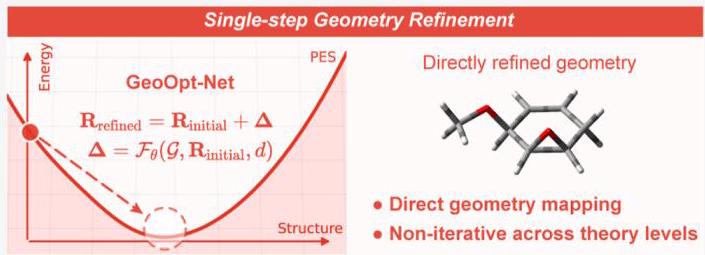
INTRODUCTION
引言
Accurate three-dimensional molecular geometries form the foundation of computational chemistry, ${}^{1,2}$ underpinning reliable predictions of reaction pathways, ${}^{3,4}$ spectroscopic signatures, ${}^{5 - 9}$ and the rational design of catalysts, ${}^{10}$ functional materials, ${}^{11}$ and drug candidates. ${}^{{12},{13}}$ At the core of these applications lies the exploration of the potential energy surface (PES), a high-dimensional hypersurface defined by the Born-Oppenheimer approximation, whose stationary points correspond to stable conformers and transition states. ${}^{14}$ Quantummechanical (QM) methods, ranging from Hartree-Fock ${\left( \mathrm{{HF}}\right) }^{{15},{16}}$ to Kohn-Sham density functional theory (DFT), ${}^{17}$ evaluate energies and forces through the self-consistent solution of the electronic Schrödinger equation, with computational cost scaling steeply with system size ${}^{18}$ (Figure 1, left).
精确的三维分子几何结构构成了计算化学的基础,${}^{1,2}$ 支撑着对反应途径的可靠预测,${}^{3,4}$ 光谱特征,${}^{5 - 9}$ 以及催化剂、${}^{10}$ 功能材料、${}^{11}$ 和候选药物的合理设计。${}^{{12},{13}}$ 这些应用的核心在于对势能面(PES)的探索,势能面是由玻恩 - 奥本海默近似定义的高维超曲面,其驻点对应于稳定构象和过渡态。${}^{14}$ 量子力学(QM)方法,从哈特里 - 福克 ${\left( \mathrm{{HF}}\right) }^{{15},{16}}$ 到科恩 - 沙姆密度泛函理论(DFT),${}^{17}$ 通过电子薛定谔方程的自洽解来评估能量和力,计算成本随系统大小急剧增加 ${}^{18}$(图1,左)。
In practical quantum-chemical workflows, hybrid density functionals combined with triple- $\zeta$ basis sets, such as B3LYP/ TZVP, are widely adopted as a balanced compromise between accuracy and computational cost. ${}^{{19} - {22}}$ Extensive benchmarks have shown that B3LYP/TZVP geometries are close to basis-set-converged structures for typical organic molecules, with residual geometric differences exerting only minor influence on relative energies, spectroscopic properties, and qualitative chemical trends. ${}^{{23},{24}}$ As a result, B3LYP/TZVP has become a de facto reference level for geometry optimization in large-scale and high-throughput DFT applications.
在实际的量子化学工作流程中,混合密度泛函与三重 $\zeta$ 基组(如B3LYP/TZVP)相结合,作为精度和计算成本之间的平衡折衷方案被广泛采用。${}^{{19} - {22}}$ 大量基准测试表明,对于典型有机分子,B3LYP/TZVP几何结构接近基组收敛结构,残余几何差异对相对能量、光谱性质和定性化学趋势的影响很小。${}^{{23},{24}}$ 因此,B3LYP/TZVP已成为大规模和高通量DFT应用中几何优化的事实上的参考水平。
In routine applications, DFT geometry optimization is rarely initiated from arbitrary coordinates. Instead, established pipelines are commonly employed to generate chemically reasonable initial structures prior to QM refinement. Classical distance-geometry approaches, exemplified by RDKit’s ETKDG sampler, ${}^{25}$ are widely used to produce force-field-level conformer ensembles. More automated workflows, such as Auto3D (ANI-2x, AIMNET), ${}^{26}$ combine conformer enumeration with machine-learned interatomic potentials and force-driven numerical optimization to identify low-energy structures. Semiempirical quantum methods, including GFN2- xTB, ${}^{27}$ further accelerate this process by providing fast preoptimized geometries at reduced computational cost. Despite their widespread use, these pipelines share a common characteristic: DFT-quality geometries are obtained only after iterative, gradient-based optimization on an explicit or implicit PES. Consequently, the computational cost and robustness of the overall workflow remain tied to the convergence behavior of numerical optimizers, motivating the search for alternative strategies that can reduce or eliminate this bottleneck.
在常规应用中,DFT几何优化很少从任意坐标开始。相反,通常采用既定的流程在量子力学优化之前生成化学上合理的初始结构。以RDKit的ETKDG采样器为例的经典距离几何方法,${}^{25}$ 被广泛用于生成力场水平的构象集。更自动化的工作流程,如Auto3D(ANI - 2x,AIMNET),${}^{26}$ 将构象枚举与机器学习的原子间势和力驱动的数值优化相结合,以识别低能量结构。半经验量子方法,包括GFN2 - xTB,${}^{27}$ 通过以降低的计算成本提供快速预优化几何结构进一步加速这一过程。尽管它们被广泛使用,但这些流程有一个共同特点:只有在对显式或隐式PES进行基于梯度的迭代优化之后才能获得DFT质量的几何结构。因此,整个工作流程的计算成本和稳健性仍然与数值优化器的收敛行为相关,这促使人们寻找可以减少或消除这一瓶颈的替代策略。
A parallel line of research has focused on molecular conformation generation directly from molecular graphs, using distance-geometry formulations, torsion-based construction, or stochastic generative modeling. Representative examples include distance-geometry-based methods such as GraphDG, ${}^{28}$ graph-conditioned refinement approaches such as CGCF, ${}^{29}$ torsion-driven construction models such as Geo-Mol, ${}^{30}$ as well as score-based, flow-based, and diffusion-based generative methods, including ConfGF, ${}^{31}$ DMCG, ${}^{32}$ and GeoDiff. ${}^{33}$ These approaches are primarily designed to sample conformational diversity or explore chemical space, rather than to serve as drop-in replacements for practical DFT geometry-optimization workflows. In particular, these approaches can yield nonphysical geometries that violate basic metric constraints or fail distance-matrix realizability, leading to premature termination or nonconvergence before any self-consistent electronic-structure or gradient evaluation is performed. Such failures preclude their direct use in standard quantum-chemical optimization workflows and are quantified in Table S1 and Table S2 of the Supporting Information.
另一项并行的研究工作专注于直接从分子图生成分子构象,使用距离几何公式、基于扭转的构建或随机生成建模。代表性的例子包括基于距离几何的方法,如GraphDG,${}^{28}$ 基于图条件细化的方法,如CGCF,${}^{29}$ 基于扭转驱动构建的模型,如Geo - Mol,${}^{30}$ 以及基于分数、流和扩散的生成方法,包括ConfGF,${}^{31}$ DMCG,${}^{32}$ 和GeoDiff。${}^{33}$ 这些方法主要旨在采样构象多样性或探索化学空间,而不是作为实际DFT几何优化工作流程的直接替代。特别是,这些方法可能会产生违反基本度量约束或无法实现距离矩阵的非物理几何结构,导致在进行任何自洽电子结构或梯度评估之前提前终止或不收敛。这种失败排除了它们在标准量子化学优化工作流程中的直接使用,并在支持信息的表S1和表S2中进行了量化。
Received: May 30, 2026
收到日期:2026年5月30日
Revised: July 1, 2026
修订日期:2026年7月1日
Accepted: July 2, 2026
接受日期:2026年7月2日
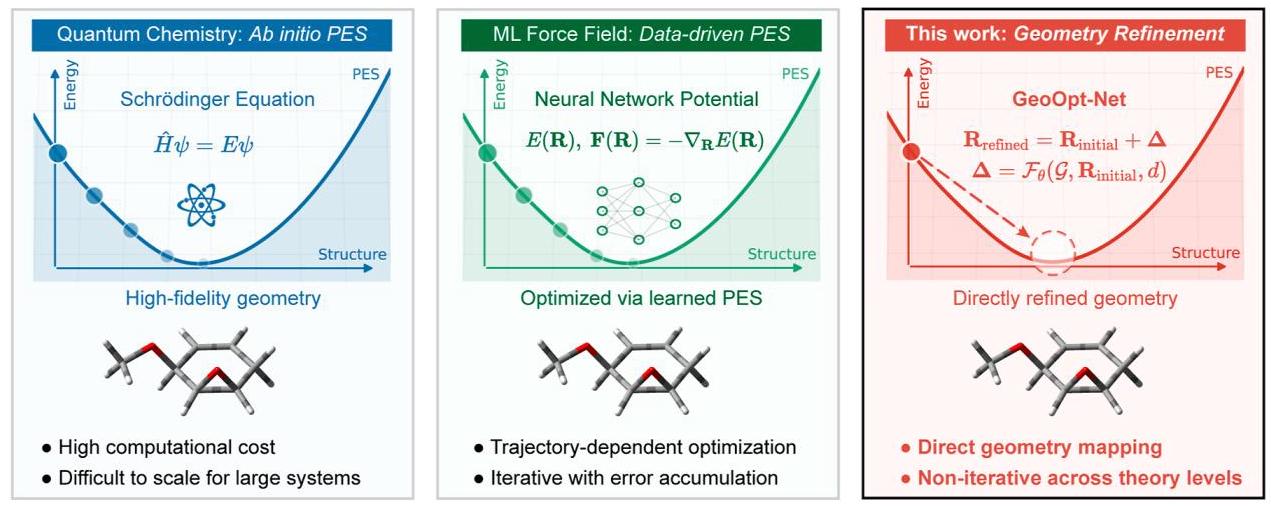
Figure 1. Conceptual comparison of geometry optimization paradigms. Left: conventional quantum-chemical optimization on an ab initio potential energy surface. Middle: iterative relaxation driven by a learned machine-learning force field. Right: GeoOpt-Net directly refines molecular geometries in a single forward pass without explicit potential energy surface construction or iterative optimization.
图1. 几何优化范式的概念比较。左:在从头算势能面上进行传统量子化学优化。中:由学习到的机器学习力场驱动的迭代松弛。右:GeoOpt - Net无需显式构建势能面或迭代优化,直接在单次前向传播中细化分子几何结构。
Another prominent strategy for accelerating geometry optimization involves machine-learned interatomic potentials (MLFFs), which learn differentiable approximations to the PES and enable rapid evaluation of energies and atomic forces. ${}^{{34} - {36}}$ Representative MLFF architectures include SchNet, ${}^{34}$ SpookyNet, ${}^{36}$ PaiNN, ${}^{37}$ DimeNet, ${}^{38}$ GemNet, ${}^{39}$ and LEFTNet, ${}^{40}$ which differ in their treatment of geometric information and target properties but share a data-driven PES paradigm, in which energies and atomic forces are learned from reference electronic-structure calculations and final geometries are obtained via force-based numerical optimization (Figure 1, middle). Recent advances, exemplified by UMA, ${}^{41}$ have demonstrated state-of-the-art accuracy by training MLFFs directly on hybrid-DFT data. Nevertheless, MLFF-based approaches fundamentally predict energies and atomic forces on a learned potential energy surface and therefore require external, iterative force-based optimization to obtain final geometries. This distinction in task definition and inference paradigm-predicting forces versus directly predicting refined coordinates-is summarized in Table S3.
另一种加速几何优化的突出策略涉及机器学习原子间势(MLFF),它学习势能面的可微近似,并能快速评估能量和原子力。${}^{{34} - {36}}$ 代表性的MLFF架构包括SchNet,${}^{34}$ SpookyNet,${}^{36}$ PaiNN,${}^{37}$ DimeNet,${}^{38}$ GemNet,${}^{39}$ 以及LEFTNet,${}^{40}$ 它们在几何信息处理和目标属性方面有所不同,但都共享数据驱动的势能面范式,即从参考电子结构计算中学习能量和原子力,并通过基于力的数值优化获得最终几何结构(图1,中间)。以UMA为例的最新进展 ${}^{41}$ 通过直接在混合密度泛函理论(hybrid-DFT)数据上训练MLFF,展示了其达到当前最优精度的能力。然而,基于MLFF的方法本质上是在学习到的势能面上预测能量和原子力,因此需要外部的、基于力的迭代优化来获得最终几何结构。任务定义和推理范式的这种差异——预测力与直接预测优化后的坐标——总结在表S3中。
Here, we introduce GeoOpt-Net, a multiscale SE(3)- equivariant geometry refinement framework designed to directly bridge low-cost initial conformers and DFT-level accuracy at the B3LYP/TZVP level of theory. In contrast to PES-based machine-learning potentials and conformer-generation models, GeoOpt-Net targets the specific task of single-shot local refinement toward DFT-converged geometries within a given conformational hypothesis. It is therefore not intended to replace conformer search or conformer selection; rather, it refines chemically reasonable force-field-level conformers into DFT-ready geometries. By explicitly decoupling bond lengths, bond angles, and dihedral torsions into dedicated equivariant graph streams and fusing them through a lightweight Transformer decoder, GeoOpt-Net predicts refined atomic coordinates in a single forward pass (Figure 1, right). To account for systematic differences across electronic-structure methods, GeoOpt-Net is trained using a two-stage, multifidelity strategy, in which transferable geometric priors are first learned from large-scale pretraining and subsequently fine-tuned to higher levels of theory via fidelity-aware feature modulation (FAFM).
在此,我们介绍GeoOpt-Net,这是一个多尺度SE(3)等变几何优化框架,旨在直接连接低成本的初始构象和理论水平为B3LYP/TZVP的DFT级精度。与基于势能面的机器学习势和构象生成模型不同,GeoOpt-Net的目标是在给定构象假设下,针对单次局部优化到DFT收敛几何结构的特定任务。因此,它并非旨在取代构象搜索或构象选择;相反,它将化学上合理的力场级构象优化为适合DFT计算的几何结构。通过将键长、键角和二面角扭转明确解耦到专用的等变图流中,并通过轻量级Transformer解码器将它们融合,GeoOpt-Net在单次前向传播中预测优化后的原子坐标(图1,右)。为了考虑不同电子结构方法之间的系统差异,GeoOpt-Net采用两阶段、多保真度策略进行训练,其中可转移的几何先验首先从大规模预训练中学习,随后通过保真度感知特征调制(FAFM)微调至更高理论水平。
By combining explicit geometric inductive biases, SE(3)- equivariance, and theory-aware fine-tuning, GeoOpt-Net addresses a critical gap in current molecular modeling pipelines: the absence of a fast, robust, and physically grounded route to DFT-ready geometries at the B3LYP/ TZVP level, a widely adopted accuracy-cost balance for organic and drug-like molecules, without iterative quantummechanical optimization. Beyond accuracy gains, GeoOpt-Net reshapes the role of machine learning in quantum chemistry by transforming local geometry refinement from a costly iterative procedure into a deterministic, single-step prediction problem, enabling scalable and reproducible quantum-chemical work-flows targeting DFT-level accuracy for large molecular systems and high-throughput applications.
通过结合显式几何归纳偏差、SE(3)等变性和理论感知微调,GeoOpt-Net填补了当前分子建模流程中的一个关键空白:在B3LYP/TZVP水平上,缺乏一条快速、稳健且基于物理的通往适合DFT计算的几何结构的途径,而这是有机和类药物分子广泛采用的精度-成本平衡,且无需迭代量子力学优化。除了提高精度外,GeoOpt-Net还通过将局部几何优化从昂贵的迭代过程转变为确定性的单步预测问题,重塑了机器学习在量子化学中的作用,从而实现了针对大分子系统和高通量应用的、以DFT级精度为目标的可扩展且可重复的量子化学工作流程。
DATA SETS AND COMPUTATIONAL DETAILS
数据集与计算细节
Data Sets
数据集
GeoOpt-Net was trained, fine-tuned, and evaluated using multiple quantum-chemical data sets spanning increasing molecular size, elemental diversity, and theoretical levels.
GeoOpt-Net使用了多个量子化学数据集进行训练、微调及评估,这些数据集涵盖了不断增加的分子大小、元素多样性和理论水平。
Pretraining Data Sets
预训练数据集
The initial pretraining of GeoOpt-Net was performed jointly on the QM9 and QM40 data sets. QM9 ${}^{42}$ comprises approximately 130k small organic molecules containing up to nine heavy atoms $\left( {\mathrm{C},\mathrm{N},\mathrm{O}\text{ , and }\mathrm{F}}\right)$ , while QM ${40}^{43}$ extends the chemical space to larger and more drug-like systems, covering 160k molecules with elements commonly found in pharmaceutical compounds (C, N, O, S, F, and Cl), representing approximately 88% of the FDA-approved drug chemical space. Together, these two data sets provide a combined training corpus of approximately 290k molecules spanning a broad range of molecular sizes and compositions. All molecular geometries and associated quantum-mechanical properties in both QM9 and QM40 were computed consistently at the B3LYP/6-31G(2df, p) level of theory, ensuring a uniform theoretical framework during the pretraining stage.
GeoOpt-Net的初始预训练是在QM9和QM40数据集上联合进行的。QM9 ${}^{42}$ 包含约13万个含有多达九个重原子 $\left( {\mathrm{C},\mathrm{N},\mathrm{O}\text{ , and }\mathrm{F}}\right)$ 的小有机分子,而QM ${40}^{43}$ 将化学空间扩展到更大且更类似药物的系统,涵盖16万个含有药物化合物中常见元素(C、N、O、S、F和Cl)的分子,占FDA批准药物化学空间的约88%。这两个数据集共同提供了一个约29万个分子的组合训练语料库,涵盖了广泛的分子大小和组成范围。QM9和QM40中的所有分子几何结构和相关量子力学性质均在B3LYP/6-31G(2df, p)理论水平上一致计算,确保了预训练阶段的统一理论框架。
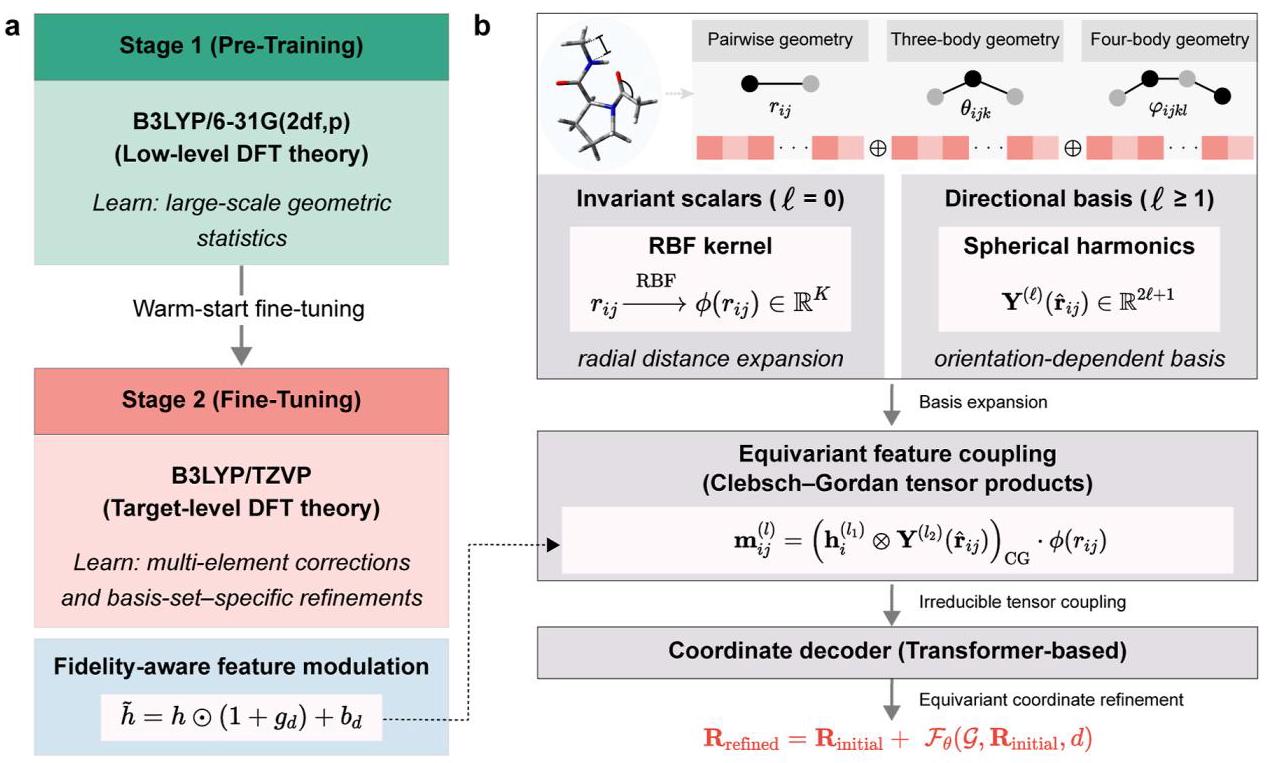
Figure 2. Two-stage training and SE(3)-equivariant geometric framework of GeoOpt-Net. (a) Two-stage training across quantum-chemical fidelity levels. The model is pretrained on large-scale geometries at the B3LYP/6-31G(2df, p) level and subsequently fine-tuned on target-level B3LYP/ TZVP data using a warm-start strategy with the fidelity-aware feature modulation (FAFM) mechanism. (b) SE(3)-equivariant geometric encoding and coordinate refinement. Pairwise distances $\left( {r}_{ij}\right)$ , bond angles $\left( {\theta }_{ijk}\right)$ , and dihedral angles $\left( {\varphi }_{ijkl}\right)$ are encoded as invariant scalar features $\left( {l = 0}\right)$ via radial basis functions and as directional features $\left( {l \geq 1}\right)$ via spherical harmonics. Equivariant features are coupled through Clebsch-Gordan tensor products and decoded by a transformer-based module to produce SE(3)-equivariant coordinate updates.
图2. GeoOpt-Net的两阶段训练和SE(3)等变几何框架。(a) 跨量子化学保真度水平的两阶段训练。该模型在B3LYP/6-31G(2df, p)水平的大规模几何结构上进行预训练,随后使用具有保真度感知特征调制(FAFM)机制的热启动策略在目标水平的B3LYP/TZVP数据上进行微调。(b) SE(3)等变几何编码和坐标细化。成对距离 $\left( {r}_{ij}\right)$、键角 $\left( {\theta }_{ijk}\right)$ 和二面角 $\left( {\varphi }_{ijkl}\right)$ 通过径向基函数编码为不变标量特征 $\left( {l = 0}\right)$,并通过球谐函数编码为方向特征 $\left( {l \geq 1}\right)$。等变特征通过克莱布施 - 戈尔丹张量积耦合,并由基于变压器的模块解码以产生SE(3)等变坐标更新。
Fine-Tuning Data Set
微调数据集
Model fine-tuning was performed using the QMe14S data set, which consists of 180k small organic molecules featuring substantially increased elemental and functional-group diversity. QMe ${14}{\mathrm{\;S}}^{22}$ includes 14 elements (H, B, C, N, O, F, Al, Si, P, S, Cl, As, Se, and Br) and spans 47 functional groups. All molecular geometries in QMe14S were obtained from density functional theory calculations at the B3LYP/TZVP level, enabling GeoOpt-Net to adapt to a higher basis set accuracy and broader chemical environments.
使用QMe14S数据集进行模型微调,该数据集由18万个小有机分子组成,其元素和官能团多样性显著增加。QMe ${14}{\mathrm{\;S}}^{22}$ 包括14种元素(H、B、C、N、O、F、Al、Si、P、S、Cl、As、Se和Br),涵盖47个官能团。QMe14S中的所有分子几何结构均通过B3LYP/TZVP水平的密度泛函理论计算获得,使GeoOpt-Net能够适应更高的基组精度和更广泛的化学环境。
External Validation Data Set
外部验证数据集
To further assess extrapolation performance beyond both the training and fine-tuning domains, an additional validation set was constructed from the ZINC20 database. ${}^{44}$ From the $\sim 1\mathrm{\;B}$ “ZINC20” collection, 1000 molecules were selected based on combined constraints on heavy-atom count and rotatable-bond count, ensuring coverage of larger and more conformationally flexible compounds not present in the QM9, QM40, or QMe14S data sets. These molecules provide a stringent test of GeoOpt-Net under realistic, drug-like structural complexity. To improve reproducibility, the exact SMILES list used for the external evaluation is provided as data/selected_zin-c20_external_set.txt, and the corresponding filtering script is provided as scripts/select_zin-c20_external_set.py in the public repository.
为了进一步评估在训练和微调域之外的外推性能,从ZINC20数据库构建了一个额外的验证集。${}^{44}$ 从 $\sim 1\mathrm{\;B}$ “ZINC20” 集合中,根据对重原子数和可旋转键数的组合约束选择了1000个分子,确保覆盖QM9、QM40或QMe14S数据集中不存在的更大且构象更灵活的化合物。这些分子在实际的、类似药物的结构复杂性下对GeoOpt-Net进行了严格测试。为了提高可重复性,用于外部评估的精确SMILES列表作为data/selected_zin-c20_external_set.txt提供,相应的过滤脚本作为公共存储库中的scripts/select_zin-c20_external_set.py提供。
Detailed statistics of data set splits, along with distributions of heavy-atom counts, rotatable-bond counts, and elemental compositions, are reported in Figures S1-S3 of the Supporting Information.
数据集划分的详细统计信息,以及重原子数、可旋转键数和元素组成的分布,在支持信息的图S1-S3中报告。
Reference Geometry Computations
参考几何结构计算
Initial 3D structures for all molecules were generated via RDKit’s ETKDG algorithm ${}^{25}$ and preoptimized with the MMFF94 force field. ${}^{45}$
所有分子的初始三维结构通过RDKit的ETKDG算法${}^{25}$生成,并用MMFF94力场进行预优化。${}^{45}$
External “ZINC20” test sets: final reference geometries and single-point energies were computed at the B3LYP/ TZVP level using Gaussian 16 software, with default convergence settings.
外部“ZINC20”测试集:使用Gaussian 16软件在B3LYP/TZVP水平上计算最终参考几何结构和单点能量,采用默认收敛设置。
Data Preprocessing
数据预处理
Coordinates were centered and standardized (zero mean, unit variance per axis) before the model input. Atom types were one-hot encoded; bond adjacency and angular/dihedral graphs were constructed via RDKit v2024.03.5. Data set splits follow an 80:10:10 train/val/test ratio stratified by heavy-atom count; external sets are used only for final evaluation.
在模型输入之前,对坐标进行了中心化和标准化处理(零均值,每个轴的单位方差)。原子类型进行了独热编码;通过RDKit v2024.03.5构建了键邻接图和角/二面角图。数据集划分按照重原子数分层,训练/验证/测试比例为80:10:10;外部集仅用于最终评估。
Inference and Evaluation Protocol
推理与评估协议
During inference, GeoOpt-Net receives the molecular graph $G$ and the initial Cartesian coordinates ${\mathrm{R}}^{\left( 0\right) }$ . With a frozen checkpoint ${\theta }^{ * }$ , the refined geometry is generated as
在推理过程中,GeoOpt-Net接收分子图$G$和初始笛卡尔坐标${\mathrm{R}}^{\left( 0\right) }$。使用冻结的检查点${\theta }^{ * }$,生成优化后的几何结构如下
$$ \widehat{\mathbf{R}} = {f}_{{\theta }^{ * }}\left( {G,{\mathbf{R}}^{\left( 0\right) }}\right) \tag{1} $$For structural evaluation, the predicted coordinates $\widehat{\mathbf{R}}$ are compared with the corresponding DFT-optimized reference geometry ${\mathrm{R}}^{\mathrm{{DFT}}}$ after Kabsch alignment eq 4
为了进行结构评估,将预测坐标$\widehat{\mathbf{R}}$与经过Kabsch对齐(公式4)后的相应DFT优化参考几何结构${\mathrm{R}}^{\mathrm{{DFT}}}$进行比较
$$ \mathrm{{RMSD}} = {\operatorname{RMSD}}_{\text{ Kabsch }}\left( {\widehat{\mathbf{R}},{\mathbf{R}}^{\mathrm{{DFT}}}}\right) \tag{2} $$Kabsch-aligned RMSD values can be computed using scripts/compute aligned rmsd.py, which reads XYZ files, preserves atom ordering, checks atom counts and element ordering, and supports both single-pair and batch evaluations.
可以使用脚本/compute_aligned_rmsd.py计算Kabsch对齐后的RMSD值,该脚本读取XYZ文件,保留原子顺序,检查原子数和元素顺序,并支持单对和批量评估。
IR RESULTS AND DISCUSSION
红外结果与讨论
Training Protocol and Model Architecture
训练协议与模型架构
GeoOpt-Net is a single-pass, SE(3)-equivariant geometry refinement model trained under a two-stage, multifidelity protocol (Figure 2). The framework integrates transferable geometric pretraining with equivariant coordinate decoding to achieve target-level quantum-chemical accuracy in a single forward pass.
GeoOpt-Net是一个单步、SE(3)等变的几何优化模型,在两阶段多保真度协议下进行训练(图2)。该框架将可转移的几何预训练与等变坐标解码相结合,以在单次前向传播中实现目标级别的量子化学精度。
Two-Stage Multifidelity Training
两阶段多保真度训练
As illustrated in Figure 2a, GeoOpt-Net is trained using a two-stage strategy across quantum-chemical fidelity levels. In stage 1, the network is pretrained on large-scale data sets computed at a lower level of theory (B3LYP/6-31G(2df, p)) to learn transferable geometric priors that capture generic bonding patterns, angular preferences, and torsional statistics. In stage 2, the pretrained weights are warm-started and fine-tuned on target-level B3LYP/TZVP data, enabling systematic correction of element- and basis-set-dependent deviations while preserving the global geometric structure learned during pretraining.
如图2a所示,GeoOpt-Net使用跨量子化学保真度水平的两阶段策略进行训练。在第一阶段,网络在较低理论水平(B3LYP/6-31G(2df, p))计算的大规模数据集上进行预训练,以学习可转移的几何先验知识,这些知识捕捉了通用的键合模式、角度偏好和扭转统计信息。在第二阶段,预训练的权重被热启动并在目标水平的B3LYP/TZVP数据上进行微调,从而在保留预训练期间学习到的全局几何结构的同时,系统地校正与元素和基组相关的偏差。
To condition geometric refinement on the target theoretical level, we introduce a fidelity-aware feature modulation (FAFM) mechanism
为了在目标理论水平上进行几何细化,我们引入了一种保真度感知特征调制(FAFM)机制
$$ \widetilde{\mathbf{h}} = \mathbf{h} \odot \left( {1 + {\mathbf{g}}_{d}}\right) + {\mathbf{b}}_{d} \tag{3} $$where ${\mathrm{g}}_{d}$ and ${\mathrm{b}}_{d}$ are learned scale and shift parameters derived from a domain embedding $d$ . This mechanism enables theory-specific geometric calibration without retraining the entire network, facilitating efficient transfer across quantum-chemical levels.
其中${\mathrm{g}}_{d}$和${\mathrm{b}}_{d}$是从域嵌入$d$导出的学习到的缩放和平移参数。这种机制能够在不重新训练整个网络的情况下进行特定于理论的几何校准,有助于在量子化学水平之间进行高效转移。
SE(3)-Equivariant Geometric Architecture
SE(3)等变几何架构
The SE(3)-equivariant model architecture is shown in Figure 2b. Starting from an RDKit ETKDG v3 + MMFF94 conformer, atomic Cartesian coordinates are projected into a 256-dimensional latent space using a linear embedding followed by LayerNorm and GELU activation. ${}^{46}$
SE(3)等变模型架构如图2b所示。从RDKit ETKDG v3 + MMFF94构象异构体开始,原子笛卡尔坐标通过线性嵌入投影到256维潜在空间,随后进行层归一化和GELU激活。${}^{46}$
Molecular geometry is decomposed into three complementary equivariant streams corresponding to pairwise distances ${r}_{ij}$ , three-body bond angles ${\theta }_{ijk}$ , and four-body dihedral torsions ${\varphi }_{ijkl}$ . Scalar geometric features $\left( {l = 0}\right)$ are encoded via radial basis expansions $\phi \left( {r}_{ij}\right)$ , while directional information $\left( {l \geq 1}\right)$ is represented using real spherical harmonics ${Y}^{\left( l\right) }\left( {\widehat{\mathbf{r}}}_{ij}\right)$ .
分子几何结构被分解为三个互补的等变流,分别对应成对距离${r}_{ij}$、三体键角${\theta }_{ijk}$和四体二面角扭转${\varphi }_{ijkl}$。标量几何特征$\left( {l = 0}\right)$通过径向基展开$\phi \left( {r}_{ij}\right)$进行编码,而方向信息$\left( {l \geq 1}\right)$则使用实球谐函数${Y}^{\left( l\right) }\left( {\widehat{\mathbf{r}}}_{ij}\right)$表示。
Equivariant message passing is performed via Clebsch-Gordan tensor products ${}^{47}$
通过克莱布什 - 戈尔丹张量积${}^{47}$执行等变消息传递
$$ {\mathbf{m}}_{ij}^{\left( l\right) } = {\left( {\mathbf{h}}_{i}^{\left( {l}_{1}\right) } \otimes {Y}^{\left( {l}_{2}\right) }\left( {\widehat{\mathbf{r}}}_{ij}\right) \right) }_{\mathrm{{CG}}} \cdot \phi \left( {r}_{ij}\right) \tag{4} $$which guarantees exact SE(3) equivariance by construction. Nonlinear activations are applied exclusively to scalar channels, whereas vector channels undergo only learned linear updates and gated residual additions, following established equivariant architectures. ${}^{{37},{48} - {51}}$
这通过构造保证了精确的SE(3)等变性。按照既定的等变架构,非线性激活仅应用于标量通道,而向量通道仅经历学习到的线性更新和门控残差加法。${}^{{37},{48} - {51}}$
The fused equivariant representation is decoded by a lightweight transformer-based module to predict an equivariant coordinate refinement
融合的等变表示由一个基于轻量级变压器的模块解码,以预测等变坐标细化
$$ {\mathbf{R}}_{\text{ refined }} = {\mathbf{R}}_{\text{ initial }} + {\mathcal{F}}_{\theta }\left( {\mathcal{G},{\mathbf{R}}_{\text{ initial }}, d}\right) \tag{5} $$yielding refined atomic coordinates that are invariant to global translations and equivariant under rotations.
产生对全局平移不变且在旋转下等变的细化原子坐标。
Equivariance Verification
等变性验证
To empirically validate SE(3) equivariance, we applied random global rotations and translations to 1000 test structures and compared the predicted coordinates under “rotate-then-predict” and “predict-then-rotate” protocols. The maximum deviation between the two procedures remained below ${1.1} \times \; {10}^{-4}\text{ Å }$ , with a mean deviation of ${3.262} \times {10}^{-5}\text{ Å }$ , confirming numerical SE(3) equivariance within floating-point precision (see Figure S4).
为了通过实验验证SE(3)等变性,我们对1000个测试结构应用了随机全局旋转和平移,并比较了“先旋转后预测”和“先预测后旋转”协议下预测的坐标。两个过程之间的最大偏差保持在${1.1} \times \; {10}^{-4}\text{ Å }$以下,平均偏差为${3.262} \times {10}^{-5}\text{ Å }$,这证实了在浮点精度内的数值SE(3)等变性(见图S4)。
Training Objective
训练目标
Model optimization minimizes a composite geometry-aware loss that jointly constrains global and local structural accuracy relative to the DFT-optimized training target. Specifically, the loss includes a global RMSD penalty on Cartesian coordinates $\left( {L}_{\text{ rmsd }}\right)$ , mean-squared-error losses on bond lengths, bond angles, and dihedral torsions $\left( {L}_{\text{ bond }}\right.$ , $\left. {{L}_{\text{ angle }},{L}_{\text{ dihedral }}}\right)$ , as well as a soft bond-length range constraint $\left( {L}_{\text{ bond range }}\right)$ to suppress unphysical distortions. The DFT-optimized coordinates are used only as supervised targets for these loss terms during training and are not required during inference. All loss definitions, weights, and ablation analyses are provided in Tables S4-S6.
模型优化旨在最小化一个综合的几何感知损失,该损失联合约束相对于DFT优化训练目标的全局和局部结构精度。具体而言,损失包括对笛卡尔坐标$\left( {L}_{\text{ rmsd }}\right)$的全局RMSD惩罚、对键长、键角和二面角扭转$\left( {L}_{\text{ bond }}\right.$、$\left. {{L}_{\text{ angle }},{L}_{\text{ dihedral }}}\right)$的均方误差损失,以及一个软键长范围约束$\left( {L}_{\text{ bond range }}\right)$以抑制非物理扭曲。DFT优化坐标仅在训练期间用作这些损失项的监督目标,推理期间不需要。所有损失定义、权重和消融分析在表S4 - S6中提供。
Training is performed using AdamW (initial learning rate 1 $\times {10}^{-3}$ , weight decay $1 \times {10}^{-5}$ ), with learning-rate decay at epochs 50 and 75 and gradient clipping on mini-batches of 32 molecules. This training protocol achieves submilli-Å accuracy in a single forward pass while preserving strict SE(3) equivariance.
使用AdamW(初始学习率1$\times {10}^{-3}$,权重衰减$1 \times {10}^{-5}$)进行训练,在第50和75个epoch时进行学习率衰减,并对32个分子的小批量进行梯度裁剪。此训练协议在单次前向传播中实现了亚毫埃精度,同时保持严格的SE(3)等变性。
Such a multibranch geometric design is critical. Bond-only models neglect angular and torsional constraints, angle-only models miss long-range torsional flexibility, and point-cloud approaches treat atoms as orderless, discarding chemical connectivity. ${}^{{30} - {33},{52}}$ In contrast, GeoOpt-Net explicitly models pairwise, three-body, and four-body geometric interactions, ensuring that each atomic representation encodes its full local coordination environment and thereby enhancing robustness and transferability across diverse chemical families.
这样的多分支几何设计至关重要。仅键模型忽略角度和扭转约束,仅角度模型错过远程扭转灵活性,点云方法将原子视为无序的,丢弃化学连接性。${}^{{30} - {33},{52}}$相比之下,GeoOpt-Net明确地对成对、三体和四体几何相互作用进行建模,确保每个原子表示编码其完整的局部配位环境,从而增强跨不同化学家族的鲁棒性和可转移性。
Geometric and Energetic Fidelity Relative to DFT References
相对于DFT参考的几何和能量保真度
We benchmark GeoOpt-Net against representative structure-generation paradigms, including classical conformer construction (RDKit), semiempirical quantum methods (GFN2-xTB), and neural interatomic potentials trained at the B3LYP/TZVP level of theory (SchNet@TZVP, PaiNN@TZVP, and UMA@ TZVP). To eliminate cross-theory discrepancies, all neural baselines are trained or fine-tuned using identical B3LYP/ TZVP geometries, energy data, and data set splits. SchNet@ TZVP and PaiNN@TZVP are trained from scratch, whereas UMA@TZVP is obtained via fine-tuning of a pretrained equivariant model. Detailed training configurations are provided in Tables S7-S10.
我们将GeoOpt-Net与代表性的结构生成范式进行基准测试,包括经典构象体构建(RDKit)、半经验量子方法(GFN2-xTB)以及在B3LYP/TZVP理论水平下训练的神经原子间势(SchNet@TZVP、PaiNN@TZVP和UMA@TZVP)。为了消除跨理论差异,所有神经基线均使用相同的B3LYP/TZVP几何结构、能量数据和数据集划分进行训练或微调。SchNet@TZVP和PaiNN@TZVP是从头开始训练的,而UMA@TZVP是通过对预训练均匀模型进行微调获得的。详细的训练配置在表S7 - S10中提供。
Table 1. Representative Examples Comparing Optimized Molecular Geometries ${}^{a}$
表1. 比较优化分子几何结构的代表性示例${}^{a}$
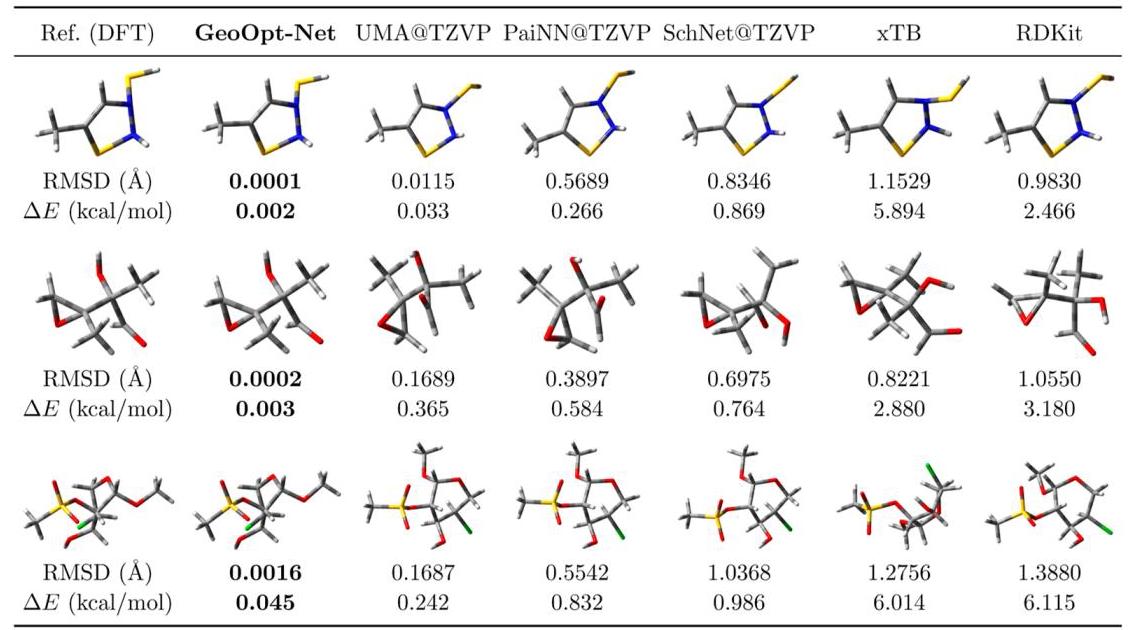
${}^{a}$ RMSD values are computed with respect to the DFT reference structures after Kabsch alignment, and ${\Delta E}$ denotes the single-point energy difference at the B3LYP/TZVP level of theory.
${}^{a}$ RMSD值是在Kabsch对齐后相对于DFT参考结构计算的,${\Delta E}$表示在B3LYP/TZVP理论水平下的单点能量差。
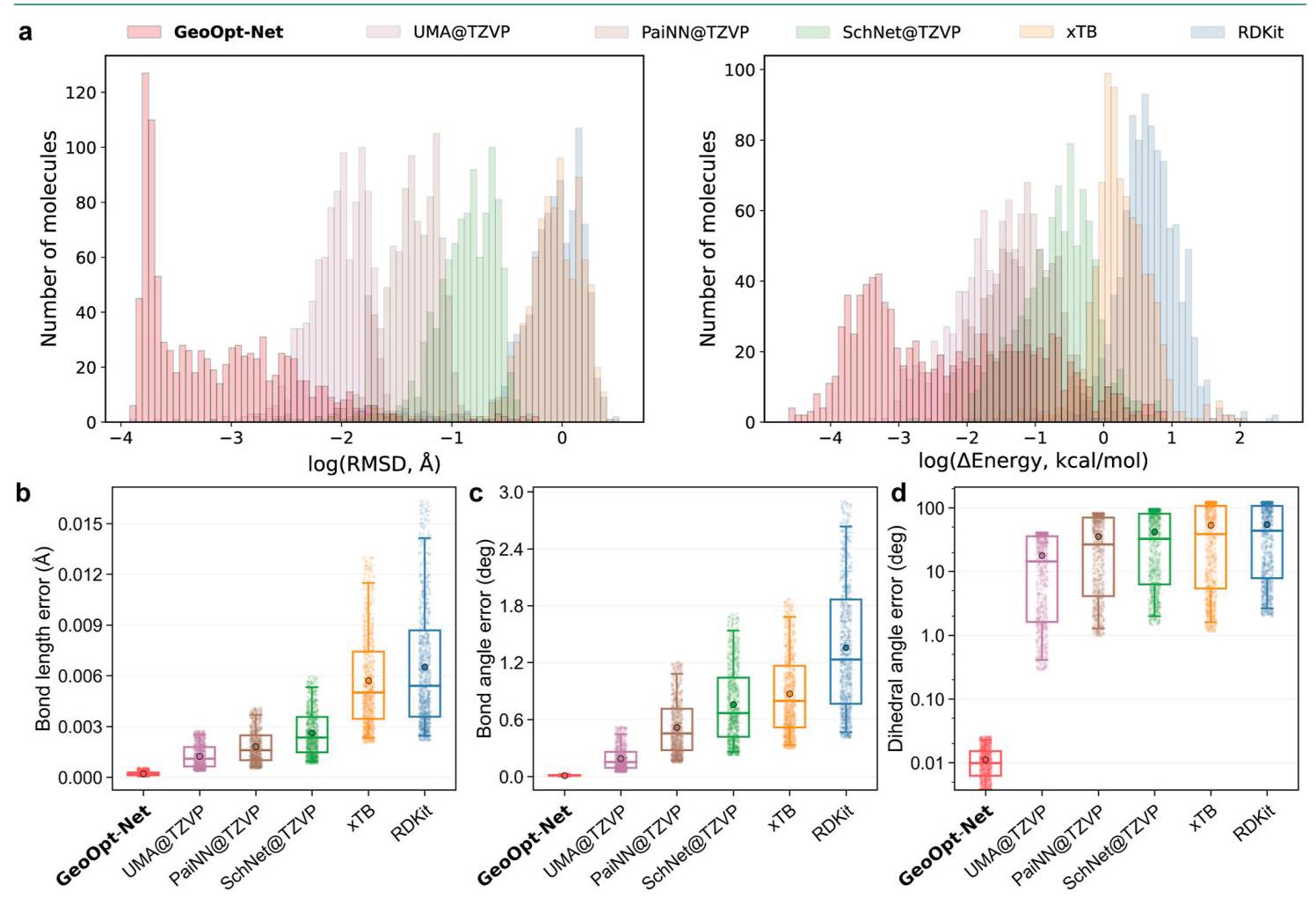
Figure 3. Benchmarking geometric and energetic fidelity relative to B3LYP/TZVP references. (a) Logarithmic distributions of all-atom RMSD values and B3LYP/TZVP single-point energy deviations ( ${\Delta E}$ ) with respect to DFT-optimized geometries. Decomposition of geometric errors into (b) bond length, (c) bond angle, and (d) dihedral angle deviations, evaluated relative to B3LYP/TZVP reference structures.
图3. 相对于B3LYP/TZVP参考的几何和能量保真度基准测试。(a) 相对于DFT优化几何结构的所有原子RMSD值和B3LYP/TZVP单点能量偏差(${\Delta E}$)的对数分布。将几何误差分解为(b) 键长、(c) 键角和(d) 二面角偏差,相对于B3LYP/TZVP参考结构进行评估。
Importantly, these methods differ not only in architecture but also in inference paradigm, as summarized in Table S3. RDKit and GFN2-xTB obtain geometries through classical or semiempirical iterative relaxation, while SchNet@TZVP, PaiNN@TZVP, and UMA@TZVP predict energies and/or forces that require an external optimizer. By contrast, GeoOpt-Net directly maps $G$ and ${\mathrm{R}}^{\left( 0\right) }$ to $\widehat{\mathbf{R}}$ in a single forward pass, without external iterative geometry optimization. The inference script is provided in the public repository, and additional checks on the inference workflow are summarized in Table S11.
重要的是,这些方法不仅在架构上不同,而且在推理范式上也不同,如表S3总结的那样。RDKit和GFN2-xTB通过经典或半经验迭代松弛获得几何结构,而SchNet@TZVP、PaiNN@TZVP和UMA@TZVP预测需要外部优化器的能量和/或力。相比之下,GeoOpt-Net在单次前向传递中直接将$G$和${\mathrm{R}}^{\left( 0\right) }$映射到$\widehat{\mathbf{R}}$,无需外部迭代几何优化。推理脚本在公共存储库中提供,推理工作流程的其他检查总结在表S11中。
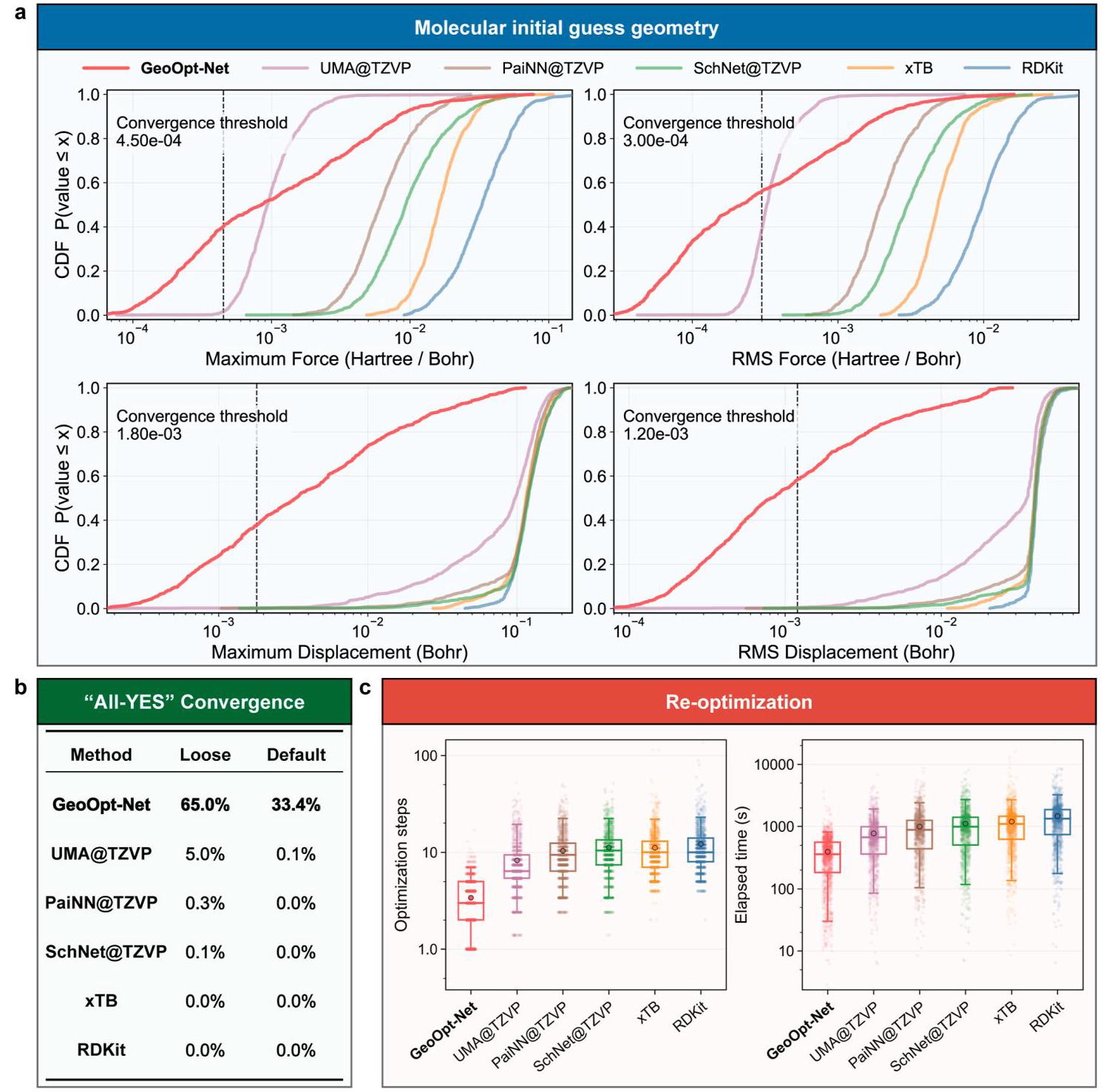
Figure 4. Quality of molecular initial guess geometries and impact on DFT convergence. (a) Cumulative distribution functions (CDFs) of four DFT geometry-optimization convergence quantities: maximum force, RMS force, maximum displacement, and RMS displacement. Dashed lines indicate the corresponding DFT geometry optimization convergence thresholds. (b) “All-YES” convergence rates, defined as the fraction of molecules simultaneously satisfying all four convergence criteria under loose and default thresholds. (c) DFT reoptimization performance starting from different initial geometries, quantified by the number of optimization steps (left) and total elapsed wall-clock time (right).
图4. 分子初始猜测几何结构的质量及其对DFT收敛的影响。(a) 四个DFT几何结构优化收敛量的累积分布函数(CDF):最大力、RMS力、最大位移和RMS位移。虚线表示相应的DFT几何结构优化收敛阈值。(b) “全是”收敛率,定义为在宽松和默认阈值下同时满足所有四个收敛标准的分子比例。(c) 从不同初始几何结构开始的DFT重新优化性能,通过优化步骤数(左)和总经过的挂钟时间(右)进行量化。
Representative comparisons are summarized in Table 1. Across all cases, GeoOpt-Net reproduces the reference geometries with submilli-Å RMSD values and near-zero single-point energy deviations. Additional per-molecule RMSD examples using the same Kabsch alignment protocol are provided in Table S12. In contrast, the baseline methods exhibit progressively increasing structural distortions. Among the neural potentials trained at identical theory level, UMA@ TZVP achieves RMSD values predominantly in the ${10}^{-3} - {10}^{-2}$ Å regime, PaiNN@TZVP concentrates in the ${10}^{-2} - {10}^{-1}$ Å range, and SchNet@TZVP shifts further toward larger deviations. These differences are accompanied by systematic increases in energy errors, indicating that even modest geometric distortions translate into measurable energetic discrepancies.
代表性比较总结在表1中。在所有情况下,GeoOpt-Net以亚毫埃的RMSD值和接近零的单点能量偏差再现参考几何结构。表S12中提供了使用相同Kabsch对齐协议的其他每个分子的RMSD示例。相比之下,基线方法表现出逐渐增加的结构扭曲。在相同理论水平下训练的神经势中,UMA@TZVP的RMSD值主要在${10}^{-3} - {10}^{-2}$ Å范围内,PaiNN@TZVP集中在${10}^{-2} - {10}^{-1}$ Å范围内,而SchNet@TZVP则向更大偏差方向移动。这些差异伴随着能量误差的系统性增加,表明即使是适度的几何扭曲也会转化为可测量的能量差异。
The full statistical distributions are shown in Figure 3a. To make the distribution-level comparison more explicit, percentile-level RMSD statistics, including ${Q}_{5},{Q}_{25},{Q}_{50},{Q}_{75}$ , ${Q}_{90},{Q}_{95},{Q}_{99}$ , and the mean, are provided in Table S13. GeoOpt-Net yields a sharply peaked RMSD distribution centered at $\log \left( \mathrm{{RMSD}}\right) \approx - 4$ , corresponding to sub-0.001 Å accuracy for the vast majority of molecules. In contrast, all baseline methods exhibit substantially broader distributions shifted toward larger deviations, even when trained or fine-tuned at the identical B3LYP/TZVP level of theory. A similar ordering is observed for single-point energy deviations: GeoOpt-Net remains tightly concentrated near zero, whereas neural interatomic potentials and semiempirical or rule-based methods display progressively wider spreads extending into the subkcal ${\mathrm{{mol}}}^{-1}$ and multikcal ${\mathrm{{mol}}}^{-1}$ regimes. The strong geometric-energetic correspondence indicates that the energetic fidelity of GeoOpt-Net originates from accurate structural refinement rather than explicit energy fitting (see Figure S5 for correlation analysis).
完整的统计分布如图3a所示。为了使分布级别的比较更加明确,表S13中提供了百分位数级别的RMSD统计数据,包括${Q}_{5},{Q}_{25},{Q}_{50},{Q}_{75}$、${Q}_{90},{Q}_{95},{Q}_{99}$和平均值。GeoOpt-Net产生了一个以$\log \left( \mathrm{{RMSD}}\right) \approx - 4$为中心的尖锐峰值RMSD分布,这对应于绝大多数分子的亚0.001 Å精度。相比之下,所有基线方法都表现出明显更宽的分布,且向更大的偏差偏移,即使在相同的B3LYP/TZVP理论水平上进行训练或微调也是如此。对于单点能量偏差也观察到类似的排序:GeoOpt-Net仍然紧密集中在零附近,而神经原子间势以及半经验或基于规则的方法则显示出逐渐变宽的分布,延伸到亚千卡${\mathrm{{mol}}}^{-1}$和多千卡${\mathrm{{mol}}}^{-1}$范围。强烈的几何-能量对应关系表明,GeoOpt-Net的能量保真度源于精确的结构优化,而不是显式的能量拟合(相关分析见图S5)。
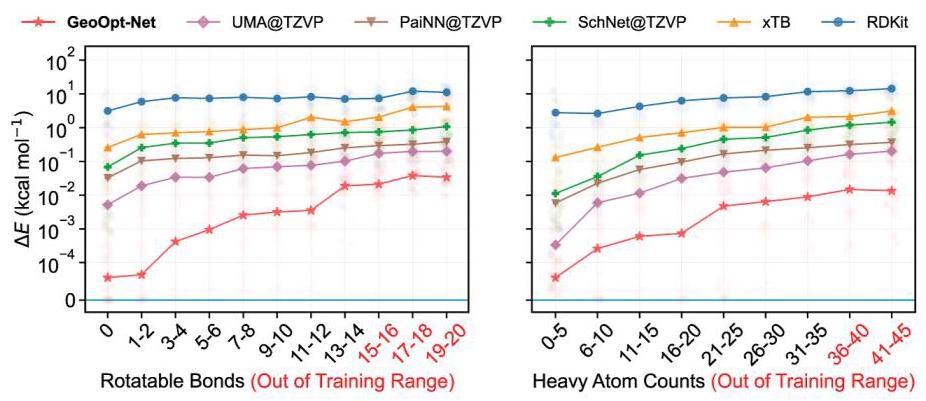
Figure 5. Energy scaling with molecular complexity. DFT single-point energy deviations ( ${\Delta E}$ , B3LYP/TZVP) evaluated as a function of molecular complexity, quantified by the number of rotatable bonds (left) and heavy atom counts (right), for different molecular geometry initialization approaches.
图5. 能量随分子复杂性的缩放。针对不同的分子几何初始化方法,将DFT单点能量偏差(${\Delta E}$,B3LYP/TZVP)评估为分子复杂性的函数,分子复杂性由可旋转键的数量(左)和重原子数(右)量化。
To further elucidate the origin of these improvements, Figure 3b-d decomposes the geometric errors into bond length, bond angle, and dihedral angle components. GeoOpt-Net achieves near-numerical-precision bond lengths, subdegree bond angle errors, and dihedral angle errors reduced by one to 2 orders of magnitude relative to all baseline methods. Additional bond-length diagnostics on CO, including refinement from RDKit/MMFF-generated coordinates and diagnostic short- and long-bond perturbations, are provided in Table S14. The pronounced reduction in torsional errors is particularly significant, as dihedral distortions are a dominant source of conformational and energetic inaccuracies in flexible molecules. The most pronounced separation appears in torsional degrees of freedom: dihedral errors for SchNet@ TZVP and PaiNN@TZVP commonly span the ${10}^{ \circ }$ scale, whereas UMA@TZVP narrows this distribution, and GeoOpt-Net reduces torsional deviations by one to 2 orders of magnitude relative to all baselines.
为了进一步阐明这些改进的来源,图3b - d将几何误差分解为键长、键角和二面角分量。相对于所有基线方法,GeoOpt-Net实现了接近数值精度的键长、亚度的键角误差以及减少了一到两个数量级的二面角误差。表S14中提供了关于CO的额外键长诊断,包括从RDKit/MMFF生成的坐标进行的优化以及诊断性的短键和长键扰动。扭转误差的显著降低尤为重要,因为二面角扭曲是柔性分子中构象和能量不准确的主要来源。最明显的差异出现在扭转自由度上:SchNet@TZVP和PaiNN@TZVP的二面角误差通常跨越${10}^{ \circ }$尺度,而UMA@TZVP缩小了这个分布,并且相对于所有基线,GeoOpt-Net将扭转偏差减少了一到两个数量级。
Collectively, these results demonstrate that even when trained at an identical DFT level and under matched data conditions, existing neural interatomic potentials exhibit nontrivial geometric drift. GeoOpt-Net, by contrast, performs deterministic single-step refinement that preserves fine-grained internal coordinates at DFT fidelity, yielding consistent improvements across bond, angular, and torsional degrees of freedom.
总体而言,这些结果表明,即使在相同的DFT水平下训练并在匹配的数据条件下,现有的神经原子间势也表现出明显的几何漂移。相比之下,GeoOpt-Net执行确定性的单步优化,在DFT保真度下保留细粒度的内部坐标,在键、角度和扭转自由度上都产生了一致的改进。
Impact of Initial Geometry Quality on DFT Convergence Efficiency
初始几何结构质量对DFT收敛效率的影响
We assess the practical utility of initial guess geometries produced by GeoOpt-Net and baseline methods (UMA@ TZVP, PaiNN@TZVP, SchNet@TZVP, GFN2-xTB, and RDKit) by directly measuring how close these structures are to standard B3LYP/TZVP geometry optimization convergence conditions. We consider four quantities used in routine DFT optimizations: the maximum force, RMS force, maximum displacement, and RMS displacement.
我们通过直接测量这些结构与标准B3LYP/TZVP几何优化收敛条件的接近程度,评估了GeoOpt-Net和基线方法(UMA@TZVP、PaiNN@TZVP、SchNet@TZVP、GFN2-xTB和RDKit)生成的初始猜测几何结构的实际效用。我们考虑了常规DFT优化中使用的四个量:最大力、均方根力、最大位移和均方根位移。
Figure 4a reports the cumulative distribution functions (CDFs) for these four metrics, where dashed vertical lines denote the corresponding convergence thresholds (maximum force: ${4.50} \times {10}^{-4}$ hartree/Bohr; RMS force: ${3.00} \times {10}^{-4}$ hartree/Bohr; maximum displacement: ${1.80} \times {10}^{-3}$ Bohr; RMS displacement: ${1.20} \times {10}^{-3}$ Bohr). Across all metrics, GeoOpt-Net produces substantially more “near-converged” initial structures, with its CDF curves shifted markedly toward the threshold region. In contrast, the baseline methods exhibit distributions largely separated from the convergence thresholds, particularly for displacement-based criteria, indicating that their initial geometries typically require substantial additional optimization before satisfying standard DFT convergence conditions.
图4a报告了这四个指标的累积分布函数(CDF),其中虚线垂直线表示相应的收敛阈值(最大力:${4.50} \times {10}^{-4}$哈特里/玻尔;均方根力:${3.00} \times {10}^{-4}$哈特里/玻尔;最大位移:${1.80} \times {10}^{-3}$玻尔;均方根位移:${1.20} \times {10}^{-3}$玻尔)。在所有指标中,GeoOpt-Net生成的“接近收敛”的初始结构要多得多,其CDF曲线明显向阈值区域偏移。相比之下,基线方法的分布在很大程度上与收敛阈值分离,特别是对于基于位移的标准,这表明它们的初始几何结构通常需要大量额外的优化才能满足标准DFT收敛条件。
This separation translates into qualitatively different convergence behavior under the stringent “All-YES” criterion, which requires simultaneously satisfying all four convergence conditions (Figure 4b). GeoOpt-Net achieves high all-criteria pass rates of 65.0% (loose) and 33.4% (default). By comparison, UMA@TZVP reaches only 5.0% (loose) and 0.1% (default), while PaiNN@TZVP and SchNet@TZVP are near-zero ( ${0.3}\% /{0.0}\%$ and ${0.1}\% /{0.0}\%$ , respectively), and xTB/ RDKit yield 0.0% under both thresholds. These results indicate that only GeoOpt-Net frequently produces initial geometries that are already compatible with standard DFT convergence conditions.
这种分离在严格的“全是”标准下转化为定性不同的收敛行为,该标准要求同时满足所有四个收敛条件(图4b)。GeoOpt-Net实现了65.0%(宽松)和33.4%(默认)的高全标准通过率。相比之下,UMA@TZVP仅达到5.0%(宽松)和0.1%(默认),而PaiNN@TZVP和SchNet@TZVP接近零(分别为${0.3}\% /{0.0}\%$和${0.1}\% /{0.0}\%$),并且xTB/RDKit在两个阈值下的通过率均为0.0%。这些结果表明,只有GeoOpt-Net经常生成已经与标准DFT收敛条件兼容的初始几何结构。
To quantify the downstream computational impact, we perform full B3LYP/TZVP reoptimizations starting from each method’s initial geometries (Figure 4c). GeoOpt-Net consistently reduces the required optimization steps and the total wall-clock time, reflecting initialization closer to the converged manifold and thus reduced search effort for the electronic-structure optimizer. Overall, GeoOpt-Net provides initial structures that substantially improve the convergence efficiency of practical DFT workflows, enabling both higher immediate convergence rates and lower reoptimization cost. In addition to reducing downstream DFT reoptimization cost, the neural-network inference itself introduces only a small computational overhead; a single-molecule runtime benchmark is provided in Table S15.
为了量化下游计算影响,我们从每种方法的初始几何结构开始进行完整的B3LYP/TZVP重新优化(图4c)。GeoOpt-Net始终减少所需的优化步骤和总挂钟时间,这反映了初始化更接近收敛流形,从而减少了电子结构优化器的搜索工作量。总体而言,GeoOpt-Net提供的初始结构显著提高了实际DFT工作流程的收敛效率,实现了更高的即时收敛率和更低的重新优化成本。除了降低下游DFT重新优化成本外,神经网络推理本身只引入了很小的计算开销;表S15中提供了单分子运行时基准测试。
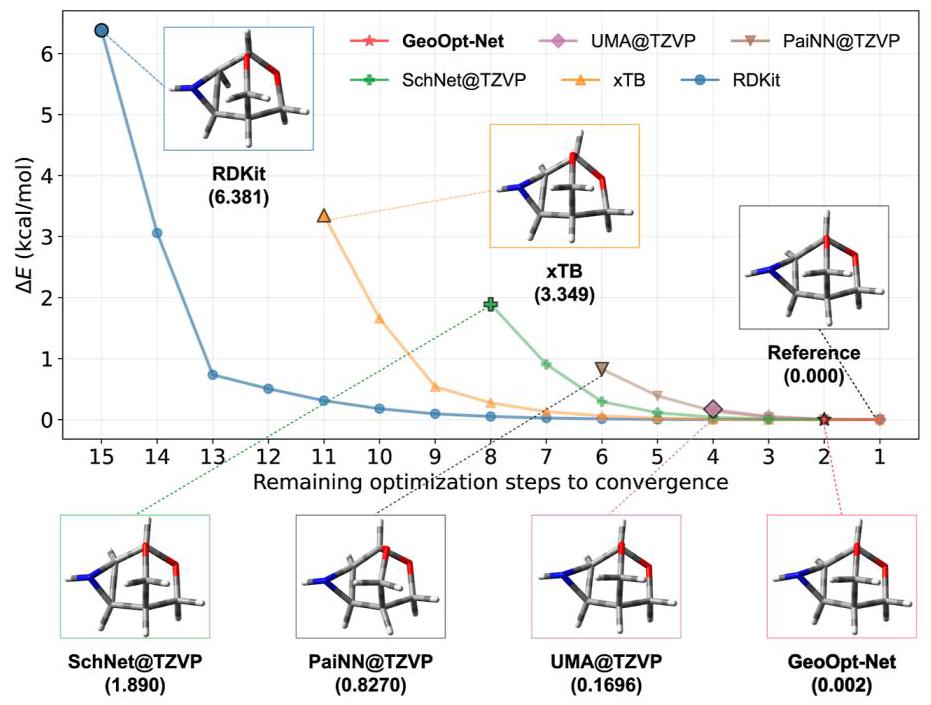
Figure 6. Geometric proximity and DFT convergence analysis. DFT single-point energy deviation ( ${\Delta E},$ B3LYP/TZVP) plotted against the remaining number of geometry-optimization steps required to reach convergence, illustrating how initial structures generated by different methods relate to the DFT convergence process.
图6. 几何接近度和DFT收敛分析。相对于达到收敛所需的剩余几何优化步骤数绘制的DFT单点能量偏差(${\Delta E},$ B3LYP/TZVP),说明了不同方法生成的初始结构与DFT收敛过程的关系。
Robustness, Scaling Behavior, and Physical Consistency beyond the Training Domain
训练域之外的鲁棒性、缩放行为和物理一致性
We further evaluate the robustness and physical reliability of GeoOpt-Net by examining how DFT single-point energy deviations ( ${\Delta E},\mathrm{B}3\mathrm{{LYP}}/\mathrm{{TZVP}}$ ) scale with molecular complexity. All analyses are conducted on 1000 molecules uniformly sampled from a billion-scale drug-like molecular library, yielding a chemically diverse evaluation set that extends beyond the training regime in both size and flexibility.
我们通过研究DFT单点能量偏差(${\Delta E},\mathrm{B}3\mathrm{{LYP}}/\mathrm{{TZVP}}$)如何随分子复杂性缩放,进一步评估了GeoOpt-Net的鲁棒性和物理可靠性。所有分析均在从十亿规模的类药物分子库中均匀采样的1000个分子上进行,从而产生了一个化学性质多样的评估集,该评估集在大小和灵活性方面都超出了训练范围。
Figure 5 summarizes the dependence of ${\Delta E}$ on two standard complexity descriptors: the number of rotatable bonds (left) and the heavy-atom count (right), with out-of-training-range bins explicitly highlighted. Across both axes, all methods show increasing ${\Delta E}$ with growing complexity, reflecting the greater difficulty of producing DFT-consistent geometries for larger and more flexible molecules. However, the magnitude and growth rate differ substantially. In particular, GeoOpt-Net consistently maintains the smallest ${\Delta E}$ across the full range, with a smooth and gradual degradation as complexity increases, and without abrupt error escalation in the out-of-range regimes. By contrast, the baseline methods exhibit progressively larger deviations and steeper scaling, reaching the kcal ${\mathrm{{mol}}}^{-1}$ and higher regimes for increasingly complex molecules. These trends indicate that GeoOpt-Net retains robust generalization to molecular sizes and flexibilities beyond those seen during training.
图5总结了${\Delta E}$对两个标准复杂性描述符的依赖性:可旋转键的数量(左)和重原子数(右),并明确突出显示了超出训练范围的区间。在两个轴上,所有方法都显示出随着复杂性增加${\Delta E}$也增加,这反映了为更大、更灵活的分子生成与DFT一致的几何结构的难度更大。然而,其大小和增长率有很大差异。特别是,GeoOpt-Net在整个范围内始终保持最小的${\Delta E}$,随着复杂性增加,其降解平稳且逐渐,并且在超出范围的区域中没有突然的误差激增。相比之下,基线方法表现出越来越大的偏差和更陡峭的缩放,对于越来越复杂的分子,偏差达到kcal ${\mathrm{{mol}}}^{-1}$及更高范围。这些趋势表明,GeoOpt-Net对分子大小和灵活性保持了强大的泛化能力,超出了训练期间所见的范围。
Beyond static complexity measures, Figure 6 connects ${\Delta E}$ to the remaining number of B3LYP/TZVP optimization steps required to reach convergence, providing an operationally meaningful proxy for geometric proximity to DFT convergence. Initial structures produced by RDKit, xTB, and the neural interatomic potentials typically exhibit larger ${\Delta E}$ and require substantially longer remaining optimization trajectories, consistent with reduced convergence efficiency. In contrast, GeoOpt-Net concentrates near small ${\Delta E}$ while requiring markedly fewer additional optimization steps, demonstrating that its predicted geometries translate directly into accelerated DFT convergence behavior.
除了静态复杂性度量之外,图6将${\Delta E}$与达到收敛所需的B3LYP/TZVP优化步骤的剩余数量联系起来,为接近DFT收敛提供了一个具有操作意义的代理。由RDKit、xTB和神经原子间势产生的初始结构通常表现出更大的${\Delta E}$,并且需要长得多的剩余优化轨迹,这与收敛效率降低一致。相比之下,GeoOpt-Net集中在小${\Delta E}$附近,同时需要明显更少的额外优化步骤,这表明其预测的几何结构直接转化为加速的DFT收敛行为。
Finally, we assess whether improved geometries also yield improved electronic observables. As shown in Table 2, dipole moments computed from GeoOpt-Net geometries closely match the DFT reference, with a ${\Delta \mu }$ of only +0.001 D. UMA@TZVP remains relatively close (+0.017 D), whereas PaiNN@TZVP, SchNet@TZVP, xTB, and RDKit display larger deviations (up to -0.319 D), indicating that their geometric errors propagate into measurable electronic-structure discrepancies. Together, these results support that GeoOpt-Net improves not only energetic proximity and convergence efficiency but also the physical consistency of downstream quantum-chemical observables beyond the training domain.
最后,我们评估改进的几何结构是否也能产生改进的电子可观测量。如表2所示,从GeoOpt-Net几何结构计算出的偶极矩与DFT参考值非常匹配,${\Delta \mu }$仅为+0.001 D。UMA@TZVP仍然相对接近(+0.017 D),而PaiNN@TZVP、SchNet@TZVP、xTB和RDKit显示出更大的偏差(高达-0.319 D),这表明它们的几何误差传播到了可测量的电子结构差异中。总之,这些结果支持GeoOpt-Net不仅提高了能量接近度和收敛效率,还提高了训练域之外下游量子化学可观测量的物理一致性。
Table 2. Comparison of Dipole Moments Computed from Molecular Geometries Optimized by GeoOpt-Net and Baseline Methods ${}^{a}$
表2. GeoOpt-Net和基线方法优化的分子几何结构计算的偶极矩比较${}^{a}$
| method | $\mu$ (Debye) | ${\Delta \mu }$ (Debye) |
| reference | 3.3293 | 0.0000 |
| GeoOpt-Net | 3.3294 | +0.001 |
| UMA@TZVP | 3.3463 | +0.0170 |
| PaiNN@TZVP | 3.194 | -0.1353 |
| SchNet@TZVP | 3.1398 | -0.1895 |
| xTB | 3.0870 | -0.2423 |
| RDKit | 3.0099 | -0.3194 |
${}^{a}$ All dipole moments $\left( \mu \right)$ are evaluated at the B3LYP/TZVP level of theory using the corresponding optimized geometries. ${\Delta \mu }$ denotes the deviation from the reference value obtained from the DFT-converged geometry at the B3LYP/TZVP level of theory.
${}^{a}$ 所有偶极矩$\left( \mu \right)$均在B3LYP/TZVP理论水平下使用相应的优化几何结构进行评估。${\Delta \mu }$表示与在B3LYP/TZVP理论水平下从DFT收敛几何结构获得的参考值的偏差。
CONCLUSION
结论
We have presented GeoOpt-Net, a single-pass SE(3)- equivariant geometry refinement framework that bridges inexpensive conformer generation and hybrid DFT accuracy at the B3LYP/TZVP level of theory. Unlike classical conformer generators, semiempirical quantum methods, or iterative machine-learning interatomic potentials, GeoOpt-Net directly learns a theory-aware geometric mapping that refines bond lengths, bond angles, and torsional degrees of freedom in a unified equivariant architecture. The combination of multibranch geometric modeling, SE(3) equivariance, and multifidelity fine-tuning enables systematic correction of basis-set- and element-dependent deviations while preserving transferable structural priors.
我们提出了GeoOpt-Net,这是一个单步SE(3)等变几何优化框架,它在B3LYP/TZVP理论水平上弥合了廉价构象异构体生成与混合DFT精度之间的差距。与传统的构象异构体生成器、半经验量子方法或迭代机器学习原子间势不同,GeoOpt-Net直接学习一种理论感知几何映射,该映射在统一的等变架构中优化键长、键角和扭转自由度。多分支几何建模、SE(3)等变性和多保真度微调的结合能够在保留可转移结构先验的同时,系统地校正基组和元素相关的偏差。
Under strictly matched B3LYP/TZVP training conditions, GeoOpt-Net consistently delivers submilli-A RMSD and tightly bounded single-point energy deviations in a single forward pass. Error decomposition reveals that the dominant gains arise from substantially improved torsional accuracy, reducing dihedral deviations by 1 to 2 orders of magnitude relative to baseline methods. These geometric improvements translate directly into practical computational benefits: Geo-Opt-Net produces initial geometries that satisfy standard DFT convergence criteria at nonzero rates (65.0% loose; 33.4% default), dramatically shortening subsequent reoptimization trajectories and reducing wall-clock cost.
在严格匹配的B3LYP/TZVP训练条件下,GeoOpt-Net在单次前向传播中始终能实现亚毫埃的RMSD和紧密受限的单点能量偏差。误差分解表明,主要的改进来自于扭转精度的大幅提高,相对于基线方法,二面角偏差减少了1到2个数量级。这些几何改进直接转化为实际的计算优势:Geo-Opt-Net生成的初始几何结构以非零速率(65.0%宽松;33.4%默认)满足标准DFT收敛标准,显著缩短了后续的重新优化轨迹并降低了挂钟时间成本。
Importantly, GeoOpt-Net retains a robust behavior beyond its training domain. Across increasing molecular size and conformational flexibility, including out-of-training-range regimes, energy deviations scale smoothly without an abrupt escalation. Improved geometric fidelity further propagates to electronic observables, with dipole moments closely matching DFT references. Together, these results demonstrate that deterministic, equivariant geometry refinement offers a scalable and physically consistent route toward generating DFT-ready structures, enabling the efficient acceleration of large-scale quantum-chemical workflows.
重要的是,GeoOpt-Net在其训练域之外仍保持稳健的行为。随着分子尺寸和构象灵活性的增加,包括超出训练范围的情况,能量偏差平稳缩放,不会突然增大。改进的几何保真度进一步传播到电子可观测量,偶极矩与DFT参考值紧密匹配。总之,这些结果表明,确定性的、等变的几何优化为生成DFT就绪结构提供了一条可扩展且物理上一致的途径,能够有效加速大规模量子化学工作流程。
A ASSOCIATED CONTENT
A 相关内容
Data Availability Statement
数据可用性声明
The computational models, data sets, trained checkpoints, inference scripts, runtime benchmark scripts, and external validation resources reported in this work are publicly available on GitHub at https://github.com/ChengchunLiu/GeoOpt_ Net.
本工作中报告的计算模型、数据集、训练好的检查点、推理脚本、运行时基准测试脚本以及外部验证资源均可在GitHub上的https://github.com/ChengchunLiu/GeoOpt_ Net公开获取。
@ Supporting Information
@ 支持信息
The Supporting Information is available free of charge at https://pubs.acs.org/doi/10.1021/acs.jctc.6c01080.
支持信息可在https://pubs.acs.org/doi/10.1021/acs.jctc.6c01080免费获取。
Details on the construction of the data set (including data extraction and data set composition), experimental settings and training procedures, and additional experimental details (PDF)
数据集构建的详细信息(包括数据提取和数据集组成)、实验设置和训练程序,以及其他实验细节(PDF)
AUTHOR INFORMATION
作者信息
Corresponding Author
通讯作者
Fanyang Mo - School of AI for Science, AI for Science (AI4S)- Preferred Program, School of Advanced Materials, and Guangdong Provincial Key Laboratory of Nano-Micro Materials Research, Peking University Shenzhen Graduate School, Shenzhen 518055, China; State Key Laboratory of Advanced Waterproof Materials, School of Materials Scienceand Engineering, Peking University, Beijing 100871, China; Corcid.org/0000-0002-4140-3020;
中国北京北京大学工学院,邮编100871;Corcid.org/0000-0002-4140-3020;
Authors
作者
Chengchun Liu - School of AI for Science and AI for Science (AI4S)-Preferred Program, Peking University Shenzhen Graduate School, Shenzhen 518055, China; State Key Laboratory of Advanced Waterproof Materials, School of Materials Science and Engineering, Peking University, Beijing 100871, China; (C) orcid.org/0009-0002-5550-4145
刘丞军 - 北京大学深圳研究生院人工智能科学与技术学院(AI4S)优选计划,中国深圳518055;北京大学材料科学与工程学院先进防水材料国家重点实验室,中国北京100871;(C) orcid.org/0009-0002-5550-4145
Wendi Cai - School of AI for Science and AI for Science (AI4S)-Preferred Program, Peking University Shenzhen Graduate School, Shenzhen 518055, China
蔡文迪 - 北京大学深圳研究生院人工智能科学与技术学院(AI4S)优选计划,中国深圳518055
Boxuan Zhao - School of AI for Science and AI for Science (AI4S)-Preferred Program, Peking University Shenzhen Graduate School, Shenzhen 518055, China; State Key Laboratory of Advanced Waterproof Materials, School of Materials Science and Engineering, Peking University, Beijing 100871, China
赵博轩 - 北京大学深圳研究生院人工智能科学与技术学院(AI4S)优选计划,中国深圳518055;北京大学材料科学与工程学院先进防水材料国家重点实验室,中国北京100871
Complete contact information is available at: https://pubs.acs.org/10.1021/acs.jctc.6c01080
完整的联系信息可在:https://pubs.acs.org/10.1021/acs.jctc.6c01080获取
Author Contributions
作者贡献
F.M. and C.L. conceived the project, designed the method, and analyzed the results. C.L. organized and prepared structural data. W.C. and B.Z. participated in the discussion and provided key suggestions. F.M. and C.L. wrote the paper. F.M. supervised the project.
F.M.和C.L.构思了该项目,设计了方法,并分析了结果。C.L.组织并准备了结构数据。W.C.和B.Z.参与了讨论并提供了关键建议。F.M.和C.L.撰写了论文。F.M.指导了该项目。
Notes
注释
The authors declare no competing financial interest.
作者声明不存在相互竞争的财务利益。
ACKNOWLEDGMENTS
致谢
We thank Peking University Shenzhen Graduate School and Shenzhen Government for the start-up funding support. We thank the High-Performance Computing Platform of Peking University for machine learning model training. We appreciate Dr. Jianning Zhang for his constructive suggestions and insightful discussions.
我们感谢北京大学深圳研究生院和深圳市政府提供的启动资金支持。我们感谢北京大学高性能计算平台用于机器学习模型训练。我们感谢张建宁博士提出的建设性建议和富有洞察力的讨论。
BREFERENCES
参考文献
(1) Gillespie, R. J.; Robinson, E. A. Models of molecular geometry. Chem. Soc. Rev. 2005, 34, 396-407.
(2) Sadowski, J.; Gasteiger, J. From atoms and bonds to three-dimensional atomic coordinates: automatic model builders. Chem. Rev. 1993, 93, 2567-2581.
(3) Bruice, T. C. Computational approaches: reaction trajectories, structures, and atomic motions. Enzyme reactions and proficiency. Chem. Rev. 2006, 106, 3119-3139.
(4) van Gerwen, P.; Briling, K. R.; Bunne, C.; Somnath, V. R.; Laplaza, R.; Krause, A.; Corminboeuf, C. 3DReact: Geometric deep learning for chemical reactions. J. Chem. Inf. Model. 2024, 64, 5771- 5785.
(5) Han, C.; Zhang, D.; Xia, S.; Zhang, Y. Accurate prediction of NMR chemical shifts: Integrating DFT calculations with three-dimensional graph neural networks. J. Chem. Theory Comput. 2024, 20, 5250-5258.
(6) Liu, C.; Zou, R.; Mo, F. Infrared Spectra Prediction for Functional Group Region Utilizing a Machine Learning Approach with Structural Neighboring Mechanism. Anal. Chem. 2024, 96, 15550-15562.
(7) Shi, J.; Liu, C.; Mo, F. Infrared Spectra Prediction for a Carbonyl Group Utilizing a Graph Network Approach. Precis. Chem. 2026, 4, 782-792.
(8) Lou, S.; Liu, C.; Zhang, D.; Chen, Y.; Mo, F. Unsupervised Hierarchical Symbolic Regression for Interpretable Property Modeling in Complex Multi-Variable Systems. Adv. Sci. 2026, 13, No. e21200.
(9) Liu, C.; Mo, F. Automation and AI-Powered Prediction in Chromatographic Separation. Acc. Chem. Res. 2026, 59, 138-150.
(10) Vogiatzis, K. D.; Polynski, M. V.; Kirkland, J. K.; Townsend, J.; Hashemi, A.; Liu, C.; Pidko, E. A. Computational approach to molecular catalysis by 3d transition metals: challenges and opportunities. Chem. Rev. 2019, 119, 2453-2523.
(11) Fang, X.; Liu, L.; Lei, J.; He, D.; Zhang, S.; Zhou, J.; Wang, F.; Wu, H.; Wang, H. Geometry-enhanced molecular representation learning for property prediction. Nat. Mach. Intell. 2022, 4, 127-134.
(12) Shen, W. X.; Zeng, X.; Zhu, F.; Wang, Y. L.; Qin, C.; Tan, Y.; Jiang, Y. Y.; Chen, Y. Z. Out-of-the-box deep learning prediction of pharmaceutical properties by broadly learned knowledge-based molecular representations. Nat. Mach. Intell. 2021, 3, 334-343.
(13) Blundell, T. L.; Jhoti, H.; Abell, C. High-throughput crystallography for lead discovery in drug design. Nat. Rev. Drug Discovery 2002, 1, 45-54.
(14) Manzhos, S.; Carrington, T., Jr. Neural network potential energy surfaces for small molecules and reactions. Chem. Rev. 2021, 121, 10187-10217.
(15) Slater, J. C. A simplification of the Hartree-Fock method. Phys. Rev. 1951, 81, 385.
(16) Fischer, C. F. Hartree-Fock Method for Atoms. A Numerical Approach; John Wiley and Sons, Inc.: New York, 1977.
(17) Kohn, W.; Becke, A. D.; Parr, R. G. Density functional theory of electronic structure. J. Phys. Chem. 1996, 100, 12974-12980.
(18) Riley, K. E.; Pitonák, M.; Jurecka, P.; Hobza, P. Stabilization and structure calculations for noncovalent interactions in extended molecular systems based on wave function and density functional theories. Chem. Rev. 2010, 110, 5023-5063.
(19) Becke, A. D. Density-functional thermochemistry. III. The role of exact exchange. J. Chem. Phys. 1993, 98, 5648-5652.
(20) Lee, C.; Yang, W.; Parr, R. G. Development of the Colle-Salvetti correlation-energy formula into a functional of the electron density. Phys. Rev. B 1988, 37, 785.
(21) Weigend, F.; Ahlrichs, R. Balanced basis sets of split valence, triple zeta valence and quadruple zeta valence quality for $\mathrm{H}$ to $\mathrm{{Rn}}$ : Design and assessment of accuracy. Phys. Chem. Chem. Phys. 2005, 7, 3297-3305.
(22) Yuan, M.; Zou, Z.; Luo, Y.; Jiang, J.; Hu, W. QMe14S: A Comprehensive and Efficient Spectral Data Set for Small Organic Molecules. J. Phys. Chem. Lett. 2025, 16, 3972-3979.
(23) Goerigk, L.; Grimme, S. A thorough benchmark of density functional methods for general main group thermochemistry, kinetics, and noncovalent interactions. Phys. Chem. Chem. Phys. 2011, 13, 6670-6688.
(24) Mardirossian, N.; Head-Gordon, M. Thirty years of density functional theory in computational chemistry: an overview and extensive assessment of 200 density functionals. Mol. Phys. 2017, 115, 2315-2372.
(25) Riniker, S.; Landrum, G. A. Better informed distance geometry: using what we know to improve conformation generation. J. Chem. Inf. Model. 2015, 55, 2562-2574.
(26) Liu, Z.; Zubatiuk, T.; Roitberg, A.; Isayev, O. Auto3d: Automatic generation of the low-energy 3d structures with ANI neural network potentials. J. Chem. Inf. Model. 2022, 62, 5373-5382.
(27) Bannwarth, C.; Ehlert, S.; Grimme, S. GFN2-xTB-An accurate and broadly parametrized self-consistent tight-binding quantum chemical method with multipole electrostatics and density-dependent dispersion contributions. J. Chem. Theory Comput. 2019, 15, 1652-1671.
(28) Simm, G. N. C.; Hernández-Lobato, J. M. A Generative Model for Molecular Distance Geometry. In Proceedings of the 37th International Conference on Machine Learning, 2020; pp 8949-8958.
(29) Xu, M.; Luo, S.; Bengio, Y.; Peng, J.; Tang, J. Learning neural generative dynamics for molecular conformation generation. arXiv 2021, arXiv.2102.10240.
(30) Ganea, O.; Pattanaik, L.; Coley, C.; Barzilay, R.; Jensen, K.; Green, W.; Jaakkola, T. Geomol: Torsional geometric generation of molecular 3d conformer ensembles. Advances in Neural Information Processing Systems 2021, 34, 13757-13769.
(31) Shi, C.; Luo, S.; Xu, M.; Tang, J. Learning gradient fields for molecular conformation generation. In International Conference on Machine Learning, 2021; pp 9558-9568.
(32) Zhu, J.; Xia, Y.; Liu, C.; Wu, L.; Xie, S.; Wang, Y.; Wang, T.; Qin, T.; Zhou, W.; Li, H. Direct molecular conformation generation. arXiv 2022, arXiv.2202.01356.
(33) Xu, M.; Yu, L.; Song, Y.; Shi, C.; Ermon, S.; Tang, J. Geodiff: A geometric diffusion model for molecular conformation generation. arXiv 2022, arXiv.2203.02923.
(34) Schütt, K.; Kindermans, P.-J.; Sauceda Felix, H. E.; Chmiela, S.; Tkatchenko, A.; Müller, K.-R. Schnet: A continuous-filter convolutional neural network for modeling quantum interactions. Advances in Neural Information Processing Systems; Curran Associates, Inc., 2017, 30, 991.
(35) Unke, O. T.; Chmiela, S.; Sauceda, H. E.; Gastegger, M.; Poltavsky, I.; Schutt, K. T.; Tkatchenko, A.; Muller, K.-R. Machine learning force fields. Chem. Rev. 2021, 121, 10142-10186.
(36) Unke, O. T.; Chmiela, S.; Gastegger, M.; Schütt, K. T.; Sauceda, H. E.; Müller, K.-R. SpookyNet: Learning force fields with electronic degrees of freedom and nonlocal effects. Nat. Commun. 2021, 12, 7273.
(37) Schütt, K.; Unke, O.; Gastegger, M. Equivariant message passing for the prediction of tensorial properties and molecular spectra. International Conference on Machine Learning, 2021, 9377- 9388.
(38) Gasteiger, J.; Groß, J.; Günnemann, S. Directional message passing for molecular graphs. arXiv 2020, arXiv.2003.03123.
(39) Gasteiger, J.; Becker, F.; Günnemann, S. GemNet: Universal directional graph neural networks for molecules. Advances in Neural Information Processing Systems, 2021, 34, 6790-6802.
(40) Du, Y.; Wang, L.; Feng, D.; Wang, G.; Ji, S.; Gomes, C. P.; Ma, Z.-M. A new perspective on building efficient and expressive 3D equivariant graph neural networks. Advances in Neural Information Processing Systems, 2023, 36, 66647-66674.
(41) Wood, B. M.; Dzamba, M.; Fu, X.; Gao, M.; Shuaibi, M.; Barroso-Luque, L.; Abdelmaqsoud, K.; Gharakhanyan, V.; Kitchin, J. R.; Levine, D. S. UMA: A Family of Universal Models for Atoms. arXiv 2025, arXiv.2506.23971.
(42) Ramakrishnan, R.; Dral, P. O.; Rupp, M.; Von Lilienfeld, O. A. Quantum chemistry structures and properties of 134 kilo molecules. Sci. Data 2014, 1, 140022.
(43) Madushanka, A.; Moura, R. T., Jr.; Kraka, E. QM40, Realistic Quantum Mechanical Dataset for Machine Learning in Molecular Science. Sci. Data 2024, 11, 1376.
(44) Irwin, J. J.; Tang, K. G.; Young, J.; Dandarchuluun, C.; Wong, B. R.; Khurelbaatar, M.; Moroz, Y. S.; Mayfield, J.; Sayle, R. A. ZINC20-a free ultralarge-scale chemical database for ligand discovery. J. Chem. Inf. Model. 2020, 60, 6065-6073.
(45) Halgren, T. A. Merck molecular force field. I. Basis, form, scope, parameterization, and performance of MMFF94. J. Comput. Chem. 1996, 17, 490-519.
(46) Hendrycks, D.; Gimpel, K. Gaussian error linear units (gelus). arXiv 2016, arXiv.1606.08415.
(47) Andersen, C. Clebsch-Gordan Series for Symmetrized Tensor Products. J. Math. Phys. 1967, 8, 988-997.
(48) Bronstein, M. M.; Bruna, J.; LeCun, Y.; Szlam, A.; Vandergheynst, P. Geometric deep learning: going beyond euclidean data. IEEE Signal Process. Mag. 2017, 34, 18-42.
(49) Atz, K.; Grisoni, F.; Schneider, G. Geometric deep learning on molecular representations. Nat. Mach. Intell. 2021, 3, 1023-1032.
(50) Batatia, I.; Batzner, S.; Kovács, D. P.; Musaelian, A.; Simm, G. N.; Drautz, R.; Ortner, C.; Kozinsky, B.; Csányi, G. The design space of E (3)-equivariant atom-centred interatomic potentials. Nat. Mach. Intell. 2025, 7, 56-67.
(51) Fuchs, F.; Worrall, D.; Fischer, V.; Welling, M. Se (3)- transformers: 3d roto-translation equivariant attention networks. NIPS'20: Proceedings of the 34th International Conference on Neural Information Processing Systems 2020, 33, 1970-1981.
(52) Jing, B.; Corso, G.; Chang, J.; Barzilay, R.; Jaakkola, T. Torsional diffusion for molecular conformer generation. Advances in Neural Information Processing Systems 2022, 35, 24240-24253.