Cycle-MS: A Closed-Loop End-to-End Framework for Mass Spectrometry Structure Elucidation
英文原文与中文译文逐段对照 · English original with Chinese translation
Jinglong Lin, Hao Li, Chengchun Liu, Zhiyuan Yan, Li Yuan, and Fanyang Mo*
林京龙、李浩、刘丞军、晏志远、袁粒、莫凡洋*
Cite This: J. Chem. Inf. Model. 2026, 66, 2709-2718
引用本文:《化学信息与建模杂志》2026年,66卷,2709 - 2718页
ACCESS Supporting Information
获取支持信息
ABSTRACT: Mass spectrometry (MS) is indispensable for molecular analysis; however, elucidating complex molecular structures from spectra remains a major challenge. Here, we present Cycle-MS, an end-to-end framework that unifies inverse spectrum-to-molecule prediction with forward spectrum reconstruction, with cycle-consistency losses refining latent representations. Cycle-MS demonstrates enhanced accuracy in predicting atomic compositions, molecular formulas, scaffolds, and functional groups, offering robust recovery of molecular scale and key chemical features. Interpretability analysis shows that Cycle-MS prioritizes structurally diagnostic fragments over nonspecific abundant peaks, ensuring chemical plausibility and structural reliability. Together, these advances establish Cycle-MS as a robust, accurate, and interpretable framework that offers a path toward fully automated, high-precision MS-based structure elucidation.
摘要:质谱法(MS)对于分子分析不可或缺;然而,从光谱中解析复杂分子结构仍然是一项重大挑战。在此,我们提出了循环质谱法(Cycle-MS),这是一个端到端框架,它将逆光谱到分子预测与正向光谱重建相结合,并通过循环一致性损失来优化潜在表示。循环质谱法在预测原子组成、分子式、骨架和官能团方面表现出更高的准确性,能够稳健地恢复分子规模和关键化学特征。可解释性分析表明,循环质谱法优先考虑结构诊断片段而非非特异性丰度峰,确保了化学合理性和结构可靠性。总之,这些进展使循环质谱法成为一个强大、准确且可解释的框架,为基于质谱的全自动、高精度结构解析提供了一条途径。
INTRODUCTION
引言
Mass spectrometry (MS) is a critical analytical technique frequently coupled with chromatography, where chromatography provides sample separation, while MS primarily provides qualitative information, although quantitative analyses are also achievable. In MS, analytes are ionized and subsequently separated according to their mass-to-charge ratios $\left( {m/z}\right)$ , generating data characterized by high sensitivity and specificity, enabling researchers to elucidate the molecular composition of complex samples. Consequently, MS has become an indispensable tool in diverse fields, including metabolomics, ${}^{1 - 3}$ proteomics, ${}^{4 - 6}$ and drug detection. ${}^{7 - 9}$ However, conventional approaches to interpreting MS data, such as rule-based methods relying on characteristic fragmentation patterns ${}^{{10},{11}}$ or database matching, ${}^{{12},{13}}$ exhibit inherent limitations. Rule-based methods are highly dependent on predefined fragmentation criteria, restricting their ability to accurately interpret complex mixtures. Database matching enables rapid analysis but is limited by database completeness and accuracy, which presents significant challenges in the identification of novel compounds.
质谱法(MS)是一种关键的分析技术,常与色谱法联用,其中色谱法用于样品分离,而质谱法主要提供定性信息,不过也可进行定量分析。在质谱分析中,分析物被离子化,随后根据其质荷比$\left( {m/z}\right)$进行分离,生成具有高灵敏度和特异性的数据,使研究人员能够阐明复杂样品的分子组成。因此,质谱法已成为包括代谢组学、${}^{1 - 3}$蛋白质组学、${}^{4 - 6}$和药物检测等多个领域不可或缺的工具。${}^{7 - 9}$然而,传统的质谱数据分析方法,如依赖特征碎片模式${}^{{10},{11}}$的基于规则的方法或数据库匹配${}^{{12},{13}}$,存在固有的局限性。基于规则的方法高度依赖预定义的碎片标准,限制了其准确解释复杂混合物的能力。数据库匹配能够实现快速分析,但受数据库完整性和准确性的限制,在鉴定新化合物方面面临重大挑战。
With the rapid advancement of artificial intelligence in recent years, machine learning (ML) has become increasingly prevalent in analytical chemistry, ${}^{{14} - {20}}$ particularly in MS. ${}^{{21} - {23}}$ Beyond tasks such as spectrum denoising ${}^{24}$ and forward spectrum prediction, ${}^{{25} - {29}}$ ML-assisted MS interpretation has emerged as a key research frontier (Figure 1). In molecular formula annotation, SIRIUS ${4}^{30}$ constructs fragmentation trees and integrates isotopic patterns for precise formula prediction and feature fingerprint extraction. In the CASMI 2016 data set, it achieved a Top-1 accuracy of 93.8%. MIST-CF ${}^{31}$ offers similar capabilities, using a data-driven energy modeling approach and an enhanced Set Transformer to replace traditional fragmentation tree inference. In the CASMI 2022 challenge, MIST-CF achieved an accuracy of 86.8% for the prediction of the joint molecular formula and the adduct, which is comparable to that of SIRIUS 4. In molecular structure elucidation, MSNovelist ${}^{32}$ uses SIRIUS 4 to extract molecular formulas and fingerprints, followed by prediction of structure with LSTM. In the CASMI 2016 data set, it achieved a Top-1 accuracy of 26% and a Top- 128 coverage of 57%. CMSSP ${}^{33}$ and CSU-MS2 ${}^{34}$ are both built on cross-modal contrastive learning, in which a unified spectrum-structure embedding space is constructed to enable high-accuracy database retrieval. CMSSP typically achieves Top-10 accuracies exceeding 80%, whereas CSU-MS2 further improves representation capacity and large-scale retrieval performance. MSGo ${}^{35}$ proposes a Transformer-based molecular structure generation framework that directly infers small-molecule structures from MS/MS spectra by incorporating in silico spectra and probabilistically guided masking strategies. Spec2Mol ${}^{36}$ represents the first end-to-end framework that directly predicts molecular SMILES from MS/MS spectra. However, in the NIST 2020 data set, Spec2Mol achieved a Top- 1 accuracy of only 7% and is currently limited to analyzing the precursor ions ${\left\lbrack \mathrm{M} + \mathrm{H}\right\rbrack }^{ + }$ and ${\left\lbrack \mathrm{M} - \mathrm{H}\right\rbrack }^{ - }$ . In recent years, diffusion-based approaches to mass-spectrometry-driven structure elucidation have attracted growing interest. DiffNovo ${}^{37}$ and DiffMS ${}^{38}$ formulate spectrum-to-structure inference as a conditional diffusion process and, through iterative denoising and structural refinement, outperform conventional sequence-to-sequence methods (e.g., Spec2Mol) in terms of chemical plausibility and structural similarity.
近年来,随着人工智能的快速发展,机器学习(ML)在分析化学中越来越普遍,${}^{{14} - {20}}$尤其是在质谱分析中。${}^{{21} - {23}}$除了光谱去噪${}^{24}$和正向光谱预测等任务外,${}^{{25} - {29}}$机器学习辅助的质谱数据分析已成为一个关键的研究前沿领域(图1)。在分子式注释方面,SIRIUS${4}^{30}$构建碎片树并整合同位素模式,以进行精确的分子式预测和特征指纹提取。在2016年的CASMI数据集中,它的Top-1准确率达到了93.8%。MIST-CF${}^{31}$提供类似的功能,它采用数据驱动的能量建模方法和增强的集合变换器来取代传统的碎片树推理。在2022年的CASMI挑战赛中,MIST-CF在联合分子式和加合物预测方面的准确率达到了86.8%,与SIRIUS 4相当。在分子结构解析方面,MSNovelist${}^{32}$使用SIRIUS 4提取分子式和指纹,然后用长短期记忆网络(LSTM)预测结构。在2016年的CASMI数据集中,它的Top-1准确率达到了26%,Top-128覆盖率达到了57%。CMSSP${}^{33}$和CSU-MS2${}^{34}$都基于跨模态对比学习构建,其中构建了一个统一的光谱-结构嵌入空间,以实现高精度的数据库检索。CMSSP通常能达到超过80%的Top-10准确率,而CSU-MS2进一步提高了表示能力和大规模检索性能。MSGo${}^{35}$提出了一个基于变换器的分子结构生成框架,通过结合计算机模拟光谱和概率引导掩蔽策略,直接从串联质谱(MS/MS)光谱推断小分子结构。Spec2Mol${}^{36}$代表了第一个直接从MS/MS光谱预测分子SMILES的端到端框架。然而,在2020年的NIST数据集中,Spec2Mol的Top-1准确率仅为7%,目前仅限于分析前体离子${\left\lbrack \mathrm{M} + \mathrm{H}\right\rbrack }^{ + }$和${\left\lbrack \mathrm{M} - \mathrm{H}\right\rbrack }^{ - }$。近年来,基于扩散的质谱驱动结构解析方法越来越受到关注。DiffNovo${}^{37}$和DiffMS${}^{38}$将光谱到结构的推理表述为一个条件扩散过程,并通过迭代去噪和结构细化,在化学合理性和结构相似性方面优于传统的序列到序列方法(如Spec2Mol)。
Received: December 7, 2025
收到日期:2025年12月7日
Revised: January 30, 2026
修订日期:2026年1月30日
Accepted: February 18, 2026
录用日期:2026年2月18日
Published: February 25, 2026
发表日期:2026年2月25日
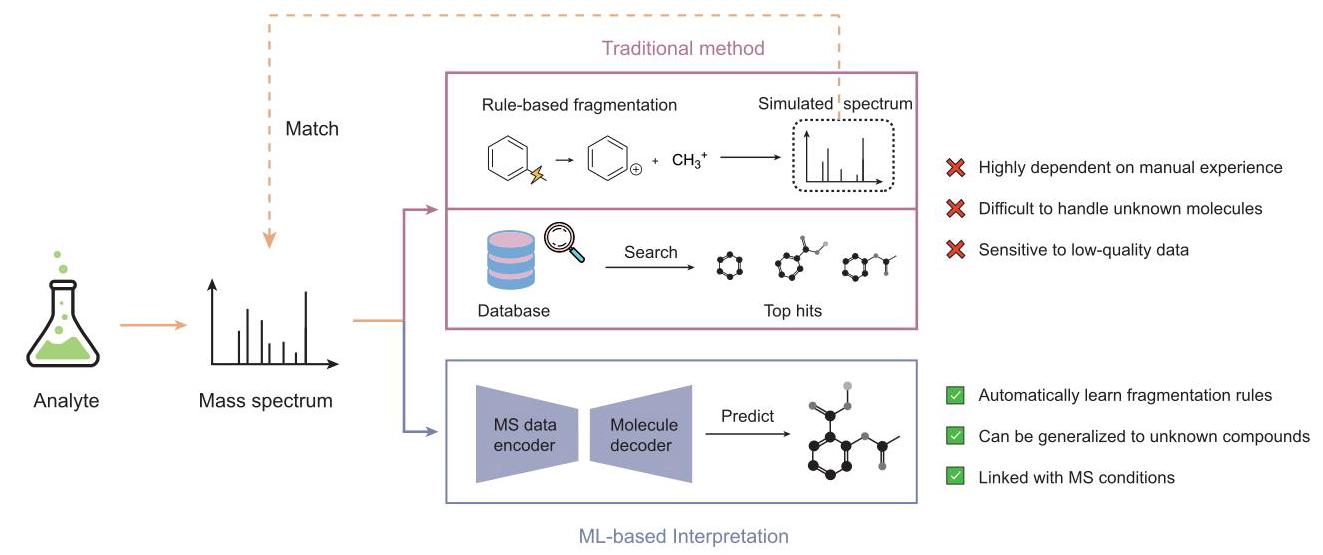
Figure 1. Comparison of traditional and ML-based mass spectrometry interpretation methods. Traditional MS interpretation relies on rule-based fragmentation and database search, which are constrained by expert dependence and limited robustness to noise. ML-based approaches learn from data, predict structures directly, and generalize across diverse experimental conditions.
图1. 传统和基于机器学习的质谱数据分析方法的比较。传统的质谱数据分析依赖基于规则的碎片分析和数据库搜索,受专家依赖和对噪声的鲁棒性有限的限制。基于机器学习的方法从数据中学习,直接预测结构,并能在不同的实验条件下进行推广。
Despite progress in molecular formula annotation and structural elucidation, achieving high-precision, end-to-end mass spectrometry interpretation remains an outstanding challenge. The main contributions of this work are as follows.
尽管在分子式注释和结构解析方面取得了进展,但实现高精度的端到端质谱解释仍然是一个突出的挑战。本工作的主要贡献如下。
We present Cycle-MS, a novel end-to-end framework that directly predicts molecular structures from a single MS/ MS spectrum without relying on external fragmentation tools. Unlike prior approaches, Cycle-MS integrates spectrum-to-molecule inference and molecule-to-spectrum reconstruction within a unified architecture, guided by a cycle-consistency loss that regularizes and refines the latent representation. The inverse path employs a Transformer-based spectrum encoder and a molecular decoder, augmented with molecular weight constraints and functional group-aware pruning during beam search to enhance generation precision and efficiency. The forward path utilizes a geometry-enhanced graph isomorphism network to encode molecular structures and an MLP to decode the corresponding spectra.
我们提出了Cycle-MS,这是一种新颖的端到端框架,可直接从单个MS/MS光谱预测分子结构,而无需依赖外部碎片化工具。与先前的方法不同,Cycle-MS在统一架构中集成了光谱到分子的推理和分子到光谱的重建,由循环一致性损失引导,该损失对潜在表示进行正则化和细化。反向路径采用基于Transformer的光谱编码器和分子解码器,在束搜索期间增加分子量约束和官能团感知剪枝,以提高生成精度和效率。正向路径利用几何增强的图同构网络对分子结构进行编码,并使用MLP对相应的光谱进行解码。
We compared Cycle-MS with representative baseline models, and the results consistently demonstrate superior performance across key molecular-level metrics, including atom count accuracy, molecular formula fidelity, and scaffold similarity. Additionally, we conducted comprehensive ablation studies, which revealed the significant impact of cycle training, experimental metadata, and pruning strategies on improving model performance.
我们将Cycle-MS与代表性的基线模型进行了比较,结果一致表明在关键的分子水平指标上具有卓越的性能,包括原子计数准确性、分子式保真度和支架相似性。此外,我们进行了全面的消融研究,结果表明循环训练、实验元数据和剪枝策略对提高模型性能有重大影响。
To investigate the interpretability of the model, we analyze latent embeddings derived from the spectrum encoder, which exhibit clear clustering patterns corresponding to molecular weight scales. Furthermore, SHAP-based attribution analysis reveals that Cycle-MS preferentially leverages structurally informative fragments rather than merely abundant but uninformative peaks, thereby reinforcing both the chemical validity and structural accuracy of the predicted molecules.
为了研究模型的可解释性,我们分析了从光谱编码器导出的潜在嵌入,这些嵌入表现出与分子量尺度相对应的清晰聚类模式。此外,基于SHAP的归因分析表明,Cycle-MS优先利用结构信息丰富的碎片,而不仅仅是丰富但无信息的峰,从而增强了预测分子的化学有效性和结构准确性。
BRESULTS AND DISCUSSION
结果与讨论
Data Set Construction and Preprocessing
数据集构建与预处理
The dataset used in this study was derived from the high-resolution tandem mass spectrometry (HR-MS/MS) subset of the NIST 20 mass spectral library. To ensure data quality, molecules with molecular weights above 700 Da, spectra containing fewer than three fragment peaks, and entries lacking valid SMILES annotations were excluded, resulting in a curated dataset of 689,467 spectra with high mass accuracy. The molecular-weight distribution of the molecules in the dataset is shown in Figure S1. To ensure the consistency and uniqueness of molecular representations, standardized SMILES strings were extracted for each compound and tokenized at the substructure level using a pretrained SentencePiece model with a vocabulary size of 300. This tokenization of substructures eliminates redundant molecular encodings and improves the generalizability of the model in structurally diverse compounds by capturing frequent functional groups and scaffolds. For model input construction, each MS/MS spectrum was converted into a fixed-length sequence of ${64}\left( {\mathrm{\;m}/\mathrm{z}}\right.$ , intensity) pairs. In cases where more than 64 fragment peaks were present, only the top 64 peaks ranked by intensity were retained; spectra with fewer peaks were zero-padded. All $m/z$ and intensity values were normalized using the global mean and variance calculated from the training set to ensure statistical consistency across inputs.
本研究中使用的数据集源自NIST 20质谱库的高分辨率串联质谱(HR-MS/MS)子集。为确保数据质量,排除了分子量高于700 Da的分子、包含少于三个碎片峰的光谱以及缺乏有效SMILES注释的条目,从而得到了一个包含689,467个具有高质量精度光谱的精选数据集。数据集中分子的分子量分布如图S1所示。为确保分子表示的一致性和唯一性,为每个化合物提取了标准化的SMILES字符串,并使用词汇量为300的预训练SentencePiece模型在子结构级别进行分词。这种子结构分词消除了冗余的分子编码,并通过捕获频繁出现的官能团和骨架提高了模型在结构多样化合物中的通用性。对于模型输入构建,每个MS/MS光谱被转换为${64}\left( {\mathrm{\;m}/\mathrm{z}}\right.$、强度对的固定长度序列。在存在超过64个碎片峰的情况下,仅保留按强度排名的前64个峰;峰数较少的光谱用零填充。所有$m/z$和强度值均使用从训练集计算出的全局均值和方差进行归一化,以确保输入之间的统计一致性。
In the molecule-to-spectrum prediction task, continuous MS/ MS data were discretized by partitioning the $m/z$ range (40- 600 Da) into 561 evenly spaced 1 Da bins. A ${\log }_{10}$ transformation was applied to the binned intensities to compress the dynamic range and reduce the dominance of high-intensity peaks. To improve model robustness under diverse experimental setups, associated metadata were incorporated as auxiliary inputs, including both categorical and continuous features. Categorical variables, ionization mode (positive/negative), instrument type (Fourier-transform mass spectrometry, FT-MS; quadrupole time-of-flight, QTOF), and fragmentation method (collision-induced dissociation, CID; higher energy collisional dissociation, HCD) were encoded with one heat into a six-dimensional binary vector. Continuous features included the normalized collision energy $\left( {NCE}\right)$ and precursor mass $M$ , which was inferred from the precursor $m/z$ and ion type. Given the large number of precursor ion types (3855 in total), these were treated as categorical indices and embedded as trainable vectors.
在分子到光谱预测任务中,通过将$m/z$范围(40 - 600 Da)划分为561个均匀间隔的1 Da bin来离散连续的MS/MS数据。对分箱后的强度应用${\log }_{10}$变换以压缩动态范围并减少高强度峰的主导地位。为提高模型在不同实验设置下的鲁棒性,将相关元数据作为辅助输入纳入,包括分类和连续特征。分类变量,电离模式(正/负)、仪器类型(傅里叶变换质谱仪,FT-MS;四极杆飞行时间质谱仪,QTOF)和碎裂方法(碰撞诱导解离,CID;高能碰撞解离,HCD)被一键编码为六维二进制向量。连续特征包括归一化碰撞能量$\left( {NCE}\right)$和前体质量$M$,其从前体$m/z$和离子类型推断得出。鉴于前体离子类型数量众多(总共3855种),这些被视为分类索引并嵌入为可训练向量。
aromaticity
Latent space
degree
implicit valence
bond direction bond type in ring or not
explicit valence
chiral tag
topological polar surface area (TPSA)
moran coefficient (MATS)
Motecular
relative hydrophobic surface area (RASA)
descriptors
molecular distance edge (MEDC)
relative polar surface area (RPSA)
Angle features
————-
bond angle
Molecule Consistency Loss
Bond-angle graph (3D spatial geometry) –>
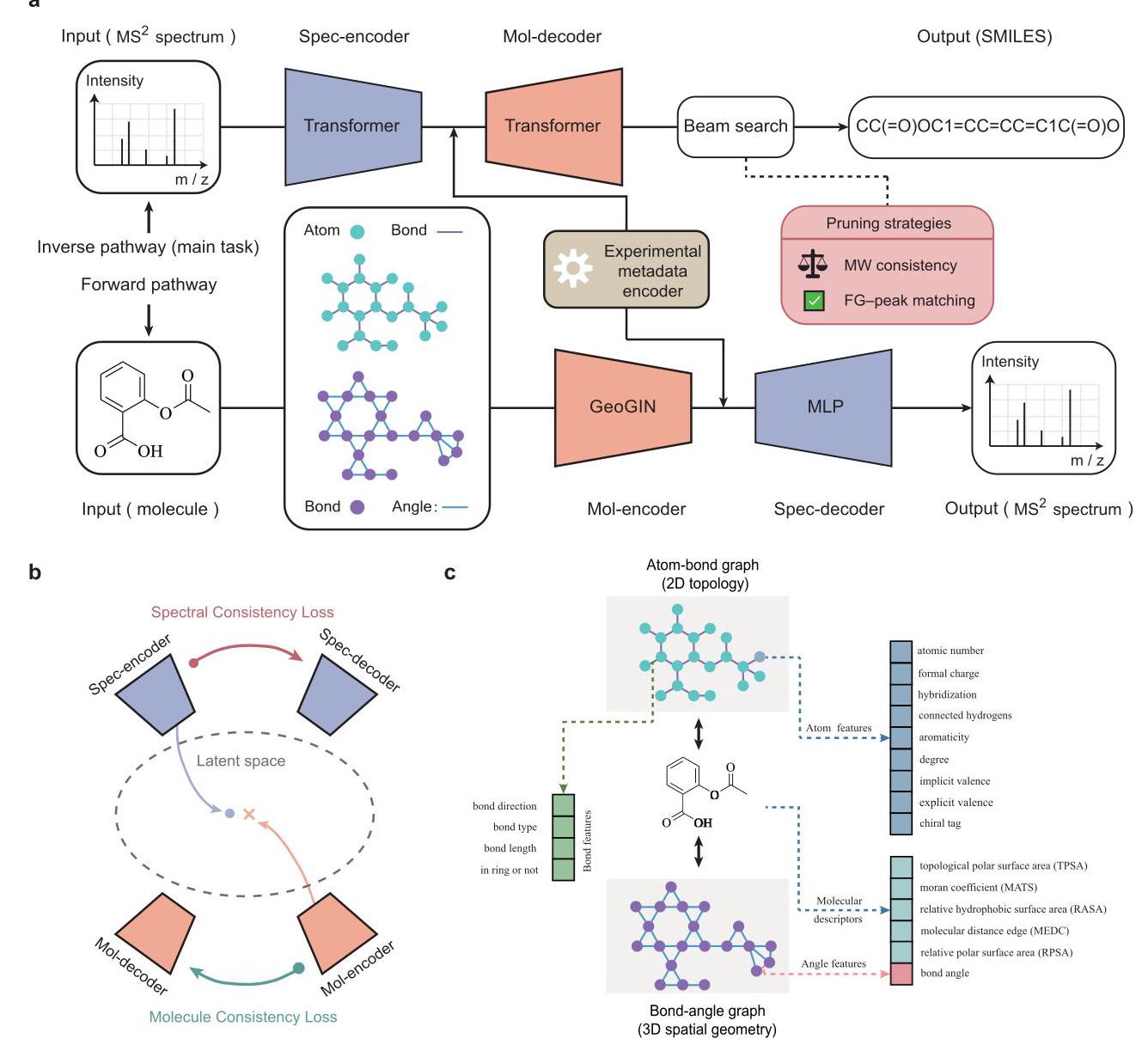
Figure 2. Schematic of Cycle-MS architecture and training strategy.(a) Inverse mass spectrum-molecule prediction (main task) employs a Transformer-based mass spectrum encoder and a molecular decoder, while the forward pathway (auxiliary task) applies a GeoGIN molecular encoder and an MLP-based mass spectrum decoder. (b) Spectral and molecular consistency losses enforce latent space alignment under a decoupled training strategy. (c) Node and edge embeddings in atom-bond and bond-angle graphs capture atomic, bonding, angular, and physicochemical descriptors, providing a comprehensive molecular representation.
图2. Cycle-MS架构和训练策略示意图。(a) 逆质谱-分子预测(主要任务)采用基于Transformer的质谱编码器和分子解码器,而正向路径(辅助任务)应用GeoGIN分子编码器和基于MLP的质谱解码器。(b) 光谱和分子一致性损失在解耦训练策略下强制潜在空间对齐。(c) 原子-键和键角图中的节点和边嵌入捕获原子、键合、角度和物理化学描述符,提供全面的分子表示。
Model Architecture and Training Strategy
模型架构与训练策略
The Cycle-MS architecture comprises two complementary pathways for inverse and forward prediction, built upon five core modules: a spectrum encoder, a spectrum decoder, a molecular encoder, a molecular decoder, and an experimental metadata encoder (Figure 2a). This dual-path design enables the model to learn bidirectional mappings between molecular structures and their tandem mass spectra while incorporating experimental information to improve generalizability across heterogeneous acquisition conditions. The metadata encoder processes the continuous variables $M$ and NCE by independently projecting them into high-dimensional latent spaces using dedicated MLP. The precursor ion type, treated as a categorical variable, is embedded through a trainable embedding layer to capture its impact on fragmentation behavior. These three feature representations are then integrated and passed through an attention-based fusion module, which dynamically adjusts the contribution of each input via learnable weights, yielding a unified conditional representation denoted as ${F}_{1}$ . In parallel, six one-hot encoded experimental parameters, such as ionization mode, instrument type, and fragmentation method, are processed by a separate MLP to produce another condition vector, ${F}_{2}$ , whereas ${F}_{1}$ emphasizes fine-grained physicochemical effects from continuous variables, and ${F}_{2}$ encodes coarser, protocol-level information reflecting the experimental platform. The combined representations ${F}_{1}$ and ${F}_{2}$ are provided as auxiliary priors to the molecular and spectral decoders, thus constraining the generative process in specific experimental settings.
循环质谱(Cycle-MS)架构包括用于反向和正向预测的两个互补路径,基于五个核心模块构建:一个光谱编码器、一个光谱解码器、一个分子编码器、一个分子解码器和一个实验元数据编码器(图2a)。这种双路径设计使模型能够学习分子结构与其串联质谱之间的双向映射,同时纳入实验信息以提高在异构采集条件下的通用性。元数据编码器通过使用专用多层感知器(MLP)将连续变量$M$和归一化交叉熵(NCE)独立投影到高维潜在空间中来处理它们。前体离子类型被视为分类变量,通过可训练的嵌入层进行嵌入,以捕捉其对碎片化行为的影响。然后,这三种特征表示被整合并通过一个基于注意力的融合模块,该模块通过可学习的权重动态调整每个输入的贡献,产生一个统一的条件表示,记为${F}_{1}$。并行地,六个独热编码的实验参数,如电离模式、仪器类型和碎片化方法,由一个单独的MLP处理,以产生另一个条件向量${F}_{2}$,而${F}_{1}$强调来自连续变量的细粒度物理化学效应,${F}_{2}$编码反映实验平台的更粗略的协议级信息。组合表示${F}_{1}$和${F}_{2}$作为辅助先验提供给分子和解码器,从而在特定实验设置中约束生成过程。
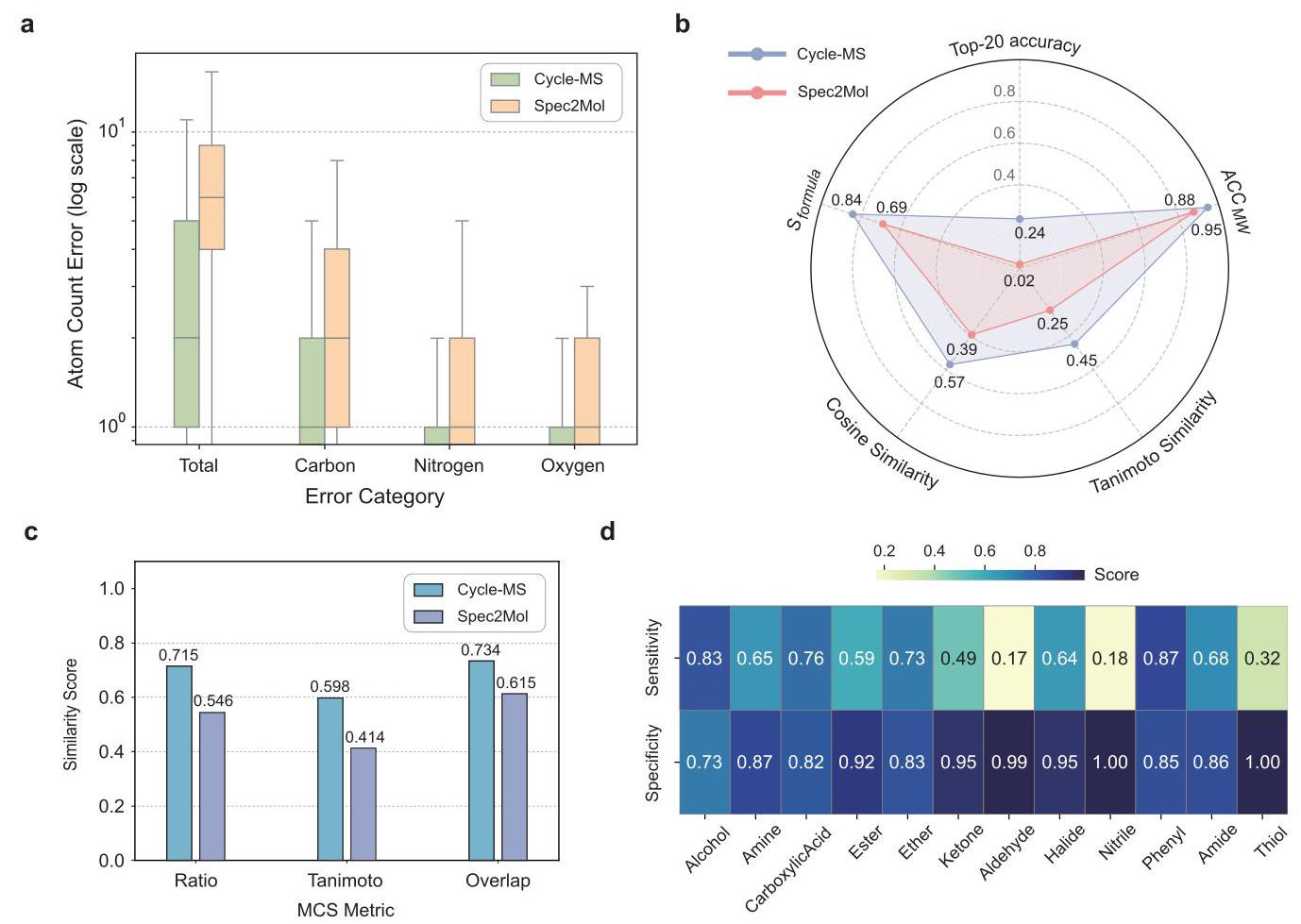
Figure 3. Comparative evaluation of Cycle-MS and Spec2Mol. (a) Atom-count prediction errors for total atoms, carbon, nitrogen, and oxygen. Cycle-MS shows consistently lower errors than that of Spec2Mol, especially for total and carbon counts. (b) Radar plot of molecular-level metrics. Cycle-MS achieves higher scores across all measures, reflecting a more faithful molecular reconstruction. (c) Maximum common substructure (MCS) analysis, where Cycle-MS attains higher ratio, Tanimoto, and overlap values. (d) Functional-group prediction performance. Cycle-MS maintains strong sensitivity and specificity for frequent groups, while sensitivity decreases for rare groups, though specificity remains high.
图3. 循环质谱(Cycle-MS)和Spec2Mol的比较评估。(a)总原子数、碳原子数、氮原子数和氧原子数的原子计数预测误差。循环质谱(Cycle-MS)始终显示出比Spec2Mol更低的误差,特别是对于总原子数和碳原子数。(b)分子水平指标的雷达图。循环质谱(Cycle-MS)在所有测量中获得更高的分数,反映出更忠实的分子重建。(c)最大公共子结构(MCS)分析,其中循环质谱(Cycle-MS)获得更高的比率、Tanimoto值和重叠值。(d)官能团预测性能。循环质谱(Cycle-MS)对常见官能团保持较强的敏感性和特异性,而对稀有官能团的敏感性降低,尽管特异性仍然很高。
In the reverse prediction pathway of Cycle-MS, the spectrum encoder is constructed using a two-layer Transformer with dual-head self-attention and rotary positional encoding. This encoding scheme injects relative positional information into the sequence of fragment peak pairs sorted by $m/z$ , thereby enhancing the model’s capacity to represent spectral sequences. The encoded spectral representation is integrated with condition vectors ${F}_{1}$ and ${F}_{2}$ , which are derived from experimental metadata encoders. The fused features are passed through two residual blocks, each comprising fully connected layers, ReLU activation, and dropout regularization, to capture higher-order interactions between spectral and metadata information. The residual architecture facilitates gradient flow and stabilizes feature fusion across modalities. The resulting high-dimensional representation is then input into a three-layer Transformer decoder with four-head self-attention. This decoder generates the target SMILES sequence in an autoregressive manner, mapping spectral inputs to molecular structures. However, due to the presence of noise in mass spectrometric data, direct autoregressive decoding may yield chemically implausible or structurally invalid molecules. To improve the fidelity of structure generation, we introduced two pruning strategies during beam search decoding. The first is a molecular mass consistency constraint. Candidate sequences are discarded if their inferred molecular mass deviates beyond the tolerance range of the experimentally measured precursor ion mass. The second is a functional group-peak matching constraint. The Gemini-2.5 Pro large language model is employed to predict fragment $m/z$ values characteristic of common functional groups in each candidate; the corresponding prompts are provided in SI-2. Candidates are discarded if none of these predicted peaks are observed in the experimental spectrum. Together, these constraints effectively eliminate invalid structures, thereby improving the accuracy and reliability of de novo molecular structure elucidation from mass spectrometry.
在循环质谱(Cycle-MS)的反向预测路径中,光谱编码器使用具有双头自注意力和旋转位置编码的两层Transformer构建。这种编码方案将相对位置信息注入到按$m/z$排序的碎片峰对序列中,从而增强模型表示光谱序列的能力。编码后的光谱表示与从实验元数据编码器导出的条件向量${F}_{1}$和${F}_{2}$整合。融合后的特征通过两个残差块,每个残差块包括全连接层、ReLU激活和随机失活正则化,以捕捉光谱和元数据信息之间的高阶相互作用。残差架构有助于梯度流动并稳定跨模态的特征融合。然后,得到的高维表示被输入到具有四头自注意力的三层Transformer解码器中。该解码器以自回归方式生成目标SMILES序列,将光谱输入映射到分子结构。然而,由于质谱数据中存在噪声,直接自回归解码可能会产生化学上不合理或结构上无效的分子。为了提高结构生成的保真度,我们在束搜索解码期间引入了两种剪枝策略。第一种是分子质量一致性约束。如果候选序列推断的分子质量偏离实验测量的前体离子质量的容差范围,则将其丢弃。第二种是官能团-峰匹配约束。使用Gemini-2.5 Pro大语言模型预测每个候选中常见官能团特征的碎片$m/z$值;相应的提示在补充信息2(SI-2)中提供。如果在实验光谱中未观察到这些预测峰中的任何一个,则丢弃候选。这些约束一起有效地消除了无效结构,从而提高了从质谱进行从头分子结构解析的准确性和可靠性。
In the auxiliary forward prediction pathway of Cycle-MS, molecular structures are formalized as graph representations to leverage their inherent graph nature. ${}^{{39} - {42}}$ Given the high sensitivity of mass spectrometry to subtle structural variations, we introduce two complementary graph representations to jointly capture the topological and three-dimensional geometric features of a molecule (Figure 2c): the atom-bond graph and the bond-angle graph. The atom-bond graph defines each atom as a node and each bond as an edge. Node features include formal charge, implicit valence, hybridization, and aromaticity, while edge features encode bond types and ring membership. This representation models molecular connectivity. The bond-angle graph, by contrast, treats bonds as nodes and connects pairs of bonds that share a common atom, thereby forming bond angles. Each edge in this graph corresponds to a real spatial angle and is annotated with its angle value together with a set of spatial and molecular descriptors, such as topological polar surface area (TPSA) and relative polar surface area (RPSA). To effectively integrate the rich structural and geometric information from both graphs, we employ a five-layer Geometry-Enhanced Graph Isomorphism Network (GeoGIN) as the molecular encoder. Unlike conventional graph neural networks such as GCN and GAT, GeoGIN introduces geometry-aware modulation into the message passing process, enabling the model to simultaneously consider topological adjacency and spatial directionality when updating node representations. After encoding, representations from the atom-bond and bond-angle graphs are fused and aggregated using global sum pooling to yield the final molecular embedding. This embedding is then concatenated with two condition vectors, ${F}_{1}$ and ${F}_{2}$ , derived from the experimental metadata encoders, producing a high-dimensional molecular representation tailored to the specific experimental context. Finally, the fused representation is passed into a three-layer multilayer perceptron spectrum decoder, which outputs predicted intensity distributions across 561 discrete $m/z$ bins ranging from 40 to 600 Da.
在Cycle-MS的辅助正向预测路径中,分子结构被形式化为图表示,以利用其固有的图性质。${}^{{39} - {42}}$ 鉴于质谱对细微结构变化的高灵敏度,我们引入了两种互补的图表示,以共同捕获分子的拓扑和三维几何特征(图2c):原子-键图和键角图。原子-键图将每个原子定义为一个节点,每个键定义为一条边。节点特征包括形式电荷、隐含价、杂化和芳香性,而边特征编码键类型和环成员。这种表示对分子连通性进行建模。相比之下,键角图将键视为节点,并连接共享一个共同原子的键对,从而形成键角。该图中的每条边对应一个实际空间角度,并标注有其角度值以及一组空间和分子描述符,如拓扑极性表面积(TPSA)和相对极性表面积(RPSA)。为了有效地整合来自两个图的丰富结构和几何信息,我们采用了一个五层几何增强图同构网络(GeoGIN)作为分子编码器。与传统的图神经网络如GCN和GAT不同,GeoGIN在消息传递过程中引入了几何感知调制,使模型在更新节点表示时能够同时考虑拓扑邻接性和空间方向性。编码后,原子-键图和键角图的表示通过全局求和池化进行融合和聚合,以产生最终的分子嵌入。然后,该嵌入与从实验元数据编码器导出的两个条件向量${F}_{1}$和${F}_{2}$连接,产生针对特定实验上下文定制的高维分子表示。最后,融合后的表示被传入一个三层多层感知器光谱解码器,该解码器输出跨越561个离散$m/z$箱的预测强度分布,范围从40到600 Da。
To enhance the representational capacity of Cycle-MS and preserve semantic-structural alignment in the latent space, we introduce two auxiliary tasks-spectrum-to-spectrum and molecule-to-molecule reconstruction-optimized via a decoupled training strategy (Figure 2b). For spectrum reconstruction, the spectrum encoder-decoder pair is loaded, and only the self-reconstruction loss is optimized. This encourages the encoder to learn informative representations of fragment intensity distributions and global spectral features. To mitigate overfitting and reward hacking, the fixed molecule decoder is incorporated to impose structural constraints, ensuring that spectral embeddings retain chemically meaningful semantics. In parallel, the molecule reconstruction task employs a frozen spectrum decoder while optimizing the molecular self-reconstruction loss, guiding the model to recover the original molecular structure from its latent representation. The frozen spectrum decoder acts as a mass spectral prior, promoting consistency across modalities. After training both tasks, we alternated forward and backward training paths to reinforce cycle consistency between the structural and spectral representations. This strategy improves the expressiveness and stability of the latent space, thereby enhancing convergence and accuracy in cross-modal prediction.
为了增强Cycle-MS的表示能力并在潜在空间中保持语义-结构对齐,我们引入了两个通过解耦训练策略优化的辅助任务——光谱到光谱和分子到分子重建(图2b)。对于光谱重建,加载光谱编码器-解码器对,并且仅优化自重建损失。这鼓励编码器学习片段强度分布和全局光谱特征的信息表示。为了减轻过拟合和奖励破解,引入固定的分子解码器以施加结构约束,确保光谱嵌入保留化学上有意义的语义。同时进行分子重建任务,在优化分子自重建损失的同时使用冻结的光谱解码器,引导模型从其潜在表示中恢复原始分子结构。冻结的光谱解码器充当质谱先验,促进跨模态的一致性。在训练这两个任务之后,我们交替进行正向和反向训练路径,以加强结构和光谱表示之间的循环一致性。这种策略提高了潜在空间的表现力和稳定性,从而提高了跨模态预测的收敛性和准确性。
Model Performance Evaluation
模型性能评估
Given that Cycle-MS is an end-to-end prediction model, we selected Spec2Mol, a representative end-to-end model for mass spectrometry interpretation, as the baseline. Spec2Mol requires four tandem MS spectra to infer a target molecule, whereas Cycle-MS needs only one. To ensure a fair comparison, we preprocessed the HR-MS/MS data set to extract a subset compatible with the input format of Spec2Mol and evaluated both models on this subset. Figure 3a compares the atom-count prediction errors of Cycle-MS and Spec2Mol. Cycle-MS consistently outperforms Spec2Mol across all categories (total atoms, carbon, nitrogen, and oxygen), with lower median errors and reduced variability. The advantage is most pronounced for total atom and carbon counts, underscoring its robustness in capturing molecular scale and backbone composition. Figure 3b compares Cycle-MS and Spec2Mol across multiple evaluation metrics. Overall, Cycle-MS significantly outperforms Spec2Mol in most categories, demonstrating greater robustness in molecular structure interpretation. ${S}_{\text{ formula }}$ is defined by comparing elemental counts between the predicted and true molecular formulas:
鉴于Cycle-MS是一个端到端预测模型,我们选择了Spec2Mol(一种用于质谱解释的代表性端到端模型)作为基线。Spec2Mol需要四个串联质谱图来推断目标分子,而Cycle-MS只需要一个。为确保公平比较,我们对高分辨质谱/质谱数据集进行预处理,以提取与Spec2Mol输入格式兼容的子集,并在此子集上评估这两个模型。图3a比较了Cycle-MS和Spec2Mol的原子计数预测误差。在所有类别(总原子数、碳、氮和氧)中,Cycle-MS始终优于Spec2Mol,具有更低的中位数误差和更小的变异性。在总原子数和碳原子数方面优势最为明显,突出了其在捕获分子规模和骨架组成方面的稳健性。图3b在多个评估指标上比较了Cycle-MS和Spec2Mol。总体而言,Cycle-MS在大多数类别中显著优于Spec2Mol,在分子结构解释方面表现出更强的稳健性。${S}_{\text{ formula }}$通过比较预测分子式和真实分子式之间的元素计数来定义:
$$ {S}_{\text{ formula }} = \frac{\mathop{\sum }\limits_{{i \in E}}\min \left( {{c}_{i}^{\text{ pred }},{c}_{i}^{\text{ true }}}\right) }{\mathop{\sum }\limits_{{i \in E}}\max \left( {{c}_{i}^{\text{ pred }},{c}_{i}^{\text{ true }}}\right) } \tag{1} $$where $E$ denotes the set of elements, and ${c}_{i}^{\text{ pred }}$ and ${c}_{i}^{\text{ true }}$ represent the counts of element $i$ in the predicted and true formulas, respectively. Cycle-MS achieves a score of 0.84 , notably higher than Spec2Mol’s 0.69, indicating superior accuracy in recovering elemental composition. ${\mathrm{{ACC}}}_{\mathrm{{MW}}}$ is defined as the complement of the relative molecular weight error:
其中$E$表示元素集,${c}_{i}^{\text{ pred }}$和${c}_{i}^{\text{ true }}$分别表示预测分子式和真实分子式中元素$i$的计数。Cycle-MS的得分为0.84,显著高于Spec2Mol的0.69,表明在恢复元素组成方面具有更高的准确性。${\mathrm{{ACC}}}_{\mathrm{{MW}}}$被定义为相对分子量误差的补数:
$$ {\mathrm{{ACC}}}_{\mathrm{{MW}}} = 1 - \frac{\left| {\mathrm{{MW}}}_{\text{ pred }} - {\mathrm{{MW}}}_{\text{ true }}\right| }{{\mathrm{{MW}}}_{\text{ true }}} \tag{2} $$Cycle-MS and Spec2Mol achieve 0.95 and 0.88, respectively, reflecting comparable performance, with a slight advantage for Cycle-MS. For structural similarity, Cycle-MS achieves 0.45 in fingerprint-based Tanimoto similarity, substantially higher than Spec2Mol’s 0.25. At the molecular level, prediction accuracy is assessed using Top-20 accuracy, where the correct molecule must appear among the top 20 candidates. Cycle-MS attains 0.24, an order of magnitude greater than Spec2Mol’s 0.02. Although absolute values remain modest, the substantial relative gains highlight Cycle-MS’s potential for chemically faithful molecular reconstruction. Figure 3c shows the similarity analysis based on the maximum common substructure (MCS), evaluated using three metrics: ratio, Tanimoto, and overlap. Respectively, these metrics capture the coverage of the true molecule by the prediction, the balance between shared and unique substructures, and the proportion of atoms correctly aligned. Across all three, Cycle-MS outperforms Spec2Mol, achieving 0.715, 0.598, and 0.734 compared with 0.546, 0.414, and 0.615. Overall, Cycle-MS demonstrates clear advantages in formula accuracy, scaffold similarity, and molecular integrity prediction, generating candidate structures that are both chemically plausible and structurally precise, thereby underscoring its potential for end-to-end mass spectrometry interpretation. Figure 3d shows the sensitivity and specificity of Cycle-MS in predicting functional groups on the test set, with Figure S2 reporting their frequencies. Prediction performance strongly depends on functional group frequency. For high-frequency groups such as phenyl (23,843), hydroxyl (19,338), and ether (13,930), Cycle-MS achieves sensitivities of 0.87, 0.83, and 0.73 , with specificities above 0.7 , demonstrating robust recognition of common motifs. For medium-frequency groups such as carboxylic acids (9166) and amides (9322), the model maintains stable performance, with sensitivities of 0.76 and 0.68 and specificities of 0.82 and 0.86 , reflecting strong generalization. For low-frequency groups such as aldehydes (619) and thiols (126), sensitivity drops sharply to 0.17 and 0.32 , while specificity remains close to 1.0, indicating a bias toward avoiding false positives over detecting rare motifs. Overall, Cycle-MS provides chemically consistent predictions for frequent functional groups but shows reduced sensitivity for rare ones.
Cycle-MS和Spec2Mol分别达到0.95和0.88,反映出相当的性能,Cycle-MS略有优势。对于结构相似性,Cycle-MS在基于指纹的Tanimoto相似性中达到0.45,大大高于Spec2Mol的0.25。在分子水平上,使用前20准确率评估预测准确性,其中正确的分子必须出现在前20个候选分子中。Cycle-MS达到0.24,比Spec2Mol的0.02高出一个数量级。尽管绝对值仍然不大,但显著的相对增益突出了Cycle-MS在化学上忠实的分子重建方面的潜力。图3c显示了基于最大公共子结构(MCS)的相似性分析,使用三个指标进行评估:比率、Tanimoto和重叠率。这些指标分别捕获预测对真实分子的覆盖范围、共享和独特子结构之间的平衡以及正确对齐的原子比例。在所有三个指标上,Cycle-MS均优于Spec2Mol,分别为0.715、0.598和0.734,而Spec2Mol为0.546、0.414和0.615。总体而言,Cycle-MS在分子式准确性、支架相似性和分子完整性预测方面表现出明显优势,生成的候选结构在化学上合理且结构精确,从而突出了其在端到端质谱解释方面的潜力。图3d显示了Cycle-MS在测试集上预测官能团的敏感性和特异性,图S2报告了它们的频率。预测性能强烈依赖于官能团频率。对于高频基团,如苯基(23,843)、羟基(19,338)和醚基(13,930),Cycle-MS的敏感性分别为0.87、0.83和0.73,特异性高于0.7,表明对常见基序的稳健识别。对于中频基团,如羧酸(9166)和酰胺(9322),模型保持稳定性能,敏感性分别为0.76和0.68,特异性分别为0.82和0.86,反映出较强的泛化能力。对于低频基团,如醛基(619)和硫醇(126),敏感性急剧下降至0.17和0.32,而特异性仍接近1.0,表明倾向于避免误报而非检测罕见基序。总体而言,Cycle-MS为常见官能团提供了化学上一致的预测,但对罕见官能团的敏感性较低。
To investigate the impact of varying search widths on model performance during beam search, we conducted experiments using four different search widths on the test set, with the results summarized in Table 1. Increasing the search width from 1 to 20 improved all evaluation metrics. Specifically, molecule accuracy rose from 0.061 to 0.264, formula accuracy increased from 0.113 to 0.324 , and the MCS-ratio grew from 0.696 to 0.776 . These findings demonstrate that increasing the search width effectively enhances the model’s predictive capability. However, while performance steadily improves, the rate of improvement diminishes with increasing search width. Therefore, selecting an appropriate search width is critical for balancing model performance and computational efficiency. Based on the results obtained from running on a NVIDIA 3090 GPU, Cycle-MS demonstrates exceptional performance. Specifically, Cycle-MS has a total of 5.46 million trainable parameters, requiring approximately 2639 MB of GPU memory during training, with a utilization rate ranging from 26 to 38%, effectively leveraging GPU resources. In terms of training time, Cycle-MS completes the process in ${12}\mathrm{\;h}$ and $5\mathrm{\;{min}}$ . The inference speed is equally impressive, with a processing time of ${0.08}\mathrm{\;s}$ per sample, enabling the model to process 134 batches, each containing 256 samples, within 50 min. In contrast, the traditional Spec2Mol model, with a larger parameter count of 49.41 million, exhibits slower inference at ${0.52}\mathrm{\;s}$ per sample, significantly lagging behind Cycle-MS. In summary, Cycle-MS offers clear advantages in resource utilization and inference efficiency, making it particularly suitable for large-scale data processing and real-time inference applications.
为了研究在束搜索过程中不同搜索宽度对模型性能的影响,我们在测试集上使用四种不同的搜索宽度进行了实验,结果总结在表1中。将搜索宽度从1增加到20提高了所有评估指标。具体来说,分子准确率从0.061提高到0.264,分子式准确率从0.113提高到0.324,最大公共子结构比率从0.696增长到0.776。这些发现表明,增加搜索宽度有效地增强了模型的预测能力。然而,虽然性能稳步提高,但随着搜索宽度的增加,提高的速率会降低。因此,选择合适的搜索宽度对于平衡模型性能和计算效率至关重要。基于在NVIDIA 3090 GPU上运行获得的结果,Cycle-MS表现出卓越的性能。具体而言,Cycle-MS共有546万个可训练参数,训练期间需要约2639 MB的GPU内存,利用率在26%至38%之间,有效地利用了GPU资源。在训练时间方面,Cycle-MS在${12}\mathrm{\;h}$和$5\mathrm{\;{min}}$内完成训练过程。推理速度同样令人印象深刻,每个样本的处理时间为${0.08}\mathrm{\;s}$,使模型能够在50分钟内处理134个批次,每个批次包含256个样本。相比之下,传统的Spec2Mol模型参数数量更多,为4941万个,每个样本的推理速度为${0.52}\mathrm{\;s}$,明显落后于Cycle-MS。总之,Cycle-MS在资源利用和推理效率方面具有明显优势,使其特别适合大规模数据处理和实时推理应用。
Table 1. Comparison of Cycle-MS Performance across Different Search Widths
表1.不同搜索宽度下Cycle-MS性能比较
| search width | ${S}_{\text{ formula }}$ | ACC ${}_{\mathrm{{MW}}}$ | MCS-ratio | molecule acc. | formula acc. |
| search width $= 1$ | 0.820 | 0.933 | 0.696 | 0.061 | 0.113 |
| search width $= 5$ | 0.855 | 0.949 | 0.743 | 0.180 | 0.236 |
| search width $= {15}$ | 0.876 | 0.958 | 0.767 | 0.244 | 0.305 |
| search width $= {20}$ | 0.881 | 0.960 | 0.776 | 0.264 | 0.324 |
In the Cycle-MS framework, several algorithm components are integrated. To evaluate the independent contributions of these components, we conducted an ablation study. Table 2 illustrates the impact of different configurations on model performance under greedy search conditions. Since ${S}_{\text{ formula }}$ is crucial for assessing the average molecular formula generation quality, we present the decrease in this metric relative to the baseline model in the table. The results show that the exclusion of experimental metadata had the largest impact on model performance, with ${S}_{\text{ formula }}$ decreasing by 11.71%. This is expected, as experimental metadata contains key information such as instrument type, precursor ion type, and NCE. For instance, precursor ion type directly influences ionization efficiency and fragmentation pathways, which, in turn, affect peak intensity; NCE determines fragmentation extent, impacting the complexity of the mass spectrum. Removing cycle consistency training and pruning strategies led to a 7% decrease in ${S}_{\text{ formula }}$ , demonstrating their importance in improving model accuracy and optimizing the molecular generation process. Additionally, replacing the GeoGIN encoder with a purely topological GNN resulted in a slight performance decrease, with ${S}_{\text{ formula }}$ dropping by 3.66%. This suggests that GeoGIN plays a role in enhancing molecular geometric encoding but is not a decisive factor. Finally, to simulate potential noise interference in experiments, we designed a noise addition strategy based on random noise, as described by the formula:
在Cycle-MS框架中,集成了几个算法组件。为了评估这些组件的独立贡献,我们进行了消融研究。表2说明了在贪婪搜索条件下不同配置对模型性能的影响。由于${S}_{\text{ formula }}$对于评估平均分子式生成质量至关重要,我们在表中展示了该指标相对于基线模型的下降情况。结果表明,排除实验元数据对模型性能的影响最大,${S}_{\text{ formula }}$下降了11.71%。这是可以预料的,因为实验元数据包含仪器类型、前体离子类型和归一化碰撞能量等关键信息。例如,前体离子类型直接影响电离效率和碎裂途径,进而影响峰强度;归一化碰撞能量决定碎裂程度,影响质谱的复杂性。去除循环一致性训练和剪枝策略导致${S}_{\text{ formula }}$下降了7%,表明它们在提高模型准确性和优化分子生成过程中的重要性。此外,用纯拓扑图神经网络替换GeoGIN编码器导致性能略有下降,${S}_{\text{ formula }}$下降了3.66%。这表明GeoGIN在增强分子几何编码方面发挥了作用,但不是决定性因素。最后,为了模拟实验中潜在的噪声干扰,我们设计了一种基于随机噪声的噪声添加策略,公式如下:
$$ \widehat{x} = x + \epsilon \cdot \operatorname{std}\left( x\right) \cdot N\left( {0,1}\right) \tag{3} $$Table 2. Ablation and Noise Effects on Cycle-MS Performance under Greedy Search Conditions
表2.贪婪搜索条件下消融和噪声对Cycle-MS性能的影响
| conditions | ${S}_{\text{ formula }}$ | ${\mathrm{{ACC}}}_{\mathrm{{MW}}}$ | MCS-ratio | molecule acc. | formula acc. | decline |
| baseline | 0.820 | 0.933 | 0.696 | 0.061 | 0.113 | |
| W/O cycle | 0.761 | 0.897 | 0.642 | 0.028 | 0.074 | 7.20% |
| W/O metadata | 0.724 | 0.791 | 0.622 | 0.014 | 0.028 | 11.71% |
| W/O GeoGIN | 0.790 | 0.928 | 0.683 | 0.053 | 0.099 | 3.66% |
| W/O pruning | 0.760 | 0.918 | 0.658 | 0.050 | 0.094 | 7.32% |
| with noise | 0.817 | 0.934 | 0.694 | 0.061 | 0.113 | 0.37% |
Specifically, we randomly selected 10% of the intensity values in the data to add noise, with a standard deviation of 0.05 for the selected points. The noise was added to the original data, and the intensity values were clamped to remain above zero. Results show that noise introduction had minimal impact on model performance, with ${S}_{\text{ formula }}$ decreasing by only 0.37%, indicating that Cycle-MS exhibits a certain degree of robustness.
具体来说,我们随机选择数据中10%的强度值添加噪声,所选点的标准差为0.05。将噪声添加到原始数据中,并将强度值钳位以保持在零以上。结果表明,引入噪声对模型性能的影响最小,${S}_{\text{ formula }}$仅下降了0.37%,表明Cycle-MS表现出一定程度的鲁棒性。
Given the commercial and limited nature of the NIST 20 data set, we decided to integrate open-source data sets for model training. We selected the MassSpecGym and MassBank data sets, obtaining 203,215 usable data points after duplicate removal and handling missing values. These data were then combined with the NIST 20 data set for training. A comparison between the trained model and the baseline model revealed a decline in several prediction metrics, with the results summarized in Table 3. This decline can be attributed to the
鉴于NIST 20数据集的商业性和有限性,我们决定整合开源数据集进行模型训练。我们选择了MassSpecGym和MassBank数据集,在去除重复值和处理缺失值后获得了203,215个可用数据点。然后将这些数据与NIST 20数据集合并进行训练。训练模型与基线模型之间的比较显示几个预测指标有所下降,结果总结在表3中。这种下降可归因于
Table 3. Performance Comparison of Baseline and Incremental Model
表3.基线模型和增量模型的性能比较
| models | Top-1 Acc. | Top-5 Acc. | Top-20 Acc. | ${S}_{\text{ formula }}$ | ACC ${}_{\mathrm{{MW}}}$ | MCS-ratio |
| baseline | 0.061 | 0.180 | 0.264 | 0.881 | 0.960 | 0.776 |
| incremental model | 0.045 | 0.119 | 0.165 | 0.849 | 0.942 | 0.733 |
fact that the NIST 20 data set primarily consists of data from FT-MS and QTOF, while many samples in the MassSpecGym and MassBank data sets originate from different instrument types. Additionally, the precursor ions in the latter data sets are primarily focused on ${\left\lbrack \mathrm{M} + \mathrm{H}\right\rbrack }^{ + }$ and ${\left\lbrack \mathrm{M} + \mathrm{{Na}}\right\rbrack }^{ + }$ , which differ from the distribution observed in the NIST 20 data set, highlighting the impact of data distribution differences on model efficacy. Nevertheless, incorporating open-source data sets helps enhance the model’s adaptability and improves its generalization across diverse experimental conditions. Future work could explore how to customize training based on the distinct data characteristics of different instruments, further enhancing the model’s performance across various data sets.
NIST 20数据集主要由来自傅里叶变换质谱(FT-MS)和四极杆飞行时间质谱(QTOF)的数据组成,而MassSpecGym和MassBank数据集中的许多样本则源自不同的仪器类型。此外,后两个数据集中的前体离子主要集中在${\left\lbrack \mathrm{M} + \mathrm{H}\right\rbrack }^{ + }$和${\left\lbrack \mathrm{M} + \mathrm{{Na}}\right\rbrack }^{ + }$上,这与NIST 20数据集中观察到的分布不同,突出了数据分布差异对模型效能的影响。尽管如此,纳入开源数据集有助于提高模型的适应性,并改善其在各种实验条件下的泛化能力。未来的工作可以探索如何根据不同仪器的独特数据特征定制训练,进一步提高模型在各种数据集上的性能。
In addition to the comparative experiments with Spec2Mol, we further conducted a systematic evaluation of other baseline models on the full test set, with the results summarized in Table 4. Cycle-MS demonstrates clear advantages across all evaluation metrics. MADGEN ${}^{43}$ adopts a framework prediction and molecular generation architecture, where molecular frameworks are predicted from mass spectrometry data and then used to generate the complete molecular structure. However, this framework-based approach is limited by the accuracy of scaffold prediction. If the predicted scaffold does not fully capture the structural differences between molecules, the generated structure may not accurately represent the true molecule, leading to lower prediction accuracy. DiffMS, on the other hand, uses a diffusion model to generate molecular structures progressively, predicting mass spectrometry data in a stepwise manner. Although the diffusion model performs well in generation tasks, it requires more steps and iterations to approach the final molecular structure. While DiffMS achieves similar Top-1 accuracy to Cycle-MS, its Top-20 accuracy is only 0.169, lower than Cycle-MS’s 0.264 . This indicates that compared to the diffusion model, the Transformer-based beam search method in Cycle-MS is more precise and efficient in generating candidate structures during the search process. These results highlight that Cycle-MS not only surpasses existing models in direct comparisons but also sustains robust, high-precision performance under broader and more heterogeneous test conditions, underscoring its real-world applicability and reliability.
除了与Spec2Mol的对比实验外,我们还在完整测试集上对其他基线模型进行了系统评估,结果总结在表4中。Cycle-MS在所有评估指标上都显示出明显优势。MADGEN ${}^{43}$采用框架预测和分子生成架构,从质谱数据中预测分子框架,然后用于生成完整的分子结构。然而,这种基于框架的方法受到支架预测准确性的限制。如果预测的支架不能完全捕捉分子之间的结构差异,生成的结构可能无法准确代表真实分子,导致预测准确性较低。另一方面,DiffMS使用扩散模型逐步生成分子结构,逐步预测质谱数据。虽然扩散模型在生成任务中表现良好,但它需要更多步骤和迭代才能接近最终分子结构。虽然DiffMS在Top-1准确率上与Cycle-MS相似,但其Top-20准确率仅为0.169,低于Cycle-MS的0.264。这表明,与扩散模型相比,Cycle-MS中基于Transformer的束搜索方法在搜索过程中生成候选结构时更精确、更高效。这些结果突出表明,Cycle-MS不仅在直接比较中超越了现有模型,而且在更广泛、更异构的测试条件下保持了强大的高精度性能,强调了其在实际应用中的适用性和可靠性。
Table 4. Comparison of Model Performance on Full Test Set across Various Metrics
表4. 各种指标下完整测试集上模型性能的比较
| models | Top-1 Acc. | Top-5 Acc. | Top-20 Acc. | ${S}_{\text{ formula }}$ | ACC ${}_{\mathrm{{MW}}}$ | MCS-ratio |
| MADGEN | 0.045 | 0.077 | 0.114 | 0.829 | 0.935 | 0.705 |
| DiffMS | 0.053 | 0.107 | 0.169 | 0.833 | 0.940 | 0.721 |
| Cycle-MS (ours) | 0.061 | 0.180 | 0.264 | 0.881 | 0.960 | 0.776 |
Finally, we evaluated the performance of several models on the CASMI 2022 data set, with the results summarized in Table 5. Cycle-MS exhibited superior performance across several key evaluation metrics. It achieved 0.806 and 0.927 for ${S}_{\text{ formula }}$ and ${\mathrm{{ACC}}}_{\mathrm{{MW}}}$ , respectively, outperforming MADGEN and DiffMS, indicating superior accuracy in molecular composition and molecular weight prediction. Additionally, Cycle-MS excelled in the structural similarity metric MCS-ratio, with a score of 0.703. However, despite Cycle-MS’s strong performance on these metrics, its predictions still lag behind those in Table 4, suggesting that the molecules in the CASMI 2022 data set possess a higher degree of complexity and novelty. This indicates that the current models still face limitations in generalizing them to novel molecules. Therefore, future research should focus on enhancing the generalization capabilities of these models, particularly in handling unknown molecules and complex data sets, to further improve their performance in real-world applications.
最后,我们在CASMI 2022数据集上评估了几个模型的性能,结果总结在表5中。Cycle-MS在几个关键评估指标上表现出卓越性能。它在${S}_{\text{ formula }}$和${\mathrm{{ACC}}}_{\mathrm{{MW}}}$上分别达到了0.806和0.927,优于MADGEN和DiffMS,表明在分子组成和分子量预测方面具有更高的准确性。此外,Cycle-MS在结构相似性指标MCS-ratio上表现出色,得分为0.703。然而,尽管Cycle-MS在这些指标上表现强劲,但其预测结果仍落后于表4中的结果,这表明CASMI 2022数据集中的分子具有更高的复杂性和新颖性。这表明当前模型在将其推广到新分子方面仍面临局限性。因此,未来的研究应专注于提高这些模型的泛化能力,特别是在处理未知分子和复杂数据集方面,以进一步提高它们在实际应用中的性能。
Table 5. Performance Comparison of Different Models on the CASMI 2022 Dataset
表5. 不同模型在CASMI 2022数据集上的性能比较
| models | ${S}_{\text{ formula }}$ | ACC ${}_{\mathrm{{MW}}}$ | MCS-ratio | Cosine Smi. | Tanimoto Smi. |
| Spec2Mol | 0.652 | 0.867 | 0.522 | 0.372 | 0.236 |
| MADGEN | 0.721 | 0.913 | 0.551 | 0.405 | 0.245 |
| DiffMS | 0.746 | 0.916 | 0.641 | 0.427 | 0.277 |
| Cycle-MS (ours) | 0.806 | 0.927 | 0.703 | 0.511 | 0.413 |
Analysis of Model Interpretability
模型可解释性分析
Figure 4 demonstrates the feature extraction capability of the spectrum encoder, with results visualized in two-dimensional space using t-SNE. In Figure 4a, we analyzed the largest test subset with identical experimental settings (e.g., fragmentation method and NCE). The latent representations extracted from ${\mathrm{{MS}}}^{2}$ spectra of molecules across different mass ranges formed clearly separable clusters. This indicates that the encoder effectively captures mass differences and models the internal structural relationships of the spectra. In Figure 4b, we expanded the analysis to the full test set to evaluate the encoder’s generalization across different experimental conditions. Although some overlap in feature vectors was observed under heterogeneous experimental setups, mass-dependent clustering remained evident. This demonstrates the encoder’s robust feature extraction capabilities, even in complex environments, and its ability to differentiate spectra from molecules of various mass levels. Overall, the spectrum encoder in Cycle-MS not only shows strong discriminative power within homogeneous data sets but also maintains excellent feature separability across heterogeneous data with varying conditions and instrumentation. This underscores its robustness and adaptability in multisource mass spectrometry analysis.
图4展示了光谱编码器的特征提取能力,结果使用t-SNE在二维空间中可视化。在图4a中,我们分析了具有相同实验设置(例如,碎裂方法和归一化碰撞能量)的最大测试子集。从跨越不同质量范围的${\mathrm{{MS}}}^{2}$分子光谱中提取的潜在表示形成了明显可分离的簇。这表明编码器有效地捕捉了质量差异并对光谱的内部结构关系进行了建模。在图4b中,我们将分析扩展到完整测试集,以评估编码器在不同实验条件下的泛化能力。尽管在异构实验设置下观察到特征向量存在一些重叠,但质量依赖性聚类仍然明显。这证明了编码器即使在复杂环境中也具有强大的特征提取能力,以及区分不同质量水平分子光谱的能力。总体而言,Cycle-MS中的光谱编码器不仅在同质数据集中显示出强大的判别能力,而且在具有不同条件和仪器的异构数据中也保持了出色的特征可分离性。这突出了其在多源质谱分析中的稳健性和适应性。
Figure 5 shows the SHAP-based interpretability analysis of the spectrum encoder, using the Levenshtein similarity between predicted and true SMILES as the target variable, with absolute SHAP values normalized for visualization. This method reveals the contribution of each fragment peak to the SMILES prediction, offering valuable insights into the model’s decision-making process. In Figure 5a, $m/z = {123}$ (fluorobenzoyl ion) and $m/z = {106}$ (aryliminium ion) are key diagnostic peaks that define the fluorobenzoyl-arylimine scaffold, playing a significant role in the model’s prediction. In contrast, common aromatic fragments such as $m/z = {95}$ , despite their frequent presence in the spectrum, contribute less to the prediction, indicating their weaker role in identifying specific molecular structures. Figure 5b highlights $m/z = {107}$ (hydroxybenzyl ion) and $m/z = {51},{53}$ (unsaturated C4 ions), which emphasize the hydroxybenzene core and tert-butylamine side chain. These fragments are heavily weighted in the model’s prediction, while common aromatic fragments like $m/z = {95},{77}$ are downweighted due to their limited impact on recognizing the molecular backbone. In Figure 5c, $m/z = {84}$ (pyrrolidone-type ion) marks the gamma-amino acid scaffold, while the intense $m/ \; z = {56}$ peak is deprioritized. This reflects the model’s preference for the amino acid backbone and its ability to improve prediction accuracy by minimizing the influence of irrelevant peaks. Figure $5\mathrm{\;d}$ shows $m/z = {69}$ (trifluoroacetyl ion) as key evidence for fluorinated structures, emphasizing the model’s precision in identifying fluorinated molecules. These results collectively demonstrate that Cycle-MS prioritizes diagnostic fragments over abundant but nonspecific peaks, enabling accurate identification of key scaffolds and functional groups. This strategy enhances Cycle-MS’s ability to generate chemically plausible and structurally precise predictions, showcasing its powerful potential for molecular structure elucidation from mass spectrometry data.
图5展示了基于SHAP的光谱编码器可解释性分析,使用预测的和真实的SMILES之间的Levenshtein相似度作为目标变量,并对绝对SHAP值进行归一化以进行可视化。此方法揭示了每个碎片峰对SMILES预测的贡献,为模型的决策过程提供了有价值的见解。在图5a中,$m/z = {123}$(氟苯甲酰离子)和$m/z = {106}$(芳基亚胺离子)是定义氟苯甲酰-芳基亚胺支架的关键诊断峰,在模型预测中起重要作用。相比之下,常见的芳香族碎片如$m/z = {95}$,尽管在光谱中频繁出现,但对预测的贡献较小,表明它们在识别特定分子结构中的作用较弱。图5b突出了$m/z = {107}$(羟基苄基离子)和$m/z = {51},{53}$(不饱和C4离子),它们强调了羟基苯核心和叔丁胺侧链。这些碎片在模型预测中权重较大,而像$m/z = {95},{77}$这样的常见芳香族碎片由于对识别分子主链的影响有限而权重较低。在图5c中,$m/z = {84}$(吡咯烷酮型离子)标记了γ-氨基酸支架,而强烈的$m/ \; z = {56}$峰则被赋予较低优先级。这反映了模型对氨基酸主链的偏好以及通过最小化无关峰的影响来提高预测准确性的能力。图$5\mathrm{\;d}$显示$m/z = {69}$(三氟乙酰离子)是氟化结构的关键证据,强调了模型在识别氟化分子方面的精度。这些结果共同表明,Cycle-MS将诊断碎片置于丰富但非特异性的峰之上,能够准确识别关键支架和官能团。这种策略增强了Cycle-MS生成化学上合理且结构精确预测的能力,展示了其从质谱数据阐明分子结构的强大潜力。
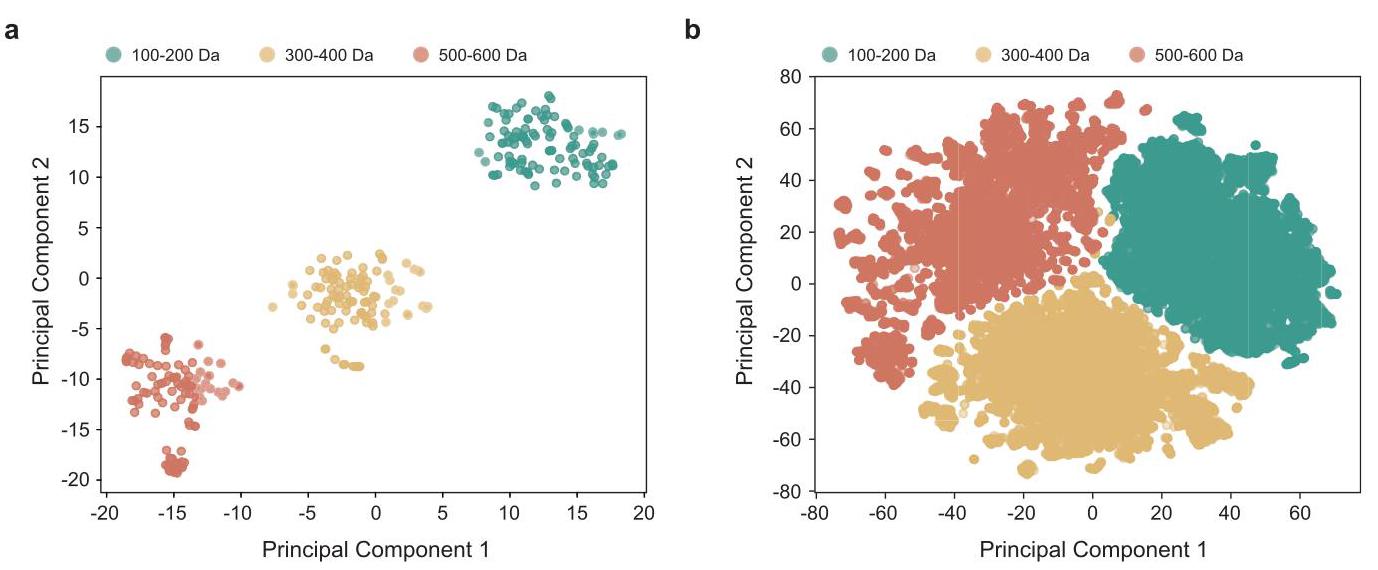
Figure 4. Visualization of spectrum encoder features using t-SNE. (a) Largest test subset under identical experimental conditions, showing clear mass-dependent clustering. (b) Full test set under heterogeneous conditions, where mass-dependent trends remain evident despite partial overlap.
图4. 使用t-SNE对光谱编码器特征进行可视化。(a) 相同实验条件下的最大测试子集,显示出明显的质量依赖性聚类。(b) 异构条件下的完整测试集,尽管存在部分重叠,但质量依赖性趋势仍然明显。
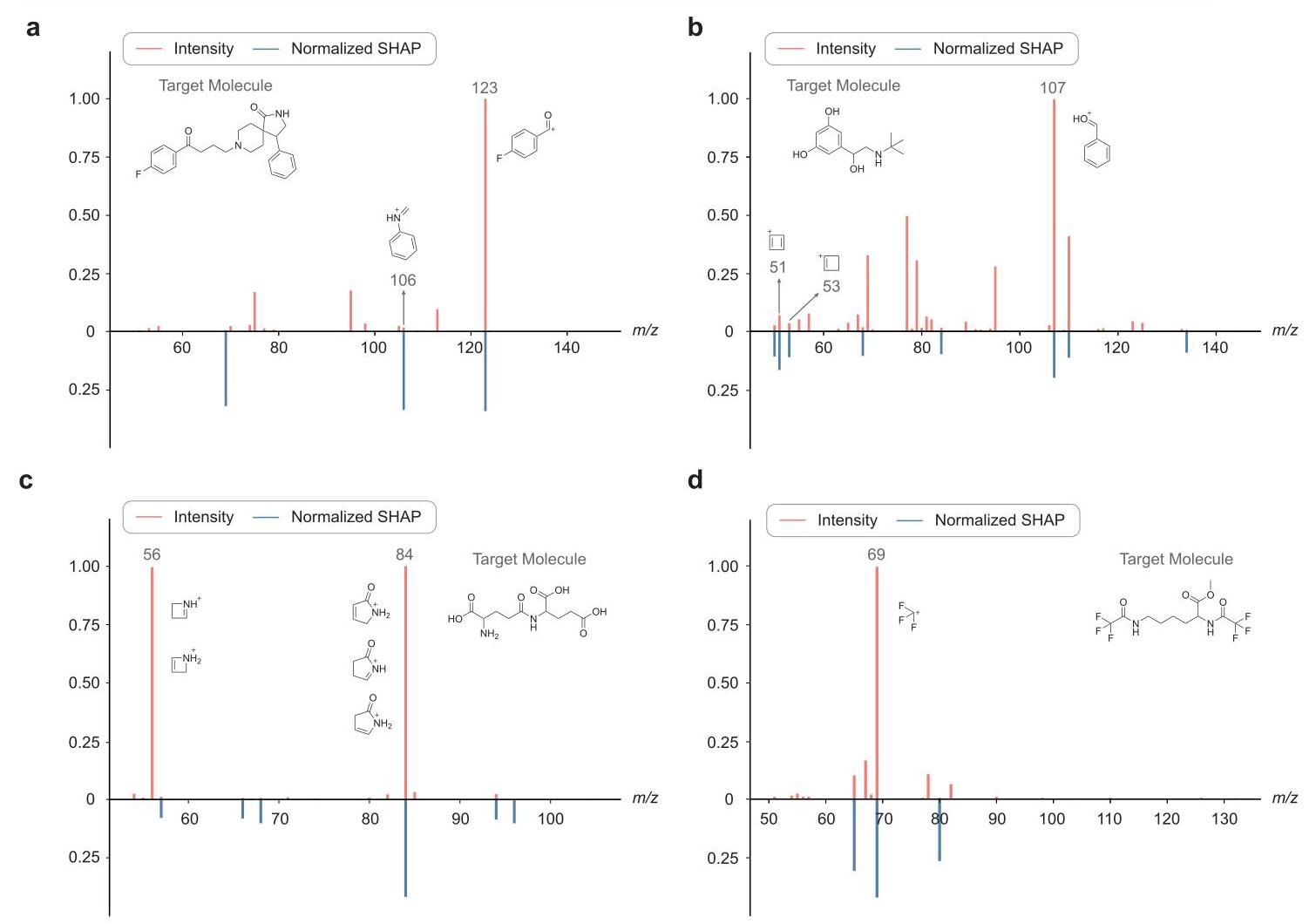
Figure 5. SHAP-based interpretability analysis of Cycle-MS. (a) Diagnostic peaks define the fluorobenzoyl-arylimine scaffold, while common aromatic fragments are downweighted. (b) Hydroxybenzene core and tert-butylamine side chain are identified by characteristic fragments, with nonspecific aromatic peaks contributing little. (c) $\gamma$ -Amino acid scaffold is highlighted by a pyrrolidone-type fragment, whereas intense but nonspecific peaks are deprioritized. (d) Dominant trifluoroacetyl fragment provides the key evidence for fluorinated motifs.
图5. Cycle-MS基于SHAP的可解释性分析。(a) 诊断峰定义了氟苯甲酰-芳基亚胺支架,而常见的芳香族碎片权重较低。(b) 羟基苯核心和叔丁胺侧链由特征碎片识别,非特异性芳香峰贡献较小。(c) $\gamma$ -氨基酸支架由吡咯烷酮型碎片突出显示,而强烈但非特异性的峰被赋予较低优先级。(d) 占主导地位的三氟乙酰碎片为氟化基序提供了关键证据。
DISCUSSION
讨论
This study introduces Cycle-MS, a model that integrates inverse spectrum-to-molecule prediction with forward spectrum reconstruction, augmented by cycle-consistency losses, to enhance spectral feature representation. Compared with other models, Cycle-MS achieves higher accuracy in atom counts, molecular formulas, scaffold similarity, and functional group prediction, enabling more reliable capture of both the overall molecular scale and key chemical features. Through a series of ablation studies, the importance of cycle training, experimental metadata, and pruning strategies in enhancing the model’s predictive performance was revealed. Interpretability analysis further reveals that Cycle-MS relies primarily on structurally diagnostic fragments rather than merely abundant peaks, thereby ensuring chemical plausibility and structural reliability in its predictions.
本研究介绍了Cycle-MS,这是一种将逆谱到分子预测与正向谱重建相结合的模型,并通过循环一致性损失进行增强,以提升光谱特征表示。与其他模型相比,Cycle-MS在原子计数、分子式、支架相似性和官能团预测方面实现了更高的准确率,能够更可靠地捕捉整体分子规模和关键化学特征。通过一系列消融研究,揭示了循环训练、实验元数据和剪枝策略在提升模型预测性能方面的重要性。可解释性分析进一步表明,Cycle-MS主要依赖于结构诊断片段而非仅仅是丰度高的峰,从而确保其预测中的化学合理性和结构可靠性。
While Cycle-MS offers a promising approach for high-precision end-to-end mass spectrometry analysis, it still faces several challenges. First, the available training data are insufficient. Future efforts should focus on incorporating more open-source data and refining data engineering to ensure effective integration of databases with diverse sources and distributions, thereby enhancing the comprehensiveness and robustness of model training. Second, Cycle-MS’s generalization ability needs improvement when dealing with novel data sets, such as CASMI 2022. To address this, future work could involve training specialized prediction models for different mass spectrometers and precursor ions, as well as the widespread use of transfer learning techniques to improve prediction accuracy across diverse data sets.
虽然Cycle-MS为高精度端到端质谱分析提供了一种有前景的方法,但它仍面临一些挑战。首先,可用的训练数据不足。未来的工作应专注于纳入更多开源数据并优化数据工程,以确保有效整合具有不同来源和分布的数据库,从而增强模型训练的全面性和稳健性。其次,Cycle-MS在处理新数据集(如CASMI 2022)时的泛化能力需要提高。为解决这一问题,未来的工作可能包括针对不同质谱仪和前体离子训练专门的预测模型,以及广泛使用迁移学习技术来提高跨不同数据集的预测准确性。
A ASSOCIATED CONTENT
A 相关内容
Data Availability Statement
数据可用性声明
The mass spectra data used in this study originate from the commercial NIST Mass Spectral Library (https://www.nist.gov/programs-projects/tandem-mass-spectral-library).Access to the full library requires a license. To ensure the reproducibility and independent verification of the key findings, the complete independent test set used for the final model evaluation has been deposited in a Zenodo repository (https://zenodo.org/records/ 18415823). The source code for the Cycle-MS framework and all associated scripts are freely available on GitHub at https:// github.com/HowardLi1984/mass2_mol_unify.
本研究中使用的质谱数据源自商业NIST质谱库(https://www.nist.gov/programs-projects/tandem-mass-spectral-library)。访问完整库需要许可证。为确保关键发现的可重复性和独立验证,用于最终模型评估的完整独立测试集已存于Zenodo存储库(https://zenodo.org/records/ 18415823)中。Cycle-MS框架的源代码和所有相关脚本可在GitHub上免费获取,网址为https:// github.com/HowardLi1984/mass2_mol_unify。
Supporting Information
支持信息
The Supporting Information is available free of charge at https://pubs.acs.org/doi/10.1021/acs.jcim.5c02981.
支持信息可在https://pubs.acs.org/doi/10.1021/acs.jcim.5c02981免费获取。
Molecular weight distribution in the data set; frequency distribution of functional groups in the test set; and prompting Gemini-2.5 for functional-group $m/z$ priors (PDF)
数据集中的分子量分布;测试集中官能团的频率分布;以及针对官能团$m/z$先验值提示Gemini-2.5(PDF)
A AUTHOR INFORMATION
A作者信息
Corresponding Author
通讯作者
Fanyang Mo - School of Materials Science and Engineering, Peking University, Beijing 100871, P. R. China; School of Advanced Materials and AI for Science (AI4S)-Preferred Program, Peking University Shenzhen Graduate School, Shenzhen 518055, P. R. China; (C) orcid.org/0000-0002- 4140-3020;
莫凡洋 - 中国北京大学材料科学与工程学院,北京100871;中国北京大学深圳研究生院先进材料与人工智能科学学院(AI4S)优选计划,深圳518055;(C) orcid.org/0000-0002- 4140-3020;邮箱:
Authors
作者
Jinglong Lin - School of Materials Science and Engineering, Peking University, Beijing 100871, P. R. China
林京龙 - 中国北京大学材料科学与工程学院,北京 100871
Hao Li - School of Electronic and Computer Engineering, Peking University Shenzhen Graduate School, Shenzhen 518055, P. R. China
李昊 - 中国北京大学深圳研究生院电子与计算机工程学院,深圳 518055
Chengchun Liu - School of Materials Science and Engineering, Peking University, Beijing 100871, P. R. China; © orcid.org/ 0009-0002-5550-4145
刘丞军 - 中国北京大学材料科学与工程学院,北京 100871;© orcid.org/ 0009-0002-5550-4145
Zhiyuan Yan - School of Electronic and Computer Engineering, Peking University Shenzhen Graduate School, Shenzhen 518055, P. R. China
晏志远 - 中国北京大学深圳研究生院电子与计算机工程学院,深圳 518055
Li Yuan - School of Electronic and Computer Engineering, Peking University Shenzhen Graduate School, Shenzhen 518055, P. R. China
袁粒 - 中国北京大学深圳研究生院电子与计算机工程学院,深圳 518055
Complete contact information is available at:
完整的联系信息如下:
https://pubs.acs.org/10.1021/acs.jcim.5c02981
Author Contributions
作者贡献
J.L analyzed the data. H.L. and J.L. performed chemoinformatic and machine learning studies. J.L and C.L conducted the interpretability analysis of the model. F.M. conceived the idea and designed the overall research. F.M. supervised the whole project. All authors wrote the manuscript. J.L. and H.L. contributed equally to this work.
J.L分析了数据。H.L.和J.L.进行了化学信息学和机器学习研究。J.L和C.L进行了模型的可解释性分析。F.M.提出了想法并设计了整体研究。F.M.监督了整个项目。所有作者撰写了手稿。J.L.和H.L.对这项工作贡献相同。
Notes
注释
The authors declare no competing financial interest.
作者声明不存在利益冲突。
ACKNOWLEDGMENTS
致谢
We thank Peking University Shenzhen Graduate School and Shenzhen Government for the start-up funding support. We thank the High Performance Computing Platform of Peking University for machine learning model training. This work is supported by the PaddlePaddle team (https://www.paddlepaddle.org.cn/).
我们感谢北京大学深圳研究生院和深圳市政府提供的启动资金支持。我们感谢北京大学高性能计算平台提供机器学习模型训练。本工作得到PaddlePaddle团队(https://www.paddlepaddle.org.cn/)的支持。
ERFERENCES
参考文献
(1) Dunn, W. B.; Ellis, D. I. Metabolomics: Current Analytical Platforms and Methodologies. Trends Anal. Chem. 2005, 24, 285-294.
(2) Zhou, B.; Xiao, J. F.; Tuli, L.; Ressom, H. W. LC-MS-based metabolomics. Molecular BioSystems 2011, 8, 470-481.
(3) Li, S.; Siddiqa, A.; Thapa, M.; Chi, Y.; Zheng, S. Trackable and scalable LC-MS metabolomics data processing using asari. Nat. Commun. 2023, 14, 4113.
(4) Aebersold, R.; Mann, M. Mass Spectrometry-Based Proteomics. Nature 2003, 422, 198-207.
(5) Yates, J. R.; Ruse, C. I.; Nakorchevsky, A. Proteomics by Mass Spectrometry: Approaches, Advances, and Applications. Annu. Rev. Biomed. Eng. 2009, 11, 49-79.
(6) Pino, L. K.; Rose, J.; O’Broin, A.; Shah, S.; Schilling, B. Emerging mass spectrometry-based proteomics methodologies for novel biomedical applications. Biochem. Soc. Trans. 2020, 48, 1953-1966.
(7) Lee, M. S.; Kerns, E. H. LC/MS Applications in Drug Development. Mass Spectrom. Rev. 1999, 18, 187-279.
(8) Dueñas, M. E.; Peltier-Heap, R. E.; Leveridge, M.; Annan, R. S.; Büttner, F. H.; Trost, M. Advances in high-throughput mass spectrometry in drug discovery. EMBO Mol. Med. 2023, 15, No. e14850.
(9) Zhang, A.; Sun, H.; Wang, X. Mass spectrometry-driven drug discovery for development of herbal medicine. Mass Spectrom. Rev. 2018, 37, 307-320.
(10) Schymanski, E. L.; Meringer, M.; Brack, W. Matching structures to mass spectra using fragmentation patterns: are the results as good as they look? Analytical chemistry 2009, 81, 3608-3617.
(11) Reiz, B.; Kertész-Farkas, A.; Pongor, S.; Myers, M. P. Chemical rule-based filtering of MS/MS spectra. Bioinformatics 2013, 29, 925- 932.
(12) Ulintz, P. J.; Zhu, J.; Qin, Z. S.; Andrews, P. C. Improved classification of mass spectrometry database search results using newer machine learning approaches. Molecular & Cellular Proteomics 2006, 5, 497-509.
(13) Cottrell, J. S. Protein identification using MS/MS data. Journal of proteomics 2011, 74, 1842-1851.
(14) Ghosh, K.; Stuke, A.; Todorović, M.; Jørgensen, P. B.; Schmidt, M. N.; Vehtari, A.; Rinke, P. Deep learning spectroscopy: Neural networks for molecular excitation spectra. Adv. Sci. 2019, 6, No. 1801367.
(15) Debus, B.; Parastar, H.; Harrington, P.; Kirsanov, D. Deep learning in analytical chemistry. TrAC Trends in Analytical Chemistry 2021, 145, No. 116459.
(16) Wang, X.; Jiang, S.; Hu, W.; Ye, S.; Wang, T.; Wu, F.; Yang, L.; Li, X.; Zhang, G.; Chen, X.; et al. Quantitatively determining surface-adsorbate properties from vibrational spectroscopy with interpretable machine learning. J. Am. Chem. Soc. 2022, 144, 16069-16076.
(17) Zou, Z.; Zhang, Y.; Liang, L.; Wei, M.; Leng, J.; Jiang, J.; Luo, Y.; Hu, W. A deep learning model for predicting selected organic molecular spectra. Nature Computational Science 2023, 3, 957-964.
(18) Xu, H.; Lin, J.; Liu, Q.; Chen, Y.; Zhang, J.; Yang, Y.; Young, M. C.; Xu, Y.; Zhang, D.; Mo, F. High-throughput discovery of chemical structure-polarity relationships combining automation and machine-learning techniques. Chem. 2022, 8, 3202-3214.
(19) Xu, H.; Lin, J.; Zhang, D.; Mo, F. Retention time prediction for chromatographic enantioseparation by quantile geometry-enhanced graph neural network. Nat. Commun. 2023, 14, 3095.
(20) Xu, H.; Wu, W.; Chen, Y.; Zhang, D.; Mo, F. Explicit relation between thin film chromatography and column chromatography conditions from statistics and machine learning. Nat. Commun. 2025, 16, 832.
(21) Beck, A. G.; Muhoberac, M.; Randolph, C. E.; Beveridge, C. H.; Wijewardhane, P. R.; Kenttamaa, H. I.; Chopra, G. Recent developments in machine learning for mass spectrometry. ACS Measurement Science Au 2024, 4, 233-246.
(22) Gessulat, S.; Schmidt, T.; Zolg, D. P.; Samaras, P.; Schnatbaum, K.; Zerweck, J.; Knaute, T.; Rechenberger, J.; Delanghe, B.; Huhmer, A.; et al. Prosit: proteome-wide prediction of peptide tandem mass spectra by deep learning. Nat. Methods 2019, 16, 509-518.
(23) Jirayupat, C.; Nagashima, K.; Hosomi, T.; Takahashi, T.; Tanaka, W.; Samransuksamer, B.; Zhang, G.; Liu, J.; Kanai, M.; Yanagida, T. Image processing and machine learning for automated identification of chemo-/biomarkers in chromatography-mass spectrometry. Analytical chemistry 2021, 93, 14708-14715.
(24) Satoh, T.; Takei, M.; Uematsu, F. Development of a Peak Extraction Method Using the High-Resolution Matrix-Assisted Laser Desorption/Ionization Time-of-Flight Mass Spectrometry and Machine Learning Techniques: Analysis of Peak Shapes. Rapid Commun. Mass Spectrom. 2022, 36, No. e9235.
(25) Young, A.; Röst, H.; Wang, B. Tandem mass spectrum prediction for small molecules using graph transformers. Nature Machine Intelligence 2024, 6, 404-416.
(26) Wei, J. N.; Belanger, D.; Adams, R. P.; Sculley, D. Rapid prediction of electron-ionization mass spectrometry using neural networks. ACS central science 2019, 5, 700-708.
(27) Allen, F.; Pon, A.; Greiner, R.; Wishart, D. Computational prediction of electron ionization mass spectra to assist in GC/MS compound identification. Analytical chemistry 2016, 88, 7689-7697.
(28) Zhu, R. L.; Jonas, E. Rapid approximate subset-based spectra prediction for electron ionization-mass spectrometry. Analytical chemistry 2023, 95, 2653-2663.
(29) Li, Y.; Kuhn, M.; Gavin, A.-C.; Bork, P. Identification of metabolites from tandem mass spectra with a machine learning approach utilizing structural features. Bioinformatics 2020, 36, 1213- 1218.
(30) Dührkop, K.; Fleischauer, M.; Ludwig, M.; Aksenov, A. A.; Melnik, A. V.; Meusel, M.; Dorrestein, P. C.; Rousu, J.; Böcker, S. SIRIUS 4: a rapid tool for turning tandem mass spectra into metabolite structure information. Nat. Methods 2019, 16, 299-302.
(31) Goldman, S.; Xin, J.; Provenzano, J.; Coley, C. W. Mist-cf: Chemical formula inference from tandem mass spectra. J. Chem. Inf. Model. 2024, 64, 2421-2431.
(32) Stravs, M. A.; Dührkop, K.; Böcker, S.; Zamboni, N. MSNovelist: de novo structure generation from mass spectra. Nat. Methods 2022, 19, 865-870.
(33) Chen, L.; Xia, B.; Wang, Y.; Huang, X.; Gu, Y.; Wu, W.; Zhou, Y. Cmssp: A contrastive mass spectra-structure pretraining model for metabolite identification. Anal. Chem. 2024, 96, 16871-16881.
(34) Xie, T.; Zhang, H.; Yang, Q.; Sun, J.; Wang, Y.; Long, J.; Zhang, Z.; Lu, H. CSU-MS2: A Contrastive Learning Framework for Cross-Modal Compound Identification from MS/MS Spectra to Molecular Structures. Anal. Chem. 2025, 97, 13350-13360.
(35) Yu, N.; Ma, Z.; Shao, Q.; Li, L.; Wang, X.; Pan, B.; Yu, H.; Wei, S. Pseudodata-based molecular structure generator to reveal unknown chemicals. Nat. Mach. Intell. 2025, 7, 1879-1887.
(36) Litsa, E. E.; Chenthamarakshan, V.; Das, P.; Kavraki, L. E. An end-to-end deep learning framework for translating mass spectra to de-novo molecules. Commun. Chem. 2023, 6, 132.
(37) Zong, G.; Gao, J.; Qi, Y.; Zhao, H.; Feng, W.; Hu, B.; Ma, J.; Du, L.; Han, J. A Spectrum-to-Structure Diffusion Model for De Novo Small Molecule Generation. Anal. Chem. 2025, 97, 27325-27336.
(38) Bohde, M.; Manjrekar, M.; Wang, R.; Ji, S.; Coley, C. W. Diffms: Diffusion generation of molecules conditioned on mass spectra. arXiv preprint arXiv:2502.09571, 2025.
(39) Kearnes, S.; McCloskey, K.; Berndl, M.; Pande, V.; Riley, P. Molecular graph convolutions: moving beyond fingerprints. J. Comput. Aided Mol. Des. 2016, 30, 595-608.
(40) Schütt, K. T.; Sauceda, H. E.; Kindermans, P.-J.; Tkatchenko, A.; Müller, K.-R. Schnet-a deep learning architecture for molecules and materials. J. Chem. Phys. 2018, 148, 241722.
(41) Fang, X.; Liu, L.; Lei, J.; He, D.; Zhang, S.; Zhou, J.; Wang, F.; Wu, H.; Wang, H. Geometry-enhanced molecular representation learning for property prediction. Nat. Mach. Intell. 2022, 4, 127-134.
(42) Li, S.-W.; Xu, L.-C.; Zhang, C.; Zhang, S.-Q.; Hong, X. Reaction performance prediction with an extrapolative and interpretable graph model based on chemical knowledge. Nat. Commun. 2023, 14, 3569.
(43) Wang, Y.; Chen, X.; Liu, L.; Hassoun, S. MADGEN: Mass-Spec attends to De Novo Molecular generation. arXiv preprint arXiv:2501.01950, 2025.