Infrared Spectra Prediction for Carbonyl Group Utilizing a Graph Network Approach
英文原文与中文译文逐段对照 · English original with Chinese translation
Jie Shi, Chengchun Liu, and Fanyang Mo*
石解,刘丞军,莫凡洋*
Cite This: Precis. Chem. 2026, 4, 782-792
引用本文:Precis. Chem. 2026, 4, 782 - 792
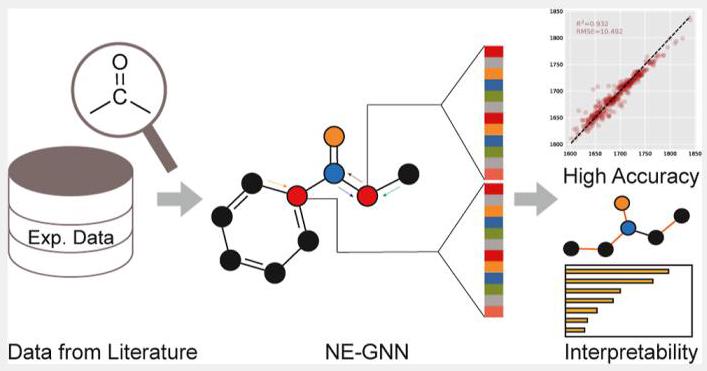
ABSTRACT: Infrared spectroscopy stands as a formidable analytical tool, ubiquitously employed across materials science and biomedical research. Yet, manual interpretation of spectral data remains a laborious and time-intensive endeavor. Carbonyl groups, pervasive in organic compounds, such as natural products, pharmaceuticals, and peptides, demonstrate both compelling predictive potential and critical diagnostic significance for interpretable spectral analysis. This work harnesses experimentally measured spectroscopic data from chemical literature, constructing a robust data set to propel efficiency. We introduce NE-GNN, a specialized feature extraction approach synergizing proximal structural analysis with graph neural networks-a method that marries predictive accuracy with interpretability. By leveraging this chemically intuitive framework, NE-GNN achieves remarkable precision in predicting carbonyl group peaks in infrared spectra. Beyond accelerating machine learning applications in spectroscopic analysis, this strategy supports data-driven discovery in chemistry.
摘要:红外光谱是一种强大的分析工具,在材料科学和生物医学研究中广泛应用。然而,光谱数据的人工解读仍然是一项费力且耗时的工作。羰基在有机化合物中普遍存在,如天然产物、药物和肽类,对于可解释的光谱分析具有显著的预测潜力和关键的诊断意义。本工作利用化学文献中实验测量的光谱数据,构建了一个强大的数据集以提高效率。我们引入了NE - GNN,一种将近端结构分析与图神经网络相结合的专门特征提取方法——一种将预测准确性与可解释性相结合的方法。通过利用这个具有化学直观性的框架,NE - GNN在预测红外光谱中的羰基峰方面取得了显著的精度。除了加速光谱分析中的机器学习应用外,该策略还支持化学领域的数据驱动发现。
KEYWORDS: GNN, infrared spectra, carbonyl group, interpretability, characteristic peak, machine learning
关键词:GNN,红外光谱,羰基,可解释性,特征峰,机器学习
INTRODUCTION
引言
Infrared spectroscopy (IR) stands as a powerful analytical tool, playing a pivotal role across diverse fields, including chemistry, materials science, biomedicine, and environmental monitoring. ${}^{1}$ By probing the vibrational signatures of chemical bonds, this technique provides a unique window into molecular structure, dynamics, and interactions. ${}^{2}$ However, conventional approaches to infrared spectral analysis often rely heavily on expert interpretation, which presents significant challenges in deciphering complex spectral data. ${}^{3}$ Key limitations include the identification and assignment of spectral features, the deconvolution of overlapping peaks, and the spectral baseline corrections. ${}^{4 - 6}$ These processes are not only time-consuming and labor-intensive but also prone to subjective errors. ${}^{7,8}$
红外光谱(IR)是一种强大的分析工具,在化学、材料科学、生物医学和环境监测等多个领域发挥着关键作用。${}^{1}$ 通过探测化学键的振动特征,该技术为分子结构、动力学和相互作用提供了独特的窗口。${}^{2}$ 然而,传统的红外光谱分析方法通常严重依赖专家解读,这在解读复杂光谱数据时面临重大挑战。${}^{3}$ 关键限制包括光谱特征的识别和归属、重叠峰的解卷积以及光谱基线校正。${}^{4 - 6}$ 这些过程不仅耗时费力,而且容易出现主观误差。${}^{7,8}$
The advent of artificial intelligence has inaugurated a transformative era for infrared spectral analysis, with cutting-edge algorithms that include convolutional neural networks (CNNs), message passing neural networks (MPNNs), and graph neural networks (GNNs) redefining traditional analytical paradigms. ${}^{9 - {11}}$ These sophisticated machine learning approaches possess an extraordinary capacity to autonomously extract meaningful patterns from vast spectral data sets, enabling rapid and precise interpretation of complex vibrational signatures without human intervention. ${}^{{12},{13}}$ Beyond merely accelerating analysis, these intelligent systems uncover hidden correlations within spectral data, offering researchers unprecedented insights into molecular structure-property relationships that were previously obscured by conventional methods. ${}^{{14},{15}}$ Molecular feature engineering bridges fundamental knowledge of chemistry with computational descriptors. ${}^{16}$ The synergy between advanced neural architectures and well-engineered molecular descriptors creates a powerful analytical framework, where physical insights guide algorithmic learning to achieve both interpretability and predictive accuracy. ${}^{{17},{18}}$
人工智能的出现为红外光谱分析开创了一个变革性的时代,包括卷积神经网络(CNN)、消息传递神经网络(MPNN)和图神经网络(GNN)在内的前沿算法正在重新定义传统分析范式。${}^{9 - {11}}$ 这些先进的机器学习方法具有非凡的能力,能够从大量光谱数据集中自动提取有意义的模式,无需人工干预即可快速准确地解读复杂的振动特征。${}^{{12},{13}}$ 这些智能系统不仅加速了分析,还揭示了光谱数据中隐藏的相关性,为研究人员提供了前所未有的关于分子结构 - 性质关系的见解,而这些关系以前被传统方法所掩盖。${}^{{14},{15}}$ 分子特征工程将化学基础知识与计算描述符联系起来。${}^{16}$ 先进的神经架构与精心设计的分子描述符之间的协同作用创建了一个强大的分析框架,其中物理见解指导算法学习以实现可解释性和预测准确性。${}^{{17},{18}}$
Infrared spectroscopy (IR) stands as an indispensable analytical tool in chemical synthesis, enabling rapid functional group characterization, real-time reaction monitoring, product structure verification, and process optimization. ${}^{19}$ While machine learning has ushered in revolutionary paradigms for interpreting such spectral data, its application to complex molecular systems remains hampered by the limitations of conventional feature engineering. ${}^{{20},{21}}$ However, a more fundamental issue is that current state-of-the-art chemical models often function as enigmatic black boxes, their decision-making processes obscured by computational complexity. ${}^{5,{22},{23}}$ This interpretability crisis becomes particularly acute in functional group identification: Despite advances in full-spectrum prediction within the mid-infrared region, the crucial task of peak assignment still relies heavily on experts. ${}^{{14},{24}}$ The fundamental challenge lies in developing models that can selectively predict localized molecular features with both algorithmic precision and chemical transparency. ${}^{25}$ An alternative methodological pathway involves developing specialized predictors targeting individual functional groups for granular single-band spectral predicting, followed by their systematic integration into a unified analytical framework. ${}^{26}$ This integrated approach promises to enable highly accurate characteristic peak predictions and interpretations of molecular spectra, fundamentally aligning the analytical process with the intuitive reasoning patterns employed by expert chemists.
红外光谱(IR)在化学合成中是一种不可或缺的分析工具,能够实现快速官能团表征、实时反应监测、产物结构验证和过程优化。${}^{19}$ 虽然机器学习为解释此类光谱数据带来了革命性的范式,但其在复杂分子系统中的应用仍然受到传统特征工程局限性的阻碍。${}^{{20},{21}}$ 然而,一个更根本的问题是,当前最先进的化学模型往往像神秘的黑匣子一样运作,其决策过程被计算复杂性所掩盖。${}^{5,{22},{23}}$ 这种可解释性危机在官能团识别中尤为严重:尽管在中红外区域的全光谱预测方面取得了进展,但峰归属的关键任务仍然严重依赖专家。${}^{{14},{24}}$ 根本挑战在于开发能够以算法精度和化学透明度选择性预测局部分子特征的模型。${}^{25}$ 另一种方法途径是开发针对单个官能团的专门预测器,用于精细的单波段光谱预测,然后将它们系统地集成到一个统一的分析框架中。${}^{26}$ 这种集成方法有望实现高精度的特征峰预测和分子光谱解释,从根本上使分析过程与专家化学家采用的直观推理模式保持一致。
Received: November 23, 2025
收到日期:2025年11月23日
Revised: January 28, 2026
修订日期:2026年1月28日
Accepted: January 29, 2026
接受日期:2026年1月29日
Published: February 6, 2026
发表日期:2026年2月6日
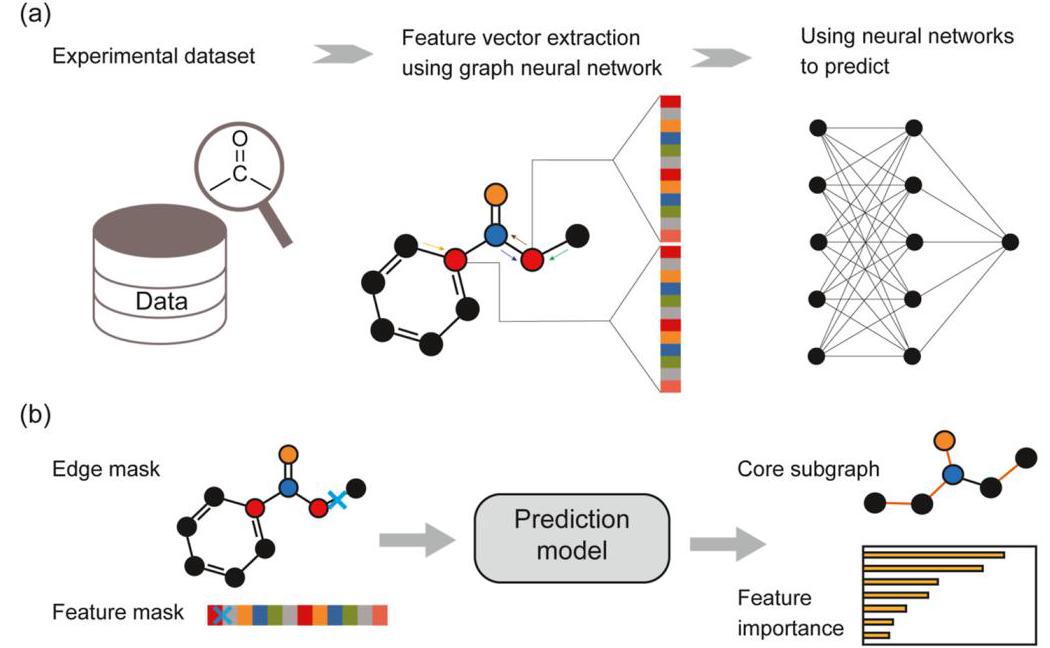
Figure 1. Workflow of this work. (a) This work establishes a predictive workflow leveraging graph neural networks for infrared spectral analysis. (b) The underlying prediction mechanism is elucidated through GNNExplainer, which interprets model decisions by identifying critical subgraph structures and feature contributions.
图1. 本工作的流程。(a)本工作建立了一个利用图神经网络进行红外光谱分析的预测流程。(b)通过GNNExplainer阐明了潜在的预测机制,它通过识别关键子图结构和特征贡献来解释模型决策。
This work presents a purpose-built graph neural network architecture that integrates proximal structural features to address these limitations. By the design of chemically intuitive molecular representations that emphasize atomic neighborhoods and bonding environments, our approach enables the targeted prediction of specific functional group characteristic peaks. Carbonyl groups, with their extensive presence across diverse compounds and their fundamental role in synthesis and real-time analytical detection, serve as an ideal test case for demonstrating how machine learning can advance beyond broad spectral reproduction to deliver precise and interpretable group-specific predictions. ${}^{27}$ By comprehensively comparing our approach to conventional methods, we show how strategically designed neural networks can complement traditional analysis, especially in scenarios that demand both accuracy and explanatory power. ${}^{28}$ Through rigorous comparative benchmarking of diverse computational models, this study provides critical guidance for researchers seeking analytical methodologies. Furthermore, this work sets the essential foundation for a future paradigm: integrating specialized prediction models tailored to distinct functional groups.
本工作提出了一种专门构建的图神经网络架构,该架构整合了近端结构特征以解决这些限制。通过设计强调原子邻域和键合环境的化学直观分子表示,我们的方法能够有针对性地预测特定官能团的特征峰。羰基在各种化合物中广泛存在,并且在合成和实时分析检测中具有重要作用,是展示机器学习如何超越广泛的光谱再现以提供精确且可解释的基团特异性预测的理想测试案例。${}^{27}$ 通过将我们的方法与传统方法进行全面比较,我们展示了经过战略设计的神经网络如何补充传统分析,特别是在需要准确性和解释力的场景中。${}^{28}$ 通过对各种计算模型进行严格比较基准测试,本研究为寻求分析方法的研究人员提供了关键指导。此外,这项工作为未来的范式奠定了基础:整合针对不同官能团量身定制的专门预测模型。
METHODS
方法
Data Set
数据集
We compiled the Characteristic Infrared Absorption Wavenumber of the Carbonyl group (CIAC) data set of experimental infrared spectra from 579 publications, focusing on carbonyl group absorption between 1590 and ${1850}{\mathrm{\;{cm}}}^{-1}$ (Figure S1). To ensure data quality, we selected molecules with only one peak in this range, excluding those with potential interference from other functional groups. For molecules exhibiting multiple peaks, we applied a criterion of chemical reasonableness, which guided our identification of structurally similar carbonyl subclasses from the same literature source and the selection of peaks with minimal wavenumber differences $\left( {{\Delta \nu } < {30}{\mathrm{\;{cm}}}^{-1}}\right)$ . The final data set contains 8072 monocarbonyl and 982 multicarbonyl compounds (Figure S2). The CIAC set generally conforms to the common distribution of carbonyl groups, and the data inside reflect different chemical environments (Figure 2). This carefully curated data set provides a reliable foundation for studying carbonyl vibrations while covering diverse molecular structures.
我们从579篇出版物中汇编了羰基特征红外吸收波数(CIAC)数据集,重点关注1590至${1850}{\mathrm{\;{cm}}}^{-1}$之间的羰基吸收(图S1)。为确保数据质量,我们选择了在此范围内只有一个峰的分子,排除了那些可能受到其他官能团干扰的分子。对于呈现多个峰的分子,我们应用了化学合理性标准,该标准指导我们从同一文献来源中识别结构相似的羰基子类,并选择波数差异最小的峰$\left( {{\Delta \nu } < {30}{\mathrm{\;{cm}}}^{-1}}\right)$。最终数据集包含8072个单羰基化合物和982个多羰基化合物(图S2)。CIAC数据集总体上符合羰基的常见分布,其内部数据反映了不同的化学环境(图2)。这个精心策划的数据集为研究羰基振动提供了可靠的基础,同时涵盖了多样的分子结构。
Molecular Graph Representation
分子图表示
We employed PyTorch Geometric’s data class to transform molecules into graph structures, where atoms serve as nodes and bonds serve as edges. To enhance feature representation, we introduced one critical attribute: ${}^{29}$
我们使用PyTorch Geometric的数据类将分子转换为图结构,其中原子作为节点,键作为边。为了增强特征表示,我们引入了一个关键属性:${}^{29}$
carbonyl_mask: An indicator $\left( {0/1/2}\right)$ recognizes the atoms within the carbonyl 2-bond radius and marks the carbonyl carbon as 0.6 , so as to select the nodes in the subsequent graph convolution operation.
羰基掩码:一个指示器$\left( {0/1/2}\right)$识别羰基2键半径内的原子,并将羰基碳标记为0.6,以便在后续的图卷积操作中选择节点。
Selection of Node and Edge Features. We selected 16 node features and 5 edge features for molecular graph representation. Node features include: 9 fundamental atomic properties: atomic number, connectivity, implicit valence, ring membership, hybridization type, electronegativity, covalent radius, aromaticity, formal charge. Seven environmental attention features: ring size, summed electronegativity of adjacent atoms, total neighbor connectivity, aromatic atom count, Neighbor ring atom count, double bond count, triple bond count. Edge features comprise the following: bond type, conjugation status, ring membership, aromaticity, and polarity.
节点和边特征的选择。我们选择了16个节点特征和5个边特征用于分子图表示。节点特征包括:9个基本原子属性:原子序数、连通性、隐含价、环成员关系、杂化类型、电负性、共价半径、芳香性、形式电荷。7个环境关注特征:环大小、相邻原子的电负性总和、总邻居连通性、芳香原子数、邻居环原子数、双键数、三键数。边特征包括以下内容:键类型、共轭状态、环成员关系、芳香性和极性。
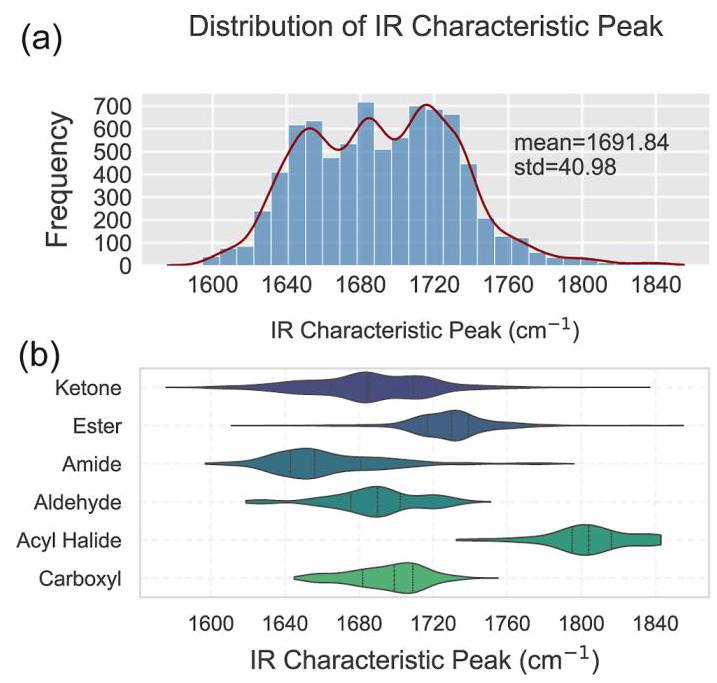
Figure 2. Distribution of the CIAC data set. (a) Wavenumber distribution in the CIAC data set. (b) Violin plot distribution of different types of carbonyl groups in the CIAC data set.
图2. CIAC数据集的分布。(a) CIAC数据集中的波数分布。(b) CIAC数据集中不同类型羰基的小提琴图分布。
Atomic. Atomic number, Connectivity, Implicit valence, Ring membership, Hybridization, Electronegativity, Covalent radius, Aromaticity, and Formal charge.
原子。原子序数、连通性、隐含价、环成员关系、杂化、电负性、共价半径、芳香性和形式电荷。
Environmental. Ring size, ΣNeighbor electronegativity, Neighbor Degree, Neighbor Aromaticity, Neighbor in Ring, Neighbor Double Bond, and Neighbor Triple Bond.
环境。环大小、Σ邻居电负性、邻居度、邻居芳香性、环内邻居、邻居双键和邻居三键。
Edge. Bond type, Conjugation status, Ring membership, Aromaticity, and Polarity.
边。键类型、共轭状态、环成员关系、芳香性和极性。
Details for NE-GNN
NE-GNN的细节
The architecture of our proposed network, named Neighbor Enhanced Graph Neural Networks (NE-GNN), as illustrated in Figure 1, processes molecular graphs through a multistage computational pipeline. Initially, both atom and edge features are projected into 128-dimensional embeddings and subsequently fused together. These fused features then undergo four successive Graph Isomorphism Network (GINE) layers that perform iterative message passing and feature updating operations to capture complex molecular patterns. ${}^{30}$ For targeted carbonyl group analysis, the network pays attention to the characteristics of two atoms around the carbonyl carbon atom except for the carbonyl oxygen after being updated with the message and integrates the feature vectors of the two. The integrated features are finally processed through two fully connected layers to generate accurate spectral predictions. Furthermore, predictions can also be strategically generated by leveraging the feature vector of the carbonyl carbon atom itself, which inherently encodes the distinct chemical environment imposed by different functional groups. ${}^{31}$ This architecture uniquely combines local chemical environment analysis around carbonyl groups with global molecular structure learning through multiple GINE layers while maintaining computational efficiency through its efficient implementation. The network’s ability to focus on chemically relevant regions while preserving broader molecular context enables both precise spectral predictions and meaningful pattern recognition.
我们提出的名为邻居增强图神经网络(NE-GNN)的网络架构,如图1所示,通过多阶段计算管道处理分子图。最初,原子和边特征都被投影到128维嵌入中,随后融合在一起。这些融合后的特征接着经过四个连续的图同构网络(GINE)层,这些层执行迭代消息传递和特征更新操作以捕获复杂的分子模式。${}^{30}$ 对于目标羰基分析,网络在使用消息更新后关注羰基碳原子周围除羰基氧之外的两个原子的特征,并整合这两个原子的特征向量。最终,整合后的特征通过两个全连接层进行处理以生成准确的光谱预测。此外,预测也可以通过利用羰基碳原子本身的特征向量策略性地生成,该特征向量本身编码了不同官能团施加的独特化学环境。${}^{31}$ 这种架构独特地将羰基周围的局部化学环境分析与通过多个GINE层进行的全局分子结构学习相结合,同时通过其高效实现保持计算效率。该网络在保留更广泛分子背景的同时专注于化学相关区域的能力,既能够实现精确的光谱预测,又能够进行有意义的模式识别。
Training Detail
训练细节
We performed hyperparameter optimization via grid search, evaluating graph convolution layers, node selection, and embedding dimensions. The optimal configuration uses 4 graph convolution layers with 128-dimensional embeddings, utilizing feature vectors from atoms directly bonded to carbonyl groups for prediction. For one node NE-GNN, the best configuration is four 256-dimensional GINE convolutional layers.
我们通过网格搜索进行超参数优化,评估图卷积层、节点选择和嵌入维度。最优配置使用4个图卷积层,嵌入维度为128维,利用直接与羰基键合的原子的特征向量进行预测。对于单节点NE-GNN,最佳配置是四个256维的GINE卷积层。
The data set was split into a training set (90%), a validation set (5%), and a test set (5%). We employed the Adam optimizer with MSE loss and a learning rate decay strategy. In order to improve training stability and avoid potential data leaks, we divided the data sets, normalized them separately, and normalized the ketone peak intensities by subtracting the mean of the data sets and dividing by the standard deviation. Subsequently, the normalized data are used for model training and prediction. During evaluation, we restore the predicted values and normalized values back, according to their respective normalized parameters.
数据集被划分为训练集(90%)、验证集(5%)和测试集(5%)。我们采用带有均方误差损失和学习率衰减策略的Adam优化器。为了提高训练稳定性并避免潜在的数据泄漏,我们对数据集进行划分,分别进行归一化,并通过减去数据集的均值并除以标准差来对酮峰强度进行归一化。随后,将归一化后的数据用于模型训练和预测。在评估期间,我们根据各自的归一化参数将预测值和归一化值恢复回来。
Interpretability Methods
可解释性方法
To demystify the decision logic of our graph neural network, we employ two complementary interpretability approaches: GNNEx-plainer and Perturbation-based Sensitivity Analysis (PSA). ${}^{32}$
为了揭开我们的图神经网络决策逻辑的神秘面纱,我们采用了两种互补的可解释性方法:GNNEx-plainer和基于扰动的敏感性分析(PSA)。${}^{32}$
GNNExplainer identifies chemically relevant substructures by optimizing a masked subgraph that maximizes its mutual information with the model’s prediction while remaining structurally concise. Its objective is formulated as
GNNExplainer通过优化一个掩码子图来识别化学相关的子结构,该掩码子图在保持结构简洁的同时,使其与模型预测的互信息最大化。其目标被表述为
$$ \mathop{\max }\limits_{{{\mathrm{G}}_{\mathrm{S}},\mathrm{F}}}\mathrm{I}\left( {\widehat{\mathrm{Y}};\left( {{\mathrm{G}}_{\mathrm{S}},\mathrm{F}}\right) }\right) - {\lambda }_{1}\mathrm{H}\left( {\mathrm{A}}_{\mathrm{S}}\right) - {\lambda }_{2}\mathrm{H}\left( \mathrm{F}\right) \tag{1} $$where $\mathrm{I}\left( {\widehat{\mathrm{Y}};\left( {{\mathrm{G}}_{\mathrm{S}},\mathrm{F}}\right) }\right)$ is the mutual information between the prediction $\mathrm{Y}$ and the explanatory subgraph ${G}_{\mathrm{S}}$ with feature mask $\mathrm{F};\mathrm{H}\left( {\mathrm{A}}_{\mathrm{S}}\right)$ and H(F) are entropy terms penalizing structural and feature complexity; ${\lambda }_{1},{\lambda }_{2}$ control the fidelity-sparsity trade-off.
其中$\mathrm{I}\left( {\widehat{\mathrm{Y}};\left( {{\mathrm{G}}_{\mathrm{S}},\mathrm{F}}\right) }\right)$是预测$\mathrm{Y}$与具有特征掩码$\mathrm{F};\mathrm{H}\left( {\mathrm{A}}_{\mathrm{S}}\right)$的解释性子图${G}_{\mathrm{S}}$之间的互信息,H(F)是惩罚结构和特征复杂性的熵项;${\lambda }_{1},{\lambda }_{2}$控制保真度-稀疏性权衡。
However, GNNExplainer yields non-negative importance scores and struggles with global feature attribution across variable-sized graphs. To address this, we introduce PSA, which quantifies the directional influence of atomic features via systematic perturbation. For a trained GNN $f$ and molecular graph $\mathcal{G}$ , the sensitivity of feature $k$ is
然而,GNNExplainer产生的重要性分数是非负的,并且在处理不同大小的图的全局特征归因方面存在困难。为了解决这个问题,我们引入了PSA,它通过系统扰动来量化原子特征的方向影响。对于一个训练好的GNN$f$和分子图$\mathcal{G}$,特征$k$的敏感性为
$$ {\Delta }_{k} = f\left( \mathcal{G}\right) - f\left( {\mathcal{G}}^{\left( k\right) }\right) \tag{2} $$where ${\mathcal{G}}^{\left( k\right) }$ is the graph with the $k$ -th atomic feature zero-masked across all atoms. A positive ${\Delta }_{k}$ implies that the feature promotes the target property, while a negative value indicates inhibition. The signed importance score ${S}_{k} = {\Delta }_{k}$ thus offers both magnitude and chemically intuitive directionality-without requiring fixed input dimensions.
其中${\mathcal{G}}^{\left( k\right) }$是在所有原子上第$k$个原子特征被零掩码的图。正的${\Delta }_{k}$意味着该特征促进目标属性,而负值表示抑制。带符号的重要性分数${S}_{k} = {\Delta }_{k}$因此既提供了大小又提供了化学上直观的方向性——而不需要固定的输入维度。
RESULTS AND DISCUSSION
结果与讨论
Model Performance Evaluation
模型性能评估
To rigorously quantify our model’s predictive accuracy, we employ three complementary statistical measures that collectively assess different dimensions of regression performance. The Mean Absolute Error (MAE) captures the average prediction deviation without directional bias, particularly valuable when outlier rejection is prioritized. More sensitive to extreme errors, the Root Mean Squared Error (RMSE) exponentially penalizes larger inaccuracies, making it ideal for applications demanding strict error boundaries. Finally, the Coefficient of Determination $\left( {R}^{2}\right)$ evaluates the global predictive power by measuring the explained variance relative to naive baselines, with values approaching 1.0 indicating a near-perfect correlation between predicted and experimental values.
为了严格量化我们模型的预测准确性,我们采用了三种互补的统计量,它们共同评估回归性能的不同维度。平均绝对误差(MAE)捕捉无方向偏差的平均预测偏差,在优先考虑异常值剔除时特别有价值。均方根误差(RMSE)对极端误差更敏感,它会对较大的误差进行指数级惩罚,因此非常适合要求严格误差边界的应用。最后,决定系数$\left( {R}^{2}\right)$通过测量相对于简单基线的解释方差来评估全局预测能力,其值接近1.0表明预测值与实验值之间几乎完美相关。
Figure 3a, b presents the predictive performance of various graph neural networks alongside a structure-aware tree-based model employing SNM (Substructure Neighborhood Mechanism). ${}^{14}$ Benchmark results for the identical test set demonstrate that the GINE-based approach consistently outperforms others by 0.6%. This performance gap highlights graph neural networks’ inherent advantages in capturing complex molecular patterns through explicit representation of atomic connectivity and chemical environments, and the RMSE was only 10.58, which was better than 12.151 ${\mathrm{{cm}}}^{-1}$ under random forest. Edge-aware architectures show particular efficacy for spectral prediction (Figure 3c) over their tree-based counterparts. The optimal GINE architecture achieves exceptional performance with ${R}^{2} = {0.931}$ , outperforming the best random forest implementation $\left( {{R}^{2} = {0.908}}\right)$ by a statistically significant margin of 0.023 .
图3a、b展示了各种图神经网络以及采用SNM(子结构邻域机制)的基于结构感知的树模型的预测性能。${}^{14}$相同测试集的基准结果表明,基于GINE的方法始终比其他方法高出0.6%。这种性能差距凸显了图神经网络在通过明确表示原子连接性和化学环境来捕捉复杂分子模式方面的固有优势,并且RMSE仅为10.58,优于随机森林下的12.151 ${\mathrm{{cm}}}^{-1}$。与基于树的对应模型相比,边缘感知架构在光谱预测方面(图3c)显示出特别的效果。最优的GINE架构以${R}^{2} = {0.931}$实现了卓越的性能,在统计上显著优于最佳随机森林实现$\left( {{R}^{2} = {0.908}}\right)$,优势为0.023。
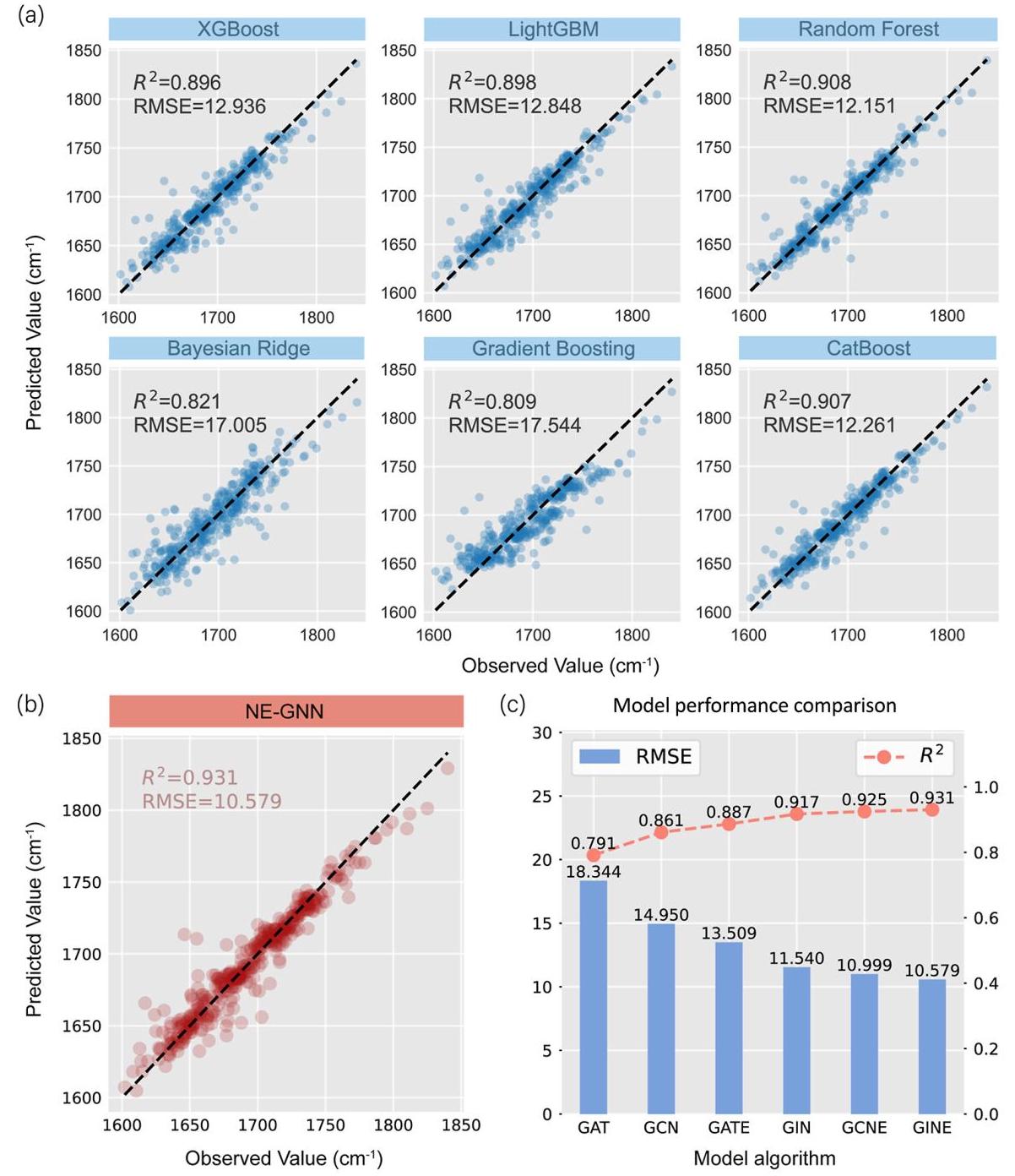
Figure 3. Model performance analysis. (a) Model performance analysis under different algorithms. (b) Prediction effect of NE-GNN. (c) Comparison of different graph convolution models.
图3. 模型性能分析。(a) 不同算法下的模型性能分析。(b) NE-GNN的预测效果。(c) 不同图卷积模型的比较。
Table 1. Prediction Results of Carbonyl Compounds
表1. 羰基化合物的预测结果
| molecule[cm ${}^{-1}$ ] |  |  |  |
| observed value | 1653.00 | 1767.00 | 1721.00 |
| NE-GNN | 1652.62 | 1767.26 | 1722.11 |
| Bayesian Ridge | 1666.95 | 1743.81 | 1710.66 |
| CatBoost | 1657.53 | 1746.45 | 1709.56 |
| Gradient Boosting | 1659.38 | 1744.62 | 1698.67 |
| LightGBM | 1663.67 | 1749.47 | 1703.01 |
| Random Forest | 1661.30 | 1753.55 | 1705.92 |
| XGBoost | 1654.66 | 1747.40 | 1704.84 |
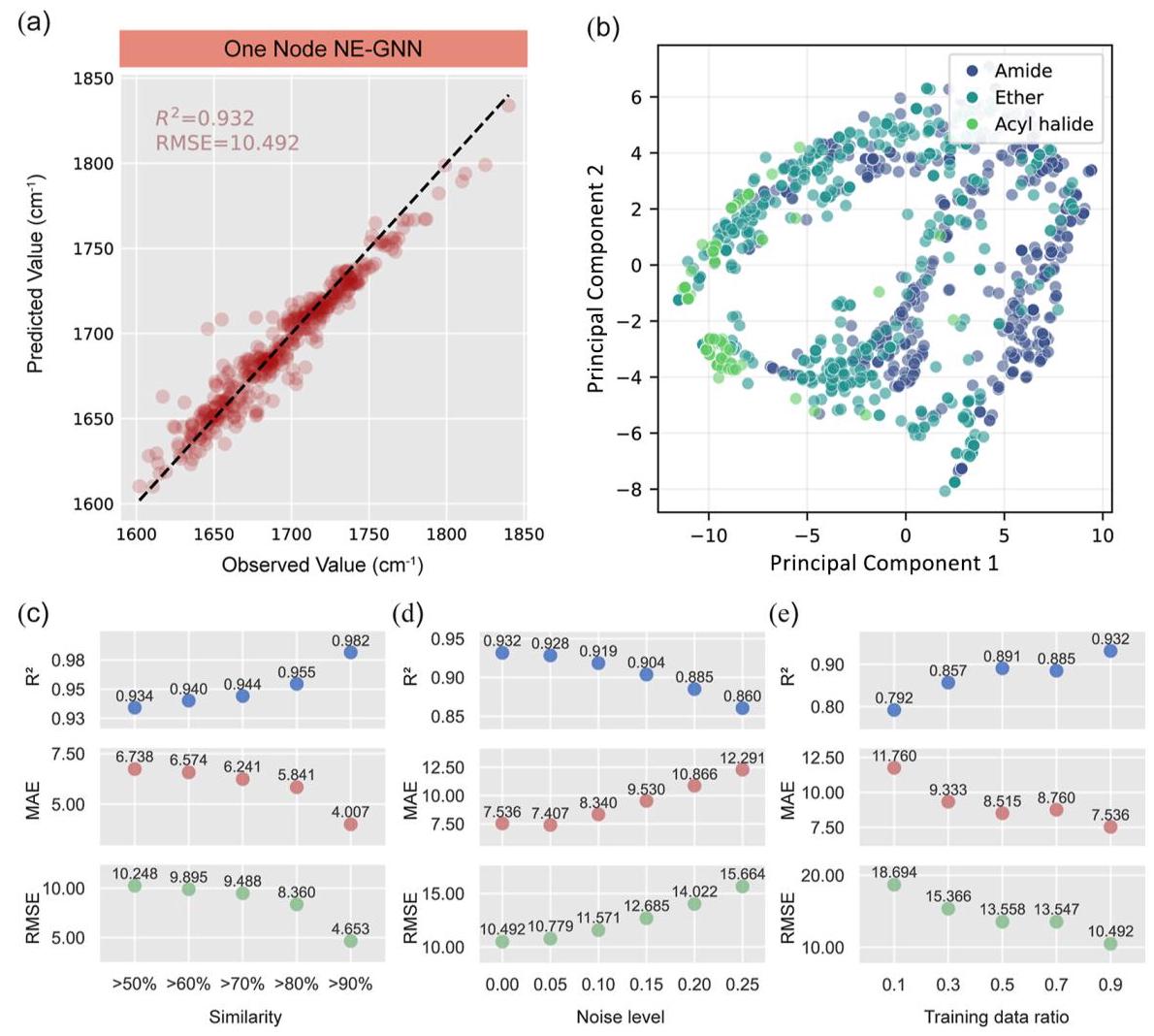
Figure 4. Model robustness analysis. (a) Model performance when selecting potential vectors of carbon in carbonyl groups for prediction. (b) Dimensionality reduction and visualization of molecular potential embeddings were performed using t-SNE, with the following hyperparameter configuration: perplexity $= {50}$ , learning_rate $= {200}$ , and $n\_ {iter} = {600}$ . (c) Comparison of model prediction performance on test-set molecules that conform to a similarity threshold relative to training-set molecules, where molecular similarity is computed using Morgan circular fingerprints (radius = 2) generated by RDKit’s ‘AllChem.GetMorganFingerprint. (d) Model tendency with introduced Gaussian noise at different intensity levels. (e) Performance comparison under different training set size.
图4. 模型稳健性分析。(a) 选择羰基中碳的潜在向量进行预测时的模型性能。(b) 使用t-SNE对分子潜在嵌入进行降维和可视化,采用以下超参数配置:困惑度$= {50}$、学习率$= {200}$和$n\_ {iter} = {600}$。(c) 相对于训练集分子符合相似性阈值的测试集分子上模型预测性能的比较,其中分子相似性使用RDKit的’AllChem.GetMorganFingerprint生成的摩根圆形指纹(半径 = 2)计算。(d) 不同强度水平引入高斯噪声时的模型趋势。(e) 不同训练集大小下的性能比较。
The incorporation of neighbor features into our graph neural network architecture has yielded superior predictive performance for carbonyl stretching frequencies, particularly demonstrating an enhanced capability in capturing both ring strain effects and distal chemical environments. As evidenced in Table 1, the GNN achieves remarkable accuracy for carbonyl groups embedded in cyclic systems: for the first molecule featuring a six-membered ring carbonyl, the prediction error is merely ${0.38}{\mathrm{\;{cm}}}^{-1}$ , compared to the minimal error of the SNM model of ${1.662}{\mathrm{\;{cm}}}^{-1}$ . The second molecule, which contains a five-membered carbonyl ring, shows a negligible GNN prediction error of ${0.269}{\mathrm{\;{cm}}}^{-1}$ , dramatically less than the error of the random forest model of ${13.45}{\mathrm{\;{cm}}}^{-1}$ . This exceptional performance stems from the GNN’s heightened sensitivity to ring strain effects, which strengthen exocyclic double bonds and consequently increase vibrational frequencies, a phenomenon that aligns precisely with established chemical theory. Furthermore, the third molecule exemplifies the GNN’s superior ability to leverage distal structural information: by effectively accounting for atomic environments separated by one intervening atom, the model predicts 1722.11 ${\mathrm{{cm}}}^{-1}$ , closely matching the experimental value of 1721.00 ${\mathrm{{cm}}}^{-1}$ . This illustrates the architecture’s advanced capacity to capture subtle electronic influences that conventional SNM approaches fail to adequately represent.
在我们的图神经网络架构中纳入邻域特征,对于羰基伸缩频率产生了卓越的预测性能,尤其展示了在捕捉环应变效应和远端化学环境方面增强的能力。如表1所示,GNN对于嵌入环状系统中的羰基实现了显著的准确性:对于第一个具有六元环羰基的分子,预测误差仅为${0.38}{\mathrm{\;{cm}}}^{-1}$,而SNM模型的最小误差为${1.662}{\mathrm{\;{cm}}}^{-1}$。第二个分子包含一个五元羰基环,GNN的预测误差可忽略不计,为${0.269}{\mathrm{\;{cm}}}^{-1}$,远小于随机森林模型的误差${13.45}{\mathrm{\;{cm}}}^{-1}$。这种卓越的性能源于GNN对环应变效应的更高敏感性,环应变效应会加强环外双键并因此增加振动频率,这一现象与既定化学理论精确相符。此外,第三个分子例证了GNN利用远端结构信息的卓越能力:通过有效考虑被一个中间原子隔开的原子环境,该模型预测为1722.11 ${\mathrm{{cm}}}^{-1}$,与1721.00 ${\mathrm{{cm}}}^{-1}$的实验值紧密匹配。这说明了该架构捕捉传统SNM方法未能充分表示的微妙电子影响的先进能力。
Ablation Experiments
消融实验
We systematically evaluated the impact of feature reduction through an ablation strategy: complete edge feature removal. As shown in Figure 3c, models without edge features (GIN, GAT, GCN) exhibited consistent performance degradation compared to their edge-aware counterparts. ${}^{24}$ The GAT architecture demonstrated particular sensitivity to feature removal, suffering the most significant performance drop. Notably, the edge-enhanced GCNE variant achieved near-parity with GINE $\left( {{R}^{2}\text{ difference } < {0.006}}\right)$ , indicating that conventional graph convolution mechanisms can rival more complex isomorphism-preserving architectures for carbonyl peak prediction when properly equipped with edge attributes (Figure S3).
我们通过一种消融策略系统地评估了特征约简的影响:完全去除边特征。如图3c所示,与具有边感知能力的对应模型相比,没有边特征的模型(GIN、GAT、GCN)表现出一致的性能下降。${}^{24}$ GAT架构对特征去除表现出特别的敏感性,性能下降最为显著。值得注意的是,边增强的GCNE变体与GINE $\left( {{R}^{2}\text{ difference } < {0.006}}\right)$ 实现了近乎相同的性能,这表明当配备适当的边属性时,传统的图卷积机制在羰基峰预测方面可以与更复杂的同构保持架构相媲美(图S3)。
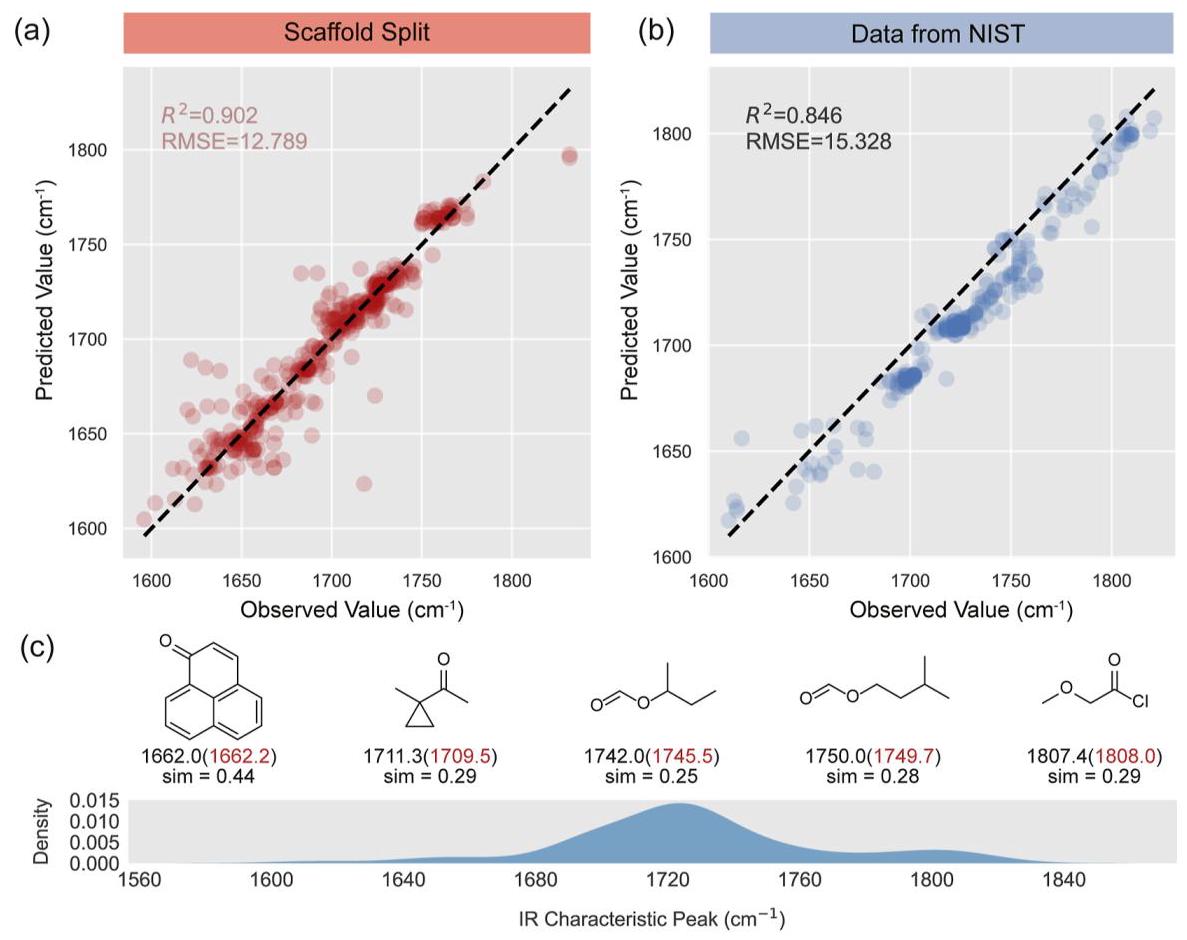
Figure 5. Model generalization analysis. (a) Performance of the model trained with a scaffold split on the test set. (b) The performance of the model in the data set acquired in Nist. (c) Distribution of infrared absorption frequencies for molecules from Nist and the example of OOD molecules in the Nist data set. The values outside the brackets are observed values, the wavenumber in the brackets represents the model predicted wavenumber, and sim is the Tanimoto similarity between the numerator and the training set.
图5. 模型泛化分析。(a) 使用支架分割训练的模型在测试集上的性能。(b) 模型在Nist获取的数据集中的性能。(c) Nist中分子的红外吸收频率分布以及Nist数据集中离群分子的示例。括号外的值是观测值,括号内的波数表示模型预测的波数,sim是分子与训练集之间的Tanimoto相似度。
In addition, we also tested NE-GNN with neighborhood features removed, NE-GNN with important neighborhood features (neighbor in ring, in ring, neighbor electronegativity, neighbor double bond) removed, and regular GNN with edge features and environmental features. The results demonstrated a significant performance degradation when several critical neighborhood features were removed, with the model exhibiting the poorest effectiveness when both edge features and environmental features were eliminated (Figure S3).
此外,我们还测试了去除邻域特征的NE-GNN、去除重要邻域特征(环内邻域、环内、邻域电负性、邻域双键)的NE-GNN以及具有边特征和环境特征的常规GNN。结果表明,去除几个关键邻域特征时性能显著下降,当同时去除边特征和环境特征时,模型表现出最差的有效性(图S3)。
As illustrated in Figure 3c, our experimental results demonstrate that among edge-enhanced graph neural networks GINE achieves superior performance $\left( {{R}^{2} = {0.931}}\right)$ , while GCNE shows slightly reduced but still competitive results $\left( {R}^{2}\right.$ = 0.925). Both architectures significantly outperform the structural neighborhood matching (SNM) approach. In contrast, GATE exhibits notably poorer performance $\left( {{R}^{2} = }\right.$ 0.887), potentially attributable to two factors: (1) insufficient training data for effective attention weight learning and (2) inherent limitations in the default GATE architecture for capturing atomic interactions critical to carbonyl vibrations, suggesting the need for domain-specific architectural modifications.
如图3c所示,我们的实验结果表明,在边增强的图神经网络中,GINE实现了卓越的性能 $\left( {{R}^{2} = {0.931}}\right)$ ,而GCNE的结果略有下降但仍具有竞争力 $\left( {R}^{2}\right.$ = 0.925)。这两种架构都明显优于结构邻域匹配(SNM)方法。相比之下,GATE的性能明显较差 $\left( {{R}^{2} = }\right.$ 0.887),这可能归因于两个因素:(1) 用于有效注意力权重学习的训练数据不足,以及(2) 默认GATE架构在捕获对羰基振动至关重要的原子相互作用方面的固有局限性,这表明需要进行特定领域的架构修改。
Node Selection Strategy
节点选择策略
Our investigation of node selection approaches reveals that single-node (carbonyl carbon) prediction outperforms dual-node (carbonyl carbon and adjacent atom) strategies (Figure 4a). This finding presents an important optimization direction, indicating that the complex structural analysis of both carbonyl neighbors (as employed in SNM) may be unnecessary. The performance degradation observed in dual-node approaches may stem from feature vector concatenation order sensitivity, an issue avoided when using solely the carbonyl carbon’s features. However, single-node prediction requires slightly higher latent space dimensionality (128 vs 256 dimensions) to maintain predictive accuracy. This suggests that while single-node strategies simplify the model architecture, they may necessitate richer feature representations to fully capture the local chemical environment’s influence on carbonyl vibrations.
我们对节点选择方法的研究表明,单节点(羰基碳)预测优于双节点(羰基碳和相邻原子)策略(图4a)。这一发现提出了一个重要的优化方向,表明对羰基两个相邻原子进行复杂的结构分析(如在SNM中所采用的)可能是不必要的。在双节点方法中观察到的性能下降可能源于特征向量连接顺序的敏感性,而仅使用羰基碳的特征时可以避免这个问题。然而,单节点预测需要稍高的潜在空间维度(128维对256维)来维持预测准确性。这表明,虽然单节点策略简化了模型架构,但它们可能需要更丰富的特征表示来充分捕捉局部化学环境对羰基振动的影响。
Notably, dual-node strategies retain their utility for specific molecular contexts, particularly in characterizing symmetric functional groups like olefinic bonds, where bilateral atomic features provide more comprehensive representations. The inherent flexibility of our framework enables adaptive node selection strategies, allowing the model to dynamically employ either single- or dual-node approaches based on chemical context. This architectural versatility not only enhances predictive performance across diverse functional groups but also significantly improves the model’s generalization capability, establishing a robust foundation for broad-spectrum vibrational spectroscopy applications.
值得注意的是,双节点策略在特定的分子环境中仍有用处,特别是在表征对称官能团如烯烃键时,双边原子特征能提供更全面的表示。我们框架固有的灵活性允许采用自适应节点选择策略,使模型能够根据化学环境动态地采用单节点或双节点方法。这种架构的通用性不仅提高了对不同官能团的预测性能,还显著提升了模型的泛化能力,为广谱振动光谱应用奠定了坚实的基础。
Latent Space Visualization
潜在空间可视化
To elucidate the model’s internal representation of molecular structures, we employed t-SNE dimensionality reduction to visualize the learned latent space embeddings (Figure 4b). ${}^{33}$
为了阐明模型对分子结构的内部表示,我们采用t-SNE降维方法来可视化学习到的潜在空间嵌入(图4b)。${}^{33}$
The resulting plot reveals distinct clustering patterns corresponding to different carbonyl functional groups, indicating that the model effectively captures the chemically relevant features. It is worth noting that the carbonyl carbons of molecules with similar carbon-based environments are relatively tightly clustered in the potential space, the acyl halides are relatively far from the amides, and the esters are relatively clustered between the two, indicating that NE-GNN has learned to distinguish subtle structural changes that affect the vibration frequency. This clustering behavior underscores the model’s ability to internalize complex chemical relationships, providing insights into how molecular features are encoded and utilized for accurate spectral predictions.
生成的图揭示了与不同羰基官能团相对应的明显聚类模式,表明该模型有效地捕捉了化学相关特征。值得注意的是,具有相似碳基环境的分子的羰基碳在潜在空间中相对紧密地聚类,酰卤离酰胺相对较远,酯则相对聚类在两者之间,这表明NE-GNN已经学会区分影响振动频率的细微结构变化。这种聚类行为强调了模型内化复杂化学关系的能力,为分子特征如何被编码和用于准确的光谱预测提供了见解。
Model Robustness Analysis
模型稳健性分析
To further investigate the model’s robustness, we systematically evaluated its performance under varying training ratios, noise levels, and test set similarity conditions. Our methodology uses the Tanimoto coefficient-a standard similarity measure in cheminformatics that compares 2D molecular fingerprints. It ranges from 0 (no similarity) to 1 (identical), and is defined as
为了进一步研究模型的稳健性,我们系统地评估了它在不同训练比例、噪声水平和测试集相似性条件下的性能。我们的方法使用了Tanimoto系数——化学信息学中一种比较二维分子指纹的标准相似性度量。它的范围从0(无相似性)到1(相同),定义为
$$ T\left( {A, B}\right) = \frac{\left| A \cap B\right| }{\left| A\right| + \left| B\right| - \left| {A \cap B}\right| } \tag{3} $$where $\left| A\right|$ and $\left| B\right|$ are the numbers of bits set in the fingerprints of molecules $A$ and $B$ , and $\left| {A \cap B}\right|$ is the number of common bits. This ratio reflects the overlap of molecular features relative to their total distinct features.
其中$\left| A\right|$和$\left| B\right|$分别是分子$A$和$B$指纹中设置的位数,$\left| {A \cap B}\right|$是共同位数。这个比例反映了分子特征相对于其总独特特征的重叠情况。
According to assessments, the prediction accuracy shows that as the proportion of similar molecules increases, the performance of the model prediction tends to improve. For molecules with higher similarity, our model may be better at predicting (Figure 4c). The model maintains robust performance with ${R}^{2} = {0.904}$ at a noise level 0.15 and preserves ${R}^{2} =$ 0.860 even when the noise increases to 0.25 . Regarding data efficiency, the NE-GNN achieves ${R}^{2} = {0.857}$ with only 30% training data, while progressively improving with larger training sets, indicating substantial potential for enhanced accuracy with expanded data sets.
根据评估,预测准确率表明,随着相似分子比例的增加,模型预测性能趋于提高。对于相似性较高的分子,我们的模型可能在预测方面表现更好(图4c)。在噪声水平为0.15时,模型使用${R}^{2} = {0.904}$保持稳健性能,即使噪声增加到0.25,也能保持${R}^{2} =$ 0.860。关于数据效率,NE-GNN仅使用30%的训练数据就能达到${R}^{2} = {0.857}$,同时随着训练集的增大性能逐步提高,这表明随着数据集的扩大,在提高准确性方面有很大潜力。
Model Generalization Analysis
模型泛化分析
To evaluate the generalizability of our model, we employed scaffold-based data splitting using the Murcko framework implemented in RDKit. This strategy groups molecules sharing similar core scaffolds into the same subset while assigning structurally distinct compounds to separate subsets, thereby providing a rigorous assessment of the out-of-distribution- (OOD) performance (Figure 5a). The resulting test yielded an ${R}^{2}$ of 0.902-slightly lower than the performance on random splits, yet still maintaining a high baseline. This indicates that our model retains strong predictive capability, even when confronted with molecules bearing unseen molecular scaffolds.
为了评估我们模型的泛化能力,我们使用了RDKit中实现的Murcko框架,基于支架进行数据分割。这种策略将共享相似核心支架的分子分组到同一子集中,同时将结构不同的化合物分配到不同的子集中,从而对分布外(OOD)性能进行严格评估(图5a)。最终测试得到的${R}^{2}$为0.902,略低于随机分割的性能,但仍保持较高的基线。这表明我们的模型即使面对带有未见分子支架的分子,仍保留强大的预测能力。
Furthermore, to probe model robustness on underrepresented carbonyl subclasses in our data set, we curated additional experimental IR spectra from the NIST Chemistry WebBook. When applied to this external test set, our model achieved an ${R}^{2}$ of 0.846 (Figure 5b, c). Although this represents a modest decline compared to the performance of our internal data, the root-mean-square error (RMSE) remains low, indicating strong predictive capability. The slight performance drop is likely attributable to the fact that the NIST spectra are predominantly recorded in the gas phase-whereas our training data primarily consist of condensed-phase measurements. This observation highlights a promising direction for future work: augmenting our data set with publicly available gas-phase IR spectra, particularly for rare carbonyl subclasses, to further enhance model coverage and robustness.
此外,为了探究我们数据集中代表性不足的羰基子类上模型的稳健性,我们从NIST化学网络手册中整理了额外的实验红外光谱。当应用于这个外部测试集时,我们的模型得到的${R}^{2}$为0.846(图5b、c)。尽管与我们内部数据的性能相比略有下降,但均方根误差(RMSE)仍然很低,表明具有强大的预测能力。性能略有下降可能归因于NIST光谱主要是在气相中记录的,而我们的训练数据主要由凝聚相测量组成。这一观察结果突出了未来工作的一个有前景的方向:用公开可用的气相红外光谱扩充我们的数据集,特别是对于罕见的羰基子类,以进一步提高模型的覆盖范围和稳健性。
In order to comprehensively evaluate the performance of the NE-GNN model specifically used to predict the characteristic infrared absorption values of functional groups, we conducted a comparative analysis of two established infrared full-spectrum prediction models: AttentiveFP, which was trained based on experimental spectral data, and DetaNet, which was based on FT calculation data. ${}^{{15},{34}}$ Using the same test set data, we replicated both models and analyzed key performance indicators including RMSE and ${R}^{2}$ (Figure 6). NE-GNN achieves a significantly lower prediction error and higher correlation compared to these full-spectrum approaches. The full-spectrum models distribute their capacity across the entire vibrational landscape and optimize global loss functions (e.g., spectral intensity similarity or SIS loss) that do not prioritize accurate localization of individual functional group bands. Consequently, they often fail to produce a distinct, sufficiently intense peak in the carbonyl region for certain molecules-sometimes even missing the carbonyl absorption entirely. In contrast, our NE-GNN is explicitly designed to focus on the local chemical environment of the carbonyl group, making it less susceptible to interference from distant or unrelated functional groups. This focused architecture enables more chemically consistent predictions and higher interpretability.
为了全面评估专门用于预测官能团特征红外吸收值的NE - GNN模型的性能,我们对两个已建立的红外全光谱预测模型进行了比较分析:基于实验光谱数据训练的AttentiveFP和基于FT计算数据的DetaNet。 ${}^{{15},{34}}$ 使用相同的测试集数据,我们复制了这两个模型并分析了包括RMSE和${R}^{2}$在内的关键性能指标(图6)。与这些全光谱方法相比,NE - GNN实现了显著更低的预测误差和更高的相关性。全光谱模型将其能力分布在整个振动图谱上,并优化全局损失函数(例如光谱强度相似性或SIS损失),这些函数并不优先考虑单个官能团谱带的准确定位。因此,对于某些分子,它们往往无法在羰基区域产生明显、足够强的峰,有时甚至完全错过羰基吸收。相比之下,我们的NE - GNN明确设计为专注于羰基基团的局部化学环境,使其更不易受到远处或不相关官能团的干扰。这种专注的架构能够实现更符合化学原理的预测和更高的可解释性。
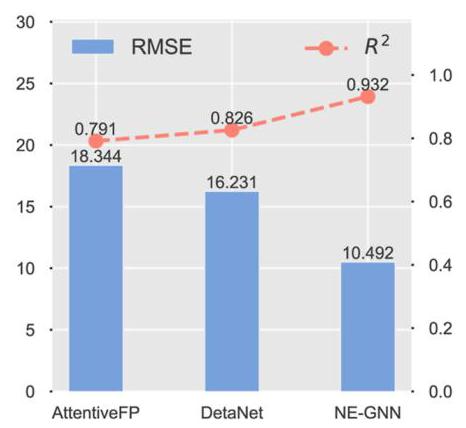
Figure 6. Performance comparison between AttentiveFP, DetaNet, and NE-GNN models. The bar chart shows the RMSE for each model, and the line chart shows the ${R}^{2}$ for each model.
图6. AttentiveFP、DetaNet和NE - GNN模型之间的性能比较。柱状图显示每个模型的RMSE,折线图显示每个模型的${R}^{2}$。
Application to Multicarbonyl and Diazo Compounds
多羰基和重氮化合物的应用
To evaluate the generalizability of our model, we conducted a parallel analysis on diazo functional groups using a data set of 1824 molecules compiled from existing literature. ${}^{14}$ Furthermore, we assessed the model’s performance on multicarbonyl compounds despite its exclusive training on monocarbonyl data. To establish a framework for multifunctional group prediction and evaluate integrated model performance, we selected two representative molecules containing two carbonyl groups and one diazo group for case analysis (Table 2). For the first molecule, NE-GNN more accurately predicted the peak of first group $\left( {{1738.51}{\mathrm{\;{cm}}}^{-1}\text{ vs observed }{1736}{\mathrm{\;{cm}}}^{-1}}\right)$ , while for the second carbonyl group, the errors of both models increased slightly, but the error of NE-GNN was slightly smaller. Both models exhibited a comparable deviation for the diazo group prediction (Figure S4). For the second molecule, the GNN maintained deviations below ${11}{\mathrm{\;{cm}}}^{-1}$ for both carbonyl groups, significantly outperforming RF’s deviations exceeding ${20}{\mathrm{\;{cm}}}^{-1}$ . This superior performance likely stems from our model’s enhanced ability to capture the influence of charged neighboring groups like diazo functionalities, where traditional RF approaches exhibit clear limitations in feature extraction. This performance indicates that the graph neural network effectively captures the fundamental chemical principles governing carbonyl vibrations, enabling accurate predictions even in the presence of multiple interacting carbonyl groups. As for the prediction of the diazo group of the second molecule, although the data set used to train the diazo group model is only 1824, our NE-GNN prediction value is 2134.23, which is closer to the observed value of 2137.00 than the RF prediction of 2133.31. The results suggest that the model’s learned representations are sufficiently general to extend beyond its training scope, highlighting its potential utility for broader applications in infrared spectral analysis.
为了评估我们模型的通用性,我们使用从现有文献中汇编的1824个分子的数据集对重氮官能团进行了并行分析。${}^{14}$此外,尽管我们的模型仅在单羰基数据上进行了专门训练,我们还是评估了它在多羰基化合物上的性能。为了建立一个多官能团预测框架并评估集成模型的性能,我们选择了两个分别含有两个羰基和一个重氮基团的代表性分子进行案例分析(表2)。对于第一个分子,NE-GNN更准确地预测了第一组$\left( {{1738.51}{\mathrm{\;{cm}}}^{-1}\text{ vs observed }{1736}{\mathrm{\;{cm}}}^{-1}}\right)$的峰值,而对于第二个羰基,两个模型的误差都略有增加,但NE-GNN的误差略小。对于重氮基团的预测,两个模型表现出相当的偏差(图S4)。对于第二个分子,GNN对两个羰基的偏差都保持在${11}{\mathrm{\;{cm}}}^{-1}$以下,明显优于偏差超过${20}{\mathrm{\;{cm}}}^{-1}$的RF。这种卓越的性能可能源于我们的模型增强了捕捉带电荷的相邻基团(如重氮官能团)影响的能力,而传统的RF方法在特征提取方面表现出明显的局限性。这一性能表明,图神经网络有效地捕捉了支配羰基振动的基本化学原理,即使在存在多个相互作用的羰基基团的情况下也能进行准确预测。至于第二个分子重氮基团的预测,尽管用于训练重氮基团模型的数据集只有1824个,但我们的NE-GNN预测值为 2134.23,比RF预测的2133.31更接近观测值2137.00。结果表明,该模型学习到的表示具有足够的通用性,可以扩展到其训练范围之外,突出了其在红外光谱分析更广泛应用中的潜在效用。
Table 2. Prediction Results of Multi-Carbonyl and Diazo Compounds
表2. 多羰基和重氮化合物的预测结果
| molecule | observed value[cm ${}^{-1}$ ] | NE-GNN predicted value $\left\lbrack {\mathrm{{cm}}}^{-1}\right\rbrack$ | Random Forest predicted value $\left\lbrack {\mathrm{{cm}}}^{-1}\right\rbrack$ |
 | ① 1736.00 | ① 1738.51 | ① 1740.57 |
| ② 1639.00 | ② 1644.43 | ② 1647.10 | |
| ③ 2110.00 | ③ 2104.90 | ③ 2104.06 | |
 | ① 1719.00 | ① 1729.93 | ① 1697.23 |
| ② 1655.00 | ② 1659.21 | © 1684.92 | |
| ③ 2137.00 | ③ 2134.23 | ③ 2133.31 |
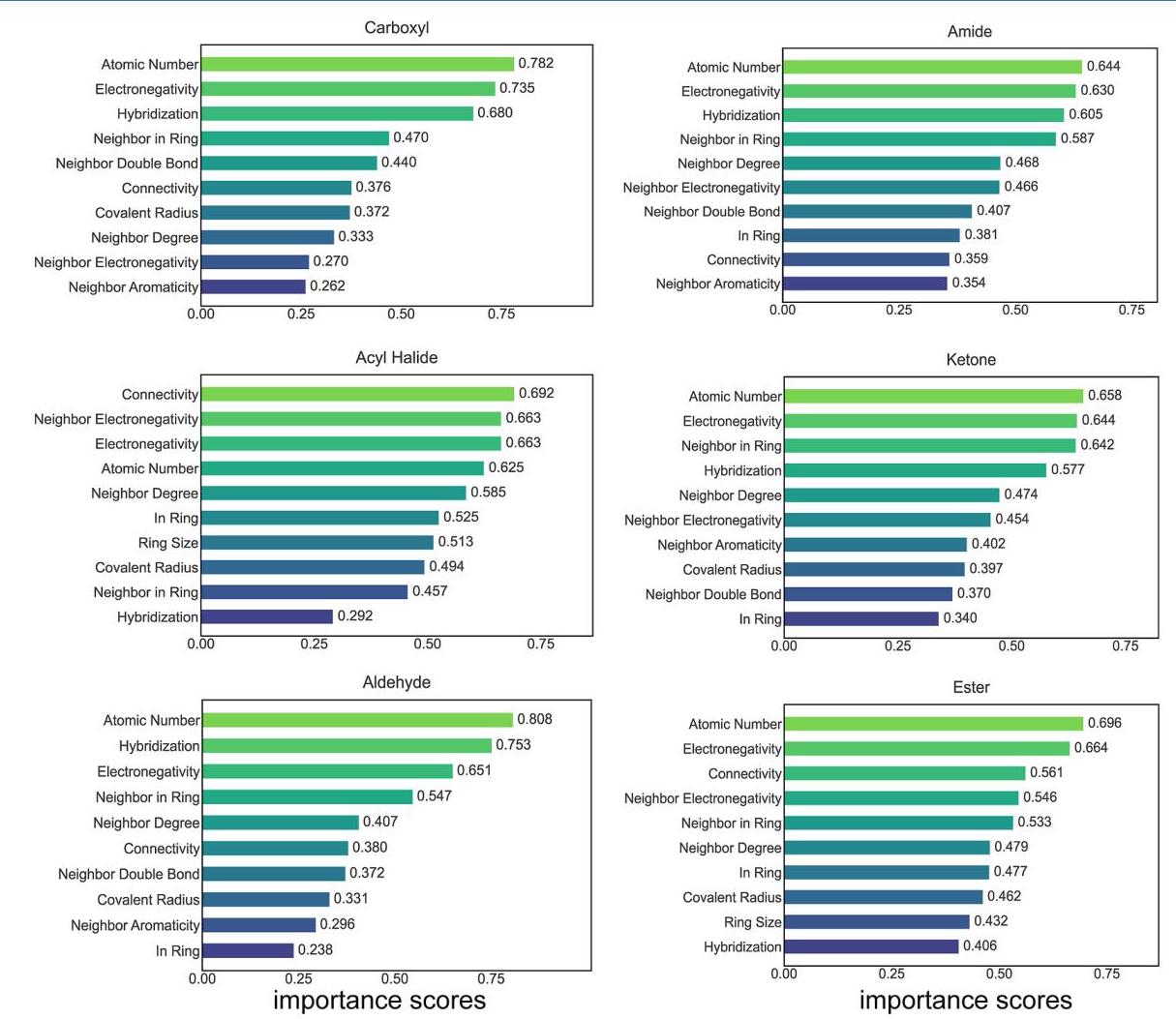
Figure 7. Statistical analysis of feature importance via GNNExplainer reveals the top ten critical characteristics across several carbonyl subclasses in the data set.
图7. 通过GNNExplainer对特征重要性进行的统计分析揭示了数据集中几个羰基子类的十大关键特征。
Model Decision-Making Process and Interpretability Analysis
模型决策过程与可解释性分析
We employed GNNExplainer to interpret the molecular prediction outcomes and performed direction-aware interpretability analysis by integrating GNNExplainer with a Perturbation-Based Sensitivity Analysis (PSA). Figure 7 gives the statistics on the importance of several carbonyl subclasses in the data set and Figure 8 gives the interpretable analytical examples of representative molecules in the carbonyl subclass.
我们使用GNNExplainer来解释分子预测结果,并通过将GNNExplainer与基于扰动的灵敏度分析(PSA)相结合,进行了方向感知可解释性分析。图7给出了数据集中几个羰基子类重要性的统计信息,图8给出了羰基子类中代表性分子的可解释分析示例。
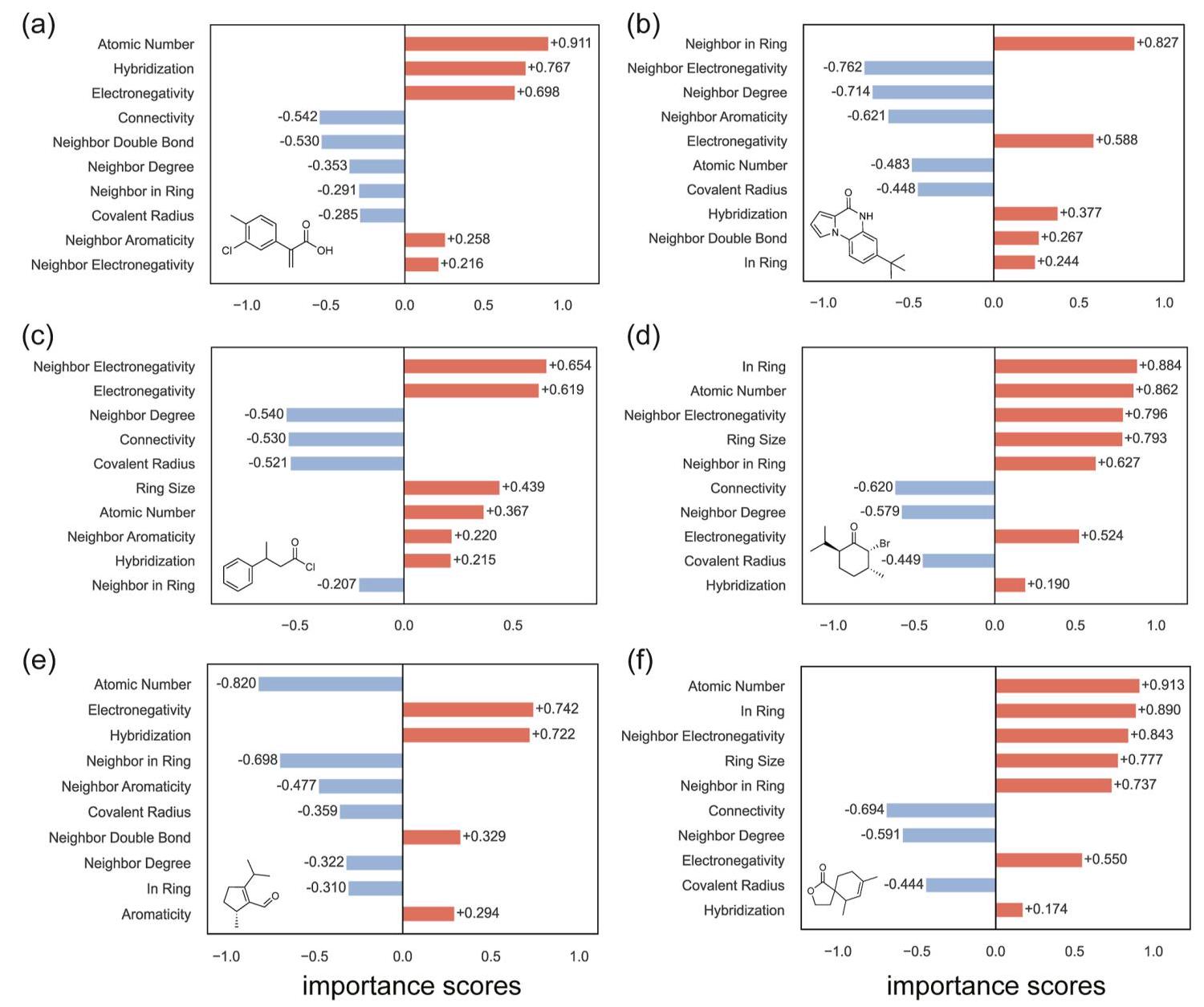
Figure 8. Interpretable analytical examples of representative molecules in the carbonyl subclass: (a) carboxylic acids, (b) amide, (c) acyl halide, (d) ketones, (e) aldehydes, (f) esters. Positive values (red) indicate features that promote absorption peak, while negative values (blue) indicate inhibitory effects.
图8. 羰基子类中代表性分子的可解释分析示例:(a) 羧酸,(b) 酰胺,(c) 酰卤,(d) 酮,(e) 醛,(f) 酯。正值(红色)表示促进吸收峰的特征,而负值(蓝色)表示抑制作用。
Average absolute importance scores were computed for key structural features, using absolute values to account for potentially opposing directional effects across molecules, and results were stratified by the carbonyl subclass. As shown in Figure 7, electronegativity and atomic number consistently rank among the top contributors across nearly all subclasses. Ring-related features are especially important for cyclic carbonyls, appearing within the top five categories for ketones, esters, and lactams. Even in acid halides-where the carbonyl is rarely cyclic-the “neighbor in ring” feature retains notable importance (rank 9, score = 0.457), and both “ring size” and “in ring” appear at ranks 6 and 7. Additionally, features such as connectivity, hybridization, and neighboring double bonds exhibit relatively high importance across several subclasses. This suggests that within specific chemical contexts these structural attributes may collectively influence carbonyl stretching frequencies through complex electronic effects, including inductive, steric, and conjugative interactions. Aggregating importance scores by subclass and reporting their means reveal consistent trends that align with established principles of physical organic chemistry, indicating a plausible association between these features and spectral behavior.
计算了关键结构特征的平均绝对重要性得分,使用绝对值来考虑分子间潜在的相反方向效应,并按羰基子类进行分层。如图7所示,电负性和原子序数在几乎所有子类中一直位列最重要的因素之中。与环相关的特征对环状羰基尤为重要,在酮、酯和内酰胺的前五大类别中出现。即使在酰卤中(羰基很少是环状的),“环内邻居”特征也保持着显著的重要性(排名第9,得分 = 0.457),并且“环大小”和“在环内”都出现在第6和第7位。此外,诸如连通性、杂化和相邻双键等特征在几个子类中都表现出相对较高的重要性。这表明在特定的化学环境中,这些结构属性可能通过包括诱导、空间和共轭相互作用在内的复杂电子效应共同影响羰基伸缩频率。按子类汇总重要性得分并报告其平均值,揭示了与物理有机化学既定原则一致的一致趋势,表明这些特征与光谱行为之间存在合理的关联。
Taking three representative molecules as examples, in Figure 8a, the enhancement of hybridization is pronounced: ${\mathrm{{sp}}}^{2}$ hybridization contributes to an increase in electronegativity. However, the neighbor-double bond likely engages in a conjugation effect with the carbonyl group, which appears to be the dominant factor. Consequently, an explainable analysis of this molecule reveals a strong inhibitory effect associated with the neighboring double bond. Additionally, the promoting roles of atomic number and electronegativity suggest that the model may have captured the inductive effect exerted by the oxygen atoms in the carboxyl group on the carbonyl moiety.
以三个代表性分子为例,在图8a中,杂化增强很明显:${\mathrm{{sp}}}^{2}$杂化导致电负性增加。然而,邻位双键可能与羰基发生共轭效应,这似乎是主导因素。因此,对该分子的可解释分析揭示了与邻位双键相关的强烈抑制作用。此外,原子序数和电负性的促进作用表明模型可能捕捉到了羧基中氧原子对羰基部分施加的诱导效应。
For 7-(tert-butyl)pyrrolo[1,2-a]quinoxalin-4(5H)-one in Figure 8b, the carbonyl group is embedded within a ring system, and consequently, the neighbor in ring exhibits the strongest promoting effect on the peak. In contrast, Neighbor Electronegativity likely reflects an inhibitory influence associated with the presence of less electronegative atoms-such as nitrogen-in the vicinity of the carbonyl group. Additionally, features such as Neighbor degree and Neighbor aromatic may indicate that the model has captured the suppressive effect of conjugation between the carbonyl and the surrounding aromatic rings on the peak intensity.
对于图8b中的7-(叔丁基)吡咯并[1,2-a]喹喔啉-4(5H)-酮,羰基嵌入在一个环系统中,因此,环内邻居对峰表现出最强的促进作用。相比之下,邻位电负性可能反映了与羰基附近存在电负性较小的原子(如氮)相关的抑制影响。此外,诸如邻位度和邻位芳香性等特征可能表明模型捕捉到了羰基与周围芳香环之间共轭对峰强度的抑制作用。
For 6,8-Dimethyl-2-oxaspiro[4.5]dec-7-en-1-one in Figure 8f, the framework identifies several characteristics with high importance scores: atomic number, neighbor electronegativity, and three ring-related characteristics, and all of these five characteristics positively affect the wavenumber of carbonyl groups, which is consistent with the induction effect of oxygen and the chemical principle that the chemical environment in the ring causes the carbonyl absorption peak to blue shift. The important subgraphs of the two molecules in Figure 8b, f can be found in Figure S5.
对于图8f中的6,8-二甲基-2-氧杂螺[4.5]癸-7-烯-1-酮,该框架识别出几个具有高重要性得分的特征:原子序数、邻位电负性和三个与环相关的特征,并且所有这五个特征都对羰基的波数产生正向影响,这与氧的诱导效应以及环内化学环境导致羰基吸收峰蓝移的化学原理一致。图8b、f中两个分子的重要子图可在图S5中找到。
This direction-sensitive, importance analysis reveals a strong correlation between the model’s behavior and well-established concepts in physical organic chemistry-such as ring strain, inductive effects, resonance, conjugation, and steric constraints-enabling us to interpret the model’s predictions within a chemically reasonable framework. Our exploration of core subgraphs and critical edges for representative molecules highlights structural motifs that are plausibly associated with differences in carbonyl infrared stretching frequencies. The identified patterns reflect familiar chemical intuitions about how local connectivity and bonding environments may relate to vibrational properties. While these findings do not establish causal relationships, they indicate that the explanations generated by GNNExplainer align with expected chemical reasoning, offering interpretable and contextually relevant insights into the model’s decision process.
这种方向敏感的重要性分析揭示了模型行为与物理有机化学中既定概念(如环张力、诱导效应、共振、共轭和空间位阻)之间的强相关性,使我们能够在化学合理的框架内解释模型的预测。我们对代表性分子的核心子图和关键边的探索突出了与羰基红外伸缩频率差异可能相关的结构基序。所识别的模式反映了关于局部连通性和键合环境如何与振动性质相关的熟悉化学直觉。虽然这些发现并未建立因果关系,但它们表明GNNExplainer生成的解释与预期的化学推理一致,为模型的决策过程提供了可解释且与上下文相关的见解。
CONCLUSION
结论
The Neighbor Enhanced Graph Neural Networks (NE-GNN) demonstrate exceptional predictive performance for carbonyl groups by effectively incorporating proximal structural features into molecular representations. This enhanced feature encoding strategy, particularly the utilization of feature vectors from key connecting atoms that bridge functional groups with the molecular scaffold, exhibits a remarkable generalization capability and promising application potential across diverse chemical contexts. The model’s ability to capture subtle electronic and steric effects through this approach provides a robust framework for accurate infrared spectral predictions.
邻域增强图神经网络(NE-GNN)通过有效地将近端结构特征纳入分子表示,展示了对羰基的卓越预测性能。这种增强的特征编码策略,特别是利用将官能团与分子骨架连接起来的关键连接原子的特征向量,在不同的化学环境中表现出显著的泛化能力和有前景的应用潜力。该模型通过这种方法捕捉微妙的电子和空间效应的能力为准确的红外光谱预测提供了一个强大的框架。
Notwithstanding these advances, several limitations warrant further investigation. The CIAC data set focuses on the coverage of several carbonyl subclasses, and a more comprehensive data set can be further expanded in the future. The current implementation does not account for hydrogen bonding interactions or three-dimensional molecular conformations, which are known to significantly influence carbonyl vibrational frequencies through spatial and electronic effects. While the feature extraction component maintains reasonable chemical interpretability, the graph readout mechanism remains challenging to analyze through conventional chemical principles. Addressing these aspects, particularly through incorporation of spatial constraints and development of more interpretable aggregation operations, represents crucial directions for future optimization. Such improvements would not only enhance prediction accuracy but also provide deeper physicochemical insights, ultimately advancing the application of machine learning in functional-group-specific infrared spectral analysis and unlocking new possibilities in computational spectroscopy.
尽管取得了这些进展,但仍有几个局限性值得进一步研究。CIAC数据集侧重于几个羰基子类的覆盖范围,未来可以进一步扩展更全面的数据集。当前的实现没有考虑氢键相互作用或三维分子构象,而众所周知,这些会通过空间和电子效应显著影响羰基振动频率。虽然特征提取组件保持了合理的化学可解释性,但通过传统化学原理分析图读出机制仍然具有挑战性。解决这些方面的问题,特别是通过纳入空间约束和开发更具可解释性的聚合操作,是未来优化的关键方向。这样的改进不仅会提高预测准确性,还会提供更深入的物理化学见解,最终推动机器学习在特定官能团红外光谱分析中的应用,并在计算光谱学中开启新的可能性。
A ASSOCIATED CONTENT
A 相关内容
Data Availability Statement
数据可用性声明
The computational models and data sets reported in this work are available at https://github.com/keyouss/IR-Carbonyl-Graph-main.
本工作中报告的计算模型和数据集可在https://github.com/keyouss/IR-Carbonyl-Graph-main获取。
M Supporting Information
M 支持信息
The Supporting Information is available free of charge at https://pubs.acs.org/doi/10.1021/prechem.5c00332.
支持信息可在https://pubs.acs.org/doi/10.1021/prechem.5c00332免费获取。
Process of data acquisition; distribution of the CIAC data set; ablation experiments for NE-GNN; performance of the model applied to diazo compounds; importance subgraphs of two example molecules; mathematical formulas for evaluation; and the statistical table of the CIAC data set (PDF)
数据采集过程;CIAC数据集的分布;NE-GNN的消融实验;应用于重氮化合物的模型性能;两个示例分子的重要子图;评估的数学公式;以及CIAC数据集的统计表(PDF)
A UTHOR INFORMATION
作者信息
Corresponding Author
通讯作者
Fanyang Mo - School of AI for Science, Peking University Shenzhen Graduate School, Shenzhen 518055, China; School of Advanced Materials and Guangdong Provincial Key Laboratory of Nano-Micro Materials Research, Peking University Shenzhen Graduate School, Shenzhen 518055, China; State Key Laboratory of Advanced Waterproof Materials, School of Materials Science and Engineering, Peking University, Beijing 100871, China; (Corcid.org/ 0000-0002-4140-3020;
莫凡洋 - 北京大学深圳研究生院人工智能科学学院,中国深圳518055;北京大学深圳研究生院先进材料学院及广东省纳米微材料研究重点实验室,中国深圳518055;北京大学材料科学与工程学院先进防水材料国家重点实验室,中国北京100871;(Corcid.org/ 0000-0002-4140-3020;邮箱:
Authors
作者
Jie Shi - School of AI for Science, Peking University Shenzhen Graduate School, Shenzhen 518055, China; School of Advanced Materials, Peking University Shenzhen Graduate School, Shenzhen 518055, China
石解 - 北京大学深圳研究生院人工智能科学学院,中国深圳 518055;北京大学深圳研究生院先进材料学院,中国深圳 518055
Chengchun Liu - School of AI for Science, Peking University Shenzhen Graduate School, Shenzhen 518055, China; State Key Laboratory of Advanced Waterproof Materials, School of Materials Science and Engineering, Peking University, Beijing 100871, China; © orcid.org/0009-0002-5550-4145
刘丞军 - 北京大学深圳研究生院人工智能科学学院,中国深圳 518055;北京大学材料科学与工程学院先进防水材料国家重点实验室,中国北京 100871;© orcid.org/0009-0002-5550-4145
Complete contact information is available at:
完整的联系方式如下:
https://pubs.acs.org/10.1021/prechem.5c00332
Author Contributions
作者贡献
F.M. and J.S. conceived the project, designed the method, and analyzed the results. J.S. trained the ML model. J.S. and C.L. organized and prepared structural data. F.M. and J.S. wrote the paper. F.M. supervised the project.
F.M. 和 J.S. 构思了项目,设计了方法,并分析了结果。J.S. 训练了机器学习模型。J.S. 和 C.L. 整理并准备了结构数据。F.M. 和 J.S. 撰写了论文。F.M. 监督了该项目。
Notes
注释
The authors declare no competing financial interest.
作者声明不存在利益冲突。
ACKNOWLEDGMENTS
致谢
We thank Peking University Shenzhen Graduate School and Shenzhen Government for the start-up funding support. We thank the High-Performance Computing Platform of Peking University for machine learning model training. We thank Dr. Hao Xu for his guidance on graph neural network theory.
我们感谢北京大学深圳研究生院和深圳市政府提供的启动资金支持。我们感谢北京大学高性能计算平台用于机器学习模型训练。我们感谢徐浩博士在图神经网络理论方面的指导。
REFERENCES
参考文献
(1) Dutta, A. Fourier transform infrared spectroscopy. In Spectroscopic Methods for Manomaterials Characterization, 2017; pp 73-93..
(1) 杜塔,A. 傅里叶变换红外光谱法。载于《用于纳米材料表征的光谱方法》,2017年;第73 - 93页。
(2) Lansford, J. L.; Vlachos, D. G. Infrared spectroscopy data-and physics-driven machine learning for characterizing surface microstructure of complex materials. Nat. Commun. 2020, 11, 1513.
(3) Hudgins, D. M.; Sandford, S. A. Infrared spectroscopy of matrix isolated polycyclic aromatic hydrocarbons. 1. PAHs containing two to four rings. J. Phys. Chem. A 1998, 102, 329-343.
(4) Wang, T.; Tan, Y.; Chen, Y. Z.; Tan, C. Infrared spectral analysis for prediction of functional groups based on feature-aggregated deep learning. J. Chem. Inf. Model. 2023, 63, 4615-4622.
(5) Ren, H.; Li, H.; Zhang, Q.; Liang, L.; Guo, W.; Huang, F.; Luo, Y.; Jiang, J. A machine learning vibrational spectroscopy protocol for spectrum prediction and spectrum-based structure recognition. Fundam. Res. 2021, 1, 488-494.
(6) Na, G. S.; Rho, Y. Explainable Machine Learning for Characterizing Unknown Molecular Structures in Infrared Spectra. Anal. Chem. 2025, 97, 20869-20878.
(7) Han, R.; Ketkaew, R.; Luber, S. A concise review on recent developments of machine learning for the prediction of vibrational spectra. J. Phys. Chem. A 2022, 126, 801-812.
(8) Punjabi, D.; Huang, Y.-C.; Holzhauer, L.; Tremouilhac, P.; Friederich, P.; Jung, N.; Bräse, S. Infrared spectrum analysis of organic molecules with neural networks using standard reference data sets in combination with real-world data. J. Cheminf. 2025, 17, 1-13.
(9) Shaban Tameh, M.; Coropceanu, V.; Purcell, T. A.; Brédas, J.-L. Prediction of the Infrared Absorbance Intensities and Frequencies of Hydrocarbons: A Message Passing Neural Network Approach. J. Phys. Chem. A 2024, 128, 9695-9706.
(10) Xu, H.; Lin, J.; Zhang, D.; Mo, F. Retention time prediction for chromatographic enantioseparation by quantile geometry-enhanced graph neural network. Nat. Commun. 2023, 14, 3095.
(11) Gillespie, R. J.; Robinson, E. A. Models of molecular geometry. Chem. Soc. Rev. 2005, 34, 396-407.
(12) Keith, J. A.; Vassilev-Galindo, V.; Cheng, B.; Chmiela, S.; Gastegger, M.; Muller, K.-R.; Tkatchenko, A. Combining machine learning and computational chemistry for predictive insights into chemical systems. Chem. Rev. 2021, 121, 9816-9872.
(13) Kovács, P.; Zhu, X.; Carrete, J.; Madsen, G. K.; Wang, Z. Machine-learning prediction of infrared spectra of interstellar polycyclic aromatic hydrocarbons. Astrophys. J. 2020, 902, 100.
(14) Liu, C.; Zou, R.; Mo, F. Infrared Spectra Prediction for Functional Group Region Utilizing a Machine Learning Approach with Structural Neighboring Mechanism. Anal. Chem. 2024, 96, 15550-15562.
(15) Saquer, N.; Iqbal, R.; Ellis, J. D.; Yoshimatsu, K. Infrared spectra prediction using attention-based graph neural networks. Digit. Discovery 2024, 3, 602-609.
(16) Zhang, W.; Kasun, L. C.; Wang, Q. J.; Zheng, Y.; Lin, Z. A review of machine learning for near-infrared spectroscopy. Sensors 2022, 22, 9764.
(17) Gastegger, M.; Schütt, K. T.; Müller, K.-R. Machine learning of solvent effects on molecular spectra and reactions. Chem. Sci. 2021, 12, 11473-11483.
(18) Lou, S.; Liu, C.; Zhang, D.; Chen, Y.; Mo, F. Unsupervised Hierarchical Symbolic Regression for Interpretable Property Modeling in Complex Multi-Variable Systems. Adv. Sci. 2026, No. e21200.
(19) Bellamy, L. The Infra-Red Spectra of Complex Molecules; Springer Science & Business Media, 2013; ..
(20) Margraf, J. T. Science-Driven Atomistic Machine Learning. Angew. Chem., Int. Ed. 2023, 62, No. e202219170.
(21) Kleine, T. S.; Lee, T.; Carothers, K. J.; Hamilton, M. O.; Anderson, L. E.; Ruiz Diaz, L.; Lyons, N. P.; Coasey, K. R.; Parker Jr, W. O.; Borghi, L.; et al. Infrared fingerprint engineering: a molecular-design approach to long-wave infrared transparency with polymeric materials. Angew. Chem., Int. Ed. 2019, 58, 17656-17660.
(22) Liu, Y.; Li, Y.; Yang, Q.; Yang, J.-D.; Zhang, L.; Luo, S. Prediction of Bond Dissociation Energy for Organic Molecules Based on a Machine-Learning Approach. Chin. J. Chem. 2024, 42, 1967- 1974.
(23) Liu, C.; Mo, F. Automation and AI-Powered Prediction in Chromatographic Separation. Acc. Chem. Res. 2026, 59, 138-150.
(24) Rao, J.; Zheng, S.; Lu, Y.; Yang, Y. Quantitative evaluation of explainable graph neural networks for molecular property prediction. Patterns 2022, 3, 100628.
(25) Liu, S.; Ying, R.; Dong, H.; Li, L.; Xu, T.; Rong, Y.; Zhao, P.; Huang, J.; Wu, D.. International Conference on Machine Learning, 2022; pp 14054-14072.
(26) Muratov, E. N.; Bajorath, J.; Sheridan, R. P.; Tetko, I. V.; Filimonov, D.; Poroikov, V.; Oprea, T. I.; Baskin, I. I.; Varnek, A.; Roitberg, A.; et al. QSAR without borders. Chem. Soc. Rev. 2020, 49, 3525-3564.
(27) Doan, V. H. M.; Ly, C. D.; Mondal, S.; Truong, T. T.; Nguyen, T. D.; Choi, J.; Lee, B.; Oh, J. Fcg-former: identification of functional groups in FTIR spectra using enhanced transformer-based model. Anal. Chem. 2024, 96, 12358-12369.
(28) Lin, J.; Mo, F. Empowering research in chemistry and materials science through intelligent algorithms. Artif. Intell. Chem. 2024, 2, 100035.
(29) McGill, C.; Forsuelo, M.; Guan, Y.; Green, W. H. Predicting infrared spectra with message passing neural networks. J. Chem. Inf. Model. 2021, 61, 2594-2609.
(30) Xu, K.; Hu, W.; Leskovec, J.; Jegelka, S. How powerful are graph neural networks? arXiv preprint. arXiv 2018, arXiv:1810.00826.
(31) Stienstra, C. M.; Hebert, L.; Thomas, P.; Haack, A.; Guo, J.; Hopkins, W. S. Graphormer-ir: Graph transformers predict experimental ir spectra using highly specialized attention. J. Chem. Inf. Model. 2024, 64, 4613-4629.
(32) Bao, C.; Fan, Z.; Zhang, C.; Zhang, Z. Graph Attention Networks for Accurate and Explainable Prediction of CO2 Solubility in Diverse Physical Solvents. Precis. Chem. 2025, 5c00207.
(33) Wattenberg, M.; Viégas, F.; Johnson, I. How to use t-SNE effectively. Distill 2016, 1, No. e2.
(34) Zou, Z.; Zhang, Y.; Liang, L.; Wei, M.; Leng, J.; Jiang, J.; Luo, Y.; Hu, W. A deep learning model for predicting selected organic molecular spectra. Nat. Comput. Sci. 2023, 3, 957-964.