Gold(III)-Catalyzed Direct Acetoxylation of Arenes with Iodobenzene Diacetate
英文原文与中文译文逐段对照 · English original with Chinese translation
Di Qiu, Zhitong Zheng, Fanyang Mo, Qing Xiao, Yu Tian, Yan Zhang, and Jianbo Wang*
邱迪,郑志通,莫凡洋,肖晴,田宇,张艳,王剑波*
Beijing National Laboratory of Molecular Sciences (BNLMS) and Key Laboratory of Bioorganic Chemistry and Molecular Engineering of Ministry of Education, College of Chemistry, Peking University, Beijing 100871, China
北京分子科学国家实验室(BNLMS)及教育部生物有机化学与分子工程重点实验室,北京大学化学与分子工程学院,北京 100871,中国
2011 Vol. 13, No. 19 4988-4991
2011年,第13卷,第19期,4988 - 4991页
Received June 1, 2011
2011年6月1日收到

${\mathrm{{AuCl}}}_{3}$ -catalyzed direct acetoxylation of electron-rich aromatic compounds has been achieved with iodobenzene diacetate as the acetoxylation reagent.
${\mathrm{{AuCl}}}_{3}$ 以二醋酸碘苯作为乙酰氧基化试剂,实现了对富电子芳香化合物的 ${\mathrm{{AuCl}}}_{3}$ 催化直接乙酰氧基化反应。
Direct acetoxylation of arenes with transition metal catalysis has remained a challenging task over the past decades. ${}^{1}$ In 1996, Crabtree and co-workers reported the direct palladium(II)-catalyzed acetoxylation of arenes with iodobenzene diacetate. ${}^{2}$ The reaction achieved moderately high efficiency; however, the regioselectivity of the reaction is far from satisfactory. More recently, Sanford and coworkers have developed highly regioselective acetoxyla-tion by employing a directing group strategy. ${}^{1,3}$ Detailed mechanistic investigation indicated that the Pd(IV)/Pd(II) catalytic cycle was involved in the reaction. With a similar Pd(II)-catalyzed system, regioselective acetoxylation of indole derivatives has been reported by Lei, ${}^{4\mathrm{a}}$ Pelcman, ${}^{4\mathrm{\;b}}$ Zhang, ${}^{4c}$ and Kwong ${}^{4d}$ recently. Moreover, Yu and coworkers have reported a Cu(II)-catalyzed acetoxylation with ${\mathrm{O}}_{2}$ as the oxidant. ${}^{5}$ Although remarkable achievements have been made in this area, ${}^{6}$ it is still highly desirable to develop an alternative approach toward the goal of direct catalytic acetoxylation of aromatics with high efficiency and generality.
在过去几十年里,过渡金属催化的芳烃直接乙酰氧基化反应一直是一项具有挑战性的任务。${}^{1}$ 1996年,Crabtree及其同事报道了钯(II)催化芳烃与二醋酸碘苯的直接乙酰氧基化反应。${}^{2}$ 该反应实现了中等偏高的效率;然而,反应的区域选择性远不能令人满意。最近,Sanford及其同事通过采用导向基团策略开发了高度区域选择性的乙酰氧基化反应。${}^{1,3}$ 详细的机理研究表明,反应涉及Pd(IV)/Pd(II)催化循环。最近,Lei、${}^{4\mathrm{a}}$ Pelcman、${}^{4\mathrm{\;b}}$ Zhang、${}^{4c}$ 和Kwong ${}^{4d}$ 报道了在类似的钯(II)催化体系中吲哚衍生物的区域选择性乙酰氧基化反应。此外,Yu及其同事报道了以 ${\mathrm{O}}_{2}$ 为氧化剂的铜(II)催化乙酰氧基化反应。${}^{5}$ 尽管在该领域已经取得了显著成就,${}^{6}$ 但为了实现芳烃直接催化乙酰氧基化的高效性和通用性这一目标,开发一种替代方法仍然是非常必要的。
In recent years, gold catalysts have been extensively studied for their unique feature in mediating various transformations in organic chemistry. ${}^{7}$ In particular, gold-catalyzed direct $\mathrm{C} - \mathrm{H}$ bond functionalization has attracted great attention as an effective approach toward aromatic $\mathrm{C} - \mathrm{H}$ bond activation. ${}^{7\mathrm{\;d}}$ It has been well-established that gold(III) can electrophilically metalate an aromatic $\mathrm{C} - \mathrm{H}$ bond to generate aryl gold(III) species. ${}^{8}$ Several ${\mathrm{{AuCl}}}_{3}$ -catalyzed $\mathrm{C} - \mathrm{C}$ bond-forming reactions have been suggested to follow the direct auration pathway. ${}^{9}$ We have recently reported a highly efficient ${\mathrm{{AuCl}}}_{3}$ -catalyzed halogenation of aromatics by $N$ -halo-succinimide. ${}^{10}$ To account for the extraordinary high catalytic efficiency of this reaction, a dual activation mode has been proposed. Herein we further demonstrate that ${\mathrm{{AuCl}}}_{3}$ is also a highly efficient catalyst in the direct acetoxylation of arenes with iodobenzene diacetate. ${}^{{11},{12}}$ A dual activation process may also operate with direct auration of aromatic substrates and activation of PhI- ${\left( \mathrm{{OAc}}\right) }_{2}$ through complexation.
近年来,金催化剂因其在介导有机化学中的各种转化方面的独特特性而受到广泛研究。${}^{7}$ 特别是,金催化的直接 $\mathrm{C} - \mathrm{H}$ 键官能团化作为一种实现芳香 $\mathrm{C} - \mathrm{H}$ 键活化的有效方法引起了极大关注。${}^{7\mathrm{\;d}}$ 已经确定金(III)可以通过亲电金属化芳香 $\mathrm{C} - \mathrm{H}$ 键生成芳基金(III)物种。${}^{8}$ 有人提出几种 ${\mathrm{{AuCl}}}_{3}$ 催化的 $\mathrm{C} - \mathrm{C}$ 键形成反应遵循直接金化途径。${}^{9}$ 我们最近报道了 ${\mathrm{{AuCl}}}_{3}$ 催化的芳烃与 $N$ -卤代琥珀酰亚胺的高效卤化反应。${}^{10}$ 为了解释该反应极高的催化效率,提出了一种双活化模式。在此,我们进一步证明 ${\mathrm{{AuCl}}}_{3}$ 也是用二醋酸碘苯对芳烃进行直接乙酰氧基化反应的高效催化剂。${}^{{11},{12}}$ 双活化过程也可能通过芳香底物的直接金化和通过络合对PhI - ${\left( \mathrm{{OAc}}\right) }_{2}$ 的活化来进行。
(5) Chen, X.; Hao, X.; Goodhue, C. E.; Yu, J. J. Am. Chem. Soc. 2006, 128, 6790.
(5) 陈,X.;郝,X.;古德休,C. E.;于,J. 《美国化学会志》2006年,128卷,6790页。
(6) For other examples of palladium-catalyzed acetoxylation of arenes, see: (a) Okamoto, M.; Yamaji, T. Chem. Lett. 2001, 30, 212. (b) Wang, G.; Yuan, T.; Wu, X. J. Org. Chem. 2008, 73, 4717.
(6) 关于钯催化芳烃乙酰氧基化反应的其他例子,见:(a) 冈本,M.;山治,T. 《化学通讯》2001年,30卷,212页。(b) 王,G.;袁,T.;吴,X. 《有机化学杂志》2008年,73卷,4717页。
(7) For selected recent reviews on Au-catalyzed transformations, see: (a) Li, Z.; Brouwer, C.; He, C. Chem. Rev. 2008, 108, 3239. (b) Arcadi, A. Chem. Rev. 2008, 108, 3266. (c) Jiménez-Núñnez, E.; Echavarren, A. M. Chem. Rev. 2008, 108, 3326. (d) Gorin, D. J.; Sherry, B. B. D.; Toste, F. D. Chem. Rev. 2008, 108, 3351. (e) Boorman, T. C.; Larrosa, I. Chem. Soc. Rev. 2011, 40, 1910. (f) Bandini, M. Chem. Soc. Rev. 2011, 40, 1358. (g) Hopkinson, M. N.; Gee, A. D.; Gouverneur, V. Chem.-Eur. J. 2011, 17, 8248.
(7) 有关金催化转化的近期精选综述,请参阅:(a) 李,Z.;布劳威尔,C.;何,C. 《化学评论》2008年,第108卷,第3239页。(b) 阿尔卡迪,A. 《化学评论》2008年,第108卷,第3266页。(c) 希门尼斯 - 努涅斯,E.;埃查瓦伦,A. M. 《化学评论》2008年,第108卷,第3326页。(d) 戈林,D. J.;雪莉,B. B. D.;托斯特,F. D. 《化学评论》2008年,第108卷,第3351页。(e) 布尔曼,T. C.;拉罗萨,I. 《化学学会评论》2011年,第40卷,第1910页。(f) 班迪尼,M. 《化学学会评论》2011年,第40卷,第1358页。(g) 霍普金森,M. N.;吉,A. D.;古韦纳,V. 《欧洲化学杂志》2011年,第17卷,第8248页。
(8) (a) Kharasch, M. S.; Isbell, H. S. J. Am. Chem. Soc. 1931, 53, 3053. (b) Liddle, K. S.; Perkin, C. J. Chem. Soc., Chem. Commun. 1972, 26. (c) de Graaf, P. W.; Boersma, J.; van der Kerk, G. J. M. J. Organomet. Chem. 1976, 105, 399. (d) Fuchita, Y.; Utsunomiya, Y.; Yasutake, M. J. Chem. Soc., Dalton Trans. 2001, 2330.
(8) (a) 卡拉施,M. S.;伊斯贝尔,H. S. 《美国化学会志》1931年,第53卷,3053页。(b) 利德尔,K. S.;珀金,C. 《化学学会会刊:化学通讯》1972年,第26期。(c) 德格拉夫,P. W.;博尔斯马,J.;范德克,G. J. M. 《有机金属化学杂志》1976年,第105卷,399页。(d) 富奇塔,Y.;内海,Y.; 安武,M. 《化学学会会刊:道尔顿汇刊》2001年,2330页。
(1) For a recent review, see: Lyons, T. W.; Sanford, M. S. Chem. Rev. 2010, 110, 1147.
(1) 近期综述见:Lyons, T. W.; Sanford, M. S. Chem. Rev. 2010, 110, 1147.
(2) Yoneyama, T.; Crabtree, R. H. J. Mol. Catal. A 1996, 108, 35.
(2) 米山,T.;克拉布特里,R. H. 《分子催化A》1996年,第108卷,第35页。
(3) (a) Dick, A. R.; Hull, K. L.; Sanford, M. S. J. Am. Chem. Soc. 2004, 126, 2300. (b) Desai, L. V.; Hull, K. L.; Sanford, M. S. J. Am. Chem. Soc. 2004, 126, 9542. (c) Dick, A. R.; Kampf, J. W.; Sanford, M. S. J. Am. Chem. Soc. 2005, 127, 12790. (d) Dick, A. R.; Kampf, J. W.; Sanford, M. S. Organometallics 2005, 24, 482. (e) Kalyani, D.; Sanford, M. S. Org. Lett. 2005, 7, 4149. (f) Racowski, J. M.; Dick, A. R.; Sanford, M. S. J. Am. Chem. Soc. 2009, 131, 10974. (g) Stowers, K. J.; Sanford, M. S. Org. Lett. 2009, 11, 4584. (h) Neufeldt, S. R.; Sanford, M. S. Org. Lett. 2010, 12, 532.
(3) (a) 迪克,A. R.;赫尔,K. L.;桑福德,M. S. 《美国化学会志》2004年,126卷,2300页。(b) 德赛,L. V.;赫尔,K. L.;桑福德,M. S. 《美国化学会志》2004年,126卷,9542页。(c) 迪克,A. R.;坎普夫,J. W.;桑福德,M. S. 《美国化学会志》2005年,127卷,12790页。(d) 迪克,A. R.;坎普夫,J. W.;桑福德,M. S. 《有机金属化学》2005年,24卷,482页。(e) 卡利亚尼,D.;桑福德,M. S. 《有机快报》2005年,7卷,4149页。(f) 拉科夫斯基,J. M.;迪克,A. R.;桑福德,M. S. 《美国化学会志》2009年,131卷,10974页。(g) 斯托尔斯,K. J.;桑福德,M. S. 《有机快报》2009年,11卷,4584页。(h) 诺伊费尔特,S. R.;桑福德,M. S. 《有机快报》2010年,12卷,532页。
(4) For palladium-catalyzed acetoxylation of indoles, see: (a) Liu, Q.; Li, G.; Yi, H.; Wu, P.; Liu, J.; Lei, A. Chem.—Eur. J. 2011, 17, 2353. (b) Mutule, I.; Suna, E.; Olofsson, K.; Palcman, B. J. Org. Chem. 2009, 74, 7195. (c) Liang, Z.; Zhao, J.; Zhang, Y. J. Org. Chem. 2010, 75, 170. (d) Choy, P. Y.; Lau, C. P.; Kwong, F. Y. J. Org. Chem. 2011, 76, 80.
(4) 关于钯催化的吲哚的乙酰氧基化反应,参见:(a) Liu, Q.; Li, G.; Yi, H.; Wu, P.; Liu, J.; Lei, A. Chem.—Eur. J. 2011, 17, 2353. (b) Mutule, I.; Suna, E.; Olofsson, K.; Palcman, B. J. Org. Chem. 2009, 74, 7195. (c) Liang, Z.; Zhao, J.; Zhang, Y. J. Org. Chem. 2010, 75, 170. (d) Choy, P. Y.; Lau, C. P.; Kwong, F. Y. J. Org. Chem. 2011, 76, 80.
At the outset of the investigation, mesitylene 1a was employed as the substrate to react with $\mathrm{{PhI}}{\left( \mathrm{{OAc}}\right) }_{2}$ in the presence of ${\mathrm{{AuCl}}}_{3}\left( {2\mathrm{\;{mol}}\% }\right)$ in 1,2-dichloroethane at different temperatures. We observed that the reaction was highly sensitive to temperature (Table 1, entries 1, 2). At ${60}^{ \circ }\mathrm{C}$ , only a trace amount of product could be detected, while, at ${80}^{ \circ }\mathrm{C}$ , we could isolate the acetoxylation product in moderately high yield (entry 2). However, di- and triacetoxylation products were also observed. The over-acetoxylation problem could be easily circumvented by employing an excess amount of aromatic substrates (entries 4-7). It was also observed that the reaction time could be significantly shortened by carrying it out at ${110}^{ \circ }\mathrm{C}$ .
在研究开始时,均三甲苯1a被用作底物,在1,2 - 二氯乙烷中于不同温度下,在${\mathrm{{AuCl}}}_{3}\left( {2\mathrm{\;{mol}}\% }\right)$存在的情况下与$\mathrm{{PhI}}{\left( \mathrm{{OAc}}\right) }_{2}$反应。我们观察到该反应对温度高度敏感(表1,条目1、2)。在${60}^{ \circ }\mathrm{C}$时,只能检测到痕量产物,而在${80}^{ \circ }\mathrm{C}$时,我们可以以中等较高的产率分离出乙酰氧基化产物(条目2)。然而,也观察到了二乙酰氧基化和三乙酰氧基化产物。通过使用过量的芳香族底物(条目4 - 7),可以轻松规避过度乙酰氧基化问题。还观察到在${110}^{ \circ }\mathrm{C}$下进行反应可以显著缩短反应时间。
Table 1. ${\mathrm{{AuCl}}}_{3}$ -Catalyzed Reaction of Mesitylene 1a and $\mathrm{{PhI}}{\left( \mathrm{{OAc}}\right) }_{2}{}^{a}$
表1. ${\mathrm{{AuCl}}}_{3}$催化均三甲苯1a与$\mathrm{{PhI}}{\left( \mathrm{{OAc}}\right) }_{2}{}^{a}$的反应
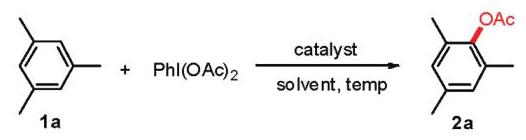
| entry | ratio | catalyst (mol %) | solvent | temp (°C) | $t$ (h) | yield (%) $b$ |
| 1 | 1:1.2 | ${\mathrm{{AuCl}}}_{3}\left( 2\right)$ | DCE | 60 | 24 | trace |
| 2 | 1:1.2 | ${\mathrm{{AuCl}}}_{3}$ (2) | DCE | 80 | 24 | ${56}^{c}$ |
| 3 | 1:1.5 | ${\mathrm{{AuCl}}}_{3}\left( 2\right)$ | DCE | 80 | 24 | ${68}^{c}$ |
| 4 | 1.5:1 | ${\mathrm{{AuCl}}}_{3}$ (2) | DCE | 110 | 12 | ${61}^{c}$ |
| 5 | 2.0:1 | ${\mathrm{{AuCl}}}_{3}$ (2) | DCE | 110 | 12 | 72 |
| 6 | 2.5:1 | ${\mathrm{{AuCl}}}_{3}$ (2) | DCE | 110 | 12 | 75 |
| 7 | 3.0:1 | ${\mathrm{{AuCl}}}_{3}\left( 2\right)$ | DCE | 110 | 12 | 69 |
| 8 | 2.5:1 | ${\mathrm{{AuCl}}}_{3}\left( 1\right)$ | DCE | 110 | 24 | 61 |
| 9 | 2.5:1 | ${\mathrm{{AuCl}}}_{3}\left( 5\right)$ | DMF | 110 | 24 | 0 |
| 10 | 2.5:1 | ${\mathrm{{AuCl}}}_{3}$ (5) | ${\mathrm{{CH}}}_{3}\mathrm{{CN}}$ | 110 | 12 | <5 |
| 11 | 2.5:1 | ${\mathrm{{AuCl}}}_{3}\left( 5\right)$ | AcOH | 110 | 24 | 53 |
| 12 | 1.5:1 | ${\mathrm{{FeCl}}}_{3}\left( {20}\right)$ | DCE | 80 | 24 | 0 |
| 13 | 1.5:1 | ${\mathrm{{FeBr}}}_{3}\left( {20}\right)$ | DCE | 80 | 24 | 0 |
| 14 | 2.5:1 | Pd(OAc) ${}_{2}$ (5) | DCE | 110 | 24 | trace |
| 15 | 2.5:1 | AcOH(200) | DCE | 110 | 24 | 0 |
| 16 | 2.5:1 | ${\mathrm{H}}_{2}{\mathrm{{SO}}}_{4}\left( {200}\right)$ | DCE | 110 | 24 | trace |
| 17 | 2.5:1 | $d$ | AcOH | 110 | 24 | trace |
${}^{a}$ Reaction conditions: mesitylene 1a, PhI(OAc) ${}_{2}$ (1 mmol), solvent (2 mL). The reaction was monitored by GC-MS. The ratio refers to 1a/ $\mathrm{{PhI}}{\left( \mathrm{{OAc}}\right) }_{2}.{}^{b}$ Isolated yield based on $\mathrm{{PhI}}{\left( \mathrm{{OAc}}\right) }_{2}.{}^{c}$ Di- and triacetoxyla-tion products were observed. ${}^{d}$ No catalyst was used. DCE = 1,2- dichloroethane, DMF $= N, N$ -dimethylformamide.
${}^{a}$反应条件:均三甲苯1a,二醋酸碘苯${}_{2}$(1 mmol),溶剂(2 mL)。反应通过GC - MS监测。该比例指的是1a/$\mathrm{{PhI}}{\left( \mathrm{{OAc}}\right) }_{2}.{}^{b}$基于$\mathrm{{PhI}}{\left( \mathrm{{OAc}}\right) }_{2}.{}^{c}$的分离产率。观察到了二乙酰氧基化和三乙酰氧基化产物。${}^{d}$未使用催化剂。DCE = 1,2 - 二氯乙烷,DMF = $= N, N$ - 二甲基甲酰胺。
Reducing the Au(III) catalyst loading to 1 mol % resulted in a longer reaction time and slightly diminished yield (entry 8). The solvents were found to significantly affect the reaction, and the initially used DCE provided the optimal results (entries 9-11). Finally, for comparison we also carried out the reaction under Fe(III)- and Pd(II)- catalyzed conditions, and under strong acidic conditions as well. None of them afforded the expected acetoxylation products (entries 12-17). The control experiment indicates that no reaction occurs in the absence of catalyst (entry 17).
将金(III)催化剂负载量降至1 mol%会导致反应时间延长且产率略有降低(条目8)。发现溶剂对反应有显著影响,最初使用的1,2 - 二氯乙烷提供了最佳结果(条目9 - 11)。最后,为了进行比较,我们还在铁(III)和钯(II)催化条件下以及强酸性条件下进行了反应。它们均未得到预期的乙酰氧基化产物(条目12 - 17)。对照实验表明在无催化剂的情况下不发生反应(条目17)。
With the optimal reaction conditions in hand, we proceeded to extend the scope of the reaction, and the results are summarized in Table 2. The reaction is general for electron-rich aromatics. For the substrates bearing three or more methyl groups, the acetoxylation all worked well with 2 mol % ${\mathrm{{AuCl}}}_{3}$ catalyst, even for the substrates bearing halogen substituents or an acetyl group (entries 4-6). When the strong electron-withdrawing group CN was present, a slightly higher catalyst loading was required (entry 7). The aromatic substrates bearing only two methyl substituents require a higher catalyst loading and the reaction took a longer time (entry 8). The diminished yield in this case was due to the formation of homocoupling of $p$ -xylene. ${}^{{13},{14}}$ Interestingly, the acetoxylation also worked with toluene derivatives bearing electron-withdrawing substituents (entries 11, 12). However, an acetoxylation product could not be identified with toluene itself as substrate.
掌握了最佳反应条件后,我们着手扩展反应范围,结果总结在表2中。该反应对富电子芳烃具有通用性。对于带有三个或更多甲基的底物,使用2 mol%的${\mathrm{{AuCl}}}_{3}$催化剂时,乙酰氧基化反应均进行得很好,即使对于带有卤素取代基或乙酰基的底物也是如此(条目4 - 6)。当存在强吸电子基团CN时,需要稍高的催化剂负载量(条目7)。仅带有两个甲基取代基的芳香族底物需要更高的催化剂负载量且反应时间更长(条目8)。在这种情况下产率降低是由于$p$ - 二甲苯的均偶联形成。${}^{{13},{14}}$有趣的是,乙酰氧基化反应也适用于带有吸电子取代基的甲苯衍生物(条目11、12)。然而,以甲苯本身作为底物时无法鉴定出乙酰氧基化产物。
The ${\mathrm{{AuCl}}}_{3}$ -catalyzed conditions could also be applied to the aromatic substrates bearing methoxy groups, although a slightly higher catalyst loading was required. It was also observed that the reaction showed excellent regioselectivities. Thus, the reaction with anisole provided the product with an acetoxy group introduced to the para position. For all other substituted anisole substrates, the regioselectivity of the acetoxylation is dominated by the methoxy substituent.
${\mathrm{{AuCl}}}_{3}$催化条件也可应用于带有甲氧基的芳香族底物,尽管需要稍高的催化剂负载量。还观察到该反应表现出优异的区域选择性。因此,与苯甲醚的反应提供了在对位引入乙酰氧基的产物。对于所有其他取代的苯甲醚底物,乙酰氧基化的区域选择性由甲氧基取代基主导。
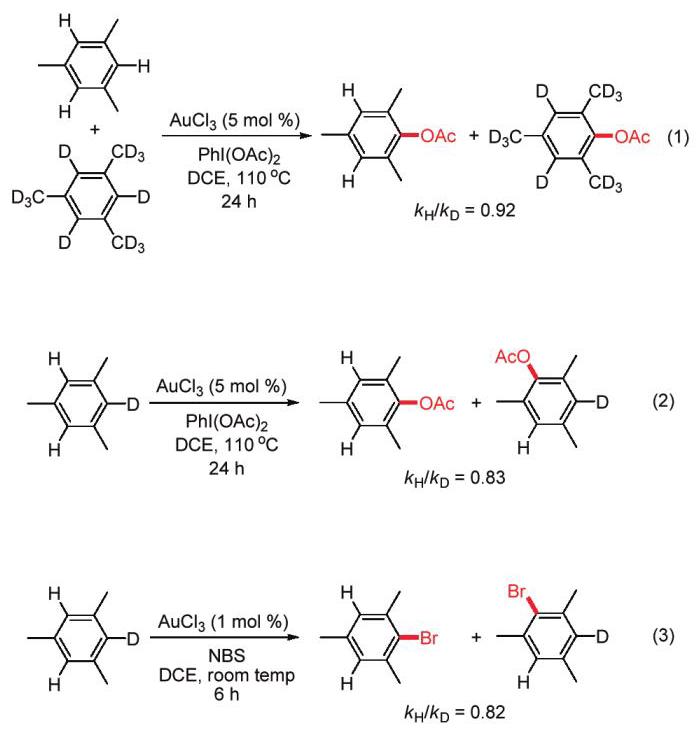
To gain insight into the reaction mechanism, kinetic isotope effect (KIE) experiments have been carried out in both an inter- and intramolecular manner. For the intermolecular experiment, an inverse KIE of 0.92 was observed (eq 1), while the corresponding intramolecular experiment afforded an inverse KIE of 0.83 (eq 2). For comparison, the intramolecular KIE for our previously reported ${\mathrm{{AuCl}}}_{3}$ -catalyzed bromination with NBS was also measured (eq 3). ${}^{10}$ It gave a similar inverse KIE value of 0.82. The inverse K IE value is consistent with electrophilic aromatic substitution, which shows similar inverse KIE data in many cases. ${}^{{15},{16}}$ On the contrary, it has been suggested that electrophilic metalations are characterized by significant primary isotope effects. For example, the electrophilic mercuration of chlorobenzene by $\mathrm{{Hg}}{\left( {\mathrm{O}}_{2}{\mathrm{{CCF}}}_{3}\right) }_{2}$ shows a primary isotope effect of ${3.9}^{17}$ Recently, a large primary KIE of 5 has been observed for
为深入了解反应机理,已以分子间和分子内方式进行了动力学同位素效应(KIE)实验。对于分子间实验,观察到逆KIE为0.92(式1),而相应的分子内实验得到的逆KIE为0.83(式2)。为作比较,还测量了我们先前报道的${\mathrm{{AuCl}}}_{3}$催化的用NBS进行溴化反应的分子内KIE(式3)。${}^{10}$它给出了类似的逆KIE值0.82。逆KIE值与亲电芳香取代一致,亲电芳香取代在许多情况下显示出类似的逆KIE数据。${}^{{15},{16}}$相反,有人提出亲电金属化的特征是显著的一级同位素效应。例如,$\mathrm{{Hg}}{\left( {\mathrm{O}}_{2}{\mathrm{{CCF}}}_{3}\right) }_{2}$对氯苯的亲电汞化反应显示出${3.9}^{17}$的一级同位素效应。最近,观察到一个大的一级KIE为5,用于
(9) (a) Li, Z.; Capretto, D. A.; Rahaman, R. O.; He, C. J. Am. Chem. Soc. 2007, 129, 12058. (b) Shi, Z.; He, C. J. Org. Chem. 2004, 69, 3669. (c) Shi, Z.; He, C. J. Am. Chem. Soc. 2004, 126, 5964. (d) Shi, Z.; He, C. J. Am. Chem. Soc. 2004, 126, 13596. (e) Reetz, M. T.; Sommer, K. Eur. J. Org. Chem. 2003, 3485. (f) Dyker, G.; Muth, E.; Hashmi, A. S. K.; Ding, L. Adv. Synth. Catal. 2003, 345, 1247. (g) Hashmi, A. S. K.; Schwarz, L.; Choi, J. H.; Frost, T. M. Angew. Chem., Int. Ed. 2000, 39, 2285. (h) Luo, Y.; Li, C.-J. Chem. Commun. 2004, 1930. (i) Sun, X.; Sun, W.; Fan, R.; Wu, J. Adv. Synth. Catal. 2007, 349, 2151.
(9) (a) 李,Z.;卡普雷托,D. A.;拉赫曼,R. O.;何,C. 《美国化学会志》2007年,129卷,12058页。(b) 施,Z.;何,C. 《有机化学杂志》2004年,69卷,3669页。(c) 施,Z.;何,C. 《美国化学会志》2004年,126卷,5964页。(d) 施,Z.;何,C. 《美国化学会志》2004年,126卷,13596页。(e) 雷茨,M. T.;索默,K. 《欧洲有机化学杂志》2003年,3485页。(f) 戴克,G.;穆特,E.;哈什米,A. S. K.;丁,L. 《合成催化进展》2003年,345卷,1247页。(g) 哈什米,A. S. K.;施瓦茨,L.;崔,J. H.;弗罗斯特,T. M. 《德国应用化学》2000年,39卷,2285页。(h) 罗,Y.;李,C.-J. 《化学通讯》2004年,1930页。(i) 孙,X.;孙,W.;范,R.;吴,J. 《合成催化进展》2007年,349卷,2151页。
(10) (a) Mo, F.; Yan, J. M.; Qiu, D.; Li, F.; Zhang, Y.; Wang, J. Angew. Chem., Int. Ed. 2010, 49, 2028. (b) Qiu, D.; Mo, F.; Zheng, Z.; Zhang, Y.; Wang, J. Org. Lett. 2010, 12, 5474.
(10) (a) 莫,F.;严,J. M.;邱,D.;李,F.;张,Y.;王,J. 《德国应用化学》,国际版2010年,第49卷,2028页。(b) 邱,D.;莫,F.;郑,Z.;张,Y.;王,J. 《有机快报》2010年,第12卷,5474页。
(11) For a recent report on ${\mathrm{{AuCl}}}_{3}$ -catalyzed direct amination of arenes, see: Gu, L.; Neo, B. S.; Zhang, Y. Org. Lett. 2011, 13, 1872.
(11) 关于${\mathrm{{AuCl}}}_{3}$催化芳烃直接胺化的最新报告,见:Gu, L.; Neo, B. S.; Zhang, Y. Org. Lett. 2011, 13, 1872。
(12) For a review on hypervalent iodine, see: Zhdankin, V. V.; Stang, P. J. Chem. Rev. 2008, 108, 5299.
(12) 有关高价碘的综述,请参阅:Zhdankin, V. V.; Stang, P. J. Chem. Rev. 2008, 108, 5299。
(13) Kar, A.; Mangu, N.; Kaiser, H. M.; Tse, M. K. J. Organomet. Chem. 2009, 694, 524.
(13) 卡尔,A.;曼古,N.;凯泽,H. M.;谢,M. K. 《有机金属化学杂志》2009年,第694卷,第524页。
(14) For detailed discussion on the acetoxylation and homocoupling, see Supporting Information.
(14) 有关乙酰氧基化和均偶联的详细讨论,请参阅补充信息。
Table 2. ${\mathrm{{AuCl}}}_{3}$ -Catalyzed Acetoxylation of Arenes ${}^{a}$
表2. ${\mathrm{{AuCl}}}_{3}$催化的芳烃乙酰氧基化反应${}^{a}$
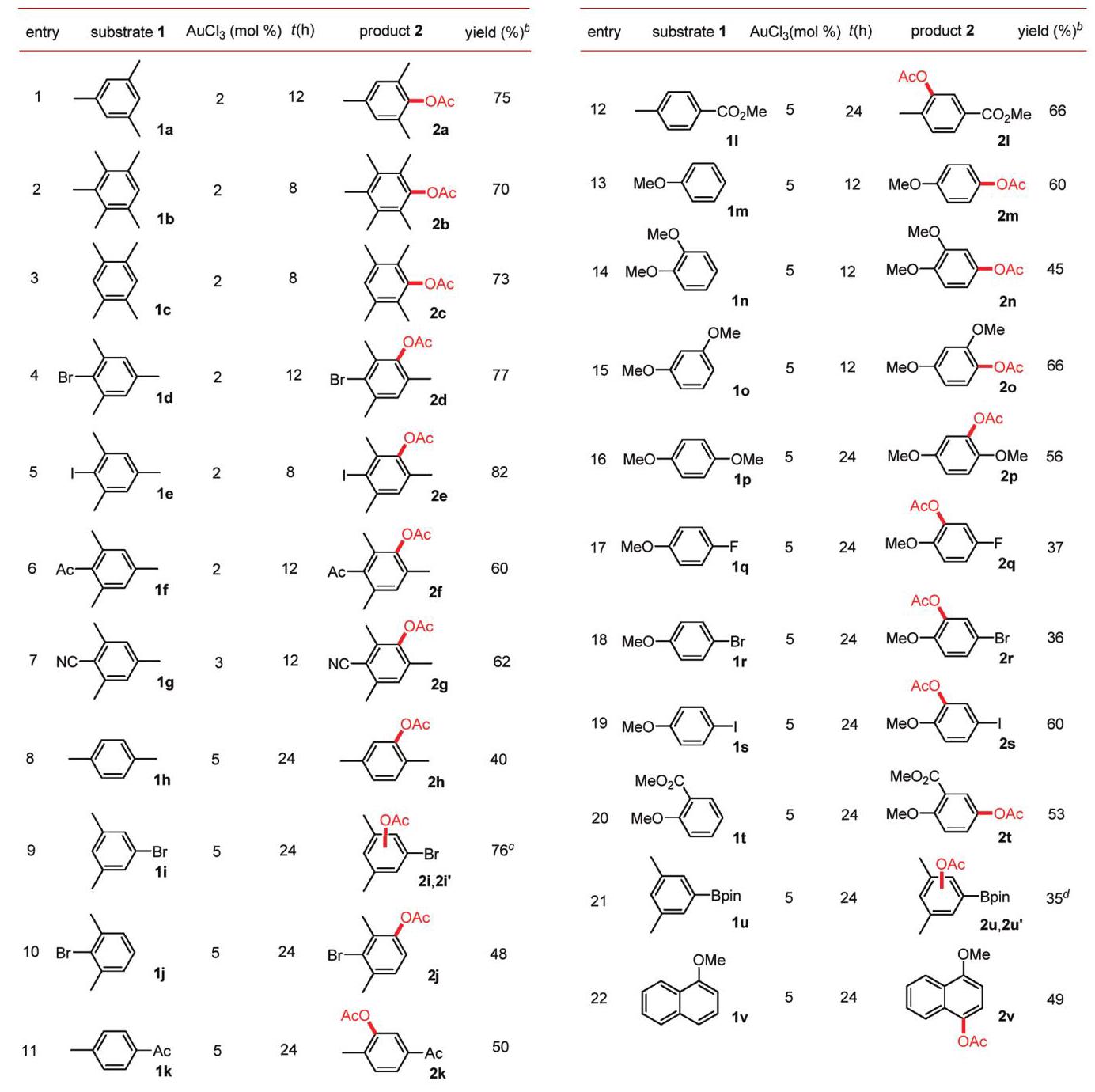
${}^{a}$ Reaction condition: a solution of arene $1\left( {{2.5}\mathrm{\;{mmol}}}\right) ,\mathrm{{PhI}}{\left( \mathrm{{OAc}}\right) }_{2}\left( {1\mathrm{{mmol}}}\right)$ , and ${\mathrm{{AuCl}}}_{3}\left( {2\text{ or }5\mathrm{\;{mol}}\% }\right)$ in DCE $\left( {2\mathrm{{mL}}}\right)$ was heated at ${110}^{ \circ }\mathrm{C}$ . The reaction was monitored by GC-MS. ${}^{b}$ Isolated yield by silica gel column chromatography based on PhI(OAc), ${}^{c}$ The ratio of $2\mathrm{i}$ to $2{\mathrm{i}}^{\prime }$ was $2 : 1$ , as determined by the integral of ${}^{1}\mathrm{H}$ NMR. 2i: 4-bromo-2,6-dimethylphenyl acetate. 2i’: 2-bromo-4,6-dimethylphenyl acetate. ${}^{d}$ The ratio of 2u to 2u’ was 1:4, as determined by the integral of 1H NMR. 2u: 2,6-dimethyl-4-(4,4,5,5-tetramethyl-1,3,2-dioxaborolan-2-yl)phenyl acetata. 2u’: 2,4-dimethyl- 6-(4,4,5,5-tetramethyl-1,3,2-dioxaborolan-2-yl)phenyl acetate.
${}^{a}$反应条件:芳烃$1\left( {{2.5}\mathrm{\;{mmol}}}\right) ,\mathrm{{PhI}}{\left( \mathrm{{OAc}}\right) }_{2}\left( {1\mathrm{{mmol}}}\right)$、${\mathrm{{AuCl}}}_{3}\left( {2\text{ or }5\mathrm{\;{mol}}\% }\right)$在二氯乙烷$\left( {2\mathrm{{mL}}}\right)$中的溶液在${110}^{ \circ }\mathrm{C}$下加热。反应通过气相色谱 - 质谱监测。${}^{b}$基于二乙酸碘苯通过硅胶柱色谱法得到的分离产率。${}^{c}$通过${}^{1}\mathrm{H}$核磁共振积分确定,$2\mathrm{i}$与$2{\mathrm{i}}^{\prime }$的比例为$2 : 1$。2i:4 - 溴 - 2,6 - 二甲基苯基乙酸酯。2i’:2 - 溴 - 4,6 - 二甲基苯基乙酸酯。${}^{d}$通过1H核磁共振积分确定,2u与2u’的比例为1:4。2u:2,6 - 二甲基 - 4 - (4,4,5,5 - 四甲基 - 1,3,2 - 二氧杂硼烷 - 2 - 基)苯基乙酸酯。2u’:2,4 - 二甲基 - 6 - (4,4,5,5 - 四甲基 - 1,3,2 - 二氧杂硼烷 - 2 - 基)苯基乙酸酯。
(15) Tunge, J. A.; Foresee, L. N. Organometallics 2005, 24, 6440 and refenences cited therein.
(15) 滕格,J. A.;福尔西,L. N. 《有机金属化学》2005年,第24卷,6440页及其中引用的参考文献。
(16) Recently, Zhang and coworkers have observed a normal KIE value of 1.1 in Au(III)-catalyzed aromatic auration; see: Zhang, G.; Luo, Y.; Wang, Y.; Zhang, L. Angew. Chem., Int. Ed. 2011, 50, 4450.
(16) 最近,张及其同事在金(III)催化的芳烃金化反应中观察到正常的动力学同位素效应值为1.1;见:张,G.;罗,Y.;王,Y.;张,L. 《德国应用化学》,国际版2011年,第50卷,4450页。
(17) Lau, W.; Kochi, J. K. J. Am. Chem. Soc. 1986, 108, 6720.
(17) 刘,W.;高木,J. K. 《美国化学会志》1986年,第108卷,6720页。
(18) Lu, P.; Boorman, T. C.; Slawin, A. M. Z.; Larrosa, I. J. Am. Chem. Soc. 2010, 132, 5580.
(18) 卢,P.;布尔曼,T. C.;斯莱温,A. M. Z.;拉罗萨,I. 《美国化学会志》2010年,第132卷,5580页。
direct $\mathrm{C} - \mathrm{H}$ activation of electron-poor arenes with $\mathrm{{Au}}\left( \mathrm{I}\right)$ complexes. ${}^{18}$
用$\mathrm{{Au}}\left( \mathrm{I}\right)$配合物对缺电子芳烃进行直接$\mathrm{C} - \mathrm{H}$活化。${}^{18}$
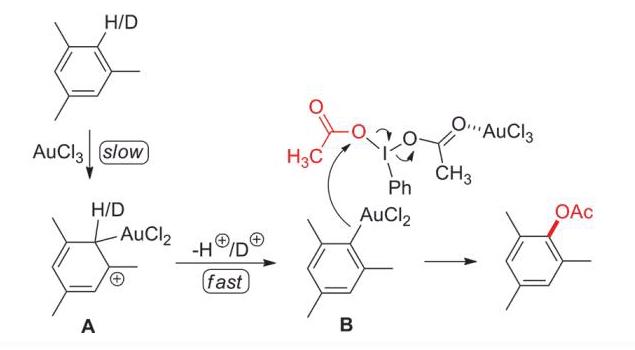
The formation of the arylgold(III) species has been well-documented in the literature, and it has been demonstrated that the aromatic auration proceeds in an electrophilic manner. ${}^{8}$ The dual activation mode provides a probable explanation for the extraordinarily high catalytic efficiency of ${\mathrm{{AuCl}}}_{3}$ as compared with other Lewis acid or protonic acid catalysts (Table 1, entries 12-16). ${}^{{10},{11},{19}}$ To accommodate the observed inverse KIE data, we assume that the formation of $\sigma$ -complex $\mathbf{A}$ (Wheland intermediate) is the rate-limiting step, in which an inverse secondary KIE is expected (Scheme 1). The subsequent deprotonation to form mesitylgold(III) species $\mathbf{B}$ is a fast step. Finally, the mesitylgold(III) species $\mathbf{B}$ attacks the Au-activated iodobenzene diacetate to afford the acetoxylation product. The rate-limiting step assumption is consistent with the observed similar data of intermolecular KIE. However, further studies are needed to unambiguously establish the reaction mechanism. ${}^{20}$
芳基金(III)物种的形成在文献中有充分记载,并且已经证明芳烃金化以亲电方式进行。${}^{8}$与其他路易斯酸或质子酸催化剂相比,这种双重活化模式为${\mathrm{{AuCl}}}_{3}$的极高催化效率提供了一个可能的解释(表1,条目12 - 16)。${}^{{10},{11},{19}}$为了适应观察到的逆动力学同位素效应数据,我们假设$\sigma$ - 配合物$\mathbf{A}$(惠兰中间体)的形成是限速步骤,在该步骤中预期有逆二级动力学同位素效应(方案1)。随后去质子化形成均三甲基金(III)物种$\mathbf{B}$是一个快速步骤。最后,均三甲基金(III)物种$\mathbf{B}$攻击金活化的二乙酸碘苯以得到乙酰氧基化产物。限速步骤假设与观察到的分子间动力学同位素效应的类似数据一致。然而,需要进一步研究来明确确定反应机理。${}^{20}$
Scheme 1. Plausible Reaction Pathway
方案1. 合理的反应途径
In conclusion, we have developed an efficient gold(III)- catalyzed acetoxylation of arenes with iodobenzene diacetate. ${}^{21}$ This catalytic system is suitable for the electron-rich aromatics, which affords the corresponding acet-oxylation products in moderately high yields. Further studies to enhance the catalytic activity and to design a new acetoxylation reagent with higher reactivity are currently underway in our laboratory.
总之,我们开发了一种高效的金(III)催化芳烃与二醋酸碘苯的乙酰氧基化反应。${}^{21}$ 该催化体系适用于富电子芳烃,能以中等偏高的产率得到相应的乙酰氧基化产物。目前我们实验室正在进行进一步的研究,以提高催化活性并设计一种具有更高反应活性的新型乙酰氧基化试剂。
Acknowledgment. The project is supported by National Basic Research Program of China (973 Program, No. 2009CB825300), Natural Science Foundation of China (Grant Nos. 20902005, 20832002, 20772003, 20821062).
致谢。本项目得到了中国国家基础研究计划(973计划,项目编号:2009CB825300)、中国国家自然科学基金(项目批准号:20902005、20832002、20772003、20821062)的资助。
Supporting Information Available. Experiment procedure, characterization data, ${}^{1}\mathrm{H}$ and ${}^{13}\mathrm{C}$ NMR spectra, KIE measurement experiments. This material is available free of charge via the Internet at http://pubs.acs.org.
可获取支持信息。实验步骤、表征数据、${}^{1}\mathrm{H}$和${}^{13}\mathrm{C}$核磁共振谱、动力学同位素效应测量实验。此材料可通过互联网免费获取,网址为http://pubs.acs.org。
(19) However, the possibility cannot be ruled out that acetoxylation proceeds through intermediate $\mathbf{B}$ without activation of $\mathrm{{PhI}}{\left( \mathrm{{OAc}}\right) }_{2}$ .
(19) 然而,不能排除乙酰氧基化反应通过中间体$\mathbf{B}$进行而无需$\mathrm{{PhI}}{\left( \mathrm{{OAc}}\right) }_{2}$活化的可能性。
(20) Other mechanistic possibilities cannot be ruled out. For example, in the first step of the catalytic cycle, an intermediate iodonium salt of the electron-rich aromatic substrate may be formed, which undergoes a subsequent Au-mediated process leading to the final product. See: (a) Lubriks, D.; Sokolovs, I.; Suna, E. Org. Lett. 2011, 13, 4324. Such a mechanism is possible because it is known that nonsymmetrical aryl- (phenyl)iodonium acetates can be formed from electron-rich arenes under Lewis acidic conditions. See: (b) Shah, A.; Pike, V. W.; Widdow-son, D. A. J. Chem. Soc., Perkin Trans. 1 1997, 2463. We thank the referee who called our attention to such mechanistic possibility.
(20) 其他机理可能性也不能排除。例如,在催化循环的第一步中,可能会形成富电子芳族底物的中间体碘鎓盐,其随后会经历金介导的过程,从而生成最终产物。见:(a) Lubriks, D.; Sokolovs, I.; Suna, E. Org. Lett. 2011, 13, 4324。这种机理是可能的,因为已知在路易斯酸性条件下,富电子芳烃可以形成不对称芳基 - (苯基)碘鎓乙酸盐。见:(b) Shah, A.; Pike, V. W.; Widdow-son, D. A. J. Chem. Soc., Perkin Trans. 1 1997, 2463。我们感谢提醒我们注意这种机理可能性的审稿人。
(21) For a recent report of direct acetoxylation of anilide promoted by stoichiometric ${\mathrm{{BF}}}_{3} \cdot {\mathrm{{OEt}}}_{2}$ , see: Liu, H.; Wang, X.; Gu, Y. Org. Biomol. Chem. 2011, 9, 1614.
(21) 关于化学计量的${\mathrm{{BF}}}_{3} \cdot {\mathrm{{OEt}}}_{2}$促进的苯胺直接乙酰氧基化的最新报告,见:Liu, H.; Wang, X.; Gu, Y. Org. Biomol. Chem. 2011, 9, 1614。