Computed ECD spectral data for over 10,000 chiral organic small molecules
英文原文与中文译文逐段对照 · English original with Chinese translation
Da Long ${}^{1,7}$ , Zhihao Li ${}^{2,7}$ , Xin Xu ${}^{1}$ , Chengchun Liu ${}^{3}$ , Hui Zhang ${}^{1}$ , Xiaoyu Cao ${}^{1\infty }$ , Liulin Yang ${}^{1\infty }$ , Xinchang Wang ${}^{1\infty }$ & Fanyang Mo ${}^{3,4,5,6\infty }$
大龙${}^{1,7}$,李志豪${}^{2,7}$,徐鑫${}^{1}$,刘丞军${}^{3}$,张惠${}^{1}$,曹晓宇${}^{1\infty }$,杨柳林${}^{1\infty }$,王新昌${}^{1\infty }$ & 莫凡洋${}^{3,4,5,6\infty }$
Determining the absolute configuration of chiral molecules is of fundamental importance in the fields of natural products chemistry, asymmetric catalysis, and pharmaceutical development. A widely adopted approach involves the comparison of experimental and theoretical electronic circular dichroism (ECD) spectra, which has proven to be a reliable method for absolute configuration assignment. However, the generation of theoretical ECD spectra via time-dependent density functional theory (TD-DFT) remains the rate-limiting step in this workflow, making its acceleration both essential and challenging. Although recent advances in deep learning offer promising strategies for establishing structure-spectrum relationships and expediting theoretical spectrum prediction, the lack of standardized and comprehensive ECD spectral datasets continues to hinder progress. This study presents the Chiral Molecular Circular Dichroism Spectral (CMCDS) dataset, a systematically structural benchmark dataset that addresses the fragmentation of existing ECD data. Characterized by high standardization, scalability, and broad molecular diversity, CMCDS facilitates deep learning applications in ECD analysis and fosters data-driven discovery of chiral molecules.
确定手性分子的绝对构型在天然产物化学、不对称催化和药物开发领域至关重要。一种广泛采用的方法是比较实验和理论电子圆二色光谱(ECD),这已被证明是一种可靠的绝对构型确定方法。然而,通过含时密度泛函理论(TD-DFT)生成理论ECD光谱仍然是该工作流程中的限速步骤,因此加速这一步骤既至关重要又具有挑战性。尽管深度学习的最新进展为建立结构-光谱关系和加速理论光谱预测提供了有前景的策略,但缺乏标准化和全面的ECD光谱数据集仍然阻碍着进展。本研究提出了手性分子圆二色光谱(CMCDS)数据集,这是一个系统的结构基准数据集,解决了现有ECD数据的碎片化问题。CMCDS具有高标准化、可扩展性和广泛的分子多样性,有助于深度学习在ECD分析中的应用,并促进手性分子的数据驱动发现。
Background & Summary
<## 背景与总结
Chirality, a geometric property describing structures incapable of superimposition onto their mirror images via rotation or translation ${}^{1}$ , is ubiquitous in chemical and biological molecular systems ${}^{2,3}$ . Chiral molecular architectures play essential roles in a variety of functional materials, including liquid crystal displays ${}^{4}$ and nonlinear optical systems ${}^{5}$ . Owing to the differences in structure-property relationships between enantiomers, the determination of the absolute configuration has become a crucial part of chiral studies ${}^{6 - 9}$ .
手性是一种几何性质,描述了无法通过旋转或平移${}^{1}$与其镜像重合的结构,在化学和生物分子系统中${}^{2,3}$普遍存在。手性分子结构在包括液晶显示器${}^{4}$和非线性光学系统${}^{5}$在内的各种功能材料中起着至关重要的作用。由于对映体之间结构-性质关系的差异,绝对构型的确定已成为手性研究的关键部分${}^{6 - 9}$。
The absolute configuration of small chiral molecules can be determined using various experimental and computational techniques, such as X-ray crystallography and chiroptical spectroscopy. X-ray crystallography, while offering unambiguous structural information, requires high-quality single crystals and is reliable only when the molecular structure contains atoms heavier than phosphorus, due to the need for significant anomalous dispersion effects. In cases where such heavy atoms are absent or crystallization is unsuccessful, chiroptical spectroscopies provide a powerful alternative. Techniques such as optical rotation (OR), vibrational circular dichroism (VCD), and electronic circular dichroism (ECD) are widely employed for their sensitivity to stereochemistry in solution. Among these, ECD is the most accepted and reliable method, often coupled with time-dependent density functional theory (TD-DFT) calculations to establish structure-spectrum correlations ${}^{{10},{11}}$ .
小分子手性化合物的绝对构型可以使用各种实验和计算技术来确定,例如X射线晶体学和圆二色光谱法。X射线晶体学虽然能提供明确的结构信息,但需要高质量的单晶,并且只有当分子结构包含比磷重的原子时才可靠,这是由于需要显著的反常色散效应。在没有这种重原子或结晶不成功的情况下,圆二色光谱法提供了一种有力的替代方法。诸如旋光(OR)、振动圆二色性(VCD)和电子圆二色性(ECD)等技术因其对溶液中立体化学的敏感性而被广泛应用。其中,ECD是最被认可和可靠的方法,通常与含时密度泛函理论(TD-DFT)计算相结合以建立结构-光谱相关性${}^{{10},{11}}$。
The simulation of ECD spectra is computationally demanding, and their cost increases significantly with increasing complexity of chiral structures ${}^{12}$ . This has gradually emerged as a non-negligible obstacle to the
ECD光谱的模拟在计算上要求很高,并且其成本随着手性结构复杂性的增加而显著增加${}^{12}$。这已逐渐成为手性研究进一步发展的一个不可忽视的障碍。
${}^{1}$ State Key Laboratory of Physical Chemistry of Solid Surfaces, School of Electronic Science and Engineering, Innovation Laboratory for Science and Technologies of Energy Materials of Fujian Province (IKKEM) and College of Chemistry and Chemical Engineering, Xiamen University, Xiamen, 361005, China. ${}^{2}$ South China Advanced Institute for Soft Matter Science and Technology, School of Emergent Soft Matter, South China University of Technology, Guangzhou, 510640, China. ${}^{3}$ School of Materials Science and Engineering, Peking University, Beijing, 100871, China. 4AI for Science (AI4S)-Preferred Program, Peking University Shenzhen Graduate School, Shenzhen, 518055, China. ${}^{5}$ School of Advanced Materials, Peking University Shenzhen Graduate School, Shenzhen, 518055, China. ${}^{6}$ Guangdong Provincial Key Laboratory of Nano-Micro Materials Research, Peking University Shenzhen Graduate School, Shenzhen, 518055, China. ${}^{7}$ These authors contributed equally: Da Long, Zhihao Li. ${}^{\text{ ✉ }}$ ; ; ; further development of chiral research, making methodological innovations in simulation techniques increasingly imperative. A possible solution to accelerate the acquisition of ECD spectra is deep-learning method. As a data-driven methodology, deep learning extracts patterns from massive datasets through complex neural networks, achieving a paradigm shift from empirical approaches to computational intelligence in diverse fields including protein folding prediction ${}^{13}$ , targeted drug design ${}^{14}$ , and organic synthesis pathway optimization ${}^{15}$ . Based on the deep neural network framework, with the help of 130,000 organic molecules (QM9S dataset) and dynamic configuration data (QM7-X subset) for model training and testing, efficient and high-precision prediction of multi-type organic molecular spectra such as infrared, Raman, ultraviolet-visible and nuclear magnetic resonance can be achieved ${}^{16}$ . By establishing molecular structure-spectrum correlations through deep learning approaches that bypass wavefunction analysis, this predictive modelling strategy represents a transformative way to innovate ECD simulations.
${}^{1}$ 固体表面物理化学国家重点实验室,电子科学与工程学院,福建省能源材料科学与技术创新实验室(IKKEM),厦门大学化学化工学院,厦门361005,中国。${}^{2}$ 华南软物质科学与技术高等研究院,华南理工大学新兴软物质学院,广州510640,中国。${}^{3}$ 北京大学材料科学与工程学院,北京100871,中国。4北京大学深圳研究生院人工智能促进科学(AI4S)优先计划,深圳518055,中国。${}^{5}$ 北京大学深圳研究生院先进材料学院,深圳518055,中国。${}^{6}$ 广东省纳米微材料研究重点实验室,北京大学深圳研究生院,深圳518055,中国。${}^{7}$ 这些作者贡献相同:龙达,李志豪。${}^{\text{ ✉ }}$ ;;; 加速ECD光谱获取的一种可能解决方案是深度学习方法。作为一种数据驱动的方法,深度学习通过复杂的神经网络从海量数据集中提取模式,在包括蛋白质折叠预测${}^{13}$、靶向药物设计${}^{14}$和有机合成途径优化${}^{15}$在内的多个领域实现了从经验方法到计算智能的范式转变。基于深度神经网络框架,借助130,000个有机分子(QM9S数据集)和动态构型数据(QM7-X子集)进行模型训练和测试,可以实现对红外、拉曼、紫外-可见和核磁共振等多种类型有机分子光谱的高效高精度预测${}^{16}$。通过绕过波函数分析的深度学习方法建立分子结构-光谱相关性,这种预测建模策略代表了一种创新ECD模拟的变革性方式。
OPEN
DATA DESCRIPTOR
数据描述
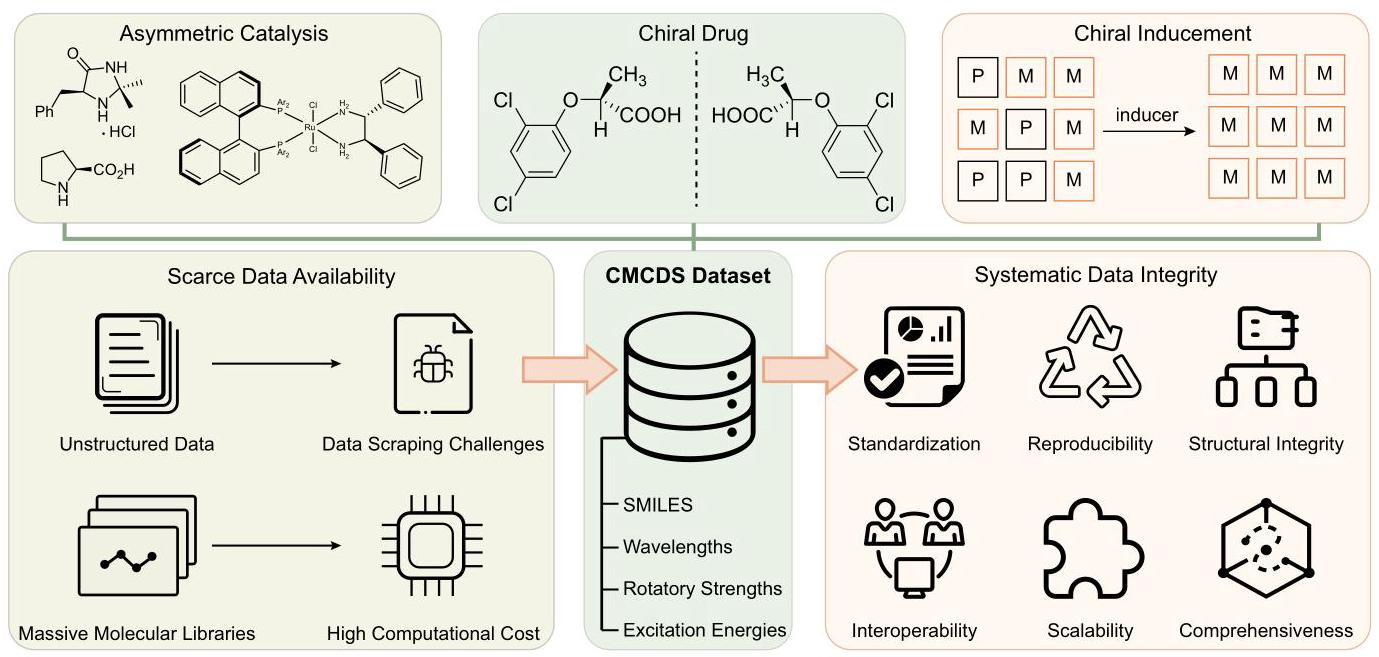
Fig. 1 Overview of the CMCDS Dataset. Chirality is widely present in various molecular structures, involving fields such as asymmetric catalysis ${}^{6,7}$ , chiral drug development ${}^{8}$ , and chiral inducement ${}^{9}$ . Due to the challenges in data collection and high computational costs, there is a lack of high-quality chiral molecular ECD spectral datasets. This work presents a standardized, highly scalable, and comprehensive CMCDS dataset with broad compound diversity.
图1 CMCDS数据集概述。手性广泛存在于各种分子结构中,涉及不对称催化${}^{6,7}$、手性药物开发${}^{8}$和手性诱导${}^{9}$等领域。由于数据收集方面的挑战和高计算成本,缺乏高质量的手性分子ECD光谱数据集。这项工作展示了一个标准化、高度可扩展且全面的CMCDS数据集,具有广泛的化合物多样性。
Critical elements, including high-quality datasets, algorithmic selection and feature engineering, are essential for machine learning predictions. The development of high quality ECD spectral databases required for training sets of large-scale chiral molecules remains limited by the unstructured nature of existing experimental data and the high computational cost of theoretical simulations, posing significant challenges for machine learning applications. To address the scarcity of high-quality chiral ECD spectral datasets for chiral molecule research, this study leverages the previously established Chiral Molecule Retention Time (CMRT) dataset ${}^{17}$ . Through implementation of a systematic screening protocol, we have identified 11,095 monochiral molecular entities meeting stringent stereochemical purity criteria. Based on the SMILES structural descriptor, high-throughput calculations were performed: firstly, the molecular conformation was globally optimized by the B3LYP/6-31G(d) method ${}^{18}$ , and then the CAM-B3LYP/6-31G(d) method ${}^{19}$ was used to calculate the first 20 excited state transition parameters, and the theoretical ECD spectrum was generated by Gaussian broadening. After data cleaning, a high-fidelity chiral molecular circular dichroism spectral (CMCDS) database containing 10,887 molecules was successfully constructed ${}^{20}$ . The CMCDS dataset has the characteristics of standardization, strong scalability, and rich variety of chiral compounds, which can significantly improve ECD spectral predictions, and its systematic nature can effectively solve the problem of fragmentation of existing ECD data and provides new perspectives for advancing chiral research.
关键要素,包括高质量数据集、算法选择和特征工程,对于机器学习预测至关重要。用于大规模手性分子训练集所需的高质量ECD光谱数据库的开发,仍然受到现有实验数据的非结构化性质以及理论模拟的高计算成本的限制,这给机器学习应用带来了重大挑战。为了解决手性分子研究中高质量手性ECD光谱数据集的稀缺问题,本研究利用了先前建立的手性分子保留时间(CMRT)数据集${}^{17}$。通过实施系统的筛选方案,我们确定了11,095个符合严格立体化学纯度标准的单一对映体分子实体。基于SMILES结构描述符,进行了高通量计算:首先,通过B3LYP/6-31G(d)方法${}^{18}$对分子构象进行全局优化,然后使用CAM-B3LYP/6-31G(d)方法${}^{19}$计算前20个激发态跃迁参数,并通过高斯展宽生成理论ECD光谱。经过数据清理,成功构建了一个包含10,887个分子的高保真手性分子圆二色光谱(CMCDS)数据库${}^{20}$。CMCDS数据集具有标准化、强可扩展性和丰富的手性化合物种类的特点,能够显著提高ECD光谱预测,其系统性能够有效解决现有ECD数据碎片化的问题,并为推进手性研究提供新的视角。
To promote transparency and reproducibility, we will publicly release all intermediate data associated with the CMCDS dataset, including the curated set of chiral molecules, geometry optimization files, and supporting code. These resources will facilitate in-depth data mining and further exploration of the structure-property relationships in chiral systems. The release of CMCDS not only supports machine-learning applications in chiral molecular research, but also serves as a foundational resource for large-scale, data-driven studies in other spectroscopy Fig. 1.
为了提高透明度和可重复性,我们将公开发布与CMCDS数据集相关的所有中间数据,包括经过整理的手性分子集、几何优化文件和支持代码。这些资源将有助于深入的数据挖掘以及对手性系统中结构-性质关系的进一步探索。CMCDS的发布不仅支持手性分子研究中的机器学习应用,也为其他光谱学中的大规模数据驱动研究提供了基础资源(图1)。
Methods
方法
This section describes the methodological framework for generating ECD spectra through large-scale automated workflows. The workflow consists of three essential stages: (1) Molecular Coordinates Generation, (2) High-Accuracy Molecular Structure Acquisition and Excited State Simulation and (3) ECD Spectra Generation.
本节描述了通过大规模自动化工作流程生成ECD光谱的方法框架。该工作流程包括三个基本阶段:(1) 分子坐标生成,(2) 高精度分子结构获取与激发态模拟,以及 (3) ECD光谱生成。
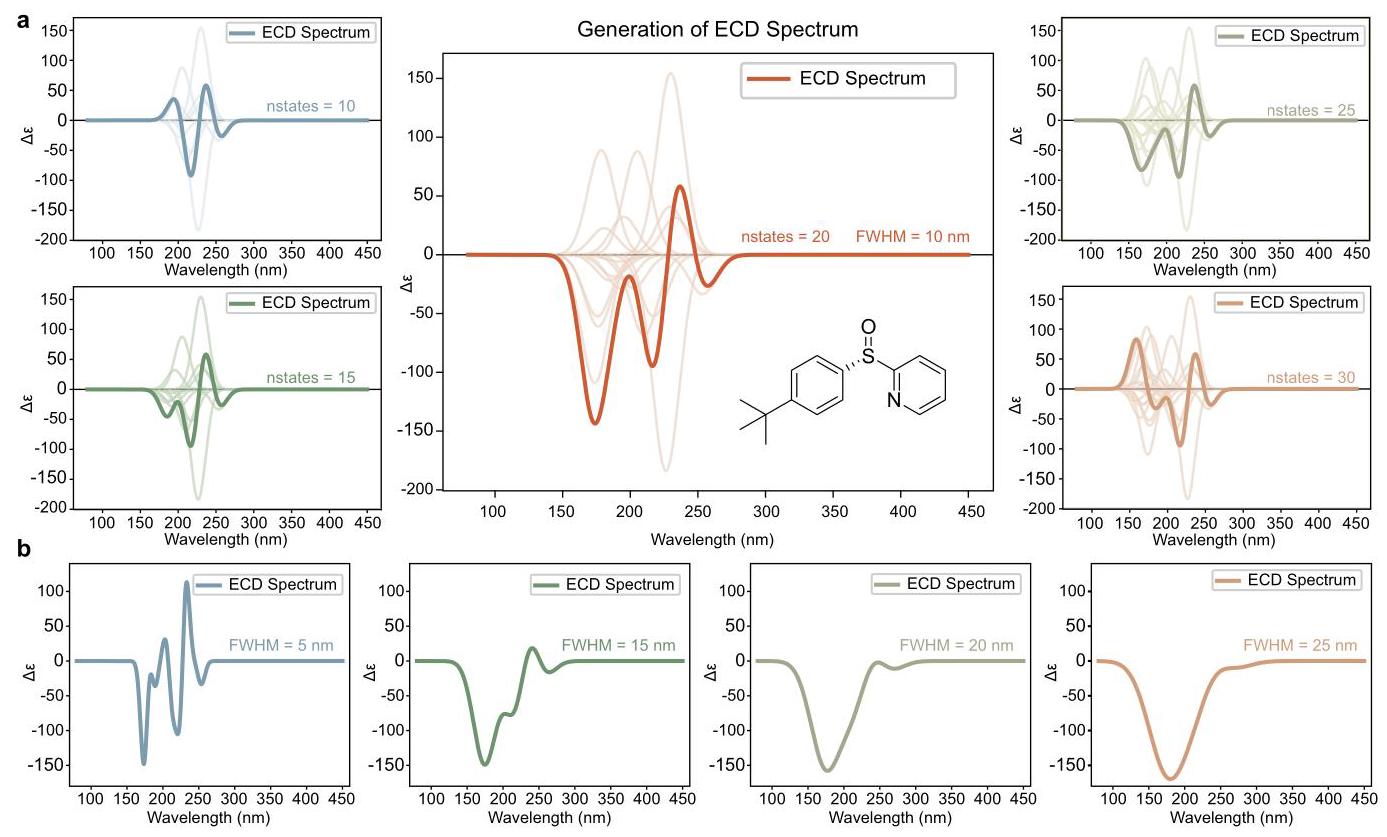
Fig. 2 Effects of the Number of Excited States (nstates) and Full Width at Half Maximum (FWHM) on ECD Spectra. (a) The complete ECD spectrum is formed by the summation of broadened peaks from individual excited states. When the number of excited states is increased, spectral features in the low-wavelength (high-energy) region exhibit significant changes, whereas the spectra in the high-wavelength (low-energy) region usually remain stable. (b) As the FWHM increases, the discrete peaks in the ECD spectrum progressively merge into a single broad peak, resulting in the loss of spectral fine structures.
图2 激发态数量(nstates)和半高宽(FWHM)对ECD光谱的影响。(a) 完整的ECD光谱由各个激发态的展宽峰叠加而成。当激发态数量增加时,低波长(高能量)区域的光谱特征会发生显著变化,而高波长(低能量)区域的光谱通常保持稳定。(b) 随着FWHM的增加,ECD光谱中的离散峰逐渐合并为一个宽峰,导致光谱精细结构的丧失。
Molecular Coordinates Generation. For the samples selection, SMILE descriptors of 11,095 organic molecules with mono-chiral center were extracted from the CMRT database. The 3D Cartesian coordinates of each molecule were generated by topologically dimensional expansion of the ASCII strings by RDKit packages ${}^{21}$ . The specific dimensional expansion method is Experimental-Torsion Basic Knowledge Distance Geometry (ETKDG), which based on empirical structural rules of organic molecular. The initial structures coordinates were stored in MDL Molfle format.
分子坐标生成。对于样本选择,从CMRT数据库中提取了11,095个具有单一手性中心的有机分子的SMILE描述符。每个分子的三维笛卡尔坐标通过RDKit软件包${}^{21}$对ASCII字符串进行拓扑维度扩展生成。具体的维度扩展方法是实验性扭转基础知识距离几何(ETKDG),它基于有机分子的经验结构规则。初始结构坐标以MDL Molfle格式存储。
High-Accuracy Molecular Structure Acquisition and Excited State Simulation. To accurately evaluate the ECD spectrum for each molecule, high-accuracy structure acquisition and excited state calculations were performed on Gaussian 16 A03 packages ${}^{22}$ using geometry optimization and excited state calculation. The geometry optimization were carried out on B3LYP/6-31G(d) level. Subsequently, the excited state calculations were performed at CAM-B3LYP/6-31G(d) level using time-dependent density functional theory (TD-DFT) with 20 excited states. In this stages, four essential results were obtained for further research. The high-accuracy structures from geometry optimization provide accurate structural information for subsequent spectral property predictions. The excited states and rotatory strengths from excited state calculations detailed reflect the circular dichroism contributions of different conformations.
高精度分子结构获取与激发态模拟。为了准确评估每个分子的ECD光谱,使用几何优化和激发态计算在高斯16 A03软件包${}^{22}$上进行了高精度结构获取和激发态计算。几何优化在B3LYP/6 - 31G(d)水平上进行。随后,使用含时密度泛函理论(TD - DFT)在CAM - B3LYP/6 - 31G(d)水平上进行激发态计算,计算20个激发态。在此阶段,获得了四个重要结果用于进一步研究。几何优化得到的高精度结构为后续光谱性质预测提供了准确的结构信息。激发态计算得到的激发态和旋光强度详细反映了不同构象的圆二色性贡献。
ECD Spectra Generation. The calculated ECD spectra for conformation were obtained through spectral broadening of discrete transitions. Specifically, the electronic excitation energies were used as peak positions, and their corresponding rotatory strengths were scaled appropriately to simulate Gaussian line shapes. The corresponding rotational strengths are scaled by a proportionality coefficient:
ECD光谱生成。通过离散跃迁的光谱展宽获得构象的计算ECD光谱。具体来说,将电子激发能用作峰位置,并对其相应的旋光强度进行适当缩放以模拟高斯线形。相应的旋转强度通过一个比例系数进行缩放:
$$ {A}_{c, i} = k{R}_{c, i}\;\left( {k = {1.5}}\right) \tag{1} $$where ${A}_{c, i}$ is the scaled rotational strength of the $i$ -th excited state for conformation $c,{R}_{c, i}$ is the raw (unscaled) rotatory strength obtained from TD-DFT calculations, and $k$ is a proportionality constant set to 1.5 to adjust the overall intensity of the spectral peaks.
其中${A}_{c, i}$是构象$c,{R}_{c, i}$的第$i$个激发态的缩放旋转强度,$c,{R}_{c, i}$是从TD - DFT计算中获得的原始(未缩放)旋光强度,$k$是设置为1.5的比例常数,用于调整光谱峰的整体强度。
Then, a full width at half maximum (FWHM) parameter independently assigned to each excited state to construct the Gaussian function:
然后,为每个激发态独立分配一个半高宽(FWHM)参数来构建高斯函数:
$$ {G}_{c, i}\left( \lambda \right) = {A}_{c, i} \cdot \exp \left( {-\frac{{\left( \lambda - {\lambda }_{0}^{\left( c, i\right) }\right) }^{2}}{2{w}^{2}}}\right) \tag{2} $$where ${G}_{c, i}\left( \lambda \right)$ is the Gaussian-broadened contribution of the $i$ -th excitation to the ECD spectrum at wavelength $\lambda ,{\lambda }_{0}^{\left( c, i\right) }$ is the central wavelength corresponding to the excitation energy after energy-to-wavelength conversion using $\lambda = {hc}/E$ , and $w$ is the width parameter related to the FWHM of the Gaussian, which determines the degree of spectral broadening (a uniform value of $w$ was used for all states).
其中${G}_{c, i}\left( \lambda \right)$是第$i$个激发对波长$\lambda ,{\lambda }_{0}^{\left( c, i\right) }$处ECD光谱的高斯展宽贡献,$\lambda ,{\lambda }_{0}^{\left( c, i\right) }$是使用$\lambda = {hc}/E$进行能量到波长转换后与激发能对应的中心波长,$w$是与高斯FWHM相关的宽度参数,它决定了光谱展宽程度(所有状态使用统一的$w$值)。
| ID | molecule 1 | ||
| SMILES | O=C(OC)N(C)[C@H](B1OC(C)(C)C(C)C(C)C1)CC2=CC=CC=C2 | ||
| Excited State | Excitation Energy (eV) | Wavelength (nm) | Rotatory Strength (cgs (10 |
| State 1 | 5.5118 | 224.94 | 0.6422 |
| State 2 | 6.1878 | 200.37 | 12.4782 |
| State 3 | 6.9331 | 178.83 | 30.7996 |
| State 4 | 7.0228 | 176.54 | 2.9987 |
| State 5 | 7.1332 | 173.81 | -15.1975 |
| State 6 | 7.2924 | 170.02 | -29.1411 |
| State 7 | 7.4701 | 165.97 | -0.0871 |
| State 8 | 7.5577 | 164.05 | 25.5558 |
| State 9 | 7.7895 | 159.17 | -16.9203 |
| State 10 | 7.9981 | 155.02 | 1.632 |
| State 11 | 8.1545 | 152.04 | -0.0558 |
| State 12 | 8.1893 | 151.40 | 51.1103 |
| State 13 | 8.2186 | 150.86 | -7.7072 |
| State 14 | 8.3150 | 149.11 | 1.9563 |
| State 15 | 8.3695 | 148.14 | -0.2357 |
| State 16 | 8.4362 | 146.97 | -16.4282 |
| State 17 | 8.5755 | 144.58 | -6.8199 |
| State 18 | 8.5763 | 144.57 | -0.2329 |
| State 19 | 8.6046 | 144.09 | -0.9157 |
| State 20 | 8.6509 | 143.32 | 6.3453 |
Table 1. Descriptions in the CMCDS dataset. This table presents the SMILES structural formula of a compound from the CMCDS dataset and its ECD spectral calculation results, including excitation energy (eV), wavelength (nm), and rotational strength $\left( {{10}^{-{40}}\mathrm{{erg}}\text{ -esu-cm/Gauss })}\right.$ for 20 excited states.
表1. CMCDS数据集中的描述。此表展示了CMCDS数据集中一种化合物的SMILES结构公式及其ECD光谱计算结果,包括20个激发态的激发能(eV)、波长(nm)和旋转强度$\left( {{10}^{-{40}}\mathrm{{erg}}\text{ -esu-cm/Gauss })}\right.$。
Subsequently,20 discrete Gaussian broadened curves are generated in the ${80} - {450}\mathrm{\;{nm}}$ wavelength range, followed by pointwise integration and summation:
随后,在${80} - {450}\mathrm{\;{nm}}$波长范围内生成20条离散的高斯展宽曲线,然后进行逐点积分和求和:
$$ {EC}{D}_{c}\left( \lambda \right) = \mathop{\sum }\limits_{{i = 1}}^{{20}}{G}_{c, i}\left( \lambda \right) \tag{3} $$where ${EC}{D}_{c}\left( \lambda \right)$ is the final ECD signal for conformation $c$ at wavelength $\lambda$ , obtained by summing the contributions of the lowest 20 excited states at each sampled wavelength point.
其中${EC}{D}_{c}\left( \lambda \right)$是构象$c$在波长$\lambda$处的最终ECD信号,通过在每个采样波长点对最低的20个激发态的贡献求和得到。
As shown in Fig. 2, the transition associated with each excited state was broadened using a Gaussian function to generate individual peaks. The complete ECD spectrum was then obtained by summing all broadened peaks.
如图2所示,与每个激发态相关的跃迁使用高斯函数进行展宽以生成单个峰。然后通过对所有展宽峰求和获得完整的ECD光谱。
Due to limited high-performance computing resources, this study adopted a rigid-conformation approximation strategy. Specifically, the default initial molecular conformations generated from SMILES-to-MOL conversion were directly utilized without systematic conformational searches, and their ECD spectra were computed accordingly. From an initial set of 11,095 calculation tasks, 10,887 ECD spectra that satisfied the established quality criteria were selected. Structures with unconverged geometry optimizations or unsuccessful excited-state calculations were excluded from the final dataset. Since the ECD spectra of mirror-image enantiomers are symmetric about the x-axis (wavelength axis), the enantiomeric spectra of 10,887 molecules were generated by sign inversion of their original spectra. This process yielded a comprehensive dataset containing ECD spectra of 21774 molecules in total.
由于高性能计算资源有限,本研究采用了刚性构象近似策略。具体而言,直接利用从SMILES到MOL转换生成的默认初始分子构象,无需进行系统的构象搜索,并据此计算其ECD光谱。从最初的11,095个计算任务中,选择了10,887个满足既定质量标准的ECD光谱。最终数据集中排除了几何优化未收敛或激发态计算未成功的结构。由于镜像对映体的ECD光谱关于x轴(波长轴)对称,因此通过对其原始光谱进行符号反转生成了10,887个分子的对映体光谱。这一过程总共产生了一个包含21774个分子的ECD光谱的综合数据集。
Data Records
数据记录
All data files associated with the creation of the CMCDS dataset have been publicly archived on Figshare ${}^{20}$ . This repository includes SMILES molecular descriptors, MOL-format files containing initial molecular structures, Gaussian input files for geometry optimizations, Gaussian output files resulting from these structural optimizations, Gaussian input files for ECD calculations, and corresponding Gaussian output files from ECD spectral simulations. Collectively, these resources provide a transparent, reproducible basis for computational studies involving conformational analyses, geometry optimization, and predictions of chiroptical properties.
所有与创建CMCDS数据集相关的数据文件都已在Figshare ${}^{20}$ 上公开存档。该存储库包括SMILES分子描述符、包含初始分子结构的MOL格式文件、用于几何优化的高斯输入文件、这些结构优化产生的高斯输出文件、用于ECD计算的高斯输入文件以及ECD光谱模拟的相应高斯输出文件。总体而言,这些资源为涉及构象分析、几何优化和手性光学性质预测的计算研究提供了一个透明、可重复的基础。
As shown in Table 1, the CMCDS dataset compiles excitation energies and rotatory strengths extracted from Gaussian output files of ECD calculations, and generates continuous theoretical ECD spectra via Gaussian broadening. The dataset encompasses data for 10,887 chiral molecules, including molecular identifiers, SMILES representations, excitation energies, and rotatory strengths for each electronic transition in all conformations, along with the corresponding computed ECD spectral plots.
如表1所示,CMCDS数据集汇编了从ECD计算的高斯输出文件中提取的激发能和旋光强度,并通过高斯展宽生成连续的理论ECD光谱。该数据集包含10887个手性分子的数据,包括分子标识符、SMILES表示、激发能以及所有构象中每个电子跃迁的旋光强度,以及相应的计算ECD光谱图。
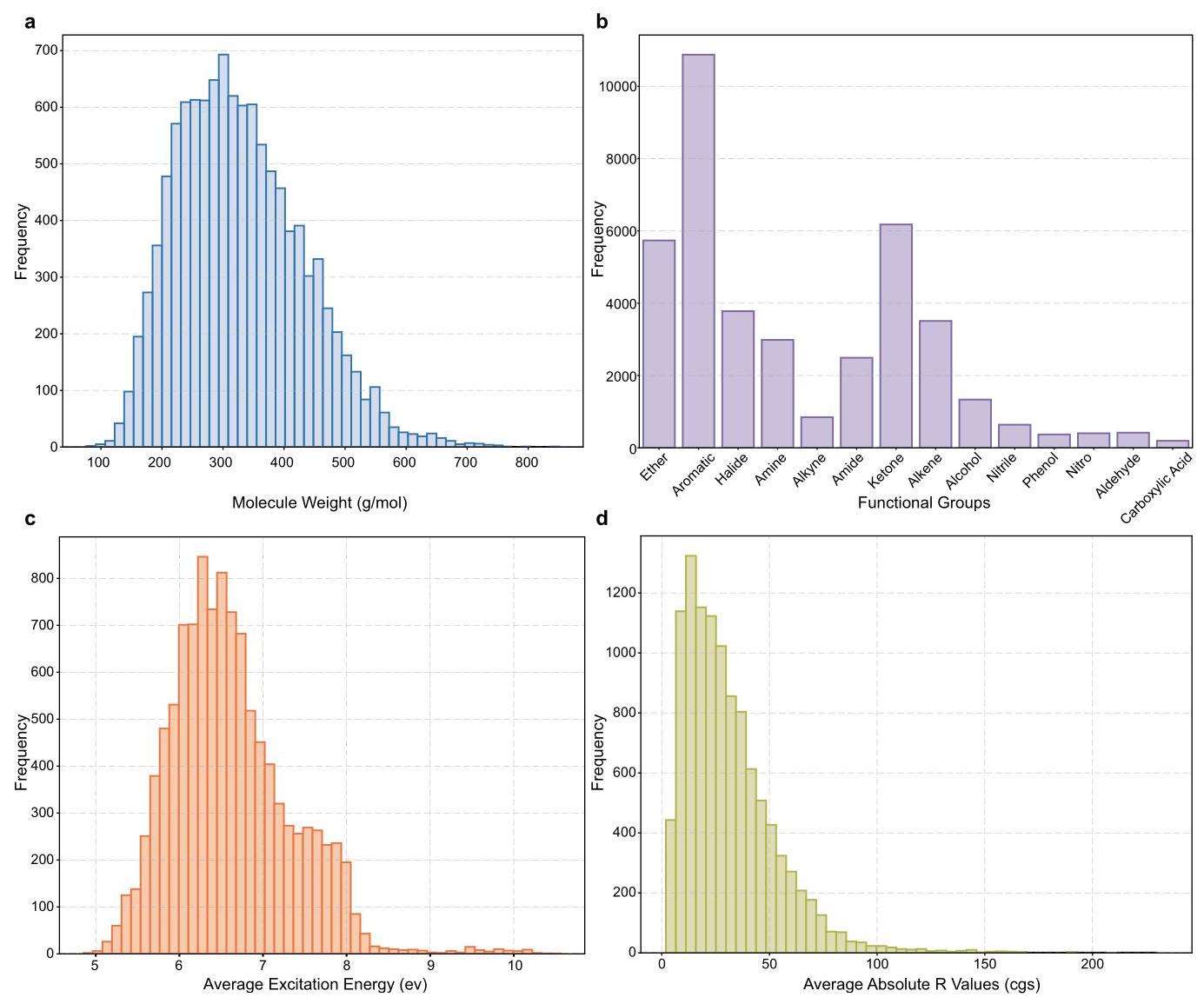
Fig. 3 Data statistics and analysis. (a) Molecular weight distribution statistical histogram. (b) Functional group statistical bar chart. (c) Average excited state energy distribution statistical histogram. (d) Average absolute rotational strength distribution statistical histogram.
图3 数据统计与分析。(a) 分子量分布统计直方图。(b) 官能团统计柱状图。(c) 平均激发态能量分布统计直方图。(d) 平均绝对旋光强度分布统计直方图。
To enhance clarity in the workflow of deriving averaged ECD spectra from chiral molecular SMILES, we have also provided a code repository. This repository demonstrates the end-to-end pipeline: starting from simplified molecular input structures (SMILES), generating three-dimensional molecular geometries, conducting DFT calculations to obtain key chiroptical parameters, and finally generating ECD spectra via Gaussian broadening functions. This workflow is designed to facilitate rapid application of the CMCDS dataset in analogous deep learning tasks, ensuring reproducibility and scalability in computational chiroptical studies.
为了提高从手性分子SMILES推导平均ECD光谱的工作流程的清晰度,我们还提供了一个代码存储库。该存储库展示了端到端的流程:从简化的分子输入结构(SMILES)开始,生成三维分子几何结构,进行DFT计算以获得关键的手性光学参数,最后通过高斯展宽函数生成ECD光谱。此工作流程旨在促进CMCDS数据集在类似深度学习任务中的快速应用,确保计算手性光学研究的可重复性和可扩展性。
Technical Validation
技术验证
Data distribution. The CMCDS dataset exhibits well-defined distributions across molecular weight, functional groups, excitation energies, and chiroptical properties. As shown in Fig. 3, the CMCDS dataset analysis reveals that 68.2% of compounds fall within the molecular weight range of 200-400 g/mol, with merely 0.2% surpassing 800 g/mol. Statistical analysis of functional groups revealed that aromatic rings are present in 99% of the molecular structures, with ketone and ester groups accounting for 56.7% and 52.7%, respectively, whereas carboxylic acids constitute a mere 1.8%. In terms of electronic excitation properties, statistical evaluation of the average excitation energies based on the 20 lowest excited states indicates that 56.4% of the molecules have excitation energies clustered within the range of ${6.0} - {7.0}\mathrm{{eV}}$ (corresponding to a wavelength range of ${177} - {207}\mathrm{\;{nm}}$ ). Furthermore, analysis of calculated parameters concerning chirality demonstrates that 86.4% of the molecules display a mean absolute rotatory strength $\langle \left| R\right| \rangle$ below 50 cgs units ( $1\mathrm{{cgs}} = {10}^{-{40}}$ erg-esu-cm/Gauss), a parameter that effectively quantifies the chiral response strength (i.e., molecular chiroptical activity).
数据分布。CMCDS数据集在分子量、官能团、激发能和手性光学性质方面呈现出明确的分布。如图3所示,CMCDS数据集分析表明,68.2%的化合物分子量在200 - 400 g/mol范围内,只有0.2%超过800 g/mol。官能团的统计分析表明,99%的分子结构中存在芳香环,酮基和酯基分别占56.7%和52.7%,而羧酸仅占1.8%。在电子激发性质方面,基于20个最低激发态对平均激发能的统计评估表明,56.4%的分子激发能聚集在${6.0} - {7.0}\mathrm{{eV}}$范围内(对应波长范围为${177} - {207}\mathrm{\;{nm}}$)。此外,对手性相关计算参数的分析表明,86.4%的分子平均绝对旋光强度$\langle \left| R\right| \rangle$低于50 cgs单位($1\mathrm{{cgs}} = {10}^{-{40}}$ erg - esu - cm/Gauss),该参数有效量化了手性响应强度(即分子手性光学活性)。
Construction of ECD Spectrum Prediction Model. Our group has constructed the ECDFormer model (based on the QFormer architecture) using the CMCDS dataset, achieving efficient generation of theoretical ECD spectra for chiral molecules through an innovative spectral properties decoupling strategy (joint peak attribute learning-prediction framework) ${}^{23}$ . The workflow involves: 1) embedding atomic topology, bond angles, and chiral descriptors of molecules into a geometric-enhanced graph neural network (Geo-GNN) to generate spatial-aware molecular representations; 2) extracting key peak attribute features (number, wavelength, Cotton effect symbol) via the QFormer encoder through a parallel prediction module; 3) synthesizing complete theoretical ECD spectra based on the predicted parameters. This deep learning model demonstrates precise and efficient ECD spectra prediction on the CMCDS dataset, providing robust support for chiral spectroscopy research while advancing machine-learning applications in chiral-related fields.
ECD光谱预测模型的构建。我们团队使用CMCDS数据集构建了ECDFormer模型(基于QFormer架构),通过创新的光谱性质解耦策略(联合峰属性学习 - 预测框架)${}^{23}$,实现了手性分子理论ECD光谱的高效生成。工作流程包括:1)将分子的原子拓扑、键角和手性描述符嵌入到几何增强图神经网络(Geo - GNN)中,以生成空间感知分子表示;2)通过并行预测模块,经由QFormer编码器提取关键峰属性特征(数量、波长、科顿效应符号);3)基于预测参数合成完整的理论ECD光谱。该深度学习模型在CMCDS数据集上展示了精确且高效的ECD光谱预测,为手性光谱研究提供了有力支持,同时推动了手性相关领域的机器学习应用。
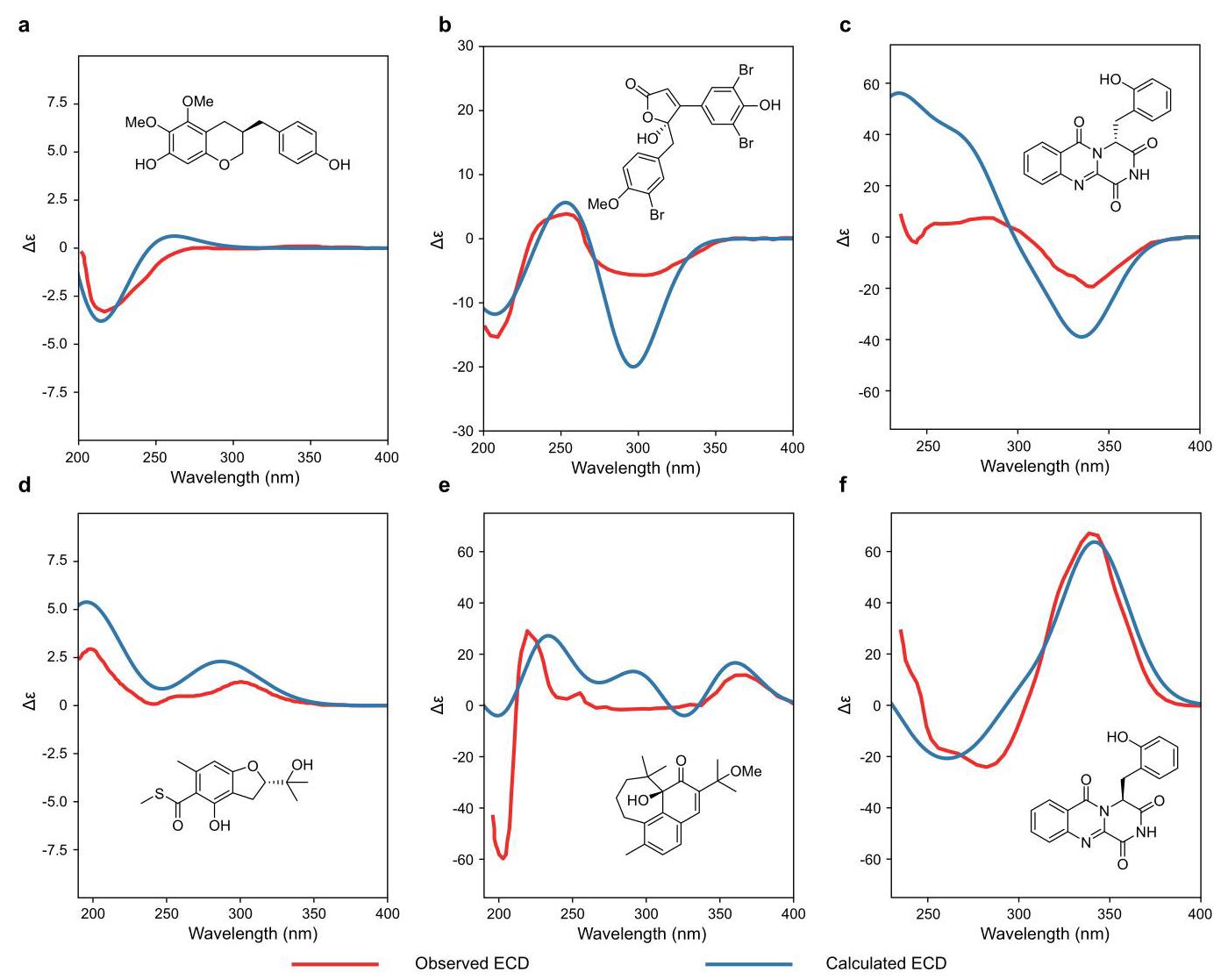
Fig. 4 ECD spectra of natural products were computed using the CMCDS dataset construction method. (a) Red line: Experimental ECD spectrum for (R)-dracaeconolide B, blue line: Calculated ECD spectrum for (R)- dracaeconolide B ${}^{24}$ . (b) Red line: Experimental ECD spectrum for procerolide E, blue line: Calculated ECD spectrum for procerolide ${\mathrm{E}}^{25}$ . (c) Red line: Experimental ECD spectrum for (-)-17-hydroxybrevianamide N, blue line: Calculated ECD spectrum for (-)-17-hydroxybrevianamide ${\mathrm{N}}^{26}$ . (d) Red line: Experimental ECD spectrum for (+)-eurothiocin A, blue line: Calculated ECD spectrum for (+)-eurothiocin A ${}^{27}$ . (e) Red line: Experimental ECD spectrum for wulfenioidin H, blue line: Calculated ECD spectrum for wulfenioidin ${\mathrm{H}}^{28}$ . (f) Red line: Experimental ECD spectrum for (+)-17-hydroxybrevianamide N, blue line: Calculated ECD spectrum for (+)-17-hydroxybrevianamide ${\mathrm{N}}^{26}$ .
图4 使用CMCDS数据集构建方法计算的天然产物ECD光谱。(a) 红线:(R)-龙血树醇内酯B的实验ECD光谱,蓝线:(R)-龙血树醇内酯B的计算ECD光谱${}^{24}$。(b) 红线:原甘油酯E的实验ECD光谱,蓝线:原甘油酯的计算ECD光谱${\mathrm{E}}^{25}$。(c) 红线:(-)-17 - 羟基短叶酰胺N的实验ECD光谱,蓝线:(-)-17 - 羟基短叶酰胺的计算ECD光谱${\mathrm{N}}^{26}$。(d) 红线:(+)-欧洲硫霉素A的实验ECD光谱,蓝线:(+)-欧洲硫霉素A的计算ECD光谱${}^{27}$。(e) 红线:狼毒素H的实验ECD光谱,蓝线:狼毒素的计算ECD光谱${\mathrm{H}}^{28}$。(f) 红线:(+)-17 - 羟基短叶酰胺N的实验ECD光谱,蓝线:(+)-17 - 羟基短叶酰胺的计算ECD光谱${\mathrm{N}}^{26}$。
Calculation of ECD Spectra of Natural Products Using Quantum Chemical Methods. As shown in Fig. 4, six representative molecular systems with experimental ECD spectra available from previous literature were selected, and their theoretical ECD spectra were computed using the CMCDS dataset construction work-flow based on DFT method. Comparative analysis revealed strong agreement between theoretical and experimental spectra across all tested molecules, with high consistency in peak positions and matching cotton effect signs. These results demonstrated that the CMCDS protocol exhibits excellent applicability and reliability in ECD spectrum prediction for complex molecular systems.
使用量子化学方法计算天然产物的ECD光谱。如图4所示,选择了六个有先前文献报道的实验ECD光谱的代表性分子系统,并使用基于DFT方法的CMCDS数据集构建工作流程计算它们的理论ECD光谱。对比分析表明,所有测试分子的理论光谱与实验光谱之间有很强的一致性,峰位置和匹配的科顿效应符号高度一致。这些结果表明,CMCDS协议在复杂分子系统的ECD光谱预测中表现出出色的适用性和可靠性。
Code availability
代码可用性
All source code developed for this study can be accessed via the GitHub repository CMCDS dataset.
本研究开发的所有源代码均可通过GitHub仓库CMCDS数据集获取。
Received: 21 April 2025; Accepted: 2 September 2025;
收到日期:2025年4月21日;接受日期:2025年9月2日;
Published online: 14 October 2025
在线发表日期:2025年10月14日
References
参考文献
Rau, L. H. Direct asymmetric photochemistry with circularly polarized light. In Chiral photochemistry, 13-56 (CRC Press, 2004).
Wang, X. et al. Assembled molecular face-rotating polyhedra to transfer chirality from two to three dimensions. Nature Communications 7, 12469 (2016).
Qu, H. et al. Truncated face-rotating polyhedra constructed from pentagonal pentaphenylpyrrole through graph theory. Journal of the American Chemical Society 142, 16223-16228 (2020).
Yang, L., Dong, Y., Hu, X. & Liu, A. Dendronized carbohydrates-liquid crystallinity study. Acta Chimica Sinica 70, 27 (2012).
Liu, X., Guo, Q. & Qiu, J. Emerging low-dimensional materials for nonlinear optics and ultrafast photonics. Advanced Materials 29, 1605886 (2017).
List, B., Lerner, R. A. & Barbas, C. F. Proline-catalyzed direct asymmetric aldol reactions. Journal of the American Chemical Society 122, 2395-2396 (2000).
Ahrendt, K. A., Borths, C. J. & MacMillan, D. W. New strategies for organic catalysis: the first highly enantioselective organocatalytic diels- alder reaction. Journal of the American Chemical Society 122, 4243-4244 (2000).
Bloom, B. P., Paltiel, Y., Naaman, R. & Waldeck, D. H. Chiral induced spin selectivity. Chemical Reviews 124, 1950-1991 (2024).
Niu, X. et al. Mechanisms for translating chiral enantiomers separation research into macroscopic visualization. Advances in Collioid and Interface Science 335, 103342 (2025).
Superchi, S., Scafato, P., Gorecki, M. & Pescitelli, G. Absolute configuration determination by quantum mechanical calculation of chiroptical spectra: Basics and applications to fungal metabolites. Current medicinal chemistry 25, 287-320 (2018).
Pescitelli, G. & Bruhn, T. Good computational practice in the assignment of absolute configurations by tddft calculations of ecd spectra. Chirality 28, 466-474 (2016).
Wang, Z., Lv, Z., Li, S. & Li, W. Electronic circular dichroism spectra calculation based on generalized energy-based fragmentation approach. Chinese Journal of Chemical Physics 38, 102-112 (2025).
Jumper, J. et al. Highly accurate protein structure prediction with alphafold. nature 596, 583-589 (2021).
Han, R., Yoon, H., Kim, G., Lee, H. & Lee, Y. Revolutionizing medicinal chemistry: the application of artificial intelligence (ai) in early drug discovery. Pharmaceuticals 16, 1259 (2023).
Coley, C. W. et al. A robotic platform for flow synthesis of organic compounds informed by ai planning. Science 365, eaax1566 (2019).
Zou, Z. et al. A deep learning model for predicting selected organic molecular spectra. Nature Computational Science 3, 957-964 (2023).
Xu, H., Lin, J., Zhang, D. & Mo, F. Retention time prediction for chromatographic enantioseparation by quantile geometry-enhanced graph neural network. Nature Communications 14, 3095 (2023).
Stephens, P. J., Devlin, F. J., Chabalowski, C. F. & Frisch, M. J. Ab initio calculation of vibrational absorption and circular dichroism spectra using density functional force fields. The Journal of physical chemistry 98, 11623-11627 (1994).
Yanai, T., Tew, D. P. & Handy, N. C. A new hybrid exchange-correlation functional using the coulomb-attenuating method (cam-b3lyp). Chemical physics letters 393, 51-57 (2004).
Long, D. et al. Computed ecd spectral data for over 10,000 chiral organic small molecules. figshare https://doi.org/10.6084/ m9.figshare.28805909 (2025).
Landrum, G. Rdkit: open-source cheminformatics. release 2014.03. 1. Zenodo (2014).
Frisch, M. J. et al. Gaussian ~ Revision A.03 (2016). Gaussian Inc. Wallingford CT.
Li, H. et al. Decoupled peak property learning for efficient and interpretable electronic circular dichroism spectrum prediction. Nature Computational Science 1-11 (2025).
Kwon, S. et al. Synthesis and structure revision of naturally occurring homoisoflavane (+)-dracaeconolide b. Journal of Natural Products 86, 149-156 (2022).
Prebble, D. W. et al. $\alpha$ -synuclein aggregation inhibitory procerolides and diphenylalkanes from the ascidian polycarpa procera. Journal of Natural Products 86, 533-540 (2023).
Xu, W.-F. et al. 17-hydroxybrevianamide n and its n1-methyl derivative, quinazolinones from a soft-coral-derived aspergillus sp. fungus: 13 senantiomers as the true natural products. Journal of Natural Products 84, 1353-1358 (2021).
Zhang, G., Pan, X., Yang, B., Li, L. & Liu, Z. The asymmetric total synthesis of (-)-eurothiocin a and its enantiomer. Journal of Natural Products 85, 997-1005 (2022).
Tu, W.-C. et al. Wulfenioidins d-n, structurally diverse diterpenoids with anti-zika virus activity isolated from orthosiphon wulfenioides. Journal of Natural Products 86, 2348-2359 (2023).
Acknowledgements
致谢
We acknowledge the financial support from the Natural Science Foundation of China (No. 22071004, 21933001, 22150013, 22272133, 21971217, 22372139 and 22250004), and the Fundamental Research Funds for the Central Universities (No. 20720240053 and 20720240070). We thank the High-Performance Computing Platforms of Peking University and Xiamen University for computational support in constructing the CMCDS dataset. We also extend our gratitude to all the reviewers for their insightful and constructive feedback, which has greatly contributed to the enhancement of our work.
我们感谢中国国家自然科学基金(项目编号:22071004、21933001、22150013、22272133、21971217、22372139 和 22250004)以及中央高校基本科研业务费专项资金(项目编号:20720240053 和 20720240070)的资助。感谢北京大学和厦门大学的高性能计算平台为构建 CMCDS 数据集提供计算支持。我们还要感谢所有审稿人提出的深刻且具建设性的反馈,这些反馈对提升我们的工作有极大帮助。
Author contributions
作者贡献
D.L., X.W., and F.M. conceived the basic idea and designed the research study. D.L. and F.M. generated the ECD spectra dataset using DFT calculation. D.L., Z.L. developed the method. X.W., and F.M. further modified the method. D.L. and Z.L. wrote the manuscript. X.C., L.Y., X.W., and F.M. revised the manuscript. D.L. and H.Z. performed the CD calculations for the natural products. X.X. and C.L. revised the figures of the manuscript. X.C., L.Y., X.W., and F.M. provided the computing platform.
D.L.、X.W. 和 F.M. 构思了基本思路并设计了研究。D.L. 和 F.M. 使用 DFT 计算生成了 ECD 光谱数据集。D.L.、Z.L. 开发了该方法。X.W. 和 F.M. 进一步修改了该方法。D.L. 和 Z.L. 撰写了手稿。X.C.、L.Y.、X.W. 和 F.M. 对手稿进行了修订。D.L. 和 H.Z. 对天然产物进行了圆二色性计算。X.X. 和 C.L. 对手稿的图表进行了修订。X.C.、L.Y.、X.W. 和 F.M. 提供了计算平台。
Competing interests
利益冲突
The authors declare no competing interests.
作者声明无利益冲突。
Additional information
附加信息
Supplementary information The online version contains supplementary material available at https://doi.org/10.1038/s41597-025-05929-2.
补充信息 在线版本包含可在https://doi.org/10.1038/s41597-025-05929-2获取的补充材料。
Correspondence and requests for materials should be addressed to X.C., L.Y., X.W. or F.M.
有关通信和材料请求应发送至X.C.、L.Y.、X.W. 或F.M.。
Reprints and permissions information is available at www.nature.com/reprints.
重印和许可信息可在www.nature.com/reprints获取。
Publisher’s note Springer Nature remains neutral with regard to jurisdictional claims in published maps and institutional affiliations.
出版商说明 施普林格·自然对于已发表地图中的管辖权主张和机构隶属关系保持中立。
Open Access This article is licensed under a Creative Commons Attribution-NonCommercial-NoDerivatives 4.0 International License, which permits any non-commercial use, sharing, distribution and reproduction in any medium or format, as long as you give appropriate credit to the original author(s) and the source, provide a link to the Creative Commons licence, and indicate if you modified the licensed material. You do not have permission under this licence to share adapted material derived from this article or parts of it. The images or other third party material in this article are included in the article’s Creative Commons licence, unless indicated otherwise in a credit line to the material. If material is not included in the article’s Creative Commons licence and your intended use is not permitted by statutory regulation or exceeds the permitted use, you will need to obtain permission directly from the copyright holder. To view a copy of this licence, visit
开放获取 本文受知识共享署名 - 非商业性 - 无衍生作品4.0国际许可协议的许可,只要您适当引用原始作者和来源,提供知识共享许可协议的链接,并表明是否修改了许可材料,就允许在任何媒介或格式中进行任何非商业性使用、共享、分发和复制。根据此许可协议,您无权共享从此文章衍生的改编材料或其部分内容。本文中的图片或其他第三方材料包含在文章的知识共享许可协议中,除非在材料的版权声明中另有说明。如果材料未包含在文章的知识共享许可协议中,且您的预期使用未得到法律法规的许可或超出许可范围,您需要直接从版权所有者处获得许可。要查看此许可协议的副本,请访问
© The Author(s) 2025
© 作者 2025