One-pot Decarbonylative Borylation of Aliphatic Aldehydes
英文原文与中文译文逐段对照 · English original with Chinese translation
Chang Lian, Jianning Zhang, Lei Zhang, and Fanyang Mo*
连畅,张建宁,张雷,莫凡洋*
Cite This: J. Org. Chem. 2025, 90, 3841-3847
引用本文:《有机化学杂志》2025年,第90卷,3841 - 3847页
ACCESS Article Recommendations Supporting Information
获取文章推荐 支持信息
ABSTRACT: We present a mild and direct method for the radical borylation of simple aliphatic aldehydes. By employing an enamine and a photocatalyst under light irradiation, aldehydes can be transformed effectively into alkyl boronic esters via a formal decarbonylative process. This alternative route for radical borylation synthesis can not only be applied to the transformation of primary, secondary, and tertiary aldehydes but also be adapted to other radical conversion reactions through the generated alkyl radical intermediate. Mechanistic studies indicate that 4-alkyl-1,4-dihydropyr-idines, formed in situ from the aldehyde and enamine, are the key intermediate for the borylation process.
摘要:我们提出了一种温和且直接的简单脂肪醛自由基硼化方法。通过在光照下使用烯胺和光催化剂,醛可以通过形式上的脱羰过程有效地转化为烷基硼酸酯。这种自由基硼化合成的替代路线不仅可以应用于伯、仲、叔醛的转化,还可以通过生成的烷基自由基中间体适用于其他自由基转化反应。机理研究表明,由醛和烯胺原位形成的4 - 烷基 - 1,4 - 二氢吡啶是硼化过程的关键中间体。
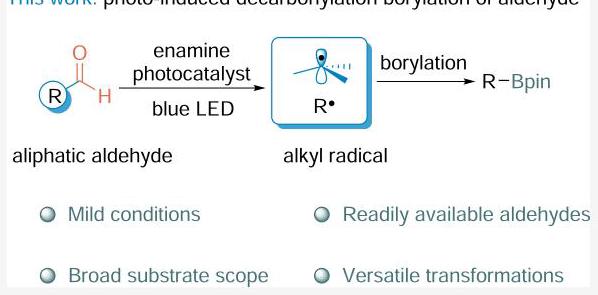
This work: photo-induced decarbonylation borylation of aldehyde
本工作:醛的光诱导脱羰硼化反应
INTRODUCTION
引言
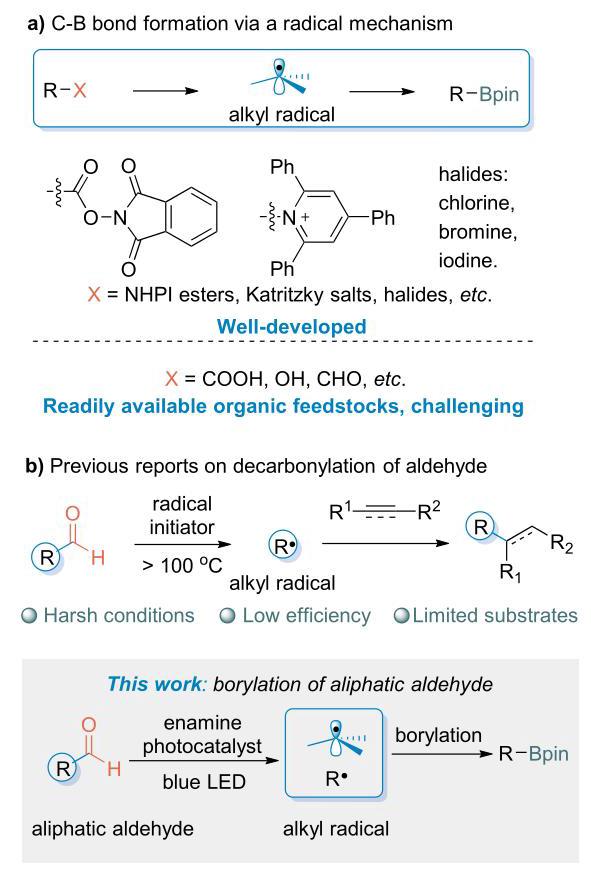
Alkyl boronic esters, as valuable organic building blocks with significant potential in medicinal chemistry, have broad applications in organic synthesis and drug discovery. ${}^{1 - 7}$ The development of synthetic methodologies for alkyl boronic esters has attracted widespread interest from academic and industrial communities. ${}^{8 - {12}}$ Conventional borylation methods are often constrained by harsh reaction conditions and the use of potentially hazardous reagents. ${}^{{13},{14}}$ In recent years, various innovative borylation strategies have been reported, such as the direct borylation of olefins. ${}^{{15},{16}}$ Among these, the alkyl radical borylation has emerged as a transformative approach characterized by its mild reaction temperature and unique reactivity, serving as an important alternative to traditional methods and transition-metal-catalyzed methods. ${}^{{17} - {32}}$ Various alkyl radical precursors, including NHPI esters, ${}^{8,{17}}$ Katritzky salts, ${}^{{18},{20}}$ and alkyl halides, ${}^{{24},{25},{29}}$ have been harnessed to achieve facile borylation (Scheme 1a) in virtue of their smooth single electron transfer (SET) processes and the stability of the intermediates generated from leaving groups. Unactivated carboxylic acids, alcohols, ketones, and aldehydes are inexpensive and readily available organic feedstocks. However, their direct radical borylation remains elusive, with few reports. MacMillan ${}^{33}$ and Liu groups ${}^{34}$ developed efficient radical borylation of unactivated carboxylic acids through innovative photochemical catalytic cycles. Lin group reported versatile deoxygenative borylation of unactivated alcohols, ketones, and aldehydes through special intermediates in an electrochemical methods. ${}^{35}$ Based on their mechanistic studies, the formation of final benzyl boronic esters relies on the attack of the benzyl anion to HBpin. Despite these advances, a general method for the radical borylation of unactivated aldehydes via common alkyl radicals reacting with boron reagents remains unexplored.
烷基硼酸酯作为在药物化学中具有巨大潜力的重要有机合成砌块,在有机合成和药物研发中有着广泛的应用。${}^{1 - 7}$ 烷基硼酸酯合成方法的发展引起了学术界和工业界的广泛关注。${}^{8 - {12}}$ 传统的硼化方法常常受到苛刻反应条件以及使用潜在危险试剂的限制。${}^{{13},{14}}$ 近年来,已报道了各种创新的硼化策略,例如烯烃的直接硼化。${}^{{15},{16}}$ 其中,烷基自由基硼化作为一种变革性方法,以其温和的反应温度和独特的反应活性脱颖而出,成为传统方法和过渡金属催化方法的重要替代方案。${}^{{17} - {32}}$ 各种烷基自由基前体,包括N - 羟基邻苯二甲酰亚胺酯(NHPI酯)${}^{8,{17}}$、卡特里茨基盐 ${}^{{18},{20}}$ 和卤代烃 ${}^{{24},{25},{29}}$,由于其平滑的单电子转移(SET)过程以及离去基团产生的中间体的稳定性,已被用于实现简便的硼化反应(方案1a)。未活化的羧酸、醇、酮和醛是廉价且易于获得的有机原料。然而,它们的直接自由基硼化仍然难以实现,相关报道很少。麦克米伦 ${}^{33}$ 和刘课题组 ${}^{34}$ 通过创新的光化学催化循环开发了未活化羧酸的高效自由基硼化反应。林课题组报道了通过电化学方法利用特殊中间体实现未活化醇、酮和醛的通用脱氧硼化反应。${}^{35}$ 基于机理研究,最终苄基硼酸酯的形成依赖于苄基阴离子对HBpin的进攻。尽管取得了这些进展,但通过常见烷基自由基与硼试剂反应实现未活化醛的自由基硼化的通用方法仍未得到探索。
Aliphatic aldehydes are abundant in natural products, and their radical transformations have garnered increasing attention. The C-H functionalization of aldehydes via a radical pathway can construct new C-C(O) bonds efficiently. ${}^{{36} - {39}}$ Another noteworthy reaction type of aldehydes is radical decarbonylation, which can access general C-C bonds. The decarbonylation coupling of aldehydes employing transition-metal catalysts is prevalent with numerous remarkable reports, ${}^{{40} - {46}}$ while its radical transformation is deficient. The radical decarbonylation reactions typically use radical initiators to activate the aldehyde $\mathrm{C}\left( \mathrm{O}\right) - \mathrm{H}$ bond, produce carbonyl radicals, convert to alkyl radicals via decarbonylation, and construct C-C bonds. ${}^{{47} - {49}}$ However, these processes require harsh reaction conditions, such as high temperatures and the use of peroxide compounds, which limit the transformation scopes (Scheme 1b). ${}^{{47},{48}}$ Deng group reported bromo radical-mediated photoredox aldehyde decarbonylation in the water-soluble solvent, realizing the functionalization of special activated alkenes in mild reaction conditions. ${}^{49}$ The general radical approach to realize (formally) decarbonylation of aldehydes is still challenging to be compatible with borylation.
脂肪醛在天然产物中广泛存在,其自由基转化受到越来越多的关注。通过自由基途径对醛进行C - H官能化可以有效地构建新的C - C(O)键。${}^{{36} - {39}}$ 醛的另一种值得注意的反应类型是自由基脱羰反应,它可以生成普通的C - C键。使用过渡金属催化剂的醛的脱羰偶联反应很普遍,有许多显著的报道,${}^{{40} - {46}}$ 而其自由基转化却很缺乏。自由基脱羰反应通常使用自由基引发剂来活化醛 $\mathrm{C}\left( \mathrm{O}\right) - \mathrm{H}$ 键,生成羰基自由基,通过脱羰转化为烷基自由基,并构建C - C键。${}^{{47} - {49}}$ 然而,这些过程需要苛刻的反应条件,如高温和使用过氧化物化合物,这限制了转化范围(方案1b)。${}^{{47},{48}}$ 邓课题组报道了在水溶性溶剂中溴自由基介导的光氧化还原醛脱羰反应,在温和的反应条件下实现了特殊活化烯烃的官能化。${}^{49}$ 实现醛(形式上)脱羰的通用自由基方法与硼化反应兼容仍然具有挑战性。
In this study, we devise a new strategy to achieve direct radical borylation of simple aliphatic aldehydes. The approach involves the addition of an enamine, which reacts with aliphatic aldehydes to form 4-alkyl-1,4-dihydropyridines in situ. This 4- alkyl-1,4-DHPs is subsequently oxidized by a photocatalyst, generating alkyl radicals that then react with diboron reagents to produce alkyl boronic esters. Despite its potential, this strategy presents several challenges, including: (1) the
在本研究中,我们设计了一种新策略来实现简单脂肪醛的直接自由基硼化。该方法涉及加入烯胺,烯胺与脂肪醛原位反应形成4 - 烷基 - 1,4 - 二氢吡啶。这种4 - 烷基 - 1,4 - 二氢吡啶随后被光催化剂氧化,生成烷基自由基,然后与双联硼试剂反应生成烷基硼酸酯。尽管具有潜力,但该策略存在几个挑战,包括:(1)…
Received: November 2, 2024
收到日期:2024年11月2日
Revised: February 10, 2025
修订日期:2025年2月10日
Accepted: March 3, 2025
接受日期:2025年3月3日
Published: March 11, 2025
发表日期:2025年3月11日
Scheme 1. (a) Alkyl Borylation via a Radical Process; (b) Limitations of Traditional Decarbonylation of Aldehyde. This Work: Direct Photocatalyzed Decarbonylation Borylation of Aldehydes difficulty in synchronizing the formation of 4-alkyl-1,4-DHPs with the photocatalytic cycle, requiring the aldehyde and enamines to be added before the photocatalyst in the reaction system; (2) the presence of a free amine group and the high equivalent of enamine, which complicate isolation of borylation products. Nevertheless, the devised strategy is achieved with a broad scope of primary, secondary, and tertiary aldehydes. Furthermore, the generated alkyl radical from simple aldehydes can also be applied to Minisci and halogenation reactions, demonstrating the versatility of the approach.
方案1. (a) 通过自由基过程进行的烷基硼化反应;(b) 醛传统脱羰反应的局限性。本研究:醛的直接光催化脱羰硼化反应 (1) 难以使4-烷基-1,4-二氢吡啶的形成与光催化循环同步,这要求在反应体系中,醛和烯胺需在光催化剂之前加入;(2) 存在游离胺基和高当量的烯胺,这使得硼化产物的分离变得复杂。尽管如此,所设计的策略适用于广泛的伯、仲和叔醛。此外,由简单醛生成的烷基自由基也可应用于Minisci反应和卤化反应,证明了该方法的通用性。
II RESULTS AND DISCUSSION
II 结果与讨论
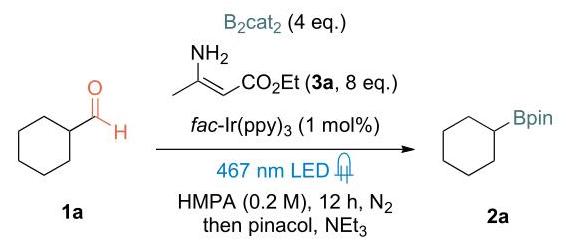
We initially selected cyclohexanecarboxaldehyde (1a) as the substrate for borylation with bis(catecholato)diboron $\left( {{\mathrm{B}}_{2}{\mathrm{{cat}}}_{2}}\right)$ under blue LED illumination at room temperature. After numerous screenings, hexamethylphosphoramide (HMPA) was chosen as the solvent, and ethyl 3-aminocrotonate (3a) was added as an additive. The desired borylation product 2a was obtained in 81% GC-FID yield and 73% isolated yield in the presence of the fac-Ir(ppy) ${}_{3}$ photocatalyst (Table 1, entry 1). Other solvents, such as DMF, performed worse than HMPA (entry 2). Attempts to lower the concentration of the reaction system (entry 3) or reduce the amounts of ${\mathrm{B}}_{2}{\mathrm{{cat}}}_{2}$ or 3a resulted in lower yields (entries 4 and 5). The use of different boron reagents, such as bis(pinacolato)diboron $\left( {{\mathrm{B}}_{2}{\mathrm{{pin}}}_{2}}\right)$ , did not yield the desired product (entry 6). Iridium catalysts, fac-Ir(ppy), demonstrated superior efficiency compared to other metal or organic photocatalysts (entries 7 and 8). The photoinduced reaction displayed sensitivity to LED wavelengths as changing the wavelength to ${390}\mathrm{\;{nm}}$ from ${467}\mathrm{\;{nm}}$ reduced the yield to 67% (entry 9). Both iridium catalysts and visible light were found to be indispensable for the reaction as no borylation product was formed in the absence of either (entries 10 and 11). Furthermore, the presence of the compound ${\mathrm{O}}_{2}$ was found to be detrimental to the borylation process (entry 12).
我们最初选择环己烷甲醛(1a)作为与双(邻苯二酚)二硼$\left( {{\mathrm{B}}_{2}{\mathrm{{cat}}}_{2}}\right)$在室温下蓝色LED光照下进行硼化反应的底物。经过多次筛选,选择六甲基磷酰胺(HMPA)作为溶剂,并加入3-氨基巴豆酸乙酯(3a)作为添加剂。在fac-Ir(ppy)${}_{3}$光催化剂存在下,所需的硼化产物2a的气相色谱-氢火焰离子化检测器(GC-FID)产率为81%,分离产率为73%(表1,条目1)。其他溶剂,如N, N-二甲基甲酰胺(DMF),表现不如HMPA(条目2)。尝试降低反应体系的浓度(条目3)或减少${\mathrm{B}}_{2}{\mathrm{{cat}}}_{2}$或3a的用量会导致产率降低(条目4和5)。使用不同的硼试剂,如双(频哪醇)二硼$\left( {{\mathrm{B}}_{2}{\mathrm{{pin}}}_{2}}\right)$,未得到所需产物(条目6)。铱催化剂fac-Ir(ppy)与其他金属或有机光催化剂相比显示出更高的效率(条目7和8)。光诱导反应对LED波长敏感,因为将波长从${467}\mathrm{\;{nm}}$改为${390}\mathrm{\;{nm}}$会使产率降至67%(条目9)。发现铱催化剂和可见光对于该反应都是必不可少的,因为在没有任何一种的情况下都不会形成硼化产物(条目10和11)。此外,发现化合物${\mathrm{O}}_{2}$的存在对硼化过程不利(条目12)。
Table 1. Optimization of Reaction Conditions ${}^{a}$
表1. 反应条件的优化${}^{a}$
| entry | deviations from standard condition | 2a ${}^{b}\left( \% \right)$ |
| 1 | none | 81 |
| 2 | DMF (0.2 M) | 41 |
| 3 | HMPA (0.1 M) | 75 |
| 4 | ${\mathrm{B}}_{2}{\mathrm{{cat}}}_{2}$ (3 equiv) | 57 |
| 5 | ethyl 3-aminocrotonate (6 equiv) | 67 |
| 6 | ${\mathrm{B}}_{2}{\text{ pin }}_{2}$ instead of ${\mathrm{B}}_{2}{\mathrm{{cat}}}_{2}$ | N.D. |
| 7 | Ir ${\left\lbrack \mathrm{{dF}}\left( {\mathrm{{CF}}}_{3}\right) \mathrm{{ppy}}\right\rbrack }_{2}\left( \mathrm{{dtbbpy}}\right) \left\lbrack {\mathrm{{PF}}}_{6}\right\rbrack$ | 76 |
| 8 | eosin Y | N.D. |
| 9 | 390 nm LED | 67 |
| 10 | no fac-Ir(ppy) ${}_{3}$ | N.D. |
| 11 | no light | N.D. |
| 12 | in air | 51 |
${}^{a}$ Standard conditions: cyclohexanecarboxaldehyde 1a (0.3 mmol,1.0 equiv), ${\mathrm{B}}_{2}{\mathrm{{cat}}}_{2}$ (1.2 mmol,4.0 equiv), ethyl 3-aminocrotonate (3a,2.4 mmol, 8 equiv), and fac-Ir(ppy) (1 mol %) in HMPA (0.2 M, 1.5 mL), Kessil 467 nm LED lamp, ${\mathrm{N}}_{2}$ atmosphere, room temperature,12 h; then pinacol (2.4 mmol, 8 equiv), NEt ${}_{3}$ (1 mL), 1 h. ${}^{b}$ GC-FID yields were given using $n$ -decane as an internal standard.
${}^{a}$ 标准条件:环己烷甲醛1a(0.3 mmol,1.0当量),${\mathrm{B}}_{2}{\mathrm{{cat}}}_{2}$(1.2 mmol,4.0当量),3-氨基巴豆酸乙酯(3a,2.4 mmol,8当量),以及fac-Ir(ppy)(1 mol%)在HMPA(0.2 M,1.5 mL)中,Kessil 467 nm LED灯,${\mathrm{N}}_{2}$气氛,室温,12小时;然后频哪醇(2.4 mmol,8当量),三乙胺${}_{3}$(1 mL),1小时。${}^{b}$ 使用$n$-癸烷作为内标给出GC-FID产率。
Subsequently, we explored the substrate scope by utilizing the optimized conditions (Scheme 2). The reaction exhibited excellent tolerance toward primary aldehydes, allowing for the conversion of long-chain aliphatic aldehydes into the desired formally decarbonylated boronic esters with medium to high yields (2b-2h). Most naturally occurring straight-chain alkyl carboxylic acids in living organisms predominantly consist of an even number of carbon atoms, serving as precursors for the synthesis of various even-carbon aliphatic aldehydes. Through the formal decarbonylation process we developed, the common even-carbon aliphatic aldehydes can be transformed into boronic esters with an odd number of carbon atoms. It demonstrates that the method has potential applications in carbon skeleton construction from synthesized odd-number-carbon aldehydes. Notably, substrates containing unsaturated groups are hard to tolerate diboron reagents because of the formation of 1,2-diboron compounds according to previous reports. ${}^{50}$ Although the yield for product (2i) is diminished, the olefin group can be tolerated, with the $\mathrm{C} = \mathrm{C}$ bond retained. Furthermore, primary aldehydes containing benzene rings were compatible, as were alkyl-, halogen-, and tri- (uoromethyl)substituted benzene rings (2j-2m).
随后,我们利用优化的条件探索了底物范围(方案2)。该反应对伯醛表现出优异的耐受性,能够将长链脂肪醛转化为所需的形式上脱羰的硼酸酯,产率中等至高(2b - 2h)。生物体内大多数天然存在的直链烷基羧酸主要由偶数个碳原子组成,是合成各种偶数碳脂肪醛的前体。通过我们开发的形式上的脱羰过程,常见的偶数碳脂肪醛可以转化为奇数个碳原子数的硼酸酯。这表明该方法在由合成的奇数碳醛构建碳骨架方面具有潜在应用。值得注意的是,根据先前的报道,含有不饱和基团的底物难以耐受二硼试剂,因为会形成1,2 - 二硼化合物。${}^{50}$ 尽管产物(2i)的产率有所降低,但烯烃基团可以耐受,$\mathrm{C} = \mathrm{C}$键得以保留。此外,含苯环的伯醛是兼容的,烷基、卤素和三(氟甲基)取代的苯环也是如此(2j - 2m)。
Secondary aldehydes were also tested for the borylation methods, producing the desired borylated products in good yields (2a, 2n-2s). Aliphatic ring aldehydes (2a, 2n-2t) and heterocyclic ring aldehydes (2p, 2q) were well-tolerated in the reaction, showcasing potential applications in the functional-ization of heteroatom rings in pharmaceutical chemistry. Additionally, secondary chain aldehydes proved to be effective substrates in this transformation (2r, 2s).
仲醛也用于硼化方法测试,能以良好产率得到所需的硼化产物(2a, 2n - 2s)。脂肪族环醛(2a, 2n - 2t)和杂环醛(2p, 2q)在反应中表现出良好耐受性,展示了其在药物化学中杂原子环官能化方面的潜在应用。此外,仲链醛被证明是该转化反应中的有效底物(2r, 2s)。
Scheme 2. Scope Explorations of the Borylation Reaction ${}^{a}$
方案2. 硼化反应的范围探索${}^{a}$
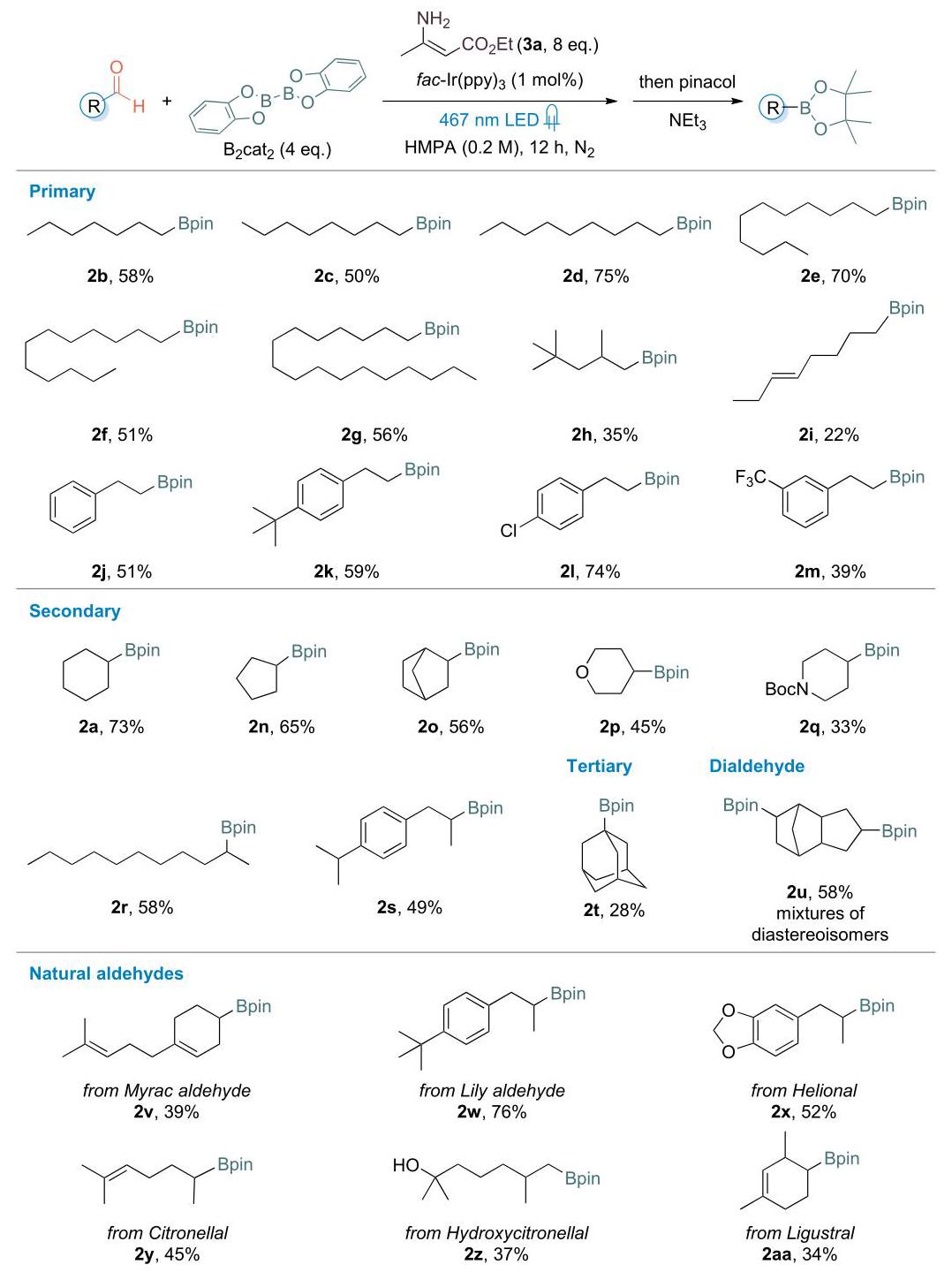
${}^{a}$ Reaction conditions: aldehyde 1 (0.3 mmol,1.0 equiv), ${\mathrm{B}}_{2}{\text{ cat }}_{2}$ (1.2 mmol,4.0 equiv), ethyl 3-aminocrotonate (3a,2.4 mmol,8 equiv), and fac-Ir(ppy) ${}_{3}$ (1 mol %) in HMPA (0.2 M,1.5 mL), Kessil 467 nm LED lamp, ${\mathrm{N}}_{2}$ atmosphere, room temperature,12 h.
${}^{a}$反应条件:醛1(0.3 mmol, 1.0当量),${\mathrm{B}}_{2}{\text{ cat }}_{2}$(1.2 mmol, 4.0当量),3 - 氨基巴豆酸乙酯(3a, 2.4 mmol, 8当量),以及fac - Ir(ppy)${}_{3}$(1 mol%)于HMPA(0.2 M, 1.5 mL)中,Kessil 467 nm发光二极管灯,${\mathrm{N}}_{2}$气氛,室温,12小时。
The reactivity of tertiary aldehydes was less favorable, probably due to steric hindrance, yielding lower product yields (2t). A dialdehyde was synthesized through the oxidation of glycol, and it can be converted to a previously unexplored diboron product (2u) that can be utilized in constructing building blocks with the special loop skeleton.
叔醛的反应活性较差,可能是由于空间位阻,产物产率较低(2t)。通过二醇氧化合成了一种二醛,它可以转化为一种以前未探索过的二硼产物(2u),可用于构建具有特殊环状骨架的结构单元。
Natural aldehydes are ideal synthetic building blocks because of their diverse and intricate structures. We also attempted several commercially available natural aldehydes (2v-2aa) as substrates, resulting in good yields. It suggested that the methodology provided a viable route to synthesize boronic esters that may be challenging to access through other synthetic procedures.
天然醛因其多样而复杂的结构,是理想的合成结构单元。我们还尝试了几种市售天然醛(2v - 2aa)作为底物,得到了良好产率。这表明该方法为合成硼酸酯提供了一条可行途径,而通过其他合成方法可能难以实现。
Previously, we have developed the borylation of Hantzsch esters which was presynthesized from aldehydes. ${}^{27}$ This new method has many advantages compared with the previous one, including: (1) most Hantzsch esters are not commercially available, while aldehydes are commercially available and cheap; (2) the direct borylation can shorten the reaction steps and avoid the heating for Hantzsch esters synthesis as well as its separation; (3) although primary alkyl radical is reactive and hard to harness, we extended the primary aldehyde scope and improved the boronic ester yields. In further validating the
此前,我们开发了由醛预合成的汉茨希酯的硼化反应。${}^{27}$与之前的方法相比,这种新方法有许多优点,包括:(1)大多数汉茨希酯没有市售,而醛是市售且便宜的;(2)直接硼化可以缩短反应步骤,避免汉茨希酯合成过程中的加热及其分离;(3)尽管伯烷基自由基具有反应活性且难以控制,但我们扩展了伯醛的范围并提高了硼酸酯的产率。为进一步验证
Scheme 3. (a) Gram-Scale Reaction; (b) Application of Synthesis Method in the Minisci Reaction; and (c) Application of Synthesis Method in the Halogenation Reaction utility of this strategy, we successfully conducted a gram-scale synthesis of 2a and obtained a satisfactory yield (Scheme 3a). To our surprise, the application of this synthesis strategy can also be successfully extended to other alkyl radical reactions, facilitating the construction of various $\mathrm{C} - \mathrm{C}$ and $\mathrm{C} - \mathrm{X}$ bonds.
方案3. (a)克级反应;(b)合成方法在Minisci反应中的应用;以及(c)合成方法在卤化反应中的应用 为验证该策略的实用性,我们成功进行了2a的克级合成并获得了令人满意的产率(方案3a)。令我们惊讶的是,这种合成策略的应用还可以成功扩展到其他烷基自由基反应,促进了各种$\mathrm{C} - \mathrm{C}$和$\mathrm{C} - \mathrm{X}$键的构建。
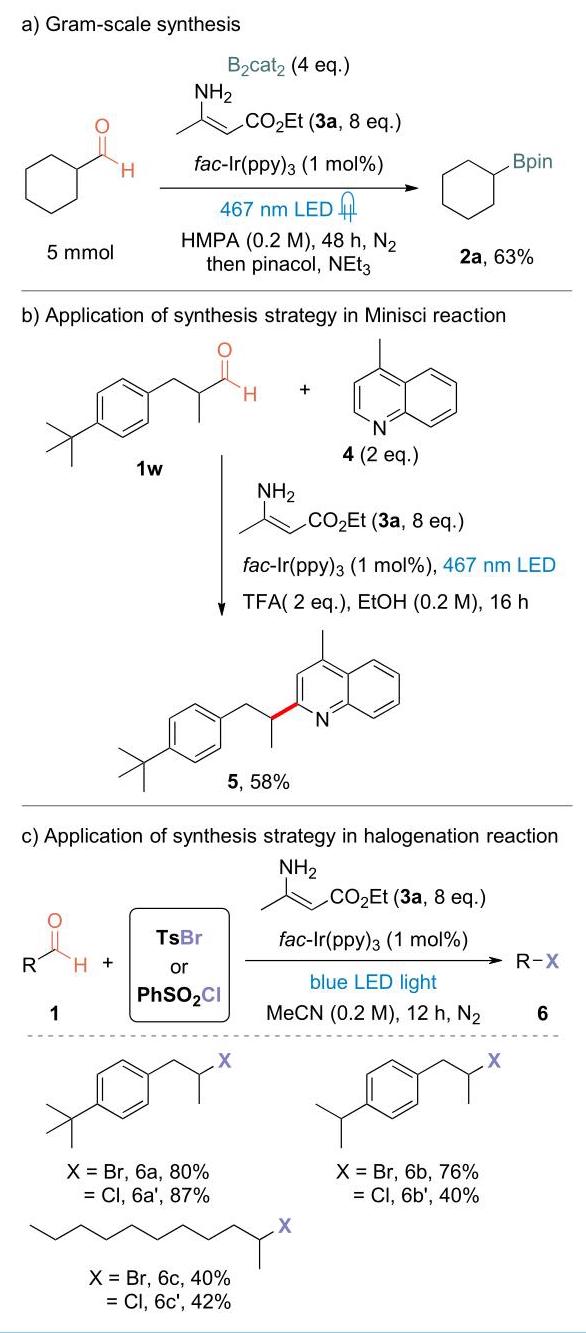
For the $\mathrm{C} - \mathrm{C}$ bond construction, aldehyde $1\mathbf{w}$ can react with 4-methylquinoline to form a Minisci reaction product in a good yield (Scheme 3b). The reaction conditions were slightly modified based on the optimized conditions, using trifluoro-acetic acid (TFA) as the additive and ethanol as the solvent. For the C-X bond construction, the bromination and chlorination of aliphatic aldehydes were achieved, respectively, under mild reaction conditions with $p$ -toluene sulfonyl bromide and benzene sulfonyl chloride as halogenation agents (Scheme 3c). The success of these versatile transformations illustrates the presence of the key alkyl radical intermediate during reaction processes and the practicability of employing aldehydes as general radical precursors.
对于$\mathrm{C} - \mathrm{C}$键的构建,醛$1\mathbf{w}$可以与4 - 甲基喹啉反应,以良好产率形成Minisci反应产物(方案3b)。反应条件在优化条件的基础上略有修改,使用三氟乙酸(TFA)作为添加剂,乙醇作为溶剂。对于C - X键的构建,在温和反应条件下,分别以$p$ - 甲苯磺酰溴和苯磺酰氯作为卤化剂,实现了脂肪醛的溴化和氯化(方案3c)。这些多功能转化反应的成功说明了反应过程中关键烷基自由基中间体的存在,以及使用醛作为通用自由基前体的实用性。
Scheme 4. (a) Radical Trap Experiment and (b) UV-Vis Spectra
方案4. (a)自由基捕获实验和(b)紫外 - 可见光谱
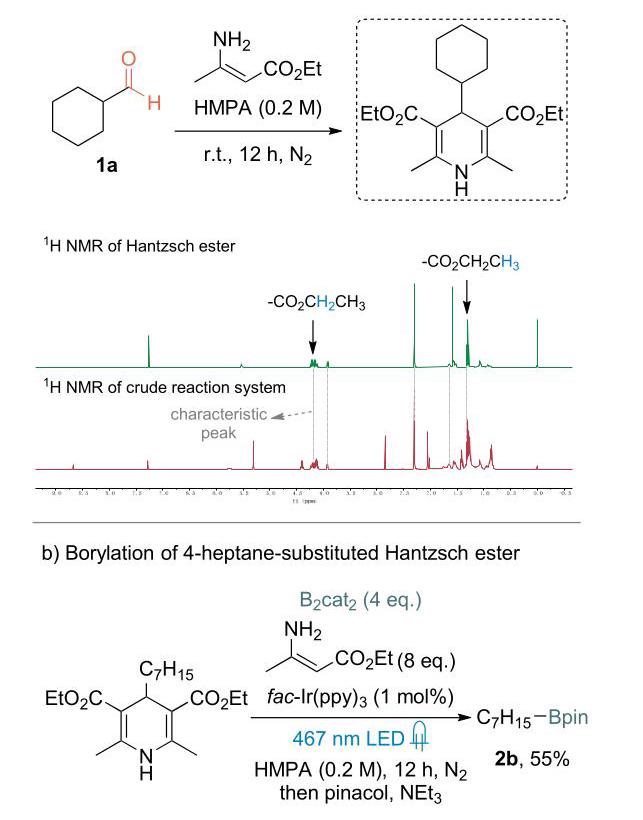
Scheme 5. (a) Analysis of ${}^{1}\mathrm{H}$ NMR Spectroscopy and (b) Borylation of Hantzsch Ester
方案5. (a)${}^{1}\mathrm{H}$核磁共振光谱分析和(b)汉茨希酯的硼化反应
a) Analysis of ${}^{1}\mathrm{H}$ NMR spectroscopy
(a)${}^{1}\mathrm{H}$核磁共振光谱分析
Scheme 6. :Plausible Mechanism
方案6. 合理的反应机理
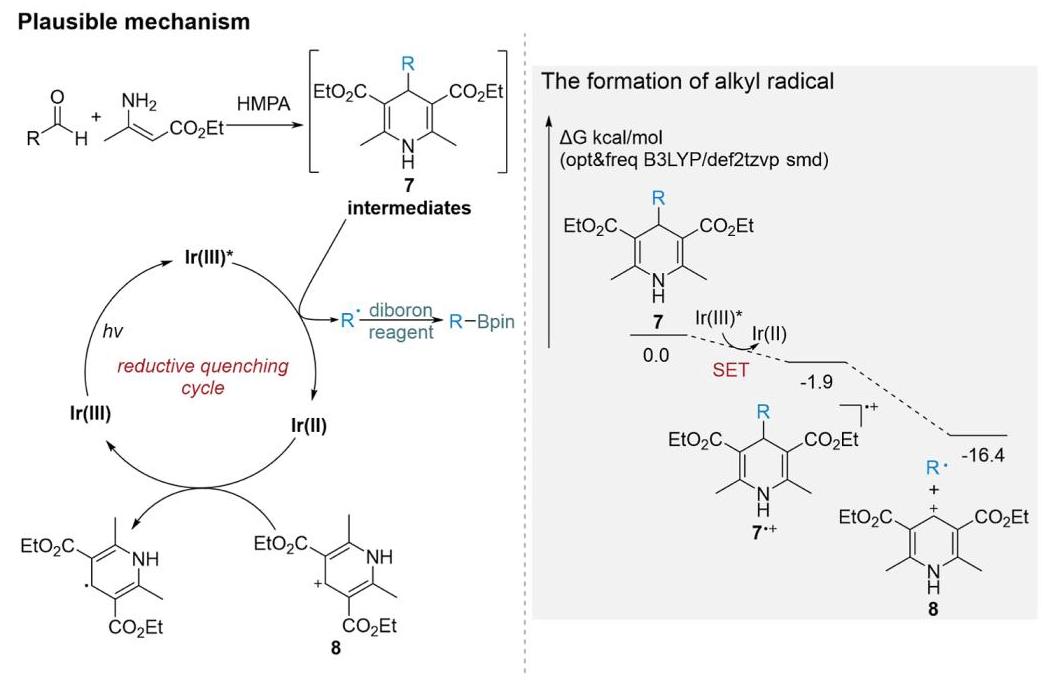
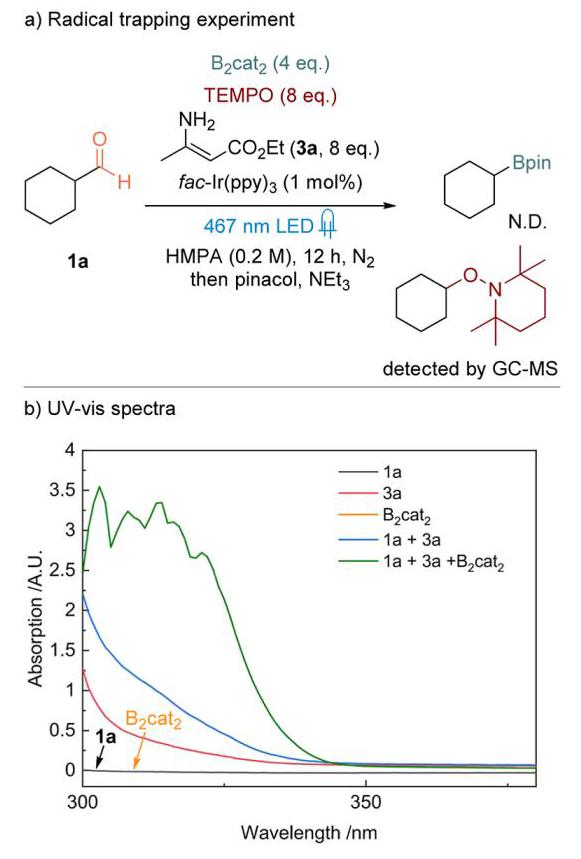
In order to verify our proposal for the reaction pathway and conduct mechanistic studies, a series of reactions were designed. To further validate the radical mechanism, TEMPO, a widely used radical scavenger, was added to the reaction mixture, resulting in no desired borylation product but TEMPO trapped product (Scheme 4a). It demonstrated that the alkyl radical was indeed generated in the reaction process. In addition, the light on-off experiment and a series of control experiments with various reagents were designed to help us understand the critical factors influencing the achievement of aliphatic aldehyde borylation (Scheme S1 and S2). The experimental result indicated that visible light and the combination of aldehydes and enamine 3a were indispensable for this radical reaction.
为了验证我们对反应途径的推测并进行机理研究,我们设计了一系列反应。为了进一步验证自由基机理,向反应混合物中加入了广泛使用的自由基清除剂 TEMPO,结果没有得到所需的硼化产物,而是得到了 TEMPO 捕获的产物(方案 4a)。这表明在反应过程中确实产生了烷基自由基。此外,设计了光开关实验和一系列使用各种试剂的对照实验,以帮助我们了解影响脂肪醛硼化反应实现的关键因素(方案 S1 和 S2)。实验结果表明,可见光以及醛与烯胺 3a 的组合对于该自由基反应是必不可少的。
A notable phenomenon was observed during stirring of the aldehyde and enamine mixture. When enamine 3a and aliphatic aldehydes were added to the reaction system and stirred for a few minutes, the color of the mixture transformed into yellow gradually. The UV-vis spectra of different mixtures were measured to explore the color change and possible reaction mechanism (Scheme 4b). Aldehyde 1a and ${\mathrm{B}}_{2}{\mathrm{{cat}}}_{2}$ did not exhibit distinct absorption peaks in the UV or visible light regions, whereas enamine 3a had a UV absorption peak below 310 nm. When 1a and 3a were combined, a red-shift occurred, moving 3a’s absorption peak to around ${320}\mathrm{\;{nm}}$ . This phenomenon explained the observed change in color in the reaction mixture. On the other hand, adding ${\mathrm{B}}_{2}{\mathrm{{cat}}}_{2}$ to the mixture of 1a and 3a resulted in a significant UV absorption. We also measured the aldehyde conversion along a reagent-adding stepwise process using GC-FID (Scheme S3), which showed that the aldehyde was consumed prominently after the addition of ${\mathrm{B}}_{2}{\mathrm{{cat}}}_{2}$ . These results suggest that optically active intermediates may form after the addition of ${\mathrm{B}}_{2}{\mathrm{{cat}}}_{2}$ .
在醛和烯胺混合物搅拌过程中观察到一个显著现象。当将烯胺 3a 和脂肪醛加入反应体系并搅拌几分钟后,混合物的颜色逐渐变为黄色。测量了不同混合物的紫外可见光谱,以探索颜色变化和可能的反应机理(方案 4b)。醛 1a 和 ${\mathrm{B}}_{2}{\mathrm{{cat}}}_{2}$ 在紫外或可见光区域没有明显的吸收峰,而烯胺 3a 在 310 nm 以下有一个紫外吸收峰。当 1a 和 3a 混合时,发生了红移,将 3a 的吸收峰移至 ${320}\mathrm{\;{nm}}$ 左右。这种现象解释了反应混合物中观察到的颜色变化。另一方面,向 1a 和 3a 的混合物中加入 ${\mathrm{B}}_{2}{\mathrm{{cat}}}_{2}$ 会导致显著的紫外吸收。我们还使用 GC-FID 沿着试剂逐步添加过程测量了醛的转化率(方案 S3),结果表明在加入 ${\mathrm{B}}_{2}{\mathrm{{cat}}}_{2}$ 后醛被大量消耗。这些结果表明,加入 ${\mathrm{B}}_{2}{\mathrm{{cat}}}_{2}$ 后可能形成了光学活性中间体。
To investigate the reaction intermediates, 1a and 3a were added to a reaction tube and stirred in HMPA for ${12}\mathrm{\;h}$ . The crude reaction mixture was then analyzed by ${}^{1}\mathrm{H}$ NMR spectroscopy, and characteristic peaks of the corresponding Hantzsch ester were identified instead of those of Stork enamine (Scheme 5a). To prove that the Hantzsch ester was indeed the intermediate during the transformation, the 4- heptane-substituted Hantzsch ester was synthesized. It was treated with the above optimized borylation conditions instead of the addition of the aldehyde, resulting in a 55% GC-FID yield (Scheme 5b). In comparison, the direct borylation of aliphatic aldehyde 1b produced 2b in a 58% yield under the same conditions. The similar yields of these two reactions suggested the possibility of in situ formation of Hantzsch esters, followed by further borylation.
为了研究反应中间体,将 1a 和 3a 加入反应管中,并在 HMPA 中搅拌 ${12}\mathrm{\;h}$ 。然后通过 ${}^{1}\mathrm{H}$ NMR 光谱分析粗反应混合物,鉴定出了相应的汉奇酯的特征峰,而不是斯托克烯胺的特征峰(方案 5a)。为了证明汉奇酯确实是转化过程中的中间体,合成了 4-庚烷取代的汉奇酯。用上述优化的硼化条件处理它,而不是加入醛,得到了 55% 的 GC-FID 产率(方案 5b)。相比之下,在相同条件下脂肪醛 1b 的直接硼化反应得到 2b 的产率为 58%。这两个反应的相似产率表明原位形成汉奇酯,随后进一步硼化的可能性。
Based on mechanistic studies, we proposed that 1a and 3a could form a Hantzsch ester intermediate in situ. The intermediate was oxidized by Ir(III)*, generating an alkyl radical. The formed alkyl radical is readily captured by the additive ${\mathrm{B}}_{2}{\mathrm{{cat}}}_{2}$ and the aprotic polar solvent HMPA to generate the desired boronate. The mechanism of converting alkyl radicals to boronates has been widely illustrated in previous studies. ${}^{{18},{27},{51}}$ Additionally, DHP cationic species 8 could serve as an electron acceptor to regenerate Ir(III), thereby completing the catalytic cycle. A DFT calculation was also performed to verify the reliability of the key alkyl radical formation processes. The results confirmed that the single-electron oxidation of Hantzsch ester 7 to generate the radical cation intermediate ${7}^{ + }$ , followed by the cleavage of the $\mathrm{C} - \mathrm{C}$ bond to form the alkyl radical and the DHP cationic species 8, were both thermodynamically favorable (Scheme 6). However, it is worth noting that this mechanism differs somewhat from those proposed for the transformation of many classic Hantzsch esters, and we carefully considered these possibilities. For instance, 4-substituted Hantzsch esters can be oxidized by excited photocatalysts, leading to the formation of pyridine ring products and alkyl radicals via proton loss. ${}^{52}$ In our previous work, while we were able to isolate pyridine ring products during subsequent separations, our in situ NMR experiments did not detect characteristic peaks corresponding to the pyridine ring product. ${}^{27}$
基于机理研究,我们提出1a和3a可原位形成一个汉茨酯中间体。该中间体被Ir(III)*氧化,生成一个烷基自由基。生成的烷基自由基很容易被添加剂${\mathrm{B}}_{2}{\mathrm{{cat}}}_{2}$和非质子极性溶剂HMPA捕获,生成所需的硼酸酯。在先前的研究中,已对将烷基自由基转化为硼酸酯的机理进行了广泛阐述。${}^{{18},{27},{51}}$此外,二氢吡啶阳离子物种8可作为电子受体使Ir(III)再生,从而完成催化循环。还进行了密度泛函理论(DFT)计算,以验证关键烷基自由基形成过程的可靠性。结果证实,汉茨酯7的单电子氧化生成自由基阳离子中间体${7}^{ + }$,随后$\mathrm{C} - \mathrm{C}$键断裂形成烷基自由基和二氢吡啶阳离子物种8,在热力学上都是有利的(方案6)。然而,值得注意的是,该机理与许多经典汉茨酯转化所提出的机理有所不同,我们仔细考虑了这些可能性。例如,4-取代的汉茨酯可被激发的光催化剂氧化,通过质子损失导致吡啶环产物和烷基自由基的形成。${}^{52}$在我们之前的工作中,虽然我们能够在后续分离过程中分离出吡啶环产物,但我们的原位核磁共振实验未检测到与吡啶环产物相对应的特征峰。${}^{27}$
Additionally, since ${\mathrm{B}}_{2}{\mathrm{{cat}}}_{2}$ is a reducing reagent, it is important to consider what species could serve as the oxidant in this mechanism to complete the catalytic cycle. Some reports suggest that Hantzsch esters can directly absorb light and undergo excitation, leading to radical formation. ${}^{53}$ However, this mechanism still requires clarification regarding the role of the photocatalyst. These individual mechanistic pathways present certain challenges that require further investigation. We believe that the actual transformation is likely a highly complex process, and we look forward to uncovering intriguing aspects of this chemistry in future studies.
此外,由于${\mathrm{B}}_{2}{\mathrm{{cat}}}_{2}$是一种还原剂,因此有必要考虑在此机理中何种物种可作为氧化剂以完成催化循环。一些报告表明,汉茨酯可直接吸收光并发生激发,导致自由基形成。${}^{53}$然而,该机理中光催化剂的作用仍需阐明。这些单独的机理途径存在一定挑战,需要进一步研究。我们认为实际转化可能是一个高度复杂的过程,我们期待在未来研究中揭示该化学领域的有趣方面。
CONCLUSIONS
结论
In conclusion, we have developed a mild method for the decarbonylation of aliphatic aldehydes utilizing an enamine and an Ir photocatalyst. This method can tolerate primary, secondary, and tertiary aldehydes as well as natural aldehydes. Additionally, the alkyl radicals generated from aldehydes can also be harnessed to the Minisci reaction and halogenation. Mechanistic investigations reveal that the Hantzsch ester intermediate, formed through the interaction of the aldehyde and enamine, plays a pivotal role in promoting decarbonylation. This method provides an efficient approach for utilizing unactivated aldehydes via a radical mechanism, offering a promising pathway for synthesizing diverse compounds from simple and inexpensive aldehydes.
总之,我们开发了一种温和的方法,利用烯胺和铱光催化剂对脂肪醛进行脱羰反应。该方法可以耐受伯、仲、叔醛以及天然醛。此外,醛产生的烷基自由基也可用于Minisci反应和卤化反应。机理研究表明,醛与烯胺相互作用形成的汉斯酯中间体在促进脱羰反应中起关键作用。该方法通过自由基机制为利用未活化醛提供了一种有效途径,为从简单廉价的醛合成各种化合物提供了一条有前景的途径。
A ASSOCIATED CONTENT
A 相关内容
Data Availability Statement
数据可用性声明
The data underlying this study are available in the published article and Supporting Information.
本研究的基础数据可在已发表的文章和补充信息中获取。
(c) Supporting Information
(c) 支持信息
The Supporting Information is available free of charge at https://pubs.acs.org/doi/10.1021/acs.joc.4c02705.
支持信息可在https://pubs.acs.org/doi/10.1021/acs.joc.4c02705免费获取。
General experimental methods, ${}^{1}\mathrm{H}$ NMR spectra, ${}^{13}\mathrm{C}$ NMR spectra, DFT calculation results, and additional discussion (PDF)
一般实验方法、${}^{1}\mathrm{H}$核磁共振谱、${}^{13}\mathrm{C}$核磁共振谱、密度泛函理论计算结果及补充讨论(PDF)
A UTHOR INFORMATION
作者信息
Corresponding Author
通讯作者
Fanyang Mo - School of Materials Science and Engineering, Peking University, Beijing 100871, P. R. China; © orcid.org/0000-0002-4140-3020; Phone: +86-10- 82529331;
莫凡洋 - 北京大学材料科学与工程学院,北京 100871,中华人民共和国;© orcid.org/0000-0002-4140-3020;电话:+86-10-82529331;邮箱:
Authors
作者
Chang Lian - Department of Energy and Resources Engineering, College of Engineering, Peking University, Beijing 100871, P. R. China
常链 - 中国北京大学工程学院能源与资源工程系,北京100871
Jianning Zhang - Department of Energy and Resources Engineering, College of Engineering, Peking University, Beijing 100871, P. R. China
张建宁 - 中国北京大学工程学院能源与资源工程系,北京100871
Lei Zhang - Department of Energy and Resources Engineering, College of Engineering, Peking University, Beijing 100871, P. R. China; (c) orcid.org/0000-0001-9031-4318
张雷 - 中国北京大学工程学院能源与资源工程系,北京100871;(c) orcid.org/0000-0001-9031-4318
Complete contact information is available at:
完整的联系信息如下:
https://pubs.acs.org/10.1021/acs.joc.4c02705
Notes
注释
The authors declare no competing financial interest.
作者声明不存在利益冲突。
ACKNOWLEDGMENTS
致谢
We are grateful for the financial support from the National Natural Science Foundation of China (grant no. 22071004, 21933001, and 22150013). We are also grateful for the High Performance Computing Platform of Peking University and the Shenzhen Cloud Computing Center for DFT calculations support.
我们感谢中国国家自然科学基金(项目编号:22071004、21933001和22150013)的资金支持。我们也感谢北京大学高性能计算平台和深圳云计算中心在密度泛函理论(DFT)计算方面提供的支持。
REFERENCES
参考文献
(1) Hall, D. G. Boronic Acids: Preparation, Applications in Organic Synthesis and Medicine; John Wiley & Sons, 2006.
(2) Smoum, R.; Rubinstein, A.; Dembitsky, V. M.; Srebnik, M. Boron containing compounds as protease inhibitors. Chem. Rev. 2012, 112, 4156-4220.
(3) Wang, M.; Shi, Z. Methodologies and strategies for selective borylation of C-Het and C-C bonds. Chem. Rev. 2020, 120, 7348- 7398.
(4) Silva, M. P.; Saraiva, L.; Pinto, M.; Sousa, M. E. Boronic acids and their derivatives in medicinal chemistry: synthesis and biological applications. Molecules 2020, 25, 4323.
(5) Jo, W.; Lee, J. H.; Cho, S. H. Advances in transition metal-free deborylative transformations of gem-diborylalkanes. Chem. Commun. 2021, 57, 4346-4353.
(6) Bose, S. K.; Mao, L.; Kuehn, L.; Radius, U.; Nekvinda, J.; Santos, W. L.; Westcott, S. A.; Steel, P. G.; Marder, T. B. First-row d-block element-catalyzed carbon-boron bond formation and related processes. Chem. Rev. 2021, 121, 13238-13341.
(7) Hanley, D.; Li, Z.-Q.; Gao, S.; Virgil, S. C.; Arnold, F. H.; Alfonzo, E. Stereospecific Enzymatic Conversion of Boronic Acids to Amines. J. Am. Chem. Soc. 2024, 146, 19160-19167.
(8) Hu, D.; Wang, L.; Li, P. Decarboxylative borylation of aliphatic esters under visible-light photoredox conditions. Org. Lett. 2017, 19, 2770-2773.
(9) Shu, C.; Noble, A.; Aggarwal, V. K. Metal-free photoinduced C (sp 3)-H borylation of alkanes. Nature 2020, 586, 714-719.
(10) Wang, B.; Peng, P.; Ma, W.; Liu, Z.; Huang, C.; Cao, Y.; Hu, P.; Qi, X.; Lu, Q. Electrochemical borylation of alkyl halides: fast, scalable access to alkyl boronic esters. J. Am. Chem. Soc. 2021, 143, 12985- 12991.
(11) Barton, L. M.; Chen, L.; Blackmond, D. G.; Baran, P. S. Electrochemical borylation of carboxylic acids. Proc. Natl. Acad. Sci. U.S.A. 2021, 118, No. e2109408118.
(12) Guo, Y.; Wang, X.; Li, C.; Su, J.; Xu, J.; Song, Q. Decarboxylation of $\beta$ -boryl NHPI esters enables radical 1,2-boron shift for the assembly of versatile organoborons. Nat. Commun. 2023, 14, 5693.
(13) Brown, H. C.; Rao, B. C. S. Hydroboration. II. A Remarkably Fast Addition of Diborane to Olefins Scope and Stoichiometry of the Reaction. J. Am. Chem. Soc. 1959, 81, 6428-6434.
(14) Brown, H. C.; Cole, T. E. Organoboranes. 31. A simple preparation of boronic esters from organolithium reagents and selected trialkoxyboranes. Organometallics 1983, 2, 1316-1319.
(15) Wu, F.-P.; Yang, Y.; Fuentes, D. P.; Wu, X.-F. Copper-catalyzed carbonylative catenation of olefins: Direct synthesis of $\gamma$ -boryl esters. Chem. 2022, 8, 1982-1992.
(16) Wu, F.-P.; Holz, J.; Yuan, Y.; Wu, X.-F. Copper-catalyzed carbonylative synthesis of $\beta$ -boryl amides via boroamidation of alkenes. CCS Chem. 2021, 3, 2643-2654.
(17) Fawcett, A.; Pradeilles, J.; Wang, Y.; Mutsuga, T.; Myers, E. L.; Aggarwal, V. K. Photoinduced decarboxylative borylation of carboxylic acids. Science 2017, 357, 283-286.
(18) Wu, J.; He, L.; Noble, A.; Aggarwal, V. K. Photoinduced deaminative borylation of alkylamines. J. Am. Chem. Soc. 2018, 140, 10700-10704.
(19) Sandfort, F.; Strieth-Kalthoff, F.; Klauck, F. J.; James, M. J.; Glorius, F. Deaminative borylation of aliphatic amines enabled by visible light excitation of an electron donor-acceptor complex. Chem.-Eur. J. 2018, 24, 17210-17214.
(20) Hu, J.; Wang, G.; Li, S.; Shi, Z. Selective C- N borylation of alkyl amines promoted by Lewis base. Angew. Chem., Int. Ed. 2018, 57, 15227-15231.
(21) Friese, F. W.; Studer, A. Deoxygenative borylation of secondary and tertiary alcohols. Angew. Chem., Int. Ed. 2019, 58, 9561-9564.
(22) Wu, J.; Bär, R. M.; Guo, L.; Noble, A.; Aggarwal, V. K. Photoinduced deoxygenative borylations of aliphatic alcohols. Angew. Chem., Int. Ed. 2019, 58, 18830-18834.
(23) Li, J.; Wang, H.; Qiu, Z.; Huang, C.-Y.; Li, C.-J. Metal-free direct deoxygenative borylation of aldehydes and ketones. J. Am. Chem. Soc. 2020, 142, 13011-13020.
(24) Cheng, Y.; Mück-Lichtenfeld, C.; Studer, A. Metal-Free Radical Borylation of Alkyl and Aryl Iodides. Angew. Chem., Int. Ed. 2018, 57, 16832-16836.
(25) Liu, Q.; Hong, J.; Sun, B.; Bai, G.; Li, F.; Liu, G.; Yang, Y.; Mo, F. Transition-metal-free borylation of alkyl iodides via a radical mechanism. Org. Lett. 2019, 21, 6597-6602.
(26) Zhang, J.-J.; Duan, X.-H.; Wu, Y.; Yang, J.-C.; Guo, L.-N. Transition-metal free C-C bond cleavage/borylation of cycloketone oxime esters. Chem. Sci. 2019, 10, 161-166.
(27) Lian, C.; Zhang, J.; Mo, F. Photoinduced decarbonylative borylation of alkyl aldehydes through 4-alkyl-1, 4-dihydropyridines. Org. Chem. Front. 2024, 11, 1140-1149.
(28) Bai, L.; Jiao, L. Photoinduced Radical Borylation of Alkyl Chlorides. Eur. J. Org Chem. 2024, 27, No. e202400043.
(29) Ji, C.-L.; Chen, H.; Gao, Q.; Han, J.; Li, W.; Xie, J. Dinuclear gold-catalyzed divergent dechlorinative radical borylation of gem-dichloroalkanes. Nat. Commun. 2024, 15, 3721.
(30) Xie, Y.; Zhang, R.; Chen, Z.-L.; Rong, M.; He, H.; Ni, S.; He, X.-K.; Xiao, W.-J.; Xuan, J. Photocatalytic Boryl Radicals Triggered Sequential B N/C N Bond Formation to Assemble Boron-Handled Pyrazoles. Adv. Sci. 2024, 11, 2306728.
(31) Wang, M.; Huang, Y.; Hu, P. Terminal C (sp3)-H borylation through intermolecular radical sampling. Science 2024, 383, 537-544.
(32) Shang, Z.-H.; Pan, J.; Wang, Z.; Zhang, Z.-X.; Wu, J. Transition-metal-free radical borylation reactions. Eur. J. Org Chem. 2023, 26, No. e202201379.
(33) Dow, N. W.; Pedersen, P. S.; Chen, T. Q.; Blakemore, D. C.; Dechert-Schmitt, A.-M.; Knauber, T.; MacMillan, D. W. Decarbox-ylative borylation and cross-coupling of (hetero) aryl acids enabled by copper charge transfer catalysis. J. Am. Chem. Soc. 2022, 144, 6163- 6172.
(34) Wei, Q.; Lee, Y.; Liang, W.; Chen, X.; Mu, B.-s.; Cui, X.-Y.; Wu, W.; Bai, S.; Liu, Z. Photocatalytic direct borylation of carboxylic acids. Nat. Commun. 2022, 13, 7112.
(35) Guan, W.; Chang, Y.; Lin, S. Electrochemically Driven Deoxygenative Borylation of Alcohols and Carbonyl Compounds. J. Am. Chem. Soc. 2023, 145, 16966-16972.
(36) Prieto, A.; Bouyssi, D.; Monteiro, N. Radical-Mediated Formal C (sp2)-H Functionalization of Aldehyde-Derived N, N-Dialkylhy-drazones. Eur. J. Org Chem. 2018, 2018, 2378-2393.
(37) Dong, J.; Wang, Z.; Wang, X.; Song, H.; Liu, Y.; Wang, Q. Ketones and aldehydes as alkyl radical equivalents for $\mathrm{C}\mathrm{H}$ functionalization of heteroarenes. Sci. Adv. 2019, 5, No. eaax9955.
(38) Tian, T.; Wang, X.; Lv, L.; Li, Z. Iron-catalyzed acylation-functionalization of unactivated alkenes with aldehydes. Chem. Commun. 2020, 56, 14637-14640.
(39) Wang, H.-Y.; Wang, X.-H.; Zhou, B.-A.; Zhang, C.-L.; Ye, S. Ketones from aldehydes via alkyl C (sp3)- H functionalization under photoredox cooperative NHC/palladium catalysis. Nat. Commun. 2023, 14, 4044.
(40) Ohno, K.; Tsuji, J. Organic synthesis by means of noble metal compounds. XXXV. Novel decarbonylation reactions of aldehydes and acyl halides using rhodium complexes. J. Am. Chem. Soc. 1968, 90, 99-107.
(41) Yang, L.; Zeng, T.; Shuai, Q.; Guo, X.; Li, C.-J. Phosphine ligand triggered oxidative decarbonylative homocoupling of aromatic aldehydes: selectively generating biaryls and diarylketones. Chem. Commun. 2011, 47, 2161-2163.
(42) Guo, X.; Wang, J.; Li, C.-J. An olefination via ruthenium-catalyzed decarbonylative addition of aldehydes to terminal alkynes. J. Am. Chem. Soc. 2009, 131, 15092-15093.
(43) Shuai, Q.; Yang, L.; Guo, X.; Basle, O.; Li, C.-J. Rhodium-catalyzed oxidative $\mathrm{C} - \mathrm{H}$ arylation of 2-arylpyridine derivatives via decarbonylation of aromatic aldehydes. J. Am. Chem. Soc. 2010, 132, 12212-12213.
(44) Guo, X.; Wang, J.; Li, C.-J. Ru-catalyzed decarbonylative addition of aliphatic aldehydes to terminal alkynes. Org. Lett. 2010, 12, 3176-3178.
(45) Yang, L.; Guo, X.; Li, C.-J. The first decarbonylative coupling of aldehydes and norbornenes catalyzed by rhodium. Adv. Synth. Catal. 2010, 352, 2899-2904.
(46) Srimontree, W.; Guo, L.; Rueping, M. Hydride Transfer Enables the Nickel-Catalyzed ipso-Borylation and Silylation of Aldehydes. Chem. -Eur. J. 2020, 26, 423-427.
(47) Tang, R.-J.; Kang, L.; Yang, L. Metal-Free Oxidative Decarbonylative Coupling of Aliphatic Aldehydes with Azaarenes: Successful Minisci-Type Alkylation of Various Heterocycles. Adv. Synth. Catal. 2015, 357, 2055-2060.
(48) Wang, Z.; Ji, X.; Zhao, J.; Huang, H. Visible-light-mediated photoredox decarbonylative Minisci-type alkylation with aldehydes under ambient air conditions. Green Chem. 2019, 21, 5512-5516.
(49) Sun, Z.; Huang, H.; Wang, Q.; Deng, G.-J. Bromo Radical-Mediated Photoredox Aldehyde Decarbonylation towards Transition-Metal-Free Hydroalkylation of Acrylamides at Room Temperature. Adv. Synth. Catal. 2022, 364, 453-458.
(50) Bonet, A.; Pubill-Ulldemolins, C.; Bo, C.; Gulyás, H.; Fernández, E. Transition-metal-free diboration reaction by activation of diboron compounds with simple Lewis bases. Angew. Chem., Int. Ed. 2011, 50, 7158-7161.
(51) Liu, Q.; Zhang, J.; Zhang, L.; Mo, F. Photo-induced radical borylation of hemiacetals via C-C bond cleavage. Tetrahedron 2021, 80, 131867.
(52) Zhang, H.-H.; Yu, S. Radical alkylation of imines with 4-alkyl-1, 4-dihydropyridines enabled by photoredox/brønsted acid cocatalysis. J. Org. Chem. 2017, 82, 9995-10006.
(53) Gu, F.; Huang, W.; Liu, X.; Chen, W.; Cheng, X. Substituted Hantzsch esters as versatile radical reservoirs in photoredox reactions. Adv. Synth. Catal. 2018, 360, 925-931.

CAS BIOFINDER DISCOVERY PLATFORM™
CAS生物发现者发现平台™
STOP DIGGING THROUGH DATA -START MAKING DISCOVERIES
停止在数据中挖掘 - 开始做出发现
CAS BioFinder helps you find the right biological insights in seconds
CAS生物发现者可帮助您在数秒内找到正确的生物学见解
Start your search
开始搜索
CAS