Recent Advances in Methodologies for Radical-Mechanistic Borylation
英文原文与中文译文逐段对照 · English original with Chinese translation
Chang Lian, ${}^{a, b}$ Jianning Zhang, ${}^{a, b}$ Di Qiu, ${}^{*, c}$ and Fanyang Mo*, ${}^{b}$
连畅,${}^{a, b}$ 张建宁,${}^{a, b}$ 邱迪,${}^{*, c}$ 以及莫凡洋*,${}^{b}$
${}^{a}$ College of Engineering, Peking University, Beijing 100871, China
${}^{a}$ 北京大学工学院,北京 100871,中国
${}^{b}$ School of Materials Science and Engineering, Peking University, Beijing 100871, China
${}^{b}$ 北京大学材料科学与工程学院,北京 100871,中国
${}^{c}$ Tianjin Key Laboratory of Structure and Performance for Functional Molecules, College of Chemistry, Tianjin Normal University, Tianjin 300387, China
${}^{c}$ 天津师范大学化学学院功能分子结构与性能天津市重点实验室,天津 300387,中国
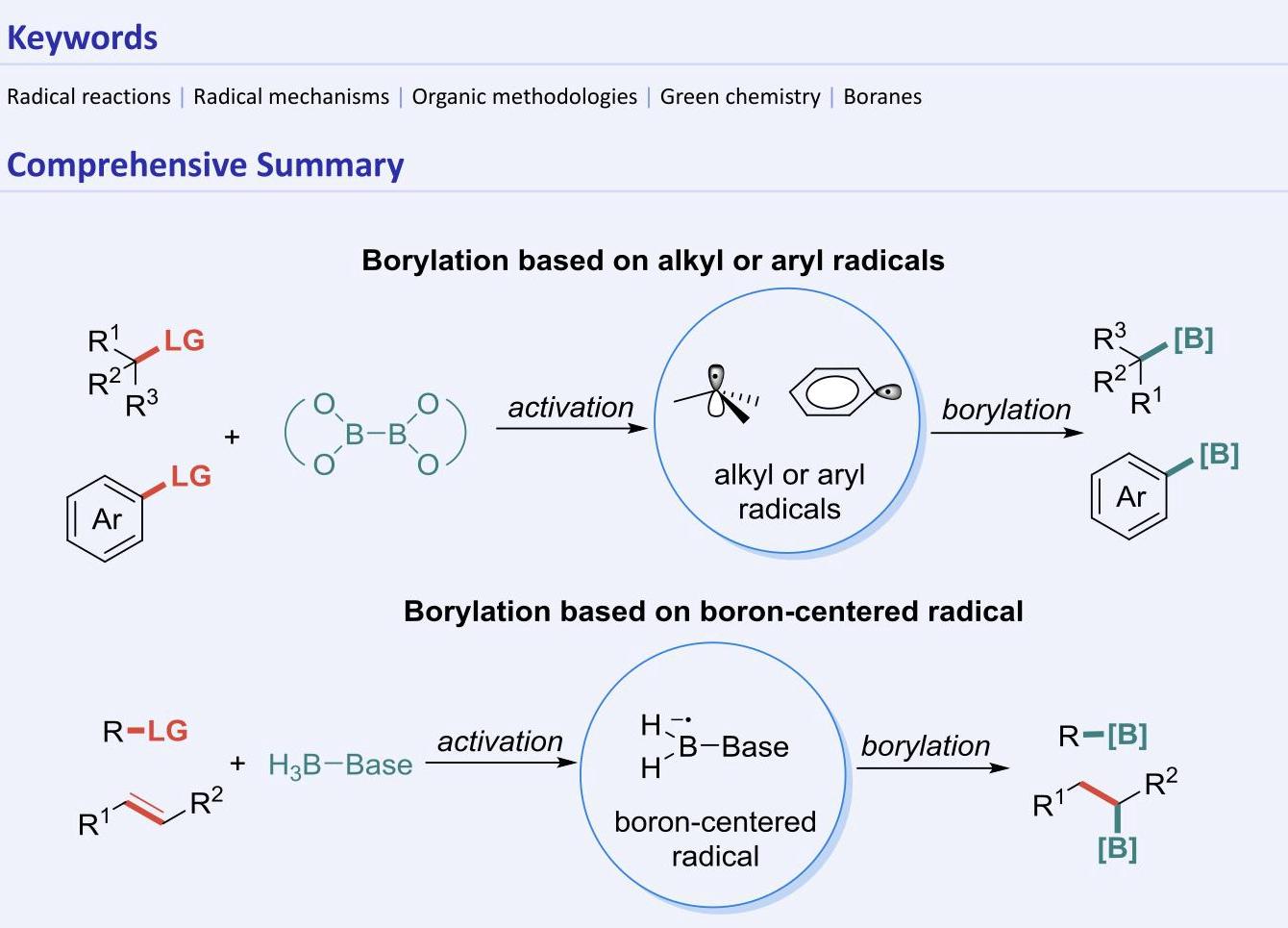
We reviewed works on radical borylation reactions since 2020 from two aspects. 1. Borylation from alkyl or aryl radicals: This approach involves the generation of alkyl or aryl radicals from various precursors such as halides and carboxylic acids, followed by their reaction with diboron reagents to form boron esters. 2. Borylation from boron-centered radicals: This approach involves generating boron-centered radicals, which then react with substrates to achieve borylation.
我们从两个方面综述了2020年以来自由基硼化反应的研究工作。1. 由烷基或芳基自由基进行的硼化反应:该方法涉及从卤化物和羧酸等各种前体生成烷基或芳基自由基,然后它们与双联硼试剂反应形成硼酸酯。2. 由硼中心自由基进行的硼化反应:该方法涉及生成硼中心自由基,然后它们与底物反应以实现硼化反应。
Contents
目录
Introduction 105
引言 105
Borylation Involving Carbon Radicals 106
涉及碳自由基的硼化反应 106
2.1. Transition-metal induced borylation 106
2.1. 过渡金属诱导的硼化反应 106
2.2. Transition-metal free borylation 108
2.2. 无过渡金属的硼化反应 108
Borylation Involving Boron-Centered Radical 111
涉及硼中心自由基的硼化反应 111
Conclusions and Perspectives 112
结论与展望 112
Introduction
引言
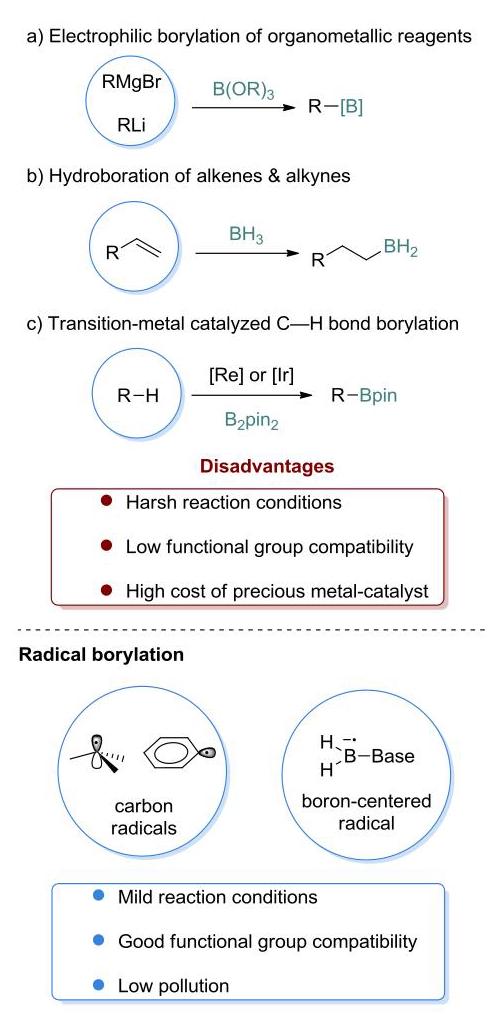
Organoboron compounds are extensively utilized in both academic research and industry, ${}^{\left\lbrack 1\right\rbrack }$ highlighting the importance of developing new synthetic methods. Traditional methods for synthesizing organoboron compounds often rely on organometallic reagents. Examples include the electrophilic borylation of organolithium reagents, ${}^{\left\lbrack 2\right\rbrack }$ the hydroboration of alkenes, ${}^{\left\lbrack 3\right\rbrack }$ and the transition metal-catalyzed borylation of $\mathrm{C} - \mathrm{H}$ bonds. ${}^{\left\lbrack 4\right\rbrack }$ However, these methods are not always ideal for practical applications because of the harsh reaction conditions, expensive metal catalysts and limited functional group compatibility. In the past decades, radical-mechanistic borylation has stood out due to its mild conditions, excellent functional group tolerance, and environmental friendliness. Numerous radical borylation methods have been proposed, diversifying synthetic approaches for organoboron compounds. ${}^{\left\lbrack 5 - {10}\right\rbrack }$
有机硼化合物在学术研究和工业中都有广泛应用,${}^{\left\lbrack 1\right\rbrack }$ 这凸显了开发新合成方法的重要性。传统的有机硼化合物合成方法通常依赖于有机金属试剂。例如,有机锂试剂的亲电硼化反应,${}^{\left\lbrack 2\right\rbrack }$ 烯烃的硼氢化反应,${}^{\left\lbrack 3\right\rbrack }$ 以及过渡金属催化的 $\mathrm{C} - \mathrm{H}$ 键的硼化反应。${}^{\left\lbrack 4\right\rbrack }$ 然而,由于反应条件苛刻、金属催化剂昂贵以及官能团兼容性有限,这些方法在实际应用中并不总是理想的。在过去几十年中,自由基机理的硼化反应因其温和的条件、出色的官能团耐受性和环境友好性而脱颖而出。已经提出了许多自由基硼化方法,使有机硼化合物的合成方法更加多样化。${}^{\left\lbrack 5 - {10}\right\rbrack }$
Boryl radicals can typically be generated by the cleavage of B-B or B-H bonds. ${}^{\left\lbrack {11}\right\rbrack }$ Due to the high B-B bond dissociation energy (BDE, for example, the calculated B-B BDE for ${\mathrm{B}}_{2}{\left( \mathrm{{pin}}\right) }_{2}$ is 101.6 kcal $\cdot {\mathrm{{mol}}}^{-1}$ ), diborane reagents often require activation. This can be achieved by coordinating a strong base, like $N$ -heterocyclic carbenes (NHCs) or ‘BuOK, to the boron center, which reduces the B-B BDE, facilitates homolysis, and stabilizes the resulting boryl radical. ${}^{\left\lbrack {12}\right\rbrack }$
硼自由基通常可以通过B - B或B - H键的断裂产生。${}^{\left\lbrack {11}\right\rbrack }$ 由于B - B键的离解能较高(例如,${\mathrm{B}}_{2}{\left( \mathrm{{pin}}\right) }_{2}$ 的计算B - B键离解能为101.6千卡 $\cdot {\mathrm{{mol}}}^{-1}$ ),乙硼烷试剂通常需要活化。这可以通过将强碱,如 $N$ - 杂环卡宾(NHCs)或叔丁醇钾,配位到硼中心来实现,这会降低B - B键离解能,促进均裂,并稳定生成的硼自由基。${}^{\left\lbrack {12}\right\rbrack }$
Alternatively, B-H bond homolysis can occur via hydrogen atom abstraction (HAT) in the presence of a radical initiator, ${}^{\left\lbrack {13} - {14}\right\rbrack }$ or through single-electron transfer (SET), ${}^{\left\lbrack {15}\right\rbrack }$ which forms a radical cation intermediate that can be deprotonated to produce the boryl radical. The computational studies indicate that the B-H bond BDE is approximately 105.2 kcal.mol ${}^{-1}$ . ${}^{\left\lbrack {16}\right\rbrack }$ To overcome the challenge posed by the high B-H BDE, NHC-boron complexes have been developed. These complexes reduce the B-H BDE to around ${70} - {90}\mathrm{{kcal}} \cdot {\mathrm{{mol}}}^{-1},{}^{\left\lbrack {17}\right\rbrack }$ facilitating B $- \mathrm{H}$ bond cleavage and enabling the formation of stable boron-centered radicals.
或者,B - H键的均裂可以在自由基引发剂存在下通过氢原子转移(HAT)发生,${}^{\left\lbrack {13} - {14}\right\rbrack }$ 或者通过单电子转移(SET),${}^{\left\lbrack {15}\right\rbrack }$ 形成一个自由基阳离子中间体,该中间体可以去质子化生成硼自由基。计算研究表明,B - H键的离解能约为105.2千卡·摩尔 ${}^{-1}$ 。${}^{\left\lbrack {16}\right\rbrack }$ 为了克服高B - H键离解能带来的挑战,已经开发了NHC - 硼配合物。这些配合物将B - H键离解能降低到约 ${70} - {90}\mathrm{{kcal}} \cdot {\mathrm{{mol}}}^{-1},{}^{\left\lbrack {17}\right\rbrack }$ ,促进B $- \mathrm{H}$ 键的断裂并能够形成稳定的硼中心自由基。
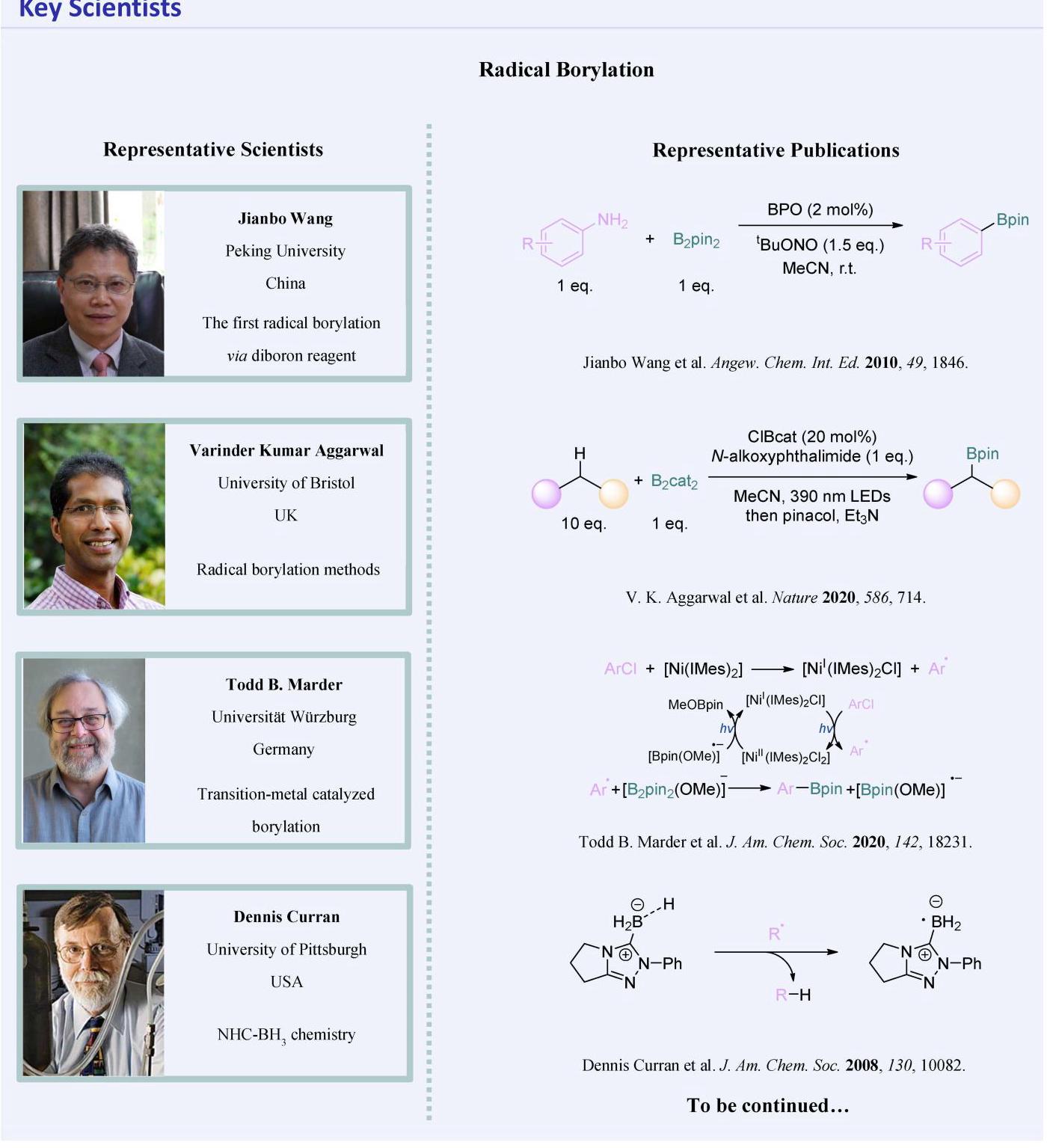
Previously, radical borylation methods were successfully used to achieve the borylation of C-N, ${}^{\left\lbrack {18} - {23}\right\rbrack }$ C-O, ${}^{\left\lbrack {24} - {25}\right\rbrack }$ and C-X ${}^{\left\lbrack {26} - {27}\right\rbrack }$ bonds, yielding aryl or alkyl borates. In recent years, this synthetic method has rapidly advanced to include the borylation of $\mathrm{C} - {\mathrm{C}}^{\left\lbrack {28} - {29}\right\rbrack }$ and $\mathrm{C} - {\mathrm{H}}^{\left\lbrack {30}\right\rbrack }$ bonds, offering a clean and environmentally friendly method for synthesizing boron compounds. Based on the types of radicals involved, works in this area can be categorized into two groups: (1) Borylation methodologies involving alkyl or aryl radicals. This research can be traced back to Wang’s pioneering work on the borylation of aromatic diazonium salts in 2010, ${}^{\left\lbrack {18}\right\rbrack }$ utilizing benzoyl peroxide (BPO) as a catalyst to achieve the first Sandmeyer-type borylation reaction involving aromatic amines, tert-butyl nitrite, and pinacolborane esters. In this reaction, aromatic diazonium salts are generated in situ from inexpensive and readily available aromatic amines, and the transformation from aromatic C-N bonds to C-B bonds is achieved via a radical pathway. Since then, research on carbon radical borylation reaction has received increasing attention. (2) Borylation methodologies driven by Lewis base boron-centered radical. This field has greatly benefited from the groundbreaking work by Curran in 2008. ${}^{\left\lbrack {31}\right\rbrack }$ They first synthesized complexes of borane and $N$ -heterocyclic carbenes, which act as a new class of radical hydrogen atom donors and facilitate borylation. In this article, we review the recent advances in radical-mechanistic borylation reactions since 2020 and discuss potential future trends in this field (Scheme 1).
以前,自由基硼化方法已成功用于实现C-N、${}^{\left\lbrack {18} - {23}\right\rbrack }$ C-O、${}^{\left\lbrack {24} - {25}\right\rbrack }$ 和C-X ${}^{\left\lbrack {26} - {27}\right\rbrack }$ 键的硼化,生成芳基或烷基硼酸酯。近年来,这种合成方法迅速发展,包括 $\mathrm{C} - {\mathrm{C}}^{\left\lbrack {28} - {29}\right\rbrack }$ 和 $\mathrm{C} - {\mathrm{H}}^{\left\lbrack {30}\right\rbrack }$ 键的硼化,为合成硼化合物提供了一种清洁且环保的方法。根据所涉及的自由基类型,该领域的工作可分为两类:(1) 涉及烷基或芳基自由基的硼化方法。这项研究可以追溯到2010年Wang关于芳族重氮盐硼化的开创性工作,${}^{\left\lbrack {18}\right\rbrack }$ 利用过氧化苯甲酰 (BPO) 作为催化剂,实现了涉及芳族胺、亚硝酸叔丁酯和平纳硼烷酯的首个桑德迈尔型硼化反应。在该反应中,芳族重氮盐由廉价且易于获得的芳族胺原位生成,并且通过自由基途径实现了从芳族C-N键到C-B键的转化。从那时起,碳自由基硼化反应的研究受到了越来越多的关注。(2) 由路易斯碱硼中心自由基驱动的硼化方法。该领域极大地受益于Curran在2008年的开创性工作。${}^{\left\lbrack {31}\right\rbrack }$ 他们首先合成了硼烷与 $N$ -杂环卡宾的配合物,这些配合物作为一类新型的自由基氢原子供体并促进硼化。在本文中,我们回顾了自2020年以来自由基机理硼化反应的最新进展,并讨论了该领域潜在的未来趋势 (方案1)。
2. Borylation Involving Carbon Radicals
2. 涉及碳自由基的硼化反应
2.1. Transition-metal induced borylation
2.1. 过渡金属诱导硼化反应
Transition-metal-induced borylation is not a new topic. Palladium-catalyzed classical Miyaura borylation ${}^{\left\lbrack {32}\right\rbrack }$ and many other transition-metal-catalyzed borylation reactions have been well applied in drug synthesis. ${}^{\left\lbrack {33} - {34}\right\rbrack }$ Transition-metal catalysts are also efficient reagents that can activate substrates to generate alkyl or aryl radicals. For example, Ni catalysts can induce single-electron reduction of halides to generate alkyl or aryl radicals, ${}^{\left\lbrack {35}\right\rbrack }$ and Ir and Ru photocatalysts can also act as efficient activators under light irradiation. ${}^{\left\lbrack {36}\right\rbrack }$ Consequently, transition-metal-induced radical borylation has also been developed.
过渡金属诱导硼化反应并非新课题。钯催化的经典宫浦硼化反应${}^{\left\lbrack {32}\right\rbrack }$以及许多其他过渡金属催化的硼化反应已在药物合成中得到广泛应用。${}^{\left\lbrack {33} - {34}\right\rbrack }$过渡金属催化剂也是能够激活底物以生成烷基或芳基自由基的高效试剂。例如,镍催化剂可诱导卤化物进行单电子还原以生成烷基或芳基自由基,${}^{\left\lbrack {35}\right\rbrack }$而铱和钌光催化剂在光照下也可作为高效活化剂。${}^{\left\lbrack {36}\right\rbrack }$因此,过渡金属诱导的自由基硼化反应也得以发展。
2.1.1. Borylation of C-X bond. Aryl halides can undergo single-electron reduction reactions with transition-metal catalysts to generate aryl radicals. Previous work has shown that aryl bromides and iodides readily form aryl radicals through the elimination of bromide and iodide anions. Once trapped by a diboron reagent, these radicals generate aryl boronates. ${}^{\left\lbrack {37}\right\rbrack }$ However, the activation of aryl chlorides and fluorides has been challenging due to the high bond energies of the C-Cl and C-F bonds. Marder
2.1.1. C-X键的硼化反应。芳基卤化物可与过渡金属催化剂发生单电子还原反应生成芳基自由基。先前的研究表明,芳基溴化物和碘化物可通过消除溴离子和碘离子轻松形成芳基自由基。一旦被双硼试剂捕获,这些自由基会生成芳基硼酸酯。${}^{\left\lbrack {37}\right\rbrack }$然而,由于C-Cl键和C-F键的高键能,芳基氯化物和氟化物的活化一直具有挑战性。马德
Scheme 1 Radical borylation reactions
方案1 自由基硼化反应
Traditional borylation methods
传统硼化方法
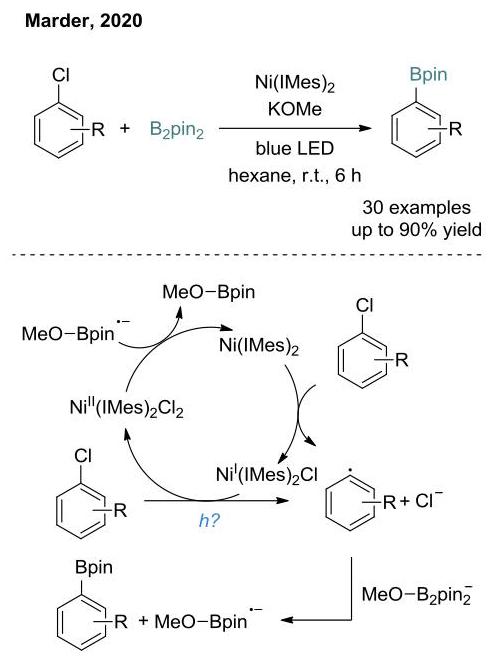
and Radius discovered that [Ni(IMes) ${}_{2}$ ] (IMes = 1,3-dimesitylimid-azoline-2-ylidene) can facilitate an oxidative addition with aryl halides. ${}^{\left\lbrack {38} - {39}\right\rbrack }$ The resulting intermediate can then react with boron reagents to generate aryl boronates. This mechanism has proven to be highly efficient and applicable to $\mathrm{C} - \mathrm{F}$ bond formation. ${}^{\left\lbrack {40}\right\rbrack }$ In 2020, Radius and Marder also demonstrated a photoinduced borylation reaction of aryl chlorides catalyzed by $\left\lbrack {\mathrm{{Ni}}{\left( \mathrm{{IMes}}\right) }_{2}}\right\rbrack .{}^{\left\lbrack {41}\right\rbrack }$ Under 400 nm light irradiation, 4-chloroanisole reacted with ${\mathrm{B}}_{2}{\mathrm{{pin}}}_{2}$ in the presence of KOMe, using 10 mol% [Ni(IMes) ${}_{2}$ ] as the catalyst at 25 °C, yielding 86% of 1-Bpin-4-methoxybenzene after 6 h (Scheme 2). Radical trapping experiments suggested the formation of aryl radicals during the transformation. The proposed mechanism involves [Ni(IMes) ${}_{2}$ ] undergoing rapid chlorine atom abstraction from aryl chlorides to form [Nil(IMes) ${}_{2}$ Cl] and aryl radicals. Further irradiation leads to $\left\lbrack {\mathrm{{Nil}}{\left( \mathrm{{IMes}}\right) }_{2}\mathrm{{Cl}}}\right\rbrack$ reacting with additional aryl chlorides to form [Nill(IMes) ${}_{2}{\mathrm{{Cl}}}_{2}$ ] and more aryl radicals. These aryl radicals then react with the nucleophilic $\left\lbrack {{\mathrm{B}}_{2}{\mathrm{{pin}}}_{2}\left( \mathrm{{OMe}}\right) }\right\rbrack$ - to yield the final borylated product.
拉迪厄斯发现[Ni(IMes)${}_{2}$](IMes = 1,3 - 二甲基咪唑啉 - 2 - 亚基)可以促进与芳基卤化物的氧化加成反应。${}^{\left\lbrack {38} - {39}\right\rbrack }$生成的中间体随后可以与硼试剂反应生成芳基硼酸酯。这一机制已被证明是高效的,适用于$\mathrm{C} - \mathrm{F}$键的形成。${}^{\left\lbrack {40}\right\rbrack }$2020年,拉迪厄斯和马德还展示了由$\left\lbrack {\mathrm{{Ni}}{\left( \mathrm{{IMes}}\right) }_{2}}\right\rbrack .{}^{\left\lbrack {41}\right\rbrack }$催化的芳基氯的光诱导硼化反应。在400 nm光照下,4 - 氯苯甲醚与${\mathrm{B}}_{2}{\mathrm{{pin}}}_{2}$在KOMe存在下反应,使用10 mol%的[Ni(IMes)${}_{2}$]作为催化剂,在25°C下反应6小时后,得到86%的1 - Bpin - 4 - 甲氧基苯(方案2)。自由基捕获实验表明在转化过程中形成了芳基自由基。提出的机制涉及[Ni(IMes)${}_{2}$]从芳基氯中快速夺取氯原子,形成[Nil(IMes)${}_{2}$Cl]和芳基自由基。进一步照射导致$\left\lbrack {\mathrm{{Nil}}{\left( \mathrm{{IMes}}\right) }_{2}\mathrm{{Cl}}}\right\rbrack$与额外的芳基氯反应,形成[Nill(IMes)${}_{2}{\mathrm{{Cl}}}_{2}$]和更多的芳基自由基。这些芳基自由基然后与亲核的$\left\lbrack {{\mathrm{B}}_{2}{\mathrm{{pin}}}_{2}\left( \mathrm{{OMe}}\right) }\right\rbrack$ - 反应,生成最终的硼化产物。
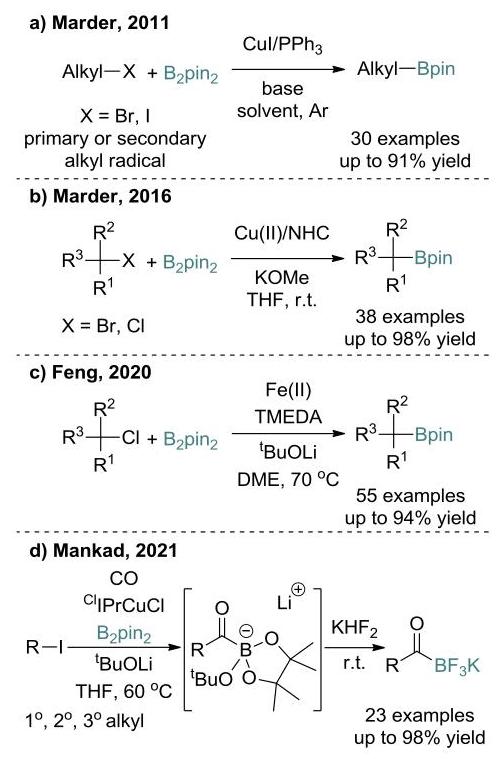
In addition to aryl halides, alkyl halides can also serve as radical precursors, generating alkyl radicals upon activation. Transition-metal-catalyzed radical borylation of alkyl halides has been widely utilized for the synthesis of alkyl boronates. In 2011, Marder and Liu reported a copper(I)-catalyzed borylation reaction of primary and secondary alkyl halides and pseudohalides (Scheme 3a). ${}^{\left\lbrack {42}\right\rbrack }$ Inspired by this work, various transition-metal-catalyzed methods for synthesizing alkyl boronates have been developed, using metals such as Copper(II) (Scheme 3b), ${}^{\left\lbrack {43}\right\rbrack }$ manganese, ${}^{\left\lbrack {44}\right\rbrack }$ iron (Scheme 3c), ${}^{\left\lbrack {45}\right\rbrack }$ and cobalt. ${}^{\left\lbrack {46}\right\rbrack }$ In 2021, Mankad developed a copper-catalyzed carbonylation boronization of alkyl
除芳基卤化物外,烷基卤化物也可作为自由基前体,活化后生成烷基自由基。过渡金属催化的烷基卤化物自由基硼化反应已被广泛用于合成烷基硼酸酯。2011年,马德和刘报道了一种铜(I)催化的伯烷基卤化物、仲烷基卤化物和拟卤化物的硼化反应(方案3a)。${}^{\left\lbrack {42}\right\rbrack }$ 受这项工作的启发,人们开发了各种过渡金属催化的合成烷基硼酸酯的方法,使用的金属如铜(II)(方案3b),${}^{\left\lbrack {43}\right\rbrack }$ 锰,${}^{\left\lbrack {44}\right\rbrack }$ 铁(方案3c),${}^{\left\lbrack {45}\right\rbrack }$ 和钴。${}^{\left\lbrack {46}\right\rbrack }$ 2021年,曼卡德开发了一种铜催化的烷基羰基硼化反应(方案3d)。该方法涉及在CO存在下原位形成四配位酰基硼中间体。通过用 ${}^{\left\lbrack {42}\right\rbrack }$ 水溶液处理这些中间体,合成了脂肪族酰基三氟硼酸钾。该反应在温和条件下有效进行,关键的机理步骤是酰卤中间体的形成。${}^{\left\lbrack {43}\right\rbrack }$
Scheme 2 Ni catalyzed radical borylation reaction of aryl chloride
方案2 镍催化的芳基氯自由基硼化反应
halides (Scheme 3d). This method involved the in situ formation of tetracoordinated acylboron intermediates in the presence of CO. By treating these intermediates with aqueous ${\mathrm{{KHF}}}_{2}$ , aliphatic potassium acyltrifluoroborates were synthesized. The reaction proceeded efficiently under mild conditions, with the key mechanism step being the formation of acyl halide intermediates. ${}^{\left\lbrack {47}\right\rbrack }$
卤化物(方案3d)。该方法涉及在CO存在下原位形成四配位酰基硼中间体。通过用 ${\mathrm{{KHF}}}_{2}$ 水溶液处理这些中间体,合成了脂肪族酰基三氟硼酸钾。该反应在温和条件下有效进行,关键的机理步骤是酰卤中间体的形成。${}^{\left\lbrack {47}\right\rbrack }$
Scheme 3 Transition-metal catalyzed radical borylation of alkyl halides
方案3 过渡金属催化的烷基卤化物自由基硼化反应
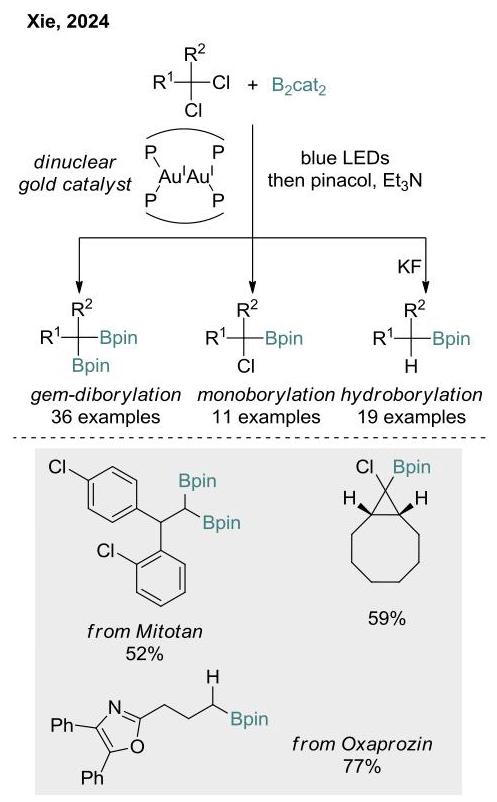
Recently, novel catalysts have been proposed to promote the borylation of alkyl radicals. For example, Xie synthesized a dinu-clear gold catalyst that can catalyze the photoinduced synthesis of gem-diboronates (Scheme 4). ${}^{\left\lbrack {48}\right\rbrack }$ Mechanistic investigations suggested that the interaction between the diboron reagent and the catalyst forms an intermediate capable of absorbing light, thereby facilitating the radical borylation process.
最近,人们提出了新型催化剂来促进烷基自由基的硼化反应。例如,谢合成了一种双核金催化剂,该催化剂可以催化光诱导合成偕二硼酸酯(方案4)。${}^{\left\lbrack {48}\right\rbrack }$ 机理研究表明,二硼试剂与催化剂之间的相互作用形成了一种能够吸收光的中间体,从而促进了自由基硼化过程。
Scheme 4 Dinuclear gold catalyzed borylation of alkyl radicals
方案4 双核金催化的烷基自由基硼化反应
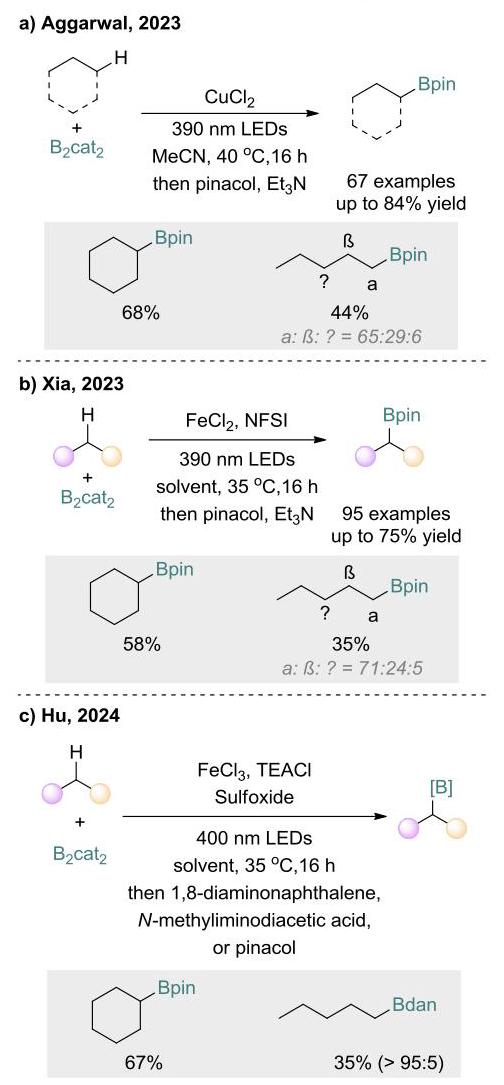
2.1.2. Borylation of C-H bond. In comparison to C-X bonds, C-H bonds are more common in organic compounds, but their borylation is not straightforward. The abundance of $\mathrm{C} - \mathrm{H}$ bonds in a molecule makes the selective activation of a specific $\mathrm{C} - \mathrm{H}$ bond particularly challenging. Aggarwal and Noble reported a light-induced, copper-mediated C-H bond borylation (Scheme 5a), achieving high yields for inactivated alkanes like cyclohexane. However, for long-chain alkanes, the regioselectivity was limited. ${}^{\left\lbrack {49}\right\rbrack }$ Similarly, Xia reported a photocatalyzed borylation of alkanes, but the regioselectivity remained limited (Scheme 5b). ${}^{\left\lbrack {50}\right\rbrack }$ In 2024, Hu reported a highly regioselective radical borylation of long-chain alkanes (Scheme 5c). Despite the high regioselectivity, the yields of most examples were not good. ${}^{\left\lbrack {51}\right\rbrack }$ Achieving both high efficiency and high selectivity in the borylation of C-H bonds remains an area of ongoing research.
2.1.2. C-H键的硼化反应。与C-X键相比,C-H键在有机化合物中更为常见,但其硼化反应并不简单。分子中 $\mathrm{C} - \mathrm{H}$ 键的丰富性使得选择性活化特定的 $\mathrm{C} - \mathrm{H}$ 键特别具有挑战性。阿加瓦尔和诺布尔报道了一种光诱导、铜介导的C-H键硼化反应(方案5a),对于环己烷等未活化的烷烃,该反应能实现高产率。然而,对于长链烷烃,区域选择性有限。${}^{\left\lbrack {49}\right\rbrack }$ 同样,夏报道了一种光催化的烷烃硼化反应,但区域选择性仍然有限(方案5b)。${}^{\left\lbrack {50}\right\rbrack }$ 2024年,胡报道了一种长链烷烃的高区域选择性自由基硼化反应(方案5c)。尽管区域选择性很高,但大多数例子的产率并不理想。${}^{\left\lbrack {51}\right\rbrack }$ 在C-H键硼化反应中实现高效率和高选择性仍然是一个正在进行研究的领域。
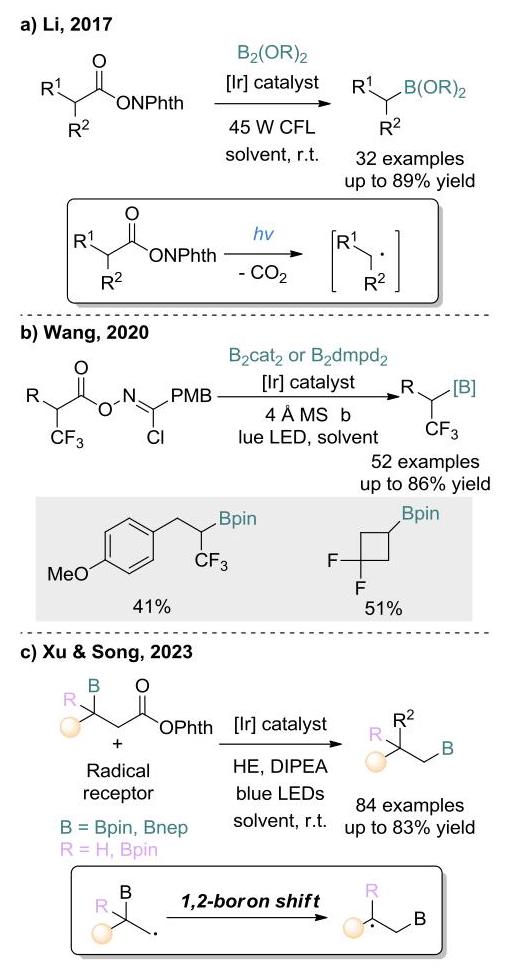
2.1.3. Borylation of C-C bond. The C-C bond is a widely existing covalent linkage in organic molecules. To achieve the borylation of C-C bonds, redox-active esters (RAEs), synthesized from carboxylic acids, are well-known reactants. RAEs of alkyl are more prone to producing alkyl radicals, making it suitable for the borylation of alkyl radicals. These alkyl RAEs easily form alkyl radicals, which promote the borylation and enable the decarboxyla-tive borylation reaction. For example, Li discovered a light-induced decarboxylative borylation reaction of aliphatic acids, where the acids were pre-transformed into $N$ -acyloxyphthali-mides (Scheme 6a). ${}^{\left\lbrack {28}\right\rbrack }$ This reaction was facilitated by an iridium photocatalyst. Recently, research has expanded this strategy for the synthesis of more valuable boronates. Wang reported a photo-induced borylation reaction useful for synthesizing $\alpha - {\mathrm{{CF}}}_{3}$ boronates, which are highly valuable building blocks in medicinal chemistry (Scheme 6b). ${}^{\left\lbrack {52}\right\rbrack }$ Xu and Song described a 1,2-boron shift reaction of $\beta$ -boron NHPI esters, demonstrating a new approach to enhance the value of borylation reactions involving RAEs (Scheme 6c). ${}^{\left\lbrack {53}\right\rbrack }$
2.1.3. C-C键的硼化反应。C-C键是有机分子中广泛存在的共价键。为实现C-C键的硼化反应,由羧酸合成的氧化还原活性酯(RAEs)是众所周知的反应物。烷基RAEs更容易产生烷基自由基,使其适用于烷基自由基的硼化反应。这些烷基RAEs很容易形成烷基自由基,从而促进硼化反应并实现脱羧硼化反应。例如,Li发现了脂肪酸的光诱导脱羧硼化反应,其中酸预先转化为$N$-酰氧基邻苯二甲酰亚胺(方案6a)。${}^{\left\lbrack {28}\right\rbrack }$该反应由铱光催化剂促进。最近,研究扩展了这一策略用于合成更有价值的硼酸盐。Wang报道了一种对合成$\alpha - {\mathrm{{CF}}}_{3}$硼酸盐有用的光诱导硼化反应,$\alpha - {\mathrm{{CF}}}_{3}$硼酸盐是药物化学中非常有价值的构建块(方案6b)。${}^{\left\lbrack {52}\right\rbrack }$Xu和Song描述了$\beta$-硼NHPI酯的1,2-硼迁移反应,展示了一种提高涉及RAEs的硼化反应价值的新方法(方案6c)。${}^{\left\lbrack {53}\right\rbrack }$
Compared to alkyl RAEs, aryl RAEs are less likely to produce aryl radicals. The main challenge in this process is the high energy barrier for aryl RAEs to produce aryl radicals. A notable advancement in the borylation of aryl RAEs is the transition-metal-free method developed by Glorius in 2017. ${}^{\left\lbrack {54}\right\rbrack }$
与烷基RAEs相比,芳基RAEs产生芳基自由基的可能性较小。该过程中的主要挑战是芳基RAEs产生芳基自由基的高能垒。芳基RAEs硼化反应的一个显著进展是Glorius在2017年开发的无过渡金属方法。${}^{\left\lbrack {54}\right\rbrack }$
Scheme 5 Transition-metal catalyzed radical borylation of alkanes
方案5 过渡金属催化的烷烃自由基硼化反应
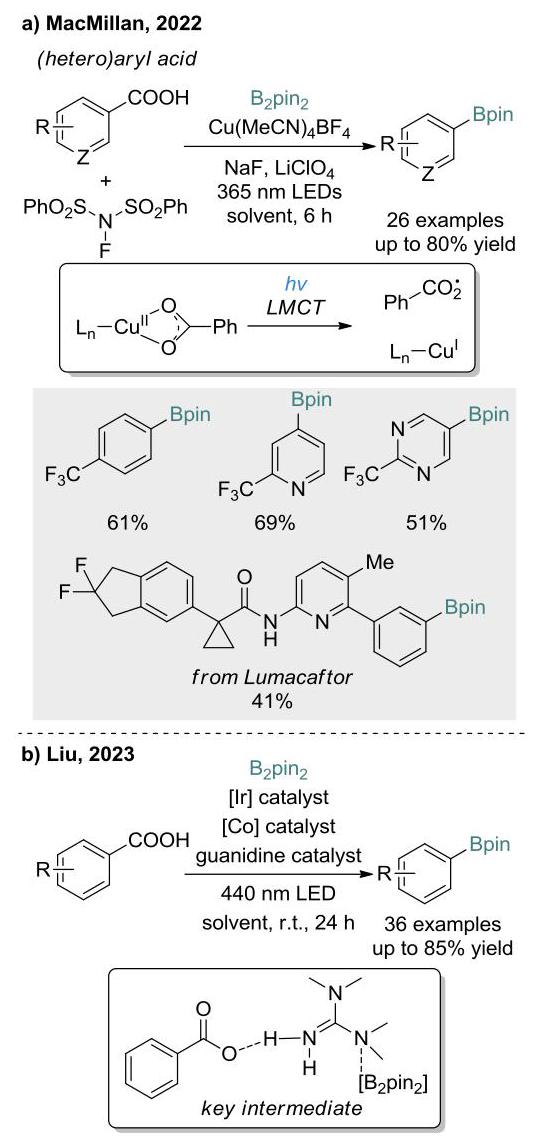
However, in recent years, there have been significant advancements achieving borylation of aryl acids. Aryl carboxylic acids themselves are inherently radical precursors, making direct borylation of carboxylic acids a significant area of scientific research. MacMillan reported a photo-induced, copper-catalyzed decarboxylative borylation of aryl acids (Scheme 7a). ${}^{\left\lbrack {55}\right\rbrack }$ Mechanistic investigations showed that the copper catalyst formed a complex with the aryl acid, which, upon excitation by light, underwent a ligand-to-metal charge transfer (LMCT) process to form an acetoxyl radical. This radical then decarboxylates to produce an aryl radical, which was subsequently captured by a diboron reagent. Liu also reported a direct borylation reaction of carboxylic acids (Scheme 7b). ${}^{\left\lbrack {56}\right\rbrack }$ This reaction combined guanidine catalysis and iridium catalysis, utilizing cobalt to enhance the reaction.
然而,近年来,在实现芳基酸的硼化反应方面取得了重大进展。芳基羧酸本身就是自由基前体,使得羧酸的直接硼化成为一个重要的科学研究领域。MacMillan报道了芳基酸的光诱导、铜催化的脱羧硼化反应(方案7a)。${}^{\left\lbrack {55}\right\rbrack }$机理研究表明,铜催化剂与芳基酸形成络合物,在光激发下,该络合物经历配体到金属的电荷转移(LMCT)过程形成乙酰氧基自由基。然后该自由基脱羧产生芳基自由基,随后被双硼试剂捕获。Liu也报道了羧酸的直接硼化反应(方案7b)。${}^{\left\lbrack {56}\right\rbrack }$该反应结合了胍催化和铱催化,利用钴增强反应。
Besides RAEs and carboxylic acids, other radical precursors have been applied in the radical borylation of C-C bonds. For example, Mo proposed a photocatalyzed decarbonylative borylation of aliphatic aldehydes in 2024, where the aldehydes were pre-transformed into 1,4-dihydropyridines. ${}^{\left\lbrack {57}\right\rbrack }$ We believe that with the advancement of radical chemistry, more radical-based methodologies will be developed and applied in this area, like alkyl carboxylic acid.
除了RAEs和羧酸外,其他自由基前体也已应用于C-C键的自由基硼化反应。例如,Mo在2024年提出了脂肪醛的光催化脱羰硼化反应,其中醛预先转化为1,4-二氢吡啶。${}^{\left\lbrack {57}\right\rbrack }$我们相信,随着自由基化学的发展,更多基于自由基的方法将被开发并应用于该领域,如烷基羧酸。
2.2. Transition-metal free borylation
2.2. 无过渡金属硼化反应
Transition-metal-free reactions provide cleaner conditions by avoiding the use of metal catalysts. These reactions are particularly valuable in medicinal synthesis, as they eliminate the risk of metal contamination. Through methods such as electrochemistry, light, or organic small molecule catalysis, substrates can be efficiently activated without the need for transition-metal catalysts, providing a more environmentally friendly approach to borylation. Metal-free radical borylation has become an important and well-explored research topic. In this chapter, we will introduce significant works since 2020 on transition-metal-free borylation.
无过渡金属反应通过避免使用金属催化剂提供了更清洁的反应条件。这些反应在药物合成中特别有价值,因为它们消除了金属污染的风险。通过电化学、光或有机小分子催化等方法,无需过渡金属催化剂即可有效活化底物,为硼化反应提供了一种更环保的方法。无金属自由基硼化反应已成为一个重要且研究充分的课题。在本章中,我们将介绍自2020年以来关于无过渡金属硼化反应的重要研究成果。
2.2.1. Electrochemical borylation. The electrochemical method is an efficient procedure in organic synthesis, where substrates can be activated by applying the necessary redox potential, thus avoiding the use of additional reagents. Electrochemical boryla-tion has been applied for the synthesis of boronates from aryl chlorides, bromides, ${}^{\left\lbrack {58}\right\rbrack }$ and iodides. ${}^{\left\lbrack {59}\right\rbrack }$ Recently, this method has been expanded to different substrates.
2.2.1. 电化学硼化反应。电化学方法是有机合成中的一种有效方法,通过施加必要的氧化还原电位可以活化底物,从而避免使用额外的试剂。电化学硼化反应已用于从芳基氯化物、溴化物、${}^{\left\lbrack {58}\right\rbrack }$和碘化物合成硼酸酯。${}^{\left\lbrack {59}\right\rbrack }$最近,该方法已扩展到不同的底物。
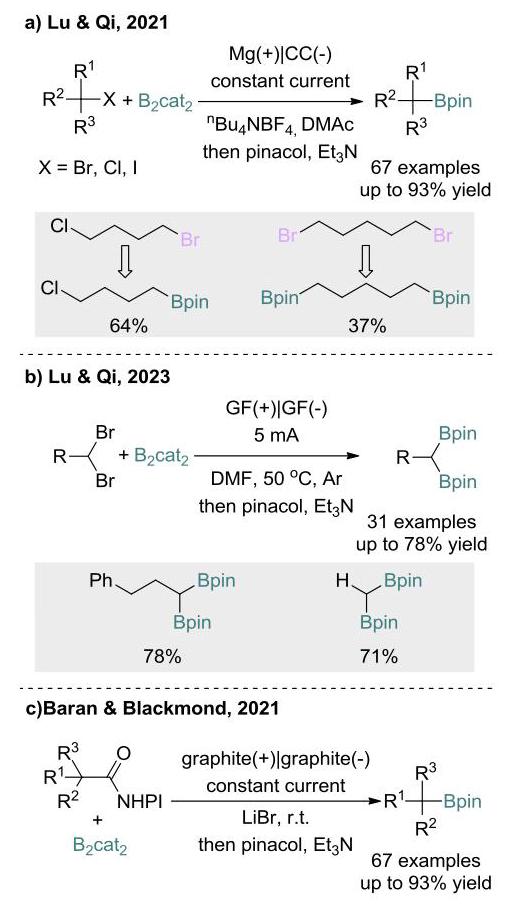
Lu and Qi reported an electrochemical borylation of alkyl halides (Scheme 8a). ${}^{\left\lbrack {60}\right\rbrack }$ By using magnesium as a sacrificial anode, they successfully avoided the need for excess reducing agents. In 2023, this group further advanced the electrooxidation of a solvent-ligated ${\mathrm{B}}_{2}{\mathrm{{cat}}}_{2}$ complex, successfully synthesizing gem-dibor-ylalkanes (Scheme 8b). ${}^{\left\lbrack {61}\right\rbrack }$ The process involved the formation of the boryl radical through the homolytic cleavage of B-B bond in a DMF-ligated ${\mathrm{B}}_{2}{\mathrm{{cat}}}_{2}$ radical cation. Concurrently, the $\alpha$ -bromo radical was generated via the reduction of gem-bromide at the cathode. The computational studies show that the diboration occurred through C-B radical-radical cross-coupling in solution.
Lu和Qi报道了卤代烷的电化学硼化反应(方案8a)。${}^{\left\lbrack {60}\right\rbrack }$通过使用镁作为牺牲阳极,他们成功避免了使用过量的还原剂。2023年,该团队进一步推进了溶剂配位的${\mathrm{B}}_{2}{\mathrm{{cat}}}_{2}$配合物的电氧化反应,成功合成了偕二硼基烷烃(方案8b)。${}^{\left\lbrack {61}\right\rbrack }$该过程涉及通过在DMF配位的${\mathrm{B}}_{2}{\mathrm{{cat}}}_{2}$自由基阳离子中B - B键的均裂形成硼基自由基。同时,$\alpha$ - 溴自由基通过在阴极还原偕二溴化物产生。计算研究表明,双硼化反应通过溶液中的C - B自由基 - 自由基交叉偶联发生。
In another instance, Baran and Blackmond proposed using aliphatic NHPI esters to achieve electrochemical decarboxylative borylation (Scheme 8c). ${}^{\left\lbrack {62}\right\rbrack }$ Additionally, other studies have explored the use of various substrates such as arylazo sulfones ${}^{\left\lbrack {63}\right\rbrack }$ and nitroarenes ${}^{\left\lbrack {64}\right\rbrack }$ in electrochemical borylation reactions.
在另一个例子中,Baran和Blackmond提出使用脂肪族NHPI酯来实现电化学脱羧硼化反应(方案8c)。${}^{\left\lbrack {62}\right\rbrack }$此外,其他研究探索了在电化学硼化反应中使用各种底物,如芳基偶氮砜${}^{\left\lbrack {63}\right\rbrack }$和硝基芳烃${}^{\left\lbrack {64}\right\rbrack }$。
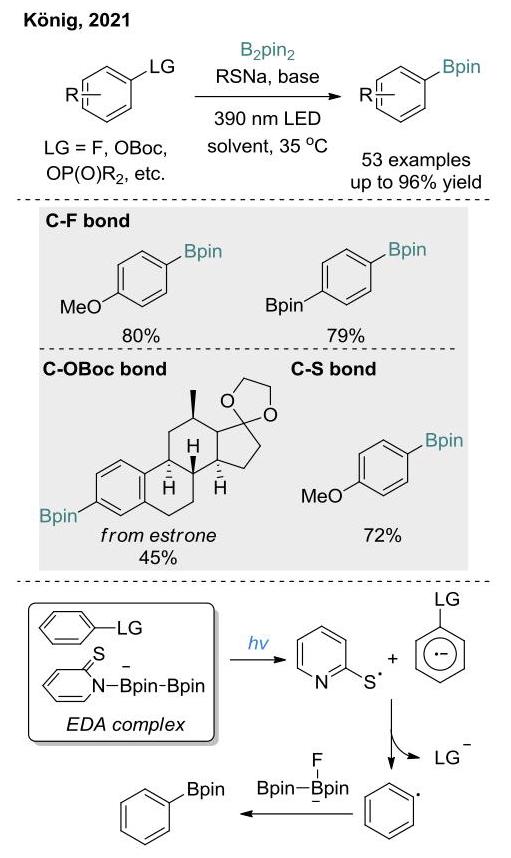
2.2.2. Light-induced borylation. In addition to electrochemical methods, small organic molecule catalysis is also a strategy for eliminating the need for transition-metal activation. This approach encompasses the use of various organic reagents. For instance, König reported a thiolate-catalyzed activation strategy for multiple aryl $\mathrm{C}$ -hetero bonds to form aryl radicals, facilitating the synthesis of aryl boronates (Scheme 9). ${}^{\left\lbrack {65}\right\rbrack }$ The authors proposed that the aryl reagent coordinated with thiolate and the diboron reagent to form an electron donor-acceptor (EDA) complex. This EDA complex absorbed light, leading to an inner-sphere electron transfer process. This process generated an aryl radical anion, which subsequently underwent C-LG bond cleavage to produce an aryl radical and a leaving anion. The aryl radical was then captured by the diboron reagent to form an aryl boronate in a process similar to previously discussed methods.
2.2.2. 光诱导硼化反应。除了电化学方法外,有机小分子催化也是一种无需过渡金属活化的策略。这种方法包括使用各种有机试剂。例如,König报道了一种硫醇盐催化的活化策略,用于多个芳基$\mathrm{C}$ - 杂键形成芳基自由基,促进芳基硼酸酯的合成(方案9)。${}^{\left\lbrack {65}\right\rbrack }$作者提出芳基试剂与硫醇盐和双硼试剂配位形成电子给体 - 受体(EDA)配合物。该EDA配合物吸收光,导致内球电子转移过程。这个过程产生芳基自由基阴离子,随后进行C - LG键裂解以产生芳基自由基和离去阴离子。然后芳基自由基被双硼试剂捕获,以类似于前面讨论的方法形成芳基硼酸酯。
Scheme 7 Transition-metal catalyzed direct borylation of aryl carboxylic
方案7 芳基羧酸的过渡金属催化直接硼化反应
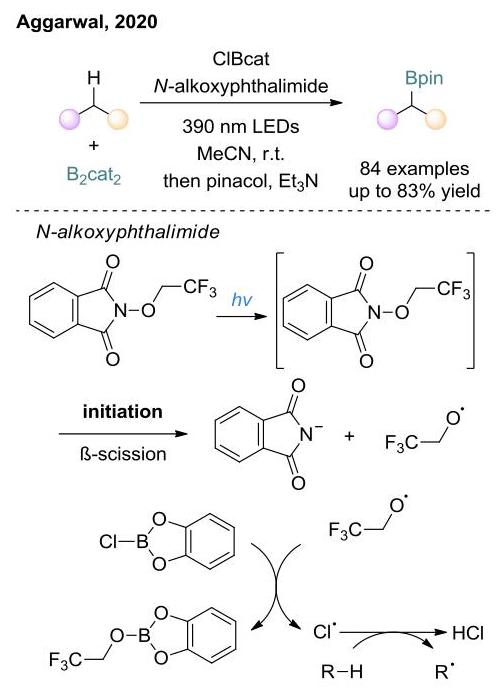
This strategy, which combines light catalysis and organic molecular catalysis, is not unusual. For example, Aggarwal used CI-Bcat as a catalyst to achieve a photoinduced C-H bond borylation reaction (Scheme 10). ${}^{\left\lbrack {30}\right\rbrack }$ In this system, the additive $N$ -alkoxyphthalimide was excited by light to release an oxygen radical. This oxygen radical underwent a radical reaction with the CI-Bcat catalyst, releasing a CI radical. The CI radical then initiated a HAT reaction with alkanes to generate alkyl radicals. These alkyl radicals were subsequently transformed into the desired boron esters.
这种将光催化与有机分子催化相结合的策略并不罕见。例如,阿加瓦尔使用CI-Bcat作为催化剂实现了光诱导的C-H键硼化反应(方案10)。${}^{\left\lbrack {30}\right\rbrack }$在该体系中,添加剂$N$-烷氧基邻苯二甲酰亚胺被光激发释放出氧自由基。该氧自由基与CI-Bcat催化剂发生自由基反应,释放出CI自由基。然后CI自由基引发与烷烃的氢原子转移(HAT)反应生成烷基自由基。这些烷基自由基随后转化为所需的硼酸酯。
In fact, several other systems use this strategy to achieve radical borylation. One representative system is Jiao’s pyridine/base method. They used pyridine (typically 4-phenylpyridine) as a
事实上,其他几个体系也使用这种策略来实现自由基硼化。一个具有代表性的体系是焦的吡啶/碱方法。他们使用吡啶(通常是4-苯基吡啶)作为
Scheme 8 Electrochemical borylation an alkyl radical, which then led to the formation of alkyl boro-nates. Larionov also reported a photo-induced borylation reaction of aryl phosphates, phenols, and other substrates (Scheme 11b). ${}^{\left\lbrack {69}\right\rbrack }$ They used phenothiazine as a photocatalyst, whose anion can absorb light and promote the SET process. Its strong reductive power allows it to reduce substrates that are not easily reduced, facilitating the formation of the desired borylated products. Yoshima also reported an organic photoredox-catalyzed decar-boxylative radical borylation of benzoic acids. ${}^{\left\lbrack {70}\right\rbrack }$ Recently, Chu reported a three-component defluorinative borylation of alkenes with trifluoromethyls and ${\mathrm{B}}_{2}{\mathrm{{pin}}}_{2}$ via dual photoredox/copper catalysis (Scheme 11c). The key step in the mechanism involved a SET event between the in situ generated ${\mathrm{{PhCF}}}_{3}/{\left\lbrack {\mathrm{{HO}}}_{ - }{\mathrm{B}}_{2}{\mathrm{{pin}}}_{2}\right\rbrack }^{ - }$ anionic intermediate and the excited photocatalyst. This process was accompanied by the elimination of fluoride ions, leading to the formation of difluoroalkyl radical.
方案8 电化学硼化 生成一个烷基自由基,然后导致烷基硼酸酯的形成。拉里奥诺夫还报道了芳基磷酸酯、酚类和其他底物的光诱导硼化反应(方案11b)。${}^{\left\lbrack {69}\right\rbrack }$他们使用吩噻嗪作为光催化剂,其阴离子可以吸收光并促进单电子转移(SET)过程。其强还原能力使其能够还原不易还原的底物,促进所需硼化产物的形成。吉岛也报道了苯甲酸的有机光氧化还原催化脱羧自由基硼化反应。${}^{\left\lbrack {70}\right\rbrack }$最近,朱报道了通过双光氧化还原/铜催化实现烯烃与三氟甲基和${\mathrm{B}}_{2}{\mathrm{{pin}}}_{2}$的三组分脱氟硼化反应(方案11c)。该机理的关键步骤涉及原位生成的${\mathrm{{PhCF}}}_{3}/{\left\lbrack {\mathrm{{HO}}}_{ - }{\mathrm{B}}_{2}{\mathrm{{pin}}}_{2}\right\rbrack }^{ - }$阴离子中间体与激发态光催化剂之间的SET事件。这个过程伴随着氟离子的消除,导致二氟烷基自由基的形成。
Scheme 9 Light-induced radical borylation catalyzed by thiolate
方案9 硫醇盐催化的光诱导自由基硼化
photocatalyst to successfully achieve the borylation of aryl or alkyl halides. ${}^{\left\lbrack {66} - {68}\right\rbrack }$ Here, we list one of the typical reaction conditions (Scheme 11a). In-depth studies on the mechanism of this
光催化剂成功实现了芳基或烷基卤化物的硼化反应。${}^{\left\lbrack {66} - {68}\right\rbrack }$在此,我们列出其中一种典型的反应条件(方案11a)。对该
Scheme 10 Light-induced C-H bond borylation catalyzed by CI-Bcat
方案10 CI-Bcat催化的光诱导C-H键硼化
Scheme 11 Light-induced radical borylation catalyzed by organic molecules
方案11 有机分子催化的光诱导自由基硼化
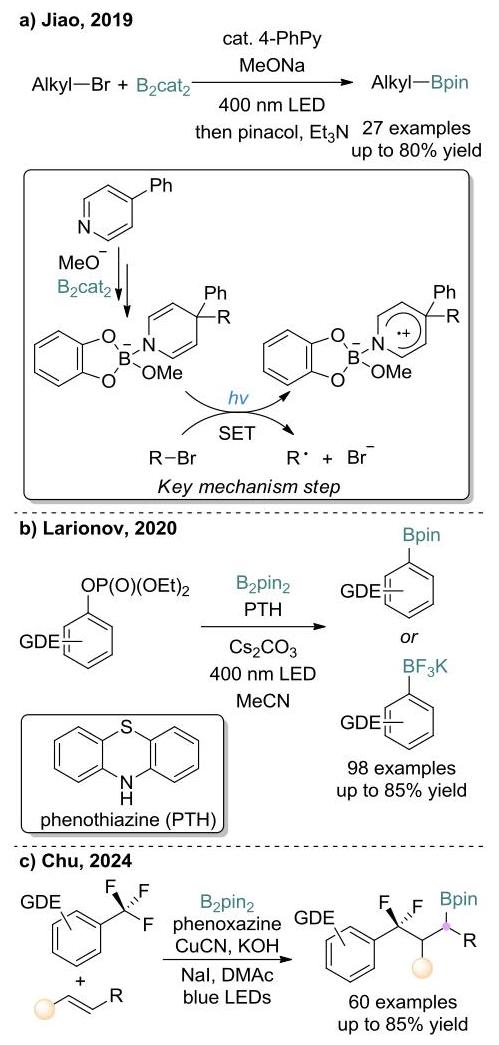
system revealed that pyridine forms a complex with the diboron reagent in the presence of a base. Upon light irradiation, this intermediate underwent a SET process with alkyl bromides, forming
体系的深入研究表明,吡啶在碱的存在下与双硼试剂形成络合物。光照后,该中间体与烷基溴发生SET过程,形成
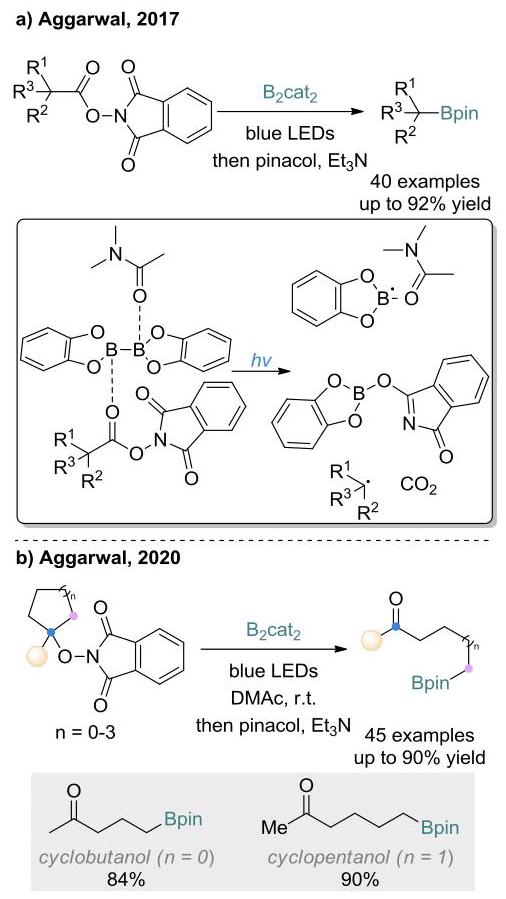
Furthermore, by designing suitable substrate structures, the substrates themselves can exhibit optical activity, which can be exploited to achieve borylation under simple conditions. RAEs are typical substrates that can release an alkyl radical under light irradiation. In 2017, Aggarwal reported a decarboxylative borylation reaction using NHPI esters as substrates (Scheme 12a). ${}^{\left\lbrack {29}\right\rbrack }$ These esters formed an intermediate with ${\mathrm{B}}_{2}{\mathrm{{cat}}}_{2}$ and solvent that could be directly excited by blue light. Upon elimination of a ${\mathrm{{CO}}}_{2}$ molecule, an alkyl radical was generated. This strategy can also be expanded to fragmentation borylation when cyclic alcohols or hemiacetals are used as substrates, as reported by Aggarwal in 2021 (Scheme 12b). ${}^{\left\lbrack {71}\right\rbrack }$ Some other substrates, such as iodides and chlorides, can also be directly excited under light irradiation, enabling borylation under very mild conditions. ${}^{\left\lbrack {72} - {74}\right\rbrack }$
此外,通过设计合适的底物结构,底物本身可以表现出光学活性,可利用这一点在简单条件下实现硼化反应。RAEs是典型的底物,在光照下可以释放烷基自由基。2017年,阿加瓦尔报道了使用NHPI酯作为底物的脱羧硼化反应(方案12a)。${}^{\left\lbrack {29}\right\rbrack }$这些酯与${\mathrm{B}}_{2}{\mathrm{{cat}}}_{2}$和溶剂形成一种中间体,该中间体可以被蓝光直接激发。消除一个${\mathrm{{CO}}}_{2}$分子后,生成一个烷基自由基。当使用环醇或半缩醛作为底物时,这种策略也可以扩展到碎片化硼化反应,如阿加瓦尔在2021年所报道的(方案12b)。${}^{\left\lbrack {71}\right\rbrack }$其他一些底物,如碘化物和氯化物,在光照下也可以直接被激发,从而在非常温和的条件下实现硼化反应。${}^{\left\lbrack {72} - {74}\right\rbrack }$
Scheme 12 Direct borylation reaction of NHPI ester
方案12 NHPI酯的直接硼化反应
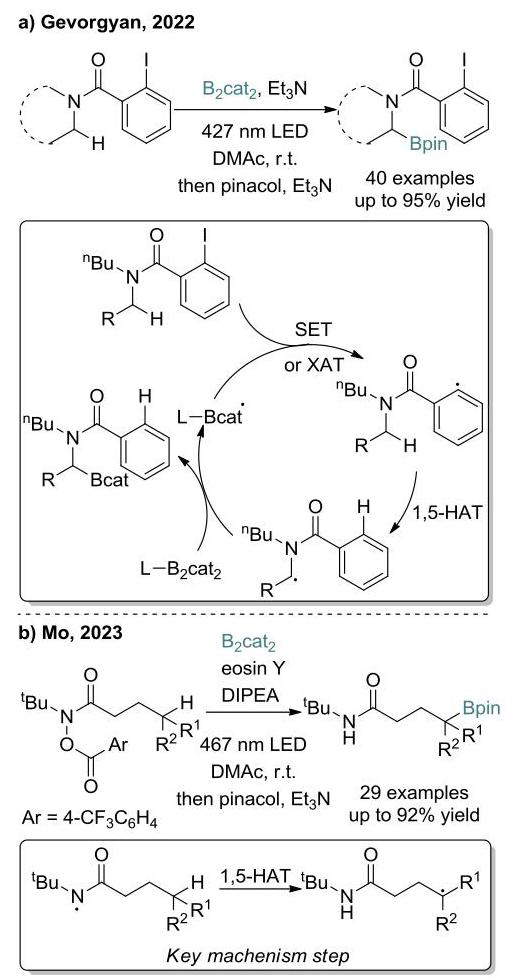
Recently, a novel strategy has attracted the attention of researchers. This method involves activating the substrate to generate an $N$ -centered radical or a radical at another site, which then undergoes an intramolecular HAT process, leading to the formation of another carbon-centered radical in the substrate. This process has been successfully employed in borylation reactions. For instance, Gevorgyan reported a selective $\alpha$ -C-H bond boryla-tion of aliphatic amines (Scheme 13a). ${}^{\left\lbrack {75}\right\rbrack }$ They used 2-iodoben-zoyl-tethered amines as substrates, which firstly generated aryl radicals on the amine. The subsequent HAT process facilitated the formation of alkyl radicals and $\alpha$ -borylated amines. The driving force behind this process was the bond energy difference between aryl and alkyl C-H bonds. Similarly, Mo applied a related strategy using hydroxamic acid derivatives as substrates (Scheme 13b). ${}^{\left\lbrack {76}\right\rbrack }$ In the presence of the photocatalyst eosin Y, an $N$ -centered radical was generated, which then underwent an intramolecular HAT process to form an alkyl radical. This design enabled Mo to achieve selective borylation at the $\gamma$ -position of carbonyl compounds.
最近,一种新策略引起了研究人员的关注。该方法涉及激活底物以生成以$N$为中心的自由基或在另一个位点生成自由基,然后该自由基经历分子内氢原子转移(HAT)过程,导致在底物中形成另一个以碳为中心的自由基。此过程已成功应用于硼化反应。例如,Gevorgyan报道了脂肪族胺的选择性$\alpha$-C-H键硼化反应(方案13a)。${}^{\left\lbrack {75}\right\rbrack }$他们使用2-碘苯甲酰基连接的胺作为底物,该底物首先在胺上生成芳基自由基。随后的HAT过程促进了烷基自由基和$\alpha$-硼化胺的形成。该过程背后的驱动力是芳基和烷基C-H键之间的键能差异。同样,Mo使用异羟肟酸衍生物作为底物应用了相关策略(方案13b)。${}^{\left\lbrack {76}\right\rbrack }$在光催化剂曙红Y存在下,生成了以$N$为中心的自由基,然后该自由基经历分子内HAT过程形成烷基自由基。这种设计使Mo能够在羰基化合物的$\gamma$位实现选择性硼化。
Scheme 13 Borylation using remote HAT strategy
方案13 使用远程氢原子转移(HAT)策略的硼化反应
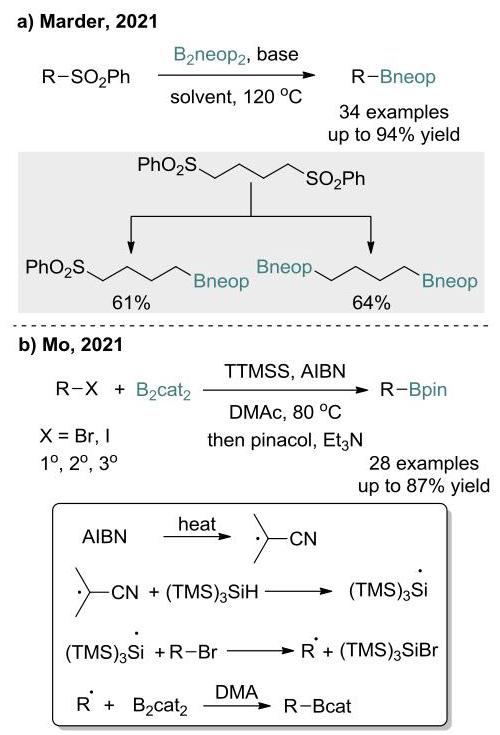
2.2.3. Borylation reaction under thermal conditions. Besides light-induced conditions, additives or catalysts can also directly promote the activation of substrates under non-light irradiation conditions, leading to borylation. For example, Marder and Radius reported a direct borylation reaction of alkyl sulfones mediated by a base (Scheme 14a). ${}^{\left\lbrack {77}\right\rbrack }$ The preliminary mechanism study revealed a rational pathway of the formation of adduct involving Lewis base, ${B}_{2}{\text{ neop }}_{2}$ and alkyl sulfones. In addition, Mo reported a radical borylation of alkyl halides using silane as an additive (Scheme 14b). ${}^{\left\lbrack {78}\right\rbrack }$ The proposed mechanism was a classical radical-involved substitution process.
2.2.3. 热条件下的硼化反应。除了光诱导条件外,添加剂或催化剂也可以在非光照条件下直接促进底物的活化,从而导致硼化反应。例如,Marder和Radius报道了由碱介导的烷基砜的直接硼化反应(方案14a)。${}^{\left\lbrack {77}\right\rbrack }$初步机理研究揭示了涉及路易斯碱、${B}_{2}{\text{ neop }}_{2}$和烷基砜的加合物形成的合理途径。此外,Mo报道了使用硅烷作为添加剂的卤代烷的自由基硼化反应(方案14b)。${}^{\left\lbrack {78}\right\rbrack }$提出的机理是一个经典的涉及自由基的取代过程。
3. Borylation Involving Boron-Centered Radical
3. 涉及硼中心自由基的硼化反应
Borane Lewis base compounds can produce a boron-centered radical through a HAT reaction. This boron-centered radical exhibits strong reactivity and can interact with various substrates. Notably, in 2008, Curran made significant advancements by synthesizing a special borane where the NHC was linked with boranes. ${}^{\left\lbrack {31}\right\rbrack }$ This NHC-borane was found to be applicable in a range of synthetic transformations. This reagent was utilized to facilitate various organic reactions such as radical dehalogenation, ${}^{\left\lbrack {79}\right\rbrack }$ decyana-tion, ${}^{\left\lbrack {80}\right\rbrack }$ and others. ${}^{\left\lbrack {81}\right\rbrack }$ However, this reagent initially did not attract widespread interest among researchers, mainly because the synthesized alkyl borane had limited utility in subsequent transformations, making it less valuable as an intermediate in medicinal chemistry.
硼烷路易斯碱化合物可通过氢原子转移(HAT)反应生成硼中心自由基。这种硼中心自由基具有很强的反应活性,能与各种底物发生相互作用。值得注意的是,2008年,柯伦通过合成一种特殊的硼烷(其中氮杂环卡宾与硼烷相连)取得了重大进展。${}^{\left\lbrack {31}\right\rbrack }$ 人们发现这种氮杂环卡宾 - 硼烷可应用于一系列合成转化反应。该试剂被用于促进各种有机反应,如自由基脱卤反应、${}^{\left\lbrack {79}\right\rbrack }$ 脱氰反应、${}^{\left\lbrack {80}\right\rbrack }$ 以及其他反应。${}^{\left\lbrack {81}\right\rbrack }$ 然而,这种试剂最初并未引起研究人员的广泛关注,主要是因为合成的烷基硼烷在后续转化反应中的用途有限,使其作为药物化学中间体的价值降低。
Scheme 14 Borylation under thermal conditions
方案14 热条件下的硼化反应
Recently, this reagent has garnered renewed attention due to the work of researchers. There have been several publications exploring the applications of borane derivatives. For example, So and co-workers reported a boron ester synthesis reaction catalyzed by NHC-diborene. ${}^{\left\lbrack {82}\right\rbrack }$ Curran also reported the synthesis of NHC-boralactones reagents, ${}^{\left\lbrack {83}\right\rbrack }$ indicating the potential for expanding the application of borane derivatives in organic synthesis.
最近,由于研究人员的工作,这种试剂再次受到关注。已有多篇文献探讨了硼烷衍生物的应用。例如,苏及其同事报道了由氮杂环卡宾 - 二硼烯催化的硼酸酯合成反应。${}^{\left\lbrack {82}\right\rbrack }$ 柯伦也报道了氮杂环卡宾 - 硼内酯试剂的合成,${}^{\left\lbrack {83}\right\rbrack }$ 这表明硼烷衍生物在有机合成中的应用有扩大的潜力。
Wang has published extensively on reactions involving ${\mathrm{{NHC}}}_{ - }{\mathrm{{BH}}}_{3}$ and has recently reviewed borylation ${}^{\left\lbrack {84}\right\rbrack }$ and hydrobora-tion ${}^{\left\lbrack {11}\right\rbrack }$ reactions involving borane Lewis base compound. Therefore, instead of detailing all the works on this reagent, we will highlight a few representative studies to illustrate some typical reaction types and recent advancements in this area.
王在涉及${\mathrm{{NHC}}}_{ - }{\mathrm{{BH}}}_{3}$的反应方面发表了大量论文,最近还对涉及硼烷路易斯碱化合物的硼化反应${}^{\left\lbrack {84}\right\rbrack }$ 和硼氢化反应${}^{\left\lbrack {11}\right\rbrack }$ 进行了综述。因此,我们不会详细介绍关于这种试剂的所有研究工作,而是重点介绍一些有代表性的研究,以说明该领域的一些典型反应类型和最新进展。
Borylation using boranes involves the boron-centered radical attacking the substrate. In this process, the reactivity is influenced by the properties of both the boron reagent and the substrate, making it easier to achieve selectivity. This control over reactivity enhances the potential for selective and stereoselective transformations.
使用硼烷进行硼化反应涉及硼中心自由基对底物的攻击。在此过程中,反应活性受硼试剂和底物性质的影响,使得更容易实现选择性。对反应活性的这种控制增强了选择性和立体选择性转化的潜力。
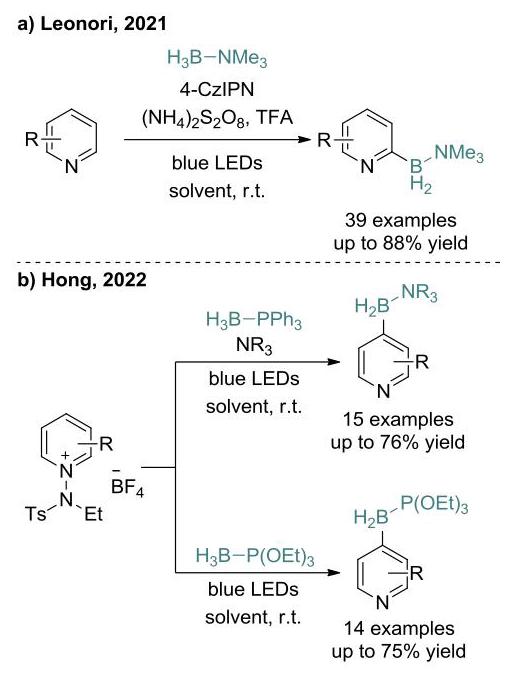
One promising strategy involves light-induced reactions. For example, Lewis base boranes can undergo a Minisci-type reaction with pyridine and its derivatives. By using different boron reagents, borylation reactions at different sites on pyridines can be achieved. Leonori reported a C2-selective Minisci borylation reaction using ${\mathrm{{BH}}}_{3} - {\mathrm{{NMe}}}_{3}$ as the borylation reagent and 4-CzIPN as the photocatalyst, achieving C2 borylation of azines (Scheme 15a). ${}^{\left\lbrack {85}\right\rbrack }$ Hong used ${\mathrm{{BH}}}_{3}$ -phosphate as the borylation reagent to achieve C4-selective borylation of pyridinium derivatives (Scheme 15b). ${}^{\left\lbrack {86}\right\rbrack }$ Additionally, Cao reported a C5-selective Minisci reaction using NHC- ${\mathrm{{BH}}}_{3}$ . ${}^{\left\lbrack {87}\right\rbrack }$
一种有前景的策略涉及光诱导反应。例如,路易斯碱硼烷可与吡啶及其衍生物发生类似米尼斯基反应。通过使用不同的硼试剂,可以实现吡啶不同位点的硼化反应。莱奥诺里报道了使用${\mathrm{{BH}}}_{3} - {\mathrm{{NMe}}}_{3}$作为硼化试剂、4 - 氰基吲哚并吡喃(4 - CzIPN)作为光催化剂的C2选择性米尼斯基硼化反应(方案15a),实现了嗪类化合物的C2硼化反应。${}^{\left\lbrack {85}\right\rbrack }$ 洪使用${\mathrm{{BH}}}_{3}$ - 磷酸盐作为硼化试剂实现了吡啶鎓衍生物的C4选择性硼化反应(方案15b)。${}^{\left\lbrack {86}\right\rbrack }$ 此外,曹报道了使用氮杂环卡宾 - ${\mathrm{{BH}}}_{3}$ 的C5选择性米尼斯基反应。${}^{\left\lbrack {87}\right\rbrack }$
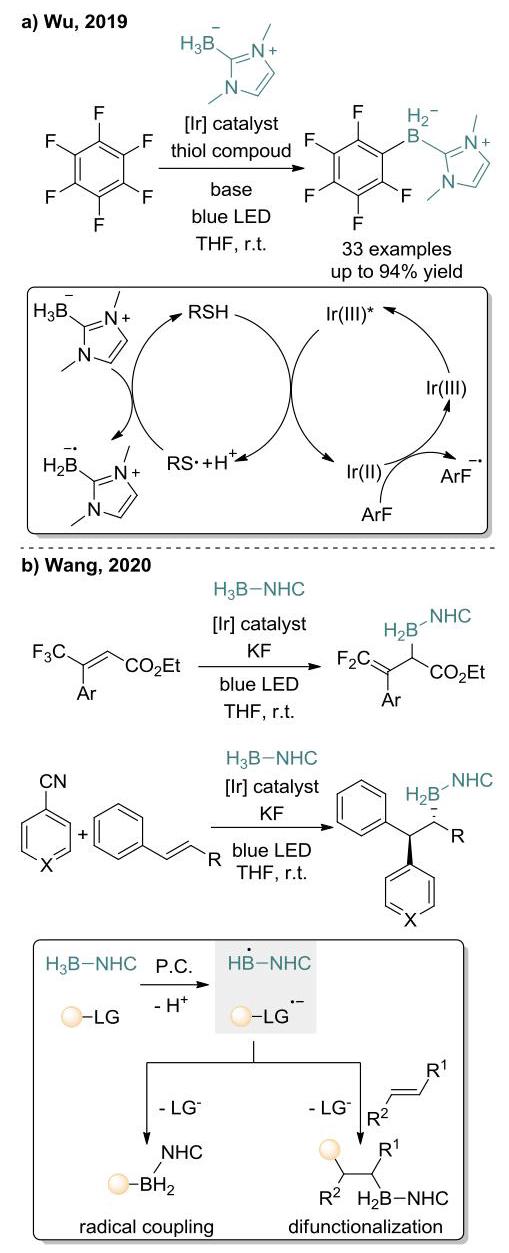
The generation of boron-centered radicals requires a reagent to abstract a hydrogen atom from borane base compounds. Traditional methods involve the use of radical initiators, which can introduce pollutants and necessitate high temperatures, leading to safety concerns. Therefore, exploring alternative methods for generating boron-centered radicals has become an important research direction.
硼中心自由基的产生需要一种试剂从硼烷碱化合物中夺取一个氢原子。传统方法涉及使用自由基引发剂,这会引入污染物且需要高温,存在安全隐患。因此,探索产生硼中心自由基的替代方法已成为一个重要的研究方向。
Wu reported a visible light-induced selective defluoroboryla-tion reaction of fluoroarenes. They used an iridium catalyst or the organic photocatalyst 4-CzIPN along with a thiol compound as the HAT catalyst (Scheme 16a). ${}^{\left\lbrack {27}\right\rbrack }$ Mechanistic experiments revealed that under light irradiation, the excited photocatalyst helped the thiol compound generate a sulfur radical. Due to the low bond energy of the B-H bond, this sulfur radical can abstract a hydrogen atom from the $\mathrm{{NHC}} - {\mathrm{{BH}}}_{3}$ , forming a boron-centered radical. This radical then reacted with fluoroarenes to produce the desired boronate.
吴等人报道了氟代芳烃的可见光诱导选择性脱氟硼化反应。他们使用铱催化剂或有机光催化剂4-CzIPN以及硫醇化合物作为氢原子转移(HAT)催化剂(方案16a)。${}^{\left\lbrack {27}\right\rbrack }$机理实验表明,在光照下,激发态的光催化剂促使硫醇化合物产生硫自由基。由于B-H键的键能较低,该硫自由基可以从$\mathrm{{NHC}} - {\mathrm{{BH}}}_{3}$中夺取一个氢原子,形成硼中心自由基。然后该自由基与氟代芳烃反应生成所需的硼酸酯。
Wang reported another activation method for ${\mathrm{{NHC}}}_{ - }{\mathrm{{BH}}}_{3}$ that does not require the addition of a thiol compound (Scheme 16b). ${}^{\left\lbrack {88}\right\rbrack }$ Instead, this method utilizes the SET process between ${\mathrm{{NHC}}}_{ - }{\mathrm{{BH}}}_{3}$ and an iridium catalyst to generate boron-centered radical. Using this approach, they successfully carried out several different transformations including diastereoselective transformation.
王等人报道了另一种${\mathrm{{NHC}}}_{ - }{\mathrm{{BH}}}_{3}$的活化方法,该方法不需要添加硫醇化合物(方案16b)。${}^{\left\lbrack {88}\right\rbrack }$相反,该方法利用${\mathrm{{NHC}}}_{ - }{\mathrm{{BH}}}_{3}$与铱催化剂之间的单电子转移(SET)过程来生成硼中心自由基。使用这种方法,他们成功地进行了几种不同的转化反应,包括非对映选择性转化。
Hydroboration is another important reaction type achieved with ${\mathrm{{NHC}}}_{ - }{\mathrm{{BH}}}_{3}$ . For instance, Curran and Dai reported a selective hydroboration reaction at the same year. ${}^{\left\lbrack {89}\right\rbrack }$ They also reported a hydroboration reaction of various substrates using NHC-BH ${}_{3}$ with CdS nanosheets as a photocatalyst. ${}^{\left\lbrack {90}\right\rbrack }$ Additionally, the borylation of unsaturated bonds is another significant reaction facilitated by NHC-BH3. ${}^{\left\lbrack {91} - {92}\right\rbrack }$
硼氢化反应是通过${\mathrm{{NHC}}}_{ - }{\mathrm{{BH}}}_{3}$实现的另一种重要反应类型。例如,柯伦和戴在同年报道了一种选择性硼氢化反应。${}^{\left\lbrack {89}\right\rbrack }$他们还报道了使用NHC-BH${}_{3}$与硫化镉纳米片作为光催化剂对各种底物进行的硼氢化反应。${}^{\left\lbrack {90}\right\rbrack }$此外,不饱和键的硼化反应是由NHC-BH3促进的另一个重要反应。${}^{\left\lbrack {91} - {92}\right\rbrack }$
In the previously mentioned borylation of carbon radicals, many reactions lacked selectivity. Typically, the mechanism involves generating alkyl or aryl radicals within the reaction system, which are then captured by a diboron reagent. This radical process often lacks efficient means to achieve selective transformations, particularly stereoselectivity.
在前面提到的碳自由基硼化反应中,许多反应缺乏选择性。通常,其机理涉及在反应体系中生成烷基或芳基自由基,然后被二硼试剂捕获。这种自由基过程通常缺乏实现选择性转化,特别是立体选择性的有效方法。
4. Conclusions and Perspectives
4. 结论与展望
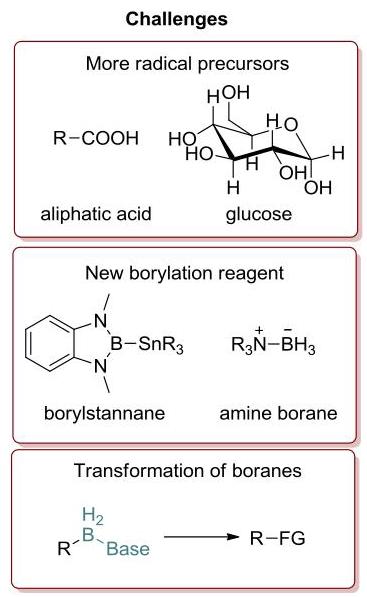
Outstanding achievements have been made in borylation reactions based on radical mechanisms. Various aryl or alkyl radical precursors, such as halides, carboxylic acids, and other substrates, have been successfully utilized for the synthesis of boron esters. However, several challenges remain. Exploring borylation from new radical precursors is necessary. For instance, most previous C-C bond borylations have used aryl acids or aliphatic acid derivatives as substrates. More exploration is needed for borylating other types of C-C bonds, like aliphatic acid. Additionally, achieving high steroselective radical borylation is a significant challenge because radical reactions usually lack steroselectivity. Another research direction is developing new boron reagents beyond diboron esters for the synthesis of boronates. Although some new borylation reagents have been discovered, their applications are still limited. ${}^{\left\lbrack {93} - {95}\right\rbrack }$
基于自由基机理的硼化反应取得了显著成就。各种芳基或烷基自由基前体,如卤化物、羧酸和其他底物,已成功用于硼酸酯的合成。然而,仍存在一些挑战。有必要从新的自由基前体探索硼化反应。例如,以前大多数的C-C键硼化反应都使用芳基酸或脂肪酸衍生物作为底物。对于其他类型的C-C键(如脂肪酸)进行硼化反应,还需要更多的探索。此外,实现高立体选择性自由基硼化是一项重大挑战,因为自由基反应通常缺乏立体选择性。另一个研究方向是开发除二硼酯之外的新型硼试剂用于硼酸酯的合成。尽管已经发现了一些新的硼化试剂,但其应用仍然有限。${}^{\left\lbrack {93} - {95}\right\rbrack }$
Borylation based on boron-centered radicals offers another strategy for achieving radical borylation. This approach shows significant advantages in selective borylation, but efficient subsequent transformations of borane derivatives remain underex-plored. With continued scientific research and exploration, effective post-conversion methods may be developed in the future, enabling the widespread application of borane-type boron compounds in synthetic chemistry (Scheme 17).
基于硼中心自由基的硼化反应为实现自由基硼化提供了另一种策略。这种方法在选择性硼化方面显示出显著优势,但硼烷衍生物的有效后续转化仍未得到充分探索。随着科学研究和探索的不断深入,未来可能会开发出有效的后转化方法,使硼烷型硼化合物在合成化学中得到广泛应用(方案17)。
Scheme 17 Unresolved issues and challenges of radical borylation
方案17自由基硼化的未解决问题和挑战
Acknowledgement
致谢
The author thanks the National Natural Science Foundation of China (Grant Nos. 22071004, 21933001 and 22150013) for financial support.
作者感谢中国国家自然科学基金(项目编号:22071004、21933001和22150013)的资助。
References
参考文献
[1] Hall, D. G. Boronic Acids: Preparation, Applications in Organic Synthesis and Medicine, John Wiley & Sons, 2006.
[2] Brown, H. C.; Cole, T. E. Organoboranes. 31. A Simple Preparation of Boronic Esters from Organolithium Reagents and Selected Trialkoxy-boranes. Organometallics 1983, 2, 1316-1319.
[3] Brown, H. C.; Rao, B. S. Hydroboration. II. A Remarkably Fast Addition of Diborane to Olefins-Scope and Stoichiometry of the Reaction. J. Am. Chem. Soc. 1959, 81, 6428-6434.
[4] Chen, H.; Hartwig, J. F. Catalytic, Regiospecific End-Functionalization of Alkanes: Rhenium-Catalyzed Borylation under Photochemical Conditions. Angew. Chem. Int. Ed. 1999, 38, 3391-3393.
[5] Friese, F. W.; Studer, A. New Avenues for C-B Bond Formation via Radical Intermediates. Chem. Sci. 2019, 10, 8503-8518.
[6] Taniguchi, T. Advances in Chemistry of N-Heterocyclic Carbene Boryl Radicals. Chem. Soc. Rev. 2021, 50, 8995-9021.
[7] Tian, Y.-M.; Guo, X.-N.; Braunschweig, H.; Radius, U.; Marder, T. B. Photoinduced Borylation for the Synthesis of Organoboron Compounds: Focus Review. Chem. Rev. 2021, 121, 3561-3597.
[8] Yan, G.; Huang, D.; Wu, X. Recent Advances in C-B Bond Formation through a Free Radical Pathway. Adv. Synth. Catal. 2018, 360, 1040- 1053.
[9] Xu, L. Decarboxylative Borylation: New Avenues for the Preparation of Organoboron Compounds. Eur. J. Org. Chem. 2018, 2018, 3884- 3890.
[10] Wang, M.; Shi, Z. Methodologies and Strategies for Selective Borylation of C-Het and C-C Bonds. Chem. Rev. 2020, 120, 7348- 7398.
[11] Phang, Y. L.; Jin, J.-K.; Zhang, F.-L.; Wang, Y.-F. Radical Hydroboration for the Synthesis of Organoboron Compounds. Chem. Commun. 2024, 60, 4275-4289.
[12] Wang, G.; Zhang, H.; Zhao, J.; Li, W.; Cao, J.; Zhu, C.; Li, S. Homolytic Cleavage of a B-B Bond by the Cooperative Catalysis of Two Lewis Bases: Computational Design and Experimental Verification. Angew. Chem. Int. Ed. 2016, 55, 5985-5989.
[13] Shimoi, M.; Watanabe, T.; Maeda, K.; Curran, D. P.; Taniguchi, T. Radical Trans-Hydroboration of Alkynes with N-Heterocyclic Carbene Boranes. Angew. Chem. Int. Ed. 2018, 57, 9485-9490.
[14] Ren, S.-C.; Zhang, F.-L.; Xu, A.-Q.; Yang, Y.; Zheng, M.; Zhou, X.; Fu, Y.; Wang, Y.-F. Regioselective Radical $\alpha$ -Borylation of $\alpha ,\beta$ -Unsaturated Carbonyl Compounds for Direct Synthesis of $\alpha$ -Borylcarbonyl Molecules. Nat. Commun. 2019, 10, 1934.
[15] Jian, Y.; Wen, F.; Shang, J.; Li, X.; Liu, Z.; An, Y.; Wang, Y. Photoredox Dearomative β-Hydroborylation of Indoles for the Synthesis of Borylated Indolines. Org. Chem. Front. 2024, 11, 149-155.
[16] Rablen, P. R.; Hartwig, J. F. Accurate Borane Sequential Bond Dissociation Energies by High-Level Ab Initio Computational Methods. J. Am. Chem. Soc. 1996, 118, 4648-4653.
[17] Lalevée, J.; Blanchard, N.; Tehfe, M.-A.; Chany, A.-C.; Fouassier, J.-P. New Boryl Radicals Derived from N-Heteroaryl Boranes: Generation and Reactivity. Chem. - Eur. J. 2010, 16, 12920-12927.
[18] Mo, F.; Jiang, Y.; Qiu, D.; Zhang, Y.; Wang, J. Direct Conversion of Arylamines to Pinacol Boronates: A Metal-Free Borylation Process. Angew. Chem. Int. Ed. 2010, 49, 1846-1849.
[19] Qiu, D.; Jin, L.; Zheng, Z.; Meng, H.; Mo, F.; Wang, X.; Zhang, Y.; Wang, J. Synthesis of Pinacol Arylboronates from Aromatic Amines: A Metal-Free Transformation. J. Org. Chem. 2013, 78, 1923-1933.
[20] Yu, J.; Zhang, L.; Yan, G. Metal-Free, Visible Light-Induced Borylation of Aryldiazonium Salts: A Simple and Green Synthetic Route to Arylboronates. Adv. Synth. Catal. 2012, 354, 2625-2628.
[21] Ahammed, S.; Nandi, S.; Kundu, D.; Ranu, B. C. One-Pot Suzuki Coupling of Aromatic Amines Via Visible Light Photocatalyzed Metal Free Borylation Using T-Buono at Room Temperature. Tetrahedron Lett. 2016, 57, 1551-1554.
[22] Xu, Y.; Yang, X.; Fang, H. Additive-and Photocatalyst-Free Borylation of Arylazo Sulfones under Visible Light. J. Org. Chem. 2018, 83, 12831-12837.
[23] Mfuh, A. M.; Doyle, J. D.; Chhetri, B.; Arman, H. D.; Larionov, O. V. Scalable, Metal- and Additive-Free, Photoinduced Borylation of Haloarenes and Quaternary Arylammonium Salts. J. Am. Chem. Soc. 2016, 138, 2985-2988.
[24] Liu, W.; Yang, X.; Gao, Y.; Li, C.-J. Simple and Efficient Generation of Aryl Radicals from Aryl Triflates: Synthesis of Aryl Boronates and Aryl Iodides at Room Temperature. J. Am. Chem. Soc. 2017, 139, 8621- 8627.
[25] Friese, F. W.; Studer, A. Deoxygenative Borylation of Secondary and Tertiary Alcohols. Angew. Chem. Int. Ed. 2019, 58, 9561-9564.
[26] Liu, Q.; Hong, J.; Sun, B.; Bai, G.; Li, F.; Liu, G.; Yang, Y.; Mo, F. Transition-Metal-Free Borylation of Alkyl lodides via a Radical Mechanism. Org. Lett. 2019, 21, 6597-6602.
[27] Xu, W.; Jiang, H.; Leng, J.; Ong, H. W.; Wu, J. Visible-Light-Induced Selective Defluoroborylation of Polyfluoroarenes, Gem-Difluoroal-kenes, and Trifluoromethylalkenes. Angew. Chem. Int. Ed. 2020, 59, 4009-4016.
[28] Hu, D.; Wang, L.; Li, P. Decarboxylative Borylation of Aliphatic Esters under Visible-Light Photoredox Conditions. Org. Lett. 2017, 19, 2770-2773.
[29] Fawcett, A.; Pradeilles, J.; Wang, Y.; Mutsuga, T.; Myers, E. L.; Aggarwal, V. K. Photoinduced Decarboxylative Borylation of Carboxylic Acids. Science 2017, 357, 283-286.
[30] Shu, C.; Noble, A.; Aggarwal, V. K. Metal-Free Photoinduced C(sp ${}^{3}$ )-H Borylation of Alkanes. Nature 2020, 586, 714-719.
[31] Ueng, S.-H.; Brahmi, M. M.; Derat, É.; Fensterbank, L.; Lacôte, E.; Malacria, M.; Curran, D. P. Complexes of Borane and $N$ -Heterocyclic Carbenes: A New Class of Radical Hydrogen Atom Donor. J. Am. Chem. Soc. 2008, 130, 10082-10083.
[32] Ishiyama, T.; Murata, M.; Miyaura, N. Palladium(0)-Catalyzed Cross-Coupling Reaction of Alkoxydiboron with Haloarenes: A Direct Procedure for Arylboronic Esters. J. Org. Chem. 1995, 60, 7508- 7510.
[33] Ishiyama, T.; Miyaura, N. Transition Metal-Catalyzed Borylation of Alkanes and Arenes Via C-H Activation. J. Organomet. Chem. 2003, 680, 3-11.
[34] Hassan, M. M. M.; Guria, S.; Dey, S.; Das, J.; Chattopadhyay, B. Transition Metal-Catalyzed Remote C-H Borylation: An Emerging Synthetic Tool. Sci. Adv. 2023, 9, eadg3311.
[35] Tendera, L.; Fantuzzi, F.; Marder, T. B.; Radius, U. Nickel Boryl Complexes and Nickel-Catalyzed Alkyne Borylation. Chem. Sci. 2023, 14, 2215-2228.
[36] Crespi, S.; Fagnoni, M. Generation of Alkyl Radicals: From the Tyranny of Tin to the Photon Democracy. Chem. Rev. 2020, 120, 9790-9833.
[37] Jiang, M.; Yang, H.; Fu, H. Visible-Light Photoredox Borylation of Aryl Halides and Subsequent Aerobic Oxidative Hydroxylation. Org. Lett. 2016, 18, 5248-5251.
[38] Schaub, T.; Radius, U. Efficient C-F and C-C Activation by a Novel N-Heterocyclic Carbene-Nickel(0) Complex. Chem. - Eur. J. 2005, 11, 5024-5030.
[39] Zhou, J.; Kuntze-Fechner, M. W.; Bertermann, R.; Paul, U. S. D.; Bert-hel, J. H. J.; Friedrich, A.; Du, Z.; Marder, T. B.; Radius, U. Preparing (Multi)Fluoroarenes as Building Blocks for Synthesis: Nickel-Catalyzed Borylation of Polyfluoroarenes via C-F Bond Cleavage. J. Am. Chem. Soc. 2016, 138, 5250-5253.
[40] Tian, Y.-M.; Guo, X.-N.; Kuntze-Fechner, M. W.; Krummenacher, I.; Braunschweig, H.; Radius, U.; Steffen, A.; Marder, T. B. Selective Photocatalytic C-F Borylation of Polyfluoroarenes by Rh/Ni Dual Catalysis Providing Valuable Fluorinated Arylboronate Esters. J. Am. Chem. Soc. 2018, 140, 17612-17623.
[41] Tian, Y.-M.; Guo, X.-N.; Krummenacher, I.; Wu, Z.; Nitsch, J.; Braunschweig, H.; Radius, U.; Marder, T. B. Visible-Light-Induced Ni-Catalyzed Radical Borylation of Chloroarenes. J. Am. Chem. Soc. 2020, 142, 18231-18242.
[42] Yang, C.-T.; Zhang, Z.-Q.; Tajuddin, H.; Wu, C.-C.; Liang, J.; Liu, J.-H.; Fu, Y.; Czyzewska, M.; Steel, P. G.; Marder, T. B.; Liu, L. Alkylboronic Esters from Copper-Catalyzed Borylation of Primary and Secondary Alkyl Halides and Pseudohalides. Angew. Chem. Int. Ed. 2012, 51, 528-532.
[43] Bose, S. K.; Brand, S.; Omoregie, H. O.; Haehnel, M.; Maier, J.; Bringmann, G.; Marder, T. B. Highly Efficient Synthesis of Alkyl-boronate Esters via Cu(II)-Catalyzed Borylation of Unactivated Alkyl Bromides and Chlorides in Air. ACS Catal. 2016, 6, 8332-8335.
[44] Atack, T. C.; Cook, S. P. Manganese-Catalyzed Borylation of Unactivated Alkyl Chlorides. J. Am. Chem. Soc. 2016, 138, 6139-6142.
[45] Wang, S.; Sun, M.; Zhang, H.; Zhang, J.; He, Y.; Feng, Z. Iron-Catalyzed Borylation and Silylation of Unactivated Tertiary, Secondary, and Primary Alkyl Chlorides. CCS Chem. 2020, 3, 2164-2173.
[46] Verma, P. K.; Prasad, K. S.; Varghese, D.; Geetharani, K. Cobalt(I)- Catalyzed Borylation of Unactivated Alkyl Bromides and Chlorides. Org. Lett. 2020, 22, 1431-1436.
[47] Cheng, L.-J.; Zhao, S.; Mankad, N. P. One-Step Synthesis of Acylboron Compounds Via Copper-Catalyzed Carbonylative Borylation of Alkyl Halides. Angew. Chem. Int. Ed. 2021, 60, 2094-2098.
[48] Ji, C.-L.; Chen, H.; Gao, Q.; Han, J.; Li, W.; Xie, J. Dinuclear Gold-Catalyzed Divergent Dechlorinative Radical Borylation of gem-Dichloroalkanes. Nat. Commun. 2024, 15, 3721.
[49] Sang, R.; Han, W.; Zhang, H.; Saunders, C. M.; Noble, A.; Aggarwal, V. K. Copper-Mediated Dehydrogenative $\mathrm{C}\left( {\mathrm{{sp}}}^{3}\right) - \mathrm{H}$ Borylation of Alkanes. J. Am. Chem. Soc. 2023, 145, 15207-15217.
[50] Tu, J.-L.; Hu, A.-M.; Guo, L.; Xia, W. Iron-Catalyzed C(sp ${}^{3}$ )-H Borylation, Thiolation, and Sulfinylation Enabled by Photoinduced Ligand-to-Metal Charge Transfer. J. Am. Chem. Soc. 2023, 145, 7600- 7611.
[51] Wang, M.; Huang, Y.; Hu, P. Terminal C(sp ${}^{3}$ )-H Borylation through Intermolecular Radical Sampling. Science 2024, 383, 537-544.
[52] Zhang, Q.; Li, X.; Zhang, W.; Ni, S.; Wang, Y.; Pan, Y. Decarboxylative Borylation of Stabilized and Activated Carbon Radicals. Angew. Chem. Int. Ed. 2020, 59, 21875-21879.
[53] Guo, Y.; Wang, X.; Li, C. et al. Decarboxylation of β-Boryl Nhpi Esters Enables Radical 1,2-Boron Shift for the Assembly of Versatile Organoborons. Nat. Commun. 2023, 14, 5693.
[54] Candish, L.; Teders, M.; Glorius, F. Transition-Metal-Free, Visible-Light-Enabled Decarboxylative Borylation of Aryl N-Hydroxyphthali-mide Esters. J. Am. Chem. Soc. 2017, 139, 7440-7443.
[55] Dow, N. W.; Pedersen, P. S.; Chen, T. Q.; Blakemore, D. C.; Dechert-Schmitt, A.; Knauber, T.; MacMillan, D. W. C. Decarboxy-lative Borylation and Cross-Coupling of (Hetero)Aryl Acids Enabled by Copper Charge Transfer Catalysis. J. Am. Chem. Soc. 2022, 144, 6163-6172.
[56] Wei, Q.; Lee, Y.; Liang, W.; Chen, X.; Mu, B.-S.; Cui, X.-Y.; Wu, W.; Bai, S.; Liu, Z. Photocatalytic Direct Borylation of Carboxylic Acids. Nat. Commun. 2022, 13, 7112.
[57] Lian, C.; Zhang, J.; Mo, F. Photoinduced Decarbonylative Borylation of Alkyl Aldehydes through 4-Alkyl-1,4-Dihydropyridines. Org. Chem. Front. 2024, 11, 1140-1149.
[58] Kim, H.; Kim, H.; Lambert, T. H.; Lin, S. Reductive Electrophoto-catalysis: Merging Electricity and Light to Achieve Extreme Reduction Potentials. J. Am. Chem. Soc. 2020, 142, 2087-2092.
[59] Hong, J.; Liu, Q.; Li, F.; Bai, G.; Liu, G.; Li, M.; Nayal, O. S.; Fu, X.; Mo, F. Electrochemical Radical Borylation of Aryl lodides. Chin. J. Chem. 2019, 37, 347-351.
[60] Wang, B.; Peng, P.; Ma, W.; Liu, Z.; Huang, C.; Cao, Y.; Hu, P.; Qi, X.; Lu, Q. Electrochemical Borylation of Alkyl Halides: Fast, Scalable Access to Alkyl Boronic Esters. J. Am. Chem. Soc. 2021, 143, 12985- 12991.
[61] Wang, B.; Zhang, X.; Cao, Y.; Zou, L.; Qi, X.; Lu, Q. Electrooxidative Activation of B-B Bond in B2cat2: Access to Gem-Diborylalkanes via Paired Electrolysis. Angew. Chem. Int. Ed. 2023, 62, e202218179.
[62] Barton, L. M.; Chen, L.; Blackmond, D. G.; Baran, P. S. Electrochemical Borylation of Carboxylic Acids. Proc. Natl. Acad. Sci. U. S. A. 2021, 118, e2109408118.
[63] Wang, R.; Chen, F.; Jiang, L.; Yi, W. Electrochemical Thiolation and Borylation of Arylazo Sulfones with Thiols and B2pin2. Adv. Synth. Catal. 2021, 363, 1904-1911.
[64] Du, L.; Zhang, B.; Ji, S.; Cai, H.; Zhang, H. Electrochemical Borylation of Nitroarenes. Sci. China Chem. 2023, 66, 534-539.
[65] Wang, S.; Wang, H.; König, B. Photo-Induced Thiolate Catalytic Activation of Inert Caryl-Hetero Bonds for Radical Borylation. Chem 2021, 7, 1653-1665.
[66] Zhang, L.; Jiao, L. Pyridine-Catalyzed Radical Borylation of Aryl Halides. J. Am. Chem. Soc. 2017, 139, 607-610.
[67] Zhang, L.; Jiao, L. Super Electron Donors Derived from Diboron. Chem. Sci. 2018, 9, 2711-2722.
[68] Zhang, L.; Wu, Z. Q.; Jiao, L. Photoinduced Radical Borylation of Alkyl Bromides Catalyzed by 4-Phenylpyridine. Angew. Chem. Int. Ed. 2020, 59, 2095-2099.
[69] Jin, S.; Dang, H. T.; Haug, G. C.; He, R.; Nguyen, V. D.; Nguyen, V. T.; Arman, H. D.; Schanze, K. S.; Larionov, O. V. Visible Light-Induced Borylation of C-O, C-N, and C-X Bonds. J. Am. Chem. Soc. 2020, 142, 1603-1613.
[70] Kubosaki, S.; Takeuchi, H.; Iwata, Y.; Tanaka, Y.; Osaka, K.; Yamawaki, M.; Morita, T.; Yoshimi, Y. Visible- and Uv-Light-Induced Decarboxylative Radical Reactions of Benzoic Acids Using Organic Photoredox Catalysts. J. Org. Chem. 2020, 85, 5362-5369.
[71] Shu, C.; Madhavachary, R.; Noble, A.; Aggarwal, V. K. Photoinduced Fragmentation Borylation of Cyclic Alcohols and Hemiacetals. Org. Lett. 2020, 22, 7213-7218.
[72] Pan, L.; Deckert, M. M.; Cooke, M. V.; Bleeke, A. R.; Laulhé, S. Solvent Anions Enable Photoinduced Borylation and Phosphonation of Aryl Halides Via Eda Complexes. Org. Lett. 2022, 24, 6466-6471.
[73] Bai, L.; Jiao, L. Photoinduced Radical Borylation of Alkyl Chlorides. Eur. J. Org. Chem. 2024, 27, e202400043.
[74] Wang, C.; Zhou, L.; Yang, K.; Zhang, F.; Song, Q. Photoinduced Nai-Promoted Radical Borylation of Alkyl Halides and Pseudohalides. Chin. J. Chem. 2021, 39, 1825-1830.
[75] Sarkar, S.; Wagulde, S.; Jia, X.; Gevorgyan, V. General and Selective Metal-Free Radical α-C-H Borylation of Aliphatic Amines. Chem 2022, 8, 3096-3108.
[76] Sun, B.; Li, W.; Liu, Q.; Zhang, G.; Mo, F. Transition Metal-Free Visible Light Photoredox-Catalyzed Remote C(sp ${}^{3}$ )-H Borylation Enabled by 1,5-Hydrogen Atom Transfer. Commun. Chem. 2023, 6, 156.
[77] Huang, M.; Hu, J.; Krummenacher, I.; Friedrich, A.; Braunschweig, H.; Westcott, S. A.; Radius, U.; Marder, T. B. Base-Mediated Radical Borylation of Alkyl Sulfones. Chem. - Eur. J. 2022, 28, e202103866.
[78] Sun, B.; Zheng, S.; Mo, F. Transition Metal- and Light-Free Radical Borylation of Alkyl Bromides and Iodides Using Silane. Chem. Commun. 2021, 57, 5674-5677.
[79] Pan, X.; Lacote, E.; Lalevee, J.; Curran, D. P. Polarity Reversal Catalysis in Radical Reductions of Halides by N-Heterocyclic Carbene Boranes. J. Am. Chem. Soc. 2012, 134, 5669-5674.
[80] Kawamoto, T.; Geib, S. J.; Curran, D. P. Radical Reactions of N-Heterocyclic Carbene Boranes with Organic Nitriles: Cyanation of NHC-Boranes and Reductive Decyanation of Malononitriles. J. Am. Chem. Soc. 2015, 137, 8617-8622.
[81] Pan, X.; Vallet, A.-L.; Schweizer, S.; Dahbi, K.; Delpech, B.; Blanchard, N.; Graff, B.; Geib, S. J.; Curran, D. P.; Lalevée, J.; Lacôte, E. Mechanistic and Preparative Studies of Radical Chain Homolytic Substitution Reactions of N-Heterocyclic Carbene Boranes and Disulfides. J. Am. Chem. Soc. 2013, 135, 10484-10491.
[82] Fan, J.; Mah, J.-Q.; Yang, M.-C.; Su, M.-D.; So, C.-W. A N-Phosphino-amidinato NHC-Diborene Catalyst for Hydroboration. J. Am. Chem. Soc. 2021, 143, 4993-5002.
[83] Dai, W.; Geib, S. J.; Curran, D. P. Ring-Opening Reactions of NHC-Boriranes with in Situ Generated HCI: Synthesis of a New Class of NHC-Boralactones. J. Am. Chem. Soc. 2019, 141, 3623-3629.
[84] Peng, T.-Y.; Zhang, F.-L.; Wang, Y.-F. Lewis Base-Boryl Radicals Enabled Borylation Reactions and Selective Activation of Carbon-Heteroatom Bonds. Acc. Chem. Res. 2023, 56, 169-186.
[85] Kim, J. H.; Constantin, T.; Simonetti, M.; Llaveria, J.; Sheikh, N. S.; Leonori, D. A Radical Approach for the Selective C-H Borylation of Azines. Nature 2021, 595, 677-683.
[86] Choi, W.; Kim, M.; Lee, K.; Park, S.; Hong, S. C4-Selective C-H Borylation of Pyridinium Derivatives Driven by Electron Donor-Acceptor Complexes. Org. Lett. 2022, 24, 9452-9457.
[87] Zheng, H.; Lu, H.; Su, C., Yang, R.; Zhao, L.; Liu, X.; Cao, H. Visible Light-Induced C-5 Selective C-H Radical Borylation of Imidazo[1,2-a]- Pyridines with NHC-Boranes. Chin. J. Chem. 2023, 41, 193-198.
[88] Qi, J.; Zhang, F.-L.; Jin, J.-K.; Zhao, Q.; Li, B.; Liu, L.-X.; Wang, Y.-F. New Radical Borylation Pathways for Organoboron Synthesis Enabled by Photoredox Catalysis. Angew. Chem. Int. Ed. 2020, 59, 12876-12884.
[89] Li, G.; Huang, G.; Sun, R.; Curran, D. P.; Dai, W. Regioselective Radical Borylation of $\alpha ,\beta$ -Unsaturated Esters and Related Compounds by Visible Light Irradiation with an Organic Photocatalyst. Org. Lett. 2021, 23, 4353-4357.
[90] Xie, F.; Mao, Z.; Curran, D. P.; Liang, H.; Dai, W. Facile Borylation of Alkenes, Alkynes, Imines, Arenes and Heteroarenes with N-Heterocyclic Carbene - Boranes and a Heterogeneous Semiconductor Photocatalyst. Angew. Chem. Int. Ed. 2023, 62, e202306846.
[91] Zhu, C.; Gao, S.; Li, W.; Zhu, C. Photoredox Radical Borylation of Electron-Deficient Alkenes with NHC-Boranes. Chem. Commun. 2020, 56, 15647-15650.
[92] Zhang, Y.; Liao, Y.; Liu, P.; Ran, Y.; Liu, X. Radical Borylation of Vinyl Azides with NHC-Boranes: Divergent Synthesis of α-Boryl Ketones and Borylated Triazoles. Org. Biomol. Chem. 2022, 20, 3550-3557.
[93] Zhang, Q.; Li, X.; Zhang, W.; Wang, Y.; Pan, Y. Photocatalyzed Radical Relayed Regio- and Stereoselective Trifluoromethylthiolation-Bora-tion. Org. Lett. 2021, 23, 5410-5414.
[94] Suzuki, K.; Nishimoto, Y.; Yasuda, M. (O-Phenylenediamino)Boryl-stannanes: Efficient Reagents for Borylation of Various Alkyl Radical Precursors. Chem. - Eur. J. 2021, 27, 3968-3973.
[95] Suzuki, K.; Sugihara, N.; Nishimoto, Y.; Yasuda, M. Anti-Selective Borylstannylation of Alkynes with (O-Phenylenediaminato) Boryl-stannanes by a Radical Mechanism. Angew. Chem. Int. Ed. 2022, 61, e202201883.
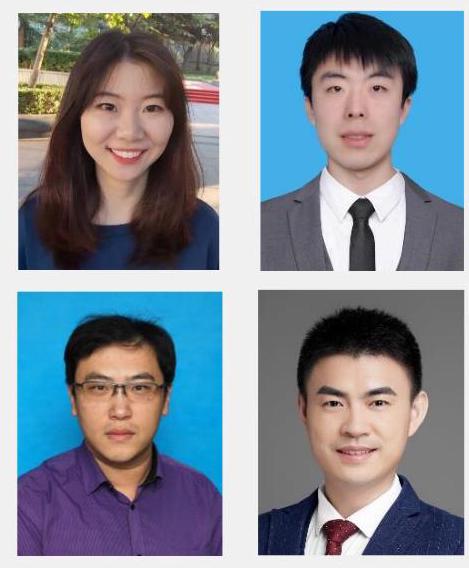
Chang Lian (Top left) received her M.S. in Tianjin Normal University in 2020, then she studied for a Ph.D. at Peking University under the supervision of Prof. Fanyang Mo.
连畅(左上角)于2020年在天津师范大学获得硕士学位,随后在莫凡洋教授的指导下于北京大学攻读博士学位。
Jianning Zhang (Top right) received his B.S. degree in Peking University in 2019 and he studied for a Ph.D. at Peking University under the supervision of Prof. Fanyang Mo.
张建宁(右上角)于2019年在北京大学获得学士学位,并在莫凡洋教授的指导下于北京大学攻读博士学位。
Di Qiu (Bottom left) was born in Tianjin, China, in 1987. He received his B.S. degree from Peking University in 2010. He continued his graduate study in Prof. Jianbo Wang’s laboratory and obtained his Ph.D. in 2015. In the same year, he joined in Tianjin Normal University as an Assistant Professor.
邱迪(左下角)1987年出生于中国天津。他于2010年在北京大学获得学士学位。他继续在王剑波教授的实验室进行研究生学习,并于2015年获得博士学位。同年,他作为助理教授加入天津师范大学。
Fanyang Mo (Bottom right) received his B.Sc. and M.S. degree in Chemistry from Beijing Institute of Technology in 2004 and 2006, respectively. He carried out graduate research under the guidance of Prof. Jianbo Wang at Peking University. He then performed postdoctoral research with Prof. Qinghai Zhang at the Scripps Research Institute from 2010 to 2011, and with Prof. Guangbin Dong at The University of Texas at Austin from 2011 to 2015. He joined Peking University in April 2015.
莫凡洋(右下角)分别于2004年和2006年在北京理工大学获得化学学士和硕士学位。他在北京大学王剑波教授的指导下进行研究生研究。然后,他于2010年至2011年在斯克里普斯研究所与张青海教授进行博士后研究,并于2011年至2015年在德克萨斯大学奥斯汀分校与董广彬教授进行博士后研究。他于2015年4月加入北京大学。
Manuscript received: June 29, 2024
稿件收到日期:2024年6月29日
Manuscript revised: August 16, 2024
稿件修订日期:2024年8月16日
Manuscript accepted: September 4, 2024
稿件接受日期:2024年9月4日
Version of record online: October 17, 2024
网络版记录版本日期:2024年10月17日