A base-free, one-pot diazotization/cross-coupling of anilines with arylboronic acids
英文原文与中文译文逐段对照 · English original with Chinese translation
Fanyang Mo, Di Qiu, Yubo Jiang, Yan Zhang, Jianbo Wang*
莫凡洋,邱迪,蒋宇博,张艳,王建波*
Beijing National Laboratory of Molecular Sciences (BNLMS), and Key Laboratory of Bioorganic Chemistry and Molecular Engineering of Ministry of Education, College of Chemistry, Peking University, Beijing 100871, China
北京分子科学国家实验室(BNLMS),教育部生物有机化学与分子工程重点实验室,北京大学化学与分子工程学院,北京 100871,中国
A R T I C L E I N F O
文章信息
Article history:
文章历史:
Received 14 October 2010
于2010年10月14日收到
Revised 9 November 2010
于2010年11月9日修订
Accepted 19 November 2010
于2010年11月19日接受
Available online 24 November 2010
于2010年11月24日在线发布
Keywords:
关键词:
Pd-catalyzed
钯催化
Suzuki-Miyaura coupling
铃木-宫浦偶联反应
Diazotization
重氮化
Aryl amine
芳胺
A B S T R A C T
摘 要
Pd-catalyzed one-pot diazotization/cross-coupling is realized for the synthesis of biaryls directly from anilines and arylboronic acids.
实现了钯催化的一锅法重氮化/交叉偶联反应,可直接从苯胺和芳基硼酸合成联芳基化合物。
© 2010 Elsevier Ltd. All rights reserved.
© 2010爱思唯尔有限公司。保留所有权利。
Suzuki-Miyaura cross-coupling is a powerful tool for the construction of $\mathrm{C} - \mathrm{C}$ bonds. ${}^{1}$ In general, aryl halides or triflates are used as coupling partners. The search for alternative electrophilic coupling partner continues to attract interests among the synthetic organic community. ${}^{2}$ Arenediazonium salts represent an attractive alternative due to their high reactivity and easy availability from aniline derivatives. ${}^{3 - 7}$ The first utilization of the aryldiazonium salts as electrophiles in palladium-catalyzed Suzuki-Miyaura cross-couplings was achieved independently by Gene ${\mathrm{t}}^{4}$ and Seng-upta. ${}^{5}$ These investigations allow biaryls synthesis with moderate to good yields by coupling of aryldiazonium tetrafluoroborates and arylboronic acids in the presence of catalytic amounts of Pd(OAc) ${}_{2}$ and without adding base and ligands. In 2001, Andrus and Song reported a palladium-imidazolium carbene catalyst system for the cross-coupling of arylboronic acid with aryldiazonium tetrafluoroborates. The reaction could be carried out at low temperature (0 ${}^{ \circ }\mathrm{C}$ or room temperature) and afforded the coupling products with high yields. ${}^{6}$
铃木-宫浦交叉偶联反应是构建$\mathrm{C} - \mathrm{C}$键的有力工具。${}^{1}$ 一般来说,芳基卤化物或三氟甲磺酸酯用作偶联伙伴。寻找替代的亲电偶联伙伴一直吸引着有机合成领域的关注。${}^{2}$ 芳基重氮盐由于其高反应活性以及可从苯胺衍生物轻松制得,是一种有吸引力的替代物。${}^{3 - 7}$ 芳基重氮盐首次作为亲电试剂用于钯催化的铃木-宫浦交叉偶联反应是由吉恩${\mathrm{t}}^{4}$ 和森古普塔分别独立实现的。${}^{5}$ 这些研究表明,在催化量的Pd(OAc)${}_{2}$ 存在下,且不添加碱和配体的情况下,通过芳基四氟硼酸重氮盐与芳基硼酸偶联,可中等至良好产率地合成联芳基化合物。2001年,安德鲁斯和宋报道了一种钯-咪唑鎓卡宾催化剂体系,用于芳基硼酸与芳基四氟硼酸重氮盐的交叉偶联反应。该反应可在低温(0${}^{ \circ }\mathrm{C}$ 或室温)下进行,并以高产率得到偶联产物。${}^{6}$
Although aryldiazonium tetrafluoroborates have been well established as coupling partners in Pd-catalyzed reactions, there are some drawbacks. First, aryldiazonium tetrafluoroborates are generally unstable and only few of them are commercially available. Therefore, they should be newly prepared before use. However, the procedure for the preparation of aryldiazonium tet-rafluoroborates is hazardous and tedious due to the use of fluoro-boric acid and recrystallization in separation process. ${}^{8}$ As a result, the reaction usually gives low yield especially when carried out in a small scale. Consequently, the advantage of easy availability of aniline starting materials may be counteracted by the lack of efficiency and flexibility in the preparation of aryldiazonium tetrafluoroborates.
尽管芳基四氟硼酸重氮盐在钯催化反应中作为偶联伙伴已得到充分确立,但仍存在一些缺点。首先,芳基四氟硼酸重氮盐通常不稳定,只有少数几种可商购获得。因此,使用前需重新制备。然而,由于在分离过程中使用氟硼酸和重结晶,制备芳基四氟硼酸重氮盐的过程既危险又繁琐。${}^{8}$ 结果,该反应通常产率较低,尤其是在小规模进行时。因此,苯胺起始原料易于获得的优势可能会被芳基四氟硼酸重氮盐制备过程中缺乏效率和灵活性所抵消。
We conceived that a one-pot diazotization/cross-coupling would circumvent these setbacks. Such an approach has been pursued first by Fujiwara and coworkers in ${1980}^{ \circ }$ although in their seminal work stoichiometric amount of $\mathrm{{Pd}}{\left( \mathrm{{OAc}}\right) }_{2}$ was required in order to obtain good yields. Almost at the same time, Matsuda and coworkers described the same coupling reaction but using alkyl nitrite as diazotizing agent and catalytic amounts of ${\mathrm{{Pd}}}_{2}{\left( \mathrm{{dba}}\right) }_{3} \cdot {}^{10}$ Andrus and Song have also demonstrated the one-pot diazotization/cross-coupling in their catalytic system with palladium-imidazolium carbene as catalyst. ${}^{6}$ Encouraged by these developments, we wish to report in this Letter an efficient Pd-catalyzed base-free cross-coupling of arylamines and arylboronic acids with tert-butyl nitrite as diazotizating agent. ${}^{11}$ The reaction does not need to use ${\mathrm{{BF}}}_{3} \cdot {\mathrm{{OEt}}}_{2}$ as in the case of Andrus’s system.
我们设想一锅法重氮化/交叉偶联反应可以避免这些挫折。藤原及其同事首先采用了这种方法${1980}^{ \circ }$,尽管在他们的开创性工作中,为了获得良好的产率需要化学计量的$\mathrm{{Pd}}{\left( \mathrm{{OAc}}\right) }_{2}$。几乎与此同时,松田及其同事描述了相同的偶联反应,但使用亚硝酸烷基酯作为重氮化试剂和催化量的${\mathrm{{Pd}}}_{2}{\left( \mathrm{{dba}}\right) }_{3} \cdot {}^{10}$。安德鲁斯和宋也在他们以钯-咪唑鎓卡宾为催化剂的体系中证明了一锅法重氮化/交叉偶联反应。${}^{6}$ 受这些进展的鼓舞,我们希望在本信函中报道一种高效的钯催化的无碱交叉偶联反应,该反应以亚硝酸叔丁酯为重氮化试剂,用于芳胺和芳基硼酸的反应。${}^{11}$ 该反应无需像安德鲁斯的体系那样使用${\mathrm{{BF}}}_{3} \cdot {\mathrm{{OEt}}}_{2}$。
Initial screening of the reaction conditions with aniline 1a, $p$ -tolylboronic acid 2a, and tert-butyl nitrite revealed that the usual Suzuki-Miyaura coupling protocol [DME, Pd(PPh3)4, aqueous ${\mathrm{{Na}}}_{2}{\mathrm{{CO}}}_{3}$ ] failed to afford any desired product. After some experimentations, it was concluded that the desired cross-coupling product 3a could be obtained in 36% GC-MS yield under a condition with $5\mathrm{\;{mol}}\% \mathrm{{Pd}}{\left( {\mathrm{{PPh}}}_{3}\right) }_{4}$ in ${\mathrm{{CH}}}_{3}\mathrm{{CN}}$ at ${90}^{ \circ }\mathrm{C}$ (Table 1, entry 1). Encouraged by this initial result, we further proceeded to optimize the reaction conditions. First, different solvents were examined and it was concluded that DMF afforded the best yield of 64% (entries 2-5). Control experiment indicated that without palladium catalyst, the reaction failed to give any coupling product (entry 6). Besides, the reaction could not be improved by adding a base (entry 7). Next, we examined other palladium catalysts; however, the reaction could not be improved (entries 8-10). The reaction became sluggish when the temperature decreased from 90 to ${70}^{ \circ }\mathrm{C}$ . To our delight, it was noted that the reaction could be significantly improved when catalyzed by a combination of ${\mathrm{{Pd}}}_{2}{\mathrm{{dba}}}_{3}\left( {{2.5}\mathrm{\;{mol}}\% }\right)$ and P(2-furyl) ${}_{3}$ (15 mol %) (entry 13). Finally, adding 1 equiv of acetic acid was found to further improve the reaction (entry 14). The positive effect of acetic acid in one-pot diazotization-coupling reaction has also been observed by Matsuda ${}^{10}$ and Beller. ${}^{12}$ We reasoned that acetic acid not only accelerated the diazotization process but also influenced the transmetallation step by anion exchange with ${}^{t}{\mathrm{{BuO}}}^{ - }$ .
使用苯胺1a、$p$ -甲苯硼酸2a和亚硝酸叔丁酯对反应条件进行初步筛选,结果表明,常规的铃木-宫浦偶联方案[DME、Pd(PPh3)4、含水${\mathrm{{Na}}}_{2}{\mathrm{{CO}}}_{3}$ ]未能得到任何所需产物。经过一些实验,得出结论:在$5\mathrm{\;{mol}}\% \mathrm{{Pd}}{\left( {\mathrm{{PPh}}}_{3}\right) }_{4}$ 存在于${\mathrm{{CH}}}_{3}\mathrm{{CN}}$ 中、温度为${90}^{ \circ }\mathrm{C}$ 的条件下,所需的交叉偶联产物3a的GC-MS产率可达36%(表1,条目1)。受这一初步结果的鼓舞,我们进一步着手优化反应条件。首先,考察了不同的溶剂,得出结论:DMF的产率最高,为64%(条目2-5)。对照实验表明,没有钯催化剂时,反应无法得到任何偶联产物(条目6)。此外,添加碱并不能改善反应(条目7)。接下来,我们考察了其他钯催化剂;然而,反应并没有得到改善(条目8-10)。当温度从90℃降至${70}^{ \circ }\mathrm{C}$ 时,反应变得迟缓。令我们高兴的是,注意到当由${\mathrm{{Pd}}}_{2}{\mathrm{{dba}}}_{3}\left( {{2.5}\mathrm{\;{mol}}\% }\right)$ 和P(2-呋喃基) ${}_{3}$(15 mol%)组合催化时,反应可以得到显著改善(条目13)。最后,发现添加1当量的乙酸可以进一步改善反应(条目14)。松田${}^{10}$ 和贝勒也观察到了乙酸在一锅法重氮化-偶联反应中的积极作用。${}^{12}$ 我们推断,乙酸不仅加速了重氮化过程,还通过与${}^{t}{\mathrm{{BuO}}}^{ - }$ 进行阴离子交换影响了转金属化步骤。
Corresponding author.
通讯作者。
(J. Wang).
(王jb)。
Table 1
表1
Pd-catalyzed cross-coupling of aniline 1a and $p$ -tolylboronic acid 2a ${}^{a}$
钯催化的苯胺1a与$p$ -甲苯硼酸2a的交叉偶联反应${}^{a}$

| Entry | Cat. (mol %) | Solvent (mol %) | Additive | Temp (°C) | Yieldb (3a, %) |
| 1 | Pd(PP ${\text{ h }}_{3}{\text{ ) }}_{4}$ (5) | MeCN | - | 90 | 36 |
| 2 | Pd(PP ${\text{ h }}_{3}{\text{ ) }}_{4}$ (5) | DCE | - | 90 | 8 |
| 3 | $\mathrm{{Pd}}{\left( {\mathrm{{PPh}}}_{3}\right) }_{4}\left( 5\right)$ | Toluene | - | 90 | 17 |
| 4 | Pd ${\left( {\mathrm{{PPh}}}_{3}\right) }_{4}\left( 5\right)$ | DMSO | - | 90 | 52 |
| 5 | Pd ${\left( {\mathrm{{PPh}}}_{3}\right) }_{4}\left( 5\right)$ | DMF | - | 90 | 64 |
| 6 | - | MeCN | - | 90 | 0 |
| 7 | Pd(PP ${\mathrm{h}}_{3}{)}_{4}\left( 5\right)$ | DMF | ${\mathrm{K}}_{2}{\mathrm{{CO}}}_{3}$ (200) | 90 | 8 |
| 8 | ${\mathrm{{PdCl}}}_{2}{\left( {\mathrm{{PPh}}}_{3}\right) }_{2}\left( 5\right)$ | DMF | - | 90 | 12 |
| 9 | $\mathrm{{Pd}}{\left( {\mathrm{P}}^{t}\mathrm{{Bu}}\right) }_{3}\left( 5\right)$ | DMF | - | 90 | 32 |
| 10 | Pd(OAc)2(5) | DMF | - | 90 | 17 |
| 11 | Pd(PP ${\mathrm{h}}_{3}{)}_{4}\left( 5\right)$ | DMF | - | 90 | 49 |
| 12 | Pd(PP ${\mathrm{h}}_{3}{)}_{4}\left( 5\right)$ | DMF | AcOH (100) | 90 | 70 |
| 13 | ${\mathrm{{Pd}}}_{2}{\mathrm{{dba}}}_{3}\left( {2.5}\right) /\mathrm{P}{\left( 2\text{ -furyl }\right) }_{3}\left( {15}\right)$ | DMF | - | 90 | 74 |
| 14 | ${\mathrm{{Pd}}}_{2}{\mathrm{{dba}}}_{3}\left( {2.5}\right) \mathrm{P}{\left( 2\text{ -furyl }\right) }_{3}\left( {15}\right)$ | DMF | AcOH (100) | 90 | 91 |
a Reaction conditions: aniline 1a (0.5 mmol); 1a:2a: ${}^{6}\mathrm{{BuONO}} = 1 : {1.3} : {1.2}$ ; solvent $2\mathrm{\;{mL}}$ , under ${\mathrm{N}}_{2}$ .
a反应条件:苯胺1a(0.5 mmol);1a:2a: ${}^{6}\mathrm{{BuONO}} = 1 : {1.3} : {1.2}$ ;溶剂$2\mathrm{\;{mL}}$ ,在${\mathrm{N}}_{2}$ 条件下。
${}^{b}$ GC-MS yield using mesitylene as internal standard.
${}^{b}$ 以均三甲苯为内标物的GC-MS产率。
Table 2
表2
The scope of the one-pot diazotization-coupling reaction ${}^{a}$
一锅法重氮化-偶联反应的范围${}^{a}$
| Entry | Arylamines 1a-n | Products 3a′-n | Yield ${}^{b}\left( \% \right)$ |
| 1 2 3 4 5 6 |       1f |       3f | 81 77 73 52 75 56 |
(continued on next page)
(续下页)
Table 2 (continued)
表2(续)
| Entry | Arylamines 1a-n | Products 3a’-n | Yield ${}^{b}$ (%) |
| 7 |  |  | 56 |
| 8 |  1h |  3h | 56 |
| 9 |  |  | 48 |
| 10 |  |  | 70 |
| 11 |  1k |  3k | 50 |
| 12 |  11 |  31 | 63 |
| 13 |  1m |  | 52 |
| 14 |  1n |  | 50 |
a Reaction were carried out in $1\mathrm{{mmol}}$ scale, DMF $4\mathrm{\;{mL}}$ under ${\mathrm{N}}_{2}$ atmosphere.
a反应以$1\mathrm{{mmol}}$ 规模进行,在DMF$4\mathrm{\;{mL}}$ 中,在${\mathrm{N}}_{2}$ 气氛下。
${}^{b}$ Isolated yield.
${}^{b}$ 分离产率。
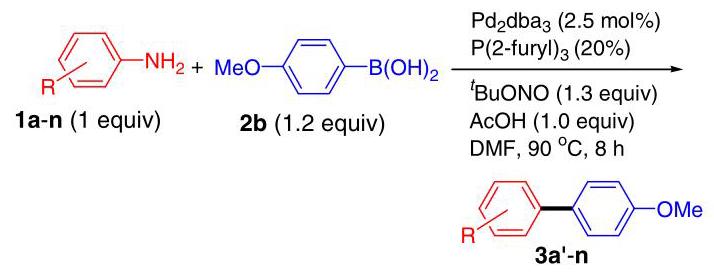
With ${\mathrm{{Pd}}}_{2}{\mathrm{{dba}}}_{3}/\mathrm{P}{\left( 2\text{ -furyl }\right) }_{3}$ catalytic system, the scope of the one-pot diazotization/coupling reaction was examined by a series of arylamines 1a-n and 4-methoxyphenylboronic acid $2{\mathbf{b}}^{13}$ The results are summarized in Table 2. For a wide range of arylamines, the reaction afforded the biaryl products $3{a}^{\prime } - n$ in moderate to good yields. Substrates with weak electronic effect generally gave good yields, as shown by methyl and halide substituted arylamines (entries 1-5). However, it was noted that the steric hindrance significantly diminished the yield (entry 4). It is also worthy to note that the reaction tolerates a wide range of subtituents, wheather it is of electron withdrawing or electron donating.
使用${\mathrm{{Pd}}}_{2}{\mathrm{{dba}}}_{3}/\mathrm{P}{\left( 2\text{ -furyl }\right) }_{3}$ 催化体系,通过一系列芳胺1a-n和4-甲氧基苯硼酸$2{\mathbf{b}}^{13}$ 考察了一锅法重氮化/偶联反应的范围。结果总结在表2中。对于多种芳胺,反应以中等至良好的产率得到联芳基产物$3{a}^{\prime } - n$ 。具有弱电子效应的底物通常产率良好,如甲基和卤代芳胺所示(条目1-5)。然而,注意到空间位阻显著降低了产率(条目4)。还值得注意的是,该反应耐受广泛的取代基,无论是吸电子的还是供电子的。
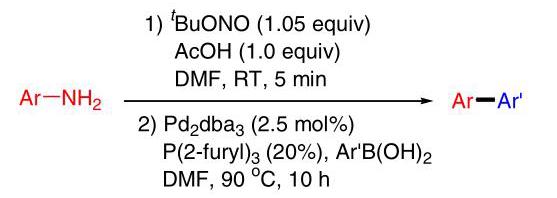
The yields of this one-pot diazotization/coupling reaction were moderate to good and the main byproduct is homo coupling of arylboronic acids. Control experiment showed that tert-butyl nitrite could function as an oxidant in homo coupling of arylboronic acid catalyzed by $\mathrm{{Pd}}\left( 0\right)$ . The advantage of this one-pot reaction lies in its operational simplicity and convenience. It is important to note that the aryldiazonium salts are formed very quickly for some substrates, such as ethyl $p$ -aminobenzoate. For this type of substrates, we have applied an alternative procedure in which the diazotization is carried out first and the cross-coupling with boronic acid is then performed upon the completion of the diazotization, namely a one-pot, two-step process. This procedure was then applied to the coupling of arylboronic acids with arylamines (Table 3). In a typical experiment, arylamine and tert-butyl nitrite were first mixed with a ratio of 1:1.05 and set to react at room temperature. The diazotization was complete within $5\mathrm{\;{min}}$ as monitored by TLC analysis. Then $\operatorname{Pd}\left( 0\right)$ catalyst, $\mathrm{P}{\left( \text{ furyl }\right) }_{3}$ , and boronic acid were added and the reaction was carried out at ${90}{}^{ \circ }\mathrm{C}$ . For a wide range of arylboronic acids, the reaction afforded products 30-z in moderate yields.
此一锅法重氮化/偶联反应的产率为中等至良好,主要副产物是芳基硼酸的自身偶联。对照实验表明,亚硝酸叔丁酯在由$\mathrm{{Pd}}\left( 0\right)$催化的芳基硼酸自身偶联反应中可作为氧化剂。此一锅法反应的优点在于其操作简单方便。需要注意的是,对于某些底物,如乙基$p$-氨基苯甲酸酯,芳基重氮盐形成得非常快。对于这类底物,我们采用了一种替代方法,即先进行重氮化,重氮化完成后再与硼酸进行交叉偶联,即一锅两步法。然后将此方法应用于芳基硼酸与芳胺的偶联反应(表3)。在典型实验中,首先将芳胺与亚硝酸叔丁酯按1:1.05的比例混合,并在室温下反应。通过TLC分析监测,重氮化在$5\mathrm{\;{min}}$内完成。然后加入$\operatorname{Pd}\left( 0\right)$催化剂、$\mathrm{P}{\left( \text{ furyl }\right) }_{3}$和硼酸,并在${90}{}^{ \circ }\mathrm{C}$下进行反应。对于多种芳基硼酸,该反应以中等产率得到产物30-z。
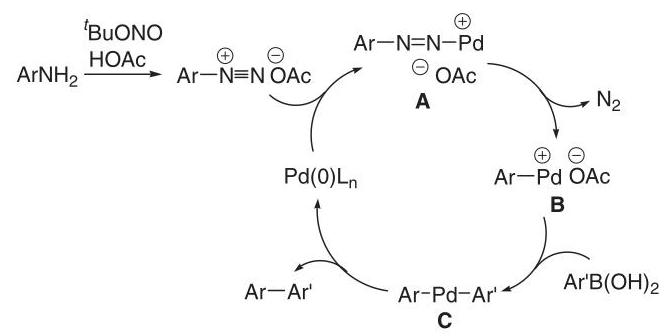
The mechanism of this diazotization-coupling is proposed to be the standard oxidative addition-reductive elimination mechanism of Pd-catalyzed cross-coupling (Scheme 1). The first-step is diazotization of arylamine to form corresponding aryldiazonium salt. It is known that aryldiazonium salt cations can coordinate transition metals to give species like $\mathbf{A}$ , in which the metal has increased its oxidation number by two units. ${}^{15}$ Alternatively, this process could also be considered as an oxidative addition of $\mathrm{{Pd}}\left( 0\right) {\mathrm{L}}_{n}$ with aryldi-azonium salt to afford Pd(II) intermediate. Extrusion of dinitrogen from intermediate $\mathbf{A}$ leads to the formation of complex $\mathbf{B}$ , from which transmetallation to form C. Reductive elimination is followed to afford the final biaryl product.
此重氮化-偶联反应的机理被认为是钯催化交叉偶联的标准氧化加成-还原消除机理(方案1)。第一步是芳胺的重氮化以形成相应的芳基重氮盐。已知芳基重氮盐阳离子可与过渡金属配位形成如$\mathbf{A}$的物种,其中金属的氧化数增加了两个单位。${}^{15}$或者,此过程也可被视为$\mathrm{{Pd}}\left( 0\right) {\mathrm{L}}_{n}$与芳基重氮盐的氧化加成以得到钯(II)中间体。从中间体$\mathbf{A}$中挤出氮气导致形成配合物$\mathbf{B}$,由此进行金属转移以形成C。接着进行还原消除以得到最终的联芳基产物。
Table 3
表3
Cross-coupling of arylamines with arylboronic acids by one-pot, two-step process ${}^{14}$
芳胺与芳基硼酸通过一锅两步法进行交叉偶联${}^{14}$
| Entry | Arylamine 1 | Boronic acid 2 | Yield ${}^{a}$ (3,%) |
| 1 |  |  2c | 30, 50 |
| 2 |  1n |  | 3p, 52 |
| 3 |  1n   1n  1n  1b  10  1m   1j  1k |  B(OH) | 3q, 51 |
| 4 |  B(OH)2 | 3r, 50 | |
| 2f | |||
| 5 |  | 3s, 54 | |
| 6 |  2h | 3t, 58 | |
| 7 |  2g | 3u, 55 | |
| 8 | B(OH)2 2h | 3v, 53 | |
| 9 |  2i | 3w, 45 | |
| 10 |  2g | 3x, 31 | |
| 11 |  2d | 3y, 48 | |
| 12 |  2i | $3\mathbf{z},{65}$ |
a Isolated yield.
a分离产率。
Scheme 1. Possible reaction mechanism.
方案1.可能的反应机理。
In conclusion, we have developed a convenient Pd-catalyzed one-pot diazotization/cross-coupling of arylamines and arylbo-ronic acids. Since arylamines are abundant and easily available, this transformation provides an efficient and economic approach for the preparation of biaryl products.
总之,我们开发了一种便捷的钯催化芳胺与芳基硼酸的一锅法重氮化/交叉偶联反应。由于芳胺丰富且易于获得,这种转化为联芳基产物的制备提供了一种高效且经济的方法。
Acknowledgments
致谢
The project is generously supported by Natural Science Foundation of China (Grant Nos. 20902005, 20832002, 20772003, 20821062), the Ministry of Education of China, and National Basic Research Program of China (973 Program, No. 2009CB825300).
本项目得到了中国国家自然科学基金(批准号:20902005、20832002、20772003、20821062)、中国教育部以及中国国家基础研究计划(973计划,编号:2009CB825300)的慷慨资助。
Supplementary data
补充数据
Supplementary data associated with this article can be found, in the online version, at doi:10.1016/j.tetlet.2010.11.099.
与本文相关的补充数据可在网络版中通过doi:10.1016/j.tetlet.2010.11.099获取。
References and notes
参考文献和注释
For selected reviews, see: (a) Suzuki, A. Acc. Chem. Res. 1982, 15, 178; (b) Miyaura, N.; Suzuki, A. Chem. Rev. 1995, 95, 2457; (c) Miyaura, N. J. Organomet. Chem. 2002, 653, 54; (d) Miyaura, N. Bull. Chem. Soc. Jpn. 2008, 81, 1535.
(a) Littke, A. F.; Fu, G. C. Angew. Chem., Int. Ed. 2002, 41, 4176; (b) Zapf, A. Angew. Chem., Int. Ed. 2003, 42, 5394.
Roglans, A.; Pla-Quintana, A.; Moreno-Manas, M. Chem. Rev. 2006, 106, 4622.
(a) Darses, S.; Jeffery, T.; Genet, J. P.; Brayer, J. L.; Demoute, J. P. Tetrahedron Lett. 1996, 37, 3857; (b) Darses, S.; Jeffery, T.; Brayer, J. L.; Demoute, J. P.; Genet, J. P. Bull. Soc. Chim. Fr. 1996, 133, 1095.
(a) Sengupta, S.; Bhattacharyya, S. J. Org. Chem. 1997, 62, 3405; (b) Sengupta, S.; Sadhukhan, S. K. Tetrahedron Lett. 1998, 39, 715.
Andrus, M. B.; Song, C. Org. Lett. 2001, 3, 3761.
For selected recent examples of using arenediazonium salts in Pd-catalyzed cross-coupling reactions, see: (a) Nan, G.; Ren, F.; Luo, M. Beilstein J. Org. Chem. 2010, 6, 70. doi:10.3762/bjoc.6.70; (b) Bonin, H.; Delbrayelle, D.; Demonchaux, P.; Gras, E. Chem. Commun. 2010, 46, 2677; (c) Coy, B. E. D.; Jovanovic, L.; Sefkow, M. Org. Lett. 2010, 12, 1976; (d) Fabrizi, G.; Goggiamani, A.; Sferrazza, A.; Cacchi, S. Angew. Chem., Int. Ed. 2010, 49, 4067; (e) Felpin, F.-X.; Ibarguren, O.; Nassar-Hardy, L.; Fouquet, E. J. Org. Chem. 2009, 74, 1349; (f) Ahmed-Omer, B.; Barrow, D. A.; Wirth, T. Tetrahedron Lett. 2009, 50, 3352; (g) Felpin, F.-X.; Coste, J.; Zakri, C.; Fouquet, E. Chem. Eur. J. 2009, 15, 7238; (h) Moro, A. V.; Cardoso, F. S. P.; Correia, C. R. D. Org. Lett. 2009, 11, 3642; (i) Schmidt, B.; Hoelter, F. Chem. Eur. J. 2009, 15, 11948; (j) Cacchi, S.; Fabrizi, G.; Goggiamani, A.; Sferrazza, A. Synlett 2009, 1277; (k) Felpin, F.-X.; Fouquet, E.; Zakri, C. Adv. Synth. Catal. 2009, 351, 649; (1) Kuethe, J. T.; Childers, K. G. Adv. Synth. Catal. 2008, 350, 1577; (m) Liu, C.-Y.; Andrey, G.; Knochel, P. Chem. Asian J. 2007, 2, 1020; (n) Dai, M.; Liang, B.; Wang, C.; Chen, J.; Yang, Z. Org. Lett. 2004, 6, 221.
(a)Vogel’s Textbook of Practical Organic Chemistry; S Furniss, B., Hannaford, A. J., Smith, P. W. G., Tatchell, A. R., Eds., 5th ed.; Longman: Singapore, 1989; (b) Balz, G.; Schiemann, G. Ber. 1927, 60, 1186; (c) Dunker, M. F. W.; tarkey, E. B.; Jenkins, G. L. J. Am. Chem. Soc. 1936, 58, 2308; (d) Roe, A. Org. React. 1949, 5, 193; (e) Doyle, M. P.; Byker, W. J. J. Org. Chem. 1979, 44, 1572.
Akiyama, F.; Miyazaki, H.; Kaneda, K.; Teranishi, S.; Fujiwara, Y.; Abe, M.; Taniguchi, H. J. Org. Chem. 1980, 45, 2359.
(a) Kikukawa, K.; Maemura, K.; Nagira, K.; Wada, F.; Matsuda, T. Chem. Lett. 1980, 551; (b) Kikukawa, K.; Maemura, K.; Kiseki, Y.; Wada, F.; Matsuda, T.; Giam, C. S. J. Org. Chem. 1981, 46, 4885.
(a) Doyle, M. P.; Siegfried, B.; Dellaria, J. F., Jr. J. Org. Chem. 1977, 42, 2426; (b) Doyle, M. P.; Dellaria, . J. F., Jr; Siegfried, B.; Bishop, S. W. J. Org. Chem. 1977, 42, 3494.
Beller, M.; Fischer, H.; Kühlein, K. Tetrahedron Lett. 1994, 35, 8773.
General procedure. ${\mathrm{{Pd}}}_{2}{\mathrm{{dba}}}_{3}\left( {{23}\mathrm{{mg}},{2.5}\mathrm{{mol}}\% }\right) ,\mathrm{P}{\left( 2\text{ -furyl }\right) }_{3}\left( {{46}\mathrm{{mg}},{20}\mathrm{{mol}}\% }\right)$ , 4-methoxybenzeneboronic acid $2\mathbf{b}$ (182 mg,1.2 equiv), and $p$ -toluidine $1\mathbf{b}$ (107 mg, 1 mmol) were weighed in a ${25}\mathrm{\;{mL}}$ Schlenk round bottle flask under nitrogen atmosphere. The system was degassed four times by oil pump. DMF (4 mL), ‘BuONO (134 mg, 1.3 equiv), and HOAc (60 mg, 1.0 equiv) were then added in succession by syringe. The resulting reaction mixture was allowed to stir at ${90}{}^{ \circ }\mathrm{C}$ for $8\mathrm{\;h}$ . The solution was then concentrated under reduced pressure and the crude residue was purified by flash column chromatography with petroleum ether to give 4-methoxy-4’-methylbiphenyl 3b (152 mg, 77%).
General procedure. ${\mathrm{{Pd}}}_{2}{\mathrm{{dba}}}_{3}\left( {{23}\mathrm{{mg}},{2.5}\mathrm{\;{mol}}\% }\right) ,\mathrm{P}{\left( 2\text{ -furyl }\right) }_{3}\left( {{46}\mathrm{{mg}},{20}\mathrm{\;{mol}}\% }\right)$ , and benzeneboronic acid 2c (146mg,1.2 equiv) were weighed in a ${25}\mathrm{\;{mL}}$Schlenk round bottle flask under nitrogen atmosphere. The system was degassed four times by oil pump. Ethyl 4-aminobenzoate $1\mathrm{\;n}$ (165 mg, 1 mmol) was weighed in another ${25}\mathrm{\;{mL}}$ Schlenk round bottle flask under nitrogen atmosphere. DMF (2 mL), ${}^{t}$ BuONO (108 mg,1.05 equiv), and HOAc (60mg, 1.0 equiv) were added in succession by syringe and this reaction mixture was stirred for $5\mathrm{\;{min}}$ . Then the solution containing the newly generated diazonium salt was transferred to the above Schlenk round bottle by syringe. In the course of this transfer, another 2 mL DMF was added to the reaction system. The resulting reaction solution was stirred at ${90}^{ \circ }\mathrm{C}$ for ${10}\mathrm{\;h}$ . The solution was then concentrated under reduced pressure and the crude residue was purified by flash column chromatography (petroleum ether/EtOAc = 30:1) to afford the product ethyl biphenyl-4-carboxylate 3o (113 mg, 50%).
在氮气氛围下的Schlenk圆底烧瓶。该体系用油泵抽真空脱气四次。在氮气氛围下,将4-氨基苯甲酸乙酯$1\mathrm{\;n}$(165毫克,1毫摩尔)称入另一个${25}\mathrm{\;{mL}}$Schlenk圆底烧瓶中。通过注射器依次加入N, N-二甲基甲酰胺(2毫升)、${}^{t}$亚硝酸叔丁酯(108毫克,1.05当量)和乙酸(60毫克,1.0当量),并将该反应混合物搅拌$5\mathrm{\;{min}}$。然后通过注射器将含有新生成重氮盐的溶液转移到上述Schlenk圆底烧瓶中。在转移过程中,向反应体系中加入另外2毫升N, N-二甲基甲酰胺。将所得反应溶液在${90}^{ \circ }\mathrm{C}$搅拌${10}\mathrm{\;h}$。然后将溶液减压浓缩,粗残余物通过快速柱色谱法(石油醚/乙酸乙酯 = 30:1)纯化,得到产物联苯-4-羧酸乙酯3o(113毫克,50%)。
(a) Sutton, D. Chem. Rev. 1993, 93, 995; (b) King, R. B. J. Organomet. Chem. 1995, 500, 187.
(a) 萨顿,D. 《化学评论》1993年,第93卷,第995页;(b) 金,R. B. 《有机金属化学杂志》1995年,第500卷,第187页。