Visible-Light Induced Transition-Metal Free Redox-Neutral Carboxylation of Remote C(sp3)-H bonds via 1,5-Hydrogen Atom Transfer
英文原文与中文译文逐段对照 · English original with Chinese translation
Wenke Li, Beiqi Sun, Lei Zhang, and Fanyang Mo*
李文珂,孙北奇,张雷,莫凡洋*
Cite This: J. Org. Chem. 2024, 89, 521-526
引用本文:《有机化学杂志》2024年,第89卷,第521 - 526页
Metrics & More
指标与更多
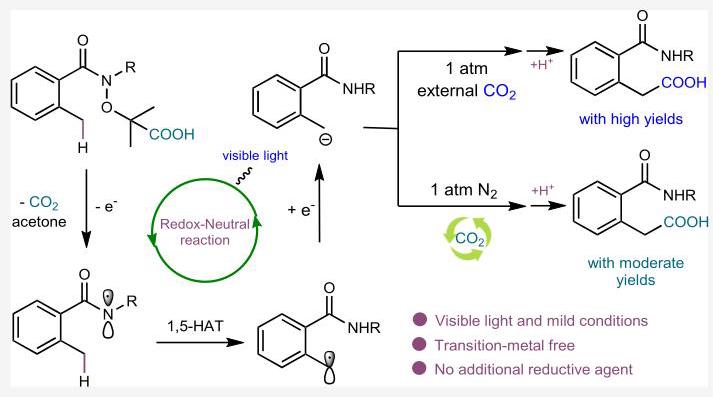
ABSTRACT: The direct carboxylation of the benzylic $\mathrm{C} - \mathrm{H}$ bonds under mild conditions is of great importance and is quite challenging. Herein, we report an approach for the carboxylation of remote benzylic $\mathrm{C}\left( {\mathrm{{sp}}}^{3}\right) - \mathrm{H}$ bonds by integrating the redox-neutral visible-light photoredox catalysis and the nitrogen-centered 1,5- hydrogen atom transfer. The chemical transformation progresses via consecutive single electron transfer, 1,5-hydrogen atom transfer, formation of benzylic carbanion, and nucleophilic attack on the ${\mathrm{{CO}}}_{2}$ steps, thereby enabling access to the desired carboxylation products with moderate to high yields. We also endeavor to recover the ${\mathrm{{CO}}}_{2}$ groups generated in situ intramolecularly to achieve carboxylation under a nitrogen atmosphere, resulting in moderate yields of corresponding carboxylation.
摘要:在温和条件下苄基$\mathrm{C} - \mathrm{H}$键的直接羧基化反应具有重要意义且极具挑战性。在此,我们报道了一种通过氧化还原中性可见光光氧化还原催化与氮中心1,5-氢原子转移相结合的方法,用于远程苄基$\mathrm{C}\left( {\mathrm{{sp}}}^{3}\right) - \mathrm{H}$键的羧基化反应。该化学转化过程通过连续的单电子转移、1,5-氢原子转移、苄基碳负离子的形成以及对${\mathrm{{CO}}}_{2}$的亲核进攻步骤进行,从而能够以中等到高的产率获得所需的羧基化产物。我们还努力在分子内原位回收${\mathrm{{CO}}}_{2}$基团,以在氮气气氛下实现羧基化反应,得到相应羧基化反应的中等产率。
I INTRODUCTION
I 引言
Approaches that enable efficient and selective functionalization of $\mathrm{C}\left( {\mathrm{{sp}}}^{3}\right) - \mathrm{H}$ bonds are of significant interest, given the ubiquitous presence of these linkages within organic compounds. ${}^{1,2}$ However, the ubiquity of $\mathrm{C}\left( {\mathrm{{sp}}}^{3}\right) - \mathrm{H}$ bonds also poses a significant challenge in terms of selectivity due to their energetic and spatial similarity. ${}^{3}$ Recently, the strategy involving hydrogen-atom transfer (HAT) mediated by radicals has surfaced as a compelling alternative to the conventional approach of transition-metal catalysis. ${}^{3}$ The 1,5-hydrogen atom transfer (1,5-HAT) serves as a complementary tool for site-selective modification of $\mathrm{C}\left( {\mathrm{{sp}}}^{3}\right) - \mathrm{H}$ bonds at distal positions to functional groups. ${}^{4 - 6}$ Enolate chemistry and transition-metal-mediated reactivity offer facile functionaliza-tion of $\alpha$ - and $\beta$ -positions of directing groups. ${}^{7}$ In contrast, achieving selective functionalization of $\mathrm{C}\left( {\mathrm{{sp}}}^{3}\right) - \mathrm{H}$ at distal $\gamma$ - and $\delta$ -positions presents greater challenges (Figure 1a). ${}^{8 - {11}}\mathrm{\;A}$ feasible solution to this issue can be achieved by generating nitrogen radicals through the departure of specific groups, followed by 1,5-HAT and subsequent functionalization of the translocated carbon-centered radicals. ${}^{12}$
鉴于这些键在有机化合物中普遍存在,能够实现对$\mathrm{C}\left( {\mathrm{{sp}}}^{3}\right) - \mathrm{H}$键进行高效且选择性官能团化的方法备受关注。${}^{1,2}$然而,由于$\mathrm{C}\left( {\mathrm{{sp}}}^{3}\right) - \mathrm{H}$键在能量和空间上的相似性,其普遍性在选择性方面也带来了重大挑战。${}^{3}$最近,涉及自由基介导的氢原子转移(HAT)策略已成为传统过渡金属催化方法的一种有吸引力的替代方案。${}^{3}$1,5-氢原子转移(1,5-HAT)作为一种用于对官能团远端位置的$\mathrm{C}\left( {\mathrm{{sp}}}^{3}\right) - \mathrm{H}$键进行位点选择性修饰的补充工具。${}^{4 - 6}$烯醇盐化学和过渡金属介导的反应性为导向基团的$\alpha$和$\beta$位置提供了便捷的官能团化方法。${}^{7}$相比之下,在远端$\gamma$和$\delta$位置实现$\mathrm{C}\left( {\mathrm{{sp}}}^{3}\right) - \mathrm{H}$的选择性官能团化面临更大挑战(图1a)。${}^{8 - {11}}\mathrm{\;A}$通过特定基团离去产生氮自由基,随后进行1,5-HAT以及对迁移后的碳中心自由基进行后续官能团化,可以找到解决这个问题的可行方案。${}^{12}$
The initial application of the nitrogen-centered radical 1,5- HAT reaction can be traced back to the Hofmann-Löffler-Freytag (HLF) reaction in the 19th century. ${}^{{13},{14}}$ In this reaction, this reactivity, which constitutes a crucial step, arises from the fact that the bond-dissociation energy (BDE) of the N-H bond is higher than that of the $\mathrm{C} - \mathrm{H}$ bond. However, the harsh conditions have limited its wider applicability in the domain of organic synthesis processes. More recently, the renaissance of photochemistry has led to numerous efforts being devoted to visible-light photoredox catalysis. By integrating photocatalysis with the nitrogen-centered radical 1,5-HAT reaction, not only can remote $\mathrm{C}\left( {\mathrm{{sp}}}^{3}\right) - \mathrm{H}$ bonds be selectively functionalized under mild conditions ${}^{6,{15} - {18}}$ but also the coupling of $\mathrm{C} - \mathrm{C}$ and $\mathrm{C} - \mathrm{Y}$ bonds ${\left( \mathrm{Y} = \mathrm{O},\mathrm{N},\mathrm{X},\mathrm{{Si}},\mathrm{B},\text{ etc. }\right) }^{2,{19} - {25}}$ can be facilitated.
以氮为中心的自由基1,5-HAT反应的最初应用可以追溯到19世纪的霍夫曼-勒夫勒-弗赖塔格(HLF)反应。${}^{{13},{14}}$在该反应中,这一构成关键步骤的反应活性源于N-H键的键解离能(BDE)高于$\mathrm{C} - \mathrm{H}$键的键解离能。然而,苛刻的条件限制了其在有机合成过程领域的更广泛应用。最近,光化学的复兴促使人们致力于可见光光氧化还原催化。通过将光催化与以氮为中心的自由基1,5-HAT反应相结合,不仅可以在温和条件下对远端$\mathrm{C}\left( {\mathrm{{sp}}}^{3}\right) - \mathrm{H}$键进行选择性官能团化${}^{6,{15} - {18}}$,而且还可以促进$\mathrm{C} - \mathrm{C}$和$\mathrm{C} - \mathrm{Y}$键的偶联${\left( \mathrm{Y} = \mathrm{O},\mathrm{N},\mathrm{X},\mathrm{{Si}},\mathrm{B},\text{ etc. }\right) }^{2,{19} - {25}}$。
Carbon dioxide $\left( {\mathrm{{CO}}}_{2}\right)$ presents an ideal but challenging renewable single carbon (C1) synthetic block for organic synthesis. ${}^{{15},{26} - {30}}$ Due to the inherent electrophilicity of ${\mathrm{{CO}}}_{2}$ , researchers have successfully achieved carboxylation reactions of $\mathrm{C}\left( \mathrm{{sp}}\right) - \mathrm{H}$ and $\mathrm{C}\left( {\mathrm{{sp}}}^{2}\right) - \mathrm{H}$ bonds in the presence of appropriate bases. ${}^{{15},{26},{27},{31} - {35}}$ However, direct carboxylation of an unactivated $\mathrm{C}\left( {\mathrm{{sp}}}^{3}\right) - \mathrm{H}$ bond with ${\mathrm{{CO}}}_{2}$ has rarely been reported. The relatively high stability of the benzylic carbon radical and its smooth reduction to carbanion enable an efficient attack on ${\mathrm{{CO}}}_{2}$ for achieving carboxylation reactions; many researchers have focused their attention on the carboxylation of benzylic $\mathrm{C}\left( {\mathrm{{sp}}}^{3}\right) -$ H bonds. ${}^{{36},{37}}$ In 2015, Murakami’s group reported the direct carboxylation reactions of the benzylic $\mathrm{C}\left( {\mathrm{{sp}}}^{3}\right) - \mathrm{H}$ bond excited by ultraviolet light. ${}^{38}$ In 2019, König’s group reported the first visible-light-mediated direct carboxylation of the benzylic $\mathrm{C}\left( {\mathrm{{sp}}}^{3}\right) - \mathrm{H}$ bond, which introduced an approach for the direct carboxylation of benzyl $\mathrm{C}\left( {\mathrm{{sp}}}^{3}\right) - \mathrm{H}$ bonds. ${}^{35}$ In 2020, Yu’s group presented a facile approach for remote $\mathrm{C}\left( {\mathrm{{sp}}}^{3}\right) - \mathrm{H}$ bond carboxylation through a 1,5-HAT strategy, furnishing an array of non-natural $\alpha$ -amino acids. ${}^{39}$
二氧化碳$\left( {\mathrm{{CO}}}_{2}\right)$是有机合成中一种理想但具有挑战性的可再生单碳(C1)合成砌块。${}^{{15},{26} - {30}}$由于${\mathrm{{CO}}}_{2}$固有的亲电性,研究人员在适当碱的存在下成功实现了$\mathrm{C}\left( \mathrm{{sp}}\right) - \mathrm{H}$键和$\mathrm{C}\left( {\mathrm{{sp}}}^{2}\right) - \mathrm{H}$键的羧化反应。${}^{{15},{26},{27},{31} - {35}}$然而,未活化的$\mathrm{C}\left( {\mathrm{{sp}}}^{3}\right) - \mathrm{H}$键与${\mathrm{{CO}}}_{2}$的直接羧化反应鲜有报道。苄基碳自由基相对较高的稳定性及其向碳负离子的顺利还原使得能够有效地进攻${\mathrm{{CO}}}_{2}$以实现羧化反应;许多研究人员将注意力集中在苄基$\mathrm{C}\left( {\mathrm{{sp}}}^{3}\right) -$H键的羧化反应上。${}^{{36},{37}}$2015年,村上小组报道了紫外光激发的苄基$\mathrm{C}\left( {\mathrm{{sp}}}^{3}\right) - \mathrm{H}$键的直接羧化反应。${}^{38}$2019年,柯尼格小组报道了首例可见光介导的苄基$\mathrm{C}\left( {\mathrm{{sp}}}^{3}\right) - \mathrm{H}$键的直接羧化反应,为苄基$\mathrm{C}\left( {\mathrm{{sp}}}^{3}\right) - \mathrm{H}$键的直接羧化引入了一种方法。${}^{35}$2020年,余小组提出了一种通过1,5-氢原子转移策略实现远程$\mathrm{C}\left( {\mathrm{{sp}}}^{3}\right) - \mathrm{H}$键羧化的简便方法,提供了一系列非天然$\alpha$-氨基酸。${}^{39}$
Received: October 4, 2023
收到日期:2023年10月4日
Revised: November 29, 2023
修订日期:2023年11月29日
Accepted: December 1, 2023
接受日期:2023年12月1日
Published: December 13, 2023
发表日期:2023年12月13日
a. Functionalization of $\mathrm{C}\left( {\mathrm{{sp}}}^{3}\right) - \mathrm{H}$ bonds
a. $\mathrm{C}\left( {\mathrm{{sp}}}^{3}\right) - \mathrm{H}$键的官能团化
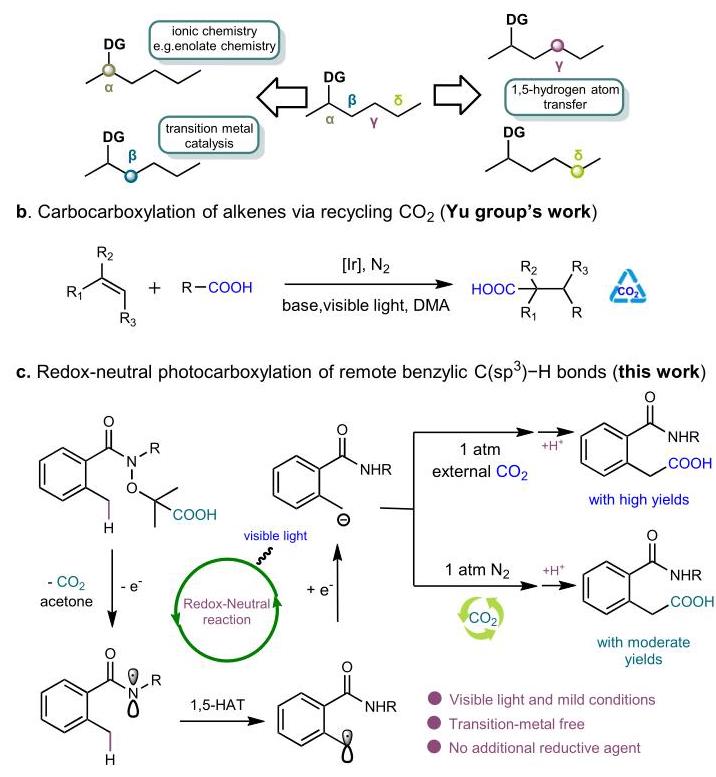
Figure 1. Functionalization of remote $\mathrm{C}\left( {\mathrm{{sp}}}^{3}\right) - \mathrm{H}$ bonds.
图1. 远程$\mathrm{C}\left( {\mathrm{{sp}}}^{3}\right) - \mathrm{H}$键的官能团化。
However, in such processes, stoichiometric carbon dioxide $\left( {\mathrm{{CO}}}_{2}\right)$ is emitted as an unused byproduct without being recycled in the transformations. In 2021, Yu’s group presented a compelling approach for the synthesis of amino acids by harnessing released ${\mathrm{{CO}}}_{2}$ , thereby establishing an atomically efficient and sustainable carbocarboxylation system (Figure 1b). ${}^{40}$ In this research, Yu’s group has achieved the first intermolecular carbon dioxide recovery for the carboxylation reaction. However, to the best of our knowledge, there are few reports on the recovery of carbon dioxide intramolecularly. Inspired by our previous work ${}^{41}$ and the Leonori group’s work, ${}^{7}$ we have designed and synthesized a series of benzylic $\alpha$ - oxiamido acids for the first time. With these substrates, we developed visible-light-induced transition-metal-free redox-neutral carboxylation of remote benzylic $\mathrm{C}\left( {\mathrm{{sp}}}^{3}\right) - \mathrm{H}$ bonds (Figure 1c). Furthermore, the intermolecular recovery of carbon dioxide has also been successfully accomplished. The low-concentration ${\mathrm{{CO}}}_{2}$ generated in situ can be reutilized as a reagent in the carboxylation reaction, representing a carbon-economical and sustainable process, different from previous carboxylation that required high pressure and a significant excess of ${\mathrm{{CO}}}_{2}$ (Table 1).
然而,在这些过程中,化学计量的二氧化碳$\left( {\mathrm{{CO}}}_{2}\right)$作为未使用的副产物排放,在转化过程中未被循环利用。2021年,余小组提出了一种利用释放的${\mathrm{{CO}}}_{2}$合成氨基酸的引人注目的方法,从而建立了一个原子经济且可持续的碳羧化体系(图1b)。${}^{40}$在本研究中,余小组实现了羧化反应中首例分子间二氧化碳的回收。然而,据我们所知,关于分子内二氧化碳回收的报道很少。受我们之前的工作${}^{41}$和莱奥诺里小组的工作启发,${}^{7}$我们首次设计并合成了一系列苄基$\alpha$-氧酰胺酸。利用这些底物,我们开发了可见光诱导的远程苄基$\mathrm{C}\left( {\mathrm{{sp}}}^{3}\right) - \mathrm{H}$键的无过渡金属氧化还原中性羧化反应(图1c)。此外,分子间二氧化碳的回收也已成功实现。原位产生的低浓度${\mathrm{{CO}}}_{2}$可作为试剂在羧化反应中再利用,这代表了一个碳经济且可持续的过程,不同于之前需要高压和大量过量${\mathrm{{CO}}}_{2}$的羧化反应(表1)。
IR RESULTS AND DISCUSSION
红外光谱结果与讨论
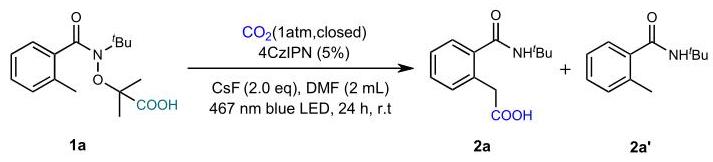
Ultimately, the subsequent reaction process was meticulously devised. We proposed a redox-neutral photoredox pathway in which the substrate undergoes oxidation, leaving carbon dioxide and acetone and resulting in the formation of nitrogen radicals. Then the 1,5-HAT process occurs followed by reduction of the resulting radical intermediate to form carbanions, which initiate a nucleophilic attack on carbon dioxide, leading to the formation of the corresponding carboxylation products. We initiated our investigations with a benzylic $\alpha$ -oxiamido acid 1a as the model substrate with a photocatalyst, solvent, and base, under 1 atm of ${\mathrm{{CO}}}_{2}$ and ${40}\mathrm{\;W}{467}\mathrm{\;{nm}}$ blue LED irradiation at room temperature. After substantial optimizations, we obtained the desired product 2a in 75% isolated yield in the presence of 4CzIPN as the photocatalyst, CsF as base as well as DMF as solvent under 1 atm ${\mathrm{{CO}}}_{2}$ atmosphere. Under the optimized conditions, the primary byproduct was hydrogenation product $2{a}^{\prime }$ with an isolated yield of 12% (entry 1). In the absence of either 4CzIPN or light, no carboxylation product 2a was observed, thereby demonstrating the indispensability of these two components (entries 2-3). It is noteworthy that 2a still exhibits a yield of 21% in a nitrogen atmosphere, indicating the potential utilization of the low-concentration ${\mathrm{{CO}}}_{2}$ generated in situ as a viable raw material for participation in the carboxylation reaction (entry 4). Using ${\mathrm{{Cs}}}_{2}{\mathrm{{CO}}}_{3}$ instead of $\mathrm{{CsF}}$ decreased the yield (entry 5). Replacing a ${467}\mathrm{\;{nm}}$ LED with ${456}\mathrm{\;{nm}}$ , reducing the quantity of 4CzIPN or substituting it with other photo-catalysts, replacing DMF with alternative solvents, and shortening the reaction time showed inferior results (entries 6-11).
最终,我们精心设计了后续的反应过程。我们提出了一种氧化还原中性的光催化氧化还原途径,在此过程中底物发生氧化反应,生成二氧化碳和丙酮,并产生氮自由基。然后发生1,5-氢原子转移过程,随后生成的自由基中间体被还原形成碳负离子,碳负离子对二氧化碳发起亲核进攻,从而生成相应的羧基化产物。我们以苄基$\alpha$-氧代酰胺酸1a作为模型底物,在光催化剂、溶剂和碱存在的条件下,于室温、1个大气压的${\mathrm{{CO}}}_{2}$和${40}\mathrm{\;W}{467}\mathrm{\;{nm}}$蓝光LED照射下开始研究。经过大量优化后,在以4CzIPN作为光催化剂、CsF作为碱以及DMF作为溶剂、1个大气压${\mathrm{{CO}}}_{2}$气氛的条件下,我们以75%的分离产率得到了所需产物2a。在优化条件下,主要副产物是氢化产物$2{a}^{\prime }$,其分离产率为12%(条目1)。在没有4CzIPN或光照的情况下,未观察到羧基化产物2a,这证明了这两个组分的不可或缺性(条目2 - 3)。值得注意的是,在氮气气氛中2a的产率仍为21%,这表明原位生成的低浓度${\mathrm{{CO}}}_{2}$有潜力作为参与羧基化反应的可行原料(条目4)。使用${\mathrm{{Cs}}}_{2}{\mathrm{{CO}}}_{3}$代替$\mathrm{{CsF}}$会降低产率(条目5)。用${456}\mathrm{\;{nm}}$代替${467}\mathrm{\;{nm}}$ LED、减少4CzIPN的用量或用其他光催化剂替代、用替代溶剂代替DMF以及缩短反应时间,结果均较差(条目6 - 11)。
Table 1. Optimization of Reaction Conditions ${}^{a}$
表1. 反应条件的优化${}^{a}$
| entry | deviations | yields ${\left( \% \right) }^{b}$ | |
| 2a | 2a ${}^{\prime }$ | ||
| 1 | none | 82 (75) | 12 |
| 2 | no light | none | none |
| 3 | no 4CzIPN | none | 15 |
| 4 | ${\mathrm{N}}_{2}$ instead of ${\mathrm{{CO}}}_{2}$ | 21 | 72 |
| 5 | ${\mathrm{{Cs}}}_{2}{\mathrm{{CO}}}_{3}$ instead of $\mathrm{{CsF}}$ | 62 | 15 |
| 6 | ${456}\mathrm{\;{nm}}$ instead of ${467}\mathrm{\;{nm}}$ | 58 | 27 |
| 7 | $\left\{ {{\left\lbrack \mathrm{r}\left\lbrack \mathrm{{dF}}\left( {\mathrm{{CF}}}_{3}\right) \mathrm{{ppy}}\right. \right\rbrack }_{2}\left( \mathrm{{dtbpy}}\right) }\right\} {\mathrm{{PF}}}_{6}\left( {5\% }\right)$ | 45 | 34 |
| 8 | eosin Y (5%) | 17 | 32 |
| 9 | 4CzIPN (2%) | 67 | 10 |
| 10 | ${\mathrm{{CH}}}_{3}\mathrm{{CN}}$ instead of DMF | 41 | 36 |
| 11 | ${12}\mathrm{\;h}$ | 64 | 8 |
${}^{a}$ Reaction conditions: 1a (0.2 mmol),4CzIPN (5%), CsF (2.0 equiv), DMF (2 mL), irradiation by Kessil 40 W blue LED for 24 h under 1 atm ${\mathrm{{CO}}}_{2}$ at ambient temperature. ${}^{b1}\mathrm{H}$ NMR yields using1,1,2,2- tetrachloroethane as an internal standard and yields of isolated products in parentheses. DMF = N, N-dimethylformamide, 4CzIPN = 2,4,5,6-tetra-9H-carbazol-9-yl-1,3-benzenedicarbonitrile.
${}^{a}$反应条件:1a(0.2 mmol),4CzIPN(5%),CsF(2.0当量),DMF(2 mL),在室温、1个大气压${\mathrm{{CO}}}_{2}$下用Kessil 40 W蓝光LED照射24小时。${}^{b1}\mathrm{H}$以1,1,2,2-四氯乙烷为内标物的NMR产率,括号内为分离产物的产率。DMF = N, N-二甲基甲酰胺,4CzIPN = 2,4,5,6-四-9H-咔唑-9-基-1,3-苯二甲腈。
With the optimized reaction conditions at our disposal, we proceeded to investigate the substrate scope of our catalytic system for visible-light photoredox-catalyzed carboxylation of benzylic $\mathrm{C}\left( {\mathrm{{sp}}}^{3}\right) - \mathrm{H}$ bonds. As summarized in Figure 2, a broad range of benzylic $\alpha$ -oxiamido acids bearing diverse functional groups on the central arene were used as starting materials. By substituting the tert-butyl group with either an isopropyl or cyclohexyl group, the substrates can undergo the desired transformation to form carboxylation products with inferior yields, which may be attributed to the replacement of a tertiary N-connected alkyl group with a secondary one, leading to weakened N-H bond and thermodynamic effects on the 1,5- HAT process (2b-2c). ${}^{25}\alpha$ -Oxiamido acids bearing monosubstituted groups at the para-position of the amido bond, such as electron-rich groups (OMe and Me) or electron-poor groups (F, Cl, and Br) on the benzene ring, have been demonstrated to be suitable starting materials, giving the desired products in good yields (2d-2h). When the monosubstituted groups are positioned at the ortho sites of the amide bond, there is a distinct decrease in the yield of the corresponding carboxylation products (2i and 2j), while the substrates bearing monosubstituted groups at the meta-position of the amide bond give moderate to desired carboxylation products (2k, 2i, and 2m). The substrates bearing methyl or fluoro disubstitution on the arene core were also suitable, resulting in moderate to high yields (2n, 2o, and 2p).
在我们掌握了优化的反应条件后,我们着手研究催化体系对苄基$\mathrm{C}\left( {\mathrm{{sp}}}^{3}\right) - \mathrm{H}$键进行可见光光氧化还原催化羧化反应的底物范围。如图2所示,一系列在中心芳烃上带有不同官能团的苄基$\alpha$ -肟基酸被用作起始原料。用异丙基或环己基取代叔丁基后,底物可以发生所需的转化,生成产率较低的羧化产物,这可能归因于用仲烷基取代了叔氮连接的烷基,导致N-H键减弱以及对1,5-氢原子转移过程的热力学影响(2b - 2c)。在酰胺键对位带有单取代基的${}^{25}\alpha$ -肟基酸,如苯环上的富电子基团(甲氧基和甲基)或贫电子基团(氟、氯和溴),已被证明是合适的起始原料,能以良好的产率得到所需产物(2d - 2h)。当单取代基位于酰胺键的邻位时,相应羧化产物的产率明显降低(2i和2j),而在酰胺键间位带有单取代基的底物能得到中等至所需的羧化产物(2k、2i和2m)。在芳烃核心带有甲基或氟双取代的底物也是合适的,能得到中等至高的产率(2n、2o和2p)。
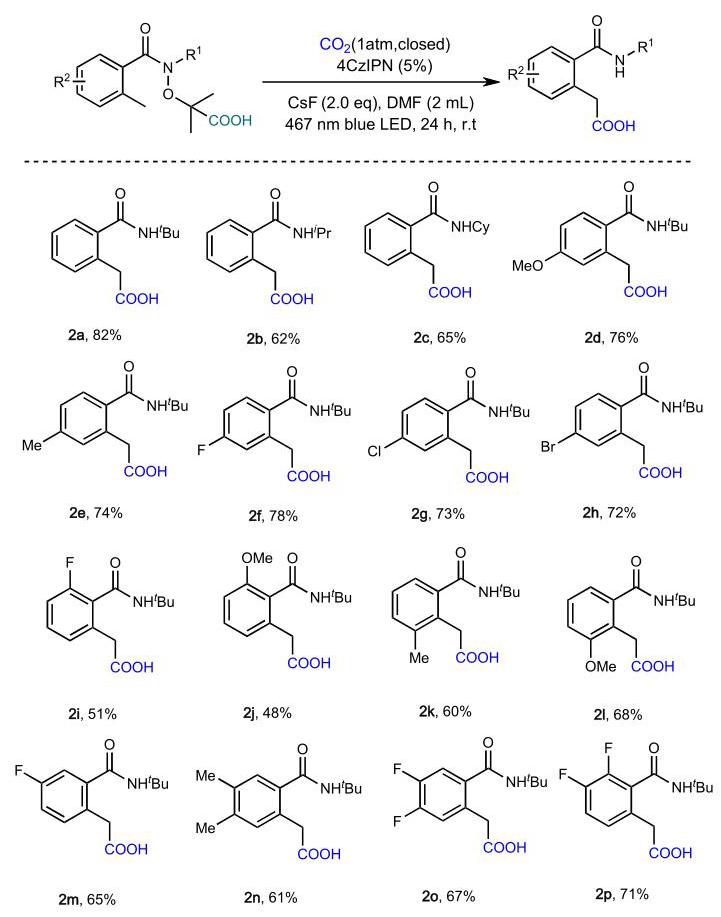
Figure 2. Scope of carboxylation of the remote benzylic $\mathrm{C} - \mathrm{H}$ bond with ${\mathrm{{CO}}}_{2}$ .
图2. 用${\mathrm{{CO}}}_{2}$对远程苄基$\mathrm{C} - \mathrm{H}$键进行羧化反应的范围。
We then investigated the utilization of in situ-generated low-concentration ${\mathrm{{CO}}}_{2}$ as a carbon source for carboxylation reactions under a nitrogen atmosphere (see the Supporting Information for details). With the optimal reaction conditions, we realized the efficient utilization of in situ-generated low-concentration ${\mathrm{{CO}}}_{2}$ without additional sources of carbon dioxide. As shown in Figure 3, under the nitrogen atmosphere, model substrate $\alpha$ -oxiamido acid 1a produces moderate quantities of the corresponding carboxylation products. Considering the utilization of CsF as the base instead of ${\mathrm{{Cs}}}_{2}{\mathrm{{CO}}}_{3}$ and conducting the reaction under the nitrogen atmosphere, we believe that ${\mathrm{{CO}}}_{2}$ released from 1a serves as the source for the carboxyl group. This process represents a carbon-efficient and sustainable approach, distinct from previous carboxylation methods that necessitated high pressure and excessive amounts of ${\mathrm{{CO}}}_{2}$ . Furthermore, we subsequently examined the reactivity of various $\alpha$ -oxime acids as substrates. The core arenes, bearing monosubstituted groups such as methoxy (2b), fluoro (2c), chloro (2d), bromo (2e), and methyl (2f), give moderate yields. However, the presence of halides or methyl disubstitution on the arene leads to decreased yields of the corresponding products (2g and 2h). In order to demonstrate the utility of this method, we also tested the gram-scale reaction conditions, giving 2a in moderate yields (see Table S4 in the Supporting Information for more details).
然后,我们研究了在氮气气氛下原位生成的低浓度${\mathrm{{CO}}}_{2}$作为羧化反应碳源的利用情况(详细信息见支持信息)。在最佳反应条件下,我们实现了原位生成的低浓度${\mathrm{{CO}}}_{2}$的有效利用,无需额外的二氧化碳源。如图3所示,在氮气气氛下,模型底物$\alpha$ -肟基酸1a产生适量的相应羧化产物。考虑到用氟化铯代替${\mathrm{{Cs}}}_{2}{\mathrm{{CO}}}_{3}$作为碱并在氮气气氛下进行反应,我们认为从1a释放的${\mathrm{{CO}}}_{2}$作为羧基的来源。这个过程代表了一种碳高效且可持续的方法,不同于以前需要高压和过量${\mathrm{{CO}}}_{2}$的羧化方法。此外,我们随后研究了各种$\alpha$ -肟酸作为底物的反应活性。带有甲氧基(2b)、氟(2c)、氯(2d)、溴(2e)和甲基(2f)等单取代基的核心芳烃,产率中等。然而,芳烃上存在卤化物或甲基双取代会导致相应产物的产率降低(2g和2h)。为了证明该方法的实用性,我们还测试了克级反应条件,以中等产率得到2a(更多详细信息见支持信息中的表S4)。
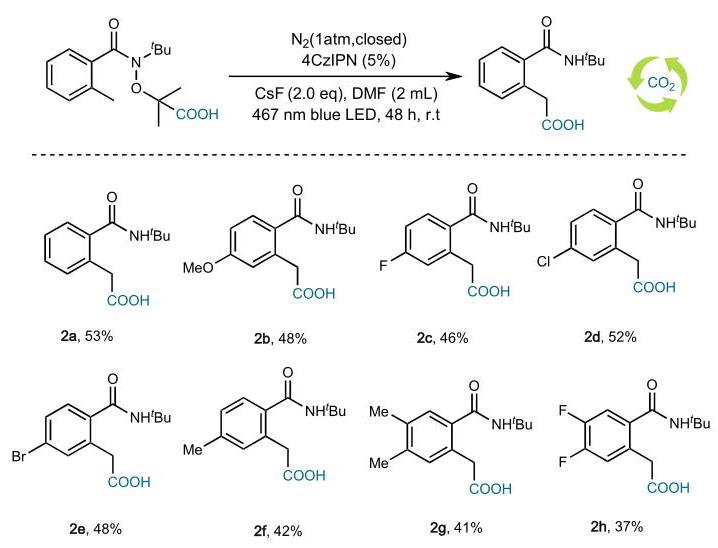
Figure 3. Carboxylation of the remote benzylic $\mathrm{C} - \mathrm{H}$ bond under an ${\mathrm{N}}_{2}$ atmosphere.
图3. 在${\mathrm{N}}_{2}$气氛下远程苄基$\mathrm{C} - \mathrm{H}$键的羧化反应。
Subsequently, a series of control experiments were conducted to gain mechanistic insights (Figure 4). We initially conducted radical inhibition experiments by incorporating (2,2,6,6- tetramethylpiperidin-1-ly)oxyl (TEMPO) into the standard reaction conditions; a noncarboxylation product was observed, and the direct TEMPO trapping product 3a was detected simultaneously, indicating potential involvement of radical intermediates. Further isotope-labeling experiments conducted under a nitrogen atmosphere indicated the formation of a benzylic anion as an intermediate, which can be quenched with ${\mathrm{D}}_{2}\mathrm{O}$ to yield 3b. Based on our proposed formation of benzylic carbanion as a critical intermediate under our reaction conditions, we considered this remote C-H bond activation could be applied to other electrophiles. Successful implementation of this reaction suggests that this strategy would be useful for achieving various other functionalizations of the remote $\mathrm{C} -$ H bond (3c). The experiments using ${}^{13}\mathrm{C}$ -labeled ${\mathrm{{CO}}}_{2}$ generated the ${}^{13}\mathrm{C} - 2\mathrm{a}$ with a yield of ${78}\%$ , giving ${69}\% {}^{13}\mathrm{C}$ incorporation, providing strong evidence that part of the carboxyl group in the desired product came from the starting material 1a.
随后,进行了一系列对照实验以深入了解反应机理(图4)。我们首先在标准反应条件下加入(2,2,6,6-四甲基哌啶-1-基)氧基(TEMPO)进行自由基抑制实验;观察到了非羧化产物,同时检测到了直接的TEMPO捕获产物3a,这表明可能存在自由基中间体。在氮气气氛下进行的进一步同位素标记实验表明,形成了苄基阴离子作为中间体,该中间体可以用${\mathrm{D}}_{2}\mathrm{O}$淬灭生成3b。基于我们提出的在反应条件下形成苄基碳负离子作为关键中间体的观点,我们认为这种远程C-H键活化可以应用于其他亲电试剂。该反应的成功实施表明,该策略对于实现远程$\mathrm{C} -$ H键的各种其他官能团化将是有用的(3c)。使用${}^{13}\mathrm{C}$标记的${\mathrm{{CO}}}_{2}$进行的实验以${78}\%$的产率生成了${}^{13}\mathrm{C} - 2\mathrm{a}$,实现了${69}\% {}^{13}\mathrm{C}$掺入,有力地证明了所需产物中的部分羧基来自起始原料1a。
Based on the control experiments and previous studies, ${}^{41}$ a plausible mechanism for the overall transformation is proposed and outlined in Figure 5. First, the photocatalyst 4CzIPN, upon photoexcitation, would oxidize $\alpha$ -oxiamido acid 1a, delivering amidyl radical I through fragmentation. The electrophilic amidyl radical II would promote a 1,5-HAT, affording the more stable benzylic radical III, which would be reduced by the photocatalyst species to both afford benzylic anionic species IV and regenerate the requisite 4CzIPN. The subsequent nucleophilic attack on ${\mathrm{{CO}}}_{2}$ and the following protonation can provide the observed carboxylic acids.
基于对照实验和先前的研究,${}^{41}$提出并在图5中概述了整个转化过程的合理机理。首先,光催化剂4CzIPN在光激发后会氧化$\alpha$ -氧代酰胺酸1a,通过裂解产生酰胺基自由基I。亲电酰胺基自由基II会促进1,5-氢原子转移,生成更稳定的苄基自由基III,该自由基会被光催化剂物种还原,既生成苄基阴离子物种IV,又再生所需的4CzIPN。随后对${\mathrm{{CO}}}_{2}$的亲核攻击以及随后的质子化可以提供观察到的羧酸。
In conclusion, we herein report the visible-light-induced transition-metal-free redox-neutral carboxylation of remote benzylic $\mathrm{C}\left( {\mathrm{{sp}}}^{3}\right) - \mathrm{H}$ bonds by nitrogen-centered radical 1,5- HAT. Our control experimental investigations strongly indicate that $\alpha$ -oxiamido acid oxidation, the subsequent 1,5-HAT, and the generation of benzylic anionic species are the essential steps. It is noteworthy that the low-concentration ${\mathrm{{CO}}}_{2}$ generated in situ can be reutilized as a reagent in the carboxylation reaction and give moderate yields of corresponding carboxylation products. This reaction proceeds smoothly without adding any transition metal or additional reductive reagent under mild conditions, affording the desired carboxylic acids in moderate to excellent yields with a broad substrate scope. This study presents a representative method of remote $\mathrm{C} - \mathrm{H}$ bond functionalization.
总之,我们在此报告了通过氮中心自由基1,5-氢原子转移实现的可见光诱导的远程苄基$\mathrm{C}\left( {\mathrm{{sp}}}^{3}\right) - \mathrm{H}$键的无过渡金属氧化还原中性羧化反应。我们的对照实验研究有力地表明,$\alpha$ -氧代酰胺酸氧化、随后的1,5-氢原子转移以及苄基阴离子物种的生成是关键步骤。值得注意的是,原位生成的低浓度${\mathrm{{CO}}}_{2}$可以作为羧化反应中的试剂被重新利用,并给出相应羧化产物的中等产率。该反应在温和条件下无需添加任何过渡金属或额外的还原试剂即可顺利进行,以中等至优异的产率提供所需的羧酸,底物范围广泛。这项研究提出了一种远程$\mathrm{C} - \mathrm{H}$键官能团化的代表性方法。
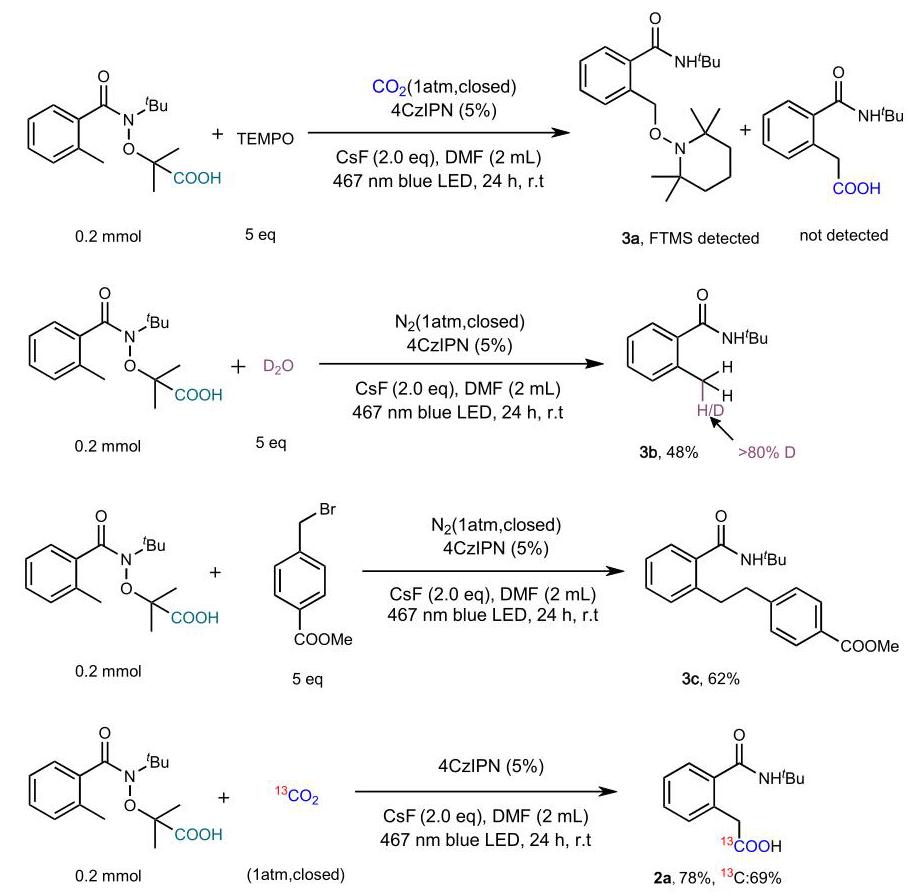
Figure 4. Control experiments and substrates undergo reactions with other electrophiles.
图4. 对照实验以及底物与其他亲电试剂的反应。
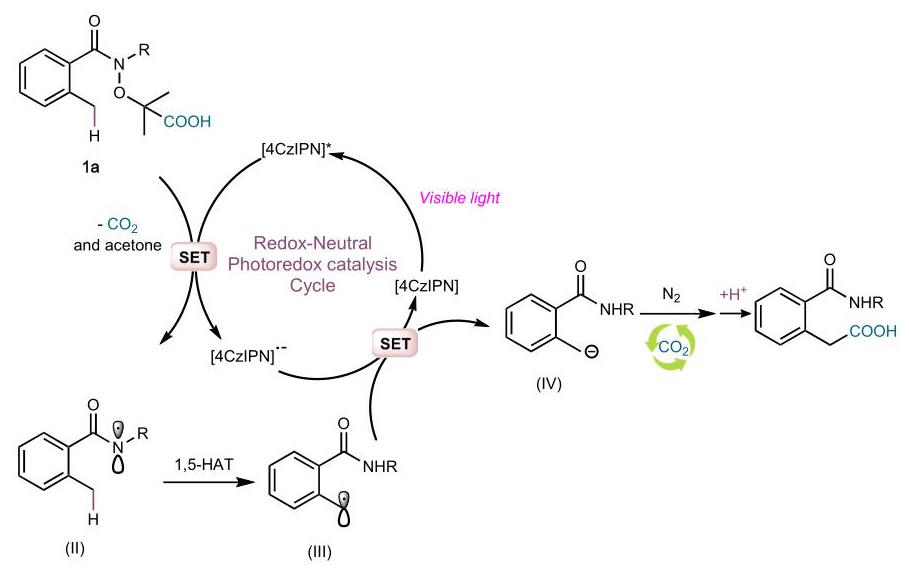
Figure 5. Plausible reaction mechanism.
图5. 合理的反应机理。
II ASSOCIATED CONTENT
II 相关内容
Data Availability Statement
数据可用性声明
The data underlying this study are available in the published article and its Supporting Information.
本研究的基础数据可在已发表的文章及其支持信息中获取。
(c) Supporting Information
(c) 支持信息
The Supporting Information is available free of charge at https://pubs.acs.org/doi/10.1021/acs.joc.3c02250.
支持信息可在https://pubs.acs.org/doi/10.1021/acs.joc.3c02250免费获取。
Reaction condition optimizations, part of mechanistic studies, characterization data, and copies of spectra of products ( ${}^{1}\mathrm{H}$ and ${}^{13}\mathrm{C}$ NMR and HRMS) (PDF)
反应条件优化、部分机理研究、表征数据以及产物的光谱副本 (${}^{1}\mathrm{H}$ 和 ${}^{13}\mathrm{C}$ NMR 及 HRMS) (PDF)
A UTHOR INFORMATION
作者信息
Corresponding Author
通讯作者
Fanyang Mo - School of Materials Science and Engineering, Peking University, Beijing 100871, China; (Corcid.org/0000- 0002-4140-3020;
莫凡洋 - 北京大学材料科学与工程学院,北京 100871,中国;(Corcid.org/0000- 0002-4140-3020;
Authors
作者
Wenke Li - College of Engineering, Peking University, Beijing 100871, China
李文珂 - 中国北京大学工学院,北京100871
Beiqi Sun - College of Engineering, Peking University, Beijing 100871, China
孙北奇 - 中国北京大学工学院,北京100871
Lei Zhang - College of Engineering, Peking University, Beijing 100871, China; (C) orcid.org/0000-0001-9031-4318
张雷 - 中国北京大学工学院,北京100871;(C) orcid.org/0000-0001-9031-4318
Complete contact information is available at:
完整联系方式见:
https://pubs.acs.org/10.1021/acs.joc.3c02250
Notes
注释
The authors declare no competing financial interest.
作者声明不存在利益冲突。
BACKNOWLEDGMENTS
致谢
We are grateful for the support from the National Natural Science Foundation of China (grant nos. 22071004, 21933001, and 22150013). We also thank Prof. Ding Ma from College of Chemistry and Molecular Engineering, Peking University, for generously donating 1 L of ${}^{13}{\mathrm{{CO}}}_{2}$ gas.
我们感谢中国国家自然科学基金(项目编号:22071004、21933001和22150013)的支持。我们还感谢北京大学化学与分子工程学院的马丁教授慷慨捐赠1升${}^{13}{\mathrm{{CO}}}_{2}$气体。
BREFERENCES
参考文献
(1) Engle, K. M.; Mei, T. S.; Wasa, M.; Yu, J. Q. Weak Coordination as a Powerful Means for Developing Broadly Useful C-H Functionaliza-tion Reactions. Acc. Chem. Res. 2012, 45, 788-802.
(2) He, J.; Wasa, M.; Chan, K.; Shao, Q.; Yu, J. Q. Palladium-catalyzed transformations of alkyl C-H bonds. Chem. Rev. 2017, 117, 8754- 8786.
(3) Bergman, R. G. C-H activation. Nature 2007, 446, 391-393.
(4) Shen, X.; Zhao, J. J.; Yu, S. Photoredox-catalyzed intermolecular remote $\mathrm{C} - \mathrm{H}$ and $\mathrm{C} - \mathrm{C}$ vinylation via iminyl radicals. Org. Lett. 2018, 20, 5523-5527.
(5) Chen, H.; Jin, W. W.; Yu, S. Enantioselective remote C (sp3)-H cyanation via dual photoredox and copper catalysis. Org. Lett. 2020, 22, 5910-5914.
(6) Guo, W.; Wang, Q.; Zhu, J. Visible light photoredox-catalysed remote $\mathrm{C} - \mathrm{H}$ functionalisation enabled by 1,5-hydrogen atom transfer (1, 5-HAT). Chem. Soc. Rev. 2021, 50, 7359-7377.
(7) Morcillo, S. P.; Dauncey, E. M.; Kim, J. H.; Douglas, J. J.; Sheikh, N. S.; Leonori, D. Photoinduced remote functionalization of amides and amines using electrophilic nitrogen radicals. Angew. Chem., Int. Ed. 2018, 57, 12945-12949.
(8) Chu, J. C.; Rovis, T. Complementary strategies for directed C (sp3)- H functionalization: a comparison of transition-metal-catalyzed activation, hydrogen atom transfer, and carbene/nitrene transfer. Angew. Chem., Int. Ed. 2018, 57, 62-101.
(9) Bume, D. D.; Pitts, C. R.; Ghorbani, F.; Harry, S.; Capilato, J. N.; Siegler, M. A.; Lectka, T. Ketones as directing groups in photocatalytic sp 3 C-H fluorination. Chem. Sci. 2017, 8, 6918-6923.
(10) Pitts, C.; Bume, D. D.; Harry, S. A.; Siegler, M. A.; Lectka, T. Multiple enone-directed reactivity modes lead to the selective photochemical fluorination of polycyclic terpenoid derivatives. J. Am. Chem. Soc. 2017, 139, 2208-2211.
(11) Sharma, A.; Hartwig, J. F. Metal-catalysed azidation of tertiary C-H bonds suitable for late-stage functionalization. Nature 2015, 517, 600-604.
(12) Nagib, D.; Stateman, L.; Nakafuku, K. Remote C-H functionalization via selective hydrogen atom transfer. Synthesis 2018, 50, 1569-1586.
(13) Hofmann, A. Ueber die Einwirkung des Broms in alkalischer Lösung auf Amide. Ber. Dtsch. Chem. Ges. 1882, 15, 762-775.
(14) Löffler, K.; Kober, S. Über die Bildung des i-Nicotins aus N-Methyl-p-pyridyl-butylamin (Dihydrometanicotin). Ber. Dtsch. Chem. Ges. 1909, 42, 3431-3438.
(15) Martinez, C.; Muniz, K. An Iodine-Catalyzed Hofmann-Löffler Reaction. Angew. Chem., Int. Ed. 2015, 54, 8287-8291.
(16) Choi, G. J.; Zhu, Q.; Miller, D. C.; Gu, C. J.; Knowles, R. R. Catalytic alkylation of remote $\mathrm{C} - \mathrm{H}$ bonds enabled by proton-coupled electron transfer. Nature 2016, 539, 268-271.
(17) Chu, J. C. K.; Rovis, T. Amide-directed photoredox-catalysed C-C bond formation at unactivated sp 3 C-H bonds. Nature 2016, 539, 272-275.
(18) Groendyke, B. J.; AbuSalim, D. I.; Cook, S. P. Iron-catalyzed, fluoroamide-directed C-H fluorination. J. Am. Chem. Soc. 2016, 138, 12771-12774.
(19) Zhu, Y. C.; Huang, K. M.; Pan, J.; Qiu, X.; Luo, X.; Qin, Q.; Wei, J.; Wen, X.; Zhang, L. Z.; Jiao, N. Silver-catalyzed remote Csp3-H functionalization of aliphatic alcohols. Nat. Commun. 2018, 9, 2625.
(20) Zhang, J.; Li, Y.; Zhang, F. Y.; Hu, C. C.; Chen, Y. Y. Generation of alkoxyl radicals by photoredox catalysis enables selective C (sp3)- H functionalization under mild reaction conditions. Angew. Chem., Int. Ed. 2016, 55, 1872-1875.
(21) Min, Q.; Yang, J.; Pang, M.; Ao, G.; Liu, F. Copper-catalyzed remote C (sp3)-H amination of carboxamides. Org. Lett. 2020, 22, 2828-2832.
(22) Zhao, Y. T.; Xia, W. J. Recent advances in radical-based C-N bond formation via photo-/electrochemistry. Chem. Soc. Rev. 2018, 47, 2591-2608.
(23) Qin, Q.; Yu, S. Visible-light-promoted remote C (sp3)-H amidation and chlorination. Org. Lett. 2015, 17, 1894-1897.
(24) Na, C. G.; Alexanian, E. J. A General Approach to Site-Specific, Intramolecular C- H Functionalization Using Dithiocarbamates. Angew. Chem., Int. Ed. 2018, 57, 13106-13109.
(25) Sun, B.; Li, W.; Liu, Q.; Zhang, G.; Mo, F. Transition metal-free visible light photoredox-catalyzed remote C (sp3)- H borylation enabled by 1, 5-hydrogen atom transfer. Commun. Chem. 2023, 6, 156.
(26) Sakakura, T.; Choi, J. C.; Yasuda, H. Transformation of carbon dioxide. Chem. Rev. 2007, 107, 2365-2387.
(27) Tortajada, A.; Börjesson, M.; Martin, R. Nickel-catalyzed reductive carboxylation and amidation reactions. Acc. Chem. Res. 2021, 54, 3941-3952.
(28) Cauwenbergh, R.; Goyal, V.; Maiti, R.; Natte, K.; Das, S. Challenges and recent advancements in the transformation of CO 2 into carboxylic acids: straightforward assembly with homogeneous 3d metals. Chem. Soc. Rev. 2022, 51, 9371-9423.
(29) Zhang, Y.; Zhang, T.; Das, S. Selective functionalization of benzylic C (sp3)-H bonds to synthesize complex molecules. Chem 2022, 8, 3175-3201.
(30) Schilling, W.; Das, S. CO2-catalyzed/promoted transformation of organic functional groups. Tetrahedron Lett. 2018, 59, 3821-3828.
(31) Ye, J. H.; Miao, M.; Huang, H.; Yan, S. S.; Yin, Z. B.; Zhou, W. J.; Yu, D. G. Visible-light-driven iron-promoted thiocarboxylation of styrenes and acrylates with CO2. Angew. Chem., Int. Ed. 2017, 56, 15416-15420.
(32) Zhu, C.; Zhang, Y. F.; Liu, Z. Y.; Zhou, L.; Liu, H.; Feng, C. Selective C-F bond carboxylation of gem-difluoroalkenes with CO 2 by photoredox/palladium dual catalysis. Chem. Sci. 2019, 10, 6721- 6726.
(33) Fan, X. Y.; Gong, X.; Ma, M. Y.; Wang, R.; Walsh, P. J. Visible light-promoted CO2 fixation with imines to synthesize diaryl $\alpha$ -amino acids. Nat. Commun. 2018, 9, 4936.
(34) Wencel-Delord, J. CO2+ Light:“Green” Valorization of Simple Arenes and Styrenes. Chem 2020, 6, 2437-2439.
(35) Meng, Q. Y.; Schirmer, T. E.; Berger, A. L.; Donabauer, K.; König, B. Photocarboxylation of benzylic C-H bonds. J. Am. Chem. Soc. 2019, 141, 11393-11397.
(36) Song, Q. W.; Zhou, Z. H.; He, L. N. Efficient, selective and sustainable catalysis of carbon dioxide. Green Chem. 2017, 19, 3707- 3728.
(37) He, X.; Qiu, L. Q.; Wang, W. J.; Chen, K. H.; He, L. N. Photocarboxylation with CO 2: an appealing and sustainable strategy for CO 2 fixation. Green Chem. 2020, 22, 7301-7320.
(38) Masuda, Y.; Ishida, N.; Murakami, M. Light-driven carboxylation of o-alkylphenyl ketones with CO2. J. Am. Chem. Soc. 2015, 137, 14063-14066.
(39) Song, L.; Fu, D.; Chen, L.; Jiang, Y.; Ye, J.; Zhu, L.; Lan, Y.; Fu, Q.; Yu, D. Visible-light photoredox-catalyzed remote difunctionalizing carboxylation of unactivated alkenes with CO2. Angew. Chem., Int. Ed. 2020, 59, 21121-21128.
(40) Liao, L.-L.; Cao, G.-M.; Jiang, Y.-X.; Jin, X.-H.; Hu, X.-L.; Chruma, J. J.; Sun, G.-Q.; Gui, Y.-Y.; Yu, D.-G. α-Amino Acids and Peptides as Bifunctional Reagents: Carbocarboxylation of Activated Alkenes via Recycling CO. J. Am. Chem. Soc. 2021, 143, 2812-2821.
(41) Li, W.; Sun, B.; Zhang, L.; Mo, F. Photocarboxylation of remote $\mathrm{C} - \mathrm{H}$ bonds through nitrogen-centred radical 1,5-hydrogen atom transfer. Green Chem. 2023, 25, 5030-5034.

CAS BIOFINDER DISCOVERY PLATFORM™
CAS生物发现者发现平台™
BRIDGE BIOLOGY AND CHEMISTRY FOR FASTER ANSWERS
架起生物学与化学的桥梁,更快获得答案
Analyze target relationships,
分析靶点关系,
compound effects, and disease
化合物效应,以及疾病
pathways
途径
Explore the platform
探索该平台