Photoinduced Decarbonylative Borylation of Alkyl Aldehyde through 4-Alkyl-1,4-Dihydropyridines
英文原文与中文译文逐段对照 · English original with Chinese translation
ORGANIC CH
有机化学
Check for updates
检查更新
Cite this: Org. Chem. Front., 2024, 11, 1140
引用本文:Org. Chem. Front., 2024, 11, 1140
Received 22nd July 2023, Accepted 19th December 2023
2023年7月22日收到,2023年12月19日接受
DOI: 10.1039/d3qo01139a
DOI: 10.1039/d3qo01139a
rsc.li/frontiers-organic
rsc.li/frontiers-organic
Photoinduced decarbonylative borylation of alkyl aldehydes through 4-alkyl-1,4-dihydropyridinest
通过4-烷基-1,4-二氢吡啶进行的烷基醛的光诱导脱羰硼化反应
Chang Lian, ${}^{a, b}$ Jianning Zhang ${}^{a, b}$ and Fanyang Mo D $* {}^{a}$
连畅,${}^{a, b}$ 张建宁 ${}^{a, b}$ 和莫凡洋 D $* {}^{a}$
We propose a novel approach for the facile decarbonylative borylation of aliphatic aldehydes. In this strategy, 1,4-dihydropyridines (DHPs) are synthesized in a single step from the corresponding aldehydes and subsequently reacted with bis(catecholato)diboron to form an alkyl C-B bond through a photoinduced process. Remarkably, this reaction can be conducted under mild conditions and demonstrates compatibility with a wide range of substrates. The experimental findings, in conjunction with density functional theory (DFT) calculations, reveal the involvement of an electron transfer process between the photocatalyst and DHPs. Notably, the appropriate redox properties of DHPs facilitate the generation of alkyl radicals under these conditions, eliminating the need for any external oxidant.
我们提出了一种用于脂肪族醛的简便脱羰硼化反应的新方法。在该策略中,1,4-二氢吡啶(DHPs)由相应的醛一步合成,随后与双(邻苯二酚)二硼反应,通过光诱导过程形成烷基C-B键。值得注意的是,该反应可以在温和条件下进行,并且与多种底物具有相容性。实验结果与密度泛函理论(DFT)计算相结合,揭示了光催化剂与DHPs之间电子转移过程的参与。值得注意的是,DHPs合适的氧化还原性质有助于在这些条件下生成烷基自由基,无需任何外部氧化剂。
1 Introduction
1 引言
Alkyl boronates possess significant importance in organic synthesis owing to their medicinal properties and versatile reactivities. The formation and manipulation of the C-B bond have been extensively explored in various fields, including pharmaceuticals, agrochemicals, and materials science. ${}^{1 - 5}$ Conventional approaches for the synthesis of boronic ester compounds predominantly rely on petrochemical-based starting materials such as olefins, alkyl halides (via organolithiums and Grignard reagents), and alkanes. ${}^{1}$ Nonetheless, these traditional methods, although widely employed, suffer from drawbacks such as harsh reaction conditions, regioselectivity, and the use of hazardous reagents. Our pioneering work on radical borylation ${}^{6}$ contributed to a more versatile and environmentally friendly strategy for C-B bond construction, which demonstrates broad applicability, simplicity in operation, cleanliness, and compatibility with late-stage transformations. ${}^{7}$ The development of novel borylation methodologies has sparked considerable interest among researchers.
硼酸烷基酯由于其药用特性和多样的反应活性,在有机合成中具有重要意义。碳 - 硼键的形成和操控在包括制药、农用化学品和材料科学等各个领域都得到了广泛研究。${}^{1 - 5}$ 传统的硼酸酯化合物合成方法主要依赖于石化基起始原料,如烯烃、卤代烃(通过有机锂试剂和格氏试剂)以及烷烃。${}^{1}$ 然而,这些传统方法尽管被广泛应用,但存在诸如反应条件苛刻、区域选择性以及使用危险试剂等缺点。我们在自由基硼化方面的开创性工作 ${}^{6}$ 为碳 - 硼键构建贡献了一种更通用且环境友好的策略,该策略具有广泛的适用性、操作简单、清洁以及与后期转化的兼容性。${}^{7}$ 新型硼化方法的开发引起了研究人员的极大兴趣。
The strategy of transforming readily available and abundant chemical compounds, such as carboxylic acids, ${}^{8 - {13}}$ alcohols, ${}^{{14},{15}}$ and amines, ${}^{{16} - {18}}$ into valuable, structurally diversified alkyl boronates is highly appealing. In 2017, Aggarwal and colleagues reported decarboxylative borylation, wherein carboxylic acids were converted into $N$ -hydroxyphthalimide (NHPI) esters, ${}^{8}$ and in 2019, the deoxygenative borylation of aliphatic alcohols was achieved by preactivating alcohol groups to xanthates or oxalates, as demonstrated by Studer’s group (Fig. 1a). ${}^{14}$ Moreover, our previous work successfully accomplished a photoinduced ring-opening borylation reaction of hemiacetals by transforming them into optically active derivatives. ${}^{19}$ These borylation reactions proceed via radical mechanisms, with the intermediates involved (such as xanthates and NHPI esters) serving as effective precursors of alkyl radicals. The strategy of pre-activation using simple starting materials has generated our interest in exploring boryla-tion reactions initiated by other radical precursors.
将容易获得且丰富的化合物,如羧酸 ${}^{8 - {13}}$、醇 ${}^{{14},{15}}$ 和胺 ${}^{{16} - {18}}$ 转化为有价值的、结构多样的硼酸烷基酯的策略极具吸引力。2017年,Aggarwal及其同事报道了脱羧硼化反应,其中羧酸被转化为 $N$ -羟基邻苯二甲酰亚胺(NHPI)酯 ${}^{8}$,2019年,Studer课题组证明通过将醇基团预活化成黄原酸酯或草酸酯实现了脂肪醇的脱氧硼化反应(图1a)。${}^{14}$ 此外,我们之前的工作通过将半缩醛转化为光学活性衍生物,成功完成了半缩醛的光诱导开环硼化反应。${}^{19}$ 这些硼化反应通过自由基机制进行,所涉及的中间体(如黄原酸酯和NHPI酯)作为烷基自由基的有效前体。使用简单起始原料进行预活化的策略激发了我们探索由其他自由基前体引发的硼化反应的兴趣。
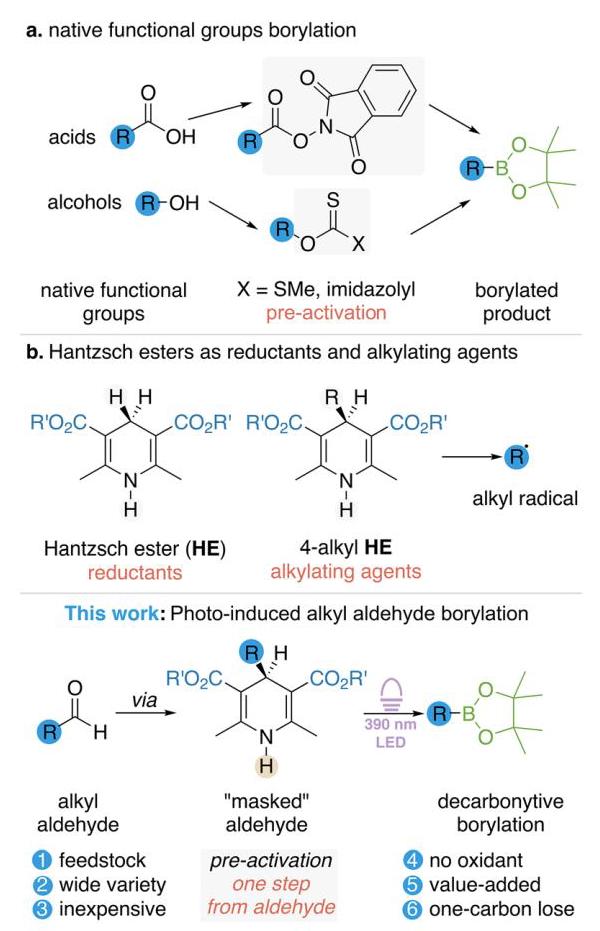
Fig. 1 Reaction design.
图1反应设计。
${}^{a}$ School of Materials Science and Engineering, Peking University, Beijing, PR China.
${}^{a}$ 中国北京,北京大学材料科学与工程学院。
${}^{b}$ College of Engineering, Peking University, Beijing, PR China
${}^{b}$ 中国北京,北京大学工学院
† Electronic supplementary information (ESI) available. See DOI: https://doi.org/ 10.1039/d3qo01139a
† 电子补充信息(ESI)可用。见DOI:https://doi.org/ 10.1039/d3qo01139a
Hantzsch esters are widely used organic reducing agents in a diverse range of organic transformations. ${}^{{20},{21}}$ The 4-substituted Hantzsch ester (4-alkyl-1,4-dihydropyridines), synthesized from aldehydes, serves as a valuable precursor for alkyl radicals under photochemical or electrochemical conditions in alkylation reactions (Fig. 1b). ${}^{22}$ There is no efficient method for the conversion of alkyl aldehydes to alkyl boro-nates. Building upon previous investigations on radical boryla-tion, we have chosen 4-alkyl-substituted Hantzsch esters as radical precursors and report a visible light-induced borylation of these esters (Fig. 1c).
汉斯酯是广泛用于各种有机转化的有机还原剂。${}^{{20},{21}}$ 由醛合成的4 - 取代汉斯酯(4 - 烷基 - 1,4 - 二氢吡啶)在光化学或电化学条件下的烷基化反应中作为烷基自由基的有价值前体(图1b)。${}^{22}$ 目前还没有将烷基醛转化为硼酸烷基酯的有效方法。基于之前对自由基硼化的研究,我们选择4 - 烷基取代的汉斯酯作为自由基前体,并报道了这些酯的可见光诱导硼化反应(图1c)。
2 Results and discussion
2结果与讨论
The well-tolerated radical precursors for borylation predominantly encompass oxidative radical precursors, such as alkyl halides or diazonium salts. ${}^{23}$ This implies that these precursors undergo an initial reduction step, leading to the formation of alkyl radicals. However, the challenge persists when attempting borylation with reductive radical precursors, such as alkanes, due to the limited availability of oxidants that exhibit compatibility with reductive diboron reagents. A commonly employed approach involves the conversion of reductive radical precursors into oxidative ones. For instance, the direct decarboxylation of alkyl carboxylic acids to generate alkyl radicals constitutes an oxidative reaction, known to be a formidable task. NHPI ester, synthesized from carboxylic acids, serves as an oxidative radical precursor, facilitating a more facile bor-ylation reaction.
用于硼化反应的耐受性良好的自由基前体主要包括氧化性自由基前体,如卤代烃或重氮盐。${}^{23}$这意味着这些前体要经历一个初始还原步骤,从而导致烷基自由基的形成。然而,当尝试使用还原性自由基前体(如烷烃)进行硼化反应时,由于与还原性二硼试剂具有兼容性的氧化剂的可用性有限,挑战依然存在。一种常用的方法是将还原性自由基前体转化为氧化性自由基前体。例如,烷基羧酸的直接脱羧以生成烷基自由基是一个氧化反应,这是一项艰巨的任务。由羧酸合成的NHPI酯用作氧化性自由基前体,促进了更简便的硼化反应。
The 4-substituted Hantzsch ester represents a category of reductive radical precursors that typically require the addition of oxidants to the reaction system in order to generate alkyl radicals. ${}^{22}$ This inherent necessity for oxidants often poses a challenge in the context of borylation reactions. However, it is noteworthy that we have observed the borylation of 4-substituted Hantzsch esters occurring smoothly and efficiently, even in the absence of added oxidants.
4-取代的汉茨酯是一类还原性自由基前体,通常需要向反应体系中添加氧化剂以生成烷基自由基。${}^{22}$在硼化反应的背景下,这种对氧化剂的内在需求常常构成挑战。然而,值得注意的是,我们观察到即使在不添加氧化剂的情况下,4-取代的汉茨酯的硼化反应也能顺利且高效地发生。
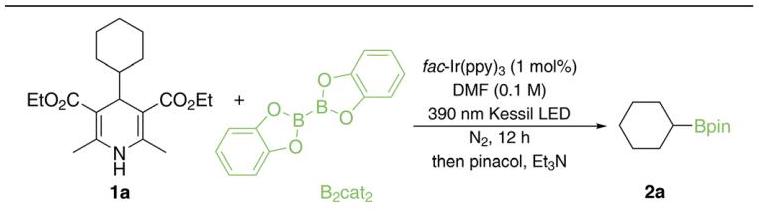
Our investigation of photocatalytic alkyl radical borylation commenced by subjecting diethyl 4-cyclohexyl-2,6-dimethyl- 1,4-dihydropyridine-3,5-dicarboxylate (1a) and bis(catecholato) diboron $\left( {{\mathrm{B}}_{2}{\mathrm{{cat}}}_{2}}\right)$ to irradiation, and the desired borylation product 2a was obtained by transforming the initial catechol boronic ester with pinacol. The reaction was conducted using 1 mol% of fac-Ir(ppy) ${}_{3}$ as the photocatalyst in $N, N$ -dimethyl-formamide (DMF) under irradiation with a Kessil 390 nm LED lamp at room temperature for 12 hours. The obtained product exhibited a 91% GC-FID yield and an 84% isolated yield (Table 1, entry 1).
我们对光催化烷基自由基硼化反应的研究始于对4-环己基-2,6-二甲基-1,4-二氢吡啶-3,5-二羧酸二乙酯(1a)和双(邻苯二酚)二硼$\left( {{\mathrm{B}}_{2}{\mathrm{{cat}}}_{2}}\right)$进行辐照,并通过用频哪醇转化初始的邻苯二酚硼酸酯得到所需的硼化产物2a。该反应在室温下使用1 mol%的fac-Ir(ppy)${}_{3}$作为光催化剂,在$N, N$-二甲基甲酰胺(DMF)中,用Kessil 390 nm LED灯辐照12小时。得到的产物的气相色谱-氢火焰离子化检测器(GC-FID)产率为91%,分离产率为84%(表1,条目1)。
Table 1 The optimization of reaction conditions ${}^{a}$
表1反应条件的优化${}^{a}$
| Entry | Deviations from standard condition | 2a ${}^{b}\left( \% \right)$ |
| 1 | None | 92% |
| 2 | DMF (0.16 M) | 75% |
| 3 | DMF (0.06 M) | 83% |
| 4 | DMAc instead of DMF | 86% |
| 5 | DCM instead of DMF | Trace |
| 6 | ${\mathrm{B}}_{2}{\mathrm{{cat}}}_{2}$ (2 eq.) | 60% |
| 7 | ${\mathrm{B}}_{2}{\mathrm{{cat}}}_{2}$ (5 eq.) | 92% |
| 8 | 2 h instead of overnight | 65% |
| 9 | ${\mathrm{B}}_{2}{\mathrm{{pin}}}_{2}$ instead of ${\mathrm{B}}_{2}{\mathrm{{cat}}}_{2}$ | N.D. |
| 10 | $\left\lbrack {\text{ Ir }{\left( \mathrm{{ppy}}\right) }_{2}\mathrm{{dtbbpy}}}\right\rbrack \left\lbrack {\mathrm{{PF}}}_{6}\right\rbrack$ | 67% |
| 11 | 456 nm light | 46% |
| 12 | No fac-Ir(ppy) | 9% |
| 13 | No light | N.D. |
${}^{a}$ Standard conditions: Hantzsch ester 1a ( ${0.3}\mathrm{{mmol}},{1.0}$ equiv.), ${\mathrm{B}}_{2}{\mathrm{{cat}}}_{2}$ (1.2 mmol, 4.0 equiv.) and fac-Ir(ppy) ${}_{3}$ (1 mol%) in DMF (0.1 M, 3.0 mL), Kessil 390 nm LED lamp, ${\mathrm{N}}_{2}$ atmosphere, room temperature, 12 h. ${}^{b}$ GC-FID yields were given using $n$ -decane as internal standard. N.D., not detected.
${}^{a}$标准条件:汉茨酯1a(${0.3}\mathrm{{mmol}},{1.0}$当量),${\mathrm{B}}_{2}{\mathrm{{cat}}}_{2}$(1.2 mmol,4.0当量)和fac-Ir(ppy)${}_{3}$(1 mol%)在DMF(0.1 M,3.0 mL)中,Kessil 390 nm LED灯,${\mathrm{N}}_{2}$气氛,室温,12小时。${}^{b}$气相色谱-氢火焰离子化检测器(GC-FID)产率以$n$-癸烷作为内标给出。未检测到(N.D.)。
During the exploration of reaction conditions, it was observed that maintaining the proper concentration of substrates resulted in a high yield of the product, while deviating from the standard value led to a slight decrease in yield (entry 2 and entry 3). Replacing DMF with $N, N$ -dimethylacetamide (DMAc) as the solvent provided a good yield of product 2a due to the similar properties between DMAc and DMF (entry 4). However, when DMF was replaced with another solvent such as dichloromethane (DCM), only a minimal quantity of product was observed (entry 5). This observation may be attributed to the Lewis base difference of DCM and DMF. Furthermore, the reduction of the boron reagent to 2 equivalents resulted in a significant decrease in yield, as depicted in entry 6. This observation can be attributed to the occurrence of side reactions involving ${\mathrm{B}}_{2}{\mathrm{{cat}}}_{2}$ under light irradiation. ${}^{24}$ Increasing the amount of ${\mathrm{B}}_{2}{\mathrm{{cat}}}_{2}$ to 5 equivalents did not significantly enhance the yield (entry 7). Notably, the reaction proceeded rapidly in the first 2 hours, yielding 65% of the bor-ylation product (entry 8).
在反应条件探索过程中,观察到保持底物的适当浓度会导致产物的高产率,而偏离标准值会导致产率略有下降(条目2和条目3)。用$N, N$-二甲基乙酰胺(DMAc)替代DMF作为溶剂,由于DMAc和DMF之间的性质相似,得到了产物2a的良好产率(条目4)。然而,当用另一种溶剂如二氯甲烷(DCM)替代DMF时,仅观察到极少量的产物(条目5)。这一观察结果可能归因于DCM和DMF的路易斯碱差异。此外,将硼试剂的量减少到2当量导致产率显著下降,如条目6所示。这一观察结果可归因于在光照下涉及${\mathrm{B}}_{2}{\mathrm{{cat}}}_{2}$的副反应的发生。${}^{24}$将${\mathrm{B}}_{2}{\mathrm{{cat}}}_{2}$的量增加到5当量并没有显著提高产率(条目7)。值得注意的是,反应在前2小时迅速进行,生成了65%的硼化产物(条目8)。
Alternative boron reagents such as bis(pinacolato)diboron $\left( {{\mathrm{B}}_{2}{\mathrm{{pin}}}_{2}}\right)$ did not exhibit reactivity in this reaction (entry 9). However, it is noteworthy that in this case, we observed the partial consumption of reagent 1a. One possible reason for the lack of borylation product formation is that the energy barrier of the reaction between ${\mathrm{B}}_{2}{\mathrm{{pin}}}_{2}$ and alkyl radicals is much higher than that of ${\mathrm{B}}_{2}{\mathrm{{cat}}}_{2}$ (see ESI Scheme S1†). Moreover, the commonly used photocatalyst $\left\lbrack {\mathrm{{Ir}}{\left( \mathrm{{ppy}}\right) }_{2}\mathrm{{dtbbpy}}}\right\rbrack \left\lbrack {\mathrm{{PF}}}_{6}\right\rbrack$ did not display comparable catalytic activity to fac-Ir(ppy) ${}_{3}$ (entry 10), which can be attributed to the differing redox abilities of these photocatalysts. Additionally, the use of a ${456}\mathrm{\;{nm}}$ LED light resulted in a lower yield of 46% compared to the ${390}\mathrm{\;{nm}}$ LED light (entry 11). Control experiments confirmed the essential roles of the photocatalyst and visible light irradiation in facilitating the borylation reaction (entries 12 and 13).
诸如双(频哪醇合)二硼$\left( {{\mathrm{B}}_{2}{\mathrm{{pin}}}_{2}}\right)$等替代硼试剂在该反应中未表现出反应活性(第9项)。然而,值得注意的是,在这种情况下,我们观察到试剂1a有部分消耗。未形成硼化产物的一个可能原因是${\mathrm{B}}_{2}{\mathrm{{pin}}}_{2}$与烷基自由基之间反应的能垒远高于${\mathrm{B}}_{2}{\mathrm{{cat}}}_{2}$之间反应的能垒(见补充信息方案S1†)。此外,常用的光催化剂$\left\lbrack {\mathrm{{Ir}}{\left( \mathrm{{ppy}}\right) }_{2}\mathrm{{dtbbpy}}}\right\rbrack \left\lbrack {\mathrm{{PF}}}_{6}\right\rbrack$与fac-Ir(ppy)${}_{3}$相比没有表现出相当的催化活性(第10项),这可归因于这些光催化剂不同的氧化还原能力。另外,与${390}\mathrm{\;{nm}}$LED灯相比,使用${456}\mathrm{\;{nm}}$LED灯导致产率较低,为46%(第11项)。对照实验证实了光催化剂和可见光照射在促进硼化反应中的重要作用(第12项和第13项)。
Subsequently, we investigated the substrate range using various Hantzsch esters (1) under the optimized conditions (Fig. 2). According to previous literature, the 4-alkyl-substituted Hantzsch esters can generate alkyl radicals under light irradiation. ${}^{21}$ We found that Hantzsch esters capable of forming secondary alkyl radicals were excellent substrates for this borylation reaction, resulting in the formation of the corresponding borylation products with good to excellent yields (2a-2g). It is worth mentioning that traditional methods often involve the addition of diboron reagents to double bonds, leading to the formation of 1,2-diboron compounds. ${}^{25}$ However, our borylation reaction, benefiting from its neutral reaction conditions, exhibited good tolerance towards alkenes (2h-2j). Additionally, our method displayed favorable diastereoselectivity, as demonstrated by the conversion of the norbornane DHP substrate into the titexo-borylation product 2k with moderate yield. Substrates containing benzene rings (2l-2n) were also amenable to the reaction, yielding boronates with yields ranging from 86% to 90%. Notably, functional groups such as the N-tert-butyloxycarbonyl group (20), hydroxyl (2p), fluorine (2q), and chlorine (2r) were well tolerated under the standard reaction conditions.
随后我们在优化条件下(图2)使用各种汉茨酯(1)研究了底物范围。根据先前文献,4-烷基取代的汉茨酯在光照下可生成烷基自由基。${}^{21}$我们发现能够形成仲烷基自由基的汉茨酯是该硼化反应的优良底物,能以良好至优异的产率形成相应的硼化产物(2a - 2g)。值得一提的是,传统方法通常涉及向双键中加入二硼试剂,导致形成1,2-二硼化合物。${}^{25}$然而,我们的硼化反应得益于其中性反应条件,对烯烃表现出良好的耐受性(2h - 2j)。此外,我们的方法显示出良好的非对映选择性,如降冰片烷DHP底物转化为具有中等产率的顺式硼化产物2k所示。含苯环的底物(2l - 2n)也适用于该反应,生成硼酸酯的产率范围为86%至90%。值得注意的是,诸如N-叔丁氧羰基(20)、羟基(2p)、氟(2q)和氯(2r)等官能团在标准反应条件下具有良好的耐受性。
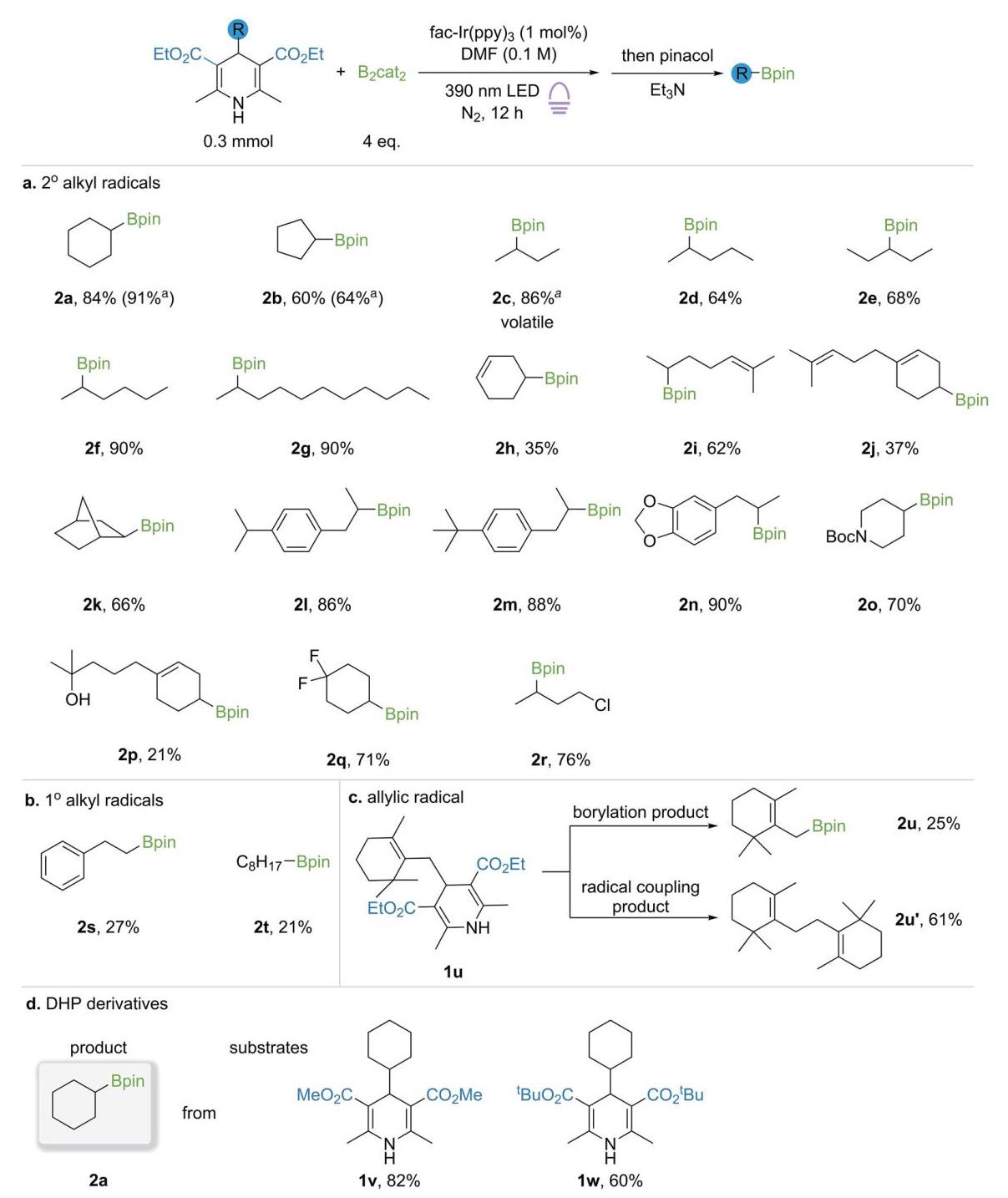
Fig. 2 Scope exploration of 4-alkyl-substituted Hantstzsch esters borylation reaction. Reaction conditions: Hantzsch ester 1 (0.3 mmol, 1.0 equiv.), ${\mathrm{B}}_{2}{\mathrm{{cat}}}_{2}$ (1.2 mmol, 4.0 equiv.) and fac-lr(ppy) ${}_{3}$ (1 mol%) in DMF (0.1 M, 3.0 mL), Kessil 390 nm LED lamp, ${\mathrm{N}}_{2}$ atmosphere, room temperature. Isolated yield. ${}^{a}$ Yields were determined by GC-FID using $n$ -decane as internal standard.
图2 4-烷基取代的汉茨酯硼化反应的范围探索。反应条件:汉茨酯1(0.3 mmol,1.0当量),${\mathrm{B}}_{2}{\mathrm{{cat}}}_{2}$(1.2 mmol,4.0当量)和fac-lr(ppy)${}_{3}$(1 mol%)于DMF(0.1 M,3.0 mL)中,Kessil 390 nm LED灯,${\mathrm{N}}_{2}$气氛,室温。分离产率。${}^{a}$产率通过气相色谱 - 氢火焰离子化检测法使用$n$ - 癸烷作为内标物测定。
In contrast to secondary alkyl radical precursors, primary alkyl radical precursors exhibited lower reactivity in this reaction. The borylation products of phenylpropyl and $n$ -octyl were obtained in low yields (2s, 2t). This disparity can be attributed to the relative stability of alkyl radicals, as secondary radicals are generally considered more stable than primary radicals. However, highly stable radicals are less favorable for boryla-tion. For instance, the highly stable allylic radical produced the borylation product $2\mathbf{u}$ with only a ${25}\%$ yield, while the radical coupling product $2{\mathbf{u}}^{\prime }$ was concurrently isolated in a 61% yield. We further explored the scope of Hantzsch ester derivatives (1v, 1w), and the results revealed that substituents with significant steric hindrance, such as tert-butyl, resulted in a notable decrease in borylation yield.
与仲烷基自由基前体相比,伯烷基自由基前体在该反应中表现出较低的反应活性。苯丙基和$n$-辛基的硼化产物产率较低(2s,2t)。这种差异可归因于烷基自由基的相对稳定性,因为仲自由基通常被认为比伯自由基更稳定。然而,高度稳定的自由基对硼化反应不太有利。例如,高度稳定的烯丙基自由基生成硼化产物$2\mathbf{u}$的产率仅为${25}\%$,而自由基偶联产物$2{\mathbf{u}}^{\prime }$的分离产率为61%。我们进一步探索了汉茨酯衍生物(1v,1w)的范围,结果表明,具有显著空间位阻的取代基,如叔丁基,导致硼化产率显著降低。
To demonstrate the utility of this borylation reaction, we explored various synthetic applications. Firstly, we conducted the large-scale synthesis of 2a, which yielded a satisfactory 65% yield (Fig. 3a). Furthermore, we investigated the pre- and post-conversion of Hantzsch ester substrates and borylation products. For instance, cyclohexylmethyl alcohols could be readily oxidized to cyclohexanecarboxaldehyde. By employing our proposed synthesis, we obtained the borylation product 2a, which could be further oxidized using hydrogen peroxide to yield cyclohexanol 3a. This entire reaction sequence exemplifies a “one-carbon-lose” strategy, where a primary alcohol is converted into a secondary alcohol (Fig. 3b).
为了证明这种硼化反应的实用性,我们探索了各种合成应用。首先,我们进行了2a的大规模合成,产率令人满意,为65%(图3a)。此外,我们研究了汉茨酯底物和硼化产物的预转化和后转化。例如,环己基甲醇可以很容易地氧化为环己烷甲醛。通过采用我们提出的合成方法,我们获得了硼化产物2a,它可以用过氧化氢进一步氧化生成环己醇3a。整个反应序列体现了一种“一碳损失”策略,即将伯醇转化为仲醇(图3b)。
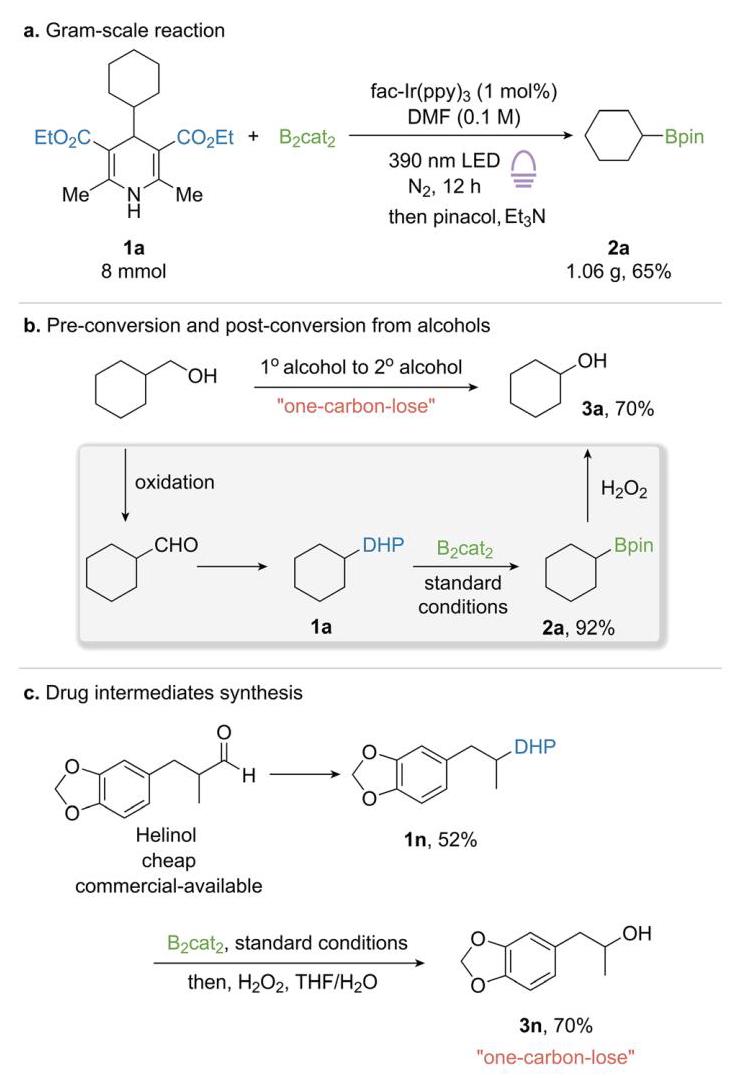
Fig. 3 Synthetic applications.
图3合成应用。
Additionally, the versatility of aldehydes in synthetic methodologies allowed for the synthesis of intriguing borylation products. For instance, acids and esters could be selectively reduced to aldehydes. We successfully accomplished the transformation of esters to the corresponding borylation product $2\mathbf{q}$ by first reducing the ester to the aldehyde (see ESI Scheme S2a†). This approach provides an alternative for bory-lation of acid derivatives. Furthermore, the reduction of lactones using diisobutylaluminum hydride (DIBAL-H) led to ring-opening aldehyde products. For example, treatment of 3-methyltetrahydro-2-furanone with DIBAL-H yielded 4-hydroxy-2-methylbutyraldehyde, which contains both hydroxyl and aldehyde groups. The transformation from aldehyde to boron ester and from hydroxyl to other functional groups, such as halogens, can be achieved as demonstrated in the case of $2\mathbf{r}$ (Scheme S2b†). This strategy allows for the synthesis of boron esters with multiple functional groups, which have been scarcely reported in the literature.
此外,醛在合成方法中的多功能性使得合成有趣的硼化产物成为可能。例如,酸和酯可以选择性地还原为醛。我们通过首先将酯还原为醛,成功地实现了酯向相应硼化产物$2\mathbf{q}$的转化(见ESI方案S2a†)。这种方法为酸衍生物的硼化提供了一种替代方法。此外,使用二异丁基氢化铝(DIBAL-H)还原内酯会导致开环醛产物。例如,用DIBAL-H处理3-甲基四氢-2-呋喃酮得到4-羟基-2-甲基丁醛,它同时含有羟基和醛基。如$2\mathbf{r}$的情况所示(方案S2b†),可以实现从醛到硼酸酯以及从羟基到其他官能团(如卤素)的转化。这种策略允许合成具有多个官能团的硼酸酯,这在文献中很少报道。
Moreover, 3n serves as an alcohol intermediate in drug synthesis and is typically obtained via a three-step synthetic route from the costly starting material piperonal. ${}^{26}$ However, by following the procedures outlined in this work (Fig. 3c), we successfully obtained the alcohol $3\mathbf{n}$ from $1\mathbf{n}$ , which can be readily prepared in a single step using the inexpensive and commercially available compound helinol. These transformations illustrate the potential applications of our borylation reaction.
此外,3n在药物合成中用作醇中间体,通常通过从昂贵的起始原料胡椒醛开始的三步合成路线获得。${}^{26}$然而,按照本工作中概述的程序(图3c),我们成功地从$1\mathbf{n}$获得了醇$3\mathbf{n}$,它可以使用廉价的市售化合物海因醇在一步中轻松制备。这些转化说明了我们的硼化反应的潜在应用。
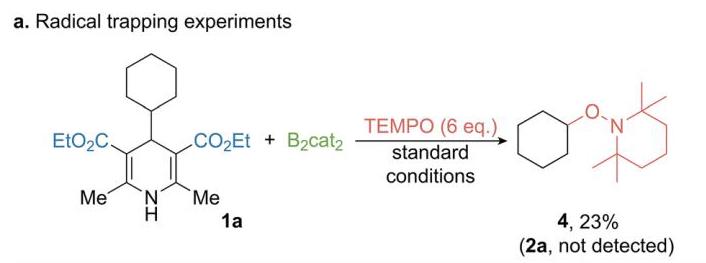
To elucidate the mechanism of this borylation reaction, additional investigations were conducted, as depicted in Fig. 4. Previous literature on the photochemical transformations of Hantzsch esters has demonstrated that alkyl radicals can be generated under light irradiation conditions. ${}^{21}$ The formation of the coupling product $2{\mathbf{u}}^{\prime }$ (Fig. 2c) supports the involvement of a radical mechanism in this reaction. To confirm the radical mechanism, we introduced 6 equivalents of TEMPO as a radical scavenger into the standard reaction system. We observed that the borylation was completely blocked, and the TEMPO scavenged product 4 was isolated in a yield of 23% (Fig. 4a).
为了阐明这种硼化反应的机理,我们进行了进一步的研究,如图4所示。先前关于汉茨酯光化学转化的文献表明,在光照条件下可以产生烷基自由基。${}^{21}$偶联产物$2{\mathbf{u}}^{\prime }$(图2c)的形成支持了该反应中自由基机理的参与。为了确认自由基机理,我们将6当量的TEMPO作为自由基清除剂引入标准反应体系。我们观察到硼化反应完全被阻断,并且以23%的产率分离出TEMPO清除产物4(图4a)。
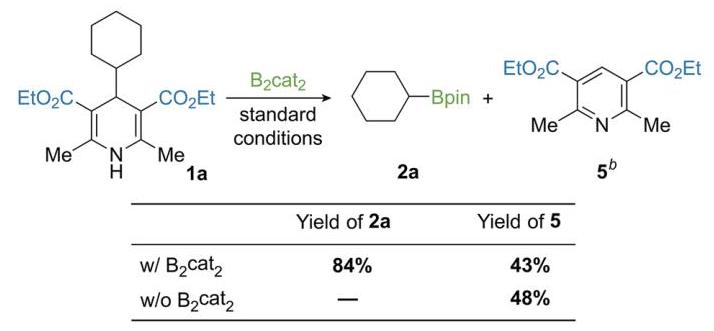
Furthermore, we isolated the by-product observed in this borylation reaction to aid in the analysis of the mechanism. Under the standard reaction conditions, the DHP group in the substrates was transformed into the pyridine product 5 , which could be easily recovered with a yield of 42% (Fig. 4b). A control experiment demonstrated that even without the addition of the boron source $\left( {{\mathrm{B}}_{2}{\mathrm{{cat}}}_{2}}\right)$ , the pyridine product 5 could still be obtained with a yield of 50%.
此外,我们分离出了该硼化反应中观察到的副产物,以辅助机理分析。在标准反应条件下,底物中的二氢吡啶基团转化为吡啶产物5,其易于回收,产率为42%(图4b)。对照实验表明,即使不添加硼源$\left( {{\mathrm{B}}_{2}{\mathrm{{cat}}}_{2}}\right)$,仍可获得产率为50%的吡啶产物5。
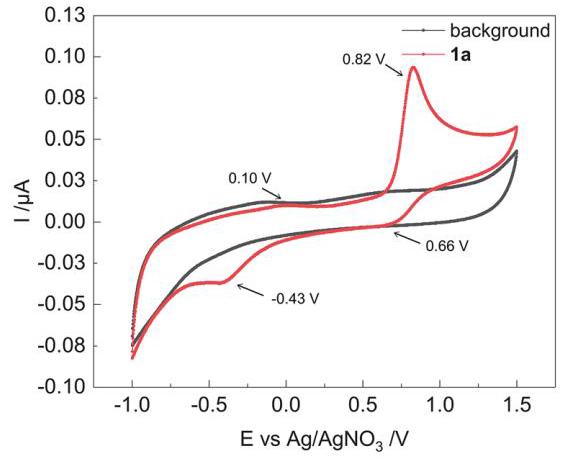
Moreover, cyclic voltammetry (CV) experiments were performed to determine the redox properties of 1a (Fig. 4c). The resulting CV curve exhibited two main redox peaks $\left( {{E}_{1/2} = }\right.$ -0.16 V and ${0.74}\mathrm{\;V}{vs}.\mathrm{{Ag}}/{\mathrm{{AgNO}}}_{3}$ reference electrode), and we attributed the wave around $- {0.16}\mathrm{\;V}$ to the oxidation of $1\mathrm{a}$ .
此外,进行了循环伏安法(CV)实验以确定1a的氧化还原性质(图4c)。所得的CV曲线显示出两个主要的氧化还原峰$\left( {{E}_{1/2} = }\right.$ -0.16 V和${0.74}\mathrm{\;V}{vs}.\mathrm{{Ag}}/{\mathrm{{AgNO}}}_{3}$(相对于参比电极),并且我们将$- {0.16}\mathrm{\;V}$附近的波归因于$1\mathrm{a}$的氧化。
c. CV experiments ${}^{c}$
c. CV实验${}^{c}$
d. UV and FL absorption spectra ${}^{d}$
d. 紫外和荧光吸收光谱${}^{d}$
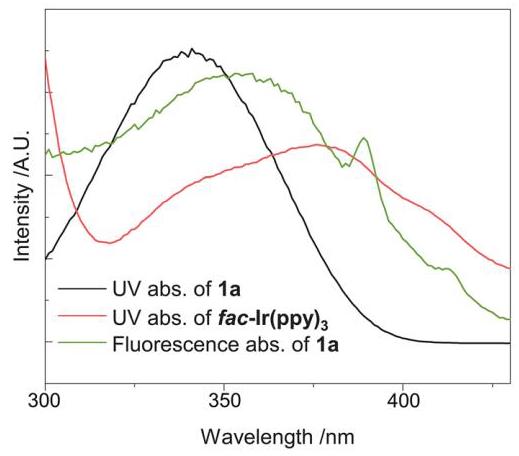
Fig. 4 Mechanism studies. ${}^{a}$ Control reaction conditions: Hantzsch ester 1a (0.3 mmol,1.0 equiv.) and fac-Ir(ppy) ${}_{3}$ (1 mol%) in DMF (0.1 M, 3.0 mL), Kessil 390 nm LED lamp, ${\mathrm{N}}_{2}$ atmosphere, room temperature. Isolated yield. ${}^{b}$ Yields were determined by GC-FID using $n$ -decane as internal standard. ${}^{c}$ Reaction conditions: solvent, MeCN; electrodes, platinum wire; reference electrode, $\mathrm{{Ag}}/{\mathrm{{AgNO}}}_{3}$ (0.01 M in $\mathrm{{MeCN}}$ ); scan rate ${0.3}\mathrm{\;V}{\mathrm{\;s}}^{-1}$ ; background, ${0.1}\mathrm{M}{\mathrm{{LiClO}}}_{4}$ in MeCN. ${}^{d}$ solvent, DMF.
图4 机理研究。${}^{a}$对照反应条件:在DMF(0.1 M,3.0 mL)中,汉茨酯1a(0.3 mmol,1.0当量)和三(2-苯基吡啶)铱(III)${}_{3}$(1 mol%),Kessil 390 nm LED灯,${\mathrm{N}}_{2}$气氛,室温。分离产率。${}^{b}$产率通过使用$n$ -癸烷作为内标物的气相色谱-火焰离子化检测法测定。${}^{c}$反应条件:溶剂,乙腈;电极,铂丝;参比电极,$\mathrm{{Ag}}/{\mathrm{{AgNO}}}_{3}$(在$\mathrm{{MeCN}}$中0.01 M);扫描速率${0.3}\mathrm{\;V}{\mathrm{\;s}}^{-1}$;背景,${0.1}\mathrm{M}{\mathrm{{LiClO}}}_{4}$在乙腈中。${}^{d}$溶剂,DMF。
Regarding the optical properties, we measured the UV-vis and fluorescence absorption spectra of substrate 1a and fac-Ir (ppy) ${}_{3}$ (Fig. 4d). The UV-vis spectra revealed that fac-Ir(ppy) ${}_{3}$ exhibited a maximum absorption wavelength around ${380}\mathrm{\;{nm}}$ , which closely corresponds to the wavelength of the lamp used in our experiments. The maximum UV-vis absorption wavelength of 1a was approximately ${340}\mathrm{\;{nm}}$ , but the fluorescence absorption spectra indicated that it also exhibited fluorescence absorption at ${390}\mathrm{\;{nm}}$ . Therefore, we proposed that under our reaction conditions, both $\mathbf{{1a}}$ and ${fac}$ - $\operatorname{Ir}{\left( \mathrm{{ppy}}\right) }_{3}$ could undergo excitation.
关于光学性质,我们测量了底物1a和三(2-苯基吡啶)铱(III)${}_{3}$的紫外-可见和荧光吸收光谱(图4d)。紫外-可见光谱显示三(2-苯基吡啶)铱(III)${}_{3}$在${380}\mathrm{\;{nm}}$附近表现出最大吸收波长,这与我们实验中使用的灯的波长密切对应。1a的最大紫外-可见吸收波长约为${340}\mathrm{\;{nm}}$,但荧光吸收光谱表明它在${390}\mathrm{\;{nm}}$处也表现出荧光吸收。因此,我们提出在我们的反应条件下,$\mathbf{{1a}}$和${fac}$ - $\operatorname{Ir}{\left( \mathrm{{ppy}}\right) }_{3}$都可以发生激发。
Based on the above observations, several intriguing questions regarding the mechanism arise in this study: (1) How does the oxidative process occur for the conversion of substrate 1a to product 5 in the absence of an external oxidant? (2) How does the photocatalyst fac-Ir(ppy) ${}_{3}$ facilitate the reaction? To address these questions, extensive investigations were conducted and will be discussed in the subsequent sections.
基于上述观察结果,本研究中出现了几个关于机理的有趣问题:(1)在没有外部氧化剂的情况下,底物1a转化为产物5的氧化过程是如何发生的?(2)光催化剂三(2-苯基吡啶)铱(III)${}_{3}$如何促进反应?为了解决这些问题,我们进行了广泛的研究,并将在后续章节中进行讨论。
To analyze the reason behind the oxidation process, we conducted nuclear magnetic resonance (NMR) spectroscopy analysis on the reaction system to examine the structures of certain stable intermediates (Fig. 5). In this analysis, we replaced the solvent in the standard conditions with fully deuterated DMF and collected samples at regular intervals for NMR proton spectroscopy detection. Prior to the NMR analysis, we performed a reaction time control experiment to determine the optimal reaction duration (see ESI Scheme S3†). We observed that the borylation product could be obtained in a yield of 65% within 2 hours and 83% within 8 hours.
为了分析氧化过程背后 的原因,我们对反应体系进行了核磁共振(NMR)光谱分析,以检查某些稳定中间体的结构(图5)。在该分析中,我们用完全氘代的DMF替换了标准条件下的溶剂,并定期收集样品进行NMR质子光谱检测。在进行NMR分析之前,我们进行了反应时间控制实验以确定最佳反应持续时间(见ESI方案S3†)。我们观察到硼化产物在2小时内产率可达65%,8小时内可达83%。
During NMR analysis, we observed several distinctive signals of compound 5. Specifically, signals corresponding to the methyl hydrogen at position 2 and the methylene group within the ester moiety gradually intensified as the reaction progressed, as depicted in the grey region in Fig. 5. However, it is worth noting that the signal of the hydrogen at position 4 (represented by the red dot) did not appear. Additionally, the hydrogen signals associated with the DHP group of reagent 1a were not entirely transformed into signals corresponding to product 5 (indicated by the blue and green dots) after approximately 8 hours, even though the borylation reaction was nearly completed (as illustrated in ESI Fig. S2†). This suggests that pyridine 5 may not be the sole product derived from the DHP group of $\mathbf{{1a}}$ ; there may be other products originating from the DHP group.
在核磁共振分析过程中,我们观察到了化合物5的几个独特信号。具体而言,随着反应的进行,与2位甲基氢以及酯部分内亚甲基相对应的信号逐渐增强,如图5中的灰色区域所示。然而,值得注意的是,4位氢的信号(由红点表示)并未出现。此外,即使硼化反应几乎完成(如补充信息图S2†所示),试剂1a的二氢吡啶(DHP)基团相关的氢信号在大约8小时后也并未完全转化为与产物5相对应的信号(由蓝点和绿点表示)。这表明吡啶5可能不是$\mathbf{{1a}}$的DHP基团衍生出的唯一产物;可能存在源自DHP基团的其他产物。
To investigate further, we conducted mass spectrometry analysis on the reaction system, which revealed the presence of a molecular ion peak corresponding to the dimerized product resulting from two DHP radicals (ESI Scheme S5†). Notably, the formation of this dimerized product from substrate 1a was a redox-neutral reaction.
为了进一步研究,我们对反应体系进行了质谱分析,结果显示存在一个对应于由两个DHP自由基形成的二聚产物的分子离子峰(补充信息方案S5†)。值得注意的是,由底物1a形成这种二聚产物是一个氧化还原中性反应。
Our previous findings have already substantiated that the yield of compound 5 is less than ${50}\%$ (as depicted in Fig. 4b). Remarkably, even in the absence of ${\mathrm{B}}_{2}{\mathrm{{cat}}}_{2}$ , the reagent $1\mathbf{a}$ can undergo transformation into compound 5. Consequently, we contend that the conversion of the DHP group assumes a pivotal role in the successful execution of these chemical reactions, rather than involving some boron-containing species. The DHP group exhibits a propensity to readily convert into its dimerized product, subsequently giving rise to pyridine 5, with other products. This mechanism obviates the need for the introduction of oxidants. Consequently, the diboron reagent can maintain its efficacy without requiring the addition of oxidants, thereby facilitating the accomplishment of the boryla-tion reaction. A similar mechanism has been proposed in previous studies. ${}^{27}$
我们之前的研究结果已经证实化合物5的产率低于${50}\%$(如图4b所示)。值得注意的是,即使在没有${\mathrm{B}}_{2}{\mathrm{{cat}}}_{2}$的情况下,试剂$1\mathbf{a}$也能转化为化合物5。因此,我们认为DHP基团的转化在这些化学反应的成功进行中起着关键作用,而不是涉及某些含硼物种。DHP基团倾向于容易转化为其二聚产物,随后产生吡啶5以及其他产物。这种机制无需引入氧化剂。因此,二硼试剂无需添加氧化剂就能保持其有效性,从而促进硼化反应的完成。之前的研究中也提出了类似的机制。${}^{27}$
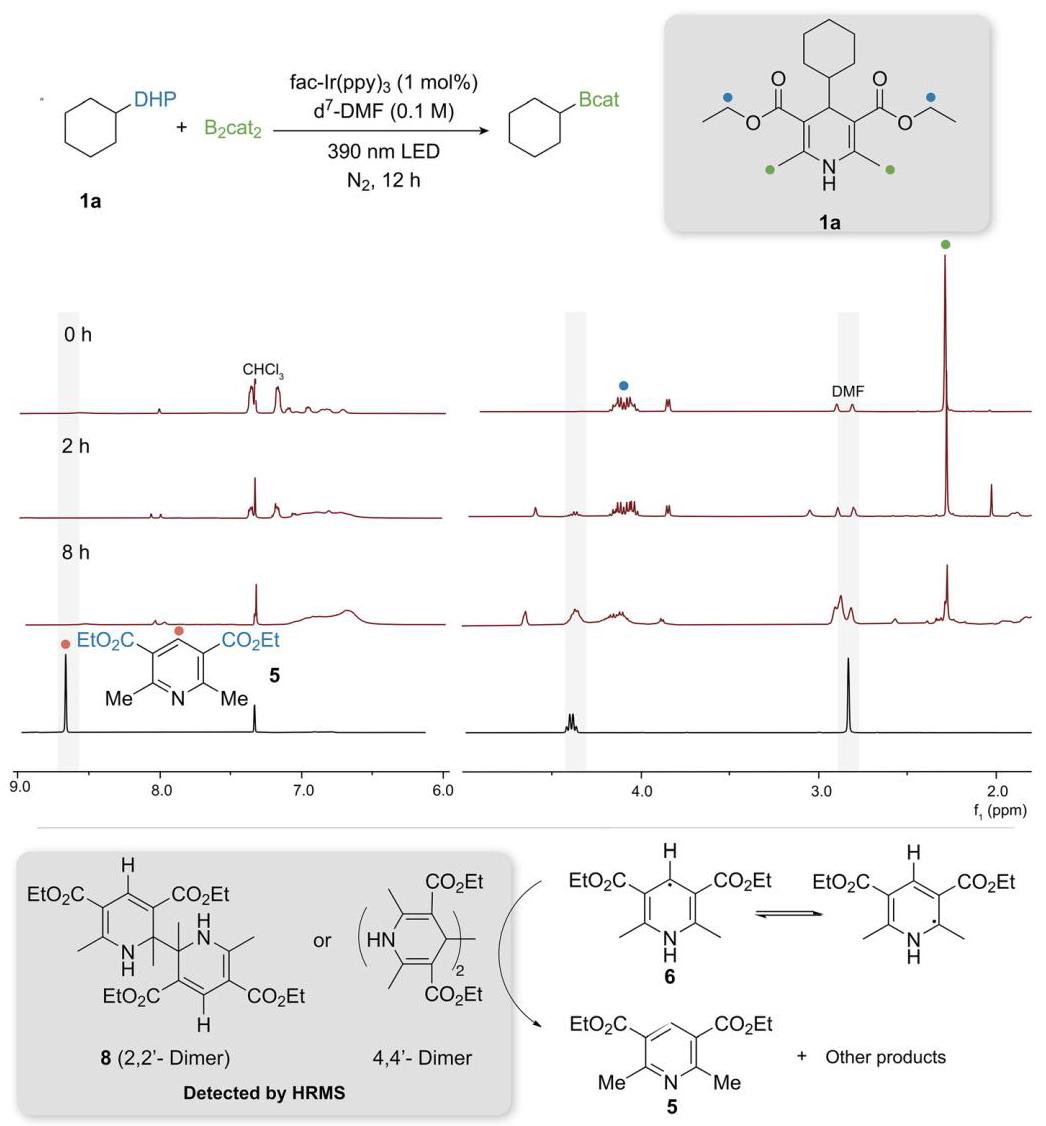
Fig. 5 NMR experiments. Reaction conditions: Hantzsch ester 1a (0.3 mmol,1.0 equiv.), B2cat (1.2 mmol, 4.0 equiv.) and fac-Ir(ppy) ${}_{3}$ (1 mol%) in ${\mathrm{d}}^{7}$ -DMF (0.1 M, 3.0 mL), Kessil 390 nm LED lamp, ${\mathrm{N}}_{2}$ atmosphere, room temperature, reaction time: 0 h, 2 h, 8 h.
图5核磁共振实验。反应条件:在${\mathrm{d}}^{7}$ -二甲基甲酰胺(0.1 M,3.0 mL)中,汉茨酯1a(0.3 mmol,1.0当量)、B2cat(1.2 mmol,4.0当量)和三(2-苯基吡啶)铱(III)${}_{3}$(1 mol%),Kessil 390 nm发光二极管灯,${\mathrm{N}}_{2}$气氛,室温,反应时间:0小时、2小时、8小时。
To investigate the interactions between fac-Ir(ppy) ${}_{3}$ and 1a, we conducted density functional theory (DFT) calculations to determine the energy changes associated with one-electron oxidation or reduction. Through these calculations, we obtained the Gibbs free energy of substrate 1a along with its oxidized species 1a’+ and reduced species 1a’- (see ESI Scheme S4†). The redox potentials were derived from the free energy change $\left( {\Delta G}\right)$ using computational methods. ${}^{{28},{29}}$ Our calculations also involved fac-Ir(ppy) ${}_{3}$ and other intermediates.
为了研究三(2-苯基吡啶)铱(III)${}_{3}$与1a之间的相互作用,我们进行了密度泛函理论(DFT)计算,以确定与单电子氧化或还原相关的能量变化。通过这些计算,我们获得了底物1a及其氧化态1a’+和还原态1a’-的吉布斯自由能(见补充信息方案S4†)。氧化还原电位是使用计算方法从自由能变化$\left( {\Delta G}\right)$推导出来的。${}^{{28},{29}}$我们的计算还涉及三(2-苯基吡啶)铱(III)${}_{3}$和其他中间体。
Experimental studies have demonstrated that the excited state of fac-Ir(ppy) ${}_{3}$ (Ir(III)) can oxidize substrate $1\mathrm{a}$ to form 1a’+ while simultaneously reducing itself to fac-Ir(ppy) ${}_{3}{}^{ - }$ (Ir (II)). ${}^{{30},{31}}$ Additionally, ${}^{1}$ a* + can generate an alkyl radical along with the cationic species 7. The above DFT results confirmed that the oxidation of $\mathbf{{1a}}$ by $\operatorname{Ir}{\left( \mathrm{{III}}\right) }^{ * }$ occurred spontaneously. Furthermore, it indicated that the intermediate Ir(π) possessed a sufficiently reduced potential to facilitate the reduction of cationic species 7, resulting in the production of radical 6 and the regeneration of Ir(iii).
实验研究表明,三(2-苯基吡啶)铱(III)${}_{3}$(Ir(III))的激发态可以氧化底物$1\mathrm{a}$形成1a’+,同时自身还原为三(2-苯基吡啶)铱(II)${}_{3}{}^{ - }$(Ir(II))。${}^{{30},{31}}$此外,${}^{1}$ a* +可以产生一个烷基自由基以及阳离子物种7。上述DFT结果证实$\operatorname{Ir}{\left( \mathrm{{III}}\right) }^{ * }$对$\mathbf{{1a}}$的氧化是自发发生的。此外,它表明中间体Ir(π)具有足够低的电位,有利于阳离子物种7的还原,从而产生自由基6并使Ir(iii)再生。
In our experimental results, we previously determined that the oxidation potential of 1a was approximately -0.16 V vs. Ag/ ${\mathrm{{AgNO}}}_{3}$ reference electrode (equivalent to ${0.64}\mathrm{\;V}\nu \mathrm{s}$ . standard hydrogen electrode, SHE). The reduction potential of Ir(III)* was found to be ${0.31}\mathrm{\;V}{vs}$ . saturated calomel electrode (SCE), which corresponds to ${0.56}\mathrm{\;V}{vs}$ . SHE. Both the experimental and DFT-calculated redox potentials indicated that Ir(III)* could oxidize 1a. However, it is important to note that the redox potential difference between them was relatively small, suggesting that the driving force for the oxidation process was not significant. Moreover, considering the strong reducibility of ${\mathrm{B}}_{2}{\mathrm{{cat}}}_{2}$ , a competitive process involving the reduction of Ir (III)* by ${\mathrm{B}}_{2}{\mathrm{{cat}}}_{2}$ could also occur within the system. Due to the optical activity of the Hantzsch ester, the excited state of the Hantzsch ester is present in the reaction system. The oxidation of the excited Hantzsch ester by Ir(шi)* is thermodynamically more favorable. This may be a key factor in the reaction, as both the Hantzsch ester and fac-Ir(ppy) ${}_{3}$ are in the excited state, and the reducibility of the excited Hantzsch ester is greater than that of ${\mathrm{B}}_{2}{\mathrm{{cat}}}_{2}$ , promoting the electron transfer process between Hantzsch ester and fac-Ir(ppy) ${}_{3}$ .
在我们的实验结果中,我们之前确定,相对于Ag/${\mathrm{{AgNO}}}_{3}$参比电极,1a的氧化电位约为 -0.16 V(相当于${0.64}\mathrm{\;V}\nu \mathrm{s}$标准氢电极,SHE)。发现Ir(III)*的还原电位相对于饱和甘汞电极(SCE)为${0.31}\mathrm{\;V}{vs}$,这相当于相对于SHE为${0.56}\mathrm{\;V}{vs}$。实验和DFT计算得到的氧化还原电位均表明Ir(III)*可以氧化1a。然而,需要注意的是,它们之间的氧化还原电位差相对较小,这表明氧化过程的驱动力并不显著。此外,考虑到${\mathrm{B}}_{2}{\mathrm{{cat}}}_{2}$的强还原性,体系中还可能发生${\mathrm{B}}_{2}{\mathrm{{cat}}}_{2}$还原Ir(III)*的竞争过程。由于汉茨希酯具有光学活性,反应体系中存在汉茨希酯的激发态。Ir(шi)*氧化激发态的汉茨希酯在热力学上更有利。这可能是反应中的一个关键因素,因为汉茨希酯和fac-Ir(ppy)${}_{3}$均处于激发态,且激发态汉茨希酯的还原性大于${\mathrm{B}}_{2}{\mathrm{{cat}}}_{2}$,促进了汉茨希酯与fac-Ir(ppy)${}_{3}$之间的电子转移过程。
The results obtained so far confirm the occurrence of electron transfer between 1a and fac-Ir(ppy) ${}_{3}$ . In addition, we sought to investigate whether simultaneous energy transfer (EnT) occurs between the Hantzsch ester and the catalyst. To explore this, we performed time-dependent density functional theory (TD-DFT) calculations to analyze the optical properties of $1\mathrm{a}$ and fac-Ir(ppy) ${}_{3}$ (Fig. 6a). The calculations revealed that the excitation wavelength for $1\mathrm{a}$ to the first excited state (S1) was ${296}\mathrm{\;{nm}}$ , while the excitation wavelength for ${fac}$ -Ir(ppy) ${}_{3}$ was ${411}\mathrm{\;{nm}}$ . This indicates that the homo-lumo gap of $1\mathrm{a}$ is larger than that of fac-Ir(ppy) ${}_{3}$ , suggesting that the energy transfer process from fac-Ir(ppy) ${}_{3}$ to $1\mathrm{a}$ is not thermodynamically favorable. Therefore, we concluded that the photocatalyst primarily governs the reaction through single electron transfer (SET), wherein the excited state of fac-Ir(ppy) ${}_{3}$ oxidizes 1a (or the excited state of 1a) to generate an alkyl radical and the cationic intermediate 7. Detailed DFT calculations were performed to validate this proposed mechanism (Fig. 6b). The results demonstrated that the Hantzsch ester substrate can indeed be oxidized by the excited state of fac-Ir(ppy) ${}_{3}$ (Ir(III), leading to the cleavage of the C-C bond in 1a and the generation of the alkyl radical and cation 7. The borylation process of the alkyl radical can proceed smoothly from both thermodynamic and kinetic perspectives, while 7 can be reduced to the radical 6, thereby regenerating Ir(III) from its reduced species Ir(II) due to the strong reducibility of the intermediate Ir(π). The subsequent transformation of 6 remains uncertain. However, an analysis of its spin density distribution indicates that the single electron of this radical is distributed with nearly equal probability at positions 2 and 4 (see ESI Scheme S6†). Therefore, we propose that 6 undergoes a dimerization process to form the 2,2’-dimeric product 8, and the DFT results confirm that this process is thermodynamically favorable.
目前得到的结果证实了1a与fac-Ir(ppy)${}_{3}$之间发生了电子转移。此外,我们试图研究汉茨希酯与催化剂之间是否同时发生能量转移(EnT)。为了探究这一点,我们进行了含时密度泛函理论(TD-DFT)计算,以分析$1\mathrm{a}$和fac-Ir(ppy)${}_{3}$的光学性质(图6a)。计算结果表明,$1\mathrm{a}$到第一激发态(S1)的激发波长为${296}\mathrm{\;{nm}}$,而${fac}$-Ir(ppy)${}_{3}$的激发波长为${411}\mathrm{\;{nm}}$。这表明$1\mathrm{a}$的HOMO-LUMO能隙大于fac-Ir(ppy)${}_{3}$,这意味着从fac-Ir(ppy)${}_{3}$到$1\mathrm{a}$的能量转移过程在热力学上是不利的。因此,我们得出结论,光催化剂主要通过单电子转移(SET)控制反应,其中fac-Ir(ppy)${}_{3}$的激发态氧化1a(或1a的激发态)生成烷基自由基和阳离子中间体7。进行了详细的DFT计算以验证这一提出的机理(图6b)。结果表明,汉茨希酯底物确实可以被fac-Ir(ppy)${}_{3}$(Ir(III))的激发态氧化,导致1a中的C-C键断裂并生成烷基自由基和阳离子7。从热力学和动力学角度来看,烷基自由基的硼化过程都可以顺利进行,而7可以被还原为自由基6,由于中间体Ir(π)的强还原性,Ir(III)从其还原态Ir(II)再生。6的后续转化仍然不确定。然而,对其自旋密度分布分析表明,该自由基的单电子在位置2和4处的分布概率几乎相等(见ESI方案S6†)。因此,我们提出6经历二聚化过程形成2,2’-二聚产物8,DFT结果证实该过程在热力学上是有利的。
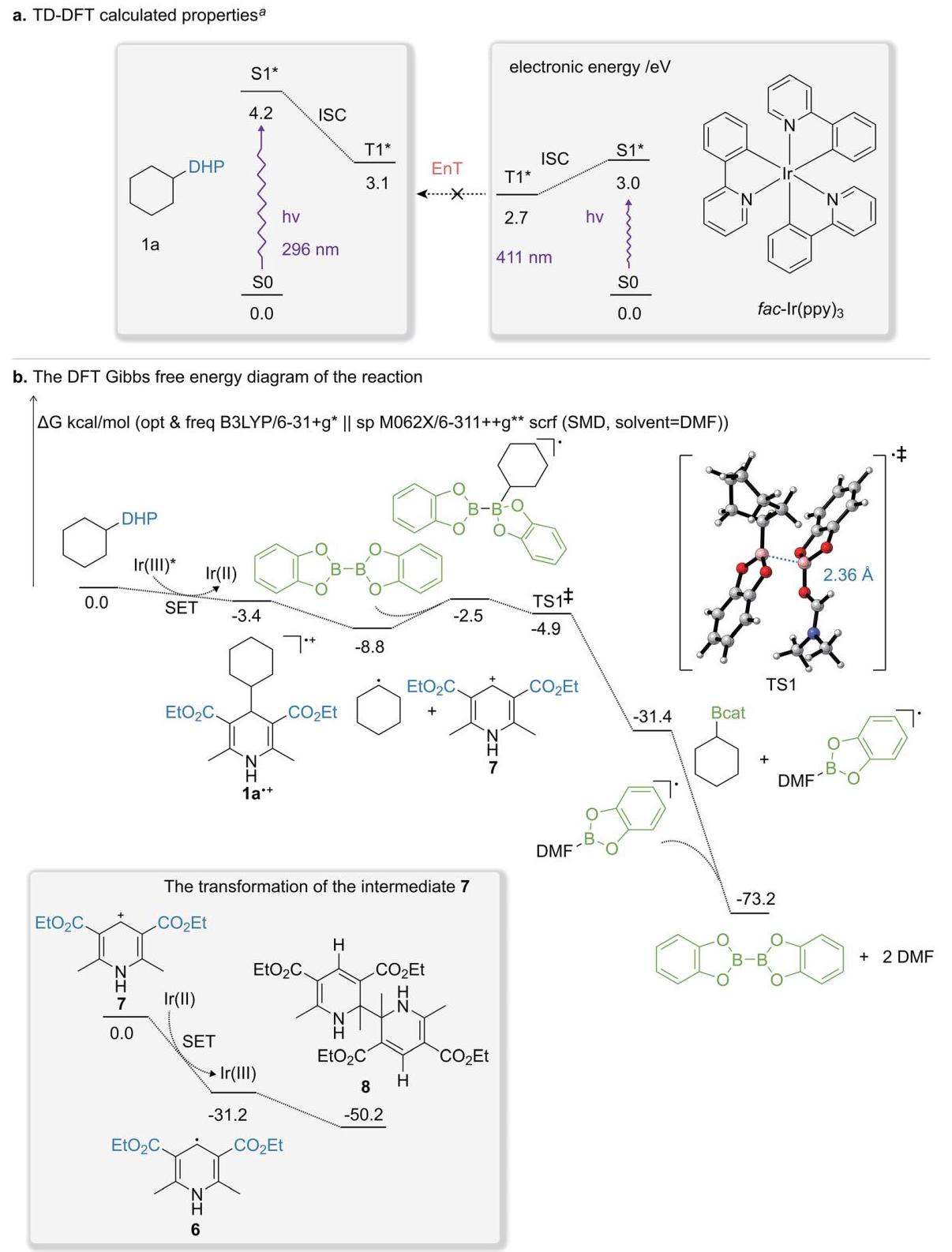
Fig. 6 DFT calculations. The S1* and T1* energies were calculated by TD-DFT under B3LYP/6-311++g** level with an implicit solvation model SMD (solvent = DMF).
图6 DFT计算。S1和T1能量通过TD-DFT在B3LYP/6-311++g**水平下,采用隐式溶剂化模型SMD(溶剂 = DMF)进行计算。
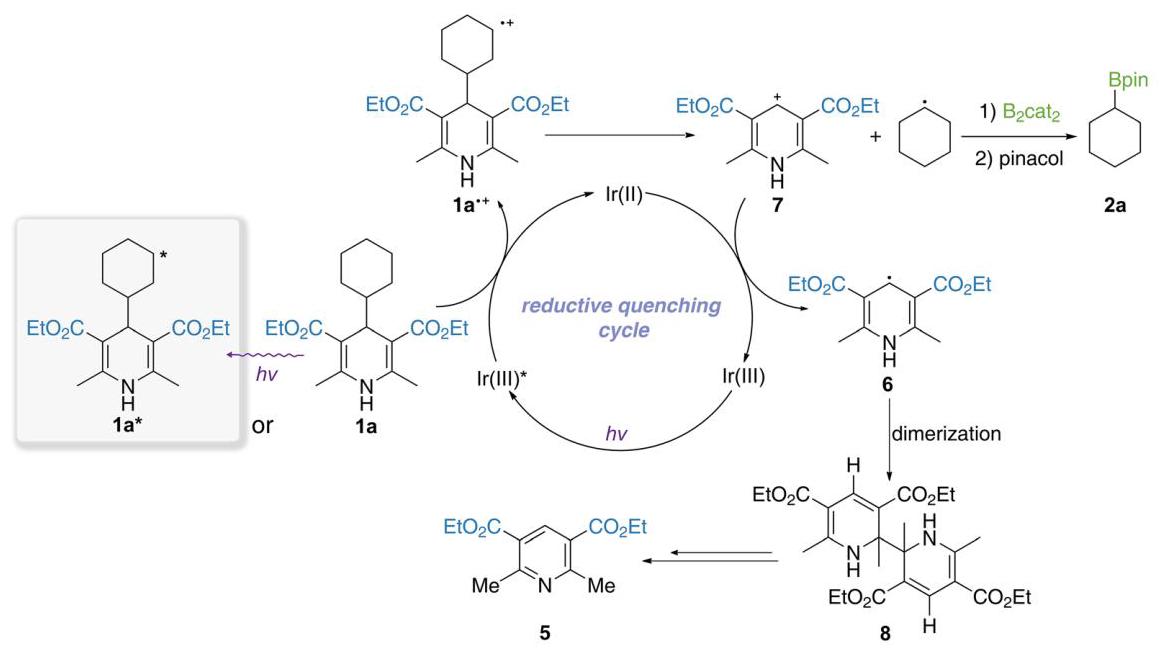
Fig. 7 Plausible mechanism.
图7合理的机理。
Based on the experimental and theoretical evidence presented, along with the knowledge from previously developed radical borylation reactions, ${}^{9,{10},{17},{32}}$ we propose a plausible mechanism outlined in Fig. 7. The excitation of fac-Ir(ppy) ${}_{3}$ initiates a reductive quenching cycle in which the excited Ir(III) * species oxidizes 1a (or excited 1a) to generate the radical cation intermediate 1a*+. This intermediate then produces an alkyl radical along with the cation 7, which react with the boron reagent to form the desired borylation product. The intermediate 7 assists in the regeneration of Ir(III) to complete the quenching cycle. The product radical 6 subsequently undergoes a dimerization reaction to form the intermediate 8. Upon isolation, the dimerization products transform into the pyridine product 5. This mechanism provides an explanation for why the reaction proceeds without the need for external oxidants.
基于所提供的实验和理论证据,以及先前开发的自由基硼化反应的知识,${}^{9,{10},{17},{32}}$我们提出了图7中概述的合理机理。fac-Ir(ppy)${}_{3}$的激发引发了一个还原猝灭循环,其中激发态的Ir(III)物种将1a(或激发态的1a)氧化,生成自由基阳离子中间体1a+。然后该中间体产生一个烷基自由基和阳离子7,它们与硼试剂反应形成所需的硼化产物。中间体7有助于Ir(III)的再生以完成猝灭循环。产物自由基6随后进行二聚反应形成中间体8。分离后,二聚产物转化为吡啶产物5。该机理解释了为什么该反应无需外部氧化剂即可进行。
3 Conclusions
3 结论
In conclusion, we have successfully developed a mild and efficient method for the radical borylation of aldehydes using 4-substituted Hantzsch esters as radical precursors. This photoredox-catalyzed reaction, conducted under visible light irradiation at room temperature, enables the transformation of aldehydes into alkyl borylation products in a “one-carbon-less” manner. The methodology exhibits excellent functional group compatibility and a broad substrate scope. By the oxidation of 4-substituted Hantzsch esters, alkyl radicals are generated and efficiently captured by the diboron reagent to afford a diverse range of alkyl borylation products. We have provided theoretical and experimental evidence confirming the formation of alkyl radicals. Furthermore, the scalability of the reaction and post-conversion of the products highlight the practical utility of this method. Through a combination of mechanistic experiments and density functional theory calculations, we have elucidated the electron transfer process between the photocatalyst and substrate, and proposed a plausible mechanism that is consistent with our experimental observations. Notably, this reaction proceeds efficiently without the need for external oxidants, offering an environmentally friendly and straightforward approach for the synthesis of alkyl boronates.
总之,我们成功开发了一种温和且高效的方法,使用4-取代的汉茨酯作为自由基前体对醛进行自由基硼化反应。这种光氧化还原催化反应在室温可见光照射下进行,能够以“少一个碳”的方式将醛转化为烷基硼化产物。该方法具有出色的官能团兼容性和广泛的底物范围。通过4-取代的汉茨酯的氧化,生成烷基自由基,并被二硼试剂有效捕获,从而得到各种烷基硼化产物。我们提供了理论和实验证据,证实了烷基自由基的形成。此外,该反应的可扩展性和产物的后转化突出了该方法的实际应用价值。通过机理实验和密度泛函理论计算相结合,我们阐明了光催化剂与底物之间的电子转移过程,并提出了一个与我们的实验观察结果一致的合理机理。值得注意的是,该反应无需外部氧化剂即可高效进行,为合成烷基硼酸酯提供了一种环境友好且直接的方法。
Conflicts of interest
利益冲突
There are no conflicts to declare.
无需申报利益冲突。
Acknowledgements
致谢
The author thanks the National Natural Science Foundation of China (Grant No. 22071004, 21933001 and 22150013). The author also thanks the High Performance Computing Platform of Peking University and the Shenzhen Cloud Computing Center for DFT calculations support.
作者感谢中国国家自然科学基金(项目编号:22071004、21933001和22150013)。作者还感谢北京大学高性能计算平台和深圳云计算中心提供的密度泛函理论(DFT)计算支持。
References
参考文献
1 D. G. Hall, Boronic Acids: Preparation and Applications in Organic Synthesis, Medicine and Materials, John Wiley & Sons, 2012.
2 S. D. Bull, M. G. Davidson, J. M. Van den Elsen, J. S. Fossey, A. T. A. Jenkins, Y.-B. Jiang, Y. Kubo, F. Marken, K. Sakurai, J. Zhao, et al., Exploiting the Reversible Covalent Bonding of Boronic Acids: Recognition, Sensing, and Assembly, Acc. Chem. Res., 2013, 46, 312-326.
3 W. L. Brooks and B. S. Sumerlin, Synthesis and Applications of Boronic Acid-containing Polymers: from Materials to Medicine, Chem. Rev., 2016, 116, 1375-1397.
4 D. B. Diaz and A. K. Yudin, The Versatility of Boron in Biological Target Engagement, Nat. Chem., 2017, 9, 731- 742.
5 R. F. Barth, P. Mi and W. Yang, Boron Delivery Agents for Neutron Capture Therapy of Cancer, Cancer Commun., 2018, 38, 1-15.
6 F. Mo, Y. Jiang, D. Qiu, Y. Zhang and J. Wang, Direct Conversion of Arylamines to Pinacol Boronates: a Metal-free Borylation Process, Angew. Chem., Int. Ed., 2010, 49, 1846-1849.
7 F. W. Friese and A. Studer, New Avenues for C-B Bond Formation via Radical Intermediates, Chem. Sci., 2019, 10, 8503-8518.
8 A. Fawcett, J. Pradeilles, Y. Wang, T. Mutsuga, E. L. Myers and V. K. Aggarwal, Photoinduced Decarboxylative Borylation of Carboxylic Acids, Science, 2017, 357, 283-286.
9 D. Hu, L. Wang and P. Li, Decarboxylative Borylation of Aliphatic Esters under Visible-light Photoredox Conditions, Org. Lett., 2017, 19, 2770-2773.
10 C. Li, J. Wang, L. M. Barton, S. Yu, M. Tian, D. S. Peters, M. Kumar, A. W. Yu, K. A. Johnson, A. K. Chatterjee, et al., Decarboxylative Borylation, Science, 2017, 356, eaam7355.
11 J. Wang, M. Shang, H. Lundberg, K. S. Feu, S. J. Hecker, T. Qin, D. G. Blackmond and P. S. Baran, Cu-catalyzed Decarboxylative Borylation, ACS Catal., 2018, 8, 9537-9542.
12 D. Wei, T.-M. Liu, B. Zhou and B. Han, Decarboxylative Borylation of m CPBA-activated Aliphatic Acids, Org. Lett., 2019, 22, 234-238.
13 Q. Wei, Y. Lee, W. Liang, X. Chen, B.-s. Mu, X.-Y. Cui, W. Wu, S. Bai and Z. Liu, Photocatalytic Direct Borylation of Carboxylic Acids, Nat. Commun., 2022, 13, 7112.
14 F. W. Friese and A. Studer, Deoxygenative Borylation of Secondary and Tertiary Alcohols, Angew. Chem., Int. Ed., 2019, 58, 9561-9564.
15 J. Wu, R. M. Bär, L. Guo, A. Noble and V. K. Aggarwal, Photoinduced Deoxygenative Borylations of Aliphatic Alcohols, Angew. Chem., Int. Ed., 2019, 58, 18830- 18834.
16 J. Hu, G. Wang, S. Li and Z. Shi, Selective C- N Borylation of Alkyl Amines Promoted by Lewis base, Angew. Chem., Int. Ed., 2018, 57, 15227-15231.
17 F. Sandfort, F. Strieth-Kalthoff, F. J. Klauck, M. J. James and F. Glorius, Deaminative Borylation of Aliphatic Amines Enabled by Visible Light Excitation of an Electron Donor-acceptor Complex, Chem. - Eur. J., 2018, 24, 17210-17214.
18 J. Wu, L. He, A. Noble and V. K. Aggarwal, Photoinduced Deaminative Borylation of Alkylamines, J. Am. Chem. Soc., 2018, 140, 10700-10704.
19 Q. Liu, J. Zhang, L. Zhang and F. Mo, Photo-Induced Radical Borylation of Hemiacetals via C-C Bond Cleavage, Tetrahedron, 2021, 80, 131867.
20 A. M. F. Phillips and A. J. L. Pombeiro, Applications of Hantzsch Esters in Organocatalytic Enantioselective Synthesis, Catalysts, 2023, 13, 419.
21 P.-Z. Wang, J.-R. Chen and W.-J. Xiao, Hantzsch Esters: an Emerging Versatile Class of Reagents in Photoredox Catalyzed Organic Synthesis, Org. Biomol. Chem., 2019, 17, 6936-6951.
22 S. Ye and J. Wu, 4-Substituted Hantzsch Esters as Alkylation Reagents in Organic Synthesis, Acta Chim. Sin., 2019, 77, 814-831.
23 Z.-H. Shang, J. Pan, Z. Wang, Z.-X. Zhang and J. Wu, Transition-Metal-Free Radical Borylation Reactions, Eur. J. Org. Chem., 2023, 26, e202201379.
24 B. Wang, X. Zhang, Y. Cao, L. Zou, X. Qi and Q. Lu, Electrooxidative Activation of B-B Bond in B2cat2: Access to gem-Diborylalkanes via Paired Electrolysis, Angew. Chem., Int. Ed., 2023, 62, e202218179.
25 Y. Wen, C. Deng, J. Xie and X. Kang, Recent Synthesis Developments of Organoboron Compounds via Metal-free Catalytic Borylation of Alkynes and Alkenes, Molecules, 2018, 24, 101.
26 S. Easwar and N. P. Argade, Amano PS-catalysed Enantioselective Acylation of (±)-α-methyl-1, 3-benzodiox-ole-5-ethanol: an Efficient Resolution of Chiral Intermediates of the Remarkable Antiepileptic Drug Candidate,(-)-talampanel, Tetrahedron: Asymmetry, 2003, 14, 333-337.
Organic Chemistry Frontiers
《有机化学前沿》
27 K. Kano and T. Matsuo, Photoinduced One-electron Reduction of 1-benzyl-3-carbamoylpyridinium chloride and 3, 5-bis (ethoxycarbonyl)-2, 6-dimethylpyridine, Bull. Chem. Soc. Jpn., 1976, 49, 3269-3273.
28 A. V. Marenich, J. Ho, M. L. Coote, C. J. Cramer and D. G. Truhlar, Computational Electrochemistry: Prediction of Liquid-phase Reduction Potentials, Phys. Chem. Chem. Phys., 2014, 16, 15068-15106.
29 P. Winget, E. J. Weber, C. J. Cramer and D. G. Truhlar, Computational Electrochemistry: Aqueous One-electron Oxidation Potentials for Substituted Anilines, Phys. Chem. Chem. Phys., 2000, 2, 1231-1239.
30 K. Nakajima, S. Nojima, K. Sakata and Y. Nishibayashi, Visible-light-mediated Aromatic Substitution Reactions of Cyanoarenes with 4-Alkyl-1, 4-dihydropyridines through Double Carbon-Carbon Bond Cleavage, ChemCatChem, 2016, 8, 1028-1032.
31 C.-M. Wang, D. Song, P.-J. Xia, J. Wang, H.-Y. Xiang and H. Yang, Visible-light-promoted Synthesis of 1, 4-dicarbo-nyl Compounds via Conjugate Addition of Aroyl Chlorides, Chem. - Asian J., 2018, 13, 271-274.
32 B. Sun, S. Zheng and F. Mo, Transition Metal- and Light-free Radical Borylation of Alkyl Bromides and Iodides Using Silane, Chem. Commun., 2021, 57, 5674-5677.