Transforming organic chemistry research paradigms: moving from manual efforts to the intersection of automation and artificial intelligence
英文原文与中文译文逐段对照 · English original with Chinese translation
Special Topic: AI for Chemistry
专题:化学领域的人工智能
Transforming organic chemistry research paradigms: Moving from manual efforts to the intersection of automation and artificial intelligence
转变有机化学研究范式:从人工操作转向自动化与人工智能的交叉融合
Chengchun Liu ${}^{1}$ , Yuntian Chen ${}^{2, * }$ & Fanyang Mo ${}^{1,3, * }$
刘丞军${}^{1}$,陈云田${}^{2, * }$ 与莫凡洋${}^{1,3, * }$
${}^{1}$ School of Materials Science and Engineering, Peking University, Beijing 100871, China;
${}^{1}$ 北京大学材料科学与工程学院,北京 100871,中国;
${}^{2}$ Ningbo Institute of Digital Twin, Eastern Institute of Technology, Ningbo 315000, China;
${}^{2}$ 东方理工学院宁波数字孪生研究院,宁波 315000,中国;
${}^{3}$ Al for Science (AI4S)-Preferred Program, Peking University Shenzhen Graduate School, Shenzhen 518055, China
${}^{3}$ 北京大学深圳研究生院人工智能促进科学(AI4S)优选计划,深圳 518055,中国
*Corresponding authors (emails: (Yuntian Chen); (Fanyang Mo))
*通讯作者(邮箱:(陈云田);(莫凡洋))
Received 21 June 2023; Revised 30 October 2023; Accepted 31 October 2023; Published online 2 November 2023
2023 年 6 月 21 日收到;2023 年 10 月 30 日修订;2023 年 10 月 31 日接受;2023 年 11 月 2 日在线发表
Abstract: Organic chemistry is undergoing a major paradigm shift, moving from a labor-intensive approach to a new era dominated by automation and artificial intelligence (AI). This transformative shift is being driven by technological advances, the ever-increasing demand for greater research efficiency and accuracy, and the burgeoning growth of interdisciplinary research. AI models, supported by computational power and algorithms, are drastically reshaping synthetic planning and introducing groundbreaking ways to tackle complex molecular synthesis. In addition, autonomous robotic systems are rapidly accelerating the pace of discovery by performing tedious tasks with unprecedented speed and precision. This article examines the multiple opportunities and challenges presented by this paradigm shift and explores its far-reaching implications. It provides valuable insights into the future trajectory of organic chemistry research, which is increasingly defined by the synergistic interaction of automation and AI.
摘要:有机化学正在经历重大的范式转变,从劳动密集型方法转向由自动化和人工智能(AI)主导的新时代。这种变革性转变是由技术进步、对更高研究效率和准确性的不断增长的需求以及跨学科研究的蓬勃发展推动的。在计算能力和算法的支持下,人工智能模型正在彻底重塑合成规划,并引入解决复杂分子合成的开创性方法。此外,自主机器人系统通过以前所未有的速度和精度执行繁琐任务,正在迅速加快发现的步伐。本文探讨了这一范式转变带来的多重机遇和挑战,并探讨了其深远影响。它为有机化学研究的未来轨迹提供了有价值的见解,有机化学研究越来越由自动化和人工智能的协同相互作用所定义。
Keywords: organic chemistry, automation platform, artificial intelligence, algorithms
关键词:有机化学,自动化平台,人工智能,算法
INTRODUCTION
引言
Traditional chemical research is characterized by a paradigm in which chemists explore and refine reaction conditions through a process of trial and error, supported by theoretical calculations and numerical simulations for scientific validation and elucidation. Critical advances have profoundly influenced the course of modern organic chemistry. Among these pivotal breakthroughs is the successful synthesis of the complex quinine alkaloids to combat malaria, achieved by R.B. Woodward and W.E. Doering from Harvard University in 1944 [1]. Then, in 1965, W. Kohn at the University of California, Santa Barbara and L. Sham at the University of California, San Diego made a major contribution to theoretical chemistry by formulating density functional theory [2], an essential tool for calculating the electronic structure of molecules. In 1970, J. Pople at Northwestern University revolutionized computational chemistry with the introduction of the GAUSSIAN program [3], a versatile tool for quantum chemical calculations that provides accurate predictions and insight into molecular properties and behavior.
传统化学研究的特点是一种范式,即化学家通过反复试验的过程探索和优化反应条件,并借助理论计算和数值模拟进行科学验证和阐释。重大进展深刻影响了现代有机化学的进程。这些关键突破之一是1944年哈佛大学的R.B. 伍德沃德和W.E. 多林成功合成了用于对抗疟疾的复杂奎宁生物碱[1]。然后,1965年,加利福尼亚大学圣巴巴拉分校的W. 科恩和加利福尼亚大学圣地亚哥分校的L. 沙姆通过提出密度泛函理论[2],为理论化学做出了重大贡献,密度泛函理论是计算分子电子结构的重要工具。1970年,西北大学的J. 波普尔引入GAUSSIAN程序[3],彻底改变了计算化学,GAUSSIAN程序是一种用于量子化学计算的通用工具,能对分子性质和行为提供准确预测和深入见解。
(C) The Author(s) 2023. Published by Science Press and EDP Sciences. This is an Open Access article distributed under the terms of the Creative Commons
(C) 作者 2023。由科学出版社和EDP Sciences出版。这是一篇根据知识共享
Attribution License (https://creativecommons.org/licenses/by/4.0), which permits unrestricted use, distribution, and reproduction in any medium, provided the
署名许可协议(https://creativecommons.org/licenses/by/4.0)分发的开放获取文章,该协议允许在任何媒介中进行不受限制的使用、分发和复制,前提是
original work is properly cited.
对原始作品进行适当引用。
However, despite these advances in computational chemistry, there remains a significant trade-off between the accuracy and speed of calculations. This trade-off can be particularly prominent when attempting to predict the outcomes of complex organic reactions. For many complex systems, ensuring high accuracy can require computational methods that are computationally intensive and time-consuming. Conversely, methods that are faster may employ approximations that compromise the accuracy of the results. This challenge remains one of the primary reasons why organic chemistry often still necessitates a manual, trial-and-error approach, as direct and reliable prediction remains elusive for many reactions. The manual process is not without its pitfalls. It is fraught with the potential for human error, often leading to lengthy research timelines and the waste of valuable resources [4]. In addition, theoretical calculations can sometimes lose critical information when dealing with complex systems due to mathematical approximations [5]. As a result, these labor-intensive, monotonous, and repetitive tasks often form the research bottleneck and pose significant challenges to today’s chemists.
然而,尽管计算化学取得了这些进展,但在计算的准确性和速度之间仍然存在重大权衡。在试图预测复杂有机反应的结果时,这种权衡可能尤为突出。对于许多复杂系统,确保高精度可能需要计算量巨大且耗时的计算方法。相反,速度更快 的方法可能采用了一些近似值,从而影响了结果的准确性。这一挑战仍然是有机化学常常仍需要采用手动反复试验方法的主要原因之一,因为对于许多反应而言,直接且可靠的预测仍然难以实现。手动过程并非没有缺陷。它充满了人为错误的可能性, 常常导致研究时间线冗长且浪费宝贵资源[4]。此外,在处理复杂系统时,由于数学近似,理论计算有时会丢失关键信息[5]。因此,这些劳动密集型、单调且重复的任务常常构成研究瓶颈,并给当今的化学家带来重大挑战。
The research model of organic chemistry has changed dramatically over the years. Data, computational power, and algorithms form the triad of artificial intelligence (AI)-driven scientific research [6]. The advances in computational technology and the iterative refinement of algorithms in recent years have unleashed several transformative waves in science, revolutionizing traditional research methods. Chemistry, with its inherent ability to generate novel substances, is naturally well positioned to embrace this era of intelligence. Currently, scientists around the world are working together to harness the potential of AI in chemistry, giving rise to the “AI for Chemistry” movement (Figure 1).
多年来,有机化学的研究模式发生了巨大变化。数据、计算能力和算法构成了人工智能(AI)驱动的科学研究的三大要素[6]。近年来,计算技术的进步和算法的不断完善在科学界引发了几次变革性浪潮,彻底改变了传统研究方法。化学因其具有生成新物质的内在能力,自然非常适合迎接这个智能时代。目前,世界各地的科学家正在共同努力挖掘AI在化学中的潜力,从而催生了 “化学中的AI” 运动(图1)。
As an inherently experimental discipline, chemistry, and particularly organic chemistry, demands a hands-on approach that trains the intellect as much as the physical skills. While this hands-on involvement remains integral for the foreseeable future, it also necessitates a degree of repetitive and mundane labor. The AI for Chemistry initiative is to seek to alleviate chemists from the burden of these manual tasks, enabling them to concentrate their efforts on scientifically impactful pursuits. Leveraging high-throughput robotic automation platforms, as opposed to conventional experimental models, allows for the efficient and accurate production of substantial volumes of standardized, high-quality experimental data [7-9]. Numerous research institutions and large companies worldwide have developed a variety of such platforms with diverse functionalities.
作为一门本质上的实验学科,化学,尤其是有机化学,需要一种实践方法,这种方法在训练智力的同时也训练实践技能。虽然在可预见的未来,这种实践参与仍然不可或缺,但它也需要一定程度的重复和单调劳动。“化学中的AI” 倡议旨在减轻化学家这些手动任务的负担,使他们能够将精力集中在具有科学影响力的追求上。与传统实验模型不同,利用高通量机器人自动化平台能够高效、准确地生成大量标准化、高质量的实验数据[7 - 9]。全球众多研究机构和大公司已经开发了各种具有不同功能的此类平台。
Another critical aspect of AI for Chemistry is the analysis and processing of large amounts of data and the intelligent solution to scientific problems. AI models constructed using algorithms can discern patterns among multiple variables in large datasets, uncover scientific information, and reveal deep-seated logical relationships [10-13]. This ‘data-driven’ methodology greatly aids synthetic route design, chemical reaction prediction, theoretical simulation, and quantum computing, and has successfully addressed a number of scientific problems [14-17]. As a result, AI-powered research methods are considered the fourth type of scientific research paradigm, following experimental science, theoretical computation, and simulation. In this article, we will review the evolution of organic chemistry research, tracing its path from labor-intensive methods to automation and finally to the integration of AI. We will scrutinize the factors that drive these paradigm shifts and evaluate their impact on efficiency, precision, and innovation in the field of organic chemistry.
“化学中的AI” 的另一个关键方面是对大量数据的分析和处理以及对科学问题的智能解决。使用算法构建的AI模型可以在大型数据集中的多个变量之间识别模式,发现科学信息,并揭示深层次的逻辑关系[10 - 13]。这种 “数据驱动” 方法极大地有助于合成路线设计、化学反应预测、理论模拟和量子计算,并成功解决了许多科学问题[14 - 17]。因此,基于AI的研究方法被认为是继实验科学、理论计算和模拟之后的第四种科学研究范式。在本文中,我们将回顾有机化学研究的演变,追溯其从劳动密集型方法到自动化,最终到AI集成的历程。我们将仔细研究推动这些范式转变的因素,并评估它们对有机化学领域的效率、精度和创新的影响。
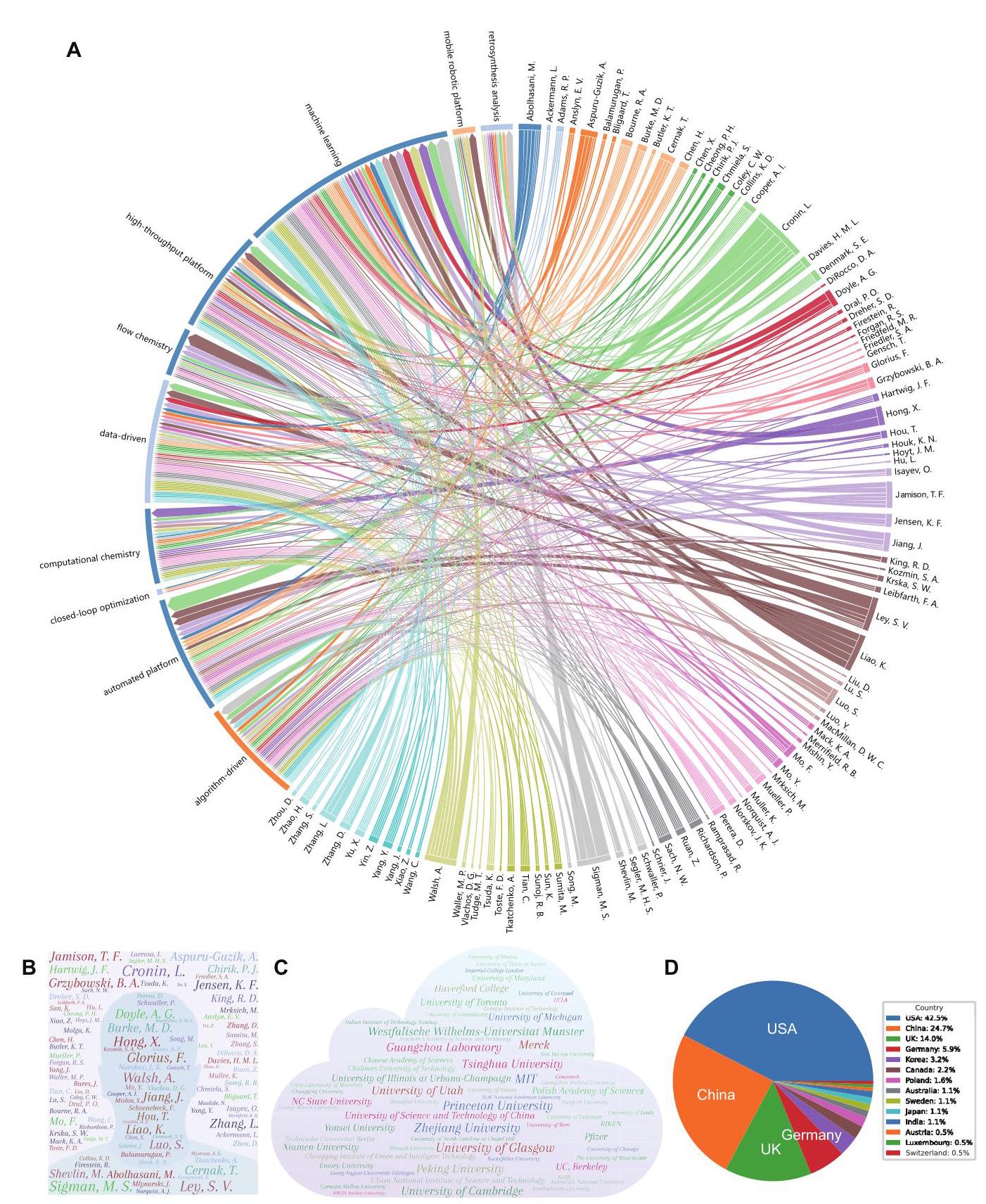
Figure 1 World-leading research group specializing in the integration of automation and AI in organic chemistry. (A) Appraisal of the research groups’ diverse inputs in AI applications for organic chemistry. Visualization through (B) research groups’ and (C) institutes’ word cloud maps, along with (D) geographical distribution.
图1专注于有机化学中自动化与AI集成的世界领先研究团队。(A) 对研究团队在有机化学AI应用中各种投入的评估。通过 (B) 研究团队和 (C) 机构的词云图以及 (D) 地理分布进行可视化展示。
ADVANCES IN AUTOMATED ORGANIC SYNTHESIS TECHNOLOGY
自动化有机合成技术的进展
As technological capabilities continue to grow, so does the potential to automate laboratory processes. Today, automation equipment has become an integral part of laboratory operations. A key aspect of the “AI for Chemistry” initiative, the application of AI to chemistry, is to free chemists from manual tasks, allowing them to concentrate on matters of real scientific importance. Automation technology is central to this endeavour. In biology, automation and high-throughput screening technologies were introduced into scientific research early on. In 1965, R.B. Merrifield from Rockefeller University designed the world’s first automated peptide synthesizer and developed an automated solid-phase peptide synthesis technology, which led to the automation of peptide synthesis [18]. In chemistry, the need for automation is even more pressing. The automation of laboratory tasks increases the overall efficiency of the experimental process by speeding up tasks, minimising waste, reducing reagent consumption, and enabling higher experimental throughput [19, 20]. Collectively, these increased efficiencies result in reduced laboratory operating costs. The implementation of automated systems in the laboratory can relieve researchers of time-consuming and monotonous tasks, freeing up time for more specialized procedures [21]. In addition, automation aims to increase the reliability and accuracy of data, as errors and variability can occur throughout the experimental process. In addition, the combination of automation and flow chemistry can improve laboratory safety by managing and safely storing hazardous materials through streamlined automation systems [22]. This technology also allows for more diverse chemical synthesis route designs [23]. In traditional laboratories, chemists often select reaction conditions from chemical MSDSs but avoid high-risk experiments, potentially missing optimal reaction conditions. However, with flow chemistry automation platforms, lab personnel can better avoid direct contact with these hazardous reagents and procedures [24]. Numerous research institutions and large companies around the world have already developed a variety of high-throughput robotic automation platforms with different functionalities [25]. In the following sections, we will discuss pipeline-based automation and robot-based automation that have had a significant impact on the field of organic synthesis.
随着技术能力的不断提升,实验室流程自动化的潜力也在增加。如今,自动化设备已成为实验室操作不可或缺的一部分。“化学人工智能”计划的一个关键方面,即人工智能在化学中的应用,是将化学家从手工任务中解放出来,使他们能够专注于真正具有科学重要性的事务。自动化技术是这一努力的核心。在生物学领域,自动化和高通量筛选技术很早就被引入到科学研究中。1965年,洛克菲勒大学的R.B. 梅里菲尔德设计了世界上第一台自动化肽合成仪,并开发了自动化固相肽合成技术,这使得肽合成实现了自动化[18]。在化学领域,自动化的需求更为迫切。实验室任务的自动化通过加快任务速度、减少浪费、降低试剂消耗以及实现更高的实验通量,提高了实验过程的整体效率[19, 20]。总体而言,这些提高的效率降低了实验室运营成本。在实验室中实施自动化系统可以将研究人员从耗时且单调的任务中解脱出来,为更专业的程序腾出时间[21]。此外,自动化旨在提高数据的可靠性和准确性,因为在整个实验过程中可能会出现误差和变异性。此外,自动化与流动化学的结合可以通过简化的自动化系统管理和安全存储危险材料来提高实验室安全性[22]。这项技术还允许进行更多样化的化学合成路线设计[23]。在传统实验室中,化学家通常从化学MSDS中选择反应条件,但会避免高风险实验,这可能会错过最佳反应条件。然而,借助流动化学自动化平台,实验室人员可以更好地避免直接接触这些危险试剂和程序[24]。世界各地的许多研究机构和大公司已经开发出了各种具有不同功能的高通量机器人自动化平台[25]。在接下来的章节中,我们将讨论对有机合成领域产生重大影响的基于管道的自动化和基于机器人的自动化。
Pipeline-based automation
基于流程的自动化
The synthesis of small molecules often depends on highly tailored procedures specific to each target [26]. If made widely available, automated processes could greatly increase the accessibility of such compounds, facilitating the exploration of their true potential [27]. In 2015, M. Burke from the University of Illinois at Urbana-Champaign achieved the synthesis of 14 different classes of small molecules using a fully automated platform [28], as shown in Figure 2A. This was achieved by strategically expanding the scope of the building block-based synthetic platform to include even ${\mathrm{{Csp}}}^{3}$ -rich polycyclic natural product frameworks, and devising capture-and-release chromatography purification schemes for all corresponding intermediates. With thousands of compatible building blocks now commercially available, many small molecules can be made using this platform. More generally, these findings pave the way for more universal and automated approaches to small molecule synthesis. Also in 2015, T. Cernak of the University of Michigan and S. Dreher of Merck explored the concept of using miniaturized chemistry experiments to guide large-scale synthetic processes of catalyzed cross-coupling reactions [29], as shown in Figure 2B. The integration of high-precision nanolitre robotics, common in biochemistry laboratories, with high-throughput high-performance liquid chromatography (HPLC) mass spectrometry can increase the efficiency and precision of experiments guiding preparative-scale syntheses, thereby streamlining the overall process. The Buchwald-Hartwig class of Pd-catalyzed C-N coupling reactions provides an essential route to the synthesis of complex drugs [30]. In 2018, S.D. Dreher of Merck and A.G. Doyle of Princeton University applied machine learning to predict the outcome of the Buchwald-Hartwig reaction in the presence of isoxazoles [31], as shown in Figure 2C. Rather than focusing on the coupling of substrates with inherent heterocyclic functionality, they used the Glorius fragment additive screening technique to evaluate the effect of isoxazole fragment additives on the amination of various aryl and heteroaryl halides. Software has been developed to submit molecular, atomic and vibrational property calculations to Spartan and then extract these properties from the resulting text files for general user access, thereby avoiding the need for time-consuming analytical and computational data collection. This software can be used to predict the performance of new substrates under specific conditions or to determine the optimum conditions for new substrates. In 2018, H. Sheng, C.J. Welch, and S.D. Dreher of Merck conducted a comprehensive chemical reactivity study of the Buchwald-Hartwig C-N coupling reaction using an automated synthesis platform [32], as shown in Figure 2D. This platform extended the scope of the synthesis to include matrix-assisted laser desorption/ionisation-time-of-flight mass spectrometry (MALDI-TOF MS). They optimized MALDI-TOF MS sample analysis by selecting appropriate ionisation matrices and instrument settings, and by incorporating ionisation internal standards to normalise the effect of reaction conditions. They found that $\alpha$ -cyano-4-hydroxycinnamic acid (CHCA) was the optimal ionisation matrix, providing the best signal-to noise ratio for several protonated model compounds. They also developed a workflow for MALDI analysis, including MALDI plate preparation, data acquisition and processing. In addition, the use of automated liquid handling equipment can significantly reduce sample preparation time.
小分子的合成通常依赖于针对每个目标量身定制的高度特定程序[26]。如果能够广泛应用,自动化流程可以大大提高此类化合物的可及性,促进对其真正潜力的探索[27]。2015年,伊利诺伊大学厄巴纳 - 香槟分校的M. 伯克使用全自动化平台实现了14种不同类别的小分子合成[28],如图2A所示。这是通过战略性地扩大基于模块的合成平台的范围,使其包括富含${\mathrm{{Csp}}}^{3}$的多环天然产物框架,并为所有相应中间体设计捕获 - 释放色谱纯化方案来实现的。由于现在有数千种兼容的模块可供商业使用,许多小分子都可以使用这个平台来制备。更普遍地说,这些发现为更通用和自动化的小分子合成方法铺平了道路。同样在2015年,密歇根大学的T. 切尔纳克和默克公司的S. 德雷尔探索了使用小型化学实验来指导催化交叉偶联反应的大规模合成过程的概念[29],如图2B所示。将生物化学实验室中常见的高精度纳升机器人技术与高通量高效液相色谱(HPLC)质谱相结合,可以提高指导制备规模合成的实验的效率和精度,从而简化整个过程。布赫瓦尔德 - 哈特维希类的钯催化C - N偶联反应为合成复杂药物提供了一条重要途径[30]。2018年,默克公司的S.D. 德雷尔和普林斯顿大学的A.G. 多伊尔应用机器学习来预测在异恶唑存在下布赫瓦尔德 - 哈特维希反应的结果[31],如图2C所示。他们不是专注于具有固有杂环功能的底物的偶联,而是使用格洛里乌斯片段添加剂筛选技术来评估异恶唑片段添加剂对各种芳基和杂芳基卤化物胺化的影响。已经开发了软件,用于将分子、原子和振动性质计算提交给斯巴达,然后从生成的文本文件中提取这些性质以供一般用户访问,从而避免了耗时的分析和计算数据收集。该软件可用于预测新底物在特定条件下的性能或确定新底物的最佳条件。2018年,默克公司的H. 盛、C.J. 韦尔奇和S.D. 德雷尔使用自动化合成平台对布赫瓦尔德 - 哈特维希C - N偶联反应进行了全面的化学反应性研究[32],如图2D所示。这个平台将合成范围扩展到包括基质辅助激光解吸/电离飞行时间质谱(MALDI - TOF MS)。他们通过选择合适的电离基质和仪器设置,并纳入电离内标来归一化反应条件的影响,优化了MALDI - TOF MS样品分析。他们发现$\alpha$ - 氰基 - 4 - 羟基肉桂酸(CHCA)是最佳的电离基质,为几种质子化模型化合物提供了最佳的信噪比。他们还开发了一个用于MALDI分析的工作流程,包括MALDI板制备、数据采集和处理。此外,使用自动化液体处理设备可以显著减少样品制备时间。
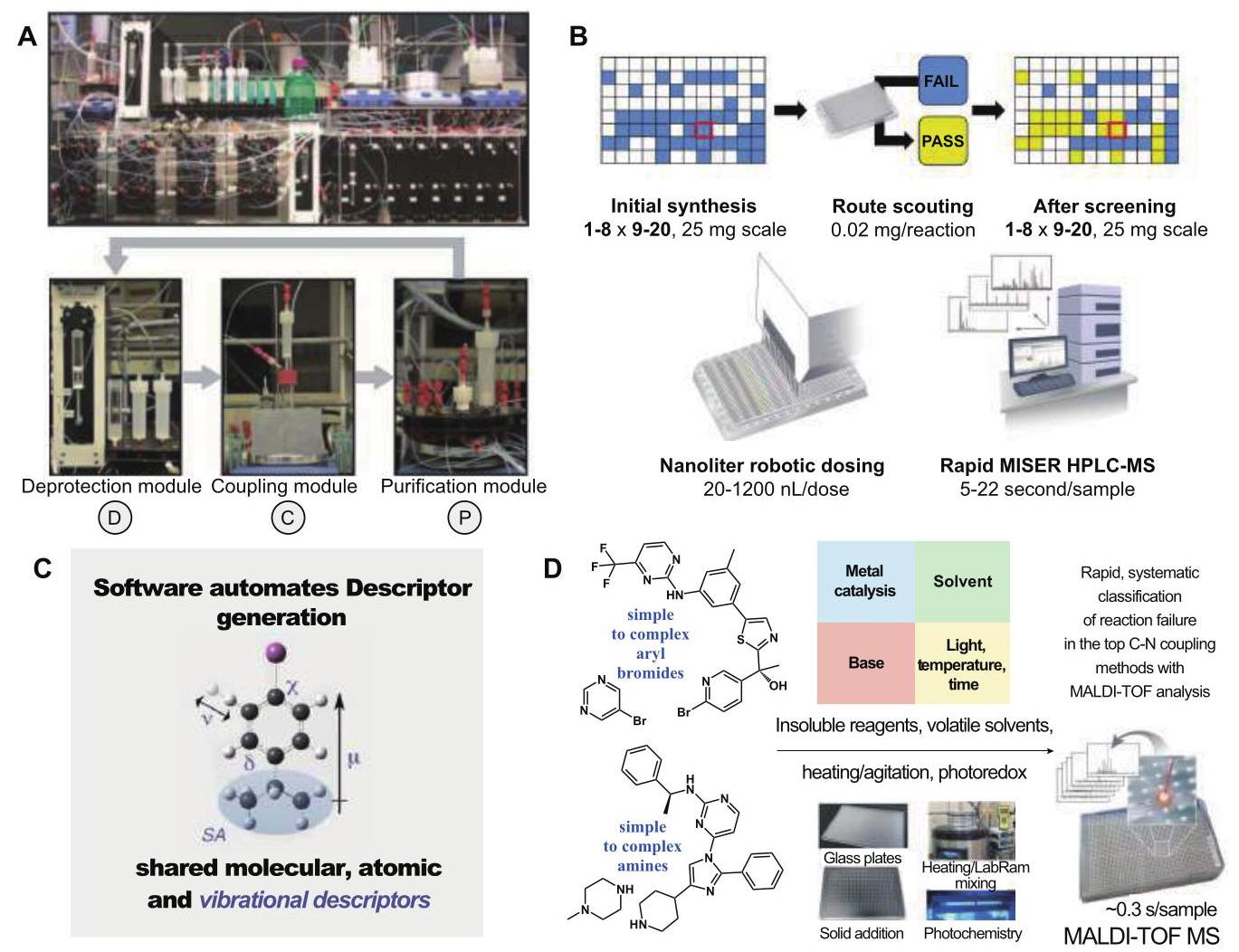
Figure 2 Revolutionary contributions related to automated and predictive chemical synthesis. (A) The creation of a fully automated synthesis platform capable of producing small molecules from 14 distinct classes. The platform’s notable features include an expanded building block based synthetic approach and capture-and-release chromatography purification systems [28]. Copyright©2015, American Association for the Advancement of Science. (B) The miniaturization of chemical experiments, facilitating large-scale synthetic processes for catalyzed cross-coupling reactions. This innovation combines nanoliter robotics with high-throughput HPLC-MS to direct preparative-scale syntheses [29]. Copyright©2014, American Association for the Advancement of Science. (C) The use of machine learning to predict the outcomes of Buchwald-Hartwig reactions invoving isoxazoles. The system integrates with the Spartan tool, enabling calculations of molecular, atomic, and vibrational properties, which could be visually represented [31]. Copyright©2018, American Association for the Advancement of Science. (D) The automation of the Buchwald-Hartwig C-N coupling reaction via a cutting-edge synthesis platform. This process involves a work-flow with MALDI-TOF MS sample analysis, optimized ionization matrix, and the application of automated liquid handling equipment [32]. Copyright©2018, American Association for the Advancement of Science.
图2与自动化和预测性化学合成相关的革命性贡献。(A)创建了一个能够从14个不同类别生产小分子的全自动化合成平台。该平台的显著特点包括基于扩展模块的合成方法和捕获 - 释放色谱纯化系统[28]。版权所有©2015,美国科学促进会。(B)化学实验的小型化,促进催化交叉偶联反应的大规模合成过程。这项创新将纳升机器人技术与高通量HPLC - MS相结合,以指导制备规模的合成[29]。版权所有©2014,美国科学促进会。(C)使用机器学习预测涉及异恶唑的布赫瓦尔德 - 哈特维希反应的结果。该系统与斯巴达工具集成,能够计算分子、原子和振动性质,并可以直观地表示[31]。版权所有©2018,美国科学促进会。(D)通过先进的合成平台实现布赫瓦尔德 - 哈特维希C - N偶联反应的自动化。这个过程涉及一个带有MALDI - TOF MS样品分析、优化电离基质和应用自动化液体处理设备的工作流程[32]。版权所有©2018,美国科学促进会。
Flow chemistry, a rapidly emerging technology in chemistry, is an innovative approach in which chemical reactions are carried out in a tube or pipe [33-35]. Reactive components are pumped together at one end and allowed to mix and react as they flow towards the other end [36]. This method offers significant advantages over traditional batch chemistry, including safer reactions, faster reactions, ease of scale-up, and greater reproducibility due to improved control over reaction parameters. In 2018, D. Perera, P. Richardson, and N.W. Sach from Pfizer developed an automated synthesis platform based on flow chemistry and built from commercially available components [37], as shown in Figure 3A. This system uniquely combined rapid nanomolar reaction screening with micromolar synthesis in a modular unit. The efficacy of the system was demonstrated by investigating various reaction variables in the Suzuki-Miyaura coupling at the nanomolar scale at high temperatures. The system was able to generate data for 5760 reactions at a rate of over 1500 reactions per day and produce micromolar quantities of the desired material by multiple injections of the same segment. Optimal conditions, replicated in traditional and batch processes at the 50-200 mg scale, resulted in excellent yields. To facilitate rapid data analysis, they used Agilent ChemStation software for real-time identification of key peaks in liquid chromatograph mass spectrometer (LC-MS) traces, followed by offline data optimisation using iChemExplorer software and visualisation using Spotfire.
流动化学是化学领域中迅速兴起的一项技术,是一种创新方法,化学反应在管道中进行[33 - 35]。反应组分在一端被泵入并混合,在流向另一端的过程中发生反应[36]。与传统的间歇式化学方法相比,该方法具有显著优势,包括反应更安全、速度更快、易于放大,以及由于对反应参数的更好控制而具有更高的重现性。2018年,辉瑞公司的D. Perera、P. Richardson和N.W. Sach开发了一个基于流动化学的自动化合成平台,该平台由市售组件构建而成[37],如图3A所示。该系统在一个模块化单元中独特地将快速纳摩尔反应筛选与微摩尔合成相结合。通过在高温下以纳摩尔规模研究铃木 - 宫浦偶联反应中的各种反应变量,证明了该系统的有效性。该系统能够以每天超过1500个反应的速度生成5760个反应的数据,并通过多次注射同一段来生产微摩尔量的所需材料。在50 - 200毫克规模的传统间歇式工艺中重复的最佳条件下,获得了优异的产率。为了便于快速数据分析,他们使用安捷伦化学工作站软件实时识别液相色谱质谱(LC - MS)图谱中的关键峰,然后使用iChemExplorer软件进行离线数据优化,并使用Spotfire进行可视化。
In 2018, T.F. Jamison and K.F. Jensen from MIT developed a plug-and-play automated chemical synthesis platform based on flow chemistry [38], as shown in Figure 3B. The aim of this platform was to reduce the workload of professional chemists and enhence their capacity for perform targeted process synthesis. In 2021, O. Isayev from Carnegie Mellon University and F.A. Leibfarth from the University of North Carolina at Chapel Hill developed a computational materials discovery approach that combined automated flow synthesis with machine learning to develop advanced copolymers for ${}^{19}\mathrm{\;F}$ MRI imaging agents [39], as shown in Figure 3C. They created a software-controlled continuous polymer synthesis platform for iterative experimental and computational cycles, exploring 0.9% of the total composition space and synthesising 397 different copolymer compositions. The ML-driven design criteria identified more than 10 copolymer compositions that surpassed the performance of existing materials. Despite these advances, synthetic routes still require human input and process development. However, the combination of automation and machine learning techniques has the potential to revolutionise the field of chemical synthesis, opening up avenues for the discovery of new and innovative compounds with significant scientific and industrial applications.
2018年,麻省理工学院的T.F. Jamison和K.F. Jensen开发了一个基于流动化学的即插即用自动化化学合成平台[38],如图3B所示。该平台的目标是减轻专业化学家的工作量,并提高他们进行靶向过程合成的能力。2021年,卡内基梅隆大学的O. Isayev和北卡罗来纳大学教堂山分校的F.A. Leibfarth开发了一种计算材料发现方法,该方法将自动化流动合成与机器学习相结合,用于开发用于${}^{19}\mathrm{\;F}$磁共振成像剂的先进共聚物[39],如图3C所示。他们创建了一个软件控制的连续聚合物合成平台,用于迭代实验和计算循环,探索了总组成空间的0.9%,并合成了397种不同的共聚物组成。机器学习驱动的设计标准识别出了10多种性能超过现有材料的共聚物组成。尽管取得了这些进展,但合成路线仍然需要人工输入和工艺开发。然而,自动化和机器学习技术的结合有可能彻底改变化学合成领域,为发现具有重大科学和工业应用的新型创新化合物开辟道路。
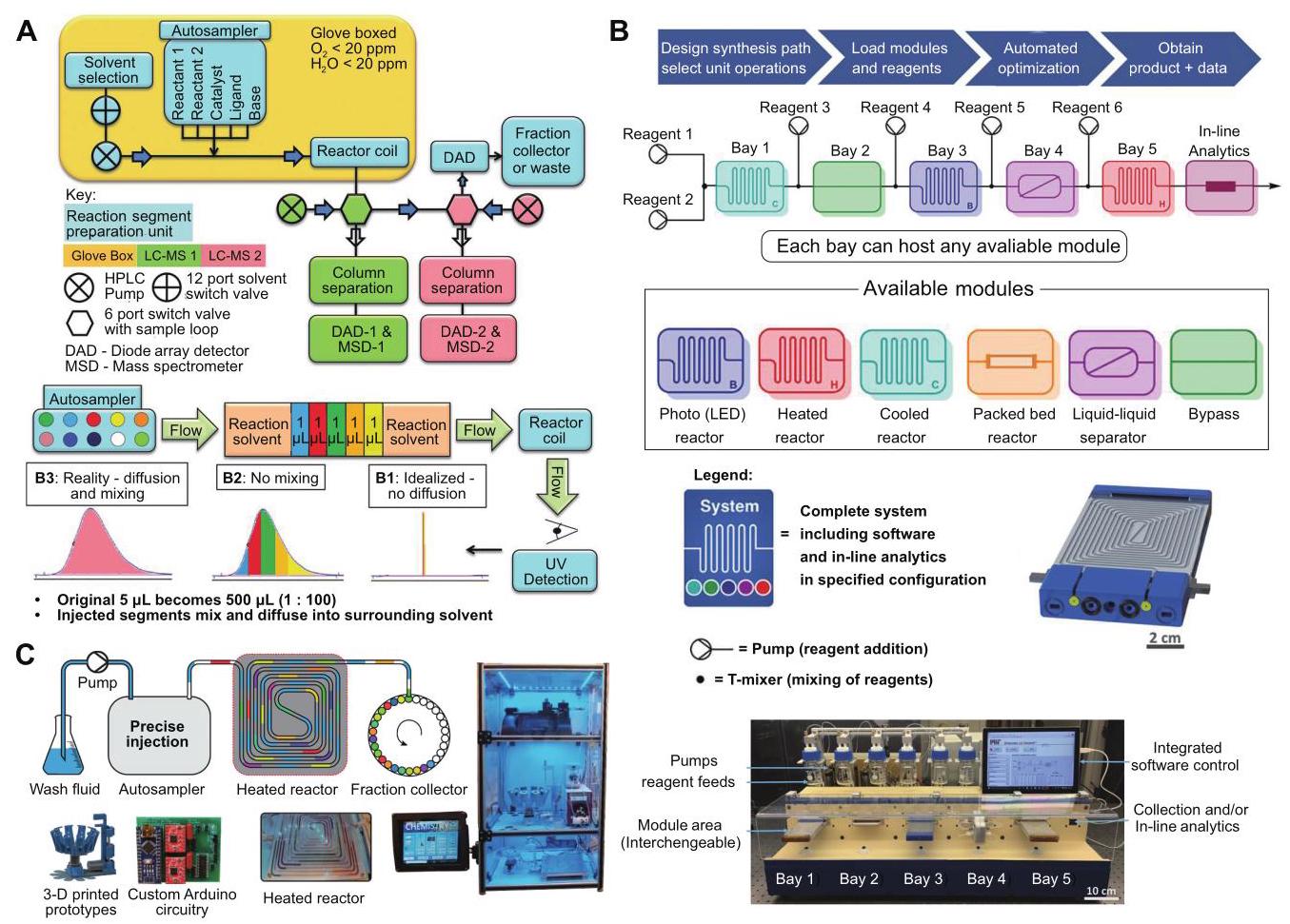
Figure 3 Flow chemistry based automation platform. (A) Pfizer’s automated synthesis platform, incorporating flow chemistry, expedited nanomolar reaction screening and micromolar synthesis within a modular unit. Capable of producing data for 5760 reactions and exceeding a rate of 1500 reactions per day, it also yielded micromolar quantities of the desired material [37]. Copyright©2018, American Association for the Advancement of Science. (B) MIT’s automated chemical synthesis platform, unveiled in 2018, merged integrated AI and robotics to minimize the professional chemist’s workload. It was a versatile, plug-and-play system designed for efficient chemical synthesis [38]. Copyright©2018, American Association for the Advancement of Science. (C) The integration of flow synthesis with machine learning significantly enhanced materials discovery. This ML-guided design model identified more than 10 copolymer compositions outperforming conventional materials [39]. Copyright©2021, American Chemical Society.
图3基于流动化学的自动化平台。(A)辉瑞公司的自动化合成平台,结合了流动化学,在一个模块化单元中加快了纳摩尔反应筛选和微摩尔合成。能够生成5760个反应的数据,每天反应速率超过1500个,还能生产微摩尔量的所需材料[37]。版权所有©2018,美国科学促进会。(B)麻省理工学院2018年推出的自动化化学合成平台,融合了人工智能和机器人技术,以减少专业化学家的工作量。它是一个多功能的即插即用系统,专为高效化学合成而设计[38]。版权所有©2018,美国科学促进会。(C)流动合成与机器学习的结合显著增强了材料发现。这种机器学习引导的设计模型识别出了10多种性能优于传统材料的共聚物组成[39]。版权所有©2021,美国化学学会。
Chemical reaction discovery is inherently unpredictable and time-consuming. Reactivity prediction is an attractive alternative; however, related methods such as computational reaction design are still in their infancy. Reaction prediction based on advanced quantum chemical methods is complex, even for simple molecules. In 2018, L. Cronin from the University of Glasgow proposed a method for producing fine chemicals and pharmaceuticals in a self-contained plastic reactor device [40], as shown in Figure 4A. The device was designed and built using a chemistry-to-computer-automated design (ChemCAD) approach, which translates traditional lab-scale synthesis into platform-independent digital code. This code guides the production of 3D printed devices that contain the entire synthesis route internally. With the production of the GABA receptor agonist $\left( \pm \right)$ -baclofen, they established a concept for localized drug production outside of specialist facilities. In 2018, they demonstrated the concept by guiding an automated system to synthesise three drugs (diphenhydramine hydrochloride, rufinamide, and sildenafil) without human intervention [41]. In 2018, L. Cronin developed an organic synthesis robot capable of performing and analysing chemical reactions faster than manual methods by efficiently navigating the chemical reaction space by predicting the reactivity of potential reagent combinations after a limited number of experiments [42]. In 2020, L. Cronin developed a scalable chemistry execution architecture that can be automatically populated by reading the literature, resulting in a generic autonomous workflow [43], as shown in Figure 4B. The robot-synthesized code is correctable in natural language without any programming knowledge and is hardware independent due to standards. This chemical code can then be combined with a graph describing the hardware module and compiled into platform-specific low-level robot instructions for execution. To validate the method, the automated synthesis of 12 compounds was performed, including the analgesic lidocaine, the Dess-Martin pe-riodinium oxidation reagent and the fluorinating agent AlkylFluor. In 2022, L. Cronin developed ChemPU, an automated chemical reaction database containing 100 molecules representing the range of reactions found in modern organic synthesis [44], as shown in Figure 4C and D. These reactions include transition metal-catalyzed coupling reactions, heterocycle formation, functional group interconversions, and multicomponent reactions. The chemical reaction codes, or $\chi \mathrm{{DL}}$ , of the reactions were stored in a database for version control, validation, collaboration and data mining. In 2022, they also used the system to develop an autonomous portable platform for general chemical synthesis and demonstrated the system by synthesising five small organic molecules, four oligopeptides, and four oligonucleotides with good yield and purity, performing a total of 24,936 base steps in 329h of platform runtime [45].
化学反应的发现本质上是不可预测且耗时的。反应性预测是一种有吸引力的替代方法;然而,诸如计算反应设计等相关方法仍处于起步阶段。基于先进量子化学方法的反应预测很复杂,即使对于简单分子也是如此。2018年,格拉斯哥大学的L. Cronin提出了一种在独立的塑料反应器装置中生产精细化学品和药品的方法[40],如图4A所示。该装置是使用化学到计算机自动化设计(ChemCAD)方法设计和构建的,该方法将传统的实验室规模合成转化为与平台无关的数字代码。此代码指导生产内部包含整个合成路线的3D打印设备。通过生产GABA受体激动剂$\left( \pm \right)$ -巴氯芬,他们确立了在专业设施之外进行本地化药物生产的概念。2018年,他们通过引导自动化系统在无人干预情况下合成三种药物(盐酸苯海拉明、卢非酰胺和西地那非)证明了这一概念[41]。2018年,L. Cronin开发了一种有机合成机器人,通过在有限数量的实验后预测潜在试剂组合的反应性,能够比手动方法更快地执行和分析化学反应[42]。2020年,L. Cronin开发了一种可扩展的化学执行架构,该架构可以通过读取文献自动填充,从而产生通用的自主工作流程[43],如图4B所示。机器人合成的代码无需任何编程知识即可用自然语言进行校正,并且由于标准而与硬件无关。然后,此化学代码可以与描述硬件模块的图形组合,并编译成特定于平台的低级机器人指令以执行。为了验证该方法,进行了12种化合物的自动化合成,包括镇痛药利多卡因、戴斯-马丁高碘氧化试剂和氟化剂AlkylFluor。2022年,L. Cronin开发了ChemPU,一个自动化化学反应数据库,包含100个代表现代有机合成中发现的反应范围的分子[44],如图4C和D所示。这些反应包括过渡金属催化的偶联反应、杂环形成、官能团相互转化和多组分反应。反应中的化学反应代码,即$\chi \mathrm{{DL}}$ ,存储在数据库中用于版本控制、验证、协作和数据挖掘。
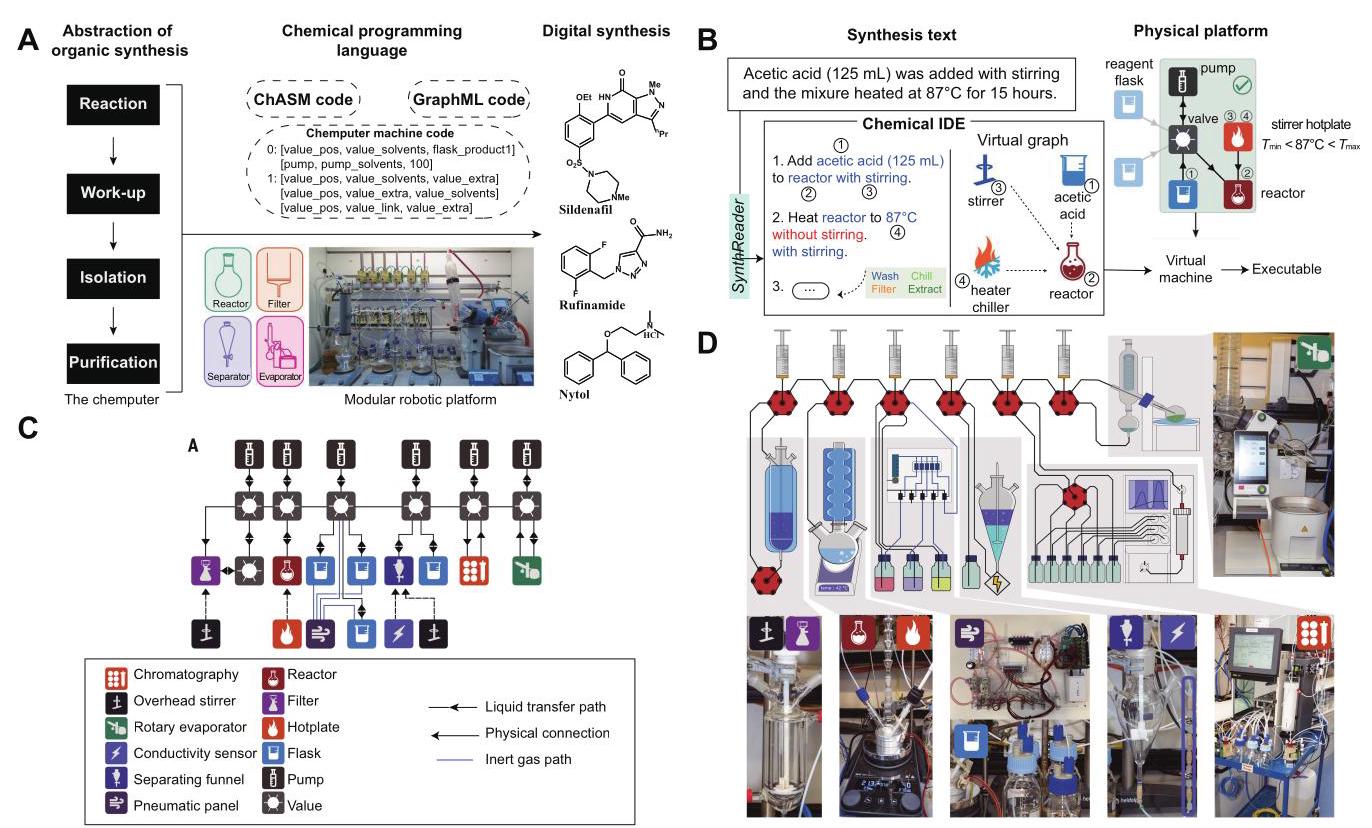
Figure 4 Illustrations depict various innovations in the field of automated chemical synthesis and robotics. (A) A standalone plastic reactor facility has been developed for producing fine chemicals and pharmaceuticals [40]. Copyright©2019, American Association for the Advancement of Science. This facility was designed using a chemistry-to-computer automated design (ChemCAD) approach, which converts conventional lab-scale synthesis into a universally compatible digital code. (B) A scalable chemistry execution architecture has been devised that can autonomously populate itself by scanning academic literature, leading to a universally applicable autonomous workflow [43]. Copyright©2020, American Association for the Advancement of Science. The resultant robot-generated code is human-readable and does not require any programming expertise to correct. It also transcends specific hardware due to the standardization. (C), (D) ChemPU is an automated chemical reaction database that houses codes for 100 distinct reactions prevalent in modern organic synthesis [44]. Copyright@2022, American Association for the Advancement of Science. It features a variety of reactions such as transition metal-catalyzed coupling, heterocycle formation, functional group interconversions, and multicomponent reactions. The codes, known as $\chi \mathrm{{DL}}$ , are stored in a database that allows version control, validation, collaboration, and data mining.
图4的插图描绘了自动化学合成和机器人技术领域的各种创新。(A) 已开发出一种独立的塑料反应器设施用于生产精细化学品和药品[40]。版权所有©2019,美国科学促进会。该设施是使用化学到计算机自动化设计(ChemCAD)方法设计的,该方法将传统的实验室规模合成转化为通用兼容的数字代码。(B) 设计了一种可扩展的化学执行架构,该架构可以通过扫描学术文献自动填充自身,从而产生通用适用的自主工作流程[43]。版权所有©2020,美国科学促进会。由此产生的机器人生成的代码是人类可读的,无需任何编程专业知识即可校正。由于标准化,它也超越了特定硬件。(C)、(D) ChemPU是一个自动化化学反应数据库,其中包含现代有机合成中常见的100种不同反应的代码[44]。版权所有@2022,美国科学促进会。它具有多种反应类型,如过渡金属催化的偶联、杂环形成、官能团相互转化和多组分反应。这些代码,称为$\chi \mathrm{{DL}}$ ,存储在一个允许进行版本控制、验证、协作和数据挖掘的数据库中。
The promise of fully automated chemical synthesis is broad and on-demand access to small molecules, a prospect that could revolutionise the field [46]. However, the range of reactions that can be performed autonomously remains limited. Automated stereospecific construction of ${\mathrm{{Csp}}}^{3} - \mathrm{C}$ bonds will broaden our access to a variety of important functional organic molecules [47]. Historically, methyliminodiacetic acid (MIDA) boronate has been used to coordinate the formation of ${\mathrm{{Csp}}}^{2} - {\mathrm{{Csp}}}^{2}$ bonds and has become a critical building block for the automated synthesis of many small molecules. However, this is incompatible with the reactions that form stereospecific ${\mathrm{{Csp}}}^{3} - {\mathrm{{Csp}}}^{2}$ and ${\mathrm{{Csp}}}^{3} - {\mathrm{{Csp}}}^{3}$ bonds [48]. In 2022, D.J. Blair from the University of Illinois at Urbana-Champaign and M.D. Burke introduced a new tetramethyl- $N$ -methyliminodiacetic acid (TIDA) boronic acid ester [47]. This new compound demonstrated stability under reaction conditions that would normally be considered challenging. The analysis revealed that the redistribution of electron density increased the covalency of the N-B bond, thereby reducing the degree of hydrolysis. Complementary steric shielding of the carbonyl $\Pi$ -face reduces its reactivity towards nucleophiles. TIDA boronate retains the unique properties of the iminodiacetic acid cage, which is critical for large-scale automated synthesis. This allows the ${\mathrm{{Csp}}}^{3}$ borate building block to be used in automated synthesis, including the preparation of natural products by automating stereospecific ${\mathrm{{Csp}}}^{3} - {\mathrm{{Csp}}}^{2}$ and ${\mathrm{{Csp}}}^{3} - {\mathrm{{Csp}}}^{3}$ bond formation. These discoveries will facilitate the automated assembly of more complex small molecules containing large amounts of ${\mathrm{{Csp}}}^{3}$ . In 2022, B.A. Grzybowski from Ulsan National Institute of Science and Technology and M.D. Burke developed a workflow concept for closed-loop optimization [49], as shown in Figure 5. Closed-loop optimization involves building a model using data-driven and machine learning methods, and then directing the robot to perform automated experiments with the lowest trial and error cost according to the model guidance. This culminated in the optimized heteroaryl Suzuki-Miyaura coupling reaction, validated by experimental conditions of universality.
全自动化化学合成的前景广阔,有望按需获取小分子,这一前景可能会给该领域带来变革[46]。然而,能够自主进行的反应范围仍然有限。${\mathrm{{Csp}}}^{3} - \mathrm{C}$键的自动化立体定向构建将拓宽我们获取各种重要功能性有机分子的途径[47]。从历史上看,甲基亚氨基二乙酸(MIDA)硼酸酯已被用于配位${\mathrm{{Csp}}}^{2} - {\mathrm{{Csp}}}^{2}$键的形成,并已成为许多小分子自动化合成的关键组成部分。然而,这与形成立体定向${\mathrm{{Csp}}}^{3} - {\mathrm{{Csp}}}^{2}$和${\mathrm{{Csp}}}^{3} - {\mathrm{{Csp}}}^{3}$键的反应不兼容[48]。2022年,伊利诺伊大学厄巴纳-香槟分校的D.J.布莱尔和M.D.伯克引入了一种新的四甲基-$N$-甲基亚氨基二乙酸(TIDA)硼酸酯[47]。这种新化合物在通常被认为具有挑战性的反应条件下表现出稳定性。分析表明,电子密度的重新分布增加了N-B键的共价性,从而降低了水解程度。羰基$\Pi$面的互补空间屏蔽降低了其对亲核试剂的反应性。TIDA硼酸酯保留了亚氨基二乙酸笼的独特性质,这对于大规模自动化合成至关重要。这使得${\mathrm{{Csp}}}^{3}$硼酸酯构建块可用于自动化合成,包括通过自动化立体定向${\mathrm{{Csp}}}^{3} - {\mathrm{{Csp}}}^{2}$和${\mathrm{{Csp}}}^{3} - {\mathrm{{Csp}}}^{3}$键的形成来制备天然产物。这些发现将有助于自动组装更多含有大量${\mathrm{{Csp}}}^{3}$的复杂小分子。2022年,蔚山国立科学技术院的B.A.格日博夫斯基和M.D.伯克开发了一种闭环优化的工作流程概念[49],如图5所示。闭环优化包括使用数据驱动和机器学习方法构建模型,然后根据模型指导引导机器人以最低的试错成本进行自动化实验。这最终实现了优化的杂芳基铃木-宫浦偶联反应,并通过通用性实验条件得到验证。
Robot-based automation
基于机器人的自动化
The advent of robotic chemistry experiments signalled the inception of the AI-powered laboratory. The aspiration of automated chemists is to establish a fully automated workflow. Nonetheless, the majority of current mechanized chemistry platforms are limited to partial automation, posing significant challenges for comprehensive scientific research. A notable advancement towards achieving a fully automated chemistry workflow was the introduction of a mobile robot by A.I. Cooper from the University of Liverpool in 2020 [50]. Powered by a batch Bayesian search algorithm, the robot autonomously conducted 688 experiments within a 10-variable experimental space over a span of eight days.
机器人化学实验的出现标志着人工智能驱动实验室的开端。自动化化学家的目标是建立一个完全自动化的工作流程。然而,当前大多数机械化化学平台仅限于部分自动化,这给全面的科学研究带来了重大挑战。朝着实现完全自动化化学工作流程迈出的一个显著进展是,2020年利物浦大学的A.I. Cooper引入了一台移动机器人[50]。该机器人由批量贝叶斯搜索算法驱动,在八天的时间里,在一个10变量的实验空间内自主进行了688次实验。
Standardizing processes, bolstering the reliability of experiments, and curbing expenses are pivotal reasons for automating chemical experiments. This is particularly significant as it enables the generation of comprehensive and resilient datasets, a crucial element for ensuing statistical assessments. A revolutionary strategy, merging automation and AI techniques, has been successfully implemented across diverse facets of chemical science, from refining reaction variables to unraveling fundamental mechanisms. In 2019, T.F. Jamison and K.F. Jensen from MIT augmented the robotic platform by incorporating AI for synthetic planning and robotics for execution [51], as depicted in Figure 6A. The system utilized computer-aided synthetic programming (CASP) to determine synthetic routes via a root-parallel Monte Carlo tree search, while a robotic arm carried out the reactions to synthesize compounds as specified in the chemical recipe file. This platform successfully automated the synthesis of 15 medically relevant small molecules, employing different synthetic routes based on the target molecule’s complexity. Concurrently, they developed a novel software program, ASKCOS, which leverages the collected data to predict organic chemical reaction outcomes.
标准化流程、增强实验可靠性以及控制成本是化学实验自动化的关键原因。这一点尤为重要,因为它能够生成全面且可靠的数据集,这是后续统计评估的关键要素。一种将自动化与人工智能技术相结合的革命性策略,已在化学科学的各个方面成功实施,从优化反应变量到揭示基本机制。2019年,麻省理工学院的T.F. 贾米森和K.F. 詹森通过将用于合成规划的人工智能与用于执行的机器人技术相结合,对机器人平台进行了升级[51],如图6A所示。该系统利用计算机辅助合成编程(CASP)通过根并行蒙特卡罗树搜索来确定合成路线,而机器人手臂则按照化学配方文件中的规定进行反应以合成化合物。该平台成功地自动化合成了15种与医学相关的小分子,根据目标分子的复杂性采用了不同的合成路线。同时,他们开发了一种新颖的软件程序ASKCOS,该程序利用收集到的数据来预测有机化学反应的结果。
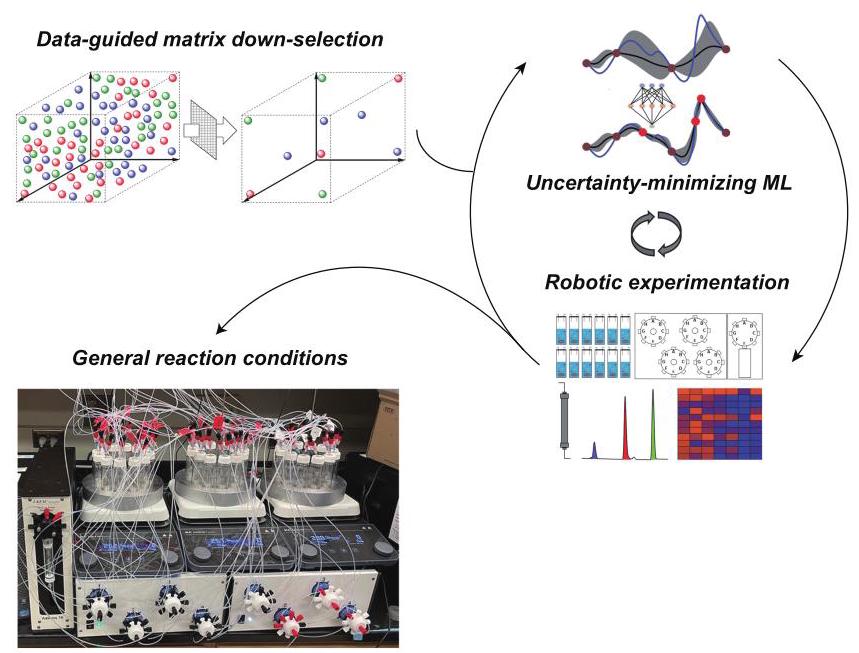
Figure 5 Autonomization of synthetic chemistry. The closed-loop optimization process integrates data-driven and machine learning strategies to build effective models. This subsequently guides robotic systems in performing automated experiments with reduced iterative costs. Optimization of heteroaryl Suzuki-Miyaura coupling reactions, with the validity confirmed under universal experimental conditions [49]. Copyright©2022, American Association for the Advancement of Science.
图5 合成化学的自动化。闭环优化过程整合了数据驱动和机器学习策略以构建有效的模型。这随后指导机器人系统以降低迭代成本的方式进行自动化实验。杂芳基铃木-宫浦偶联反应的优化,其有效性在通用实验条件下得到证实[49]。版权所有©2022,美国科学促进会。
In 2022, F. Mo and D. Zhang from Peking University further contributed to the development of robotic platforms by constructing a custom desktop robot system for high-throughput thin-layer chromatography (TLC) data collection [52,53], as illustrated in Figure 6B. Executing a TLC analysis requires a series of methodical steps: first the analyte is dissolved, then spotted, followed by the development of the TLC plate, and concluding with the measurement and calculation of each analyte’s retardation factor $\left( {R}_{f}\right)$ value. Central to this process are two synchronized robots, designed to carry out complex tasks with the utmost precision and safety, reminiscent of the dexterity of human limbs. The apparatus also incorporates a pair of cameras, a duo of light sources, a networking device, and a computing machine. The lesser of the two robots, the DOBOT MG400, is tasked with the preparation and application of the TLC samples onto the designated plates. This is followed by the AUBO i5, its larger counterpart, which carefully holds and positions the TLC plate into the designated chamber for the development phase. Once this phase is complete, the plate is relocated to a receptacle for visualization and subsequent imaging under ultraviolet illumination. The AUBO i5 then secures a fresh plate from its storage location and places it onto the designated stand, thereby resetting the system for subsequent iterations. To enhance operational efficiency, the setup includes six chambers, each containing a unique elution solvent. A specially designed Python script oversees the entire operation, managing the robots, cameras, and illumination sources. This state-of-the-art robotic system for TLC experiments is pivotal for enabling the standardized, high-throughput acquisition of ${R}_{f}$ values
2022年,北京大学的F. Mo和D. Zhang通过构建用于高通量薄层色谱(TLC)数据收集的定制桌面机器人系统,为机器人平台的发展做出了进一步贡献[52,53],如图6B所示。执行TLC分析需要一系列有条不紊的步骤:首先将分析物溶解,然后点样,接着展开TLC板,最后测量和计算每个分析物的比移值$\left( {R}_{f}\right)$。这一过程的核心是两个同步机器人,它们被设计用来以最高的精度和安全性执行复杂任务,让人联想到人类肢体的灵活性。该装置还包括一对摄像头、两个光源、一个网络设备和一台计算机。两个机器人中较小的DOBOT MG400负责将TLC样品制备并应用到指定的板上。随后是较大的AUBO i5,它小心地将TLC板固定并放置到指定的腔室中进行展开阶段。一旦这个阶段完成,板子被重新放置到一个容器中以便在紫外光照射下进行可视化和后续成像。然后AUBO i5从其存储位置获取一块新板并将其放置到指定的支架上,从而为后续迭代重置系统。为了提高操作效率,该装置包括六个腔室,每个腔室含有一种独特的洗脱溶剂。一个专门设计的Python脚本监督整个操作,管理机器人、摄像头和照明源。这种用于TLC实验的先进机器人系统对于实现${R}_{f}$值的标准化、高通量获取至关重要
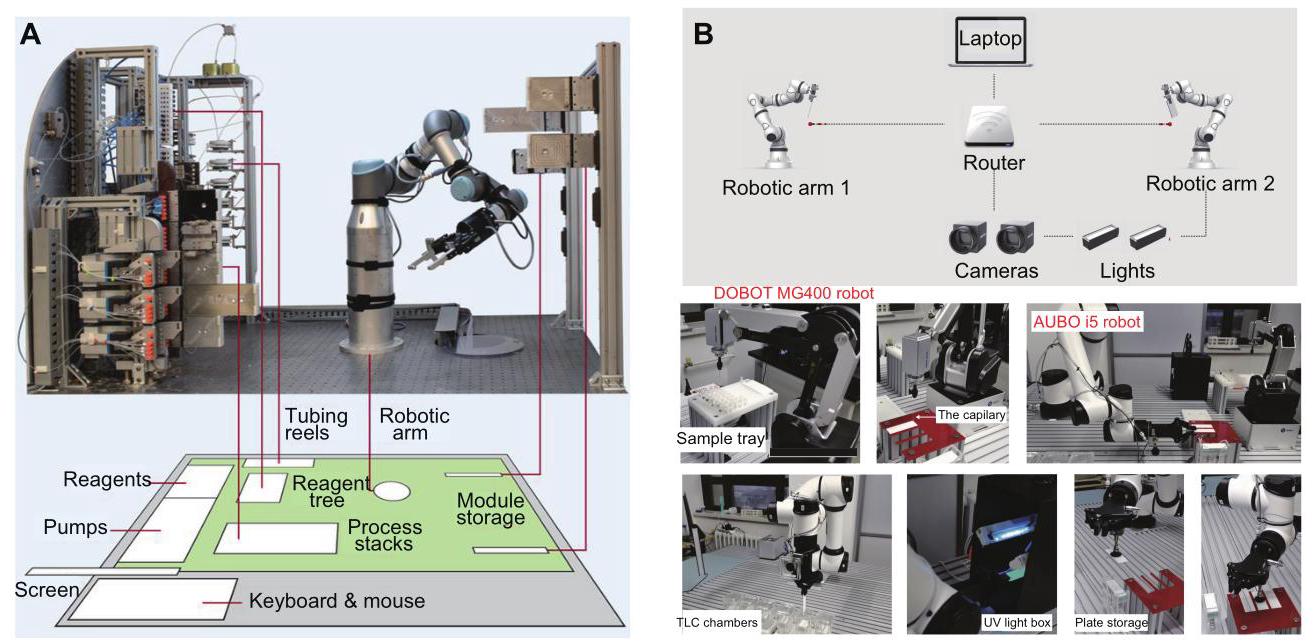
Figure 6 The figure depicts the robot-based automation platform, which powered by scientific data intelligence, excels at handling routine tasks common in chemical research. (A) In 2019, the ASKCOS software program was introduced, integrating AI for strategic synthetic planning and robotics for efficient execution [51]. Copyright©2019, American Association for the Advancement of Science. (B) High-throughput TLC robotic platform [52]. Copyright©2022, Elsevier.
图6展示了基于机器人的自动化平台,该平台由科学数据智能驱动,擅长处理化学研究中常见的日常任务。(A) 2019年,ASKCOS软件程序推出,集成了用于战略合成规划的人工智能和用于高效执行的机器人技术[51]。版权所有©2019,美国科学促进会。(B) 高通量薄层色谱机器人平台[52]。版权所有©2022,爱思唯尔。
Selection of the appropriate automation approach
选择合适的自动化方法
Automated systems in organic chemistry encompass a spectrum of technologies designed to streamline and optimize chemical processes, from the initial mixing of reactants to the final purification and isolation of products [54]. Two prevalent approaches are pipeline-based automation and robot-based automation. Pipeline-based automation involves a series of automated processes and machines, organized sequentially (in a pipeline), to facilitate different stages of a chemical reaction or process [55]. Conversely, robot-based automation leverages robots to execute tasks traditionally performed by human operators, ranging from simple tasks, like weighing and mixing reactants, to more complex ones, like monitoring reactions, purifying products, and analyzing results [51-53]. Robots can be programmed to execute tasks sequentially or in parallel and can be equipped with various tools and sensors to perform diverse operations. By assessing these factors, researchers and practitioners can make informed decisions on the most suitable automation approach for their specific needs, as outlined below.
有机化学中的自动化系统涵盖了一系列旨在简化和优化化学过程的技术,从反应物的初始混合到产物的最终纯化和分离[54]。两种常见的方法是基于管道的自动化和基于机器人的自动化。基于管道的自动化涉及一系列按顺序(在管道中)组织的自动化过程和机器,以促进化学反应或过程的不同阶段[55]。相反,基于机器人的自动化利用机器人来执行传统上由人类操作员执行的任务,从简单的任务,如称量和混合反应物,到更复杂的任务,如监测反应、纯化产物和分析结果[51 - 53]。机器人可以被编程为按顺序或并行执行任务,并且可以配备各种工具和传感器以执行各种操作。通过评估这些因素,研究人员和从业者可以就最适合其特定需求的自动化方法做出明智的决策,如下所述。
(1) Efficiency. Pipeline-based automation is generally more efficient for large-scale production as it can manage large volumes of samples or reactions in a continuous flow manner. In contrast, robot-based automation is more efficient for tasks necessitating high levels of precision and accuracy.
(1) 效率。基于管道的自动化对于大规模生产通常更有效,因为它可以以连续流动的方式处理大量样品或反应。相比之下,基于机器人的自动化对于需要高精度和准确性的任务更有效。
(2) Flexibility. Robot-based automation offers greater flexibility and adaptability to changing requirements or new reactions, as robots can be reprogrammed to perform different tasks. Conversely, pipeline-based automation is less flexible due to its fixed setup, with each stage of the process carried out in a specific order.
(2) 灵活性。基于机器人的自动化提供了更大的灵活性和对不断变化的要求或新反应的适应性,因为机器人可以重新编程以执行不同的任务。相反,基于管道的自动化由于其固定设置而灵活性较差,过程的每个阶段都按特定顺序进行。
(3) Safety. Both pipeline-based and robot-based automation enhance safety by minimizing personnel exposure to hazardous chemicals and reaction conditions. However, robot-based automation may confer additional safety benefits, as robots can handle hazardous chemicals and operate under dangerous conditions without exposing human operators to risk.
(3) 安全性。基于管道的自动化和基于机器人的自动化都通过最大限度地减少人员接触危险化学品和反应条件来提高安全性。然而,基于机器人的自动化可能带来额外的安全益处,因为机器人可以处理危险化学品并在危险条件下操作而不会使人类操作员面临风险。
(4) Cost. Both automation approaches necessitate a significant initial investment. The cost of pipeline-based automation includes setting up the pipeline and associated machinery, while the cost of robot-based automation includes purchasing robots and associated equipment. The overall cost will vary depending on the reaction or process complexity and production scale.
(4) 成本。两种自动化方法都需要大量的初始投资。基于管道的自动化成本包括设置管道和相关机器,而基于机器人的自动化成本包括购买机器人和相关设备。总体成本将根据反应或过程的复杂性以及生产规模而有所不同。
(5) Maintenance. Regular maintenance is essential for both automation approaches to ensure proper functioning. Maintenance of pipeline-based automation involves ensuring all pipeline parts are functioning correctly, whereas maintenance of robot-based automation entails ensuring the robot and its associated equipment are functioning correctly.
(5) 维护。定期维护对于两种自动化方法都至关重要,以确保正常运行。基于管道的自动化维护涉及确保所有管道部件正常运行,而基于机器人的自动化维护则需要确保机器人及其相关设备正常运行。
Ultimately, the choice between pipeline-based and robot-based automation will hinge on various factors, such as production scale, reaction or process complexity, the need for flexibility, and the available budget. Often, a combination of both approaches may be utilized to optimize the overall process. For instance, a robot could be employed to prepare and load samples into a pipeline-based system for continuous flow reactions $\left\lbrack {{56},{57}}\right\rbrack$ .
最终,基于管道的自动化和基于机器人的自动化之间的选择将取决于各种因素,如生产规模、反应或过程的复杂性、对灵活性的需求以及可用预算。通常,可以同时使用两种方法的组合来优化整个过程。例如,可以使用机器人将样品制备并加载到基于管道的系统中进行连续流动反应$\left\lbrack {{56},{57}}\right\rbrack$。
AI-FACILITATED ORGANIC CHEMISTRY RESEARCH
人工智能辅助的有机化学研究
AI for Chemistry is an emerging discipline that focuses on using large-scale data analysis and intelligent decision making to address scientific challenges. Through algorithmic processes, AI models can identify patterns in large datasets, extract scientific insights, and discover complex logical relationships. Since 1969, E.J. Corey has pioneered the integration of computational and graphical communication technologies into organic synthesis pathways, thereby charting a new course for the design of complex organic synthesis path ways [58]. The concept of explicable AI and AI-driven hypothesis generation is a relatively recent development in chemistry. Recently, A. Aspuru-Guzik and his team from the University of Toronto developed a machine learning algorithm capable of extracting human-understandable insights from large datasets in chemistry and physics [59]. This algorithm not only confirmed some well-known ‘rules of thumb’ about the solubility and energy levels of organic molecules, but also revealed new principles. In subsequent sections, we delve into research in organic chemistry facilitated by AI. We will explore AI applications in this domain, including retrosynthetic analysis, predicting molecular properties, and forecasting the reactivity of chemical reactions.
化学人工智能是一门新兴学科,专注于利用大规模数据分析和智能决策来应对科学挑战。通过算法过程,人工智能模型可以识别大型数据集中的模式,提取科学见解,并发现复杂的逻辑关系。自1969年以来,E.J. Corey率先将计算和图形通信技术整合到有机合成途径中,从而为复杂有机合成途径的设计开辟了一条新道路[58]。可解释人工智能和人工智能驱动的假设生成的概念在化学领域是相对较新的发展。最近,多伦多大学的A. Aspuru-Guzik及其团队开发了一种机器学习算法,能够从化学和物理的大型数据集中提取人类可理解的见解[59]。该算法不仅证实了一些关于有机分子溶解度和能级的著名“经验法则”,还揭示了新的原理。在后续章节中,我们将深入探讨人工智能辅助的有机化学研究。我们将探索该领域的人工智能应用,包括逆合成分析、预测分子性质以及预测化学反应的反应性。
AI-powered retrosynthetic analysis models
基于人工智能的逆合成分析模型
The retrosynthetic analysis stands as a pivotal method in the systematic planning for the synthesis of small organic molecules, having grown significantly due to recent advancements in technology [60,61]. A monumental achievement in this field is credited to B.A. Grzybowski and his team, who birthed a revolutionary retrosynthetic analysis software named Chematica [62]. This sophisticated software is founded on a vast database comprising over 7 million organic molecules, meticulously interconnected through an equal number of organic reactions to form a comprehensive network. A monumental endeavor, the team input over 50,000 organic reaction rules manually, instructing Chematica on the potential alterations each small molecule might undergo during reactions. It should be noted that the exact figures might be subjected to updates. In various trials, Chematica curated synthesis routes that not only diverged significantly from those previously reported by chemists but also showcased fewer steps and higher yields, thereby reducing time and costs markedly. This groundbreaking tool transitioned into a new phase in 2017 when it was acquired by Merck, undergoing a rebranding to become Synthia for commercial service.
逆合成分析是系统规划有机小分子合成的关键方法,随着技术的最新进展,其重要性显著提升[60,61]。该领域的一项重大成就是由B.A. Grzybowski及其团队取得的,他们开发了一款具有革命性的逆合成分析软件Chematica[62]。这款先进的软件基于一个庞大的数据库,该数据库包含超过700万个有机分子,并通过同样数量的有机反应精心连接,形成一个全面的网络。这是一项艰巨的工作,团队手动输入了超过50,000条有机反应规则,指导Chematica了解每个小分子在反应过程中可能发生的潜在变化。需要注意的是,确切数字可能会有所更新。在各种试验中,Chematica策划的合成路线不仅与化学家先前报道的路线有很大差异,而且步骤更少、产率更高,从而显著减少了时间和成本。这个开创性的工具在2017年被默克公司收购后进入了一个新阶段,重新命名为Synthia用于商业服务。
Taking an enormous leap forward, the development transitioned from a manual rule input system to an autonomous learning entity. This evolution was actualized in 2018 when researchers M.S.H. Segler from Westfälische Wilhelms-Universität Münster and M.P. Waller from Shanghai University augmented it with a Monte Carlo tree search (MCTS) integrated with an extended policy network to steer the search process, coupled with a filter network to prioritize the most promising retrosynthetic pathways [63]. They trained these deep neural networks on an extensive set of published organic chemistry reactions. The system efficiently solved almost twice the number of molecules and was 30 times faster than traditional computational search methods, which rely on extracted rules and custom-designed heuristic algorithms. They also performed best first search (BFS) at a cost determined by a policy network, called “neural BFS”. All algorithms used the same set of automatically extracted transformations. Double-blind AB experiments confirmed the superiority of 3N-MCTS over traditional methods, with organic chemists clearly favouring the former. Machine-generated retrosynthetic routes should be considered on a par with reported molecular routes of practical interest to organic chemists.
向前迈出了巨大的一步,该发展从手动规则输入系统转变为自主学习实体。这一演变在2018年得以实现,当时明斯特大学的M.S.H. Segler和上海大学的M.P. Waller对其进行了改进,加入了与扩展策略网络集成的蒙特卡罗树搜索(MCTS)以引导搜索过程,以及一个过滤网络以优先选择最有前途的逆合成途径[63]。他们在大量已发表的有机化学反应上训练这些深度神经网络。该系统有效地解决了几乎两倍数量的分子,并且比依赖提取规则和定制启发式算法的传统计算搜索方法快30倍。他们还在由策略网络确定的成本下进行最佳优先搜索(BFS),称为“神经BFS”。所有算法都使用相同的一组自动提取的转化。双盲AB实验证实了3N-MCTS相对于传统方法的优越性,有机化学家明显更青睐前者。机器生成的逆合成路线应被视为与有机化学家实际感兴趣的已报道分子路线相当。
In 2021, P. Schwaller from the University of Bern demonstrated that transformer neural networks can learn atomic mapping information between reactants and products without supervision or manual labelling [64]. They developed a chemically neutral, attention-guided reaction mapper called RXNMapper, which uses the attention weights of transformers to extract coherent chemical grammars from unannotated reaction sets. RXNMapper excels at carbon skeleton rearrangements and complex reactions, which often require human understanding of the reaction mechanism for accurate atom maps. The method achieved 99.4% correct complete atom mappings on a test set of 49,000 highly unbalanced patent reactions. This approach outperforms others in both accuracy and speed, even for reactions with non-trivial atomic mappings and chemical complexity. It effectively bridges the gap between data-driven and rule-based strategies in various chemical reaction tasks.
2021年,伯尔尼大学的P. Schwaller证明,变压器神经网络可以在无监督或手动标记的情况下学习反应物和产物之间的原子映射信息[64]。他们开发了一种化学中性、注意力引导的反应映射器RXNMapper,它使用变压器的注意力权重从未注释的反应集中提取连贯的化学语法。RXNMapper在碳骨架重排和复杂反应方面表现出色,这些反应通常需要人类对反应机理的理解才能获得准确的原子映射。该方法在49,000个高度不平衡的专利反应测试集上实现了99.4%的正确完整原子映射。即使对于具有非平凡原子映射和化学复杂性的反应,这种方法在准确性和速度上也优于其他方法。它有效地弥合了各种化学反应任务中数据驱动和基于规则策略之间的差距。
Prediction of molecular properties
分子性质预测
Predicting the properties of compounds is critical to numerous applications such as drug design and materials science. The emergence of computational methods as potent instruments has enabled precise predictions of molecular attributes, thereby facilitating the strategic development of compounds across different sectors. This subsection delves into data derived from theoretical calculations and high-throughput experiments, enhancements in computational capacities for modeling polarization and determining molecular characteristics, the creation of automated systems for TLC and HPLC, and the incorporation of machine learning methodologies for analyzing and predicting compound attributes and separations.
预测化合物的性质对于药物设计和材料科学等众多应用至关重要。计算方法作为强大工具的出现,使得能够精确预测分子属性,从而推动了不同领域化合物的战略开发。本小节深入探讨了源自理论计算和高通量实验的数据、用于建模极化和确定分子特征的计算能力提升、用于薄层色谱(TLC)和高效液相色谱(HPLC)的自动化系统的创建,以及用于分析和预测化合物属性及分离的机器学习方法的纳入。
The advancement of computational capabilities has opened new avenues for modeling polarization. P.L.A. Popelier, in 2014, showcased that kriging, a machine learning method, can precisely interpret the electron density response of a topological atom to changes in the positions of nearby atoms [65]. An innovative approach of altering training set sizes was employed, drastically reducing training times while retaining accuracy. This approach was implemented for each amino acid, modifying their geometries through normal modes of vibration across all local energy minima on the Ramachandran map. The modified geometries served as the training data for the kriging models. The validity of the kriging models was assessed through a meticulous comparison of the predicted and actual total electrostatic energies for previously untested geometries. This approach was substantiated using aromatic amino acids such as histidine, phenylalanine, tryptophan, and tyrosine as test cases.
计算能力的进步为极化建模开辟了新途径。2014年,P.L.A. Popelier展示了一种机器学习方法——克里金法,它可以精确解释拓扑原子对附近原子位置变化的电子密度响应[65]。采用了一种创新的改变训练集大小的方法,在保持准确性的同时大幅减少了训练时间。该方法针对每个氨基酸实施,通过在拉马钱德兰图上所有局部能量最小值处的正常振动模式修改其几何结构。修改后的几何结构用作克里金模型的训练数据。通过对先前未测试几何结构的预测和实际总静电能进行细致比较,评估了克里金模型的有效性。使用组氨酸(histidine)、苯丙氨酸(phenylalanine)、色氨酸(tryptophan)和酪氨酸(tyrosine)等芳香族氨基酸作为测试案例,证实了该方法。
The ability to accurately and efficiently predict molecular properties across the chemical compound space is pivotal for the rational design of compounds in the chemical and pharmaceutical industries. To address this, A. Tkatchenko, in 2015, developed and implemented a series of efficient empirical methods for estimating atomization and total energies of molecules [66]. The methods ranged from a simple sum over atoms, the addition of bond energies, pairwise interatomic force fields, and extended to advanced machine learning approaches capable of describing collective interactions among multiple atoms or bonds. Even simple pairwise force fields exhibited prediction accuracy comparable to benchmark energies computed using density functional theory with hybrid exchange-correlation functions for equilibrium molecular geometries. This remarkable accuracy was achieved using a vectorized representation of molecules, the Bag of Bonds model, which exhibited strong nonlocality in chemical space. Additionally, this representation facilitated the accurate prediction of electronic properties of molecules, such as polarizability and molecular frontier orbital energies.
在化学和制药行业中,准确高效地预测整个化合物空间的分子性质对于合理设计化合物至关重要。为解决此问题,2015年A. Tkatchenko开发并实施了一系列用于估计分子原子化和总能量的高效经验方法[66]。这些方法从简单的原子求和、键能相加、成对原子间力场,扩展到能够描述多个原子或键之间集体相互作用的先进机器学习方法。即使是简单的成对力场,其预测准确性也与使用具有混合交换相关函数的密度泛函理论计算的平衡分子几何结构的基准能量相当。使用分子的矢量化表示——键袋模型(Bag of Bonds model)实现了这种显著的准确性,该模型在化学空间中表现出很强的非局部性。此外,这种表示有助于准确预测分子的电子性质,如极化率和分子前沿轨道能量。
TLC is an important tool for monitoring chemical reactions and discerning the ability of different substances to separate. In 2022, F. Mo and D. Zhang of Peking University combined the TLC with automation and AI to make an excellent work for the prediction of TLC [52], as shown in Figure 6A. This remarkable innovation aims to facilitate the collection of large volumes of TLC data using a specialized desktop robotic system to meticulously handle the complex steps involved in TLC analysis. The platform excels at performing large amounts of standardized ${R}_{f}$ value assessments, resulting in large amounts of standardized TLC data. The next step is to perform feature engineering on the raw data. The process of feature engineering allows for the translation of compound structures, additional physical properties, and varying factors such as elution solvents into a vector space, thereby streamlining the data cleaning process. Following this, a series of machine learning methodologies are applied to perform regression analysis on the engineered data. The predictive accuracies of multiple machine learning methods, including Bayesian regression, random forest (RF), light gradient boosting machine (LightGBM or LGB), extreme gradient boosting (XGBoost or XGB), and artificial neural network (ANN), were carefully evaluated. Building on this foundation, an ensemble approach is suggested to construct a superior model, thereby enhancing the accuracy further. A model boasting the highest accuracy, with an ${R}^{2}$ value of 0.951, is achieved by employing a simple weighted average of the aforementioned methods. The commendable results also underscore the precision and reliability of the dataset acquired through the automated platform, as machine learning techniques impose strict demands for accurate, independent, and identically distributed data. This research offers invaluable insights into the selection of optimal purification parameters and presents organic chemists with a pragmatic AI tool for chromatography applications.
薄层色谱(TLC)是监测化学反应和辨别不同物质分离能力的重要工具。2022年,北京大学的F. Mo和D. Zhang将TLC与自动化和人工智能相结合,在TLC预测方面取得了出色成果[52],如图6A所示。这一卓越创新旨在利用专门的桌面机器人系统促进大量TLC数据的收集,以精心处理TLC分析中涉及的复杂步骤。该平台擅长进行大量标准化的${R}_{f}$值评估,从而产生大量标准化的TLC数据。下一步是对原始数据进行特征工程。特征工程过程允许将化合物结构、其他物理性质以及诸如洗脱溶剂等各种因素转化到向量空间,从而简化数据清理过程。在此之后,应用一系列机器学习方法对工程化数据进行回归分析。仔细评估了包括贝叶斯回归、随机森林(RF)、轻梯度提升机(LightGBM或LGB)、极端梯度提升(XGBoost或XGB)和人工神经网络(ANN)在内的多种机器学习方法的预测准确性。在此基础上,建议采用集成方法构建一个更优模型,从而进一步提高准确性。通过对上述方法进行简单加权平均,实现了一个具有最高准确性的模型,其${R}^{2}$值为0.951。这些值得称赞的结果还强调了通过自动化平台获取的数据集的精确性和可靠性,因为机器学习技术对准确、独立且同分布的数据有严格要求。这项研究为选择最佳纯化参数提供了宝贵见解,并为有机化学家提供了一种用于色谱应用的实用人工智能工具。
HPLC is a technique used to separate, identify and quantify each component in a sample mixture based on differences in adsorption capacity with an adsorbent material. In 2023, F. Mo and D. Zhang introduced machine learning methods to chromatographic enantiomer separation [67], as shown in Figure 7B. They developed a literature dataset (CMRT dataset) of retention times of chiral molecules in HPLC to address the challenge of data acquisition. Using this dataset, they introduced a Quantile Geometry Augmented Graph Neural Network (QGeoGNN) to detect the relationship between molecular structure and retention time, demonstrating promising predictive power for enantiomers. The dataset includes different HPLC columns with two substrates and seven substituents. Their study achieved multi column prediction by incorporating chromatographic domain knowledge into a machine learning model, paving the way for predicting chromatographic enantiomeric separations by calculating separation probabilities. Their work highlights the potential application of machine learning techniques in experimental settings, ultimately accelerating the pace of scientific discovery.
高效液相色谱法是一种基于与吸附材料的吸附能力差异来分离、鉴定和定量样品混合物中各成分的技术。2023年,F. Mo和D. Zhang将机器学习方法引入色谱对映体分离[67],如图7B所示。他们开发了一个关于手性分子在高效液相色谱中保留时间的文献数据集(CMRT数据集),以应对数据采集的挑战。利用这个数据集,他们引入了分位数几何增强图神经网络(QGeoGNN)来检测分子结构与保留时间之间的关系,展示了对映体有前景的预测能力。该数据集包括具有两种底物和七个取代基的不同高效液相色谱柱。他们的研究通过将色谱领域知识纳入机器学习模型实现了多柱预测,为通过计算分离概率预测色谱对映体分离铺平了道路。他们的工作突出了机器学习技术在实验环境中的潜在应用,最终加快了科学发现的步伐。
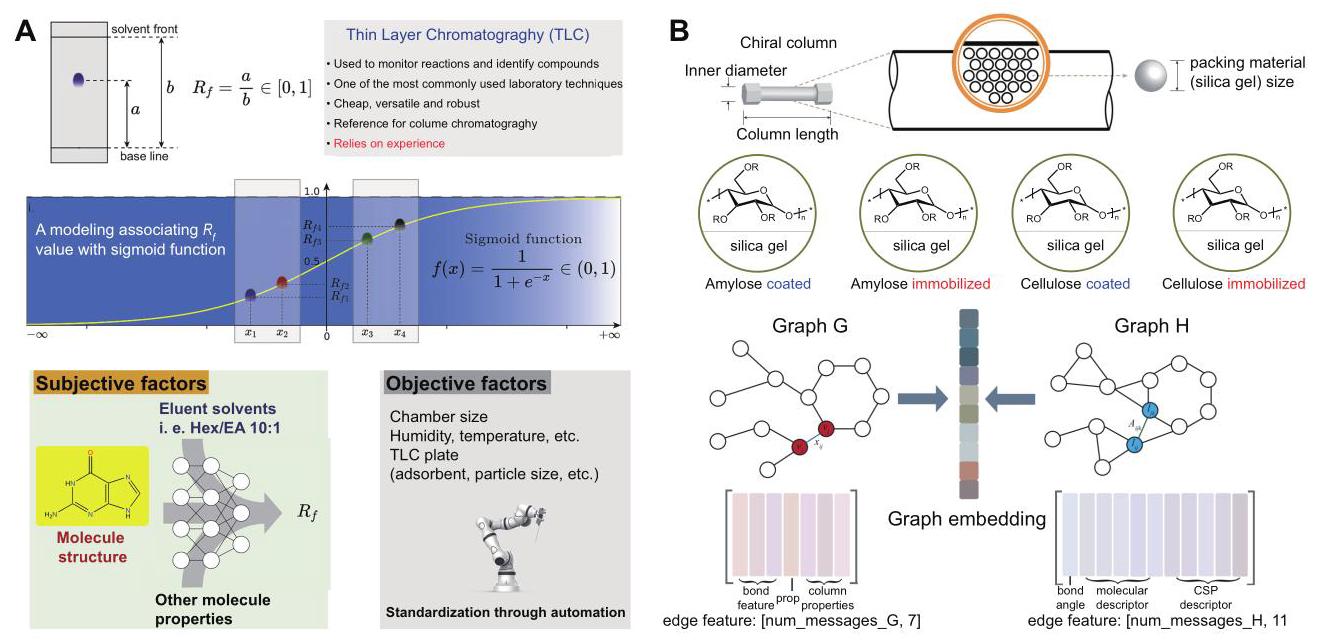
Figure 7 AI-driven prediction of compound separation. (A) High-throughput TLC robotic platform: This sophisticated platform is designed for large-scale standardization and measurement of ${R}_{f}$ values, subsequently generating substantial volumes of normalized TLC data. These data are then utilized for regression analysis through machine learning techniques [52]. Copyright@2022, Elsevier. (B) Predicting chromatographic enantiomer separation: By leveraging a literature-based dataset (CMRT dataset) of retention times for chiral molecules in HPLC, establishing a correlation between molecular structure and retention time. This is further enhanced by employing the quantile geometry augmented graph neural network (QGeoGNN) for achieving optimal prediction accuracy [67]. Copyright©2022, Springer Nature.
图7 人工智能驱动的化合物分离预测。(A) 高通量薄层色谱机器人平台:这个精密的平台设计用于大规模标准化和测量${R}_{f}$值,随后生成大量标准化的薄层色谱数据。然后通过机器学习技术将这些数据用于回归分析[52]。版权所有@2022,爱思唯尔。(B) 预测色谱对映体分离:通过利用基于文献的高效液相色谱中手性分子保留时间的数据集(CMRT数据集),建立分子结构与保留时间之间的相关性。通过采用分位数几何增强图神经网络(QGeoGNN)进一步提高预测精度[67]。版权所有©2022,施普林格自然。
Prediction of reactivity of chemical reactions
化学反应活性的预测
In the realm of chemical reaction predictions, multivariate linear regression (MLR) has stood out as a fundamental statistical instrument. While traditional linear regression hinges on one predictor variable, MLR takes into account multiple predictors, painting a holistic picture of their collective impact on the outcome.
在化学反应预测领域,多元线性回归(MLR)已成为一种基本的统计工具。传统线性回归依赖于一个预测变量,而MLR则考虑多个预测变量,全面描绘它们对结果的综合影响。
The pivotal role of MLR in organic chemistry research can be attributed to M.S. Sigman’s seminal research, particularly in forecasting specific reaction outcomes, like discerning the enantioselectivity associated with diverse catalyst structures. In a pioneering series of investigations, Sigman collaborated with esteemed peers to spearhead advancements in chemical research. A highlight of his scientific journey was in 2015 when
MLR在有机化学研究中的关键作用可归因于M.S. Sigman的开创性研究,特别是在预测特定反应结果方面,比如识别与不同催化剂结构相关的对映选择性。在一系列开创性的研究中,Sigman与杰出的同行合作,引领化学研究的进步。他科学之旅的一个亮点是在2015年,当时
Sigman joined forces with F.D. Toste from the University of Utah. Their data-centric approach illuminated the intricacies of asymmetric induction in chiral anionic catalysis, taking a deep dive into the interaction of various catalysts and substrates [68], as shown in Figure 8A. In 2018, Sigman worked alongside M.R. Biscoe from the City College of New York to delve into stereodivergent Pd-catalyzed cross-coupling reactions. They employed a blend of molecular modeling, parameterization, and experimental validation to refine reaction conditions and identify critical factors influencing stereoselectivity [69], which is demonstrated in Figure 8B. Building upon this, in 2019, Sigman unveiled an innovative modeling method for enantioselectivity. Through crafting mechanism-specific correlations, the study revealed patterns in response and supplied a mechanistic rationale for certain responses [70]. Futhermore, in 2021, Sigman together with A.G. Doyle from UCLA, formulated an intricate classification system highlighting the interplay and reactivity trends of monoden-tate phosphine ligands. This insightful approach illuminates the effect of connectivity on reaction results and presents a side-by-side analysis of nickel and palladium catalysis. Such a classification mechanism can fast-track mechanistic examinations of akin organometallic reactions, aiding in the design of reactions by predicting the behavior of mono- and bi-bound phosphines. This methodology stands as a pivotal tool for grasping structure-reactivity associations in catalysis [71], as depicted in Figure 8C.
Sigman与犹他大学的F.D. Toste合作。他们以数据为中心的方法揭示了手性阴离子催化中不对称诱导的复杂性,深入研究了各种催化剂和底物的相互作用[68],如图8A所示。2018年,Sigman与纽约城市学院的M.R. Biscoe合作,深入研究立体发散性钯催化的交叉偶联反应。他们采用分子建模、参数化和实验验证相结合的方法来优化反应条件,并确定影响立体选择性的关键因素[69],如图8B所示。在此基础上,2019年,Sigman推出了一种创新的对映选择性建模方法。通过构建特定机理的相关性,该研究揭示了响应模式,并为某些响应提供了机理依据[70]。此外,2021年,Sigman与加州大学洛杉矶分校的A.G. Doyle一起,制定了一个复杂的分类系统,突出了单齿膦配体的相互作用和反应活性趋势。这种有见地的方法阐明了连接性对反应结果的影响,并对镍和钯催化进行了并列分析。这样的分类机制可以快速跟踪类似有机金属反应的机理研究,通过预测单键和双键膦的行为来辅助反应设计。这种方法是理解催化中结构 - 反应活性关联的关键工具[71],如图8C所示。
As the development of MLR progress, the scientific community is increasingly attracted to nonlinear machine learning (ML) methodologies. Notable techniques such as RFs and neural networks have gained popularity due to their adaptability. Often, these techniques outperform MLR, especially in situations characterized by complex features and large datasets. However, these advanced methods come with their own set of challenges, including interpretability issues, susceptibility to overfitting, and high computational demands. Historically, the design of asymmetric reaction catalysts relied on empirical methods, which required researchers to intuitively interpret structural nuances to improve selectivity. Fast forward to today, we see machine learning and cheminformatics integrating seamlessly with traditional methods, enabling quick trend identification in extensive datasets. A significant shift occurred in 2019, thanks to the pioneering work of S.E. Denmark. Denmark’s computational framework cleverly combined advanced cheminformatics techniques, representing a dramatic departure from conventional methods [72], as illustrated in Figure 8D. At the heart of his innovation were the invariant molecular descriptors, valued for their stability against structural modifications of catalysts. These descriptors formed the foundation of a meticulously curated training database, highlighting the steric and electronic intricacies of catalysts. Leveraging this wealth of data, machine learning tools, specifically support vector machines and deep feed-forward neural networks, were fine-tuned. Their effectiveness was demonstrated by their unparalleled predictive abilities, particularly in chiral phosphoric acid-mediated thiol additions to N-imides. Moreover, the universal training set (UTS) denotes a strategically chosen representative subset of catalysts that is agnostic to the reaction or mechanism, making it apt for optimizing any reaction catalyzed by a specific scaffold. The Kennard-Stone algorithm was employed to select the UTS of phosphoric acid catalysts, ensuring the sampling of catalysts from uniform regions of the feature space. This approach boosts confidence in predictions made during method development as they remain within the feature space defined by the initial training set. Hence, the UTS is a potent tool for optimizing reactions catalyzed by this phosphoric acid catalyst, and we anticipate a growing number of reactions optimized using this method in the future.
随着MLR的发展,科学界越来越被非线性机器学习(ML)方法所吸引。随机森林(RFs)和神经网络等著名技术因其适应性而受到欢迎。通常,这些技术优于MLR,特别是在具有复杂特征和大数据集的情况下。然而,这些先进方法也带来了一系列自身的挑战,包括可解释性问题、过拟合敏感性和高计算需求。从历史上看,不对称反应催化剂的设计依赖于经验方法,这要求研究人员直观地解释结构细微差别以提高选择性。快进到今天,我们看到机器学习和化学信息学与传统方法无缝集成,能够在大量数据集中快速识别趋势。2019年发生了重大转变,这要归功于S.E. Denmark的开创性工作。Denmark的计算框架巧妙地结合了先进的化学信息学技术,与传统方法有很大不同[72],如图8D所示。他创新的核心是不变分子描述符,因其对催化剂结构修饰的稳定性而受到重视。这些描述符构成了精心策划的训练数据库的基础,突出了催化剂的空间和电子复杂性。利用这些丰富的数据,对机器学习工具,特别是支持向量机和深度前馈神经网络进行了微调。它们的有效性通过其无与伦比的预测能力得到证明,特别是在手性磷酸介导的硫醇加成到N - 酰亚胺的反应中。此外,通用训练集(UTS)表示一个经过战略选择的催化剂代表性子集,与反应或机理无关,使其适用于优化由特定支架催化的任何反应。采用肯纳德 - 斯通算法来选择磷酸催化剂的UTS,确保从特征空间的均匀区域对催化剂进行采样。这种方法增强了在方法开发过程中进行预测的信心,因为它们仍在初始训练集定义的特征空间内。因此,UTS是优化由这种磷酸催化剂催化的反应的有力工具,我们预计未来会有越来越多的反应使用这种方法进行优化。
While innovations in automation and algorithms have enriched the field, a synchronicity deficit between platforms and optimization algorithms remained. This hurdle was adeptly surmounted in 2023 by Y. Mo of Zhejiang University with the debut of the automatic reactive optimization and parallel scheduling (AROPS) platform [73], as shown in Figure 8E. The linchpin of AROPS is its bespoke Bayesian optimizer, tailored for managing the nuances of multi-reactor/analyzer reactive optimization. Boasting three adaptive scheduling modes, it also possesses a unique strategy grounded in the Probability of Improvement (PI), enabling the early cessation of unpromising experiments, thus refining resource deployment in simultaneous optimization tasks. Validated against cornerstone reactions in organic synthesis, AROPS epitomizes the aspirations of the modern chemist, harmonizing resourcefulness with innovation.
虽然自动化和算法方面的创新丰富了该领域,但平台与优化算法之间仍存在同步性不足的问题。2023年,浙江大学的Y. Mo推出了自动反应优化与并行调度(AROPS)平台,巧妙地克服了这一障碍,如图8E所示。AROPS的关键在于其定制的贝叶斯优化器,专为管理多反应器/分析仪反应优化的细微差别而设计。它拥有三种自适应调度模式,还拥有一种基于改进概率(PI)的独特策略,能够提前终止无前途的实验,从而在同步优化任务中优化资源部署。通过有机合成中的基础反应验证,AROPS体现了现代化学家的抱负,将机智与创新完美结合。
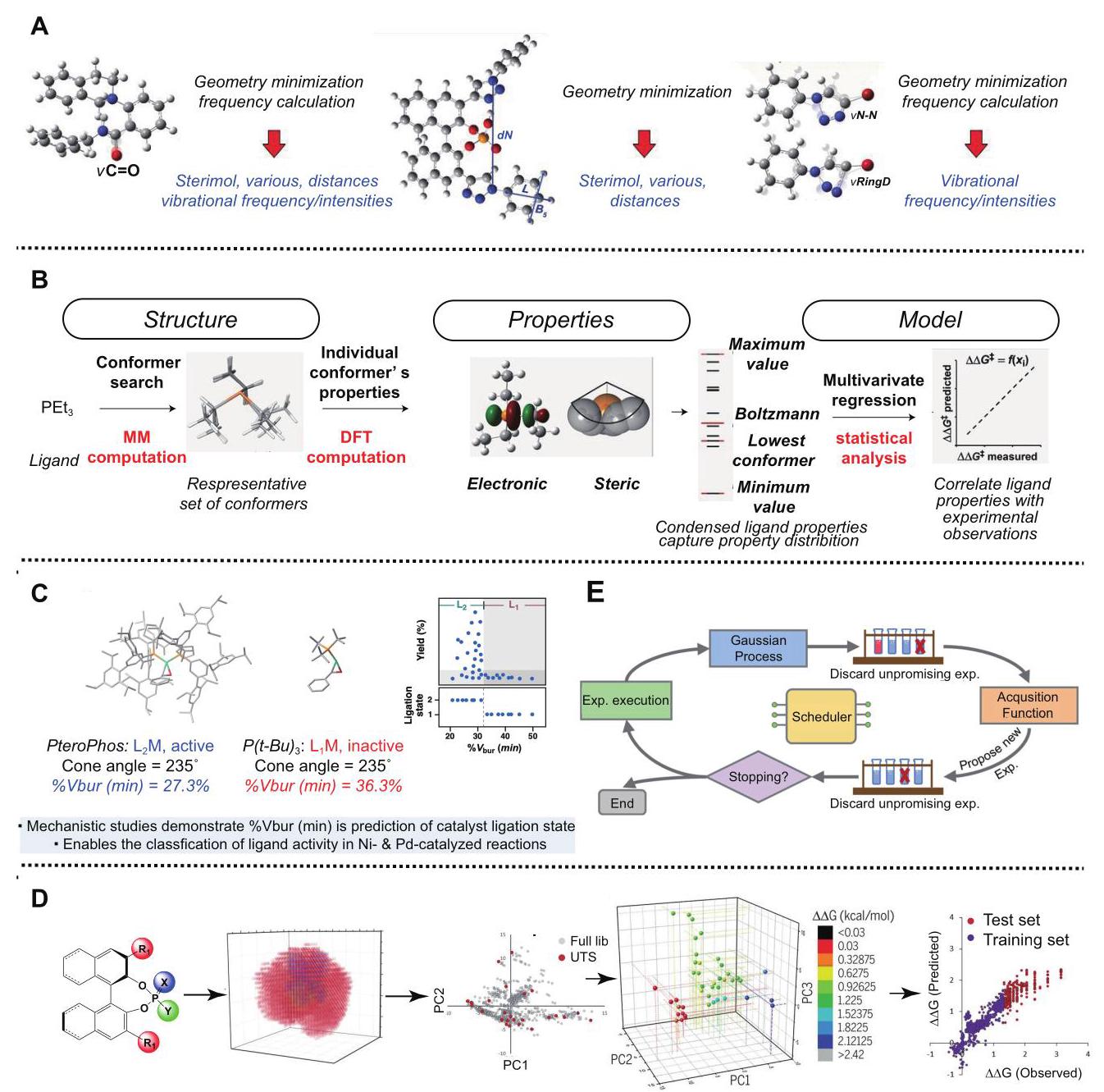
Figure 8 AI-driven catalyst design and optimization. (A) Data-intensive approach to mechanistic elucidation of chiral ionic catalysis: Introduced by F.D. Toste and M.S. Sigman in 2015, this approach entailed a comprehensive analysis of various catalysts and substrates, revealing the key mechanistic attributes of the system and insights into enantioselectivity [68]. Copyright@2015, American Association for the Advancement of Science. (B) Stereodivergent Pd-catalyzed cross-coupling reactions: M.S. Sigman and M.R. Biscoe employed molecular modeling and parameterization in conjunction with experimental validation to elucidate the factors governing stereoselectivity in 2018 [69]. Copyright©2018, American Association for the Advancement of Science. (C) Monodentate phosphine ligands classification: In 2021, M.S. Sigman and A.G. Doyle presented a methodology to categorize monodentate phosphine ligands based on their connectivity status and reactivity, enabling a more nuanced understanding of reaction outcomes in cross-coupling catalysis [71]. Copyright©2021, American Association for the Advancement of Science. (D) Computationally guided catalyst selection: S.E. Denmark demonstrated in 2019 how machine learning and cheminformatics could revolutionize the selection of chiral catalysts [72]. Copyright©2019, American Association for the Advancement of Science. (E) Automatic reactive optimization and parallel scheduling (AROPS): Introduced by Y. Mo in 2023, AROPS effectively integrates optimization algorithms with module scheduling, resulting in a more efficient experimental process [73]. Copyright ©2023, American Chemical Society.
图8 人工智能驱动的催化剂设计与优化。(A) 手性离子催化机理阐释的数据密集型方法:2015年由F.D. Toste和M.S. Sigman引入,该方法对各种催化剂和底物进行了全面分析,揭示了系统的关键机理属性以及对对映选择性的见解[68]。版权所有@2015,美国科学促进会。(B) 立体发散性钯催化交叉偶联反应:2018年,M.S. Sigman和M.R. Biscoe结合分子建模和参数化以及实验验证,阐明了控制立体选择性的因素[69]。版权所有©2018,美国科学促进会。(C) 单齿膦配体分类:2021年,M.S. Sigman和A.G. Doyle提出了一种基于单齿膦配体的连接状态和反应性进行分类的方法,能够更细致地理解交叉偶联催化中的反应结果[71]。版权所有©2021,美国科学促进会。(D) 计算引导的催化剂选择:2019年,S.E. Denmark展示了机器学习和化学信息学如何彻底改变手性催化剂的选择[72]。版权所有©2019,美国科学促进会。(E) 自动反应优化与并行调度(AROPS):2023年由Y. Mo推出,AROPS有效地将优化算法与模块调度相结合,实现了更高效的实验过程[73]。版权所有©2023,美国化学学会。
The increasing demand for accuracy and efficiency in scientific research has spurred the development of fully automated workflows in chemistry, significantly changing traditional laboratory practices [74-76]. These automated systems increase efficiency by allowing round-the-clock experimentation and minimising human error, thereby improving the accuracy of results. In this context, the historically difficult task of selectively functionalising hindered aromatic meta-C-H bonds saw progress in 2022. K. Liao from Guangzhou Laboratory and Y. Yang from Sun Yat-sen University successfully addressed this challenge by harnessing the power of automation-driven high-throughput experimentation (HTE) and deep learning (DL) [77], as shown in Figure 9A. They introduced a novel method for functionalising these obstructed C-H bonds using carbon dioxide as an unobtrusive director in a one-pot, three-step process. This process has been specifically designed for the selective arylation of $o$ -alkylaryl ketones at the obstructed meta position. The method includes light-induced C-H carboxylation, carboxyl-directed Pd-catalyzed C-H functionalisation and microwave assisted decarboxylation. Using HTE and DL, they studied a wide range of substrates, including over a thousand (1032) reactions, and developed a DL-driven reaction yield prediction model called CMPRY. This model was evaluated in two different tests using unseen $o$ -alkylaryl ketones and/or potassium aryltri-fluorobo rates, and demonstrated remarkable predictive performance with mean absolute yield errors of only 6.6% and 8.4%. Such results underline its potential for real-world synthetic applications. Meanwhile, in 2023, K. Liao and H. Chen from the Guangzhou Laboratory made a breakthrough by innovatively using 1,4-dihydropyridine (DHP) derivatives, typically known for their biological relevance, as catalysts in a de-carboxylative selenation reaction [78], as shown in Figure 9B. This reaction demonstrated extensive substrate versatility, which was enhanced by HTE and AI. The AI-driven model demonstrated the ability to identify key structural features and accurately predict previously unseen reactions. With a correlation coefficient of 0.89, a root mean square error of ${9.0}\%$ and a mean absolute error of ${6.3}\%$ , this model demonstrated remarkable performance. This work not only expanded the catalytic applications of DHP derivatives but also highlighted the effectiveness of integrating HTE and AI to advance the development of chemical synthesis.
科学研究对准确性和效率的需求不断增加,推动了化学领域全自动工作流程的发展,显著改变了传统实验室操作[74 - 76]。这些自动化系统通过实现全天候实验并将人为误差降至最低来提高效率,从而提高结果的准确性。在此背景下,选择性官能化受阻芳香族间位C - H键这一历史难题在2022年取得了进展。广州实验室的廖凯和中山大学的杨扬通过利用自动化驱动的高通量实验(HTE)和深度学习(DL)的力量成功应对了这一挑战[77],如图9A所示。他们引入了一种新颖的方法,在一锅三步反应中使用二氧化碳作为不显眼的导向基团来官能化这些受阻的C - H键。该过程专门设计用于在受阻的间位对$o$ - 烷基芳基酮进行选择性芳基化。该方法包括光诱导的C - H羧基化、羧基导向的钯催化C - H官能化和微波辅助脱羧。他们使用HTE和DL研究了广泛的底物,包括超过一千个(1032)反应,并开发了一个名为CMPRY的由DL驱动的反应产率预测模型。该模型在使用未见过的$o$ - 烷基芳基酮和/或芳基三氟硼酸钾的两个不同测试中进行了评估,并表现出卓越的预测性能,平均绝对产率误差仅为6.6%和8.4%。这些结果突显了其在实际合成应用中的潜力。同时,在2023年,广州实验室的廖凯和陈欢通过创新性地使用通常因其生物学相关性而闻名的1,4 - 二氢吡啶(DHP)衍生物作为脱羧硒化反应的催化剂取得了突破[78],如图9B所示。该反应展示了广泛的底物通用性,通过HTE和人工智能得到了增强。人工智能驱动的模型展示了识别关键结构特征并准确预测以前未见过的反应的能力。该模型的相关系数为0.89,均方根误差为${9.0}\%$,平均绝对误差为${6.3}\%$,表现卓越。这项工作不仅扩展了DHP衍生物的催化应用,还突出了整合HTE和人工智能以推动化学合成发展的有效性。
The innovative advancements in the fields of AI and machine learning are revolutionizing how scientists analyze and comprehend immense volumes of data. These technologies merge rapid processing with unparalleled precision. Crucially, in the sphere of machine learning, the presence of comprehensive, high-caliber data is indispensable for the development of exceptional models. A monumental endeavor in this sector is the ibond database. This initiative is led by the esteemed researchers J. Cheng, S. Luo, and J. Yang from Tsinghua University, along with X. Li from Nankai University. This remarkable database aggregates activity metrics of various molecules, with a particular emphasis on parameters such as internet bond-energy database (p ${K}_{\mathrm{a}}$ and BDE). In the year 2020, distinguished scholars J. Yang, L. Zhang, and S. Luo introduced a predictive model for $\mathrm{p}{K}_{\mathrm{a}}$ values, leveraging the comprehensive data from the ibond database. These data span 39 distinctive solvents [79], as illustrated in Figure 10A. The model utilizes structural and physical-organic parameter-based descriptors (SPOC), which effectively capture the electronic and structural characteristics of molecules. When this model was trained using state-of-the-art methods like neural networks or the XG-Boost algorithm, it delivered exceptional performance, reflected in a mean absolute error (MAE) of a mere ${0.87}\mathrm{p}{K}_{\mathrm{a}}$ units. Chemical reactivity, especially within polar organic reactions, is principally determined by the attributes of nucleophilicity and electrophilicity. The groundbreaking quantitative scale introduced by H. Mayr and colleagues has been instrumental in elucidating the patterns of chemical reactivity [80]. By 2023, this research experienced further advancements. Notably, S. Luo and L. Zhang unveiled an enhanced predictive machine learning model [81], as detailed in Figure 10B. Termed as rSPOC, this refined molecular representation amalgamates structural, physicochemical, and solvent features. With an impressive database comprising 1115 nucleophiles, 285 electrophiles, and 22 solvents, it is unparalleled in its capacity to predict reactivity. Impressively, when the rSPOC model was subjected to training with the extra trees algorithm, it exhibited remarkable accuracy in forecasting Mayr’s $\mathrm{N}$ and $\mathrm{E}$ parameters, achieving ${R}^{2}$ values of 0.92 and 0.93 respectively, and maintaining a consistent MAE of 1.45 for both. This model’s prowess was further evidenced when it efficiently predicted the nucleophilicity of $\mathrm{{NAD}}\left( \mathrm{P}\right) \mathrm{H}$ and various enamines, highlighting its potential in predicting the reactivity of previously unknown molecules. To augment its accessibility and utility, an online predictive platform was inaugurated at http://isyn.luoszgroup.com/, grounded on this pioneering model. This platform offers users the capability to predict $\mathrm{p}{K}_{\mathrm{a}}$ values across a wide range of $\mathrm{X} - \mathrm{H}$ acidities in popularly employed solvents.
人工智能和机器学习领域的创新进展正在彻底改变科学家分析和理解海量数据的方式。这些技术将快速处理与无与伦比的精度相结合。至关重要的是,在机器学习领域,全面、高质量的数据对于开发卓越模型不可或缺。该领域的一项重大努力是ibond数据库。这项计划由清华大学的杰出研究人员J. Cheng、S. Luo和J. Yang以及南开大学的X. Li领导。这个非凡的数据库汇总了各种分子的活性指标,特别强调诸如互联网键能数据库(p ${K}_{\mathrm{a}}$ 和BDE)等参数。在2020年,杰出学者J. Yang、L. Zhang和S. Luo利用ibond数据库的全面数据推出了一个预测 $\mathrm{p}{K}_{\mathrm{a}}$ 值的模型。这些数据涵盖39种不同的溶剂[79],如图10A所示。该模型利用基于结构和物理有机参数的描述符(SPOC),有效地捕捉了分子的电子和结构特征。当使用神经网络或XG - Boost算法等先进方法对该模型进行训练时,它表现出卓越的性能,平均绝对误差(MAE)仅为 ${0.87}\mathrm{p}{K}_{\mathrm{a}}$ 单位。化学反应活性,特别是在极性有机反应中,主要由亲核性和亲电性的属性决定。H. Mayr及其同事引入的开创性定量标度在阐明化学反应模式方面发挥了重要作用[80]。到2023年,这项研究有了进一步进展。值得注意的是,S. Luo和L. Zhang推出了一个增强的预测机器学习模型[81],如图10B详细所示。这个被称为rSPOC的精细分子表示融合了结构、物理化学和溶剂特征。拥有一个包含1115种亲核试剂、285种亲电试剂和22种溶剂的令人印象深刻的数据库,它在预测反应活性方面的能力无与伦比。令人印象深刻的是,当rSPOC模型使用额外树算法进行训练时,它在预测Mayr的 $\mathrm{N}$ 和 $\mathrm{E}$ 参数方面表现出显著的准确性,分别达到 ${R}^{2}$ 值0.92和0.93,并且两者的MAE均保持在1.45。当该模型有效预测 $\mathrm{{NAD}}\left( \mathrm{P}\right) \mathrm{H}$ 和各种烯胺的亲核性时,进一步证明了其强大能力,突出了其在预测未知分子反应活性方面的潜力。为了提高其可及性和实用性,基于这个开创性模型,在http://isyn.luoszgroup.com/开设了一个在线预测平台。这个平台为用户提供了在常用溶剂中预测广泛 $\mathrm{X} - \mathrm{H}$ 酸度下的 $\mathrm{p}{K}_{\mathrm{a}}$ 值的能力。
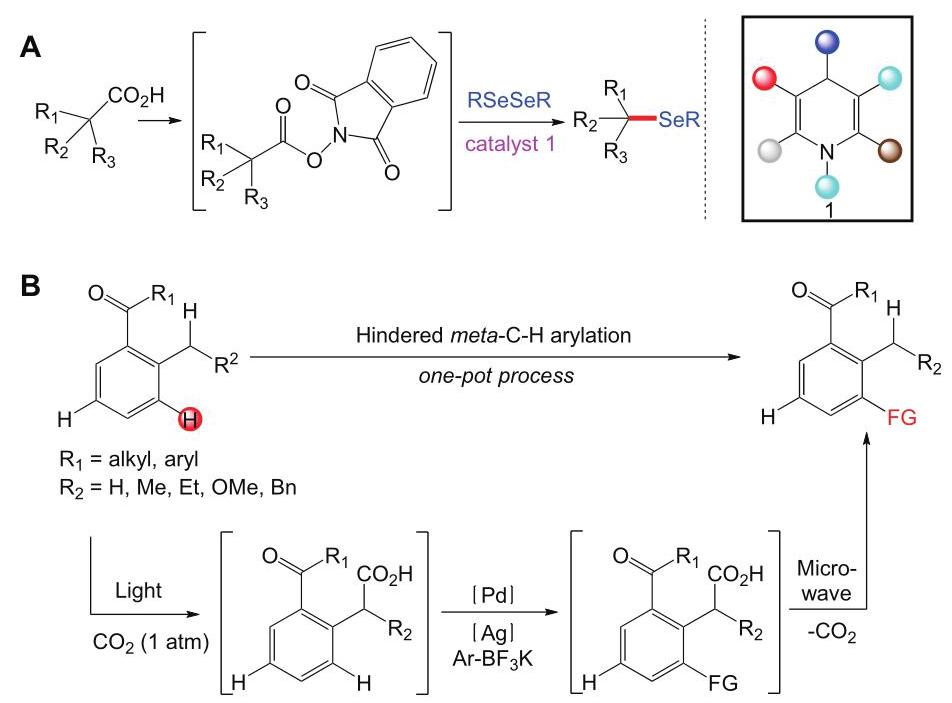
Figure 9 Enhancing chemical synthesis via the integration of HTE and AI. (A) The intersection of automated HTE and DL technologies to boost efficiency in chemical synthesis [77]. Copyright@2022, Elsevier. (B) Exploring the use of DHP derivatives as catalysts in the decarboxylation selenization reaction [78]. Copyright©2023, Royal Society of Chemistry. Broad substrate versatility of the reaction is significantly enhanced by integrating HTE and AI.
图9通过整合高通量实验(HTE)和人工智能增强化学合成。(A) 自动化高通量实验和深度学习技术的交叉点以提高化学合成效率[77]。版权所有@2022,爱思唯尔。(B) 探索二氢吡啶(DHP)衍生物在脱羧硒化反应中作为催化剂的用途[78]。版权所有©2023,皇家化学学会。通过整合高通量实验和人工智能,反应的广泛底物通用性得到显著增强。
The emergence of an interdisciplinary approach encourages collaboration between different disciplines. Specialists in organic chemistry, AI, and computer science, among others, are working together to create ingenious solutions to complex problems, enriching research methods and broadening the field of organic chemistry. In the complex arena of synthetic chemistry, predicting enantioselectivity in asymmetric catalysis has been a stubborn puzzle, compounded by the intricate relationship between structure and enantioselectiv-ity [82]. The challenge becomes daunting without a comprehensive understanding of synthetic space, which can discourage the exploration and discovery of asymmetric reactions [83-85]. In 2023, X. Hong and L. Ackermann made a significant breakthrough by inventively establishing a data-driven approach that directly addresses this complex problem [86]. Their tactic centred on the use of machine learning, which they combined with a deep understanding of the transition state. This combination allowed them to accurately predict the enantioselectivity of asymmetric palladium electrocatalytic C-H activation, an impressive achievement in itself. This complex process involved transforming transition state knowledge into a format that could be understood and applied by machine learning models. This modification enabled the models to perform a comprehensive evaluation of a wide range of potential scenarios, revealing unexpected effects of alkenes on enantioselectivity and providing critical insights into the dependence of the rate-determining step on olefin reactivity. A major advance in computational chemistry has been the increasing use of direct trajectory calculations, which are now an integral part of modern research [87]. However, its use in the investigation of reaction mechanisms is often limited by the enormous computational cost of ab initio trajectory calculations. Against this backdrop, machine learning-based potential energy surfaces (ML-PESs) emerge as a compelling solution, offering a viable strategy to bypass these immense computational costs while maintaining the necessary precision [88,89]. However, building a robust ML-PES comes with its own set of hurdles, as the training set for the potential energy surface must sufficiently cover an all-encompassing configuration space. In a landmark breakthrough in 2023, X. Hong and T. Hou charted a pioneering path [90], as shown in Figure 11. They proposed an innovative approach involving the use of quasiclassical trajectory (QCT) calculations when the required properties can be determined by localized sampling of the configuration space. This strategy facilitates the construction of locally accurate ML-PESs. Their pioneering method has been effectively demonstrated in two model reactions: the methyl migration of the i-pentane cation and the dimerisation of cyclopentadiene. Impressively, these locally precise ML-PESs showed resilience and precision in reproducing the static and dynamic features of the reactions, accurately capturing time-sensitive changes in free energy and entropy, and accounting for temporal gaps. This achievement represents a major leap forward in the advancing world of computational chemistry, and highlights the power of combining traditional computational methods with the dynamic capabilities of machine learning.
跨学科方法的出现促进了不同学科之间的合作。有机化学、人工智能和计算机科学等领域的专家正在共同努力,为复杂问题创造巧妙的解决方案,丰富研究方法并拓宽有机化学领域。在合成化学这个复杂的领域中,预测不对称催化中的对映选择性一直是一个棘手的难题,结构与对映选择性之间的复杂关系更是雪上加霜[82]。如果没有对合成空间的全面理解,这个挑战将变得令人生畏,这可能会阻碍不对称反应的探索和发现[83-85]。2023年,X. Hong和L. Ackermann通过创造性地建立一种直接解决这个复杂问题的数据驱动方法取得了重大突破[86]。他们的策略以机器学习的应用为核心,并将其与对过渡态的深入理解相结合。这种结合使他们能够准确预测不对称钯电催化C-H活化的对映选择性,这本身就是一项令人瞩目的成就。这个复杂的过程涉及将过渡态知识转化为机器学习模型能够理解和应用的格式。这种修改使模型能够对广泛的潜在情况进行全面评估,揭示烯烃对对映选择性的意外影响,并提供关于速率决定步骤对烯烃反应性的依赖性的关键见解。计算化学的一项重大进展是直接轨迹计算的使用日益增加,现在它已成为现代研究不可或缺的一部分[87]。然而,它在反应机理研究中的应用常常受到从头算轨迹计算巨大计算成本的限制。在这种背景下,基于机器学习的势能面(ML-PESs)作为一种引人注目的解决方案出现了,它提供了一种可行的策略,既能绕过这些巨大的计算成本,又能保持必要的精度[88,89]。然而,构建一个强大的ML-PES也有其自身的一系列障碍,因为势能面的训练集必须充分覆盖一个全面的构型空间。在2023年的一项具有里程碑意义的突破中,X. Hong和T. Hou开辟了一条开创性的道路[90],如图11所示。他们提出了一种创新方法,当所需属性可以通过构型空间的局部采样确定时,使用准经典轨迹(QCT)计算。这种策略有助于构建局部精确的ML-PES。他们的开创性方法已在两个模型反应中得到有效验证:异戊烷阳离子的甲基迁移和环戊二烯的二聚反应。令人印象深刻的是,这些局部精确的ML-PES在再现反应的静态和动态特征方面表现出了弹性和精度,准确地捕捉了自由能和熵的时间敏感变化,并考虑了时间间隙。这一成就代表了计算化学不断发展的世界中的一个重大飞跃,并突出了将传统计算方法与机器学习的动态能力相结合的力量。
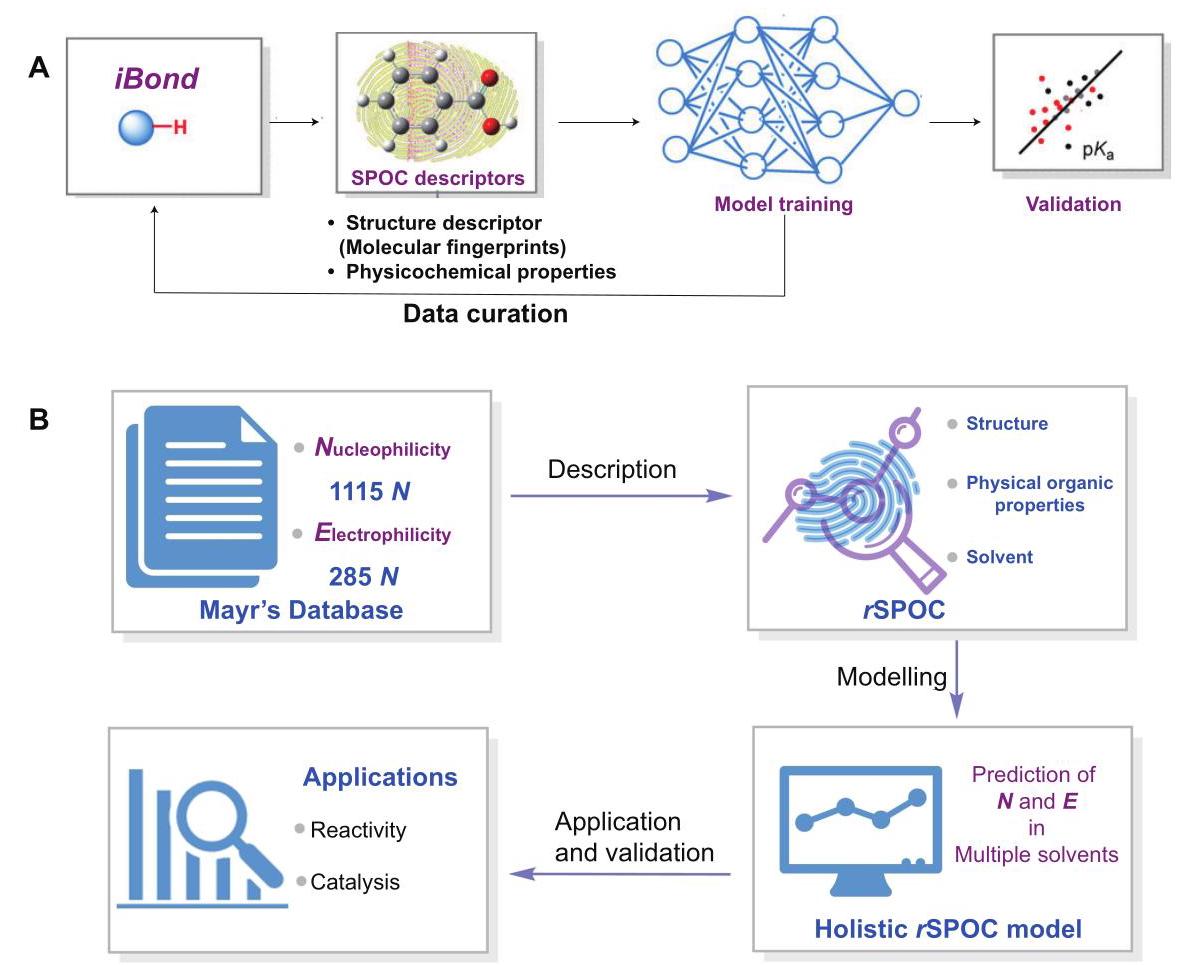
Figure 10 Data-driven reactivity predictions. (A) An advanced model has been engineered for predicting p ${K}_{\mathrm{a}}$ values, leveraging the ibond database which encompasses data from 39 distinct solvents [79]. Copyright@2020, John Wiley and Sons. The machine-learning-driven model employs SPOC to capture the molecular electronic and structural features. Training using either a neural network or the XGBoost algorithm has resulted in its remarkable predictive prowess, evidenced by a minimum mean absolute error (MAE) of ${0.87}\mathrm{p}{K}_{\mathrm{a}}$ units. (B) A broad-scale predictive model, developed using machine learning techniques, has been introduced [81]. Copyright@2023, John Wiley and Sons. This innovative molecular representation, designated as rSPOC, amalgamates structural, physicochemical, and solvent-related elements. The model’s dataset incorporates 1115 nucleophiles, 285 electrophiles, and 22 solvents, thereby establishing it as the most expansive resource for reactivity prediction currently in existence.
图10 数据驱动的反应性预测。(A) 利用包含来自39种不同溶剂数据的ibond数据库,设计了一个用于预测p ${K}_{\mathrm{a}}$值的先进模型[79]。版权所有@2020,约翰威立父子公司。这个机器学习驱动的模型采用SPOC来捕捉分子的电子和结构特征。使用神经网络或XGBoost算法进行训练,其显著的预测能力得到了证明,最小平均绝对误差(MAE)为${0.87}\mathrm{p}{K}_{\mathrm{a}}$单位。(B) 引入了一个使用机器学习技术开发的大规模预测模型[81]。版权所有@2023,约翰威立父子公司。这种创新的分子表示法,称为rSPOC,融合了结构、物理化学和与溶剂相关的元素。该模型的数据集包含1115种亲核试剂、285种亲电试剂和22种溶剂,从而使其成为目前存在的用于反应性预测的最广泛资源。
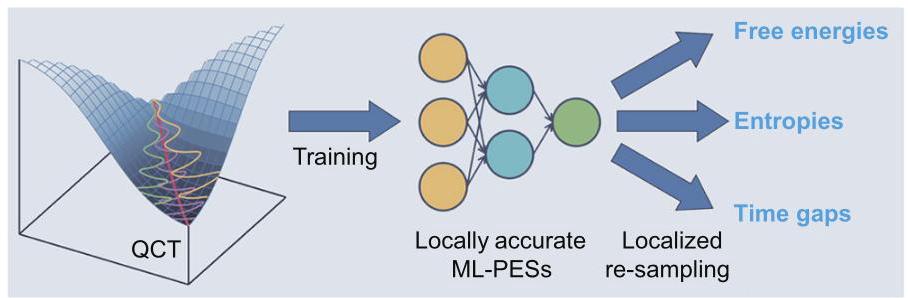
Figure 11 AI in molecular design. A technique known as quasiclassical trajectory aids in creating precise machine learning models for tracking energy changes during reactions. This was shown in two sample reactions: one involving a complex molecule’s part moving and the other involving the union of two smaller molecules. These machine learning models reliably show both constant and changing aspects of reactions, including energy and entropy shifts over time and addressing time variations [90]. Copyright©2022, American Physical Society.
图11 分子设计中的人工智能。一种称为准经典轨迹的技术有助于创建精确的机器学习模型,用于跟踪反应过程中的能量变化。这在两个示例反应中得到了展示:一个涉及复杂分子部分的移动,另一个涉及两个较小分子的结合。这些机器学习模型可靠地展示了反应的恒定和变化方面,包括随时间的能量和熵变化以及处理时间变化[90]。版权所有©2022,美国物理学会。
CONCLUSIONS
结论
Summary
总结
In summary, this review elucidates the crucial transformation in the field of chemistry instigated by the proliferation of automation technologies. This transition is pivotal in redirecting the focus of chemists from manual and labor-intensive tasks to intellectual inquiries as information analysts. This not only enables a more profound understanding of scientific principles but also counteracts the monotony associated with laboratory work. However, to harness the full potential of this information-centric approach, there is a compelling need to develop AI algorithms that are both predictive and explainable. This necessity arises from the escalating demand for transparency in AI decision-making processes, a demand rooted in the end users’ aspiration to comprehend the logic behind AI-generated outcomes instead of merely accepting them at face value. Therefore, addressing this requirement is of paramount importance for the continued development and application of AI technologies in chemistry and beyond.
总之,本综述阐明了自动化技术的普及在化学领域引发的关键变革。这一转变对于将化学家的关注点从手工和劳动密集型任务重新导向作为信息分析师的智力探究至关重要。这不仅有助于更深入地理解科学原理,还能抵消与实验室工作相关的单调乏味。然而,为了充分发挥这种以信息为中心的方法的潜力,迫切需要开发具有预测性和可解释性的人工智能算法。这种必要性源于对人工智能决策过程透明度的需求不断升级,这种需求源于最终用户渴望理解人工智能生成结果背后的逻辑,而不仅仅是表面接受它们。因此,满足这一要求对于人工智能技术在化学及其他领域的持续发展和应用至关重要。
Outlook
展望
New research paradigms are having a profound impact on organic chemistry. They are accelerating scientific discovery, reshaping interdisciplinary collaboration, provoking ethical considerations, and redefining the future role of humans in research.
新的研究范式正在对有机化学产生深远影响。它们正在加速科学发现,重塑跨学科合作,引发伦理思考,并重新定义人类在研究中的未来角色。
(1) When discussing the relationship between AI and chemistry, it is essential to consider the specific intricacies of different branches of chemistry. Researchers have made significant progress in the application of AI for chemical analysis and prediction models, as well as the development of automated chemical experimentation platforms. Through years of dedicated independent research, these achievements are now at a stage where they can be integrated to promote further advancements in the field of AI for Chemistry. The academic community is currently on the cusp of an explosion of research in this area. In the future, it is likely that the knowledge embedding and knowledge discovery techniques in scientific machine learning [91,92] will be leveraged to connect current prediction models and automated experimentation platforms and generate self-evolving AI chemistry research assistant, which is illustrated in Figure 12. Here, we will focus on organic chemistry and its interplay with AI-driven advancements. Organic chemistry, which explores the structure, properties, and reactions of organic compounds and materials, is notably intricate. Its vast realm of reactions and mechanisms makes it both an exciting and challenging field. Organic molecules, with their diverse functional groups and isomers, present a rich playground for AI models. In the backdrop of AI-chemical research synergy, organic compounds’ structural complexity necessitates sophisticated molecular descriptors. Graph convolutional networks (GCNs) are pivotal for processing molecular structures [93]. For organic chemistry, GCNs can be particularly beneficial in recognizing structural motifs and functional groups. With the appropriate descriptors, AI can predict reactivity patterns or even the stereochemical outcomes of reactions-a historically challenging task given the 3D nature of molecules [94]. Combinatorial chemistry, when applied to organic synthesis, leads to the creation of vast molecular libraries. These libraries can serve as treasure troves for drug discovery or materials science. However, the challenge here is not just about synthesizing molecules but also about understanding their potential applications. Organic molecules often display biological activity due to their interactions with biomolecules, and predicting these interactions requires understanding the subtle interplays of molecular shapes, electronics, and more. The idea of knowledge discovery in scientific machine learning offers unique prospects for organic chemistry [95, 96]. Reaction mechanisms, which are central to organic chemistry, often involve intricate pathways with intermediates, transition states, and competing reactions. Traditional methods of determining these mechanisms involve kinetic studies, isotope labeling, and more. However, if symbolic mathematics, combined with AI, can help elucidate these pathways, it would revolutionize our understanding and teaching of organic reactions. Knowledge embedding, as mentioned, becomes even more pertinent from an organic chemist’s perspective. Organic chemistry has a wealth of heuristic rules, from Markovnikov’s rule for electrophilic addition to Baldwin’s rules for ring closures. If AI models can be instilled with this embedded knowledge, their predictions would not just be data-driven but would also align with chemists’ intuitive understanding, offering a deeper and more insightful perspective.
(1) 在讨论人工智能与化学的关系时,必须考虑化学不同分支的具体复杂性。研究人员在将人工智能应用于化学分析和预测模型以及开发自动化化学实验平台方面取得了重大进展。经过多年专注的独立研究,这些成果现在已发展到可以整合起来推动人工智能化学领域进一步发展的阶段。学术界目前正处于该领域研究爆发的前夕。未来,很可能会利用科学机器学习中的知识嵌入和知识发现技术 [91,92] 来连接当前的预测模型和自动化实验平台,并生成自我进化的人工智能化学研究助手,如图12所示。在此,我们将重点关注有机化学及其与人工智能驱动的进展之间的相互作用。有机化学研究有机化合物和材料的结构、性质和反应,其复杂性尤为显著。其庞大的反应和机理领域使其成为一个既令人兴奋又具有挑战性 的领域。有机分子具有多样的官能团和异构体,为人工智能模型提供了丰富的研究对象。在人工智能与化学研究协同的背景下,有机化合物的结构复杂性需要复杂的分子描述符。图卷积网络(GCN)对于处理分子结构 [93] 至关重要。对于有机化学而言,GCN在识别结构基序和官能团方面可能特别有用。有了合适的描述符,人工智能可以预测反应性模式,甚至反应的立体化学结果——鉴于分子的三维性质,这是一项历来具有挑战性的任务 [94]。组合化学应用于有机合成时,会产生大量的分子库。这些库可作为药物发现或材料科学的宝库。然而,这里的挑战不仅在于合成分子,还在于了解它们的潜在应用。有机分子由于与生物分子的相互作用而常常表现出生物活性,预测这些相互作用需要理解分子形状、电子学等之间的微妙相互作用。科学机器学习中的知识发现理念为有机化学提供了独特的前景 [95, 96]。反应机理是有机化学的核心,通常涉及带有中间体、过渡态和竞争反应的复杂途径。确定这些机理的传统方法包括动力学研究、同位素标记等。然而,如果符号数学与人工智能相结合能够帮助阐明这些途径,将彻底改变我们对有机反应的理解和教学。如前所述,从有机化学家的角度来看,知识嵌入变得更加相关。有机化学有大量的启发式规则,从亲电加成的马尔科夫尼科夫规则到环化反应的鲍德温规则。如果人工智能模型能够被灌输这些嵌入的知识,其预测将不仅由数据驱动,还将与化学家的直观理解相一致,提供更深入、更有见地的观点。
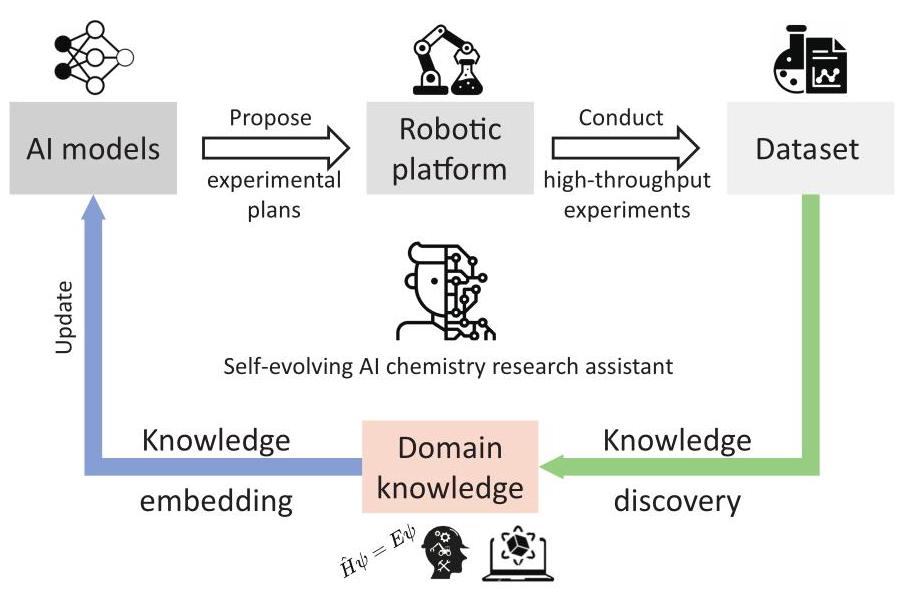
Figure 12 Pipeline of generating self-evolving AI chemistry research assistant.
图12生成自我进化的人工智能化学研究助手的流程。
(2) The world of AI has seen a considerable shift in the past few years, with general-purpose models like the generative pre-trained transformer (GPT) gaining immense popularity. This evolution is not isolated to linguistics; it has spilled over to other specialized domains, most notably chemistry. And as we dive deeper into this confluence of chemistry and AI, it is worth noting the strides we have made, especially in terms of chemical big models and language models. ChEMBL, for instance, stands out as a beacon in this realm. As a manually curated database of bioactive molecules, its value is magnified when combined with transformer models. By training these models on the ChEMBL dataset, researchers have been able to predict a plethora of molecular properties and activities, bridging the gap between AI’s potential and practical chemistry [97]. Further, the integration of the SMILES notation, i.e., simplified molecular input line entry system, demonstrates another innovative step. With SMILES, chemical structures get a textual representation, allowing for easier integration into language models. This integration has enabled these models to predict, generate, and optimize molecular structures, a feat previously deemed far-fetched. Then there’s ChemBERTa, reminiscent of the BERT model for natural languages but tailor-made for the world of chemistry. As a transformer-based model, ChemBERTa taps into vast amounts of chemical data, and upon fine-tuning, serves purposes ranging from property prediction to the complex realm of retrosynthesis [98]. Speaking of retrosynthesis, the RETRO model stands out in this sphere. Trained on vast databases of chemical reactions, RETRO predicts potential retrosynthetic pathways, offering insights into potential precursors and reactions for target molecules [99]. Beyond tools like RETRO, even large language models such as BERT and GPT have been applied in inverse synthesis, where, given a product, the model suggests potential synthetic routes and reactants. However, it is not merely the applications of neural networks in AI chemistry that are evolving - it is the very essence of their nature. The chronology of AI saw a humble beginning with simple neural network architectures, but today, we witness behemoths like GPT-4, armed with billions of parameters [100]. This scaling up in AI chemistry brings about an interesting conundrum, one that juxtaposes model complexity with interpretability. There is an undeniable allure to the capabilities of larger models. Yet, in a domain like chemistry, where the stakes are high and the margin for error is minuscule, the need for interpretability is undeniable. Reflecting upon AI’s role in chemistry, it becomes clear that interpretability, though significant, is not the lone beacon guiding this ship. The overarching vision for AI in chemistry is vast and multi-dimensional: prediction is at the forefront, with sophisticated models promising unparalleled accuracy in forecasting chemical properties and reactions. Exploration is another frontier, with AI providing a lens to navigate the intricate maze of chemical compounds and reactions, some of which might elude human intuition. Optimization presents the promise of revolutionizing chemical processes by pushing the boundaries to achieve greener and more efficient synthesis methodologies. Ultimately, while the initial attraction towards AI chemistry might have been its promise of interpretability, the reality is far more nuanced. The intersection of AI and chemistry is a dynamic space, ever-evolving and constantly being reshaped by the challenges and needs intrinsic to the chemical domain. As we continue to traverse this journey, it is evident that AI’s contribution to chemistry is bound to be as transformative as it is multifaceted.
(2) 在过去几年中,人工智能领域发生了重大转变,生成式预训练变换器(GPT)等通用模型广受欢迎。这种发展并非仅限于语言学领域;它已经蔓延到其他专业领域,尤其是化学领域。当我们深入研究化学与人工智能的融合时,值得注意的是我们所取得的进展,特别是在化学大模型和语言模型方面。例如,ChEMBL在这一领域堪称灯塔。作为一个人工整理的生物活性分子数据库,当与变换器模型结合时,其价值得到了提升。通过在ChEMBL数据集上训练这些模型,研究人员能够预测大量分子特性和活性,弥合了人工智能潜力与实际化学之间的差距[97]。此外,简化分子输入线性条目系统(SMILES)符号的整合展示了另一个创新步骤。有了SMILES,化学结构获得了文本表示,便于更轻松地集成到语言模型中。这种整合使这些模型能够预测、生成和优化分子结构,这一壮举以前被认为是遥不可及的。然后是ChemBERTa,它让人联想到用于自然语言的BERT模型,但专为化学领域量身定制。作为基于变换器的模型,ChemBERTa利用了大量化学数据,经过微调后,可用于从性质预测到复杂的逆合成领域等各种目的[98]。说到逆合成,RETRO模型在这一领域脱颖而出。它在大量化学反应数据库上进行训练,RETRO预测潜在的逆合成途径,为目标分子的潜在前体和反应提供见解[99]。除了RETRO这样的工具,甚至像BERT和GPT这样的大型语言模型也已应用于逆合成,即给定一个产物,模型会建议潜在的合成路线和反应物。然而,不仅仅是人工智能化学中神经网络的应用在不断发展——其本质也在演变。人工智能的发展历程始于简单的神经网络架构,但如今,我们见证了像GPT - 4这样拥有数十亿参数的巨头[100]。人工智能化学中的这种规模扩大带来了一个有趣的难题,即模型复杂性与可解释性的并列。更大模型的能力具有不可否认的吸引力。然而,在化学这样一个风险高且误差 margin 极小的领域,对可解释性的需求是不可否认的。反思人工智能在化学中的作用,很明显,可解释性虽然重要,但并非指引这艘船的唯一灯塔。化学中人工智能的总体愿景是广阔且多维度的:预测处于前沿,复杂模型有望在预测化学性质和反应方面实现无与伦比的准确性。探索是另一个前沿领域,人工智能提供了一个视角来 navigate 错综复杂的化合物和反应迷宫,其中一些可能超出人类直觉。优化有望通过突破界限实现更绿色、更高效的合成方法,从而彻底改变化学过程。最终,虽然最初对人工智能化学的吸引力可能在于其可解释性的 promise,但现实要微妙得多。人工智能与化学的交叉是一个动态空间,不断发展并不断被化学领域固有的挑战和需求重塑形状。当我们继续踏上这段旅程时,很明显人工智能对化学的贡献注定会既具有变革性又具有多面性。
(3) The emergence of new paradigms in AI and automation has also raised significant ethical concerns. These technologies are permeating various research fields, stirring debates about data privacy and the transparency of AI algorithms. In particular, the question arises: how can we leverage vast amounts of data without compromising privacy? One potential solution is federated learning. Federated learning is an approach that allows for model training across multiple decentralized devices or servers holding local data samples, without data exchange [101, 102]. This not only preserves data privacy but also facilitates the collaborative nature of AI without centralizing sensitive information. Within the context of organic chemistry, this means that institutions or labs can contribute to the development and training of shared models without ever exposing individual data points, ensuring that sensitive or proprietary chemical data remains confidential. Furthermore, transparency in AI algorithms can be enhanced by incorporating explainable AI (XAI) techniques, which aim to make the inner workings of models more interpretable for human researchers. As the discipline of organic chemistry progress, integrating such techniques can offer insights into why a particular AI-driven prediction or recommendation was made, bridging the gap between human intuition and machine learning. As the landscape of organic chemistry transforms under AI’s influence, the above considerations, combined with federated learning, will play a pivotal role. While AI performs routine tasks, allowing human researchers to focus on conceptual and creative endeavors, it is essential to harness AI tools responsibly and ethically. The union of humans and AI in research should be symbiotic, with each enhancing the other’s capabilities. For now, as we stand on the brink of a new epoch in organic chemistry, scientists need not fear AI replacing them. Instead, the emphasis should be on adapting and mastering AI tools, ensuring that human unique skills continue to complement AI, making the collaboration more powerful than either could achieve alone.
(3) 人工智能和自动化领域新范式的出现也引发了重大的伦理问题。这些技术正在渗透到各个研究领域,引发了关于数据隐私和人工智能算法透明度的争论。特别是,问题来了:我们如何在不损害隐私的情况下利用大量数据?一种潜在的解决方案是联邦学习。联邦学习是一种允许在持有本地数据样本的多个分散设备或服务器上进行模型训练的方法,而无需进行数据交换[101, 102]。这不仅保护了数据隐私,还促进了人工智能的协作性质,而无需集中敏感信息。在有机化学的背景下,这意味着机构或实验室可以为共享模型的开发和训练做出贡献,而无需暴露单个数据点,确保敏感或专有的化学数据保持机密。此外,可以通过纳入可解释人工智能(XAI)技术来提高人工智能算法的透明度,这些技术旨在使模型的内部工作原理对人类研究人员更具可解释性。随着有机化学学科的发展,整合这些技术可以深入了解为什么会做出特定的人工智能驱动的预测或推荐,弥合人类直觉与机器学习之间的差距。随着有机化学领域在人工智能的影响下发生转变,上述考虑因素与联邦学习相结合将发挥关键作用。虽然人工智能执行常规任务,使人类研究人员能够专注于概念性和创造性工作,但以负责任和符合道德的方式使用人工智能工具至关重要。研究中人类与人工智能的结合应该是共生的,彼此增强对方的能力。目前,当我们站在有机化学新时代的边缘时,科学家不必担心人工智能会取代他们。相反,重点应该是适应和掌握人工智能工具,确保人类独特的技能继续补充人工智能,使合作比任何一方单独实现的都更强大。
Recommendations
建议
The rise of interdisciplinary research is revolutionizing scientific inquiry. By fusing organic chemistry, computer science, and AI, new systems now predict reaction outcomes and optimize synthetic routes. This melding has significantly broadened the scope of organic chemistry. Within the evolving panorama of synthetic platforms, microfluidics and flow chemistry are particularly striking. They offer meticulous control over reaction conditions, enhance reproducibility, and efficiently scale reactions. The advent of robot-assisted synthesis, as demonstrated by systems like ChemSpeed and innovations from pharmaceutical companies, utilizes robots to perform repetitive tasks, ensuring consistent conditions, reducing human errors, and amplifying throughput [103]. Concurrently, 3D printing in organic synthesis serves as an innovative tool for creating custom reactionware, thereby enhancing a experimental design versatility. Another significant advancement is in situ monitoring techniques. Devices like ReactIR and nuclear magnetic resonance (NMR), which offer real-time reaction monitoring, have become crucial in understanding reaction kinetics, identifying intermediates, and determining reaction endpoints. With the scientific community gravitating towards sustainability, platforms emphasizing renewable resources and green reaction conditions have risen to prominence. For researchers venturing into this field, the ability is multifaceted, as follows:
跨学科研究的兴起正在彻底改变科学探究的方式。通过将有机化学、计算机科学和人工智能融合在一起,新的系统现在可以预测反应结果并优化合成路线。这种融合显著拓宽了有机化学的范围。在不断发展的合成平台全景中,微流控和流动化学尤为引人注目。它们能够对反应条件进行精确控制,提高可重复性,并有效地扩大反应规模。机器人辅助合成的出现,如ChemSpeed等系统以及制药公司的创新成果所示,利用机器人执行重复性任务,确保条件一致,减少人为误差,并提高通量[103]。与此同时,有机合成中的3D打印是创建定制反应器具的创新工具,从而增强了实验设计的通用性。另一项重大进展是原位监测技术。像ReactIR和核磁共振(NMR)这样能够提供实时反应监测的设备,对于理解反应动力学、识别中间体和确定反应终点至关重要。随着科学界向可持续发展靠拢,强调可再生资源和绿色反应条件的平台日益突出。对于涉足该领域的研究人员来说,能力是多方面的,如下所述:
(1) Keeping abreast of recent literature, conferences, and workshops on automation and AI in chemistry is vital.
(1) 紧跟化学领域中关于自动化和人工智能的最新文献、会议和研讨会至关重要。
(2) Collaborating with professionals like computer scientists, engineers, and data analysts can offer fresh insights.
(2) 与计算机科学家、工程师和数据分析师等专业人士合作可以提供新的见解。
(3) A basic understanding of programming, particularly Python due to its cheminformatics libraries, is indispensable.
(3) 对编程有基本的了解,特别是由于其化学信息学库而对Python的了解是必不可少的。
(4) Starting with small-scale automation projects can offer familiarity with the domain before scaling up.
(4) 从小规模自动化项目开始可以在扩大规模之前熟悉该领域。
(5) Regardless of the project size, safety is paramount, especially considering the unpredictable challenges posed by automation.
(5) 无论项目规模如何,安全都是至关重要的,特别是考虑到自动化带来的不可预测的挑战。
When exploring machine learning predictive models for organic synthesis, a solid foundation is crucial. While these models are powerful, they require precise data that encompasses physicochemical properties, spectral details, and known synthetic pathways. Leveraging existing data sources, such as literature, patents, and academic texts, can prevent redundant experimental efforts and optimize resources. It is vital to integrate diverse datasets; correlating spectral data with reaction outcomes can shed light on mechanisms or reveal unforeseen by-products. Although large datasets are tempting, the focus should be on data quality; subpar data can lead to inaccurate predictions, highlighting the need for careful data curation and validation. A fascinating aspect of machine learning is transfer learning, wherein models trained on existing datasets can be refined with specific experimental data, optimizing the learning path and enhancing model robustness. Furthermore, scholars with a deep understanding of two or more fields often find themselves more inspired and creative, showcasing the unique allure and excitement of interdisciplinary science. For those eager to build an automation system in the laboratory, proficiency in electrical knowledge, simple mechanical structure design, CAD software, robot programming and control technology, programmable logic controllers (PLC), and communication technology is essential. Additionally, a strong hands-on ability is crucial. Although professional companies can be engaged if the budget permits, the cost-effectiveness and subsequent maintenance and transformation pose challenges. Given the limited resources of scientific research groups, deploying AI and automation systems requires substantial resources. A practical solution is to collaborate with the industry on scientific issues of mutual interest. The industry may have a wealth of data and application scenarios in specific fields, while the academic community possesses the intellectual resources to identify and address scientific problems. Such collaboration can promote progress in the field and facilitate the sharing of scientific research results.
在探索用于有机合成的机器学习预测模型时,坚实的基础至关重要。虽然这些模型很强大,但它们需要精确的数据,包括物理化学性质、光谱细节和已知的合成途径。利用现有数据源,如文献、专利和学术文本,可以避免重复的实验工作并优化资源。整合不同的数据集至关重要;将光谱数据与反应结果相关联可以揭示反应机制或发现意外的副产物。尽管大型数据集很诱人,但重点应放在数据质量上;质量不佳的数据可能导致不准确的预测,这突出了仔细进行数据整理和验证的必要性。机器学习的一个引人入胜的方面是迁移学习,即在现有数据集上训练的模型可以用特定的实验数据进行优化,优化学习路径并增强模型的稳健性。此外,对两个或更多领域有深入理解的学者往往会发现自己更有灵感和创造力,展现了跨学科科学的独特魅力和兴奋之处。对于那些渴望在实验室中构建自动化系统的人来说,精通电气知识、简单机械结构设计、CAD软件、机器人编程和控制技术、可编程逻辑控制器(PLC)以及通信技术是必不可少的。此外,强大的动手能力也至关重要。虽然如果预算允许可以聘请专业公司,但成本效益以及后续的维护和改造都带来挑战。鉴于科研团队资源有限,部署人工智能和自动化系统需要大量资源。一个实际的解决方案是就共同感兴趣的科学问题与行业合作。行业在特定领域可能拥有丰富的数据和应用场景,而学术界拥有识别和解决科学问题的智力资源。这种合作可以推动该领域的进展并促进科研成果的共享。
Funding
资金支持
This work was supported by the National Natural Science Foundation of China (22071004, 21933001 and 22150013).
本研究得到了中国国家自然科学基金(22071004、21933001和22150013)的支持。
Conflict of interest
利益冲突
The authors declare no conflict of interest.
作者声明无利益冲突。
References
参考文献
1 Woodward RB, Doering WE. The total synthesis of quinine. J Am Chem Soc 1945; 67: 860-874.
2 Kohn W, Sham LJ. Self-consistent equations including exchange and correlation effects. Phys Rev 1965; 140: A1133- A1138.
3 Pople JA, Hehre WJ. Computation of electron repulsion integrals involving contracted Gaussian basis functions. J Comput Phys 1978; 27: 161-168.
4 Cole JM. The chemistry of errors. Nat Chem 2022; 14: 973-975.
5 Zhao Q, Savoie BM. Simultaneously improving reaction coverage and computational cost in automated reaction prediction tasks. Nat Comput Sci 2021; 1: 479-490.
6 Wolos A, Roszak R, Zadto-Dobrowolska A, et al. Synthetic connectivity, emergence, and self-regeneration in the network of prebiotic chemistry. Science 2000; 369: eaaw1955.
7 Chen Y, Zhou T, Wu J, et al. Photonic unsupervised learning variational autoencoder for high-throughput and low-latency image transmission. Sci Adv 2023; 9: eadf8437.
8 Gaunt MJ, Janey JM, Schultz DM, et al. Myths of high-throughput experimentation and automation in chemistry. Chem 2021; 7: 2259-2260.
9 Isbrandt ES, Sullivan RJ, Newman SG. High throughput strategies for the discovery and optimization of catalytic reactions. Angew Chem Int Ed 2019; 58: 7180-7191.
10 Burés J, Larrosa I. Organic reaction mechanism classification using machine learning. Nature 2023; 613: 689-695.
11 Shields BJ, Stevens J, Li J, et al. Bayesian reaction optimization as a tool for chemical synthesis. Nature 2021; 590: 89-96.
12 Hueffel JA, Sperger T, Funes-Ardoiz I, et al. Accelerated dinuclear palladium catalyst identification through unsupervised machine learning. Science 2021; 374: 1134-1140.
13 Xiouras C, Cameli F, Quilló GL, et al. Applications of artificial intelligence and machine learning algorithms to crystallization. Chem Rev 2022; 122: 13006-13042.
14 Huang HY, Broughton M, Mohseni M, et al. Power of data in quantum machine learning. Nat Commun 2021; 12: 2631.
15 Liu Y, Yang Q, Li Y, et al. Application of machine learning in organic chemistry. Chin J Org Chem 2020; 40: 3812.
16 Strieth-Kalthoff F, Sandfort F, Segler MHS, et al. Machine learning the ropes: Principles, applications and directions in synthetic chemistry. Chem Soc Rev 2020; 49: 6154-6168.
17 Biamonte J, Wittek P, Pancotti N, et al. Quantum machine learning. Nature 2017; 549: 195-202.
18 Merrifield RB. Automated synthesis of peptides. Science 1965; 150: 178-185.
19 Delgado-Licona F, Abolhasani M. Research acceleration in self-driving labs: Technological roadmap toward accelerated materials and molecular discovery. Adv Intell Syst 2023; 5: 2200331.
20 Fasano V, Mykura RC, Fordham JM, et al. Automated stereocontrolled assembly-line synthesis of organic molecules. Nat Synth 2022; 1: 902-907.
21 Buglioni L, Raymenants F, Slattery A, et al. Technological innovations in photochemistry for organic synthesis: Flow chemistry, high-throughput experimentation, scale-up, and photoelectrochemistry. Chem Rev 2022; 122: 2752-2906.
22 Movsisyan M, Delbeke EIP, Berton JKET, et al. Taming hazardous chemistry by continuous flow technology. Chem Soc Rev 2016; 45: 4892-4928.
23 Tsubogo T, Oyamada H, Kobayashi S. Multistep continuous-flow synthesis of (R)- and (S)-rolipram using heterogeneous catalysts. Nature 2015; 520: 329-332.
24 Newby JA, Blaylock DW, Witt PM, et al. Design and application of a low-temperature continuous flow chemistry platform. Org Process Res Dev 2014; 18: 1211-1220.
25 Nambiar AMK, Breen CP, Hart T, et al. Bayesian optimization of computer-proposed multistep synthetic routes on an automated robotic flow platform. ACS Cent Sci 2022; 8: 825-836.
26 Trobe M, Burke MD. The molecular industrial revolution: Automated synthesis of small molecules. Angew Chem Int Ed 2018; 57: 4192-4214.
27 Service RF. The synthesis machine. Science 2015; 347: 1190-1193.
28 Li J, Ballmer SG, Gillis EP, et al. Synthesis of many different types of organic small molecules using one automated process. Science 2015; 347: 1221-1226.
29 Buitrago Santanilla A, Regalado EL, Pereira T, et al. Nanomole-scale high-throughput chemistry for the synthesis of complex molecules. Science 2015; 347: 49-53.
30 Ruiz-Castillo P, Buchwald SL. Applications of palladium-catalyzed C-N cross-coupling reactions. Chem Rev 2016; 116: 12564-12649.
31 Ahneman DT, Estrada JG, Lin S, et al. Predicting reaction performance in C-N cross-coupling using machine learning. Science 2018; 360: 186-190.
32 Lin S, Dikler S, Blincoe WD, et al. Mapping the dark space of chemical reactions with extended nanomole synthesis and MALDI-TOF MS. Science 2018; 361: eaar6236.
33 Günther A, Jensen KF. Multiphase microfluidics: From flow characteristics to chemical and materials synthesis. Lab Chip 2006; 6: 1487-1503.
34 Hartman RL, McMullen JP, Jensen KF. Deciding whether to go with the flow: Evaluating the merits of flow reactors for synthesis. Angew Chem Int Ed 2011; 50: 7502-7519.
35 Morse PD, Beingessner RL, Jamison TF. Enhanced reaction efficiency in continuous flow. Israel J Chem 2017; 57: 218-227.
36 Chatterjee S, Guidi M, Seeberger PH, et al. Automated radial synthesis of organic molecules. Nature 2020; 579: 379-384.
37 Perera D, Tucker JW, Brahmbhatt S, et al. A platform for automated nanomole-scale reaction screening and micromole-scale synthesis in flow. Science 2018; 359: 429-434.
38 Bédard AC, Adamo A, Aroh KC, et al. Reconfigurable system for automated optimization of diverse chemical reactions. Science 2018; 361: 1220-1225.
39 Reis M, Gusev F, Taylor NG, et al. Machine-learning-guided discovery of ${}^{19}$ F MRI agents enabled by automated copolymer synthesis. J Am Chem Soc 2021; 143: 17677-17689.
40 Steiner S, Wolf J, Glatzel S, et al. Organic synthesis in a modular robotic system driven by a chemical programming language. Science 2019; 363: eaav2211.
41 Kitson PJ, Marie G, Francoia JP, et al. Digitization of multistep organic synthesis in reactionware for on-demand pharmaceuticals. Science 2018; 359: 314-319.
42 Granda JM, Donina L, Dragone V, et al. Controlling an organic synthesis robot with machine learning to search for new reactivity. Nature 2018; 559: 377-381.
43 Mehr SHM, Craven M, Leonov AI, et al. A universal system for digitization and automatic execution of the chemical synthesis literature. Science 2020; 370: 101-108.
44 Rohrbach S, Šiaučiulis M, Chisholm G, et al. Digitization and validation of a chemical synthesis literature database in the ChemPU. Science 2022; 377: 172-180.
45 Manzano JS, Hou W, Zalesskiy SS, et al. An autonomous portable platform for universal chemical synthesis. Nat Chem 2022; 14: 1311-1318.
46 Schneider G. Automating drug discovery. Nat Rev Drug Discov 2018; 17: 97-113.
47 Blair DJ, Chitti S, Trobe M, et al. Automated iterative Csp ${}^{3}$ -C bond formation. Nature 2022; 604: 92-97.
48 Dasgupta A, Stefkova K, Babaahmadi R, et al. Site-selective ${\mathrm{{Csp}}}^{3} - \mathrm{{Csp}}/{\mathrm{{Csp}}}^{3} - {\mathrm{{Csp}}}^{2}$ cross-coupling reactions using frustrated lewis pairs. J Am Chem Soc 2021; 143: 4451-4464.
49 Angello NH, Rathore V, Beker W, et al. Closed-loop optimization of general reaction conditions for heteroaryl Suzuki-Miyaura coupling. Science 2022; 378: 399-405.
50 Burger B, Maffettone PM, Gusev VV, et al. A mobile robotic chemist. Nature 2020; 583: 237-241.
51 Coley CW, Thomas Iii DA, Lummiss JAM, et al. A robotic platform for flow synthesis of organic compounds informed by AI planning. Science 2019; 365: eaax1566.
52 Xu H, Lin J, Liu Q, et al. High-throughput discovery of chemical structure-polarity relationships combining automation and machine-learning techniques. Chem 2022; 8: 3202-3214.
53 Xu H, Zhang D, Mo F. High-throughput automated platform for thin layer chromatography analysis. STAR Protocols 2022; 3: 101893.
54 Vaucher AC, Zipoli F, Geluykens J, et al. Automated extraction of chemical synthesis actions from experimental procedures. Nat Commun 2020; 11: 3601.
55 Hammer AJS, Leonov AI, Bell NL, et al. Chemputation and the standardization of chemical informatics. JACS Au 2021; 1: 1572-1587.
56 Coley CW, Eyke NS, Jensen KF. Autonomous discovery in the chemical sciences Part I: Progress. Angew Chem Int Ed 2020; 59: 22858-22893.
57 Gao W, Raghavan P, Coley CW. Autonomous platforms for data-driven organic synthesis. Nat Commun 2022; 13: 1075.
58 Corey EJ, Wipke WT. Computer-assisted design of complex organic syntheses. Science 1969; 166: 178-192.
59 Krenn M, Pollice R, Guo SY, et al. On scientific understanding with artificial intelligence. Nat Rev Phys 2022; 4: 761-769.
60 Baylon JL, Cilfone NA, Gulcher JR, et al. Enhancing retrosynthetic reaction prediction with deep learning using multiscale reaction classification. J Chem Inf Model 2019; 59: 673-688.
61 Corey E, Cheng X. The Logic of Chemical Synthesis. Boston: Wiley, 1989
62 Klucznik T, Mikulak-Klucznik B, McCormack MP, et al. Efficient syntheses of diverse, medicinally relevant targets planned by computer and executed in the laboratory. Chem 2018; 4: 522-532.
63 Segler MHS, Preuss M, Waller MP. Planning chemical syntheses with deep neural networks and symbolic AI. Nature 2018; 555: 604-610.
64 Schwaller P, Hoover B, Reymond JL, et al. Extraction of organic chemistry grammar from unsupervised learning of chemical reactions. Sci Adv 2021; 7: eabe4466.
65 Fletcher TL, Davie SJ, Popelier PLA. Prediction of intramolecular polarization of aromatic amino acids using kriging machine learning. J Chem Theor Comput 2014; 10: 3708-3719.
66 Hansen K, Biegler F, Ramakrishnan R, et al. Machine learning predictions of molecular properties: Accurate many-body potentials and nonlocality in chemical space. J Phys Chem Lett 2015; 6: 2326-2331.
67 Xu H, Lin J, Zhang D, et al. Retention time prediction for chromatographic enantioseparation by quantile geometry-enhanced graph neural network. Nat Commun 2023; 14: 3095.
68 Milo A, Neel AJ, Toste FD, et al. A data-intensive approach to mechanistic elucidation applied to chiral anion catalysis. Science 2015; 347: 737-743.
69 Zhao S, Gensch T, Murray B, et al. Enantiodivergent Pd-catalyzed C-C bond formation enabled through ligand parameterization. Science 2018; 362: 670-674.
70 Reid JP, Sigman MS. Holistic prediction of enantioselectivity in asymmetric catalysis. Nature 2019; 571: 343-348.
71 Newman-Stonebraker SH, Smith SR, Borowski JE, et al. Univariate classification of phosphine ligation state and reactivity in cross-coupling catalysis. Science 2021; 374: 301-308.
72 Zahrt AF, Henle JJ, Rose BT, et al. Prediction of higher-selectivity catalysts by computer-driven workflow and machine learning. Science 2019; 363: eaau5631.
73 Ruan Y, Lin S, Mo Y. AROPS: A framework of automated reaction optimization with parallelized scheduling. J Chem Inf Model 2023; 63: 770-781.
74 Xu Y, Liu X, Cao X, et al. Artificial intelligence: A powerful paradigm for scientific research. Innovation 2021; 2: 100179.
75 Taylor CJ, Pomberger A, Felton KC, et al. A brief introduction to chemical reaction optimization. Chem Rev 2023; 123: 3089-3126.
76 Adamo A, Beingessner RL, Behnam M, et al. On-demand continuous-flow production of pharmaceuticals in a compact, reconfigurable system. Science 2016; 352: 61-67.
77 Qiu J, Xie J, Su S, et al. Selective functionalization of hindered meta-C-H bond of o-alkylaryl ketones promoted by automation and deep learning. Chem 2022; 8: 3275-3287.
78 Yu Z, Kong Y, Li B, et al. HTE- and AI-assisted development of DHP-catalyzed decarboxylative selenation. Chem Commun 2023; 59: 2935.
79 Yang Q, Li Y, Yang J, et al. Holistic prediction of the $\mathrm{p}{K}_{\mathrm{a}}$ in diverse solvents based on a machine-learning approach. Angew Chem Int Ed 2020; 59: 19282-19291.
80 Li L, Mayer P, Stephenson DS, et al. An overlooked pathway in 1,3-dipolar cycloadditions of diazoalkanes with enamines. Angew Chem Int Ed 2022; 61: e202117047.
81 Liu Y, Yang Q, Cheng J, et al. Prediction of nucleophilicity and electrophilicity based on a machine-learning approach. ChemPhysChem 2023; 24: e202300162.
82 Wagen CC, McMinn SE, Kwan EE, et al. Screening for generality in asymmetric catalysis. Nature 2022; 610: 680- 686.
83 Kim H, Gerosa G, Aronow J, et al. A multi-substrate screening approach for the identification of a broadly applicable Diels-Alder catalyst. Nat Commun 2019; 10: 770.
84 Rosales AR, Wahlers J, Limé E, et al. Rapid virtual screening of enantioselective catalysts using CatVS. Nat Catal 2019; 2: 41-45.
85 Shcherbakova EG, James TD, Anzenbacher Jr. P. High-throughput assay for determining enantiomeric excess of chiral diols, amino alcohols, and amines and for direct asymmetric reaction screening. Nat Protoc 2020; 15: 2203-2229.
86 Xu LC, Frey J, Hou X, et al. Enantioselectivity prediction of pallada-electrocatalysed C-H activation using transition state knowledge in machine learning. Nat Synth 2023; 2: 321-330.
87 Pereyaslavets L, Kamath G, Butin O, et al. Accurate determination of solvation free energies of neutral organic compounds from first principles. Nat Commun 2022; 13: 414.
88 Manzhos S, Carrington Jr T. Neural network potential energy surfaces for small molecules and reactions. Chem Rev 2021; 121: 10187-10217.
89 Mills AW, Goings JJ, Beck D, et al. Exploring potential energy surfaces using reinforcement machine learning. J Chem Inf Model 2022; 62: 3169-3179.
90 Zhang J, Zhang H, Qin Z, et al. Quasiclassical trajectory simulation as a protocol to build locally accurate machine learning potentials. J Chem Inf Model 2023; 63: 1133-1142.
91 Karniadakis GE, Kevrekidis IG, Lu L, et al. Physics-informed machine learning. Nat Rev Phys 2022; 3: 422-440.
92 Chen Y, Zhang D. Integration of knowledge and data in machine learning. ArXiv: 2202.10337
93 Sun M, Zhao S, Gilvary C, et al. Graph convolutional networks for computational drug development and discovery. Brief BioInf 2020; 21: 919-935.
94 Zhang S, Tong H, Xu J, et al. Graph convolutional networks: A comprehensive review. Comput Soc Netw 2019; 6: 11.
95 Li SW, Xu LC, Zhang C, et al. Reaction performance prediction with an extrapolative and interpretable graph model based on chemical knowledge. Nat Commun 2023; 14: 3569.
96 Zhang S, Xu L, Li S, et al. Bridging chemical knowledge and machine learning for performance prediction of organic synthesis. Chem Eur J 2023; 29: e202202834.
97 Nowotka MM, Gaulton A, Mendez D, et al. Using ChEMBL web services for building applications and data processing workflows relevant to drug discovery. Expert Opin Drug Dis 2017; 12: 757-767.
98 Guo J, Ranković B, Schwaller P. Bayesian optimization for chemical reactions. Chimia 2023; 77: 31-38.
99 Borgeaud S, Mensch A, Hoffmann J, et al. Improving language models by retrieving from trillions of tokens. In: Proceedings of the 39th International Conference on Machine Learning, PMLR. Baltimore, 2022. 2206-2240.
00 White AD. The future of chemistry is language. Nat Rev Chem 2023; 7: 457-458.
101 Li L, Fan Y, Tse M, et al. A review of applications in federated learning. Comput Ind Eng 2020; 149: 106854.
102 Zhu W, Luo J, White AD. Federated learning of molecular properties with graph neural networks in a heterogeneous setting. Patterns 2022; 3: 100521.
103 Biyani SA, Moriuchi YW, Thompson DH. Advancement in organic synthesis through high throughput experimentation. Chem Methods 2021; 1: 323-339.