First-principles Investigation of the Unique Role of Anode Surfaces in Organic Electrochemical Reactions
英文原文与中文译文逐段对照 · English original with Chinese translation
Jianning Zhang, Xin Wen, Weibin Chen, Lei Zhang, Fanyang Mo,* and Shenzhen Xu*
张建宁,温鑫,陈卫斌,张雷,莫凡洋*,徐深圳*
Cite This: J. Phys. Chem. C 2023, 127, 15215-15226
引用本文:J. Phys. Chem. C 2023, 127, 15215 - 15226
ACCESS
获取途径
ABSTRACT: The Kolbe reaction is one of the most classical electrochemical reactions, which enables carboxylic acids or carboxylates to undergo decarboxylation processes via anodic oxidation, forming dimeric alkanes. The reaction could be influenced by many factors separately or synergistically, and changing a single factor may completely change the reaction path. Platinum (Pt) and graphite are common electrode materials used in electrochemical reactions. Electrochemists have obtained abundant empirical evidence that the electrode materials surfaces can affect reaction paths and products, but conventional experiments have difficulty obtaining a microscopic understanding of the specific role of surfaces. In this work, we employ ab initio atomic models to simulate the Kolbe-type oxidation reactions of acetic acid as a model reactant on Pt and graphite surfaces from both thermodynamic and kinetic perspectives. An atomic-scale understanding is presented to explain why Pt and graphite electrode surfaces exhibit different preferences for reaction paths, and we also reveal the joint impact of surface morphologies and adsorption configurations on the kinetics of rate-limiting steps. For the surface morphologies, low-coordinated Pt atoms make the decarboxylation easier to happen on the Pt surface than on the graphite surface. The adsorption configuration of oxidative reaction intermediates is also a determining factor for the energy barriers of different reaction paths on the two surfaces. These discoveries provide mechanistic insights into the anodic oxidation of carboxylic acids, facilitating the understanding of microscopic electrochemical processes and the exploration of new electrochemistry.
摘要:科尔贝反应是最经典的电化学反应之一,它使羧酸或羧酸盐通过阳极氧化进行脱羧过程,生成二聚烷烃。该反应可能分别或协同地受到许多因素的影响,改变单个因素可能会完全改变反应路径。铂(Pt)和石墨是电化学反应中常用的电极材料。电化学家已经获得了大量的经验证据,表明电极材料表面会影响反应路径和产物,但传统实验难以从微观上理解表面的具体作用。在这项工作中,我们采用从头算原子模型,从热力学和动力学角度模拟了乙酸作为模型反应物在Pt和石墨表面上的科尔贝型氧化反应。提出了一个原子尺度的理解,以解释为什么Pt和石墨电极表面对反应路径表现出不同的偏好,并且我们还揭示了表面形貌和吸附构型对限速步骤动力学的联合影响。对于表面形貌,低配位的Pt原子使脱羧反应在Pt表面比在石墨表面更容易发生。氧化反应中间体的吸附构型也是两个表面上不同反应路径能垒的决定因素。这些发现为羧酸的阳极氧化提供了机理见解,有助于理解微观电化学过程和探索新的电化学。
INTRODUCTION
<## 引言>
Organic electrochemical reactions are frequently used for academic and industrial applications because of their mild conditions, high efficiency, and environmental friendliness. ${}^{1 - 8}$ There are many factors that can influence the reaction processes, leading to different reaction paths with distinct products and efficiencies. ${}^{9 - {11}}$ For example, the electrochemical oxidation of carboxylic acid will undergo two main, completely different reaction paths, the Kolbe pathway (usually named the Kolbe reaction) and the non-Kolbe pathway, to generate different products under the influence of different experimental conditions. Electrochemists have conducted extensive experimental studies to realize various reaction paths with different mechanisms via altering the experimental conditions in Kolbe reactions. Numerous experimental observations and results are discussed and summarized in many classic electrochemical textbooks. ${}^{12}$ Generally, the Kolbe pathway and non-Kolbe pathway are always a pair of competing paths, and the relative activities of the two reaction paths depend on several reaction conditions, including solvents, ${}^{13}$ electrode surfaces, ${}^{9,{13},{14}}$ reactant species, ${}^{14}$ and so on. ${}^{{15},{16}}$ As shown in Figure 1 (top panel), it is found that Pt, iridium, and vitreous carbon anodes favor the Kolbe pathway to produce long-chain alkane, whereas graphite and porous carbon anodes facilitate the non-Kolbe pathway with cation intermediates generated during the oxidation reaction and further reacting with nucleophiles. ${}^{12}$ These results, which have been verified extensively in previous experiments, are known as the universal laws of Kolbe-type reactions. ${}^{9,{17}}$ One of our previous studies also illustrated the selectivity of Kolbe-type reaction paths by altering the anodic materials. ${}^{10}$ Employing the same interesting carboxylic acid molecules, we realized a 1,4-migration rearrangement triggered by radical intermediates on Pt electrodes and a 1,2-migration rearrangement triggered by carbon cation intermediates on graphite electrodes. Electrochemical researchers are curious about the origin of the selectivity impacted by electrode materials, and the intrinsic mechanism of the selectivity is still elusive based on reported experimental investigation. ${}^{18}$
有机电化学反应因其条件温和、效率高和环境友好等特点,在学术和工业应用中经常被使用。${}^{1 - 8}$ 有许多因素会影响反应过程,导致不同的反应路径,产生不同的产物和效率。${}^{9 - {11}}$ 例如,羧酸的电化学氧化会经历两条主要的、完全不同的反应路径,即科尔贝途径(通常称为科尔贝反应)和非科尔贝途径,在不同的实验条件影响下生成不同的产物。电化学家们通过改变科尔贝反应中的实验条件,进行了广泛的实验研究,以实现具有不同机理的各种反应路径。许多经典的电化学教科书中都讨论和总结了大量的实验观察结果和成果。${}^{12}$ 一般来说,科尔贝途径和非科尔贝途径总是一对相互竞争的路径,两条反应路径的相对活性取决于几个反应条件,包括溶剂,${}^{13}$ 电极表面,${}^{9,{13},{14}}$ 反应物种类,${}^{14}$ 等等。${}^{{15},{16}}$ 如图1(上图)所示,发现铂、铱和玻璃碳阳极有利于科尔贝途径生成长链烷烃,而石墨和多孔碳阳极则促进非科尔贝途径,在氧化反应过程中生成阳离子中间体,并进一步与亲核试剂反应。${}^{12}$ 这些结果在以前的实验中得到了广泛验证,被称为科尔贝型反应的普遍规律。${}^{9,{17}}$ 我们之前的一项研究也通过改变阳极材料说明了科尔贝型反应路径的选择性。${}^{10}$ 使用相同的有趣羧酸分子,我们在铂电极上实现了由自由基中间体引发的1,4-迁移重排,在石墨电极上实现了由碳阳离子中间体引发的1,2-迁移重排。电化学研究人员对电极材料影响选择性的起源感到好奇,基于已报道的实验研究,选择性的内在机制仍然难以捉摸。${}^{18}$
Ab initio atomic-scale models based on the density functional theory ${\left( \mathrm{{DFT}}\right) }^{{19},{20}}$ provide us powerful tools to investigate the microscopic mechanism of electrochemical surface reactions. The thermodynamics and kinetics of possible reaction pathways on different electrode surfaces can be obtained via calculating the energies of reaction intermediate states and transition states. Based on our previous experimental research on carboxylic acid oxidation on Pt and graphite electrodes, ${}^{{10},{21},{22}}$ herein we employ acetic acid as a model reactant and choose Pt and graphite as model electrode surfaces to perform DFT simulations (Figure 1 middle and bottom panels). We investigate the relationship between the selectivity of reaction paths and the electrode surface properties, including surface morphologies and adsorption configurations, which will provide atomic-scale insights into anodic oxidation for future electrochemical synthesis.
基于密度泛函理论的从头算原子尺度模型 ${\left( \mathrm{{DFT}}\right) }^{{19},{20}}$ 为我们研究电化学表面反应的微观机理提供了强大的工具。通过计算反应中间态和过渡态的能量,可以获得不同电极表面上可能反应路径的热力学和动力学。基于我们之前对铂和石墨电极上羧酸氧化的实验研究,${}^{{10},{21},{22}}$ 在此我们以乙酸作为模型反应物,选择铂和石墨作为模型电极表面进行密度泛函理论模拟(图1中图和下图)。我们研究反应路径的选择性与电极表面性质之间的关系,包括表面形貌和吸附构型,这将为未来的电化学合成阳极氧化提供原子尺度的见解。
Received: May 16, 2023
收到日期:2023年5月16日
Revised: July 6, 2023
修订日期:2023年7月6日
Published: July 31, 2023
发表日期:2023年7月31日
The Kolbe oxidation reaction of alkyl carboxylic acid on different surfaces -
不同表面上烷基羧酸的科尔贝氧化反应 -
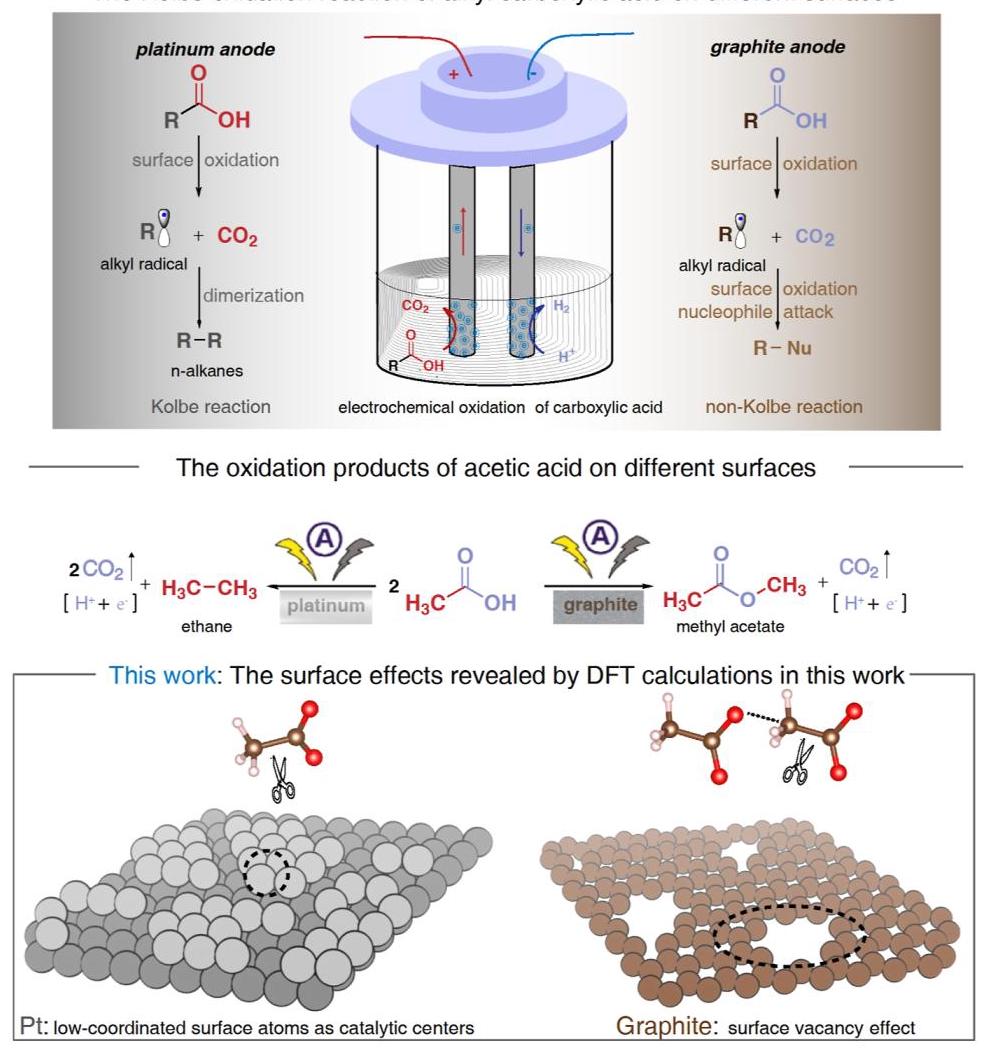
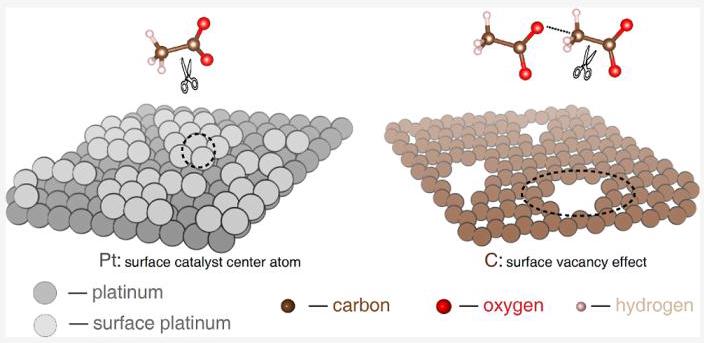
Figure 1. Introduction to this work. The top panel shows the general process of electrochemical oxidative decarboxylation of carboxylic acid R-COOH. The Pt surface favors the Kolbe reaction, in which radicals R* are formed and dimerize to form alkanes. The graphite surface favors a non-Kolbe reaction in which radicals ${\mathrm{R}}^{ \bullet }$ would be oxidized to form carbocations and be subsequently attacked by nucleophiles. The middle panel shows the reaction products of acetic acid on the Pt surface and the graphite surface in experiments. ${}^{9,{23}}$ The bottom panel shows the theoretical insights from the DFT calculations in this work, revealing that the low-coordinated surface Pt atoms play a crucial role in the decarboxylation of acetic acid and that the reaction activity of the graphite surface comes from the surface vacancy defects. For all figures throughout this work, the colors represent different elements: red-oxygen, brown-carbon, white-hydrogen, grey-Pt, and light gray-low-coordinated surface Pt.
图1. 本工作的介绍。上图展示了羧酸R-COOH电化学氧化脱羧的一般过程。铂表面有利于科尔贝反应,其中形成自由基R*并二聚形成烷烃。石墨表面有利于非科尔贝反应,其中自由基 ${\mathrm{R}}^{ \bullet }$ 会被氧化形成碳正离子,随后被亲核试剂攻击。中图展示了实验中乙酸在铂表面和石墨表面的反应产物。${}^{9,{23}}$ 下图展示了本工作中密度泛函理论计算的理论见解,揭示了低配位表面铂原子在乙酸脱羧中起关键作用,石墨表面的反应活性来自表面空位缺陷。对于本工作中的所有图,颜色代表不同元素:红色-氧,棕色-碳,白色-氢,灰色-铂,浅灰色-低配位表面铂。
METHODS
方法
We used the Vienna Ab initio Simulation Package (VASP) version ${6.1.0}^{{24} - {26}}$ to perform spin-polarized DFT calculations. The projector augmented wave (PAW) method potentials ${}^{27}$ was used to simulate the nuclei and frozen-core electrons of Pt, C, O, and H. We employed the Perdew-Burke-Ernzerhof (PBE) ${}^{28}$ formulation, which adopts the generalized gradient approximation (GGA) as the exchange-correlation functional. The corresponding self-consistently optimized valence electrons were: $5{\mathrm{\;d}}^{9}6{\mathrm{\;s}}^{1}$ for $\mathrm{{Pt}},2{\mathrm{\;s}}^{2}2{\mathrm{p}}^{2}$ for $\mathrm{C},2{\mathrm{\;s}}^{2}2{\mathrm{p}}^{4}$ for $\mathrm{O}$ , and $1{\mathrm{\;s}}^{1}$ for $\mathrm{H}$ . To describe the interaction of adsorbates accurately, we applied the Grimme’s D2 dispersion correction to account for the van der Waals force. ${}^{29}$ The method of Methfessel-Paxton order 1 was used to determine partial occupancies, and the width of the smearing is ${0.2}\mathrm{{eV}}$ because the electrode materials investigated in this work were all metallic. We applied a force-convergence criterion of less than ${0.03}\mathrm{{eV}}/\mathrm{A}$ (for each direction) to each atom that was allowed to relax. The kinetic-energy cutoff for the plane-wave basis was ${500}\mathrm{{eV}}$ for all of our calculations. We performed convergence tests about the cutoff energy, and the results showed that when the cutoff energy increased from 500 to 600 eV, the total energy difference was below 0.1 meV per atom.
我们使用Vienna从头算模拟包(VASP)版本${6.1.0}^{{24} - {26}}$进行自旋极化密度泛函理论(DFT)计算。采用投影增强波(PAW)方法势${}^{27}$来模拟Pt、C、O和H的原子核及冻结核心电子。我们采用了Perdew-Burke-Ernzerhof(PBE)${}^{28}$公式,该公式采用广义梯度近似(GGA)作为交换关联泛函。相应的自洽优化价电子为:$5{\mathrm{\;d}}^{9}6{\mathrm{\;s}}^{1}$对应$\mathrm{{Pt}},2{\mathrm{\;s}}^{2}2{\mathrm{p}}^{2}$,$\mathrm{C},2{\mathrm{\;s}}^{2}2{\mathrm{p}}^{4}$对应$\mathrm{O}$,$1{\mathrm{\;s}}^{1}$对应$\mathrm{H}$。为了准确描述吸附质的相互作用,我们应用了Grimme的D2色散校正来考虑范德华力。${}^{29}$使用Methfessel-Paxton一阶方法来确定部分占据情况,展宽宽度为${0.2}\mathrm{{eV}}$,因为本工作中研究的电极材料均为金属。我们对每个允许弛豫的原子应用了小于${0.03}\mathrm{{eV}}/\mathrm{A}$(每个方向)的力收敛标准。对于我们所有的计算,平面波基组的动能截止值为${500}\mathrm{{eV}}$。我们对截止能量进行了收敛测试,结果表明当截止能量从500 eV增加到600 eV时,每个原子的总能量差低于0.1 meV。
We built a slab model for simulating the Pt(111) surface and the graphite surface. We obtained the Pt metal lattice constant using a primitive cell (containing one Pt atom) with a converged $k$ -point mesh of ${13} \times {13} \times {13}$ . We made a three-layer slab of Pt and a three-layer slab of graphite. The vacuum regions in the slabs have a thickness of no less than ${20\text{ Å }}$ . In order to consider the effect of solvent, we included water molecules on the surface (Figure 2). The size of the supercells for simulating the Pt(111) surface was ${19.06\text{ Å }} \times {19.06\text{ Å }} \times {40}$ Å with 147 Pt atoms in total for the thermodynamic modeling. The $k$ -point mesh of $1 \times 1 \times 1$ was employed in geometry optimization, and $2 \times 2 \times 1$ employed in single-point energy calculations for Brillouin zone sampling. A smaller supercell of the Pt slab was used for kinetic calculations because of the high computational expense of the transition state (TS) search calculations, which contains 75 Pt atoms with dimensions of ${13.68\text{ Å }} \times {13.68\text{ Å }} \times {25\text{ Å }}$ and do not include the co-adsorbed solvent water molecules. We also made convergence tests for the $k$ -point mesh used for this smaller Pt slab model. When we changed the $k$ -point mesh from $2 \times 2 \times 1$ to $3 \times 3 \times 1$ , the reaction energy change was $< {0.05}\mathrm{{eV}}$ . We therefore employed the $2 \times 2 \times {1k}$ -points in the kinetic barrier calculations for the Pt surface cases. The size of the supercells for simulating the graphite surface was ${12.31\text{ Å }} \times {12.31\text{ Å }} \times {25\text{ Å }}$ (75 carbon atoms in total), with a $k$ -point mesh of $1 \times 1 \times 1$ for Brillouin zone sampling in geometry optimizations and single-point energy calculations. The convergence test also confirmed that the $1 \times 1 \times {1k}$ -point mesh for the graphite slab cases could meet the accuracy requirement.
我们构建了一个用于模拟Pt(111)表面和石墨表面的平板模型。我们使用一个原胞(包含一个Pt原子),在${13} \times {13} \times {13}$的收敛$k$点网格下获得了Pt金属晶格常数。我们制作了一个三层的Pt平板和一个三层的石墨平板。平板中的真空区域厚度不小于${20\text{ Å }}$。为了考虑溶剂的影响,我们在表面包含了水分子(图2)。用于模拟Pt(111)表面的超胞尺寸为${19.06\text{ Å }} \times {19.06\text{ Å }} \times {40}$ Å,在热力学建模中总共有147个Pt原子。在几何优化中采用了$1 \times 1 \times 1$的$k$点网格,在布里渊区采样的单点能量计算中采用了$2 \times 2 \times 1$。由于过渡态(TS)搜索计算的计算成本很高,因此使用了一个较小的Pt平板超胞进行动力学计算,该超胞包含75个Pt原子,尺寸为${13.68\text{ Å }} \times {13.68\text{ Å }} \times {25\text{ Å }}$,并且不包括共吸附的溶剂水分子。我们还对用于这个较小Pt平板模型的$k$点网格进行了收敛性测试。当我们将$k$点网格从$2 \times 2 \times 1$更改为$3 \times 3 \times 1$时,反应能量变化为$< {0.05}\mathrm{{eV}}$。因此,在Pt表面情况的动力学势垒计算中我们采用了$2 \times 2 \times {1k}$个点。用于模拟石墨表面的超胞尺寸为${12.31\text{ Å }} \times {12.31\text{ Å }} \times {25\text{ Å }}$(总共75个碳原子),在几何优化和单点能量计算中,用于布里渊区采样的$k$点网格为$1 \times 1 \times 1$。收敛性测试还证实,石墨平板情况的$1 \times 1 \times {1k}$点网格可以满足精度要求。
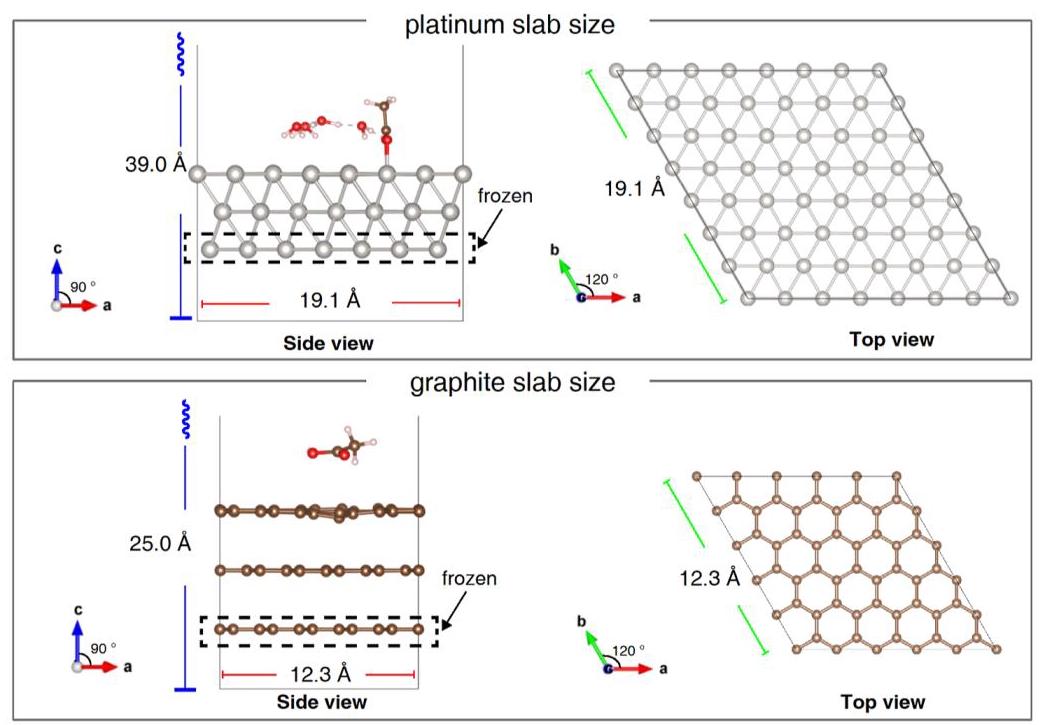
Figure 2. Surface slab setup of Pt and graphite electrodes. The size of the Pt surface slab model is ${19.06\text{ Å }} \times {19.06\text{ Å }} \times {40.00\text{ Å }}$ for the computation of thermodynamic properties. The size of the graphite surface slab model is ${12.31\text{ Å }} \times {12.31\text{ Å }} \times {25\text{ Å }}$ . The bottom layer (marked by the dashed frame) of the Pt and the graphite slabs is frozen in their equilibrium bulk positions during the geometry optimizations.
图2. Pt和石墨电极的表面平板设置。用于热力学性质计算的Pt表面平板模型尺寸为${19.06\text{ Å }} \times {19.06\text{ Å }} \times {40.00\text{ Å }}$。石墨表面平板模型尺寸为${12.31\text{ Å }} \times {12.31\text{ Å }} \times {25\text{ Å }}$。在几何优化过程中,Pt和平板石墨的底层(用虚线框标记)固定在其平衡体位置。
For the kinetic properties calculations, we employed the climbing image nudged elastic band (CI-NEB) method ${}^{30}$ and the DIMER method ${}^{31}$ to do the TS search and calculate kinetic barriers. We inserted five structures (images) between the initial state (IS) and the final state (FS) and optimized the image structures to find a minimum-energy path and the TS configuration. We performed vibrational frequency analysis to confirm the optimized TS structures, which should exhibit a single, nontrivial imaginary mode. We computed the vibrational frequencies of the modes involving atoms belonging to the adsorbates and surface adsorption sites in our supercell; not all of the atoms in the surface model were included due to the high computational cost. A few TS cases exhibited small imaginary modes $\left( { < {150}\mathrm{i}{\mathrm{{cm}}}^{-1}}\right)$ , which resulted from the rotation of adsorbates (not involved in reaction paths) or the noise of the numerical finite difference method used to construct the Hessian matrices. We thus ignored these small imaginary modes here. We also calculated zero-point energies (ZPEs), thermal corrections, and entropy terms (at $T = {298.15}$ K) to evaluate vibrational free-energy contributions based on the harmonic oscillator approximation (see Figure S5). We chose the reaction path shown in Figure 4 where the $\mathrm{C} - \mathrm{C}$ bond of an acetoxy radical was broken facilitated by the surface Pt atoms as our testing case. The influence of vibrational free energy corrections on reaction energies was less than ${0.1}\mathrm{{eV}}$ in the testing cases. Compared to the typical energy changes along our investigated reaction paths in this work (higher than ${1.8}\mathrm{{eV}}$ ), the vibrational free energy corrections were negligible (thus excluded from the energy diagrams presented in this study).
对于动力学性质计算,我们采用了爬山图像推挤弹性带(CI-NEB)方法${}^{30}$和 dimer 方法${}^{31}$来进行过渡态搜索并计算动力学势垒。我们在初始态(IS)和终态(FS)之间插入了五个结构(图像),并优化图像结构以找到最小能量路径和过渡态构型。我们进行了振动频率分析以确认优化后的过渡态结构,其应呈现单一的、非平凡的虚模式。我们计算了超胞中涉及吸附质和表面吸附位点原子的模式的振动频率;由于计算成本高,表面模型中的所有原子并未全部包含在内。少数过渡态情况呈现出小的虚模式$\left( { < {150}\mathrm{i}{\mathrm{{cm}}}^{-1}}\right)$,这是由吸附质的旋转(不涉及反应路径)或用于构建海森矩阵的数值有限差分法的噪声导致的。因此,我们在此忽略这些小的虚模式。我们还计算了零点能(ZPEs)、热校正和熵项(在$T = {298.15}$K 时)以基于谐振子近似评估振动自由能贡献(见图 S5)。我们选择了图 4 所示的反应路径,其中表面 Pt 原子促进了乙酰氧基自由基的$\mathrm{C} - \mathrm{C}$键断裂作为我们的测试案例。在测试案例中,振动自由能校正对反应能量的影响小于${0.1}\mathrm{{eV}}$。与本工作中我们研究的反应路径上的典型能量变化(高于${1.8}\mathrm{{eV}}$)相比,振动自由能校正可忽略不计(因此在本研究呈现的能量图中被排除)。
We applied the implicit solvation model ${}^{{32},{33}}$ to test the solvation effect on the reaction energetics. The solvent environment was represented by a polarizable continuum with a dielectric constant $= {80}$ corresponding to pure liquid ${\mathrm{H}}_{2}\mathrm{O}$ . The energy tests verified that solvation corrections for the decarboxylation of an acetoxy radical resulted in small energy differences $\left( { < {0.1}\mathrm{{eV}}}\right)$ compared to the results without solvation corrections. Considering the extra computational cost, we did not include the implicit solvation model for the study of rest reaction pathways.
我们应用隐式溶剂化模型${}^{{32},{33}}$来测试溶剂化对反应能量学的影响。溶剂环境由具有对应于纯液体${\mathrm{H}}_{2}\mathrm{O}$的介电常数$= {80}$的可极化连续介质表示。能量测试证实,与无溶剂化校正的结果相比,乙酰氧基自由基脱羧的溶剂化校正导致的能量差异较小$\left( { < {0.1}\mathrm{{eV}}}\right)$。考虑到额外的计算成本,我们在研究其余反应路径时未包括隐式溶剂化模型。
An important electrochemical oxidation process considered in our model was the process from an acetic acid molecule to an acetoxy radical, which could be expressed by the following eq 1
我们模型中考虑的一个重要的电化学氧化过程是从乙酸分子到乙酰氧基自由基的过程,其可由以下等式 1 表示
$$ {\mathrm{{CH}}}_{3}\mathrm{{COOH}}{ + }^{ * } \rightarrow {\mathrm{{CH}}}_{3}{\mathrm{{COO}}}^{ * }{}^{ * } + {\mathrm{H}}^{ + } + {\mathrm{e}}^{ - } $$$$ \text{ (*: adsorption site) } \tag{1} $$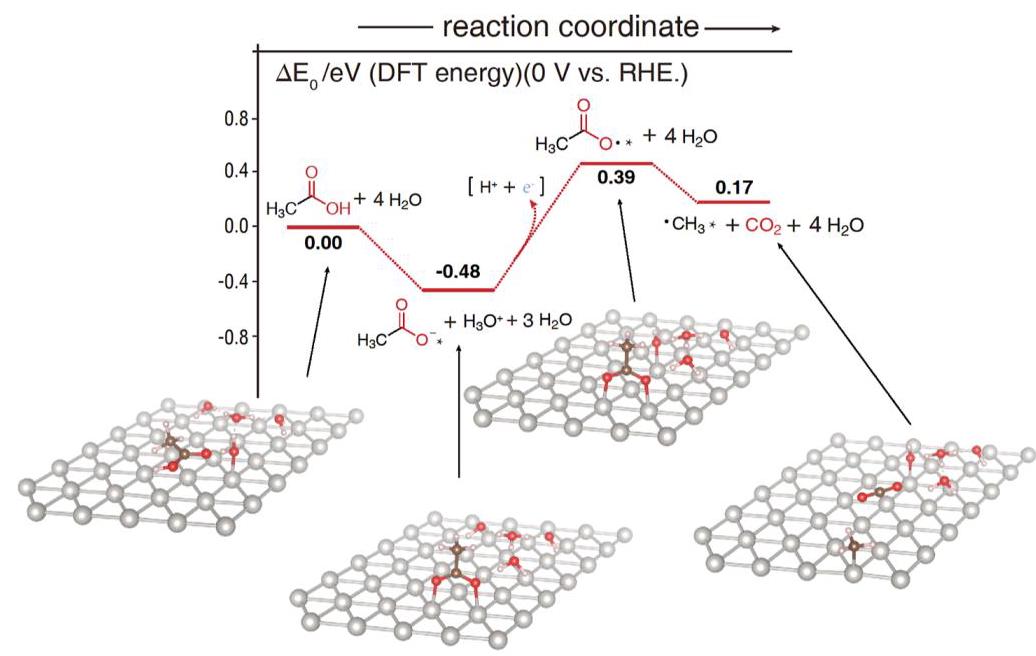
Figure 3. DFT total energies of different reaction states during the Kolbe reaction of acetic acid on the Pt surface. The 1st state: an acetic acid and four ${\mathrm{H}}_{2}\mathrm{O}$ molecules; the 2nd state: an acetate anion and a hydrated proton $\left( {{\mathrm{H}}_{3}{\mathrm{O}}^{ + }}\right)$ with three molecules of water (i.e., an Eigen cation); the 3rd state: an acetoxy radical and four ${\mathrm{H}}_{2}\mathrm{O}$ molecules; the $4\mathrm{{th}}$ state: a methyl radical, a ${\mathrm{{CO}}}_{2}$ molecule, and four ${\mathrm{H}}_{2}\mathrm{O}$ molecules.
图 3. 乙酸在 Pt 表面进行 Kolbe 反应期间不同反应状态的 DFT 总能量。第一状态:一个乙酸和四个${\mathrm{H}}_{2}\mathrm{O}$分子;第二状态:一个乙酸根阴离子和一个水合质子$\left( {{\mathrm{H}}_{3}{\mathrm{O}}^{ + }}\right)$以及三个水分子(即一个 Eigen 阳离子);第三状态:一个乙酰氧基自由基和四个${\mathrm{H}}_{2}\mathrm{O}$分子;第$4\mathrm{{th}}$状态:一个甲基自由基、一个${\mathrm{{CO}}}_{2}$分子和四个${\mathrm{H}}_{2}\mathrm{O}$分子。
For the reaction product, the energy of the proton and electron pair $\left( {{\mathrm{H}}^{ + } + {\mathrm{e}}^{ - }}\right)$ was calculated by the computational hydrogen electrode model, ${}^{{34},{35}}$ which is described as the eq 2
对于反应产物,质子和电子对$\left( {{\mathrm{H}}^{ + } + {\mathrm{e}}^{ - }}\right)$的能量通过计算氢电极模型${}^{{34},{35}}$计算,其描述为等式 2
$$ E\left( {{\mathrm{H}}^{ + } + {\mathrm{e}}^{ - }}\right) = 1/{2E}\left( {\mathrm{H}}_{2}\right) - \left| e\right| \times U \tag{2} $$where $E\left( {{\mathrm{H}}^{ + } + {\mathrm{e}}^{ - }}\right)$ is the energy of the proton and electron pair; $E\left( {\mathrm{H}}_{2}\right)$ is the energy of an isolated gas-phase ${\mathrm{H}}_{2}$ ; le| is the elementary charge; and $U$ is the applied potential vs the reversible hydrogen electrode (RHE).
其中$E\left( {{\mathrm{H}}^{ + } + {\mathrm{e}}^{ - }}\right)$是质子和电子对的能量;$E\left( {\mathrm{H}}_{2}\right)$是孤立气相${\mathrm{H}}_{2}$的能量;|e|是元电荷;$U$是相对于可逆氢电极(RHE)施加的电势。
B RESULTS AND DISCUSSION
B 结果与讨论
Simulations of the Reaction Paths on Different Surfaces. We chose acetic acid as the reactant in our modeling system. According to the experimental work by Dickinson in 1962, ${}^{23}$ the electrochemical oxidation of acetic acid on the Pt surface in water will produce ethane and carbon dioxide (the Kolbe reaction). In order to understand the mechanism of this electro-oxidation reaction, previous chemists have proposed several theories for this Kolbe reaction, e.g., the discharged ion theory, ${}^{{36},{37}}$ the hydrogen peroxide theory, ${}^{38}$ and so on. These theories tend to describe the Kolbe reaction as a homogenous reaction, where the reaction intermediates are formed on the electrode surfaces and further diffuse into the solvent to produce the product. Dickinson and Wynne-Jones gave their comments on these theories according to the existing experimental work. ${}^{39}$ They think the assumption of a homogenous reaction path has contradictions with some experimental observations, such as critical concentrations of acids and electrode effects. Vijh and Conway further summarized the experimental results of the electrode kinetic effects of the Kolbe reaction. ${}^{40}$ They think the heterogeneous reaction hypothesis, in which reaction intermediates are generated and transformed to products on both surfaces, is easier to explain the electrodes effects. Vijh concluded that the reaction on Pt surfaces underwent the process shown by the following eqs $3 - {5.}^{40}$ The acetic acid is first ionized to an acetate anion adsorbed on the Pt surface, then oxidized to form an acetoxy radical, which undergoes a subsequent decarboxylation reaction process, producing a methyl radical.
不同表面上反应路径的模拟。在我们的建模系统中,我们选择乙酸作为反应物。根据1962年迪金森的实验工作,${}^{23}$ 乙酸在水中铂表面的电化学氧化会产生乙烷和二氧化碳(科尔贝反应)。为了理解这种电氧化反应的机理,之前的化学家针对这种科尔贝反应提出了几种理论,例如,放电离子理论,${}^{{36},{37}}$ 过氧化氢理论,${}^{38}$ 等等。这些理论倾向于将科尔贝反应描述为均相反应,其中反应中间体在电极表面形成,然后进一步扩散到溶剂中以产生产物。迪金森和韦恩 - 琼斯根据现有的实验工作对这些理论发表了评论。${}^{39}$ 他们认为均相反应路径的假设与一些实验观察结果存在矛盾,例如酸的临界浓度和电极效应。维杰和康威进一步总结了科尔贝反应的电极动力学效应的实验结果。${}^{40}$ 他们认为非均相反应假设,即反应中间体在两个表面上生成并转化为产物,更容易解释电极效应。维杰得出结论,铂表面上的反应经历了以下方程式所示的过程 $3 - {5.}^{40}$ 乙酸首先电离为吸附在铂表面的乙酸根阴离子,然后被氧化形成乙酰氧基自由基,该自由基随后经历脱羧反应过程,产生甲基自由基。
Ionization of acetic acid
乙酸的电离
$$ {\mathrm{{CH}}}_{3}\mathrm{{COOH}} + {}^{ * } \rightarrow {\mathrm{{CH}}}_{3}{\mathrm{{COO}}}^{- * } + {\mathrm{H}}^{ + } \tag{3} $$Oxidation of the acetate anion
乙酸根阴离子的氧化
$$ {\mathrm{{CH}}}_{3}{\mathrm{{COO}}}^{- * } \rightarrow {\mathrm{{CH}}}_{3}{\mathrm{{COO}}}^{\bullet * } + {\mathrm{e}}^{ - } \tag{4} $$Decarboxylation of the acetoxy radical
乙酰氧基自由基的脱羧
$$ {\mathrm{{CH}}}_{3}{\mathrm{{COO}}}^{\bullet * } \rightarrow {\mathrm{{CH}}}_{3}{}^{\bullet * } + {\mathrm{{CO}}}_{2} \tag{5} $$Inspired by Vijh’s work, we chose the above reaction steps to perform our thermodynamic calculations. In our model, the acetic acid first dissociates into an acetate anion and a hydronium ion, which would be expected to happen in a realistic aqueous environment. The hydronium ion has different possible configurations. We apply the Eigen cation configuration in our model, which is a hydrated proton $\left( {{\mathrm{H}}_{3}{\mathrm{O}}^{ + }}\right)$ connected with three water molecules $\left( {{\mathrm{H}}_{2}\mathrm{O}}\right)$ through hydrogen bond interaction (the 2nd state in Figure 3). Then, the adsorbed acetate anion is oxidized on the electrode surface to generate an acetoxy radical. We find that the acetoxy radical forms a stable vertical bidentate configuration on the Pt surface, and our DFT-predicted configuration is consistent with the experimental infrared spectroscopy results. ${}^{{41},{42}}$ The decarboxylation of the acetoxy radical forms a methyl radical and a ${\mathrm{{CO}}}_{2}$ molecule on the surface. The complete path described above is presented in Figure 3. According to a recent experimental study, it was concluded that carbolyte anions are prone to oxidation, whereas carboxylic acids exhibit difficulty undergoing oxidation on a Pt surface. ${}^{43}$ It is thus reasonable to consider that the ionization process of acetic acid occurs prior to the Kolbe oxidation process.
受维杰(Vijh)工作的启发,我们选择上述反应步骤进行热力学计算。在我们的模型中,乙酸首先分解为乙酸根阴离子和水合氢离子,这在实际的水性环境中是预期会发生的。水合氢离子有不同的可能构型。我们在模型中应用特征阳离子构型,即一个通过氢键相互作用与三个水分子$\left( {{\mathrm{H}}_{2}\mathrm{O}}\right)$相连的水合质子$\left( {{\mathrm{H}}_{3}{\mathrm{O}}^{ + }}\right)$(图3中的第二种状态)。然后,吸附的乙酸根阴离子在电极表面被氧化生成乙酰氧基自由基。我们发现乙酰氧基自由基在铂表面形成稳定的垂直双齿构型,并且我们的密度泛函理论(DFT)预测的构型与实验红外光谱结果一致。${}^{{41},{42}}$乙酰氧基自由基的脱羧反应在表面形成一个甲基自由基和一个${\mathrm{{CO}}}_{2}$分子。上述完整路径如图3所示。根据最近的一项实验研究,得出的结论是碳负离子易于氧化,而羧酸在铂表面难以发生氧化反应。${}^{43}$因此,有理由认为乙酸的电离过程发生在科尔贝(Kolbe)氧化过程之前。
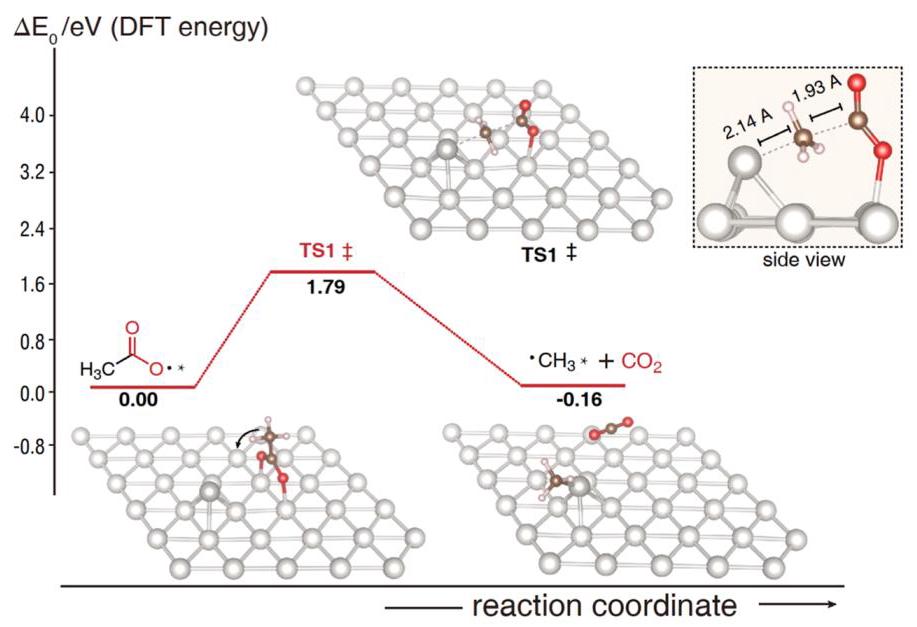
Figure 4. DFT energy diagram of the decarboxylation process from an acetoxy radical to a methyl radical and a ${\mathrm{{CO}}}_{2}$ . A low-coordinated Pt adatom acts as the active center. The geometries of IS, TS, and FS are shown in the figure.
图4. 从乙酰氧基自由基到甲基自由基和一个 ${\mathrm{{CO}}}_{2}$ 的脱羧过程的DFT能量图。一个低配位的铂吸附原子作为活性中心。图中显示了初始态(IS)、过渡态(TS)和终态(FS)的几何结构。
In Figure 3, the step of the 2nd $\rightarrow$ 3rd states is the oxidation reaction of an acetate anion, generating an acetoxy radical. Our computed oxidation potential is ${0.87}\mathrm{\;V}$ vs RHE based on a thermodynamic calculation. In experiments, Dickinson reported that generated ${\mathrm{{CO}}}_{2}$ was detected when the anode potential exceeded ${2.0}\mathrm{\;V}$ vs the saturated calomel electrode (SCE). ${}^{23}$ They used a mixed solution of sodium acetate and acetic acid in an equal molar ratio, and the $\mathrm{{pH}}$ value of this mixed solution in the experiment was approximately 4.74 according to the ionization constant of acetic acid. The experimental oxidation potential was ${2.5}\mathrm{\;V}$ vs RHE (equivalent to ${2.0}\mathrm{\;V}$ vs $\mathrm{{SCE}}$ at $\mathrm{{pH}} = {4.74}$ ) based on eq 6 after transforming the reference potential
在图3中,第二$\rightarrow$第三状态的步骤是醋酸根阴离子的氧化反应,生成乙酰氧基自由基。基于热力学计算,我们计算出的氧化电位相对于可逆氢电极(RHE)为${0.87}\mathrm{\;V}$。在实验中,迪金森报告称,当阳极电位超过相对于饱和甘汞电极(SCE)的${2.0}\mathrm{\;V}$时,检测到生成了${\mathrm{{CO}}}_{2}$。${}^{23}$他们使用了等摩尔比的醋酸钠和醋酸的混合溶液,根据醋酸的电离常数,该混合溶液在实验中的$\mathrm{{pH}}$值约为4.74。根据式6转换参考电位后,实验氧化电位相对于RHE为${2.5}\mathrm{\;V}$(相当于在$\mathrm{{pH}} = {4.74}$时相对于$\mathrm{{SCE}}$为${2.0}\mathrm{\;V}$)
$$ E\left( \mathrm{{RHE}}\right) = E\left( \mathrm{{SCE}}\right) + {0.059} \times \mathrm{{pH}}\left( \mathrm{V}\right) + {0.24}\left( \mathrm{\;V}\right) \tag{6} $$$E\left( \mathrm{{RHE}}\right)$ is the potential vs RHE, and $E\left( \mathrm{{SCE}}\right)$ is the potential vs SCE. We thus find the overpotential of acetic acid oxidation in the experiment to be quite large $\left( {{1.63}\mathrm{\;V}}\right)$ based on our thermodynamic analysis. This large overpotential reflects the high kinetic barrier of the Kolbe reaction, which may stem from the decarboxylation process occurring on the surface. Because the vertical configuration of the acetoxy radical on the surface makes the C-C bond relatively far away from surface, ${}^{41}$ which leads to a configurational resistance for the decarboxylation reaction. The $\mathrm{C} - \mathrm{C}$ bond cleavage thus requires additional assistance in this system, which can be catalyzed by certain low-coordinated Pt atoms on the surface.
$E\left( \mathrm{{RHE}}\right)$是相对于RHE的电位,$E\left( \mathrm{{SCE}}\right)$是相对于SCE的电位。因此,基于我们的热力学分析,我们发现实验中醋酸氧化的过电位相当大$\left( {{1.63}\mathrm{\;V}}\right)$。这种大的过电位反映了科尔贝反应的高动力学势垒,这可能源于表面发生的脱羧过程。因为表面上乙酰氧基自由基的垂直构型使C-C键离表面相对较远,${}^{41}$这导致了脱羧反应的构型阻力。因此,在该体系中,$\mathrm{C} - \mathrm{C}$键的断裂需要额外的帮助,这可以由表面上某些低配位的Pt原子催化。
We then focus on the kinetics of the $\mathrm{C} - \mathrm{C}$ bond cleavage in acetoxy radicals on the Pt surface. We first consider an absolutely flat Pt surface (atomic-level flat and no oxides), where we simulate the decarboxylation process using the constrained molecular dynamics (CMD) method (see Figure S1). We insert several enhanced sampling points into the speculated path; that is, in the approaching process of the acetoxy radical’s methyl group toward the surface, we select several fixed lengths of the C-Pt bond, where the C atom belongs to the methyl group of the acetoxy radical and the Pt atom is the adsorption site for the dissociated methyl group. The C-Pt length is just the reaction coordinate of the decarboxylation process. We sample possible structures at each point with a fixed $\mathrm{C} - \mathrm{{Pt}}$ length. This enhanced sampling calculation shows that when we force the methyl group to gradually get close to the Pt surface, the $\mathrm{C} - \mathrm{H}$ bond is cleaved more easily than the $\mathrm{C} - \mathrm{C}$ bond and the product ${\mathrm{{CH}}}_{2}{\mathrm{{COO}}}^{\bullet * }$ radical will be formed. The qualitative results given by the CMD simulations indicate that it is unlikely to form $* * {\mathrm{{CH}}}_{3}$ via the decarboxylation of ${\mathrm{{CH}}}_{3}{\mathrm{{COO}}}^{\bullet * }$ on the atomic-level, absolutely flat Pt surface. The high kinetic energy barrier of this type of decarboxylation step was also verified by a recent computational study. ${}^{44}$ Their results show that the kinetic barrier of the decarboxylation process of the acetic acid radical on the atomic-level flat Pt surface is ${2.5}\mathrm{{eV}}$ , even when a highly oxidizing potential of ${2.0}\mathrm{\;V}$ vs the standard hydrogen electrode (SHE) is applied.
然后,我们关注Pt表面乙酰氧基自由基中$\mathrm{C} - \mathrm{C}$键断裂的动力学。我们首先考虑一个绝对平坦的Pt表面(原子级平坦且无氧化物),在这里我们使用约束分子动力学(CMD)方法模拟脱羧过程(见图S1)。我们在推测的路径中插入几个增强采样点;也就是说,在乙酰氧基自由基的甲基向表面靠近的过程中,我们选择几个固定长度的C-Pt键,其中C原子属于乙酰氧基自由基的甲基,Pt原子是解离甲基的吸附位点。C-Pt长度正是脱羧过程的反应坐标。我们在每个点以固定的$\mathrm{C} - \mathrm{{Pt}}$长度对可能的结构进行采样。这种增强采样计算表明,当我们迫使甲基逐渐靠近Pt表面时,$\mathrm{C} - \mathrm{H}$键比$\mathrm{C} - \mathrm{C}$键更容易断裂,并且会形成产物${\mathrm{{CH}}}_{2}{\mathrm{{COO}}}^{\bullet * }$自由基。CMD模拟给出的定性结果表明,在原子级绝对平坦的Pt表面上,通过${\mathrm{{CH}}}_{3}{\mathrm{{COO}}}^{\bullet * }$的脱羧形成$* * {\mathrm{{CH}}}_{3}$不太可能。最近的一项计算研究也验证了这种脱羧步骤的高动能势垒。${}^{44}$他们的结果表明,即使施加相对于标准氢电极(SHE)为${2.0}\mathrm{\;V}$的高氧化电位,原子级平坦的Pt表面上醋酸自由基脱羧过程的动力学势垒仍为${2.5}\mathrm{{eV}}$。
However, we realize that the realistic Pt surface can’t be atomic-level flat; that is, there are one or more low-coordinated Pt atoms existing on the surface. ${}^{45}$ There is some literature reporting the catalysis effects of Pt atoms of different coordination numbers in electrochemical reactions. ${}^{{46},{47}}$ We speculate that these low-coordinated Pt atoms can also promote the decarboxylation process, helping the acetoxy radical produce methyl radical and carbon dioxide. We perform DFT calculations to verify our conjecture. In order to investigate the role of low-coordinated Pt atoms, we construct a simplified model with a Pt adatom at the surface next to the acetoxy radical. This is just a representative modeling case for approximating the realistic surface morphology to explore the catalytic activity of low-coordinated Pt atoms on the surface, which does not mean the presence of a significant amount of single Pt adatoms. Our results show that the low-coordinated Pt adatom can facilitate the decarboxylation process with a kinetic barrier of ${1.79}\mathrm{{eV}}$ (Figure 4). With the assistance of low-coordinated Pt adatoms on the surface, the acetoxy radical can generate a methyl radical and carbon dioxide through a configurational inversion process (namely the Walden inversion). We can see that although this energy barrier (1.79 eV) is still relatively high, which actually explains the large overpotential observed in the experiment, ${}^{23}$ this Pt-adatom-assisted path already exhibits a much lower kinetic barrier than that of the $\mathrm{C} - \mathrm{C}$ bond cleavage path on the atomic-level flat Pt surface (2.5 eV, as predicted by the earlier computational study ${}^{44}$ ). We further investigate the kinetics of alternative pathways on the Pt surface, which helps us analyze the likely reaction mechanisms.
然而,我们意识到实际的铂表面并非原子级平整;也就是说,表面存在一个或多个低配位铂原子。${}^{45}$ 有一些文献报道了不同配位数的铂原子在电化学反应中的催化作用。${}^{{46},{47}}$ 我们推测这些低配位铂原子也能促进脱羧过程,帮助乙酰氧基生成甲基自由基和二氧化碳。我们进行密度泛函理论(DFT)计算来验证我们的推测。为了研究低配位铂原子的作用,我们构建了一个简化模型,在乙酰氧基旁边的表面有一个铂吸附原子。这只是一个用于近似实际表面形态以探索表面低配位铂原子催化活性的代表性建模案例,并不意味着存在大量单个铂吸附原子。我们的结果表明,低配位铂吸附原子可以促进脱羧过程,其动力学势垒为${1.79}\mathrm{{eV}}$ (图4)。在表面低配位铂吸附原子的协助下,乙酰氧基可以通过构型反转过程(即瓦尔登反转)生成甲基自由基和二氧化碳。我们可以看到,尽管这个能垒(1.79电子伏特)仍然相对较高,这实际上解释了实验中观察到的较大过电位,${}^{23}$ 但这条铂吸附原子辅助的路径已经表现出比原子级平整铂表面上的$\mathrm{C} - \mathrm{C}$ 键断裂路径(如早期计算研究所预测的2.5电子伏特${}^{44}$ )低得多的动力学势垒。我们进一步研究了铂表面替代路径的动力学,这有助于我们分析可能的反应机制。
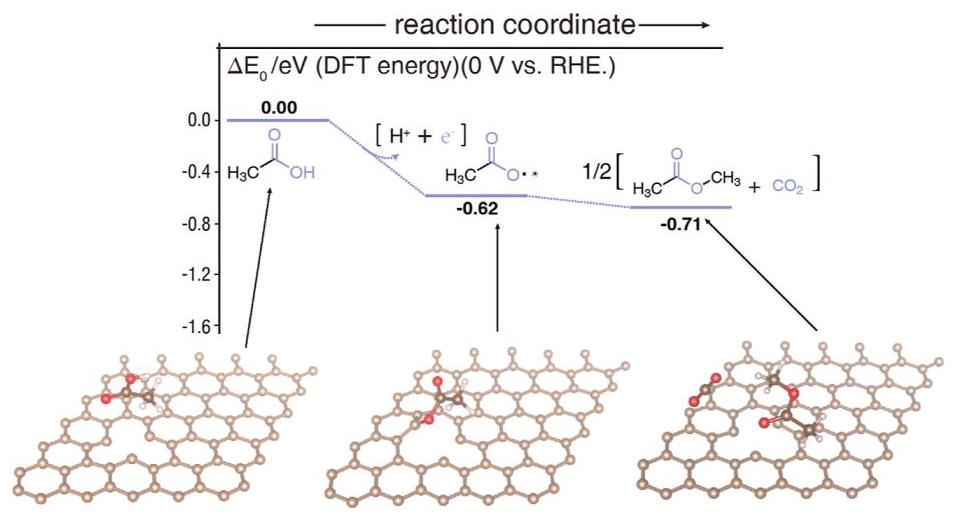
Figure 5. DFT total energies of different reaction states of the acetic acid oxidation on the graphite surface. The 1st state: an acetic acid; the 2nd state: an acetoxy radical; the 3rd state: a methyl acetate and a ${\mathrm{{CO}}}_{2}$ . The relative DFT energy of the 3rd state is calculated by the following method: we add two adsorbed acetoxy radicals to the model and calculate the energy change $\left( {\Delta E}\right)$ of the reaction: $2{\mathrm{{CH}}}_{3}{\mathrm{{COO}}}^{* * } \rightarrow {\mathrm{{CH}}}_{3}{\mathrm{{COOCH}}}_{3} + {\mathrm{{CO}}}_{2}$ . The DFT energy of the 3rd state is obtained by adding the normalized ${\Delta E}/2$ onto the DFT energy of the 2nd state.
图5. 石墨表面乙酸氧化不同反应状态的DFT总能量。第一状态:一个乙酸;第二状态:一个乙酰氧基;第三状态:一个乙酸甲酯和一个${\mathrm{{CO}}}_{2}$ 。第三状态的相对DFT能量通过以下方法计算:我们在模型中添加两个吸附的乙酰氧基并计算反应的能量变化$\left( {\Delta E}\right)$ :$2{\mathrm{{CH}}}_{3}{\mathrm{{COO}}}^{* * } \rightarrow {\mathrm{{CH}}}_{3}{\mathrm{{COOCH}}}_{3} + {\mathrm{{CO}}}_{2}$ 。第三状态的DFT能量是通过将归一化的${\Delta E}/2$ 加到第二状态的DFT能量上得到的。
An alternative pathway is that the acetoxy radical may desorb from the surface and subsequently undergo decarboxylation. We further computed the energy change associated with this desorption step (see Figure S2). The substantial increase in energy (2.95 eV) signifies the challenge of acetoxy radical desorption from the surface. Our analysis thus suggests that the acetoxy radical is likely to undergo decarboxylation on the Pt surface.
另一条替代路径是乙酰氧基可能从表面解吸,随后进行脱羧。我们进一步计算了与该解吸步骤相关的能量变化(见图S2)。能量的大幅增加(2.95电子伏特)表明乙酰氧基从表面解吸具有挑战性。因此,我们的分析表明乙酰氧基很可能在铂表面进行脱羧。
Furthermore, we can see that the onset of the above Kolbe reaction occurs at a high overpotential in aqueous solutions, under which water can be oxidized before ${\mathrm{{CO}}}_{2}$ is generated. ${}^{23}$ Therefore, the intermediate species of the water oxidation reaction, such as adsorbed oxygen atoms (O*), adsorbed hydroxide radicals (OH), etc., may also participate in the decarboxylation of ${\mathrm{{CH}}}_{3}{\mathrm{{COO}}}^{\bullet * }$ . We investigate the effect of ${\mathrm{O}}^{ * }$ , a representative ${\mathrm{H}}_{2}\mathrm{O}$ -oxidation intermediate species, on the decarboxylation step’s kinetics (see Figure S3). Although this reaction path is similar to the above case of a low-coordinated Pt adatom as the active center, the O-involved energy barrier $\left( {{3.30}\mathrm{{eV}}}\right)$ is much higher than that in the Pt-adatom case $\left( {{1.79}\mathrm{{eV}}}\right)$ , indicating the promotion of decarboxylation kinetics is more likely to be induced by the low-coordinated Pt atoms on the electrode surface.
此外,我们可以看到上述科尔贝反应在水溶液中需要高过电位才能开始,在此过电位下,在${\mathrm{{CO}}}_{2}$ 生成之前水就可以被氧化。${}^{23}$ 因此,水氧化反应的中间物种,如吸附的氧原子(O*)、吸附的氢氧根自由基(OH)等,也可能参与${\mathrm{{CH}}}_{3}{\mathrm{{COO}}}^{\bullet * }$ 的脱羧反应。我们研究了${\mathrm{O}}^{ * }$ (一种代表性的${\mathrm{H}}_{2}\mathrm{O}$ -氧化中间物种)对脱羧步骤动力学的影响(见图S3)。尽管这条反应路径与上述以低配位铂吸附原子为活性中心的情况类似,但涉及O的能垒$\left( {{3.30}\mathrm{{eV}}}\right)$ 比铂吸附原子情况下的能垒$\left( {{1.79}\mathrm{{eV}}}\right)$ 高得多,这表明脱羧动力学的促进更可能是由电极表面的低配位铂原子引起的。
We apply similar methods (as discussed in the Pt surface case) to analyze the oxidation reaction of acetic acid on the graphite surface, which follows a quite different reaction path. In 1968, Sato’s experiments showed that methyl acetate was the main product of acetic acid oxidation on the graphite surface. ${}^{8}$ They used glacial acetic acid or methanol as the solvent and found that methyl acetate was the main product in both cases. Sato and the following researchers think that two possible paths may occur on the graphite surface: (1) the direct reaction of acetoxy radicals forms methyl acetate; (2) a carbocation intermediate is formed under a high oxidation potential from a methyl radical. ${}^{9,{48}}$ Here, we note that we focus on the different selectivities of different electrodes (Pt vs graphite) in this work, and we are not trying to demonstrate which path (the direct formation of a methyl acetate or the formation of a carbocation) is more likely to proceed on the specific graphite surface. The complete comparisons are presented in the next section.
我们采用类似的方法(如在铂表面的情况中所讨论的)来分析乙酸在石墨表面的氧化反应,该反应遵循截然不同的反应路径。1968年,佐藤的实验表明,乙酸甲酯是乙酸在石墨表面氧化的主要产物。${}^{8}$他们使用冰醋酸或甲醇作为溶剂,发现在这两种情况下乙酸甲酯都是主要产物。佐藤及后续研究人员认为,在石墨表面可能发生两条路径:(1)乙酰氧基自由基直接反应生成乙酸甲酯;(2)在高氧化电位下,甲基自由基形成碳正离子中间体。${}^{9,{48}}$在此,我们注意到在本工作中我们关注的是不同电极(铂与石墨)的不同选择性,并且我们并非试图证明在特定石墨表面上哪条路径(直接形成乙酸甲酯或形成碳正离子)更有可能进行。完整的比较将在下一节给出。
When glacial acetic acid is used as the solvent, the ionization of acetic acid is weak. It means the concentration of acetate anions in the solvent can be ignored, and the main form of acetic acid is the neutral acetic acid molecule. We chose this reaction system to build our simulation model. Our DFT calculations start with neutral acetic acid as a reactant. We find that acetic acid and acetoxy radicals do not adsorb on the pristine graphite surface because of the low affinity between them and the aromatic graphite surface. It means electrochemical oxidation cannot occur easily on the pristine graphite surface. However, it has been found that there are a large number of paramagnetic centers on the graphite surface, including boron doping and vacancy defects, and some researchers think the oxidation reaction of acid occurs at the paramagnetic centers of graphite. ${}^{{49} - {51}}$ Therefore, we build a graphite model with a surface carbon vacancy defect as a representative case for a realistic graphite surface with paramagnetic centers. The introduction of a carbon vacancy defect creates unsaturated coordinated carbon atoms on the surface, which could exhibit stronger interaction with adsorbates. Our calculation results confirm that the oxygen atom of the adsorbed acetoxy radical binds with a low-coordinated carbon atom next to the vacancy defect of the graphite surface. The adsorption configuration is shown in Figure 5 (the middle panel).
当使用冰醋酸作为溶剂时,乙酸的电离很弱。这意味着溶剂中乙酸根阴离子的浓度可以忽略不计,乙酸的主要形式是中性的乙酸分子。我们选择这个反应体系来构建我们的模拟模型。我们的密度泛函理论(DFT)计算以中性乙酸作为反应物开始。我们发现乙酸和乙酰氧基自由基不会吸附在原始石墨表面,因为它们与芳香性石墨表面之间的亲和力较低。这意味着在原始石墨表面不容易发生电化学氧化。然而,已经发现石墨表面存在大量顺磁中心,包括硼掺杂和空位缺陷,并且一些研究人员认为酸的氧化反应发生在石墨的顺磁中心。${}^{{49} - {51}}$因此,我们构建了一个具有表面碳空位缺陷的石墨模型,作为具有顺磁中心的实际石墨表面的代表性案例。碳空位缺陷的引入在表面产生了不饱和配位的碳原子,这可能与吸附质表现出更强的相互作用。我们的计算结果证实,吸附的乙酰氧基自由基的氧原子与石墨表面空位缺陷旁边的低配位碳原子结合。吸附构型如图5(中间面板)所示。
In our DFT model, we investigate methyl acetate formation by the reaction of two acetoxy radicals. ${}^{9}$ The reaction involving two acetoxy radicals is divided into three states, which are summarized in the eqs 7 and 8 and Figure 5. In the 1st state, the acetic acid physisorbs at the surface; the step of the $1\mathrm{{st}} \rightarrow$ 2nd states is the oxidation of acetic acid (eq 7). In the step of the 2nd $\rightarrow$ 3rd state, a reaction between two acetoxy radicals occurs with a methyl group transfer. The products are methyl acetate and ${\mathrm{{CO}}}_{2}$ .
在我们的密度泛函理论(DFT)模型中,我们研究了两个乙酰氧基自由基反应生成乙酸甲酯的过程。${}^{9}$ 涉及两个乙酰氧基自由基的反应分为三个状态,这些状态总结在等式7、8和图5中。在第一个状态下,乙酸物理吸附在表面;第二个状态$1\mathrm{{st}} \rightarrow$ 的步骤是乙酸的氧化反应(等式7)。在第二个$\rightarrow$ 第三个状态的步骤中,两个乙酰氧基自由基之间发生反应并伴有甲基转移。产物是乙酸甲酯和${\mathrm{{CO}}}_{2}$ 。
Oxidation of acetic acid
乙酸的氧化
$$ {\mathrm{{CH}}}_{3}\mathrm{{COOH}} + {}^{ * } \rightarrow {\mathrm{{CH}}}_{3}{\mathrm{{COO}}}^{ \bullet }{}^{ * } + {\mathrm{H}}^{ + } + {\mathrm{e}}^{ - } \tag{7} $$Formation of methyl acetate
乙酸甲酯的形成
$$ {\mathrm{{CH}}}_{3}{\mathrm{{COO}}}^{ \bullet }{}^{ * } \rightarrow {0.5} \times \left( {{\mathrm{{CH}}}_{3}{\mathrm{{COOCH}}}_{3} + {\mathrm{{CO}}}_{2}}\right) \tag{8} $$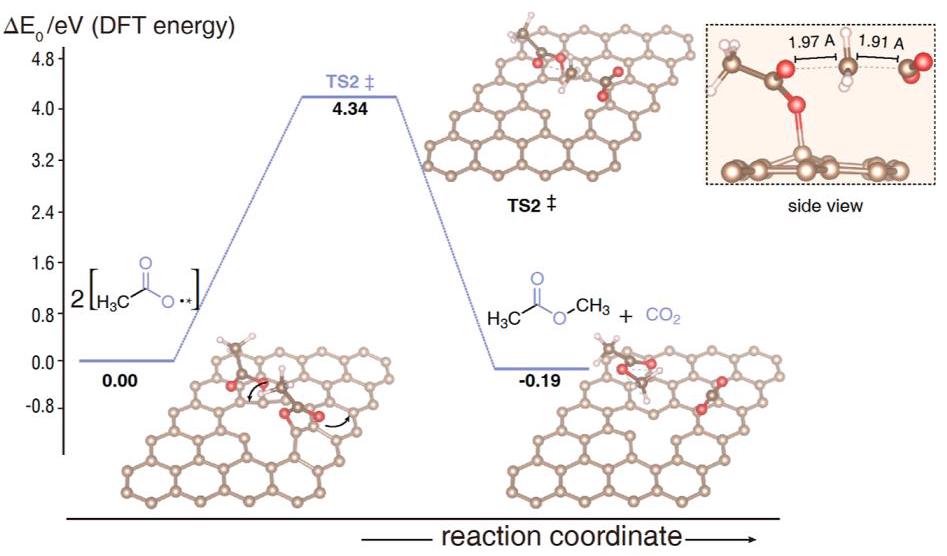
Figure 6. DFT energy diagram of the methyl acetate formation process on the graphite surface. Geometries of IS, TS, and FS are shown in the figure.
图6. 石墨表面乙酸甲酯形成过程的DFT能量图。图中显示了初始态(IS)、过渡态(TS)和终态(FS)的几何结构。
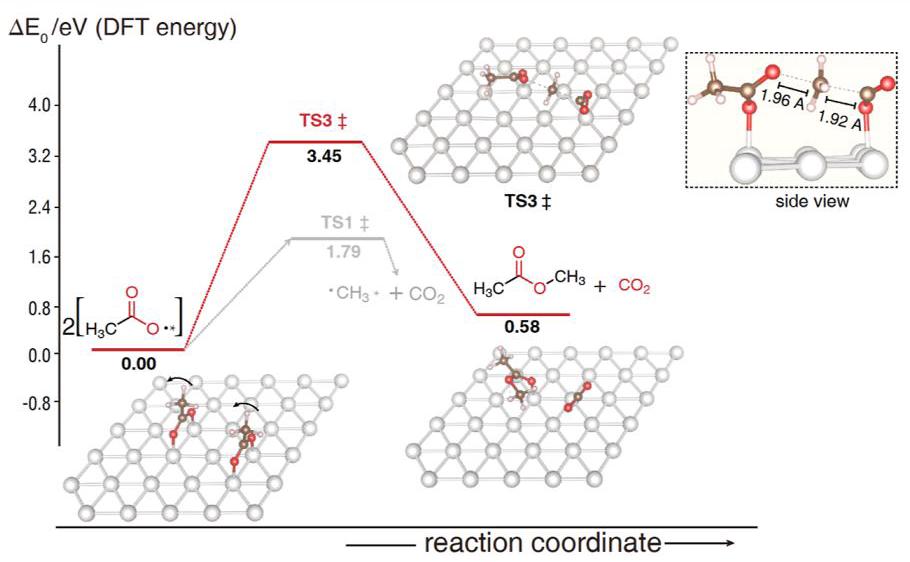
Figure 7. DFT energy diagram of the acetic acid oxidation on the Pt surface. The red line represents the energy change of the methyl acetate formation process. IS, TS, and FS atomic configurations of the reaction are shown in the figure. The gray line shows the energy change of the decarboxylation reaction from an acetoxy radical to a methyl radical and ${\mathrm{{CO}}}_{2}$ on the Pt surface for comparison (presented in Figure 4).
图7. 铂表面乙酸氧化的DFT能量图。红线表示乙酸甲酯形成过程的能量变化。图中显示了该反应的初始态(IS)、过渡态(TS)和终态(FS)的原子构型。灰线显示了铂表面上乙酰氧基自由基到甲基自由基的脱羧反应的能量变化以及${\mathrm{{CO}}}_{2}$用于比较(见图4)。
According to our calculation results, the oxidation potential of acetic acid is -0.62 V vs RHE on the graphite surface. In experiments, Sato reported that the anodic potential of ${\mathrm{{CO}}}_{2}$ generation from the graphite surface was around ${1.4}\mathrm{\;V}$ vs SCE. The accurate $\mathrm{{pH}}$ value of glacial acetic acid is hard to estimate. Some literature reported the $\mathrm{{pH}}$ value of glacial acetic acid is approximately ${3.0}.{}^{52}$ We assume that the $\mathrm{{pH}}$ value of the system is 3.0; the experimental oxidation potential thus is ${1.8}\mathrm{\;V}$ vs RHE (equivalent to ${1.4}\mathrm{\;V}$ vs SCE at $\mathrm{{pH}} = {3.0}$ ) based on eq 6 after changing the reference potential. It means that a large overpotential $\left( { \sim {2.4}\mathrm{\;V}}\right)$ is applied in the experiments. We think that the overpotential originates from the high kinetic barrier of the step in which two acetoxy radicals react to produce the methyl acetate. Therefore, we performed kinetic calculations to find the TS of the reaction of two acetoxy radicals and obtain the kinetic barrier value (Figure 6). There are two acetoxy radicals binding with two adjacent low-coordinated carbon atoms of the surface defect in our model. The C-C bond of one acetoxy radical is broken, and the dissociated methyl group is directly transferred to another acetoxy radical. The results show that the formation of methyl acetate proceeds with a kinetic barrier of ${4.34}\mathrm{{eV}}$ . In this reaction path, the methyl group of one acetoxy radical undergoes a configurational inversion (the Walden inversion) to get connected to another acetoxy radical. The kinetic barrier of the methyl acetate formation from the acetic acid on a graphite surface is much higher than that of the methyl radical formation on a Pt surface. This could be the reason for the higher overpotential observed on the graphite electrode $\left( { \sim {2.4}\mathrm{\;V}}\right)$ compared to the Pt electrode case $\left( { \sim {1.6}\mathrm{\;V}}\right)$ . We also calculate the energy barrier of the ${\mathrm{{CH}}}_{3}{}^{\bullet * }$ radical formation on the graphite surface, which exhibits an even higher value (refer to the next section).
根据我们的计算结果,在石墨表面上,乙酸相对于可逆氢电极(RHE)的氧化电位为 -0.62 V。在实验中,佐藤报告称,从石墨表面产生${\mathrm{{CO}}}_{2}$的阳极电位相对于饱和甘汞电极(SCE)约为${1.4}\mathrm{\;V}$。冰醋酸准确的$\mathrm{{pH}}$值难以估算。一些文献报道冰醋酸的$\mathrm{{pH}}$值约为${3.0}.{}^{52}$。我们假设该体系的$\mathrm{{pH}}$值为3.0;因此,根据式6在改变参考电位后,实验氧化电位相对于RHE为${1.8}\mathrm{\;V}$(相当于在$\mathrm{{pH}} = {3.0}$时相对于SCE为${1.4}\mathrm{\;V}$)。这意味着在实验中施加了较大的过电位$\left( { \sim {2.4}\mathrm{\;V}}\right)$。我们认为该过电位源于两个乙酰氧基自由基反应生成乙酸甲酯步骤的高动力学势垒。因此,我们进行了动力学计算以找到两个乙酰氧基自由基反应的过渡态(TS)并获得动力学势垒值(图6)。在我们的模型中,有两个乙酰氧基自由基与表面缺陷处两个相邻的低配位碳原子结合。一个乙酰氧基自由基的C - C键断裂,解离出的甲基直接转移到另一个乙酰氧基自由基上。结果表明,乙酸甲酯的形成过程具有${4.34}\mathrm{{eV}}$的动力学势垒。在该反应路径中,一个乙酰氧基自由基的甲基发生构型翻转(瓦尔登翻转)以与另一个乙酰氧基自由基相连。在石墨表面上由乙酸形成乙酸甲酯的动力学势垒远高于在铂表面上形成甲基自由基的动力学势垒。这可能是与铂电极情况$\left( { \sim {1.6}\mathrm{\;V}}\right)$相比,在石墨电极$\left( { \sim {2.4}\mathrm{\;V}}\right)$上观察到更高过电位的原因。我们还计算了在石墨表面上形成${\mathrm{{CH}}}_{3}{}^{\bullet * }$自由基的能垒,其值更高(见下一节)。
Simulations of Switched Reaction Paths on the Two Different Surfaces. In order to investigate the reason for different selectivities of the oxidation reactions on different material surfaces, we switch the two reaction paths in the above simulations of the Pt and graphite cases, namely, the process of methyl acetate formation on the Pt surface and the process of generating methyl radicals on the graphite surface. We are interested in the kinetic barriers of these switched reaction paths, which will be used to compare with the barrier results of the paths investigated in the above section (Figures 4 and 6). We therefore add an additional acetoxy radical molecule in the Pt surface model with methyl acetate as the product (Figure 7). The energy barrier of this reaction (3.45 eV) is much higher than that of the ${\mathrm{{CH}}}_{3}{}^{\bullet * }$ formation $\left( {{1.79}\mathrm{{eV}}}\right)$ on the Pt surface, indicating that the methyl acetate formation is much more difficult to proceed compared to the ${\mathrm{{CH}}}_{3}{}^{\bullet * }$ generation on the Pt electrode surface.
两种不同表面上切换反应路径的模拟。为了研究不同材料表面上氧化反应选择性不同的原因,我们在上述铂和石墨情况的模拟中切换了两个反应路径,即在铂表面上乙酸甲酯形成过程和在石墨表面上甲基自由基生成过程。我们关注这些切换反应路径的动力学势垒,将其用于与上一节(图4和图6)中研究的路径的势垒结果进行比较。因此,我们在以乙酸甲酯为产物的铂表面模型中添加了一个额外的乙酰氧基自由基分子(图7)。该反应的能垒(3.45 eV)远高于铂表面上${\mathrm{{CH}}}_{3}{}^{\bullet * }$形成$\left( {{1.79}\mathrm{{eV}}}\right)$的能垒,表明与铂电极表面上${\mathrm{{CH}}}_{3}{}^{\bullet * }$的生成相比,乙酸甲酯的形成要困难得多。
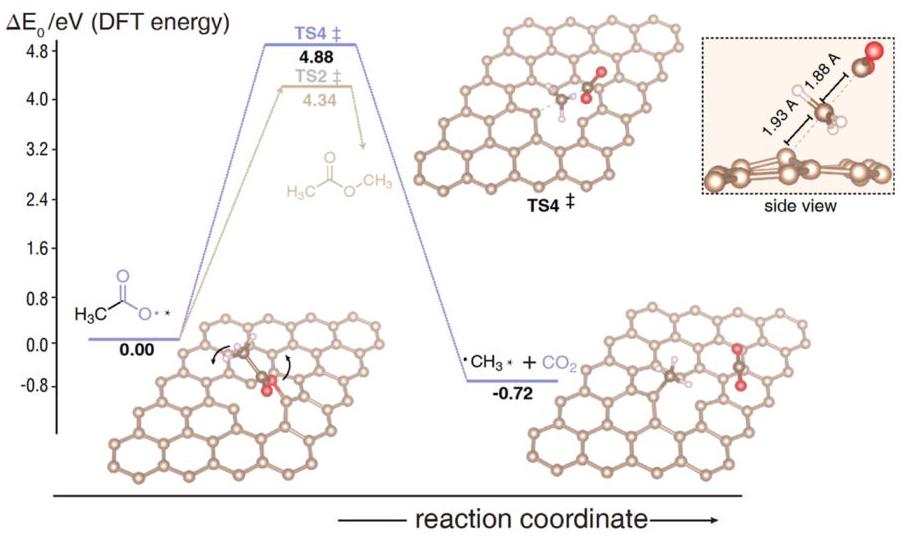
Figure 8. DFT energy diagram of the acetic acid oxidation on the graphite surface. The blue line represents the energy change of the decarboxylation reaction to generate a methyl radical. IS, TS, and FS atomic configurations of the reaction path are shown in the figure. The light-colored line shows the energy change of the methyl acetate formation on the graphite surface for comparison (presented in Figure 6).
图8. 石墨表面上乙酸氧化的密度泛函理论(DFT)能量图。蓝色线表示脱羧反应生成甲基自由基的能量变化。图中显示了反应路径的初始态(IS)、过渡态(TS)和终态(FS)原子构型。浅色线显示了石墨表面上乙酸甲酯形成的能量变化以供比较(见图6)。
For the graphite surface case, we simulate the reaction of the methyl radical formation, in which an acetoxy radical generates a methyl radical and ${\mathrm{{CO}}}_{2}$ . The adjacent low-coordinated carbon atom of the carbon vacancy defect performs as the catalytic site. Our calculations reveal that the methyl carbon atom directly forms a bond with the low-coordinated carbon atom to generate an adsorbed methyl radical. The TS of this reaction is shown in Figure 8, and the corresponding kinetic barrier is ${4.88}\mathrm{{eV}}$ in our simulation. By comparing this value with the kinetic barrier of the methyl acetate formation (4.34 eV in Figure 6) on the graphite surface, we find that a methyl acetate is more easily formed than a methyl radical in the graphite electrode case.
对于石墨表面的情况,我们模拟了甲基自由基形成的反应,其中一个乙酰氧基自由基生成一个甲基自由基和${\mathrm{{CO}}}_{2}$。碳空位缺陷相邻的低配位碳原子作为催化位点。我们的计算表明,甲基碳原子直接与低配位碳原子形成键,生成吸附的甲基自由基。该反应的过渡态如图8所示,在我们的模拟中相应的动力学势垒为${4.88}\mathrm{{eV}}$。通过将该值与石墨表面上乙酸甲酯形成的动力学势垒(图6中为4.34 eV)进行比较,我们发现在石墨电极的情况下,乙酸甲酯比甲基自由基更容易形成。
Discussions of the Reaction Mechanisms on Different
不同表面上反应机理的讨论
Surfaces. Based on the above results, we think that the selectivity of carboxylic acid electrochemical oxidation reactions depends on two important factors. The first one is the adsorption configuration of acid, which determines the relative energy barriers along different reaction paths. The other factor is the catalytic effect of the surface low-coordinated atoms, which could facilitate the decarboxylation process. As shown in Figure 3, the acetate on the Pt surface exhibits a stable bidentate vertical adsorption configuration. In this configuration, the C-C bond is far from the surface, which induces a high kinetic barrier for the decarboxylation process. The C-C bond is a stable covalent bond, and the surface atoms may facilitate its cleavage. We introduce a low-coordinated Pt adatom on the surface in our model, which serves as a representative case for simulating a more realistic Pt surface. We find that the low-coordinated Pt adatom indeed lowers the kinetic barrier, whose catalytic role comes from two main aspects based on our calculations: (1) low-coordinated Pt atoms exhibit intrinsically high activities; (2) when the Pt adatom protrudes from the surface, it can reduce the change of the configurational angle of the C-C bond along the bond cleavage process, thus lowering the reaction kinetic barrier. On the surface of graphite, defects are ubiquitous, and the adsorption configuration of acetoxy radicals is unidentate at the defect site. There is a higher kinetic barrier to dissociating the $\mathrm{C} - \mathrm{C}$ bond and forming adsorbed methyl radicals on the graphite surface because the configurational angle change is larger and the surface carbon atoms do not exhibit strong activities. However, when another acetoxy radical exists, they interact relatively more easily to form a methyl acetate. The reactions on both surfaces show high kinetic barriers, which are consistent with the high overpotentials observed in earlier experiments. ${}^{9,{39}}$ Our modeling results reveal that the large overpotential can be explained by the high kinetic barrier of the C-C bond cleavage process. In this process, the acetoxy radicals usually undergo a configurational inversion step, namely the Walden inversion, to achieve the decarboxylation process. A characteristic of the Walden inversion is that the reaction activity is significantly suppressed by the steric hindrance. Previous researchers summarized experimental phenomena as follows: the greater the steric hindrance of the carboxylic acid’s $\alpha$ -position is, the lower the reaction yield is. ${}^{{53} - {55}}$ For example, acetic acid can generate the coupling product ethane with a high yield of 93%; however, if the hydrogen atom of the acetic acid’s $\alpha$ -position is substituted by any other alkyl groups, the coupling product yield will decrease. ${}^{53}$ In addition, the concentration of acetic acid may also have an influence on the overpotential. In the case of a pure acetic acid solvent environment, Pt can also be used as an anode for the acetic acid oxidation. As shown in Figure S4, the computed potential of the acetic acid oxidation (without any ${\mathrm{H}}_{2}\mathrm{O}$ molecules in the surface model as a crude approximation for the pure acetic acid solvent environment) is around ${0.42}\mathrm{\;V}$ vs RHE, in contrast to the oxidation potential of ${0.79}\mathrm{\;V}$ vs RHE in the aqueous solvent environment on the Pt surface.
表面。基于上述结果,我们认为羧酸电化学氧化反应的选择性取决于两个重要因素。第一个因素是酸的吸附构型,它决定了沿不同反应路径的相对能垒。另一个因素是表面低配位原子的催化作用,其可以促进脱羧过程。如图3所示,Pt表面的乙酸根呈现出稳定的双齿垂直吸附构型。在这种构型中,C-C键远离表面,这导致脱羧过程具有较高的动力学能垒。C-C键是一个稳定的共价键,表面原子可能会促进其断裂。我们在模型中在表面引入了一个低配位的Pt吸附原子,作为模拟更真实Pt表面的一个典型例子。我们发现低配位的Pt吸附原子确实降低了动力学能垒,基于我们的计算,其催化作用主要来自两个方面:(1)低配位的Pt原子本身具有较高的活性;(2)当Pt吸附原子从表面突出时,它可以减少C-C键沿键断裂过程的构型角变化,从而降低反应动力学能垒。在石墨表面,缺陷无处不在,在缺陷位点乙氧基自由基的吸附构型为单齿。在石墨表面断裂$\mathrm{C} - \mathrm{C}$键并形成吸附的甲基自由基存在较高的动力学能垒,因为构型角变化较大且表面碳原子没有表现出很强的活性。然而,当另一个乙氧基自由基存在时,它们相互作用相对更容易形成乙酸甲酯。两个表面上的反应都显示出较高的动力学能垒,这与早期实验中观察到的高过电位一致。${}^{9,{39}}$我们的建模结果表明,大的过电位可以用C-C键断裂过程的高动力学能垒来解释。在这个过程中,乙氧基自由基通常会经历一个构型反转步骤,即瓦尔登反转,以实现脱羧过程。瓦尔登反转的一个特点是反应活性会受到空间位阻的显著抑制。以前的研究人员总结实验现象如下:羧酸$\alpha$位的空间位阻越大,反应产率越低。${}^{{53} - {55}}$例如,乙酸可以高产率93%生成偶联产物乙烷;然而,如果乙酸$\alpha$位的氢原子被任何其他烷基取代,偶联产物产率将会降低。${}^{53}$此外,乙酸的浓度也可能对过电位有影响。在纯乙酸溶剂环境的情况下,Pt也可以用作乙酸氧化的阳极。如图S4所示,计算得到的乙酸氧化电位(表面模型中没有任何${\mathrm{H}}_{2}\mathrm{O}$分子,作为纯乙酸溶剂环境的粗略近似)相对于RHE约为${0.42}\mathrm{\;V}$,相比之下,在Pt表面的水性溶剂环境中氧化电位为${0.79}\mathrm{\;V}$相对于RHE。
Recently, the Chan group also modeled the Kolbe reaction on the Pt surface. ${}^{44}$ They used water as the solvent and proposed that the Pt surface is oxidized by oxygen generated from the oxygen evolution reaction (OER); then, the Kolbe reaction occurs on the oxidized Pt surface to produce ethane molecules. Although the oxidized surface was observed in previous experiments, ${}^{56}$ we think some other possible paths of the Kolbe reaction can better explain the experimental results. The recent theoretical work concluded that the ideally pristine Pt surface could not promote the Kolbe reaction because of the high kinetic barrier of decarboxylation on the pristine Pt surface. ${}^{44}$ Our calculations of the pristine Pt surface case also exhibit high energy barriers, which are consistent with their results. However, due to the fact that a realistic Pt surface cannot be ideally atomic-flat, ${}^{45}$ we consider low-coordinated Pt adatoms on the surface to approximate a more realistic situation. Our work shows that the low-coordinated Pt atoms play a critical catalytic role in activating the $\mathrm{C} - \mathrm{C}$ bond cleavage of the adsorbed acetoxy radical. Moreover, when changing the water solvent to other components like methanol, acetic acid, ${}^{8,9}$ and dimethylformamide, ${}^{57}$ the Kolbe reactions also occur, and Sato found that the Kolbe reaction of acetic acid proceeded efficiently in methanol, while the methanol oxidation was limited under the corresponding electrochemical condition. ${}^{9}$ They did not find the formation of solvent oxidation intermediates (like ${\mathrm{O}}^{ * }$ ) in the experiment. In these systems with non-aqueous solvent molecules, the Pt electrode surfaces are not likely to be covered by oxide terminations. In addition, the adsorption configuration of the acetoxy radical molecule is an important factor for the selectivities of the reaction paths based on our calculations. According to some spectroscopy experiments, ${}^{{41},{42}}$ the adsorption configuration of acetate is bidentate, which is the most stable configuration of acetate on a flat Pt surface. If an unoxidized termination dominates the Pt surface, the bidentate configuration will be observed, which means the C-C bond will be perpendicular to the surface. In the recent computational study, ${}^{44}$ the stable configuration of acetate on an oxidized Pt surface is that the $\mathrm{C} - \mathrm{C}$ bond of the acetate is parallel to the surface. If an oxidized surface dominates the reaction, the bidentate configuration will be less likely to exist on the surface, which is somehow contradictory to the earlier spectroscopy experiments. ${}^{{41},{42}}$ Some researchers also observed the existence of oxidized Pt surfaces, but they think that the Kolbe reaction is less likely to occur on the oxidized surfaces. ${}^{{56},{58}}$ Moreover, for some types of oxide electrode materials (Ni and Pt oxides), previous experimental evidence showed the inefficiency of Kolbe reactions. ${}^{{23},{40},{59},{60}}$ Given the above evidence and discussions, the adsorption configurations of the acetate radical and the catalytic roles of the oxidized vs unoxidized Pt surfaces have not reached an agreement.
最近,Chan研究小组也对铂表面的科尔贝反应进行了建模。${}^{44}$ 他们以水为溶剂,并提出铂表面被析氧反应(OER)产生的氧气氧化;然后,科尔贝反应在氧化的铂表面发生,生成乙烷分子。尽管在之前的实验中观察到了氧化表面,${}^{56}$ 但我们认为科尔贝反应的其他一些可能路径能更好地解释实验结果。最近的理论研究得出结论,理想的原始铂表面无法促进科尔贝反应,因为原始铂表面上脱羧反应的动力学势垒很高。${}^{44}$ 我们对原始铂表面情况的计算也显示出高能量势垒,这与他们的结果一致。然而,由于实际的铂表面不可能是理想的原子平面,${}^{45}$ 我们考虑表面上低配位的铂吸附原子来近似更实际的情况。我们的研究表明,低配位的铂原子在激活吸附的乙酰氧基自由基的$\mathrm{C} - \mathrm{C}$ 键断裂中起关键催化作用。此外,当将水溶剂换成甲醇、乙酸等其他成分时,${}^{8,9}$ 以及二甲基甲酰胺,${}^{57}$ 科尔贝反应也会发生,并且佐藤发现乙酸在甲醇中的科尔贝反应能高效进行,而在相应的电化学条件下甲醇氧化受到限制。${}^{9}$ 他们在实验中未发现溶剂氧化中间体(如${\mathrm{O}}^{ * }$ )的形成。在这些含有非水溶剂分子的体系中,铂电极表面不太可能被氧化物终端覆盖。此外,根据我们的计算,乙酰氧基自由基分子的吸附构型是反应路径选择性的一个重要因素。根据一些光谱实验,${}^{{41},{42}}$ 乙酸根的吸附构型是双齿的,这是乙酸根在平坦铂表面上最稳定的构型。如果未氧化的终端主导铂表面,将观察到双齿构型,这意味着碳 - 碳键将垂直于表面。在最近的计算研究中,${}^{44}$ 乙酸根在氧化铂表面的稳定构型是乙酸根的$\mathrm{C} - \mathrm{C}$ 键平行于表面。如果氧化表面主导反应,双齿构型在表面上存在的可能性较小,这在某种程度上与早期的光谱实验相矛盾。${}^{{41},{42}}$ 一些研究人员也观察到了氧化铂表面的存在,但他们认为科尔贝反应在氧化表面上不太可能发生。${}^{{56},{58}}$ 此外,对于某些类型的氧化物电极材料(镍和铂氧化物),先前的实验证据表明科尔贝反应效率不高。${}^{{23},{40},{59},{60}}$ 鉴于上述证据和讨论,乙酸根自由基的吸附构型以及氧化与未氧化铂表面的催化作用尚未达成一致。
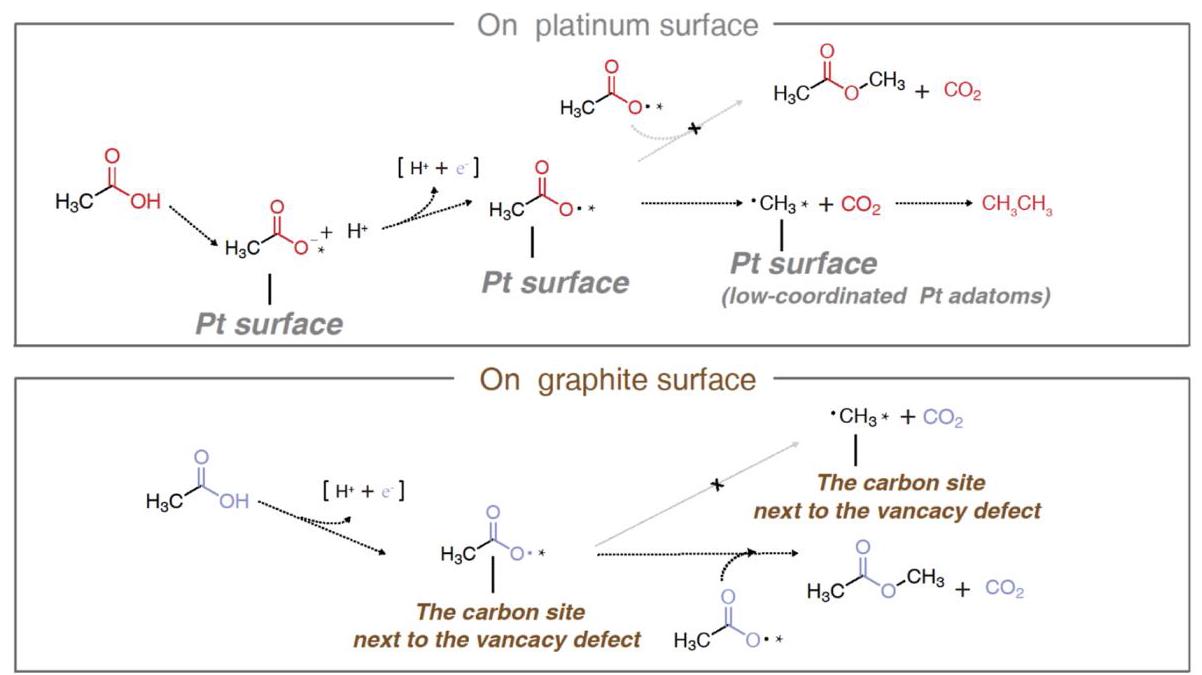
Figure 9. Reaction paths of acetic acid oxidation reactions on two different surfaces. The top panel shows the oxidation of acetic acid on the Pt electrode surface. The methyl acetate formation has a higher kinetic barrier compared to the generation of the methyl radical. The bottom panel shows the acetic acid oxidation on the graphite electrode surface, where the formation of methyl acetate is an easier process.
图9. 乙酸氧化反应在两种不同表面上的反应路径。上图显示了乙酸在铂电极表面的氧化。与甲基自由基的生成相比,乙酸甲酯的形成具有更高的动力学势垒。下图显示了乙酸在石墨电极表面的氧化,其中乙酸甲酯的形成是一个更容易的过程。
Another significant feature of the Kolbe reaction is the high Tafel slope region. ${}^{{56},{58},{61}}$ Due to the high kinetic barrier of decarboxylation, the methyl radical cannot be generated rapidly following the formation of acetoxy radicals. It means the acetoxy radical will cover the surface and form a dipole layer. The dipole layer will prevent carboxylic acid radicals from further adsorbing on the surface when the potential is not sufficiently high for breaking the C-C bond, which could induce the high Tafel slope region. The exact mechanism resulting in the large Tafel slope is still under debate, and we expect future research on this question.
科尔贝反应的另一个显著特征是高塔菲尔斜率区域。${}^{{56},{58},{61}}$ 由于脱羧反应的动力学势垒很高,乙酰氧基自由基形成后甲基自由基不能迅速生成。这意味着乙酰氧基自由基将覆盖表面并形成偶极层。当电位不足以高到打破碳 - 碳键时,偶极层将阻止羧酸自由基进一步吸附在表面,这可能导致高塔菲尔斜率区域。导致大塔菲尔斜率的确切机制仍在争论中,我们期待未来对此问题的研究。
CONCLUSIONS
结论
We employ ab initio atomic-scale models to simulate the oxidation reaction of acetic acid on the Pt and graphite surfaces, which exhibit different selectivities of reaction paths. As shown in Figure 9, the acetoxy radical is bonded to the Pt surface and forms a bidentate vertical adsorption configuration. In this configuration, the C-C bond is far from the surface, which induces a high kinetic barrier for the decarboxylation process. We introduce a low-coordinated Pt adatom on the surface in our model, which serves as a representative case for simulating a realistic Pt surface. We find that the low-coordinated Pt adatom can lower the kinetic barrier. For the graphite surface case, carbon vacancy defects are ubiquitous, and the adsorption configuration of acetoxy radicals is unidentate at the defects. The dissociation of the C-C bond and the formation of adsorbed methyl radicals on the graphite surface have a significant kinetic barrier due to the larger change in configurational angle and the relatively low activity of the surface carbon atoms. When another acetoxy radical exists, they interact relatively more easily to form methyl acetate. The high kinetic barriers on both surfaces predicted from our DFT calculations are consistent with the high overpotential observed in earlier experiments. ${}^{9,{39}}$
我们采用从头算原子尺度模型来模拟乙酸在铂和石墨表面的氧化反应,这两种表面呈现出不同的反应路径选择性。如图9所示,乙酰氧基与铂表面结合并形成双齿垂直吸附构型。在这种构型中,C-C键远离表面,这导致脱羧过程的动力学势垒较高。我们在模型中引入了表面低配位铂原子,作为模拟实际铂表面的一个代表性例子。我们发现低配位铂原子可以降低动力学势垒。对于石墨表面的情况,碳空位缺陷普遍存在,乙酰氧基在缺陷处的吸附构型为单齿。由于构型角的较大变化和表面碳原子相对较低的活性,石墨表面C-C键的解离和吸附甲基自由基的形成具有显著的动力学势垒。当另一个乙酰氧基存在时,它们相互作用相对更容易形成乙酸甲酯。我们的密度泛函理论计算预测的两种表面上的高动力学势垒与早期实验中观察到的高过电位一致。${}^{9,{39}}$
Our study also discusses the catalytic effect of oxidized vs unoxidized Pt surfaces. A recent computational study proposed that the acetic acid oxidation reaction should occur on an oxidized Pt surface. However, our simulation results imply that the unoxidized Pt surface may facilitate the reaction as well. The bidentate adsorption configuration of acetic acid in experiments is consistent with the most stable configuration on the unoxidized Pt surface in our model. ${}^{{41},{42}}$ We consider Pt adatoms on the surface, and these atoms exhibit relatively good catalytic activity for the formation of methyl radicals. Some other experimental evidence also indicates that the oxidized Pt surface is not a necessary condition for activating the Kolbe reactions. ${}^{{40},{56},{58},{60}}$
我们的研究还讨论了氧化态与未氧化态铂表面的催化作用。最近的一项计算研究提出,乙酸氧化反应应该发生在氧化的铂表面上。然而,我们的模拟结果表明,未氧化的铂表面也可能促进该反应。实验中乙酸的双齿吸附构型与我们模型中未氧化铂表面上最稳定的构型一致。${}^{{41},{42}}$我们考虑表面上的铂原子,这些原子对甲基自由基的形成表现出相对较好的催化活性。其他一些实验证据也表明,氧化的铂表面不是激活科尔贝反应的必要条件。${}^{{40},{56},{58},{60}}$
Overall, our computational study reveals the origin of the Pt vs graphite electrodes’ different selectivities for the oxidation reactions of acetic acids. Based on mechanistic understanding, we could further increase the Kolbe reaction’s activity and control the reaction paths’ selectivities by various surface engineering approaches, e.g., introduction of more low-coordinated Pt atoms to the Pt surface or exposure of more edges and vertices of the Pt electrode material can potentially facilitate the methyl radical formation. We expect more interesting electrode materials with different surface morphologies to be synthesized and applied in the Kolbe reaction field.
总体而言,我们的计算研究揭示了铂电极与石墨电极在乙酸氧化反应中不同选择性的起源。基于机理理解,我们可以通过各种表面工程方法进一步提高科尔贝反应的活性并控制反应路径的选择性,例如,向铂表面引入更多低配位铂原子或使铂电极材料暴露更多的边缘和顶点可能会促进甲基自由基的形成。我们期望合成更多具有不同表面形态的有趣电极材料并应用于科尔贝反应领域。
ASSOCIATED CONTENT
相关内容
(c) Supporting Information
(c) 支持信息
The Supporting Information is available free of charge at https://pubs.acs.org/doi/10.1021/acs.jpcc.3c03221.
支持信息可在https://pubs.acs.org/doi/10.1021/acs.jpcc.3c03221免费获取。
CMD method for simulations of methyl radical formation on the atomic-flat platinum surface; desorption of acetoxy radicals from the Pt surface; C-C bond cleavage catalyzed by an adsorbed oxygen radical; simulations of the electrochemical oxidation of acetic acids with glacial acetic acid as solvent; and vibrational and solvation corrections for reaction energies (PDF)
用于模拟原子级平整铂表面上甲基自由基形成的CMD方法;乙酰氧基自由基从铂表面的脱附;吸附氧自由基催化的C-C键断裂;以冰醋酸为溶剂的醋酸电化学氧化模拟;以及反应能量的振动和溶剂化校正(PDF)
Cartesian coordinates of the intermediate states (obtained in the thermodynamic calculations) and the IS, TS, and FS structures (obtained in the kinetic calculations) (ZIP)
中间态(在热力学计算中获得)以及IS、TS和FS结构(在动力学计算中获得)的笛卡尔坐标(ZIP)
A AUTHOR INFORMATION
A 作者信息
Corresponding Authors
通讯作者
Fanyang Mo - School of Materials Science and Engineering, Peking University, Beijing 100871, PR China; © orcid.org/ 0000-0002-4140-3020;
莫凡洋 - 中国北京大学材料科学与工程学院,北京100871;© orcid.org/ 0000-0002-4140-3020;
Shenzhen Xu - School of Materials Science and Engineering, Peking University, Beijing 100871, PR China; Beijing Key Laboratory of Theory and Technology for Advanced Battery Materials, School of Materials Science and Engineering, Peking University, Beijing 100871, PR China; AI for Science Institute, Beijing 100084, PR China; (C) orcid.org/0000- 0001-7268-9917;
徐深圳 - 中国北京大学材料科学与工程学院,北京100871;中国北京大学材料科学与工程学院先进电池材料理论与技术北京市重点实验室,北京100871;中国北京100084人工智能科学研究院;(C) orcid.org/0000- 0001-7268-9917;
Authors
作者
Jianning Zhang - School of Materials Science and Engineering, Peking University, Beijing 100871, PR China; Department of Energy and Resources Engineering, College of Engineering, Peking University, Beijing 100871, PR China
Xin Wen - School of Materials Science and Engineering, Peking University, Beijing 100871, PR China; Present Address: Beijing National Laboratory for Molecular Sciences (BNLMS), Institute of Chemistry, Chinese Academy of Sciences, Beijing 100049, PR China
Weibin Chen - School of Materials Science and Engineering, Peking University, Beijing 100871, PR China; Department of Energy and Resources Engineering, College of Engineering, Peking University, Beijing 100871, PR China
Lei Zhang - Department of Energy and Resources Engineering, College of Engineering, Peking University, Beijing 100871, PR China; Present Address: Department of Chemistry, National University of Singapore 117544, Republic of Singapore.; (C) orcid.org/0000-0001-9031-4318
Complete contact information is available at:
https://pubs.acs.org/10.1021/acs.jpcc.3c03221
Author Contributions
作者贡献
Jianning Zhang: Literature review, DFT calculations and data analysis, academic discussions, and writing the paper manuscript. Xin Wen: DFT calculations and data analysis and academic discussions. Weibin Chen: DFT calculations and academic discussions. Lei Zhang: Academic discussions and editing the paper manuscript. Fanyang Mo: Project design, funding support, and editing the paper manuscript. Shenzhen Xu: Project design, guidance on the model constructions and computational details, academic discussions, software support, and writing the paper manuscript.
张建宁:文献综述、密度泛函理论计算与数据分析、学术讨论以及撰写论文手稿。温鑫:密度泛函理论计算与数据分析以及学术讨论。陈伟斌:密度泛函理论计算与学术讨论。张雷:学术讨论以及编辑论文手稿。莫凡洋:项目设计、资金支持以及编辑论文手稿。徐深圳:项目设计、模型构建和计算细节指导、学术讨论、软件支持以及撰写论文手稿。
Notes
注释
The authors declare no competing financial interest.
作者声明不存在相互竞争的财务利益。
I ACKNOWLEDGMENTS
I 致谢
This project is supported by the National Natural Science Foundation of China (grant nos. 21933001, 22071004, and 52273223). The DFT calculations are supported by the High Performance Computing Platform of Peking University and the Beijing Beilong Super Cloud Computing Co., Ltd. The authors also acknowledge Professor Xidong Wang (School of Materials Science and Engineering, Peking University) for his support.
本项目由中国国家自然科学基金(项目编号:21933001、22071004和52273223)资助。密度泛函理论(DFT)计算得到了北京大学高性能计算平台和北京北龙超级云计算有限公司的支持。作者还感谢王锡东教授(北京大学材料科学与工程学院)的支持。
R REFERENCES
R参考文献
(1) Waldvogel, S. R.; Lips, S.; Selt, M.; Riehl, B.; Kampf, C. J. Electrochemical Arylation Reaction. Chem. Rev. 2018, 118, 6706- 6765.
(2) Yan, M.; Kawamata, Y.; Baran, P. S. Synthetic Organic Electrochemical Methods since 2000: On the Verge of a Renaissance. Chem. Rev. 2017, 117, 13230-13319.
(3) Yoshida, J.-I.; Kataoka, K.; Horcajada, R.; Nagaki, A. Modern Strategies in Electroorganic Synthesis. Chem. Rev. 2008, 108, 2265- 2299.
(4) Ma, C.; Fang, P.; Mei, T.-S. Recent Advances in C-H Functionalization Using Electrochemical Transition Metal Catalysis. ACS Catal. 2018, 8, 7179-7189.
(5) Moeller, K. D. Synthetic Applications of Anodic Electrochemistry. Tetrahedron 2000, 56, 9527-9554.
(6) Sperry, J. B.; Wright, D. L. The Application of Cathodic Reductions and Anodic Oxidations in the Synthesis of Complex Molecules. Chem. Soc. Rev. 2006, 35, 605-621.
(7) Tang, S.; Liu, Y.; Lei, A. Electrochemical Oxidative Cross-Coupling with Hydrogen Evolution: A Green and Sustainable Way for Bond Formation. Chem 2018, 4, 27-45.
(8) Schäfer, H.-J. Recent Contributions of Kolbe Electrolysis to Organic Synthesis. In Electrochemistry IV; Steckhan, E., Ed.; Springer Berlin Heidelberg: Berlin, Heidelberg, 1990; pp 91-151.
(9) Sato, N.; Sekine, T.; Sugino, K. Anodic Processes of Acetate Ion in Methanol and in Glacial Acetic Acid at Various Anode Materials. J. Electrochem. Soc. 1968, 115, 242.
(10) Zhang, Z.; Zhang, L.; Zhang, X.; Yang, J.; Yin, Y.; Jiang, Y.; Zeng, C.; Lu, G.; Yang, Y.; Mo, F. Anodic Oxidation Triggered Divergent 1,2- and 1,4-Group Transfer Reactions of B-Hydrox-ycarboxylic Acids Enabled by Electrochemical Regulation. Chem. Sci. 2020, 11, 12021-12028.
(11) Kuhn, A. T.; Mortimer, C. J.; Bond, G. C.; Lindley, J. A Critical Analysis of Correlations between the Rate of the Electrochemical Hydrogen Evolution Reaction and Physical Properties of the Elements. J. Electroanal. Chem. Interfacial Electrochem. 1972, 34, 1-14.
(12) Tanaka, H.; Peters, M.; Torii, S. Oxidation of Carboxylic Acids and Derivatives. Organic Electrochemistry: Revised and Expanded, 5th ed.; CRC Press, 2015; pp 1267-1308.
(13) Koehl, W. J. Anodic Oxidation of Aliphatic Acids at Carbon Anodes. J. Am. Chem. Soc. 1964, 86, 4686-4690.
(14) Ross, S. D.; Finkelstein, M. Anodic Oxidations. V. Kolbe Oxidation of Phenylacetic Acid and 1-Methylcyclohexaneacetic Acid at Platinum and at Carbon. J. Org. Chem. 1969, 34, 2923-2927.
(15) Woolford, R. G.; Arbic, W.; Rosser, A. The Electrolysis of Ω- Bromocarboxylic Acids: Ii. Preparation of Long-Chain Ω-Bromocar-boxylic Esters by Mixed Coupling Reactions. Can. J. Chem. 1964, 42, 1788-1791.
(16) Woolford, R. G. The Electrolysis of Ω-Bromocarboxylic Acids. Can. J. Chem. 1962, 40, 1846-1850.
(17) Torii, S.; Okamoto, T.; Tanaka, H. Electrolytic Decarboxylation Reactions. I. Electrosynthesis Of .Gamma.-Substituted Butyrolactones And .Gamma.-Substituted .Alpha., Beta.-Butenolides From .Gamma.- Substituted Paraconic Acids. J. Org. Chem. 1974, 39, 2486-2488.
(18) Kingston, C.; Palkowitz, M. D.; Takahira, Y.; Vantourout, J. C.; Peters, B. K.; Kawamata, Y.; Baran, P. S. A Survival Guide for the “Electro-Curious”. Acc. Chem. Res. 2020, 53, 72-83.
(19) Hohenberg, P.; Kohn, W. Inhomogeneous Electron Gas. Phys. Rev. 1964, 136, B864-B871.
(20) Kohn, W.; Sham, L. J. Self-Consistent Equations Including Exchange and Correlation Effects. Phys. Rev. 1965, 140, A1133- A1138.
(21) Zhang, L.; Zhang, Z.; Zhang, J.; Li, K.; Mo, F. Oxidant-Free Oxidation of C-H Bonds by Cathodic Hydrogen Evolution: A Phosphonic Kolbe Oxidation/Cyclization Process. Green Chem. 2018, 20, 3916-3920.
(22) Zhang, L.; Zhang, Z.; Hong, J.; Yu, J.; Zhang, J.; Mo, F. Oxidant-Free C(Sp2)-H Functionalization/C-O Bond Formation: A kolbe Oxidative Cyclization Process. J. Org. Chem. 2018, 83, 3200- 3207.
(23) Dickinson, T.; Wynne-Jones, W. F. K. Mechanism of Kolbe’s Electrosynthesis. Part 1.-Anode Potential Phenomena. Trans. Faraday Soc. 1962, 58, 382-387.
(24) Kresse, G.; Hafner, J. Norm-Conserving and Ultrasoft Pseudopotentials for First-Row and Transition Elements. J. Phys.: Condens. Matter 1994, 6, 8245-8257.
(25) Kresse, G.; Furthmüller, J. Efficient Iterative Schemes for Ab Initio Total-Energy Calculations Using a Plane-Wave Basis Set. Phys. Rev. B: Condens. Matter Mater. Phys. 1996, 54, 11169-11186.
(26) Botana, A. S.; Norman, M. R. Electronic Structure and Magnetism of Transition Metal Dihalides: Bulk to Monolayer. Phys. Rev. Mater. 2019, 3, 044001.
(27) Blöchl, P. E.; Jepsen, O.; Andersen, O. K. Improved Tetrahedron Method for Brillouin-Zone Integrations. Phys. Rev. B: Condens. Matter Mater. Phys. 1994, 49, 16223-16233.
(28) Blaha, P.; Schwarz, K.; Tran, F.; Laskowski, R.; Madsen, G. K. H.; Marks, L. D. Wien2k: An Apw+Lo Program for Calculating the Properties of Solids. J. Chem. Phys. 2020, 152, 074101.
(29) Grimme, S. Semiempirical Gga-Type Density Functional Constructed with a Long-Range Dispersion Correction. J. Comput. Chem. 2006, 27, 1787-1799.
(30) Henkelman, G.; Jónsson, H. Improved Tangent Estimate in the Nudged Elastic Band Method for Finding Minimum Energy Paths and Saddle Points. J. Chem. Phys. 2000, 113, 9978-9985.
(31) Henkelman, G.; Jónsson, H. A Dimer Method for Finding Saddle Points on High Dimensional Potential Surfaces Using Only First Derivatives. J. Chem. Phys. 1999, 111, 7010-7022.
(32) Mathew, K.; Sundararaman, R.; Letchworth-Weaver, K.; Arias, T. A.; Hennig, R. G. Implicit Solvation Model for Density-Functional Study of Nanocrystal Surfaces and Reaction Pathways. J. Chem. Phys. 2014, 140, 084106.
(33) Mathew, K.; Kolluru, V. S. C.; Mula, S.; Steinmann, S. N.; Hennig, R. G. Implicit Self-Consistent Electrolyte Model in Plane-Wave Density-Functional Theory. J. Chem. Phys. 2019, 151, 234101.
(34) Norskov, J. K.; Rossmeisl, J.; Logadottir, A.; Lindqvist, L.; Kitchin, J. R.; Bligaard, T.; Jónsson, H. Origin of the Overpotential for Oxygen Reduction at a Fuel-Cell Cathode. J. Phys. Chem. B 2004, 108, 17886-17892.
(35) Skúlason, E.; Tripkovic, V.; Björketun, M. E.; Gudmundsdóttir, S.; Karlberg, G.; Rossmeisl, J.; Bligaard, T.; Jónsson, H.; Nørskov, J. K. Modeling the Electrochemical Hydrogen Oxidation and Evolution Reactions on the Basis of Density Functional Theory Calculations. J. Phys. Chem. C 2010, 114, 18182-18197.
(36) Walker, O. J.; Weiss, J. The Influence of the Electrode Surface on Anodic Processes. Trans. Faraday Soc. 1935, 31, 1011-1017.
(37) Shukla, S. N.; Walker, O. J. Anode Phenomena in the Electrolysis of Potassium Acetate Solutions. Part Ii. Discharge Potential of the Acetate Ion. Trans. Faraday Soc. 1931, 27, 722-730.
(38) Glasstone, S.; Hickling, A. The Mechanism of the Kolbe Electrosynthesis and Allied Reactions. Trans. Electrochem. Soc. 1939, 75, 333.
(39) Dickinson, T.; Wynne-Jones, W. F. K. Mechanism of Kolbe’s Electrosynthesis. Part 3.—Theoretical Discussion. Trans. Faraday Soc. 1962, 58, 400-404.
(40) Vijh, A. K.; Conway, B. E. Electrode Kinetic Aspects of the Kolbe Reaction. Chem. Rev. 1967, 67, 623-664.
(41) Heinen, M.; Jusys, Z.; Behm, R. J. Ethanol, Acetaldehyde and Acetic Acid Adsorption/Electrooxidation on a Pt Thin Film Electrode under Continuous Electrolyte Flow: An in Situ Atr-Ftirs Flow Cell Study. J. Phys. Chem. C 2010, 114, 9850-9864.
(42) Cai, D.; Zhang, J.; Lu, J.; Zha, Q. The study of in situ FTIR adsorption spectroscopy for Kolbe reaction on the platinum electrode. Spectrosc. Spectral Anal. 1989, 09, 12.
(43) Hioki, Y.; Costantini, M.; Griffin, J.; Harper, K. C.; Merini, M. P.; Nissl, B.; Kawamata, Y.; Baran, P. S. Overcoming the Limitations of Kolbe Coupling with Waveform-Controlled Electrosynthesis. Science 2023, 380, 81-87.
(44) Liu, S.; Govindarajan, N.; Prats, H.; Chan, K. Understanding the Reaction Mechanism of Kolbe Electrolysis on Pt Anodes. Chem Catal. 2022, 2, 1100-1113.
(45) Chang, L. Y.; Barnard, A. S.; Gontard, L. C.; Dunin-Borkowski, R. E. Resolving the Structure of Active Sites on Platinum Catalytic Nanoparticles. Nano Lett. 2010, 10, 3073-3076.
(46) Bondue, C. J.; Calle-Vallejo, F.; Figueiredo, M. C.; Koper, M. T. M. Structural Principles to Steer the Selectivity of the Electrocatalytic Reduction of Aliphatic Ketones on Platinum. Nat. Catal. 2019, 2, 243-250.
(47) Esposito, D. V.; Hunt, S. T.; Stottlemyer, A. L.; Dobson, K. D.; McCandless, B. E.; Birkmire, R. W.; Chen, J. G. Low-Cost Hydrogen-Evolution Catalysts Based on Monolayer Platinum on Tungsten Monocarbide Substrates. Angew. Chem., Int. Ed. 2010, 49, 9859-9862.
(48) Heard, D. M.; Lennox, A. J. J. Electrode Materials in Modern Organic Electrochemistry. Angew. Chem., Int. Ed. 2020, 59, 18866- 18884.
(49) Nair, R. R.; Sepioni, M.; Tsai, I. L.; Lehtinen, O.; Keinonen, J.; Krasheninnikov, A. V.; Thomson, T.; Geim, A. K.; Grigorieva, I. V. Spin-Half Paramagnetism in Graphene Induced by Point Defects. Nat. Phys. 2012, 8, 199-202.
(50) Vassiliev, Y. B.; Kovsman, E. P.; Freidlin, G. N. Electrosynthesis of Dibasic Saturated Acids of Normal Structure—I. The Influence of Different Parameters on the Yield of Electrosynthesis Products. Electrochim. Acta 1982, 27, 937-952.
(51) Ross, S. D. Section of Chemical Sciences: Anodic Oxidation of Organic Compounds. Trans. N. Y. Acad. Sci. 1968, 30, 901-909.
(52) Hall, N. F. The Strength of Organic Bases in Glacial Acetic Acid Solution1. J. Am. Chem. Soc. 1930, 52, 5115-5128.
(53) Schäfer, H. J. 2.8-Kolbe Reactions. In Comprehensive Organic Synthesis; Trost, B. M., Fleming, I., Eds.; Pergamon: Oxford, 1991; pp 633-658.
(54) Advances in Organic Chemistry: Methods and Results. In Index to Reviews, Symposia Volumes and Monographs in Organic Chemistry; Kharasch, N., Wolf, W., Eds.; Pergamon, 1966; p 16.
(55) Weinberg, N. L.; Weinberg, H. R. Electrochemical Oxidation of Organic Compounds. Chem. Rev. 1968, 68, 449-523.
(56) Conway, B. E.; Vijh, A. K. Controlled Potential Studies on the Kolbe Reaction and the Role of Coadsorbed Surface Oxides. I. Platinum in Trifluoroacetate Solutions. J. Phys. Chem. 1967, 71, 3637-3654.
(57) Rand, L.; Mohar, A. F. The Electrolytic Formation and Cleavage of N-Methyl-N-(Triphenylacetoxymethyl)Formamide. J. Org. Chem. 1965, 30, 3156-3157.
(58) Vijh, A. K.; Conway, B. E. Controlled Potential Studies on the Kolbe Reaction and the Role of Coadsorbed Surface Oxides. Ii. The Reaction at Gold. J. Phys. Chem. 1967, 71, 3655-3664.
(59) Glasstone, S.; Hickling, A. The Hydrogen Peroxide Theory of Electrolytic Oxidation. Chem. Rev. 1939, 25, 407-441.
(60) Conway, B. E.; Vijh, A. K. Kolbe Electrosynthesis. Role of CO-Adsorbed Surface Oxides. J. Org. Chem. 1966, 31, 4283-4285.
(61) Grinberg, V. A.; Sterlin, S. R.; Lundgren, C. A.; Cherstkov, V. F.; Delyagina, N. I.; Mysov, E. I.; Stepanov, A. A.; Denisovich, L. I. Electrochemical Perfluoroalkoxylation of Aromatic Compounds. Russ. Chem. Bull. 1997, 46, 1441-1444.