Transition-metal Free Visible Light Photoredox-catalyzed Remote C(sp3)-H Borylation Enabled by 1,5-Hydrogen Atom Transfer
英文原文与中文译文逐段对照 · English original with Chinese translation
communications
通信
chemistry
化学
ARTICLE
文章
https://doi.org/10.1038/s42004-023-00960-z OPEN
https://doi.org/10.1038/s42004-023-00960-z 开放
Transition metal-free visible light photoredox- catalyzed remote $\mathrm{C}\left( {\mathrm{{sp}}}^{3}\right) - \mathrm{H}$ borylation enabled by 1,5-hydrogen atom transfer
通过1,5-氢原子转移实现的无过渡金属可见光光氧化还原催化远程$\mathrm{C}\left( {\mathrm{{sp}}}^{3}\right) - \mathrm{H}$硼化反应
Beiqi Sun ${}^{1,2}$ , Wenke Li ${}^{2}$ , Qianyi Liu ${}^{2}$ , Gaoge Zhang ${}^{2}$ & Fanyang Mo D ${}^{1\infty }$
孙北奇${}^{1,2}$,李文珂${}^{2}$,刘谦益${}^{2}$,张高歌${}^{2}$ & 莫凡洋${}^{1\infty }$
The borylation of unreactive carbon-hydrogen bonds is a valuable method for transforming feedstock chemicals into versatile building blocks. Here, we describe a transition metal-free method for the photoredox-catalyzed borylation of unactivated $\mathrm{C}\left( {\mathrm{{sp}}}^{3}\right) - \mathrm{H}$ bond, initiated by 1,5-hydrogen atom transfer (HAT). The remote borylation was directed by 1,5-HAT of the amidyl radical, which was generated by photocatalytic reduction of hydroxamic acid derivatives. The method accommodates substrates with primary, secondary and tertiary C(sp3) -H bonds, yielding moderate to good product yields (up to 92%) with tolerance for various functional groups. Mechanistic studies, including radical clock experiments and DFT calculations, provided detailed insight into the 1,5-HAT borylation process.
未反应的碳氢键的硼化反应是将原料化学品转化为通用结构单元的一种有价值的方法。在此,我们描述了一种无过渡金属的方法,用于通过1,5-氢原子转移(HAT)引发的光氧化还原催化的未活化$\mathrm{C}\left( {\mathrm{{sp}}}^{3}\right) - \mathrm{H}$键的硼化反应。远程硼化反应由光催化还原异羟肟酸衍生物生成的酰胺基自由基的1,5-HAT引导。该方法适用于具有伯、仲和叔C(sp3)-H键的底物,能以中等至良好的产率(高达92%)得到产物,并且对各种官能团具有耐受性。包括自由基钟实验和DFT计算在内的机理研究为1,5-HAT硼化过程提供了详细的见解。
Road, Beijing 100871, China. E
中国北京 100871。
Alkyl boronic esters are highly versatile building blocks in organic synthesis because C-B bonds can be easily transformed into various useful functional groups ${}^{1}$ . C-H borylation is desirable and powerful because it directly transforms common $\mathrm{C} - \mathrm{H}$ bonds into synthetically valuable $\mathrm{C} - \mathrm{B}$ bonds. Borylation of nonactivated $\mathrm{C}\left( {\mathrm{{sp}}}^{3}\right) - \mathrm{H}$ is one of the most challenging subjects in the area. In the past decades, a series of methods have been established ${}^{2 - 4}$ . and most of them require transition-metals as catalysts, including ${\mathrm{W}}^{5},{\mathrm{{Rh}}}^{6},{\mathrm{{Pd}}}^{7 - {10}},{\operatorname{Ir}}^{{11} - {24}}$ (Fig. 1a), and the reaction conditions could be very harsh (temperature 100-150 °C). In 2020, the Aggarwal group reported the metal-free photoinduced borylation of alkanes (Fig. 1b) ${}^{25}$ . However, due to the low reactivity of alkanes, the reaction requires high equivalency of alkane substrates (10 equiv.), and the yields based on diboron are relatively low (lower than 50% in most cases). Given that boronic esters are important in organic synthesis and medicinal chemistry, it is of great significance to develop substrate equivalent and efficient $\mathrm{C} - \mathrm{H}$ borylation methods.
烷基硼酸酯是有机合成中非常通用的结构单元,因为C-B键可以很容易地转化为各种有用的官能团${}^{1}$。C-H硼化反应是理想且强大的,因为它能直接将常见的$\mathrm{C} - \mathrm{H}$键转化为具有合成价值的$\mathrm{C} - \mathrm{B}$键。未活化$\mathrm{C}\left( {\mathrm{{sp}}}^{3}\right) - \mathrm{H}$的硼化反应是该领域最具挑战性的课题之一。在过去几十年中,已经建立了一系列方法${}^{2 - 4}$。并且它们中的大多数需要过渡金属作为催化剂,包括${\mathrm{W}}^{5},{\mathrm{{Rh}}}^{6},{\mathrm{{Pd}}}^{7 - {10}},{\operatorname{Ir}}^{{11} - {24}}$(图1a),并且反应条件可能非常苛刻(温度100 - 150°C)。2020年,Aggarwal课题组报道了烷烃的无金属光诱导硼化反应(图1b)${}^{25}$。然而,由于烷烃的低反应活性,该反应需要高当量的烷烃底物(10当量),并且基于二硼的产率相对较低(大多数情况下低于50%)。鉴于硼酸酯在有机合成和药物化学中很重要,开发底物等效且高效的$\mathrm{C} - \mathrm{H}$硼化方法具有重要意义。
Hydrogen atom transfer (HAT) is a general strategy in organic synthesis, and it represents an attractive approach toward remote $\mathrm{C} - \mathrm{H}$ functionalization ${}^{{26} - {28}}$ . The earliest example of remote $\mathrm{C} - \mathrm{H}$ functionalization by means of HAT was Hofmann-Löffler-Freytag (HLF) reaction (Fig. 2a) ${}^{{29},{30}}$ , the key step is the 1,5-hydrogen atom abstraction via nitrogen-centered radical, where the bond-dissociation energy (BDE) of $\mathrm{N} - \mathrm{H}$ bond is higher than the $\mathrm{C} - \mathrm{H}$ bond. In past decades, the nitrogen-centered radical-based HLF type reaction has shown its advances in regioselective functionali-zation of inert $\mathrm{C} - \mathrm{H}$ bonds ${}^{{31},{32}}$ , by trapping the carbon-centered radicals towards the formations of $\mathrm{C} - {\mathrm{C}}^{{33},{34}},\mathrm{C} - {\mathrm{O}}^{{35},{36}},\mathrm{C} - {\mathrm{N}}^{{37} - {40}}$ , and $\mathrm{C} - \mathrm{X}{\left( \mathrm{X} = \text{ halogen }\right) }^{{41} - {44}}$ bonds. Particularly, amidyl radical is widely explored nitrogen-centered radical in above mentioned processes. In 2016, Knowles ${}^{45}$ and Rovis ${}^{46}$ independently developed oxidative photocatalytic generation of amidyl radicals by direct $\mathrm{N} - \mathrm{H}$ bond cleavage, after 1,5-HAT process, followed by the Michael addition of the translocated carbon-centered radical, affording the remote functionalized amides (Fig. 2b). Another way to generate amidyl radical is using activated precursors ${}^{47}$ , for example, single-electron photoreduction of $N$ -acyloxy(halo) phthalimides ${}^{4\bar{8},{49}}$ , $N$ -aminopyridinium salts ${}^{{50} - {53}}$ , and hydroxylamides ${}^{{40},{47},{54} - {58}}$ give the corresponding amidyl radicals upon heterolytic cleavage of the respective leaving groups (Fig. 2c). Despite these advances, trapping the carbon-centered radical with diboron compounds to build $\mathrm{C} - \mathrm{B}$ bonds, is still challenging and remains unexplored.
氢原子转移(HAT)是有机合成中的一种通用策略,是实现远程$\mathrm{C} - \mathrm{H}$官能化${}^{{26} - {28}}$的一种有吸引力的方法。最早通过HAT进行远程$\mathrm{C} - \mathrm{H}$官能化的例子是霍夫曼-勒夫勒-弗赖塔格(HLF)反应(图2a)${}^{{29},{30}}$,关键步骤是通过氮中心自由基进行1,5-氢原子提取,其中$\mathrm{N} - \mathrm{H}$键的键解离能(BDE)高于$\mathrm{C} - \mathrm{H}$键。在过去几十年中,基于氮中心自由基的HLF型反应在惰性$\mathrm{C} - \mathrm{H}$键${}^{{31},{32}}$的区域选择性官能化方面取得了进展,通过捕获碳中心自由基形成$\mathrm{C} - {\mathrm{C}}^{{33},{34}},\mathrm{C} - {\mathrm{O}}^{{35},{36}},\mathrm{C} - {\mathrm{N}}^{{37} - {40}}$和$\mathrm{C} - \mathrm{X}{\left( \mathrm{X} = \text{ halogen }\right) }^{{41} - {44}}$键。特别是,酰胺基自由基是上述过程中广泛探索的氮中心自由基。2016年,诺尔斯${}^{45}$和罗维斯${}^{46}$独立开发了通过直接$\mathrm{N} - \mathrm{H}$键裂解氧化光催化生成酰胺基自由基的方法,在1,5-HAT过程之后,接着进行迁移的碳中心自由基的迈克尔加成反应,得到远程官能化的酰胺(图2b)。另一种生成酰胺基自由基的方法是使用活化前体${}^{47}$,例如,$N$-酰氧基(卤代)邻苯二甲酰亚胺${}^{4\bar{8},{49}}$、$N$-氨基吡啶盐${}^{{50} - {53}}$和羟酰胺${}^{{40},{47},{54} - {58}}$的单电子光还原反应在各自离去基团的异裂后生成相应的酰胺基自由基(图2c)。尽管取得了这些进展,但用双硼化合物捕获碳中心自由基以构建$\mathrm{C} - \mathrm{B}$键仍然具有挑战性,尚未得到探索。
a. Transition metal catalyzed $\mathrm{C}\left( {\mathrm{{sp}}}^{3}\right) - \mathrm{H}$ borylation
a. 过渡金属催化的$\mathrm{C}\left( {\mathrm{{sp}}}^{3}\right) - \mathrm{H}$硼化反应
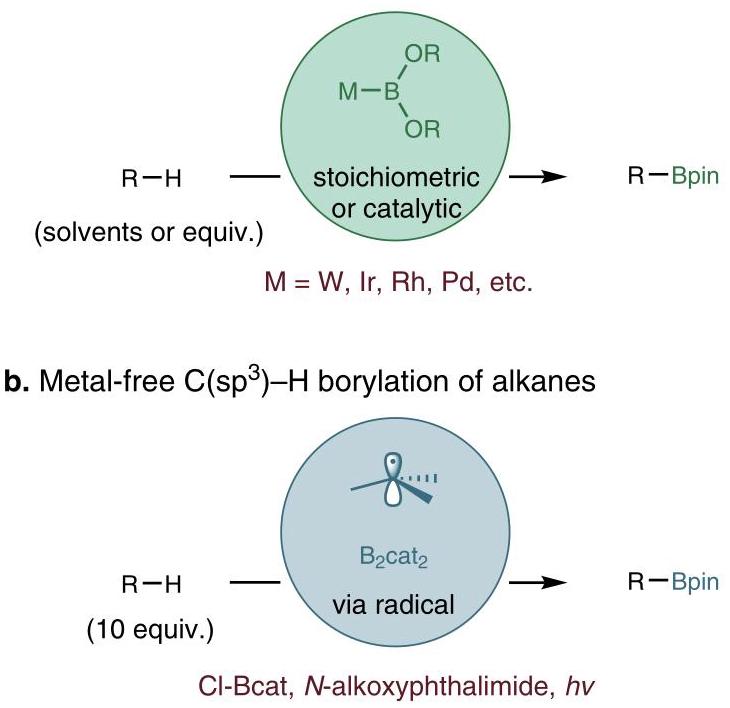
Fig. 1 Unactivated C(sp ${}^{3}$ )-H bonds borylation. Previously reported: a Transition metal catalyzed $\mathrm{C}\left( {\mathrm{{sp}}}^{3}\right) - \mathrm{H}$ borylation. b The metal-free photoinduced borylation of alkanes by Aggarwal group.
图1未活化的C(sp${}^{3}$)-H键硼化反应。先前报道的:a过渡金属催化的$\mathrm{C}\left( {\mathrm{{sp}}}^{3}\right) - \mathrm{H}$硼化反应。b阿加瓦尔课题组报道的无金属光诱导烷烃硼化反应。
In our previous studies, we focused on developing transition metal-free radical borylation reactions ${}^{{59} - {63}}$ . We therefore turned our interest towards the use of amidyl radicals for remote $\mathrm{C} - \mathrm{H}$ bond ( $\gamma$ -position of a carbonyl compound) borylation reaction (Fig. 2d). With a properly designed amidyl radical precursor that facilitates an intramolecular 1,5-HAT process, site-selective bor-ylation of $\gamma - \mathrm{C} - \mathrm{H}$ bond could be achieved. It is known that $\alpha - \mathrm{C} - \mathrm{H}$ bond and $\beta - \mathrm{C} - \mathrm{H}$ bond could be simply activated ${}^{64}$ . For the direct $\gamma - \mathrm{C} - \mathrm{H}$ functionalization, only a few of examples have been reported to date ${}^{{65} - {68}}$ . Thus, our research offers another significant aspect worthy of consideration. Here we present a method that does not require transition metals for the photoredox-catalyzed borylation of unreactive $\mathrm{C}\left( {\mathrm{{sp}}}^{3}\right) - \mathrm{H}$ bonds initiated through 1,5-HAT.
在我们之前的研究中,我们专注于开发无过渡金属的自由基硼化反应${}^{{59} - {63}}$。因此,我们将兴趣转向使用酰胺基自由基进行远程$\mathrm{C} - \mathrm{H}$键(羰基化合物的$\gamma$位)硼化反应(图2d)。通过设计得当的酰胺基自由基前体促进分子内1,5-HAT过程,可以实现$\gamma - \mathrm{C} - \mathrm{H}$键的位点选择性硼化。已知$\alpha - \mathrm{C} - \mathrm{H}$键和$\beta - \mathrm{C} - \mathrm{H}$键可以简单地被活化${}^{64}$。对于直接的$\gamma - \mathrm{C} - \mathrm{H}$官能化,迄今为止仅报道了少数例子${}^{{65} - {68}}$。因此,我们的研究提供了另一个值得考虑的重要方面。在此,我们提出一种方法,该方法在通过1,5-HAT引发的光氧化还原催化的未反应$\mathrm{C}\left( {\mathrm{{sp}}}^{3}\right) - \mathrm{H}$键硼化反应中不需要过渡金属。
Results and discussion
结果与讨论
Reaction optimization. Recently, visible-light photoredox catalysis has been the leading efficient access to $N$ -radicals under mild conditions. With their weak $\mathrm{N} - \mathrm{O}$ bond, hydroxylamine derivatives have recently been exploited as nitrogen-centered radical precursors in visible-light photocatalysis, given their higher oxidation state, it would be necessary to apply reductive conditions ${}^{{54},{55},{57}}$ . Thus,4-trifluoromethylbenzoyl hydroxamic acid derivative (1a) was used as the model substrate to establish optimal reaction parameters, including the equivalency of bis(catecholato) diboron $\left( {{\mathrm{B}}_{2}{\mathrm{{cat}}}_{2}}\right)$ , the choice of photocatalysts (Ir and Ru complexes, or organic photocatalysts), light sources, and additives (Table 1 and Supplementary Table 1 and Fig. 1). We investigated that with $\operatorname{Ir}{\left( p - {\mathrm{{CF}}}_{3}\mathrm{{ppy}}\right) }_{3}\left( {2\% }\right)$ as photocatalyst, ${40}\mathrm{\;W}{456}\mathrm{\;{nm}}$ light source, ${\mathrm{{Et}}}_{3}\mathrm{\;N}$ as additive, the desired product was obtained in 45% GC yield. Other amines, such as DABCO, DIPEA or no additive (entry 2-4), were tested, and DIPEA gave improved yield (47%), almost same yield was obtained with a longer reaction time $\left( {{30}\mathrm{\;h}}\right)$ (entry 5). Replacing photocatalyst to $\mathrm{{Ir}}{\left( \mathrm{{ppy}}\right) }_{3},\left\lbrack {\mathrm{{Ru}}{\left( \mathrm{{bpy}}\right) }_{3}}\right\rbrack {\mathrm{{Cl}}}_{2}$ , or 4CzIPN could not give the improved results (entry 6-8). Gratifyingly, the reaction gave 47% yield by using Eosin Y, which is a non transition metal photocatalyst, and importantly, much cheaper than $\operatorname{Ir}{\left( p - {\mathrm{{CF}}}_{3}\mathrm{{ppy}}\right) }_{3}$ (entry 9). Furthermore, We examined the influence of the light source. ${467}\mathrm{\;{nm}}$ wavelength LED turned out to be better than ${456}\mathrm{\;{nm}}$ LED, leading a jump increasing yield (from 47% to 73%, entry 10). Higher equivalent photocatalyst (5%) resulted in 77% yield (entry 11). Reducing the ${\mathrm{B}}_{2}{\mathrm{{cat}}}_{2}$ loading from 3.0 to 2.5 equiv. led to a slightly improved yield (81% GC yield, isolated in 73%), and 4.0 equiv. ${\mathrm{B}}_{2}{\mathrm{{cat}}}_{2}$ gave significantly lower yield (entry 13), which showed that the product yield is not always proportional to the equivalent of borylating reagent. Decreasing the loading of additive DIPEA, the yield dropped to 54% (entry 14). Control experiments revealed that no borylation product formed in the absence of photocatalyst, light or additive (entry 15-17). To rule out the potential for substrate thermal decomposition, we conducted a control experiment by replacing the light with heating at ${50}^{ \circ }\mathrm{C}$ for ${12}\mathrm{\;h}$ in the absence of light. However, no borylation product was detected under these conditions (entry 18). Continuous irradiation is necessary, as turning off the light after 30 min resulted in no product formation (entry 19). The standard reaction in air gave a 76% yield, indicating that the reaction is not sensitive to oxygen (entry 20).
反应优化。最近,可见光光氧化还原催化已成为在温和条件下高效生成$N$自由基的主要方法。鉴于其较弱的$\mathrm{N} - \mathrm{O}$键,羟胺衍生物最近被用作可见光光催化中以氮为中心的自由基前体,由于其较高的氧化态,有必要施加还原条件${}^{{54},{55},{57}}$。因此,4-三氟甲基苯甲酰羟肟酸衍生物(1a)被用作模型底物来确定最佳反应参数,包括双(邻苯二酚)二硼$\left( {{\mathrm{B}}_{2}{\mathrm{{cat}}}_{2}}\right)$的当量、光催化剂(铱和钌配合物或有机光催化剂)的选择、光源和添加剂(表1、补充表1和图1)。我们研究发现,以$\operatorname{Ir}{\left( p - {\mathrm{{CF}}}_{3}\mathrm{{ppy}}\right) }_{3}\left( {2\% }\right)$作为光催化剂、${40}\mathrm{\;W}{456}\mathrm{\;{nm}}$作为光源、${\mathrm{{Et}}}_{3}\mathrm{\;N}$作为添加剂时,目标产物的气相色谱产率为45%。测试了其他胺类,如DABCO、DIPEA或不添加添加剂(条目2 - 4),DIPEA的产率有所提高(47%),延长反应时间$\left( {{30}\mathrm{\;h}}\right)$时产率几乎相同(条目5)。将光催化剂换成$\mathrm{{Ir}}{\left( \mathrm{{ppy}}\right) }_{3},\left\lbrack {\mathrm{{Ru}}{\left( \mathrm{{bpy}}\right) }_{3}}\right\rbrack {\mathrm{{Cl}}}_{2}$或4CzIPN时,产率没有提高(条目6 - 8)。令人欣慰的是,使用非过渡金属光催化剂曙红Y时反应产率为47%,重要的是,它比$\operatorname{Ir}{\left( p - {\mathrm{{CF}}}_{3}\mathrm{{ppy}}\right) }_{3}$便宜得多(条目9)。此外,我们研究了光源的影响。${467}\mathrm{\;{nm}}$波长的发光二极管结果比${456}\mathrm{\;{nm}}$发光二极管更好,产率大幅提高(从47%提高到73%,条目10)。光催化剂当量提高到5%时产率为77%(条目11)。将${\mathrm{B}}_{2}{\mathrm{{cat}}}_{2}$的用量从3.0当量降至2.5当量,产率略有提高(气相色谱产率81% , 分离产率73%),而4.0当量的${\mathrm{B}}_{2}{\mathrm{{cat}}}_{2}$产率显著降低(条目13),这表明产物产率并不总是与硼化试剂的当量成正比。减少添加剂DIPEA的用量,产率降至54%(条目14)。对照实验表明,在没有光催化剂、光或添加剂的情况下不会形成硼化产物(条目15 - 17)。为排除底物热分解的可能性,我们进行了对照实验,在无光条件下于${50}^{ \circ }\mathrm{C}$加热${12}\mathrm{\;h}$来替代光照。然而,在这些条件下未检测到硼化产物(条目18)。持续照射是必要的,因为30分钟后关灯则不会生成产物(条目19)。在空气中进行的标准反应产率为76%,表明该反应对氧气不敏感(条目20)。
a. Hofmann-Loffler-Freytag (HLF) reaction
a. 霍夫曼 - 洛夫勒 - 弗雷泰格(HLF)反应
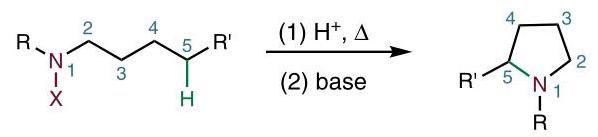
b. $\mathrm{C}\left( {\mathrm{{sp}}}^{3}\right) - \mathrm{H}$ functionalization by oxidative photocatalytic generation of amidyl radicals
b. 通过氧化光催化生成酰胺基自由基实现$\mathrm{C}\left( {\mathrm{{sp}}}^{3}\right) - \mathrm{H}$官能化
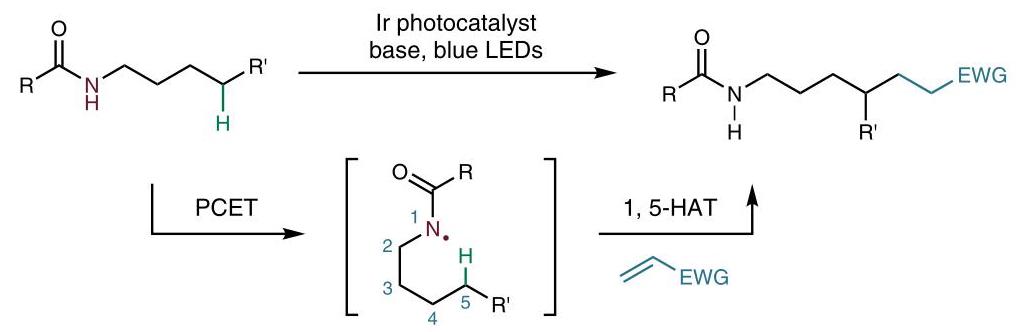
c. $\mathrm{C}\left( {\mathrm{{sp}}}^{3}\right) - \mathrm{H}$ functionalization by amidyl radical precursors
c. 通过酰胺基自由基前体实现$\mathrm{C}\left( {\mathrm{{sp}}}^{3}\right) - \mathrm{H}$官能化
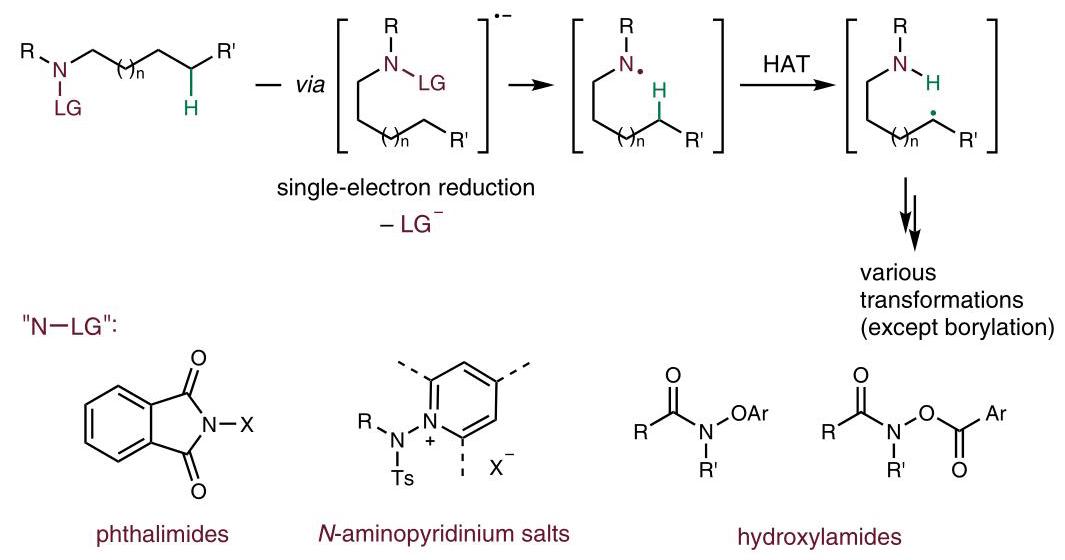
d. Carbonyl compounds $\gamma - \mathrm{C}\left( {\mathrm{{sp}}}^{3}\right) - \mathrm{H}$ borylation by amidyl radical precursors
d. 羰基化合物通过酰胺基自由基前体进行硼化反应$\gamma - \mathrm{C}\left( {\mathrm{{sp}}}^{3}\right) - \mathrm{H}$
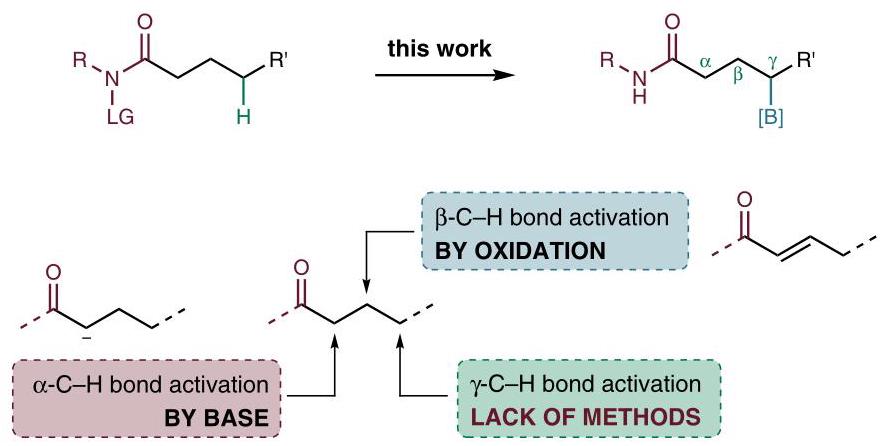
Fig. 2 HLF type remote C-H functionalization reactions. a HLF reaction. b C(sp ${}^{3}$ )-H functionalization via amidyl radical by Knowles and Rovis group independently. c C(sp ${}^{3}$ ) -H functionalization by amidyl radical precursors. “N-LG” showed some of the precursors. d This work: carbonyl compounds $\gamma$ - $\mathrm{C}\left( {\mathrm{{sp}}}^{3}\right) - \mathrm{H}$ borylation.
图2 HLF型远程C-H官能团化反应。a HLF反应。b Knowles和Rovis课题组分别通过酰胺基自由基进行的C(sp${}^{3}$)-H官能团化反应。c 酰胺基自由基前体进行的C(sp${}^{3}$)-H官能团化反应。“N-LG”展示了部分前体。d 本工作:羰基化合物$\gamma$ - $\mathrm{C}\left( {\mathrm{{sp}}}^{3}\right) - \mathrm{H}$硼化反应
Table 1 Optimization of reaction conditions ${}^{a}$ .
表1 反应条件${}^{a}$的优化
| Entry | ${\mathrm{B}}_{2}{\mathrm{{cat}}}_{2}$ | PC (mol%) | Light | Additive | Yielda, b(%) |
| 1 | 3.0 | Ir ${\left( p - {\mathrm{{CF}}}_{3}\mathrm{{ppy}}\right) }_{3}$ (2 mol%) | 456 nm | Et ${}_{3}\mathrm{N}$ (2.0) | 45 |
| 2 | 3.0 | Ir ${\left( p - {\mathrm{{CF}}}_{3}\mathrm{{ppy}}\right) }_{3}$ (2 mol%) | 456 nm | DABCO (2.0) | 15 |
| 3 | 3.0 | Ir ${\left( p - {\mathrm{{CF}}}_{3}\mathrm{{ppy}}\right) }_{3}\left( {2\mathrm{\;{mol}}\% }\right)$ | 456 nm | DIPEA (2.0) | 47 |
| 4 | 3.0 | Ir( $p - {\mathrm{{CF}}}_{3}$ ppy) ${}_{3}$ (2 mol%) | 456 nm | none | trace |
| 5° | 3.0 | Ir( $p - {\mathrm{{CF}}}_{3}$ ppy) ${}_{3}$ (2 mol%) | 456 nm | DIPEA (2.0) | 49 |
| 6 | 3.0 | Ir(ppy)3 (2 mol%) | 456 nm | DIPEA (2.0) | 30 |
| 7 | 3.0 | [Ru(bpy) ${\mathrm{{Cl}}}_{2}$ (2 mol%) | 456 nm | DIPEA (2.0) | trace |
| 8 | 3.0 | 4CzIPN (2 mol%) | 456 nm | DIPEA (2.0) | trace |
| 9 | 3.0 | Eosin Y (2 mol%) | 456 nm | DIPEA (2.0) | 47 |
| 10 | 3.0 | Eosin Y (2 mol%) | 467 nm | DIPEA (2.0) | 73 |
| 11 | 3.0 | Eosin Y (5 mol%) | 467 nm | DIPEA (2.0) | 77 |
| 12 | 2.5 | Eosin Y (5 mol%) | 467 nm | DIPEA (2.0) | 81 (73) |
| 13 | 4.0 | Eosin Y (5 mol%) | 467 nm | DIPEA (2.0) | 40 |
| 14 | 2.5 | Eosin Y (5 mol%) | 467 nm | DIPEA (1.5) | 54 |
| 15 | 2.5 | None | 467 nm | DIPEA (2.0) | trace |
| 16 | 2.5 | Eosin Y (5 mol%) | none | DIPEA (2.0) | trace |
| 17 | 2.5 | Eosin Y (5 mol%) | 467 nm | None | trace |
| 18d | 2.5 | Eosin Y (5 mol%) | none | DIPEA (2.0) | trace |
| 19e | 2.5 | Eosin Y (5 mol%) | 467 nm | DIPEA (2.0) | trace |
| 20f | 2.5 | Eosin Y (5 mol%) | 467 nm | DIPEA (2.0) | 76 |
| ${}^{a}$ Reactions run on 0.2 mmol scale, using Kessil 40 W blue LED as light source. ${}^{b}$ GC-fid yields are measured by using decane as an internal standard. The yield in bracket is isolated yield. CThe reaction time is 30 h | |||||
${}^{d}{50}^{ \circ }\mathrm{C}$ for ${12}\mathrm{\;h}$ , in the dark.
${}^{d}{50}^{ \circ }\mathrm{C}$用于${12}\mathrm{\;h}$,在黑暗中
eTurned off the light after ${30}\mathrm{\;{min}}$ .
e 在${30}\mathrm{\;{min}}$后关闭灯光
fThe reaction was set up in air.
f 反应在空气中进行
Subtrate scope. With the optimal reaction conditions, we next sought to explore the substrate scope of this visible light photoredox-catalyzed remote $\mathrm{C}\left( {\mathrm{{sp}}}^{3}\right) - \mathrm{H}$ borylation. As summarized in Fig. 3, a variety of hydroxamic acid derivatives were synthesized and tested. The reactions of the substrates with tertiary $\mathrm{C} - \mathrm{H}$ bonds in the $\gamma$ -position all gave borylation products in good to excellent yields (2a-2d), while the reactions of the substrate possessing secondary $\mathrm{C} - \mathrm{H}$ bonds could also afford moderate yield (2e, 2h-2j). Substrates containing tertiary $\mathrm{C} - \mathrm{H}$ bond in cyclic structure were also tested, and cyclopentyl (2f) and cyclohexyl (2g) products were formed in 83% and 58%, respectively. Specially, we found that this method can activate secondary $\mathrm{C}\left( {\mathrm{{sp}}}^{3}\right) - \mathrm{H}$ bonds in cyclic substrates, producing the corresponding syn product $2\mathbf{h}$ with excellent diastereoselectivity. Moreover, for bicyclic substrate which have more than one $\gamma$ -positions, such as norbornyl derivative, high site-selectivity was obtained (2i, 65%; 2j, 64%) (as indicated by NMR NOE test, see Supplementary Data 2 Figs. 1-3 for details). With the replacement of tertbutyl group to isopropyl group or cyclohexyl group, the substrates can undergo the desired transformation to form borylation products in moderate to good yields (2k-2o), albeit the undesired hydrogenation by-products accompanied. It may cause by replacing the $N$ -connected alkyl group from tertiary one to secondary one, which weakens the $\mathrm{N} - \mathrm{H}$ bond, and the 1,5-HAT process was affected thermodynamically (vide infra, a DFT calculation was performed). Interestingly, we found that a benzene ring can be involved in this six-membered ring 1,5-HAT process, as exemplified in the cases of (2p-2u). For isolation of these products, we found the partial instability of the benzylic pinacol boronic esters in silica gel, and that in situ oxidation with ${\mathrm{H}}_{2}{\mathrm{O}}_{2}$ allowed isolation of the corresponding alcohols in high yields. Various functional groups such as methyl(2q), methoxy (2r), chlorine (2s) and bromine (2t) were well tolerated, and the yields were up to 92%. For secondary benzylic substrates(2u) or benzylic position on the carbon chain substrates(2v-2w), the products were obtained in good yields. $\alpha$ -hydroxy hydroxamic acids derivatives were also tested, including methoxy (2x), acetoxy (2y). Amino acid leucine-derived hydroxamic acid also underwent this remote borylation, giving the desired product in 45% (2z). Our method can also work on complex molecules, such as lithocholic acid and dehy-droabietylamine derivatives (in the cases of 2aa and 2ab). It is worth noting that the last example (2ab) in the substrate scope is a different type other than the rest ones. The borylation of $\mathrm{C} - \mathrm{H}$ bond took place on the alkyl chain of the amine site.
底物范围。在优化的反应条件下,我们接下来探索这种可见光光氧化还原催化的远程$\mathrm{C}\left( {\mathrm{{sp}}}^{3}\right) - \mathrm{H}$硼化反应的底物范围。如图3所示,合成并测试了多种异羟肟酸衍生物。在$\gamma$位带有叔$\mathrm{C} - \mathrm{H}$键的底物反应均能以良好至优异的产率得到硼化产物(2a - 2d),而带有仲$\mathrm{C} - \mathrm{H}$键的底物反应也能得到中等产率(2e,2h - 2j)。还测试了环状结构中含有叔$\mathrm{C} - \mathrm{H}$键的底物,环戊基(2f)和环己基(2g)产物的产率分别为83%和58%。特别地,我们发现该方法可以活化环状底物中的仲$\mathrm{C}\left( {\mathrm{{sp}}}^{3}\right) - \mathrm{H}$键,以优异的非对映选择性生成相应的顺式产物$2\mathbf{h}$。此外,对于具有多个$\gamma$位的双环底物,如降冰片基衍生物,可获得高的位点选择性(2i,65%;2j,64%)(通过核磁共振NOE测试表明,详细内容见补充数据2图1 - 3)。用异丙基或环己基取代叔丁基后,底物可以发生预期的转化,以中等至良好的产率形成硼化产物(2k - 2o),尽管伴有不需要的氢化副产物。这可能是由于将与$N$相连的烷基从叔烷基变为仲烷基,削弱了$\mathrm{N} - \mathrm{H}$键,并且1,5 - HAT过程在热力学上受到影响(见下文,进行了DFT计算)。有趣的是,我们发现苯环可以参与这个六元环1,5 - HAT过程,如(2p - 2u)的情况所示。为了分离这些产物,我们发现苄基频哪醇硼酸酯在硅胶中部分不稳定,并且用${\mathrm{H}}_{2}{\mathrm{O}}_{2}$原位氧化可以高产率地分离出相应的醇类。各种官能团如甲基(2q)、甲氧基(2r)、氯(2s)和溴(2t)都能很好地耐受,产率高达92%。对于仲苄基底物(2u)或碳链底物上的苄基位置(2v - 2w),产物以良好的产率得到。$\alpha$ - 羟基异羟肟酸衍生物也进行了测试,包括甲氧基(2x)、乙酰氧基(2y)。氨基酸亮氨酸衍生的异羟肟酸也能进行这种远程硼化反应,以45%的产率得到所需产物(2z)。我们的方法也适用于复杂分子,如石胆酸和脱氢枞胺衍生物(在2aa和2ab的情况下)。值得注意的是,底物范围中的最后一个例子(2ab)与其他例子是不同类型。$\mathrm{C} - \mathrm{H}$键的硼化反应发生在胺位点的烷基链上。
Mechanistic studies. To gain further insight into the mechanism of this 1,5-HAT borylation reaction, we performed a series of mechanistic investigations. First, 2,2,6,6-tetramethyl-1-piper-idinyloxy (TEMPO) was added to standard conditions, and the reaction yielded 16% of the corresponding TEMPO-trapped product 3 as a white solid, instead of the desired borylation product (Fig. 4a). Second, we designed and managed to synthesize the remote cyclopropyl substrate lac, and the reaction of lac in standard conditions gave the ring-opened terminal borylation product in 32% yield (Fig. 4b). These two experiments indicated the involvement of carbon radical intermediates in this borylation reaction. The photocatalyst Eosin Y was found to be the only absorbing species in the reaction near the excitation wavelength $\left( {{\lambda }_{\max } = {467}\mathrm{\;{nm}}}\right)$ from ultraviolet-visible absorption spectroscopy (Fig. 4c and Supplementary Fig. 2). To determine whether the reaction involves an efficient radical chain mechanism, we performed a light on- off experiment showing no product formation in the dark phases (Fig. 4d and Supplementary Table 2 and Fig. 3).
机理研究。为了更深入地了解这种1,5-氢原子转移硼化反应的机理,我们进行了一系列机理研究。首先,将2,2,6,6-四甲基-1-哌啶氧基(TEMPO)添加到标准条件下,反应生成了16%的相应TEMPO捕获产物3,为白色固体,而不是所需的硼化产物(图4a)。其次,我们设计并成功合成了远程环丙基底物lac,lac在标准条件下的反应得到了开环末端硼化产物,产率为32%(图4b)。这两个实验表明碳自由基中间体参与了该硼化反应。通过紫外-可见吸收光谱发现,光催化剂曙红Y是反应中在激发波长$\left( {{\lambda }_{\max } = {467}\mathrm{\;{nm}}}\right)$附近唯一的吸收物种(图4c和补充图2)。为了确定该反应是否涉及有效的自由基链机制,我们进行了光开关实验,结果表明在黑暗阶段没有产物生成(图4d和补充表2以及图3)。
In recent days, the Chechik group reported a new type of radical scavenger called CHANT to detect short-lived radical intermediates (Supplementary Fig. 4) ${}^{69}$ . In this method, the radical trapping product is a bench-stable terminal alkene that can be analyzed by mass spectrometry (MS). To further testify the 1,5-HAT process, we chose CHANT as radical trapping reagent, and carried out the reaction in standard conditions (Fig. 5). The trapped radicals were then analyzed by electrospray ionization HRMS (Supplementary Tables 3, 4 and Figs. 5-7). The MS peak at $\mathrm{m}/\mathrm{z}{337.2849}$ indicates the trapped radical intermediates, whereas it cannot distinguish the nitrogen-centered radical R1 or the carbon-centered radical R2, since they are isomers. In order to distinguish them, the tandem mass spectrometry was analyzed at m/z 337.2849, the two low-intensity peaks F1 (m/z 237.1961) and F2 (m/z 181.1336) which contain two nitrogen atoms, could only be attributed to the trapped R1, the fragments showed that the acyl group RCO was dissociated. The most strong-intensity peaks F3 (m/z 264.1957) is a stable acylium ions, and F4 (m/z 236.2008) is F3 losing CO. They could only be attributed to the trapped R2, and many other strong peaks could also be attributed to it (see Supplementary Table 4 for details). This experiment proved that the existence of R1 and R2. The intensity of the trapped R2 is 100 times greater than the trapped R1. Assuming a similar ionization efficiency of the trapped R1 and R2 species, this suggests that the 1,5-HAT process is very fast and that the carbon-centered radical R2 is the resting state for this radical process.
最近,切奇克小组报道了一种新型的自由基清除剂CHANT,用于检测短寿命自由基中间体(补充图4)${}^{69}$。在该方法中,自由基捕获产物是一种易于处理的稳定末端烯烃,可通过质谱(MS)进行分析。为了进一步验证1,5-氢原子转移过程,我们选择CHANT作为自由基捕获试剂,并在标准条件下进行反应(图5)。然后通过电喷雾电离高分辨质谱对捕获的自由基进行分析(补充表3、4以及图5 - 7)。$\mathrm{m}/\mathrm{z}{337.2849}$处的质谱峰表明存在捕获的自由基中间体,然而它无法区分以氮为中心的自由基R1或碳为中心的自由基R2,因为它们是异构体。为了区分它们,在m/z 337.2849处进行串联质谱分析,两个含有两个氮原子的低强度峰F1(m/z 237.1,961)和F2(m/z 181.1336)只能归因于捕获的R1,碎片显示酰基RCO已解离。最强强度的峰F3(m/z 264.1957)是稳定的酰鎓离子,F4(m/z 236.2008)是F3失去CO。它们只能归因于捕获的R2,许多其他强峰也可归因于它(详细信息见补充表4)。该实验证明了R1和R2的存在。捕获的R2的强度比捕获的R1大100倍。假设捕获的R1和R2物种具有相似的电离效率,这表明1,5-氢原子转移过程非常快,并且碳中心自由基R2是该自由基过程的稳态。
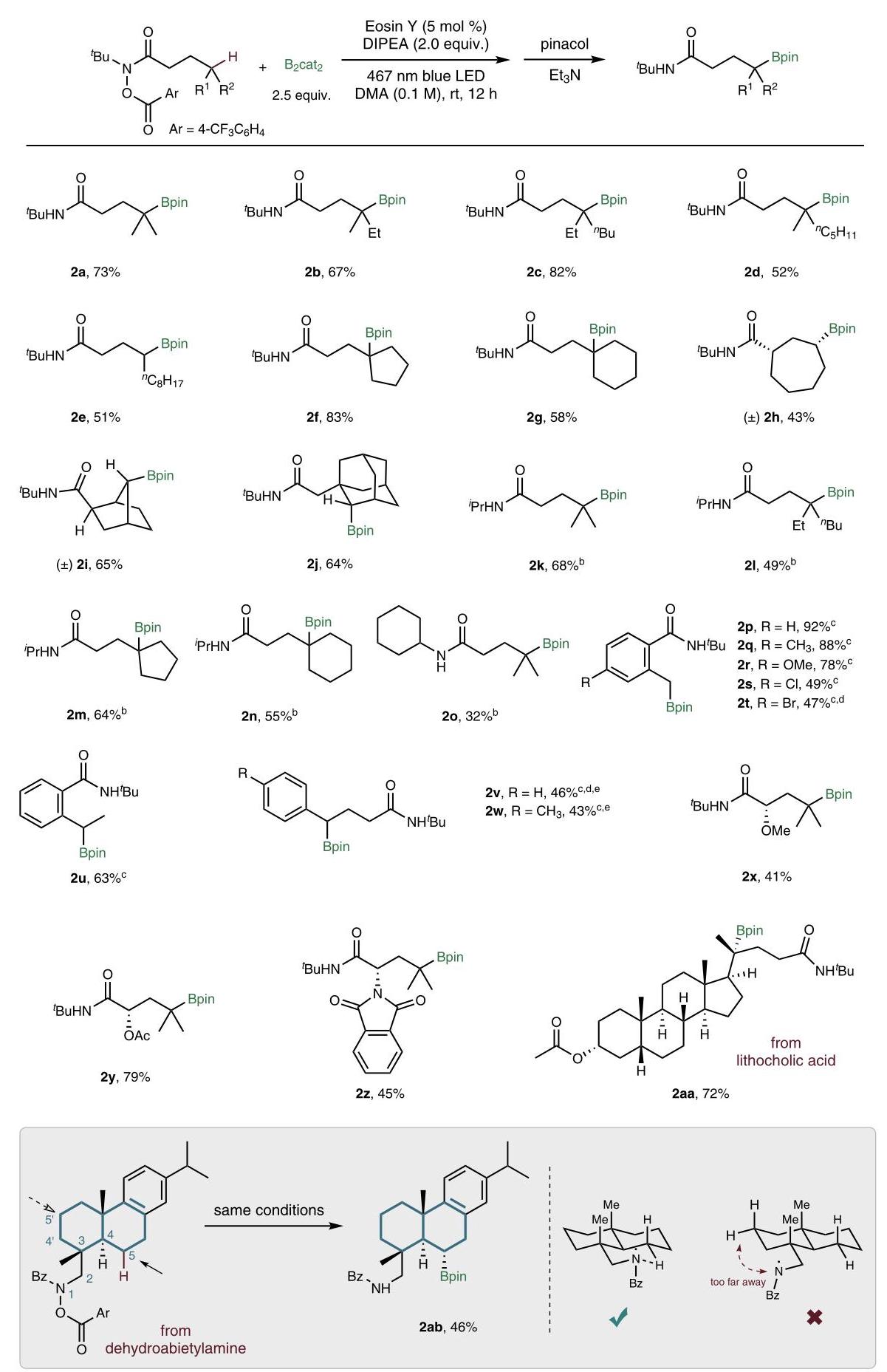
Fig. 3 Substrate scope. a Reaction conditions: substrate (0.3 mmol), B2cat (0.75 mmol), Eosin Y (5%), DMA (3 mL), DIPEA (0.6 mmol), irradiated by Kessil 40 W blue LED for 12 h, then with pinacol (4.0 equiv.) and Et ${}_{3}\mathrm{\;N}$ (1 mL); b Products were formed as mixtures of borylation product and hydrogenation side product; c Yields were of isolated products after in-situ oxidation with hydrogen peroxide (4.0 equiv.); d’H NMR yield was reported. e Reaction time was ${24}\mathrm{\;h}$ .
图3底物范围。a反应条件:底物(0.3 mmol),B2cat(0.75 mmol),曙红Y(5%),DMA(3 mL),DIPEA(0.6 mmol),用Kessil 40 W蓝色LED照射12 h,然后加入频哪醇(4.0当量)和Et${}_{3}\mathrm{\;N}$(1 mL);b产物以硼化产物和氢化副产物的混合物形式形成;c产率为用过氧化氢(4.0当量)原位氧化后分离产物的产率;d’H NMR产率已报道。e反应时间为${24}\mathrm{\;h}$。
a. Radical trapping with TEMPO
a. 用TEMPO进行自由基捕获
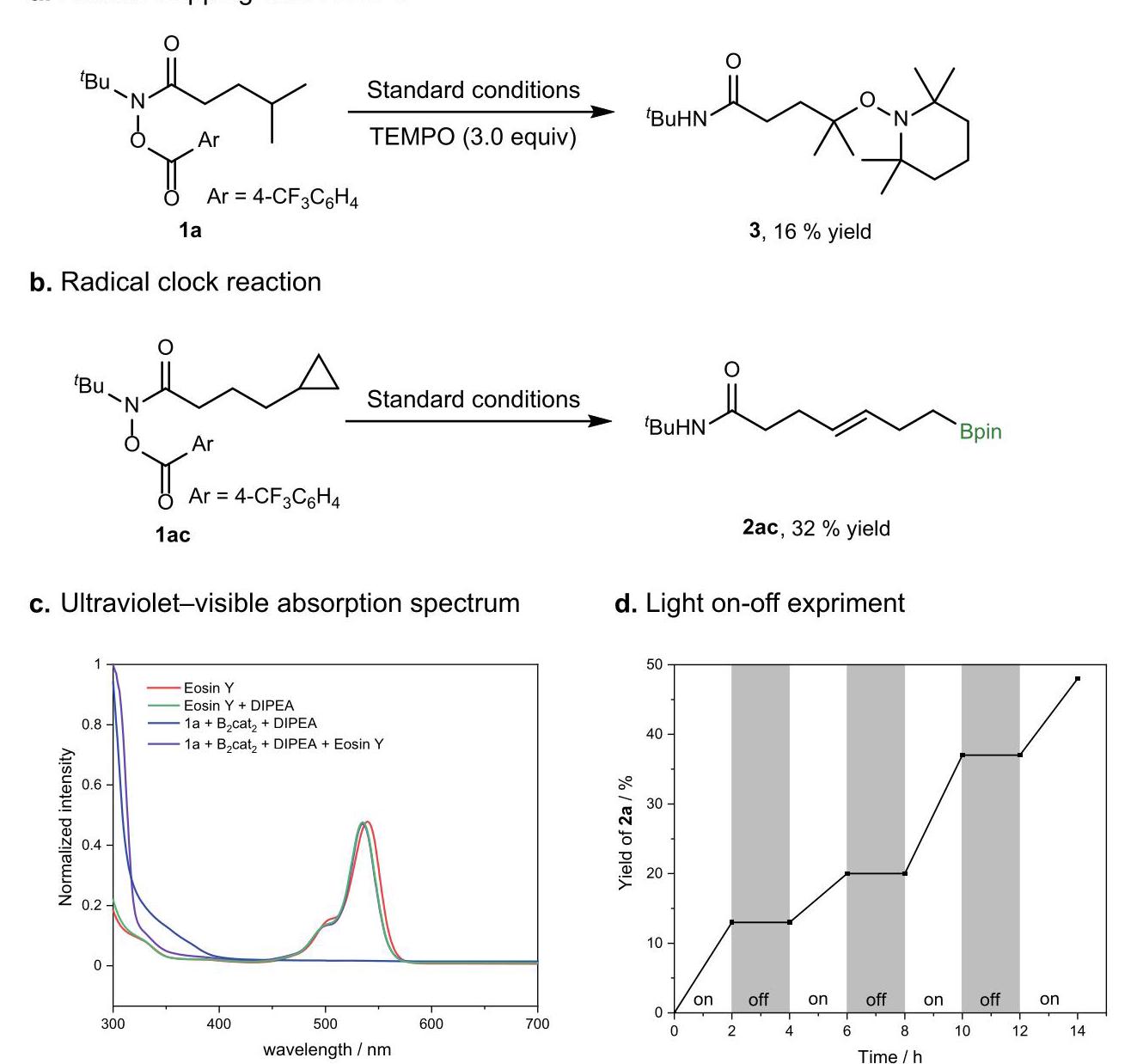
Fig. 4 Mechanistic studies. a The standard reaction with TEMPO (3.0 equiv.) as a radical scavenger. b Radical clock ring-opening reaction of 1ac. c In the ultraviolet-visible absorption spectrum, the photocatalyst Eosin Y was found to be the only absorbing species in the reaction near the excitation wavelength $\left( {{\lambda }_{\max } = {467}\mathrm{\;{nm}}}\right) \cdot \mathbf{d}$ The light on-off expriment showed no product formation in dark.
图4机理研究。a以TEMPO(3.0当量)作为自由基清除剂的标准反应。b 1ac的自由基钟开环反应。c在紫外-可见吸收光谱中,发现光催化剂曙红Y是反应中在激发波长$\left( {{\lambda }_{\max } = {467}\mathrm{\;{nm}}}\right) \cdot \mathbf{d}$附近唯一的吸收物种。光开关实验表明在黑暗中没有产物生成。
To better understand the photoredox mechanism of this 1,5- HAT process, we carried out density functional theory (DFT) calculations (see Supplementary Information section 6 for details). The computed free energy profile of the key steps in the photo irradiation process is shown in Fig. 6. Eosin Y transfers from ground state ${\mathrm{{EY}}}^{2 - }$ to excited singlet state ${\left\lbrack {\mathrm{{EY}}}^{2 - }\right\rbrack }^{ * }$ (S1) upon being irradiated with the vertical excitation energy of $+ {65.7}\mathrm{{kcal}}{\mathrm{{mol}}}^{-1}$ (equals to ${2.8}\mathrm{{eV}}$ , corresponds to the energy of ${442}\mathrm{\;{nm}}$ wavelength light) ${}^{{70} - {72}}$ . Then this singlet state transforms to its more stable triplet counterpart ${\left\lbrack {\mathrm{{EY}}}^{2 - }\right\rbrack }^{ * }{\left( \mathrm{\;T}1\right) }^{73}$ . Next, this triplet state species is oxidatively quenched by $\mathbf{{1a}}$ to give ${\mathrm{{EY}}}^{ - }$ and $1{a}^{ - }$ , which further undergoes $\mathrm{N} - \mathrm{O}$ bond cleavage to form a nitrogen-centered radical, accompanied with the leaving of ${\mathrm{{CF}}}_{3}{\mathrm{C}}_{6}{\mathrm{H}}_{4}{\mathrm{{CO}}}_{2}^{ - }$ group. The $\mathrm{N}$ _radical overcomes a relatively low barrier $\left( {{7.7}\mathrm{{kcal}}{\mathrm{{mol}}}^{-1}}\right)$ to the six-member ring transition state HAT_TS, which allows the hydrogen atom to transfer from $C$ atom to $N$ atom to give the C_radical, this step is quite favorable thermodynamically. Subsequently, the C_radical is borylated by diboron to give the desired product ${}^{59}$ .
为了更好地理解这种1,5-氢原子转移(HAT)过程的光氧化还原机理,我们进行了密度泛函理论(DFT)计算(详细信息见补充信息第6节)。光照射过程中关键步骤的计算自由能剖面图如图6所示。曙红Y在受到垂直激发能为$+ {65.7}\mathrm{{kcal}}{\mathrm{{mol}}}^{-1}$(等于${2.8}\mathrm{{eV}}$,对应于${442}\mathrm{\;{nm}}$波长光的能量)的照射后,从基态${\mathrm{{EY}}}^{2 - }$转移到激发单重态${\left\lbrack {\mathrm{{EY}}}^{2 - }\right\rbrack }^{ * }$(S1)${}^{{70} - {72}}$。然后这个单重态转变为更稳定的三重态${\left\lbrack {\mathrm{{EY}}}^{2 - }\right\rbrack }^{ * }{\left( \mathrm{\;T}1\right) }^{73}$。接下来,这个三重态物种被$\mathbf{{1a}}$氧化淬灭,生成${\mathrm{{EY}}}^{ - }$和$1{a}^{ - }$,后者进一步发生$\mathrm{N} - \mathrm{O}$键断裂,形成一个以氮为中心的自由基,同时伴随着${\mathrm{{CF}}}_{3}{\mathrm{C}}_{6}{\mathrm{H}}_{4}{\mathrm{{CO}}}_{2}^{ - }$基团的离去。$\mathrm{N}$自由基克服了一个相对较低的能垒$\left( {{7.7}\mathrm{{kcal}}{\mathrm{{mol}}}^{-1}}\right)$,到达六元环过渡态HAT_TS,这使得氢原子从$C$原子转移到$N$原子,生成C自由基,这一步在热力学上非常有利。随后,C自由基被双硼硼化,得到所需产物${}^{59}$。
As shown in substrate scope studies, it is noted that the borylation reactivity is in a order of tertiary $\mathrm{C} - \mathrm{H}$ bond substrates > secondary ones > primary ones. For tertiary $\mathrm{C} - \mathrm{H}$ bond substrates, the reactivity of the $N$ -tert-butyl substituted ones are better than that of the $N$ -isopropyl ones. To further elucidate these reactivity patterns, we calculated the standard Gibbs free energy and the activation Gibbs free energy in the process of 1,5- HAT of radicals I to IV (Table 2 and Supplementary Tables 5-7). Our results indicate that the tertiary $\mathrm{C} - \mathrm{H}$ bonds are the most thermodynamically and dynamically favorable for 1,5-HAT process, due to the more stability effect of $\sigma - p$ hyperconjugation. When replacing tertbutyl with isopropyl in tertiary $\mathrm{C} - \mathrm{H}$ bond substrates, the activation energy raises from 7.7 to ${10.8}\mathrm{{kcal}}{\mathrm{{mol}}}^{-1}$ (IV), leading to the formation of a certain amount of hydrogenation product.Similar behavior was observed for secondary $\mathrm{C} - \mathrm{H}$ bond substrates, where the activation energy increases from 7.7 to ${10.4}\mathrm{{kcal}}{\mathrm{{mol}}}^{-1}$ (II). For the primary $\mathrm{C} - \mathrm{H}$ bond substrates, the barrier is ${13.1}\mathrm{{kcal}}{\mathrm{{mol}}}^{-1}$ (I), the reaction all gave hydrogenation products and no borylation products were obtained.
如底物范围研究所示,值得注意的是,硼化反应活性顺序为叔$\mathrm{C} - \mathrm{H}$键底物>仲底物>伯底物。对于叔$\mathrm{C} - \mathrm{H}$键底物,$N$-叔丁基取代的底物的反应活性优于$N$-异丙基取代的底物。为了进一步阐明这些反应活性模式,我们计算了自由基I至IV的1,5-HAT过程中的标准吉布斯自由能和活化吉布斯自由能(表2和补充表5-7)。我们的结果表明,叔$\mathrm{C} - \mathrm{H}$键在热力学和动力学上对1,5-HAT过程最为有利,这是由于$\sigma - p$超共轭的稳定性效应更强。当在叔$\mathrm{C} - \mathrm{H}$键底物中用异丙基取代叔丁基时,活化能从7.7升高到${10.8}\mathrm{{kcal}}{\mathrm{{mol}}}^{-1}$(IV),导致形成一定量的氢化产物。对于仲$\mathrm{C} - \mathrm{H}$键底物也观察到了类似的行为,其中活化能从7.7增加到${10.4}\mathrm{{kcal}}{\mathrm{{mol}}}^{-1}$(II)。对于伯$\mathrm{C} - \mathrm{H}$键底物,能垒为${13.1}\mathrm{{kcal}}{\mathrm{{mol}}}^{-1}$(I),反应均生成氢化产物,未得到硼化产物。
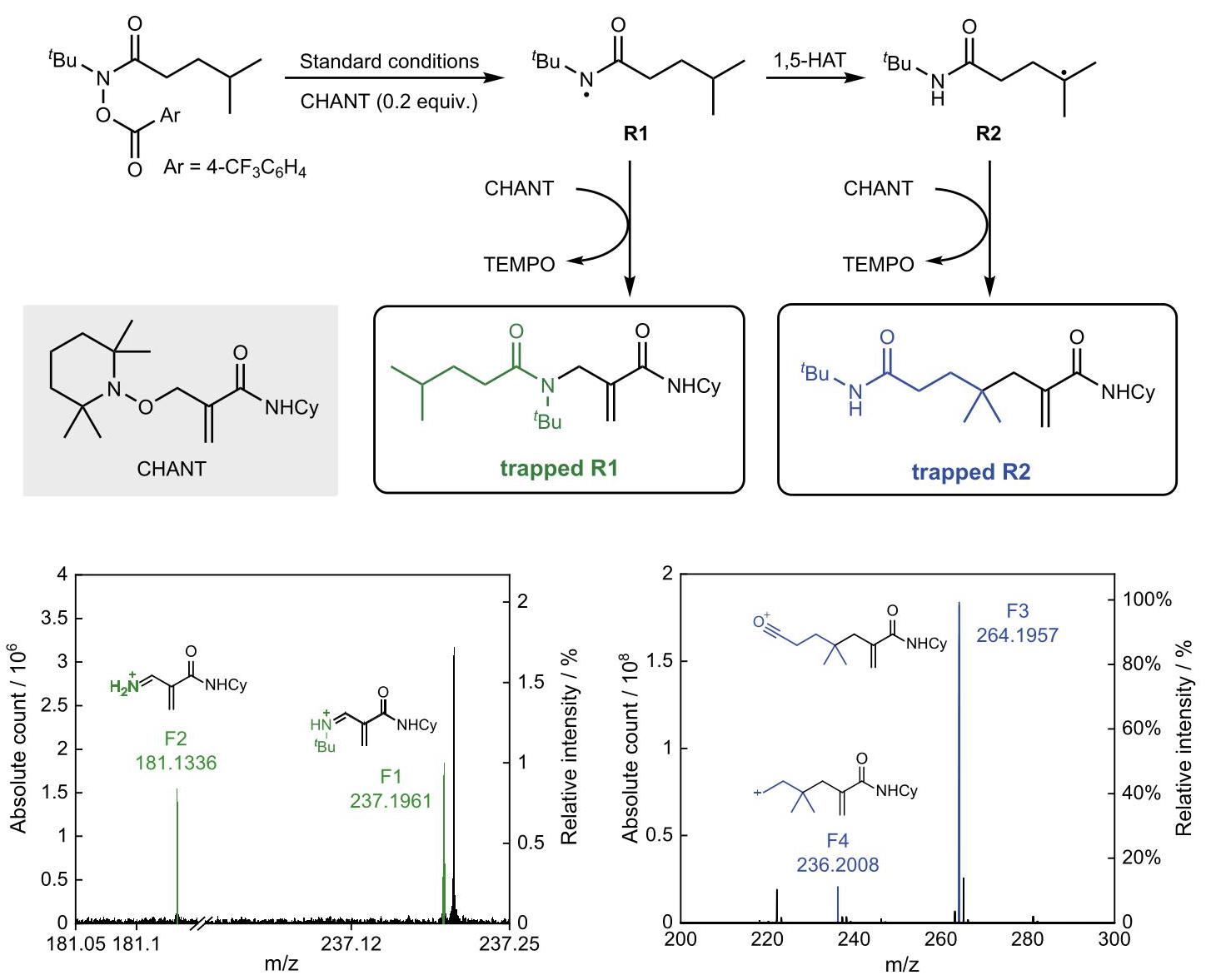
Fig. 5 The radical trapping experiment with CHANT and MS analysis. R1: carbon-centered radical. R2: nitrogen-centered radical. Trapped R1: R1 trapped by CHANT. Trapped R2: R2 trapped by CHANT. CHANT: N-cyclohexyl-2-[(2,2,6,6-tetramethylpiperidin-1-yl)oxy]methylacrylamide. Cy = cyclohexyl. The fragments F1 and F2 were attributed to trapped R1; The fragments F3 and F4 were attributed to trapped R2.
图5 使用CHANT进行的自由基捕获实验和质谱分析。R1:碳中心自由基。R2:氮中心自由基。捕获的R1:被CHANT捕获的R1。捕获的R2:被CHANT捕获的R2。CHANT:N-环己基-2-[(2,2,6,6-四甲基哌啶-1-基)氧基]甲基丙烯酰胺。Cy = 环己基。碎片F1和F2归因于捕获的R1;碎片F3和F4归因于捕获的R2。
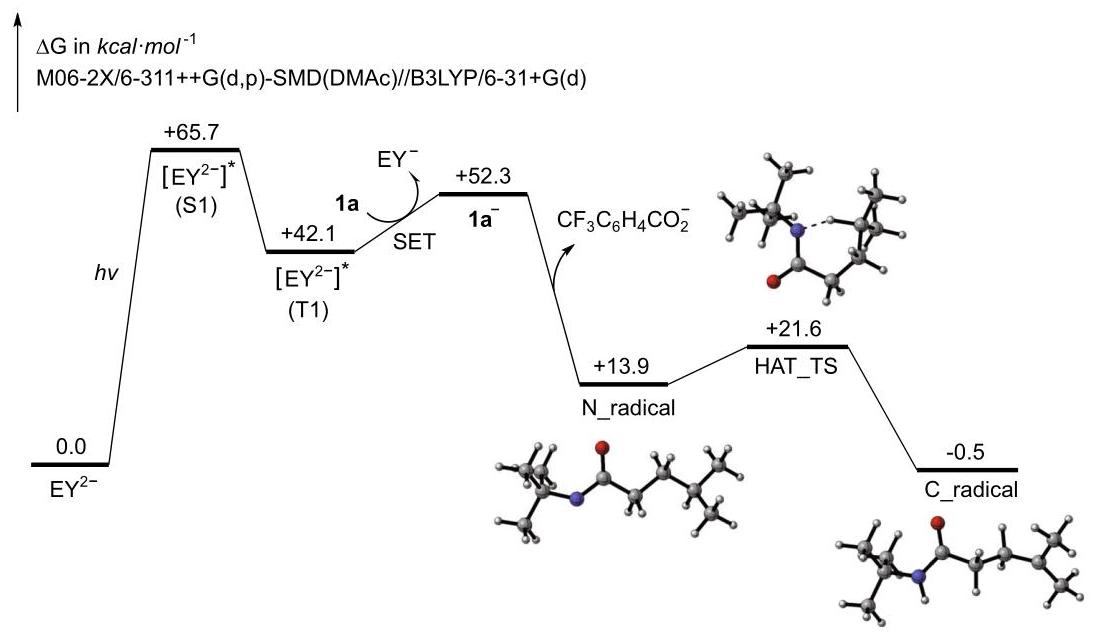
Fig. 6 DFT-computed pathways for the generation of the N-centered radical and 1,5-HAT process. 1a is reducted by EY ${}^{2 - }{\left( \mathrm{\top }\right) }^{ \star }$ to give 1a ${}^{ - }$ , followed the leaving of ${\mathrm{{CF}}}_{3}{\mathrm{C}}_{6}{\mathrm{H}}_{4}{\mathrm{{CO}}}_{2}^{ - }$ group, which is thermodynamically favorable. The N_radical overcomes a relatively low barrier (7.7 kcal · mol ${}^{-1}$ ) to give C_radical. The Gaussian O9 level of M06-2X/6-311++G(d, p)-SMD(DMAc)//B3LYP/6-31+G(d) was used.
图6 用于生成氮中心自由基和1,5-HAT过程的DFT计算路径。1a被EY ${}^{2 - }{\left( \mathrm{\top }\right) }^{ \star }$还原得到1a ${}^{ - }$,随后${\mathrm{{CF}}}_{3}{\mathrm{C}}_{6}{\mathrm{H}}_{4}{\mathrm{{CO}}}_{2}^{ - }$基团离去,这在热力学上是有利的。氮自由基克服相对较低的势垒(7.7 kcal·mol ${}^{-1}$)得到碳自由基。使用了高斯O9水平的M06-2X/6-311++G(d, p)-SMD(DMAc)//B3LYP/6-31+G(d)。
Table 2 The correlation between the type of remote $\mathrm{C} - \mathrm{H}$ bonds and reaction parameters.
表2 远程$\mathrm{C} - \mathrm{H}$键的类型与反应参数之间的相关性。
| kcal mol-1 | 1 | II | III | IV |
| $\Delta {\mathrm{G}}^{\Theta }$ | -8.3 | -12.2 | -14.4 | -14.7 |
| $\Delta {\mathrm{G}}^{ \ddagger }$ | 13.1 | 10.4 | 7.7 | 10.8 |
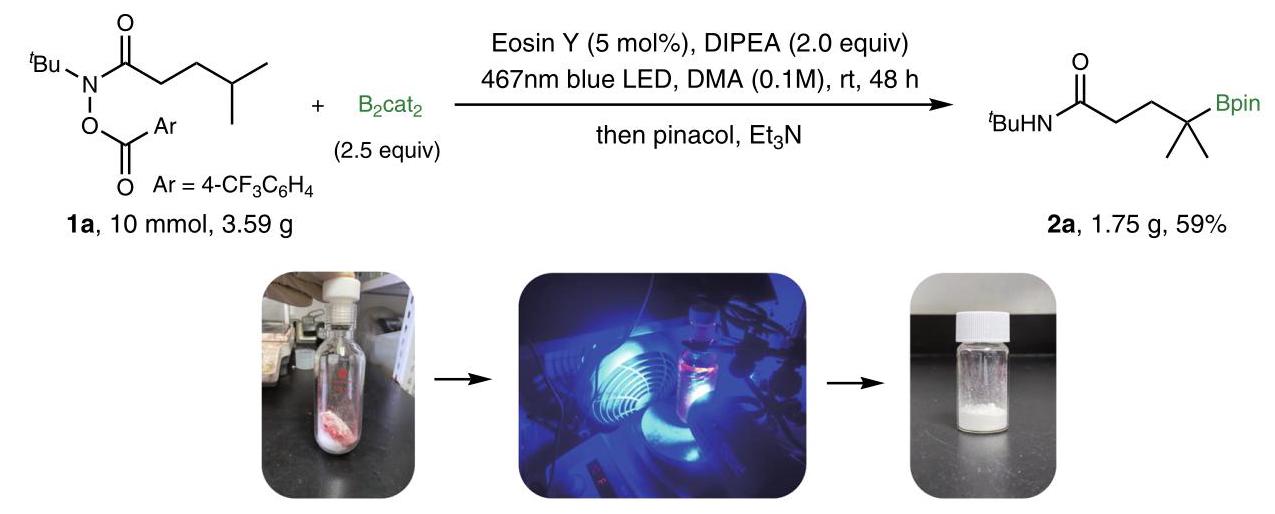
To further demonstrate the utility of this borylation method, a gram-scale reaction of $\mathbf{{1a}}$ was carried out under air (Fig. 7a and Supplementary Fig. 8), furnishing 2a in 59% isolated yield. The resulting borylation products could be further transformed to a series of functional groups (Fig. 7b). For example, the tertiary alcohol in $\gamma$ -position of carbonyl compounds could be obtained by oxidation of the boron compound 2a. In addition, tertiary boronic esters underwent C-C bond formation with vinyl Grignard reagent to afford vinylation products ${5}^{74}$ . Treatment of $1\mathrm{a}$ with ${\mathrm{{KHF}}}_{2}$ yields the potassium trifluoroborate salt 6 in 63% yield.
为了进一步证明这种硼化方法的实用性,在空气中进行了$\mathbf{{1a}}$的克级反应(图7a和补充图8),以59%的分离产率得到2a。所得的硼化产物可以进一步转化为一系列官能团(图7b)。例如,羰基化合物$\gamma$位的叔醇可以通过硼化合物2a的氧化得到。此外,叔硼酸酯与乙烯基格氏试剂发生C-C键形成反应,得到乙烯基化产物${5}^{74}$。用${\mathrm{{KHF}}}_{2}$处理$1\mathrm{a}$,以63%的产率得到三氟硼酸钾盐6。
Based on the experimental and computational results as well as studies on previously developed radical borylation reactions ${}^{{59},{62},{75} - {79}}$ , a proposed mechanism for the photoredox-catalyzed 1,5-HAT borylation process is presented in Fig. 8. First, substrate 1a is reducted by exicited photocatalyst Eosin Y to give radical A, followed by N-O bond cleavage to give nitrogen-center radical $\mathbf{B}$ , due to the higer BDE of $\mathrm{N} - \mathrm{H}$ bond, radical $\mathbf{B}$ forms the six-membered ring transition state $\mathbf{C}$ to allow intramolecular 1,5- HAT process to give carbon-centered radical $\mathbf{D}$ , which adds to diboron ${\mathrm{B}}_{2}{\mathrm{{cat}}}_{2}$ to deliver the adduct $\mathbf{E}$ , with the help of DMA, the adduct F’s B-B bond is dissociated to form C-B bond, affords the borylated product $\mathbf{G}$ , along with the DMA-Bcat radical $\mathbf{H}$ .
基于实验和计算结果以及对先前开发的自由基硼化反应${}^{{59},{62},{75} - {79}}$的研究,图8展示了光氧化还原催化的1,5-HAT硼化过程的推测机理。首先,底物1a被激发的光催化剂曙红Y还原得到自由基A,随后N-O键断裂得到氮中心自由基$\mathbf{B}$,由于$\mathrm{N} - \mathrm{H}$键的键解离能更高,自由基$\mathbf{B}$形成六元环过渡态$\mathbf{C}$,以允许分子内1,5-HAT过程得到碳中心自由基$\mathbf{D}$,其加成到二硼${\mathrm{B}}_{2}{\mathrm{{cat}}}_{2}$上得到加合物$\mathbf{E}$,在DMA的帮助下,加合物F的B-B键解离形成C-B键,得到硼化产物$\mathbf{G}$,以及DMA-Bcat自由基$\mathbf{H}$。
a. Gram-scale synthesis
a. 克级合成
b. Construction of $\gamma$ -functionalized carbonyl compounds
b. $\gamma$官能化羰基化合物的构建
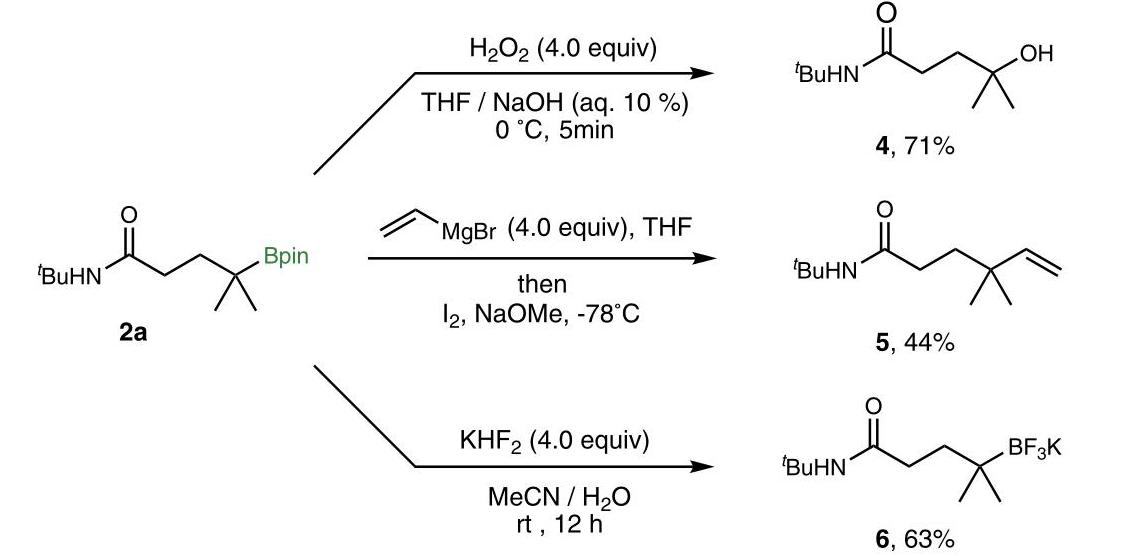
Fig. 7 The gram-scale synthesis and further transformations of the borylation products. a Gram-scale synthesis set up in air, resulting 1.59 g 2a as a white solid, the following pictures depict the step-by-step procedure involved in the synthesis. b Conversion of 2a into $\gamma$ -functionalized carbonyl compounds: oxidation to alcohol; vinylation of boronic ester; transformation to potassium trifluoroborate salts.
图7 硼化产物的克级合成及进一步转化。a 在空气中进行的克级合成,得到1.59 g白色固体2a,以下图片描绘了合成过程中的逐步步骤。b 将2a转化为$\gamma$官能化羰基化合物:氧化为醇;硼酸酯的乙烯基化;转化为三氟硼酸钾盐。
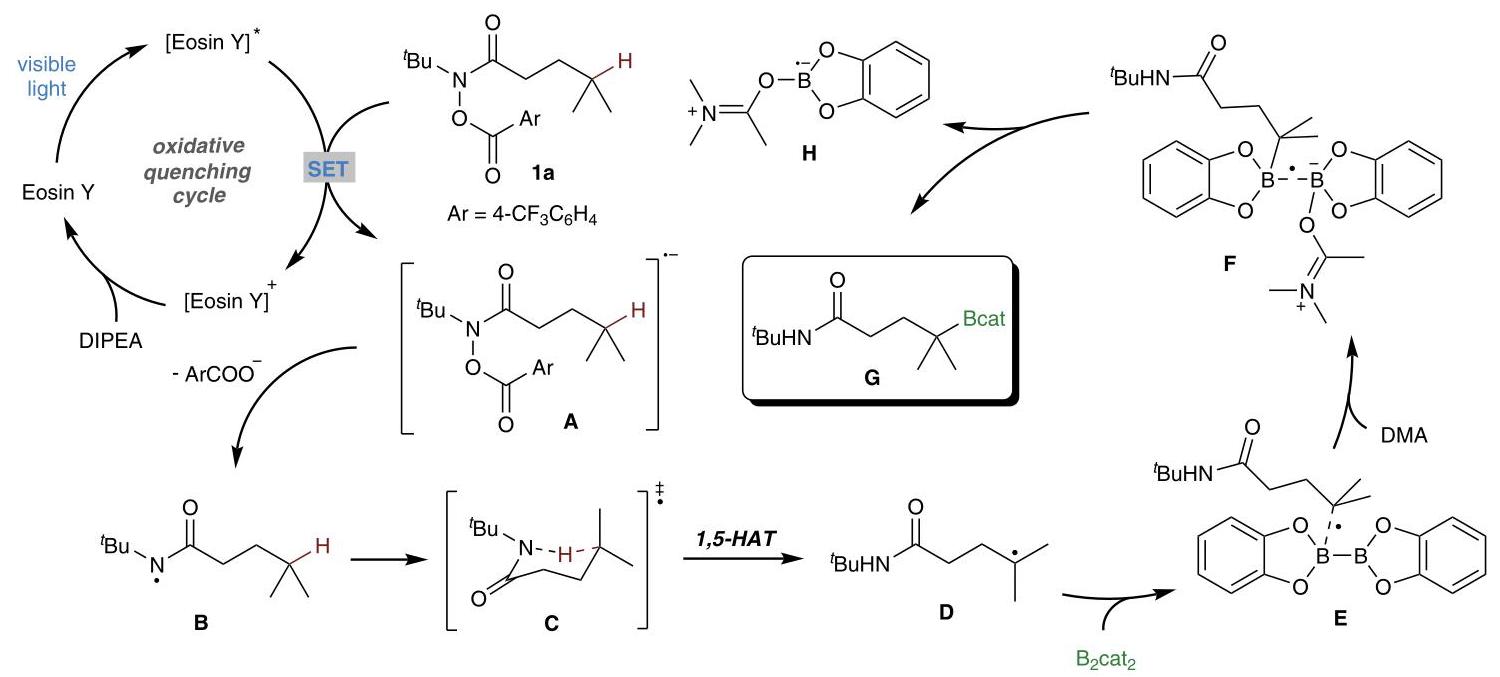
Fig. 8 Proposed mechanism for the remote C(sp3)-H borylation reaction enabled by 1,5-HAT process. The carbon radical D is then borylated by B ${}_{2}$ cat ${}_{2}$ / DMA to give G.
图8 1,5-HAT过程实现远程C(sp3)-H硼化反应的推测机理。碳自由基D随后被B ${}_{2}$ cat ${}_{2}$ / DMA硼化得到G。
Conclusion
结论
In conclusion, we have developed a transition-metal free visible light photoredox-catalyzed remote $\mathrm{C}\left( {\mathrm{{sp}}}^{3}\right) - \mathrm{H}$ borylation reaction, which enabled by 1,5-HAT process based on hydroxamic acid derivatives. A series of mechanism experiments, as well as DFT calculations resolved the radical mechanism in detail. This investigation afforded remote $\mathrm{C} - \mathrm{H}$ bond functionalization of $\gamma$ position of carbonyl compounds, thus provided scarce synthetic method of such type. We anticipate that this approach will find broad applications in synthetic community.
总之,我们开发了一种无过渡金属可见光光氧化还原催化的远程$\mathrm{C}\left( {\mathrm{{sp}}}^{3}\right) - \mathrm{H}$硼化反应,该反应通过基于异羟肟酸衍生物的1,5-HAT过程实现。一系列机理实验以及DFT计算详细解析了自由基机理。该研究实现了羰基化合物$\gamma$位的远程$\mathrm{C} - \mathrm{H}$键官能团化,从而提供了此类稀缺的合成方法。我们预计这种方法将在合成领域得到广泛应用。
Methods
方法
General procedure of C(sp ${}^{3}$ ) - H borylation enabled by 1,5-HAT. In a glovebox under a nitrogen atmosphere, sequentially added ${\mathrm{B}}_{2}{\mathrm{{cat}}}_{2}\left( {{0.75}\mathrm{{mmol}},{1.5}\text{ equiv., }}\right.$ 178 mg), the substrate (0.3 mmol, 1.0 equiv.), Eosin Y (5%, 0.015 mmol, 10.5 mg) and $3\mathrm{\;{mL}}$ DMA to a ${10}\mathrm{\;{mL}}$ Schlenk tube with a stir bar, followed by DIPEA $\left( {{0.6}\mathrm{{mmol}},{2.0}\text{ equiv., }{105\mu }\mathrm{L}}\right)$ . The capped Schlenk tube was removed from the glovebox, and the reaction mixture was irradiated by ${467}\mathrm{\;{nm}}$ Kessil ${40}\mathrm{\;W}$ LED at a $3\mathrm{\;{cm}}$ distance for ${12}\mathrm{\;h}$ , with a fan for cooling. As the catechol boronate esters are sensitive to hydrolysis, RBcat was transformed to RBpin for isolation. After cooling to room temperature, pinacol (142mg, 4.0 equiv.) and 1.0 mL triethylamine were added, and the mixture was stirred at room temperature for $1\mathrm{\;h}$ . Water was added to the reaction mixture, the aqueous layer was extracted with EtOAc $\left( {{20}\mathrm{\;{mL}} \times 2}\right)$ . If phase separation was slow, brine was added. The organic phases were combined and washed with ${50}\mathrm{\;{mL}}$ of saturated brine, the organic phase was dried over anhydrous sodium sulfate and filtered, then concentrated under reduced pressure, purified by column chromatography to give the product. The product was monitored by thin-layer chromatography with phosphomolybdic acid stain.
通过1,5-氢原子转移实现的C(sp${}^{3}$) - H硼化反应的一般步骤。在氮气气氛的手套箱中,依次向带有搅拌棒的${10}\mathrm{\;{mL}}$Schlenk管中加入${\mathrm{B}}_{2}{\mathrm{{cat}}}_{2}\left( {{0.75}\mathrm{{mmol}},{1.5}\text{ equiv., }}\right.$178mg)、底物(0.3mmol,1.0当量)、曙红Y(5%,0.015mmol,10.5mg)和$3\mathrm{\;{mL}}$DMA,随后加入二异丙基乙胺$\left( {{0.6}\mathrm{{mmol}},{2.0}\text{ equiv., }{105\mu }\mathrm{L}}\right)$。将加盖的Schlenk管从手套箱中取出,反应混合物用${467}\mathrm{\;{nm}}$Kessil${40}\mathrm{\;W}$LED在$3\mathrm{\;{cm}}$距离下照射${12}\mathrm{\;h}$,同时用风扇冷却。由于邻苯二酚硼酸酯对水解敏感,将RBcat转化为RBpin进行分离。冷却至室温后,加入频哪醇(142mg,4.0当量)和1.0mL三乙胺,混合物在室温下搅拌$1\mathrm{\;h}$。向反应混合物中加入水,水层用乙酸乙酯$\left( {{20}\mathrm{\;{mL}} \times 2}\right)$萃取。如果相分离缓慢,则加入盐水。合并有机相,用${50}\mathrm{\;{mL}}$饱和盐水洗涤,有机相用无水硫酸钠干燥并过滤,然后减压浓缩,通过柱色谱纯化得到产物。产物用磷钼酸染色的薄层色谱进行监测。
Data availability
数据可用性
The authors declare that the data supporting the study are available within the article and Supplementary Information. For experimental details and compounds characterization, see Supplementary Information. For Cartesian coordinates of the structures, see Supplementary Data 1. For NMR spectra, see Supplementary Data 2.
作者声明,支持本研究的数据可在文章及补充信息中获取。有关实验细节和化合物表征,请参阅补充信息。有关结构的笛卡尔坐标,请参阅补充数据1。有关核磁共振光谱,请参阅补充数据2。
Received: 24 January 2023; Accepted: 17 July 2023;
收到日期:2023年1月24日;接受日期:2023年7月17日;
Published online: 24 July 2023
在线发表日期:2023年7月24日
References
参考文献
Hall, D. G. Boronic Acids: Preparation, Applications in Organic Synthesis and Medicine (John Wiley & Sons, Weinheim, Germany, 2006).
Mkhalid, I. A., Barnard, J. H., Marder, T. B., Murphy, J. M. & Hartwig, J. F. C -H activation for the construction of C-B bonds. Chem. Rev. 110, 890-931 (2010).
Xu, L. et al. Recent advances in catalytic C-H borylation reactions. Tetrahedron 73, 7123-7157 (2017).
Tian, Y.-M., Guo, X.-N., Braunschweig, H., Radius, U. & Marder, T. B. Photoinduced borylation for the synthesis of organoboron compounds: focus review. Chem. Rev. 121, 3561-3597 (2021).
Waltz, K. M. & Hartwig, J. F. Selective functionalization of alkanes by transition-metal boryl complexes. Science 277, 211-213 (1997).
Chen, H., Schlecht, S., Semple, T. C. & Hartwig, J. F. Thermal, catalytic, regiospecific functionalization of alkanes. Science 287, 1995-1997 (2000).
Zhang, L.-S. et al. Direct borylation of primary C-H bonds in functionalized molecules by palladium catalysis. Angew. Chem. Int. Ed. 53, 3899-3903 (2014).
He, J. et al. Ligand-promoted borylation of $\mathrm{C}\left( {\mathrm{{sp}}}^{3}\right) - \mathrm{H}$ bonds with palladium(ii) catalysts. Angew. Chem. Int. Ed. 55, 785-789 (2016).
He, J., Shao, Q., Wu, Q. & Yu, J.-Q. Pd (ii)-catalyzed enantioselective C(sp ${}^{3}$ ) -H borylation. J. Am. Chem. Soc. 139, 3344-3347 (2017).
Chandrashekar, H. B. et al. Ligand-enabled $\delta - \mathrm{C}\left( {\mathrm{{sp}}}^{3}\right) - \mathrm{H}$ borylation of aliphatic amines. Angew. Chem. Int. Ed. 60, 18194-18200 (2021).
Ohmura, T., Torigoe, T. & Suginome, M. Catalytic functionalization of methyl group on silicon: iridium-catalyzed $\mathrm{C}\left( {\mathrm{{sp}}}^{3}\right) - \mathrm{H}$ borylation of methylchlorosilanes. J. Am. Chem. Soc. 134, 17416-17419 (2012).
Liskey, C. W. & Hartwig, J. F. Iridium-catalyzed C-H borylation of cyclopropanes. J. Am. Chem. Soc. 135, 3375-3378 (2013).
Ohmura, T., Torigoe, T. & Suginome, M. Functionalization of tetraorganosilanes and permethyloligosilanes at a methyl group on silicon via iridium-catalyzed $\mathrm{C}\left( {\mathrm{{sp}}}^{3}\right) - \mathrm{H}$ borylation. Organometallics 32,6170-6173 (2013).
Li, Q., Liskey, C. W. & Hartwig, J. F. Regioselective borylation of the C-H bonds in alkylamines and alkyl ethers. observation and origin of high reactivity of primary $\mathrm{C} - \mathrm{H}$ bonds beta to nitrogen and oxygen. J. Am. Chem. Soc. 136, 8755-8765 (2014).
Murakami, R., Tsunoda, K., Iwai, T. & Sawamura, M. Stereoselective C-H borylations of cyclopropanes and cyclobutanes with silica-supported monophosphane-ir catalysts. Chem.-A Eur. J. 20, 13127-13131 (2014).
Ohmura, T., Torigoe, T. & Suginome, M. Iridium-catalysed borylation of sterically hindered $\mathrm{C}\left( {\mathrm{{sp}}}^{3}\right) - \mathrm{H}$ bonds: remarkable rate acceleration by a catalytic amount of potassium tert-butoxide. Chem. Commun. 50, 6333-6336 (2014).
Huang, G., Kalek, M., Liao, R.-Z. & Himo, F. Mechanism, reactivity, and selectivity of the iridium-catalyzed $\mathrm{C}\left( {\mathrm{{sp}}}^{3}\right) - \mathrm{H}$ borylation of chlorosilanes. Chem. Sci. 6, 1735-1746 (2015).
Miyamura, S., Araki, M., Suzuki, T., Yamaguchi, J. & Itami, K. Stereodivergent synthesis of arylcyclopropylamines by sequential C-H borylation and suzuki-miyaura coupling. Angew. Chem. Int. Ed. 3, 846-851 (2015).
Cook, A. K., Schimler, S. D., Matzger, A. J. & Sanford, M. S. Catalyst-controlled selectivity in the $\mathrm{C} - \mathrm{H}$ borylation of methane and ethane. Science 351, 1421-1424 (2016).
Larsen, M. A., Cho, S. H. & Hartwig, J. Iridium-catalyzed, hydrosilyl-directed borylation of unactivated alkyl C-H bonds. J. Am. Chem. Soc. 138, 762-765 (2016).
Smith, K. T. et al. Catalytic borylation of methane. Science 351, 1424-1427 (2016).
Chen, L., Yang, Y., Liu, L., Gao, Q. & Xu, S. Iridium-catalyzed enantioselective $\alpha - \mathrm{C}\left( {\mathrm{{sp}}}^{3}\right) - \mathrm{H}$ borylation of azacycles. J. Am. Chem. Soc. 142,12062-12068 (2020).
Dannatt, J. E., Yadav, A., Smith III, M. R. & Maleczka Jr, R. E. Amide directed iridium $\mathrm{C}\left( {\mathrm{{sp}}}^{3}\right) - \mathrm{H}$ borylation catalysis with high n-methyl selectivity. Tetrahedron 109, 132578 (2022).
Shi, Y., Yang, Y. & Xu, S. Iridium-catalyzed enantioselective C(sp ${\mathrm{s}}^{3}$ )-H borylation of aminocyclopropanes. Angew. Chem. Int. Ed. 61, e202201463 (2022).
Shu, C., Noble, A. &Aggarwal, V. K. Metal-free photoinduced $\mathrm{C}\left( {\mathrm{{sp}}}^{3}\right) - \mathrm{H}$ borylation of alkanes. Nature 586, 714-719 (2020).
Stateman, L. M., Nakafuku, K. M. & Nagib, D. A. Remote C-H functionalization via selective hydrogen atom transfer. Synthesis 50, 1569-1586 (2018).
Sarkar, S., Cheung, K. P. S. & Gevorgyan, V. C-H functionalization reactions enabled by hydrogen atom transfer to carbon-centered radicals. Chem. Sci. 11, 12974-12993 (2020).
Capaldo, L., Ravelli, D. & Fagnoni, M. Direct photocatalyzed hydrogen atom transfer (HAT) for aliphatic C-H bonds elaboration. Chem. Rev. 122, 1875-1924 (2021).
Hofmann, A. Ueber die einwirkung des broms in alkalischer lösung auf die amine. Ber. Dtsch. Chem. Ges. 16, 558-560 (1883).
Löffer, K. & Kaim, H. Synthese des inaktiven δ-coniceins. Ber. Dtsch. Chem. Ges. 42, 94-107 (1909).
Guo, W., Wang, Q. & Zhu, J. Visible light photoredox-catalysed remote C-H functionalisation enabled by 1,5-hydrogen atom transfer (1, 5-HAT). Chem. Soc. Rev. 50, 7359-7377 (2021).
Wu, X. & Zhu, C. Radical functionalization of remote C $\left( {\mathrm{{sp}}}^{3}\right) - \mathrm{H}$ bonds mediated by unprotected alcohols and amides. CCS Chem. 2, 813-828 (2020).
Chen, H. & Yu, S. Remote C-C bond formation via visible light photoredox-catalyzed intramolecular hydrogen atom transfer. Org. Biomol. Chem. 18, 4519-4532 (2020).
Guo, Q. et al. Visible-light promoted regioselective amination and alkylation of remote $\mathrm{C}\left( {\mathrm{{sp}}}^{3}\right) - \mathrm{H}$ bonds. Nat. Commun. 11,1463 (2020).
Rivero, A. R., Fodran, P., Ondrejková, A. & Wallentin, C.-J. Alcohol etherification via alkoxy radicals generated by visible-light photoredox catalysis. Org. Lett. 22, 8436-8440 (2020).
Kim, K., Kim, N. & Hong, S. Visible light-induced intramolecular C-O bond formation via 1, 5-hydrogen atom transfer strategy. Bull. Korean Chem. Soc. 42, 548-552 (2021).
Zhao, Y. & Xia, W. Recent advances in radical-based C-N bond formation via photo-/electrochemistry. Chem. Soc. Rev. 47, 2591-2608 (2018).
Min, Q.-Q., Yang, J.-W., Pang, M.-J., Ao, G.-Z. & Liu, F. Copper-catalyzed remote $\mathrm{C}\left( {\mathrm{{sp}}}^{3}\right) - \mathrm{H}$ amination of carboxamides. Org. Lett. 22,2828-2832 (2020).
Wappes, E. A., Fosu, S. C., Chopko, T. C. & Nagib, D. A. Triiodide-mediated $\delta$ -amination of secondary C-H bonds. Angew. Chem. 128, 10128-10132 (2016).
Davies, J., Svejstrup, T. D., Fernandez Reina, D., Sheikh, N. S. & Leonori, D. Visible-light-mediated synthesis of amidyl radicals: transition-metal-free hydroamination and n-arylation reactions. J. Am. Chem. Soc. 138, 8092-8095 (2016).
Morcillo, S. P. et al. Photoinduced remote functionalization of amides and amines using electrophilic nitrogen radicals. Angew. Chem. Int. Ed. 57, 12945-12949 (2018).
De Armas, P. et al. Synthesis of 1, 4-epimine compounds. iodosobenzene diacetate, an efficient reagent for neutral nitrogen radical generation. Tetrahedron Lett. 26, 2493-2496 (1985).
Martínez, C. & Muniz, K. An iodine-catalyzed hofmann-löffler reaction. Angew. Chem. Int. Ed. 54, 8287-8291 (2015).
Qin, Q. & Yu, S. Visible-light-promoted remote $\mathrm{C}\left( {\mathrm{{sp}}}^{3}\right) - \mathrm{H}$ amidation and chlorination. Org. Lett. 17, 1894-1897 (2015).
Choi, G. J., Zhu, Q., Miller, D. C., Gu, C. J. & Knowles, R. R. Catalytic alkylation of remote $\mathrm{C} - \mathrm{H}$ bonds enabled by proton-coupled electron transfer. Nature 539, 268-271 (2016).
Chu, J. C. & Rovis, T. Amide-directed photoredox-catalysed C-C bond formation at unactivated ${\mathrm{{sp}}}^{3}\mathrm{C} - \mathrm{H}$ bonds. Nature 539,272-275 (2016).
Jung, H., Keum, H., Kweon, J. & Chang, S. Tuning triplet energy transfer of hydroxamates as the nitrene precursor for intramolecular $\mathrm{C}\left( {\mathrm{{sp}}}^{3}\right) - \mathrm{H}$ amidation. J. Am. Chem. Soc. 142, 5811-5818 (2020).
Kim, H., Kim, T., Lee, D. G., Roh, S. W. & Lee, C. Nitrogen-centered radical-mediated C-H imidation of arenes and heteroarenes via visible light induced photocatalysis. Chem. Commun. 50, 9273-9276 (2014).
Allen, L. J., Cabrera, P. J., Lee, M. & Sanford, M. S. N-acyloxyphthalimides as nitrogen radical precursors in the visible light photocatalyzed room temperature $\mathrm{C} - \mathrm{H}$ amination of arenes and heteroarenes. J. Am. Chem. Soc. 136, 5607-5610 (2014).
Kim, N., Lee, C., Kim, T. & Hong, S. Visible-light-induced remote $\mathrm{C}\left( {\mathrm{{sp}}}^{3}\right) - \mathrm{H}$ pyridylation of sulfonamides and carboxamides. Org. Lett. 21, 9719-9723 (2019).
Moon, Y. et al. Visible light induced alkene aminopyridylation using N-aminopyridinium salts as bifunctional reagents. Nat. Commun. 10, 4117 (2019).
Jiang, H. & Studer, A. Amidyl radicals by oxidation of $\alpha$ -amido-oxy acids: transition-metal-free amidofluorination of unactivated alkenes. Angew. Chem. Int. Ed. 57, 10707-10711 (2018).
Greulich, T. W., Daniliuc, C. G. & Studer, A. N-aminopyridinium salts as precursors for N-centered radicals-direct amidation of arenes and heteroarenes. Org. Lett. 17, 254-257 (2015).
Chen, H., Guo, L. & Yu, S. Primary, secondary, and tertiary $\gamma - \mathrm{C}\left( {\mathrm{{sp}}}^{3}\right) - \mathrm{H}$ vinylation of amides via organic photoredox-catalyzed hydrogen atom transfer. Org. Lett. 20, 6255-6259 (2018).
Chen, H., Fan, W., Yuan, X.-A. & Yu, S. Site-selective remote $\mathrm{C}\left( {\mathrm{{sp}}}^{3}\right) - \mathrm{H}$ heteroarylation of amides via organic photoredox catalysis. Nat. Commun. 10, 4743 (2019).
Wu, K., Wang, L., Colón-Rodríguez, S., Flechsig, G.-U. & Wang, T. Amidyl radical directed remote allylation of unactivated ${\mathrm{{sp}}}^{3}\mathrm{C} - \mathrm{H}$ bonds by organic photoredox catalysis. Angew. Chem. Int. Ed. 58, 1774-1778 (2019).
Chen, H., Jin, W. & Yu, S. Enantioselective remote $\mathrm{C}\left( {\mathrm{{sp}}}^{3}\right) - \mathrm{H}$ cyanation via dual photoredox and copper catalysis. Org. Lett. 22, 5910-5914 (2020).
Jin, W. & Yu, S. Photoinduced and palladium-catalyzed remote desaturation of amide derivatives. Org. Lett. 23, 6931-6935 (2021).
Liu, Q. et al. Transition-metal-free borylation of alkyl iodides via a radical mechanism. Org. Lett. 21, 6597-6602 (2019).
Liu, Q., Zhang, L. & Mo, F. Organic borylation reactions via radical mechanism. Acta Chim. Sin. 78, 1297-1308 (2020).
Mo, F., Qiu, D. & Wang, J. Synthesis of arylboronic pinacol esters from corresponding arylamines. Org. Synth 97, 1-11 (2020).
Sun, B., Zheng, S. & Mo, F. Transition metal-and light-free radical borylation of alkyl bromides and iodides using silane. Chem. Commun. 57, 5674-5677 (2021).
Liu, Q. et al. Synthesis of alkylboronic esters from alkyl iodides. Org. Synth 99, 15-28 (2022).
Wang, C. &Dong, G. Catalytic $\beta$ -functionalization of carbonyl compounds enabled by $\alpha ,\beta$ -desaturation. ACS Catal. 10, 6058-6070 (2020).
Zhang, F.-L., Hong, K., Li, T.-J., Park, H. & Yu, J.-Q. Functionalization of $\mathrm{C}\left( {\mathrm{{sp}}}^{3}\right) - \mathrm{H}$ bonds using a transient directing group. Science 351,252-256 (2016).
Zhu, R.-Y., Li, Z.-Q., Park, H. S., Senanayake, C. H. & Yu, J.-Q. Ligand-enabled $\gamma - \mathrm{C}\left( {\mathrm{{sp}}}^{3}\right) - \mathrm{H}$ activation of ketones. J. Am. Chem. Soc. 140,3564-3568 (2018).
Jiang, H. & Studer, A. α-aminoxy-acid-auxiliary-enabled intermolecular radical $\gamma - \mathrm{C}\left( {\mathrm{{sp}}}^{3}\right) - \mathrm{H}$ functionalization of ketones. Angew. Chem. 130, 1708-1712 (2018).
Hu, R., Chen, F.-J., Zhang, X., Zhang, M. & Su, W. Copper-catalyzed dehydrogenative $\gamma - \mathrm{C}\left( {\mathrm{{sp}}}^{3}\right) - \mathrm{H}$ amination of saturated ketones for synthesis of polysubstituted anilines. Nat. Commun. 10, 1-10 (2019).
Williams, P. J. et al. New approach to the detection of short-lived radical intermediates. J. Am. Chem. Soc. 144, 15969-15976 (2022).
Daly, S. et al. The gas-phase photophysics of Eosin Y and its maleimide conjugate. J. Phys. Chem. A 120, 3484-3490 (2016).
Fan, X.-Z. et al. Eosin Y as a direct hydrogen-atom transfer photocatalyst for the functionalization of C-H bonds. Angew. Chem. Int. Ed. 57, 8514-8518 (2018).
Yan, D.-M., Zhao, Q.-Q., Rao, L., Chen, J.-R. & Xiao, W.-J. Eosin Y as a redox catalyst and photosensitizer for sequential benzylic $\mathrm{C} - \mathrm{H}$ amination and oxidation. Chem.-A Eur. J. 24, 16895-16901 (2018).
Mau, A. W.-H., Johansen, O. & Sasse, W. H. F. Xanthene dyes as sensitizers for the photoreduction of water. Photochem. Photobiol. 41, 503-509 (1985).
Sonawane, R. P. et al. Enantioselective construction of quaternary stereogenic centers from tertiary boronic esters: methodology and applications. Angew. Chem. Int. Ed. 50, 3760-3763 (2011).
Fawcett, A. et al. Photoinduced decarboxylative borylation of carboxylic acids. Science 357, 283-286 (2017).
Hu, D., Wang, L. & Li, P. Decarboxylative borylation of aliphatic esters under visible-light photoredox conditions. Org. Lett. 19, 2770-2773 (2017).
Hu, J., Wang, G., Li, S. & Shi, Z. Selective C-N borylation of alkyl amines promoted by lewis base. Angew. Chem. Int. Ed. 57, 15227-15231 (2018).
Wu, J., He, L., Noble, A. & Aggarwal, V. K. Photoinduced deaminative borylation of alkylamines. J. Am. Chem. Soc. 140, 10700-10704 (2018).
Friese, F. W. & Studer, A. Deoxygenative borylation of secondary and tertiary alcohols. Angew. Chem. Int. Ed. 58, 9561-9564 (2019).
Acknowledgements
致谢
This work is supported by the Natural Science Foundation of China (Grant Nos. 22071004, 21933001, 22150013).
本工作得到了中国国家自然科学基金(项目编号:22071004、21933001、22150013)的支持。
Author contributions
作者贡献
B.S. discovered the method and optimized the reaction condition, performed the substrate synthesis, substrate scope and characterization of the resulting compounds, conducted mechanism studies except DFT calculations, and prepared the manuscript. W.L. contributed to the synthesis of part of the substrates and performed characterizations. Q.L. conducted DFT calculations as part of the mechanism studies. G.Z. helped with reaction condition optimization. F.M. directed the study and prepared the manuscript.
B.S.发现了该方法并优化了反应条件,进行了底物合成、底物范围研究以及所得化合物的表征,开展了除DFT计算之外的机理研究,并撰写了稿件。W.L. 参与了部分底物的合成并进行了表征。Q.L. 作为机理研究的一部分进行了DFT计算。G.Z. 协助优化反应条件。F.M. 指导了该研究并撰写了稿件。
Competing interests
利益冲突
The authors declare no competing interests.
作者声明无利益冲突。
Additional information
附加信息
Supplementary information The online version contains supplementary material available at https://doi.org/10.1038/s42004-023-00960-z.
补充信息 在线版本包含可在https://doi.org/10.1038/s42004-023-00960-z获取的补充材料。
Correspondence and requests for materials should be addressed to Fanyang Mo.
应将信件和材料请求发送至莫凡洋。
Peer review information Communications Chemistry thanks the anonymous reviewers for their contribution to the peer review of this work.
同行评审信息 《通讯化学》感谢匿名审稿人对本工作同行评审的贡献。
Reprints and permission information is available at http://www.nature.com/reprints
重印和许可信息可在http://www.nature.com/reprints获取
Publisher’s note Springer Nature remains neutral with regard to jurisdictional claims in published maps and institutional affiliations.
出版商说明 施普林格·自然对于已发表地图中的管辖权主张和机构隶属关系保持中立。