Gold(III)-Catalyzed Halogenation of Aromatic Boronates with N-Halosuccinimides
英文原文与中文译文逐段对照 · English original with Chinese translation
条目编号0:用N-卤代琥珀酰亚胺对芳基硼酸酯进行金(III)催化的卤化反应
Di Qiu, Fanyang Mo, Zhitong Zheng, Yan Zhang, and Jianbo Wang*
狄秋,莫凡洋,郑志通,张燕,王剑波*
Beijing National Laboratory of Molecular Sciences (BNLMS) and Key Laboratory of Bioorganic Chemistry and Molecular Engineering of Ministry of Education, College of Chemistry, Peking University, Beijing 100871, China
北京分子科学国家实验室(BNLMS)及教育部生物有机化学与分子工程重点实验室,北京大学化学与分子工程学院,北京100871,中国
ORGANIC LETTERS
《有机快报》
2010 Vol. 12, No. 23 5474-5477
2010年,第12卷,第23期,5474 - 5477页
ABSTRACT
摘要
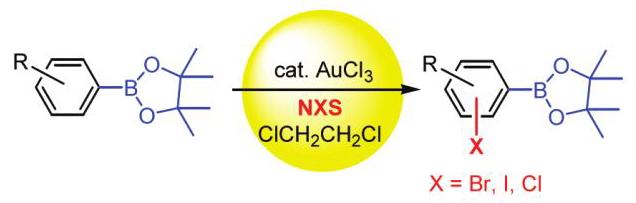
Aromatic boronates bearing halogen substituents in the aromatic ring can be synthesized by ${\mathrm{{AuCl}}}_{3}$ -catalyzed halogenations with N-halosuccinimides.
带有芳环上卤素取代基的芳基硼酸酯可通过${\mathrm{{AuCl}}}_{3}$ -催化的与N-卤代琥珀酰亚胺的卤化反应合成。
Functionalized aromatic boronic acids and esters have attracted great attention in recent years because of their extensive application in organic synthesis as well as in other fields. ${}^{1,2}$ Aromatic boronates bearing halogen substituents are particularly valuable because multiple Suzuki-Miyaura cross-coupling reactions are possible from such compounds. ${}^{3}$ Halogen-substituted arylboronic compounds have been commonly synthesized by selective monoborylation of aromatic substrates bearing more than one halide. ${}^{4}$ Apparently, this approach is limited in scope by the availability of multih-alogen-substituted aromatic starting materials as well as by the difficulties associated with the selective monoborylation. Recently, direct C-H borylation of mono- and dihaloarenes has been developed into a useful method for preparing haloarylboronates. ${}^{5}$
功能化的芳基硼酸和硼酸酯近年来因其在有机合成以及其他领域的广泛应用而备受关注。${}^{1,2}$ 带有卤素取代基的芳基硼酸酯特别有价值,因为这类化合物可进行多次铃木 - 宫浦交叉偶联反应。${}^{3}$ 卤代芳基硼酸化合物通常通过对带有多个卤化物的芳族底物进行选择性单硼化反应来合成。${}^{4}$ 显然,这种方法在范围上受到多卤代芳族起始原料可用性以及与选择性单硼化相关的困难的限制。最近,单卤代芳烃和二卤代芳烃的直接C - H硼化反应已发展成为制备卤代芳基硼酸酯的一种有用方法。${}^{5}$
On the other hand, halogenation of arylboronic compounds would be an attractive alternative approach to access these arylboronic compounds. Although arylboronic compounds are relatively stable in general, their further derivatization has been found difficult due to the chemical property of the boron group that makes them reactive toward commonly used organic reagents. In particular, protodeboronation or ipso substitution of the boron group easily occurs. ${}^{6}$ For this reason, halogenation of arylboronic acid derivatives has been rarely documented in the literature. In 1961, Kuivila and co-workers reported AcOH-mediated bromination and chlorination of arylboronic acids. The reaction is only limited to methoxy-substituted arylboronic acids. ${}^{7}$ More recently, Hall and coworkers reported a Ag(I)-mediated iodination and bromination of arylboronic acids. ${}^{8}$ The reaction occurs under mild conditions $\left( {{25}^{ \circ }\mathrm{C}}\right)$ and is regioselective. However, this reaction is generally restricted to arylboronic acids bearing electron-donating substituents, and moreover, a stoichiometric amount of silver salt is used.
另一方面,芳基硼酸化合物的卤化反应将是获得这些芳基硼酸化合物的一种有吸引力的替代方法。尽管芳基硼酸化合物一般相对稳定,但由于硼基团的化学性质使其对常用有机试剂具有反应性,发现其进一步衍生化很困难。特别是,硼基团的质子脱硼或本位取代很容易发生。${}^{6}$ 因此,芳基硼酸衍生物的卤化反应在文献中很少有记载。1961年,Kuivila及其同事报道了醋酸介导的芳基硼酸的溴化和氯化反应。该反应仅限于甲氧基取代的芳基硼酸。${}^{7}$ 最近,Hall及其同事报道了银(I)介导的芳基硼酸的碘化和溴化反应。${}^{8}$ 该反应在温和条件下发生$\left( {{25}^{ \circ }\mathrm{C}}\right)$ 且具有区域选择性。然而,该反应一般仅限于带有供电子取代基的芳基硼酸,而且使用了化学计量的银盐。
(5) For a recent review, see: Mkhalid, I. A. I.; Barnard, J. H.; Marder, T. B.; Murphy, J. M.; Hartwig, J. F. Chem. Rev. 2010, 110, 890.
(5) 近期综述见:Mkhalid, I. A. I.; Barnard, J. H.; Marder, T. B.; Murphy, J. M.; Hartwig, J. F. Chem. Rev. 2010, 110, 890.
(6) For examples, see: (a) Kabalka, G. W.; Sastry, K. A. R.; Sastry, U.; Somayaji, V. Org. Prep. Proced. Int. 1982, 14, 359. (b) Thiebes, C.; Prakash, G. K. S.; Petasis, N. A.; Olah, G. A. Synlett 1998, 2, 141. (c) Szumigala, R. H., Jr.; Devine, P. N.; Gauthier, D. R., Jr.; Volante, R. P. J. Org. Chem. 2004, 69, 566. (d) Thompson, A. L. S.; Kabalka, G. W.; Akula, M. R.; Huffman, J. W. Synthesis 2005, 547. (e) Murphy, J. M.; Liao, X.; Hartwig, J. F. J. Am. Chem. Soc. 2007, 129, 15434. (f) Wu, H.; Hynes, J., Jr. Org. Lett. 2010, 12, 1192.
(6) 例如见:(a) Kabalka, G. W.; Sastry, K. A. R.; Sastry, U.; Somayaji, V. Org. Prep. Proced. Int. 1982, 14, 359. (b) Thiebes, C.; Prakash, G. K. S.; Petasis, N. A.; Olah, G. A. Synlett 1998, 2, 141. (c) Szumigala, R. H., Jr.; Devine, P. N.; Gauthier, D. R., Jr.; Volante, R. P. J. Org. Chem. 2004, 69, 566. (d) Thompson, A. L. S.; Kabalka, G. W.; Akula, M. R.; Huffman, J. W. Synthesis 2005, 547. (e) Murphy, J. M.; Liao, X.; Hartwig, J. F. J. Am. Chem. Soc. 2007, 129, 15434. (f) Wu, H.; Hynes, J., Jr. Org. Lett. 2010, 12, 1192.
(1) For selected reviews, see: (a) Suzuki, A. Acc. Chem. Res. 1982, 15, 178. (b) Miyaura, N.; Suzuki, A. Chem. Rev. 1995, 95, 2457. (c) Miyaura, N. J. Organomet. Chem. 2002, 653, 54. (d) Miyaura, N. Bull. Chem. Soc. Jpn. 2008, 81, 1535. (e) Merino, P.; Tejero, T. Angew Chem. Int. Ed. 2010, 49, 7164.
(1) 有关选定的综述,请参阅:(a) Suzuki, A. Acc. Chem. Res. 1982, 15, 178。(b) Miyaura, N.; Suzuki, A. Chem. Rev. 1995, 95, 2457。(c) Miyaura, N. J. Organomet. Chem. 2002, 653, 54。(d) Miyaura, N. Bull. Chem. Soc. Jpn. 2008, 81, 1535。(e) Merino, P.; Tejero, T. Angew Chem. Int. Ed. 2010, 49, 7164。
(2) Hall, D. G. Boronic Acids; Wiley-VCH: Weinheim, 2005.
(2) Hall, D. G. Boronic Acids; Wiley-VCH: Weinheim, 2005。
(3) (a) Wang, C.; Glorius, F. Angew. Chem., Int. Ed. 2009, 48, 5240. (b) Tobisu, M.; Chatani, N. Angew. Chem., Int. Ed. 2009, 48, 3565.
(3) (a) Wang, C.; Glorius, F. Angew. Chem., Int. Ed. 2009, 48, 5240。(b) Tobisu, M.; Chatani, N. Angew. Chem., Int. Ed. 2009, 48, 3565。
(4) For examples, see: (a) Kabalka, G. W.; Sastry, U.; Sastry, K. A. R. J. Organomet. Chem. 1983, 259, 269. (b) Ishiyama, T.; Murata, M.; Miyaura, N. J. Org. Chem. 1995, 60, 7508. (c) Baron, O.; Knochel, P. Angew. Chem., Int. Ed. 2005, 44, 3133. (d) Jiang, Q.; Ryan, M.; Zhichkin, P. J. Org. Chem. 2007, 72, 6618. (e) Ablordeppey, S. Y.; Altundas, R.; Bricker, B.; Zhu, X. Y.; Eyunni, V. K.; Kumar, S.; Jackson, T.; Khan, A.; Roth, B. L. Bioorg. Med. Chem. 2008, 16, 7291. (f) Konno, H.; Aimoto, S.; Smith, S. O.; Nosaka, K.; Akaji, K. Bioorg. Med. Chem. 2009, 17, 5769.
(4) 例如,请参阅:(a) Kabalka, G. W.; Sastry, U.; Sastry, K. A. R. J. Organomet. Chem. 1983, 259, 269。(b) Ishiyama, T.; Murata, M.; Miyaura, N. J. Org. Chem. 1995, 60, 7508。(c) Baron, O.; Knochel, P. Angew. Chem., Int. Ed. 2005, 44, 3133。(d) Jiang, Q.; Ryan, M.; Zhichkin, P. J. Org. Chem. 2007, 72, 6618。(e) Ablordeppey, S. Y.; Altundas, R.; Bricker, B.; Zhu, X. Y.; Eyunni, V. K.; Kumar, S.; Jackson, T.; Khan, A.; Roth, B. L. Bioorg. Med. Chem. 208, 16, 7291。(f) Konno, H.; Aimoto, S.; Smith, S. O.; Nosaka, K.; Akaji, K. Bioorg. Med. Chem. 2009, 17, 5769。
${\mathrm{{We}}}^{9}$ have recently reported a highly efficient ${\mathrm{{AuCl}}}_{3}$ - catalyzed halogenation of aromatics by $N$ -bromo-, $N$ -iodo-, and $N$ -chlorosuccinimide (NBS, NIS, and NCS, respectively). ${}^{{10},{11}}$ The halogenation conditions are mild, and in particular, the catalyst loading of ${\mathrm{{AuCl}}}_{3}$ is very low (0.01-1.0 mmol %). In this paper, we further demonstrate that ${\mathrm{{AuCl}}}_{3}$ can also be used for the halogenation of arylboronates. The reaction is highly efficient and demonstrates high regioselectivities in most cases.
${\mathrm{{We}}}^{9}$最近报道了一种高效的${\mathrm{{AuCl}}}_{3}$催化的芳烃卤化反应,该反应使用$N$-溴代琥珀酰亚胺、{{F#}}-碘代琥珀酰亚胺和$N$-氯代琥珀酰亚胺(分别为NBS、NIS和NCS)。${}^{{10},{11}}$卤化反应条件温和,特别是${\mathrm{{AuCl}}}_{3}$的催化剂用量非常低(0.01 - 1.0 mmol%)。在本文中,我们进一步证明${\mathrm{{AuCl}}}_{3}$也可用于芳基硼酸酯的卤化反应。该反应高效,并且在大多数情况下具有高区域选择性。
At the outset, we observed with delight that the bromination of pinacol benzylboronate with NBS occurs efficiently with $2\mathrm{\;{mol}}\% {\mathrm{{AuCl}}}_{3}$ in ${\mathrm{{ClCH}}}_{2}{\mathrm{{CH}}}_{2}\mathrm{{Cl}}$ (DCE) at ${60}^{ \circ }\mathrm{C}$ (Table 1, entry 1). However, the regioselectivity is rather low, with the ratio of ortholmeta/para being nearly 1:1:1. We proceeded to compare other typical Lewis acid catalysts that have been widely used for bromination with NBS. The results summarized in Table 1 clearly demonstrate that ${\mathrm{{AuCl}}}_{3}$ has much higher efficiency. Strong Lewis acids, such as ${\mathrm{{FeCl}}}_{3}$ and FeBr3, which are commonly used as Lewis acid catalysts in halogenation reactions, only afforded conversion of 51% and 12%, respectively, even with a catalyst loading of 20 mol % (Table 1, entries 2 and 3), while ${\mathrm{{BF}}}_{3} \cdot {\mathrm{{OEt}}}_{2}$ only afforded a conversion of less than $5\%$ (entry 4). ${\mathrm{{NH}}}_{4}{\mathrm{{NO}}}_{3}$ , which has been an efficient catalyst in this type of reaction as reported by Tanemura and co-workers, ${}^{{10}\mathrm{a}}$ was not efficient (entry 5). Moreover, we found that neither ${\mathrm{{AlCl}}}_{3}$ nor ${\mathrm{H}}_{2}{\mathrm{{SO}}}_{4}$ was active in this reaction (entries 6 and 7). Finally, control experiments in the absence of ${\mathrm{{AuCl}}}_{3}$ demonstrate that $\mathrm{{Au}}$ catalyst is required for the halogenation (entry 8).
一开始,我们高兴地观察到,在$2\mathrm{\;{mol}}\% {\mathrm{{AuCl}}}_{3}$存在下,频哪醇苄基硼酸酯与NBS在${\mathrm{{ClCH}}}_{2}{\mathrm{{CH}}}_{2}\mathrm{{Cl}}$(二氯乙烷)中于${60}^{ \circ }\mathrm{C}$下能高效发生溴化反应(表1,条目1)。然而,区域选择性相当低,邻位/间位/对位的比例接近1:1:1。我们接着比较了其他常用于与NBS进行溴化反应的典型路易斯酸催化剂。表1总结的结果清楚地表明,${\mathrm{{AuCl}}}_{3}$具有更高的效率。强路易斯酸,如卤化反应中常用作路易斯酸催化剂的${\mathrm{{FeCl}}}_{3}$和FeBr3,即使催化剂负载量为20 mol%,转化率也仅分别为51%和12%(表1,条目2和3),而${\mathrm{{BF}}}_{3} \cdot {\mathrm{{OEt}}}_{2}$的转化率仅低于$5\%$(条目4)。据Tanemura及其同事报道,${\mathrm{{NH}}}_{4}{\mathrm{{NO}}}_{3}$在这类反应中是一种高效催化剂,${}^{{10}\mathrm{a}}$却效率不高(条目5)。此外,我们发现${\mathrm{{AlCl}}}_{3}$和${\mathrm{H}}_{2}{\mathrm{{SO}}}_{4}$在该反应中均无活性(条目6和7)。最后,在没有${\mathrm{{AuCl}}}_{3}$的情况下进行的对照实验表明,卤化反应需要$\mathrm{{Au}}$催化剂(条目8)。
Table 1. Bromination of Pinacol Phenylboronate Using Various Catalysts ${}^{a}$
表1. 使用各种催化剂${}^{a}$对频哪醇苯基硼酸酯进行溴化反应

| entry | catalyst (mol %) | conversion ${}^{b}$ (%) |
| 1 | ${\mathrm{{AuCl}}}_{3}$ (2) | 100 |
| 2 | ${\mathrm{{FeCl}}}_{3}$ (20) | 51 |
| 3 | ${\mathrm{{FeBr}}}_{3}\left( {20}\right)$ | 12 |
| 4 | ${\mathrm{{BF}}}_{3} \bullet {\mathrm{{OEt}}}_{2}\left( {20}\right)$ | <5 |
| 5 | ${\mathrm{{NH}}}_{4}{\mathrm{{NO}}}_{3}\left( {20}\right)$ | <5 |
| 6 | ${\mathrm{{AlCl}}}_{3}\left( {20}\right)$ | <5 |
| 7 | ${\mathrm{H}}_{2}{\mathrm{{SO}}}_{4}\left( {20}\right)$ | <5 |
| 8 | none | <5 |
${}^{a}$ Reaction conditions: PhBpin (1 mmol), NBS (1.2 mmol), DCE (2 $\mathrm{{mL}}),{60}^{ \circ }\mathrm{C},6\mathrm{\;h}.{}^{b}$ Conversion was determined by GC-MS with $n$ -dodecane as the internal standard. DCE: 1,2-dichloroethane. NBS: N-bromosuccinimide.
${}^{a}$反应条件:PhBpin(1 mmol),NBS(1.2 mmol),二氯乙烷(2 $\mathrm{{mL}}),{60}^{ \circ }\mathrm{C},6\mathrm{\;h}.{}^{b}$ 转化率通过气相色谱 - 质谱联用仪以$n$ - 十二烷作为内标物测定。二氯乙烷:1,2 - 二氯乙烷。NBS:N - 溴代琥珀酰亚胺。
With the efficient ${\mathrm{{AuCl}}}_{3}$ -catalyzed halogenations being confirmed, we then proceeded to study the scope of the reaction. ${}^{12}$ A variety of arylboronate substrates have been subjected to the reaction and the data are shown in Table 2. The results show that ${\mathrm{{AuCl}}}_{3}$ could catalyze a wide range of arylboronates, including these bearing heterocyclic rings (entries 13, 14, and 20). Moreover, the reaction works well with arylboronates bearing electron-withdrawing substituents on aromatic rings, although higher catalyst loading and reaction temperature as well as longer reaction times are required in these cases (entries 7-12). It was particularly noted that temperature was an important factor for the reaction. Depending on the substrates, the reaction temperature needs to be adjusted to enable complete bromination. Moreover, high temperature in some cases led to multiha-logenation. It has been noted that the 2-position of thiophene is more active so the bromination or iodination occurs at the 2-position preferentially (entries 13, 14, and 20). The low yield in the case of $1\mathrm{\;m}$ is due to the ipso substitution of the boron group by the bromine (entry 13).
在确认了${\mathrm{{AuCl}}}_{3}$催化的卤化反应高效之后,我们接着研究该反应的适用范围。${}^{12}$多种芳基硼酸酯底物已进行该反应,数据见表2。结果表明,${\mathrm{{AuCl}}}_{3}$能催化多种芳基硼酸酯,包括带有杂环的那些(条目13、14和20)。此外,该反应对于芳环上带有吸电子取代基的芳基硼酸酯也能很好地进行,不过在这些情况下需要更高的催化剂负载量、反应温度以及更长的反应时间(条目7 - 12)。特别要注意的是,温度是该反应的一个重要因素。根据底物的不同,需要调整反应温度以实现完全溴化。此外,在某些情况下高温会导致多卤化。已经注意到噻吩的2 - 位更活泼,所以溴化或碘化优先发生在2 - 位(条目13、14和20)。$1\mathrm{\;m}$情况下产率低是由于硼基团被溴进行了本位取代(条目13)。
The structures of the halogenation products have been established by spectra data. ${}^{13}$ Moreover, four of them are further confirmed by X-ray crystallographic analyses of the products (2a, 2f) or their corresponding hydrolyzed acids (2b’, 2q’) (Figure 1).
卤化产物的结构已通过光谱数据确定。${}^{13}$此外,其中四种产物通过对产物(2a、2f)或其相应水解酸(2b’、2q’)的X射线晶体学分析得到进一步确认(图1)。
An interesting question in the halogenation of arylbor-onates concerns the property of the boronate group in affecting the halogenation activity and regioselectivity. We proceeded to investigate this issue by comparing the halogenation of benzene and pinacol phenylboronate under identical conditions. The data collected in Table 3 demonstrate that the pinacol boronate group is a weak activating group (compare entries 1-4). Next, we found that in the bromination of phenylboronate the corresponding products could be isolated in 75% yield as regioisomers. The ratio of ortholmeta/para is nearly 1:1:1 as detected by ${}^{1}\mathrm{H}$ NMR. The directing effect of boron is obscure with the ratio of ortho + para versus meta being approximately 2:1, which means meta is slightly disfavored.
芳基硼酸卤化过程中一个有趣的问题是硼酸酯基团对卤化活性和区域选择性的影响。我们通过比较相同条件下苯和频哪醇苯硼酸的卤化反应来研究这个问题。表3中收集的数据表明频哪醇硼酸酯基团是一个弱活化基团(比较条目1 - 4)。接下来,我们发现苯硼酸溴化反应中相应产物可以作为区域异构体以75%的产率分离出来。通过${}^{1}\mathrm{H}$核磁共振检测,邻位/间位/对位的比例接近1:1:1。硼的导向作用不明显,邻位 + 对位与间位的比例约为2:1,这意味着间位产物稍少。
The experiments suggest that the pinacol boronate group is a weakly activating and ortho/para-directing group. This may be explained by the following reasoning. First, boron has smaller value of electronegativity than carbon (2.04 versus 2.55). Consequently, the inductive effect of boron is electron-donating. On the other hand, since boron has an empty p-orbital, the resonance effect is electron-withdrawing. However, the boron may be complexed with a Lewis base (such as carbonyl oxygen of succinimide) in the reaction system, which may counteract the electron-withdrawing effect. ${}^{14}$
实验表明频哪醇硼酸酯基团是一个弱活化且邻/对定向的基团。这可以通过以下推理来解释。首先,硼的电负性值比碳小(2.04对2.55)。因此,硼的诱导效应是供电子的。另一方面,由于硼有一个空的p轨道,共振效应是吸电子的。然而,硼可能在反应体系中与路易斯碱(如琥珀酰亚胺的羰基氧)络合,这可能抵消吸电子效应。${}^{14}$
(7) Kuivila, H. G.; Benjamin, L. E.; Murphy, C. J.; Price, A. D.; Polevy, J. H. J. Org. Chem. 1962, 27, 825.
(7) 库维拉,H. G.;本杰明,L. E.;墨菲,C. J.;普赖斯,A. D.;波列维,J. H. 《有机化学杂志》1962年,第27卷,第825页。
(8) Al-Zoubi, R. M.; Hall, D. G. Org. Lett. 2010, 12, 2480.
(8) 阿尔 - 祖比,R. M.;霍尔,D. G. 《有机快报》2010年,第12卷,第2480页。
(9) Mo, F.; Yan, J. M.; Qiu, D.; Li, F.; Zhang, Y.; Wang, J. Angew. Chem., Int. Ed. 2010, 49, 2028.
(9) 莫,F.;严,J. M.;邱,D.;李,F.;张,Y.;王,J. 《德国应用化学》2010年,第49卷,第2028页。
(10) For examples of halogenations with NXS, see: (a) Tanemura, K.; Suzuki, T.; Nishida, Y.; Satsumabayashi, K.; Horaguchi, T. Chem. Lett. 2003, 32, 932. (b) Zhang, Y.; Shibatomi, K.; Yamamoto, H. Synlett 2005, 2837. (c) Zysman-Colman, E.; Arias, K.; Siegel, J. S. Can. J. Chem. 2009, 87, 440.
(10) 关于用NXS进行卤化反应的例子,见:(a) 根村,K.;铃木,T.;西田,Y.;萨摩林,K.;堀口,T. 《化学通讯》2003年,第32卷,第932页。(b) 张,Y.;柴富巳,K.;山本,H. 《合成快报》2005年,第2837页。(c) 齐斯曼 - 科尔曼,E.;阿里亚斯,K.;西格尔,J. S. 《加拿大化学杂志》2009年,第87卷,第440页。
(11) For examples of tramsition-metal-catalyzed halogenation with NXS, see: (a) Kalyani, D.; Dick, A. R.; Anani, W. Q.; Sanford, M. S. Org. Lett. 2006, 8, 2523. (b) Kalyani, D.; Dick, A. R.; Anani, W. Q.; Sanford, M. S. Tetrahedron 2006, 62, 11483.
(11) 关于过渡金属催化用NXS进行卤化反应的例子,见:(a) 卡利亚尼,D.;迪克,A. R.;阿纳尼,W. Q.;桑福德,M. S. 《有机快报》2006年,第8卷,第2523页。(b) 卡利亚尼,D.;迪克,A. R.;阿纳尼,W. Q.;桑福德, M. S. 《四面体》2006年,第62卷,第11483页。
(12) For the reaction scope of the boron group, see the Supporting Information.
(12) 关于硼基团的反应范围,见支持信息。
(13) For details of the structure characterization, see the Supporting Information.
(13) 关于结构表征的细节,见支持信息。
Table 2. ${\mathrm{{AuCl}}}_{3}$ -Catalyzed Halogenation of Pinacol Arylboronates ${}^{a}$
表2. ${\mathrm{{AuCl}}}_{3}$催化的频哪醇芳基硼酸酯的卤化反应 ${}^{a}$
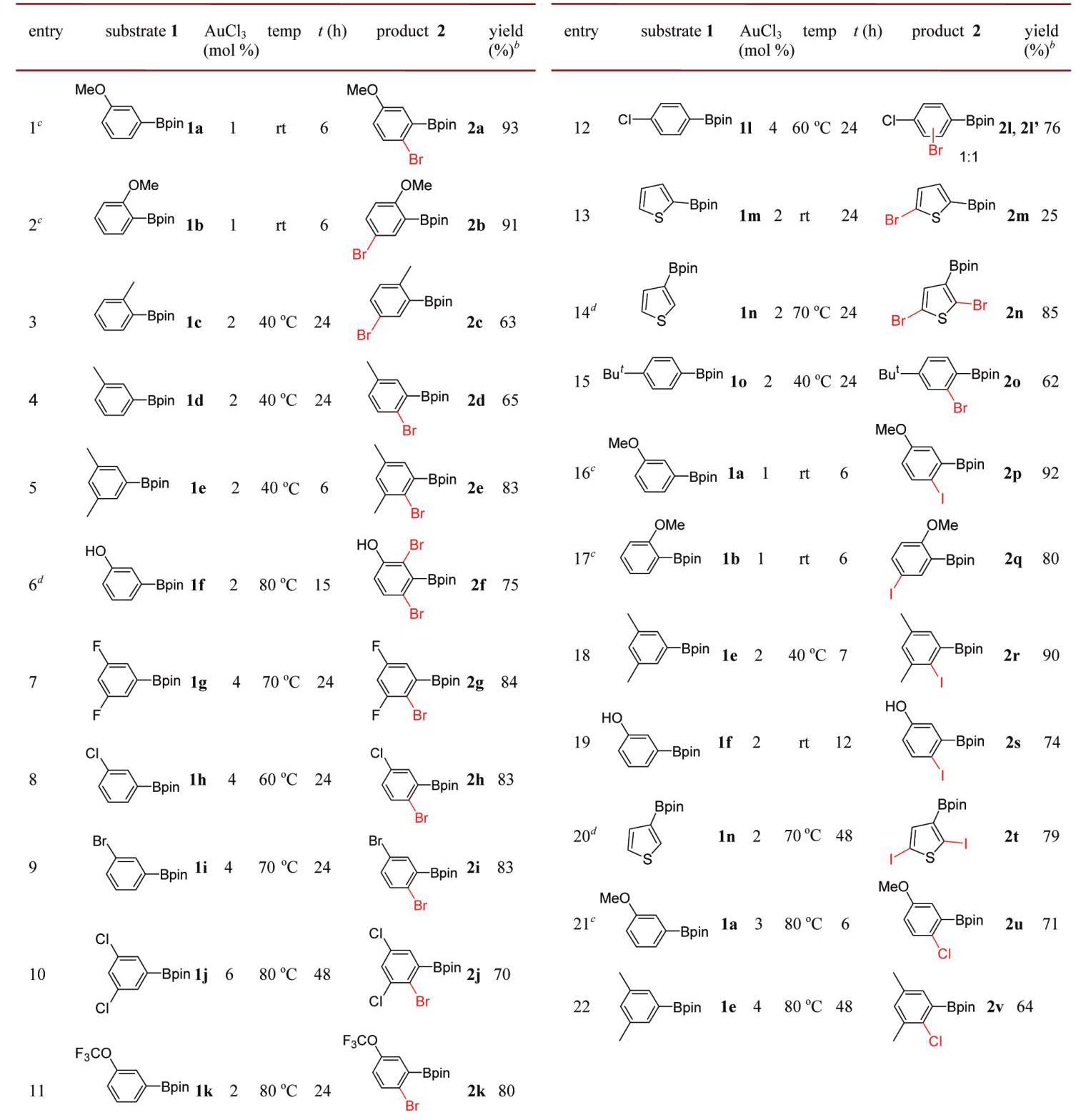
${}^{a}$ Reaction conditions: ArBpin (1 mmol), NXS (1.2 mmol), DCE (2 mL). ${}^{b}$ Isolated yield. ${}^{c}$ 1.0 equiv of NXS was used. ${}^{d}$ 2.4 equiv of NXS was used.
${}^{a}$反应条件:ArBpin(1 mmol),NXS(1.2 mmol),DCE(2 mL)。${}^{b}$分离产率。${}^{c}$使用1.0当量的NXS。${}^{d}$使用2.4当量的NXS。
Since the electronic effect of the pinacol boronate group is rather weak, the regioselectivity of the Au-catalyzed bromination is controlled by other substituents on the aromatic ring in most cases. For example, even a weak directing group such as a methyl in the aromatic ring overrides the pinacol boronate group to control the regioselectivity of bromination (Table 2, entry 3). The bromination selectivity of the reaction with pinacol p-tert-butylphenylboronate 1o indicates steric effects also play an important role (Table 2, entry 15). Interestingly, there is an obvious trend that halogenation occurs favorably at the position ortho to the boron substituent. A similar ortho directing effect has also been observed in Hall’s Ag-mediated halogenation reaction. ${}^{8}$
由于频哪醇硼酸酯基团的电子效应相当弱,在大多数情况下,金催化溴化反应的区域选择性由芳环上的其他取代基控制。例如,即使是芳环上的一个弱导向基团,如甲基,也会优先于频哪醇硼酸酯基团来控制溴化反应的区域选择性(表2,条目3)。与对叔丁基苯基硼酸频哪醇酯1o的反应的溴化选择性表明空间效应也起着重要作用(表2,条目15)。有趣的是,存在一个明显的趋势,即卤化反应倾向于在硼取代基的邻位发生。在霍尔的银介导的卤化反应中也观察到了类似的邻位导向效应。${}^{8}$
(14) For a discussion of electronic effects of boron groups, see: Entwistle, C. D.; Marder, T. B. Chem. Mater. 2004, 16, 4574.
(14) 关于硼基团电子效应的讨论,见:Entwistle, C. D.; Marder, T. B. Chem. Mater. 2004, 16, 4574.
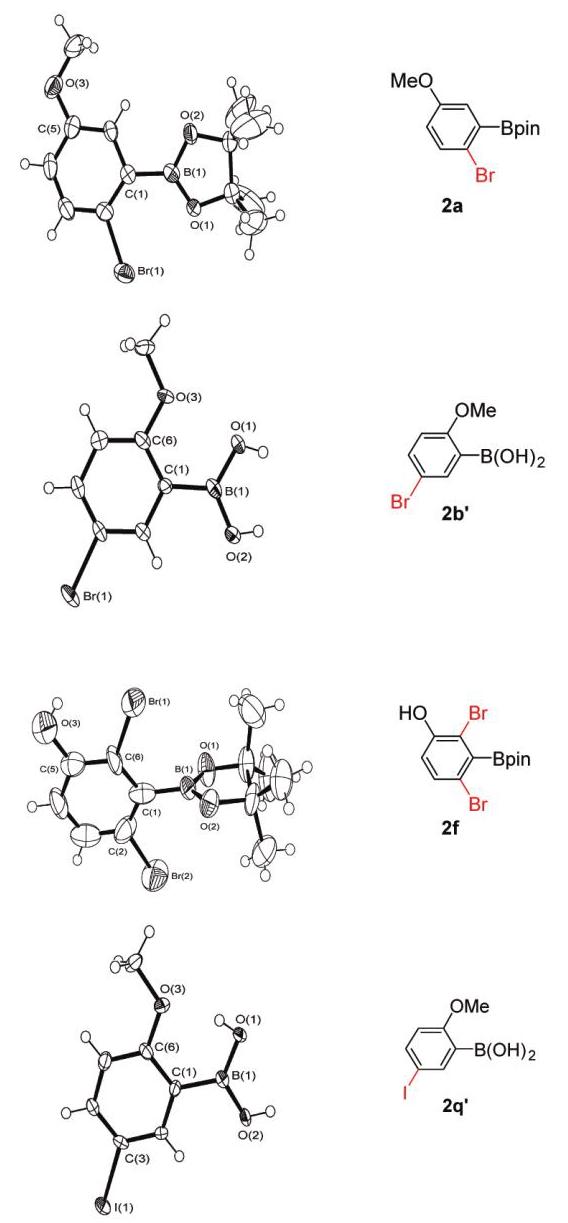
Figure 1. X-ray structures of $2\mathbf{a},2\mathbf{f},2{\mathbf{b}}^{\prime }$ , and $2{\mathbf{q}}^{\prime }$ .
图1. $2\mathbf{a},2\mathbf{f},2{\mathbf{b}}^{\prime }$ 、和 $2{\mathbf{q}}^{\prime }$ 的X射线结构。
Table 3. Comparison of the Reactivity in ${\mathrm{{AuCl}}}_{3}$ -Catalyzed Bromination ${}^{a}$
表3. ${\mathrm{{AuCl}}}_{3}$ 催化溴化反应中反应活性的比较 ${}^{a}$
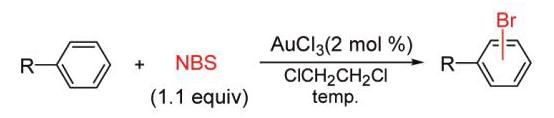
| entry | substrate, $\mathrm{R} =$ | temp (°C) | $t$ (h) | conversion ${}^{b}$ (%) |
| 1 | H | 40 | 6 | 15 |
| 2 | H | 40 | 24 | 30 |
| 3 | Bpin | 40 | 6 | 24 |
| 4 | Bpin | 40 | 24 | 46 |
| 5 | H | 60 | 6 | 42 |
| 6 | Bpin | 60 | 6 | >99 |
${}^{a}$ Reaction conditions: R-Ph (1 mmol), NBS (1.1 mmol), DCE (2 mL). ${}^{b}$ Conversion was determined by GC-MS with $n$ -dodecane as the internal standard.
${}^{a}$ 反应条件:R-Ph (1 mmol),NBS (1.1 mmol),DCE (2 mL)。 ${}^{b}$ 转化率通过以 $n$ -十二烷为内标物的GC-MS测定。
Scheme 1. Application of Halogenated Arylboronic Compounds in Consecutive Suzuki-Miyaura Cross-Coupling
方案1. 卤代芳基硼酸化合物在连续铃木-宫浦交叉偶联反应中的应用
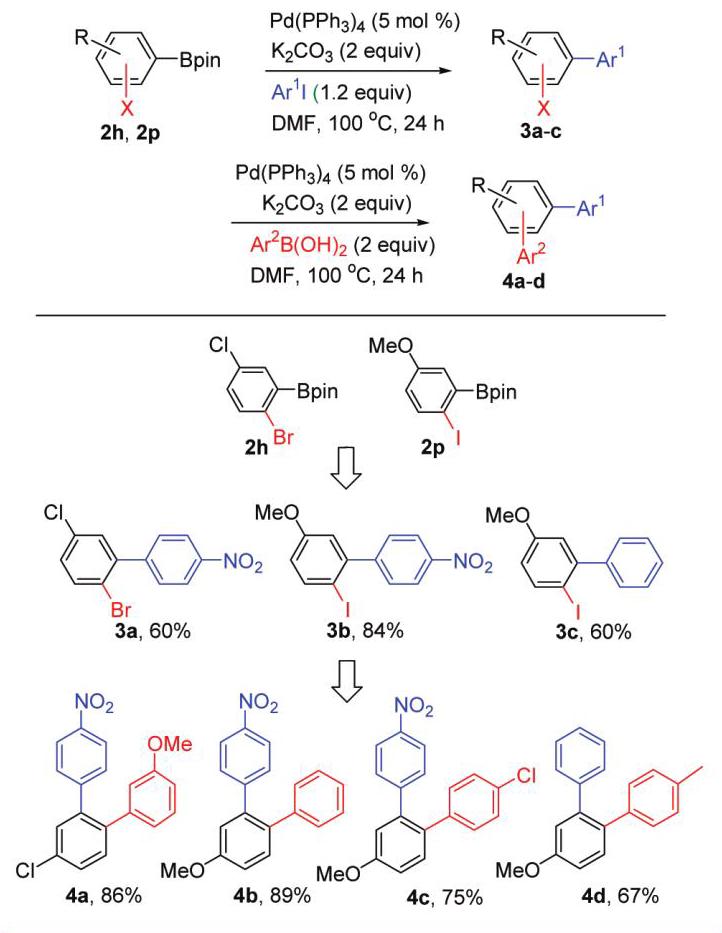
The halogenated arylboronic compounds are valuable in organic synthesis. To demonstrate the utility of the products, we have carried out experiments of consecutive Suzuki-Miyaura coupling reactions (Scheme 1). Thus, starting from 2h and 2p, substituted o-terphenyl products 4a-d could be prepared in two steps in high yields.
卤代芳基硼酸化合物在有机合成中很有价值。为了证明产物的实用性,我们进行了连续铃木-宫浦偶联反应的实验(方案1)。因此,从2h和2p开始,可以通过两步以高产率制备取代的邻三联苯产物4a-d。
In conclusion, we have developed an efficient catalytic halogenation reaction of arylboronates. It has the advantages of low catalyst loading, mild halogenation conditions, and generally good yields and high regioselectivity. This reaction provides an easy approach toward functionalized arylbor-onates that are otherwise difficult to access.
总之,我们开发了一种高效的芳基硼酸酯催化卤化反应。它具有催化剂负载量低、卤化条件温和、产率普遍良好且区域选择性高的优点。该反应为制备其他难以获得的官能化芳基硼酸酯提供了一种简便方法。
Acknowledgment. This project was supported by the NSFC (Grant Nos. 20902005, 20832002, 20772003, 20821062) and 973 Program (No. 2009CB825300).
致谢。本项目得到了国家自然科学基金(批准号20902005、20832002、20772003、20821062)和973计划(编号2009CB825300)的支持。
Supporting Information Available: Experimental procedure, characterization data, and ${}^{1}\mathrm{H}$ and ${}^{13}\mathrm{C}$ NMR spectra for all new compounds. This material is available free of charge via the Internet at http://pubs.acs.org.
支持信息可获取:所有新化合物的实验步骤、表征数据以及 ${}^{1}\mathrm{H}$ 和 ${}^{13}\mathrm{C}$ NMR光谱。该材料可通过互联网免费获取,网址为http://pubs.acs.org。
OL102350V