Photocarboxylation of Remote C-H Bond through Nitrogen-Centred Radicals 1,5-Hydrogen Atom Transfer
英文原文与中文译文逐段对照 · English original with Chinese translation
Wenke Li," Beiqi Sun," Lei Zhang" and Fanyang Mo D *b
李文珂,“孙北奇,“张雷” 及莫凡洋*b
Check for updates
查看更新
Cite this: Green Chem., 2023, 25, 5030
引用本文:Green Chem., 2023, 25, 5030
Received 2nd May 2023, Accepted 13th June 2023
于2023年5月2日收到,2023年6月13日接受
DOI: 10.1039/d3gc01426f
DOI: 10.1039/d3gc01426f
rsc.li/greenchem
rsc.li/greenchem
The carboxylation of the $\mathrm{C} - \mathrm{H}$ bond utilizing ${\mathrm{{CO}}}_{2}$ represents a challenging but attractive tactic for capitalizing on the abundant availability of ${\mathrm{{CO}}}_{2}$ in organic synthesis. In this investigation, we report visible-light-driven carboxylation of a remote C-H bond via a nitrogen-centered 1,5-hydrogen atom transfer (1,5-HAT) mechanism. The achievement of direct photocarboxylation of the remote benzylic $\mathrm{C} - \mathrm{H}$ bond has been realized. The functionalization of electron-deficient alkenes, in conjunction with remote aliphatic $\mathrm{C} - \mathrm{H}$ bonds and ${\mathrm{{CO}}}_{2}$ , has been developed employing the 1,5-HAT strategy as well. These methods enable the photocarboxylation of different types of $\mathrm{C} - \mathrm{H}$ bonds and feature mild reaction conditions, a comprehensive range of substrates, and exceptional functional group tolerance, providing a sustainable and eco-friendly approach to valuable carboxylic acids and derivatives.
利用${\mathrm{{CO}}}_{2}$对$\mathrm{C} - \mathrm{H}$键进行羧化反应是有机合成中利用${\mathrm{{CO}}}_{2}$丰富可得性的一种具有挑战性但有吸引力的策略。在本研究中,我们报道了通过氮中心的1,5-氢原子转移(1,5-HAT)机制实现的远程C-H键的可见光驱动羧化反应。远程苄基$\mathrm{C} - \mathrm{H}$键的直接光羧化反应已得以实现。利用1,5-HAT策略,也开发了缺电子烯烃与远程脂肪族$\mathrm{C} - \mathrm{H}$键和${\mathrm{{CO}}}_{2}$的官能化反应。这些方法能够实现不同类型$\mathrm{C} - \mathrm{H}$键的光羧化反应,具有温和的反应条件、广泛的底物范围以及出色的官能团耐受性,为合成有价值的羧酸及其衍生物提供了一种可持续且环保的方法。
The efficient and selective functionalization of unactivated $\mathrm{C}\left( {\mathrm{{sp}}}^{3}\right) - \mathrm{H}$ bonds is a long-sought-after goal in organic synthetic chemistry. ${}^{1}$ However, the inherently low reactivity and ubiquity of these bonds present considerable challenges. As an alternative to transition-metal-catalyzed C-H activation, the hydrogen atom transfer (HAT) strategy has garnered significant attention due to its capacity to facilitate site-selective functionalization of $\mathrm{C}\left( {\mathrm{{sp}}}^{3}\right) - \mathrm{H}$ in complex molecules. ${}^{2}$ According to the reports, 1,5-HAT has broadly expanded the potential of C-H bond activation, constituting a significant breakthrough in the site-selective functionalization of remote inert $\mathrm{C}\left( {\mathrm{{sp}}}^{3}\right) - \mathrm{H}$ in complex molecules. ${}^{3 - 6}$ The initial application via 1,5-HAT, embodied by the Hofmann-Löffler-Freytag (HLF) reaction (Fig. 1a), can be traced back to the late 19th century. This reaction proceeds via the generation of a nitrogen-centered radical, followed by an intramolecular 1,5-HAT process, ultimately yielding a carbon-centered radical. ${}^{7,8}$ However, the harsh conditions of the HLF reaction confine its extensive application to organic synthesis.
未活化$\mathrm{C}\left( {\mathrm{{sp}}}^{3}\right) - \mathrm{H}$键的高效和选择性官能化是有机合成化学中一个长期追求的目标。${}^{1}$ 然而,这些键固有的低反应活性和普遍性带来了相当大的挑战。作为过渡金属催化C-H活化的替代方法,氢原子转移(HAT)策略因其能够促进复杂分子中$\mathrm{C}\left( {\mathrm{{sp}}}^{3}\right) - \mathrm{H}$的位点选择性官能化而受到了广泛关注。${}^{2}$ 根据报道,1,5-HAT广泛拓展了C-H键活化的潜力,是复杂分子中远程惰性$\mathrm{C}\left( {\mathrm{{sp}}}^{3}\right) - \mathrm{H}$位点选择性官能化的一项重大突破。${}^{3 - 6}$ 通过1,5-HAT的最初应用,以霍夫曼-勒夫勒-弗赖塔格(HLF)反应(图1a)为代表,可以追溯到19世纪末。该反应通过生成氮中心自由基,随后进行分子内1,5-HAT过程,最终生成碳中心自由基。${}^{7,8}$ 然而,HLF反应的苛刻条件限制了其在有机合成中的广泛应用。
Recently, the renaissance of photochemistry has promoted the development of milder ways of exploring this reactivity. The synergism of visible-light photoredox catalysis with 1,5-HAT led to the development of the remote functionalization of $\mathrm{C}\left( {\mathrm{{sp}}}^{3}\right) - \mathrm{H}$ bonds. ${}^{3 - 5,9,{10}}$
最近,光化学的复兴推动了探索这种反应性的更温和方法的发展。可见光光氧化还原催化与1,5-HAT的协同作用导致了$\mathrm{C}\left( {\mathrm{{sp}}}^{3}\right) - \mathrm{H}$键远程官能化的发展。${}^{3 - 5,9,{10}}$
Over the past few decades, the amidyl radical-based 1,5- HAT process has been widely reported. In 2016, the Knowles and Rovis groups independently reported the generation of amidyl radicals via the proton-coupled electron transfer (PCET) process (Fig. 1b). ${}^{{11},{12}}$ The direct $\mathrm{N} - \mathrm{H}$ bond cleavage is the crucial step, resulting in the generation of amidyl radicals. Subsequently, the translocated carbon-centered radical reacted with the alkene with electron-withdrawing groups (EWGs) by the Giese radical addition reaction leading to remote C-H functionalization. Another method to generate amidyl radicals is via N-X bond cleavage, including N-halogen bond cleavage, ${}^{{13} - {15}}\mathrm{\;N} - \mathrm{N}$ bond cleavage, ${}^{16}$ and $\mathrm{N} - \mathrm{O}$ cleavage. ${}^{4,{17} - {19}}$ Prompted by the interest in the nitrogen-centered-radical based 1,5-HAT strategy, researchers recently have made remarkable contributions to remote $\mathrm{C} - \mathrm{H}$ bond functionali-zation via nitrogen-centered-radical (NCR)-triggered radical translocation processes. These innovative approaches have enabled the formation of a diverse range of bonds, including the building of C-C, ${}^{{13},{20}}$ C-O, ${}^{{21},{22}}$ C-N, ${}^{{23} - {26}}$ C-S, ${}^{27}$ and C-X $\left( {\mathrm{X} = \text{ halogen }}\right)$ bonds. ${}^{{14},{19},{28}}$
在过去几十年中,基于酰胺基自由基的1,5-氢原子转移过程已被广泛报道。2016年,诺尔斯(Knowles)和罗维斯(Rovis)团队独立报道了通过质子耦合电子转移(PCET)过程生成酰胺基自由基(图1b)。${}^{{11},{12}}$直接的$\mathrm{N} - \mathrm{H}$键裂解是关键步骤,导致酰胺基自由基的生成。随后,迁移后的碳中心自由基通过吉斯(Giese)自由基加成反应与带有吸电子基团(EWG)的烯烃反应,实现远程C-H官能团化。另一种生成酰胺基自由基的方法是通过N-X键裂解,包括N-卤键裂解、${}^{{13} - {15}}\mathrm{\;N} - \mathrm{N}$键裂解、${}^{16}$和$\mathrm{N} - \mathrm{O}$裂解。${}^{4,{17} - {19}}$受基于氮中心自由基的1,5-HAT策略的启发,研究人员最近通过氮中心自由基(NCR)引发的自由基迁移过程,在远程$\mathrm{C} - \mathrm{H}$键官能团化方面做出了卓越贡献。这些创新方法能够形成多种类型的键,包括构建C-C、${}^{{13},{20}}$C-O、${}^{{21},{22}}$C-N、${}^{{23} - {26}}$C-S、${}^{27}$和C-X$\left( {\mathrm{X} = \text{ halogen }}\right)$键。${}^{{14},{19},{28}}$
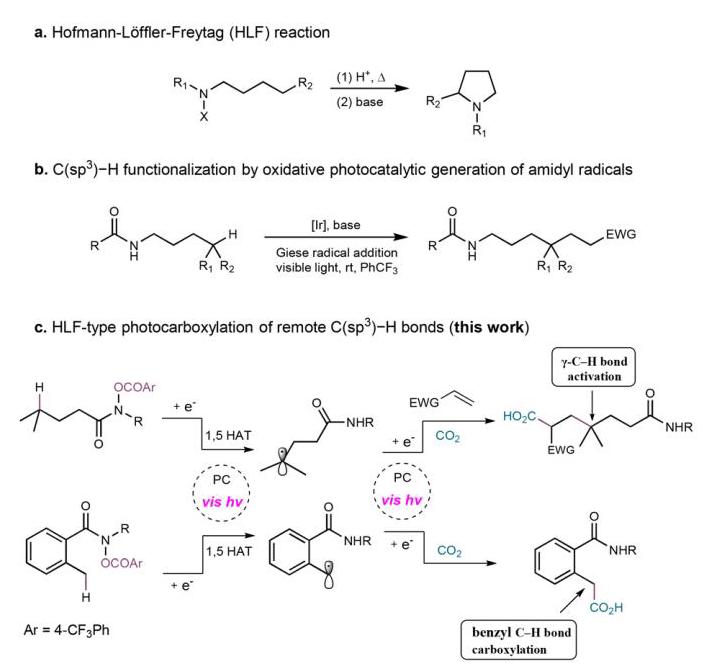
Fig. 1 Visible light-driven carboxylation of a $\mathrm{C}\left( {\mathrm{{sp}}}^{3}\right) - \mathrm{H}$ bond with ${\mathrm{{CO}}}_{2}$ .
图1可见光驱动的$\mathrm{C}\left( {\mathrm{{sp}}}^{3}\right) - \mathrm{H}$键与${\mathrm{{CO}}}_{2}$的羧基化反应。
${}^{a}$ College of Engineering, Peking University, Beijing 100871, China
${}^{a}$中国北京大学工程学院,北京100871
${}^{b}$ School of Materials Science and Engineering, Beijing 100871, China.
${}^{b}$中国北京100871材料科学与工程学院。
† Electronic supplementary information (ESI) available. See DOI: https://doi.org/ 10.1039/d3gc01426f
† 提供电子补充信息(ESI)。见DOI:https://doi.org/ 10.1039/d3gc01426f
Owing to its abundance, minimal toxicity, and renewability, carbon dioxide $\left( {\mathrm{{CO}}}_{2}\right)$ , the well-known greenhouse gas, emerges as an ideal one-carbon building block for the formation of C-C bonds in organic synthesis. ${}^{{28} - {32}}$ Carboxylation employing ${\mathrm{{CO}}}_{2}$ epitomizes a remarkable transformation, proffering a highly atom-economical route to the synthesis of valuable carboxylic acids and their derivatives. ${}^{{33} - {36}}$ The emerging visible-light-induced carboxylation in organic synthesis has recently encountered an intriguing transformation. ${}^{{37} - {41}}$ Many researchers have made outstanding contributions to the carboxylation of different types of $\mathrm{C} - \mathrm{H}$ bonds. ${}^{{42} - {57}}$ In this context, the generation of carbanions via visible-light photoredox catalysis, concomitant with the reduction of ${\mathrm{{CO}}}_{2}$ for carboxylation purposes, has emerged as a prevalent methodology employed in photo-carboxylation reactions. ${}^{{43},{45},{46},{49},{54},{57},{58}}$ He and co-workers have meticulously detailed recent work related to photocarbox-ylation reactions involving ${\mathrm{{CO}}}_{2}$ in their comprehensive review. ${}^{{59},{60}}$ In 2015, Murakami and his colleagues disclosed a unique approach wherein ultraviolet light excitation ( ${365}\mathrm{\;{nm}}$ ) was employed to amalgamate the 1,5-hydrogen atom transfer (HAT) process with carboxylation, offering new insights for the photocarboxylation of remote carbon-hydrogen bonds. ${}^{61}$ The nitrogen-centered-radical based HLF-type remote $\mathrm{C}\left( {\mathrm{{sp}}}^{3}\right) - \mathrm{H}$ functionalization, which involves the 1,5-HAT process and subsequent Giese radical addition, is a widely recognized and established mechanism within the field of organic chemistry. ${}^{{11},{12}}$ However, nitrogen-centered-radical based HLF-type remote $\mathrm{C}\left( {\mathrm{{sp}}}^{3}\right) - \mathrm{H}$ photocarboxylation is still synthetically challenging and remains mainly unexplored. Herein, we disclose an innovative method for the carboxylation of remote $\mathrm{C}\left( {\mathrm{{sp}}}^{3}\right) - \mathrm{H}$ bonds with ${\mathrm{{CO}}}_{2}$ under visible light irradiation, utilizing a nitrogen-centered 1,5-hydrogen atom transfer strategy (Fig. 1c). To the best of our knowledge, this is the first report on the combination of the nitrogen-centered-radical based HLF-type reaction with photocarboxylation.
由于二氧化碳$\left( {\mathrm{{CO}}}_{2}\right)$储量丰富、毒性极小且可再生,这种著名的温室气体成为有机合成中形成碳 - 碳键的理想一碳构件。${}^{{28} - {32}}$ 使用${\mathrm{{CO}}}_{2}$进行羧化是一种卓越的转化反应,为合成有价值的羧酸及其衍生物提供了一条原子经济性很高的途径。${}^{{33} - {36}}$ 有机合成中新兴的可见光诱导羧化反应最近遇到了一个有趣的转变。${}^{{37} - {41}}$ 许多研究人员对不同类型$\mathrm{C} - \mathrm{H}$键的羧化做出了杰出贡献。${}^{{42} - {57}}$ 在这种背景下,通过可见光光氧化还原催化生成碳负离子,并同时还原${\mathrm{{CO}}}_{2}$用于羧化目的,已成为光羧化反应中普遍采用的方法。${}^{{43},{45},{46},{49},{54},{57},{58}}$ 何及其同事在他们的全面综述中详细阐述了最近与涉及${\mathrm{{CO}}}_{2}$的光羧化反应相关的工作。${}^{{59},{60}}$ 2015年,村上及其同事披露了一种独特的方法,其中利用紫外光激发(${365}\mathrm{\;{nm}}$)将1,5 - 氢原子转移(HAT)过程与羧化反应相结合,为远程碳 - 氢键的光羧化反应提供了新的见解。${}^{61}$ 基于氮中心自由基的HLF型远程$\mathrm{C}\left( {\mathrm{{sp}}}^{3}\right) - \mathrm{H}$官能团化反应,涉及1,5 - HAT过程及随后的吉斯自由基加成,是有机化学领域中广泛认可且已确立的机制。${}^{{11},{12}}$ 然而,基于氮中心自由基的HLF型远程$\mathrm{C}\left( {\mathrm{{sp}}}^{3}\right) - \mathrm{H}$光羧化反应在合成上仍然具有挑战性,并且主要仍未得到充分探索。在此,我们披露了一种在可见光照射下利用氮中心1,5 - 氢原子转移策略将远程$\mathrm{C}\left( {\mathrm{{sp}}}^{3}\right) - \mathrm{H}$键与${\mathrm{{CO}}}_{2}$进行羧化的创新方法(图1c)。据我们所知,这是关于基于氮中心自由基的HLF型反应与光羧化反应相结合的首次报道。
Due to the inherently weak N-O bond, hydroxylamine derivatives have been seen as prominent precursors for the generation of amidyl radicals through visible-light photoredox catalysis. Inspired by the Yu group, ${}^{3,{62}}$ we have harnessed hydroxamic acid derivatives as amidyl radical precursors and exploited the carbon-centered radical engendered via the migration of the 1,5-HAT process to realize the photocarboxyla-tion of different types of remote C-H bonds. In the case of remote aliphatic C-H bonds, we herein reported a visible-light-promoted functionalization of alkenes by employing abundant ${\mathrm{{CO}}}_{2}$ and aliphatic hydroxamic acid derivatives. For remote benzylic C-H bonds, photocarboxylation could be realized directly. These strategies for remote C-H bond photocarboxyla-tion, characterized by their exceptional step-economy and ambient conditions with visible light, enable the assembly of molecular complexity in an environmentally benign and sustainable pattern.
由于N - O键本质上较弱,羟胺衍生物被视为通过可见光光氧化还原催化生成酰胺基自由基的重要前体。受余课题组的启发,${}^{3,{62}}$ 我们利用异羟肟酸衍生物作为酰胺基自由基前体,并利用通过1,5 - HAT过程迁移产生的碳中心自由基实现了不同类型远程碳 - 氢键的光羧化反应。对于远程脂肪族碳 - 氢键,我们在此报道了通过使用丰富的${\mathrm{{CO}}}_{2}$和脂肪族异羟肟酸衍生物实现的可见光促进的烯烃官能团化反应。对于远程苄基碳 - 氢键,可以直接实现光羧化反应。这些远程碳 - 氢键光羧化反应的策略,以其出色的步骤经济性和可见光照射下的温和条件为特征,能够以环境友好和可持续的方式构建分子复杂性。
We envisioned a photoredox process involving the 1,5-HAT process, the subsequent Giese radical addition, and the reduction of the radical intermediate to a carbanion, which subsequently leads to a nucleophilic attack on carbon dioxide resulting in carboxylation products. For remote aliphatic C-H bonds, the initial reaction conditions were established by employing a hydroxamic acid derivative 1a as the model substrate and benzyl acrylate 2a as a radical acceptor, with a solvent, photocatalyst, base, and ${\mathrm{{CO}}}_{2}$ under blue light irradiation at ambient temperature. After a series of methodical investigations of the reaction parameters, we obtained in the presence of benzyl acrylate as the radical acceptor, (Ir[dF $\left. {{\left( {\mathrm{{CF}}}_{3}\right) }_{\mathrm{{PPy}}}{\rbrack }_{2}\left( \text{ dtbpy }\right) }\right) {\mathrm{{PF}}}_{6}$ in DMF as the photocatalyst, ${\mathrm{{Cs}}}_{2}{\mathrm{{CO}}}_{3}$ as the base and DIPEA as the additive under a ${\mathrm{{CO}}}_{2}$ atmosphere, under the optimal conditions, the desired product 3a in 82% yield. Nearly no carboxylation product 3a was detected in the absence of either $\left( {\operatorname{Ir}{\left\lbrack \mathrm{{dF}}\left( {\mathrm{{CF}}}_{3}\right) \mathrm{{ppy}}\right\rbrack }_{2}\left( \mathrm{{dtbpy}}\right) }\right) {\mathrm{{PF}}}_{6}$ , carbon dioxide, or DIPEA as an additive or light, demonstrating that these four components were essential (entries 2-5). It should be noted that lower yields were obtained when replacing the photocatalyst, in the absence of ${\mathrm{{Cs}}}_{2}{\mathrm{{CO}}}_{3}$ , when changing the solvent, when reducing the amount of photocatalyst, or when shortening the reaction time (entries 6-11).
我们设想了一个光氧化还原过程,该过程涉及1,5-氢原子转移(1,5-HAT)过程、随后的吉泽自由基加成反应,以及将自由基中间体还原为碳负离子,随后碳负离子对二氧化碳进行亲核进攻,从而生成羧化产物。对于远程脂肪族碳氢键,最初的反应条件是通过使用异羟肟酸衍生物1a作为模型底物、丙烯酸苄酯2a作为自由基受体,并在室温下蓝光照射下加入溶剂、光催化剂、碱和${\mathrm{{CO}}}_{2}$来确定的。在对反应参数进行了一系列系统研究后,我们发现在以丙烯酸苄酯作为自由基受体、以(Ir[dF $\left. {{\left( {\mathrm{{CF}}}_{3}\right) }_{\mathrm{{PPy}}}{\rbrack }_{2}\left( \text{ dtbpy }\right) }\right) {\mathrm{{PF}}}_{6}$ 在N, N-二甲基甲酰胺(DMF)中作为光催化剂、以${\mathrm{{Cs}}}_{2}{\mathrm{{CO}}}_{3}$作为碱、以N, N-二异丙基乙胺(DIPEA)作为添加剂且在${\mathrm{{CO}}}_{2}$气氛下,在最佳条件下,目标产物3a的产率为82%。在没有$\left( {\operatorname{Ir}{\left\lbrack \mathrm{{dF}}\left( {\mathrm{{CF}}}_{3}\right) \mathrm{{ppy}}\right\rbrack }_{2}\left( \mathrm{{dtbpy}}\right) }\right) {\mathrm{{PF}}}_{6}$、二氧化碳、作为添加剂的DIPEA或光照的情况下,几乎检测不到羧化产物3a,这表明这四种成分是必不可少的(第2 - 5项)。需要注意的是,在没有${\mathrm{{Cs}}}_{2}{\mathrm{{CO}}}_{3}$时更换光催化剂、改变溶剂、减少光催化剂用量或缩短反应时间时,产率会降低(第6 - 11项)。
With the optimal reaction conditions, the generality of this three-component carboxylation was investigated with a variety of hydroxamic acid derivatives and alkenes, as summarized in Table 1; benzyl acrylate was selected as a radical acceptor, and different types of aliphatic hydroxamic acid derivatives as starting materials delivered the expected products in good yields (3a, 3b, 3c, and 3d). The scope of electron-withdrawing group alkenes was explored subsequently, including 2-phenoxyetha-nol acrylate (3e) and a series of alkyl acrylate esters (3f, 3g, 3h), which delivered the corresponding products in moderate-to-good yields (61-80%). Moreover, styrene with an electron-withdrawing substituent at the para position, such as cyano (3i) and esters (3j), also delivered the expected products in good yields (Fig. 2).
在优化的反应条件下,我们用各种异羟肟酸衍生物和烯烃对这种三组分羧化反应的通用性进行了研究,总结于表1中;选择丙烯酸苄酯作为自由基受体,不同类型的脂肪族异羟肟酸衍生物作为起始原料,均能以良好的产率得到预期产物(3a、3b、3c和3d)。随后研究了吸电子基团烯烃的范围,包括2-苯氧基乙醇丙烯酸酯(3e)和一系列丙烯酸烷基酯(3f、3g、3h),它们能以中等到良好的产率(61 - 80%)得到相应产物。此外,在对位带有吸电子取代基的苯乙烯,如氰基(3i)和酯基(3j),也能以良好的产率得到预期产物(图2)。
Table 1 Optimization of the reaction conditions ${}^{a}$
表1反应条件的优化${}^{a}$
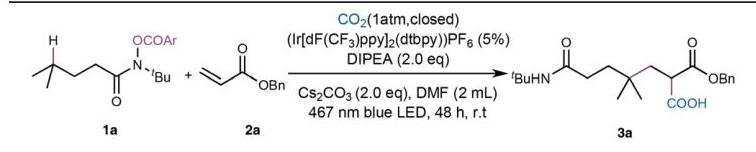
| Entry | Deviations | Yields ${}^{b}\left( \% \right)$ |
| 1 | None | 82 (75) |
| 2 | No light | Trace |
| 3 | No $\left( {{\mathrm{{Ir}\left\lbrack {{dF}\left( {C{F}_{3}}\right) {ppy}}\right\rbrack }}_{2}\left( \text{ dtbpy }\right) }\right) {\mathrm{{PF}}}_{6}$ | Trace |
| 4 | ${\mathrm{N}}_{2}$ instead of ${\mathrm{{CO}}}_{2}$ | Trace |
| 5 | No DIPEA | Trace |
| 6 | 4CzIPN instead of $\left( {\operatorname{Ir}{\left\lbrack \mathrm{{dF}}\left( {\mathrm{{CF}}}_{3}\right) \mathrm{{ppy}}\right\rbrack }_{2}\left( \mathrm{{dtbpy}}\right) }\right) {\mathrm{{PF}}}_{6}$ | 35 |
| 7 | No ${\mathrm{{Cs}}}_{2}{\mathrm{{CO}}}_{3}$ | 61 |
| 8 | 456 nm instead of 467 nm | 58 |
| 9 | ${\mathrm{{CH}}}_{3}\mathrm{{CN}}$ instead of DMF | 29 |
| 10 | $\left( {\mathrm{{Ir}}{\left\lbrack \mathrm{{dF}}\left( {\mathrm{{CF}}}_{3}\right) \mathrm{{ppy}}\right\rbrack }_{2}\left( \mathrm{{dtbpy}}\right) }\right) {\mathrm{{PF}}}_{6}\left( {2\% }\right)$ | 65 |
| 11 | 24 h | 71 |
${}^{a}$ Reaction conditions: 1a (0.2 mmol),1b (5.0 eq.),(Ir[dF(CF ${}_{3}$ ) ppy] ${}_{2}$ (dtbpy)) ${\mathrm{{PF}}}_{6}$ (5%), DIPEA (2.0 eq.), ${\mathrm{{Cs}}}_{2}{\mathrm{{CO}}}_{3}$ (2.0 eq.), DMF (2 mL), and irradiation by Kessil ${40}\mathrm{\;W}$ blue LED for ${48}\mathrm{\;h}$ under 1 atm ${\mathrm{{CO}}}_{2}$ at ambient temperature. ${}^{b{}^{1}}\mathrm{H}$ NMR yields using 1,1,2,2-tetrachloroethane as an internal standard with the yields of isolated products given in parentheses. DMF = $N, N$ -dimethylformamide and DIPEA = $N, N$ - diisopropylethylamine.
${}^{a}$反应条件:1a(0.2 mmol),1b(5.0当量),(Ir[dF(CF ${}_{3}$ )ppy] ${}_{2}$ (dtbpy)) ${\mathrm{{PF}}}_{6}$(5%),DIPEA(2.0当量),${\mathrm{{Cs}}}_{2}{\mathrm{{CO}}}_{3}$(2.0当量),DMF(2 mL),并在室温下1个大气压${\mathrm{{CO}}}_{2}$下用Kessil ${40}\mathrm{\;W}$蓝光发光二极管照射${48}\mathrm{\;h}$。以1,1,2,2-四氯乙烷作为内标物的${}^{b{}^{1}}\mathrm{H}$核磁共振产率,括号内为分离产物的产率。DMF = $N, N$ -二甲基甲酰胺,DIPEA = $N, N$ -二异丙基乙胺。
With the successful development of three-component carboxylation of the aliphatic hydroxamic acid derivative with electron-withdrawing alkenes, we envisioned that the same strategy might be possibly extended to the benzylic hydroxamic acid derivative 4a. Intriguingly, when 4a was used as the model substrate and benzyl acrylate 4a or styrene derivative 4c was used as the radical acceptor, both the direct carboxylation product and the alkene addition carboxylation products were detected (Fig. 3). When benzyl acrylate was chosen as the radical acceptor, the ratio of the direct carboxylation product to the alkene addition carboxylation product was almost the same, both in moderate yields. If the styrene derivatives were chosen as the model alkene, the selectivity of the alkene carboxylation product was increased to 74%. We speculate that the benzyl carbanion must be stable enough to result in the formation of direct carboxylation products.
随着脂肪族异羟肟酸衍生物与吸电子烯烃的三组分羧化反应的成功开发,我们设想相同的策略可能可以扩展到苄基异羟肟酸衍生物4a。有趣的是,当使用4a作为模型底物,丙烯酸苄酯4a或苯乙烯衍生物4c作为自由基受体时,直接羧化产物和烯烃加成羧化产物均被检测到(图3)。当选择丙烯酸苄酯作为自由基受体时,直接羧化产物与烯烃加成羧化产物的比例几乎相同,二者产率均适中。如果选择苯乙烯衍生物作为模型烯烃,烯烃羧化产物的选择性提高到74%。我们推测苄基碳负离子必须足够稳定才能导致直接羧化产物的形成。
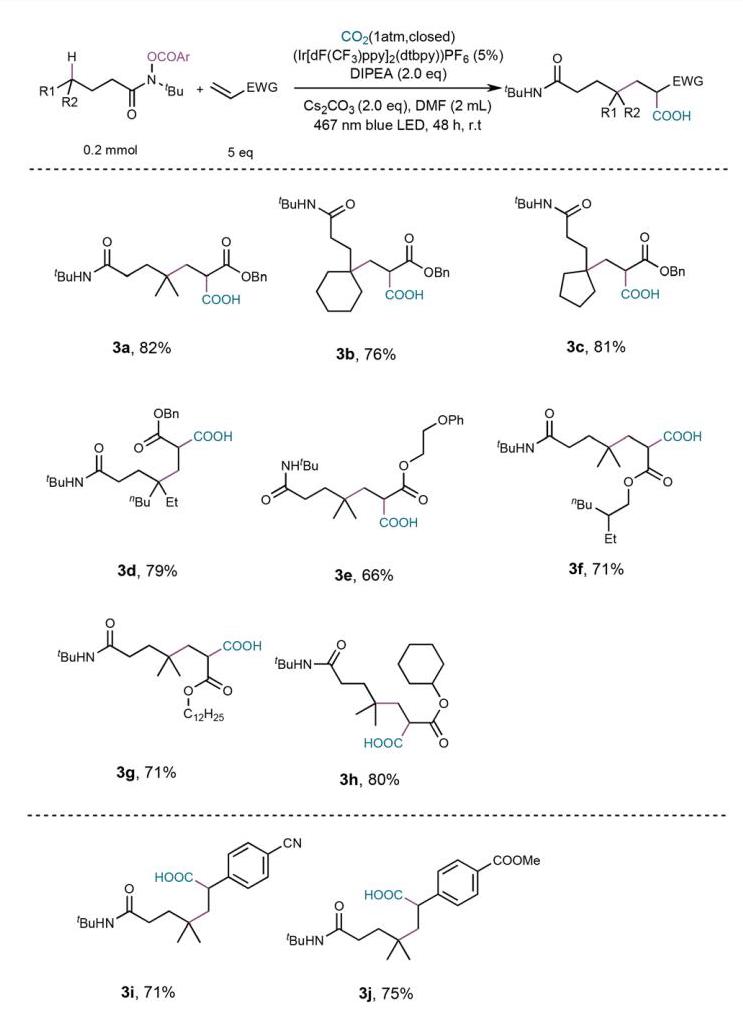
Fig. 2 Scope of carboxylation of remote $\mathrm{C} - \mathrm{H}$ bonds with electron-deficient alkenes and ${\mathrm{{CO}}}_{2}$ .
图2 缺电子烯烃和${\mathrm{{CO}}}_{2}$对远程$\mathrm{C} - \mathrm{H}$键的羧化反应范围。
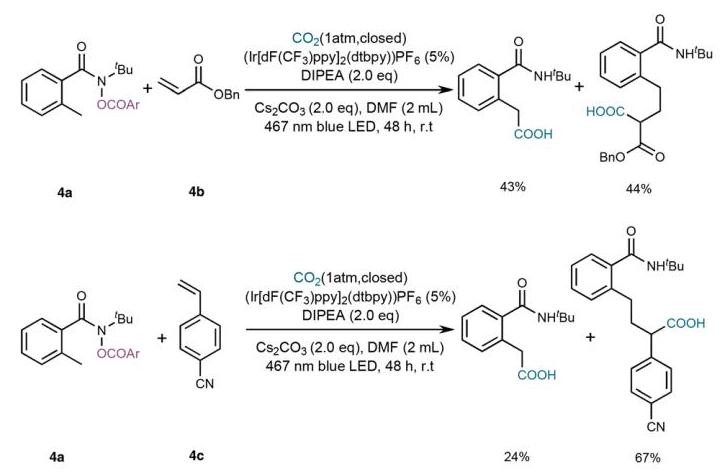
Fig. 3 The reaction of benzylic hydroxamic acid derivatives with electron-deficient alkenes and ${\mathrm{{CO}}}_{2}$ .
图3 苄基异羟肟酸衍生物与缺电子烯烃和${\mathrm{{CO}}}_{2}$的反应。
Under the optimal reaction conditions, we then investigated the substrate scope of this visible-light-driven metal-free remote benzylic $\mathrm{C} - \mathrm{H}$ bond carboxylation. As summarized in Fig. 4, a broad range of benzylic hydroxamic acid derivatives bearing diverse functional groups on the central arene amide as starting materials, including fluoro (6j, 6k), bromo (6e), chloro (6f), methyl (6b, 6i), and methoxy (6d, 6h), delivered the corresponding products in moderate-to-good yields (57-82%). The substrates bearing methyl disubstitution on the arene core (6i) were also suitable. This reaction was not hampered by ortho substitution (6h, 6k) on the central benzene ring. When the isopropyl or cyclohexyl benzylic hydroxamic acid derivatives were used as starting materials, a low yield of the desired product was obtained (6c, 6g).
在最佳反应条件下,我们接着研究了这种可见光驱动的无金属远程苄基$\mathrm{C} - \mathrm{H}$键羧化反应的底物范围。如图4总结所示,一系列在中心芳烃酰胺上带有不同官能团的苄基异羟肟酸衍生物作为起始原料,包括氟代(6j,6k)、溴代(6e)、氯代(6f)、甲基(6b,6i)和甲氧基(6d,6h),都以中等到良好的产率(57 - 82%)得到了相应产物。在芳烃核心上带有甲基二取代的底物(6i)也是合适的。该反应不受中心苯环上邻位取代(6h,6k)的阻碍。当使用异丙基或环己基苄基异羟肟酸衍生物作为起始原料时,得到的目标产物产率较低(6c,6g)。
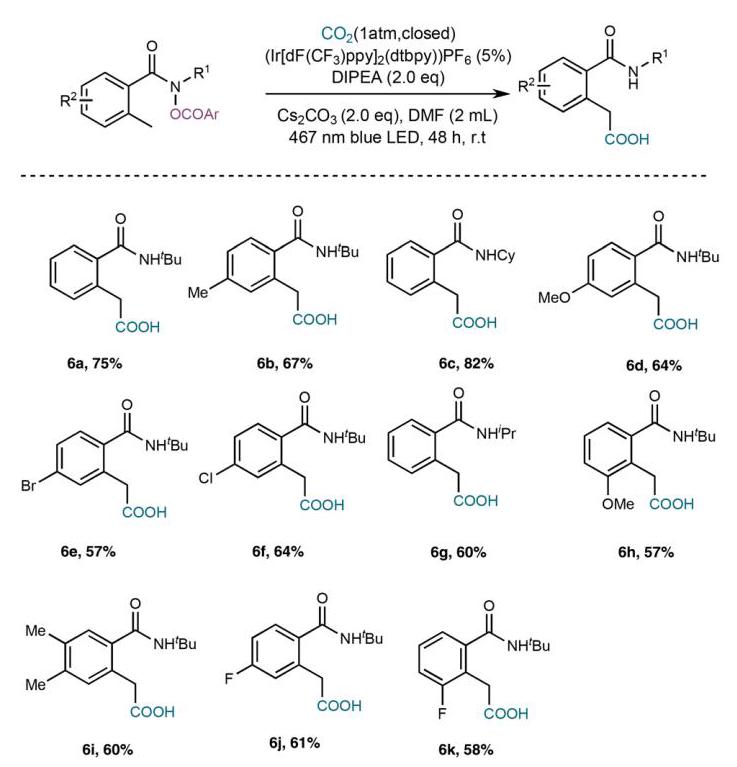
Fig. 4 Scope of carboxylation of remote benzylic $\mathrm{C} - \mathrm{H}$ bonds with ${\mathrm{{CO}}}_{2}$ .
图4 ${\mathrm{{CO}}}_{2}$对远程苄基$\mathrm{C} - \mathrm{H}$键的羧化反应范围。
A series of control experiments were conducted to gain more mechanistic insight into this new transformation. We initially carried out radical inhibition experiments. As illustrated in Fig. 5, when 2,2,6,6-tetramethyl-1-piperidinyloxy (TEMPO) was added to the standard reaction conditions, we found that the formation of the desired products was significantly inhibited. Moreover, the direct TEMPO trapping products were detected simultaneously (7a, 7b), suggesting that radical intermediates might be involved. When ${\mathrm{D}}_{2}\mathrm{O}$ was added to the reaction mixture, up to 85% deuterium incorporation at the benzylic position of $7\mathbf{c}$ was observed, suggesting the formation of a benzylic carbanion intermediate.
进行了一系列对照实验以更深入了解这种新转化反应的机理。我们首先进行了自由基抑制实验。如图5所示,当将2,2,6,6 - 四甲基 - 1 - 哌啶氧基(TEMPO)添加到标准反应条件下时,我们发现目标产物的形成受到显著抑制。此外,同时检测到了直接的TEMPO捕获产物(7a,7b),这表明可能涉及自由基中间体。当将${\mathrm{D}}_{2}\mathrm{O}$添加到反应混合物中时,观察到在$7\mathbf{c}$的苄基位置有高达85%的氘掺入,这表明形成了苄基碳负离子中间体。
Based on the control experiments and previous studies, ${}^{4}$ a plausible mechanism for the overall transformation is proposed and outlined in Fig. 6. First, the Ir ${}^{\mathrm{{III}}}$ -photocatalyst, upon photoexcitation, would reduce the hydroxamic acid derivatives, which could deliver the amidyl radical intermediate I through fragmentation and regenerate the requisite ${\operatorname{Ir}}^{\mathrm{{IV}}}$ . The electrophilic amidyl radical I would promote a 1,5-hydrogen atom transfer, affording the radical intermediate II, after the subsequent Giese radical addition generating the intermediate III, which would be reduced by the Ir ${}^{\mathrm{{III}}}$ species to both afford the carbon anion intermediate IV and regenerate the requisite ${\operatorname{Ir}}^{\mathrm{{IV}}}$ . The subsequent nucleophilic attack on ${\mathrm{{CO}}}_{2}$ and the following protonation can provide the observed carboxylic acids. The photoactive ${\operatorname{Ir}}^{\mathrm{{IV}}}$ -photocatalyst is likely to be regenerated by oxidizing a molecule of DIPEA.
基于对照实验和先前的研究,${}^{4}$提出了一个关于整体转化反应的合理机理,并在图6中概述。首先,Ir${}^{\mathrm{{III}}}$ - 光催化剂在光激发后会还原异羟肟酸衍生物,该衍生物可通过裂解产生酰胺基自由基中间体I并再生所需的${\operatorname{Ir}}^{\mathrm{{IV}}}$。亲电的酰胺基自由基I会促进1,5 - 氢原子转移,得到自由基中间体II,在随后的吉斯自由基加成生成中间体III后,中间体III会被Ir${}^{\mathrm{{III}}}$物种还原,既生成碳负离子中间体IV又再生所需的${\operatorname{Ir}}^{\mathrm{{IV}}}$。随后对${\mathrm{{CO}}}_{2}$的亲核进攻以及接下来的质子化可以提供观察到的羧酸。光活性的${\operatorname{Ir}}^{\mathrm{{IV}}}$ - 光催化剂可能通过氧化一分子的DIPEA而再生。
In conclusion, we herein report the combination of the HLF-type reaction with photocarboxylation. The visible-light-driven carboxylation of remote $\mathrm{C} - \mathrm{H}$ bonds by nitrogen-centered radical 1,5-hydrogen atom transfer was developed. Unlike previously reported ways of generating radicals, our control experimental investigations strongly indicate N-O cleavage and 1,5-hydrogen atom transfer to be the essential steps for the generation of radicals, which were reduced to the corresponding carbanions through single-electron transfer. Subsequently, the carbanions further underwent nucleophilic attack on ${\mathrm{{CO}}}_{2}$ to generate carboxylates. It is noteworthy that this reaction proceeds smoothly without adding any metal reagent under mild conditions, affording the desired carboxylic acids in moderate to excellent yields with broad substrate scope. This study presents a representative method of remote C-H bond functionalization.
总之,我们在此报告了HLF型反应与光羧基化反应的结合。通过氮中心自由基1,5-氢原子转移实现了远程$\mathrm{C} - \mathrm{H}$键的可见光驱动羧基化反应。与先前报道的产生自由基的方法不同,我们的对照实验研究强烈表明,N-O键裂解和1,5-氢原子转移是产生自由基的关键步骤,这些自由基通过单电子转移还原为相应的碳负离子。随后,碳负离子进一步对${\mathrm{{CO}}}_{2}$进行亲核进攻,生成羧酸盐。值得注意的是,该反应在温和条件下无需添加任何金属试剂即可顺利进行,底物范围广泛,以中等至优异的产率得到所需的羧酸。本研究提出了一种远程C-H键官能团化的代表性方法。
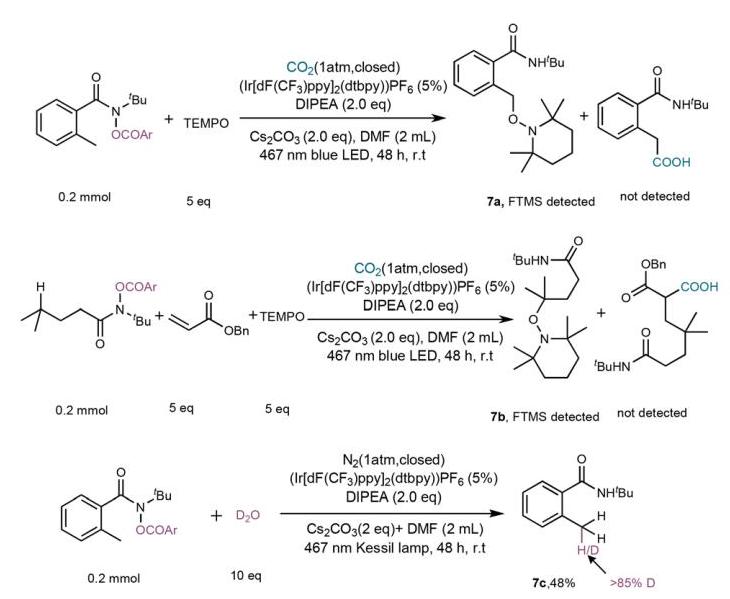
Fig. 5 Control experiments for the elucidation of the mechanism.
图5 用于阐明机理的对照实验。
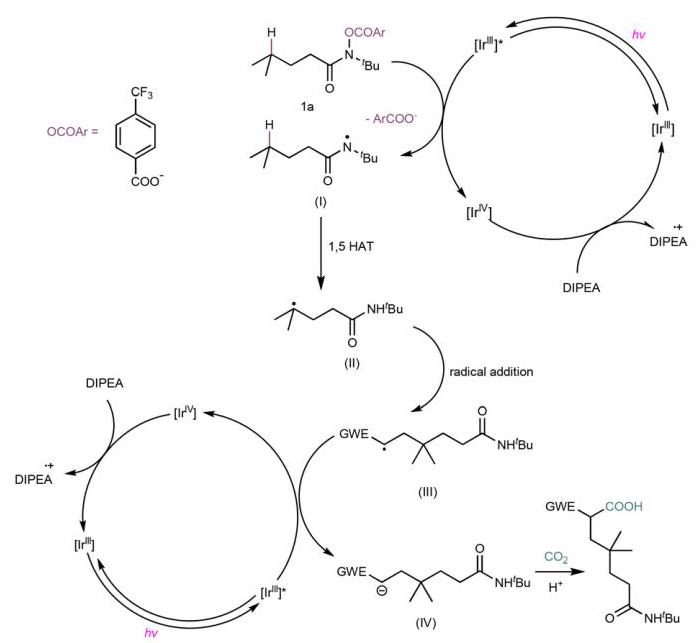
Fig. 6 Plausible reaction mechanism.
图6 合理的反应机理。
Conflicts of interest
利益冲突
There are no conflicts to declare.
无需声明利益冲突。
Acknowledgements
致谢
This work is supported by the Natural Science Foundation of China (Grant No. 22071004, 21933001, 22150013).
本研究得到了中国国家自然科学基金(项目编号:22071004、21933001、22150013)的资助。
References
参考文献
1 R. G. Bergman, Nature, 2007, 446, 391-393.
2 Q. Min, J. Yang, M. Pang, G. Ao and F. Liu, Org. Lett., 2020, 22, 2828-2832.
3 X. Shen, J. J. Zhao and S. Yu, Org. Lett., 2018, 20, 5523- 5527.
4 H. Chen, W. Jin and S. Yu, Org. Lett., 2020, 22, 5910-5914.
5 L. M. Stateman, K. M. Nakafuku and D. A. Nagib, Synthesis, 2018, 50, 1569-1586.
6 W. Guo, Q. Wang and J. Zhu, Chem. Soc. Rev., 2021, 50, 7359-7377.
7 A. Hofmann, Ber. Dtsch. Chem. Ges., 1882, 15, 762-775.
8 K. Löffler and S. Kober, Ber. Dtsch. Chem. Ges., 1909, 42, 3431-3438.
9 G. Kumar, S. Pradhan and I. Chatterjee, Chem. - Asian J., 2020, 15, 651-672.
10 X. Wu and C. Zhu, CCS Chem., 2020, 2, 813-828.
11 G. J. Choi, Q. Zhu, D. C. Miller, C. J. Gu and R. R. Knowles, Nature, 2016, 539, 268-271.
12 J. C. K. Chu and T. Rovis, Nature, 2016, 539, 272-275.
13 Q. Guo, Q. Peng, H. Chai, Y. Huo, S. Wang and Z. Xu, Nat. Commun., 2020, 11, 1463.
14 Q. Qin and S. Yu, Org. Lett., 2015, 17, 1894-1897.
15 R. Z. Liu, J. Li, J. Sun, X. G. Liu, S. Qu, P. Li and B. Zhang, Angew. Chem., Int. Ed., 2020, 59, 4428-4433.
16 N. Kim, C. Lee, T. Kim and S. Hong, Org. Lett., 2019, 21, 9719-9723.
17 H. Jung, H. Keum, J. Kweon and S. Chang, J. Am. Chem. Soc., 2020, 142, 5811-5818.
18 K. Wu, L. Wang, S. Colon-Rodriguez, G. U. Flechsig and T. Wang, Angew. Chem., Int. Ed., 2019, 58, 1774-1778.
19 S. P. Morcillo, E. M. Dauncey, J. H. Kim, J. J. Douglas, N. S. Sheikh and D. Leonori, Angew. Chem., Int. Ed., 2018, 57, 12945-12949.
20 H. Chen and S. Yu, Org. Biomol. Chem., 2020, 18, 4519- 4532.
21 A. R. Rivero, P. Fodran, A. Ondrejková and C. Wallentin, Org. Lett., 2020, 22, 8436-8440.
22 K. Kim, N. Kim and S. Hong, Bull. Korean Chem. Soc., 2021, 42, 548-552.
23 Q. Min, J. Yang, M. Pang, G. Ao and F. Liu, Org. Lett., 2020, 22, 2828-2832.
24 Y. Zhao and W. Xia, Chem. Soc. Rev., 2018, 47, 2591-2608.
25 E. A. Wappes, S. C. Fosu, T. C. Chopko and D. A. Nagib, Angew. Chem., 2016, 128, 10128-10132.
26 J. Davies, T. D. Svejstrup, D. Fernandez Reina, N. S. Sheikh and D. Leonori, J. Am. Chem. Soc., 2016, 138, 8092-8095.
27 C. G. Na and E. J. Alexanian, Angew. Chem., 2018, 130, 13290-13293.
28 C. Martinez and K. Muniz, Angew. Chem., Int. Ed., 2015, 54, 8287-8291.
29 T. Sakakura, J. C. Choi and H. Yasuda, Chem. Rev., 2007, 107, 2365-2387.
30 T. Sakakura and K. Kohno, Chem. Commun., 2009, 1312- 1330.
31 A. Tortajada, M. Börjesson and R. Martin, Acc. Chem. Res., 2021, 54, 3941-3952.
32 A. Tortajada, F. Hernandez, M. Borjesson, T. Moragas and R. Martin, Angew. Chem., Int. Ed., 2018, 57, 15948-15982.
33 M. Borjesson, T. Moragas, D. Gallego and R. Martin, ACS Catal., 2016, 6, 6739-6749.
34 T. Fujihara and Y. Tsuji, Front. Chem., 2019, 7, 430.
35 K. Huang, C. L. Sun and Z. J. Shi, Chem. Soc. Rev., 2011, 40, 2435-2452.
36 C. S. Yeung, Angew. Chem., Int. Ed., 2019, 58, 5492-5502.
37 Y. Cao, X. He, N. Wang, H. R. Li and L. N. He, Chin. J. Chem., 2018, 36, 644-659.
38 J. Hou, J. S. Li and J. Wu, Asian J. Org. Chem., 2018, 7, 1439-1447.
39 K. Shimomaki, K. Murata, R. Martin and N. Iwasawa, J. Am. Chem. Soc., 2017, 139, 9467-9470.
40 F. Tan and G. Yin, Chin. J. Chem., 2018, 36, 545-554.
41 Z. B. Yin, J. H. Ye, W. J. Zhou, Y. H. Zhang, L. Ding, Y. Y. Gui, S. S. Yan, J. Li and D. G. Yu, Org. Lett., 2017, 20, 190-193.
42 Y. Jin, N. Toriumi and N. Iwasawa, ChemSusChem, 2022, 15, e202102095.
43 H. Seo, M. H. Katcher and T. F. Jamison, Nat. Chem., 2017, 9, 453-456.
44 N. Ishida, Y. Masuda, S. Uemoto and M. Murakami, Chemistry, 2016, 22, 6524-6527.
45 V. R. Yatham, Y. Shen and R. Martin, Angew. Chem., Int. Ed., 2017, 56, 10915-10919.
46 J. H. Ye, M. Miao, H. Huang, S. S. Yan, Z. B. Yin, W. J. Zhou and D. G. Yu, Angew. Chem., Int. Ed., 2017, 56, 15416- 15420.
47 J. Hou, A. Ee, W. Feng, J. H. Xu, Y. Zhao and J. Wu, J. Am. Chem. Soc., 2018, 140, 5257-5263.
48 Q. Y. Meng, S. Wang, G. S. Huff and B. Konig, J. Am. Chem. Soc., 2018, 140, 3198-3201.
49 L. L. Liao, G. M. Cao, J. H. Ye, G. Q. Sun, W. J. Zhou, Y. Y. Gui, S. S. Yan, G. Shen and D. G. Yu, J. Am. Chem. Soc., 2018, 140, 17338-17342.
50 C. Zhu, Y. F. Zhang, Z. Y. Liu, L. Zhou, H. Liu and C. Feng, Chem. Sci., 2019, 10, 6721-6726.
51 B. Sahoo, P. Bellotti, F. Hernandez, Q. Y. Meng, S. Crespi, B. Konig and R. Martin, Chemistry, 2019, 25, 9001-9005.
52 H. Wang, Y. Gao, C. Zhou and G. Li, J. Am. Chem. Soc., 2020, 142, 8122-8129.
53 Y. Masuda, N. Ishida and M. Murakami, J. Am. Chem. Soc., 2015, 137, 14063-14066.
54 J. Wencel Delord, Chem, 2020, 6, 2437-2439.
55 N. Ishida, Y. Masuda, Y. Imamura, K. Yamazaki and M. Murakami, J. Am. Chem. Soc., 2019, 141, 19611-19615.
56 Q. Y. Meng, T. E. Schirmer, A. L. Berger, K. Donabauer and B. Konig, J. Am. Chem. Soc., 2019, 141, 11393-11397.
57 L. Song, D. Fu, L. Chen, Y. Jiang, J. Ye, L. Zhu, Y. Lan, Q. Fu and D. Yu, Angew. Chem., Int. Ed., 2020, 59, 21121-21128.
58 Z. Zhang, J. H. Ye, T. Ju, L. L. Liao, H. Huang, Y. Y. Gui, W. J. Zhou and D. G. Yu, ACS Catal., 2020, 10, 10871- 10885.
59 Q. W. Song, Z. H. Zhou and L. N. He, Green Chem., 2017, 19, 3707-3728.
60 X. He, L. Q. Qiu, W. J. Wang, K. H. Chen and L. N. He, Green Chem., 2020, 22, 7301-7320.
61 Y. Masuda, N. Ishida and M. Murakami, J. Am. Chem. Soc., 2015, 137, 14063-14066.
62 H. Chen, W. Fan, X. A. Yuan and S. Yu, Nat. Commun., 2019, 10, 4743.