Direct Stannylation and Silylation of Benzyl Alcohol by Palladium Catalysis
英文原文与中文译文逐段对照 · English original with Chinese translation
Guanglu Yue, Qianyi Liu, Jingyao Wei, Yanqiong Pi, Di Qiu,* and Fanyang Mo*
岳光陆,刘谦益,魏静瑶,皮艳琼,邱迪*,莫凡洋*
Cite This: J. Org. Chem. 2023, 88, 2735-2741
引用本文:《有机化学杂志》2023年,第88卷,第2735 - 2741页
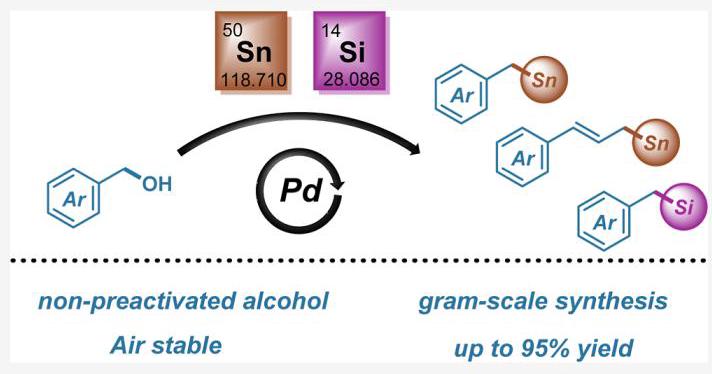
ABSTRACT: A direct transformation of non-preactivated benzyl alcohols to benzyl stannanes and benzyl silanes was realized through Pd-catalyzed $\mathrm{C}\left( {\mathrm{{sp}}}^{3}\right) - \mathrm{O}$ activation process. By using versatile tin and silicon sources, these reactions exhibit a broad substrate scope and a high efficiency under mild conditions, affording functionalized benzyl and allylic stannanes and benzylsilanes with high yields. The successful implementation of gram-scale stannylation/silylation as well as the one-pot Stille coupling reaction demonstrates the potential application of this method in organic synthesis. Both experimental and theoretical investigations reveal the mechanistic details of this reaction.
摘要:通过钯催化的$\mathrm{C}\left( {\mathrm{{sp}}}^{3}\right) - \mathrm{O}$活化过程,实现了未预活化的苄醇向苄基锡烷和苄基硅烷的直接转化。使用通用的锡源和硅源,这些反应在温和条件下具有广泛的底物范围和高效率,能够高产率地得到官能化的苄基和烯丙基锡烷以及苄基硅烷。克级规模的锡基化/硅基化反应以及一锅法施蒂勒偶联反应的成功实施证明了该方法在有机合成中的潜在应用。实验和理论研究都揭示了该反应的机理细节。
1. INTRODUCTION
1. 引言
Alcohols and their derivatives are serving as a class of abundant compounds with important application value, which widely exist in biomolecules and drug molecules. ${}^{1 - 3}$ At the same time, they have also drawn the attention of chemists as a molecular building block in organic synthesis. ${}^{4 - 6}$ Compared with organic halides, alcohols have also become the coupling reaction partner favored by scientists due to their advantages of natural existence, environmental friendliness, and low toxicity. ${}^{7 - {11}}$ However, the bond dissociation energy (BDE) of the C-O bond in alcohol is relatively strong, making it difficult for low-valent metals to directly activate the $\mathrm{C} - \mathrm{O}$ bond by oxidative addition. ${}^{{12},{13}}$ Therefore, a variety of $\mathrm{C} - \mathrm{O}$ electrophiles have been established recently to reduce their BDE of the $\mathrm{C} - \mathrm{O}$ bond, aiming to achieve the selective of $\mathrm{C} - \mathrm{O}$ bond reorganization. For example, carbamates, ${}^{{14} - {16}}$ sulfonates, ${}^{{17} - {20}}$ ethers, ${}^{{21} - {23}}$ and so forth are typically used in transition-metal-catalyzed $\mathrm{C} - \mathrm{O}$ bond coupling reactions, allowing the selective $\mathrm{C} - \mathrm{C}$ bond and carbon-heteroatom bond construction.
醇类及其衍生物是一类丰富且具有重要应用价值的化合物,广泛存在于生物分子和药物分子中。${}^{1 - 3}$ 同时,它们作为有机合成中的分子构建单元也引起了化学家的关注。${}^{4 - 6}$ 与有机卤化物相比,醇类因其天然存在、环境友好和低毒性等优点,也成为了科学家们青睐的偶联反应伙伴。${}^{7 - {11}}$ 然而,醇中C-O键的键解离能(BDE)相对较强,使得低价金属难以通过氧化加成直接活化$\mathrm{C} - \mathrm{O}$键。${}^{{12},{13}}$ 因此,最近已经建立了多种$\mathrm{C} - \mathrm{O}$亲电试剂来降低其$\mathrm{C} - \mathrm{O}$键的BDE,旨在实现$\mathrm{C} - \mathrm{O}$键重排的选择性。例如,氨基甲酸盐、${}^{{14} - {16}}$磺酸盐、${}^{{17} - {20}}$醚、${}^{{21} - {23}}$等通常用于过渡金属催化的$\mathrm{C} - \mathrm{O}$键偶联反应,从而实现选择性的$\mathrm{C} - \mathrm{C}$键和碳-杂原子键的构建。
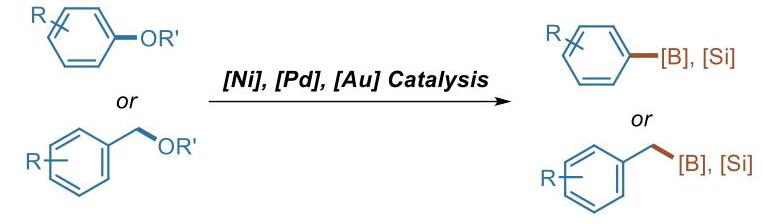
With the widespread development of transition-metal-catalyzed C-O electrophiles to build C-C bond, ${}^{4 - {11}}$ the construction of carbon-heteroatom bond remains a great challenge. ${}^{24}$ In view of the great importance of organic boron and silicon compounds in cross-coupling reactions, chemists have used different transition-metal complexes to cleave C-O bond in electrophilic alcohol derivatives to build C-B/Si bond, such as the employment of ${\mathrm{{Ni}}}^{{25} - {31}}\mathrm{\;{Pd}},{}^{32}\mathrm{{Au}},{}^{33}$ and other metals ${}^{{34} - {37}}$ (Scheme 1a). On the other hand, organotin reagents are featured as important molecular building blocks in medicinal chemistry, ${}^{{38} - {42}}$ materials science, ${}^{{43},{44}}$ and organic synthesis. ${}^{{45} - {47}}$ We envisioned whether the $\mathrm{C} - \mathrm{{Sn}}$ bond can be constructed by $\mathrm{C} - \mathrm{O}$ bond breaking in the $\mathrm{C} - \mathrm{O}$ electrophiles, especially directly in the alcohols. In 2016, Martin’s group successfully realized the $\mathrm{C} - \mathrm{{Sn}}$ bond formation by Ni-catalyzed $\mathrm{C}\left( {\mathrm{{sp}}}^{3}\right) - \mathrm{O}$ bond activation of aryl esters ${}^{48}$ (Scheme 1b). Based on the previous research of stannanes in our group, ${}^{{49},{50}}$ we further envisioned whether the $\mathrm{C}\left( {\mathrm{{sp}}}^{3}\right) - \mathrm{{Sn}}$ bond can be constructed by $\mathrm{C}\left( {\mathrm{{sp}}}^{3}\right) - \mathrm{O}$ bond breaking in the $\mathrm{C} - \mathrm{O}$ electrophiles, especially directly in the alcohols without any pre-activation (Scheme 1c).
随着过渡金属催化的C-O亲电试剂构建C-C键的广泛发展,${}^{4 - {11}}$ 构建碳-杂原子键仍然是一个巨大的挑战。${}^{24}$ 鉴于有机硼和硅化合物在交叉偶联反应中的重要性,化学家们使用不同的过渡金属配合物来裂解亲电醇衍生物中的C-O键以构建C-B/Si键,例如使用${\mathrm{{Ni}}}^{{25} - {31}}\mathrm{\;{Pd}},{}^{32}\mathrm{{Au}},{}^{33}$和其他金属${}^{{34} - {37}}$(方案1a)。另一方面,有机锡试剂在药物化学、${}^{{38} - {42}}$材料科学、${}^{{43},{44}}$和有机合成中是重要的分子构建单元。${}^{{45} - {47}}$ 我们设想是否可以通过在$\mathrm{C} - \mathrm{O}$亲电试剂中裂解$\mathrm{C} - \mathrm{O}$键来构建$\mathrm{C} - \mathrm{{Sn}}$键,特别是直接在醇中。2016年,Martin小组通过镍催化的芳基酯${}^{48}$的$\mathrm{C}\left( {\mathrm{{sp}}}^{3}\right) - \mathrm{O}$键活化成功实现了$\mathrm{C} - \mathrm{{Sn}}$键的形成(方案1b)。基于我们小组之前对锡烷的研究,${}^{{49},{50}}$ 我们进一步设想是否可以通过在$\mathrm{C} - \mathrm{O}$亲电试剂中裂解$\mathrm{C}\left( {\mathrm{{sp}}}^{3}\right) - \mathrm{O}$键来构建$\mathrm{C}\left( {\mathrm{{sp}}}^{3}\right) - \mathrm{{Sn}}$键,特别是直接在醇中且无需任何预活化(方案1c)。
2. RESULTS AND DISCUSSION
2. 结果与讨论
Initially, naphthalen-2-ylmethanol (1a) and ${\left( {\mathrm{{SnMe}}}_{3}\right) }_{2}$ (2a) were employed as model substrates for this investigation. Having optimized the reaction conditions, we were delighted to find that a catalytic system containing $\mathrm{{Pd}}{\left( \mathrm{{OAc}}\right) }_{2},1,{1}^{\prime }$ - bis(dicyclohexylphosphino)ferrocene (DCPF), $\mathrm{{Ti}}{\left( {\mathrm{O}}^{i}\mathrm{{Pr}}\right) }_{4}$ , and ${\mathrm{{Piv}}}_{2}\mathrm{O}$ promoted the targeted reaction at ${140}{}^{ \circ }\mathrm{C}$ , affording 3a in 80% isolated yield (Table 1, entry 1). A number of control experiments were conducted to provide further insight of this reaction. Not surprisingly, a decreased amount of tin source 2a led to lower yields (entries 2 and 3). Use of less catalyst (5 mol %) gave incomplete conversion on a small scale (entry 4). With use of other ligands, such as $1,{1}^{\prime }$ -bis- (diphenylphosphino)ferrocene (DPPF), the reaction was almost shut down (entry 5). Acid anhydride seems to be critical: the yield was intensively diminished in the absence of
最初,使用萘 - 2 - 甲醇(1a)和${\left( {\mathrm{{SnMe}}}_{3}\right) }_{2}$(2a)作为该研究的模型底物。在优化反应条件后,我们很高兴地发现,包含$\mathrm{{Pd}}{\left( \mathrm{{OAc}}\right) }_{2},1,{1}^{\prime }$ - 双(二环己基膦基)二茂铁(DCPF)、$\mathrm{{Ti}}{\left( {\mathrm{O}}^{i}\mathrm{{Pr}}\right) }_{4}$和${\mathrm{{Piv}}}_{2}\mathrm{O}$的催化体系在${140}{}^{ \circ }\mathrm{C}$下促进了目标反应,以80%的分离产率得到3a(表1,条目1)。进行了许多对照实验以进一步深入了解该反应。不出所料,锡源2a的量减少导致产率降低(条目2和3)。使用较少的催化剂(5 mol%)在小规模上导致不完全转化(条目4)。使用其他配体,如$1,{1}^{\prime }$ - 双(二苯基膦基)二茂铁(DPPF),反应几乎停止(条目5)。酸酐似乎至关重要:在没有
Received: September 20, 2022
收到日期:2022年9月20日
Published: February 15, 2023
发表日期:2023年2月15日
Scheme 1. Construction of Benzylstannanes and Silanes via C-O Bond Cleavage
方案1. 通过C - O键裂解构建苄基锡烷和硅烷
a) Transition-Metal-Catalyzed Borylation/Silyation via C-O Bond Activation
a)通过C - O键活化的过渡金属催化硼化/硅化
b) Ni-Catalyzed Stannylation via C(sp3)-O Bond Activation
b)通过C(sp3)-O键活化的镍催化锡化反应
R

c) Pd-Catalyzed Stannylation and Silylation via C(sp3)-O Bond Activation (this work)
c)通过C(sp3)-O键活化的钯催化锡化和硅化反应(本工作)
R
OH [Pd] Catalysis FG
OH [Pd]催化 FG
R
$\left( {{FG} = {\mathrm{{SnMe}}}_{3},{\mathrm{{SnBu}}}_{3},{\mathrm{{SiMe}}}_{3},{\mathrm{{SiMe}}}_{2}\mathrm{{Ph}}}\right) \; {\mathrm{{Piv}}}_{2}\mathrm{O}$ (entry 6); the replacement of ${\mathrm{{Piv}}}_{2}\mathrm{O}$ with $\mathrm{{TsCl}}$ led to trace products (entry 7), while the use of other acid anhydrides, such as ${\mathrm{{Ac}}}_{2}\mathrm{O}$ , did not affect the reaction yield (entries 8). Given that ${\mathrm{{Ac}}}_{2}\mathrm{O}$ is moisture-sensitive and flammable, we decided to still use ${\mathrm{{Piv}}}_{2}\mathrm{O}$ . Additionally, controlled experiments reveal that the palladium catalyst and additives are critical for this stannylation reaction (entries 9- 11). Unlike the air sensitivity of the Ni-catalyzed reaction, this Pd-catalyzed protocol can still afford 3a with 78% isolated yield without ${\mathrm{N}}_{2}$ protection (entry 12).
$\left( {{FG} = {\mathrm{{SnMe}}}_{3},{\mathrm{{SnBu}}}_{3},{\mathrm{{SiMe}}}_{3},{\mathrm{{SiMe}}}_{2}\mathrm{{Ph}}}\right) \; {\mathrm{{Piv}}}_{2}\mathrm{O}$(条目6);用$\mathrm{{TsCl}}$替代${\mathrm{{Piv}}}_{2}\mathrm{O}$导致痕量产物(条目7),而使用其他酸酐如${\mathrm{{Ac}}}_{2}\mathrm{O}$,不影响反应产率(条目8)。鉴于${\mathrm{{Ac}}}_{2}\mathrm{O}$对水分敏感且易燃,我们决定仍使用${\mathrm{{Piv}}}_{2}\mathrm{O}$。此外,对照实验表明钯催化剂和添加剂对该锡化反应至关重要(条目9 - 11)。与镍催化反应对空气敏感不同,该钯催化方案在没有${\mathrm{N}}_{2}$保护的情况下仍能以78%的分离产率得到3a(条目12)。
Table 1. Optimization of the Reaction Conditions ${}^{a}$
表1. 反应条件${}^{a}$的优化

| entry | deviation from standard conditions | yield ${\left( \% \right) }^{b}$ |
| 1 | none | 80 |
| 2 | 1.4 equiv of ${\left( {\mathrm{{SnMe}}}_{3}\right) }_{2}$ | 71 |
| 3 | 1.2 equiv of ${\left( {\mathrm{{SnMe}}}_{3}\right) }_{2}$ | 56 |
| 4 | 5 mol % of $\mathrm{{Pd}}{\left( \mathrm{{OAc}}\right) }_{2}$ | 39 |
| 5 | DPPF instead of DCPF | trace |
| 6 | TsCl instead of ${\mathrm{{Piv}}}_{2}\mathrm{O}$ | trace |
| 7 | ${\mathrm{{Ac}}}_{2}\mathrm{O}$ instead of ${\mathrm{{Piv}}}_{2}\mathrm{O}$ | 80 |
| 8 | $\mathrm{w}/\mathrm{o}{\mathrm{{Piv}}}_{2}\mathrm{O}$ | 54 |
| 9 | $\mathrm{w}/\mathrm{o}\mathrm{{Ti}}{\left( {\mathrm{O}}^{i}\mathrm{{Pr}}\right) }_{4}$ | 28 |
| 10 | $\mathrm{w}/\mathrm{o}{\mathrm{{Piv}}}_{2}\mathrm{O}$ or $\mathrm{{Ti}}{\left( {\mathrm{O}}^{i}\mathrm{{Pr}}\right) }_{4}$ | 39 |
| 11 | w/o Pd(OAc) ${}_{2}$ | 0 |
| 12 | in an air atmosphere | 78 |
${}^{a}$ Reaction conditions: naphthalen-2-ylmethanol 1a $\left( {{0.2}\mathrm{{mmol}}}\right) ,\left( {\mathrm{{Sn}}{\mathrm{{Me}}}_{3}}\right) {}_{2}\left( {{0.3}\mathrm{{mmol}}}\right) ,\mathrm{{Pd}}{\left( \mathrm{{OAc}}\right) }_{2}\left( {{10}\mathrm{\;{mol}}\% }\right) ,\mathrm{{DCPF}}\left( {{15}\mathrm{\;{mol}}\% }\right) ,\mathrm{{Ti}}{\left( {\mathrm{O}}^{i}\mathrm{{Pr}}\right) }_{4}({0.15}$ mmol), Piv, O(0.2 mmol), toluene (1 mL), 140°C in a N, 2 atmosphere, 3 h. DCPF = 1,1’-bis(dicyclohexylphosphino)ferrocene. Piv,0 = pivalic anhydride. DPPF $= 1,{1}^{\prime }$ -bis(diphenylphosphino)ferrocene. TsCl $=$ tosyl chloride. ${\mathrm{{Ac}}}_{2}\mathrm{O} =$ acetic anhydride. ${}^{b}$ Isolated yields.
${}^{a}$反应条件:2-萘甲醇1a($\left( {{0.2}\mathrm{{mmol}}}\right) ,\left( {\mathrm{{Sn}}{\mathrm{{Me}}}_{3}}\right) {}_{2}\left( {{0.3}\mathrm{{mmol}}}\right) ,\mathrm{{Pd}}{\left( \mathrm{{OAc}}\right) }_{2}\left( {{10}\mathrm{\;{mol}}\% }\right) ,\mathrm{{DCPF}}\left( {{15}\mathrm{\;{mol}}\% }\right) ,\mathrm{{Ti}}{\left( {\mathrm{O}}^{i}\mathrm{{Pr}}\right) }_{4}({0.15}$毫摩尔),新戊酸酐(0.2毫摩尔),甲苯(1毫升),在氮气气氛中于140°C反应3小时。DCPF = 1,1’-双(二环己基膦基)二茂铁。新戊酸酐 = 新戊酸酐。DPPF $= 1,{1}^{\prime }$ -双(二苯基膦基)二茂铁。TsCl $=$ 对甲苯磺酰氯。${\mathrm{{Ac}}}_{2}\mathrm{O} =$ 乙酸酐。${}^{b}$ 分离产率。
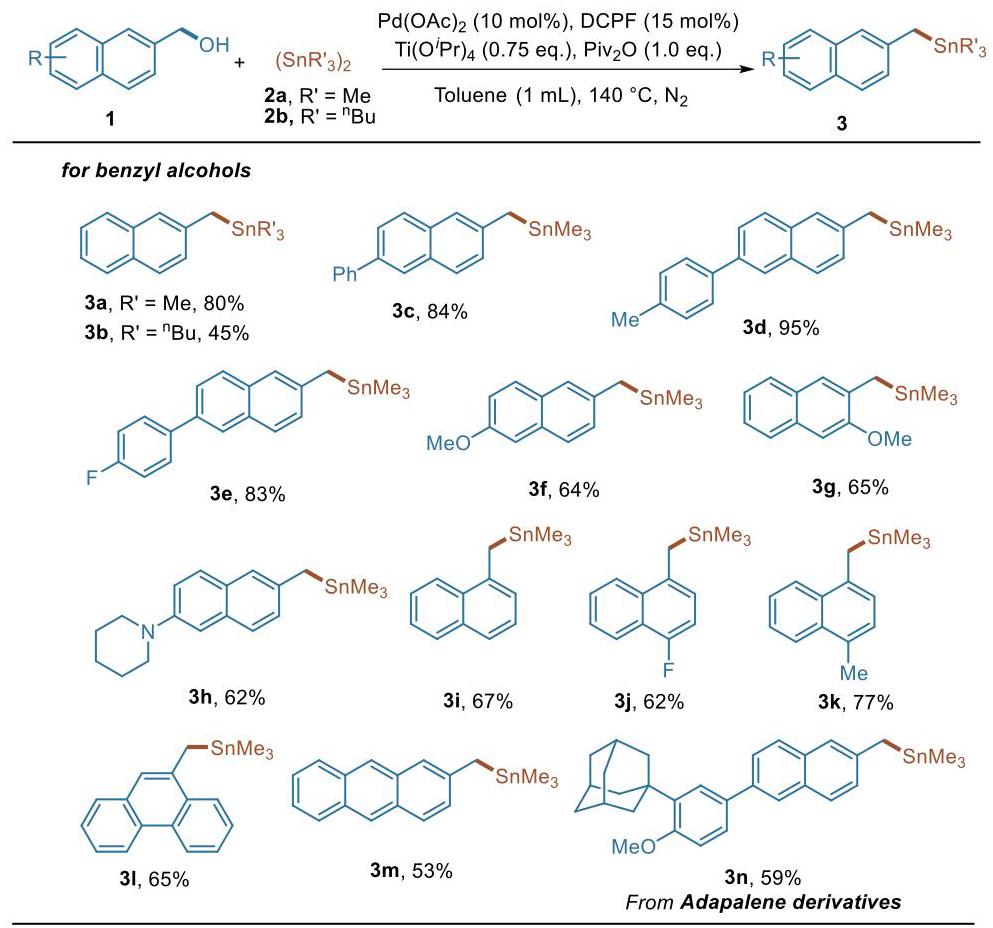
With these optimized conditions, we then evaluated the scope of this stannylation process (Scheme 2). Overall, a great many naphthalen-2-yl as well as 1-yl methanol derivatives (3a- 3k) could be accommodated in this benzylic stannylation reaction, affording the corresponding stannanes in good to excellent yields (45-95% yields). Compared with using ${\left( {\mathrm{{SnBu}}}_{3}\right) }_{2}$ (2b) as the stannylation reagent to obtain 3b, the reaction using 2a affords better yield of 3a, suggesting the steric hinder effect of the butyl group in 2b. Various stannylated naphthalen-2-yl and 1-yl scaffolds are smoothly constructed through this Pd-catalyzed C-O activation protocol. Both electron-donating groups and electron-withdrawing groups were compatible with the transformation, such as methoxy (3f, 3g), amino (3h), methyl (3k), and fluorine (3j) substituents. The substrate containing ortho-substituted methoxy group also affords $3\mathbf{g}$ with moderate yield. To explore the scope of other aromatic rings, phenanthrene (31) and anthracene stannane derivatives (3m) can be obtained with moderate to good yields. Moreover, to demonstrate the applicability of this stannylation method in complex molecules, we smoothly converted the alcohol groups embedded in Adapalene framework into the trimethylstannyl groups (3n), allowing the selective modification of this drug scaffold through sequential Stille coupling reaction.
在这些优化条件下,我们接着评估了该锡基化反应的适用范围(方案2)。总体而言,许多2-萘基以及1-萘基甲醇衍生物(3a - 3k)都能适用于该苄基锡基化反应,以良好至优异的产率(45 - 95%产率)得到相应的锡烷。与使用${\left( {\mathrm{{SnBu}}}_{3}\right) }_{2}$(2b)作为锡基化试剂得到3b相比,使用2a进行反应能得到产率更高的3a,这表明2b中丁基的空间位阻效应。通过这种钯催化的C - O活化方法能顺利构建各种含锡的2-萘基和1-萘基骨架。供电子基团和吸电子基团都能与该转化反应兼容,如甲氧基(3f,3g)、氨基(3h)、甲基(3k)和氟(3j)取代基。含有邻位取代甲氧基的底物也能以中等产率得到$3\mathbf{g}$。为了探索其他芳环的适用范围,菲(31)和蒽锡烷衍生物(3m)能以中等至良好的产率得到。此外,为了证明这种锡基化方法在复杂分子中的适用性,我们顺利地将阿达帕林骨架中的醇羟基转化为三甲基锡基(3n),从而可以通过连续的Stille偶联反应对该药物骨架进行选择性修饰。
Scheme 2. Scope of Naphthyl Methanol substrates
方案2. 萘甲醇底物的适用范围
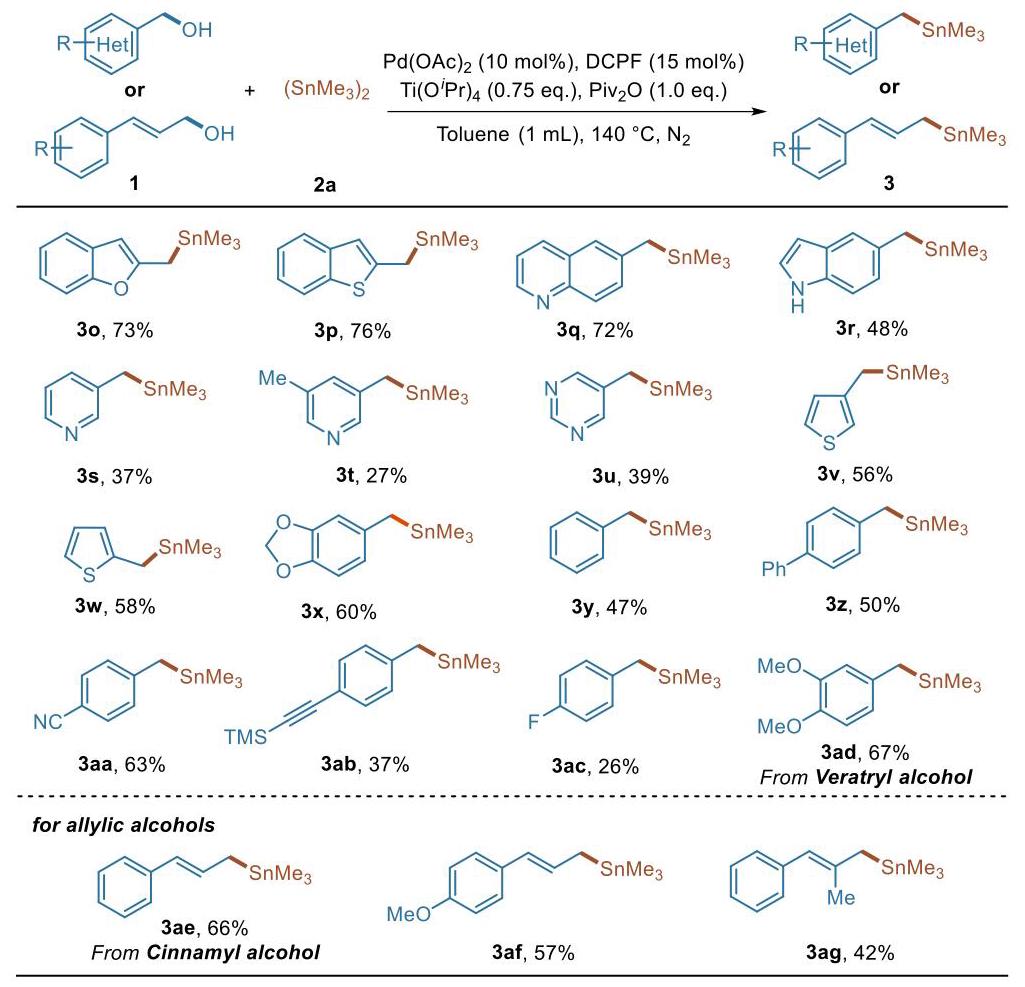
We then examined the functional group tolerance of simple benzyl alcohols and allyl alcohols (Scheme 3). Typically, benzofuran (3o), benzothiophene (3p), quinoline (3q), indole (3r), pyridine (3s, 3t), pyrimidine (3u), and thiophene (3v, 3w) substituted methanol derivatives could be obtained with moderate to good yields (27-76% yields). Additionally, a variety of substituents on the ring of simple benzyl alcohols can also afford the corresponding stannylation products in moderate yields (3x-3ac). In the fluoro-substituted case of 3ac, the diminished efficiency was probably due to high volatile properties. Furthermore, we also found that this stannylation protocol was compatible by using allyl alcohols as the substrates, affording allylic trimethylstannanes in moderate yield (3ae-3ag). Notably, the stannylation reaction of natural products of veratryl alcohol and cinnamyl alcohol was also successful, and the corresponding products 3ad and 3ae were isolated in 67 and 66% yields, respectively.
然后我们研究了简单苄醇和烯丙醇的官能团耐受性(方案3)。通常,苯并呋喃(3o)、苯并噻吩(3p)、喹啉(3q)、吲哚(3r)、吡啶(3s,3t)、嘧啶(3u)和噻吩(3v,3w)取代的甲醇衍生物能以中等至良好的产率(27 - 76%产率)得到。此外,简单苄醇环上的各种取代基也能以中等产率得到相应的锡基化产物(3x - 3ac)。在3ac的氟取代情况下,效率降低可能是由于其高挥发性。此外,我们还发现以烯丙醇为底物时该锡基化反应也适用,以中等产率得到烯丙基三甲基锡烷(3ae - 3ag)。值得注意的是,藜芦醇和肉桂醇等天然产物的锡基化反应也成功了,相应产物3ad和3ae的分离产率分别为67%和66%。
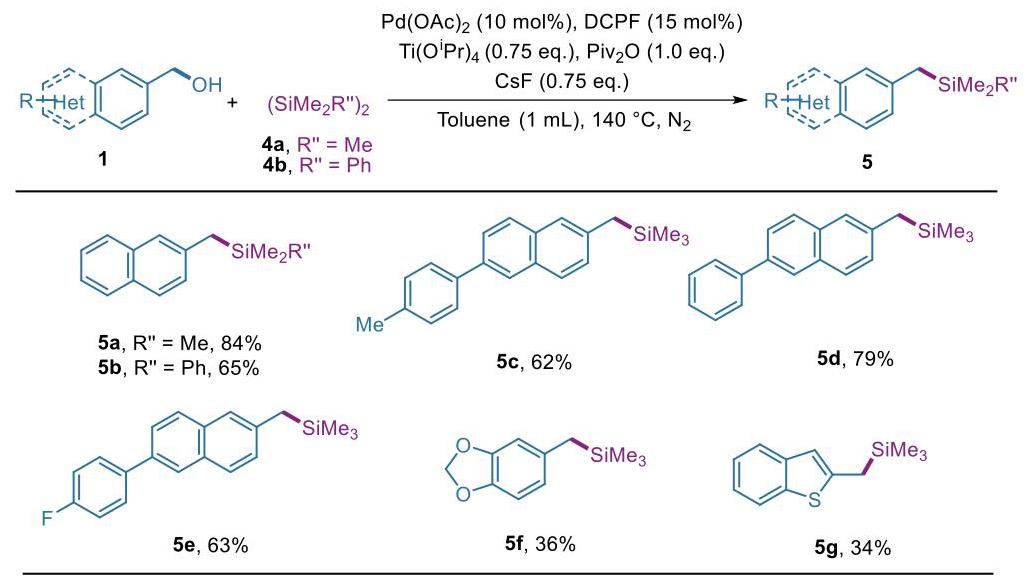
The success of the Pd-catalyzed $\mathrm{C}\left( {\mathrm{{sp}}}^{3}\right) - \mathrm{O}$ bond stannyla-tion from naphthylmethanols encouraged us to further explore the homologous silylation process (Scheme 4). However, simply replacement of hexamethylditin (2a) with hexamethyl-disilane (4a) under the standard conditions did not give an acceptable yield of silylation products. After further screening the reaction conditions, we found that adding 0.75 equiv amount of CsF under the standard conditions can efficiently promote the silylation process. Subsequently, we also examined the substrate scope of this silylation process. As shown in Scheme 4, 2-naphthyl as well as aryl-substituted naphthyl methanols smoothly completed this reaction, providing the corresponding silylation products in 63-84% yields (5a-5e). For the benzylic substrates, the piperonyl and benzothiophene methanols afforded silylation products with relatively low yields. Likewise, by using ${\left( {\mathrm{{SiMe}}}_{2}\mathrm{{Ph}}\right) }_{2}4\mathbf{b}$ as the coupling partner, the silylation product (5b) can also be obtained in 65% yield.
钯催化萘甲醇进行$\mathrm{C}\left( {\mathrm{{sp}}}^{3}\right) - \mathrm{O}$键锡基化反应的成功,促使我们进一步探索类似的硅基化反应过程(方案4)。然而,在标准条件下简单地用六甲基二硅烷(4a)替代六甲基二锡(2a),硅基化产物的产率并不理想。经过进一步筛选反应条件,我们发现在标准条件下加入0.75当量的CsF可以有效促进硅基化反应过程。随后,我们还研究了该硅基化反应过程的底物范围。如方案4所示,2-萘基以及芳基取代的萘甲醇都能顺利完成此反应,以63 - 84%的产率得到相应的硅基化产物(5a - 5e)。对于苄基底物,胡椒基甲醇和苯并噻吩甲醇的硅基化产物产率相对较低。同样,以${\left( {\mathrm{{SiMe}}}_{2}\mathrm{{Ph}}\right) }_{2}4\mathbf{b}$作为偶联伙伴,也能以65%的产率得到硅基化产物(5b)。
In view of the low yield of $3\mathrm{\;b}$ using ${\left( {\mathrm{{SnBu}}}_{3}\right) }_{2}$ as the tin source, we then examined the stannylation reaction using ${\mathrm{{Me}}}_{3}{\mathrm{{Si}}}_{ - }{\mathrm{{SnBu}}}_{3}$ as the stannylation reagent, which was assisted by CsF to promote the transmetallation process (eq 1). ${}^{48}$ To our delight, the desired stannylation product (3b) was obtained with a higher yield, 75%.
鉴于以${\left( {\mathrm{{SnBu}}}_{3}\right) }_{2}$为锡源时$3\mathrm{\;b}$的产率较低,我们随后研究了以${\mathrm{{Me}}}_{3}{\mathrm{{Si}}}_{ - }{\mathrm{{SnBu}}}_{3}$为锡基化试剂的锡基化反应,该反应由CsF协助以促进金属转移过程(式1)。${}^{48}$令我们高兴的是,所需的锡基化产物(3b)以较高的产率75%得到。

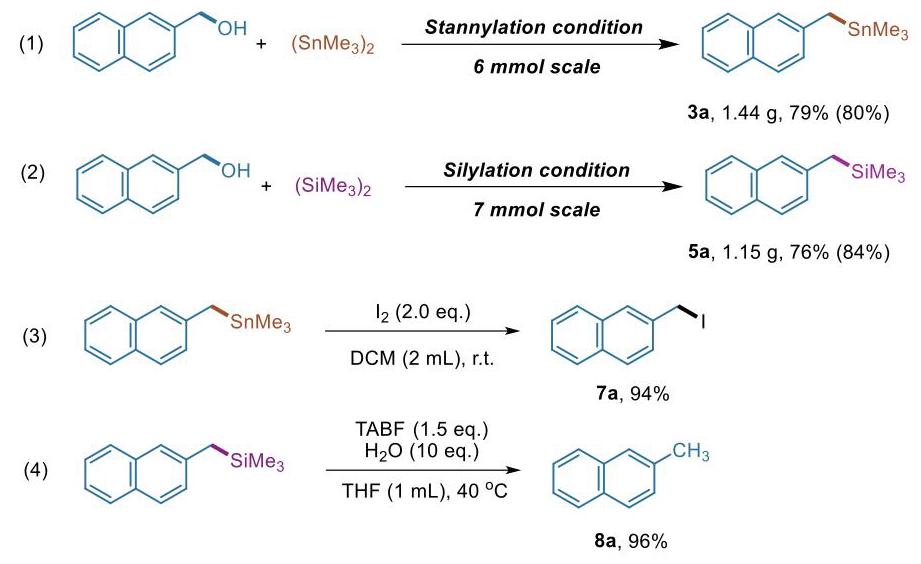
In order to demonstrate the practical application of this Pd-catalyzed protocol, we have tested the gram-scale stannylation and silylation using 1a as the substrate under standard conditions (Scheme 5). To our delight, the corresponding stannylation product (3a) and silylation product (5a) were successfully obtained with comparable good yields (79 and 76%, respectively). The selective functional group transformations of 3a and 5a were also successfully realized, affording iodination product 7a and desilted methylation product 8a with excellent yields, respectively. The successful gram-scale stannylation/silylation as well as the further transformation of stannyl and silyl products demonstrates the potential application of this method.
为了证明这种钯催化方法的实际应用,我们在标准条件下以1a为底物测试了克级规模的锡基化和硅基化反应(方案5)。令我们高兴的是,相应的锡基化产物(3a)和硅基化产物(5a)分别以相当不错的产率(分别为79%和76%)成功得到。3a和5a的选择性官能团转化也成功实现,分别以优异的产率得到碘化产物7a和脱硅甲基化产物8a。克级规模的成功锡基化/硅基化以及锡基和硅基产物的进一步转化证明了该方法的潜在应用价值。
Scheme 3. Scope of Benzyl Alcohols and Allyl Alcohol Substrates
方案3. 苄醇和烯丙醇底物的范围
Scheme 4. Silylation Substrate Scope for Benzyl Alcohols
方案4. 苄醇的硅基化底物范围
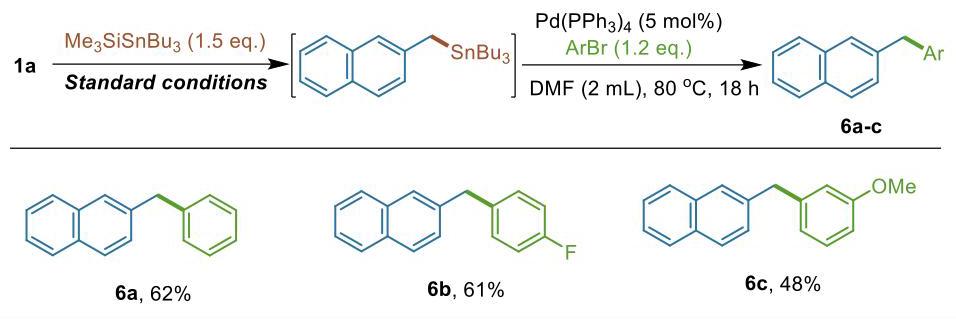
We then carried out the tandem Pd-catalyzed Stille cross-coupling reaction without purification of the crude stannyla-tion products (Scheme 6). Upon completion of the stannylation step, toluene was removed in vacuum. The residue was dissolved in dimethylformamide and directly subjected to sequential Stille reaction to afford the biaryl methanes (6a-6c) in moderate yields within two steps.
然后,我们在不纯化粗锡基化产物的情况下进行了钯催化的串联Stille交叉偶联反应(方案6)。锡基化步骤完成后,在真空中除去甲苯。将残余物溶解在二甲基甲酰胺中,直接进行连续的Stille反应,两步内以中等产率得到联芳基甲烷(6a - 6c)。
For exploring the reaction details, we tried to investigate the effect of ${\mathrm{{Piv}}}_{2}\mathrm{O}$ during this stannylation reaction (Scheme 7). Initially, we assumed that ${\mathrm{{Piv}}}_{2}\mathrm{O}$ interacted with alcohol 1a to form pivalic ester $1{a}^{\prime }$ , thereby activating the $\mathrm{C}\left( {\mathrm{{sp}}}^{3}\right) - \mathrm{O}$ bond. Therefore, we performed this reaction under standard conditions using $1{a}^{\prime }$ as the substrate. However, the desired product 3a was obtained in a diminished yield of 57%. Considering that ${\mathrm{{Piv}}}_{2}\mathrm{O}$ may be converted to $\mathrm{{PivOH}}$ in the reaction, we then added $\mathrm{{PivOH}}$ , without adding ${\mathrm{{Piv}}}_{2}\mathrm{O}$ under standard conditions. Stannylation product 3a was obtained with 59 and 54% yields, respectively. The yield of 3a still did not change significantly, which indicates that the pivalic ester $1{a}^{\prime }$ is not the key intermediate of the reaction. The results in Table 1 (entry 7) show that the acid anhydride is a very important additive. Thus, we speculate that ${\mathrm{{Piv}}}_{2}\mathrm{O}$ may play a role in assisting anion exchange in the catalytic cycle.
为了探究反应细节,我们试图研究${\mathrm{{Piv}}}_{2}\mathrm{O}$在该锡基化反应中的作用(方案7)。最初,我们假设${\mathrm{{Piv}}}_{2}\mathrm{O}$与醇1a相互作用形成新戊酸酯$1{a}^{\prime }$,从而活化$\mathrm{C}\left( {\mathrm{{sp}}}^{3}\right) - \mathrm{O}$键。因此,我们以$1{a}^{\prime }$为底物在标准条件下进行该反应。然而,所需产物3a的产率降低至57%。考虑到${\mathrm{{Piv}}}_{2}\mathrm{O}$在反应中可能转化为$\mathrm{{PivOH}}$,我们随后在标准条件下添加了$\mathrm{{PivOH}}$,而不添加${\mathrm{{Piv}}}_{2}\mathrm{O}$。锡基化产物3a的产率分别为59%和54%。3a的产率仍然没有显著变化,这表明新戊酸酯$1{a}^{\prime }$不是反应的关键中间体。表1(条目7)中的结果表明酸酐是一种非常重要的添加剂。因此,我们推测${\mathrm{{Piv}}}_{2}\mathrm{O}$可能在催化循环中协助阴离子交换。
Scheme 5. Gram-Scale Stannylation/Silylation and Further Transformations of 3a/5a
方案5. 3a/5a的克级锡基化/硅基化及进一步转化
Scheme 6. Sequential Stannylation/Stille Cross-Coupling Reactions
方案6. 连续锡基化/施蒂勒交叉偶联反应
Scheme 7. Investigation of the Role of ${\mathrm{{Piv}}}_{2}\mathrm{O}$
方案7. ${\mathrm{{Piv}}}_{2}\mathrm{O}$作用的研究

w/o Pi ${\mathrm{v}}_{2}\mathrm{O}$ conditions ${\mathrm{{Piv}}}_{2}\mathrm{O}$ (1.0 eq.) PivOH (1.0 eq.)
无Pi${\mathrm{v}}_{2}\mathrm{O}$条件下${\mathrm{{Piv}}}_{2}\mathrm{O}$(1.0当量)新戊醇(1.0当量)
(instead of ${\mathrm{{Piv}}}_{2}\mathrm{O}$ )
(代替${\mathrm{{Piv}}}_{2}\mathrm{O}$)
Yields of 3a 57% 59% 54%
3a的产率57% 59% 54%
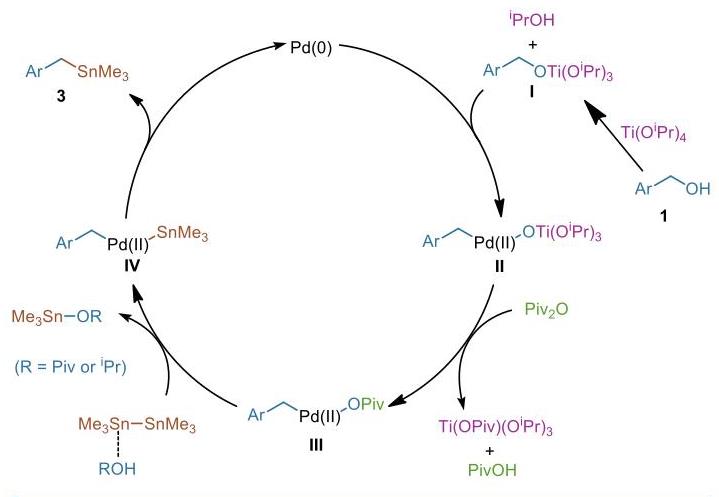
Based on our investigation and literature reported, ${}^{{12},{13},{51},{52}}$ we have proposed a possible mechanism for palladium-catalyzed $\mathrm{C}\left( {\mathrm{{sp}}}^{3}\right) - \mathrm{O}$ bond cleavage stannylation reactions (Scheme 8). At first, benzyl alcohol 1 reacts with $\mathrm{{Ti}}{\left( {\mathrm{O}}^{i}\mathrm{{Pr}}\right) }_{4}$ to activate the $\mathrm{C}\left( {\mathrm{{sp}}}^{3}\right) - \mathrm{O}$ bond through the formation of benzyl titanate I. Subsequently, oxidative addition of I with Pd(0) species occurs to form Pd(II) complex II. We speculated that the bulky $\mathrm{{OTi}}{\left( \mathrm{{OR}}\right) }_{3}$ counterion could react with ${\mathrm{{Piv}}}_{2}{\mathrm{O}}^{.53}$ Thus, this complex II undergoes sequential anion exchange with ${\mathrm{{Piv}}}_{2}\mathrm{O}$ to form an active benzyl-Pd(II)-OPiv complex III. Next, III undergoes transmetallation process with activated ditin species to obtain intermediate IV. Finally, reductive elimination of benzyl-Pd(II)-Sn species IV provides target product 3, along with the regeneration of $\mathrm{{Pd}}\left( 0\right)$ species to complete this catalytic cycle. The proposed mechanism is further supported by density functional theory (DFT) calculations. The computed free-energy profile of the overall catalytic cycle of benzyl alcohols is shown in Scheme S1.
基于我们的研究和文献报道,${}^{{12},{13},{51},{52}}$我们提出了钯催化$\mathrm{C}\left( {\mathrm{{sp}}}^{3}\right) - \mathrm{O}$键裂解锡基化反应的可能机理(方案8)。首先,苄醇1与$\mathrm{{Ti}}{\left( {\mathrm{O}}^{i}\mathrm{{Pr}}\right) }_{4}$反应,通过形成钛酸苄酯I活化$\mathrm{C}\left( {\mathrm{{sp}}}^{3}\right) - \mathrm{O}$键。随后,I与Pd(0)物种发生氧化加成形成Pd(II)配合物II。我们推测庞大的$\mathrm{{OTi}}{\left( \mathrm{{OR}}\right) }_{3}$抗衡离子可能与${\mathrm{{Piv}}}_{2}{\mathrm{O}}^{.53}$反应。因此,该配合物II与${\mathrm{{Piv}}}_{2}\mathrm{O}$进行连续的阴离子交换,形成活性苄基-Pd(II)-OPiv配合物III。接下来,III与活化的二锡物种进行转金属化过程,得到中间体IV。最后,苄基-Pd(II)-Sn物种IV的还原消除提供目标产物3,同时再生$\mathrm{{Pd}}\left( 0\right)$物种以完成该催化循环。密度泛函理论(DFT)计算进一步支持了所提出的机理。苄醇整个催化循环的计算自由能剖面图见图S1。
Scheme 8. Possible Reaction Mechanism
方案8. 可能的反应机理
3. CONCLUSIONS
3. 结论
In conclusion, we have developed the palladium-catalyzed stannylation and silylation reactions of benzylic/allylic alcohols through selective $\mathrm{C}\left( {\mathrm{{sp}}}^{3}\right) - \mathrm{O}$ bond cleavage. This reaction affords functionalized benzyl/allyl stannanes and benzylsilanes in moderate to good yields. Additionally, this strategy has the feature of good functional group tolerance, using non-pre-activated alcohols as the substrates, and can be carried out under an air atmosphere. The success of gram-scale stannylation/silylation as well as the tandem Stille coupling reactions demonstrates the possibility for further application of this synthetic method. Both the experimental and theoretical research studies reveal the mechanistic details of this reaction.
总之,我们通过选择性的$\mathrm{C}\left( {\mathrm{{sp}}}^{3}\right) - \mathrm{O}$键断裂,开发了钯催化的苄醇/烯丙醇的锡基化和硅基化反应。该反应以中等至良好的产率提供功能化的苄基/烯丙基锡烷和苄基硅烷。此外,该策略具有良好的官能团耐受性,使用未预先活化的醇作为底物,并且可以在空气气氛下进行。克级锡基化/硅基化以及串联的Stille偶联反应的成功证明了这种合成方法进一步应用的可能性。实验和理论研究都揭示了该反应的机理细节。
ASSOCIATED CONTENT
相关内容
Data Availability Statement
数据可用性声明
The data underlying this study are available in the published article and its Supporting Information.
本研究的基础数据可在已发表的文章及其支持信息中获取。
(c) Supporting Information
(c) 支持信息
The Supporting Information is available free of charge at https://pubs.acs.org/doi/10.1021/acs.joc.2c02265.
支持信息可在https://pubs.acs.org/doi/10.1021/acs.joc.2c02265免费获取。
General experimental methods, ${}^{1}\mathrm{H}$ NMR spectra, ${}^{13}\mathrm{C}$ NMR spectra, and coordinates and energies for the calculated structures (PDF)
一般实验方法、${}^{1}\mathrm{H}$核磁共振谱、${}^{13}\mathrm{C}$核磁共振谱以及计算结构的坐标和能量(PDF)
A AUTHOR INFORMATION
A 作者信息
Corresponding Authors
通讯作者
Di Qiu - Tianjin Key Laboratory of Structure and Performance for Functional Molecules, College of Chemistry, Tianjin Normal University, Tianjin 300387, China;
邱迪 - 功能分子结构与性能天津市重点实验室,天津师范大学化学学院,天津 300387,中国;邮箱:
Fanyang Mo - School of Materials Science and Engineering, Peking University, Beijing 100871, China; (C) orcid.org/ 0000-0002-4140-3020;
莫凡洋 - 北京大学材料科学与工程学院,北京 100871,中国;(C) orcid.org/ 0000-0002-4140-3020;邮箱:
Authors
作者
Guanglu Yue - Tianjin Key Laboratory of Structure and Performance for Functional Molecules, College of Chemistry, Tianjin Normal University, Tianjin 300387, China
岳光璐 - 功能分子结构与性能天津市重点实验室,天津师范大学化学学院,天津 300387,中国
Qianyi Liu - School of Materials Science and Engineering, Peking University, Beijing 100871, China
刘谦益 - 北京大学材料科学与工程学院,北京 100871,中国
Jingyao Wei - Tianjin Key Laboratory of Structure and Performance for Functional Molecules, College of Chemistry, Tianjin Normal University, Tianjin 300387, China
魏静瑶 - 功能分子结构与性能天津市重点实验室,天津师范大学化学学院,天津 300387,中国
Yanqiong Pi - Tianjin Key Laboratory of Structure and Performance for Functional Molecules, College of Chemistry, Tianjin Normal University, Tianjin 300387, China
皮艳琼 - 功能分子结构与性能天津市重点实验室,天津师范大学化学学院,天津 300387,中国
Complete contact information is available at: https://pubs.acs.org/10.1021/acs.joc.2c02265
完整的联系信息可在:https://pubs.acs.org/10.1021/acs.joc.2c02265获取
Notes
注释
The authors declare no competing financial interest.
作者声明不存在利益冲突。
ACKNOWLEDGMENTS
致谢
The authors thank the Tianjin Normal University Research Innovation Project for Postgraduate Students (2022KYCX115Y), the Science and Technology Development Fund of Tianjin Education Commission for Higher Education (2020KJ007), and the National Natural Science Foundation of China (22071004).
作者感谢天津师范大学研究生科研创新项目(2022KYCX115Y)、天津市教育委员会高等教育科学技术发展基金(2020KJ007)以及国家自然科学基金(22071004)。
EREFERENCES
参考文献
(1) Lindsley, C. W. The Top Prescription Drugs of 2010 in the United States: Antipsychotics Show Strong Growth. ACS Chem. Neurosci. 2011, 2, 276-277.
(2) Grembecka, M. Alcohols-Their Role in the Modern World of Sweeteners: A Review. Eur. Food Res. Technol. 2015, 241, 1-14.
(3) Wu, L.; Moteki, T.; Gokhale, A. A.; Flaherty, D. W.; Toste, F. D. Production of Fuels and Chemicals from Biomass: Condensation Reactions and Beyond. Chem 2016, 1, 32-58.
(4) Cherney, A. H.; Kadunce, N. T.; Reisman, S. E. Enantioselecti-veand Enantiospecific Transition-Metal-Catalyzed Cross-Coupling Reactions of Organometallic Reagents to Construct C-C Bonds. Chem. Rev. 2015, 115, 9587-9652.
(5) Huang, F.; Liu, Z.; Yu, Z. K. C-Alkylation of Ketones and Related Compounds by Alcohols: Transition-Metal-Catalyzed Dehydrogenation. Angew. Chem., Int. Ed. 2016, 55, 862-875.
(6) Zhao, B. L.; Rogge, T.; Ackermann, L. Z. Z.; Shi, Z. Metal-Catalysed C-Het (F, O, S, N) and C-C Bond Arylation. Chem. Soc. Rev. 2021, 50, 8903-8953.
(7) Yu, D. G.; Li, B. J.; Shi, Z. J. Exploration of New C-O Electrophiles in Cross-Coupling Reactions. Acc. Chem. Res. 2010, 43, 1486-1495.
(8) Li, B. J.; Yu, D. G.; Sun, C. L.; Shi, Z. J. Activation of “Inert” Alkenyl/Aryl C-O Bond and Its Application in Cross-Coupling Reactions. Chem.-Eur. J. 2011, 17, 1728-1759.
(9) Yu, D. G.; Wang, X.; Zhu, R. Y.; Luo, S.; Zhang, X. B.; Wang, B. Q.; Wang, L.; Shi, Z. J. Direct Arylation/Alkylation/Magnesiation of Benzyl Alcohols in the Presence of Grignard Reagents Via Ni-, Fe-, or Co-Catalyzed ${\mathrm{{sp}}}^{3}\mathrm{C} - \mathrm{O}$ Bond Activation. J. Am. Chem. Soc. 2012,134, 14638-14641.
(10) Cornella, J.; Zarate, C.; Martin, R. Metal-Catalyzed Activation of Ethers via C-O Bond Cleavage: A New Strategy for Molecular Diversity. Chem. Soc. Rev. 2014, 43, 8081-8097.
(11) Liu, F.; Jiang, H.; Zhou, Y.; Shi, Z. J. Direct Transformation of Arenols Based on C-O Activation. Chin. J. Chem. 2020, 38, 855-863.
(12) Zhang, S. Q.; Hong, X. Mechanism and Selectivity Control in Ni- and Pd-Catalyzed Cross-Couplings Involving Carbon-Oxygen Bond Activation. Acc. Chem. Res. 2021, 54, 2158-2171.
(13) Chernyshev, V. M.; Ananikov, V. P. Nickel and Palladium Catalysis: Stronger Demand than Ever. ACS Catal. 2022, 12, 1180- 1200.
(14) Antoft-Finch, A.; Blackburn, T.; Snieckus, V. N, N-Diethyl O-Carbamate: Directed Metalation Group and Orthogonal Suzuki-Miyaura Cross-Coupling Partner. J. Am. Chem. Soc. 2009, 131, 17750-17752.
(15) Quasdorf, K. W.; Riener, M.; Petrova, K. V.; Garg, N. K. Suzuki-Miyaura Coupling of Aryl Carbamates, Carbonates, and Sulfamates. J. Am. Chem. Soc. 2009, 131, 17748-17749.
(16) Yoshikai, N.; Matsuda, H.; Nakamura, E. Hydroxyphosphine Ligand for Nickel-Catalyzed Cross-Coupling through Nickel/ Magnesium Bimetallic Cooperation. J. Am. Chem. Soc. 2009, 131, 9590-9599.
(17) Scott, W. J.; Crisp, G. T.; Stille, J. K. Palladium-Catalyzed Coupling of Vinyl Triflates with Organostannanes. A Short Synthesis of Pleraplysillin-1. J. Am. Chem. Soc. 1984, 106, 4630-4632.
(18) Zhou, J.; Fu, G. C. Palladium-Catalyzed Negishi Cross-Coupling Reactions of Unactivated Alkyl Iodides, Bromides, Chlorides, and Tosylates. J. Am. Chem. Soc. 2003, 125, 12527-12530.
(19) Ito, S.; Fujiwara, Y.-i.; Nakamura, E.; Nakamura, M. Iron-Catalyzed Cross-Coupling of Alkyl Sulfonates with Arylzinc Reagents. Org. Lett. 2009, 11, 4306-4309.
(20) Xia, A.; Lv, P.; Xie, X.; Liu, Y. H. Nickel-Catalyzed Cyanation of Unactivated Alkyl Sulfonates with $\mathrm{{Zn}}{\left( \mathrm{{CN}}\right) }_{2}$ . Org. Lett. 2020,22, 7842-7847.
(21) Wenkert, E.; Michelotti, E. L.; Swindell, C. S. Nickel-Induced Conversion of Carbon-Oxygen into Carbon-Carbon Bonds. One-Step Transformations of Enol Ethers into Olefins and Aryl Ethers into Biaryls. J. Am. Chem. Soc. 1979, 101, 2246-2247.
(22) Guan, B. T.; Xiang, T.; Wu, S. K.; Sun, Z. P.; Wang, B. Q.; Zhao, K. Q.; Shi, Z. J. Methylation of arenes via Ni-catalyzed aryl C-O/F activation. Chem. Commun. 2008, 1437-1439.
(23) Wiensch, E.; Montgomery, J. Nickel-Catalyzed Amination of Silyloxyarenes through C-O Bond Activation. Angew. Chem., Int. Ed. 2018, 57, 11045-11049.
(24) Qiu, Z.; Li, C.-J. Transformations of Less-Activated Phenols and Phenol Derivatives via C-O Cleavage. Chem. Rev. 2020, 120, 10454-10515.
(25) Tobisu, M.; Zhao, J.; Kinuta, H.; Furukawa, T.; Igarashi, T.; Chatani, N. Nickel-Catalyzed Borylation of Aryl and Benzyl 2-Pyridyl Ethers: A Method for Converting a Robust ortho-Directing Group. Adv. Synth. Catal. 2016, 358, 2417-2421.
(26) Martin, R.; Martin-Montero, T.; Krolikowski, C.; Zarate, R.; Manzano, R. Stereospecific Nickel-Catalyzed Borylation of Secondary Benzyl Pivalates. Synlett 2017, 28, 2604-2608.
(27) Pein, W. L.; Wiensch, E. M.; Montgomery, J. Nickel-Catalyzed Ipso-Borylation of Silyloxyarenes via C-O Bond Activation. Org. Lett. 2021, 23, 4588-4592.
(28) Liu, X.; Xu, B.; Su, W. P. Ni-Catalyzed Deoxygenative Borylation of Phenols via O-Phenyl-uronium Activation. ACS Catal. 2022, 12, 8904-8910. (e) Zarate, C.; Martin, R. A Mild Ni/Cu-Catalyzed Silylation via C-O Cleavage. J. Am. Chem. Soc. 2014, 136, 2236-2239.
(29) Zarate, C.; Nakajima, M.; Martin, R. A Mild and Ligand-Free Ni-Catalyzed Silylation via C-OMe Cleavage. J. Am. Chem. Soc. 2017, 139, 1191-1197.
(30) Wiensch, E. M.; Todd, D. P.; Montgomery, J. Silyloxyarenes as Versatile Coupling Substrates Enabled by Nickel-Catalyzed C-O Bond Cleavage. ACS Catal. 2017, 7, 5568-5571.
(31) Cao, Z. C.; Luo, F.-X.; Shi, W.-J.; Shi, Z. J. Direct Borylation of Benzyl Alcohol and its Analogues in the Absence of Bases. Org. Chem. Front. 2015, 2, 1505-1510.
(32) Miura, H.; Hachiya, Y.; Nishio, H.; Fukuta, Y.; Toyomasu, T.; Kobayashi, K.; Masaki, Y.; Shishido, T. Practical Synthesis of Allyl, Allenyl, and Benzyl Boronates through ${\mathrm{S}}_{\mathrm{N}}1$ ’-Type Borylation under Heterogeneous Gold Catalysis. ACS Catal. 2021, 11, 758-766.
(33) Kinuta, H.; Tobisu, M.; Chatani, N. Rhodium-Catalyzed Borylation of Aryl 2-Pyridyl Ethers through Cleavage of the Carbon-Oxygen Bond: Borylative Removal of the Directing Group. J. Am. Chem. Soc. 2015, 137, 1593-1600.
(34) Zeng, X.; Zhang, Y.; Liu, Z.; Geng, S.; He, Y.; Feng, Z. Iron-Catalyzed Borylation of Aryl Ethers via Cleavage of C-O Bonds. Org. Lett. 2020, 22, 2950-2955.
(35) Zhang, J.; Zhang, Y.; Geng, S.; Chen, S.; Liu, Z.; Zeng, X.; He, Y.; Feng, Z. C-O. Bond Silylation Catalyzed by Iron: A General Method for the Construction of Csp2-Si Bonds. Org. Lett. 2020, 22, 2669-2674.
(36) Mao, L.; Szabó, K. J.; Marder, T. B. Synthesis of Benzyl-, Allyl-, and Allenyl-boronates via Copper-Catalyzed Borylation of Alcohols. Org. Lett. 2017, 19, 1204-1207.
(37) Ragan, J. A.; Raggon, J. W.; Hill, P. D.; Jones, B. P.; McDermott, R. E.; Munchhof, M. J.; Marx, M. A.; Casavant, J. M.; Cooper, B. A.; Doty, J. L.; Lu, Y. Cross-Coupling Methods for the Large-Scale Preparation of an Imidazole-Thienopyridine: Synthesis of [2-(3-Methyl-3H-imidazol-4-yl)- thieno[3,2-b]pyridin-7-yl]-(2- methyl-1H-indol-5-yl)-amine. Org. Process Res. Dev. 2003, 7, 676- 683.
(38) Alonso, E.; Fuwa, H.; Vale, C.; Suga, Y.; Goto, T.; Konno, Y.; Sasaki, M.; LaFerla, F. M.; Vieytes, M. R.; Giménez-Llort, L.; Botana, L. M. Design and Synthesis of Skeletal Analogues of Gambierol: Attenuation of Amyloid- $\beta$ and Tau Pathology with Voltage-Gated Potassium Channel and N-Methyl-d-aspartate Receptor Implications. J. Am. Chem. Soc. 2012, 134, 7467-7479.
(39) Valot, G.; Regens, C. S.; O’Malley, D. P.; Godineau, E.; Takikawa, H.; Fürstner, A. Total Synthesis of Amphidinolide F. Angew. Chem., Int. Ed. 2013, 52, 9534-9538.
(40) Li, H.-L.; Chen, Q.-F.; Lu, Z.-H.; Li, A. Total Syntheses of Aflavazole and 14-Hydroxyaflavinine. J. Am. Chem. Soc. 2016, 138, 15555-15558.
(41) Heravi, M. M.; Mohammadkhani, L. Recent Applications of Stille Reaction in Total Synthesis of Natural Products: An Update. J. Organomet. Chem. 2018, 869, 106-200.
(42) Carsten, B.; He, F.; Son, H. J.; Xu, T.; Yu, L. Stille Polycondensation for Synthesis of Functional Materials. Chem. Rev. 2011, 111, 1493-1528.
(43) Yu, Z. D.; Lu, Y.; Wang, J. Y.; Pei, J. Conformation Control of Conjugated Polymers. Chem.-Eur. J. 2020, 26, 16194-16205.
(44) Neumann, W. P.; Moser, W. The Organic Chemistry of Tin; Interscience: New York, 1970.
(45) Beletskaya, I. P. The Cross-Coupling Reactions of Organic Halides with Organic Derivatives of Tin, Mercury and Copper Catalyzed by Palladium. J. Organomet. Chem. 1983, 250, 551-564.
(46) Stille, J. K. The Palladium-Catalyzed Cross-Coupling Reactions of Organotin Reagents with Organic Electrophiles [New Synthetic Methods (58)]. Angew. Chem., Int. Ed. 1986, 25, 508-524.
(47) Yue, G.; Wei, J.; Qiu, D.; Mo, F. Recent Advances in the Synthesis of Arylstannanes. Acta Chim. Sin. 2022, 80, 956-969.
(48) Gu, Y.; Martín, R. Ni-Catalyzed Stannylation of Aryl Esters via C-O Bond Cleavage. Angew. Chem., Int. Ed. 2017, 56, 3187-3190.
(49) Lian, C.; Yue, G.; Zhang, H.; Wei, L.; Liu, D.; Liu, S.; Fang, H.; Qiu, D. Synthesis of Arylstannanes by Palladium-Catalyzed Desulfitative Coupling Reaction of Sodium Arylsulfinates with Distannanes. Tetrahedron Lett. 2018, 59, 4019-4023.
(50) Li, S.; Lian, C.; Yue, G.; Zhang, J.; Qiu, D.; Mo, F. Transition Metal Free Stannylation of Alkyl Halides: The Rapid Synthesis of Alkyltrimethylstannanes. J. Org. Chem. 2022, 87, 4291-4297.
(51) Espinet, P.; Echavarren, A. M. The Mechanisms of the Stille Reaction. Angew. Chem., Int. Ed. 2004, 43, 4704-4734.
(52) Li, Y.-X.; Xuan, Q.-Q.; Liu, L.; Wang, D.; Chen, Y.-J.; Li, C.-J. A Pd(0)-Catalyzed Direct Dehydrative Coupling of Terminal Alkynes with Allylic Alcohols To Acces 1,4-Enynes. J. Am. Chem. Soc. 2013, 135, 12536-12539.
(53) Satoh, T.; Ikeda, M.; Miura, M.; Nomura, M. Palladium-Catalyzed Etherification of Allyl Alcohols Using Phenols in the Presence of Titanium(IV) Isopropoxide. J. Org. Chem. 1997, 62, 4877-4879.