Synthesis of Alkylboronic Esters from Alkyl Iodides
英文原文与中文译文逐段对照 · English original with Chinese translation
Synthesis of Alkylboronic Esters from Alkyl lodides
由烷基碘合成烷基硼酸酯
Qianyi Liu, ${}^{\text{ ¶ },\mathrm{a}}$ Hao Liang, ${}^{\ddagger ,\mathrm{a}}$ Shangyong Zhou, ${}^{ \ddagger }$ Lei Zhang, ${}^{\text{ § }}$ Jianxin Yang, ${}^{ \ddagger }$ Yunxing Yin, ${}^{ \ddagger }$ Yang Yang, ${}^{ \dagger }$ Di Qiu ${}^{\prime \prime }$ and Fanyang Mo ${}^{1, * ,8}$
刘谦益,${}^{\text{ ¶ },\mathrm{a}}$ 梁浩,${}^{\ddagger ,\mathrm{a}}$ 周尚勇,${}^{ \ddagger }$ 张雷,${}^{\text{ § }}$ 杨建新,${}^{ \ddagger }$ 尹云星,${}^{ \ddagger }$ 杨洋,${}^{ \dagger }$ 邱迪 ${}^{\prime \prime }$ 和莫凡洋 ${}^{1, * ,8}$
“College of Chemistry and Molecular Engineering, Peking University, Beijing 100871, China; †WuXi AppTec (Tianjin) Co., Ltd., Tianjin 300457, China; “Tianjin Key Laboratory of Structure and Performance for Functional Molecules, College of Chemistry, Tianjin Normal University, Tianjin 300387, China; ‘Department of Chemistry and Biochemistry, University of California Santa Barbara, California 93106, USA; School of Materials Science and Engineering, Peking University, Beijing 100871, China a These authors contributed equally.
“中国北京100871,北京大学化学与分子工程学院;†中国天津300457,药明康德(天津)有限公司;中国天津300387,天津师范大学化学学院功能分子结构与性能天津市重点实验室;美国加利福尼亚93106,加利福尼亚大学圣巴巴拉分校化学与生物化学系;中国北京100871,北京大学材料科学与工程学院 a 这些作者贡献相同。
Checked by Jordan Thompson and Sarah Reisman
经乔丹·汤普森和莎拉·雷斯曼检查
Procedure (Note 1)
实验步骤(注释1)
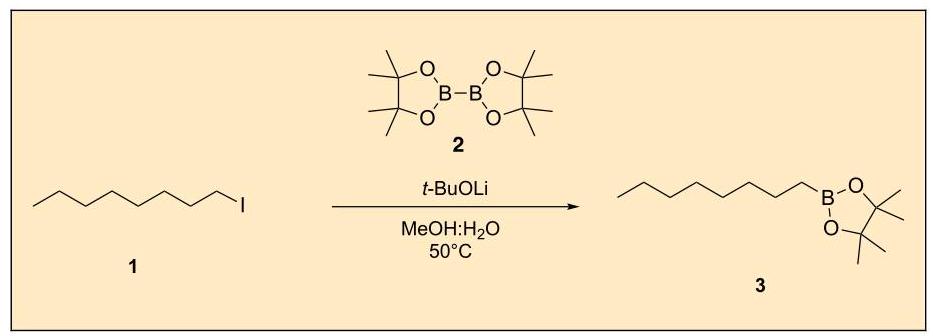
A. 4,4,5,5-Tetramethyl-2-octyl-1,3,2-dioxaborolane (3). A 1-L three-necked round-bottomed flask equipped with a 6-cm rod-shaped Teflon-coated magnetic stir bar is charged with bis(pinacolato)diboron (211 g, 833 mmol, 4.0 equiv) (Note 2). To the flask, MeOH (420 mL) and H ${}_{2}$ O (4.2 mL) (Note 3) are added using glass graduated cylinders successively, followed by 1-iodooctane (50.0 g, 208 mmol, 1.0 equiv, 37.8 mL) (Note 4) via syringe. The mixture is stirred for 1 min under air at ambient temperature to distribute 1-iodooctane evenly throughout the solution prior to addition of base. To this mixture, $t$ -BuOLi (33.3 g, 416 mmol, 2.0 equiv) (Note 5) is added portion-wise under ambient atmosphere. The flask is fitted with a water-cooled reflux condenser and clamped above an oil bath on a hot plate/stirrer. Both of the side necks and the reflux condenser are sealed with rubber septa and an ${\mathrm{N}}_{2}$ inlet connected to a Schlenk line by a needle adaptor is inserted in the reflux condenser septum. The pressure inside the reaction system is reduced to $< {0.1}\mathrm{{mmHg}}$ using a vacuum pump, and the atmosphere is refilled with ${\mathrm{N}}_{2}$ from the balloon. This vacuum-refill cycle is performed three additional times. The flask is lowered into a ${50}{}^{ \circ }\mathrm{C}$ oil bath and stirred for ${56}\mathrm{\;h}$ (Note 6) (Figure 1).
A. 4,4,5,5-四甲基-2-辛基-1,3,2-二氧杂硼烷(3)。向一个装有6厘米长棒状聚四氟乙烯涂层磁力搅拌棒的1升三颈圆底烧瓶中加入双(频哪醇合)二硼(211克,833毫摩尔,4.0当量)(注释2)。使用玻璃量筒依次向烧瓶中加入甲醇(420毫升)和水${}_{2}$(4.2毫升)(注释3),然后通过注射器加入1-碘辛烷(50.0克,208毫摩尔,1.0当量,37.8毫升)(注释4)。在室温下于空气中搅拌混合物1分钟,以便在加入碱之前将1-碘辛烷均匀地分散在整个溶液中。在环境气氛下,将叔丁醇锂$t$(33.3克,416毫摩尔,2.0当量)(注释5)分批加入到该混合物中。烧瓶配备有一个水冷回流冷凝器,并夹在热板/搅拌器上的油浴上方。两个侧颈和回流冷凝器都用橡胶隔垫密封,并通过针头适配器将一个与Schlenk管连接的${\mathrm{N}}_{2}$入口插入回流冷凝器隔垫中。使用真空泵将反应系统内的压力降至$< {0.1}\mathrm{{mmHg}}$,并用来自气球的${\mathrm{N}}_{2}$重新填充气氛。这个抽真空-重新填充循环再进行三次。将烧瓶放入${50}{}^{ \circ }\mathrm{C}$油浴中并搅拌${56}\mathrm{\;h}$(注释6)(图1)。
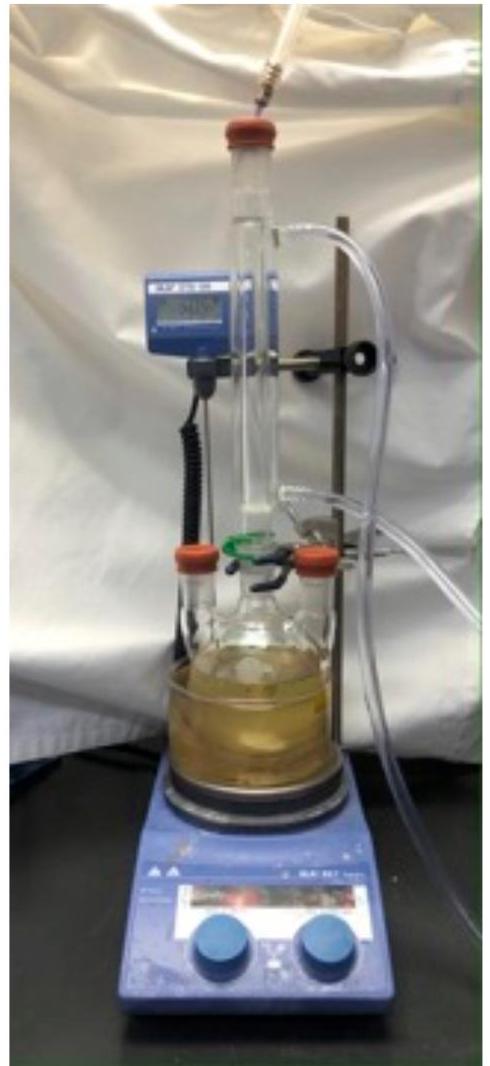
Figure 1. Reaction set-up (photo provided by checkers)
图1. 反应装置(由检验者提供的照片)
The solid reagents dissolve, which results in a colorless solution. A white solid precipitates after 2-3 h during stirring, and the conversion is monitored by TLC (Note 7) (Figure 2). Upon completion, the reaction mixture is cooled to ${26}^{ \circ }\mathrm{C}$ and filtered using a Büchner funnel (Note 8). The filter cake is washed with $n$ -hexane $\left( {{20}\mathrm{\;{mL}}}\right)$ (Note 9), and the combined filtrate is transferred to a 2-L round-bottomed flask. The combined filtrate is concentrated on a rotary evaporator (bath temperature ${35}^{ \circ }\mathrm{C},{40}\mathrm{{mmHg}}$ ) to afford a white residue. To the residue in the 2-L round-bottomed flask, $n$ -heptane $\left( {{400}\mathrm{\;{mL}}}\right)$ is added. The resulting mixture is stirred at ${26}^{ \circ }\mathrm{C}$ for ${10}\mathrm{\;{min}}$ and filtered. The filtrate is transferred to a 1-L round-bottomed flask charged with a 2.5-cm rod-shaped stir bar and cooled to $- {50}{}^{ \circ }\mathrm{C}$ in a dry ice-ethanol bath (Note 10). The solution is stirred for another ${10}\mathrm{\;{min}}$ and filtered. The filtrate is transferred to another 1-L round-bottomed flask and concentrated on a rotary evaporator (bath temperature ${35}^{ \circ }\mathrm{C},{40}\mathrm{{mmHg}}$ ).
固体试剂溶解,形成无色溶液。搅拌2 - 3小时后有白色固体沉淀析出,通过TLC(注释7)(图2)监测转化率。反应完成后,将反应混合物冷却至${26}^{ \circ }\mathrm{C}$,并用布氏漏斗过滤(注释8)。滤饼用$n$ -己烷$\left( {{20}\mathrm{\;{mL}}}\right)$洗涤(注释9),合并滤液转移至2升圆底烧瓶中。合并滤液在旋转蒸发仪上浓缩(浴温${35}^{ \circ }\mathrm{C},{40}\mathrm{{mmHg}}$),得到白色残余物。向2升圆底烧瓶中的残余物中加入$n$ -庚烷$\left( {{400}\mathrm{\;{mL}}}\right)$。所得混合物在${26}^{ \circ }\mathrm{C}$搅拌${10}\mathrm{\;{min}}$并过滤。滤液转移至装有2.5厘米棒状搅拌棒的1升圆底烧瓶中,在干冰 - 乙醇浴中冷却至$- {50}{}^{ \circ }\mathrm{C}$(注释10)。溶液再搅拌${10}\mathrm{\;{min}}$并过滤。滤液转移至另一个1升圆底烧瓶中,在旋转蒸发仪上浓缩(浴温${35}^{ \circ }\mathrm{C},{40}\mathrm{{mmHg}}$)。
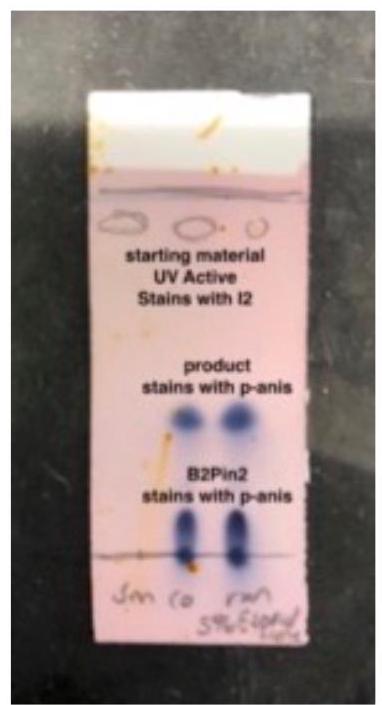
Figure 2. Thin Layer Chromatography (TLC) analysis (photo provided by checkers)
图2. 薄层色谱(TLC)分析(由检验者提供的照片)
The residue (approximately ${80}\mathrm{\;g}$ ) is dissolved in petroleum ether $\left( {{100}\mathrm{\;{mL}}}\right)$ , and the solution is charged onto a column (diameter $= {10}\mathrm{\;{cm}}$ ) of
将残余物(约${80}\mathrm{\;g}$)溶于石油醚$\left( {{100}\mathrm{\;{mL}}}\right)$中,然后将该溶液装入一根直径为$= {10}\mathrm{\;{cm}}$的柱中
750-g silica gel (Note 11) and eluted with petroleum ether to remove the remaining starting material, which requires approximately ${1000}\mathrm{\;{mL}}$ of solvent. At this point petroleum ether:ethyl acetate (4:1) (1000 mL) is used to elute the product. The eluent is collected in a 2-L beaker until TLC analysis (Note 7) shows that no product (3) is still eluting from the silica gel. Approximately 2000 mL total of eluent is used in this step.
750克硅胶(注释11),并用石油醚洗脱以除去剩余的起始原料,这大约需要${1000}\mathrm{\;{mL}}$的溶剂。此时,使用石油醚:乙酸乙酯(4:1)(1000毫升)洗脱产物。将洗脱液收集在一个2升的烧杯中,直到薄层色谱分析(注释7)表明没有产物(3)仍从硅胶中洗脱出来。此步骤总共使用约2000毫升的洗脱液。
The eluent is concentrated by rotary evaporation at ${35}^{ \circ }\mathrm{C}\left( {{40}\mathrm{{mmHg}}}\right)$ ., and eventually transferred into a 100-mL round-bottomed flask, using petroleum ether (20 mL) to wash the larger flasks. After concentration by rotary evaporation at ${35}^{ \circ }\mathrm{C}\left( {{40}\mathrm{{mmHg}}}\right)$ and further drying under high vacuum for ${30}\mathrm{\;{min}}$ at ${26}^{ \circ }\mathrm{C}\left( {{0.5}\mathrm{{mmHg}}}\right)$ , product 3 (35 g,70% isolated yield) is obtained as a colorless oil (Figure 3) (Notes 12,13, and 14). ${}^{2}$
洗脱液在${35}^{ \circ }\mathrm{C}\left( {{40}\mathrm{{mmHg}}}\right)$下通过旋转蒸发浓缩,最终转移到一个100毫升的圆底烧瓶中,用石油醚(20毫升)洗涤较大的烧瓶。在${35}^{ \circ }\mathrm{C}\left( {{40}\mathrm{{mmHg}}}\right)$下通过旋转蒸发浓缩并在${26}^{ \circ }\mathrm{C}\left( {{0.5}\mathrm{{mmHg}}}\right)$下高真空进一步干燥${30}\mathrm{\;{min}}$后,得到产物3(35克,分离产率70%),为无色油状物(图3)(注释12、13和14)。${}^{2}$
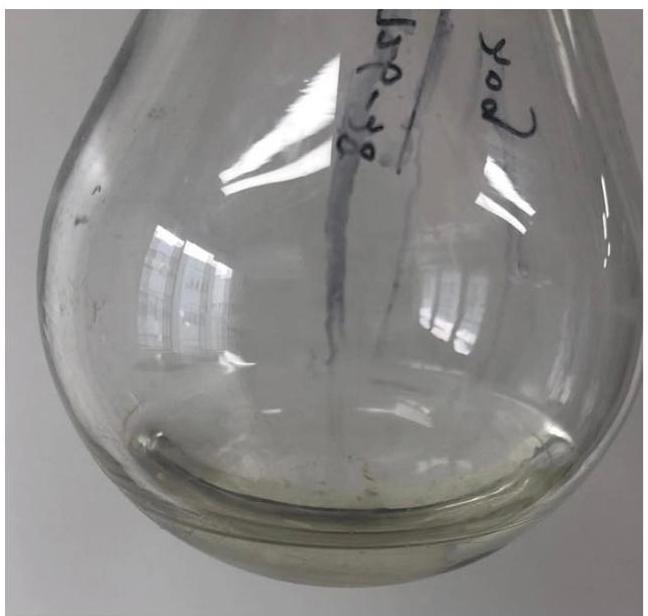
Figure 3. Final purified product (photo provided by submitter)
图3.最终纯化产物(提交者提供的照片)
Notes
注意事项
Prior to performing each reaction, a thorough hazard analysis and risk assessment should be carried out with regard to each chemical substance and experimental operation on the scale planned and in the context of the laboratory where the procedures will be carried out. Guidelines for carrying out risk assessments and for analyzing the hazards associated with chemicals can be found in references such as Chapter 4 of “Prudent Practices in the Laboratory” (The National Academies Press, Washington, D.C., 2011; the full text can be accessed free of charge at https://www.nap.edu/catalog/12654/prudent-practices-in-the-
在进行每一项反应之前,应针对计划规模的每种化学物质和实验操作,并结合将开展相关程序的实验室环境,进行全面的危害分析和风险评估。有关进行风险评估以及分析与化学品相关危害的指南,可在诸如《实验室审慎做法》(美国国家科学院出版社,华盛顿特区,2011年;全文可在https://www.nap.edu/catalog/12654/prudent-practices-in-the免费获取)第4章等参考文献中找到。
laboratory-handling-and-management-of-chemical. See also “Identifying and Evaluating Hazards in Research Laboratories” (American Chemical Society, 2015) which is available via the associated website “Hazard Assessment in Research Laboratories” at https://www.acs.org/content/acs/en/about/governance/committees /chemicalsafety/hazard-assessment.html. In the case of this procedure, the risk assessment should include (but not necessarily be limited to) an evaluation of the potential hazards associated with diboron pinacol ester, 1-iodooctane, lithium tert-butoxide, methanol, dry ice, ethanol, petroleum ether, ethyl acetate, 2,3,5,6-tetrachloro-nitrobenzene, and silica gel.
化学物质的实验室操作与管理。另见《研究实验室中的危害识别与评估》(美国化学学会,2015年),可通过相关网站“研究实验室中的危害评估”(https://www.acs.org/content/acs/en/about/governance/committees /chemicalsafety/hazard-assessment.html)获取。就本程序而言,风险评估应包括(但不限于)对与频哪醇硼酸酯、1-碘辛烷、叔丁醇锂、甲醇、干冰、乙醇、石油醚、乙酸乙酯、2,3,5,6-四氯硝基苯和硅胶相关的潜在危害进行评估。
Bis(pinacolato)diboron $\left( {{\mathrm{B}}_{2}{\mathrm{{pin}}}_{2}}\right)$ was purchased by the submitters from Allychem Co., Ltd., Dalian, China, and was used as received. The checkers purchased Bis(pinacolato)diboron $\left( {{\mathrm{B}}_{2}{\mathrm{{pin}}}_{2}}\right) \left( { > {98}^{ \circ }}\right)$ from Frontier Scientific and used the material as received.
双(频哪醇合)二硼$\left( {{\mathrm{B}}_{2}{\mathrm{{pin}}}_{2}}\right)$由提交者从中国大连的Allychem有限公司购买,并按收到时的状态使用。校验者从Frontier Scientific购买了双(频哪醇合)二硼$\left( {{\mathrm{B}}_{2}{\mathrm{{pin}}}_{2}}\right) \left( { > {98}^{ \circ }}\right)$,并按收到时的状态使用该材料。
MeOH (AR) is obtained from KAISHILI Co., Ltd., Tianjin, China, and is used as received. The reaction is not sensitive to water. The checkers used methanol (≥99.8%) purchased from Fisher Scientific.
甲醇(AR)购自中国天津凯仕利有限公司,使用时未作进一步处理。该反应对水不敏感。检验人员使用的是从Fisher Scientific购买的甲醇(≥99.8%)。
1-Iodooctane was purchased by the submitters from ENERGY Chemical Co., Ltd. and used as received. The checkers purchased 1-iodooctane (>97%) from VWR and used the material as received.
提交者从ENERGY Chemical Co., Ltd.购买了1-碘辛烷并按收到时的状态使用。审核者从VWR购买了1-碘辛烷(>97%)并按收到时的状态使用。
t-BuOLi was purchased by the submitters from Bidepharm Co., Ltd., Shanghai, China, and was used as received. The checkers purchased t-BuOLi (>99%) from Alfa Aesar and used the material as received. t-BuOLi is very light and will disperse in the air when weighing it. To avoid inhalation, it is advisable to add it to a tared vessel in the hood.
叔丁基锂由提交者从中国上海的毕得医药有限公司购买,并按收到时的状态使用。检验者从Alfa Aesar购买了叔丁基锂(>99%)并按收到时的状态使用。叔丁基锂非常轻,称重时会在空气中分散。为避免吸入,建议在通风橱中将其加入已去皮重的容器中。
An oil bath is used for the reaction. No gas evolution or solvent at reflux is observed.
反应使用油浴。未观察到有气体逸出或回流时溶剂沸腾的现象。
TLC analysis is performed on silica gel plates (0.15-0.2 mm, glass backed, purchased from Dexin Corporation in Yantai, China) with petroleum ether (bp 40-60 ${}^{ \circ }\mathrm{C}$ )/ethyl acetate (19:1) as eluent. The product $\left( {{\mathrm{R}}_{\mathrm{f}} = {0.37}}\right)$ can be detected by staining with $p$ -anisaldehyde, and the starting material can be observed under UV lamp $\left( {{254}\mathrm{\;{nm}}}\right)$ or stained with ${\mathrm{I}}_{2}$ . Petroleum ether and ethyl acetate are purchased from FUCHEN Chemical Reagent Co., Ltd, Tianjin, China, and are used as received. The checkers used petroleum ether (≥98.5%) and ethyl acetate (≥99.5%), both purchased from Fisher Scientific.
硅胶板(0.15 - 0.2毫米,玻璃背板,购自中国烟台德信公司)上进行TLC分析,以石油醚(沸点40 - 60 ${}^{ \circ }\mathrm{C}$ )/乙酸乙酯(19:1)作为洗脱剂。产物$\left( {{\mathrm{R}}_{\mathrm{f}} = {0.37}}\right)$ 可用$p$ -茴香醛染色检测,原料可在紫外灯$\left( {{254}\mathrm{\;{nm}}}\right)$ 下观察或用${\mathrm{I}}_{2}$ 染色。石油醚和乙酸乙酯购自中国天津富晨化学试剂有限公司,按收到的状态使用。检验人员使用的石油醚(≥98.5%)和乙酸乙酯(≥99.5%)均购自Fisher Scientific。
Büchner funnels (10 cm diameter) are used for all filtration steps. Medium speed filter papers are used.
所有过滤步骤均使用(直径10厘米的)布氏漏斗。使用中速滤纸。
n-Hexane is purchased from FUCHEN Chemical Reagent Co., Ltd, Tianjin, China, and used as received. The checkers used $n$ -hexane (≥99.5%) purchased from Fisher Scientific.
正己烷购自中国天津的富晨化学试剂有限公司,并按收到时的状态使用。检验员使用的是从Fisher Scientific购买的$n$ -己烷(≥99.5%)。
The filtrate is cooled and stirred at $- {50}{}^{ \circ }\mathrm{C}$ in dry ice-ethanol bath. The main component of the filter cake is ${\mathrm{B}}_{2}{\text{ pin }}_{2}$ in this step.
将滤液冷却,并在干冰 - 乙醇浴中于$- {50}{}^{ \circ }\mathrm{C}$搅拌。此步骤中滤饼的主要成分是${\mathrm{B}}_{2}{\text{ pin }}_{2}$。
100-200 Mesh silica gel (Anhui, China) is employed. The residue (approximately ${80}\mathrm{\;g}$ ) is dissolved in petroleum ether (bp ${40} - {60}{}^{ \circ }\mathrm{C}$ , ${100}\mathrm{\;{mL}}$ ), and the solution is charged onto the column. The flow rate of the column is $\sim {50}\mathrm{\;{mL}}/\mathrm{{min}}$ .
使用100-200目硅胶(中国安徽)。残余物(约${80}\mathrm{\;g}$)溶于石油醚(沸点${40} - {60}{}^{ \circ }\mathrm{C}$,${100}\mathrm{\;{mL}}$),然后将溶液注入柱中。柱的流速为$\sim {50}\mathrm{\;{mL}}/\mathrm{{min}}$。
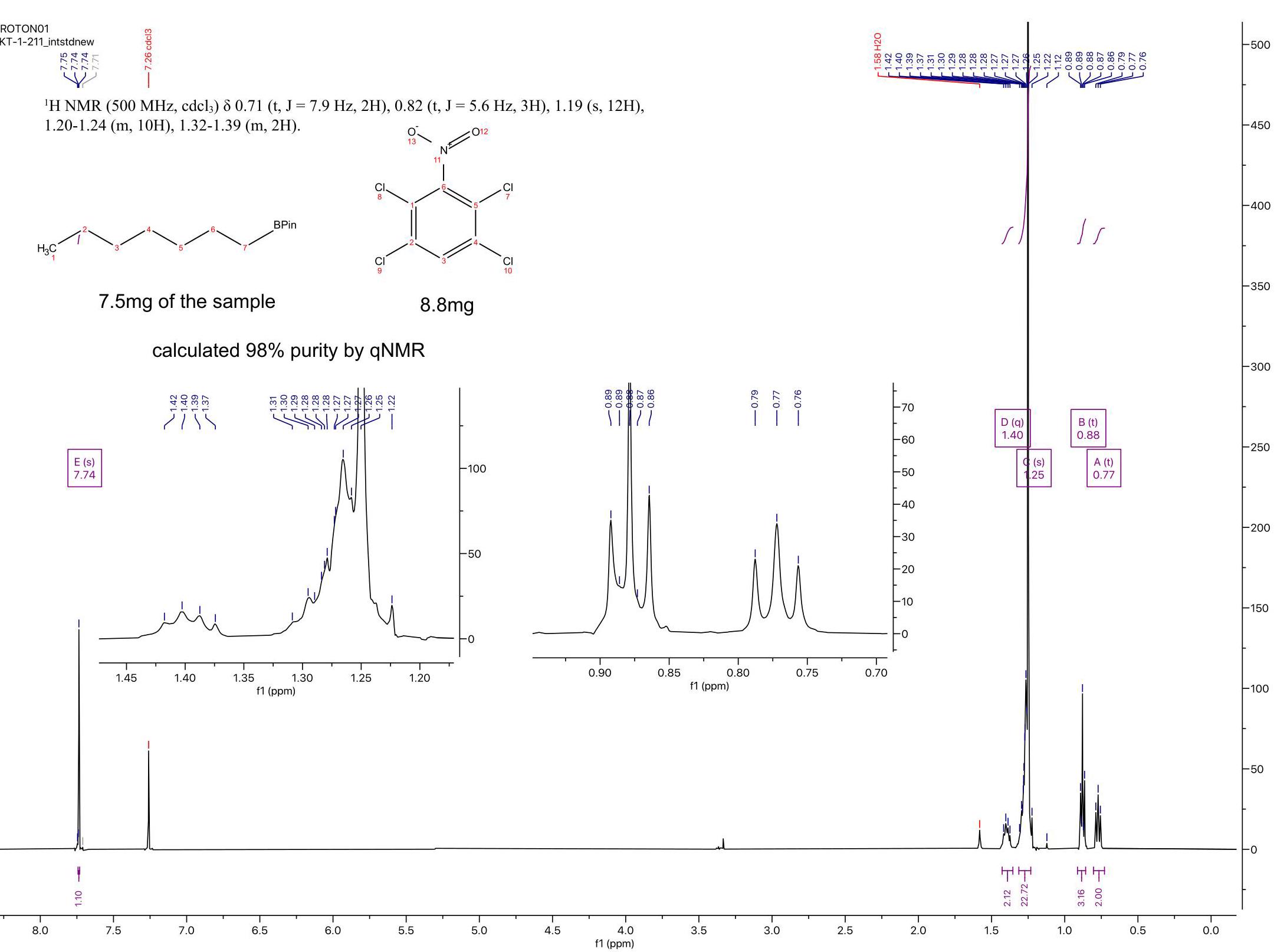
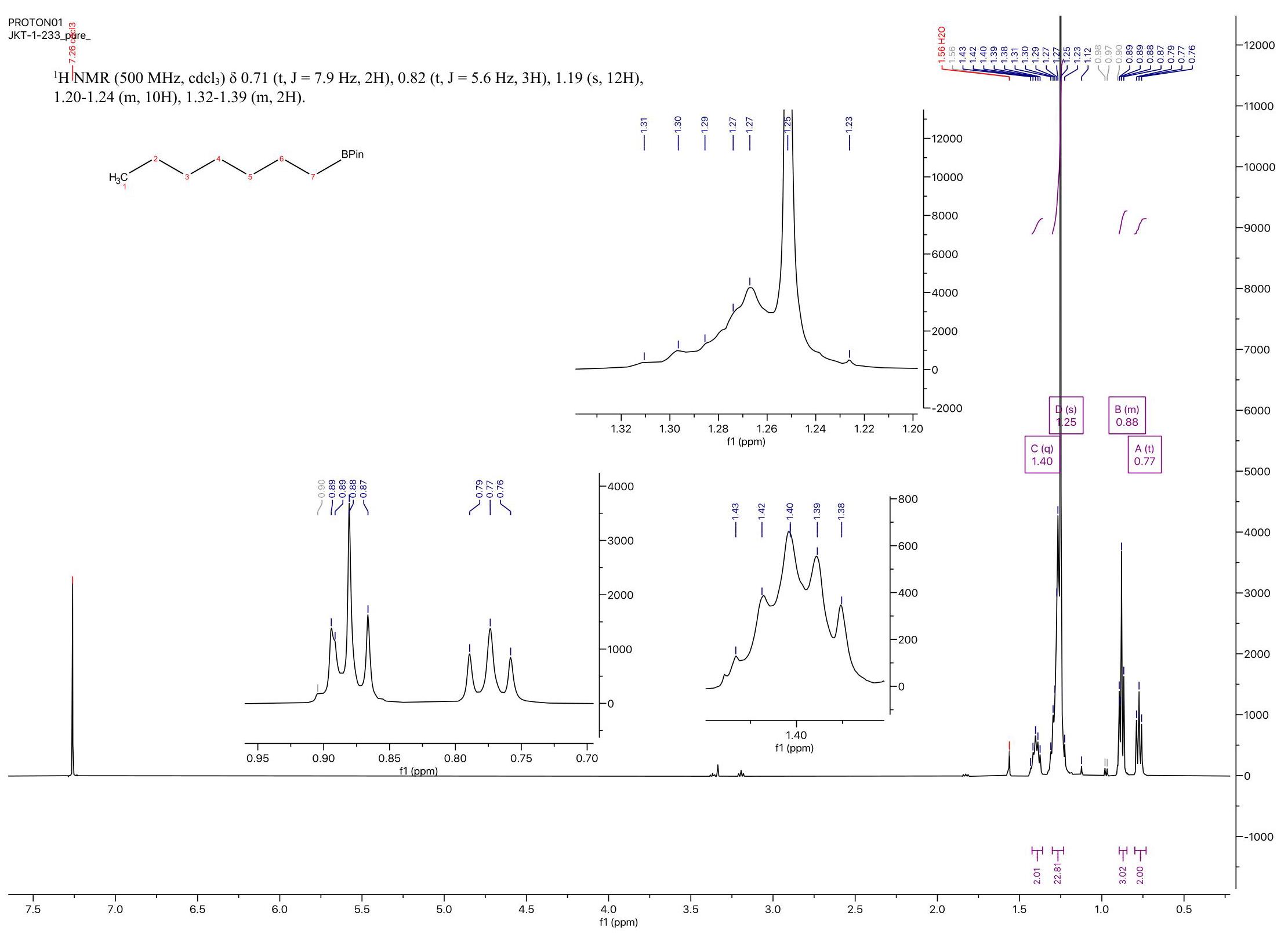
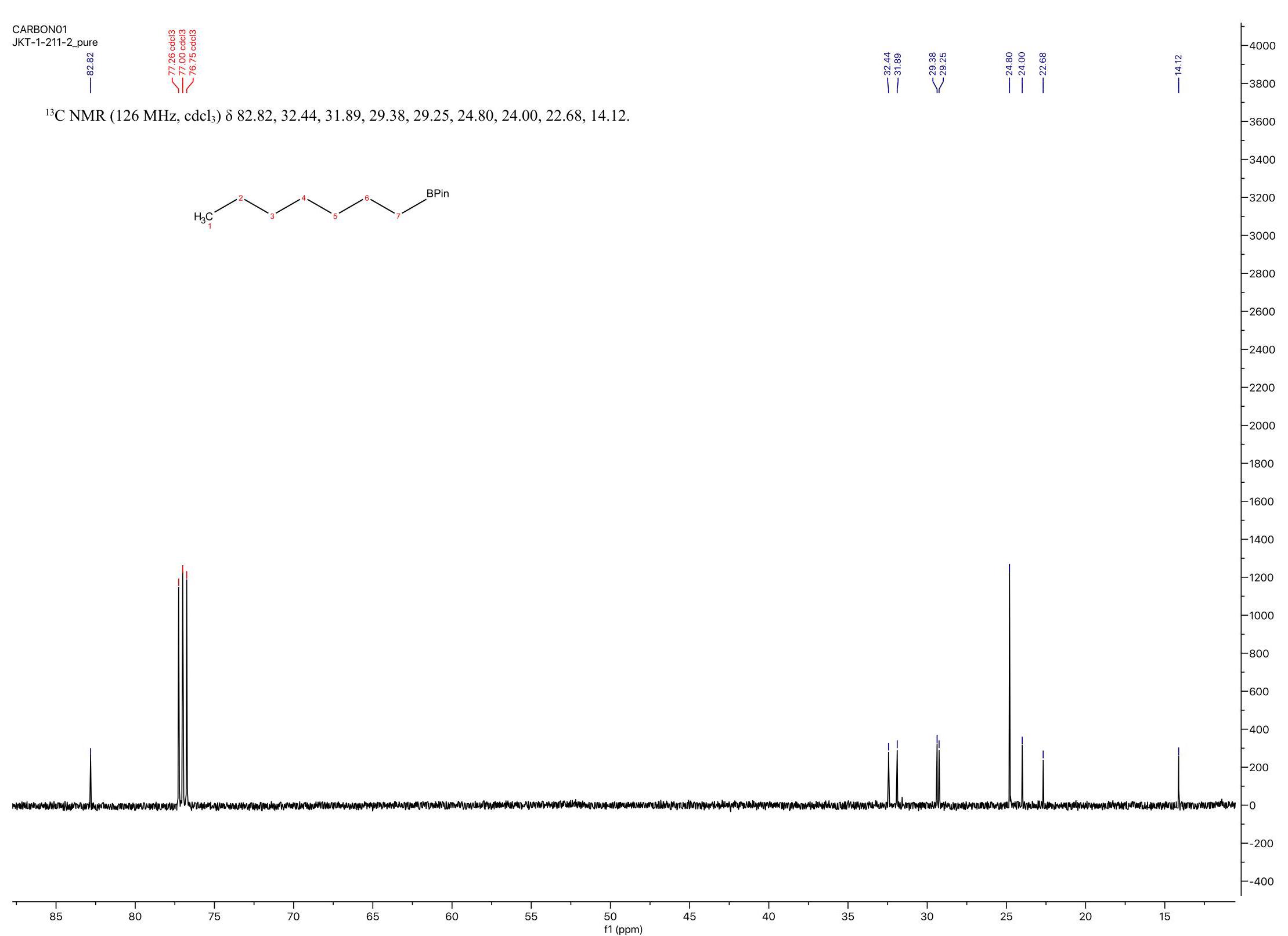
Characterization data of 3: 4,4,5,5-tetramethyl-2-octyl-1,3,2-dioxaborolane, colorless liquid; ${\mathrm{R}}_{\mathrm{f}} = {0.37}$ (petroleum ether-ethyl acetate,19:1); ${}^{1}\mathrm{H}$ NMR $\left. {\left( {{500}\mathrm{{MHz}},{\mathrm{{CDCl}}}_{3}}\right) \delta : {0.77}\left( {\mathrm{t}, J = {7.8}\mathrm{\;{Hz}},2\mathrm{H}}\right) ,{0.88}\left( {\mathrm{t}, J = {6.9}\mathrm{\;{Hz}},3\mathrm{H}}\right) ,{1.25}(\mathrm{\;s}\text{ , }}\right)$ 12 H), 1.25-1.30 (m, 10 H), 1.37-1.42 (m, 2H). ${}^{13}\mathrm{C}$ NMR (126 MHz, CDCl ${}_{3}$ ) 6: 14.1, 22.7, 24.0, 24.8, 29.3, 29.4, 31.9, 32.4, 82.8.1’B NMR (128 MHz, ${\mathrm{{CDCl}}}_{3}$ ) 6: 34.64 (s). IR (neat): 2960 (s), 1465(s), 1378 (s), 1319 (s), 1214 (s), ${1147}\left( \mathrm{\;s}\right) ,{968}\left( \mathrm{\;s}\right) ,{847}\left( \mathrm{\;s}\right) {\mathrm{{cm}}}^{-1}$ . HRMS $\left\lbrack {\mathrm{M}}^{\bullet + }\right\rbrack$ calcd for ${\mathrm{C}}_{14}{\mathrm{H}}_{29}{\mathrm{{BO}}}_{2}{}^{\bullet + } : {240.22551}$ . Found: $\left\lbrack {\mathrm{M}}^{\bullet + }\right\rbrack : {240.22563}$ .
3:4,4,5,5-四甲基-2-辛基-1,3,2-二氧杂硼烷的表征数据:无色液体;${\mathrm{R}}_{\mathrm{f}} = {0.37}$(石油醚-乙酸乙酯,19:1);${}^{1}\mathrm{H}$核磁共振$\left. {\left( {{500}\mathrm{{MHz}},{\mathrm{{CDCl}}}_{3}}\right) \delta : {0.77}\left( {\mathrm{t}, J = {7.8}\mathrm{\;{Hz}},2\mathrm{H}}\right) ,{0.88}\left( {\mathrm{t}, J = {6.9}\mathrm{\;{Hz}},3\mathrm{H}}\right) ,{1.25}(\mathrm{\;s}\text{ , }}\right)$ 12H),1.25 - 1.30(m,10H),1.37 - 1.42(m,2H)。${}^{13}\mathrm{C}$核磁共振(126兆赫兹,CDCl${}_{3}$)6: 14.1, 22.7, 24.0, 24.8, 29.3, 29.4, 31.9, 32.4, 82.8。1’B核磁共振(128兆赫兹,${\mathrm{{CDCl}}}_{3}$)6: 34.64(s)。红外光谱(纯物质):2960(s),1465(s),1378(s),1319(s),1214(s),${1147}\left( \mathrm{\;s}\right) ,{968}\left( \mathrm{\;s}\right) ,{847}\left( \mathrm{\;s}\right) {\mathrm{{cm}}}^{-1}$。高分辨质谱$\left\lbrack {\mathrm{M}}^{\bullet + }\right\rbrack$计算值为${\mathrm{C}}_{14}{\mathrm{H}}_{29}{\mathrm{{BO}}}_{2}{}^{\bullet + } : {240.22551}$。实测值:$\left\lbrack {\mathrm{M}}^{\bullet + }\right\rbrack : {240.22563}$。
Analysis by qNMR, performed with 2,3,5,6-tetrachloro-nitrobenzene (Millipore Sigma, >99%) as an internal standard, indicated that the purity of the product was 98%.
以2,3,5,6-四氯硝基苯(密理博西格玛,>99%)作为内标进行定量核磁共振分析,结果表明产物纯度为98%。
When the reaction was performed at one-half scale, 17.6 g (70%) of the product was obtained.
当反应按半量进行时,得到17.6克(70%)产物。
Working with Hazardous Chemicals
使用危险化学品
The procedures in Organic Syntheses are intended for use only by persons with proper training in experimental organic chemistry. All hazardous materials should be handled using the standard procedures for work with chemicals described in references such as “Prudent Practices in the Laboratory” (The National Academies Press, Washington, D.C., 2011; the full text can be accessed free of charge at
《有机合成》中的实验步骤仅适用于接受过实验有机化学正规培训的人员。所有危险材料的处理都应遵循《实验室安全操作规范》(美国国家科学院出版社,华盛顿特区,2011年;全文可免费获取,网址为
http://www.nap.edu/catalog.php?record id=12654). All chemical waste should be disposed of in accordance with local regulations. For general guidelines for the management of chemical waste, see Chapter 8 of Prudent Practices.
http://www.nap.edu/catalog.php?record_id=12654)。所有化学废物应按照当地法规进行处理。有关化学废物管理的一般指南,请参阅《安全操作规范》第8章。
In some articles in Organic Syntheses, chemical-specific hazards are highlighted in red “Caution Notes” within a procedure. It is important to recognize that the absence of a caution note does not imply that no significant hazards are associated with the chemicals involved in that procedure. Prior to performing a reaction, a thorough risk assessment should be carried out that includes a review of the potential hazards associated with each chemical and experimental operation on the scale that is planned for the procedure. Guidelines for carrying out a risk assessment and for analyzing the hazards associated with chemicals can be found in Chapter 4 of Prudent Practices.
在《有机合成》的一些文章中,特定化学品的危害在步骤中的红色“注意事项”中突出显示。必须认识到,没有注意事项并不意味着该步骤中涉及的化学品没有重大危害。在进行反应之前,应进行全面的风险评估,包括审查与计划在该步骤规模下的每种化学品和实验操作相关的潜在危害。进行风险评估和分析化学品相关危害的指南可在《安全操作规范》第4章中找到。
The procedures described in Organic Syntheses are provided as published and are conducted at one’s own risk. Organic Syntheses, Inc., its Editors, and its Board of Directors do not warrant or guarantee the safety of individuals using these procedures and hereby disclaim any liability for any injuries or damages claimed to have resulted from or related in any way to the procedures herein.
《有机合成》中描述的步骤按原样提供,使用风险自负。有机合成公司、其编辑和董事会不保证使用这些步骤的个人的安全,特此声明对因使用本步骤而导致或与之相关的任何伤害或损害不承担任何责任。
Discussion
讨论
Alkylboronic acids and esters are versatile building blocks in transition-metal-catalyzed cross-coupling reactions ${}^{3}$ and key intermediates in functional group interconversions. ${}^{4}$ Conventional methods to prepare alkylboronates include the electrophilic borylation of organolithium reagents ${}^{5}$ or Grignard reagents, ${}^{6}$ transition-metal-catalyzed hydroboration of olefins, ${}^{7}$ and transition-metal-catalyzed C-H borylation of hydrocarbons. ${}^{8}$ In recent years, transition-metal-free borylation of alkyl halides has emerged as a new approach for the preparation of alkylboronates. ${}^{9}$ In 2010, Wang reported the efficient direct conversion of anilines into aryl pinacol boronic esters via a diazonium salt intermediate, ${}^{10}$ which is pioneering work on borylation based on a radical mechanism. Subsequently, numerous transition-metal-free borylation protocols have been developed. ${}^{11}$ However, the direct borylation of alkyl substrates without preliminary activation remains underdeveloped. Studer ${}^{12}$ and Jiao ${}^{13}$ have reported the direct borylation of alkyl substrates under photochemical conditions. In this context, we investigated and developed the direct transition-metal-free borylation of alkyl halides without the use of photochemical conditions. ${}^{2}$ This synthetic approach provides an operationally simple, transition-metal-free and irradiation-free protocol for the borylation of readily avalable alkyl iodide and bromide substrates. Furthermore, this transition-metal-free borylation occurs under mild conditions and tolerates a broad range of functional groups (Figure 4). Under these conditions, a diverse range of primary and secondary alkyl halides could be effectively transformed to the corresponding alkylboronates in good to excellent yield.
烷基硼酸和硼酸酯是过渡金属催化的交叉偶联反应${}^{3}$中的通用结构单元,也是官能团相互转化中的关键中间体${}^{4}$。制备硼酸酯的传统方法包括有机锂试剂${}^{5}$或格氏试剂${}^{6}$的亲电硼化、过渡金属催化的烯烃硼氢化${}^{7}$以及过渡金属催化的烃类C-H硼化${}^{8}$。近年来,卤代烃的无过渡金属硼化已成为制备硼酸酯的一种新方法${}^{9}$。2010年,王报道了通过重氮盐中间体将苯胺高效直接转化为芳基频哪醇硼酸酯${}^{10}$,这是基于自由基机理的硼化开创性工作。随后,开发了许多无过渡金属硼化方案${}^{11}$。然而,未经预活化的烷基底物的直接硼化仍未得到充分发展。施图德${}^{12}$和焦${}^{13}$报道了在光化学条件下烷基底物的直接硼化。在此背景下,我们研究并开发了无需光化学条件的卤代烃直接无过渡金属硼化${}^{2}$。这种合成方法为易于获得的烷基碘和溴底物的硼化提供了一种操作简单、无过渡金属且无需辐照的方案。此外,这种无过渡金属硼化在温和条件下进行,并且能耐受多种官能团(图4)。在这些条件下,各种伯卤代烃和仲卤代烃可以有效地转化为相应的硼酸酯,产率良好至优异。
The borylation of alkyl halides proceeds via a radical mechanism. As the alkyl radical could also be reduced by methanol, a high concentration of free diboron is needed to increase the yield of borylation product. If less ${\mathrm{B}}_{2}{\mathrm{{pin}}}_{2}$ is used, the yield of borylation product will decrease resulting from the increase of reduction product. For a ${0.5}\mathrm{{mmol}}$ scale reaction,3 equiv of ${\mathrm{B}}_{2}{\text{ pin }}_{2}$ and 1.5 equiv of $t$ -BuOLi are sufficient; however, for large-scale preparations 4 equiv of ${\mathrm{B}}_{2}{\mathrm{{pin}}}_{2}$ and 2 equiv of $t$ -BuOLi are required. In a small-scale reaction, the reaction system appears to be uniform and proceeds rapidly. In contrast, large-scale reactions involve a solid phase that may result in non-uniform temperature in different regions of the reaction system. In addition, concentration of different reagents in the solution may be difficult to determine, i.e., the concentration of diboron compound. Therefore, a higher concentration of reagents is needed to increase the conversion and borylation yield. In addition, a ${50}\mathrm{\;g}$ scale reaction requires the removal of the excess ${\mathrm{B}}_{2}{\mathrm{{pin}}}_{2}$ and other byproducts via filtration before purification on column chromatography, which results in the loss of a certain amount of the product and lower isolated yield.
卤代烃的硼化通过自由基机理进行。由于烷基自由基也可以被甲醇还原,因此需要高浓度的游离双硼来提高硼化产物的产率。如果使用较少的${\mathrm{B}}_{2}{\mathrm{{pin}}}_{2}$,硼化产物的产率会因还原产物的增加而降低。对于${0.5}\mathrm{{mmol}}$规模的反应,3当量的${\mathrm{B}}_{2}{\text{ pin }}_{2}$和1.5当量的$t$-BuOLi就足够了;然而,对于大规模制备,需要4当量的${\mathrm{B}}_{2}{\mathrm{{pin}}}_{2}$和2当量的$t$-BuOLi。在小规模反应中,反应体系似乎是均匀的,反应进行迅速。相比之下,大规模反应涉及固相,这可能导致反应体系不同区域的温度不均匀。此外,溶液中不同试剂的浓度可能难以确定,即双硼化合物的浓度。因此,需要更高浓度的试剂来提高转化率和硼化产率。此外,${50}\mathrm{\;g}$规模的反应需要在柱色谱纯化之前通过过滤除去过量的${\mathrm{B}}_{2}{\mathrm{{pin}}}_{2}$和其他副产物,这会导致一定量的产物损失和较低的分离产率。
Figure 4. Substrate Scope of Borylation of Alkyl Iodides ${}^{a}$
图4. 烷基碘化物${}^{a}$的硼化底物范围
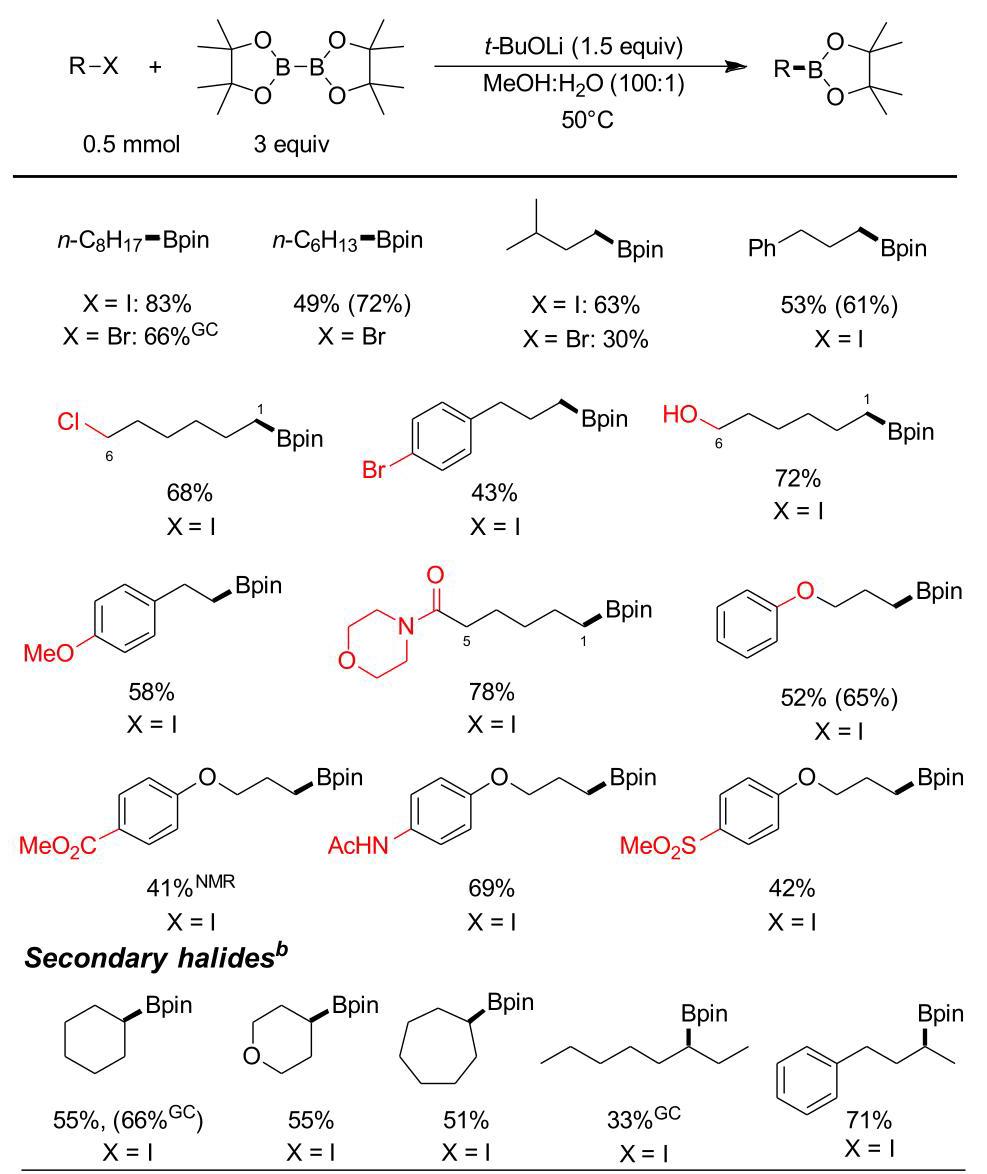
${}^{a}$ Reaction conditions: Alkyl halide 1 0.5 mmol, ${\mathrm{B}}_{2}{\text{ pin }}_{2}$ 1.5 mmol (3 equiv), $t$ -BuOLi 0.75 mmol (1.5 equiv), MeOH 0.85 mL, ${\mathrm{H}}_{2}\mathrm{O}{10\mu }\mathrm{L}$ . Isolated yields are reported. The yields in parentheses are referred to the conditions with the use of ${\mathrm{B}}_{2}{\text{ pin }}_{2}$ (2 mmol,4 equiv) and $t$ - BuOLi (1 mmol, 2 equiv). The yields with a “GC” superscript are GC yields with decane as an internal standard. The yields with a “NMR” superscript are ${}^{1}\mathrm{H}$ NMR yield with1,1,2,2- tetrachloroethane as an internal standard ${}^{b}{\mathrm{\;B}}_{2}{\text{ cat }}_{2}$ (4 equiv), $t$ -BuOLi (2 equiv), MeOH, ${80}^{ \circ }\mathrm{C}$ , ${48}\mathrm{\;h}$ ; then ${\mathrm{{Et}}}_{3}\mathrm{\;N}$ (4 equiv), pinacol (4 equiv), rt, $3\mathrm{\;h}$ .
${}^{a}$反应条件:卤代烃1 0.5 mmol,${\mathrm{B}}_{2}{\text{ pin }}_{2}$ 1.5 mmol(3当量),$t$ -丁基锂0.75 mmol(1.5当量),甲醇0.85 mL,${\mathrm{H}}_{2}\mathrm{O}{10\mu }\mathrm{L}$。报告的是分离产率。括号内的产率是指使用${\mathrm{B}}_{2}{\text{ pin }}_{2}$(2 mmol,4当量)和$t$ -丁基锂(1 mmol,2当量)的条件下的产率。带有“GC”上标的产率是以癸烷为内标的气相色谱产率。带有“NMR”上标的产率是以1,1,2,2-四氯乙烷为内标的${}^{1}\mathrm{H}$核磁共振产率${}^{b}{\mathrm{\;B}}_{2}{\text{ cat }}_{2}$(4当量),$t$ -丁基锂(2当量),甲醇,${80}^{ \circ }\mathrm{C}$,${48}\mathrm{\;h}$;然后${\mathrm{{Et}}}_{3}\mathrm{\;N}$(4当量),频哪醇(4当量),室温,$3\mathrm{\;h}$。
References
参考文献
School of Materials Science and Engineering, Peking University, Beijing 100871, China; (Fanyang Mo): 0000- 0002-4140-3020. The project is supported by Natural Science Foundation of China (Grant Nos. 21772003, 21933001, 22071004).
Liu, Q.; Hong, J.; Sun, B.; Bai, G.; Li, F.; Liu, G.; Yang, Y.; Mo, F. Org. Lett. 2019, 21, 6597-6602.
Miyaura, N.; Suzuki, A. Chem. Rev. 1995, 95, 2457-2483.
Wu, P.; Givskov, M.; Nielsen, T. E. Chem. Rev. 2019, 119, 11245-11290.
Brown, H. C.; Cole, T. E. Organometallics. 1983, 2, 1316-1319.
Leermann, T.; Leroux, F. R.; Colobert, F. Org. Lett. 2011, 13, 4479-4481.
Zweifel, G.; Brown, H. C., Hydration of Olefins, Dienes, and Acetylenes via Hydroboration. In Organic Reactions, pp 1.
(a) Chen, H.; Schlecht, S.; Semple, T. C.; Hartwig, J. F. Science 2000, 287, 1995-1997; (b) Mkhalid, I. A. I.; Barnard, J. H.; Marder, T. B.; Murphy, J. M.; Hartwig, J. F. Chem. Rev. 2010, 110, 890-931.
Liu, Q.; Zhang, L.; Mo, F. Acta Chimica. Sinica. 2020, 78, 1297-1308.
Mo, F.; Jiang, Y.; Qiu, D.; Zhang, Y.; Wang, J. Angew. Chem. Int. Ed. 2010, 49, 1846-1849.
Friese, F. W.; Studer, A. Chem. Sci. 2019, 10, 8503-8518.
Cheng, Y.; Mück-Lichtenfeld, C.; Studer, A. Angew. Chem. Int. Ed. 2018, 57, 16832-16836.
Zhang, L.; Wu, Z.-Q.; Jiao, L. Angew. Chem. Int. Ed. 2020, 59, 2095-2099.
Appendix Chemical Abstracts Nomenclature (Registry Number)
附录 化学文摘命名法(登记号)
4,4,4’,4’,5,5,5’,5’-Octamethyl-2,2’-bi(1,3,2-dioxaborolane): diboron pinacol ester; (73183-34-3)
4,4,4’,4’,5,5,5’,5’-八甲基-2,2’-联(1,3,2-二氧硼戊环):联硼酸频那醇酯;(73183-34-3)
1-Iodooctane; (629-27-6)
1-碘代辛烷;(629-27-6)
Lithium tert-butoxide; (1907-33-1)
叔丁醇锂;(1907-33-1)
Methanol; (67-56-1)
甲醇;(67-56-1)
4,4,5,5-Tetramethyl-2-octyl-1,3,2-dioxaborolane; (66217-56-9)
4,4,5,5-四甲基-2-辛基-1,3,2-二氧硼戊环;(66217-56-9)
Dr. Qianyi Liu was born in Shandong province of
刘谦益博士出生于中国山东省
China. He received his B.S. degree from Peking
。他于2015年从北京大学获得学士学位。
University in 2015. He obtained his Ph. D in 2020
他于2020年在莫凡洋教授的指导下获得博士学位。
under the supervision of Prof. Fanyang Mo. He
他
now works as a Boya post-doctoral fellow in Prof.
现在是北京大学化学与分子工程学院朱荣实验室的博雅博士后。
Rong Zhu’s laboratory at College of Chemistry in
在
Peking University.
北京大学。
Hao Liang was born in February 1991 in Tai’an of
梁浩于1991年2月出生于山东省泰安市。
Shandong province. He has received his B.S.
他于2012年从天津大学获得
degree from Tianjin University in 2012.
学士学位。
Shangyong Zhou was born in November 1989 in Tai’an of Shandong province. He has received his Master’s degree from Tianjin Normal University in 2015. Now he is a team leader in WuXi AppTec.
周尚勇1989年11月出生于山东省泰安市。2015年毕业于天津师范大学并获得硕士学位。现任药明康德团队负责人。
Lei Zhang was born in 1993 in Henan province of
张雷1993年出生于中国河南省。
China. He obtained his B. Eng. degree from Beijing
他于2016年在北京理工大学获得工学学士学位。同年,
Institute of Technology in 2016. In the same year,
他进入北京大学,
he moved to Peking University and started his
并在
Ph.D. study under the supervision of Prof.
莫凡洋教授的指导下开始攻读博士学位。
Fanyang Mo.
Jianxin Yang was born in April 1980 in Jiangxi
杨建新1980年4月出生于中国江西省。
province of China. He has received his B.S. and
他于2002年和2005年在吉林大学分别获得学士和硕士学位。
M.S. degree from Jilin University in 2002 and 2005.
Now he is a Director II in WuXi AppTec.
现任药明康德二级总监。
Yunxing Yin was born in Hubei province of China.
尹云星出生于中国湖北省。
He has received his B.S. degree from Three Gorges
他于2000年毕业于三峡大学并获得学士学位。现任药明康德化学副总裁。
University in 2000. Now he is a VP of chemistry in
WuXi AppTec.
Yang Yang received his B.Sc. degree in Chemistry from Peking University in 2011. He carried out graduate research under the guidance of Prof. Stephen Buchwald at the Massachusetts Institute of Technology, studying copper-catalyzed asymmetric hydrofunctionalization of simple olefins. He then performed postdoctoral research in the laboratory of Prof. Frances Arnold at the California Institute of Technology, where he evolved cytochrome P450 enzymes for enantioselective $\mathrm{C}\left( {\mathrm{{sp}}}^{3}\right) - \mathrm{H}$ amination reactions. In 2020, he became an Assistant Professor in the Department of Chemistry and Biochemistry at the University of California Santa Barbara.
杨阳于2011年在北京大学获得化学理学学士学位。他在麻省理工学院斯蒂芬·布赫瓦尔德教授的指导下进行研究生研究,研究简单烯烃的铜催化不对称氢官能化反应。随后,他在加州理工学院弗朗西斯·阿诺德教授的实验室进行博士后研究,在那里他开发了用于对映选择性$\mathrm{C}\left( {\mathrm{{sp}}}^{3}\right) - \mathrm{H}$胺化反应的细胞色素P450酶。2020年,他成为加利福尼亚大学圣巴巴拉分校化学与生物化学系的助理教授。
Di Qiu was born in Tianjin, China, in 1987. He received his B.S. degree from Peking University in 2010. He continued his graduate study in Prof. Jianbo Wang’s laboratory and obtained his Ph.D. in 2015. In the same year, he joined in Tianjin Normal University as an assistant professor. His research interests lie in aromatic C-P bond formation and functional group transformations in aromatic compounds.
邱迪1987年出生于中国天津。2010年,他从北京大学获得学士学位。他继续在王剑波教授的实验室攻读研究生,并于2015年获得博士学位。同年,他加入天津师范大学担任助理教授。他的研究兴趣在于芳香族化合物中碳 - 磷键的形成以及官能团的转化。
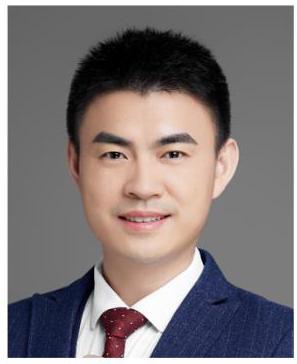
Fanyang Mo was born in Liaoyang city of Liaoning Province in 1982. He obtained his undergraduate degree and Master’s degree in applied chemistry in 2004 and 2006 at Beijing Institute of Technology under the supervision of Professor Zhiming Zhou. He then moved to Peking University where he studied the synthetic applications of diazo compounds and aryldiazonium salts transformations under the supervision of Prof. Jianbo Wang. After receiving his Ph.D. in 2010, he went to the US and worked with Professor Qinghai Zhang at The Scripps Research Institute and Professor Guangbin Dong at The University of Texas at Austin from 2010 to 2015. He joined Peking University as an Assistant Professor in April 2015. His research interests are photo/electro-driven organic synthesis and the modification of semiconductor oxides for energy application, molecular electronics. Now and in the future, Dr. Mo and his group are dedicated in using artificial intelligence and robotics to improve the production efficiency of scientific knowledge, accelerate the development of organic chemistry, and improve the basic role of synthetic chemistry in material preparation and drug development.
莫凡洋1982年出生于辽宁省辽阳市。2004年和2006年,他在北京理工大学在周志敏教授的指导下分别获得应用化学专业的本科学位和硕士学位。随后他前往北京大学,在王剑波教授的指导下研究重氮化合物的合成应用以及芳基重氮盐的转化。2010年获得博士学位后,他前往美国,2010年至2015年期间在斯克里普斯研究所与张青海教授以及德克萨斯大学奥斯汀分校的董广彬教授合作。2015年4月,他加入北京大学担任助理教授。他的研究兴趣是光/电驱动的有机合成以及用于能源应用、分子电子学的半导体氧化物的改性。现在和未来,莫博士及其团队致力于利用人工智能和机器人技术提高科学知识的生产效率,加速有机化学的发展,并提升合成化学在材料制备和药物开发中的基础作用。
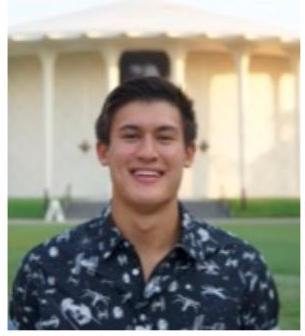
Jordan Thompson is a second-year graduate student in Professor Sarah Reisman’s laboratory. He is interested in the total synthesis of complex natural products and completed his undergraduate studies at UC Berkeley under the guidance of Professor Tom Maimone.
乔丹·汤普森是莎拉·雷斯曼教授实验室的一名二年级研究生。他对复杂天然产物的全合成感兴趣,并在汤姆·迈蒙教授的指导下于加州大学伯克利分校完成了本科学习。
-550
-500
450
-50
-0
-50
80 75 70 65 60 55 50 45 40 35 30 25 20 15 10 5 0 -5 -10 -15
f1 (ppm)
f1(ppm)