Electrocatalytic Oxidative Hydrofunctionalization Reactions of Alkenes via Co(II/III/IV) Cycle
英文原文与中文译文逐段对照 · English original with Chinese translation
Fan Yang, Yi-Chen Nie, Han-Yuan Liu, Lei Zhang, Fanyang Mo, and Rong Zhu*
杨帆,聂逸晨,刘汉元,张雷,莫凡洋,朱荣*
Cite This: ACS Catal. 2022, 12, 2132-2137
引用本文:ACS催化。2022年,12卷,2132 - 2137页
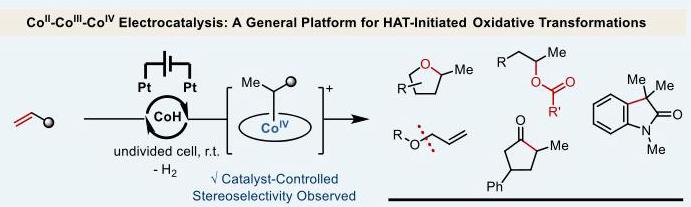
ABSTRACT: Here we disclose a general Co(II/III/IV) electrocatalytic platform for alkene functionalization. Driven by electricity, a set of the oxidative hydrofunctionalization reactions via hydrogen atom transfer were demonstrated without the need for stochio-metric chemical oxidants. The scope of the reactions encompasses hydroalkoxylation, hydroacyloxylation, hydroarylation, semipinacol rearrangement, and deallylation. Mechanistic studies and stereochemical evidence support an ECEC process involving an electrochemically generated organocobalt(IV) intermediate. This work presents an example of reactivity space expansion in electrocatalysis in the ${\mathrm{{VB}}}_{12}$ -system by going beyond the common oxidation states of Co(I/II/II).
摘要:在此,我们公开了一种用于烯烃官能化的通用钴(II/III/IV)电催化平台。在电驱动下,展示了一系列通过氢原子转移的氧化氢官能化反应,无需化学计量的化学氧化剂。反应范围包括氢烷氧基化、氢酰氧基化、氢芳基化、半频哪醇重排和脱烯丙基反应。机理研究和立体化学证据支持了一个涉及电化学生成的有机钴(IV)中间体的ECEC过程。这项工作通过超越钴(I/II/III)的常见氧化态,展示了在${\mathrm{{VB}}}_{12}$ -系统中电催化反应活性空间扩展的一个例子。
KEYWORDS: cobalt, hydrogen atom transfer, electrocatalysis, hydrofunctionalization, alkenes
关键词:钴,氢原子转移,电催化,氢官能化,烯烃
Using electric current as a traceless reagent in transition-metal catalysis has opened up a new avenue for the development of sustainable transformations. ${}^{1}$ Transition-metal complexes can serve as electron transfer mediators to reduce overpotentials and meanwhile bring in rich and tunable reactivities for electrosynthesis. ${}^{2}$ Cobalt complexes were among the first explored metal-based redox catalysts in electrosynthesis because of their multiple accessible oxidation states. ${}^{3}$ In particular, vitamin ${\mathrm{B}}_{12}$ and its mimics (cobaloxime, CoSalen, etc.) have received considerable attention for their good redox cyclability and distinct reactivities at ${\mathrm{{Co}}}^{\mathrm{I}},{\mathrm{{Co}}}^{\mathrm{{II}}}$ , and ${\mathrm{{Co}}}^{\mathrm{{III}}}$ oxidation states, respectively (Figure 1a). ${}^{4}$ For example, the square planar four-coordinate ${\mathrm{{Co}}}^{\mathrm{I}}$ “supernucleophile” has been employed for electroreductive dehalogenation, ${}^{5}$ Giese reaction, ${}^{6}$ and carboxylation ${}^{7}$ since 1980s, and more recently, it has been used in $\mathrm{{Co}} - \mathrm{H}$ -catalyzed olefin isomerization ${}^{8}$ and related reactions ${}^{9}$ via hydrogen-atom-transfer (HAT). The combination of electrochemical HAT reaction and copper-mediated radical functionalization has resulted in an elegant solution for enantioselective hydrocyanation of conjugated alkenes. ${}^{10}$
在过渡金属催化中使用电流作为无痕试剂为可持续转化的发展开辟了一条新途径。${}^{1}$ 过渡金属配合物可以作为电子转移介质来降低过电位,同时为电合成带来丰富且可调的反应活性。${}^{2}$ 钴配合物由于其多种可及的氧化态,是电合成中最早被探索的金属基氧化还原催化剂之一。${}^{3}$ 特别是,维生素${\mathrm{B}}_{12}$ 及其类似物(钴胺肟、CoSalen等)因其良好的氧化还原循环能力以及在${\mathrm{{Co}}}^{\mathrm{I}},{\mathrm{{Co}}}^{\mathrm{{II}}}$ 和${\mathrm{{Co}}}^{\mathrm{{III}}}$ 氧化态下分别具有独特的反应活性而受到了广泛关注(图1a)。${}^{4}$ 例如,平面四方四配位的${\mathrm{{Co}}}^{\mathrm{I}}$ “超亲核试剂”自20世纪80年代以来已被用于电还原脱卤、${}^{5}$ 吉泽反应、${}^{6}$ 和羧基化反应${}^{7}$ ,最近,它已被用于$\mathrm{{Co}} - \mathrm{H}$ -催化的烯烃异构化反应${}^{8}$ 及相关反应${}^{9}$ 通过氢原子转移(HAT)。电化学HAT反应与铜介导的自由基官能化反应的结合为共轭烯烃的对映选择性氢氰化提供了一个优雅的解决方案。${}^{10}$
Electrochemically going beyond the common oxidation states $\left( {\mathrm{{Co}}}^{\mathrm{I}/\mathrm{{II}}/\mathrm{{III}}}\right)$ may allow one to explore new reactivity space. An inspiring example is Ackermann’s discovery of a formal ${\mathrm{{Co}}}^{\mathrm{{IV}}}$ intermediate in electrocatalytic $\mathrm{C} - \mathrm{H}$ functionalization reactions. ${}^{11}$ In ${\mathrm{{VB}}}_{12}$ -related systems, cationic organocobalt(IV) complexes have been known since the 1970s (Figure 1b). ${}^{12}$ Their organometallic radical cation nature makes them susceptible to nucleophilic displacement at the alkyl ligand. ${}^{13}$ This was recently leveraged in a series of HAT-initiated oxidative hydrofunctionalization reactions using stoichiometric chemical oxidants such as $N$ -fluoropyridiniums, hypervalent iodine reagents, and persulfates. ${}^{14}$ In our previous work, a well-defined organocobalt(III) complex was electrochemically characterized, where the ${\mathrm{{Co}}}^{\mathrm{{III}}/\mathrm{{IV}}}$ oxidation proved accessible at quite low potential $\left( {E}_{\mathrm{p}/2}\right.$ vs $\left. {{\mathrm{{Fc}}}^{ + }/\mathrm{{Fc}} \sim - {0.01}\mathrm{\;V}}\right) \cdot {}^{15}$ However, to the best of our knowledge, such a ${\mathrm{{Co}}}^{\mathrm{{IV}}}$ state in ${\mathrm{{VB}}}_{12}$ -related catalysts has not been explored in electrosynthesis.
通过电化学方式超越常见氧化态$\left( {\mathrm{{Co}}}^{\mathrm{I}/\mathrm{{II}}/\mathrm{{III}}}\right)$,可能使人们探索新的反应活性空间。一个鼓舞人心的例子是阿克曼在电催化$\mathrm{C} - \mathrm{H}$官能化反应中发现了一种形式上的${\mathrm{{Co}}}^{\mathrm{{IV}}}$中间体。${}^{11}$在${\mathrm{{VB}}}_{12}$相关体系中,阳离子有机钴(IV)配合物自20世纪70年代就已为人所知(图1b)。${}^{12}$它们的有机金属自由基阳离子性质使其在烷基配体处易受亲核取代。${}^{13}$最近,这一性质被用于一系列由氢原子转移(HAT)引发的氧化氢官能化反应中,使用了化学计量的化学氧化剂,如$N$ -氟吡啶鎓、高价碘试剂和过硫酸盐。${}^{14}$在我们之前的工作中,对一种明确的有机钴(III)配合物进行了电化学表征,其中${\mathrm{{Co}}}^{\mathrm{{III}}/\mathrm{{IV}}}$氧化在相对于$\left. {{\mathrm{{Fc}}}^{ + }/\mathrm{{Fc}} \sim - {0.01}\mathrm{\;V}}\right) \cdot {}^{15}$相当低的电位$\left( {E}_{\mathrm{p}/2}\right.$下被证明是可行的。然而,据我们所知,在电合成中尚未探索${\mathrm{{VB}}}_{12}$相关催化剂中的这种${\mathrm{{Co}}}^{\mathrm{{IV}}}$状态。
Here we report a general electrocatalytic platform enabling a set of HAT-initiated oxidative transformations in undivided cells via electrochemically generated ${\mathrm{{Co}}}^{\mathrm{{IV}}}$ intermediates (Figure 1c). Replacing stoichiometric oxidants leads to a more cost-effective and/or safer protocol that generates less waste stream. The scope of the reactions encompasses hydroalkoxylation, hydroacyloxylation, hydroarylation, semi-pinacol rearrangement, and deallylation without the need for tedious optimizations. The relevance of ${\mathrm{{Co}}}^{\mathrm{{IV}}}$ intermediates was supported by the observed catalyst-controlled stereoselectivity.
在此,我们报告了一个通用的电催化平台,该平台通过电化学产生的${\mathrm{{Co}}}^{\mathrm{{IV}}}$中间体,能够在未分隔的电池中实现一系列由氢原子转移(HAT)引发的氧化转化(图1c)。取代化学计量的氧化剂会产生一种更具成本效益和/或更安全的方案,产生的废物流更少。反应范围包括氢烷氧基化、氢酰氧基化、氢芳基化、半频哪醇重排和脱烯丙基化,无需繁琐的优化。观察到的催化剂控制的立体选择性支持了${\mathrm{{Co}}}^{\mathrm{{IV}}}$中间体的相关性。
We commenced our investigation by studying the electrocatalytic intramolecular hydroalkoxylation of 2,2-diphenylpent- 4-en-1-ol (1a) as the model reaction (Figure 2a). A set of optimal conditions was identified as shown in entry 1. In methanol at ambient temperature, constant current $\left( {5\mathrm{\;{mA}}}\right)$ electrolysis using platinum mesh electrodes was performed in the presence of a catalytic amount of CoSalen complex 3a and diphenylsilane as a hydride source. The cyclization product 2a was obtained in 87% yield after 3.75-h electrolysis (2.3 F/mol, corresponding to 87% faradaic efficiency). CoSalen complex 3b, bearing a less sterically hindered backbone, furnished substantially lower conversion and yield, which could be attributable to the instability of the ligand backbone during electrolysis (entry 2). The reaction proved to be relatively insensitive to the choice of the electrolyte or the silane (entry 3-4), while it was significantly affected by the solvent and catalyst loading (entry 5-6). Changing the anode from platinum mesh to reticulated vitreous carbon (RVC) provided a comparable yield (entry 7). Doubling the current led to catalyst decomposition and thus low conversion (entry 8). Control experiments established the essential roles of the catalysts, silane, and electricity, respectively (entries 9-11).
我们通过研究2,2 -二苯基戊-4-烯-1-醇(1a)的电催化分子内氢烷氧基化作为模型反应开始我们的研究(图2a)。确定了一组最佳条件,如条目1所示。在室温下的甲醇中,在催化量的CoSalen配合物3a和作为氢化物源的二苯基硅烷存在下,使用铂网电极进行恒电流$\left( {5\mathrm{\;{mA}}}\right)$电解。在3.75小时的电解后(2.3 F/mol,对应87%的法拉第效率),以87%的产率得到环化产物2a。具有空间位阻较小主链的CoSalen配合物3b提供了显著更低的转化率和产率,这可能归因于电解过程中配体主链的不稳定性(条目2)。该反应被证明对电解质或硅烷的选择相对不敏感(条目3 - 4),而它受到溶剂和催化剂负载量的显著影响(条目5 - 6)。将阳极从铂网改为网状玻璃碳(RVC)提供了相当的产率(条目7)。将电流加倍导致催化剂分解,因此转化率较低(条目8)。对照实验分别确定了催化剂、硅烷和电的关键作用(条目9 - 11)。
Received: December 3, 2021
收到日期:2021年12月3日
Revised: January 8, 2022
修订日期:2022年1月8日
Published: January 27, 2022
发表日期:2022年1月27日
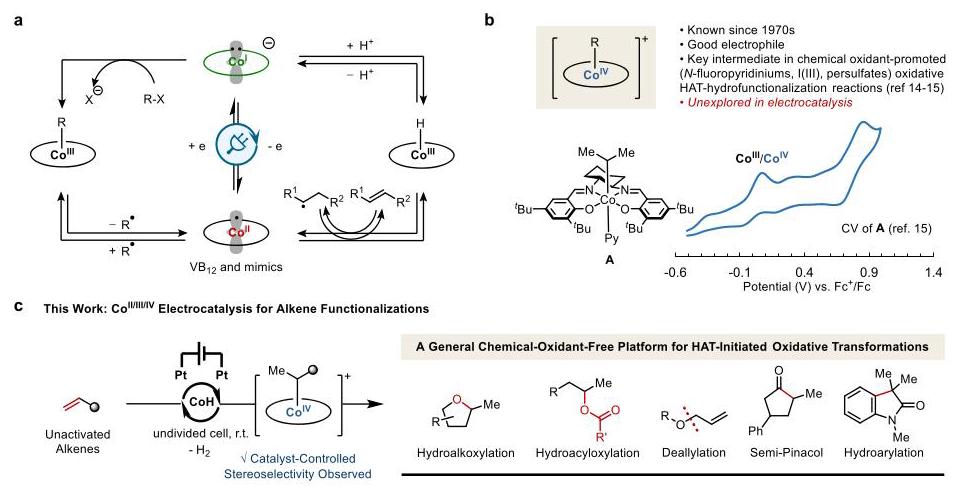
Figure 1. (a) Established electrosynthesis catalyzed by ${\mathrm{{VB}}}_{12}$ and analogues typically involves oxidation states I, II, and III. (b) Related organocobalt(IV) complex remains unexplored in electrocatalysis. Reproduced with permission from ref 15. (c) This work: a general platform for electrocatalytic oxidative functionalization of olefins via ${\mathrm{{Co}}}^{\mathrm{{IV}}}$ .
图1. (a)由${\mathrm{{VB}}}_{12}$及其类似物催化的已确立的电合成通常涉及氧化态I、II和III。(b)相关的有机钴(IV)配合物在电催化中尚未被探索。经参考文献15许可复制。(c)本工作:通过${\mathrm{{Co}}}^{\mathrm{{IV}}}$进行烯烃电催化氧化官能化的通用平台。
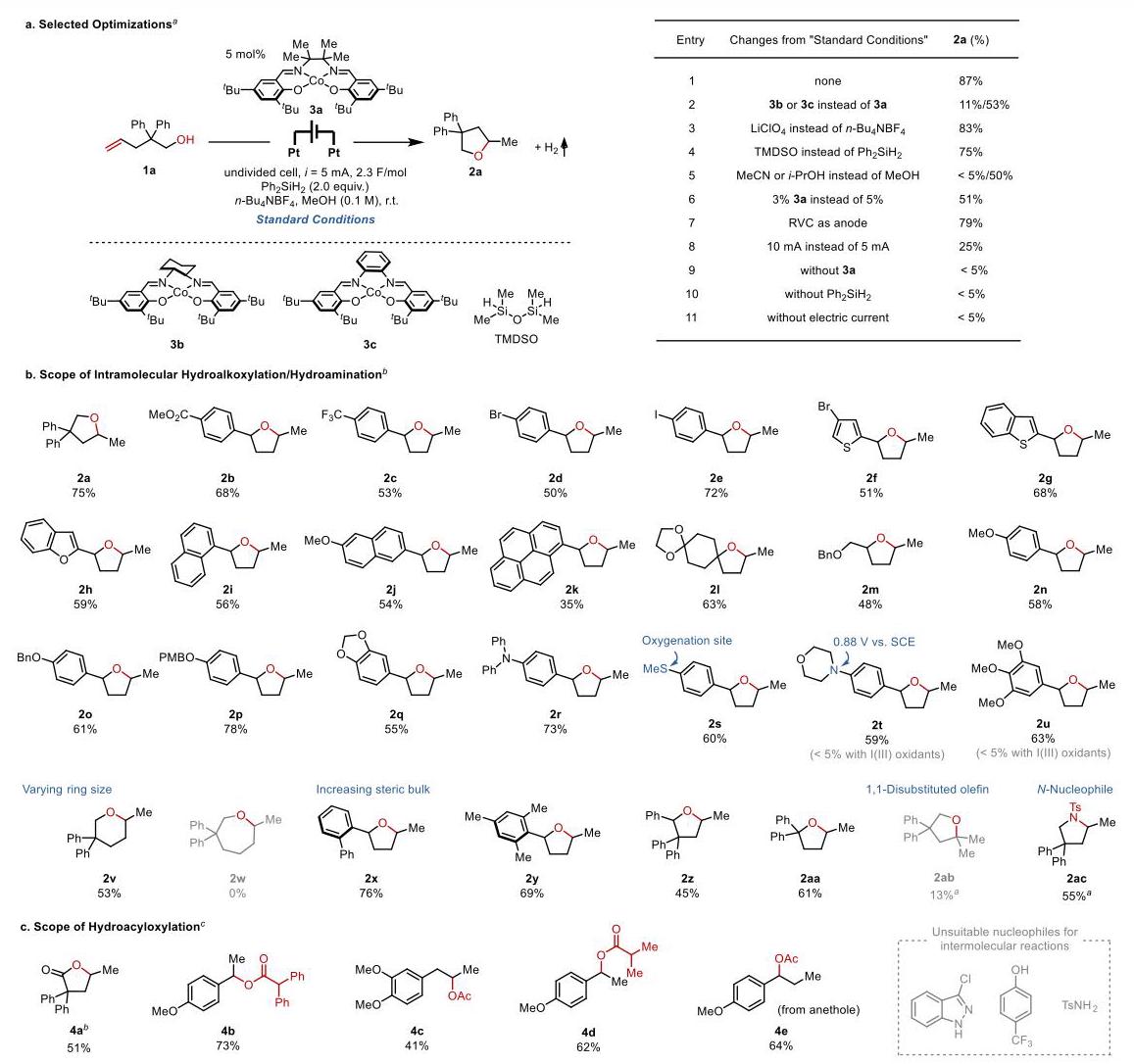
Figure 2. Selected optimizations and scope of the electrocatalytic hydroalkoxylation(hydroamination) and hydroacyloxylation reactions. ${}^{a}$ Yields were determined by ${}^{1}\mathrm{H}$ NMR analysis of the crude reaction mixture. ${}^{b}$ Isolated yields under standard conditions (d.r. ranged from 1.1:1 to 1.9:1 in the cases where diastereomers were produced, see SI). ‘Solated yields under modified standard conditions where MeCN and TMDSO were used in place of $\mathrm{{MeOH}}$ and ${\mathrm{{Ph}}}_{2}{\mathrm{{SiH}}}_{2}$ , respectively. For 4b-e,3.0 equiv of carboxylic acid was used.
图2. 电催化氢烷氧基化(氢胺化)和氢酰氧基化反应的部分优化及适用范围。${}^{a}$ 产率通过粗反应混合物的${}^{1}\mathrm{H}$ NMR分析确定。${}^{b}$ 在标准条件下的分离产率(在产生非对映异构体的情况下,非对映体比例范围为1.1:1至1.9:1,见补充信息)。在使用乙腈和TMDSO分别代替$\mathrm{{MeOH}}$ 和${\mathrm{{Ph}}}_{2}{\mathrm{{SiH}}}_{2}$ 的改良标准条件下的分离产率。对于4b - e,使用3.0当量的羧酸。
With the optimized protocol in hand, the scope and limitation of the intramolecular hydroalkoxylation was first investigated (Figure 2b). We examined various $\gamma$ -hydroxy alkenes bearing a range of functional groups including esters (2b), aryl halides (2d, e), heterocycles (2f-h), fused aromatics (2i-k), and acid-sensitive protecting groups (2l), which afforded cyclization products in good yields. We were particularly interested in substrates that are incompatible with strong chemical oxidants such as $N$ -fluoropyridiniums or I ${}^{\mathrm{{III}}}$ reagents. To this, the electrocatalytic system demonstrated excellent compatibility with electrophores such as sulfide (2s), tertiary amines (2t), ${}^{16}$ or electron-rich aryls (2u), which is consistent with the low potential of ${\mathrm{{Co}}}^{\mathrm{{III}}/\mathrm{{IV}}}$ transition. Ring closure to afford a six-membered-ring proceeded smoothly (2v), while medium-ring formation was rather difficult (2w). On the nucleophile side, more hindered secondary alcohols as well as tertiary alcohols and sulfonamides can be employed (2x-2aa and 2ac). The addition of carboxylic acid was also demonstrated in both intra- and intermolecular fashion, which displayed efficiency that is comparable to the chemical oxidant-based protocols (Figure 2c). ${}^{14}$ g Notably, potential byproducts derived from anodic decarboxylation were not observed. Regarding the alkene substitutions, unactivated monosubstituted alkenes and styrenes proved to be viable, while 1,1- disubsituted alkenes afforded mostly an isomerization product (2ab). This corroborates with previous observations in chemical oxidant-mediated reactions, which could be attributable to the disfavored formation of corresponding organocobalt(IV) species. Internal olefins except for aryl substituted ones (4e) generally displayed low reactivity, which was anticipated for $\mathrm{{Co}} - \mathrm{H}$ HAT-initiated reactions.
有了优化的方案后,首先研究了分子内氢烷氧基化的适用范围和局限性(图2b)。我们研究了各种带有一系列官能团的$\gamma$ -羟基烯烃,包括酯(2b)、芳基卤化物(2d,e)、杂环(2f - h)、稠环芳烃(2i - k)和酸敏感保护基(2l),这些都能以良好的产率得到环化产物。我们特别关注与强化学氧化剂如$N$ -氟吡啶鎓或I${}^{\mathrm{{III}}}$ 试剂不相容的底物。对此,电催化体系对诸如硫化物(2s)、叔胺(2t)、${}^{16}$ 或富电子芳基(2u)等亲电试剂表现出优异的兼容性,这与${\mathrm{{Co}}}^{\mathrm{{III}}/\mathrm{{IV}}}$ 转变的低电位一致。顺利进行闭环生成六元环(2v),而生成中环则相当困难(2w)。在亲核试剂方面,可以使用位阻更大的仲醇以及叔醇和磺酰胺(2x - 2aa和2ac)。还展示了羧酸在分子内和分子间的加成,其效率与基于化学氧化剂的方案相当(图2c)。${}^{14}$ g值得注意的是,未观察到源自阳极脱羧的潜在副产物。关于烯烃取代基,未活化的单取代烯烃和苯乙烯被证明是可行的,而1,1 - 二取代烯烃大多得到异构化产物(2ab)。这与化学氧化剂介导的反应中先前的观察结果一致,这可能归因于相应有机钴(IV)物种的不利形成。除芳基取代的内烯烃(4e)外,一般显示出低反应性,这对于$\mathrm{{Co}} - \mathrm{H}$ HAT引发的反应是预期的。
Under the electrocatalytic conditions, methanol was found to add across a vinyl ether (5) in Markovnikov-selective fashion (Figure 3a). Inspired by recent reports on HAT-initiated alkene isomerization under chemical oxidation or electroreduction conditions ${}^{8,{17}}$ as well as results from our own lab, we envisioned a tandem isomerization/hydromethoxyla-tion reaction that leads to trapping at the more cation-stabilizing site (Figure 3b). The in situ hydrolysis of the resulting acetal would provide a cheap and chemoselective means for allyl deprotection, which is alternative to strong base-mediated ${}^{18}$ or precious metal-catalyzed methods. ${}^{19}$ Indeed, we were able to show efficient deallylation to reveal ${1}^{ \circ }$ , ${2}^{ \circ },{3}^{ \circ }$ alcohols, carboxylic acids, and anilines (Figure 3c).
在电催化条件下,发现甲醇以马氏选择性方式加成到乙烯基醚(5)上(图3a)。受最近关于化学氧化或电还原条件下${}^{8,{17}}$ HAT引发的烯烃异构化的报道以及我们自己实验室的结果的启发,我们设想了一种串联异构化/氢甲氧基化反应,该反应导致在更稳定阳离子的位点捕获(图3b)。所得缩醛的原位水解将为烯丙基脱保护提供一种廉价且化学选择性的方法,这是强碱介导的${}^{18}$ 或贵金属催化方法的替代方法。${}^{19}$ 事实上,我们能够展示有效的烯丙基脱保护以得到${1}^{ \circ }$ 、${2}^{ \circ },{3}^{ \circ }$ 醇、羧酸和苯胺(图3c)。
To demonstrate the generality of this electrocatalytic protocol, C-C bond forming rearrangement and cyclization reactions were carried out (Figure 4). For example, semi-pinacol rearrangement of a cyclobutane-containing allylic alcohol 9 was achieved, furnishing the ring-expansion product 10 in good yield. An intramolecular hydroarylation reaction was demonstrated (12). Cyclization at the $\alpha$ -position of an amide likely proceeded via a radical rather than a cationic intermediate, which is in line with Vanderwal’s proposal on HAT-initiated oxidative polyene cyclization. ${}^{20}$ Compared with chemical oxidant-based systems, the electrocatalytic method displayed similar efficiency at a lower expense and with less organic waste production, which could be important for scaling up applications.
为了证明这种电催化方法的通用性,进行了C-C键形成重排和环化反应(图4)。例如,实现了含环丁烷的烯丙醇9的半频哪醇重排,以良好的产率得到扩环产物10。展示了分子内氢芳基化反应(12)。酰胺在$\alpha$位的环化可能通过自由基而非阳离子中间体进行,这与Vanderwal关于HAT引发的氧化多烯环化的提议一致。${}^{20}$与基于化学氧化剂的体系相比,电催化方法在较低成本和较少有机废物产生的情况下显示出相似的效率,这对于扩大应用规模可能很重要。
A series of experiments were performed in order to probe the mechanism of the electrocatalytic hydrofunctionalization reactions (Figure 5). First, cyclic voltammetry of Co complex 3a displayed a reversible oxidation event at ${E}_{1/2} = - {0.17}\mathrm{\;V}$ vs ${\mathrm{{Fc}}}^{ + }/\mathrm{{Fc}}$ in methanol, which was not affected by the addition of silane (Figure 5a). Interestingly, the reduction wave disappeared upon adding potassium methoxide. It indicates that methoxide, which could be cathodically generated, might serve as a necessary catalyst for silane activation and thus affect the formation of $\mathrm{{Co}} - \mathrm{H}$ from ${\mathrm{{Co}}}^{\mathrm{{III}}}$ . This also corroborates with the solvent effect observed during optimization (Figure 2a, entry 5). Next, hydride transfer from the silane was confirmed by a deuterium-labeling experiment, whereas running the reaction in ${\mathrm{{CD}}}_{3}\mathrm{{OD}}$ provided nearly no D incorporation (Figure 5b). Interestingly, the D% incorporation was substantially lower than expected in the first case, which is most likely due to $\mathrm{H}/\mathrm{D}$ scrambling by reversible HAT (rather than $\mathrm{{Co}} - \mathrm{D}/{\mathrm{H}}^{ + }$ exchange or oxidation of methanol). Further, the HAT process was evaluated by a radical clock substrate, where the ring-opening trapping product was predominantly observed, suggesting the radical nature of the intermediate generated by HAT (Figure 5c).
为了探究电催化氢官能化反应的机理,进行了一系列实验(图5)。首先,Co配合物3a在甲醇中的循环伏安图显示在${E}_{1/2} = - {0.17}\mathrm{\;V}$相对于${\mathrm{{Fc}}}^{ + }/\mathrm{{Fc}}$处有一个可逆的氧化事件,该事件不受硅烷添加的影响(图5a)。有趣的是,加入甲醇钾后还原波消失。这表明可以阴极产生的甲醇根可能是硅烷活化的必要催化剂,从而影响从${\mathrm{{Co}}}^{\mathrm{{III}}}$形成$\mathrm{{Co}} - \mathrm{H}$。这也与优化过程中观察到的溶剂效应一致(图2a,条目5)。接下来,通过氘标记实验证实了硅烷的氢转移,而在${\mathrm{{CD}}}_{3}\mathrm{{OD}}$中进行反应几乎没有氘掺入(图5b)。有趣的是,在第一种情况下氘掺入率远低于预期,这很可能是由于可逆HAT导致的$\mathrm{H}/\mathrm{D}$重排(而不是$\mathrm{{Co}} - \mathrm{D}/{\mathrm{H}}^{ + }$交换或甲醇氧化)。此外,通过自由基钟底物评估了HAT过程,其中主要观察到开环捕获产物,表明HAT产生的中间体具有自由基性质(图5c)。
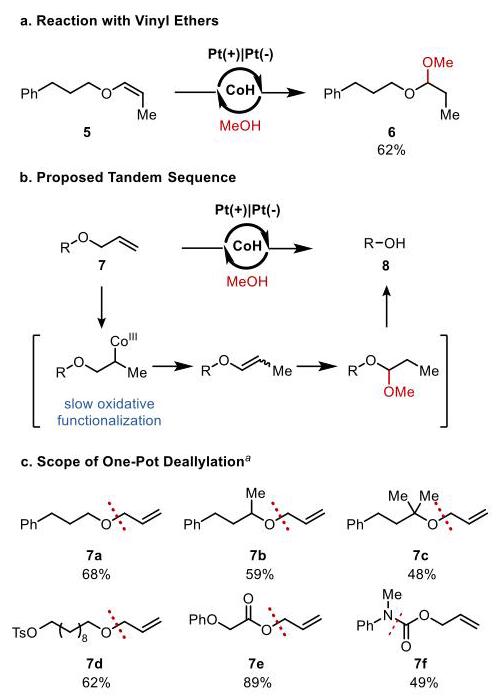
Figure 3. Selective deallylation via tandem isomerization/hydro-methoxylation sequence. ${}^{a}$ Isolated yields. Conditions: substrate (0.30 mmol,1 equiv),3a (5 mol %), TMDSO (2.0 equiv), $n - {\mathrm{{Bu}}}_{4}{\mathrm{{NBF}}}_{4}$ (2.0 equiv) in $\mathrm{{MeOH}}\left( {{3.0}\mathrm{\;{mL}}}\right)$ , Pt mesh electrode, undivided cell, constant current $i = 5\mathrm{\;{mA}},{2.3}\mathrm{\;F}/\mathrm{{mol}},{25}^{ \circ }\mathrm{C}$ .
图3. 通过串联异构化/氢甲氧基化序列进行的选择性脱烯丙基化反应。${}^{a}$ 分离产率。反应条件:底物(0.30 mmol,1当量),3a(5 mol%),TMDSO(2.0当量),$n - {\mathrm{{Bu}}}_{4}{\mathrm{{NBF}}}_{4}$(2.0当量)于$\mathrm{{MeOH}}\left( {{3.0}\mathrm{\;{mL}}}\right)$中,铂网电极,无隔膜电解池,恒电流$i = 5\mathrm{\;{mA}},{2.3}\mathrm{\;F}/\mathrm{{mol}},{25}^{ \circ }\mathrm{C}$。
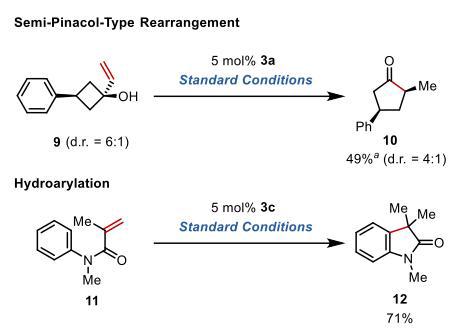
Figure 4. Electrocatalytic $\mathrm{C} - \mathrm{C}$ bond forming hydrofunctionaliza-tions. ${}^{a}$ TMDSO was used in place of ${\mathrm{{Ph}}}_{2}{\mathrm{{SiH}}}_{2}$ . Determined by ${}^{1}\mathrm{H}$ NMR analysis of the crude reaction mixture.
图4. 电催化$\mathrm{C} - \mathrm{C}$键形成的氢官能化反应。${}^{a}$ 使用TMDSO代替${\mathrm{{Ph}}}_{2}{\mathrm{{SiH}}}_{2}$。通过对粗反应混合物进行${}^{1}\mathrm{H}$ NMR分析确定。
A key mechanistic evidence for the involvement of a ${\mathrm{{Co}}}^{\mathrm{{IV}}}$ intermediate was provided by the attempted asymmetric synthesis using a chiral CoSalen catalyst (Figure 5d). Despite the low enantiomeric excess, this observed catalyst controlled stereoselectivity strongly supports the ${\mathrm{{Co}}}^{\mathrm{{IV}}}$ hypothesis. ${}^{{14}\mathrm{\;b},\mathrm{\;d},\mathrm{f}}$ Nonetheless, we observed an interesting correlation between the anode material and the selectivity. Tentatively, this might be attributable to the more facile oxidation of free radicals on RVC compared with platinum. ${}^{21}$ Unfortunately, substantial optimizations did not provide satisfying ee’s.
使用手性CoSalen催化剂进行的不对称合成尝试为${\mathrm{{Co}}}^{\mathrm{{IV}}}$中间体的参与提供了关键的机理证据(图5d)。尽管对映体过量较低,但观察到的这种催化剂控制的立体选择性有力地支持了${\mathrm{{Co}}}^{\mathrm{{IV}}}$假说。${}^{{14}\mathrm{\;b},\mathrm{\;d},\mathrm{f}}$尽管如此,我们观察到阳极材料与选择性之间存在有趣的相关性。初步推测,这可能归因于与铂相比,RVC上自由基的氧化更容易。${}^{21}$不幸的是,大量优化并未提供令人满意的对映体过量值。
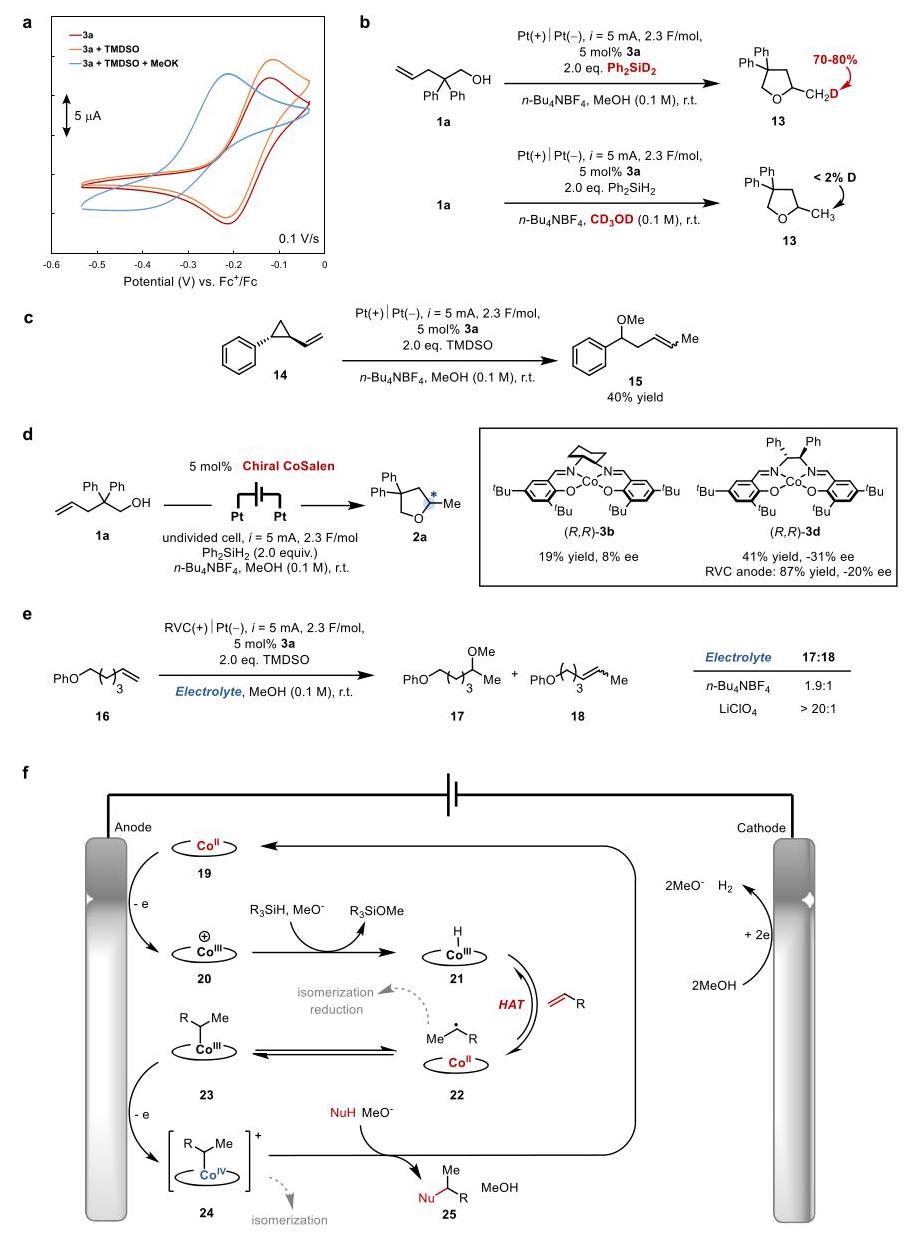
Figure 5. Mechanistic studies. (a) Cyclic voltammograms obtained in ${0.1}\mathrm{M}n - {\mathrm{{Bu}}}_{4}{\mathrm{{NClO}}}_{4}$ , MeOH. (b) Isotope labeling experiment. (c) Radical clock test. (d) Observation of catalyst-controlled stereoselectivity was consistent with the involvement of ${\mathrm{{Co}}}^{\mathrm{{IV}}}$ . (e) Electrolyte effect in hydromethoxylation reaction. (f) Current mechanistic hypothesis.
图5. 机理研究。(a) 在${0.1}\mathrm{M}n - {\mathrm{{Bu}}}_{4}{\mathrm{{NClO}}}_{4}$、甲醇中获得的循环伏安图。(b) 同位素标记实验。(c) 自由基钟测试。(d) 对催化剂控制的立体选择性的观察结果与${\mathrm{{Co}}}^{\mathrm{{IV}}}$的参与一致。(e) 氢甲氧基化反应中的电解质效应。(f) 当前的机理假设。
The putative ${\mathrm{{Co}}}^{\mathrm{{IV}}}$ species generated at the electrode could be intercepted either before or after diffusing into the bulk solution. An electrolyte effect could be used to probe this step. Moeller has shown that for a radical-cation-mediated reaction carried out in methanol, the effective methanol concentration near the anode could be lowered by an electrolyte that forms a more hydrophobic electric double layer (EDL). ${}^{22}$ Indeed, we noticed that for the hydromethoxylation reaction shown in Figure 5e, the selectivity for methanol trapping over isomerization was substantially lower with the more hydrophobic ${\mathrm{{NBu}}}_{4}{\mathrm{{BF}}}_{4}$ than with ${\mathrm{{LiClO}}}_{4}$ . Therefore, it seems that the ${\mathrm{{Co}}}^{\mathrm{{IV}}}$ species is mostly trapped near the electrode rather than in the bulk solution, which is consistent with the irreversible oxidation wave assigned to ${\mathrm{{Co}}}^{\mathrm{{III}}/\mathrm{{IV}}}$ in Figure 1b.
在电极上生成的假定${\mathrm{{Co}}}^{\mathrm{{IV}}}$物种在扩散到本体溶液之前或之后都可能被拦截。电解质效应可用于探测这一步骤。Moeller表明,对于在甲醇中进行的自由基阳离子介导的反应,形成更疏水双电层(EDL)的电解质可以降低阳极附近的有效甲醇浓度。${}^{22}$ 确实,我们注意到对于图5e所示的氢甲氧基化反应,与${\mathrm{{LiClO}}}_{4}$相比,使用更疏水的${\mathrm{{NBu}}}_{4}{\mathrm{{BF}}}_{4}$时,甲醇捕获相对于异构化的选择性要低得多。因此,似乎${\mathrm{{Co}}}^{\mathrm{{IV}}}$物种大多在电极附近被捕获,而不是在本体溶液中,这与图1b中归因于${\mathrm{{Co}}}^{\mathrm{{III}}/\mathrm{{IV}}}$的不可逆氧化波一致。
On the basis of these observations, a plausible catalytic cycle involving an ECEC sequence is depicted in Figure 5f. Anodic oxidation of the ${\mathrm{{Co}}}^{\mathrm{{II}}}$ complex and cathode reduction of methanol would afford ${\mathrm{{Co}}}^{\mathrm{{III}}}$ and methoxide anion, respectively. Hydride exchange between the silane and ${\mathrm{{Co}}}^{\mathrm{{III}}}$ could be facilitated by methoxide. The resulting $\mathrm{{Co}} - \mathrm{H}$ species 21 would undergo HAT with an alkene to afford an alkyl radical 22, followed by ${\mathrm{{Co}}}^{\mathrm{{II}}}$ trapping to give an alkylcobalt(III) complex 23. A second anodic oxidation then takes place to convert 23 to a highly electrophilic ${\mathrm{{Co}}}^{\mathrm{{IV}}}$ complex 24, which would be rapidly intercepted by a nucleophile next to the anode to form the hydrofunctionalization product 25 and regenerate the ${\mathrm{{Co}}}^{\mathrm{{II}}}$ complex. The major side pathways include reduction (hydrogenation) and isomerization. The latter could be a result of either back-HAT from the alkyl radical to ${\mathrm{{Co}}}^{\mathrm{{II}}}$ and/or the deprotonation of ${\mathrm{{Co}}}^{\mathrm{{IV}}}$ complex 24.
基于这些观察结果,图5f描绘了一个涉及ECEC序列的合理催化循环。${\mathrm{{Co}}}^{\mathrm{{II}}}$配合物的阳极氧化和甲醇的阴极还原将分别得到${\mathrm{{Co}}}^{\mathrm{{III}}}$和甲氧基阴离子。甲氧基可以促进硅烷和${\mathrm{{Co}}}^{\mathrm{{III}}}$之间的氢化物交换。生成的$\mathrm{{Co}} - \mathrm{H}$物种21将与烯烃发生氢原子转移(HAT)生成烷基自由基22,随后被${\mathrm{{Co}}}^{\mathrm{{II}}}$捕获得到烷基钴(III)配合物23。然后进行第二次阳极氧化,将23转化为高度亲电的${\mathrm{{Co}}}^{\mathrm{{IV}}}$配合物24,其将在阳极附近迅速被亲核试剂拦截,形成氢官能化产物25并再生${\mathrm{{Co}}}^{\mathrm{{II}}}$配合物。主要的副反应途径包括还原(氢化)和异构化。后者可能是由于烷基自由基向${\mathrm{{Co}}}^{\mathrm{{II}}}$的反向氢原子转移和/或${\mathrm{{Co}}}^{\mathrm{{IV}}}$配合物24的去质子化导致的。
In conclusion, we disclose a general electricity-driven method for the Co-catalyzed oxidative hydrofunctionalization reactions of alkenes via a ${\mathrm{{Co}}}^{\mathrm{{II}}/\mathrm{{III}}/\mathrm{{IV}}}$ cycle. Being free of stoichiometric chemical oxidants, this method applies to the formal Markovnikov-selective addition of alcohols and carboxylic acids to unactivated alkenes with excellent functional group compatibility, as well as two types of C-C bond forming reactions. A tandem isomerization/hydromethoxyla-tion sequence was also developed for selective allyl deprotection. Mechanistic studies provided evidence for an ECEC mechanism involving ${\mathrm{{Co}}}^{\mathrm{{IV}}}$ intermediates, where moderate enantioselectivity was achieved to preliminarily demonstrate the potential of catalyst control. We anticipate that the results reported here will facilitate future investigations on chemo- and stereoselective electrocatalysis involving high valent cobalt organometallics.
总之,我们公开了一种通过${\mathrm{{Co}}}^{\mathrm{{II}}/\mathrm{{III}}/\mathrm{{IV}}}$循环进行钴催化的烯烃氧化氢官能化反应的通用电驱动方法。该方法无需化学计量的化学氧化剂,适用于醇和羧酸对未活化烯烃的形式上的马氏选择性加成,具有优异的官能团兼容性,以及两种类型的碳 - 碳键形成反应。还开发了一种串联异构化/氢甲氧基化序列用于选择性烯丙基脱保护。机理研究为涉及${\mathrm{{Co}}}^{\mathrm{{IV}}}$中间体的ECEC机理提供了证据,其中实现了适度的对映选择性,初步证明了催化剂控制的潜力。我们预计这里报道的结果将促进未来对涉及高价钴有机金属化合物的化学和立体选择性电催化的研究。
ASSOCIATED CONTENT
相关内容
(c) Supporting Information
(c) 支持信息
The Supporting Information is available free of charge at https://pubs.acs.org/doi/10.1021/acscatal.1c05557.
支持信息可在https://pubs.acs.org/doi/10.1021/acscatal.1c05557免费获取。
Experimental procedures, characterization, spectra, and kinetic data (PDF)
实验步骤、表征、光谱和动力学数据 (PDF)
A AUTHOR INFORMATION
A作者信息
Corresponding Author
通讯作者
Rong Zhu - Beijing National Laboratory for Molecular Sciences (BNLMS), Key Laboratory of Bioorganic Chemistry and Molecular Engineering of Ministry of Education, College of Chemistry and Molecular Engineering, Peking University, Beijing 100871, China; (C) orcid.org/0000-0001-5035- 3531;
朱荣 - 北京分子科学国家实验室(BNLMS),教育部生物有机化学与分子工程重点实验室,化学与分子工程学院,北京大学,北京 100871,中国;(C) orcid.org/0000-0001-5035- 3531;
Authors
作者
Fan Yang - Beijing National Laboratory for Molecular Sciences (BNLMS), Key Laboratory of Bioorganic Chemistry and Molecular Engineering of Ministry of Education, College of Chemistry and Molecular Engineering, Peking University, Beijing 100871, China
Yi-Chen Nie - Beijing National Laboratory for Molecular Sciences (BNLMS), Key Laboratory of Bioorganic Chemistry and Molecular Engineering of Ministry of Education, College of Chemistry and Molecular Engineering, Peking University, Beijing 100871, China
Han-Yuan Liu - Beijing National Laboratory for Molecular Sciences (BNLMS), Key Laboratory of Bioorganic Chemistry and Molecular Engineering of Ministry of Education, College of Chemistry and Molecular Engineering, Peking University, Beijing 100871, China
Lei Zhang - Beijing National Laboratory for Molecular Sciences (BNLMS), Key Laboratory of Bioorganic Chemistry and Molecular Engineering of Ministry of Education, College of Chemistry and Molecular Engineering, Peking University, Beijing 100871, China; orcid.org/0000-0001-9031-4318
Fanyang Mo - School of Materials Science and Engineering, Peking University, Beijing 100871, China
Complete contact information is available at: https://pubs.acs.org/10.1021/acscatal.1c05557
完整的联系方式可在以下网址获取:https://pubs.acs.org/10.1021/acscatal.1c05557
Notes
注释
The authors declare no competing financial interest.
作者声明不存在相互竞争的财务利益。
ACKNOWLEDGMENTS
致谢
Financial support was provided by the Natural Science Foundation of China (21901011), the Clinical Medicine Plus X Young Scholars Project of Peking University (7100602764) and startup fund from the College of Chemistry and Molecular Engineering, Peking University and BNLMS. We thank Dr. Yuanhe Li (PKU) for the enantiomeric excess measurement of the chiral compounds and Dr. Jinchao Wei (Institute of Chemistry, Chinese Academy of Sciences) for assistance of high-resolution mass data, and we thank Yun-Nian Yin (PKU) for assistance with experiments.
本研究得到了中国国家自然科学基金(21901011)、北京大学临床医学+X青年学者项目(7100602764)以及北京大学化学与分子工程学院和北京分子科学国家研究中心的启动资金的资助。我们感谢李远和博士(北京大学)对手性化合物对映体过量的测定,感谢魏进超博士(中国科学院化学研究所)对高分辨率质谱数据的协助,感谢殷云念(北京大学)对实验的协助。
CREFERENCES
(1) (a) Yan, M.; Kawamata, Y.; Baran, P. S. Synthetic Organic Electrochemical Methods Since 2000: On the Verge of a Renaissance. Chem. Rev. 2017, 117, 13230-13319. (b) Meyer, T. H.; Choi, I.; Tian, C.; Ackermann, L. Powering the Future: How Can Electrochemistry Make a Difference in Organic Synthesis? Chem. 2020, 6, 2484-2496. (c) Gandeepan, P.; Finger, L. H.; Meyer, T. H.; Ackermann, L. 3d metallaelectrocatalysis for resource economical syntheses. Chem. Soc. Rev. 2020, 49, 4254-4272. (d) Novaes, L. F. T.; Liu, J.; Shen, Y.; Lu, L.; Meinhardt, J. M.; Lin, S. Electrocatalysis as an enabling technology for organic synthesis. Chem. Soc. Rev. 2021, 50, 7941-8002.
(2) (a) Francke, R.; Little, R. D. Redox catalysis in organic electrosynthesis: basic principles and recent developments. Chem. Soc. Rev. 2014, 43, 2492-2521. (b) Ma, C.; Fang, P.; Liu, D.; Jiao, K.-J.; Gao, P.-S.; Qiu, H.; Mei, T.-S. Transition metal-catalyzed organic reactions in undivided electrochemical cells. Chem. Sci. 2021, 12, 12866-12873. (c) Ma, C.; Fang, P.; Liu, Z.-R.; Xu, S.-S.; Xu, K.; Cheng, X.; Lei, A.; Xu, H.-C.; Zeng, C.; Mei, T.-S. Recent advances in organic electrosynthesis employing transition metal complexes as electrocatalysts. Science Bulletin 2021, 66, 2412-2429. (d) Chang, X.; Zhang, Q.; Guo, C. Asymmetric Electrochemical Transformations. Angew. Chem., Int. Ed. 2020, 59, 12612-12622. (e) Tang, S.; Liu, Y.; Lei, A. Electrochemical Oxidative Cross-coupling with Hydrogen Evolution: A Green and Sustainable Way for Bond Formation. Chem. 2018, 4, 27-45.
(3) (a) Zhong, J.; Yu, Y.; Zhang, D.; Ye, K. Merging cobalt catalysis and electrochemistry in organic synthesis. Chin. Chem. Lett. 2021, 32, 963-972. (b) Sauermann, N.; Meyer, T. H.; Tian, C.; Ackermann, L. Electrochemical Cobalt-Catalyzed C-H Oxygenation at Room Temperature. J. Am. Chem. Soc. 2017, 139, 18452-18455. (c) Gao, X.; Wang, P.; Zeng, L.; Tang, S.; Lei, A. Cobalt(II)-Catalyzed Electrooxidative C-H Amination of Arenes with Alkylamines. J. Am. Chem. Soc. 2018, 140, 4195-4199. (d) Chalkley, M. J.; Garrido-Barros, P.; Peters, J. C. A molecular mediator for reductive concerted proton-electron transfers via electrocatalysis. Science 2020, 369, 850- 854.
(4) (a) Yin, Y.-N.; Ouyang, D.-C.; Wang, J.-J; Zhu, R. Recent advances in CoSalen-catalyzed radical reactions. Sci. Sin Chim 2020, 50, 1217-1232. (b) Michiyuki, T.; Komeyama, K. Recent Advances in Four-Coordinated Planar Cobalt Catalysis in Organic Synthesis. Asian J. Org. Chem. 2020, 9, 343-358.
(5) Shimakoshi, H.; Luo, Z.; Inaba, T.; Hisaeda, Y. Electrolysis of trichloromethylated organic compounds under aerobic conditions catalyzed by the ${\mathrm{B}}_{12}$ model complex for ester and amide formation. Dalton Trans. 2016, 45, 10173-10180.
(6) Scheffold, R.; Orlinski, R. Synthesis and reactions of porphine-type metal complexes. 15. Carbon-carbon bond formation by light assisted ${\mathrm{B}}_{12}$ -catalysis. Nucleophilic acylation of Michael olefins. J. Am. Chem. Soc. 1983, 105, 7200-7202.
(7) (a) Chen, B.-L.; Zhu, H.-W.; Xiao, Y.; Sun, Q.-L.; Wang, H.; Lu, J.-X. Asymmetric electrocarboxylation of 1-phenylethyl chloride catalyzed by electrogenerated chiral ${\left\lbrack {\mathrm{{Co}}}^{1}\text{ (salen) }\right\rbrack }^{ - }$ complex. Electro-chem. Commun. 2014, 42, 55-59. (b) Yang, Z.; Yu, Y.; Lai, L.; Zhou, L.; Ye, K.; Chen, F.-E. Carbon dioxide cycle via electrocatalysis: Electrochemical carboxylation of ${\mathrm{{CO}}}_{2}$ and decarboxylative function-alization of carboxylic acids. Green Synth. Catal. 2021, 2, 19-26.
(8) Gnaim, S.; Bauer, A.; Zhang, H.-J.; Chen, L.; Gannet, C.; Malapit, C. A.; Hill, D.; Vogt, D.; Tang, T.; Daley, R.; Hao, W.; Quertenmont, M.; Beck, W. D.; Kandahari, E.; Vantourout, J. C.; Echeverria, P.-G.; Abruna, H.; Blackmond, D.; Minteer, S.; Reisman, S.; Sigman, M. S.; Baran, P. S. Cobalt-Electrocatalytic Hydrogen Atom Transfer for Functionalization of Unsaturated C-C Bonds. ChemRxiv, Aug. 25, 2021, Version 1. DOI: 10.33774/chemrxiv-2021-b34zI.
(9) (a) Cai, C.-Y.; Wu, Z.-J.; Liu, J.-Y.; Chen, M.; Song, J.; Xu, H.-C. Tailored cobalt-salen complexes enable electrocatalytic intramolecular allylic C-H functionalizations. Nat. Commun. 2021, 12, 3745. (b) Chen, M.; Wu, Z.-J.; Song, J.; Xu, H.-C. Dual-functional cobalt catalyst enables electrocatalytic allylic C-H alkylation. ChemRxiv, Nov. 18, 2021, Version 2. DOI: 10.33774/chemrxiv-2021-tsk2m-v2.
(10) Song, L.; Fu, N.; Ernst, B. G.; Lee, W. H.; Frederick, M. O.; DiStasio, R. A.; Lin, S. Dual electrocatalysis enables enantioselective hydrocyanation of conjugated alkenes. Nat. Chem. 2020, 12, 747- 754.
(11) Meyer, T. H.; Oliveira, J. C. A.; Ghorai, D.; Ackermann, L. Insights into Cobalta(III/IV/II)-Electrocatalysis: Oxidation-Induced Reductive Elimination for Twofold C-H Activation. Angew. Chem., Int. Ed. 2020, 59, 10955-10960.
(12) Halpern, J.; Chan, M. S.; Hanson, J.; Roche, T. S.; Topich, J. A. Detection and characterization of radical cations produced by one-electron chemical and electrochemical oxidations of organocobalt compounds. J. Am. Chem. Soc. 1975, 97, 1606-1608.
(13) Vol’pin, M. E.; Levitin, I. Y.; Sigan, A. L.; Halpern, J.; Tom, G. M. Reactivity of organocobalt(IV) chelate complexes toward nucleophiles: diversity of mechanisms. Inorg. Chim. Acta 1980, 41, 271-277.
(14) (a) Shigehisa, H.; Hayashi, M.; Ohkawa, H.; Suzuki, T.; Okayasu, H.; Mukai, M.; Yamazaki, A.; Kawai, R.; Kikuchi, H.; Satoh, Y.; Fukuyama, A.; Hiroya, K. Catalytic Synthesis of Saturated Oxygen Heterocycles by Hydrofunctionalization of Unactivated Olefins: Unprotected and Protected Strategies. J. Am. Chem. Soc. 2016, 138, 10597-10604. (b) Ebisawa, K.; Izumi, K.; Ooka, Y.; Kato, H.; Kanazawa, S.; Komatsu, S.; Nishi, E.; Shigehisa, H. Catalyst- and Silane-Controlled Enantioselective Hydrofunctionalization of Alkenes by Cobalt-Catalyzed Hydrogen Atom Transfer and Radical-Polar Crossover. J. Am. Chem. Soc. 2020, 142, 13481-13490. (c) Touney, E. E.; Foy, N. J.; Pronin, S. V. Catalytic Radical-Polar Crossover Reactions of Allylic Alcohols. J. Am. Chem. Soc. 2018, 140, 16982- 16987. (d) Discolo, C. A.; Touney, E. E.; Pronin, S. V. Catalytic Asymmetric Radical-Polar Crossover Hydroalkoxylation. J. Am. Chem. Soc. 2019, 141, 17527-17532. (e) Yahata, K.; Kaneko, Y.; Akai, S. Cobalt-Catalyzed Intermolecular Markovnikov Hydroamination of Nonactivated Olefins: ${N}^{2}$ -Selective Alkylation of Benzotriazole. Org. Lett. 2020, 22, 598-603. (f) Qin, T.; Lv, G.; Meng, Q.; Zhang, G.; Xiong, T.; Zhang, Q. Cobalt-Catalyzed Radical Hydroamination of Alkenes with N-fluorobenzenesulfonimides. Angew. Chem., Int. Ed. 2021, 60, 25949-25957. (g) Zhou, X.-L.; Yang, F.; Sun, H.-L.; Yin, Y.-N.; Ye, W.-T.; Zhu, R. Cobalt-Catalyzed Intermolecular Hydro-functionalization of Alkenes: Evidence for a Bimetallic Pathway. J. Am. Chem. Soc. 2019, 141, 7250-7255. (h) Yin, Y.-N.; Ding, R.-Q.; Ouyang, D.-C.; Zhang, Q.; Zhu, R. Highly chemoselective synthesis of hindered amides via cobalt-catalyzed intermolecular oxidative hydro-amidation. Nat. Commun. 2021, 12, 2552. (i) Shevick, S. L.; Obradors, C.; Shenvi, R. A. Mechanistic Interrogation of Co/Ni-Dual Catalyzed Hydroarylation. J. Am. Chem. Soc. 2018, 140, 12056- 12068.
(15) Sun, H.-L.; Yang, F.; Ye, W.-T.; Wang, J.-J.; Zhu, R. Dual Cobalt and Photoredox Catalysis Enabled Intermolecular Oxidative Hydrofunctionalization. ACS Catal. 2020, 10, 4983-4989.
(16) Roth, H. G.; Romero, N. A.; Nicewicz, D. A. Experimental and Calculated Electrochemical Potentials of Common Organic Molecules for Applications to Single-Electron Redox Chemistry. Synlett 2016, 27, 714-723. For comparison with previously developed methods, see SI-S37.
(17) (a) Crossley, S. W. M.; Barabé, F.; Shenvi, R. A. Simple, Chemoselective, Catalytic Olefin Isomerization. J. Am. Chem. Soc. 2014, 136, 16788-16791. (b) Huang, G.; Ke, M.; Tao, Y.; Chen, F. Specific Z-Selectivity in the Oxidative Isomerization of Allyl Ethers to Generate Geometrically Defined Z-Enol Ethers Using a Cobalt(II)- (salen) Complex Catalyst. J. Org. Chem. 2020, 85, 5321-5329. (c) Li, N.; Gui, Y.; Chu, M.; You, M.; Qiu, X.; Liu, H.; Wang, S.; Deng, M.; Ji, B. Cobalt-Catalyzed Deprotection of Allyl Carboxylic Esters Induced by Hydrogen Atom Transfer. Org. Lett. 2021, 23, 8460- 8464.
(18) Bailey, W. F.; England, M. D.; Mealy, M. J.; Thongsornkleeb, C.; Teng, L. Facile O-deallylation of allyl ethers via ${\mathrm{S}}_{\mathrm{N}}{2}^{\prime }$ reaction with tert-butyllithium. Org. Lett. 2000, 2, 489-491.
(19) (a) Kuznik, N.; Krompiec, S. Transition metal complexes as catalysts of double-bond migration in O-allyl systems. Coord. Chem. Rev. 2007, 251, 222-233. (b) Li, J.; Yu, J.; Zhao, J.; Wang, J.; Zheng, S.; Lin, S.; Chen, L.; Yang, M.; Jia, S.; Zhang, X.; Chen, P. R. Palladium-triggered deprotection chemistry for protein activation in living cells. Nat. Chem. 2014, 6, 352-361. (c) Vutukuri, D. R.; Bharathi, P.; Yu, Z.; Rajasekaran, K.; Tran, M.-H.; Thayumanavan, S. A mild deprotection strategy for allyl-protecting groups and its implications in sequence specific dendrimer synthesis. J. Org. Chem. 2003, 68, 1146-1149.
(20) Vrubliauskas, D.; Vanderwal, C. D. Cobalt-Catalyzed Hydrogen Atom Transfer Induces Bicyclizations that Tolerate Electron-rich and -deficient Intermediate Alkenes. Angew. Chem., Int. Ed. 2020, 59, 6115-6121.
(21) Heard, D. M.; Lennox, A. J. J. Electrode Materials in Modern Organic Electrochemistry. Angew. Chem., Int. Ed. 2020, 59, 18866- 18884.
(22) Redden, A.; Moeller, K. D. Anodic coupling reactions: Exploring the Generality of Curtin-Hammett Controlled Reactions. Org. Lett. 2011, 13, 1678-1681.
Recommended by ACS
由美国化学学会推荐
Pairing Iron and Nickel Catalysis for Electrochemical Esterification of Aryl Halides with Carbazates
铁镍催化协同实现芳基卤化物与咔唑的电化学酯化反应
Peng Xue, Niankai Fu, et al.
彭雪,付念凯等
OCTOBER 06, 2022
2022年10月6日
ORGANIC LETTERS READ
《有机快报》阅读
Benzylic C(sp3)-H Bonds Play the Dual Role of Starting Material and Oxidation Inhibitor for Hydrazides in the Electrochemical Synthesis of Hydrazones
苄基C(sp3)-H键在腙的电化学合成中对酰肼起着起始原料和氧化抑制剂的双重作用
Issa Yavari and Sina Shaabanzadeh
伊萨·亚瓦里和西娜·沙班扎德
NOVEMBER 08, 2022
2022年11月8日
THE JOURNAL OF ORGANIC CHEMISTRY READ
《有机化学杂志》
Electrocatalytic Radical-Polar Crossover Hydroetherification of Alkenes with Phenols
烯烃与酚的电催化自由基-极性交叉氢醚化反应
Steve H Park, Hyunwoo Kim, et al.
史蒂夫·H·帕克、玄宇·金等
AUGUST 12, 2022
2022年8月12日
ACS CATALYSIS READ
美国化学会催化杂志 已读
Electrocatalytic Ketyl-Olefin Cyclization at a Favorable Applied Bias Enabled by a Concerted Proton-Electron Transfer Mediator
通过协同质子-电子转移介质在有利的外加偏压下进行的电催化酮基-烯烃环化反应
Joseph Derosa, Jonas C. Peters, et al.
约瑟夫·德罗萨、乔纳斯·C·彼得斯等人
APRIL 18, 2022
2022年4月18日
INORGANIC CHEMISTRY READ
无机化学读物
Get More Suggestions
获取更多建议