Recent Development of Aryl Diazonium Chemistry for the Derivatization of Aromatic Compounds
英文原文与中文译文逐段对照 · English original with Chinese translation
Fanyang Mo,* Di Qiu, Lei Zhang, and Jianbo Wang*
莫凡洋*,邱迪,张雷,王剑波*
Cite This: https://doi.org/10.1021/acs.chemrev.0c01030 Read Online
引用本文:https://doi.org/10.1021/acs.chemrev.0c01030 在线阅读
III Metrics & More 13 Article Recommendations
III 指标与更多 13 篇文章推荐
ABSTRACT: Aryl diazonium salts are versatile building blocks in organic synthesis. In light of the ever-increasing importance of aryl diazonium salts spanning most disciplines of the chemical sciences, we review the recent development of aryl diazonium chemistry over the past seven years (2013-2020). Special emphasis is put on various new transformations involving the generation of radical intermediates via thermal, photochemical, and electrochemical means. Recent advances in the development of transition metal-catalyzed reactions using aryl diazonium salts are also reviewed. Together, these newly developed transformations significantly expand the synthetic chemist’s repertoire of aromatic carbon-carbon and carbon-heteroatom bond forming methods using aryl diazonium precursors, providing powerful tools for the synthesis and modification of complex molecular scaffolds.
摘要:芳基重氮盐是有机合成中通用的构建单元。鉴于芳基重氮盐在化学科学的大多数学科中日益重要,我们综述了过去七年(2013 - 2020 年)芳基重氮化学的最新进展。特别强调了通过热、光化学和电化学方法生成自由基中间体的各种新转化。还综述了使用芳基重氮盐的过渡金属催化反应的最新进展。总之,这些新开发的转化显著扩展了合成化学家使用芳基重氮前体形成芳香族碳 - 碳和碳 - 杂原子键的方法库,为复杂分子支架的合成和修饰提供了强大工具。
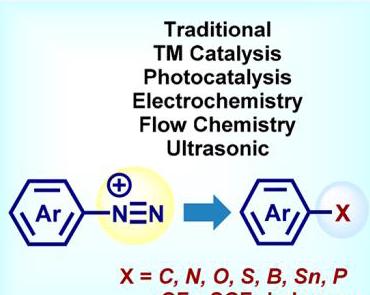
${\mathrm{{CF}}}_{3},{\mathrm{{SCF}}}_{3}$ halogen…
${\mathrm{{CF}}}_{3},{\mathrm{{SCF}}}_{3}$ 卤素…
CONTENTS
目录
Introduction B
引言B
Aryl C-C Bond Formations D
芳基C-C键的形成D
2.1. Aryl C-C Bond Formations Involving Aryl Radical Intermediates D
2.1. 涉及芳基自由基中间体的芳基C-C键形成D
2.1.1. Radical Addition to Double Bonds D
2.1.1. 自由基对双键的加成D
2.1.2. Difunctionalization of Alkenes E
2.1.2. 烯烃的双官能团化E
2.1.3. Radical Addition to Aromatic Compounds 1
2.1.3. 自由基对芳香化合物的加成1
2.1.4. Radical Addition to Alkynes P
2.1.4. 自由基对炔烃的加成P
2.1.5. Radical Addition to CO Q
2.1.5. 自由基对CO的加成Q
2.1.6. Cascade Radical Cyclization R
2.1.6. 级联自由基环化R
2.1.7. C-CN, $\mathrm{C} - {\mathrm{{CF}}}_{3}$ , and $\mathrm{C} - {\mathrm{{CF}}}_{2}\mathrm{X}$ Bond Formations V
2.1.7. C-CN、$\mathrm{C} - {\mathrm{{CF}}}_{3}$和$\mathrm{C} - {\mathrm{{CF}}}_{2}\mathrm{X}$键的形成V
2.1.8. Miscellaneous Y
2.1.8. 杂项Y
2.2. Transition-Metal-Catalyzed Coupling Reactions of Aryl Diazonium Salts Y
2.2. 芳基重氮盐的过渡金属催化偶联反应Y
2.2.1. Heck-type Reactions with Alkenes Z
2.2.1. 与烯烃的Heck型反应Z
2.2.2. C-H Bond Functionalizations of Arenes AB
2.2.2. 芳烃的C-H键官能团化AB
2.2.3. Suzuki-Miyaura, Hiyama, Stille-type Coupling Reactions, and Others AE
2.2.3. Suzuki-Miyaura、Hiyama、Stille型偶联反应及其他AE
2.2.4. Sonogashira-type Coupling Reactions with Alkynes AH
2.2.4. 与炔烃AH的Sonogashira型偶联反应
2.2.5. Gold-Catalyzed Coupling Reactions and Cyclizations AH
2.2.5. 金催化的偶联反应和环化反应AH
Aryl Diazonium Salts in Aryl C-Heteroatom Bond Formations AO
芳基重氮盐在芳基碳 - 杂原子键形成中的应用AO
3.1. C-Halogen Bond Formations AO
3.1. 碳 - 卤键形成AO
3.2. C-O Bond Formations AP
3.2. 碳 - 氧键形成AP
3.3. C-N Bond Formations AQ
3.3. 碳 - 氮键形成AQ
3.4. C-B Bond Formations AQ
3.4. 碳 - 硼键形成AQ
3.5. C-P Bond Formations AS
3.5. 碳 - 磷键形成AS
3.6. C-Sn Bond Formations AT
3.6. 碳 - 锡键形成AT
3.7. C-Se, Te Bond Formations AU
3.7. 碳 - 硒、碲键形成AU
3.8. C-S Bond Formations AV
3.8. 碳 - 硫键形成AV
3.8.1. Synthesis of Aryl Sulfides and Sulfox-ides AV
3.8.1. 芳基硫醚和亚砜的合成AV
3.8.2. Synthesis of Aryl Sulfones through the Insertion of ${\mathrm{{SO}}}_{2}$ AY
3.8.2. 通过${\mathrm{{SO}}}_{2}$插入合成芳基砜AY
3.8.3. $\mathrm{C} - {\mathrm{{SCF}}}_{3}$ and $\mathrm{C} - {\mathrm{{SCF}}}_{2}\mathrm{H}$ Bond Formations BG
3.8.3. $\mathrm{C} - {\mathrm{{SCF}}}_{3}$和$\mathrm{C} - {\mathrm{{SCF}}}_{2}\mathrm{H}$键形成BG
3.9. Reactions with Nitriles and Cascade Reactions BJ
3.9. 与腈的反应和级联反应BJ
Reactions with the Retention of the Nitrogen Group BL
含氮基团保留的反应BL
4.1. Nucleophilic Additions with Aryl Diazonium Cation BL
4.1. 芳基重氮阳离子BL的亲核加成
4.2. Radical-type Reactions with Aryl Diazonium Salts BP
4.2. 芳基重氮盐BP的自由基型反应
Aryl Diazonium Salts in Flow Chemistry BR
流动化学中的芳基重氮盐BR
Aryl Diazonium Salts in the Modification of Functional Materials and Molecules BT
功能材料和分子修饰中的芳基重氮盐BT
Conclusions BW
结论BW
Author Information BW
作者信息BW
Corresponding Authors BW
通讯作者BW
Authors BW
作者BW
Notes BW
注释BW
Biographies BW
传记BW
Received: September 23, 2020
收到日期:2020年9月23日
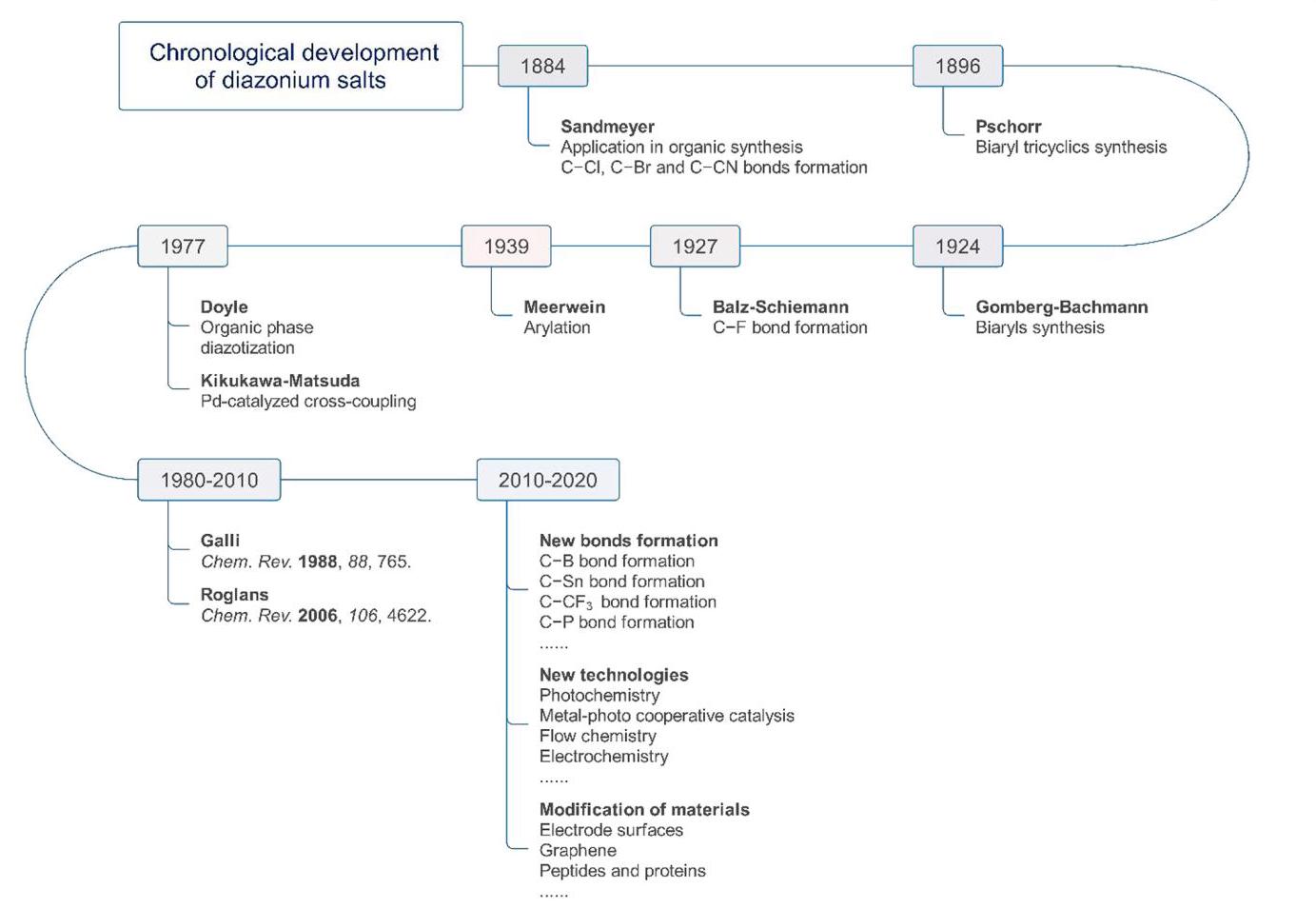
Figure 1. Chronological development of diazonium salts chemistry.
图1. 重氮盐化学的时间发展历程。
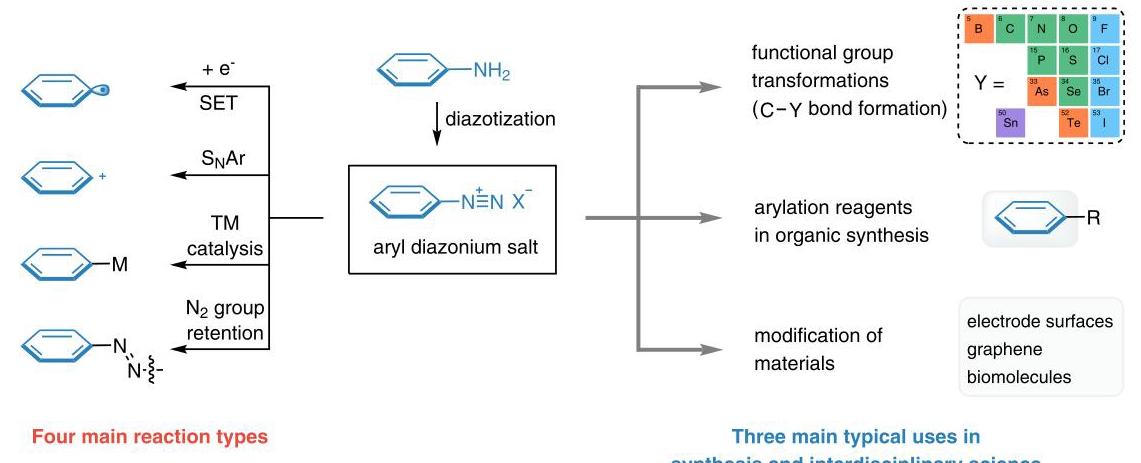
Scheme 1. Summary of the Transformations and Applications of Aryl Diazonium Salts
方案1. 芳基重氮盐的转化与应用总结
synthesis and interdisciplinary science
合成与跨学科科学
Acknowledgments References
致谢 参考文献
BX BX
1. INTRODUCTION
1. 引言
Conveniently synthesized from the corresponding anilines, aryl diazonium salts are widely used building blocks in modern organic synthesis. ${}^{1 - 3}$ Since the initial report by Griefs in ${1858}^{4}$ a series of prominent named reactions associated with aryl diazonium salts have been discovered and developed over the past centuries. Most notable examples include the Sandmeyer reaction (1884), ${}^{5,6}$ Pschorr reaction (1896), ${}^{7}$ Gomberg-Bachmann reaction (1924), ${}^{8}$ Balz-Schiemann reaction (1927), ${}^{9}$ and Meerwein arylation (1939). ${}^{10}$ In 1977, Doyle developed a diazotization method that could be conducted in the organic phase, allowing for the generation of diazonium salts from water-incompatible substrates. ${}^{{11},{12}}$ In the same year, Kikukawa and Matsuda pioneered transition-metal-catalyzed cross-coupling of aryl diazonium salts. ${}^{{13},{14}}$ Their work paved the way for further advancing cross-coupling chemistry using aryl diazonium salts as electrophilic coupling partners. However, since then, the field of aryl diazonium chemistry has been dormant for a long time.
芳基重氮盐可以由相应的苯胺方便地合成,是现代有机合成中广泛使用的构建单元。${}^{1 - 3}$ 自格里夫斯在${1858}^{4}$ 首次报道以来,在过去几个世纪里,人们发现并开发了一系列与芳基重氮盐相关的著名反应。最著名的例子包括桑德迈尔反应(1884年)、${}^{5,6}$ 普朔尔反应(1896年)、${}^{7}$ 贡伯格-巴赫曼反应(1924年)、${}^{8}$ 巴尔兹-施iemann反应(1927年)、${}^{9}$ 以及梅尔魏因芳基化反应(1939年)。${}^{10}$ 1977年,多伊尔开发了一种可以在有机相中进行的重氮化方法,使得从不与水混溶的底物中生成重氮盐成为可能。${}^{{11},{12}}$ 同年,菊川和松田开创了过渡金属催化的芳基重氮盐交叉偶联反应。${}^{{13},{14}}$ 他们的工作为使用芳基重氮盐作为亲电偶联伙伴进一步推进交叉偶联化学铺平了道路。然而,从那时起,芳基重氮化学领域长期处于休眠状态。
The past decade has witnessed a renaissance of aryl diazonium chemistry. ${}^{{15} - {19}}$ In particular, a range of new functional group conversions based on the diazonium moiety have been developed. These processes encompass the formation of aromatic $\mathrm{C} - \mathrm{B},\mathrm{C} - \mathrm{P},\mathrm{C} - \mathrm{{Sn}}$ , and $\mathrm{C} - {\mathrm{{CF}}}_{3}$ bonds from aryl diazonium salts. Using these methods, a range of functionalized aromatic compounds can now be conveniently accessed from readily available arylamines. In recent years, the merger of aryl diazonium chemistry and visible-light photo-redox catalysis afforded a series of new tools for aromatic C-C and $\mathrm{C} - \mathrm{Y}\left( {\mathrm{Y} = \mathrm{B},\mathrm{P},\mathrm{S},\mathrm{{Sn}},\mathrm{{Se}}}\right.$ , etc.) bond formations. Aryl diazonium salts have also found new applications in the synthesis of nitrogen-containing heterocyclic compounds. Furthermore, the use of diazonium chemistry provided new strategies for the synthesis of medicinally active agents ${}^{{20},{21}}$ and the modification of bulk materials, such as electrode surfaces and graphenes. ${}^{{22},{23}}$ Biomolecules including peptides and proteins can now also be rapidly modified by aryl diazonium reagents (Figure 1). ${}^{24}$ Moreover, starting from abundantly available arylamines, transformations via the intermediacy of aryl diazonium salts enabled large-scale applications in the syntheses of functional molecules, such as haloarenes, azo dyes, and nanomaterials. ${}^{{25} - {31}}$
在过去十年中,芳基重氮化学迎来了复兴。${}^{{15} - {19}}$ 特别是,基于重氮基团开发了一系列新的官能团转化反应。这些过程包括从芳基重氮盐形成芳香族$\mathrm{C} - \mathrm{B},\mathrm{C} - \mathrm{P},\mathrm{C} - \mathrm{{Sn}}$ 键和$\mathrm{C} - {\mathrm{{CF}}}_{3}$ 键。使用这些方法,现在可以从容易获得的芳胺方便地制备一系列官能化芳香族化合物。近年来,芳基重氮化学与可见光光氧化还原催化的结合为芳香族C-C键和$\mathrm{C} - \mathrm{Y}\left( {\mathrm{Y} = \mathrm{B},\mathrm{P},\mathrm{S},\mathrm{{Sn}},\mathrm{{Se}}}\right.$ 键等的形成提供了一系列新工具。芳基重氮盐在含氮杂环化合物的合成中也有了新的应用。此外,重氮化学的应用为药物活性剂${}^{{20},{21}}$ 的合成以及电极表面和石墨烯等块状材料的改性提供了新策略。${}^{{22},{23}}$ 包括肽和蛋白质在内的生物分子现在也可以被芳基重氮试剂快速修饰(图1)。${}^{24}$ 此外,从大量可得的芳胺出发,通过芳基重氮盐中间体进行的转化反应在卤代芳烃、偶氮染料和纳米材料等功能分子的合成中实现了大规模应用。${}^{{25} - {31}}$
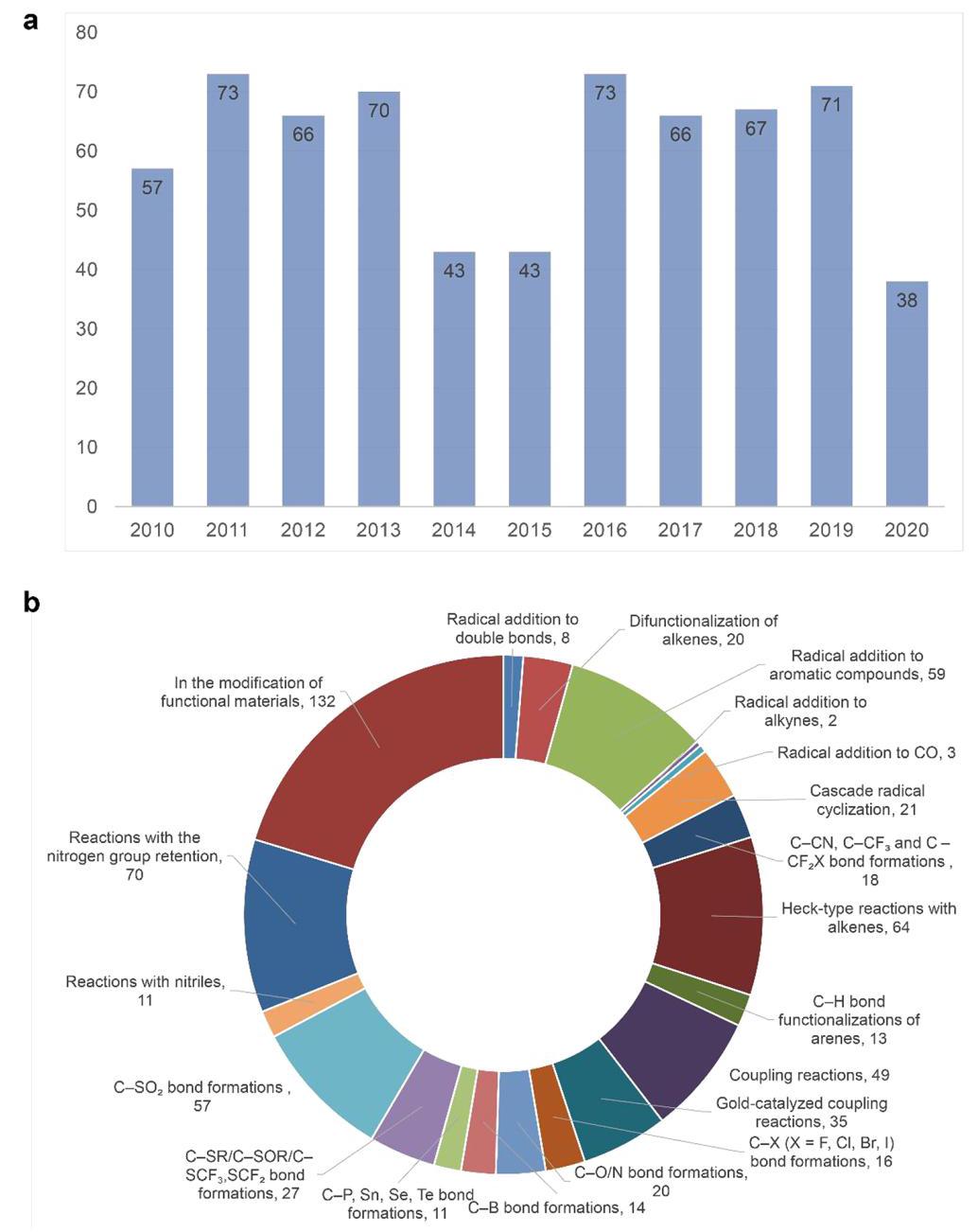
Figure 2. (a) Number of publications on reactions with aryl diazonium salts (2010-2020); (b) pie chart of numbers of publications on various types of reactions of aryl diazonium salts (2010-2020).
图2. (a)关于芳基重氮盐反应的出版物数量(2010 - 2020年);(b)芳基重氮盐各类反应的出版物数量饼图(2010 - 2020年)。
The reactions of aryl diazonium salts can be categorized into four classes, including transformations via aryl radical, transformations via aryl cation, transition-metal-catalyzed processes, and transformations with retention of the dinitrogen group (Scheme 1). The first three reaction classes are based on the intrinsic electrophilicity of diazonium salts with ${\mathrm{N}}_{2}$ as an excellent leaving group. In the last reaction type, in the presence of aromatic nucleophiles such as phenols and anilines, the arene diazonium ion can serve as a nitrogen electrophile, giving rise to products with dinitrogen retention (Scheme 1). The broad utility of diazonium chemistry originates from the wide availability of their aniline precursors and the diverse diazotization conditions for their preparation.
芳基重氮盐的反应可以分为四类,包括通过芳基自由基的转化反应、通过芳基阳离子的转化反应、过渡金属催化的过程以及保留二氮基团的转化反应(方案1)。前三种反应类型是基于重氮盐以${\mathrm{N}}_{2}$ 作为优良离去基团的固有亲电性。在最后一种反应类型中,在酚类和苯胺类等芳香亲核试剂存在下,芳烃重氮离子可以作为氮亲电试剂,生成保留二氮的产物(方案1)。重氮化学的广泛应用源于其苯胺前体的广泛可得性以及制备它们的多样重氮化条件。
While it is regarded as classic chemistry included in every basic organic chemistry textbook, aryldiazonium still remains an active topic of research over the past decade (Figure 2). C-
虽然芳基重氮盐被认为是每本基础有机化学教科书中的经典化学内容,但在过去十年中,它仍然是一个活跃的研究课题(图2)。C -
H arylation using aryl diazonium reagents has been the most extensively studied transformation with respect to the number of publications (72 papers). This is followed by other functional group conversions and nitrogen retaining processes. All of these transformations continue to attract attention from both academia and industry.
就发表的论文数量而言(72篇论文),使用芳基重氮试剂的芳基化反应是研究最为广泛的转化反应。其次是其他官能团转化和氮保留过程。所有这些转化反应继续吸引着学术界和工业界的关注。
Since our previous review in 2013, an array of exciting research has emerged in this area, which warrants a new review article to provide an update and guidance to this field. In this article, we provide a comprehensive review on recently developed diazonium chemistry. The review will primarily focus on recent studies published after 2013.
自我们2013年上次综述以来,该领域出现了一系列令人兴奋的研究,这需要一篇新的综述文章来提供该领域的最新情况和指导。在本文中,我们对最近发展的重氮化学进行了全面综述。该综述将主要关注2013年以后发表的最新研究。
2. ARYL C-C BOND FORMATIONS
2. 芳基C-C键的形成
2.1. Aryl C-C Bond Formations Involving Aryl Radical Intermediates
2.1. 涉及芳基自由基中间体的芳基C-C键形成
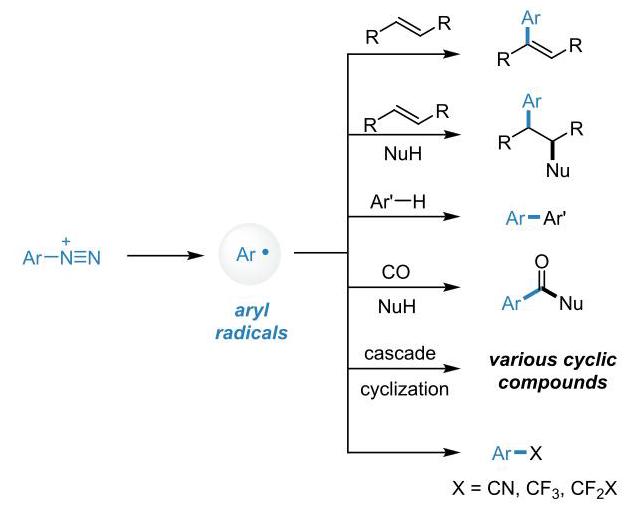
As a commonly used class of aryl radical precursor, aryl diazonium salts have enjoyed numerous applications in the construction of aryl $\mathrm{C} - \mathrm{C}$ bonds. In recent years, alternative routes for aryl radical generation, particularly the employment of the visible-light photoredox system, electrolysis, and organic promoter-initiated radical reactions, made aryl diazonium chemistry an attractive area in organic synthesis. Various arylated molecules can be synthesized through selective aryl C-C bond formations based on aryl radical intermediates. In this section, recent advances will be classified according to different reaction pathways, including radical addition to double bonds to form arylated alkenes, difunctionalization of alkenes, radical addition to aromatic compounds to form biaryls, radical addition to alkynes, radical addition to CO, cascade radical cyclization to form a variety of cyclic compounds, and aryl $\mathrm{C} - \mathrm{{CN}},\mathrm{C} - {\mathrm{{CF}}}_{3}$ , and $\mathrm{C} - {\mathrm{{CF}}}_{2}\mathrm{X}$ bond formations (Scheme 2).
作为一类常用的芳基自由基前体,芳基重氮盐在芳基$\mathrm{C} - \mathrm{C}$键的构建中有着众多应用。近年来,芳基自由基生成的替代路线,特别是可见光光氧化还原体系、电解和有机促进剂引发的自由基反应的应用,使芳基重氮化学成为有机合成中一个有吸引力的领域。基于芳基自由基中间体,可以通过选择性的芳基C-C键形成来合成各种芳基化分子。在本节中,将根据不同的反应途径对近期的进展进行分类,包括自由基加成到双键上形成芳基化烯烃、烯烃的双官能化、自由基加成到芳香化合物上形成联芳基、自由基加成到炔烃上、自由基加成到CO上、级联自由基环化形成各种环状化合物,以及芳基$\mathrm{C} - \mathrm{{CN}},\mathrm{C} - {\mathrm{{CF}}}_{3}$和$\mathrm{C} - {\mathrm{{CF}}}_{2}\mathrm{X}$键的形成(方案2)。
Scheme 2. C-C Bond Formations Based on Aryl Radical Intermediates
方案2. 基于芳基自由基中间体的C-C键形成
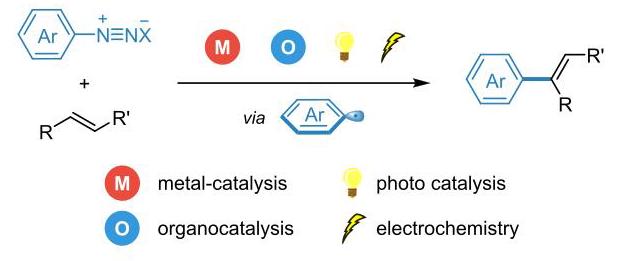
2.1.1. Radical Addition to Double Bonds. Meerwein arylation reactions have been well-established as a powerful method for the synthesis of arylated olefins. ${}^{10}$ It could be carried out on alkenes bearing electron-withdrawing groups such as coumarins, cinnamic acids, and acrylic acids. The substrate scope of this process was later expanded to electron-rich alkenes. Classical Meerwein arylations require a catalytic or stoichiometric amount of redox-active transition-metal salts, such as copper(I) salt, and have relatively limited substrate scope. In recent years, a series of improvements have been reported for Meerwein arylations, including the expansion of substrate scope in traditional Cu-catalyzed arylations, the employment of metal-free systems, and electrochemical systems, particularly, photocatalytic systems (Scheme 3). ${}^{32}$
2.1.1. 自由基加成到双键上。Meerwein芳基化反应已被确立为合成芳基化烯烃的有力方法。${}^{10}$它可以在带有吸电子基团的烯烃上进行,如香豆素、肉桂酸和丙烯酸。该过程的底物范围后来扩展到富电子烯烃。经典的Meerwein芳基化反应需要催化量或化学计量的氧化还原活性过渡金属盐,如铜(I)盐,并且底物范围相对有限。近年来,已有一系列关于Meerwein芳基化反应的改进报道,包括传统铜催化芳基化反应中底物范围的扩展、无金属体系和电化学体系的应用,特别是光催化体系(方案3)。${}^{32}$
Scheme 3. Different Routes for Selective Radical Addition to Double Bonds
方案3. 选择性自由基加成到双键上的不同路线
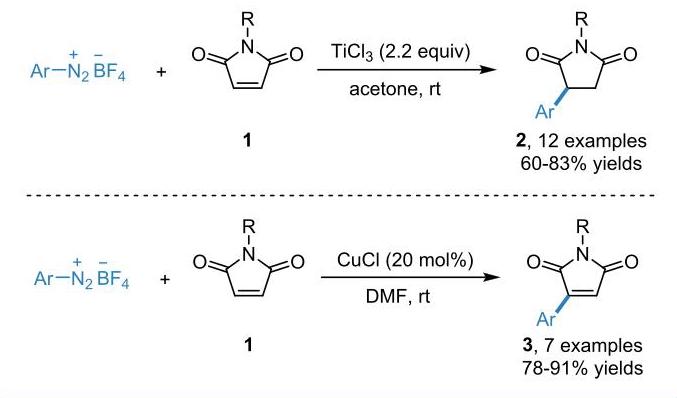
In traditional Cu-mediated Meerwein arylations, the substrate scope is usually limited in vinyl esters and other electron-deficient alkenes. This classical approach was expanded using $N$ -substituted maleimides 1 as the substrates catalyzed by a substoichiometric amount of $\mathrm{{CuCl}}$ , affording 3- arylmaleimides 3 with high yields (Scheme 4). ${}^{33}$ Particularly, this methodology provided access to two classes of products by changing the transition-metal reagents. In the presence of ${\mathrm{{TiCl}}}_{3}$ , this reaction generated 3-arylsuccinimides 2 instead.
在传统的铜介导的Meerwein芳基化反应中,底物范围通常限于乙烯基酯和其他缺电子烯烃。使用$N$取代的马来酰亚胺1作为底物,以亚化学计量的$\mathrm{{CuCl}}$催化,扩展了这种经典方法,以高产率得到3-芳基马来酰亚胺3(方案4)。${}^{33}$特别地,这种方法通过改变过渡金属试剂可以得到两类产物。在${\mathrm{{TiCl}}}_{3}$存在下,该反应生成3-芳基琥珀酰亚胺2。
Scheme 4. Synthesis of 3-Arylsuccinimides and 3- Arylmaleimides
方案4. 3-芳基琥珀酰亚胺和3-芳基马来酰亚胺的合成
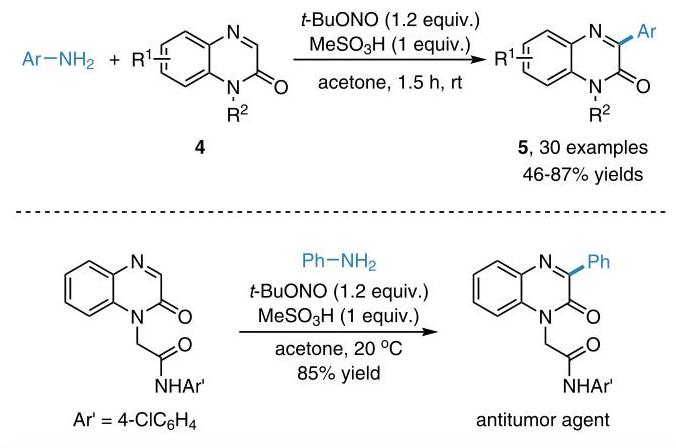
Given the cost of transition metal catalysis, a transition-metal-free direct $\mathrm{C} - 3$ arylation of quinoxalin-2(1H)-ones 4 has also been explored in the presence of ${\mathrm{{MeSO}}}_{3}\mathrm{H}$ (Scheme 5). ${}^{34}$ Using arylamines as the substrates, this work represents a metal-free protocol for Meerwein arylations at room temperature. The plausible mechanism involves the generation of aryl radical through the single-electron reduction of aryl diazonium mesylate. The aryl radical then adds to protonated quinoxalin- $2\left( {1H}\right)$ -one, followed by single-electron transfer (SET) and deprotonation to deliver the desired product 5.
考虑到过渡金属催化的成本,在${\mathrm{{MeSO}}}_{3}\mathrm{H}$存在下,还探索了喹喔啉-2(1H)-酮4的无过渡金属直接$\mathrm{C} - 3$芳基化反应(方案5)。${}^{34}$以芳胺为底物,这项工作代表了一种在室温下进行Meerwein芳基化反应的无金属方案。合理的机理涉及通过甲磺酸芳基重氮盐的单电子还原生成芳基自由基。然后芳基自由基加成到质子化的喹喔啉-$2\left( {1H}\right)$-酮上,接着进行单电子转移(SET)和去质子化,得到所需产物5。
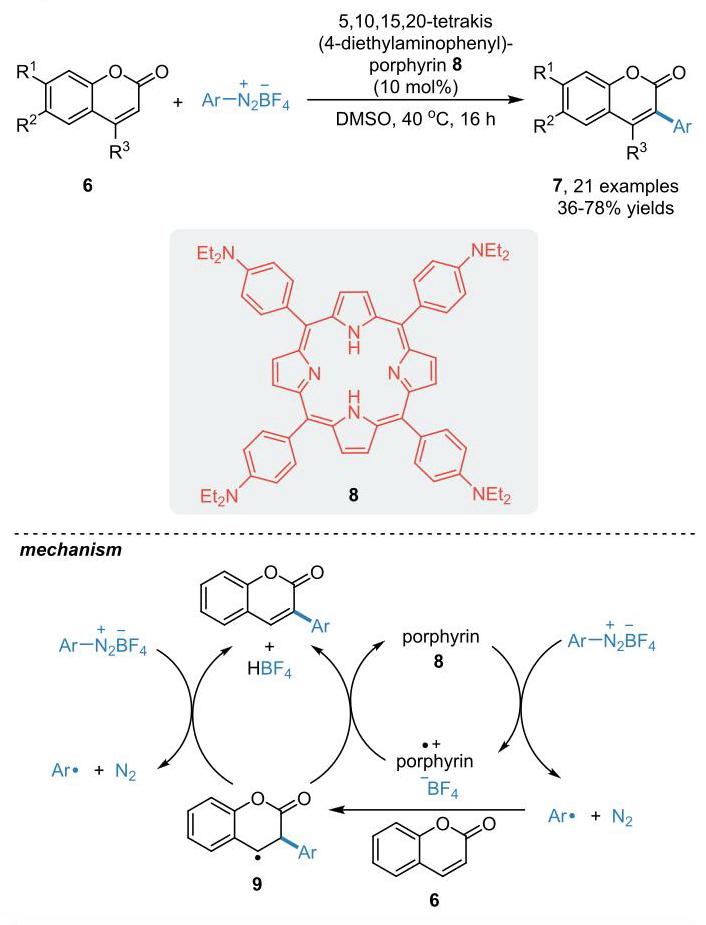
The organic promoter-mediated protocol was illustrated by Kanai and co-workers, who developed metal-free C(3)-H selective arylation of coumarins 6 catalyzed by 5,10,15,20- tetrakis(4-diethylaminophenyl)porphyrin 8 (Scheme 6). ${}^{35}$ This metal-free Meerwein arylation provided 3-arylcoumarins 7 in moderate yields. This reaction is initiated by one-electron reduction of aryl diazonium salts with porphyrin, affording aryl radical with extrusion of dinitrogen gas. The addition of the aryl radical to coumarin then furnishes a benzyl radical intermediate 9, which is oxidized by either the porphyrin radical cation or the aryl diazonium substrate.
有机促进剂介导的方法由金井及其同事进行了阐述,他们开发了由5,10,15,20-四(4-二乙氨基苯基)卟啉8催化的香豆素6的无金属C(3)-H选择性芳基化反应(方案6)。${}^{35}$ 这种无金属的梅尔魏因芳基化反应以中等产率提供了3-芳基香豆素7。该反应由卟啉对芳基重氮盐的单电子还原引发,生成芳基自由基并释放出氮气。芳基自由基加成到香豆素上,然后生成苄基自由基中间体9,该中间体被卟啉自由基阳离子或芳基重氮底物氧化。
Scheme 5. Direct C-3 Arylation of Quinoxalin-2(1H)-ones with Arylamines
方案5. 喹喔啉-2(1H)-酮与芳胺的直接C-3芳基化反应
Scheme 6. Porphyrin-Promoted Meerwein C(3)-H Arylation of Coumarins
方案6. 卟啉促进的香豆素的默温C(3)-H芳基化反应
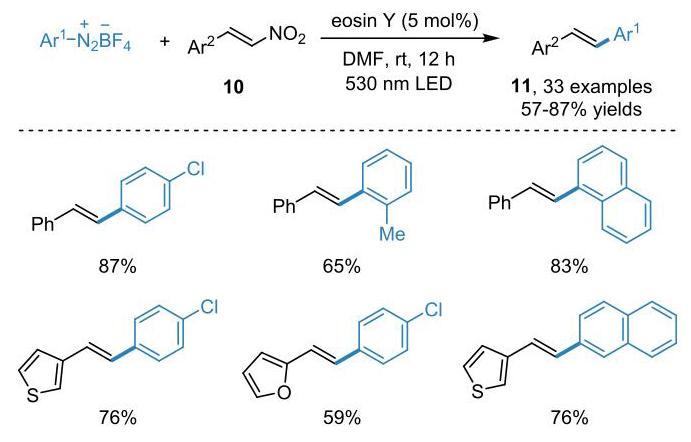
Another improvement in this area is the combination of photoredox catalysis. Mainly, eosin Y is an effective organic photocatalyst for the redox reactions involving aryl diazonium salts. ${}^{{36},{37}}$ In 2016, the visible-light-induced coupling of aryl diazonium salts with nitroalkenes 10 was developed using eosin Y as the photosensitizer, affording stilbene derivatives 11 (Scheme 7). ${}^{38}$ This protocol uses green LEDs as the light source. A radical mechanism was proposed for this reaction, with nitroalkenes 10 serving as the radical acceptor. After the radical addition, the nitro group is then cleaved via homolytic fragmentation.
该领域的另一项改进是光氧化还原催化的结合。主要地,曙红Y是用于涉及芳基重氮盐的氧化还原反应的有效有机光催化剂。${}^{{36},{37}}$2016年,以曙红Y作为光敏剂,开发了可见光诱导的芳基重氮盐与硝基烯烃10的偶联反应,得到芪衍生物11(方案7)。${}^{38}$该方案使用绿色发光二极管作为光源。该反应提出了一种自由基机理,其中硝基烯烃10作为自由基受体。自由基加成后,硝基通过均裂断裂被裂解。
Scheme 7. Visible-Light-Induced Cross-Coupling of Aryl Diazonium Salts with Nitroalkenes
方案7. 可见光诱导的芳基重氮盐与硝基烯烃的交叉偶联
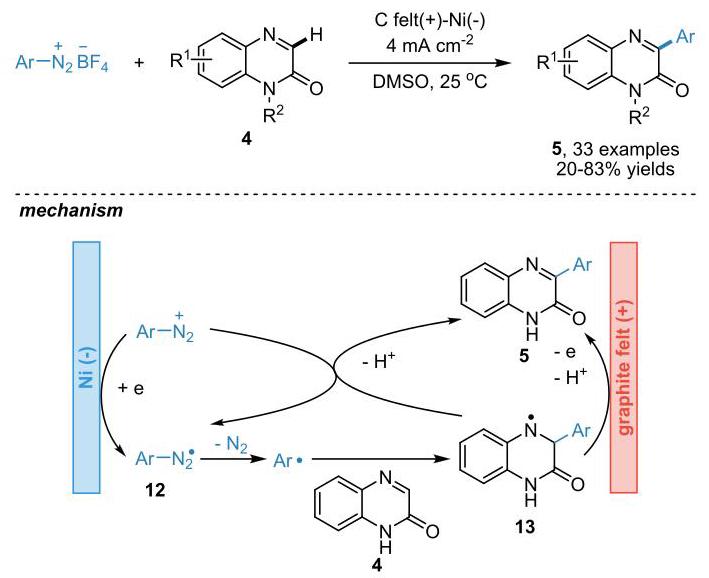
On the other hand, the past decade has witnessed a resurgence of organic electrochemistry. In 2019, the electrochemical Minisci-type selective arylation of quinoxalinones 4 and aryl diazonium salts was realized, which represents an alternative route to Cu-catalyzed Meerwein arylation or visible-light-induced protocol (Scheme 8). ${}^{39}$ The success of this electrochemical arylation approach to quinoxalin-2(1H)-ones 4 has demonstrated the feasibility of performing radical-type $\mathrm{C} - \mathrm{H}$ arylation of aryl diazonium salts under paired electrolysis conditions. On the basis of control experiments and CV analysis, a reaction mechanism is proposed which involves the initial reduction of aryl diazonium salts at the cathode’s surface to generate corresponding phenyl diazo radicals 12. After the loss of dinitrogen, the resulting aryl radical adds to quinoxalin- 2 (1H)-one to generate $N$ -centered radical intermediate 13. Subsequently, this intermediate is oxidized at the anode to afford the corresponding product. An alternative mechanism involves the homogeneous electron transfer of 13 with the aryl diazonium species. This gives rise to the product 5 and regenerates 12, thus initiating a radical chain process.
另一方面,过去十年见证了有机电化学的复兴。2019年,实现了喹喔啉酮4与芳基重氮盐的电化学Minisci型选择性芳基化反应,这代表了一种替代铜催化的Meerwein芳基化反应或可见光诱导反应的途径(方案8)。${}^{39}$ 这种电化学芳基化方法用于合成喹喔啉-2(1H)-酮4的成功,证明了在成对电解条件下对芳基重氮盐进行自由基型$\mathrm{C} - \mathrm{H}$ 芳基化反应的可行性。基于对照实验和循环伏安分析,提出了一种反应机理,该机理涉及芳基重氮盐在阴极表面首先被还原生成相应的苯基重氮自由基12。在失去氮气后,生成的芳基自由基加成到喹喔啉-2(1H)-酮上,生成$N$ 中心自由基中间体13。随后,该中间体在阳极被氧化得到相应的产物。另一种机理涉及13与芳基重氮物种的均相电子转移。这产生了产物5并再生了12,从而引发了自由基链反应。
Scheme 8. Electrochemical Cross-Coupling of Quinoxalin- 2(1H)-one with Aryl diazonium Salts
方案8. 喹喔啉-2(1H)-酮与芳基重氮盐的电化学交叉偶联
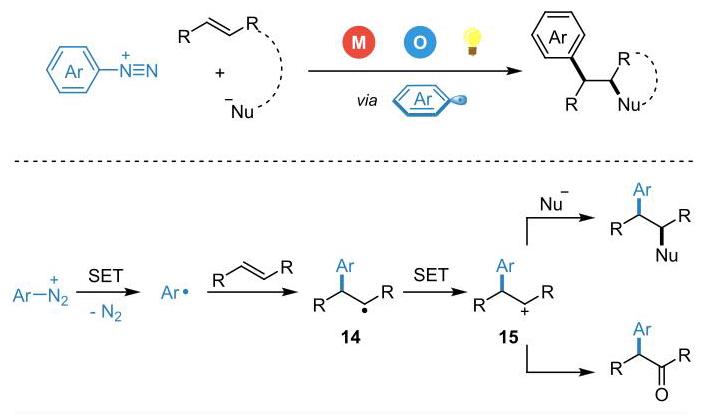
2.1.2. Difunctionalization of Alkenes. The difunction-alization of alkenes can be achieved through the selective radical addition to double bonds upon the employment of transition-metal catalysis, organic promoters, photoredox or electrolysis conditions (Scheme 9). The reaction is initiated by the decomposition of aryl diazonium salts through an SET process. The resultant aryl radical is subsequently trapped by alkenes to afford an alkyl radical intermediate 14, which undergoes single-electron oxidation to afford a carbenium ion 15. Finally, an intra- or intermolecular nucleophilic reaction occurs to afford the difunctionalization product. This difunctionalization strategy allows the synthesis of various functional molecules, including oxyarylation, aminoarylation, fluoroarylation, arylthio(seleno)cyanation products, and a variety of cyclic compounds. This section will sum up the representative advances according to the type of pathways to generate aryl radicals.
2.1.2. 烯烃的双官能化。通过在过渡金属催化、有机促进剂、光氧化还原或电解条件下(方案9),烯烃的双官能化可以通过选择性自由基加成到双键上来实现。该反应由芳基重氮盐通过单电子转移(SET)过程分解引发。生成的芳基自由基随后被烯烃捕获,得到烷基自由基中间体14,其经过单电子氧化得到碳正离子15。最后,发生分子内或分子间亲核反应,得到双官能化产物。这种双官能化策略允许合成各种功能分子,包括氧芳基化、氨基芳基化、氟芳基化、芳基硫(硒)氰化产物以及各种环状化合物。本节将根据生成芳基自由基的途径类型总结代表性进展。
Scheme 9. General Routes for Difunctionalization of Alkenes
方案9. 烯烃双官能化的一般路线
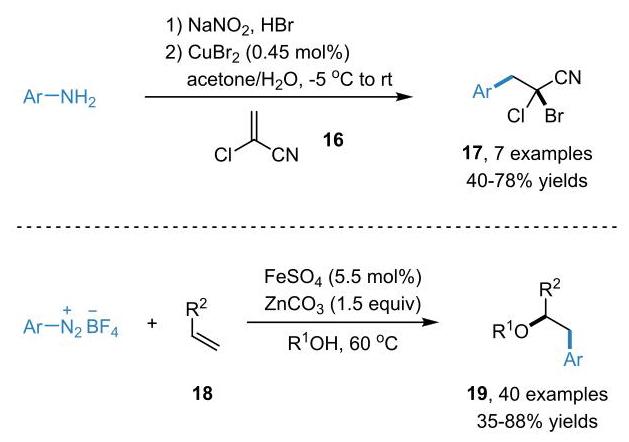
2.1.2.1. Transition-Metal Catalysis. Traditional radical addition to alkenes from aryl diazonium salts needs the participation of copper salts or other transition metals. A practical application of this strategy was disclosed through a Cu(II)-catalyzed bromoarylation reaction using 2-chloroacry-lonitrile 16 with in situ formed aryl diazonium salts, accessing the preparation of 2-bromo-2-chloro-3-arylpropanenitriles 17 with moderate to good yields in acetone/water (Scheme 10, up). ${}^{40}$ Another similar protocol involved the Fe(II)-catalyzed oxyarylation of electron-rich olefins 18, including styrenes, vinyl pyrrolidinone, and vinyl oxazolidinone with aryl diazonium tetrafluoroborates, furnishing corresponding carbo-hydroxylated and carbomethoxylated products 19, including functionalized dihydroisocoumarin and dihydrobenzofuran derivatives (Scheme 10, below). ${}^{41}$ These reactions involve single-electron transfer with the $\mathrm{{Cu}}\left( \mathrm{{II}}\right) /\mathrm{{Cu}}\left( \mathrm{I}\right)$ or $\mathrm{{Fe}}\left( \mathrm{{III}}\right) /$ Fe(II) redox pair, respectively.
2.1.2.1. 过渡金属催化。传统上,芳基重氮盐对烯烃的自由基加成反应需要铜盐或其他过渡金属的参与。通过使用2-氯丙烯腈16与原位生成的芳基重氮盐进行的Cu(II)催化的溴芳基化反应,揭示了该策略的实际应用,在丙酮/水中以中等至良好的产率制备2-溴-2-氯-3-芳基丙腈17(方案10,上)。${}^{40}$ 另一个类似的方案涉及Fe(II)催化的富电子烯烃18(包括苯乙烯、乙烯基吡咯烷酮和乙烯基恶唑烷酮)与四氟硼酸芳基重氮盐的氧芳基化反应,得到相应的碳羟基化和碳甲氧基化产物19,包括官能化的二氢异香豆素和二氢苯并呋喃衍生物(方案10,下)。${}^{41}$ 这些反应分别涉及与$\mathrm{{Cu}}\left( \mathrm{{II}}\right) /\mathrm{{Cu}}\left( \mathrm{I}\right)$ 或 $\mathrm{{Fe}}\left( \mathrm{{III}}\right) /$ Fe(II)氧化还原对的单电子转移。
Scheme 10. Cu- and Fe-Catalyzed Difunctionalization of Alkenes
方案10. Cu和Fe催化的烯烃双官能化反应
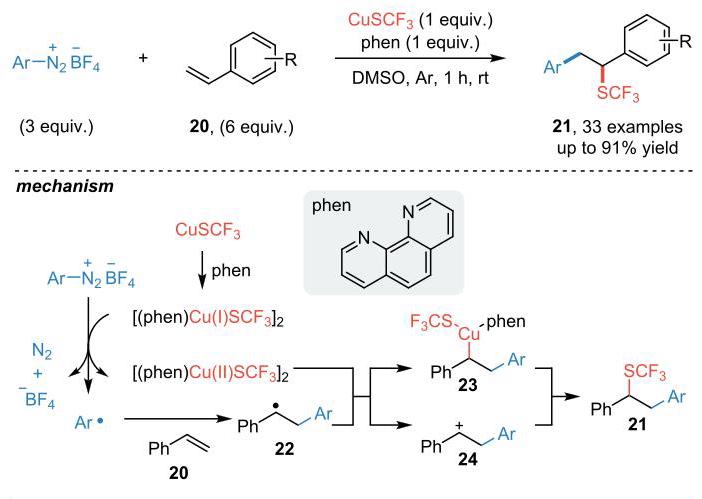
In recent years, incorporating a trifluoromethylthio group into an organic molecule has received extensive attention. A recent representative advance of Cu-mediated difunctionaliza-tion is the aryltrifluoromethylthiolation of styrenes 20 by the reaction with aryl diazonium salts and ${\mathrm{{CuSCF}}}_{3}$ under room temperature (Scheme 11). ${}^{42}$ An oxidative radical intermolecular aryltrifluoromethylthiolation of styrenes with aryl diazonium salts and ${\mathrm{{CuSCF}}}_{3}$ has been established. Mechanistically, dimeric complex $\mathrm{{Cu}}\left( \mathrm{I}\right) - {\mathrm{{SCF}}}_{3}$ was in situ oxidized by the aryl diazonium salt to produce the corresponding $\mathrm{{Cu}}\left( \mathrm{{II}}\right) - {\mathrm{{SCF}}}_{3}$ species and aryl radicals. The selective addition of the aryl radical to styrenes resulted in the formation of benzyl radical 22. Two reaction pathways with $\mathrm{{Cu}}$ (II)- ${\mathrm{{SCF}}}_{3}$ were proposed. In the first mechanism, this benzyl radical can be trapped by $\mathrm{{Cu}}\left( \mathrm{{II}}\right) - {\mathrm{{SCF}}}_{3}$ to generate alkyl-Cu(III) species 23, followed by reductive elimination to afford the trifluoromethylthioarylation product 21. In the latter case, the benzyl radical is oxidized by Cu(II) to generate a carbocation 24, which then reacts with the ${\mathrm{{CF}}}_{3}\mathrm{\;S}$ anion to obtain the final product 21.
近年来,将三氟甲硫基引入有机分子受到了广泛关注。Cu介导的双官能化反应的一个近期代表性进展是在室温下通过与芳基重氮盐和${\mathrm{{CuSCF}}}_{3}$ 反应对苯乙烯20进行芳基三氟甲硫基化反应(方案11)。${}^{42}$ 已经建立了芳基重氮盐和${\mathrm{{CuSCF}}}_{3}$ 对苯乙烯的氧化自由基分子间芳基三氟甲硫基化反应。从机理上讲,二聚配合物$\mathrm{{Cu}}\left( \mathrm{I}\right) - {\mathrm{{SCF}}}_{3}$ 被芳基重氮盐原位氧化,生成相应的$\mathrm{{Cu}}\left( \mathrm{{II}}\right) - {\mathrm{{SCF}}}_{3}$ 物种和芳基自由基。芳基自由基对苯乙烯的选择性加成导致苄基自由基22的形成。提出了两条与$\mathrm{{Cu}}$ (II)-${\mathrm{{SCF}}}_{3}$ 相关的反应途径。在第一种机理中,该苄基自由基可以被$\mathrm{{Cu}}\left( \mathrm{{II}}\right) - {\mathrm{{SCF}}}_{3}$ 捕获,生成烷基-Cu(III)物种23,随后进行还原消除,得到三氟甲硫基芳基化产物21。在后一种情况下,苄基自由基被Cu(II)氧化生成碳正离子24,然后与${\mathrm{{CF}}}_{3}\mathrm{\;S}$ 阴离子反应得到最终产物21。
Scheme 11. Intermolecular Trifluoromethylthioarylation of Styrenes with Aryl Diazonium Salts and CuSCF ${}_{3}$
方案11. 芳基重氮盐和CuSCF ${}_{3}$ 对苯乙烯的分子间三氟甲硫基芳基化反应
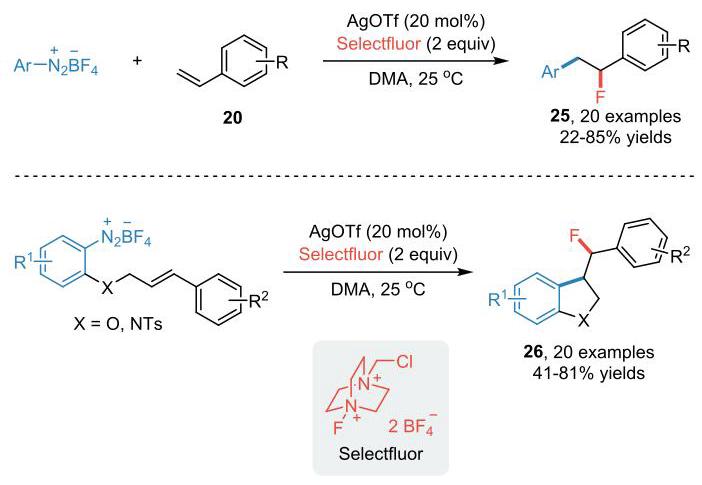
Serving as an extension of a copper-catalyzed protocol, a silver-catalyzed intermolecular and intramolecular Meerwein fluoroarylation of styrenes with aryl diazonium salts was also disclosed in 2015 (Scheme 12). ${}^{43}$ This fluoroarylation reaction is promoted by AgOTf at room temperature, and Selectfluor is used as the fluorine source. The intramolecular procedure can be applied to synthesize fluorinated heterocycles, including dihydrobenzofurans 25 and indolines 26.
作为铜催化方案的扩展,2015年还公开了银催化的苯乙烯与芳基重氮盐的分子间和分子内Meerwein氟芳基化反应(方案12)。${}^{43}$ 该氟芳基化反应在室温下由AgOTf促进,Selectfluor用作氟源。分子内方法可用于合成氟化杂环,包括二氢苯并呋喃25和吲哚啉26。
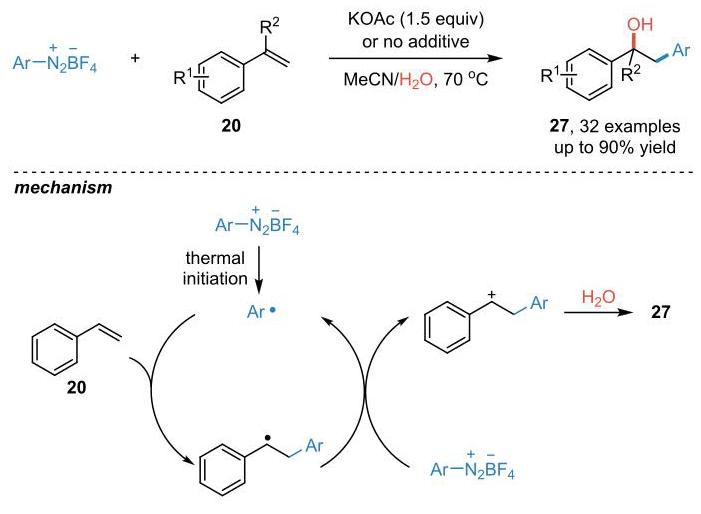
2.1.2.2. Transition-Metal-free Approaches. Apart from the employment of transition-metal catalysis, another approach involves the transition-metal-free difunctionalization, in which the radical procedure was initiated under thermal or base-initiated conditions. In the former case, Heinrich developed a transition-metal-free hydroxyarylation of styrenes 20 with aryl diazonium tetrafluoroborates (Scheme 13). ${}^{44}$ It was proposed that the diazonium salt itself act as an oxidant to propagate the radical chain via a radical-polar crossover mechanism. This approach allows the synthesis of tertiary benzylic alcohols 27 or esters under mild conditions.
2.1.2.2. 无过渡金属方法。除了使用过渡金属催化外,另一种方法涉及无过渡金属双官能化,其中自由基过程是在热或碱引发的条件下启动的。在前一种情况下,海因里希开发了一种用四氟硼酸芳基重氮盐对苯乙烯20进行无过渡金属羟基芳基化的方法(方案13)。${}^{44}$ 有人提出重氮盐本身作为氧化剂,通过自由基-极性交叉机制传播自由基链。这种方法允许在温和条件下合成叔苄醇27或酯。
An electron-rich complex-induced carboalkoxylation of styrenes 20 with aryl diazonium salts was realized at room
在室温下实现了富电子配合物诱导的苯乙烯20与芳基重氮盐的碳烷氧基化反应
Scheme 12. Ag-Catalyzed Inter- and Intramolecular Meerwein Fluoroarylation of Styrenes
方案12. 银催化的苯乙烯分子间和分子内梅尔魏因氟芳基化反应
Scheme 13. Thermally Induced Carbohydroxylation of Styrenes with Aryl Diazonium Salts
方案13. 热诱导的苯乙烯与芳基重氮盐的碳羟基化反应
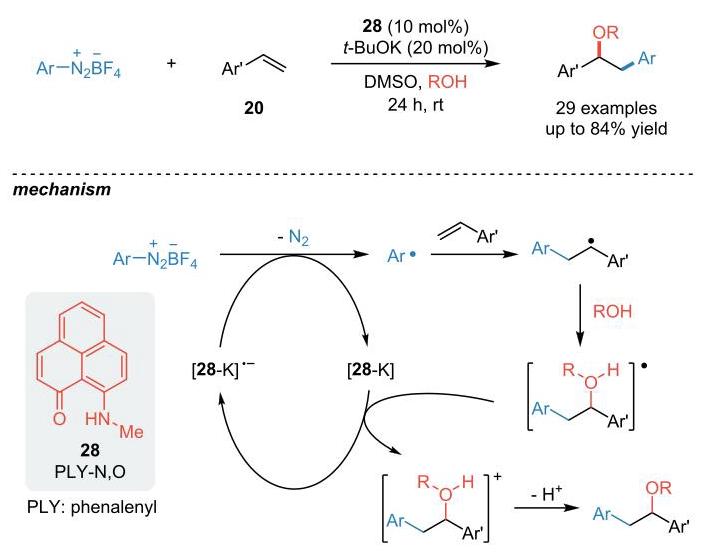
temperature (Scheme 14). ${}^{45}$ This Meerwein addition proceeded in the presence of a phenalenyl catalyst 28 (PLY) at room temperature, allowing the difunctionalization of styrene using alcohol as the alkoxy donor. On the basis of the experimental results and detailed DFT calculations, the authors proposed a mechanism in which a [PLY-K] complex serves as an electron carrier to catalyze the decomposition of the diazonium salt and the formation of the product.
在室温下进行(方案14)。${}^{45}$ 这种梅尔魏因加成反应在菲烯基催化剂28(PLY)存在下于室温下进行,允许使用醇作为烷氧基供体对苯乙烯进行双官能化。根据实验结果和详细的密度泛函理论计算,作者提出了一种机制,其中[PLY-K]配合物作为电子载体催化重氮盐的分解和产物的形成。
Scheme 14. Light-free Phenalenyl-Catalyzed Carboalkoxylation of Styrenes
方案14. 无光菲烯基催化的苯乙烯碳烷氧基化反应
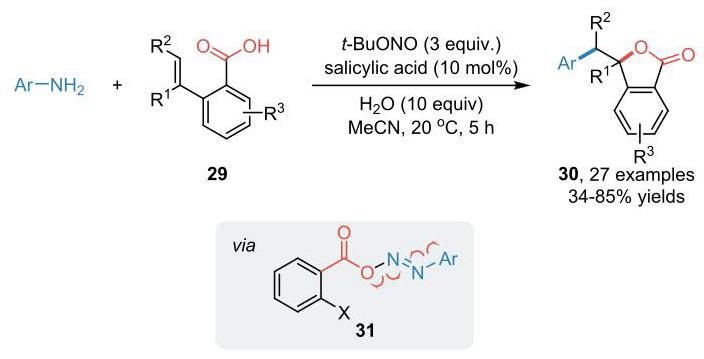
Using arylamines as the aryl radical precursors, the arylesterification of $\gamma$ -alkenoic acids 29 was developed under room temperature (Scheme 15). ${}^{46}$ Using salicylic acid and water facilitated this process, affording various $\gamma ,\gamma$ -disubstituted butyrolactones 30. Salicylic acid was proposed to play an important role in the generation of the aryl radical through N-O homolytic cleavage of in situ formed aryl diazobenzoate 31.
以芳胺为芳基自由基前体,在室温下开发了$\gamma$ -烯酸29的芳基酯化反应(方案15)。${}^{46}$ 使用水杨酸和水促进了这一过程,得到了各种$\gamma ,\gamma$ -二取代丁内酯30。有人提出水杨酸在通过原位形成的芳基重氮苯甲酸酯31的N-O均裂产生芳基自由基中起重要作用。
Scheme 15. Salicylic Acid Promoted Arylation-Lactonization Sequence of $\gamma$ -Alkenoic Acids with Anilines
方案15. 水杨酸促进的$\gamma$ -烯酸与苯胺的芳基化-内酯化反应序列
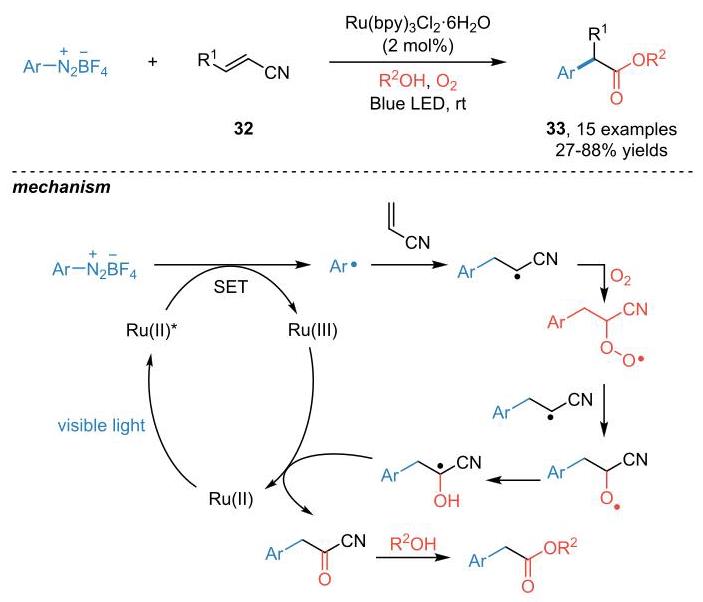
2.1.2.3. Photoredox Approaches. The photoredox protocol provides a complementary route to generate an aryl radical under mild conditions. The aryl radical intermediate is subsequently intercepted by alkenes selectively to deliver difunctionalized products or carbonyl compounds. In 2015, a visible-light-induced oxygenative Meerwein arylation of 32 was reported, affording a straightforward approach to $\alpha$ -aryl esters 33 in moderate to good yields (Scheme 16). ${}^{47}$ By intercepting the incipient carbon-centered radical with dioxygen, this radical arylation process furnished $\alpha$ -aryl esters 33 as the final products upon the loss of the cyanide.
2.1.2.3. 光氧化还原方法。光氧化还原方案提供了一条在温和条件下生成芳基自由基的补充途径。随后,芳基自由基中间体被烯烃选择性地捕获,以提供双官能化产物或羰基化合物。2015年,有报道称32发生了可见光诱导的氧化Meerwein芳基化反应,以中等到良好的产率提供了一种直接合成$\alpha$-芳基酯33的方法(方案16)。${}^{47}$ 通过用双氧捕获初始的碳中心自由基,这个自由基芳基化过程在氰化物离去后提供了$\alpha$-芳基酯33作为最终产物。
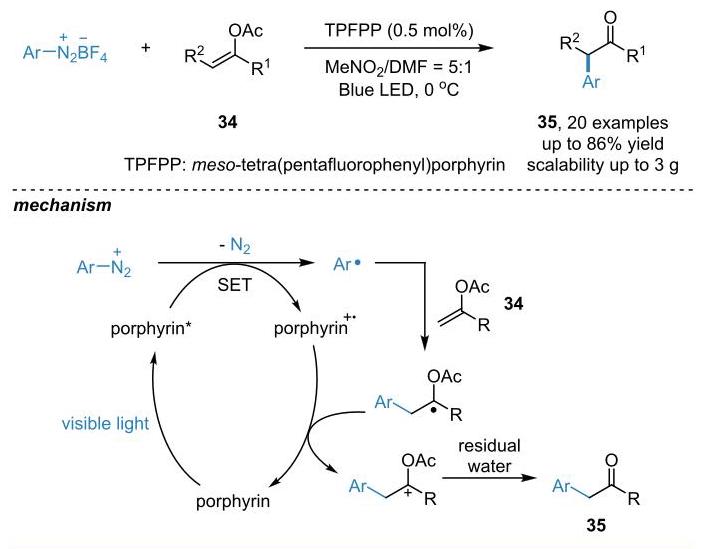
In 2018, using various porphyrins as the SET photocatalysts, the photoinduced arylation of enol acetates 34 with aryl diazonium salts was developed both in batch and continuous-flow conditions, affording $\alpha$ -arylated aldehydes and ketones 35 in excellent yields (Scheme 17). ${}^{48}$ This process is easily scaled-up under continuous-flow conditions. Mechanistically, upon blue light irradiation, the porphyrin catalyst is excited from the steady state (PS) to the singlet state ( ${}^{1}$ PS*). Intersystem crossing provided the triplet state $\left( {{}^{3}\mathrm{{PS}} * }\right)$ . The triplet species can reduce the diazonium salts to generate an aryl radical, which is trapped by enol acetates 34 to yield the final products.
2018年,使用各种卟啉作为单电子转移光催化剂,在间歇和连续流动条件下开发了烯醇醋酸酯34与芳基重氮盐的光诱导芳基化反应,以优异的产率得到$\alpha$ -芳基化醛和酮35(方案17)。${}^{48}$ 该过程在连续流动条件下易于放大。从机理上讲,在蓝光照射下,卟啉催化剂从基态(PS)激发到单重态(${}^{1}$ PS*)。系间窜越产生三重态$\left( {{}^{3}\mathrm{{PS}} * }\right)$ 。三重态物种可以还原重氮盐以产生芳基自由基,该自由基被烯醇醋酸酯34捕获以产生最终产物。
Scheme 16. Visible-Light-Induced Meerwein Cascade Reaction for the Preparation of $\alpha$ -Aryl Esters
方案16. 可见光诱导的梅尔魏因级联反应制备$\alpha$ -芳基酯
Scheme 17. Porphyrin-Catalyzed Arylations of Enol-Acetates in Batch and Continuous-Flow Conditions
方案17. 卟啉催化的烯醇醋酸酯在间歇和连续流动条件下的芳基化反应
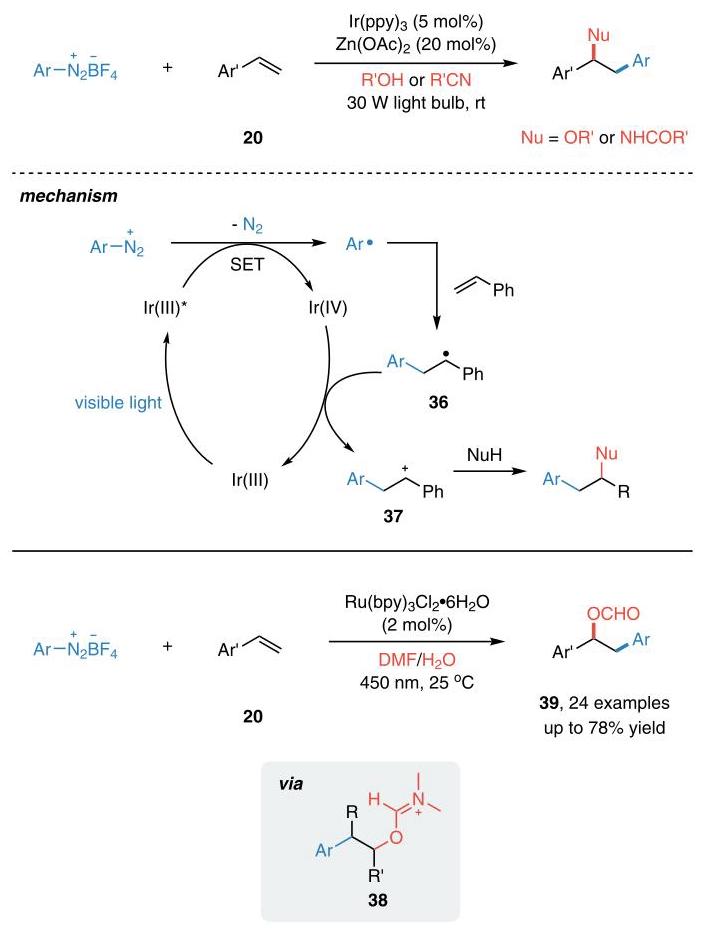
Aryl diazonium salts can serve as effective aryl radical precursors upon visible-light irradiation to enable olefin difunctionalization. For example, the oxyarylation and amino-arylation of styrenes 20 with diazonium salts under photoredox catalytic conditions were realized (Scheme 18), ${}^{49}$ allowing for the addition of an aryl group and a heteroatom across the styrene double bond. This reaction involves the initial reduction of the aryl diazonium salts with photoexcited Ir(III)* to provide an aryl radical. The aryl radical then adds to the styrene $\mathrm{C} = \mathrm{C}$ double bond, forming benzylic radical 36 and then is oxidized by Ir(IV) to benzylic cation 37. Further reaction with the nucleophile then affords three-component coupling products.
在可见光照射下,芳基重氮盐可作为有效的芳基自由基前体,实现烯烃的双官能团化。例如,在光氧化还原催化条件下,实现了苯乙烯20与重氮盐的氧芳基化和氨基芳基化反应(方案18),${}^{49}$ 使得芳基和杂原子能够跨苯乙烯双键加成。该反应首先涉及光激发的Ir(III)*将芳基重氮盐还原,生成芳基自由基。然后芳基自由基加成到苯乙烯 $\mathrm{C} = \mathrm{C}$ 双键上,形成苄基自由基36,随后被Ir(IV)氧化为苄基阳离子37。与亲核试剂进一步反应,即可得到三组分偶联产物。
When the reaction was performed in DMF, intermolecular formyloxyarylation of alkenes was accomplished in good yields. ${}^{50}$ Here, the nascent benzylic cation is intercepted by DMF to generate the iminium ion intermediate 38. Hydrolysis of the iminium ion 38 yields the formyloxyarylation product 39.
当反应在N, N-二甲基甲酰胺中进行时,烯烃的分子间甲酰氧基芳基化反应能够以良好的产率完成。${}^{50}$ 在此过程中,新生的苄基阳离子被N, N-二甲基甲酰胺捕获,生成亚胺离子中间体38。亚胺离子38水解得到甲酰氧基芳基化产物39。
Similarly, using alcoholic solvents, an analogous visible-light-induced alkoxyarylation of olefins with aryl diazonium salts could be realized using a tris(bipyridine)ruthenium catalyst. ${}^{51}$ This simple and versatile method allows the preparation of various alkoxyarylation products under mild reaction conditions, with a low catalyst loading and a short reaction time.
类似地,使用醇类溶剂,在三联吡啶钌催化剂的作用下,可实现芳基重氮盐与烯烃的可见光诱导的烷氧基芳基化反应。${}^{51}$ 这种简单且通用的方法能够在温和的反应条件下,以低催化剂负载量和短反应时间制备各种烷氧基芳基化产物。
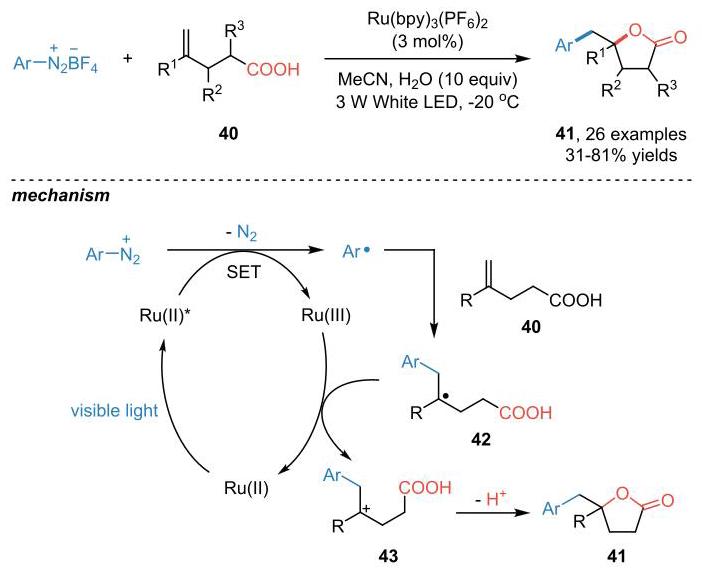
The substrate scope of this visible-light photocatalytic arylation was expanded to olefinic carboxylic acids 40, affording $\gamma ,\gamma$ -disubstituted butyrolactones 41 as the products (Scheme 19). ${}^{52}$ This process is initiated by aryl diazonium salts oxidative quenching of the excited state of the photocatalyst. Regioselective addition of the aryl radical to the alkene moiety generates a tertiary carbon radical intermediate 42. The oxidation of this species by a $\mathrm{{Ru}}$ (III) catalyst affords tertiary carbocation 43, which then undergoes intramolecular nucleophilic addition with the carboxylic acid to form $\gamma ,\gamma$ - disubstituted butyrolactones 41.
这种可见光光催化芳基化反应的底物范围扩展到了烯属羧酸40,得到 $\gamma ,\gamma$ -二取代丁内酯41作为产物(方案19)。${}^{52}$ 该过程由芳基重氮盐对光催化剂激发态的氧化猝灭引发。芳基自由基对烯烃部分的区域选择性加成生成叔碳自由基中间体42。该物种被 $\mathrm{{Ru}}$ (III)催化剂氧化得到叔碳正离子43,然后叔碳正离子与羧酸进行分子内亲核加成,形成 $\gamma ,\gamma$ -二取代丁内酯41。
Scheme 18. Photocatalytic Oxyarylation and Aminoarylation of Styrenes with Iodonium or Diazonium Salts
方案18. 苯乙烯与碘鎓盐或重氮盐的光催化氧芳基化和氨基芳基化反应
Scheme 19. Photocatalytic Arylation-Lactonization Sequence of Olefinic Carboxylic Acids with Aryl Diazonium Salts
方案19. 烯属羧酸与芳基重氮盐的光催化芳基化-内酯化反应序列
In 2017, the photoinduced difunctionalization reactions were applied by König and Fagnoni to the preparation of isochromanones using 2-carboxy-substituted aryl diazonium salts. ${}^{53}$ In the same year, the photocatalyzed reactions of 2- (alkoxycarbonyl)benzenediazonium tetrafluoroborates with various alkenes were disclosed by Basso, affording isochroma-nones in good yields under batch and flow conditions. ${}^{54}$
2017年,König和Fagnoni将光诱导双官能团化反应应用于使用2-羧基取代的芳基重氮盐制备异色满酮。${}^{53}$ 同年,Basso公开了四氟硼酸2-(烷氧基羰基)苯重氮盐与各种烯烃的光催化反应,在间歇和流动条件下均能以良好的产率得到异色满酮。${}^{54}$
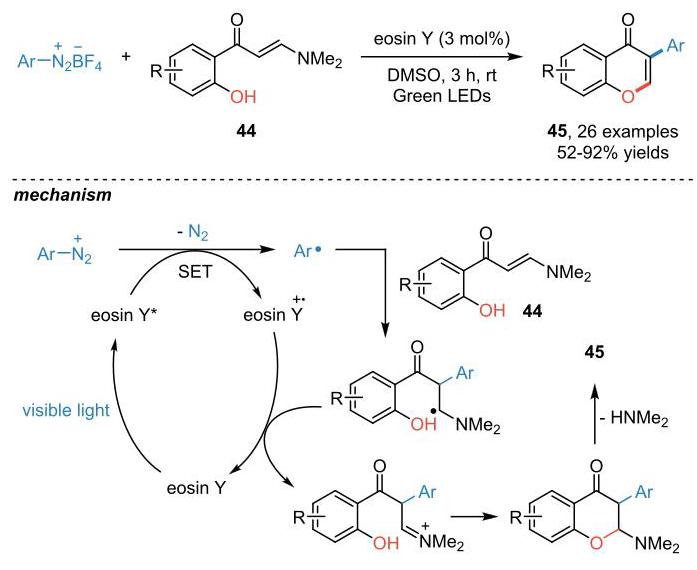
In 2020, the domino reaction of ortho-hydroxyarylenami-nones 44 with in situ photogenerated aryl radicals was realized, enabling the assembly of 3-aryl-substituted chromenes 45 with moderate to high yields (Scheme 20). ${}^{55}$
2020年,实现了邻羟基芳基烯胺酮44与原位光生成的芳基自由基的多米诺反应,能够以中等到高的产率组装3-芳基取代的色烯45(方案20)。${}^{55}$
Scheme 20. Visible Light-Mediated Arylation of ortho-Hydroxyarylenaminones to Synthesize Isoflavones
方案20. 邻羟基芳基烯胺酮的可见光介导芳基化反应合成异黄酮
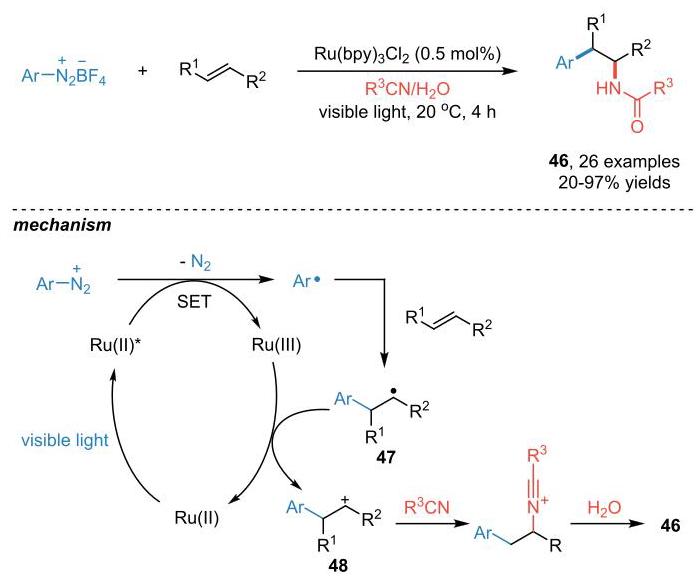
Besides carbooxygenation of olefins, other types of alkene difunctionalization have also been established. The photoredox intermolecular aminoarylation of alkenes under visible-light irradiation was realized, leading to amides as well as 3-aryl-3,4- dihydro isoquinoline 46 (Scheme 21). ${}^{56}$ The proposed mechanism involves the initial formation of the aryl radical by a single-electron transfer from the excited state of the photocatalyst Ru(II)* by aryl diazonium salts. The addition of the aryl radical to an alkene affords the corresponding radical intermediate 47, which is subsequently oxidized to give a carbocation 48. Finally, 48 is intercepted by a nitrile, followed by hydrolysis to obtain the aminoarylation product.
除了烯烃的碳氧官能团化反应外,还建立了其他类型的烯烃双官能团化反应。实现了可见光照射下烯烃的光氧化还原分子间氨基芳基化反应,得到酰胺以及3-芳基-3,4-二氢异喹啉46(方案21)。${}^{56}$ 提出的机理涉及光催化剂Ru(II)*的激发态通过单电子转移将芳基重氮盐还原,首先形成芳基自由基。芳基自由基加成到烯烃上得到相应的自由基中间体47,随后被氧化生成碳正离子48。最后,48被腈捕获,然后水解得到氨基芳基化产物。
Scheme 21. Photoredox Intermolecular Aminoarylation of Alkenes
方案21. 烯烃的光氧化还原分子间氨基芳基化反应
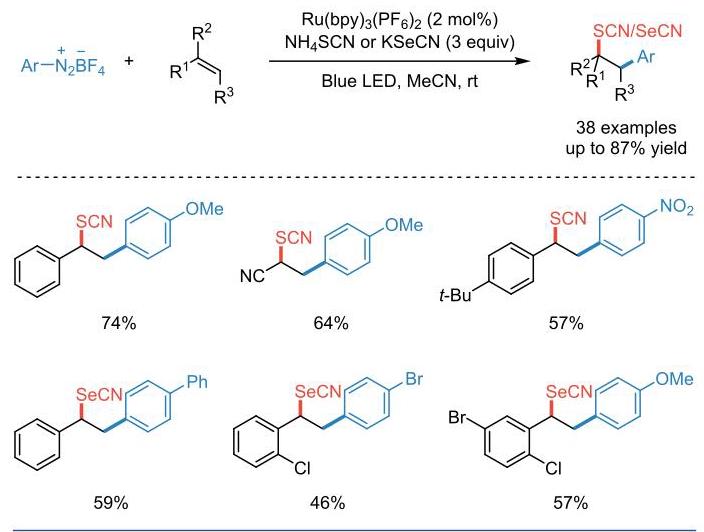
In 2019, Maity reported a photoredox-catalyzed, three-component intermolecular arylthiocyanation/arylselenocyana-tion of alkenes with diazonium salts (Scheme 22). ${}^{57}$ Using ammonium thiocyanate and potassium selenocyanate as the thiocyanate/selenocyanate source, chemoselective difunction-alization of alkenes was done under visible-light irradiation, affording aryl-substituted alkylthiocyanates and alkylselenocya-nates with moderate to high yields. On the basis of the Stern-Volmer quenching experiment, an SET process between the photoexcited Ru(II)* and the aryl diazonium salt leads to the aryl radical. Subsequent radical addition and radical-polar crossover provide the carbenium ion, which reacts with ${\mathrm{{SCN}}}^{ - }$ to give the product.
2019年,迈蒂报道了一种光氧化还原催化的、烯烃与重氮盐的三组分分子间芳基硫氰化/芳基硒氰化反应(方案22)。${}^{57}$ 使用硫氰酸铵和硒氰酸钾作为硫氰酸盐/硒氰酸盐源,在可见光照射下实现了烯烃的化学选择性双官能化,以中等到高的产率得到芳基取代的烷基硫氰酸盐和烷基硒氰酸盐。基于斯特恩-沃尔默猝灭实验,光激发的Ru(II)*与芳基重氮盐之间的单电子转移过程产生芳基自由基。随后的自由基加成和自由基-极性交叉产生碳正离子,该碳正离子与${\mathrm{{SCN}}}^{ - }$反应生成产物。
Scheme 22. Photoredox-Catalyzed Intermolecular Radical Arylthiocyanation/Arylselenocyanation of Alkenes
方案22. 光氧化还原催化的烯烃分子间自由基芳基硫氰化/芳基硒氰化反应
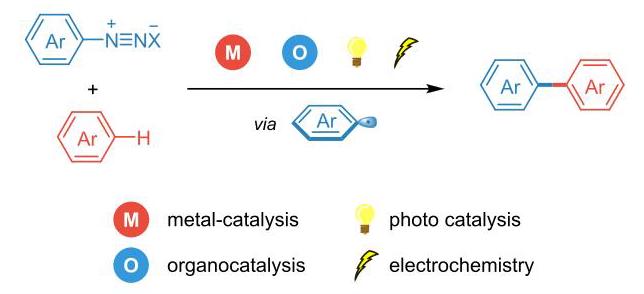
2.1.3. Radical Addition to Aromatic Compounds. The aryl radical addition to aromatic compounds with aryl diazonium salts, which was first discovered by Gomberg and Bachmann, ${}^{8}$ is a highly useful method for synthesizing unsymmetrical biaryls. Several outstanding reviews have discussed biaryl synthesis with arene diazonium salts over the past six years. ${}^{{58} - {63}}$ This radical-type C-H bond arylation has attracted interest from the synthetic community. ${}^{{64},{65}}$ Recent advances in this area mainly focus on developing transition-metal-catalyzed, organic initiator-mediated, photoinduced, and electrolysis processes (Scheme 23). The transition-metal-catalyzed $\mathrm{C} - \mathrm{H}$ bond functionalization and dual photoredox/ transition-metal-catalyzed approaches will be summarized in the following section.
2.1.3. 自由基对芳香化合物的加成。芳基自由基与芳基重氮盐对芳香化合物的加成反应,最早由贡伯格和巴赫曼发现,${}^{8}$ 是合成不对称联芳基的一种非常有用的方法。在过去六年里,有几篇优秀的综述讨论了用芳烃重氮盐合成联芳基的方法。${}^{{58} - {63}}$ 这种自由基型C-H键芳基化反应引起了合成界的关注。${}^{{64},{65}}$ 该领域的最新进展主要集中在开发过渡金属催化、有机引发剂介导、光诱导和电解过程(方案23)。过渡金属催化的$\mathrm{C} - \mathrm{H}$ 键官能化以及双光氧化还原/过渡金属催化方法将在下一节中进行总结。
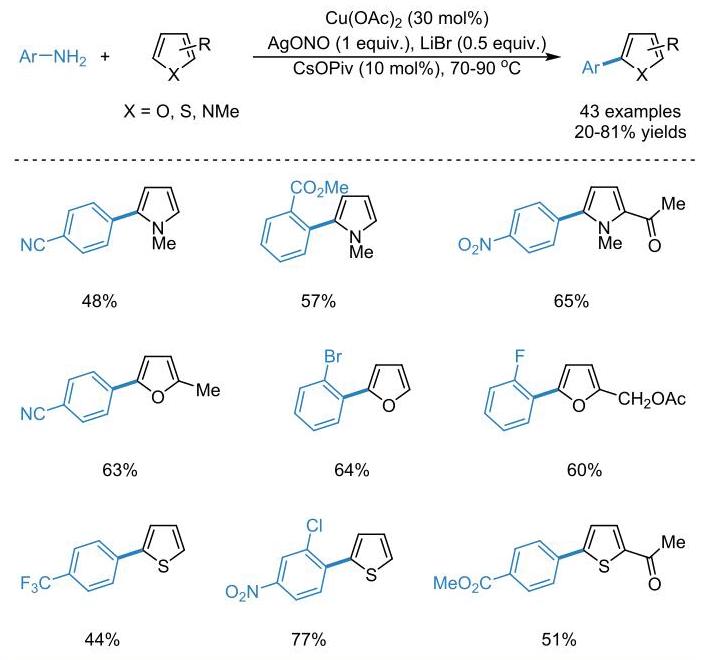
2.1.3.1. Transition-Metal Catalysis. The addition of transition-metal can facilitate the SET process of aryl diazonium ions to generate aryl radicals. This strategy’s main advances are the extension of substrate scope and the efficiency of the reactions. Employing AgONO for the diazotization of anilines under acid-free conditions, $\mathrm{{Cu}}{\left( \mathrm{{OAc}}\right) }_{2}$ -catalyzed direct $\mathrm{C} - \mathrm{H}$ arylation of $N$ -methylpyrroles, furans, and thiophenes was reported in 2014 (Scheme 24). ${}^{66}$ This one-pot diazotization/arylation protocol provides a new approach for the $\mathrm{C} - \mathrm{H}$ arylation of electron-rich heteroarenes, affording a variety of heterobiaryl products in moderate to good yields.
2.1.3.1. 过渡金属催化。加入过渡金属可以促进芳基重氮离子的单电子转移过程以生成芳基自由基。该策略的主要进展在于底物范围的扩展和反应效率的提高。2014年报道了在无酸条件下使用硝酸银进行苯胺的重氮化反应,$\mathrm{{Cu}}{\left( \mathrm{{OAc}}\right) }_{2}$ -催化的$\mathrm{C} - \mathrm{H}$ 对$N$ -甲基吡咯、呋喃和噻吩的直接$\mathrm{C} - \mathrm{H}$ 芳基化反应(方案24)。${}^{66}$ 这种一锅法重氮化/芳基化方案为富电子杂芳烃的$\mathrm{C} - \mathrm{H}$ 芳基化提供了一种新方法,以中等到良好的产率得到各种杂联芳基产物。
A broader range of Cu-promoted Gomberg-Bachmann reactions was reported (Scheme 25). A one-pot diazotization/
报道了更广泛的铜促进的贡伯格-巴赫曼反应(方案25)。一锅法重氮化/
Scheme 23. Different Methods for Arenes C-H Bond Arylations via Aryl Radicals
方案23. 通过芳基自由基进行芳烃C-H键芳基化的不同方法
Beyond the Gomberg-Bachmann reaction
超越贡伯格-巴赫曼反应
Scheme 24. Cu-Catalyzed C-H Arylation of Heteroarenes by Anilines with AgONO as the Diazotization Agent
方案24. 以硝酸银为重氮化剂,铜催化苯胺对杂芳烃的C-H芳基化反应
Scheme 25. Cu-Catalyzed Arylations of Anilines
方案25. 铜催化的苯胺芳基化反应
$\mathrm{{Cu}}{\left( \mathrm{{OAc}}\right) }_{2}\left( {{10}\mathrm{{mol}}\% }\right)$
$t$ -BuONO (1.2 equiv.)
$t$ -叔丁基硝酸酯(1.2当量)
${\mathrm{{Ar} - {NH}}}_{2}$
${\mathrm{{MeSO}}}_{3}\mathrm{H}$ (1 equiv.)
${\mathrm{{MeSO}}}_{3}\mathrm{H}$ (1当量)
${\mathrm{{CaCO}}}_{3}$ (1 equiv.)
${\mathrm{{CaCO}}}_{3}$ (1当量)
acetone ${\mathrm{H}}_{2}\mathrm{O},{25}^{ \circ }\mathrm{C}$
丙酮 ${\mathrm{H}}_{2}\mathrm{O},{25}^{ \circ }\mathrm{C}$
R = Boc, Ts 12 examples
R = 叔丁氧羰基、对甲苯磺酰基 12个实例
28-83% yields
产率28 - 83%
$\mathrm{{Cu}}{\left( \mathrm{{OAc}}\right) }_{2}\left( {{20}\mathrm{\;{mol}}\% }\right)$
$t$ -BuONO (3 equiv.)
$t$ -叔丁基硝酸酯(3当量)
$\mathrm{{Ar}} - {\mathrm{{NH}}}_{2}$
${\mathrm{{Cs}}}_{2}{\mathrm{{CO}}}_{3}$ (1 equiv.)
${\mathrm{{Cs}}}_{2}{\mathrm{{CO}}}_{3}$(1当量)
Ar
DMSO, ${50}^{ \circ }\mathrm{C}$
二甲基亚砜,${50}^{ \circ }\mathrm{C}$
$X = O, S$ 26 examples
$X = O, S$ 26个实例
50-82% yields
产率为50 - 82%
Cu-catalyzed regioselective C2-arylation of $N$ -Boc pyrroles with anilines was disclosed. ${}^{67}$ These reactions were carried out at an ambient temperature in degassed aqueous acetone using $\mathrm{{Cu}}{\left( \mathrm{{OAc}}\right) }_{2}$ and $t$ -BuONO/ ${\mathrm{{MeSO}}}_{3}\mathrm{H}$ as the diazotizing agents and ${\mathrm{{CaCO}}}_{3}$ as the base, leading to $\mathrm{C}2$ -arylated pyrroles in high yields. A similar arylation protocol was realized to afford 2-aryl-substituted benzoxazoles and benzothiazoles. ${}^{68}$
公开了铜催化的用苯胺对$N$ - 叔丁氧羰基吡咯进行区域选择性C2 - 芳基化反应。${}^{67}$ 这些反应在脱气的丙酮水溶液中于室温下进行,使用$\mathrm{{Cu}}{\left( \mathrm{{OAc}}\right) }_{2}$ 和$t$ - 丁基亚硝酸酯/${\mathrm{{MeSO}}}_{3}\mathrm{H}$ 作为重氮化试剂,${\mathrm{{CaCO}}}_{3}$ 作为碱,以高收率得到$\mathrm{C}2$ - 芳基化吡咯。实现了类似的芳基化方案以得到2 - 芳基取代的苯并恶唑和苯并噻唑。${}^{68}$
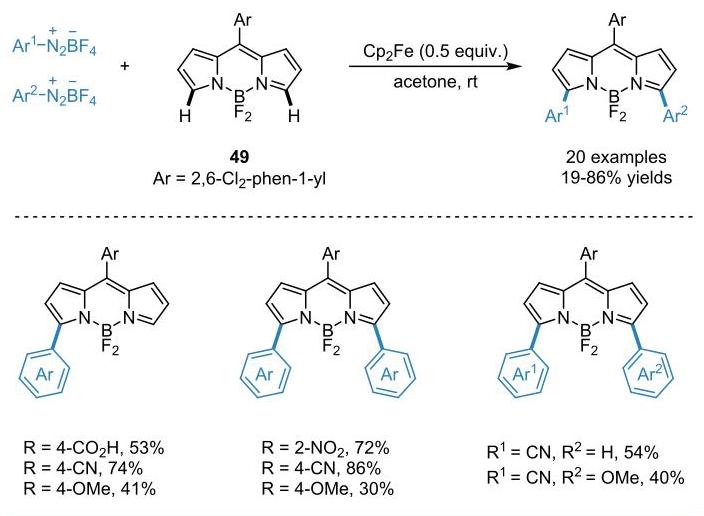
Aryl diazonium salts were also used for the regioselective modification of BODIPY dyes 49 to fine-tune their emissive properties (Scheme 26). ${}^{69}$ This radical $\mathrm{C} - \mathrm{H}$ arylation used ferrocene as the promoter to generate aryl radical from aryl diazonium salts and allowed for the synthesis of brightly fluorescent $\left( {\Phi > {0.85}}\right)$ arylated boron dipyrrins. The role of ferrocene in aryl radical formation was confirmed by cyclic voltammetry. ${}^{70}$ Additionally, direct and sequential arylations of pyrrole with aryl diazonium salt can also be initiated by the SET process catalyzed by cobaltocene at room temperature. ${}^{71}$
芳基重氮盐还用于BODIPY染料49的区域选择性修饰以微调其发光性质(方案26)。${}^{69}$ 这种自由基$\mathrm{C} - \mathrm{H}$ 芳基化使用二茂铁作为促进剂从芳基重氮盐生成芳基自由基,并允许合成明亮荧光的$\left( {\Phi > {0.85}}\right)$ 芳基化硼二吡咯。通过循环伏安法证实了二茂铁在芳基自由基形成中的作用。${}^{70}$ 此外,在室温下,二茂钴催化的单电子转移过程也可以引发吡咯与芳基重氮盐的直接和连续芳基化反应。${}^{71}$
Scheme 26. ${\mathrm{{Cp}}}_{2}\mathrm{{Fe}}$ -Catalyzed Arylation of BODIPYs
方案26. ${\mathrm{{Cp}}}_{2}\mathrm{{Fe}}$催化的BODIPY的芳基化反应
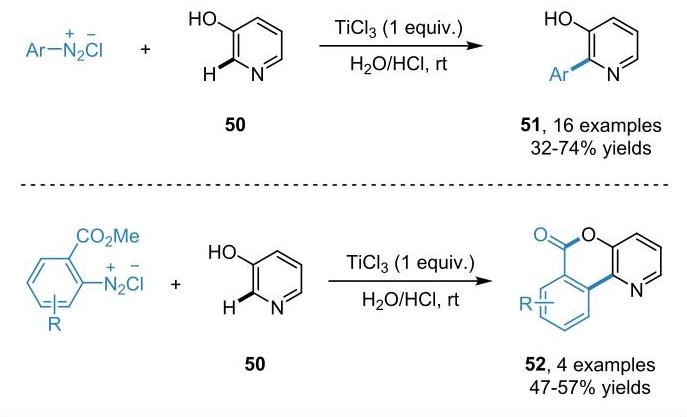
Gomberg-Bachmann arylation of pyridine usually leads to a mixture of regioisomers. Aiming to achieve the regioselective arylation of pyridine, a regioselective radical arylation of 3- hydroxypyridine 50 was realized using a stoichiometric amount titanium(III) complex. This process takes advantage of the C-3 hydroxy directing effect and the protonated pyridine nitrogen to access C-2 arylated products (Scheme 27). ${}^{72}$ Using aryl diazonium chlorides, a range of 3-hydroxy-2-phenylpyridines 51 were obtained in moderate to good yields. This methodology also enables a rapid assembly of tricyclic benzopyr-anopyridinones 52.
吡啶的冈伯格 - 巴赫曼芳基化通常会导致区域异构体的混合物。为了实现吡啶的区域选择性芳基化,使用化学计量的钛(III)配合物实现了3 - 羟基吡啶50的区域选择性自由基芳基化。该过程利用C - 3羟基的导向作用和质子化的吡啶氮来获得C - 2芳基化产物(方案27)。${}^{72}$ 使用芳基氯化铵,以中等至良好的产率得到一系列3 - 羟基 - 2 - 苯基吡啶51。该方法还能够快速组装三环苯并吡喃并吡啶酮52。
Scheme 27. Ti(III)-Mediated Radical Arylation of 3- Hydroxypyridines
方案27. Ti(III)介导的3 - 羟基吡啶的自由基芳基化反应
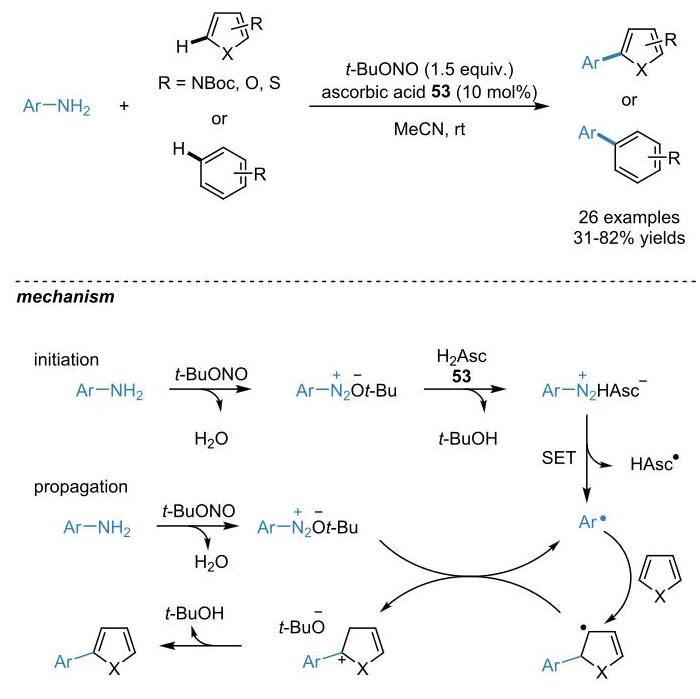
2.1.3.2. Organocatalysis Approaches. Using organic initiators instead of transition-metal species for radical arylations using diazonium salts is desirable from a green chemistry perspective. These organic initiators should be redox-active molecules to serve as efficient electron donors and acceptors. In 2014, Martin and Carrillo reported a metal-free Gomberg-Bachmann reaction using ascorbic acid 53 as the radical initiator (Scheme 28). ${}^{73}$ This research represents the first of organic reductant for such radical processes. Additionally, in situ generations of aryl diazonium salts from anilines can be achieved in the presence of 53. Good yields of biaryl products are obtained for strongly electron-deficient diazonium salts and electron-rich (hetero)arenes. In 2016, the same group disclosed a radical $\mathrm{C} - \mathrm{H}$ arylation of (hetero)arenes with aryl diazonium tetrafluoroborates catalyzed by gallic acid in water-acetone at room temperature. ${}^{74}$ Biowastes rich in gallic acid, such as grape pomace, can also promote this arylation process.
2.1.3.2. 有机催化方法。从绿色化学的角度来看,使用有机引发剂而不是过渡金属物种进行重氮盐的自由基芳基化反应是可取的。这些有机引发剂应该是具有氧化还原活性的分子,以作为有效的电子供体和受体。2014年,马丁和卡里略报道了使用抗坏血酸53作为自由基引发剂的无金属冈伯格 - 巴赫曼反应(方案28)。${}^{73}$ 该研究代表了此类自由基过程中首次使用有机还原剂。此外,在53存在下可以实现从苯胺原位生成芳基重氮盐。对于强缺电子重氮盐和富电子(杂)芳烃,得到了良好产率的联芳基产物。2016年,同一研究小组公开了在室温下,在水 - 丙酮中,没食子酸催化的(杂)芳烃与四氟硼酸芳基重氮盐的自由基$\mathrm{C} - \mathrm{H}$ 芳基化反应。${}^{74}$ 富含没食子酸的生物废料,如葡萄皮渣,也可以促进该芳基化过程。
Scheme 28. Ascorbic Acid Initiated Direct C-H Arylation of (Hetero)arenes with Anilines
方案28. 抗坏血酸引发的(杂)芳烃与苯胺的直接C - H芳基化反应
In 2018, the same group reported heteroarenes’ radical arylation with anilines induced by aqueous sodium carbonate at room temperature. ${}^{75}$ This method was applied to the modification of naphthylimide or bisthienylcyclopentenes. The key step for generating aryl radicals involves the thermal fragmentation of a diazo anhydride, which is formed from aryl diazonium salts under basic aqueous conditions.
2018年,同一研究小组报道了在室温下,碳酸钠水溶液诱导的杂芳烃与苯胺的自由基芳基化反应。${}^{75}$ 该方法被应用于萘二甲酰亚胺或双噻吩基环戊烯的修饰。生成芳基自由基的关键步骤涉及重氮酸酐的热分解,重氮酸酐是在碱性水溶液条件下由芳基重氮盐形成的。
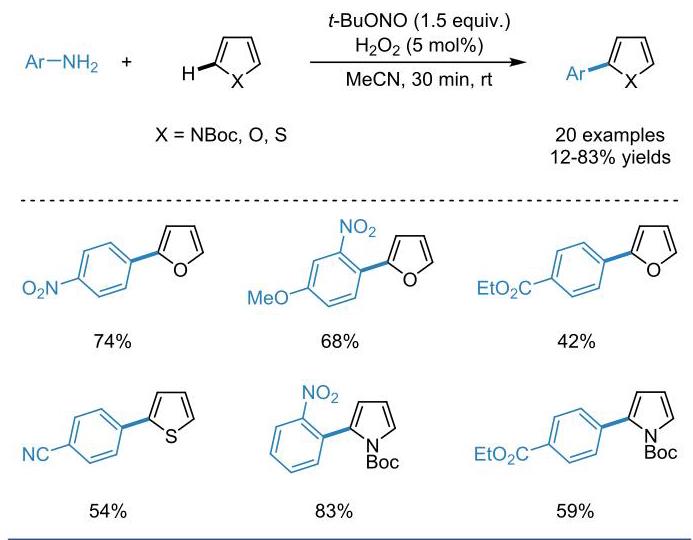
After Martin and Carrillo’s research, several in situ diazotization/radical arylations using various electron transfer agents have been developed. ${}^{76}$ In the presence of hydrogen peroxide, a C-H arylation of heteroarenes with in situ generated aryl diazonium compounds was reported (Scheme 29). ${}^{77}$ DFT calculations support a mechanism involving a covalent adduct of tert-butoxide and aryl diazonium, allowing for inner sphere electron transfer to occur. Besides, the graphene oxide has also been explored as a catalyst and/or initiator in the arylation of heteroarenes. ${}^{78}$ The localized radicals on reduced graphene oxide play a crucial role in generating an aryl radical.
在Martin和Carrillo的研究之后,已经开发了几种使用各种电子转移剂的原位重氮化/自由基芳基化反应。${}^{76}$ 在过氧化氢存在下,报道了杂芳烃与原位生成的芳基重氮化合物的C-H芳基化反应(方案29)。${}^{77}$ DFT计算支持一种涉及叔丁醇盐和芳基重氮的共价加合物的机理,使得内球电子转移能够发生。此外,氧化石墨烯也已被探索作为杂芳烃芳基化反应中的催化剂和/或引发剂。${}^{78}$ 还原氧化石墨烯上的局域自由基在生成芳基自由基中起关键作用。
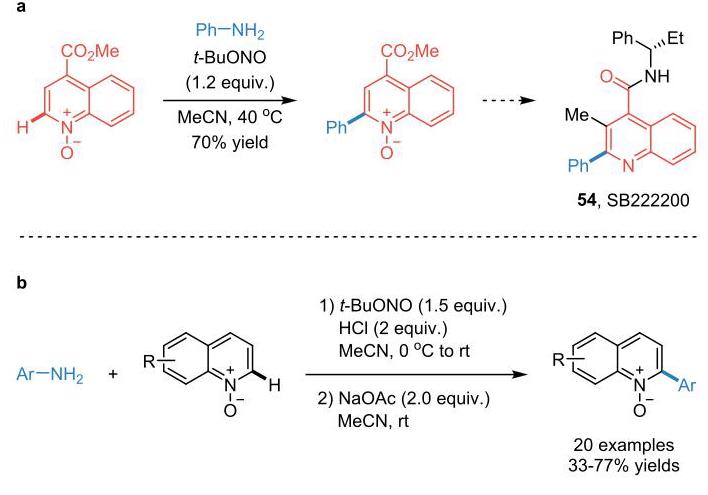
Moreover, direct $\mathrm{C} - \mathrm{H}$ arylation of heterocyclic $N$ -oxides was developed (Scheme 30). ${}^{{79} - {81}}$ In 2016, Horan reported an additive-free method for the $\mathrm{C} - \mathrm{H}$ arylation of heterocyclic $N$ - oxides (Scheme 30a). ${}^{79}$ This chemistry delivered 2-phenyl-quinoline- $N$ -oxide, a key intermediate en route to the NK-3 receptor antagonist SB222200 (54), in 70% yield. The C2- arylation of quinoline- $N$ -oxides can be efficiently carried out with aryl diazonium salts in the presence of a base without exogenous reductants (Scheme 30b). ${}^{80}$
此外,还开发了杂环$N$-氧化物的直接$\mathrm{C} - \mathrm{H}$芳基化反应(方案30)。${}^{{79} - {81}}$ 2016年,Horan报道了一种无添加剂的杂环$N$-氧化物芳基化方法(方案30a)。${}^{79}$ 该反应以70%的产率得到了2-苯基喹啉$N$-氧化物,这是通往NK-3受体拮抗剂SB222200(54)的关键中间体。喹啉$N$-氧化物的C2-芳基化反应可以在碱存在下,无外源还原剂的情况下,用芳基重氮盐有效地进行(方案30b)。${}^{80}$
Scheme 29. Hydrogen Peroxide Promoted C-H Arylation of Heteroarenes
方案29. 过氧化氢促进的杂芳烃C-H芳基化反应
Scheme 30. C-H Arylation of Heterocyclic N-Oxides through in situ Diazotization of Anilines
方案30. 通过苯胺原位重氮化实现的杂环N-氧化物的C-H芳基化反应
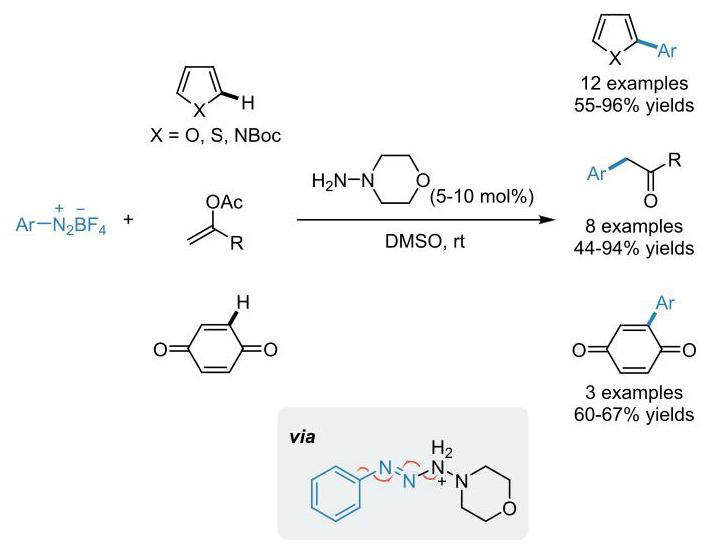
Hydrazines were also explored as a new family of low molecular-weight catalysts to promote $\mathrm{C} - \mathrm{H}$ arylation using aryl diazonium salts (Scheme 31). ${}^{82}$ A range of substrates, including electron-rich heterocycles, vinyl acetates, and quinones, could be effectively arylated under these conditions.
肼也被探索作为一类新型的低分子量催化剂,以促进使用芳基重氮盐的$\mathrm{C} - \mathrm{H}$芳基化反应(方案31)。${}^{82}$ 在这些条件下,一系列底物,包括富电子杂环、醋酸乙烯酯和醌,都可以有效地进行芳基化反应。
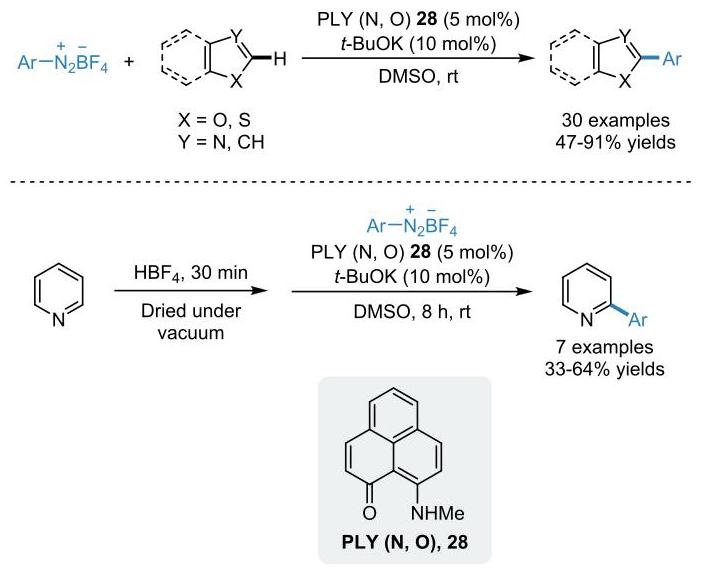
Mandal and co-workers explored C-H arylation of heteroarenes using PLY 28 under photofree conditions (Scheme 32). ${}^{{83} - {85}}$ The mechanism is like reactions using this class of promoters.
Mandal及其同事探索了在无光条件下使用PLY 28进行杂芳烃的C-H芳基化反应(方案32)。${}^{{83} - {85}}$ 其机理与使用这类促进剂的反应类似。
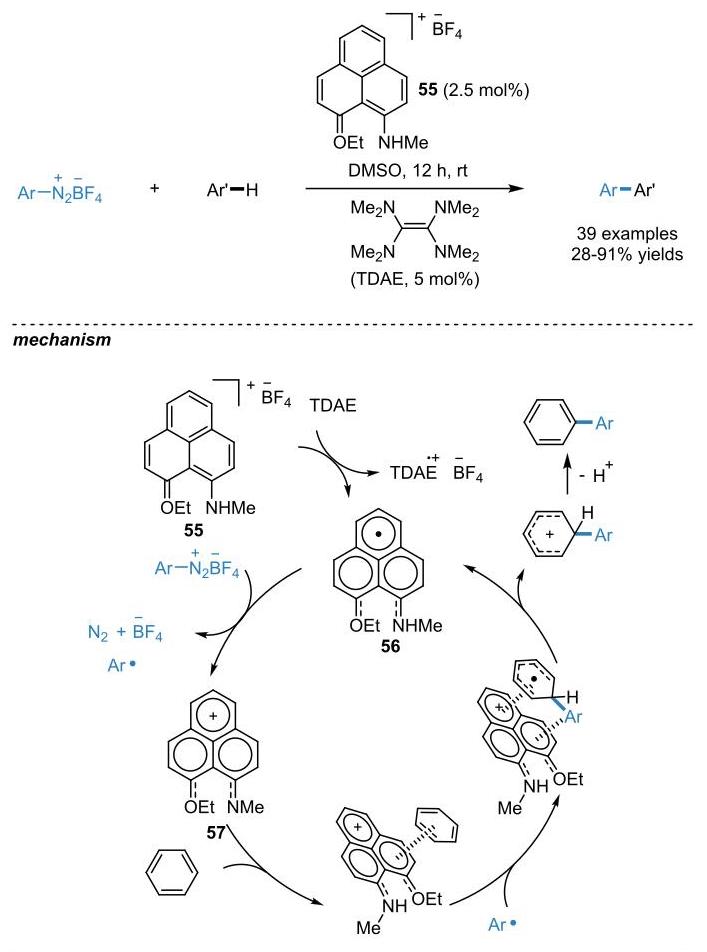
In 2018, the same group developed a Lewis acid-redox dual catalytic system using the phenalenyl derivative with one-electron redox characteristics (Scheme 33). ${}^{84}$ The proposed mechanism starts with the single-electron reduction of phenalenyl cation 55 using an organic electron donor tetrakis(dimethylamino)ethylene (TDAE), leading to the phenalenyl radical 56. This radical then reacts with the aryl diazonium salt to generate an aryl radical and the cationic species 57. The authors also disclosed a protocol for the $\mathrm{C} - \mathrm{H}$ arylation of arenes and heteroarenes using a phenalenyl-supported iron(III) catalyst and potassium as the reductant. ${}^{85}$
2018年,同一研究小组开发了一种使用具有单电子氧化还原特性的菲烯基衍生物的路易斯酸-氧化还原双催化体系(方案33)。${}^{84}$ 提出的机理始于使用有机电子供体四(二甲基氨基)乙烯(TDAE)对菲烯基阳离子55进行单电子还原,生成菲烯基自由基56。然后该自由基与芳基重氮盐反应生成芳基自由基和阳离子物种57。作者还公开了一种使用菲烯基负载的铁(III)催化剂和钾作为还原剂进行芳烃和杂芳烃$\mathrm{C} - \mathrm{H}$芳基化反应的方案。${}^{85}$
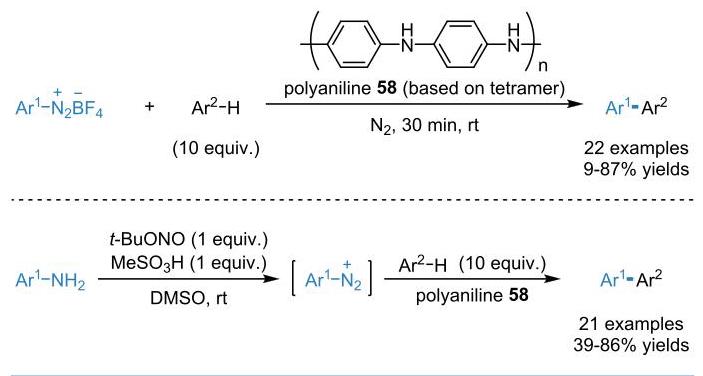
Redox-active polyanilines have also been explored as a radical promoter (Scheme 34). ${}^{{86},{87}}$ Amaya and Hirao employed polyaniline 58 for the Gomberg-Bachmann reaction from aryl diazonium salts ${}^{86}$ or anilines, ${}^{87}$ giving the cross-coupling product in moderate to good yields. Only 1 mol % (based on aniline tetramer) of the polyaniline 58 was required for this arylation reaction. Polyaniline is sufficiently reducing to convert various arene diazonium salts to aryl radicals.
氧化还原活性聚苯胺也已被探索作为自由基促进剂(方案34)。${}^{{86},{87}}$ Amaya和Hirao使用聚苯胺58进行由芳基重氮盐${}^{86}$或苯胺参与的Gomberg-Bachmann反应,${}^{87}$ 以中等至良好的产率得到交叉偶联产物。该芳基化反应仅需要1 mol%(基于苯胺四聚体)的聚苯胺58。聚苯胺具有足够的还原性,能够将各种芳烃重氮盐转化为芳基自由基。
Scheme 31. Hydrazine-Catalyzed Reductive C-C Bond Formation
方案31. 肼催化的还原C-C键形成反应
Scheme 32. Phenalenyl-Based Radicals in the $\mathrm{C} - \mathrm{H}$
方案32. 基于菲烯基的自由基在$\mathrm{C} - \mathrm{H}$
Arylation of Heteroarenes
杂芳烃的芳基化反应
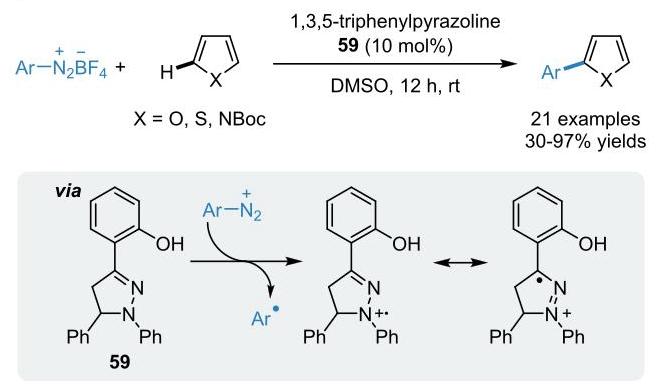
In 2019, 1,3,5-triphenylpyrazolines 59 was explored as an organic catalyst for the $\mathrm{C} - \mathrm{H}$ arylation of heteroarenes using aryl diazonium salts (Scheme 35). ${}^{88}$
2019年,1,3,5-三苯基吡唑啉59被探索作为一种有机催化剂,用于使用芳基重氮盐对杂芳烃进行$\mathrm{C} - \mathrm{H}$芳基化反应(方案35)。${}^{88}$
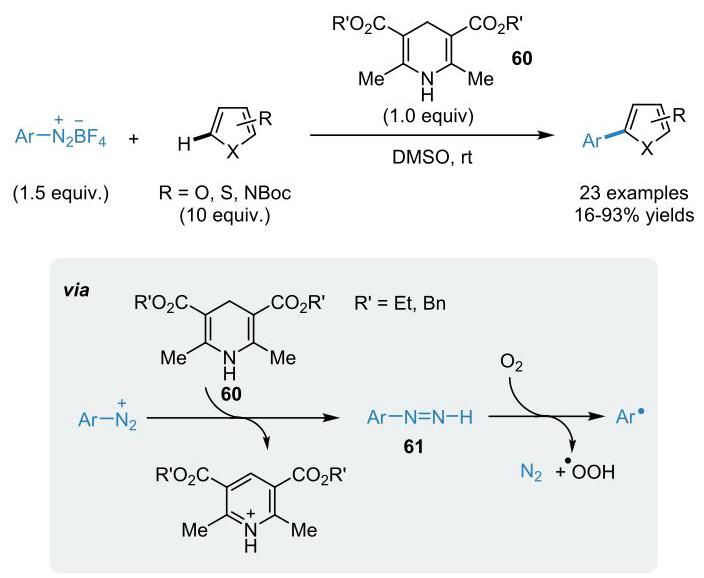
Apart from the protocols using aryl diazonium ions as aryl radical precursors, the radical arylations of heteroarenes with in situ formed aryldiazotates was developed in strongly alkaline aqueous solution conditions. ${}^{89}$ Recently, the diazene species have been explored as the aryl radical precursors in Gomberg-Bachmann arylation of arenes, in which the Hantzsch ester 60 transfers a hydride to the aryl diazonium substrate. ${\mathrm{O}}_{2}$ then induces fragmentation of the diazene intermediate 61 to produce an aryl radical for subsequent arylation (Scheme 36). ${}^{90}$
除了使用芳基重氮离子作为芳基自由基前体的方案外,在强碱性水溶液条件下开发了原位形成的芳基重氮酸盐对杂芳烃的自由基芳基化反应。${}^{89}$最近,重氮烯物种已被探索作为芳烃的Gomberg-Bachmann芳基化反应中的芳基自由基前体,其中Hantzsch酯60将氢负离子转移到芳基重氮底物上。${\mathrm{O}}_{2}$然后诱导重氮烯中间体61断裂以产生芳基自由基用于后续芳基化反应(方案36)。${}^{90}$
Scheme 33. Phenalenyl-Based Lewis Acid-Redox Dual Catalytic System
方案33. 菲并烯基路易斯酸-氧化还原双催化体系
Scheme 34. Polyaniline-Induced C-H Arylation of Arenes
方案34. 聚苯胺诱导的芳烃C-H芳基化反应
Scheme 35. 1,3,5-Triphenylpyrazoline Catalyzed C-H Arylations of Heteroarenes
方案35. 1,3,5-三苯基吡唑啉催化的杂芳烃C-H芳基化反应
Scheme 36. Hantzsch Ester-Mediated Generation of Aryl Radicals
方案36. Hantzsch酯介导的芳基自由基生成
2.1.3.3. Visible-Light-Induced Arylations. In the previous introduction, the radical arylation of arenes with diazonium salts should be facilitated by the addition of transition-metals or redox-active organic initiators, including ascorbic and gallic acid, ${\mathrm{H}}_{2}{\mathrm{O}}_{2}$ , graphene, hydrazines, PLY, and polyanilines. Furthermore, the photoredox catalysis strategy represents a complementary and mild approach to synthesize (hetero)- biaryls. A pioneering work using a photoredox catalyst was communicated by König for the arylation of heteroarenes with aryl diazonium salts by using eosin Y as an organic photoredox catalyst under green light irradiation at ${530}\mathrm{\;{nm}}$ (Scheme 37). ${}^{91}$
2.1.3.3. 可见光诱导的芳基化反应。在之前的介绍中,通过添加过渡金属或氧化还原活性有机引发剂(包括抗坏血酸和没食子酸)${\mathrm{H}}_{2}{\mathrm{O}}_{2}$、石墨烯、肼、PLY和聚苯胺,应该可以促进重氮盐对芳烃的自由基芳基化反应。此外,光氧化还原催化策略是合成(杂)联芳基的一种互补且温和的方法。König报道了一项开创性工作,使用光氧化还原催化剂,在绿光照射下${530}\mathrm{\;{nm}}$,以曙红Y作为有机光氧化还原催化剂,实现了芳基重氮盐对杂芳烃的芳基化反应(方案37)。${}^{91}$
Scheme 37. Eosin Y-Catalyzed Visible-Light-Induced Arylations of Heteroarenes
方案37. 曙红Y催化的可见光诱导的杂芳烃芳基化反应
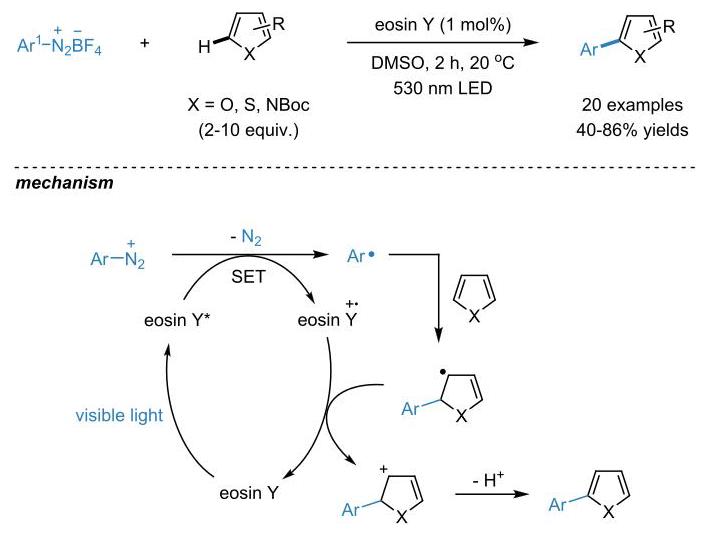
This photoredox pathway is highly dependent on the nature of the light source, solvent, and $\mathrm{{pH}}$ of the medium. ${}^{92}$ This photoredox protocol is mechanistically initiated by the oxidative quenching process of the excited state of the photocatalyst (eosin Y* or Ru(II)*) with an aryl diazonium salt to generate an aryl radical. This aryl radical undergoes subsequent addition to arenes, followed by single-electron oxidation and final deprotonation to obtain biaryls. The hypervalent photocatalyst can facilitate the single-electron oxidation of the resulting radical adduct. This process is independent of the aryl diazonium ion’s redox potential, which plays an important role in the radical-chain pathway. Thus, both electron-rich and -deficient aryl diazonium salts can smoothly react in the presence of photosensitizers.
这种光氧化还原途径高度依赖于光源、溶剂和介质的$\mathrm{{pH}}$性质。${}^{92}$这种光氧化还原方案在机理上是由光催化剂(曙红Y或Ru(II))的激发态与芳基重氮盐的氧化猝灭过程引发的,以生成芳基自由基。该芳基自由基随后加成到芳烃上,接着进行单电子氧化和最终去质子化以获得联芳基。高价光催化剂可以促进所得自由基加合物的单电子氧化。这个过程与芳基重氮离子的氧化还原电位无关,而氧化还原电位在自由基链途径中起重要作用。因此,富电子和缺电子的芳基重氮盐在光敏剂存在下都能顺利反应。
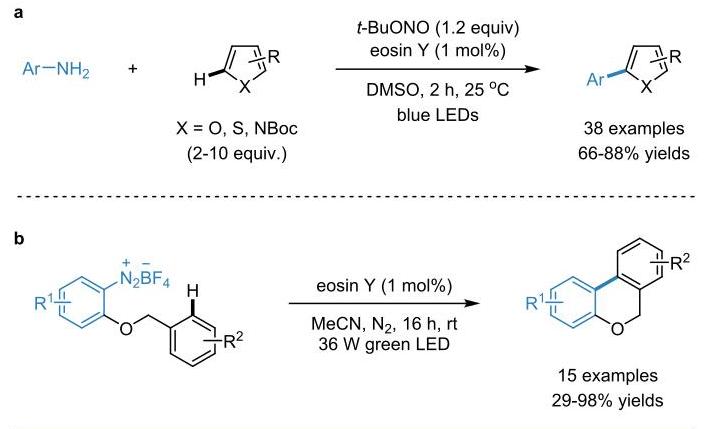
Since this report by König, several photoredox catalysts have been reported to promote the photocatalytic Gomberg-Bachmann reaction. Recently, organic photoredox catalysts have demonstrated powerful applications in the visible-light-induced transformations of aryl diazonium salts. ${}^{{93} - {98}}$ Notably, eosin Y-catalyzed visible-light-induced intermolecular arylation of anilines, ${}^{99}$ as well as intramolecular arylation of aryl diazonium tetrafluoroborates, ${}^{100}$ was developed (Scheme 38).
自König的这份报告以来,已经报道了几种光氧化还原催化剂来促进光催化的Gomberg-Bachmann反应。最近,有机光氧化还原催化剂在可见光诱导的芳基重氮盐转化中展示了强大的应用。${}^{{93} - {98}}$值得注意的是,开发了曙红Y催化的可见光诱导的苯胺分子间芳基化反应${}^{99}$以及四氟硼酸芳基重氮盐的分子内芳基化反应${}^{100}$(方案38)。
Scheme 38. Photoredox Eosin Y-Catalyzed Arylation Reactions of Aryl diazonium Salts
方案38. 光氧化还原曙红Y催化的芳基重氮盐芳基化反应
Besides eosin Y, more organic dyes, including iodo-Bodipys 62, ${}^{101}$ electron-deficient porphyrins 63, ${}^{102}$ Rhodamine B, ${}^{103}$ and 9,10-dihydro-10-methylacridine, ${}^{104}$ have been utilized as photosensitizers to promote the visible-light-induced arylations of diazonium salts (Scheme 39).
除了曙红Y之外,更多的有机染料,包括碘代Bodipy 62${}^{101}$、缺电子卟啉63${}^{102}$、罗丹明B${}^{103}$和9,10-二氢-10-甲基吖啶${}^{104}$,已被用作光敏剂来促进可见光诱导的重氮盐芳基化反应(方案39)。
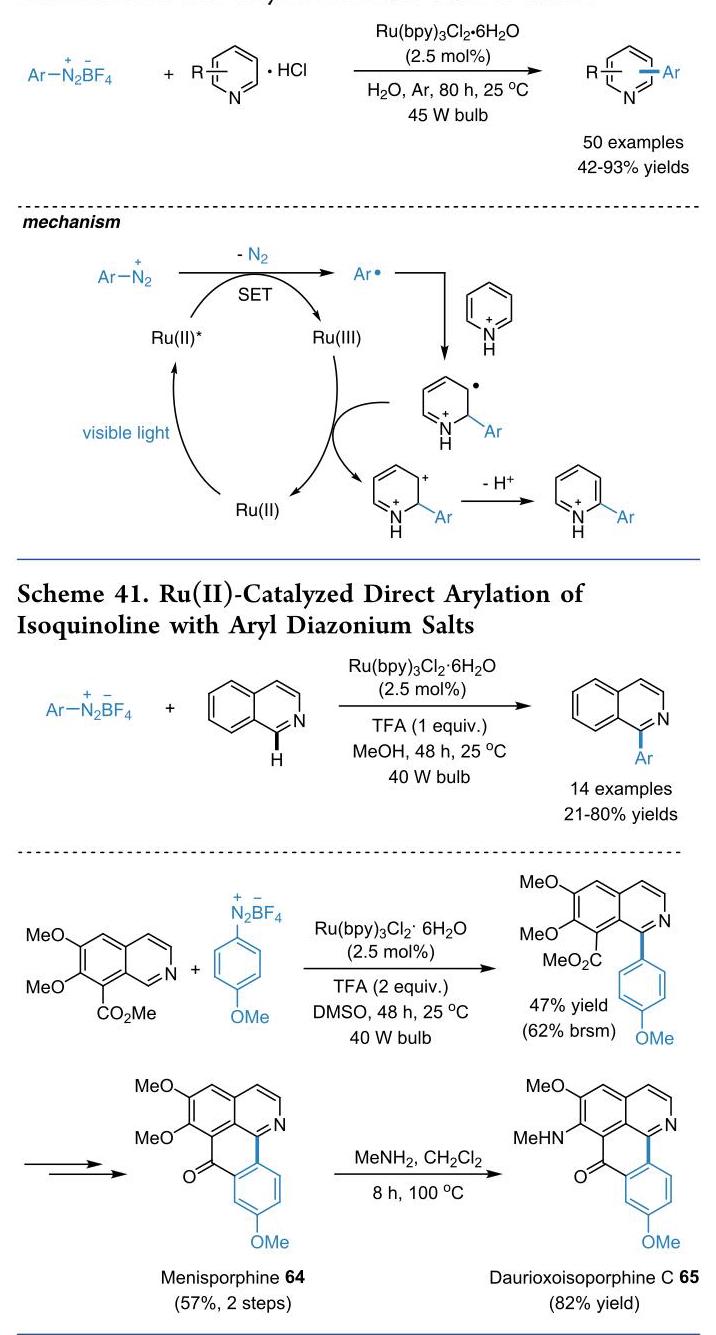
Moreover, the ruthenium(II) complex has emerged as efficient photosensitizers for catalyzing $\mathrm{C} - \mathrm{H}$ arylations of aryl diazonium salts. ${}^{{105} - {109}}$ In 2014, the direct arylation of $N$ - heteroarenes with aryl diazonium salts was successfully implemented in water, using $\mathrm{{Ru}}{\left( \mathrm{{bpy}}\right) }_{3}{\mathrm{{Cl}}}_{2} \cdot 6{\mathrm{H}}_{2}\mathrm{O}$ as a photosensitizer and a commercial household light bulb as a light source (Scheme 40). ${}^{105}$ This water-phase arylation reaction provides a variety of arylated heterocycle scaffolds including xanthene, thiazole, pyrazine, pyridazine, and pyridine with good regioselectivity.
此外,钌(II)配合物已成为催化芳基重氮盐的$\mathrm{C} - \mathrm{H}$芳基化反应的有效光敏剂。${}^{{105} - {109}}$2014年,以$\mathrm{{Ru}}{\left( \mathrm{{bpy}}\right) }_{3}{\mathrm{{Cl}}}_{2} \cdot 6{\mathrm{H}}_{2}\mathrm{O}$作为光敏剂,使用市售家用灯泡作为光源,成功实现了芳基重氮盐与$N$-杂芳烃在水中的直接芳基化反应(方案40)。${}^{105}$该水相芳基化反应提供了多种芳基化杂环支架,包括呫吨、噻唑、吡嗪、哒嗪和吡啶,具有良好的区域选择性。
Isoquinoline alkaloids are attractive natural products due to their diverse chemical structures and bioactivities. The direct $\mathrm{C} - \mathrm{H}$ arylation of isoquinoline with aryl diazonium salts using TFA as an additive and $\mathrm{{Ru}}{\left( \mathrm{{bpy}}\right) }_{3}{\mathrm{{Cl}}}_{2} \cdot 6{\mathrm{H}}_{2}\mathrm{O}$ as the photoredox catalyst provides efficient access to substituted isoquinoline derivatives (Scheme 41). ${}^{106}$ With this visible-light-induced synthetic methodology, the concise total syntheses of two isoquinoline alkaloids menisporphine 64 and daurioxoisopor-phine C 65 have been accomplished.
异喹啉生物碱由于其多样的化学结构和生物活性而成为有吸引力的天然产物。以三氟乙酸为添加剂,以$\mathrm{{Ru}}{\left( \mathrm{{bpy}}\right) }_{3}{\mathrm{{Cl}}}_{2} \cdot 6{\mathrm{H}}_{2}\mathrm{O}$作为光氧化还原催化剂,通过异喹啉与芳基重氮盐的直接$\mathrm{C} - \mathrm{H}$芳基化反应,可以高效地获得取代异喹啉衍生物(方案41)。${}^{106}$利用这种可见光诱导的合成方法,已经完成了两种异喹啉生物碱甲血卟啉64和大叶紫堇异卟啉C 65的简洁全合成。
In 2015, Maestri and Malacria utilized Ru(II)-catalyzed photoredox C-H arylation of unactivated arenes with aryl diazonium salts under visible-light irradiation (Scheme 42). ${}^{107}$ High yields of biaryls are obtained only when a large excess of arenes (40 equivalence) is used during the reaction. In 2016, Natarajan reported photoredox intramolecular cyclization of in situ formed aryl diazonium salts from the reactions of $N$ -(2- aminoaryl)benzoimines 66 and tert-butyl nitrite (Scheme 42). ${}^{108}$ Utilizing $\mathrm{{Ru}}{\left( \mathrm{{bpy}}\right) }_{3}{\mathrm{{Cl}}}_{2}$ as a photoredox catalyst and a blue LED as an irradiation source, this mild protocol affords 6- aryl phenanthridines 67 with good yields.
2015年,Maestri和Malacria利用钌(II)催化在可见光照射下未活化芳烃与芳基重氮盐的光氧化还原C-H芳基化反应(方案42)。${}^{107}$只有在反应过程中使用大量过量的芳烃(40当量)时,才能获得高产率的联芳基化合物。2016年,Natarajan报道了由$N$-(2-氨基芳基)苯并亚胺66与亚硝酸叔丁酯反应原位形成的芳基重氮盐的光氧化还原分子内环化反应(方案42)。${}^{108}$以$\mathrm{{Ru}}{\left( \mathrm{{bpy}}\right) }_{3}{\mathrm{{Cl}}}_{2}$作为光氧化还原催化剂,以蓝色发光二极管作为照射源,该温和的反应方案能够以良好的产率得到6-芳基菲啶67。
Scheme 39. Organic Photosensitizer-Promoted Photoredox C-H Arylation of Heteroarenes
方案39. 有机光敏剂促进的杂芳烃光氧化还原C-H芳基化反应
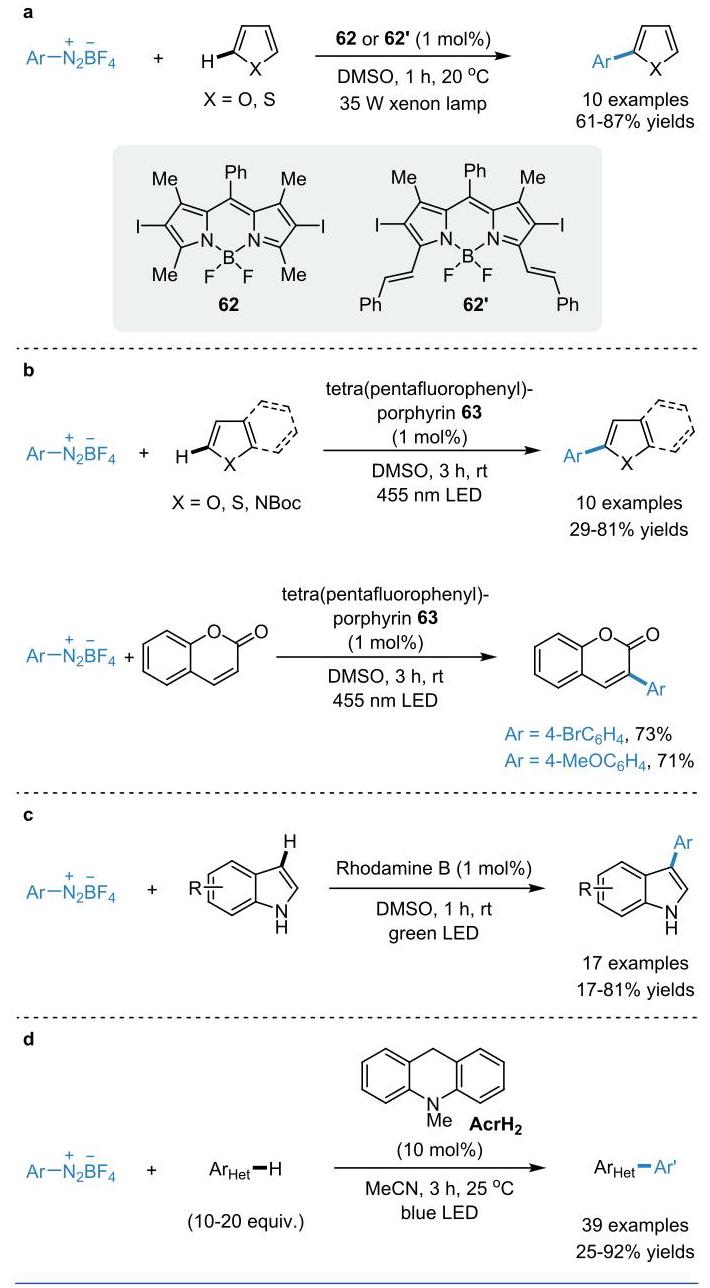
Recently, from the substrates of arylamines as safe aryl radical precursors, the selective C-H arylation of pyridines was realized upon visible-light irradiation, allowing the synthesis of 2-aryl pyridines and 2-aryl bipyridines with moderate to good yields (Scheme 43). ${}^{109}$
最近,以芳胺为安全的芳基自由基前体作为底物,通过可见光照射实现了吡啶的选择性C-H芳基化反应,能够以中等到良好的产率合成2-芳基吡啶和2-芳基联吡啶(方案43)。${}^{109}$
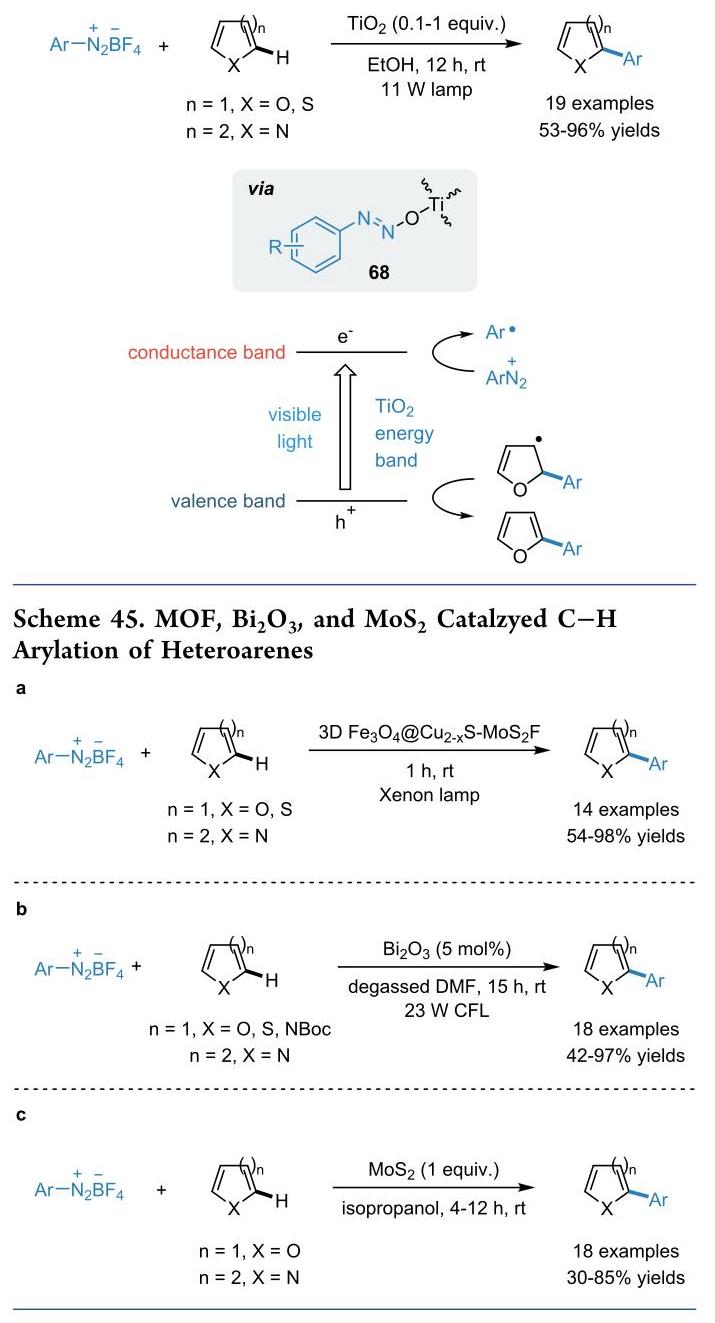
Apart from utilizing homogeneous photosensitizers, a series of metal oxides have demonstrated promise as efficient heterogeneous catalysts for visible-light-induced radical-type arylation reactions, opening up the green protocol of a cost-effective, sustainable operation through catalyst recycling. In 2015, a photoredox direct arylation of electron-rich hetero-arenes had been disclosed with an easily accessible and recyclable, heterogeneous ${\mathrm{{TiO}}}_{2}$ catalyst (Scheme 44). ${}^{110}$ Mechanistically, ${\mathrm{{TiO}}}_{2}$ -diazoether 68 was detected as the key reactive intermediates, which, upon visible-light irradiation, promoted one electron from the valence band to the metal oxide’s conduction band and, in turn, reduced the diazoether to the aryl radical species. The aryl radical then reacts with heteroarenes via a radical chain pathway. The radical intermediate is oxidized by the hole at the valence band to furnish a cation species, losing a proton to give the final product.
除了使用均相光敏剂外,一系列金属氧化物已被证明有望作为可见光诱导自由基型芳基化反应的有效多相催化剂,通过催化剂循环利用开辟了一种经济高效、可持续操作的绿色方案。2015年,公开了一种使用易于获得且可循环利用的多相${\mathrm{{TiO}}}_{2}$催化剂进行富电子杂芳烃的光氧化还原直接芳基化反应(方案44)。${}^{110}$从机理上讲,${\mathrm{{TiO}}}_{2}$-重氮醚68被检测为关键反应中间体,在可见光照射下,它将一个电子从价带促进到金属氧化物的导带,进而将重氮醚还原为芳基自由基物种。然后芳基自由基通过自由基链途径与杂芳烃反应。自由基中间体被价带处的空穴氧化,形成阳离子物种,失去一个质子得到最终产物。
Scheme 40. Ru(II)-Catalyzed Direct Arylation of $N$ - Heteroarenes with Aryl Diazonium Salts in Water
方案40. 钌(II)催化的芳基重氮盐与$N$-杂芳烃在水中的直接芳基化反应
Other heterogeneous catalytic systems, including a three-dimensional porous ${\mathrm{{Fe}}}_{3}{\mathrm{O}}_{4}@{\mathrm{{Cu}}}_{2 - x}\mathrm{\;S} - {\mathrm{{MoS}}}_{2}$ framework, ${}^{111} \; {\mathrm{{Bi}}}_{2}{\mathrm{O}}_{3},{}^{112}$ and $2\mathrm{D}{\mathrm{{MoS}}}_{2}{}^{113}$ were found to exhibit catalytic reactivity in photoredox arylation of heteroarenes with aryl diazonium salts (Scheme 45). ${}^{111}$ The terminal sulfur groups, or the single-electron in the conductance band, can facilitate the electron transfer to the diazonium salt to generate an aryl radical.
其他多相催化体系,包括三维多孔${\mathrm{{Fe}}}_{3}{\mathrm{O}}_{4}@{\mathrm{{Cu}}}_{2 - x}\mathrm{\;S} - {\mathrm{{MoS}}}_{2}$骨架、${}^{111} \; {\mathrm{{Bi}}}_{2}{\mathrm{O}}_{3},{}^{112}$和$2\mathrm{D}{\mathrm{{MoS}}}_{2}{}^{113}$,被发现可在杂芳烃与芳基重氮盐的光氧化还原芳基化反应中表现出催化活性(方案45)。${}^{111}$末端硫基团或导带中的单电子可促进向重氮盐的电子转移,以生成芳基自由基。
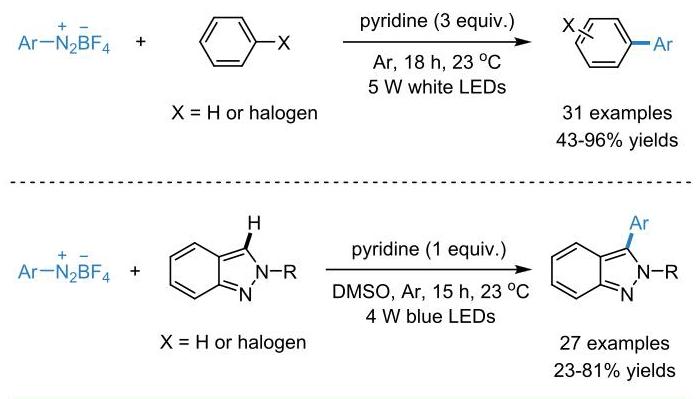
Furthermore, visible light-promoted, catalyst-free Gomberg-Bachmann arylations have also been developed. ${}^{{114} - {116}}$ In situ formation of photoactive electron donor-acceptor (EDA) complexes from aryl diazonium salts and arenes eliminates the need for a photocatalyst. In 2017, Heinrich achieved the blue LED-irradiated radical arylation of diverse arenes and heteroarenes of aryl diazonium salts in the absence of any photocatalyst and other additives (Scheme 46). ${}^{114}$ In most cases, the substrate scope in this process is limited in electron-deficient aryl diazonium salts with electron-rich arenes due to the effective formation of a visible light-absorbing charge-transfer complex.
此外,还开发了可见光促进的无催化剂的冈伯格-巴赫曼芳基化反应。${}^{{114} - {116}}$由芳基重氮盐和芳烃原位形成光活性电子供体-受体(EDA)配合物消除了对光催化剂的需求。2017年,海因里希在没有任何光催化剂和其他添加剂的情况下,实现了蓝色发光二极管照射下芳基重氮盐与多种芳烃和杂芳烃的自由基芳基化反应(方案46)。${}^{114}$在大多数情况下,由于有效形成了可见光吸收电荷转移配合物,该过程中的底物范围在缺电子芳基重氮盐与富电子芳烃的反应中受到限制。
Scheme 42. Ru(II)-Catalyzed Photoredox C-H Intermolecular Arylation of Unactivated Arenes and Intramolecular Cyclization of N-(2-Aminoaryl)benzoimines
方案42. Ru(II)催化的未活化芳烃的光氧化还原C-H分子间芳基化反应以及N-(2-氨基芳基)苯甲亚胺的分子内环化反应
a
$\mathrm{{Ru}}{\left( \mathrm{{bpy}}\right) }_{3}{\mathrm{X}}_{2}\left( {{0.5}\mathrm{\;{mol}}\% }\right)$
$\mathrm{{Ar}} - {\mathrm{N}}_{2}{\mathrm{{BF}}}_{4}$ + Ar
$\mathrm{{Ar}} - {\mathrm{N}}_{2}{\mathrm{{BF}}}_{4}$ + Ar
MeCN, 1-96 h, 25 ${}^{ \circ }\mathrm{C}$
乙腈,1 - 96小时,25 ${}^{ \circ }\mathrm{C}$
(40 equiv.)
(40当量)
blue LED
蓝色发光二极管
34 examples
34个实例
$X = {\mathrm{{SbF}}}_{6},\mathrm{{Cl}}$ 32-92% yields
$X = {\mathrm{{SbF}}}_{6},\mathrm{{Cl}}$产率32 - 92%
Me F
甲基 氟
${\mathrm{{NO}}}_{2}$ F
80% 91% 71%
o/m/p = 1.8/1.3/1
邻/间/对 = 1.8/1.3/1
$- {\mathrm{{NO}}}_{2}$
OMe
甲氧基
72% 34% 41%
o/m/p = 3.3/1/1.5
邻/间/对 = 3.3/1/1.5
NH2
$t$ -BuONO (1.3 equiv.)
$t$叔丁基亚硝酸酯(1.3当量)
Ru(bpy) ${}_{3}{\mathrm{{Cl}}}_{2}$ (1 mol%)
Ru(bpy)${}_{3}{\mathrm{{Cl}}}_{2}$(1摩尔%)
DMSO, Ar, 6 h, rt
二甲基亚砜,氩气,6小时,室温
5 W blue LED
5瓦蓝色发光二极管
66 67, 13 examples
66、67,13个示例
85-94% yields
85 - 94%的产率
Scheme 43. Photoredox Synthesis of 2-Arylpyridines and 2-
方案43. 2 - 芳基吡啶和2 -
Arylbipyridines
芳基联吡啶的光氧化还原合成
Ru(bpy) ${\left( {\mathrm{{PF}}}_{6}\right) }_{2}\left( {2\mathrm{\;{mol}}\% }\right)$
钌(联吡啶)${\left( {\mathrm{{PF}}}_{6}\right) }_{2}\left( {2\mathrm{\;{mol}}\% }\right)$
$t$ -BuONO (1.2 equiv.)
$t$ -叔丁基亚硝酸酯(1.2当量)
${\mathrm{{CF}}}_{3}{\mathrm{{CO}}}_{2}\mathrm{H}$ (6.5 equiv.)
${\mathrm{{CF}}}_{3}{\mathrm{{CO}}}_{2}\mathrm{H}$(6.5当量)
$\mathrm{{Ar}} - {\mathrm{{NH}}}_{2}$ R II R II
$\mathrm{{Ar}} - {\mathrm{{NH}}}_{2}$ R II R II
MeCN, Ar, 3 h, rt
乙腈,氩气,3小时,室温
24 W blue LED
24瓦蓝色发光二极管
(4 equiv.) C2 or C4
(4当量)C2或C4
21 examples
21个示例
34-84% yields
34 - 84%的产率
Ir[df(CF ${}_{3}$ )ppy] ${}_{2}$ (dtbpy)) ${\mathrm{{PF}}}_{6}$
Ir[df(CF ${}_{3}$ )ppy] ${}_{2}$ (dtbpy)) ${\mathrm{{PF}}}_{6}$
(1 mol%)
(1摩尔%)
$t$ -BuONO (1.2 equiv.)
$t$ -叔丁基亚硝酸酯(1.2当量)
${\mathrm{{CF}}}_{3}{\mathrm{{CO}}}_{2}\mathrm{H}$ (6.5 equiv.)
${\mathrm{{CF}}}_{3}{\mathrm{{CO}}}_{2}\mathrm{H}$(6.5当量)
$\mathrm{{Ar}} - {\mathrm{{NH}}}_{2}$
MeCN, Ar, 12 h, rt
乙腈,芳烃,12小时,室温
24 W blue LED
24瓦蓝色发光二极管
(4 equiv.) 4 examples
(4当量)4个实例
45-61% yields
产率45 - 61%
To further expand the substrate scope of this photosensitizer-free photoredox chemistry, electron-rich heterocycles were investigated for their ability to form photoactive EDA complexes. As a result, pyridine is amenable to the visible light-promoted photocatalyst-free arylation of (halo)arenes ${}^{115}$ or
为进一步拓展这种无光敏剂光氧化还原化学的底物范围,研究了富电子杂环形成光活性电子给体 - 受体配合物的能力。结果表明,吡啶适用于可见光促进的无光催化剂的(卤代)芳烃${}^{115}$芳基化反应或
Scheme 44. Heterogeneous ${\mathrm{{TiO}}}_{2}$ -Catalyzed C-H Arylation of Heteroarenes
方案44. 非均相${\mathrm{{TiO}}}_{2}$催化的杂芳烃C - H芳基化反应
Scheme 46. Visible-Light-Induced Catalyst-Free Radical ${2H}$ -indazoles ${}^{116}$ (Scheme 47). In this catalyst-free transformation, the key intermediate is an electron donor-acceptor complex between aryl diazonium salts and pyridine, which subsequently generates an aryl radical through the photo-excitation SET process.
方案46. 可见光诱导的无催化剂自由基${2H}$ - 吲唑${}^{116}$(方案47)。在这种无催化剂转化中,关键中间体是芳基重氮盐与吡啶之间的电子给体 - 受体配合物,其随后通过光激发单电子转移过程产生芳基自由基。
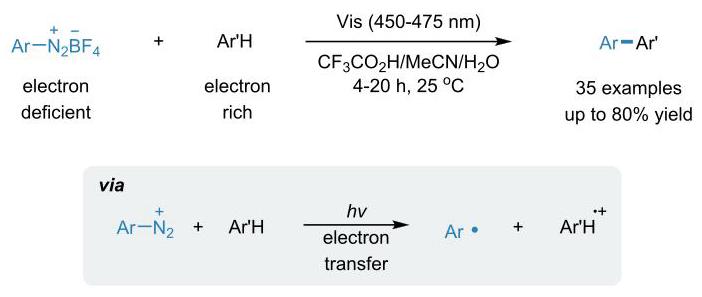
Scheme 47. Visible Light-Promoted Gomberg-Bachmann Reactions to Form Biaryls and C3-Arylated-2H-Indazoles
方案47. 可见光促进的形成联芳基和C3 - 芳基化 - 2H - 吲唑的冈伯格 - 巴赫曼反应
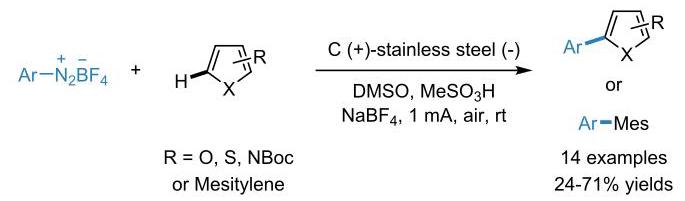
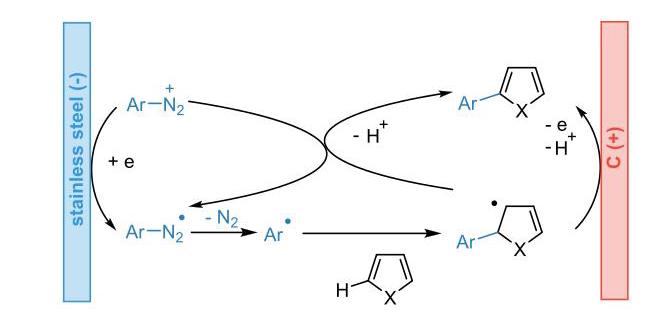
2.1.3.4. Electrochemical Approach. From the perspective of generating aryl radicals, the electrolytic process is considered as a complementary method for the Gomberg-Bachmann reaction. In 2018, Amaya et al. utilized the electrochemical method to the Gomberg-Bachmann reaction of aryl diazonium salts with heteroarenes (furans, pyrroles, thio-phenes, and mesitylene) in a simple undivided cell (Scheme 48). ${}^{117}$ However, the substrate scope of aromatics is limited to electron-rich arenes. A radical chain pathway and cathodic reduction of aryl diazonium salts followed by an anodic oxidation pathway are both proposed.
2.1.3.4. 电化学方法。从生成芳基自由基的角度来看,电解过程被认为是冈伯格 - 巴赫曼反应的一种补充方法。2018年,阿马亚等人在一个简单的无隔膜电解池中利用电化学方法进行芳基重氮盐与杂芳烃(呋喃、吡咯、噻吩和均三甲苯)的冈伯格 - 巴赫曼反应(方案48)。${}^{117}$然而,芳烃的底物范围仅限于富电子芳烃。提出了自由基链途径以及芳基重氮盐的阴极还原随后阳极氧化途径。
Scheme 48. Electrolytic Arylation of Aryl Diazonium Salts and Heteroarenes
方案48. 芳基重氮盐与杂芳烃的电解芳基化反应
mechanism
机理
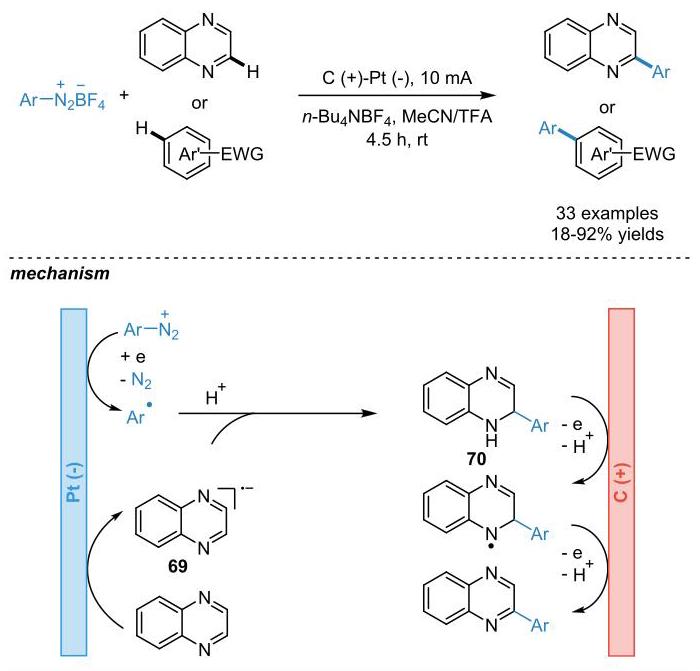
In 2019, the electrochemical method was applied to achieve the radical-type arylation of electron-deficient aromatics with aryl diazonium salts through reductive activation (Scheme 49). ${}^{118}$ Various electron-deficient arenes, including quinox-alinone, pyrazine, naphthyridine, pyridazine, quinoline, and isoquinoline derivatives, are amenable to this transformation within an undivided cell. Mechanistically, EPR results, control experiments, CV, and DFT calculations indicate that quinoxaline reduction serves as the vital step to achieve this electrolytic transformation. The in situ formed aryl radical reacts with the quinoxaline radical or radical anion 69 through radical-radical coupling to deliver 2-aryl-1,2-dihydroquinoxaline 70, followed by twice anode oxidation and deprotonation to provide the desired product.
2019年,电化学方法被应用于通过还原活化实现缺电子芳烃与芳基重氮盐的自由基型芳基化反应(方案49)。${}^{118}$各种缺电子芳烃,包括喹喔啉酮、吡嗪、萘啶、哒嗪、喹啉和异喹啉衍生物,在无隔膜电解池中都适用于这种转化。从机理上讲,电子顺磁共振结果、对照实验、循环伏安法和密度泛函理论计算表明喹喔啉的还原是实现这种电解转化的关键步骤。原位形成的芳基自由基通过自由基 - 自由基偶联与喹喔啉自由基或自由基阴离子69反应生成2 - 芳基 - 1,2 - 二氢喹喔啉70,随后经过两次阳极氧化和去质子化得到所需产物。
Scheme 49. Electrochemical Arylation of Electron-Deficient Arenes
方案49. 缺电子芳烃的电化学芳基化反应
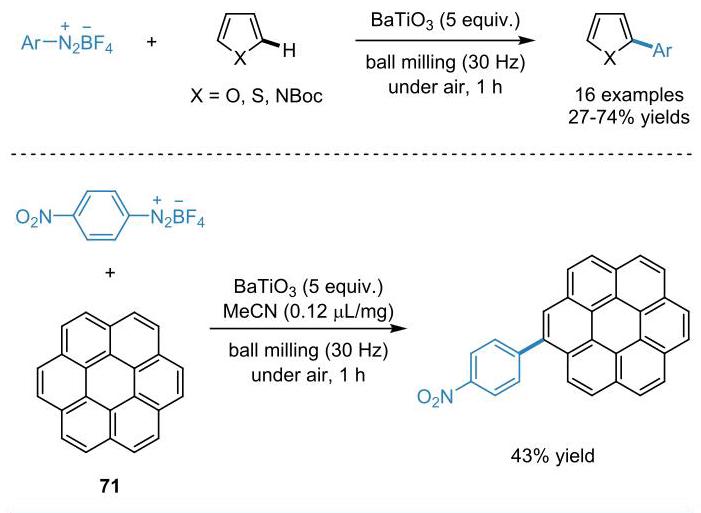
2.1.3.5. Mechanoredox Approach. Serving as a complement protocol to the previous transition-metal catalysis, organic molecule-initiated, photoredox, and electrochemical transformations, another novel oxidative quenching process involves the mechanoredox system upon ball milling, which promotes one electron from the valence band to the conduction band of ${\mathrm{{BaTiO}}}_{3}$ (Scheme 50). ${}^{119}$ The resulting aryl radical species successfully induce sequential arylation or borylation reaction. The practical applications of this strategy have been demonstrated by the gram-scale synthesis of 2- arylated heteroarenes and direct functionalization of PAH coronene 71.
2.1.3.5. 机械氧化还原方法。作为先前过渡金属催化、有机分子引发的光氧化还原和电化学转化的补充方案,另一种新型的氧化猝灭过程涉及球磨时的机械氧化还原体系,其将一个电子从价带提升到${\mathrm{{BaTiO}}}_{3}$的导带(方案50)。${}^{119}$生成的芳基自由基物种成功诱导了连续的芳基化或硼基化反应。该策略的实际应用已通过2 - 芳基化杂芳烃的克级合成和多环芳烃蔻71的直接官能团化得到证明。
Scheme 50. Mechanoredox Arylation by Using Ball Milling and Piezoelectric Materials
方案50. 使用球磨和压电材料的机械氧化还原芳基化反应
2.1.4. Radical Addition to Alkynes. Upon decomposing aryl diazonium salts, the in situ formed aryl radical can be intercepted by alkynes to generate an alkene radical, followed by sequential transformations to afford arylated products. Using gallic acid as the radical initiator, a photoredox- and metal-free aerobic difunctionalization of terminal alkynes 72 with aryl diazonium salts was disclosed (Scheme 51). ${}^{120}$ This mild protocol allows the synthesis of unprotected $\alpha$ -hydroxy
2.1.4. 自由基对炔烃的加成反应。芳基重氮盐分解后,原位生成的芳基自由基可被炔烃捕获生成烯基自由基,随后经过一系列转化得到芳基化产物。以没食子酸作为自由基引发剂,实现了末端炔烃72与芳基重氮盐的光氧化还原和无金属有氧双官能团化反应(方案51)。${}^{120}$ 该温和的反应方案能够以中等产率合成未保护的$\alpha$ -羟基
Scheme 51. Gallic Acid-Promoted Aerobic Coupling Reaction of Terminal Alkynes with Aryl diazonium Salts
方案51. 没食子酸促进的末端炔烃与芳基重氮盐的有氧偶联反应
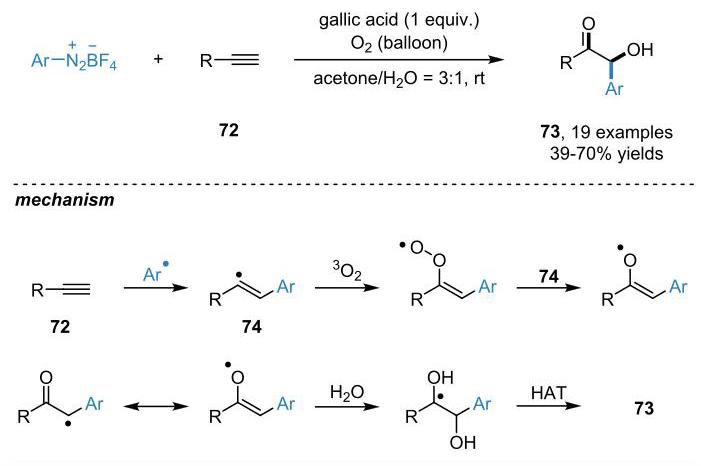
ketones 73 with moderate yields. The plausible mechanism involves the initial generation of an aryl radical, which reacts with the alkyne to produce an alkenyl radical species 74, followed by the reaction with dioxygen and water to afford the desired $\alpha$ -hydroxy ketones.
酮类化合物73。可能的反应机理为:首先生成芳基自由基,其与炔烃反应生成烯基自由基物种74,随后与氧气和水反应得到所需的$\alpha$ -羟基酮。
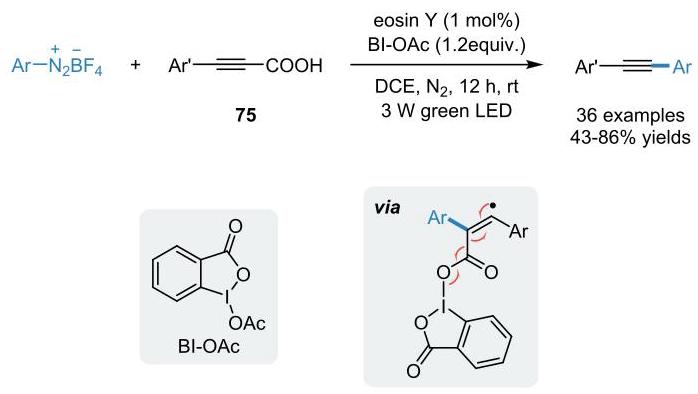
In 2019, Cheng reported visible-light-induced decarbox-ylative alkynylation of aryl diazonium salts with alkynyl carboxylic acids 75 (Scheme 52). ${}^{121}$ Using eosin Y as the photosensitizer and hypervalent iodine(III) reagent as the additive, this protocol enables the synthesis of diversely functionalized aryl alkynes under mild and transition-metal-free conditions upon visible-light irradiation. This protocol merged photoredox catalysis with decarboxylative alkynylation.
2019年,程等人报道了可见光诱导的芳基重氮盐与炔基羧酸75的脱羧炔基化反应(方案52)。${}^{121}$ 以曙红Y作为光敏剂,高价碘(III)试剂作为添加剂,该反应方案能够在可见光照射下,在温和且无过渡金属的条件下合成多种官能团化的芳基炔烃。此反应方案将光氧化还原催化与脱羧炔基化反应相结合。
Scheme 52. Decarboxylative Alkynylation of Aryl diazonium Salts with Alkynyl Carboxylic Acids
方案52. 芳基重氮盐与炔基羧酸的脱羧炔基化反应
2.1.5. Radical Addition to CO. In recent decades, the radical alkoxycarbonylation reaction involving the carbon-centered radical addition to $\mathrm{{CO}}$ has provided an alternative route to synthesize esters. However, most of these alkoxycarbonylations suffered from the employment of transition-metals, ${}^{122}$ or upon the UV light irradiation by Xe lamp. ${}^{123}$ The first transition-metal- and UV-light-free radical alkoxycarbonylation was disclosed using aryl halides as the substrates. ${}^{124}$ This thermal alkoxycarbonylation proceeded through a base-initiated radical-chain mechanism. It is still highly desirable to develop a mild and efficient radical alkoxycarbonylation process.
2.1.5. 自由基对CO的加成反应。近几十年来,涉及以碳为中心的自由基加成到$\mathrm{{CO}}$ 的自由基烷氧基羰基化反应为合成酯提供了一条替代途径。然而,大多数此类烷氧基羰基化反应需要使用过渡金属,${}^{122}$ 或者在Xe灯的紫外光照射下进行。${}^{123}$ 首次报道了以芳基卤化物为底物的无过渡金属和紫外光的自由基烷氧基羰基化反应。${}^{124}$ 该热烷氧基羰基化反应通过碱引发的自由基链机理进行。开发一种温和且高效的自由基烷氧基羰基化工艺仍然非常必要。
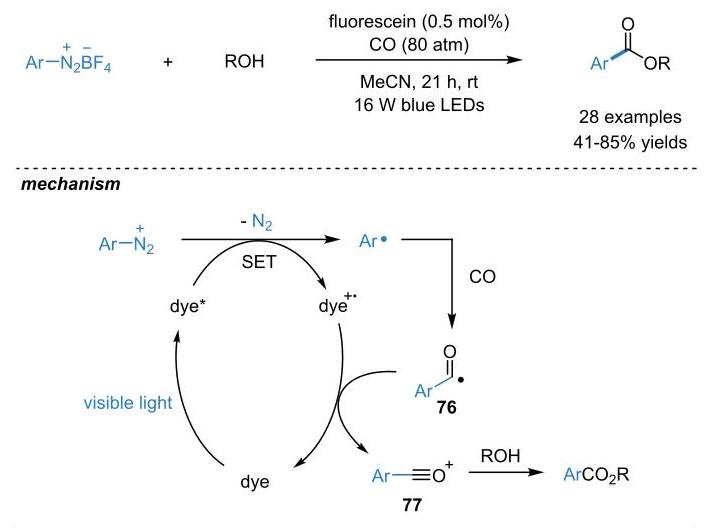
In 2015, Lu and Xiao reported the first radical alkoxycarboxylation of aryl diazonium salts using CO gas through a blue LED irradiation and metal-free conditions (Scheme 53). ${}^{125}$ As a synthetic method, this protocol is featured by a low loading of an organic dye as the photosensitizer, wide substrate scope, and mild reaction conditions. Mechanistically, oxidative quenching of fluorescein’s excited state with aryl diazonium ion occurs to generate the aryl radical. The aryl radical is trapped by CO to form a benzoyl radical 76, which is subsequently oxidized by dye radical cation, resulting in the generation of highly electrophilic acylium ion 77. Trapping of acylium ions by alcohol affords the alkoxycarboxylation product.
2015年,卢和肖报道了通过蓝色LED照射和无金属条件,使用CO气体对芳基重氮盐进行首次自由基烷氧基羰基化反应(方案53)。${}^{125}$ 作为一种合成方法,该反应方案的特点是作为光敏剂的有机染料负载量低、底物范围广且反应条件温和。从机理上讲,荧光素的激发态与芳基重氮离子发生氧化猝灭生成芳基自由基。芳基自由基被CO捕获形成苯甲酰基自由基76,随后被染料自由基阳离子氧化,生成高亲电性的酰鎓离子77。醇对酰鎓离子的捕获得到烷氧基羰基化产物。
Scheme 53. Fluorescein-Catalyzed Radical Alkoxycarbonylation of Aryl Diazonium Salts via Visible Light Photoredox Catalysis
方案53. 荧光素催化的芳基重氮盐通过可见光光氧化还原催化的自由基烷氧基羰基化反应
Almost at the same time, Wangelin and co-workers reported a similar visible light-driven radical alkoxycarboxylation using CO gas catalyzed by eosin Y, affording alkyl benzoates under metal-, base-, and ligand-free conditions (Scheme 54). ${}^{126}$ Compared with Xiao’s work, this protocol is amenable to synthesize tert-butyl esters with good yields, and the pressure of the CO atmosphere is relative low. The reaction mechanism is similar to the previous work.
几乎在同一时间,万格林及其同事报道了使用曙红Y催化的类似可见光驱动的CO气体自由基烷氧基羰基化反应,在无金属、无碱和无配体的条件下得到苯甲酸烷基酯(方案54)。${}^{126}$ 与肖的工作相比,该反应方案能够以良好的产率合成叔丁酯,并且CO气氛的压力相对较低。反应机理与之前的工作类似。
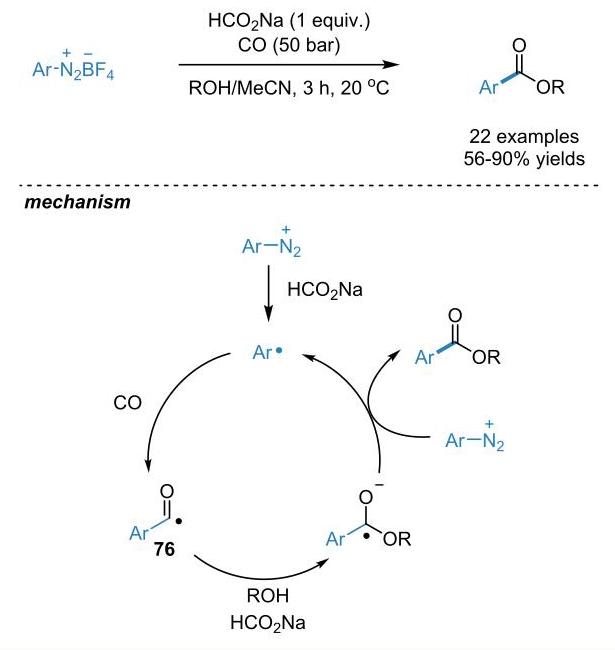
In 2017, the same group reported a metal- and photo-free radical aromatic carbonylations mediated by weak bases at room temperature (Scheme 55). ${}^{127}$ This reaction is initiated by SET of an in situ formed diazoformate adduct to form an aryl radical, followed by radical trapping with carbon monoxide and alcohols.
2017年,同一研究小组报道了在室温下由弱碱介导的无金属和无光的自由基芳基羰基化反应(方案55)。${}^{127}$ 该反应由原位形成的重氮甲酸酯加合物的单电子转移引发形成芳基自由基,随后与一氧化碳和醇进行自由基捕获反应。
Scheme 54. Eosin Y-Catalyzed Radical Alkoxycarbonylation of Aryl Diazonium Salts
方案54. 曙红Y催化的芳基重氮盐的自由基烷氧基羰基化反应
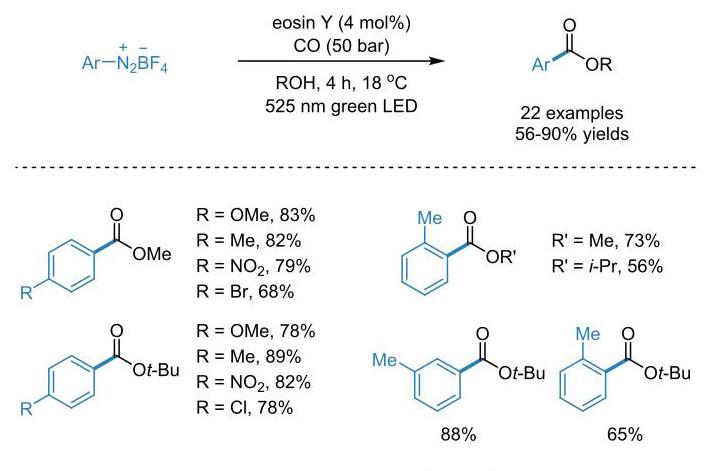
Scheme 55. Weak Base-Mediated Radical Alkoxycarbonylation of Aryl Diazonium Salts
方案55. 弱碱介导的芳基重氮盐的自由基烷氧基羰基化反应
2.1.6. Cascade Radical Cyclization. Cyclization of aryl diazonium salts with functionalized alkenes or alkynes has provided a facile and expeditious route to assembly of five- or six-membered rings, particularly for heterocyclic scaffold (Figure 3). This route usually proceeds through a transition-metal-catalyzed condition or radical cyclization pathway. The reaction pathway involves the photoinduced or organic promoted-initiated formation of aryl radicals, followed by selective radical addition to unsaturated bonds and a sequential cyclization process. This content will focus on the recent representative research in this area, summarized according to the scaffold of carbon or heterocyclic rings.
2.1.6. 串联自由基环化反应。芳基重氮盐与官能化烯烃或炔烃的环化反应为构建五元或六元环,尤其是杂环骨架,提供了一种简便快捷的途径(图3)。该途径通常通过过渡金属催化条件或自由基环化途径进行。反应途径包括光诱导或有机促进引发生成芳基自由基,随后选择性地将自由基加成到不饱和键上并进行连续的环化过程。本内容将重点介绍该领域最近的代表性研究,并根据碳环或杂环骨架进行总结。>
First, the facile assembly of an oxindoles scaffold has been realized through the intermolecular aryl radical addition and cyclization cascade. ${}^{{128} - {130}}$ As for constructing of a five-membered ring scaffold, a visible light-mediated radical arylation reaction of $N$ -arylacrylamides 78 with aryl diazonium salts was realized, affording a variety of 3,3-disubstituted oxindoles 79 under mild conditions (Scheme 56). ${}^{128}$ This photoredox protocol represents a novel approach for assembly heterocycles upon visible-light irradiation. The plausible mechanism includes the initial oxidative quenching process of excited state Ru(II)* to generate an aryl radical, which adds to the $N$ -arylacrylamides 78 affording an alkyl radical 80. Intramolecular cyclization, single-electron oxidation by Ru- (III), and final dehydrogenation occur in sequence, delivering oxindoles 79 derivatives and regenerating the photocatalyst.
首先,通过分子间芳基自由基加成和环化串联反应,实现了异吲哚酮骨架的简便构建。${}^{{128} - {130}}$ 至于构建五元环骨架,实现了可见光介导的$N$ -芳基丙烯酰胺78与芳基重氮盐的自由基芳基化反应,在温和条件下得到了各种3,3 - 二取代异吲哚酮79(方案56)。${}^{128}$ 这种光氧化还原方法代表了一种在可见光照射下组装杂环的新方法。合理的机理包括激发态Ru(II)*的初始氧化猝灭过程以生成芳基自由基,该自由基加成到$N$ -芳基丙烯酰胺78上得到烷基自由基80。随后依次发生分子内环化、Ru(III)的单电子氧化以及最终的脱氢反应,生成异吲哚酮79衍生物并再生光催化剂。
Scheme 56. Synthesis of Oxindoles by Radical Reactions of Aryl Diazonium Salts with N-Arylacrylamides
方案56. 芳基重氮盐与N - 芳基丙烯酰胺的自由基反应合成异吲哚酮
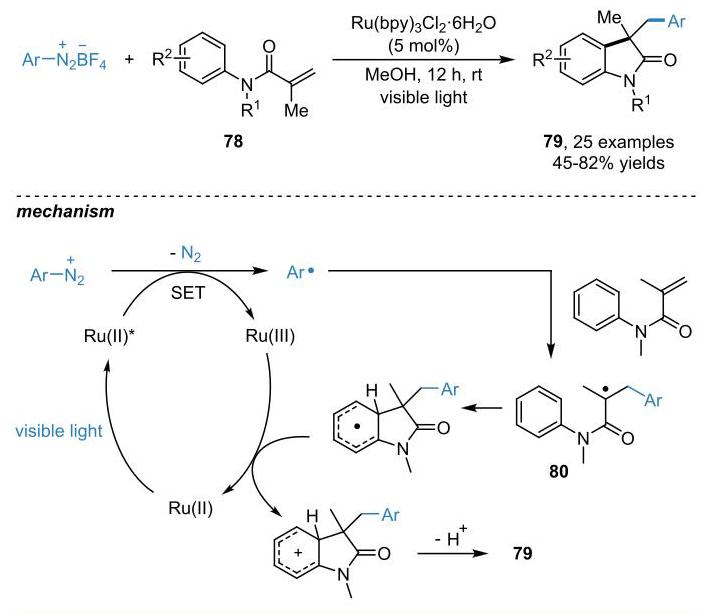
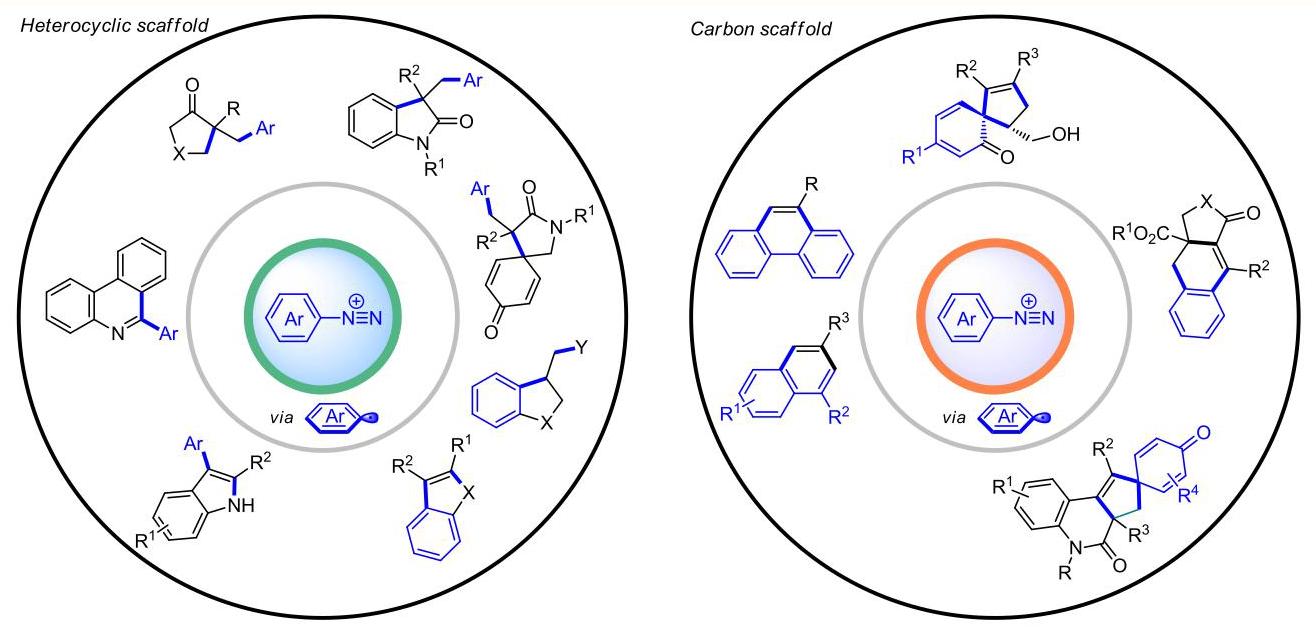
Figure 3. Diverse cyclic scaffold derived from radical and catalytic cyclization cascade reactions.
图3. 由自由基和催化环化串联反应衍生的各种环状骨架
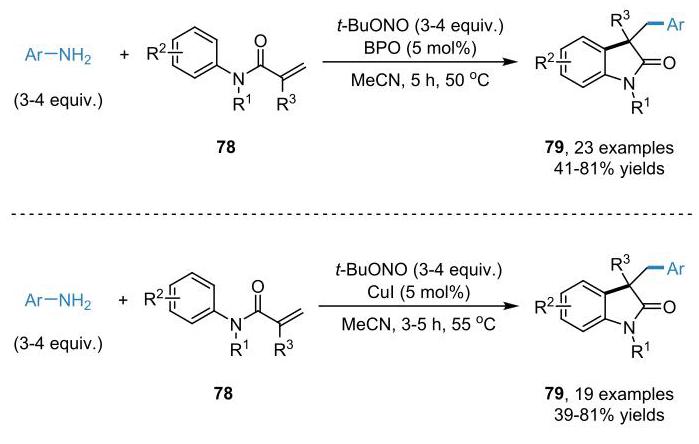
Another similar assembly of the oxindole scaffold was realized by a mild radical $\mathrm{C} - \mathrm{H}$ cyclization reaction of anilines with $N$ -arylacrylamides 78, affording the pharmaceutically important 3-benzyl-3-alkyloxindole scaffold 79 with moderate to good yields (Scheme 57). ${}^{129}$ In the presence of BPO as the radical initiator and $t$ -BuONO as the diazotization reagent, this protocol proceeds under metal- and photoredox-free conditions. The same group also reported a Cu(I)-catalyzed Meerwein carboarylation process to form 3-benzyl-3-alkylox-indoles. ${}^{130}$
通过苯胺与$N$-芳基丙烯酰胺78进行温和的自由基$\mathrm{C} - \mathrm{H}$环化反应,实现了另一种类似的氧化吲哚骨架组装,以中等至良好的产率得到了具有药学重要性的3-苄基-3-烷基氧化吲哚骨架79(方案57)。${}^{129}$在BPO作为自由基引发剂和$t$-丁基亚硝酸酯作为重氮化试剂的存在下,该方案在无金属和光氧化还原条件下进行。同一研究小组还报道了一种铜(I)催化的Meerwein碳芳基化过程,以形成3-苄基-3-烷基氧化吲哚。${}^{130}$
Scheme 57. Radical C-H Cyclization Reaction of Anilines with $N$ -Arylacrylamides
方案57. 苯胺与$N$ -芳基丙烯酰胺的自由基C - H环化反应
In 2018, with a photocatalyzed cascade intermolecular addition/cyclization cascade strategy, Tang and co-workers developed a rapid synthetic route to azaspirocyclic cyclo-hexadienones 82 from $N$ -benzylacrylamides 81 with aryl diazonium salts under mild conditions (Scheme 58). ${}^{131}$ The reaction pathway includes the Ru-catalyzed photoredox generation of the aryl radical, followed by radical addition/ intramolecular cyclization/single-electron oxidation by Ru(III) to form a carbenium ion 83. This cation undergoes C-F bond cleavage applying ${\mathrm{H}}_{2}\mathrm{O}$ as an external oxygen source and final base-promoted deprotonation to deliver azaspirocyclic cyclo-hexadienones 82 scaffolds.
2018年,Tang及其同事采用光催化串联分子间加成/环化策略,在温和条件下从$N$ -苄基丙烯酰胺81与芳基重氮盐开发了一种快速合成氮杂螺环环己二烯酮82的路线(方案58)。${}^{131}$ 反应途径包括Ru催化的光氧化还原生成芳基自由基,随后通过Ru(III)进行自由基加成/分子内环化/单电子氧化以形成碳正离子83。该阳离子以${\mathrm{H}}_{2}\mathrm{O}$ 作为外部氧源进行C - F键裂解,并最终通过碱促进的去质子化得到氮杂螺环环己二烯酮82骨架。
Scheme 58. Photocatalyzed Cascade Cyclization to Afford Azaspirocyclic Cyclohexadienones
方案58. 光催化串联环化反应制备氮杂螺环环己二烯酮
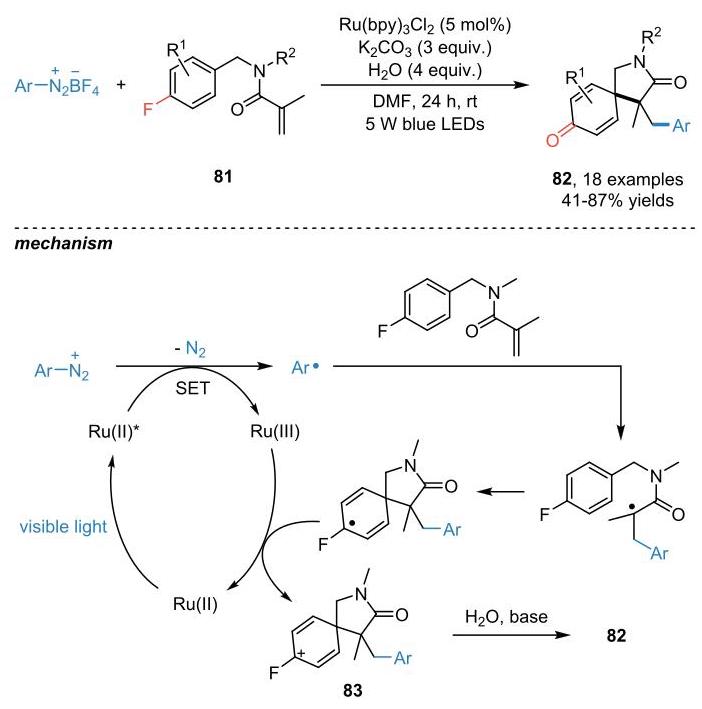
Apart from the intermolecular cyclization process, the Studer group developed the intramolecular radical carboiodination, carbotelluration, and carboaminoxylation of in situ generated aryl diazonium salts from arylamines (Scheme 59). ${}^{132}$ The reaction pathway includes the formation of aryl radicals, which undergo selective 5-exo or 6-exo cyclization. The cyclized alkyl radicals 84 proceed through iodine abstraction in a chain reaction to obtain carboiodinated products with good yields, or trapped by PhTeTePh or TEMPO to provide the corresponding carbotelluration and carboaminoxylation products, respectively.
除了分子内环化过程,Studer小组开发了由芳胺原位生成的芳基重氮盐的分子内自由基碳碘化、碳碲化和碳氨氧基化反应(方案59)。${}^{132}$ 反应途径包括芳基自由基的形成,该自由基进行选择性的5 - 外向或6 - 外向环化。环化的烷基自由基84通过链反应中的碘原子夺取反应以良好的产率得到碳碘化产物,或者被PhTeTePh或TEMPO捕获,分别提供相应的碳碲化和碳氨氧基化产物。
Scheme 59. Radical Carboiodination, Carbotelluration, and Carboaminoxylation of Arylamines
方案59. 芳胺的自由基碳碘化、碳碲化和碳氨氧基化反应
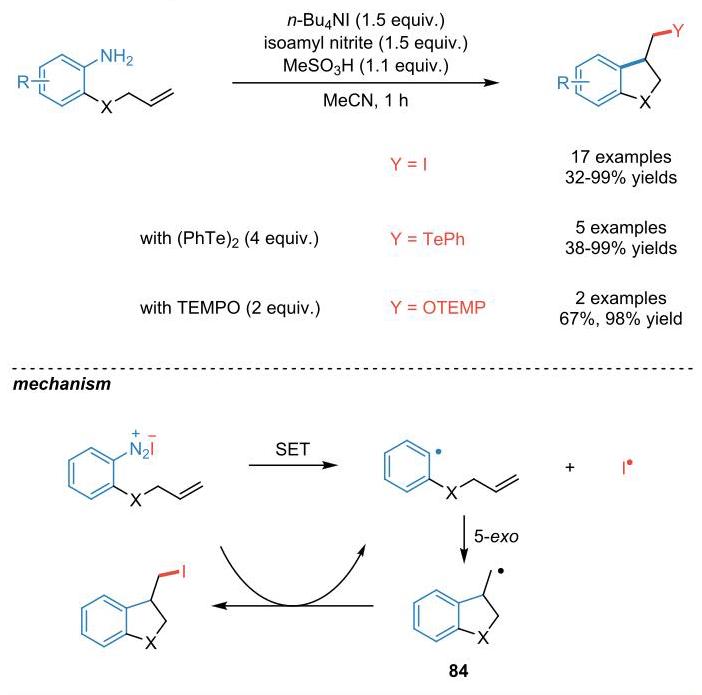
In addition to radical addition with an alkene moiety, a radical 5-exo cyclization of 2-allyloxyphenyldiazonium salts 85 with alkynes has also been developed, achieving the diastereoselective synthesis of highly functionalized ortho-spirocyclohexadienones 86 with moderate to good yields (Scheme 60). ${}^{133}$ This formal $\left\lbrack {2 + 2 + 1}\right\rbrack$ cyclization process provides a complementary route to afford all-carbon spiro-five-membered rings.
除了与烯烃部分进行自由基加成反应外,还开发了2-烯丙氧基苯基重氮盐85与炔烃的自由基5-外环化反应,以中等至良好的产率实现了高官能化邻位螺环环己二烯酮86的非对映选择性合成(方案60)。${}^{133}$ 这种形式上的$\left\lbrack {2 + 2 + 1}\right\rbrack$ 环化过程提供了一条互补的途径来构建全碳螺五元环。
Another formal $\left\lbrack {2 + 2 + 1}\right\rbrack$ cycloaddition from anilines was developed through a radical deaminative ipso-cyclization of 4- methoxyanilines with $N$ -tethered 1,7-enynes 87, affording spirocyclohexadienone-containing cyclopenta[c]quinolin-4- ones 88 with two all-carbon quaternary stereocenters in one step (Scheme 61). ${}^{134}$ This radical cascade reaction proceeds through radical type 6-exo-dig/5-exo-trig ipso-cyclization/ single-electron oxidation to assemble cyclopenta[c]quinolin- 4-ones under oxidant-free thermal conditions.
另一种通过4-甲氧基苯胺与$N$ -连接的1,7-烯炔87进行自由基脱氨基原位环化反应,开发了一种从苯胺出发的形式上的$\left\lbrack {2 + 2 + 1}\right\rbrack$ 环加成反应,一步合成了含有两个全碳季碳立体中心的含螺环己二烯酮的环戊[c]喹啉-4-酮88(方案61)。${}^{134}$ 这种自由基串联反应通过自由基类型的6-外环化/5-外环化原位环化/单电子氧化过程,在无氧化剂的热条件下组装环戊[c]喹啉-4-酮。
The benzo-fused five-membered heterocycles represent a ubiquitous scaffold in natural products. Particularly, benzo[b]- heteroles containing heteroatoms other than nitrogen and oxygen have received considerable attention for their potential applications in materials science. ${}^{135}$ In 2016, the synthesis of functionalized benzothiophenes 89 or benzoselenophene 90 was disclosed through the intermolecular radical cascade reaction of $o$ -methylthio- or $o$ -methylselanyl-arylamines (Scheme 62). ${}^{136}$ The proposed mechanism involves the initial diazotization and generation of an aryl radical, which adds to the alkyne moiety to afford the vinyl radical intermediate. Subsequently, intramolecular homolytic substitution at the sulfur atom or selenium atom occurs, delivering final benzo[b]heterole derivatives 89/90.
苯并稠合的五元杂环是天然产物中普遍存在的骨架。特别是,含有除氮和氧以外杂原子的苯并[b]杂环因其在材料科学中的潜在应用而受到了相当多的关注。${}^{135}$ 2016年,通过$o$ -甲硫基-或$o$ -甲硒基-芳胺的分子间自由基串联反应,公开了官能化苯并噻吩89或苯并硒吩90的合成方法(方案62)。${}^{136}$ 提出的机理涉及最初的重氮化反应和芳基自由基的生成,该自由基加成到炔烃部分生成乙烯基自由基中间体。随后,在硫原子或硒原子上发生分子内均裂取代反应,得到最终的苯并[b]杂环衍生物89/90。
Scheme 60. Selective Radical Cyclization of 2- Allyloxyphenyldiazonium Ions with Alkynes
方案60. 2-烯丙氧基苯基重氮离子与炔烃的选择性自由基环化反应
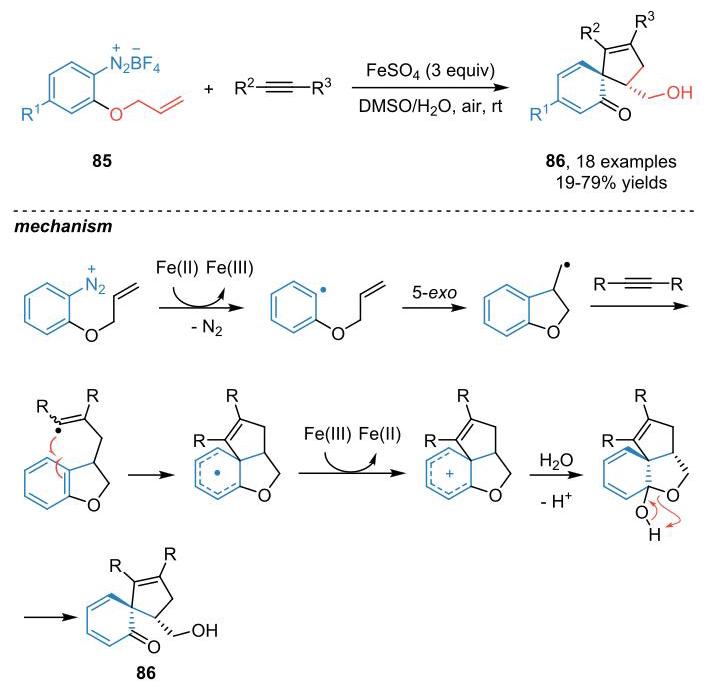
Scheme 61. Synthesis of Spirocyclohexadienone-Containing Cyclopenta[c]quinolin-4-ones
方案61. 含螺环己二烯酮的环戊[c]喹啉-4-酮的合成
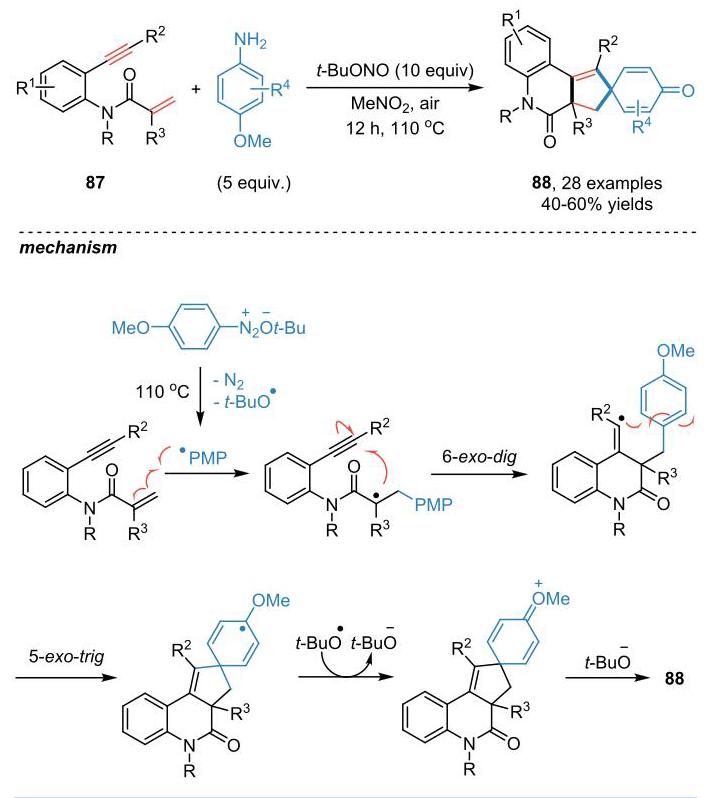
Scheme 62. Synthesis of Benzothiophenes or Benzoselenophene through Radical Cascade Reactions
方案62. 通过自由基串联反应合成苯并噻吩或苯并硒吩
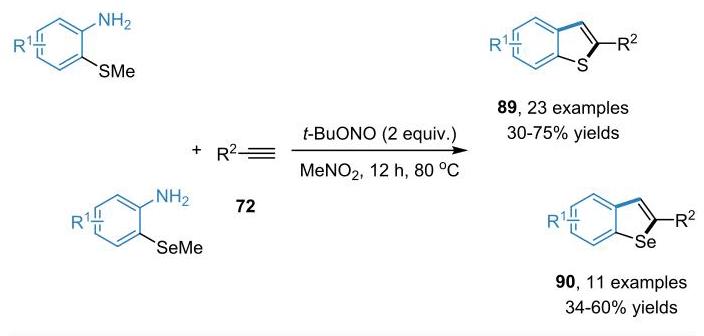
In addition, the photoredox system has emerged as an efficient route to access the synthesis of benzo-fused five-membered heterocycles, especially for indoles. A visible light-mediated cyclization of o-azidoarylalkynes 91 with aryl diazonium salts was catalyzed by eosin Y in the presence of 1,4-cyclohexadiene (1,4-CHD), enabling a transition-metal-free route for the synthesis of unsymmetrical 2,3-diarylated indoles 92 (Scheme 63). ${}^{137}$
此外,光氧化还原体系已成为合成苯并稠合五元杂环,特别是吲哚的有效途径。在1,4-环己二烯(1,4-CHD)存在下,曙红Y催化邻叠氮芳基炔烃91与芳基重氮盐的可见光介导环化反应,为合成不对称2,3-二芳基吲哚92提供了一条无过渡金属的途径(方案63)。${}^{137}$
Scheme 63. Photoredox Cyclization to Afford Indoles
方案63. 光氧化还原环化反应制备吲哚
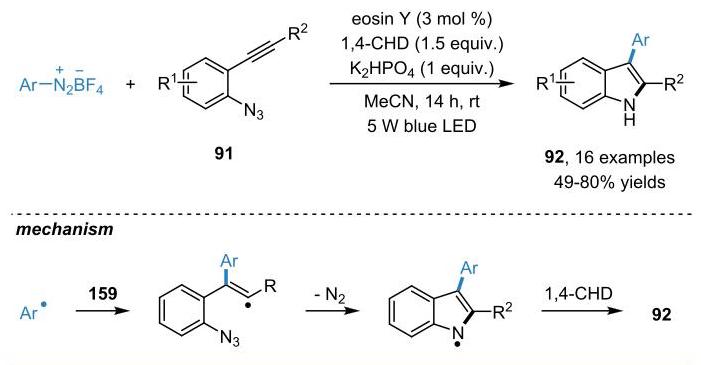
Moreover, the combination of a ring-opening rearrangement with radical arylation presents a novel route to synthesize cyclic ketones. According to this strategy, Kim and co-workers reported a visible-light-induced photoredox catalytic arylation/ ring expansion cascade reaction of 1-(1-arylvinyl)cyclobutanols 93 with aryl diazonium salts, giving rise to functionalized cyclic ketones under mild conditions (Scheme 64). ${}^{138}$ The proposed reaction pathway includes the photoinduced formation of an aryl radical and sequential selective addition to 1-(1-arylvinyl)- cyclobutanols to afford alkyl radical 94. This alkyl radical 94 is oxidized by Ru(III) or aryl diazonium ions through a radical-chain pathway to obtain a benzylic carbenium ion 95, followed by 1,2-migration to deliver ring expansion products.
此外,开环重排与自由基芳基化的结合为合成环状酮提供了一条新途径。根据这一策略,Kim及其同事报道了1-(1-芳基乙烯基)环丁醇93与芳基重氮盐的可见光诱导光氧化还原催化芳基化/环扩展串联反应,在温和条件下生成官能化环状酮(方案64)。${}^{138}$ 提出的反应途径包括光诱导形成芳基自由基,并依次选择性加成到1-(1-芳基乙烯基)环丁醇上生成烷基自由基94。该烷基自由基94通过自由基链途径被Ru(III)或芳基重氮离子氧化,得到苄基碳正离子95,随后进行1,2-迁移以生成环扩展产物。
On the other hand, this cyclization cascade strategy has also been utilized in the concise construction of six-membered rings. In 2014, the Studer group developed a base-promoted homolytic aromatic substitution of ortho-amino-biphenyls and alkynes 72, assembling phenanthrene scaffold 96 under transition-metal- and photofree thermal conditions (Scheme 65). ${}^{139}$ Mechanistically, the biaryl diazonium salts are generated in situ from biarylamines using isoamyl nitrite as the diazotization reagent. After single-electron reduction using TBAI as the chain initiator, the corresponding biaryl radical forms, followed by addition to an alkyne and subsequent base promoted homolytic aromatic substitution, affording phenan-threnes 96 in moderate to good yields.
另一方面,这种环化串联策略也已用于六元环的简洁构建。2014年,施图德小组开发了一种碱促进的邻氨基联苯和炔烃的均裂芳香取代反应72,在无过渡金属和光的热条件下组装菲骨架96(方案65)。${}^{139}$ 从机理上讲,使用亚硝酸异戊酯作为重氮化试剂,由联芳基胺原位生成联芳基重氮盐。以四丁基碘化铵作为链引发剂进行单电子还原后,形成相应的联芳基自由基,然后加成到炔烃上,随后进行碱促进的均裂芳香取代反应,以中等至良好的产率得到菲96。
Scheme 64. Photoredox Arylative/Ring Expansion of 1-(1- Arylvinyl)cyclobutanols
方案64. 1-(1-芳基乙烯基)环丁醇的光氧化还原芳基化/扩环反应
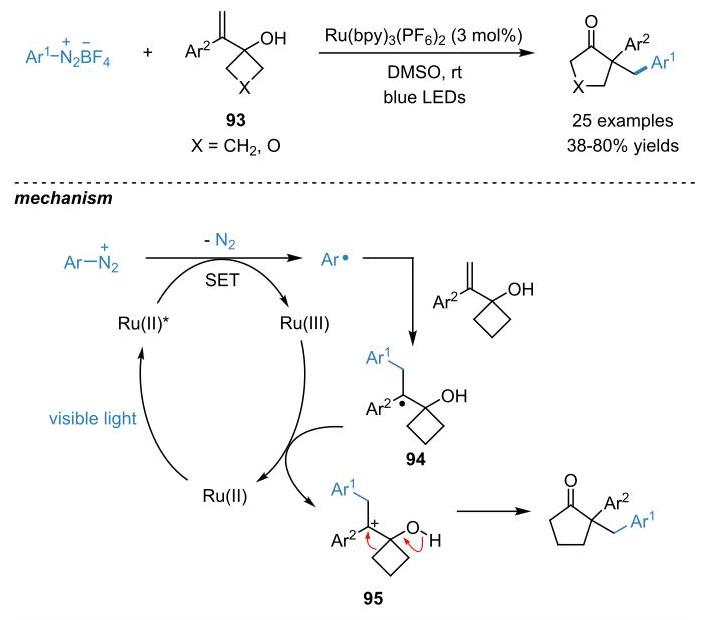
Scheme 65. Cyclization of ortho-Amino-Biphenyls and Alkynes
方案65. 邻氨基联苯和炔烃的环化反应
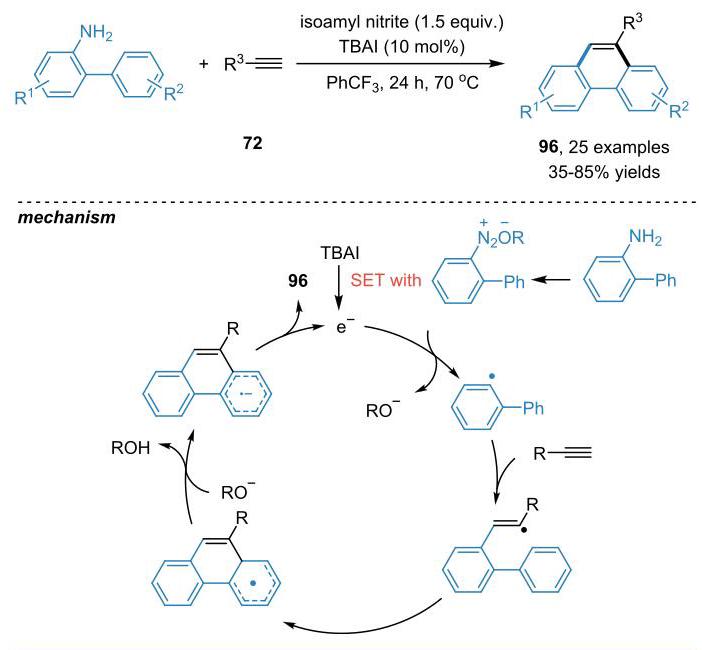
Cho and co-workers utilized a visible light-promoted photocatalytic strategy to realize cyclization to achieve the synthesis of polyheteroaromatic compounds (Scheme 66). ${}^{{140},{141}}$ With 2-heteroaryl amines as the substrates, this photoredox protocol allows the synthesis of polycyclic heteroaromatics, and the gram-scale synthesis of 9-phenyl-phenanthrene. This process is initiated by $t$ -BuONO-mediated diazotization, followed by photoredox SET oxidation to generate the aryl radical. Subsequent selective addition/ intramolecular cyclization/oxidation by Ir(IV)/deprotonation occurs, affording polyheteroaromatic products along with the regeneration of Ir(III).
赵等人利用可见光促进的光催化策略实现环化反应,以合成多杂芳族化合物(方案66)。${}^{{140},{141}}$ 以2-杂芳基胺为底物,这种光氧化还原方法可以合成多环杂芳烃,并能进行9-苯基菲的克级合成。该过程由$t$ -丁基亚硝酸酯介导的重氮化反应引发,随后通过光氧化还原单电子转移氧化生成芳基自由基。随后发生Ir(IV)介导的选择性加成/分子内环化/氧化/去质子化反应,得到多杂芳族产物并使Ir(III)再生。
Scheme 66. Photoredox Synthesis of Polyheteroaromatics
方案66. 多杂芳烃的光氧化还原合成

Additionally, this radical [4 + 2] benzannulation procedure from ortho-amino-biphenyls and alkynes enables the expeditious synthesis of various benzo-fused ring scaffolds, affording phenanthrenes ${97},{}^{142}$ naphthalenes ${98},{}^{143}$ and tetrazolo[1,5- a]quinoline ${99}^{144}$ under light-free thermal conditions or at room temperature (Scheme 67).
此外,这种由邻氨基联苯和炔烃进行的自由基[4 + 2]苯并环化反应能够快速合成各种苯并稠环骨架,在无光热条件下或室温下得到菲${97},{}^{142}$ 萘${98},{}^{143}$ 和四唑并[1,5-a]喹啉${99}^{144}$ (方案67)。
Scheme 67. Radical [4 + 2] Benzannulation from ortho-Amino-Biphenyls and Alkynes
方案67. 邻氨基联苯和炔烃的自由基[4 + 2]苯并环化反应
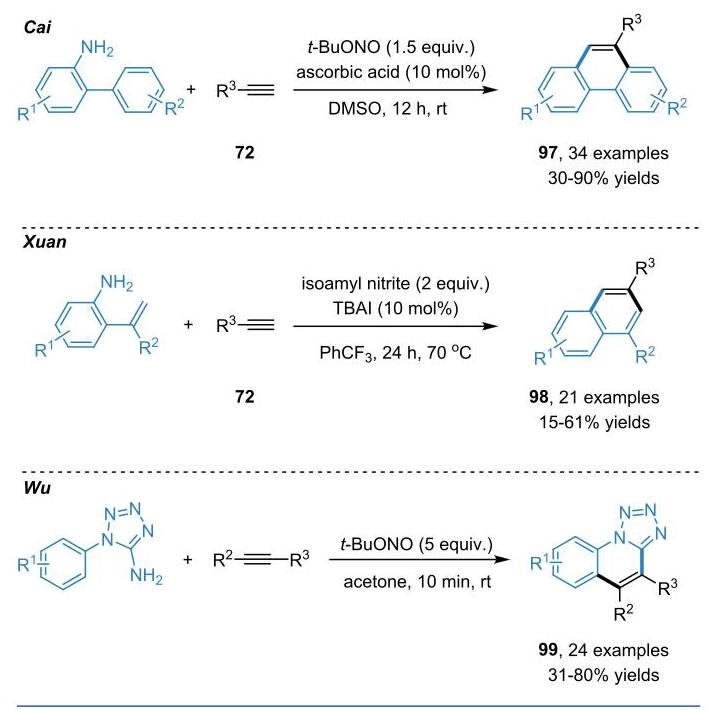
Apart from the selective cyclization with the substrates of alkynes, a transition-metal- and light-free arylative cyclization of 2-isocyanobiphenyls 100 with arylamines was reported, accessing the synthesis of 6-aryl phenanthridine derivatives 101 in a one-pot manner (Scheme 68). ${}^{145}$ This reaction pathway is initiated by the addition of thermal-initiated aryl radical to isocyanobiphenyls 100 to form an imidoyl radical 102. Subsequently, the intramolecular homolytic aromatic substitution of 102 occurs on the pending ring, affording a cyclohexadienyl radical 103. Next, either the SET oxidation to afford cyclohexadienyl cation followed by deprotonative aromatization, or the deprotonation of the cyclohexadienyl radical first followed by SET, can both direct the formation of phenanthridine products 101.
除了与炔烃底物进行选择性环化反应外,还报道了2-异氰基联苯100与芳胺的无过渡金属和光的芳基化环化反应,以一锅法合成6-芳基菲啶衍生物101(方案68)。${}^{145}$ 该反应途径由热引发的芳基自由基加成到异氰基联苯100上形成亚氨基酰基自由基102开始。随后,102在悬垂环上发生分子内均裂芳香取代反应,得到环己二烯基自由基103。接下来,要么通过单电子转移氧化得到环己二烯基阳离子,然后进行去质子芳构化,要么先对环己二烯基自由基进行去质子化,然后进行单电子转移,都可以导向菲啶产物101的形成。
Studer and co-workers realized the cascade radical cyclization of 1,6-enynes with aryl diazonium salts by electron catalysis, affording polycyclic structures in one step (Scheme 69). In 2016, they realized the facile construction of biologically important polycyclic $\gamma$ -lactams and lactones through this radical cascade strategy under transition-metal-free thermal conditions. ${}^{146}$ The reaction mechanism involves initial LiI-promoted SET of the aryl diazonium ion to form an aryl radical. Chemoselective radical addition to the alkene moiety of 1,6-enyne provides tertiary alkyl radical 104, which undergoes a subsequent 5-exo-dig cyclization to deliver vinyl radical 105. Next, intramolecular cyclization/deprotonation/ SET oxidation occurs to afford a polycyclic $\gamma$ -lactam product. The same group also reported a cascade radical cyclization of 1,6-enynes using TBAI as a chain initiator, affording a broad range of polycyclic compounds in moderate yields. ${}^{147}$
施图德等人通过电子催化实现了1,6-烯炔与芳基重氮盐的串联自由基环化反应,一步得到多环结构(方案69)。2016年,他们通过这种自由基串联策略在无过渡金属的热条件下轻松构建了具有生物学重要性的多环$\gamma$ -内酰胺和内酯。${}^{146}$ 反应机理包括芳基重氮离子首先由碘化锂促进的单电子转移形成芳基自由基。对1,6-烯炔的烯烃部分进行化学选择性自由基加成得到叔烷基自由基104,其随后进行5-外向-环化反应生成乙烯基自由基105。接下来,发生分子内环化/去质子化/单电子转移氧化反应,得到多环$\gamma$ -内酰胺产物。同一研究小组还报道了以四丁基碘化铵作为链引发剂的1,6-烯炔的串联自由基环化反应,以中等产率得到多种多环化合物。${}^{147}$
Scheme 68. Arylative Cyclization of 2-Isocyanobiphenyls to Afford 6-Aryl Phenanthridines
方案68. 2-异氰基联苯的芳基化环化反应制备6-芳基菲啶
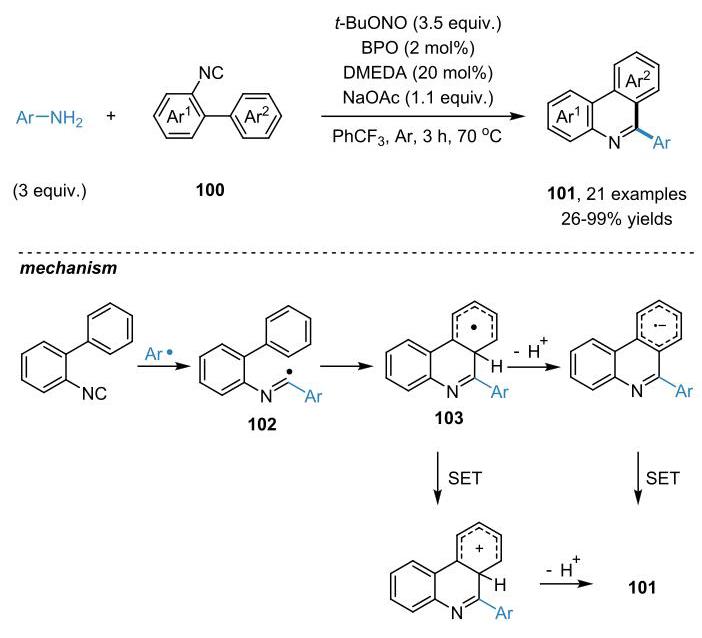
Scheme 69. Cascade Radical Cyclization of 1,6-Enynes with Aryl diazonium Salts
方案69. 1,6-烯炔与芳基重氮盐的串联自由基环化反应
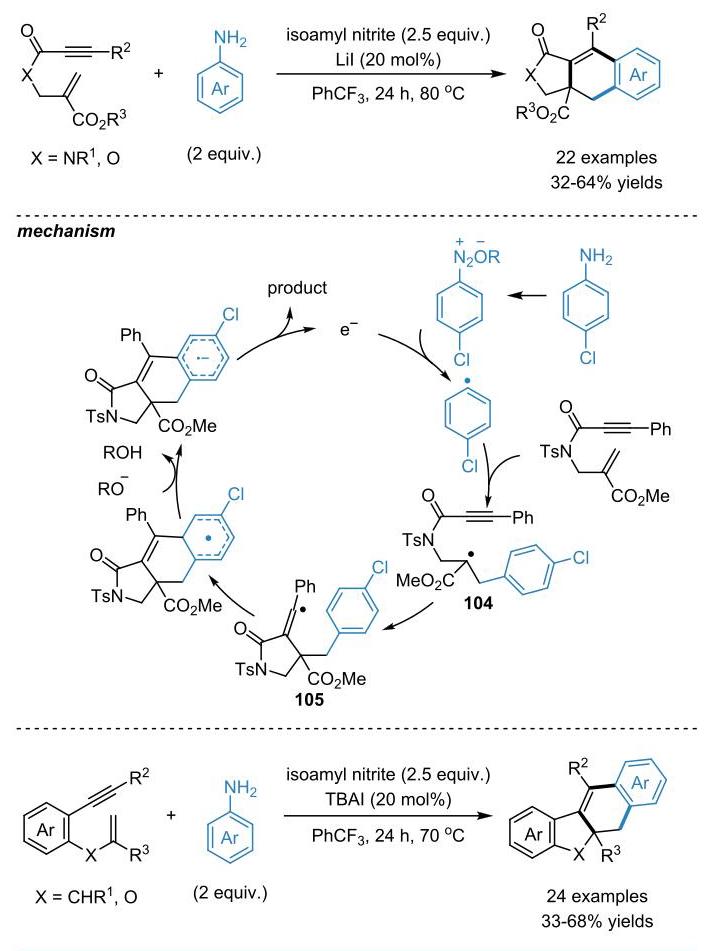
2.1.7. $\mathrm{C} - \mathrm{{CN}},\mathrm{C} - {\mathrm{{CF}}}_{3}$ , and $\mathrm{C} - {\mathrm{{CF}}}_{2}\mathrm{X}$ Bond Formations. 2.1.7.1. C-CN Bond Formations. Traditional Sandmeyer-type cyanation of aryl diazonium salts has been widely used in constructing the aryl $\mathrm{C} - \mathrm{{CN}}$ bond, which usually needs the participation of stoichiometric copper salts. The selective advances emphasize expanding substrates scope and investigating new efficient catalytic systems, including the radical-type cyanations and several transition-metal-catalyzed coupling reactions for constructing C-CN bonds.
2.1.7. $\mathrm{C} - \mathrm{{CN}},\mathrm{C} - {\mathrm{{CF}}}_{3}$ 键和 $\mathrm{C} - {\mathrm{{CF}}}_{2}\mathrm{X}$ 键的形成。2.1.7.1. C-CN键的形成。传统的桑德迈尔型芳基重氮盐氰化反应已广泛用于构建芳基 $\mathrm{C} - \mathrm{{CN}}$ 键,该反应通常需要化学计量的铜盐参与。选择性研究的进展重点在于扩大底物范围和研究新型高效催化体系,包括自由基型氰化反应以及几种用于构建C-CN键的过渡金属催化偶联反应。
Recently, Cu-mediated Sandmeyer-type, as well as Pd-catalyzed cyanation of aryl diazonium salts, has been applied as an efficient route to access benzonitrile derivatives. ${}^{148}$ As shown in Scheme 70, a ${\mathrm{{Cu}}}_{2}\mathrm{O}$ -mediated cyanation of aryl diazonium salts was realized by using trimethylsilyl cyanide 106 as the cyano source. ${}^{149}$ This mild protocol affords aromatic nitriles with good yields in the presence of a substoichiometric amount of nontoxic, inexpensive ${\mathrm{{Cu}}}_{2}\mathrm{O}$ . In 2016, Dughera disclosed a copper-free cyanation of aryl diazonium o-benzenedisulfonimides 107 using tetrabutyl ammonium cyanide 108 as a safe cyanide source, which represents a rare case of the transition-metal-free Sandmeyer cyanation reaction. ${}^{150}$ This reaction features good functional group tolerance and the ability to recover o-benzenedisulfoni-mide for preparing other salts. The o-benzenedisulfonimide anion is assumed to facilitate the SET process.
最近,铜介导的桑德迈尔型反应以及钯催化的芳基重氮盐氰化反应已被用作制备苯甲腈衍生物的有效途径。${}^{148}$ 如图70所示,使用三甲基硅基氰化物106作为氰基源实现了 ${\mathrm{{Cu}}}_{2}\mathrm{O}$ 介导的芳基重氮盐氰化反应。${}^{149}$ 该温和的反应方案在亚化学计量的无毒、廉价 ${\mathrm{{Cu}}}_{2}\mathrm{O}$ 存在下能以良好的产率得到芳香腈。2016年,杜格拉报道了使用四丁基氯化铵108作为安全氰化物源对芳基邻苯二磺酰亚胺107进行无铜氰化反应,这是无过渡金属桑德迈尔氰化反应的罕见例子。${}^{150}$ 该反应具有良好的官能团耐受性以及回收邻苯二磺酰亚胺用于制备其他盐的能力。邻苯二磺酰亚胺阴离子被认为有助于单电子转移过程。
Scheme 70. Cu-Mediated and Cu-free Cyanation of Aryl Diazonium Salts
方案70. 铜介导和无铜的芳基重氮盐氰化反应
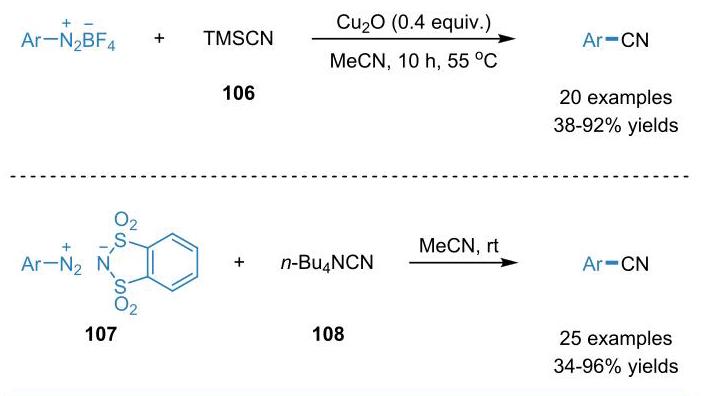
Additionally, another cyanation strategy involves the Pd-catalyzed oxidative cross-coupling reactions of aryl diazonium salts with various cyano sources (Scheme 71). A common and nontoxic organic solvent acetonitrile ${}^{151}$ and NCTS ( $N$ -cyano- $N$ -phenyl- $p$ -toluenesulfonamide ${)}^{152}$ have been developed in the cyanation in the presence of silver(I) salts under ambient air.
此外,另一种氰化策略涉及钯催化的芳基重氮盐与各种氰基源的氧化交叉偶联反应(方案71)。在环境空气中银(I)盐存在下,已开发出一种常见且无毒的有机溶剂乙腈 ${}^{151}$ 和NCTS($N$ -氰基-$N$ -苯基-$p$ -甲苯磺酰胺 ${)}^{152}$ 用于氰化反应。
Scheme 71. Pd-Catalzyed Cyanation of Aryl Diazonium Salts
方案71. 钯催化的芳基重氮盐氰化反应
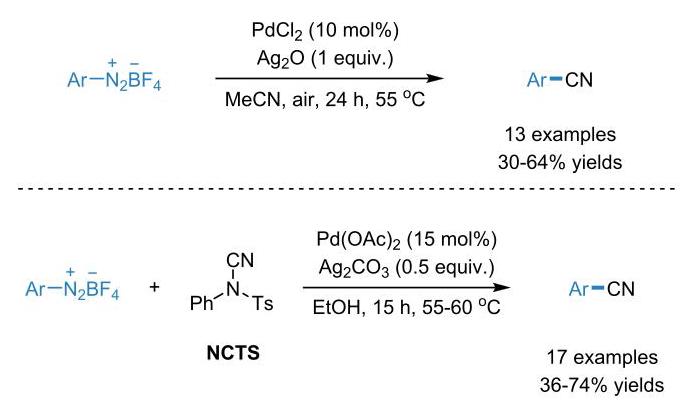
In 2019, Chia reported copper-free Sandmeyer-type cyanation of anilines using tert-butyl isocyanide under mild conditions. ${}^{153}$ This Cu- and solvent-free protocol affords aryl nitriles in moderate to good yields (10 examples, 52-81% yields), which reveals that the tert-butyl isocyanide can serve as a potential cyanide source for the cyanation reaction.
2019年,基亚报道了在温和条件下使用叔丁基异腈对苯胺进行无铜桑德迈尔型氰化反应。${}^{153}$ 这种无铜且无溶剂的反应方案能以中等至良好的产率得到芳基腈(10个例子,产率52 - 81%),这表明叔丁基异腈可作为氰化反应的潜在氰化物源。
2.1.7.2. $\mathrm{C} - {\mathrm{{CF}}}_{3}$ and $\mathrm{C} - {\mathrm{{CF}}}_{2}\mathrm{X}$ Bond Formations. The introduction of trifluoromethyl groups and other fluorinated substituents into organic molecules can substantially alter their properties, such as metabolic stability, lipophilicity, permeability. Because of these fluorinated groups’ importance, chemists have been focusing on the selective aryl $\mathrm{C} - {\mathrm{{CF}}}_{3}$ and $\mathrm{C} - {\mathrm{{CF}}}_{2}\mathrm{X}$ bond formations. In 2013, Fu reported an elemental copper-mediated Sandmeyer-type trifluoromethyla-tion of arylamines (Scheme 72). ${}^{154}$ In their method,
2.1.7.2. $\mathrm{C} - {\mathrm{{CF}}}_{3}$ 键和 $\mathrm{C} - {\mathrm{{CF}}}_{2}\mathrm{X}$ 键的形成。将三氟甲基和其他含氟取代基引入有机分子可显著改变其性质,如代谢稳定性、亲脂性、渗透性。由于这些含氟基团的重要性,化学家们一直专注于选择性的芳基 $\mathrm{C} - {\mathrm{{CF}}}_{3}$ 键和 $\mathrm{C} - {\mathrm{{CF}}}_{2}\mathrm{X}$ 键的形成。2013年,傅报道了元素铜介导的芳胺桑德迈尔型三氟甲基化反应(方案72)。${}^{154}$ 在他们的方法中,
Scheme 72. Cu-Mediated Sandmeyer-Type Trifluoromethylation of Anilines with Umemoto’s Reagent
方案72. 用梅本试剂通过铜介导的苯胺桑德迈尔型三氟甲基化反应
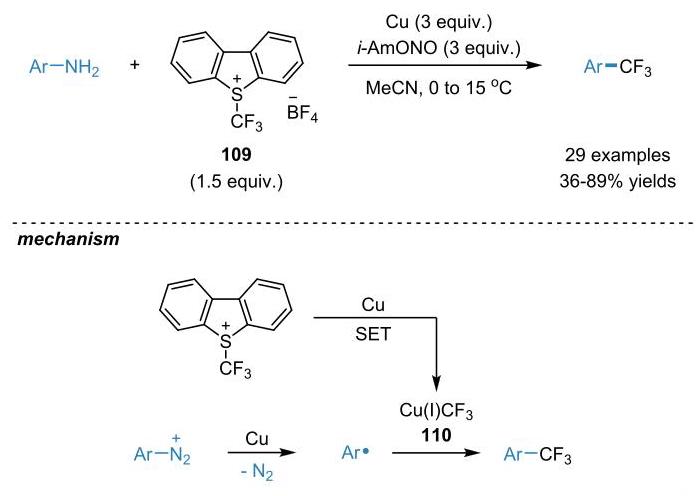
Umemoto’s reagent 109 was employed as the ${\mathrm{{CF}}}_{3}$ source, and iso-amyl nitrite $\left( {i\text{ -AmONO }}\right)$ was used to effect the in situ diazotization reaction. This trifluoromethylation reaction proceeds smoothly under mild conditions and exhibits good tolerance of many synthetically relevant functional groups. A radical pathway is supported by a series of mechanistic studies, including the clock trapping reaction, ESR test, and a ${\mathrm{{CuCF}}}_{3}$ species 110 suggested by ${}^{19}\mathrm{\;F}$ NMR spectrum. The practical application of this protocol is demonstrated by the preparation of leflunomide and formal $\mathrm{C}\left( {\mathrm{{sp}}}^{2}\right) - \mathrm{H}$ bond trifluoromethyla-tion through a nitration-reduction-trifluoromethylation tandem process.
使用梅本试剂109作为${\mathrm{{CF}}}_{3}$源,并用亚硝酸异戊酯$\left( {i\text{ -AmONO }}\right)$进行原位重氮化反应。该三氟甲基化反应在温和条件下顺利进行,对许多合成相关官能团具有良好的耐受性。一系列机理研究支持了自由基途径,包括时钟捕获反应、电子自旋共振测试以及${}^{19}\mathrm{\;F}$核磁共振谱表明的${\mathrm{{CuCF}}}_{3}$物种110。通过硝化-还原-三氟甲基化串联过程制备来氟米特和形成正式的$\mathrm{C}\left( {\mathrm{{sp}}}^{2}\right) - \mathrm{H}$键的三氟甲基化证明了该方案的实际应用。
Meanwhile, Wang and co-workers realized a Ag-mediated trifluoromethylation of in situ formed aryl diazonium salts, converting an aromatic amino group into a ${\mathrm{{CF}}}_{3}$ group (Scheme 73). ${}^{155}$ Through the simple addition of preformed ${\mathrm{{AgCF}}}_{3}$ 111 into a diazonium chloride solution in EtCN under $- {78}^{ \circ }\mathrm{C}$ , this trifluoromethylation protocol turns out to be compatible with a wide range of substrate scopes, including both electron-rich and electron-deficient anilines, as well as heteroaromatic amine derivatives. Gram-scale experiments demonstrate the potential usefulness of this method. Mechanistically, an oxidative addition-reductive elimination pathway involving the hypervalent silver species 112 has been proposed.
同时,王和他的同事实现了银介导的原位形成的芳基重氮盐的三氟甲基化,将芳香氨基转化为${\mathrm{{CF}}}_{3}$基团(方案73)。${}^{155}$通过在$- {78}^{ \circ }\mathrm{C}$条件下将预先形成的${\mathrm{{AgCF}}}_{3}$ 111简单加入乙腈中的重氮氯化物溶液中,该三氟甲基化方案与广泛的底物范围兼容,包括富电子和缺电子的苯胺以及杂芳族胺衍生物。克级实验证明了该方法的潜在实用性。从机理上讲,已经提出了涉及高价银物种112的氧化加成-还原消除途径。
Almost at the same time, Goossen and co-workers developed a copper-mediated trifluoromethylation of stable diazonium tetrafluoroborate salts (Scheme 74). ${}^{156}$ In their work, an in situ generated ${\mathrm{{CuCF}}}_{3}$ species is contrived to react with aryl diazonium salt to deliver a trifluoromethylated product at room temperature. Thus, the Ruppert-Prakash reagent 113 (TMSCF ${}_{3}$ ) is used as the ${\mathrm{{CF}}}_{3}$ source and is premixed with $\mathrm{{Cu}}\left( \mathrm{I}\right)$ thiocyanate and cesium carbonate prior to the diazonium salt. The reaction proceeded smoothly with good functional group tolerance and generally afforded moderate to high yields of trifluoromethylated products. This trifluoromethylation reaction is proposed to proceed via a radical process, which is in line with classic Sandmeyer halogenation reactions.
几乎在同一时间,古森和他的同事开发了铜介导的稳定四氟硼酸重氮盐的三氟甲基化(方案74)。${}^{156}$在他们的工作中,设计了一种原位生成的${\mathrm{{CuCF}}}_{3}$物种与芳基重氮盐反应,在室温下得到三氟甲基化产物。因此,鲁珀特-普拉卡什试剂113(TMSCF${}_{3}$)用作${\mathrm{{CF}}}_{3}$源,并在重氮盐之前与$\mathrm{{Cu}}\left( \mathrm{I}\right)$硫氰酸盐和碳酸铯预混合。反应顺利进行,对官能团具有良好的耐受性,通常得到中等至高产率的三氟甲基化产物。该三氟甲基化反应被认为是通过自由基过程进行的,这与经典的桑德迈尔卤化反应一致。
Scheme 73. Silver-Mediated Trifluoromethylation of Aryl Diazonium Salts
方案73. 银介导的芳基重氮盐的三氟甲基化
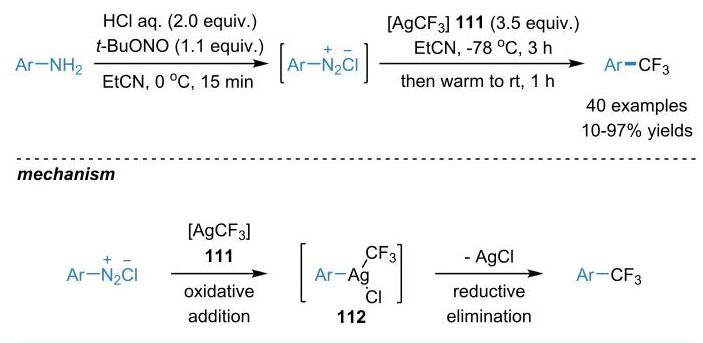
Scheme 74. Cu-Mediated Sandmeyer Reaction of Aryl Diazonium Salts with ${\mathrm{{TMSCF}}}_{3}$
方案74. 铜介导的芳基重氮盐与${\mathrm{{TMSCF}}}_{3}$的桑德迈尔反应
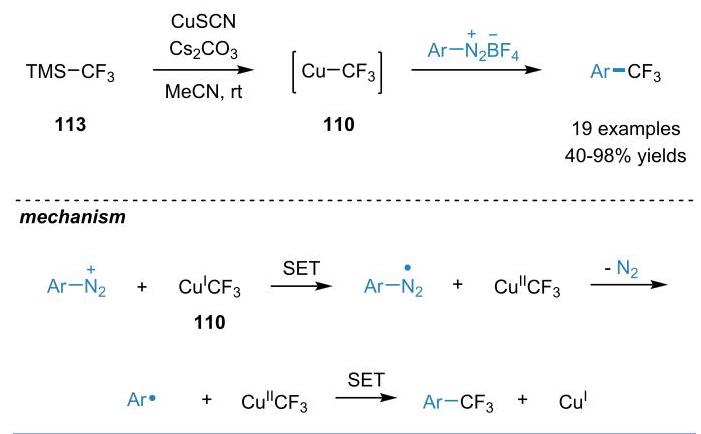
In 2014, the one-pot in situ diazotization and copper-mediated trifluoromethylation of (hetero)aromatic amines was realized using the Ruppert-Prakash reagent 113, affording various benzotrifluorides in good yields (Scheme 75). ${}^{157}$
2014年,使用鲁珀特-普拉卡什试剂113实现了(杂)芳族胺的一锅原位重氮化和铜介导的三氟甲基化,以良好的产率得到各种三氟甲苯(方案75)。${}^{157}$
In 2014, Grushin and co-workers developed a Sandmeyer-type trifluoromethylation of aryl diazonium salts with fluoroform-derived ${\mathrm{{CuCF}}}_{3}$ 110 in aqueous media (Scheme 76). ${}^{158}$ Unlike the other reactions mentioned above, the ${\mathrm{{CF}}}_{3}$ moiety in this protocol originates from an inexpensive, nonflammable gas of fluoroform. Subsequently, ${\mathrm{{CuCF}}}_{3}$ 110 can be easily generated as a solution by treating CuCl with $t$ -BuOK and ${\mathrm{{CHF}}}_{3}$ successively. This radical-type trifluoromethylation features a broad substrate scope, including a couple of heterocyclic examples, as well as some complex molecules. A similar protocol trifluoromethylation using anilines as the substrates was realized using Langlois’ reagent 114, affording trifluoromethylated arenes with moderate to good yields in the presence of TBHP as the suitable oxidant. ${}^{159}$
2014年,格鲁申和他的同事在水性介质中开发了芳基重氮盐与源自氟仿的${\mathrm{{CuCF}}}_{3}$ 110的桑德迈尔型三氟甲基化(方案76)。${}^{158}$与上述其他反应不同,该方案中的${\mathrm{{CF}}}_{3}$部分源自廉价、不可燃的氟仿气体。随后,通过依次用$t$-丁醇钾和${\mathrm{{CHF}}}_{3}$处理氯化铜,可以很容易地将${\mathrm{{CuCF}}}_{3}$ 110制成溶液。这种自由基型三氟甲基化具有广泛的底物范围,包括一些杂环实例以及一些复杂分子。使用朗格卢瓦试剂114实现了以苯胺为底物的类似三氟甲基化方案,在合适的氧化剂叔丁基过氧化氢存在下,得到中等至良好产率的三氟甲基化芳烃。${}^{159}$
Fluorine-18 is a major radionuclide for labeling such radiotracers in positron emission tomography (PET), serving as an important imaging modality for biomedical research and
氟-18是正电子发射断层扫描(PET)中用于标记此类放射性示踪剂的主要放射性核素,是生物医学研究的重要成像方式,并且
Scheme 75. Copper-Mediated Trifluoromethylation of in situ Generated Aryl Diazonium Salts
方案75. 原位生成的芳基重氮盐的铜介导三氟甲基化
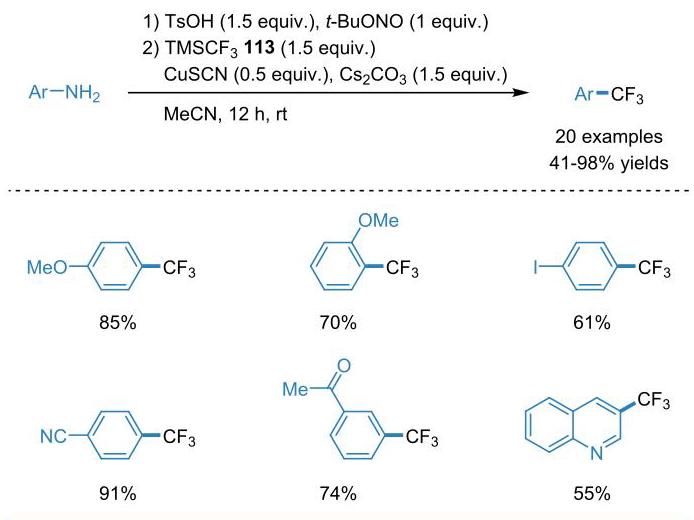
Scheme 76. Cu-Mediated Trifluoromethylation from Fluoroform and Langlois’ Reagent
方案76. 由氟仿和朗格卢瓦试剂进行的铜介导三氟甲基化
Grushin drug development. In 2019, Pike and co-workers reported a gas phase route to access $\left\lbrack {{}^{18}\mathrm{\;F}}\right\rbrack$ fluoroform, which can be used in labeling aryl organic compounds with trifluoromethyl groups. ${}^{160}$ In the presence of base and CuBr, $\left\lbrack {{}^{18}\mathrm{\;F}}\right\rbrack$ fluoroform is converted rapidly into $\left\lbrack {{}^{18}\mathrm{\;F}}\right\rbrack {\mathrm{{CuCF}}}_{3}$ for reaction with aryl diazonium salts, affording $\left\lbrack {{}^{18}\mathrm{\;F}}\right\rbrack$ trifuoromethyl arenes with moderate to good yields (five examples, 45-96% yields).
格鲁申药物研发。2019年,派克及其同事报道了一种获得$\left\lbrack {{}^{18}\mathrm{\;F}}\right\rbrack$氟仿的气相路线,其可用于用三氟甲基标记芳基有机化合物。${}^{160}$ 在碱和溴化铜存在下,$\left\lbrack {{}^{18}\mathrm{\;F}}\right\rbrack$氟仿迅速转化为$\left\lbrack {{}^{18}\mathrm{\;F}}\right\rbrack {\mathrm{{CuCF}}}_{3}$以与芳基重氮盐反应,得到产率中等至良好的$\left\lbrack {{}^{18}\mathrm{\;F}}\right\rbrack$三氟甲基芳烃(5个例子,产率45 - 96%)。
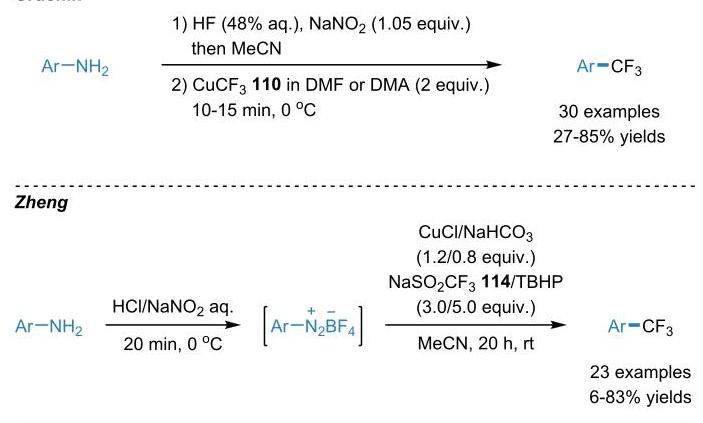
In 2015, a Cu-mediated catalyst-dependent transformation of aryl diazonium salts with Langlois’ reagent 114 was disclosed, affording trifluoromethanesulfonylated or trifluor-omethylated arenes with excellent chemoselectivity (Scheme 77). ${}^{161}$ The ${\mathrm{{Cu}}}_{2}\mathrm{O}$ -catalyzed reaction in DMSO affords aryl trifluoromethanesulfones with moderate to good yields. Alternatively, in the presence of $\mathrm{{Cu}}{\left( \mathrm{{MeCN}}\right) }_{4}{\mathrm{{BF}}}_{4}$ and Tpy as the ligand, this reaction gives rise to trifluoromethylated arenes in moderate yields. In the latter case, TBHP is used as an oxidant with Langlois’ reagent to generate a trifluoromethyl radical, which ligates with $\mathrm{{Cu}}\left( \mathrm{I}\right)$ to afford an active $\mathrm{{Cu}}\left( \mathrm{{II}}\right) - {\mathrm{{CF}}}_{3}$ intermediate.
2015年,公开了一种铜介导的芳基重氮盐与朗格卢瓦试剂114的催化剂依赖性转化反应,以优异的化学选择性得到三氟甲磺酰化或三氟甲基化芳烃(方案77)。${}^{161}$ 在二甲基亚砜中的${\mathrm{{Cu}}}_{2}\mathrm{O}$催化反应以中等至良好的产率得到芳基三氟甲磺酸盐。或者,在$\mathrm{{Cu}}{\left( \mathrm{{MeCN}}\right) }_{4}{\mathrm{{BF}}}_{4}$和三联吡啶作为配体存在下,该反应以中等产率得到三氟甲基化芳烃。在后一种情况下,叔丁基过氧化氢用作氧化剂与朗格卢瓦试剂反应生成三氟甲基自由基,其与$\mathrm{{Cu}}\left( \mathrm{I}\right)$连接得到活性$\mathrm{{Cu}}\left( \mathrm{{II}}\right) - {\mathrm{{CF}}}_{3}$中间体。
Apart from the trifluoromethyl group, more fluorinated functionality has been introduced into arenes through the reaction with aryl diazonium salts. In 2014, Goossen accomplished a Sandmeyer-type difluoromethylation of (hetero)aryl diazonium salts by using an in situ generated difluoromethyl-copper complex 115 (Scheme 78). ${}^{162}$ This
除了三氟甲基外,更多含氟官能团已通过与芳基重氮盐反应引入芳烃中。2014年,古森通过使用原位生成的二氟甲基铜配合物115完成了(杂)芳基重氮盐的桑德迈尔型二氟甲基化反应(方案78)。${}^{162}$ 此
Scheme 77. Cu-Promoted Trifluoromethanesulfonylation and Trifluoromethylation of Aryl Diazonium Tetrafluoroborates with ${\mathrm{{NaSO}}}_{2}{\mathrm{{CF}}}_{3}$
方案77. 铜促进的四氟硼酸芳基重氮盐与${\mathrm{{NaSO}}}_{2}{\mathrm{{CF}}}_{3}$的三氟甲磺酰化和三氟甲基化
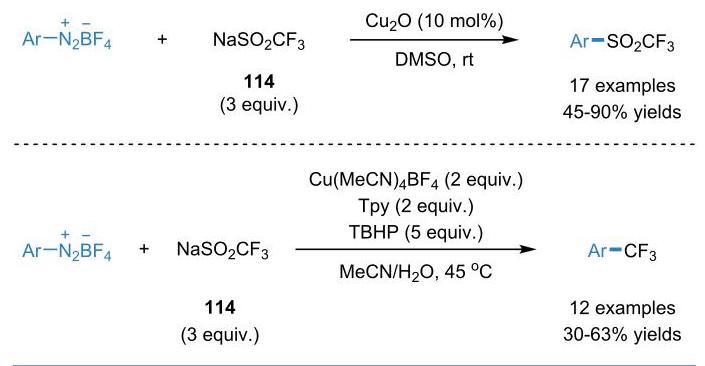
mild protocol allows the synthesis of difluoromethyl (hetero)- arenes from readily available aromatic amines.
温和的方法允许从易得的芳香胺合成二氟甲基(杂)芳烃。
Scheme 78. Sandmeyer Difluoromethylation of Aryl Diazonium Salts
方案78. 芳基重氮盐的桑德迈尔二氟甲基化
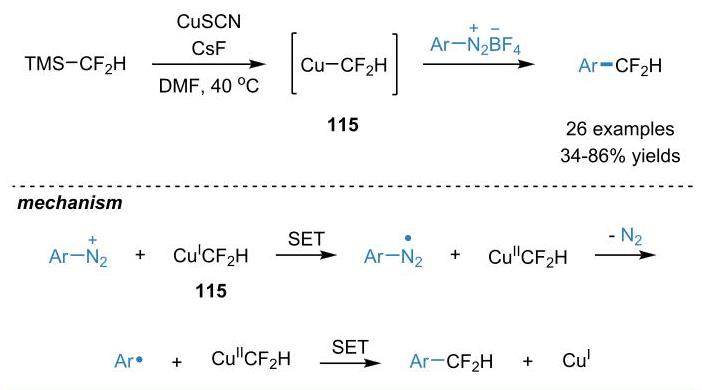
In addition to the trifluoromethylation and difluoromethy-lation of aryl diazonium salts, a copper-mediated perfluor-oalkylation of diazonium salts was reported by using perfluoroalkyl iodide 116-derived stable ${\mathrm{R}}_{\mathrm{F}}\mathrm{{Cu}}\left( \mathrm{{MeCN}}\right)$ complex as the perfluoroalkylating agents (Scheme 79). ${}^{163}$ This radical protocol provides a general and regiospecific synthetic route to perfluoroalkylated arenes with moderate yields. In 2016, Wu and Cao disclosed a silver and copper comediated isoperfluoropropylation of in situ generated aryl diazonium salts by using hexafluoropropylene gas 117 (HFP) as the perfluoroalkyl source (Scheme 79). ${}^{164}$
除了芳基重氮盐的三氟甲基化和二氟甲基化外,还报道了一种铜介导的重氮盐的全氟烷基化反应,使用全氟烷基碘116衍生的稳定${\mathrm{R}}_{\mathrm{F}}\mathrm{{Cu}}\left( \mathrm{{MeCN}}\right)$配合物作为全氟烷基化试剂(方案79)。${}^{163}$ 这种自由基方法提供了一种通用的、区域选择性的合成路线,以中等产率得到全氟烷基化芳烃。2016年,吴和曹公开了一种银和铜共同介导的原位生成的芳基重氮盐的异全氟丙基化反应,使用六氟丙烯气体117(HFP)作为全氟烷基源(方案79)。${}^{164}$
Scheme 79. Synthetic Route to Perfluoroalkylated Arenes from Aryl Diazonium Salts
方案79. 从芳基重氮盐合成全氟烷基化芳烃的路线
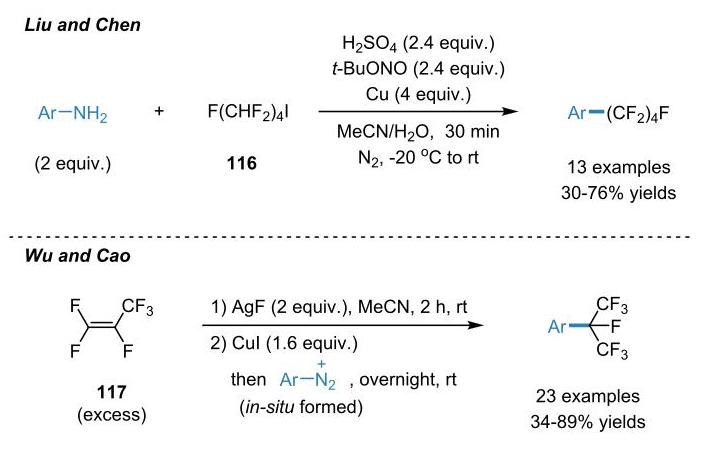
The previous difluoromethylation reactions require excess transition metal salts. As for the copper-free difluoromethyla-tion procedure, Lu and Cai disclosed a visible-light-induced photoredox difluoromethylation of aryl diazonium salts with $\alpha$ - aryl- $\beta ,\beta$ -difluoroenol silyl ether 118 (Scheme 80). ${}^{165}$ In the presence of a tiny amount $\left( {{0.05}\mathrm{\;{mol}}\% }\right)$ of photosensitizer and a short light exposure, this radical chain protocol is initiated by the selective radical addition of an aryl radical to $\alpha$ -aryl- $\beta ,\beta$ - difluoroenol silyl ether 118, followed by single-electron oxidation process from another aryl diazonium salt to afford a variety of $\alpha$ -aryl- $\alpha ,\alpha$ -difluoroketones 119 with moderate to good yields.
先前的二氟甲基化反应需要过量的过渡金属盐。至于无铜二氟甲基化方法,Lu和Cai公开了一种可见光诱导的光氧化还原反应,即芳基重氮盐与$\alpha$ -芳基- $\beta ,\beta$ -二氟烯醇硅醚118发生二氟甲基化反应(方案80)。${}^{165}$在少量$\left( {{0.05}\mathrm{\;{mol}}\% }\right)$光敏剂存在和短时间光照下,该自由基链反应通过芳基自由基选择性加成到$\alpha$ -芳基- $\beta ,\beta$ -二氟烯醇硅醚118上引发,随后另一个芳基重氮盐发生单电子氧化过程,以中等至良好的产率得到各种$\alpha$ -芳基- $\alpha ,\alpha$ -二氟酮119。
Scheme 80. Visible-Light-Induced Photoredox Difluoromethylation of Aryl Diazonium Salts
方案80. 可见光诱导的芳基重氮盐的光氧化还原二氟甲基化反应
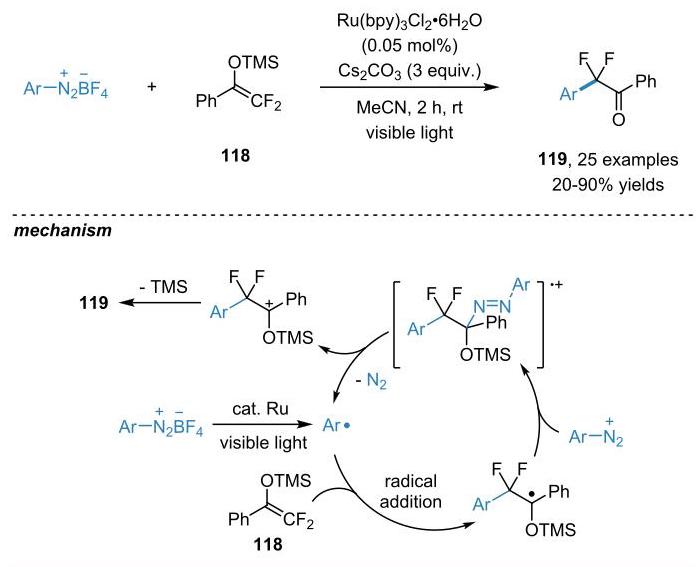
Furthermore, other fluorinated functionalities can be selectively introduced on aromatic rings through the Cu-mediated Sandmeyer-type reaction using TMSCF ${}_{2}\mathrm{{PO}}{\left( \mathrm{{OEt}}\right) }_{2}$ 120 as the fluorinated reagent ${}^{166}$ or the pentafluoroethylation reaction ${}^{167}$ with an active pentafluoroethylation reagent " ${\mathrm{{CuC}}}_{2}{\mathrm{\;F}}_{5}$ " 121, which is pregenerated from CuSCN, tetrafluoroethylene, and CsF (Scheme 81).
此外,通过使用TMSCF ${}_{2}\mathrm{{PO}}{\left( \mathrm{{OEt}}\right) }_{2}$ 120作为氟化试剂${}^{166}$的铜介导的桑德迈尔型反应或与活性五氟乙基化试剂“${\mathrm{{CuC}}}_{2}{\mathrm{\;F}}_{5}$”121的五氟乙基化反应${}^{167}$,可以在芳环上选择性引入其他氟化官能团,活性五氟乙基化试剂“${\mathrm{{CuC}}}_{2}{\mathrm{\;F}}_{5}$”121由CuSCN、四氟乙烯和CsF预先制备(方案81)。
Scheme 81. Synthesis of Aryl Difluoromethylphosphonates and Pentafluoroethyl Arenes through Sandmeyer-Type Reaction
方案81. 通过桑德迈尔型反应合成芳基二氟甲基膦酸酯和五氟乙基芳烃
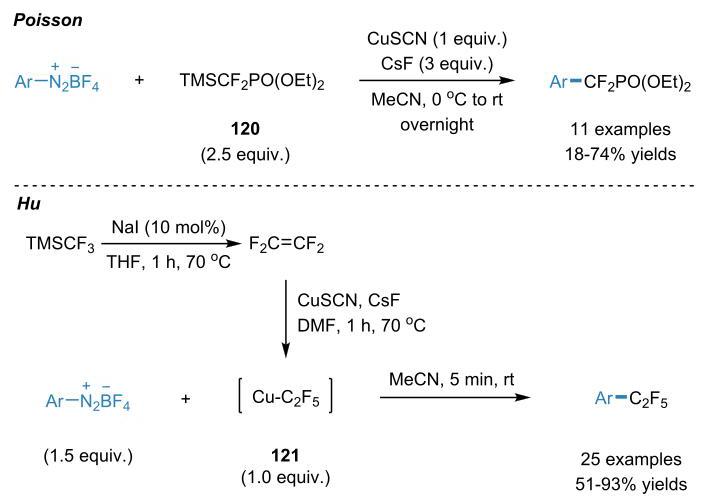
2.1.8. Miscellaneous. The aryl radical through photoinduced diazonium decomposition can undergo an intramolecular HAT process to obtain an alkyl radical 122, which allows remote $\mathrm{C}\left( {\mathrm{{sp}}}^{3}\right) - \mathrm{H}$ bond functionality (Scheme 82). ${}^{168}$
2.1.8. 杂项。通过光诱导重氮盐分解产生的芳基自由基可进行分子内氢原子转移(HAT)过程以获得烷基自由基122,这使得能够实现远程$\mathrm{C}\left( {\mathrm{{sp}}}^{3}\right) - \mathrm{H}$键官能化(方案82)。${}^{168}$
Scheme 82. Visible Light-Promoted Remote C-H Functionalization of o-Diazoniaphenyl Alkyl Sulfones
方案82. 邻重氮苯基烷基砜的可见光促进的远程C-H官能化反应

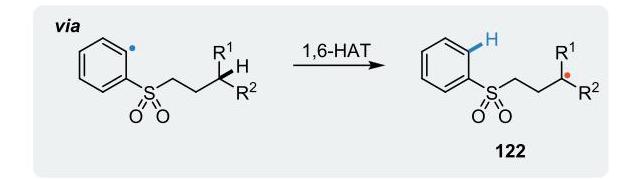
Subsequent interception by various nucleophiles provides the remote $\mathrm{C} - \mathrm{O},\mathrm{C} - \mathrm{N}$ , and $\mathrm{C} - \mathrm{C}$ bond formation products. Moreover, aryl diazonium ions have also been explored as radical initiates to allow the regioselective cleavage of aziridines, ${}^{169}$ as well as the preparation of spirobi[indene] derivatives. ${}^{170}$
随后被各种亲核试剂捕获可得到远程$\mathrm{C} - \mathrm{O},\mathrm{C} - \mathrm{N}$和$\mathrm{C} - \mathrm{C}$键形成产物。此外,芳基重氮离子也已被研究作为自由基引发剂,用于实现氮丙啶的区域选择性裂解${}^{169}$,以及制备螺双[茚]衍生物${}^{170}$。
Upon visible-light irradiation, a selective HAT process with acetone using aryl diazonium ions as radical precursors was realized under continuous-flow conditions, affording an acetonyl radical which was subsequently utilized to forge versatile C-C bonds (Scheme 83). ${}^{171}$
在可见光照射下,在连续流动条件下实现了以芳基重氮离子作为自由基前体与丙酮的选择性氢原子转移(HAT)过程,生成一个乙酰基自由基,该自由基随后被用于构建多种C-C键(方案83)。${}^{171}$
Scheme 83. Acetonyl Radical-Induced Synthesis of Various Heterocycles
方案83. 乙酰基自由基诱导合成各种杂环化合物
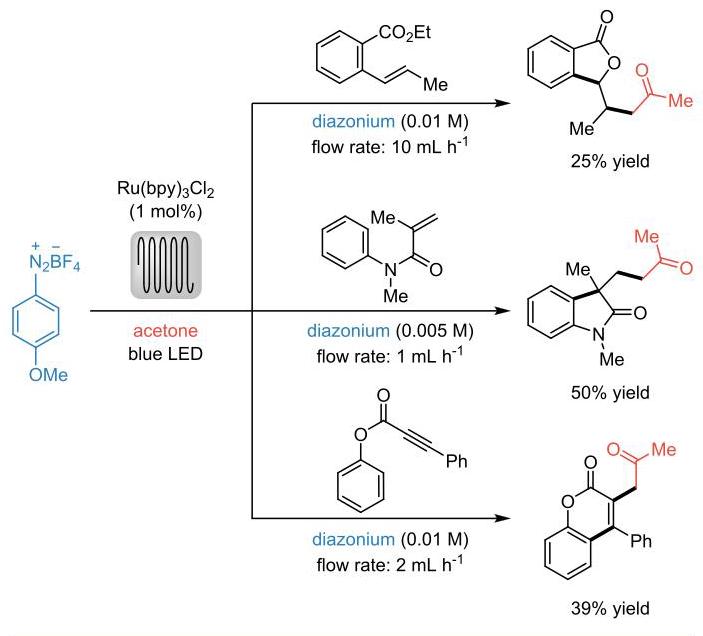
2.2. Transition-Metal-Catalyzed Coupling Reactions of Aryl Diazonium Salts
2.2. 芳基重氮盐的过渡金属催化偶联反应
Serving as the surrogates of aryl halides, aryl diazonium salts have been utilized in transition-metal-catalyzed cross-coupling reactions for $\mathrm{C} - \mathrm{C}$ bond formations (Scheme 84). In most cases, both the palladium and gold complex have been explored as catalysts in coupling reactions to synthesize versatile functional molecules.
作为芳基卤化物的替代物,芳基重氮盐已被用于过渡金属催化的交叉偶联反应中以形成$\mathrm{C} - \mathrm{C}$键(方案84)。在大多数情况下,钯和金配合物都已被探索用作偶联反应的催化剂,以合成多功能功能分子。
Scheme 84. Transition-Metal-Catalyzed Coupling Reactions of Aryl Diazonium Salts
方案84. 芳基重氮盐的过渡金属催化偶联反应
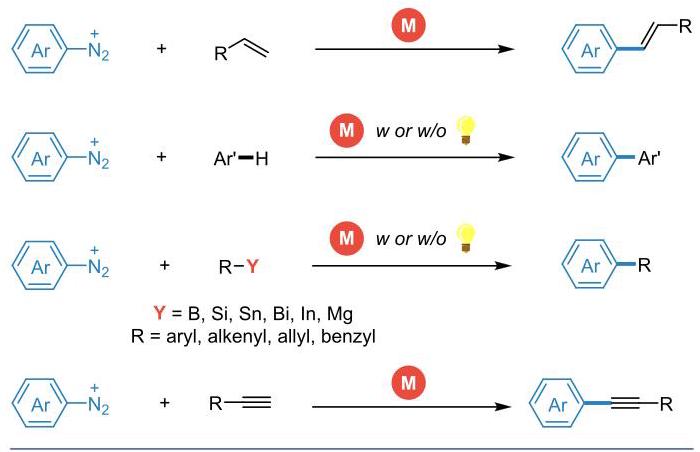
For the Pd-catalyzed coupling reactions of aryl diazonium salts, the reaction is initiated by the oxidative addition to form an aryl-Pd(II) species. The insertion reaction, electrophilic $\mathrm{C} - \mathrm{H}$ bond functionalization, or transmetalation occurs, followed by reduction elimination to afford the desired coupling product along with the regeneration of $\mathrm{{Pd}}\left( 0\right)$ species. An innovative strategy in this area is the combination of the dual palladium/photoredox catalytic system, allowing selective coupling reactions under sustainable and environmentally benign conditions. The recent improvements will be summarized according to the types of coupling reactions.
对于钯催化的芳基重氮盐偶联反应,反应通过氧化加成开始,形成芳基 - 钯(II)物种。随后发生插入反应、亲电$\mathrm{C} - \mathrm{H}$键官能化或转金属化,接着进行还原消除,得到所需的偶联产物以及$\mathrm{{Pd}}\left( 0\right)$物种的再生。该领域的一种创新策略是双钯/光氧化还原催化体系的组合,使得在可持续和环境友好的条件下进行选择性偶联反应。近期的进展将根据偶联反应的类型进行总结。
A type of related reaction is the gold-catalyzed coupling reactions of aryl diazonium salts upon or without the visible-light irradiation. Mechanistically, these reactions are initiated by two-step single-electron oxidations of $\mathrm{{Au}}\left( \mathrm{I}\right)$ by aryl diazonium ions to generate an aryl-Au(III) intermediate. The photoredox catalytic system can facilitate this SET process. With the sequential transformations of the active aryl-Au(III) species with alkenes, alkynes, or other coupling partners, versatile coupling products including difunctionaliza-tion of alkenes, C-H bond functionalization of arenes/alkynes, and (hetero)cyclic compounds are obtained.
一类相关反应是在有或无可见光照射下金催化的芳基重氮盐偶联反应。从机理上讲,这些反应通过芳基重氮离子对$\mathrm{{Au}}\left( \mathrm{I}\right)$进行两步单电子氧化引发,生成芳基 - 金(III)中间体。光氧化还原催化体系可以促进这种单电子转移过程。随着活性芳基 - 金(III)物种与烯烃、炔烃或其他偶联伙伴的顺序转化,可获得包括烯烃双官能化、芳烃/炔烃的C - H键官能化以及(杂)环化合物在内的多种偶联产物。
2.2.1. Heck-type Reactions with Alkenes. Since the pioneering work by Kikukawa and Matsuda in 1977, ${}^{{13},{14}}$ aryldiazonium salts have been established as a type of electrophilic reaction partner in transition-metal-catalyzed cross-coupling reactions. Thus, aryldiazonium salts could be considered as aryl halide surrogates in cross-coupling reactions for C-C bond and C-heteroatom bond formations. In recent years, efforts were dedicated to the development of a new catalytic system, mechanistic study, ${}^{172}$ and synthetic application of Heck-Matsuda type chemistry. ${}^{{173} - {176}}$
2.2.1. 与烯烃的Heck型反应。自1977年菊川和松田的开创性工作以来,${}^{{13},{14}}$芳基重氮盐已被确立为过渡金属催化交叉偶联反应中的一类亲电反应伙伴。因此,芳基重氮盐可被视为交叉偶联反应中用于形成C - C键和C - 杂原子键的芳基卤化物替代物。近年来,致力于开发新的催化体系、Heck - 松田型化学的机理研究、${}^{172}$和合成应用。${}^{{173} - {176}}$
A modified Heck-Matsuda reaction was developed to allow for anilines to be applied as the starting materials in the presence of methanesulfonic acid (Scheme 85). ${}^{177}$ Under these conditions, the aniline starting material underwent in situ diazotization for Pd-catalyzed coupling. A range of anilines were excellent substrates for this process.
开发了一种改进的Heck - 松田反应,允许在甲磺酸存在下将苯胺用作起始原料(方案85)。${}^{177}$在这些条件下,苯胺起始原料进行原位重氮化以进行钯催化的偶联。一系列苯胺是该过程的优良底物。
The one-pot tandem process that generates Heck-Matsuda coupled products from anilines via stable aryl diazonium tosylate salts 124 was reported (Scheme 86). ${}^{178}$ The reaction pathway includes the rapid formation of aryl diazonium salts using a polymer-supported nitrite reagent 123 with $p$ -TsOH, followed by a base-free Heck-Matsuda reaction with acrylates or styrenes. Moreover, this procedure allows the direct synthesis of 3,4-dihydroquinolin-2-ones by using 2-nitroani-lines as the substrates.
报道了通过稳定的芳基重氮甲苯磺酸盐124从苯胺一锅法串联生成Heck - 松田偶联产物的过程(方案86)。${}^{178}$反应途径包括使用聚合物负载的亚硝酸盐试剂123与$p$ - TsOH快速形成芳基重氮盐,然后与丙烯酸酯或苯乙烯进行无碱Heck - 松田反应。此外,该方法允许以2 - 硝基苯胺为底物直接合成3,4 - 二氢喹啉 - 2 - 酮。
Scheme 85. Heck-Matsuda Arylation of Olefins through in Situ Diazotization Approach
方案85. 通过原位重氮化方法进行的烯烃的Heck - 松田芳基化反应
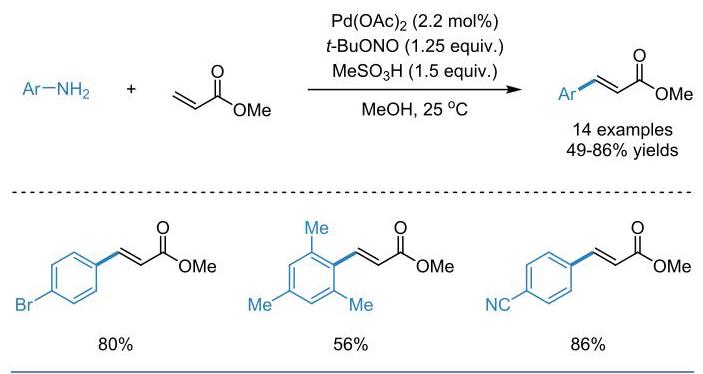
Scheme 86. Tandem Heck-Matsuda Reactions of Anilines and One-Pot Synthesis of 3,4-Dihydroquinolin-2-ones
方案86. 苯胺的串联Heck - 松田反应及3,4 - 二氢喹啉 - 2 - 酮的一锅法合成
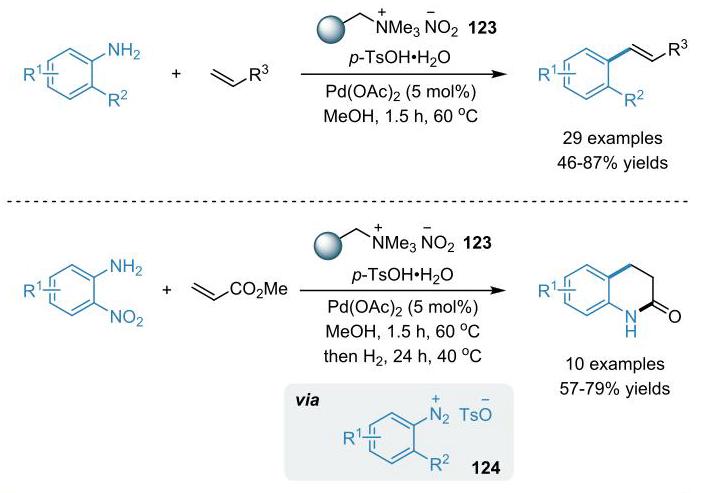
The heterogeneous Pd-catalyzed Heck-Matsuda reaction has been developed using palladium nanoparticles supported on sulfonic acid functionalized silica as trifunctional heterogeneous catalysts for Heck-Matsuda and Suzuki coupling reactions (Scheme 87). ${}^{179}$ The arylation of acrylates and boronic acids with in situ generated aryl diazonium salts proceeds under mild conditions using this heterogeneous catalytic system. These new catalysts are trifunctional. They act as a proton donor for the diazotization step and provide a counterion for the diazonium salt. Most importantly, they are also the Pd catalyst for cross-coupling. Additionally, synthetic calcium-phyllosilicates can also serve as bifunctional bases in the Matsuda-Heck reaction using methanol as the solvent. ${}^{180}$ This heterogeneous catalytic protocol provides a complementary route to synthesize acid-sensitive products.
使用负载在磺酸官能化二氧化硅上的钯纳米颗粒作为用于Heck-Matsuda和Suzuki偶联反应的三功能多相催化剂,已开发出多相钯催化的Heck-Matsuda反应(方案87)。${}^{179}$ 使用这种多相催化体系,原位生成的芳基重氮盐与丙烯酸酯和硼酸的芳基化反应在温和条件下进行。这些新型催化剂具有三功能。它们在重氮化步骤中充当质子供体,并为重氮盐提供抗衡离子。最重要的是,它们也是用于交叉偶联的钯催化剂。此外,合成的钙叶硅酸盐在以甲醇为溶剂的Matsuda-Heck反应中也可以用作双功能碱。${}^{180}$ 这种多相催化方案为合成酸敏感产物提供了一条补充途径。
Scheme 87. Palladium Nanoparticles as Trifunctional Heterogeneous Catalysts for Heck-Matsuda and Suzuki Reactions
方案87. 钯纳米颗粒作为用于Heck-Matsuda和Suzuki反应的三功能多相催化剂
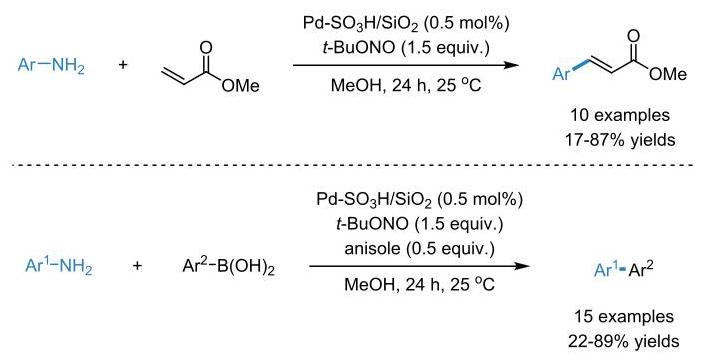
In 2015, an in-water Heck-Matsuda reaction with water-soluble aryl diazonium tosylates was developed. ${}^{181}$ A range of alkenes underwent arylation in good yields. Electron-deficient alkenes afforded high yields of product, while moderate yields were observed for electron-rich alkenes. The reaction is significantly accelerated using microwave irradiation.
2015年,开发了一种使用水溶性芳基对甲苯磺酸重氮盐的水相Heck-Matsuda反应。${}^{181}$ 一系列烯烃以良好的产率进行芳基化反应。缺电子烯烃能提供高产率的产物,而富电子烯烃的产率适中。使用微波辐射可显著加速该反应。
The Heck-Matsuda reaction has been utilized in synthesizing various functional molecules (Scheme 88). Coupling of ethenesulfonyl fluoride 125 and aryl diazonium tetrafluor-oborates under mild reaction conditions furnished $\beta$ - arylethenesulfonyl fluorides (126), which are versatile bis-electrophiles for sulfur(VI) fluoride exchange click chemistry. ${}^{182}$
Heck-Matsuda反应已用于合成各种功能分子(方案88)。在温和的反应条件下,乙烯基磺酰氟125与芳基四氟硼酸重氮盐偶联得到$\beta$ -芳基乙烯基磺酰氟(126),它们是用于六氟化硫交换点击化学的通用双亲电试剂。${}^{182}$
Scheme 88. Heck-Matsuda Reaction for the Synthesis of $\beta$ - Arylethenesulfonyl Fluorides and 2-Deoxy Aryl C-Glycosides
方案88. 用于合成$\beta$ -芳基乙烯基磺酰氟和2-脱氧芳基C-糖苷的Heck-Matsuda反应
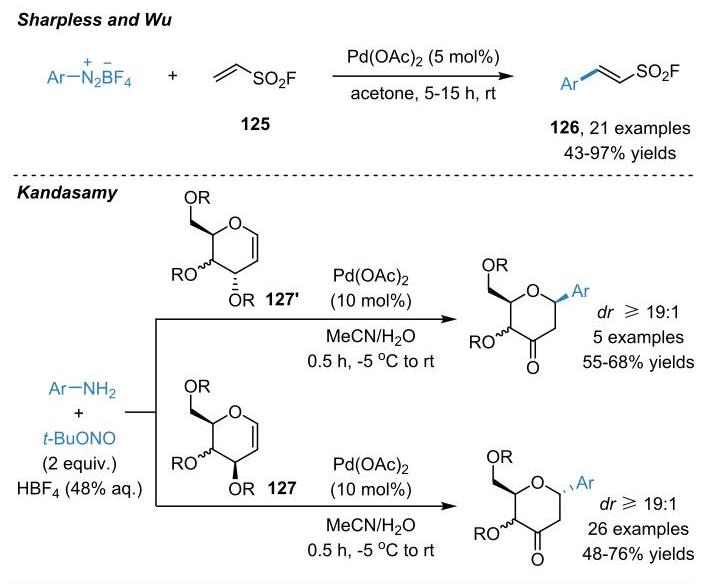
The stereocontrolled synthesis of aryl-C-glycosides has also been reported. Kandasamy disclosed a Pd-catalyzed Heck-Matsuda reaction of glycals 127 and aryl diazonium salts ${}^{183}$ or anilines ${}^{184}$ in the presence of $t$ -butyl nitrite, achieving a one-pot stereospecific synthesis of 2,3-deoxy-3-keto- $\alpha$ -aryl-C-glycosides and 2-deoxy aryl C-glycosides under room temperature.
芳基 - C - 糖苷的立体控制合成也有报道。Kandasamy 披露了在 $t$ - 亚硝酸丁酯存在下,糖类化合物 127 与芳基重氮盐 ${}^{183}$ 或苯胺 ${}^{184}$ 的钯催化 Heck - Matsuda 反应,在室温下实现了 2,3 - 脱氧 - 3 - 酮 - $\alpha$ - 芳基 - C - 糖苷和 2 - 脱氧芳基 C - 糖苷的一锅法立体专一性合成。
The Pd-catalyzed Heck-Matsuda cascade reaction has been developed to synthesize cyclic compounds. In 2017, Li and Song reported a Pd-catalyzed dearomative $\left\lbrack \begin{array}{l} 2 + 2 + 1 \end{array}\right\rbrack$ carboannulation of 1,7-enynes 128 and aryl diazonium salts, affording spirocyclohexadienone-fused cyclopenta $\left\lbrack c\right\rbrack$ quinolin- 4(5H)-ones 129 (Scheme 89). ${}^{185}$ This reaction is initiated by the selective insertion of Ar-Pd(II) species, followed by 6-exo-dig insertion to alkyne, ipso-cyclization, and a water-mediated substitution sequence to achieve the expeditious assembly of the polycyclic scaffold.
已开发出钯催化的Heck-Matsuda级联反应来合成环状化合物。2017年,Li和Song报道了钯催化的1,7-烯炔128与芳基重氮盐的去芳构化$\left\lbrack \begin{array}{l} 2 + 2 + 1 \end{array}\right\rbrack$ 碳环化反应,得到螺环环己二烯酮稠合的环戊$\left\lbrack c\right\rbrack$ 喹啉-4(5H)-酮129(方案89)。${}^{185}$ 该反应由Ar-Pd(II)物种的选择性插入引发,随后是对炔烃的6-外向插入、本位环化和水介导的取代序列,以实现多环骨架的快速组装。
Furthermore, enantioselective Heck-Matsuda arylations have been explored in recent years. In 2012, using a redox-relay strategy, Sigman developed an enantioselective Heck arylation of acyclic alkenyl alcohols with aryl diazonium salts by using low Lewis basicity ${\mathrm{{CF}}}_{3}$ -substituted pyridine oxazoline as the chiral ligand, delivering a series of $\beta$ -, $\gamma$ -, or $\delta$ -aryl carbonyl products (Scheme 90). ${}^{186}$ The carbopalladation step was found to be highly regioselective. Sequential carbopalla-dation/ $\beta$ -hydride elimination eventually provided the carbonyl compound as the final product.
此外,近年来还探索了对映选择性Heck-Matsuda芳基化反应。2012年,Sigman使用氧化还原中继策略,通过使用低Lewis碱性${\mathrm{{CF}}}_{3}$ -取代的吡啶恶唑啉作为手性配体,开发了无环烯基醇与芳基重氮盐的对映选择性Heck芳基化反应,得到一系列$\beta$ -、$\gamma$ -或$\delta$ -芳基羰基产物(方案90)。${}^{186}$ 发现碳钯化步骤具有高度的区域选择性。连续的碳钯化/$\beta$ -氢消除最终提供羰基化合物作为最终产物。
Scheme 89. Pd-Catalyzed Dearomative $\left\lbrack {2 + 2 + 1}\right\rbrack$ Carboannulation of 1,7-Enynes with Aryl Diazonium Salts and Water
方案89. 钯催化的1,7-烯炔与芳基重氮盐和水的去芳构化$\left\lbrack {2 + 2 + 1}\right\rbrack$ 碳环化反应
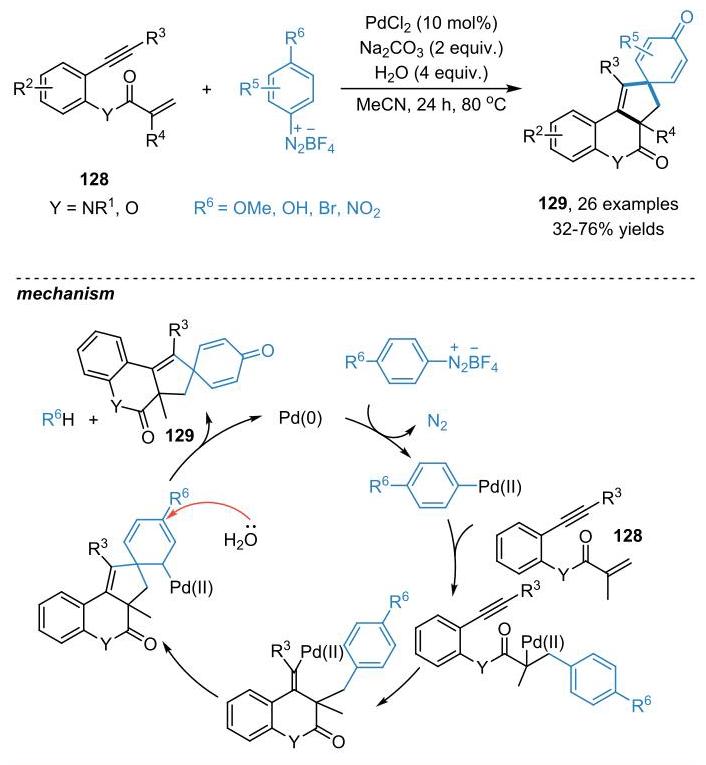
Scheme 90. Enantioselective Heck Arylations of Racemic Alcohols
方案90. 外消旋醇的对映选择性Heck芳基化反应
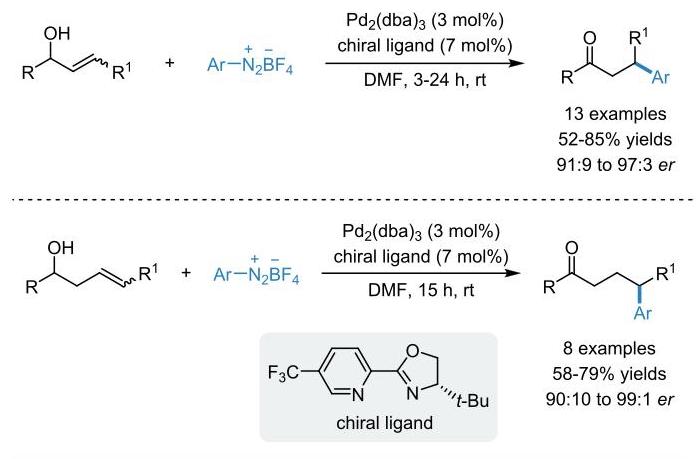
In 2018, a Heck-Matsuda desymmetrization of meso (1R,2S)-cyclohex-4-ene-1,2-diol 130 was successfully realized (Scheme 91). ${}^{187}$ This method provides trisubstituted allylic alcohols with excellent diastereo- and enantiocontrol.
2018年,成功实现了内消旋(1R,2S)-环己-4-烯-1,2-二醇130的Heck-Matsuda去对称化反应(方案91)。${}^{187}$ 该方法可提供具有优异非对映和对映选择性控制的三取代烯丙醇。
In 2017, an enantioselective Heck-Matsuda reaction of five-, six-, and seven-membered ring alkenes with aryl diazonium salts was established (Scheme 92). ${}^{188}$ Under phase-transfer conditions, in the presence of a Pd catalyst and chiral phosphoric acid catalyst 131, the resulting arylated carbocycles were synthesized with good enantiocontrol.
2017年,建立了五元、六元和七元环烯烃与芳基重氮盐的对映选择性Heck-Matsuda反应(方案92)。${}^{188}$ 在相转移条件下,在钯催化剂和手性磷酸催化剂131存在下,所得芳基化碳环以良好的对映选择性合成。
Scheme 91. Enantioselective Heck-Matsuda Desymmetrization of cis-Cyclohex-4-ene-1,2-diol
方案91. 顺式环己-4-烯-1,2-二醇的对映选择性Heck-Matsuda去对称化反应
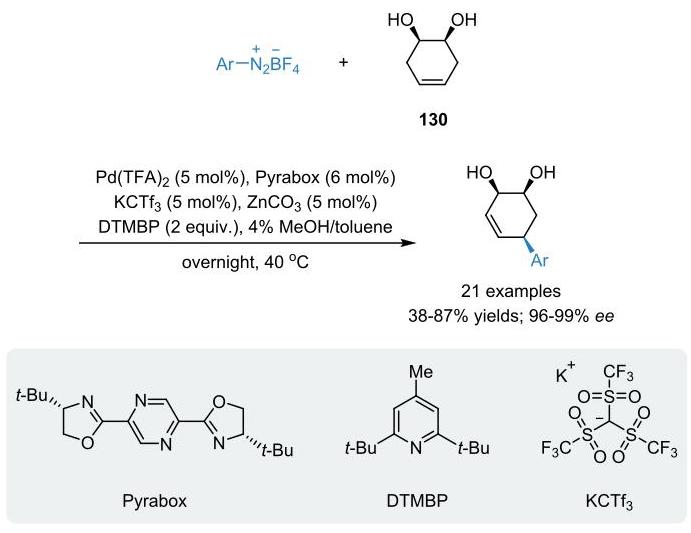
Scheme 92. Enantioselective Heck-Matsuda Arylations of Cyclopentene, Cyclohexene, and Cycloheptene Derivatives
方案92. 环戊烯、环己烯和环庚烯衍生物的对映选择性Heck-Matsuda芳基化反应
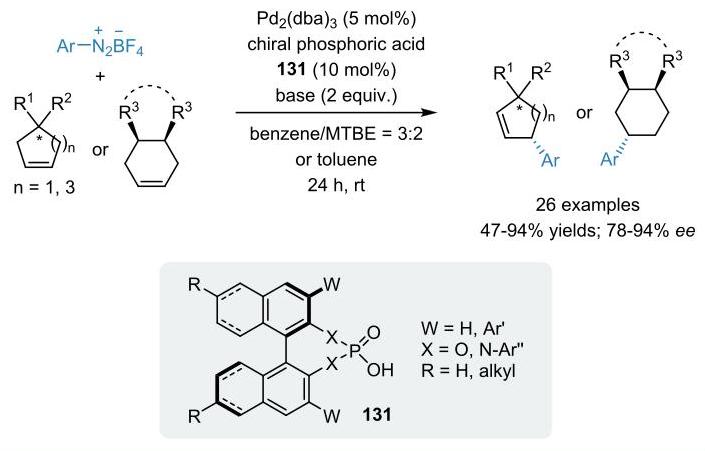
This Pd-catalyzed asymmetric Heck-Matsuda reaction has merged with cascade cyclization through the double Heck reaction to assemble cyclic compounds (Scheme 93). ${}^{189}$ Functionalized dihydrobenzofurans bearing all carbon quaternary centers 132 were obtained in high enantioselectivity. This catalytic protocol found application in the synthesis of enantiopure tricyclic dihydrobenzofuran scaffold 133.
这种钯催化的不对称Heck-Matsuda反应通过双Heck反应与串联环化相结合以组装环状化合物(方案93)。${}^{189}$ 获得了具有高对映选择性的带有全碳季中心的功能化二氢苯并呋喃132。该催化方案在对映纯三环二氢苯并呋喃支架133的合成中得到应用。
Scheme 93. Pd-Catalyzed Enantioselective Double Heck Reaction
方案93. 钯催化的对映选择性双Heck反应
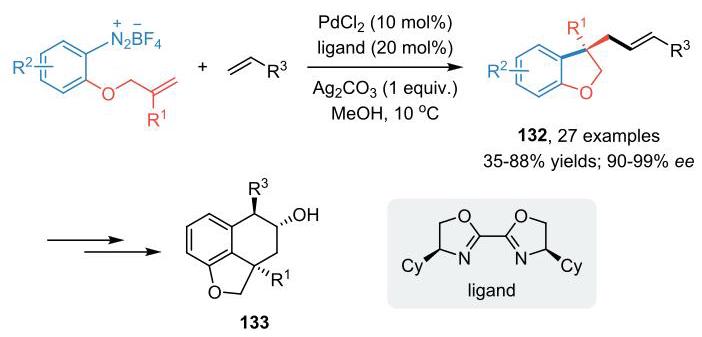
In addition to Heck-type C-C bond formations, arylbora-tion of alkenes with aryl diazonium salts was also reported. ${}^{{190} - {192}}$ In 2015, an enantioselective Pd-catalyzed arylboration of $\alpha$ -olefins, using aryl diazonium salts, and bis(pinacolato)diboron 134 was disclosed, allowing the direct preparation of enantioenriched benzylic boronates 135 (Scheme 94). ${}^{190}$ Mechanistically, upon interaction with the lipophilic chiral phosphoric acid anion, the insoluble aryl diazonium salt undergoes phase transfer to provide a soluble chiral ion pair 136. Oxidative addition of $\mathrm{{Pd}}\left( 0\right)$ into the aryl diazonium substrate followed by carbopalladation with the alkene furnishes an enantioenriched alkylpalladium complex 137. Transmetalation of 137 with the diboron reagent and subsequent reductive elimination forms the arylboration product 135 and regenerates the $\mathrm{{Pd}}\left( 0\right)$ catalyst.
除了Heck型碳-碳键形成反应外,还报道了芳基重氮盐与烯烃的芳基硼化反应。${}^{{190} - {192}}$ 2015年,公开了一种对映选择性钯催化的$\alpha$ -烯烃与芳基重氮盐和双(频哪醇)二硼134的芳基硼化反应,可直接制备对映体富集的苄基硼酸酯135(方案94)。${}^{190}$ 从机理上讲,与亲脂性手性磷酸阴离子相互作用时,不溶性芳基重氮盐发生相转移以提供可溶性手性离子对136。$\mathrm{{Pd}}\left( 0\right)$ 对芳基重氮盐底物进行氧化加成,然后与烯烃进行碳钯化反应,得到对映体富集的烷基钯配合物137。137与二硼试剂进行转金属化反应,随后进行还原消除反应,形成芳基硼化产物135并使$\mathrm{{Pd}}\left( 0\right)$ 催化剂再生。
Scheme 94. Pd-Catalyzed Three-Component Reaction of $\alpha$ - Olefins, Aryl Diazonium Salts, and ${\mathrm{B}}_{2}{\text{ pin }}_{2}$
方案94. $\alpha$ -烯烃、芳基重氮盐和${\mathrm{B}}_{2}{\text{ pin }}_{2}$ 的钯催化三组分反应
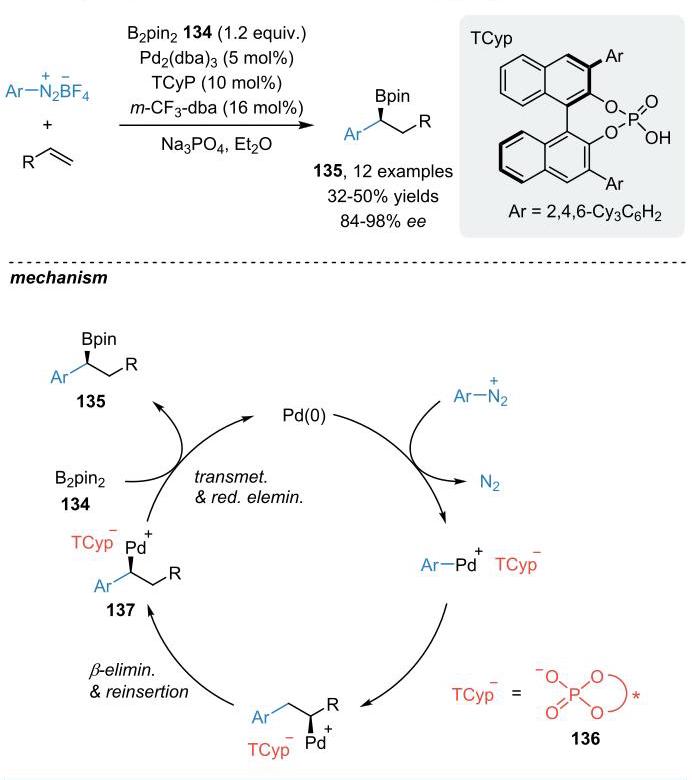
In 2016, a similar Pd-catalyzed 1,2-arylboration of vinyl-arenes was developed, affording arylated benzylic boronates with high regioselectivity (Scheme 95). ${}^{191}$ The proposed mechanism is analogous to those involving terminal olefins.
2016年,开发了一种类似的钯催化的乙烯基芳烃的1,2-芳基硼化反应,可提供具有高区域选择性的芳基化苄基硼酸酯(方案95)。${}^{191}$ 提出的机理与涉及末端烯烃的机理类似。
2.2.2. C-H Bond Functionalizations of Arenes. Transition metal-catalyzed arenes $\mathrm{C} - \mathrm{H}$ bond functionalization with aryl diazonium salts represents an alternative route to the radical type arylation reactions (Scheme 96). The main feature of this protocol lies in the participation of transition metals, such as palladium or iridium complex, instead of radical initiators. The excellent regioselectivity is usually controlled by the directing group on substrates. Additionally, the substrate scope of arenes has been expanded to inert aromatics, in addition to electron-rich heterocycles that are usually superior in Gomberg-Bachmann arylations.
2.2.2. 芳烃的C-H键官能化。过渡金属催化的芳烃与芳基重氮盐的$\mathrm{C} - \mathrm{H}$ 键官能化反应是自由基型芳基化反应的另一种途径(方案96)。该方法的主要特点在于过渡金属(如钯或铱配合物)的参与,而不是自由基引发剂。优异的区域选择性通常由底物上的导向基团控制。此外,芳烃的底物范围已扩展到惰性芳烃,除了在Gomberg-Bachmann芳基化反应中通常表现优异的富电子杂环。
Mechanistically, one reaction pathway includes the direct oxidative addition of aryl diazonium ions to the transition metal center to form a hypervalent carbometalated species, followed by reduction elimination to form biaryls. A Pd-
从机理上讲,一种反应途径包括芳基重氮离子直接氧化加成到过渡金属中心以形成高价碳金属化物种,然后进行还原消除反应以形成联芳基。一个钯-
Scheme 95. Pd-Catalyzed Regioselective Arylboration of Vinylarenes
方案95. 钯催化的乙烯基芳烃的区域选择性芳基硼化反应
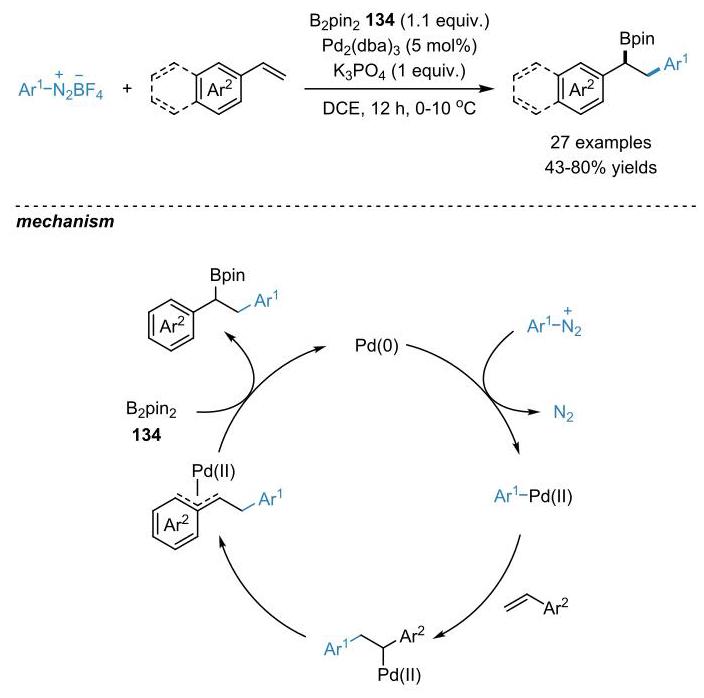
Scheme 96. Arenes C-H Bond Functionalizations with Aryl Diazonium Salts
方案96. 芳烃与芳基重氮盐的C-H键官能化反应

catalyzed arylation of indoles was also reported, producing 2- arylindoles with ${0.5} - 1\mathrm{\;{mol}}\% \mathrm{{Pd}}{\left( \mathrm{{OAc}}\right) }_{2}$ under air (Scheme 97). ${}^{193}$ This arylation procedure could also be extended to benzofurans and benzothiophenes in MeOH, delivering C-2 and C-3 arylated products in good yields. DFT calculations support a Heck-Matsuda type mechanism, which proceeds through electrophilic carbopalladation and sequential anti- $\beta$ - deprotonation rearomatization.
也有报道称吲哚的催化芳基化反应,在空气中用${0.5} - 1\mathrm{\;{mol}}\% \mathrm{{Pd}}{\left( \mathrm{{OAc}}\right) }_{2}$生成2-芳基吲哚(方案97)。${}^{193}$ 该芳基化方法也可以扩展到在甲醇中的苯并呋喃和苯并噻吩,以良好的产率得到C-2和C-3芳基化产物。密度泛函理论计算支持Heck-Matsuda型机理,该机理通过亲电碳钯化和顺序反-$\beta$-去质子化再芳构化进行。
Scheme 97. Pd-Catalyzed Base-Free C-H Arylation of Heteroarenes
方案97. 钯催化的无碱杂芳烃C-H芳基化反应
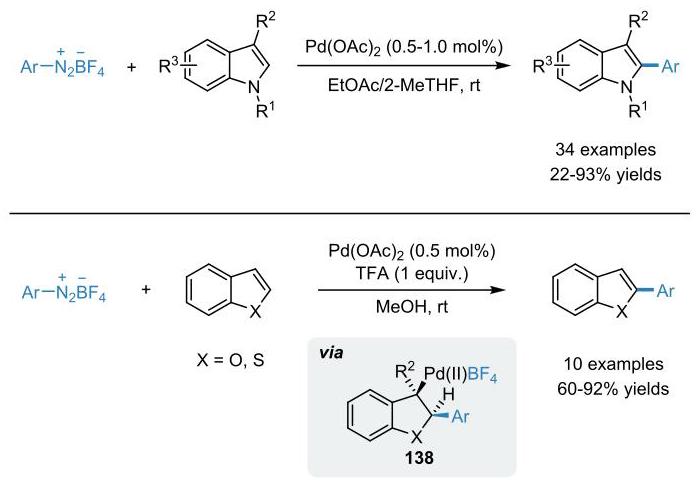
Tryptophan is a rare proteinogenic amino acid that has gained much current attention as a handle for site-selective protein modification and conjugation. In 2017, Fairlamb and co-workers described a regioselective Pd-mediated C-H arylation for tryptophans 139 usingaryl diazonium salts. This process affords C2-arylated tryptophan derivatives 140 in good to excellent yields (Scheme 98). ${}^{194}$ Tosylic acid was found to have a rate-accelerating effect for this transformation.
色氨酸是一种稀有的蛋白质ogenic氨基酸,作为位点选择性蛋白质修饰和缀合的手段,目前备受关注。2017年,Fairlamb及其同事描述了使用芳基重氮盐对色氨酸139进行区域选择性钯介导的C-H芳基化反应。该过程以良好到优异的产率得到C2-芳基化色氨酸衍生物140(方案98)。${}^{194}$ 发现对甲苯磺酸对该转化有加速作用。
Scheme 98. Pd(OAc)2-Catalyzed C-H Arylation of Tryptophans with Aryl Diazonium Salts
方案98. Pd(OAc)2催化的色氨酸与芳基重氮盐的C-H芳基化反应
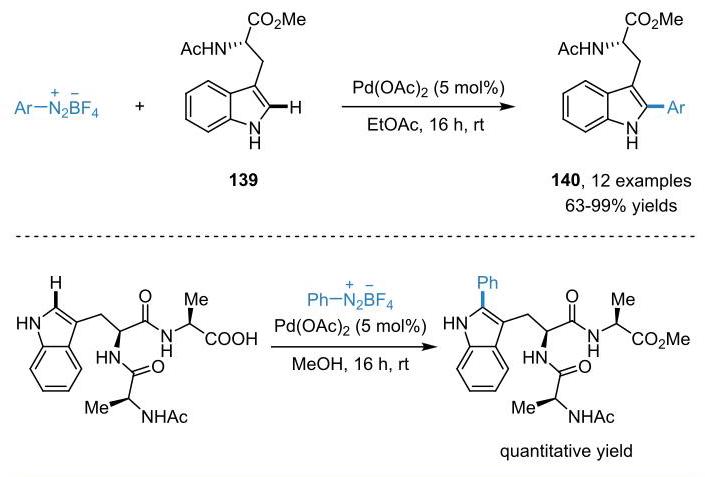
Moreover, a series of transition-metal-catalyzed, directing group-assisted C-H arylation using aryl diazonium salts have been reported. ${}^{{195} - {198}}$ Chang described an Ir(III)-catalyzed ortho- $\mathrm{C} - \mathrm{H}$ arylation of benzamides with aryl diazonium salts under oxidant-free conditions (Scheme 99). ${}^{195}$ Enamides and quinoline N-oxides could also be arylated under these conditions. The authors proposed that the turnover-limiting step is likely the formation of an aryliridium(V) intermediate derived from the aryl diazonium substrates.
此外,还报道了一系列使用芳基重氮盐的过渡金属催化、导向基团辅助的C-H芳基化反应。${}^{{195} - {198}}$ Chang描述了在无氧化剂条件下,Ir(III)催化苯甲酰胺与芳基重氮盐的邻位$\mathrm{C} - \mathrm{H}$芳基化反应(方案99)。${}^{195}$ 在这些条件下,烯酰胺和喹啉N-氧化物也可以被芳基化。作者提出,周转限制步骤可能是由芳基重氮底物衍生的芳基铱(V)中间体的形成。
Scheme 99. Cp*Ir(III)-Catalyzed C-H Arylation of Arenes and Alkenes with Aryl Diazonium Salts
方案99. Cp*Ir(III)催化的芳烃和烯烃与芳基重氮盐的C-H芳基化反应
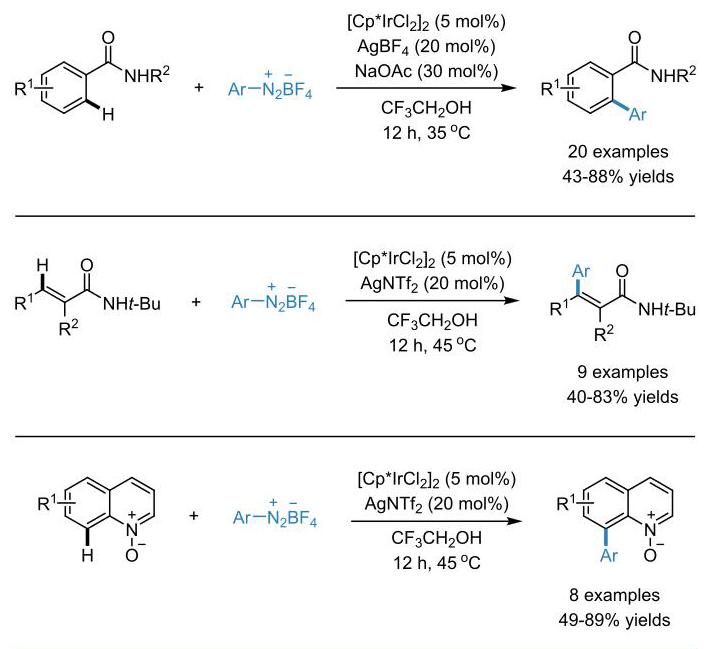
In the same year, Gooßen described an oxidant-free Ir-catalyzed ortho-C-H arylation protocol for benzoic acids 141 by using aryl diazonium salts with a catalytic amount of ${\mathrm{{Ag}}}_{2}{\mathrm{{CO}}}_{3}$ and stoichiometric ${\mathrm{{Li}}}_{2}{\mathrm{{CO}}}_{3}$ as additives (Scheme 100). ${}^{196}$ After various directing groups were evaluated, only free carboxylic acids (as in benzoic acid) and secondary amides were effective as directing groups in this ortho-C-H arylation regime (versus 2-pyridyl, 2-pyridyl ether, acetamide, 8- aminoquinoline amide, ester, 2-oxazolyl), allowing the synthesis of diaryl carboxylates 142. On the basis of radical scavenger experiments, a single-electron oxidation of aryl radical to Ir(III) species is hypothesized.
同年,Gooßen描述了一种无氧化剂的Ir催化的苯甲酸141的邻位C-H芳基化方法,使用芳基重氮盐与催化量的${\mathrm{{Ag}}}_{2}{\mathrm{{CO}}}_{3}$和化学计量的${\mathrm{{Li}}}_{2}{\mathrm{{CO}}}_{3}$作为添加剂(方案100)。${}^{196}$ 在评估了各种导向基团后,只有游离羧酸(如苯甲酸中的)和仲酰胺在这种邻位C-H芳基化体系中作为导向基团有效(与2-吡啶基、2-吡啶基醚、乙酰胺、8-氨基喹啉酰胺、酯、2-恶唑基相比),从而可以合成二芳基羧酸盐142。基于自由基清除剂实验,推测芳基自由基单电子氧化为Ir(III)物种。
Scheme 100. Iridium-Catalyzed ortho-Arylation of Benzoic Acids with Arene diazonium Salts
方案100. 铱催化的苯甲酸与芳基重氮盐的邻位芳基化反应
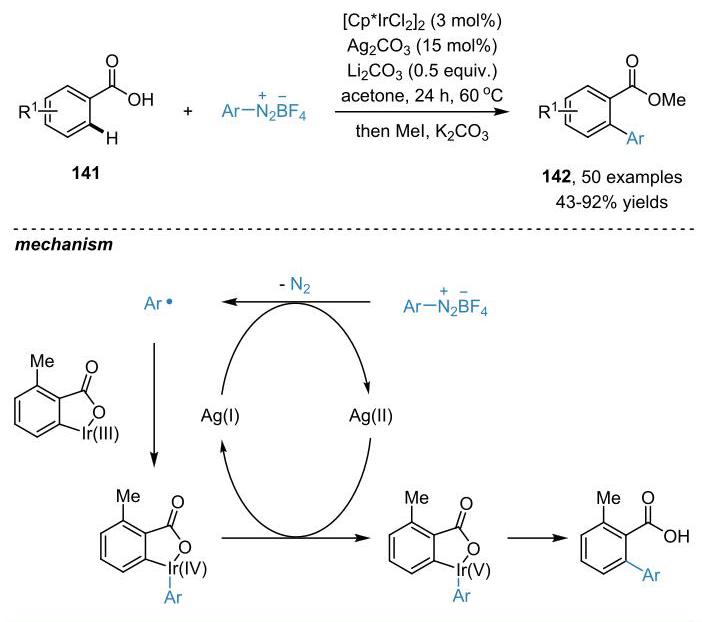
In addition to iridium catalysts, palladium complexes have also been explored as efficient catalysts for promoting directed $\mathrm{C} - \mathrm{H}$ arylation of $N$ -methoxybenzamides 143 with in situ generated aryl diazonium salts as arylating agents, affording phenanthridones 144 via formation of C-C and C-N bonds in a one-pot fashion (Scheme 101). ${}^{197}$ The reaction pathway involves the initial ortho-C-H arylation of $N$ -methoxybenza-mide 143 with aryl diazonium salts to generate the biaryl bond, followed by a second $\mathrm{C} - \mathrm{H}$ activation and subsequent intramolecular amidation reaction to form the $\mathrm{C} - \mathrm{N}$ bond, which builds up the phenanthridinone scaffold.
除了铱催化剂外,钯配合物也被探索作为促进$\mathrm{C} - \mathrm{H}$-甲氧基苯甲酰胺143与原位生成的芳基重氮盐作为芳基化剂进行导向$N$芳基化反应的有效催化剂,通过一锅法形成C-C和C-N键得到菲啶酮144(方案101)。${}^{197}$ 反应途径包括首先$N$-甲氧基苯甲酰胺143与芳基重氮盐进行邻位C-H芳基化反应生成联芳基键,然后进行第二次$\mathrm{C} - \mathrm{H}$活化和随后的分子内酰胺化反应形成$\mathrm{C} - \mathrm{N}$键,从而构建菲啶酮骨架。
In 2018, Polley and co-workers reported a Pd-catalyzed C-H arylation of aniline carbamates with aryl diazonium salts for the synthesis of various of carbazole alkaloids under mild conditions in the absence of external oxidants, acids, or bases. ${}^{198}$
2018年,波利及其同事报道了一种钯催化的苯胺氨基甲酸酯与芳基重氮盐的C-H芳基化反应,该反应在温和条件下,无需外部氧化剂、酸或碱,即可合成各种咔唑生物碱。${}^{198}$
Furthermore, the combined systems consisting of a photo-redox and a transition-metal catalyst have been developed, which expands the utility of transition metal-catalyzed $\mathrm{C} - \mathrm{H}$ functionalization through a photoinduced SET process. In 2011, Sanford and co-workers first described a Pd-catalyzed directed ortho-C-H activation and arylation reaction with aryl diazonium salts under visible-light photoredox catalysis to obtain 2-arylpyridine derivatives (Scheme 102). ${}^{199}$ Mechanistically, this dual catalytic system is initiated by the oxidative quenching of the excited state of photosensitizer to afford an aryl radical, which subsequently oxidizes the cyclic Pd(II) species to a Pd(III) intermediate. This Pd(III) species undergoes single-electron oxidation by a hypervalent photosensitizer to form Pd(IV) intermediate 145, followed by final reductive elimination to forge the biaryl $\mathrm{C} - \mathrm{C}$ bond.
此外,已经开发出由光氧化还原催化剂和过渡金属催化剂组成的复合体系,该体系通过光诱导单电子转移过程扩展了过渡金属催化的$\mathrm{C} - \mathrm{H}$官能团化的应用范围。2011年,桑福德及其同事首次描述了在可见光光氧化还原催化下,钯催化的与芳基重氮盐的定向邻位C-H活化和芳基化反应,以获得2-芳基吡啶衍生物(方案102)。${}^{199}$从机理上讲,这种双催化体系是由光敏剂激发态的氧化猝灭引发的,从而产生芳基自由基,该自由基随后将环状钯(II)物种氧化为钯(III)中间体。该钯(III)物种通过高价光敏剂进行单电子氧化,形成钯(IV)中间体145,随后通过最终的还原消除形成联芳基$\mathrm{C} - \mathrm{C}$键。
Scheme 101. Palladium-Catalyzed Deaminative Phenanthridinone Synthesis from Anilines via C-H Bond Activation
方案101. 通过C-H键活化由苯胺钯催化的脱氨基菲啶酮合成
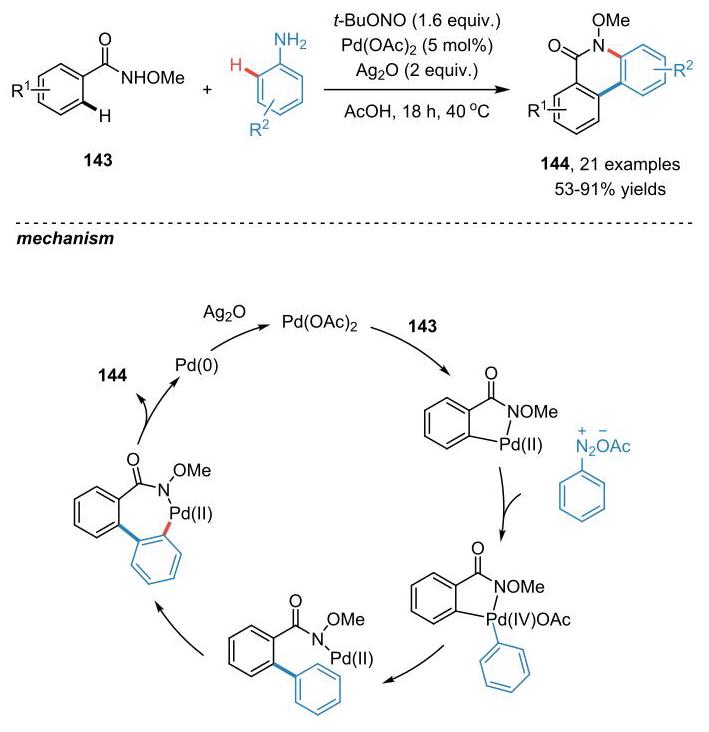
Scheme 102. Mechanism for the Pd/Photoredox-Catalyzed C-H Arylation
方案102. 钯/光氧化还原催化的C-H芳基化机理
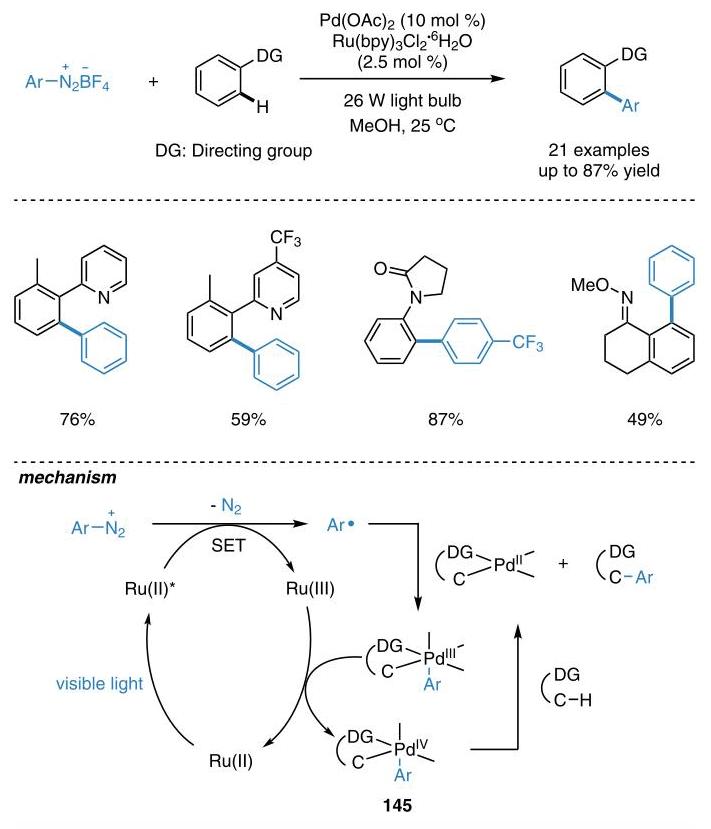
Subsequent to Sanford’s pioneering research, a series of dual photoredox/Pd-catalyzed C-H functionalization systems have been established (Scheme 103). ${}^{200}$ Employing the Pd/AcrH ${}_{2}$ dual catalytic system, visible-light-induced ortho-C-H aryla-tions of acetanilides, benzanilides, and $N$ -methylbenzamides were realized, which represents a new example for the combination of a transition metal catalyst with an organic photoredox catalyst. ${}^{201}$ Balaraman reported a Pd/Ru photo-redox catalytic system in dimethyl carbonate (DMC) as a green solvent for ortho-C-H arylation of pivalanilides with aryl diazonium salts. ${}^{202}$ The same group also disclosed a dual catalytic approach for $\mathrm{C} - \mathrm{H}$ functionalization with aryl diazonium salts using the Pd/eosin Y catalytic system. ${}^{203}$
在桑福德的开创性研究之后,一系列双光氧化还原/钯催化的C-H官能团化体系得以建立(方案103)。${}^{200}$采用钯/AcrH${}_{2}$双催化体系,实现了可见光诱导的乙酰苯胺、苯甲酰苯胺和$N$-甲基苯甲酰胺的邻位C-H芳基化反应,这代表了过渡金属催化剂与有机光氧化还原催化剂结合的一个新例子。${}^{201}$巴拉腊曼报道了一种在碳酸二甲酯(DMC)中作为绿色溶剂的钯/钌光氧化还原催化体系,用于新戊酰苯胺与芳基重氮盐的邻位C-H芳基化反应。${}^{202}$同一研究小组还公开了一种使用钯/曙红Y催化体系与芳基重氮盐进行$\mathrm{C} - \mathrm{H}$官能团化的双催化方法。${}^{203}$
Scheme 103. Visible Light-Promoted Pd/Photoredox-Catalyzed C-H Arylations of Arenes
方案103. 可见光促进的钯/光氧化还原催化的芳烃C-H芳基化反应
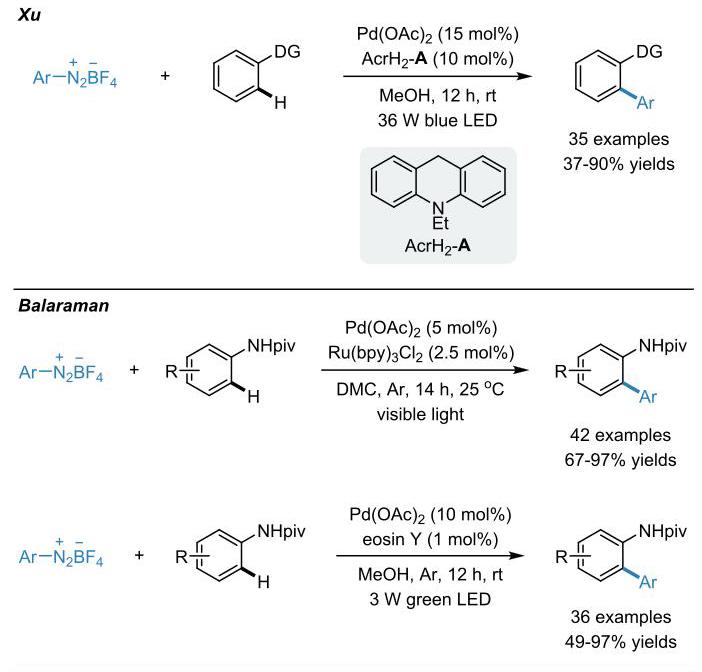
This dual Pd/Ru cocatalyzed system has found applications in modifying various heterocycles, such as the selective arylation of 6-arylpurine nucleosides 146 employing purine as a directing group, ${}^{204}$ as well as $\mathrm{C} - \mathrm{H}$ arylation of benzodiazepines 147 (Scheme 104). ${}^{205}$
这种双钯/钌共催化体系已在修饰各种杂环化合物中得到应用,例如以嘌呤为导向基团对6-芳基嘌呤核苷146进行选择性芳基化反应,${}^{204}$以及$\mathrm{C} - \mathrm{H}$对苯二氮卓147进行芳基化反应(方案104)。${}^{205}$
Apart from the $\mathrm{C}\left( {\mathrm{{sp}}}^{2}\right) - \mathrm{H}$ arylation reactions, the synergistic Pd/Ru-catalyzed photoredox system was explored for the arylation of unactivated $\mathrm{C}\left( {\mathrm{{sp}}}^{3}\right) - \mathrm{H}$ bonds with aryl diazonium salts by using 5-chloro-8-aminoquinoline 148 as the auxiliary group (Scheme 105). ${}^{206}$ This $\mathrm{C}\left( {\mathrm{{sp}}}^{3}\right) - \mathrm{H}$ arylation reaction represents an extension for the dual catalytic $\mathrm{C} - \mathrm{H}$ functionalization process. A plausible mechanism involves a one-electron oxidative addition, enabling a Pd(II)-Pd(III)- Pd(IV)-Pd(II) catalytic cycle.
除了$\mathrm{C}\left( {\mathrm{{sp}}}^{2}\right) - \mathrm{H}$芳基化反应外,还探索了协同的钯/钌催化光氧化还原体系,通过使用5-氯-8-氨基喹啉148作为辅助基团,用芳基重氮盐对未活化的$\mathrm{C}\left( {\mathrm{{sp}}}^{3}\right) - \mathrm{H}$键进行芳基化反应(方案105)。${}^{206}$这种$\mathrm{C}\left( {\mathrm{{sp}}}^{3}\right) - \mathrm{H}$芳基化反应代表了双催化$\mathrm{C} - \mathrm{H}$官能团化过程的扩展。一种合理的机理涉及单电子氧化加成,从而实现钯(II)-钯(III)-钯(IV)-钯(II)催化循环。
Scheme 104. Visible Light-Promoted Pd/Ru-Catalyzed C-H Arylations of 6-Arylpurine and Benzodiazepines
方案104. 可见光促进的钯/钌催化的6-芳基嘌呤和苯二氮卓的C-H芳基化反应
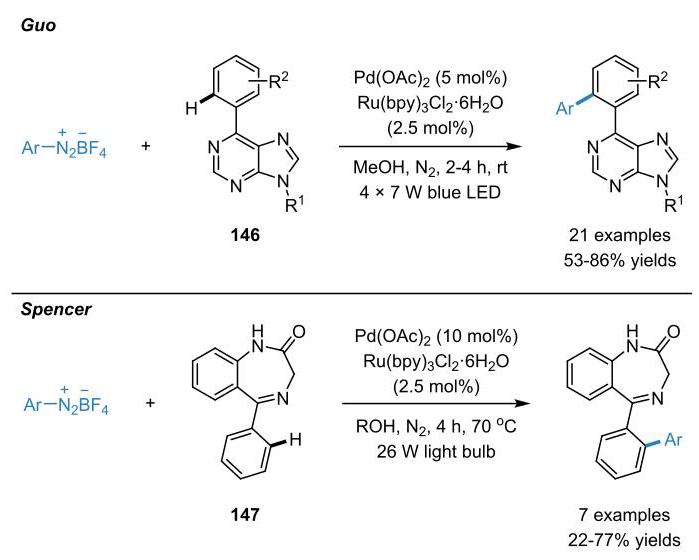
Scheme 105. Auxiliary-Directed Visible Light-Promoted Pd/Ru C $\left( {\mathrm{{sp}}}^{3}\right) -$ H Arylations
方案105. 辅助导向的可见光促进的钯/钌C$\left( {\mathrm{{sp}}}^{3}\right) -$H芳基化反应
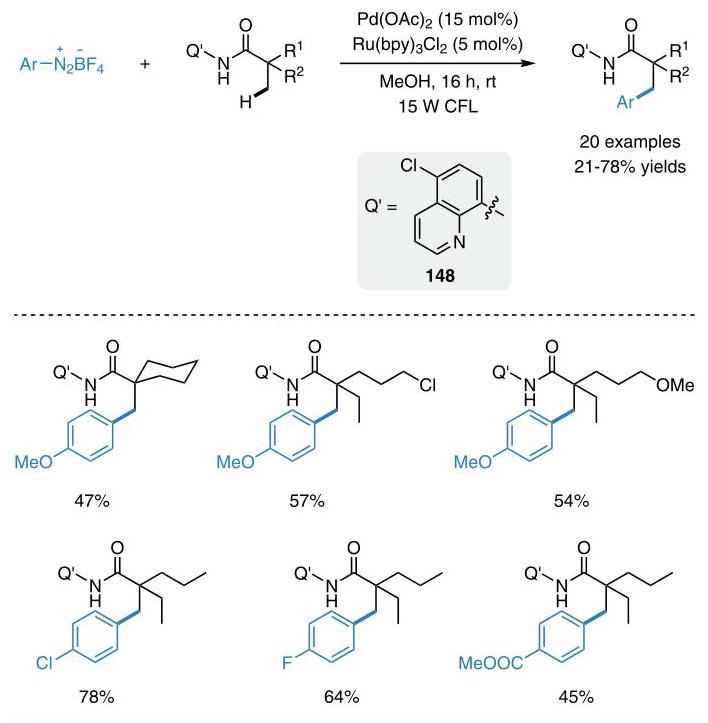
2.2.3. Suzuki-Miyaura, Hiyama, Stille-type Coupling Reactions, and Others. Not only can aryl diazonium salts be applied in Heck-type reactions, these substrates have also been explored as electrophiles in transition metal-catalyzed cross-coupling reactions with nucleophilic organometallic compounds through Suzuki-Miyaura, Hiyama, Stille, and Kumu-da-type coupling reactions (Scheme 106). Palladium and nickel complexes have been utilized as catalysts for these coupling reactions. A gold-catalyzed coupling reaction will be summarized in a separate section below.
2.2.3. 铃木-宫浦、桧山、施蒂勒型偶联反应及其他反应。芳基重氮盐不仅可应用于赫克型反应,这些底物还被探索用作亲电试剂,通过铃木-宫浦、桧山、施蒂勒和久留田型偶联反应,与亲核有机金属化合物进行过渡金属催化的交叉偶联反应(方案106)。钯和镍配合物已被用作这些偶联反应的催化剂。金催化的偶联反应将在下面单独的部分进行总结。
Scheme 106. Transition-Metal-Catalyzed Coupling Reactions of Aryl Diazonium Salts with Organometallic Compounds
方案106. 芳基重氮盐与有机金属化合物的过渡金属催化偶联反应
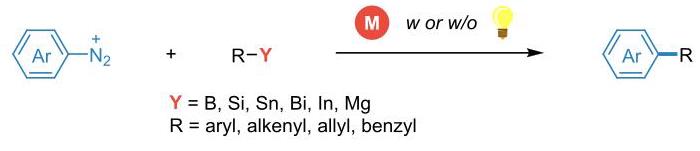
Pd-catalyzed cross-coupling reactions of aryl diazonium salts are dominated by reactions with arylboronic acids. Recent advances mainly include sustainable, cost-effective catalytic procedures, ${}^{207}$ variations in the aryl organometallic partners, and one-pot procedures using anilines as substrates. The Suzuki-Miyaura coupling reactions of aryl diazonium tetrafluoroborates can be applied to the safe production of ${500}\mathrm{\;g}$ of 2-cyano-4-formylbiphenyl 149, an essential intermediate for manufacturing angiotensin II inhibitors (Scheme 107). ${}^{208}$
钯催化的芳基重氮盐交叉偶联反应主要是与芳基硼酸的反应。最近的进展主要包括可持续、具有成本效益的催化方法、芳基有机金属伙伴的${}^{207}$变化,以及以苯胺为底物的一锅法。四氟硼酸芳基重氮盐的铃木-宫浦偶联反应可应用于安全生产制造血管紧张素II抑制剂的重要中间体2-氰基-4-甲酰基联苯149的${500}\mathrm{\;g}$(方案107)。${}^{208}$
A series of heterogeneous catalytic systems have been explored for Suzuki coupling reactions of aryl diazonium salts. Utilizing palladium supported on activated carbon $\left( {\mathrm{{Pd}}/\mathrm{C}}\right)$ in an aqueous hydrotropic solution, a ligand-free protocol for the Suzuki-Miyaura reaction and base-free Heck-Matsuda reaction was reported under mild conditions. ${}^{209}$ In addition, the stabilizing effect of biopolymers and biomolecules has been exploited for preparing palladium composite catalysts. Both palladium nanoparticles immobilized on a titanium dioxide cellulose composite (PdNPs@TiO ${}_{2}$ -Cell) ${}^{210}$ and Pd@poly-dopamine-coated nano- ${\mathrm{{Fe}}}_{3}{\mathrm{O}}_{4}{}^{211}$ have been synthesized and utilized in heterogeneous catalytic Suzuki cross-coupling reactions.
已经探索了一系列用于芳基重氮盐铃木偶联反应的多相催化体系。在水性向溶剂中使用负载在活性炭$\left( {\mathrm{{Pd}}/\mathrm{C}}\right)$上的钯,报道了一种在温和条件下的无配体铃木-宫浦反应和无碱赫克-松田反应方案。${}^{209}$此外,生物聚合物和生物分子的稳定作用已被用于制备钯复合催化剂。固定在二氧化钛纤维素复合材料(PdNPs@TiO ${}_{2}$ -Cell)${}^{210}$上的钯纳米颗粒和Pd@聚多巴胺包覆的纳米${\mathrm{{Fe}}}_{3}{\mathrm{O}}_{4}{}^{211}$都已合成并用于多相催化铃木交叉偶联反应。
Scheme 107. Hectogram-Scale Synthesis of 2-Cyano-4- Formylbiphenyl
方案107. 2-氰基-4-甲酰基联苯的百克级合成
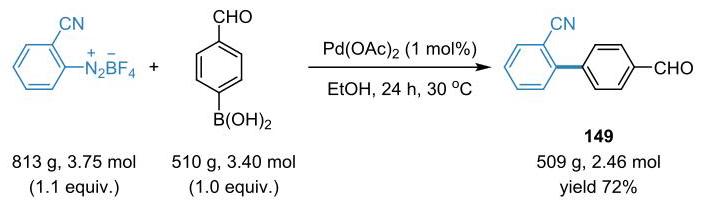
From a green chemistry perspective, new Suzuki-Miyaura coupling procedures utilizing water as a solvent are attractive. Bräse et al. disclosed an environmentally benign Pd-catalyzed Suzuki-Miyaura cross-coupling reaction of aryl diazonium tosylates in neat water (Scheme 108). ${}^{212}$
从绿色化学的角度来看,利用水作为溶剂的新型铃木-宫浦偶联方法很有吸引力。Bräse等人公开了一种在纯水中对甲苯磺酸芳基重氮盐的环境友好型钯催化铃木-宫浦交叉偶联反应(方案108)。${}^{212}$
Scheme 108. Suzuki-Miyaura Cross-Coupling of Aryl Diazonium Tosylates in Neat Water
方案108. 在纯水中对甲苯磺酸芳基重氮盐的铃木-宫浦交叉偶联
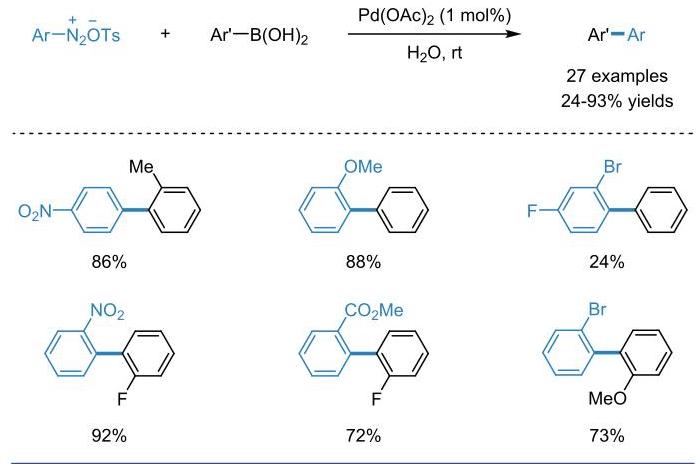
A “cationic” Suzuki-Miyaura cross-coupling reaction was reported using a ${\mathrm{{PAd}}}_{3}$ -Pd catalyst in the absence of any base or metal mediator, allowing for the efficient coupling reaction of base-sensitive polyfluoroaryl and heteroaryl boronic acids (Scheme 109). ${}^{213}$ The low coordinate cationic palladium complexes 150 are stabilized by electron-rich bulky phosphine ligands such as ${\mathrm{{PAd}}}_{3}$ .
报道了一种“阳离子型”铃木-宫浦交叉偶联反应,该反应使用${\mathrm{{PAd}}}_{3}$ -钯催化剂,无需任何碱或金属介质,可实现对碱敏感的多氟芳基和杂芳基硼酸的高效偶联反应(方案109)。${}^{213}$低配位阳离子钯配合物150由富电子的大位阻膦配体如${\mathrm{{PAd}}}_{3}$稳定。
To expand the substrate scope of organoboron coupling partners, an ultrafast Pd-catalyzed coupling reaction of potassium vinyltrifluoroborate 151 was developed, facilitating the synthesis of styrenes that are prone to polymerization and the preparation of stilbenes within minutes through a Suzuki-Heck coupling sequence (Scheme 110). ${}^{214}$ The scope of the organoboron moiety can also be expanded to diarylborinic acids. ${}^{215}$
为了扩大有机硼偶联伙伴的底物范围,开发了一种超快速钯催化的乙烯基三氟硼酸钾151的偶联反应,通过铃木-赫克偶联序列,在几分钟内促进了易于聚合的苯乙烯的合成和二苯乙烯的制备(方案110)。${}^{214}$有机硼部分的范围也可以扩大到二芳基硼酸。${}^{215}$
The advantage of easy availability of aniline starting materials may be counteracted by the lack of efficiency and flexibility in preparing and isolating aryl diazonium tetra-fluoroborates. In 2011, Wang and co-workers reported a Pd-catalyzed Suzuki cross-coupling reaction of in situ generated aryl diazonium salts with arylboronic acids. ${}^{216}$ This base-free, one-pot diazotization/cross-coupling protocol enables the synthesis of biaryls directly from anilines. Afterward, a base-, acid-, and ligand-free Pd-catalyzed Suzuki-Miyaura cross-coupling reaction of anilines was reported (Scheme 111). ${}^{217}$ This reaction proceeds through the formation of an aryl-Pd alkoxo complex 152, confirmed by ESI-MS as a trimeric complex, which promotes the transmetalation step with aryl
苯胺起始原料易于获得的优点,可能会被制备和分离四氟硼酸芳基重氮盐时缺乏效率和灵活性所抵消。2011年,Wang及其同事报道了原位生成的芳基重氮盐与芳基硼酸的钯催化 Suzuki 交叉偶联反应。${}^{216}$ 这种无碱、一锅法重氮化/交叉偶联方案能够直接从苯胺合成联芳基。此后,又报道了一种无碱、无酸和无配体的钯催化苯胺的 Suzuki-Miyaura 交叉偶联反应(方案111)。${}^{217}$ 该反应通过形成芳基-钯烷氧基络合物152进行,ESI-MS证实其为三聚体络合物,它促进了与芳基的转金属化步骤
Scheme 109. “Cationic” Suzuki-Miyaura Coupling Reactions
方案109. “阳离子型” Suzuki-Miyaura 偶联反应
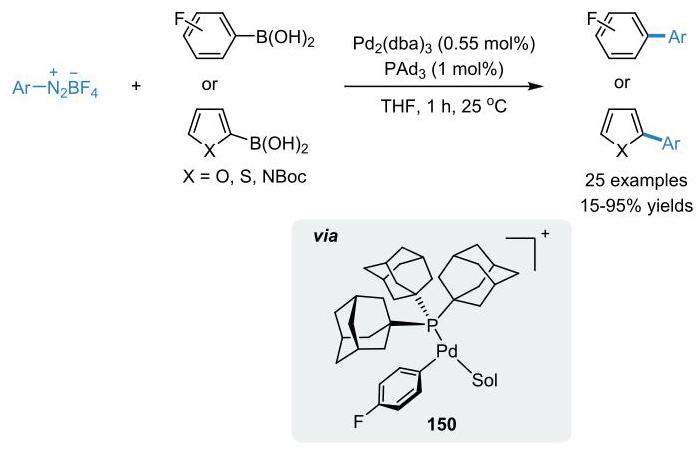
Scheme 110. Ultrafast Suzuki-Miyaura and Heck Reactions for the Synthesis of Styrenes and Stilbenes
方案110. 用于合成苯乙烯和二苯乙烯的超快 Suzuki-Miyaura 和 Heck 反应
Pd(OAc) ${}_{2}$ (1 mol%)
Pd(OAc) ${}_{2}$ (1 mol%)
$\mathrm{{Ar}} - {\mathrm{N}}_{2}\mathrm{{OTs}}$ BF3K
$\mathrm{{Ar}} - {\mathrm{N}}_{2}\mathrm{{OTs}}$ BF3K
$\mathrm{{MeCN}}/{\mathrm{H}}_{2}\mathrm{O}$ , rt
$\mathrm{{MeCN}}/{\mathrm{H}}_{2}\mathrm{O}$ ,室温
151 within ${450}\mathrm{\;s}$ 13 examples
151在${450}\mathrm{\;s}$ 13个实例中
52-97% yields
52 - 97% 的产率
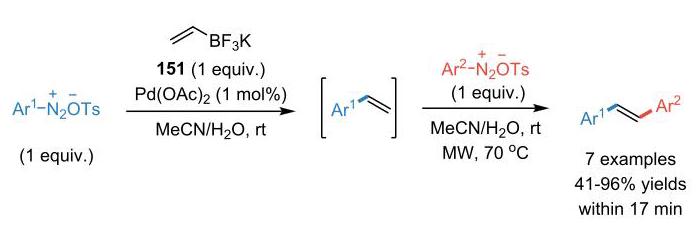
Scheme 111. Pd-Catalyzed Suzuki-Miyaura Cross-Coupling Reactions of Anilines boronic acids without any external base. Another Suzuki-Miyaura cross-coupling of anilines has been reported using silver nitrite (AgONO) as an alternative nitrosating reagent. ${}^{218}$
方案111. 钯催化苯胺与硼酸的 Suzuki-Miyaura 交叉偶联反应,无需任何外部碱。另一种使用亚硝酸银(AgONO)作为替代亚硝化试剂的苯胺 Suzuki-Miyaura 交叉偶联反应也有报道。${}^{218}$
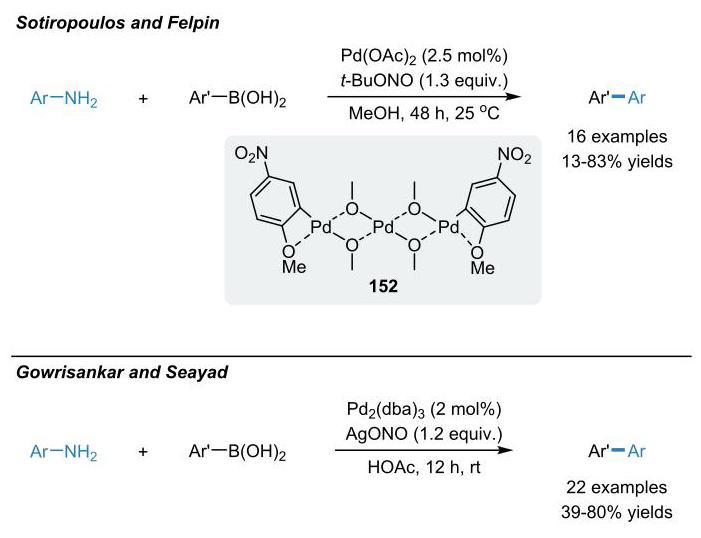
Schmidt has developed a deacetylation/diazotization followed by Pd-catalyzed cross-coupling sequence of acetani-lides for selective C-C bond formations (Scheme 112). ${}^{{219} - {221}}$
Schmidt 开发了一种脱乙酰化/重氮化,然后是钯催化的乙酰苯胺交叉偶联序列,用于选择性 C-C 键形成(方案112)。${}^{{219} - {221}}$
Scheme 112. Deacetylation-Diazotization-Coupling Sequence for Pd-Catalyzed C-C Bond Formations
方案112. 钯催化 C-C 键形成的脱乙酰化-重氮化-偶联序列
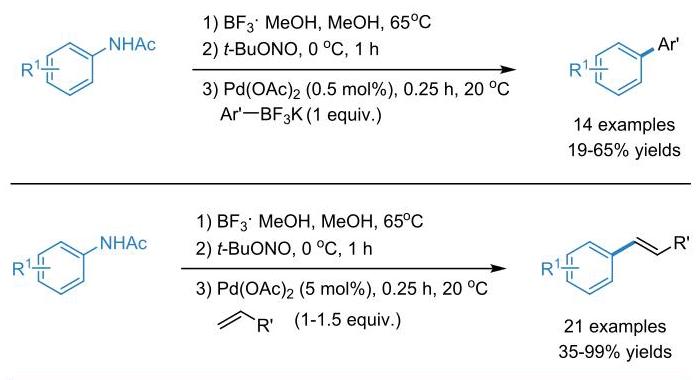
The reaction pathway includes the Lewis acid-mediated decomposition of the acetanilide to obtain anilines, followed by diazotization and sequential Pd-catalyzed coupling reaction with aryltrifluoroborates, furnishing unsymmetrical biaryls and stilbenes in moderate to good yields.
反应途径包括路易斯酸介导的乙酰苯胺分解以获得苯胺,然后进行重氮化以及与芳基三氟硼酸盐的顺序钯催化偶联反应,以中等至良好的产率提供不对称联芳基和二苯乙烯。
Moreover, a multicomponent Pd-catalyzed coupling reaction of aryl diazonium salts and arylboronic acids with ynamides 153 was disclosed, giving rise to functionalized triaryl-substituted enamides 154 (Scheme 113). ${}^{222}$ Mechanistically, this coupling reaction is initiated by the Pd-catalyzed coupling of 153 with aryl diazonium salts to afford a keteniminium species 155, followed by 1,3-aryl migration to generate a vinylic palladium(II) complex, and sequential trapping of the arylboronic acid.
此外,还公开了一种芳基重氮盐、芳基硼酸与炔酰胺153的多组分钯催化偶联反应,生成功能化的三芳基取代烯酰胺154(方案113)。${}^{222}$ 从机理上讲,这种偶联反应是由钯催化的153与芳基重氮盐的偶联引发,得到烯酮亚胺物种155,随后进行1,3-芳基迁移以生成乙烯基钯(II)络合物,然后依次捕获芳基硼酸。
Scheme 113. Pd-Catalyzed Coupling of Ynamides, Aryl Diazonium Salts, and Arylboronic Acids
方案113. 钯催化炔酰胺、芳基重氮盐和芳基硼酸的偶联反应
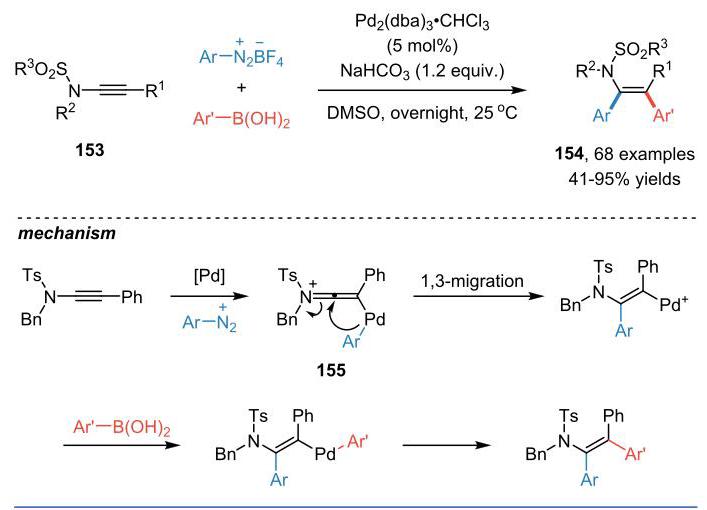
Nickel complexes have also been explored as cheaper and efficient catalysts in cross-coupling reactions of aryl diazonium salts with arylboronic acids. In glycerol as a reaction medium, this base-free protocol is amenable to synthesize functionalized biaryls in good to excellent yields (15 examples, 71-90% yields). ${}^{223}$
镍络合物也被探索作为芳基重氮盐与芳基硼酸交叉偶联反应中更便宜且高效的催化剂。在甘油作为反应介质中,这种无碱方案能够以良好至优异的产率合成功能化联芳基(15个实例,71 - 90% 的产率)。${}^{223}$
Apart from the Suzuki-Miyaura coupling reactions, the Negishi cross-coupling of aryl diazonium $o$ -benzenedisulfoni-mides 107 was disclosed (Scheme 114). ${}^{224}$ In 2019, visible light-facilitated Ni-catalyzed one-pot Negishi coupling reactions was developed using diazonium salts with in situ generated ${\mathrm{{Ar}}}_{2}\mathrm{{Zn}}$ from Grignard reagents and ${\mathrm{{ZnBr}}}_{2}{}^{.225}$
除了 Suzuki-Miyaura 偶联反应外,还公开了芳基重氮 $o$ -苯二磺酰亚胺107的 Negishi 交叉偶联反应(方案114)。${}^{224}$ 2019年,开发了可见光促进的镍催化的一锅法 Negishi 偶联反应,使用重氮盐与原位生成的 ${\mathrm{{Ar}}}_{2}\mathrm{{Zn}}$ 由格氏试剂和 ${\mathrm{{ZnBr}}}_{2}{}^{.225}$
Scheme 114. Negishi Cross-Coupling of Aryl Diazonium Salts
方案114. 芳基重氮盐的根岸交叉偶联反应
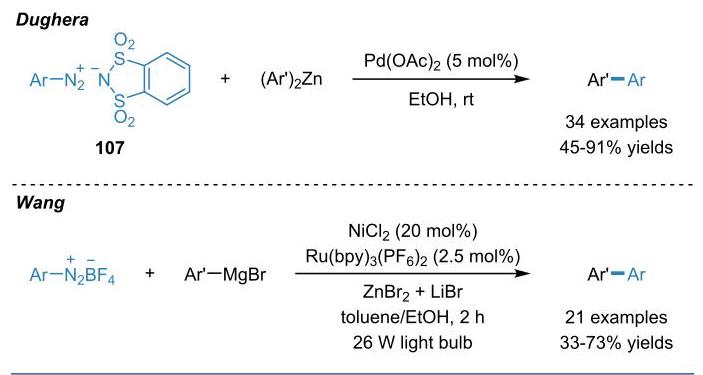
Pd-catalyzed cross-coupling reactions of aryl diazonium salts with organometallic partners other than arylboronic acids have also been established, including an aqueous phase Hiyama cross-coupling, ${}^{226}$ an $\mathrm{{Al}}{\left( \mathrm{{OH}}\right) }_{3}$ -supported Pd nanoparticles catalyzed Stille cross-coupling, ${}^{227}$ homocoupling of aryl diazonium salts in ionic liquids, ${}^{228}$ and cross-coupling with organoindium or organobismuth reagents ${}^{229}$ (Scheme 115).
钯催化芳基重氮盐与除芳基硼酸之外的有机金属试剂的交叉偶联反应也已得到证实,包括水相中的日向交叉偶联反应、${}^{226}$一种$\mathrm{{Al}}{\left( \mathrm{{OH}}\right) }_{3}$负载的钯纳米颗粒催化的史迪尔交叉偶联反应、${}^{227}$芳基重氮盐在离子液体中的自身偶联反应、${}^{228}$以及与有机铟或有机铋试剂的交叉偶联反应${}^{229}$(方案115)。
In 2018, Shang reported a Pd-catalyzed desulfinative and denitrogenative cross-coupling reaction of aryl sulfonyl hydrazides with aryl diazonium salts in the presence of TBAI, which afforded biaryl products under mild conditions in good yields (37 examples, 66-95% yields). ${}^{230}$ A plausible pathway includes the initial formation of iodobenzene by in situ Sandmeyer-type iodination of the aryl diazonium salt with TBAI, followed by Pd-catalyzed desulfinative coupling to deliver the desired biaryls.
2018年,尚报道了在四丁基碘化铵存在下,钯催化芳基磺酰肼与芳基重氮盐的脱亚磺酰基和脱氮交叉偶联反应,该反应在温和条件下能以良好的产率得到联芳基产物(37个例子,产率66 - 95%)。${}^{230}$一种可能的反应途径包括通过四丁基碘化铵对芳基重氮盐进行原位桑德迈尔型碘化反应首先生成碘苯,随后通过钯催化的脱亚磺酰基偶联反应得到所需的联芳基产物。
Scheme 115. Pd-Catalyzed Cross-Coupling Reaction of Aryl Diazonium Salts with Other Organometallic Partners
方案115. 钯催化芳基重氮盐与其他有机金属试剂的交叉偶联反应
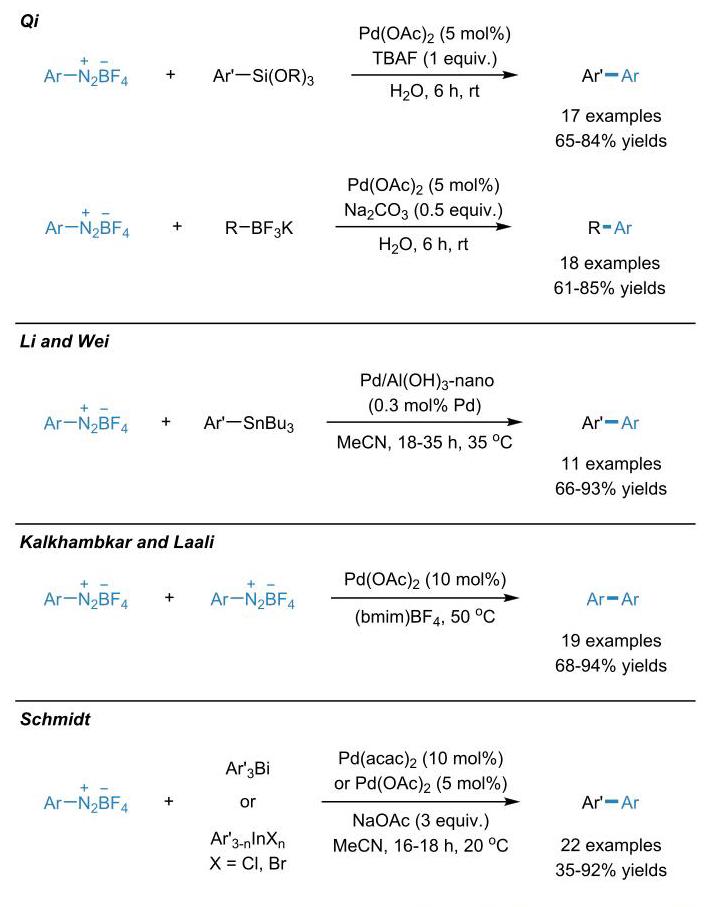
Another type of Pd-catalyzed coupling reaction involves the oxidative decarboxylative coupling of aryl $\alpha$ -keto carboxylic acid 156 with aryl diazonium fluoroborates, which represents a complementary synthetic route to the carbonylation reactions (Scheme 116). ${}^{231}$ Both radical trapping experiments and EPR spectroscopy results indicate that this protocol proceeds through a single-electron oxidation pathway involving the formation of an acyl radical.
另一类钯催化的偶联反应涉及芳基$\alpha$ - 酮羧酸156与氟硼酸芳基重氮盐的氧化脱羧偶联反应,这是羰基化反应的一种互补合成路线(方案116)。${}^{231}$自由基捕获实验和电子顺磁共振光谱结果均表明该反应通过涉及酰基自由基形成的单电子氧化途径进行。
Scheme 116. Pd-Catalyzed Decarboxylative Coupling of $\alpha$ - Oxocarboxylic Acid with Aryl Diazonium Salts
方案116. 钯催化$\alpha$ - 氧代羧酸与芳基重氮盐的脱羧偶联反应
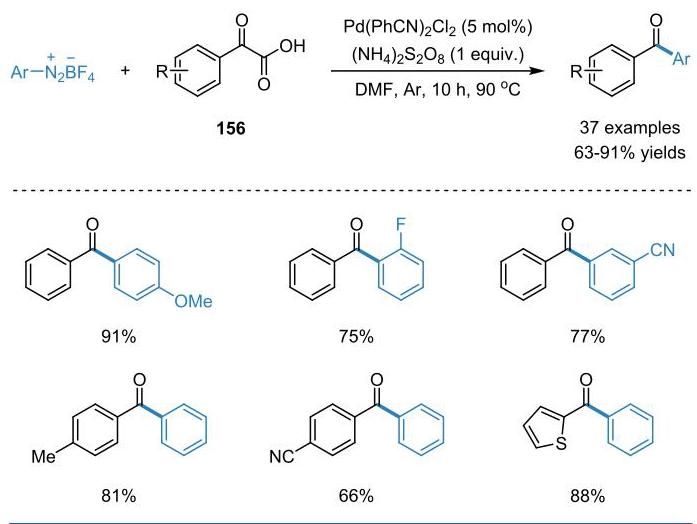
In 2014, a cobalt complex was explored as efficient catalysis in the cross-coupling reaction of aryl diazonium salts with vinyl diazoacetates 157, affording regiospecific synthesis of $N$ - arylpyrazoles with good yields (Scheme 117). ${}^{232}$ Particularly, the nitrogen moiety in the pyrazole scaffold is from the substrates of vinyl diazoacetates 157. The reaction mechanism is initiated by oxidative addition to form a cationic aryl-cobalt complex, followed by $N$ -coordination to form diazo-cobalt species 158. This complex undergoes 1,5-electrocyclization (1,5-EC)/tautomerization and loss of hydrogen. Finally, the reductive elimination of $N$ -cobalt pyrazole 159 furnishes the desired product and regenerates the active cobalt species. This reaction not only features many advantages such as cheap catalysts, mild conditions, and excellent regioselectivity but also explores the catalytic coupling between diazonium salts and diazo compounds.
2014年,人们探索了一种钴配合物作为芳基重氮盐与乙烯基重氮乙酸酯157交叉偶联反应的高效催化剂,能以良好的产率区域选择性地合成$N$ - 芳基吡唑(方案117)。${}^{232}$特别地,吡唑骨架中的氮部分来自乙烯基重氮乙酸酯157的底物。反应机理始于氧化加成形成阳离子芳基 - 钴配合物,随后进行$N$ - 配位形成重氮 - 钴物种158。该配合物经历1,5 - 电环化(1,5 - EC)/互变异构并失去氢。最后,$N$ - 钴吡唑159的还原消除生成所需产物并再生活性钴物种。该反应不仅具有许多优点,如催化剂廉价、条件温和和区域选择性优异,还探索了重氮盐与重氮化合物之间的催化偶联反应。
Scheme 117. Co-Catalyzed Cross-Coupling Reactions of Aryl diazonium Salts with Vinyl Diazoacetates
方案117. 钴催化芳基重氮盐与乙烯基重氮乙酸酯的交叉偶联反应
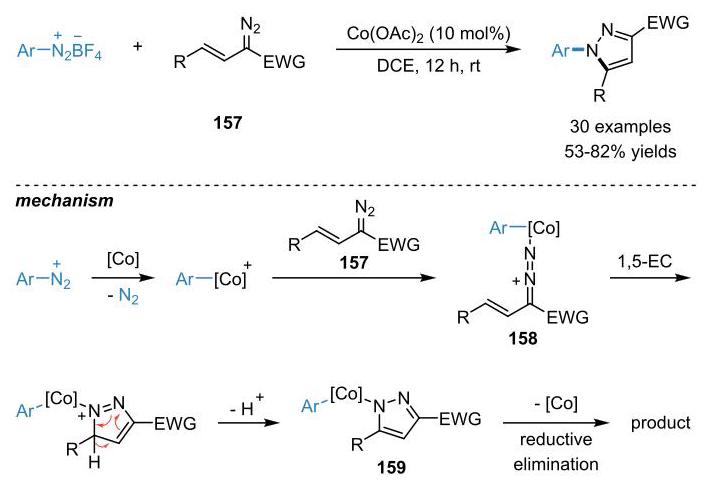
2.2.4. Sonogashira-type Coupling Reactions with Alkynes. Transition metal-catalyzed Sonogashira-type cross-coupling reactions of aryl diazonium salts have opened an alternative avenue toward the synthesis of arylated alkynes (Scheme 118). Under copper- and phosphane-free conditions, a Pd-catalyzed Sonogashira coupling reaction of aryl diazonium o-benzenedisulfonimides 107 with terminal alkynes 72 was developed. ${}^{233}$ The $o$ -benzenedisulfonimide can be recovered in greater than 80% yields. In 2015, a ${\mathrm{{Pd}}}_{0} - {\mathrm{{MnFe}}}_{2}{\mathrm{O}}_{4}$ -catalyzed decarboxylative Sonogashira reaction of aryl diazonium salts with propiolic acid derivatives was reported. ${}^{234}$
2.2.4. 与炔烃的 Sonogashira 型偶联反应。过渡金属催化的芳基重氮盐的 Sonogashira 型交叉偶联反应为芳基化炔烃的合成开辟了一条新途径(方案 118)。在无铜和无膦条件下,开发了芳基重氮邻苯二磺酰亚胺 107 与末端炔烃 72 的钯催化 Sonogashira 偶联反应。${}^{233}$ $o$ -苯二磺酰亚胺的回收率大于 80%。2015 年,报道了芳基重氮盐与丙炔酸衍生物的 ${\mathrm{{Pd}}}_{0} - {\mathrm{{MnFe}}}_{2}{\mathrm{O}}_{4}$ 催化脱羧 Sonogashira 反应。${}^{234}$
Scheme 118. Pd-Catalyzed Ligand-free Sonogashira Coupling Reaction
方案118. 钯催化的无配体Sonogashira偶联反应
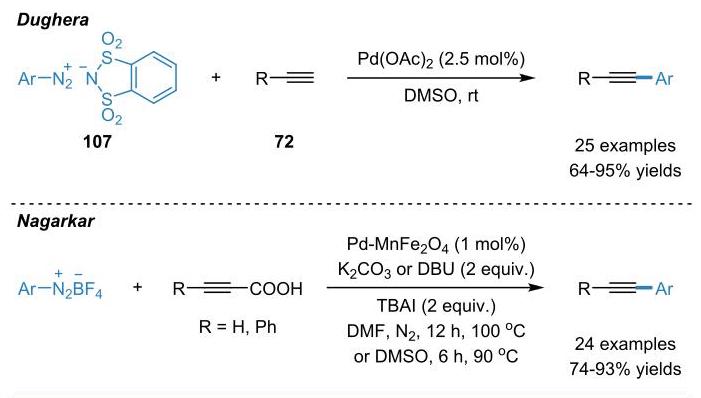
2.2.5. Gold-Catalyzed Coupling Reactions and Cycli-zations. Taking advantage of aryl diazonium ions’ oxidative property, gold-catalyzed cross-coupling reactions of aryl diazonium salts have emerged as a novel strategy for constructing C-C bonds under redox-neutral conditions. Unlike traditional Pd-catalyzed coupling reactions of aryl diazonium salts, the oxidation process in gold catalysis includes two potential pathways (Scheme 119). Supported by DFT calculations, one pathway consists of single-electron oxidation (path a) of gold(I) complex by the in situ formed aryl radical under organic-initiated or photoredox conditions, giving rise to an Ar-Au(II) complex 160, followed by second single-electron oxidation to afford the Ar-Au(III) intermediate 161. ${}^{235}$ The other plausible pathway (path b) is initiated by the nucleophilic addition of gold(I) complex to aryl diazonium ions to afford an ${\mathrm{{ArN}}}_{2} - \mathrm{{Au}}$ (III) intermediate 162, which undergoes dinitrogen elimination upon visible-light irradiation or thermal condition to deliver the $\mathrm{{Ar}} - \mathrm{{Au}}$ (III) intermediate 161. Proceeded through this key intermediate, various coupling products were obtained through sequential transformations, including difunctionalization, Sonogashira-type reaction, biaryls synthesis, the Meyer-Schuster rearrangement reaction, cascade cyclization, and C-heteroatom bond formations (Scheme 119). In this section, advances in C-C bond formation will be introduced according to reaction types. Gold-catalyzed C-heteroatom bond formations will be the focus of the next section.
2.2.5. 金催化的偶联反应和环化反应。利用芳基重氮离子的氧化性质,芳基重氮盐的金催化交叉偶联反应已成为在氧化还原中性条件下构建碳 - 碳键的新策略。与传统的钯催化芳基重氮盐偶联反应不同,金催化中的氧化过程包括两条潜在途径(方案119)。在密度泛函理论计算的支持下,一条途径是在有机引发或光氧化还原条件下,原位形成的芳基自由基对金(I)配合物进行单电子氧化(路径a),生成Ar - Au(II)配合物160,随后进行第二次单电子氧化得到Ar - Au(III)中间体161。${}^{235}$ 另一条合理的途径(路径b)是由金(I)配合物对芳基重氮离子进行亲核加成,得到一个${\mathrm{{ArN}}}_{2} - \mathrm{{Au}}$ (III)中间体162,该中间体在可见光照射或热条件下进行氮气消除,生成$\mathrm{{Ar}} - \mathrm{{Au}}$ (III)中间体161。通过这个关键中间体,经过一系列转化得到了各种偶联产物,包括双官能化、Sonogashira型反应、联芳基合成、Meyer - Schuster重排反应、级联环化反应以及碳 - 杂原子键的形成(方案119)。在本节中,将根据反应类型介绍碳 - 碳键形成方面的进展。金催化的碳 - 杂原子键形成将是下一节的重点。
Scheme 119. General Routes for Gold-Catalyzed Coupling Reactions
方案119. 金催化偶联反应的一般路线
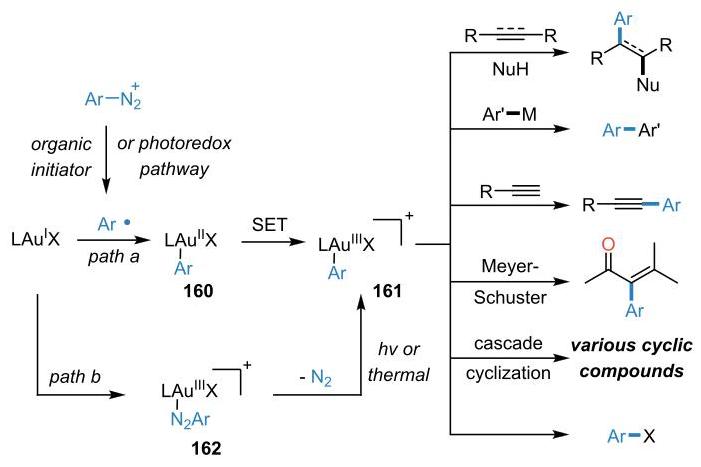
2.2.5.1. Difunctionalization. In 2013, combining gold and photoredox catalysis, ${}^{{236},{237}}$ Glorius established an oxy- and aminoarylation of alkenes with aryl diazonium salts at room temperature (Scheme 120). ${}^{238}$ The use of this novel dual gold/ photoredox catalytic system allowed for the difunctionalization of alkenes under mild conditions without requiring external oxidants. Mechanistically, the cationic Au(I) catalyst 163 first reacts with the alkene substrate to afford the alkyl gold(I) intermediate 164. Aryl radicals generated from the aryl diazonium salt in the photoredox cycle then react with alkyl gold(I) species to afford the Au(II) intermediate 165. This Au(II) species is then oxidized by the Ru(III) catalyst, generating an Au(III) species 166, which then undergoes rapid reductive elimination to deliver the product.
2.2.5.1. 双官能化。2013年,Glorius将金催化和光氧化还原催化相结合,${}^{{236},{237}}$ 在室温下实现了芳基重氮盐与烯烃的氧芳基化和氨芳基化反应(方案120)。${}^{238}$ 使用这种新型的双金/光氧化还原催化体系,可以在温和条件下实现烯烃的双官能化,无需外部氧化剂。从机理上讲,阳离子金(I)催化剂163首先与烯烃底物反应,生成烷基金(I)中间体164。在光氧化还原循环中,芳基重氮盐产生的芳基自由基随后与烷基金(I)物种反应,生成金(II)中间体165。然后,该金(II)物种被钌(III)催化剂氧化,生成金(III)物种166,随后快速进行还原消除得到产物。
With this dual gold and photoredox catalytic system, a wide range of three-component intermolecular oxyarylation reactions of simple alkenes with aryl diazonium salts were also developed (Scheme 121). ${}^{239}$ Inexpensive organic dyes could be employed as the photocatalyst, affording $\alpha$ -arylated ether products 167 in good yields under mild conditions.
使用这种双金和光氧化还原催化体系,还开发了一系列简单烯烃与芳基重氮盐的三组分分子间氧芳基化反应(方案121)。${}^{239}$ 廉价的有机染料可用作光催化剂,在温和条件下以良好的产率得到$\alpha$ -芳基化醚产物167。
In 2014, Toste and co-workers reported a ring expansion-oxidative arylation reaction of alkenyl or allenyl cycloalkanols 168 with aryl diazonium salts, affording functionalized cyclic ketones 169 in high yields (Scheme 122). ${}^{240}$ In 2015, Shin reported an arylative cyclization process from tert-butyl allenoates 170 with aryl diazonium salts, employing in situ generated vinyl gold complexes to deliver 3-arylated butenolides 171 (Scheme 122). ${}^{241}$
2014年,Toste及其同事报道了烯基或联烯基环烷醇168与芳基重氮盐的扩环 - 氧化芳基化反应,以高产率得到官能化的环酮169(方案122)。${}^{240}$ 2015年,Shin报道了叔丁基丙二烯酸酯170与芳基重氮盐的芳基化环化过程,使用原位生成的乙烯基金配合物得到3 - 芳基化丁烯内酯171(方案122)。${}^{241}$
Shi developed nonphotocatalytic conditions for gold-catalyzed alkene difunctionalization using diazonium salts (Scheme 123). ${}^{242}$ In the presence of $\mathrm{{Au}}\left( \mathrm{I}\right)$ catalyst and ${\mathrm{{NaHCO}}}_{3}$ , various alkenes, alkynes, and allenes were converted to oxy- and aminoarylation products in good yields. Compared to the photoactivation method, this base-initiated approach also offered good efficiency, fast reaction rates, and broad substrate scope.
Shi开发了使用重氮盐进行金催化烯烃双官能化的非光催化条件(方案123)。${}^{242}$ 在$\mathrm{{Au}}\left( \mathrm{I}\right)$ 催化剂和${\mathrm{{NaHCO}}}_{3}$ 存在下,各种烯烃、炔烃和联烯以良好的产率转化为氧芳基化和氨芳基化产物。与光活化方法相比,这种碱引发的方法也具有良好的效率、快速的反应速率和广泛的底物范围。
This gold-catalyzed visible-light-induced reaction also allows the difunctionalization of alkynes. In 2016, Hashmi reported a novel visible light-mediated gold-catalyzed intermolecular 1,2- difunctionalization of alkynes with aryl diazonium salts in methanol under photosensitizer- and oxidant-free conditions, providing an array of $\alpha$ -aryl ketones 172 in moderate to good yields (Scheme 124). ${}^{243}$ A proposed reaction pathway is initiated by light-induced single-electron oxidation of aryl diazonium salt to Au(I) center, giving rise to an Ar-Au(III) species 161. Subsequently, the addition of methanol to the $\pi$ - activated alkyne forms the vinyl gold species 173, followed by reductive elimination to generate arylated enol ether 174, which undergoes hydrolysis to afford $\alpha$ -aryl ketones.
这种金催化的可见光诱导反应还能实现炔烃的双官能团化。2016年,哈希米报道了一种新型的可见光介导的金催化反应,在无光敏剂和无氧化剂的条件下,炔烃与芳基重氮盐在甲醇中发生分子间1,2 - 双官能团化反应,以中等至良好的产率得到一系列$\alpha$ - 芳基酮172(方案124)。${}^{243}$ 一种可能的反应途径是由光诱导芳基重氮盐单电子氧化至金(I)中心引发的,生成Ar - Au(III)物种161。随后,甲醇加成到$\pi$ - 活化的炔烃上形成乙烯基金物种173,接着进行还原消除生成芳基化烯醇醚174,后者经水解得到$\alpha$ - 芳基酮。
Scheme 120. Dual Gold/Photoredox-Catalyzed Intramolecular Oxy- and Aminoarylation of Alkenes
方案120. 金/光氧化还原双催化的烯烃分子内氧芳基化和氨基芳基化反应
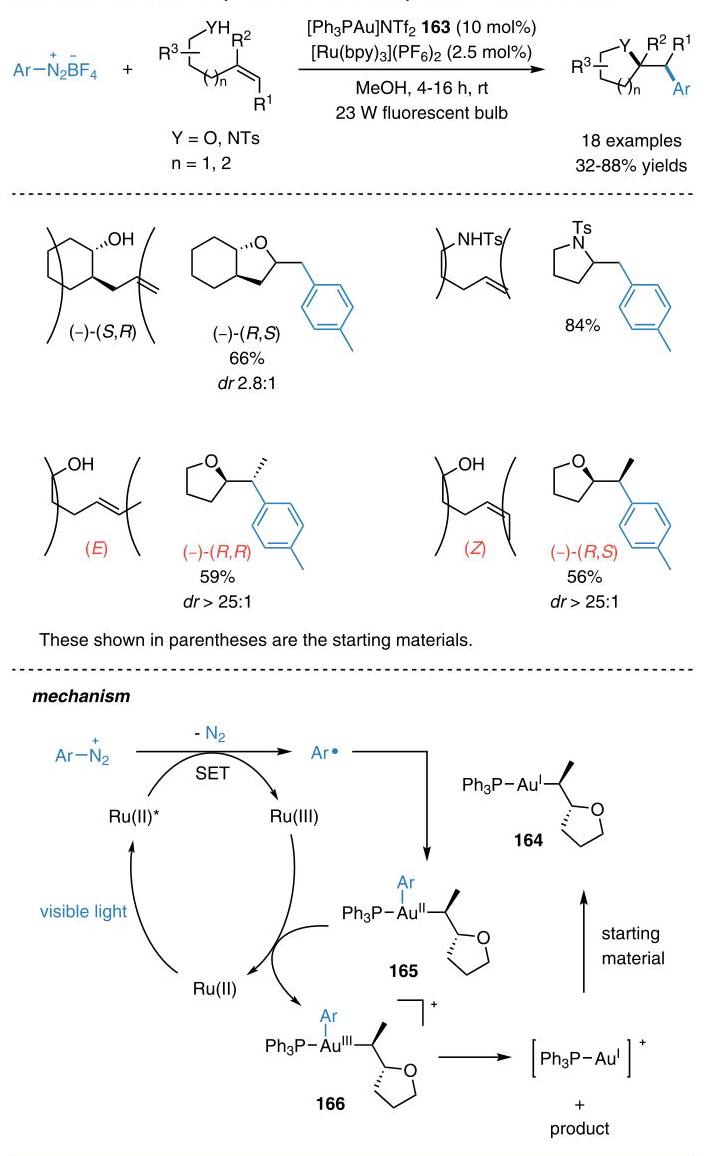
Scheme 121. Dual Gold/Photoredox-Catalyzed Intermolecular Oxyarylation of Alkenes
方案121. 金/光氧化还原双催化的烯烃分子间氧芳基化反应
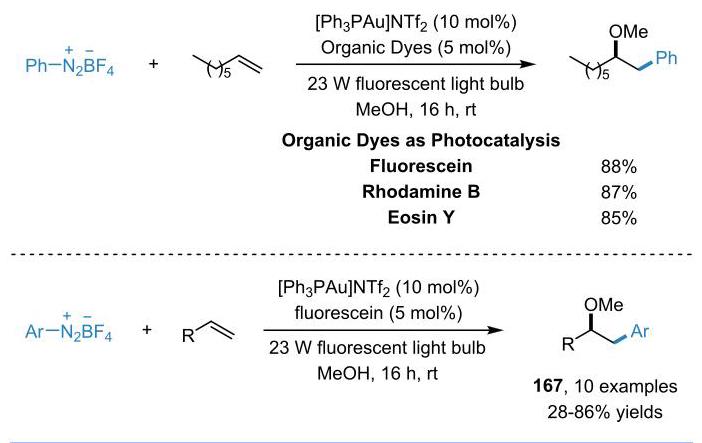
Scheme 122. Arylative Ring Expansion of Alkenyl Cycloalkanols and Arylative Cyclization of Allenoates
方案122. 烯基环烷醇的芳基化扩环反应和联烯酸酯的芳基化环化反应
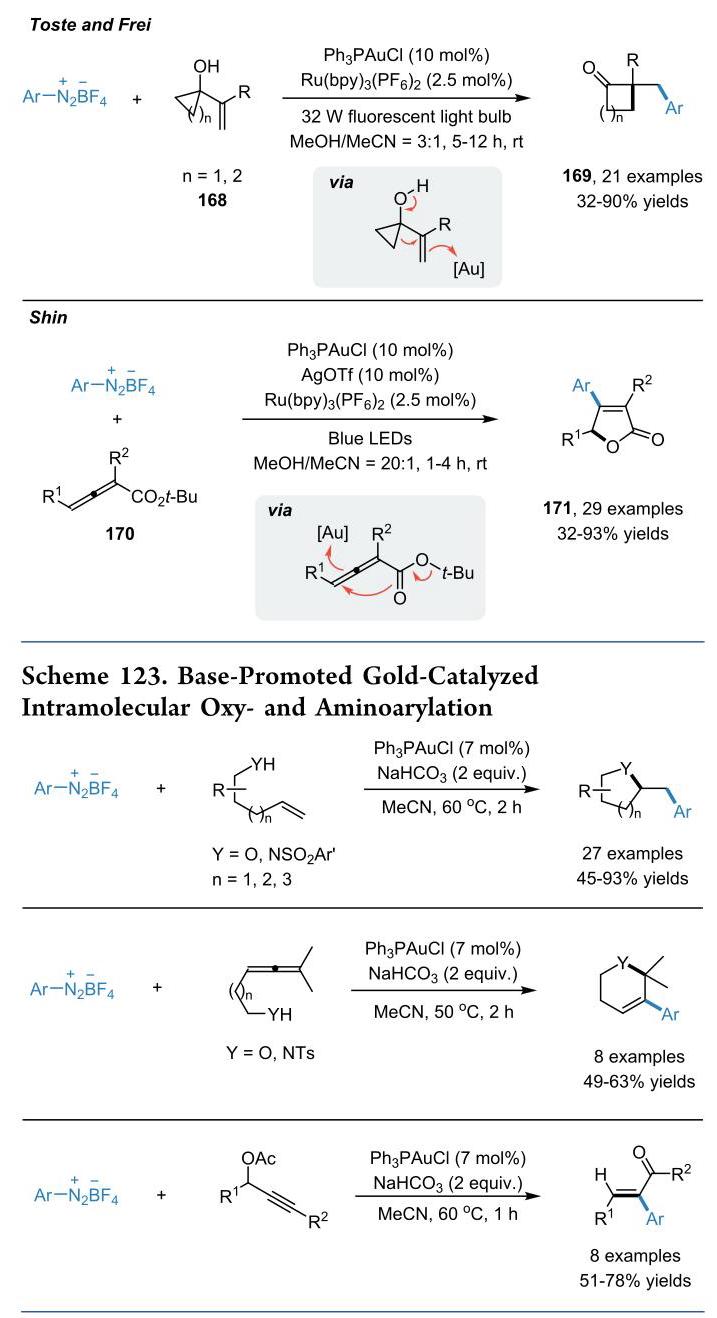
In 2020, Echavarren developed a visible-light-induced gold-catalyzed arylative alkoxycyclization of 1,6-enynes with aryl diazonium salts in the presence of alcohols (Scheme 125). ${}^{244}\mathrm{\;A}$ plausible reaction pathway is initiated by the photoredox-assisted formation of an Ar-Au(III) complex, followed by 5- exo-dig cyclization to form a gold carbenoid species 175, which undergoes nucleophilic attack by alcohol to generate a vinyl gold(III) intermediate 176. Finally, reductive elimination affords the cyclization product along with the regeneration of the catalytically active Au(I) species.
2020年,埃查瓦伦开发了一种可见光诱导的金催化1,6-烯炔与芳基重氮盐在醇存在下的芳基化烷氧基环化反应(方案125)。${}^{244}\mathrm{\;A}$ 一种合理的反应途径是通过光氧化还原辅助形成Ar-Au(III)配合物开始,随后进行5-外向-环化形成金叶立德物种175,其受到醇的亲核攻击生成乙烯基金(III)中间体176。最后,还原消除得到环化产物并再生催化活性的Au(I)物种。
The gold-catalyzed alkyne difunctionalization cascade demonstrates applications in synthesizing various cyclic compounds at room temperature, especially for benzo-fused scaffolds. In 2016, Du and Zhu reported a visible-light-mediated dual gold/photoredox catalyzed aminoarylation reaction of alkynes 177, affording multisubstituted indoles with good functional group tolerance in moderate to excellent yields (Scheme 126). ${}^{245}$ This cyclization proceeds through the photoredox SET oxidation to form Ar-Au(III) species, followed by 5-endo-dig intramolecular nucleophilic cyclization and reductive elimination to form indole products and regenerate the gold(I) complex.
金催化的炔烃双官能化级联反应在室温下合成各种环状化合物中具有应用,特别是对于苯并稠合骨架。2016年,Du和Zhu报道了一种可见光介导的双金/光氧化还原催化的炔烃177的氨基芳基化反应,以中等至优异的产率提供了具有良好官能团耐受性的多取代吲哚(方案126)。${}^{245}$ 这种环化反应通过光氧化还原单电子转移氧化形成Ar-Au(III)物种进行,随后进行5-内向-分子内亲核环化和还原消除以形成吲哚产物并再生金(I)配合物。
Scheme 124. Visible-Light-Mediated Gold-Catalyzed 1,2- Difunctionalization of Alkynes
方案124. 可见光介导的金催化炔烃的1,2-双官能化反应
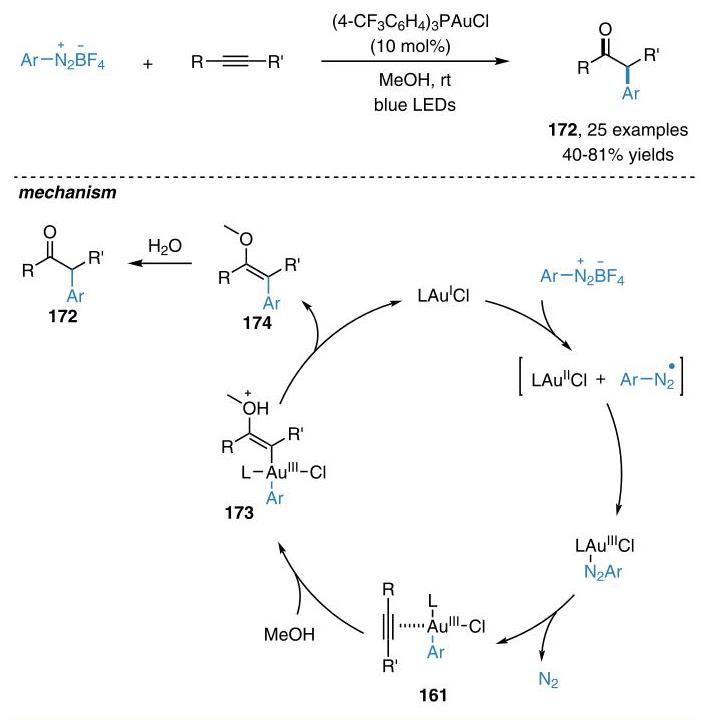
Scheme 125. Photoredox-Assisted Gold-Catalyzed Arylative Alkoxycyclization of 1,6-Enynes
方案125. 光氧化还原辅助的金催化1,6-烯炔的芳基化烷氧基环化反应
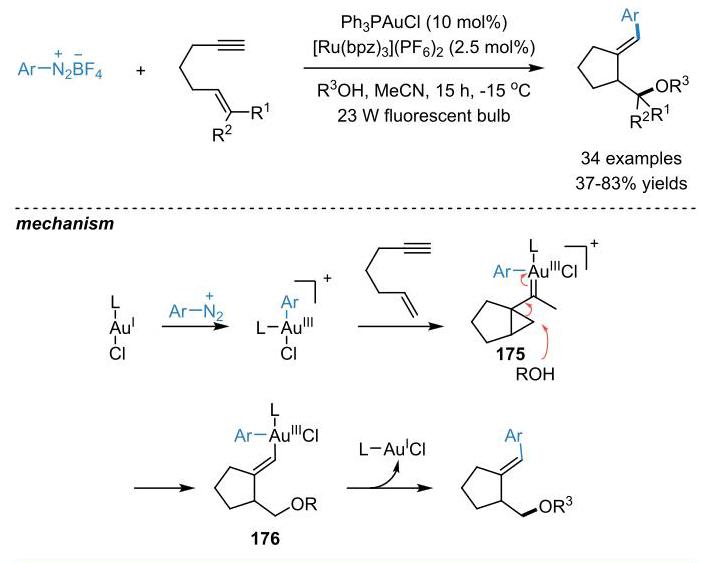
Scheme 126. Visible-Light-Driven Aminoarylation of Alkynes
方案126. 可见光驱动的炔烃的氨基芳基化反应
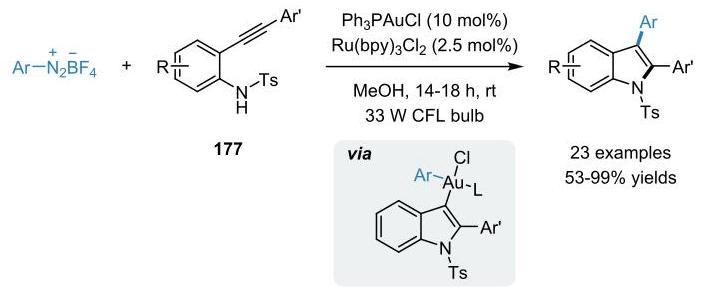
This visible-light-promoted dual gold/photoredox alkyne difunctionalization/cyclization strategy enables the selective coupling of heteroatom $\left( {\mathrm{N},\mathrm{S},\mathrm{{Se}},\mathrm{O}}\right)$ -tethered alkynes with aryl diazonium salts to rapidly access various heterocycles, including benzothiophenes 178, benzoselenophenes 179, 3H-indoles 180, vicinal diaryl-substituted ${2H}$ -benzo[e][1,2]- thiazine 1,1-dioxides 181 (benzosultams), ${1H}$ -isochromen-1- ones 182 (isocoumarins), 4H-chromen-4-ones 183 (flavones), and ${4H}$ -thiochromen-4-ones 184 (thioflavones) (Scheme 127). ${}^{246}$
这种可见光促进的双金/光氧化还原炔烃双官能化/环化策略能够使杂原子 $\left( {\mathrm{N},\mathrm{S},\mathrm{{Se}},\mathrm{O}}\right)$ 连接的炔烃与芳基重氮盐选择性偶联,以快速获得各种杂环化合物,包括苯并噻吩178、苯并硒吩179、3H-吲哚180、邻位二芳基取代的 ${2H}$ -苯并[e][1,2]-噻嗪1,1-二氧化物181(苯并磺内酰胺)、${1H}$ -异苯并呋喃-1-酮182(异香豆素)、4H-色烯-4-酮183(黄酮)和 ${4H}$ -硫代色烯-4-酮184(硫代黄酮)(方案127)。${}^{246}$
Scheme 127. Selective Arylative Heterocyclization of Heteroatom (N, S, Se, O) Tethered Alkynes with Aryl Diazonium Salts
方案127. 杂原子(N、S、Se、O)连接的炔烃与芳基重氮盐的选择性芳基化杂环化反应
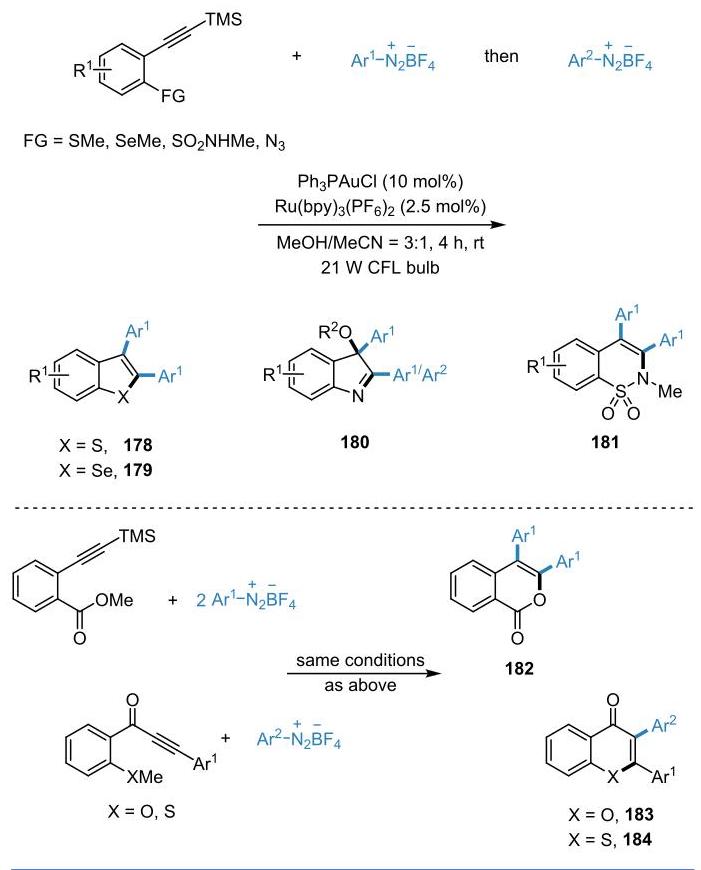
In addition, this dual gold/photoredox catalysis also opens a new avenue toward the synthesis of benzofurans (Scheme 128). ${}^{247}$ In 2016, Ollivier and Fensterbank developed an arylative cyclization of o-alkynylphenols 185 with aryl diazonium salts, affording 2,3-diarylated benzofuran derivatives 186 in the absence of base and/or additives upon visible-light irradiation. ${}^{248}$ Another visible-light-induced domino $\mathrm{C}\left( \mathrm{{sp}}\right)$ arylation/oxyarylation cascade reaction of 2-[(trimethylslyl)- ethynyl]phenol 185’ with aryl diazonium salts provides access to 2,3-diarylbenzofurans 186 via double arylation. ${}^{249}$
此外,这种双金/光氧化还原催化还为苯并呋喃的合成开辟了一条新途径(方案128)。${}^{247}$ 2016年,奥利维耶和平特班克开发了邻炔基苯酚185与芳基重氮盐的芳基化环化反应,在可见光照射下,无需碱和/或添加剂即可得到2,3-二芳基苯并呋喃衍生物186。${}^{248}$ 另一种可见光诱导的2-[(三甲基甲硅烷基)-乙炔基]苯酚185’与芳基重氮盐的多米诺 $\mathrm{C}\left( \mathrm{{sp}}\right)$ 芳基化/氧芳基化级联反应通过双芳基化反应得到2,3-二芳基苯并呋喃186。${}^{249}$
A photoredox-free gold(III)-promoted arylative cyclization of alkynoic acids with aryl diazonium salts was developed, furnishing seven/eight- and five/six-membered ring enol lactones under thermally induced conditions (Scheme 129). ${}^{250}$ A plausible mechanism involves the aryl diazonium salt oxidizing Au(I) to aryl gold(III) complex 161. Because of its Lewis acidity, aryl gold(III) complex 161 coordinates with the alkyne moiety to facilitate the carboxylic acid’s nucleophilic
开发了一种无光氧化还原的金(III)促进的炔酸与芳基重氮盐的芳基化环化反应,在热诱导条件下提供七/八元和五/六元环烯醇内酯(方案129)。${}^{250}$ 一种合理的机理涉及芳基重氮盐将Au(I)氧化为芳基金(III)配合物161。由于其路易斯酸性,芳基金(III)配合物161与炔烃部分配位以促进羧酸的亲核反应
Scheme 128. Dual Gold/Photoredox Catalyzed Synthesis of Benzofurans attack. Finally, the reductive elimination of 187/187’ furnishes the cyclic enol lactones.
方案128. 双金/光氧化还原催化合成苯并呋喃攻击。最后,187/187’的还原消除生成环状烯醇内酯。
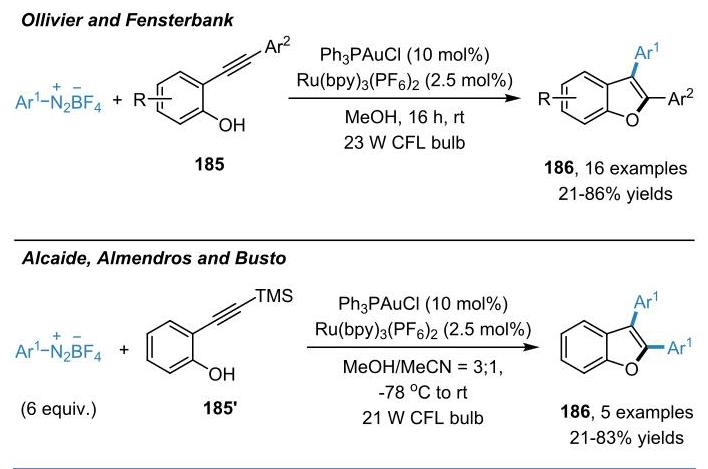
Scheme 129. Gold-Promoted Arylative Cyclization of Alkynoic Acids with Aryl Diazonium Salts
方案129. 金促进的炔酸与芳基重氮盐的芳基化环化反应
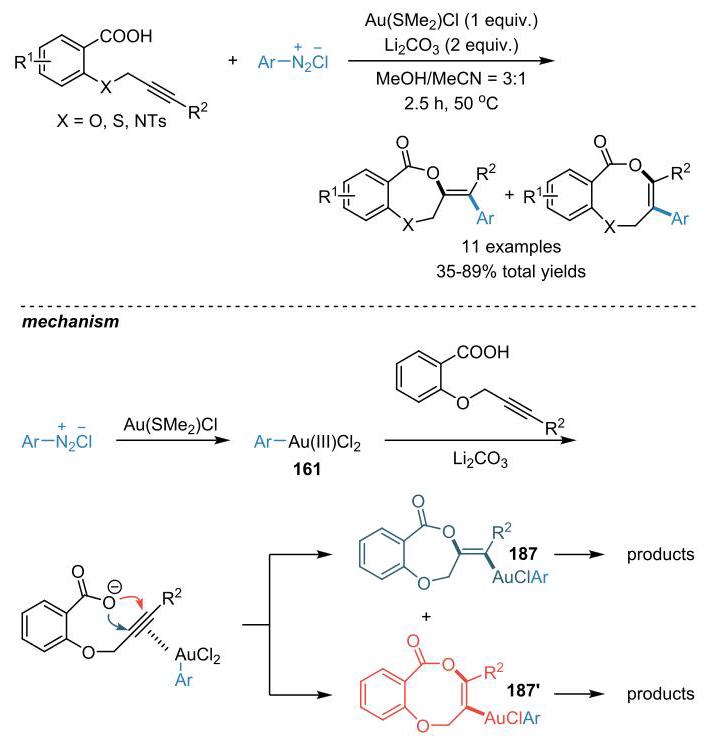
2.2.5.2. C-H Functionalization. In 2017, a dual Au-/Ru-catalyzed photoredox arylation of arenes with aryl diazonium salts was established under mild conditions (Scheme 130). ${}^{251}$ Compared with the Pd/Ru photoredox system, this Au-catalyzed C-H functionalization enables the straightforward arylation of simple arenes without any directing group. Similar to Sanford’s mechanism, a single-electron reduction of the aryl diazonium salt from the photoredox catalyst generates the aryl radical, which follows an Au(I)-Au(II)-Au(III)-Au(I) catalytic cycle.
2.2.5.2. C-H官能化。2017年,在温和条件下建立了一种双金/钌催化的光氧化还原芳烃与芳基重氮盐的芳基化反应(方案130)。${}^{251}$与钯/钌光氧化还原体系相比,这种金催化的C-H官能化反应能够使简单芳烃直接进行芳基化,无需任何导向基团。与桑福德的机理类似,光氧化还原催化剂对芳基重氮盐进行单电子还原生成芳基自由基,该自由基遵循金(I)-金(II)-金(III)-金(I)催化循环。
In 2020, Hashmi reported a photosensitizer-free photochemical synthesis of organogold(III) pincer complexes 188 from DMSAuCl and diazonium salts in the presence of a base (Scheme 131). ${}^{252}$ This method not only gives access to these pincer gold complexes in moderate to excellent yields but also provides evidence for the photoredox oxidation of gold(I)
2020年,哈希米报道了在碱存在下,由二甲基硫代金(I)氯和重氮盐无光敏剂光化学合成有机金(III)钳形配合物188的方法(方案131)。${}^{252}$该方法不仅能以中等至优异的产率获得这些钳形金配合物,还为金(I)的光氧化还原氧化提供了证据
Scheme 130. Dual Au/Ru Catalyzed Photoredox C-H Arylation of Arenes
方案130. 双金/钌催化的芳烃光氧化还原C-H芳基化反应
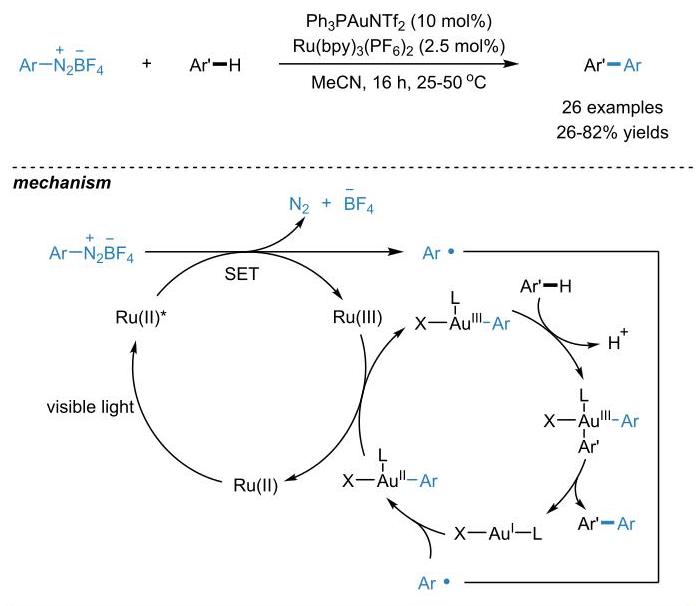
Scheme 131. Synthesis of Pincer Au ${}^{\mathrm{{III}}}$ Complex by Oxidative Addition/C-H Activation Cascade species by aryl diazonium salts to form a gold(III) intermediate.
方案131. 通过氧化加成/C-H活化级联反应合成钳形金${}^{\mathrm{{III}}}$配合物,芳基重氮盐与物种形成金(III)中间体。
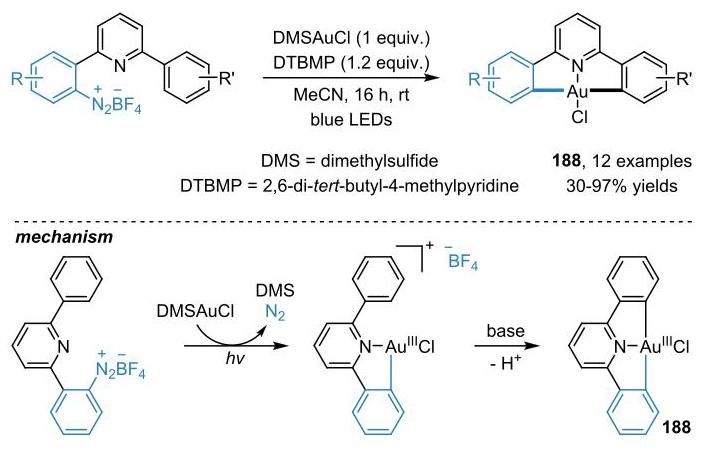
Aside from the photoredox system, ascorbic acid 53 has been employed as an organic initiator to accelerate the oxidative addition of in situ generated aryl diazonium chlorides onto Au(I) (Scheme 132). ${}^{253}$ The resulting aryl-Au(III) species 161 has been used to prepare 3-arylindoles with good regioselectivity from 1-methylindole. On the basis of EPR analysis, cyclic voltammetry experiments, and DFT calculations, the mechanism constitutes two steps of single-electron oxidation via a radical pathway.
除了光氧化还原体系外,抗坏血酸53已被用作有机引发剂,以加速原位生成的芳基重氮氯化物对金(I)的氧化加成反应(方案132)。${}^{253}$所得的芳基-金(III)物种161已用于从1-甲基吲哚以良好的区域选择性制备3-芳基吲哚。基于电子顺磁共振分析、循环伏安实验和密度泛函理论计算,该机理通过自由基途径由两个单电子氧化步骤构成。
Scheme 132. Ascorbic Acid as an Aryl Radical Initiator in Au-Mediated Arylation of Indoles with Aryl Diazonium Salts
方案132. 抗坏血酸作为芳基自由基引发剂用于金介导的吲哚与芳基重氮盐的芳基化反应
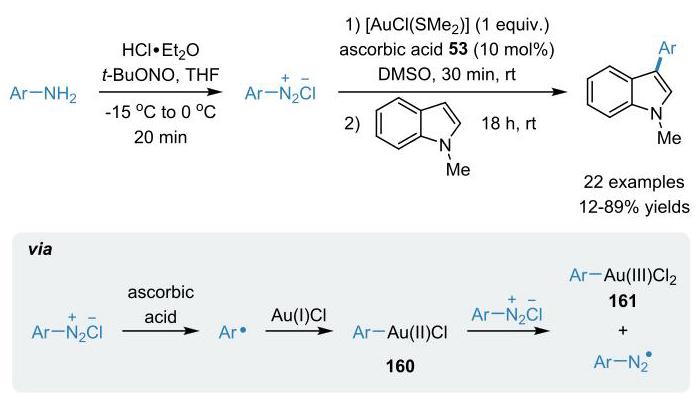
2.2.5.3. Coupling Reactions with Ar-M Species. The dual gold/photoredox visible-light-promoted catalytic system was recently demonstrated as a reliable tool for oxidative addition of aryl diazonium salts to Au(I) complex to form the corresponding aryl-Au(III) species. ${}^{{254} - {257}}$ Utilizing this dual catalytic strategy, Suzuki-type coupling reactions of aryl diazonium salts and arylboronic acids have been developed. Catalysts include ${\mathrm{{PPh}}}_{3}{\mathrm{{AuNTf}}}_{2}{}^{255}$ or ${\mathrm{{Ph}}}_{3}\mathrm{{PAuCl}}$ in combination with $\mathrm{{Ru}}{\left( \mathrm{{bpy}}\right) }_{3}{\left( {\mathrm{{PF}}}_{6}\right) }_{2}$ or 9-mesityl-10-acridinium salt as the photosensitizer ${}^{256}$ (Scheme 133). Asymmetric synthesis of atropoisomeric biaryls using chiral (P, N) ligands was investigated, even though only up to 26% ee was obtained. ${}^{257}$ Mechanistic studies reveal that this dual catalytic pathway is highly catalyst-dependent: for the cationic PPh ${}_{3}{\mathrm{{AuNTf}}}_{2}$ catalyst, transmetalation of the arylboronic acid with $\mathrm{{Au}}\left( \mathrm{I}\right)$ occurs before oxidation of Au (I) to Au (III), while for the neutral ${\mathrm{{PPh}}}_{3}\mathrm{{AuCl}}$ catalyst, transmetalation occurs after oxidation of Au (I) to Au (III).
2.2.5.3. 与Ar-M物种的偶联反应。双金/光氧化还原可见光促进的催化体系最近被证明是一种可靠的工具,用于将芳基重氮盐氧化加成到金(I)配合物上,形成相应的芳基-金(III)物种。${}^{{254} - {257}}$利用这种双催化策略,已开发出芳基重氮盐与芳基硼酸的铃木型偶联反应。催化剂包括${\mathrm{{PPh}}}_{3}{\mathrm{{AuNTf}}}_{2}{}^{255}$或${\mathrm{{Ph}}}_{3}\mathrm{{PAuCl}}$与$\mathrm{{Ru}}{\left( \mathrm{{bpy}}\right) }_{3}{\left( {\mathrm{{PF}}}_{6}\right) }_{2}$或9-均三甲苯基-10-吖啶盐作为光敏剂${}^{256}$(方案133)。研究了使用手性(P,N)配体进行阻转异构联芳基的不对称合成,尽管仅获得了高达26%的对映体过量值。${}^{257}$机理研究表明,这种双催化途径高度依赖于催化剂:对于阳离子PPh${}_{3}{\mathrm{{AuNTf}}}_{2}$催化剂,芳基硼酸与$\mathrm{{Au}}\left( \mathrm{I}\right)$的转金属化反应在金(I)氧化为金(III)之前发生,而对于中性${\mathrm{{PPh}}}_{3}\mathrm{{AuCl}}$催化剂,转金属化反应在金(I)氧化为金(III)之后发生。
Scheme 133. Dual Gold/Photoredox System in Cross-Coupling Reaction of Aryl Diazonium Salts with Arylboronic Acids
方案133. 双金/光氧化还原体系用于芳基重氮盐与芳基硼酸的交叉偶联反应
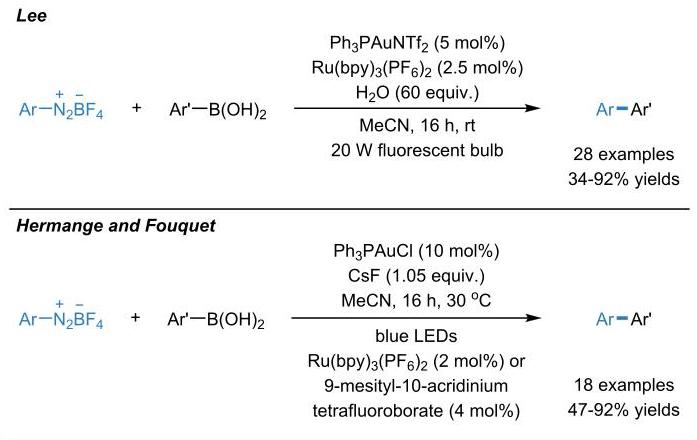
Merging gold/photoredox catalysis under visible-light irradiation, Patil realized the Hiyama-type cross-coupling reactions of aryl diazonium salts with allylsilanes ${}^{258}$ and arylsilanes ${}^{259}$ (Scheme 134). This reaction is thought to proceed through a photoredox-promoted generation of an electrophilic Ar-Au(III) intermediate 161, which undergoes transmetalation with allyltrimethylsilane or arylsilane to form allylarenes or biaryls, respectively. In the latter case, the addition of copper salts as catalysts has been crucial for the success of this transformation, likely due to the acceleration of the transmetalation process.
在可见光照射下将金催化与光氧化还原催化相结合,帕蒂尔实现了芳基重氮盐与烯丙基硅烷${}^{258}$和芳基硅烷${}^{259}$的日山型交叉偶联反应(方案134)。该反应被认为是通过光氧化还原促进生成亲电的Ar-Au(III)中间体161进行的,该中间体与烯丙基三甲基硅烷或芳基硅烷发生转金属化反应,分别形成烯丙基芳烃或联芳基。在后一种情况下,添加铜盐作为催化剂对于该转化的成功至关重要,这可能是由于转金属化过程的加速。
Moreover, gold complexes have emerged as efficient catalysts in cross-coupling reactions of aryl diazonium salts in the absence of photoredox catalysts. Mechanistic investigations indicate that aryl diazonium salts can effectively serve as electrophiles for oxidative addition to $\mathrm{{Au}}\left( \mathrm{I}\right)$ to generate Au(III) species, either under mild photochemical conditions ${}^{254}$ or under thermal conditions. ${}^{260}$ Hashmi established a photosensitizer-free visible-light-driven gold-catalyzed Suzuki coupling reaction of aryl diazonium salts with arylboronic acids (Scheme 135). ${}^{261}$ The same group has extended this method to pinacol esters, MIDA boronates, and potassium trifluor-oboronates as the efficient coupling partners. ${}^{262}$ Mechanistically, these photosensitizer-free approaches proceed through path b, which is initiated directly by the nucleophilic addition of gold(I) complex to the terminal nitrogen of aryl diazonium ions, resulting in the formation of an Ar-Au(III) intermediate.
此外,在没有光氧化还原催化剂的情况下,金配合物已成为芳基重氮盐交叉偶联反应中的有效催化剂。机理研究表明,芳基重氮盐可以有效地作为亲电试剂进行氧化加成到$\mathrm{{Au}}\left( \mathrm{I}\right)$以生成Au(III)物种,无论是在温和的光化学条件${}^{254}$下还是在热条件下。${}^{260}$哈希米建立了一种无光敏剂的可见光驱动的金催化芳基重氮盐与芳基硼酸的铃木偶联反应(方案135)。${}^{261}$同一研究小组已将该方法扩展到频哪醇酯、MIDA硼酸酯和三氟硼酸钾作为有效的偶联伙伴。${}^{262}$从机理上讲,这些无光敏剂的方法通过路径b进行,该路径直接由金(I)配合物对芳基重氮离子末端氮的亲核加成引发,导致形成Ar-Au(III)中间体。
Scheme 134. Gold/Photoredox Catalytic Coupling Reactions of Allyl or Arylsilanes
方案134. 烯丙基或芳基硅烷的金/光氧化还原催化偶联反应
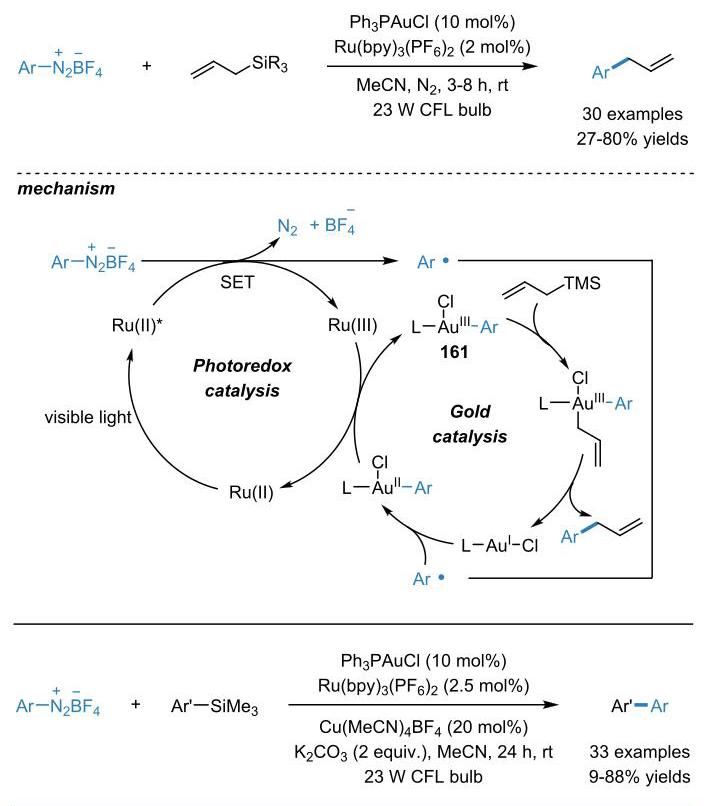
Scheme 135. Photosensitizer-Free Visible-Light-Driven Gold-Catalyzed Suzuki and Hiyama Coupling Reaction
方案135. 无光敏剂的可见光驱动的金催化铃木和日山偶联反应
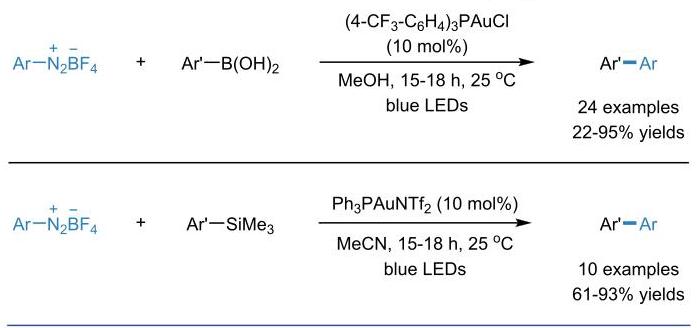
Organosilicon compounds have been explored as coupling partners in gold-catalyzed coupling reactions with aryl diazonium salts. ${}^{262}$ In 2018, Xie and Hashmi reported a photochemical gold-catalyzed chemoselective Hiyama arylation of B, Si-bifunctionalized aryl reagents 189 with aryl diazonium salts (Scheme 136). ${}^{263}$ A wide array of diversely functionalized ${\mathrm{{sp}}}^{2}$ - and ${\mathrm{{sp}}}^{3}$ -hybridized biarylboronates was obtained, which are versatile building blocks for the assembly of various multiaryls via one-pot iterative orthogonal Pd-catalyzed C-C or Cu-catalyzed C-heteroatom bond formations.
有机硅化合物已被探索作为与芳基重氮盐进行金催化偶联反应的偶联伙伴。${}^{262}$2018年,谢和哈希米报道了一种光化学金催化的B, Si-双官能化芳基试剂189与芳基重氮盐的化学选择性日山芳基化反应(方案136)。${}^{263}$获得了多种功能多样的${\mathrm{{sp}}}^{2}$ - 和${\mathrm{{sp}}}^{3}$ - 杂化联芳基硼酸酯,它们是通过一锅法迭代正交钯催化的C-C或铜催化的C-杂原子键形成来组装各种多芳基的通用构建块。
Furthermore, a photoredox-free gold-catalyzed Suzuki-type cross-coupling reaction of aryl diazonium salts with arylboronic acids was achieved without any external oxidants, affording substituted biaryls in moderate to good yields (Scheme intermediate 161. A similar approach using aryl diazonium o-benzenedisulfonimides as the electrophilic partners was also developed. ${}^{265}$
此外,实现了芳基重氮盐与芳基硼酸的无光氧化还原金催化铃木型交叉偶联反应,无需任何外部氧化剂,以中等至良好的产率得到取代联芳基(方案中间体161)。还开发了一种使用芳基邻苯二磺酰亚胺作为亲电伙伴的类似方法。${}^{265}$
Scheme 136. Light-Induced Gold-Catalyzed Chemoselective Hiyama Arylation
方案136. 光诱导金催化的化学选择性日山芳基化反应
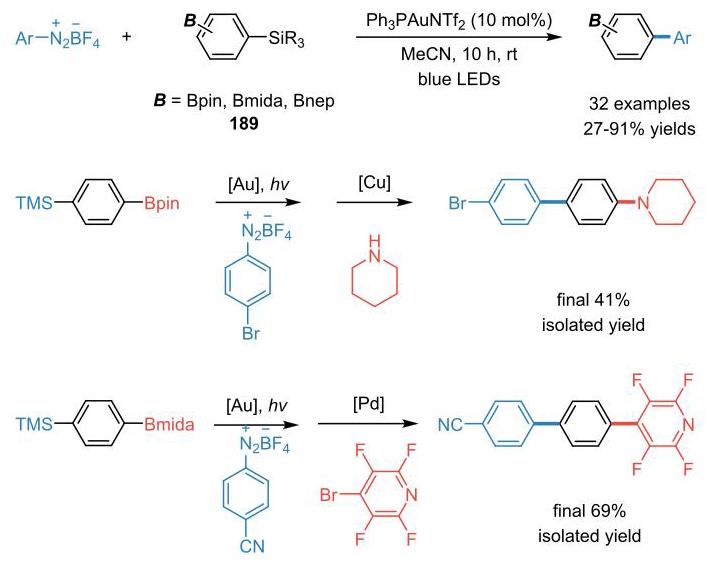
137). ${}^{264}$ The bipyridine ligand plays an important role in facilitating dinitrogen extrusion to afford the key Ar-Au(III)
137)。${}^{264}$联吡啶配体在促进氮气挤出以提供关键的Ar-Au(III)方面起着重要作用
Scheme 137. Photoredox-Free Gold-Catalyzed Cross-Coupling with Aryl Diazonium Salts with Arylboronic Acids
方案137. 无光氧化还原金催化的芳基重氮盐与芳基硼酸的交叉偶联反应
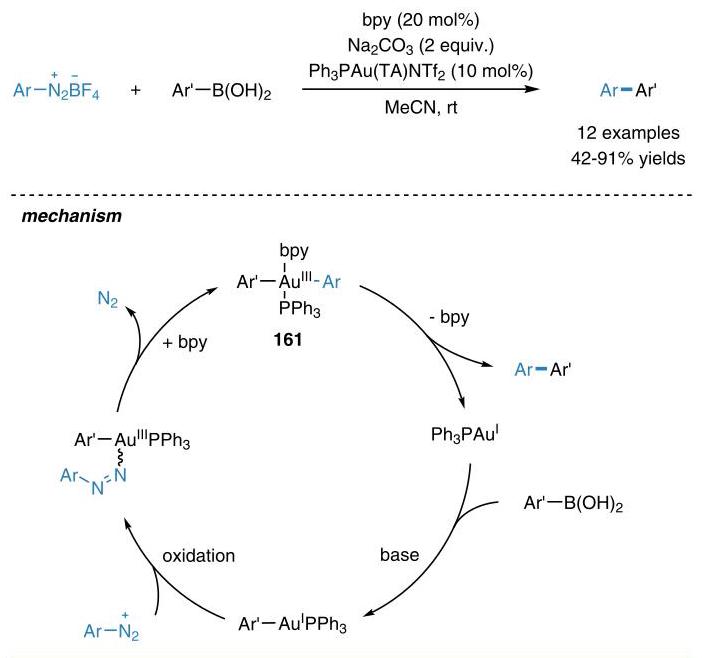
Aside from the gold-catalyzed Suzuki-Miyaura coupling reaction, a photoredox-free gold-catalyzed Stille cross-coupling reaction of aryl diazonium salts with organostannanes was also reported, affording biaryls, vinyl arenes, and arylacetylenes in moderate yields (Scheme 138). ${}^{266}$
除了金催化的铃木-宫浦偶联反应外,还报道了芳基重氮盐与有机锡烷的无光氧化还原金催化的斯蒂尔交叉偶联反应,以中等产率得到联芳基、乙烯基芳烃和芳基乙炔(方案138)。${}^{266}$
2.2.5.4. Coupling Reactions with Alkynes. Besides palladium catalysts, gold complexes have also been utilized to promote $\mathrm{C}\left( \mathrm{{sp}}\right) - \mathrm{C}\left( {\mathrm{{sp}}}^{2}\right)$ coupling reaction of aryl diazonium salts with alkynes (Scheme 139). Mechanistically, the key Ar-Au(III) intermediate can be generated under the light-free, base-mediated condition at room temperature, ${}^{264}$ light-free thermal conditions, ${}^{260}$ or using a photosensitizer-free visible light-enabled approach. ${}^{262}$
2.2.5.4. 与炔烃的偶联反应。除钯催化剂外,金配合物也被用于促进芳基重氮盐与炔烃的$\mathrm{C}\left( \mathrm{{sp}}\right) - \mathrm{C}\left( {\mathrm{{sp}}}^{2}\right)$偶联反应(方案139)。从机理上讲,关键的Ar - Au(III)中间体可在无光照、碱介导的室温条件下、${}^{264}$无光照热条件下、${}^{260}$或采用无光敏剂的可见光驱动方法生成。${}^{262}$
Scheme 138. Light-Free Gold-Catalyzed Stille Cross-Coupling Reactions
方案138. 无光照金催化的Stille交叉偶联反应
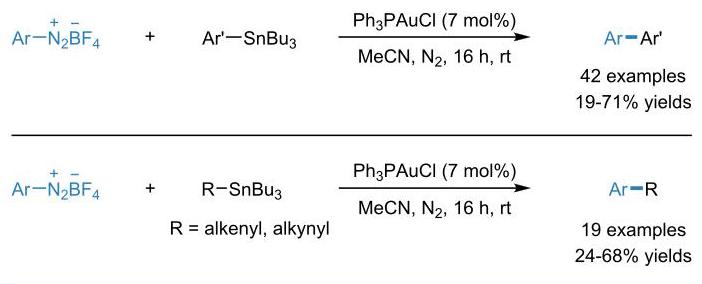
Scheme 139. Gold-Promoted C(sp)-C(sp ${}^{2}$ ) Coupling Reaction of Aryl Diazonium Salts
方案139. 金促进的芳基重氮盐的C(sp)-C(sp ${}^{2}$ )偶联反应
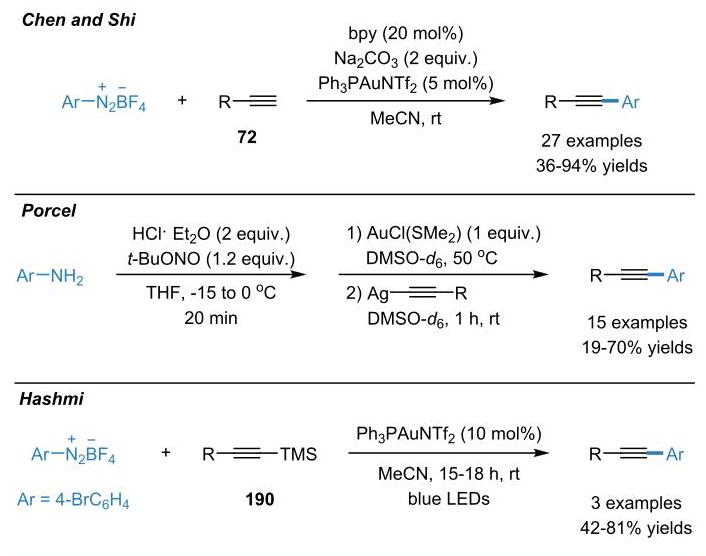
In 2016, Toste ${}^{267}$ and Glorius ${}^{268}$ explored a dual gold/Ru catalytic system to achieve the $\mathrm{C}\left( \mathrm{{sp}}\right) - \mathrm{C}\left( {\mathrm{{sp}}}^{2}\right)$ cross-coupling reaction of aryl diazonium tetrafluoroborates with alkynyl-trimethylsilanes 190 or terminal alkynes 72, respectively (Scheme 140). The reaction proceeds via visible light-mediated single-electron oxidative addition of aryl diazonium salts, resulting in the formation of alkynyl-Au(III) species, followed by reductive elimination.
2016年,托斯特${}^{267}$和格洛里乌斯${}^{268}$探索了一种双金/钌催化体系,分别实现了四氟硼酸芳基重氮盐与炔基三甲基硅烷190或末端炔烃72的$\mathrm{C}\left( \mathrm{{sp}}\right) - \mathrm{C}\left( {\mathrm{{sp}}}^{2}\right)$交叉偶联反应(方案140)。该反应通过可见光介导的芳基重氮盐的单电子氧化加成进行,导致炔基-Au(III)物种的形成,随后进行还原消除。
Scheme 140. Dual Gold/Photoredox Catalytic C(sp)-C(sp ${}^{2}$ ) Cross-Coupling Reactions
方案140. 双金/光氧化还原催化的C(sp)-C(sp ${}^{2}$ )交叉偶联反应
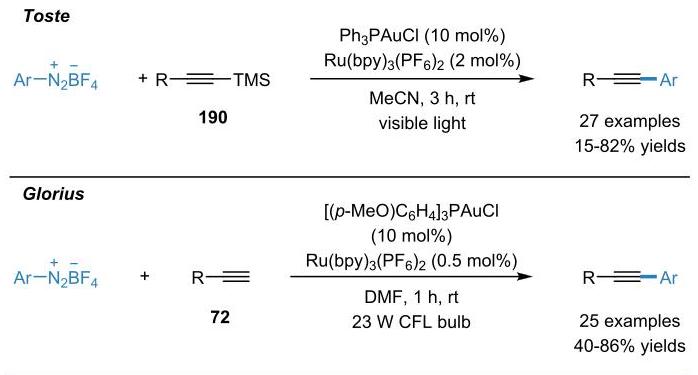
2.2.5.5. Meyer-Schuster Rearrangement. Utilizing a dual gold/photoredox visible-light-promoted catalytic system, several groups disclosed the tandem Meyer-Schuster/arylation of propargyl alcohols with aryl diazonium salts, affording $\alpha$ - arylated enones in one pot (Scheme 141). In 2016, Shin ${}^{269}$ and Glorius ${}^{270}$ reported tandem Meyer-Schuster/cross-coupling of alkynols 191 with aryl diazonium tetrafluoroborates under blue or green LED irradiation, respectively. In this process, aryl diazonium salts play triple roles as oxidants, coupling partners, and catalytic activators to dissociate propargyl alcohols. In 2016, Alcaide and Almendros also developed the arylative coupling of alkynols 191 or alkynyl hydroperoxides, affording aryl-substituted $\alpha ,\beta$ -unsaturated ketones and 3-acylidene-2- oxindole derivatives. ${}^{271}$
2.2.5.5. 迈耶-舒斯特重排。利用双金/光氧化还原可见光促进的催化体系,几个研究小组公开了炔丙醇与芳基重氮盐的串联迈耶-舒斯特/芳基化反应,一锅法得到$\alpha$-芳基化烯酮(方案141)。2016年,申${}^{269}$和格洛里乌斯${}^{270}$分别报道了在蓝色或绿色LED照射下,炔醇191与四氟硼酸芳基重氮盐的串联迈耶-舒斯特/交叉偶联反应。在此过程中,芳基重氮盐作为氧化剂、偶联伙伴和催化活化剂发挥三重作用,使炔丙醇解离。2016年,阿尔凯德和阿尔门德罗斯还开发了炔醇191或炔基氢过氧化物的芳基化偶联反应,得到芳基取代的$\alpha ,\beta$-不饱和酮和3-亚烯基-2-吲哚酮衍生物。${}^{271}$
Scheme 141. Dual Gold/Photoredox Catalysis for Meyer-Schuster/Arylation Reaction
方案141. 双金/光氧化还原催化的迈耶-舒斯特/芳基化反应
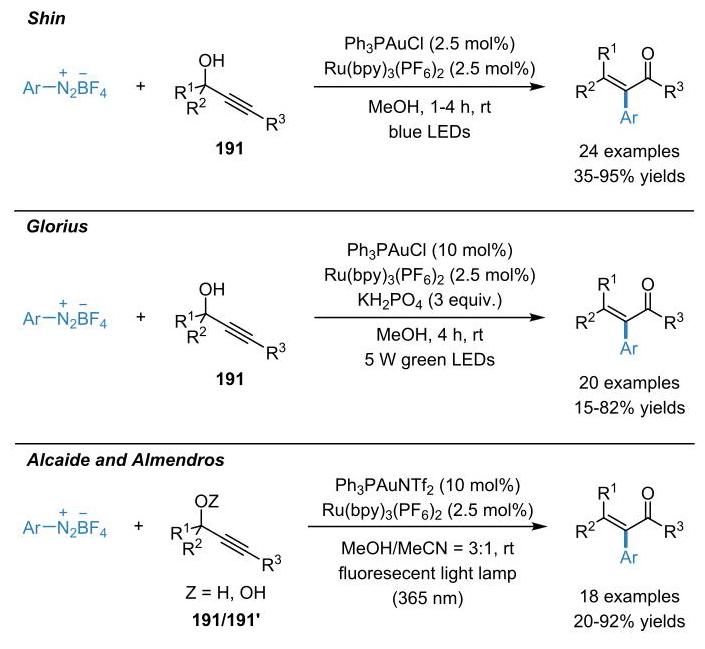
The mechanism of this dual catalytic Meyer-Schuster/ arylation reaction has been proposed as shown in Scheme 142. The Au(I) species first undergoes single-electron oxidation with an aryl radical generated upon oxidative quenching of the visible-light-activated photocatalyst by the aryl diazonium salt. Subsequent single-electron oxidation of the resulting Ar-Au(II) complex 160 either by the oxidized photocatalyst Ru(III) or in a radical chain reaction with another equivalent of aryl diazonium cation will lead to the Ar-Au(III) species 161. With the activation of Au(III) species in MeOH solvent, Meyer-Schuster rearrangement occurs through an allenyl ether intermediate. Finally, reductive elimination from the subsequent $\sigma$ -complex 192 selectively affords the coupling product accompanied by the regeneration of $\mathrm{{Au}}\left( \mathrm{I}\right)$ species.
这种双催化迈耶-舒斯特/芳基化反应的机理如图方案142所示。Au(I)物种首先与芳基重氮盐对可见光活化的光催化剂进行氧化猝灭时产生的芳基自由基进行单电子氧化。所得的Ar-Au(II)配合物160随后被氧化的光催化剂Ru(III)或与另一当量的芳基重氮阳离子进行自由基链反应进行单电子氧化,将导致Ar-Au(III)物种161。在MeOH溶剂中激活Au(III)物种后,迈耶-舒斯特重排通过烯丙基醚中间体发生。最后,从随后的$\sigma$-配合物192中进行还原消除,选择性地得到偶联产物并伴随着$\mathrm{{Au}}\left( \mathrm{I}\right)$物种的再生。
Scheme 142. Proposed Mechanism of Tandem Meyer-Schuster/Arylation Reaction
方案142. 串联迈耶-舒斯特/芳基化反应的推测机理
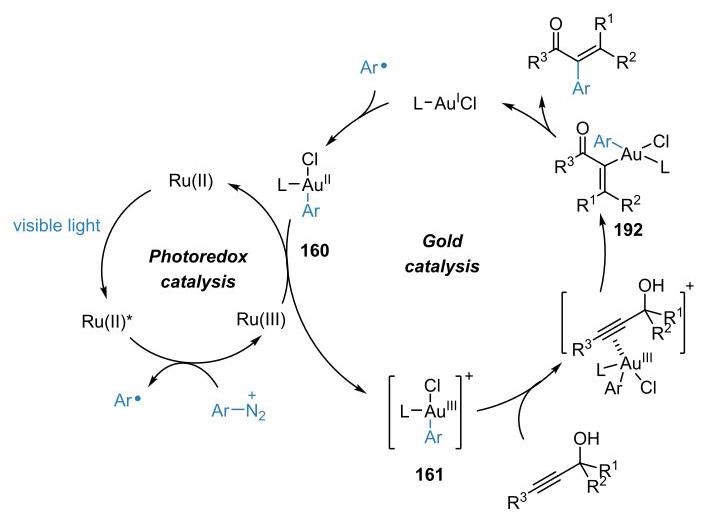
In 2017, Alcaide and co-workers employed a dual gold/ photoredox catalytic system to realize a domino $\mathrm{C}\left( \mathrm{{sp}}\right) -$ arylation/oxyarylation of TMS-terminated alkynols 193, affording tri- and tetrasubstituted $\alpha ,\beta$ -unsaturated ketones (Scheme 143). ${}^{249}$ This domino bis-arylative sequence proceeds
2017年,阿尔凯德及其同事采用双金/光氧化还原催化体系实现了TMS端基炔醇193的多米诺$\mathrm{C}\left( \mathrm{{sp}}\right) -$芳基化/氧芳基化反应,得到三取代和四取代的$\alpha ,\beta$-不饱和酮(方案143)。${}^{249}$这种多米诺双芳基化序列进行
Scheme 143. Visible-Light-Induced Gold-Catalyzed Domino C(sp) Arylation/Oxyarylation of TMS-Terminated Alkynols with Aryl Diazonium Salts
方案143. 可见光诱导的金催化TMS端炔醇与芳基重氮盐的多米诺C(sp)芳基化/氧芳基化反应
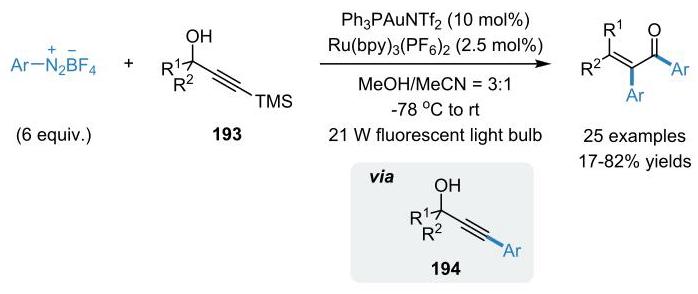
via the initial dual catalytic $\mathrm{C}\left( \mathrm{{sp}}\right) - \mathrm{C}\left( {\mathrm{{sp}}}^{2}\right)$ coupling reaction of TMS-terminated alkynols 193 to form monoarylated intermediates 194, followed by Meyer-Schuster/arylation to produce the desired diarylated $\alpha ,\beta$ -unsaturated ketones.
通过TMS端炔醇193的初始双催化$\mathrm{C}\left( \mathrm{{sp}}\right) - \mathrm{C}\left( {\mathrm{{sp}}}^{2}\right)$偶联反应形成单芳基化中间体194,然后通过迈耶-舒斯特反应/芳基化反应生成所需的二芳基化$\alpha ,\beta$不饱和酮。
3. ARYL DIAZONIUM SALTS IN ARYL C-HETEROATOM BOND FORMATIONS
3. 芳基重氮盐在芳基碳-杂原子键形成中的应用
Sandmeyer-type transformations of aryl diazonium salts have opened a superior avenue toward the selective construction of aryl $\mathrm{C} - \mathrm{C}$ and $\mathrm{C} - \mathrm{X}$ bonds. In the classical $\mathrm{C} - \mathrm{X}$ bond formations of aryl diazonium ions, copper salts are required for aryl radical generation. The scope of heteroatom is usually limited to halogen, nitrogen, oxygen, and sulfur atoms. Recent endeavors in the field have mainly focused on the expansion of the scope of the reaction, more types of carbon-heteroatom bond formations, and the combination with photoredox or electrochemical synthetic methods. In this review, the most recent selected advances are classified according to the types of C-X bonds.
芳基重氮盐的桑德迈尔型转化为选择性构建芳基$\mathrm{C} - \mathrm{C}$和$\mathrm{C} - \mathrm{X}$键开辟了一条优越的途径。在芳基重氮离子的经典$\mathrm{C} - \mathrm{X}$键形成中,需要铜盐来产生芳基自由基。杂原子的范围通常限于卤素、氮、氧和硫原子。该领域最近的努力主要集中在扩大反应范围、更多类型的碳-杂原子键形成以及与光氧化还原或电化学合成方法的结合。在本综述中,最新选定的进展根据C-X键的类型进行分类。
3.1. C-Halogen Bond Formations
3.1. C-卤键的形成
Traditional Sandmeyer halogenations of aryl diazonium salts have been widely used in constructing aryl $\mathrm{C} - \mathrm{X}\left( {\mathrm{X} = \mathrm{{Cl}},\mathrm{{Br}}}\right)$ bonds via denitrogenative substitution reactions. However, these halogenations need the participation of a stoichiometric amount of copper halides or harsh hydrohalic acid as the halogen sources and low reaction temperature for the diazotization process. In view of the importance of aryl halides in organic synthesis, the development of novel halogenation of aryl diazonium salts has garnered significant attention from the synthetic community. Recent developments are focused on expanding substrate scope and exploring new efficient catalytic systems for aryl $\mathrm{C} - \mathrm{X}$ bond formations, including the employment of halogen sources and alternative routes for generating aryl radicals.
传统的芳基重氮盐桑德迈尔卤化反应已广泛用于通过脱氮取代反应构建芳基$\mathrm{C} - \mathrm{X}\left( {\mathrm{X} = \mathrm{{Cl}},\mathrm{{Br}}}\right)$键。然而,这些卤化反应需要化学计量的卤化铜或强氢卤酸作为卤素源,并且重氮化过程需要较低的反应温度。鉴于芳基卤化物在有机合成中的重要性,芳基重氮盐新型卤化反应的开发引起了合成界的广泛关注。最近的进展集中在扩大底物范围和探索用于形成芳基$\mathrm{C} - \mathrm{X}$键的新型高效催化体系,包括使用卤素源和生成芳基自由基的替代途径。
For example, a diazotization/iodination process based on the lamination of Pickering emulsions has been established, which represents a complementary route for constructing an aryl C-I bond. ${}^{272}$ Additionally, aiming to avoid copper halides or HX as the halogen source, a metal- and acid-free halogenation of arylamines using N-halosuccinimide and sodium nitrite serves as a complementary approach to the Sandmeyer reaction (Scheme 144). ${}^{273}$ The direct hydro-deamination of arylamines using ${\mathrm{{BF}}}_{3} \cdot {\mathrm{{Et}}}_{2}\mathrm{O}$ in DMF has also been examined.
例如,已经建立了基于皮克林乳液层压的重氮化/碘化过程,这是构建芳基C-I键的一种补充途径。${}^{272}$此外,为了避免使用卤化铜或HX作为卤素源,使用N-卤代琥珀酰亚胺和亚硝酸钠对芳胺进行无金属和无酸卤化反应是桑德迈尔反应的一种补充方法(方案144)。${}^{273}$也已经研究了在DMF中使用${\mathrm{{BF}}}_{3} \cdot {\mathrm{{Et}}}_{2}\mathrm{O}$对芳胺进行直接加氢脱氨反应。
Scheme 144. Direct Halogenation and Hydrodeamination of Arylamines in DMF
方案144. DMF中芳胺的直接卤化和加氢脱氨反应
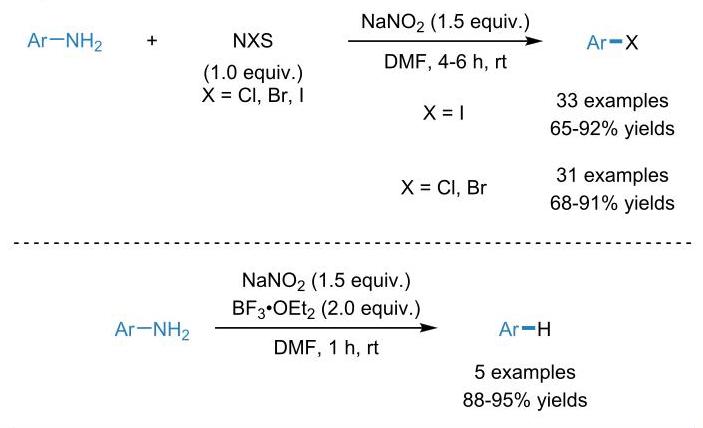
Aside from copper salts, the gold(I) complex ${\mathrm{{Ph}}}_{3}\mathrm{{PAuCl}}$ has been explored as an efficient catalyst in C-heteroatom coupling reactions with different nucleophiles, achieving aryl $\mathrm{C} - \mathrm{{Br}},\mathrm{C} - \mathrm{S}$ , and $\mathrm{C} - \mathrm{P}$ bond formations under photoredox-free thermal conditions (Scheme 145). ${}^{274}$ On the basis of mechanistic investigations, the heteroatom nucleophiles are thought to facilitate the oxidation of $\mathrm{{Au}}\left( \mathrm{I}\right)$ to form $\mathrm{{Ar}} - \mathrm{{Au}}\left( \mathrm{{III}}\right)$ complex 195, which undergoes final reductive elimination to forge C-Nu bonds.
除了铜盐之外,金(I)配合物${\mathrm{{Ph}}}_{3}\mathrm{{PAuCl}}$已被探索作为与不同亲核试剂进行C-杂原子偶联反应的有效催化剂,在无光氧化还原热条件下实现芳基$\mathrm{C} - \mathrm{{Br}},\mathrm{C} - \mathrm{S}$、$\mathrm{C} - \mathrm{P}$键的形成(方案145)。${}^{274}$基于机理研究,认为杂原子亲核试剂促进$\mathrm{{Au}}\left( \mathrm{I}\right)$氧化形成$\mathrm{{Ar}} - \mathrm{{Au}}\left( \mathrm{{III}}\right)$配合物195,其最终经历还原消除以形成C-Nu键。
Scheme 145. Gold-Catalyzed Aryl C-Br, C-S, and C-P Bond Formations
方案145. 金催化的芳基C-Br、C-S和C-P键的形成
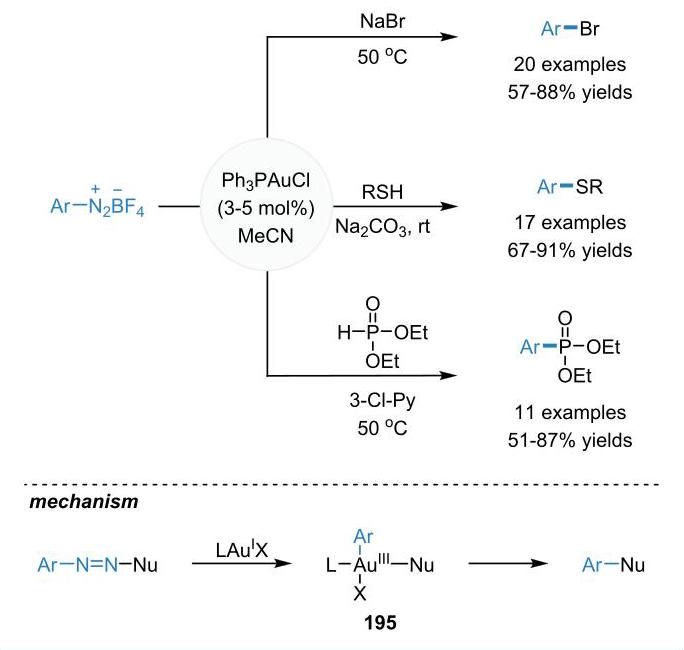
In 2018, Mo and co-workers developed a general electrochemical protocol for the Sandmeyer halogenation process (Scheme 146). ${}^{275}$ With the employment of a simple and inexpensive halogen source, this electrochemical protocol enables the efficient synthesis of a variety of aryl halides in good yields. A practical application of this method has been demonstrated by the one-pot halogenation process using anilines as the starting material and the multigram scale synthesis of aryl halides using inexpensive graphite as the electrode. On the basis of the mechanistic studies, including radical clock and radical scavenger experiments, cyclic voltammetry analysis, and in situ electron paramagnetic resonance (EPR) analysis, a single-electron reduction mechanism for the halogenation of diazonium salts upon electrolysis has been proposed.
2018年,Mo及其同事开发了一种用于桑德迈尔卤化过程的通用电化学方法(方案146)。${}^{275}$通过使用简单且廉价的卤素源,这种电化学方法能够以良好的产率高效合成各种芳基卤化物。该方法的实际应用已通过以苯胺为起始原料的一锅卤化过程以及使用廉价石墨作为电极的芳基卤化物的多克规模合成得到证明。基于包括自由基钟和自由基清除剂实验、循环伏安分析和原位电子顺磁共振(EPR)分析在内的机理研究,提出了电解时重氮盐卤化反应的单电子还原机理。
Scheme 146. Electrochemical Sandmeyer Reaction of Aryl Diazonium Salts
方案146. 芳基重氮盐的电化学桑德迈尔反应
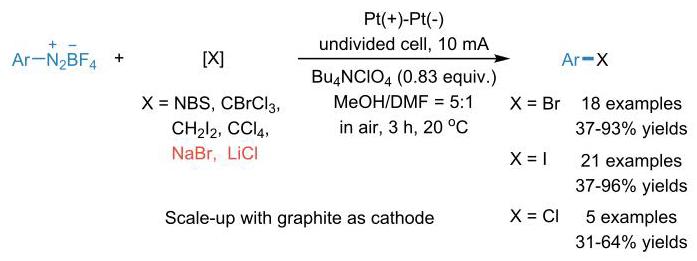
mechanism
机理
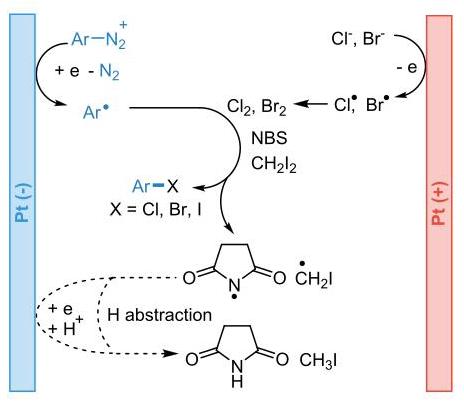
One of the oldest and most commonly used C-F bond-forming reactions is the Balz-Schiemann reaction. The preformed aryl diazonium tetrafluoroborates undergo thermal decomposition at a high temperature to afford aryl fluorides. Aiming to forge aryl $\mathrm{C} - \mathrm{F}$ bond under mild conditions, $\mathrm{{Hu}}$ developed a hypervalent iodine(III) reagent/Lewis acid catalytic system to synthesize fluoroarenes at relatively low temperatures (Scheme 147). ${}^{276}\mathrm{{Hu}}$ and co-workers suggested that the aryl diazonium is partially reduced by the hypervalent iodine species, which enhances the leaving propensity of the diazo moiety of the aryl diazonium salt to give an aryl cation intermediate 196. This species 196 undergoes sequential intramolecular nucleophilic fluorination to obtain the desired aryl fluoride.
最古老且最常用的C-F键形成反应之一是巴尔兹-施iemann反应。预先形成的芳基重氮四氟硼酸盐在高温下热分解以得到芳基氟化物。为了在温和条件下形成芳基$\mathrm{C} - \mathrm{F}$键,$\mathrm{{Hu}}$开发了一种高价碘(III)试剂/路易斯酸催化体系,以在相对较低的温度下合成氟代芳烃(方案147)。${}^{276}\mathrm{{Hu}}$及其同事认为,芳基重氮被高价碘物种部分还原,这增强了芳基重氮盐重氮部分的离去倾向,从而产生芳基阳离子中间体196。该物种196经历顺序的分子内亲核氟化反应以获得所需的芳基氟化物。
3.2. C-O Bond Formations
3.2. C-O键的形成
A standard method for converting aryl diazonium salts to the corresponding phenols is the thermal decomposition of diazonium salts in a highly acidic aqueous solution. ${}^{2}$ In 2017, Zarei reported the hydrolysis of diazonium salts immobilized on the surface of silica sulfuric acid. ${}^{277}$ Employing diazonium salt nanocomposites, this protocol features operational simplicity, availability of reactants, short reaction times and easy workup, affording phenol derivatives in moderate to good yields (11 examples, 20-83% yields).
将芳基重氮盐转化为相应酚类的标准方法是在高酸性水溶液中热分解重氮盐。${}^{2}$ 2017年,扎雷伊报道了固定在硅胶硫酸表面的重氮盐的水解反应。${}^{277}$ 采用重氮盐纳米复合材料,该方法具有操作简单、反应物易得、反应时间短和后处理容易等特点,能以中等至良好的产率得到酚类衍生物(11个例子,产率20 - 83%)。
Scheme 147. Hypervalent Iodine(III)-Catalyzed Balz-Schiemann Reaction
方案147. 高价碘(III)催化的巴尔兹 - 施iemann反应
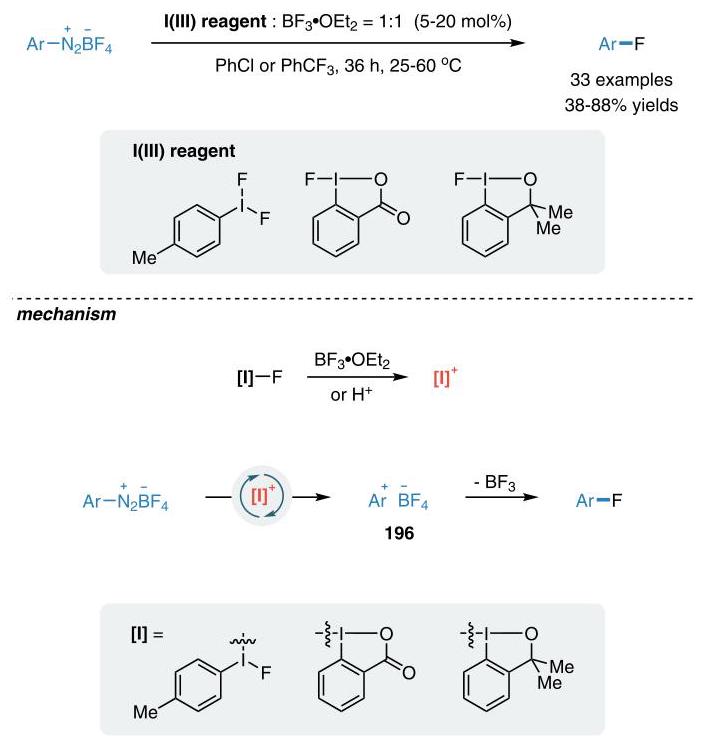
In combination with photoinduced transformations, a visible-light-induced photoredox intramolecular C-O bond formation of 2-(2’-aminophenyl)-phenol derivatives was developed, affording naturally occurring dibenzofuran scaffold 197 (Scheme 148). ${}^{278}$ In this protocol, intramolecular $\mathrm{C} - \mathrm{O}$ bond formation through in situ formed diazonium intermediate from 2-(2’-aminoaryl)phenol is facilitated by visible-light photocatalysis utilizing T(p-F)PPT 198 as the organic photosensitizer to initiate the generation of oxy radical intermediate 199.
结合光诱导转化,开发了一种可见光诱导的光氧化还原分子内C - O键形成反应,用于2 - (2’-氨基苯基) - 苯酚衍生物,得到天然存在的二苯并呋喃骨架197(方案148)。${}^{278}$ 在该方法中,利用T(p - F)PPT 198作为有机光敏剂的可见光光催化促进了从2 - (2’-氨基芳基)苯酚原位形成重氮中间体的分子内$\mathrm{C} - \mathrm{O}$ 键形成,从而引发氧自由基中间体199的生成。
Scheme 148. Visible-Light-Promoted Synthesis of Dibenzofuran Derivatives
方案148. 可见光促进的二苯并呋喃衍生物的合成
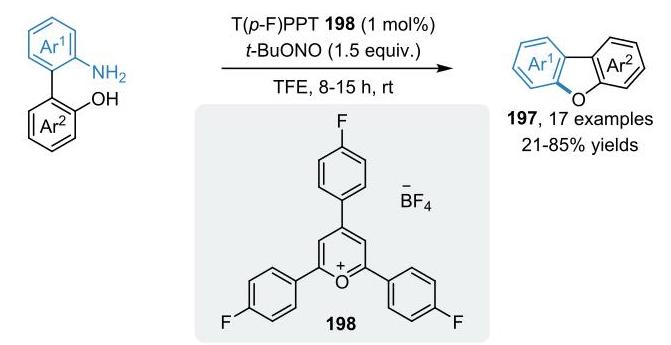
mechanism
机理
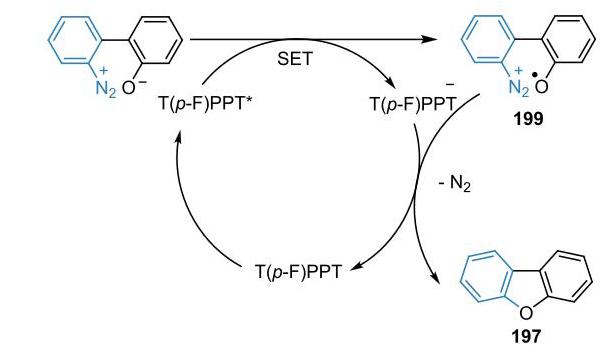
Furthermore, trifluoromethyl ethers are increasingly being investigated for pharmaceutical, agrochemical, and materials science applications due to their strongly electron-withdrawing and highly lipophilic properties. Therefore, the development of new methods for the synthesis of trifluoromethyl ethers has received much attention. In 2019, a dual photoredox/Cu-catalytic trifluoromethoxylation of aryl diazonium salts was developed upon visible-light irradiation using trifluoromethyl arylsulfonate as the trifluoromethoxylation reagent (Scheme 149). ${}^{279}$ This new strategy combined a photoredox catalytic system with Cu-promoted selective trifluoromethoxylation, enabling the synthesis of trifluoromethoxylated arenes in good yields, as well as the late-stage trifluoromethoxylation of complex small molecules. Mechanistic studies indicate that $\mathrm{{Cs}}\left\lbrack {\mathrm{{Cu}}{\left( {\mathrm{{OCF}}}_{3}\right) }_{2}}\right\rbrack$ intermediate 200 might be generated during the reaction, followed by single-electron oxidation by Ru(III) and aryl radical to form a key $\mathrm{{Ar}} - \mathrm{{Cu}}$ (III) $- {\mathrm{{OCF}}}_{3}$ adduct 201. Finally, reductive elimination from this hypervalent Cu(III) intermediate 201 yields the desired product and regenerates the $\mathrm{{Cu}}\left( \mathrm{I}\right)$ species.
此外,由于三氟甲醚具有强吸电子和高亲脂性,其在医药、农药和材料科学领域的应用越来越受到研究。因此,开发合成三氟甲醚的新方法受到了广泛关注。2019年,开发了一种在可见光照射下,以芳基三氟甲磺酸酯作为三氟甲氧基化试剂的光氧化还原/Cu双催化芳基重氮盐的三氟甲氧基化反应(方案149)。${}^{279}$ 这种新策略将光氧化还原催化体系与Cu促进的选择性三氟甲氧基化相结合,能够以良好的产率合成三氟甲氧基化芳烃,以及对复杂小分子进行后期三氟甲氧基化。机理研究表明,$\mathrm{{Cs}}\left\lbrack {\mathrm{{Cu}}{\left( {\mathrm{{OCF}}}_{3}\right) }_{2}}\right\rbrack$ 中间体200可能在反应过程中生成,随后被Ru(III)和芳基自由基单电子氧化形成关键的$\mathrm{{Ar}} - \mathrm{{Cu}}$ (III)$- {\mathrm{{OCF}}}_{3}$ 加合物201。最后,从这种高价Cu(III)中间体201进行还原消除得到所需产物并再生$\mathrm{{Cu}}\left( \mathrm{I}\right)$ 物种。
Scheme 149. Visible Light Photoredox Cu-Promoted Trifluoromethoxylation of Aryl Diazonium Tetrafluoroborates
方案149. 可见光光氧化还原Cu促进的四氟硼酸芳基重氮盐的三氟甲氧基化反应
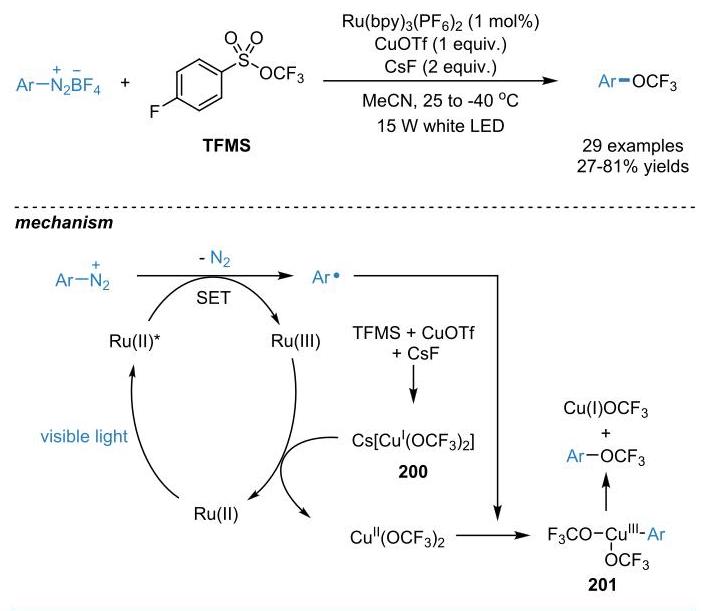
In 2019, a silver-mediated trifluoromethoxylation of (hetero)aryl diazonium tetrafluoroborates under light-free conditions was published (Scheme 150). ${}^{280}$ This light-free protocol uses ${\mathrm{{AgOCF}}}_{3}$ as the trifluoromethoxylation reagent. The reaction is initiated by an SET process to generate an aryl radical and Ag(II) species 202, followed by recombination and $\mathrm{C} - {\mathrm{{OCF}}}_{3}$ bond formation.
2019年,发表了一种在无光条件下银介导的四氟硼酸(杂)芳基重氮盐的三氟甲氧基化反应(方案150)。${}^{280}$ 这种无光方法使用${\mathrm{{AgOCF}}}_{3}$ 作为三氟甲氧基化试剂。反应通过单电子转移过程引发,生成芳基自由基和Ag(II)物种202,随后进行重组和$\mathrm{C} - {\mathrm{{OCF}}}_{3}$ 键形成。
3.3. C-N Bond Formations
3.3. C-N键的形成
Aryl diazonium salts can serve as partners in transition-metal-catalyzed coupling reactions to form aryl $\mathrm{C} - \mathrm{N}$ bonds, such as the traditional introduction of azido group onto aromatic rings. ${}^{281}$ This section summarizes recent advances in $\mathrm{C} - \mathrm{N}$ bond formations through coupling reactions via nitrogen extrusion. The cascade reactions with nitriles or the synthesis of nitrogen-containing heterocycles with the retention of diazo moiety will be discussed in the following section.
芳基重氮盐可作为过渡金属催化偶联反应中的反应物,形成芳基$\mathrm{C} - \mathrm{N}$键,例如传统的在芳环上引入叠氮基。${}^{281}$ 本节总结了通过氮消除偶联反应形成$\mathrm{C} - \mathrm{N}$键的最新进展。与腈的级联反应或保留重氮部分的含氮杂环的合成将在下一节讨论。
Scheme 150. Ag-Mediated Trifluoromethoxylation of Aryl Diazonium Salts
方案150. 银介导的芳基重氮盐的三氟甲氧基化反应
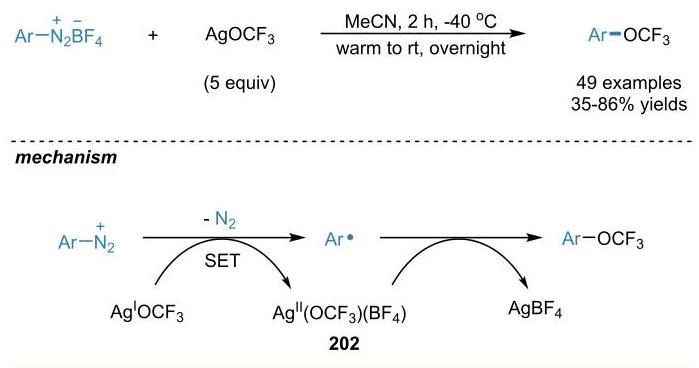
Using arylamine substrates, an iron-mediated C-N reaction of the in situ formed aryl diazonium salts with dialkyl azodicarboxylate was reported, affording N-aryl hydrazide derivatives 203 in good yields (Scheme 151). ${}^{282}$ This reaction is initiated by single-electron reduction of $\mathrm{{Fe}}\left( \mathrm{{II}}\right)$ to generate an aryl radical, followed by radical addition to DIAD to deliver hydrazides.
使用芳胺底物,报道了原位生成的芳基重氮盐与偶氮二甲酸二烷基酯的铁介导的C-N反应,以良好的产率得到N-芳基酰肼衍生物203(方案151)。${}^{282}$ 该反应通过将$\mathrm{{Fe}}\left( \mathrm{{II}}\right)$单电子还原引发,生成芳基自由基,然后自由基加成到DIAD上得到酰肼。
Scheme 151. Fe-Mediated Reaction of Aryl Diazonium Salts with Azodicarboxylate
方案151. 铁介导的芳基重氮盐与偶氮二甲酸酯的反应
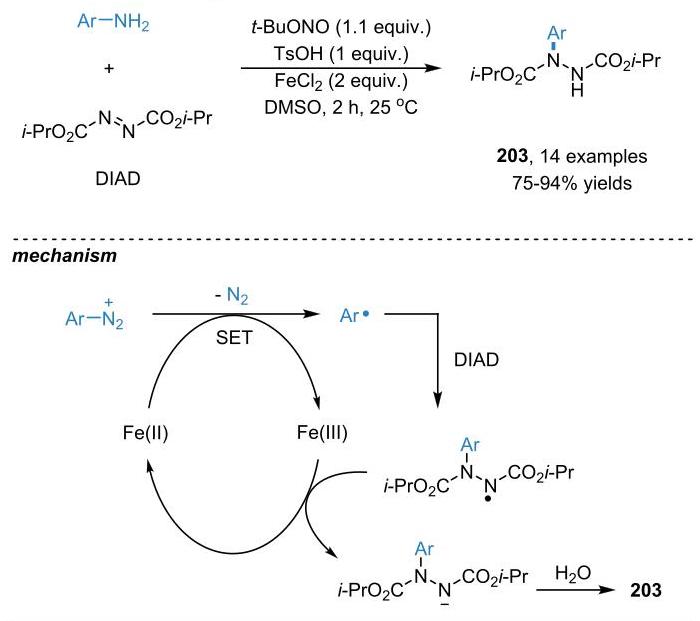
Aside from hydrazide formation, a Cu-catalyzed Ullmann-type arylation of pyrazoles with in situ generated aryl diazonium salts from anilines was carried out under ligand-free conditions (Scheme 152). ${}^{{283},{284}}$ For other nitrogen heterocycles, the addition of TBAI and base significantly improves the yields of this C-N bond formation protocol. Theoretical studies toward the copper-catalyzed arylation indicate that this coupling reaction proceeds through a $\mathrm{{Cu}}\left( \mathrm{I}\right) /\mathrm{{Cu}}\left( \mathrm{{III}}\right)$ catalytic cycle. ${}^{285}$ In addition, oxidative addition of aryl diazonium salts is found to be the rate-determining step.
除了形成酰肼外,在无配体条件下进行了铜催化的吡唑与由苯胺原位生成的芳基重氮盐的乌尔曼型芳基化反应(方案152)。${}^{{283},{284}}$ 对于其他氮杂环,添加TBAI和碱可显著提高该C-N键形成反应的产率。对铜催化芳基化反应的理论研究表明,该偶联反应通过$\mathrm{{Cu}}\left( \mathrm{I}\right) /\mathrm{{Cu}}\left( \mathrm{{III}}\right)$催化循环进行。${}^{285}$ 此外,发现芳基重氮盐的氧化加成是速率决定步骤。
3.4. C-B Bond Formations
3.4. C-B键的形成
Methods for the preparation of arylboronic acid derivatives have attracted much attention from organic chemists. In recent years, the selective construction of aryl $\mathrm{C} - \mathrm{B}$ bonds via the homolytic cleavage of the boron-boron bond opens up a new approach for the synthesis of arylboronic acid derivatives. ${}^{{286},{287}}$ In particular, Sandmeyer-type borylation of arylamines and aryl diazonium salts for the synthesis of (hetero)arylboronic acids and boronates has been well studied in the past decade. Several modified practical routes to arylboronic compounds have been established, which can be applied in both academic settings and industrial processes.
芳基硼酸衍生物的制备方法引起了有机化学家的广泛关注。近年来,通过硼-硼键的均裂选择性构建芳基$\mathrm{C} - \mathrm{B}$键为芳基硼酸衍生物的合成开辟了一条新途径。${}^{{286},{287}}$ 特别是,在过去十年中,对用于合成(杂)芳基硼酸和硼酸酯的芳胺和芳基重氮盐的桑德迈尔型硼化反应进行了深入研究。已经建立了几种改进的实用路线来制备芳基硼酸化合物,这些路线可应用于学术研究和工业生产过程。
Scheme 152. Cu-Catalyzed Arylation of Nitrogen Heterocycles from Anilines
方案152. 铜催化的由苯胺对氮杂环进行芳基化反应
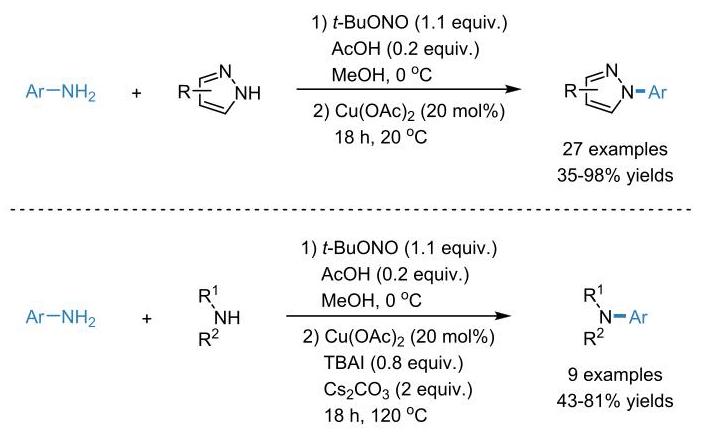
In 2010, Mo, Wang and co-workers reported a metal-free aryl $\mathrm{C} - \mathrm{B}$ bond forming reaction that directly converts arylamines into arylboronates with ${\mathrm{B}}_{2}{\mathrm{{pin}}}_{2}$ (134) in the presence of $t$ -BuONO (Scheme 153). ${}^{288}$ The addition of a catalytic amount of BPO as a radical initiator improves the yields at room temperature. The reaction displays a broad substrate scope with most meta- and para-substituted anilines. However, ortho-substituted arylamines with an electron-deficient group and meta-substituted arylamines with an electron-donating group give lower yields or only trace amounts of product. In addition, heteroaromatic amines are incompatible with this chemistry. In 2013, this borylation method was further expanded by increasing the reaction temperature to ${80}^{ \circ }\mathrm{C}{.}^{289}$ The modified protocol works well for heterocyclic arylamines.
2010年,Mo、Wang及其同事报道了一种无金属的芳基$\mathrm{C} - \mathrm{B}$键形成反应,该反应在$t$ -BuONO存在下,能使芳胺与${\mathrm{B}}_{2}{\mathrm{{pin}}}_{2}$ (134)直接转化为芳基硼酸酯(方案153)。${}^{288}$ 添加催化量的BPO作为自由基引发剂可提高室温下的产率。该反应对大多数间位和对位取代的苯胺具有广泛的底物适应性。然而,带有缺电子基团的邻位取代芳胺和带有供电子基团的间位取代芳胺产率较低或仅生成痕量产物。此外,杂芳族胺不适用此反应体系。2013年,通过将反应温度提高到${80}^{ \circ }\mathrm{C}{.}^{289}$ ,该硼化方法得到进一步扩展。改进后的方案对杂环芳胺效果良好。
Scheme 153. Sandmeyer-type Borylation of Arylamines for the Synthesis of Arylboronates
方案153. 用于合成芳基硼酸酯的芳胺的桑德迈尔型硼化反应
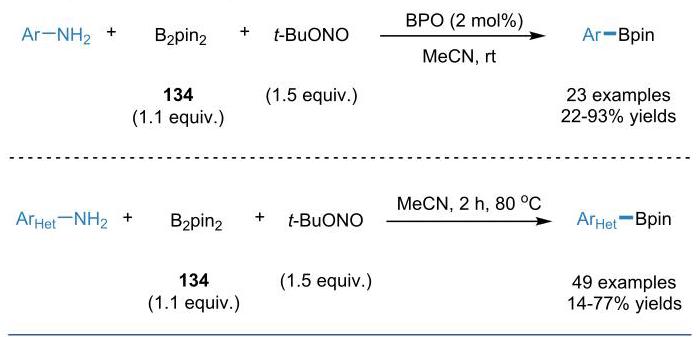
In 2014, Pucheault and co-workers disclosed a series of metallocene reagents capable of promoting borylation of anilines to form boronates at room temperature (Scheme 154). ${}^{290}$ This protocol uses diisopropylaminoborane (204, ${\mathrm{H}}_{2}{\mathrm{{BNi}}}^{ - }{\mathrm{{Pr}}}_{2}$ ) as the borylation agent and is presumed to proceed through a radical chain mechanism. Another zinc-catalyzed borylation of aryl diazonium salts and aryltriazenes was developed to synthesize arylboronate in the presence of 5% $\mathrm{{Zn}}{\left( {\mathrm{{ClO}}}_{4}\right) }_{2}$ . ${}^{291}$
2014年,Pucheault及其同事公开了一系列能够在室温下促进苯胺硼化以形成硼酸酯的茂金属试剂(方案154)。${}^{290}$ 该方案使用二异丙基氨基硼烷(204,${\mathrm{H}}_{2}{\mathrm{{BNi}}}^{ - }{\mathrm{{Pr}}}_{2}$ )作为硼化剂,推测其通过自由基链机制进行。还开发了另一种锌催化的芳基重氮盐和芳基三氮烯的硼化反应,以在5% $\mathrm{{Zn}}{\left( {\mathrm{{ClO}}}_{4}\right) }_{2}$ 存在下合成芳基硼酸酯。${}^{291}$
Scheme 154. Borylation Using Group IV Metallocene and Zinc Catalysts
方案154. 使用第IV族茂金属和锌催化剂进行硼化反应
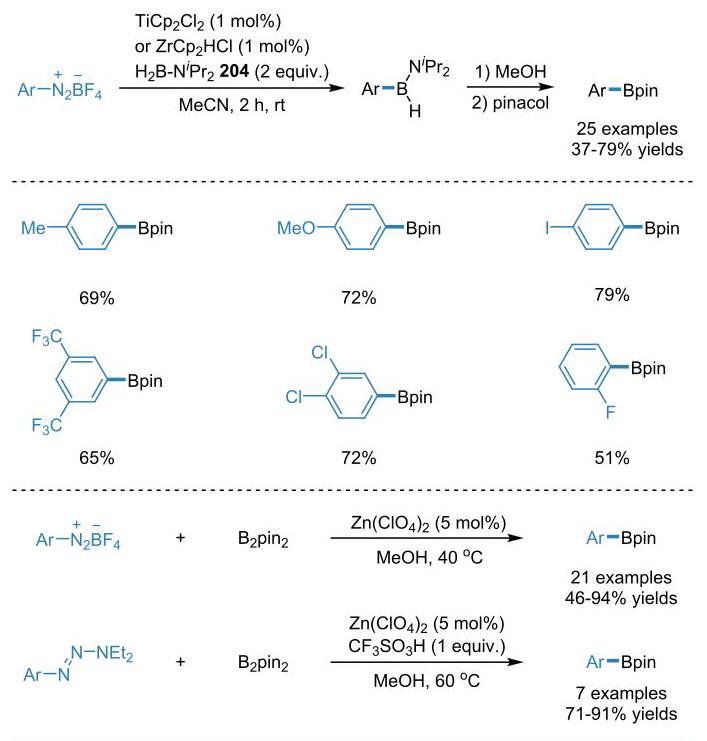
Other borylation reagents have also been employed to forge aryl $\mathrm{C} - \mathrm{B}$ bonds. Aside from ${\mathrm{B}}_{2}{\mathrm{{pin}}}_{2}$ (134), diboronic acid 205 has been explored as a new borylation reagent to facilitate the aqueous phase borylation of a wide range of diazonium salts, leading to the facile synthesis of (hetero)arylboronic acids (Scheme 155). ${}^{292}$ Furthermore, this one-pot fast borylation method was combined with other reactions such as esterification, Suzuki-Miyaura coupling, hydrogenolysis, and Petasis borono-Mannich reaction for rapid access to molecular diversity. ${}^{293}$
还使用了其他硼化试剂来构建芳基$\mathrm{C} - \mathrm{B}$键。除了${\mathrm{B}}_{2}{\mathrm{{pin}}}_{2}$ (134)之外,二硼酸205已被探索作为一种新的硼化试剂,以促进各种重氮盐的水相硼化反应,从而简便地合成(杂)芳基硼酸(方案155)。${}^{292}$ 此外,这种一锅快速硼化方法与其他反应如酯化、铃木-宫浦偶联、氢解和佩塔西斯硼基-曼尼希反应相结合,可快速获得分子多样性。${}^{293}$
Scheme 155. Aqueous Phase Borylation of Aryl Diazonium Salts and Arylamines with Diboronic Acid
方案155. 用二硼酸对芳基重氮盐和芳胺进行水相硼化反应
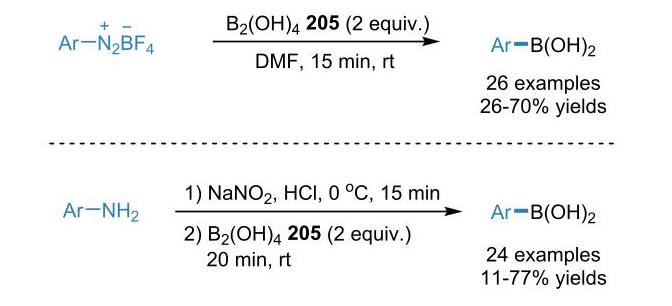
In addition to the synthesis of arylboronic acids and pinacol boronates, a metal-free transformation from arylamines with a nonsymmetrical diboron reagent B(pin)-B(dan) 206 to access aryl naphthalene-1,8-diamino boronamides 207 was reported (Scheme 156). ${}^{294}$ This Sandmeyer-type borylation reaction represents an important supplement to the preparation of aryl-B(dan) compounds.
除了合成芳基硼酸和频哪醇硼酸酯外,还报道了一种无金属转化反应,即使用不对称二硼试剂B(pin)-B(dan) 206将芳胺转化为芳基萘-1,8-二氨基硼酰胺207(方案156)。${}^{294}$ 这种桑德迈尔型硼化反应是对芳基-B(dan)化合物制备的重要补充。
To develop Sandmeyer-type borylation under aqueous conditions, Xue and co-workers reported aqueous phase diazotization conditions to convert aryl amines to arylboro-nates. ${}^{295}$ The borylation with ${\mathrm{B}}_{2}{\left( \mathrm{{OH}}\right) }_{4}$ as the boron source
为了在水相条件下开发桑德迈尔型硼化反应,薛等人报道了水相重氮化条件,用于将芳胺转化为芳基硼酸酯。${}^{295}$ 以${\mathrm{B}}_{2}{\left( \mathrm{{OH}}\right) }_{4}$作为硼源进行硼化反应
Scheme 156. Transformation from Arylamines to Aryl Naphthalene-1,8-Diamino Boronamides
方案156. 从芳胺到芳基萘-1,8-二氨基硼酰胺的转化
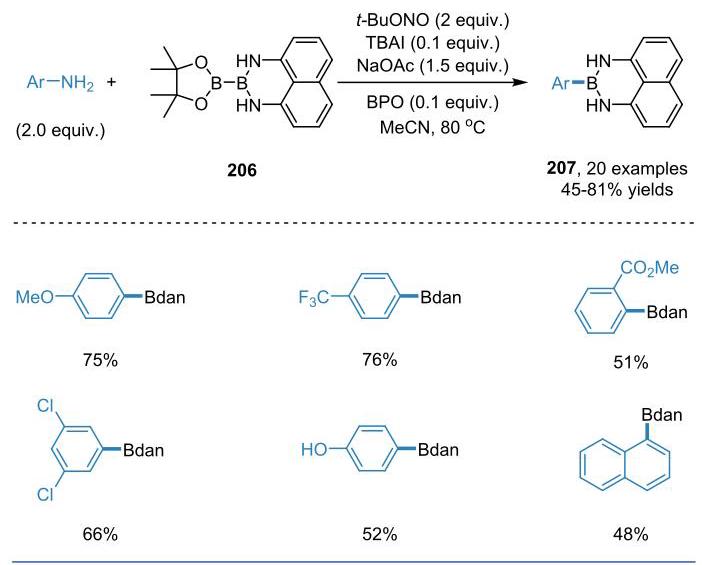
was also achieved, affording arylboronic acid products (Scheme 157).
也得以实现,得到了芳基硼酸产物(方案157)。
Scheme 157. Methanol-Promoted Borylation of Arylamines to Access Arylboronates and Boronic Acids
方案157. 甲醇促进的芳胺硼化反应以获得芳基硼酸酯和硼酸
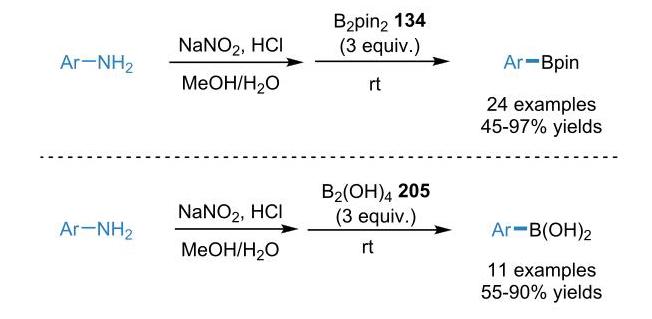
Another aqueous phase borylation of aryl diazonium tetrafluoroborates with ${\mathrm{B}}_{2}{\text{ pin }}_{2}$ (134) was shown to proceed in acetone-water solution at room temperature (Scheme 158). ${}^{296}$
另一种用${\mathrm{B}}_{2}{\text{ pin }}_{2}$(134)对四氟硼酸芳基重氮盐进行的水相硼化反应显示,在室温下于丙酮-水溶液中进行(方案158)。${}^{296}$
Merging photoredox catalysis with borylation, Yan and coworkers first disclosed an organic dye (eosin Y)-catalyzed visible-light-promoted reduction of stable aryl diazonium tetrafluoroborate salts to generate free aryl radicals that are borylated with ${\mathrm{B}}_{2}{\text{ pin }}_{2}$ . ${}^{297}$ The one-pot diazotization/photoinduced borylation of anilines with $t$ -BuONO and ${\mathrm{B}}_{2}{\text{ pin }}_{2}$ (134) occurs at room temperature upon visible-light irradiation (Scheme 159). ${}^{298}$ In 2020, Wu and co-workers reported the borylation of aryl diazonium salts in water using easily prepared, highly emissive, and crystalline carbon dots as efficient photoredox catalysts, affording arylboronates in moderate to good yields (22 examples, up to 78% yield). ${}^{299}$ These photoredox borylation protocols feature good functional group tolerance, nontoxic catalysts, and green solvents.
将光氧化还原催化与硼化反应相结合,严等人首次披露了一种有机染料(曙红Y)催化的可见光促进稳定的四氟硼酸芳基重氮盐还原反应,以生成可与${\mathrm{B}}_{2}{\text{ pin }}_{2}$进行硼化反应的游离芳基自由基。${}^{297}$ 用$t$-叔丁基亚硝酸酯和${\mathrm{B}}_{2}{\text{ pin }}_{2}$(134)对苯胺进行的一锅法重氮化/光诱导硼化反应在室温下可见光照射时发生(方案159)。${}^{298}$ 2020年,吴等人报道了在水中使用易于制备、高发射性和结晶性的碳点作为高效光氧化还原催化剂对芳基重氮盐进行硼化反应,以中等至良好的产率得到芳基硼酸酯(22个例子,产率高达78%)。${}^{299}$ 这些光氧化还原硼化反应方案具有良好的官能团耐受性、无毒催化剂和绿色溶剂的特点。
Scheme 158. Catalyst-Free Borylation of Aryl Diazonium Tetrafluoroborates in Acetone-Water Solution
方案158. 丙酮-水溶液中四氟硼酸芳基重氮盐的无催化剂硼化反应
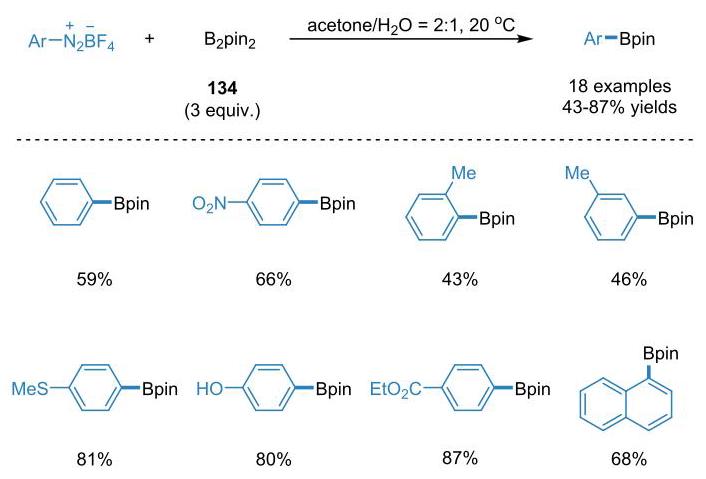
Scheme 159. Visible-Light-Induced Photoredox Borylation of Anilines
方案159. 可见光诱导的苯胺光氧化还原硼化反应
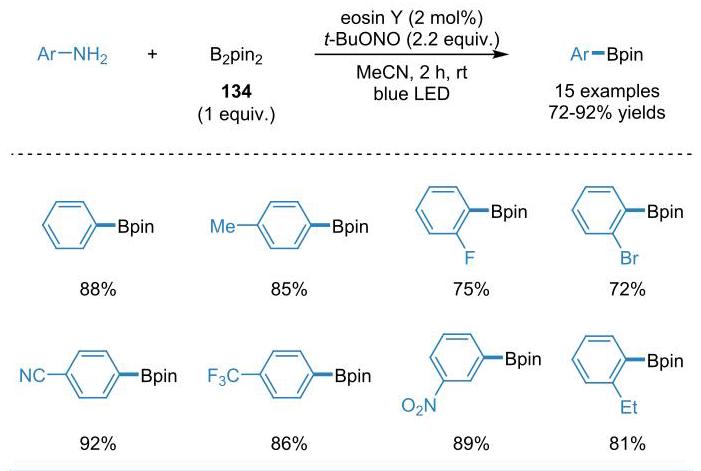
As illustrated before, Kubota and Ito developed a novel mechanoredox system through agitation of piezoelectric materials via ball milling to achieve the borylation of aryl diazonium salts (Scheme 160). ${}^{119}$ This mechanoredox borylation can serve as a complementary option to the existing transition-metal-catalyzed or photoredox transformations.
如前所述,久保田和伊藤通过球磨搅拌压电材料开发了一种新型机械氧化还原体系,以实现芳基重氮盐的硼化反应(方案160)。${}^{119}$ 这种机械氧化还原硼化反应可以作为现有过渡金属催化或光氧化还原转化的补充选择。
Scheme 160. Mechanoredox Borylation by Using Ball Milling and Piezoelectric Materials
方案160. 使用球磨和压电材料的机械氧化还原硼化反应
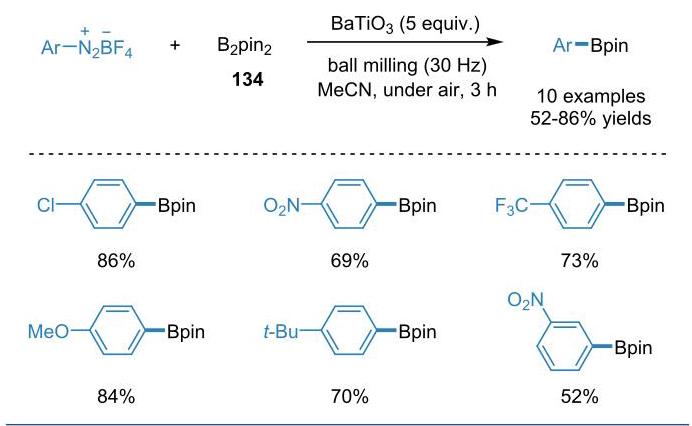
3.5. C-P Bond Formations
3.5. C-P键的形成
The cascade coupling reaction involving Cu-mediated Sandmeyer-type C-P bond formation of aryl diazonium salts with ${\mathrm{{PCl}}}_{3}$ followed by hydrolysis can afford arylphosphonic acid derivatives. ${}^{300}$ However, this protocol usually forms a mixture with the desired product in moderate yields. ${}^{301}$ In 2015, Toste utilized a dual gold/photoredox system in the cross-coupling to form C-P bonds, allowing the P-arylation of aryl diazonium salts with H-phosphonates (Scheme 161). ${}^{302}$
涉及铜介导的芳基重氮盐与${\mathrm{{PCl}}}_{3}$进行Sandmeyer型C-P键形成并随后水解的串联偶联反应能够得到芳基膦酸衍生物。${}^{300}$然而,该方法通常会形成与目标产物的混合物,产率中等。${}^{301}$2015年,托斯特在交叉偶联反应中使用了双金/光氧化还原体系来形成C-P键,实现了芳基重氮盐与H-膦酸酯的P-芳基化反应(方案161)。${}^{302}$
Scheme 161. Gold/Photoredox Catalyzed Aryl C-P Bond Formations
方案161. 金/光氧化还原催化的芳基C-P键形成
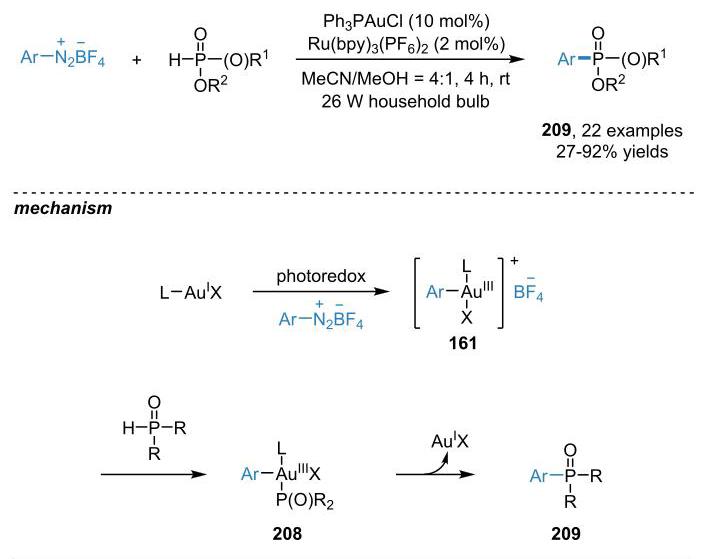
This mild protocol proceeds at room temperature in the absence of base or oxidants, affording arylphosphonates in moderate to good yields. The proposed mechanism starts with photoredox single-electron oxidation to form an electrophilic aryl gold(III) intermediate 161, followed by coupling with the H-phosphonate nucleophile to generate an aryl-Au-P(O)R ${}_{2}$ species 208. Finally, reductive elimination forms the desired arylphosphonates 209 along with the regeneration of $\mathrm{{Au}}\left( \mathrm{I}\right)$ species.
这个温和的方法在室温下、无碱或氧化剂的条件下进行,以中等至良好的产率得到芳基膦酸酯。所提出的机理始于光氧化还原单电子氧化,形成亲电芳基金(III)中间体161,随后与H-膦酸酯亲核试剂偶联,生成芳基-Au-P(O)R${}_{2}$物种208。最后,还原消除生成所需的芳基膦酸酯209以及$\mathrm{{Au}}\left( \mathrm{I}\right)$物种的再生。
In 2016, our group reported metal-free Sandmeyer-type phosphorylation of arylamines with triarylphosphites as the phosphorus source (Scheme 162). ${}^{303}$ This one-pot phosphorylation of anilines is conducted under mild conditions without excluding air or moisture, affording functionalized arylphosph-onates 210 in moderate to good yields. This reaction is proposed to proceed through a radical pathway, initiated by the SET of diazonium salt with triaryl phosphite to give a diazonium radical anion 211 and a phosphite radical cation 212. Then, phosphite radical cation 212 reacts with water to generate a phosphono radical 213 and a phenol byproduct. Finally, the reaction between diazonium radical anion 211 and phosphono radical 213 gives the desired phosphorylation product.
2016年,我们小组报道了以亚磷酸三芳基酯为磷源,对芳胺进行无金属Sandmeyer型磷酸化反应(方案162)。${}^{303}$苯胺的这种一锅法磷酸化反应在温和条件下进行,无需排除空气或水分,以中等至良好的产率得到功能化的芳基膦酸酯210。该反应被认为是通过自由基途径进行的,由重氮盐与亚磷酸三芳基酯的单电子转移引发,生成重氮自由基阴离子211和亚磷酸根自由基阳离子212。然后,亚磷酸根自由基阳离子212与水反应生成膦酰基自由基213和苯酚副产物。最后,重氮自由基阴离子211与膦酰基自由基213之间的反应得到所需的磷酸化产物。
Scheme 162. Metal-Free Sandmeyer-Type Aromatic C-P Bond Formations
方案162. 无金属Sandmeyer型芳基C-P键形成
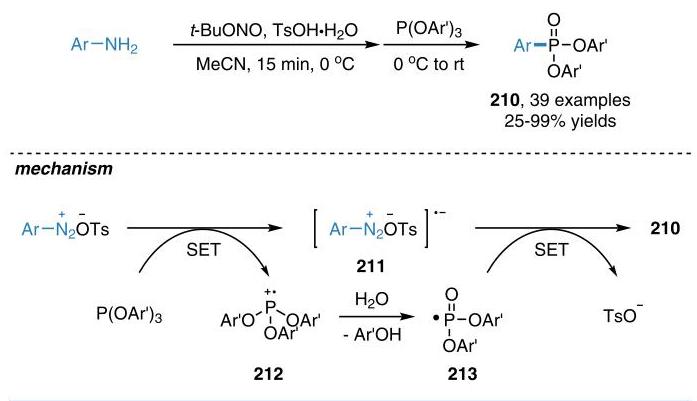
3.6. C-Sn Bond Formations
3.6. 碳 - 锡键的形成
The versatile applications of organotin reagents to forge $\mathrm{C} - \mathrm{C}$ bonds through Stille coupling have made organotin compounds synthetically valuable building blocks. However, existing methods for constructing aryl C-Sn bonds usually suffer from harsh conditions and limited scope. In 2013, Wang and co-workers reported a Sandmeyer-type stannylation reaction of arylamines with hexamethyldistannane 214 as the tin source (Scheme 163). ${}^{304}$ Using one equivalent of acid to promote the diazotization process, this mild stannylation reaction affords a wide range of aryl trimethylstannanes 215 in moderate to good yields. The synthetic application of this protocol has been successfully demonstrated by a gram-scale synthesis and the tandem Pd-catalyzed Stille cross-coupling reaction to obtain biaryl products in good yields. Mechanistically, this stannylation involves the diazotization of the amino group with $t$ -BuONO to form a diazonium salt, followed by SET from ${\left( {\mathrm{{SnMe}}}_{3}\right) }_{2}$ (214) to the diazonium salt, generating diazonium radical 216 and radical cation species 217. The decomposition of diazonium radical anion 217 forms an aryl radical, while the radical cation 217 reacts with tert-butoxide anion 218 to generate a trimethylstannyl radical 219. The reaction of the aryl radical with ${\left( {\mathrm{{SnMe}}}_{3}\right) }_{2}\left( \mathbf{{214}}\right)$ or the alternative direct combination of the aryl radical with trimethylstannyl radical 219 can both afford the stannylation product.
有机锡试剂通过Stille偶联形成$\mathrm{C} - \mathrm{C}$键的广泛应用,使有机锡化合物成为具有合成价值的构建单元。然而,现有的构建芳基碳 - 锡键的方法通常条件苛刻且适用范围有限。2013年,Wang及其同事报道了以六甲基二锡烷214为锡源的芳胺的Sandmeyer型锡基化反应(方案163)。${}^{304}$ 使用一当量的酸促进重氮化过程,这种温和的锡基化反应能以中等至良好的产率得到多种芳基三甲基锡烷215。该方法的合成应用已通过克级合成以及串联钯催化的Stille交叉偶联反应成功得到证明,能以良好的产率获得联芳基产物。从机理上讲,这种锡基化反应涉及用$t$ -BuONO使氨基重氮化形成重氮盐,随后从${\left( {\mathrm{{SnMe}}}_{3}\right) }_{2}$(214)向重氮盐进行单电子转移,生成重氮自由基216和自由基阳离子物种217。重氮自由基阴离子217的分解形成芳基自由基,而自由基阳离子217与叔丁醇根阴离子218反应生成三甲基锡基自由基219。芳基自由基与${\left( {\mathrm{{SnMe}}}_{3}\right) }_{2}\left( \mathbf{{214}}\right)$反应或芳基自由基与三甲基锡基自由基219的直接组合都能得到锡基化产物。
Scheme 163. Sandmeyer-type Stannylation Reaction of Arylamines
方案163. 芳胺的Sandmeyer型锡基化反应
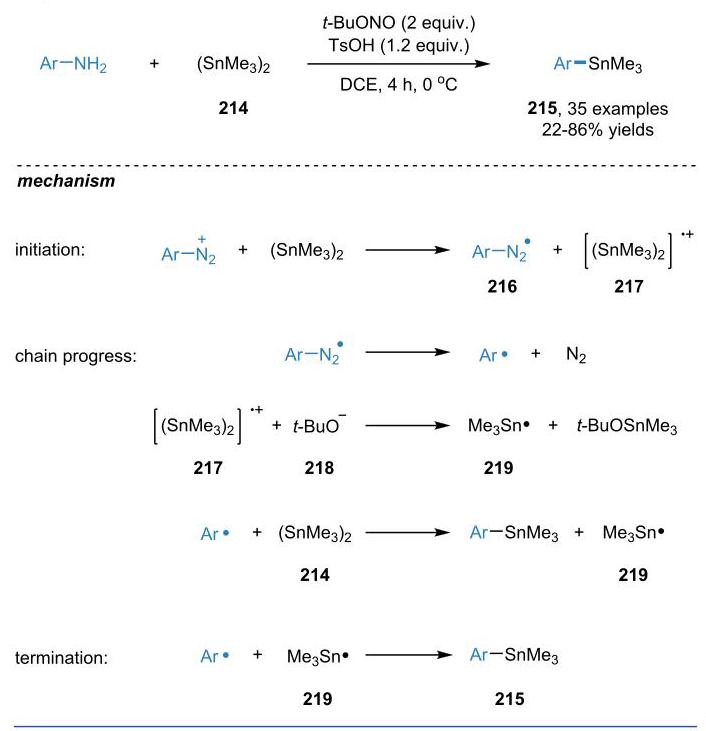
The same group further developed a consecutive Sand-meyer-type borylation and stannylation from nitroaniline derivatives, leading to the synthesis of a series of functionalized trimethylstannyl arylboronates 220 (Scheme 164). ${}^{305}$ Taking advantage of the difference in the reactivity of boronates and stannanes in Pd-catalyzed cross-coupling reactions, a series of $m$ - and $p$ -terphenyl derivatives can be synthesized in moderate yields through chemoselective consecutive Stille coupling and Suzuki-Miyaura coupling reactions.
同一研究小组进一步从硝基苯胺衍生物开发了连续的Sandmeyer型硼基化和锡基化反应,从而合成了一系列功能化的三甲基锡基芳基硼酸酯220(方案164)。${}^{305}$ 利用硼酸酯和锡烷在钯催化的交叉偶联反应中的反应活性差异,通过化学选择性连续的Stille偶联和Suzuki - Miyaura偶联反应,可以中等产率合成一系列$m$ - 和$p$ - 三联苯衍生物。
Scheme 164. Synthesis of Trimethylstannyl Arylboronates from Nitro-Substituted Anilines
方案164. 由硝基取代苯胺合成三甲基锡基芳基硼酸酯
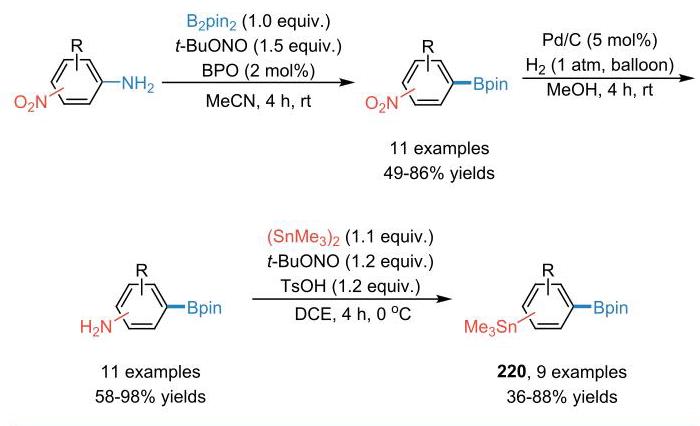
3.7. C-Se, Te Bond Formations
3.7. C-硒、碲键的形成
Sandmeyer-type transformation of aryl diazonium salts can also be used for the preparation of unsymmetrical diaryl selenides (Scheme 165). In 2012, Ranu and co-workers disclosed a microwave-assisted reaction of aryl diazonium fluoroborates with diaryl dichalcogenides 221 in the presence of zinc dust, affording various unsymmetrical diaryl chalcogenides in high yields. ${}^{306}$ In 2014, Alves and co-workers described a catalyst-free reaction of aryl diazonium tetrafluoroborates with in situ generated arylselenols from diaryl diselenides and hypophosphorous acid $\left( {{\mathrm{H}}_{3}{\mathrm{{PO}}}_{2}}\right) \cdot {}^{307}$ This direct nucleophilic aromatic substitution reaction enables the synthesis of diaryl selenides in moderate to good yields.
芳基重氮盐的桑德迈尔型转化也可用于制备不对称二芳基硒醚(方案165)。2012年,拉努及其同事披露了芳基重氮氟硼酸盐与二芳基二硫属元素化物221在锌粉存在下的微波辅助反应,以高产率得到了各种不对称二芳基硫属元素化物。${}^{306}$ 2014年,阿尔维斯及其同事描述了四氟硼酸芳基重氮盐与由二芳基二硒醚和次磷酸原位生成的芳基硒醇的无催化剂反应 $\left( {{\mathrm{H}}_{3}{\mathrm{{PO}}}_{2}}\right) \cdot {}^{307}$ 这种直接亲核芳香取代反应能够以中等至良好的产率合成二芳基硒醚。
Scheme 165. Synthesis of Diaryl Selenides from Aryl Diazonium Tetrafluoroborates with Diaryl Diselenides
方案165. 由四氟硼酸芳基重氮盐与二芳基二硒醚合成二芳基硒醚
Ranu
拉努
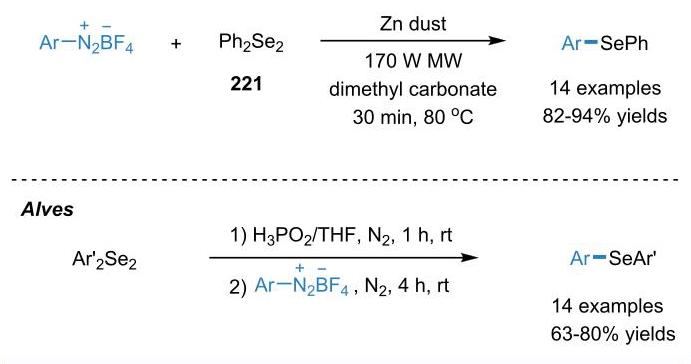
Recently, the selective trifluoromethylselenolation of aryl diazonium salts has attracted substantial attention from chemists. The Sandmeyer protocol for synthesizing trifluor-omethyl selenoethers was achieved by a copper-catalyzed trifluoromethylselenolation of aryl diazonium salts using ${\mathrm{{Me}}}_{4}{\mathrm{{NSeCF}}}_{3}$ (222) as the trifluoromethylselenolation reagent (Scheme 166). ${}^{308}$ This Cu-catalyzed protocol allows the efficient synthesis of trifluoromethyl selenoethers in high yields under mild conditions.
最近,芳基重氮盐的选择性三氟甲基硒化反应引起了化学家们的广泛关注。通过使用 ${\mathrm{{Me}}}_{4}{\mathrm{{NSeCF}}}_{3}$(222)作为三氟甲基硒化试剂,通过铜催化芳基重氮盐的三氟甲基硒化反应实现了合成三氟甲基硒醚的桑德迈尔方案(方案166)。${}^{308}$ 这种铜催化方案能够在温和条件下高效合成三氟甲基硒醚。
On the basis of the on-water synthetic strategy with ${\mathrm{{Na}}}_{2}\mathrm{{Te}}$ , Tanini and Capperuccia reported a tellurenylation method through Sandmeyer-type reaction (Scheme 167). ${}^{309}$ A range of substituted anilines are converted into the corresponding valuable diaryl tellurides upon treatment with ${\mathrm{{Na}}}_{2}\mathrm{{Te}}$ through a copper-free on-water Sandmeyer-type reaction.
基于使用 ${\mathrm{{Na}}}_{2}\mathrm{{Te}}$ 的水相合成策略,塔尼尼和卡佩鲁西亚报道了一种通过桑德迈尔型反应的碲化方法(方案167)。${}^{309}$ 一系列取代苯胺在通过无铜水相桑德迈尔型反应与 ${\mathrm{{Na}}}_{2}\mathrm{{Te}}$ 处理后转化为相应的有价值的二芳基碲化物。
Moreover, visible-light catalysis has opened up convenient routes for direct late-stage $\mathrm{C}\left( {\mathrm{{sp}}}^{2}\right)$ -chalcogen- ${\mathrm{{CF}}}_{3}$ bond formations. ${}^{310}$ In 2018, Billard and Tlili reported the first visible-light-promoted photoredox trifluoromethylselenolation of aryl diazonium salts (Scheme 168). ${}^{311}$ Using an organic photocatalyst and shelf-stable reagent trifluoromethyl toluene-selenosulfonate ${\mathrm{{TsSeCF}}}_{3}$ , this metal-free protocol allows the synthesis of trifluoromethylselenolated arenes as well as their higher homologues in high yields at room temperature. On the basis of EPR spectroscopy, luminescence investigation, and cyclic voltammetry, this reaction is believed to proceed through the initial reduction of the diazonium salt by the exited eosin Y through SET. The resulting aryl radical reacts with the ${\mathrm{{CF}}}_{3}{\mathrm{{SeSeCF}}}_{3}$ dimer obtained through the photoinduced homolysis of ${\mathrm{{TsSeCF}}}_{3}$ , furnishing a trivalent selenium radical 223. This key trivalent selenium radical intermediate is then oxidized by the aryl diazonium salt to furnish the electrophilic species 224, which then reacts with DMSO to form the desired product.
此外,可见光催化为直接后期 $\mathrm{C}\left( {\mathrm{{sp}}}^{2}\right)$ -硫属元素 - ${\mathrm{{CF}}}_{3}$ 键的形成开辟了便捷途径。${}^{310}$ 2018年,比拉尔和蒂利报道了首例可见光促进的芳基重氮盐的光氧化还原三氟甲基硒化反应(方案168)。${}^{311}$ 使用有机光催化剂和货架稳定试剂三氟甲基甲苯硒磺酸盐 ${\mathrm{{TsSeCF}}}_{3}$,这种无金属方案能够在室温下高产率合成三氟甲基硒化芳烃及其高级同系物。基于电子顺磁共振光谱、发光研究和循环伏安法,该反应被认为是通过激发态曙红Y通过单电子转移对重氮盐进行初始还原而进行的。生成的芳基自由基与通过 ${\mathrm{{TsSeCF}}}_{3}$ 的光诱导均裂得到的 ${\mathrm{{CF}}}_{3}{\mathrm{{SeSeCF}}}_{3}$ 二聚体反应,生成三价硒自由基223。然后,这个关键的三价硒自由基中间体被芳基重氮盐氧化,生成亲电物种224,然后它与二甲基亚砜反应形成所需产物。
Scheme 166. Sandmeyer-type Trifluoromethylselenolation of (Hetero)Aromatic Amines Catalyzed by Copper
方案166. 铜催化的(杂)芳族胺的桑德迈尔型三氟甲基硒化反应
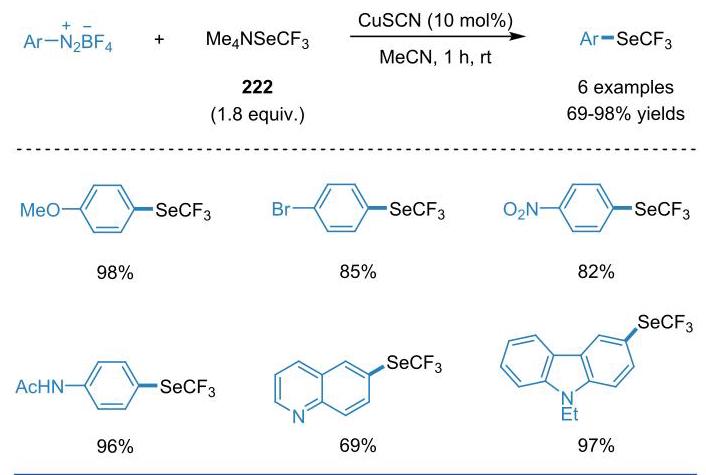
Scheme 167. Sandmeyer-type Synthesis of Diaryl Tellurides
方案167. 二芳基碲化物的桑德迈尔型合成
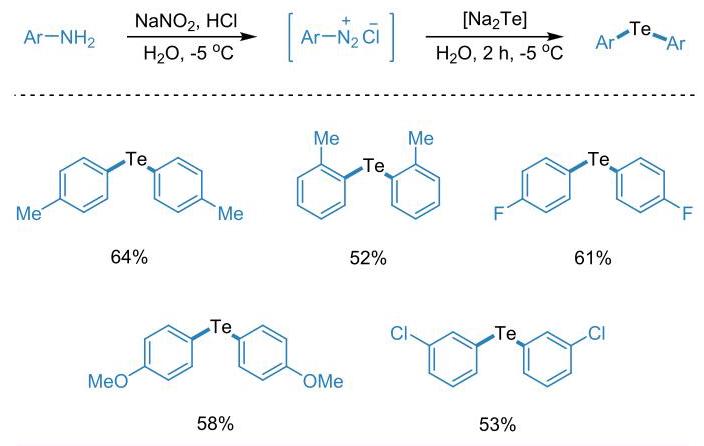
Scheme 168. Visible-Light-Mediated Metal-Free Synthesis of Trifluoromethylselenolated Arenes
方案168. 可见光介导的无金属合成三氟甲基硒化芳烃
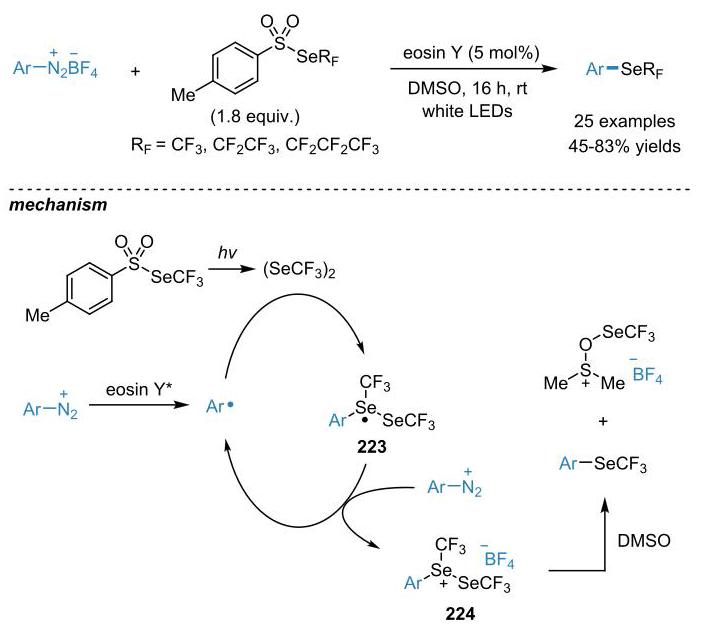
In 2020, Lu and Zhao reported a visible-light photocatalytic difluoromethylselenolation of in situ generated aryl diazonium salts using a shelf-stable Se-(difluoromethyl) 4-methylbenze-nesulfonoselenoate 225 (Scheme 169). ${}^{312}$ Mechanistic investigations, including ${}^{19}\mathrm{\;F}$ NMR spectroscopy and radical trapping experiments, indicate this difluoromethylselenolation reaction is initiated by SET of photoexcited RB with an aryl diazonium salt to afford an aryl radical, which reacts with 1,2- bis(difluoromethyl)diselane generated by the visible-light-induced homolysis of ${\mathrm{{TsSeCF}}}_{2}\mathrm{H}$ 225 to deliver the corresponding aryl difluoromethylselenol ether and difluor-omethylselenol radical. The sulfone radical 226 subsequently undergoes SET with the radical anion of the photocatalyst, leading to the regeneration of the photocatalyst and the formation of sulfite cation 227, which is trapped by water to afford TsOH.
2020年,卢和赵报道了使用稳定的硒 - (二氟甲基)4 - 甲基苯磺酰亚硒酸酯225对原位生成的芳基重氮盐进行可见光光催化二氟甲基硒化反应(方案169)。${}^{312}$ 机理研究,包括${}^{19}\mathrm{\;F}$核磁共振光谱和自由基捕获实验表明,这种二氟甲基硒化反应是由光激发的RB与芳基重氮盐发生单电子转移引发的,生成芳基自由基,该自由基与通过可见光诱导的${\mathrm{{TsSeCF}}}_{2}\mathrm{H}$ 225均裂产生的1,2 - 双(二氟甲基)二硒醚反应,生成相应的芳基二氟甲基硒醇醚和二氟甲基硒醇自由基。随后,砜自由基226与光催化剂的自由基阴离子发生单电子转移,导致光催化剂再生并形成亚硫酸根阳离子227,后者被水捕获生成对甲苯磺酸。
Scheme 169. Photoredox Metal-free Difluoromethylselenolation of Arylamines
方案169. 无金属光氧化还原催化的芳胺二氟甲基硒化反应
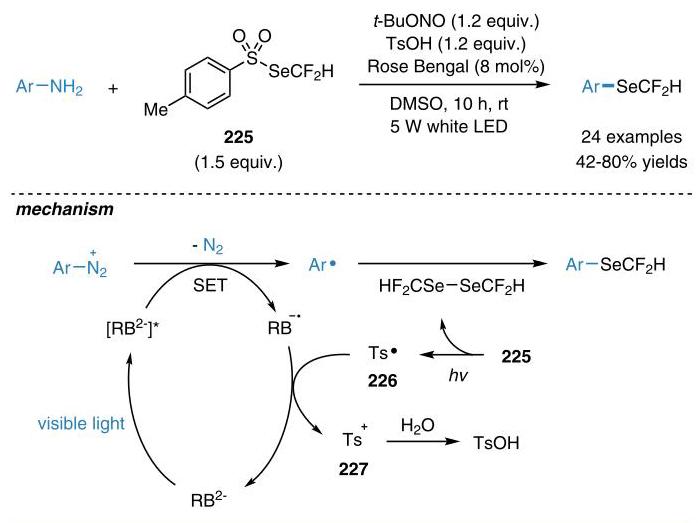
3.8. C-S Bond Formations
3.8. C-S键的形成
Sandmeyer-type transformations of aryl diazonium salts have been widely used in aryl $\mathrm{C} - \mathrm{S}$ bond formations. Mechanistically, this C-S bond forging process may proceed through the following pathways (Scheme 170). One (path a) is initiated by SET of an aryl diazonium ion to generate an aryl radical, which is intercepted by sulfur sources to construct a C-S bond. The Stadler-Ziegler reaction involves this radical-type protocol using transition metals or other initiators to facilitate the generation of aryl radicals. Another route (path b) is the transition metal-catalyzed coupling process to form Ar-M species, followed by trapping a nucleophilic sulfur moiety to give the corresponding $\mathrm{{Ar}} - \mathrm{S}$ coupling product. The third one (path c) constitutes a direct nucleophilic substitution, in which the aryl diazonium acts as the precursor of carbenium ions. Recent advances mainly focus on developing new catalytic systems, exploring substrate scope, and synthesizing various functionalized S-containing aromatic molecules. This section will classify these reactions according to the types of products, including sulfides, sulfoxides, sulfones, tri- or difluoromethyl thioether, and other compounds.
芳基重氮盐的桑德迈尔型转化已广泛用于芳基$\mathrm{C} - \mathrm{S}$键的形成。从机理上讲,这种C-S键的形成过程可能通过以下途径进行(方案170)。一种(途径a)是由芳基重氮离子的单电子转移引发,生成芳基自由基,该自由基被硫源捕获以构建C-S键。施塔德勒-齐格勒反应涉及使用过渡金属或其他引发剂促进芳基自由基生成的这种自由基型反应。另一条途径(途径b)是过渡金属催化的偶联过程,形成Ar-M物种,然后捕获亲核硫部分以得到相应的$\mathrm{{Ar}} - \mathrm{S}$偶联产物。第三种(途径c)是直接亲核取代,其中芳基重氮盐作为碳正离子的前体。最近的进展主要集中在开发新的催化体系、探索底物范围以及合成各种功能化的含硫芳香分子。本节将根据产物类型对这些反应进行分类,包括硫化物、亚砜、砜、三氟甲基或二氟甲基硫醚以及其他化合物。
Scheme 170. General Routes for Aryl C-S Bond Formations Using Aryl Diazonium Salts
方案170. 使用芳基重氮盐形成芳基C-S键的一般途径
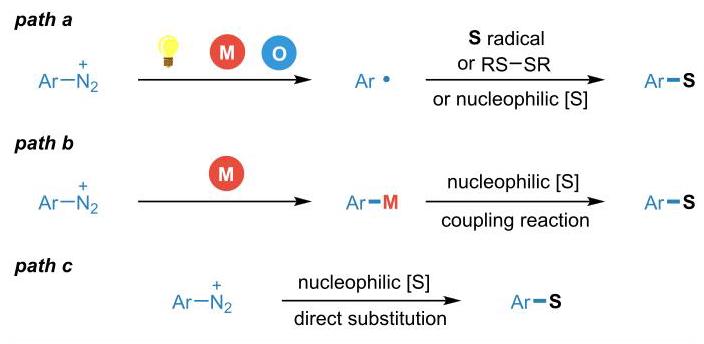
3.8.1. Synthesis of Aryl Sulfides and Sulfoxides. Although SRN1 reaction of aromatic thiols with aryl diazonium salts (Stadler-Ziegler synthesis) has been widely employed for the synthesis of unsymmetrical diaryl sulfides, various modifications have also been made to achieve improved yields and milder reaction conditions in the recent research. For practical applications, the synthesis of aryl sulfides through aryl diazonium transformations has been utilized in the site-selective modification of amino acids in proteins, an active area of research in chemical biology. In 2018, Sengupta and Chandrasekaran reported a mild chemo-selective method for $S$ -arylation of cysteine using aryl diazonium salts in MeOH (Scheme 171). ${}^{313}$ This base-promoted metal-free protocol can serve as a tool for modifying cysteine derivatives through a radical chain mechanism.
3.8.1. 芳基硫化物和亚砜的合成。尽管芳香族硫醇与芳基重氮盐的SRN1反应(施塔德勒-齐格勒合成)已广泛用于合成不对称二芳基硫化物,但在最近的研究中也进行了各种改进,以实现更高的产率和更温和的反应条件。在实际应用中,通过芳基重氮盐转化合成芳基硫化物已用于蛋白质中氨基酸的位点选择性修饰,这是化学生物学中一个活跃的研究领域。2018年,森古普塔和钱德拉塞卡兰报道了一种在甲醇中使用芳基重氮盐对胱氨酸进行$S$芳基化的温和化学选择性方法(方案171)。${}^{313}$这种碱促进的无金属方法可作为通过自由基链机制修饰胱氨酸衍生物的工具。
Scheme 171. Metal-free S-Arylation of Cysteine by Using Aryl Diazonium Salts
方案171. 使用芳基重氮盐对胱氨酸进行无金属S-芳基化
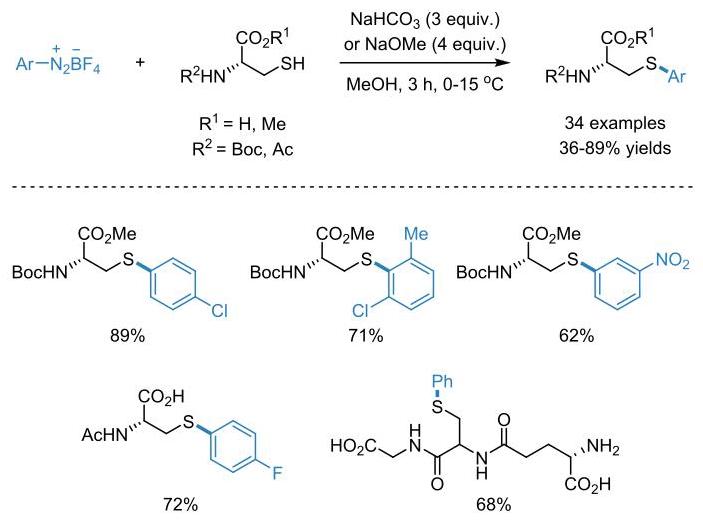
Moreover, further C(aryl)-S coupling reactions have been explored to access aryl sulfides (Scheme 172). In 2016, a weak base-mediated radical chalcogenation of aryl diazonium salts was developed, affording various functionalized thioethers, selenides, and tellurides. ${}^{314}$ The reaction pathway involves the homolysis of the initially formed diazoacetate to generate an aryl radical, which is then intercepted by a chalcogenide. The divergent synthesis of symmetrical and unsymmetrical diaryl sulfides resulted from the coupling reaction of aryl diazonium salts with ${\mathrm{{Na}}}_{2}\mathrm{\;S}$ or disulfides under microwave- or iron-/base-mediated conditions, ${}^{315}$ or Cu-catalyzed C(aryl)-S coupling reactions of aryl dithiocarbamates 228 and aryl diazonium salts. ${}^{316}$
此外,还探索了进一步的C(芳基)-S偶联反应以获得芳基硫化物(方案172)。2016年,开发了一种弱碱介导的芳基重氮盐自由基硫属化反应,得到了各种功能化的硫醚、硒化物和碲化物。${}^{314}$反应途径包括最初形成的重氮乙酸酯的均裂以生成芳基自由基,然后该自由基被硫属化物捕获。对称和不对称二芳基硫化物的发散合成是由芳基重氮盐与${\mathrm{{Na}}}_{2}\mathrm{\;S}$或二硫化物在微波或铁/碱介导的条件下的偶联反应,${}^{315}$或芳基二硫代氨基甲酸盐228与芳基重氮盐的铜催化C(芳基)-S偶联反应导致的。${}^{316}$
Scheme 172. C(aryl)-S Coupling Reactions for the Synthesis of Aryl Sulfides
方案172. 用于合成芳基硫化物的C(芳基)-S偶联反应
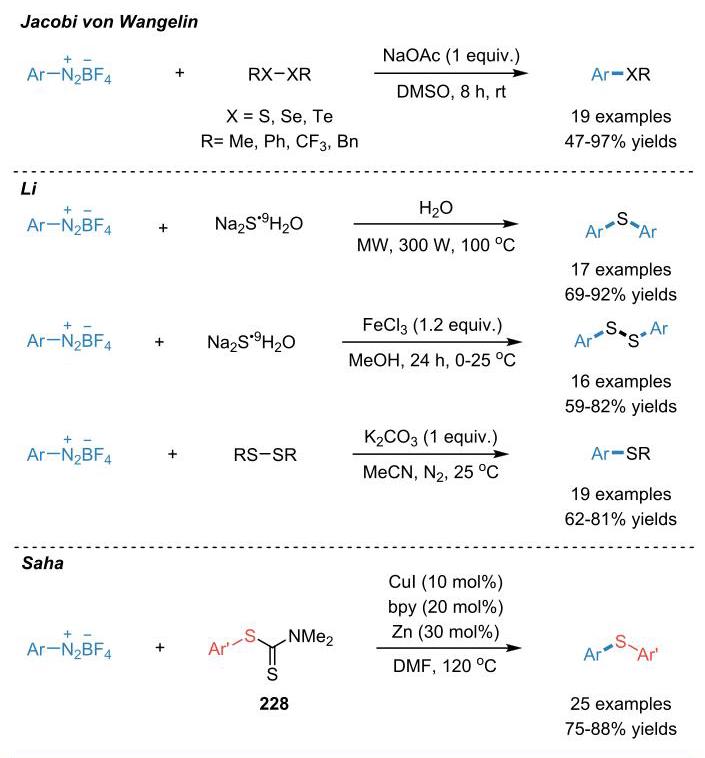
The organocatalytic photoredox system has been explored for the generation of aryl radicals and the synthesis of aryl sulfides from aryl diazonium salts with disulfides 229 (Scheme 173). ${}^{317}$ In the presence of $2\mathrm{\;{mol}}\%$ eosin $\mathrm{Y}$ as the photosensitizer, this mild protocol provides aryl sulfides in good yields. The critical steps in this photocatalytic thiolation include the photoinduced generation of aryl radicals, followed by a nucleophilic attack of disulfide 229 to give trivalent sulfur radical 230. Subsequent single-electron oxidation of trivalent sulfur radical by the eosin Y radical cation furnishes an electrophilic species 231, which undergoes substitution in the presence of DMSO.
已经探索了有机催化光氧化还原体系用于从芳基重氮盐与二硫化物229生成芳基自由基和合成芳基硫化物(方案173)。${}^{317}$在$2\mathrm{\;{mol}}\%$曙红$\mathrm{Y}$作为光敏剂的存在下,这种温和的方法以良好的产率提供芳基硫化物。这种光催化硫醇化的关键步骤包括光诱导生成芳基自由基,然后二硫化物229进行亲核攻击以得到三价硫自由基230。随后,曙红Y自由基阳离子对三价硫自由基进行单电子氧化,产生亲电物种231,该亲电物种在DMSO存在下发生取代反应。
Scheme 173. Visible Light-Mediated Synthesis of Aryl Sulfides
方案173. 可见光介导的芳基硫化物合成
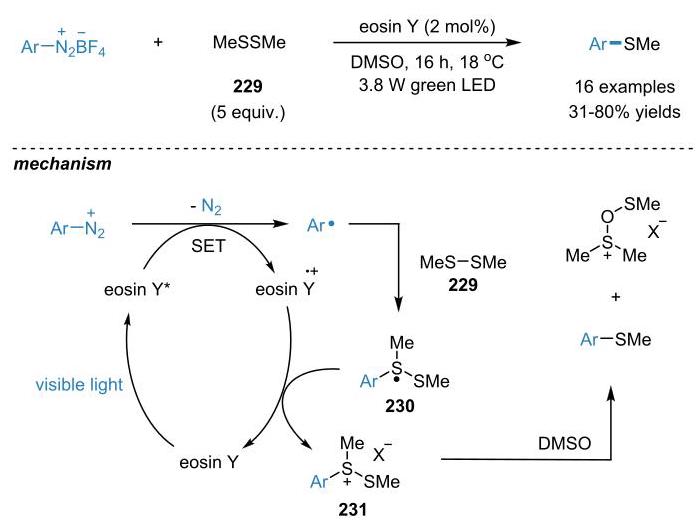
Employing the photoredox catalytic system, a visible-light-mediated one-pot Stadler-Ziegler reaction of arylamines with thiols affords aryl sulfides in good yields under mild conditions (Scheme 174). ${}^{318}$ A scalable continuous-flow protocol has also been developed. Microreactors’ use leads to improved irradiation of the reaction medium, resulting in significant acceleration compared to its batch counterpart. On the basis of the control experiment result, this reaction is likely initiated by the oxidative quenching of photoexcited Ru(II) species with photolabile diazosulfides 232 to generate aryl radicals.
采用光氧化还原催化体系,芳胺与硫醇在可见光介导下进行一锅法施塔德勒-齐格勒反应,可在温和条件下以良好产率得到芳基硫醚(方案174)。${}^{318}$ 还开发了一种可扩展的连续流方案。使用微反应器可改善反应介质的辐照,与间歇反应相比,反应显著加速。根据对照实验结果,该反应可能是由光激发的Ru(II)物种与光不稳定的重氮硫醚232发生氧化猝灭,生成芳基自由基而引发的。
Scheme 174. Photoredox One-Pot Stadler-Ziegler Synthesis of Aryl Sulfides
方案174. 光氧化还原一锅法施塔德勒-齐格勒合成芳基硫醚
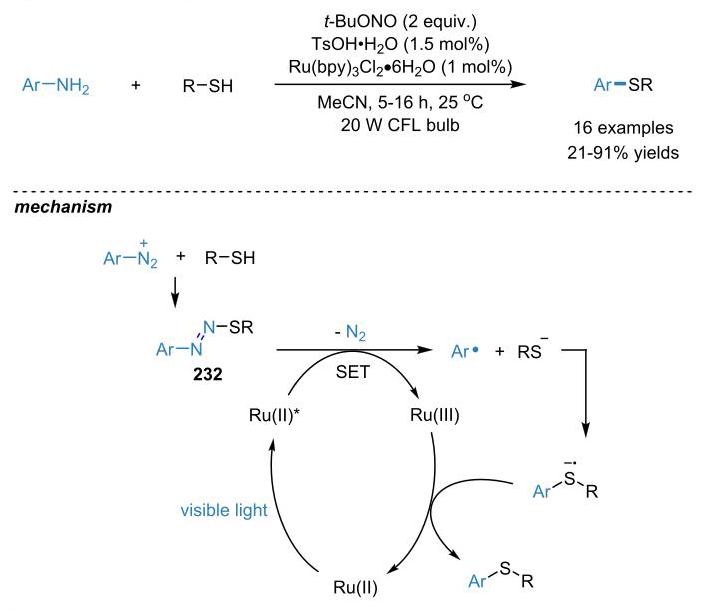
In 2015, Jiang reported a visible-light-induced thioether formation through photoredox C-S coupling reaction of alkyl/ aryl thiosulfates 233 and aryl diazonium salts at room temperature (Scheme 175). ${}^{319}$ This protocol allows the late-stage sulfuration of pharmaceutical derivatives. Electron paramagnetic study reveals a thiosulfate radical species 234 as the key intermediate. The cercosporin has been found to initiate photocatalyzed C-S coupling of thiols and aryl diazonium salts, allowing the selective synthesis of aryl sulfides under mild conditions (Scheme 175). ${}^{320}$
2015年,江报道了在室温下通过光氧化还原C-S偶联反应,使烷基/芳基硫代硫酸盐233与芳基重氮盐发生可见光诱导的硫醚形成反应(方案175)。${}^{319}$ 该方案允许药物衍生物的后期硫化。电子顺磁共振研究表明硫代硫酸根自由基物种234是关键中间体。已发现尾孢菌素可引发硫醇与芳基重氮盐的光催化C-S偶联反应,从而在温和条件下选择性合成芳基硫醚(方案175)。${}^{320}$
Scheme 175. Visible-Light-Induced Thioether Formation from Thiosulfates or Thiols
方案175. 由硫代硫酸盐或硫醇可见光诱导形成硫醚
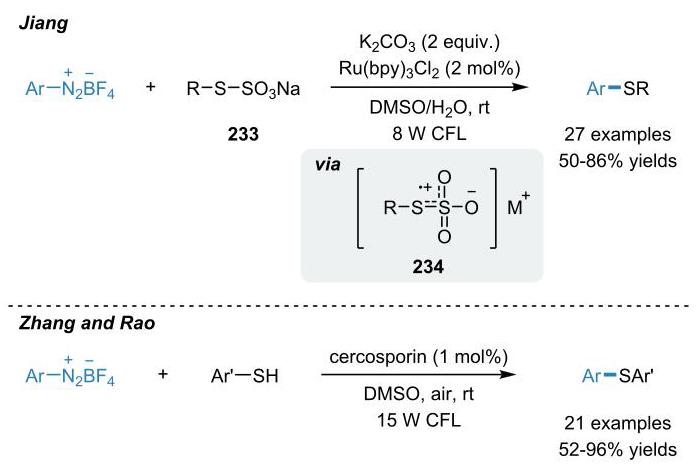
Apart from the synthesis of aryl sulfides, the methylsulfox-idation of aryl diazonium salts has also been explored to obtain aryl sulfoxides (Scheme 176). In 2016, Rastogi developed a visible-light-induced methylsulfoxidation of (het)aryl diazonium salts with DMSO. ${}^{321}$ This photoredox protocol affords aryl methyl sulfoxides in moderate to excellent yields under mild conditions. The reaction pathway is initiated by SET between aryl diazonium salt with Ru(II)* species to generate an aryl radical and a Ru(III) species. The aryl radical then reacts with DMSO to form an O-centered radical 235, followed by sequential single-electron oxidation and methyl group transfer to deliver aryl sulfoxides. In 2018, Wu and Zhang reported a methylsulfoxidation of tetrazole-amines with neat DMSO or methyl-sulfinyl derivatives in the presence of $t$ - BuONO, which produces antifungal methylsulfinyl-1H-tetrazole derivatives 236 in moderate to excellent yields. ${}^{322}$
除了芳基硫醚的合成,芳基重氮盐的甲基亚砜化反应也已被探索用于制备芳基亚砜(方案176)。2016年,拉什吉开发了一种用二甲基亚砜对(杂)芳基重氮盐进行可见光诱导的甲基亚砜化反应。${}^{321}$ 该光氧化还原方案在温和条件下以中等至优异的产率提供芳基甲基亚砜。反应途径是由芳基重氮盐与Ru(II)*物种之间的单电子转移引发,生成芳基自由基和Ru(III)物种。芳基自由基然后与二甲基亚砜反应形成以氧为中心的自由基235,随后依次进行单电子氧化和甲基转移,得到芳基亚砜。2018年,吴和张报道了在$t$ - BuONO存在下,用纯二甲基亚砜或甲基亚磺酰基衍生物对四唑胺进行甲基亚砜化反应,以中等至优异的产率生成抗真菌的甲基亚磺酰基-1H-四唑衍生物236。${}^{322}$
Scheme 176. Methylsulfoxidation of Aryl Diazonium Salts and Arylamines
方案176. 芳基重氮盐和芳胺的甲基亚砜化反应
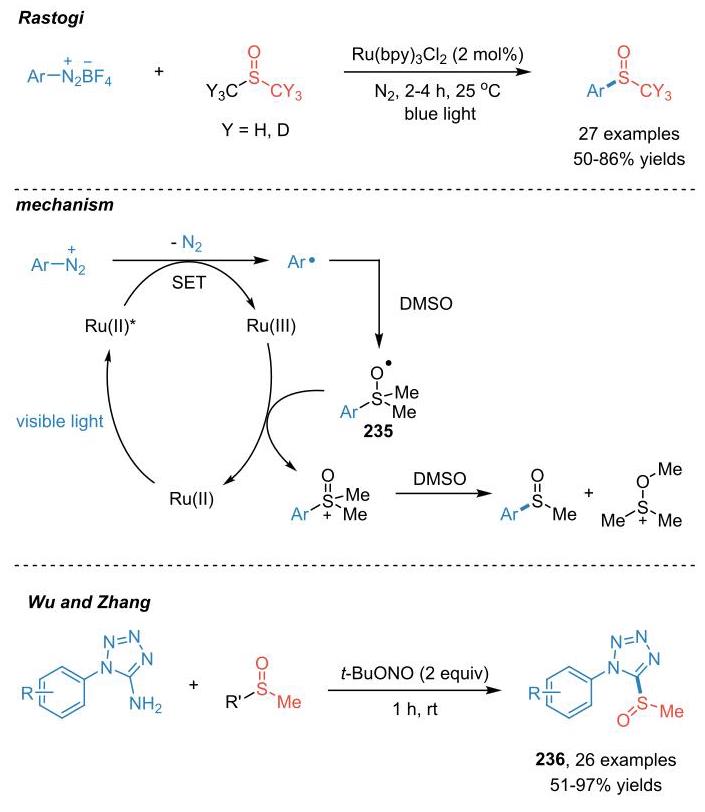
Taking advantage of the dual photoredox/transition-metal-catalyzed system, Lee realized a visible-light-driven Ag-catalyzed C-S coupling reaction of aryl thiols and aryl diazonium salts, enabling the selective synthesis of diaryl sulfoxides and diaryl sulfones under open-flask condition (Scheme 177). ${}^{323}$ These reactions show strong solvent dependence. For example, the reactions in DMSO give exclusive aryl sulfoxides 239 as the product. While in DMF, aryl sulfoxides can be further oxidized to the final oxidation product, aryl sulfones 240. Also, pyridine benefits to the formation of sulfoxides 239. Mechanistically, the intermediate product aryl sulfides 238 are obtained through the radical combination of thiyl radicals 237 with aryl radicals under
利用双光氧化还原/过渡金属催化体系,李实现了芳基硫醇与芳基重氮盐的可见光驱动的银催化C-S偶联反应,能够在敞口烧瓶条件下选择性合成二芳基亚砜和二芳基砜(方案177)。${}^{323}$ 这些反应表现出强烈的溶剂依赖性。例如,在二甲基亚砜中的反应以芳基亚砜239作为唯一产物。而在N, N-二甲基甲酰胺中,芳基亚砜可进一步氧化为最终氧化产物二芳基砜240。此外,吡啶有利于亚砜239的形成。从机理上讲,中间体产物芳基硫醚238是通过硫自由基237与芳基自由基在氧化条件下的自由基结合得到的。
Scheme 177. Silver-Catalyzed Synthesis of Diaryl Sulfoxides and Diaryl Sulfones
方案177. 银催化合成二芳基亚砜和二芳基砜
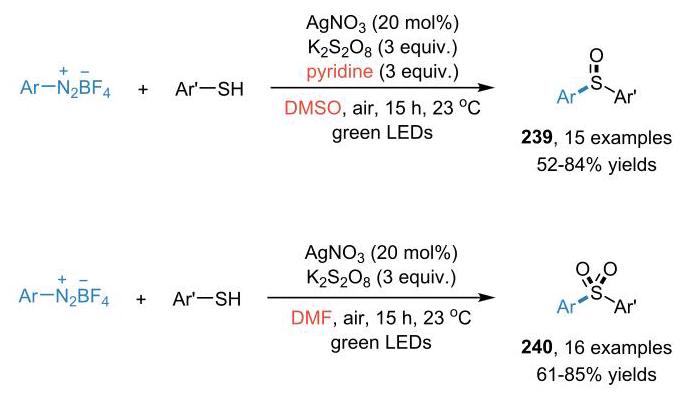
mechanism
机理
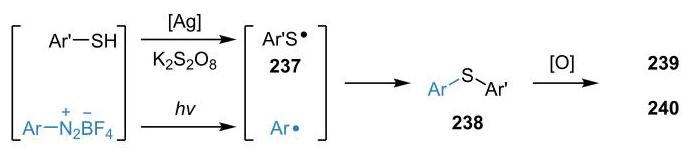
oxidative conditions. Sequential selective oxidation of 238 results in the formation of aryl sulfoxides 239 or sulfones 240.
238的顺序选择性氧化导致芳基亚砜239或砜240的形成。
The development of a greener metal-free approach for the synthesis of sulfones using organic photoredox catalysts is substantially appealing. In 2019, a visible-light-induced cross-coupling reaction of aryl diazonium and sulfinate salts using eosin Y as an organic photoredox catalyst was reported (Scheme 178). ${}^{324}$ This transition metal- and external oxidant/ reductant-free protocol affords unsymmetrical diaryl/alkyl aryl sulfones in moderate to excellent yields. The key step for generating desired sulfones is the photoinduced radical combination of the aryl radical with sulfonyl radical 241.
开发一种使用有机光氧化还原催化剂合成砜的更绿色的无金属方法极具吸引力。2019年,报道了使用曙红Y作为有机光氧化还原催化剂,芳基重氮盐与亚磺酸盐进行可见光诱导的交叉偶联反应(方案178)。${}^{324}$ 该无过渡金属和外部氧化剂/还原剂的方案以中等至优异的产率提供不对称二芳基/烷基芳基砜。生成所需砜的关键步骤是芳基自由基与磺酰基自由基241的光诱导自由基结合。
Scheme 178. Eosin Y-Catalyzed Cross-Coupling Reaction of Aryl Diazonium and Sulfinate Salts
方案178. 曙红Y催化芳基重氮盐与亚磺酸盐的交叉偶联反应
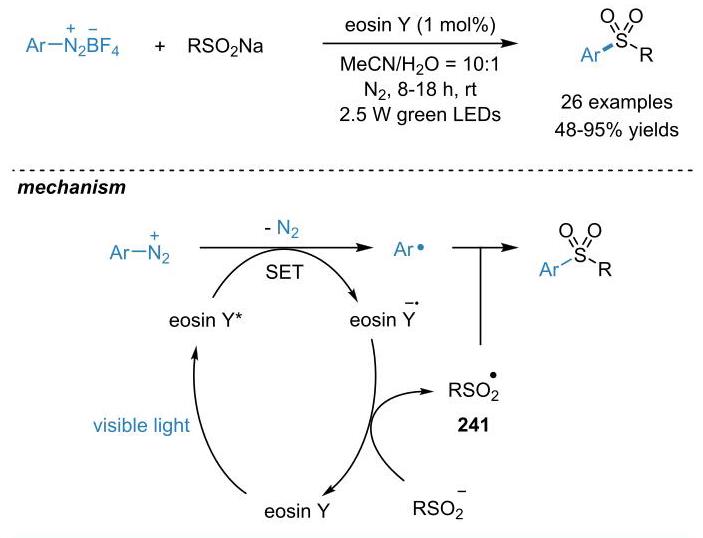
In addition to the photoredox protocol, Xu and Tang reported a Cu-catalyzed three-component coupling reaction of aryl diazonium salts, elemental sulfur, and ${\mathrm{R}}_{2}\mathrm{P}\left( \mathrm{O}\right) \mathrm{H}$ compounds (Scheme 179). ${}^{325}$ This phosphorothiolation reaction allows the direct formation of P-S and C-S bonds in one operation, affording $S$ -aryl phosphorothioates 242 in high yields. The chemistry is assumed to proceed through the
除了光氧化还原方案外,徐和唐报道了一种铜催化的芳基重氮盐、元素硫和${\mathrm{R}}_{2}\mathrm{P}\left( \mathrm{O}\right) \mathrm{H}$化合物的三组分偶联反应(方案179)。${}^{325}$ 这种磷硫醇化反应允许在一次操作中直接形成P-S和C-S键,以高产率得到$S$ -芳基磷硫酯242。据推测,该反应过程为
Scheme 179. Copper-Catalyzed Phosphorothiolation of Aryl Diazonium Salts
方案179. 铜催化芳基重氮盐的磷硫醇化反应
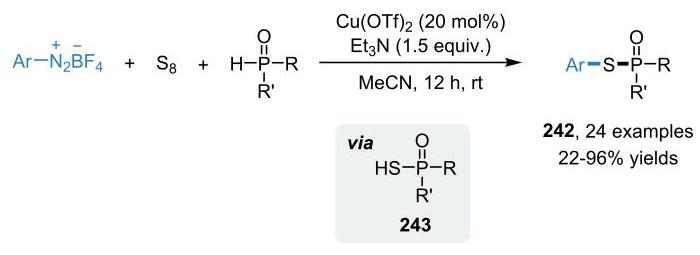
reaction of ${\mathrm{R}}_{2}\mathrm{P}\left( \mathrm{O}\right) \mathrm{H}$ with elemental sulfur to generate $S$ - hydrogen phosphorothioates 243, followed by Cu-catalyzed C-S bond formation of aryl diazonium salts, leading to the formation of $S$ -aryl phosphorothioates 242 via a radical pathway.
${\mathrm{R}}_{2}\mathrm{P}\left( \mathrm{O}\right) \mathrm{H}$与元素硫反应生成$S$ -氢磷硫酯243,随后铜催化芳基重氮盐的C-S键形成,通过自由基途径生成$S$ -芳基磷硫酯242。
The $O$ -benzotriazolyl sulfonimidates are served as the key intermediates for synthesizing sulfonimidamides, which are sulfonamide monoaza analogues and regarded as bioisosteres of the parent compounds. To access the synthesis of these biochemical active molecules, Bolm reported the three-component reaction of aryl diazonium tetrafluoroborates, N-tritylsulfinylamine, and N-hydroxybenzotriazole hydrate in the presence of the tertiary amine, affording O-benzotriazolyl sulfonimidates 246 with good yields by using inexpensive and environmentally benign dimethyl carbonate as the solvent (Scheme 180). ${}^{326}$ Reaction mechanism includes the double coordination of the tertiary amine and sulfinylamine with the nitrogen of the diazonium salt. Upon SET from the tertiary amine to give $N$ -radical cation, the aryl radical is formed, followed by the addition to the sulfur reagent to give a sulfoximiminoyl radical 244. A combination of sulfoximiminopl radical 244 and hydroxybenzotriazole radical (oxygen-centered) 245 gives rise to the sulfonimidate product 246.
$O$ -苯并三唑基亚磺酰亚胺酯用作合成磺酰亚胺酰胺的关键中间体,磺酰亚胺酰胺是磺酰胺的单氮类似物,被视为母体化合物的生物电子等排体。为了实现这些生物活性分子的合成,博尔姆报道了在叔胺存在下,四氟硼酸芳基重氮盐、N-三苯基亚磺酰亚胺和N-羟基苯并三唑水合物的三组分反应,使用廉价且环境友好的碳酸二甲酯作为溶剂,以良好的产率得到O-苯并三唑基亚磺酰亚胺酯246(方案180)。${}^{326}$ 反应机理包括叔胺和亚磺酰亚胺与重氮盐氮的双重配位。叔胺发生单电子转移生成$N$ -自由基阳离子,形成芳基自由基,随后加成到硫试剂上生成亚磺酰亚胺酰基自由基244。亚磺酰亚胺酰基自由基244与羟基苯并三唑自由基(以氧为中心)245结合生成亚磺酰亚胺酯产物246。
Scheme 180. Three-Component Synthesis of Benzotriazolyl Sulfonimidates
方案180. 苯并三唑基亚磺酰亚胺酯的三组分合成
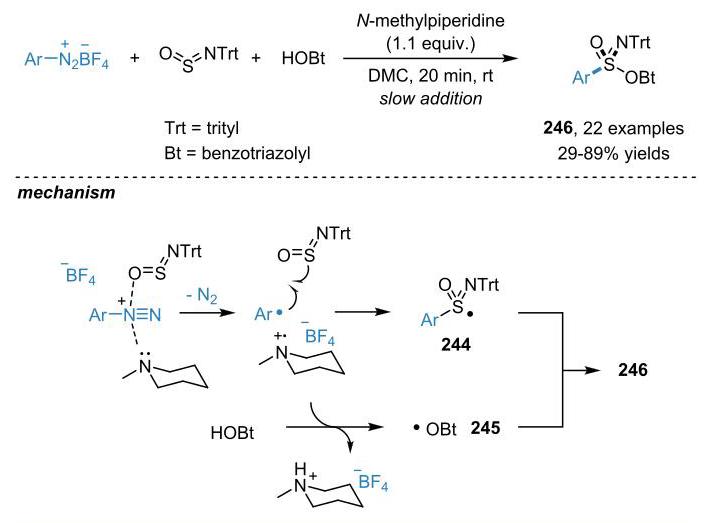
3.8.2. Synthesis of Aryl Sulfones through the Insertion of ${\mathrm{{SO}}}_{2}$ . In the recent years, aromatic sulfonylation reactions of aryl diazonium salts, particularly through the insertion of ${\mathrm{{SO}}}_{2}$ by using DABCO- ${\left( {\mathrm{{SO}}}_{2}\right) }_{2}$ (DABSO) or inorganic sulfites as gaseous sulfur dioxide surrogate, have opened a novel and superior route to construct $\mathrm{C}\left( {\mathrm{{sp}}}^{2}\right) - {\mathrm{{SO}}}_{2}$ bonds (Scheme 181). ${}^{{327},{328}}$ This radical-type sulfonylation reaction allows the synthesis of aryl sulfones, sulfonamides, sulfonyl halides, thiosulfonates, sulfonic esters, and a variety of cyclic compounds containing sulfonyl group. In this section, systematic recent advances explored by Wu, Loh, Tu, Jiang, and other groups will be summarized.
3.8.2. 通过插入${\mathrm{{SO}}}_{2}$合成芳基砜。近年来,芳基重氮盐的芳族磺酰化反应,特别是通过使用DABCO-${\left( {\mathrm{{SO}}}_{2}\right) }_{2}$(DABSO)或无机亚硫酸盐作为气态二氧化硫替代物插入${\mathrm{{SO}}}_{2}$,开辟了一条新颖且优越的构建$\mathrm{C}\left( {\mathrm{{sp}}}^{2}\right) - {\mathrm{{SO}}}_{2}$键的途径(方案181)。${}^{{327},{328}}$ 这种自由基型磺酰化反应允许合成芳基砜、磺酰胺、磺酰卤、硫代磺酸盐、磺酸酯以及各种含磺酰基的环状化合物。在本节中,将总结吴、罗、涂、江等研究小组最近系统的研究进展。
Scheme 181. General Features of Sulfonylation Reactions of Aryl Diazonium Salts through the Insertion of ${\mathrm{{SO}}}_{2}$
方案181. 通过插入${\mathrm{{SO}}}_{2}$进行芳基重氮盐磺酰化反应的一般特征
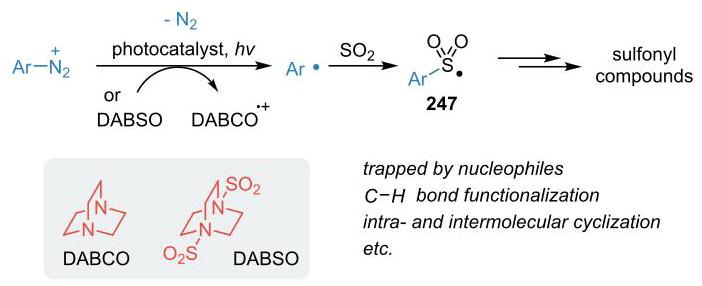
3.8.2.1. Trapped by Nucleophiles. In 2014, Li and Wu reported a novel aminosulfonylation of aryl diazonium tetrafluoroborates, DABSO and hydrazines, affording aryl $N$ - aminosulfonamides with good to excellent yields at room temperature (Scheme 182). ${}^{329}$ The reaction mechanism involves the addition of an in situ generated aryl radical to ${\mathrm{{SO}}}_{2}$ , giving rise to an aryl sulfonyl radical 247, which was intercepted by hydrazinium radical 248 to obtain aryl $N$ - aminosulfonamides. In the same year, the coupling of (hetero)aromatic amines with DABSO and hydrazines was disclosed, leading to aryl $N$ -aminosulfonamides through a tandem diazotization/aminosulfonylation reaction. ${}^{330}$
3.8.2.1. 被亲核试剂捕获。2014年,李和吴报道了一种芳基四氟硼酸重氮盐、DABSO和肼的新型氨磺酰化反应,在室温下以良好至优异的产率得到芳基$N$-氨磺酰胺(方案182)。${}^{329}$反应机理涉及原位生成的芳基自由基加成到${\mathrm{{SO}}}_{2}$上,生成芳基磺酰基自由基247,其被肼基自由基248捕获以得到芳基$N$-氨磺酰胺。同年,公开了(杂)芳族胺与DABSO和肼的偶联反应,通过串联重氮化/氨磺酰化反应得到芳基$N$-氨磺酰胺。${}^{330}$
Scheme 182. Aminosulfonylation of Aryl Diazonium Salts or Anilines with DABSO and Hydrazines
方案182. 芳基重氮盐或苯胺与DABSO和肼的氨磺酰化反应
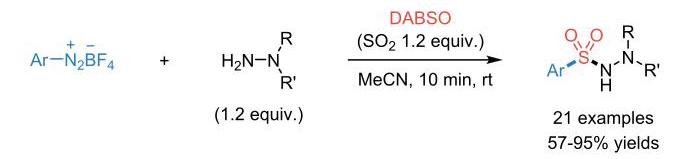
mechanism
机理
DABSO $\mathrm{{Ar}} - {\mathrm{N}}_{2} \; - {\mathrm{N}}_{2}$ R
DABSO $\mathrm{{Ar}} - {\mathrm{N}}_{2} \; - {\mathrm{N}}_{2}$ R
Ar・ + ${\mathrm{{SO}}}_{2}$
Ar・ + ${\mathrm{{SO}}}_{2}$
R'
HN-N
247 248
$\mathrm{{Ar}} - {\mathrm{{NH}}}_{2}$ t-BuONO (1.8 equiv)
$\mathrm{{Ar}} - {\mathrm{{NH}}}_{2}$ 叔丁基亚硝酸酯(1.8当量)
(1.5 equiv)
(1.5当量)
${\mathrm{{BF}}}_{3} \cdot {\mathrm{{OEt}}}_{2}$ (1.8 equiv)
${\mathrm{{BF}}}_{3} \cdot {\mathrm{{OEt}}}_{2}$ (1.8当量)
${\mathrm{H}}_{2}\mathrm{\;N} - \mathrm{N}$
DABSO
DABSO
MeCN, ${30}^{ \circ }\mathrm{C}$
乙腈,${30}^{ \circ }\mathrm{C}$
(1.0 equiv) 22 examples
(1.0当量)22个实例
23-95% yields
产率23 - 95%
A three-component reaction of 2-(allyloxy)anilines or diazonium tetrafluoroborates, DABSO, and hydrazines were realized to afford 1-(2,3-dihydrobenzofuran-3-yl)-methanesul-fonohydrazides (Scheme 183). ${}^{331}$ This radical procedure includes the in situ formed aryl radical, followed by intramolecular 5-exo-cyclization and insertion of sulfur dioxide.
实现了2-(烯丙氧基)苯胺或四氟硼酸重氮盐、DABSO和肼的三组分反应,得到1-(2,3-二氢苯并呋喃-3-基)-甲磺酰肼(方案183)。${}^{331}$该自由基过程包括原位形成的芳基自由基,随后进行分子内5-外向环化和二氧化硫插入。
Scheme 183. Synthesis of 1-(2,3-Dihydrobenzofuran-3- yl)methanesulfonohydrazides
方案183. 1-(2,3-二氢苯并呋喃-3-基)甲磺酰肼的合成
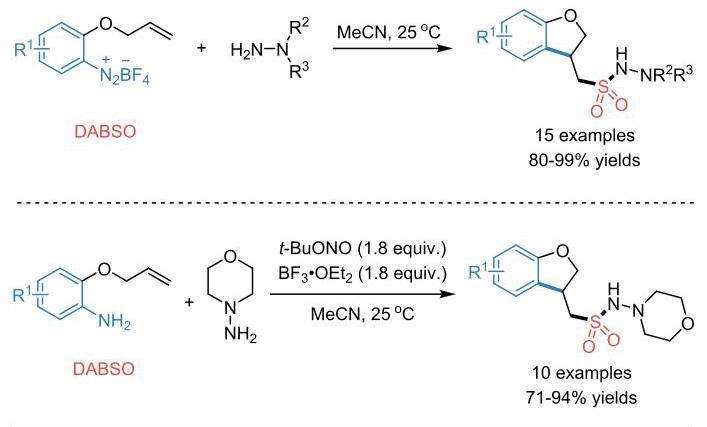
Besides, the in situ formed aryl sulfonyl radical can be trapped by hydroxylamines or amines, affording aryl O-aminosulfonates and sulfonamides, respectively (Scheme 184). ${}^{332}$
此外,原位形成的芳基磺酰基自由基可被羟胺或胺捕获,分别得到芳基O-氨磺酸盐和磺酰胺(方案184)。${}^{332}$
Scheme 184. Synthesis of O-Aminosulfonates and Sulfonamides
方案184. O-氨磺酸盐和磺酰胺的合成
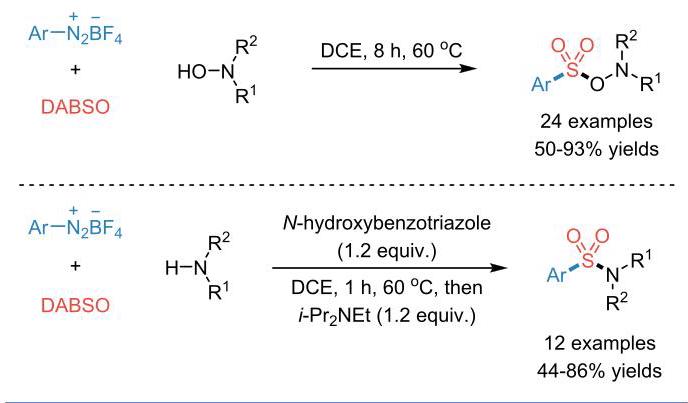
The copper complexes have been utilized to facilitate the coupling reaction of aryl diazonium salts, DABSO with various nucleophiles, allowing the aminosulfonylation to access sulfonamides, ${}^{333}$ and oxysulfonylation to synthesize aryl sulfonic esters, ${}^{334}$ respectively (Scheme 185). These Cu-catalyzed multicomponent reactions proceed through the oxidation of aryl sulfonyl radical 247 with copper species, followed by reductive elimination to afford the desired products.
铜配合物已被用于促进芳基重氮盐、DABSO与各种亲核试剂的偶联反应,使氨磺酰化反应能够得到磺酰胺,${}^{333}$ 以及氧磺酰化反应能够分别合成芳基磺酸酯,${}^{334}$ (方案185)。这些铜催化的多组分反应通过铜物种氧化芳基磺酰基自由基247进行,随后进行还原消除以得到所需产物。
In addition, the trapping process of aryl sulfonyl radical by thiols was disclosed by Yang and co-workers, allowing an acid-promoted synthesis of unsymmetrical aryl thiosulfonates (Scheme 186). ${}^{335}$ In the same year, Volla and co-workers developed a visible-light-induced ${\mathrm{{SO}}}_{2}$ insertion strategy toward the synthesis of thiosulfonates 249 from the same substrates under room temperature. ${}^{336}$ Both of these coupling transformations proceed through the radical-radial cross-coupling reaction of sulfenyl radical and the aryl sulfonyl radical under thermal or photoredox conditions.
此外,Yang及其同事揭示了硫醇对芳基磺酰基自由基的捕获过程,从而实现了酸促进的不对称芳基硫代磺酸酯的合成(方案186)。${}^{335}$ 同年,Volla及其同事开发了一种可见光诱导的 ${\mathrm{{SO}}}_{2}$ 插入策略,用于在室温下从相同底物合成硫代磺酸酯249。${}^{336}$ 这两种偶联转化都是通过在热或光氧化还原条件下亚磺酰基自由基与芳基磺酰基自由基的自由基-自由基交叉偶联反应进行的。
The potassium/sodium metabisulfite has been recently explored as the inorganic sulfur dioxide surrogate, particularly for the ${\mathrm{{SO}}}_{2}$ insertion reactions with aryl diazonium salts. ${}^{337}$ To explore the ${\mathrm{{ArSO}}}_{2} - \mathrm{S}$ bond construction process, Wu and Ye reported a photoredox three-component reaction of aryl diazonium salts, sodium metabisulfite, and thiourea 250, giving rise to $S$ -aryl thiosulfonates 249 with moderate yields (Scheme 187). ${}^{338}$ Proposed mechanism includes the reaction of aryl diazonium tetrafluoroborate with thiourea 250, leading to salt intermediate 251, which reacts with ${\mathrm{{Na}}}_{2}{\mathrm{\;S}}_{2}{\mathrm{O}}_{5}$ to form thiophenolate anions ${252},{\mathrm{{SO}}}_{2}$ and urea. The sulfenyl radical 253 generated from the thiophenolate anion 252 assisted by the photocatalyst reacts with the photoinduced formed aryl sulfonyl radical 242 to produce the $S$ -aryl thiosulfonate 249. Recently, a TFA-promoted multicomponent reaction of aryl diazonium with sodium metabisulphite and thiols was reported, affording thiosulfonates in good yields under transition-metal-free conditions. ${}^{339}$
焦亚硫酸钾/钠最近被用作无机二氧化硫替代物,特别是用于与芳基重氮盐的 ${\mathrm{{SO}}}_{2}$ 插入反应。${}^{337}$ 为了探索 ${\mathrm{{ArSO}}}_{2} - \mathrm{S}$ 键的构建过程,Wu和Ye报道了芳基重氮盐、焦亚硫酸钠和硫脲250的光氧化还原三组分反应,以中等产率得到 $S$ -芳基硫代磺酸酯249(方案187)。${}^{338}$ 提出的机理包括四氟硼酸芳基重氮盐与硫脲250反应,生成盐中间体251,其与 ${\mathrm{{Na}}}_{2}{\mathrm{\;S}}_{2}{\mathrm{O}}_{5}$ 反应形成硫酚盐阴离子 ${252},{\mathrm{{SO}}}_{2}$ 和尿素。在光催化剂辅助下,硫酚盐阴离子252产生的亚磺酰基自由基253与光诱导形成的芳基磺酰基自由基242反应,生成 $S$ -芳基硫代磺酸酯249。最近,有人报道了在无过渡金属条件下,三氟乙酸促进的芳基重氮盐与焦亚硫酸钠和硫醇的多组分反应,以良好的产率得到硫代磺酸酯。${}^{339}$
Scheme 185. Cu-Catalyzed Coupling of Aryl Diazonium Tetrafluoroborates, DABSO, and N-Chloroamines or Alcohols
方案185. 铜催化的四氟硼酸芳基重氮盐、DABSO与N-氯胺或醇的偶联反应
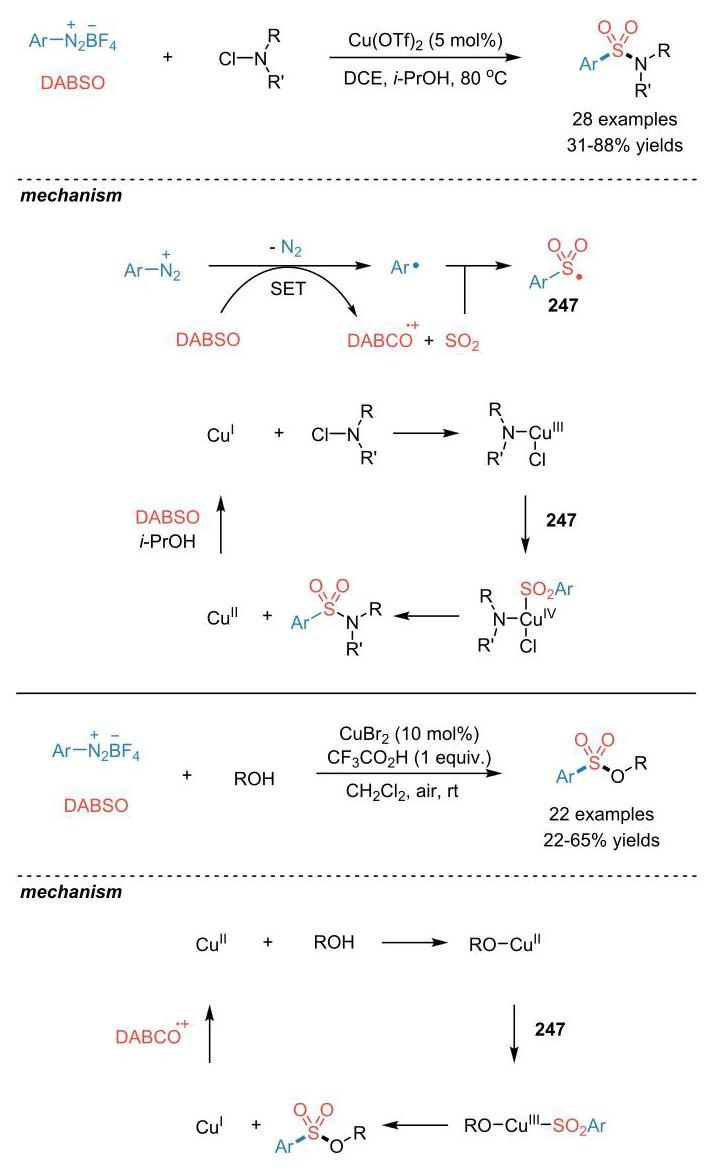
Moreover, the synthesis of vinyl sulfones through ${\mathrm{{SO}}}_{2}$ insertion has been established (Scheme 188). In 2015, Feng and co-workers reported an iodide-catalyzed radical alkenyla-tion of diazonium tetrafluoroborates, terminal alkenes, and DABSO in the presence of TBHP. ${}^{340}$ Another synthetic route toward the synthesis of vinyl sulfones involves a Cu(II)- catalyzed three-component substrate-dependent reaction of aryl diazonium salts, DABSO with alkenes, affording $\left( E\right)$ - alkenyl sulfones or allylic sulfones via the insertion of sulfur dioxide. ${}^{341}$ This reaction is assumed to be initiated by the conversion of $\mathrm{{Cu}}\left( \mathrm{I}\right)$ to $\mathrm{{Cu}}\left( \mathrm{{II}}\right)$ in the presence of ${\mathrm{{SO}}}_{2}$ , which can promote the formation of an aryl radical. Next, the insertion of ${\mathrm{{SO}}}_{2}$ affords the aryl sulfonyl radical 247, which is added to alkenes to generate an alkyl radical 254. Subsequently, oxidation by Cu(II) and final deprotonation occurs to deliver the vinyl sulfone product.
此外,通过 ${\mathrm{{SO}}}_{2}$ 插入合成乙烯基砜的方法已经建立(方案188)。2015年,Feng及其同事报道了在叔丁基过氧化氢存在下,碘化物催化的四氟硼酸重氮盐、末端烯烃和DABSO的自由基烯基化反应。${}^{340}$ 另一条合成乙烯基砜的路线涉及铜(II)催化的芳基重氮盐、DABSO与烯烃的三组分底物依赖性反应,通过二氧化硫插入得到 $\left( E\right)$ -烯基砜或烯丙基砜。${}^{341}$ 该反应被认为是在 ${\mathrm{{SO}}}_{2}$ 存在下,$\mathrm{{Cu}}\left( \mathrm{I}\right)$ 转化为 $\mathrm{{Cu}}\left( \mathrm{{II}}\right)$ 引发的,这可以促进芳基自由基的形成。接下来,${\mathrm{{SO}}}_{2}$ 的插入产生芳基磺酰基自由基247,其加成到烯烃上生成烷基自由基254。随后,铜(II)氧化并最终去质子化,得到乙烯基砜产物。
Scheme 186. Synthesis of Thiosulfonates through Insertion of Sulfur Dioxide
方案186. 通过二氧化硫插入合成硫代磺酸酯
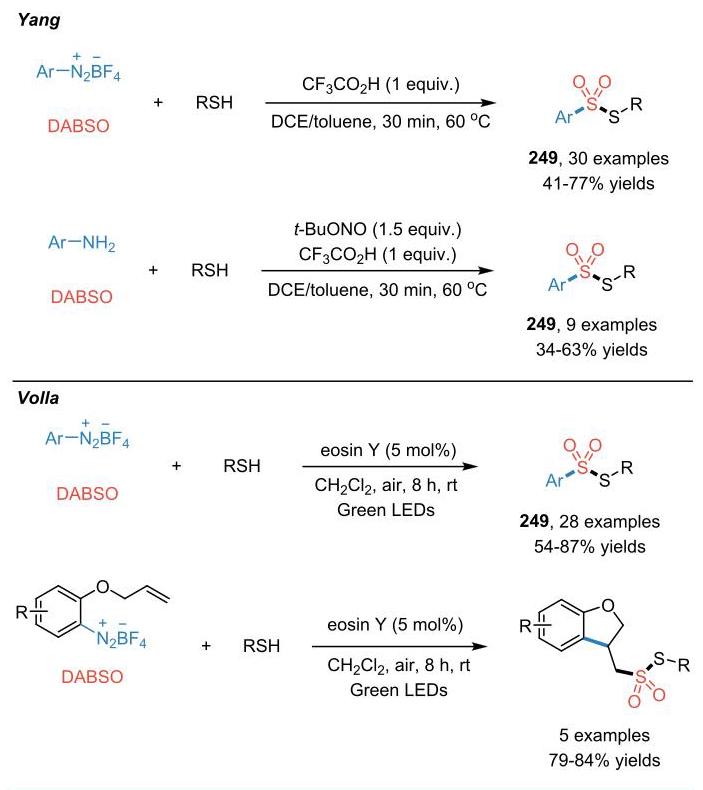
Scheme 187. Photoredox Reaction of Aryl Diazonium Salts, Sodium Metabisulfite, and Thiourea
方案187. 芳基重氮盐、焦亚硫酸钠和硫脲的光氧化还原反应
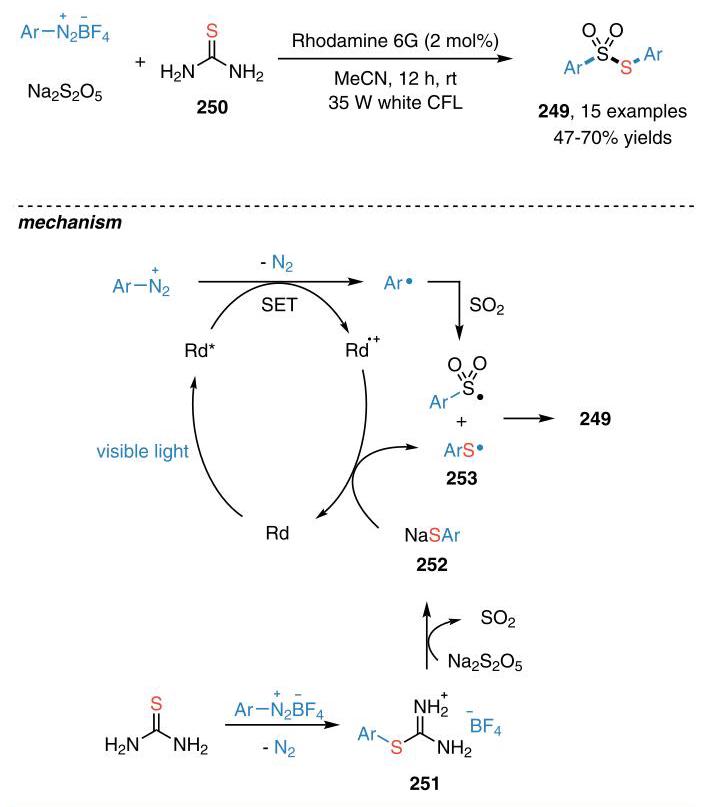
Scheme 188. Three-Component Synthesis of Vinyl Sulfones of Aryl Diazonium Salts, DABSO with Alkenes
方案188. 芳基重氮盐、DABSO与烯烃的乙烯基砜三组分合成反应
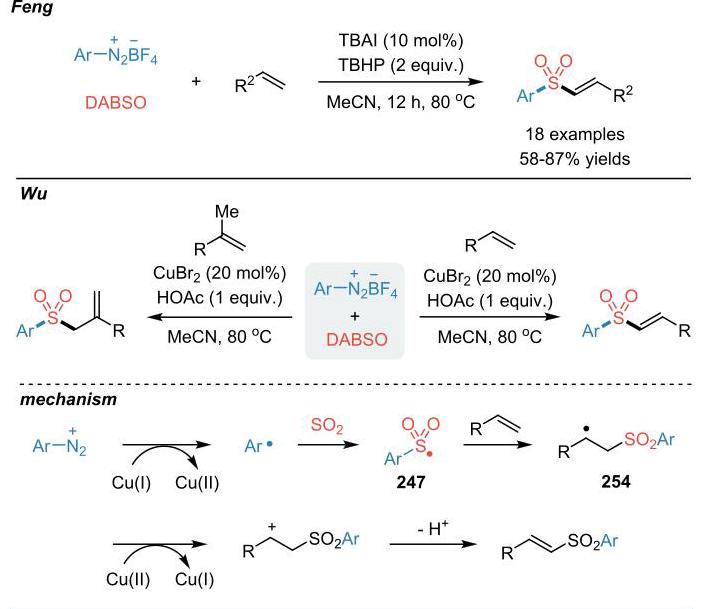
The radical tandem procedure also allows the synthesis of $\beta$ - keto sulfones through the Cu-catalyzed multicomponent reaction of aryl diazonium salts, DABSO, 3-aryl propiolic acids, and water, ${}^{342}$ as well as the additive-free reaction with silyl enol ether ${}^{343}$ (Scheme 189). In the previous case, the key steps in this transformation involve sulfonylation of aryl radicals with ${\mathrm{{SO}}}_{2}$ , selective addition of 247 to 3-aryl propiolic acid, and decarboxylation. The latter reaction involves the trapping process of aryl sulfonyl radical 247 with silyl enol ether, followed by single-electron oxidation by tertiary amine cation radical and desilylation to provide the desired $\beta$ -keto sulfones.
自由基串联反应还可以通过芳基重氮盐、DABSO、3-芳基炔丙酸和水的铜催化多组分反应合成$\beta$ - 酮砜,${}^{342}$ 以及与硅烯醇醚的无添加剂反应 ${}^{343}$ (方案189)。在前一种情况下,该转化的关键步骤包括芳基自由基与${\mathrm{{SO}}}_{2}$ 的磺酰化、247对3-芳基炔丙酸的选择性加成以及脱羧反应。后一个反应涉及硅烯醇醚捕获芳基磺酰基自由基247,然后通过叔胺阳离子自由基进行单电子氧化和脱硅反应,以提供所需的$\beta$ - 酮砜。
Another multicomponent cascade reaction approach by exploiting the differential reactivity pattern of substrates under open-atmosphere and metal-free conditions has been established (Scheme 190). ${}^{344}$ This cascade protocol uses aryl diazonium salts and alkynes/alkenes as the coupling partners at air atmosphere in the presence of DABSO or sodium metabisulfite as the source of ${\mathrm{{SO}}}_{2}$ .
另一种利用底物在开放大气和无金属条件下的不同反应模式的多组分级联反应方法已经建立(方案190)。${}^{344}$ 该级联方案在空气气氛中使用芳基重氮盐和炔烃/烯烃作为偶联伙伴,以DABSO或焦亚硫酸钠作为${\mathrm{{SO}}}_{2}$ 的来源。
A four-component reaction of aryl diazonium salts, alkenes, and hydroxylamines was disclosed by using DABSO or potassium metabisulfite as the source of sulfur dioxide (Scheme 191). ${}^{345}$ This alkene vicinal difunctionalization strategy enables the synthesis of arylated $\beta$ -hydroxysulfones with good yields under room temperature.
通过使用DABSO或亚硫酸氢钾作为二氧化硫的来源,公开了芳基重氮盐、烯烃和羟胺的四组分反应(方案191)。${}^{345}$ 这种烯烃邻位双官能化策略能够在室温下以良好的产率合成芳基化的$\beta$ - 羟基砜。
The combination of $\mathrm{C} - \mathrm{H}$ functionalization strategy with ${\mathrm{{SO}}}_{2}$ insertion has been achieved by an Ir-catalyzed three-component reaction of enamides, aryl diazonium tetrafluor-oborates, and DABSO (Scheme 192). ${}^{346}$ This direct C-H aryl sulfonylation protocol allows the synthesis of a diverse array of $\beta$ -amidovinyl sulfones in moderate to excellent yields and high stereoselectivities under light-free conditions. In the same year, a $\mathrm{{Cu}}{\left( \mathrm{{OTf}}\right) }_{2}$ -mediated aryl sulfonylation protocol was disclosed to afford $\beta$ -amidovinyl sulfones with good yields (32 examples, 26-95% yields). ${}^{347}$
$\mathrm{C} - \mathrm{H}$ 官能化策略与${\mathrm{{SO}}}_{2}$ 插入的结合已通过烯酰胺、芳基四氟硼酸重氮盐和DABSO的铱催化三组分反应实现(方案192)。${}^{346}$ 这种直接的C-H芳基磺酰化方案允许在无光条件下以中等至优异的产率和高立体选择性合成各种$\beta$ - 酰胺基乙烯基砜。同年,公开了一种$\mathrm{{Cu}}{\left( \mathrm{{OTf}}\right) }_{2}$ 介导的芳基磺酰化方案,以良好的产率提供$\beta$ - 酰胺基乙烯基砜(32个例子,产率26 - 95%)。${}^{347}$
Recently, the synthesis of aryl sulfonyl fluorides 257 has been achieved by Cu-catalyzed fluorosulfonylation of aryl diazonium salts in the presence of ${\mathrm{{KHF}}}_{2},{}^{348}$ or Cu-free Sandmeyer-type protocol using sodium metabisulfite and Selectfluor as the sulfur dioxide and fluorine sources ${}^{349}$
最近,通过在${\mathrm{{KHF}}}_{2},{}^{348}$ 存在下铜催化芳基重氮盐的氟磺酰化或使用焦亚硫酸钠和Selectfluor作为二氧化硫和氟源的无铜桑德迈尔型方案,实现了芳基磺酰氟257的合成 ${}^{349}$
Scheme 189. Synthesis of $\beta$ -Keto Sulfones by Cu-Catalyzed Multicomponent Reaction
方案189. 通过铜催化多组分反应合成$\beta$ - 酮砜
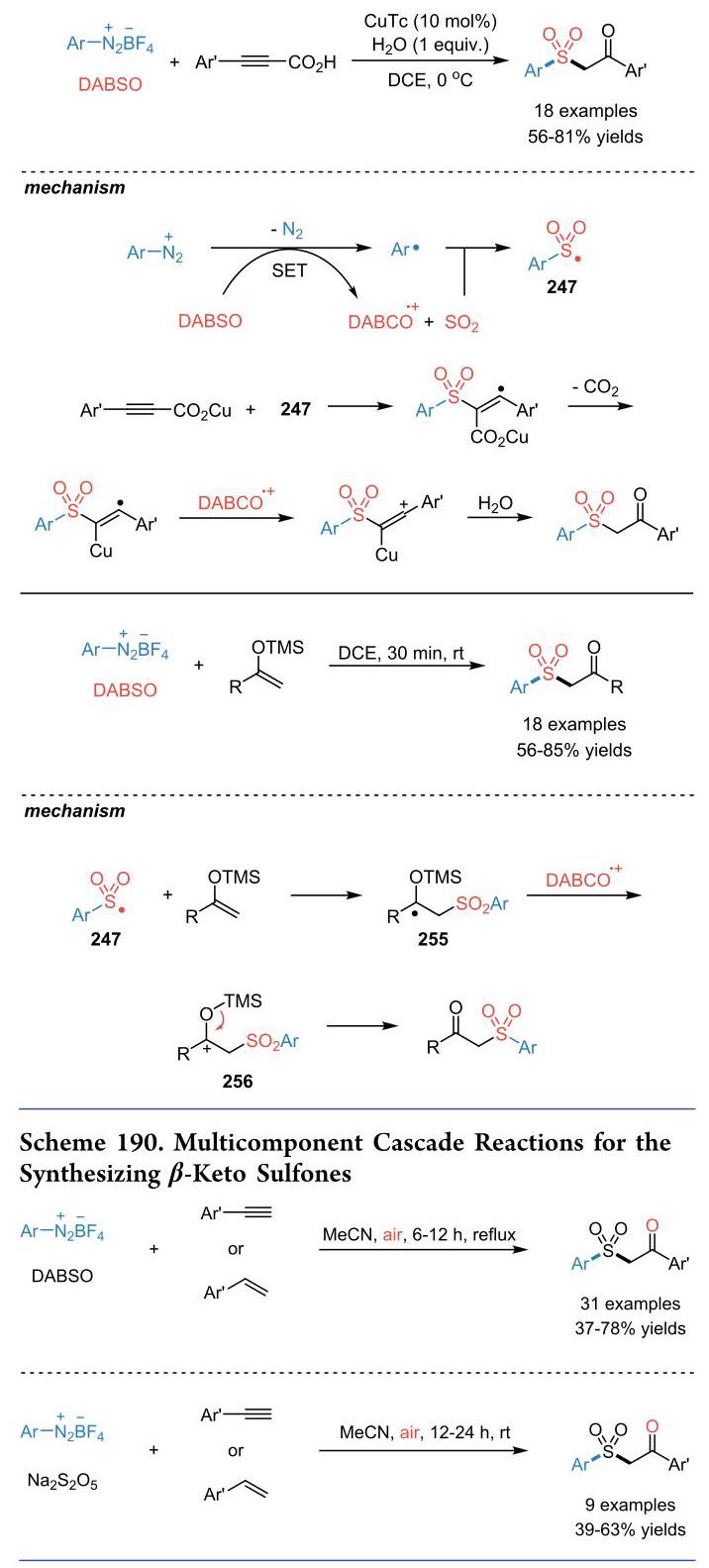
(Scheme 193). The previous reaction pathway involves the ${\mathrm{{SO}}}_{2}$ insertion of the aryl radical to form the aryl sulfonyl radical 247, followed by either chlorine abstraction and sequential Cl-F exchange, or direct combination with fluorine anion, which depend on the electronic character of the arene ring.
(方案193)。先前的反应途径涉及芳基自由基的${\mathrm{{SO}}}_{2}$ 插入以形成芳基磺酰基自由基247,随后进行氯原子夺取和连续的Cl-F交换,或直接与氟阴离子结合,这取决于芳烃环的电子性质。
3.8.2.2. C-H Functionalization Combined with ${\mathrm{{SO}}}_{2}$ Insertion. Moreover, the Wu and co-workers have merged direct $\mathrm{C} - \mathrm{H}$ functionalization strategy and insertion reaction of ${\mathrm{{SO}}}_{2}$ , giving rise to diverse sulfonated arenes with high efficiency and good selectivity. They realized the Pd-catalyzed directing group-assisted $\mathrm{C} - \mathrm{H}$ bond sulfonylation of indoles ${}^{350}$ and $N$ -(quinolin-8-yl)benzamides ${}^{351}$ through ${\mathrm{{SO}}}_{2}$ insertion (Scheme 194). These two protocols provide good examples for the combination of radical chemistry and Pd-catalyzed $\mathrm{C} - \mathrm{H}$ activation with the insertion of sulfur dioxide. The reaction mechanism involves the single-electron oxidation of aryl sulfonyl radical 247 with Pd(II)-chelated complex and sequential oxidation by tertiary amine radical cation, followed by reductive elimination of Pd(IV) species. tion was disclosed through a three-component reaction of 8- aminoquinoline amides 261, DABSO, and aryl diazonium tetrafluoroborates. ${}^{352}$ This catalytic protocol is triggered by a Cu-chelated complex via the copper catalyst’s coordination with the substrate and in situ generated aryl sulfonyl radical 247, thus providing 5-sulfonyl-8-aminoquinoline amides 262 in moderate to good yields with excellent para-selectivity. The three-component reaction of naphthols 263, DABSO, and aryl diazonium tetrafluoroborates was reported by using iron(III) chloride as the radical initiator. ${}^{353}$
3.8.2.2. C-H官能化与${\mathrm{{SO}}}_{2}$插入相结合。此外,Wu及其同事将直接$\mathrm{C} - \mathrm{H}$官能化策略与${\mathrm{{SO}}}_{2}$的插入反应相结合,高效且高选择性地生成了多种磺化芳烃。他们通过${\mathrm{{SO}}}_{2}$插入实现了钯催化的导向基团辅助的吲哚${}^{350}$和$N$-(喹啉-8-基)苯甲酰胺${}^{351}$的$\mathrm{C} - \mathrm{H}$键磺酰化反应(方案194)。这两种方法为自由基化学与钯催化的$\mathrm{C} - \mathrm{H}$活化以及二氧化硫插入的结合提供了很好的例子。反应机理涉及芳基磺酰基自由基247与钯(II)螯合配合物的单电子氧化以及叔胺自由基阳离子的顺序氧化,随后钯(IV)物种发生还原消除。通过8-氨基喹啉酰胺261、DABSO和四氟硼酸芳基重氮盐的三组分反应公开了${}^{352}$。该催化方法由铜螯合配合物引发,通过铜催化剂与底物的配位以及原位生成的芳基磺酰基自由基247,从而以中等至良好的产率和优异的对位选择性提供5-磺酰基-8-氨基喹啉酰胺262。使用氯化铁作为自由基引发剂报道了萘酚263、DABSO和四氟硼酸芳基重氮盐的三组分反应。${}^{353}$
Scheme 191. Vicinal Difunctionalization of Alkenes through Insertion of Sulfur Dioxide
方案191. 通过二氧化硫插入实现烯烃的邻位双官能化
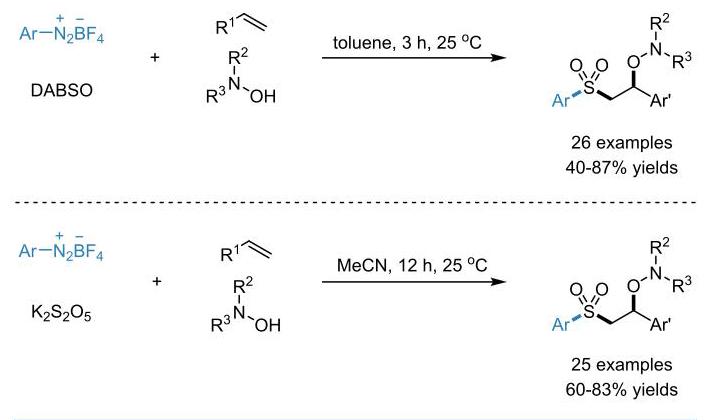
Scheme 192. Ir-Catalyzed C-H Aryl Sulfonylation of Enamides
方案192. 铱催化的烯酰胺的C-H芳基磺酰化
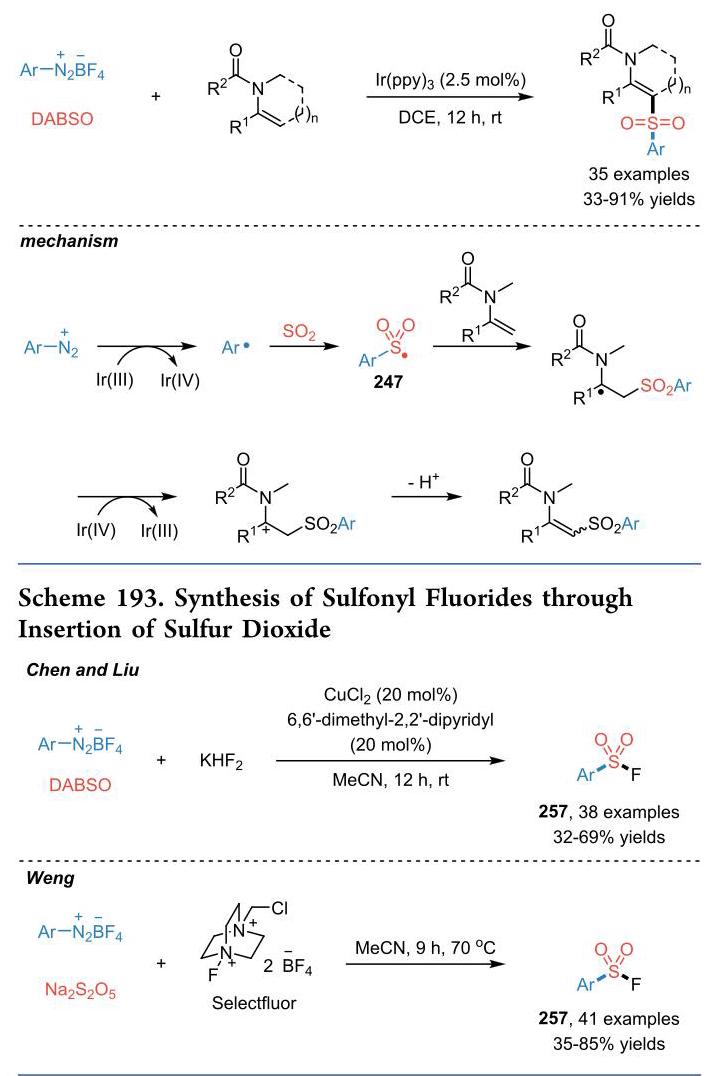
Scheme 194. Pd-Catalyzed Direct C-H Functionalization of Indoles and N-(Quinolin-8-yl)benzamides
方案194. 钯催化的吲哚和N-(喹啉-8-基)苯甲酰胺的直接C-H官能化
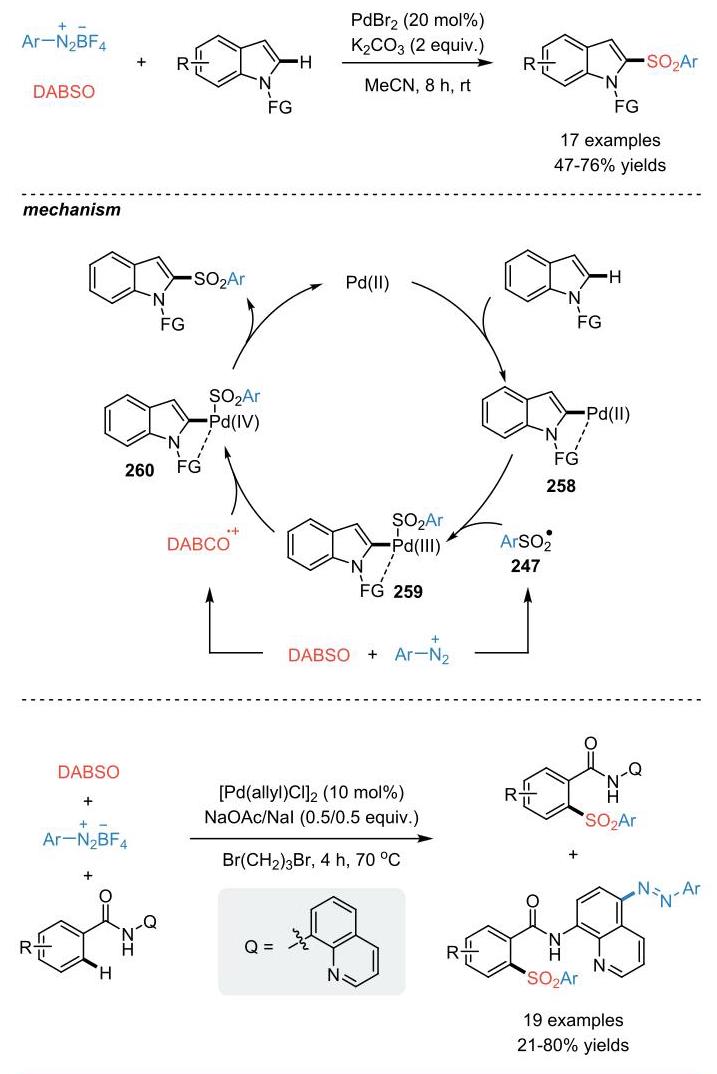
Other transition metal complexes have been explored as catalysts in the sulfonylative $\mathrm{C}\left( {\mathrm{{sp}}}^{2}\right) - \mathrm{H}$ bond functionalization process (Scheme 195). A Cu-catalyzed C-H bond sulfonyla-
其他过渡金属配合物已被探索用作磺酰化$\mathrm{C}\left( {\mathrm{{sp}}}^{2}\right) - \mathrm{H}$键官能化过程中的催化剂(方案195)。铜催化的C-H键磺酰化反应
Scheme 195. Cu- and Fe-Catalyzed C-H Bond Sulfonylation Reactions
方案195. 铜和铁催化的C-H键磺酰化反应
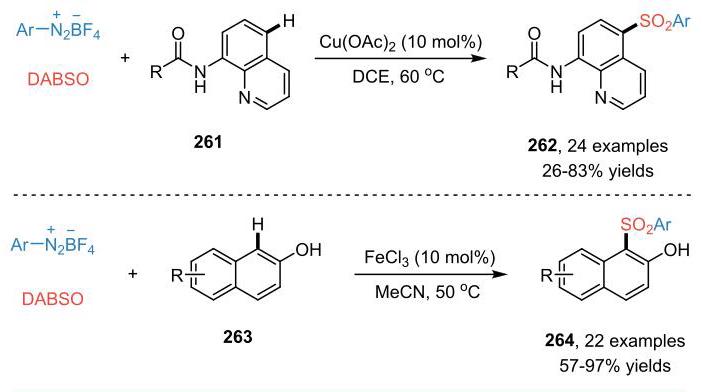
Besides, the transition-metal-free C-H bond sulfonylation reactions of aryl diazonium salts with the ${\mathrm{{SO}}}_{2}$ insertion have also been explored by Wu and co-workers, allowing the selective $\mathrm{C} - \mathrm{H}$ bond sulfonylations of anilines ${}^{354}$ and quinoline $N$ -oxides ${}^{355}$ (Scheme 196).
此外,Wu及其同事还探索了无过渡金属的芳基重氮盐与${\mathrm{{SO}}}_{2}$插入的C-H键磺酰化反应,实现了苯胺${}^{354}$和喹啉$N$-氧化物${}^{355}$的选择性$\mathrm{C} - \mathrm{H}$键磺酰化反应(方案196)。
Scheme 196. Transition-Metal-free C-H Bond Sulfonylation Reactions
方案196. 无过渡金属的C-H键磺酰化反应
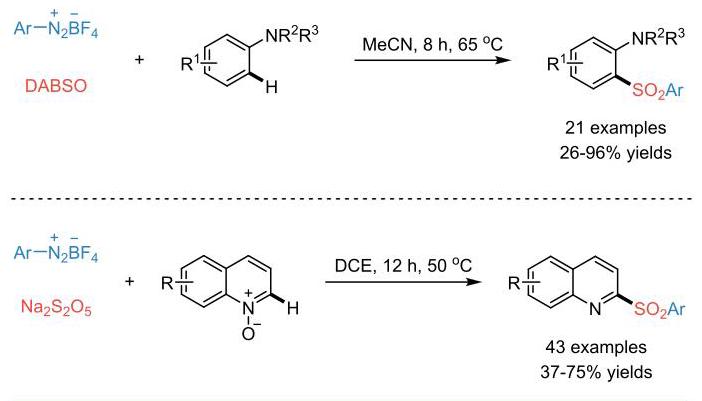
In 2018, Wu and co-workers achieved the benzylic $\mathrm{C}\left( {\mathrm{{sp}}}^{3}\right) -$ H bond sulfonylation at the para position of the hydroxyl group selectively with the insertion of ${\mathrm{{SO}}}_{2}$ through a visible-light-induced three-component reaction of aryl diazonium tetrafluoroborates, 4-methylphenols and sodium metabisulfite (Scheme 197). ${}^{356}$ Mechanistically, an aryl radical from the aryl diazonium salt is generated in the presence of an excited state of Ir(III)* under visible-light irradiation, which then reacts with sulfur dioxide providing aryl sulfonyl radical intermediate 247. The photocatalyst also promotes the oxidation of phenol in the presence of base via SET, leading to phenoxy radical 265. This phenoxy radical undergoes an intermolecular HAT with phenol to produce benzylic radical intermediate 266. Finally, aryl sulfonyl radical 247 couples with benzylic radical 266, giving rise to the corresponding product 267.
2018年,Wu及其同事通过四氟硼酸芳基重氮盐、4-甲基苯酚和焦亚硫酸钠的可见光诱导三组分反应,选择性地在羟基的对位实现了苄基$\mathrm{C}\left( {\mathrm{{sp}}}^{3}\right) -$H键磺酰化反应,并插入了${\mathrm{{SO}}}_{2}$(方案197)。${}^{356}$ 从机理上讲,在可见光照射下,在激发态的铱(III)*存在下,芳基重氮盐产生芳基自由基,然后与二氧化硫反应生成芳基磺酰基自由基中间体247。光催化剂还通过单电子转移在碱存在下促进苯酚的氧化,生成苯氧基自由基265。该苯氧基自由基与苯酚发生分子间氢原子转移,生成苄基自由基中间体266。最后,芳基磺酰基自由基247与苄基自由基266偶联,生成相应的产物267。
Scheme 197. Ir-Catalyzed Benzylic C-H Bond Sulfonylation
方案197. 铱催化的苄基C-H键磺酰化
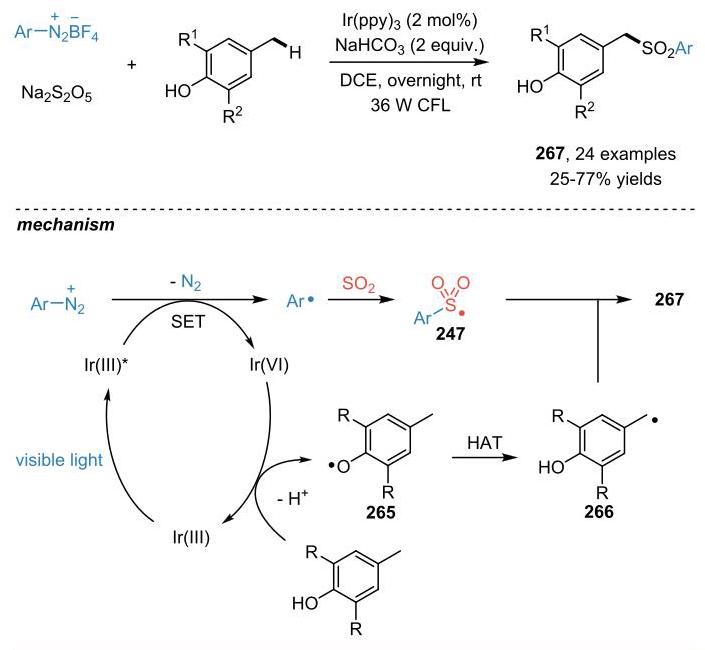
3.8.2.3. Cyclizations. The combination of radical cyclization with ${\mathrm{{SO}}}_{2}$ insertion has been widely established to access the synthesis of various (hetero)cyclic sulfones derivatives. At first, this method has been applied to synthesize $S$ -containing heterocycles. In 2015, Wu and co-workers reported a Cu-catalyzed cyclization reaction of 2-alkynyl aryl diazonium salts with DASBO, affording benzo[b]thiophenes 1,1-dioxides 268 (Scheme 198). ${}^{357}$ The aryl sulfonyl radical was initially intercepted by morpholin-4-amine, followed by intramolecular 5-endo-dig cyclization.
3.8.2.3. 环化反应。自由基环化反应与${\mathrm{{SO}}}_{2}$插入反应的结合已被广泛用于合成各种(杂)环砜衍生物。首先,该方法已被应用于合成含$S$的杂环化合物。2015年,吴等人报道了2-炔基芳基重氮盐与DASBO的铜催化环化反应,得到苯并[b]噻吩-1,1-二氧化物268(方案198)。${}^{357}$芳基磺酰基自由基首先被吗啉-4-胺捕获,然后进行分子内5-endo-dig环化反应。
Scheme 198. Cu-Catalyzed Cyclization/SO2 Insertion Leading to Benzo $\left\lbrack b\right\rbrack$ thiophenes 1,1-Dioxides
方案198. 铜催化环化/SO2插入反应生成苯并$\left\lbrack b\right\rbrack$噻吩-1,1-二氧化物
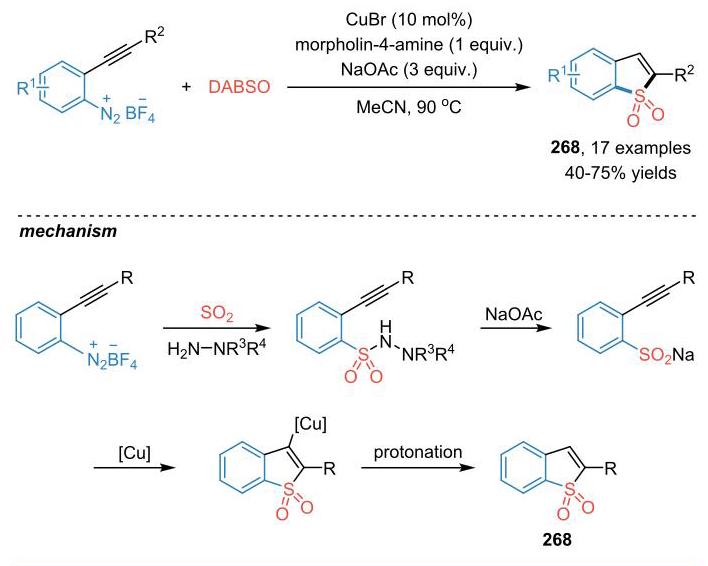
Aiming to synthesize other $S$ -containing rings, a radical-triggered three-component bicyclization cascade reaction of 2- alkynyl aryl diazonium tetrafluoroborates with DABSO and internal alkynes was disclosed, affording a variety of richly decorated indeno[1,2-c]thiochromene 5,5-dioxides 269 with moderate to good yields and high levels of regioselectivity (Scheme 199). ${}^{358}$
为了合成其他含$S$的环,人们公开了一种由自由基引发的2-炔基芳基四氟硼酸重氮盐与DABSO和内炔的三组分双环化串联反应,以中等至良好的产率和高区域选择性得到了各种装饰丰富的茚并[1,2-c]硫代色烯-5,5-二氧化物269(方案199)。${}^{358}$
The radical cyclization process with the insertion of ${\mathrm{{SO}}}_{2}$ shows practical applications in synthesizing sulfonated six-membered rings (Scheme 200). The catalyst-free synthetic approach for 3-sulfonated coumarins was realized through a three-component reaction of aryl diazonium tetrafluoroborates, DABSO and aryl propiolates 272, ${}^{359}$ or using (allyloxy)anilines as the substrates. ${}^{360}$ This tandem reaction proceeds through the in situ formation of aryl sulfonyl radicals 247, radical addition to aryl propiolates 272, spirocyclization, single-electron oxidation, 1,2-ester migration and final aromatization to get desired 3-sulfonated coumarin derivatives 273.
插入${\mathrm{{SO}}}_{2}$的自由基环化过程在合成磺化六元环方面显示出实际应用价值(方案200)。通过芳基四氟硼酸重氮盐、DABSO和芳基丙炔酸酯272的三组分反应,${}^{359}$或使用(烯丙氧基)苯胺作为底物,实现了无催化剂合成3-磺化香豆素的方法。${}^{360}$该串联反应通过原位形成芳基磺酰基自由基247、自由基加成到芳基丙炔酸酯272、螺环化、单电子氧化、1,2-酯迁移和最终芳构化得到所需的3-磺化香豆素衍生物273。
The assembly of sulfonated tetrahydropyridine scaffold 275 was realized through the three-component reaction of 1,6- enynes, DABSO, and aryl diazonium salts under catalyst- and additive-free conditions (Scheme 201). ${}^{361}$ The reaction mechanism includes the formation of aryl sulfonyl radical 247, which undergoes radical addition and intramolecular 6- exo cyclization to deliver an alkyl radical. Finally, this radical is trapped by an additional aryl diazonium cation, followed by an SET process to deliver the desired product.
在无催化剂和添加剂的条件下,通过1,6-烯炔、DABSO和芳基重氮盐的三组分反应实现了磺化四氢吡啶支架275的组装(方案201)。${}^{361}$反应机理包括形成芳基磺酰基自由基247,该自由基进行自由基加成和分子内6-exo环化以产生烷基自由基。最后,该自由基被另一个芳基重氮阳离子捕获,随后通过单电子转移过程得到所需产物。
Scheme 199. Radical-Induced Bicyclization to Afford Polycyclic Sulfones
方案199. 自由基诱导的双环化反应生成多环砜
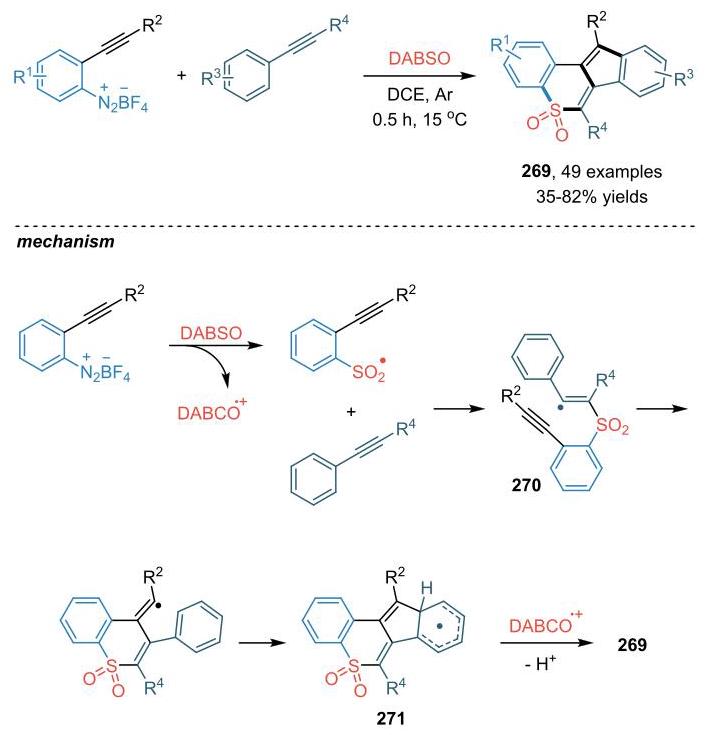
Scheme 200. Synthesis of Sulfonated Coumarin Derivatives through Insertion of ${\mathrm{{SO}}}_{2}$
方案200. 通过插入${\mathrm{{SO}}}_{2}$合成磺化香豆素衍生物
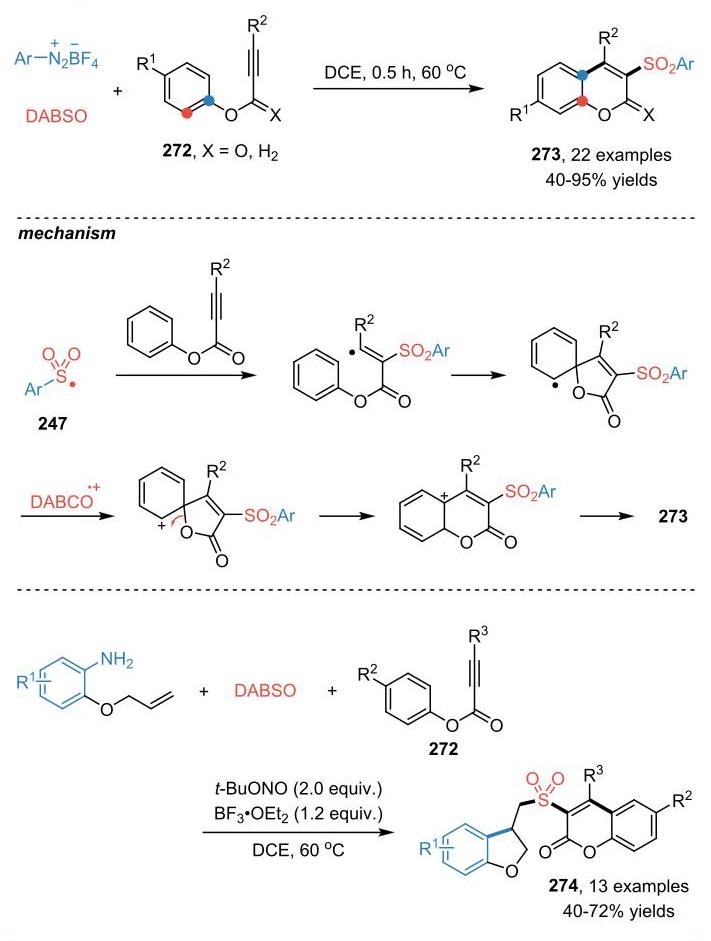
This cyclization strategy also allows the synthesis of sulfonated phenanthridines 278 through aryl sulfonyl radical interception with vinyl azides 277 (Scheme 202). ${}^{362}$ This
这种环化策略还允许通过芳基磺酰基自由基与乙烯基叠氮化物277的捕获反应合成磺化菲啶278(方案202)。${}^{362}$该
Scheme 201. Synthesis of Tetrahydropyridine Derivatives through the Reaction of 1,6-Enynes, DABSO, and Aryl Diazonium Salts reaction proceeds via the addition of in situ generated aryl sulfonyl radical 247 to vinyl azides along with the extrusion of ${\mathrm{N}}_{2}$ , followed by intramolecular cyclization, single-electron oxidation, and deprotonation to obtain 6-(sulfonylmethyl)- phenanthridine scaffold.
方案201. 通过1,6-烯炔、DABSO和芳基重氮盐反应合成四氢吡啶衍生物 反应通过原位生成的芳基磺酰基自由基247与乙烯基叠氮化物的加成反应以及${\mathrm{N}}_{2}$的消除反应进行,随后进行分子内环化、单电子氧化和去质子化反应,得到6-(磺酰基甲基)菲啶支架。
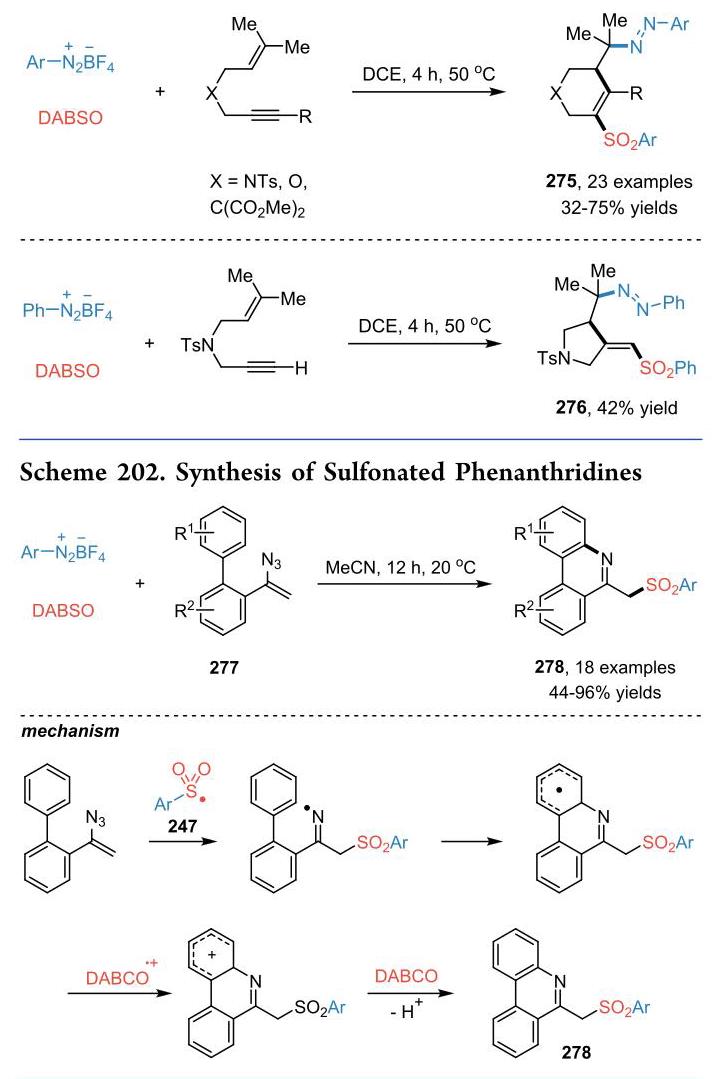
This radical cyclization process with the insertion of ${\mathrm{{SO}}}_{2}$ has also been utilized in synthesizing sulfonated five-membered rings, including 3-sulfonated-2,3-dihydrobenzo $\left\lbrack d\right\rbrack$ isothiazole 1,1-dioxides ${280},{}^{363}$ sulfonated ${9H}$ -pyrrolo $\left\lbrack {1,2 - a}\right\rbrack$ indoles 282,364 and azaspiro[4,5]-decanes 285 and azaspiro[4,5]- trienones ${286}^{365}$ under transition-metal- and photoredox-free conditions (Scheme 203).
这种插入${\mathrm{{SO}}}_{2}$的自由基环化过程也被用于合成磺化五元环,包括3 - 磺化 - 2,3 - 二氢苯并$\left\lbrack d\right\rbrack$异噻唑1,1 - 二氧化物${280},{}^{363}$磺化${9H}$ - 吡咯并$\left\lbrack {1,2 - a}\right\rbrack$吲哚282、364以及氮杂螺[4,5] - 癸烷285和氮杂螺[4,5] - 三烯酮${286}^{365}$,反应在无过渡金属和光氧化还原条件下进行(方案203)。
In addition, Cu-catalyzed combination strategy of sulfony-lation with ${\mathrm{{SO}}}_{2}$ insertion enables the synthesis of sulfonated five-membered heterocyclic compounds (Scheme 204). In 2017, Cheng reported a Cu(II)-catalyzed three-component reaction of aryl diazonium salts, DABSO with $N$ -(aryl sulfonyl)acrylamides 287, affording sulfonated oxindoles 288 with moderate yields. ${}^{366}$ Mechanistically, this catalytic transformation is triggered by the in situ formation of aryl sulfonyl radicals. Afterward, the sequential radical addition to a double bond, radical cyclization, and desulfonylative 1,4-aryl migration occur to provide the final product by merely forming four new bonds. Additionally, 2,3-allenoic acids have been explored as substrates in a Cu(II)-catalyzed three-component reaction of aryl diazonium tetrafluoroborates by using DABSO or sodium metabisulfite as the ${\mathrm{{SO}}}_{2}$ surrogate, giving rise to 4-sulfonylated furan-2(5H)-ones 290 in good yields. ${}^{367}$
此外,铜催化的磺酰化与${\mathrm{{SO}}}_{2}$插入的联合策略能够合成磺化五元杂环化合物(方案204)。2017年,程报道了芳基重氮盐、DABSO与$N$ -(芳基磺酰基)丙烯酰胺287的铜(II)催化三组分反应,以中等产率得到磺化氧化吲哚288。${}^{366}$从机理上讲,这种催化转化是由芳基磺酰基自由基的原位形成引发的。随后,依次发生自由基加成到双键、自由基环化以及脱磺酰基1,4 - 芳基迁移,仅通过形成四个新键就得到了最终产物。此外,2,3 - 联烯酸已被探索作为芳基四氟硼酸重氮盐的铜(II)催化三组分反应的底物,使用DABSO或焦亚硫酸钠作为${\mathrm{{SO}}}_{2}$替代物,以良好的产率得到4 - 磺化呋喃 - 2(5H) - 酮290。${}^{367}$
Scheme 203. Synthesis of Sulfonated Benzosultams, 9H-Pyrrolo[1,2-a]indoles and Spirocyclic Compounds
方案203. 磺化苯并磺内酰胺、9H - 吡咯并[1,2 - a]吲哚和螺环化合物的合成
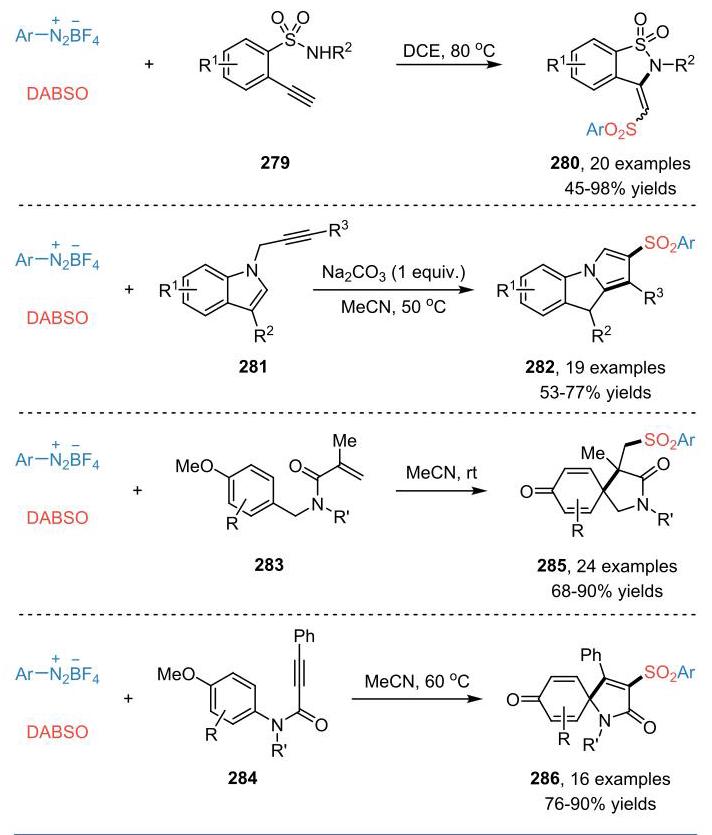
Scheme 204. Cu-Catalyzed Synthesis of Sulfonated Oxindoles and Furan-2(5H)-ones through Insertion of ${\mathrm{{SO}}}_{2}$
方案204. 通过插入${\mathrm{{SO}}}_{2}$铜催化合成磺化氧化吲哚和呋喃 - 2(5H) - 酮
Cheng
程
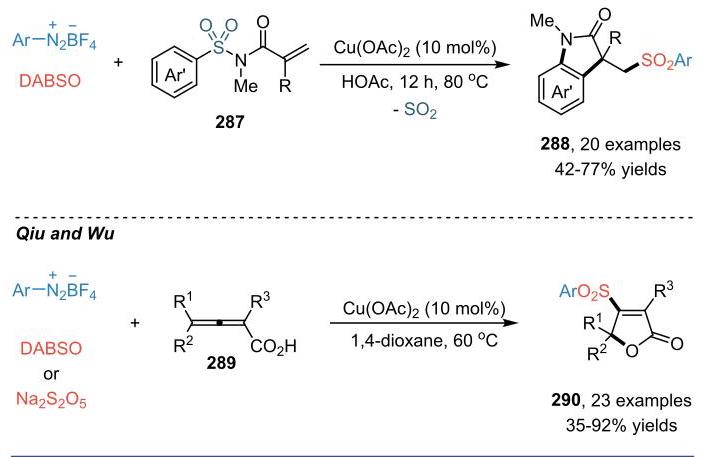
The cyclization strategy merged with the insertion of ${\mathrm{{SO}}}_{2}$ allows the synthesis of sulfonated seven-membered rings, including the Cu-catalyzed three-component reaction to afford sulfonated benzo-fused seven-membered nitrogen heterocycles 292, ${}^{368}$ and catalyst-free protocol for synthesizing sulfonated [3,1]-benzothiazepines 294 (Scheme 205). ${}^{369}$ These two protocols represent the efficient and attractive strategy for preparing seven-membered heterocyclic compounds containing a sulfonyl group through a radical-type cyclization pathway.
与${\mathrm{{SO}}}_{2}$插入相结合的环化策略能够合成磺化七元环,包括铜催化的三组分反应以得到磺化苯并稠合七元氮杂环292,${}^{368}$以及用于合成磺化[3,1] - 苯并硫氮杂䓬294的无催化剂方法(方案205)。${}^{369}$这两种方法代表了通过自由基型环化途径制备含磺酰基七元杂环化合物的高效且有吸引力的策略。
Although significant achievements have been made on DABSO, this ${\mathrm{{SO}}}_{2}$ surrogate has rarely been explored in enantioselective synthesis. In 2018, Han and co-workers
尽管在DABSO方面已经取得了显著成就,但这种${\mathrm{{SO}}}_{2}$替代物在对映选择性合成中很少被探索。2018年,韩及其同事
Scheme 205. Synthesis of Sulfonated Seven-Membered Rings through Insertion of ${\mathrm{{SO}}}_{2}$
方案205. 通过插入${\mathrm{{SO}}}_{2}$合成磺化七元环
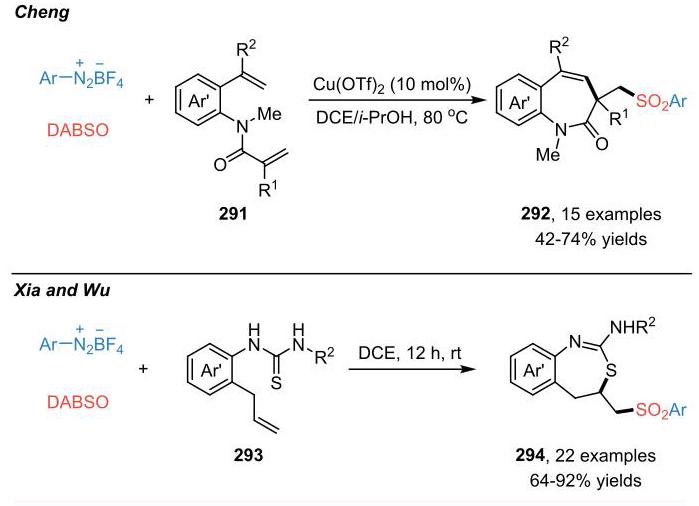
reported the first example for the enantioselective synthesis of chiral sulfonyl lactones 296 with the insertion of ${\mathrm{{SO}}}_{2}$ through Cu-catalyzed three-component reaction of aryl diazonium salts, DABSO and unsaturated carboxylic acids 295 (Scheme 206). ${}^{370}$ This multiple-step asymmetric radical reaction affords the corresponding sulfonyl lactones 296 bearing quaternary stereogenic center with up to 95% yields and 88% ee. The reaction mechanism is proposed to involve the initial reduction of aryl diazonium tetrafluoroborate by $\mathrm{{Cu}}\left( \mathrm{I}\right)$ via SET to generate aryl radical and Cu(II) complex. The resulting Cu(II) complex coordinates with unsaturated carboxylic acid 295 in the presence of 2,6-ditert-butylpyridine and chiral ligand to provide a Cu(II)-unsaturated carboxylic acid complex 297, in which the double bond is attacked by aryl sulfonyl radical, leading to an alkyl radical intermediate 298. Subsequent single-electron oxidation followed by reductive elimination of Cu(III) intermediate 299 gives rise to the final chiral product 296 and the regeneration of $\mathrm{{Cu}}\left( \mathrm{I}\right)$ species.
报道了首例通过芳基重氮盐、DABSO和不饱和羧酸295的铜催化三组分反应插入${\mathrm{{SO}}}_{2}$对映选择性合成手性磺酰基内酯296的实例(方案206)。${}^{370}$ 该多步不对称自由基反应以高达95%的产率和88%的对映体过量得到带有季碳立体中心的相应磺酰基内酯296。反应机理推测涉及通过单电子转移由$\mathrm{{Cu}}\left( \mathrm{I}\right)$对四氟硼酸芳基重氮盐进行初始还原以生成芳基自由基和铜(II)配合物。所得的铜(II)配合物在2,6-二叔丁基吡啶和手性配体存在下与不饱和羧酸295配位,形成铜(II)-不饱和羧酸配合物297,其中双键被芳基磺酰基自由基进攻,生成烷基自由基中间体298。随后的单电子氧化,接着还原消除铜(III)中间体299,得到最终的手性产物296并再生$\mathrm{{Cu}}\left( \mathrm{I}\right)$物种。
Scheme 206. Cu-Catalyzed Asymmetric Radical Sulfonylation for the Synthesis of Chiral Sulfonyl Lactones
方案206. 铜催化不对称自由基磺酰化合成手性磺酰基内酯
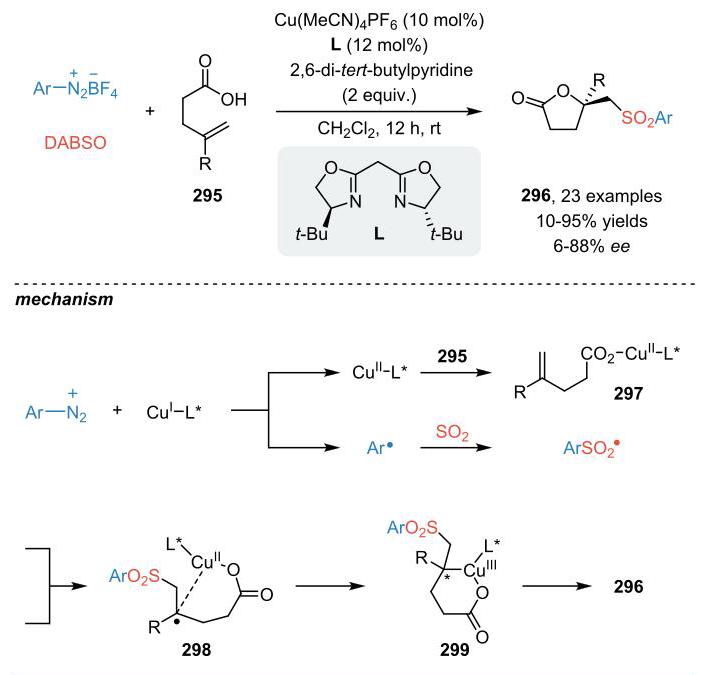
Recently, the photoinduced sulfonylation reactions through the insertion of ${\mathrm{{SO}}}_{2}$ have been explored as an avenue to synthesize sulfonated cyclic compounds. In 2018, Wu and coworkers realized a visible-light-induced photoredox three-component reaction of aryl diazonium tetrafluoroborates, DABSO with 2-vinyl benzoic acids 300, leading to sulfonated isobenzofuran-1(3H)-ones 301 with good yields under mild conditions (Scheme 207). ${}^{371}$ Mechanistically, the photocatalyst promotes the single-electron oxidation from radical 302 to cation 303 during the reaction process. Then, intramolecular nucleophilic attack of carboxylic acid to the cation 303 affords the corresponding sulfonated isobenzofuran-1(3H)-one 301.
最近,通过插入${\mathrm{{SO}}}_{2}$的光诱导磺酰化反应已被探索为合成磺化环状化合物的途径。2018年,吴等人实现了四氟硼酸芳基重氮盐、DABSO与2-乙烯基苯甲酸300的可见光诱导光氧化还原三组分反应,在温和条件下以良好产率得到磺化异苯并呋喃-1(3H)-酮301(方案207)。${}^{371}$ 从机理上讲,光催化剂在反应过程中促进自由基302到阳离子303的单电子氧化。然后,羧酸对阳离子303的分子内亲核进攻得到相应的磺化异苯并呋喃-1(3H)-酮301。
Scheme 207. Photoredox Synthesis of Sulfonated Isobenzofuran-1(3H)-ones
方案207. 磺化异苯并呋喃-1(3H)-酮的光氧化还原合成
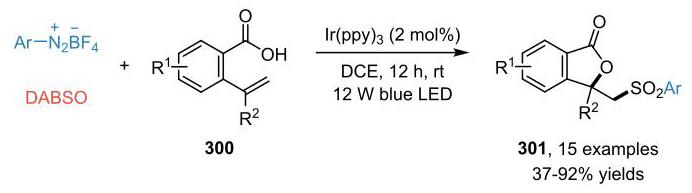
mechanism
机理
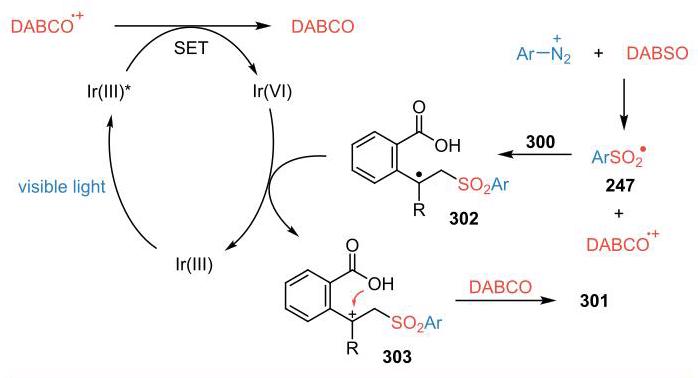
Subsequently, the same group studied the combination of photoredox transformation with ${\mathrm{{SO}}}_{2}$ insertion to realize the synthesis of various sulfonated functional molecules, including sulfonated 2,2-disubstituted tetrahydrofurans 304/tetrahydro-pyran and 1,3-dihydroisobenzofuran scaffold, ${}^{372}$ sulfonated 1- isoindolinones 305, ${}^{373}$ and $\beta$ -sulfonyl amides 306 (Scheme 208). ${}^{374}$
随后,同一研究小组研究了光氧化还原转化与${\mathrm{{SO}}}_{2}$插入的结合,以实现各种磺化功能分子的合成,包括磺化的2,2-二取代四氢呋喃304/四氢吡喃和1,3-二氢异苯并呋喃骨架,${}^{372}$ 磺化的1-异吲哚啉酮305,${}^{373}$ 以及$\beta$-磺酰胺306(方案208)。${}^{374}$
In 2018, Wu and co-workers reported a three-component reaction of aryl diazonium salts, DABSO and N-(2-vinyl phenyl)amides 307, leading to 4-((aryl sulfonyl)methyl)-4H-benzo[d][1,3]oxazines 308 by merging photoredox catalysis and radical-type insertion of ${\mathrm{{SO}}}_{2}$ (Scheme 209). ${}^{375}$ With the combination of the insertion of ${\mathrm{{SO}}}_{2}$ through semipinacol rearrangement, a visible-light-induced photoredox-catalyzed sulfonylation of alkenyl cyclobutanols 309 was reported. ${}^{376}$ This protocol proceeds through an aryl sulfonyl radical-induced 1,2-carbon migration process, affording $\beta$ -sulfonated ketones 310 bearing $\alpha$ -carbon quaternary centers with high yields.
2018年,吴等人报道了芳基重氮盐、DABSO和N-(2-乙烯基苯基)酰胺307的三组分反应,通过光氧化还原催化和${\mathrm{{SO}}}_{2}$的自由基型插入得到4-((芳基磺酰基)甲基)-4H-苯并[d][1,3]恶嗪308(方案209)。${}^{375}$ 通过半频哪醇重排插入${\mathrm{{SO}}}_{2}$的结合,报道了可见光诱导的光氧化还原催化的烯基环丁醇309的磺酰化反应。${}^{376}$ 该方法通过芳基磺酰基自由基诱导的1,2-碳迁移过程进行,以高产率得到带有$\alpha$-碳季中心的$\beta$-磺化酮310。
As for the synthesis of other heterocycles, the construction of 2-sulfonyl-substituted 9H-pyrrolo[1,2-a]indole derivatives 312 has been achieved by a visible-light-catalyzed cascade sulfonylation/cyclization of $N$ -propargyl indoles 311 with aryl diazonium salts and DABSO with good yields (Scheme 210). ${}^{377}$ The proposed mechanism includes the addition of aryl sulfonyl radical to a triple bond, intramolecular cyclization, single-electron oxidation, isomerization, and deprotonation process.
至于其他杂环的合成,通过可见光催化的$N$-炔丙基吲哚311与芳基重氮盐和DABSO的级联磺酰化/环化反应,已成功构建了2-磺酰基取代的9H-吡咯并[1,2-a]吲哚衍生物312,产率良好(方案210)。${}^{377}$提出的机理包括芳基磺酰基自由基加成到三键、分子内环化、单电子氧化、异构化和去质子化过程。
Scheme 208. Photoredox Synthesis of Sulfonated 2,2- Disubstituted Tetrahydrofurans and 1-Isoindolinones and $\beta$ -Sulfonyl Amides
方案208. 磺化的2,2-二取代四氢呋喃和1-异吲哚啉酮以及$\beta$-磺酰基酰胺的光氧化还原合成
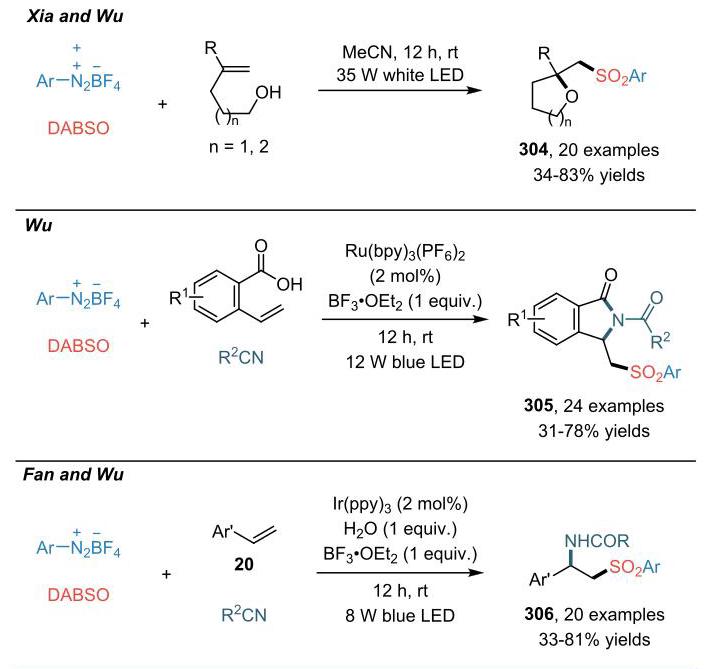
Scheme 209. Photoredox Synthesis of Sulfonated Benzo $\left\lbrack d\right\rbrack \left\lbrack {1,3}\right\rbrack$ oxazines and $\beta$ -Sulfonated Ketones
方案209. 磺化苯并$\left\lbrack d\right\rbrack \left\lbrack {1,3}\right\rbrack$恶嗪和$\beta$-磺化酮的光氧化还原合成
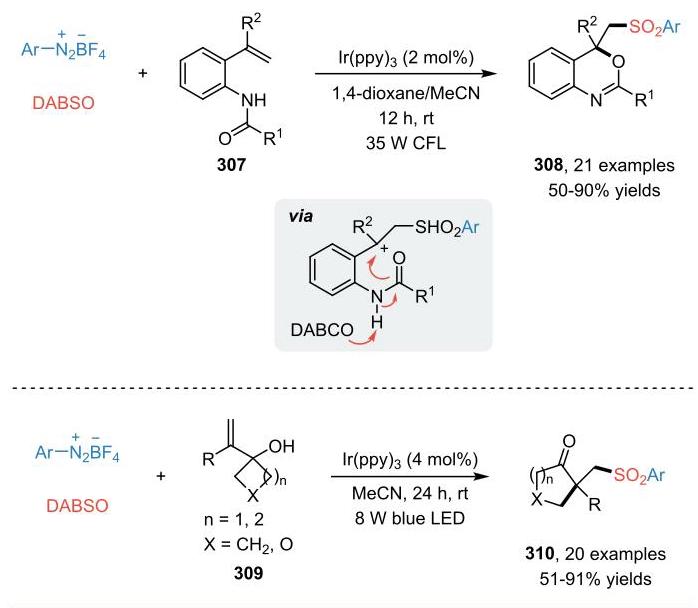
Scheme 210. Photoredox Synthesis of 2-Sulfonyl-substituted 9H-Pyrrolo[1,2-a]indoles
方案210. 2-磺酰基取代的9H-吡咯并[1,2-a]吲哚的光氧化还原合成
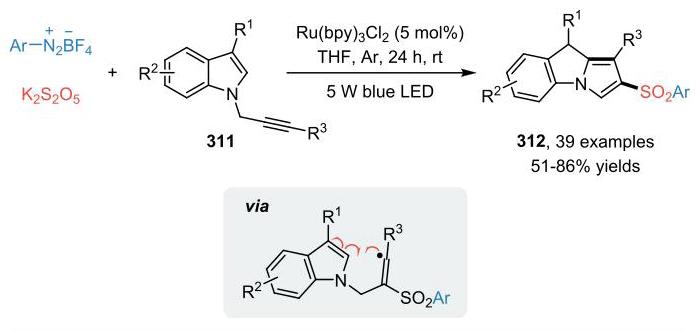
Furthermore, Jiang and co-workers utilized the ${\mathrm{{SO}}}_{2}$ insertion strategy in constructing polycyclic compounds through the multicomponent reaction of aryl diazonium tetrafluoroborates with functionalized alkynes. In 2017, Jiang and co-workers merged $\left\lbrack \begin{array}{ll} 2 + & 2 \end{array}\right\rbrack$ cycloaddition and 1,4-addition sequence induced by $S$ -centered radicals through the three-component reaction of aryl diazonium salts, DABSO and benzene-linked allene-ynes 313 (Scheme 211). ${}^{378}$ This metal-free cascade cyclization approach allows the synthesis of a wide range of cyclobuta[a]naphthalen-4-ols 314 with excellent diastereose-lectivity and good yields. Mechanistically, this reaction is proposed to proceed by [2 + 2] cycloaddition, insertion of ${\mathrm{{SO}}}_{2}$ , radical 1,4-addition, diazotization, single-electron reduction, and tautomerization.
此外,江和他的同事们在通过四氟硼酸芳基重氮盐与功能化炔烃的多组分反应构建多环化合物时采用了${\mathrm{{SO}}}_{2}$插入策略。2017年,江和他的同事们通过芳基重氮盐、DABSO和苯连接的丙二烯-炔烃313的三组分反应,将$\left\lbrack \begin{array}{ll} 2 + & 2 \end{array}\right\rbrack$环加成和由$S$中心自由基引发的1,4-加成序列结合起来(方案211)。${}^{378}$这种无金属级联环化方法能够合成多种具有优异非对映选择性和良好产率的环丁烷[a]萘-4-醇314。从机理上讲,该反应被认为是通过[2 + 2]环加成、${\mathrm{{SO}}}_{2}$插入、自由基1,4-加成、重氮化、单电子还原和互变异构化进行的。
Scheme 211. Synthesis of Cyclobuta[a]naphthalen-4-ols through Insertion of ${\mathrm{{SO}}}_{2}$
方案211. 通过插入${\mathrm{{SO}}}_{2}$合成环丁烷[a]萘-4-醇
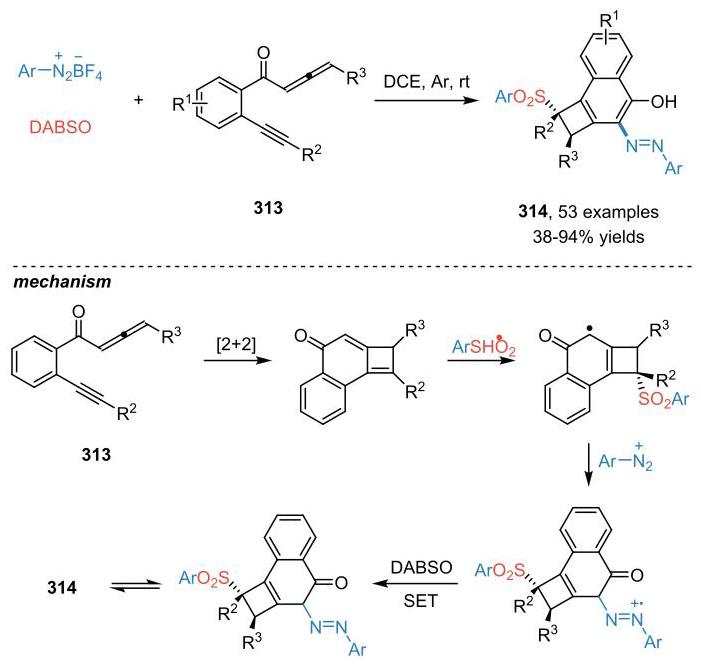
The same group utilized this radical-triggered multicomponent reaction to access the synthesis of sulfonated 1- indenones 316, ${}^{379}$ and sulfone-containing 1,3-dimethylene-substituted $\left( {Z, Z}\right)$ -isobenzofurans 319, ${}^{380}$ or sulfonated $\left( Z\right)$ - 1,3-dihydroisobenzofurans ${320}^{381}$ (Scheme 212).
同一研究小组利用这种自由基引发的多组分反应来合成磺化的1-茚酮316、${}^{379}$和含砜的1,3-二亚甲基取代的$\left( {Z, Z}\right)$-异苯并呋喃319、${}^{380}$或磺化的$\left( Z\right)$-1,3-二氢异苯并呋喃${320}^{381}$(方案212)。
Another synthetic route toward 1,3-dimethylene-substituted isobenzofuran derivatives 322 involves a Pd-catalyzed cyclization/radical addition cascade reaction of $\beta$ -alkynyl ketones 321, aryl diazonium salts, and DABSO (Scheme 213). ${}^{382}$ This reaction is proposed to proceed through a sequence of a Heck-type reaction, oxo-cyclization, sulfonyl radical addition, single-electron oxidation, and deprotonation process.
另一条合成1,3-二亚甲基取代的异苯并呋喃衍生物322的路线涉及$\beta$-炔基酮321、芳基重氮盐和DABSO的钯催化环化/自由基加成级联反应(方案213)。${}^{382}$该反应被认为是通过Heck型反应、氧环化、磺酰基自由基加成、单电子氧化和去质子化过程依次进行的。
3.8.3. $\mathrm{C} - {\mathrm{{SCF}}}_{3}$ and $\mathrm{C} - {\mathrm{{SCF}}}_{2}\mathrm{H}$ Bond Formations. Functionalized trifluoromethyl aryl sulfides constitute highly attractive building blocks for their exceptional lipophilicity and chemical properties. For such reasons, selective trifluorome-thylthiolation, difluoromethylthiolation, and pentafluoroe-thylthiolation have attracted significant attention in recent years. The main topic is developing suitable and mild reagents for these transformations, including transition-metal- ${\mathrm{{SCF}}}_{2}\mathrm{X}(\mathrm{X}$ = F, H) complexes and organic ${\mathrm{{SCF}}}_{2}\mathrm{X}$ -containing molecules. The recent approaches include the Cu-mediated or Ag-mediated process, and photoredox protocol to forge $\mathrm{C} - {\mathrm{{SCF}}}_{3}$ and $\mathrm{C} - {\mathrm{{SCF}}}_{2}\mathrm{H}$ bonds.
3.8.3. $\mathrm{C} - {\mathrm{{SCF}}}_{3}$和$\mathrm{C} - {\mathrm{{SCF}}}_{2}\mathrm{H}$键的形成。功能化的三氟甲基芳基硫醚因其特殊的亲脂性和化学性质而构成极具吸引力的结构单元。出于这些原因,选择性三氟甲硫基化、二氟甲硫基化和五氟乙硫基化近年来受到了广泛关注。主要课题是开发适用于这些转化的温和试剂,包括过渡金属-${\mathrm{{SCF}}}_{2}\mathrm{X}(\mathrm{X}$ = F, H)配合物和含${\mathrm{{SCF}}}_{2}\mathrm{X}$的有机分子。最近的方法包括铜介导或银介导的过程,以及用于形成$\mathrm{C} - {\mathrm{{SCF}}}_{3}$和$\mathrm{C} - {\mathrm{{SCF}}}_{2}\mathrm{H}$键的光氧化还原方案。
Scheme 212. Synthesis of Sulfonated 1-Indenones and $\left( {Z, Z}\right)$ -Isobenzofurans
方案212. 磺化1-茚酮和$\left( {Z, Z}\right)$-异苯并呋喃的合成
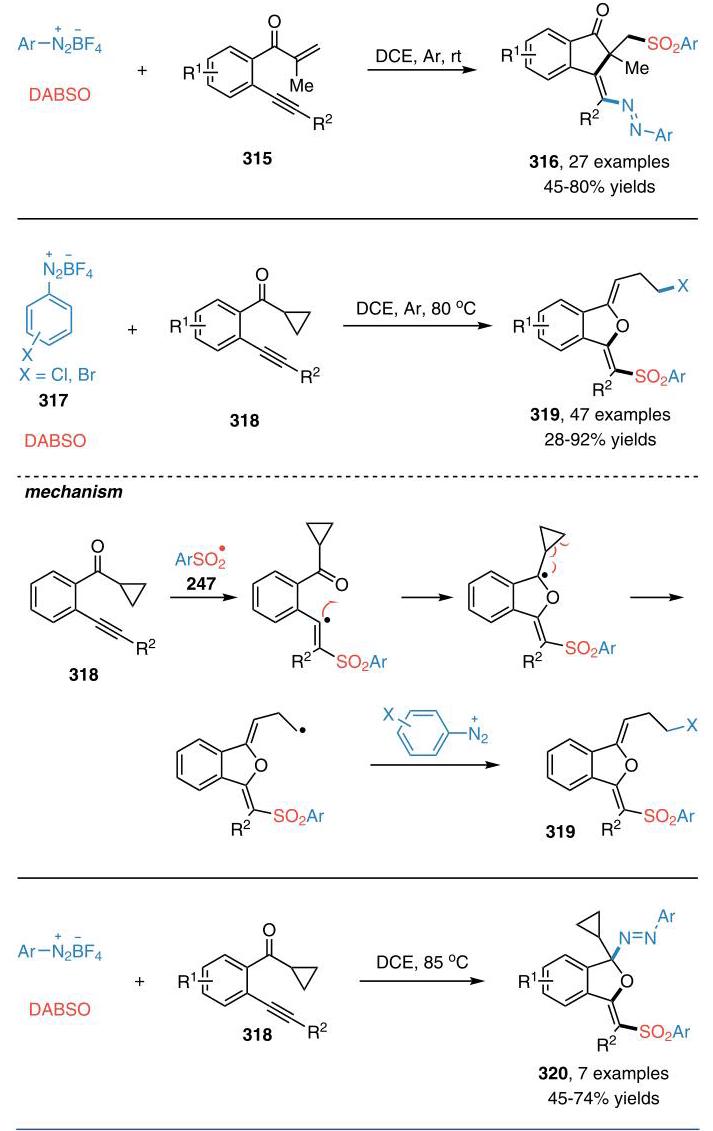
In 2014, Goossen and co-workers reported a Cu-mediated Sandmeyer trifluoromethylthiolation of aryl diazonium salts using Prakash reagent 113 as the trifluoromethylating reagent (Scheme 214). ${}^{383}$ In the presence of sodium thiocyanate and base, this regiospecific trifluoromethylthiolation protocol affords aryl trifuoromethyl thioethers 323 with moderate to excellent yields. Mechanistically, this reaction proceeds through an SET process to afford an aryl radical, followed by the reaction with 324 to form aryl thiocyanate, which undergoes nucleophilic substitution with trifluoromethyl anion. In the same year, Goossen also achieved the one-pot copper-mediated Sandmeyer trifluoromethylthiolation from (hetero)aromatic amines. ${}^{157}$
2014年,古森及其同事报道了使用普拉卡什试剂113作为三氟甲基化试剂,通过铜介导的芳基重氮盐的桑德迈尔三氟甲硫基化反应(方案214)。${}^{383}$ 在硫氰酸钠和碱存在下,这种区域特异性的三氟甲硫基化反应方案能够以中等至优异的产率得到芳基三氟甲硫醚323。从机理上讲,该反应通过单电子转移过程生成芳基自由基,然后与324反应形成芳基硫氰酸盐,芳基硫氰酸盐再与三氟甲基阴离子发生亲核取代反应。同年,古森还实现了从(杂)芳族胺一锅法铜介导的桑德迈尔三氟甲硫基化反应。${}^{157}$
The development of new trifluoromethylating reagent has attracted great attention in the selective trifluoromethylth-iolation of aromatic compounds. In 2016, by using ${\mathrm{{Me}}}_{4}{\mathrm{{NSCF}}}_{3}$ 327 as the trifluoromethylating reagent, Goossen continuously reported a Sandmeyer-type trifluoromethylthiolation of aryl-amines or aryl diazonium salts (Scheme 215). ${}^{308}$
新型三氟甲基化试剂的开发在芳香族化合物的选择性三氟甲硫基化反应中引起了极大关注。2016年,通过使用${\mathrm{{Me}}}_{4}{\mathrm{{NSCF}}}_{3}$ 327作为三氟甲基化试剂,古森继续报道了芳胺或芳基重氮盐的桑德迈尔型三氟甲硫基化反应(方案215)。${}^{308}$
Scheme 213. Pd-catalyzed Oxo-Cyclization/SO ${}_{2}$ Insertion Cascade of $\beta$ -Alkynyl Ketones
方案213. Pd催化的氧环化/SO ${}_{2}$ 插入 $\beta$ -炔基酮的串联反应
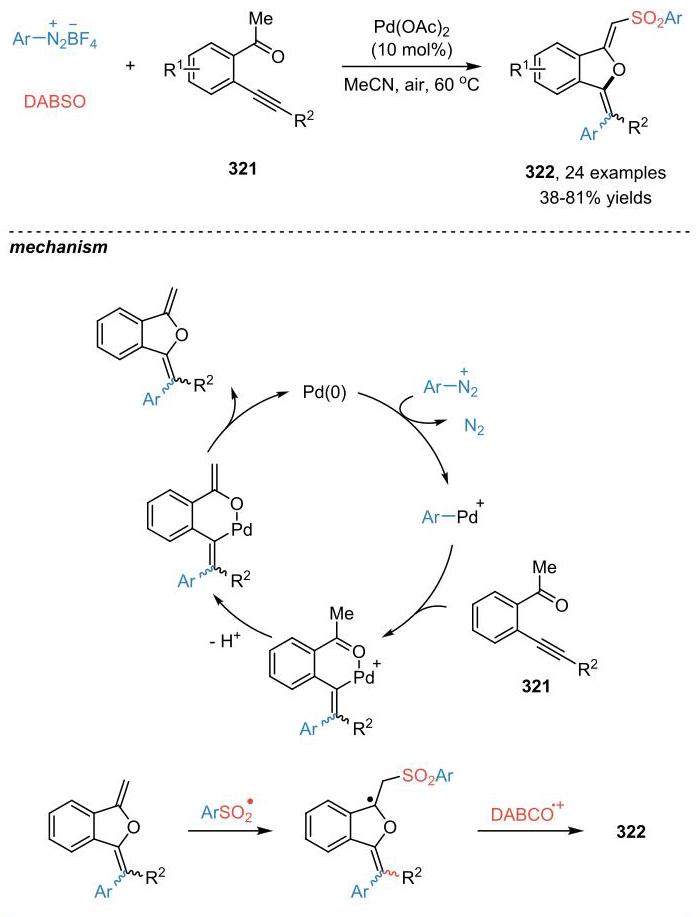
Scheme 214. Sandmeyer Trifluoromethylthiolation of Aryl Diazonium Salts
方案214. 芳基重氮盐的桑德迈尔三氟甲硫基化反应
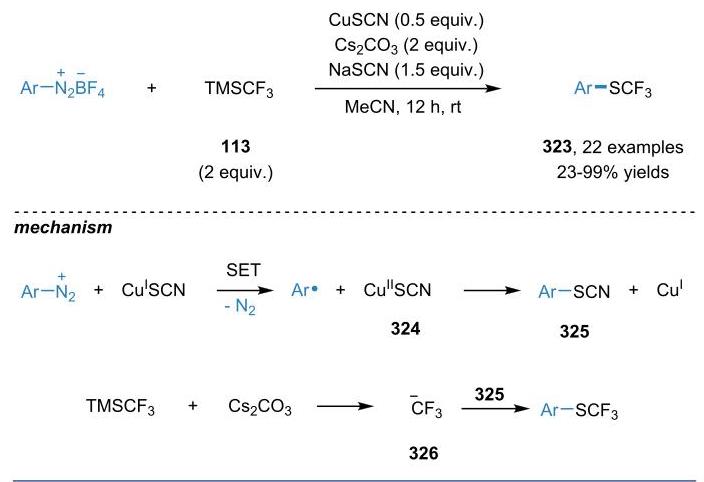
Moreover, the photoredox trifluoromethylthiolation of aryl diazonium ions has been established in the absence of copper salts. ${}^{310}$ Wangelin and co-workers first developed the diverse synthetic trifluoromethylthiolation protocol of aryl diazonium salts with the commercial disulfide ${\mathrm{{CF}}}_{3}{\mathrm{{SSCF}}}_{3}{328}$ (Scheme 216). ${}^{384}$ They found that the photoredox procedure is superior to the base-mediated process.
此外,在没有铜盐的情况下,已经实现了芳基重氮离子的光氧化还原三氟甲硫基化反应。${}^{310}$ 万格林及其同事首次开发了使用市售二硫化物${\mathrm{{CF}}}_{3}{\mathrm{{SSCF}}}_{3}{328}$ 对芳基重氮盐进行多种合成三氟甲硫基化反应的方案(方案216)。${}^{384}$ 他们发现光氧化还原方法优于碱介导的方法。
The limitation of the previous trifluoromethylthiolation protocol is the employment of highly volatile liquid ${\mathrm{{CF}}}_{3}{\mathrm{{SSCF}}}_{3}$ 328. In 2018, Zhao reported a visible-light-induced photoredox trifluoromethylthiolation of aryl diazonium salts using $S$ - trifluoromethyl 4-methoxylbenzenesulfonothioate 329 as the
先前三氟甲硫基化反应方案的局限性在于使用了高挥发性液体${\mathrm{{CF}}}_{3}{\mathrm{{SSCF}}}_{3}$ 328。2018年,赵报道了使用$S$ -三氟甲基4-甲氧基苯磺酰硫酯329作为三氟甲硫基化试剂,通过可见光诱导的芳基重氮盐的光氧化还原三氟甲硫基化反应(方案217)。${\mathrm{{CF}}}_{3}{\mathrm{{SSCF}}}_{3}$ 在Ru(II)配合物存在下,这种温和的反应方案能够以中等至良好的产率得到芳基三氟甲硫醚。此外,已经建立了以苯胺为底物、以玫瑰红为光催化剂的一锅法反应条件,得到了具有相似反应结果的目标化合物。
Scheme 215. Sandmeyer-type Trifluoromethylthiolation with ${\mathrm{{Me}}}_{4}{\mathrm{{NSCF}}}_{3}$
方案215. 用${\mathrm{{Me}}}_{4}{\mathrm{{NSCF}}}_{3}$ 进行的桑德迈尔型三氟甲硫基化反应
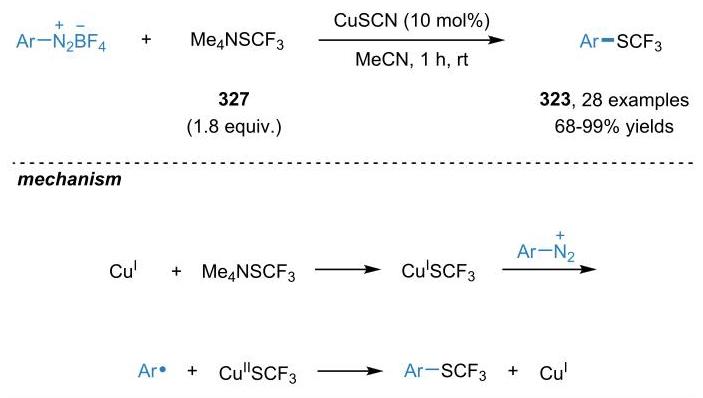
Scheme 216. Weak Base-Mediated and Photoredox Trifluoromethylthiolation with ${\left( {\mathrm{F}}_{3}\mathrm{{CS}}\right) }_{2}$
方案216. 用${\left( {\mathrm{F}}_{3}\mathrm{{CS}}\right) }_{2}$ 进行的弱碱介导和光氧化还原三氟甲硫基化反应
NaOAc (1 equiv.)
乙酸钠(1当量)
$\mathrm{{Ar}} - {\mathrm{N}}_{2}{\mathrm{{BF}}}_{4}$ + ${\mathrm{F}}_{3}{\mathrm{{CS} - {SCF}}}_{3} \; \mathrm{{Ar}} = {\mathrm{{SCF}}}_{3}$
DMSO, ${24}\mathrm{\;h},{20}^{ \circ }\mathrm{C}$
二甲基亚砜,${24}\mathrm{\;h},{20}^{ \circ }\mathrm{C}$
328 323, 6 examples
328 323,6个实例
(1 equiv.) 31-76% yields
(1当量) 产率31 - 76%
$\mathrm{{Ru}}{\left( \mathrm{{bpy}}\right) }_{3}{\mathrm{{Cl}}}_{2}\left( {{0.5}\mathrm{\;{mol}}\% }\right)$
$\mathrm{{Ar}} - {\mathrm{N}}_{2}{\mathrm{{BF}}}_{4} \; {\mathrm{F}}_{3}{\mathrm{{CS} - {SCF}}}_{3} \; \mathrm{{Ar}} = {\mathrm{{SCF}}}_{3}$
DMSO, $1\mathrm{\;h},{20}^{ \circ }\mathrm{C}$
二甲基亚砜,$1\mathrm{\;h},{20}^{ \circ }\mathrm{C}$
328 3.8 W blue LED 323, 8 examples
328 3.8 W蓝色发光二极管323,8个实例
(1 equiv.) 33-70% yields
(1当量) 产率33 - 70%
trifluoromethylthiolating reagent (Scheme 217). ${}^{385}$ In the presence of Ru(II) complex, this mild protocol affords aryl trifluoromethyl thioethers with moderate to good yields. Additionally, one-pot conditions from anilines as the substrates using Rose Bengal as photocatalyst have been established, giving rise to the desired compounds with similar reaction outcomes.
三氟甲硫基化试剂(方案217)。${}^{385}$ 在Ru(II)配合物存在下,这种温和的反应方案能够以中等至良好的产率得到芳基三氟甲硫醚。此外,已经建立了以苯胺为底物、以玫瑰红为光催化剂的一锅法反应条件,得到了具有相似反应结果的目标化合物。
Scheme 217. Visible Light Photocatalytic Trifluoromethylthiolation with $S$ -Trifluoromethyl 4- Methoxylbenzenesulfonothioate
方案217. 用$S$-三氟甲基4-甲氧基苯磺酰硫酯进行的可见光光催化三氟甲基硫醇化反应
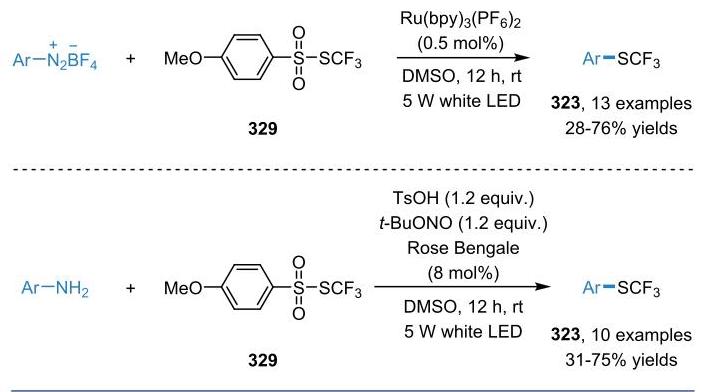
In 2019, Billard and Tlili disclosed a visible-light-induced trifluoromethylthiolation of aryl diazonium salts using shelf-stable TsSCFs 330 as the trifluoromethylthiolating reagent in the presence of ruthenium-based photosensitizer under mild reaction conditions (Scheme 218). ${}^{386}$ In the same year, Tlili and Gampe have utilized this photocatalytic and copper-catalyzed method to rapidly access the S and Se homologues of two ${\mathrm{{OCF}}}_{3}$ -containing pharmaceuticals riluzole and pretoma-nid. ${}^{387}$
2019年,比拉尔和蒂利公开了一种可见光诱导的芳基重氮盐的三氟甲基硫醇化反应,该反应在温和的反应条件下,以稳定的对甲苯磺酰基三氟甲硫醚(TsSCF₃)330作为三氟甲基硫醇化试剂,在钌基光敏剂存在下进行(方案218)。${}^{386}$同年,蒂利和甘佩利用这种光催化和铜催化的方法,快速获得了两种含${\mathrm{{OCF}}}_{3}$的药物利鲁唑和喷他脒的硫和硒同系物。${}^{387}$
Scheme 218. Visible-Light-Mediated Trifluoromethylthiolation with ${\mathrm{{TsSCF}}}_{3}$
方案218. 用${\mathrm{{TsSCF}}}_{3}$进行的可见光介导的三氟甲基硫醇化反应
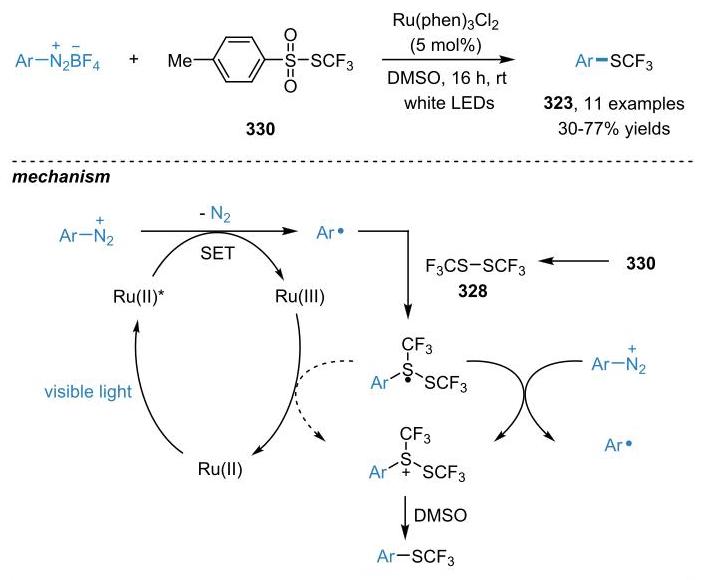
Except for the trifluoromethylthiolation of aryl diazonium salts, Goossen reported a Cu-mediated difluoromethylthiola-tion of aryl diazonium salts, affording pharmaceutical and agrochemical important aryl difluoromethyl thioethers 331 with high yields (Scheme 219). ${}^{388}$ This mild drifluorome-thylthiolation reaction proceeds through the in situ generations of organothiocyanates 325 as the key intermediates, followed by the reaction with copper- ${\mathrm{{CF}}}_{2}\mathrm{H}$ complex generated in situ from copper thiocyanate and TMSCF ${}_{2}\mathrm{H}$ to deliver difluor-omethylthiolation products.
除了芳基重氮盐的三氟甲基硫醇化反应外,Goossen报道了铜介导的芳基重氮盐的二氟甲基硫醇化反应,以高产率得到了对制药和农用化学品具有重要意义的芳基二氟甲基硫醚331(方案219)。${}^{388}$ 这种温和的二氟甲基硫醇化反应通过原位生成有机硫氰酸酯325作为关键中间体进行,随后与由硫氰酸铜和TMSCF ${}_{2}\mathrm{H}$原位生成的铜 ${\mathrm{{CF}}}_{2}\mathrm{H}$ 配合物反应,得到二氟甲基硫醇化产物。
Scheme 219. Cu-Mediated Synthesis of Aryl Difluoromethyl Thioethers Using TMSCF ${}_{2}\mathrm{H}$
方案219. 使用TMSCF${}_{2}\mathrm{H}$铜介导合成芳基二氟甲基硫醚
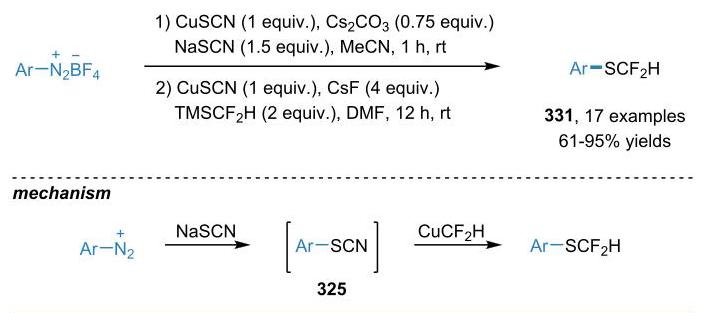
In the same year, copper-promoted difluoromethylthiolation of (hetero)aryl diazonium salts was realized by using stable NHC-ligated difluoromethylthiolated silver complex [(SIPr)- Ag(SCF ${}_{2}$ H) 332 (Scheme 220). ${}^{389}$ In the presence of one equivalent of $\mathrm{{Cu}}\left( \mathrm{I}\right) /$ bpy, this difluoromethylthiolation reaction affords various difluoromethylthiolated arenes and heteroar-enes in good to excellent yields under mild reaction conditions. This reaction is proposed to proceed through an SET process of aryl diazonium salts with in situ formed $\mathrm{{Cu}}\left( \mathrm{I}\right) {\mathrm{{SCF}}}_{2}\mathrm{H}{333}$ to afford an aryl radical, followed by the sequential SET process with $\mathrm{{Cu}}\left( \mathrm{{II}}\right) {\mathrm{{SCF}}}_{2}\mathrm{H}$ species 334 to deliver the desired difluoromethylthiolated product along with the formation of Cu(I) species.
同年,通过使用稳定的NHC连接的二氟甲基硫醇化银配合物[(SIPr)-Ag(SCF ${}_{2}$ H) 332],实现了铜促进的(杂)芳基重氮盐的二氟甲基硫醇化反应(方案220)。${}^{389}$ 在一当量的$\mathrm{{Cu}}\left( \mathrm{I}\right) /$ bpy存在下,该二氟甲基硫醇化反应在温和的反应条件下以良好至优异的产率提供了各种二氟甲基硫醇化的芳烃和杂芳烃。有人提出,该反应通过芳基重氮盐与原位形成的$\mathrm{{Cu}}\left( \mathrm{I}\right) {\mathrm{{SCF}}}_{2}\mathrm{H}{333}$ 的单电子转移过程进行,以生成芳基自由基,随后与$\mathrm{{Cu}}\left( \mathrm{{II}}\right) {\mathrm{{SCF}}}_{2}\mathrm{H}$ 物种334进行连续的单电子转移过程,从而得到所需的二氟甲基硫醇化产物,并形成Cu(I)物种。
A Sandmeyer-type pentafluoroethylthiolation of aryl diazonium salts was also realized with ${\mathrm{{Me}}}_{4}{\mathrm{{NSC}}}_{2}{\mathrm{\;F}}_{5}{336}$ in the presence of catalytic amounts of elemental copper (Scheme 221). ${}^{390}$ In 2018, Wang and co-workers reported a visible-
在催化量的元素铜存在下,也用${\mathrm{{Me}}}_{4}{\mathrm{{NSC}}}_{2}{\mathrm{\;F}}_{5}{336}$实现了芳基重氮盐的桑德迈尔型五氟乙基硫醇化反应(方案221)。${}^{390}$2018年,王及其同事报道了一种可见光
Scheme 220. Sandmeyer-Type Difluoromethylthiolation of Aryl Diazonium Salts with Difluoromethylthiolated Silver Complex
方案220. 用二氟甲基硫醇化银配合物对芳基重氮盐进行桑德迈尔型二氟甲基硫醇化反应
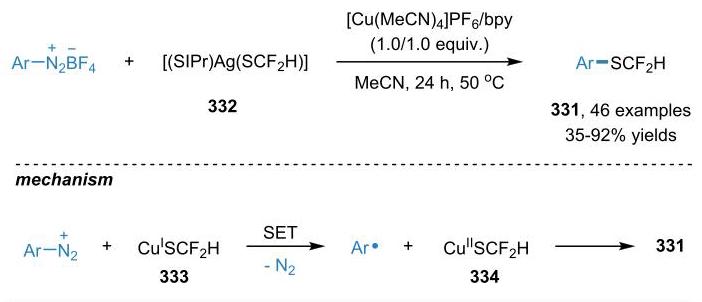
Scheme 221. Synthesis of Pentafluoroethyl Thioethers via Sandmeyer Reaction
方案221. 通过桑德迈尔反应合成五氟乙基硫醚

mechanism
机理
$$ {\mathrm{{Ar}}}^{ + }{\mathrm{N}}_{2} + {\mathrm{{Cu}}}^{\prime }{\mathrm{{SC}}}_{2}{\mathrm{\;F}}_{5}\;\xrightarrow[{-{\mathrm{N}}_{2}}]{\mathrm{{SET}}}{\mathrm{{Ar}}}^{ * } + {\mathrm{{Cu}}}^{\prime \prime }{\mathrm{{SC}}}_{2}{\mathrm{\;F}}_{5}\; \rightarrow \text{ 335 } $$light-induced difluoromethylthiolation of aryl diazonium salts by using shelf-stable, easily prepared ${\mathrm{{PhSO}}}_{2}{\mathrm{{SCF}}}_{2}\mathrm{H}$ as the difluoromethylthiolating reagent. ${}^{391}$ Under the irradiation with a 12 W white CFL and catalyzed by $5\mathrm{\;{mol}}\% \mathrm{{Ru}}{\left( \mathrm{{bpy}}\right) }_{3}{\left( {\mathrm{{PF}}}_{6}\right) }_{2}$ , this photoredox protocol affords a variety of difluoromethyl thioethers with moderate to good yields (28 examples, 17- 85% yields). In this reaction, sodium ascorbate was added to promote the SET process.
使用稳定、易于制备的${\mathrm{{PhSO}}}_{2}{\mathrm{{SCF}}}_{2}\mathrm{H}$作为二氟甲基硫醇化试剂,对芳基重氮盐进行光诱导二氟甲基硫醇化反应。${}^{391}$在12 W白色紧凑型荧光灯照射下,以$5\mathrm{\;{mol}}\% \mathrm{{Ru}}{\left( \mathrm{{bpy}}\right) }_{3}{\left( {\mathrm{{PF}}}_{6}\right) }_{2}$为催化剂,该光氧化还原反应可得到多种二氟甲基硫醚,产率中等至良好(28个实例,产率17 - 85%)。在该反应中,加入抗坏血酸钠以促进单电子转移过程。
3.9. Reactions with Nitriles and Cascade Reactions
3.9. 与腈类的反应及串联反应
Aryl diazonium salts’ reaction with nitriles has opened a novel synthetic route to $N$ -containing heterocycles through the $N$ - aryl nitrilium intermediates (Scheme 222). During this process,
芳基重氮盐与腈类的反应通过$N$ -芳基腈鎓中间体开辟了一条通往含$N$杂环的新型合成路线(方案222)。在此过程中,
Scheme 222. General Pathway for the Reaction of Aryl Diazonium Salts with Nitriles
方案222. 芳基重氮盐与腈类反应的一般途径

the aryl diazonium salt serves as the precursor of aryl cation, which undergoes nucleophilic attack by nitriles to generate $N$ - aryl nitrilium ions 337, followed by sequential cyclization or cascade reactions. The recent catalytic approaches are mainly focused on expanding the scope toward the facile assembly of various $N$ -containing heterocycles.
芳基重氮盐作为芳基阳离子的前体,受到腈类的亲核攻击生成$N$ -芳基腈鎓离子337,随后依次进行环化或串联反应。最近的催化方法主要集中在扩大各种含$N$杂环的简便组装范围。
In 2017, Shen and Yu reported a three-component reaction of aryl diazonium salts, nitriles, and alkynes, providing multiply substituted quinolines under catalyst- and additive-free conditions (Scheme 223). ${}^{392}$ The author has proposed that the formation of nitrilium cation 337 initiates this cascade annulation through nucleophilic attack of nitriles to diazonium salts. This key nitrilium cation undergoes a concerted Diels-Alder reaction, followed by deprotonation to obtain quinoline 338, or proceeds through stepwise alkyne nucleophilic addition/electrophilic cyclization alternatively.
2017年,沈和于报道了芳基重氮盐、腈类和炔烃的三组分反应,在无催化剂和添加剂的条件下提供多取代喹啉(方案223)。${}^{392}$作者提出腈鎓阳离子337的形成通过腈类对重氮盐的亲核攻击引发了这种串联环化反应。这个关键的腈鎓阳离子进行协同的狄尔斯-阿尔德反应,随后去质子化得到喹啉338,或者交替地通过逐步的炔烃亲核加成/亲电环化反应进行。
In addition to the cyclization process with alkynes, a three-component assembly reaction of aryl diazonium salts, nitriles,
除了与炔烃的环化过程外,芳基重氮盐、腈类
Scheme 223. Synthesis of Quinolines through Three-Component Reaction of Aryl Diazonium Salts, Nitriles, and Alkynes approach proceeds via the generation of $N$ -aryl nitrilium intermediates 337 from aryl diazonium salts and nitriles, followed by the reaction with styrenes 20 to obtain 3,4- dihydroquinolinium salts 339 as the key intermediate. In the presence of ${\mathrm{{NaBH}}}_{4}$ or DDQ, functionalized tetrahydroquino-lines 340 or quinolines 341 are obtained, respectively. Moreover, the synthesis of $N$ -arylbenzimidazoles was achieved by a cyclization/oxidation cascade reaction of aryl diazonium salts, nitriles, and anilines. ${}^{394}$ This reaction proceeds through the in situ generations of $N$ -arylnitrilium salts, followed by the formation of $N,{N}^{\prime }$ -diarylamidines, and final oxidative cyclization by $\mathrm{{PhI}}{\left( \mathrm{{OAc}}\right) }_{2}$ to obtain $N$ -aryl benzimidazoles.
方案224. 通过芳基重氮盐、腈类和苯乙烯的三组分反应合成喹啉的方法通过芳基重氮盐和腈类生成$N$ -芳基腈鎓中间体337进行,随后与苯乙烯20反应得到3,4 -二氢喹啉鎓盐339作为关键中间体。在${\mathrm{{NaBH}}}_{4}$或DDQ存在下,分别得到官能化的四氢喹啉340或喹啉341。此外,通过芳基重氮盐、腈类和苯胺的环化/氧化串联反应实现了$N$ -芳基苯并咪唑的合成。${}^{394}$该反应通过原位生成$N$ -芳基腈盐进行,随后形成$N,{N}^{\prime }$ -二芳基脒,并最终由$\mathrm{{PhI}}{\left( \mathrm{{OAc}}\right) }_{2}$进行氧化环化得到$N$ -芳基苯并咪唑。
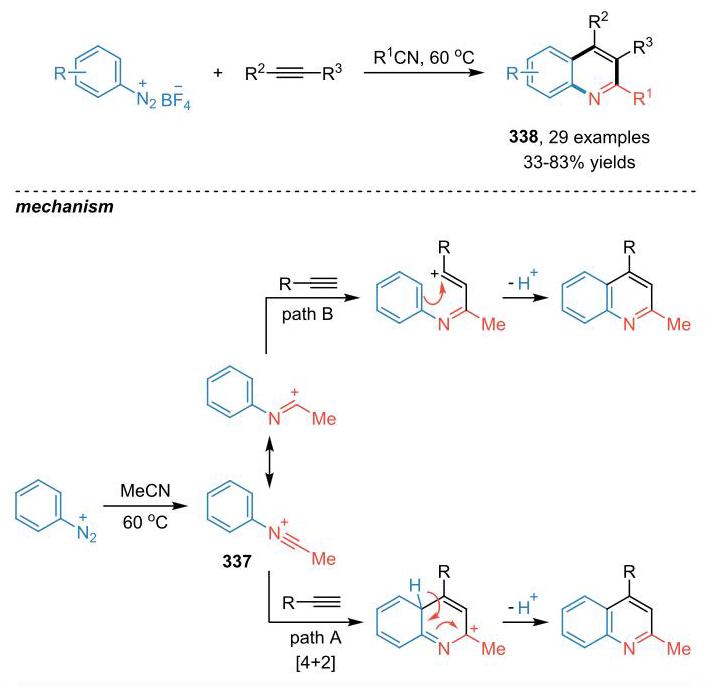
and styrenes 20 was represented under transition-metal-free conditions (Scheme 224). ${}^{393}$ This divergent synthetic
和苯乙烯20在无过渡金属条件下进行了展示(方案224)。${}^{393}$这种多样化的合成
Scheme 224. One-Pot Synthesis of (Tetrahydro)quinolines
方案224. (四氢)喹啉的一锅法合成
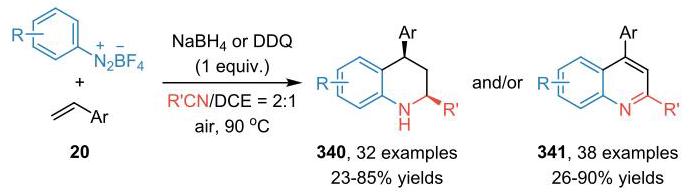
mechanism
机理
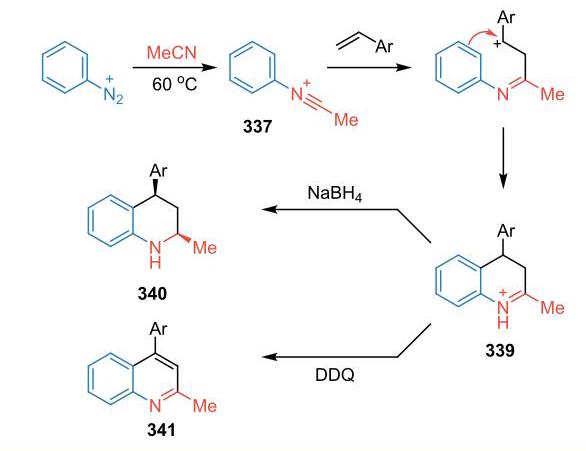
Moreover, the annulation strategy of aryl diazonium salts with nitriles was explored to access a variety of heterocyclic compounds. In 2017, Liu and co-workers reported a direct [2 +2 + 2] annulation of aryl diazonium salts with two equivalent nitriles, affording multisubstituted quinazolines 342 in moderate yields under metal-free conditions (Scheme 225). ${}^{395}$ Reaction of the aryl diazonium salt with a nitrile provides the initial formation of a reactive nitrilium ion, which is attacked by another molecule of nitrile followed by electrophilic cyclization to deliver the desired product. In 2018, the same group also reported the transition-metal-free synthetic route for $N$ -arylketimines 343 through intermolecular arylation of $N$ -arylnitrilium ions by electron-rich arenes. ${}^{396}$
此外,探索了芳基重氮盐与腈类的环化策略以获得各种杂环化合物。2017年,刘及其同事报道了芳基重氮盐与两当量腈类的直接[2 +2 + 2]环化反应,在无金属条件下以中等产率得到多取代喹唑啉342(方案225)。${}^{395}$芳基重氮盐与腈类的反应最初形成一个活性腈鎓离子,该离子受到另一个腈类分子的攻击,随后进行亲电环化以得到所需产物。2018年,同一研究小组还报道了通过富电子芳烃对$N$ -芳基腈鎓离子的分子间芳基化反应,在无过渡金属条件下合成$N$ -芳基酮亚胺343的路线。${}^{396}$
Scheme 225. Synthesis of Quinazolines and Ketimines
方案225. 喹唑啉和酮亚胺的合成
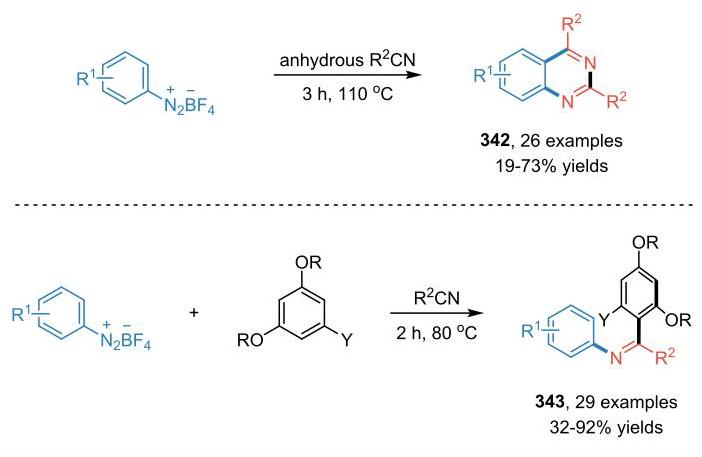
In 2017, the transition-metal-free synthesis of multi-substituted quinazolin-4(3H)-imines 345 had been achieved through the three-component reaction of aryl diazonium salts, nitriles, and 2-cyanoanilines 344 (Scheme 226). ${}^{397}$ This annulation reaction is initiated by the in situ formation of reactive $N$ -arylnitrilium intermediate 337, followed by nucleophilic amination/tandem cyclization with $o$ -cyanoani-lines 344 to deliver quinazolin-4(3H)-imines 345. This cyclization strategy has been utilized in the synthesis of quinazolino[3,4-a]-quinazolin-13-ones 346 through the annulation reaction of o-(methoxycarbonyl)benzene diazonium salts, nitriles, and 2-cyanoanilines 344. ${}^{398}$
2017年,通过芳基重氮盐、腈和2-氰基苯胺344的三组分反应(方案226),实现了多取代喹唑啉-4(3H)-亚胺345的无过渡金属合成。${}^{397}$ 该环化反应由活性$N$ -芳基腈鎓中间体337的原位形成引发,随后与$o$ -氰基苯胺344进行亲核胺化/串联环化反应,生成喹唑啉-4(3H)-亚胺345。这种环化策略已被用于通过邻(甲氧基羰基)苯重氮盐、腈和2-氰基苯胺344的环化反应合成喹唑啉并[3,4-a]-喹唑啉-13-酮346。${}^{398}$
Scheme 226. Synthesis of Quinazolin-4(3H)-Imines and Quinazolinoquinazolinones through Annulation Cascade
方案226。通过环化级联反应合成喹唑啉-4(3H)-亚胺和喹唑啉并喹唑啉酮
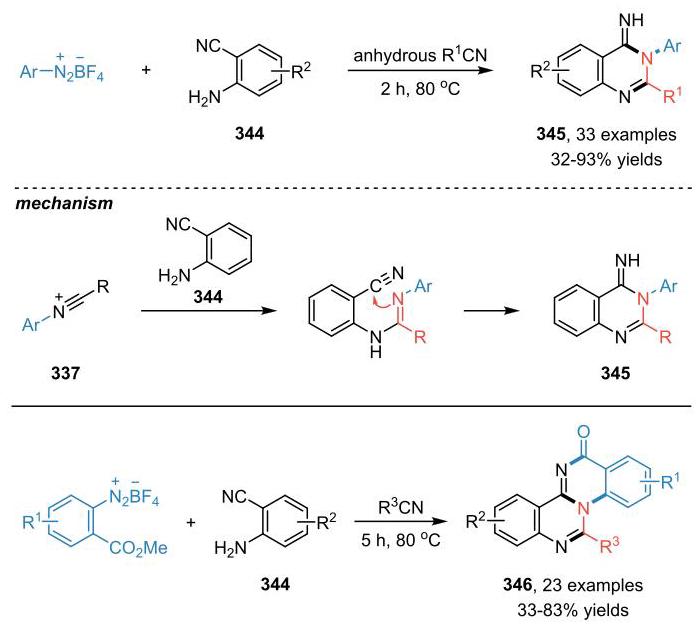
Furthermore, Liu has trapped the $N$ -arylnitrilium ion by 2- aminoarylketones 347 to furnish other heterocycles. The synthesis of $N$ -arylquinazolinium salts ${348}^{399}$ and 2-amino-3- cyanoquinolines ${349}^{400}$ was realized through the trapping process of $N$ -arylnitrilium ion 337 by 2-aminoarylketones 347, followed by sequential cyclizations (Scheme 227).
此外,刘用2-氨基芳基酮347捕获了$N$ -芳基腈鎓离子,以提供其他杂环化合物。通过2-氨基芳基酮347捕获$N$ -芳基腈鎓离子337,随后进行顺序环化反应,实现了$N$ -芳基喹唑啉鎓盐${348}^{399}$和2-氨基-3-氰基喹啉${349}^{400}$的合成(方案227)。
Scheme 227. Synthesis of N-Arylquinazolinium Salts and 2- Arylamino-3-Cyanoquinolines
方案227。N-芳基喹唑啉鎓盐和2-芳基氨基-3-氰基喹啉的合成
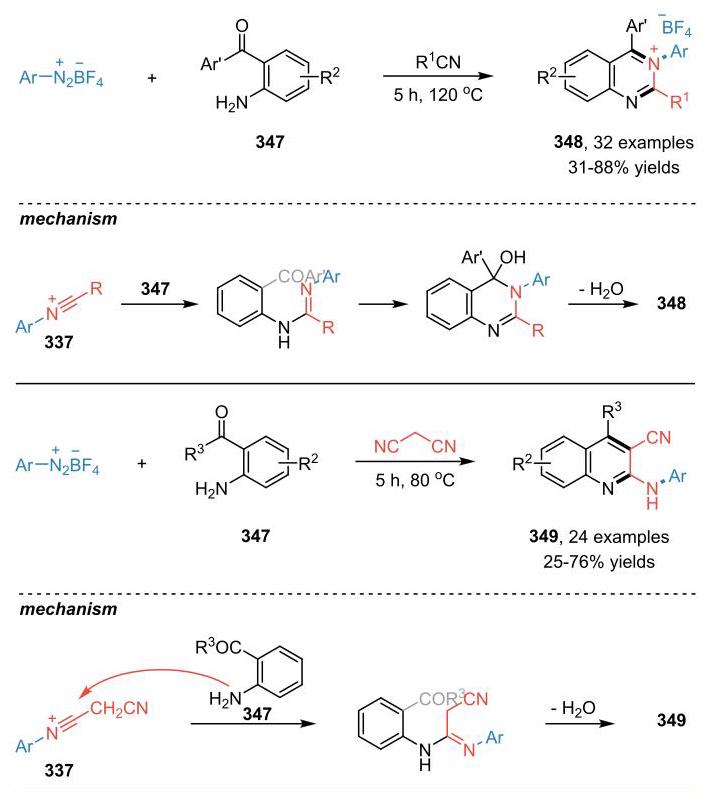
In 2019, Sharma and co-workers reported a catalyst-free three-component reaction of aryl diazonium salts, quinoline $N$ - oxides in acetonitrile under microwave irradiation, affording various 2-anilinoquinolines in moderate yields (Scheme 228). ${}^{401}$ This reaction pathway includes the formal [3 + 2] cycloaddition of quinoline $N$ -oxides with in situ formed $N$ - arylnitrilium ion, followed by proton abstraction/rearomatiza-tion/hydrolysis sequence to deliver the desired product. However, using 2-substituted quinoline as the substrates, this protocol affords 3-hydroxyquinoline as the major product through a 1,3-O-transfer from $N$ -oxide to the C3 position of quinolines.
2019年,夏尔马及其同事报道了在微波辐射下,芳基重氮盐、喹啉$N$ -氧化物在乙腈中的无催化剂三组分反应,以中等产率得到各种2-苯胺基喹啉(方案228)。${}^{401}$ 该反应途径包括喹啉$N$ -氧化物与原位形成的$N$ -芳基腈鎓离子的形式上的[3 + 2]环加成反应,随后进行质子抽取/再芳构化/水解序列反应,以得到所需产物。然而,使用2-取代喹啉作为底物时,该方案通过$N$ -氧化物向喹啉C3位的1,3-O-转移,以3-羟基喹啉作为主要产物。
Scheme 228. Synthesis of 2-Anilinoquinolines and 3- Hydroxyquinolines
方案228。2-苯胺基喹啉和3-羟基喹啉的合成
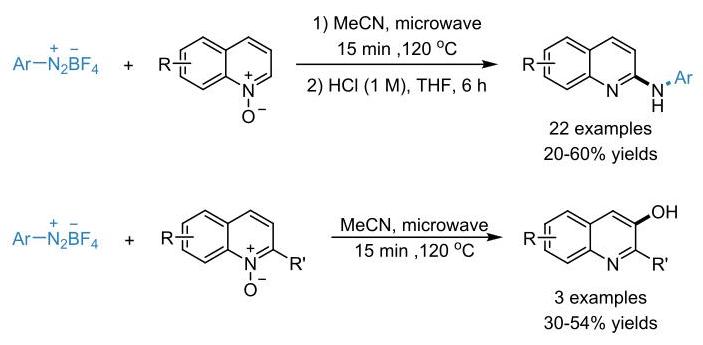
4. REACTIONS WITH THE RETENTION OF THE NITROGEN GROUP
4. 氮基团保留的反应
Aryl diazonium salts have been applied not only in $\mathrm{C} - \mathrm{C}/\mathrm{C} - \mathrm{X}$ bond formation through the extrusion of ${\mathrm{N}}_{2}$ ; these substrates can also be subjected to $N$ -containing coupling reactions, affording aryl hydrazines, azo compounds, hydrazones, various $N$ -heterocycles, and other compounds. In this section, we will briefly introduce these reactions (Figure 4). Mechanistically, these $N$ -containing coupling reactions can be summarized according to the nucleophilic or radical-type reactions. The previous routes involve the direct addition of aryl diazonium ions by carbonic nucleophiles to obtain azo, hydrazone, and diazo-containing heterocycles. The latter pathway consists of the interception of diazonium ions by carbon-centered radicals.
芳基重氮盐不仅已通过挤出${\mathrm{N}}_{2}$应用于$\mathrm{C} - \mathrm{C}/\mathrm{C} - \mathrm{X}$键的形成;这些底物还可以进行含$N$的偶联反应,得到芳基肼、偶氮化合物、腙、各种含$N$的杂环以及其他化合物。在本节中,我们将简要介绍这些反应(图4)。从机理上讲,这些含$N$的偶联反应可以根据亲核或自由基型反应进行总结。先前的路线涉及碳酸亲核试剂直接加成芳基重氮离子以获得偶氮、腙和含重氮的杂环。后一种途径包括碳中心自由基拦截重氮离子。
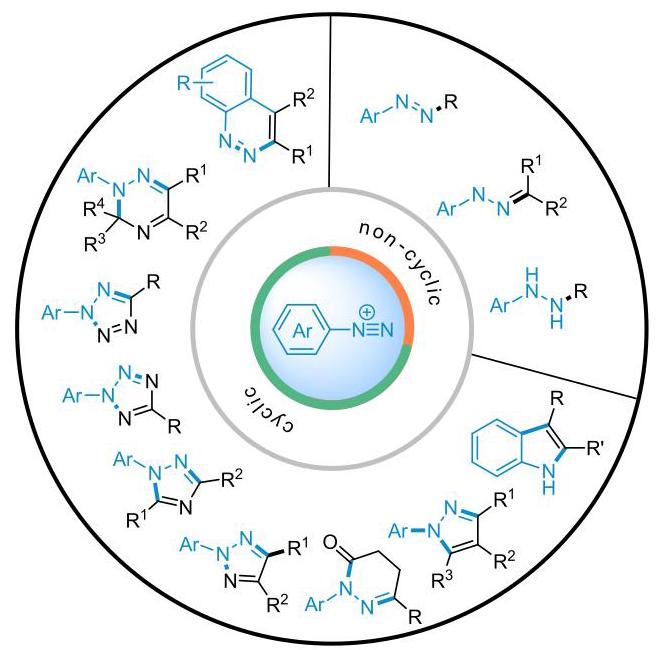
Figure 4. Reactions with retention of the nitrogen group.
图4. 氮基团保留的反应。
4.1. Nucleophilic Additions with Aryl Diazonium Cation
4.1. 芳基重氮阳离子的亲核加成反应
The aryl diazonium cation can be intercepted by nucleophiles to access the synthesis of various liner or cyclic compounds with the $N$ -containing moiety. The aryl diazonium ions can also be attacked by carbonic nucleophiles, including metal complexes, CH-acids, aromatic compounds, enolate species, diazo compounds, isocyanides, nitrile ylides, alkynes, enamines/enaminones, and others. Notably, the nucleophilic reactions with aryl diazonium salts represent a general method to synthesize azo compounds. In 2015, Shen reported a preparation and characterization of the thermally stable, well-defined NHC-ligated difluoromethylated silver complexes [(SIPr)Ag(CF ${}_{2}$ H) ${}^{3}$ SO. A variety of aryl diazonium salts were treated with $\left\lbrack {\left( \mathrm{{SIPr}}\right) \mathrm{{Ag}}\left( {{\mathrm{{CF}}}_{2}\mathrm{H}}\right) }\right\rbrack$ 350 in acetonitrile at room temperature, and the corresponding difluoromethylated azo derivatives, which are air- and moisture-insensitive compounds, were afforded in high yields (Scheme 229). ${}^{402}$
芳基重氮阳离子可被亲核试剂捕获,以合成各种含$N$基团的直链或环状化合物。芳基重氮离子也可被碳亲核试剂进攻,包括金属配合物、碳氢酸、芳香族化合物、烯醇盐、重氮化合物、异腈、腈叶立德、炔烃、烯胺/烯胺酮等。值得注意的是,芳基重氮盐的亲核反应是合成偶氮化合物的通用方法。2015年,沈报道了热稳定、结构明确的NHC配体二氟甲基化银配合物[(SIPr)Ag(CF ${}_{2}$ H) ${}^{3}$ SO的制备与表征。在室温下,将各种芳基重氮盐与乙腈中的$\left\lbrack {\left( \mathrm{{SIPr}}\right) \mathrm{{Ag}}\left( {{\mathrm{{CF}}}_{2}\mathrm{H}}\right) }\right\rbrack$ 350反应,得到相应的二氟甲基化偶氮衍生物,这些化合物对空气和湿气不敏感,产率很高(方案229)。${}^{402}$
Scheme 229. Difluoromethylation of Aryl Diazonium Salts with $\left\lbrack {\left( \mathbf{{SIPr}}\right) \mathbf{{Ag}}\left( {{\mathbf{{CF}}}_{2}\mathbf{H}}\right) }\right\rbrack$
方案229. 用$\left\lbrack {\left( \mathbf{{SIPr}}\right) \mathbf{{Ag}}\left( {{\mathbf{{CF}}}_{2}\mathbf{H}}\right) }\right\rbrack$对芳基重氮盐进行二氟甲基化反应
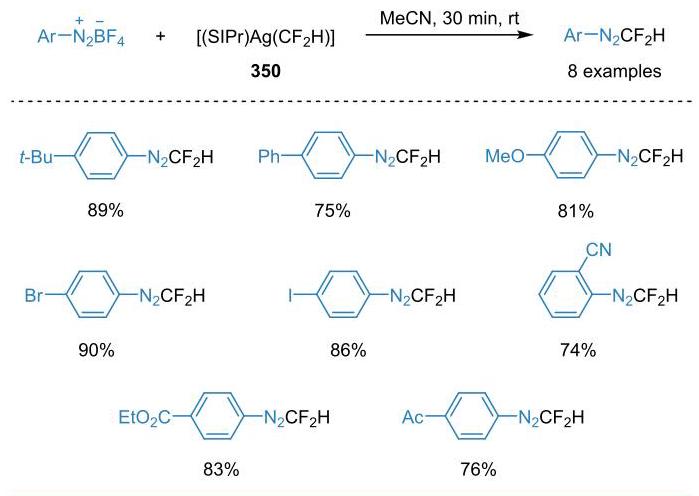
As for the heterocyclic diazonium analogues, preparing a series of stable, previously inaccessible 1,2,5-oxadiazolyl diazonium salts 351 were represented by using ${\mathrm{{NOBF}}}_{4}$ in trifluoroacetic acid. ${}^{403}$ Selective azo coupling reactions of obtained diazonium salts with a series of structurally diverse CH-acids, including arenes, dimedone, Meldrum’s acid, and 2- nitropropane, have also been successfully performed (Scheme 230).
至于杂环重氮类似物,通过在三氟乙酸中使用${\mathrm{{NOBF}}}_{4}$制备了一系列稳定的、以前难以获得的1,2,5-恶二唑基重氮盐351。${}^{403}$ 所得重氮盐与一系列结构多样的碳氢酸,包括芳烃、达米酮、丙二酸亚异丙酯和2-硝基丙烷,也成功进行了选择性偶氮偶联反应(方案230)。
Scheme 230. Azo Coupling Reactions of 1,2,5-Oxadiazolyl Diazonium Salts
方案230. 1,2,5-恶二唑基重氮盐的偶氮偶联反应
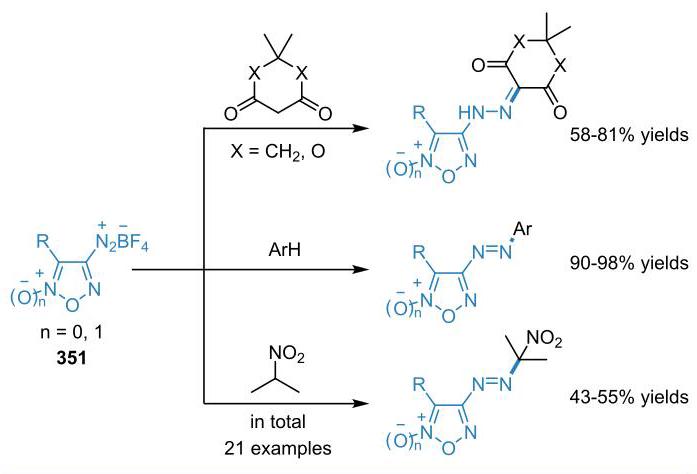
As a complementary route to azo compounds under metal-free conditions, aryl diazonium salts can also undergo nucleophilic attack by imidazo-heterocycles, ${}^{404}$ as well as by 2,3-dihydropyrroles, ${}^{405}$ affording azo imidazo[1,2-a]pyridines and 4-arylazo-2-pyrrolines, respectively.
作为在无金属条件下合成偶氮化合物的补充途径,芳基重氮盐也可被咪唑杂环${}^{404}$以及2,3-二氢吡咯${}^{405}$亲核进攻,分别得到偶氮咪唑并[1,2-a]吡啶和4-芳基偶氮-2-吡咯啉。
Enolate species can trap the aryl diazonium salts to obtain hydrazone derivatives. In 2018, Zhu and Jiang developed a base-mediated intermolecular $\mathrm{C}\left( {\mathrm{{sp}}}^{3}\right) - \mathrm{H}$ amination reaction of trifluoromethyl ketones 352 and aryl diazonium salts, giving rise to trifluoroacetylated hydrazones 353 in high yields with excellent $E/Z$ selectivity (Scheme 231). ${}^{406}$ This simple protocol features metal-, catalyst-, directing group-free, gram-scalable, and a wide range of substrate scope. This reaction is proposed to be imitated by the enolization of the trifluoromethyl ketone 352 in the presence of a base. A subsequent interception by enolate anion occurs, followed by 1,3-HAT to obtain 353.
烯醇盐可捕获芳基重氮盐以获得腙衍生物。2018年,朱和江开发了一种碱介导的三氟甲基酮352与芳基重氮盐的分子间$\mathrm{C}\left( {\mathrm{{sp}}}^{3}\right) - \mathrm{H}$胺化反应,以高产率和优异的$E/Z$选择性得到三氟乙酰化腙353(方案231)。${}^{406}$ 这个简单的方法具有无金属、无催化剂、无导向基团、克级规模且底物范围广的特点。该反应被认为是在碱存在下三氟甲基酮352的烯醇化反应所模拟的。随后烯醇盐阴离子进行捕获,接着通过1,3-氢原子转移得到353。
Scheme 231. Synthesis of Trifluoroacetylated Hydrazones of Trifluoromethyl Ketones
方案231. 三氟甲基酮的三氟乙酰化腙的合成
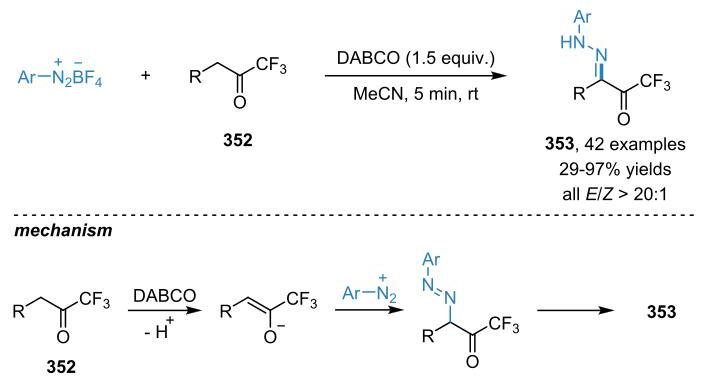
In 2018, the synthesis of $\alpha$ -arylhydrazo- $\beta$ -keto sulfones 354 was realized by a Cu-catalyzed, four-component reaction of aryl diazonium salts, alkenes, and sodium sulfinates under aerobic conditions (Scheme 232). ${}^{407}$ This oxysulfonylation/ diazenylation cascade protocol allows the facile formation of $\mathrm{C} - \mathrm{O},\mathrm{C} - \mathrm{S}$ , and $\mathrm{C} - \mathrm{N}$ bonds in a one-pot manner. The reaction is proposed to be initiated by the single-electron oxidation of sulfonyl anion by oxygen in the presence of $\mathrm{{Cu}}$ (II) catalyst to afford sulfonyl radical 355. After several radical-type transformations, the key step is the nucleophilic addition of enol Cu (II) intermediate 356 at the terminal nitrogen atom, followed by the final tautomerization to sulfones 354.
2018年,通过芳基重氮盐、烯烃和亚磺酸钠在有氧条件下的铜催化四组分反应,实现了$\alpha$-芳基肼基-$\beta$-酮砜354的合成(方案232)。${}^{407}$这种氧硫化/重氮基化级联方案允许以一锅法轻松形成$\mathrm{C} - \mathrm{O},\mathrm{C} - \mathrm{S}$和$\mathrm{C} - \mathrm{N}$键。该反应被认为是在氧存在下磺酰阴离子在$\mathrm{{Cu}}$(II)催化剂存在下进行单电子氧化开始,生成磺酰基自由基355。经过几次自由基型转化后,关键步骤是烯醇铜(II)中间体356在末端氮原子处进行亲核加成,随后最终互变异构为砜354。
Scheme 232. Copper(II)-Catalyzed Synthesis of $\alpha$ - Arylhydrazo- $\beta$ -keto Sulfones
方案232. 铜(II)催化合成$\alpha$-芳基肼基-$\beta$-酮砜
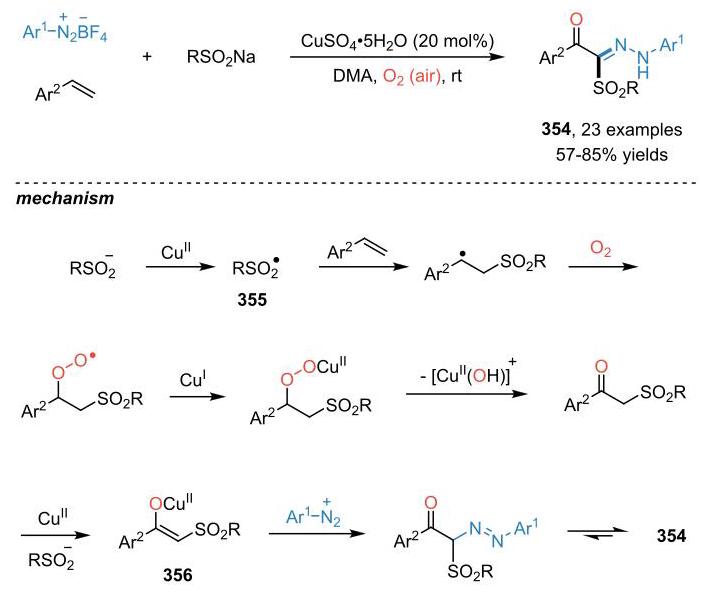
In the same year, a Co-catalyzed, three-component cycloaddition reaction of aryl diazonium salts, diazoesters 357 and 1,3-dicarbonyl compounds was represented (Scheme 233). ${}^{408}$ The reaction pathway initiates at nucleophilic addition of the diazoester 357 to the terminal nitrogen of the aryl diazonium salt. After extrusion of ${\mathrm{N}}_{2},1,3$ -HAT and elimination of ${\mathrm{{HBF}}}_{4}$ generate nitrilimine 358, which undergoes [2,3]-cycloaddition with 1,3-dicarbonyl compounds to form fully substituted pyrazoles and eliminate water at room temperature.
同年,报道了芳基重氮盐、重氮酯357和1,3-二羰基化合物的钴催化三组分环加成反应(方案233)。${}^{408}$反应途径始于重氮酯357对芳基重氮盐末端氮的亲核加成。在挤出${\mathrm{N}}_{2},1,3$-HAT并消除${\mathrm{{HBF}}}_{4}$后生成腈亚胺358,其与1,3-二羰基化合物进行[2,3]-环加成以形成完全取代的吡唑,并在室温下消除水。
Ma and co-workers demonstrated the synthesis of tetrazoles through a cycloaddition cascade reaction. ${}^{{409} - {412}}$ In 2015, they found that the aryl diazonium salts can be trapped by
马和同事通过环加成级联反应证明了四唑的合成。${}^{{409} - {412}}$2015年,他们发现芳基重氮盐可以被
Scheme 233. Synthesis of Pyrazoles of Aryl diazonium Salts, Diazoesters and 1,3-Dicarbonyls
方案233. 芳基重氮盐、重氮酯和1,3-二羰基化合物合成吡唑
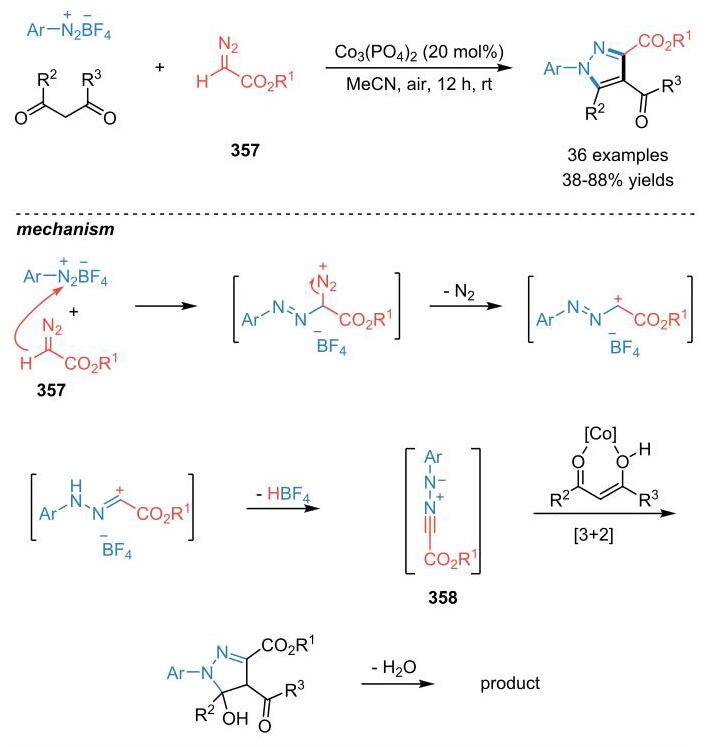
${\mathrm{{CF}}}_{3}{\mathrm{{CHN}}}_{2}$ 359 catalyzed by silver salts, giving rise to a diverse array of 2-aryl-5-trifluoromethyltetrazoles with moderate to excellent yields (Scheme 234). ${}^{409}$ The one-pot diazotization/ cycloaddition sequence from commercially available aniline derivatives has also been achieved.
${\mathrm{{CF}}}_{3}{\mathrm{{CHN}}}_{2}$359在银盐催化下捕获,以中等至优异的产率得到各种2-芳基-5-三氟甲基四唑(方案234)。${}^{409}$也实现了从市售苯胺衍生物的一锅法重氮化/环加成序列。
Scheme 234. Silver-Catalyzed [3 + 2] Cycloaddition of Aryl Diazonium Salts with ${\mathrm{{CF}}}_{3}{\mathrm{{CHN}}}_{2}$
方案234. 芳基重氮盐与${\mathrm{{CF}}}_{3}{\mathrm{{CHN}}}_{2}$的银催化[3 + 2]环加成
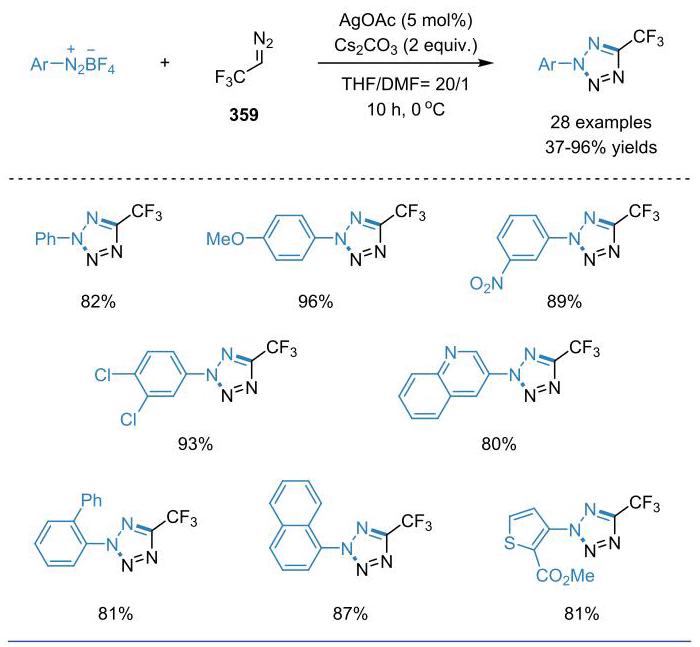
In 2019, they explored ${\mathrm{{PhSO}}}_{2}{\mathrm{{CF}}}_{2}{\mathrm{{CHN}}}_{2}{\mathbf{{360}}}_{\text{ and }}$ the Seyferth-Gilbert reagent 361 as the substrates in a silver-catalyzed formal [3 + 2] cycloaddition strategy under mild conditions, enabling the regioselective synthesis of a variety of difluoromethylated tetrazoles, ${}^{410}$ as well as a broad set of phosphonylated tetrazoles (Scheme 235). ${}^{411}$ These two cycloaddition protocols exhibit a feasible one-pot operation from commercially available aniline derivatives. The trapping process by diazoacetates or $\alpha$ -diazo acetophenones was also disclosed, allowing the regioselective construction of ketone-derived or carboxylic tetrazoles (35 examples, 46-92% yields). ${}^{412}$
2019年,他们在温和条件下探索了${\mathrm{{PhSO}}}_{2}{\mathrm{{CF}}}_{2}{\mathrm{{CHN}}}_{2}{\mathbf{{360}}}_{\text{ and }}$Seyferth-Gilbert试剂361作为底物用于银催化的形式[3 + 2]环加成策略,能够区域选择性地合成各种二氟甲基化四唑,${}^{410}$以及一系列膦酰化四唑(方案235)。${}^{411}$这两种环加成方案展示了从市售苯胺衍生物进行可行的一锅操作。还公开了通过重氮乙酸酯或$\alpha$-重氮苯乙酮的捕获过程,允许区域选择性构建酮衍生的或羧酸四唑(35个例子,产率46-92%)。${}^{412}$
Scheme 235. Nucleophilic Addition of Aryl Diazonium Salts with ${\mathrm{{PhSO}}}_{2}{\mathrm{{CF}}}_{2}{\mathrm{{CHN}}}_{2}$ and Seyferth-Gilbert Reagent
方案235. 芳基重氮盐与${\mathrm{{PhSO}}}_{2}{\mathrm{{CF}}}_{2}{\mathrm{{CHN}}}_{2}$和Seyferth-Gilbert试剂的亲核加成
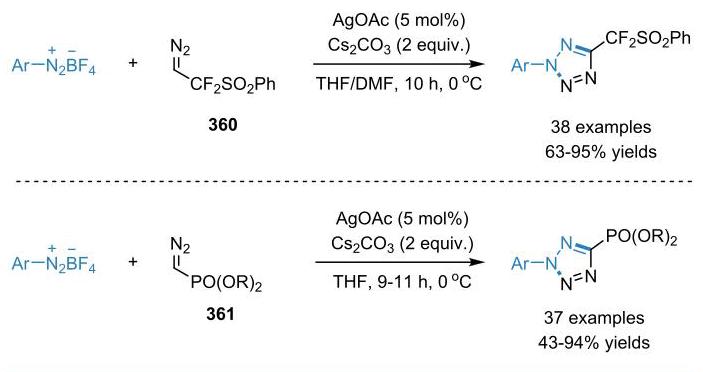
Moreover, the cycloaddition of aryl diazonium salts has been applied in the facile synthesis of functionalized 1,2,4-triazoles. In this strategy, diazonium salts serve as the two N atom resource to target 1,2,4-triazoles skeletons and trap by isocyanides selectively. In 2018, the construction of 1,2,4- triazole scaffold had been achieved by a catalyst-dependent regioselective $\left\lbrack {3 + 2}\right\rbrack$ cycloaddition of isocyanides with aryl diazonium salts (Scheme 236). ${}^{413}$ This reaction selectively affords 1,3-disubstituted 1,2,4-triazoles 362 with high yields under Ag(I) catalysis, whereas 1,5-disubstituted 1,2,4-triazoles 363 with moderate to good yields by Cu(II) catalysis.
此外,芳基重氮盐的环加成反应已应用于功能化1,2,4-三唑的简便合成。在该策略中,重氮盐作为两个N原子源,用于构建1,2,4-三唑骨架,并通过异腈选择性捕获。2018年,通过异腈与芳基重氮盐的催化剂依赖区域选择性$\left\lbrack {3 + 2}\right\rbrack$环加成反应实现了1,2,4-三唑骨架的构建(方案236)。${}^{413}$该反应在Ag(I)催化下以高产率选择性地得到1,3-二取代的1,2,4-三唑362,而在Cu(II)催化下以中等至良好的产率得到1,5-二取代的1,2,4-三唑363。
In 2018, Bao and Wan reported a copper-catalyzed, three-component reaction of aryl diazonium salts, diazo compounds, and nitriles to obtain fully substituted 1,2,4-triazoles (Scheme 237). ${}^{414}$ This catalytic reaction proceeds through selective [3 + 2] cycloaddition of in situ formed nitrile ylides 364 with diazonium ions.
2018年,Bao和Wan报道了芳基重氮盐、重氮化合物和腈的铜催化三组分反应,以获得完全取代的1,2,4-三唑(方案237)。${}^{414}$该催化反应通过原位形成的腈叶立德364与重氮离子的选择性[3 + 2]环加成进行。
Another synthetic route toward 1,3,5-trisubstituted 1,2,4- triazoles involves the metal-free cycloaddition/decarboxylation cascade reaction of aryl diazonium salts utilizing azlactones 365 as the cycloadditive partners (Scheme 238). ${}^{415}$ The selectivity in the formation of 1,2,4-triazoles depends on the structure of aryl diazonium salts.
另一条合成1,3,5-三取代1,2,4-三唑的路线涉及芳基重氮盐与吖内酯365作为环加成伙伴的无金属环加成/脱羧级联反应(方案238)。${}^{415}$1,2,4-三唑形成的选择性取决于芳基重氮盐的结构。
Moreover, aryl diazonium salts have also been explored as the dinitrogen resource trapping by alkyne, achieving the one-pot assembly of 4-amidocinnolines 366 in the absence of transition-metal with high yields (Scheme 239). ${}^{416}$ Mechanistically, this reaction includes the sequence of diazotization with $t$ -BuONO, intramolecular nucleophilic addition of the alkyne to the diazonium ion, followed by nitrile addition to the intermediary vinyl cation 367 and hydrolysis.
此外,芳基重氮盐也被用作炔烃捕获的二氮源,在无过渡金属的情况下以高产率实现了4-氨基喹啉366的一锅组装(方案239)。${}^{416}$从机理上讲,该反应包括用$t$-BuONO进行重氮化、炔烃对重氮离子的分子内亲核加成,然后腈加成到中间体乙烯基阳离子367上并水解。
Moreover, the copper-mediated annulation cascade reactions have opened a novel route to access functionalized $N$ -aryl 1,2,3-triazoles in a facile manner. In this process, the key step includes the nucleophilic attack of in situ formed Cu-coordinated enamines with aryl diazonium cations. The vinyl azides have been utilized as enamine precursors in the presence of copper to participate in cascade cyclization with aryl diazonium salts, affording densely functionalized ${N}^{2}$ -substituted 1,2,3-triazoles with moderate to good yields. ${}^{417}$ In 2020, Cheung and Ma developed a Cu-mediated annulation reaction of alkyl 3-aminoacrylates with aryl diazonium salts, affording
此外,铜介导的环化级联反应为以简便方式获得功能化的$N$-芳基1,2,3-三唑开辟了一条新途径。在这个过程中,关键步骤包括原位形成的铜配位烯胺对芳基重氮阳离子的亲核攻击。在铜存在下,乙烯基叠氮化物已被用作烯胺前体,参与与芳基重氮盐的级联环化反应,以中等至良好的产率得到高度功能化的${N}^{2}$-取代的1,2,3-三唑。${}^{417}$2020年,Cheung和Ma开发了一种铜介导的3-氨基丙烯酸烷基酯与芳基重氮盐的环化反应,得到
Scheme 236. [3 + 2] Cycloaddition of Isocyanides with Aryl Diazonium Salts
方案236. 异腈与芳基重氮盐的[3 + 2]环加成
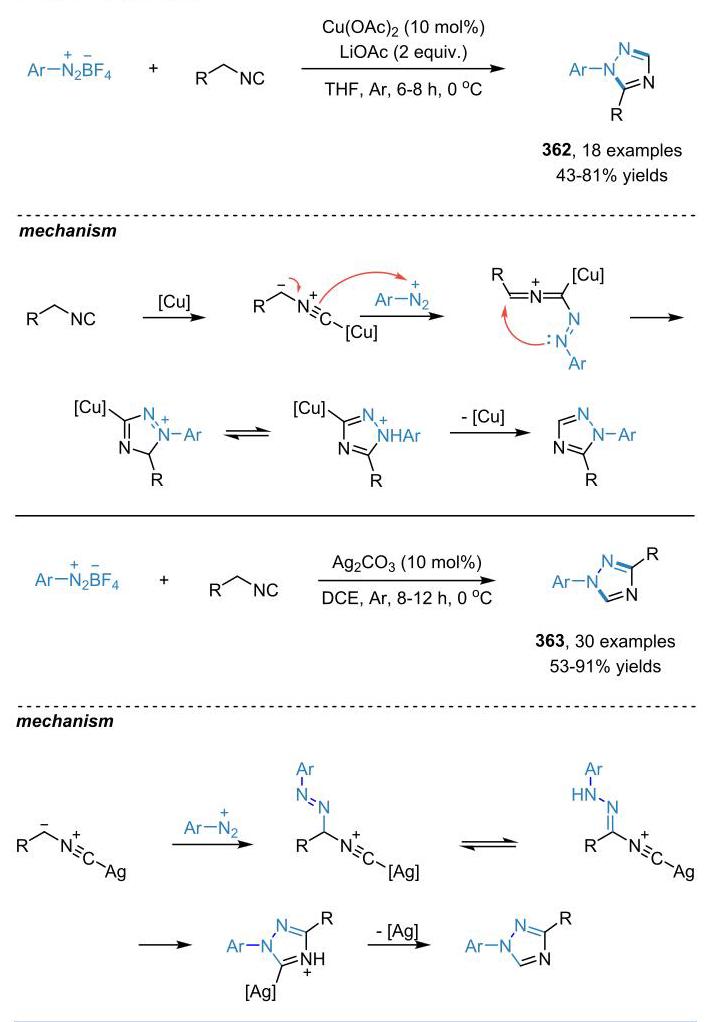
Scheme 237. Diazonium Ions Trapped by Nitrile Ylides
方案237. 腈叶立德捕获重氮离子
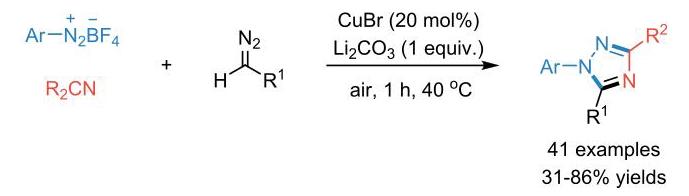
mechanism
机理
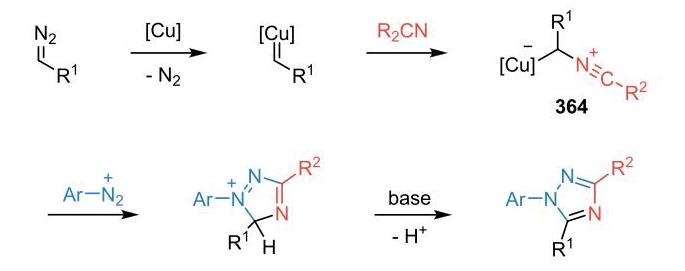
diverse alkyl ${N}^{2}$ -aryl1,2,3-triazole-carboxylates and their analogues under mild conditions. ${}^{418}$ These two reactions are proposed to proceed through an ionic mechanism, which includes a Cu-based cyclized species 368/369 as the key intermediate, followed by a reductive elimination to furnish the ${N}^{2}$ -aryl triazole product (Scheme 240).
在温和条件下得到多种烷基${N}^{2}$-芳基1,2,3-三唑羧酸酯及其类似物。${}^{418}$这两个反应被认为是通过离子机理进行的,其中包括以铜基环化物种368/369作为关键中间体,随后进行还原消除以提供${N}^{2}$-芳基三唑产物(方案240)。
The copper-catalyzed annulation cascade reactions of aryl diazonium salts with oxime acetates ${}^{419}$ and arylamines ${}^{420}$ were developed, affording $N$ -2-aryl-1,2,3-triazoles and $N$ -2-aryl-
开发了芳基重氮盐与肟乙酸酯${}^{419}$和芳基胺${}^{420}$的铜催化环化级联反应,得到$N$-2-芳基-1,2,3-三唑和$N$-2-芳基-
Scheme 238. Synthesis of 1,2,4-Triazoles from Azlactones
方案238. 由吖内酯合成1,2,4-三唑
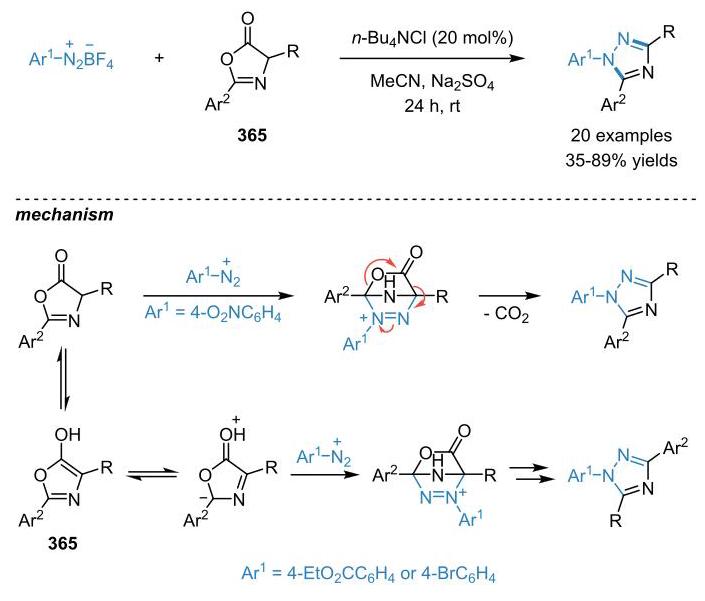
Scheme 239. ${\mathrm{{BF}}}_{3}$ -Mediated Cascade Reaction of 2- Alkynylanilines with Nitriles naphthotriazoles, respectively (Scheme 241). In the previous case, the proposed mechanism involves a nucleophilic attack of copper(II) enamide complex at the terminal $\mathrm{N}$ atom of aryl diazonium salts, followed by the isomerization to obtain cyclic hydrazonyl iminyl copper(II) as the key intermediate 370.
方案239. ${\mathrm{{BF}}}_{3}$介导的2-炔基苯胺与腈萘并三唑的级联反应(方案241)。在前一种情况下,提出的机理涉及铜(II)乙酰胺络合物对芳基重氮盐末端$\mathrm{N}$原子的亲核攻击,随后异构化以获得环状腙基亚氨基铜(II)作为关键中间体370。
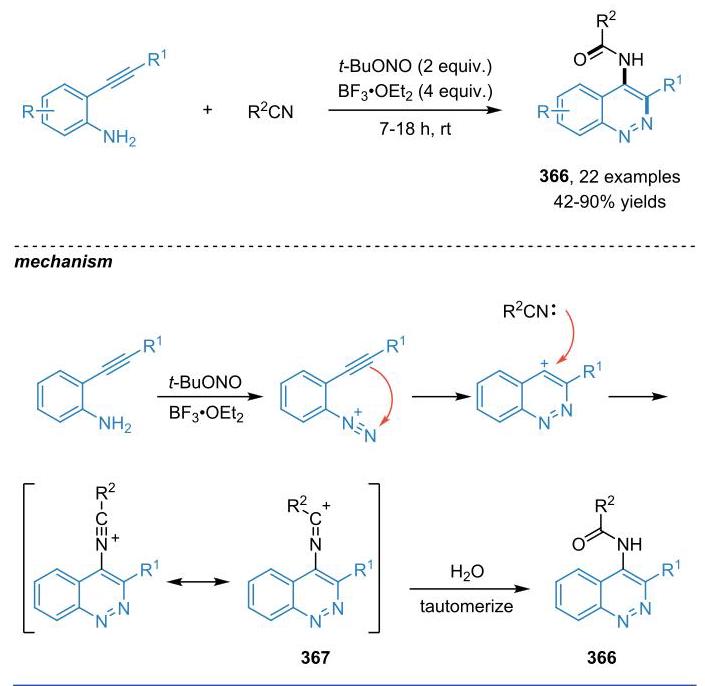
A divergent copper-catalyzed trapping process of ketene $N, S$ -acetals (alkylthio-substituted enaminones) with aryl diazonium salts was disclosed under an oxygen atmosphere at room temperature, allowing the regioselective generation of functionally diverse ${N}^{2}$ -substituted 1,2,3-triazoles 371 and 2,3- dihydro-1,2,4-triazines 372 (Scheme 242). ${}^{421}$ The selective formation of five- and six-membered $N$ -heterocyclic products depends on the amount of oxidant and base. The mechanistic studies have revealed that the reaction proceeds via the generation of six-membered imino-Cu(II) hydrazone complex 373, or seven-membered benzyl-Cu(II) hydrazone complex 374, respectively.
在室温常压下,公开了一种铜催化的酮$N, S$ -缩醛(烷硫基取代的烯胺酮)与芳基重氮盐的发散捕获过程,可区域选择性地生成功能多样的${N}^{2}$ -取代的1,2,3-三唑371和2,3-二氢-1,2,4-三嗪372(方案242)。${}^{421}$五元环和六元环$N$ -杂环产物的选择性形成取决于氧化剂和碱的用量。机理研究表明,反应分别通过生成六元亚氨基铜(II)腙络合物373或七元苄基铜(II)腙络合物374进行。
Scheme 240. Copper(I)-Mediated Synthesis of ${N}^{2}$ -Aryl 1,2,3-Triazoles from Vinyl Azides and Alkyl 3- Aminoacrylate
方案240. 由乙烯基叠氮化物和烷基3-氨基丙烯酸酯通过铜(I)介导合成${N}^{2}$ -芳基1,2,3-三唑
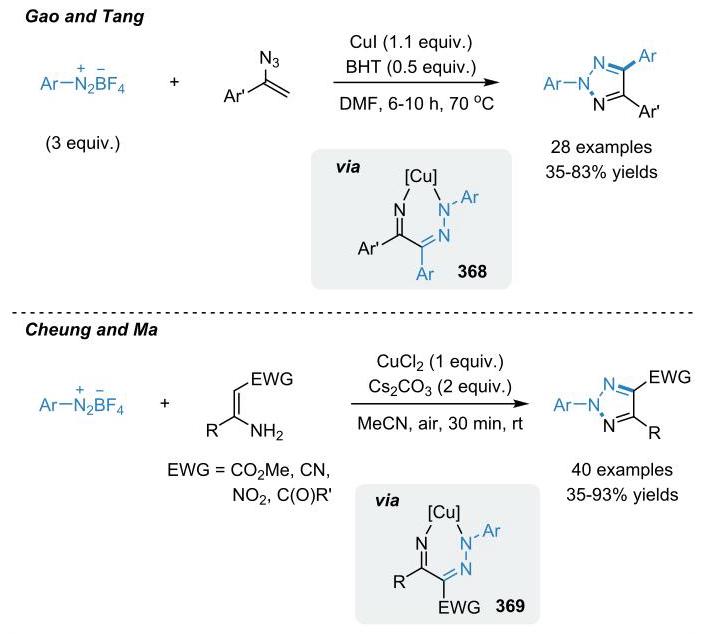
Scheme 241. Copper-Catalyzed Coupling of Oxime Acetates or Arylamines with Aryl diazonium Salts
方案241. 肟乙酸酯或芳胺与芳基重氮盐的铜催化偶联反应
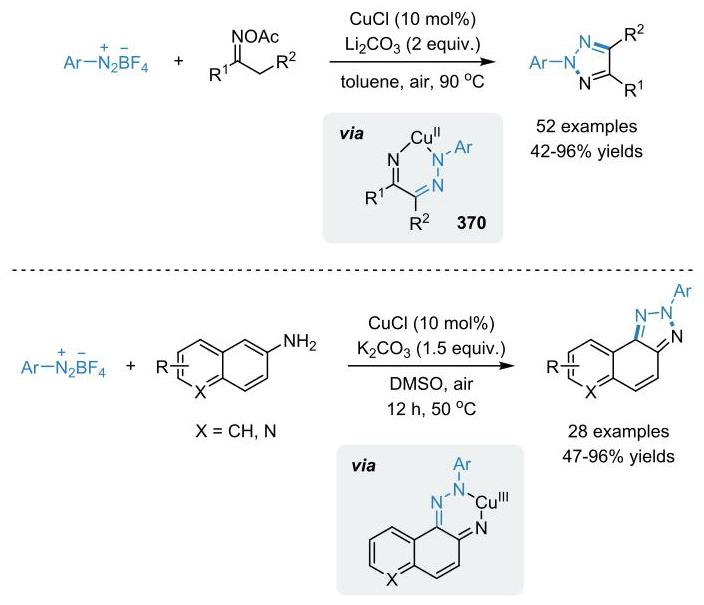
Additionally, both the homogeneous or heterogeneous copper-catalyzed [4 + 2] annulation reaction of $\beta$ -enaminones with aryl diazonium salts were developed, affording densely functionalized 3H-1,2,4-triazines 375 with good yields (Scheme 243). ${}^{422}$
此外,还开发了均相或非均相铜催化的$\beta$ -烯胺酮与芳基重氮盐的[4 + 2]环化反应,以良好的产率得到功能密集的3H-1,2,4-三嗪375(方案243)。${}^{422}$
As for the case of heteroatom nucleophiles, Slootweg and coworkers reported the facile synthesis of tunable aryl azophosphonium salts through the reaction of para-substituted aryl diazonium salts with tritert-butylphosphine, leading to a range of colored compounds (16 examples, 55-96% yields). ${}^{423}$ Additionally, the one-pot reaction from anilines through diazotization and treatment with a trialkyl phosphite was reported, affording phosphonohydrazines in moderate yields (6 examples, 27-84% yields). ${}^{424}$ These two reactions utilized phosphine compounds as the nucleophiles.
至于杂原子亲核试剂的情况,Slootweg及其同事报道了通过对取代芳基重氮盐与三叔丁基膦的反应,简便地合成了可调谐的芳基氮膦鎓盐,得到了一系列有色化合物(16个例子,产率55-96%)。${}^{423}$此外,还报道了从苯胺通过重氮化和用亚磷酸三烷基酯处理的一锅法反应,以中等产率(6个例子,产率27-84%)得到膦酰肼。${}^{424}$这两个反应都利用膦化合物作为亲核试剂。
Scheme 242. Copper(II)-Catalyzed C-H Nitrogenation/ Annulation Cascade of Ketene N, S-Acetals with Aryl Diazonium Salts
方案242. 铜(II)催化的乙烯酮N, S-缩醛与芳基重氮盐的C-H胺化/环化级联反应
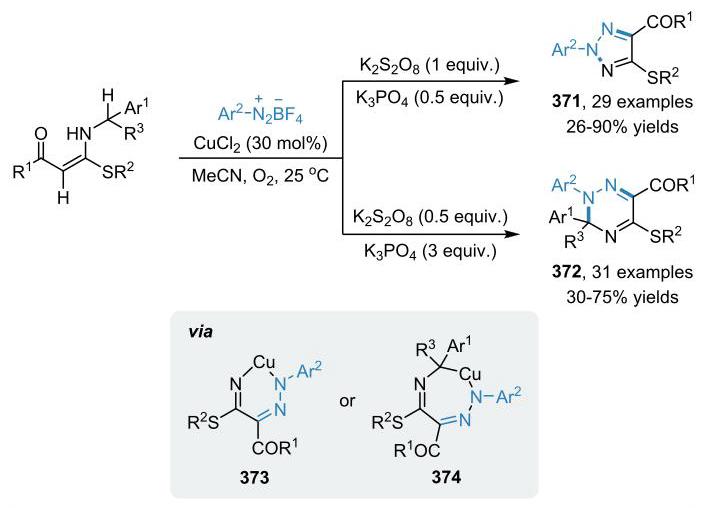
Scheme 243. Copper-Catalyzed [4 + 2] Annulation of $\beta$ - Enaminones and Aryl Diazonium Salts
方案243. 铜催化的$\beta$ -烯胺酮与芳基重氮盐的[4 + 2]环化反应
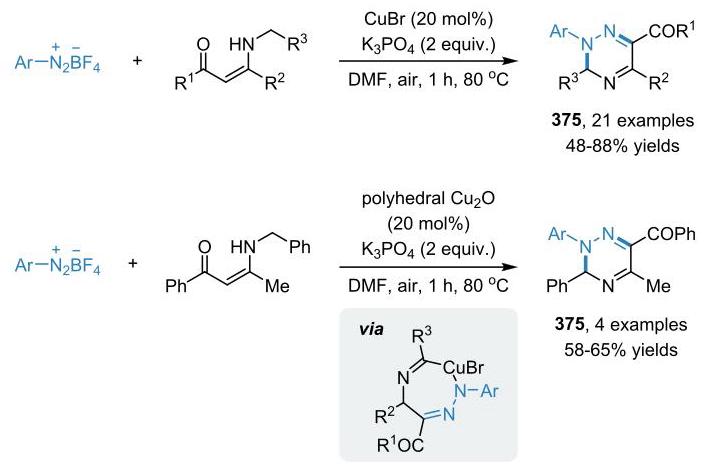
Nitrogen nucleophiles can also attack the aryl diazonium salts. In 2016, a three-step synthetic sequence toward benzo[e]imidazo[1,2-c][1,2,3]triazine derivatives was disclosed. ${}^{425}$ The reaction pathway includes sequential imidazole formation, reduction of nitro group accompanied by diazonium formation, and intramolecular $N - N$ bond formation, delivering benzo[e]imidazo[1,2-c][1,2,3]triazines with good yields (8 examples, 79-89% yields).
氮亲核试剂也可以进攻芳基重氮盐。2016年,公开了一种合成苯并[e]咪唑并[1,2-c][1,2,3]三嗪衍生物的三步合成序列。${}^{425}$反应途径包括依次形成咪唑、硝基还原伴随重氮形成以及分子内$N - N$键形成,以良好的产率得到苯并[e]咪唑并[1,2-c][1,2,3]三嗪(8个例子,产率79-89%)。
The construction of functionalized tetrazoles can be achieved through this trapping process with nitrogen nucleophiles. In 2015, Liu and co-workers reported a one-pot sequential reaction of aryl diazonium salts with amidines under basic conditions, followed by the treatment of ${\mathrm{I}}_{2}/\mathrm{{KI}}$ at room temperature (Scheme 244). ${}^{426}$ This transition-metal-free protocol affords a series of 2,5-disubstituted tetrazoles in moderate to high yields. The key step involves the nucleophilic addition of amidines with diazonium cation to obtain iminotriazene 376, followed by ${\mathrm{I}}_{2}$ -mediated cyclization and deprotonation sequence.
通过与氮亲核试剂的这种捕获过程可以实现功能化四唑的构建。2015年,Liu及其同事报道了芳基重氮盐与脒在碱性条件下的一锅顺序反应,然后在室温下用${\mathrm{I}}_{2}/\mathrm{{KI}}$处理(方案244)。${}^{426}$这种无过渡金属的方法以中等至高收率得到一系列2,5-二取代四唑。关键步骤包括脒与重氮阳离子的亲核加成以得到亚氨基三氮烯376,随后是${\mathrm{I}}_{2}$介导的环化和去质子化序列。
The nucleophilic trapping process also allows the synthesis of sulfonated hydrazines through a transition-metal- and oxidant-free cross-coupling reactions of various aryl diazonium tetrafluoroborates with rongalite 377, affording N-amino-sulfonamide 378 with moderate to good yields under room arylsulfinate anion, which is generated through the radical combination of the aryl radical with sulfoxylate anion radical.
亲核捕获过程还允许通过各种芳基重氮四氟硼酸盐与雕白粉377的无过渡金属和无氧化剂的交叉偶联反应合成磺化肼,在室温下以中等至良好的产率得到N-氨基磺酰胺378,芳基亚磺酸盐阴离子是通过芳基自由基与亚磺酸盐阴离子自由基的自由基结合产生的。
Scheme 244. Synthesis of 2,5-Substituted Tetrazoles from Aryl Diazonium Salts and Amidines
方案244. 由芳基重氮盐和脒合成2,5-取代四唑
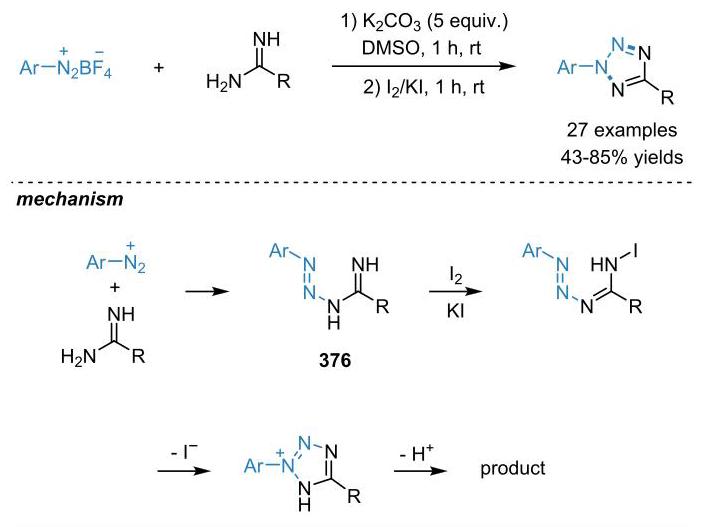
temperature (Scheme 245). ${}^{427}$ The essential step involves the nucleophilic addition of aryl diazonium ion by in situ formed
温度(方案245)。${}^{427}$ 关键步骤涉及原位形成的芳基重氮离子的亲核加成
Scheme 245. Synthesis of N-Aminosulfonamides through Radical Coupling Reactions
方案245. 通过自由基偶联反应合成N-氨基磺酰胺
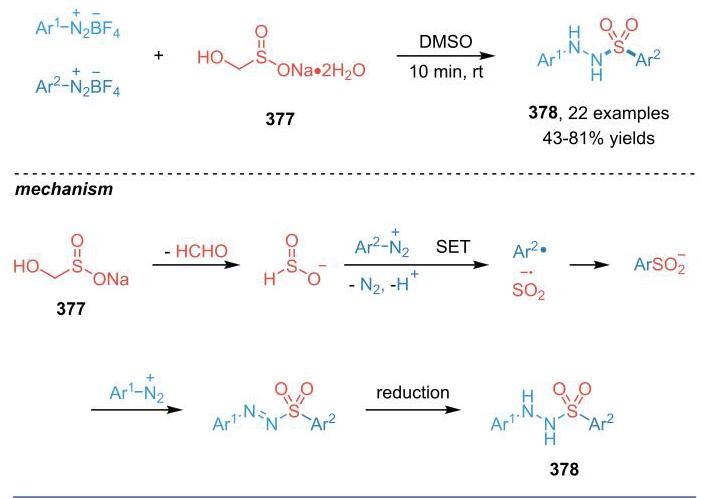
4.2. Radical-type Reactions with Aryl Diazonium Salts
4.2. 芳基重氮盐的自由基型反应
Another route in this section involves the radical-type interception of aryl diazonium ions, leading to the formation of diazonium radical cation, followed by a sequential SET process or radical-chain pathway to afford final products (Scheme 246). The radical chain may be initiated by copper complex, sulfinates, thermal, or photoredox conditions.
本节中的另一条途径涉及芳基重氮离子的自由基型截获,导致重氮自由基阳离子的形成,随后通过连续的单电子转移过程或自由基链途径得到最终产物(方案246)。自由基链可以由铜配合物、亚磺酸盐、热或光氧化还原条件引发。
In 2015, Heinrich and co-workers developed a transition-metal-free carboamination reaction of inert alkenes under thermal conditions, affording the desired azo compounds with moderate to good yields (Scheme 247). ${}^{428}$ This base-induced radical carboamination protocol proceeds via the formation of an alkyl radical by the addition of aryl radical with an alkene. The critical step is the trapping process of aryl diazonium ion by this alkyl radical, followed by SET to get a difunctionaliza-tion product. The radical alkene functionalization by using frozen diazonium chlorides was also disclosed, enabling the azo formation with moderate yields. ${}^{429}$
2015年,海因里希及其同事开发了一种在热条件下惰性烯烃的无过渡金属碳胺化反应,以中等至良好的产率得到所需的偶氮化合物(方案247)。${}^{428}$ 这种碱诱导的自由基碳胺化方案通过芳基自由基与烯烃加成形成烷基自由基来进行。关键步骤是该烷基自由基捕获芳基重氮离子的过程,随后进行单电子转移以得到双官能化产物。还公开了使用冷冻重氮氯化物进行的自由基烯烃官能化反应,能够以中等产率形成偶氮化合物。${}^{429}$
Scheme 246. General Routes for Radical-type Interception
方案246. 自由基型截获的一般途径

Scheme 247. Carboamination for the Synthesis of Azo Compounds
方案247. 用于合成偶氮化合物的碳胺化反应
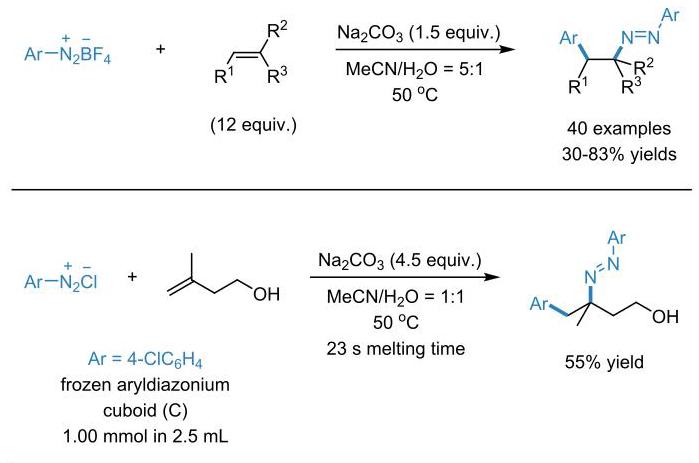
Besides, the copper complex has been utilized to promote the tandem ring-opening/cyclization cascade of cyclopropanols 379 with aryl diazonium salts at room temperature, achieving the regioselective synthesis of structurally diverse $N$ -aryl pyrazoles with good yields (Scheme 248). ${}^{430}$ The reaction pathway includes the SET and ring-opening process, leading to the formation of the $\beta$ -keto alkyl radical 380, trapped by aryl diazonium salt to afford a $N$ -radical cation 381. Subsequent single-electron reduction, 1,3-HAT, intramolecular cyclization, and water elimination occur successively, affording desired $N$ - aryl pyrazole.
此外,铜配合物已被用于在室温下促进环丙醇379与芳基重氮盐的串联开环/环化级联反应,以良好的产率实现结构多样的$N$ -芳基吡唑的区域选择性合成(方案248)。${}^{430}$ 反应途径包括单电子转移和开环过程,导致形成$\beta$ -酮烷基自由基380,被芳基重氮盐捕获得到$N$ -自由基阳离子381。随后依次发生单电子还原、1,3-氢原子转移、分子内环化和水消除,得到所需的$N$ -芳基吡唑。
Scheme 248. Synthesis of N-Arylpyrazoles through Cu-Mediated Tandem Ring-Opening/Cyclization Reactions
方案248. 通过铜介导的串联开环/环化反应合成N-芳基吡唑
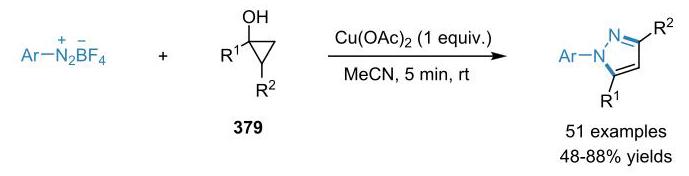
mechanism
机理
Cu(OAc) ${}_{2}$ Cu(OAc) ${}_{2}$ - CuOAc
醋酸铜${}_{2}$ 醋酸铜${}_{2}$ - 醋酸亚铜
CuI
碘化亚铜
Ar
R
380 381
Ar
-Ar
$- {\mathrm{H}}_{2}\mathrm{O}$
( OH
The sulfinates have also been employed to initiate the radical-type interception reaction of aryl diazonium salts. In 2014, Antonchick and co-workers established a novel multicomponent cascade reaction of alkenes, diazonium salts, and sodium triflinate 114, representing a straightforward and regioselective synthetic route to access indoles, pyrazoles, and pyridazinones with moderate to good yields (Scheme 249). ${}^{431}$
亚磺酸盐也被用于引发芳基重氮盐的自由基型截获反应。2014年,安东奇克及其同事建立了一种烯烃、重氮盐和三氟甲磺酸钠114的新型多组分级联反应,这是一条直接且区域选择性的合成路线,能够以中等至良好的产率获得吲哚、吡唑和哒嗪酮(方案249)。${}^{431}$
Scheme 249. Cascade Multicomponent Synthesis of Indoles, Pyrazoles, and Pyridazinones
方案249. 吲哚、吡唑和哒嗪酮的级联多组分合成
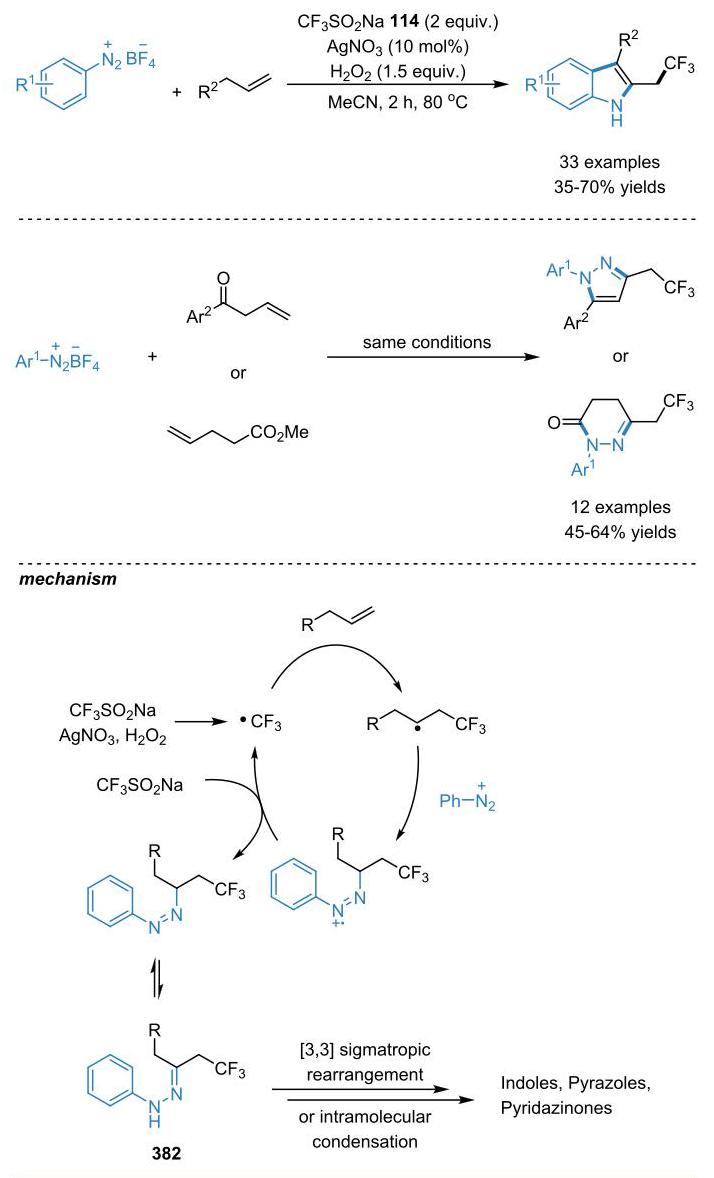
This divergent and selective protocol for synthesizing trifluoromethylated heterocycles is based on the radical trifluoromethylation of alkenes, followed by the coupling reaction with aryl diazonium salts and SET to afford aryl hydrazones 382 as the key intermediates. These hydrazones 382 proceed through acid-promoted [3,3]- $\sigma$ rearrangement/ cyclization/ammonia elimination to provide indoles, or undergo intramolecular condensation by elimination of water to afford pyrazoles or dihydropyridazinones.
这种用于合成三氟甲基化杂环的发散性和选择性方案基于烯烃的自由基三氟甲基化,随后与芳基重氮盐进行偶联反应并进行单电子转移,得到关键中间体芳基腙382。这些腙382通过酸促进的[3,3]-$\sigma$重排/环化/氨消除反应生成吲哚,或通过消除水进行分子内缩合得到吡唑或二氢哒嗪酮。
In 2019, Wu and co-workers reported the selective assembly of fully substituted pyrazoles through rongalite-mediated three-component reaction of aryl diazonium salts and $\alpha ,\beta$ - unsaturated carbonyls under transition-metal-free condition at room temperature (Scheme 250). ${}^{432}$ During this radical annulation protocol, aryl diazonium salts have served as both the precursor of the aryl and aryl hydrazine units. This reaction is initiated by the SET to afford an aryl radical, which undergoes radical addition with benzylideneacetone to provide a benzylic radical 383. Subsequently, the aryl diazonium cation is intercepted by 383, followed by SET process and reduction to obtain a hydrazine intermediate 384. Finally, intramolecular annulation and aromatization occur to generate the desired pyrazole product.
2019年,吴及其同事报道了在室温无过渡金属条件下,通过连二亚硫酸钠介导的芳基重氮盐与$\alpha ,\beta$ -不饱和羰基的三组分反应选择性组装全取代吡唑(方案250)。${}^{432}$ 在这个自由基环化反应中,芳基重氮盐既作为芳基单元又作为芳基肼单元的前体。该反应由单电子转移引发,生成芳基自由基,其与苄叉丙酮进行自由基加成得到苄基自由基383。随后,芳基重氮阳离子被383截获,接着进行单电子转移过程和还原反应,得到肼中间体384。最后,发生分子内环化和芳构化反应,生成所需的吡唑产物。
Scheme 250. Synthesis of Pyrazoles via Rongalite-Mediated Three-Component Radical Annulation Reaction
方案250. 通过连二亚硫酸钠介导的三组分自由基环化反应合成吡唑
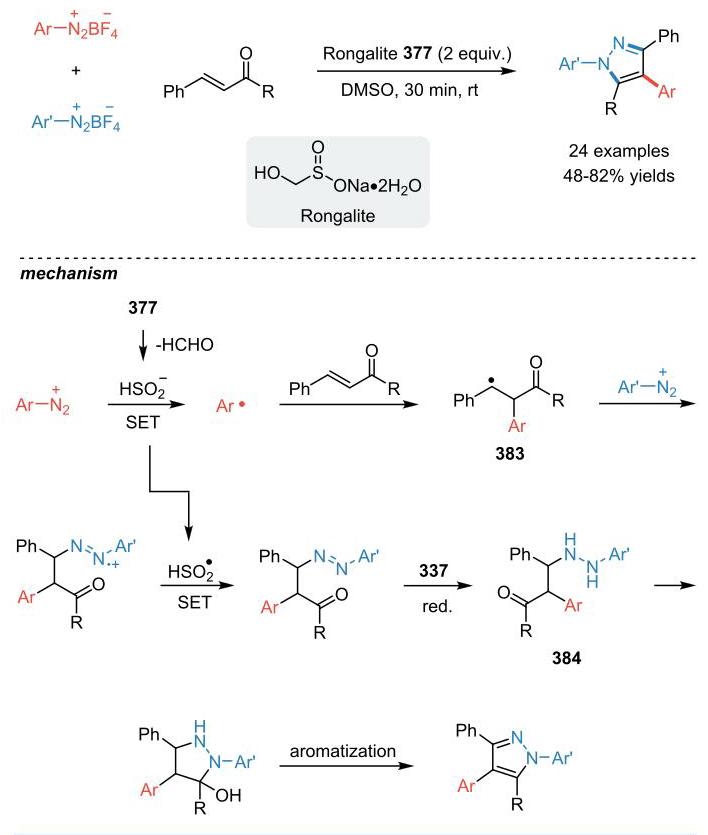
This radical-type interception can be implemented upon visible-light irradiation. With the employment of visible-light-induced photoredox strategy, an azotrifluoromethylation of alkenes with aryl diazonium salts and sodium triflinate 114 was realized, affording corresponding trifluoromethylated azo compounds 385 with good yields (Scheme 251). ${}^{433}$ The reductive quenching process of $\mathrm{{Ru}}$ (III) results in the formation of ${\mathrm{{CF}}}_{3}$ radical 386, which adds to the alkene to obtain an alkyl radical 387. The key step involves the radical interception of the aryl diazonium ion with 387.
这种自由基型截获可在可见光照射下实现。通过采用可见光诱导的光氧化还原策略,实现了芳基重氮盐与三氟甲磺酸钠114对烯烃的三氟甲基偶氮化反应,以良好的产率得到相应的三氟甲基化偶氮化合物385(方案251)。${}^{433}$ $\mathrm{{Ru}}$(III)的还原猝灭过程导致形成${\mathrm{{CF}}}_{3}$自由基386,其加成到烯烃上得到烷基自由基387。关键步骤涉及芳基重氮离子与387的自由基截获。
In 2020, Correia and Hammond developed a visible-light-induced redox-neutral coupling reaction of aryl diazonium salts with dihydropyridines (DHP), affording a wide range of alkylaryldiazenes 389 without the addition of additional reductant or oxidant (Scheme 252). ${}^{434}$ This reaction is initiated by the photoinduced formation of aryl radical, which undergoes HAT with DHP to obtain an alkyl radical. Trapping of diazonium ions with an alkyl radical occurs to form radical cation 390, followed by the SET process to deliver alkylaryldiazenes.
2020年,科雷亚和哈蒙德开发了一种可见光诱导的芳基重氮盐与二氢吡啶(DHP)的氧化还原中性偶联反应,无需添加额外的还原剂或氧化剂即可得到多种烷基芳基二氮烯389(方案252)。${}^{434}$ 该反应由光诱导形成芳基自由基引发,芳基自由基与DHP发生氢原子转移得到烷基自由基。烷基自由基捕获重氮离子形成自由基阳离子390,随后通过单电子转移过程生成烷基芳基二氮烯。
In 2020, Rafique and Braga reported a visible-light-promoted photoredox azo coupling reaction of imidazoheteroarenes and anilines under room temperate in the presence of eosin ${\mathrm{Y}}_{ - }{\mathrm{{Na}}}_{2}$ (Scheme 253). ${}^{435}$ Mechanistically, both the ionic and radical pathways may be simultaneously operating in this transformation.
2020年,拉菲克和布拉加报道了在曙红存在下,咪唑并杂芳烃和苯胺在室温下的可见光促进的光氧化还原偶氮偶联反应${\mathrm{Y}}_{ - }{\mathrm{{Na}}}_{2}$(方案253)。${}^{435}$ 从机理上讲,离子和自由基途径可能在该转化中同时起作用。
Scheme 251. Photoredox Azotrifluoromethylation of Alkenes with Aryl diazonium Salts and Sodium Triflinate
方案251. 芳基重氮盐与三氟甲磺酸钠对烯烃的光氧化还原三氟甲基偶氮化反应
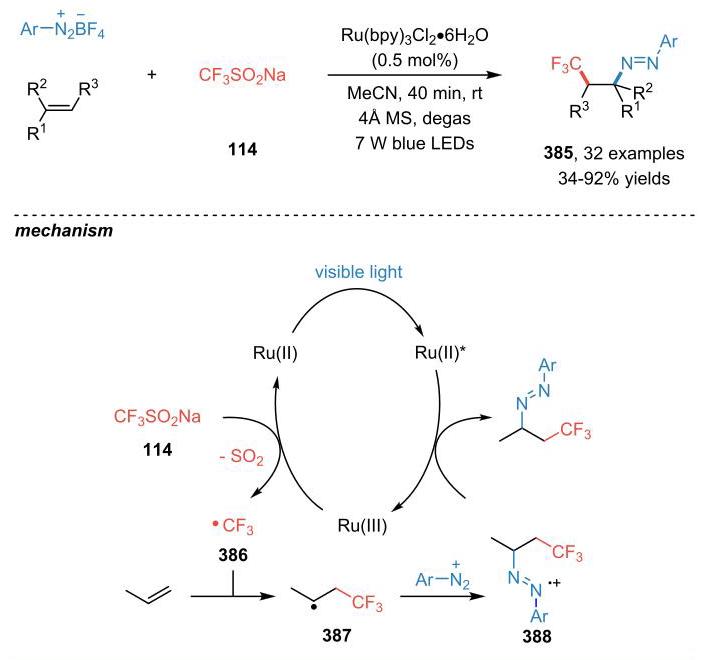
Scheme 252. Photoredox-Catalyzed Synthesis of Alkylaryldiazenes
方案252. 光氧化还原催化合成烷基芳基二氮烯
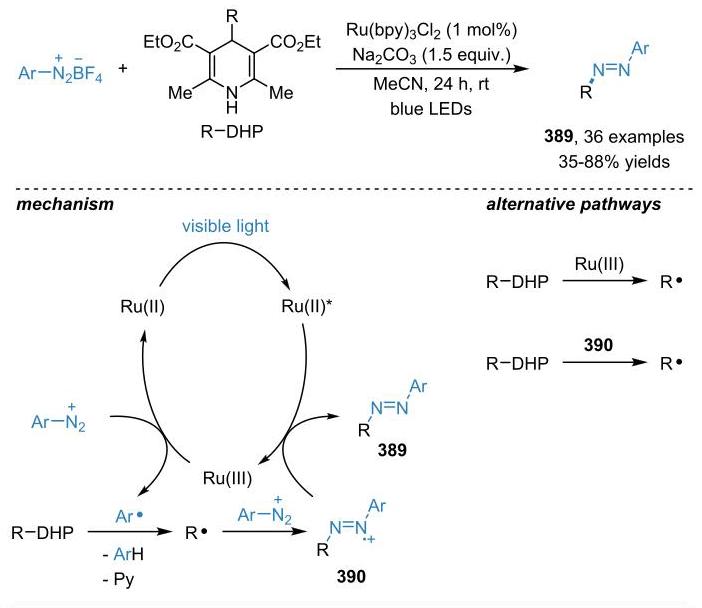
5. ARYL DIAZONIUM SALTS IN FLOW CHEMISTRY
5. 流动化学中的芳基重氮盐
The transformations of aryl diazonium salts are potentially explosive, both for a large-scale procedure in lab synthetic research and in industrial production. The utilization of continuous-flow protocol partially enhances the safe operation of aryl diazonium salts. With the employment of a continuous-flow setup, the aryl diazonium salts can be generated in situ with no need to separate. Additionally, the generation and transformation of aryl diazonium ions are thoroughly controlled under small and automated flow conditions, avoiding the accumulation of a high concentration of aryl diazonium salts. This has made the combination of flow protocol with aryl diazonium chemistry an attractive area.
芳基重氮盐的转化在实验室合成研究的大规模操作和工业生产中都有潜在的爆炸风险。连续流动方案的使用在一定程度上提高了芳基重氮盐操作的安全性。通过采用连续流动装置,可以原位生成芳基重氮盐,无需分离。此外,在小流量和自动化条件下,芳基重氮离子的生成和转化得到了充分控制,避免了高浓度芳基重氮盐的积累。这使得流动方案与芳基重氮化学的结合成为一个有吸引力的领域。
In 2015, Felpin completed an elegant review, which includes the recent reactions involving the use of diazonium salts in flow conditions. ${}^{23}$ This review has covered the continuous-flow generations and transformations of aryl diazonium salts during 2012 to 2015. ${}^{{436} - {445}}$ Thus, this content will mainly focus on the recent reactions of aryl diazonium salts in the continuous-flow reactor after the year 2015. Recent advances are focused on the parameters optimization in a continuous-flow reactor, ${}^{{446} - {449}}$ particularly for synthesizing azo and hydrazone compounds ${}^{450}$ (Scheme 254), and the exploration of specific transformations of aryl diazonium salts.
2015年,费尔平完成了一篇精彩的综述,其中包括了最近在流动条件下使用重氮盐的反应。${}^{23}$ 这篇综述涵盖了2012年至2015年期间芳基重氮盐的连续流动生成和转化。${}^{{436} - {445}}$ 因此,本文内容将主要关注2015年之后芳基重氮盐在连续流动反应器中的最新反应。最近的进展集中在连续流动反应器中的参数优化上,${}^{{446} - {449}}$ 特别是用于合成偶氮和腙化合物 ${}^{450}$ (方案254),以及对芳基重氮盐特定转化的探索。
Scheme 253. Visible-Light-Induced Azo Coupling of Imidazoheteroarenes and Anilines with Aryl Diazonium Salts
方案253. 咪唑并杂芳烃和苯胺与芳基重氮盐的可见光诱导偶氮偶联反应
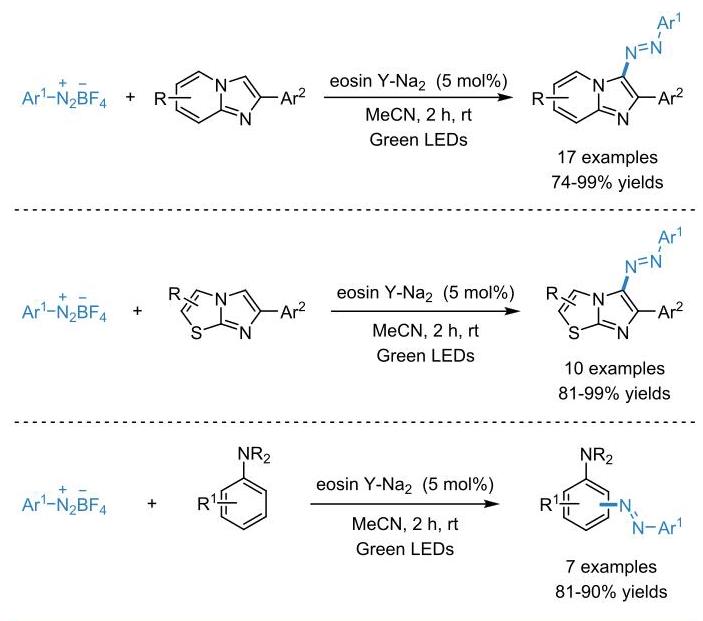
Scheme 254. Flow in Situ Formation of Hydrazine and Azo Derivatives
方案254. 肼和偶氮衍生物的流动原位形成
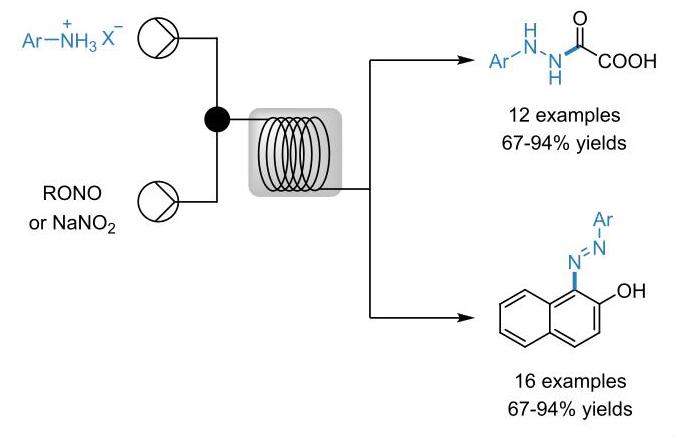
In 2016, Buchwald developed a continuous-flow Balz-Schiemann protocol by using ${\mathrm{{LiBF}}}_{4}$ as an effective additive that eliminates the need to isolate the aryl diazonium salts (Scheme 255). ${}^{451}$ This new flow to the stirred-batch reactor process allows the efficient synthesis of aryl fluorides with high yields through the safer generation and dediazotization of aryl diazonium salts. The utility of this system has been successfully identified by the scale-up Balz-Schiemann reaction without compromising the yield.
2016年,布赫瓦尔德开发了一种连续流动的巴尔兹 - 施iemann反应方案,使用 ${\mathrm{{LiBF}}}_{4}$ 作为有效添加剂,无需分离芳基重氮盐(方案255)。${}^{451}$ 这种新的从搅拌釜式反应器到连续流动的方法,通过更安全地生成和脱重氮化芳基重氮盐,能够高效合成高产率的芳基氟化物。该系统的实用性已通过放大的巴尔兹 - 施iemann反应得到成功验证,且不影响产率。
In 2019, Lévesque reported the Balz-Schiemann reaction of 2-cyano-5-aminopyridine to obtain 2-cyano-5-fluoropyridine using an ionic liquid (1-butyl-3-methylimidazolium tetrafluor-oborate, BMIMBF ${}_{4}$ ) as a solvent (Scheme 256). ${}^{452}$ Compared with Buchwald’s flow-batch method, this protocol allows the C-F bond formation under fully continuous-flow conditions.
2019年,莱韦斯克报道了2 - 氰基 - 5 - 氨基吡啶的巴尔兹 - 施iemann反应,使用离子液体(1 - 丁基 - 3 - 甲基咪唑四氟硼酸盐,BMIMBF ${}_{4}$ )作为溶剂制备2 - 氰基 - 5 - 氟吡啶(方案256)。${}^{452}$ 与布赫瓦尔德的流动 - 釜式方法相比,该方案能够在完全连续流动条件下形成C - F键。
Scheme 255. Synthesis of Aryl Fluorides in Continuous-Flow through Balz-Schiemann Reaction
方案255. 通过巴尔兹 - 施iemann反应连续流动合成芳基氟化物
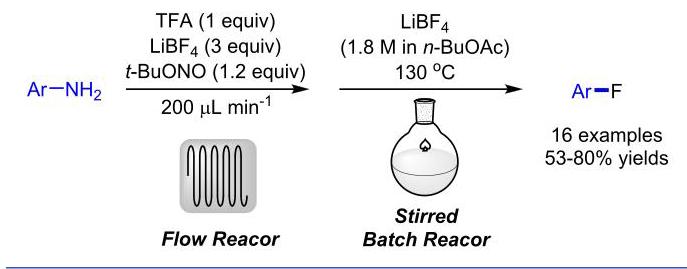
In addition to C-F bond formations via the Balz-Schiemann reaction, the continuous-flow procedure has also been applied to constructing other carbon-heteroatom bonds from diazonium salts. In 2017, Su developed a fully continuous-flow diazotization-hydrolysis protocol to access the synthesis of $p$ -cresol 391 up to 91% total yield and productivity of ${388}\mathrm{\;g}/\mathrm{h}$ (Scheme 257). ${}^{453}$ This process is initiated from the diazotization of $p$ -toluidine to form diazonium intermediate, followed by urea quenching process and final hydrolysis to give the product $p$ -cresol. Besides, a continuous-flow deaminohydrogenation reaction was also realized to synthesize 1,3-difluorobenzene. ${}^{454}$
除了通过巴尔兹 - 施iemann反应形成C - F键外,连续流动方法还被应用于从重氮盐构建其他碳 - 杂原子键。2017年,苏开发了一种完全连续流动的重氮化 - 水解方案,以高达91%的总产率合成 $p$ - 甲酚391,生产率为 ${388}\mathrm{\;g}/\mathrm{h}$ (方案257)。${}^{453}$ 该过程从 $p$ - 甲苯胺的重氮化形成重氮中间体开始,接着是尿素淬灭过程,最后水解得到产物 $p$ - 甲酚。此外,还实现了连续流动脱氨基氢化反应以合成1,3 - 二氟苯。${}^{454}$
In 2020, the C-S bond forging reaction was disclosed upon the continuous-flow protocol, in which the first step diazotization was realized on graphene oxide. The thiols were added in succession to intercept aryl diazonium ions, giving rise to desired thioethers in very high yields (Scheme 258).
2020年,在连续流动方案中公开了C - S键形成反应,其中第一步重氮化在氧化石墨烯上实现。依次加入硫醇以捕获芳基重氮离子,以非常高的产率得到所需的硫醚(方案258)。
Moreover, the C-C bond construction of aryl diazonium salts was also realized through the continuous-flow Sonoga-shira and Suzuki-Miyaura cross-coupling reactions using anilines under continuous-flow conditions (Scheme 259). ${}^{456}$ The arylamines undergo initial diazotization and sequential iodination under the flow setup, followed by Pd-catalyzed coupling reaction in the third flow reactor.
此外,芳基重氮盐的C - C键构建也通过在连续流动条件下使用苯胺进行连续流动的Sonoga - shira和Suzuki - Miyaura交叉偶联反应得以实现(方案259)。${}^{456}$ 在流动装置下,芳胺首先进行重氮化和顺序碘化,然后在第三个流动反应器中进行钯催化的偶联反应。
With the combination of photoredox strategy, the radical-type arylation reaction of arenes with anilines was realized under continuous-flow conditions, enabling overall reaction times of 45 min (Scheme 260). ${}^{457}$ This UV-light-promoted flow protocol involves the formation and photoinduced decomposition of diazo anhydride intermediate 392 to afford an aryl radical, followed by the Gomberg-Bachmann reaction with a (hetero)arene to form the desired bi(hetero)aryls.
通过光氧化还原策略的结合,芳烃与苯胺的自由基型芳基化反应在连续流动条件下得以实现,总反应时间为45分钟(方案260)。${}^{457}$ 这种紫外光促进的流动方法涉及重氮酸酐中间体392的形成和光诱导分解,以生成芳基自由基,随后与(杂)芳烃进行冈伯格-巴赫曼反应,形成所需的双(杂)芳基。
Apart from the flow process upon UV-light irradiation, Rueping and Rehm developed a continuous-flow $\mathrm{C} - \mathrm{H}$ arylation of heteroarenes with aryl diazonium salts irradiated by blue light using ${\mathrm{{TiO}}}_{2}$ as an immobilized photocatalyst in a microstructured falling film reactor (Scheme 261). ${}^{458}$ This method represents a novel combination of a visible-light-induced reaction with a continuous-flow process.
除了紫外光照射下的流动过程外,鲁平(Rueping)和雷姆(Rehm)开发了一种连续流动的$\mathrm{C} - \mathrm{H}$ 杂芳烃与芳基重氮盐的芳基化反应,该反应在微结构化降膜反应器中使用${\mathrm{{TiO}}}_{2}$ 作为固定光催化剂,以蓝光照射(方案261)。${}^{458}$ 该方法代表了可见光诱导反应与连续流动过程的一种新组合。
Merging with the transition-metal- and visible-light-induced photoredox catalysis and continuous-flow reactions, Acker-mann developed a manganese-catalyzed C-H arylation of (hetero)arenes employing continuous visible-light flow conditions (Scheme 262). ${}^{459}$ This visible-light-induced flow protocol allows the synthesis of biaryls with high yields, as well as the efficient, versatile transformations at room temperature.
阿克曼(Acker-mann)将过渡金属和可见光诱导的光氧化还原催化与连续流动反应相结合,开发了一种在连续可见光流动条件下锰催化的(杂)芳烃C-H芳基化反应(方案262)。${}^{459}$ 这种可见光诱导的流动方法能够高产率地合成联芳基,并且在室温下实现高效、通用的转化。
Scheme 256. Continuous-Flow Balz-Schiemann Reaction Enabled by Ionic Liquids
方案256. 离子液体实现的连续流动巴尔兹-施iemann反应
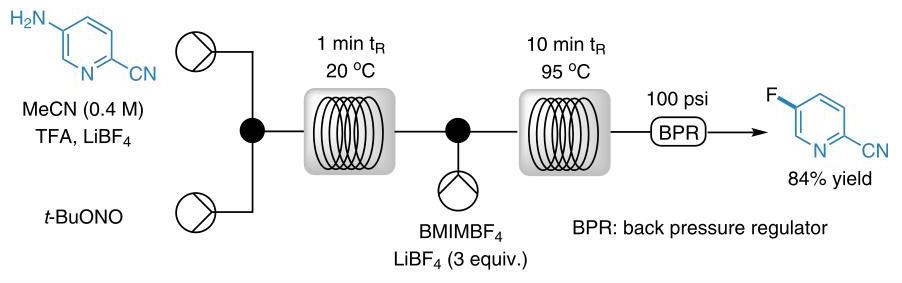
Scheme 257. Fully Continuous-Flow Process for the Synthesis of $p$ -Cresol
方案257. $p$ -甲酚合成的全连续流动过程
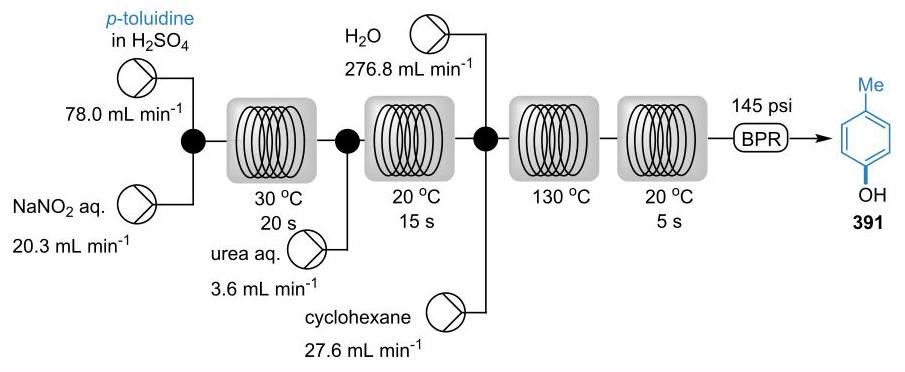
Scheme 258. Graphene Oxide-Catalyzed Two-Step Continuous-Flow Synthesis of Unsymmetrical Thioethers
方案258. 氧化石墨烯催化的不对称硫醚两步连续流动合成
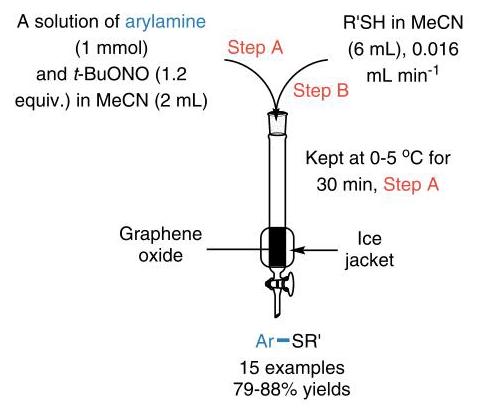
In 2018, the de Oliveira group developed a photoinduced arylation of enol acetates 34 with aryl diazonium salts using various porphyrins as the SET photocatalysts, affording $\alpha$ - arylated aldehyde and ketone building blocks with high efficiency (Scheme 263). ${}^{48}$ The success of this continuous-photoflow strategy has demonstrated the practical application in $\mathrm{C}\left( {\mathrm{{sp}}}^{2}\right) - \mathrm{C}\left( {\mathrm{{sp}}}^{3}\right)$ bond formation.
2018年,德奥利维拉(de Oliveira)课题组使用各种卟啉作为单电子转移光催化剂,开发了芳基重氮盐与烯醇醋酸酯34的光诱导芳基化反应,高效地得到了$\alpha$ -芳基化醛和酮结构单元(方案263)。${}^{48}$ 这种连续光流策略的成功证明了其在$\mathrm{C}\left( {\mathrm{{sp}}}^{2}\right) - \mathrm{C}\left( {\mathrm{{sp}}}^{3}\right)$ 键形成中的实际应用。
Except for a traditional flow protocol and the merging of the photoredox/flow process, a mechanochemical synthetic route was developed using a jacketed screw reactor, allowing the synthesis of the azo compounds with $\beta$ -napththol under continuous-flow conditions. ${}^{460}$
除了传统的流动方法以及光氧化还原/流动过程的结合外,还开发了一种使用夹套螺杆反应器的机械化学合成路线,该路线允许在连续流动条件下用$\beta$ -萘酚合成偶氮化合物。${}^{460}$
6. ARYL DIAZONIUM SALTS IN THE MODIFICATION OF FUNCTIONAL MATERIALS AND MOLECULES
6. 芳基重氮盐在功能材料和分子修饰中的应用
Apart from the effective utilization of aryl diazonium salts in organic synthetic chemistry, recent applications of diazonium compounds have furnished new strategies for the modification of materials and biomolecules, including electrode surfaces, graphene, carbon nanotubes, as well as peptides and proteins. In most cases, aryl diazonium salts are utilized as synthon of the substituted (hetero)aryl group to modify materials’ surface through covalent functionalization. This transformation usually proceeds through traditional radical-type arylation to forge a $\mathrm{C} - \mathrm{C}$ bond, or constructing a $\mathrm{C} - \mathrm{S}$ bond by the reaction with amino acid, ${\mathrm{{MoS}}}_{2}$ , and forging a $\mathrm{C} - \mathrm{{Au}}$ bond.
除了在有机合成化学中有效利用芳基重氮盐外,重氮化合物最近的应用为材料和生物分子的修饰提供了新策略,包括电极表面、石墨烯、碳纳米管以及肽和蛋白质。在大多数情况下,芳基重氮盐用作取代(杂)芳基的合成子,通过共价功能化修饰材料表面。这种转化通常通过传统的自由基型芳基化形成$\mathrm{C} - \mathrm{C}$键,或通过与氨基酸反应构建$\mathrm{C} - \mathrm{S}$键,${\mathrm{{MoS}}}_{2}$,并形成$\mathrm{C} - \mathrm{{Au}}$键。
Scheme 259. Continuous-Flow Sonogashira and Suzuki-Miyaura Coupling Reactions of Anilines
方案259. 苯胺的连续流Sonogashira和Suzuki-Miyaura偶联反应
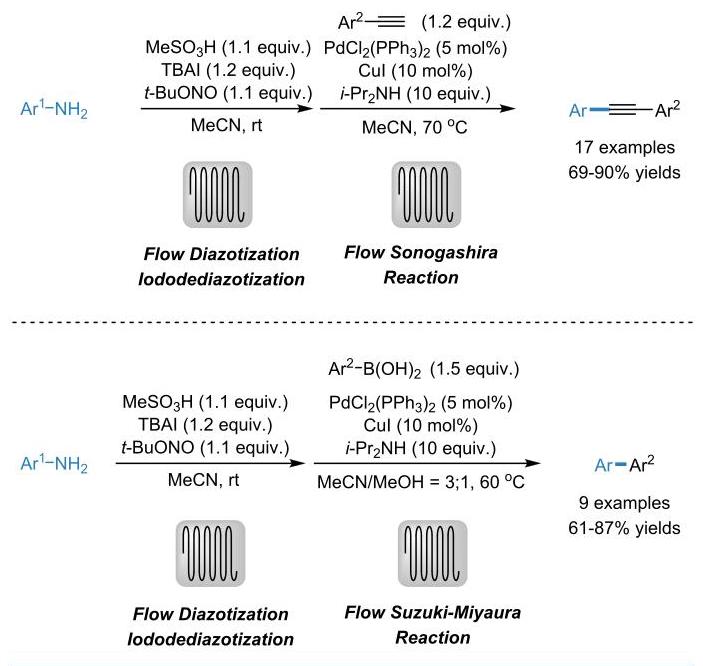
Several recent reviews and papers have surveyed the advances in the development and application of diazonium compounds for the surface modification of diverse materials application of diazonium compounds for the surface modification of various materials, ${}^{461}$ such as gra-phene, ${}^{{22},{462} - {464}}$ electrode surfaces, ${}^{{465} - {469}}$ carbon nano-tubes, ${}^{{470} - {477}}$ nanostructured mesoporous ITO films, ${}^{478}$ glycosides, ${}^{479}$ and graphene oxide. ${}^{{480},{481}}$ Mainly, a range of aryl functional groups can be employed to functionalize the basal plane of ${\mathrm{{MoS}}}_{2}$ through diazonium-based chemistry. ${}^{{482} - {484}}$ Several elegant reviews have recently focused on modifying functional materials and bioactive molecules by using aryl diazonium salts. In this section, we will just give a brief instruction toward the recent advances in this area.
最近的几篇综述和论文调查了重氮化合物在各种材料表面修饰的开发和应用进展,重氮化合物在各种材料表面修饰的应用,${}^{461}$如石墨烯,${}^{{22},{462} - {464}}$电极表面,${}^{{465} - {469}}$碳纳米管,${}^{{470} - {477}}$纳米结构介孔ITO薄膜,${}^{478}$糖苷,${}^{479}$和氧化石墨烯。${}^{{480},{481}}$主要地,一系列芳基官能团可用于通过基于重氮的化学方法对${\mathrm{{MoS}}}_{2}$的基面进行功能化。${}^{{482} - {484}}$最近有几篇精彩的综述聚焦于使用芳基重氮盐修饰功能材料和生物活性分子。在本节中,我们将简要介绍该领域的最新进展。
Scheme 260. Light-Induced C-H Arylation of Arenes by in Situ Generated Diazo Anhydrides
方案260. 原位生成的重氮酸酐对芳烃的光诱导C-H芳基化
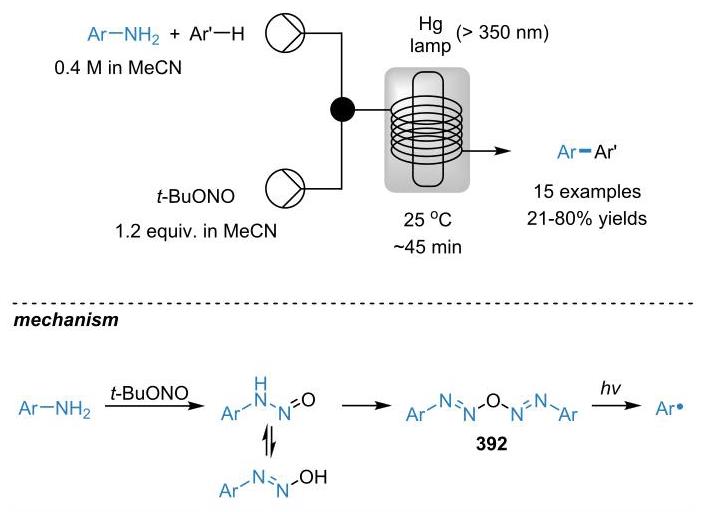
Scheme 261. Continuous-Flow Light-Mediated C-H Arylation of Heteroarenes Using ${\mathrm{{TiO}}}_{2}$
方案261. 使用${\mathrm{{TiO}}}_{2}$对杂芳烃进行连续流光介导的C-H芳基化
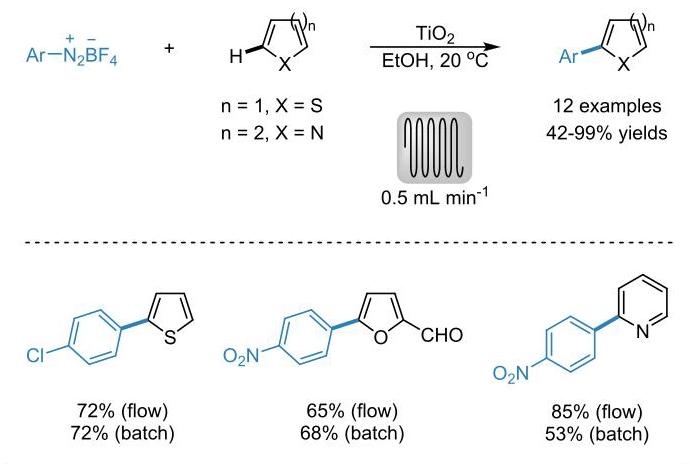
Scheme 262. Continuous-Flow Visible-Light-Mediated Approach for Mn-Catalyzed C-H Arylation of Heteroarenes
方案262. 用于Mn催化的杂芳烃C-H芳基化的连续流可见光介导方法
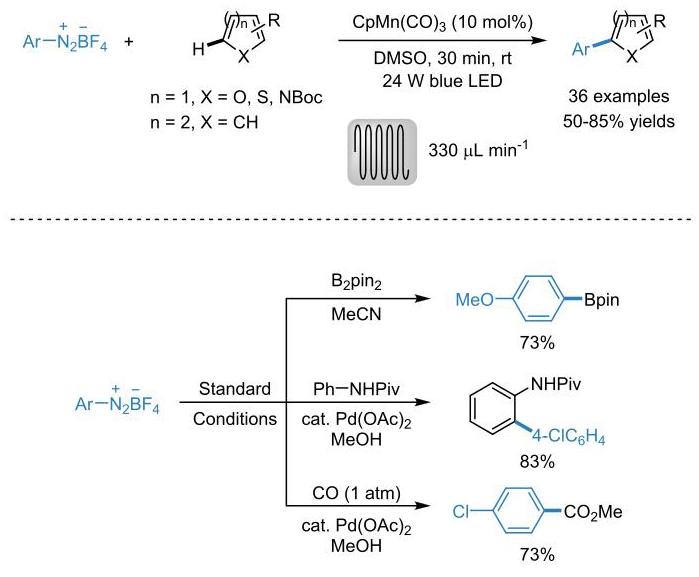
Scheme 263. Continuous-Photoflow Setup for $\mathrm{C} - \mathrm{H}$ Arylations
方案263. $\mathrm{C} - \mathrm{H}$芳基化的连续光流装置
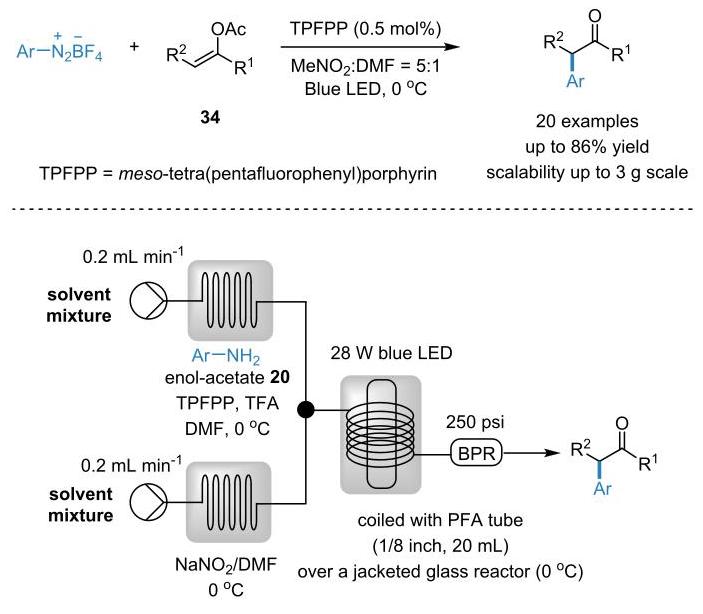
For the wide-established graphene modifications, both the preprepared and the in situ formed aryl diazonium salts are utilized to access the aryl group functionality. In 2020, Assali synthesized an array of graphene materials covalently functionalized with hydroxyl-, amine-, or carboxyl containing groups through the direct diazonium functionalization of few-layer graphene (FLG) (Scheme 264). ${}^{485}$ Here, the arylamines are initially diazotized using isoamyl nitrite, followed by radical addition to graphene to afford the antibacterial materials.
对于广泛应用的石墨烯修饰,预先制备的和原位形成的芳基重氮盐都被用于获得芳基官能团。2020年,阿萨利通过对少层石墨烯(FLG)进行直接重氮功能化,合成了一系列用含羟基、胺基或羧基的基团共价功能化的石墨烯材料(方案264)。${}^{485}$在此,芳胺首先用异戊基亚硝酸盐进行重氮化,然后自由基加成到石墨烯上得到抗菌材料。
The diazonium functionalization using 2-aminobenzene-1,4- disulfonic acid as the substrate was reported under aqueous phase conditions, allowing the surface modification of carbon fibers (CFs) (Scheme 265). ${}^{486}$
在水相条件下报道了以2-氨基苯-1,4-二磺酸为底物的重氮功能化,实现了碳纤维(CFs)的表面修饰(方案265)。${}^{486}$
Using the in situ diazotization/modification strategy, the selective diazonium functionalization of graphite nanosheets (GNs) and Si nanoparticles (Si NPs) was developed, affording a useful electrochemical Si-Ar-GNs composite (Scheme 266). ${}^{487}$ This protocol features of forging of $\mathrm{C} - \mathrm{C}$ and $\mathrm{C} - \mathrm{{Si}}$ bonds in a two-step process.
采用原位重氮化/修饰策略,开发了石墨纳米片(GNs)和硅纳米颗粒(Si NPs)的选择性重氮功能化,得到了一种有用的电化学Si-Ar-GNs复合材料(方案266)。${}^{487}$该方案的特点是在两步过程中形成$\mathrm{C} - \mathrm{C}$和$\mathrm{C} - \mathrm{{Si}}$键。
Apart from the $\mathrm{C} - \mathrm{C}$ and $\mathrm{C} - \mathrm{{Si}}$ bond formations, $\mathrm{C} - \mathrm{P}$ bond formations on the surface of black phosphorus were realized by covalent aryl diazonium functionalization, enabling the material’s hole-carrier mobility to be tuned, affording an optimized layered two-dimensional semiconductor. ${}^{488}$
除了形成$\mathrm{C} - \mathrm{C}$和$\mathrm{C} - \mathrm{{Si}}$键外,通过共价芳基重氮功能化实现了黑磷表面的$\mathrm{C} - \mathrm{P}$键形成,能够调节材料的空穴载流子迁移率,得到优化的层状二维半导体。${}^{488}$
The aryl diazonium functionalization also allows the Au surface graft through the generation aryl diazonium gold(III) species. ${}^{489}$ A combination of photoredox protocol with surface modification was realized to the afford nanopores within polynitrophenylene films on Au(111) surfaces (Scheme 267). ${}^{490}$ Using 4-nitrobenzenediazonium tetrafluoroborate as the substrate, the corresponding aryl radical 393 is generated upon the visible-light irradiation, followed by C-Au bond formation. The sequential photoredox arylation reaction could lead to the formation of a polynitrophenylene scaffold.
芳基重氮官能化还可通过生成芳基重氮金(III)物种实现金表面接枝。${}^{489}$ 将光氧化还原方案与表面改性相结合,在金(111)表面的聚硝基苯撑薄膜中形成了纳米孔(方案267)。${}^{490}$ 以四氟硼酸4-硝基苯重氮盐为底物,在可见光照射下生成相应的芳基自由基393,随后形成C-Au键。连续的光氧化还原芳基化反应可导致聚硝基苯撑支架的形成。
In addition to the photoredox strategy, the electrochemical protocol of diazotized N-doped carbon nanodots (N-CD) was developed to generate aryl radicals, allowing the electrografting onto the surface of carbon electrodes (Scheme 268). ${}^{491}$ The
除了光氧化还原策略外,还开发了重氮化N掺杂碳纳米点(N-CD)的电化学方案来生成芳基自由基,从而实现电接枝到碳电极表面(方案268)。${}^{491}$ 该
Scheme 264. Functionalization of the Few-Layer Graphene electrochemical method allows nanofilter film preparation on the Au electrode by combining the aryl diazonium salt reduction strategy and boronate affinity. ${}^{492}$ This research demonstrates the diazonium modification in the enhancement of the signal-to-noise ratio in electrochemical biosensors.
方案264. 少层石墨烯的功能化 电化学方法通过结合芳基重氮盐还原策略和硼酸酯亲和力,可在金电极上制备纳米滤膜。${}^{492}$ 本研究证明了重氮修饰在提高电化学生物传感器信噪比方面的作用。
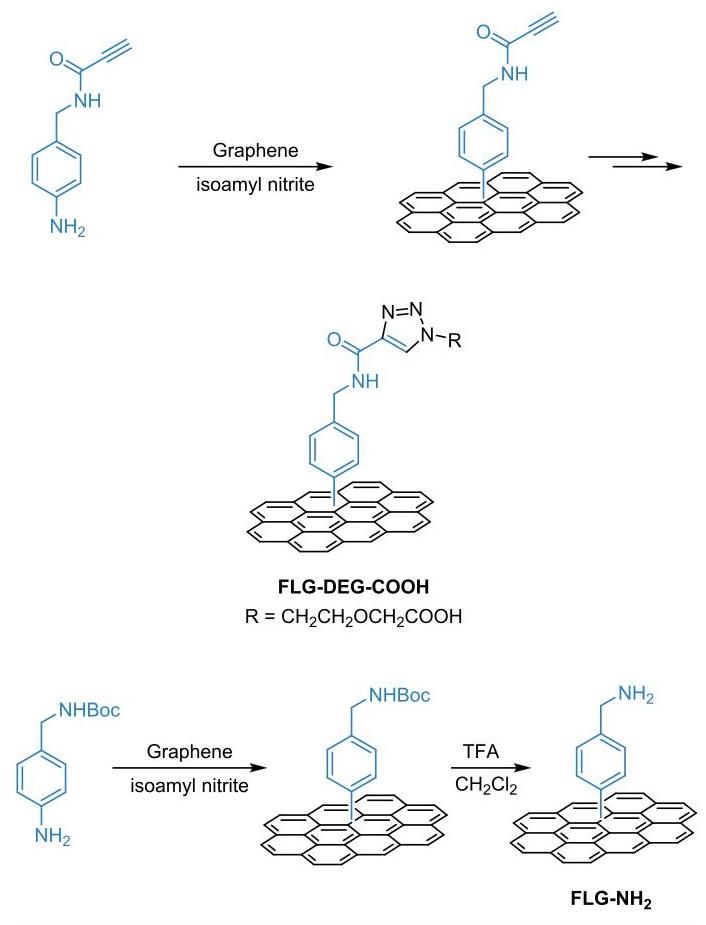
Scheme 265. CFs Surface Modifications
方案265. 碳纤维表面改性
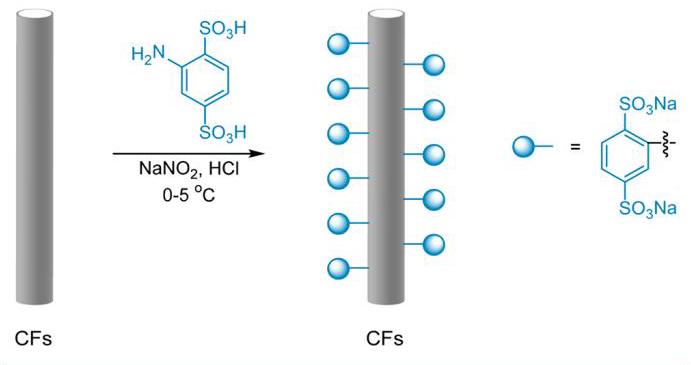
Moreover, the aryl diazonium functionalization has demonstrated chemical biology applications through the selective covalent functionalization of amino acids, peptides, and proteins. Several outstanding reviews have elegantly covered and emphasized these recent advances. ${}^{{24},{493} - {498}}$ Thus, we will only briefly introduce this content to highlight these recent advances, stimulating interest toward broader applications of aryl diazonium salts as aryl transfer agents in bioconjugation reactions.
此外,芳基重氮官能化已通过对氨基酸、肽和蛋白质的选择性共价官能化展现出化学生物学应用。已有几篇优秀的综述优雅地涵盖并强调了这些最新进展。${}^{{24},{493} - {498}}$ 因此,我们将仅简要介绍此内容以突出这些最新进展,激发人们对芳基重氮盐作为芳基转移剂在生物共轭反应中更广泛应用的兴趣。
The aryl diazonium salts can serve as both aryl and azo precursors to graft on the biochemical molecules. For the previous case, the aryl group functionality of the phenolic side chain of tyrosine was realized through the selective $\mathrm{C} - \mathrm{C}$ bond
芳基重氮盐既可以作为芳基前体,也可以作为偶氮前体接枝到生化分子上。对于前一种情况,通过选择性$\mathrm{C} - \mathrm{C}$ 键
Scheme 266. Illustration of Si-Ar-GNs Preparation
方案266. 硅-芳基-石墨烯纳米片制备示意图
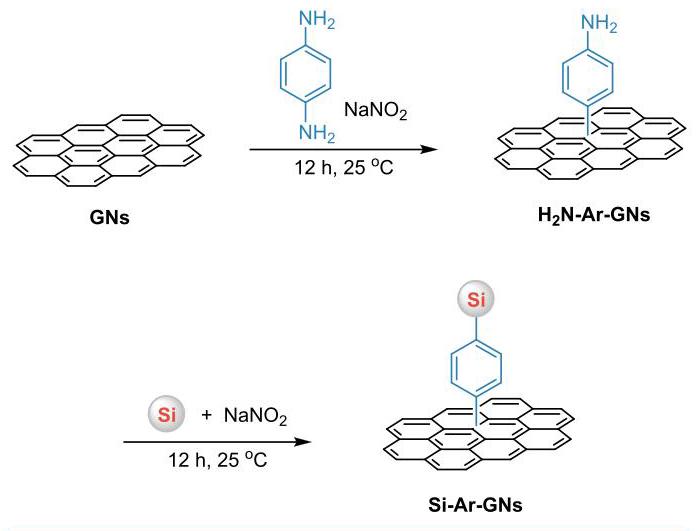
Scheme 267. Photocatalysis with Particle Lithography to Generate Polynitrophenylene Nanostructures formation on aromatic rings, affording 3-aryltyrosine derivatives. ${}^{499}$ The 3-monoaryl tyrosine hydroxamic acids possessing KDM4A demethylase activities were also synthesized through the diazonium functionalization. ${}^{500}$
方案267. 利用粒子光刻光催化生成聚硝基苯撑纳米结构 在芳环上形成键,得到3-芳基酪氨酸衍生物。${}^{499}$ 还通过重氮官能化合成了具有KDM4A去甲基酶活性的3-单芳基酪氨酸异羟肟酸。${}^{500}$
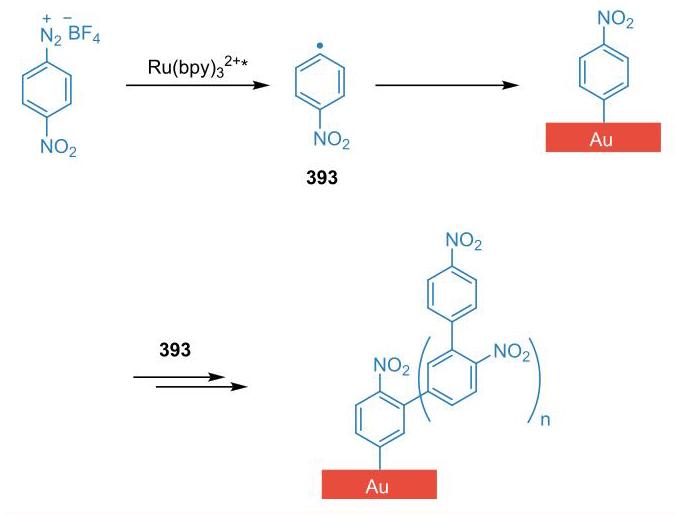
Scheme 268. Diazotized N-CD Electrografting on Carbon Electrodes
方案268. 重氮化N-CD在碳电极上的电接枝
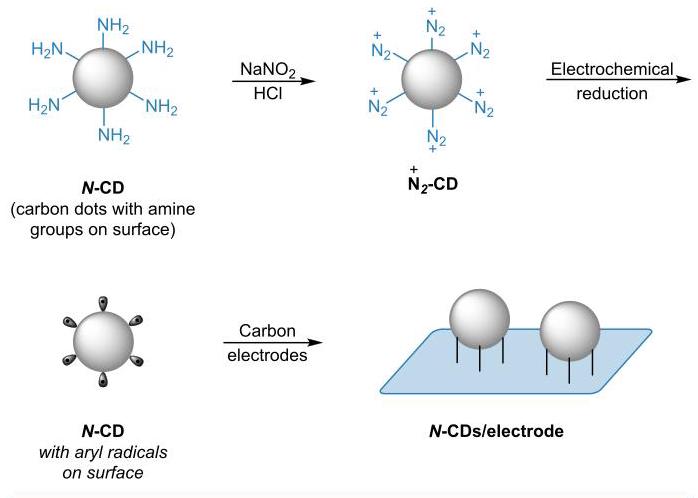
For the latter case, the site-selective azo coupling between tyrosine and aryl diazonium salts was realized. ${}^{501}$ Besides, the modification of tyrosine and tyrosine-containing peptides was disclosed using ${}^{64}\mathrm{{Cu}}$ - and ${}^{68}\mathrm{{Ga}}$ -labeled 1,4,7-triazacyclono-nane-1,4,7-triacetic acid-diazonium salts 394 as building blocks (Scheme 269). ${}^{502}$ These bioconjugation reactions on proteins have successfully been achieved through the selective azo coupling reaction on the aromatic rings.
对于后一种情况,实现了酪氨酸与芳基重氮盐之间的位点选择性偶氮偶联。${}^{501}$ 此外,使用${}^{64}\mathrm{{Cu}}$ -和${}^{68}\mathrm{{Ga}}$ -标记的1,4,7-三氮杂环壬烷-1,4,7-三乙酸重氮盐394作为构建单元,公开了对酪氨酸和含酪氨酸肽的修饰(方案269)。${}^{502}$ 通过芳环上的选择性偶氮偶联反应,已成功实现了这些在蛋白质上的生物共轭反应。
Scheme 269. Aryl Diazonium Salts for Chemo-selective Bioconjugation of Tyrosine Residues
方案269. 用于酪氨酸残基化学选择性生物共轭的芳基重氮盐
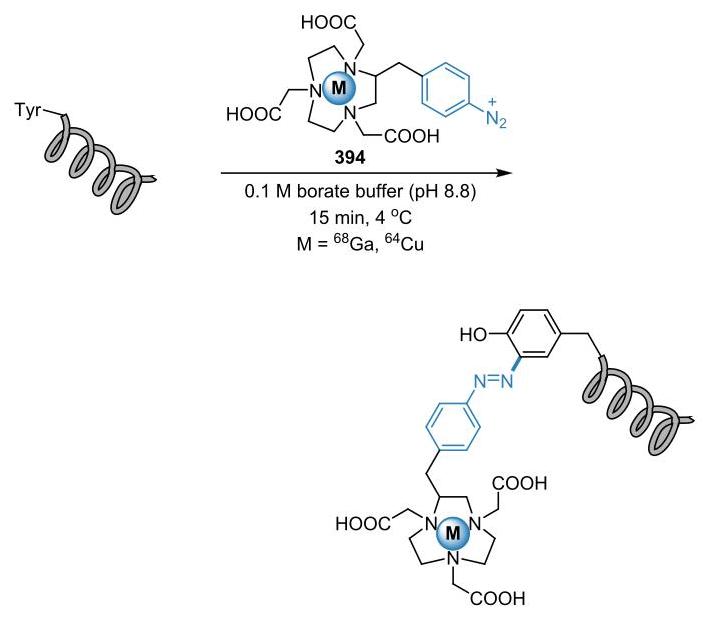
7. CONCLUSIONS
7. 结论
While aryl diazonium salts have been known for more than 160 years, as shown in this review, the chemistry of these fascinating compounds still remains as an exciting and attractive research topic in synthetic organic chemistry in recent years. Owing to their versatile reactivity, aryl diazonium salts are pervasive and outstanding substrates in various transformations, which have found numerous new applications in organic synthesis, functional material modifications, biological chemical research, and other interdisciplinary fields. In particular, over the past decade, the merger of aryl diazonium chemistry with photocatalysis, transition-metal catalysis, continuous-flow technique, electrochemistry, and mechanor-edox catalysis leads to the generation of aryl radicals and other reactive species under mild conditions, thus opening new possibilities for further utilization of aryldiazonium salts. Furthermore, several new aryl $\mathrm{C} - \mathrm{C}$ bonds and $\mathrm{C} - \mathrm{Y}(\mathrm{Y} = \mathrm{B}$ , S, P, Sn, and Se) bond forming reactions have emerged in the past years, which significantly increase the synthetic utilities of aryldiazonium salts.
虽然芳基重氮盐已被发现160多年了,但如本综述所示,近年来,这些迷人化合物的化学性质在合成有机化学领域仍然是一个令人兴奋且极具吸引力的研究课题。由于其多样的反应活性,芳基重氮盐在各种转化反应中都是普遍且出色的底物,在有机合成、功能材料改性、生物化学研究及其他跨学科领域都有众多新应用。特别是在过去十年中,芳基重氮化学与光催化、过渡金属催化、连续流技术、电化学和机械氧化还原催化的结合,使得芳基自由基和其他活性物种在温和条件下得以生成,从而为芳基重氮盐的进一步利用开辟了新的可能性。此外,在过去几年中出现了几种新的芳基$\mathrm{C} - \mathrm{C}$键以及$\mathrm{C} - \mathrm{Y}(\mathrm{Y} = \mathrm{B}$(与S、P、Sn和Se)键形成反应,这显著提高了芳基重氮盐的合成效用。
Although aryl halides (or pseudohalides), aryl boronic acids, and aryl hypervalent iodine compounds are the common choices for functional group conversion or coupling reactions, aryl diazonium salts have their own distinguishing features and advantages. First, aryl diazonium salts are synthesized from the corresponding aryl amines, which are widely available and cheap industrial feedstocks. Second, since the conditions of diazotization are orthogonal to many other reactions, the reactions involving diazonium salts have excellent compatibility. Third, amino groups are easily protected and deprotected; thus, the conversion of amino groups through diazonium salts may be advantageous for late-stage modification in the synthesis of drug molecules or natural products.
尽管芳基卤化物(或拟卤化物)、芳基硼酸和芳基高价碘化合物是官能团转化或偶联反应的常用选择,但芳基重氮盐有其独特的特点和优势。首先,芳基重氮盐由相应的芳胺合成,芳胺是广泛可得且廉价的工业原料。其次,由于重氮化条件与许多其他反应相互正交,涉及重氮盐的反应具有出色的兼容性。第三,氨基易于保护和脱保护;因此,通过重氮盐对氨基进行转化可能有利于药物分子或天然产物合成中的后期修饰。
Despite the myriad recent advances, several limitations need to be addressed in the future, in order to further improve the practicality and versatility of these methods. For most of the reactions, the aryldiazonium salts are used as the reactants. Because of the stability problem and safety concerns related to aryldiazonium salts, ${}^{503}$ the wide applications of these transformations in organic synthesis are rather hampered. The in situ generation of aryldiazonium salts and flow technic may circumvent these problems to some extent; however, the diazotization process may not be compatible with many reactions. Recently, some aryldiazonium salts surrogates, such as aryl triazenes, ${}^{{504} - {506}}$ arylazo sulfones, ${}^{{507} - {512}}$ have been developed and applied in the arylation reactions. These compounds can be employed to introduce aryl groups (or sulfonyl groups) selectively under Lewis acid or visible-light-driven conditions. However, up to now, these nonexplosive precursors are still far from replacing the synthetic value of aryldiazonium salts in organic synthesis.
尽管最近有众多进展,但未来仍需解决一些局限性,以进一步提高这些方法的实用性和通用性。对于大多数反应,芳基重氮盐用作反应物。由于与芳基重氮盐相关的稳定性问题和安全顾虑,${}^{503}$这些转化反应在有机合成中的广泛应用受到了相当大的阻碍。芳基重氮盐的原位生成和流动技术可能在一定程度上规避这些问题;然而,重氮化过程可能与许多反应不兼容。最近,一些芳基重氮盐替代物,如芳基三氮烯、${}^{{504} - {506}}$芳基偶氮砜、${}^{{507} - {512}}$已被开发并应用于芳基化反应。这些化合物可用于在路易斯酸或可见光驱动条件下选择性引入芳基(或磺酰基)。然而,截至目前,这些非爆炸性前体在有机合成中仍远不能取代芳基重氮盐的合成价值。
As for the generation of aryldiazonium salts from arylamines, although some progress has been made, the choice of reagents and the reaction conditions for the diazotization of arylamines are still limited. Further development along this line would be desirable. Moreover, the scope of transition-metal-catalyzed transformations with aryldiazonium salts is still narrow. Future exploration in this arena would lead to the development of new methods for aryl $\mathrm{C} - \mathrm{C}$ bond forming with arylamines as the factual cross-coupling partners.
至于由芳胺生成芳基重氮盐,尽管已取得一些进展,但芳胺重氮化的试剂选择和反应条件仍然有限。沿着这条线进一步发展是可取的。此外,芳基重氮盐的过渡金属催化转化范围仍然狭窄。在这个领域的未来探索将导致开发以芳胺作为实际交叉偶联伙伴形成芳基$\mathrm{C} - \mathrm{C}$键的新方法。
AUTHOR INFORMATION
作者信息
Corresponding Authors
通讯作者
Fanyang Mo - Department of Energy and Resources Engineering, College of Engineering and School of Materials Science and Engineering, Peking University, Beijing 100871, China; © orcid.org/0000-0002-4140-3020;
莫凡洋 - 中国北京大学工程学院能源与资源工程系及材料科学与工程学院,北京 100871;© orcid.org/0000-0002-4140-3020;
Jianbo Wang - Beijing National Laboratory of Molecular Sciences (BNLMS), Key Laboratory of Bioorganic Chemistry and Molecular Engineering of Ministry of Education, College of Chemistry, Peking University, Beijing 100871, China; © orcid.org/0000-0002-0092-0937;
王建波 - 中国北京大学化学与分子工程学院,北京分子科学国家实验室(BNLMS),生物有机化学与分子工程教育部重点实验室,北京 100871;© orcid.org/0000-0002-0092-0937;
Authors
作者
Di Qiu - Tianjin Key Laboratory of Structure and Performance for Functional Molecules, College of Chemistry, Tianjin Normal University, Tianjin 300387, China; © orcid.org/0000-0001-9706-6302
Lei Zhang - Department of Energy and Resources Engineering, College of Engineering, Peking University, Beijing 100871, China; (Corcid.org/0000-0001-9031-4318
Complete contact information is available at: https://pubs.acs.org/10.1021/acs.chemrev.0c01030
完整的联系信息可在以下网址获取:https://pubs.acs.org/10.1021/acs.chemrev.0c01030
Notes
注释
The authors declare no competing financial interest.
作者声明不存在利益冲突。
Biographies
个人简介
Fanyang Mo obtained his undergraduate and master’s degrees in applied chemistry from the Beijing Institute of Technology under the supervision of Professor Zhiming Zhou in 2004 and 2006, respectively. He then moved to Peking University and pursued his Ph.D. studies under the supervision of Professor Jianbo Wang. After receiving his Ph.D. in 2010, he went to the USA and worked with Professor Qinghai Zhang at The Scripps Research Institute and Professor Guangbin Dong at The University of Texas at Austin from 2010 to 2015. He joined Peking University as an Assistant Professor in April 2015. The current research interests of his group include resources orientated organic synthesis, modification of semiconductor oxides for energy and resource utilization, and molecular electronics.
莫凡洋于2004年和2006年分别在北京理工大学在周志民教授的指导下获得应用化学专业的本科和硕士学位。之后,他前往北京大学,在王剑波教授的指导下攻读博士学位。2010年获得博士学位后,他前往美国,2010年至2015年期间在斯克里普斯研究所与张青海教授以及德克萨斯大学奥斯汀分校与董广彬教授合作。2015年4月,他作为助理教授加入北京大学。他的团队目前的研究兴趣包括资源导向的有机合成、用于能源和资源利用的半导体氧化物改性以及分子电子学。
Di Qiu was born in Tianjin, China. He received his B.S. degree from Peking University in 2010. He was a graduate student in Prof. Jianbo Wang’s laboratory from 2010 to 2015. He obtained his Ph.D. degree in 2015. His research projects are focused on the development of basic organic functional group transformations, in particular, the gold-catalyzed C-H bond functionalization and the transformation of aromatic $\mathrm{C} - \mathrm{N}$ bonds based on diazonium salts. Dr. Qiu has published 30 papers in renowned international journals. Since 2015, he has been an Assistant Professor at the College of Chemistry, Tianjin Normal University. His research interests lie in aromatic CSn and C-P bond formation and functional group transformations in aromatic compounds.
仇迪出生于中国天津。他于2010年在北京大学获得理学学士学位。2010年至2015年期间,他是王剑波教授实验室的研究生。2015年获得博士学位。他的研究项目专注于基础有机官能团转化的开发,特别是金催化的C-H键官能化以及基于重氮盐的芳香族$\mathrm{C} - \mathrm{N}$键的转化。仇博士已在著名国际期刊上发表30篇论文。自2015年以来,他一直是天津师范大学化学学院的助理教授。他的研究兴趣在于芳香族C-Sn和C-P键的形成以及芳香族化合物中的官能团转化。
Lei Zhang is a Ph.D. candidate under the supervision of Prof. Fanyang Mo at Peking University. He obtained his B. Eng. degree from Beijing Institute of Technology in 2016, and his bachelor thesis was finished under the joint guidance of Prof. Jianbo Wang and Prof. Fanyang Mo. In the same year, he moved to Peking University and started his Ph.D. study. His research project focuses on green organic synthesis by using organic electrochemistry and investigation of reaction mechanism enabled by single-molecule platform.
张雷是北京大学在莫凡洋教授指导下的一名博士研究生。他于2016年在北京理工大学获得工学学士学位,他的本科论文是在王剑波教授和莫凡洋教授的联合指导下完成的。同年,他前往北京大学开始攻读博士学位。他的研究项目专注于利用有机电化学进行绿色有机合成以及通过单分子平台对反应机理的研究。
Jianbo Wang received his B.Eng. from Nanjing University of Science and Technology in 1983 and his Ph.D. from Hokkaido University (under the supervision of Prof. Hiroshi Suginome) in 1990. He was a postdoctoral associate at the University of Geneva from 1990 to 1993 (with Prof. Charles W. Jefford) and at University of Wisconsin-Madison from 1993 to 1995 (with Profs. Howard E. Zimmerman and Leonard A. Fahien). He began his independent academic career at Peking University in 1995 as an associate professor and was promoted to full professor in 1999. His research interests focus on the catalytic metal carbene transformations.
王剑波于1983年在南京理工大学获得工学学士学位,并于1990年在北海道大学(在杉野浩史教授的指导下)获得博士学位。1990年至1993年,他在日内瓦大学(与查尔斯·W·杰福德教授合作)担任博士后研究员,1993年至1995年在威斯康星大学麦迪逊分校(与霍华德·E·齐默尔曼教授和伦纳德·A·法希恩教授合作)担任博士后研究员。1995年,他在北京大学开始独立的学术生涯,担任副教授,并于1999年晋升为教授。他的研究兴趣集中在催化金属卡宾转化。
ACKNOWLEDGMENTS
致谢
This project is supported by the Natural Science Foundation of China (Grant Nos. 21772003, 21933001, 22071004, 91956104), Beijing National Laboratory of Molecular Sciences (BNLMS), and Laboratory for Synthetic Chemistry and Chemical Biology of Health@InnoHK of ITC, HKSAR. This work was partially funded by the BHP-PKU CCUS project supported by BHP Billiton. We thank Prof. Yang Yang (University of California-Santa Barbara) for helpful discussions.
本项目得到了中国国家自然科学基金(项目编号:21772003、21933001、22071004、91956104)、北京分子科学国家实验室(BNLMS)以及香港特别行政区创新科技署健康@InnoHK合成化学与化学生物学实验室的支持。本研究部分得到了必和必拓支持的必和必拓 - 北大碳捕集利用与封存项目的资助。我们感谢杨阳教授(加利福尼亚大学圣巴巴拉分校)给予的有益讨论。
REFERENCES
参考文献
(1) Hodgson, H. H. The Sandmeyer Reaction. Chem. Rev. 1947, 40, 251-277.
(2) Galli, C. Radical Reactions of Arenediazonium Ions: An Easy Entry into the Chemistry of the Aryl Radical. Chem. Rev. 1988, 88, 765-792.
(3) Roglans, A.; Pla-Quintana, A.; Moreno-Mañas, M. Diazonium Salts as Substrates in Palladium-Catalyzed Cross-Coupling Reactions. Chem. Rev. 2006, 106, 4622-4643.
(4) Griefs, P. Vorläufige Notiz über die Einwirkung von salpetriger Säure auf Amidinitro- und Aminitrophenylsäure. Justus Liebigs Ann. Chem. 1858, 106, 123-125.
(5) Sandmeyer, T. Ueber die Ersetzung der Amidgruppe durch Chlor in den aromatischen Substanzen. Ber. Dtsch. Chem. Ges. 1884, 17, 1633-1635.
(6) Sandmeyer, T. Ueber die Ersetzung der Amid-gruppe durch Chlor, Brom und Cyan in den aromatischen Substanzen. Ber. Dtsch. Chem. Ges. 1884, 17, 2650-2653.
(7) Pschorr, R. Neue Synthese des Phenanthrens und seiner Derivate. Ber. Dtsch. Chem. Ges. 1896, 29, 496-501.
(8) Gomberg, M.; Bachmann, W. E. The Synthesis of Biaryl Compounds by Means of the Diazo Reaction. J. Am. Chem. Soc. 1924, 46, 2339-2343.
(9) Balz, G.; Schiemann, G. Über Aromatische Fluorverbindungen, I.: Ein neues Verfahren zu ihrer Darstellung. Ber. Dtsch. Chem. Ges. B 1927, 60, 1186-1190.
(10) Meerwein, H.; Büchner, E.; van Emster, K. Über die Einwirkung Aromatischer Diazoverbindungen auf $\alpha ,\beta$ -Ungesättigte Carbonylverbindungen. J. Prakt. Chem. 1939, 152, 237-266.
(11) Doyle, M. P.; Dellaria, J. F.; Siegfried, B.; Bishop, S. W. Reductive Deamination of Arylamines by Alkyl Nitrites in N, N-Dimethylformamide. A Direct Conversion of Arylamines to Aromatic Hydrocarbons. J. Org. Chem. 1977, 42, 3494-3498.
(12) Doyle, M. P.; Siegfried, B.; Dellaria, J. F. Alkyl Nitrite-metal Halide Deamination Reactions. 2. Substitutive Deamination of Arylamines by Alkyl Nitrites and Copper(II) Halides. A Direct and Remarkably Efficient Conversion of Arylamines to Aryl Halides. J. Org. Chem. 1977, 42, 2426-2431.
(13) Kikukawa, K.; Matsuda, T. Reaction of Diazonium Salts with Transition Metals. I. Arylation of Olefins with Arenediazonium Salts Catalyzed by Zero Valent Palladium. Chem. Lett. 1977, 6, 159-162.
(14) Kikukawa, K.; Nagira, K.; Terao, N.; Wada, F.; Matsuda, T. Reaction of Diazonium Salts with Transition Metals. II. Palladiumca-talyzed Arylation of Ethylene with Arenediazonium Salts. Bull. Chem. Soc. Jpn. 1979, 52, 2609-2610.
(15) Mo, F.; Dong, G.; Zhang, Y.; Wang, J. Recent Applications of Arene Diazonium Salts in Organic Synthesis. Org. Biomol. Chem. 2013, 11, 1582-1593.
(16) He, L.; Qiu, G.; Gao, Y.; Wu, J. Removal of Amino Groups from Anilines through Diazonium Salt-Based Reactions. Org. Biomol. Chem. 2014, 12, 6965-6971.
(17) Trusova, M. E.; Kutonova, K. V.; Kurtukov, V. V.; Filimonov, V. D.; Postnikov, P. S. Arenediazonium Salts Transformations in Water Media: Coming Round to Origins. Resource-Efficient Technologies 2016, 2, 36-42.
(18) Mo, F.; Qiu, D.; Zhang, Y.; Wang, J. Renaissance of Sandmeyer-Type Reactions: Conversion of Aromatic C-N Bonds into C-X Bonds (X = B, Sn, P, or CF ${}_{3}$ ). Acc. Chem. Res. 2018, 51, 496-506.
(19) Koziakov, D.; Wu, G.; Jacobi von Wangelin, A. Aromatic Substitutions of Arenediazonium Salts via Metal Catalysis, Single Electron Transfer, and Weak Base Mediation. Org. Biomol. Chem. 2018, 16, 4942-4953.
(20) Brown, D. G.; Boström, J. Analysis of Past and Present Synthetic Methodologies on Medicinal Chemistry: Where Have All the New Reactions Gone? J. Med. Chem. 2016, 59, 4443-4458.
(21) Mennen, S. M.; Alhambra, C.; Allen, C. L.; Barberis, M.; Berritt, S.; Brandt, T. A.; Campbell, A. D.; Castañón, J.; Cherney, A. H.; Christensen, M.; et al. The Evolution of High-Throughput Experimentation in Pharmaceutical Development and Perspectives on the Future. Org. Process Res. Dev. 2019, 23, 1213-1242.
(22) Paulus, G. L.; Wang, Q. H.; Strano, M. S. Covalent Electron Transfer Chemistry of Graphene with Diazonium Salts. Acc. Chem. Res. 2013, 46, 160-170.
(23) Oger, N.; Le Grognec, E.; Felpin, F.-X. Handling Diazonium Salts in Flow for Organic and Material Chemistry. Org. Chem. Front. 2015, 2, 590-614.
(24) Sengupta, S.; Chandrasekaran, S. Modifications of Amino Acids Using Arenediazonium Salts. Org. Biomol. Chem. 2019, 17, 8308- 8329.
(25) Bernard, M.-C.; Chaussé, A.; Cabet-Deliry, E.; Chehimi, M. M.; Pinson, J.; Podvorica, F.; Vautrin-Ul, C. Organic Layers Bonded to Industrial, Coinage, and Noble Metals through Electrochemical Reduction of Aryldiazonium Salts. Chem. Mater. 2003, 15, 3450- 3462.
(26) Blaser, H.-U.; Indolese, A.; Naud, F.; Nettekoven, U.; Schnyder, A. Industrial R&D on Catalytic C-C and C-N Coupling Reactions: A Personal Account on Goals, Approaches and Results. Adv. Synth. Catal. 2004, 346, 1583-1598.
(27) Mahouche-Chergui, S.; Gam-Derouich, S.; Mangeney, C.; Chehimi, M. M. Aryl Diazonium Salts: A New Class of Coupling Agents for Bonding Polymers, Biomacromolecules and Nanoparticles to Surfaces. Chem. Soc. Rev. 2011, 40, 4143-4166.
(28) Merino, E. Synthesis of Azobenzenes: The Coloured Pieces of Molecular Materials. Chem. Soc. Rev. 2011, 40, 3835-3853.
(29) Yu, Z.; Lv, Y.; Yu, C. A Continuous Kilogram-Scale Process for the Manufacture of o-Difluorobenzene. Org. Process Res. Dev. 2012, 16, 1669-1672.
(30) Mohamed, A. A.; Salmi, Z.; Dahoumane, S. A.; Mekki, A.; Carbonnier, B.; Chehimi, M. M. Functionalization of Nanomaterials with Aryldiazonium Salts. Adv. Colloid Interface Sci. 2015, 225, 16-36.
(31) Sheng, M.; Frurip, D.; Gorman, D. Reactive Chemical Hazards of Diazonium Salts. J. Loss Prev. Process Ind. 2015, 38, 114-118.
(32) Hari, D. P.; König, B. The Photocatalyzed Meerwein Arylation: Classic Reaction of Aryl Diazonium Salts in a New Light. Angew. Chem., Int. Ed. 2013, 52, 4734-4743.
(33) Yang, Z.-H.; Chen, Z.-H.; An, Y.-L.; Zhao, S.-Y. Selective and Tunable Synthesis of 3-Arylsuccinimides and 3-Arylmaleimides from Arenediazonium Tetrafluoroborates and Maleimides. RSC Adv. 2016, 6, 23438-23447.
(34) Yuan, J.; Liu, S.; Qu, L. Transition Metal-Free Direct C-3 Arylation of Quinoxalin-2(1H)-ones with Arylamines under Mild Conditions. Adv. Synth. Catal. 2017, 359, 4197-4207.
(35) Kojima, M.; Oisaki, K.; Kanai, M. Metal-Free C(3)-H Arylation of Coumarins Promoted by Catalytic Amounts of 5,10,15,20- Tetrakis(4-diethylaminophenyl)porphyrin. Chem. Commun. 2015, 51, 9718-9721.
(36) Hari, D. P.; König, B. Synthetic Applications of Eosin Y in Photoredox Catalysis. Chem. Commun. 2014, 50, 6688-6699.
(37) Srivastava, V.; Singh, P. P. Eosin Y Catalysed Photoredox Synthesis: A Review. RSC Adv. 2017, 7, 31377-31392.
(38) Zhang, N.; Quan, Z.-J.; Zhang, Z.; Da, Y.-X.; Wang, X.-C. Synthesis of Stilbene Derivatives via Visible-Light-Induced Cross-Coupling of Aryl Diazonium Salts with Nitroalkenes Using $- {\mathrm{{NO}}}_{2}$ as a Leaving Group. Chem. Commun. 2016, 52, 14234-14237.
(39) Jiang, Y.; Dou, G.; Zhang, L.; Xu, K.; Little, R. D.; Zeng, C. Electrochemical Cross-Coupling of $\mathrm{C}\left( {\mathrm{{sp}}}^{2}\right) - \mathrm{H}$ with Aryldiazonium Salts via a Paired Electrolysis: an Alternative to Visible Light Photoredox-Based Approach. Adv. Synth. Catal. 2019, 361, 5170- 5175.
(40) Batsyts, S.; Shehedyn, M.; Goreshnik, E. A.; Obushak, M. D.; Schmidt, A.; Ostapiuk, Y. V. 2-Bromo-2-chloro-3-arylpropanenitriles as C-3 Synthons for the Synthesis of Functionalized 3-Amino-thiophenes. Eur. J. Org. Chem. 2019, 2019, 7842-7856.
(41) de Souza, E. L. S.; Wiethan, C.; Correia, C. R. D. Iron-Catalyzed Meerwein Carbooxygenation of Electron-Rich Olefins: Studies with Styrenes, Vinyl Pyrrolidinone, and Vinyl Oxazolidinone. ACS Omega 2019, 4, 18918-18929.
(42) Xiao, Z.; Liu, Y.; Zheng, L.; Liu, C.; Guo, Y.; Chen, Q.-Y. Oxidative Radical Intermolecular Trifluoromethylthioarylation of Styrenes by Arenediazonium Salts and Copper(I) Trifluoromethylth-iolate. J. Org. Chem. 2018, 83, 5836-5843.
(43) Guo, R.; Yang, H.; Tang, P. Silver-Catalyzed Meerwein Arylation: Intermolecular and Intramolecular Fluoroarylation of Styrenes. Chem. Commun. 2015, 51, 8829-8832.
(44) Kindt, S.; Wicht, K.; Heinrich, M. R. Thermally Induced Carbohydroxylation of Styrenes with Aryldiazonium Salts. Angew. Chem., Int. Ed. 2016, 55, 8744-8747.
(45) Govindarajan, R.; Ahmed, J.; Swain, A. K.; Mandal, S. K. Transition-Metal-Free Catalytic Carboalkoxylation of Styrenes at Room Temperature. J. Org. Chem. 2019, 84, 13490-13502.
(46) Felipe-Blanco, D.; Gonzalez-Gomez, J. C. Metal-Free Arylation-Lactonization Sequence of $\gamma$ -Alkenoic Acids Using Anilines as Aryl Radical Precursors. Eur. J. Org. Chem. 2019, 2019, 7735-7744.
(47) Niu, T.; Li, L.; Ni, B.; Bu, M.; Cai, C.; Jiang, H. Visible-Light-Induced Meerwein Cascade Reactions for the Preparation of $\alpha$ -Aryl Esters. Eur. J. Org. Chem. 2015, 2015, 5775-5780.
(48) de Souza, A. A. N.; Silva, N. S.; Müller, A. V.; Polo, A. S.; Brocksom, T. J.; de Oliveira, K. T. Porphyrins as Photoredox Catalysts in $\mathrm{C}\left( {\mathrm{{sp}}}^{2}\right)$ -H Arylations: Batch and Continuous Flow Approaches. J. Org. Chem. 2018, 83, 15077-15086.
(49) Fumagalli, G.; Boyd, S.; Greaney, M. F. Oxyarylation and Aminoarylation of Styrenes Using Photoredox Catalysis. Org. Lett. 2013, 15, 4398-4401.
(50) Yao, C.-J.; Sun, Q.; Rastogi, N.; König, B. Intermolecular Formyloxyarylation of Alkenes by Photoredox Meerwein Reaction. ACS Catal. 2015, 5, 2935-2938.
(51) Yamaguchi, E.; Tanaka, W.; Itoh, A. Olefin Bifunctionalization: A Visible-light Photoredox-catalyzed Aryl Alkoxylation of Olefins. Chem. - Asian J. 2019, 14, 121-124.
(52) Guo, W.; Cheng, H.-G.; Chen, L.-Y.; Xuan, J.; Feng, Z.-J.; Chen, J.-R.; Lu, L.-Q.; Xiao, W.-J. De Novo Synthesis of γ,γ- Disubstituted Butyrolactones through a Visible Light Photocatalytic Arylation-Lactonization Sequence. Adv. Synth. Catal. 2014, 356, 2787-2793.
(53) Crespi, S.; Jäger, S.; König, B.; Fagnoni, M. A Photocatalytic Meerwein Approach to the Synthesis of Isochromanones and Isochromenones. Eur. J. Org. Chem. 2017, 2017, 2147-2153.
(54) Anselmo, M.; Moni, L.; Ismail, H.; Comoretto, D.; Riva, R.; Basso, A. Photocatalyzed Synthesis of Isochromanones and Isobenzofuranones under Batch and Flow Conditions. Beilstein J. Org. Chem. 2017, 13, 1456-1462.
(55) Mkrtchyan, S.; Iaroshenko, V. O. Visible-Light-Mediated Arylation of Ortho-Hydroxyarylenaminones: Direct Access to Isoflavones. Chem. Commun. 2020, 56, 2606-2609.
(56) Prasad Hari, D.; Hering, T.; König, B. The Photoredox-Catalyzed Meerwein Addition Reaction: Intermolecular Amino-Arylation of Alkenes. Angew. Chem., Int. Ed. 2014, 53, 725-728.
(57) Hoque, I. U.; Chowdhury, S. R.; Maity, S. Photoredox-Catalyzed Intermolecular Radical Arylthiocyanation/Arylselenocyana-tion of Alkenes: Access to Aryl-Substituted Alkylthiocyanates/ Alkylselenocyanates. J. Org. Chem. 2019, 84, 3025-3035.
(58) Bonin, H.; Sauthier, M.; Felpin, F.-X. Transition Metal-Mediated Direct C-H Arylation of Heteroarenes Involving Aryl Radicals. Adv. Synth. Catal. 2014, 356, 645-671.
(59) Hofmann, J.; Heinrich, M. R. Recent Developments in Intermolecular Radical Arylations of Arenes and Heteroarenes. Tetrahedron Lett. 2016, 57, 4334-4340.
(60) Revathi, L.; Ravindar, L.; Fang, W.-Y.; Rakesh, K. P.; Qin, H.-L. Visible Light-Induced C-H Bond Functionalization: A Critical Review. Adv. Synth. Catal. 2018, 360, 4652-4698.
(61) Felpin, F.-X.; Sengupta, S. Biaryl Synthesis with Arenediazo-nium Salts: Cross-Coupling, CH-Arylation and Annulation Reactions. Chem. Soc. Rev. 2019, 48, 1150-1193.
(62) Amaya, T.; Jin, Y.; Tobisu, M. Recent Advances in Gomberg-Backmann Biaryl Synthesis. Tetrahedron Lett. 2019, 60, 151062.
(63) Chan, T. L.; Wu, Y.; Choy, P. Y.; Kwong, F. Y. A Radical Process towards the Development of Transition-Metal-Free Aromatic Carbon-Carbon Bond-Forming Reactions. Chem. - Eur. J. 2013, 19, 15802-15814.
(64) Zhang, N.; Samanta, S. R.; Rosen, B. M.; Percec, V. Single Electron Transfer in Radical Ion and Radical-Mediated Organic, Materials and Polymer Synthesis. Chem. Rev. 2014, 114, 5848-5958.
(65) Heinrich, M.; Fehler, S. How the Structural Elucidation of the Natural Product Stephanosporin Led to New Developments in Aryl Radical and Medicinal Chemistry. Synlett 2015, 26, 580-603.
(66) Gowrisankar, S.; Seayad, J. AgONO-Assisted Direct C-H Arylation of Heteroarenes with Anilines. Chem. - Eur. J. 2014, 20, 12754-12758.
(67) Honraedt, A.; Raux, M.-A.; Le Grognec, E.; Jacquemin, D.; Felpin, F.-X. Copper-Catalyzed Free-Radical C-H Arylation of Pyrroles. Chem. Commun. 2014, 50, 5236-5238.
(68) Feng, P.; Ma, G.; Zhang, T.; Wang, C. Copper-Catalyzed Direct C-H Bond Arylation of Benzoxazoles with Anilines. Asian J. Org. Chem. 2018, 7, 788-792.
(69) Verbelen, B.; Boodts, S.; Hofkens, J.; Boens, N.; Dehaen, W. Radical C-H Arylation of the BODIPY Core with Aryldiazonium Salts: Synthesis of Highly Fluorescent Red-Shifted Dyes. Angew. Chem., Int. Ed. 2015, 54, 4612-4616.
(70) Dixit, S.; Siddiqui, Q. T.; Muneer, M.; Agarwal, N. Ferrocene Catalysed C-H Arylation of Arenes and Reaction Mechanism Study using Cyclic Voltammetry. Tetrahedron Lett. 2016, 57, 4228-4231.
(71) Yamaguchi, E.; Kashima, Y.; Itoh, A. Single-Electron-Transfer-Initiated Sequential Direct Arylation Reaction of Pyrrole with Aryl Diazonium Salts. Asian J. Org. Chem. 2019, 8, 324-327.
(72) Fürst, M. C. D.; Bock, L. R.; Heinrich, M. R. Regioselective Radical Arylation of 3-Hydroxypyridines. J. Org. Chem. 2016, 81, 5752-5758.
(73) Crisóstomo, F. P.; Martín, T.; Carrillo, R. Ascorbic Acid as an Initiator for the Direct C-H Arylation of (Hetero)arenes with Anilines Nitrosated In Situ. Angew. Chem., Int. Ed. 2014, 53, 2181-2185.
(74) Perretti, M. D.; Monzón, D. M.; Crisóstomo, F. P.; Martín, V. S.; Carrillo, R. Radical C-H Arylations of (Hetero)arenes Catalysed by Gallic Acid. Chem. Commun. 2016, 52, 9036-9039.
(75) Monzón, D. M.; Santos, T.; Pinacho-Crisóstomo, F.; Martín, V. S.; Carrillo, R. Mild Base-Promoted Arylation of (Hetero) Arenes with Anilines. Chem. - Asian J. 2018, 13, 325-333.
(76) Choi, Y.; Chatterjee, T.; Kim, J.; Kim, J. S.; Cho, E. J. Synthesis of Cyclopenta-Fused Polycyclic Aromatic Hydrocarbons Utilizing Aryl-Substituted Anilines. Org. Biomol. Chem. 2016, 14, 6804-6810.
(77) Kharade, A.; Patil, M.; Patil, M. Anion Induced Dediazotization of In Situ Generated Aniline Diazonium Compounds in Direct C-H Arylation of Heteroarenes: An Experimental and Computational Study. ChemistrySelect 2017, 2, 1711-1716.
(78) Morimoto, N.; Morioku, K.; Suzuki, H.; Nakai, Y.; Nishina, Y. Carbocatalytic Reductive Coupling Reactions via Electron Transfer from Graphene to Aryldiazonium Salt. Chem. Commun. 2017, 53, 7226-7229.
(79) Colleville, A. P.; Horan, R. A. J.; Olazabal, S.; Tomkinson, N. C. O. C-H Arylation of Heterocyclic N-Oxides through In Situ Diazotisation Of Anilines without Added Promoters: A Green and Selective Coupling Process. Org. Process Res. Dev. 2016, 20, 1283- 1296.
(80) Kumar, R.; Kumar, R.; Dhiman, A. K.; Sharma, U. Regioselective Metal-Free C2-H Arylation of Quinoline N-Oxides with Aryldiazonium Salts/Anilines under Ambient Conditions. Asian J. Org. Chem. 2017, 6, 1043-1053.
(81) Yuan, J.-W.; Liu, S.-N.; Qu, L.-B. Cu(OAc)2-Catalyzed Direct Radical C2 Arylation of Quinoline $N$ -oxide with Arylamines. Tetrahedron 2017, 73, 2267-2275.
(82) Shaaban, S.; Jolit, A.; Petkova, D.; Maulide, N. A Family of Low Molecular-Weight, Organic Catalysts for Reductive C-C Bond Formation. Chem. Commun. 2015, 51, 13902-13905.
(83) Ahmed, J.; P, S.; Vijaykumar, G.; Jose, A.; Raj, M.; Mandal, S. K. A New Face of Phenalenyl-Based Radicals in the Transition Metal-Free C-H Arylation of Heteroarenes at Room Temperature: Trapping the Radical Initiator via C-C $\sigma$ -Bond Formation. Chem. Sci. 2017,8, 7798-7806.
(84) Ahmed, J.; Chakraborty, S.; Jose, A.; P, S.; Mandal, S. K. Integrating Organic Lewis Acid and Redox Catalysis: The Phenalenyl Cation in Dual Role. J. Am. Chem. Soc. 2018, 140, 8330-8339.
(85) Chakraborty, S.; Ahmed, J.; Shaw, B. K.; Jose, A.; Mandal, S. K. An Iron-Based Long-Lived Catalyst for Direct C-H Arylation of Arenes and Heteroarenes. Chem. - Eur. J. 2018, 24, 17651-17655.
(86) Amaya, T.; Hata, D.; Moriuchi, T.; Hirao, T. Polyaniline-Induced C-H Arylation of Arenes with Arenediazonium Salts. Chem. - Eur. J. 2015, 21, 16427-16433.
(87) Hata, D.; Moriuchi, T.; Hirao, T.; Amaya, T. Polyaniline-Induced Arylation with Arenediazonium Salts Derived from Anilines. Chem. - Eur. J. 2017, 23, 7703-7709.
(88) Annes, S. B.; Ramesh, S. 1,3,5-Triphenylpyrazoline-Based Organocatalysis: Synthesis of Aryl-Heteroaryl Compounds and Exploiting Byproduct from the Reaction for Alkyne-Carbonyl Metathesis (ACM) Reaction in One Pot. Asian J. Org. Chem. 2019, 8, 1398-1404.
(89) Hofmann, J.; Gans, E.; Clark, T.; Heinrich, M. R. Radical Arylation of Anilines and Pyrroles via Aryldiazotates. Chem. - Eur. J. 2017, 23, 9647-9656.
(90) Tatunashvili, E.; Chan, B.; Nashar, P. E.; McErlean, C. S. P. σ- Bond Initiated Generation of Aryl Radicals from Aryl Diazonium Salts. Org. Biomol. Chem. 2020, 18, 1812-1819.
(91) Hari, D. P.; Schroll, P.; König, B. Metal-Free, Visible-Light-Mediated Direct C-H Arylation of Heteroarenes with Aryl Diazonium Salts. J. Am. Chem. Soc. 2012, 134, 2958-2961.
(92) Majek, M.; Filace, F.; Jacobi von Wangelin, A. On the Mechanism of Photocatalytic Reactions with Eosin Y. Beilstein J. Org. Chem. 2014, 10, 981-989.
(93) Prier, C. K.; Rankic, D. A.; MacMillan, D. W. C. Visible Light Photoredox Catalysis with Transition Metal Complexes: Applications in Organic Synthesis. Chem. Rev. 2013, 113, 5322-5363.
(94) Sun, C.-L.; Shi, Z.-J. Transition-Metal-Free Coupling Reactions. Chem. Rev. 2014, 114, 9219-9280.
(95) Romero, N. A.; Nicewicz, D. A. Organic Photoredox Catalysis. Chem. Rev. 2016, 116, 10075-10166.
(96) Ghosh, I.; Marzo, L.; Das, A.; Shaikh, R.; König, B. Visible Light Mediated Photoredox Catalytic Arylation Reactions. Acc. Chem. Res. 2016, 49, 1566-1577.
(97) Marzo, L.; Pagire, S. K.; Reiser, O.; König, B. Visible-Light Photocatalysis: Does It Make a Difference in Organic Synthesis? Angew. Chem., Int. Ed. 2018, 57, 10034-10072.
(98) Shaw, M. H.; Twilton, J.; MacMillan, D. W. C. Photoredox Catalysis in Organic Chemistry. J. Org. Chem. 2016, 81, 6898-6926.
(99) Maity, P.; Kundu, D.; Ranu, B. C. Visible-Light-Photocatalyzed Metal-Free C-H Heteroarylation of Heteroarenes at Room Temperature: A Sustainable Synthesis of Biheteroaryls. Eur. J. Org. Chem. 2015, 2015, 1727-1734.
(100) Feng, G.; He, J.-Y.; Bai, Q.-F.; Jin, C. Organic Photoredox Catalysis for Pschorr Reaction: A Metal-Free and Mild Approach to 6H-Benzo[c]chromenes. Synlett 2018, 29, 2311-2315.
(101) Huang, L.; Zhao, J. Iodo-Bodipys as Visible-Light-Absorbing Dual-Functional Photoredox Catalysts for Preparation of Highly Functionalized Organic Compounds by Formation of C-C Bonds via Reductive and Oxidative Quenching Catalytic Mechanisms. RSC Adv. 2013, 3, 23377-23388.
(102) Rybicka-Jasińska, K.; König, B.; Gryko, D. Porphyrin-Catalyzed Photochemical C-H Arylation of Heteroarenes. Eur. J. Org. Chem. 2017, 2017, 2104-2107.
(103) Zhang, Y.-P.; Feng, X.-L.; Yang, Y.-S.; Cao, B.-X. Metal-Free, C-H Arylation of Indole and Its Derivatives with Aryl Diazonium Salts by Visible-Light Photoredox Catalysis. Tetrahedron Lett. 2016, 57, 2298-2302.
(104) Feng, Y.-S.; Bu, X.-S.; Huang, B.; Rong, C.; Dai, J.-J.; Xu, J.; Xu, H.-J. NADH Coenzyme Model Compound as Photocatalyst for the Direct Arylation of (Hetero)arenes. Tetrahedron Lett. 2017, 58, 1939-1942.
(105) Xue, D.; Jia, Z.-H.; Zhao, C.-J.; Zhang, Y.-Y.; Wang, C.; Xiao, J. Direct Arylation of N-Heteroarenes with Aryldiazonium Salts by Photoredox Catalysis in Water. Chem. - Eur. J. 2014, 20, 2960-2965.
(106) Zhang, J.; Chen, J.; Zhang, X.; Lei, X. Total Syntheses of Menisporphine and Daurioxoisoporphine C Enabled by Photoredox-Catalyzed Direct C-H Arylation of Isoquinoline with Aryldiazonium Salt. J. Org. Chem. 2014, 79, 10682-10688.
(107) Gomes, F.; Narbonne, V.; Blanchard, F.; Maestri, G.; Malacria, M. Formal Base-Free Homolytic Aromatic Substitutions via Photo-redox Catalysis. Org. Chem. Front. 2015, 2, 464-469.
(108) Natarajan, P.; Kumar, N.; Sharma, M. Visible Light-Mediated Intramolecular C-H Arylation of Diazonium Salts of N-(2-aminoaryl)- benzoimines: A Facile Synthesis of 6-Arylphenanthridines. Org. Chem. Front. 2016, 3, 1265-1270.
(109) Hagui, W.; Soulé, J.-F. Synthesis of 2-Arylpyridines and 2- Arylbipyridines via Photoredox-Induced Meerwein Arylation with in Situ Diazotization of Anilines. J. Org. Chem. 2020, 85, 3655-3663.
(110) Zoller, J.; Fabry, D. C.; Rueping, M. Unexpected Dual Role of Titanium Dioxide in the Visible Light Heterogeneous Catalyzed C-H Arylation of Heteroarenes. ACS Catal. 2015, 5, 3900-3904.
(111) Zhi, L.; Zhang, H.; Yang, Z.; Liu, W.; Wang, B. Interface Coassembly of Mesoporous ${\mathrm{{MoS}}}_{2}$ Based-Frameworks for Enhanced Near-Infrared Light Driven Photocatalysis. Chem. Commun. 2016, 52, 6431-6434.
(112) Buglioni, L.; Riente, P.; Palomares, E.; Pericàs, M. A. Visible-Light-Promoted Arylation Reactions Photocatalyzed by Bismuth(III) Oxide. Eur. J. Org. Chem. 2017, 2017, 6986-6990.
(113) Hwang, E.; Mi Lee, S.; Bak, S.; Min Hwang, H.; Kim, H.; Lee, H. Facile C-H Arylation Using Catalytically Active Terminal Sulfurs of 2-Dimensional Molybdenum Disulfide. Tetrahedron Lett. 2018, 59, 3969-3973.
(114) Fürst, M. C.; Gans, E.; Böck, M. J.; Heinrich, M. R. Visible-Light-Induced, Catalyst-Free Radical Arylations of Arenes and Heteroarenes with Aryldiazonium Salts. Chem. - Eur. J. 2017, 23, 15312-15315.
(115) Lee, J.; Hong, B.; Lee, A. Visible-Light-Promoted, Catalyst-Free Gomberg-Bachmann Reaction: Synthesis of Biaryls. J. Org. Chem. 2019, 84, 9297-9306.
(116) Aganda, K. C. C.; Kim, J.; Lee, A. Visible-Light-Mediated Direct C3-Arylation of ${2H}$ -indazoles Enabled by An Electron-Donor-Acceptor Complex. Org. Biomol. Chem. 2019, 17, 9698-9702.
(117) Hata, D.; Tobisu, M.; Amaya, T. Electrolytic Cross-Coupling of Arenediazonium Salts and Heteroarenes. Bull. Chem. Soc. Jpn. 2018, 91, 1749-1751.
(118) Wang, P.; Yang, Z.; Wang, Z.; Xu, C.; Huang, L.; Wang, S.; Zhang, H.; Lei, A. Electrochemical Arylation of Electron-Deficient Arenes through Reductive Activation. Angew. Chem., Int. Ed. 2019, 58, 15747-15751.
(119) Kubota, K.; Pang, Y.; Miura, A.; Ito, H. Redox Reactions of Small Organic Molecules Using Ball Milling and Piezoelectric Materials. Science 2019, 366, 1500-1504.
(120) Alcaide, B.; Almendros, P.; Fernández, I.; Herrera, F.; Luna, A. De Novo Synthesis of $\alpha$ -Hydroxy Ketones by Gallic Acid-Promoted Aerobic Coupling of Terminal Alkynes with Diazonium Salts. Chem. - Eur. J. 2017, 23, 17227-17230.
(121) Yang, L.; Li, H.; Du, Y.; Cheng, K.; Qi, C. Visible Light-Catalyzed Decarboxylative Alkynylation of Arenediazonium Salts with Alkynyl Carboxylic Acids: Direct Access to Aryl Alkynes by Organic Photoredox Catalysis. Adv. Synth. Catal. 2019, 361, 5030-5041.
(122) Ishiyama, T.; Murata, M.; Suzuki, A.; Miyaura, N. Synthesis of Ketones from Iodoalkenes, Carbon Monoxide and 9-Alkyl-9- borabicyclo[3.3.1]nonane Derivatives via A Radical Cyclization and Palladium-Catalysed Carbonylative Cross-Coupling Sequence. J. Chem. Soc., Chem. Commun. 1995, 295-296.
(123) Nagahara, K.; Ryu, I.; Komatsu, M.; Sonoda, N. Radical Carboxylation: Ester Synthesis from Alkyl Iodides, Carbon Monoxide, and Alcohols under Irradiation Conditions. J. Am. Chem. Soc. 1997, 119, 5465-5466.
(124) Zhang, H.; Shi, R.; Ding, A.; Lu, L.; Chen, B.; Lei, A. Transition-Metal-Free Alkoxycarbonylation of Aryl Halides. Angew. Chem., Int. Ed. 2012, 51, 12542-12545.
(125) Guo, W.; Lu, L.-Q.; Wang, Y.; Wang, Y.-N.; Chen, J.-R.; Xiao, W.-J. Metal-Free, Room-Temperature, Radical Alkoxycarbonylation of Aryldiazonium Salts through Visible-Light Photoredox Catalysis. Angew. Chem., Int. Ed. 2015, 54, 2265-2269.
(126) Majek, M.; Jacobi von Wangelin, A. Metal-Free Carbon-ylations by Photoredox Catalysis. Angew. Chem., Int. Ed. 2015, 54, 2270-2274.
(127) Koziakov, D.; Jacobi von Wangelin, A. Metal-Free Radical Aromatic Carbonylations Mediated by Weak Bases. Org. Biomol. Chem. 2017, 15, 6715-6719.
(128) Fu, W.; Xu, F.; Fu, Y.; Zhu, M.; Yu, J.; Xu, C.; Zou, D. Synthesis of 3,3-Disubstituted Oxindoles by Visible-Light-Mediated Radical Reactions of Aryl Diazonium Salts with N-Arylacrylamides. J. Org. Chem. 2013, 78, 12202-12206.
(129) Tang, S.; Zhou, D.; Wang, Y.-C. Metal-Free Meerwein Carboarylation of Alkenes with Anilines: A Straightforward Approach to 3-Benzyl-3-alkyloxindoles. Eur. J. Org. Chem. 2014, 2014, 3656- 3661.
(130) Tang, S.; Zhou, D.; Deng, Y.; Li, Z.; Yang, Y.; He, J.; Wang, Y. Copper-Catalyzed Meerwein Carboarylation of Alkenes with Anilines to Form 3-Benzyl-3-alkyloxindole. Sci. China: Chem. 2015, 58, 684- 688.
(131) Yuan, L.; Jiang, S.-M.; Li, Z.-Z.; Zhu, Y.; Yu, J.; Li, L.; Li, M.- Z.; Tang, S.; Sheng, R.-R. Photocatalyzed Cascade Meerwein Addition/Cyclization of $N$ -benzylacrylamides toward Azaspirocycles. Org. Biomol. Chem. 2018, 16, 2406-2410.
(132) Hartmann, M.; Studer, A. Cyclizing Radical Carboiodination, Carbotelluration, and Carboaminoxylation of Aryl Amines. Angew. Chem., Int. Ed. 2014, 53, 8180-8183.
(133) Hegmann, N.; Prusko, L.; Heinrich, M. R. Synthesis of Spirocyclohexadienones through Radical Cascade Reactions Featuring 3-Fold Carbon-Carbon Bond Formation. Org. Lett. 2017, 19, 2222- 2225.
(134) Li, J.; Zhang, W.-W.; Wei, X.-J.; Liu, F.; Hao, W.-J.; Wang, S.- L.; Li, G.; Tu, S.-J.; Jiang, B. Radical Deaminative ipso-Cyclization of 4-Methoxyanilines with 1,7-Enynes for Accessing Spirocyclohexadie-none-Containing Cyclopenta[c]quinolin-4-ones. J. Org. Chem. 2017, 82, 6621-6628.
(135) Wu, B.; Yoshikai, N. Recent Developments in Synthetic Methods for Benzo[b]heteroles. Org. Biomol. Chem. 2016, 14, 5402- 5416.
(136) Zang, H.; Sun, J.-G.; Dong, X.; Li, P.; Zhang, B. Preparation of Benzothiophenes and Benzoselenophenes from Arylamines and Alkynes via Radical Cascade Reactions. Adv. Synth. Catal. 2016, 358, 1746-1752.
(137) Jin, C.; Su, L.; Ma, D.; Cheng, M. Transition-Metal-Free, Visible-Light-Mediated Cyclization of o-Azidoarylalkynes with Aryl Diazonium Salts. New J. Chem. 2017, 41, 14053-14056.
(138) Kwon, S. J.; Kim, D. Y. Visible Light Photoredox-Catalyzed Arylative Ring Expansion of 1-(1-Arylvinyl)cyclobutanol Derivatives. Org. Lett. 2016, 18, 4562-4565.
(139) Hartmann, M.; Daniliuc, C. G.; Studer, A. Preparation of Phenanthrenes from Ortho-Amino-Biphenyls and Alkynes via Base-Promoted Homolytic Aromatic Substitution. Chem. Commun. 2015, 51, 3121-3123.
(140) Chatterjee, T.; Choi, M. G.; Kim, J.; Chang, S.-K.; Cho, E. J. Visible-Light-Induced Regioselective Synthesis of Polyheteroaromatic Compounds. Chem. Commun. 2016, 52, 4203-4206.
(141) Chatterjee, T.; Lee, D. S.; Cho, E. J. Extended Study of Visible-Light-Induced Photocatalytic [4 + 2] Benzannulation: Synthesis of Polycyclic (Hetero)Aromatics. J. Org. Chem. 2017, 82, 4369-4378.
(142) Bu, M.; Lu, G.; Cai, C. Ascorbic Acid Promoted [4 + 2] Benzannulation: A Mild, Operationally Simple Approach to the Synthesis of Phenanthrenes. Org. Chem. Front. 2016, 3, 630-634.
(143) Cao, X.; Cai, B.-G.; Xu, G.-Y.; Xuan, J. Radical Addition/ Cyclization Reaction of 2-Vinylanilines with Alkynes: Synthesis of Naphthalenes via Electron Catalysis. Chem. - Asian J. 2018, 13, 3855- 3858.
(144) Liu, T.; Ji, Y.-G.; Wu, L. tert-Butyl Nitrite-Mediated Radical Cyclization of Tetrazole Amines and Alkynes toward Tetrazolo[1,5- a]quinolines. Org. Biomol. Chem. 2019, 17, 2619-2623.
(145) Xia, Z.; Huang, J.; He, Y.; Zhao, J.; Lei, J.; Zhu, Q. Arylative Cyclization of 2-Isocyanobiphenyls with Anilines: One-Pot Synthesis of 6-Arylphenanthridines via Competitive Reaction Pathways. Org. Lett. 2014, 16, 2546-2549.
(146) Xuan, J.; Daniliuc, C. G.; Studer, A. Construction of Polycyclic $\gamma$ -Lactams and Related Heterocycles via Electron Catalysis. Org. Lett. 2016, 18, 6372-6375.
(147) Xuan, J.; Gonzalez-Abradelo, D.; Strassert, C. A.; Daniliuc, C.- G.; Studer, A. Radical Cascade Cyclization: Reaction of 1,6-Enynes with Aryl Radicals by Electron Catalysis. Eur. J. Org. Chem. 2016, 2016, 4961-4964.
(148) Yan, G.; Zhang, Y.; Wang, J. Recent Advances in the Synthesis of Aryl Nitrile Compounds. Adv. Synth. Catal. 2017, 359, 4068-4105.
(149) Xu, W.-B.; Xu, Q.-H.; Zhang, Z.-F.; Li, J.-Z. Copper(I)-Oxide-Mediated Cyanation of Arenediazonium Tetrafluoroborates with Trimethylsilyl Cyanide: A Method for Synthesizing Aromatic Nitriles. Asian J. Org. Chem. 2014, 3, 1062-1065.
(150) Barbero, M.; Cadamuro, S.; Dughera, S. Copper-Free Sandmeyer Cyanation of Arenediazonium o-Benzenedisulfonimides. Org. Biomol. Chem. 2016, 14, 1437-1441.
(151) Xu, W.; Xu, Q.; Li, J. Sandmeyer Cyanation of Arenediazonium Tetrafluoroborate Using Acetonitrile as A Cyanide Source. Org. Chem. Front. 2015, 2, 231-235.
(152) Li, J.; Xu, W.; Ding, J.; Lee, K.-H. The Application of NCTS (N-cyano-N-phenyl- $p$ -toluenesulfonamide) in Palladium-Catalyzed Cyanation of Arenediazonium Tetrafluoroborates and Aryl Halides. Tetrahedron Lett. 2016, 57, 1205-1209.
(153) Chia, P. W.; Yong, F. S. J.; Mohamad, H.; Kan, S. Y. Cyanation of Anilines to Aryl Nitriles Using tert-Butyl Isocyanide: A Simple and Copper-free Procedure. Bull. Korean Chem. Soc. 2019, 40, 939-942.
(154) Dai, J.-J.; Fang, C.; Xiao, B.; Yi, J.; Xu, J.; Liu, Z.-J.; Lu, X.; Liu, L.; Fu, Y. Copper-Promoted Sandmeyer Trifluoromethylation Reaction. J. Am. Chem. Soc. 2013, 135, 8436-8439.
(155) Wang, X.; Xu, Y.; Mo, F.; Ji, G.; Qiu, D.; Feng, J.; Ye, Y.; Zhang, S.; Zhang, Y.; Wang, J. Silver-Mediated Trifluoromethylation of Aryldiazonium Salts: Conversion of Amino Group into Trifluoromethyl Group. J. Am. Chem. Soc. 2013, 135, 10330-10333.
(156) Danoun, G.; Bayarmagnai, B.; Grünberg, M. F.; Gooßen, L. J. Sandmeyer Trifluoromethylation of Arenediazonium Tetrafluorobo-rates. Angew. Chem., Int. Ed. 2013, 52, 7972-7975.
(157) Bayarmagnai, B.; Matheis, C.; Risto, E.; Goossen, L. J. One-Pot Sandmeyer Trifluoromethylation and Trifluoromethylthiolation. Adv. Synth. Catal. 2014, 356, 2343-2348.
(158) Lishchynskyi, A.; Berthon, G.; Grushin, V. V. Trifluorome-thylation of Arenediazonium Salts with Fluoroform-Derived ${\mathrm{{CuCF}}}_{3}$ in Aqueous Media. Chem. Commun. 2014, 50, 10237-10240.
(159) Hong, J.; Wang, G.; Huo, L.; Zheng, C. Copper-Promoted Conversion of Aromatic Amines into Trifluoromethylated Arenes: One-Pot Sandmeyer Trifluoromethylation. Chin. J. Chem. 2017, 35, 1761-1767.
(160) Yang, B. Y.; Telu, S.; Haskali, M. B.; Morse, C. L.; Pike, V. W. A Gas Phase Route to $\left\lbrack {{}^{18}\mathrm{\;F}}\right\rbrack$ fluoroform with Limited Molar Activity Dilution. Sci. Rep. 2019, 9, 14835.
(161) Zhang, K.; Xu, X.-H.; Qing, F.-L. Copper-Promoted Trifluoromethanesulfonylation and Trifluoromethylation of Arene-diazonium Tetrafluoroborates with ${\mathrm{{NaSO}}}_{2}{\mathrm{{CF}}}_{3}$ . J. Org. Chem. 2015, 80, 7658-7665.
(162) Matheis, C.; Jouvin, K.; Goossen, L. J. Sandmeyer Difluoromethylation of (Hetero-)Arenediazonium Salts. Org. Lett. 2014, 16, 5984-5987.
(163) Jiang, D.-F.; Liu, C.; Guo, Y.; Xiao, J.-C.; Chen, Q.-Y. A General, Regiospecific Synthetic Route to Perfluoroalkylated Arenes via Arenediazonium Salts with ${\mathrm{R}}_{\mathrm{F}}\mathrm{{Cu}}\left( {{\mathrm{{CH}}}_{3}\mathrm{{CN}}}\right)$ Complexes. Eur. J. Org. Chem. 2014, 2014, 6303-6309.
(164) Wang, X.; Li, Y.; Guo, Y.; Zhu, Z.; Wu, Y.; Cao, W. Direct Isoperfluoropropylation of Arenediazonium Salts with Hexafluor-opropylene. Org. Chem. Front. 2016, 3, 304-308.
(165) Wu, Y.; Lu, G.; Zhou, B.; Bu, M.; Wan, L.; Cai, C. Visible-Light-Initiated Difluoromethylation of Arene Diazonium Tetrafluor-oborates. Chem. Commun. 2016, 52, 5965-5968.
(166) Bayle, A.; Cocaud, C.; Nicolas, C.; Martin, O. R.; Poisson, T.; Pannecoucke, X. Copper-Mediated Synthesis of Aryldifluoromethyl-phosphonates: A Sandmeyer Approach. Eur. J. Org. Chem. 2015, 2015, 3787-3792.
(167) Xing, B.; Li, L.; Ni, C.; Hu, J. Pentafluoroethylation of Arenediazonium Tetrafluoroborates Using On-Site Generated Tetrafluoroethylene. Chin. J. Chem. 2019, 37, 1131-1136.
(168) Du, S.; Kimball, E. A.; Ragains, J. R. Visible-Light-Promoted Remote C-H Functionalization of o-Diazoniaphenyl Alkyl Sulfones. Org. Lett. 2017, 19, 5553-5556.
(169) Zhang, X.; Qiu, X.; Rong, J.; Su, Z.; Cui, X.; Tao, C. Aryldiazonium Ion Initiated C-N Bond Cleavage for the Versatile, Efficient and Regioselective Ring Opening of Aziridines. Org. Chem. Front. 2019, 6, 1832-1836.
(170) Liu, J.; Li, Q.; Wei, Y.; Shi, M. Visible Light Induced Cyclization to Spirobi[indene] Skeletons from Functionalized Alkylidienecyclopropanes. Org. Lett. 2020, 22, 2494-2499.
(171) Anselmo, M.; Basso, A.; Protti, S.; Ravelli, D. Photoredox-Catalyzed Generation of Acetonyl Radical in Flow: Theoretical Investigation and Synthetic Applications. ACS Catal. 2019, 9, 2493- 2500.
(172) Menezes da Silva, V. H.; Morgon, N. H.; Correia, C. R. D.; Braga, A. A. C. DFT Perspective on the Selectivity and Mechanism of Ligand-Free Heck Reaction involving Allylic Esters and Arenediazo-nium Salts. J. Organomet. Chem. 2019, 896, 5-15.
(173) Felpin, F.-X.; Nassar-Hardy, L.; Le Callonneс, F.; Fouquet, E. Recent Advances in the Heck-Matsuda Reaction in Heterocyclic Chemistry. Tetrahedron 2011, 67, 2815-2831.
(174) Taylor, J. G.; Moro, A. V.; Correia, C. R. D. Evolution and Synthetic Applications of the Heck-Matsuda Reaction: The Return of Arenediazonium Salts to Prominence. Eur. J. Org. Chem. 2011, 2011, 1403-1428.
(175) Gilbertson, S. R. Relay Reactions That Trap Organometallic Intermediates. Science 2012, 338, 1432-1433.
(176) Ouyang, K.; Hao, W.; Zhang, W.-X.; Xi, Z. Transition-Metal-Catalyzed Cleavage of C-N Single Bonds. Chem. Rev. 2015, 115, 12045-12090.
(177) Oger, N.; Le Callonnec, F.; Jacquemin, D.; Fouquet, E.; Le Grognec, E.; Felpin, F.-X. Heck-Matsuda Arylation of Olefins Through a Bicatalytic Approach: Improved Procedures and Rationalization. Adv. Synth. Catal. 2014, 356, 1065-1071.
(178) Faggyas, R. J.; Grace, M.; Williams, L.; Sutherland, A. Multibond Forming Tandem Reactions of Anilines via Stable Aryl Diazonium Salts: One-Pot Synthesis of 3,4-Dihydroquinolin-2-ones. J. Org. Chem. 2018, 83, 12595-12608.
(179) Oger, N.; Le Grognec, E.; Felpin, F. X. Palladium Nanoparticles Supported on Sulfonic Acid Functionalized Silica as Trifunctional Heterogeneous Catalysts for Heck and Suzuki Reactions. ChemCatChem 2015, 7, 2085-2094.
(180) Brunner, H.; Vedder, L. Utilization of Synthetic Calcium-Phyllosilicates as Bifunctional Bases in the Matsuda-Heck Reaction. ChemCatChem 2019, 11, 698-702.
(181) Kutonova, K. V.; Trusova, M. E.; Stankevich, A. V.; Postnikov, P. S.; Filimonov, V. D. Matsuda-Heck Reaction with Arenediazonium Tosylates in Water. Beilstein J. Org. Chem. 2015, 11, 358-362.
(182) Qin, H. L.; Zheng, Q.; Bare, G. A.; Wu, P.; Sharpless, K. B. A Heck-Matsuda Process for the Synthesis of MMMMMMM-Arylethenesulfonyl Fluorides: Selectively Addressable Bis-electro-philes for SuFEx Click Chemistry. Angew. Chem., Int. Ed. 2016, 55, 14155-14158.
(183) Singh, A. K.; Kandasamy, J. Palladium Catalyzed Stereo-controlled Synthesis of C-Aryl Glycosides Using Glycals and Arenediazonium Salts at Room Temperature. Org. Biomol. Chem. 2018, 16, 5107-5112.
(184) Singh, A. K.; Venkatesh, R.; Kandasamy, J. Palladium-Catalyzed One-Pot Stereospecific Synthesis of 2-Deoxy Aryl C-Glycosides from Glycals and Anilines in the Presence of tert-Butyl Nitrite. Synthesis 2019, 51, 4215-4230.
(185) Liu, Y.; Song, R.-J.; Li, J.-H. Palladium-Catalyzed Dear-omatizative $\left\lbrack \begin{array}{l} 2 + 2 + 1 \end{array}\right\rbrack$ Carboannulation of 1,7-Enynes with Aryl Diazonium Salts and ${\mathrm{H}}_{2}\mathrm{O}$ : Facile Synthesis of Spirocyclohexadie-none-Fused Cyclopenta[c]quinolin-4(5H)-ones. Chem. Commun. 2017, 53, 8600-8603.
(186) Werner, E. W.; Mei, T.-S.; Burckle, A. J.; Sigman, M. S. Enantioselective Heck Arylations of Acyclic Alkenyl Alcohols Using a Redox-Relay Strategy. Science 2012, 338, 1455-1458.
(187) Angnes, R. A.; Thompson, L. M.; Mashuta, M. S.; Correia, C. R. D.; Hammond, G. B. Non-Covalent Substrate Directed Enantioselective Heck Desymmetrization of cis-Cyclohex-4-ene-1,2- diol: Synthesis of all cis Chiral 5-Aryl-cyclohex-3-ene-1,2-diols and Mechanistic Investigation. Adv. Synth. Catal. 2018, 360, 3760-3767.
(188) Avila, C. M.; Patel, J. S.; Reddi, Y.; Saito, M.; Nelson, H. M.; Shunatona, H. P.; Sigman, M. S.; Sunoj, R. B.; Toste, F. D. Enantioselective Heck-Matsuda Arylations through Chiral Anion Phase-Transfer of Aryl Diazonium Salts. Angew. Chem., Int. Ed. 2017, 56, 5806-5811.
(189) Ju, B.; Chen, S.; Kong, W. Pd-Catalyzed Enantioselective Double Heck Reaction. Org. Lett. 2019, 21, 9343-9347.
(190) Nelson, H. M.; Williams, B. D.; Miró, J.; Toste, F. D. Enantioselective 1, 1-Arylborylation of Alkenes: Merging Chiral Anion Phase Transfer with Pd Catalysis. J. Am. Chem. Soc. 2015, 137, 3213-3216.
(191) Yang, K.; Song, Q. Pd-Catalyzed Regioselective Arylboration of Vinylarenes. Org. Lett. 2016, 18, 5460-5463.
(192) Zhang, P.; Xing, M.; Guan, Q.; Zhang, J.; Zhao, Q.; Zhang, C. Pd-Catalyzed Stereoselective 1,2-Aryboration of Alkenylarenes. Org. Lett. 2019, 21, 8106-8109.
(193) Gemoets, H. P.; Kalvet, I.; Nyuchev, A. V.; Erdmann, N.; Hessel, V.; Schoenebeck, F.; Noël, T. Mild and Selective Base-Free C-H Arylation of Heteroarenes: Experiment and Computation. Chem. Sci. 2017, 8, 1046-1055.
(194) Reay, A. J.; Hammarback, L. A.; Bray, J. T. W.; Sheridan, T.; Turnbull, D.; Whitwood, A. C.; Fairlamb, I. J. S. Mild and Regioselective Pd(OAc)2-Catalyzed C-H Arylation of Tryptophans by $\left\lbrack {\mathrm{{ArN}}}_{2}\right\rbrack \mathrm{X}$ , Promoted by Tosic Acid. ACS Catal. 2017,7,5174- 5179.
(195) Shin, K.; Park, S.-W.; Chang, S. Cp*Ir(III)-Catalyzed Mild and Broad C-H Arylation of Arenes and Alkenes with Aryldiazonium Salts Leading to the External Oxidant-Free Approach. J. Am. Chem. Soc. 2015, 137, 8584-8592.
(196) Huang, L.; Hackenberger, D.; Goossen, L. J. Iridium-Catalyzed ortho-Arylation of Benzoic Acids with Arenediazonium Salts. Angew. Chem., Int. Ed. 2015, 54, 12607-12611.
(197) Yedage, S. L.; Bhanage, B. M. Palladium-Catalyzed Deaminative Phenanthridinone Synthesis from Aniline via C-H Bond Activation. J. Org. Chem. 2016, 81, 4103-4111.
(198) Polley, A.; Varalaxmi, K.; Jana, R. Palladium-Catalyzed Ortho C-H Arylation of Aniline Carbamates with Diazonium Salts under Mild Conditions: Expedient Synthesis of Carbazole Alkaloids. ACS Omega 2018, 3, 14503-14516.
(199) Kalyani, D.; McMurtrey, K. B.; Neufeldt, S. R.; Sanford, M. S. Room-Temperature C-H Arylation: Merger of Pd-Catalyzed C-H Functionalization and Visible-Light Photocatalysis. J. Am. Chem. Soc. 2011, 133, 18566-18569.
(200) Tóth, B. L.; Tischler, O.; Novák, Z. Recent Advances in Dual Transition Metal-Visible Light Photoredox Catalysis. Tetrahedron Lett. 2016, 57, 4505-4513.
(201) Jiang, J.; Zhang, W.-M.; Dai, J.-J.; Xu, J.; Xu, H.-J. Visible-Light-Promoted C-H Arylation by Merging Palladium Catalysis with Organic Photoredox Catalysis. J. Org. Chem. 2017, 82, 3622-3630.
(202) Sahoo, M. K.; Rana, J.; Subaramanian, M.; Balaraman, E. Room-Temperature Direct Arylation of Anilides under External Oxidant-Free Conditions Using ${\mathrm{{CO}}}_{2}$ -Derived Dimethyl Carbonate (DMC) as a ‘Green’ Solvent. Chem. Select 2017, 2, 7565-7569.
(203) Sahoo, M. K.; Midya, S. P.; Landge, V. G.; Balaraman, E. A Unified Strategy for Silver-, Base-, and Oxidant-Free Direct Arylation of C-H Bonds. Green Chem. 2017, 19, 2111-2117.
(204) Liang, L.; Xie, M.-S.; Wang, H.-X.; Niu, H.-Y.; Qu, G.-R.; Guo, H.-M. Visible-Light-Mediated Monoselective Ortho C-H Arylation of 6-Arylpurine Nucleosides with Diazonium Salts. J. Org. Chem. 2017, 82, 5966-5973.
(205) Khan, R.; Boonseng, S.; Kemmitt, P. D.; Felix, R.; Coles, S. J.; Tizzard, G. J.; Williams, G.; Simmonds, O.; Harvey, J.-L.; Atack, J.; et al. Combining Sanford Arylations on Benzodiazepines with the Nuisance Effect. Adv. Synth. Catal. 2017, 359, 3261-3269.
(206) Czyz, M. L.; Lupton, D. W.; Polyzos, A. Auxiliary-Directed $\mathrm{C}\left( {\mathrm{{sp}}}^{3}\right) - \mathrm{H}$ Arylation by Synergistic Photoredox and Palladium Catalysis. Chem. - Eur. J. 2017, 23, 14450-14453.
(207) Oger, N.; Felpin, F.-X. Heterogeneous Palladium Catalysts for Suzuki-Miyaura Coupling Reactions Involving Aryl Diazonium Salts. ChemCatChem 2016, 8, 1998-2009.
(208) Colleville, A. P.; Horan, R. A. J.; Tomkinson, N. C. O. Aryldiazonium Tetrafluoroborate Salts as Green and Efficient Coupling Partners for the Suzuki-Miyaura Reaction: From Opti-misation to Mole Scale. Org. Process Res. Dev. 2014, 18, 1128-1136.
(209) Jadhav, S. N.; Kumbhar, A. S.; Rode, C. V.; Salunkhe, R. S. Ligand-Free Pd Catalyzed Cross-Coupling Reactions in An Aqueous Hydrotropic Medium. Green Chem. 2016, 18, 1898-1911.
(210) Jadhav, S.; Jagdale, A.; Kamble, S.; Kumbhar, A.; Salunkhe, R. Palladium Nanoparticles Supported on A Titanium Dioxide Cellulose Composite (PdNPs@TiO ${}_{2}$ -Cell) for Ligand-Free Carbon-Carbon Cross Coupling Reactions. RSC Adv. 2016, 6, 3406-3420.
(211) Dubey, A. V.; Kumar, A. V. A Biomimetic Magnetically Recoverable Palladium Nanocatalyst for the Suzuki Cross-Coupling Reaction. RSC Adv. 2016, 6, 46864-46870.
(212) Bräse, S.; Postnikov, P.; Kutonova, K.; Jung, N.; Trusova, M.; Filimonov, V. Arenediazonium Tosylates (ADTs) as Efficient Reagents for Suzuki-Miyaura Cross-Coupling in Neat Water. Synthesis 2017, 49, 1680-1688.
(213) Chen, L.; Sanchez, D. R.; Zhang, B.; Carrow, B. P. Cationic Suzuki-Miyaura Coupling with Acutely Base-Sensitive Boronic Acids. J. Am. Chem. Soc. 2017, 139, 12418-12421.
(214) Trusova, M. E.; Rodriguez-Zubiri, M.; Kutonova, K. V.; Jung, N.; Bräse, S.; Felpin, F.-X.; Postnikov, P. S. Ultra-Fast Suzuki and Heck Reactions for the Synthesis of Styrenes and Stilbenes Using Arenediazonium Salts as Super-Electrophiles. Org. Chem. Front. 2018, 5, 41-45.
(215) Wang, F.; Wang, C.; Sun, G.; Zou, G. Highly Efficient Palladium-Catalyzed Cross-Coupling of Diarylborinic Acids with Arenediazoniums for Practical Diaryl Synthesis. Tetrahedron Lett. 2020, 61, 151491.
(216) Mo, F.; Qiu, D.; Jiang, Y.; Zhang, Y.; Wang, J. A Base-Free, One-Pot Diazotization/Cross-Coupling of Anilines with Arylboronic Acids. Tetrahedron Lett. 2011, 52, 518-522.
(217) Joncour, R.; Susperregui, N.; Pinaud, N.; Miqueu, K.; Fouquet, E.; Sotiropoulos, J.-M.; Felpin, F.-X. Chelation-Assisted Cross-Coupling of Anilines through In Situ Activation as Diazonium Salts with Boronic Acids under Ligand-, Base-, and Salt-Free Conditions. Chem. - Eur. J. 2013, 19, 9291-9296.
(218) Gowrisankar, S.; Seayad, J. Silver-Nitrite-Assisted In Situ Diazotization Reaction: Cross-Coupling of Anilines with Arylboronic Acids at Room Temperature. Asian J. Org. Chem. 2015, 4, 521-524.
(219) Schmidt, B.; Elizarov, N.; Riemer, N.; Hölter, F. Acetamidoarenediazonium Salts: Opportunities for Multiple Arene Functionalization. Eur. J. Org. Chem. 2015, 2015, 5826-5841.
(220) Schmidt, B.; Berger, R. A Deacetylation-Diazotation-Coupling Sequence: Palladium-Catalyzed C-C Bond Formation with Acetani-lides as Formal Leaving Groups. Adv. Synth. Catal. 2013, 355, 463- 476.
(221) Schmidt, B.; Elizarov, N.; Schilde, U.; Kelling, A. Dual Role of Acetanilides: Traceless Removal of a Directing Group through Deacetylation/Diazotation and Palladium-Catalyzed C-C-Coupling Reactions. J. Org. Chem. 2015, 80, 4223-4234.
(222) Dutta, S.; Yang, S.; Vanjari, R.; Mallick, R. K.; Gandon, V.; Sahoo, A. K. Keteniminium-Driven Umpolung Difunctionalization of Ynamides. Angew. Chem., Int. Ed. 2020, 59, 10785-10790.
(223) Bhojane, J. M.; Sarode, S. A.; Nagarkar, J. M. Nickel-Glycerol: An Efficient, Recyclable Catalysis System for Suzuki Cross Coupling Reactions Using Aryl Diazonium Salts. New J. Chem. 2016, 40, 1564- 1570.
(224) Barbero, M.; Cadamuro, S.; Dughera, S. Negishi Cross-Coupling of Arenediazonium o-Benzenedisulfonimides. Tetrahedron 2014, 70, 8010-8016.
(225) Wang, L.; Liu, G. One-Pot Negishi Cross-Coupling Reaction of Aryldiazonium Salts via Ni Catalysis Induced by Visible-Light. Catal. Commun. 2019, 131, 105785.
(226) Cheng, K.; Zhao, B.; Hu, S.; Zhang, X.-M.; Qi, C. Pd-Catalyzed Cross-Coupling Reactions of Arenediazonium Salts with Arylsilanes and Aryltrifluoroborates in Water. Tetrahedron Lett. 2013, 54, 6211-6214.
(227) Li, X.; Zhu, T.; Shao, Z.; Li, Y.; Chang, H.; Gao, W.; Zhang, Y.; Wei, W. Newly-Generated Al(OH) ${}_{3}$ -Supported Pd Nanoparticles-Catalyzed Stille and Kumada Coupling Reactions of Diazonium Salts, (Het)aryl Chlorides. Tetrahedron 2016, 72, 69-75.
(228) Savanur, H. M.; Kalkhambkar, R. G.; Laali, K. K. Pd(OAc) ${}_{2}$ Catalyzed Homocoupling of Arenediazonium Salts in Ionic Liquids: Synthesis of Symmetrical Biaryls. Tetrahedron Lett. 2016, 57, 663- 667.
(229) Schmidt, B.; Riemer, N.; Coswig, C.; Shipman, M. Palladium-Catalyzed Cross-Coupling of Arenediazonium Salts with Organo-indium or Organobismuth Reagents. Synlett 2018, 29, 2427-2431.
(230) Shang, Y. Desulfinative and Denitrogenative Palladium-Catalyzed Cross-Coupling of Arylsulfonyl Hydrazides with Aryl Diazonium Salts. Appl. Organomet. Chem. 2018, 32, No. e4484.
(231) Panja, S.; Maity, P.; Ranu, B. C. Palladium-Catalyzed Ligand-Free Decarboxylative Coupling of $\alpha$ -Oxocarboxylic Acid with Aryl Diazonium Tetrafluoroborate: An Access to Unsymmetrical Diaryl Ketones. J. Org. Chem. 2018, 83, 12609-12618.
(232) Guo, H.; Zhang, D.; Zhu, C.; Li, J.; Xu, G.; Sun, J. When Aryldiazonium Salts Meet Vinyl Diazoacetates: A Cobalt-Catalyzed Regiospecific Synthesis of N-Arylpyrazoles. Org. Lett. 2014, 16, 3110- 3113.
(233) Barbero, M.; Cadamuro, S.; Dughera, S. Copper- and Phosphane-Free Sonogashira Coupling of Arenediazonium o-Benzenedisulfonimides. Eur. J. Org. Chem. 2014, 2014, 598-605.
(234) Jadhav, V. G.; Sarode, S. A.; Nagarkar, J. M. Palladium on Manganese Ferrite: An Efficient Catalyst for Ligand Free Decarbox-ylative Sonogashira Reaction with Arene Diazonium Tetrafluorobo-rate. Tetrahedron Lett. 2015, 56, 1771-1774.
(235) Liu, Y.; Yang, Y.; Zhu, R.; Liu, C.; Zhang, D. DFT Study on Photosensitizer-Free Visible-Light-Mediated Au-Catalyzed cis-Difunc-tionalization of Alkynes: Mechanism and Selectivities as Compared to Rh Catalysis. J. Org. Chem. 2019, 84, 16171-16182.
(236) Hopkinson, M. N.; Tlahuext-Aca, A.; Glorius, F. Merging Visible Light Photoredox and Gold Catalysis. Acc. Chem. Res. 2016, 49, 2261-2272.
(237) Twilton, J.; Le, C.; Zhang, P.; Shaw, M. H.; Evans, R. W.; MacMillan, D. W. C. The Merger of Transition Metal and Photocatalysis. Nat. Rev. Chem. 2017, 1, 0052.
(238) Sahoo, B.; Hopkinson, M. N.; Glorius, F. Combining Gold and Photoredox Catalysis: Visible Light-Mediated Oxy- and Amino-arylation of Alkenes. J. Am. Chem. Soc. 2013, 135, 5505-5508.
(239) Hopkinson, M. N.; Sahoo, B.; Glorius, F. Dual Photoredox and Gold Catalysis: Intermolecular Multicomponent Oxyarylation of Alkenes. Adv. Synth. Catal. 2014, 356, 2794-2800.
(240) Shu, X.-Z.; Zhang, M.; He, Y.; Frei, H.; Toste, F. D. Dual Visible Light Photoredox and Gold-Catalyzed Arylative Ring Expansion. J. Am. Chem. Soc. 2014, 136, 5844-5847.
(241) Patil, D. V.; Yun, H.; Shin, S. Catalytic Cross-Coupling of Vinyl Golds with Diazonium Salts under Photoredox and Thermal Conditions. Adv. Synth. Catal. 2015, 357, 2622-2628.
(242) Dong, B.; Peng, H.; Motika, S. E.; Shi, X. Gold Redox Catalysis through Base-Initiated Diazonium Decomposition toward Alkene, Alkyne, and Allene Activation. Chem. - Eur. J. 2017, 23, 11093-11099.
(243) Huang, L.; Rudolph, M.; Rominger, F.; Hashmi, A. S. K. Photosensitizer-Free Visible-Light-Mediated Gold-Catalyzed 1,2- Difunctionalization of Alkynes. Angew. Chem., Int. Ed. 2016, 55, 4808-4813.
(244) Mayans, J. G.; Suppo, J.-S.; Echavarren, A. M. Photoredox-Assisted Gold-Catalyzed Arylative Alkoxycyclization of 1,6-Enynes. Org. Lett. 2020, 22, 3045-3049.
(245) Qu, C.; Zhang, S.; Du, H.; Zhu, C. Cascade Photoredox/Gold Catalysis: Access to Multisubstituted Indoles via Aminoarylation of Alkynes. Chem. Commun. 2016, 52, 14400-14403.
(246) Alcaide, B.; Almendros, P.; Busto, E.; Herrera, F.; Lázaro-Milla, C.; Luna, A. Photopromoted Entry to Benzothiophenes, Benzoselenophenes, 3H-Indoles, Isocoumarins, Benzosultams, and (Thio)flavones by Gold-Catalyzed Arylative Heterocyclization of Alkynes. Adv. Synth. Catal. 2017, 359, 2640-2652.
(247) Taschinski, S.; Döpp, R.; Ackermann, M.; Rominger, F.; de Vries, F.; Menger, M. F. S. J.; Rudolph, M.; Hashmi, A. S. K.; Klein, J. E. M. N. Light-Induced Mechanistic Divergence in Gold(I) Catalysis: Revisiting the Reactivity of Diazonium Salts. Angew. Chem., Int. Ed. 2019, 58, 16988-16993.
(248) Xia, Z.; Khaled, O.; Mouriès-Mansuy, V.; Ollivier, C.; Fensterbank, L. Dual Photoredox/Gold Catalysis Arylative Cyclization of o-Alkynylphenols with Aryldiazonium Salts: A Flexible Synthesis of Benzofurans. J. Org. Chem. 2016, 81, 7182-7190.
(249) Alcaide, B.; Almendros, P.; Busto, E.; Lázaro-Milla, C. Photoinduced Gold-Catalyzed Domino C(sp) Arylation/Oxyarylation of TMS-Terminated Alkynols with Arenediazonium Salts. J. Org. Chem. 2017, 82, 2177-2186.
(250) Carrillo-Arcos, U. A.; Porcel, S. Gold Promoted Arylative Cyclization of Alkynoic Acids with Arenediazonium Salts. Org. Biomol. Chem. 2018, 16, 1837-1842.
(251) Gauchot, V.; Sutherland, D. R.; Lee, A. L. Dual Gold and Photoredox Catalysed C-H Activation of Arenes for Aryl-Aryl Cross Couplings. Chem. Sci. 2017, 8, 2885-2889.
(252) Eppel, D.; Rudolph, M.; Rominger, F.; Hashmi, A. S. K. Mercury-Free Synthesis of Pincer [CÑC]Au(III) Complexes by an Oxidative Addition/CH Activation Cascade. ChemSusChem 2020, 13, 1986-1990.
(253) Medina-Mercado, I.; Asomoza-Solís, E. O.; Martínez-González, E.; Ugalde-Saldivar, V. M.; Ledesma-Olvera, L. G.; Barquera-Lozada, J. E.; Gómez-Vidales, V.; Barroso-Flores, J.; Frontana-Uribe, B. A.; Porcel, S. Ascorbic Acid as an Aryl Radical Inducer in the Gold-Mediated Arylation of Indoles with Aryldiazo-nium Chlorides. Chem. - Eur. J. 2020, 26, 634-642.
(254) Huang, L.; Rominger, F.; Rudolph, M.; Hashmi, A. S. K. A General Access to Organogold(III) Complexes by Oxidative Addition of Diazonium Salts. Chem. Commun. 2016, 52, 6435-6438.
(255) Gauchot, V.; Lee, A.-L. Dual Gold Photoredox C(sp ${\text{ ) }}^{2}$ -C(s ${\text{ p }}^{2}$ ) Cross Couplings- Development and Mechanistic Studies. Chem. Commun. 2016, 52, 10163-10166.
(256) Cornilleau, T.; Hermange, P.; Fouquet, E. Gold-Catalysed Cross-Coupling between Aryldiazonium Salts and Arylboronic Acids: Probing the Usefulness of Photoredox Conditions. Chem. Commun. 2016, 52, 10040-10043.
(257) Tabey, A.; Berlande, M.; Hermange, P.; Fouquet, E. Mechanistic and Asymmetric Investigations of the Au-Catalysed Cross-Coupling between Aryldiazonium Salts and Arylboronic Acids Using (P, N) Gold Complexes. Chem. Commun. 2018, 54, 12867- 12870.
(258) Akram, M. O.; Mali, P. S.; Patil, N. T. Cross-Coupling Reactions of Aryldiazonium Salts with Allylsilanes under Merged Gold/Visible-Light Photoredox Catalysis. Org. Lett. 2017, 19, 3075- 3078.
(259) Chakrabarty, I.; Akram, M. O.; Biswas, S.; Patil, N. T. Visible Light Mediated Desilylative $\mathrm{C}\left( {\mathrm{{sp}}}^{2}\right) - \mathrm{C}\left( {\mathrm{{sp}}}^{2}\right)$ Cross-Coupling Reactions of Arylsilanes with Aryldiazonium Salts under Au(I)/Au(III) Catalysis. Chem. Commun. 2018, 54, 7223-7226.
(260) Asomoza-Solís, E. O.; Rojas-Ocampo, J.; Toscano, R. A.; Porcel, S. Arenediazonium Salts as Electrophiles for the Oxidative Addition of Gold(I). Chem. Commun. 2016, 52, 7295-7298.
(261) Witzel, S.; Xie, J.; Rudolph, M.; Hashmi, A. S. K. Photosensitizer-Free, Gold-Catalyzed C-C Cross-Coupling of Boronic Acids and Diazonium Salts Enabled by Visible Light. Adv. Synth. Catal. 2017, 359, 1522-1528.
(262) Witzel, S.; Sekine, K.; Rudolph, M.; Hashmi, A. S. K. New Transmetalation Reagents for the Gold-Catalyzed Visible Light-Enabled C(sp or ${\mathrm{{sp}}}^{2}$ )-C(sp ${\mathrm{p}}^{2}$ ) Cross-Coupling with Aryldiazonium Salts in the Absence of A Photosensitizer. Chem. Commun. 2018, 54, 13802-13804.
(263) Xie, J.; Sekine, K.; Witzel, S.; Krämer, P.; Rudolph, M.; Rominger, F.; Hashmi, A. S. K. Light-Induced Gold-Catalyzed Hiyama Arylation: A Coupling Access to Biarylboronates. Angew. Chem., Int. Ed. 2018, 57, 16648-16653.
(264) Cai, R.; Lu, M.; Aguilera, E. Y.; Xi, Y.; Akhmedov, N. G.; Petersen, J. L.; Chen, H.; Shi, X. Ligand-Assisted Gold-Catalyzed Cross-Coupling with Aryldiazonium Salts: Redox Gold Catalysis without an External Oxidant. Angew. Chem., Int. Ed. 2015, 54, 8772- 8776.
(265) Barbero, M.; Dughera, S. Gold Catalysed Suzuki-Miyaura Coupling of Arenediazonium o-Benzenedisulfonimides. Tetrahedron 2018, 74, 5758-5769.
(266) Akram, M. O.; Shinde, P. S.; Chintawar, C. C.; Patil, N. T. Gold(I)-Catalyzed Cross-Coupling Reactions of Aryldiazonium Salts with Organostannanes. Org. Biomol. Chem. 2018, 16, 2865-2869.
(267) Kim, S.; Rojas-Martin, J.; Toste, F. D. Visible Light-Mediated Gold-Catalysed Carbon(sp ${}^{2}$ )-Carbon(sp) Cross-Coupling. Chem. Sci. 2016, 7, 85-88.
(268) Tlahuext-Aca, A.; Hopkinson, M. N.; Sahoo, B.; Glorius, F. Dual Gold/Photoredox-Catalyzed C(sp)-H Arylation of Terminal Alkynes with Diazonium Salts. Chem. Sci. 2016, 7, 89-93.
(269) Um, J.; Yun, H.; Shin, S. Cross-Coupling of Meyer-Schuster Intermediates under Dual Gold-Photoredox Catalysis. Org. Lett. 2016, 18, 484-487.
(270) Tlahuext-Aca, A.; Hopkinson, M. N.; Garza-Sanchez, R. A.; Glorius, F. Alkyne Difunctionalization by Dual Gold/Photoredox Catalysis. Chem. - Eur. J. 2016, 22, 5909-5913.
(271) Alcaide, B.; Almendros, P.; Busto, E.; Luna, A. Domino Meyer-Schuster/Arylation Reaction of Alkynols or Alkynyl Hydro-peroxides with Diazonium Salts Promoted by Visible Light under Dual Gold and Ruthenium Catalysis. Adv. Synth. Catal. 2016, 358, 1526-1533.
(272) Yang, H.; Fu, L.; Wei, L.; Liang, J.; Binks, B. P. Compartmentalization of Incompatible Reagents within Pickering Emulsion Droplets for One-Pot Cascade Reactions. J. Am. Chem. Soc. 2015, 137, 1362-1371.
(273) Mukhopadhyay, S.; Batra, S. Direct Transformation of Arylamines to Aryl Halides via Sodium Nitrite and N-Halosuccini-mide. Chem. - Eur. J. 2018, 24, 14622-14626.
(274) Peng, H.; Cai, R.; Xu, C.; Chen, H.; Shi, X. Nucleophile Promoted Gold Redox Catalysis with Diazonium Salts: C-Br, C-S and C-P Bond Formation through Catalytic Sandmeyer Coupling. Chem. Sci. 2016, 7, 6190-6196.
(275) Liu, Q.; Sun, B.; Liu, Z.; Kao, Y.; Dong, B.-W.; Jiang, S.-D.; Li, F.; Liu, G.; Yang, Y.; Mo, F. A General Electrochemical Strategy for the Sandmeyer Reaction. Chem. Sci. 2018, 9, 8731-8737.
(276) Xing, B.; Ni, C.; Hu, J. Hypervalent Iodine(III)-Catalyzed Balz-Schiemann Fluorination under Mild Conditions. Angew. Chem., Int. Ed. 2018, 57, 9896-9900.
(277) Zarei, A.; Khazdooz, L.; Aghaei, H.; Gheisari, M. M.; Alizadeh, S.; Golestanifar, L. Synthesis of Phenols by Using Aryldiazonium Silica Sulfate Nanocomposites. Tetrahedron 2017, 73, 6954-6961.
(278) Cho, J. Y.; Roh, G.; Cho, E. J. Visible-Light-Promoted Synthesis of Dibenzofuran Derivatives. J. Org. Chem. 2018, 83, 805- 811.
(279) Yang, S.; Chen, M.; Tang, P. Visible-Light Photoredox-Catalyzed and Copper-Promoted Trifluoromethoxylation of Arene-diazonium Tetrafluoroborates. Angew. Chem., Int. Ed. 2019, 58, 7840-7844.
(280) Yang, Y.-M.; Yao, J.-F.; Yan, W.; Luo, Z.; Tang, Z.-Y. Silver-Mediated Trifluoromethoxylation of (Hetero)aryldiazonium Tetra-fluoroborates. Org. Lett. 2019, 21, 8003-8007.
(281) Gil, E. S.; da Silva, C. B.; Nogara, P. A.; da Silveira, C. H.; da Rocha, J. B. T.; Iglesias, B. A.; Lüdtke, D. S.; Gonçalves, P. F. B.; Rodembusch, F. S. Synthesis, Photophysical Characterization, CASSCF/CASPT2 Calculations and CT-DNA Interaction Sudy of Amino and Azido Benzazole Analogues. J. Mol. Liq. 2020, 297, 111938.
(282) Khalaj, M.; Ghazanfarpour-Darjani, M. Cross-Coupling Reaction of Aryl Diazonium Salts with Azodicarboxylate Using ${\mathrm{{FeCl}}}_{2}$ . RSC Adv. 2015, 5, 80698-80701.
(283) Toummini, D.; Tlili, A.; Berges, J.; Ouazzani, F.; Taillefer, M. Copper-Catalyzed Arylation of Nitrogen Heterocycles from Anilines under Ligand-Free Conditions. Chem. - Eur. J. 2014, 20, 14619- 14623.
(284) Fabre, I.; Perego, L. A.; Bergès, J.; Ciofini, I.; Grimaud, L.; Taillefer, M. Antagonistic Effect of Acetates in C-N Bond Formation with In Situ Generated Diazonium Salts: A Combined Theoretical and Experimental Study. Eur. J. Org. Chem. 2016, 2016, 5887-5896.
(285) Ahmad, K.; Chang, C.-R.; Li, J. Theoretical Studies on Copper-Catalyzed Arylation of Nitrogen Heterocycles from Benzenediazonium Acetate under Ligand-Free Conditions. J. Organomet. Chem. 2018, 864, 50-57.
(286) Qiu, D.; Zhang, Y.; Wang, J. Direct Synthesis of Arylboronic Pinacol Esters from Arylamines. Org. Chem. Front. 2014, 1, 422-425.
(287) Yan, G.; Huang, D.; Wu, X. Recent Advances in C-B Bond Formation through a Free Radical Pathway. Adv. Synth. Catal. 2018, 360, 1040-1053.
(288) Mo, F.; Jiang, Y.; Qiu, D.; Zhang, Y.; Wang, J. Direct Conversion of Arylamines to Pinacol Boronates: A Metal-Free Borylation Process. Angew. Chem., Int. Ed. 2010, 49, 1846-1849.
(289) Qiu, D.; Jin, L.; Zheng, Z.; Meng, H.; Mo, F.; Wang, X.; Zhang, Y.; Wang, J. Synthesis of Pinacol Arylboronates from Aromatic Amines: A Metal-Free Transformation. J. Org. Chem. 2013, 78, 1923- 1933.
(290) Marciasini, L. D.; Vaultier, M.; Pucheault, M. Borylation using Group IV Metallocene under Mild Conditions. Tetrahedron Lett. 2014, 55, 1702-1705.
(291) Qi, X.; Jiang, L.-B.; Zhou, C.; Peng, J.-B.; Wu, X.-F. Convenient and General Zinc-Catalyzed Borylation of Aryl Diazonium Salts and Aryltriazenes under Mild Conditions. Chemis-tryOpen 2017, 6, 345-349.
(292) Erb, W.; Hellal, A.; Albini, M.; Rouden, J.; Blanchet, J. An Easy Route to (Hetero)arylboronic Acids. Chem. - Eur. J. 2014, 20, 6608-6612.
(293) Erb, W.; Albini, M.; Rouden, J.; Blanchet, J. Sequential One-Pot Access to Molecular Diversity through Aniline Aqueous Borylation. J. Org. Chem. 2014, 79, 10568-10580.
(294) Ding, S.; Ma, Q.; Zhu, M.; Ren, H.; Tian, S.; Zhao, Y.; Miao, Z. Direct Transformation from Arylamines to Aryl Naphthalene-1,8- diamino Boronamides: A Metal-Free Sandmeyer-Type Process. Molecules 2019, 24, 377.
(295) Xue, D.; Zhao, C.-J.; Jia, Z.-H.; Wang, C.; Xiao, J. Methanol-Promoted Borylation of Arylamines: A Simple and Green Synthetic Method to Arylboronic Acids and Arylboronates. Synlett 2014, 25, 1577-1584.
(296) Qi, X.; Li, H.-P.; Peng, J.-B.; Wu, X.-F. Borylation of Aryldiazonium Salts at Room Temperature in an Aqueous Solution under Catalyst-Free Conditions. Tetrahedron Lett. 2017, 58, 3851- 3853.
(297) Yu, J.; Zhang, L.; Yan, G. Metal-Free, Visible Light-Induced Borylation of Aryldiazonium Salts: A Simple and Green Synthetic Route to Arylboronates. Adv. Synth. Catal. 2012, 354, 2625-2628.
(298) Ahammed, S.; Nandi, S.; Kundu, D.; Ranu, B. C. One-Pot Suzuki Coupling of Aromatic Amines via Visible Light Photocatalyzed Metal Free Borylation using $t$ -BuONO at Room Temperature. Tetrahedron Lett. 2016, 57, 1551-1554.
(299) Lei, T.; Wei, S. M.; Feng, K.; Chen, B.; Tung, C. H.; Wu, L. Z. Borylation of Diazonium Salts by Highly Emissive and Crystalline Carbon Dots in Water. ChemSusChem 2020, 13, 1715-1719.
(300) Doak, G. O.; Freedman, L. D. The Synthesis of Arylphosphonic and Diarylphosphinic Acids by the Diazo Reaction. J. Am. Chem. Soc. 1951, 73, 5658-5660.
(301) Ju, L.; Pretelt, J.; Chen, T.; Dennis, J. M.; Heifferon, K. V.; Baird, D. G.; Long, T. E.; Moore, R. B. Synthesis and Characterization of Phosphonated Poly(ethylene terephthalate) Ionomers. Polymer 2018, 151, 154-163.
(302) He, Y.; Wu, H.; Toste, F. D. A Dual Catalytic Strategy for Carbon-Phosphorus Cross-Coupling via Gold and Photoredox Catalysis. Chem. Sci. 2015, 6, 1194-1198.
(303) Wang, S.; Qiu, D.; Mo, F.; Zhang, Y.; Wang, J. Metal-Free Aromatic Carbon-Phosphorus Bond Formation via a Sandmeyer-Type Reaction. J. Org. Chem. 2016, 81, 11603-11611.
(304) Qiu, D.; Meng, H.; Jin, L.; Wang, S.; Tang, S.; Wang, X.; Mo, F.; Zhang, Y.; Wang, J. Synthesis of Aryl Trimethylstannanes from Aryl Amines: A Sandmeyer-Type Stannylation Reaction. Angew. Chem., Int. Ed. 2013, 52, 11581-11584.
(305) Qiu, D.; Wang, S.; Tang, S.; Meng, H.; Jin, L.; Mo, F.; Zhang, Y.; Wang, J. Synthesis of Trimethylstannyl Arylboronate Compounds by Sandmeyer-Type Transformations and Their Applications in Chemoselective Cross-Coupling Reactions. J. Org. Chem. 2014, 79, 1979-1988.
(306) Kundu, D.; Ahammed, S.; Ranu, B. C. Microwave-Assisted Reaction of Aryl Diazonium Fluoroborate and Diaryl Dichalcogenides in Dimethyl Carbonate: A General Procedure for the Synthesis of Unsymmetrical Diaryl Chalcogenides. Green Chem. 2012, 14, 2024- 2030.
(307) Balaguez, R. A.; Ricordi, V. G.; Freitas, C. S.; Perin, G.; Schumacher, R. F.; Alves, D. Simple and Catalyst-Free Method for the Synthesis of Diaryl Selenides by Reactions of Arylselenols and Arenediazonium Salts. Tetrahedron Lett. 2014, 55, 1057-1061.
(308) Matheis, C.; Wagner, V.; Goossen, L. J. Sandmeyer-Type Trifluoromethylthiolation and Trifluoromethylselenolation of (Hetero)Aromatic Amines Catalyzed by Copper. Chem. - Eur. J. 2016, 22, 79-82.
(309) Tanini, D.; Ricci, L.; Capperucci, A. Rongalite-Promoted on Water Synthesis of Functionalised Tellurides and Ditellurides. Adv. Synth. Catal. 2020, 362, 1323-1332.
(310) Ghiazza, C.; Billard, T.; Tlili, A. Merging Visible-Light Catalysis for the Direct Late-Stage Group-16-Trifluoromethyl Bond Formation. Chem. - Eur. J. 2019, 25, 6482-6495.
(311) Ghiazza, C.; Debrauwer, V.; Monnereau, C.; Khrouz, L.; Médebielle, M.; Billard, T.; Tlili, A. Visible-Light-Mediated Metal-Free Synthesis of Trifluoromethylselenolated Arenes. Angew. Chem., Int. Ed. 2018, 57, 11781-11785.
(312) Lu, K.; Li, Q.; Xi, X.; Zhou, T.; Zhao, X. Metal-Free Difluoromethylselenolation of Arylamines Under Visible-Light Photocatalysis. J. Org. Chem. 2020, 85, 1224-1231.
(313) Naveen, N.; Sengupta, S.; Chandrasekaran, S. Metal-Free S-Arylation of Cysteine Using Arenediazonium Salts. J. Org. Chem. 2018, 83, 3562-3569.
(314) Koziakov, D.; Majek, M.; Jacobi von Wangelin, A. Metal-Free Radical Thiolations Mediated by Very Weak Bases. Org. Biomol. Chem. 2016, 14, 11347-11352.
(315) Li, X.; Du, J.; Zhang, Y.; Chang, H.; Gao, W.; Wei, W. Synthesis and Nano-Pd Catalyzed Chemoselective Oxidation of Symmetrical and Unsymmetrical Sulfides. Org. Biomol. Chem. 2019, 17, 3048-3055.
(316) Dutta, S.; Saha, A. Aryldithiocarbamates as Thiol Alternatives in Cu-Catalyzed C(aryl)-S Coupling Reactions Using Aryldiazonium Tetrafluoroborate Salts. Org. Biomol. Chem. 2019, 17, 9360-9366.
(317) Majek, M.; von Wangelin, A. J. Organocatalytic Visible Light Mediated Synthesis of Aryl Sulfides. Chem. Commun. 2013, 49, 5507- 5509.
(318) Wang, X.; Cuny, G. D.; Noël, T. A Mild, One-Pot Stadler-Ziegler Synthesis of Arylsulfides Facilitated by Photoredox Catalysis in Batch and Continuous-Flow. Angew. Chem., Int. Ed. 2013, 52, 7860-7864.
(319) Li, Y.; Xie, W.; Jiang, X. Mechanistic Study of a Photocatalyzed C-S Bond Formation Involving Alkyl/Aryl Thiosulfate. Chem. - Eur. J. 2015, 21, 16059-16065.
(320) Li, J.; Bao, W.; Zhang, Y.; Rao, Y. Metal-Free Cercosporin-Photocatalyzed C-S Coupling for the Selective Synthesis of Aryl Sulfides under Mild Conditions. Eur. J. Org. Chem. 2019, 2019, 7175- 7178.
(321) Pramanik, M. M. D.; Rastogi, N. Visible Light Catalyzed Methylsulfoxidation of (Het)aryl Diazonium Salts Using DMSO. Chem. Commun. 2016, 52, 8557-8560.
(322) Dai, P.; Luo, K.; Yu, X.; Yang, W.-C.; Wu, L.; Zhang, W.-H. tert-Butyl Nitrite Mediated Expeditious Methylsulfoxidation of Tetrazole-amines with DMSO: Metal-free Synthesis of Antifungal Active Methylsulfinyl-1H-tetrazole Derivatives. Adv. Synth. Catal. 2018, 360, 468-473.
(323) Kim, D. H.; Lee, J.; Lee, A. Visible-Light-Driven Silver-Catalyzed One-Pot Approach: A Selective Synthesis of Diaryl Sulfoxides and Diaryl Sulfones. Org. Lett. 2018, 20, 764-767.
(324) Chawla, R.; Yadav, L. D. S. Organic Photoredox Catalysis Enabled Cross-Coupling of Arenediazonium and Sulfinate Salts: Synthesis of (Un)symmetrical Diaryl/Alkyl Aryl Sulfones. Org. Biomol. Chem. 2019, 17, 4761-4766.
(325) Zhang, L.; Zhang, P.; Li, X.; Xu, J.; Tang, G.; Zhao, Y. Synthesis of S-Aryl Phosphorothioates by Copper-Catalyzed Phosphorothiolation of Diaryliodonium and Arenediazonium Salts. J. Org. Chem. 2016, 81, 5588-5594.
(326) Bremerich, M.; Conrads, C. M.; Langletz, T.; Bolm, C. Additions to N-Sulfinylamines as an Approach for the Metal-free Synthesis of Sulfonimidamides: O-Benzotriazolyl Sulfonimidates as Activated Intermediates. Angew. Chem., Int. Ed. 2019, 58, 19014- 19020.
(327) Qiu, G.; Lai, L.; Cheng, J.; Wu, J. Recent Advances in the Sulfonylation of Alkenes with the Insertion of Sulfur Dioxide via Radical Reactions. Chem. Commun. 2018, 54, 10405-10414.
(328) Ye, S.; Li, X.; Xie, W.; Wu, J. Photoinduced Sulfonylation Reactions through the Insertion of Sulfur Dioxide. Eur. J. Org. Chem. 2020, 2020, 1274-1287.
(329) Zheng, D.; An, Y.; Li, Z.; Wu, J. Metal-Free Amino-sulfonylation of Aryldiazonium Tetrafluoroborates with DABCO. ${\left( {\mathrm{{SO}}}_{2}\right) }_{2}$ and Hydrazines. Angew. Chem., Int. Ed. 2014,53,2451-2454.
(330) Zheng, D.; Li, Y.; An, Y.; Wu, J. Aminosulfonylation of Aromatic Amines, Sulfur Dioxide and Hydrazines. Chem. Commun. 2014, 50, 8886-8888.
(331) An, Y.; Zheng, D.; Wu, J. Synthesis of 1-(2,3-Dihydrobenzo-furan-3-yl)-methanesulfonohydrazides through Insertion of Sulfur Dioxide. Chem. Commun. 2014, 50, 11746-11748.
(332) Liu, T.; Zheng, D.; Li, Z.; Wu, J. A Route to O-Aminosulfonates and Sulfonamides through Insertion of Sulfur Dioxide and Hydrogen Atom Transfer. Adv. Synth. Catal. 2017, 359, 2653-2659.
(333) Zhang, F.; Zheng, D.; Lai, L.; Cheng, J.; Sun, J.; Wu, J. Synthesis of Aromatic Sulfonamides through a Copper-Catalyzed Coupling of Aryldiazonium Tetrafluoroborates, DABCO $\cdot {\left( {\mathrm{{SO}}}_{2}\right) }_{2}$ , and N-Chloroamines. Org. Lett. 2018, 20, 1167-1170.
(334) Wang, Y.; Deng, L.; Deng, Y.; Han, J. Copper-Catalyzed Multicomponent Reaction of DABCO- ${\left( {\mathrm{{SO}}}_{2}\right) }_{2}$ , Alcohols, and Aryl
Diazoniums for the Synthesis of Sulfonic Esters. J. Org. Chem. 2018, 83, 4674-4680.
(335) Li, G.; Gan, Z.; Kong, K.; Dou, X.; Yang, D. Metal-Free Synthesis of Thiosulfonates via Insertion of Sulfur Dioxide. Adv. Synth. Catal. 2019, 361, 1808-1814.
(336) Nair, A. M.; Kumar, S.; Halder, I.; Volla, C. M. R. Visible-Light Mediated Sulfonylation of Thiols via Insertion of Sulfur Dioxide. Org. Biomol. Chem. 2019, 17, 5897-5901.
(337) Ye, S.; Yang, M.; Wu, J. Recent Advances in Sulfonylation Reactions Using Potassium/Sodium Metabisulfite. Chem. Commun. 2020, 56, 4145-4155.
(338) Gong, X.; Li, X.; Xie, W.; Wu, J.; Ye, S. An Unexpected Reaction of Aryldiazonium Tetrafluoroborates, Sodium Metabisulfite, and Thiourea under Photoinduced Conditions. Org. Chem. Front. 2019, 6, 1863-1867.
(339) Huang, C.-M.; Li, J.; Wang, S.-Y.; Ji, S.-J. TFA Promoted Multi-Component Reaction of Aryldiazonium with Sodium Metabisulphite and Thiols: Construction of Thiosulfonate under Transition-Metal Free Conditions. Chin. Chem. Lett. 2020, 31, 1923-1926.
(340) Fan, W.; Su, J.; Shi, D.; Feng, B. An Efficient One-Pot, Three-Component Synthesis of Vinyl Sulfones via Iodide-Catalyzed Radical Alkenylation. Tetrahedron 2015, 71, 6740-6743.
(341) Mao, R.; Yuan, Z.; Zhang, R.; Ding, Y.; Fan, X.; Wu, J. A Copper(II)-Catalyzed Three-Component Reaction of Aryldiazonium Tetrafluoroborates, Sulfur Dioxide, with Alkenes. Org. Chem. Front. 2016, 3, 1498-1502.
(342) Yu, J.; Mao, R.; Wang, Q.; Wu, J. Synthesis of $\beta$ -Keto Sulfones via a Multicomponent Reaction through Sulfonylation and Decarboxylation. Org. Chem. Front. 2017, 4, 617-621.
(343) Liu, T.; Zheng, D.; Ding, Y.; Fan, X.; Wu, J. Synthesis of $\beta$ - Keto Sulfones by a Catalyst-Free Reaction of Aryldiazonium Tetrafluoroborates, Sulfur Dioxide, and Silyl Enol Ethers. Chem. - Asian J. 2017, 12, 465-469.
(344) Kumar, M.; Ahmed, R.; Singh, M.; Sharma, S.; Thatikonda, T.; Singh, P. P. Functionalization of Alkynes and Alkenes Using a Cascade Reaction Approach: Synthesis of $\beta$ -Keto Sulfones under Metal-free Conditions. J. Org. Chem. 2020, 85, 716-725.
(345) Zhang, J.; An, Y.; Wu, J. Vicinal Difunctionalization of Alkenes through a Multicomponent Reaction with the Insertion of Sulfur Dioxide. Chem. - Eur. J. 2017, 23, 9477-9480.
(346) Zhu, T. H.; Zhang, X. C.; Cui, X. L.; Zhang, Z. Y.; Jiang, H.; Sun, S. S.; Zhao, L. L.; Zhao, K.; Loh, T. P. Direct C(sp ${}^{2}$ )-H Arylsulfonylation of Enamides via Iridium(III)-Catalyzed Insertion of Sulfur Dioxide with Aryldiazonium Tetrafluoroborates. Adv. Synth. Catal. 2019, 361, 3593-3598.
(347) Zhu, T.-H.; Zhang, X.-C.; Zhao, K.; Loh, T.-P. Cu(OTf)2- Mediated C(sp ${}^{2}$ )-H Arylsulfonylation of Enamides via the Insertion of Sulfur Dioxide. Org. Chem. Front. 2019, 6, 94-98.
(348) Liu, Y.; Yu, D.; Guo, Y.; Xiao, J.-C.; Chen, Q.-Y.; Liu, C. Arenesulfonyl Fluoride Synthesis via Copper-Catalyzed Fluorosulfo-nylation of Arenediazonium Salts. Org. Lett. 2020, 22, 2281-2286.
(349) Zhong, T.; Pang, M.-K.; Chen, Z.-D.; Zhang, B.; Weng, J.; Lu, G. Copper-Free Sandmeyer-Type Reaction for the Synthesis of Sulfonyl Fluorides. Org. Lett. 2020, 22, 3072-3078.
(350) Liu, T.; Zhou, W.; Wu, J. Palladium-Catalyzed Direct C-H Functionalization of Indoles with the Insertion of Sulfur Dioxide: Synthesis of 2-Sulfonated Indoles. Org. Lett. 2017, 19, 6638-6641.
(351) Xia, H.; An, Y.; Zeng, X.; Wu, J. Palladium-Catalyzed Direct Sulfonylation of C-H Bonds with the Insertion of Sulfur Dioxide. Chem. Commun. 2017, 53, 12548-12551.
(352) Xia, H.; An, Y.; Zeng, X.; Wu, J. A Copper-Catalyzed Sulfonylative C-H Bond Functionalization from Sulfur Dioxide and Aryldiazonium Tetrafluoroborates. Org. Chem. Front. 2018, 5, 366- 370.
(353) Zhou, K.; Chen, M.; Yao, L.; Wu, J. Synthesis of Sulfonated Naphthols via C-H Bond Functionalization with the Insertion of Sulfur Dioxide. Org. Chem. Front. 2018, 5, 371-375.
(354) Zhou, K.; Zhang, J.; Lai, L.; Cheng, J.; Sun, J.; Wu, J. C-H Bond Sulfonylation of Anilines with the Insertion of Sulfur Dioxide under Metal-Free Conditions. Chem. Commun. 2018, 54, 7459-7462.
(355) You, G.; Xi, D.; Sun, J.; Hao, L.; Xia, C. Transition-Metal- and Oxidant-Free Three-Component Reaction of Quinoline $N$ -Oxides, Sodium Metabisulfite and Aryldiazonium Tetrafluoroborates via a Dual Radical Coupling Process. Org. Biomol. Chem. 2019, 17, 9479- 9488.
(356) Gong, X.; Chen, J.; Lai, L.; Cheng, J.; Sun, J.; Wu, J. Benzylic $\mathrm{C}\left( {\mathrm{{sp}}}^{3}\right)$ -H Bond Sulfonylation of 4-Methylphenols with the Insertion of Sulfur Dioxide under Photocatalysis. Chem. Commun. 2018, 54, 11172-11175.
(357) Luo, Y.; Pan, X.; Chen, C.; Yao, L.; Wu, J. An Unexpected Reaction of 2-Alkynylaryldiazonium Tetrafluoroborate with Sulfur Dioxide. Chem. Commun. 2015, 51, 180-182.
(358) Qin, X.-Y.; He, L.; Li, J.; Hao, W.-J.; Tu, S.-J.; Jiang, B. Regioselective Synthesis of Polycyclic Sulfones via Radical-Induced Three-Component Bicyclization Cascades. Chem. Commun. 2019, 55, 3227-3230.
(359) Zheng, D.; Yu, J.; Wu, J. Generation of Sulfonyl Radicals from Aryldiazonium Tetrafluoroborates and Sulfur Dioxide: The Synthesis of 3-Sulfonated Coumarins. Angew. Chem., Int. Ed. 2016, 55, 11925- 11929.
(360) Wang, X.; Liu, T.; Zheng, D.; Zhong, Q.; Wu, J. Synthesis of 3-(((2,3-Dihydrobenzofuran-3-yl)methyl)sulfonyl) Coumarins through the Reaction of 2-(Allyloxy)anilines, Sulfur Dioxide, and Aryl Propiolates. Org. Chem. Front. 2017, 4, 2455-2458.
(361) An, Y.; Wu, J. Synthesis of Tetrahydropyridine Derivatives through a Reaction of 1,6-Enynes, Sulfur Dioxide, and Aryldiazonium Tetrafluoroborates. Org. Lett. 2017, 19, 6028-6031.
(362) Wang, X.; Li, Y.; Qiu, G.; Wu, J. Synthesis of 6- (Sulfonylmethyl)phenanthridines through a Reaction of Aryldiazo-nium Tetrafluoroborates, Sulfur Dioxide, and Vinyl Azides. Org. Chem. Front. 2018, 5, 2555-2559.
(363) Zhou, K.; Xia, H.; Wu, J. Generation of Benzosultams via a Radical Process with the Insertion of Sulfur Dioxide. Org. Chem. Front. 2017, 4, 1121-1124.
(364) Chen, H.; Liu, M.; Qiu, G.; Wu, J. A Three-Component Reaction of Aryldiazonium Tetrafluoroborates, Sulfur Dioxide, and 1- (Prop-2-yn-1-yl)indoles under Catalyst-Free Conditions. Adv. Synth. Catal. 2019, 361, 146-150.
(365) Nair, A. M.; Halder, I.; Khan, S.; Volla, C. M. R. Metal Free Sulfonylative Spirocyclization of Alkenyl and Alkynyl Amides via Insertion of Sulfur Dioxide. Adv. Synth. Catal. 2020, 362, 224-229.
(366) Wang, H.; Sun, S.; Cheng, J. Copper-Catalyzed Arylsulfony-lation and Cyclizative Carbonation of N-(Arylsulfonyl)acrylamides Involving Desulfonative Arrangement toward Sulfonated Oxindoles. Org. Lett. 2017, 19, 5844-5847.
(367) Zhou, K.; Zhang, J.; Qiu, G.; Wu, J. Copper(II)-Catalyzed Reaction of 2,3-Allenoic Acids, Sulfur Dioxide, and Aryldiazonium Tetrafluoroborates: Route to 4-Sulfonylated Furan-2(5H)-ones. Org. Lett. 2019, 21, 275-278.
(368) Wang, H.; Wang, B.; Sun, S.; Cheng, J. Copper-Catalyzed Radical Heck Type Cyclization: A Three-Component Reaction of DABCO- ${\left( {\mathrm{{SO}}}_{2}\right) }_{2}$ , Aryldiazonium Tetrafluoroborates and Dienes toward Sulfonated Benzo- Seven-Membered Nitrogen Heterocycles. Org. Chem. Front. 2018, 5, 2547-2551.
(369) He, F.-S.; Wu, Y.; Zhang, J.; Xia, H.; Wu, J. Thiosulfonylation of Alkenes with the Insertion of Sulfur Dioxide under Non-Metallic Conditions. Org. Chem. Front. 2018, 5, 2940-2944.
(370) Wang, Y.; Deng, L.; Zhou, J.; Wang, X.; Mei, H.; Han, J.; Pan, Y. Synthesis of Chiral Sulfonyl Lactones via Copper-Catalyzed Asymmetric Radical Reaction of DABCO- $\left( {\mathrm{{SO}}}_{2}\right)$ . Adv. Synth. Catal. 2018, 360, 1060-1065.
(371) Zhang, J.; Zhou, K.; Wu, J. Generation of Sulfonated Isobenzofuran-1(3H)-ones under Photocatalysis through the Insertion of Sulfur Dioxide. Org. Chem. Front. 2018, 5, 813-816.
(372) He, F.-S.; Cen, X.; Yang, S.; Zhang, J.; Xia, H.; Wu, J. Intramolecular Oxysulfonylation of Alkenes with the Insertion of Sulfur Dioxide under Photocatalysis. Org. Chem. Front. 2018, 5, 2437-2441.
(373) Zhang, J.; Zhang, F.; Lai, L.; Cheng, J.; Sun, J.; Wu, J. Generation of Sulfonated 1-Isoindolinones through a Multicomponent Reaction with the Insertion of Sulfur Dioxide. Chem. Commun. 2018, 54, 3891-3894.
(374) Zong, Y.; Lang, Y.; Yang, M.; Li, X.; Fan, X.; Wu, J. Synthesis of $\beta$ -Sulfonyl Amides through a Multicomponent Reaction with the Insertion of Sulfur Dioxide under Visible Light Irradiation. Org. Lett. 2019, 21, 1935-1938.
(375) Liu, T.; Zheng, D.; Li, Z.; Wu, J. Synthesis of Sulfonated Benzo $\left\lbrack d\right\rbrack \left\lbrack {1,3}\right\rbrack$ oxazines by Merging Photoredox Catalysis and Insertion of Sulfur Dioxide. Adv. Synth. Catal. 2018, 360, 865-869.
(376) He, F.-S.; Wu, Y.; Li, X.; Xia, H.; Wu, J. Photoredox-Catalyzed Sulfonylation of Alkenylcyclobutanols with the Insertion of Sulfur Dioxide through Semipinacol Rearrangement. Org. Chem. Front. 2019, 6, 1873-1878.
(377) Liu, Y.; Wang, Q.-L.; Chen, Z.; Chen, P.; Tang, K.-W.; Zhou, Q.; Xie, J. Visible-Light-Induced Cascade Sulfonylation/Cyclization of N-Propargylindoles with Aryldiazonium Tetrafluoroborates via the Insertion of Sulfur Dioxide. Org. Biomol. Chem. 2019, 17, 10020- 10029.
(378) Liu, F.; Wang, J.-Y.; Zhou, P.; Li, G.; Hao, W.-J.; Tu, S.-J.; Jiang, B. Merging [2 + 2] Cycloaddition with Radical 1,4-Addition: Metal-Free Access to Functionalized Cyclobuta[a]naphthalen-4-ols. Angew. Chem., Int. Ed. 2017, 56, 15570-15574.
(379) Shen, Z.-J.; Wu, Y.-N.; He, C.-L.; He, L.; Hao, W.-J.; Wang, A.-F.; Tu, S.-J.; Jiang, B. Stereoselective Synthesis of Sulfonated 1- Indenones via Radical-Triggered Multi-Component Cyclization of $\beta$ - Alkynyl Propenones. Chem. Commun. 2018, 54, 445-448.
(380) Huang, M. H.; Shi, H. N.; Zhu, C. F.; He, C. L.; Hao, W. J.; Tu, S. J.; Jiang, B. Stereospecific Synthesis of $\left( {Z, Z}\right)$ -Isobenzofurans via Radical-Enabled Cleavage of $\mathrm{C}\left( {\mathrm{{sp}}}^{3}\right) - \mathrm{C}\left( {\mathrm{{sp}}}^{3}\right)$ and $\mathrm{C}\left( {\mathrm{{sp}}}^{2}\right)$ -Halogen Bonds. Adv. Synth. Catal. 2019, 361, 5340-5345.
(381) Shi, H.-N.; Huang, M.-H.; He, C.-L.; Lu, H.-P.; Hao, W.-J.; Tu, X.-C.; Tu, S.-J.; Jiang, B. Completely Stereoselective Synthesis of Sulfonated 1,3-Dihydroisobenzofurans via Radical Multicomponent Reactions. J. Org. Chem. 2019, 84, 13686-13695.
(382) Liu, S.; Chen, K.; Hao, W.-J.; Tu, X.-C.; Tu, S.-J.; Jiang, B. Generation of 1,3-Dimethylene-Substituted Isobenzofurans via Pd- (II)-Catalyzed Selective Oxo-cyclization/ ${\mathrm{{SO}}}_{2}$ Insertion Cascade of $\beta$ - Alkynyl Ketones. J. Org. Chem. 2019, 84, 1964-1971.
(383) Danoun, G.; Bayarmagnai, B.; Gruenberg, M. F.; Goossen, L. J. Sandmeyer Trifluoromethylthiolation of Arenediazonium Salts with Sodium Thiocyanate and Ruppert-Prakash Reagent. Chem. Sci. 2014, 5, 1312-1316.
(384) Koziakov, D.; Majek, M.; Jacobi von Wangelin, A. Radical Aromatic Trifluoromethylthiolation: Photoredox Catalysis vs. Base Mediation. Eur. J. Org. Chem. 2017, 2017, 6722-6725.
(385) Zhao, X.; Zheng, X.; Tian, M.; Tong, Y.; Yang, B.; Wei, X.; Qiu, D.; Lu, K. Visible-Light Photocatalytic Trifluoromethylthiolation of Aryldiazonium Salts: Conversion of Amino Group into Trifluoromethylthiol Group. Org. Chem. Front. 2018, 5, 2636-2640.
(386) Ghiazza, C.; Monnereau, C.; Khrouz, L.; Billard, T.; Tlili, A. Visible-Light-Mediated Synthesis of Trifluoromethylthiolated Arenes. Synthesis 2019, 51, 2865-2870.
(387) Ghiazza, C.; Billard, T.; Dickson, C.; Tlili, A.; Gampe, C. M. Chalcogen ${\mathrm{{OCF}}}_{3}$ Isosteres Modulate Drug Properties without Introducing Inherent Liabilities. ChemMedChem 2019, 14, 1586- 1589.
(388) Bayarmagnai, B.; Matheis, C.; Jouvin, K.; Goossen, L. J. Synthesis of Difluoromethyl Thioethers from Difluoromethyl Trimethylsilane and Organothiocyanates Generated In Situ. Angew. Chem., Int. Ed. 2015, 54, 5753-5756.
(389) Wu, J.; Gu, Y.; Leng, X.; Shen, Q. Copper-Promoted Sandmeyer Difluoromethylthiolation of Aryl and Heteroaryl Diazonium Salts. Angew. Chem., Int. Ed. 2015, 54, 7648-7652.
(390) Matheis, C.; Bayarmagnai, B.; Jouvin, K.; Goossen, L. J. Convenient Synthesis of Pentafluoroethyl Thioethers via Catalytic Sandmeyer Reaction with a Stable Fluoroalkylthiolation Reagent. Org. Chem. Front. 2016, 3, 949-952.
(391) Wang, W.; Zhang, S.; Zhao, H.; Wang, S. Visible Light-Promoted Difluoromethylthiolation of Aryldiazonium Salts. Org. Biomol. Chem. 2018, 16, 8565-8568.
(392) Wang, H.; Xu, Q.; Shen, S.; Yu, S. Synthesis of Quinolines through Three-Component Cascade Annulation of Aryl Diazonium Salts, Nitriles, and Alkynes. J. Org. Chem. 2017, 82, 770-775.
(393) Youn, S. W.; Yoo, H. J.; Lee, E. M.; Lee, S. Y. Metal-Free One-Pot Synthesis of (Tetrahydro)Quinolines through Three-Component Assembly of Arenediazonium Salts, Nitriles, and Styrenes. Adv. Synth. Catal. 2018, 360, 278-283.
(394) Youn, S. W.; Lee, E. M. Metal-Free One-Pot Synthesis of N, N’-Diarylamidines and N-Arylbenzimidazoles from Arenediazo-nium Salts, Nitriles, and Free Anilines. Org. Lett. 2016, 18, 5728- 5731.
(395) Ramanathan, M.; Liu, S.-T. Preparation of Quinazolines via a 2 + 2+2 Annulation from Aryldiazonium Salts and Nitriles. J. Org. Chem. 2017, 82, 8290-8295.
(396) Ramanathan, M.; Wang, Y.-H.; Liu, Y.-H.; Peng, S.-M.; Cheng, Y.-C.; Liu, S.-T. Preparation of Ketimines from Aryldiazonium Salts, Arenes, and Nitriles via Intermolecular Arylation of $N$ - Arylnitrilium Ions. J. Org. Chem. 2018, 83, 6133-6141.
(397) Ramanathan, M.; Liu, Y.-H.; Peng, S.-M.; Liu, S.-T. Synthesis of Substituted Quinazolin-4(3H)-imines From Aryldiazonium Salts, Nitriles and 2-Cyanoanilines via A Metal-Free Tandem Approach. Org. Lett. 2017, 19, 5840-5843.
(398) Ramanathan, M.; Liu, S.-T. Preparation of Quinazolinoqui-nazolinones via a Cascade Approach. J. Org. Chem. 2018, 83, 14138- 14145.
(399) Ramanathan, M.; Wan, J.; Liu, S.-T. Preparation of N-Arylquinazolinium Salts via a Cascade Approach. J. Org. Chem. 2019, 84, 7459-7467.
(400) Ramanathan, M.; Wan, J.; Liu, Y.-H.; Peng, S.-M.; Liu, S.-T. Synthesis of 2-Arylamino-3-Cyanoquinolines via a Cascade Reaction through a Nitrilium Intermediate. Org. Biomol. Chem. 2020, 18, 975- 982.
(401) Dhiman, A. K.; Chandra, D.; Kumar, R.; Sharma, U. Catalyst-Free Synthesis of 2-Anilinoquinolines and 3-Hydroxyquinolines via Three-Component Reaction of Quinoline N-Oxides, Aryldiazonium Salts, and Acetonitrile. J. Org. Chem. 2019, 84, 6962-6969.
(402) Gu, Y.; Chang, D.; Leng, X.; Gu, Y.; Shen, Q. Well-Defined, Shelf-Stable (NHC)Ag(CF ${}_{2}$ H) Complexes for Difluoromethylation. Organometallics 2015, 34, 3065-3071.
(403) Zhilin, E. S.; Fershtat, L. L.; Bystrov, D. M.; Kulikov, A. S.; Dmitrienko, A. O.; Ananyev, I. V.; Makhova, N. N. Renaissance of 1,2,5-Oxadiazolyl Diazonium Salts: Synthesis and Reactivity. Eur. J. Org. Chem. 2019, 2019, 4248-4259.
(404) Chakraborty, A.; Jana, S.; Kibriya, G.; Dey, A.; Hajra, A. tert-Butyl Nitrite Mediated Azo Coupling between Anilines and Imidazoheterocycles. RSC Adv. 2016, 6, 34146-34152.
(405) Rong, J.; Jiang, H.; Wang, S.; Su, Z.; Wang, H.; Tao, C. Metal-Free Cascade Reactions of Aziridines with Arylalkynes and Aryldiazoniums: Facile Access to Arylazopyrrolines. Org. Biomol. Chem. 2020, 18, 3149-3157.
(406) Zhu, C.; Zeng, H.; Chen, F.; Yang, Z.; Cai, Y.; Jiang, H. Intermolecular C(sp ${}^{3}$ )-H Amination Promoted by Internal Oxidants: Synthesis of Trifluoroacetylated Hydrazones. Angew. Chem., Int. Ed. 2018, 57, 17215-17219.
(407) Gao, W.-C.; Cheng, Y.-F.; Shang, Y.-Z.; Chang, H.-H.; Li, X.; Zhou, R.; Qiao, Y.; Wei, W.-L. Copper(II)-Catalyzed Four-Component Oxysulfonylation/Diazenylation: Synthesis of $\alpha$ -Arylhy-drazo- $\beta$ -keto Sulfones. J. Org. Chem. 2018, 83, 11956-11962.
(408) Shao, Y.; Zheng, H.; Qian, J.; Wan, X. In Situ Generation of Nitrilimines from Aryldiazonium Salts and Diazo Esters: Synthesis of Fully Substituted Pyrazoles under Room Temperature. Org. Lett. 2018, 20, 2412-2415.
(409) Chen, Z.; Fan, S.-Q.; Zheng, Y.; Ma, J.-A. Silver-Catalyzed Regioselective [3 + 2] Cycloaddition of Arenediazonium Salts with 2,2,2-Trifluorodiazoethane $\left( {{\mathrm{{CF}}}_{3}{\mathrm{{CHN}}}_{2}}\right)$ : A Facile Access to 2-Aryl-5- trifluoromethyltetrazoles. Chem. Commun. 2015, 51, 16545-16548.
(410) Peng, X.; Xiao, M.-Y.; Zeng, J.-L.; Zhang, F.-G.; Ma, J.-A. Construction of Difluoromethylated Tetrazoles via Silver-Catalyzed Regioselective [3 + 2] Cycloadditions of Aryl Diazonium Salts. Org. Lett. 2019, 21, 4808-4811.
(411) Zhai, S.-J.; Peng, X.; Zhang, F.-G.; Ma, J.-A. Catalytic Direct Regioselective Synthesis of Phosphonylated Tetrazoles from Aryl Diazonium Salts and Seyferth-Gilbert Reagent. Org. Lett. 2019, 21, 9884-9888.
(412) Xiao, M.-Y.; Chen, Z.; Zhang, F.-G.; Ma, J.-A. Regioselective Synthesis of Carboxylic and Fluoromethyl Tetrazoles Enabled by Silver-Catalyzed Cycloaddition of Diazoacetates and Aryl Diazonium Salts. Tetrahedron 2020, 76, 131063.
(413) Liu, J.-Q.; Shen, X.; Wang, Y.; Wang, X.-S.; Bi, X. [3 + 2] Cycloaddition of Isocyanides with Aryl Diazonium Salts: Catalyst-Dependent Regioselective Synthesis of 1,3- and 1,5-Disubstituted 1,2,4-Triazoles. Org. Lett. 2018, 20, 6930-6933.
(414) Li, H.; Wu, X.; Hao, W.; Li, H.; Zhao, Y.; Wang, Y.; Lian, P.; Zheng, Y.; Bao, X.; Wan, X. [3 + 2] Cycloaddition of Nitrile Ylides with Diazonium Salts: Copper-Catalyzed One-Pot Synthesis of Fully Substituted 1,2,4-Triazoles. Org. Lett. 2018, 20, 5224-5227.
(415) Yu, X.-Y.; Xiao, W.-J.; Chen, J.-R. Synthesis of Trisubstituted 1,2,4-Triazoles from Azlactones and Aryldiazonium Salts by a Cycloaddition/Decarboxylation Cascade. Eur. J. Org. Chem. 2019, 2019, 6994-6998.
(416) Senadi, G. C.; Gore, B. S.; Hu, W.-P.; Wang, J.-J. BF ${}_{3}$ - Etherate-Promoted Cascade Reaction of 2-Alkynylanilines with Nitriles: One-Pot Assembly of 4-Amido-Cinnolines. Org. Lett. 2016, 18, 2890-2893.
(417) Liu, Z.; Ji, H.; Gao, W.; Zhu, G.; Tong, L.; Lei, F.; Tang, B. Copper(I)-Mediated Carboamination of Vinyl Azides by Aryldiazo-nium Salts: Synthesis of ${\mathrm{N}}_{2}$ -Substituted 1,2,3-Triazoles. Chem. Commun. 2017, 53, 6259-6262.
(418) Liu, H.-N.; Cao, H.-Q.; Cheung, C. W.; Ma, J.-A. Cu-Mediated Expeditious Annulation of Alkyl 3-Aminoacrylates with Aryldiazonium Salts: Access to Alkyl ${\mathrm{N}}_{2}$ -Aryl 1,2,3-Triazole-carboxylates for Druglike Molecular Synthesis. Org. Lett. 2020, 22, 1396-1401.
(419) Zhu, C.; Zeng, H.; Chen, F.; Liu, C.; Zhu, R.; Wu, W.; Jiang, H. Copper-Catalyzed Coupling of Oxime Acetates and Aryldiazonium Salts: An Azide-Free Strategy toward N-2-Aryl-1,2,3-triazoles. Org. Chem. Front. 2018, 5, 571-576.
(420) Zhu, C.; Zeng, H.; Chen, F.; Liu, C.; Jiang, H. Copper-Catalyzed Cyclization of Aryl Amines and Aryldiazonium Salts under Air: Access to N-2-Aryl-Naphthotriazoles. Adv. Synth. Catal. 2019, 361, 5149-5159.
(421) Wu, P.; He, Y.; Wang, H.; Zhou, Y.-G.; Yu, Z. Copper(II)- Catalyzed C-H Nitrogenation/Annulation Cascade of Ketene N, S-Acetals with Aryldiazonium Salts: A Direct Access to ${\mathrm{N}}_{2}$ -Substituted Triazole and Triazine Derivatives. Org. Lett. 2020, 22, 310-315.
(422) Ding, Q.; Li, M.; Sun, Y.; Yu, Y.; Baell, J. B.; Huang, F. Copper-Catalyzed [4 + 2] Annulation Reaction of $\beta$ -Enaminones and Aryl Diazonium Salts without External Oxidant: Synthesis of Highly Functionalized 3H-1,2,4-triazines via Homogeneous or Heterogeneous Strategy. Org. Chem. Front. 2020, 7, 457-463.
(423) Habraken, E. R. M.; van der Zee, L. J. C.; van de Vrande, K. N. A.; Jupp, A. R.; Nieger, M.; Ehlers, A. W.; Slootweg, J. C. Facile Synthesis of Tuneable Azophosphonium Salts. Eur. J. Inorg. Chem. 2019, 2019, 1594-1603.
(424) Kent, G. T.; Blackburn, D. J.; Gonzalez, J. R.; Mayer, M. L.; Wu, W. Convenient Synthesis of Phosphonohydrazines from Arylamines. Tetrahedron Lett. 2016, 57, 2097-2099.
(425) Pilali, H.; Kamazani, S. F.; Moradi, S.; Moghimi, S.; Mahdavi, M.; Firoozpour, L.; Shafiee, A.; Foroumadi, A. Efficient Three-Step Synthesis of Benzo[e]imidazo[1,2-c][1,2,3]triazines. Synth. Commun. 2016, 46, 563-567.
(426) Ramanathan, M.; Wang, Y.-H.; Liu, S.-T. One-Pot Reactions for Synthesis of 2,5-Substituted Tetrazoles from Aryldiazonium Salts and Amidines. Org. Lett. 2015, 17, 5886-5889.
(427) Wang, M.; Tang, B.-C.; Wang, J.-G.; Xiang, J.-C.; Guan, A.-Y.; Huang, P.-P.; Guo, W.-Y.; Wu, Y.-D.; Wu, A.-X. The Triple Role of Rongalite in Aminosulfonylation of Aryldiazonium Tetrafluorobo-rates: Synthesis of $N$ -Aminosulfonamides via a Radical Coupling Reaction. Chem. Commun. 2018, 54, 7641-7644.
(428) Kindt, S.; Wicht, K.; Heinrich, M. R. Base-Induced Radical Carboamination of Nonactivated Alkenes with Aryldiazonium Salts. Org. Lett. 2015, 17, 6122-6125.
(429) Thon, D.; Fürst, M. C. D.; Altmann, L.-M.; Heinrich, M. R. Frozen Aryldiazonium Chlorides in Radical Reactions with Alkenes and Arenes. Tetrahedron 2018, 74, 5289-5294.
(430) Liu, J.; Xu, E.; Jiang, J.; Huang, Z.; Zheng, L.; Liu, Z.-Q. Copper-Mediated Tandem Ring-Opening/Cyclization Reactions of Cyclopropanols with Aryldiazonium Salts: Synthesis of N-Arylpyr-azoles. Chem. Commun. 2020, 56, 2202-2205.
(431) Matcha, K.; Antonchick, A. P. Cascade Multicomponent Synthesis of Indoles, Pyrazoles, and Pyridazinones by Functionaliza-tion of Alkenes. Angew. Chem., Int. Ed. 2014, 53, 11960-11964.
(432) Wang, M.; Tang, B.-C.; Xiang, J.-C.; Chen, X.-L.; Ma, J.-T.; Wu, Y.-D.; Wu, A.-X. Aryldiazonium Salts Serve as a Dual Synthon: Construction of Fully Substituted Pyrazoles via Rongalite-Mediated Three-Component Radical Annulation Reaction. Org. Lett. 2019, 21, 8934-8937.
(433) Yu, X.-L.; Chen, J.-R.; Chen, D.-Z.; Xiao, W.-J. Visible-Light-Induced Photocatalytic Azotrifluoromethylation of Alkenes with Aryldiazonium Salts and Sodium Triflinate. Chem. Commun. 2016, 52, 8275-8278.
(434) Angnes, R. A.; Potnis, C.; Liang, S.; Correia, C. R. D.; Hammond, G. B. Photoredox-Catalyzed Synthesis of Alkylaryldia-zenes: Formal Deformylative C-N Bond Formation with Alkyl Radicals. J. Org. Chem. 2020, 85, 4153-4164.
(435) Saba, S.; Dos Santos, C. R.; Zavarise, B. R.; Naujorks, A. A. S.; Franco, M. S.; Schneider, A. R.; Scheide, M. R.; Affeldt, R. F.; Rafique, J.; Braga, A. L. Photoinduced, Direct C(sp ${}^{2}$ )-H Bond Azo Coupling of Imidazoheteroarenes and Imidazoanilines with Aryl Diazonium Salts Catalyzed by Eosin Y. Chem. - Eur. J. 2020, 26, 4461-4466.
(436) Chernyak, N.; Buchwald, S. L. Continuous-Flow Synthesis of Monoarylated Acetaldehydes Using Aryldiazonium Salts. J. Am. Chem. Soc. 2012, 134, 12466-12469.
(437) Chen, M.; Buchwald, S. L. Continuous-Flow Synthesis of 1- Substituted Benzotriazoles from Chloronitrobenzenes and Amines in a C-N Bond Formation/Hydrogenation/Diazotization/Cyclization Sequence. Angew. Chem., Int. Ed. 2013, 52, 4247-4250.
(438) Gross, A. J.; Nock, V.; Polson, M. I. J.; Alkaisi, M. M.; Downard, A. J. Surface Patterning Using Two-Phase Laminar Flow and In Situ Formation of Aryldiazonium Salts. Angew. Chem., Int. Ed. 2013, 52, 10261-10264.
(439) Yu, Z.-Q.; Lv, Y.-W.; Yu, C.-M.; Su, W.-K. Continuous Flow Reactor for Balz-Schiemann Reaction: A New Procedure for the Preparation of Aromatic Fluorides. Tetrahedron Lett. 2013, 54, 1261- 1263.
(440) Jacq, J.; Pasau, P. Multistep Flow Synthesis of 5-Amino-2-aryl- 2H-[1,2,3]-triazole-4-carbonitriles. Chem. - Eur. J. 2014, 20, 12223- 12233.
(441) Nalivela, K. S.; Tilley, M.; McGuire, M. A.; Organ, M. G. Multicomponent, Flow Diazotization/Mizoroki-Heck Coupling Protocol: Dispelling Myths about Working with Diazonium Salts. Chem. - Eur. J. 2014, 20, 6603-6607.
(442) Oger, N.; d’Halluin, M.; Le Grognec, E.; Felpin, F.-X. Using Aryl Diazonium Salts in Palladium-Catalyzed Reactions under Safer Conditions. Org. Process Res. Dev. 2014, 18, 1786-1801.
(443) Oger, N.; Le Grognec, E.; Felpin, F.-X. Continuous-Flow Heck-Matsuda Reaction: Homogeneous versus Heterogeneous Palladium Catalysts. J. Org. Chem. 2014, 79, 8255-8262.
(444) Bhaya, V.; Joshi, R.; Kulkarni, A. Continuous-Flow Meerwein Arylation. J. Flow Chem. 2014, 4, 211-216.
(445) Deadman, B. J.; Collins, S. G.; Maguire, A. R. Taming Hazardous Chemistry in Flow: The Continuous Processing of Diazo and Diazonium Compounds. Chem. - Eur. J. 2015, 21, 2298-2308.
(446) Shukla, C. A.; Kulkarni, A. A.; Ranade, V. V. Selectivity Engineering of the Diazotization Reaction in a Continuous Flow Reactor. React. Chem. Eng. 2016, 1, 387-396.
(447) Liu, Y.; Zeng, C.; Wang, C.; Zhang, L. Continuous Diazotization of Aromatic Amines with High Acid and Sodium Nitrite Concentrations in Microreactors. J. Flow Chem. 2018, 8, 139- 146.
(448) Cortés-Borda, D.; Kutonova, K. V.; Jamet, C.; Trusova, M. E.; Zammattio, F.; Truchet, C.; Rodriguez-Zubiri, M.; Felpin, F.-X. Optimizing the Heck-Matsuda Reaction in Flow with a Constraint-Adapted Direct Search Algorithm. Org. Process Res. Dev. 2016, 20, 1979-1987.
(449) Caramelli, D.; Salley, D.; Henson, A.; Camarasa, G. A.; Sharabi, S.; Keenan, G.; Cronin, L. Networking Chemical Robots for Reaction Multitasking. Nat. Commun. 2018, 9, 3406.
(450) Hu, T.; Baxendale, I.; Baumann, M. Exploring Flow Procedures for Diazonium Formation. Molecules 2016, 21, 918.
(451) Park, N. H.; Senter, T. J.; Buchwald, S. L. Rapid Synthesis of Aryl Fluorides in Continuous Flow through the Balz-Schiemann Reaction. Angew. Chem., Int. Ed. 2016, 55, 11907-11911.
(452) Snead, D. R.; Lévesque, F.; Morris, W. J.; Naber, J. R. An Improved Balz-Schiemann Reaction Enabled by Ionic Liquids and Continuous Processing. Tetrahedron 2019, 75, 4261-4265.
(453) Yu, Z.; Ye, X.; Xu, Q.; Xie, X.; Dong, H.; Su, W. A Fully Continuous-Flow Process for the Synthesis of p-Cresol: Impurity Analysis and Process Optimization. Org. Process Res. Dev. 2017, 21, 1644-1652.
(454) Yu, Z.; Lu, G.; Chen, J.; Xie, S.; Su, W. Conversion of 2,4- Difluoroaniline to 1,3-Difluorobenzene Using a Continuous-Flow Reactor. J. Flow Chem. 2018, 8, 51-57.
(455) Choudhury, P.; Basu, B. Graphene Oxide-Catalyzed Two-Step Continuous-Flow Conversion of Aryl Amine to Unsymmetrical Thioether. J. Flow Chem. 2020, 10, 389-396.
(456) Teci, M.; Tilley, M.; McGuire, M. A.; Organ, M. G. Using Anilines as Masked Cross-Coupling Partners: Design of a Telescoped Three-Step Flow Diazotization, Iododediazotization, Cross-Coupling Process. Chem. - Eur. J. 2016, 22, 17407-17415.
(457) Cantillo, D.; Mateos, C.; Rincon, J. A.; de Frutos, O.; Kappe, C. O. Light-Induced C-H Arylation of (Hetero)arenes by In Situ Generated Diazo Anhydrides. Chem. - Eur. J. 2015, 21, 12894-12898.
(458) Fabry, D. C.; Ho, Y. A.; Zapf, R.; Tremel, W.; Panthöfer, M.; Rueping, M.; Rehm, T. H. Blue Light Mediated C-H Arylation of Heteroarenes using ${\mathrm{{TiO}}}_{2}$ as an Immobilized Photocatalyst in a Continuous-Flow Microreactor. Green Chem. 2017, 19, 1911-1918.
(459) Liang, Y.-F.; Steinbock, R.; Yang, L.; Ackermann, L. Continuous Visible-Light Photoflow Approach for a Manganese-Catalyzed (Het)Arene C-H Arylation. Angew. Chem., Int. Ed. 2018, 57, 10625-10629.
(460) Sharma, B. M.; Atapalkar, R. S.; Kulkarni, A. A. Continuous Flow Solvent Free Organic Synthesis involving Solids (Reactants/ Products) using a Screw Reactor. Green Chem. 2019, 21, 5639-5646.
(461) Wang, D.; Khan, M. K.; Moloney, M. G. Diazo and Diazonium Compounds for Surface Modification. Tetrahedron Lett. 2020, 61, 151672.
(462) Englert, J. M.; Dotzer, C.; Yang, G.; Schmid, M.; Papp, C.; Gottfried, J. M.; Steinrück, H.-P.; Spiecker, E.; Hauke, F.; Hirsch, A. Covalent Bulk Functionalization of Graphene. Nat. Chem. 2011, 3, 279-286.
(463) Kaplan, A.; Yuan, Z.; Benck, J. D.; Govind Rajan, A.; Chu, X. S.; Wang, Q. H.; Strano, M. S. Current and Future Directions in Electron Transfer Chemistry of Graphene. Chem. Soc. Rev. 2017, 46, 4530-4571.
(464) Van Gorp, H.; Walke, P.; Teyssandier, J.; Hirsch, B. E.; Uji-I, H.; Tahara, K.; Tobe, Y.; Van der Auweraer, M.; De Feyter, S. On the Thermal Stability of Aryl Groups Chemisorbed on Graphite. J. Phys. Chem. C 2020, 124, 1980-1990.
(465) Kumar, A.; Hsu, L. H.-H.; Kavanagh, P.; Barrière, F.; Lens, P. N. L.; Lapinsonnière, L.; Lienhard V, J. H.; Schröder, U.; Jiang, X.; Leech, D. The Ins and Outs of Microorganism-Electrode Electron Transfer Reactions. Nat. Rev. Chem. 2017, 1, 0024.
(466) Mattiuzzi, A.; Jabin, I.; Mangeney, C.; Roux, C.; Reinaud, O.; Santos, L.; Bergamini, J.-F.; Hapiot, P.; Lagrost, C. Electrografting of Calix[4]arenediazonium Salts to Form Versatile Robust Platforms for Spatially Controlled Surface Functionalization. Nat. Commun. 2012, 3, 1130.
(467) Bélanger, D.; Pinson, J. Electrografting: A Powerful Method for Surface Modification. Chem. Soc. Rev. 2011, 40, 3995-4048.
(468) Farquhar, A. K.; Smith, S. R.; Dyck, C. V.; McCreery, R. L. Large Capacity Enhancement of Carbon Electrodes by Solution Processing for High Density Energy Storage. ACS Appl. Mater. Interfaces 2020, 12, 10211-10223.
(469) Chen, Q.; Xia, Z.; Zhang, Y.; Wang, S. Preparation oaf Polyaniline/Diazonium Salt/TiO ${}_{2}$ Nanotube Arrays as Supercapacitor Electrode by Electrochemical Grafting and Deposition. J. Solid State Electrochem. 2019, 23, 3399-3408.
(470) Piao, Y.; Meany, B.; Powell, L. R.; Valley, N.; Kwon, H.; Schatz, G. C.; Wang, Y. Brightening of Carbon Nanotube Photoluminescence through the Incorporation of ${\mathrm{{sp}}}^{3}$ Defects. Nat. Chem. 2013, 5, 840-845.
(471) He, X.; Hartmann, N. F.; Ma, X.; Kim, Y.; Ihly, R.; Blackburn, J. L.; Gao, W.; Kono, J.; Yomogida, Y.; Hirano, A.; et al. Tunable Room-Temperature Single-Photon Emission at Telecom Wavelengths from ${\mathrm{{sp}}}^{3}$ Defects in Carbon Nanotubes. Nat. Photonics 2017,11, 577-582.
(472) Hartmann, N. F.; Yalcin, S. E.; Adamska, L.; Hároz, E. H.; Ma, X.; Tretiak, S.; Htoon, H.; Doorn, S. K. Photoluminescence Imaging of Solitary Dopant Sites in Covalently Doped Single-Wall Carbon Nanotubes. Nanoscale 2015, 7, 20521-20530.
(473) Shiraki, T.; Shiraishi, T.; Juhász, G.; Nakashima, N. Emergence of New Red-Shifted Carbon Nanotube Photoluminescence based on Proximal Doped-Site Design. Sci. Rep. 2016, 6, 28393.
(474) Hartmann, N. F.; Velizhanin, K. A.; Haroz, E. H.; Kim, M.; Ma, X.; Wang, Y.; Htoon, H.; Doorn, S. K. Photoluminescence Dynamics of Aryl ${\mathrm{{sp}}}^{3}$ Defect States in Single-Walled Carbon Nanotubes. ACS Nano 2016, 10, 8355-8365.
(475) Powell, L. R.; Piao, Y.; Wang, Y. Optical Excitation of Carbon Nanotubes Drives Localized Diazonium Reactions. J. Phys. Chem. Lett. 2016, 7, 3690-3694.
(476) Brozena, A. H.; Kim, M.; Powell, L. R.; Wang, Y. Controlling the Optical Properties of Carbon Nanotubes with Organic Colour-Centre Quantum Defects. Nat. Rev. Chem. 2019, 3, 375-392.
(477) Gentil, S.; Rousselot-Pailley, P.; Sancho, F.; Robert, V.; Mekmouche, Y.; Guallar, V.; Tron, T.; Le Goff, A. Efficiency of Site-Specific Clicked Laccase-Carbon Nanotubes Biocathodes towards ${\mathrm{O}}_{2}$ Reduction. Chem. - Eur. J. 2020, 26, 4798-4804.
(478) Ben M’Barek, Y.; Rosser, T.; Sum, J.; Blanchard, S.; Volatron, F.; Izzet, G.; Salles, R.; Fize, J.; Koepf, M.; Chavarot-Kerlidou, M.; et al. Dye-Sensitized Photocathodes: Boosting Photoelectrochemical Performances with Polyoxometalate Electron Transfer Mediators. ACS Appl. Energy Mater. 2020, 3, 163-169.
(479) Zen, F.; Angione, M. D.; Behan, J. A.; Cullen, R. J.; Duff, T.; Vasconcelos, J. M.; Scanlan, E. M.; Colavita, P. E. Modulation of Protein Fouling and Interfacial Properties at Carbon Surfaces via Immobilization of Glycans Using Aryldiazonium Chemistry. Sci. Rep. 2016, 6, 24840.
(480) Wang, A.; Yu, W.; Huang, Z.; Zhou, F.; Song, J.; Song, Y.; Long, L.; Cifuentes, M. P.; Humphrey, M. G.; Zhang, L.; Shao, J.; Zhang, C. Covalent Functionalization of Reduced Graphene Oxide with Porphyrin by means of Diazonium Chemistry for Nonlinear Optical Performance. Sci. Rep. 2016, 6, 23325.
(481) Hoan, N. T. V.; Minh, N. N.; Nhi, T. T. K.; Van Thang, N.; Tuan, V. A.; Nguyen, V. T.; Thanh, N. M.; Van Hung, N.; Khieu, D. Q. ${\mathrm{{TiO}}}_{2}$ /Diazonium/Graphene Oxide Composites: Synthesis and Visible-Light-Driven Photocatalytic Degradation of Methylene Blue. J. Nanomater. 2020, 2020, 4350125.
(482) Knirsch, K. C.; Berner, N. C.; Nerl, H. C.; Cucinotta, C. S.; Gholamvand, Z.; McEvoy, N.; Wang, Z.; Abramovic, I.; Vecera, P.; Halik, M.; et al. Basal-Plane Functionalization of Chemically Exfoliated Molybdenum Disulfide by Diazonium Salts. ACS Nano 2015, 9, 6018-6030.
(483) Chu, X. S.; Yousaf, A.; Li, D. O.; Tang, A. A.; Debnath, A.; Ma, D.; Green, A. A.; Santos, E. J. G.; Wang, Q. H. Direct Covalent Chemical Functionalization of Unmodified Two-Dimensional Molybdenum Disulfide. Chem. Mater. 2018, 30, 2112-2128.
(484) Benson, E. E.; Zhang, H.; Schuman, S. A.; Nanayakkara, S. U.; Bronstein, N. D.; Ferrere, S.; Blackburn, J. L.; Miller, E. M. Balancing the Hydrogen Evolution Reaction, Surface Energetics, and Stability of Metallic ${\mathrm{{MoS}}}_{2}$ Nanosheets via Covalent Functionalization. J. Am. Chem. Soc. 2018, 140, 441-450.
(485) Assali, M.; Almasri, M.; Kittana, N.; Alsouqi, D. Covalent Functionalization of Graphene Sheets with Different Moieties and Their Effects on Biological Activities. ACS Biomater. Sci. Eng. 2020, 6, 112-121.
(486) Wang, X.; Huang, Z.; Lai, M.; Jiang, L.; Zhang, Y.; Zhou, H. Highly Enhancing the Interfacial Strength of CF/PEEK Composites by Introducing PAIK onto Diazonium Functionalized Carbon Fibers. Appl. Surf. Sci. 2020, 510, 145400.
(487) Zhang, Y.; Ren, J.; Xu, T.; Feng, A.; Hu, K.; Yu, N.; Xia, Y.; Zhu, Y.; Huang, Z.; Wu, G. Covalent Bonding of Si Nanoparticles on Graphite Nanosheets as Anodes for Lithium-Ion Batteries Using Diazonium Chemistry. Nanomaterials 2019, 9, 1741.
(488) Ryder, C. R.; Wood, J. D.; Wells, S. A.; Yang, Y.; Jariwala, D.; Marks, T. J.; Schatz, G. C.; Hersam, M. C. Covalent Functionalization and Passivation of Exfoliated Black Phosphorus via Aryl Diazonium Chemistry. Nat. Chem. 2016, 8, 597-602.
(489) Almheiri, S.; Ahmad, A. A. L.; Le Droumaguet, B.; Pires, R.; Mohamed, A. A.; Chehimi, M. M. Development of Latent Fingerprints via Aryldiazonium Tetrachloroaurate Salts on Copper Surfaces: An XPS Study. Langmuir 2020, 36, 74-83.
(490) Verberne-Sutton, S. D.; Quarels, R. D.; Zhai, X.; Garno, J. C.; Ragains, J. R. Application of Visible Light Photocatalysis with Particle Lithography To Generate Polynitrophenylene Nanostructures. J. Am. Chem. Soc. 2014, 136, 14438-14444.
(491) Gutiérrez-Sánchez, C.; Mediavilla, M.; Guerrero-Esteban, T.; Revenga-Parra, M.; Pariente, F.; Lorenzo, E. Direct Covalent Immobilization of New Nitrogen-Doped Carbon Nanodots by Electrografting for Sensing Applications. Carbon 2020, 159, 303-310.
(492) Nishitani, S.; Sakata, T. Enhancement of Signal-to-Noise Ratio for Serotonin Detection with Well-Designed Nanofilter-Coated Potentiometric Electrochemical Biosensor. ACS Appl. Mater. Interfaces 2020, 12, 14761-14769.
(493) Spicer, C. D.; Davis, B. G. Selective Chemical Protein Modification. Nat. Commun. 2014, 5, 4740.
(494) Koniev, O.; Wagner, A. Developments and Recent Advancements in the Field of Endogenous Amino Acid Selective Bond Forming Reactions for Bioconjugation. Chem. Soc. Rev. 2015, 44, 5495-5551.
(495) de Gruyter, J. N.; Malins, L. R.; Baran, P. S. Residue-Specific Peptide Modification: A Chemist’s Guide. Biochemistry 2017, 56, 3863-3873.
(496) Sengupta, S.; Mehta, G. Late Stage Modification of Peptides via C-H Activation Reactions. Tetrahedron Lett. 2017, 58, 1357-1372.
(497) Hetemi, D.; Noël, V.; Pinson, J. Grafting of Diazonium Salts on Surfaces: Application to Biosensors. Biosensors 2020, 10, 4.
(498) Boutureira, O.; Bernardes, G. J. L. Advances in Chemical Protein Modification. Chem. Rev. 2015, 115, 2174-2195.
(499) Fehler, S. K.; Pratsch, G.; Östreicher, C.; Fürst, M. C. D.; Pischetsrieder, M.; Heinrich, M. R. Radical Arylation of Tyrosine Residues in Peptides. Tetrahedron 2016, 72, 7888-7893.
(500) Morera, L.; Roatsch, M.; Fürst, M. C. D.; Hoffmann, I.; Senger, J.; Hau, M.; Franz, H.; Schüle, R.; Heinrich, M. R.; Jung, M. 4- Biphenylalanine- and 3-Phenyltyrosine-Derived Hydroxamic Acids as Inhibitors of the JumonjiC-Domain-Containing Histone Demethylase KDM4A. ChemMedChem 2016, 11, 2063-2083.
(501) Huang, F.; Nie, Y.; Ye, F.; Zhang, M.; Xia, J. Site Selective Azo Coupling for Peptide Cyclization and Affinity Labeling of an SH3 Protein. Bioconjugate Chem. 2015, 26, 1613-1622.
(502) Leier, S.; Richter, S.; Bergmann, R.; Wuest, M.; Wuest, F. Radiometal-Containing Aryl Diazonium Salts for Chemoselective Bioconjugation of Tyrosine Residues. ACS Omega 2019, 4, 22101- 22107.
(503) Firth, J. D.; Fairlamb, I. J. S. A Need for Caution in the Preparation and Application of Synthetically Versatile Aryl Diazonium Tetrafluoroborate Salts. Org. Lett. 2020, 22, 7057-7059.
(504) Zhu, C.; Yamane, M. Transition-Metal-Free Borylation of Aryltriazene Mediated by ${\mathrm{{BF}}}_{3} \cdot {\mathrm{{OEt}}}_{2}$ . Org. Lett. 2012,14,4560-4563.
(505) Xu, L.; Yang, W.; Zhang, L.; Miao, M.; Yang, Z.; Xu, X.; Ren, H. Brönsted Acid-Mediated Intramolecular Cyclization of Biaryl Triazenes for the Synthesis of Fluorenes and 9,10-Dihydro-Phenanthrenes. J. Org. Chem. 2014, 79, 9206-9221.
(506) Mao, S.; Chen, Z.; Wang, L.; Khadka, D. B.; Xin, M.; Li, P.; Zhang, S.-Q. Synthesis of Aryl Trimethylstannane via ${\mathrm{{BF}}}_{3} \cdot {\mathrm{{OEt}}}_{2}$ - Mediated Cross-Coupling of Hexaalkyl Distannane Reagent with Aryl Triazene at Room Temperature. J. Org. Chem. 2019, 84, 463-471.
(507) Crespi, C.; Protti, S.; Fagnoni, M. Wavelength Selective Generation of Aryl Radicals and Aryl Cations for Metal-Free Photoarylations. J. Org. Chem. 2016, 81, 9612-9619.
(508) da Silva Júnior, P.; Amin, H.; Nauth, A.; da Silva Emery, F.; Protti, S.; Opatz, T. Flow Photochemistry of Azosulfones: Application of “Sunflow” Reactors. ChemPhotoChem. 2018, 2, 878-883.
(509) Sauer, C.; Liu, Y.; De Nisi, A.; Protti, S.; Fagnoni, M.; Bandini, M. Photocatalyst-free, Visible Light Driven, Gold Promoted Suzuki Synthesis of (Hetero)biaryls. ChemCatChem 2017, 9, 4456-4459.
(510) Lian, C.; Yue, G.; Mao, J.; Liu, D.; Ding, Y.; Liu, Z.; Qiu, D.; Zhao, X.; Lu, K.; Fagnoni, M.; Protti, S. Visible-Light-Driven Synthesis of Arylstannanes from Arylazo Sulfones. Org. Lett. 2019, 21, 5187-5191.
(511) Qiu, D.; Lian, C.; Mao, J.; Ding, Y.; Liu, Z.; Wei, L.; Fagnoni, M.; Protti, S. Visible Light-Driven, Photocatalyst-Free Arbuzov-Like Reaction via Arylazo Sulfones. Adv. Synth. Catal. 2019, 361, 5239- 5244.
(512) Qiu, D.; Lian, C.; Mao, J.; Fagnoni, M.; Protti, S. Dyedauxiliary Groups, an Emerging Approach in Organic Chemistry. The Case of Arylazo Sulfones. J. Org. Chem. 2020, 85, 12813-12822.