Transition metal- and photo-free radical borylation of alkyl bromides and iodides by silane
英文原文与中文译文逐段对照 · English original with Chinese translation
Beiqi Sun, Sihan Zheng and Fanyang Mo b *
孙北奇,郑思晗,莫凡洋*
Check for updates
查看更新
Cite this: DOI: 10.1039/d1cc02134f
引用本文:DOI: 10.1039/d1cc02134f
Received 5th December 2020, Accepted 29th April 2021
2020年12月5日收到,2021年4月29日接受
DOI: 10.1039/d1cc02134f
DOI: 10.1039/d1cc02134f
rsc.li/chemcomm
rsc.li/chemcomm
We report operationally simple and neutral conditions for boryla-tion of alkyl bromides and iodides to alkyl boronic esters under transition metal- and light-free conditions. A series of substrates with a wide range of functional groups were effectively transformed into the borylation products in moderate to good yields. Mechanistic studies, including radical clock experiments and DFT calculations, gave detailed insight into the radical borylation process.
我们报道了在无过渡金属和光的条件下,将溴代烷和碘代烷硼化为烷基硼酸酯的操作简单且中性的条件。一系列具有广泛官能团的底物以中等至良好的产率有效地转化为硼化产物。包括自由基钟实验和DFT计算在内的机理研究,对自由基硼化过程有了详细的了解。
Alkyl boronic esters are highly versatile building blocks in organic synthesis because C-B bonds can easily be transformed into various useful functional groups. ${}^{1}$ Furthermore, alkyl boronic esters are important substrates for transition-metal catalyzed C-C bond forming reactions. ${}^{2,3,4}$ Diboron compounds are often used in borylation reactions. ${}^{5,6}$ In the past decades, a series of transition-metal catalysts have been reported for the construction of C-B bonds from alkyl halides with diborons (Fig. 1a). These metals include Pd, ${}^{7,8}\mathrm{{Cu}},{}^{9 - {17}}\mathrm{{Ni}},{}^{{18},{19}}\mathrm{{Zn}},{}^{20}\mathrm{{Fe}},{}^{{21},{22}}{\mathrm{{Ag}}}^{23}$ and $\mathrm{{Mn}}$ . ${}^{24}$ Although these reactions are highly reliable, a potential problem is metal residues in the products. While some metals, such as iron, have higher residue tolerance, other metals, such as palladium, have lower residue tolerance. Given that a considerable number of boronic esters have been used in areas related to biological and medicinal applications, ${}^{25}$ it is still highly desirable to develop complementary metal-free borylation methods.
烷基硼酸酯是有机合成中用途广泛的结构单元,因为碳 - 硼键可以很容易地转化为各种有用的官能团。${}^{1}$此外,烷基硼酸酯是过渡金属催化的碳 - 碳键形成反应的重要底物。${}^{2,3,4}$二硼化合物常用于硼化反应。${}^{5,6}$在过去几十年中,已经报道了一系列过渡金属催化剂用于由卤代烷与二硼构建碳 - 硼键(图1a)。这些金属包括钯,${}^{7,8}\mathrm{{Cu}},{}^{9 - {17}}\mathrm{{Ni}},{}^{{18},{19}}\mathrm{{Zn}},{}^{20}\mathrm{{Fe}},{}^{{21},{22}}{\mathrm{{Ag}}}^{23}$和$\mathrm{{Mn}}$。${}^{24}$尽管这些反应非常可靠,但一个潜在的问题是产物中的金属残留。虽然一些金属,如铁,具有较高的残留耐受性,但其他金属,如钯,具有较低的残留耐受性。鉴于大量的硼酸酯已用于生物和医学应用相关领域,${}^{25}$开发互补的无金属硼化方法仍然非常有必要。
In recent years, various approaches to transition metal-free borylation of alkyl halides have been developed: for example, those reported by the Studer group, ${}^{26}$ the Jiao group ${}^{27}$ and the Song group ${}^{28}$ (Fig. 1b). Studer and co-workers reported boryla-tion of alkyl iodides using bis(catecholato)diboron $\left( {{\mathrm{B}}_{2}{\text{ cat }}_{2}}\right)$ as a boron source under visible light irradiation conditions. Furthermore, Jiao and co-workers developed photoinduced borylation of alkyl bromides catalyzed using an organocatalyst (4-phenylpyridine). Very recently, the Song group developed a photoinduced radical borylation of aliphatic halides and pseu-dohalides with NaI as a catalyst. Our laboratory has also been interested in the development of borylation of organic substrates, ${}^{29}$ especially in an operationally simple way. In 2019, we reported a base-assisted radical borylation reaction of alkyl iodides under metal and light free conditions. ${}^{30}$ Herein we wish to further report an easy and efficient borylation of alkyl bromides and iodides without assistance of metal and light (Fig. 1c). This method operates under neutral reaction conditions and uses bench stable, commercially available silane (tris(trimethylsilyl)silane) and ${\mathrm{B}}_{2}{\mathrm{{cat}}}_{2}$ for the borylation of a broad range of alkyl bromides and alkyl iodides with good functional group tolerance (Table 1).
近年来,已经开发了各种无过渡金属硼化卤代烷的方法:例如,Studer小组${}^{26}$、焦小组${}^{27}$和宋小组${}^{28}$报道的方法(图1b)。Studer及其同事报道了在可见光照射条件下,使用双(儿茶酚)二硼$\left( {{\mathrm{B}}_{2}{\text{ cat }}_{2}}\right)$作为硼源对碘代烷进行硼化反应。此外,焦及其同事开发了使用有机催化剂(4 - 苯基吡啶)催化的溴代烷的光诱导硼化反应。最近,宋小组开发了以碘化钠为催化剂的脂肪族卤化物和拟卤化物的光诱导自由基硼化反应。我们实验室也一直对有机底物的硼化反应的开发感兴趣,${}^{29}$特别是以操作简单的方式。2019年,我们报道了在无金属和光的条件下,碘代烷的碱辅助自由基硼化反应。${}^{30}$在此,我们希望进一步报道一种在无金属和光的情况下,对溴代烷和碘代烷进行简单而有效的硼化反应(图1c)。该方法在中性反应条件下运行,并使用稳定的、市售的硅烷(三(三甲基硅基)硅烷)和${\mathrm{B}}_{2}{\mathrm{{cat}}}_{2}$对广泛的溴代烷和碘代烷进行硼化反应,具有良好的官能团耐受性(表1)。
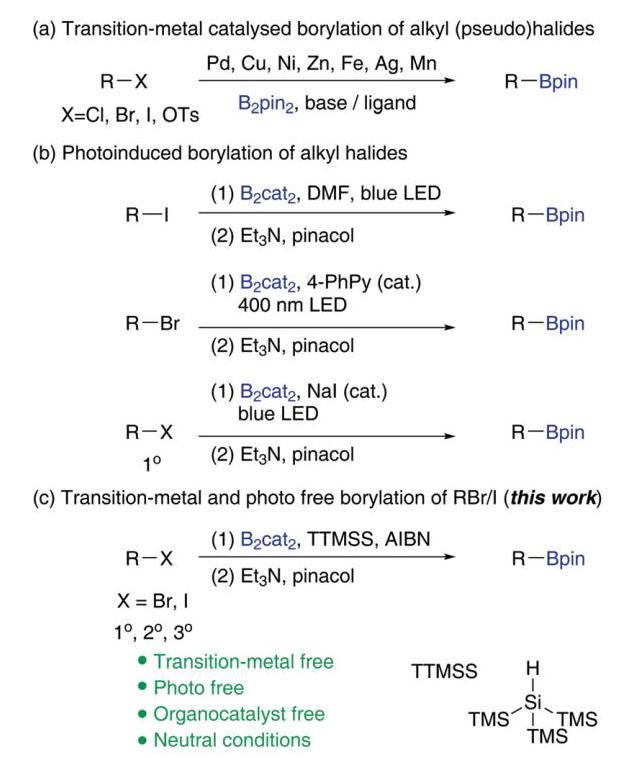
Fig. 1 Borylation of alkyl halides.
图1卤代烷的硼化反应。
School of Materials Science and Engineering, Peking University, Beijing 100871, China.
北京大学材料科学与工程学院,北京100871,中国。
† Electronic supplementary information (ESI) available. CCDC 2079272. For ESI and crystallographic data in CIF or other electronic format see DOI: 10.1039/ d1cc02134f
† 提供电子补充信息(ESI)。CCDC 2079272。有关ESI和CIF或其他电子格式的晶体学数据,请参阅DOI: 10.1039/ d1cc02134f
Table 1 Optimization of reaction conditions ${}^{a}$
表1反应条件的优化${}^{a}$
| $n - {\mathrm{C}}_{8}{\mathrm{H}}_{17}\mathrm{{Br}}$ | ${\mathrm{B}}_{2}{\mathrm{{cat}}}_{2}$ | TTMSS, AIBN, DMA, 80°C then pinacol, ${\mathrm{{Et}}}_{3}\mathrm{\;N}$ | $n - {\mathrm{C}}_{8}{\mathrm{H}}_{17}$ Bpin | ||
| 1a 2a | |||||
| Entry | TTMSS | AIBN | ${\mathrm{B}}_{2}{\text{ cat }}_{2}$ | Time (h) | Yield (%) |
| ${1}^{b}$ | 1.15 | 1.0 | 4.0 | 21 | 59 |
| 2 | 2.0 | 2.0 | 4.0 | 15 | 87 |
| 3 | 2.0 | 2.0 | 4.0 | 21 | 89 (81) |
| 4 | 2.0 | 2.0 | 4.0 | 21 | 90 |
| ${5}^{c}$ | 2.0 | 2.0 | 4.0 | 21 | 89 |
| 6 | 1.1 | 1.1 | 4.0 | 12 | 87 |
| 7 | 1.1 | 1.1 | 2.0 | 6 | 89 |
| 8 | 1.1 | 1.1 | 1.5 | 6 | 73 |
| 9 | 1.1 | 1.1 | 2.0 | 6 | 79 |
| 10 | 1.1 | 1.1 | 1.5 | 6 | 84 (81) |
| 11 | 1.1 | 1.1 | 1.2 | 6 | 70 |
| 12 | 1.0 | 1.1 | 1.2 | 6 | 72 |
| 13 | 1.1 | 1.1 | 2.5 | 6 | 81 |
| 14 | 1.1 | 1.1 | 3.0 | 6 | 75 |
| ${15}^{d}$ | 1.15 | 0 | 4.0 | 48 | Trace |
| ${16}^{e}$ | 1.1 | 1.1 | 1.5 | 6 | 76 |
${}^{a}$ Reaction conditions: 1a ( ${0.3}\mathrm{{mmol}}$ ), ${\mathrm{B}}_{2}{\text{ cat }}_{2}$ , AIBN (azobisisobutyroni-trile), TTMSS (tris(trimethylsilyl)silane), DMA (2 mL), ${80}^{ \circ }\mathrm{C}$ . The reactions were set up in a glovebox and the glovebox was heated outside. Then pinacol (4.0 equiv.) and ${\mathrm{{Et}}}_{3}\mathrm{\;N}\left( {1\mathrm{\;{mL}}}\right)$ were added. Decane was used as an internal standard. GC-fid yield, the yields in brackets are isolated yields. ${}^{b}$ The reaction temperature was ${70}{}^{ \circ }\mathrm{C}$ . ${}^{c}$ Using ACCN (1, ${1}^{\prime }$ -azobis(cyclohexanecarbonitrile)) instead of AIBN. ${}^{d}{10}\mathrm{\;W}$ blue LED (10 cm distance), room temperature. ${}^{e}$ The reaction was set up in air.
${}^{a}$反应条件:1a(${0.3}\mathrm{{mmol}}$),${\mathrm{B}}_{2}{\text{ cat }}_{2}$,偶氮二异丁腈(AIBN),三(三甲基硅基)硅烷(TTMSS),N, N-二甲基乙酰胺(DMA,2 mL),${80}^{ \circ }\mathrm{C}$。反应在手套箱中设置,手套箱在外部加热。然后加入频哪醇(4.0当量)和${\mathrm{{Et}}}_{3}\mathrm{\;N}\left( {1\mathrm{\;{mL}}}\right)$。癸烷用作内标。气相色谱-氢火焰离子化检测器产率,括号内的产率为分离产率。${}^{b}$反应温度为${70}{}^{ \circ }\mathrm{C}$。${}^{c}$使用1,${1}^{\prime }$-偶氮双(环己烷甲腈)(ACCN)代替AIBN。${}^{d}{10}\mathrm{\;W}$蓝色发光二极管(距离10 cm),室温。${}^{e}$反应在空气中设置。
At the outset of the research, we must consider how to activate the alkyl C-Br bond without the help of metal and light. In this context, tributylstannane is an optional reagent which produces carbon radicals by abstraction of X from C-X derivatives. ${}^{31}$ However, due to its toxicity, we then turned our attention to other environmentally friendly reagents. Tris(trimethylsilyl)silane (TTMSS) is an organosilicon compound and notable as possessing a weak Si-H bond, with a bond dissociation energy estimated at 84 kcal ${\mathrm{{mol}}}^{-1}$ . The compound has been described as an environmentally benign analogue of tributyltin hydride. ${}^{32}$ It has been shown that the silyl radical $\left( {{\mathrm{R}}_{3}{Si}}\right)$ generated by the initiation process can cleave alkyl $\mathrm{C} - \mathrm{X}$ bonds $\left( {\mathrm{X} = \mathrm{{Cl}},\mathrm{{Br}},\mathrm{I}}\right)$ to give alkyl radicals; ${}^{33}$ this promising feature drew our great interest. As such, we commenced our study by investigating the borylation of octyl bromide (1a) under transition-metal and light free conditions using ${\mathrm{B}}_{2}{\text{ cat }}_{2}$ as the borylating reagent and the TTMSS/ AIBN combination as the dehalogenation reagents. After the reaction finished, pinacol (4.0 equiv.) and triethylamine were added to the mixture prior to purification, in order to transform R-Bcat to R-Bpin, which allowed us to isolate it. We got a positive result at ${70}^{ \circ }\mathrm{C}$ (entry 1) in the first place. The desired octyl boronate (2a) was obtained in 59% (GC-fid yield with decane as an internal standard). We then increased the amounts of AIBN and TTMSS at ${80}^{ \circ }\mathrm{C}$ ; the yields were relatively higher (entries 2-4). We also tried 1, 1’-azobis(cyclohexanecarbonitrile) (ACCN) with a higher decomposition temperature for initiation; the yield was about the same (entry 5). Next, we gradually decreased the equivalency of reagents and the reaction time (entries 6-10), and found that the yields remained almost unaffected. The optimal yield (84%) is shown in entry 10. Further lowering the amount of ${\mathrm{B}}_{2}{\mathrm{{cat}}}_{2}$ or TTMSS gave slightly decreased yields (entries 11 and 12). It was shown that 1.5 equivalents of ${\mathrm{B}}_{2}{\text{ cat }}_{2}$ is suitable for this reaction (entries 13 and 14). Finally, a control reaction with no AIBN but with shining light from a blue LED only afforded a trace amount of desired product (entry 15). We also tried this reaction in air and the yield was not affected too much (76% yield, entry 16).
在研究开始时,我们必须考虑如何在没有金属和光照的情况下活化烷基C-Br键。在这种情况下,三丁基锡烷是一种可选试剂,它通过从C-X衍生物中夺取X来产生碳自由基。${}^{31}$然而,由于其毒性,我们随后将注意力转向了其他环境友好型试剂。三(三甲基硅基)硅烷(TTMSS)是一种有机硅化合物,因其具有较弱的Si-H键而值得注意,其键解离能估计为84千卡${\mathrm{{mol}}}^{-1}$。该化合物被描述为氢化三丁基锡的环境友好型类似物。${}^{32}$已经表明,引发过程产生的硅基自由基$\left( {{\mathrm{R}}_{3}{Si}}\right)$可以裂解烷基$\mathrm{C} - \mathrm{X}$键$\left( {\mathrm{X} = \mathrm{{Cl}},\mathrm{{Br}},\mathrm{I}}\right)$以生成烷基自由基;${}^{33}$这一有前景的特性引起了我们极大的兴趣。因此,我们开始研究在无过渡金属和光照条件下,使用${\mathrm{B}}_{2}{\text{ cat }}_{2}$作为硼化试剂,TTMSS/AIBN组合作为脱卤试剂,对溴代辛烷(1a)进行硼化反应。反应完成后,在纯化之前向混合物中加入频哪醇(4.0当量)和三乙胺,以便将R-Bcat转化为R-Bpin,从而使我们能够分离出产物。我们首先在${70}^{ \circ }\mathrm{C}$(条目1)得到了阳性结果。以癸烷为内标,通过气相色谱-氢火焰离子化检测器测得所需的硼酸辛酯(2a)的产率为59%。然后我们在${80}^{ \circ }\mathrm{C}$增加了AIBN和TTMSS的用量;产率相对较高(条目2-4)。我们还尝试了使用分解温度较高的1,1’-偶氮双(环己烷甲腈)(ACCN)进行引发;产率大致相同(条目5)。接下来,我们逐渐降低试剂的当量和反应时间(条目6-10),发现产率几乎不受影响。条目10显示了最佳产率(84%)。进一步降低${\mathrm{B}}_{2}{\mathrm{{cat}}}_{2}$或TTMSS的用量会使产率略有下降(条目11和12)。结果表明,1.5当量的${\mathrm{B}}_{2}{\text{ cat }}_{2}$适用于该反应(条目13和14)。最后,一个不使用AIBN但仅用蓝色发光二极管光照的对照反应仅得到痕量的所需产物(条目15)。我们还在空气中尝试了该反应,产率受影响不大(产率76%,条目16)。
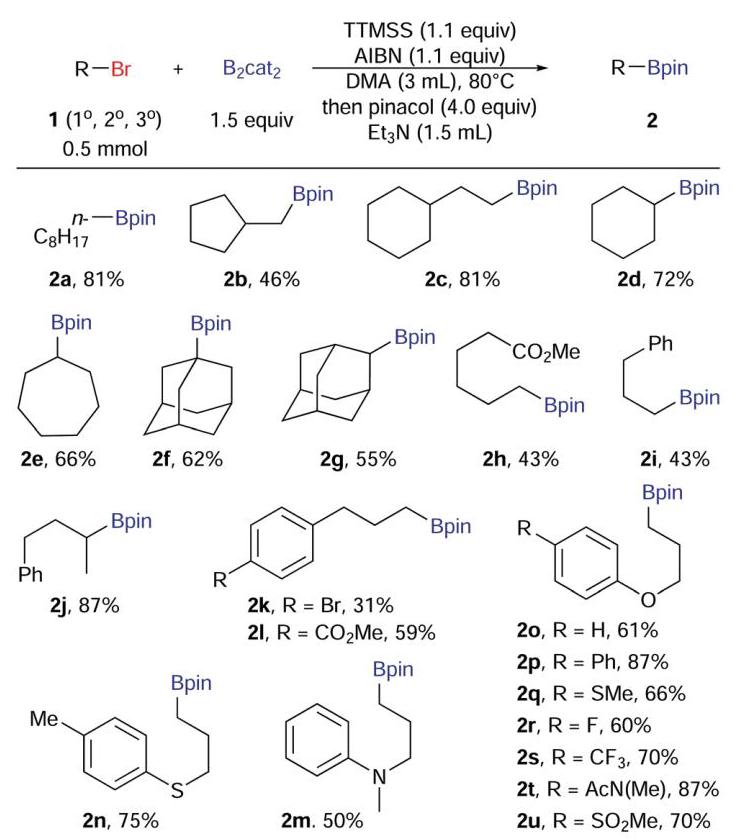
Fig. 2 Substrate scope studies of alkyl bromides.
图2 溴代烷烃的底物范围研究。
With the optimized conditions in hand, we next explored the substrate scope of alkyl bromides (Fig. 2). In general, this method is not sensitive to the steric hindrance of the substrates, as a series of primary, secondary and tertiary alkyl bromides all afford the corresponding borylated products in moderate to good yields. For primary substrates, the borylation products were obtained in 46%-81% yields (2a-2c). Specifically, a number of secondary cyclic bromides were tested, and the corresponding borylation products were formed in 55%-87% yields (2d, 2e, 2g and 2j). When tertiary 1-adamantyl bromide was used as the substrate, the reaction went smoothly and provided a tertiary alkyl boronate in 62% yield (2f). Transformations with phenyl, ester, aromatic amine and sulfide groups were compatible with this method (2h-2n), affording up to 87% yield. It should be noted that when both aryl and alkyl bromides were present in a substrate (e.g. 1k), the reaction proceeded on the alkyl side with the aryl side reserved, affording product $2\mathbf{k}$ , albeit in a decreased yield. We also applied this method to a series of 4-substituted aromatic ether substrates; many functional groups such as phenyl (2p, 87%), thiomethyl (2q, 66%), fluorine (2r, 60%), trifluoromethyl (2s, 70%), amide (2t, 87%) and mesyl (2u, 70%) groups were tolerated and all gave good yields.
在掌握了优化条件后,我们接下来探索了溴代烷烃的底物范围(图2)。一般来说,该方法对底物的空间位阻不敏感,因为一系列伯、仲和叔溴代烷烃均能以中等至良好的产率得到相应的硼化产物。对于伯底物,硼化产物的产率为46% - 81%(2a - 2c)。具体而言,测试了多种仲环溴化物,相应的硼化产物产率为55% - 87%(2d、2e、2g和2j)。当使用叔丁基溴作为底物时,反应顺利进行,以62%的产率得到叔烷基硼酸酯(2f)。含有苯基、酯基、芳胺基和硫醚基的底物的转化与该方法兼容(2h - 2n),产率高达87%。需要注意的是,当底物中同时存在芳基溴和烷基溴时(如1k),反应在烷基一侧进行,芳基一侧保留,得到产物$2\mathbf{k}$,尽管产率有所降低。我们还将该方法应用于一系列4 - 取代的芳基醚底物;许多官能团如苯基(2p,87%)、硫甲基(2q, 66%)、氟(2r, 60%)、三氟甲基(2s, 70%)、酰胺(2t, 87%)和甲磺酰基(2u, 70%)均能耐受,且产率良好。
We next investigated the substrate scope of alkyl iodides (Fig. 3). In general, the borylation products were obtained at a lower temperature $\left( {{70}^{ \circ }\mathrm{C}}\right)$ with a shorter time (2 h). In $2\mathbf{w}$ , the iodine atom was more active than chlorine and only one side was borylated in 65% yield. The double bond (2x), cyclic ether (2y), and naphthyl (2z) were all tolerated and gave moderate to good yields. A heterocycle like thiophene was also compatible and afforded 76% yield. Cholesteryl iodide could be transformed into cholesteryl boronic ester 2ab in 59% yield with a 4 : 1 diastereoselectivity. One of the isomers was identified by X-ray crystallography (for details, see the ESI†).
接下来我们研究了碘代烷烃的底物范围(图3)。一般来说,硼化产物在较低温度$\left( {{70}^{ \circ }\mathrm{C}}\right)$下反应较短时间(2小时)即可得到。在$2\mathbf{w}$中,碘原子比氯原子更活泼,且只有一侧发生硼化反应,产率为65%。双键(2x)、环醚(2y)和萘基(2z)均能耐受,产率中等至良好。噻吩等杂环也兼容,产率为76%。胆固醇碘化物可以以59%的产率和4:1的非对映选择性转化为胆固醇硼酸酯2ab。其中一种异构体通过X射线晶体学鉴定(详情见补充信息†)。
(1)
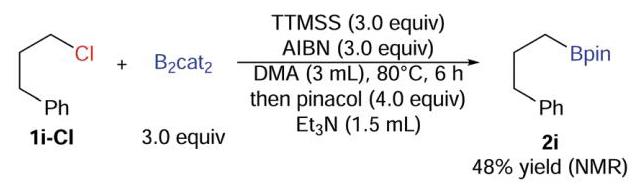
Given that the transformation of an alkyl chloride into the corresponding alkyl radical is much more difficult than that of an alkyl bromide or iodide, ${}^{34}$ it is quite challenging to achieve this radical borylation goal by means of a metal- and light-free concept. Nevertheless, the current method gave a preliminary positive result. With an increasing amount of reagents, the borylation of 1-chloro-3-phenylpropane (1i-Cl) gave 48% NMR yield of the corresponding product 2i (eqn (1)).
鉴于将氯代烷烃转化为相应的烷基自由基比溴代烷烃或碘代烷烃困难得多,${}^{34}$通过无金属和无光照的概念实现这一自由基硼化目标颇具挑战性。然而,目前的方法给出了初步的阳性结果。随着试剂用量的增加,1 - 氯 - 3 - 苯基丙烷(1i - Cl)的硼化反应以48%的NMR产率得到相应产物2i(式(1))。
To gain further insight into the mechanism of this silane promoted alkyl bromide borylation reaction, we performed a series of mechanistic investigations. First, when a commonly used radical scavenger, 2,2,6,6-tetramethyl-1-piperidinyloxy (TEMPO), was added under the standard conditions, only a trace amount of 2a was obtained (Fig. 4a). Second, the boryla-tion of cyclopropyl substrate 1ac gave the ring-opened product 2ac in moderate yield (Fig. 4b). Third, when 6-bromo-1-hexene 1ad was used as the substrate, the borylation reaction gave both linear and cyclic products 2ad and 2ae in 23% and 25% NMR yields, respectively. All these mechanistic experiments together indicated the involvement of alkyl radical intermediates in this borylation reaction.
为了进一步深入了解这种硅烷促进的溴代烷烃硼化反应的机理,我们进行了一系列机理研究。首先,在标准条件下加入常用的自由基清除剂2,2,6,6 - 四甲基 - 1 - 哌啶氧基(TEMPO)时,仅得到痕量的2a(图4a)。其次,环丙基底物1ac的硼化反应以中等产率得到开环产物2ac(图4b)。第三,当使用6 - 溴 - 1 - 己烯1ad作为底物时,硼化反应分别以23%和25%的NMR产率得到线性产物2ad和环状产物2ae。所有这些机理实验共同表明该硼化反应涉及烷基自由基中间体。
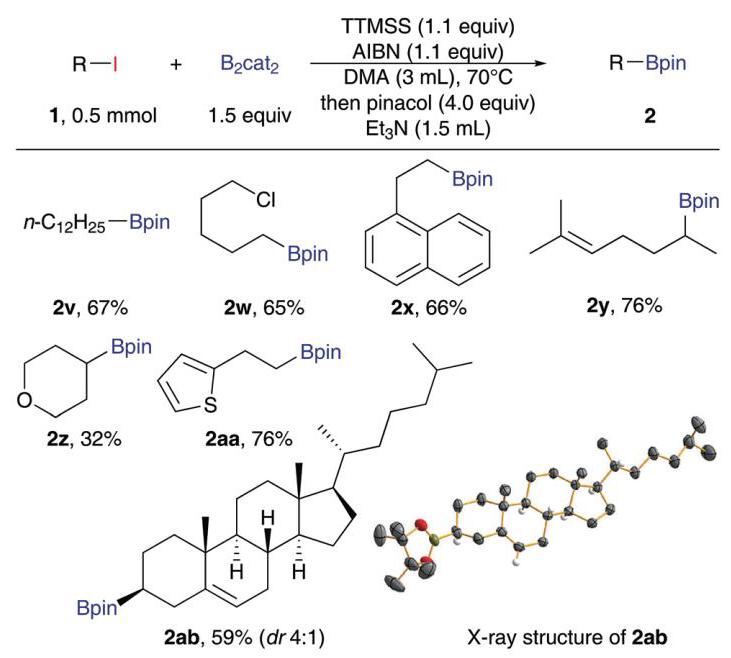
Fig. 3 Substrate scope studies of alkyl iodides.
图3 碘代烷烃的底物范围研究。
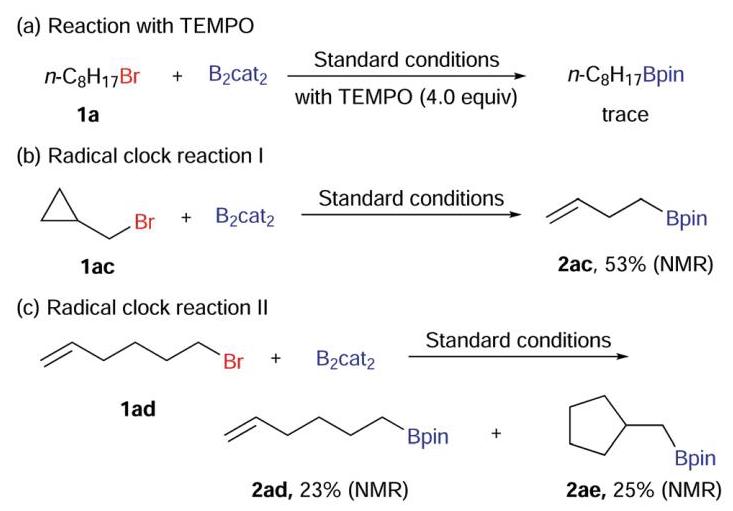
Fig. 4 Mechanistic studies.
图4 机理研究。
Furthermore, we performed density functional theory (DFT) calculations on the potential energy surface of this silane promoted C-B bond formation (Fig. 5, see the ESI† for details). We found that, after the silyl radical ((TMS) ${}_{3}$ Si) is generated, the cleavage of the C-Br bond is favored $\left( {-{15.8}\mathrm{{kcal}}{\mathrm{{mol}}}^{-1}}\right)$ , leading to a carbon-centered radical. Then this alkyl radical adds to ${\mathrm{B}}_{2}{\text{ cat }}_{2}$ to afford INT1. The activation energy of this step is about ${8.8}\mathrm{{kcal}}{\mathrm{{mol}}}^{-1}$ . With the help of DMA, INT1 undergoes decomposition to deliver the final borylated product and DMA-Bcat radical 10. The geometric structures and the key bond lengths of TS1, INT1 and TS2 are shown in Fig. 5. Radical 10 may couple itself to regenerate ${\mathrm{B}}_{2}{\mathrm{{cat}}}_{2}$ and DMA. ${}^{35}$ This process is supported by calculation results, since this step is very thermodynamically favorable $\left( {{\Delta G} = - {46.5}\mathrm{{kcal}}{\mathrm{{mol}}}^{-1}}\right)$ .
此外,我们对该硅烷促进的C-B键形成的势能面进行了密度泛函理论(DFT)计算(图5,详细信息见补充信息†)。我们发现,在生成硅基自由基((TMS)${}_{3}$Si)后,C-Br键的断裂是有利的$\left( {-{15.8}\mathrm{{kcal}}{\mathrm{{mol}}}^{-1}}\right)$,从而产生一个以碳为中心的自由基。然后这个烷基自由基加成到${\mathrm{B}}_{2}{\text{ cat }}_{2}$上得到中间体INT1。这一步的活化能约为${8.8}\mathrm{{kcal}}{\mathrm{{mol}}}^{-1}$。在DMA的帮助下,INT1发生分解,生成最终的硼化产物和DMA-Bcat自由基10。TS1、INT1和TS2的几何结构和关键键长如图5所示。自由基10可能会自身偶联以再生${\mathrm{B}}_{2}{\mathrm{{cat}}}_{2}$和DMA。${}^{35}$这一过程得到了计算结果的支持,因为这一步在热力学上非常有利$\left( {{\Delta G} = - {46.5}\mathrm{{kcal}}{\mathrm{{mol}}}^{-1}}\right)$。
On the basis of our combined experimental and computational evidence as well as studies on previously developed radical borylation reactions, ${}^{{35},{36},{37},{38},{39},{40},{41}}$ a plausible mechanism is outlined in Fig. 6. We propose that it is a classical radical-involved substitution process. The silyl radical $\left( {{\left( \mathrm{{TMS}}\right) }_{3}{Si}}\right)$ generated by the initiation process can abstract the bromine atom of the alkyl bromide to give an alkyl radical, which adds to diboron ${\mathrm{B}}_{2}{\text{ cat }}_{2}$ to deliver the final borylation product.
基于我们的实验和计算证据以及对先前开发的自由基硼化反应的研究,${}^{{35},{36},{37},{38},{39},{40},{41}}$图6概述了一个合理的机理。我们提出这是一个经典的涉及自由基的取代过程。引发过程产生的硅基自由基$\left( {{\left( \mathrm{{TMS}}\right) }_{3}{Si}}\right)$可以夺取烷基溴的溴原子,生成一个烷基自由基,该烷基自由基加成到二硼${\mathrm{B}}_{2}{\text{ cat }}_{2}$上,得到最终的硼化产物。
In conclusion, a transition-metal free and light free radical borylation of alkyl bromides and iodides was developed, which works efficiently under simple operation and neutral conditions with good functional group compatibility. A series of mechanism experiments, as well as DFT calculations, showed that the reaction involves a classical radical process.
总之,我们开发了一种无过渡金属和无光照的烷基溴化物和碘化物的自由基硼化反应,该反应在简单操作和中性条件下高效进行,具有良好的官能团兼容性。一系列机理实验以及DFT计算表明,该反应涉及一个经典的自由基过程。
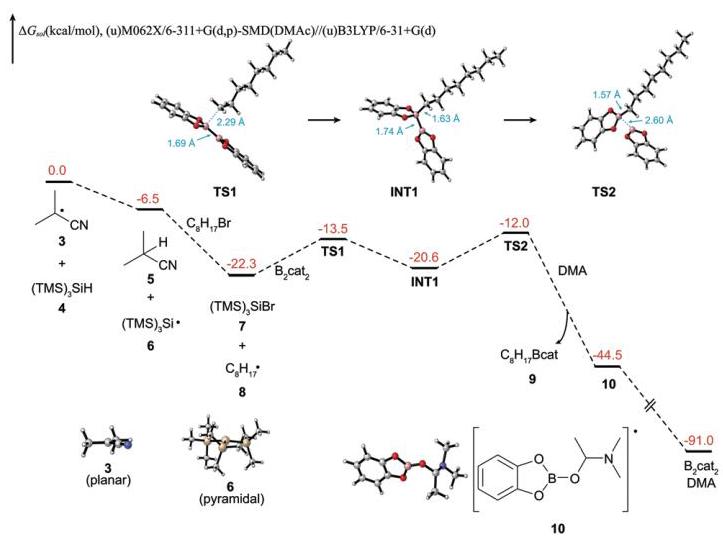
Fig. 5 DFT calculations on the potential energy surface of silane promoted C-B bond formation.
图5 硅烷促进的C-B键形成的势能面的DFT计算。
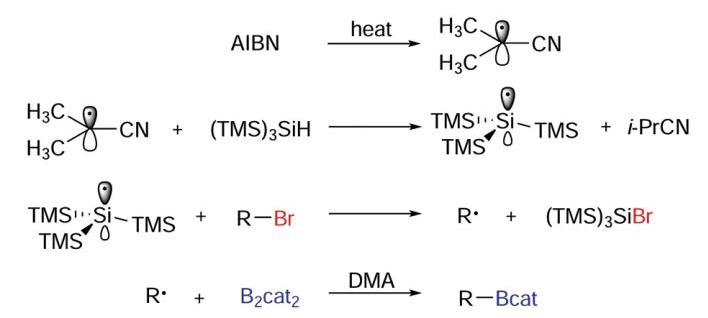
Fig. 6 Proposed mechanism.
图6 提出的机理。
Conflicts of interest
利益冲突
There are no conflicts to declare.
无需申报利益冲突。
Notes and references
注释与参考文献
1 D. G. Hall, Boronic acids: preparation, applications in organic synthesis and medicine, John Wiley & Sons, 2006.
2 S. R. Chemler, D. Trauner and S. J. Danishefsky, Angew. Chem., Int. Ed., 2001, 40, 4544-4568.
3 H. Doucet, Eur. J. Org. Chem., 2008, 2013-2030.
4 R. Jana, T. P. Pathak and M. S. Sigman, Chem. Rev., 2011, 111, 1417-1492.
5 E. C. Neeve, S. J. Geier, I. A. I. Mkhalid, S. A. Westcott and T. B. Marder, Chem. Rev., 2016, 116, 9091-9161.
6 A. B. Cuenca, R. Shishido, H. Ito and E. Fernández, Chem. Soc. Rev., 2017, 46, 415-430.
7 A. Bej, D. Srimani and A. Sarkar, Green Chem., 2012, 14, 661-667.
8 A. Joshi-Pangu, X. Ma, M. Diane, S. Iqbal, R. J. Kribs, R. Huang, C.-Y. Wang and M. R. Biscoe, J. Org. Chem., 2012, 77, 6629-6633.
9 D. Hemming, R. Fritzemeier, S. A. Westcott, W. L. Santos and P. G. Steel, Chem. Soc. Rev., 2018, 47, 7477-7494.
10 H. Ito and K. Kubota, Org. Lett., 2012, 14, 890-893.
11 C.-T. Yang, Z.-Q. Zhang, H. Tajuddin, C.-C. Wu, J. Liang, J.-H. Liu, Y. Fu, M. Czyzewska, P. G. Steel, T. B. Marder and L. Liu, Angew. Chem., Int. Ed., 2012, 51, 528-532.
12 K. Kubota, E. Yamamoto and H. Ito, J. Am. Chem. Soc., 2013, 135, 2635-2640.
13 J. H. Kim and Y. K. Chung, RSC Adv., 2014, 4, 39755-39758.
14 H. Iwamoto, K. Kubota, E. Yamamoto and H. Ito, Chem. Commun., 2015, 51, 9655-9658.
15 H. Yoshida, Y. Takemoto, S. Kamio, I. Osaka and K. Takaki, Org. Chem. Front., 2017, 4, 1215-1219.
16 S. K. Bose, S. Brand, H. O. Omoregie, M. Haehnel, J. Maier, G. Bringmann and T. B. Marder, ACS Catal., 2016, 6, 8332-8335.
17 X. Lou, Z.-Q. Zhang, J.-H. Liu and X.-Y. Lu, Chem. Lett., 2016, 45, 200-202.
18 A. S. Dudnik and G. C. Fu, J. Am. Chem. Soc., 2012, 134, 10693-10697.
19 J. Yi, J.-H. Liu, J. Liang, J.-J. Dai, C.-T. Yang, Y. Fu and L. Liu, Adv. Synth. Catal., 2012, 354, 1685-1691.
20 S. K. Bose, K. Fucke, L. Liu, P. G. Steel and T. B. Marder, Angew. Chem., Int. Ed., 2014, 53, 1799-1803.
21 T. C. Atack, R. M. Lecker and S. P. Cook, J. Am. Chem. Soc., 2014, 136, 9521-9523.
22 R. B. Bedford, P. B. Brenner, E. Carter, T. Gallagher, D. M. Murphy and D. R. Pye, Organometallics, 2014, 33, 5940-5943.
23 X. Lu, Z.-Q. Zhang, L. Yu, B. Zhang, B. Wang, T.-J. Gong, C.-L. Tian, B. Xiao and Y. Fu, Chin. J. Chem., 2019, 37, 11-18.
24 T. C. Atack and S. P. Cook, J. Am. Chem. Soc., 2016, 138, 6139-6142.
25 W. Yang, X. Gao and B. Wang, Biological and medicinal applications of boronic acids, Wiley Online Library, 2005, pp. 481-582.
26 Y. Cheng, C. Mück-Lichtenfeld and A. Studer, Angew. Chem., Int. Ed., 2018, 57, 16832-16836.
27 L. Zhang, Z.-Q. Wu and L. Jiao, Angew. Chem., Int. Ed., 2020, 59, 2095-2099.
28 C. Wang, L. Zhou, K. Yang, F. Zhang and Q. Song, Chin. J. Chem..
29 Q. Liu, L. Zhang and F. Mo, Acta Chim. Sin., 2020, 78, 1297-1308.
30 Q. Liu, J. Hong, B. Sun, G. Bai, F. Li, G. Liu, Y. Yang and F. Mo, Org. Lett., 2019, 21, 6597-6602.
31 T. V. B. RajanBabu, P. C. Bulman Page and B. R. Buckley, Tri-n-butylstannane, American Cancer Society, 2004.
32 C. Chatgilialoglu, C. Ferreri, Y. Landais and V. I. Timokhin, Chem. Rev., 2018, 118, 6516-6572.
33 C. Chatgilialoglu, Acc. Chem. Res., 1992, 25, 188-194.
34 Y.-R. Luo, Handbook of bond dissociation energies in organic compounds, CRC Press, 2002.
35 A. Fawcett, J. Pradeilles, Y. Wang, T. Mutsuga, E. L. Myers and V. K. Aggarwal, Science, 2017, 357, 283-286.
36 D. Hu, L. Wang and P. Li, Org. Lett., 2017, 19, 2770-2773.
37 J. Hu, G. Wang, S. Li and Z. Shi, Angew. Chem., Int. Ed., 2018, 57, 15227-15231.
38 J. Wu, L. He, A. Noble and V. K. Aggarwal, J. Am. Chem. Soc., 2018, 140, 10700-10704.
39 F. Sandfort, F. Strieth-Kalthoff, F. J. Klauck, M. J. James and F. Glorius, Chem. - Eur. J., 2018, 24, 17210-17214.
40 F. W. Friese and A. Studer, Angew. Chem., Int. Ed., 2019, 58, 9561-9564.
41 J. Wu, R. M. Bär, L. Guo, A. Noble and V. K. Aggarwal, Angew. Chem., Int. Ed., 2019, 58, 18830-18834.