Anodic Oxidation Triggered Divergent 1,2- and 1,4-Group Transfer Reactions of β-Hydroxycarboxylic Acids Enabled by Electrochemical Regulation
英文原文与中文译文逐段对照 · English original with Chinese translation
Zhenxing Zhang, ${ \ddagger }^{\text{ ab }}$ Lei Zhang, ${ \ddagger }^{\text{ a }}$ Xianhao Zhang, ${}^{\text{ c }}$ Jianxin Yang, ${}^{\text{ c }}$ Yunxing Yin, ${}^{\text{ c }}$ Yangye Jiang, ${}^{d}$ Chengchu Zeng, ${}^{b}{}^{d}$ Gang Lu, ${}^{e}$ Yang Yang ${}^{f}$ and Fanyang Mo ${}^{b}$
张振兴,${ \ddagger }^{\text{ ab }}$ 张雷,${ \ddagger }^{\text{ a }}$ 张先浩,${}^{\text{ c }}$ 杨建新,${}^{\text{ c }}$ 尹云星,${}^{\text{ c }}$ 蒋洋烨,${}^{d}$ 曾成初,${}^{b}{}^{d}$ 卢刚,${}^{e}$ 杨阳 ${}^{f}$ 和莫凡洋 ${}^{b}$
We report a set of electrochemically regulated protocols for the divergent synthesis of ketones and $\beta$ -keto esters from the same $\beta$ -hydroxycarboxylic acid starting materials. Enabled by electrochemical control, the anodic oxidation of carboxylic acids proceeded in either a one-electron or a two-electron pathway, leading to a 1,4-aryl transfer or a semipinacol-type 1,2-group transfer product with excellent chemoselectivity. The 1,4-aryl transfer represents an unprecedented example of carbon-to-oxygen group transfer proceeding via a radical mechanism. In contrast to previously reported radical group transfer reactions, this 1,4-group transfer process features the migration of electron-rich aryl substituents. Furthermore, with these chemoselective electrochemical oxidation protocols, a range of ketones and $\beta$ -keto esters including those possessing a challenging-to-access medium-sized ring could be synthesized in excellent yields.
我们报道了一组电化学调控的方法,可从相同的$\beta$-羟基羧酸起始原料出发,以发散性方式合成酮类和$\beta$-酮酯。在电化学控制下,羧酸的阳极氧化通过单电子或双电子途径进行,以优异的化学选择性生成1,4-芳基转移产物或半频哪醇型1,2-基团转移产物。1,4-芳基转移代表了通过自由基机制进行的碳到氧基团转移的前所未有的例子。与先前报道的自由基基团转移反应相比,这种1,4-基团转移过程的特点是富电子芳基取代基的迁移。此外,通过这些化学选择性电化学氧化方法,可以以优异的产率合成一系列酮类和$\beta$-酮酯,包括那些具有难以获得的中等大小环的化合物。
Check for updates
查看更新
Cite this: DOI: 10.1039/d0sc02386h
引用本文:DOI: 10.1039/d0sc02386h
All publication charges for this article have been paid for by the Royal Society of Chemistry
本文的所有出版费用均由皇家化学学会支付
Received 28th April 2020
2020年4月28日收到
Accepted 25th September 2020
2020年9月25日接受
DOI: 10.1039/d0sc02386h
DOI: 10.1039/d0sc02386h
rsc.li/chemical-science
rsc.li/chemical-science
Introduction
引言
As an essential class of synthetically useful transformations, rearrangement reactions such as ring expansion, ring contraction and functional group transposition have received considerable attention due to their excellent atom economy, stereospecificity and efficiency. ${}^{1}$ Among various rearrangement processes, radical and ionic group migrations represent two of the most commonly encountered mechanisms. In this context, it is of great interest if the same substrate can undergo either radical or ionic rearrangement when being subjected to different reaction conditions.
作为一类重要的合成转化反应,重排反应如扩环、缩环和官能团转位等,因其出色的原子经济性、立体专一性和效率而备受关注。${}^{1}$ 在各种重排过程中,自由基和离子基团迁移是最常见的两种机制。在这种情况下,如果同一底物在不同反应条件下能发生自由基或离子重排,那将非常有趣。
Our laboratory has been interested in utilizing organic electrochemistry as a mild and efficient alternative to conventional chemical approaches for sustainable synthesis. ${}^{2}$ One of the most appealing advantages of organic electrochemistry lies in its ability to exert exquisite control over the reaction outcome. Through the fine tuning of applied potential and other electrochemical parameters (e.g., choice of electrodes and electrolytes), common organic starting materials can selectively undergo one- or two-electron redox processes at the electrode and generate highly reactive intermediates. ${}^{3}$ We surmise that the judicious selection of electrochemical conditions could be used to trigger mechanistically distinct rearrangement processes from the same substrate.
我们实验室一直致力于利用有机电化学作为一种温和且高效的替代传统化学方法的手段来实现可持续合成。${}^{2}$ 有机电化学最吸引人的优点之一在于其能够对反应结果进行精确控制。通过微调施加的电势和其他电化学参数(例如电极和电解质的选择),常见的有机起始原料可以在电极上选择性地经历单电子或双电子氧化还原过程,并生成高活性中间体。${}^{3}$ 我们推测,明智地选择电化学条件可用于触发同一底物发生机制不同的重排过程。
Scheme 1 Electrochemical oxidation of alkyl carboxylic acids.
方案1 烷基羧酸的电化学氧化
${}^{a}$ Department of Energy and Resources Engineering, College of Engineering, Peking University, Beijing 100871, China.
${}^{a}$ 能源与资源工程系,工程学院,北京大学,北京100871,中国。
${}^{b}$ College of Chemistry and Chemical Engineering, Anyang Normal University, Anyang 455000, China
${}^{b}$ 化学化工学院,安阳师范学院,安阳455000,中国
${}^{c}$ WuXi AppTec (Tianjin) Co., Ltd, Tianjin 300457, P. R. China
${}^{c}$ 无锡药明康德(天津)有限公司,天津300457,中华人民共和国
${}^{d}$ College of Life Science &Bioengineering, Beijing University of Technology, Beijing 100124, China
${}^{d}$ 生命科学与生物工程学院,北京工业大学,北京100124,中国
eSchool of Chemistry and Chemical Engineering, Shandong University, Jinan, Shandong 250100, China
山东大学化学与化工学院,山东济南250100,中国
${}^{f}$ Department of Chemistry and Biochemistry, University of California, Santa Barbara, California 93106, USA
${}^{f}$ 化学与生物化学系,加利福尼亚大学圣巴巴拉分校,加利福尼亚93106,美国
“Jiangsu Donghai Silicon Industry S&T Innovation Center, Jiangsu 222300, China
“江苏东海硅产业科技创新中心,江苏222300,中国
† Electronic supplementary information (ESI) available. CCDC 1987570. For ESI and crystallographic data in CIF or other electronic format see DOI: 10.1039/d0sc02386h
† 电子补充信息(ESI)可用。CCDC 1987570。有关ESI和CIF或其他电子格式的晶体学数据,请参阅DOI:10.1039/d0sc02386h
‡ These authors contributed equally to this work.
‡ 这些作者对本工作贡献相同。
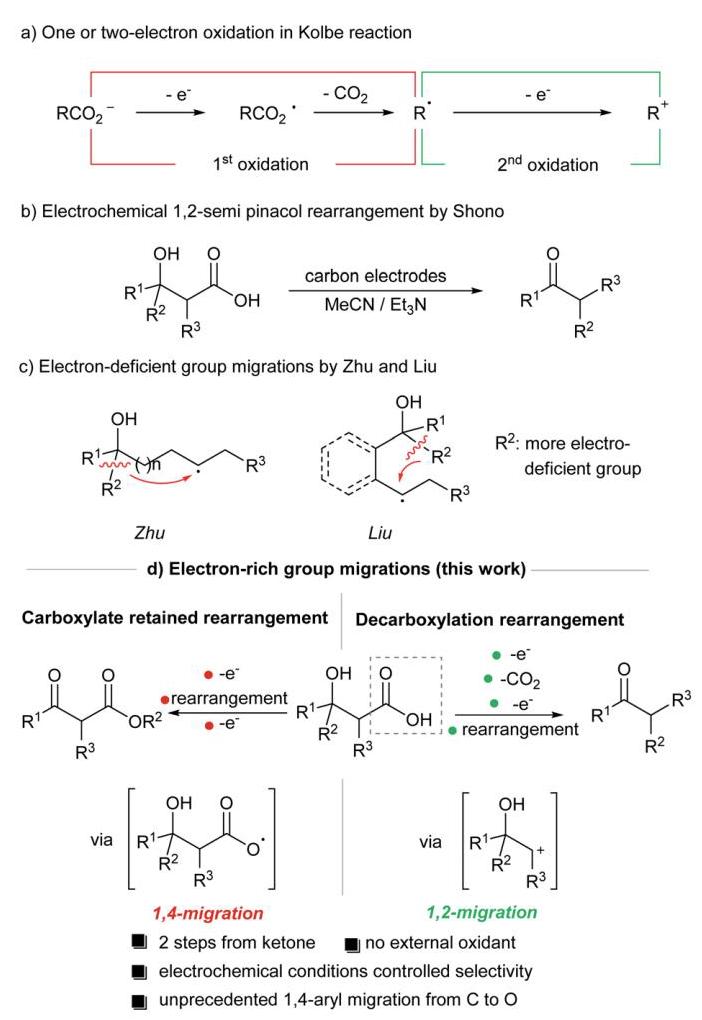
Kolbe electrolysis is a classical organic electrochemical reaction which provides an effective means to couple alkyl radicals generated from the anodic oxidation of carboxylic acids. ${}^{4}$ In these anodic processes, the initial one-electron oxidation-triggered decarboxylation leads to the formation of an alkyl radical (Scheme 1a). This transient alkyl radical can also be further oxidized electrochemically, giving rise to a new reactive carbocation species. For example, this electrochemically generated carbocation has been utilized in semi-pinacol rearrangement by Shono (Scheme 1b). ${}^{5}$ We postulated that this electrochemistry-enabled mechanistic dichotomy could be further leveraged to allow for divergent rearrangement processes from the same substrate.
科尔贝电解是一种经典的有机电化学反应,它提供了一种有效方法来偶联由羧酸阳极氧化产生的烷基自由基。${}^{4}$ 在这些阳极过程中,最初的单电子氧化引发的脱羧反应导致烷基自由基形成(方案1a)。这个瞬时的烷基自由基也可以进一步被电化学氧化,产生一种新的活性碳正离子物种。例如,这种电化学产生的碳正离子已被Shono用于半频哪醇重排(方案1b)。${}^{5}$ 我们推测,这种电化学实现的机制二分法可以进一步利用,以允许同一底物发生不同的重排过程。
We envisioned an electrochemically controlled product selectivity in the anodic oxidation induced rearrangement of $\beta$ -hydroxycarboxylic acids (Scheme 1d). In this design, the two-electron oxidation of $\beta$ -hydroxycarboxylic acids would lead to a carbocation intermediate at the $\beta$ -position of the alcohol, thereby inducing the semipinacol-type ionic rearrangement. On the other hand, under appropriate electrochemical conditions, one-electron oxidation of the carboxylic acid would give rise to a highly reactive oxygen-centered radical, thereby allowing for novel functional group migration processes via a radical mechanism. ${}^{6}$ More importantly, we demonstrate that the electron-rich aryl migration can be accomplished in this carbon-to-oxygen group transfer triggered by anodic one-electron oxidation of $\beta$ -hydroxycarboxylic acids. We note that carbon to oxygen group transfer initiated by an oxygen-centered radical is unprecedented in the literature. ${}^{6a}$
我们设想在阳极氧化诱导的$\beta$ -羟基羧酸重排中实现电化学控制的产物选择性(方案1d)。在这种设计中,$\beta$ -羟基羧酸的双电子氧化将在醇的$\beta$ -位产生一个碳正离子中间体,从而引发半频哪醇型离子重排。另一方面,在适当的电化学条件下,羧酸的单电子氧化将产生一个高活性的氧中心自由基,从而允许通过自由基机制进行新的官能团迁移过程。${}^{6}$ 更重要的是,我们证明了在由$\beta$ -羟基羧酸阳极单电子氧化引发的这种碳到氧的基团转移中,可以实现富电子芳基的迁移。我们注意到,由氧中心自由基引发的碳到氧的基团转移在文献中是前所未有的。${}^{6a}$
Radical-mediated functional group migration reactions have received considerable attention and a number of elegant protocols for carbon-group transfer processes have been recently reported by ${\mathrm{{Zhu}}}^{7}$ and ${\mathrm{{Liu}}}^{8}$ (Scheme 1c). In these previously reported radical aryl migration reactions, electron-deficient aryl group migrates preferentially over electron-rich ones due to the nucleophilic nature of the carbon-centered radical. The inverse reactivity pattern, namely the migration of electron-rich aryl groups, is seldom reported.
自由基介导的官能团迁移反应受到了广泛关注,${\mathrm{{Zhu}}}^{7}$ 和${\mathrm{{Liu}}}^{8}$ 最近报道了许多用于碳基团转移过程的出色方法(方案1c)。在这些先前报道的自由基芳基迁移反应中,由于碳中心自由基的亲核性质,缺电子芳基比富电子芳基更优先迁移。很少报道相反的反应模式,即富电子芳基的迁移。
Results and discussion
结果与讨论
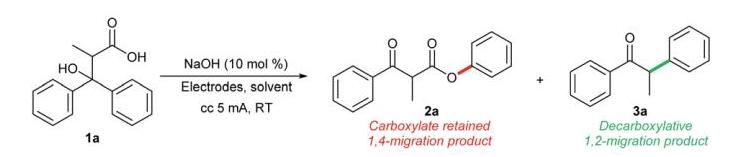
We commenced our studies by investigating reaction conditions for the electrochemical oxidation induced rearrangement of 3-hydroxy-2-methyl-3,3-diphenylpropanoic acid 1a (Table 1). When glassy carbon was used as electrodes (anode and cathode), a mixture of products 2a and 3a was obtained with low chemoselectivity (entry 1). Similar to our previous work on intramolecular oxidative cyclization, ${}^{2b}$ a catalytic amount of NaOH could serve as the base and the supporting electrolyte in this reaction, and no additional electrolyte was needed for the electrochemical transformation. To improve the chemo-selectivity of this reaction, we examined the use of a range of electrodes and solvents. With graphite as the anode and Pt plate as the cathode, using a $3 : 1$ mixture of water and pyridine as the solvent, 3a formed with excellent chemoselectivity (entry 3). Increasing the electric quantity from $2\mathrm{\;F}{\mathrm{\;{mol}}}^{-1}$ to ${2.3}\mathrm{\;F}{\mathrm{\;{mol}}}^{-1}$ further improved the yield of 3a to 74% (entry 4). On the other hand, the use of Pt anode in conjunction with a mixed MeCN/ ${\mathrm{H}}_{2}\mathrm{O}$ solvent led to the selective formation of $2\mathbf{a}$ (entries 6 and 7). Finally, no product was observed in the absence of electric current (entry 8).
我们通过研究3-羟基-2-甲基-3,3-二苯基丙酸1a的电化学氧化诱导重排反应条件来开展研究(表1)。当使用玻碳作为电极(阳极和阴极)时,得到了产物2a和3a的混合物,化学选择性较低(第1项)。与我们之前关于分子内氧化环化的工作类似,${}^{2b}$ 催化量的NaOH可作为该反应的碱和支持电解质,并且电化学转化不需要额外的电解质。为了提高该反应的化学选择性,我们研究了一系列电极和溶剂的使用情况。以石墨为阳极、铂板为阴极,使用 $3 : 1$ 水和吡啶的混合物作为溶剂时,3a以优异的化学选择性生成(第3项)。将电量从 $2\mathrm{\;F}{\mathrm{\;{mol}}}^{-1}$ 增加到 ${2.3}\mathrm{\;F}{\mathrm{\;{mol}}}^{-1}$ 进一步将3a的产率提高到74%(第4项)。另一方面,使用铂阳极与MeCN/${\mathrm{H}}_{2}\mathrm{O}$ 混合溶剂导致选择性地形成 $2\mathbf{a}$ (第6项和第7项)。最后,在无电流的情况下未观察到产物(第8项)。
Table 1 Reaction development and optimization ${}^{a}$
表1反应的发展与优化 ${}^{a}$
| Entry | Electrodes | Solvents (ratio) | $2{a}^{b}\left( \% \right)$ | 3a ${}^{b}\left( \% \right)$ |
| 1 | Glassy carbon (+/-) | $\mathrm{{MeOH}}/{\mathrm{H}}_{2}\mathrm{O}\left( {3 : 1}\right)$ | 22 | 28 |
| 2 | Graphite (+/-) | Pyridine $/{\mathrm{H}}_{2}\mathrm{O}\left( {1 : 3}\right)$ | 3 | 46 |
| 3 | Graphite/Pt (+/-) | Pyridine $/{\mathrm{H}}_{2}\mathrm{O}\left( {1 : 3}\right)$ | 1 | 56 |
| ${4}^{c}$ | Graphite/Pt (+/-) | Pyridine $/{\mathrm{H}}_{2}\mathrm{O}\left( {1 : 3}\right)$ | 1 | 74 |
| 5 | Pt $\left( {+/ - }\right)$ | $\mathrm{{MeOH}}/{\mathrm{H}}_{2}\mathrm{O}\left( {3 : 1}\right)$ | 60 | 3 |
| 6 | Pt $\left( {+/ - }\right)$ | $\mathrm{{MeCN}}/{\mathrm{H}}_{2}\mathrm{O}\left( {3 : 1}\right)$ | 73 | ND |
| ${7}^{c}$ | Pt $\left( {+/ - }\right)$ | $\mathrm{{MeCN}}/{\mathrm{H}}_{2}\mathrm{O}\left( {3 : 1}\right)$ | 78 | ND |
| 8 | Pt $\left( {+/ - }\right)$ | ${\mathrm{{MeCN}/H}}_{2}\mathrm{O}\left( {3 : 1}\right)$ | ND | ND |
${}^{a}$ Entries 1-4 were performed on IKA Electrasyn 2.0 with its kit electrodes at room temperature. Entries 5-8 were performed in a test tube with Pt gauzes (52 mesh) as electrodes and IKA Electrasyn 2.0 as a power supply. Substrate 1a (0.3 mmol), solvents $4\mathrm{\;{mL}},\mathrm{{NaOH}}$ (10 mol%) for entries 1,5-8, constant current (cc) $5\mathrm{\;{mA}},2\mathrm{\;F}{\mathrm{\;{mol}}}^{-1}$ . ND, not detected. ${}^{b}$ Yields were determined by ${}^{1}\mathrm{H}$ NMR using 1,3,5- trimethoxylbenzene as an internal standard. ${}^{c}{2.3}\mathrm{\;F}{\mathrm{\;{mol}}}^{-1}$ .
${}^{a}$ 第1 - 4项在IKA Electrasyn 2.0上使用其配套电极在室温下进行。第5 - 8项在试管中以铂网(52目)为电极、IKA Electrasyn 2.0为电源进行。底物1a(0.3 mmol),第1、5 -8项的溶剂 $4\mathrm{\;{mL}},\mathrm{{NaOH}}$ (10 mol%),恒流(cc) $5\mathrm{\;{mA}},2\mathrm{\;F}{\mathrm{\;{mol}}}^{-1}$ 。ND,未检测到。 ${}^{b}$ 产率通过以1,3,5-三甲氧基苯为内标物的 ${}^{1}\mathrm{H}$ NMR测定。 ${}^{c}{2.3}\mathrm{\;F}{\mathrm{\;{mol}}}^{-1}$ 。
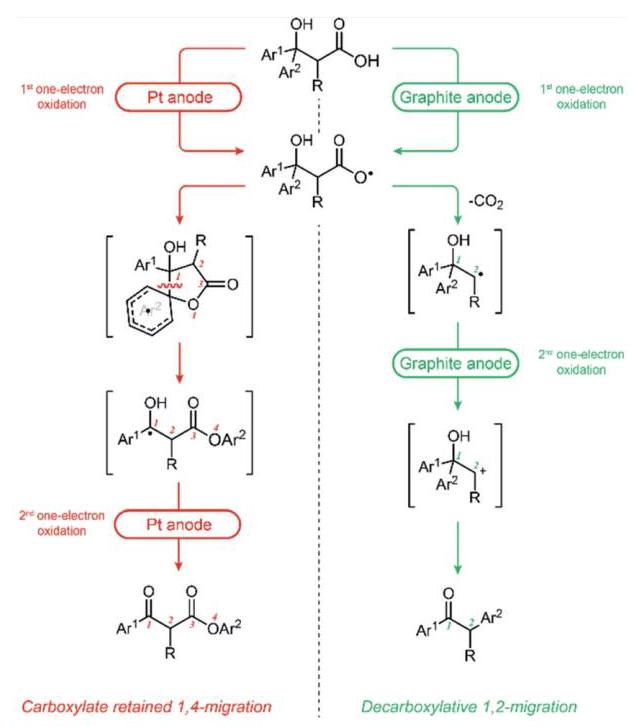
Based on previous study on Kolbe electrolysis ${}^{9}$ and our own work, we reasoned that the choice of electrode plays a dominant role in determining the product selectivity. ${}^{10}$ We observed that anode materials were key factor to the outcome of the reaction. Platinum electrodes favor 1,4-migration, whereas carbon-based electrodes favor 1,2-migration. For 1,4-aryl migration, the substrate undergoes a one-electron oxidation process to afford an oxygen-centered carboxylate radical. This triggers the 1,4-aryl migration followed by one-electron oxidation on the anode to deliver the final $\beta$ -keto ester product (Scheme 2, left). For 1,2- group migration, a two-electron oxidation process takes place, resulting in the formation of a carbocation. The subsequent semi-pinacol rearrangement then furnishes the ketone product (Scheme 2, right).
基于之前对Kolbe电解 ${}^{9}$ 的研究以及我们自己的工作,我们推断电极的选择在决定产物选择性方面起主导作用。 ${}^{10}$ 我们观察到阳极材料是反应结果的关键因素。铂电极有利于1,4-迁移,而碳基电极有利于1,2-迁移。对于1,4-芳基迁移,底物经历单电子氧化过程以产生以氧为中心的羧酸根自由基。这引发1,4-芳基迁移,随后在阳极上进行单电子氧化以得到最终的 $\beta$ -酮酯产物(方案2,左)。对于1,2-基团迁移,发生双电子氧化过程,导致形成碳正离子。随后的半频哪醇重排进而提供酮产物(方案2,右)。
With the optimized reaction conditions in hand (Table 1, entries 4 and 7), we investigated the substrate scope of the one-electron oxidation induced 1,4-aryl migration (Table 2). A series of acyclic $\beta ,\beta$ -diaryl- $\beta$ -hydroxycarboxylic acids $1\mathbf{a} - 1\mathbf{r}$ were converted to the corresponding $\beta$ -keto esters 2a-2r under electrochemical conditions in good to excellent yields. Some of these functionalized $\beta$ -carbonyl esters require multistep synthetic procedure to synthesize using conventional methods. Therefore, this electricity-driven radical-mediated 1,4-aryl migration strategy provided an efficient access to these $\beta$ -keto ester building blocks. Notably, in contrast to previously developed radical group transfer processes, when asymmetrical $\beta ,\beta$ - diaryl substituted $\beta$ -hydroxycarboxylic acid 1i-1n was applied, the electron-rich aryl group migrated preferentially over the electron-neutral one. Additionally, we found that strong electron-withdrawing group substituted $\beta ,\beta$ -diaryl- $\beta$ -hydrox-ycarboxylic acids had a poor reactivity toward 1,4-aryl migration, including cyan, amide and ester groups. We attribute this selectivity to the electrophilic nature of oxygen-centered radical generated from single-electron oxidation. From a mechanistic perspective, this rearrangement represents a selectivity reversal in radical migration reactions. ${}^{6a}$ Furthermore, a range of medium-sized lactones (2s-2u) that are challenging to synthesize ${}^{11}$ could also be effectively prepared using this radical 1,4- aryl migration ( $n + 3$ ring expansion), thus further demonstrating the synthetic utility of this electrochemically triggered group transfer process. We note that the current 1,4-aryl migration can only be applied to diaryl substituted $\beta$ -hydrox-ycarboxylic acids. Retro-Reformatsky reaction took place when alkyl/aryl substituted $\beta$ -hydroxycarboxylic acids were used.
在掌握了优化的反应条件后(表1,第4和7项),我们研究了单电子氧化诱导的1,4-芳基迁移的底物范围(表2)。一系列无环的$\beta ,\beta$-二芳基-$\beta$-羟基羧酸$1\mathbf{a} - 1\mathbf{r}$在电化学条件下以良好至优异的产率转化为相应的$\beta$-酮酯2a - 2r。其中一些官能化的$\beta$-羰基酯使用传统方法需要多步合成程序。因此,这种电驱动的自由基介导的1,4-芳基迁移策略为这些$\beta$-酮酯结构单元提供了一种有效的合成途径。值得注意的是,与先前开发的自由基基团转移过程不同,当应用不对称的$\beta ,\beta$-二芳基取代的$\beta$-羟基羧酸1i - 1n时,富电子芳基比电子中性芳基优先迁移。此外,我们发现强吸电子基团取代的$\beta ,\beta$-二芳基-$\beta$-羟基羧酸对1,4-芳基迁移的反应性较差,包括氰基、酰胺和酯基。我们将这种选择性归因于单电子氧化产生的以氧为中心的自由基的亲电性质。从机理角度来看,这种重排代表了自由基迁移反应中的选择性反转。${}^{6a}$此外,一系列难以合成的中等大小的内酯(2s - 2u)${}^{11}$也可以通过这种自由基1,4-芳基迁移($n + 3$扩环)有效地制备,从而进一步证明了这种电化学触发的基团转移过程的合成效用。我们注意到当前的1,4-芳基迁移仅适用于二芳基取代的$\beta$-羟基羧酸。当使用烷基/芳基取代的$\beta$-羟基羧酸时会发生逆Reformatsky反应。
Scheme 2 Rationale for migration selectivity.
方案2迁移选择性的原理。
We next surveyed the substrate scope of the two-electron oxidation induced semi-pinacol rearrangement (1,2-aryl/alkyl migration) (Table 3). For substituted $\beta$ -hydroxycarboxylic acids 1a-1e, both moderate electron-withdrawing and electron-donating groups were well tolerated, providing the corresponding products (3a-3e) in excellent yields (73-80%). However, substrates with strong electron-withdrawing group showed low reactivity (1v-1x). For $\beta$ -alkyl- $\beta$ -aryl- $\beta$ -hydrox-ycarboxylic acid 1y, selective 1,2-aryl over 1,2-alkyl migration was observed, which is characteristic for semipinacol rearrangement involving a cationic intermediate. ${}^{12}$ Additionally, a wide range of cyclic ketone-drived $\beta$ -hydroxycarboxylic acids 1z-1ah were transformed into their corresponding $n + 1$ ring-expansion ketone products in moderate to good yields.
接下来,我们研究了双电子氧化诱导的半频哪醇重排(1,2-芳基/烷基迁移)的底物范围(表3)。对于取代的$\beta$-羟基羧酸1a - 1e,中等吸电子和供电子基团都能很好地耐受,以优异的产率(73 - 80%)提供相应的产物(3a - 3e)。然而,具有强吸电子基团的底物显示出低反应性(1v - 1x)。对于$\beta$-烷基-$\beta$-芳基-$\beta$-羟基羧酸1y,观察到1,2-芳基迁移优先于1,2-烷基迁移,这是涉及阳离子中间体的半频哪醇重排的特征。${}^{12}$此外,一系列环状酮衍生的$\beta$-羟基羧酸1z - 1ah以中等至良好的产率转化为它们相应的$n + 1$扩环酮产物。
Table 2 Kolbe one-electron oxidation process induced 1,4-aryl migration from carbon to oxygen ${}^{\alpha }$
表2 Kolbe单电子氧化过程诱导的从碳到氧的1,4-芳基迁移${}^{\alpha }$
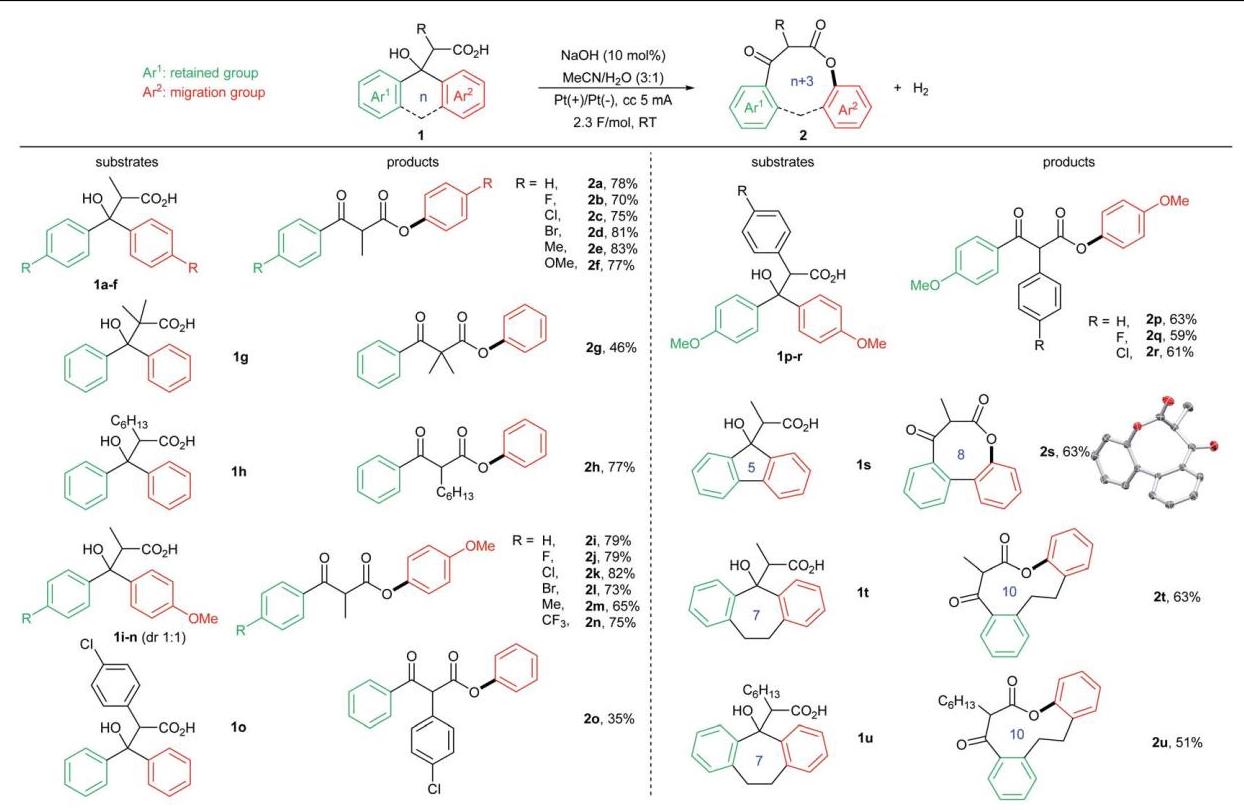
${}^{a}$ Reaction conditions: substrate $1\left( {{0.3}\mathrm{{mmol}}}\right) ,\mathrm{{NaOH}}\left( {{10}\mathrm{\;{mol}}\% }\right)$ , MeCN $3\mathrm{{mL}},{\mathrm{H}}_{2}\mathrm{O}1\mathrm{{mL}}$ , platinum gauzes as both anode and cathode, constant current (cc) $5\mathrm{\;{mA}},{2.3}\mathrm{\;F}{\mathrm{\;{mol}}}^{-1}$ . The reactions were performed in a test tube using Electrasyn 2.0 as power supply.
${}^{a}$反应条件:底物$1\left( {{0.3}\mathrm{{mmol}}}\right) ,\mathrm{{NaOH}}\left( {{10}\mathrm{\;{mol}}\% }\right)$,乙腈$3\mathrm{{mL}},{\mathrm{H}}_{2}\mathrm{O}1\mathrm{{mL}}$,铂网作为阳极和阴极,恒流(cc)$5\mathrm{\;{mA}},{2.3}\mathrm{\;F}{\mathrm{\;{mol}}}^{-1}$。反应在试管中使用Electrasyn 2.0作为电源进行。
Table 3 Non-Kolbe (two-electron oxidation) process-triggered semi-pinacol rearrangement ${}^{a}$
表3非Kolbe(双电子氧化)过程触发的半频哪醇重排${}^{a}$
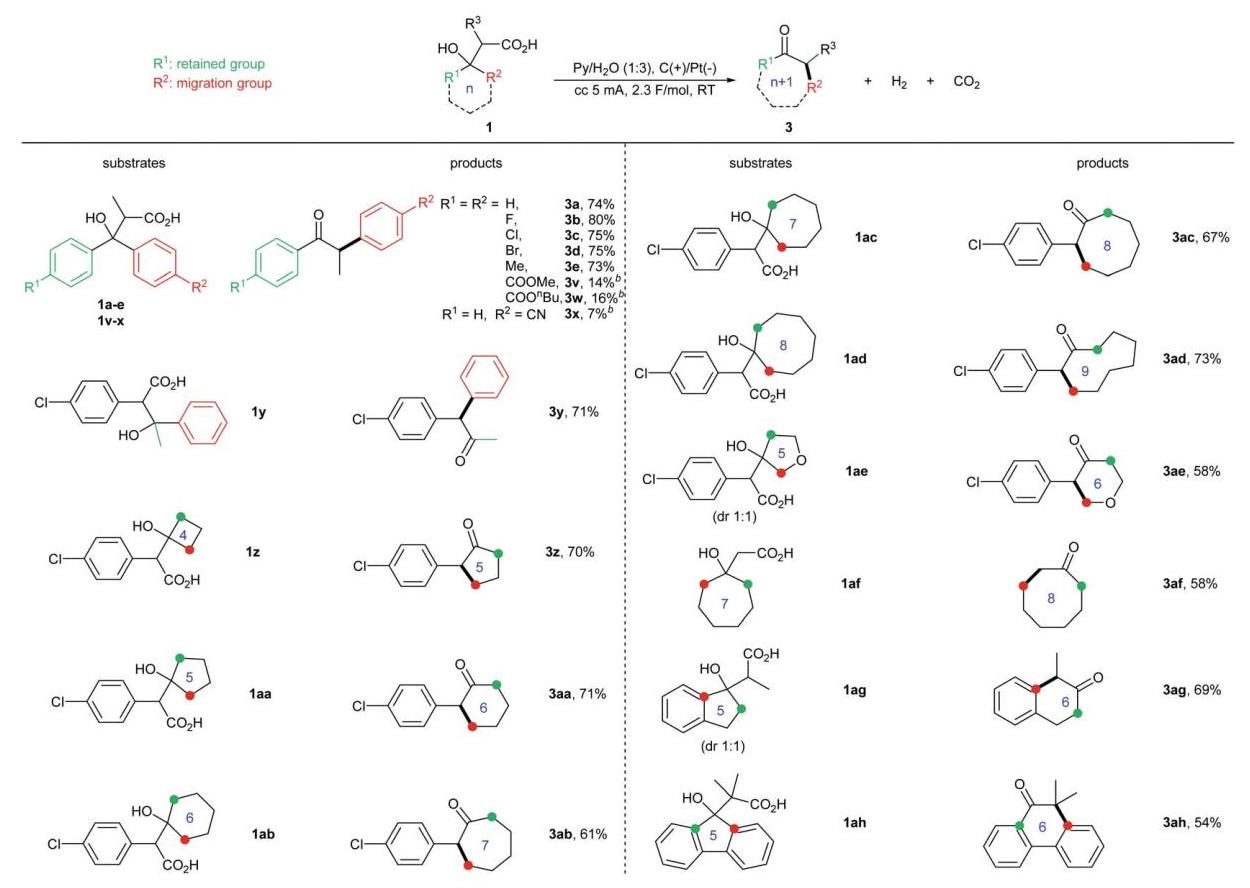
${}^{a}$ Reaction conditions: substrate $1\left( {{0.3}\mathrm{{mmol}}}\right)$ , pyridine $1\mathrm{\;{mL}},{\mathrm{H}}_{2}\mathrm{O}3\mathrm{\;{mL}}$ , graphite plate as anode, platinum plate as cathode, constant current (cc) 5 $\mathrm{{mA}},{2.3}\mathrm{\;F}{\mathrm{\;{mol}}}^{-1}$ . The reactions were performed on Electrasyn ${2.0}.{}^{b}{4.6}\mathrm{\;F}{\mathrm{\;{mol}}}^{-1}$ .
${}^{a}$ 反应条件:底物 $1\left( {{0.3}\mathrm{{mmol}}}\right)$ 、吡啶 $1\mathrm{\;{mL}},{\mathrm{H}}_{2}\mathrm{O}3\mathrm{\;{mL}}$ 、石墨板作阳极、铂板作阴极、恒流(cc)5 $\mathrm{{mA}},{2.3}\mathrm{\;F}{\mathrm{\;{mol}}}^{-1}$ 。反应在Electrasyn ${2.0}.{}^{b}{4.6}\mathrm{\;F}{\mathrm{\;{mol}}}^{-1}$ 上进行。
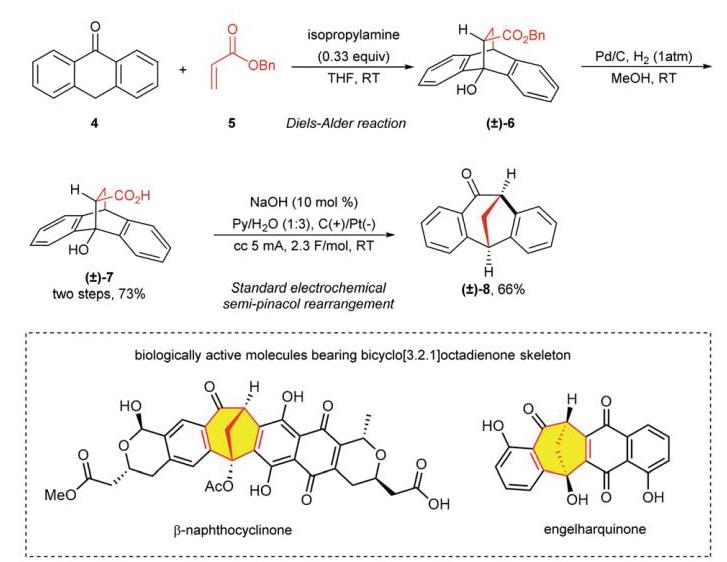
Scheme 3 Synthesis of 8 and two biologically active molecules bearing bicycle[3.2.1]octadienone skeleton.
方案3 8以及两个带有双环[3.2.1]辛二烯酮骨架的生物活性分子的合成。
Thus, the electrochemical protocol detailed here allowed for a wide range of substrates including diaryl and aryl/alkyl substituted carboxylic acids to be effectively converted, thereby representing a more general process relative to the prior work described by Shono. ${}^{5}$
因此,本文详述的电化学方法能够有效转化包括二芳基和芳基/烷基取代羧酸在内的多种底物,相对于Shono之前描述的工作而言,这是一个更具普遍性的过程。 ${}^{5}$
This two-electron oxidation induced semipinacol rearrangement was also successfully applied in the construction of a biologically active polycyclic scaffold bicyclo[3.2.1]octadie-none, which is found in plant-derived natural products including $\beta$ -naphthocyclinone and engelharquinone. ${}^{13}$ As shown in Scheme 3, the Diels-Alder reaction between anthrone 4 and benzyl acrylate 5 afforded bicyclo[2.2.2] 6, which was subsequently hydrogenated to compound 7 in 73% yield in two steps. Furthermore, 7 underwent the decarboxylative semi-pinacol rearrangement to afford the desired bicycle[3.2.1]octa-dienone 8 in good yield under the standard electrochemical conditions.
这种双电子氧化诱导的半频哪醇重排也成功应用于构建具有生物活性的多环骨架双环[3.2.1]辛二烯酮,它存在于包括 $\beta$ -萘环素酮和恩格尔哈醌在内的植物源天然产物中。 ${}^{13}$ 如方案3所示,蒽酮4与丙烯酸苄酯5之间的狄尔斯-阿尔德反应得到双环[2.2.2] 6,随后在两步反应中以73%的产率氢化为化合物7。此外,7在标准电化学条件下进行脱羧半频哪醇重排,以良好的产率得到所需的双环[3.2.1]辛二烯酮8。
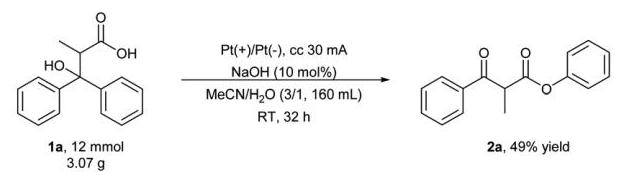
To further demonstrate the utility of this electrochemical method, a gram-scale synthesis of 2a was carried out under constant current electrolysis (eqn (1)). The 12 mmol-scale reaction furnished 2a in 49% yield, thereby demonstrating the potential of this method for the large-scale synthesis of valuable $\beta$ -keto esters.
为了进一步证明这种电化学方法的实用性,在恒流电解条件下进行了2a的克级合成(式(1))。12 mmol规模的反应以49%的产率得到2a,从而证明了该方法用于大规模合成有价值的 $\beta$ -酮酯的潜力。
(1)
Moreover, a number of derivatization transformations was carried out. Fluorination (9), chlorination (10), bromination (11), azidation (12) and sponification (13) of 2t were successfully executed, providing a range of synthetically useful building blocks (Scheme 4).
此外,还进行了一些衍生化转化。成功实现了2t的氟化(9)、氯化(10)、溴化(11)、叠氮化(12)和皂化(13),提供了一系列具有合成用途的结构单元(方案4)。
To revisit our original design for 1,4-migration reaction, we assumed that the carboxylate is oxidized first, followed by intramolecular addition of an oxygen-centered radical to the electron-rich arene (Scheme 5a). Nevertheless, there indeed exists a viable alternative mechanism in which the electron-rich arene is oxidized first, which then underwent intramolecular nucleophilic attack by the carboxylate (Scheme 5b).
为了重新审视我们最初的1,4-迁移反应设计,我们假设羧酸盐首先被氧化,然后氧中心自由基分子内加成到富电子芳烃上(方案5a)。然而,确实存在另一种可行的机制,即富电子芳烃首先被氧化,然后羧酸盐进行分子内亲核进攻(方案5b)。
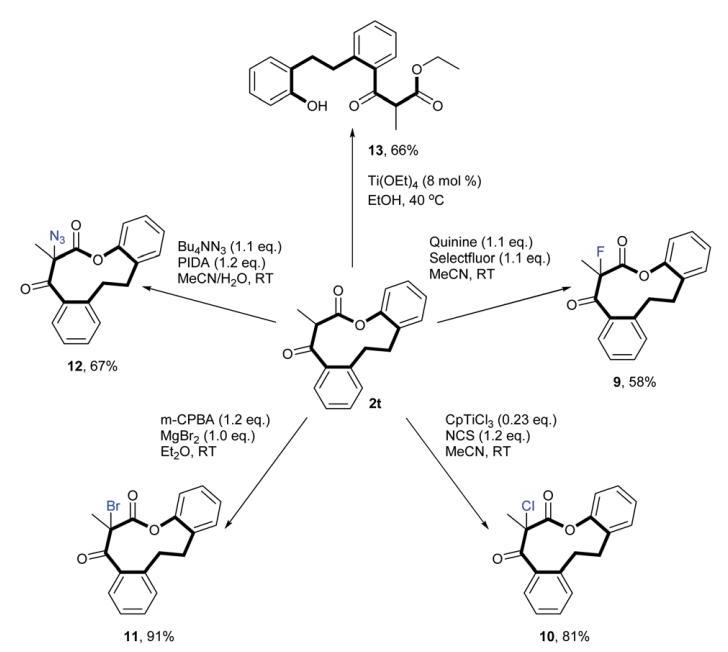
Scheme 4 Versatile transformations of medium-sized lactone 2t.
方案4中等大小内酯2t的多种转化。
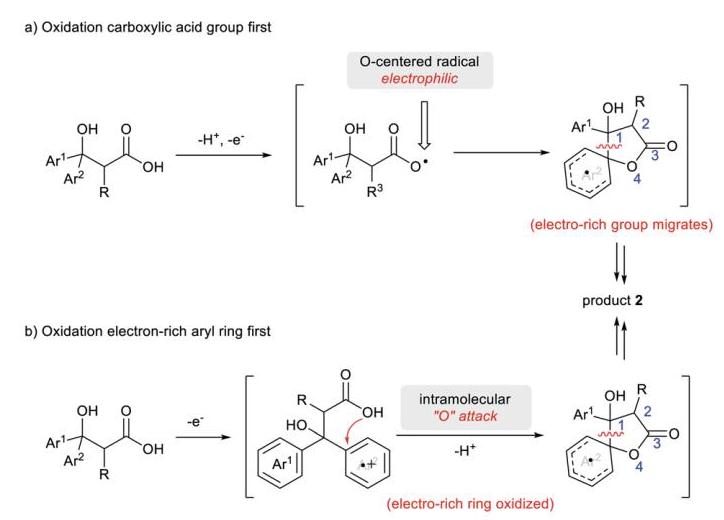
Scheme 5 Two possible reaction mechanisms for 1,4-migration.
方案5 1,4-迁移的两种可能反应机制。
To differentiate between these two mechanisms, cyclic voltammetry studies were carried out (Fig. 1). Our CV studies indicated that carboxylates undergo single electron oxidation at much lower potential relative to that of carboxylic acids (see the ESI† for details). For this reason, under electrolysis conditions, only the deprotonated substrate (i.e., the carboxylate) undergoes single electron oxidation. This deprotonation facilitated oxidation is common among Kolbe electrolysis. Thus, the redox potential difference between the carboxylate $\left( {{\mathbf{{1a}}}^{\prime } - {\mathbf{{1f}}}^{\prime }}\right)$ and the arene $\left( {{\mathbf{{1a}}}^{\prime \prime } - {\mathbf{{1f}}}^{\prime \prime }}\right)$ will dictate the functionality undergoing preferential oxidation. We found that the carboxylate form $1{a}^{\prime },1{c}^{\prime }$ and $1{f}^{\prime }$ display a series of irreversible anodic events occurred with an onset potential of 0.73 V (Fig. 1b). In contrast, compounds ${\mathbf{{1a}}}^{\prime \prime },{\mathbf{{1c}}}^{\prime \prime }$ and ${\mathbf{{1f}}}^{\prime \prime }$ , which contain no carboxylate functionality, showed no oxidation peaks at ${0.7}\mathrm{\;V}$ (Fig. 1c-e). As such, we assigned waves between ${0.73}\mathrm{\;V}$ and ${0.78}\mathrm{\;V}$ in Fig. 1b to the oxidation of carboxylate moiety in $1{a}^{\prime },1{c}^{\prime }$ and $1{f}^{\prime }$ . For compound $1{f}^{\prime \prime }$ containing the most electron-rich arene (anisole), an evident anodic wave appeared at 1.20 V. We attributed this wave to the oxidation of aryl ring, because the oxidation potential of tertiary alcohols is prohibitive according to literature report. ${}^{14}$ By contrast, oxidation peaks for compounds ${\mathbf{{1a}}}^{\prime \prime }$ and 1c” were insignificant, appearing as shoulder peaks at ${1.35}\mathrm{\;V}$ and ${1.50}\mathrm{\;V}$ , respectively. This is well in accord with that they possess electron-neutral or deficient aryl rings. We noticed that in the CV curve of compound $1{\mathrm{f}}^{\prime }$ , after the first oxidation peak at ${0.78}\mathrm{\;V}$ , another oxidation peak appeared at ${1.12}\mathrm{\;V}$ . We believe this second peak corresponds to arene oxidation in compound 1f’. Taken together, the data support the sequence of carboxylate oxidation prior to arene oxidation. DFT calculations were performed to investigate the energetics of reaction pathway involving carboxylate radical. The results show that the in situ formed carboxylate radical can easily undergo radical addition and C-C bond cleavage steps to realize an unusual carbon to oxygen 1,4-aryl migration. (See details in ESI†).
为了区分这两种机理,我们进行了循环伏安法研究(图1)。我们的循环伏安研究表明,相对于羧酸,羧酸盐在低得多的电位下发生单电子氧化(详情见补充信息†)。因此,在电解条件下,只有去质子化的底物(即羧酸盐)发生单电子氧化。这种去质子化促进的氧化在Kolbe电解中很常见。因此,羧酸盐$\left( {{\mathbf{{1a}}}^{\prime } - {\mathbf{{1f}}}^{\prime }}\right)$和芳烃$\left( {{\mathbf{{1a}}}^{\prime \prime } - {\mathbf{{1f}}}^{\prime \prime }}\right)$之间的氧化还原电位差将决定优先发生氧化的官能团。我们发现羧酸盐形式$1{a}^{\prime },1{c}^{\prime }$和$1{f}^{\prime }$显示出一系列不可逆的阳极事件,起始电位为0.73 V(图1b)。相比之下,不含有羧酸盐官能团的化合物${\mathbf{{1a}}}^{\prime \prime },{\mathbf{{1c}}}^{\prime \prime }$和${\mathbf{{1f}}}^{\prime \prime }$在${0.7}\mathrm{\;V}$处没有氧化峰(图1c - e)。因此,我们将图1b中${0.73}\mathrm{\;V}$和${0.78}\mathrm{\;V}$之间的波归因于$1{a}^{\prime },1{c}^{\prime }$和$1{f}^{\prime }$中羧酸盐部分的氧化。对于含有电子密度最高的芳烃(苯甲醚)的化合物$1{f}^{\prime \prime }$,在1.20 V处出现了明显的阳极波。我们将此波归因于芳环的氧化,因为根据文献报道,叔醇的氧化电位过高。${}^{14}$相比之下,化合物${\mathbf{{1a}}}^{\prime \prime }$和1c"的氧化峰不明显,分别在${1.35}\mathrm{\;V}$和${1.50}\mathrm{\;V}$处表现为肩峰。这与它们具有电子中性或缺电子的芳环这一情况非常吻合。我们注意到在化合物$1{\mathrm{f}}^{\prime }$的循环伏安曲线中,在${0.78}\mathrm{\;V}$处的第一个氧化峰之后,在${1.12}\mathrm{\;V}$处出现了另一个氧化峰。我们认为这个第二个峰对应于化合物1f’中芳环的氧化。综上所述,数据支持羧酸盐氧化先于芳环氧化的顺序。进行了密度泛函理论(DFT)计算以研究涉及羧酸盐自由基的反应途径的能量学。结果表明,原位形成的羧酸盐自由基可以很容易地经历自由基加成和碳 - 碳键断裂步骤,以实现不寻常的碳到氧的1,4 - 芳基迁移。(详情见补充信息†)。
To further verify this, two additional experiments were carried out (Scheme 6). Since the oxidation potential of carboxylate is lower than that of arene, we should be able to control the potential such that the carboxylate is more readily oxidized than the arene. Accordingly, a controlled potential electrolysis (CPE) was conducted using 1f as the substrate. The potential was controlled at ${0.91}\mathrm{\;V}{vs}.{\mathrm{{Fc}}}^{+/0}$ . After ${8.18}\mathrm{C}$ of charge passed through the reaction mixture, desired product 2f was formed in 14% yield with 48% current efficiency (Scheme 6a). On the other hand, $N$ -acyloxyphthalimides are widely used substrates for decarboxylative C-C bond-forming reactions under reductive conditions, ${}^{15}$ which is different from most oxidizing decarboxylative reactions of carboxylic acids. Therefore, we hypothesized that $N$ -hydroxyph-thalimide derived from 1a might be transformed to 1,4- migration product 2a under redox neutral condition. To test our hypothesis, we first synthesized compound 14 from 1a and $N$ -hydroxyphthalimide in one step. Next, an unoptimized conditions from literature ${}^{15d}$ was applied to substrate 14. Gratifyingly, 1,4-migration product 2a was formed in 10% yield upon irradiation (Scheme 6b). Mechanistically, a single-electron transfer from visible light-excited photocatalyst Ir(III)* to the $N$ -acyloxyphthalimide 14 generates a radical anion that undergoes homolytic cleavage of the N-O bond to form the carboxylate radical and phthalimide anion. Final product 2a is produced via sequential radical carbon to oxygen 1,4-migration and oxidation by Ir(Iv).
为进一步验证这一点,我们进行了另外两个实验(方案6)。由于羧酸盐的氧化电位低于芳烃,我们应该能够控制电位,使羧酸盐比芳烃更容易被氧化。因此,以1f为底物进行了恒电位电解(CPE)。电位控制在${0.91}\mathrm{\;V}{vs}.{\mathrm{{Fc}}}^{+/0}$。在${8.18}\mathrm{C}$的电荷通过反应混合物后,所需产物2f以14%的产率和48%的电流效率生成(方案6a)。另一方面,$N$-酰氧基邻苯二甲酰亚胺是还原条件下脱羧形成C-C键反应中广泛使用的底物,${}^{15}$这与大多数羧酸的氧化脱羧反应不同。因此,我们假设由1a衍生的$N$-羟基邻苯二甲酰亚胺可能在氧化还原中性条件下转化为1,4-迁移产物2a。为了验证我们的假设,我们首先一步从1a合成了化合物14和$N$-羟基邻苯二甲酰亚胺。接下来,将文献中未优化的条件${}^{15d}$应用于底物14。令人欣慰的是,光照下1,4-迁移产物2a以10%的产率生成(方案6b)。从机理上讲,从可见光激发的光催化剂Ir(III)*到$N$-酰氧基邻苯二甲酰亚胺14的单电子转移产生一个自由基阴离子,该阴离子经历N-O键的均裂形成羧酸盐自由基和邻苯二甲酰亚胺阴离子。最终产物2a通过自由基碳到氧的顺序1,4-迁移和Ir(IV)的氧化产生。
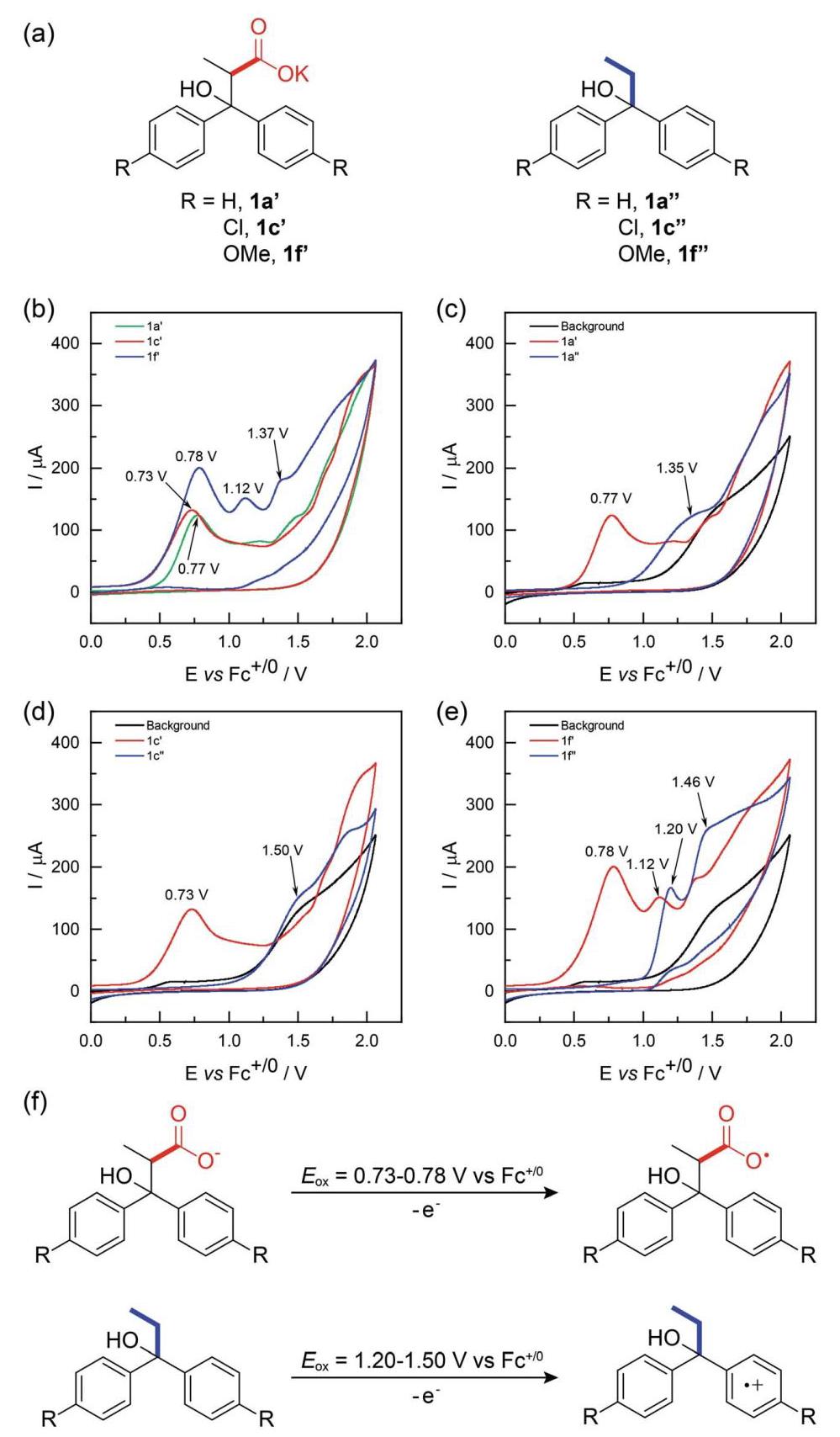
Fig. 1 CV studies: working electrode, platinum disk ( $\Phi$ 3 mm); counter electrode, silver wire; reference electrode, Ag/AgNO ${}_{3}$ (0.1 M in MeCN); scan rate ${0.1}\mathrm{\;V}{\mathrm{\;s}}^{-1}$ ; substrate concentration, $5\mathrm{{mM}}$ ; background, ${0.1}\mathrm{M}{\mathrm{{LiClO}}}_{4}$ in $\mathrm{{MeCN}}/{\mathrm{H}}_{2}\mathrm{O}\left( {3 : 1}\right)$ .
图1循环伏安研究:工作电极,铂盘($\Phi$ 3毫米);对电极,银线;参比电极,Ag/AgNO${}_{3}$(0.1 M乙腈溶液);扫描速率${0.1}\mathrm{\;V}{\mathrm{\;s}}^{-1}$;底物浓度,$5\mathrm{{mM}}$;背景,${0.1}\mathrm{M}{\mathrm{{LiClO}}}_{4}$于$\mathrm{{MeCN}}/{\mathrm{H}}_{2}\mathrm{O}\left( {3 : 1}\right)$中。
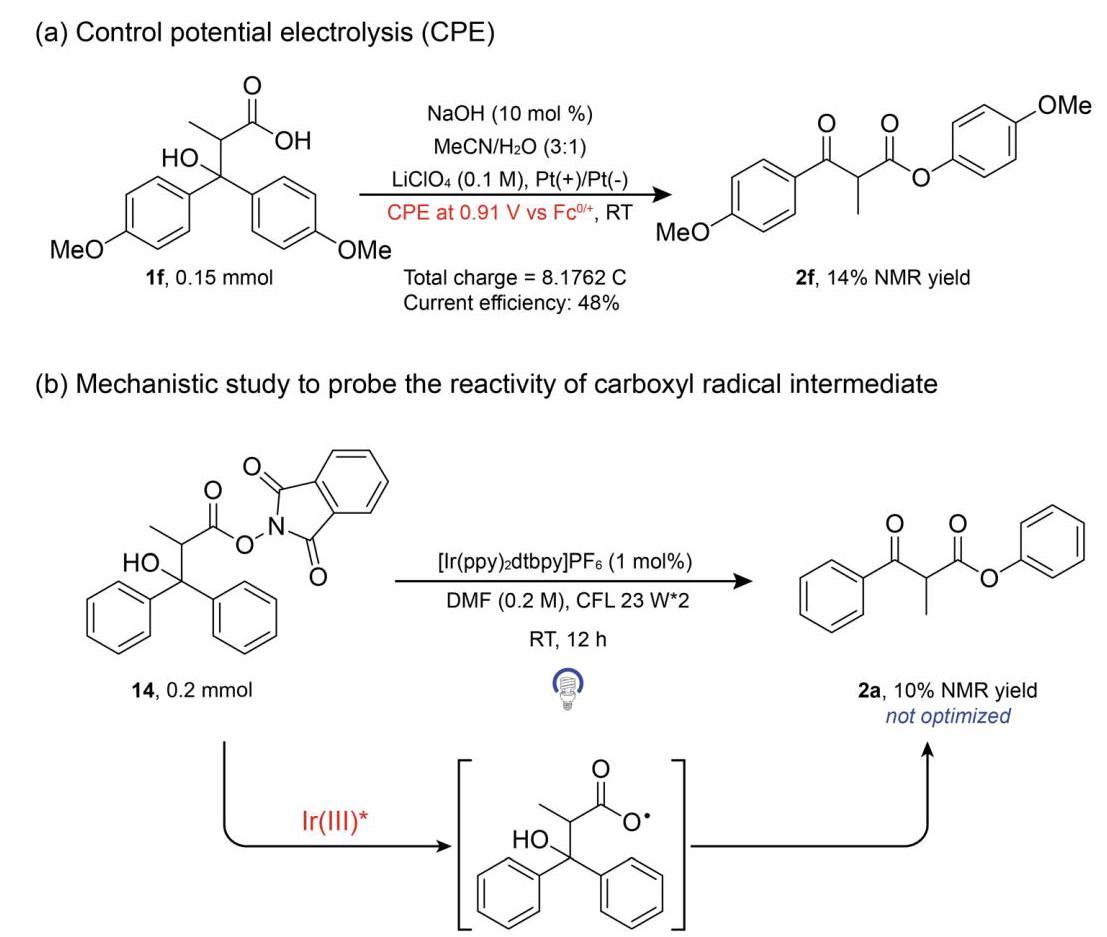
Scheme 6 Mechanistic studies on 1,4-migration.
方案6 1,4-迁移的机理研究。
Conclusions
结论
In summary, we have developed an orthogonal set of electrochemically controlled 1,4- and 1,2-group transfer reactions triggered by the oxidation of $\beta$ -hydroxycarboxylic acids. Notably, through the judicious selection of electrochemical conditions, the same substrate could undergo either the 1,2-semipinacol rearrangement or the unprecedented carbon to oxygen 1,4-aryl migration with excellent chemoselectivity. This electrochemistry enabled chemo-selective transformations provided a new method for the divergent transformation of easily available carboxylic acid derivatives.
总之,我们开发了一组由$\beta$ -羟基羧酸氧化引发的电化学控制的正交1,4-和1,2-基团转移反应。值得注意的是,通过明智地选择电化学条件,相同的底物可以进行1,2-半频哪醇重排或前所未有的碳到氧的1,4-芳基迁移,具有出色的化学选择性。这种电化学实现的化学选择性转化为易得的羧酸衍生物的发散转化提供了一种新方法。
Conflicts of interest
利益冲突
There are no conflicts to declare.
无需申报利益冲突。
Acknowledgements
致谢
The project was supported by the Natural Science Foundation of China (grants 21772003, 21933001, 22071004). This work was also partially funded by the BHP-PKU CCUS project supported by BHP Billiton.
本项目得到了中国国家自然科学基金(项目编号:21772003、21933001、22071004)的资助。本研究还得到了必和必拓支持的必和必拓 - 北大碳捕集与封存项目的部分资助。
Notes and references
注释与参考文献
1 C. M. Rojas, Molecular Rearrangements in Organic Synthesis, John Wiley & Sons, Inc., New Jersey, 2015.
2 (a) Q. Liu, B. Sun, Z. Liu, Y. Kao, B.-W. Dong, S.-D. Jiang, F. Li, G. Liu, Y. Yang and F. Mo, Chem. Sci., 2018, 9, 8731; (b) L. Zhang, Z. Zhang, J. Hong, J. Yu, J. Zhang and F. Mo, J. Org. Chem., 2018, 83, 3200; (c) L. Zhang, Z. Zhang, J. Zhang, K. Li and F. Mo, Green Chem., 2018, 20, 3916; (d) J. Hong, M. Li, J. Zhang, B. Sun and F. Mo, ChemSusChem, 2019, 12, 6; (e) Z. Zhang, L. Zhang, Y. Cao, F. Li, G. Bai, G. Liu, Y. Yang and F. Mo, Org. Lett., 2019, 21, 762; (f) M. García-Melchor, A. A. C. Braga, A. Lledós, G. Ujaque and F. Maseras, Acc. Chem. Res., 2013, 46, 2626.
3 (a) J.-i. Yoshida, A. Shimizu and R. Hayashi, Chem. Rev., 2018, 118, 4702; (b) A. Wiebe, T. Gieshoff, S. Möhle, E. Rodrigo, M. Zirbes and S. R. Waldvogel, Angew. Chem., Int. Ed., 2018, 57, 5594; (c) S. R. Waldvogel, S. Lips, M. Selt, B. Riehl and C. J. Kampf, Chem. Rev., 2018, 118, 6706; (d) S. Tang, Y. Liu and A. Lei, Chem, 2018, 4, 27; (e) S. Möhle, M. Zirbes, E. Rodrigo, T. Gieshoff, A. Wiebe and S. R. Waldvogel, Angew. Chem., Int. Ed., 2018, 57, 6018; (f) M. Yan, Y. Kawamata and P. S. Baran, Chem. Rev., 2017, 117, 13230; (g) Y. Jiang, K. Xu and C. Zeng, Chem. Rev., 2018, 118, 4485; (h) J.-i. Yoshida, K. Kataoka, R. Horcajada and A. Nagaki, Chem. Rev., 2008, 108, 2265; (i) K. D. Moeller, Tetrahedron, 2000, 56, 9527.
4 (a) M. Faraday, Ann. Phys., 1834, 108, 401; (b) H. Kolbe, Justus Liebigs Ann. Chem., 1849, 69, 257.
5 T. Shono, J. Hayashi, H. Omoto and Y. Matsumura, Tetrahedron Lett., 1977, 18, 2667.
Chemical Science
化学科学
6 (a) Z.-M. Chen, X.-M. Zhang and Y.-Q. Tu, Chem. Soc. Rev., 2015, 44, 5220; (b) A. Studer and M. Bossart, Tetrahedron, 2001, 57, 9649.
7 (a) X. Wu, M. Wang, L. Huan, D. Wang, J. Wang and C. Zhu, Angew. Chem., Int. Ed., 2018, 57, 1640; (b) Z. Wu, R. Ren and C. Zhu, Angew. Chem., Int. Ed., 2016, 55, 10821; (c) Z. Wu, D. Wang, Y. Liu, L. Huan and C. Zhu, J. Am. Chem. Soc., 2017, 139, 1388; (d) Y. Xu, Z. Wu, J. Jiang, Z. Ke and C. Zhu, Angew. Chem., Int. Ed., 2017, 56, 4545.
8 (a) L. Li, Z.-L. Li, Q.-S. Gu, N. Wang and X.-Y. Liu, Sci. Adv., 2017, 3, e1701487; (b) L. Li, Z.-L. Li, F.-L. Wang, Z. Guo, Y.-F. Cheng, N. Wang, X.-W. Dong, C. Fang, J. Liu, C. Hou, B. Tan and X.-Y. Liu, Nat. Commun., 2016, 7, 13852; (c) Z.-L. Li, X.-H. Li, N. Wang, N.-Y. Yang and X.-Y. Liu, Angew. Chem., Int. Ed., 2016, 55, 15100; (d) F. Mo, D. Qiu, Y. Zhang and J. Wang, Acc. Chem. Res., 2018, 51, 496.
9 (a) W. J. Koehl, J. Am. Chem. Soc., 1964, 86, 4686; (b) S. D. Ross and M. Finkelstein, J. Org. Chem., 1969, 34, 2923; (c) J. Xiang, M. Shang, Y. Kawamata, H. Lundberg, S. H. Reisberg, M. Chen, P. Mykhailiuk, G. Beutner, M. R. Collins, A. Davies, M. Del Bel, G. M. Gallego, J. E. Spangler, J. Starr, S. Yang, D. G. Blackmond and P. S. Baran, Nature, 2019, 573, 398.
10 (a) H.-J. Schäfer, Recent contributions of kolbe electrolysis to organic synthesis, Berlin, Heidelberg, 1990, DOI: 10.1007/ BFb0034365; (b) H. Tanaka, M. Kuroboshi and S. Torii, Organic Electrochemistry, CRC Press, 2015, p. 1265.
11 G. Rousseau, Tetrahedron, 1995, 51, 2777.
12 Z.-L. Song, C.-A. Fan and Y.-Q. Tu, Chem. Rev., 2011, 111, 7523.
13 (a) Y. Ando, S. Hori, T. Fukazawa, K. Ohmori and K. Suzuki, Angew. Chem., Int. Ed., 2015, 54, 9650; (b) T. Fukazawa, Y. Ando, K. Ohmori, T. Hayashi and K. Suzuki, Org. Lett., 2017, 19, 1470; (c) C.-C. Wu, C.-F. Peng, I.-L. Tsai, M. H. Abd El-Razek, H.-S. Huang and I.-S. Chen, Phytochemistry, 2007, 68, 1338.
14 R. Francke, T. Quell, A. Wiebe and S. R. Waldvogel, Organic Electrochemistry, CRC Press, 2015, p. 983.
15 (a) T. Qin, J. Cornella, C. Li, L. R. Malins, J. T. Edwards, S. Kawamura, B. D. Maxwell, M. D. Eastgate and P. S. Baran, Science, 2016, 352, 801; (b) L. Candish, M. Teders and F. Glorius, J. Am. Chem. Soc., 2017, 139, 7440; (c) A. Fawcett, J. Pradeilles, Y. Wang, T. Mutsuga, E. L. Myers and V. K. Aggarwal, Science, 2017, 357, 283; (d) D. Hu, L. Wang and P. Li, Org. Lett., 2017, 19, 2770.