Gold-Catalyzed Halogenation of Aromatics by N-Halosuccinimides
英文原文与中文译文逐段对照 · English original with Chinese translation
Fanyang Mo, Jerry Mingtao Yan, Di Qiu, Fei Li, Yan Zhang, and Jianbo Wang*
莫凡洋,闫明涛,邱迪,李飞,张岩,王剑波*
Halogenation of aromatic compounds is one of the fundamental reactions in organic chemistry. ${}^{\left\lbrack 1\right\rbrack }N$ -Bromo-, $N$ -iodo-, and $N$ -chlorosuccinimide (NBS, NIS, and NCS, respectively) are highly useful halogenating reagents in laboratories in terms of their ease of handling, as well as the generation of relatively inert succinimide as the by-product. Various halogenation systems usingh NXS (X = Br, I, or Cl) have been developed, ${}^{\left\lbrack 2 - 4\right\rbrack }$ but halogenating unactivated aromatics proceeds only in the presence of strong Lewis acids or protonic acids. ${}^{\left\lbrack 3\right\rbrack }$ Moreover, reaction conditions are in general very harsh, such as high catalyst loadings, ${}^{\left\lbrack 3\mathrm{f},\mathrm{i}\right\rbrack }$ high reaction temperatures, ${}^{\left\lbrack 3\mathrm{e}\right\rbrack }$ or considerably acidic solutions. ${}^{\left\lbrack 3\mathrm{c}\right\rbrack }$ Some of these reported catalytic systems proceed under relatively milder reaction conditions. For example, Tanemura et al. reported a method for the halogenation of aromatic rings using NXS in the presence of ${\mathrm{{NH}}}_{4}{\mathrm{{NO}}}_{3}$ or ${\mathrm{{FeCl}}}_{3}$ in $\mathrm{{MeCN}}{.}^{\left\lbrack 3\mathrm{\;g}\right\rbrack }$ The reaction works with unactivated aromatics, but the catalyst loading is high (10-100% mol). Yamamoto et al. reported halogenation with ${\mathrm{{ZrCl}}}_{4}$ as the catalyst, and although the catalyst loading is low $\left( {5\mathrm{\;{mol}}\% }\right)$ the substrate scope is limited to electron-rich aromatic rings. ${}^{\left\lbrack 2q\right\rbrack }$ Moreover, benzylic halogenation occurs when halogenating alkyl-substituted benzene derivatives, which is also a general side reaction in many other halogenation systems. In view of these facts, we still consider it highly desirable to develop milder and more efficient halogenation methods.
芳香族化合物的卤化反应是有机化学中的基本反应之一。${}^{\left\lbrack 1\right\rbrack }N$-溴代-、$N$-碘代-和$N$-氯代琥珀酰亚胺(分别为NBS、NIS和NCS)在实验室中是非常有用的卤化试剂,因为它们易于操作,并且生成相对惰性的琥珀酰亚胺作为副产物。已经开发了各种使用NXS(X = Br、I或Cl)的卤化体系,${}^{\left\lbrack 2 - 4\right\rbrack }$但未活化芳烃的卤化反应仅在强路易斯酸或质子酸存在下才能进行。${}^{\left\lbrack 3\right\rbrack }$此外,反应条件通常非常苛刻,例如高催化剂负载量、${}^{\left\lbrack 3\mathrm{f},\mathrm{i}\right\rbrack }$高反应温度、${}^{\left\lbrack 3\mathrm{e}\right\rbrack }$或相当酸性的溶液。${}^{\left\lbrack 3\mathrm{c}\right\rbrack }$一些报道的催化体系在相对温和的反应条件下进行。例如,Tanemura等人报道了一种在${\mathrm{{NH}}}_{4}{\mathrm{{NO}}}_{3}$或${\mathrm{{FeCl}}}_{3}$存在下使用NXS对芳环进行卤化的方法,该反应在$\mathrm{{MeCN}}{.}^{\left\lbrack 3\mathrm{\;g}\right\rbrack }$中进行。该反应适用于未活化的芳烃,但催化剂负载量很高(10 - 100% mol)。Yamamoto等人报道了以${\mathrm{{ZrCl}}}_{4}$为催化剂的卤化反应,尽管催化剂负载量低$\left( {5\mathrm{\;{mol}}\% }\right)$,但底物范围仅限于富电子芳环。${}^{\left\lbrack 2q\right\rbrack }$此外,在卤化烷基取代的苯衍生物时会发生苄基卤化反应,这也是许多其他卤化体系中常见的副反应。鉴于这些事实,我们仍然认为开发更温和、更高效的卤化方法是非常有必要的。
The previous studies have focused on the activation of NXS through complexation or protonation of the carbonyl oxygen atom of NXS by acids to enhance the reactivity of the halogenation process (Scheme 1 a). We envisaged that a dual activation of both the aromatic ring and NXS might greatly enhance the reactivity (Scheme 1b). For this purpose, the formation of a ${\mathrm{C}}_{\mathrm{{Ar}}} - \mathrm{M}$ bond through direct metallation of a ${\mathrm{C}}_{\mathrm{{Ar}}} - \mathrm{H}$ bond is required. In principle, the cleavage of a ${\mathrm{C}}_{\mathrm{{Ar}}} - \mathrm{H}$ bond to form ${\mathrm{C}}_{\mathrm{{Ar}}} - \mathrm{M}$ bond proceeds through oxidative addition or electrophilic substitution mechanisms by metal complexes having either low or high oxidation states, respectively. ${}^{\left\lbrack 5\right\rbrack }$
先前的研究集中在通过酸对NXS羰基氧原子的络合或质子化来活化NXS,以提高卤化反应的活性(方案1a)。我们设想对芳环和NXS进行双重活化可能会大大提高反应活性(方案1b)。为此,需要通过${\mathrm{C}}_{\mathrm{{Ar}}} - \mathrm{M}$键的直接金属化形成${\mathrm{C}}_{\mathrm{{Ar}}} - \mathrm{H}$键。原则上,${\mathrm{C}}_{\mathrm{{Ar}}} - \mathrm{H}$键的断裂形成${\mathrm{C}}_{\mathrm{{Ar}}} - \mathrm{M}$键分别通过低氧化态或高氧化态的金属配合物的氧化加成或亲电取代机制进行。${}^{\left\lbrack 5\right\rbrack }$
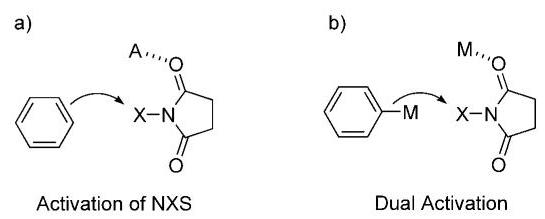
Scheme 1. Halogenation through activation by catalysts. A = acid, $\mathrm{M} =$ metal, and $\mathrm{X} = \mathrm{{Br}},\mathrm{I},\mathrm{{Cl}}$ .
方案1. 催化剂活化卤化反应。A = 酸,$\mathrm{M} =$金属,$\mathrm{X} = \mathrm{{Br}},\mathrm{I},\mathrm{{Cl}}$。
Gold-catalyzed transformations have been hot topics in organic chemistry in recent years. ${}^{\left\lbrack 6\right\rbrack }$ It has been documented that gold(III) can electrophilically metallate ${\mathrm{C}}_{\mathrm{{Ar}}} - \mathrm{H}$ bonds to afford arylgold(III) species. ${}^{\left\lbrack 7,8\right\rbrack }$ In 1931 Kharasch and Isbell reported that ${\mathrm{{AuCl}}}_{3}$ could react with neat benzene to form a phenylgold(III) complex, which could react with hydrogen chloride to form phenyl chloride. ${}^{\left\lbrack 7\mathrm{a}\right\rbrack }$ More recently, He and coworkers reported several ${\mathrm{{AuCl}}}_{3}$ -catalyzed $\mathrm{C} - \mathrm{C}$ bond-forming reactions, in which arylgold(III) species, generated through direct metallation of electron-rich aromatics, are proposed as the key intermediates. ${}^{\left\lbrack 8\mathrm{a} - \mathrm{d}\right\rbrack }{\mathrm{{AuCl}}}_{3}$ -catalyzed $\mathrm{C} - \mathrm{C}$ bond-forming reactions between electron-rich aromatics and alkynes, as well as methyl vinyl ketone are reported by Reetz and Sommer, ${}^{\left\lbrack 8\mathrm{e}\right\rbrack }$ and Hashmi et al. ${}^{\left\lbrack 8\mathrm{f},\mathrm{g}\right\rbrack }$ Although the mechanism of these highly efficient ${\mathrm{{AuCl}}}_{3}$ -catalyzed reactions is still unclear, we were encouraged by these reports and decided to explore the possibility of gold-catalyzed halogenation based on the hypothetical dual activation mode as shown in Scheme 1b. Herein we report a highly efficient and practical ${\mathrm{{AuCl}}}_{3}$ -catalyzed halogenation of aromatics with NXS.
近年来,金催化的转化反应一直是有机化学领域的热门话题。${}^{\left\lbrack 6\right\rbrack }$ 据文献记载,金(III)可以通过亲电金属化作用于${\mathrm{C}}_{\mathrm{{Ar}}} - \mathrm{H}$键,生成芳基金(III)物种。${}^{\left\lbrack 7,8\right\rbrack }$ 1931年,Kharasch和Isbell报道了${\mathrm{{AuCl}}}_{3}$能与纯苯反应生成苯基金(III)配合物,该配合物可与氯化氢反应生成氯苯。${}^{\left\lbrack 7\mathrm{a}\right\rbrack }$ 最近,He及其同事报道了几种${\mathrm{{AuCl}}}_{3}$催化的$\mathrm{C} - \mathrm{C}$键形成反应,其中通过富电子芳烃的直接金属化生成的芳基金(III)物种被认为是关键中间体。${}^{\left\lbrack 8\mathrm{a} - \mathrm{d}\right\rbrack }{\mathrm{{AuCl}}}_{3}$ Reetz和Sommer以及Hashmi等人报道了富电子芳烃与炔烃以及甲基乙烯基酮之间的${\mathrm{{AuCl}}}_{3}$催化的$\mathrm{C} - \mathrm{C}$键形成反应。${}^{\left\lbrack 8\mathrm{e}\right\rbrack }$ ${}^{\left\lbrack 8\mathrm{f},\mathrm{g}\right\rbrack }$ 尽管这些高效的${\mathrm{{AuCl}}}_{3}$催化反应的机制仍不清楚,但这些报道鼓舞了我们,我们决定基于图1b所示的假设双活化模式探索金催化卤化反应的可能性。在此,我们报道了一种高效实用的${\mathrm{{AuCl}}}_{3}$催化的芳烃与NXS的卤化反应。
Table 1: Bromination of benzene with NBS using various catalysts in DCE. ${}^{\left\lbrack a\right\rbrack }$
表1:在二氯乙烷中使用各种催化剂,NBS对苯的溴化反应。${}^{\left\lbrack a\right\rbrack }$

| Entry | Catalyst (mol%) | Yield ${\left\lbrack \% \right\rbrack }^{\left\lbrack b\right\rbrack }$ |
| 1 | ${\mathrm{{AuCl}}}_{3}$ (1) | 99 |
| 2 | ${\mathrm{{FeCl}}}_{3}$ (20) | 27 |
| 3 | ${\mathrm{{FeBr}}}_{3}$ (20) | 25 |
| 4 | ${\mathrm{{BF}}}_{3} \cdot {\mathrm{{OEt}}}_{2}$ (20) | 7 |
| 5 | ${\mathrm{{NH}}}_{4}{\mathrm{{NO}}}_{3}$ (20) | <1 |
| 6 | ${\mathrm{{ZrCl}}}_{4}$ (20) | 5 |
| 7 | Pd(OAc) ${}_{2}$ (20) | 0 |
| 8 | ${\mathrm{{AlCl}}}_{3}$ (20) | <1 |
| 9 | HCl (20) ${}^{\left\lbrack c\right\rbrack }$ | 0 |
| 10 | ${\mathrm{H}}_{2}{\mathrm{{SO}}}_{4}$ (20) | 25 |
[a] Reaction conditions: benzene (1 mmol), NBS (1 mmol), DCE (2 mL), ${80}^{ \circ }\mathrm{C},{24}\mathrm{\;h}$ . [b] Yields determined by using GC/MS methods with $n$ -dodecane as the internal standard. [c] ${4.7}\mathrm{M}$ in dioxane. DCE $= 1,2$ - dichloroethane, NBS $= N$ -bromosuccinimide.
[a]反应条件:苯(1 mmol),NBS(1 mmol),二氯乙烷(2 mL),${80}^{ \circ }\mathrm{C},{24}\mathrm{\;h}$。[b]产率通过气相色谱/质谱法测定,以$n$-十二烷为内标。[c] ${4.7}\mathrm{M}$在二氧六环中。二氯乙烷$= 1,2$-二氯乙烷,NBS$= N$-N-溴代琥珀酰亚胺。
[*] F. Mo, J. M. Yan, D. Qiu, F. Li, Dr. Y. Zhang, Prof. Dr. J. Wang Beijing National Laboratory of Molecular Sciences (BNLMS) and Key Laboratory of Bioorganic Chemistry and Molecular Engineering of Ministry of Education, College of Chemistry
[*] F. Mo,J. M. Yan,D. Qiu,F. Li,Y. Zhang博士,J. Wang教授 北京分子科学国家实验室(BNLMS)和教育部生物有机化学与分子工程重点实验室,化学学院
Peking University, Beijing 100871 (China)
北京大学,北京100871(中国)
Fax: (+ 86) 10-6275-1708
传真:(+86)10 - 6275 - 1708
Homepage: http://www.chem.pku.edu.cn/physicalorganic/ home.htm
主页:http://www.chem.pku.edu.cn/physicalorganic/ home.htm
[**] The project is supported by the NSFC (Grant No. 20832002, 20772003, 20821062), 973 Program (No. 2009CB825300).
[**]本项目得到国家自然科学基金(批准号20832002、20772003、20821062)、973计划(编号2009CB825300)的资助。
Supporting information for this article is available on the WWW under http://dx.doi.org/10.1002/anie.200906699.
本文的支持信息可在网页http://dx.doi.org/10.1002/anie.200906699上获取。
First, we compared the efficiency of typical acid catalysts developed for halogenation reaction using NBS. Therefore, the bromination of benzene with NBS was carried out in DCE at ${80}^{ \circ }\mathrm{C}$ for 24 hours (Table 1). To our delight, $1\mathrm{\;{mol}}\%$ of ${\mathrm{{AuCl}}}_{3}$ gave nearly a quantitative yield of bromobenzene (Table 1, entry 1), whereas ${\mathrm{{FeCl}}}_{3}$ and ${\mathrm{{FeBr}}}_{3}$ , widely used as Lewis acid catalyst in this type of reaction, only afforded the product in 27% and 25% yield, respectively, at a 20 mol % catalyst loading, (Table 1, entries 2 and 3). ${\mathrm{{BF}}}_{3} \cdot {\mathrm{{OEt}}}_{2}$ , another strong Lewis acid known for its ability to activate NXS, gave only a 7% yield with the same catalyst loading. ${\mathrm{{NH}}}_{4}{\mathrm{{NO}}}_{3}$ and ${\mathrm{{ZrCl}}}_{4}$ , which have been efficient catalysts in the systems reported by Tanemura et al. ${}^{\left\lbrack 3\mathrm{\;g}\right\rbrack }$ and Yamamoto and coworkers, ${}^{\left\lbrack 2\mathrm{q}\right\rbrack }$ were not efficient in that a less than 5% yield of desired product was observed (Table 1, entries 5 and 6). Pd(OAc), which has been used in direct aromatic $\mathrm{C} - \mathrm{H}$ bond activation, ${}^{\left\lbrack 9\right\rbrack }$ gave no product (Table 1, entry 7). Since reactions between gold(III) trichloride and aryl compounds generates HCl, as indicated in previous literature, ${}^{\left\lbrack 7\mathrm{a}\right\rbrack }$ the possibility exists that in situ generated HCl may catalyze the reaction. However, when ${20}\mathrm{\;{mol}}\%$ of $\mathrm{{HCl}}$ was used as the catalyst under identical conditions, no product was observed (Table 1, entry 9), thereby ruling out the possible HCl catalysis. Finally, the strong acid catalyst ${\mathrm{H}}_{2}{\mathrm{{SO}}}_{4}\left( {{20}\mathrm{\;{mol}}\% }\right)$ could catalyze the reaction but with low efficiency (Table 1, entry 10). These bromination results clearly demonstrate the superb catalytic activity of ${\mathrm{{AuCl}}}_{3}$ as compared with other Lewis acid or protonic acid catalysts.
首先,我们比较了使用NBS开发的用于卤化反应的典型酸催化剂的效率。因此,在二氯乙烷中于${80}^{ \circ }\mathrm{C}$下用NBS对苯进行溴化反应24小时(表1)。令我们高兴的是,${\mathrm{{AuCl}}}_{3}$的$1\mathrm{\;{mol}}\%$给出了几乎定量产率的溴苯(表1,条目1),而在该类反应中广泛用作路易斯酸催化剂的${\mathrm{{FeCl}}}_{3}$和${\mathrm{{FeBr}}}_{3}$,在20 mol%的催化剂负载量下,产率分别仅为27%和25%(表1,条目2和3)。${\mathrm{{BF}}}_{3} \cdot {\mathrm{{OEt}}}_{2}$,另一种以其活化NXS的能力而闻名的强路易斯酸,在相同的催化剂负载量下产率仅为7%。${\mathrm{{NH}}}_{4}{\mathrm{{NO}}}_{3}$和${\mathrm{{ZrCl}}}_{4}$,在Tanemura等人${}^{\left\lbrack 3\mathrm{\;g}\right\rbrack }$以及Yamamoto及其同事${}^{\left\lbrack 2\mathrm{q}\right\rbrack }$报道的体系中是有效的催化剂,但在该反应中效率不高,观察到所需产物的产率低于5%(表1,条目5和6)。已用于直接芳基$\mathrm{C} - \mathrm{H}$键活化的Pd(OAc)${}^{\left\lbrack 9\right\rbrack }$没有得到产物(表1,条目7)。如先前文献所示,由于三氯化金(III)与芳基化合物之间的反应会生成HCl${}^{\left\lbrack 7\mathrm{a}\right\rbrack }$,因此存在原位生成的HCl可能催化该反应的可能性。然而,在相同条件下使用$\mathrm{{HCl}}$的${20}\mathrm{\;{mol}}\%$作为催化剂时,未观察到产物(表1,条目9),从而排除了可能的HCl催化作用。最后,强酸催化剂${\mathrm{H}}_{2}{\mathrm{{SO}}}_{4}\left( {{20}\mathrm{\;{mol}}\% }\right)$可以催化该反应,但效率较低(表1,条目10)。这些溴化反应结果清楚地表明,与其他路易斯酸或质子酸催化剂相比,${\mathrm{{AuCl}}}_{3}$具有出色的催化活性。
Next, the scope of this ${\mathrm{{AuCl}}}_{3}$ - catalyzed bromination was examined with a variety of aromatic substrates (Table 2). The results demonstrated wide substrate scope, including some unactivated aromatic substrates. Most substrates were treated with one equivalent of NBS and 0.01 to $1\mathrm{\;{mol}}\%$ of ${\mathrm{{AuCl}}}_{3}$ , affording the corresponding aryl bromides in high yields. Clean conversion
接下来,用各种芳香底物研究了这种${\mathrm{{AuCl}}}_{3}$催化的溴化反应的范围(表2)。结果表明底物范围广泛,包括一些未活化的芳香底物。大多数底物用一当量的NBS和0.01至$1\mathrm{\;{mol}}\%$的${\mathrm{{AuCl}}}_{3}$处理,以高产率得到相应的芳基溴化物。完全转化
Table 2: ${\mathrm{{AuCl}}}_{3}$ -catalyzed bromination of aromatic rings by ${\mathrm{{NBS}}}^{\left\lbrack \mathrm{a}\right\rbrack }$
表2:${\mathrm{{NBS}}}^{\left\lbrack \mathrm{a}\right\rbrack }$对芳香环的${\mathrm{{AuCl}}}_{3}$催化溴化反应
| ArH 1a-o + NBS | cat. AuCl ${}_{3}$ DCE | ArBr 2a-o | ||||||
| Entry | ArH | ${\mathrm{{AuCl}}}_{3}$ (mol%) | $T$ [℃] | $t$ [h] | ArBr | Yield [%] | ||
| 1 |  | 1a | 1 | 80 |  |  | 2a | >99 |
| 2 |  | 1b | 1 | RT | 40 |  | 2b, 2b' | >99 o/p=1:2 |
| 3 |  | 1c | 0.5 | RT | 30 |  | 2c | >99 |
| 4 |  | 1d | 0.5 | 60 | 5 |  | 2 d | >99 |
| 5 |  | 1e | 1 | RT | 24 |  | 2e | 93 |
| 6 |  | 1f | 0.1 0.01 | RT 80 | 12 12 |  | 2 f | > 99, (98) > 99 |
| 7 |  | 1 g | 0.1 | 80 | 15 |  | 2 g | > 99, (95) |
| 8 |  | 1 h | 0.1 0.01 | RT 80 | 1 20 |  | 2 h | > 99, (96) > 99 |
| 9 |  | 1i | 0.1 0.01 | RT RT | 1 12 |  | 2i | > 99, (98) > 99 |
| 10 |  | 1j | 0.1 | 80 | 23 |  | 2 j | > 99, (96) |
| 11 |  | 1k | 5 | 80 | 48 |  | 2k | 80 |
| 12 |  | 11 | 1 | 80 | 12 |  | 2l,2l',2l" | >99,0/m/ $p = 7 : 1 : 2$ |
| ${13}^{\left\lbrack c\right\rbrack }$ |  | 1m | 1 | 60 | 11 |  | 2 m | 82 |
| 14 |  | 1n | 1 | 80 | 3 |  | 2n | > 99 |
| 15 |  | 10 | 0.5 | RT | 4 |  | 20 | > 99, (92) |
| 16 |  | 1p | 5 | 80 | 10 |  | 2p | trace |
[a] Reaction conditions: substrate/NBS = 1:1. [b] Yields determined by using GC/MS methods with $n$ -dodecane as the internal standard. Yield of isolated product given within parentheses. [c] 40% ${\mathrm{{BF}}}_{3} \cdot {\mathrm{{OEt}}}_{2}$ was added.
[a]反应条件:底物/NBS = 1:1。[b]产率通过使用以$n$ -十二烷为内标的GC/MS方法测定。括号内给出分离产物的产率。[c]加入了40%的${\mathrm{{BF}}}_{3} \cdot {\mathrm{{OEt}}}_{2}$。
f ${\mathrm{{AuCl}}}_{3}$ , affording the ields. Clean conversion was observed in all cases: GC/MS analysis indicates that only monobromination products are formed. Additionally, ben-
对于${\mathrm{{AuCl}}}_{3}$,得到了产率。在所有情况下均观察到完全转化:GC/MS分析表明仅形成单溴化产物。此外,苯 -
Communications
通讯
zylic bromination did not occur when the alkyl-substituted benzene derivatives were subjected to the reaction (Table 2, entries 2-6 and 13). Bromination of electron-rich aromatics, such as anisole (1h) and 1,4-dimethoxybenzene (1i), requires only 0.01 mol% catalyst. A control experiment indicated that no reaction took place in the absence of the ${\mathrm{{AuCl}}}_{3}$ catalyst in these cases. Notably, aromatic rings bearing moderately strong electron-withdrawing substituents can also be brominated, although a higher catalyst loading and longer reaction time are required in such cases (Table 2, entries 11-14). However, for aromatics with strong electron-withdrawing substituents, such as a nitro group, the bromination did not occur with 5 mol% of ${\mathrm{{AuCl}}}_{3}$ at ${80}^{ \circ }\mathrm{C}$ (Table 2, entry 16).
当烷基取代的苯衍生物进行该反应时,未发生苄基溴化反应(表2,条目2 - 6和13)。富电子芳烃,如苯甲醚(1h)和1,4 - 二甲氧基苯(1i)的溴化反应仅需0.01 mol%的催化剂。对照实验表明,在这些情况下,没有${\mathrm{{AuCl}}}_{3}$催化剂时不发生反应。值得注意的是,带有中等强度吸电子取代基的芳环也可以被溴化,尽管在这种情况下需要更高的催化剂负载量和更长的反应时间(表2,条目11 - 14)。然而,对于带有强吸电子取代基(如硝基) 的芳烃,在${80}^{ \circ }\mathrm{C}$下使用5 mol%的${\mathrm{{AuCl}}}_{3}$时不发生溴化反应(表2,条目16)。
In addition to the low catalyst loading, this halogenation process only uses one equivalent of NBS and the reaction proceeds with high yields. The halogenation is clean with succinimide as the only by-product. These advantages allow the possibility of combining this ${\mathrm{{AuCl}}}_{3}$ -catalyzed halogenation with other transition metal catalyzed transformations such as $\mathrm{C} - \mathrm{N}$ and $\mathrm{C} - \mathrm{C}$ bond-forming reactions. First, we conceived that the in situ produced succinimide could be utilized as a nitrogen source in the sequential $\mathrm{C} - \mathrm{N}$ bond formation. Upon the completion of the halogenation reaction, active copper ${}^{\left\lbrack {10}\right\rbrack }$ was added to the solution and the reaction mixture was set to microwave irradiation for 30 minutes at ${150}^{ \circ }\mathrm{C}{.}^{\left\lbrack {11}\right\rbrack }$ To our delight, the corresponding aryl amides were obtained in good yields (Table 3). Therefore, this two-step transformation constitutes an indirect strategy for converting an aromatic $\mathrm{C} - \mathrm{H}$ bond into a $\mathrm{C} - \mathrm{N}$ bond.
除了催化剂负载量低之外,这种卤化过程仅使用一当量的NBS,并且反应以高产率进行。卤化反应很干净,琥珀酰亚胺是唯一的副产物。这些优点使得将这种${\mathrm{{AuCl}}}_{3}$催化的卤化反应与其他过渡金属催化的转化反应(如$\mathrm{C} - \mathrm{N}$和$\mathrm{C} - \mathrm{C}$键形成反应)相结合成为可能。首先,我们设想原位生成的琥珀酰亚胺可以在连续的$\mathrm{C} - \mathrm{N}$键形成中用作氮源。卤化反应完成后,将活性铜${}^{\left\lbrack {10}\right\rbrack }$加入溶液中,并将反应混合物在${150}^{ \circ }\mathrm{C}{.}^{\left\lbrack {11}\right\rbrack }$下进行30分钟的微波辐射。令我们高兴的是,相应的芳基酰胺以良好的产率得到(表3)。因此,这种两步转化构成了一种将芳族$\mathrm{C} - \mathrm{H}$键转化为$\mathrm{C} - \mathrm{N}$键的间接策略。
Table 3: Converting arenes into aniline derivatives. ${}^{\left\lbrack a\right\rbrack }$
表3:将芳烃转化为苯胺衍生物。${}^{\left\lbrack a\right\rbrack }$

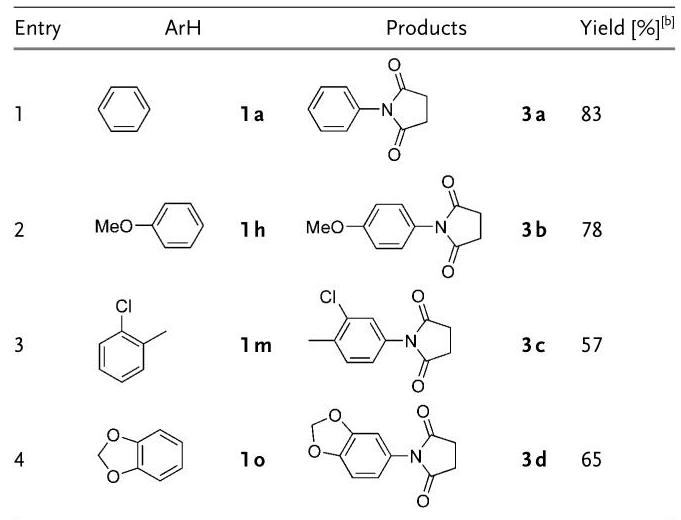
[a] First step: arene (1 mmol), NBS (1 mmol), see Table 2 for the reaction conditions. Second step: Active Cu (5 mmol), DMF 1 mL; MW 150W, Temp 150°C, time 30 min. [b] Yield of isolated product.
[a] 第一步:芳烃(1 mmol),NBS(1 mmol),反应条件见表2。第二步:活性铜(5 mmol),DMF 1 mL;微波150W,温度150°C,时间30分钟。[b] 分离产物的产率。
Next, we examined the combination of halogenation with palladium-catalyzed transformations, namely the Suzuki-Miyaura cross-coupling, Miyaura borylation, and Sonogashira coupling reactions (Scheme 2a, b, c respectively). All three types of palladium-catalyzed coupling reactions turned out to be compatible with the ${\mathrm{{AuCl}}}_{3}$ -catalyzed halogenation conditions. In a typical procedure, the arene was first converted into the corresponding aryl bromide under the conditions shown in Table 2. Upon completion of bromination, the solvent was removed and the crude product was directly subjected to the palladium-catalyzed coupling reaction without additional purification. The two-step reaction afforded satisfactory yields in all cases.
接下来,我们研究了卤化反应与钯催化的转化反应的结合,即铃木 - 宫浦交叉偶联反应、宫浦硼化反应和索尼加什ira偶联反应(分别为方案2a、b、c)。所有三种类型的钯催化偶联反应都与${\mathrm{{AuCl}}}_{3}$催化的卤化反应条件兼容。在一个典型的步骤中,芳烃首先在表2所示的条件下转化为相应的芳基溴化物。溴化反应完成后,除去溶剂,粗产物直接进行钯催化的偶联反应,无需进一步纯化。在所有情况下,两步反应都提供了令人满意的产率。
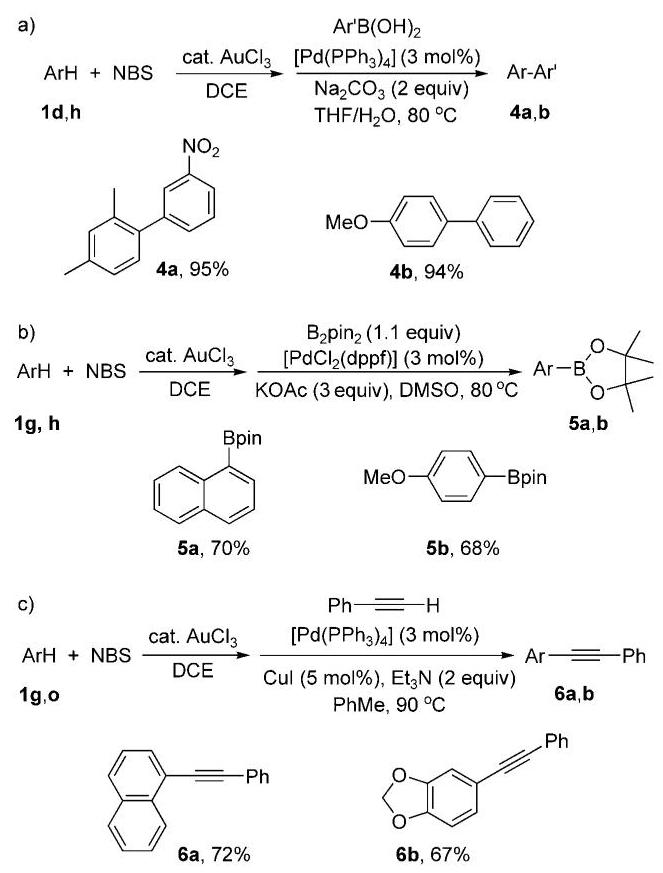
Scheme 2. Sequential transformations: bromination and a) Suzuki-Miyaura cross-coupling, b) Miyaura borylation, and c) Sonogashira coupling.
方案2. 连续转化:溴化反应以及a)铃木 - 宫浦交叉偶联反应、b)宫浦硼化反应和c)索尼加什ira偶联反应。
The extraordinarily high efficiency of the ${\mathrm{{AuCl}}}_{3}$ catalysis in aromatic halogenations raises intriguing questions concerning its reaction mechanism. We hypothesized a dual activation mode with the generation of arylgold(III) species as the key intermediate as shown in Scheme 1b. This hypothesis is based on the following: 1) It has been documented in the literature that simple aromatic groups readily react with ${\mathrm{{AuCl}}}_{3}$ to form arylgold(III) species at room temperature. ${}^{\left\lbrack 7\right\rbrack }$ Moreover, arylgold species have been recently proposed as intermediates in gold-catalyzed transformations; ${}^{\left\lbrack 8\mathrm{a} - \mathrm{d}\right\rbrack }2$ ) Gold catalysts are soft Lewis acids and therefore only weakly bond to a hard Lewis base such as the carbonyl oxygen atom. However, as shown by the results summarized in Table 1, ${\mathrm{{AuCl}}}_{3}$ is far more reactive as compared with other strong Lewis acids such as ${\mathrm{{FeCl}}}_{3},{\mathrm{{FeBr}}}_{3}$ , and ${\mathrm{{AlCl}}}_{3}$ in the bromination reaction with NBS, which implies different activation modes are operative in these reactions. For the normal Lewis acid or protonic acid catalysis, the activation of NBS is realized through coordination of carbonyl oxygen atom. Therefore, in the case of ${\mathrm{{AuCl}}}_{3}$ , a dual activation of both the aromatic substrate and NBS seems likely.
在芳环卤化反应中,${\mathrm{{AuCl}}}_{3}$催化的极高效率引发了关于其反应机理的有趣问题。我们假设了一种双重活化模式,即生成芳基金(III)物种作为关键中间体,如图1b所示。该假设基于以下几点:1) 文献记载,简单芳基在室温下容易与${\mathrm{{AuCl}}}_{3}$反应形成芳基金(III)物种。${}^{\left\lbrack 7\right\rbrack }$此外,芳基金物种最近被认为是金催化转化反应中的中间体;${}^{\left\lbrack 8\mathrm{a} - \mathrm{d}\right\rbrack }2$) 金催化剂是软路易斯酸,因此与硬路易斯碱如羰基氧原子的键合较弱。然而,如表1总结的结果所示,与其他强路易斯酸如${\mathrm{{FeCl}}}_{3},{\mathrm{{FeBr}}}_{3}$和${\mathrm{{AlCl}}}_{3}$相比,${\mathrm{{AuCl}}}_{3}$在与NBS的溴化反应中活性要高得多,这意味着这些反应中存在不同的活化模式。对于普通路易斯酸或质子酸催化,NBS的活化是通过羰基氧原子的配位实现的。因此,在${\mathrm{{AuCl}}}_{3}$的情况下,芳基底物和NBS的双重活化似乎是可能的。
To gain insights into the mechanism, a kinetic isotopic effect (KIE) was measured through intermolecular competitive bromination of benzene and $\left\lbrack {\mathrm{D}}_{6}\right\rbrack$ benzene with NBS as catalyzed by ${\mathrm{{BF}}}_{3} \cdot {\mathrm{{OEt}}}_{2},{\mathrm{{FeBr}}}_{3},{\mathrm{{ZrCl}}}_{4}$ , and ${\mathrm{{AuCl}}}_{3}$ , respectively. When brominations were catalyzed by ${\mathrm{{BF}}}_{3} \cdot {\mathrm{{OEt}}}_{2}$ , FeBr, and ${\mathrm{{ZrCl}}}_{4}$ , the ${k}_{\mathrm{H}}/{k}_{\mathrm{D}}$ values ranged from 0.91-1.13, whereas the ${k}_{\mathrm{H}}/{k}_{\mathrm{D}}$ value is 1.66 in the case of ${\mathrm{{AuCl}}}_{3}$ -catalyzed bromination. In general, electrophilic aromatic substitution does not exhibit primary isotope effect because proton transfer from the $\pi$ -complex intermediate is fast and thus not in the rate-limiting step. ${}^{\left\lbrack {12}\right\rbrack }$ Hence, the lack of primary kinetic isotopic effects for ${\mathrm{{BF}}}_{3} \cdot {\mathrm{{OEt}}}_{2}$ -, FeBr ${}_{3}$ -, and ${\mathrm{{ZrCl}}}_{4}$ -catalyzed bromina-tions are consistent with the activation of NXS as shown in Scheme 1 a. Although the modest value of kinetic isotopic effect observed in ${\mathrm{{AuCl}}}_{3}$ -catalyzed bromination does not provide conclusive information, ${}^{\left\lbrack {13}\right\rbrack }$ it demonstrates that the gold catalysis for bromination is distinct in mechanism from other Lewis acid catalyzed brominations.
为了深入了解反应机理,分别通过${\mathrm{{BF}}}_{3} \cdot {\mathrm{{OEt}}}_{2},{\mathrm{{FeBr}}}_{3},{\mathrm{{ZrCl}}}_{4}$和${\mathrm{{AuCl}}}_{3}$催化的苯和$\left\lbrack {\mathrm{D}}_{6}\right\rbrack$苯与NBS的分子间竞争溴化反应来测量动力学同位素效应(KIE)。当由${\mathrm{{BF}}}_{3} \cdot {\mathrm{{OEt}}}_{2}$、FeBr和${\mathrm{{ZrCl}}}_{4}$催化溴化反应时,${k}_{\mathrm{H}}/{k}_{\mathrm{D}}$值在0.91 - 1.13范围内,而在${\mathrm{{AuCl}}}_{3}$催化的溴化反应中,${k}_{\mathrm{H}}/{k}_{\mathrm{D}}$值为1.66。一般来说,亲电芳香取代反应不表现出一级同位素效应,因为从$\pi$ -络合物中间体的质子转移很快,因此不在速率限制步骤中。${}^{\left\lbrack {12}\right\rbrack }$因此,${\mathrm{{BF}}}_{3} \cdot {\mathrm{{OEt}}}_{2}$、FeBr${}_{3}$和${\mathrm{{ZrCl}}}_{4}$催化的溴化反应缺乏一级动力学同位素效应与图1a所示的NXS活化一致。尽管在${\mathrm{{AuCl}}}_{3}$催化的溴化反应中观察到的适度动力学同位素效应值没有提供确凿信息,${}^{\left\lbrack {13}\right\rbrack }$但它表明金催化的溴化反应在机理上与其他路易斯酸催化的溴化反应不同。
In conclusion, we have developed an efficient and mild protocol for the bromination of arenes with NBS under ${\mathrm{{AuCl}}}_{3}$ catalysis. Low catalyst loading, mild reaction conditions, as well as clean transformations (almost quantitative yield of aryl bromides in most cases and inert succinimide as the only byproduct), are the advantages of this new method. Moreover, as demonstrated by several examples, the clean reactions allow the combination of bromination with other transition metal catalyzed reactions to realize functionaliza-tion of aromatic $\mathrm{C} - \mathrm{H}$ bonds in an efficient manner. Finally, this ${\mathrm{{AuCl}}}_{3}$ -catalyzed reaction can also be extended to chlorination and iodination with NCS and NIS, respectively. ${}^{\left\lbrack {14}\right\rbrack }$
总之,我们开发了一种高效且温和的方案,用于在${\mathrm{{AuCl}}}_{3}$催化下用NBS对芳烃进行溴化反应。低催化剂负载量、温和的反应条件以及清洁的转化过程(在大多数情况下芳基溴化物几乎定量产率,且唯一的副产物是惰性的琥珀酰亚胺)是这种新方法的优点。此外,如几个例子所示,清洁的反应允许将溴化反应与其他过渡金属催化的反应相结合,以高效的方式实现芳族$\mathrm{C} - \mathrm{H}$键的官能化。最后,这种${\mathrm{{AuCl}}}_{3}$催化的反应也可以分别扩展到用NCS和NIS进行氯化和碘化反应。${}^{\left\lbrack {14}\right\rbrack }$
Experimental Section
实验部分
Typical procedure for the ${\mathrm{{AuCl}}}_{3}$ -catalyzed bromination with NBS: NBS ( $3\mathrm{{mmol}},{540}\mathrm{{mg}}$ ) and ${\mathrm{{AuCl}}}_{3}$ ( ${0.003}\mathrm{{mmol}},{0.1}\mathrm{\;{mol}}\% ,1\mathrm{{mg}}$ ) were weighed into a ${25}\mathrm{\;{mL}}$ round bottom flask. DCE (2 mL) and methyl 2-methoxybenzoate $1\mathbf{j}$ (3 mmol, ${498}\mathrm{{mg}}$ ) were then added to the flask in succession. The resulting reaction mixture was stirred for about ${23}\mathrm{\;h}$ at ${80}^{ \circ }\mathrm{C}$ (monitored by GC/MS). The solution was then concentrated under reduced pressure and the residue was purified by flash column chromatography to give methyl 5-bromo-2-methoxy-benzoate $2\mathbf{j}\left( {{703}\mathrm{{mg}},{96}\% }\right)$ .
${\mathrm{{AuCl}}}_{3}$催化下用NBS进行溴化反应的典型步骤:将NBS($3\mathrm{{mmol}},{540}\mathrm{{mg}}$)和${\mathrm{{AuCl}}}_{3}$(${0.003}\mathrm{{mmol}},{0.1}\mathrm{\;{mol}}\% ,1\mathrm{{mg}}$)称入一个${25}\mathrm{\;{mL}}$圆底烧瓶中。然后依次向烧瓶中加入二氯乙烷(2 mL)和2-甲氧基苯甲酸甲酯$1\mathbf{j}$(3 mmol,${498}\mathrm{{mg}}$)。所得反应混合物在${80}^{ \circ }\mathrm{C}$下搅拌约${23}\mathrm{\;h}$(通过GC/MS监测)。然后在减压下浓缩溶液,残余物通过快速柱色谱法纯化,得到5-溴-2-甲氧基苯甲酸甲酯$2\mathbf{j}\left( {{703}\mathrm{{mg}},{96}\% }\right)$。
Received: November 27, 2009
收到日期:2009年11月27日
Published online: February 12, 2010
在线发表日期:2010年2月12日
Keywords: aromatic compounds $\cdot \mathrm{C} - \mathrm{H}$ activation $\cdot$ gold $\cdot$ halogenation $\cdot$ synthetic methods
关键词:芳香族化合物 $\cdot \mathrm{C} - \mathrm{H}$活化 $\cdot$金 $\cdot$卤化 $\cdot$合成方法
[1] a) R. Taylor, Electrophilic Aromatic Substitution, Wiley, New York, 1990; b) P. B. De La Mare, Electrophilic Halogenation, Cambridge University Press, Cambridge, 1976, chapt. 5.
[2] Halogenation of activated aromatics with NXS: a) R. H. Mitchell, Y. H. Lai, R. V. Williams, J. Org. Chem. 1979, 44, 4733; b) H. M. Gilow, D. E. Burton, J. Org. Chem. 1981, 46, 2221; c) H. Konishi, K. Aritomi, T. Okano, J. Kiji, Bull. Chem. Soc. Jpn. 1989, 62, 591; d) Y. Goldberg, H. Alper, J. Org. Chem. 1993, 58, 3072; e) J. Auerbach, S. A. Weissman, T. J. Blacklock, M. R. Angeles, K. Hoogsteen, Tetrahedron Lett. 1993, 34, 931; f) S. Fujisaki, H. Eguchi, A. Omura, A. Okamoto, A. Nishida, Bull. Chem. Soc. Jpn. 1993, 66, 1576; g) P. Bovonsombat, E. Mcnelis, Synthesis 1993, 237; h) G. J. M. Gruter, O. S. Akkerman, F. Bickelhaupt, J. Org. Chem. 1994, 59, 4473; i) Y. Goldberg, H. Alper, J. Mol. Catal. 1994, 88, 377; j) V. Paul, A. Sudalai, T. Daniel, K. V. Srinivasan, Tetrahedron Lett. 1994, 35, 7055; k) M. C. Carreño, J. L. G. Ruano, G. Sanz, M. A. Toledo, A. Urbano, J. Org. Chem. 1995, 60, 5328; 1) T. Oberhauser, J. Org. Chem. 1997, 62, 4504; m) A. N. Cammidge, K. V. Crepy, M. Fugier, 1997, Synth. Commun. 1997, 27, 4159; n) J. L. Bloomer, W. Zheng, Synth. Commun. 1998, 28, 2087; o) B. Andersh, D. L. Murphy, R. J. Olson, Synth. Commun. 2000, 30, 2091; p) R. Rajagopal, D. V. Jarikote, R. J. Lahoti, T. Daniel, K. V. Srinivasan, Tetrahedron Lett. 2003, 44, 1815; q) Y. Zhang, K. Shibatomi, H. Yamamoto, Synlett 2005, 2837; r) J. S. Yadav, B. V. S. Reddy, P. S. R. Reddy, A. K. Basak, A. V. Narsaiah, Adv. Synth. Catal. 2004, 346, 77; s) M. Bagheri, N. Azizi, M. R. Saidi, Can. J. Chem. 2005, 83, 146; t) N. C. Ganguly, P. De, S. Dutta, Synthesis 2005, 1103; u) E. Zysman-Colman, K. Arias, J. S. Siegel, Can. J. Chem. 2009, 87, 440.
[3] Halogenation of unactivated aromatics with NXS: a) H. Schmid, Helv. Chim. Acta 1946, 29, 1144; b) J. C. Roberts, P. Roffey, J. Chem. Soc. C 1966, 160; c) F. L. Lambert, W. D. Ellis, R. J. Parry, J. Org. Chem. 1965, 30, 304; d) R. S. Coleman, E. B. Grant, J. Org. Chem. 1991, 56, 1357; e) V. Paul, A. Sudalai, T. Daniel, K. V. Srinivasan, Tetrahedron Lett. 1994, 35, 7055; f) A. Zanka, A. Kubota, Synlett 1999, 1984; g) K. Tanemura, T. Suzuki, Y. Nishida, K. Satsumabayashi, T. Horaguchi, Chem. Lett. 2003, 32, 932; h) G. A. Olah, Q. Wang, G. Sandford, G. K. S. Prakash, J. Org. Chem. 1993, 58, 3194; i) G. A. Olah, Q. Wang, G. Sandford, G. K. S. Prakash, J. Org. Chem. 1993, 58, 3194; j) G. K. S. Prakash, T. Mathew, D. Hoole, P. M. Esteves, Q. Wang, G. Rasul, G. A. Olah, J. Am. Chem. Soc. 2004, 126, 15770.
[4] Transition metal catalyzed halogenation with NXS: a) D. Kalyani, A. R. Dick, W. Q. Anani, M. S. Sanford, Org. Lett. 2006, 8, 2523; b) D. Kalyani, A. R. Dick, W. Q. Anani, M. S. Sanford, Tetrahedron 2006, 62, 11483.
[5] G. Dyker, Handbook of C-H Transformations, Wiley-VCH, Weinheim, 2005.
[6] For selected reviews on gold-catalyzed reactions, see: a) S. Ma, S. Yu, Z. Gu, Angew. Chem. 2006, 118, 206; Angew. Chem. Int. Ed. 2006, 45, 200; b) A. S. K. Hashmi, C. J. Hutchings, Angew. Chem. 2006, 118, 8064; Angew. Chem. Int. Ed. 2006, 45, 7896; c) E. Jiménez-Núñez, A. M. Echavarren, Chem. Commun. 2007, 333; d) A. Fürstner, P. W. Davies, Angew. Chem. 2007, 119, 3478; Angew. Chem. Int. Ed. 2007, 46, 3410; e) A. S. K. Hashmi, Chem. Rev. 2007, 107, 3180; f) Z. Li, C. Brouwer, C. He, Chem. Rev. 2008, 108, 3239; g) A. Arcadi, Chem. Rev. 2008, 108, 3266; h) E. Jiménez-Núñnez, A. M. Echavarren, Chem. Rev. 2008, 108, 3326; i) D. J. Gorin, B. B. D. Sherry, F. D. Toste, Chem. Rev. 2008, 108, 3351.
[7] a) M. S. Kharasch, H. S. Isbell, J. Am. Chem. Soc. 1931, 53, 3053; b) K. S. Liddle, C. Perkin, J. Chem. Soc. Chem. Commun. 1972, 26; c) P. W. de Graaf, J. Boersma, G. J. M. van der Kerk, J. Organomet. Chem. 1976, 105, 399; d) Y. Fuchita, Y. Utsunomiya, M. Yasutake, J. Chem. Soc. Dalton Trans. 2001, 2330.
Communications
通讯
[8] a) Z. Li, D. A. Capretto, R. O. Rahaman, C. He, J. Am. Chem. Soc. 2007, 129, 12058; b) Z. Shi, C. He, J. Org. Chem. 2004, 69, 3669; c) Z. Shi, C. He, J. Am. Chem. Soc. 2004, 126, 5964; d) Z. Shi, C. He, J. Am. Chem. Soc. 2004, 126, 13596; e) M. T. Reetz, K. Sommer, Eur. J. Org. Chem. 2003, 3485; f) G. Dyker, E. Muth, A. S. K. Hashmi, L. Ding, Adv. Synth. Catal. 2003, 345, 1247; g) A. S. K. Hashmi, L. Schwarz, J. H. Choi, T. M. Frost, Angew. Chem. 2000, 112, 2382; Angew. Chem. Int. Ed. 2000, 39, 2285; h) Y. Luo, C. J. Li, Chem. Commun. 2004, 1930; i) X. Sun, W. Sun, R. Fan, J. Wu, Adv. Synth. Catal. 2007, 349, 2151.
[9] For example, see: C. Jia, D. Piao, J. Oyamada, W. Lu, T. Kitamura, Y. Fujiwara, Science 2000, 287, 1992.
[10] P. H. Gore, G. K. Hughes, J. Chem. Soc. 1959, 1615.
[11] L. D. S. Yadav, B. S. Yadav, V. K. Rai, Synthesis 2006, 1868.
[12] H. Zollinger, Adv. Phys. Org. Chem. 1964, 2, 163.
[13] The KIE data for aromatic auration is not available. For KIE studies on electrophilic aromatic metallation, see: a) J. A. Tunge, L. N. Foresee, Organometallics 2005, 24, 6440; b) W. Lau, J. K. Kochi, J. Am. Chem. Soc. 1986, 108, 6720.
[14] For details, see the Supporting Information.