Discussion Addendum for: Synthesis of Arylboronic Pinacol Esters from Corresponding Arylamines
英文原文与中文译文逐段对照 · English original with Chinese translation
Discussion Addendum for:
讨论附录针对:
Synthesis of Arylboronic Pinacol Esters from Corresponding Arylamines
由相应芳胺合成芳基硼酸频哪醇酯
Fanyang Mo, ${}^{qv}$ Di Qiu, ${}^{ \ddagger }$ and Jianbo Wang ${}^{*\text{ § }1}$
莫凡洋,${}^{qv}$ 邱迪,${}^{ \ddagger }$ 以及王剑波 ${}^{*\text{ § }1}$
${}^{q}$ Department of Energy and Resources Engineering, College of Engineering, Peking University, Beijing 100871, China
${}^{q}$ 北京大学工学院能源与资源工程系,北京 100871,中国
${}^{ \triangledown }$ Jiangsu Donghai Silicon Industry S&T Innovation Center, Donghai County, Jiangsu 222300, China
${}^{ \triangledown }$ 江苏东海硅产业科技创新中心,江苏东海 222300,中国
*Tianjin Key Laboratory of Structure and Performance for Functional Molecules, MOE Key Laboratory of Inorganic-Organic Hybrid Functional
*天津市功能分子结构与性能重点实验室,教育部无机 - 有机杂化功能材料化学重点实验室
Materials Chemistry, College of Chemistry, Tianjin Normal University, Tianjin 300387, P. R. China
天津师范大学化学学院,天津 300387,中华人民共和国
${}^{\text{ § }}$ Beijing National Laboratory of Molecular Sciences (BNLMS), Key Laboratory of Bioorganic Chemistry and Molecular Engineering of Ministry of Education, College of Chemistry, Peking University, Beijing 100871, China
${}^{\text{ § }}$ 北京分子科学国家实验室(BNLMS),教育部生物有机化学与分子工程重点实验室,北京大学化学学院,北京 100871,中国
Original Article: Qiu, D.; Meng, H.; Jin, L.; Tang, S.; Wang, S.; Mo, F.; Zhang, Y.; Wang, J. Org. Synth. 2014, 91, 106-115.
原始文章:邱迪;孟辉;金磊;唐帅;王帅;莫凡洋;张宇;王剑波。《有机合成》2014 年,91 卷,106 - 115 页。

The wide applications of Suzuki-Miyaura cross-coupling reaction in constructing C-C bond have created an increasing demand for arylboronic acids or arylboronates. ${}^{2}$ The traditional synthetic route of arylboronic acids relied on the trapping of organolithium or Grignard reagents with a trialkyl borate, followed by acidic hydrolysis. ${}^{3}$ In 1995, Miyaura et al. developed the palladium-catalyzed borylation of arylhalides with bis(pinacolato)diboron, representing another important approach toward arylboronates. ${}^{4}$ Direct borylation via aromatic $\mathrm{C} - \mathrm{H}$ bond activation has been extensively explored in the recent decades. ${}^{5}$ Following our report in 2010, ${}^{6}$ a series of similar Sandmeyer-type borylation reactions under modified conditions appeared in
铃木 - 宫浦交叉偶联反应在构建碳碳键方面的广泛应用对芳基硼酸或芳基硼酸酯的需求日益增加。${}^{2}$ 芳基硼酸的传统合成路线依赖于用硼酸三烷基酯捕获有机锂试剂或格氏试剂,然后进行酸性水解。${}^{3}$ 1995 年,宫浦等人开发了钯催化的芳基卤化物与双(频哪醇合)二硼的硼化反应,这是合成芳基硼酸酯的另一种重要方法。${}^{4}$ 近几十年来,通过芳环$\mathrm{C} - \mathrm{H}$键活化进行的直接硼化反应得到了广泛研究。${}^{5}$ 继我们 2010 年的报告之后,${}^{6}$ 一系列在改进条件下的类似桑德迈尔型硼化反应出现在
the literature. ${}^{7}$ These recent advances are the focus of this Discussion Addendum.
文献中。${}^{7}$ 这些最新进展是本讨论增编的重点。
In 2010, our group developed the metal-free direct conversion of aryl amines 1 to arylboronates ${3.}^{6}$ Using ${\mathrm{B}}_{2}{\mathrm{{pin}}}_{2}2$ as the boron source, the reaction is promoted by the radical initiator dibenzoyl peroxide (BPO), and it is complete at room temperature within 1-2 h. As shown in Scheme 1, aryl amines 1 bearing various functionalities can be engaged in this transformation, and the corresponding borylation products are obtained in moderate to good yields; however, for heteroaromatic amines and some ortho-substituted aryl amines, the reaction only gives trace amount of the products.
2010 年,我们小组开发了无金属直接将芳胺 1 转化为芳基硼酸酯的方法。${3.}^{6}$ 使用${\mathrm{B}}_{2}{\mathrm{{pin}}}_{2}2$作为硼源,该反应由自由基引发剂过氧化二苯甲酰(BPO)促进,在室温下 1 - 2 小时内完成。如图 1 所示,带有各种官能团的芳胺 1 均可参与此转化反应,并以中等至良好的产率得到相应的硼化产物;然而,对于杂环芳胺和一些邻位取代的芳胺,反应仅得到痕量产物。
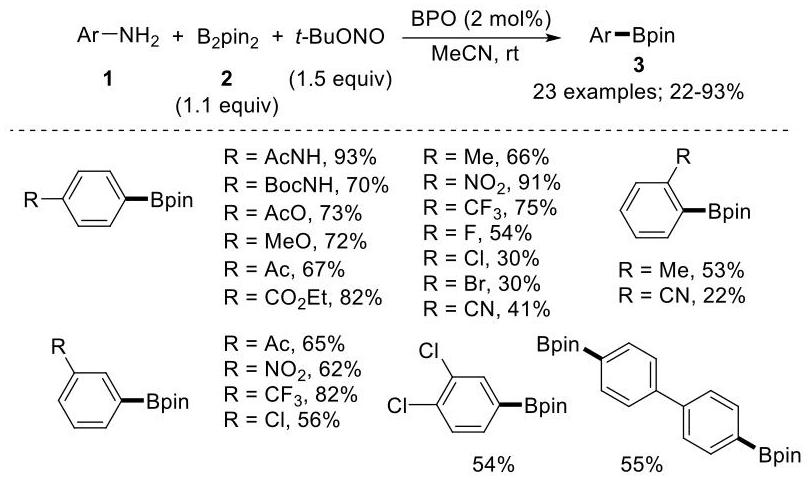
Scheme 1. Metal-free borylation of arylamines at room temperature
图 1. 室温下芳胺的无金属硼化反应
We have noted that the substituents on the aromatic ring of arylamine substrates significantly affect the yields of borylation products. Therefore, we further devoted ourselves to developing more general conditions for the widespread aryl amine substrates. Gratifyingly, we found that simply carrying out the reaction in MeCN at ${80}{}^{ \circ }\mathrm{C}$ in the absence of BPO would expand the substrate scope. ${}^{8}$ Importantly, the modified reaction conditions give slightly improved yields in most cases. The modified conditions turn out to be compatible with a broader substrate scope, including ortho-substituted aryl amines, amines with unprotected hydroxyl and amino groups, aldehydes, and more importantly, heterocyclic amines (Scheme 2). It has been observed that electron-deficient heterocyclic amines exhibit high reactivity in the formation of the borylation products, while electron-rich heterocyclic amines are prone to oxidation in the presence of $t$ -BuONO, thus resulting in diminished yields. The reactions can be carried out on gram scale for selected substrates.
我们注意到芳胺底物芳环上的取代基对硼化产物的产率有显著影响。因此,我们进一步致力于为更广泛的芳胺底物开发更通用的条件。令人欣慰的是,我们发现简单地在 MeCN 中于${80}{}^{ \circ }\mathrm{C}$下在无 BPO 的情况下进行反应会扩大底物范围。${}^{8}$ 重要的是,改进后的反应条件在大多数情况下产率略有提高。改进后的条件适用于更广泛的底物范围,包括邻位取代的芳胺、带有未保护羟基和氨基的胺、醛,更重要的是杂环胺(图 2)。据观察,缺电子杂环胺在硼化产物形成过程中表现出高反应活性,而富电子杂环胺在$t$ - BuONO 存在下容易氧化,从而导致产率降低。对于选定的底物,反应可以在克级规模上进行。
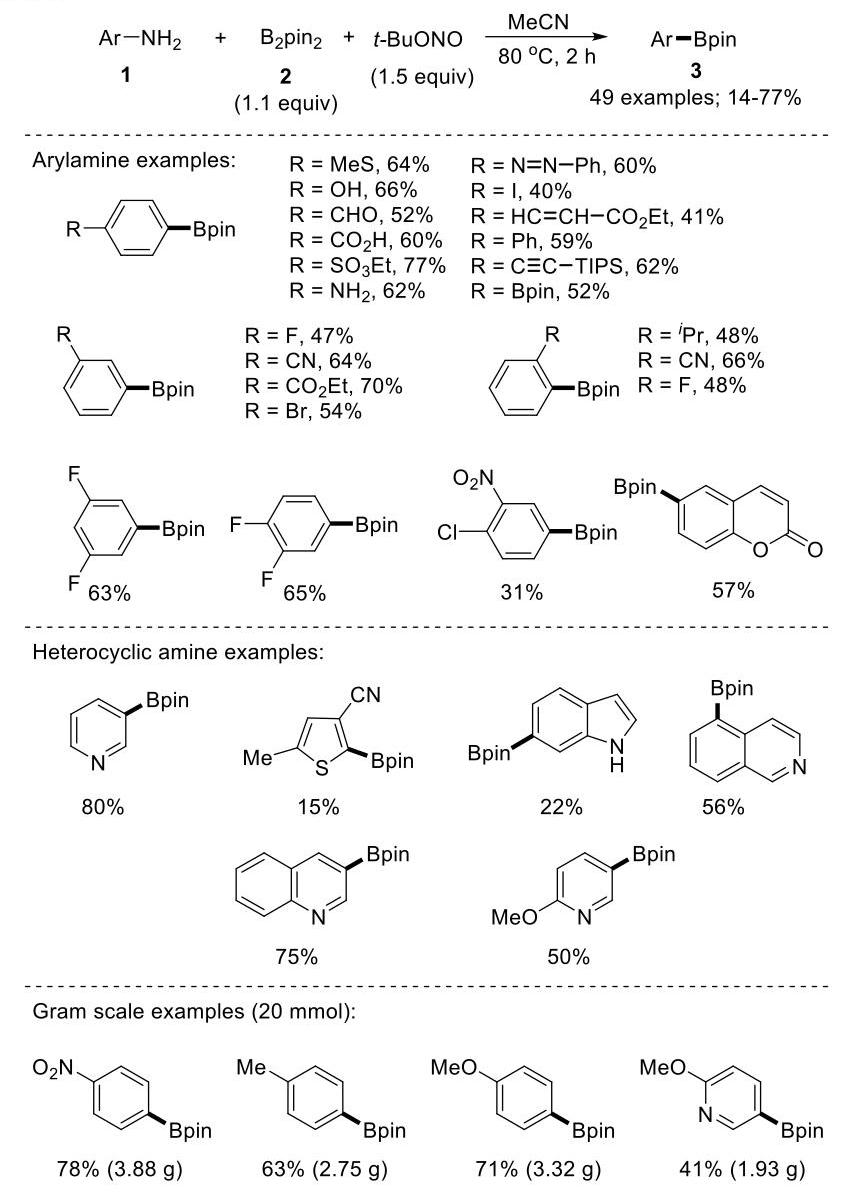
Scheme 2. Metal-free borylation of arylamines under modified conditions in the absence of BPO
图 2. 在无 BPO 的改进条件下芳胺的无金属硼化反应
Following our initial report in 2010, many new Sandmeyer-type borylations under modified conditions have been developed. In 2012, Yamane group reported the ${\mathrm{{BF}}}_{3}$ -mediated synthetic method for deaminoborylation of aryltriazenes 4 with bis(pinacolato)diboron 2. ${}^{9}$ Various arylboronic esters are prepared in moderate to good yields with this facile transition-metal-free procedure (Scheme 3). Mechanistic studies suggested that this borylation process might not involve an aryl free radical process.
继我们在2010年的初步报告之后,人们开发了许多在改良条件下的新型桑德迈尔型硼化反应。2012年,Yamane课题组报道了用双(频哪醇合)二硼(2)对芳基三氮烯(4)进行脱氨基硼化反应的${\mathrm{{BF}}}_{3}$介导的合成方法。${}^{9}$ 通过这种简便的无过渡金属方法可以中等至良好的产率制备各种芳基硼酸酯(方案3)。机理研究表明,这种硼化过程可能不涉及芳基自由基过程。
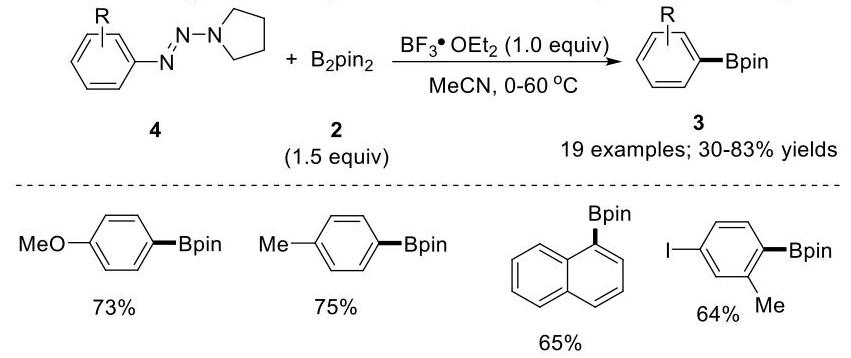
Scheme 3. Transition-metal-free borylation of aryltriazenes
方案3.芳基三氮烯的无过渡金属硼化反应
In 2012, Yan and co-workers reported an organic dye (eosin Y)-catalyzed visible light-promoted reduction of stable aryldiazonium tetrafluoroborate salts 5 to generate aryl free radicals that are borylated with ${\mathrm{B}}_{2}{\text{ pin }}_{2}{2.}^{10}$ Both electron poor and electron rich aromatics are tolerated and provide the corresponding borylated compounds in moderate to good yields (Scheme 4). Similarly, this photoredox protocol could be extended to in situ generated diazonium salt from aryl amine and $t$ -BuONO.
2012年,Yan及其同事报道了一种有机染料(曙红Y)催化的可见光促进的稳定芳基四氟硼酸重氮盐(5)还原反应,以生成芳基自由基,该自由基与${\mathrm{B}}_{2}{\text{ pin }}_{2}{2.}^{10}$进行硼化反应。缺电子和富电子的芳烃都适用,并以中等至良好的产率提供相应的硼化产物(方案4)。同样,这种光氧化还原方案可以扩展到由芳胺和$t$-叔丁基亚硝酸酯原位生成重氮盐的反应。
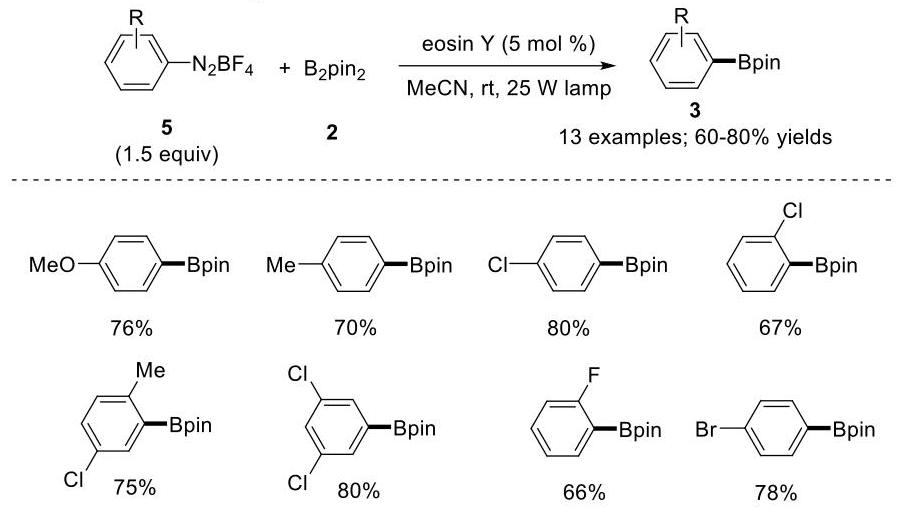
Scheme 4. Eosin Y-catalyzed borylation of aryldiazonium tetrafluoroborate salts
方案4.曙红Y催化的芳基四氟硼酸重氮盐的硼化反应
In 2016, Ranu reported that using the same photocatalyst, eosin Y, a variety of anilines were borylated to give corresponding arylboronates in the presence of $t$ -BuONO and ${\mathrm{B}}_{2}{\mathrm{{pin}}}_{2}$ 2 at room temperature with visible light irradiation (Scheme 5). ${}^{11}$ This procedure avoids the isolation and handling of hazardous diazonium salt and the use of any metal reagent.
2016年,Ranu报道,使用相同的光催化剂曙红Y,在室温下用可见光照射,在$t$-叔丁基亚硝酸酯和${\mathrm{B}}_{2}{\mathrm{{pin}}}_{2}$2存在下,多种苯胺被硼化生成相应的芳基硼酸酯(方案5)。${}^{11}$ 该方法避免了危险重氮盐的分离和处理以及任何金属试剂的使用。
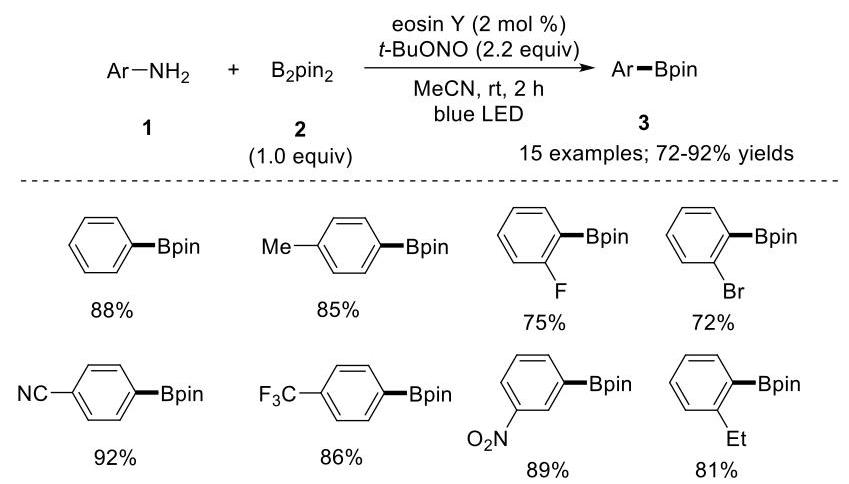
Scheme 5. Visible light photo-catalyzed borylation of aryl amine
方案5.芳胺的可见光光催化硼化反应
In 2014, Pucheault and co-workers disclosed that a series of titanocene and zirconocene reagents were capable of promoting borylation of anilines to form boronates at room temperature (Scheme 6). ${}^{12}$ In contrast to previous works, this protocol uses diisopropylaminoborane $6\left( {{\mathrm{H}}_{2}\mathrm{{BN}}i - {\mathrm{{Pr}}}_{2}}\right)$ as the borylating agent, and the reaction is presumed to proceed through a radical chain mechanism.
2014年,Pucheault及其同事披露,一系列二茂钛和二茂锆试剂能够在室温下促进苯胺的硼化反应以形成硼酸酯(方案6)。${}^{12}$ 与之前的工作相比,该方案使用二异丙基氨基硼烷$6\left( {{\mathrm{H}}_{2}\mathrm{{BN}}i - {\mathrm{{Pr}}}_{2}}\right)$作为硼化剂,并且推测反应通过自由基链机理进行。
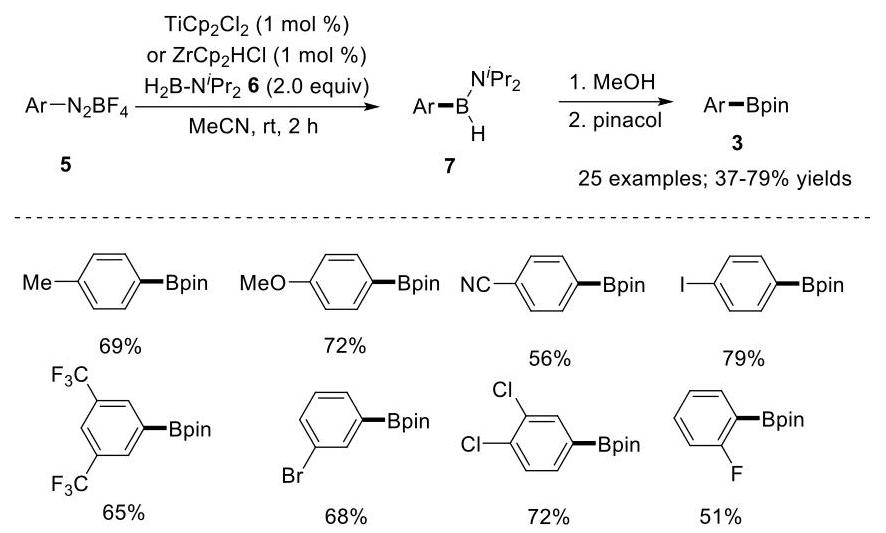
Scheme 6. Borylation of aromatic diazonium salts using titanocene and zirconocene
方案6.使用二茂钛和二茂锆对芳基重氮盐进行硼化反应
In 2017, Wu and co-workers demonstrated a zinc-catalyzed borylation of aryldiazonium salts 5 and aryltriazenes 8 for arylboronate synthesis (Scheme 7). ${}^{13}$ The reaction was carried out in methanol with $5\% \mathrm{{Zn}}{\left( {\mathrm{{ClO}}}_{4}\right) }_{2}$ catalyst at ${40}{}^{ \circ }\mathrm{C}$ , providing various arylboronates.
2017年,Wu及其同事展示了一种锌催化的芳基四氟硼酸重氮盐(5)和芳基三氮烯(8)的硼化反应,用于合成芳基硼酸酯(方案7)。${}^{13}$ 该反应在甲醇中用$5\% \mathrm{{Zn}}{\left( {\mathrm{{ClO}}}_{4}\right) }_{2}$催化剂在${40}{}^{ \circ }\mathrm{C}$下进行,得到各种芳基硼酸酯。
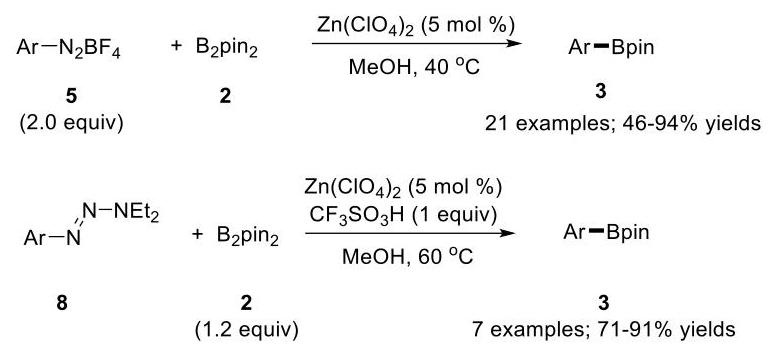
Scheme 7. Zinc-catalyzed borylation of aryl diazonium salts and aryltriazenes
方案7.锌催化的芳基重氮盐和芳基三氮烯的硼化反应
Diazotizations were typically conducted in aqueous solution in the early days. Although aqueous conditions have sometimes restricted the substrate scope due to functional group compatibility or solubility issues, there are also potential advantages of using water as solvent, such as low cost, safety, and environmental benefits. Thus, developing Sandmeyer-type borylation under aqueous conditions is desirable. In 2014, Xue and co-workers reported aqueous phase diazotization conditions for the conversion of aryl amines to arylboronates. ${}^{14}$ In this procedure, the first diazotization step was conducted at $0 - {5}^{ \circ }\mathrm{C}$ in mixed solvent of $\mathrm{{MeOH}}/\mathrm{{aq}}$ . HCl. For the second step, protic solvents such as alcohols and organic acids are superior to aprotic solvents. In addition, Xue and co-workers expanded the borylation to include ${\mathrm{B}}_{2}{\left( \mathrm{{OH}}\right) }_{4}$ 9 as the boron source, affording arylboronic acids 10 as the products (Scheme 8).
早期重氮化反应通常在水溶液中进行。尽管由于官能团兼容性或溶解性问题,水相条件有时会限制底物范围,但使用水作为溶剂也有潜在的优点,如低成本、安全和环境效益。因此,开发水相条件下的桑德迈尔型硼化反应是可取的。2014年,Xue及其同事报道了将芳胺转化为芳基硼酸酯的水相重氮化条件。${}^{14}$ 在该方法中,第一步重氮化反应在$0 - {5}^{ \circ }\mathrm{C}$下于$\mathrm{{MeOH}}/\mathrm{{aq}}$.HCl的混合溶剂中进行。对于第二步,质子性溶剂如醇和有机酸优于非质子性溶剂。此外,Xue及其同事将硼化反应扩展到包括${\mathrm{B}}_{2}{\left( \mathrm{{OH}}\right) }_{4}$9作为硼源,得到芳基硼酸(10)作为产物(方案8)。
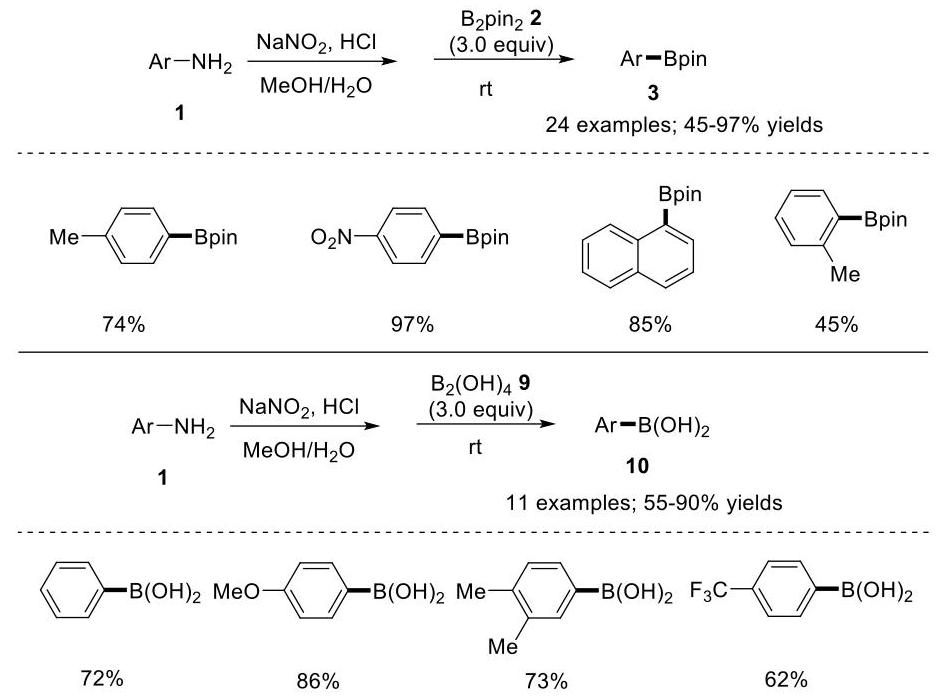
Scheme 8. Methanol-promoted borylation of arylamines to synthesize arylboronic acids and arylboronates
方案8. 甲醇促进的芳胺硼化反应以合成芳基硼酸和芳基硼酸酯
In 2014, Blanchet group disclosed the aqueous phase borylation of a wide range of diazonium salts with diboronic acid 9, leading to the facile synthesis of (hetero)arylboronic acids ${10.}^{{15}\mathrm{a}}$ The most attractive advantage was the speed of the reactions, as all of the examples went to completion in approximately a half an hour (Scheme 9). Furthermore, the authors combined this fast one-pot borylation method with other reactions such as esterification, Suzuki-Miyaura coupling, hydrogenolysis, and Petasis borono-Mannich reaction for rapidly achieving molecular diversity. ${}^{{15}\mathrm{\;b}}$
2014年,布兰切特团队报道了一系列重氮盐与二硼酸9在水相中的硼化反应,可轻松合成(杂)芳基硼酸${10.}^{{15}\mathrm{a}}$ 最吸引人的优点是反应速度快,所有示例均在约半小时内完成(方案9)。此外,作者将这种快速的一锅法硼化方法与其他反应(如酯化、铃木-宫浦偶联、氢解和佩塔西斯硼代-曼尼希反应)相结合,以快速实现分子多样性。${}^{{15}\mathrm{\;b}}$
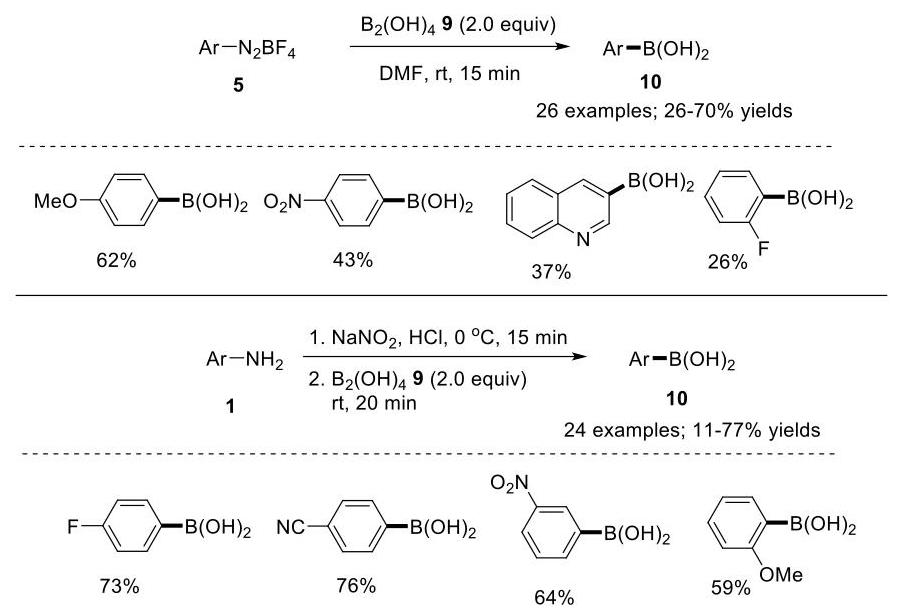
Scheme 9. Aqueous phase borylation of diazonium salts and arylamines with diboronic acid
方案9. 重氮盐和芳胺与二硼酸的水相硼化反应
In 2017, Wu further demonstrated that the borylation of stable diazonium tetrafluoroborates 5 could proceed under catalyst-free conditions in acetone-water solution (Scheme 10). ${}^{16}$ Control experiments indicate that water plays a crucial role in promoting the borylation of diazonium tetrafluoroborates. Mechanistically, the reaction proceeds through a radical pathway, as TEMPO or BHT completely inhibited the desired transformation.
2017年,吴进一步证明稳定的四氟硼酸重氮盐5在丙酮-水溶液中可在无催化剂条件下进行硼化反应(方案10)。${}^{16}$ 对照实验表明,水在促进四氟硼酸重氮盐的硼化反应中起关键作用。从机理上讲,该反应通过自由基途径进行,因为TEMPO或BHT完全抑制了所需的转化。
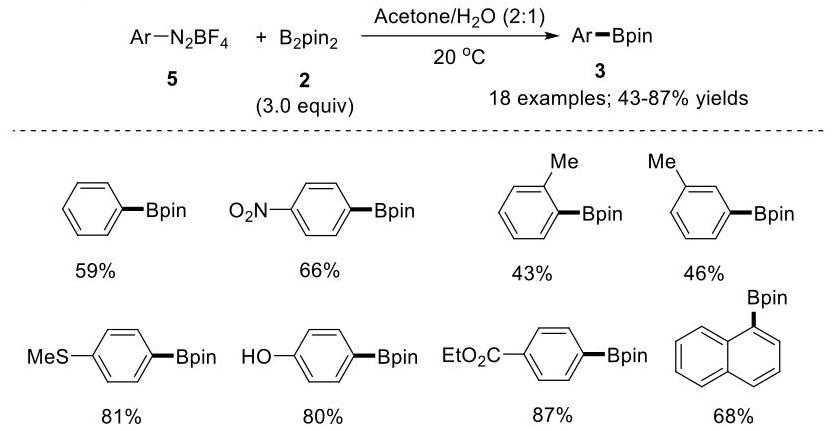
Scheme 10. Borylation of diazonium tetrafluoroborates in acetone-water solution
方案10. 四氟硼酸重氮盐在丙酮-水溶液中的硼化反应
In 2019, Miao and co-workers reported the metal-free transformation of arylamines to aryl naphthalene-1,8-diamino boronamides 12 with a nonsymmetrical diboron reagent B(pin)-B(dan) 11 (Scheme 11). ${}^{17}$ This Sandmeyer-type borylation reaction represents an important supplement for the preparation of aryl-B(dan) compounds.
2019年,苗及其同事报道了芳胺与非对称二硼试剂B(pin)-B(dan) 11无金属转化为芳基萘-1,8-二氨基硼酰胺12的反应(方案11)。${}^{17}$ 这种桑德迈尔型硼化反应是制备芳基-B(dan)化合物的重要补充。
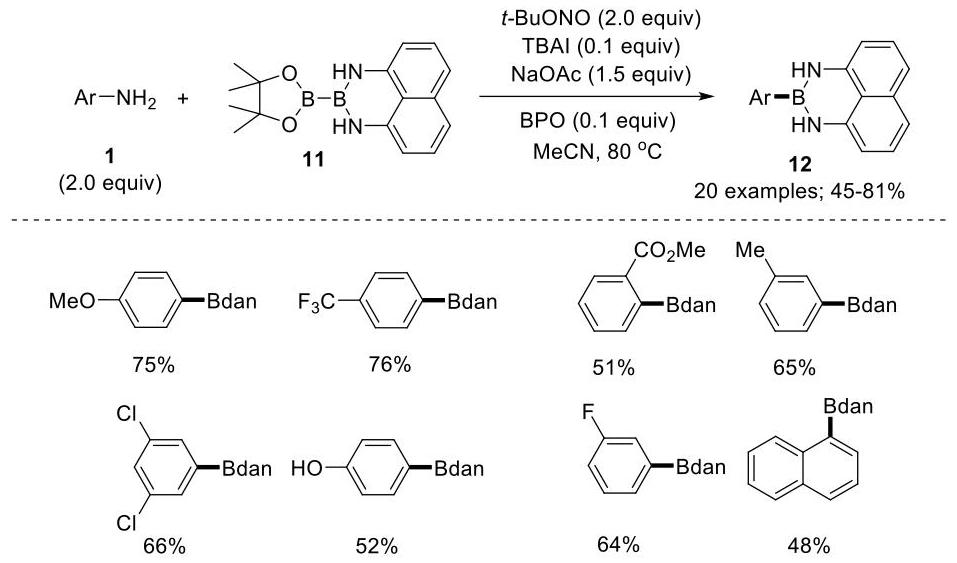
Scheme 11. Transformation of arylamines to aryl naphthalene-1,8- diamino boronamides
方案11. 芳胺转化为芳基萘-1,8-二氨基硼酰胺
In summary, the Sandmeyer-type borylation of aryl amines and their derivatives for the synthesis of (hetero)arylboronic acids and boronates have been well studied in the past decade. A number of modified practical routes to arylboronic compounds have been established, and these methods are available for application in academic settings as well as industrial processes.
综上所述,在过去十年中,对用于合成(杂)芳基硼酸和硼酸酯的芳胺及其衍生物的桑德迈尔型硼化反应进行了深入研究。已经建立了许多改进的芳基硼酸化合物实用路线,这些方法可用于学术研究以及工业生产。
References
参考文献
Beijing National Laboratory of Molecular Sciences (BNLMS) and Key Laboratory of Bioorganic Chemistry and Molecular Engineering of Ministry of Education, College of Chemistry, Peking University, Beijing 100871, China; : Jianbo Wang: 0000- 0002-0092-0937.
For selected reviews, see: (a) Suzuki, A. Acc. Chem. Res. 1982, 15, 178-184. (b) Miyaura, N.; Suzuki, A. Chem. Rev. 1995, 95, 2457-2483. (c) Miyaura, N. Top. Curr. Chem. 2002, 219, 11-59. (d) Miyaura, N. J. Organomet. Chem. 2002, 653, 54-57. (e) Ishiyama, T.; Miyaura, N. Chem. Rec. 2004, 3, 271-280. (f) Miyaura, N. Bull. Chem. Soc. Jpn. 2008, 81, 1535-1553.
(a) Brown, H. C.; Cole, T. E. Organometallics 1983, 2, 1316-1319. (b) Brown, H. C.; Srebnik, M.; Cole, T. E. Organometallics 1986, 5, 2300-2303.
(a) Ishiyama, T.; Murata, M.; Miyaura, N. J. Org. Chem. 1995, 60, 7508- 7510. (b) Ishiyama, T.; Miyaura, N. J. Organomet. Chem. 2000, 611, 392- 402.
(a) Ishiyama, T.; Miyaura, N. J. Organomet. Chem. 2003, 680, 3-11. (b) Mkhalid, I. A. I.; Barnard, J. H.; Marder, T. B.; Murphy, J. C.; Hartwig, J. F. Chem. Rev. 2010, 110, 890-931.
Mo, F.; Jiang, Y.; Qiu, D.; Zhang, Y.; Wang, J. Angew. Chem. Int. Ed. 2010, 49, 1846-1849.
For reviews, see: (a) Mo, F.; Qiu, D.; Zhang, Y.; Wang, J. Acc. Chem. Res. 2018, 51, 496-506. (b) Yan, G.; Huang, D.; Wu, X. Adv. Synth. Catal. 2018, 360, 1040-1053. (c) Friese, F. W.; Studer, A. Chem. Sci. 2019, DOI: 10.1039/c9sc03765a.
(a) Qiu, D.; Jin, L.; Zheng, Z.; Meng, H.; Mo, F.; Wang, X.; Zhang, Y.; Wang, J. J. Org. Chem. 2013, 78, 1923-1933. (b) Qiu, D.; Zhang, Y.; Wang, J. Org. Chem. Front. 2014, 1, 422-425.
Zhu, C.; Yamane, M. Org. Lett. 2012, 14, 4560-4563.
Yu, J.; Zhang, L.; Yan, G. Adv. Synth. Catal. 2012, 354, 2625-2628.
Ahammed, S.; Nandi, S.; Kundu, D.; Ranu, B. C. Tetrahedron Lett. 2016, 57, 1551-1554.
Marciasini, L. D.; Vaultier, M.; Pucheault, M. Tetrahedron Lett. 2014, 55, 1702-1705.
Qi, X.; Jiang, L.-B.; Zhou, C.; Peng, J.-B.; Wu, X.-F. ChemistryOpen 2017, 6, 345-349.
Zhao, C.-J.; Xue, D.; Jia, Z.-H.; Wang, C.; Xiao, J. Synlett 2014, 25, 1577- 1584.
(a) Erb, W.; Hellal, A.; Albini, M.; Rouden, J.; Blanchet, J. Chem. Eur. J. 2014, 20, 6608-6612. (b) Erb, W.; Albini, M.; Rouden, J.; Blanchet, J. J. Org. Chem. 2014, 79, 10568-10580.
Qi, X.; Li, H.-P.; Peng, J.-B.; Wu, X.-F. Tetrahedron Lett. 2017, 58, 3851-3853.
Ding, S.; Ma, Q.; Zhu, M.; Ren, H.; Tian, S.; Zhao, Y.; Miao, Z. Molecules 2019, 24, 377.
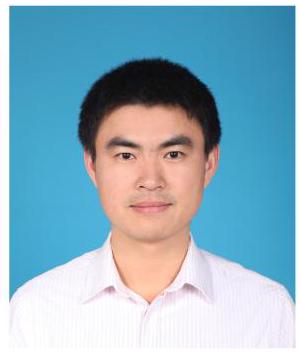
Fanyang Mo obtained his undergraduate degree and master degree at Beijing Institute of Technology. He then moved to Peking University for graduate study in Prof. Jianbo Wang’ laboratory. After receiving his Ph.D. in 2010, he went to the US and worked with Prof. Qinghai Zhang at The Scripps Research Institute and Prof. Guangbin Dong at The University of Texas at Austin from 2010 to 2015. He joined Peking University as an Assistant Professor in April 2015. His research interests include photo/electro-driven organic synthesis, modification of semiconductor oxides for energy application, carbon dioxide transformation, etc.
莫凡洋在北京理工大学获得本科学位和硕士学位。随后,他前往北京大学,在王剑波教授的实验室攻读博士学位。2010年获得博士学位后,他前往美国,于2010年至2015年期间在斯克里普斯研究所与张青海教授合作,并在德克萨斯大学奥斯汀分校与董广彬教授合作。2015年4月,他作为助理教授加入北京大学。他的研究兴趣包括光/电驱动有机合成、用于能源应用的半导体氧化物改性、二氧化碳转化等。
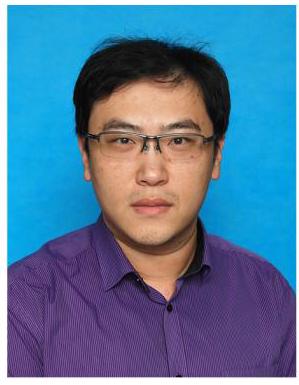
Di Qiu was born in Tianjin, China, in 1987. He received his B.S. degree from Peking University in 2010. He continued his graduate study in Prof. Jianbo Wang’s laboratory and obtained his Ph.D. in 2015. In the same year, he joined in Tianjin Normal University as an Assistant Professor. His research interests lie in aromatic C-Sn, C-P bond formations, and functional group transformations in aromatic compounds.
邱迪1987年出生于中国天津。2010年,他在北京大学获得学士学位。他继续在王剑波教授的实验室攻读研究生,并于2015年获得博士学位。同年,他作为助理教授加入天津师范大学。他的研究兴趣在于芳香族C-Sn、C-P键的形成以及芳香族化合物中的官能团转化。
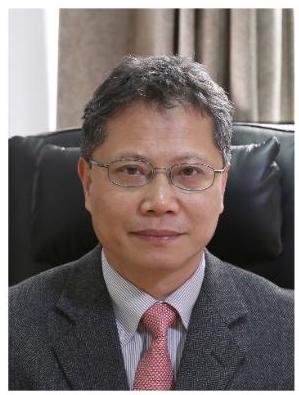
Jianbo Wang received his B.Eng. from Nanjing University of Science and Technology in 1983, and his Ph.D. from Hokkaido University in 1990. He was a postdoctoral associate at the University of Geneva from 1990 to 1993, and University of Wisconsin-Madison from 1993 to 1995. He began his independent academic career at Peking University in 1995 as an Associate Professor and was promoted to Full Professor in 1999. His research interests have been focused on the catalytic metal carbene transformations.
王剑波1983年毕业于南京理工大学,获工学学士学位,1990年毕业于北海道大学,获博士学位。1990年至1993年,他在日内瓦大学担任博士后研究员,1993年至1995年在威斯康星大学麦迪逊分校担任博士后研究员。1995年,他在北京大学开始独立的学术生涯,担任副教授,并于1999年晋升为教授。他的研究兴趣一直集中在催化金属卡宾转化方面。