Carboxylation of Alkenyl Boronic Acids and Alkenyl Boronic Acid Pinacol Esters with CO2 Catalyzed by Cuprous Halide
英文原文与中文译文逐段对照 · English original with Chinese translation
Accepted Article
录用文章
Title: Cuprous halide catalysed carboxylation of alkenyl boronic acids and alkenyl boronic acid pinacol esters with CO2
标题:卤化亚铜催化的烯基硼酸和烯基硼酸频哪醇酯与二氧化碳的羧基化反应
Authors: Junting Hong, Onkar S. Nayal, and Fanyang Mo
作者:洪钧婷、翁卡尔·S·纳亚尔和莫凡洋
This manuscript has been accepted after peer review and appears as an Accepted Article online prior to editing, proofing, and formal publication of the final Version of Record (VoR). This work is currently citable by using the Digital Object Identifier (DOI) given below. The VoR will be published online in Early View as soon as possible and may be different to this Accepted Article as a result of editing. Readers should obtain the VoR from the journal website shown below when it is published to ensure accuracy of information. The authors are responsible for the content of this Accepted Article.
本稿件经同行评审后被接受,在编辑、校对和正式发表最终记录版本(VoR)之前,以录用文章形式在线出现。目前可通过以下给出的数字对象标识符(DOI)引用此作品。VoR 将尽快在 Early View 上在线发表,由于编辑原因,可能与本录用文章有所不同。读者应在 VoR 发表时从以下所示的期刊网站获取,以确保信息准确。作者对本录用文章的内容负责。
To be cited as: Eur. J. Org. Chem. 10.1002/ejoc.202000288
引用格式为:Eur. J. Org. Chem. 10.1002/ejoc.202000288
Link to VoR: https://doi.org/10.1002/ejoc.202000288
VoR 链接:https://doi.org/10.1002/ejoc.202000288
Cuprous halide catalysed carboxylation of alkenyl boronic acids and alkenyl boronic acid pinacol esters with ${\mathrm{{CO}}}_{2}$
卤化亚铜催化的烯基硼酸和烯基硼酸频哪醇酯与${\mathrm{{CO}}}_{2}$的羧基化反应
Junting Hong, ${}^{\left\lbrack \mathrm{a}\right\rbrack }$ Onkar S. Nayal, ${}^{\left\lbrack \mathrm{a}\right\rbrack }$ and Fanyang Mo ${}^{\star \left\lbrack {\mathrm{a},\mathrm{b}}\right\rbrack }$
洪钧婷,${}^{\left\lbrack \mathrm{a}\right\rbrack }$ 翁卡尔·S·纳亚尔,${}^{\left\lbrack \mathrm{a}\right\rbrack }$ 以及莫凡洋 ${}^{\star \left\lbrack {\mathrm{a},\mathrm{b}}\right\rbrack }$
[a] Junting Hong, Onkar S. Nayal, Prof. Dr. Fanyang Mo. Department of Energy and Resources Engineering, College of Engineering, Peking University, Beijing, 100871, China. Homepage: http://www2.coe.pku.edu.cn/faculty/mofanyang/index.html
[a] 洪钧婷,翁卡尔·S·纳亚尔,莫凡洋教授。北京大学工学院能源与资源工程系,北京 100871,中国。主页:http://www2.coe.pku.edu.cn/faculty/mofanyang/index.html
[b] Prof. Dr. Fanyang Mo. Jiangsu Donghai Silicon Industry S&T Innovation Center, Donghai County, Jiangsu 222300, China.
[b] 莫凡洋教授。江苏东海硅产业科技创新中心,江苏省东海县 222300,中国。
Abstract: A cuprous halide catalysed carboxylation of alkenyl boronic acids and alkenyl boronic acid pinacol esters under ${\mathrm{{CO}}}_{2}$ , affording the corresponding $\alpha ,\beta$ -unsaturated carboxylic acids in good yield, has been developed. The potassium (E)-trifluoro(styryl)borate is also compatible with this reaction. This simple and efficient copper(I) catalytic system showed good functional group tolerance.
摘要:开发了一种卤化亚铜催化的烯基硼酸和烯基硼酸频哪醇酯在${\mathrm{{CO}}}_{2}$条件下的羧基化反应,能以良好的产率得到相应的$\alpha ,\beta$-不饱和羧酸。(E)-三氟(苯乙烯基)硼酸钾也与该反应兼容。这种简单高效的铜(I)催化体系表现出良好的官能团耐受性。
Introduction
引言
Carbon dioxide $\left( {\mathrm{{CO}}}_{2}\right)$ is an ideal carboxylative reagent, and it can be fixed into organic substrates to provide carboxylic acids and derivatives. ${}^{\left\lbrack 1\right\rbrack }$ However, ${\mathrm{{CO}}}_{2}$ is a less-reactive electrophile, so this transformation usually required a suitable transition-metal catalyst and a carbon nucleophile. ${}^{\left\lbrack 1f\right\rbrack }$ Recently, organoboronic acids and their derivatives have attracted much attention as the carbon nucleophiles in carboxylation with ${\mathrm{{CO}}}_{2}$ . The earliest work was the rhodium-catalysed carboxylation of aryl- and alkenyl boronic esters with ${\mathrm{{CO}}}_{2}$ reported by Iwasawa in ${2006}.{}^{\left\lbrack 2\right\rbrack }$ Since then, many similar transition metal catalysed carboxylation of organoboronates with ${\mathrm{{CO}}}_{2}$ have been reported using ${\mathrm{{Cu}}}_{,}{}^{\left\lbrack 3\right\rbrack }\mathrm{{Ag}},{}^{\left\lbrack 4\right\rbrack } \; {\mathrm{{Ni}}}^{\left\lbrack 5\right\rbrack }$ catalysts. In almost all of these cases, the $\mathrm{C}\left( {\mathrm{{sp}}}^{2}\right) - \mathrm{B}$ bond was carboxylated with ${\mathrm{{CO}}}_{2}$ , except in one case where the alkyl $\mathrm{C}\left( {\mathrm{{sp}}}^{3}\right)$ - B bond was carboxylated with ${\mathrm{{CO}}}_{2} \cdot {}^{\left\lbrack 3e\right\rbrack }$ In 2010, Lin and Marder ${}^{\left\lbrack 6\right\rbrack }$ disclosed the DFT studies of the carboxylation reactions of arylboronate esters with ${\mathrm{{CO}}}_{2}$ catalysed by (NHC)Cu(I) complexes, affirming the basic mechanistic proposal in Hou’s work ${}^{\left\lbrack 3\mathrm{h}\right\rbrack }$ .
二氧化碳$\left( {\mathrm{{CO}}}_{2}\right)$是一种理想的羧化试剂,它可以被固定到有机底物中以提供羧酸及其衍生物。${}^{\left\lbrack 1\right\rbrack }$然而,${\mathrm{{CO}}}_{2}$是一种反应活性较低的亲电试剂,因此这种转化通常需要合适的过渡金属催化剂和碳亲核试剂。${}^{\left\lbrack 1f\right\rbrack }$最近,有机硼酸及其衍生物作为与${\mathrm{{CO}}}_{2}$羧化反应中的碳亲核试剂受到了广泛关注。最早的工作是岩泽在${2006}.{}^{\left\lbrack 2\right\rbrack }$报道的铑催化芳基硼酸酯和烯基硼酸酯与${\mathrm{{CO}}}_{2}$的羧化反应。从那时起,使用${\mathrm{{Cu}}}_{,}{}^{\left\lbrack 3\right\rbrack }\mathrm{{Ag}},{}^{\left\lbrack 4\right\rbrack } \; {\mathrm{{Ni}}}^{\left\lbrack 5\right\rbrack }$催化剂报道了许多类似的过渡金属催化有机硼酸酯与${\mathrm{{CO}}}_{2}$的羧化反应。在几乎所有这些情况下,$\mathrm{C}\left( {\mathrm{{sp}}}^{2}\right) - \mathrm{B}$键都与${\mathrm{{CO}}}_{2}$发生羧化反应,除了一个例子中烷基$\mathrm{C}\left( {\mathrm{{sp}}}^{3}\right)$-B键与${\mathrm{{CO}}}_{2} \cdot {}^{\left\lbrack 3e\right\rbrack }$发生羧化反应。2010年,林和马德${}^{\left\lbrack 6\right\rbrack }$披露了由(NHC)Cu(I)配合物催化的芳基硼酸酯与${\mathrm{{CO}}}_{2}$羧化反应的DFT研究,证实了侯的工作${}^{\left\lbrack 3\mathrm{h}\right\rbrack }$中的基本机理假设。
In the carboxylation of $\mathrm{C}\left( {\mathrm{{sp}}}^{2}\right)$ -B bond with ${\mathrm{{CO}}}_{2}$ , alkenyl boronic acid esters are used as substrates, especially alkenyl 5,5- dimethyl-1,3,2-dioxaborinane (-Bneop), ${}^{\left\lbrack 2,3g,3h,4b,5\right\rbrack }$ and only two cases used alkenyl boronic acid pinacol esters (-Bpin) ${}^{\left\lbrack 3c,3f\right\rbrack }$ with only one example each (Scheme 1a). These two reactions aim to afford $\left\lbrack {{}^{11}\mathrm{C}}\right\rbrack$ -labeled carboxylic acids with direct application of $\left\lbrack {{}^{11}\mathrm{C}}\right\rbrack {\mathrm{{CO}}}_{2}$ . And they both proceeded under a micromolar scale, with copper catalysts, and finished within several minutes. However, such catalytic systems have the limits of complex operating conditions, using ligands and additives, trapping $\left\lbrack {{}^{11}\mathrm{C}}\right\rbrack {\mathrm{{CO}}}_{2}$ below $- {10}^{ \circ }\mathrm{C}$ , etc. Furthermore, several works ${}^{\left\lbrack 7\right\rbrack }$ on the synthesis of carboxylic acids from alkenes and terminal alkynes, involves Cu-catalysed carboxylation of in situ formed related boron compounds with ${\mathrm{{CO}}}_{2}$ (Scheme 1b). However, the carboxylation of alkenyl boric acid and alkenyl potassium trifluoroborate with ${\mathrm{{CO}}}_{2}$ have not been developed yet.
在使用${\mathrm{{CO}}}_{2}$对$\mathrm{C}\left( {\mathrm{{sp}}}^{2}\right)$-B键进行羧基化反应中,烯基硼酸酯用作底物,尤其是烯基5,5-二甲基-1,3,2-二氧硼戊环(-Bneop),${}^{\left\lbrack 2,3g,3h,4b,5\right\rbrack }$且仅有两例使用烯基硼酸频哪醇酯(-Bpin)${}^{\left\lbrack 3c,3f\right\rbrack }$,各仅一个实例(方案1a)。这两个反应旨在通过直接应用$\left\lbrack {{}^{11}\mathrm{C}}\right\rbrack {\mathrm{{CO}}}_{2}$来制备$\left\lbrack {{}^{11}\mathrm{C}}\right\rbrack$标记的羧酸。并且它们均在微摩尔规模下,使用铜催化剂,在几分钟内完成。然而,此类催化体系存在操作条件复杂、使用配体和添加剂、捕获$\left\lbrack {{}^{11}\mathrm{C}}\right\rbrack {\mathrm{{CO}}}_{2}$低于$- {10}^{ \circ }\mathrm{C}$等局限性。此外,一些关于由烯烃和末端炔烃合成羧酸的工作${}^{\left\lbrack 7\right\rbrack }$,涉及铜催化原位形成的相关硼化合物与${\mathrm{{CO}}}_{2}$的羧基化反应(方案1b)。然而,烯基硼酸和烯基三氟硼酸钾与${\mathrm{{CO}}}_{2}$的羧基化反应尚未得到开发。
On the basis of our previous work, ${}^{\left\lbrack 3b\right\rbrack }$ we further examined the carboxylation of alkenyl boric acids and alkenyl boronic acid pinacol esters to expand the organoboron substrates on the incorporation of ${\mathrm{{CO}}}_{2}$ . Herein, we report a simple and efficient cuprous halide catalysed system for the carboxylation of three kinds of alkenyl boron compounds (Scheme 1c), with the advantage of mild conditions, simple operation, good functional group compatibility, high yields and external ligand free.
基于我们之前的工作,${}^{\left\lbrack 3b\right\rbrack }$我们进一步研究了烯基硼酸和烯基硼酸频哪醇酯的羧基化反应,以扩展在引入${\mathrm{{CO}}}_{2}$时的有机硼底物范围。在此,我们报道了一种简单高效的卤化亚铜催化体系,用于三种烯基硼化合物的羧基化反应(方案1c)[,具有条件温和、操作简单、官能团兼容性好、产率高且无需外部配体的优点。
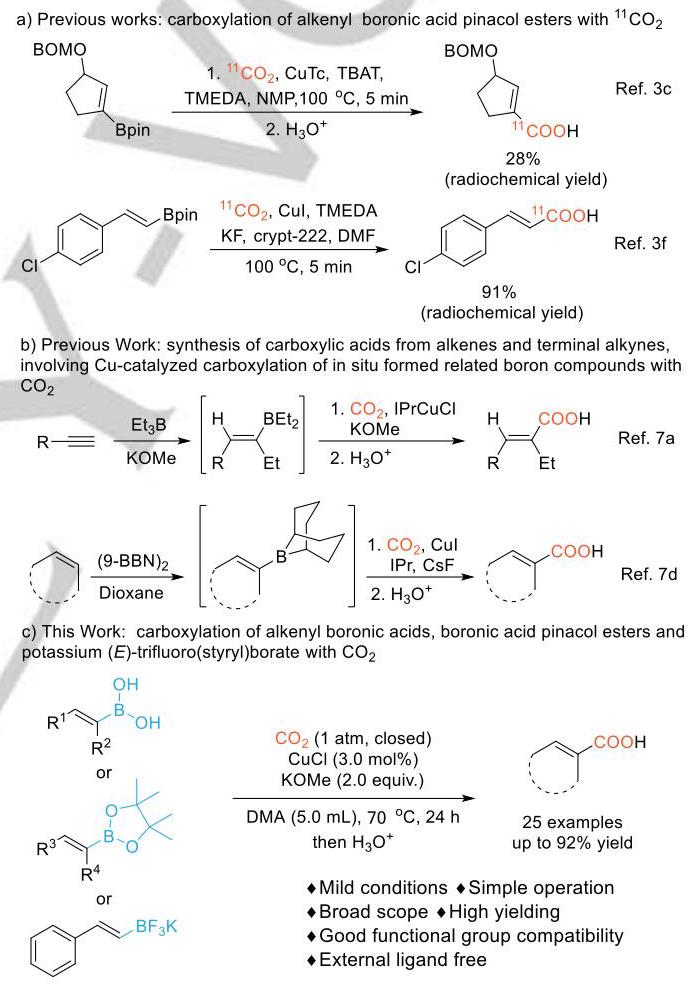
Scheme 1. a) Previous works: carboxylation of alkenyl boronic acid pinacol esters with ${}^{11}{\mathrm{{CO}}}_{2}$ ; b) Previous Work: synthesis of carboxylic acids from alkenes and terminal alkynes, involving Cu-catalysed carboxylation of in situ formed related boron compounds with ${\mathrm{{CO}}}_{2}$ ; c) This Work: carboxylation of alkenyl boronic acids, boronic acid pinacol esters and potassium (E)- trifluoro(styryl)borate with ${\mathrm{{CO}}}_{2}$ .
方案1. a)先前的工作:烯基硼酸频哪醇酯与${}^{11}{\mathrm{{CO}}}_{2}$的羧基化反应;b)先前的工作:由烯烃和末端炔烃合成羧酸,涉及铜催化原位形成的相关硼化合物与${\mathrm{{CO}}}_{2}$的羧基化反应;c)本工作:烯基硼酸、硼酸频哪醇酯和(E)-三氟(苯乙烯基)硼酸钾与${\mathrm{{CO}}}_{2}$的羧基化反应。
Results and Discussion
结果与讨论
In the optimization study (table 1), we chose (E)-styrylboronic acid 1a as model substrate to react with ${\mathrm{{CO}}}_{2}$ at ambient pressure. After an extensive survey of reaction parameters, we obtained 95%
在优化研究中(表1),我们选择(E)-苯乙烯硼酸1a作为模型底物,在常压下与${\mathrm{{CO}}}_{2}$反应。经过对反应参数的广泛研究,我们得到了95%
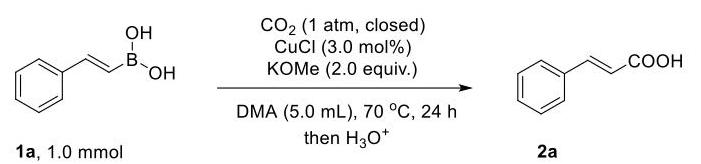
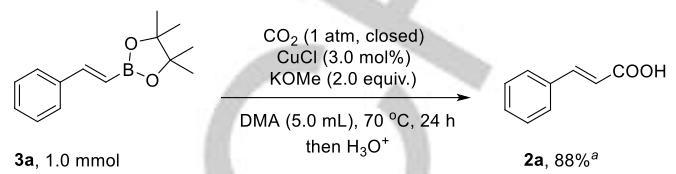
FULL PAPER yield of the desired product by using 3.0 mol% CuCl and 2.0 equiv. KOMe in DMA at ${70}^{ \circ }\mathrm{C}$ for ${24}\mathrm{\;h}$ (entry 1). Other cuprous halides such as Cul, CuBr were relatively less effective (entries 2-3). Further study showed that a smaller amount of CuCl was not conducive to the reaction, and 3 mol% was sufficient (entries 1, 4-5). In addition, the use of other alkoxide bases such as ${\mathrm{{KO}}}^{t}\mathrm{{Bu}}$ , LiOMe showed less effective (entries 6-7). And 2.0 equiv. is the optimal stoichiometry of KOMe (entries 1, 8-9). Other solvents such as DMF, DMSO, MeCN and THF provided low yields of the desired product (entries 10-13). Furthermore, the reaction temperature proved to be crucial. Low temperature would seriously reduce the yield, but it should not either be too high (entries 1, 14-16). Finally, control experiments show that both the catalyst and the base are crucial to the reaction (entries 17-18). While investigating the boron-containing structure in alkenyl boron compounds, we found that in addition to (E)-styrylboronic acid 1a, (E)-4,4,5,5-tetramethyl-2-styryl-1,3,2-dioxaborolane 3a and potassium (E)-trifluoro(styryl)borate 4 also reacted well under identical conditions (Scheme 2). These three boron compounds gave the carboxylated product 2a in 92%, 88%, 83% isolated yields, respectively. We are encouraged that the current method could be adopted to a broad scope of alkenyl boron compounds, especially alkenyl boronic acids and alkenyl boronic acid pinacol esters, since both are commercially available.
在DMA中,于${70}^{ \circ }\mathrm{C}$下使用3.0 mol%的CuCl和2.0当量的KOMe反应${24}\mathrm{\;h}$,得到所需产物的全论文产率(条目1)。其他卤化亚铜,如Cul、CuBr,效果相对较差(条目2 - 3)。进一步研究表明,较少量的CuCl不利于反应,3 mol%就足够了(条目1、4 - 5)。此外,使用其他醇盐碱,如${\mathrm{{KO}}}^{t}\mathrm{{Bu}}$、LiOMe,效果较差(条目6 - 7)。2.0当量是KOMe的最佳化学计量比(条目1、8 - 9)。其他溶剂,如DMF、DMSO、MeCN和THF,得到所需产物的产率较低(条目10 - 13)。此外,反应温度被证明至关重要。低温会严重降低产率,但温度也不宜过高(条目1、14 - 16)。最后,对照实验表明,催化剂和碱对反应都至关重要(条目17 - 18)。在研究烯基硼化合物中的含硼结构时,我们发现,除了(E)-苯乙烯硼酸1a外,(E)-4,4,5,5-四甲基-2-苯乙烯基-1,3,2-二氧硼戊环3a和(E)-三氟(苯乙烯基)硼酸钾4在相同条件下也反应良好(方案2)。这三种硼化合物分别以92%、88%、83%的分离产率得到羧化产物2a。我们受到鼓舞,因为当前方法可应用于广泛的烯基硼化合物,特别是烯基硼酸和烯基硼酸频哪醇酯,因为它们两者都可商购获得。
Table 1. Optimization of the reaction conditions ${}^{\mathrm{a}}$ .
表1. 反应条件${}^{\mathrm{a}}$的优化。
| Entry | Variation from standard conditions | Yield ${\left( \% \right) }^{b}$ |
| 1 | None | 95 |
| 2 | Cul instead of CuCl | 80 |
| 3 | CuBr instead of CuCl | 86 |
| 4 | With 2.0 mol% CuCl | 79 |
| 5 | With 4.0 mol% CuCl | 95 |
| 6 | KO'Bu instead of KOMe | 60 |
| 7 | LiOMe instead of KOMe | 80 |
| 8 | With 1.5 equiv. KOMe | 83 |
| 9 | With 2.5 equiv. KOMe | 92 |
| 10 | DMF instead of DMA | 41 |
| 11 | DMSO instead of DMA | 34 |
| 12 | MeCN instead of DMA | 21 |
| 13 | THF instead of DMA | 20 |
| 14 | Reaction at room temperature | trace |
| 15 | Reaction at ${50}{}^{ \circ }\mathrm{C}$ | 48 |
| 16 | Reaction at ${100}{}^{ \circ }\mathrm{C}$ | 75 |
| 17 | Without copper catalyst | NR |
| 18 | Without base | NR |
[a] Reaction performed on 1.0 mmol scales. [b] Yields were determined by ${}^{1}\mathrm{H}$ NMR with 1,1,2,2-Tetrachloroethane as an internal standard.
[a] 反应在1.0 mmol规模上进行。[b] 产率通过以1,1,2,2-四氯乙烷为内标的${}^{1}\mathrm{H}$ NMR测定。
a) The reaction of $\left( E\right)$ -styrylboronic acid 1a with ${\mathrm{{CO}}}_{2}$ in the optimal conditions
a) 在最佳条件下$\left( E\right)$-苯乙烯硼酸1a与${\mathrm{{CO}}}_{2}$的反应
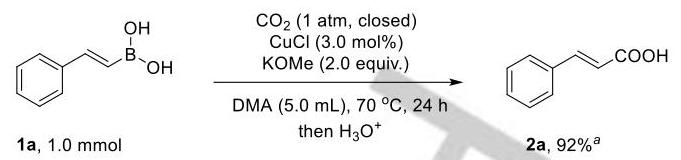
b) The reaction of $\left( E\right) - 4,4,5,5$ -tetramethyl-2-styryl-1,3,2-dioxaborolane 3a with ${\mathrm{{CO}}}_{2}$ in the optimal conditions
b) 在最佳条件下$\left( E\right) - 4,4,5,5$-四甲基-2-苯乙烯基-1,3,2-二氧杂硼烷3a与${\mathrm{{CO}}}_{2}$的反应
c) The reaction of potassium $\left( E\right)$ -trifluoro(styryl)borate 4 with ${\mathrm{{CO}}}_{2}$ in the optimal conditions
c) 在最佳条件下$\left( E\right)$-三氟(苯乙烯基)硼酸钾4与${\mathrm{{CO}}}_{2}$的反应
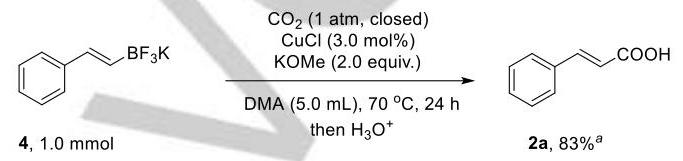
Scheme 2. The reaction of (E)-styrylboronic acid 1a, (E)-4,4,5,5-tetramethyl-2- styryl-1,3,2-dioxaborolane 3a, (E)-trifluoro(styryl)borate 4 with ${\mathrm{{CO}}}_{2}$ in the optimal conditions. ${}^{a}$ Isolated yield.
方案2. 在最佳条件下(E)-苯乙烯硼酸1a、(E)-4,4,5,5-四甲基-2-苯乙烯基-1,3,2-二氧杂硼烷3a、(E)-三氟(苯乙烯基)硼酸钾4与${\mathrm{{CO}}}_{2}$的反应。${}^{a}$分离产率。
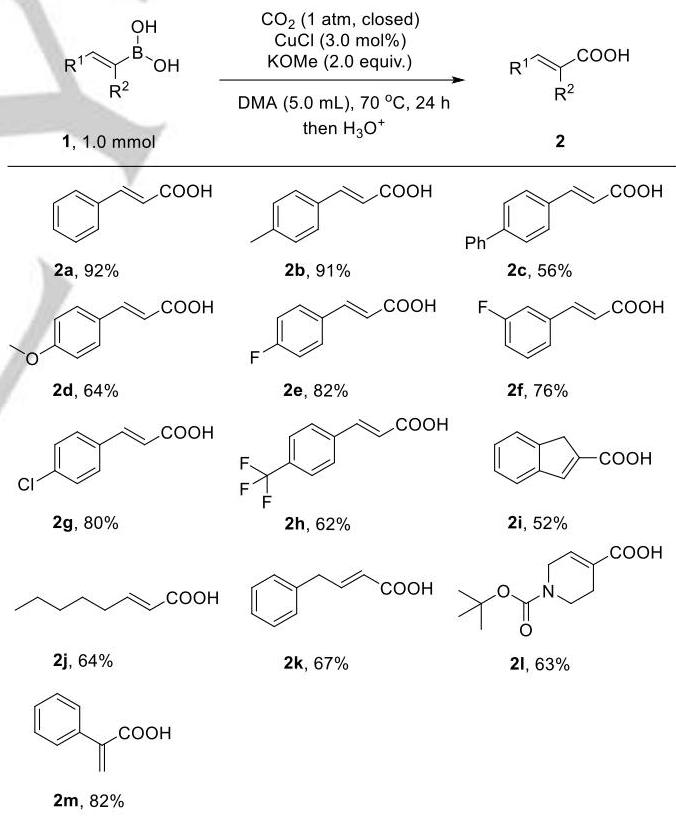
Scheme 3. The substrates scope of alkenyl boron acids. Reactions were carried out by using alkenyl boronic acid 1 (1.0 mmol), cat. CuCl (3.0 mol%), base KOMe (2.0 equiv.) in DMA at ${70}{}^{ \circ }\mathrm{C}$ for ${24}\mathrm{\;h}$ under 1 atm ${\mathrm{{CO}}}_{2}$ . Isolated yields were reported.
方案3. 烯基硼酸的底物范围。反应通过使用烯基硼酸1(1.0 mmol)、催化剂CuCl(3.0 mol%)、碱KOMe(2.0当量)在DMA中于${70}{}^{ \circ }\mathrm{C}$下反应${24}\mathrm{\;h}$,在1 atm${\mathrm{{CO}}}_{2}$下进行。报道了分离产率。
We first evaluated the scope of alkenyl boronic acids under the optimal conditions (Scheme 3). When the substituent ${R}^{1}$ was aryl and ${R}^{2}$ was hydrogen, substrates (E)-Styrylboronic acids were successfully converted to the corresponding cinnamic acids (2a-
我们首先在最优条件下评估了烯基硼酸的适用范围(方案3)。当取代基${R}^{1}$为芳基且${R}^{2}$为氢时,底物(E)-苯乙烯硼酸成功转化为相应的肉桂酸(2a -
FULL PAPER
全文
h). The p-methyl-substituted styrylboronic acid gave a high yield (91%, 2b), while p-phenyl-substituted styrylboronic acid and p-methoxy -substituted styrylboronic acid provided obviously lower yields (56%, 2c and 64%, 2d), probably because electronic effect promoted the generation of protodeboronation by-products. Halogen-substituted styrylboronic acids were compatible and gave the corresponding products (2e-h) in moderate to good yields. With the substituent ${R}^{1}$ as hydrogen and ${R}^{2}$ as aryl, the substrate (1-phenylvinyl)boronic acid can also gave the desired product $2\mathrm{\;m}$ in 82% yield. In addition, cyclic alkenyl substrates provided the corresponding products (2i and 2I) in good yields. Also, Boc-protected amines was compatible under the reaction conditions (2I). Moreover, when ${R}^{1}$ was linear alkyl or benzyl, both the substrates underwent the reaction smoothly (2j and 2k). We then focused on the scope of alkenyl boronic acid pinacol esters (Scheme 4). When the substituent ${R}^{3}$ was aryl and ${R}^{4}$ was hydrogen, substrates (E)-Styrylboronic acid pinacol esters provided the desired products (2a and 2v) in good yields. In addition, when the substituent ${R}^{3}$ was ethoxy carbonyl and ${R}^{4}$ was hydrogen, the substrate gave product 2n in 76% yield. And product 2n is an important chemical intermediate, monoethyl fumarate, which can be used to produce preservatives. Again, cyclic alkenyl substrates gave the corresponding products (20-u) in moderate to good yields. Cyclohexenyl boronic acid pinacol esters afforded products (2o-q, 2s) in high yields, except products 2u, possibly because of the effect of secondary amine and steric hindrance. Besides, heterocyclehexenyl boronic acid pinacol esters also provided the desired products (2r, 2l, 2t) in good yields, implying that both oxygen-containing heterocycle and nitrogen-containing heterocycle were compatible under the reaction conditions. Notably, this method is suitable for the synthesis of many unknown acrylic acids (2p-r, 2t-u).
h). 对甲基取代的苯乙烯硼酸产率较高(91%,2b),而对苯基取代的苯乙烯硼酸和对甲氧基取代的苯乙烯硼酸产率明显较低(56%,2c和64%,2d),这可能是由于电子效应促进了原脱硼副产物的生成。卤素取代的苯乙烯硼酸具有兼容性,能以中等至良好的产率得到相应产物(2e - h)。当取代基${R}^{1}$为氢且${R}^{2}$为芳基时,底物(1 - 苯基乙烯基)硼酸也能以82%的产率得到所需产物$2\mathrm{\;m}$。此外,环状烯基底物能以良好的产率得到相应产物(2i和2I)。同样,Boc保护的胺在反应条件下具有兼容性(2I)。此外,当${R}^{1}$为直链烷基或苄基时,两种底物都能顺利反应(2j和2k)。然后我们关注了烯基硼酸频哪醇酯的底物范围(方案4)。当取代基${R}^{3}$为芳基且${R}^{4}$为氢时,底物(E)-苯乙烯硼酸频哪醇酯能以良好的产率得到所需产物(2a和2v)。此外,当取代基${R}^{3}$为乙氧基羰基且${R}^{4}$为氢时,底物能以76%的产率得到产物2n。产物2n是一种重要的化学中间体,富马酸单乙酯,可用于生产防腐剂。同样,环状烯基底物能以中等至良好的产率得到相应产物(20 - u)。环己烯基硼酸频哪醇酯能以高产率得到产物(2o - q,2s),产物2u除外,这可能是由于仲胺和空间位阻的影响。此外,含杂环己烯基硼酸频哪醇酯也能以良好的产率得到所需产物(2r,2l,2t),这意味着含氧杂环和含氮杂环在反应条件下都具有兼容性。值得注意的是,该方法适用于多种未知丙烯酸的合成(2p - r,2t - u)。
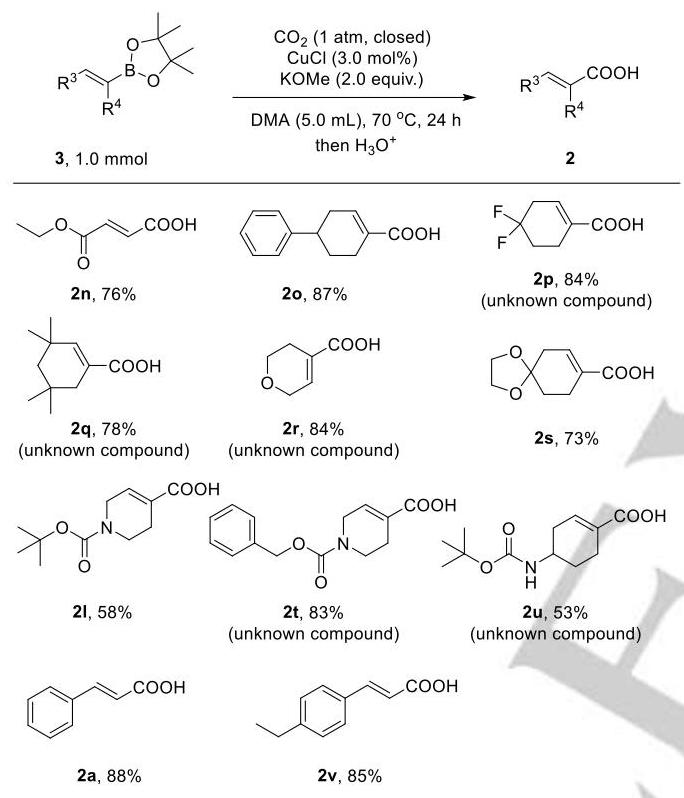
Scheme 4. The substrates scope of alkenyl boronic acid pinacol esters. Reactions were carried out by using alkenyl boronic acid pinacol ester 3 (1.0 mmol), cat. CuCl (3.0 mol%), base KOMe (2.0 equiv.) in DMA at 70 ${}^{ \circ }\mathrm{C}$ for 24 h under 1 atm ${\mathrm{{CO}}}_{2}$ . Isolated yields were reported.
方案4. 烯基硼酸频哪醇酯的底物范围。反应使用烯基硼酸频哪醇酯3(1.0 mmol)、催化剂CuCl(3.0 mol%)、碱KOMe(2.0当量)在DMA中于70${}^{ \circ }\mathrm{C}$下1个大气压${\mathrm{{CO}}}_{2}$反应24小时。报告的是分离产率。
Based on the previous literatures ${}^{\left\lbrack 3g,3h,6,8\right\rbrack }$ and our own study ${}^{\left\lbrack 3b\right\rbrack }$ , a plausible mechanism was proposed (Scheme 5). On one hand, previous reports ${}^{\left\lbrack 8\right\rbrack }$ showed very solid evidence that DMA can work actively as an acido ligand coordinating with copper. On the other hand, due to stability issue and the empty d orbital of copper, organocopper species has to be saturated by being coordinated with substrates, ligands or solvents. As such, the proposed mechanism circle starts with the complex $\mathrm{{Cu}}{\left( \mathrm{{DMA}}\right) }_{n}\mathrm{{Cl}}(\mathrm{n} = 2$ or 3) formed from the coordination between CuCl and DMA. Initially, the complex $\mathrm{{Cu}}{\left( \mathrm{{DMA}}\right) }_{\mathrm{n}}\mathrm{{Cl}}$ exchanges the ligand with KOMe to generate the copper alkoxide $\mathrm{{Cu}}{\left( \mathrm{{DMA}}\right) }_{\mathrm{n}}\left( \mathrm{{OMe}}\right)$ A, which undergoes transmetalation with alkenyl boron acid 1 to form the intermediate B and C. Nucleophilic addition of copper complex C to ${\mathrm{{CO}}}_{2}$ provides copper carboxylate D. $\sigma$ -Metathesis with KOMe generates carboxylic acid potassium salt E and regenerate $\mathrm{{Cu}}{\left( \mathrm{{DMA}}\right) }_{\mathrm{n}}\left( \mathrm{{OMe}}\right)$ A, thereby completing the catalytic cycle.
基于之前的文献${}^{\left\lbrack 3g,3h,6,8\right\rbrack }$以及我们自己的研究${}^{\left\lbrack 3b\right\rbrack }$,提出了一种合理的机理(方案5)。一方面,之前的报道${}^{\left\lbrack 8\right\rbrack }$显示了非常确凿的证据,即DMA可以作为与铜配位的酸性配体发挥积极作用。另一方面,由于稳定性问题以及铜的空d轨道,有机铜物种必须通过与底物、配体或溶剂配位来达到饱和。因此,所提出的机理循环从由CuCl和DMA之间的配位形成的配合物$\mathrm{{Cu}}{\left( \mathrm{{DMA}}\right) }_{n}\mathrm{{Cl}}(\mathrm{n} = 2$或3)开始。最初,配合物$\mathrm{{Cu}}{\left( \mathrm{{DMA}}\right) }_{\mathrm{n}}\mathrm{{Cl}}$与KOMe交换配体以生成铜醇盐$\mathrm{{Cu}}{\left( \mathrm{{DMA}}\right) }_{\mathrm{n}}\left( \mathrm{{OMe}}\right)$A,其与烯基硼酸1进行金属转移反应以形成中间体B和C。铜配合物C对${\mathrm{{CO}}}_{2}$的亲核加成提供了羧酸铜D。$\sigma$与KOMe的复分解反应生成羧酸钾盐E并再生$\mathrm{{Cu}}{\left( \mathrm{{DMA}}\right) }_{\mathrm{n}}\left( \mathrm{{OMe}}\right)$A,从而完成催化循环。
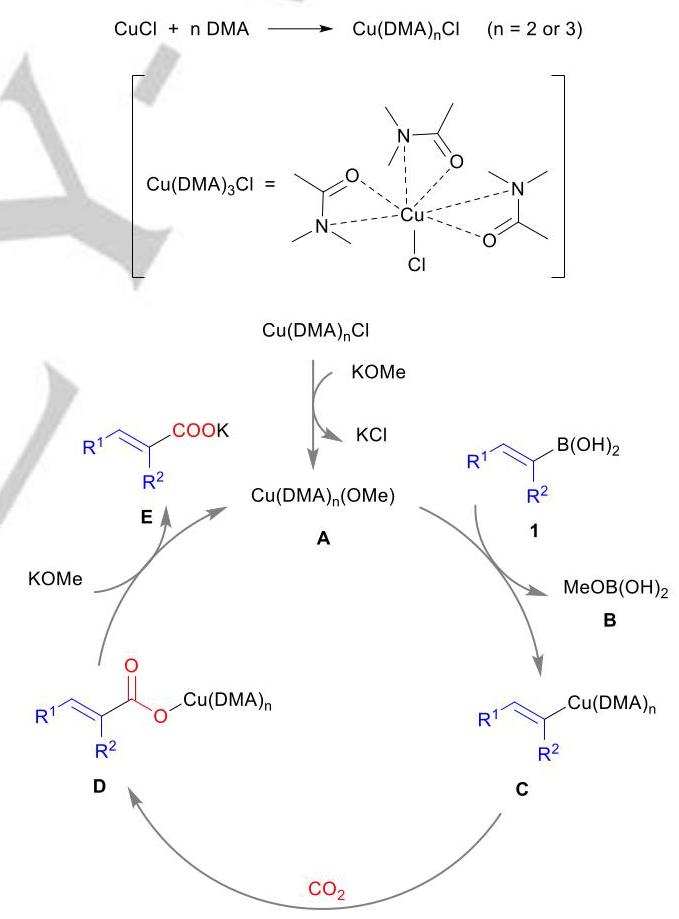
Scheme 5. Proposed mechanism.
方案5. 提出的机理。
Conclusion
结论
In summary, we have succeeded in developing the cuprous halide catalysed carboxylation of alkenyl boronic acids and alkenyl boronic acid pinacol esters with ${\mathrm{{CO}}}_{2}$ . The potassium (E)- trifluoro(styryl)borate can also be carboxylated using this method.
总之,我们成功开发了卤化亚铜催化的烯基硼酸和烯基硼酸频哪醇酯与${\mathrm{{CO}}}_{2}$的羧基化反应。使用该方法,(E)-三氟(苯乙烯基)硼酸钾也可以被羧基化。
FULL PAPER
全文
A wide range of alkenyl boron compounds were effetively transformed into the corresponding $\alpha ,\beta$ -unsaturated carboxylic acids in moderate to high yield. Good functional group tolerance improve the generality of the reaction. And the use of inexpensive cuprous halides, mild conditions and simple operation expand the utility of the reaction.
多种烯基硼化合物能有效地转化为相应的$\alpha ,\beta$-不饱和羧酸,产率适中至高。良好的官能团耐受性提高了反应的通用性。使用廉价的卤化亚铜、温和的条件和简单的操作扩大了该反应的实用性。
Experimental Section
实验部分
General information: Solvents were purchased from TONGGUANG CHEMICAL, Beijing or BEIJING CHEMICAL, in GR (or CCER). Purification of products was conducted by column chromatography on silica gel (200- 300 mesh, for some cases 300-400 mesh were used, from Qingdao, China). NMR spectra were measured on a Bruker ARX400 ( ${}^{1}\mathrm{H}$ at 400 MHz, ${}^{13}\mathrm{C}$ at 101 MHz, ${}^{19}\mathrm{\;F}$ at 471 MHz) magnetic resonance spectrometer. Chemical shifts (δ) are reported in ppm using tetramethylsilane as internal standard $\left( {s = \text{ singlet }, d = \text{ doublet }, t = \text{ triplet }, q = \text{ quartet },{dd} = \text{ doublet of }}\right)$ doublets, $m =$ multiplet), and coupling constants (J) were reported in Hertz (Hz). The substrates were purchased from commercial sources.
一般信息:溶剂购自北京通光化学试剂有限公司或北京化学试剂公司,为GR(或CCER)级。产品纯化通过硅胶柱色谱法进行(200 - 300目,某些情况下使用300 - 400目,来自中国青岛)。核磁共振谱在Bruker ARX400(${}^{1}\mathrm{H}$处为400 MHz,${}^{13}\mathrm{C}$处为101 MHz,${}^{19}\mathrm{\;F}$处为471 MHz)核磁共振光谱仪上测定。化学位移(δ)以ppm为单位报告,以四甲基硅烷作为内标$\left( {s = \text{ singlet }, d = \text{ doublet }, t = \text{ triplet }, q = \text{ quartet },{dd} = \text{ doublet of }}\right)$双峰,$m =$多重峰),耦合常数(J)以赫兹(Hz)为单位报告。底物购自商业来源。
General experimental procedure for the synthesis of (E)-3- phenylacrylic acid (2a): Phenylvinylboronic acid 1a (148.0 mg, 1.0 mmol), KOMe (140.3mg, 2.0 mmol), CuCl (3.0mg, 0.03 mmol) was charged in a ${50}\mathrm{\;{mL}}$ Schlenk tube under ${\mathrm{N}}_{2}$ , followed by $5\mathrm{\;{mL}}$ anhydrous DMA. After that the Schlenk tube was filled with carbon dioxide by applying four-five cycles of evacuation and filling with ${\mathrm{{CO}}}_{2}$ . The Schlenk tube was tightly sealed and stirred at ${70}^{ \circ }\mathrm{C}$ for 24 hours after which it was quenched by careful addition of 1.0 M aq. HCI sol. The reaction mixture was diluted with water and extracted three times with EtOAc. The combined organic phases were washed with brine, dried over anhydrous ${\mathrm{{Na}}}_{2}{\mathrm{{SO}}}_{4}$ and filtered. Then the solvent was removed in vacuo. The crude product was purified by silica gel column chromatography (0-25 % EtOAc in pet-ether) to obtain the desired product 2a 136.2 mg, in 92% yield.
(E)-3-苯基丙烯酸(2a)的一般合成实验步骤:在${50}\mathrm{\;{mL}}$Schlenk管中,在${\mathrm{N}}_{2}$条件下加入苯乙烯硼酸1a(148.0 mg,1.0 mmol)、KOMe(140.3mg,2.0 mmol)、CuCl(3.0mg,0.03 mmol),接着加入$5\mathrm{\;{mL}}$无水DMA。之后,通过抽真空和用${\mathrm{{CO}}}_{2}$填充进行四到五次循环,将Schlenk管充满二氧化碳。将Schlenk管紧密密封并在${70}^{ \circ }\mathrm{C}$搅拌24小时,之后小心加入1.0 M的盐酸水溶液淬灭反应。反应混合物用水稀释,并用乙酸乙酯萃取三次。合并的有机相用盐水洗涤,用无水${\mathrm{{Na}}}_{2}{\mathrm{{SO}}}_{4}$干燥并过滤。然后在真空下除去溶剂。粗产物通过硅胶柱色谱法(石油醚中0 - 25%的乙酸乙酯)纯化,得到所需产物2a 136.2 mg,产率92%。
(E)-3-phenylacrylic acid (2a): White solid, 136.2 mg obtained, yield 92% from 1a; 130.3 mg obtained, yield 88% from 3a; 122.9 mg obtained, yield 83% from 4. Rf: 0.7 (PE/EA=3:1). ${}^{1}$ H NMR (400 MHz, DMSO- ${\mathrm{d}}_{6}$ ) δ 12.44 $\left( {s,{1H}}\right) ,{7.73} - {7.65}\left( {m,{2H}}\right) ,{7.61}\left( {d, J = {16.0}\mathrm{\;{Hz}},1\mathrm{H}}\right) ,{7.41}(p, J = {3.5}\mathrm{\;{Hz}}$ , 3H), 6.55 (d, J = 16.0 Hz, 1H). ${}^{13}\mathrm{C}$ NMR (101 MHz, DMSO-6) 6 168.07, 144.41, 134.69, 130.68, 129.36, 128.67, 119.68.
(E)-3-苯基丙烯酸(2a):白色固体,由1a得到136.2 mg,产率92%;由3a得到130.3 mg,产率88%;由4得到122.9 mg,产率83%。比移值:0.7(石油醚/乙酸乙酯 = 3:1)。${}^{1}$氢核磁共振谱(400 MHz,DMSO - ${\mathrm{d}}_{6}$)δ 12.44 $\left( {s,{1H}}\right) ,{7.73} - {7.65}\left( {m,{2H}}\right) ,{7.61}\left( {d, J = {16.0}\mathrm{\;{Hz}},1\mathrm{H}}\right) ,{7.41}(p, J = {3.5}\mathrm{\;{Hz}}$,3H),6.55(d,J = 16.0 Hz,1H)。${}^{13}\mathrm{C}$核磁共振谱(101 MHz,DMSO - 6)δ 168.07,144.41,134.69,130.68,129.36,128.67,119.68。
(E)-p-methylcinnamic acid (2b): White solid, 147.5 mg obtained, yield 91%. Rf: 0.4 (PE/EA=3:1). 1H NMR (400 MHz, DMSO-da) 5 12.37 (s, 1H), ${7.62} - {7.51}\left( {\mathrm{\;m},3\mathrm{H}}\right) ,{7.20}\left( {\mathrm{\;d},\mathrm{\;J} = {7.9}\mathrm{\;{Hz}},2\mathrm{H}}\right) ,{6.47}\left( {\mathrm{\;d},\mathrm{\;J} = {16.0}\mathrm{\;{Hz}},1\mathrm{H}}\right)$ , 2.30 (s, 3H). ${}^{13}\mathrm{C}$ NMR (101 MHz, DMSO-d6) δ 168.18, 144.38, 140.56, 131.94, 129.94, 128.61, 118.52, 21.43.[9]
(E)-对甲基肉桂酸 (2b):白色固体,获得 147.5 mg,产率 91%。Rf:0.4 (石油醚/乙酸乙酯 = 3:1)。¹H NMR (400 MHz, DMSO - d₆) δ 12.37 (s, 1H),${7.62} - {7.51}\left( {\mathrm{\;m},3\mathrm{H}}\right) ,{7.20}\left( {\mathrm{\;d},\mathrm{\;J} = {7.9}\mathrm{\;{Hz}},2\mathrm{H}}\right) ,{6.47}\left( {\mathrm{\;d},\mathrm{\;J} = {16.0}\mathrm{\;{Hz}},1\mathrm{H}}\right)$,2.30 (s, 3H)。${}^{13}\mathrm{C}$ NMR (101 MHz, DMSO - d₆) δ 168.18, 144.38, 140.56, 131.94, 129.94, 128.61, 118.52, 21.43.[9]
(E)-3-([1,1’-biphenyl]-4-yl)acrylic acid (2c): White solid, 125.5 mg obtained, yield 56%. Rf: 0.4 (PE/EA=3:1). 1H NMR (400 MHz, DMSO-d6) $\delta$ 12.43 (s,1H),7.82 - 7.61 (m,7H),7.49 (t, J = 7.5 Hz,2H),7.40 (t, J = ${7.3}\mathrm{\;{Hz}},1\mathrm{H}),{6.59}\left( {\mathrm{\;d},\mathrm{\;J} = {16.0}\mathrm{\;{Hz}},1\mathrm{H}}\right) {.}^{13}\mathrm{C}$ NMR (101 MHz, DMSO- ${\mathrm{d}}_{6}$ ) $\delta$ 168.07, 143.91, 142.17, 139.70, 133.83, 129.49, 129.33, 128.40, 127.53, 127.15, 119.62.[9]
(E)-3-([1,1’-联苯]-4-基)丙烯酸(2c):白色固体,得到125.5毫克,产率56%。比移值:0.4(石油醚/乙酸乙酯=3:1)。氢核磁共振谱(400兆赫,二甲亚砜-d6)$\delta$12.43(单峰,1个氢),7.82 - 7.61(多重峰,7个氢),7.49(三重峰,J = 7.5赫兹,2个氢),7.40(三重峰,J = ${7.3}\mathrm{\;{Hz}},1\mathrm{H}),{6.59}\left( {\mathrm{\;d},\mathrm{\;J} = {16.0}\mathrm{\;{Hz}},1\mathrm{H}}\right) {.}^{13}\mathrm{C}$碳核磁共振谱(101兆赫,二甲亚砜-${\mathrm{d}}_{6}$)$\delta$168.07,143.91,142.17,139.70,133.83,129.49,129.33,128.40,127.53,127.15,119.62。[9]
(E)-3-(4-methoxyphenyl)acrylic acid (2d): White solid, 114.0 mg obtained, yield 64%. Rf: 0.5 (PE/EA=3:1). 1H NMR (400 MHz, DMSO-d6) $\delta = {12.24}\left( {s,{1H}}\right) ,{7.65}\left( {d, J = {8.7Hz},{2H}}\right) ,{7.55}\left( {d, J = {16.0Hz},{1H}}\right) ,{6.97}(d$ , $J = {8.7}\mathrm{\;{Hz}},2\mathrm{\;H}),{6.38}\left( {d, J = {16.0}\mathrm{\;{Hz}},1\mathrm{H}}\right) ,{3.80}\left( {s,3\mathrm{H}}\right) .{}^{13}\mathrm{C}$ NMR $({101}\mathrm{{MHz}}$ , DMSO- ${\mathrm{d}}_{6}$ ) 6 168.31, 161.38, 144.22, 130.42, 127.27, 116.94, 114.80, 55.77.[9]
(E)-3-(4-甲氧基苯基)丙烯酸(2d):白色固体,得到114.0毫克,产率64%。比移值:0.5(石油醚/乙酸乙酯=3:1)。氢核磁共振谱(400兆赫,二甲亚砜-d6)$\delta = {12.24}\left( {s,{1H}}\right) ,{7.65}\left( {d, J = {8.7Hz},{2H}}\right) ,{7.55}\left( {d, J = {16.0Hz},{1H}}\right) ,{6.97}(d$,$J = {8.7}\mathrm{\;{Hz}},2\mathrm{\;H}),{6.38}\left( {d, J = {16.0}\mathrm{\;{Hz}},1\mathrm{H}}\right) ,{3.80}\left( {s,3\mathrm{H}}\right) .{}^{13}\mathrm{C}$碳核磁共振谱$({101}\mathrm{{MHz}}$,二甲亚砜-${\mathrm{d}}_{6}$)δ168.31,161.38,144.22,130.42,127.27,116.94,114.80,55.77。[9]
(E)-4-fluorocinnamic acid (2e): White solid, 136.2 mg obtained, yield 82%. ${\mathrm{R}}_{\mathrm{f}} : {0.6}\left( {\mathrm{{PE}}/\mathrm{{EA}} = 3 : 1}\right) .{}^{1}\mathrm{H}$ NMR $\left( {{400}\mathrm{{MHz}},\text{ DMSO- }{\mathrm{d}}_{6}}\right) \delta$ 12.42 (s,1H), ${7.80} - {7.70}\left( {\mathrm{\;m},2\mathrm{H}}\right) ,{7.60}\left( {\mathrm{\;d},\mathrm{\;J} = {16.0}\mathrm{\;{Hz}},1\mathrm{H}}\right) ,{7.23}\left( {\mathrm{t},\mathrm{J} = {8.8}\mathrm{\;{Hz}},2\mathrm{H}}\right) ,{6.50}$
(E)-4-氟肉桂酸(2e):白色固体,得到136.2毫克,产率82%。${\mathrm{R}}_{\mathrm{f}} : {0.6}\left( {\mathrm{{PE}}/\mathrm{{EA}} = 3 : 1}\right) .{}^{1}\mathrm{H}$核磁共振$\left( {{400}\mathrm{{MHz}},\text{ DMSO- }{\mathrm{d}}_{6}}\right) \delta$ 12.42(单峰,1H),${7.80} - {7.70}\left( {\mathrm{\;m},2\mathrm{H}}\right) ,{7.60}\left( {\mathrm{\;d},\mathrm{\;J} = {16.0}\mathrm{\;{Hz}},1\mathrm{H}}\right) ,{7.23}\left( {\mathrm{t},\mathrm{J} = {8.8}\mathrm{\;{Hz}},2\mathrm{H}}\right) ,{6.50}$
(d, J = 16.0 Hz, 1H). ${}^{13}$ C NMR (101 MHz, DMSO-d6) δ 167.99, 164.82, 162.36,143.15,131.16 (d, J = 38.4 Hz), 119.55, 116.30 (d, J = 22.2 Hz). ${}^{\left\lbrack 9\right\rbrack }$
(双峰,J = 16.0赫兹,1H)。${}^{13}$碳核磁共振(101兆赫兹,二甲基亚砜-d6)δ 167.99,164.82,162.36,143.15,131.16(双峰,J = 38.4赫兹),119.55,116.30(双峰,J = 22.2赫兹)。${}^{\left\lbrack 9\right\rbrack }$
(E)-3-fluorocinnamic acid (2f): White solid, 126.2 mg obtained, yield 76%. ${\mathrm{R}}_{\mathrm{f}} : {0.5}\left( {\mathrm{{PE}}/\mathrm{{EA}} = 3 : 1}\right) \cdot {}^{1}\mathrm{H}$ NMR $\left( {{400}\mathrm{{MHz}},\text{ DMSO- }{\mathrm{d}}_{6}}\right) \delta$ 12.53 (s,1H),7.63 $- {7.52}\left( {\mathrm{\;m},2\mathrm{H}}\right) ,{7.50}\left( {\mathrm{\;d},\mathrm{\;J} = {7.8}\mathrm{\;{Hz}},1\mathrm{H}}\right) ,{7.42}\left( {\mathrm{{td}},\mathrm{J} = {7.9},{6.0}\mathrm{\;{Hz}},1\mathrm{H}}\right) ,{7.20}$ (td, $\mathrm{J} = {8.5},{2.5}\mathrm{\;{Hz}},1\mathrm{H}),{6.60}\left( {\mathrm{\;d},\mathrm{\;J} = {16.0}\mathrm{\;{Hz}},1\mathrm{H}}\right) .{}^{13}\mathrm{C}$ NMR (101 MHz, DMSO-d6) $\delta$ 167.85,162.87 $\left( {d, J = {244.4}\mathrm{\;{Hz}}}\right) ,{142.98}\left( {d, J = {3.0}\mathrm{\;{Hz}}}\right)$ , ${137.24}\left( {d, J = {8.1}\mathrm{\;{Hz}}}\right) ,{131.18}\left( {d, J = {8.1}\mathrm{\;{Hz}}}\right) ,{124.99}\left( {d, J = {3.0}\mathrm{\;{Hz}}}\right)$ , ${121.28},{117.26}\left( {\mathrm{\;d},\mathrm{\;J} = {22.2}\mathrm{\;{Hz}}}\right) ,{114.79}\left( {\mathrm{\;d},\mathrm{\;J} = {22.2}\mathrm{\;{Hz}}}\right) {.}^{\left\lbrack {10}\right\rbrack }$
(E)-3-氟肉桂酸(2f):白色固体,得到126.2毫克,产率76%。${\mathrm{R}}_{\mathrm{f}} : {0.5}\left( {\mathrm{{PE}}/\mathrm{{EA}} = 3 : 1}\right) \cdot {}^{1}\mathrm{H}$核磁共振$\left( {{400}\mathrm{{MHz}},\text{ DMSO- }{\mathrm{d}}_{6}}\right) \delta$ 12.53(单峰,1H),7.63 $- {7.52}\left( {\mathrm{\;m},2\mathrm{H}}\right) ,{7.50}\left( {\mathrm{\;d},\mathrm{\;J} = {7.8}\mathrm{\;{Hz}},1\mathrm{H}}\right) ,{7.42}\left( {\mathrm{{td}},\mathrm{J} = {7.9},{6.0}\mathrm{\;{Hz}},1\mathrm{H}}\right) ,{7.20}$ (三重峰-双峰,$\mathrm{J} = {8.5},{2.5}\mathrm{\;{Hz}},1\mathrm{H}),{6.60}\left( {\mathrm{\;d},\mathrm{\;J} = {16.0}\mathrm{\;{Hz}},1\mathrm{H}}\right) .{}^{13}\mathrm{C}$核磁共振(101兆赫兹,二甲基亚砜-d6)$\delta$ 167.85,162.87 $\left( {d, J = {244.4}\mathrm{\;{Hz}}}\right) ,{142.98}\left( {d, J = {3.0}\mathrm{\;{Hz}}}\right)$ ,${137.24}\left( {d, J = {8.1}\mathrm{\;{Hz}}}\right) ,{131.18}\left( {d, J = {8.1}\mathrm{\;{Hz}}}\right) ,{124.99}\left( {d, J = {3.0}\mathrm{\;{Hz}}}\right)$ ,${121.28},{117.26}\left( {\mathrm{\;d},\mathrm{\;J} = {22.2}\mathrm{\;{Hz}}}\right) ,{114.79}\left( {\mathrm{\;d},\mathrm{\;J} = {22.2}\mathrm{\;{Hz}}}\right) {.}^{\left\lbrack {10}\right\rbrack }$
(E)-4-chlorocinnamic acid (2g): White solid, 145.6 mg obtained, yield 80%. Rf: 0.6 (PE/EA=3:1). ${}^{1}\mathrm{H}$ NMR (400 MHz, DMSO- ${\mathrm{d}}_{6}$ ) 5 12.52 (s, 1H), ${7.74}\left( {d, J = {8.3Hz},{2H}}\right) ,{7.61}\left( {d, J = {16.1Hz},{1H}}\right) ,{7.48}\left( {d, J = {8.2Hz},{2H}}\right)$ , ${6.58}\left( {\mathrm{\;d},\mathrm{\;J} = {16.1}\mathrm{\;{Hz}},1\mathrm{H}}\right) .{}^{13}\mathrm{C}\mathrm{{NMR}}\left( {{101}\mathrm{{MHz}},{\mathrm{{DMSO}}}_{2} - {\mathrm{d}}_{6}}\right) {\delta 167.91},{142.97}$ , 135.18, 133.66, 130.37, 129.36, 120.52. ${}^{\left\lbrack 9\right\rbrack }$
(E)-4-氯肉桂酸(2g):白色固体,得到145.6毫克,产率80%。Rf:0.6(石油醚/乙酸乙酯=3:1)。${}^{1}\mathrm{H}$核磁共振(400兆赫,二甲基亚砜-${\mathrm{d}}_{6}$)δ12.52(单峰,1H),${7.74}\left( {d, J = {8.3Hz},{2H}}\right) ,{7.61}\left( {d, J = {16.1Hz},{1H}}\right) ,{7.48}\left( {d, J = {8.2Hz},{2H}}\right)$,${6.58}\left( {\mathrm{\;d},\mathrm{\;J} = {16.1}\mathrm{\;{Hz}},1\mathrm{H}}\right) .{}^{13}\mathrm{C}\mathrm{{NMR}}\left( {{101}\mathrm{{MHz}},{\mathrm{{DMSO}}}_{2} - {\mathrm{d}}_{6}}\right) {\delta 167.91},{142.97}$,135.18,133.66,130.37,129.36,120.52。${}^{\left\lbrack 9\right\rbrack }$
(E)-4-(trifluoromethyl)cinnamic acid (2h): White solid, 134.0 mg obtained, yield 62%. ${R}_{f} : {0.3}\left( {{PE}/{EA} = 3 : 1}\right) .{5}^{1}H$ NMR $\left( {{400}\text{ MHz, DMSO-d }{}_{6}}\right) \; \delta$ 12.63 (s,1H),7.88 (d, J = 8.0 Hz,2H),7.71 (d, J = 8.1 Hz,2H),7.66 (d, $\mathrm{J} = {16.0}\mathrm{\;{Hz}},1\mathrm{H}),{6.67}\left( {\mathrm{\;d},\mathrm{\;J} = {16.0}\mathrm{\;{Hz}},1\mathrm{H}}\right) \cdot {}^{13}\mathrm{C}$ NMR (101 MHz, DMSO- ${\mathrm{d}}_{6})\delta$ 167.68,142.50,138.69,130.3 (q, J $= {32.3}\mathrm{\;{Hz}}),{129.20},{126.05}(\mathrm{q},\mathrm{J}$ =4.0 Hz), 124.4 (d, J = 272.7 Hz), 122.57. ${}^{\left\lbrack 9\right\rbrack }$
(E)-4-(三氟甲基)肉桂酸(2h):白色固体,得到134.0毫克,产率62%。${R}_{f} : {0.3}\left( {{PE}/{EA} = 3 : 1}\right) .{5}^{1}H$核磁共振$\left( {{400}\text{ MHz, DMSO-d }{}_{6}}\right) \; \delta$12.63(单峰,1H),7.88(双峰,J = 8.0赫兹,2H),7.71(双峰,J = 8.1赫兹,2H),7.66(双峰,$\mathrm{J} = {16.0}\mathrm{\;{Hz}},1\mathrm{H}),{6.67}\left( {\mathrm{\;d},\mathrm{\;J} = {16.0}\mathrm{\;{Hz}},1\mathrm{H}}\right) \cdot {}^{13}\mathrm{C}$核磁共振(101兆赫,二甲基亚砜-${\mathrm{d}}_{6})\delta$167.68,142.50,138.69,130.3(四重峰,J$= {32.3}\mathrm{\;{Hz}}),{129.20},{126.05}(\mathrm{q},\mathrm{J}$ =4.0赫兹),124.4(双峰,J = 272.7赫兹),122.57。${}^{\left\lbrack 9\right\rbrack }$
Indene-2-carboxylic acid (2i): White solid, 83.2 mg obtained, yield 52%. ${\mathrm{R}}_{\mathrm{f}} : {0.5}\left( {\mathrm{{PE}}/\mathrm{{EA}} = 3 : 1}\right) \cdot {}^{1}\mathrm{H}$ NMR $\left( {{400}\mathrm{{MHz}},\text{ DMSO- }{\mathrm{d}}_{6}}\right) \delta$ 12.51 (s,1H),7.69 (s, 1H), 7.62 - 7.52 (m, 2H), 7.38 - 7.32 (m, 2H), 3.63 (s, 2H). ${}^{13}\mathrm{C}$ NMR (101 MHz, DMSO-4b) & 166.16, 145.09, 143.04, 140.61, 138.88, 127.75, 127.22, 124.79, 123.78, 38.56. ${}^{\left\lbrack 9\right\rbrack }$
茚-2-羧酸(2i):白色固体,得到83.2毫克,产率52%。${\mathrm{R}}_{\mathrm{f}} : {0.5}\left( {\mathrm{{PE}}/\mathrm{{EA}} = 3 : 1}\right) \cdot {}^{1}\mathrm{H}$核磁共振$\left( {{400}\mathrm{{MHz}},\text{ DMSO- }{\mathrm{d}}_{6}}\right) \delta$12.51(单峰,1H),7.69(单峰,1H),7.62 - 7.52(多重峰,2H),7.38 - 7.32(多重峰,2H),3.63(单峰,2H)。${}^{13}\mathrm{C}$核磁共振(101兆赫,二甲基亚砜-4b)δ166.16,145.09,143.04,140.61,138.88,127.75,127.22,124.79,123.78,38.56。${}^{\left\lbrack 9\right\rbrack }$
(E)-oct-2-enoic acid (2j): Yellow oil, 90.9 mg obtained, yield 64%. Rf: 0.6 (PE/EA=20:1). 1H NMR (400 MHz, DMSO-d6): δ 12.13 (s, 1H), 6.87 - 6.75 $\left( {m,{1H}}\right) ,{5.75}\left( {d, J = {15.6}\mathrm{\;{Hz}},1\mathrm{H}}\right) ,{2.16}\left( {q, J = {7.0}\mathrm{\;{Hz}},2\mathrm{H}}\right) ,{1.41}(q, J = {7.2} \; \mathrm{{Hz}},2\mathrm{H}),{1.27}\left( {\mathrm{{tt}},\mathrm{J} = {11.9},{5.4}\mathrm{\;{Hz}},4\mathrm{H}}\right) ,{0.86}\left( {\mathrm{t},\mathrm{J} = {6.9}\mathrm{{Hz}},3\mathrm{H}}\right) .{}^{13}\mathrm{C}$ NMR (101 MHz, DMSO-d6): 5 167.56, 149.22, 122.37, 31.79, 31.26, 27.68, 22.35, 14.28.[11]
(E)-2-辛烯酸(2j):黄色油状物,得到90.9毫克,产率64%。比移值:0.6(石油醚/乙酸乙酯=20:1)。1H核磁共振(400兆赫,二甲亚砜-d6):δ 12.13(单峰,1H),6.87 - 6.75 $\left( {m,{1H}}\right) ,{5.75}\left( {d, J = {15.6}\mathrm{\;{Hz}},1\mathrm{H}}\right) ,{2.16}\left( {q, J = {7.0}\mathrm{\;{Hz}},2\mathrm{H}}\right) ,{1.41}(q, J = {7.2} \; \mathrm{{Hz}},2\mathrm{H}),{1.27}\left( {\mathrm{{tt}},\mathrm{J} = {11.9},{5.4}\mathrm{\;{Hz}},4\mathrm{H}}\right) ,{0.86}\left( {\mathrm{t},\mathrm{J} = {6.9}\mathrm{{Hz}},3\mathrm{H}}\right) .{}^{13}\mathrm{C}$ 核磁共振(101兆赫,二甲亚砜-d6):5 167.56,149.22,122.37,31.79,31.26,27.68,22.35,14.28。[11]
(E)-4-phenylbut-2-enoic acid (2k): White solid, 108.6 mg obtained, yield 67%. Rf: 0.3 (PE/EA=5:1). 1H NMR (400 MHz, DMSO- ${\mathrm{d}}_{6}$ ) 5 12.35 (s, 1H), ${7.42}\left( {\mathrm{\;d},\mathrm{\;J} = {7.2}\mathrm{\;{Hz}},2\mathrm{H}}\right) ,{7.33}\left( {\mathrm{t},\mathrm{J} = {7.5}\mathrm{\;{Hz}},2\mathrm{H}}\right) ,{7.24}\left( {\mathrm{t},\mathrm{J} = {7.3}\mathrm{\;{Hz}},1\mathrm{H}}\right)$ , ${6.50}\left( {\mathrm{\;d},\mathrm{\;J} = {16.0}\mathrm{\;{Hz}},1\mathrm{H}}\right) ,{6.31}\left( {\mathrm{{dt}},\mathrm{J} = {16.0},{7.1}\mathrm{\;{Hz}},1\mathrm{H}}\right) ,{3.20}\left( {\mathrm{{dd}},\mathrm{J} = {7.1}}\right)$ , 1.4 Hz, 2H). ${}^{13}$ C NMR (101 MHz, DMSO- ${\mathrm{d}}_{6}$ ) ${}^{13}$ C NMR (101 MHz, DMSO- ${\mathrm{d}}_{6}){\delta 173.13},{137.18},{132.70},{129.10},{127.87},{126.49},{123.66},{38.30}.{}^{\left\lbrack {12}\right\rbrack }$
(E)-4-苯基-2-丁烯酸(2k):白色固体,得到108.6毫克,产率67%。比移值:0.3(石油醚/乙酸乙酯=5:1)。1H核磁共振(400兆赫,二甲亚砜 - ${\mathrm{d}}_{6}$ )5 12.35(单峰,1H),${7.42}\left( {\mathrm{\;d},\mathrm{\;J} = {7.2}\mathrm{\;{Hz}},2\mathrm{H}}\right) ,{7.33}\left( {\mathrm{t},\mathrm{J} = {7.5}\mathrm{\;{Hz}},2\mathrm{H}}\right) ,{7.24}\left( {\mathrm{t},\mathrm{J} = {7.3}\mathrm{\;{Hz}},1\mathrm{H}}\right)$ ,${6.50}\left( {\mathrm{\;d},\mathrm{\;J} = {16.0}\mathrm{\;{Hz}},1\mathrm{H}}\right) ,{6.31}\left( {\mathrm{{dt}},\mathrm{J} = {16.0},{7.1}\mathrm{\;{Hz}},1\mathrm{H}}\right) ,{3.20}\left( {\mathrm{{dd}},\mathrm{J} = {7.1}}\right)$ ,1.4赫兹,2H)。${}^{13}$ 碳核磁共振(101兆赫,二甲亚砜 - ${\mathrm{d}}_{6}$ )${}^{13}$ 碳核磁共振(101兆赫,二甲亚砜 - ${\mathrm{d}}_{6}){\delta 173.13},{137.18},{132.70},{129.10},{127.87},{126.49},{123.66},{38.30}.{}^{\left\lbrack {12}\right\rbrack }$
1-[(tert-butoxy)carbonyl]-1,2,3,6-tetrahydropyridine-4-carboxylic acid (2I): White solid, 143.1 mg obtained, yield 63% from 1I; 131.7 mg obtained, yield ${58}\%$ from 3I. ${R}_{f} : {0.4}\left( {{PE}/{EA} = 3 : 1}\right) .{}^{1}H$ NMR (400 MHz, ${\mathrm{{CDCl}}}_{3}$ ) $\delta$ 11.68 (s,1H),6.98(s,1H),4.08(s,2H),3.50 (t, J $= {5.5}\mathrm{\;{Hz}},2\mathrm{H}$ ), 2.40 – 2.33 (m, 2H), 1.44 (s, 9H). ${}^{13}$ C NMR (101 MHz, CDCl3) δ 170.93, 154.76, 137.50 (d, J = 63.6 Hz), 128.57, 80.28, 43.62 (d, J = 46.5 Hz), 39.90 (d, J = 126.2 Hz), 28.38, 24.09.[13]
1-[(叔丁氧基)羰基]-1,2,3,6-四氢吡啶-4-羧酸(2I):白色固体,得到143.1mg,以1I计产率63%;以3I计得到131.7mg,产率${58}\%$。${R}_{f} : {0.4}\left( {{PE}/{EA} = 3 : 1}\right) .{}^{1}H$核磁共振(400兆赫,${\mathrm{{CDCl}}}_{3}$) $\delta$ 11.68(单峰,1H),6.98(单峰,1H),4.08(单峰,2H),3.50(三重峰,J $= {5.5}\mathrm{\;{Hz}},2\mathrm{H}$),2.40 – 2.33(多重峰,2H),1.44(单峰,9H)。${}^{13}$碳核磁共振(101兆赫,CDCl₃) δ 170.93,154.76,137.50(双峰,J = 63.6赫兹),128.57,80.28,43.62(双峰,J = 46.5赫兹),39.90(双峰,J = 126.2赫兹),28.38,24.09。[13]
2-phenylacrylic acid (2m): Orange solid, 121.4 mg obtained, yield 82%. ${\mathrm{R}}_{\mathrm{f}} : {0.3}\left( {\mathrm{{PE}}/\mathrm{{EA}} = {10} : 1}\right) \cdot {}^{1}\mathrm{H}$ NMR $\left( {{400}\mathrm{{MHz}},\text{ DMSO- }{\mathrm{d}}_{6}}\right) \delta$ 12.86 (s,1H),7.46 - 7.28 (m, 5H), 6.24 (s, 1H), 5.96 (s, 1H). 13C NMR (101 MHz, DMSO-d6) 5 168.22, 141.97, 137.18, 128.57, 128.47, 128.42, 126.53.
2-苯基丙烯酸(2m):橙色固体,得到121.4mg,产率82%。${\mathrm{R}}_{\mathrm{f}} : {0.3}\left( {\mathrm{{PE}}/\mathrm{{EA}} = {10} : 1}\right) \cdot {}^{1}\mathrm{H}$核磁共振$\left( {{400}\mathrm{{MHz}},\text{ DMSO- }{\mathrm{d}}_{6}}\right) \delta$ 12.86(单峰,1H),7.46 - 7.28(多重峰,5H),6.24(单峰,1H),5.96(单峰,1H)。碳-13核磁共振(101兆赫,二甲基亚砜-d6) 5 168.22,141.97,137.18,128.57,128.47,128.42,126.53。
(E)-4-ethoxy-4-oxobut-2-enoic acid (2n): White solid, 109.5 mg obtained, yield 76%. Rf: 0.4 (PE/EA=10:1). ${}^{1}\mathrm{H}$ NMR (400 MHz, DMSO- ${\mathrm{d}}_{6}$ ) δ 13.24 $\left( {s,{1H}}\right) ,{6.70}\left( {s,{2H}}\right) ,{4.20}\left( {q, J = {7.1Hz},{2H}}\right) ,{1.25}\left( {t, J = {7.1Hz},{3H}}\right) \cdot {}^{13}C$ NMR (101 MHz, DMSO-da) & 166.18, 165.01, 135.01, 133.10, 61.44, 14.38
(E)-4-乙氧基-4-氧代-2-烯酸(2n):白色固体,得到109.5mg,产率76%。比移值:0.4(石油醚/乙酸乙酯=10:1)。${}^{1}\mathrm{H}$核磁共振(400兆赫,二甲基亚砜-${\mathrm{d}}_{6}$) δ 13.24 $\left( {s,{1H}}\right) ,{6.70}\left( {s,{2H}}\right) ,{4.20}\left( {q, J = {7.1Hz},{2H}}\right) ,{1.25}\left( {t, J = {7.1Hz},{3H}}\right) \cdot {}^{13}C$核磁共振(101兆赫,二甲基亚砜-da) & 166.18,165.01,135.01,133.10,61.44,14.38
4-phenylcyclohex-1-ene-1-carboxylic acid (20): White solid, 175.8 mg obtained, yield 87%. Rf: 0.3 (PE/EA=5:1). ${}^{1}$ H NMR (400 MHz, CDCl3) δ 12.27 (s, 1H), 7.35-7.39 (m, 2H), 7.26-7.28 (m, 4H), 2.92 - 2.80 (m, 1H), 2.56-2.64 (m, 2H), 2.34-2.44 (m, 2H), 2.08-2.13 (m, 1H), 1.73-1.87 (m, 1H).
4-苯基环己-1-烯-1-羧酸(20):白色固体,得到175.8mg,产率87%。比移值:0.3(石油醚/乙酸乙酯=5:1)。${}^{1}$氢核磁共振(400兆赫,氯仿) δ 12.27(单峰,1H),7.35 - 7.39(多重峰,2H),7.26 - 7.28(多重峰,4H),2.92 - 2.80(多重峰,1H),2.56 - 2.64(多重峰,2H),2.34 - 2.44(多重峰,2H),2.08 - 2.13(多重峰,1H),1.73 - 1.87(多重峰,1H)。
FULL PAPER
全文
${}^{13}\mathrm{C}$ NMR (101 MHz, CDCIs) δ 173.08,145.88,141.97,129.73,128.59, 126.85, 126.42, 39.06, 33.97, 29.33, 24.48.[16]
${}^{13}\mathrm{C}$ 核磁共振(101兆赫,CDCl₃)δ 173.08,145.88,141.97,129.73,128.59, 126.85, 126.42, 39.06, 33.97, 29.33, 24.48.[16]
4,4-difluorocyclohex-1-ene-1-carboxylic acid (2p): Unknown compound. White solid, 136.1 mg obtained, yield 84%. Rf: 0.5 (PE/EA=5:1). ${}^{1}\mathrm{H}$ NMR (400 MHz, DMSO- ${\mathrm{d}}_{6}$ ): δ 12.50 (s,1H),6.74 - 6.67 (m,1H),2.70- 2.80 (m, 2H), 2.39-2.44 (m, 2H), 1.97-2.11 (m, 2H). ${}^{13}\mathrm{C}$ NMR (101 MHz, DMSO-d6) δ 167.58, 133.87, 129.90, 123.66 (t, J = 239.37 Hz), 34.75 $\left( {t, J = {27.27}\mathrm{\;{Hz}}}\right) ,{29.70}\left( {t, J = {24.24}\mathrm{\;{Hz}}}\right) ,{22.99}\left( {t, J = {5.05}\mathrm{\;{Hz}}}\right) \cdot {}^{19}\mathrm{\;F}$ NMR (471 MHz, DMSO-d, 6 -94.98 (pd, J = 14.6, 3.1 Hz). HRMS: calculated for ${\mathrm{C}}_{7}{\mathrm{H}}_{7}{\mathrm{\;F}}_{2}{\mathrm{O}}_{2}{\left\lbrack \mathrm{M} - \mathrm{H}\right\rbrack }^{ - }{161.041959}$ , found 161.04159.
4,4 - 二氟环己 - 1 - 烯 - 1 - 羧酸(2p):未知化合物。白色固体,得到136.1毫克,产率84%。比移值:0.5(石油醚/乙酸乙酯 = 5:1)。${}^{1}\mathrm{H}$ 核磁共振(400兆赫,二甲基亚砜 - ${\mathrm{d}}_{6}$ ):δ 12.50(单峰,1H),6.74 - 6.67(多重峰,1H),2.70 - 2.80(多重峰,2H),2.39 - 2.44(多重峰,2H),1.97 - 2.11(多重峰,2H)。${}^{13}\mathrm{C}$ 核磁共振(101兆赫,二甲基亚砜 - d₆)δ 167.58, 133.87, 129.90, 123.66(三重峰,J = 239.37赫兹),34.75 $\left( {t, J = {27.27}\mathrm{\;{Hz}}}\right) ,{29.70}\left( {t, J = {24.24}\mathrm{\;{Hz}}}\right) ,{22.99}\left( {t, J = {5.05}\mathrm{\;{Hz}}}\right) \cdot {}^{19}\mathrm{\;F}$ 核磁共振(471兆赫,二甲基亚砜 - d,6 - 94.98(伪双峰,J = 14.6, 3.1赫兹)。高分辨质谱:计算值为 ${\mathrm{C}}_{7}{\mathrm{H}}_{7}{\mathrm{\;F}}_{2}{\mathrm{O}}_{2}{\left\lbrack \mathrm{M} - \mathrm{H}\right\rbrack }^{ - }{161.041959}$ ,实测值为161.04159。
3,3,5,5-Tetramethyl-cyclohexen-carbonsaeure (2q): Unknown compound. White solid, 142.1 mg obtained, yield 78%. Rf: 0.3 (PE/EA=10:1). ${}^{1}\mathrm{H}$ NMR (400 MHz, DMSO- ${\mathrm{d}}_{6}$ ) δ 12.17 (s, 1H), 6.61 (s, 1H), 1.92 (d, J = 1.7 Hz, 2H), 1.31 (s, 2H), 1.03 (s, 6H), 0.92 (s, 6H). 1'3C NMR (101 MHz, DMSO-d6) δ 169.06, 146.90, 127.02, 49.11, 37.67, 33.37, 30.81, 30.50,29.94. HRMS: calculated for ${\mathrm{C}}_{11}{\mathrm{H}}_{17}{\mathrm{O}}_{2}{\left\lbrack \mathrm{M} - \mathrm{H}\right\rbrack }^{ - }{181.123403}$ , found 181.123380.
3,3,5,5 - 四甲基 - 环己烯 - 羧酸(2q):未知化合物。白色固体,得到142.1毫克,产率78%。比移值:0.3(石油醚/乙酸乙酯 = 10:1)。${}^{1}\mathrm{H}$ 核磁共振(400兆赫,二甲基亚砜 - ${\mathrm{d}}_{6}$ )δ 12.17(单峰,1H),6.61(单峰,1H),1.92(双峰,J = 1.7赫兹,2H),1.31(单峰,2H),1.03(单峰,6H),0.92(单峰,6H)。¹³C核磁共振(101兆赫,二甲基亚砜 - d₆)δ 169.06, 146.90, 127.02, 49.11, 37.67, 33.37, 30.81, 30.50,29.94。高分辨质谱:计算值为 ${\mathrm{C}}_{11}{\mathrm{H}}_{17}{\mathrm{O}}_{2}{\left\lbrack \mathrm{M} - \mathrm{H}\right\rbrack }^{ - }{181.123403}$ ,实测值为181.123380。
3,6-dihydro-2H-pyran-4-carboxylic acid (2r): Unknown compound. White solid, 107.6 mg obtained, yield 84%. Rf: 0.4 (PE/EA=3:1). 1H NMR (400 MHz, DMSO-d6) δ 12.40 (s, 1H), 6.85 (p, J = 2.3 Hz, 1H), 4.18 (q, J $= {2.9}\mathrm{\;{Hz}},2\mathrm{H}),{3.68}\left( {\mathrm{t},\mathrm{J} = {5.5}\mathrm{\;{Hz}},2\mathrm{H}}\right) ,{2.21}\left( {\mathrm{{tq}},\mathrm{J} = {5.2},{2.4}\mathrm{\;{Hz}},2\mathrm{H}}\right) .{}^{13}\mathrm{C}$ NMR (101 MHz, DMSO-d6) & 167.51, 137.82, 128.27, 64.92, 63.64, 24.67. HRMS: calculated for ${\mathrm{C}}_{6}{\mathrm{H}}_{8}{\mathrm{{NaO}}}_{3}{\left\lbrack \mathrm{M} + \mathrm{{Na}}\right\rbrack }^{ + }{151.036565}$ , found 151.03658.
3,6 - 二氢 - 2H - 吡喃 - 4 - 羧酸(2r):未知化合物。白色固体,得到107.6mg,产率84%。比移值:0.4(石油醚/乙酸乙酯 = 3:1)。¹H核磁共振(400兆赫,DMSO - d6) δ 12.40(单峰,1H),6.85(宽峰,J = 2.3赫兹,1H),4.18(四重峰,J $= {2.9}\mathrm{\;{Hz}},2\mathrm{H}),{3.68}\left( {\mathrm{t},\mathrm{J} = {5.5}\mathrm{\;{Hz}},2\mathrm{H}}\right) ,{2.21}\left( {\mathrm{{tq}},\mathrm{J} = {5.2},{2.4}\mathrm{\;{Hz}},2\mathrm{H}}\right) .{}^{13}\mathrm{C}$ 核磁共振(101兆赫,DMSO - d6) & 167.51,137.82,128.27,64.92,63.64,24.67。高分辨质谱:计算值为${\mathrm{C}}_{6}{\mathrm{H}}_{8}{\mathrm{{NaO}}}_{3}{\left\lbrack \mathrm{M} + \mathrm{{Na}}\right\rbrack }^{ + }{151.036565}$ ,实测值151.03658。
1,4-dioxaspiro[4.5]dec-7-ene-8-carboxylic acid (2s): White solid, 134.4 mg obtained, yield 73%. Rf: 0.3 (PE/EA=3:1). 1H NMR (400 MHz, DMSO- ${\mathrm{d}}_{6})\delta$ 12.23 (s,1H),6.72-6,70 (m,1H),3.89 (s,4H),2.36-2.30 (m,4H),1.68 (t, J = 6.4 Hz, 2H). ${}^{13}$ C NMR (101 MHz, DMSO-d6) δ 168.15, 136.72, 130.15, 106.97, 64.26, 36.04, 30.70, 23.83.[17]
1,4 - 二氧杂螺[4.5]癸 - 7 - 烯 - 8 - 羧酸(2s):白色固体,得到134.4mg,产率73%。比移值:0.3(石油醚/乙酸乙酯 = 3:1)。¹H核磁共振(400兆赫,DMSO - ${\mathrm{d}}_{6})\delta$ 12.23(单峰,1H),6.72 - 6.70(多重峰,1H),3.89(单峰,4H),2.36 - 2.30(多重峰,4H),1.68(三重峰,J = 6.4赫兹,2H)。${}^{13}$ 碳核磁共振(101兆赫,DMSO - d6) δ 168.15,136.72,130.15,106.97,64.26,36.04,30.70,23.83。[17]
1-benzyloxycarbonyl-1,2,3,6-tetrahydropyridine-4-carboxylic acid (2t): Unknown compound. White solid, 216.7 mg obtained, yield 83%. Rf: 0.2 (PE/EA=3:1). 1H NMR (400 MHz, DMSO-d6) δ 12.50 (s, 1H), 7.38-7.31 $\left( {m,{5H}}\right) ,{6.86} - {6.79}\left( {m,{1H}}\right) ,{5.11}\left( {s,{2H}}\right) ,{4.12} - {4.03}\left( {m,{2H}}\right) ,{3.50}\left( {d, J}\right) \; = {8.1}\mathrm{\;{Hz}},2\mathrm{H}),{2.29} - {2.25}\left( {\mathrm{\;m},2\mathrm{H}}\right) {.}^{13}\mathrm{C}$ NMR (101 MHz, DMSO- ${\mathrm{d}}_{6}$ )5167.57, 154.95, 137.30, 135.50, 135.26, 129.22, 128.89, 128.34, 128.10, 66.76, 43.66,24.32. HRMS: calculated for ${\mathrm{C}}_{14}{\mathrm{H}}_{16}{\mathrm{{NO}}}_{4}{\left\lbrack \mathrm{M} + \mathrm{H}\right\rbrack }^{ + }{262.107384}$ , found 262.107522.
1 - 苄氧羰基 - 1,2,3,6 - 四氢吡啶 - 4 - 羧酸(2t):未知化合物。白色固体,得到216.7mg,产率83%。比移值:0.2(石油醚/乙酸乙酯 = 3:1)。¹H核磁共振(400兆赫,DMSO - d6) δ 12.50(单峰,1H),7.38 - 7.31 $\left( {m,{5H}}\right) ,{6.86} - {6.79}\left( {m,{1H}}\right) ,{5.11}\left( {s,{2H}}\right) ,{4.12} - {4.03}\left( {m,{2H}}\right) ,{3.50}\left( {d, J}\right) \; = {8.1}\mathrm{\;{Hz}},2\mathrm{H}),{2.29} - {2.25}\left( {\mathrm{\;m},2\mathrm{H}}\right) {.}^{13}\mathrm{C}$ 核磁共振(101兆赫,DMSO - ${\mathrm{d}}_{6}$ )5167.57,154.95,137.30,135.50,135.26,129.22,128.89,128.34,128.10,66.76,43.66,24.32。高分辨质谱:计算值为${\mathrm{C}}_{14}{\mathrm{H}}_{16}{\mathrm{{NO}}}_{4}{\left\lbrack \mathrm{M} + \mathrm{H}\right\rbrack }^{ + }{262.107384}$ ,实测值262.107522。
4-((tert-butoxycarbonyl)amino)cyclohex-1-ene-1-carboxylic acid (2u): Unknown compound. White solid, 127.8 mg obtained, yield 53%. Rf: 0.3 (PE/EA=3:1). ${}^{1}$ H NMR (400 MHz, DMSO- ${\mathrm{d}}_{6}$ ) δ 12.18 (s, 1H), 6.87 (d, J = 7.6 Hz, 1H), 6.75-6.73 (m, 1H), 2.41-2.30 (m, 2H), 2.21-1.99 (m, 2H), 1.81- ${1.71}\left( {\mathrm{\;m},1\mathrm{H}}\right) ,{1.45} - {1.39}\left( {\mathrm{\;m},2\mathrm{H}}\right) ,{1.38}\left( {\mathrm{\;s},9\mathrm{H}}\right) \cdot {}^{13}\mathrm{C}$ NMR (101 MHz, DMSO- ${\mathrm{d}}_{6})\delta$ 168.28,155.45,137.43,130.35,78.01,45.48,31.98,28.72,28.55, 23.76. HRMS: calculated for ${\mathrm{C}}_{12}{\mathrm{H}}_{18}{\mathrm{{NO}}}_{4}{\left\lbrack \mathrm{M} - \mathrm{H}\right\rbrack }^{ - }$ 240.124132, found 240.123703.
4-((叔丁氧基羰基)氨基)环己-1-烯-1-羧酸(2u):未知化合物。白色固体,得到127.8毫克,产率53%。比移值:0.3(石油醚/乙酸乙酯=3:1)。${}^{1}$氢核磁共振谱(400兆赫,二甲基亚砜-${\mathrm{d}}_{6}$)δ12.18(单峰,1H),6.87(双峰,J = 7.6赫兹,1H),6.75 - 6.73(多重峰,1H),2.41 - 2.30(多重峰,2H),2.21 - 1.99(多重峰,2H),1.81 - ${1.71}\left( {\mathrm{\;m},1\mathrm{H}}\right) ,{1.45} - {1.39}\left( {\mathrm{\;m},2\mathrm{H}}\right) ,{1.38}\left( {\mathrm{\;s},9\mathrm{H}}\right) \cdot {}^{13}\mathrm{C}$碳核磁共振谱(101兆赫,二甲基亚砜-${\mathrm{d}}_{6})\delta$)δ168.28,155.45,137.43,130.35,78.01,45.48,31.98,28.72,28.55,23.76。高分辨质谱:计算值为${\mathrm{C}}_{12}{\mathrm{H}}_{18}{\mathrm{{NO}}}_{4}{\left\lbrack \mathrm{M} - \mathrm{H}\right\rbrack }^{ - }$240.124132,实测值为240.123703。
(E)-4-ethyl cinnamic acid (2v): White solid, 149.7 mg obtained, yield 85%. ${\mathrm{R}}_{\mathrm{f}} : {0.3}\left( {\mathrm{{PE}}/\mathrm{{EA}} = {10} : 1}\right) \cdot {}^{1}\mathrm{H}$ NMR $\left( {{400}\mathrm{{MHz}},\text{ DMSO- }{\mathrm{d}}_{6}}\right) \delta$ 12.38 (s,1H),7.61 $\left( {s,{1H}}\right) ,{7.57}\left( {d, J = {16.0}\mathrm{\;{Hz}},2\mathrm{H}}\right) ,{7.26}\left( {d, J = {7.9}\mathrm{\;{Hz}},2\mathrm{H}}\right) ,{6.48}(d, J = {15.9} \; \mathrm{{Hz}},1\mathrm{H}),{2.62}\left( {\mathrm{q},\mathrm{J} = {7.6}\mathrm{\;{Hz}},2\mathrm{H}}\right) ,{1.18}\left( {\mathrm{t},\mathrm{J} = {7.6}\mathrm{\;{Hz}},3\mathrm{H}}\right) {.}^{13}\mathrm{C}$ NMR (101 MHz, DMSO- ${\mathrm{d}}_{6}$ ) δ 168.19, 146.84, 144.43, 132.22, 128.81, 128.76, 118.61, 28.53, 15.85. ${}^{\left\lbrack {18}\right\rbrack }$
(E)-4-乙基肉桂酸(2v):白色固体,得到149.7毫克,产率85%。${\mathrm{R}}_{\mathrm{f}} : {0.3}\left( {\mathrm{{PE}}/\mathrm{{EA}} = {10} : 1}\right) \cdot {}^{1}\mathrm{H}$核磁共振谱$\left( {{400}\mathrm{{MHz}},\text{ DMSO- }{\mathrm{d}}_{6}}\right) \delta$12.38(单峰,1H),7.61$\left( {s,{1H}}\right) ,{7.57}\left( {d, J = {16.0}\mathrm{\;{Hz}},2\mathrm{H}}\right) ,{7.26}\left( {d, J = {7.9}\mathrm{\;{Hz}},2\mathrm{H}}\right) ,{6.48}(d, J = {15.9} \; \mathrm{{Hz}},1\mathrm{H}),{2.62}\left( {\mathrm{q},\mathrm{J} = {7.6}\mathrm{\;{Hz}},2\mathrm{H}}\right) ,{1.18}\left( {\mathrm{t},\mathrm{J} = {7.6}\mathrm{\;{Hz}},3\mathrm{H}}\right) {.}^{13}\mathrm{C}$碳核磁共振谱(101兆赫,二甲基亚砜-${\mathrm{d}}_{6}$)δ168.19,146.84,144.43,132.22,128.81,128.76,118.61,28.53,15.85。${}^{\left\lbrack {18}\right\rbrack }$
Acknowledgements
致谢
The project is supported by the Natural Science Foundation of China (Grant 21772003, 21933001). We also thank Peking University for a start-up fund. This work was partially funded by the BHP-PKU CCUS project supported by BHP Billiton.
本项目得到了国家自然科学基金(项目批准号:21772003,21933001)的资助。我们还要感谢北京大学提供的启动资金。本研究部分得到了必和必拓支持的必和必拓 - 北大碳捕集与封存项目的资助。
Keywords: $\cdot$ Copper catalyst $\cdot$ Carbon dioxide $\cdot$ Carboxylation $\cdot$ Alkenyl boron compounds
关键词:$\cdot$ 铜催化剂 $\cdot$ 二氧化碳 $\cdot$ 羧基化 $\cdot$ 烯基硼化合物
References
参考文献
[1] a) J. Hong, M. Li, J. Zhang, B. Sun, F. Mo, ChemSusChem 2019, 12, 6-39; b) A. Tortajada, F. Juliá- Hernández, M. Börjesson, T. Moragas, R. Martin, Angew. Chem. Int. Ed. 2018, 57, 15948-15982; c) X. Wang, H. Wang, Y. Sun, Chem 2017, 3, 211-228; d) Q. Liu, L. Wu, R. Jackstell, M. Beller, Nat. Commun. 2015, 6, 5933; e) Y. Tsuji, T. Fujihara, Chem. Commun. 2012, 48, 9956-9964; f) K. Huang, C.-L. Sun, Z.-J. Shi, Chem. Soc. Rev. 2011, 40, 2435-2452; g) A. Correa, R. Martín, Angew. Chem. Int. Ed. 2009, 48, 6201-6204.
[2] K. Ukai, M. Aoki, J. Takaya, N. Iwasawa, J. Am. Chem. Soc. 2006, 128, 8706-8707.
[3] a) S.-S. Yan, D.-S. Wu, J.-H. Ye, L. Gong, X. Zeng, C.-K. Ran, Y.-Y. Gui, J. Li, D.-G. Yu, ACS Catal. 2019, 9, 6987- 6992; b) O. S. Nayal, J. Hong, Y. Yang, F. Mo, Org. Chem. Front. 2019, 6, 3673-3677; c) C. H. Jensen, H. D. Hansen, T. Bay, S. B. Vogensen, S. Lehel, L. Thiesen, C. Bundgaard, R. P. Clausen, G. M. Knudsen, M. M. Herth, P. Wellendorph, B. Frolund, ACS Chem. Neurosci. 2017, 8, 22-27; d) W. Wang, G. Zhang, R. Lang, C. Xia, F. Li, Green Chem. 2013, 15, 635-640; e) H. A. Duong, P. B. Huleatt, Q.-W. Tan, E. L. Shuying, Org. Lett. 2013, 15, 4034-4037; f) P. J. Riss, S. Lu, S. Telu, F. I. Aigbirhio, V. W. Pike, Angew. Chem. Int. Ed. 2012, 51, 2698-2702; g) J. Takaya, S. Tadami, K. Ukai, N. Iwasawa, Org. Lett. 2008, 10, 2697-2700; h) T. Ohishi, M. Nishiura, Z. Hou, Angew. Chem. Int. Ed. 2008, 47, 5792-5795.
[4] a) Z. Zhi-Hua, G. Chun-Xiang, X. Jia-Ning, L. Kai-Xuan, H. Liang-Nian, Curr. Org. Synth. 2017, 14, 1185-1192; b) X. Zhang, W.-Z. Zhang, L.-L. Shi, C.-X. Guo, L.-L. Zhang, X.- B. Lu, Chem. Commun. 2012, 48, 6292-6294.
[5]
Y. Makida, E. Marelli, A. M. Z. Slawin, S. P. Nolan, Chem. Commun. 2014, 50, 8010-8013.
[6] L. Dang, Z. Lin, T. B. Marder, Organometallics. 2010, 29, 917-927.
[7] a) K. Kuge, Y. Luo, Y. Fujita, Y. Mori, G. Onodera, M. Kimura, Org. Lett. 2017, 19, 854-857; b) M. Juhl, S. L. R. Laursen, Y. Huang, D. U. Nielsen, K. Daasbjerg, T. Skrydstrup, ACS Catal. 2017, 7, 1392-1396; c) H. Ohmiya, M. Tanabe, M. Sawamura, Org. Lett. 2011, 13, 1086- 1088; d) T. Ohishi, L. Zhang, M. Nishiura, Z. Hou, Angew. Chem. Int. Ed. 2011, 50, 8114-8117.
[8] a) C. Cox, D. Ferraris, N. N. Murthy, T. Lectka, J. Am. Chem. Soc. 1996, 118, 5332-5333; b) A. O. Gorbunov, K. K. Spektor, M. Y. Skripkin, N. A. Tsyrulnikov, Russ. J. Gen. Chem+. 2012, 82, 1053-1057; c) N. A. Bogachev, D. A. Lyubichev, G. L. Starova, A. B. Nikolskii, M. Y. Skripkin, Russ. J. Gen. Chem+. 2018, 88, 617-621; d) N. Basma, P. L. Cullen, A. J. Clancy, M. S. P. Shaffer, N. T. Skipper, T. F. Headen, C. A. Howard, Mol. Phys. 2019, 117, 3353- 3363.
[9] C.-x. Song, P. Chen, Y. Tang, RSC Advances 2017, 7, 11233-11243.
[10] W. Szymanski, B. Wu, B. Weiner, S. de Wildeman, B. L. Feringa, D. B. Janssen, J. Org. Chem. 2009, 74, 9152- 9157.
[11] Y. Zhao, Y. Chen, T. R. Newhouse, Angew. Chem. Int. Ed. 2017, 56, 13122-13125.
[12] N. Hayama, R. Kuramoto, T. Földes, K. Nishibayashi, Y. Kobayashi, I. Pápai, Y. Takemoto, J. Am. Chem. Soc. 2018, 140, 12216-12225.
[13] J. T. Joseph, A. M. Sajith, R. C. Ningegowda, S. Shashikanth, Adv. Synth. Catal. 2017, 359, 419-425.
[14] K. Paridala, S.-M. Lu, M.-M. Wang, C. Li, Chem. Commun. 2018, 54, 11574-11577.
[15] R. Aav, E. Shmatova, I. Reile, M. Borissova, F. Topić, K. Rissanen, Org. Lett. 2013, 15, 3786-3789.
FULL PAPER
全文
[16] K. Nogi, T. Fujihara, J. Terao, Y. Tsuji, J. Org. Chem.
2015, 80, 11618-11623.
[17] A. Ashimori, B. Bachand, L. E. Overman, D. J. Poon, J. Am. Chem. Soc. 1998, 120, 6477-6487.
[18] D. Basavaiah, A. J. Rao, Synthetic. Commun. 2002, 32, 195-201.
FULL PAPER
全文
Entry for the Table of Contents
目录条目
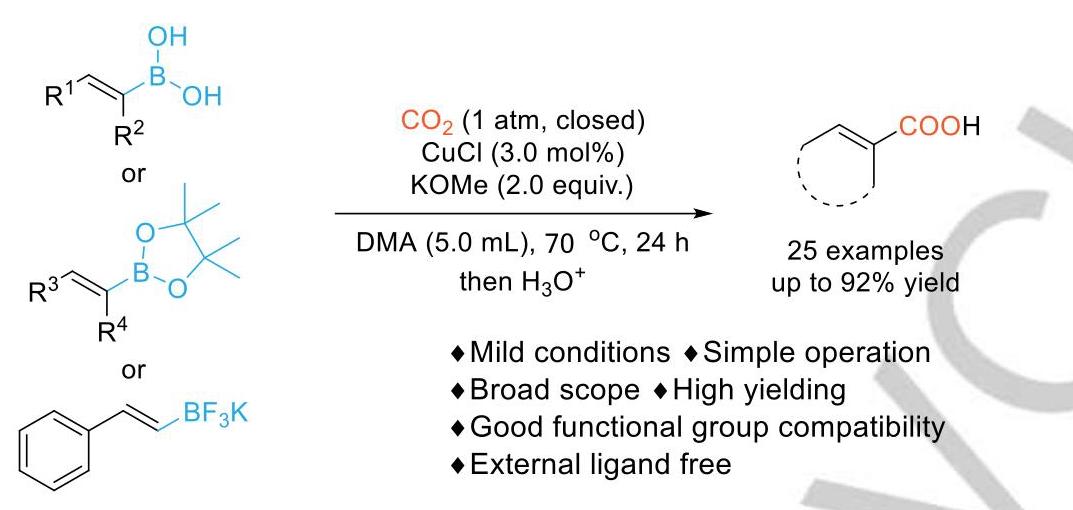
Three kinds of alkenyl boron compounds were effetively transformed into the corresponding a, $\beta$ -unsaturated carboxylic acids in moderate to high yield through cuprous halide-catalysted carboxylation with ${\mathrm{{CO}}}_{2}$ . The advantages of this method include low cost, mild conditions, simple operation, broad scope and external ligand free.
三种烯基硼化合物通过卤化亚铜催化的与 ${\mathrm{{CO}}}_{2}$ 的羧化反应,能以中等到高产率有效地转化为相应的 α, $\beta$ -不饱和羧酸。该方法的优点包括成本低、条件温和、操作简单、适用范围广且无需外加配体。