Electrocatalytic Oxidative Transformation of Organic Acids for Carbon–Heteroatom and Sulfur–Heteroatom Bond Formation
英文原文与中文译文逐段对照 · English original with Chinese translation
CHEMISTRY & SUSTAINABILITY
化学与可持续性
CHIPMSUSCHIM
CHIPMSUSCHIM
ENERGY & MATERIALS
能源与材料
Accepted Article
录用文章
Title: Electro-catalytic oxidative transformation of organic acids for carbon-heteroatom and sulfur-heteroatom bond formation
标题:用于碳 - 杂原子和硫 - 杂原子键形成的有机酸电催化氧化转化
Authors: Man Li, Junting Hong, Wei Xiao, Yang Yang, Di Qiu, and Fanyang Mo
作者:李满、洪钧婷、肖伟、杨扬、邱迪、莫凡洋
This manuscript has been accepted after peer review and appears as an Accepted Article online prior to editing, proofing, and formal publication of the final Version of Record (VoR). This work is currently citable by using the Digital Object Identifier (DOI) given below. The VoR will be published online in Early View as soon as possible and may be different to this Accepted Article as a result of editing. Readers should obtain the VoR from the journal website shown below when it is published to ensure accuracy of information. The authors are responsible for the content of this Accepted Article.
本稿件经同行评审后已被接受,并在编辑、校对和正式出版最终记录版本(VoR)之前以录用文章形式在线发表。目前可通过以下数字对象标识符(DOI)引用此作品。VoR 将尽快在 Early View 上在线发表,由于编辑原因可能与本录用文章有所不同。读者应在 VoR 发表时从以下期刊网站获取,以确保信息准确。作者对本录用文章的内容负责。
To be cited as: ChemSusChem 10.1002/cssc.201902657
引用格式:ChemSusChem 10.1002/cssc.201902657
Link to VoR: http://dx.doi.org/10.1002/cssc.201902657
VoR 链接:http://dx.doi.org/10.1002/cssc.201902657
Electrochemical transformation of organic acids for carbon- heteroatom and sulfur-heteroatom bond formation
用于碳-杂原子和硫-杂原子键形成的有机酸的电化学转化
Man Li, ${}^{\left\lbrack \mathrm{a}\right\rbrack }$ Junting Hong, ${}^{\left\lbrack \mathrm{a}\right\rbrack }$ Wei Xiao, ${}^{\left\lbrack \mathrm{a}\right\rbrack }$ Yang Yang, ${}^{\left\lbrack \mathrm{b}\right\rbrack }$ Di Qiu, ${}^{\left\lbrack \mathrm{c}\right\rbrack }$ and Fanyang Mo*[a, d]
李满,${}^{\left\lbrack \mathrm{a}\right\rbrack }$ 洪钧婷,${}^{\left\lbrack \mathrm{a}\right\rbrack }$ 肖伟,${}^{\left\lbrack \mathrm{a}\right\rbrack }$ 杨扬,${}^{\left\lbrack \mathrm{b}\right\rbrack }$ 邱迪,${}^{\left\lbrack \mathrm{c}\right\rbrack }$ 以及莫凡洋*[a, d]
Dedication ((optional))
献辞((可选))
REVIEW
综述
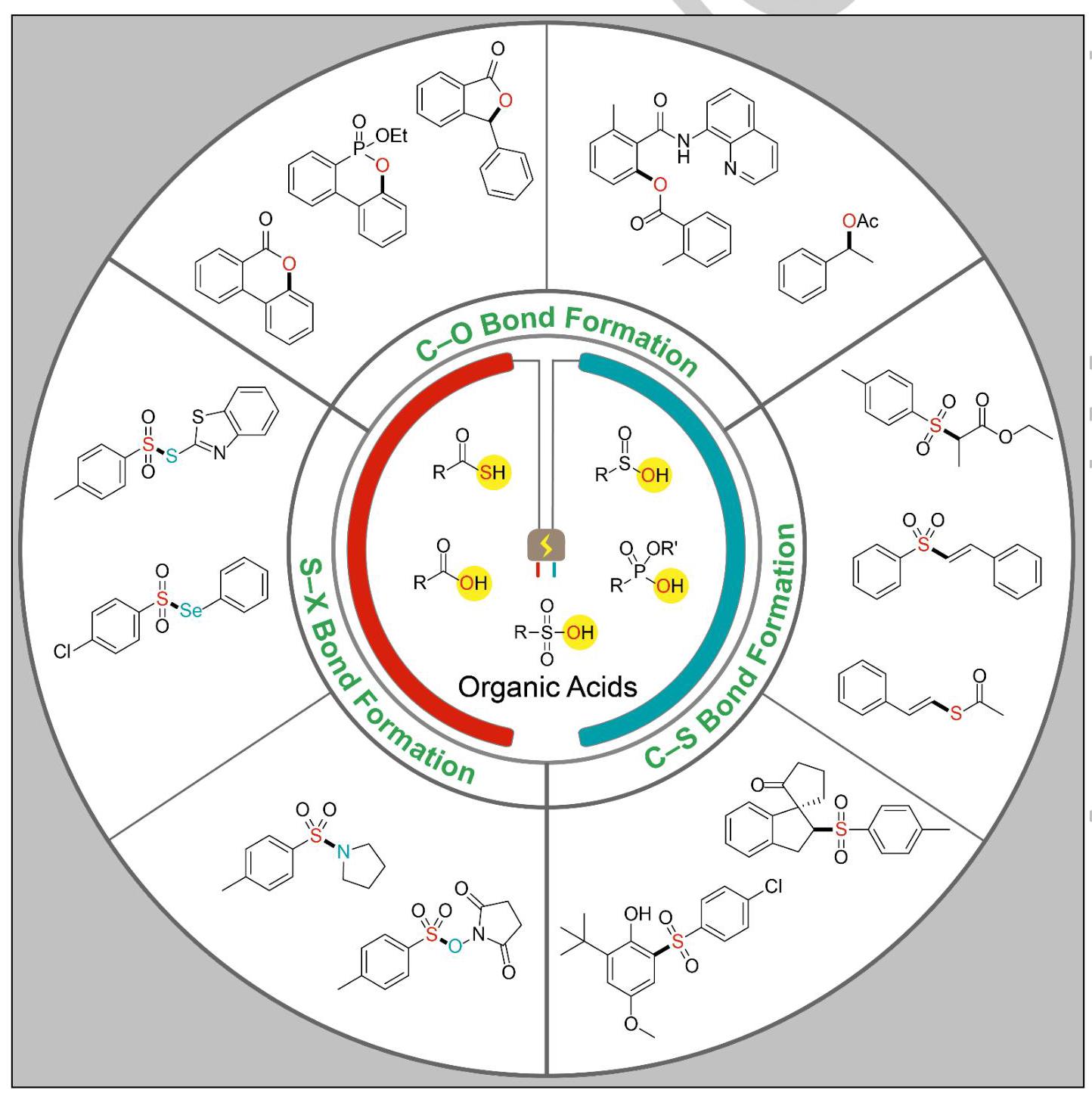
Abstract: The electrolysis of organic acids has garnered increasing attention in recent years. In addition to the famous electrochemical decarboxylation known as Kolbe electrolysis, a number of other electrochemical processes have been recently established, allowing for the construction of carbon-heteroatom and sulfur-heteroatom bonds from organic acids. In this review, we survey recent advances in electrochemical C-X and S-X (X = N, O, S, Se) bond forming reactions from five classes of organic acids and their conjugate bases, namely carboxylic, thiocarboxylic, phosphonic, sulfinic and sulfonic acids.
摘要:近年来,有机酸的电解受到了越来越多的关注。除了著名的称为科尔贝电解的电化学脱羧反应外,最近还建立了许多其他电化学过程,从而能够从有机酸构建碳 - 杂原子和硫 - 杂原子键。在本综述中,我们考察了从五类有机酸及其共轭碱,即羧酸、硫代羧酸、膦酸、亚磺酸和磺酸,形成电化学C - X和S - X(X = N、O、S、Se)键的反应的最新进展。
1. Introduction
1. 引言
Organic electrochemistry represents one of the most powerful and sustainable methods in organic chemistry. ${}^{\left\lbrack 1\right\rbrack }$ Hazardous stoichiometric external oxidants or reductants generally used in conventional organic synthesis can be avoided or used in catalytic amount by organic electrosynthesis. ${}^{\left\lbrack 2\right\rbrack }$ Among the oxidative coupling reactions, external oxidant-free methods with hydrogen evolution are particularly attractive, which can be realized by employing organic electrochemistry.[3] What’s more, in certain cases some chemical regents such as strong bases or highly active oxidants can be electrogenerated in situ, which are both environmentally friendly and mechanistically interesting. ${}^{\left\lbrack 4\right\rbrack }$ Recent studies have demonstrated the usefulness of organic electrosynthesis in inert bond functionalization ${}^{\left\lbrack 5\right\rbrack }$ and difunctionalization of alkenes or alkynes. ${}^{\left\lbrack 6\right\rbrack }$
有机电化学是有机化学中最强大且可持续的方法之一。${}^{\left\lbrack 1\right\rbrack }$传统有机合成中通常使用的危险化学计量的外部氧化剂或还原剂,在有机电合成中可以避免使用或仅以催化量使用。${}^{\left\lbrack 2\right\rbrack }$在氧化偶联反应中,析氢的无外部氧化剂方法特别有吸引力,这可以通过有机电化学来实现。[3]此外,在某些情况下,可以原位电生成一些化学试剂,如强碱或高活性氧化剂,这既环保又具有有趣的反应机理。${}^{\left\lbrack 4\right\rbrack }$最近的研究表明有机电合成在惰性键官能团化${}^{\left\lbrack 5\right\rbrack }$以及烯烃或炔烃的双官能团化方面很有用。${}^{\left\lbrack 6\right\rbrack }$
The electrodecarboxylation of aliphatic carboxylic acids to form dimeric products, known as the Kolbe reaction has found widespread applications in organic electrochemistry. ${}^{\left\lbrack 7\right\rbrack }$ Mechanistically, alkyl radicals are generated and coupled in classical Kolbe reaction. In recent years, the concept of Kolbe electrolysis has been largely expanded due to the rich chemistry of alkyl radicals. ${}^{\left\lbrack 8\right\rbrack }$ In addition, a number of non-decarboxylative electrochemical transformations of carboxylic acids have also been developed in recent years. Prior to the extrusion of carbon dioxide, the carboxylic acid group can participate in various C-O bond-forming reactions to provide esters and lactones as the product. The anodic oxidation of other organic acids such as sulfinic acids are very similar with that of carboxylic acids. Such sulfinic acids as ${\mathrm{{CF}}}_{3}{\mathrm{{SO}}}_{2}\mathrm{{Na}}$ were well known to release ${\mathrm{{SO}}}_{2}$ via anodic oxidation. It should be noted that generally C-S or S-X instead of C-O or O-X bond-forming reactions are observed in the electrolysis of thiocarboxylic acids and sulfinic acids. In this review, recent advances in C-O, C-S and S-X (X = N, O, S, Se) bond formation reactions involving organic acidic functional groups using electrochemical methods are summarized based on the types of the reacting organic acid substrates. The organic acids involved in this review include carboxylic acids, thiocarboxylic acids, phosphonic acids, sulfinic acids and sulfonic acids. Representative examples involving C-H functionalization and alkene/alkyne difunctionalization processes are highlighted. Electrochemical reactions involving merely expulsion of ${\mathrm{{CO}}}_{2}$ or ${\mathrm{{SO}}}_{2}$ from respective carboxylic acids or sulfinic acids are out of the reach of this review.
脂肪族羧酸的电极羧化反应生成二聚体产物,即所谓的科尔贝反应,在有机电化学中有着广泛的应用。${}^{\left\lbrack 7\right\rbrack }$从机理上讲,在经典的科尔贝反应中会生成烷基自由基并发生偶联。近年来,由于烷基自由基丰富的化学反应,科尔贝电解的概念得到了很大扩展。${}^{\left\lbrack 8\right\rbrack }$此外,近年来还开发了许多羧酸的非脱羧电化学转化反应。在挤出二氧化碳之前,羧酸基团可以参与各种形成C - O键的反应,生成酯和内酯作为产物。其他有机酸如亚磺酸的阳极氧化与羧酸的阳极氧化非常相似。像${\mathrm{{CF}}}_{3}{\mathrm{{SO}}}_{2}\mathrm{{Na}}$这样的亚磺酸通过阳极氧化会释放出${\mathrm{{SO}}}_{2}$。需要注意的是,在硫代羧酸和亚磺酸的电解中,通常观察到的是形成C - S或S - X键,而不是C - O或O - X键的反应。在本综述中,基于反应有机酸底物的类型,总结了使用电化学方法涉及有机酸性官能团的C - O、C - S和S - X(X = N、O、S、Se)键形成反应的最新进展。本综述涉及的有机酸包括羧酸、硫代羧酸、膦酸、亚磺酸和磺酸。重点介绍了涉及C - H官能团化和烯烃/炔烃双官能团化过程的代表性实例。仅涉及从相应羧酸或亚磺酸中排出${\mathrm{{CO}}}_{2}$或${\mathrm{{SO}}}_{2}$的电化学反应不在本综述范围内。
Man Li received his B.S. degree from Henan Normal University in 2010, and obtained his M.Sc. degree from Lanzhou Institute of Chemical Physics (LICP), Chinese Academy of Sciences (CAS) in 2014. He has been a Research Assistant at LICP, CAS, Shanghai Institute of Organic Chemistry, CAS and Peking University. His research interests include chemical transformations of carbon dioxide and organic electrochemistry.
李满于2010年在河南师范大学获得学士学位,并于2014年在中国科学院兰州化学物理研究所获得硕士学位。他曾在中国科学院兰州化学物理研究所、中国科学院上海有机化学研究所和北京大学担任研究助理。他的研究兴趣包括二氧化碳的化学转化和有机电化学。
Junting Hong received her B.S. degrees from Beijing Institute of Technology in 2017. She is currently a Ph.D. candidate in Professor Fanyang Mo’s group in Peking University.
洪钧婷于2017年在北京理工大学获得学士学位。她目前是北京大学莫凡洋教授课题组的博士研究生。
Wei Xiao is a third-year undergraduate student of Peking University. He is now studying in Professor Mo’s group.
肖伟是北京大学的一名大三本科生。他现在在莫教授的课题组学习。
Yang Yang received his Ph.D. degree from the Massachusetts Institute of Technology under the guidance of Prof. Stephen Buchwald. At MIT, his research focused on copper-catalyzed asymmetric hydrofunctionalization of simple olefins. In particular, he developed a copper-catalyzed
杨扬在斯蒂芬·布赫瓦尔德教授的指导下于麻省理工学院获得博士学位。在麻省理工学院,他的研究重点是简单烯烃的铜催化不对称氢官能团化。特别是,他开发了一种铜催化的
[a] M. Li, J. Hong, W. Xiao, Prof. Dr. F. Mo,
[a] 李满,洪钧婷,肖伟,莫凡洋教授
Department of Energy and Resources Engineering
能源与资源工程系
College of Engineering
工程学院
Peking University, Beijing, 100871, China
北京大学,北京,100871,中国
[b] Dr. Y. Yang
[b] 杨扬博士
Division of Chemistry and Chemical Engineering
化学与化学工程系
California Institute of Technology, Pasadena, California 91125,
加州理工学院,帕萨迪纳,加利福尼亚91125,
United States
美国
[c] Prof. Dr. D. Qiu,
[c] 邱博士教授,
Tianjin Key Laboratory of Structure and Performance for Functional
天津市功能结构与性能重点实验室
Molecules, MOE Key Laboratory of Inorganic-Organic Hybrid
分子,无机-有机杂化教育部重点实验室
Functional Materials Chemistry
功能材料化学
College of Chemistry, Tianjin Normal University, Tianjin
天津师范大学化学学院,天津
300387, China
300387,中国
[d] Prof. Dr. F. Mo,
[d] F. 莫教授博士
Jiangsu Donghai Silicon Industry S&T Innovation Center, Donghai
江苏东海硅产业科技创新中心,东海
County, Jiangsu 222300, China
中国江苏省222300县
REVIEW
综述
enantioselective hydroamination of unactivated internal olefins and a set of methods for the enantioselective addition of olefin-derived nucleophiles to carbonyls and imines. He is currently an NIH Postdoctoral Fellow in the laboratory of Prof. Frances Arnold at the California Institute of Technology, where he is using directed evolution to engineer cytochrome P450 enzymes for enantioselective $\mathrm{C} - \mathrm{H}$ amination.
未活化内烯烃的对映选择性氢胺化反应以及一系列将烯烃衍生亲核试剂对映选择性加成到羰基和亚胺上的方法。他目前是美国国立卫生研究院(NIH)的博士后研究员,在加州理工学院弗朗西斯·阿诺德教授的实验室工作,在那里他利用定向进化技术改造细胞色素P450酶以实现对映选择性$\mathrm{C} - \mathrm{H}$胺化反应。
Di Qiu was born in Tianjin, China, in 1987. He received his B.S. degree from Peking
邱迪1987年出生于中国天津。他于北京大学获得了学士学位
University in 2010. He continued his
2010年毕业于大学。他继续他的
graduate study in Prof. Jianbo Wang’s
在王建波教授的指导下进行研究生学习
laboratory and obtained his Ph.D. in 2015. In
实验室并于2015年获得博士学位。在
the same year, he joined in Tianjin Normal
同年,他进入天津师范大学
University as an assistant professor. His
作为助理教授的大学。他的
research interests lie in aromatic C-P bond
研究兴趣在于芳香族碳-磷键
formation and functional group
形成与官能团
transformations in aromatic compounds.
芳香化合物中的转化反应。
Fanyang Mo obtained his undergraduate and master’s degrees in applied chemistry
莫凡洋获得了应用化学专业的本科和硕士学位
from the Beijing Institute of Technology
来自北京理工大学
under the supervision of Professor Zhiming
在郅明教授的指导下
Zhou in 2004 and 2006, respectively. He
周分别在2004年和2006年。他
then moved to Peking University and
随后前往北京大学并
pursued his Ph.D. studies under the
在……之下攻读博士学位
supervision of Professor Jianbo Wang. After
王建波教授指导。之后
receiving his Ph.D. in 2010, he went to the
2010年获得博士学位后,他前往了
USA and worked with Professor Qinghai
美国并与青海教授共事
Zhang at The Scripps Research Institute
斯克里普斯研究所的张
and Professor Guangbin Dong at The University of Texas at Austin from 2010 to 2015. He joined Peking University as an Assistant Professor in April 2015. The current research interests of his group include ${\mathrm{{CO}}}_{2}$ utilization in organic synthesis, organic electrochemistry and modification of semiconductor oxides for energy and resources utilization.
2010年至2015年期间,他在德克萨斯大学奥斯汀分校与董广彬教授合作。2015年4月,他作为助理教授加入北京大学。他所在团队目前的研究兴趣包括有机合成中的${\mathrm{{CO}}}_{2}$利用、有机电化学以及用于能源和资源利用的半导体氧化物改性。
2. Ester C-O bond formation via electrolysis of carboxylic acids
2. 通过羧酸电解形成酯的C-O键
2.1 Direct oxidative coupling of carboxylic acid with aryl $\mathrm{C}\left( {\mathrm{{sp}}}^{2}\right) - \mathrm{H}$ bond
2.1 羧酸与芳基$\mathrm{C}\left( {\mathrm{{sp}}}^{2}\right) - \mathrm{H}$键的直接氧化偶联
Early works of this topic including examples involving transition-metal-catalyzed electrochemical transformations such as the oxygenation of $\mathrm{C} - \mathrm{H}$ bonds have been summarized by other reviews ${}^{\left\lbrack 5a,5b,9\right\rbrack }$ and are not included in this review. We will only focus on the recent advances in this part.
该主题的早期研究成果,包括涉及过渡金属催化的电化学转化的实例,如$\mathrm{C} - \mathrm{H}$键的氧化反应,已被其他综述${}^{\left\lbrack 5a,5b,9\right\rbrack }$总结,本综述不再赘述。我们将只关注这部分的最新进展。
The oxidative cyclization of 2-arylbenzonic acid via aryl $\mathrm{C}\left( {\mathrm{{sp}}}^{2}\right) -$ H bond functionalization is an ideal approach towards biaryl lactones. In 2018, several groups independently reported the anodic oxidative cyclization of 2-arylbenzonic acids under transition-metal-free conditions (Scheme 1). ${}^{\left\lbrack {10}\right\rbrack }$ Previously, this transformation has been achieved by many groups by means of metal catalysis (Pd, Cu, etc.) in combination with stoichiometric oxidant. The catalysis system is somewhat complicated. And the use of large amount of oxidant cause safety issue, excessive waste generation and poor atom economy. In this regard, electrochemistry offers a more superior way than traditional chemistry.
通过芳基$\mathrm{C}\left( {\mathrm{{sp}}}^{2}\right) -$H键官能团化实现2-芳基苯甲酸的氧化环化是合成联芳基内酯的理想方法。2018年,多个研究小组独立报道了在无过渡金属条件下2-芳基苯甲酸的阳极氧化环化反应(方案1)。${}^{\left\lbrack {10}\right\rbrack }$此前,许多研究小组通过金属催化(钯、铜等)与化学计量的氧化剂相结合实现了这种转化。催化体系有些复杂。大量氧化剂的使用会带来安全问题、产生过多废物以及原子经济性差等问题。在这方面,电化学提供了一种比传统化学更优越的方法。
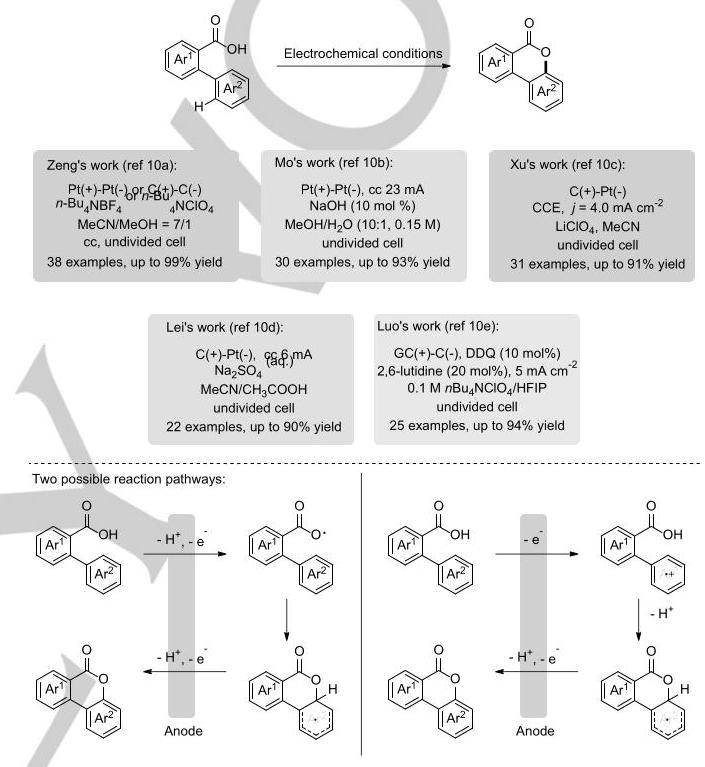
Scheme 1. Oxidative cyclization of 2-arylbenzonic acids.
方案1. 2-芳基苯甲酸的氧化环化反应。
Constant current electrolysis in an undivided cell at room temperature were employed in all these methods. In Zeng’s report, the utilization of inexpensive graphite electrodes can be quite attractive for large-scale electrosynthesis. ${}^{\left\lbrack {10}b\right\rbrack }$ This method had been applied to a ${40}\mathrm{\;g}$ scale synthesis. In Mo’s report, catalytic amount of NaOH was used and no further supporting electrolyte was required, which is distinct from others’ works.[10c] In Lei’s report, ${\mathrm{{Na}}}_{2}{\mathrm{{SO}}}_{4}$ aqueous solution was used as a cheap and green supporting electrolyte. ${}^{\left\lbrack {10}c\right\rbrack }$ Notably, they found that acids such as acetic acid were beneficial for the reaction. In Xu’s report, the electrolysis of 2-phenylbenzonic acid could be conducted on 100 g scale under an air atmosphere. ${}^{\left\lbrack {10}\mathrm{\;d}\right\rbrack }$ In Luo’s report, catalytic amount of DDQ and 2,6-lutidine was used as a redox mediator and base, respectively. ${}^{\left\lbrack {10}e\right\rbrack }$ Therefore, indirect electrolysis was used in Luo’s method and direct electrolysis was used by others’ works. It’s noteworthy that Zeng and Luo also reported the electrochemical lactonization of diaryl acrylic acids affording valuable coumarins. As for the reaction mechanism, the most popular proposed mechanism was the generation of carboxylate radical by anodic oxidation of carboxylate anion, which was followed by an intramolecular radical trapping cyclization. However, the prior anodic oxidation of the aromatic ring containing the reacting C-H bond cannot be ruled out especially for the electron-rich aromatic ring substituted with a methoxyl group as suggested by Lei and co-workers.
所有这些方法均采用在室温下于无隔膜电解槽中进行恒流电解。在曾的报告中,使用廉价的石墨电极对于大规模电合成颇具吸引力。${}^{\left\lbrack {10}b\right\rbrack }$该方法已应用于${40}\mathrm{\;g}$规模的合成。在莫的报告中,使用了催化量的氢氧化钠,无需额外的支持电解质,这与其他研究不同。[10c]在雷的报告中,${\mathrm{{Na}}}_{2}{\mathrm{{SO}}}_{4}$水溶液被用作廉价且绿色的支持电解质。${}^{\left\lbrack {10}c\right\rbrack }$值得注意的是,他们发现乙酸等酸对反应有益。在徐的报告中,2-苯基苯甲酸的电解可以在空气气氛下以100 g规模进行。${}^{\left\lbrack {10}\mathrm{\;d}\right\rbrack }$在罗的报告中,催化量的DDQ和2,6-二甲基吡啶分别用作氧化还原介质和碱。${}^{\left\lbrack {10}e\right\rbrack }$因此,罗的方法采用间接电解,而其他研究采用直接电解。值得注意的是,曾和罗还报道了二芳基丙烯酸的电化学内酯化反应,生成了有价值的香豆素。至于反应机理,最流行的机理是羧酸根阴离子通过阳极氧化生成羧酸根自由基,随后进行分子内自由基捕获环化。然而,不能排除含有反应性C-H键的芳环先进行阳极氧化的可能性,特别是如雷及其同事所指出的,对于被甲氧基取代的富电子芳环。
In 2018, Neumann and co-workers reported an electrocatalytic formylation reaction of benzene and its halogenated derivatives in the presence of ${\left\lbrack {\mathrm{{Co}}}^{\mathrm{{III}}}{\mathrm{W}}_{12}{\mathrm{O}}_{40}\right\rbrack }^{5 - }$ as a catalyst and lithium formate as an electrolyte(Scheme 2). ${}^{\left\lbrack {11}\right\rbrack }$ The aryl formates products are easily hydrolyzed by water affording the corresponding phenols and formic acid. Hydrogen was formed at the cathode. Therefore, the sum reaction is an indirect hydroxylation of benzene with water to yield phenol and ${\mathrm{H}}_{2}$ as products. It’s proposed that the formyloxy radical serves as the reactive species based on EPR study.
2018年,诺伊曼及其同事报道了在${\left\lbrack {\mathrm{{Co}}}^{\mathrm{{III}}}{\mathrm{W}}_{12}{\mathrm{O}}_{40}\right\rbrack }^{5 - }$作为催化剂和甲酸锂作为电解质的存在下,苯及其卤代衍生物的电催化甲酰化反应(方案2)。${}^{\left\lbrack {11}\right\rbrack }$芳基甲酸酯产物容易被水水解,生成相应的酚和甲酸。氢气在阴极生成。因此,总反应是苯与水的间接羟基化反应,生成酚和${\mathrm{H}}_{2}$作为产物。基于电子顺磁共振研究,推测甲酰氧基自由基是反应活性物种。
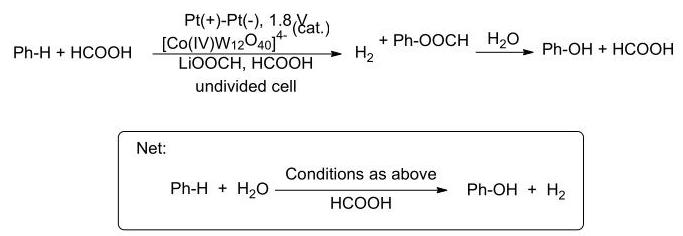
Scheme 2. Pathway for the electrochemical hydroxylation of benzene to phenol.
方案2. 苯电化学羟基化生成苯酚的途径。
In 2019, Ackermann and co-workers reported the first electrochemical cobalt-catalyzed C(sp ${}^{2}$ )-H acyloxylation in biomass-derived y-valerolactone (GVL) as a renewable solvent (Scheme 3). ${}^{\left\lbrack {12}\right\rbrack }$ Electricity serves as sustainable oxidant with molecular hydrogen as the sole byproduct in the absence of stoichiometric amounts of metal oxidants. Both aromatic and aliphatic carboxylic acids were amenable substrates. A plausible catalytic cycle was slightly revised from original paper according to the related works afterwards. ${}^{\left\lbrack {13}\right\rbrack }$ The reaction was initiated by the oxidation of $\mathrm{{Co}}\left( \mathrm{I}\right)$ catalyst with carboxylic acid to form carboxylate Co(II), followed by coordination with directing group on the substrate. Further oxidation this Co(II) to Co(III) occurs with concomitant activation of C-H bond. At last, reductive elimination and proto-demetallation affords the final product and regenerates Co(I) catalyst (Scheme 3).
2019年,阿克曼及其同事报道了首例电化学钴催化的生物质衍生γ-戊内酯(GVL)中C(sp${}^{2}$)-H酰氧基化反应,GVL作为一种可再生溶剂(方案3)。${}^{\left\lbrack {12}\right\rbrack }$ 在没有化学计量的金属氧化剂的情况下,电作为可持续氧化剂,分子氢作为唯一的副产物。芳香族和脂肪族羧酸都是合适的底物。根据后来的相关工作,对最初论文中的一个合理催化循环进行了轻微修改。${}^{\left\lbrack {13}\right\rbrack }$ 该反应由羧酸氧化$\mathrm{{Co}}\left( \mathrm{I}\right)$ 催化剂形成羧酸钴(II)引发,然后与底物上的导向基团配位。进一步将这种Co(II)氧化为Co(III),同时激活C-H键。最后,还原消除和质子脱金属得到最终产物并再生Co(I)催化剂(方案3)。
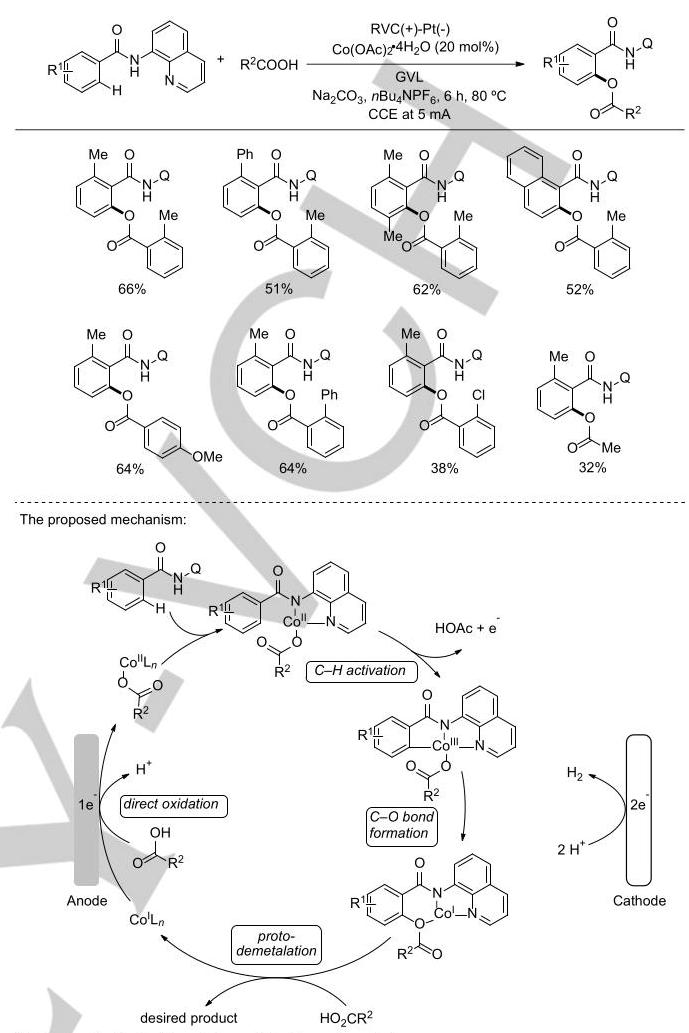
Scheme 3. Cobalt-catalyzed C-H acyloxylation.
方案3. 钴催化的C-H酰氧基化反应。
2.2 Direct oxidative coupling of carboxylic acid with vinyl $\mathrm{C}\left( {\mathrm{{sp}}}^{2}\right) - \mathrm{H}$ bond
2.2羧酸与乙烯基$\mathrm{C}\left( {\mathrm{{sp}}}^{2}\right) - \mathrm{H}$键的直接氧化偶联
In 2018, one example of intramolecular oxidative cyclization of carboxylic acid with vinyl $\mathrm{C}\left( {\mathrm{{sp}}}^{2}\right)$
2018年,罗及其同事报道了一个羧酸与乙烯基$\mathrm{C}\left( {\mathrm{{sp}}}^{2}\right)$的分子内氧化环化反应实例
-H bond was reported by Luo and co-workers (Scheme 4). ${}^{\left\lbrack {11}\right\rbrack }$ Tetrabutylammonium bromide was a better redox mediator than DDQ in this case.
-H键(方案4)。${}^{\left\lbrack {11}\right\rbrack }$在这种情况下,四丁基溴化铵是比DDQ更好的氧化还原介质。
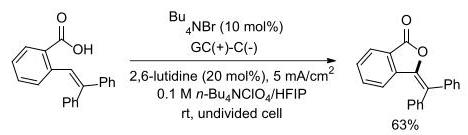
Scheme 4. Oxidative cyclization of carboxylic acid with vinyl $\mathrm{C}\left( {\mathrm{{sp}}}^{2}\right) - \mathrm{H}$ bond in the presence of tetrabutylammonium bromide.
方案4. 在四丁基溴化铵存在下羧酸与乙烯基$\mathrm{C}\left( {\mathrm{{sp}}}^{2}\right) - \mathrm{H}$键的氧化环化反应。
2.3 Intramolecular coupling of carboxylic acid with $\mathrm{C}\left( {\mathrm{{sp}}}^{2}\right) - \mathrm{X}$ bond
2.3 羧酸与$\mathrm{C}\left( {\mathrm{{sp}}}^{2}\right) - \mathrm{X}$键的分子内偶联
In 2018, during the investigation of the intramolecular lactonization of 2’-halobiphenyl-2-carboxylic acids, Luo and coworkers found that C-X substitution products were obtained instead of C-H substitution products (Scheme 5). ${}^{\left\lbrack {11}\right\rbrack }$ Halogens including chloride, bromide, and fluoride, could be viable leaving groups. This kind of electrolysis-initiated aromatic radical substitution is relatively rare.
2018年,在研究2’-卤代联苯-2-羧酸的分子内内酯化反应时,罗及其同事发现得到的是C-X取代产物而非C-H取代产物(方案5)。${}^{\left\lbrack {11}\right\rbrack }$ 包括氯、溴和氟在内的卤素可以作为可行的离去基团。这种电解引发的芳香自由基取代相对少见。
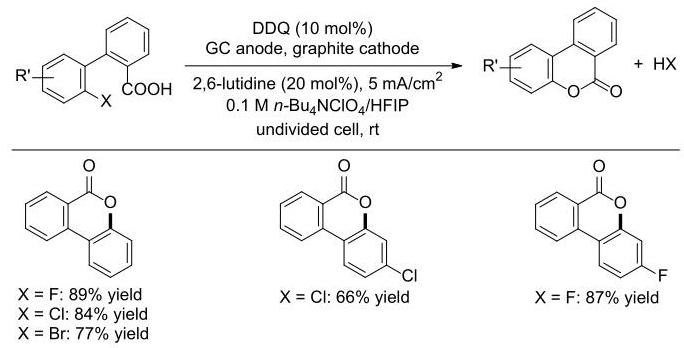
Scheme 5. Intramolecular lactonization of 2’-halobiphenyl-2-carboxylic acids.
方案5. 2’-卤代联苯-2-羧酸的分子内内酯化反应。
2.4 Electrocatalytic dehydrogenative esterification of carboxylic acids with ketones
2.4 羧酸与酮的电催化脱氢酯化反应
In light of the competing decarboxylation of aliphatic acids, it would be significant to construct ester C-O bonds from aliphatic acids suppressing this side reaction. In 2017, Xu and co-workers reported the intra- and intermolecular electrocatalytic dehydrogenative esterification of carboxylic acids with ketones by using an indirect electrolysis strategy (Scheme 6). ${}^{\left\lbrack {14}\right\rbrack }$
鉴于脂肪族酸存在竞争性脱羧反应,从脂肪族酸构建酯C-O键并抑制该副反应具有重要意义。2017年,Xu及其同事报道了通过间接电解策略实现羧酸与酮的分子内和分子间电催化脱氢酯化反应(方案6)。${}^{\left\lbrack {14}\right\rbrack }$
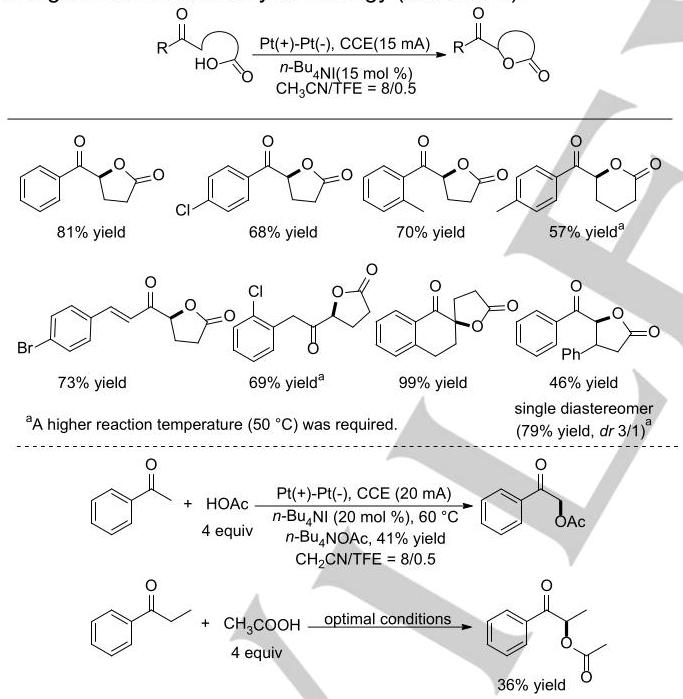
Scheme 6. Electrocatalytic dehydrogenative esterification of aliphatic carboxylic acids.
方案6. 脂肪族羧酸的电催化脱氢酯化反应。
For intermolecular dehydrogenative esterification, both aliphatic and aromatic acids were well-tolerated. They proposed the following mechanism (Scheme 7). Cathodic reduction of the carboxylic acid forms the corresponding carboxylate anion. With $n - {\mathrm{{Bu}}}_{4}\mathrm{{NI}}$ as a mediator, the in situ-generated ${\mathrm{I}}_{2}$ could transform the ketone to $\alpha$ -iodinated ketone. The $\alpha$ -iodinated ketone could also be generated from acyl hypoiodite intermediate.The final nucleophilic substitution affords the ester product. The utility of this method is illustrated by the synthesis of a natural product cytosporanone A on a gram scale.
对于分子间脱氢酯化反应,脂肪族和芳香族酸都能很好地耐受。他们提出了以下机理(方案7)。羧酸的阴极还原形成相应的羧酸根阴离子。以$n - {\mathrm{{Bu}}}_{4}\mathrm{{NI}}$作为介质,原位生成的${\mathrm{I}}_{2}$可将酮转化为$\alpha$-碘化酮。$\alpha$-碘化酮也可由酰基亚碘酸盐中间体生成。最终的亲核取代反应得到酯产物。该方法的实用性通过克级规模合成天然产物孢丝酮A得到了说明。
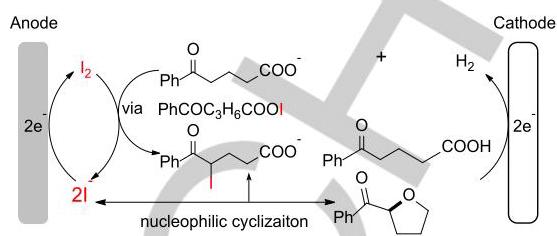
Scheme 7. Proposed mechanism for electrocatalytic dehydrogenative esterification of aliphatic carboxylic acids.
方案7. 脂肪族羧酸电催化脱氢酯化反应的 proposed 机理。
In 2019, Terent’ev and co-workers reported an electrochemically induced intermolecular cross-dehydrogenative C-O coupling of $\beta$ -diketones and $\beta$ -ketoesters with carboxylic acids by using KBr as supporting electrolyte (Scheme 8). ${}^{\left\lbrack {15}\right\rbrack }$ They proposed that brominated $\beta$ -diketones or $\beta$ -ketoesters serve as an important intermediate in this reaction, similar with that of Xu’s work.
2019年,Terent’ev及其同事报道了以KBr作为支持电解质,通过电化学诱导实现$\beta$-二酮和$\beta$-酮酯与羧酸的分子间交叉脱氢C-O偶联反应(方案8)。${}^{\left\lbrack {15}\right\rbrack }$他们提出溴化$\beta$-二酮或$\beta$-酮酯在该反应中作为重要中间体,与Xu的工作类似。
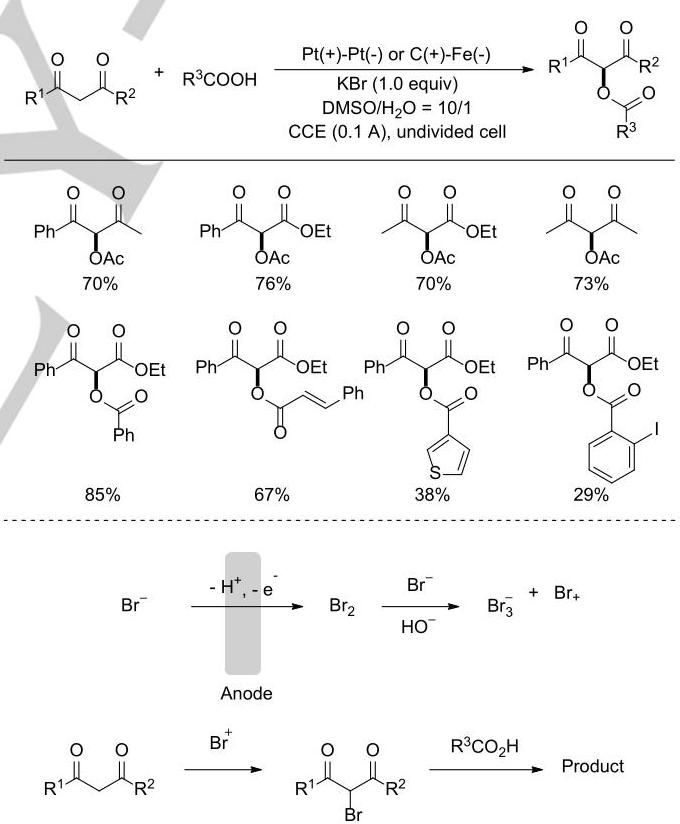
Scheme 8. Intermolecular cross-dehydrogenative C-O coupling of $\beta$ -diketones and $\beta$ -ketoesters with carboxylic acids.
方案8. $\beta$-二酮和$\beta$-酮酯与羧酸的分子间交叉脱氢C-O偶联反应。
Recently, Wirth and co-workers reported the enantioselective electrochemical lactonization of diketo acid derivatives using chiral iodoarenes as redox mediators for the first time (Scheme 9). ${}^{\left\lbrack {16}\right\rbrack }$ CV studies show that chiral iodoarene has a lower oxidative potential than the substrate, indicating hypervalent iodine regent is first generated in situ in this electrochemical reaction, which then works as a homogeneous chiral organocatalyst to catalyze enantioselective lactonization reaction. Notably, this reaction could also be accomplished using an electrochemical flow microreactor with a lower supporting electrolyte concentration. In 2019, an efficient cross-coupling reaction of carbon dioxide with amines and aryl ketones was developed, providing a variety of O- $\beta$ -oxoalkyl carbamates with moderate to good yields. ${}^{\left\lbrack {17}\right\rbrack }$
最近,Wirth及其同事首次报道了使用手性碘芳烃作为氧化还原介质,对二酮酸衍生物进行对映选择性电化学内酯化反应(方案9)。${}^{\left\lbrack {16}\right\rbrack }$循环伏安研究表明,手性碘芳烃的氧化电位低于底物,表明高价碘试剂在该电化学反应中原位首先生成,然后作为均相手性有机催化剂催化对映选择性内酯化反应。值得注意的是,该反应也可以使用支持电解质浓度较低的电化学流动微反应器来完成。2019年,开发了一种二氧化碳与胺和芳基酮的高效交叉偶联反应,以中等至良好的产率提供了多种O-$\beta$-氧代烷基氨基甲酸酯。${}^{\left\lbrack {17}\right\rbrack }$
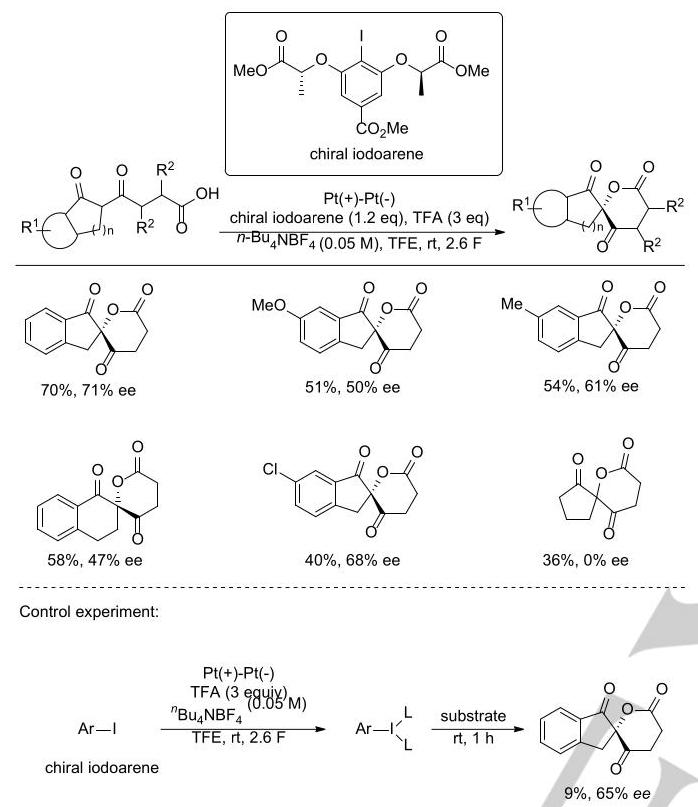
Scheme 9. Enantioselective electrochemical lactonization of diketo acid derivatives.
方案9. 二酮酸衍生物的对映选择性电化学内酯化反应。
2.5 Esterification of benzylic $\mathrm{C}\left( {\mathrm{{sp}}}^{3}\right) - \mathrm{H}$ bond
2.5 苄基$\mathrm{C}\left( {\mathrm{{sp}}}^{3}\right) - \mathrm{H}$键的酯化反应
In 2018, Zeng and co-workers reported the external oxidant-free electrochemical lactonization of benzylic $\mathrm{C}\left( {\mathrm{{sp}}}^{3}\right) - \mathrm{H}$ bonds (Scheme 10). ${}^{\left\lbrack {10}b\right\rbrack }$ Lactones with a new quaternary carbon center could be forged in some cases. Notably, an example of the electrochemical lactonization of aliphatic carboxylic acid was given. A plausible mechanism was proposed by the authors. The initial electrogenerated carboxylate radical might trigger a remote 1,5-hydrogen-atom-transfer (HAT) resulting in the formation of a stabilized benzylic radical. The final cyclization leads to the product by losing an electron and a proton possibly via a cation intermediate. It should be mentioned that 2-methylbenzonic acid and 2-ethylbenzonic acid were not suitable for this protocol, which indicates that the stability of the benzylic radical intermediate is highly important for this reaction.
2018年,曾及其同事报道了苄基$\mathrm{C}\left( {\mathrm{{sp}}}^{3}\right) - \mathrm{H}$键的无外源性氧化剂的电化学内酯化反应(方案10)。${}^{\left\lbrack {10}b\right\rbrack }$ 在某些情况下,可以生成具有新的季碳中心的内酯。值得注意的是,给出了一个脂肪族羧酸的电化学内酯化反应的例子。作者提出了一个合理的机理。最初电生成的羧酸根自由基可能引发远程的1,5-氢原子转移(HAT),从而形成稳定的苄基自由基。最终的环化反应通过可能经由阳离子中间体失去一个电子和一个质子而生成产物。应该提到的是,2-甲基苯甲酸和2-乙基苯甲酸不适合该反应体系,这表明苄基自由基中间体的稳定性对该反应非常重要。
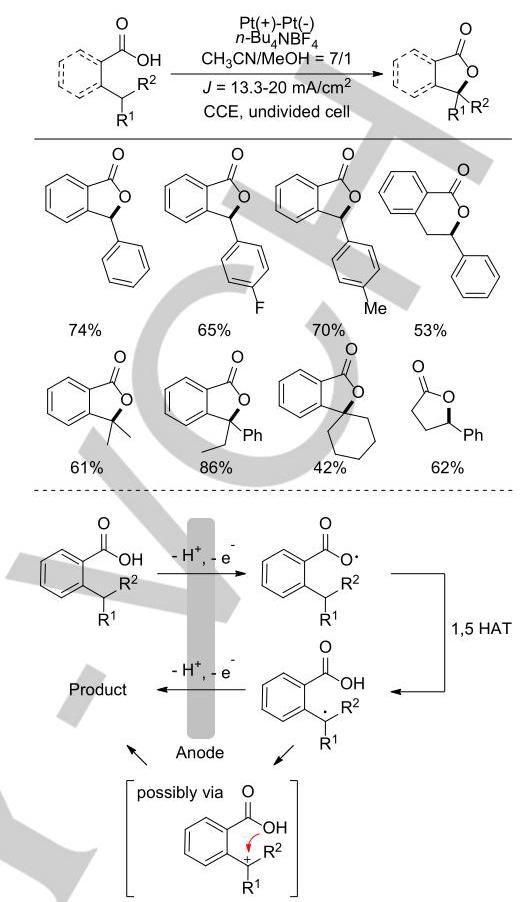
Scheme 10. Electrochemical lactonization of benzylic $\mathrm{C}\left( {\mathrm{{sp}}}^{3}\right) - \mathrm{H}$ bonds.
方案10. 苄基$\mathrm{C}\left( {\mathrm{{sp}}}^{3}\right) - \mathrm{H}$键的电化学内酯化反应。
At the same year, Muñiz and co-workers also reported an example of the electrochemical lactonization of aliphatic carboxylic acid in higher yield (Scheme 11).[18]
同年,穆尼兹及其同事也报道了一个脂肪族羧酸的电化学内酯化反应的例子,产率更高(方案11)。[18]
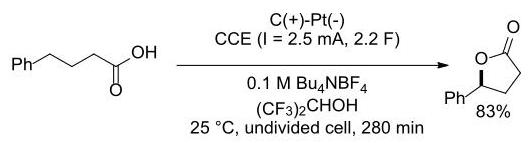
Scheme 11. Electrochemical lactonization of aliphatic carboxylic acid.
方案11. 脂肪族羧酸的电化学内酯化反应。
In 2018, Neumann and co-workers reported the acetoxylation of alkylarenes catalyzed by ${\left\lbrack {\mathrm{{Co}}}^{\mathrm{{IV}}}{\mathrm{W}}_{12}{\mathrm{O}}_{40}\right\rbrack }^{4 - }$ in acetic acid. ${}^{\left\lbrack {11}\right\rbrack }$ Dehydrogenation or oxidation of alkylarenes were also observed in these reactions (Scheme 12).
2018年,诺伊曼及其同事报道了在乙酸中由${\left\lbrack {\mathrm{{Co}}}^{\mathrm{{IV}}}{\mathrm{W}}_{12}{\mathrm{O}}_{40}\right\rbrack }^{4 - }$催化的烷基芳烃的乙酰氧基化反应。${}^{\left\lbrack {11}\right\rbrack }$ 在这些反应中也观察到了烷基芳烃的脱氢或氧化反应(方案12)。
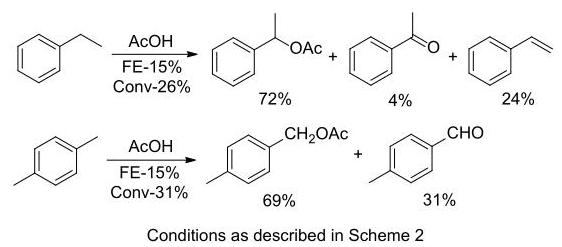
Scheme 12. Electrochemical oxidation of alkylarenes catalyzed by ${\left\lbrack {\mathrm{{Co}}}^{IV}{\mathrm{\;W}}_{12}{\mathrm{O}}_{40}\right\rbrack }^{4 - }$ in acetic acid. FE = Faradaic efficiency for oxidation of the organic substrate.
方案12. 在乙酸中由${\left\lbrack {\mathrm{{Co}}}^{IV}{\mathrm{\;W}}_{12}{\mathrm{O}}_{40}\right\rbrack }^{4 - }$催化的烷基芳烃的电化学氧化反应。FE = 有机底物氧化的法拉第效率。
2.6 Esterification of carboxylic acids via difunctionalization of alkenes
2.6 通过烯烃双官能化实现羧酸的酯化反应
2.6.1 Lactone formation via intramolecular trapping of intermediate with carboxylic acids
2.6.1 通过羧酸对中间体进行分子内捕获形成内酯
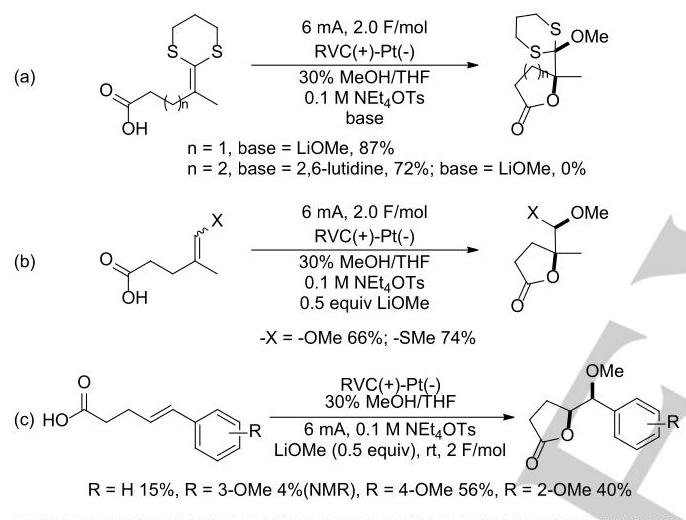
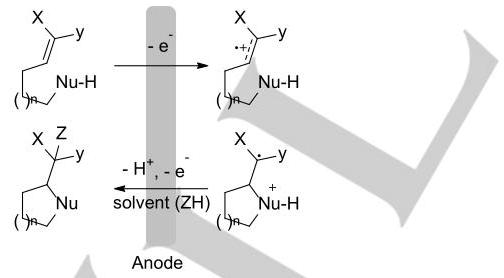
In 2013, Moeller and co-workers reported the anodic coupling of carboxylic acids to electron-rich double bonds (Scheme 13). ${}^{\left\lbrack {19}\right\rbrack }$ Although aliphatic carboxylic acids were used as substrates, Kolbe decarboxylation does not appear to be a significant competing pathway. Electron-rich olefins including ketene dithioacetal, vinyl sulfide, enol ether and substituted styrene were all suitable for this reaction. Mechanistically, it’s likely that oxidation occurs at the olefin and carboxylate traps the resulting radical cation intermediate. After the second oxidation and nucleophilic attack by methanol or methoxide, the final products are furnished.
2013年,默勒及其同事报道了羧酸与富电子双键的阳极偶联反应(方案13)。${}^{\left\lbrack {19}\right\rbrack }$ 尽管使用脂肪族羧酸作为底物,但科尔贝脱羧反应似乎并不是一个重要的竞争途径。包括烯酮二硫代缩醛、乙烯基硫醚、烯醇醚和取代苯乙烯在内的富电子烯烃都适用于该反应。从机理上讲,氧化可能发生在烯烃上,羧酸盐捕获生成的自由基阳离子中间体。经过第二次氧化以及甲醇或甲醇盐的亲核进攻后,得到最终产物。
Proposed mechanism:
提出的机理:
Scheme 13. Coupling of carboxylic acids to electron-rich double bonds.
方案13. 羧酸与富电子双键的偶联反应。
Using the similar strategy of Moeller, in 2019, Xu and coworkers reported the lactone formation from carboxylic acid-containing styrene substrates (Scheme 14). ${}^{\left\lbrack {20}\right\rbrack }$ The endo-type cyclization deserves attention in Xu’s work.
采用与默勒相似的策略,2019年,徐及其同事报道了由含羧酸的苯乙烯底物形成内酯的反应(方案14)。${}^{\left\lbrack {20}\right\rbrack }$ 徐的工作中,内型环化反应值得关注。
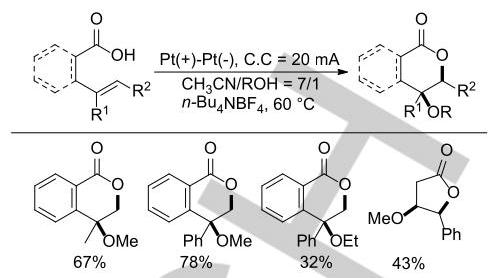
Scheme 14. Electrochemical lactones formation.
方案14. 电化学合成内酯。
In 2018, Kam and co-workers investigated the effect of ortho’- substituted side chains bearing nucleophilic groups such as ${\mathrm{{CO}}}_{2}\mathrm{H}$ on the reactivity of anodically generated 4-methoxy- and 3,4- dimethoxystilbene cation radicals (Scheme 15). ${}^{\left\lbrack {21}\right\rbrack }$ With COOH as the ortho’substituent, bis-δ-lactones were obtained via direct intramolecular cation-nucleophile reaction.
2018年,卡姆及其同事研究了带有亲核基团如 ${\mathrm{{CO}}}_{2}\mathrm{H}$ 的邻位取代侧链对阳极生成的4-甲氧基和3,4-二甲氧基二苯乙烯阳离子自由基反应活性的影响(方案15)。${}^{\left\lbrack {21}\right\rbrack }$ 以COOH作为邻位取代基时,通过直接分子内阳离子-亲核试剂反应得到双δ-内酯。
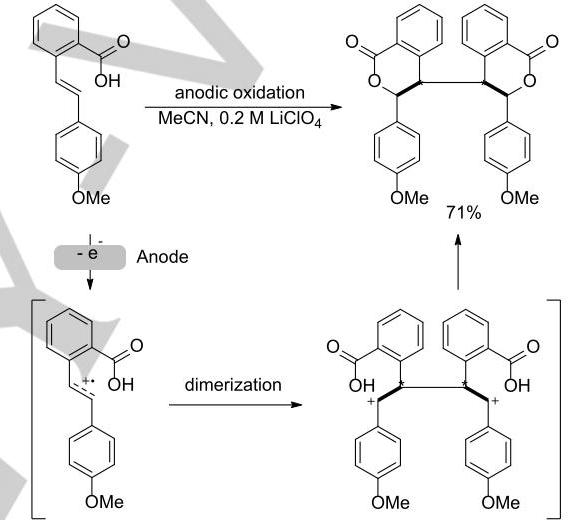
Scheme 15. Reactivity of anodically generated 4-methoxystilbene cation radicals.
方案15. 阳极生成的4-甲氧基二苯乙烯阳离子自由基的反应活性。
Integration of electrochemical oxidative cyclization and chemical oxidation is an intriguing strategy in the difunctionalization of alkenes. Based on their previous work, in 2013, Yoshida and co-workers reported the integration of electrooxidative cyclization of alkenes bearing a nucleophilic moiety in the presence of DMSO and chemical oxidation of the resulting alkoxysulfonium ions. ${}^{\left\lbrack {22}\right\rbrack }$ The alkoxysulfonium ions can be converted to ketones by treatment with ${\mathrm{{Et}}}_{3}\mathrm{\;N}$ via Swern-Moffatt type oxidation. The reaction is useful for synthesis of lactones when the ${\mathrm{{CO}}}_{2}\mathrm{H}$ group serves as an intramolecular nucleophile (Scheme 16).
电化学氧化环化与化学氧化相结合是烯烃双官能化中一种引人关注的策略。基于他们之前的工作,2013年,吉田及其同事报道了在DMSO存在下,对带有亲核部分的烯烃进行电氧化环化,并对生成的烷氧基锍离子进行化学氧化反应。${}^{\left\lbrack {22}\right\rbrack }$ 通过斯温-莫法特型氧化反应,用 ${\mathrm{{Et}}}_{3}\mathrm{\;N}$ 将烷氧基锍离子转化为酮。当 ${\mathrm{{CO}}}_{2}\mathrm{H}$ 基团作为分子内亲核试剂时,该反应可用于内酯的合成(方案16)。
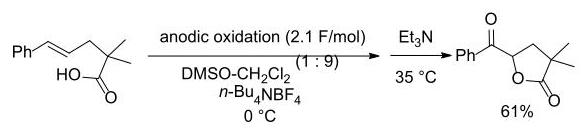
Scheme 16. Electrooxidative cyclization of alkenes
方案16. 烯烃的电氧化环化反应
In 2017, Lam and co-workers reported an electrochemical synthesis of phthalides using anodically generated aroyloxy radicals in combination with aliphatic carboxylic acid as alkylating agent precursors (Scheme 17). ${}^{\left\lbrack {23}\right\rbrack }$ They proposed that aroyloxy radical and alkyl radical are key intermediates of this reaction. The electrogenerated alkyl radical from aliphatic carboxylic acid might oxidize the aromatic carboxylate forming the aroyloxy radical. The possibility of the direct oxidation of the olefin into a radical-cation followed by its capture through a nucleophilic attack from the carboxylate was not favored by a control experiment.
2017年,林及其同事报道了使用阳极生成的芳酰氧基自由基与脂肪族羧酸作为烷基化剂前体,电化学合成邻苯二甲内酯的反应(方案17)。${}^{\left\lbrack {23}\right\rbrack }$ 他们提出芳酰氧基自由基和烷基自由基是该反应的关键中间体。脂肪族羧酸产生的电生成烷基自由基可能会氧化芳香族羧酸盐形成芳酰氧基自由基。对照实验不支持烯烃直接氧化为自由基阳离子然后被羧酸盐亲核进攻捕获的可能性。
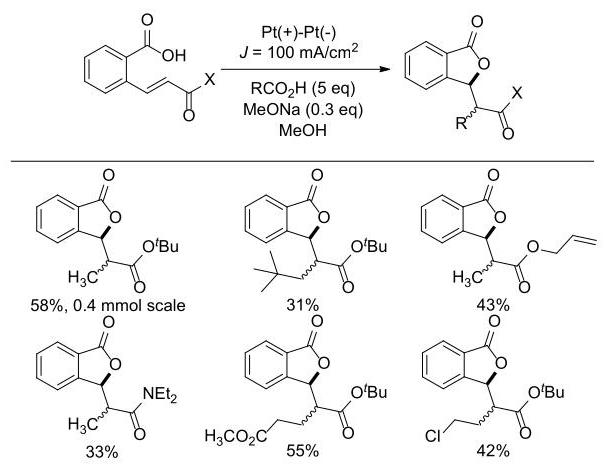
Scheme 17. Electrochemical synthesis of phthalides via anodic activation of aromatic carboxylic acids
方案17. 通过芳香族羧酸的阳极活化电化学合成邻苯二甲内酯
In 2018, Han and co-workers reported the synthesis of thio-substituted lactones via electrochemical oxysulfuration of alkenes (Scheme 18). ${}^{\left\lbrack {24}\right\rbrack }$ Unsaturated carboxylic acids including aliphatic and aromatic acids were all suitable for this reaction. It’s likely that aryl sulfur radical generated from anodic oxidation of thiophenol triggers the addition reaction. The resulting radical intermediate undergoes further anodic oxidation to afford the carbocation intermediate, which is attacked by the nucleophile furnishing the final product.
2018年,韩及其同事报道了通过烯烃的电化学氧硫化反应合成硫取代内酯的反应(方案18)。${}^{\left\lbrack {24}\right\rbrack }$ 包括脂肪族和芳香族酸在内的不饱和羧酸都适用于该反应。由苯硫酚阳极氧化产生的芳基硫自由基可能引发加成反应。生成的自由基中间体进一步进行阳极氧化得到碳正离子中间体,该中间体被亲核试剂进攻得到最终产物。
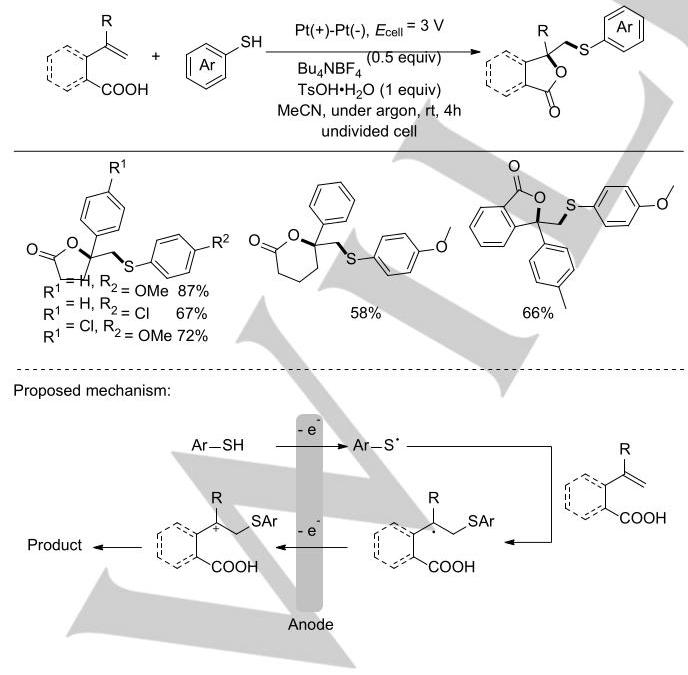
Scheme 18. Synthesis of thio-substituted lactones via electrochemical oxysulfuration of alkenes
方案18. 通过烯烃的电化学氧硫化反应合成硫取代内酯
Using the similar strategy, in 2019, Xu and co-workers reported an electrochemical fluoromethylation triggered lactonization of alkenes under additional supporting electrolyte- and catalyst-free conditions (Scheme 19). ${}^{\left\lbrack {25}\right\rbrack }$ With readily prepared ${\mathrm{{CF}}}_{2}{\mathrm{{HSO}}}_{2}\mathrm{{Na}}$ or ${\mathrm{{CF}}}_{3}{\mathrm{{SO}}}_{2}\mathrm{{Na}}$ as the fluoromethylating reagents, the desired ${\mathrm{{CF}}}_{2}\mathrm{H}$ - or ${\mathrm{{CF}}}_{3}$ -containing lactones were obtained in an undivided cell under semi-aqueous conditions. Cyclic voltammetric (CV) experiments indicated that ${\mathrm{{CF}}}_{2}{\mathrm{{HSO}}}_{2}\mathrm{{Na}}$ and ${\mathrm{{CF}}}_{3}{\mathrm{{SO}}}_{2}\mathrm{{Na}}$ are easier to be electrochemically oxidized to generate fluoromethyl radicals than the alkene moiety. Thus, ${R}_{f}$ radical generated by anodic oxidation of ${\mathrm{R}}_{\mathrm{f}}{\mathrm{{SO}}}_{2}\mathrm{{Na}}$ adds to alkene, followed by further anodic oxidation of the resulting benzylic radical species to give benzylic carbocation. Intramolecular trapping by carboxylic acid furnishes the final product.
采用类似策略,2019年,Xu及其同事报道了在无额外支持电解质和催化剂的条件下,电化学氟甲基化引发的烯烃内酯化反应(方案19)。${}^{\left\lbrack {25}\right\rbrack }$ 以易于制备的${\mathrm{{CF}}}_{2}{\mathrm{{HSO}}}_{2}\mathrm{{Na}}$ 或${\mathrm{{CF}}}_{3}{\mathrm{{SO}}}_{2}\mathrm{{Na}}$ 作为氟甲基化试剂,在半水相条件下的无隔膜电解池中获得了所需的含${\mathrm{{CF}}}_{2}\mathrm{H}$ 或${\mathrm{{CF}}}_{3}$ 的内酯。循环伏安(CV)实验表明,${\mathrm{{CF}}}_{2}{\mathrm{{HSO}}}_{2}\mathrm{{Na}}$ 和${\mathrm{{CF}}}_{3}{\mathrm{{SO}}}_{2}\mathrm{{Na}}$ 比烯烃部分更容易被电化学氧化生成氟甲基自由基。因此,${\mathrm{R}}_{\mathrm{f}}{\mathrm{{SO}}}_{2}\mathrm{{Na}}$ 的阳极氧化产生的${R}_{f}$ 自由基加成到烯烃上,随后所得苄基自由基物种进一步阳极氧化生成苄基碳正离子。羧酸的分子内捕获得到最终产物。
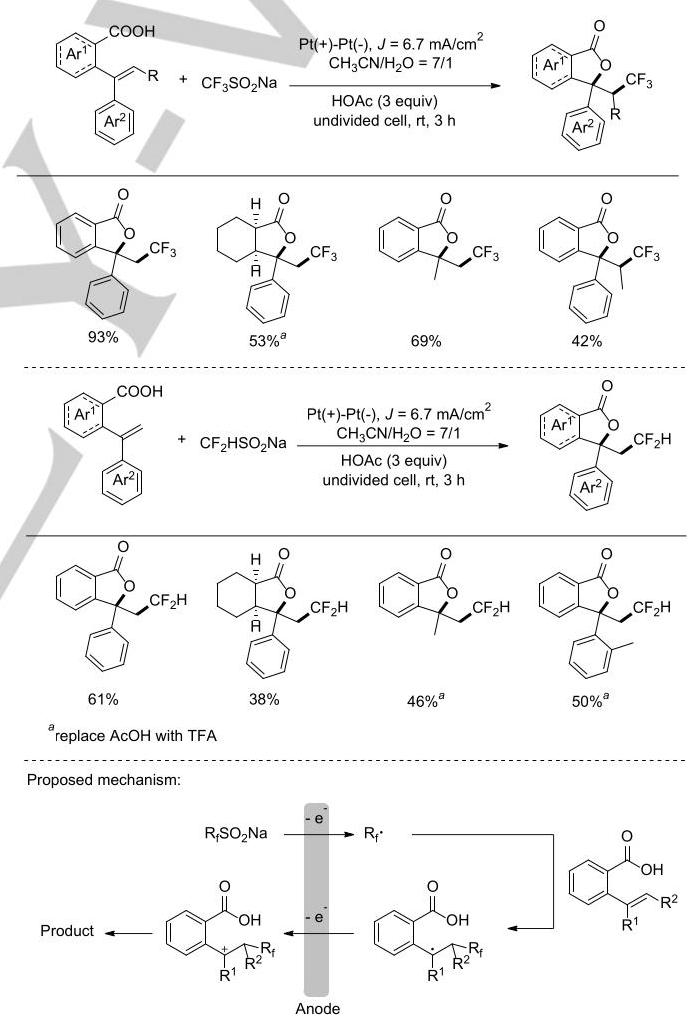
Scheme 19. Electrochemical fluoromethylation triggered lactonization of alkenes.
方案19. 电化学氟甲基化引发的烯烃内酯化反应。
2.6.2 Ester formation via intermolecular trapping of intermediate with carboxylic acids
2.6.2 通过中间体与羧酸的分子间捕获形成酯
REVIEW In 2014, Kam and co-workers investigated the electrochemical oxidation of 4,4’-dimethoxystilbene under different conditions. When the reaction was carried out in 25% AcOH/MeCN/0.1 M ${\mathrm{{LiClO}}}_{4}$ in the presence of NaOAc (0.25 M), isomeric acetate derivatives were obtained in combined yields of 62% (Scheme 20). ${}^{\left\lbrack {26}\right\rbrack }$ The radical cation intermediate was proposed as the key species in this anodic oxidation.
综述 2014年,Kam及其同事研究了4,4’-二甲氧基芪在不同条件下的电化学氧化。当反应在25% AcOH/MeCN/0.1 M ${\mathrm{{LiClO}}}_{4}$ 中,在NaOAc(0.25 M)存在下进行时,得到了异构体乙酸酯衍生物,总收率为62%(方案20)。${}^{\left\lbrack {26}\right\rbrack }$ 自由基阳离子中间体被认为是该阳极氧化反应中的关键物种。
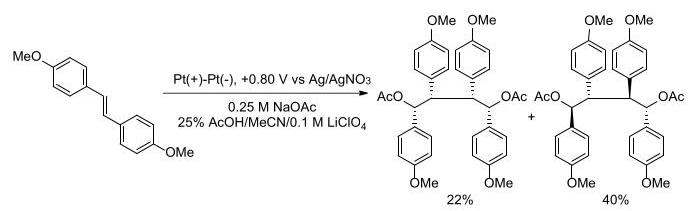
Scheme 20. Electrochemical oxidation of 4,4’-dimethoxystilbene.
方案20. 4,4’-二甲氧基芪的电化学氧化。
In 2015, DeVos and co-workers reported the divergent paired electrosynthesis of diacid and diol precursors through simultaneous cathodic carboxylation and anodic acetoxylation of conjugated dienes (Scheme 21). ${}^{\left\lbrack {27}\right\rbrack }$ As for the acetoxylation reaction, the choice of the tetraethylammonium salt seemed very important. When an acetate anion was used, no diacetate ester product was observed; when a trifluoroacetate salt was employed, a good yield of diacetoxylated compound product was obtained.
2015年,DeVos及其同事报道了通过共轭二烯的同时阴极羧化和阳极乙酰氧基化,实现二酸和二醇前体的发散式成对电合成(方案21)。${}^{\left\lbrack {27}\right\rbrack }$ 至于乙酰氧基化反应,四乙基铵盐的选择似乎非常重要。当使用乙酸根阴离子时,未观察到二乙酸酯产物;当使用三氟乙酸盐时,得到了高产率的二乙酰氧基化化合物产物。
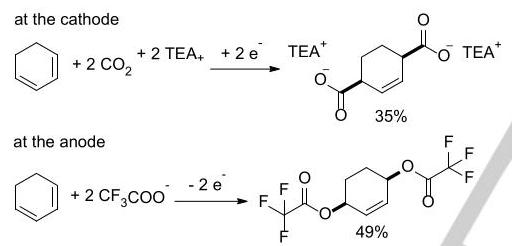
Scheme 21. Divergent paired electrosynthesis of diacid and diol precursors.
方案21. 二酸和二醇前体的发散式成对电合成。
In 2018, Lei and co-workers reported the electrochemical oxidative oxysulfenylation (including acyloxysulfenylation) and aminosulfenylation of alkenes with hydrogen evolution. ${}^{\left\lbrack {28}\right\rbrack }$ Neither external chemical oxidants nor metal catalysts are required in these reactions. One example of acyloxysulfenylation of styrene was reported (Scheme 22). The proposed mechanism was similar with that of Han and co-workers. ${}^{\left\lbrack {24}\right\rbrack }$ Notably, the authors pointed out that although thiyl radical was the most likely species triggering the reaction, the possibility of arylbis(arylthio)sulfonium ion serves as the key intermediate could not be completely ruled out.
2018年,Lei及其同事报道了烯烃的电化学氧化氧硫基化(包括酰氧基硫基化)和氨基硫基化反应,并伴有氢气析出。${}^{\left\lbrack {28}\right\rbrack }$ 这些反应既不需要外部化学氧化剂,也不需要金属催化剂。报道了一个苯乙烯酰氧基硫基化的例子(方案22)。提出的机理与Han及其同事的类似。${}^{\left\lbrack {24}\right\rbrack }$ 值得注意的是,作者指出,虽然硫自由基是引发反应最可能的物种,但芳基双(芳基硫基)锍离子作为关键中间体的可能性也不能完全排除。

Scheme 22. Electrochemical oxidative oxysulfenylation of alkenes.
方案22. 烯烃的电化学氧化氧硫基化反应。
On the basis of this work, Lei and co-workers further developed the electrochemical oxytrifluoromethylation and aminotrifluoromethylation of alkenes in the presence of yttrium triflate using ${\mathrm{{CF}}}_{3}{\mathrm{{SO}}}_{2}\mathrm{{Na}}$ as trifluoromethylation reagent. ${}^{\left\lbrack {29}\right\rbrack }$ Formic acid and acetic acid could participate in the electrochemical oxytrifluoromethylation to afford the corresponding ${\mathrm{{CF}}}_{3}$ - containing esters (Scheme 23). It’s likely that ${\mathrm{{CF}}}_{3}$ radical generated from oxidation of ${\mathrm{{CF}}}_{3}{\mathrm{{SO}}}_{2}\mathrm{{Na}}$ at the anode triggers this reaction.
基于这项工作,雷及其同事进一步开发了在三氟甲磺酸钇存在下,使用${\mathrm{{CF}}}_{3}{\mathrm{{SO}}}_{2}\mathrm{{Na}}$作为三氟甲基化试剂,对烯烃进行电化学氧三氟甲基化和氨三氟甲基化反应。${}^{\left\lbrack {29}\right\rbrack }$甲酸和乙酸可以参与电化学氧三氟甲基化反应,得到相应的含${\mathrm{{CF}}}_{3}$酯(方案23)。阳极上${\mathrm{{CF}}}_{3}{\mathrm{{SO}}}_{2}\mathrm{{Na}}$氧化生成的${\mathrm{{CF}}}_{3}$自由基可能引发了该反应。
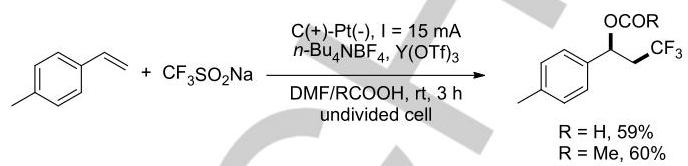
Scheme 23. Electrochemical oxytrifluoromethylation of alkenes.
方案23. 烯烃的电化学氧三氟甲基化反应。
In 2019, the Lei group reported the electrochemical aminoselenation and oxyselenation of styrenes without any acids or oxidants as additives. Formic acid, acetic acid, butyric acid, benzoic acid, and cyclopropyl carboxylic acid are all amenable nucleophiles in the oxyselenation of styrene (Scheme 24).[30] Two possible mechanisms involving seleno radical-initiated addition or cyclic selenium intermediate were proposed.
2019年,雷课题组报道了在无任何酸或氧化剂添加剂的情况下,对苯乙烯进行电化学氨硒化和氧硒化反应。甲酸、乙酸、丁酸、苯甲酸和环丙基羧酸都是苯乙烯氧硒化反应中合适的亲核试剂(方案24)。[30] 提出了两种可能的机理,涉及硒自由基引发的加成反应或环状硒中间体。
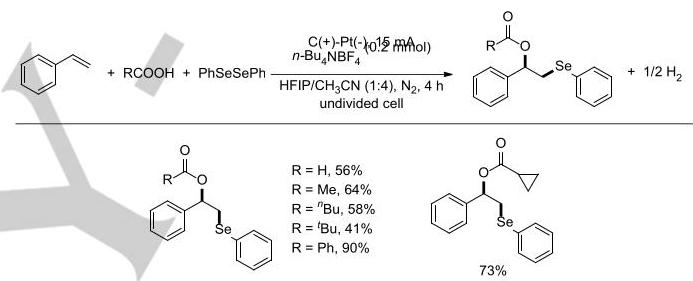
Scheme 24. Electrochemical oxyselenation of styrenes.
方案24. 苯乙烯的电化学氧硒化反应。
In 2019, Li and co-workers developed an intermolecular 1,2- bromoesterification of alkenes with carboxylic acids and $N$ - bromosuccinimide (NBS) under electrochemical oxidative conditions (Scheme 25). ${}^{\left\lbrack {31}\right\rbrack }$ They found that TEMPO promoted this reaction significantly. Inorganic bromine sources, such as $\mathrm{{LiBr}},{\mathrm{{NH}}}_{4}\mathrm{{Br}}$ , and KBr were not suitable for this reaction. A wide range of alkenes, including 1,1-disubstituted ethylene, 1,2- disubstituted ethylene, terminal styrenes, cycloolefins, and aliphatic alkene, were transformed to their corresponding products via C-Br and C-O bond formation. Various carboxylic acids, such as aromatic acids, cinnamic acid, aliphatic acids, and amino acids, were tolerated by the electrooxidative system. The cyclic bromonium ion intermediate was proposed as the key species in this transformation.
2019年,李及其同事开发了一种在电化学氧化条件下,烯烃与羧酸和$N$ - 溴代琥珀酰亚胺(NBS)进行分子间1,2 - 溴酯化反应(方案25)。${}^{\left\lbrack {31}\right\rbrack }$他们发现TEMPO能显著促进该反应。无机溴源,如$\mathrm{{LiBr}},{\mathrm{{NH}}}_{4}\mathrm{{Br}}$和KBr不适合该反应。包括1,1 - 二取代乙烯、1,2 - 二取代乙烯、末端苯乙烯、环烯烃和脂肪族烯烃在内的多种烯烃,通过形成C - Br键和C - O键转化为相应产物。电氧化体系能耐受各种羧酸,如芳香酸、肉桂酸、脂肪族酸和氨基酸。环状溴鎓离子中间体被认为是该转化过程中的关键物种。
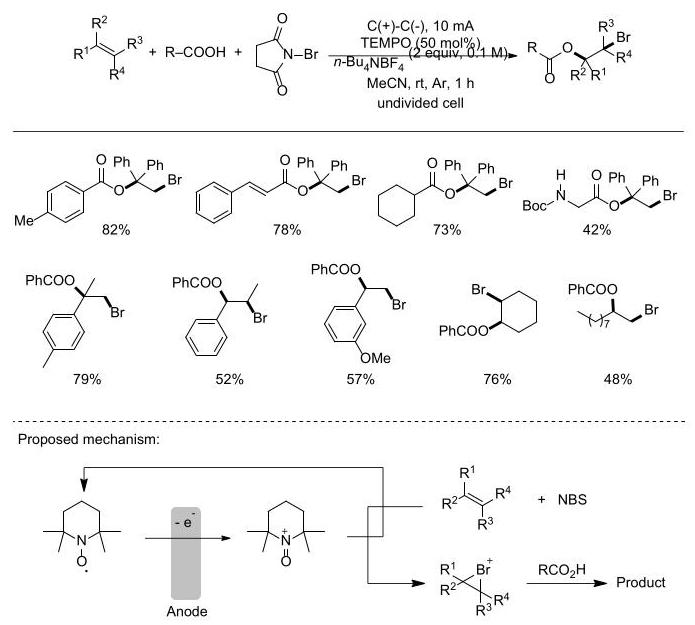
Scheme 25. Electrooxidative 1,2-bromoesterification of alkenes with acids and NBS.
方案25. 烯烃与酸和NBS的电氧化1,2 - 溴酯化反应。
2.7 Anodic allylic esterification of nonactivated alkenes
2.7 未活化烯烃的阳极烯丙基酯化反应
In 2018, Siewert and co-workers reported the anodic allylic esterification and amination of nonactivated alkenes catalyzed by diselenides (Scheme 26). ${}^{\left\lbrack {32}\right\rbrack }$ , A detailed mechanistic study revealed a plausible mechanism. The selenolactone is proposed as the key intermediate of this reaction. Both intramolecular and intermolecular anodic allylic esterification were presented in this work. The high regioselectivity of the intermolecular anodic allylic esterification is noteworthy. The required potential to drive the reaction can be adjusted easily, which is an important advantage of this electrochemical reaction compared with conventional methods.
2018年,西韦特及其同事报道了由二硒化物催化的未活化烯烃的阳极烯丙基酯化和胺化反应(方案26)。${}^{\left\lbrack {32}\right\rbrack }$ ,详细的机理研究揭示了一种合理的机理。硒内酯被认为是该反应的关键中间体。这项工作中展示了分子内和分子间的阳极烯丙基酯化反应。分子间阳极烯丙基酯化反应的高区域选择性值得注意。驱动该反应所需的电位可以很容易地调节,与传统方法相比,这是这种电化学反应的一个重要优势。
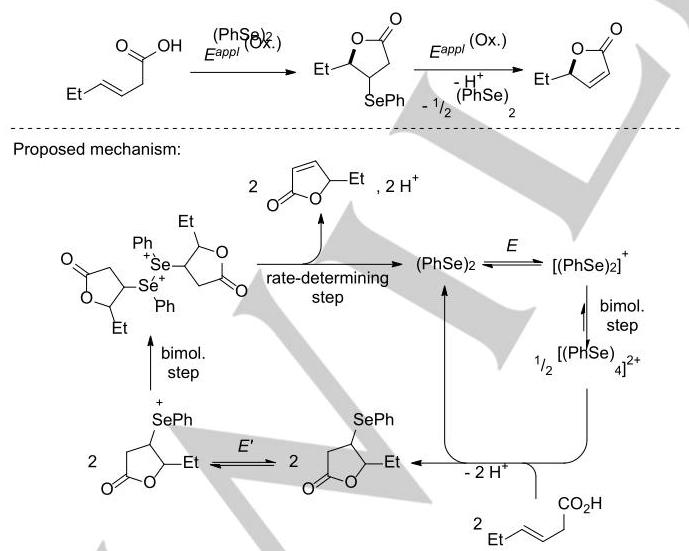
Scheme 26. Anodic allylic esterification and amination of nonactivated alkenes.
方案26. 未活化烯烃的阳极烯丙基酯化和胺化反应。
2.8 Electrochemical reactions involving electrogenerated carboxylates
2.8涉及电生成羧酸盐的电化学反应
In 2015, Senboku and co-workers reported the electrochemical three-component coupling reaction of benzylic halides, carbon dioxide and N, N-dimethylformamide (DMF) by using paired electrolysis (Scheme 27). ${}^{\left\lbrack {33}\right\rbrack }$ In this reaction, carboxylate ion was generated in situ from the carboxylation of benzylic halides at the cathode. At the same time, N-acyliminium ion intermediate was generated from electrochemical oxidation of DMF at the anode. Coupling of carboxylate ion with $N$ -acyliminium ion gives the desired coupling product.
2015年,Senboku及其同事报道了通过成对电解进行的苄基卤化物、二氧化碳和N, N-二甲基甲酰胺(DMF)的电化学三组分偶联反应(方案27)。${}^{\left\lbrack {33}\right\rbrack }$ 在该反应中,羧酸根离子通过苄基卤化物在阴极的羧化反应原位生成。同时,N-酰基亚胺离子中间体通过DMF在阳极的电化学氧化生成。羧酸根离子与$N$ -酰基亚胺离子偶联得到所需的偶联产物。
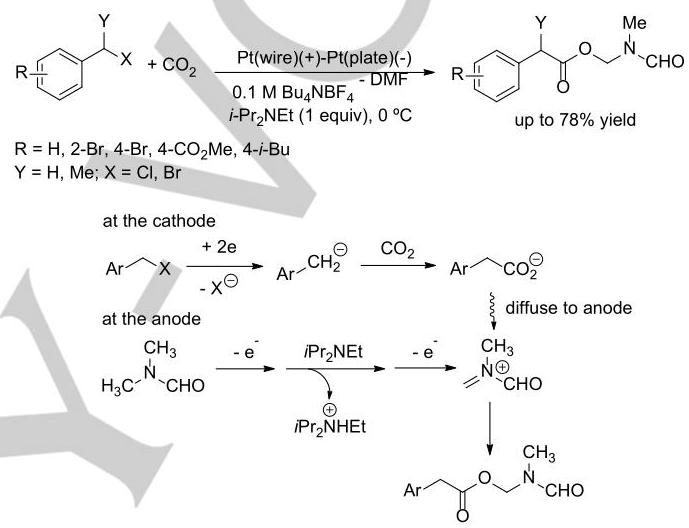
Scheme 27. Electrochemical three-component coupling reaction of benzylic halides, carbon dioxide and DMF.
方案27. 苄基卤化物、二氧化碳和DMF的电化学三组分偶联反应。
3. C-S bond formation via electrolysis of thiocarboxylic acids
3. 通过硫代羧酸电解形成C-S键
It is well established that the electrolysis of thiocarboxylic acid can generate the corresponding sulfur-centered radical. In 2017, Wirth and co-workers reported an example of electrochemical addition of thioacetic acid to phenyl acetylene using the electrochemical flow reactor without supporting electrolyte (Scheme 28). ${}^{\left\lbrack {34}\right\rbrack }$ The thioacetyl radical is stable and adds to phenyl acetylene smoothly to afford thioester. The authors pointed out that it is crucial to use hexafluoroisopropanol (HFIP) to stabilize the formed radical. Dimerization of thioacetic acid is observed with other solvents.
众所周知,硫代羧酸的电解可以产生相应的硫中心自由基。2017年,Wirth及其同事报道了一个使用无支持电解质的电化学流动反应器将硫代乙酸电化学加成到苯乙炔上的例子(方案28)。${}^{\left\lbrack {34}\right\rbrack }$硫代乙酰基自由基是稳定的,能顺利地加成到苯乙炔上生成硫酯。作者指出,使用六氟异丙醇(HFIP)来稳定生成的自由基至关重要。在其他溶剂中会观察到硫代乙酸的二聚化。

Scheme 28. Electrochemical addition of thioacetic acid to phenyl acetylene.
方案28. 硫代乙酸对苯乙炔的电化学加成。
In 2016, Zeng and co-workers reported a paired electrosynthesis of 3-amino-2-thiocyanato- $\alpha ,\beta$ -unsaturated carbonyl derivatives from $\beta$ -dicarbonyl compounds and ammonium carbamodithioate mediated by bromide ions (Scheme
2016年,曾及其同事报道了由溴离子介导的从$\beta$ -二羰基化合物和氨基甲酰二硫代铵成对电合成3-氨基-2-硫氰酸根合-$\alpha ,\beta$ -不饱和羰基衍生物(方案
REVIEW 29). ${}^{\left\lbrack {35}\right\rbrack }$ In this reaction, bromide is oxidized anodically and the ammonium ion is reduced cathodically. The carbamodithioate anion here serves as the thiocyanato group source via expulsion of ${\mathrm{H}}_{2}\mathrm{\;S}$ .
综述29)。${}^{\left\lbrack {35}\right\rbrack }$在该反应中,溴离子在阳极被氧化,铵离子在阴极被还原。这里的氨基甲酰二硫代阴离子通过排出${\mathrm{H}}_{2}\mathrm{\;S}$作为硫氰酸根基团源。
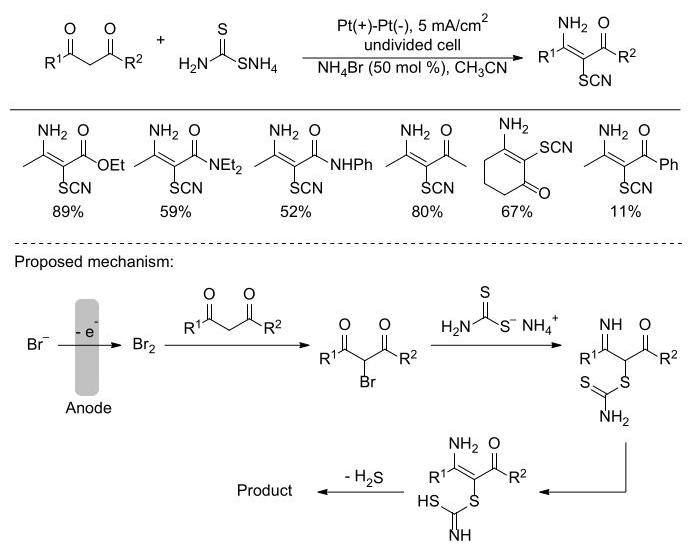
Scheme 29. Electrosynthesis of 3-amino-2-thiocyanato- $\alpha ,\beta$ -unsaturated carbonyl derivatives.
方案29. 3-氨基-2-硫氰酸根合-$\alpha ,\beta$ -不饱和羰基衍生物的电合成。
4. C-O bond formation via electrolysis of phosphonic acids
4. 通过膦酸电解形成C-O键
Compared with the electrolysis of carboxylic acids, the electrolysis of phosphonic acids received less attention. In 2018, Mo and co-workers reported an anodic oxidation/cyclization of 2- (aryl)arylphosphonic acid monoesters for ethoxy dibenzooxaphosphorin oxide synthesis (Scheme 30).[36] Similar with their previous work on the anodic oxidation/cyclization of 2- arylbenzonic acids, catalytic amount of NaOH was used in this work. This electrochemical reaction features transition-metal-, external oxidant- and electrolyte-free. The reaction proceeds at room temperature with hydrogen as the only byproduct. A phosphonic Kolbe oxidation initiated mechanism was proposed. In addition to $\mathrm{C} - \mathrm{O}$ bond formations via electrochemical transformations of carboxylic acids, the electrochemical N-acylation of carboxylic acids has also been reported recently.[37]
与羧酸的电解相比,膦酸的电解受到的关注较少。2018年,Mo及其同事报道了2-(芳基)芳基膦酸单酯的阳极氧化/环化反应以合成乙氧基二苯并氧杂磷杂环氧化物(方案30)。[36] 与他们之前关于2-芳基苯甲酸阳极氧化/环化的工作类似,这项工作中使用了催化量的NaOH。该电化学反应的特点是无过渡金属、无外部氧化剂和无电解质。反应在室温下进行,氢气是唯一的副产物。提出了一种膦酸Kolbe氧化引发机制。除了通过羧酸的电化学转化形成$\mathrm{C} - \mathrm{O}$键外,最近还报道了羧酸的电化学N-酰化反应。[37]
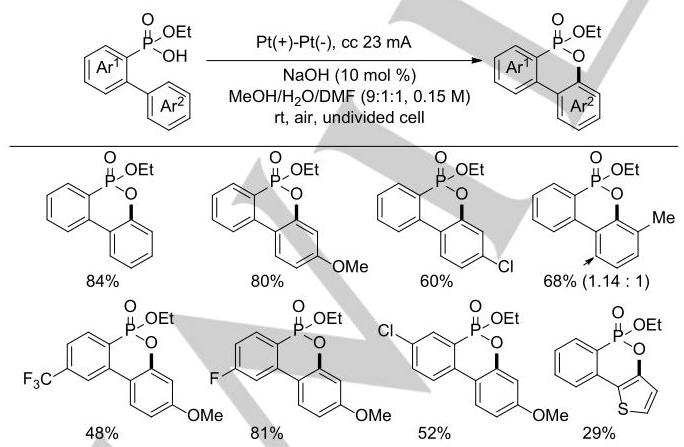
Scheme 30. Anodic oxidation/cyclization of 2-(aryl)arylphosphonic acid monoesters.
方案30. 2-(芳基)芳基膦酸单酯的阳极氧化/环化反应。
5. C-S bond formation or S-X (X = N, O, S, Se) bond formation via electrolysis of sulfinic acids
5. 通过亚磺酸电解形成C-S键或S-X(X = N、O、S、Se)键
5.1 C-S bond formation via electrolysis of sulfinic acids
5.1 通过亚磺酸电解形成碳-硫键
5.1.1 Synthesis of vinyl sulfones from sodium sulfinates
5.1.1 由亚磺酸钠合成乙烯基砜
In 2015, Yuan and co-workers reported an electrochemical method for the synthesis of vinyl sulfones from sodium sulfinates and olefins (Scheme 31). ${}^{\left\lbrack {38}\right\rbrack }$ With NaI as supporting electrolyte, the reaction can be performed under transition-metal- and external oxidant-free conditions. Apart from sodium phenylsulfinates, aliphatic sodium sulfinate like sodium methanesulfinate is also amenable.In a proposed mechanism, the in situ electrogenerated ${I}_{2}$ played an important role in this reaction. Additionally, a sulfonyl radical is proposed to be generated from the sulfonyl iodide intermediate. In 2018, in a report of a radical triggered migration reaction (vide infra, Scheme 38), ${}^{\left\lbrack {39}\right\rbrack }$ Han and co-workers reported an electrochemical synthesis of vinyl sulfone from 1,1-diphenylethylene and para-methylbenzenesulfinate without any mediators (Scheme 32).
2015年,Yuan及其同事报道了一种由亚磺酸钠和烯烃合成乙烯基砜的电化学方法(方案31)。${}^{\left\lbrack {38}\right\rbrack }$ 以NaI作为支持电解质,该反应可以在无过渡金属和外部氧化剂的条件下进行。除苯亚磺酸钠外,脂肪族亚磺酸钠如甲亚磺酸钠也是适用的。在一个提出的机理中,原位电生成的${I}_{2}$ 在该反应中起重要作用。此外,有人提出磺酰基碘中间体可生成一个磺酰基自由基。2018年,在一篇关于自由基引发的迁移反应的报告中(见下文,方案38),${}^{\left\lbrack {39}\right\rbrack }$ Han及其同事报道了在没有任何介质的情况下,由1,1 - 二苯乙烯和对甲基苯亚磺酸钠电化学合成乙烯基砜(方案32)。
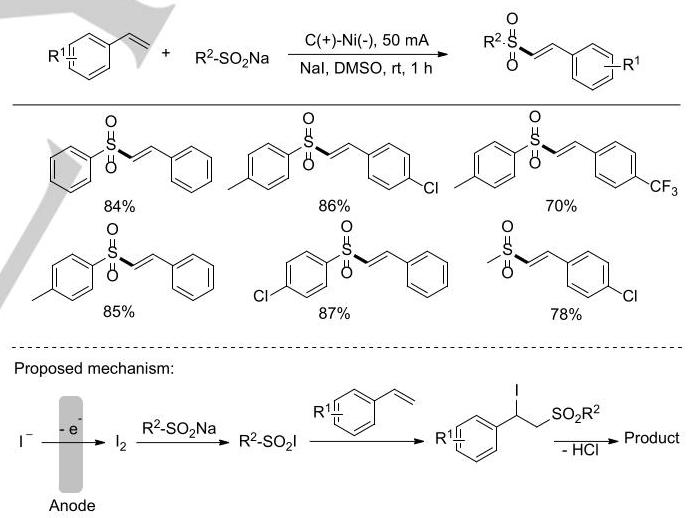
Scheme 31. Electrochemical synthesis of vinyl sulfones from sodium sulfinates and olefins.
方案31. 由亚磺酸钠和烯烃电化学合成乙烯基砜。
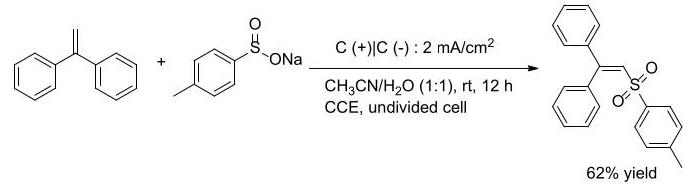
Scheme 32. Electrochemical synthesis of vinyl sulfone from 1,1- diphenylethylene and para-methylbenzenesulfinate.
方案32. 由1,1 - 二苯乙烯和对甲基苯亚磺酸钠电化学合成乙烯基砜。
REVIEW
综述
In 2016, Wang, Zha and co-workers developed an electrochemical synthesis of (E)-vinyl sulfones from cinnamic acids and sodium sulfinates via decarboxylative sulfono functionalization (Scheme 33). ${}^{\left\lbrack {40}\right\rbrack }$ Both electronic effect and steric effect of substituents for cinnamic acids and sodium sulfinates were observed in this reaction. Aliphatic sodium sulfinates (e.g., sodium methanesulfinate and sodium trifluoromethanesulfinate) are not compatible substrates. When styrene was employed as the coupling partner instead of cinnamic acid under the standard conditions of this decarboxylative sulfono functionalization, only a trace amount of vinyl sulfone was obtained. A sulfonyl radical-triggered mechanism was proposed.
2016年,Wang、Zha及其同事通过脱羧磺酰基官能化反应,由肉桂酸和亚磺酸钠开发了一种电化学合成(E)-乙烯基砜的方法(方案33)。${}^{\left\lbrack {40}\right\rbrack }$ 在该反应中观察到了肉桂酸和亚磺酸钠取代基的电子效应和空间效应。脂肪族亚磺酸钠(如甲亚磺酸钠和三氟甲亚磺酸钠)不是合适的底物。在该脱羧磺酰基官能化反应的标准条件下,当使用苯乙烯代替肉桂酸作为偶联伙伴时,仅获得痕量的乙烯基砜。提出了一种磺酰基自由基引发的机理。
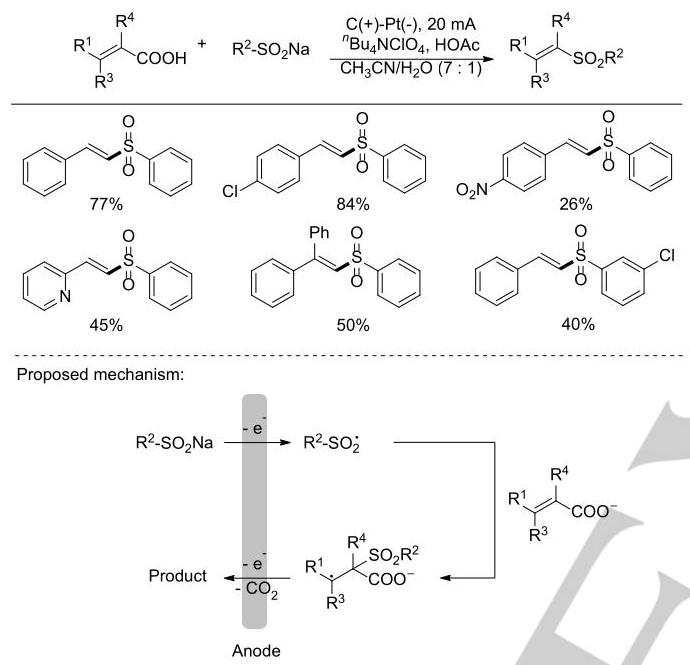
Scheme 33. Electrochemical synthesis of $\left( E\right)$ -vinyl sulfones from cinnamic acids and sodium sulfinates.
方案33. 由肉桂酸和亚磺酸钠电化学合成$\left( E\right)$ -乙烯基砜。
5.1.2 Synthesis of $\beta$ -keto sulfones from sulfinates and 1,3- dicarbonyl compounds
5.1.2 由亚磺酸盐和1,3 - 二羰基化合物合成$\beta$ - 酮砜
In 2015, Yuan and co-workers reported an efficient electrochemical synthesis of $\beta$ -ketosulfones from sodium sulfinates and 1,3-dicarbonyl compounds with ${\mathrm{{NH}}}_{4}\mathrm{I}$ as the supporting electrolyte (Scheme 34). ${}^{\left\lbrack {41}\right\rbrack }$ Notably, C-C bond cleavage occurs in this transformation. lodide salts are necessary for this reaction since no desired product was obtained with ${\mathrm{{NH}}}_{4}\mathrm{{OAc}}$ as the supporting electrolyte. The authors proposed that the in situ electrogenerated ${\mathrm{I}}_{2}$ plays an important role and the iodinated 1,3-dicarbonyl compound serves as the key intermediate in this reaction.
2015年,Yuan及其同事报道了以${\mathrm{{NH}}}_{4}\mathrm{I}$为支持电解质,由亚磺酸钠和1,3 - 二羰基化合物高效电化学合成$\beta$ - 酮砜(方案34)。${}^{\left\lbrack {41}\right\rbrack }$值得注意的是,在此转化过程中发生了C - C键断裂。碘盐对于该反应是必需的,因为以${\mathrm{{NH}}}_{4}\mathrm{{OAc}}$作为支持电解质时未得到所需产物。作者提出原位电生成的${\mathrm{I}}_{2}$起重要作用,且碘化的1,3 - 二羰基化合物是该反应的关键中间体。
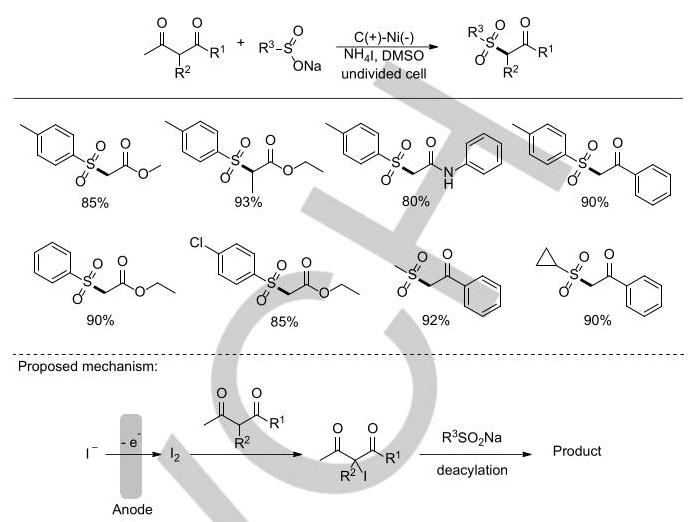
Scheme 34. Electrochemical synthesis of $\beta$ -ketosulfones from sodium sulfinates and 1,3-dicarbonyl compounds.
方案34. 由亚磺酸钠和1,3 - 二羰基化合物电化学合成$\beta$ - 酮砜。
5.1.3 Difunctionalization of alkenes or alkynes via electrolysis of sulfinic acids
5.1.3 通过亚磺酸电解实现烯烃或炔烃的双官能团化
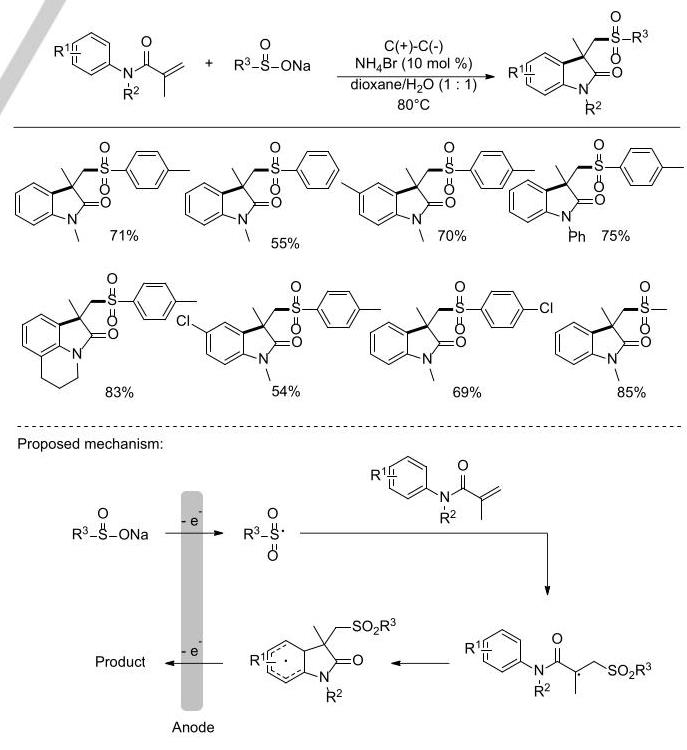
In 2016, Zeng and co-workers developed an efficient electrochemical cyclization method for synthesis of 3- sulfonyloxindoles via difunctionalization of acrylamide from electrolysis of a mixture of sodium sulfinates and acrylamide under transition-metal- and external chemical oxidant-free conditions (Scheme 35). ${}^{\left\lbrack {42}\right\rbrack }$ A catalytic amount of ${\mathrm{{NH}}}_{4}\mathrm{{Br}}$ is employed as a redox catalyst and no supporting electrolyte is required. Mechanistically, it is proposed that sulfonyl radical generated from sulfonyl bromide serves as a key intermediate in this reaction.
2016年,曾及其同事开发了一种高效的电化学环化方法,用于在无过渡金属和外部化学氧化剂的条件下,通过亚磺酸钠和丙烯酰胺混合物的电解,对丙烯酰胺进行双官能团化反应来合成3-磺酰基氧化吲哚(方案35)。${}^{\left\lbrack {42}\right\rbrack }$ 使用催化量的${\mathrm{{NH}}}_{4}\mathrm{{Br}}$ 作为氧化还原催化剂,无需支持电解质。从机理上讲,该反应中由磺酰溴产生的磺酰基自由基被认为是关键中间体。
REVIEW
综述
Scheme 35. Electrochemical cyclization method for the synthesis of 3- sulfonyloxindoles.
方案35. 合成3-磺酰基氧化吲哚的电化学环化方法。
In 2017, Chang and co-workers reported an efficient organic electrosynthesis of tertiary $\beta$ -hydroxysulfones from functionalized $\alpha$ -methylstyrenes with substituted sodium sulfinates (Scheme 36). ${}^{\left\lbrack {43}\right\rbrack }$ With KI as supporting electrolyte, a mixture of acetonitrile and water as solvent, the desired product can be obtained in 85- 96% yields under constant potential electrolysis. Sulfonyl radical generated from sulfonyl iodide added to the double bond of $\alpha$ - methylstyrene furnishing a benzylic radical, followed by loss of one electron to form the stable tertiary carbocation. With the hydration of carbocation, the desired product was produced. Notably, the simple styrene is also amenable to this transformation.
2017年,张及其同事报道了一种高效的有机电合成方法,用于从官能化的$\alpha$ -甲基苯乙烯与取代的亚磺酸钠合成叔$\beta$ -羟基砜(方案36)。${}^{\left\lbrack {43}\right\rbrack }$ 以KI作为支持电解质,乙腈和水的混合物作为溶剂,在恒电位电解条件下,所需产物的产率可达85 - 96%。由磺酰碘产生的磺酰基自由基加成到$\alpha$ -甲基苯乙烯的双键上,生成苄基自由基,然后失去一个电子形成稳定的叔碳正离子。随着碳正离子的水合作用,生成了所需产物。值得注意的是,简单的苯乙烯也适用于这种转化。
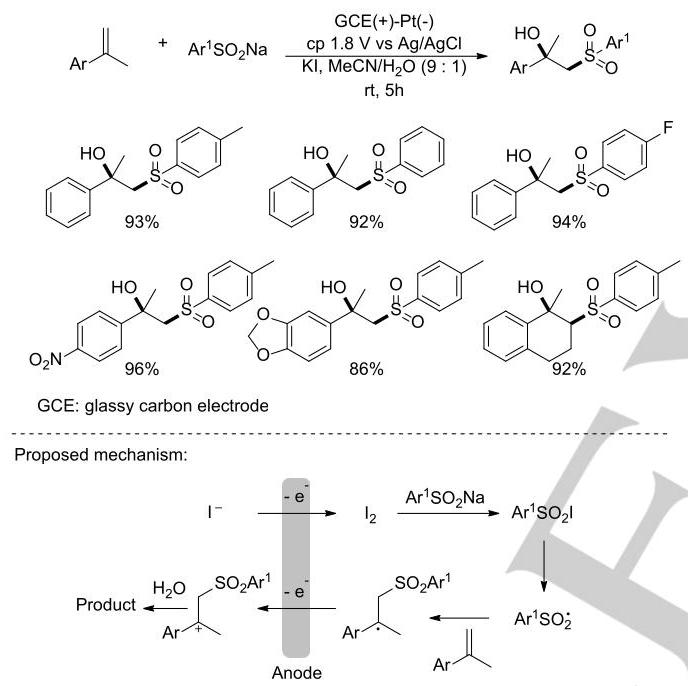
Scheme 36. Electrosynthesis of tertiary $\beta$ -hydroxysulfones.
方案36. 叔$\beta$ -羟基砜的电合成。
In 2019, Li and co-workers reported an electrochemical intermolecular 1,2-aminosulfonylation of alkenes with sulfinates and amines without the need of additive redox catalysts, metal catalysts and chemical oxidants (Scheme 37).[44] While arylalkenes were viable substrates in this reaction, aliphatic alkene had no reactivity. This protocol was applicable to both arylsulfinates and alkylsulfinates. A wide range of primary and secondary amines can undergo the aminosulfonylation reaction. A sulfonyl radical-involved mechanism was proposed. Amines serve as nucleophiles in this aminosulfonylation reaction.
2019年,李及其同事报道了一种电化学分子间反应,即烯烃与亚磺酸盐和胺进行1,2-氨基磺酰化反应,无需添加氧化还原催化剂、金属催化剂和化学氧化剂(方案37)。[44] 虽然芳基烯烃是该反应的可行底物,但脂肪族烯烃没有反应活性。该方法适用于芳基亚磺酸盐和烷基亚磺酸盐。多种伯胺和仲胺都能进行氨基磺酰化反应。他们提出了一种涉及磺酰基自由基的机理。在该氨基磺酰化反应中,胺作为亲核试剂。
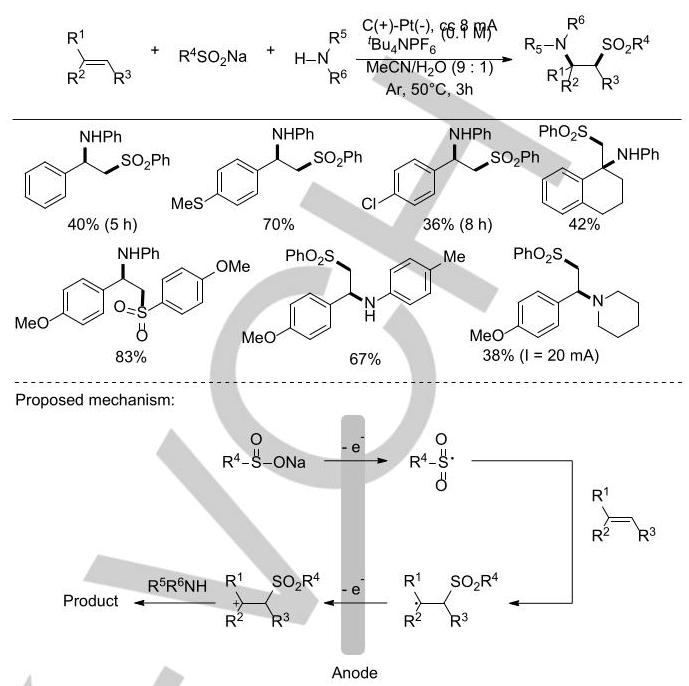
Scheme 37. Electrochemical three-component 1,2-aminosulfonylation of alkenes.
方案37. 烯烃的电化学三组分1,2-氨基磺酰化反应。
In 2018, Han and co-workers reported an electrochemical 1,2- sulfonylation/alkynylation of alkenes via radical 1,4-alkynyl migration of alkynyl-substituted tertiary alcohols (Scheme 38). ${}^{\left\lbrack {39}\right\rbrack }$ Aryl- and alkyl-substituted sodium sulfinates were used as sulfonyl source in this reaction. Apart from 1,4-alkynyl migration, 1,4-alkenyl migration was also demonstrated. The reaction proceeds smoothly in an undivided cell without the use of any metal catalyst, additive and external chemical oxidant. This reaction represents the first electrochemical distal radical migration reaction. A possible mechanism was proposed. Anodic oxidation of sodium sulfinate gives the oxygen-centered radical, which resonates to the more stable sulfonyl radical. The sulfonyl radical adds to the terminal position of the alkene to give a radical, followed by a 1,4-alkynyl migration.
2018年,韩及其同事报道了一种电化学方法,通过炔基取代的叔醇的自由基1,4-炔基迁移实现烯烃的1,2-磺酰化/炔基化反应(方案38)。${}^{\left\lbrack {39}\right\rbrack }$ 在该反应中,芳基和烷基取代的亚磺酸钠用作磺酰基源。除了1,4-炔基迁移外,还证明了1,4-烯基迁移。该反应在无隔膜电解池中顺利进行,无需使用任何金属催化剂、添加剂和外部化学氧化剂。该反应代表了首例电化学远程自由基迁移反应。他们提出了一种可能的机理。亚磺酸钠在阳极氧化生成以氧为中心的自由基,该自由基共振转化为更稳定的磺酰基自由基。磺酰基自由基加成到烯烃的末端位置生成一个自由基,随后发生1,4-炔基迁移。
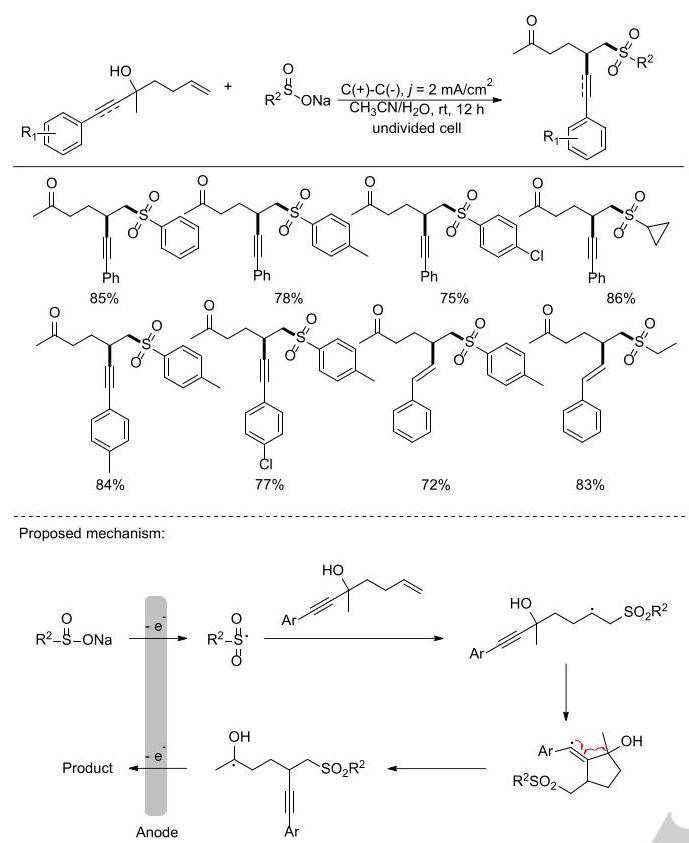
Scheme 38. Electrochemical 1,2-sulfonylation/alkynylation of alkenes via radical 1,4-alkynyl migration.
方案38. 通过自由基1,4-炔基迁移实现烯烃的电化学1,2-磺酰化/炔基化反应。
In the same year, Guo and co-workers reported an electrochemical sulfonylation/heteroarylation of alkenes with sulfinic acids via distal heteroaryl ipso-migration (Scheme 39). ${}^{\left\lbrack {45}\right\rbrack }$ Various sulfonated functionalized heteroarenes were prepared in an undivided cell, avoiding the use of any metal catalysts, additives and external chemical oxidants. A sulfonyl radical-initiated mechanism similar with that of Han and co-workers was proposed. ${}^{\left\lbrack {39}\right\rbrack }$
同年,郭及其同事报道了一种电化学方法,通过远程杂芳基本位迁移实现烯烃与亚磺酸的磺酰化/杂芳基化反应(方案39)。${}^{\left\lbrack {45}\right\rbrack }$ 在无隔膜电解池中制备了各种磺化官能化杂芳烃,避免了使用任何金属催化剂、添加剂和外部化学氧化剂。他们提出了一种与韩及其同事类似的由磺酰基自由基引发的机理。${}^{\left\lbrack {39}\right\rbrack }$
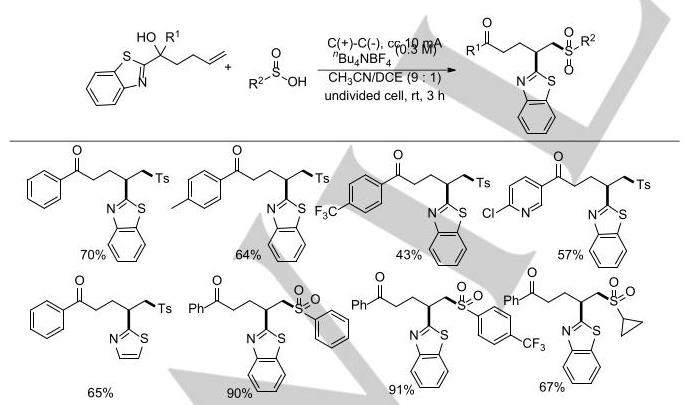
Scheme 39. Electrochemical sulfonylation/heteroarylation of alkenes with sulfinic acids.
方案39. 烯烃与亚磺酸的电化学磺酰化/杂芳基化反应。
In 2019, Zhang and co-workers reported the electrochemical sulfonylation/semipinacol rearrangement of allylic alcohols using sodium arylsulfinates as reagents (Scheme 40).[46] All-carbon quaternary stereocenters were constructed by utilizing this strategy. It’s possible that the sulfonyl radical initiates this difunctionalization of alkenes and the radical adduct might be oxidized to carbocation, which subsequently undergo a cationic 1,2-rearrangement process. Stoichiometric oxidants and transition-metal catalysts were not required in this protocol.
2019年,Zhang及其同事报道了使用芳基亚磺酸钠作为试剂对烯丙醇进行电化学磺酰化/半频哪醇重排反应(方案40)。[46] 利用该策略构建了全碳季碳立体中心。磺酰基自由基可能引发了烯烃的这种双官能化反应,自由基加合物可能被氧化为碳正离子,随后经历阳离子1,2-重排过程。该反应无需化学计量的氧化剂和过渡金属催化剂。
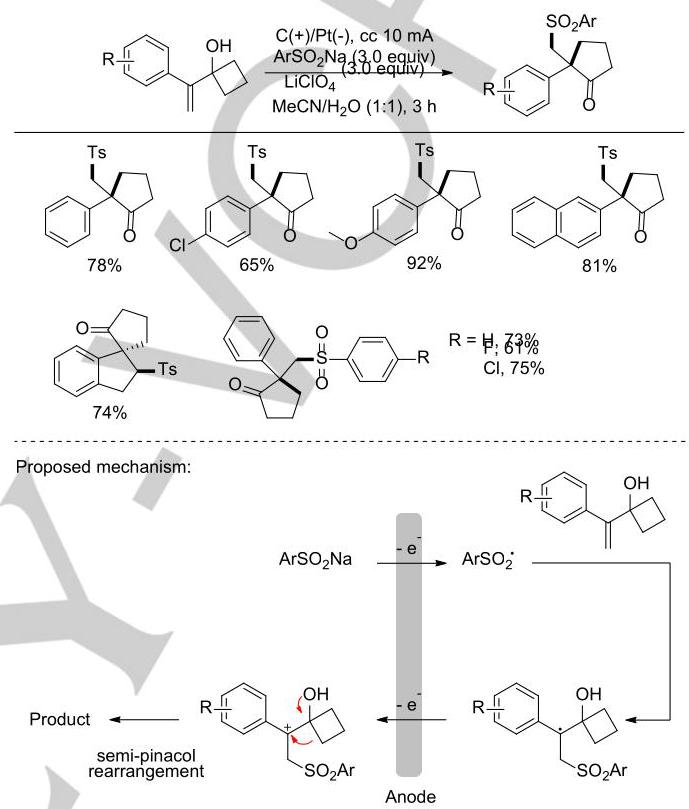
Scheme 40. Electrochemical sulfonylation/semipinacol rearrangement of allylic alcohols.
方案40. 烯丙醇的电化学磺酰化/半频哪醇重排反应。
In 2017, Lei and co-workers developed an efficient electrochemical arylsulfonylation reaction of ynones with sulfinic acids under external chemical oxidant-free conditions (Scheme 41). ${}^{\left\lbrack {47}\right\rbrack }$ A series of sulfonatedindenones could be obtained with tetrabutylammonium iodide (TBAI) as redox catalyst. A sulfonyl radical-initiated tandem reaction mechanism was proposed. Notably, a similar arylsulfonylation product was obtained when the chalcone was used as the substrate to react with benzenesulfinic acid under the electrooxidation conditions.
2017年,Lei及其同事在无外部化学氧化剂的条件下开发了一种有效的电化学炔酮与亚磺酸的芳基磺酰化反应(方案41)。${}^{\left\lbrack {47}\right\rbrack }$ 以四丁基碘化铵(TBAI)作为氧化还原催化剂,可以得到一系列磺化茚酮。提出了一种磺酰基自由基引发的串联反应机理。值得注意的是, 在电氧化条件下,当使用查耳酮作为底物与苯亚磺酸反应时,也得到了类似的芳基磺酰化产物。
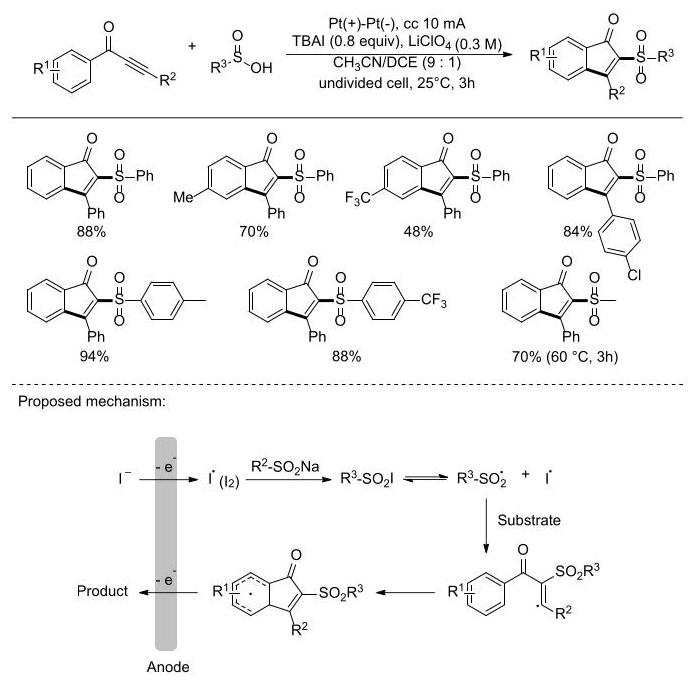
Scheme 41. Electrochemical arylsulfonylation reaction of ynones with sulfinic acids.
方案41. 炔酮与亚磺酸的电化学芳基磺酰化反应。
5.1.4 Arylation of sulfinic acids via electrolysis of sulfinic acids
5.1.4 通过亚磺酸电解实现亚磺酸的芳基化
Electrochemical arylation of sulfinic acids is an important method for the synthesis of arylsulfones. Electrogeneration of phenoquinone and its analogues as electrophiles is a popular strategy for the arylation of sulfinic acids. ${}^{\left\lbrack {48}\right\rbrack }$ Besides, in 2017, Yu and co-workers reported an electrochemical α-sulfonylation of $1\mathrm{H}$ -indoles with sodium sulfinates by using a catalytic amount of TBAI. ${}^{\left\lbrack {49}\right\rbrack }$ As Baran and Waldvogel has summarized part of this field in their reviews, ${}^{\left\lbrack 1a,1b\right\rbrack }$ we will only focus on some representative advances in recent years and not reiterate the same contents here. Notably, for some cases not only C-S bonds but also S-N bonds are constructed in sequential reactions. We will discuss these cases in a following part (see 5.3).
亚磺酸的电化学芳基化是合成芳基砜的重要方法。电生成苯醌及其类似物作为亲电试剂是亚磺酸芳基化的常用策略。${}^{\left\lbrack {48}\right\rbrack }$ 此外,2017年,Yu及其同事报道了使用催化量的TBAI,通过亚磺酸钠对$1\mathrm{H}$ -吲哚进行电化学α-磺酰化反应。${}^{\left\lbrack {49}\right\rbrack }$ 由于Baran和Waldvogel在他们的综述中已经总结了该领域的部分内容,${}^{\left\lbrack 1a,1b\right\rbrack }$ 我们将只关注近年来一些有代表性的进展,在此不再赘述相同内容。值得注意的是,在一些情况下,不仅构建了C-S键而且在连续反应中还构建了S-N键。我们将在后续部分讨论这些情况(见5.3)。
In 2016, Nematollahi and co-workers reported the electrochemical synthesis of arylsulfonyl-4,4’-biphenol and bis-phenylsulfonyl-4,4’-biphenol derivatives via the electrochemical oxidation of 4,4’-biphenol in the presence of arylsulfinic acids as nucleophiles (Scheme 42). ${}^{\left\lbrack {48}\mathrm{a}\right\rbrack }$ Different products can be obtained depending on electrode potential.
2016年,Nematollahi及其同事报道了在作为亲核试剂的亚磺酸存在下,通过对4,4’-联苯酚进行电化学氧化,电化学合成芳基磺酰基-4,4’-联苯酚和双苯基磺酰基-4,4’-联苯酚衍生物(方案42)。${}^{\left\lbrack {48}\mathrm{a}\right\rbrack }$ 根据电极电位的不同,可以得到不同的产物。
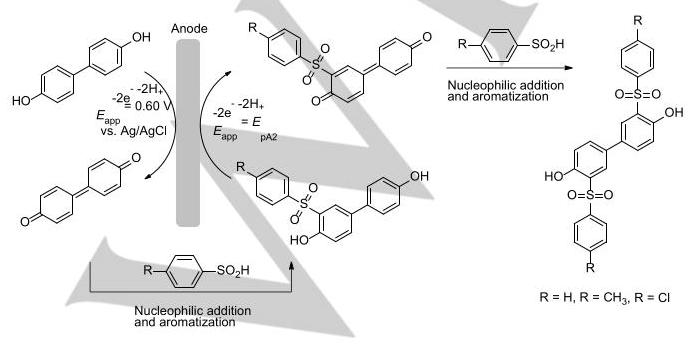
Scheme 42. Electrochemical synthesis of arylsulfonyl-4,4’-biphenol and bis-phenylsulfonyl-4,4’-biphenol derivatives.
方案42. 芳基磺酰基-4,4’-联苯酚和双苯基磺酰基-4,4’-联苯酚衍生物的电化学合成。
In 2017, Momeni and Nematollahi reported the convergent paired electrochemical synthesis of new aminonaphthol derivatives via oxidation (and reduction) of acid orange 7 in the presence of arylsulfinic acids as nucleophiles (Scheme 43). ${}^{\left\lbrack {48}b\right\rbrack }$ It’s proposed that the electrogenerated 1-iminonaphthalen-2(1H)-one participates in Michael addition reaction with arylsulfinic acids to form the 1-amino-3-(phenylsulfonyl)naphthalen-2-ol derivatives.
2017年,Momeni和Nematollahi报道了在作为亲核试剂存在的亚磺酸存在下,通过对酸性橙7进行氧化(和还原),收敛成对电化学合成新的氨基萘酚衍生物(方案43)。${}^{\left\lbrack {48}b\right\rbrack }$ 有人提出,电生成的1-亚氨基萘-2(1H)-酮与亚磺酸发生迈克尔加成反应,形成1-氨基-3-(苯基磺酰基)萘-2-醇衍生物。
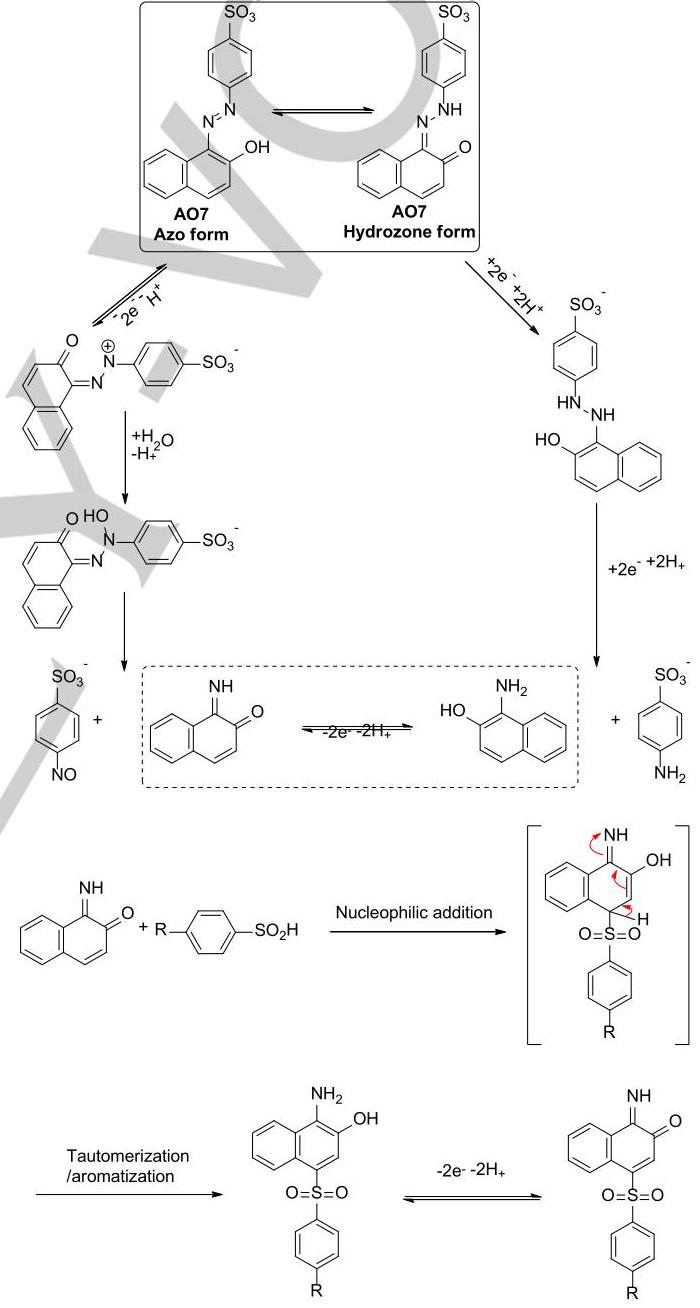
Scheme 43. Electrochemical synthesis of new aminonaphthol derivatives
方案43. 新的氨基萘酚衍生物的电化学合成
In 2019, Waldvogel and co-workers developed a novel electrochemical strategy for the synthesis of arylsulfones by direct sulfonylation of phenols with sodium sulfinates (Scheme 44). ${}^{\left\lbrack {50}\right\rbrack }$ In this method, the sulfinates are used both as supporting electrolytes and coupling components. Therefore, additional reagent waste is prevented. HFIP (1,1,1,3,3,3- hexafluoroisopropanol) might play a role of stabilizing radical intermediate. By adding water to the solvent, decomposition of the generated sulfones can be diminished, since hydrogen is preferably generated at the cathode. The following mechanism was proposed. Initially, a phenoxyl radical is formed via electrochemical oxidation of the phenol component. The phenoxyl radical is trapped by a nucleophilic attack from the sulfinate anion, which forms a C-S bond. The final product is furnished after a further anodic oxidation. The mechanistic assumption is supported by oxidation potential determinations, revealing the lower oxidation potentials of the phenol components in comparation with sulfinates.
2019年,Waldvogel及其同事开发了一种通过苯酚与亚磺酸钠直接磺酰化合成芳基砜的新型电化学策略(方案44)。${}^{\left\lbrack {50}\right\rbrack }$ 在该方法中,亚磺酸盐既用作支持电解质又用作偶联组分。因此,避免了额外的试剂浪费。HFIP(1,1,1,3,3,3-六氟异丙醇)可能起到稳定自由基中间体的作用。通过向溶剂中加水,可以减少生成的砜的分解,因为在阴极优先生成氢气。提出了以下机理。最初,通过苯酚组分的电化学氧化形成苯氧基自由基。苯氧基自由基受到亚磺酸根阴离子亲核攻击的捕获,形成C-S键。经过进一步的阳极氧化后得到最终产物。氧化电位测定支持了这一机理假设,结果表明与亚磺酸盐相比,苯酚组分的氧化电位较低。
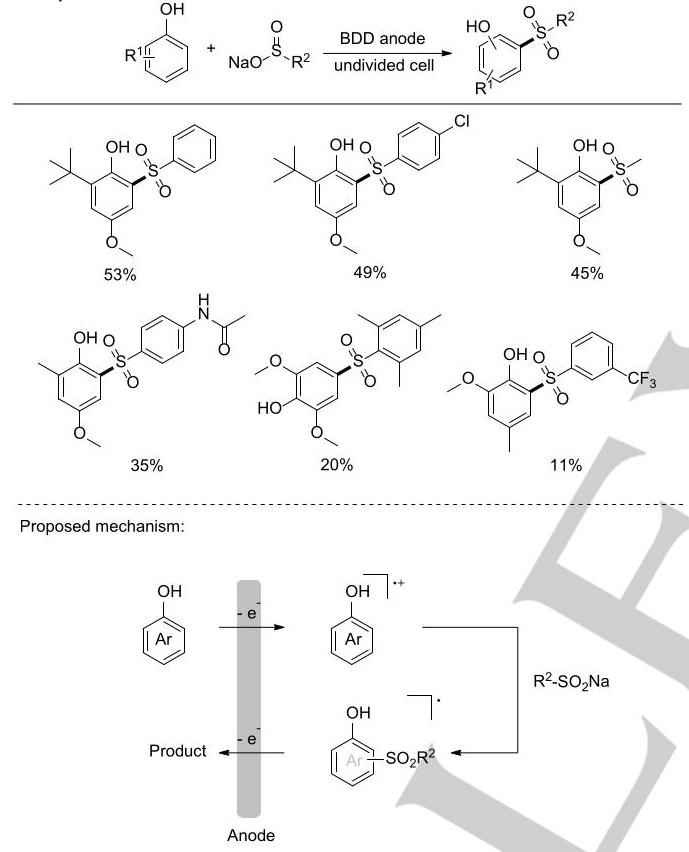
Scheme 44. Electrochemical synthesis of arylsulfones by direct sulfonylation of phenols with sodium sulfinates.
方案44. 通过苯酚与亚磺酸钠直接磺酰化电化学合成芳基砜。
5.2 S-X (X = N, O, S, Se) bond formation via electrolysis of sulfinic acids
5.2 通过亚磺酸电解形成S-X(X = N、O、S、Se)键
5.2.1 S-N bond formation via electrolysis of sulfinic acids
5.2.1 通过亚磺酸电解形成S-N键
The electrochemical approach has provided a complementary method to access sulfonamides. ${}^{\left\lbrack {51}\right\rbrack }$ In 2016, Zeng and co-workers reported an efficient electrochemical synthesis of sulfonamides via oxidative amination of sodium sulfinates mediated by ${\mathrm{{NH}}}_{4}\mathrm{I}$ as a redox catalyst (Scheme 45). ${}^{\left\lbrack {52}\right\rbrack }$ A wide range of substrates, including aliphatic or aromatic secondary and primary amines, as well as aqueous ammonia, proved to be compatible with this method. External oxidants or corrosive molecular iodine were avoided in this transformation. Later, Terent’ev[53] and Yuan[54] independently reported similar protocols. Notably, in Yuan’s report, with ${\mathrm{H}}_{2}\mathrm{O}$ as the solvent and $\mathrm{{NaI}}$ as the supporting electrolyte, the electrolyte solution could be reused up to 10 times without an obvious reduction in the yields.
电化学方法为合成磺酰胺提供了一种补充方法。${}^{\left\lbrack {51}\right\rbrack }$ 2016年,曾和他的同事报道了一种通过以${\mathrm{{NH}}}_{4}\mathrm{I}$作为氧化还原催化剂介导的亚磺酸钠氧化胺化反应高效电化学合成磺酰胺的方法(方案45)。${}^{\left\lbrack {52}\right\rbrack }$ 事实证明,包括脂肪族或芳香族仲胺和伯胺以及氨水在内的多种底物都与该方法兼容。该转化过程避免了使用外部氧化剂或腐蚀性分子碘。后来,特伦捷夫[53]和袁[54]分别独立报道了类似的方法。值得注意的是,在袁的报告中,以${\mathrm{H}}_{2}\mathrm{O}$为溶剂,以$\mathrm{{NaI}}$为支持电解质,电解液可重复使用多达10次,产率没有明显降低。
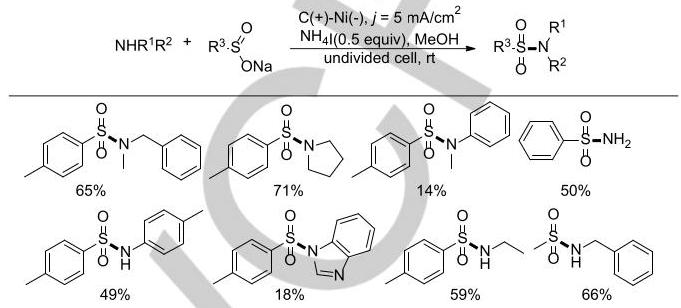
Scheme 45. Electrochemical oxidative amination of sodium sulfinates.
方案45. 亚磺酸钠的电化学氧化胺化反应。
Apart from using halide anions as redox catalyst, another important strategy in this field is the electrogeneration of nitrogen-centered electrophiles in the presence of sulfinic acids as nucleophiles. ${}^{\left\lbrack {55}\right\rbrack }$ We will highlight several most important advances employing this strategy below.
除了使用卤化物阴离子作为氧化还原催化剂外,该领域的另一个重要策略是在存在作为亲核试剂的亚磺酸的情况下电生成以氮为中心的亲电试剂。${}^{\left\lbrack {55}\right\rbrack }$ 我们将在下面重点介绍采用该策略的几个最重要的进展。
In 2012, Nematollahi and co-workers reported the electrochemical synthesis of some sulfonamide derivatives via the electrooxidation of 4-propyl and 4-butyl derivatives of urazole in the presence of arylsulfinic acids as nucleophiles (Scheme 46). ${}^{\left\lbrack {55}\mathrm{a}\right\rbrack }$ It’s proposed that electrogenerated 4-alkyl-4H-1,2,4- triazole-3,5-diones are attacked by arylsulfinic acids.
2012年,内马托拉希和他的同事报道了在存在芳基亚磺酸作为亲核试剂的情况下通过对4-丙基和4-丁基尿唑衍生物进行电氧化来电化学合成一些磺酰胺衍生物(方案46)。${}^{\left\lbrack {55}\mathrm{a}\right\rbrack }$ 有人认为电生成的4-烷基-4H-1,2,4-三唑-3,5-二酮会受到芳基亚磺酸的攻击。
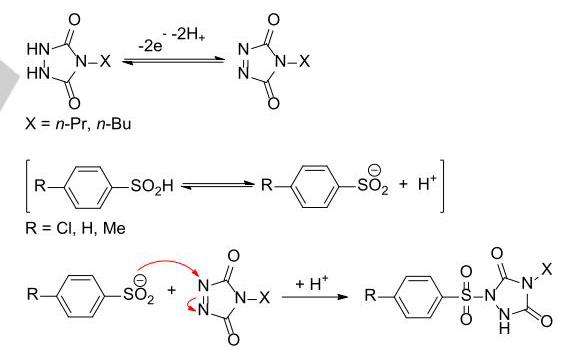
Scheme 46. Electrochemical oxidation of 4-substituted urazoles in the presence of arylsulfinic acids.
方案46. 在芳基亚磺酸存在下对4-取代尿唑的电化学氧化。
Furthermore, in 2017, Varmaghani and co-workers reported the electrochemical synthesis of two different series of sulfonamides using 4-(4-nitrophenyl)urazole and arylsulfinic acids as substrates by controlling the potential during electrolysis (Scheme 47). ${}^{\left\lbrack {55}b\right\rbrack }$ One series of sulfonamides were obtained via direct electrochemical oxidation of 4-(4-nitrophenyl)urazole in the presence of arylsulfinic acids and another one were obtained via a paired electrosynthesis. In addition, they also investigated the electrochemical oxidation of 4-cyclohexylurazole in the presence of arylsulfinic acids.
此外,2017年,瓦尔马加尼和他的同事报道了通过在电解过程中控制电位,以4-(4-硝基苯基)尿唑和芳基亚磺酸为底物电化学合成两种不同系列的磺酰胺(方案47)。${}^{\left\lbrack {55}b\right\rbrack }$ 一系列磺酰胺是通过在芳基亚磺酸存在下对4-(4-硝基苯基)尿唑进行直接电化学氧化得到的,另一系列是通过成对电合成得到的。此外,他们还研究了在芳基亚磺酸存在下对4-环己基尿唑的电化学氧化。
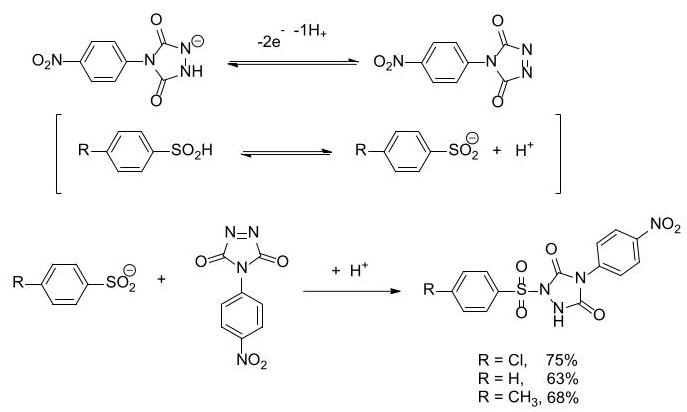
Scheme 47. Electrochemical synthesis of diverse sulfonamide derivatives.
方案47. 多种磺酰胺衍生物的电化学合成。
In 2015, Nematollahi and co-workers reported the synthesis of disulfonamide derivatives of N, N-dimethyl-1,4-benzenediamine by electrochemical oxidation of 4-nitroso-N, N-dimethylaniline in the presence of arylsulfinic acids as nucleophiles (Scheme 48). ${}^{\left\lbrack {55}\mathrm{c}\right\rbrack }$ Interestingly, $N$ -arylsulfonyl-3-arylsulfonyl derivatives were obtained by the chemical reaction of 4-nitroso-N, N-dimethylaniline with arylsulfinic acids.
2015年,内马托拉希和他的同事报道了在存在芳基亚磺酸作为亲核试剂的情况下通过对4-亚硝基-N, N-二甲基苯胺进行电化学氧化来合成N, N-二甲基-1,4-苯二胺的二磺酰胺衍生物(方案48)。${}^{\left\lbrack {55}\mathrm{c}\right\rbrack }$ 有趣的是,$N$ -芳基磺酰基-3-芳基磺酰基衍生物是通过4-亚硝基-N, N-二甲基苯胺与芳基亚磺酸的化学反应得到的。
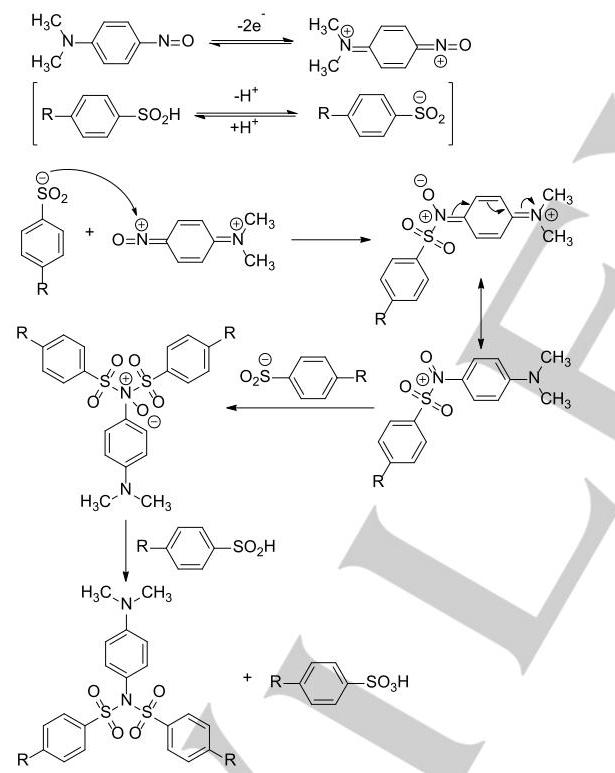
Scheme 48. Electrochemical oxidation of 4-nitroso- $N, N$ -dimethylaniline in the presence of arylsulfinic acids.
方案48. 在芳基亚磺酸存在下对4-亚硝基-$N, N$ -二甲基苯胺的电化学氧化。
In the same year, they also reported the synthesis of N-(4- (dimethylamino)phenyl)benzenesulfonamide via electrochemical reduction of 4-nitroso- $N, N$ -dimethylaniline with arylsulfinic acids as nucleophiles (Scheme 49). ${}^{\left\lbrack {55}\mathrm{\;d}\right\rbrack }$ This is the first report describing generation of Michael acceptor via electrochemical reduction. ${}^{\left\lbrack {55}e\right\rbrack }$
同年,他们还报道了以芳基亚磺酸作为亲核试剂通过对4-亚硝基-$N, N$ -二甲基苯胺进行电化学还原合成N-(4-(二甲氨基)phenyl)苯磺酰胺(方案49)。${}^{\left\lbrack {55}\mathrm{\;d}\right\rbrack }$ 这是第一篇描述通过电化学还原生成迈克尔受体的报告。${}^{\left\lbrack {55}e\right\rbrack }$
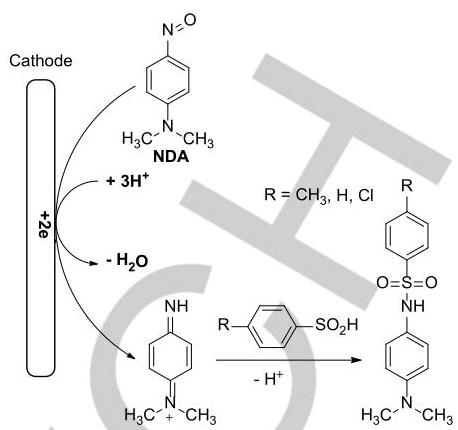
Scheme 49. Electrochemical reduction of 4-nitroso- $N, N$ -dimethylaniline with arylsulfinic acids.
方案49. 芳基亚磺酸对4-亚硝基-$N, N$-二甲基苯胺的电化学还原反应。
In 2018, Nematollahi and co-workers reported a paired electrochemical method for the synthesis of sulfonamides, diarylsulfones and bis(arylsulfonyl)aminophenols using nitrobenzene derivatives and arylsulfinic acids as starting materials (Scheme 50). ${}^{\left\lbrack {55}f\right\rbrack }$ For the electrochemical oxidation of nitrobenzene, $p$ -nitroaniline, and $p$ -nitrophenol in the presence of arylsulfinic acids, the products were sulfonamides, diarylsulfones and bis(arylsulfonyl)aminophenols, respectively. Therefore, the product selectivity was greatly influenced by the nature of the functional group.
2018年,Nematollahi及其同事报道了一种成对电化学方法,该方法以硝基苯衍生物和芳基亚磺酸为起始原料合成磺酰胺、二芳基砜和双(芳基磺酰基)氨基酚(方案50)。${}^{\left\lbrack {55}f\right\rbrack }$ 对于在芳基亚磺酸存在下硝基苯、$p$-硝基苯胺和$p$-硝基苯酚的电化学氧化反应,产物分别为磺酰胺、二芳基砜和双(芳基磺酰基)氨基酚。因此,产物选择性受官能团性质的影响很大。
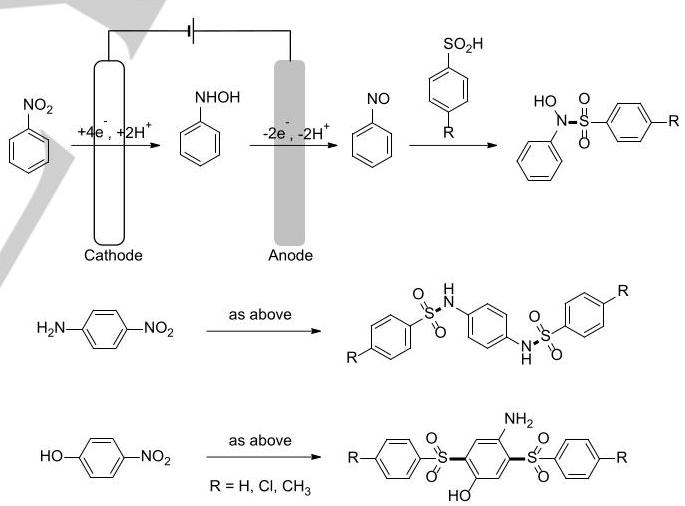
Scheme 50. Electrochemical synthesis of sulfonamides, diarylsulfones and bis(arylsulfonyl)aminophenols.
方案50. 磺酰胺、二芳基砜和双(芳基磺酰基)氨基酚的电化学合成。
5.2.2 S-O bond formation via electrolysis of sulfinic acids
5.2.2 通过亚磺酸电解形成S-O键
In 2019, Terent’ev and co-workers reported the electrochemical synthesis of sulfonates from sodium sulfinates and $N$ - hydroxysuccinimide (Scheme 51). ${}^{\left\lbrack {56}\right\rbrack }$ The yields were lower compared with sulfonylhydrazides as sulfonylation reagent. ${\mathrm{{NH}}}_{4}\mathrm{{Br}}$ serves as a supporting electrolyte in this reaction.
2019年,特伦捷夫及其同事报道了由亚磺酸钠和$N$-羟基琥珀酰亚胺电化学合成磺酸盐的方法(方案51)。${}^{\left\lbrack {56}\right\rbrack }$与作为磺酰化试剂的磺酰肼相比,产率较低。${\mathrm{{NH}}}_{4}\mathrm{{Br}}$在该反应中用作支持电解质。
REVIEW
综述
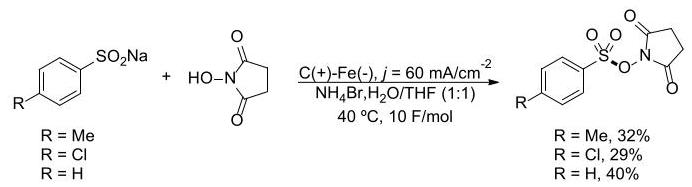
Scheme 51. Electrochemical synthesis of sulfonates from sodium sulfinates and $N$ -hydroxysuccinimide.
方案51. 由亚磺酸钠和$N$-羟基琥珀酰亚胺电化学合成磺酸盐。
5.2.3 S-S/S-Se bond formation via electrolysis of sulfinic acids
5.2.3 通过亚磺酸电解形成S-S/S-Se键
In 2019, Sun and co-workers reported the electrochemical oxidative cross-coupling of arylsulfinic acids with thiophenols, providing unsymmetrical thiosulfonates in good to excellent yields (Scheme 52). ${}^{\left\lbrack {57}\right\rbrack }$ The reactions of arylsulfinic acids with disulfides or diselenides were also practical under similar conditions to afford thiosulfonates or selenosulfonates. External oxidants or redox catalysts were not required in these reactions.
2019年,Sun及其同事报道了芳基亚磺酸与苯硫酚的电化学氧化交叉偶联反应,以良好至优异的产率提供不对称硫代磺酸酯(方案52)。${}^{\left\lbrack {57}\right\rbrack }$ 在类似条件下,芳基亚磺酸与二硫化物或二硒化物的反应也能实际进行,得到硫代磺酸酯或硒代磺酸酯。这些反应不需要外部氧化剂或氧化还原催化剂。
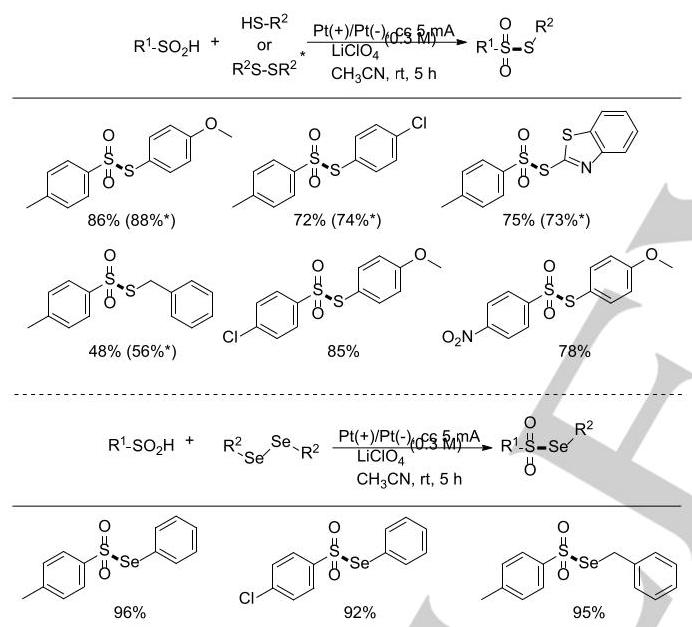
Scheme 52. Electrochemical oxidative cross-coupling of arylsulfinic acids with thiophenols.
方案52. 芳基亚磺酸与苯硫酚的电化学氧化交叉偶联反应。
5.3 Sequential C-S and S-N bond formation via electrolysis of sulfinic acids
5.3 通过亚磺酸电解实现顺序C-S和S-N键的形成
Electrochemical sequential C-S and S-N bond formation can be realized with the electrogeneration of electrophiles possessing both carbon- and nitrogen-centered electrophilic positions such as $p$ -methylquinoneimine in the presence of sulfinic acids as nucleophiles. ${}^{\left\lbrack {58}\right\rbrack }$
在作为亲核试剂的亚磺酸存在下,通过电生成具有碳中心和亲氮中心亲电位置的亲电试剂,如$p$-甲基醌亚胺,可实现电化学顺序C-S和S-N键的形成。${}^{\left\lbrack {58}\right\rbrack }$
In 2017, Nematollahi and co-workers reported the synthesis of sulfonyl derivatives of $p$ -methylaminophenol by reaction of the electrogenerated $p$ -methylquinoneimine with sulfinic acids. Some mono and bis (or tris)sulfonyl- $p$ -(methylamino)phenol derivatives were obtained by changing the applied potential (Scheme 53). ${}^{\left\lbrack {58}\mathrm{a}\right\rbrack }$ This method doesn’t deal with organic solvent and strong acid/base. For the synthesis of mono or bissulfonyl-p- (methylamino)phenol derivatives, only C-S bond was forged. For the synthesis of trissulfonyl- $p$ -(methylamino)phenol derivative, both C-S and S-N bonds were constructed.
2017年,Nematollahi及其同事报道了通过电生成的$p$-甲基醌亚胺与亚磺酸反应合成$p$-甲基氨基酚的磺酰基衍生物。通过改变施加的电位,得到了一些单和双(或三)磺酰基-$p$-(甲基氨基)苯酚衍生物(方案53)。${}^{\left\lbrack {58}\mathrm{a}\right\rbrack }$该方法不涉及有机溶剂和强酸/碱。对于单或双磺酰基对(甲基氨基)苯酚衍生物的合成,仅形成了C-S键。对于三磺酰基-$p$-(甲基氨基)苯酚衍生物的合成,构建了C-S和S-N键。
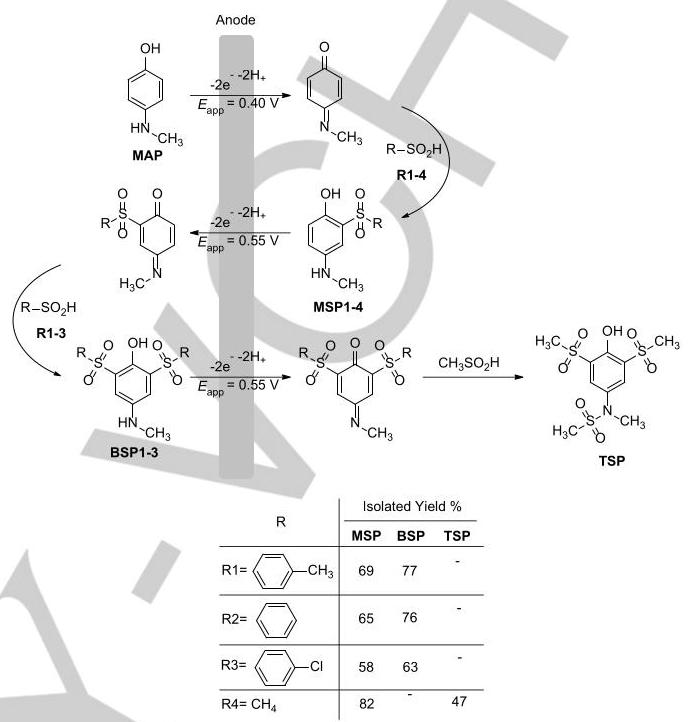
Scheme 53. Synthesis of sulfone derivatives of $p$ -methylaminophenol.
方案53. $p$-甲基氨基酚的砜衍生物的合成。
In 2018, Momeni and Nematollahi reported the electrochemical synthesis of new quinonesulfonimide derivatives by the oxidation of 4-aminophenyl ether in the presence of arylsulfinic acids in both electrochemical conventional batch and flow cells (Scheme 54). ${}^{\left\lbrack {58}b\right\rbrack }$ No use of a supporting electrolyte is an important advantage for electrochemical flow cell compared with the conventional batch cell.
2018年,Momeni和Nematollahi报道了在电化学常规间歇式和流通池中,在芳基亚磺酸存在下,通过氧化4-氨基苯醚电化学合成新的醌磺酰亚胺衍生物(方案54)。${}^{\left\lbrack {58}b\right\rbrack }$与传统间歇式电池相比,不使用支持电解质是电化学流通池的一个重要优点。
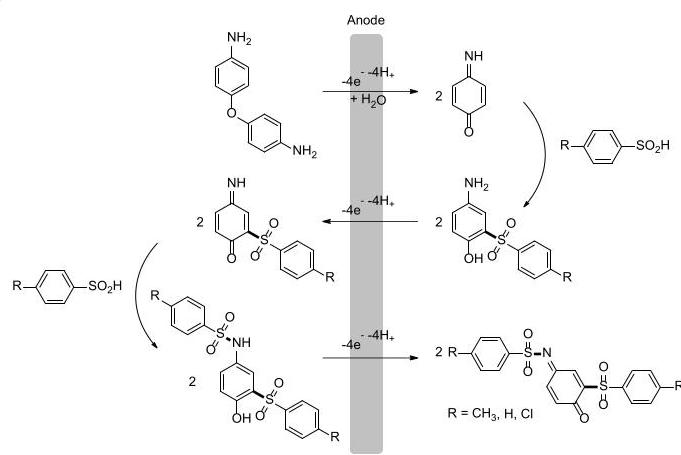
Scheme 54. Electrochemical synthesis of quinone sulfonimide derivatives.
方案54. 醌磺酰亚胺衍生物的电化学合成。
In 2019, Nematollahi and co-workers reported a tunable pair electrochemical synthesis of benzenesulfonamide derivatives by using reductive controlled potential electrolysis of dinitrobenzene in the presence of arylsulfinic acids (Scheme 55). ${}^{\left\lbrack {58}\mathrm{c}\right\rbrack }$ By adjusting
2019年,Nematollahi及其同事报道了在芳基亚磺酸存在下,通过对二硝基苯进行还原控制电位电解,可调谐地成对电化学合成苯磺酰胺衍生物(方案55)。${}^{\left\lbrack {58}\mathrm{c}\right\rbrack }$通过调节
the potential, $N$ -hydroxy- $N$ -(4-nitrophenyl)benzenesulfonamide derivatives and N-(4-amino-3- (phenylsulfonyl)phenyl)benzenesulfonamide derivatives could be selectively obtained.
电位,可以选择性地获得$N$-羟基-$N$-(4-硝基苯基)苯磺酰胺衍生物和N-(4-氨基-3-(苯基磺酰基)苯基)苯磺酰胺衍生物。
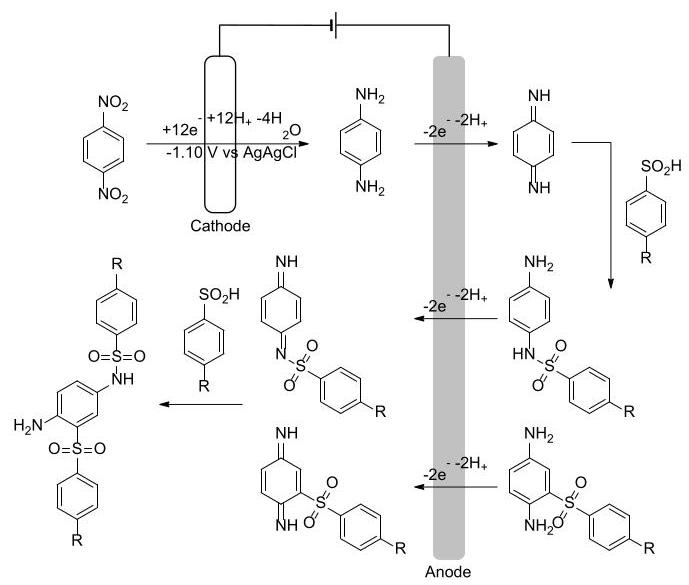
Scheme 55. Electrochemical synthesis of benzenesulfonamide derivatives.
方案55. 苯磺酰胺衍生物的电化学合成。
6. C-O bond formation via electrolysis of sulfonates
6. 通过磺酸盐电解形成C-O键
One of the most important applications of electrolysis of sulfonates lies in the electrochemical glycosylation. Using triflate anions as nucleophiles in the presence of glycosylcation pools furnished a-glycosyltriflates selectively. The OTf group can be displaced by an alcohol to construct a $\beta$ -selective glycosyl linkage. As this field has been discussed by other reviews, ${}^{\left\lbrack 1a,{59}\right\rbrack }$ we will not reiterate in depth here.
磺酸盐电解最重要的应用之一在于电化学糖基化。在糖基化反应体系中使用三氟甲磺酸根阴离子作为亲核试剂可选择性地生成α-糖基三氟甲磺酸酯。OTf基团可被醇取代以构建$\beta$选择性糖基键。由于该领域已在其他综述中讨论过,${}^{\left\lbrack 1a,{59}\right\rbrack }$我们在此不再深入赘述。
In 2019, Waldvogel and co-workers developed the first electrochemical protocol for the direct synthesis of aryl mesylates by dehydrogenative coupling (Scheme 56). ${}^{\left\lbrack {60}\right\rbrack }$ In order to trap the anodically generated radical cations efficiently, tetrabutylammonium methanesulfonate $\left( {{\mathrm{{Bu}}}_{4}{\mathrm{{NCH}}}_{3}{\mathrm{{SO}}}_{3}}\right)$ in acetonitrile was used as a supporting electrolyte to ensure a sufficient concentration of the nucleophile methanesulfonate. The formation of regioisomeric products was observed in some cases. In the case of biphenyl, the corresponding dimesylated product could be isolated. In addition, anodic formation of aryl benzenesulfonates was also successfully performed.
2019年,Waldvogel及其同事开发了首个通过脱氢偶联直接合成芳基甲磺酸酯的电化学方法(方案56)。${}^{\left\lbrack {60}\right\rbrack }$为了有效捕获阳极生成的自由基阳离子,使用乙腈中的甲磺酸四丁铵$\left( {{\mathrm{{Bu}}}_{4}{\mathrm{{NCH}}}_{3}{\mathrm{{SO}}}_{3}}\right)$作为支持电解质以确保亲核试剂甲磺酸根有足够的浓度。在某些情况下观察到了区域异构体产物的形成。对于联苯,可以分离出相应的二甲磺酸化产物。此外,芳基苯磺酸酯的阳极形成也成功实现。
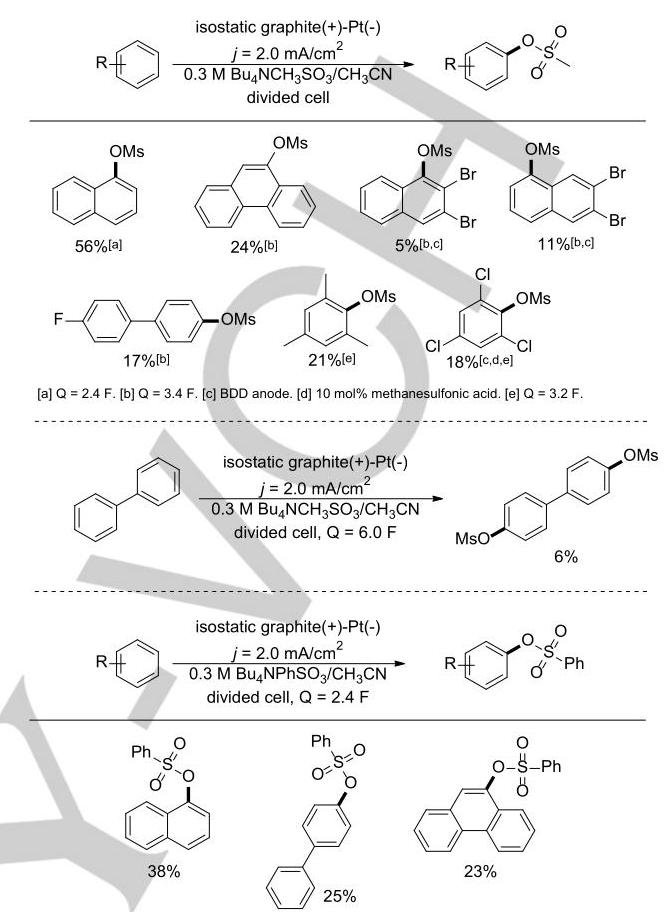
Scheme 56. Anodic formation of aryl mesylates through dehydrogenative coupling reaction.
方案56. 通过脱氢偶联反应阳极形成芳基甲磺酸酯。
7. Conclusion
7. 结论
In conclusion, electrolysis of organic acids has gained increasing attention in recent years and impressive advances have been achieved. Despite the well-known decarboxylation possibility of carboxylates via anodic oxidation, a number of ester-forming reactions involving carboxylic acids have been reported. By employing electricity as the oxidant, many oxidative bond-forming reactions can be performed under external chemical oxidants-free conditions. Furthermore, transition-metal catalysts can also be obviated in many cases. Many challenging transformations including inert chemical bond functionalization and difunctionalization of alkenes/alkynes can be realized by using electrochemical methods. As for the design of the electrochemical reactions involving transformations of organic acids, it is not limited to anodic oxidation; cathodic reduction and paired electrolysis can also be considered. The most common roles of organic acids in these electrochemical reactions are radical precursors and nucleophiles. What’s more, the scalability of electrosynthesis has been demonstrated in many reactions. Notably, the selectivity of the electrochemical reactions can be finely tuned by several factors including the electrode potential, which represents a great advantage compared with other methods. Interestingly, the product selectivity of certain electrochemical reactions can be greatly influenced by the nature of the functional groups or different from conventional chemical reactions.
总之,近年来有机酸的电解受到了越来越多的关注,并取得了令人瞩目的进展。尽管羧酸盐通过阳极氧化发生脱羧反应是众所周知的可能性,但已经报道了许多涉及羧酸的成酯反应。通过使用电作为氧化剂,许多氧化成键反应可以在无外部化学氧化剂的条件下进行。此外,在许多情况下也可以避免使用过渡金属催化剂。通过电化学方法可以实现许多具有挑战性的转化,包括惰性化学键官能化以及烯烃/炔烃的双官能化。至于涉及有机酸转化的电化学反应设计,它不限于阳极氧化;阴极还原和成对电解也可以考虑。有机酸在这些电化学反应中最常见的作用是自由基前体和亲核试剂。此外,电合成的可扩展性已在许多反应中得到证明。值得注意的是,电化学反应的选择性可以通过包括电极电位在内的几个因素进行精细调节,这与其他方法相比是一个很大的优势。有趣的是,某些电化学反应的产物选择性会受到官能团性质很大的影响,或者与传统化学反应不同。
Several issues remain to be solved in the field of electrochemical functionalization of organic acidic groups. The substrate scope remains limited in some reactions. For some intramolecular reactions, it is challenging to develop the corresponding intermolecular version. There is still much room to develop in the field of inert chemical bond functionalization. For example, electrochemical reactions involving C-C bond cleavage are relatively rare. Furthermore, compared with the difunctionalization of alkenes, the difunctionalization of alkynes received less attention. As paired electrolysis can possess higher current efficiency than single anodic oxidation or cathodic reduction in theory, it is significant to develop practical paired electrolysis. It is expected that more kinds of mechanistically interesting protocols to be developed. Moreover, more detailed mechanistic studies should be undertaken to help our understanding of these electrochemical reactions. The enantioselective electrochemical transformations remain elusive. For indirect electrolysis, the loading of redox catalyst is large in some cases. As for the reaction solvents, green solvents such as water are favored for environmental reasons. As supporting electrolyte is required in most electrochemical reactions, it is important to reduce the amount of supporting electrolyte and develop effective recovery methods to save cost. At last, electrochemical flow reactions deserve more attention due to their unique advantages compared with batch reactions.
在有机酸基团的电化学官能化领域仍有几个问题有待解决。在某些反应中底物范围仍然有限。对于一些分子内反应,开发相应的分子间反应版本具有挑战性。在惰性化学键官能化领域仍有很大的发展空间。例如,涉及碳 - 碳键断裂的电化学反应相对较少。此外,与烯烃的双官能化相比,炔烃的双官能化受到的关注较少。由于成对电解理论上可以比单阳极氧化或阴极还原具有更高的电流效率,开发实用的成对电解具有重要意义。预计会开发出更多种具有有趣机理的方案。此外,应该进行更详细的机理研究以帮助我们理解这些电化学反应。对映选择性电化学反应仍然难以捉摸。对于间接电解,在某些情况下氧化还原催化剂的负载量很大。至于反应溶剂,出于环境原因,水等绿色溶剂更受青睐。由于大多数电化学反应都需要支持电解质,减少支持电解质的用量并开发有效的回收方法以节省成本很重要。最后,由于电化学流动反应与间歇反应相比具有独特优势,值得更多关注。
Acknowledgements ((optional))
致谢((可选))
This project is supported by National Natural Science Foundation of China (Grant 21772003). We also thank Peking University for a start-up fund. This work was also partially funded by the BHP-PKU CCUS project supported by BHP Billiton.
本项目得到中国国家自然科学基金(项目批准号21772003)的支持。我们也感谢北京大学提供的启动资金。本研究还得到必和必拓支持的必和必拓 - 北大碳捕集与封存项目的部分资助。
Keywords: Electrosynthesis • Organic acids • Carbon-heteroatom bond formation - Sulfur-heteroatom bond formation
关键词:电合成 • 有机酸 • 碳 - 杂原子键形成 - 硫 - 杂原子键形成
Oxidative coupling
氧化偶联
[1] a) M. Yan, Y. Kawamata, P. S. Baran, Chem. Rev. 2017, 117, 13230- 13319; b) S. R. Waldvogel, S. Lips, M. Selt, B. Riehl, C. J. Kampf, Chem. Rev. 2018, 118, 6706-6765; c) J.-i. Yoshida, K. Kataoka, R. Horcajada, A. Nagaki, Chem. Rev. 2008, 108, 2265-2299; d) K. D. Moeller, Tetrahedron 2000, 56, 9527-9554; e) Y. Jiang, K. Xu, C. Zeng, Chem. Rev. 2018, 118, 4485-4540.
[2] J. B. Sperry, D. L. Wright, Chem. Soc. Rev. 2006, 35, 605-621.
[3] S. Tang, Y. Liu, A. Lei, Chem 2018, 4, 27-45.
[4] a) S. Möhle, M. Zirbes, E. Rodrigo, T. Gieshoff, A. Wiebe, S. R. Waldvogel, Angew. Chem. Int. Ed. 2018, 57, 6018-6041; b) A. Wiebe, T. Gieshoff, S. Möhle, E. Rodrigo, M. Zirbes, S. R. Waldvogel, Angew. Chem. Int. Ed. 2018, 57, 5594-5619.
[5] a) C. Ma, P. Fang, T.-S. Mei, ACS Catal. 2018, 8, 7179-7189; b) N. Sauermann, T. H. Meyer, Y. Qiu, L. Ackermann, ACS Catal. 2018, 8, 7086-7103; c) V. Dwivedi, D. Kalsi, B. Sundararaju, ChemCatChem 2019, 11, 5160-5187.
[6] G. S. Sauer, S. Lin, ACS Catal. 2018, 8, 5175-5187.
[7] H. Kolbe, Justus Liebigs Ann. Chem. 1849, 69, 257-294.
[8] a) H. Tanaka, M. Kuroboshi, S. Torii, in Organic Electrochemistry, Fifth Edition Revised and Expanded (Eds.: O. Hammerich, B. Speiser), CRC Press, Boca Raton, 2015, pp. 1267-1307; b) H.-J. Schäfer, in Electrochemistry IV (Ed.: E. Steckhan), Springer Berlin Heidelberg, Berlin, Heidelberg, 1990, pp. 91-151.
[9] K.-J. Jiao, C.-Q. Zhao, P. Fang, T.-S. Mei, Tetrahedron Lett. 2017, 58, 797-802.
[10] a) S. Zhang, L. Li, H. Wang, Q. Li, W. Liu, K. Xu, C. Zeng, Org. Lett. 2018, 20, 252-255; b) L. Zhang, Z. Zhang, J. Hong, J. Yu, J. Zhang, F. Mo, J. Org. Chem. 2018, 83, 3200-3207; c) X.-Z. Tao, J.-J. Dai, J. Zhou, J. Xu, H.-J. Xu, Chemistry A European Journal 2018, 24, 6932-6935; d) A. Shao, N. Li, Y. Gao, J. Zhan, C.-W. Chiang, A. Lei, Chinese. J. Chem. 2018, 36, 619-624; e) Y. Cheng, C. Mück-Lichtenfeld, A. Studer, Angew. Chem. Int. Ed. 2018, 57, 16832-16836.
[11] A. M. Khenkin, M. Somekh, R. Carmieli, R. Neumann, Angew. Chem. Int. Ed. 2018, 57, 5403-5407.
[12] C. Tian, U. Dhawa, J. Struwe, L. Ackermann, Chinese. J. Chem. 2019, 37, 552-556.
[13] a) D. Kalsi, S. Dutta, N. Barsu, M. Rueping, B. Sundararaju, ACS Catal. 2018, 8, 8115-8120; b) L. Zeng, S. Tang, D. Wang, Y. Deng, J.-L. Chen, J.-F. Lee, A. Lei, Org. Lett. 2017, 19, 2170-2173.
[14] S. Zhang, F. Lian, M. Xue, T. Qin, L. Li, X. Zhang, K. Xu, Org. Lett. 2017, 19, 6622-6625.
[15] O. V. Bityukov, O. K. Matveeva, V. A. Vil’, V. A. Kokorekin, G. I. Nikishin, A. O. Terent’ev, J. Org. Chem. 2019, 84, 1448-1460.
[16] W.-C. Gao, Z.-Y. Xiong, S. Pirhaghani, T. Wirth, Synthesis 2019, 51, 276- 284.
[17] J. Wang, P. Qian, K. Hu, Z. Zha, Z. Wang, ChemElectroChem 2019, 6, 4292-4296.
[18] S. Herold, D. Bafaluy, K. Muñiz, Green Chem. 2018, 20, 3191-3196.
[19] R. J. Perkins, H.-C. Xu, J. M. Campbell, K. D. Moeller, Beilstein J. Org. Chem. 2013, 9, 1630-1636.
[20] S. Zhang, L. Li, P. Wu, P. Gong, R. Liu, K. Xu, Adv. Synth. Catal. 2019, 361, 485-489.
[21] K.-W. Chong, N. F. Thomas, Y.-Y. Low, T.-S. Kam, J. Org. Chem. 2018, 83, 15087-15100.
[22] Y. Ashikari, T. Nokami, J.-i. Yoshida, Org. Biomol. Chem. 2013, 11, 3322-3331.
[23] D. Hayrapetyan, V. Shkepu, O. T. Seilkhanov, Z. Zhanabil, K. Lam, Chem. Commun. 2017, 53, 8451-8454.
[24] Y. Wang, L. Deng, H. Mei, B. Du, J. Han, Y. Pan, Green Chem. 2018, 20, 3444-3449.
[25] S. Zhang, L. Li, J. Zhang, J. Zhang, M. Xue, K. Xu, Chem. Sci. 2019, 10, 3181-3185.
[26] F.-J. Hong, Y.-Y. Low, K.-W. Chong, N. F. Thomas, T.-S. Kam, J. Org. Chem. 2014, 79, 4528-4543.
[27] R. Matthessen, J. Fransaer, K. Binnemans, D. E. De Vos, ChemElectroChem 2015, 2, 73-76.
[28] Y. Yuan, Y. Chen, S. Tang, Z. Huang, A. Lei, Science Advances 2018, 4, eaat5312.
[29] L. Zhang, G. Zhang, P. Wang, Y. Li, A. Lei, Org. Lett. 2018, 20, 7396- 7399.
[30] L. Sun, Y. Yuan, M. Yao, H. Wang, D. Wang, M. Gao, Y.-H. Chen, A. Lei, Org. Lett. 2019, 21, 1297-1300.
[31] C. Wan, R.-J. Song, J.-H. Li, Org. Lett. 2019, 21, 2800-2803.
[32] M. Wilken, S. Ortgies, A. Breder, I. Siewert, ACS Catal. 2018, 8, 10901- 10912.
[33] H. Senboku, K. Nagakura, T. Fukuhara, S. Hara, Tetrahedron 2015, 71, 3850-3856.
[34] A. A. Folgueiras-Amador, K. Philipps, S. Guilbaud, J. Poelakker, T. Wirth, Angew. Chem. Int. Ed. 2017, 56, 15446-15450.
[35] L.-S. Kang, M.-H. Luo, C. M. Lam, L.-M. Hu, R. D. Little, C.-C. Zeng, Green Chem. 2016, 18, 3767-3774.
[36] L. Zhang, Z. Zhang, J. Zhang, K. Li, F. Mo, Green Chem. 2018, 20, 3916- 3920.
REVIEW
综述
[37] F. Ke, Y. Xu, S. Zhu, X. Lin, C. Lin, S. Zhou, H. Su, Green Chem. 2019, 21, 4329-4333.
[38] Y.-C. Luo, X.-J. Pan, G.-Q. Yuan, Tetrahedron 2015, 71, 2119-2123.
[39] Y. Gao, H. Mei, J. Han, Y. Pan, Chemistry A European Journal 2018, 24, 17205-17209.
[40] P. Qian, M. Bi, J. Su, Z. Zha, Z. Wang, J. Org. Chem. 2016, 81, 4876- 4882.
[41] X.-J. Pan, J. Gao, G.-Q. Yuan, Tetrahedron 2015, 71, 5525-5530.
[42] Y.-Y. Jiang, S. Liang, C.-C. Zeng, L.-M. Hu, B.-G. Sun, Green Chem. 2016, 18, 6311-6319.
[43] C.-K. Chan, N.-C. Lo, P.-Y. Chen, M.-Y. Chang, Synthesis 2017, 49, 4469-4477.
[44] M.-J. Luo, B. Liu, Y. Li, M. Hu, J.-H. Li, Adv. Synth. Catal. 2019, 361, 1538-1542.
[45] M.-W. Zheng, X. Yuan, Y.-S. Cui, J.-K. Qiu, G. Li, K. Guo, Org. Lett. 2018, 20, 7784-7789.
[46] J.-C. Kang, Y.-Q. Tu, J.-W. Dong, C. Chen, J. Zhou, T.-M. Ding, J.-T. Zai, Z.-M. Chen, S.-Y. Zhang, Org. Lett. 2019, 21, 2536-2540.
[47] J. Wen, W. Shi, F. Zhang, D. Liu, S. Tang, H. Wang, X.-M. Lin, A. Lei, Org. Lett. 2017, 19, 3131-3134.
[48] a) D. Nematollahi, M. Baniardalan, S. Khazalpour, M. R. Pajohi-Alamoti, Electrochim. Acta 2016, 191, 98-105; b) S. Momeni, D. Nematollahi, Scientific Reports 2017, 7, 41963; c) D. Nematollahi, A. Amani, J. Electroanal. Chem. 2011, 651, 72-79; d) D. Nematollahi, S. Momeni, S. Khazalpour, Electrochim. Acta 2014, 147, 310-318; e) E. Salahifar, D. Nematollahi, New J. Chem. 2015, 39, 3852-3858; f) M. Sharafi-Kolkeshvandi, D. Nematollahi, F. Nikpour, M. Bayat, E. Soltani, Electrochim. Acta 2016, 222, 845-855; g) M. Sharafi-Kolkeshvandi, D. Nematollahi, F. Nikpour, E. Salahifar, New J. Chem. 2016, 40, 5442- 5447; h) E. Tammari, S. Lotfi, J. Electroanal. Chem. 2016, 766, 162-167; i) D. Nematollahi, A. Afkhami, A. Shajari, Electrochim. Acta 2017, 248, 376-387; j) M. Sharafi-Kolkeshvandi, D. Nematollahi, F. Nikpour, Synthesis 2017, 49, 1555-1560; k) D. Nematollahi, A. Namdar, S. Momeni, J. Electroanal. Chem. 2018, 810, 161-170.
[49] M.-L. Feng, L.-Y. Xi, S.-Y. Chen, X.-Q. Yu, Eur. J. Org. Chem. 2017, 2017, 2746-2750.
[50] J. Nikl, S. Lips, D. Schollmeyer, R. Franke, S. R. Waldvogel, Chemistry A European Journal 2019, 25, 6891-6895.
[51] a) G. Laudadio, E. Barmpoutsis, C. Schotten, L. Struik, S. Govaerts, D. L. Browne, T. Noël, J. Am. Chem. Soc. 2019, 141, 5664-5668; b) T. Noël, Y. Cao, G. Laudadio, Accounts. Chem. Res. 2019, 52, 2858-2869.
[52] Y.-y. Jiang, Q.-Q. Wang, S. Liang, L.-M. Hu, R. D. Little, C.-C. Zeng, J. Org. Chem. 2016, 81, 4713-4719.
[53] A. O. Terent’ev, O. M. Mulina, D. A. Pirgach, M. A. Syroeshkin, A. P. Glinushkin, G. I. Nikishin, Mendeleev. Commun. 2016, 26, 538-539.
[54] a) C. Zhang, Y. Chen, G. Yuan, Chinese. J. Chem. 2016, 34, 1277-1282; b) H. Huang, G. Yuan, X. Li, H. Jiang, Tetrahedron Lett. 2013, 54, 7156- 7159.
[55] a) F. Varmaghani, D. Nematollahi, S. Mallakpour, R. Esmaili, Green Chem. 2012, 14, 963-967; b) F. Varmaghani, M. Hassan, D. Nematollahi, S. Mallakpour, New J. Chem. 2017, 41, 8279-8288; c) S. Khazalpour, D. Nematollahi, Green Chem. 2015, 17, 3508-3514; d) S. Khazalpour, D. Nematollahi, A. Ahmad, B. Dowlati, Electrochim. Acta 2015, 180, 909- 913; e) L. Fotouhi, M. M. Heravi, V. Zadsirjan, P. A. Atoi, The Chemical Record 2018, 18, 1633-1657; f) B. Mokhtari, D. Nematollahi, H. Salehzadeh, Green Chem. 2018, 20, 1499-1505; g) D. Nematollahi, A. Maleki, Electrochem. Commun. 2009, 11, 488-491; h) D. Nematollahi, E. Mehdipour, A. Zeinodini-Meimand, A. Maleki, Tetrahedron Lett. 2010, 51, 6447-6450; i) H. Beiginejad, D. Nematollahi, J. Org. Chem. 2014, 79, 6326-6329; j) D. Nematollahi, S. S. H. Davarani, P. Mirahmadpour, F. Varmaghani, Chinese. Chem. Lett. 2014, 25, 593-595; k) F. Varmaghani, B. Karimi, S. Mallakpour, Electrochim. Acta 2018, 269, 312-320.
[56] A. O. Terent’ev, O. M. Mulina, V. D. Parshin, V. A. Kokorekin, G. I. Nikishin, Org. Biomol. Chem. 2019, 17, 3482-3488.
[57] X. Zhang, T. Cui, Y. Zhang, W. Gu, P. Liu, P. Sun, Adv. Synth. Catal. 2019, 361, 2014-2019.
[58] a) D. Nematollahi, S. Khazalpour, M. Ranjbar, S. Momeni, Scientific Reports 2017, 7, 4436; b) S. Momeni, D. Nematollahi, Green Chem. 2018, 20, 4036-4042; c) B. Mokhtari, D. Nematollahi, H. Salehzadeh, Scientific Reports 2019, 9, 4537.
[59] S. Manmode, K. Matsumoto, T. Nokami, T. Itoh, Asian Journal of Organic Chemistry 2018, 7, 1719-1729.
[60] S. Möhle, S. Herold, N. D. Hillerson, S. R. Waldvogel, ChemElectroChem 2019, 6, 121-125.
REVIEW
综述
Entry for the Table of Contents (Please choose one layout)
<## 目录条目(请选择一种布局)
Layout 1:
布局1:
REVIEW
综述
Electrolysis of organic acids for carbon-heteroatom and sulfur-heteroatom bond formation Man Li, Junting Hong, Wei Xiao, Yang
用于碳 - 杂原子和硫 - 杂原子键形成的有机酸电解 李满,洪钧婷,肖伟,杨
Yang, Di Qiu, Fanyang Mo*
杨,邱迪,莫凡洋*
Organic acids C-X and S-X
有机酸C - X和S - X
bond formation
键形成
Page No. - Page No.
页码 - 页码
Electrochemical transformation of
电化学转化
C-s organic acids for carbon-heteroatom
用于碳 - 杂原子的C - s有机酸
and sulfur-heteroatom bond N-s
和硫 - 杂原子键N - s
OH
0-s formation
0 - s形成
Layout 2:
布局2:
REVIEW
综述
Author(s), Corresponding Author(s)*
作者,通讯作者*
((Insert TOC Graphic here)) Page No. - Page No.
((在此插入目录图表))页码 - 页码
Title
标题
Text for Table of Contents
目录文本
REVIEW
综述
[1] a) M. Yan, Y. Kawamata, P. S. Baran, Chem. Rev. 2017, 117, 13230-13319; b) S. R. Waldvogel, S. Lips, M. Selt, B. Riehl, C. J. Kampf, Chem. Rev. 2018, 118, 6706-6765; c) J.-i. Yoshida, K. Kataoka, R. Horcajada, A. Nagaki, Chem. Rev. 2008, 108, 2265-2299; d) K. D. Moeller, Tetrahedron 2000, 56, 9527-9554; e) Y. Jiang, K. Xu, C. Zeng, Chem. Rev. 2018, 118, 4485- 4540.
[2] J. B. Sperry, D. L. Wright, Chem. Soc. Rev. 2006, 35, 605-621.
[3] S. Tang, Y. Liu, A. Lei, Chem 2018, 4, 27-45.
[4] a) S. Möhle, M. Zirbes, E. Rodrigo, T. Gieshoff, A. Wiebe, S. R. Waldvogel, Angew. Chem. Int. Ed. 2018, 57, 6018-6041; b) A. Wiebe, T. Gieshoff, S. Möhle, E. Rodrigo, M. Zirbes, S. R. Waldvogel, Angew. Chem. Int. Ed. 2018, 57, 5594-5619.
[5] a) C. Ma, P. Fang, T.-S. Mei, ACS Catal. 2018, 8, 7179-7189; b) N. Sauermann, T. H. Meyer, Y. Qiu, L. Ackermann, ACS Catal. 2018, 8, 7086-7103; c) V. Dwivedi, D. Kalsi, B. Sundararaju, ChemCatChem 2019, 11, 5160-5187.
[6] G. S. Sauer, S. Lin, ACS Catal. 2018, 8, 5175-5187.
[7] H. Kolbe, Justus Liebigs Ann. Chem. 1849, 69, 257-294.
[8] a) H. Tanaka, M. Kuroboshi, S. Torii, in Organic Electrochemistry, Fifth Edition Revised and Expanded (Eds.: O. Hammerich, B. Speiser), CRC Press, Boca Raton, 2015, pp. 1267-1307; b) H.-J. Schäfer, in Electrochemistry IV (Ed.: E. Steckhan), Springer Berlin Heidelberg, Berlin, Heidelberg, 1990, pp. 91-151.
[9] K.-J. Jiao, C.-Q. Zhao, P. Fang, T.-S. Mei, Tetrahedron Lett. 2017, 58, 797-802.
[10] a) S. Zhang, L. Li, H. Wang, Q. Li, W. Liu, K. Xu, C. Zeng, Org. Lett. 2018, 20, 252-255; b) L. Zhang, Z. Zhang, J. Hong, J. Yu, J. Zhang, F. Mo, J. Org. Chem. 2018, 83, 3200-3207; c) X.-Z. Tao, J.-J. Dai, J. Zhou, J. Xu, H.-J. Xu, Chemistry A European Journal 2018, 24, 6932-6935; d) A. Shao, N. Li, Y. Gao, J. Zhan, C.-W. Chiang, A. Lei, Chinese. J. Chem. 2018, 36, 619-624; e) Y. Cheng, C. Mück-Lichtenfeld, A. Studer, Angew. Chem. Int. Ed. 2018, 57, 16832-16836.
[11] A. M. Khenkin, M. Somekh, R. Carmieli, R. Neumann, Angew. Chem. Int. Ed. 2018, 57, 5403- 5407.
[12] C. Tian, U. Dhawa, J. Struwe, L. Ackermann, Chinese. J. Chem. 2019, 37, 552-556.
[13] a) D. Kalsi, S. Dutta, N. Barsu, M. Rueping, B. Sundararaju, ACS Catal. 2018, 8, 8115-8120; b) L. Zeng, S. Tang, D. Wang, Y. Deng, J.-L. Chen, J.-F. Lee, A. Lei, Org. Lett. 2017, 19, 2170- 2173.
[14] S. Zhang, F. Lian, M. Xue, T. Qin, L. Li, X. Zhang, K. Xu, Org. Lett. 2017, 19, 6622-6625.
[15] O. V. Bityukov, O. K. Matveeva, V. A. Vil’, V. A. Kokorekin, G. I. Nikishin, A. O. Terent’ev, J. Org. Chem. 2019, 84, 1448-1460.
[16] W.-C. Gao, Z.-Y. Xiong, S. Pirhaghani, T. Wirth, Synthesis 2019, 51, 276-284.
[17] J. Wang, P. Qian, K. Hu, Z. Zha, Z. Wang, ChemElectroChem 2019, 6, 4292-4296.
[18] S. Herold, D. Bafaluy, K. Muñiz, Green Chem. 2018, 20, 3191-3196.
[19] R. J. Perkins, H.-C. Xu, J. M. Campbell, K. D. Moeller, Beilstein J. Org. Chem. 2013, 9, 1630- 1636.
[20] S. Zhang, L. Li, P. Wu, P. Gong, R. Liu, K. Xu, Adv. Synth. Catal. 2019, 361, 485-489.
[21] K.-W. Chong, N. F. Thomas, Y.-Y. Low, T.-S. Kam, J. Org. Chem. 2018, 83, 15087-15100.
[22] Y. Ashikari, T. Nokami, J.-i. Yoshida, Org. Biomol. Chem. 2013, 11, 3322-3331.
[23] D. Hayrapetyan, V. Shkepu, O. T. Seilkhanov, Z. Zhanabil, K. Lam, Chem. Commun. 2017, 53, 8451-8454.
[24] Y. Wang, L. Deng, H. Mei, B. Du, J. Han, Y. Pan, Green Chem. 2018, 20, 3444-3449.
[25] S. Zhang, L. Li, J. Zhang, J. Zhang, M. Xue, K. Xu, Chem. Sci. 2019, 10, 3181-3185.
[26] F.-J. Hong, Y.-Y. Low, K.-W. Chong, N. F. Thomas, T.-S. Kam, J. Org. Chem. 2014, 79, 4528- 4543.
[27] R. Matthessen, J. Fransaer, K. Binnemans, D. E. De Vos, ChemElectroChem 2015, 2, 73-76.
REVIEW
综述
[28] Y. Yuan, Y. Chen, S. Tang, Z. Huang, A. Lei, Science Advances 2018, 4, eaat5312.
[29] L. Zhang, G. Zhang, P. Wang, Y. Li, A. Lei, Org. Lett. 2018, 20, 7396-7399.
[30] L. Sun, Y. Yuan, M. Yao, H. Wang, D. Wang, M. Gao, Y.-H. Chen, A. Lei, Org. Lett. 2019, 21, 1297-1300.
[31] C. Wan, R.-J. Song, J.-H. Li, Org. Lett. 2019, 21, 2800-2803.
[32] M. Wilken, S. Ortgies, A. Breder, I. Siewert, ACS Catal. 2018, 8, 10901-10912.
[33] H. Senboku, K. Nagakura, T. Fukuhara, S. Hara, Tetrahedron 2015, 71, 3850-3856.
[34] A. A. Folgueiras-Amador, K. Philipps, S. Guilbaud, J. Poelakker, T. Wirth, Angew. Chem. Int. Ed. 2017, 56, 15446-15450.
[35] L.-S. Kang, M.-H. Luo, C. M. Lam, L.-M. Hu, R. D. Little, C.-C. Zeng, Green Chem. 2016, 18, 3767-3774.
[36] L. Zhang, Z. Zhang, J. Zhang, K. Li, F. Mo, Green Chem. 2018, 20, 3916-3920.
[37] F. Ke, Y. Xu, S. Zhu, X. Lin, C. Lin, S. Zhou, H. Su, Green Chem. 2019, 21, 4329-4333.
[38] Y.-C. Luo, X.-J. Pan, G.-Q. Yuan, Tetrahedron 2015, 71, 2119-2123.
[39] Y. Gao, H. Mei, J. Han, Y. Pan, Chemistry A European Journal 2018, 24, 17205-17209.
[40] P. Qian, M. Bi, J. Su, Z. Zha, Z. Wang, J. Org. Chem. 2016, 81, 4876-4882.
[41] X.-J. Pan, J. Gao, G.-Q. Yuan, Tetrahedron 2015, 71, 5525-5530.
[42] Y.-Y. Jiang, S. Liang, C.-C. Zeng, L.-M. Hu, B.-G. Sun, Green Chem. 2016, 18, 6311-6319.
[43] C.-K. Chan, N.-C. Lo, P.-Y. Chen, M.-Y. Chang, Synthesis 2017, 49, 4469-4477.
[44] M.-J. Luo, B. Liu, Y. Li, M. Hu, J.-H. Li, Adv. Synth. Catal. 2019, 361, 1538-1542.
[45] M.-W. Zheng, X. Yuan, Y.-S. Cui, J.-K. Qiu, G. Li, K. Guo, Org. Lett. 2018, 20, 7784-7789.
[46] J.-C. Kang, Y.-Q. Tu, J.-W. Dong, C. Chen, J. Zhou, T.-M. Ding, J.-T. Zai, Z.-M. Chen, S.-Y. Zhang, Org. Lett. 2019, 21, 2536-2540.
[47] J. Wen, W. Shi, F. Zhang, D. Liu, S. Tang, H. Wang, X.-M. Lin, A. Lei, Org. Lett. 2017, 19, 3131-3134.
[48] a) D. Nematollahi, M. Baniardalan, S. Khazalpour, M. R. Pajohi-Alamoti, Electrochim. Acta 2016, 191, 98-105; b) S. Momeni, D. Nematollahi, Scientific Reports 2017, 7, 41963; c) D.
Nematollahi, A. Amani, J. Electroanal. Chem. 2011, 651, 72-79; d) D. Nematollahi, S. Momeni, S. Khazalpour, Electrochim. Acta 2014, 147, 310-318; e) E. Salahifar, D. Nematollahi, New J.
Chem. 2015, 39, 3852-3858; f) M. Sharafi-Kolkeshvandi, D. Nematollahi, F. Nikpour, M. Bayat,
E. Soltani, Electrochim. Acta 2016, 222, 845-855; g) M. Sharafi-Kolkeshvandi, D. Nematollahi,
F. Nikpour, E. Salahifar, New J. Chem. 2016, 40, 5442-5447; h) E. Tammari, S. Lotfi, J.
Electroanal. Chem. 2016, 766, 162-167; i) D. Nematollahi, A. Afkhami, A. Shajari,
Electrochim. Acta 2017, 248, 376-387; j) M. Sharafi-Kolkeshvandi, D. Nematollahi, F. Nikpour,
Synthesis 2017, 49, 1555-1560; k) D. Nematollahi, A. Namdar, S. Momeni, J. Electroanal.
Chem. 2018, 810, 161-170.
[49] M.-L. Feng, L.-Y. Xi, S.-Y. Chen, X.-Q. Yu, Eur. J. Org. Chem. 2017, 2017, 2746-2750.
[50] J. Nikl, S. Lips, D. Schollmeyer, R. Franke, S. R. Waldvogel, Chemistry A European Journal 2019, 25, 6891-6895.
[51] a) G. Laudadio, E. Barmpoutsis, C. Schotten, L. Struik, S. Govaerts, D. L. Browne, T. Noël, J. Am. Chem. Soc. 2019, 141, 5664-5668; b) T. Noël, Y. Cao, G. Laudadio, Accounts. Chem. Res. 2019, 52, 2858-2869.
[52] Y.-y. Jiang, Q.-Q. Wang, S. Liang, L.-M. Hu, R. D. Little, C.-C. Zeng, J. Org. Chem. 2016, 81, 4713-4719.
[53] A. O. Terent’ev, O. M. Mulina, D. A. Pirgach, M. A. Syroeshkin, A. P. Glinushkin, G. I. Nikishin, Mendeleev. Commun. 2016, 26, 538-539.
[54] a) C. Zhang, Y. Chen, G. Yuan, Chinese. J. Chem. 2016, 34, 1277-1282; b) H. Huang, G. Yuan, X. Li, H. Jiang, Tetrahedron Lett. 2013, 54, 7156-7159.
REVIEW
综述
[55] a) F. Varmaghani, D. Nematollahi, S. Mallakpour, R. Esmaili, Green Chem. 2012, 14, 963-967; b) F. Varmaghani, M. Hassan, D. Nematollahi, S. Mallakpour, New J. Chem. 2017, 41, 8279- 8288; c) S. Khazalpour, D. Nematollahi, Green Chem. 2015, 17, 3508-3514; d) S. Khazalpour, D. Nematollahi, A. Ahmad, B. Dowlati, Electrochim. Acta 2015, 180, 909-913; e) L. Fotouhi, M. M. Heravi, V. Zadsirjan, P. A. Atoi, The Chemical Record 2018, 18, 1633-1657; f) B. Mokhtari, D. Nematollahi, H. Salehzadeh, Green Chem. 2018, 20, 1499-1505; g) D. Nematollahi, A. Maleki, Electrochem. Commun. 2009, 11, 488-491; h) D. Nematollahi, E. Mehdipour, A. Zeinodini-Meimand, A. Maleki, Tetrahedron Lett. 2010, 51, 6447-6450; i) H. Beiginejad, D. Nematollahi, J. Org. Chem. 2014, 79, 6326-6329; j) D. Nematollahi, S. S. H. Davarani, P. Mirahmadpour, F. Varmaghani, Chinese. Chem. Lett. 2014, 25, 593-595; k) F. Varmaghani, B. Karimi, S. Mallakpour, Electrochim. Acta 2018, 269, 312-320.
[56] A. O. Terent’ev, O. M. Mulina, V. D. Parshin, V. A. Kokorekin, G. I. Nikishin, Org. Biomol. Chem. 2019, 17, 3482-3488.
[57] X. Zhang, T. Cui, Y. Zhang, W. Gu, P. Liu, P. Sun, Adv. Synth. Catal. 2019, 361, 2014-2019.
[58] a) D. Nematollahi, S. Khazalpour, M. Ranjbar, S. Momeni, Scientific Reports 2017, 7, 4436; b) S. Momeni, D. Nematollahi, Green Chem. 2018, 20, 4036-4042; c) B. Mokhtari, D. Nematollahi, H. Salehzadeh, Scientific Reports 2019, 9, 4537.
[59] S. Manmode, K. Matsumoto, T. Nokami, T. Itoh, Asian Journal of Organic Chemistry 2018, 7, 1719-1729.
[60] S. Möhle, S. Herold, N. D. Hillerson, S. R. Waldvogel, ChemElectroChem 2019, 6, 121-125.