Modification of TiO2 Nanoparticles with Organodiboron Molecules Inducing Stable Surface Ti3+ Complex
英文原文与中文译文逐段对照 · English original with Chinese translation
iScience
《交叉科学》
Modification of TiO ${}_{2}$ Nanoparticles with Organodiboron Molecules Inducing Stable Surface Ti ${}^{3 + }$ Complex
用有机二硼分子修饰TiO${}_{2}$纳米颗粒以诱导稳定的表面Ti${}^{3 + }$配合物
Yang Cao, Peng Zhou, Yongguang Tu, Zheng Liu, Bo-Wei Dong, Aryan Azad, Dongge Ma, Dong Wang, Xu Zhang, Yang Yang, Shang-Da Jiang, Rui Zhu, Shaojun Guo, Fanyang Mo, Wanhong Ma
曹洋, 周鹏, 涂永光, 刘政, 董博伟, 阿里安·阿扎德, 马冬歌, 王东, 张旭, 杨扬, 蒋尚达, 朱锐, 郭少军, 莫凡洋, 马万红
PII: S2589-0042(19)30362-1
文章识别号:S2589-0042(19)30362-1
DOI: https://doi.org/10.1016/j.isci.2019.09.024
数字对象标识符:https://doi.org/10.1016/j.isci.2019.09.024
Reference: ISCI 622
参考文献:ISCI 622
To appear in: ISCIENCE
即将发表于:《iScience》
Received Date: 25 June 2019
收到日期:2019年6月25日
Revised Date: 1 September 2019
修订日期:2019年9月1日
Accepted Date: 13 September 2019
接受日期:2019年9月13日
Please cite this article as: Cao, Y., Zhou, P., Tu, Y., Liu, Z., Dong, B.-W., Azad, A., Ma, D., Wang, D., Zhang, X., Yang, Y., Jiang, S.-D., Zhu, R., Guo, S., Mo, F., Ma, W., Modification of TiO ${}_{2}$ Nanoparticles
请将本文引用为:曹, Y., 周, P., 涂, Y., 刘, Z., 董, B.-W., 阿扎德, A., 马, D., 王, D., 张, X., 杨, Y., 江, S.-D., 朱, R., 郭, S., 莫, F., 马, W., TiO ${}_{2}$ 纳米颗粒的改性
with Organodiboron Molecules Inducing Stable Surface Ti ${}^{3 + }$ Complex, ISCIENCE (2019), doi: https:// doi.org/10.1016/j.isci.2019.09.024.
通过有机二硼分子诱导稳定的表面Ti${}^{3 + }$络合物,《交叉科学》(2019年),doi: https:// doi.org/10.1016/j.isci.2019.09.024。
This is a PDF file of an article that has undergone enhancements after acceptance, such as the addition of a cover page and metadata, and formatting for readability, but it is not yet the definitive version of record. This version will undergo additional copyediting, typesetting and review before it is published in its final form, but we are providing this version to give early visibility of the article. Please note that, during the production process, errors may be discovered which could affect the content, and all legal disclaimers that apply to the journal pertain.
这是一篇文章的PDF文件,该文章在接受后进行了改进,例如添加了封面页和元数据,并进行了格式设置以提高可读性,但它还不是最终的记录版本。此版本将在以最终形式出版之前进行额外的校对、排版和审核,但我们提供此版本是为了让读者尽早了解该文章。请注意,在制作过程中,可能会发现影响内容的错误,并且适用于该期刊的所有法律免责声明均适用。
© 2019 The Author(s).
© 2019 作者。
Modification of ${\mathrm{{TiO}}}_{2}$ Nanoparticles with Organodiboron Molecules Inducing Stable Surface ${\mathrm{{Ti}}}^{3 + }$ Complex
Yang Cao ${}^{1 \dagger }$ , Peng Zhou ${}^{2 \dagger }$ , Yongguang ${\mathrm{{Tu}}}^{3,4 \dagger }$ , Zheng Liu ${}^{5}$ , Bo-Wei Dong ${}^{5}$ , Aryan Azad ${}^{1}$ , Dongge ${\mathrm{{Ma}}}^{6}$ , Dong Wang ${}^{1}$ , Xu Zhang, ${}^{7}$ Yang Yang, ${}^{8}$ Shang-Da Jiang ${}^{5}$ , Rui Zhu ${}^{3,9}$ , Shaojun Guo ${}^{1,2}$ , Fanyang Mo ${}^{1,{10},{11}, * }$ , Wanhong Ma ${}^{12}$
${}^{1}$ Department of Energy and Resources Engineering, College of Engineering, Peking University, Beijing, 100871, China.
${}^{2}$ Department of Materials Science and Engineering, College of Engineering, Peking University, Beijing, 100871, China.
${}^{3}$ State Key Laboratory for Artificial Microstructure and Mesoscopic Physics, School of Physics, Frontiers Science Center for Nano-optoelectronics & Collaborative Innovation Center of Quantum Matter, Peking University, Beijing, 100871, China.
${}^{4}$ Shaanxi Institute of Flexible Electronics, Northwestern Polytechnical University, Xi’an, Shaanxi 710072, China.
${}^{5}$ Beijing National Laboratory for Molecular Sciences, College of Chemistry and Molecular Engineering, Peking University, Beijing, 100871, China.
${}^{6}$ School of Science, Beijing Technology and Business University, Beijing,100048, China.
${}^{7}$ Department of Physics and astronomy, California State University Northridge, CA 91330 United States.
${}^{8}$ Division of Chemistry and Chemical Engineering California Institute of Technology, Pasadena, CA 91125, United States.
${}^{9}$ Collaborative Innovation Center of Extreme Optics, Shanxi University, Taiyuan, Shanxi 030006, China.
${}^{10}$ Jiangsu Donghai Silicon Industry S&T Innovation Center, Donghai County, Jiangsu 222300, China
${}^{11}$ Lead contact
${}^{11}$ Beijing National Laboratory for Molecular Sciences, Key Laboratory of Photochemistry, CAS Research/Education Center for Excellence in Molecular Sciences, Institute of Chemistry, The Chinese Academy of Sciences, Beijing 100190, China.
${}^{11}$ 中国科学院化学研究所分子科学卓越创新中心光化学重点实验室,北京分子科学国家研究中心,北京 100190,中国。
*Correspondence to: .
*通信作者:。
${}^{ \dagger }$ These authors contributed equally.
${}^{ \dagger }$ 这些作者贡献相同。
SUMMARY
摘要
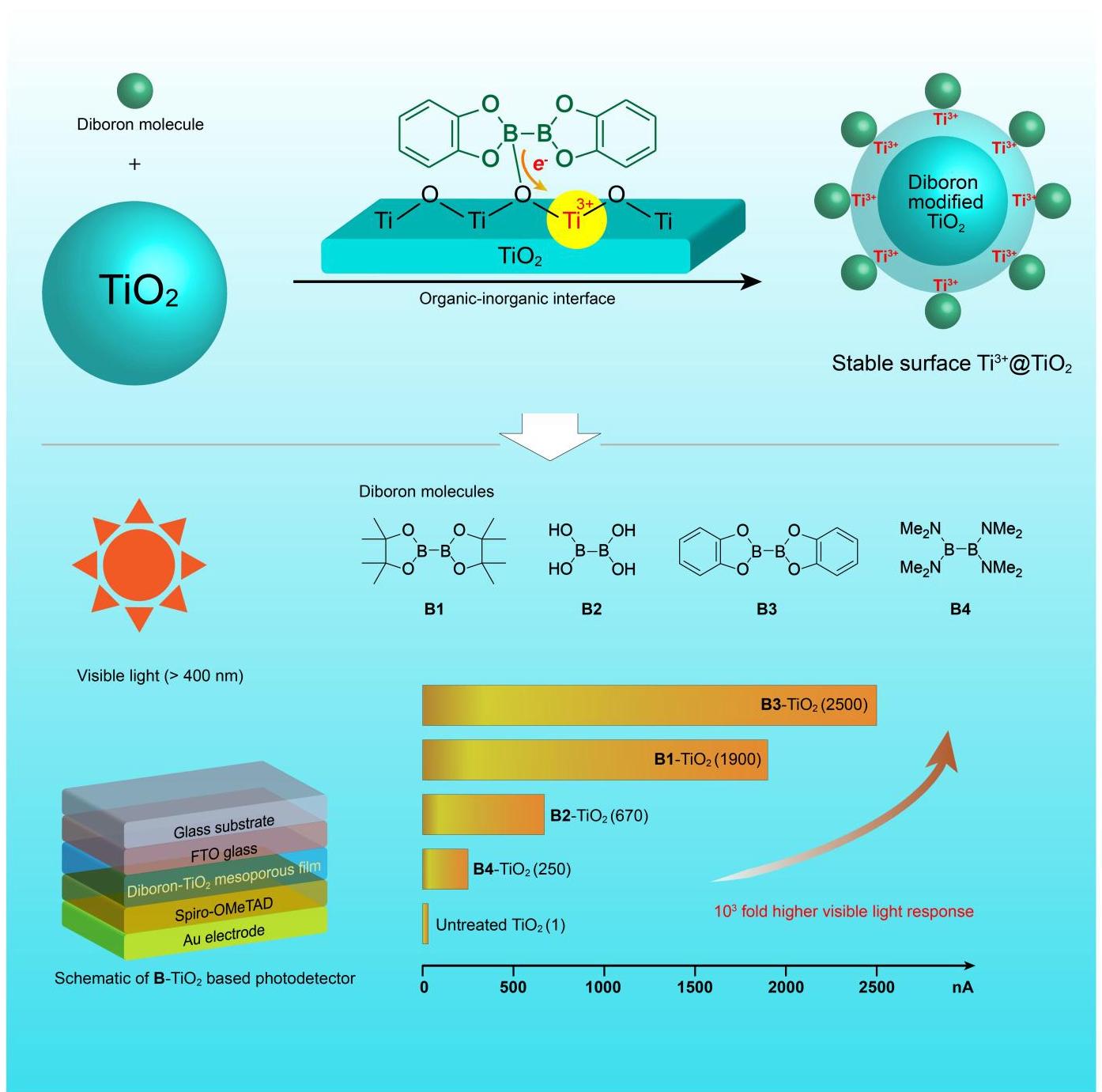
As one of the most promising semiconductor oxide materials, titanium dioxide $\left( {\mathrm{{TiO}}}_{2}\right)$ absorbs ultraviolet (UV) light but not visible light. To address this limitation, the introduction of ${\mathrm{{Ti}}}^{3 + }$ defects represents a common strategy to render ${\mathrm{{TiO}}}_{2}$ visible-light-responsive. Unfortunately, current hurdles in ${\mathrm{{Ti}}}^{3 + }$ generation technologies impeded the widespread application of ${\mathrm{{Ti}}}^{3 + }$ modified materials. Herein, we demonstrate a simple and mechanistically distinct approach to generating abundant surface- ${\mathrm{{Ti}}}^{3 + }$ sites without leaving behind oxygen vacancy and sacrificing one-off electron donors. In particular, upon adsorption of organodiboron reagents onto ${\mathrm{{TiO}}}_{2}$ nanoparticles, spontaneous electron injection from the dibron-bound ${\mathrm{O}}^{2 - }$ site to adjacent ${\mathrm{{Ti}}}^{4 + }$ site leads to an extremely stable blue surface ${\mathrm{{Ti}}}^{3 + } - {\mathrm{O}}^{ - }$ complex. Notably, this defect generation protocol is also applicable to other semiconductor oxides including $\mathrm{{ZnO}},{\mathrm{{SnO}}}_{2},{\mathrm{{Nb}}}_{2}{\mathrm{O}}_{5}$ and ${\mathrm{{In}}}_{2}{\mathrm{O}}_{3}$ . Furthermore, the as-prepared photoelectronic device using this strategy affords ${10}^{3}$ fold higher visible light response, and the fabricated perovskite solar cell shows an enhanced performance.
作为最有前途的半导体氧化物材料之一,二氧化钛 $\left( {\mathrm{{TiO}}}_{2}\right)$ 吸收紫外线(UV)但不吸收可见光。为了解决这一限制,引入 ${\mathrm{{Ti}}}^{3 + }$ 缺陷是使 ${\mathrm{{TiO}}}_{2}$ 具有可见光响应性的常见策略。不幸的是,目前 ${\mathrm{{Ti}}}^{3 + }$ 生成技术的障碍阻碍了 ${\mathrm{{Ti}}}^{3 + }$ 改性材料的广泛应用。在此,我们展示了一种简单且机制不同的方法来生成大量表面 ${\mathrm{{Ti}}}^{3 + }$ 位点,而不会留下氧空位且不牺牲一次性电子供体。特别是,当有机二硼试剂吸附到 ${\mathrm{{TiO}}}_{2}$ 纳米颗粒上时,从二硼结合的 ${\mathrm{O}}^{2 - }$ 位点到相邻 ${\mathrm{{Ti}}}^{4 + }$ 位点的自发电子注入会导致形成极其稳定的蓝色表面 ${\mathrm{{Ti}}}^{3 + } - {\mathrm{O}}^{ - }$ 络合物。值得注意的是,这种缺陷生成方案也适用于其他半导体氧化物,包括 $\mathrm{{ZnO}},{\mathrm{{SnO}}}_{2},{\mathrm{{Nb}}}_{2}{\mathrm{O}}_{5}$ 和 ${\mathrm{{In}}}_{2}{\mathrm{O}}_{3}$。此外,使用该策略制备的光电器件的可见光响应提高了 ${10}^{3}$ 倍,并且制备的钙钛矿太阳能电池表现出增强的性能。
INTRODUCTION
引言
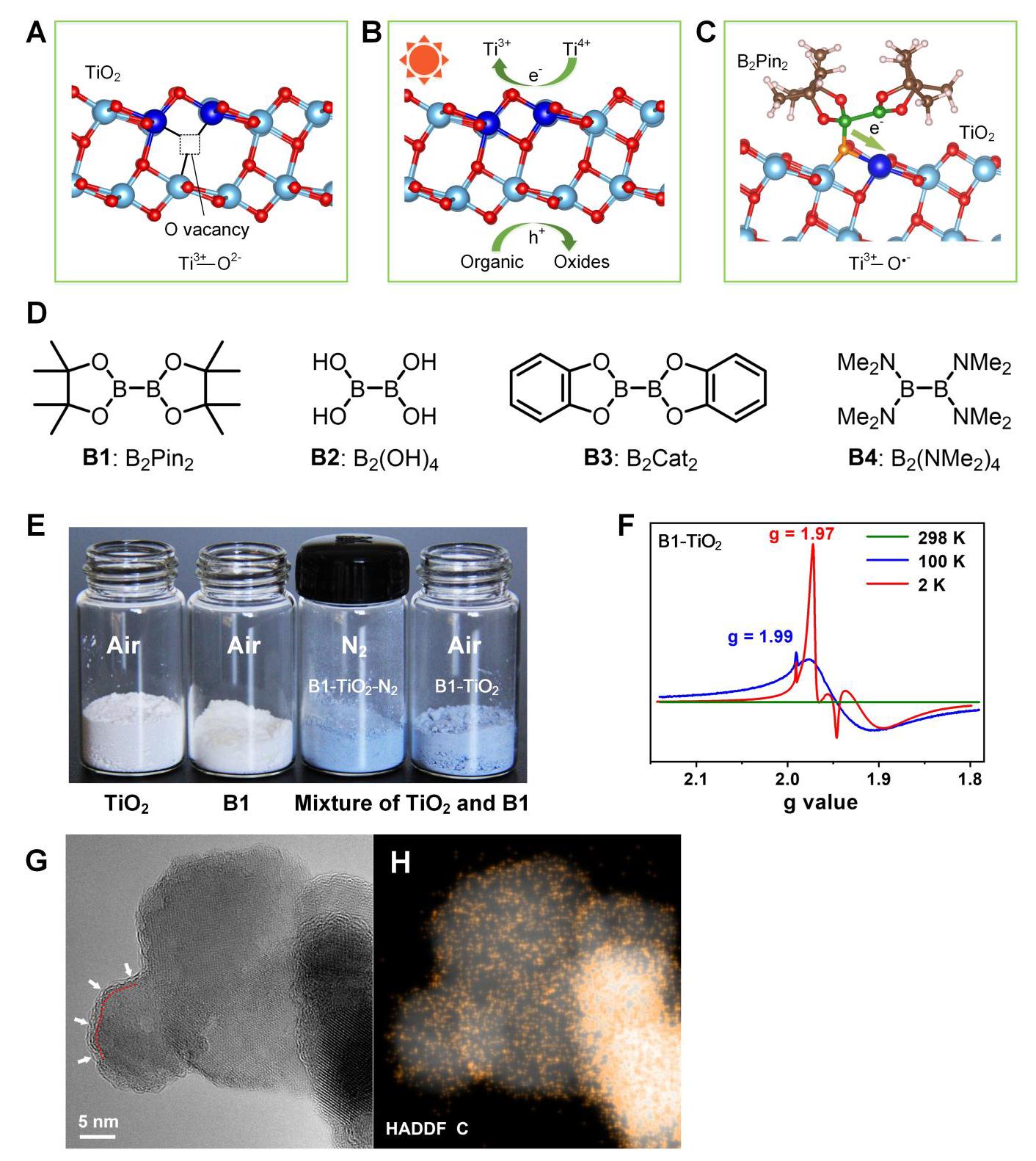
Due to its abundance, nontoxicity and stability, semiconductor oxide $\left( {{\mathrm{{TiO}}}_{2},\mathrm{{ZnO}},{\mathrm{{SnO}}}_{2},\mathrm{{etc}}}\right)$ nanoparticles and films have been widely used as wide-band gap semiconductor photocatalysts for a variety of solar-driven clean energy and environmental technologies, such as photovoltaics and photocatalytic fuel generation.(Chen and Mao, 2007; Grätzel, 2001) However, pristine wide band semiconductor oxides is not an appropriate candidate for practical applications since it only adsorbs UV light. The optical response of ${\mathrm{{TiO}}}_{2}$ nanocrystal has been tuned to visible region using band gap engineering techniques, including metallic (Dahl et al., 2014; Hoffmann et al., 1995) or nonmetallic (Asahi et al., 2014; Asahi et al., 2001; Chen and Burda, 2008; Khan et al., 2002) impurity doping, solid solution formation,(Maeda et al., 2006; Wang et al., 2008) and self-structural modification.(Liu and Chen, 2014) Among various self-modification techniques, in situ formation of self-doped ${\mathrm{{Ti}}}^{3 + }$ in the bulk phase through the introduction of oxygen vacancy at high temperature is an effective strategy for band gap engineering (Figure 1A).(Zuo et al., 2010) Additionally, hydrogenation of ${\mathrm{{TiO}}}_{2}$ nanocrystals can also result in visible-light responsible materials.(Chen et al., 2011) The latest studies show that these low-energy absorption materials arouse utilities in visible light water splitting, microwave and terahertz absorption.(Green et al., 2018a; Green et al., 2019a; Green et al., 2019b; Green et al., 2018b; Guan and Chen, 2018; Tian et al., 2017) Unfortunately, harsh reaction conditions and long-time treatment have limited the practicality of these methods, especially in the context of on-site fabrication and reprocessing of light harvesting devices. Alternatively, UV irradiation of ${\mathrm{{TiO}}}_{2}$ nanoparticles (Schrauben et al., 2012) or visible light irradiation of dye-sensitized systems can also produce visible-light-responsive blue-surface ${\mathrm{{TiO}}}_{2}$ (Figure 1B).(Yan et al.,2017) In both cases, organic sacrificial agents are required, and these agents are irreversibly oxidized by photoinduced holes (e.g., alcohol to aldehyde and ${\mathrm{I}}^{ - }$ to ${\mathrm{I}}_{2}$ ). Moreover, such nascent optically active ${\mathrm{{Ti}}}^{3 + }$ center is highly unstable towards ${\mathrm{O}}_{2}$ due to instantaneous oxidation to ${\mathrm{{Ti}}}^{4 + }$ . To our knowledge, the formation of air-stable surface ${\mathrm{{Ti}}}^{3 + }$ centers using these techniques has not been previously described. We surmise that this is largely due to the difficulty in stabilizing the key ${\mathrm{{Ti}}}^{3 + } - {\mathrm{O}}^{2 - }$ moiety formed in these processes, as such moiety is highly reactive toward ${\mathrm{O}}_{2}$ to afford ${\mathrm{{Ti}}}^{4 + } - \mathrm{O} - {\mathrm{O}}^{ - }$ . In light of these constraints, the ability to access air-stable surface ${\mathrm{{Ti}}}^{3 + }$ defects within ${\mathrm{{TiO}}}_{2}$ would represent a paradigm shift for the field of ${\mathrm{{TiO}}}_{2}$ -based oxide semiconducting materials. In this report, we show that this goal can be accomplished through the simultaneous modification of surface ${\mathrm{O}}^{2 - }$ and ${\mathrm{{Ti}}}^{4 + }$ sites in ${\mathrm{{TiO}}}_{2}$ to afford a persistent, optically active ${\mathrm{{Ti}}}^{3 + } - {\mathrm{O}}^{ - }$ species.
由于其丰富性、无毒性和稳定性,半导体氧化物$\left( {{\mathrm{{TiO}}}_{2},\mathrm{{ZnO}},{\mathrm{{SnO}}}_{2},\mathrm{{etc}}}\right)$纳米颗粒和薄膜已被广泛用作宽带隙半导体光催化剂,用于各种太阳能驱动的清洁能源和环境技术,如光伏和光催化燃料生成。(Chen和Mao,2007年;Grätzel,2001年) 然而,原始的宽带半导体氧化物并不是实际应用的合适候选材料,因为它只吸收紫外光。使用带隙工程技术,包括金属 (Dahl等人,2014年;Hoffmann等人,1995年) 或非金属 (Asahi等人,2014年;Asahi等人,2001年;Chen和Burda,2008年;Khan等人,2002年) 杂质掺杂、固溶体形成,(Maeda等人,2006年;Wang等人,2008年) 以及自结构修饰,(Liu和Chen,2014年),${\mathrm{{TiO}}}_{2}$纳米晶体的光学响应已被调整到可见光区域。在各种自修饰技术中,通过在高温下引入氧空位在体相中原位形成自掺杂${\mathrm{{Ti}}}^{3 + }$是带隙工程的有效策略 (图1A)。(Zuo等人,2010年) 此外,${\mathrm{{TiO}}}_{2}$纳米晶体的氢化也可以产生可见光响应材料。(Chen等人,2011年) 最新研究表明,这些低能量吸收材料在可见光水分解、微波和太赫兹吸收方面有应用。(Green等人,2018a;Green等人,2019a;Green等人,2019b;Green等人,2018b;Guan和Chen,2018年;Tian等人,2017年) 不幸的是,苛刻的反应条件和长时间处理限制了这些方法的实用性,特别是在光收集装置的现场制造和再处理方面。或者,${\mathrm{{TiO}}}_{2}$纳米颗粒的紫外光照射 (Schrauben等人,2012年) 或染料敏化系统的可见光照射也可以产生可见光响应的蓝色表面${\mathrm{{TiO}}}_{2}$ (图1B)。(Yan等人,2017年) 在这两种情况下,都需要有机牺牲剂,并且这些试剂会被光生空穴不可逆地氧化 (例如,醇氧化为醛,${\mathrm{I}}^{ - }$氧化为${\mathrm{I}}_{2}$)。此外,由于瞬间氧化为${\mathrm{{Ti}}}^{4 + }$,这种新生的光学活性${\mathrm{{Ti}}}^{3 + }$中心对${\mathrm{O}}_{2}$非常不稳定。据我们所知,以前尚未描述使用这些技术形成空气稳定的表面${\mathrm{{Ti}}}^{3 + }$中心。我们推测这主要是由于难以稳定这些过程中形成的关键${\mathrm{{Ti}}}^{3 + } - {\mathrm{O}}^{2 - }$部分,因为这样的部分对${\mathrm{O}}_{2}$具有高反应性以提供${\mathrm{{Ti}}}^{4 + } - \mathrm{O} - {\mathrm{O}}^{ - }$。鉴于这些限制,在${\mathrm{{TiO}}}_{2}$中获得空气稳定的表面${\mathrm{{Ti}}}^{3 + }$缺陷的能力将代表基于${\mathrm{{TiO}}}_{2}$的氧化物半导体材料领域的范式转变。在本报告中,我们表明可以通过同时修饰${\mathrm{{TiO}}}_{2}$中的表面${\mathrm{O}}^{2 - }$和${\mathrm{{Ti}}}^{4 + }$位点来实现这一目标,以提供持久的、光学活性的${\mathrm{{Ti}}}^{3 + } - {\mathrm{O}}^{ - }$物种。
Organodiboron compounds constitute a class of stable and highly versatile reagents commonly used in organic synthesis.(Neeve et al., 2016) Despite their unique reactivity, to date, the use of these diboron species in the modification of inorganic materials remains surprisingly scarce. Herein, we report a new method for the facile generation of ${\mathrm{{Ti}}}^{3 + }$ defects on ${\mathrm{{TiO}}}_{2}$ surface under mild conditions $\left( { < {80}\square }\right)$ enabled by the use of diboron reagents (Figure 1C). In this process, facilitated by the intimate interaction of the diboron reagent’s B center with the surface bridging ${\mathrm{O}}_{2\mathrm{c}}$ of ${\mathrm{{TiO}}}_{2}$ , the adsorption of organodiboron reagents onto ${\mathrm{{TiO}}}_{2}$ nanoparticles leads to spontaneous electron transfer, resulting in a stale, blue surface ${\mathrm{{Ti}}}^{3 + } - {\mathrm{{TiO}}}_{2}$ . Notably, this process does not require complicated synthetic manipulations such as anaerobic photo irradiation or high temperature calcination, which are commonly employed by previously developed techniques.
有机二硼化合物是一类稳定且用途广泛的试剂,常用于有机合成。(Neeve 等人,2016 年)尽管它们具有独特的反应活性,但迄今为止,这些二硼物种在无机材料改性中的应用仍出奇地少。在此,我们报道了一种在温和条件下借助二硼试剂在 ${\mathrm{{TiO}}}_{2}$ 表面轻松产生 ${\mathrm{{Ti}}}^{3 + }$ 缺陷的新方法(图 1C)。在这个过程中,由于二硼试剂的硼中心与 ${\mathrm{{TiO}}}_{2}$ 的表面桥接 ${\mathrm{O}}_{2\mathrm{c}}$ 紧密相互作用,有机二硼试剂在 ${\mathrm{{TiO}}}_{2}$ 纳米颗粒上的吸附会导致自发的电子转移,从而形成稳定的蓝色表面 ${\mathrm{{Ti}}}^{3 + } - {\mathrm{{TiO}}}_{2}$。值得注意的是,该过程不需要复杂的合成操作,如厌氧光照射或高温煅烧,而这些是先前开发的技术常用的方法。
Previously developed strategies for ${\mathrm{{TiO}}}_{2}$ surface modification have mainly focused on the modification of surface Ti sites with organic nucleophiles (e.g., phenol, alcohol and carboxylic acids). In contrast, surface bridging oxygen $\left( {\mathrm{O}}_{2\mathrm{c}}\right)$ sites have seldom been functionalized with electrophilic organic reagents. We posited that electrophilic organic adsorbates with an appropriate reduction potential might favorably interact with the surface ${\mathrm{O}}_{2\mathrm{c}}$ sites. Importantly, this binding event might overcome the barrier of electron transfer from ${\mathrm{O}}^{2 - }$ sites to adjacent ${\mathrm{{Ti}}}^{4 + }$ sites and further stabilize the primary charge separation state. We were particularly interested in the use of organic diboron reagents due to their unique Lewis acidity and reducing ability (vide supra). Previous work in the area of synthetic organic chemistry showed that upon binding to a Lewis basic oxygen atom, these organic diboron species can function as single electron reducing agents, thus allowing for various important transformations.(Liu et al., 2019; Mo et al., 2010; Mo et al., 2018; Pietsch et al., 2015; Wang et al., 2016; Zhang and Jiao, 2017) Based on these reasons, we envisioned that upon the coordination of such diboron compounds with the surface oxygen atom in metal oxide materials, the formation of surface diboron-oxygen Lewis pair may induce single electron transfer from the ipso- ${\mathrm{O}}_{2\mathrm{c}}$ site to the adjacent Ti site. Furthermore, the interaction of diboron species with the oxygen atom may stabilize the resulting low valent Ti-high valent O pair.
先前开发的${\mathrm{{TiO}}}_{2}$表面改性策略主要集中在用有机亲核试剂(如苯酚、醇和羧酸)对表面Ti位点进行改性。相比之下,表面桥连氧$\left( {\mathrm{O}}_{2\mathrm{c}}\right)$位点很少用亲电有机试剂进行功能化。我们推测,具有适当还原电位的亲电有机吸附物可能与表面${\mathrm{O}}_{2\mathrm{c}}$位点产生有利的相互作用。重要的是,这种结合事件可能克服从${\mathrm{O}}^{2 - }$位点到相邻${\mathrm{{Ti}}}^{4 + }$位点的电子转移障碍,并进一步稳定初级电荷分离状态。由于其独特的路易斯酸性和还原能力(见上文),我们对使用有机二硼试剂特别感兴趣。合成有机化学领域的先前工作表明,这些有机二硼物种在与路易斯碱性氧原子结合后,可以作为单电子还原剂,从而实现各种重要的转化。(刘等人,2019年;莫等人,2010年;莫等人,2018年;皮茨等人,2015年;王等人,2016年;张和焦,2017年) 基于这些原因,我们设想,当这些二硼化合物与金属氧化物材料中的表面氧原子配位时,表面二硼-氧路易斯对的形成可能会诱导从原位${\mathrm{O}}_{2\mathrm{c}}$位点到相邻Ti位点的单电子转移。此外,二硼物种与氧原子的相互作用可能会稳定由此产生的低价Ti-高价O对。
RESULTS AND DISCUSSION
结果与讨论
Spectroscopic Characterizations
光谱表征
We use P25 TiO ${}_{2}$ to study the surface modification behavior, for P25 TiO ${}_{2}$ is typical TiO ${}_{2}$ material applied in photochemical applications and shows enhanced performance based on fine nanoparticles and heterointerface between anatase and rutile phase.(Xia et al., 2013; Xia et al., 2014) Mechanical mixing of commercial Degussa ${\mathrm{{TiO}}}_{2}$ P25 and bis(pinacolato)diboron $\left( {{\mathrm{B}}_{2}{\mathrm{{Pin}}}_{2}}\right.$ , B1) in a nitrogen-filled glovebox at room temperature resulted in a rapid color change from white to blue within $1\mathrm{\;{min}}$ (Figure 1E and movie S1). This blue titania, labeled as $\mathrm{B}1 - {\mathrm{{TiO}}}_{2} - {\mathrm{N}}_{2}$ , was highly sensitive to ${\mathrm{O}}_{2}$ and faded immediately upon exposure to air. Unexpectedly, heating B1-TiO2- ${\mathrm{N}}_{2}$ at ${80}\square$ under vacuum for $3\mathrm{\;h}$ resulted in a blue sample that is stable under air, which we labeled as $\mathrm{B}1 - {\mathrm{{TiO}}}_{2}$ . This sample could be stored outside the glovebox for weeks, and the blue color persisted. Similar transformations were observed with three other diboron compounds as shown in Figure 1 & Figure S1. To fully disperse the diboron compound onto the ${\mathrm{{TiO}}}_{2}$ nanoparticles, this heterogeneous reaction was performed in a diboron-soluble solvent, such as methanol or diethyl ether. Same blue samples were obtained after removal of organic solvents under vacuum. On the basis of previous studies,(Iorio et al., 2012) the blue color was indicative of the formation of ${\mathrm{{Ti}}}^{3 + }$ defects. To probe whether B1 was oxidized in this process, the newly prepared blue B1- ${\mathrm{{TiO}}}_{2}$ sample was extracted with ${\mathrm{{CDCl}}}_{3}$ , and B1 was found to be the only boron containing species present in the extract (Figure S2). Additionally, the use of this recovered B1 from the extract for ${\mathrm{{TiO}}}_{2}$ modification also gave rise to the same blue titania. Thus, these experiments suggested that diboron compound B1 is not a one-off sacrifice agent. Based on these findings, a new mechanism must be responsible for the formation of this blue ${\mathrm{{TiO}}}_{2}$ .
我们使用P25 TiO${}_{2}$来研究表面改性行为,因为P25 TiO${}_{2}$是用于光化学应用的典型TiO${}_{2}$材料,并且基于精细的纳米颗粒以及锐钛矿相和金红石相之间的异质界面而表现出增强的性能。(Xia等人,2013年;Xia等人,2014年)在室温下于充满氮气的手套箱中对商用德固赛${\mathrm{{TiO}}}_{2}$ P25和双(频哪醇合)二硼$\left( {{\mathrm{B}}_{2}{\mathrm{{Pin}}}_{2}}\right.$ ,即B1)进行机械混合,在$1\mathrm{\;{min}}$内导致颜色迅速从白色变为蓝色(图1E和视频S1)。这种蓝色二氧化钛,标记为$\mathrm{B}1 - {\mathrm{{TiO}}}_{2} - {\mathrm{N}}_{2}$ ,对${\mathrm{O}}_{2}$高度敏感,暴露于空气中会立即褪色。出乎意料的是,在真空下于${80}\square$将B1-TiO2-${\mathrm{N}}_{2}$加热$3\mathrm{\;h}$会得到一种在空气中稳定的蓝色样品,我们将其标记为$\mathrm{B}1 - {\mathrm{{TiO}}}_{2}$ 。该样品可以在手套箱外储存数周,并且蓝色持续存在。如图1和图S1所示,用其他三种二硼化合物也观察到了类似的转变。为了将二硼化合物完全分散到${\mathrm{{TiO}}}_{2}$纳米颗粒上,这种多相反应在二硼可溶的溶剂中进行,如甲醇或乙醚。在真空下去除有机溶剂后得到了相同的蓝色样品。根据先前的研究,(Iorio等人,2012年)蓝色表明形成了${\mathrm{{Ti}}}^{3 + }$缺陷。为了探究在此过程中B1是否被氧化,用${\mathrm{{CDCl}}}_{3}$萃取新制备的蓝色B1-${\mathrm{{TiO}}}_{2}$样品,发现B1是萃取物中唯一存在的含硼物种(图S2)。此外,将从萃取物中回收的这种B1用于${\mathrm{{TiO}}}_{2}$改性也产生了相同的蓝色二氧化钛。因此,这些实验表明二硼化合物B1不是一次性牺牲剂。基于这些发现,必须有一个新的机制来解释这种蓝色${\mathrm{{TiO}}}_{2}$的形成。
To probe the existence of ${\mathrm{{Ti}}}^{3 + }$ species, electron paramagnetic resonance (EPR) spectra (Zuo et al.,2010) of the $\mathrm{B}1 - {\mathrm{{TiO}}}_{2}$ sample were acquired. Low-temperature (2K and ${100}\mathrm{\;K}$ ) EPR data features transitions with $\mathrm{g} = {1.97} - {1.99}$ , while the room temperature EPR is silent (Figure 1F). This behavior is characteristic of ${\mathrm{{Ti}}}^{3 + }$ species as documented by previous studies.(Li et al.,2008) The observed g-values show the presence of a strong anisotropic paramagnetic ${\mathrm{{Ti}}}^{3 + }$ center, indicating that the local symmetry of ${\mathrm{{Ti}}}^{3 + }$ is vastly broken. Furthermore, this ${\mathrm{{Ti}}}^{3 + }$ EPR signal would be split if B replaces the bridging O, or directly bound to Ti.(Gopal et al., 2008) However, in all the cw-EPR measurements, we did not observe the hyperfine coupling originating from the ${}^{10}\mathrm{\;B}$ or ${}^{11}\mathrm{\;B}$ nucleus. This suggests either no or very weak coupling between the B atom and the ${\mathrm{{Ti}}}^{3 + }$ center. Moreover, we find that B3-TiO ${}_{2}$ shows a g signal at 2.003 at room temperature (Figure S3), which could be characteristic of a ${\mathrm{{Ti}}}^{3 + } - {\mathrm{O}}^{ - }$ radical. We also applied the ACTEM method to study the existence and status of diboron molecule on the surface of ${\mathrm{{TiO}}}_{2}$ . In the HRTEM image of B3-TiO ${}_{2}$ (Figure 1G), we find that the surface of ${\mathrm{{TiO}}}_{2}$ nanocrystal is wrapped by an outer layer with $\sim 1\mathrm{\;{nm}}$ thickness. In addition, the EDS mapping of $\mathrm{C}$ element under HADDF model (Figure 1H) shows a carbon-rich surface shell representing adsorbed organic diboron molecule on the ${\mathrm{{TiO}}}_{2}$ surface.
为探测${\mathrm{{Ti}}}^{3 + }$物种的存在,获取了$\mathrm{B}1 - {\mathrm{{TiO}}}_{2}$样品的电子顺磁共振(EPR)光谱(左等人,2010年)。低温(2K和${100}\mathrm{\;K}$)EPR数据的特征是具有$\mathrm{g} = {1.97} - {1.99}$的跃迁,而室温EPR无信号(图1F)。如先前研究(李等人,2008年)所记录,这种行为是${\mathrm{{Ti}}}^{3 + }$物种的特征。观察到的g值表明存在强各向异性顺磁${\mathrm{{Ti}}}^{3 + }$中心,这表明${\mathrm{{Ti}}}^{3 + }$的局部对称性被极大破坏。此外,如果B取代桥连的O或直接与Ti结合,该${\mathrm{{Ti}}}^{3 + }$ EPR信号会分裂。(戈帕尔等人,2008年)然而,在所有的连续波EPR测量中,我们未观察到源自${}^{10}\mathrm{\;B}$或${}^{11}\mathrm{\;B}$核的超精细耦合。这表明B原子与${\mathrm{{Ti}}}^{3 + }$中心之间要么没有耦合,要么耦合非常弱。此外,我们发现B3-TiO${}_{2}$在室温下在2.003处显示g信号(图S3),这可能是${\mathrm{{Ti}}}^{3 + } - {\mathrm{O}}^{ - }$自由基的特征。我们还应用先进冷场发射透射电子显微镜(ACTEM)方法研究${\mathrm{{TiO}}}_{2}$表面二硼分子的存在和状态。在B3-TiO${}_{2}$的高分辨率透射电子显微镜(HRTEM)图像(图1G)中,我们发现${\mathrm{{TiO}}}_{2}$纳米晶体的表面被一层厚度为$\sim 1\mathrm{\;{nm}}$的外层包裹。此外,高角度环形暗场(HADDF)模式下$\mathrm{C}$元素的能谱映射(图1H)显示了一个富含碳的表面壳层,代表${\mathrm{{TiO}}}_{2}$表面吸附的有机二硼分子。
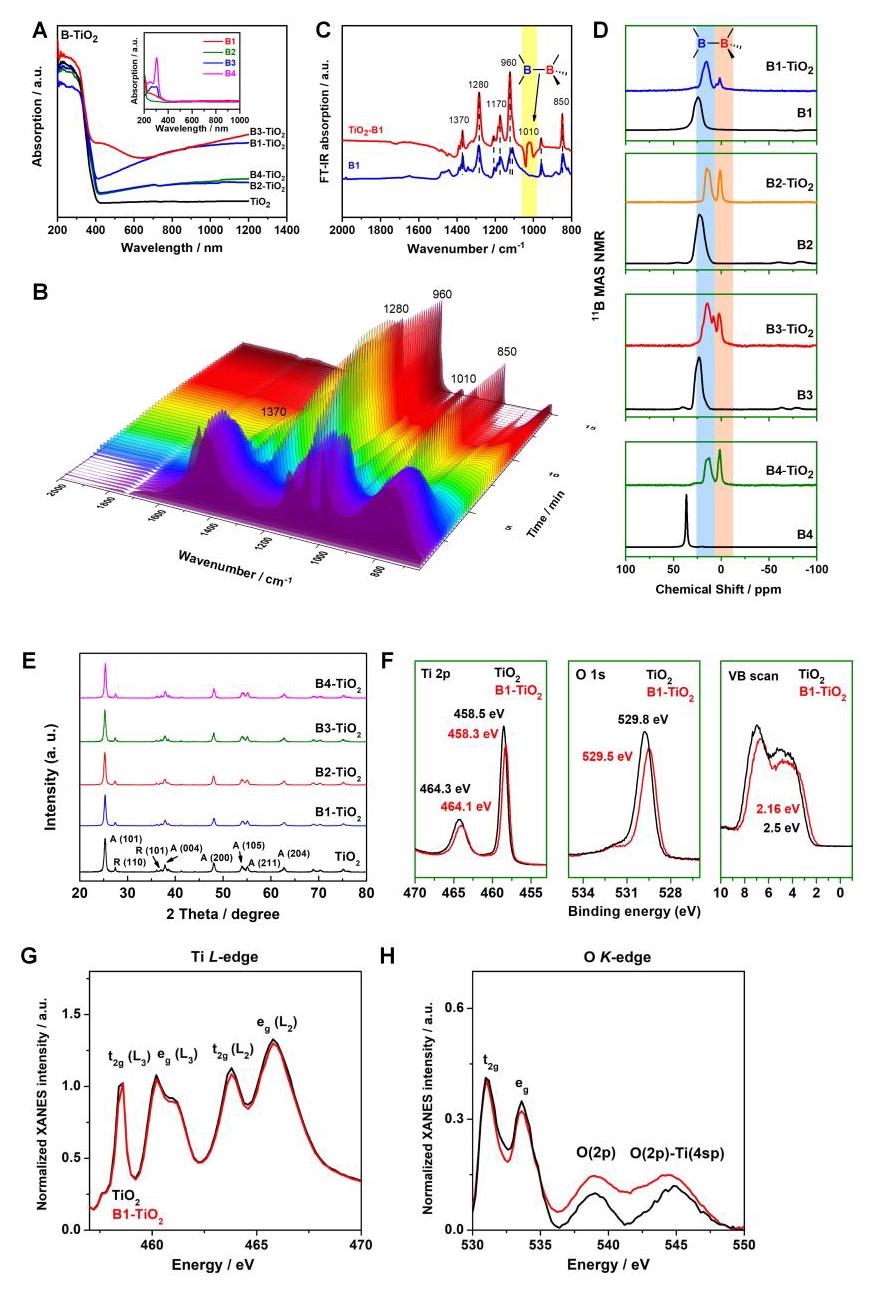
We next investigated the structures and properties of these diboron- ${\mathrm{{TiO}}}_{2}$ nanoparticles with powder X-ray diffraction (PXRD), solid-state UV-Vis spectroscopy (UV-Vis), in situ attenuated total reflectance-Fourier transform infrared spectroscopy (in situ ATR-FTIR) and solid-state ${}^{11}\mathrm{\;B}$ magic angle spinning nuclear magnetic resonance ( ${}^{11}\mathrm{\;B}$ MAS NMR). PXRD analysis (Figure S4) shows that the commercial P25 sample is a mixture of anatase-phase and rutile-phase ${\mathrm{{TiO}}}_{2}$ . The PXRD pattern of ${\mathrm{{TiO}}}_{2}$ remained the same upon adsorption of the diboron reagent, indicating no phase change occurred in this process. Thus, this result suggests that the blue species is likely related to surface engineering rather than bulk phase modification. The solid-state UV-Vis spectra in Figure 2A showed that neither the pristine white ${\mathrm{{TiO}}}_{2}$ nor the diboron compound absorbs visible light $\left( { > {400}\mathrm{\;{nm}}}\right)$ . First, absorption bands beginning at ${400}\mathrm{\;{nm}}$ and steadily growing into the near infrared (NIR) region were observed for all four ${\mathrm{B - {TiO}}}_{2}$ samples. These adsorption bands were different from that arising from metal to ligand charge transfer (MLCT) of the surface complex between ${\mathrm{{Ti}}}^{4 + }$ sites and organic ligands commonly observed in previous work.(Lang et al.,2012) The UV-Vis absorption spectra associated with ${\mathrm{{Ti}}}^{3 + }$ materials can differ between different preparation methods.(Howe and Gratzel, 1985) In our case, the diboron modified ${\mathrm{{TiO}}}_{2}$ samples were found to absorb visible light with higher intensity in the NIR region. This suggested that the ${\mathrm{{Ti}}}^{3 + }$ species in our case is different from the previously reported ${\mathrm{{Ti}}}^{3 + } - {\mathrm{O}}^{2 - }$ structures. In the in situ ATR-FTIR spectra (Figure 2B), the emergence of new signals corresponding to the diboron compound was observed over the time, clearly demonstrating the adsorption process. In the FT-IR spectra (Figure 2C), signals at 1280 and ${1170}{\mathrm{\;{cm}}}^{-1}$ are assigned to two different types of B-O vibration. Based on DFT calculations, the B-B stretching vibration appears at ca. ${1000}{\mathrm{\;{cm}}}^{-1}$ (Figure S5). As shown in Figure 2C, this signal is absent in B1 due to the ${\mathrm{C}}_{2}$ symmetry of this diboron molecule. In contrast, a new peak at ${1010}{\mathrm{\;{cm}}}^{-1}$ corresponding to $\mathrm{B} - \mathrm{B}$ stretching emerged in the $\mathrm{B}1 - {\mathrm{{TiO}}}_{2}$ sample, thereby demonstrating the formation of the oxygen-diboron Lewis pair.
接下来,我们用粉末X射线衍射(PXRD)、固态紫外可见光谱(UV-Vis)、原位衰减全反射傅里叶变换红外光谱(原位ATR-FTIR)和固态${}^{11}\mathrm{\;B}$魔角旋转核磁共振(${}^{11}\mathrm{\;B}$ MAS NMR)研究了这些二硼${\mathrm{{TiO}}}_{2}$纳米颗粒的结构和性质。PXRD分析(图S4)表明,市售P25样品是锐钛矿相和金红石相${\mathrm{{TiO}}}_{2}$的混合物。吸附二硼试剂后,${\mathrm{{TiO}}}_{2}$的PXRD图谱保持不变,表明在此过程中没有发生相变。因此,该结果表明蓝色物种可能与表面工程有关,而不是体相改性。图2A中的固态紫外可见光谱表明,原始白色${\mathrm{{TiO}}}_{2}$和二硼化合物均不吸收可见光$\left( { > {400}\mathrm{\;{nm}}}\right)$。首先,在所有四个${\mathrm{B - {TiO}}}_{2}$样品中均观察到从${400}\mathrm{\;{nm}}$开始并稳定增长到近红外(NIR)区域的吸收带。这些吸收带与先前工作中常见的${\mathrm{{Ti}}}^{4 + }$位点与有机配体之间的表面配合物的金属到配体电荷转移(MLCT)产生的吸收带不同。(Lang等人,2012年)与${\mathrm{{Ti}}}^{3 + }$材料相关的紫外可见吸收光谱在不同的制备方法之间可能会有所不同。(Howe和Gratzel,1985年)在我们的案例中,发现二硼改性的${\mathrm{{TiO}}}_{2}$样品在近红外区域吸收可见光的强度更高。这表明我们案例中的${\mathrm{{Ti}}}^{3 + }$物种与先前报道的${\mathrm{{Ti}}}^{3 + } - {\mathrm{O}}^{2 - }$结构不同。在原位ATR-FTIR光谱(图2B)中,随着时间的推移观察到了与二硼化合物相对应的新信号的出现,清楚地证明了吸附过程。在FT-IR光谱(图2C)中,1280和${1170}{\mathrm{\;{cm}}}^{-1}$处的信号归因于两种不同类型的B-O振动。基于DFT计算,B-B伸缩振动出现在约${1000}{\mathrm{\;{cm}}}^{-1}$处(图S5)。如图2C所示,由于该二硼分子的${\mathrm{C}}_{2}$对称性,B1中不存在该信号。相反,在$\mathrm{B}1 - {\mathrm{{TiO}}}_{2}$样品中出现了一个对应于$\mathrm{B} - \mathrm{B}$伸缩的${1010}{\mathrm{\;{cm}}}^{-1}$处的新峰,从而证明了氧-二硼路易斯对的形成。
Solid-state ${}^{11}\mathrm{\;B}$ MAS NMR spectroscopy was next used to elucidate the binding details of the diboron reagent with the ${\mathrm{{TiO}}}_{2}$ surface. Upon adsorption, the $\mathrm{B}\left( {\mathrm{{sp}}}^{2}\right) - \mathrm{B}\left( {\mathrm{{sp}}}^{3}\right)$ adducts should exhibit two distinct boron environments in the solid-state NMR spectra. As shown in Figure 2D, in all four cases, new peaks appear and shift upfield, indicating changes in the chemical environment of the two B atoms. Previous studies revealed that the ${}^{11}\mathrm{\;B}$ signal of ${\mathrm{{sp}}}^{3}$ hybridized tetracoordinate boron undergoes an upfield shift relative to the ${\mathrm{{sp}}}^{2}$ hybridized tricoordinate one.(Nöth and Wrackmeyer, 1978) Thus, we attribute the peaks close to 0 ppm to B atom bound to the surface $\mathrm{O}$ atom of ${\mathrm{{TiO}}}_{2}$ nanoparticles. The $\mathrm{X}$ -ray diffraction (XRD) were applied to examine the structure of the ${\mathrm{{TiO}}}_{2}$ by diboron compound modification. According to the XRD results, no change of the lattice was characterized. To further our understanding of the surface interaction between the diboron molecule and ${\mathrm{{TiO}}}_{2}$ nanoparticles, we carried out XPS and SXANES studies. The Ti 2p spectra shows that the peaks were shift for ${0.2}\mathrm{{eV}}$ towards the lower binding energy region, this is also happened in O 1s spectra. The valance band spectra show that the band level shift to lower energy, that shift from ${2.5}\mathrm{{eV}}$ to ${2.16}\mathrm{{eV}}$ . The Ti $2\mathrm{p},\mathrm{O}1\mathrm{\;s}$ spectra change means that the surface modification shows significant influence on the surface electron structure of the ${\mathrm{{TiO}}}_{2}$ . As shown in Figure $2\mathrm{G}$ , the ${\mathrm{t}}_{2\mathrm{\;g}}\left( {\mathrm{\;L}}_{3}\right)$ peak of Ti-L edge shows that the B1- ${\mathrm{{TiO}}}_{2}$ is slight lower than that of pristine ${\mathrm{{TiO}}}_{2}$ , and the peak of ${\mathrm{e}}_{\mathrm{g}}\left( {\mathrm{L}}_{2}\right)$ is shift to higher energy, which can be attributed to the existence of ${\mathrm{{Ti}}}^{3 + }$ .(Kronawitter et al.,2011; Stewart et al.,2006) The O-K edge originates from the hybridization of ${\mathrm{O}}_{2\mathrm{p}}$ ligand-hole states with the coordinating atoms s, p, d states.(Karvonen et al., 2010) In our case, the O-K edge shows that the peaks of B1- ${\mathrm{{TiO}}}_{2}$ that index to Ti-O bond around ${545}\mathrm{{eV}}$ and the O $2\mathrm{p}$ around ${539}\mathrm{{eV}}$ are much higher than that of pristine ${\mathrm{{TiO}}}_{2}$ (Figure 2H), demonstrating more electron location in $\mathrm{O}2\mathrm{p}$ orbital and $\mathrm{{Ti}} - \mathrm{O}$ bond instead of the $\mathrm{O}{\mathrm{e}}_{\mathrm{g}}$ orbitals.(de Groot et al.,1989) Meanwhile, the Ti-K edge line shows no significant change between ${B1} - {\mathrm{{TiO}}}_{2}$ and pristine ${\mathrm{{TiO}}}_{2}$ in the pre-edge region and the EXANE region (Figure S6). The reason is that the diboron compound are bond with surface ipso- ${\mathrm{O}}^{2 - }$ atoms. Moreover, the B 1s XPS also provides consistent results indexing of B species with different binding energies (Figure S7). On the basis of these spectroscopic evidence, we propose that the coordination of diboron compound with surface $\mathrm{O}$ sites on ${\mathrm{{TiO}}}_{2}$ facilitate the electron transfer from the ipso- ${\mathrm{O}}^{2 - }$ to adjacent ${\mathrm{{Ti}}}^{4 + }$ site, and this coordination further stabilize the newly formed ${\mathrm{{Ti}}}^{3 + } - {\mathrm{O}}^{- * }$ species. We note that the activation of inert lattice ${\mathrm{O}}^{2 - }$ and the stabilization of surface ${\mathrm{{Ti}}}^{3 + }$ enabled by the formation of $\equiv \mathrm{B} - {\mathrm{O}}^{ - } - {\mathrm{{Ti}}}^{3 + }$ moiety is a novel process that has not been reported in ${\mathrm{{TiO}}}_{2}$ modification.
接下来使用固态${}^{11}\mathrm{\;B}$ MAS NMR光谱来阐明二硼试剂与${\mathrm{{TiO}}}_{2}$表面的结合细节。吸附后,$\mathrm{B}\left( {\mathrm{{sp}}}^{2}\right) - \mathrm{B}\left( {\mathrm{{sp}}}^{3}\right)$加合物在固态NMR光谱中应表现出两种不同的硼环境。如图2D所示,在所有四种情况下,都会出现新的峰并向上场移动,这表明两个B原子的化学环境发生了变化。先前的研究表明,${\mathrm{{sp}}}^{3}$杂化的四配位硼的${}^{11}\mathrm{\;B}$信号相对于${\mathrm{{sp}}}^{2}$杂化的三配位硼的信号发生了上移。(诺特和拉克迈尔,1978年)因此,我们将接近0 ppm的峰归因于与${\mathrm{{TiO}}}_{2}$纳米颗粒表面$\mathrm{O}$原子结合的B原子。应用$\mathrm{X}$射线衍射(XRD)来研究二硼化合物修饰后的${\mathrm{{TiO}}}_{2}$的结构。根据XRD结果,未发现晶格有变化。为了进一步了解二硼分子与${\mathrm{{TiO}}}_{2}$纳米颗粒之间的表面相互作用,我们进行了XPS和SXANES研究。Ti 2p光谱表明,${0.2}\mathrm{{eV}}$的峰向较低结合能区域移动,O 1s光谱中也出现了这种情况。价带光谱表明,能带水平向较低能量移动,即从${2.5}\mathrm{{eV}}$移动到${2.16}\mathrm{{eV}}$。Ti$2\mathrm{p},\mathrm{O}1\mathrm{\;s}$光谱的变化意味着表面修饰对${\mathrm{{TiO}}}_{2}$的表面电子结构有显著影响。如图$2\mathrm{G}$所示,Ti-L边的${\mathrm{t}}_{2\mathrm{\;g}}\left( {\mathrm{\;L}}_{3}\right)$峰表明B1-${\mathrm{{TiO}}}_{2}$略低于原始${\mathrm{{TiO}}}_{2}$的峰,${\mathrm{e}}_{\mathrm{g}}\left( {\mathrm{L}}_{2}\right)$的峰向更高能量移动,这可归因于${\mathrm{{Ti}}}^{3 + }$的存在。(克罗纳维特等人,2011年;斯图尔特等人,2006年)O-K边源于${\mathrm{O}}_{2\mathrm{p}}$配体-空穴态与配位原子s、p、d态的杂化。(卡尔沃宁等人,2010年)在我们的例子中,O-K边表明,在${545}\mathrm{{eV}}$附近与Ti-O键相关的B1-${\mathrm{{TiO}}}_{2}$的峰以及在${539}\mathrm{{eV}}$附近的O$2\mathrm{p}$的峰比原始${\mathrm{{TiO}}}_{2}$的峰高得多(图2H),这表明在$\mathrm{O}2\mathrm{p}$轨道和$\mathrm{{Ti}} - \mathrm{O}$键中有更多的电子分布,而不是在$\mathrm{O}{\mathrm{e}}_{\mathrm{g}}$轨道中。(德格鲁特等人,1989年)同时,Ti-K边谱线在前边缘区域和EXANE区域中${B1} - {\mathrm{{TiO}}}_{2}$与原始${\mathrm{{TiO}}}_{2}$之间没有显著变化(图S6)。原因是二硼化合物与表面本位${\mathrm{O}}^{2 - }$原子键合。此外,B 1s XPS也提供了具有不同结合能的B物种的一致索引结果(图S7)。基于这些光谱证据,我们提出二硼化合物与${\mathrm{{TiO}}}_{2}$表面$\mathrm{O}$位点的配位促进了电子从本位${\mathrm{O}}^{2 - }$转移到相邻的${\mathrm{{Ti}}}^{4 + }$位点,并且这种配位进一步稳定了新形成的${\mathrm{{Ti}}}^{3 + } - {\mathrm{O}}^{- * }$物种。我们注意到,通过形成$\equiv \mathrm{B} - {\mathrm{O}}^{ - } - {\mathrm{{Ti}}}^{3 + }$部分实现的惰性晶格${\mathrm{O}}^{2 - }$的活化和表面${\mathrm{{Ti}}}^{3 + }$的稳定是一个在${\mathrm{{TiO}}}_{2}$修饰中尚未报道的新过程。
DFT calculation results
密度泛函理论计算结果
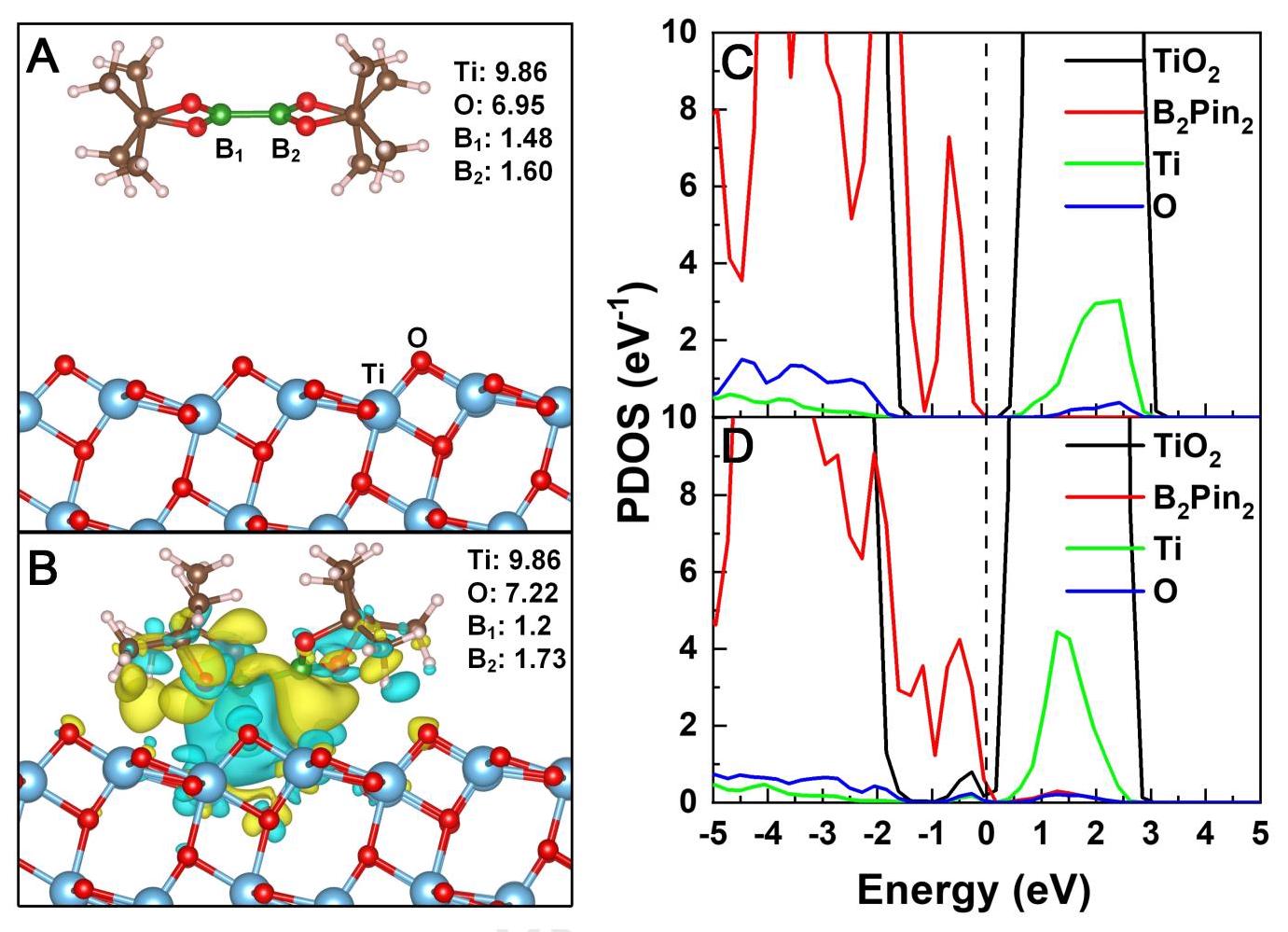
We next investigated the surface ${\mathrm{{Ti}}}^{3 + } - {\mathrm{O}}^{ - }$ structure in the blue ${\mathrm{{TiO}}}_{2}$ nanoparticles by simulating the adsorption of $\mathrm{B}1$ on the ${\mathrm{{TiO}}}_{2}$ surface and the accompanying charge transfer between them using density functional theory (DFT) calculations. According to the literature, the {101} facet in anatase ${\mathrm{{TiO}}}_{2}$ are dominant facet and we set up the adsorption model of anatase ${\mathrm{{TiO}}}_{2}\{ {101}\}$ facet.(Lazzeri et al.,2001) Our calculations showed that the Fermi levels in no adsorption is located in the ${\mathrm{{TiO}}}_{2}$ band gap (Figure 3A and 3C). Importantly, the diboron-adsorbed ${\mathrm{{TiO}}}_{2}$ model shows a clear charge transfer from B1 to the ${\mathrm{{TiO}}}_{2}\{ {101}\}$ surface (Figure 3B). Furthermore, the Bader charge calculation showed substantial electron transfer from the ${\mathrm{B}}_{1}$ atom to the bridging O atom. Furthermore, those electrons (light blue region) are localized between the bridging O atom and the neighbor surface Ti atom according to the calculated charge difference density mapping. The calculated projected density of state (PDOS) plots showed that the Fermi level rises to the bottom of the ${\mathrm{{TiO}}}_{2}$ conduction band which is mainly derived from Ti 3d states (Figure 3D). Some Ti 3d and O 2p states below the Fermi level appear, which are filled with electrons. The filled Ti 3d states indicate the partial reduction of the surface Ti sites, which explains the existence of the ${\mathrm{{Ti}}}^{3 + }$ species observed in our EPR experiments. Moreover, the adsorption model of B2, B3 and B4 on ${\mathrm{{TiO}}}_{2}\{ {101}\}$ surface was also calculated (Figure S8A-C and Figure S9). These data showed that a new electron-filled band-gap state consisting of Ti 3d appears in all the three models (Figure S8D-F and Figure S9). This strongly suggested that the adsorption of organic diboron compounds can lead to the formation of ${\mathrm{{Ti}}}^{3 + }$ species on ${\mathrm{{TiO}}}_{2}$ surface. The adsorption model based on rutile ${\mathrm{{TiO}}}_{2}$ shows the similar results (Figure S10 and Figure S11). The adsorption model of the interface between anatase ${\mathrm{{TiO}}}_{2}$ and rutile ${\mathrm{{TiO}}}_{2}$ was also set up to evaluate the heterojunction in P25 nanoparticles (Figure S12 and S13). To interpret the stability of the surface ${\mathrm{{Ti}}}^{3 + }$ in $\mathrm{B} - {\mathrm{{TiO}}}_{2}$ in the air atmosphere, the oxygen adsorption models were set. The calculation result shows that ${\mathrm{O}}_{2}$ molecule is hesitate to adsorb to the adjacent ${\mathrm{{Ti}}}_{5\mathrm{c}}$ site of the molecule (energy rising process), which represent the protection role of the molecule (Figure S14 and Table S1).
接下来,我们通过密度泛函理论(DFT)计算,模拟了$\mathrm{B}1$在蓝色${\mathrm{{TiO}}}_{2}$纳米颗粒表面的吸附以及它们之间伴随的电荷转移,从而研究了其表面${\mathrm{{Ti}}}^{3 + } - {\mathrm{O}}^{ - }$结构。根据文献,锐钛矿型${\mathrm{{TiO}}}_{2}$中的{101}面是主要晶面,我们建立了锐钛矿型${\mathrm{{TiO}}}_{2}\{ {101}\}$面的吸附模型。(Lazzeri等人,2001年) 我们的计算表明,无吸附时的费米能级位于${\mathrm{{TiO}}}_{2}$带隙中(图3A和3C)。重要的是,双硼吸附的${\mathrm{{TiO}}}_{2}$模型显示出从B1到${\mathrm{{TiO}}}_{2}\{ {101}\}$表面的明显电荷转移(图3B)。此外,巴德电荷计算表明有大量电子从${\mathrm{B}}_{1}$原子转移到桥连O原子。此外,根据计算出的电荷差密度图,这些电子(浅蓝色区域)定域在桥连O原子和相邻表面Ti原子之间。计算出的投影态密度(PDOS)图表明,费米能级上升到${\mathrm{{TiO}}}_{2}$导带底部,这主要源于Ti 3d态(图3D)。费米能级以下出现了一些Ti 3d和O 2p态,它们被电子填充。填充的Ti 3d态表明表面Ti位点部分还原,这解释了我们在EPR实验中观察到的${\mathrm{{Ti}}}^{3 + }$物种的存在。此外,还计算了B2、B3和B4在${\mathrm{{TiO}}}_{2}\{ {101}\}$表面的吸附模型(图S8A - C和图S9)。这些数据表明,在所有这三个模型中都出现了由Ti 3d组成的新的电子填充带隙态(图S8D - F和图S9)。这有力地表明,有机双硼化合物的吸附可导致在${\mathrm{{TiO}}}_{2}$表面形成${\mathrm{{Ti}}}^{3 + }$物种。基于金红石型${\mathrm{{TiO}}}_{2}$的吸附模型显示了类似的结果(图S10和图S11)。还建立了锐钛矿型${\mathrm{{TiO}}}_{2}$和金红石型${\mathrm{{TiO}}}_{2}$之间界面的吸附模型,以评估P25纳米颗粒中的异质结(图S12和S13)。为了解释空气中$\mathrm{B} - {\mathrm{{TiO}}}_{2}$中表面${\mathrm{{Ti}}}^{3 + }$的稳定性,设置了氧吸附模型。计算结果表明,${\mathrm{O}}_{2}$分子难以吸附到该分子相邻的${\mathrm{{Ti}}}_{5\mathrm{c}}$位点(能量上升过程),这代表了该分子的保护作用(图S14和表S1)。
Photodetectors and perovskite solar cells performance
光电探测器和钙钛矿太阳能电池性能
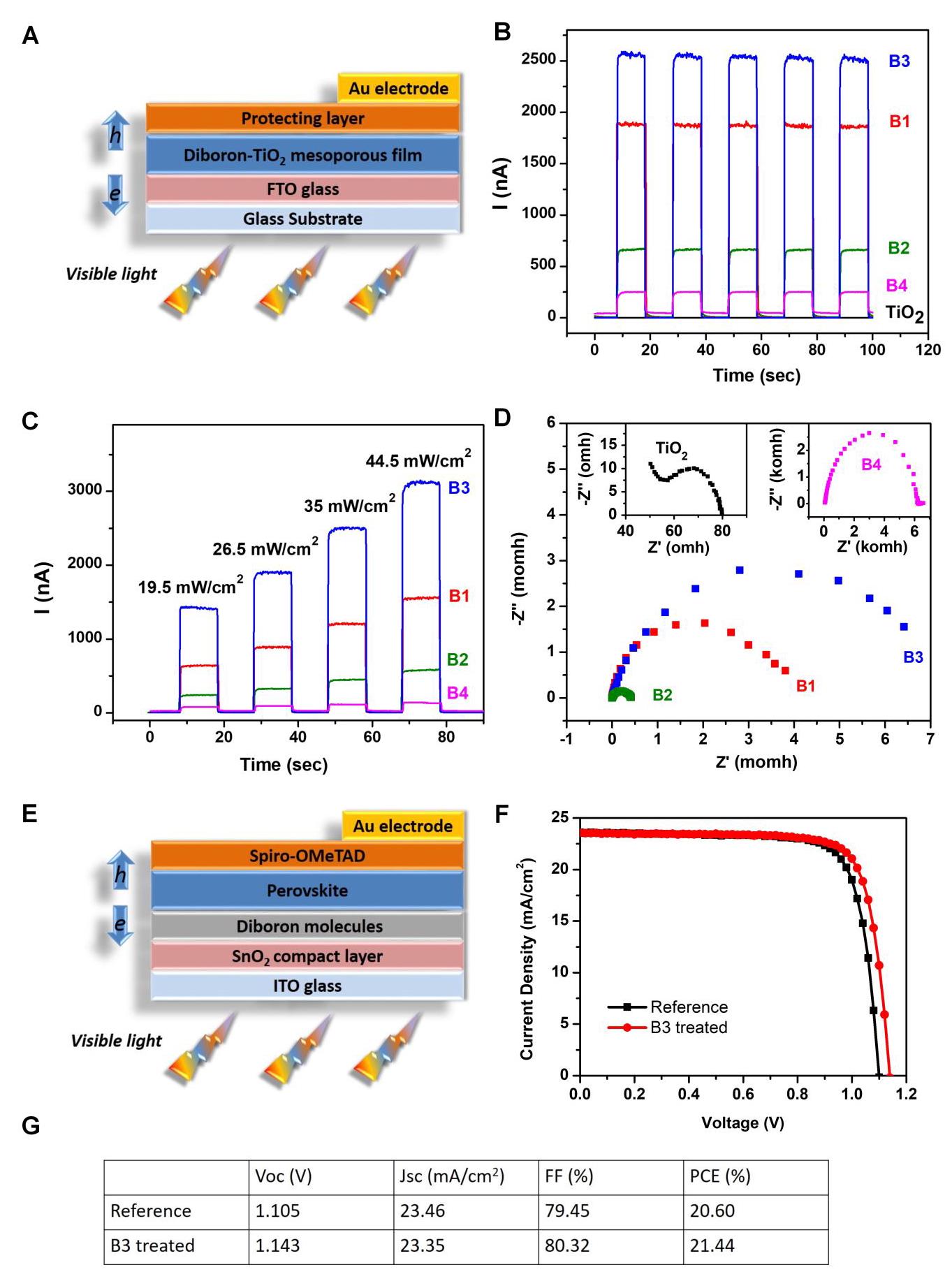
To further explore the optoelectronic properties of this diboron-adsorbed ${\mathrm{{TiO}}}_{2}$ material under visible-light excitation, thin films were then fabricated into photodetectors (denoted as FTO/TiO2/diboron/Spiro-OMeTAD/Au, Figure 4A). The time dependent current curves (I-t) for these diboron-type photodetectors under visible-light illumination (> 400 nm) exhibited excellent on-off switching repetitions through five cycles (interval = 10 s) (Figure 4B). The photocurrent for these four diboron-type detectors increased linearly with the light intensity (Figure 4C, Figure S15 and Table S2). In contrast, the observed photocurrent for ${\mathrm{{TiO}}}_{2}$ without diboron modification did not change regardless of the on/off state, which was ascribed to the intrinsic band gap of anatase ${\mathrm{{TiO}}}_{2}\left( {{3.2}\mathrm{{eV}}}\right)$ . Furthermore, the charge transport process in diboron-modified devices was investigated using electrochemical impedance spectroscopy (EIS) measurements in the dark at $0\mathrm{\;V}$ (Figure 4D). The larger semicircle radius of Nyquist plot in the low-frequency region for the B3 device compared to the B1, B2 and B4 devices indicated less electron recombination.(Kim et al., 2012) This observation agreed well with the highest photocurrent for the B3 device (Figure 4B). The IPCE has also evaluated and the B3-TiO ${}_{2}$ device shows the best performance (Figure S16). The B-TiO ${}_{2}$ photodetectors show good response towards long-time on-off tests compared to the ${\mathrm{{TiO}}}_{2}$ photodetector (Figure S17 and Figure S18) and the response of the photodetectors do not attenuate after stored in a dry air atmosphere for at least 7 months (Figure S19). We also fabricated solar cells based on the diboron molecule interface modulation and the J-V performance of the device were characterized showing an improved solar cell performance (Figure 4E-G). The data shows that the B3 treated device based on B3-SnO ${}_{2}$ interface have a better performance compared to the reference device of ${\mathrm{{SnO}}}_{2}$ based perovskite solar cell.
为了进一步探索这种二硼吸附的${\mathrm{{TiO}}}_{2}$材料在可见光激发下的光电特性,随后将薄膜制成光电探测器(表示为FTO/TiO2/二硼/Spiro-OMeTAD/金,图4A)。这些二硼型光电探测器在可见光照射(>400 nm)下的时间相关电流曲线(I-t)通过五个周期(间隔 = 10 s)表现出优异的开关重复性能(图4B)。这四个二硼型探测器的光电流随光强线性增加(图4C、图S15和表S2)。相比之下,观察到未经过二硼修饰的${\mathrm{{TiO}}}_{2}$的光电流无论开/关状态如何都没有变化,这归因于锐钛矿${\mathrm{{TiO}}}_{2}\left( {{3.2}\mathrm{{eV}}}\right)$的本征带隙。此外,在$0\mathrm{\;V}$的黑暗环境中使用电化学阻抗谱(EIS)测量研究了二硼修饰器件中的电荷传输过程(图4D)。与B1、B2和B4器件相比,B3器件在低频区域的奈奎斯特图半圆半径更大,表明电子复合较少。(Kim等人,2012年)这一观察结果与B3器件的最高光电流(图4B)非常吻合。还评估了IPCE,并且B3-TiO${}_{2}$器件表现出最佳性能(图S16)。与${\mathrm{{TiO}}}_{2}$光电探测器相比,B-TiO${}_{2}$光电探测器在长时间开/关测试中表现出良好的响应(图S17和图S18),并且光电探测器在干燥空气气氛中储存至少7个月后响应不会衰减(图S19)。我们还基于二硼分子界面调制制造了太阳能电池,并对器件的J-V性能进行了表征,显示出太阳能电池性能有所改善(图4E-G)。数据表明,基于B3-SnO${}_{2}$界面的B3处理器件与基于${\mathrm{{SnO}}}_{2}$的钙钛矿太阳能电池的参考器件相比具有更好的性能。
We note that previously developed solar cells such as dye-sensitized solar cells (DSSCs) and perovskite solar cells (PSCs) inevitably involve the use of expensive dyes and/or toxic and unstable reagents. Thus, our approach to generating visible-light active center via the adsorption of stable and inexpensive diboron compounds holds great advantages over these traditional techniques. Furthermore, a diverse range of diboron compounds can be conveniently synthesized from B4, potentially allowing for the fine-tuning of semiconductor-based materials. More importantly, the present strategy is not limited to ${\mathrm{{TiO}}}_{2}$ . In our studies, we have determined that a broad range of other common semiconducting oxides, including $\mathrm{{ZnO}},{\mathrm{{SnO}}}_{2},{\mathrm{{Nb}}}_{2}{\mathrm{O}}_{5}$ and ${\mathrm{{In}}}_{2}{\mathrm{O}}_{3}$ , were also successfully modified by diboron reagents, thus clearly demonstrating the generality of this method for semiconducting metal oxide modification (Figure S20).
我们注意到,先前开发的太阳能电池,如染料敏化太阳能电池(DSSC)和钙钛矿太阳能电池(PSC)不可避免地涉及使用昂贵的染料和/或有毒且不稳定的试剂。因此,我们通过吸附稳定且廉价的二硼化合物来产生可见光活性中心的方法比这些传统技术具有很大优势。此外,可以方便地从B4合成多种二硼化合物,这可能允许对基于半导体的材料进行微调。更重要的是,目前的策略不限于${\mathrm{{TiO}}}_{2}$。在我们的研究中,我们确定包括$\mathrm{{ZnO}},{\mathrm{{SnO}}}_{2},{\mathrm{{Nb}}}_{2}{\mathrm{O}}_{5}$和${\mathrm{{In}}}_{2}{\mathrm{O}}_{3}$在内的许多其他常见半导体氧化物也成功地被二硼试剂修饰,从而清楚地证明了这种半导体金属氧化物修饰方法的通用性(图S20)。
LIMITATIONS OF THE STUDY
研究的局限性
In the current study, perovskite solar cells assembled from $\mathrm{B} - {\mathrm{{TiO}}}_{2}$ display relatively poor performance (Figure S21). Many factors such as device fabrication could influence the performance of such device. Additionally, in our present work, mesoporous ${\mathrm{{TiO}}}_{2}$ was used in B- ${\mathrm{{TiO}}}_{2}$ -based devices while planar ${\mathrm{{SnO}}}_{2}$ was used in $\mathrm{B} - {\mathrm{{SnO}}}_{2}$ -based devices. We are uncertain if this deviation led to the contrasting device performance based on $\mathrm{B} - {\mathrm{{TiO}}}_{2}$ and $\mathrm{B} - {\mathrm{{SnO}}}_{2}$ materials. Nonetheless, the three orders of magnitude improvement observed in B-TiO2-based photodetector clearly demonstrates the utility of this diboron-based modification strategy. Currently, we are actively pursuing other applications based on diboron-modified semiconductor oxide materials featuring unique surface defects.
在当前研究中,由$\mathrm{B} - {\mathrm{{TiO}}}_{2}$组装的钙钛矿太阳能电池表现出相对较差的性能(图S21)。许多因素,如器件制造,可能会影响此类器件的性能。此外,在我们目前的工作中,基于B-${\mathrm{{TiO}}}_{2}$的器件使用了介孔${\mathrm{{TiO}}}_{2}$,而基于$\mathrm{B} - {\mathrm{{SnO}}}_{2}$的器件使用了平面${\mathrm{{SnO}}}_{2}$。我们不确定这种差异是否导致了基于$\mathrm{B} - {\mathrm{{TiO}}}_{2}$和$\mathrm{B} - {\mathrm{{SnO}}}_{2}$材料的器件性能形成对比。尽管如此,在基于B-TiO2的光电探测器中观察到的三个数量级的改进清楚地证明了这种基于二硼的改性策略的实用性。目前,我们正在积极探索基于具有独特表面缺陷的二硼改性半导体氧化物材料的其他应用。
METHODS
方法
All methods can be found in the accompanying Transparent Methods supplemental file.
所有方法均可在随附的《透明方法》补充文件中找到。
ACKNOWLEDGEMENT
致谢
We thank J. C. Zhao for encouragement; H. J. Yang (Tsinghua University), G. Q. Liu (Peking University), S. L. Wang (Peking University), H. P. Zhou (Peking University) and L. Jiao (Tsinghua University) for insightful discussions; H. Fu (Peking University), H. J. Yang and X. Zhang (Peking University) for assistance with ${}^{11}\mathrm{\;B}$ MAS NMR spectroscopy. A portion of EPR work was performed on the Steady High Magnetic Field Facilities, High Magnetic Field Laboratory of Chinese Academy of Sciences. The authors thank beamline BL08U1A and BL14W1 (Shanghai Synchrotron Radiation Facility) for providing the beam time. This research was supported by the National Natural Science Foundation of China (21772003, 91733301 and
我们感谢J. C. Zhao的鼓励;感谢H. J. Yang(清华大学)、G. Q. Liu(北京大学)、S. L. Wang(北京大学)、H. P. Zhou(北京大学)和L. Jiao(清华大学)进行的深入讨论;感谢H. Fu(北京大学)、H. J. Yang和X. Zhang(北京大学)在${}^{11}\mathrm{\;B}$ MAS NMR光谱方面提供的帮助。部分电子顺磁共振工作是在中国科学院强磁场科学中心稳态强磁场实验装置上完成的。作者感谢上海同步辐射装置的BL08U1A和BL14W1光束线提供的束流时间。本研究得到了中国国家自然科学基金(21772003、91733301和
91433203), the 973 Program of China (2015CB932203), ENN Group and BHP-PKU CCUS project.
91433203)、中国973计划(2015CB932203)、新奥集团和神华-北大CCUS项目的支持。
AUTHOR CONTRIBUTIONS
作者贡献
F. M. conceived the idea. Y. C., P. Z., Y. T., Z. L. and B.-W. D. performed experiments. Y. C., P. Z. and X. Z. conducted the DFT calculation. All authors analyzed data. Y. C., P. Z., Y. T., X. Z., Y. Y., S.-D. J., F. M. and W. M. wrote the manuscript. F. M. directed the whole project.
F.M.提出想法。Y.C.、P.Z.、Y.T.、Z.L.和B.-W.D.进行实验。Y.C.、P.Z.和X.Z.进行密度泛函理论(DFT)计算。所有作者分析数据。Y.C.、P.Z.、Y.T.、X.Z.、Y.Y.、S.-D.J.、F.M.和W.M.撰写手稿。F.M.指导整个项目。
DECLARATION OF INTERESTS
利益声明
The authors declare no competing interests.
作者声明不存在利益冲突。
References and Notes:
参考文献和注释:
Asahi, R., Morikawa, T., Irie, H., and Ohwaki, T. (2014). Nitrogen-Doped Titanium Dioxide as Visible-Light-Sensitive Photocatalyst: Designs, Developments, and Prospects. Chem Rev 114, 9824-9852.
Asahi, R., Morikawa, T., Ohwaki, T., Aoki, K., and Taga, Y. (2001). Visible-Light Photocatalysis in Nitrogen-Doped Titanium Oxides. Science 293, 269-271.
Chen, X., and Burda, C. (2008). The Electronic Origin of the Visible-Light Absorption Properties of C-, N- and S-Doped TiO2 Nanomaterials. J Am Chem Soc 130, 5018-5019.
Chen, X., Liu, L., Yu, P.Y., and Mao, S.S. (2011). Increasing Solar Absorption for Photocatalysis with Black Hydrogenated Titanium Dioxide Nanocrystals. Science 331, 746-750.
Chen, X., and Mao, S.S. (2007). Titanium Dioxide Nanomaterials: Synthesis, Properties, Modifications, and Applications. Chem Rev 107, 2891-2959.
Dahl, M., Liu, Y., and Yin, Y. (2014). Composite Titanium Dioxide Nanomaterials. Chem Rev 114, 9853-9889. de Groot, F.M.F., Grioni, M., Fuggle, J.C., Ghijsen, J., Sawatzky, G.A., and Petersen, H. (1989). Oxygen 1s x-ray-absorption edges of transition-metal oxides. Phys Rev B 40, 5715-5723.
Gopal, N.O., Lo, H.-H., and Ke, S.-C. (2008). Chemical State and Environment of Boron Dopant in B, N-Codoped Anatase TiO2 Nanoparticles: An Avenue for Probing Diamagnetic Dopants in TiO2 by Electron Paramagnetic Resonance Spectroscopy. J Am Chem Soc 130, 2760-2761.
Grätzel, M. (2001). Photoelectrochemical cells. Nature 414, 338.
Green, M., Liu, Z., Xiang, P., Liu, Y., Zhou, M., Tan, X., Huang, F., Liu, L., and Chen, X. (2018a). Doped, conductive SiO2 nanoparticles for large microwave absorption. Light: Science & Applications 7, 87.
Green, M., Van Tran, A.T., Smedley, R., Roach, A., Murowchick, J., and Chen, X. (2019a). Microwave absorption of magnesium/hydrogen-treated titanium dioxide nanoparticles. Nano Materials Science 1, 48-59.
Green, M., Xiang, P., Liu, Z., Murowchick, J., Tan, X., Huang, F., and Chen, X. (2019b). Microwave absorption of aluminum/hydrogen treated titanium dioxide nanoparticles. Journal of Materiomics 5, 133-146.
Green, M.A., Xu, J., Liu, H., Zhao, J., Li, K., Liu, L., Qin, H., Zhu, Y., Shen, D., and Chen, X. (2018b). Terahertz absorption of hydrogenated TiO2 nanoparticles. Materials Today Physics 4, 64-69.
Guan, L., and Chen, X. (2018). Photoexcited Charge Transport and Accumulation in Anatase TiO2. ACS Applied Energy Materials 1, 4313-4320.
Hoffmann, M.R., Martin, S.T., Choi, W., and Bahnemann, D.W. (1995). Environmental Applications of Semiconductor Photocatalysis. Chem Rev 95, 69-96.
Howe, R.F., and Gratzel, M. (1985). EPR observation of trapped electrons in colloidal titanium dioxide. J Phys Chem 89, 4495-4499.
Iorio, Y.D., Aguirre, M.E., Brusa, M.A., and Grela, M.A. (2012). Surface Chemistry Determines Electron Storage Capabilities in Alcoholic Sols of Titanium Dioxide Nanoparticles. A Combined FTIR and Room Temperature EPR Investigation. J Phys Chem C 116, 9646-9652.
Karvonen, L., Valkeapää, M., Liu, R.-S., Chen, J.-M., Yamauchi, H., and Karppinen, M. (2010). O-K and Co-L XANES Study on Oxygen Intercalation in Perovskite SrCoO3-δ. Chem Mater 22, 70-76.
Khan, S.U.M., Al-Shahry, M., and Ingler, W.B. (2002). Efficient Photochemical Water Splitting by a Chemically Modified n-TiO2. Science 297, 2243-2245.
Kim, K.S., Song, H., Nam, S.H., Kim, S.-M., Jeong, H., Kim, W.B., and Jung, G.Y. (2012). Fabrication of an Efficient Light-Scattering Functionalized Photoanode Using Periodically Aligned ZnO Hemisphere Crystals for Dye-Sensitized Solar Cells. Adv Mater 24, 792-798.
Kronawitter, C.X., Bakke, J.R., Wheeler, D.A., Wang, W.-C., Chang, C., Antoun, B.R., Zhang, J.Z., Guo, J., Bent, S.F., Mao, S.S., et al. (2011). Electron Enrichment in 3d Transition Metal Oxide Hetero-Nanostructures. Nano Letters 11, 3855-3861.
Lang, X., Ma, W., Zhao, Y., Chen, C., Ji, H., and Zhao, J. (2012). Visible - Light - Induced Selective Photocatalytic Aerobic Oxidation of Amines into Imines on TiO2. Chem Eur J 18, 2624-2631.
Lazzeri, M., Vittadini, A., and Selloni, A. (2001). Structure and energetics of stoichiometric ${\mathrm{TiO}}_{2}$ anatase surfaces. Phys Rev B 63, 155409.
Li, G., Dimitrijevic, N.M., Chen, L., Nichols, J.M., Rajh, T., and Gray, K.A. (2008). The Important Role of Tetrahedral Ti4+ Sites in the Phase Transformation and Photocatalytic Activity of TiO2 Nanocomposites. J Am Chem Soc 130, 5402-5403.
Liu, L., and Chen, X. (2014). Titanium Dioxide Nanomaterials: Self-Structural Modifications. Chem Rev 114, 9890- 9918.
Liu, Q., Hong, J., Sun, B., Bai, G., Li, F., Liu, G., Yang, Y., and Mo, F. (2019). Transition-Metal-Free Borylation of Alkyl Iodides via a Radical Mechanism. Org Lett 21, 6597-6602.
Maeda, K., Teramura, K., Lu, D., Takata, T., Saito, N., Inoue, Y., and Domen, K. (2006). Photocatalyst releasing hydrogen from water. Nature 440, 295-295.
Mo, F., Jiang, Y., Qiu, D., Zhang, Y., and Wang, J. (2010). Direct Conversion of Arylamines to Pinacol Boronates: A Metal-Free Borylation Process. Angew Chem Int Edit 49, 1846-1849.
Mo, F., Qiu, D., Zhang, Y., and Wang, J. (2018). Renaissance of Sandmeyer-Type Reactions: Conversion of Aromatic C-N Bonds into C-X Bonds (X = B, Sn, P, or CF3). Accounts Chem Res 51, 496-506.
Neeve, E.C., Geier, S.J., Mkhalid, I.A.I., Westcott, S.A., and Marder, T.B. (2016). Diboron(4) Compounds: From Structural Curiosity to Synthetic Workhorse. Chem Rev 116, 9091-9161.
Nöth, H., and Wrackmeyer, B. (1978). 11B NMR of Tetracoordinate Boron. In Nuclear Magnetic Resonance Spectroscopy of Boron Compounds, H. Nöth, and B. Wrackmeyer, eds. (Berlin, Heidelberg: Springer Berlin Heidelberg), pp. 74-101.
Pietsch, S., Neeve, E.C., Apperley, D.C., Bertermann, R., Mo, F., Qiu, D., Cheung, M.S., Dang, L., Wang, J., Radius, U., et al. (2015). Synthesis, Structure, and Reactivity of Anionic sp2-sp3 Diboron Compounds: Readily Accessible Boryl Nucleophiles. Chem Eur J 21, 7082-7098.
Schrauben, J.N., Hayoun, R., Valdez, C.N., Braten, M., Fridley, L., and Mayer, J.M. (2012). Titanium and Zinc Oxide Nanoparticles Are Proton-Coupled Electron Transfer Agents. Science 336, 1298-1301.
Stewart, S.J., Fernández-García, M., Belver, C., Mun, B.S., and Requejo, F.G. (2006). Influence of N-Doping on the Structure and Electronic Properties of Titania Nanoparticle Photocatalysts. The Journal of Physical Chemistry B 110, 16482-16486.
Tian, L., Xu, J., Alnafisah, A., Wang, R., Tan, X., Oyler, N.A., Liu, L., and Chen, X. (2017). A Novel Green TiO2 Photocatalyst with a Surface Charge-Transfer Complex of Ti and Hydrazine Groups. Chem Eur J 23, 5345-5351.
Wang, D., Kako, T., and Ye, J. (2008). Efficient Photocatalytic Decomposition of Acetaldehyde over a Solid-Solution Perovskite (Ag0.75Sr0.25)(Nb0.75Ti0.25)O3 under Visible-Light Irradiation. J Am Chem Soc 130, 2724- 2725.
Wang, G., Zhang, H., Zhao, J., Li, W., Cao, J., Zhu, C., and Li, S. (2016). Homolytic Cleavage of a B-B Bond by the Cooperative Catalysis of Two Lewis Bases: Computational Design and Experimental Verification. Angew Chem Int Edit 55, 5985-5989.
Xia, T., Li, N., Zhang, Y., Kruger, M.B., Murowchick, J., Selloni, A., and Chen, X. (2013). Directional heat dissipation across the interface in anatase-rutile nanocomposites. ACS Appl Mater Interfaces 5, 9883-9890.
Xia, T., Zhang, Y., Murowchick, J., and Chen, X. (2014). Vacuum-treated titanium dioxide nanocrystals: Optical properties, surface disorder, oxygen vacancy, and photocatalytic activities. Catal Today 225, 2-9.
Yan, Y., Shi, W., Yuan, Z., He, S., Li, D., Meng, Q., Ji, H., Chen, C., Ma, W., and Zhao, J. (2017). The Formation of Ti-H Species at Interface Is Lethal to the Efficiency of TiO2-Based Dye-Sensitized Devices. J Am Chem Soc 139, 2083-2089.
Zhang, L., and Jiao, L. (2017). Pyridine-Catalyzed Radical Borylation of Aryl Halides. J Am Chem Soc 139, 607- 610.
Zhang, L., and Jiao, L. (2017). Pyridine-Catalyzed Radical Borylation of Aryl Halides. J Am Chem Soc 139, 607- 610.
Zuo, F., Wang, L., Wu, T., Zhang, Z., Borchardt, D., and Feng, P. (2010). Self-Doped Ti3+ Enhanced Photocatalyst for Hydrogen Production under Visible Light. J Am Chem Soc 132, 11856-11857.
Zuo, F., Wang, L., Wu, T., Zhang, Z., Borchardt, D., and Feng, P. (2010). Self-Doped Ti3+ Enhanced Photocatalyst for Hydrogen Production under Visible Light. J Am Chem Soc 132, 11856-11857.
Figure 1. Conventional methods and present work for the preparation of self-doped ${\mathrm{{Ti}}}^{3 + } - {\mathrm{{TiO}}}_{2}$ materials (A) ${\mathrm{{Ti}}}^{3 + }$ generation as a result of oxygen vacancy formation. High temperature combustion with reductant leads to oxygen vacancy in ${\mathrm{{TiO}}}_{2}$ bulk phase.(Zuo et al.,2010)
图1. 制备自掺杂${\mathrm{{Ti}}}^{3 + } - {\mathrm{{TiO}}}_{2}$材料的传统方法和当前工作 (A) 由于形成氧空位而产生${\mathrm{{Ti}}}^{3 + }$。与还原剂进行高温燃烧会导致${\mathrm{{TiO}}}_{2}$体相中出现氧空位。(左等人,2010年)
(B) ${\mathrm{{Ti}}}^{3 + }$ generation by photo irradiation. By removal of photoinduced holes using organic sacrificial agents, electrons are cumulated at the conduction band of ${\mathrm{{TiO}}}_{2}$ , resulting in the reduction of ${\mathrm{{Ti}}}^{4 + }$ to ${\mathrm{{Ti}}}^{3 + }$ .(Schrauben et al., 2012; Yan et al., 2017)
(B) 通过光辐照产生${\mathrm{{Ti}}}^{3 + }$。使用有机牺牲剂去除光生空穴后,电子在${\mathrm{{TiO}}}_{2}$的导带处累积,导致${\mathrm{{Ti}}}^{4 + }$还原为${\mathrm{{Ti}}}^{3 + }$。(施劳本等人,2012年;严等人,2017年)
(C) Present work. Diboron compound $\left( {{\mathrm{B}}_{2}{\mathrm{{Pin}}}_{2}}\right)$ adsorption on the surface of ${\mathrm{{TiO}}}_{2}$ nanoparticles induces spontaneous electron injection for the formation of optically active ${\mathrm{{Ti}}}^{3 + } - {\mathrm{O}}^{ - }$ species. The light blue, blue, red, orange, earth yellow, green and pink balls stand for the ${\mathrm{{Ti}}}^{4 + },{\mathrm{{Ti}}}^{3 + },{\mathrm{O}}^{2 - },{\mathrm{O}}^{ - },\mathrm{C},\mathrm{B}$ and $\mathrm{H}$ atom, respectively.
(C) 当前工作。二硼化合物$\left( {{\mathrm{B}}_{2}{\mathrm{{Pin}}}_{2}}\right)$吸附在${\mathrm{{TiO}}}_{2}$纳米颗粒表面会引发自发电子注入,以形成光学活性的${\mathrm{{Ti}}}^{3 + } - {\mathrm{O}}^{ - }$物种。浅蓝色、蓝色、红色、橙色、土黄色、绿色和粉色球分别代表${\mathrm{{Ti}}}^{4 + },{\mathrm{{Ti}}}^{3 + },{\mathrm{O}}^{2 - },{\mathrm{O}}^{ - },\mathrm{C},\mathrm{B}$和$\mathrm{H}$原子。
(D) Four commercially available diboron compounds used in this study: ${\mathrm{B}}_{2}{\mathrm{{Pin}}}_{2}$ (bis(pinacolato)diboron), ${\mathrm{B}}_{2}{\left( \mathrm{{OH}}\right) }_{4}$ (tetrahydroxydiborane), ${\mathrm{B}}_{2}{\mathrm{{Cat}}}_{2}$ (bis(catecholato)diboron) and ${\mathrm{B}}_{2}{\left( {\mathrm{{NMe}}}_{2}\right) }_{4}$ (tetrakis(dimethylamino)diboron).
(D) 本研究中使用的四种市售二硼化合物:${\mathrm{B}}_{2}{\mathrm{{Pin}}}_{2}$(双(频哪醇合)二硼)、${\mathrm{B}}_{2}{\left( \mathrm{{OH}}\right) }_{4}$(四羟基二硼烷)、${\mathrm{B}}_{2}{\mathrm{{Cat}}}_{2}$(双(儿茶酚合)二硼)和${\mathrm{B}}_{2}{\left( {\mathrm{{NMe}}}_{2}\right) }_{4}$(四(二甲氨基)二硼)。
(E) Photograph comparing ${\mathrm{{TiO}}}_{2}\left( {\mathrm{P}{25}}\right) ,{\mathrm{B}}_{2}{\mathrm{{Pin}}}_{2}\left( {\mathrm{\;B}1}\right) ,\mathrm{B}1 - {\mathrm{{TiO}}}_{2} - {\mathrm{N}}_{2}$ sample under an inert atmosphere (mixture of solid ${\mathrm{{TiO}}}_{2}$ and ${\mathrm{B}}_{2}{\mathrm{{Pin}}}_{2}$ ) and $\mathrm{B}1 - {\mathrm{{TiO}}}_{2}$ under air after heating at ${80}^{ \circ }\mathrm{C}$ under vacuum for $3\mathrm{\;h}$ .
(E) 比较在惰性气氛(固体${\mathrm{{TiO}}}_{2}$和${\mathrm{B}}_{2}{\mathrm{{Pin}}}_{2}$的混合物)下的${\mathrm{{TiO}}}_{2}\left( {\mathrm{P}{25}}\right) ,{\mathrm{B}}_{2}{\mathrm{{Pin}}}_{2}\left( {\mathrm{\;B}1}\right) ,\mathrm{B}1 - {\mathrm{{TiO}}}_{2} - {\mathrm{N}}_{2}$样品与在真空中于${80}^{ \circ }\mathrm{C}$加热$3\mathrm{\;h}$后在空气中的$\mathrm{B}1 - {\mathrm{{TiO}}}_{2}$的照片。
(F) EPR spectra of $\mathrm{B}1 - {\mathrm{{TiO}}}_{2}$ at various temperatures.
(F) 不同温度下$\mathrm{B}1 - {\mathrm{{TiO}}}_{2}$的电子顺磁共振光谱。
(G) HRTEM of B3-TiO ${}_{2}$ . A short-dashed curve is applied to outline a portion of the interface between the crystalline core and the outer layer (marked by white arrows).
(G) B3-TiO${}_{2}$的高分辨透射电子显微镜图像。一条短虚线曲线用于勾勒晶核与外层之间的部分界面(由白色箭头标记)。
(H) The corresponding HADDF-STEM image of B3-TiO ${}_{2}$ with distribution of the C element mapping.
(H) B3-TiO${}_{2}$的相应高角度环形暗场扫描透射电子显微镜图像及碳元素分布图。
Movie S1. Related to Figure 1E. Mechanical mixing of two fine white powders of commercial Degussa ${\mathrm{{TiO}}}_{2}$ P25 and bis(pinacolato)diboron $\left( {{\mathrm{B}}_{2}{\mathrm{{Pin}}}_{2},\mathrm{\;B}1}\right)$ in a glove box and in air were recorded by a smart phone camera. Samples color change from white to blue within one minute. Please watch the video for detail.
电影S1。与图1E相关。在手套箱和空气中,用智能手机摄像头记录了商业德固赛${\mathrm{{TiO}}}_{2}$ P25和双(频哪醇合)二硼$\left( {{\mathrm{B}}_{2}{\mathrm{{Pin}}}_{2},\mathrm{\;B}1}\right)$两种细白色粉末的机械混合过程。样品在一分钟内从白色变为蓝色。详情请观看视频。
Figure 2. Spectroscopic Characterizations
图2. 光谱表征
(A) UV-Vis spectra of the white ${\mathrm{{TiO}}}_{2}$ P25 and diboron-adsorbed ${\mathrm{{TiO}}}_{2}$ P25. The inset shows the UV-Vis spectra of four free diboron compounds.
(A) 白色${\mathrm{{TiO}}}_{2}$P25和吸附二硼的${\mathrm{{TiO}}}_{2}$P25的紫外-可见光谱。插图展示了四种游离二硼化合物的紫外-可见光谱。
(B) In situ ATR-FTIR spectrum of B1 onto ${\mathrm{{TiO}}}_{2}$ over ${15}\mathrm{\;{min}}$ .
(B) B1在${15}\mathrm{\;{min}}$上在${\mathrm{{TiO}}}_{2}$上的原位ATR-FTIR光谱。
(C) FT-IR spectra of free B1 and B1- ${\mathrm{{TiO}}}_{2}$ .
(C) 游离B1和B1-${\mathrm{{TiO}}}_{2}$的傅里叶变换红外光谱。
(D) Solid-state ${}^{11}$ B MAS NMR of diboron compounds B and B-TiO ${}_{2}$ .
(D) 二硼化合物B和B-TiO${}_{2}$的固态${}^{11}$B MAS NMR。
(E) XRD pattern of the diboron compounds modified ${\mathrm{{TiO}}}_{2}$
(E) 经${\mathrm{{TiO}}}_{2}$改性的二硼化合物的XRD图谱
(F) Ti $2\mathrm{p},\mathrm{O}1\mathrm{\;s}$ and valance band structure $\mathrm{X}$ -ray photoelectron spectroscopy spectra of ${\mathrm{{TiO}}}_{2}$ and $\mathrm{B}1 - {\mathrm{{TiO}}}_{2}$ .
(F) Ti $2\mathrm{p},\mathrm{O}1\mathrm{\;s}$以及${\mathrm{{TiO}}}_{2}$和$\mathrm{B}1 - {\mathrm{{TiO}}}_{2}$的价带结构$\mathrm{X}$ -射线光电子能谱。
(G) Normalized Ti-L edge XANES spectra of ${\mathrm{{TiO}}}_{2}$ and $\mathrm{B}1 - {\mathrm{{TiO}}}_{2}$ .
(G) ${\mathrm{{TiO}}}_{2}$和$\mathrm{B}1 - {\mathrm{{TiO}}}_{2}$的归一化Ti-L边X射线吸收近边结构光谱。
(H) Normalized O-K edge XANES spectra of ${\mathrm{{TiO}}}_{2}$ and $\mathrm{B}1 - {\mathrm{{TiO}}}_{2}$ .
(H) ${\mathrm{{TiO}}}_{2}$和$\mathrm{B}1 - {\mathrm{{TiO}}}_{2}$的归一化O-K边XANES光谱。
Figure 3. DFT calculation results
图3. 密度泛函理论(DFT)计算结果
(A) Optimized geometric structures and charge difference density mappings for no adsorption.
(A) 无吸附时的优化几何结构和电荷差密度映射。
(B) Optimized geometric structures and charge difference density mappings for adsorption of B1 on the ${\mathrm{{TiO}}}_{2}\{ {101}\}$ surface. The numbers in the figure stand for the Bader charges on the various atoms. The isosurfaces of the electron density difference plots are all ${0.001}\mathrm{e}{\text{ Å }}^{-3}$ . The yellow and light blue surfaces represent electron depletion and accumulation. The blue, red, earth yellow, green and pink spheres stands for the Ti, O, C, B and H atoms, respectively.
(B) B1在${\mathrm{{TiO}}}_{2}\{ {101}\}$表面吸附的优化几何结构和电荷差密度映射。图中的数字代表各个原子上的巴德电荷。电子密度差图的等值面均为${0.001}\mathrm{e}{\text{ Å }}^{-3}$。黄色和浅蓝色表面分别代表电子耗尽和积累。蓝色、红色、土黄色、绿色和粉色球体分别代表Ti、O、C、B和H原子。
(C) Projected density of state (PDOS) plots for no adsorption.
(C) 无吸附时的投影态密度 (PDOS) 图。
(D) Projected density of state (PDOS) plots for adsorption of B1 on the ${\mathrm{{TiO}}}_{2}\{ {101}\}$ surface (the insert on the right are the magnification of the inter band at near the Fermi energy level). The dashed line show the Fermi level.
(D) B1在${\mathrm{{TiO}}}_{2}\{ {101}\}$表面吸附的投影态密度(PDOS)图(右侧插图为费米能级附近带间的放大图)。虚线表示费米能级。
Figure 4. Photodetectors and perovskite solar cells performance
图4. 光电探测器和钙钛矿太阳能电池的性能
(A) Schematic of the FTO/TiO ${}_{2}$ /diboron/Spiro-OMeTAD/Au photodetector.
(A) FTO/TiO ${}_{2}$ /二硼/Spiro-OMeTAD/金光电探测器的示意图。
(B) Time dependent current curves for the detectors under light illumination $\left( {\lambda > {400}\mathrm{\;{nm}}}\right)$ with ${10}\mathrm{\;s}$ on/off switching intervals.
(B) 探测器在光照$\left( {\lambda > {400}\mathrm{\;{nm}}}\right)$下,${10}\mathrm{\;s}$开/关切换间隔时的时间相关电流曲线。
(C) Time dependent current curves for these photodetectors under illumination intensities $\left( {\lambda > {400}\mathrm{\;{nm}}}\right)$ of 19.5 $\mathrm{{mW}} \cdot {\mathrm{{cm}}}^{-2},{26.5}\mathrm{{mW}} \cdot {\mathrm{{cm}}}^{-2},{35.0}\mathrm{{mW}} \cdot {\mathrm{{cm}}}^{-2}$ , and ${44.5}\mathrm{{mW}} \cdot {\mathrm{{cm}}}^{-2}$ .
(C) 这些光电探测器在光照强度为19.5 $\mathrm{{mW}} \cdot {\mathrm{{cm}}}^{-2},{26.5}\mathrm{{mW}} \cdot {\mathrm{{cm}}}^{-2},{35.0}\mathrm{{mW}} \cdot {\mathrm{{cm}}}^{-2}$和${44.5}\mathrm{{mW}} \cdot {\mathrm{{cm}}}^{-2}$的$\left( {\lambda > {400}\mathrm{\;{nm}}}\right)$下的时间相关电流曲线。
(D) Nyquist plots from the photodetectors in the dark.
(D) 光电探测器在黑暗中的奈奎斯特图。
(E) Schematic of the ITO/ ${\mathrm{{SnO}}}_{2}$ /diboron/Perovskite/Spiro-OMeTAD/Au solar cell.
(E) ITO/${\mathrm{{SnO}}}_{2}$/二硼/钙钛矿/Spiro-OMeTAD/金太阳能电池的示意图。
(F) Current density-voltage curves (J-V) of the diboron modificated perovskite solar cell.
(F) 二硼改性钙钛矿太阳能电池的电流密度-电压曲线(J-V)。
(G) Photovoltaic parameters of the diboron modificated perovskite solar cell.
(G) 二硼改性钙钛矿太阳能电池的光伏参数。
Journal Pre-proof
期刊预校样
Highlights
亮点
Organodiborons are used to reshape the surface electronic state of semiconductor oxides.
有机二硼用于重塑半导体氧化物的表面电子态。
Diboron adsorption leads to spontaneous charge transfer and reduced surface metal ions.
二硼吸附导致自发电荷转移并减少表面金属离子。
Photodetector based on diboron material affords ${10}^{3}$ fold higher visible light response.
基于二硼材料的光电探测器的可见光响应提高了${10}^{3}$倍。