Cu-catalysed carboxylation of aryl boronic acids with CO2
英文原文与中文译文逐段对照 · English original with Chinese translation
ORGANIC CH
有机化学
Check for updates
检查更新
Cite this: Org. Chem. Front., 2019, 6, 3673
引用本文:Org. Chem. Front., 2019, 6, 3673
Received 18th August 2019, Accepted 17th September 2019
2019年8月18日收到,2019年9月17日接受
DOI: 10.1039/c9qo01023h
DOI: 10.1039/c9qo01023h
rsc.li/frontiers-organic
rsc.li/frontiers-organic
Cu-Catalysed carboxylation of aryl boronic acids with ${\mathrm{{CO}}}_{2} \dagger$
铜催化芳基硼酸与${\mathrm{{CO}}}_{2} \dagger$的羧基化反应
Onkar S. Nayal, ${}^{a}$ Junting Hong, ${}^{a}$ Yang Yang ${}^{b}$ and Fanyang Mo ${}^{c}{}^{d}{}^{e}{}^{a}$ No ${}^{c}$
Onkar S. Nayal,${}^{a}$洪钧婷,${}^{a}$杨扬${}^{b}$和莫凡洋${}^{c}{}^{d}{}^{e}{}^{a}$ 无${}^{c}$
A copper/N-heterocyclic carbene (NHC) catalysed carboxylation of aryl boronic acids under one atmospheric pressure of ${\mathrm{{CO}}}_{2}$ has been developed. A wide range of aryl boronic acids was transformed into benzoic acid derivatives in moderate to high yields. The carboxylation method shows excellent functional group compatibility, and sensitive functional groups such as carbonyls, esters, and nitriles were tolerated. Mechanistic studies revealed the vital role of the base in promoting the transmetalation step for this copper-catalysed carboxylation.
已开发出一种在${\mathrm{{CO}}}_{2}$的一个大气压下铜/氮杂环卡宾(NHC)催化芳基硼酸的羧基化反应。多种芳基硼酸以中等至高收率转化为苯甲酸衍生物。该羧基化方法显示出优异的官能团兼容性,并且羰基、酯和腈等敏感官能团也能耐受。机理研究揭示了碱在促进该铜催化羧基化反应的转金属步骤中的关键作用。
Introduction
引言
The efficient conversion and utilisation of carbon dioxide $\left( {\mathrm{{CO}}}_{2}\right)$ , the primary component of greenhouse gases, is of pivotal importance to combat global warming. ${}^{1 - 3}$ In this context, the catalytic carboxylation of organic molecules with carbon dioxide represents a green and sustainable alternative for the synthesis of value-added chemicals. ${}^{4}$ In recent years, ${\mathrm{{CO}}}_{2}$ has been used as the $\mathrm{C}1$ source in various organic transformations. ${}^{5}$ Among these processes, synthesis of carboxylic acids with ${\mathrm{{CO}}}_{2}$ through $\mathrm{C} - \mathrm{C}$ bond formation is particularly attractive, ${}^{6 - 8}$ in part due to the ubiquity of carboxylic acids in various bioactive natural products, ${}^{9}$ agrochemicals ${}^{10}$ and pharmaceuticals. ${}^{{11} - {13}}$ Owing to the kinetic inertness and thermodynamic stability of carbon dioxide, highly reactive and air-sensitive organometallic reagents were usually used as the starting materials for nucleophilic carboxylation in previously developed approaches. ${}^{3}$ However, the relatively low functional group tolerance of these organometallic species hampers their widespread application.
二氧化碳$\left( {\mathrm{{CO}}}_{2}\right)$作为温室气体的主要成分,其高效转化和利用对于应对全球变暖至关重要。${}^{1 - 3}$在此背景下,利用二氧化碳对有机分子进行催化羧化反应,为合成高附加值化学品提供了一种绿色可持续的途径。${}^{4}$近年来,${\mathrm{{CO}}}_{2}$已在各种有机转化反应中用作$\mathrm{C}1$源。${}^{5}$在这些过程中,通过$\mathrm{C} - \mathrm{C}$键的形成,利用${\mathrm{{CO}}}_{2}$合成羧酸的方法尤为引人关注,${}^{6 - 8}$部分原因在于羧酸广泛存在于各种具有生物活性的天然产物中,${}^{9}$以及农药${}^{10}$和医药领域。${}^{{11} - {13}}$由于二氧化碳具有动力学惰性和热力学稳定性,在以往开发的方法中,亲核羧化反应通常使用高活性且对空气敏感的有机金属试剂作为起始原料。${}^{3}$然而,这些有机金属物种对官能团的耐受性相对较低,限制了它们的广泛应用。
To overcome these challenges, in the past decades, organoboron reagents have been applied as the precursor to carboxylic acids due to their ease of handling, broad availability and functional group compatibility. ${}^{14}$ In this regard, Iwasawa, ${}^{{15},{16}}$ Hou, ${}^{{17},{18}}$ Zhang and Lu, ${}^{19}{\text{ Nolan }}^{20}$ and Riss groups ${}^{21}$ have reported efficient protocols for the synthesis of carboxylic acids from aryl and alkenyl boronic esters with ${\mathrm{{CO}}}_{2}$ . Despite these recent advances, the carboxylation of organo-boronic acids, which constitute the simplest and most broadly available class of organoboron reagents, ${}^{22}$ still remain underdeveloped. ${}^{23}$ Previous efforts ${}^{{24} - {26}}$ in engaging arylboronic acids for the transition-metal-catalysed carboxylation have relied on various carbon dioxide surrogates including oxalic acid, acetyl acetate, and isocyanide (Scheme 1a). To date, the direct use of the most desirable C1 source for carboxylation, namely carbon dioxide, has remained unsuccessful. Herein, we report an efficient and economical approach to utilise ${\mathrm{{CO}}}_{2}$ for the synthesis of benzoic acids from boronic acids using an NHC-supported copper catalyst.
为了克服这些挑战,在过去几十年中,有机硼试剂因其易于处理、广泛可得以及官能团兼容性而被用作羧酸的前体。${}^{14}$ 在这方面,岩泽、${}^{{15},{16}}$ 侯、${}^{{17},{18}}$ 张和陆、${}^{19}{\text{ Nolan }}^{20}$ 以及里斯小组 ${}^{21}$ 报道了从芳基和烯基硼酸酯合成羧酸的有效方法。${\mathrm{{CO}}}_{2}$ 尽管有这些最新进展,但构成最简单且最广泛可得的有机硼试剂类别的有机硼酸的羧化反应 ${}^{22}$ 仍未得到充分发展。${}^{23}$ 以前在使芳基硼酸参与过渡金属催化的羧化反应方面的努力 ${}^{{24} - {26}}$ 依赖于各种二氧化碳替代物,包括草酸、乙酰乙酸和异氰化物(方案1a)。迄今为止,将最理想的用于羧化反应的C1源,即二氧化碳直接用于反应仍未成功。在此,我们报道了一种高效且经济的方法,使用NHC负载的铜催化剂,利用 ${\mathrm{{CO}}}_{2}$ 从硼酸合成苯甲酸。
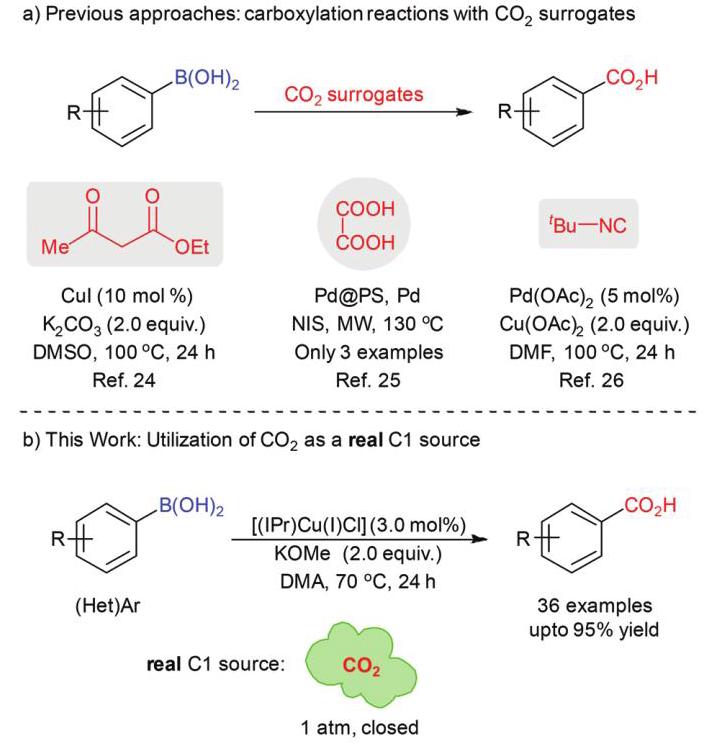
Scheme 1 a) Previous strategies for the carboxylation reaction with various ${\mathrm{{CO}}}_{2}$ surrogates. (b) This work: Utilization of ${\mathrm{{CO}}}_{2}$ as a real C1 source for carboxylation reaction.
方案a) 以前使用各种 ${\mathrm{{CO}}}_{2}$ 替代物进行羧化反应的策略。(b) 本工作:将 ${\mathrm{{CO}}}_{2}$ 用作羧化反应的实际C1源。
${}^{a}$ Department of Energy and Resources Engineering, College of Engineering, Peking University, Beijing, 100871, China.
${}^{a}$ 能源与资源工程系,工程学院,北京大学,北京,100871,中国。
${}^{b}$ Division of Chemistry and Chemical Engineering, California Institute of Technology, Pasadena, CA 91125, USA
${}^{b}$ 化学与化学工程系,加州理工学院,帕萨迪纳,加利福尼亚州91125,美国
‘Jiangsu Donghai Silicon Industry S&T Innovation Center, Donghai County, Jiangsu 222300, China
[具体单位] 江苏东海硅产业科技创新中心,江苏省东海县,江苏222300,中国
†Electronic supplementary information (ESI) available. See DOI: 10.1039/ c9qo01023h
† 可获得电子补充信息(ESI)。见DOI: 10.1039/c9qo01023h
We started our investigation by evaluating a series of catalysts, bases, solvents and reaction temperature to facilitate the conversion of boronic acid (1ah) to carboxylic acid (2ah). After an extensive survey of reaction parameters (for details, see ESI Tables S1-4†), 82% yield of the desired product was obtained using 3.0 mol% [(IPr)Cu(I)Cl] and 2.0 equiv. of KOMe in DMA at ${70}^{ \circ }\mathrm{C}$ (Table 1, entry 1). The use of other alkoxide bases provided low yields of desired product due to incomplete conversion (Table 1, entries 2 and 3). Further evaluation of base stoichiometry revealed that 2.0 equiv. of KOMe to be optimal (Table 1 entries 1, 4 and 5 and see ESI, Table S4†). In addition, lowering the reaction temperature from ${70}^{ \circ }\mathrm{C}$ to ${50}^{ \circ }\mathrm{C}$ resulted in sluggish reaction (Table 1, entry 6), although the yield of the desired product could not be further improved by increasing the temperature (Table 1, entry 7). Moreover, control experiments show that both the catalyst and the base are critical to this transformation (Table 1, entries 8 and 9). Furthermore, trace quantities of water resulted in the undesired protodebor-onation (Table 1, entries 10-12). Among all the solvents studied, DMA was found to be the best for this carboxylation (Table 1, entries 13-15 and see ESI, Table S3†).
我们通过评估一系列催化剂、碱、溶剂和反应温度来展开研究,以促进硼酸(1ah)向羧酸(2ah)的转化。在对反应参数进行广泛考察后(详细内容见补充信息表S1 - 4†),在${70}^{ \circ }\mathrm{C}$条件下,使用3.0 mol%的[(IPr)Cu(I)Cl]和2.0当量的KOMe于DMA中,得到了82%产率的目标产物(表1,条目1)。使用其他醇盐碱时,由于转化不完全,目标产物的产率较低(表1,条目2和3)。对碱化学计量比的进一步评估表明,2.0当量的KOMe是最优的(表1条目1、4和5,另见补充信息表S4†)。此外,将反应温度从${70}^{ \circ }\mathrm{C}$降至${50}^{ \circ }\mathrm{C}$会导致反应缓慢(表1,条目6),尽管升高温度并不能进一步提高目标产物的产率(表1,条目7)。此外,对照实验表明催化剂和碱对该转化反应均至关重要(表1,条目8和9)。此外,痕量的水会导致不期望的原硼酸去硼反应(表1,条目10 - 12)。在所有研究的溶剂中,发现DMA最适合该羧化反应(表1,条目13 - 15,另见补充信息表S3†)。
We next examined the substrate scope of aryl boronic acids under these reaction conditions (Scheme 2). Electron-deficient substrates were successfully converted to the corresponding carboxylic acids (2a-2l). Halogen-substituted aryl boronic acids were also compatible under optimized reaction conditions (Scheme 2, 2a-2g). A range of sensitive functional groups such as carbonyls, esters, nitriles and carboxylic acids were compatible with our protocol (Scheme 1, 2h-2k). Furthermore, 1,4-phenylenediboronic acid also provided the corresponding dicarboxylated product in excellent yield (Scheme 1, 21).
接下来,我们在这些反应条件下考察了芳基硼酸的底物范围(方案2)。缺电子底物成功转化为相应的羧酸(2a - 2l)。卤代芳基硼酸在优化的反应条件下也具有兼容性(方案2,2a - 2g)。一系列敏感官能团如羰基、酯基、腈基和羧基与我们的反应体系兼容(方案1,2h - 2k)。此外,1,4 - 苯二硼酸也以优异的产率提供了相应的二羧化产物(方案1,21)。
Table 1 Optimization of the reaction conditions ${}^{a}$
表1反应条件的优化${}^{a}$
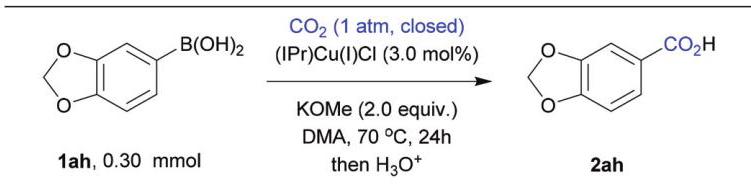
| Entry | Variation from standard conditions | Yield ${}^{b}$ (%) |
| 1 | None | 82 |
| 2 | ${\mathrm{{KO}}}^{t}\mathrm{{Bu}}$ instead of KOMe in THF | 9 |
| 3 | LiOMe instead of KOMe | Trace |
| 4 | With 1.5 equiv. KOMe | 75 |
| 5 | With 1.0 equiv. KOMe | 67 |
| 6 | Reaction at ${50}{}^{ \circ }\mathrm{C}$ | 45 |
| 7 | Reaction at ${100}{}^{ \circ }\mathrm{C}$ | 83 |
| 8 | Without base | NR |
| 9 | Without [(IPr)Cu(1)Cl] | NR |
| 10 | Without anhydrous DMA | 60 |
| 11 | With 0.5 mmol of ${\mathrm{H}}_{2}\mathrm{O}$ as an additive | 58 |
| 12 | With 1.0 mmol of ${\mathrm{H}}_{2}\mathrm{O}$ as an additive | 43 |
| 13 | DMF instead of DMA | 38 |
| 14 | DMSO instead of DMA | 33 |
| 15 | MeCN instead of DMA | 23 |
${}^{a}$ Reaction performed on 0.3 mmol scales. ${}^{b}$ Yields were determined by ${}^{1}\mathrm{H}$ NMR with benzyl alcohol as an internal standard.
${}^{a}$反应在0.3 mmol规模上进行。${}^{b}$产率通过以苯甲醇为内标物的${}^{1}\mathrm{H}$ NMR测定。
Aryl boronic acids possessing an electron-donating group were also excellent substrates for this transformation. Amine substituted aryl boronic acids could be effectively converted to the desired products (Scheme 2, 2m-2n), although free amines were not compatible (see ESI†). Up to 73% yield of the desired carboxylated product was obtained for substrates bearing unprotected phenols and alcohols (Scheme 2, 2o-2p). Moreover, other electron-rich aryl boronic acids with a thioether and ether substituent converted smoothly into respective products with good yields (Scheme 2, 2q-2u). The use of THF as the solvent was found to be important for the effective carboxylation of electron-neutral boronic acids (Scheme 2, 2v-2ag). Finally, oxygen and nitrogen-containing heteroaromatic aryl boronic acids were tolerated and gave the corresponding carboxylated products 2ah, 2ai, and 2aj in 80%, 53%, and 59% isolated yields, respectively. Unfortunately, no product was observed in the case of 2-pyri-dylboronic acid, presumably due to the rapid protodeboryla-tion (Scheme 2, 2ak). ${}^{27}$
具有供电子基团的芳基硼酸也是该转化反应的优良底物。胺取代的芳基硼酸可以有效地转化为目标产物(方案2,2m - 2n),尽管游离胺不兼容(见补充信息†)。对于带有未保护酚羟基和醇羟基的底物,目标羧化产物的产率高达73%(方案2,2o - 2p)。此外,其他带有硫醚和醚取代基的富电子芳基硼酸也能顺利转化为相应产物,产率良好(方案2,2q - 2u)。发现使用THF作为溶剂对于电子中性硼酸的有效羧化反应很重要(方案2,2v - 2ag)。最后,含氧和含氮杂芳基硼酸具有耐受性,分别以80%、53%和59%的分离产率得到相应的羧化产物2ah、2ai和2aj。遗憾的是,2 - 吡啶硼酸的反应未观察到产物,可能是由于快速的原硼酸去硼反应(方案2,2ak)。${}^{27}$
To gain further insights into the mechanism of this Cu-cat-alysed carboxylation of aryl boronic acid with ${\mathrm{{CO}}}_{2}$ , stoichiometric studies were carried out. Initially, to find out the role of base in this transformation, we carried out the reaction between the catalyst [(IPr)Cu(I)Cl] and base KOMe in THF at room temperature. This reaction provided 93% yield of the copper alkoxide complex [(IPr)Cu(I)(OMe)] (Scheme 3a, 4 and see ESI† for more details). ${}^{28}$ We next carried out the carboxylation reaction of phenylboronic acid using a catalytic amount of [(IPr)Cu(I)(OMe)]. Although no desired product was obtained in the absence of KOMe (see ESI,† mechanistic study, page no. 28 and 29), the benzoic acid formed in 50% yield using a stoichiometric amount of base (Scheme 3b, 2ae). These results indicate the key role of the base in promoting the carboxylation. Furthermore, the reaction between [(IPr)Cu(I)(OMe)] complex and phenylboronic acid in the presence of KOMe at room temperature afforded 70% yield of the NHC-ligated aryl-copper complex (Scheme 3c, 5 and for more details see ESI,† mechanistic study, page no. 30-32). ${}^{29}$ Stoichiometric reaction using this aryl copper(1) complex and carbon dioxide afforded 80% yield of the carboxylic acid (Scheme 3d, 2ae).
为了进一步深入了解这种铜催化的芳基硼酸与${\mathrm{{CO}}}_{2}$的羧化反应机理,我们进行了化学计量研究。首先,为了确定碱在该转化过程中的作用,我们在室温下于四氢呋喃中使催化剂[(IPr)Cu(I)Cl]与碱KOMe发生反应。该反应生成了产率为93%的醇铜配合物(IPr)Cu(I)(OMe)。${}^{28}$接下来,我们使用催化量的[(IPr)Cu(I)(OMe)]进行苯硼酸的羧化反应。尽管在没有KOMe的情况下未得到所需产物(见补充信息†,机理研究,第28和29页),但使用化学计量的碱时苯甲酸的产率为50%(方案3b、2ae)。这些结果表明碱在促进羧化反应中起关键作用。此外,[(IPr)Cu(I)(OMe)]配合物与苯硼酸在室温下于KOMe存在的情况下反应,生成了产率为70%的氮杂环卡宾配位的芳基铜配合物(方案3c、5,更多细节见补充信息†中的机理研究,第30 - 32页)。${}^{29}$使用该芳基铜(I)配合物与二氧化碳进行化学计量反应,得到了产率为80%的羧酸(方案3d、2ae)。
On the basis of these results and previous studies, ${}^{{15} - {21}}$ a catalytic cycle for the carboxylation of aryl boronic with ${\mathrm{{CO}}}_{2}$ is proposed in Scheme 4. Initially, the ligand exchange between [(IPr)Cu(I)Cl] and KOMe generates the copper alkoxide [(IPr)Cu (1)(OMe)] (4), which undergoes transmetalation with phenyl-boronic acid to form the arylcopper(I) complex [(IPr)Cu(I)Ph] (5). Nucleophilic addition of $\left\lbrack {\left( \mathrm{{IPr}}\right) \mathrm{{Cu}}\left( \mathrm{I}\right) \mathrm{{Ph}}}\right\rbrack$ to ${\mathrm{{CO}}}_{2}$ provides carboxylate [(IPr)Cu(I)(OOCPh)] (6). σ-Metathesis with KOMe generates PhCOOK (7) and regenerate [(IPr)Cu(I)(OMe)] (4), thereby completing the catalytic cycle. The hydrolysis of PhCOOK (7) finally furnishes the desired product.
基于这些结果和先前的研究,${}^{{15} - {21}}$方案4中提出了芳基硼酸与${\mathrm{{CO}}}_{2}$羧化反应的催化循环。首先,[(IPr)Cu(I)Cl]与KOMe之间的配体交换生成醇铜(IPr)Cu(1)(OMe),其与苯硼酸发生金属转移反应形成芳基铜(I)配合物(IPr)Cu(I)Ph。$\left\lbrack {\left( \mathrm{{IPr}}\right) \mathrm{{Cu}}\left( \mathrm{I}\right) \mathrm{{Ph}}}\right\rbrack$对${\mathrm{{CO}}}_{2}$的亲核加成生成羧酸盐(IPr)Cu(I)(OOCPh)。与KOMe的σ-复分解反应生成PhCOOK(7)并再生(IPr)Cu(I)(OMe),从而完成催化循环。PhCOOK(7)的水解最终得到所需产物。
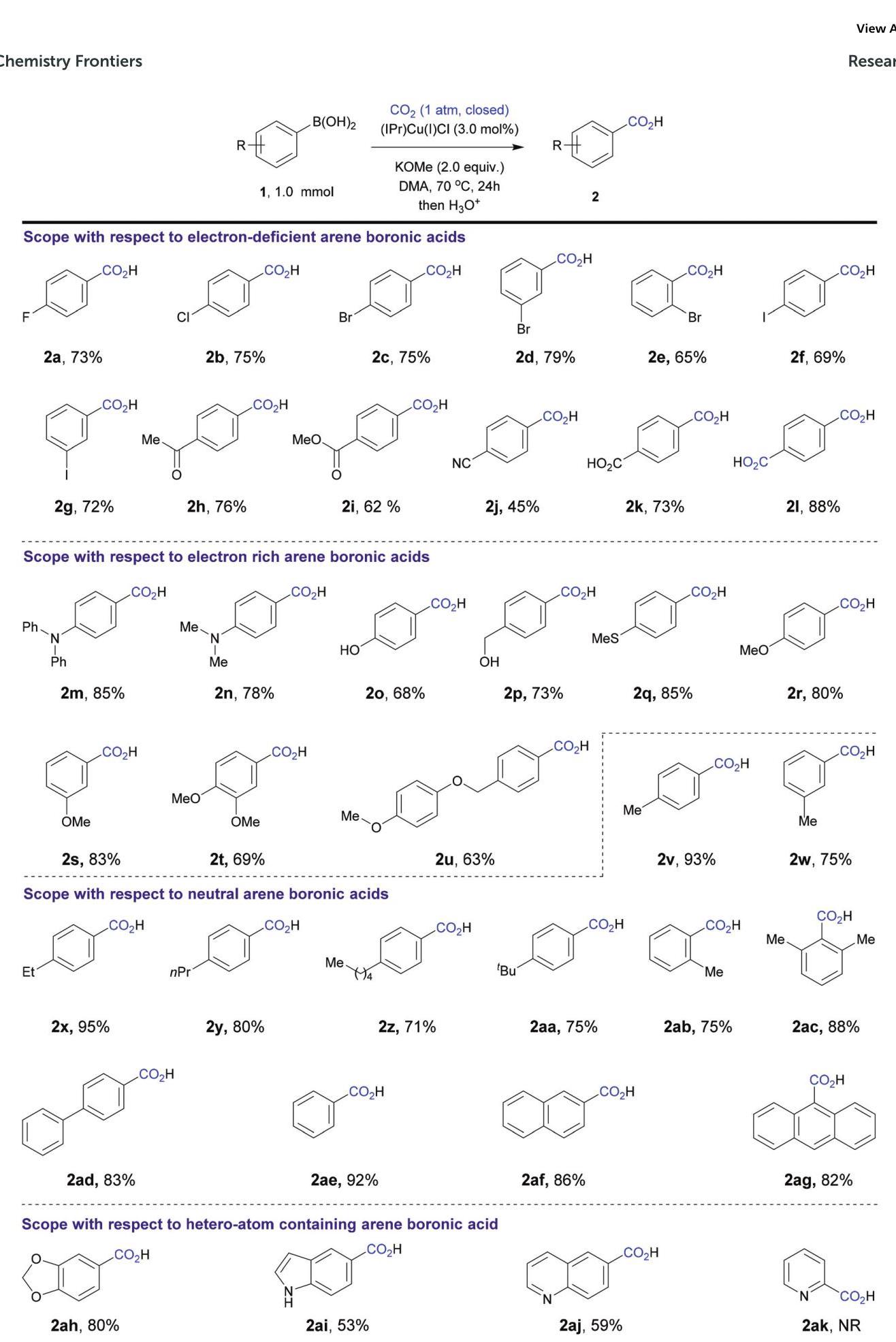
Scheme 2 The substrate scope of aryl boronic acids. Reactions were carried out by using aryl boronic acid (1.0 mmol), cat. [(IPr)Cu(I)Cl] (3.0 mol%), base KOMe (2.0 equiv.) in DMA at 70°C for 24 h under 1 atm ${\mathrm{{CO}}}_{2}$ . Isolated yields were reported. For substrates 1v-1ag, THF was used as solvent.
方案2芳基硼酸的底物范围。反应使用芳基硼酸(1.0 mmol)、催化剂[(IPr)Cu(I)Cl](3.0 mol%)、碱KOMe(2.0当量)在1个大气压${\mathrm{{CO}}}_{2}$下于70°C的N, N-二甲基乙酰胺中进行24小时。报告的是分离产率。对于底物1v - 1ag,使用四氢呋喃作为溶剂。
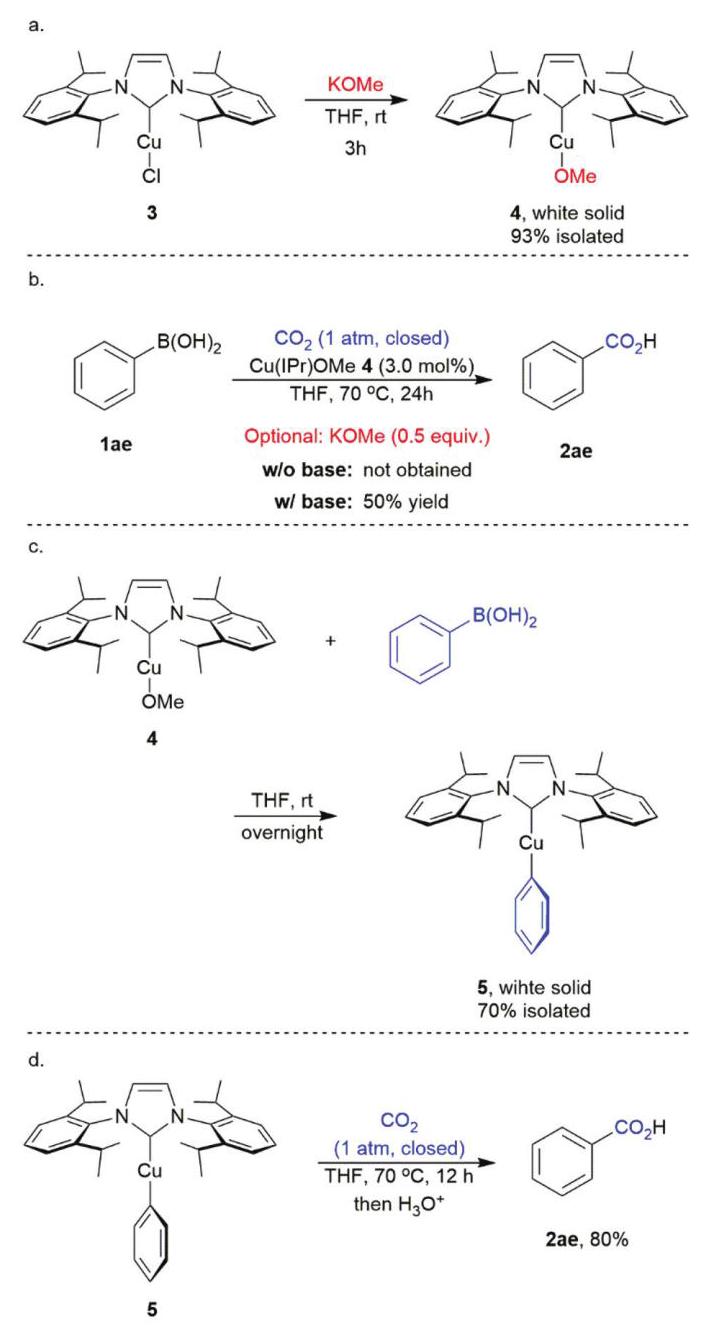
Scheme 3 Control experiments for mechanistic study.
方案3机理研究的对照实验。
Conclusions
结论
In summary, we have developed a mild and efficient Cu-cata-lysed protocol for the synthesis of aryl carboxylic acid using aryl boronic acids and ${\mathrm{{CO}}}_{2}$ . A wide range of aryl boronic acids were effectively transformed into benzoic acid derivatives. The developed carboxylation method showed excellent functional group tolerance, and a range of sensitive functional groups such as carbonyls, esters, and nitriles were compatible. In addition, stoichiometric studies indicated that the alkoxycop-per(I) [(IPr)Cu(I)(OMe)] (4) and the arylcopper(I) species (5) are involved in this transformation. Further studies on the incorporation of ${\mathrm{{CO}}}_{2}$ into other classes of organic molecules are currently underway in our laboratory.
总之,我们开发了一种温和且高效的铜催化方案,用于使用芳基硼酸和${\mathrm{{CO}}}_{2}$合成芳基羧酸。多种芳基硼酸被有效地转化为苯甲酸衍生物。所开发的羧化方法显示出优异的官能团耐受性,并且一系列敏感的官能团如羰基、酯基和腈基都是兼容的。此外,化学计量学研究表明,烷氧基铜(I)(IPr)Cu(I)(OMe)和芳基铜(I)物种(5)参与了该转化过程。目前我们实验室正在对将${\mathrm{{CO}}}_{2}$引入其他类有机分子进行进一步研究。
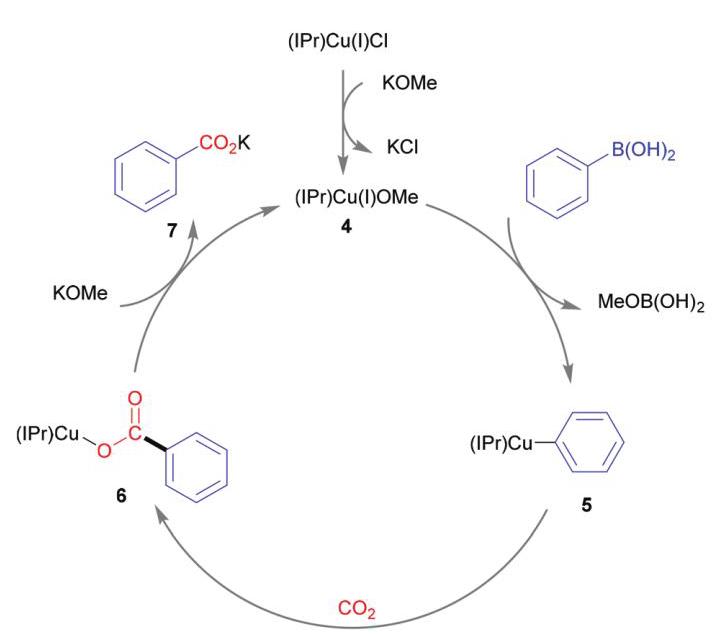
Scheme 4 Proposed mechanistic pathway.
方案4 提出的机理途径。
Conflicts of interest
利益冲突
There are no conflicts to declare.
无需声明利益冲突。
Acknowledgements
致谢
O. N. is grateful to Peking University for the Boya Postdoctoral Fellowship. The project is supported by the Natural Science Foundation of China (Grant 21772003). We also thank Peking University for a start-up fund. This work was partially funded by the BHP-PKU CCUS project supported by BHP Billiton.
O. N. 感谢北京大学授予博雅博士后奖学金。本项目得到中国国家自然科学基金(项目批准号21772003)的支持。我们也感谢北京大学提供的启动资金。本研究部分得到必和必拓支持的必和必拓 - 北大碳捕集与封存项目的资助。
Notes and references
注释与参考文献
1 M. Aresta, A. Dibenedetto and A. Angelini, Chem. Rev., 2014, 114, 1709-1742.
2 J. Artz, T. E. Müller, K. Thenert, J. Kleinekorte, R. Meys, A. Sternberg, A. Bardow and W. Leitner, Chem. Rev., 2018, 118, 434-504.
3 T. Sakakura, J.-C. Choi and H. Yasuda, Chem. Rev., 2007, 107, 2365-2387.
4 A. Tortajada, F. Juliá-Hernández, M. Börjesson, T. Moragas and R. Martin, Angew. Chem., Int. Ed., 2018, 57, 15948- 15982.
5 R. Martín and A. W. Kleij, ChemSusChem, 2011, 4, 1259- 1263.
6 K. Huang, C.-L. Sun and Z.-J. Shi, Chem. Soc. Rev., 2011, 40, 2435-2452.
7 Y. Tsuji and T. Fujihara, Chem. Commun., 2012, 48, 9956- 9964.
8 J. Hong, M. Li, J. Zhang, B. Sun and F. Mo, ChemSusChem, 2019, 12, 6-39.
9 T. Patra and D. Maiti, Chem. - Eur. J., 2017, 23, 7382-7401.
Organic Chemistry Frontiers
《有机化学前沿》
10 I. G. Morgunov, S. V. Kamzolova, E. G. Dedyukhina, T. I. Chistyakova, J. N. Lunina, A. A. Mironov, N. N. Stepanova, O. N. Shemshura and M. B. Vainshtein, Appl. Microbiol. Biotechnol., 2017, 101, 921-932.
11 P. Chand, Y. S. Babu, S. Bantia, N. Chu, L. B. Cole, P. L. Kotian, W. G. Laver, J. A. Montgomery, V. P. Pathak, S. L. Petty, D. P. Shrout, D. A. Walsh and G. M. Walsh, J. Med. Chem., 1997, 40, 4030-4052.
12 S. Wang and C. Xi, Chem. Soc. Rev., 2019, 48, 382- 404.
13 C. Ballatore, D. M. Huryn and A. B. Smith III, ChemMedChem, 2013, 8, 385-395.
14 J. W. B. Fyfe and A. J. B. Watson, Chem, 2017, 3, 31-55.
15 J. Takaya, S. Tadami, K. Ukai and N. Iwasawa, Org. Lett., 2008, 10, 2697-2700.
16 K. Ukai, M. Aoki, J. Takaya and N. Iwasawa, J. Am. Chem. Soc., 2006, 128, 8706-8707.
17 T. Ohishi, M. Nishiura and Z. Hou, Angew. Chem., Int. Ed., 2008, 47, 5792-5795.
18 T. Ohishi, L. Zhang, M. Nishiura and Z. Hou, Angew. Chem., Int. Ed., 2011, 50, 8114-8117.
19 X. Zhang, W. Z. Zhang, L. L. Shi, C. X. Guo, L. L. Zhang and X. B. Lu, Chem. Commun., 2012, 48, 6292-6294.
20 Y. Makida, E. Marelli, A. M. Slawin and S. P. Nolan, Chem. Commun., 2014, 50, 8010-8013.
21 P. J. Riss, S. Lu, S. Telu, F. I. Aigbirhio and V. W. Pike, Angew. Chem., Int. Ed., 2012, 51, 2698-2702.
22 A. J. J. Lennox and G. C. Lloyd-Jones, Chem. Soc. Rev., 2014, 43, 412-443.
23 W. Zhang and X. Lu, Chin. J. Catal., 2012, 33, 745-756.
24 R. Zheng, Q. Zhou, H. Gu, H. Jiang, J. Wu, Z. Jin, D. Han, G. Dai and R. Chen, Tetrahedron Lett., 2014, 55, 5671-5675.
25 A. K. Shil, S. Kumar, C. B. Reddy, S. Dadhwal, V. Thakur and P. Das, Org. Lett., 2015, 17, 5352-5355.
26 Z.-B. Chen, K. Liu, F.-L. Zhang, Q. Yuan and Y.-M. Zhu, Org. Biomol. Chem., 2017, 15, 8078-8083.
27 K. L. Billingsley and S. L. Buchwald, Angew. Chem., Int. Ed., 2008, 47, 4695-4698.
28 A. Bonet, V. Lillo, J. Ramírez, M. M. Díaz-Requejo and E. Fernández, Org. Biomol. Chem., 2009, 7, 1533-1535.
29 K. Takatsu, R. Shintani and T. Hayashi, Angew. Chem., Int. Ed., 2011, 50, 5548-5552.