Zn+-O- dual-spin surface states formation by modification of ZnO nanoparticles with diboron compounds
英文原文与中文译文逐段对照 · English original with Chinese translation
LANGMUIR
朗缪尔
Subscriber access provided by UNIV OF CAMBRIDGE
由剑桥大学提供的订阅者访问权限
Interfaces: Adsorption, Reactions, Films, Forces, Measurement Techniques, Charge Transfer, Electrochemistry, Electrocatalysis, Energy Production and Storage
界面:吸附、反应、薄膜、力、测量技术、电荷转移、电化学、电催化、能源生产与存储
Zn+-O- dual-spin surface states formation by modification of ZnO nanoparticles with diboron compounds
通过用二硼化合物修饰ZnO纳米颗粒形成Zn⁺-O⁻双自旋表面态
Yang Cao, Yongguang Tu, Peng Zhou, Jianning Zhang, Yuchen Deng, Biao Kong, Xu Zhang, Shaojun Guo, Rui Zhu, Ding Ma, Yang Yang, and Fanyang Mo
曹洋,涂永光,周鹏,张建宁,邓宇辰,孔彪,张旭,郭少军,朱锐,马丁,杨阳,莫凡洋
Langmuir, Just Accepted Manuscript • DOI: 10.1021/acs.langmuir.9b01955 • Publication Date (Web): 14 Aug 2019 Downloaded from pubs.acs.org on August 18, 2019
《朗缪尔》,刚录用的稿件 • DOI: 10.1021/acs.langmuir.9b01955 • 网络出版日期:2019年8月14日 于2019年8月从pubs.acs.org下载
Just Accepted
刚被接受
“Just Accepted” manuscripts have been peer-reviewed and accepted for publication. They are posted online prior to technical editing, formatting for publication and author proofing. The American Chemical Society provides “Just Accepted” as a service to the research community to expedite the dissemination of scientific material as soon as possible after acceptance. “Just Accepted” manuscripts appear in full in PDF format accompanied by an HTML abstract. “Just Accepted” manuscripts have been fully peer reviewed, but should not be considered the official version of record. They are citable by the Digital Object Identifier (DOI®). “Just Accepted” is an optional service offered to authors. Therefore, the “Just Accepted” Web site may not include all articles that will be published in the journal. After a manuscript is technically edited and formatted, it will be removed from the “Just Accepted” Web site and published as an ASAP article. Note that technical editing may introduce minor changes to the manuscript text and/or graphics which could affect content, and all legal disclaimers and ethical guidelines that apply to the journal pertain. ACS cannot be held responsible for errors or consequences arising from the use of information contained in these “Just Accepted” manuscripts.
“刚被接受"的稿件已经经过同行评审并被接受发表。它们在进行技术编辑、排版以供发表和作者校对之前就已在线发布。美国化学学会提供“刚被接受”服务,以便在稿件被接受后尽快加速科学材料的传播。“刚被接受”的稿件以PDF格式全文出现,并附有HTML摘要。“刚被接受”的稿件已经经过全面的同行评审,但不应被视为正式的记录版本。它们可以通过数字对象标识符(DOI®)引用。“刚被接受”是一项提供给作者的可选服务。因此,“刚被接受”网站可能不包括该期刊将发表的所有文章。稿件经过技术编辑和排版后,将从“刚被接受”网站上删除,并作为一篇尽快发表的文章发表。请注意,技术编辑可能会对手稿文本和/或图形进行细微更改,这可能会影响内容,并且适用于该期刊的所有法律免责声明和道德准则均适用。美国化学学会不对因使用这些“刚被接受”稿件中包含的信息而产生的错误或后果负责。
is published by the American Chemical Society. 1155 Sixteenth Street N.W., Washington, DC 20036
由美国化学学会出版。华盛顿特区西北第十六街1155号,邮编20036
Published by American Chemical Society. Copyright © American Chemical Society. However, no copyright claim is made to original U.S. Government works, or works produced by employees of any Commonwealth realm Crown government in the course of their duties.
由美国化学学会出版。版权所有©美国化学学会。但是,对于美国政府的原始作品或任何英联邦王国政府的雇员在其职责范围内创作的作品,不主张版权。
${\mathrm{{Zn}}}^{ + } - {\mathrm{O}}^{ - }$ dual-spin surface states formation by modification of $\mathrm{{ZnO}}$ nanoparticles with diboron compounds
通过二硼化合物修饰$\mathrm{{ZnO}}$纳米颗粒形成${\mathrm{{Zn}}}^{ + } - {\mathrm{O}}^{ - }$双自旋表面态
Yang Cao, ${}^{ \dagger }$ Yongguang Tu, ${}^{ \ddagger }$ Peng Zhou, ${}^{\text{ § }}$ Jianning Zhang, ${}^{ \dagger }$ Yuchen Deng, ${}^{\sharp }$ Biao Kong, ${}^{\sharp }$ Xu Zhang, ${}^{ \bot }$ Shaojun Guo, ${}^{\dagger ,\text{ § }}$ Rui Zhu, ${}^{ \ddagger }$ Ding Ma, ${}^{!}$ Yang Yang ${}^{\text{ ¶ }}$ and Fanyang Mo ${}^{\dagger ,{}^{ * }}$
曹洋,${}^{ \dagger }$涂永光,${}^{ \ddagger }$周鹏,${}^{\text{ § }}$张建宁,${}^{ \dagger }$邓雨晨,${}^{\sharp }$孔彪,${}^{\sharp }$张旭,${}^{ \bot }$郭少军,${}^{\dagger ,\text{ § }}$朱锐,${}^{ \ddagger }$马丁,${}^{!}$杨阳${}^{\text{ ¶ }}$和莫凡洋${}^{\dagger ,{}^{ * }}$
${}^{ \dagger }$ Department of Energy and Resources Engineering, College of Engineering, Peking University, Beijing 100871, China.
${}^{ \dagger }$ 能源与资源工程系,工程学院,北京大学,北京100871,中国。
‡State Key Laboratory for Artificial Microstructure and Mesoscopic Physics, School of Physics, Peking University, Beijing, 100871, China.
‡人工微结构和介观物理国家重点实验室,物理学院,北京大学,北京,100871,中国。
${}^{\text{ § }}$ Department of Materials Science and Engineering, College of Engineering, Peking University, Beijing,100871, China.
${}^{\text{ § }}$ 材料科学与工程系,工程学院,北京大学,北京,100871,中国。
${}^{1}$ College of Chemistry and Molecular Engineering and College of Engineering, Peking University, Beijing,100871, China.
${}^{1}$ 化学与分子工程学院及工程学院,北京大学,北京,100871,中国。
#Collaborative Innovation Center of Chemistry for Energy Materials (iChEM), Department of Chemistry Laboratory of Advanced Materials, Shanghai Key Laboratory of Molecular Catalysis and Innovative Materials, Fudan University, Shanghai, 200433, P. R. China
能源材料化学协同创新中心(iChEM),化学系,先进材料实验室,分子催化与创新材料上海市重点实验室,复旦大学,上海,200433,中华人民共和国
${}^{\bot }$ Department of Physics and astronomy, California State University Northridge, CA 91330, United States.
${}^{\bot }$ 物理与天文学系,加利福尼亚州立大学北岭分校,加利福尼亚州91330,美国。
${}^{\text{ ¶ }}$ Division of Chemistry and Chemical Engineering, California Institute of Technology, Pasadena, CA 91125, United States.
${}^{\text{ ¶ }}$ 化学与化学工程系,加利福尼亚理工学院,帕萨迪纳,加利福尼亚州91125,美国。
Supporting Information Placeholder
支持信息占位符
ABSTRACT: ZnO semiconductor oxides are versatile functional materials that used in photoelectronic, catalysis, sensing, etc. The ${\mathrm{{Zn}}}^{ + } - {\mathrm{O}}^{ - }$ surface electronic states of semiconductor oxides were formed on ZnO’s surface by Zn 4s, $\mathrm{O}2$ p orbitals coupling with the diboron compound’s B 2p orbitals. The formation of spin coupled surface states was based on the spin orbit interaction on the interface, which has not been reported before. It shows that the semiconductor oxide’s spin surface states can be modulated by regulating surface orbital energy. The ${\mathrm{{Zn}}}^{ + } - {\mathrm{O}}^{ - }$ surface electronic states were confirmed by ESR results, which may help expand fundamental research on spintronics modulation and quantum transport.
摘要:ZnO半导体氧化物是用于光电子、催化、传感等领域的多功能功能材料。半导体氧化物的${\mathrm{{Zn}}}^{ + } - {\mathrm{O}}^{ - }$表面电子态是通过Zn 4s、$\mathrm{O}2$ p轨道与二硼化合物的B 2p轨道耦合在ZnO表面形成的。自旋耦合表面态的形成基于界面上的自旋轨道相互作用,这在以前尚未见报道。结果表明,通过调节表面轨道能量可以调制半导体氧化物的自旋表面态。${\mathrm{{Zn}}}^{ + } - {\mathrm{O}}^{ - }$表面电子态通过ESR结果得到证实,这可能有助于扩展自旋电子学调制和量子输运的基础研究。
KEYWORDS: ZnO, Surface state, Spintronics, Diboron compound, Spin-orbit coupling
关键词:ZnO;表面态;自旋电子学;二硼化合物;自旋轨道耦合
INTRODUCTION
引言
$\mathrm{{ZnO}}$ are key semiconductor oxide materials for wide applications in optoelectronic devices, ${}^{1,}{}^{2}$ piezoelectronic devices, ${}^{3}$ catalysis, ${}^{4}$ sensing, ${}^{5}$ etc. Surface engineering of zinc oxide have been studied for decades. ${}^{6}$ Surface disorder treatment, ${}^{7,8}$ defects engineering ${}^{9}$ are basically surface states engineering methods. Organic molecule modification method have also been developed to modulate the surface states by charge transfer method to adjust electronic structures and band structures. ${}^{6,{10}}$ According to the previous study, the orbitals on the surface of the nanoparticles are distinct from that bulk and should be sensitive to surface modification, which can induce unique surface states. ${}^{11}$ Surface spin orbitronics are important issues and are mostly studied in transition metal surface, topological insulators, two-dimensional materials. ${}^{12}$ But there exists no similar reference in semiconductor oxide systems. ${\mathrm{{Zn}}}^{ + }\left( {3{\mathrm{d}}^{10}4{\mathrm{\;s}}^{1}}\right)$ systems possess special electronic structure that has been reported and studied in ZnO relate chemistry. ${}^{13}$ Monovalent zinc ions have been prepared under extremely harsh physical conditions, such as $\gamma$ -irradiation, ${}^{14}$ electron impact ionization, ${}^{15}$ glow discharge ${}^{16}$ and laser vaporization. ${}^{17}$ In 2004, the Carmona group reported a landmark discovery of the dimetallic sandwich compound decamethyldizincocene $\left( {{\mathrm{{Zn}}}_{2}{\left( \eta 5 - {\mathrm{C}}_{5}{\mathrm{{Me}}}_{5}\right) }_{2}}\right)$ , containing a central subvalent $\mathrm{{Zn}} - \mathrm{{Zn}}$ bond with both $\mathrm{{Zn}}$ atoms formally in the +1 oxidation state. ${}^{18}$ Chen group recently reported the first example of mononuclear univalent ${\mathrm{{Zn}}}^{ + }$ in solid materials of zeolite. ${}^{{19},{20}}$
$\mathrm{{ZnO}}$ 是关键的半导体氧化物材料,广泛应用于光电器件、${}^{1,}{}^{2}$ 压电电子器件、${}^{3}$ 催化、${}^{4}$ 传感、${}^{5}$ 等领域。氧化锌的表面工程已经研究了几十年。${}^{6}$ 表面无序处理、${}^{7,8}$ 缺陷工程 ${}^{9}$ 基本上都是表面态工程方法。有机分子修饰方法也已被开发出来,通过电荷转移方法来调节表面态,以调整电子结构和能带结构。${}^{6,{10}}$ 根据先前的研究,纳米颗粒表面的轨道与体相不同,应该对表面修饰敏感,这可以诱导出独特的表面态。${}^{11}$ 表面自旋电子学是重要的课题,主要在过渡金属表面、拓扑绝缘体、二维材料中进行研究。${}^{12}$ 但在半导体氧化物体系中不存在类似的参考文献。${\mathrm{{Zn}}}^{ + }\left( {3{\mathrm{d}}^{10}4{\mathrm{\;s}}^{1}}\right)$ 体系具有特殊的电子结构,这在氧化锌相关化学中已有报道和研究。${}^{13}$ 单价锌离子是在极其苛刻的物理条件下制备的,如 $\gamma$ -辐照、${}^{14}$ 电子碰撞电离、${}^{15}$ 辉光放电 ${}^{16}$ 和激光汽化。${}^{17}$ 2004年,卡莫纳小组报道了一个具有里程碑意义的发现,即二金属夹心化合物十甲基二锌茂 $\left( {{\mathrm{{Zn}}}_{2}{\left( \eta 5 - {\mathrm{C}}_{5}{\mathrm{{Me}}}_{5}\right) }_{2}}\right)$ ,其中心含有一个亚价 $\mathrm{{Zn}} - \mathrm{{Zn}}$ 键,两个 $\mathrm{{Zn}}$ 原子的形式氧化态均为 +1。${}^{18}$ 陈小组最近报道了沸石固体材料中单核单价 ${\mathrm{{Zn}}}^{ + }$ 的第一个例子。${}^{{19},{20}}$
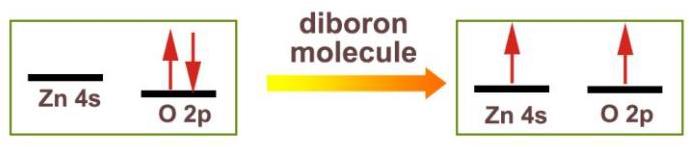
Organodiboron compounds represent a group of stable and highly versatile reagents that are extremely useful in organic synthesis. ${}^{21}$ Despite their widespread use in synthetic chemistry, these diboron(4) species have not been used to modify inorganic materials. We find that surface modification of ZnO nanoparticles with diboron compounds can induce surface ${\mathrm{{Zn}}}^{ + }$ - ${\mathrm{O}}^{ - }$ dual spin states. Based on the experimental characterization as well as the reference that modulate magnetic spin of ${\mathrm{{SrRuO}}}_{3}$ by tuning oxygen coordination environment, ${}^{22}$ we surmise that the spin surface states originated from surface orbital hybridization companied with electron redistribution induced by modulation of oxygen coordination environment. To the best of our knowledge, there is no similar report on forming these dual spin states. A conceptually new method for the facile generation of abundant surface ${\mathrm{{Zn}}}^{ + } - {\mathrm{O}}^{ - }$ surface states on $\mathrm{{ZnO}}$ nanoparticles were developed under mild conditions $\left( { < {80}^{ \circ }\mathrm{C}}\right)$ by means of diboron(4) reagents. In this process, the intimate interaction of the diboron(4) reagent’s B center with the surface bridging ${\mathrm{O}}_{2\mathrm{c}}$ of $\mathrm{{ZnO}}$ facilitates the adsorption of the organodiboron reagents onto the $\mathrm{{ZnO}}$ nanoparticles which lead to spontaneous electron transfer resulting in ${\mathrm{{Zn}}}^{ + } - {\mathrm{O}}^{ - }$ dual-spin surface states (Figure 1b-d). Notably, this process exhibits a facile method to modulate ZnO’s surface states by introducing dual-spin electrons coupled to surface orbitals.
有机二硼化合物是一类稳定且用途广泛的试剂,在有机合成中极为有用。${}^{21}$ 尽管它们在合成化学中广泛使用,但这些二硼(4)物种尚未用于修饰无机材料。我们发现用二硼化合物对氧化锌纳米颗粒进行表面修饰可以诱导表面 ${\mathrm{{Zn}}}^{ + }$ - ${\mathrm{O}}^{ - }$ 双自旋态。基于实验表征以及通过调节氧配位环境来调节 ${\mathrm{{SrRuO}}}_{3}$ 的磁自旋的参考文献,${}^{22}$ 我们推测自旋表面态源于表面轨道杂化以及由氧配位环境调节引起的电子重新分布。据我们所知,没有关于形成这些双自旋态的类似报道。在温和条件下,通过二硼(4)试剂开发了一种概念上新的方法,用于在 $\mathrm{{ZnO}}$ 纳米颗粒上轻松生成丰富的表面 ${\mathrm{{Zn}}}^{ + } - {\mathrm{O}}^{ - }$ 表面态。$\left( { < {80}^{ \circ }\mathrm{C}}\right)$ 在这个过程中,二硼(4)试剂的B中心与 $\mathrm{{ZnO}}$ 的表面桥连 ${\mathrm{O}}_{2\mathrm{c}}$ 的紧密相互作用促进了有机二硼试剂在 $\mathrm{{ZnO}}$ 纳米颗粒上的吸附,这导致自发电子转移,从而产生 ${\mathrm{{Zn}}}^{ + } - {\mathrm{O}}^{ - }$ 双自旋表面态(图1b - d)。值得注意的是,这个过程展示了一种通过引入与表面轨道耦合的双自旋电子来调节氧化锌表面态的简便方法。
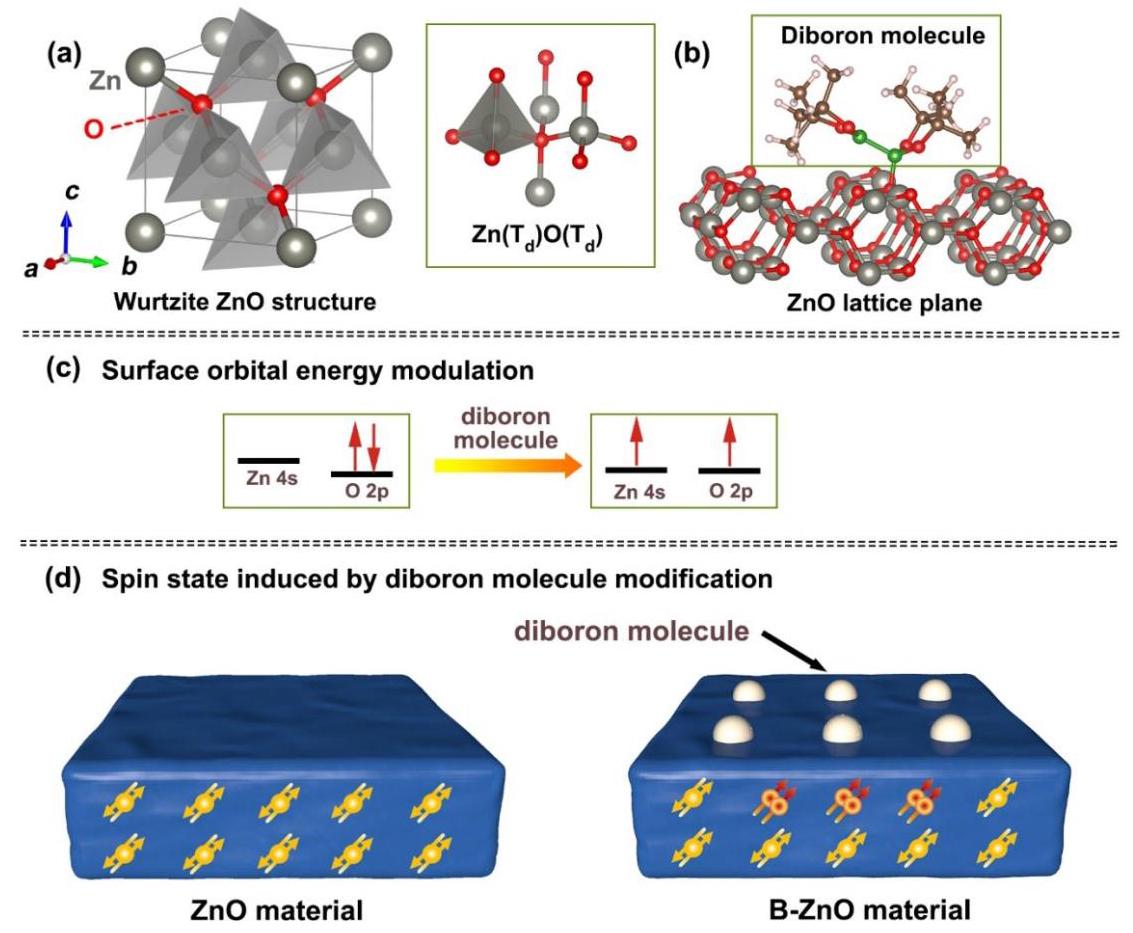
Figure 1. (a) Structure of wurtzite ZnO (b) Adsorption model of the organic diboron compound on ZnO surface. (c) Surface orbital energy modulation induced by diboron compound modification. (d) Schematic diagram of spin states induced in ZnO by diboron molecule.
图1. (a) 纤锌矿型ZnO的结构 (b) 有机二硼化合物在ZnO表面的吸附模型。(c) 二硼化合物修饰引起的表面轨道能量调制。(d) 二硼分子在ZnO中诱导的自旋态示意图。
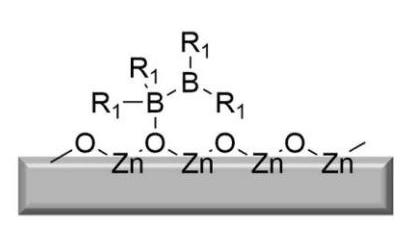
According to the literature, surface oxygen sites coordination changes can induce electron behaviors like magnetism. ${}^{22}$ We posited that electrophilic organic adsorbates with an appropriate reduction potential might favorably interact with the surface ${\mathrm{O}}_{2\mathrm{c}}$ sites. Importantly, this binding changed the coordination behavior of surface ${\mathrm{O}}_{2\mathrm{c}}$ and affected the surface states. We were particularly interested in the use of organic diboron(4) reagents due to their unique Lewis acidity and reducing ability (vide supra). Previous work in the area of synthetic organic chemistry showed that upon binding to a Lewis basic oxygen atom, these organic diboron(4) species could function as single electron reducing agents; thus, allowing various important transformations. ${}^{{23} - {29}}$ Based on these reasons, we envisioned that the coordination of such diboron(4) compounds with the surface oxygen atom in metal oxide materials may lead to the formation of surface diboron-oxygen Lewis pairs which may induce single electron transfer from the ipso- ${\mathrm{O}}_{2\mathrm{c}}$ site to the adjacent $\mathrm{{Zn}}$ site. Furthermore, the interaction of diboron(4) species with the oxygen atom may stabilize the resulting low valent Zn-high valent O pair (Figure 1b-d).
根据文献,表面氧位点配位变化可诱导类似磁性的电子行为。${}^{22}$ 我们推测,具有适当还原电位的亲电有机吸附质可能与表面 ${\mathrm{O}}_{2\mathrm{c}}$ 位点发生有利的相互作用。重要的是,这种结合改变了表面 ${\mathrm{O}}_{2\mathrm{c}}$ 的配位行为并影响了表面态。由于其独特的路易斯酸性和还原能力(见上文),我们对有机二硼(4)试剂的使用特别感兴趣。合成有机化学领域的先前工作表明,这些有机二硼(4)物种与路易斯碱性氧原子结合后可作为单电子还原剂;因此,可实现各种重要的转化。${}^{{23} - {29}}$ 基于这些原因,我们设想这种二硼(4)化合物与金属氧化物材料中的表面氧原子配位可能导致形成表面二硼-氧路易斯对,这可能会诱导从原位 ${\mathrm{O}}_{2\mathrm{c}}$ 位点到相邻 $\mathrm{{Zn}}$ 位点的单电子转移。此外,二硼(4)物种与氧原子的相互作用可能会稳定生成的低价Zn-高价O对(图1b-d)。
EXPERIMENTAL DETAILS
实验细节
B1-ZnO- ${\mathrm{N}}_{2}$ sample: In a glovebox, ${10}\mathrm{{mg}},{20}\mathrm{{mg}}$ or ${50}\mathrm{{mg}}$ B1 $\left( {{\mathrm{B}}_{2}{\mathrm{{Pin}}}_{2}}\right.$ , the molecular structure was depicted in Figure 2a) was dissolved in $2\mathrm{\;{mL}}$ dried ${\mathrm{{CH}}}_{3}\mathrm{{OH}}$ (Energy Chemical Co. Ltd., China). Then ${0.5}\mathrm{\;g}\mathrm{{ZnO}}$ nanoparticles $({30}\mathrm{\;{nm}}$ , Shanghai Macklin Biochemical Co. Ltd) were dispersed in B1 solution and the mixture was stirred at room temperature $\left( { \sim {30}{}^{ \circ }\mathrm{C}}\right)$ for overnight. After evaporation of solvent under vacuum at room temperature for $2\mathrm{\;h}$ , a blue powder of $\mathrm{B}1 - \mathrm{{ZnO}} - {\mathrm{N}}_{2}$ sample was obtained. This sample was sensitive to air and should be stored in an inertia atmosphere.
B1-ZnO-${\mathrm{N}}_{2}$样品:在手套箱中,将${10}\mathrm{{mg}},{20}\mathrm{{mg}}$或${50}\mathrm{{mg}}$B1$\left( {{\mathrm{B}}_{2}{\mathrm{{Pin}}}_{2}}\right.$(其分子结构如图2a所示)溶解于$2\mathrm{\;{mL}}$干燥的${\mathrm{{CH}}}_{3}\mathrm{{OH}}$(中国能源化学有限公司)中。然后将${0.5}\mathrm{\;g}\mathrm{{ZnO}}$纳米颗粒$({30}\mathrm{\;{nm}}$(上海麦克林生化科技有限公司)分散于B1溶液中,并在室温下搅拌$\left( { \sim {30}{}^{ \circ }\mathrm{C}}\right)$过夜。在室温下真空蒸发溶剂$2\mathrm{\;h}$后,得到$\mathrm{B}1 - \mathrm{{ZnO}} - {\mathrm{N}}_{2}$样品的蓝色粉末。该样品对空气敏感,应保存在惰性气氛中。
B1-ZnO sample: In a glovebox, the above $\mathrm{B}1 - \mathrm{{ZnO}} - {\mathrm{N}}_{2}$ sample was heat at ${80}{}^{ \circ }\mathrm{C}$ under vacuum for $3\mathrm{\;h}$ . The redundant B1 molecules were removed under vacuum via volatilization. After heating treatment, the sample become insensitive to air.
B1-ZnO样品:在手套箱中,将上述$\mathrm{B}1 - \mathrm{{ZnO}} - {\mathrm{N}}_{2}$样品在${80}{}^{ \circ }\mathrm{C}$下真空加热$3\mathrm{\;h}$。多余的B1分子通过挥发在真空下除去。热处理后,样品对空气不再敏感。
Other B-ZnO samples are prepared with the sample procedure by using the corresponding diboron compounds.
其他B-ZnO样品按照使用相应二硼化合物的样品制备程序进行制备。
RESULTS AND DISCUSSION
结果与讨论
The diboron(4) compound could be uniformly dispersed onto the ZnO nanoparticles in a diboron(4)-soluble solvent, such as methanol or ether. Blue samples were obtained after solvent evaporation and heating at ${80}^{ \circ }\mathrm{C}$ under vacuum for $3\mathrm{\;h}$ . These blue samples are tagged as B-ZnO. They can be stored outside of a glovebox for at least 6 months while retaining the blue color. This color change only occurs with diboron(4) compounds. Monoboron compounds, such as methyl borate, are unable to sensitize the $\mathrm{{ZnO}}$ with no color change when mixed with $\mathrm{{ZnO}}$ . We investigated the structures and properties of these diboron(4)-sensitized ZnO nanoparticles with UV-Visible spectroscopy (UV-Vis), X-ray diffraction (XRD), X-ray photoelectron spectroscopy (XPS), transmittance electronic microscopy (TEM), fourier transform infrared spectroscopy (FT-IR) and boron nuclear magnetic resonance ( ${}^{11}\mathrm{\;B}$ NMR). The UV-Visible absorption spectra (Figure 2b and S1) of B-ZnO shows that the sample with the diboron compound modification exhibit enhanced visible light absorption (wavelength $> {400}\mathrm{\;{nm}}$ ). The blue color and the visible light absorption of the B-ZnO samples imply formation of the reduced state of zinc(I). ${}^{30}$
二硼(4)化合物能够在二硼(4)可溶的溶剂(如甲醇或乙醚)中均匀分散到ZnO纳米颗粒上。在溶剂蒸发并于真空下在${80}^{ \circ }\mathrm{C}$加热$3\mathrm{\;h}$后得到蓝色样品。这些蓝色样品标记为B-ZnO。它们可以在手套箱外储存至少6个月,同时保持蓝色。这种颜色变化仅发生在二硼(4)化合物上。单硼化合物,如硼酸甲酯,与$\mathrm{{ZnO}}$混合时无法使$\mathrm{{ZnO}}$产生颜色变化。我们用紫外可见光谱(UV-Vis)、X射线衍射(XRD)、X射线光电子能谱(XPS)、透射电子显微镜(TEM)、傅里叶变换红外光谱(FT-IR)和硼核磁共振(${}^{11}\mathrm{\;B}$ NMR)研究了这些二硼(4)敏化的ZnO纳米颗粒的结构和性质。B-ZnO的紫外可见吸收光谱(图2b和S1)表明,经二硼化合物改性的样品表现出增强的可见光吸收(波长$> {400}\mathrm{\;{nm}}$)。B-ZnO样品的蓝色和可见光吸收意味着锌(I)还原态的形成。${}^{30}$
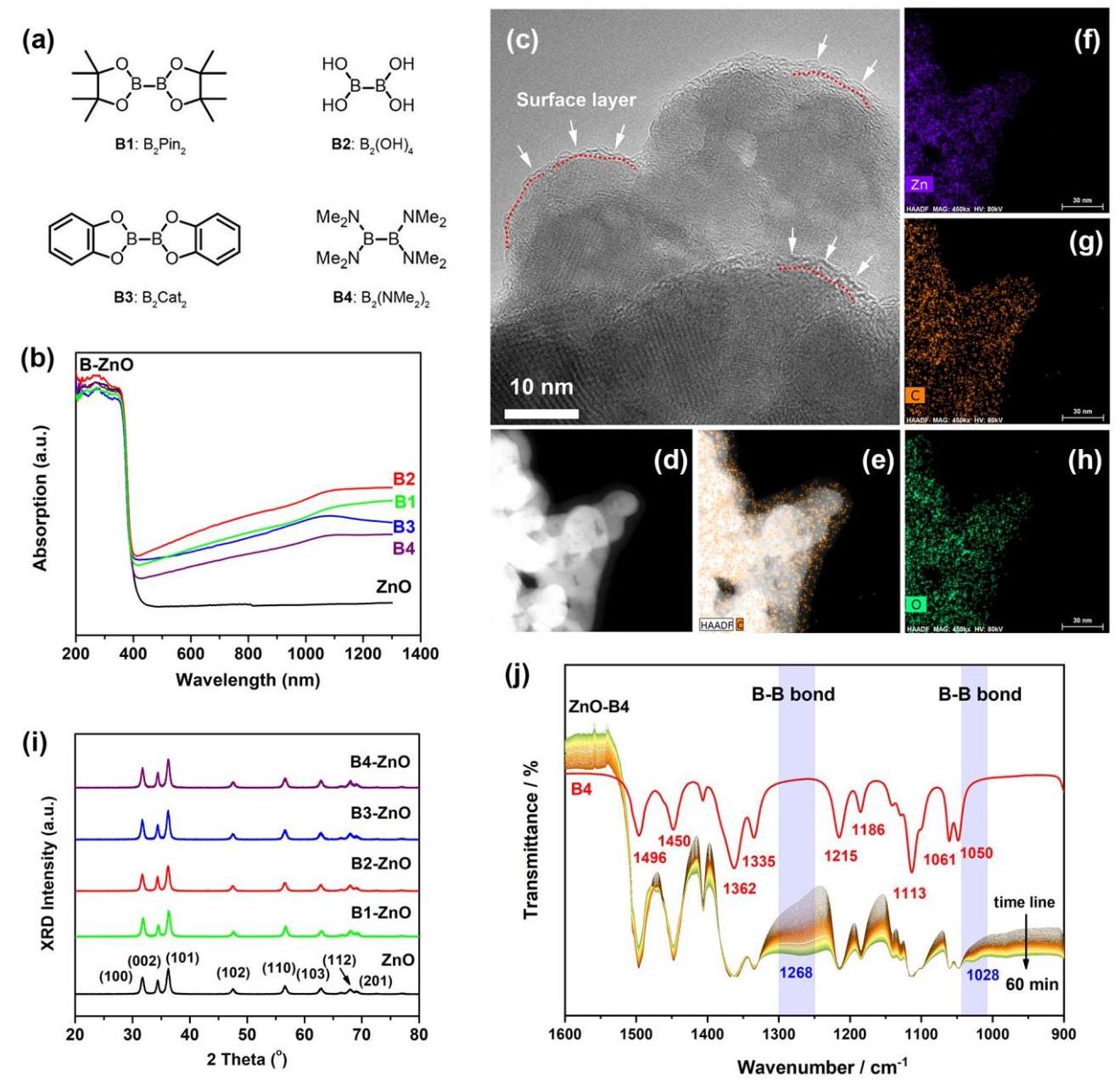
Figure 2. (a) Four commercially available diboron(4) compounds used in this study: ${\mathrm{B}}_{2}{\mathrm{{Pin}}}_{2}$ (bis(pinacolato)diboron), ${\mathrm{B}}_{2}{\left( \mathrm{{OH}}\right) }_{4}$ (tetrahydroxydiborane), ${\mathrm{B}}_{2}{\mathrm{{Cat}}}_{2}$ (bis(catecholato)diboron) and ${\mathrm{B}}_{2}{\left( {\mathrm{{NMe}}}_{2}\right) }_{4}$ (tetrakis(dimethylamino)diboron). (b) UV-Visible spectral absorbance of the white ZnO and B-ZnO samples. (c) HRTEM photo of B1-ZnO sample (The red dotted curve shows the interface of the surface molecule while the white arrow shows the organic molecule layer) (d) HADDF image of B1-ZnO sample (e) the carbon mapping image in the HADDF mode. (f) Zn mapping image of the B1-ZnO sample (g) C mapping image of the B1-ZnO sample (h) O mapping image of the B1-ZnO sample (i) XRD spectra of pristine ZnO and four B-ZnO samples. (j) In situ ATR-FTIR spectrum of B4 on ZnO over 60 min performed at room temperature with a B4 molecule for comparison (in red).
图2. (a)本研究中使用的四种市售二硼(4)化合物:${\mathrm{B}}_{2}{\mathrm{{Pin}}}_{2}$(双(频哪醇)二硼),${\mathrm{B}}_{2}{\left( \mathrm{{OH}}\right) }_{4}$(四羟基二硼烷),${\mathrm{B}}_{2}{\mathrm{{Cat}}}_{2}$(双(儿茶酚)二硼)和${\mathrm{B}}_{2}{\left( {\mathrm{{NMe}}}_{2}\right) }_{4}$(四(二甲氨基)二硼)。(b)白色ZnO和B-ZnO样品的紫外可见光谱吸光度。(c)B1-ZnO样品的高分辨透射电子显微镜照片(红色虚线表示表面分子的界面,白色箭头表示有机分子层)(d)B1-ZnO样品的高角度环形暗场成像(HADDF)图像(e)HADDF模式下的碳映射图像。(f)B1-ZnO样品的锌映射图像(g)B1-ZnO样品的碳映射图像(h)B1-ZnO样品的氧映射图像(i)原始ZnO和四个B-ZnO样品的XRD光谱。(j)在室温下用B4分子对ZnO上的B4进行60分钟的原位衰减全反射傅里叶变换红外光谱(ATR-FTIR),用于比较(红色)。
We then performed TEM characterization to explore the surface structure of the material. A thin organic molecule layer (ca. ${0.5} - 2\mathrm{\;{nm}}$ ) on the surface of the material can be seen in the TEM picture (Figure 2c). The corresponding C phase mapping in the HADDF mode (Figure 2e) and the corresponding Zn, C and O element mapping (Figure 2f-h) exhibit C phase mapping distribute over a larger area than $\mathrm{{Zn}},\mathrm{O}$ phase mapping, which means a carbon-containing layer on the surface of $\mathrm{{ZnO}}$ nanoparticle (Figure 2d). The powder X-ray diffraction analysis (Figure 2i) showed that the commercial $\mathrm{{ZnO}}$ and diboron compound modified $\mathrm{{ZnO}}$ samples can be indexed to wurtzite lattice nanoparticles. There were no new peaks after modification which indicate no changes in the crystal structure upon adsorption. The X-ray photoelectron spectroscopy showed that the O 1s and Zn 2p binding energies of B1-ZnO are lower than the pristine ZnO sample. The valance band of B1- $\mathrm{{ZnO}}$ also shifted to a lower energy, which means that the valance band electron was much closer to the Fermi level energy, and electron may be more likely to jump to the conduction band (Figure S2).
然后我们进行了TEM表征以探索材料的表面结构。在TEM照片(图2c)中可以看到材料表面有一层薄的有机分子层(约${0.5} - 2\mathrm{\;{nm}}$)。HADDF模式下相应的C相映射(图2e)以及相应的Zn、C和O元素映射(图2f-h)显示,C相映射分布的区域比$\mathrm{{Zn}},\mathrm{O}$相映射更大,这意味着在$\mathrm{{ZnO}}$纳米颗粒表面有一层含碳层(图2d)。粉末X射线衍射分析(图2i)表明,市售的$\mathrm{{ZnO}}$和经二硼化合物改性的$\mathrm{{ZnO}}$样品可以索引到纤锌矿晶格纳米颗粒。改性后没有新的峰,这表明吸附后晶体结构没有变化。X射线光电子能谱表明,B1-ZnO的O 1s和Zn 2p结合能低于原始ZnO样品。B1-$\mathrm{{ZnO}}$的价带也向较低能量移动,这意味着价带电子更接近费米能级能量,电子可能更有可能跃迁到导带(图S2)。
The ZnO shows increased visible light absorption based on the surface interaction with the diboron compound. To make a better understanding of the adsorption process, an in-situ FT-IR analysis was used to track the surface bonding behavior. Figure 2j shows the in-situ ATR-FTIR spectra along a 60 min course of the B4 molecule interaction with $\mathrm{{ZnO}}$ nanoparticles. The magnification vibration in ${1600} \sim {900}{\mathrm{\;{cm}}}^{-1}$ shows the fingerprint of the B4 molecule when interacting with ZnO. For comparison, free B4 molecule IR signals were found to agree well with simulations using the Gaussian09 software (Figure S4). The calculated results suggest a B-B bond stretching vibration peak at ca. ${1000}{\mathrm{\;{cm}}}^{-1}$ where the intensity is zero. This conforms to the fact that B4 is a C2 symmetric molecule. The symmetry may be lost when B4 was adsorbed on ZnO resulting in the corresponding B-B bond vibration signals appearance. Indeed, new vibrations at around ${1268}{\mathrm{\;{cm}}}^{-1}$ and ${1028}{\mathrm{\;{cm}}}^{-1}$ appear which can be indexed to the B-B bond vibration. The B-B bond vibration was silent in free B4 molecule which suggests that B4 interacts with the ZnO nanoparticle through the B-B moiety. ATR-FTIR spectra of other B-ZnO samples all show an extra absorption around ${1020}{\mathrm{\;{cm}}}^{-1}$ compared to the free diboron molecule, which was indexed to the asymmetry ${\mathrm{{sp}}}^{2} - {\mathrm{{sp}}}^{3}\mathrm{\;B} - \mathrm{B}$ bond vibration (Figure S5). On the other hand, most typical pure diboron(4) compound absorption peaks have very small changes in the wavenumber in the modified samples, which mean that the main chemical structure of the molecule remains unchanged.
基于与二硼化合物的表面相互作用,ZnO的可见光吸收增强。为了更好地理解吸附过程,采用原位傅里叶变换红外光谱(FT-IR)分析来追踪表面键合行为。图2j展示了B4分子与$\mathrm{{ZnO}}$纳米颗粒相互作用60分钟过程中的原位衰减全反射傅里叶变换红外光谱(ATR-FTIR)。${1600} \sim {900}{\mathrm{\;{cm}}}^{-1}$中的放大振动显示了B4分子与ZnO相互作用时的指纹特征。作为对比,发现游离B4分子的红外信号与使用Gaussian09软件的模拟结果吻合良好(图S4)。计算结果表明,在约${1000}{\mathrm{\;{cm}}}^{-1}$处有一个B-B键伸缩振动峰,其强度为零。这与B4是C2对称分子这一事实相符。当B4吸附在ZnO上时,对称性可能会丧失,从而导致相应的B-B键振动信号出现。实际上,在约${1268}{\mathrm{\;{cm}}}^{-1}$和${1028}{\mathrm{\;{cm}}}^{-1}$处出现了新的振动,可将其归属于B-B键振动。游离B4分子中B-B键振动不明显,这表明B4通过B-B部分与ZnO纳米颗粒相互作用。与游离二硼分子相比,其他B-ZnO样品的ATR-FTIR光谱在${1020}{\mathrm{\;{cm}}}^{-1}$附近均显示出额外吸收,这可归属于不对称${\mathrm{{sp}}}^{2} - {\mathrm{{sp}}}^{3}\mathrm{\;B} - \mathrm{B}$键振动(图S5)。另一方面,大多数典型的纯二硼(4)化合物吸收峰在改性样品中的波数变化非常小,这意味着分子的主要化学结构保持不变。
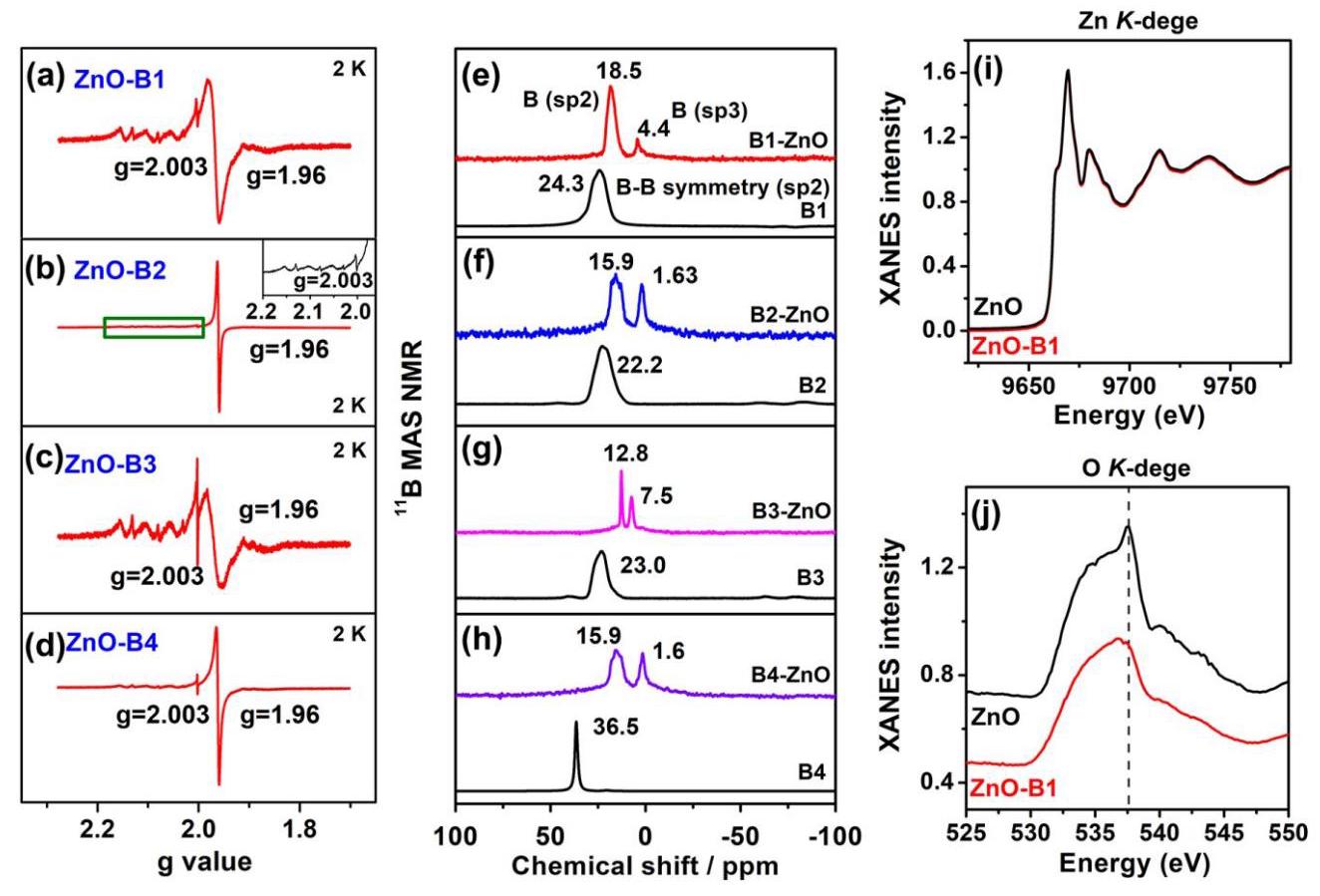
Figure 3. (a-d) EPR spectra of four B-ZnO samples at 2 K. The inset in (b) is magnifications of the green rectangular areas with g values of 2.2~1.99. (e-h) Solid-state boron nuclear magnetic resonance spectra of B1-B4 and four B-ZnO samples. (i) Zn $K$ -edge and (j) O $K$ -edge TEY spectra of B1-ZnO and ZnO.
图3.(a - d)四个B-ZnO样品在2 K时的电子顺磁共振(EPR)光谱。(b)中的插图是绿色矩形区域的放大图,g值为2.2~1.99。(e - h)B1 - B4和四个B-ZnO样品的固态硼核磁共振光谱。(i)B1-ZnO和ZnO的Zn $K$ -边和(j)O $K$ -边总电子产额(TEY)光谱。
Then the surface electronic states and the diboron molecule’s structure were characterized by ESR, NMR and XAFS. (Figure 3) The electron paramagnetic resonance (EPR) spectrum of the B1-ZnO sample showed a strong singlet line centered on a $g$ value of 1.960 at $2\mathrm{\;K}$ (Figure 3a). Some $g > {2.0}$ signals were also observed, which could be indexed to the radical state of organic molecule. The observed $g$ values were characteristic of a paramagnetic ${\mathrm{{Zn}}}^{ + }$ center as exemplified in a few reports such as $\mathrm{{ZnO}}$ synthesized by evaporation $\left( {g = {1.96}}\right) ,{}^{31}$ heat treated $\mathrm{{ZnO}}{\left( g = {1.955}\right) }^{32}$ defect-rich ultrathin $\mathrm{{ZnAl}} - \mathrm{{LDH}}{\left( g = {1.99}\right) }^{33}$ and ${\mathrm{{Zn}}}^{ + }$ -doped ZSM-5 molecule sieve $\left( {g = {1.99}}\right) {.}^{34}$
然后通过电子自旋共振(ESR)、核磁共振(NMR)和X射线吸收精细结构(XAFS)对表面电子态和二硼分子的结构进行了表征。(图3)B1-ZnO样品的电子顺磁共振(EPR)光谱在$2\mathrm{\;K}$处显示出一条以$g$值1.960为中心的强单线态谱线(图3a)。还观察到一些$g > {2.0}$信号,可将其归属于有机分子的自由基态。观察到的$g$值是顺磁性${\mathrm{{Zn}}}^{ + }$中心的特征,如在一些报告中所举例的,如通过蒸发$\left( {g = {1.96}}\right) ,{}^{31}$、热处理$\mathrm{{ZnO}}{\left( g = {1.955}\right) }^{32}$、富缺陷超薄$\mathrm{{ZnAl}} - \mathrm{{LDH}}{\left( g = {1.99}\right) }^{33}$合成的$\mathrm{{ZnO}}$以及${\mathrm{{Zn}}}^{ + }$掺杂的ZSM-5分子筛$\left( {g = {1.99}}\right) {.}^{34}$
Furthermore, the solid-state boron nuclear magnetic resonance ( ${}^{11}\mathrm{\;B}$ NMR) can be used to elucidate the binding details of the diboron (4) adsorbed on ZnO (Figure 3e-h). The peaks around ${20} \sim {40}\mathrm{{ppm}}$ for the free diboron (4) compounds were assigned to the two identical symmetric boron atoms in the pure B1-B4 molecule. (B1: 24.3 ppm, B2: 22.2 ppm, B3: 23.0 ppm, and B4: 36.5 ppm) In the adsorption samples, the bonding on the boron atom will cause the molecule to lose its symmetry resulting in two distinct chemical environments around the two boron atoms. Thus, a chemical shift was observed at 4.4 ppm for B1-ZnO in the ${}^{11}\mathrm{\;B}$ NMR which was presumably responsible for the complexation mode (B2: 1.63 ppm, B3: 7.5 ppm, and B4: 1.6 ppm). This new peak appeared in the very upfield region compared with that for the free B1 indicating a change in the coordination on the boron atom. Mechanistically, tetracoordinating boron has a higher electron density than the tricoordinating species due to its formal negative charge which results in a chemical shift upfield in the NMR spectrum. ${}^{35}$ Moreover, Marder and co-workers reported a $N$ -heterocyclic carbene (NHC)-B1 adduct with a 0.34 ppm chemical shift which they assigned to the tetracoordinating boron. ${}^{36}$ The peak close to 0 ppm in the present case should be attributed to one of the boron atoms in the diboron(4) molecule coordinating with the bridged oxygen or the hydroxyl group on the $\mathrm{{ZnO}}$ surface.
此外,固态硼核磁共振(${}^{11}\mathrm{\;B}$ NMR)可用于阐明吸附在ZnO上的二硼(4)的结合细节(图3e - h)。游离二硼(4)化合物在${20} \sim {40}\mathrm{{ppm}}$附近的峰归属于纯B1 - B4分子中两个相同的对称硼原子。(B1:24.3 ppm,B2:22.2 ppm,B3:23.0 ppm,B4:36.5 ppm)在吸附样品中,硼原子上的键合会导致分子失去对称性,从而在两个硼原子周围产生两种不同的化学环境。因此,在${}^{11}\mathrm{\;B}$ NMR中观察到B1 - ZnO在4.4 ppm处有化学位移,这可能是由于络合模式(B2:1.63 ppm,B3:7.5 ppm,B4:1.6 ppm)。与游离B1相比,这个新峰出现在非常高场的区域,表明硼原子上的配位发生了变化。从机理上讲,由于其形式负电荷,四配位硼比三配位物种具有更高的电子密度,这导致在NMR光谱中化学位移向高场移动。${}^{35}$此外,Marder及其同事报道了一种$N$ - 杂环卡宾(NHC) - B1加合物,其化学位移为0.34 ppm,他们将其归属于四配位硼。${}^{36}$在本案例中,接近0 ppm的峰应归因于二硼(4)分子中的一个硼原子与$\mathrm{{ZnO}}$表面上的桥连氧或羟基配位。
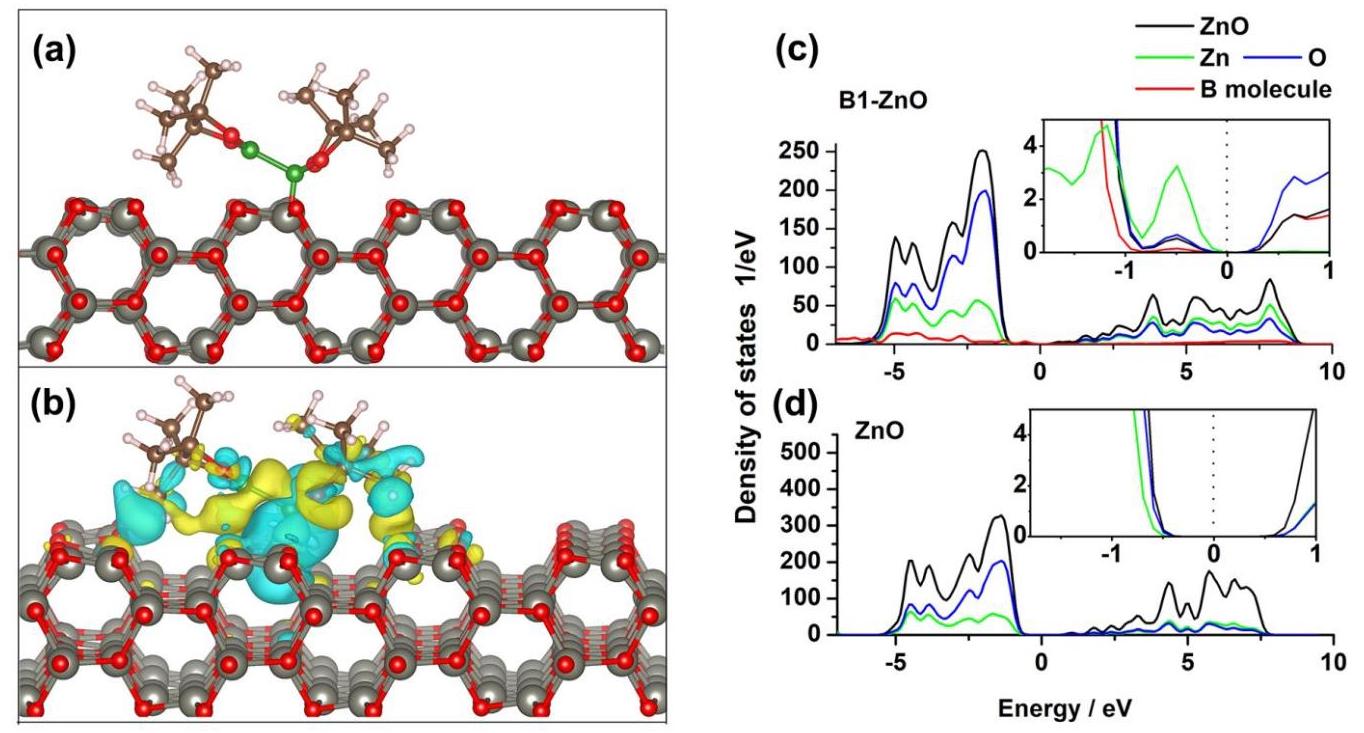
Figure 4. (a) Optimized geometric structures and (b) charge density difference mappings for the B1 adsorption on the ZnO {110} surface. The isosurfaces of the electron density difference plots are all 0.001 e ${\text{ Å }}^{-3}$ . The yellow and light blue surfaces represent electron depletion and accumulation. The silvery gray, red, earth yellow, green and pink spheres are the Zn, O, C, B and H atoms, respectively. The projected density of state (PDOS) plots of (c) B1 molecule adsorption on ZnO {110} plane and (d) pristine ZnO {110} surface calculated by GGA+U. (U=7.5 eV, the insert is a magnification of the PDOS around the Fermi level.
图4.(a)B1在ZnO {110}表面吸附的优化几何结构和(b)电荷密度差映射。电子密度差图的等值面均为0.001 e ${\text{ Å }}^{-3}$ 。黄色和浅蓝色表面分别代表电子耗尽和积累。银灰色、红色、土黄色、绿色和粉红色球体分别为Zn、O、C、B和H原子。(c)B1分子吸附在ZnO {110}平面和(d)原始ZnO {110}表面投影态密度(PDOS)图(通过GGA + U计算,U = 7.5 eV,插图是费米能级附近PDOS的放大图)。
X-ray absorption fine structure (XAFS) spectra were used to investigate this surface complexation. The X-ray absorption near edge structure spectroscopy (XANES) spectra of the $\mathrm{{Zn}}K$ - edge (Figure 3i) showed that B-ZnO and ZnO have little difference, indicating that the diboron (4) compounds only interacted with the surface ZnO layer. The introduction of the diboron compound did not influence the bulk properties of the $\mathrm{{ZnO}}$ substrate, which was in accordance with the Fourier-transformed (FT) ${\mathrm{k}}^{2}$ -weighted extended X-ray absorption fine structure (EXAFS) spectra in Figure S6. The XANES spectra of the O $K$ -edge were measured in the FEY mode, which provided information about the surface $\mathrm{O}$ atoms. ${}^{37}\mathrm{{We}}$ compared ZnO with B4-ZnO to exclude the influence of the O atoms in the diboron compounds. The absorption around 537.6 eV could be ascribed to the hybridization of the Zn 4p and O 2p orbitals. ${}^{{38},{39}}$ The negative shift (-0.4 eV) of the absorption peak to 537.2 eV showed that the surface $\mathrm{O}$ atom shifted to a lower valance state (Figure 3j), due to the formation of a B-O coordination bond that led to the formation of a lower valence state of the ${\mathrm{{Zn}}}^{ + }$ species.
X射线吸收精细结构(XAFS)光谱用于研究这种表面络合。$\mathrm{{Zn}}K$ 边的X射线吸收近边结构光谱(XANES)光谱(图3i)表明,B - ZnO和ZnO几乎没有差异,这表明二硼(4)化合物仅与表面ZnO层相互作用。二硼化合物的引入并未影响$\mathrm{{ZnO}}$ 衬底的体相性质,这与图S6中的傅里叶变换(FT)${\mathrm{k}}^{2}$ 加权扩展X射线吸收精细结构(EXAFS)光谱一致。在FEY模式下测量了O $K$ 边的XANES光谱,该光谱提供了有关表面$\mathrm{O}$ 原子的信息。${}^{37}\mathrm{{We}}$ 将ZnO与B4 - ZnO进行比较以排除二硼化合物中O原子的影响。537.6 eV附近的吸收可归因于Zn 4p和O 2p轨道的杂化。${}^{{38},{39}}$ 吸收峰向537.2 eV的负移( - 0.4 eV)表明表面$\mathrm{O}$ 原子转变为较低价态(图3j),这是由于形成了B - O配位键导致${\mathrm{{Zn}}}^{ + }$ 物种形成较低价态。
DFT calculations were further used to study the adsorption of the diboron molecule on the $\mathrm{{ZnO}}$ nanoparticle surface. This study focuses on the $\mathrm{{ZnO}}\{ {110}\}$ surface, which is non-polar and contributes up to 80% of the ZnO total surface area. ${}^{40}$ The optimized geometry of the B1 adsorption on the $\mathrm{{ZnO}}$ surface was shown in Figure 4a. The B1 molecule was tightly bound with the surface ${\mathrm{O}}_{2\mathrm{c}}$ atom through the $\mathrm{B} - \mathrm{O}$ coordination bond. The charge density difference plots in Figure 4b showed the charge redistribution around the adsorption site of the ZnO $\{ {110}\}$ surface mainly on $\mathrm{p}$ orbital of $\mathrm{O}$ atoms and $\mathrm{s}$ orbital in surface Zn atoms, and it also exhibited electron redistribution in the organic molecule. This charge redistribution could result in the formation of a ${\mathrm{{Zn}}}^{ + } - {\mathrm{O}}^{ - }$ pair. Next, the projected density of state (PDOS) of the $\mathrm{{ZnO}}$ surface with the adsorption of $\mathrm{B}1$ molecule was shown in Figure 4c. As a comparison, the PDOS of the pristine ZnO {110} surface was shown in Figure 4d. Some intermediate states just below the Fermi level appeared upon the adsorption of the B1 molecule. What’s more, O 2p states in B1- $\mathrm{{ZnO}}$ model showed a density states of ${199}{\mathrm{{eV}}}^{-1}$ at $- {1.4}\mathrm{{eV}}$ , while in pristine $\mathrm{{ZnO}}$ , the relate density was ${204}{\mathrm{{eV}}}^{-1}$ at $- {1.9}\mathrm{{eV}};\mathrm{{Zn}}$ 4s states at $1\mathrm{{eV}}$ was ${1.3}{\mathrm{{eV}}}^{-1}$ in the model of pristine $\mathrm{{ZnO}}\{ {110}\}$ surface, ${1.4}{\mathrm{{eV}}}^{-1}$ at around ${0.66}\mathrm{{eV}}$ in $\mathrm{B}1 - \mathrm{{ZnO}}$ model. It could be concluded that $\mathrm{O}2\mathrm{p}$ states were reduced but $\mathrm{{Zn}}4\mathrm{\;s}$ states were increased in the B1-ZnO model, and the band gap was shrinked. The circumstance showed that the surface adsorption of B1 molecule induce electron redistribution that some states were moved from $\mathrm{O}2\mathrm{p}$ to $\mathrm{{Zn}}4\mathrm{\;s}$ , which is consistent with the formation of the ${\mathrm{{Zn}}}^{ + } - {\mathrm{O}}^{ - }$ pair. The B2, B3, B4 molecule adsorption on the $\mathrm{{ZnO}}\{ {110}\}$ surface were also analyzed (Figure S8). The PDOS plots (Figure S9) showed the presence of electron-filled $\mathrm{{Zn}}4\mathrm{\;s}$ states within the band gap, suggesting that the adsorption of the diboron molecule could lead to the formation of the ${\mathrm{{Zn}}}^{ + }$ species on the $\mathrm{{ZnO}}$ surface. The stability of the newly formed ${\mathrm{{Zn}}}^{ + } - {\mathrm{O}}^{ - }$ pair was examined by calculating the adsorption energy of an ${\mathrm{O}}_{2}$ molecule on the adjacent sites of the ${\mathrm{{Zn}}}^{ + } - {\mathrm{O}}^{ - }$ pair. The adsorption energy is generally positive (Table S1), indicating that it is energetically unstable for the ${\mathrm{O}}_{2}$ molecule to get close to the ${\mathrm{{Zn}}}^{ + } - {\mathrm{O}}^{ - }$ center. This result demonstrated that the organic complexation could prevent further oxidation of the ${\mathrm{{Zn}}}^{ + }$ species by ${\mathrm{O}}_{2}$ molecule, thus stabilize the formed ${\mathrm{{Zn}}}^{ + } - {\mathrm{O}}^{ - }$ pair in the air atmosphere.
密度泛函理论(DFT)计算进一步用于研究双硼分子在$\mathrm{{ZnO}}$纳米颗粒表面的吸附。本研究聚焦于$\mathrm{{ZnO}}\{ {110}\}$表面,该表面是非极性的,占氧化锌总表面积的80%。${}^{40}$图4a展示了B1在$\mathrm{{ZnO}}$表面吸附的优化几何结构。B1分子通过$\mathrm{B} - \mathrm{O}$配位键与表面${\mathrm{O}}_{2\mathrm{c}}$原子紧密结合。图4b中的电荷密度差图显示,氧化锌$\{ {110}\}$表面吸附位点周围的电荷重新分布主要发生在$\mathrm{O}$原子的$\mathrm{p}$轨道和表面锌原子的$\mathrm{s}$轨道上,并且在有机分子中也表现出电子重新分布。这种电荷重新分布可能导致形成一个${\mathrm{{Zn}}}^{ + } - {\mathrm{O}}^{ - }$对。接下来,图4c展示了吸附$\mathrm{B}1$分子的$\mathrm{{ZnO}}$表面的投影态密度(PDOS)。作为对比,图4d展示了原始氧化锌{110}表面的PDOS。吸附B1分子后,在费米能级以下出现了一些中间态。此外,B1 - $\mathrm{{ZnO}}$模型中的O 2p态在$- {1.4}\mathrm{{eV}}$处显示出${199}{\mathrm{{eV}}}^{-1}$的态密度,而在原始$\mathrm{{ZnO}}$中,相关密度在$- {1.9}\mathrm{{eV}};\mathrm{{Zn}}$处为${204}{\mathrm{{eV}}}^{-1}$。在原始$\mathrm{{ZnO}}\{ {110}\}$表面模型中,$1\mathrm{{eV}}$处的4s态为${1.3}{\mathrm{{eV}}}^{-1}$,在$\mathrm{B}1 - \mathrm{{ZnO}}$模型中,在${0.66}\mathrm{{eV}}$附近为${1.4}{\mathrm{{eV}}}^{-1}$。可以得出结论,在B1 - 氧化锌模型中,$\mathrm{O}2\mathrm{p}$态减少但$\mathrm{{Zn}}4\mathrm{\;s}$态增加,并且带隙缩小。这种情况表明B1分子的表面吸附诱导了电子重新分布,一些态从$\mathrm{O}2\mathrm{p}$转移到$\mathrm{{Zn}}4\mathrm{\;s}$,这与${\mathrm{{Zn}}}^{ + } - {\mathrm{O}}^{ - }$对的形成一致。还分析了B2、B3、B4分子在$\mathrm{{ZnO}}\{ {110}\}$表面的吸附(图S8)。PDOS图(图S9)显示在带隙内存在电子填充的$\mathrm{{Zn}}4\mathrm{\;s}$态,表明双硼分子的吸附可能导致在$\mathrm{{ZnO}}$表面形成${\mathrm{{Zn}}}^{ + }$物种。通过计算${\mathrm{O}}_{2}$分子在${\mathrm{{Zn}}}^{ + } - {\mathrm{O}}^{ - }$对相邻位点的吸附能来检验新形成的${\mathrm{{Zn}}}^{ + } - {\mathrm{O}}^{ - }$对的稳定性。吸附能通常为正(表S1),表明${\mathrm{O}}_{2}$分子靠近${\mathrm{{Zn}}}^{ + } - {\mathrm{O}}^{ - }$中心在能量上是不稳定的。该结果表明有机络合可以防止${\mathrm{{Zn}}}^{ + }$物种被${\mathrm{O}}_{2}$分子进一步氧化,从而在空气气氛中稳定形成的${\mathrm{{Zn}}}^{ + } - {\mathrm{O}}^{ - }$对。
CONCLUSIONS
结论
${\mathrm{{Zn}}}^{ + } - {\mathrm{O}}^{ - }$ dual-spin surface states were formed by a surface modification method. The diboron compound successfully induced surface charge redistribution by adjusting the surface orbital energy. Based on changing the coordination environment of ${\mathrm{O}}_{2\mathrm{c}}$ and the unique structure of the diboron compound itself, new spinning surface states constituting Zn 4s, O 2p, and organic molecules’ orbitals were formed. And the spin-orbit coupling was induced by the surface states to form dual-spin ${\mathrm{{Zn}}}^{ + } - {\mathrm{O}}^{ - }$ states.
${\mathrm{{Zn}}}^{ + } - {\mathrm{O}}^{ - }$双自旋表面态通过表面改性方法形成。二硼化合物通过调节表面轨道能量成功诱导了表面电荷重新分布。基于改变${\mathrm{O}}_{2\mathrm{c}}$的配位环境以及二硼化合物本身的独特结构,形成了由Zn 4s、O 2p和有机分子轨道组成的新的自旋表面态。并且表面态诱导了自旋轨道耦合以形成双自旋${\mathrm{{Zn}}}^{ + } - {\mathrm{O}}^{ - }$态。
ASSOCIATED CONTENT
相关内容
Supporting Information
支持信息
The Supporting Information is available free of charge on the ACS Publications website.
支持信息可在ACS出版物网站上免费获取。
AUTHOR INFORMATION
作者信息
Corresponding Author
通讯作者
Notes
注释
The authors declare no competing financial interest.
作者声明不存在相互竞争的财务利益。
ACKNOWLEDGMENT
致谢
The project was supported by the Natural Science Foundation of China (Grant 21772003). We also thank the “1000-Youth Talents Plan” and Peking University for start-up funds. A portion of the EPR work was performed on the Steady High Magnetic Field Facilities, High Magnetic Field Laboratory of the Chinese Academy of Sciences. The authors thank beamline BL08U1A and BL14W1 (Shanghai Synchrotron Radiation Facility) for providing the beam time. This work was also partially funded by the BHP-PKU CCUS project supported by BHP Billiton. Cao Y., Tu Y., Zhang J. run the experimental work; Cao Y., Zhou P. do the theoretical work; Deng Y. give some help to the experimental work; Zhang X. give some advice to the theoretical work, Kong B., Guo S., Zhu R., Ma D., Yang Y. check the manuscript; Mo F. direct the whole project.
The project was supported by the Natural Science Foundation of China (Grant 21772003). We also thank the “1000-Youth Talents Plan” and Peking University for start-up funds. A portion of the EPR work was performed on the Steady High Magnetic Field Facilities, High Magnetic Field Laboratory of the Chinese Academy of Sciences. The authors thank beamline BL08U1A and BL14W1 (Shanghai Synchrotron Radiation Facility) for providing the beam time. This work was also partially funded by the BHP-PKU CCUS project supported by BHP Billiton. Cao Y., Tu Y., Zhang J. run the experimental work; Cao Y., Zhou P. do the theoretical work; Deng Y. give some help to the experimental work; Zhang X. give some advice to the theoretical work, Kong B., Guo S., Zhu R., Ma D., Yang Y. check the manuscript; Mo F. direct the whole project.
REFERENCES
参考文献
(1) Ozgur, U.; Hofstetter, D.; Morkoc, H., ZnO devices and applications: a review of current status and future prospects. Proc. IEEE 2010, 98 (7), 1255- 1268.
(2) Djurišić, A.; Ng, A.; Chen, X., ZnO nanostructures for optoelectronics: material properties and device applications. Prog. Quant. Electron. 2010, 34 (4), 191-259.
(3) Wang, X.; Song, J.; Wang, Z. L., Nanowire and nanobelt arrays of zinc oxide from synthesis to properties and to novel devices. J. Mater. Chem. 2007, 17 (8), 711-720.
(4). Kumar, B. V.; Naik, H. S. B.; Girija, D.; Kumar, B. V., ZnO nanoparticle as catalyst for efficient green one-pot synthesis of coumarins through Knoevenagel condensation. J. Chem. Sci. 2011, 123 (5), 615-621.
(5) Wang, L.; Kang, Y.; Liu, X.; Zhang, S.; Huang, W.; Wang, S., ZnO nanorod gas sensor for ethanol detection. Sens. Actuators B Chem. 2012, 162 (1), 237- 243.
(6) Hewlett, R. M.; McLachlan, M. A., Surface Structure Modification of ZnO and the Impact on Electronic Properties. Adv. Mater. 2016, 28 (20), 3893-3921.
(7) Chen, X.; Liu, L.; Peter, Y. Y.; Mao, S. S., Increasing solar absorption for photocatalysis with black hydrogenated titanium dioxide nanocrystals. Science 2011, 331 (6018), 746-750.
(8) Lin, L.; Huang, J.; Li, X.; Abass, M. A.; Zhang, S., Effective surface disorder engineering of metal oxide nanocrystals for improved photocatalysis. Appl. Catal. B-Environ. 2017, 203, 615-624.
(9) Schmidt-Mende, L.; MacManus-Driscoll, J. L., ZnO-nanostructures, defects, and devices. Mater. Today 2007, 10 (5), 40-48.
(10) Zhang, G.; Kim, G.; Choi, W., Visible light driven photocatalysis mediated via ligand-to-metal charge transfer (LMCT): an alternative approach to solar activation of titania. Energy Environ. Sci. 2014, 7 (3), 954-966.
(11) Freund, H. J., Metal oxide surfaces: electronic structure and molecular adsorption. Phys. Status Solidi (b) 1995, 192 (2), 407-440.
(12) Huang, Z.; Zhang, Y.; He, Y.; Song, H.; Yin, C.; Wu, K., A chemist’s overview of surface electron spins. Chem. Soc. Rev. 2017, 46 (7), 1955-1976.
(13) Chen, G.; Zhao, Y.; Shang, L.; Waterhouse, G. I. N.; Kang, X.; Wu, L.-Z.; Tung, C.-H.; Zhang, T., Recent Advances in the Synthesis, Characterization and Application of ${\mathrm{{Zn}}}^{ + }$ -containing Heterogeneous Catalysts. Adv. Sci. 2016,3 (7), 1500424.
(14) Isoya, J.-I.; Fujiwara, S., ESR of Hot Ions: Zn (I), Cd (I), and Hg (I) in $\gamma$ - Irradiated Potassium Tetracyano Zincate (II), Cadmate (II), and Mercurate (II). Bull. Chem. Soc. Jpn. 1972, 45 (7), 2182-2188.
(15) Rogers, W. T.; Stefani, G.; Camilloni, R.; Dunn, G. H.; Msezane, A. Z.; Henry, R. J. W. Electron-impact ionization of ${\mathrm{{Zn}}}^{ + }$ and ${\mathrm{{Ga}}}^{ + }$ . Phys. Rev. A 1982, 25 (2), 737-748.
(16) Weis, P.; Kemper, P. R.; Bowers, M. T., ${\mathrm{{Mn}}}^{ + }\left( {\mathrm{H}}_{2}\right) \mathrm{n}$ and ${\mathrm{{Zn}}}^{ + }{\left( {\mathrm{H}}_{2}\right) }_{\mathrm{n}}$ Clusters: Influence of 3d and 4s Orbitals on Metal- Ligand Bonding. J. Phys. Chem. A 1997, 101 (15), 2809-2816.
(17) Duncan, M. A., Invited review article: laser vaporization cluster sources. Rev. Sci. Instrum. 2012, 83 (4), 041101.
(18) Resa, I.; Carmona, E.; Gutierrez-Puebla, E.; Monge, A., Decamethyldizincocene, a Stable Compound of Zn(I) with a Zn-Zn Bond. Science 2004, 305 (5687), 1136-1138.
(19) Tian, Y.; Li, G.-D.; Chen, J.-S., Chemical formation of mononuclear univalent zinc in a microporous crystalline silicoaluminophosphate. J. Am. Chem. Soc. 2003, 125 (22), 6622-6623.
(20) Li, L.; Li, G. D.; Yan, C.; Mu, X. Y.; Pan, X. L.; Zou, X. X.; Wang, K. X.; Chen, J. S., Efficient Sunlight $\square$ Driven Dehydrogenative Coupling of Methane to Ethane over a ${\mathrm{{Zn}}}^{ + }\square$ Modified Zeolite. Angew. Chem. Int. Ed. 2011,50 (36),8299- 8303.
(21) Neeve, E. C.; Geier, S. J.; Mkhalid, I. A. I.; Westcott, S. A.; Marder, T. B., Diboron(4) Compounds: From Structural Curiosity to Synthetic Workhorse. Chem. Rev. 2016, 116 (16), 9091-9161.
(22) Kan, D.; Aso, R.; Sato, R.; Haruta, M.; Kurata, H.; Shimakawa, Y., Tuning magnetic anisotropy by interfacially engineering the oxygen coordination environment in a transition metal oxide. Nat. Mater. 2016, 15 (4), 432-437.
(23) Mo, F.; Jiang, Y.; Qiu, D.; Zhang, Y.; Wang, J., Direct Conversion of Arylamines to Pinacol Boronates: A Metal-Free Borylation Process. Angew. Chem. Int. Ed. 2010, 49 (10), 1846-1849.
(24) Pietsch, S.; Neeve, E. C.; Apperley, D. C.; Bertermann, R.; Mo, F.; Qiu, D.; Cheung, M. S.; Dang, L.; Wang, J.; Radius, U.; Lin, Z.; Kleeberg, C.; Marder, T. B., Synthesis, Structure, and Reactivity of Anionic sp2-sp3 Diboron Compounds: Readily Accessible Boryl Nucleophiles. Chem. Eur. J. 2015, 21 (19), 7082-7098.
(25) Wang, G.; Zhang, H.; Zhao, J.; Li, W.; Cao, J.; Zhu, C.; Li, S., Homolytic Cleavage of a B-B Bond by the Cooperative Catalysis of Two Lewis Bases: Computational Design and Experimental Verification. Angew. Chem. Int. Ed. 2016, 55 (20), 5985-5989.
(26) Mo, F.; Qiu, D.; Zhang, Y.; Wang, J., Renaissance of Sandmeyer-Type Reactions: Conversion of Aromatic C-N Bonds into C-X Bonds (X = B, Sn, P, or ${\mathrm{{CF}}}_{3}$ ). Acc. Chem. Res. 2018, 51 (2), 496-506.
(27) Wang, G., W.; Zhang, H.; Zhao, J.; Li, W.; Cao, J.; Zhu, C., Z.; Li, S., Homolytic Cleavage of a B-B Bond by the Cooperative Catalysis of Two Lewis Bases: Computational Design and Experimental Verification. Angew. Chem. Int. Ed. 2016, 55 (20), 5985-5989.
(28) Wang, G.; Cao, J.; Gao, L.; Chen, W.; Huang, W.; Cheng, X.; Li, S., Metal-Free Synthesis of C-4 Substituted Pyridine Derivatives Using Pyridine-boryl Radicals via a Radical Addition/Coupling Mechanism: A Combined Computational and Experimental Study. J. Am. Chem. Soc. 2017, 139 (10), 3904-3910.
(29) Zhang, L.; Jiao, L., Super electron donors derived from diboron. Chem. Sci. 2018, 9 (10), 2711-2722.
(30) Schrauben, J. N.; Hayoun, R.; Valdez, C. N.; Braten, M.; Fridley, L.; Mayer, J. M., Titanium and Zinc Oxide Nanoparticles Are Proton-Coupled Electron Transfer Agents. Science 2012, 336 (6086), 1298-1301.
(31) Li, D.; Leung, Y. H.; Djurišić, A. B.; Liu, Z. T.; Xie, M. H.; Shi, S. L.; Xu, S. J.; Chan, W. K., Different origins of visible luminescence in ZnO nanostructures fabricated by the chemical and evaporation methods. Appl. Phys. Lett. 2004, 85 (9), 1601-1603.
(32) Morazzoni, F.; Scotti, R.; Di Nola, P.; Milani, C.; Narducci, D., Electron paramagnetic resonance study of the interaction of the $\mathrm{{ZnO}}$ surface with air and air-reducing gas mixtures. J. Chem. Soc., Faraday Trans. 1992, 88 (12), 1691- 1694.
(33) Zhao, Y.; Chen, G.; Bian, T.; Zhou, C.; Waterhouse, G. I.; Wu, L. Z.; Tung, C. H.; Smith, L. J.; O’Hare, D.; Zhang, T., Defect DRich Ultrathin ZnAl Double Hydroxide Nanosheets for Efficient Photoreduction of ${\mathrm{{CO}}}_{2}$ to CO with Water. Adv. Mater. 2015, 27 (47), 7824-7831.
(34) Li, L.; Li, G. D.; Yan, C.; Mu, X. Y.; Pan, X. L.; Zou, X. X.; Wang, K. X.; Chen, J. S., Efficient Sunlight Driven Dehydrogenative Coupling of Methane to Ethane over a Zn ${}^{ + }$ Modified Zeolite. Angew. Chem. 2011, 123 (36), 8449-8453.
(35) Nöth, H.; Wrackmeyer, B., 1’B NMR of Tetracoordinate Boron. In Nuclear Magnetic Resonance Spectroscopy of Boron Compounds, Nöth, H.; Wrackmeyer, B., Eds. Springer Berlin Heidelberg: Berlin, Heidelberg, 1978; pp 74-101.
(36) Kleeberg, C.; Crawford, A. G.; Batsanov, A. S.; Hodgkinson, P.; Apperley, D. C.; Cheung, M. S.; Lin, Z.; Marder, T. B., Spectroscopic and Structural Characterization of the CyNHC Adduct of ${\mathrm{B}}_{2}{\mathrm{{pin}}}_{2}$ in Solution and in the Solid State. J. Org. Chem. 2012, 77 (1), 785-789.
(37) Kobayashi, H.; Emura, S.; Arachi, Y.; Tatsumi, K., Investigation of inorganic compounds on the surface of cathode materials using Li and O K-edge XANES. J Power Sources 2007, 174 (2), 774-778.
(38) de Groot, F. M. F.; Grioni, M.; Fuggle, J. C.; Ghijsen, J.; Sawatzky, G. A.; Petersen, H., Oxygen 1s x-ray-absorption edges of transition-metal oxides. Phys. Rev. B 1989, 40 (8), 5715-5723.
(39) Dong, C. L.; Persson, C.; Vayssieres, L.; Augustsson, A.; Schmitt, T.; Mattesini, M.; Ahuja, R.; Chang, C. L.; Guo, J. H., Electronic structure of nanostructured $\mathrm{{ZnO}}$ from x-ray absorption and emission spectroscopy and the local density approximation. Phys. Rev. B 2004, 70 (19), 195325.
(40) Vo, C. T.; Huynh, L. K.; Hung, J. Y.; Jiang, J.-C., Methanol adsorption and decomposition on $\mathrm{{ZnO}}\left( {{101}^{ - }0}\right)$ surface: A density functional theory study. Appl. Surf. Sci. 2013, 280, 219-224.
Insert artwork Table of Contents here
在此插入插图目录
ZnO Surface modification
氧化锌表面改性
Surface orbital energy modulation
表面轨道能量调制