Electrochemical Radical Borylation of Aryl Iodides
英文原文与中文译文逐段对照 · English original with Chinese translation
Accepted Article
录用文章
Title: Electrochemical Radical Borylation of Aryl lodides
标题:芳基碘化物的电化学自由基硼化反应
Authors: Junting Hong, Qianyi Liu, Feng Li, Guangcan Bai, Guoquan Liu, Man Li, Onkar S. Nayal, Xuefeng Fu and Fanyang Mo*
作者:洪钧婷、刘谦益、李锋、白光灿、刘国权、李满、昂卡尔·S·纳亚尔、付雪峰和莫凡洋*
This manuscript has been accepted and appears as an Accepted Article online.
本稿件已被录用并以录用文章形式在线发表。
This work may now be cited as: Chin. J. Chem. 2019, 37, 10.1002/cjoc.201900001.
本研究现可引用为:《中国化学》2019年,第37卷,10.1002/cjoc.201900001。
The final Version of Record (VoR) of it with formal page numbers will soon be published online in Early View: http://dx.doi.org/10.1002/cjoc.201900001.
其带有正式页码的最终出版记录版本(VoR)将很快在Early View在线发表:http://dx.doi.org/10.1002/cjoc.201900001。
WILEY-VCH SIOC CCS
威立-维克希出版集团中国科学院上海有机化学研究所化学数据库
Electrochemical Radical Borylation of Aryl Iodides†
芳基碘化物的电化学自由基硼化反应†
Junting Hong, ${}^{\ddagger a}$ Qianyi Liu, ${}^{\ddagger a}$ Feng Li, ${}^{b}$ Guangcan Bai, ${}^{b}$ Guoquan Liu, ${}^{b}$ Man Li, ${}^{a}$ Onkar S. Nayal ${}^{a}$ , Xuefeng Fu ${}^{c}$ and Fanyang Mo**, a
洪钧婷,${}^{\ddagger a}$ 刘芊艺,${}^{\ddagger a}$ 李丰,${}^{b}$ 白广灿,${}^{b}$ 刘国强,${}^{b}$ 李满,${}^{a}$ 翁卡·S·纳亚尔 ${}^{a}$ ,付雪峰 ${}^{c}$ 以及莫凡洋**,a
Department of Energy and Resources Engineering, College of Engineering, Peking University, Beijing 100871, China
能源与资源工程系,工程学院,北京大学,北京 100871,中国
State Key Laboratory of Natural and Biomimetic Drugs, School of Pharmaceutical Sciences, Peking University, Beijing 100871, China
天然药物及仿生药物国家重点实验室,药学院,北京大学,北京 100871,中国
${}^{c}$ Department of Biomedical Engineering, College of Engineering, Peking University, Beijing 100871, China
${}^{c}$ 生物医学工程系,工程学院,北京大学,北京 100871,中国
’ Jiangsu Weiming Environmental Protection S&T Co., Itd
’ 江苏威名环保科技有限公司
ite this paper: Chin. J. Chem. 2019, 37, XXX-XXX. DOI: 10.1002/cjoc.201900XXX
引用本文:《中国化学》2019年,第37卷,XXX - XXX。DOI: 10.1002/cjoc.201900XXX
Summary of main observation and conclusion Herein, we report the first electrochemical strategy for the borylation of aryl iodides via a radical pathway using current as a driving force. A mild reaction condition allows an assorted range of readily available aryl iodides to be proficiently converted into synthetically valuable arylboronic esters under transition metal catalyst-free conditions. Moreover, this method also shows good functional group tolerance. Initial control mechanistic experiments reveal the formation of aryl radical as a key intermediate and the current plays important role in the generation of radical intermediate.
主要观察结果和结论总结 在此,我们报道了首个以电流为驱动力,通过自由基途径实现芳基碘化物硼化反应的电化学策略。温和的反应条件使得一系列易于获得的芳基碘化物能够在无过渡金属催化剂的条件下高效地转化为具有合成价值的芳基硼酸酯。此外,该方法还表现出良好的官能团耐受性。初步的控制机理实验表明,芳基自由基作为关键中间体形成,且电流在自由基中间体的生成中起着重要作用。
Packground and Originality Content
背景与原创内容
Arylboronic acids and their derivatives have found widespread applications in organic synthesis. ${}^{1 - 3}$ Consequently, the methods of ti eir preparation have been intensively developed in the past decades. Conventional approaches to the synthesis of arylboronic acids or esters from aryl halides require either prior preparation of ghly reactive organometallic reagents, ${}^{4 - 5}$ or the procedures ${}^{6}$ required transition-metal such as Pd, ${}^{7 - {10}}\mathrm{\;{Ni}}{,}^{{11} - {13}}\mathrm{{Cu}},{}^{{14} - {16}}{\mathrm{{Zn}}}^{17}$ and - ${\mathrm{e}}^{18}$ as a catalyst. These methods are widely used in laboratories and pharmaceutical companies. However, the limited functional c oup compatibility and the use of expensive metals and/or ligands or strong bases are the obvious drawbacks in these methods. Nevertheless, there is a strong need to the development of efficient, mild, and transition-metal-free synthetic approach for the borylation of aryl halides.
芳基硼酸及其衍生物在有机合成中有着广泛的应用。${}^{1 - 3}$ 因此,在过去几十年里,它们的制备方法得到了深入发展。从芳基卤化物合成芳基硼酸或酯的传统方法,要么需要预先制备高活性的有机金属试剂,${}^{4 - 5}$ 要么这些方法 ${}^{6}$ 需要过渡金属如钯 ${}^{7 - {10}}\mathrm{\;{Ni}}{,}^{{11} - {13}}\mathrm{{Cu}},{}^{{14} - {16}}{\mathrm{{Zn}}}^{17}$ 以及 - ${\mathrm{e}}^{18}$ 作为催化剂。这些方法在实验室和制药公司中被广泛使用。然而,有限的官能团兼容性以及使用昂贵的金属和/或配体或强碱是这些方法的明显缺点。尽管如此,迫切需要开发一种高效、温和且无过渡金属的芳基卤化物硼化合成方法。
In this context, Organic electrochemistry offers a green and custainable alternative tool to conventional chemical approaches for organic transformations. ${}^{{19} - {35}}$ Various versatile reactive intermediate (e. g., radical cation, radical anion, and radical) can efficiently generated by anodic oxidation, cathodic reduction, as well as paired electrolysis. Our laboratory has been engaged in the development of organic electrochemistry to overcome unmet nthetic challenges. ${}^{{36} - {38}}$ With this background, we thought to the synthesis of aryl boronates from aryl halides through e’ectrochemical transformation (Scheme 1c).
在这种背景下,有机电化学为传统化学方法进行有机转化提供了一种绿色且可持续的替代工具。${}^{{19} - {35}}$ 通过阳极氧化、阴极还原以及成对电解可以有效地生成各种多功能的反应中间体(例如,自由基阳离子、自由基阴离子和自由基)。我们实验室一直致力于有机电化学的发展,以克服未解决的合成挑战。${}^{{36} - {38}}$ 基于此背景,我们考虑通过电化学转化从芳基卤化物合成芳基硼酸酯(方案1c)。
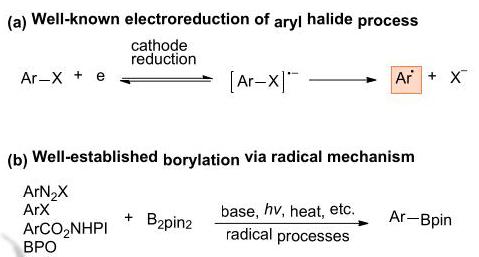
In the context of electro-reduction of aryl halides, it’s well known that aryl halide easily transforms to aryl radical via a versible, dissociative electron transfer (DET) process. Ensuing, this radical is widely used in various organic transformations (Scheme 1a). ${}^{39}$ Except this strategy, transition-metal-free borylation approaches are also well known for the synthesis of a diverse range of organoboron compounds via radical pathway. ${}^{{40} - {42}}$ Since the pioneering work of the Wang group in 2010, ${}^{{43} - {45}}$ numerous transition-metal-free aromatic borylation protocols have been developed using anilines, ${}^{{46} - {49}}$ aryl (pseudo)halides, ${}^{{50} - {56}}$ and aryl carboxylates ${}^{57}$ as the coupling substrates (Scheme 1b). Inspired from these strategies, we thought to develop an electrochemical radical borylation of aryl halides via cathodic reduction under transition-metal-free condition (Scheme 1c).
在芳基卤化物的电还原背景下,众所周知,芳基卤化物通过可逆的离解电子转移(DET)过程很容易转化为芳基自由基。随后,这个自由基被广泛用于各种有机转化(方案1a)。${}^{39}$ 除了这种策略,无过渡金属的硼化方法也因通过自由基途径合成各种有机硼化合物而广为人知。${}^{{40} - {42}}$ 自2010年王课题组的开创性工作以来,${}^{{43} - {45}}$ 已经开发了许多无过渡金属的芳香硼化方案,使用苯胺 ${}^{{46} - {49}}$、芳基(拟)卤化物 ${}^{{50} - {56}}$ 和芳基羧酸盐 ${}^{57}$ 作为偶联底物(方案1b)。受这些策略的启发,我们考虑在无过渡金属条件下通过阴极还原开发芳基卤化物的电化学自由基硼化反应(方案1c)。
We present herein mild radical borylation of aryl halides with commercially available bis(pinacolato)diboron $\left( {{\mathrm{B}}_{2}{\mathrm{{pin}}}_{2}}\right)$ , as the boron source. After the comparison of the present study with the known borylation methods, we found that the electrochemical radical borylation reaction has many advantages over the known protocols. Primarily, the overall process is sustainable in which electron serves as the reductant with solvents being oxidized at the anode, therefore no sacrificing anode is needed. Furthermore, this reaction can be performed under air atmosphere. Moreover, this electrochemical radical borylation of aryl iodides approach got remarkable increase in reaction rate over the reported work on borylation of aryl iodides by Zhang’s group under the similar reaction conditions. ${}^{54}$
我们在此展示了使用市售的双(频哪醇)二硼 $\left( {{\mathrm{B}}_{2}{\mathrm{{pin}}}_{2}}\right)$ 作为硼源对芳基卤化物进行温和的自由基硼化反应。在将本研究与已知的硼化方法进行比较后,我们发现电化学自由基硼化反应相对于已知方案有许多优点。首先,整个过程是可持续的,其中电子作为还原剂,溶剂在阳极被氧化,因此不需要牺牲阳极。此外,该反应可以在空气气氛下进行。而且,在类似反应条件下,这种芳基碘化物的电化学自由基硼化方法在反应速率上比张课题组报道的芳基碘化物硼化工作有显著提高。${}^{54}$
This article has been accepted for publication and undergone full peer review but has not been through the copyediting, typesetting, pagination and proofreading process which may lead to differences between this version and the Version of Record. Please cite this article as doi: 10.1002/cjoc.201900001
本文已被接受发表并经过全面同行评审,但尚未经过编辑、排版、分页和校对过程,这可能导致本版本与记录版本之间存在差异。请将本文引用为doi: 10.1002/cjoc.201900001
Concise Report
简要报告
Scheme 1 Electrochemical borylation of aryl halides
方案1 芳基卤化物的电化学硼化反应
(c) Electrochemical radical borylation of aryl iodides (this work)
(c) 芳基碘化物的电化学自由基硼化反应(本研究)

Sustainable process (no sacrificing anode, no electrolyte)
可持续过程(无需牺牲阳极,无需电解质)
Soft conditions (not sensitive to air or moisture)
温和条件(对空气或湿气不敏感)
Simple operation (undivided cell)
操作简单(单室电解池)
Desults and Discussion
结果与讨论
Results (sample title, optional)
结果(示例标题,可选)
this investigation, we chose phenyl iodide 1a as model substrate and pinacol diboron $\left( {{\mathrm{B}}_{2}{\mathrm{{pin}}}_{2}}\right)$ 2 as a borylating agent ${}^{\prime - }$ able 1). Interestingly, ${54}\%$ yield of 3a was obtained using platinum meshes as the electrodes with ${13}\mathrm{{mA}}$ constant current in the presence of cesium carbonate (entry 1). Notably, either increasing or decreasing the current resulted in lower yields (entries 2 and 3). After that, other bases such as CsF, CsOAc, $t$ -BuOK and MeONa were also investigated under similar reaction conditions. However, all these bases were less effective. (entries 4-5 and 7-8). To our delight, the significant change was observed in the yield of the desired product after the elevation of reaction temperature in 2h (entry 6). Moreover, other solvents, such as EtOH, THF and MeCN were also tested to optimize the best reaction solvent. Regrettably, no better yields of 3a were obtained (entries 9-11). In the cases of THF and MeCN solvents, the reaction media became less conductive (30 V, 1-3 mA). Therefore, electrolyte ${\mathrm{{Bu}}}_{4}{\mathrm{{NClO}}}_{4}$ was added in the reaction media to succeed the reaction (entries 10-11). After the screening of additional reaction times, it is revealed that $3\mathrm{\;h}$ is the optimum time for the completion of the reaction (entry 12). Moreover, drastically changes were observed in the yield of the desired product after increasing the amount of ${\mathrm{B}}_{2}{\mathrm{{pin}}}_{2}$ from 3.0 and 4.0 equivalent (entry 1 and entries 12-13). Finally, in the absence of current, deleterious impact was observed in the yield of 3a (entry 14), which clearly indicates the significant role of current in the generation of aryl radical. Moreover, the “on and off” experiment also indicated the requirement of continuous current (entry 15). constant current. ${}^{b}$ Determined by GC-FID with $n$ -decane as an internal standard. ${}^{c}{\mathrm{{Bu}}}_{4}{\mathrm{{NClO}}}_{4}$ as the electrolyte was added. ${}^{d}$ “On and off” control experiment. During a total time of 3 hours, the current continued for 3 min and then interrupted for 27 min, cycled for 6 times.
在本研究中,我们选择碘苯1a作为模型底物,频哪醇二硼$\left( {{\mathrm{B}}_{2}{\mathrm{{pin}}}_{2}}\right)$ 2作为硼化剂${}^{\prime - }$ (图1)。有趣的是,在碳酸铯存在下,以铂网作为电极并采用${13}\mathrm{{mA}}$ 恒电流时,可获得3a的${54}\%$ 产率(条目1)。值得注意的是,增大或减小电流都会导致产率降低(条目2和3)。之后,在类似反应条件下还研究了其他碱,如CsF、CsOAc、$t$叔丁醇钾和甲氧基钠。然而,所有这些碱的效果都较差(条目4 - 5和7 - 8)。令我们高兴的是,在2小时内升高反应温度后,所需产物的产率有显著变化(条目6)。此外,还测试了其他溶剂,如乙醇、四氢呋喃和乙腈,以优化最佳反应溶剂。遗憾的是,未获得更高产率的3a(条目9 - 11)。在四氢呋喃和乙腈溶剂的情况下,反应介质的导电性变差(30 V,1 - 3 mA)。因此,在反应介质中加入电解质${\mathrm{{Bu}}}_{4}{\mathrm{{NClO}}}_{4}$ 以使反应顺利进行(条目10 - 11)。在筛选了其他反应时间后,发现$3\mathrm{\;h}$ 是反应完成的最佳时间(条目12)。此外,将${\mathrm{B}}_{2}{\mathrm{{pin}}}_{2}$ 的量从3.0当量增加到4.0当量后,所需产物的产率有显著变化(条目1和条目12 - 13)。最后,在无电流的情况下,观察到3a的产率受到有害影响(条目14),这清楚地表明电流在芳基自由基生成中的重要作用。此外,“开和关”实验也表明需要持续电流(条目15)。恒电流。${}^{b}$ 由气相色谱 - 氢火焰离子化检测器以$n$ 癸烷作为内标物测定。${}^{c}{\mathrm{{Bu}}}_{4}{\mathrm{{NClO}}}_{4}$ 加入了作为电解质。${}^{d}$ “开和关”对照实验。在总共3小时的时间内,电流持续3分钟,然后中断27分钟,循环6次。

| 1a (0.5 mmol) 2 | $T$ , time undivided cell | 3a | ||||||
| Entry | Base | 1a / 2 / Base | Current (mA) | $T\left( {{}^{ \circ }\mathrm{C}}\right)$ | Time (h) | Solvent | Conv. of 1a (%) | Yield ${\left( \% \right) }^{b}$ |
| 1 | ${\mathrm{{Cs}}}_{2}{\mathrm{{CO}}}_{3}$ | 1:3:2 | 10 | 50 | 1 | MeOH | 69 | 44 |
| 2 | ${\mathrm{{Cs}}}_{2}{\mathrm{{CO}}}_{3}$ | 1:3:2 | 13 | 50 | 1 | MeOH | 61 | 54 |
| 3 | ${\mathrm{{Cs}}}_{2}{\mathrm{{CO}}}_{3}$ | 1:3:2 | 20 | 50 | 1 | MeOH | 79 | 52 |
| 4 | CsF | 1:3:2 | 13 | 50 | 1 | MeOH | 71 | 33 |
| 5 | CsOAc | 1:3:2 | 13 | 50 | 1 | MeOH | 58 | 16 |
| 6 | ${\mathrm{{Cs}}}_{2}{\mathrm{{CO}}}_{3}$ | 1:3:2 | 13 | 65 | 2 | MeOH | 100 | 64 |
| 7 | 'BuOK | 1:3:2 | 13 | 65 | 2 | MeOH | 51 | 40 |
| 8 | MeONa | 1:3:2 | 13 | 65 | 2 | MeOH | 59 | 44 |
| 9 | ${\mathrm{{Cs}}}_{2}{\mathrm{{CO}}}_{3}$ | 1:3:2 | 13 | 78 | 2 | EtOH | 85 | 30 |
| 10 | ${\mathrm{{Cs}}}_{2}{\mathrm{{CO}}}_{3}$ | 1:3:2 | 13 | 65 | 2 | THF ${}^{c}$ | 40 | 34 |
| 11 | ${\mathrm{{Cs}}}_{2}{\mathrm{{CO}}}_{3}$ | 1:3:2 | 13 | 65 | 2 | MeCN ${}^{c}$ | 64 | 11 |
| 12 | ${\mathrm{{Cs}}}_{2}{\mathrm{{CO}}}_{3}$ | 1:4:2 | 13 | 65 | 3 | MeOH | 98 | 76 |
| 13 | ${\mathrm{{Cs}}}_{2}{\mathrm{{CO}}}_{3}$ | 1:3.5:2 | 13 | 65 | 3 | MeOH | 97 | 67 |
| 14 | ${\mathrm{{Cs}}}_{2}{\mathrm{{CO}}}_{3}$ | 1:4:2 | 0 | 65 | 3 | MeOH | 19 | 14 |
| ${15}^{d}$ | ${\mathrm{{Cs}}}_{2}{\mathrm{{CO}}}_{3}$ | 1:4:2 | 0-13 | 65 | 3 | MeOH | 52 | 33 |
${}^{\sigma }$ Reaction conditions: Platinum mesh electrodes (1 cm $\times 1$ cm),1a (0.5 mmol),2, base (2.0 equiv.), solvent (5 mL), heating, undivided cell, sealed tube. cc,
${}^{\sigma }$ 反应条件:铂网电极(1 cm $\times 1$ cm),1a(0.5 mmol),2,碱(2.0当量),溶剂(5 mL),加热,不分隔电池,密封管。cc,
With the optimal reaction conditions in hand, we explored the substrate scope of aryl iodide (Table 2). Notably, a wide range of aryl iodide derivatives bearing both electron-withdrawing and electron-donating groups could be borylated in moderate to good yields. Aryl iodides with an electron-donating group furnished the corresponding borylation product in good yields (3a-3e). A sterically hindered aryl iodide such as 2e and 2f smoothly engaged ir the reaction and afforded a moderate yield of the respective product. In addition, aryl iodides with an electron-withdrawing group, such as an amide and an ester, produced borylation products in moderate yields (3g-j). Notably, for substrate 1j’, the ester group was converted to phenolic hydroxyl and furnished r oduct 3j in 60% yield.
掌握最佳反应条件后,我们探索了碘苯的底物范围(表2)。值得注意的是,一系列带有吸电子基团和供电子基团的碘苯衍生物都能以中等至良好的产率进行硼化反应。带有供电子基团的碘苯能以良好的产率得到相应的硼化产物(图3a - 3e)。像2e和2f这样位阻较大的碘苯能顺利参与反应,并以中等产率得到各自的产物。此外,带有吸电子基团(如酰胺和酯)的碘苯能以中等产率生成硼化产物(图3g - j)。值得注意的是,对于底物1j’,酯基转化为酚羟基,以60%的产率得到产物3j。
To study the mechanism, we designed a series of electron paramagnetic resonance (EPR) experiments. In this context, dimethylpyridine N-oxide (DMPO) was introduced as a spin trapping agent to convert the short-living active radical into EPR uetectable nitroxide radicals. ${}^{58}$ The EPR spectra were simulated using the least-squares fitting method with EasySpin’s function garlic (for details, see Supporting Information). The parameters, isotropic $g$ values and hyperfine constants $A$ were carefully compared with literature data and used as the unique fingerprint of the trapped radicals.
为了研究反应机理,我们设计了一系列电子顺磁共振(EPR)实验。在此背景下,引入二甲基吡啶N - 氧化物(DMPO)作为自旋捕获剂,将寿命较短的活性自由基转化为EPR可检测的氮氧自由基。${}^{58}$ 使用EasySpin的garlic函数通过最小二乘法拟合来模拟EPR谱(详细信息见支持信息)。将各向同性$g$ 值和超精细常数$A$ 等参数与文献数据仔细比较,并用作捕获自由基的唯一指纹。
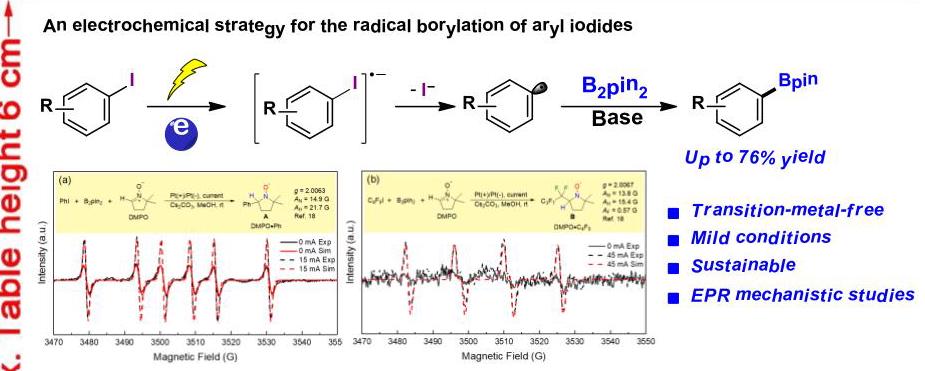
Interestingly, when the current is passed through in a reaction medium for 5 minutes at room temperature, the strong EPR signal is appeared (see Figure 1a). Besides, in the absence of current, the intensity of EPR signal is decreased under similar conditions. This FPR signal is generally assigned to be DMPO-Ph, which is already Known in various reported literature. ${}^{{59} - {60}}$ However, on the basis of evious reports, we found that the signals of some other species such as DMPO-CH3, ${}^{{60} - {61}}$ DMPO-CH2, OH, ${}^{{61} - {62}}$ appear very close or similar to the EPR signal of DMPO-Ph. To verify an ectrochemically generating radical species by the reduction of halides on cathode process, we carried out the reaction with ${}^{n}{\mathrm{C}}_{4}{\mathrm{\;F}}_{9}\mathrm{I}$ in the presence of ${45}\mathrm{\;{mA}}$ current. As expected, a very special “quasi-quartet” signal of DMPO $\cdot {\mathrm{C}}_{4}{\mathrm{\;F}}_{9}{}^{61}$ appears within 30 minutes shown in Figure 1b due to the inductive effect caused by the adjacent fluorine substituents. On the basis of results of ol experiments presented in Supporting Information, the mentioned literatures and the cyclic voltammetry studies (vide ir fra), we concluded that the strong EPR signal appears due to the ormation of DMPO-Ph species in Figure 1a. Thus, these results indicate toward the generation of aryl radicals and current enhance the rate of formation of aryl radical.
有趣的是,当在室温下于反应介质中通入电流5分钟时,出现了强烈的电子顺磁共振(EPR)信号(见图1a)。此外,在无电流的情况下,在类似条件下EPR信号的强度会降低。该FPR信号通常被认为是DMPO-Ph,这在各种已报道的文献中已有记载。${}^{{59} - {60}}$ 然而,根据先前的报道,我们发现一些其他物种的信号,如DMPO-CH3、${}^{{60} - {61}}$ DMPO-CH2, OH、${}^{{61} - {62}}$ ,与DMPO-Ph的EPR信号非常接近或相似。为了验证在阴极过程中通过卤化物还原电化学产生自由基物种,我们在${}^{n}{\mathrm{C}}_{4}{\mathrm{\;F}}_{9}\mathrm{I}$ 存在${45}\mathrm{\;{mA}}$ 电流的情况下进行了反应。正如预期的那样,由于相邻氟取代基引起的诱导效应,图1b中在30分钟内出现了非常特殊的DMPO $\cdot {\mathrm{C}}_{4}{\mathrm{\;F}}_{9}{}^{61}$ “准四重峰”信号。根据支持信息中给出的实验结果、上述文献以及循环伏安法研究(见下文),我们得出结论,图1a中强烈的EPR信号是由于DMPO-Ph物种的形成。因此,这些结果表明生成了芳基自由基,并且电流提高了芳基自由基的形成速率。
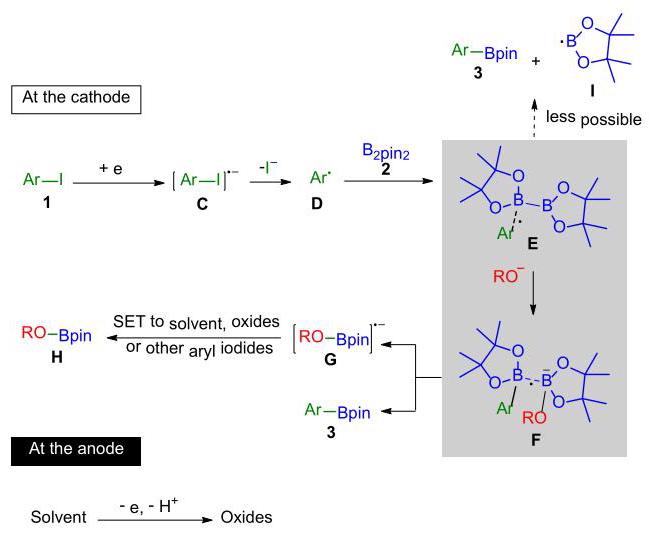
able 2 Substrate scope ${}^{a}$ through intermediate E and F. Meanwhile, the reaction becomes redox neutral due to the anodic oxidation of the solvent to give oxides which balance the overall transformation. Consequently, intermediate G quenched by solvent, oxides or other aryl iodides via SET to afford E. However, the possibility of the formation of desired product 3 via the generation of boron-centered radical I cannot be ruled out at this stage.
表2底物范围${}^{a}$ 通过中间体E和F。同时,由于溶剂的阳极氧化生成氧化物以平衡整体转化,反应变为氧化还原中性。因此,中间体G通过单电子转移(SET)被溶剂、氧化物或其他芳基碘淬灭以得到E。然而,在此阶段不能排除通过生成硼中心自由基I形成所需产物3的可能性。
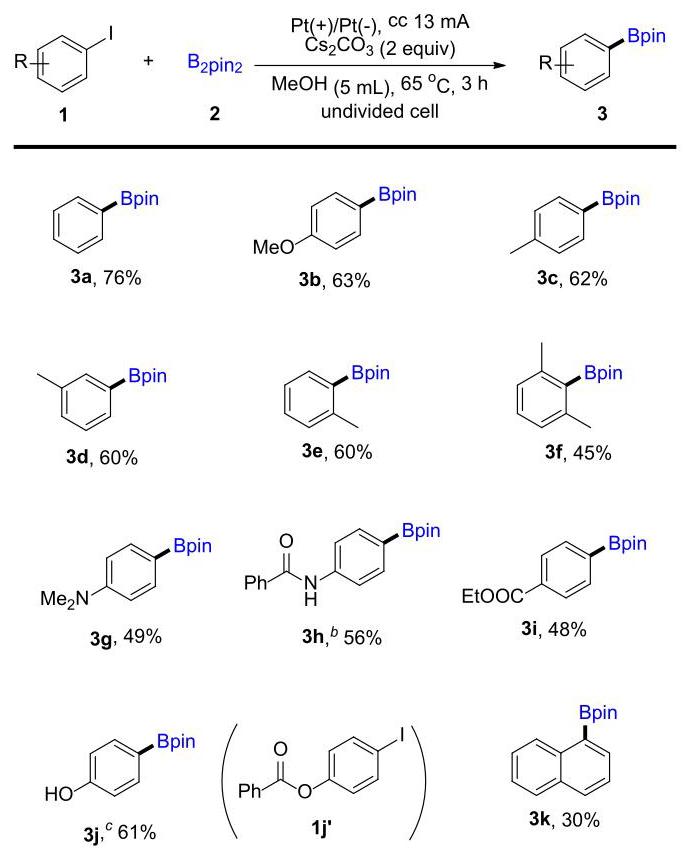
${}^{a}$ Reaction conditions: 1 (0.5 mmol),2 (2.0 mmol,4.0 equiv.), ${\mathrm{{Cs}}}_{2}{\mathrm{{CO}}}_{3}$ (1.0 mmol,2.0 equiv), $\mathrm{{MeOH}}$ (5 mL), platinum mesh electrodes $\left( {1\mathrm{\;{cm}} \times 1\mathrm{\;{cm}}}\right)$ , constant current ${13}\mathrm{\;{mA}},{65}^{ \circ }\mathrm{C},3\mathrm{\;h}$ , undivided cell, sealed tube. ${}^{b}$ Using reticulated vitreous carbon (RVC) electrodes. ${}^{c}$ From $1{j}^{\prime }$ .
${}^{a}$ 反应条件:1(0.5 mmol),2(2.0 mmol,4.0当量),${\mathrm{{Cs}}}_{2}{\mathrm{{CO}}}_{3}$ (1.0 mmol,2.0当量),$\mathrm{{MeOH}}$ (5 mL),铂网电极$\left( {1\mathrm{\;{cm}} \times 1\mathrm{\;{cm}}}\right)$ ,恒流${13}\mathrm{\;{mA}},{65}^{ \circ }\mathrm{C},3\mathrm{\;h}$ ,无隔膜电解池,密封管。${}^{b}$ 使用网状玻璃碳(RVC)电极。${}^{c}$ 来自$1{j}^{\prime }$ 。
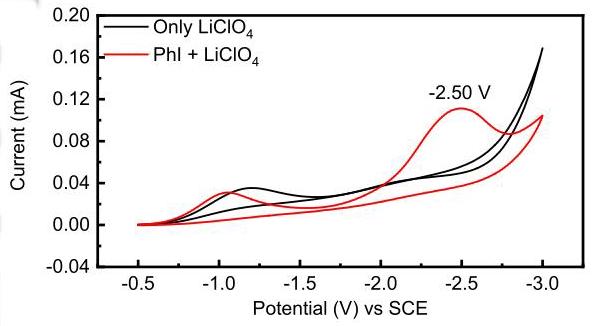
To further clarify the reduction process of iodides, we designed cyclic voltammetry (CV) measurements. Initially, when we mixed phenyl iodide 1a with ${\mathrm{{LiClO}}}_{4}$ solution, a single reduction peak was appeared which is shown in Figure 2a. Noteworthy, after the adding of ${\mathrm{B}}_{2}{\mathrm{{pin}}}_{2}$ and base ${\mathrm{{Cs}}}_{2}{\mathrm{{CO}}}_{3}$ in the model reaction, the single reduction peak appeared with a sharp band. While this peak was completely disappeared in the absence of phenyl iodide 1a as shown in Figure 2b. Thus, these results indicate towards the single electron reduction process of aryl iodides on the cathode. In addition, we conducted differential pulsed voltammetry (DPV) experiments to further indicate toward the single electron reduction of aryl iodide shown in Supporting Information.
为了进一步阐明碘化物的还原过程,我们设计了循环伏安法(CV)测量。最初,当我们将苯基碘1a与${\mathrm{{LiClO}}}_{4}$ 溶液混合时,出现了一个单一的还原峰,如图2a所示。值得注意的是,在模型反应中加入${\mathrm{B}}_{2}{\mathrm{{pin}}}_{2}$ 和碱${\mathrm{{Cs}}}_{2}{\mathrm{{CO}}}_{3}$ 后,单一还原峰出现且伴有一个尖锐的峰带。而如图2b所示,在没有苯基碘1a的情况下该峰完全消失。因此,这些结果表明在阴极上芳基碘发生了单电子还原过程。此外,我们进行了差分脉冲伏安法(DPV)实验,以进一步表明支持信息中所示的芳基碘的单电子还原。
According to our mechanistic investigations and recent relevant literatures, ${}^{{63} - {64}}$ a plausible mechanism for this electrochemical borylation of aryl iodides is proposed (Scheme 2). Initially, at the cathode, aryl iodide 1 undergoes reduction to afford the corresponding radical anion C, which is further transformed into the aryl radical D via carbon-halogen bond cleavage. Further, aryl radical $D$ interacts with ${B}_{2}{\text{ pin }}_{2}$ in the presence of a base $\left( {\mathrm{{RO}}}^{ - }\right)$ to generate the desired product 3 along with the formation of G
根据我们的机理研究和最近的相关文献,${}^{{63} - {64}}$ 提出了一种用于芳基碘化物电化学硼化的合理机理(方案2)。最初,在阴极,芳基碘化物1发生还原反应,生成相应的自由基阴离子C,该自由基阴离子通过碳-卤键断裂进一步转化为芳基自由基D。此外,芳基自由基 $D$ 在碱 $\left( {\mathrm{{RO}}}^{ - }\right)$ 存在下与 ${B}_{2}{\text{ pin }}_{2}$ 相互作用,生成所需产物3,并形成G
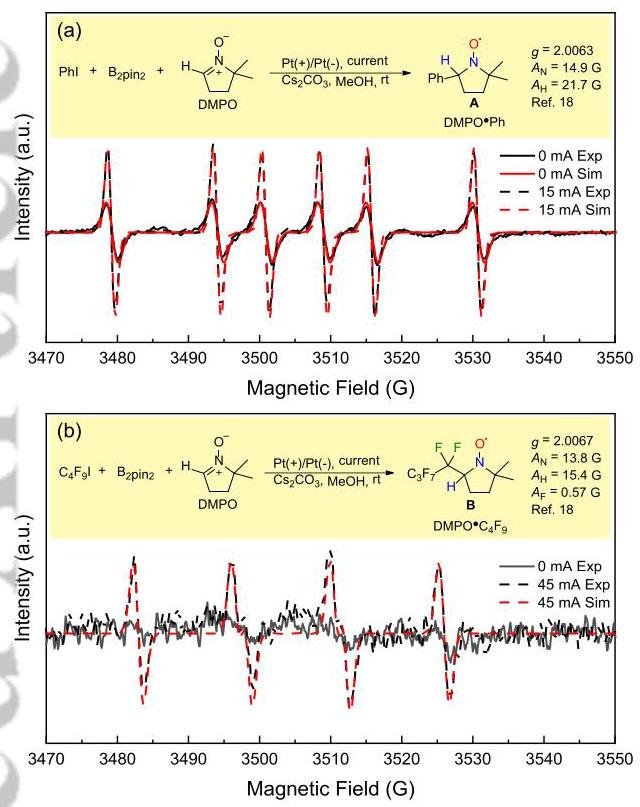
Figure 1 EPR experiments. Reaction conditions: iodides (0.3 mmol), ${\mathrm{B}}_{2}{\mathrm{{Pin}}}_{2}$ (1.2 mmol,4.0 equiv.), ${\mathrm{{Cs}}}_{2}{\mathrm{{CO}}}_{3}$ (0.6 mmol,2.0 equiv), DMPO (0.3 mmol, ${30\mu }\mathrm{L}$ ), MeOH (3 mL), platinum mesh electrodes (1 cm × 1 cm), stirred at room temperature with given current and time.
图1电子顺磁共振(EPR)实验。反应条件:碘化物(0.3 mmol),${\mathrm{B}}_{2}{\mathrm{{Pin}}}_{2}$(1.2 mmol,4.0当量),${\mathrm{{Cs}}}_{2}{\mathrm{{CO}}}_{3}$(0.6 mmol,2.0当量),DMPO(0.3 mmol,${30\mu }\mathrm{L}$),甲醇(3 mL),铂网电极(1 cm×1 cm),在室温下以给定电流和时间搅拌。
Vithout ${\mathrm{B}}_{2}{\mathrm{{pin}}}_{2}$ and base
无${\mathrm{B}}_{2}{\mathrm{{pin}}}_{2}$和碱
(b) With ${\mathrm{B}}_{2}{\mathrm{{pin}}}_{2}$ and base
(b) 有${\mathrm{B}}_{2}{\mathrm{{pin}}}_{2}$和碱
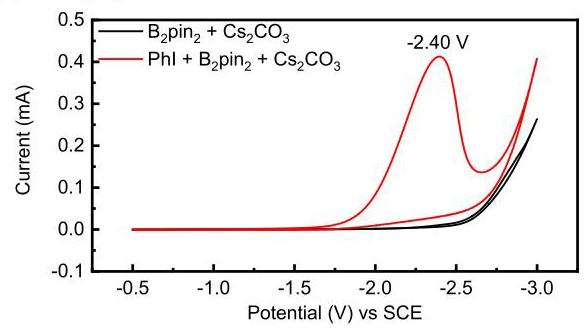
Figure 2 Cyclic voltammetry (CV) experiments. Reaction conditions: 1a (3 mmol), ${\mathrm{{LiClO}}}_{4}$ (3 mmol), ${\mathrm{B}}_{2}{\mathrm{{pin}}}_{2}$ (6 mmol), ${\mathrm{{Cs}}}_{2}{\mathrm{{CO}}}_{3}$ (3 mmol), MeOH (30 mL), 20 ${}^{ \circ }\mathrm{C}$ . L-type glassy carbon as working electrode, Pt wire as counter electrode and saturated calomel electrode (SCE) as reference. Scan rate: 0.02 V/s.
图2循环伏安法(CV)实验。反应条件:1a(3 mmol),${\mathrm{{LiClO}}}_{4}$(3 mmol),${\mathrm{B}}_{2}{\mathrm{{pin}}}_{2}$(6 mmol),${\mathrm{{Cs}}}_{2}{\mathrm{{CO}}}_{3}$(3 mmol),甲醇(30 mL),20 ${}^{ \circ }\mathrm{C}$。L型玻碳作为工作电极,铂丝作为对电极,饱和甘汞电极(SCE)作为参比电极。扫描速率:0.02 V/s。
Scheme 2 Proposed mechanism
方案2提出的机理
Conclusions
结论
In summary, we have developed a sustainable and practical electrochemical borylation of aryl iodides, providing a very useful approach to arylboronic esters. EPR, CV and PVD experiments verified the formation of aryl radicals in this electrochemical borylation reaction, which supports a radical borylation mechanism. This electrochemical borylation reaction is complementary to other borylation methods and might inspire further investigations in the radical borylation strategy.
总之,我们开发了一种可持续且实用的芳基碘化物电化学硼化反应,为芳基硼酸酯提供了一种非常有用的方法。电子顺磁共振(EPR)、循环伏安法(CV)和物理气相沉积(PVD)实验证实了该电化学硼化反应中芳基自由基的形成,这支持了自由基硼化机理。这种电化学硼化反应与其他硼化方法互补,可能会激发对自由基硼化策略的进一步研究。
Experimental
实验
An undivided cell was equipped with two platinum mesh electrodes and connected to a DC regulated power supply. Aryl iodide 1 (0.5 mmol), ${\mathrm{B}}_{2}{\mathrm{{pin}}}_{2}$ (2 mmol,508 mg,4 equiv), ${\mathrm{{Cs}}}_{2}{\mathrm{{CO}}}_{3}$ (1.0 mmol, 326 mg, 2 equiv) and 5 mL of anhydrous MeOH was added to the cell. The mixture was electrolyzed using constant current conditions (13 mA) at ${65}^{ \circ }\mathrm{C}$ under magnetic stirring. After almost 3 hours, the TLC analysis indicated that the electrolysis was complete (witnessed by the disappearance of the aryl iodide). Upon cooling to room temperature, the reaction mixture was transferred to a 100 mL flask by methanol, and then a little silica gel was added into it. After removal of the solvent in vacuo, the residue was poured onto a silica gel column and purified by c lumn chromatography to give the desired product 3.
一个无隔膜电解池配备了两个铂网电极,并连接到一个直流稳压电源。向电解池中加入芳基碘1(0.5 mmol)、${\mathrm{B}}_{2}{\mathrm{{pin}}}_{2}$(2 mmol,508 mg,4当量)、${\mathrm{{Cs}}}_{2}{\mathrm{{CO}}}_{3}$(1.0 mmol,326 mg,2当量)和5 mL无水甲醇。在磁力搅拌下,于${65}^{ \circ }\mathrm{C}$使用恒流条件(13 mA)对混合物进行电解。近3小时后,薄层色谱分析表明电解完成(以芳基碘的消失为证)。冷却至室温后,通过甲醇将反应混合物转移至100 mL烧瓶中,然后向其中加入少量硅胶。在真空中除去溶剂后,将残余物倒在硅胶柱上,通过柱色谱法纯化,得到所需产物3。
cupporting Information
支持信息
The supporting information for this article is available on the WW under https://doi.org/10.1002/cjoc.2018xxxxx.
本文的支持信息可在网站https://doi.org/10.1002/cjoc.2018xxxxx上获取。
^cknowledgement (optional)
致谢(可选)
The project was supported by the Natural Science Foundation f China (Grant 21772003). We also thank the “1000-Youth Talents Plan” and Peking University for start-up funds. This work was also partially funded by the Peking University carbon capture, u.ilization and storage project supported by BHP Billiton.
The project was supported by the Natural Science Foundation f China (Grant 21772003). We also thank the “1000-Youth Talents Plan” and Peking University for start-up funds. This work was also partially funded by the Peking University carbon capture, u.ilization and storage project supported by BHP Billiton.
References
参考文献
- Suzuki, A., Organoborates in new synthetic reactions. Acc Chem Res 1982, 15 (6), 178-184.
Miyaura, N.; Suzuki, A., Palladium-Catalyzed Cross-Coupling .eactions of Organoboron Compounds. Chem Rev 1995, 95 (7), 2457-2483.
Xu, L.; Zhang, S.; Li, P., Boron-selective reactions as powerful trols for modular synthesis of diverse complex molecules. Chem Soc Rev 2015, 44 (24), 8848-8858.
- Brown, H. C.; Cole, T. E., Organoboranes. 31. A simple
selected trialkoxyboranes. Organometallics 1983, 2 (10), 1316-1319.
Brown, H. C.; Srebnik, M.; Cole, T. E., Organoboranes. 48. improved procedures for the preparation of boronic and borinic eters. Organometallics 1986, 5 (11), 2300-2303.
o. Chow, W. K.; Yuen, O. Y.; Choy, P. Y.; So, C. M.; Lau, C. P.; ‘ong, W. T.; Kwong, F. Y., A decade advancement of transition metal-catalyzed borylation of aryl halides and sulfonates. RSC Adv 2013, 3 (31), 12518-12539.
Giroux, A.; Han, Y.; Prasit, P., One pot biaryl synthesis via in situ boronate formation. Tetrahedron Lett 1997, 38 (22), 3841-3844.
Ishiyama, T.; Murata, M.; Miyaura, N., Palladium(0)-Catalyzed Cross-Coupling Reaction of Alkoxydiboron with Haloarenes: A Direct Procedure for Arylboronic Esters. J Org Chem 1995, 60 (23), 7508-7510.
Lipshutz, B. H.; Moser, R.; Voigtritter, K. R., Miyaura Borylations of Aryl Bromides in Water at Room Temperature. Israel J Chem 2010, 50 (5 - 6), 691-695.
Tempest, P. A.; Armstrong, R. W., Cyclobutenedione Derivatives on Solid Support: Toward Multiple Core Structure Libraries. J Am Chem Soc 1997, 119 (32), 7607-7608.
Liu, X.-W.; Echavarren, J.; Zarate, C.; Martin, R., Ni-Catalyzed Borylation of Aryl Fluorides via C-F Cleavage. J Am Chem Soc 2015, 137 (39), 12470-12473.
Moldoveanu, C.; Wilson, D. A.; Wilson, C. J.; Leowanawat, P.; Resmerita, A.-M.; Liu, C.; Rosen, B. M.; Percec, V., Neopentylglycolborylation of ortho-Substituted Aryl Halides Catalyzed by NiCl2-Based Mixed-Ligand Systems. J Org Chem 2010, 75 (16), 5438-5452.
Yamamoto, T.; Morita, T.; Takagi, J.; Yamakawa, T., NiCl2(PMe3)2-Catalyzed Borylation of Aryl Chlorides. Org Lett 2011, 13 (21), 5766-5769.
Zhu, W.; Ma, D., Formation of Arylboronates by a Cul-Catalyzed Coupling Reaction of Pinacolborane with Aryl Iodides at Room Temperature. Org Lett 2006, 8 (2), 261-263.
Guobing, Y.; MingHua, Y.; Jian, Y., Ligand-Free Copper-Catalyzed Borylation of Aryl and Benzyl Halides with Bis(pinacolato)diboron. Letters in Organic Chemistry 2012, 9 (1), 71-75.
Kleeberg, C.; Dang, L.; Lin, Z.; Marder, T. B., A Facile Route to Aryl Boronates: Room-Temperature, Copper-Catalyzed Borylation of Aryl Halides with Alkoxy Diboron Reagents. Angew Chem Int Ed 2009, 48 (29), 5350-5354.
Bose, S. K.; Deißenberger, A.; Eichhorn, A.; Steel, P. G.; Lin, Z.; Marder, T. B., Zinc-Catalyzed Dual C-X and C-H Borylation of Aryl Halides. Angew Chem Int Ed 2015, 54 (40), 11843-11847.
Bedford, R. B.; Brenner, P. B.; Carter, E.; Gallagher, T.; Murphy, D. M.; Pye, D. R., Iron-Catalyzed Borylation of Alkyl, Allyl, and Aryl Halides: Isolation of an Iron(I) Boryl Complex. Organometallics 2014, 33 (21), 5940-5943.
Moeller, K. D., Synthetic applications of anodic electrochemistry. Tetrahedron 2000, 56 (49), 9527-9554.
Sperry, J. B.; Wright, D. L., The application of cathodic reductions and anodic oxidations in the synthesis of complex molecules. Chem Soc Rev 2006, 35 (7), 605-621.
Jutand, A., Contribution of electrochemistry to - ganometallic catalysis. Chem Rev 2008, 108 (7), 2300-2347.
Yoshida, J.-i.; Kataoka, K.; Horcajada, R.; Nagaki, A., Modern rategies in electroorganic synthesis. Chem Rev 2008, 108 (7), 2265-2299.
Francke, R.; Little, R. D., Redox catalysis in organic lectrosynthesis: basic principles and recent developments. Chem Soc Rev 2014, 43 (8), 2492-2521.
- Horn, E. J.; Rosen, B. R.; Baran, P. S., Synthetic organic e’ectrochemistry: An enabling and innately sustainable method. ACS Cent Sci 2016, 2 (5), 302-308.
Feng, R.; Smith, J. A.; Moeller, K. D., Anodic Cyclization Reactions and the Mechanistic Strategies That Enable Optimization. Acc Chem Res 2017, 50 (9), 2346-2352.
Jiang, Y.; Xu, K.; Zeng, C., Use of Electrochemistry in the Synthesis of Heterocyclic Structures. Chem Rev 2018, 118, 4.85-4540.
Yan, M.; Kawamata, Y.; Baran, P. S., Synthetic Organic Rectrochemical Methods Since 2000: On the Verge of a Penaissance. Chem Rev 2017, 117 (21), 13230-13319.
Ma, C.; Fang, P.; Mei, T.-S., Recent Advances in C-H Functionalization Using Electrochemical Transition Metal Catalysis. AS Catal 2018, 8 (8), 7179-7189.
Möhle, S.; Zirbes, M.; Rodrigo, E.; Gieshoff, T.; Wiebe, A.; aldvogel, S. R., Modern Electrochemical Aspects for the Synthesis of Value-Added Organic Products. Angew Chem Int Ed 018, 57 (21), 6018-6041.
Sauer, G. S.; Lin, S., An Electrocatalytic Approach to the .adical Difunctionalization of Alkenes. ACS Catal 2018, 8 (6), 5175-5187.
Sauermann, N.; Meyer, T. H.; Qiu, Y.; Ackermann, L., Electrocatalytic C-H Activation. ACS Catal 2018, 8 (8), 7086-7103.
Tang, S.; Liu, Y.; Lei, A., Electrochemical Oxidative Cross-coupling with Hydrogen Evolution: A Green and Sustainable Way for Bond Formation. Chem 2018, 4 (1), 27-45.
Waldvogel, S. R.; Lips, S.; Selt, M.; Riehl, B.; Kampf, C. J., Electrochemical Arylation Reaction. Chem Rev 2018, 118 (14), 6706-6765.
Wiebe, A.; Gieshoff, T.; Möhle, S.; Rodrigo, E.; Zirbes, M.; Waldvogel, S. R., Electrifying Organic Synthesis. Angew Chem Int Ed 2018, 57 (20), 5594-5619.
Yoshida, J.-i.; Shimizu, A.; Hayashi, R., Electrogenerated Cationic Reactive Intermediates: The Pool Method and Further Advances. Chem Rev 2018, 118 (9), 4702-4730.
Liu, Q.; Sun, B.; Liu, Z.; Kao, Y.; Dong, B.-W.; Jiang, S.-D.; Li, F.; Liu, G.; Yang, Y.; Mo, F., A general electrochemical strategy for the Sandmeyer reaction. Chem Sci 2018, 9 (46), 8731-8737.
Zhang, L.; Zhang, Z.; Hong, J.; Yu, J.; Zhang, J.; Mo, F., Oxidant-Free C(sp2)-H Functionalization/C-O Bond Formation: A Kolbe Oxidative Cyclization Process. J Org Chem 2018, 83 (6), 3200-3207.
Zhang, L.; Zhang, Z.; Zhang, J.; Li, K.; Mo, F., Oxidant-free oxidation of C-H bonds by cathodic hydrogen evolution: a phosphonic Kolbe oxidation/cyclization process. Green Chem 2018, 20 (17), 3916-3920.
Gennaro, A.; Isse, A. A.; Mussini, P. R., Activation of the Carbon-Halogen Bond. In Organic electrochemistry: revised and expanded fifth edition, Hammerich, O.; Speiser, B., Eds. Taylor & Francis Group: Boca Raton, 2015.
Chen, K.; Wang, L.; Meng, G.; Li, P., Recent Advances in Transition-Metal-Free Aryl C-B Bond Formation. Synthesis 2017, 49 (21), 4719-4730.
Mo, F.; Qiu, D.; Zhang, Y.; Wang, J., Renaissance of Sandmeyer-Type Reactions: Conversion of Aromatic C-N Bonds into C-X Bonds (X = B, Sn, P, or CF3). Acc Chem Res 2018, 51 (2), 496-506.
Yan, G.; Huang, D.; Wu, X., Recent Advances in C-B Bond Formation through a Free Radical Pathway. Adv Synth Catal 2018, 360 (6), 1040-1053.
Mo, F.; Jiang, Y.; Qiu, D.; Zhang, Y.; Wang, J., Direct Conversion of Arylamines to Pinacol Boronates: A Metal-Free Borylation Process. Angew Chem Int Ed 2010, 49 (10), 1846-1849.
Qiu, D.; Jin, L.; Zheng, Z.; Meng, H.; Mo, F.; Wang, X.; Zhang, Y.; Wang, J., Synthesis of Pinacol Arylboronates from Aromatic Amines: A Metal-Free Transformation. J Org Chem 2013, 78 (5), 1923-1933.
Qiu, D.; Zhang, Y.; Wang, J., Direct synthesis of arylboronic pinacol esters from arylamines. Org Chem Front 2014, 1 (4), 22-425.
^6. Yu, J.; Zhang, L.; Yan, G., Metal-Free, Visible Light-Induced Borylation of Aryldiazonium Salts: A Simple and Green Synthetic oute to Arylboronates. Adv Synth Catal 2012, 354 (14 - 15), 2625-2628.
Zhu, C.; Yamane, M., Transition-Metal-Free Borylation of ryltriazene Mediated by BF3-OEt2. Org Lett 2012, 14 (17), 4560-4563.
Erb, W.; Albini, M.; Rouden, J.; Blanchet, J., Sequential Che-Pot Access to Molecular Diversity through Aniline Aqueous Borylation. J Org Chem 2014, 79 (21), 10568-10580.
Zhao, C.-J.; Xue, D.; Jia, Z.-H.; Wang, C.; Xiao, J., Methanol-Promoted Borylation of Arylamines: A Simple and Green Synthetic Method to Arylboronic Acids and Arylboronates. Synlett 2014, 25 (11), 1577-1584.
Chen, K.; Zhang, S.; He, P.; Li, P., Efficient metal-free motochemical borylation of aryl halides under batch and continuous-flow conditions. Chem Sci 2016, 7 (6), 3676-3680.
Mfuh, A. M.; Doyle, J. D.; Chhetri, B.; Arman, H. D.; Larionov, C. V., Scalable, Metal- and Additive-Free, Photoinduced Borylation of Haloarenes and Quaternary Arylammonium Salts. J Am Chem Soc 2016, 138 (9), 2985-2988.
F . Mfuh, A. M.; Schneider, B. D.; Cruces, W.; Larionov, O. V., Metal- and additive-free photoinduced borylation of haloarenes. Nature Protocols 2017, 12, 604.
- Pinet, S.; Liautard, V.; Debiais, M.; Pucheault, M., Radical Retal-Free Borylation of Aryl Iodides. Synthesis 2017, 49 (21), 4759-4768.
-4. Zhang, J.; Wu, H.-H.; Zhang, J., Cesium Carbonate Mediated Borylation of Aryl Iodides with Diboron in Methanol. Eur J Org Cnem 2013, 2013 (28), 6263-6266.
Zhang, L.; Jiao, L., Pyridine-Catalyzed Radical Borylation of Aryl Halides. J Am Chem Soc 2017, 139 (2), 607-610.
Liu, W.; Yang, X.; Gao, Y.; Li, C.-J., Simple and Efficient Generation of Aryl Radicals from Aryl Triflates: Synthesis of Aryl Boronates and Aryl Iodides at Room Temperature. J Am Chem Soc 2017, 139 (25), 8621-8627.
Candish, L.; Teders, M.; Glorius, F., Transition-Metal-Free, Visible-Light-Enabled Decarboxylative Borylation of Aryl N-Hydroxyphthalimide Esters. J Am Chem Soc 2017, 139 (22), 7440-7443.
Buettner, G. R., Spin Trapping: ESR parameters of spin adducts 1474 1528V. Free Radical Bio Med 1987, 3 (4), 259-303.
Augusto, O.; Kunze, K. L.; Ortiz de Montellano, P. R., N-Phenylprotoporphyrin IX formation in the hemoglobin-phenylhydrazine reaction. Evidence for a protein-stabilized iron-phenyl intermediate. J Biol Chem 1982, 257 (11), 6231-6241.
Hill, H. A. O.; Thornalley, P. J., Phenyl radical production during the oxidation of phenylhydrazine and in phenylphydrazine-induced haemolysis. Febs Lett 1981, 125 (2), 235-238.
Janzen, E. G.; Liu, J. I. P., Radical addition reactions of 5,5-Dimethyl-1-pyrroline-1-oxide. ESR spin trapping with a cyclic nitrone. Journal of Magnetic Resonance (1969) 1973, 9 (3), 510-512.
Marriott, P. R.; Perkins, M. J.; Griller, D., Spin trapping for hydroxyl in water: a kinetic evaluation of two popular traps. Canadian Journal of Chemistry 1980, 58 (8), 803-807.
Cheng, Y.; Mück-Lichtenfeld, C.; Studer, A., Transition Metal-Free 1,2-Carboboration of Unactivated Alkenes. J Am Chem Soc 2018, 140 (20), 6221-6225.
Cheng, Y.; Mück-Lichtenfeld, C.; Studer, A., Metal-Free Radical Borylation of Alkyl and Aryl lodides. Angew Chem Int Ed 2018, 57 (51), 16832-16836.
(The following will be filled in by the editorial staff)
(以下内容将由编辑人员填写)
Manuscript received: XXXX, 2019
稿件收到日期:2019年XXXX
Manuscript revised: XXXX, 2019
稿件修订日期:2019年XXXX
Manuscript accepted: XXXX, 2019
稿件录用日期:2019年XXXX
Accepted manuscript online: XXXX, 2019
录用稿件在线发布日期:2019年XXXX
Version of record online: XXXX, 2019
记录版本在线发布日期:2019年XXXX
Entry for the Table of Contents
目录条目
Page No.
页码
Electrochemical Radical Borylation of Aryl Iodides
芳基碘化物的电化学自由基硼化反应
Junting Hong, Qianyi Liu, Feng Li, Guangcan Bai, uoquan Liu, Man Li, Onkar S. Nayal and Fanyang Mo*
洪钧婷,刘谦益,李丰,白广灿,刘uoquan,李满,Onkar S. Nayal和莫凡洋*
The first electrochemical strategy for the radical borylation of aryl iodides is reported in this paper. The significant promoting effect of current in the aryl radical generation revealed by EPR studies.
本文报道了芳基碘化物自由基硼化反应的首个电化学策略。EPR研究揭示了电流在芳基自由基生成中的显著促进作用。