Mn-Mediated Electrochemical Trifluoromethylation/C(sp2)–H Functionalization Cascade for the Synthesis of Azaheterocycles
英文原文与中文译文逐段对照 · English original with Chinese translation
Zhenxing Zhang, ${}^{ \dagger }$ Lei Zhang, ${}^{ \dagger }$ O Yang Cao, ${}^{ \dagger }$ Feng Li, ${}^{ \ddagger }$ Guangcan Bai, ${}^{ \ddagger }$ Guoquan Liu, ${}^{\ddagger \circledR }$ Yang Yang, ${}^{\$ \circledR }$ and Fanyang Mo**,
张振兴,${}^{ \dagger }$ 张雷,${}^{ \dagger }$ 曹洋,${}^{ \dagger }$ 李丰,${}^{ \ddagger }$ 白广灿,${}^{ \ddagger }$ 刘国权,${}^{\ddagger \circledR }$ 杨扬,${}^{\$ \circledR }$ 莫凡洋**
${}^{ \dagger }$ Department of Energy and Resources Engineering, College of Engineering and ${}^{ \ddagger }$ State Key Laboratory of Natural and Biomimetic Drugs, School of Pharmaceutical Sciences, Peking University, Beijing 100871, China
${}^{ \dagger }$ 能源与资源工程系,工程学院,以及 ${}^{ \ddagger }$ 天然药物及仿生药物国家重点实验室,药学院,北京大学,北京 100871,中国
${}^{\text{ § }}$ Division of Chemistry and Chemical Engineering, California Institute of Technology, Pasadena, California 91125, United States
${}^{\text{ § }}$ 化学与化学工程系,加州理工学院,帕萨迪纳,加利福尼亚 91125,美国
(c) Supporting Information
(c) 支持信息
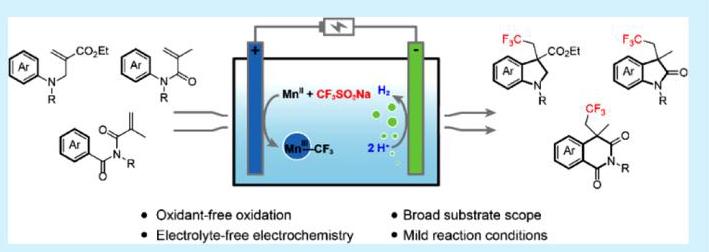
ABSTRACT: A general electrohemical strategy for the combined trifluoromethylation/C $\left( {\mathrm{{sp}}}^{2}\right) - \mathrm{H}$ functionalization using Langlois’ reagent as the ${\mathrm{{CF}}}_{3}$ source under oxidant-free conditions was developed. Using Mn salts as the redox mediator, this method provides an efficient and sustainable means to access a variety of functionalized heterocycles bearing a ${\mathrm{{CF}}}_{3}$ moiety. Detailed mechanistic studies are consistent with the formation of ${\mathrm{{CF}}}_{3}$ -bound high oxidation state $\mathrm{{Mn}}$ species, suggesting a transition-metal-mediated ${\mathrm{{CF}}}_{3}$ transfer mechanism for this trifluoromethylation $/\mathrm{C}\left( {\mathrm{{sp}}}^{2}\right) - \mathrm{H}$ functionalization process.
摘要:开发了一种通用的电化学策略,用于在无氧化剂条件下使用朗格卢瓦试剂作为 ${\mathrm{{CF}}}_{3}$ 源进行联合三氟甲基化/C $\left( {\mathrm{{sp}}}^{2}\right) - \mathrm{H}$ 官能团化反应。使用锰盐作为氧化还原介质,该方法提供了一种有效且可持续的手段来获得各种带有 ${\mathrm{{CF}}}_{3}$ 部分的官能化杂环。详细的机理研究与 ${\mathrm{{CF}}}_{3}$ 结合的高氧化态 $\mathrm{{Mn}}$ 物种的形成一致,表明该三氟甲基化 $/\mathrm{C}\left( {\mathrm{{sp}}}^{2}\right) - \mathrm{H}$ 官能团化过程存在过渡金属介导的 ${\mathrm{{CF}}}_{3}$ 转移机制。
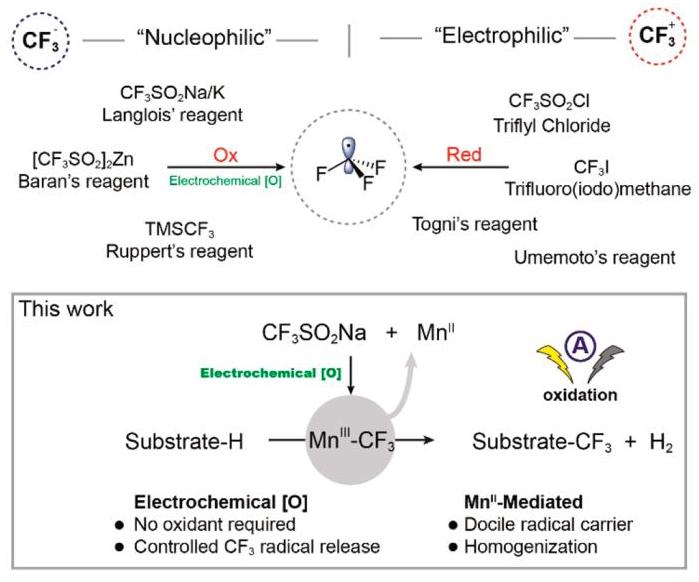
Owing to the prevalence of the trifluoromethyl group in pharmaceuticals, ${}^{1}$ agrochemicals, ${}^{2}$ and functional materials, ${}^{3}$ the development of efficient and sustainable methods for the introduction of the trifluoromethyl group into organic molecules has attracted much attention. ${}^{4}$ Among various means to prepare trifluoromethylated compounds, trifluor-omethylation based on a radical mechanism has been extensively studied and proven highly useful. ${}^{4d}$ Two strategies are commonly used to generate the trifluoromethyl radical, namely, the chemical oxidation of nucleophilic trifluorome-thylation reagents (e.g., Langlois’ reagent and Baran’s reagent) and the single electron reduction of electrophilic trifluor-omethylation reagents (e.g., triflyl chloride, ${\mathrm{{CF}}}_{3}\mathrm{I}$ and Togni’s reagent) (Scheme 1). Despite their synthetic utility, the use of stoichiometric quantities of chemical oxidants or reductants inevitably generates environmentally hazardous waste and greatly reduces the functional group compatibility of these methods.
由于三氟甲基在药物、${}^{1}$ 农用化学品、${}^{2}$ 和功能材料中的普遍性,${}^{3}$ 开发高效且可持续的将三氟甲基引入有机分子的方法受到了广泛关注。${}^{4}$ 在制备三氟甲基化化合物的各种方法中,基于自由基机理的三氟甲基化已得到广泛研究并被证明非常有用。${}^{4d}$ 通常使用两种策略来生成三氟甲基自由基,即亲核三氟甲基化试剂(如朗格卢瓦试剂和巴兰试剂)的化学氧化和亲电三氟甲基化试剂(如三氟甲磺酸氯、${\mathrm{{CF}}}_{3}\mathrm{I}$ 和托格尼试剂)的单电子还原(方案1)。尽管它们具有合成实用性,但使用化学计量的化学氧化剂或还原剂不可避免地会产生对环境有害的废物,并大大降低了这些方法的官能团兼容性。
To address these limitations, organic electrochemistry represents a very attractive alternative to conventional redox transformations, wherein the substrate or reagent can directly undergo redox processes without the use of stoichiometric chemical oxidants/reductants. ${}^{5}$ As a part of our program directed toward the development of novel electrochemical methods for organic synthesis, ${}^{6}$ we recently became interested in using the bench stable and highly inexpensive Langlois’ reagent $\left( {{\mathrm{{CF}}}_{3}{\mathrm{{SO}}}_{2}\mathrm{{Na}}}\right)$ for radical trifluoromethylation under electrochemical conditions. In this approach, cathodic hydrogen evolution balances the oxidative part of the redox cycle, thus making the overall transformation oxidant-free. Addtion-ally, the release of reactive intermediate $\left( {{\mathrm{{CF}}}_{3} \cdot }\right)$ can be easily regulated by electric current, allowing the reaction to proceed in a controlled maner. Moreover, the use of a transition metal redox mediator can benefit the reaction by enabling the key steps of the aimed transformation being conducted homogeneously. Despite these desirable features, electrochemical trifluoromethylation is still rare and has only been applied in a few examples, including the C-H functionalization of electron-rich arenes ${}^{7}$ and heterocycles ${}^{8}$ and olefin difunction-alization. ${}^{9}$
为解决这些局限性,有机电化学是传统氧化还原转化的一种极具吸引力的替代方法,在此过程中底物或试剂无需使用化学计量的化学氧化剂/还原剂即可直接进行氧化还原过程。${}^{5}$ 作为我们开发有机合成新电化学方法计划的一部分,${}^{6}$ 我们最近对在电化学条件下使用实验室稳定且价格低廉的朗格卢瓦试剂 $\left( {{\mathrm{{CF}}}_{3}{\mathrm{{SO}}}_{2}\mathrm{{Na}}}\right)$ 进行自由基三氟甲基化反应产生了兴趣。在这种方法中,阴极析氢平衡了氧化还原循环的氧化部分,从而使整个转化过程无需氧化剂。此外,活性中间体 $\left( {{\mathrm{{CF}}}_{3} \cdot }\right)$ 的释放可以很容易地通过电流进行调节,使反应能够以可控的方式进行。此外,使用过渡金属氧化还原介质可以使目标转化的关键步骤均相进行,从而有利于反应。尽管具有这些理想的特性,但电化学三氟甲基化反应仍然很少见,仅在少数例子中得到应用,包括富电子芳烃 ${}^{7}$ 和杂环 ${}^{8}$ 的C-H官能化以及烯烃双官能化。${}^{9}$
Scheme 1. Conventional and Electrochemical Approaches to the Generation of Trifluoromethyl Radical
方案1. 生成三氟甲基自由基的传统方法和电化学方法
Received: December 16, 2018
收到日期:2018年12月16日
Oxindole is an important structural motif in numerous natural products and bioactive compounds, and trifluorome-thylated oxindoles and their analogs hold great promise for application in medicinal chemistry. ${}^{10}$ Previous synthetic routes toward these molecules all required the use of stoichiometric quantities of chemical oxidants or reductants to generate the key trifluoromethyl radical species. ${}^{11}$ Herein, we report a general Mn-mediated electrochemical trifluoromethylation for the construction of a variety of trifluoromethyl-containing oxindoles and related heterocycles to bypass the use of stoichiometric chemical oxidants. Notably, a variety of substrates, including those previously unexplored ones, are readily accommodated by this electrochemical process, affording a diverse range of trifluoromethylated heterocycles bearing an all-carbon quaternary center in excellent yield. ${}^{12}$
氧化吲哚是众多天然产物和生物活性化合物中的重要结构单元,三氟甲基化氧化吲哚及其类似物在药物化学中具有广阔的应用前景。${}^{10}$ 以往合成这些分子的路线都需要使用化学计量的化学氧化剂或还原剂来生成关键的三氟甲基自由基物种。${}^{11}$ 在此,我们报道了一种通用的锰介导的电化学三氟甲基化反应,用于构建各种含三氟甲基的氧化吲哚和相关杂环,以避免使用化学计量的化学氧化剂。值得注意的是,各种底物,包括那些以前未被探索的底物,都能很容易地适应这种电化学过程,以优异的产率提供各种带有全碳季碳中心的三氟甲基化杂环。${}^{12}$
Using $N$ -methyl- $N$ -phenylmethacrylamide (1a) as the model substrate, we commenced our study on the electrochemical trifluoromethylation/C $\left( {\mathrm{{sp}}}^{2}\right) - \mathrm{H}$ functionalization using Langlois reagent as the ${\mathrm{{CF}}}_{3}$ source. The use of a catalytic amount of redox active transition-metal species was found to be critical for this transformation, and manganese salts proved to be optimal for this process. ${}^{13}$ After extensive optimization, we found that using ${\mathrm{{MnBr}}}_{2}$ as the mediator, ${\mathrm{H}}_{3}{\mathrm{{PO}}}_{4}$ as the sacrificial oxidant, and Pt meshes as the electrodes with a constant electric current of ${10}\mathrm{\;{mA}}$ for $6\mathrm{\;h}$ , the desired trifluoromethyl-substituted oxindole product 2a formed in 67% yield (Table 1, entry 1). Control experiment in the absence of manganese salt only provided 12% yield of 2a (entry 2), thereby demonstrating the pivotal role of the manganase catalyst. We found that ${\mathrm{{MnSO}}}_{4}$ also catalyzed this trifluor-omethylation/C $\left( {\mathrm{{sp}}}^{2}\right) - \mathrm{H}$ functionalization reaction, albeit in lower yield (entry 3). In contrast, other transition metal salts such as ${\mathrm{{NiBr}}}_{2}$ were found to be ineffective (entry 4). Additionally, when the reaction was carried out at room temperature, only a trace amount of product was observed (entry 5). Other polar and water miscible solvents, such as DMA and MeCN, were less efficient (entries 6 and 7). It was found that the use of an acid additive such as ${\mathrm{H}}_{3}{\mathrm{{PO}}}_{4}$ can significantly improve the rate of proton reduction on the Pt electrode, and the yield of 2a was much lower in the absence of ${\mathrm{H}}_{3}{\mathrm{{PO}}}_{4}$ (entry 8). Replacing ${\mathrm{H}}_{3}{\mathrm{{PO}}}_{4}$ with a weaker acid, HOAc, resulted in a similar yield (entry 9). No reaction occurred in the absence of externally applied potential (entry 10). Notably, we were able to avoid the use of electrolytes for this transformation, thus further fulfilling the requirement of green and sustainable chemistry.
以$N$-甲基-$N$-苯基甲基丙烯酰胺(1a)为模型底物,我们开始了以Langlois试剂为${\mathrm{{CF}}}_{3}$源的电化学三氟甲基化/C$\left( {\mathrm{{sp}}}^{2}\right) - \mathrm{H}$官能化反应的研究。发现使用催化量的氧化还原活性过渡金属物种对该转化至关重要,并且锰盐被证明是该过程的最佳选择。${}^{13}$经过广泛优化,我们发现以${\mathrm{{MnBr}}}_{2}$为介质,${\mathrm{H}}_{3}{\mathrm{{PO}}}_{4}$为牺牲氧化剂,铂网为电极,在${10}\mathrm{\;{mA}}$的恒定电流下反应$6\mathrm{\;h}$,所需的三氟甲基取代的氧化吲哚产物2a以67%的产率生成(表1,条目1)。在没有锰盐的情况下进行的对照实验仅得到了12%产率的2a(条目2),从而证明了锰催化剂的关键作用。我们发现${\mathrm{{MnSO}}}_{4}$也催化了该三氟甲基化/C$\left( {\mathrm{{sp}}}^{2}\right) - \mathrm{H}$官能化反应,尽管产率较低(条目3)。相比之下,发现其他过渡金属盐如${\mathrm{{NiBr}}}_{2}$无效(条目4)。此外,当反应在室温下进行时,仅观察到痕量产物(条目5)。其他极性且与水混溶的溶剂,如DMA和MeCN,效率较低(条目6和7)。发现使用酸添加剂如${\mathrm{H}}_{3}{\mathrm{{PO}}}_{4}$可以显著提高铂电极上质子还原的速率,并且在没有${\mathrm{H}}_{3}{\mathrm{{PO}}}_{4}$的情况下2a的产率要低得多(条目8)。用较弱的酸HOAc代替${\mathrm{H}}_{3}{\mathrm{{PO}}}_{4}$,得到了相似的产率(条目9)。在没有外部施加电势的情况下不发生反应(条目10)。值得注意的是,我们能够避免在该转化中使用电解质,从而进一步满足了绿色和可持续化学的要求。
Table 1. Reaction Development and Optimization ${}^{a}$
表1. 反应的发展与优化${}^{a}$

| entry | deviation from the standard conditions | yield ${\% }^{b}$ |
| 1 | none | 69 (67) |
| 2 | no Mn salt | 12 |
| 3 | ${\mathrm{{MnSO}}}_{4}$ instead of ${\mathrm{{MnBr}}}_{2} \cdot 4{\mathrm{H}}_{2}\mathrm{O}$ | 54 |
| 4 | ${\mathrm{{NiBr}}}_{2}$ instead of ${\mathrm{{MnBr}}}_{2} \cdot 4{\mathrm{H}}_{2}\mathrm{O}$ | trace |
| 5 | room temperature | trace |
| 6 | DMA instead of 1,4-dioxane | 53 |
| 7 | MeCN instead of 1,4-dioxane | 58 |
| 8 | no ${\mathrm{H}}_{3}{\mathrm{{PO}}}_{4}$ | 27 |
| 9 | $\mathrm{{AcOH}}$ instead of ${\mathrm{H}}_{3}{\mathrm{{PO}}}_{4}$ | 66 |
| 10 | no electricity | 0 |
${}^{a}$ Reaction conditions: ${0.3}\mathrm{{mmol}}$ scale,1,4-dioxane $3\mathrm{{mL}},{\mathrm{H}}_{2}\mathrm{O}{0.3} \; \mathrm{{mL}}$ , Pt gauze electrodes $\left( {1\mathrm{\;{cm}} \times 1\mathrm{\;{cm}},{52}\text{ meshes }}\right)$ were applied. cc, constant current. 1.5 equiv of ${\mathrm{{CF}}}_{3}{\mathrm{{SO}}}_{2}\mathrm{\;{Na}}$ was added at the beginning. After $3\mathrm{\;h}$ , another1.5equiv of ${\mathrm{{CF}}}_{3}{\mathrm{{SO}}}_{2}\mathrm{{Na}}$ was then added. ${}^{b}$ Yields were determined by ${}^{1}\mathrm{H}$ NMR spectroscopic analysis using 1,3,5- trimethoxybenzene as the internal standard. Isolated yield are shown in parentheses.
${}^{a}$反应条件:${0.3}\mathrm{{mmol}}$规模,1,4 - 二氧六环$3\mathrm{{mL}},{\mathrm{H}}_{2}\mathrm{O}{0.3} \; \mathrm{{mL}}$,使用铂网电极$\left( {1\mathrm{\;{cm}} \times 1\mathrm{\;{cm}},{52}\text{ meshes }}\right)$。cc,恒定电流。在开始时加入1.5当量的${\mathrm{{CF}}}_{3}{\mathrm{{SO}}}_{2}\mathrm{\;{Na}}$。在$3\mathrm{\;h}$之后,再加入1.5当量的${\mathrm{{CF}}}_{3}{\mathrm{{SO}}}_{2}\mathrm{{Na}}$。${}^{b}$产率通过使用1,3,5 - 三甲氧基苯作为内标的${}^{1}\mathrm{H}$NMR光谱分析测定。括号内显示的是分离产率。
With the optimized reaction conditions in hand, we next surveyed the substrate scope of this trifluoromethylation/ $\mathrm{C}\left( {\mathrm{{sp}}}^{2}\right) - \mathrm{H}$ functionalization process (Scheme 2). A wide range of $N$ -arylmethacrylamide derivatives bearing different sub-stituents on aryl ring was found to be excellent substrates. Substrates bearing electron-withdrawing (2c-2i) or electron-donating groups (2b and 2j) afforded the desired products. Notably, this anodic oxidative process tolerated a variety of functional groups, such as an ester (2i), halides (2d-2g), a nitrile (2h), and a free alcohol (2o). Substrates with different protecting groups on the nitrogen atom $\left( {1\mathrm{k} - 1\mathrm{o}}\right)$ were also successfully transformed to the corresponding oxindole derivatives (2k-2o) in good yields (67-77%). Finally, this reaction was also compatible with a fused ring system (2k).
在掌握了优化的反应条件后,我们接下来考察了这种三氟甲基化/$\mathrm{C}\left( {\mathrm{{sp}}}^{2}\right) - \mathrm{H}$官能化过程的底物范围(方案2)。发现一系列在芳环上带有不同取代基的$N$-芳基甲基丙烯酰胺衍生物是优良的底物。带有吸电子基团(2c - 2i)或供电子基团(2b和2j)的底物都能得到所需产物。值得注意的是,这种阳极氧化过程耐受多种官能团,如酯基(2i)、卤原子(2d - 2g)、腈基(2h)和游离醇羟基(2o)。氮原子上带有不同保护基的底物$\left( {1\mathrm{k} - 1\mathrm{o}}\right)$也能成功转化为相应的氧化吲哚衍生物(2k - 2o),产率良好(67 - 77%)。最后,该反应也适用于稠环体系(2k)。
Scheme 2. Oxidant-Free Electrochemical Trifluoromethylation-Initiated Radical Oxidative Annulation towards Oxindoles ${}^{a}$
方案2. 无氧化剂电化学三氟甲基化引发的自由基氧化环化反应生成氧化吲哚${}^{a}$
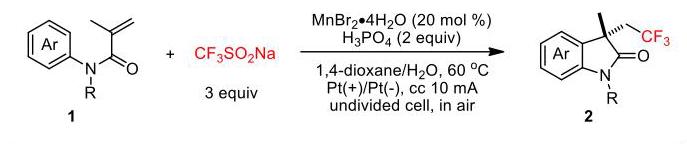
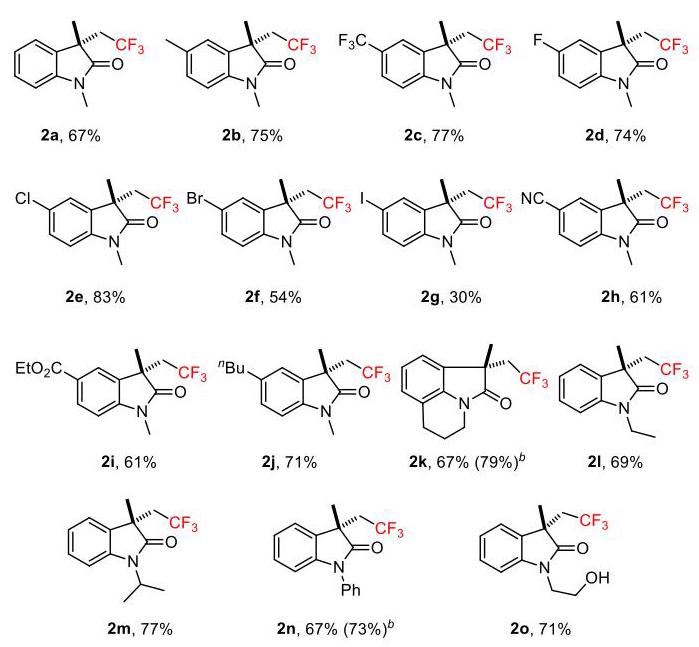
${}^{a}$ Reaction conditions: 1 (0.3 mmol), ${\mathrm{{MnBr}}}_{2}$ (0.06 mmol,0.2 equiv), 1,4-dioxane $3\mathrm{\;{mL}},{\mathrm{H}}_{2}\mathrm{O}{0.3}\mathrm{\;{mL}}$ , Pt gauze electrodes $(1\mathrm{\;{cm}} \times 1\mathrm{\;{cm}},{52}$ meshes) were applied. cc, constant current. 1.5 equiv ${\mathrm{{CF}}}_{3}{\mathrm{{SO}}}_{2}\mathrm{{Na}}$ was added at the beginning. After 3 h, another 1.5 equiv was added. Isolated yields were given. ${}^{b}$ isolated yields from ref 11f were given. Reaction conditions of ref 11f: $1\left( {{0.25}\mathrm{{mmol}}}\right) ,{\mathrm{{CF}}}_{3}{\mathrm{{SO}}}_{2}\mathrm{{Na}}({0.75} \; \mathrm{{mmol}}),{\mathrm{K}}_{2}{\mathrm{\;S}}_{2}{\mathrm{O}}_{8}$ (2 equiv), ${\mathrm{{CH}}}_{3}\mathrm{{CN}}/{\mathrm{H}}_{2}\mathrm{O}$ (2. $5\mathrm{\;{mL}},4/1),{80}^{ \circ }\mathrm{C},{12} - \; {36}\mathrm{\;h}$ , under ${\mathrm{N}}_{2}$ .
${}^{a}$反应条件:1(0.3 mmol),${\mathrm{{MnBr}}}_{2}$(0.06 mmol,0.2当量),1,4 - 二氧六环$3\mathrm{\;{mL}},{\mathrm{H}}_{2}\mathrm{O}{0.3}\mathrm{\;{mL}}$,使用铂网电极$(1\mathrm{\;{cm}} \times 1\mathrm{\;{cm}},{52}$(网目)。恒流。开始时加入1.5当量${\mathrm{{CF}}}_{3}{\mathrm{{SO}}}_{2}\mathrm{{Na}}$。3小时后,再加入1.5当量。给出分离产率。${}^{b}$给出参考文献11f的分离产率。参考文献11f的反应条件:$1\left( {{0.25}\mathrm{{mmol}}}\right) ,{\mathrm{{CF}}}_{3}{\mathrm{{SO}}}_{2}\mathrm{{Na}}({0.75} \; \mathrm{{mmol}}),{\mathrm{K}}_{2}{\mathrm{\;S}}_{2}{\mathrm{O}}_{8}$(2当量),${\mathrm{{CH}}}_{3}\mathrm{{CN}}/{\mathrm{H}}_{2}\mathrm{O}$(2.$5\mathrm{\;{mL}},4/1),{80}^{ \circ }\mathrm{C},{12} - \; {36}\mathrm{\;h}$,在${\mathrm{N}}_{2}$下。
Further investigations revealed that the current electrochemical trifluoromethylation $/\mathrm{C}\left( {\mathrm{{sp}}}^{2}\right) - \mathrm{H}$ functionalization is a widely applicable strategy and could be readily applied in the synthesis of ${\mathrm{{CF}}}_{3}$ -substituted indoline derivatives (Scheme 3) and ${\mathrm{{CF}}}_{3}$ -containing hydroisoquinoline-1,3-dione derivatives (Scheme 4). A variety of $N$ -arylamide acrylates 3 and $N$ - methacryloyl- $N$ -methylarylamides 5 could be converted to the corresponding trifluoromethylated indoline and hydroisoqui-noline-1,3-dione derivatives in good yields. Of special note, the trifluoromethylation/C $\left( {\mathrm{{sp}}}^{2}\right) - \mathrm{H}$ functionalization of substrates 3 type of compounds has not been reported before.
进一步的研究表明,当前的电化学三氟甲基化$/\mathrm{C}\left( {\mathrm{{sp}}}^{2}\right) - \mathrm{H}$官能化是一种广泛适用的策略,可轻松应用于合成${\mathrm{{CF}}}_{3}$取代的吲哚啉衍生物(方案3)和含${\mathrm{{CF}}}_{3}$的氢化异喹啉 - 1,3 - 二酮衍生物(方案4)。多种$N$ - 芳酰胺丙烯酸酯3和$N$ - 甲基丙烯酰基 - $N$ - 甲基芳酰胺5可以高产率转化为相应的三氟甲基化吲哚啉和氢化异喹啉 - 1,3 - 二酮衍生物。特别值得注意的是,底物3类化合物的三氟甲基化/C$\left( {\mathrm{{sp}}}^{2}\right) - \mathrm{H}$官能化此前尚未见报道。
Scheme 3. Oxidant-Free Electrochemical Trifluoromethylation-Initiated Radical Oxidative Cyclization towards Indolines ${}^{a}$
方案3. 无氧化剂电化学三氟甲基化引发的自由基氧化环化反应生成吲哚啉${}^{a}$
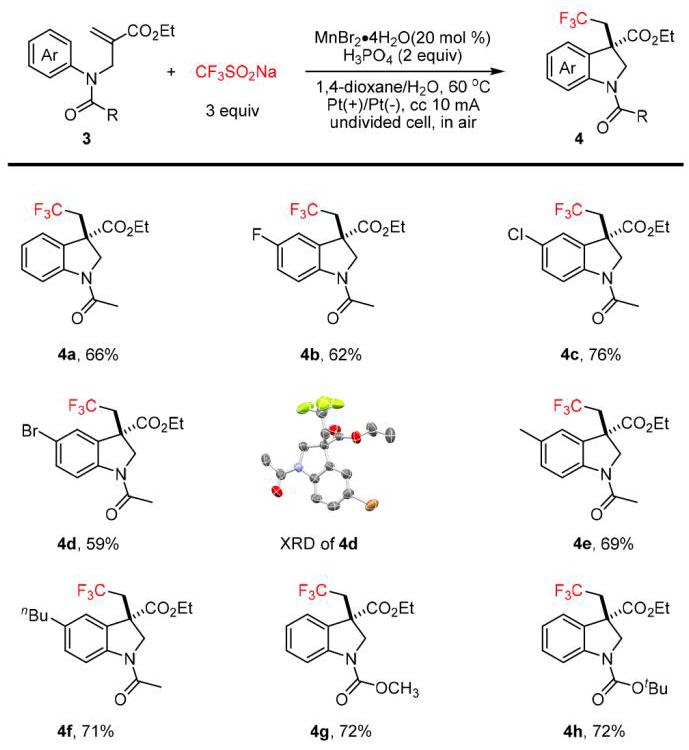
“Reaction conditions: 3 (0.3 mmol), MnBr, (0.06 mmol, 0.2 equiv), 1,4-dioxane $3\mathrm{\;{mL}},{\mathrm{H}}_{2}\mathrm{O}{0.3}\mathrm{\;{mL}}$ , Pt gauze electrodes $(1\mathrm{\;{cm}} \times 1\mathrm{\;{cm}},{52}$ meshes) were applied. cc, constant current. 1.5 equiv ${\mathrm{{CF}}}_{3}{\mathrm{{SO}}}_{2}\mathrm{{Na}}$ was added at the beginning. After $3\mathrm{\;h}$ , another 1.5 equiv was added. Isolated yields were given.
反应条件:3(0.3 mmol)、MnBr₂(0.06 mmol,0.2当量)、1,4 - 二氧六环$3\mathrm{\;{mL}},{\mathrm{H}}_{2}\mathrm{O}{0.3}\mathrm{\;{mL}}$、铂网电极$(1\mathrm{\;{cm}} \times 1\mathrm{\;{cm}},{52}$目)。采用恒电流(cc)。起始时加入1.5当量${\mathrm{{CF}}}_{3}{\mathrm{{SO}}}_{2}\mathrm{{Na}}$。$3\mathrm{\;h}$后,再加入1.5当量。给出了分离产率。
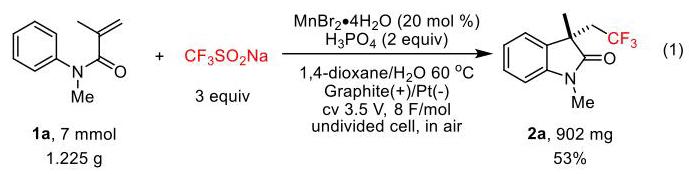
To further demonstrate the utility of this electrochemical protocol, a gram-scale synthesis of oxindole 2a was carried out under air (eq 1). This reaction was performed with graphite as the anode and platinum as the cathode, and furnished in 53% isolated yield.
为进一步证明该电化学方法的实用性,在空气中进行了克级规模的氧化吲哚2a的合成(式1)。该反应以石墨为阳极、铂为阴极进行,分离产率为53%。
To probe the mechanism of this electrochemical reaction, we performed a series of polarographic and spectroscopic analysis, including cyclic voltammetry (CV), ${}^{19}\mathrm{\;F}$ NMR, and stoichiometric control experiment. First, we investigated the redox behavior of ${\mathrm{{MnBr}}}_{2},{\mathrm{{CF}}}_{3}{\mathrm{{SO}}}_{2}\mathrm{{Na}}$ , $1\mathrm{a}$ and their combination in solution by cyclic voltammetry (Figure 1).
为探究该电化学反应的机理,我们进行了一系列极谱和光谱分析,包括循环伏安法(CV)、${}^{19}\mathrm{\;F}$ NMR以及化学计量控制实验。首先,我们通过循环伏安法研究了${\mathrm{{MnBr}}}_{2},{\mathrm{{CF}}}_{3}{\mathrm{{SO}}}_{2}\mathrm{{Na}}$、$1\mathrm{a}$及其在溶液中的组合的氧化还原行为(图1)。
Scheme 4. Oxidant-Free Electrochemical Trifluoromethylation-initiated Radical Oxidative Cyclization towards Hydroisoquinoline-1,3-diones ${}^{a}$
方案4. 无氧化剂的电化学三氟甲基化引发的自由基氧化环化反应合成氢化异喹啉 - 1,3 - 二酮${}^{a}$
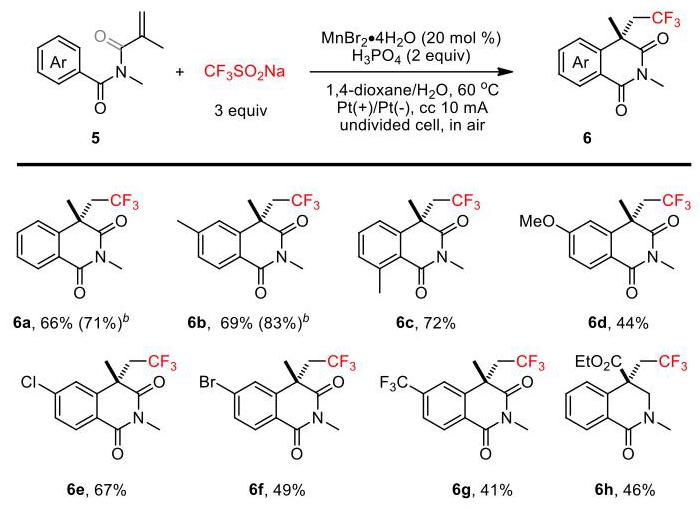
${}^{a}$ Reaction conditions: $5\left( {{0.3}\mathrm{{mmol}}}\right) ,{\mathrm{{MnBr}}}_{2}\left( {{0.06}\mathrm{{mmol}},{0.2}\text{ equiv), }}\right)$ 1,4-dioxane $3\mathrm{\;{mL}},{\mathrm{H}}_{2}\mathrm{O}{0.3}\mathrm{\;{mL}}$ , Pt gauze electrodes $(1\mathrm{\;{cm}} \times 1\mathrm{\;{cm}},{52}$ meshes) were applied. cc, constant current. 1.5 equiv ${\mathrm{{CF}}}_{3}{\mathrm{{SO}}}_{2}\mathrm{{Na}}$ was added at the beginning. After $3\mathrm{\;h}$ , another 1.5 equiv was added. Isolated yields were given. ${}^{b}$ Isolated yields from ref 11i were given. Reaction conditions of ref 11i: 5, ${\mathrm{{CF}}}_{3}{\mathrm{{SO}}}_{2}\mathrm{{Na}}$ (3.0 equiv),1,2,3,5- tetrakis(carbazol-9-yl)-4,6-dicyanobenzene (4CzIPN,2 mol %), ${\mathrm{N}}_{2}$ (with ${0.5}\mathrm{\;{mol}}\%$ of ${\mathrm{O}}_{2}$ ), rt, $c = {0.02}\mathrm{M}$ , DCE, blue LEDs.
${}^{a}$反应条件:$5\left( {{0.3}\mathrm{{mmol}}}\right) ,{\mathrm{{MnBr}}}_{2}\left( {{0.06}\mathrm{{mmol}},{0.2}\text{ equiv), }}\right)$ 1,4 - 二氧六环$3\mathrm{\;{mL}},{\mathrm{H}}_{2}\mathrm{O}{0.3}\mathrm{\;{mL}}$、铂网电极$(1\mathrm{\;{cm}} \times 1\mathrm{\;{cm}},{52}$目)。采用恒电流(cc)。起始时加入1.5当量${\mathrm{{CF}}}_{3}{\mathrm{{SO}}}_{2}\mathrm{{Na}}$。$3\mathrm{\;h}$后,再加入1.5当量。给出了分离产率。${}^{b}$给出了参考文献11i的分离产率。参考文献11i的反应条件:5、${\mathrm{{CF}}}_{3}{\mathrm{{SO}}}_{2}\mathrm{{Na}}$(3.0当量)、1,2,3,5 - 四(咔唑 - 9 - 基)- 4,6 - 二氰基苯(4CzIPN,2摩尔%)、${\mathrm{N}}_{2}$(含${0.5}\mathrm{\;{mol}}\%$的${\mathrm{O}}_{2}$)、室温、$c = {0.02}\mathrm{M}$、二氯乙烷、蓝色发光二极管。
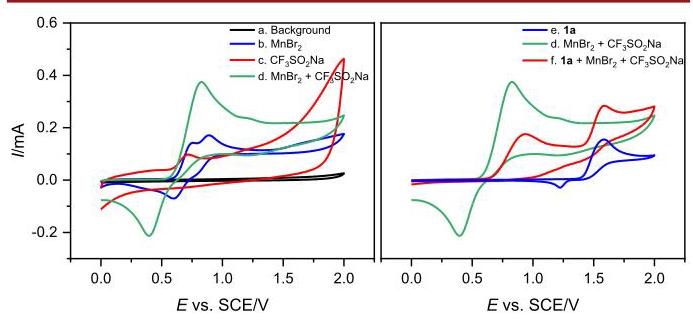
Figure 1. CVs of ${\mathrm{{MnBr}}}_{2},{\mathrm{{CF}}}_{3}{\mathrm{{SO}}}_{2}\mathrm{{Na}}$ , and substrate 1a. Conditions: a L-type glassy carbon working electrode, a saturated calomel electrode (SCE) reference electrode, and a platinum wire counter electrode, ${\mathrm{{LiClO}}}_{4}\left( {{0.10}\mathrm{M}\text{ in MeCN }}\right)$ , TFA $\left( {{60}\mathrm{{mM}}}\right) ,{0.1}\mathrm{\;V}/\mathrm{s}$ with (a) Background; (b) ${\mathrm{{MnBr}}}_{2} \cdot 4{\mathrm{H}}_{2}\mathrm{O}\left( {2\mathrm{{mM}}}\right)$ ; (c) ${\mathrm{{CF}}}_{3}{\mathrm{{SO}}}_{2}\mathrm{{Na}}\left( {8\mathrm{{mM}}}\right)$ ; (d) ${\mathrm{{MnBr}}}_{2} \cdot 4{\mathrm{H}}_{2}\mathrm{O}\left( {2\mathrm{{mM}}}\right)$ and ${\mathrm{{CF}}}_{3}{\mathrm{{SO}}}_{2}\mathrm{{Na}}\left( {8\mathrm{{mM}}}\right)$ ; (e) $1\mathrm{a}\left( {4\mathrm{{mM}}}\right)$ ; (f) 1a ( $4\mathrm{{mM}}$ ), ${\mathrm{{MnBr}}}_{2} \cdot 4{\mathrm{H}}_{2}\mathrm{O}$ ( $2\mathrm{{mM}}$ ) and ${\mathrm{{CF}}}_{3}{\mathrm{{SO}}}_{2}\mathrm{{Na}}$ ( $8\mathrm{{mM}}$ ).
图1. ${\mathrm{{MnBr}}}_{2},{\mathrm{{CF}}}_{3}{\mathrm{{SO}}}_{2}\mathrm{{Na}}$和底物1a的循环伏安图。条件:L型玻碳工作电极、饱和甘汞电极(SCE)参比电极和铂丝对电极,${\mathrm{{LiClO}}}_{4}\left( {{0.10}\mathrm{M}\text{ in MeCN }}\right)$,TFA $\left( {{60}\mathrm{{mM}}}\right) ,{0.1}\mathrm{\;V}/\mathrm{s}$,(a) 背景;(b) ${\mathrm{{MnBr}}}_{2} \cdot 4{\mathrm{H}}_{2}\mathrm{O}\left( {2\mathrm{{mM}}}\right)$;(c) ${\mathrm{{CF}}}_{3}{\mathrm{{SO}}}_{2}\mathrm{{Na}}\left( {8\mathrm{{mM}}}\right)$;(d) ${\mathrm{{MnBr}}}_{2} \cdot 4{\mathrm{H}}_{2}\mathrm{O}\left( {2\mathrm{{mM}}}\right)$和${\mathrm{{CF}}}_{3}{\mathrm{{SO}}}_{2}\mathrm{{Na}}\left( {8\mathrm{{mM}}}\right)$;(e) $1\mathrm{a}\left( {4\mathrm{{mM}}}\right)$;(f) 1a ($4\mathrm{{mM}}$),${\mathrm{{MnBr}}}_{2} \cdot 4{\mathrm{H}}_{2}\mathrm{O}$ ($2\mathrm{{mM}}$) 和${\mathrm{{CF}}}_{3}{\mathrm{{SO}}}_{2}\mathrm{{Na}}$ ($8\mathrm{{mM}}$)。
The TFA/MeCN solution of ${\mathrm{{MnBr}}}_{2}$ displays a quasi-reversible anodic wave (line b) of 0.75 and ${0.89}\mathrm{\;V}$ and cathodic wave of ${0.60}\mathrm{\;V}$ versus saturated calomel electrode (SCE), which we attributed to the ${\mathrm{{Mn}}}^{\mathrm{{II}}}/{\mathrm{{Mn}}}^{\mathrm{{III}}}$ redox couple of the bromide-bound complex and the direct oxidation of free ${\mathrm{{Br}}}^{ - }$ . ${\mathrm{{CF}}}_{3}{\mathrm{{SO}}}_{2}\mathrm{{Na}}$ shows an irreversible anodic wave at ${0.71}\mathrm{\;V}$ (line c). Furthermore, the combination of ${\mathrm{{MnBr}}}_{2}$ and ${\mathrm{{CF}}}_{3}{\mathrm{{SO}}}_{2}\mathrm{{Na}}$ exhibits a quasi-reversible anodic CV feature at ${0.83}\mathrm{\;V}$ (line d), which we attributed to the ${\mathrm{{Mn}}}^{\mathrm{{II}}}/{\mathrm{{Mn}}}^{\mathrm{{III}}}$ redox couple of the ${\mathrm{{CF}}}_{3}$ -bound complex. The lower cathodic-to-anodic peak current ratio $\left( {{I}_{\mathrm{c}}/{I}_{\mathrm{a}} = {0.56}}\right)$ reflects the instability and high reactivity of ${\mathrm{{Mn}}}^{\mathrm{{III}}} - {\mathrm{{CF}}}_{3}$ under these conditions. $\mathrm{{CV}}$ of $1\mathrm{a}$ shows a relatively higher oxidation wave larger than ${1.5}\mathrm{\;V}$ , indicating its unlikely interacting with electrodes directly in the presence of Mn salt and Langlois’ reagent. Addition of 1a to a mixture of ${\mathrm{{MnBr}}}_{2}$ and ${\mathrm{{CF}}}_{3}{\mathrm{{SO}}}_{2}\mathrm{{Na}}$ resulted in the appearance of two irreversible anodic waves of 0.94 and ${1.59}\mathrm{\;V}$ (line f), which corresponds to the formation of the putative ${\mathrm{{Mn}}}^{\mathrm{{III}}} - {\mathrm{{CF}}}_{3}$ and the single electron oxidation leading to the formation of the final product (vide infra, Scheme 5).
${\mathrm{{MnBr}}}_{2}$的三氟乙酸/乙腈溶液相对于饱和甘汞电极(SCE)显示出0.75和${0.89}\mathrm{\;V}$的准可逆阳极波(曲线b)以及${0.60}\mathrm{\;V}$的阴极波,我们将其归因于溴化物结合络合物的${\mathrm{{Mn}}}^{\mathrm{{II}}}/{\mathrm{{Mn}}}^{\mathrm{{III}}}$氧化还原对和游离${\mathrm{{Br}}}^{ - }$的直接氧化。${\mathrm{{CF}}}_{3}{\mathrm{{SO}}}_{2}\mathrm{{Na}}$在${0.71}\mathrm{\;V}$处显示出不可逆阳极波(曲线c)。此外,${\mathrm{{MnBr}}}_{2}$和${\mathrm{{CF}}}_{3}{\mathrm{{SO}}}_{2}\mathrm{{Na}}$的组合在${0.83}\mathrm{\;V}$处表现出准可逆阳极循环伏安特征(曲线d),我们将其归因于${\mathrm{{CF}}}_{3}$结合络合物的${\mathrm{{Mn}}}^{\mathrm{{II}}}/{\mathrm{{Mn}}}^{\mathrm{{III}}}$氧化还原对。较低的阴极与阳极峰值电流比$\left( {{I}_{\mathrm{c}}/{I}_{\mathrm{a}} = {0.56}}\right)$反映了${\mathrm{{Mn}}}^{\mathrm{{III}}} - {\mathrm{{CF}}}_{3}$在这些条件下的不稳定性和高反应性。$1\mathrm{a}$的$\mathrm{{CV}}$显示出一个相对较高的氧化波,大于${1.5}\mathrm{\;V}$,表明在存在锰盐和朗格卢瓦试剂的情况下,它不太可能直接与电极相互作用。向${\mathrm{{MnBr}}}_{2}$和${\mathrm{{CF}}}_{3}{\mathrm{{SO}}}_{2}\mathrm{{Na}}$的混合物中加入1a导致出现0.94和${1.59}\mathrm{\;V}$的两个不可逆阳极波(曲线f),这对应于假定的${\mathrm{{Mn}}}^{\mathrm{{III}}} - {\mathrm{{CF}}}_{3}$的形成以及导致最终产物形成的单电子氧化(见下文,方案5)。
Scheme 5. Stoichiometric Experiment
方案5. 化学计量实验
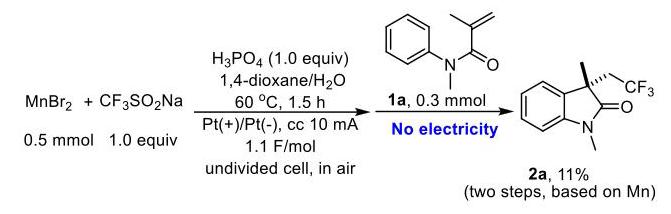
To gain more insight into the mechanism of this Mn-mediated electrochemical trifluoromethylation, the electrochemical reaction of ${\mathrm{{CF}}}_{3}{\mathrm{{SO}}}_{2}\mathrm{{Na}}$ and ${\mathrm{{Mn}}}^{\mathrm{{II}}}$ was studied with ${}^{19}\mathrm{\;F}$ NMR spectroscopy. In accord with literature, free ${\mathrm{{CF}}}_{3}{\mathrm{{SO}}}_{2}\mathrm{{Na}}$ reagent shows a singlet peak at $- {87.5}\mathrm{{ppm}}{.}^{14}$ When electric current of ${1.1}\mathrm{\;F}/\mathrm{{mol}}$ was applied, the ${}^{19}\mathrm{\;F}$ NMR signal of ${\mathrm{{CF}}}_{3}{\mathrm{{SO}}}_{2}\mathrm{{Na}}$ disappeared, indicating its complete consumption upon electrolysis. New peaks around -73.0 ppm appearance indicated new ${\mathrm{{CF}}}_{3}$ species formation (Figure S4).
为了更深入了解这种锰介导的电化学三氟甲基化的机理,用${}^{19}\mathrm{\;F}$核磁共振光谱研究了${\mathrm{{CF}}}_{3}{\mathrm{{SO}}}_{2}\mathrm{{Na}}$和${\mathrm{{Mn}}}^{\mathrm{{II}}}$的电化学反应。与文献一致,游离的${\mathrm{{CF}}}_{3}{\mathrm{{SO}}}_{2}\mathrm{{Na}}$试剂在$- {87.5}\mathrm{{ppm}}{.}^{14}$处显示出单峰。当施加${1.1}\mathrm{\;F}/\mathrm{{mol}}$的电流时,${\mathrm{{CF}}}_{3}{\mathrm{{SO}}}_{2}\mathrm{{Na}}$的${}^{19}\mathrm{\;F}$核磁共振信号消失,表明其在电解时完全消耗。-73.0 ppm附近出现的新峰表明形成了新的${\mathrm{{CF}}}_{3}$物种(图S4)。
Moreover, we performed an electrically controlled stoichiometric experiment. We first applied electricity of ${1.1}\mathrm{\;F}/\mathrm{{mol}}$ to the dioxane $/{\mathrm{H}}_{2}\mathrm{O}$ solution of ${\mathrm{{MnBr}}}_{2}$ and ${\mathrm{{CF}}}_{3}{\mathrm{{SO}}}_{2}\mathrm{{Na}}$ and then introduced substrate 1a. The mixture was allowed to react in the absence of external electricity, and this two-step reaction afforded the desired product (2a) in 11% isolated yield. The result showed that the electrochemically generated high oxidation state Mn species can function both as a ${\mathrm{{CF}}}_{3}$ carrier and an oxidant for the trifluoromethylation $/\mathrm{C}\left( {\mathrm{{sp}}}^{2}\right) - \mathrm{H}$ functionalization.
此外,我们进行了一个电控化学计量实验。我们首先向含有${\mathrm{{MnBr}}}_{2}$和${\mathrm{{CF}}}_{3}{\mathrm{{SO}}}_{2}\mathrm{{Na}}$的二氧六环$/{\mathrm{H}}_{2}\mathrm{O}$溶液施加${1.1}\mathrm{\;F}/\mathrm{{mol}}$的电量,然后引入底物1a。混合物在无外部电量的情况下反应,这个两步反应以11%的分离产率得到了所需产物(2a)。结果表明,电化学产生的高氧化态锰物种既可以作为${\mathrm{{CF}}}_{3}$载体,也可以作为三氟甲基化$/\mathrm{C}\left( {\mathrm{{sp}}}^{2}\right) - \mathrm{H}$官能团化的氧化剂。
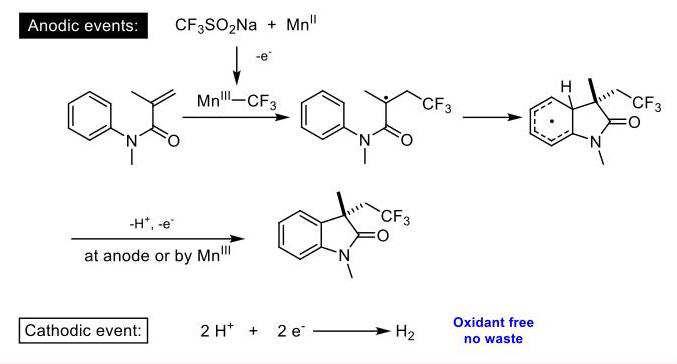
Based on these mechanistic studies, a plausible mechanism for the trifluoromethylation/C $\left( {\mathrm{{sp}}}^{2}\right) - \mathrm{H}$ functionalization is proposed in Scheme 6. At the anode, the ${\mathrm{{Mn}}}^{\mathrm{{III}}} - {\mathrm{{CF}}}_{3}$ species is generated by anodic oxidation of ${\mathrm{{Mn}}}^{\mathrm{{II}}}$ in the presence of Langlois reagent. Subsequently, $\mathrm{{Mn}}$ -assisted delivery of ${\mathrm{{CF}}}_{3}$ - to the olefin moiety provides a transient carbon centered radical. Further radical addition to the aromatic ring followed by either anode or ${\mathrm{{Mn}}}^{\mathrm{{III}}}$ -mediated oxidation furnishes the final $\mathrm{C}\left( {\mathrm{{sp}}}^{2}\right) -$ H functionalization product. At the cathode, reduction of proton to dihydrogen takes place to balance the overall transformation.
基于这些机理研究,方案6中提出了一种三氟甲基化/C$\left( {\mathrm{{sp}}}^{2}\right) - \mathrm{H}$官能团化的合理机理。在阳极,在Langlois试剂存在下,${\mathrm{{Mn}}}^{\mathrm{{II}}}$通过阳极氧化生成${\mathrm{{Mn}}}^{\mathrm{{III}}} - {\mathrm{{CF}}}_{3}$物种。随后,$\mathrm{{Mn}}$辅助将${\mathrm{{CF}}}_{3}$传递到烯烃部分,产生一个瞬态碳中心自由基。进一步向芳环进行自由基加成,随后通过阳极或${\mathrm{{Mn}}}^{\mathrm{{III}}}$介导的氧化得到最终的$\mathrm{C}\left( {\mathrm{{sp}}}^{2}\right) -$H官能团化产物。在阴极,质子还原为氢气以平衡整体转化。
Scheme 6. Proposed Reaction Events on Both Electrodes and in Bulk Solvent
方案6. 电极和本体溶剂中的反应过程推测
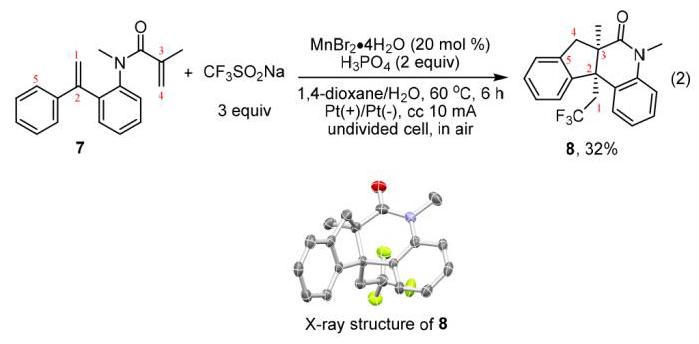
Finally, we found that this electrochemical C-H trifluor-omethylation method could be applied in the rapid construction of complex ring systems. Under the same reaction conditions as described above, trifluoromethlated product 8 featuring bicyclic ring systems could be conveniently synthesized in 32% yield (eq 2). Further extension of this electrochemical trifluoromethylation process to the preparation of other complex polycyclic compounds is currently underway in our laboratory.
最后,我们发现这种电化学C-H三氟甲基化方法可用于快速构建复杂的环系统。在与上述相同的反应条件下,可以方便地合成具有双环系统的三氟甲基化产物8,产率为32%(方程式2)。目前我们实验室正在将这种电化学三氟甲基化过程进一步扩展到制备其他复杂的多环化合物。
In summary, we have developed a general Mn-mediated electrochemical protocol for the trifluoromethylation/C $\left( {\mathrm{{sp}}}^{2}\right) -$ H functionalization process. This method provides a sustainable means for the synthesis of a variety of trifluoromethylated oxindoles and related heterocycles. We expect that these efforts will guide the further development of synthetically useful electrochemical organic transformations.
总之,我们开发了一种通用的锰介导的电化学方法用于三氟甲基化/C$\left( {\mathrm{{sp}}}^{2}\right) -$H官能团化过程。该方法为合成各种三氟甲基化的羟吲哚及相关杂环提供了一种可持续的手段。我们期望这些努力将指导合成上有用的电化学有机转化的进一步发展。
ASSOCIATED CONTENT
相关内容
3 Supporting Information
3 支持信息
The Supporting Information is available free of charge on the ACS Publications website at DOI: 10.1021/acs.or-glett.8b04010.
支持信息可在ACS出版物网站上免费获取,DOI: 10.1021/acs.or-glett.8b04010。
Experimental procedures, additional information, and characterization data (PDF)
实验步骤、附加信息和表征数据(PDF)
Accession Codes
存取号
CCDC 1885350 and 1890462 contain the supplementary crystallographic data for this paper. These data can be obtained free of charge via www.ccdc.cam.ac.uk/data_request/cif, or by contacting The Cambridge Crystallographic Data Centre, 12 Union Road, Cambridge CB2 1EZ, UK; fax: +44 1223 336033.
CCDC 1885350和1890462包含了本文的补充晶体学数据。这些数据可以通过www.ccdc.cam.ac.uk/data_request/cif免费获取,或联系英国剑桥联合路12号剑桥晶体学数据中心(邮编CB2 1EZ);传真:+44 1223 336033获取。
AUTHOR INFORMATION
作者信息
Corresponding Author
通讯作者
ORCID ®
ORCID编号
Lei Zhang: 0000-0001-9031-4318
张雷:0000-0001-9031-4318
Guoquan Liu: 0000-0003-0680-4811
刘国权:0000-0003-0680-4811
Yang Yang: 0000-0002-4956-2034
杨扬:0000-0002-4956-2034
Fanyang Mo: 0000-0002-4140-3020
莫凡洋:0000-0002-4140-3020
Present Address
当前地址
${}^{ \bot }$ Jiangsu Weiming Environmental Protection S&T Co., Itd.
${}^{ \bot }$ 江苏威名环保科技有限公司
Notes
注释
The authors declare no competing financial interest.
作者声明不存在相互竞争的财务利益。
I ACKNOWLEDGMENTS
I 致谢
The project was supported by the Natural Science Foundation of China (Grants 21772003). We also thank the “1000-Youth Talents Plan” and Peking University for start-up funds.
The project was supported by the Natural Science Foundation of China (Grants 21772003). We also thank the “1000-Youth Talents Plan” and Peking University for start-up funds.
R REFERENCES
R参考文献
(1) (a) Müller, K.; Faeh, C.; Diederich, F. Science 2007, 317, 1881. (b) Purser, S.; Moore, P. R.; Swallow, S.; Gouverneur, V. Chem. Soc. Rev. 2008, 37, 320.
(2) Peter, J. ChemBioChem 2004, 5, 570.
(3) (a) Iacono, S. T.; Iyer, S. S., Eds. Handbook of Fluoropolymer Science and Technology; John Wiley & Sons, Inc.: Hoboken, NJ, 2014. (b) Hiyama, T.; Yamamoto, H., Fluorine-Containing Materials. In Organofluorine Compounds: Chemistry and Applications, Yamamoto, H., Ed. Springer Berlin Heidelberg: Berlin, Heidelberg, 2000; pp 183.
(4) (a) Furuya, T.; Kamlet, A. S.; Ritter, T. Nature 2011, 473, 470. (b) Nie, J.; Guo, H.-C.; Cahard, D.; Ma, J.-A. Chem. Rev. 2011, 111, 455. (c) Tomashenko, O. A.; Grushin, V. V. Chem. Rev. 2011, 111, 4475. (d) Studer, A. Angew. Chem., Int. Ed. 2012, 51, 8950. (e) Sebastián, B. V.; Beatriz, L.; Al, P. Chem. - Eur. J. 2014, 20, 16806. (f) Charpentier, J.; Früh, N.; Togni, A. Chem. Rev. 2015, 115, 650. (g) Liu, X.; Xu, C.; Wang, M.; Liu, Q. Chem. Rev. 2015, 115, 683. (h) Wang, L.; Studer, A. Org. Lett. 2017, 19, 5701. (i) Kautzky, J. A.; Wang, T.; Evans, R. W.; MacMillan, D. W. C. J. Am. Chem. Soc. 2018, 140, 6522. (j) Le, C.; Chen, T. Q.; Liang, T.; Zhang, P.; MacMillan, D. W. C. Science 2018, 360, 1010. (k) Lubbesmeyer, M.; Leifert, D.; Schafer, H.; Studer, A. Chem. Commun. 2018, 54, 2240.
(5) (a) Moeller, K. D. Tetrahedron 2000, 56, 9527. (b) Yoshida, J.-i.; Kataoka, K.; Horcajada, R.; Nagaki, A. Chem. Rev. 2008, 108, 2265. (c) Francke, R.; Little, R. D. Chem. Soc. Rev. 2014, 43, 2492. (d) Horn, E. J.; Rosen, B. R.; Baran, P. S. ACS Cent. Sci. 2016, 2, 302. (e) Yan, M.; Kawamata, Y.; Baran, P. S. Chem. Rev. 2017, 117, 13230. (f) Jiang, Y.; Xu, K.; Zeng, C. Chem. Rev. 2018, 118, 4485. (g) Möhle, S.; Zirbes, M.; Rodrigo, E.; Gieshoff, T.; Wiebe, A.; Waldvogel, S. R. Angew. Chem., Int. Ed. 2018, 57, 6018. (h) Tang, S.; Liu, Y.; Lei, A. Chem. 2018, 4, 27. (i) Waldvogel, S. R.; Lips, S.; Selt, M.; Riehl, B.; Kampf, C. J. Chem. Rev. 2018, 118, 6706. (j) Wiebe, A.; Gieshoff, T.; Möhle, S.; Rodrigo, E.; Zirbes, M.; Waldvogel, S. R. Angew. Chem., Int. Ed. 2018, 57, 5594.
(6) (a) Liu, Q.; Sun, B.; Liu, Z.; Kao, Y.; Dong, B.-W.; Jiang, S.-D.; Li, F.; Liu, G.; Yang, Y.; Mo, F. Chem. Sci. 2018, 9, 8731. (b) Zhang, L.; Zhang, Z.; Hong, J.; Yu, J.; Zhang, J.; Mo, F. J. Org. Chem. 2018, 83, 3200. (c) Zhang, L.; Zhang, Z.; Zhang, J.; Li, K.; Mo, F. Green Chem. 2018, 20, 3916.
(7) Tommasino, J.-B.; Brondex, A.; Médebielle, M.; Thomalla, M.; Langlois, B. R.; Billard, T. Synlett 2002, 2002, 1697.
(8) O’Brien, A. G.; Maruyama, A.; Inokuma, Y.; Fujita, M.; Baran, P. S.; Blackmond, D. G. Angew. Chem., Int. Ed. 2014, 53, 11868.
(9) (a) Ye, K.-Y.; Pombar, G.; Fu, N.; Sauer, G. S.; Keresztes, I.; Lin, S. J. Am. Chem. Soc. 2018, 140, 2438. (b) Ye, K.-Y.; Song, Z.; Sauer, G. S.; Harenberg, J. H.; Fu, N.; Lin, S. Chem. - Eur. J. 2018, 24, 12274. (c) Zhang, L.; Zhang, G.; Wang, P.; Li, Y.; Lei, A. Org. Lett. 2018, 20, 7396.
(10) (a) Marti, C.; Carreira, E. M. Eur. J. Org. Chem. 2003, 2003, 2209. (b) Galliford, C. V.; Scheidt, K. A. Angew. Chem., Int. Ed. 2007, 46, 8748. (c) Zhou, F.; Liu, Y.-L.; Zhou, J. Adv. Synth. Catal. 2010, 352, 1381.
(11) (a) Mu, X.; Wu, T.; Wang, H.-y.; Guo, Y.-l.; Liu, G. J. Am. Chem. Soc. 2012, 134, 878. (b) Lin, J.-S.; Liu, X.-G.; Zhu, X.-L.; Tan, B.; Liu, X.-Y. J. Org. Chem. 2014, 79, 7084. (c) Lu, Q.; Liu, C.; Peng, P.; Liu, Z.; Fu, L.; Huang, J.; Lei, A. Asian J. Org. Chem. 2014, 3, 273. (d) Tang, X.-J.; Thomoson, C. S.; Dolbier, W. R. Org. Lett. 2014, 16, 4594. (e) Li, L.; Deng, M.; Zheng, S.-C.; Xiong, Y.-P.; Tan, B.; Liu, X.-Y. Org. Lett. 2014, 16, 504. (f) Wei, W.; Wen, J.; Yang, D.; Liu, X.; Guo, M.; Dong, R.; Wang, H. J. Org. Chem. 2014, 79, 4225. (g) An, Y.; Li, Y.; Wu, J. Org. Chem. Front. 2016, 3, 570. (h) Sakamoto, R.; Kashiwagi, H.; Selvakumar, S.; Moteki, S. A.; Maruoka, K. Org. Biomol. Chem. 2016, 14, 6417. (i) Lu, M.; Liu, Z.; Zhang, J.; Tian, Y.;
Qin, H.; Huang, M.; Hu, S.; Cai, S. Org. Biomol. Chem. 2018, 16, 6564.
(12) During the preparation of this work, a similar work was reported by Zeng. Jiang, Y.-Y.; Dou, G.-Y.; Xu, K.; Zeng, C.-C. Org. Chem. Front. 2018, 5, 2573.
(13) (a) Fu, N.; Sauer, G. S.; Lin, S. J. Am. Chem. Soc. 2017, 139, 15548. (b) Fu, N.; Sauer, G. S.; Saha, A.; Loo, A.; Lin, S. Science 2017, 357, 575.
(14) Langlois, B. R.; Billard, T.; Mulatier, J.-C.; Yezeguelian, C. J. Fluorine Chem. 2007, 128, 851.