Direct Conversion of Arylamines to Pinacol Boronates: A Metal-Free Borylation Process
英文原文与中文译文逐段对照 · English original with Chinese translation
Fanyang Mo, Yubo Jiang, Di Qiu, Yan Zhang, and Jianbo Wang*
莫凡洋、蒋玉波、邱迪、张燕、王剑波*
Arylboronic acids or arylboronates have found widespread applications in transition-metal-catalyzed C-C bond forming reactions, as represented by the Suzuki-Miyaura cross-coupling reaction. ${}^{\left\lbrack 1\right\rbrack }$ These applications have created an increasing demand for various boronic acids and esters. ${}^{\left\lbrack 2\right\rbrack }$ The most commonly utilized method to prepare these boron compounds is the reaction of aryl Grignard reagents or aryllithium reagents with trialkyl borates followed by hydrolytic workup. ${}^{\left\lbrack 3\right\rbrack }$ This traditional approach, although still widely used, suffers some obvious drawbacks such as rigorous anhydrous conditions and narrow functional group compatibility. In 1995, Miyaura and co-workers reported a Pd-catalyzed cross coupling of arylbromides or iodides with a diboron pinacol (pin). ${}^{\left\lbrack 4\right\rbrack }$ The favorable tolerance of this method to a variety of functional groups means that it is now well-established as a complementary route to arylboro-nates. ${}^{\left\lbrack 5 - 8\right\rbrack }$ In addition to these two important methods, it should be mentioned that great efforts have been made in transition-metal-catalyzed direct borylation of aromatic $\mathrm{C} - \mathrm{H}$ bonds. ${}^{\left\lbrack 9,{10}\right\rbrack }$
芳基硼酸或芳基硼酸酯在过渡金属催化的碳 - 碳键形成反应中有着广泛应用,以铃木 - 宫浦交叉偶联反应为代表。${}^{\left\lbrack 1\right\rbrack }$ 这些应用对各种硼酸和硼酸酯的需求日益增加。${}^{\left\lbrack 2\right\rbrack }$ 制备这些硼化合物最常用的方法是芳基格氏试剂或芳基锂试剂与硼酸三烷基酯反应,随后进行水解后处理。${}^{\left\lbrack 3\right\rbrack }$ 这种传统方法虽然仍被广泛使用,但存在一些明显缺点,如严格的无水条件和官能团兼容性窄。1995年,宫浦及其同事报道了钯催化的芳基溴化物或碘化物与频哪醇二硼(频哪醇)的交叉偶联反应。${}^{\left\lbrack 4\right\rbrack }$ 该方法对各种官能团具有良好的耐受性,这意味着它现在已成为制备芳基硼酸酯的一种重要补充途径。${}^{\left\lbrack 5 - 8\right\rbrack }$ 除了这两种重要方法外,还应提到在过渡金属催化的芳烃$\mathrm{C} - \mathrm{H}$ 键直接硼化方面已经做出了巨大努力。${}^{\left\lbrack 9,{10}\right\rbrack }$
Arylamines are cheap and abundant starting materials, which are easily available from arenes through nitration and subsequent reduction. The aromatic amino group can be converted into various functional groups by the Sandmeyer reaction. ${}^{\left\lbrack {11}\right\rbrack }$ The standard procedure for converting aryl-amines to arylboronic acids or boronates would need two steps, namely a Sandmeyer reaction to convert the amino group into a halogen group, followed by use of a Grignard reagent or a Pd-catalyzed borylation. Although the two-step procedure is highly reliable and widely used in organic synthesis, the combination of these reactions in the conversion of arylamines to arylboronates is usually not very efficient because of the generally low-yielding and tedious separation procedures required. Moreover, metals that might contaminate the final boron products and cause environmental problems in large-scale production are inevitably involved in these steps. In this context, the direct borylation of arylamines to arylboronates would be highly desirable. Herein, we describe a novel method for the synthesis of arylboronates by the reaction of the diboron pinacol ester ${\mathrm{B}}_{2}{\mathrm{{pin}}}_{2}$ with arylamines in the presence of tert-butyl nitrite. The reaction is metal-free and can be carried out under air at room temperature.
芳胺是廉价且丰富的起始原料,可通过芳烃硝化及后续还原轻松获得。芳香氨基可通过桑德迈尔反应转化为各种官能团。${}^{\left\lbrack {11}\right\rbrack }$ 将芳胺转化为芳基硼酸或硼酸酯的标准程序需要两步,即通过桑德迈尔反应将氨基转化为卤素基团,然后使用格氏试剂或钯催化的硼化反应。尽管两步法高度可靠且广泛用于有机合成,但在将芳胺转化为芳基硼酸酯的过程中,这些反应的组合通常效率不高,因为通常需要低产率且繁琐的分离程序。此外,这些步骤不可避免地会涉及可能污染最终硼产物并在大规模生产中造成环境问题的金属。在此背景下,芳胺直接硼化生成芳基硼酸酯将是非常理想的。在此,我们描述了一种在亚硝酸叔丁酯存在下,通过频哪醇二硼酯${\mathrm{B}}_{2}{\mathrm{{pin}}}_{2}$ 与芳胺反应合成芳基硼酸酯的新方法。该反应无金属,可在室温下于空气中进行。
The Sandmeyer reaction is a classic reaction in which an aromatic amino group is replaced with a halogen, ${}^{\left\lbrack {12}\right\rbrack }$ as well as with other groups such as hydrogen, ${}^{\left\lbrack {13}\right\rbrack }$ hydroxy, ${}^{\left\lbrack {14}\right\rbrack }$ cyano, ${}^{\left\lbrack {15}\right\rbrack }$ and azido ${}^{\left\lbrack {16}\right\rbrack }$ groups. Diazonium ions are the common intermediates in these synthetically very useful transformations. In view of the diversity of transformations that occur via diazonium ions, we hypothesized that it might be possible to replace an aromatic amino group with a boron group under Sandmeyer reaction conditions. To the best of our knowledge, this type of transformation has not been reported to date. After some initial attempts, it was concluded that tert-butyl nitrite $\left( {t\mathrm{{BuONO}},\mathbf{3}}\right)$ was a suitable diazotization agent for this transformation. ${}^{\left\lbrack {17}\right\rbrack }$ Thus, a solution of aniline $\mathbf{1}\mathbf{a},{\mathrm{B}}_{2}{\text{ pin }}_{2}\mathbf{2}$ , and $t$ BuONO 3 in acetonitrile was heated at ${60}^{ \circ }\mathrm{C}$ for $1\mathrm{\;h}$ . To our delight, phenylboronate 4a was formed in 40% yield as shown by GC-MS analysis (Table 1, entry 1). Encouraged by this initial result, we further proceeded to optimize the reaction conditions.
桑德迈尔反应是一个经典反应,其中芳族氨基被卤素取代,${}^{\left\lbrack {12}\right\rbrack }$ 以及被其他基团如氢、${}^{\left\lbrack {13}\right\rbrack }$ 羟基、${}^{\left\lbrack {14}\right\rbrack }$ 氰基、${}^{\left\lbrack {15}\right\rbrack }$ 和叠氮基 ${}^{\left\lbrack {16}\right\rbrack }$ 取代。重氮离子是这些在合成上非常有用的转化中的常见中间体。鉴于通过重氮离子发生的转化的多样性,我们推测在桑德迈尔反应条件下用硼基团取代芳族氨基可能是可行的。据我们所知,这种类型的转化迄今为止尚未见报道。经过一些初步尝试,得出结论认为亚硝酸叔丁酯 $\left( {t\mathrm{{BuONO}},\mathbf{3}}\right)$ 是这种转化的合适重氮化剂。${}^{\left\lbrack {17}\right\rbrack }$ 因此,将苯胺 $\mathbf{1}\mathbf{a},{\mathrm{B}}_{2}{\text{ pin }}_{2}\mathbf{2}$ 和 $t$ BuONO 3 在乙腈中的溶液在 ${60}^{ \circ }\mathrm{C}$ 加热 $1\mathrm{\;h}$ 。令我们高兴的是,通过气相色谱 - 质谱分析表明,苯基硼酸酯4a以40%的产率形成(表1,条目1)。受此初步结果的鼓舞,我们进一步着手优化反应条件。
Initially, we explored the use of additives that could promote this transformation. Possible additives include KOAc (Table 1, entry 2), which may accelerate trans-boryla-tion of ${\mathrm{B}}_{2}{\mathrm{{pin}}}_{2},{}^{\left\lbrack 4\right\rbrack }$ and metal salts (Table 1, entries 3-6), which may speed up the decomposition of the phenyldiazonium ion. ${}^{\left\lbrack {11}\mathrm{\;b}\right\rbrack }$ However, the reaction was not significantly improved by these additives. Notably, ${\mathrm{{Cu}}}^{\mathrm{I}}$ and ${\mathrm{{Cu}}}^{\mathrm{{II}}}$ salts, which are commonly used in the classic Sandmeyer reaction, afforded 4a in only 8% and 7% yields, respectively (Table 1, entries 3,4). In both cases, diphenylamine was the major product. It was noted that use of $\mathrm{{Fe}}{\left( \mathrm{{OAc}}\right) }_{2}$ significantly improved the yield (Table 1, entry 6). As it is suggested that the Sandmeyer reaction proceeds by a radical mechanism, ${}^{\left\lbrack {11}\mathrm{\;b},{18}\right\rbrack }$ the radical initiators 2,2’-azobisisobutyronitrile (AIBN) and benzoyl peroxide (BPO) were introduced into the reaction mixture in subsequent experiments. It was indeed observed that higher yields could be obtained in the presence of these radical initiators (Table 1, entries 7-13). Furthermore, when BPO was used as an additive, the reaction could be carried out at room temperature with improved yields, although the reaction time was extended from 1 to 3 hours (Table 1, entries 9, 10). The optimized reaction conditions use only 2% of BPO to afford a yield of 77% (Table 1, entry 13). Finally, it was observed that the reaction was marginally affected by solvents (Table 1, entries 14-17).
最初,我们探索了使用可促进这种转化的添加剂。可能的添加剂包括醋酸钾(表1,条目2),其可能加速 ${\mathrm{B}}_{2}{\mathrm{{pin}}}_{2},{}^{\left\lbrack 4\right\rbrack }$ 的转硼化反应,以及金属盐(表1,条目3 - 6),其可能加速苯基重氮离子的分解。${}^{\left\lbrack {11}\mathrm{\;b}\right\rbrack }$ 然而,这些添加剂并未使反应得到显著改善。值得注意的是,经典桑德迈尔反应中常用的 ${\mathrm{{Cu}}}^{\mathrm{I}}$ 和 ${\mathrm{{Cu}}}^{\mathrm{{II}}}$ 盐,分别仅以8%和7%的产率得到4a(表1,条目3,4)。在这两种情况下,二苯胺都是主要产物。注意到使用 $\mathrm{{Fe}}{\left( \mathrm{{OAc}}\right) }_{2}$ 显著提高了产率(表1,条目6)。由于有人认为桑德迈尔反应通过自由基机理进行,${}^{\left\lbrack {11}\mathrm{\;b},{18}\right\rbrack }$ 在后续实验中将自由基引发剂2,2’-偶氮二异丁腈(AIBN)和过氧化苯甲酰(BPO)引入反应混合物中。确实观察到在这些自由基引发剂存在下可以获得更高的产率(表1,条目7 - 13)。此外,当使用BPO作为添加剂时,反应可以在室温下进行且产率提高,尽管反应时间从1小时延长到3小时(表1,条目9,10)。优化后的反应条件仅使用2%的BPO即可获得77%的产率(表1,条目13)。最后,观察到反应受溶剂的影响很小(表1,条目14 - 17)。
[*] F. Mo, D. Qiu, Dr. Y. Zhang, Prof. Dr. J. Wang
[*] F. 莫,D. 邱,Y. 张博士,J. 王教授博士
Beijing National Laboratory of Molecular Sciences (BNLMS) and Key Laboratory of Bioorganic Chemistry and Molecular Engineering of Ministry of Education, College of Chemistry, Peking University Beijing 100871 (China)
北京分子科学国家实验室(BNLMS)及教育部生物有机化学与分子工程重点实验室, 北京大学化学与分子工程学院, 北京 100871(中国)
Fax: (+ 86) 10-6275-1708
传真:(+86) 10 - 6275 - 1708
Homepage: http://www.chem.pku.edu.cn/physicalorganic/ home.htm
主页:http://www.chem.pku.edu.cn/physicalorganic/ home.htm
Y. Jiang
姜宇
Department of Chemistry, Tongji University
同济大学化学系
Shanghai 200092 (China)
上海200092(中国)
[**] The project is supported by the NSFC (grant no. 20832002, 20772003, 20821062) and the 973 Program (no. 2009CB825300). The authors greatly appreciate with discussions and suggestions from Profs. Norio Miyaura and Todd B. Marder.
[**] 本项目得到国家自然科学基金(项目编号:20832002、20772003、20821062)和973计划(项目编号:2009CB825300)的资助。作者非常感谢宫浦宪男教授和托德·B·马德教授的讨论和建议。
Supporting information for this article is available on the WWW under http://dx.doi.org/10.1002/anie.200905824.
本文的支持信息可在网页http://dx.doi.org/10.1002/anie.200905824上获取。
Table 1: Reaction of aniline 1a, ${B}_{2}{\text{ pin }}_{2}$ 2, and $t$ BuONO 3. ${}^{\left\lbrack a\right\rbrack }$
表1:苯胺1a、${B}_{2}{\text{ pin }}_{2}$ 2和$t$叔丁基硝酸酯3的反应。${}^{\left\lbrack a\right\rbrack }$
| Ph-Bpin 4a $\mathrm{{Ph}} - {\mathrm{{NH}}}_{2} \; {\mathrm{B}}_{2}{\mathrm{{pin}}}_{2} \; t$ BuONO $\rightarrow$ 1a 2 3 | |||||
| Entry | Ratio (1a/2/3) | Solvent | Additive [mol %] | $T\left\lbrack {{}^{ \circ }\mathrm{C}}\right\rbrack$ | Yield ${\left\lbrack \% \right\rbrack }^{\left\lbrack b\right\rbrack }$ |
| 1 | 1:1:1 | MeCN | none | 60 | 40 |
| 2 | 1:1:1 | MeCN | KOAc (100) | 60 | 30 |
| 3 | 1:1:1 | MeCN | ${\mathrm{{CuPF}}}_{6}{\left( \mathrm{{MeCN}}\right) }_{4}$ (100) | 60 | 8 |
| 4 | 1:1:1.5 | MeCN | $\mathrm{{Cu}}{\left( \mathrm{{OAc}}\right) }_{2}$ (100) | 60 | 7 |
| 5 | 1:1.2:1.5 | MeCN | ${\mathrm{{SnCl}}}_{2}$ (100) | 60 | 29 |
| 6 | 1:1.2:1.5 | MeCN | Fe(OAc) ${}_{2}$ (100) | 60 | 62 |
| 7 | 1:1:1 | MeCN | BPO (10) | 60 | 49 |
| 8 | 1:1:1 | MeCN | AIBN (10) | 60 | 47 |
| 9 | 1:1.2:1.5 | MeCN | BPO (10) | 60 | 57 |
| 10 | 1:1.2:1.5 | MeCN | BPO (10) | RT | 66 |
| 11 | 1:0.5:1.5 | MeCN | BPO (10) | RT | 11 |
| 12 | 1:1.1:1.5 | MeCN | BPO (5) | RT | 70 |
| ${13}^{\left\lbrack c\right\rbrack }$ | 1:1.1:1.5 | MeCN | BPO (2) | RT | 77 |
| 14 | 1:1.1:1.5 | ${\mathrm{{CH}}}_{2}{\mathrm{{Cl}}}_{2}$ | BPO (2) | RT | 49 |
| 15 | 1:1.1:1.5 | dichloroethane | BPO (2) | RT | 65 |
| 16 | 1:1.1:1.5 | toulene | BPO (2) | RT | 65 |
| 17 | 1:1.1:1.5 | EtOAc | BPO (2) | RT | 66 |
[a] Reaction conditions: aniline 1 a (1 mmol), solvent (3 mL). Reaction time: $1\mathrm{\;h}$ for ${60}^{ \circ }\mathrm{C};3\mathrm{\;h}$ for RT. [b] GC-MS yield with mesitylene (1 mmol) as internal standard. [c] The entry in bold represents the optimized reaction conditions.
[a] 反应条件:苯胺1a(1 mmol),溶剂(3 mL)。反应时间:$1\mathrm{\;h}$ 时为${60}^{ \circ }\mathrm{C};3\mathrm{\;h}$ ,室温时为RT。[b] 以均三甲苯(1 mmol)为内标通过气相色谱 - 质谱法测定的产率。[c] 加粗的条目表示优化后的反应条件。
A series of arylamines were then subjected to the optimized reaction conditions (Table 2). All of the reactions were complete within 2 hours, and afforded the corresponding arylboronates in moderate to good yields. The reaction occurred smoothly with meta- and para-substituted aryl-amines, while the reactions with ortho-substituted arylamines gave lower yields or only trace amounts of product in the case of $o$ -nitroaniline (Table 2, entries 8,11,22). This result might be attributed to steric hindrance of the ortho substituent. In general, substrates with electron-withdrawing groups at the para and meta positions exhibit good reactivity (Table 2, entries $1,3,5,6,9,{10},{13},{14},{20})$ . Substrates with an electron-donating group at the meta position gave trace amounts or even no products. These results indicate that this reaction is significantly affected by steric and electronic effects of the substituents. Finally, it was worth noting that substrates bearing halo substituents could also be employed in this reaction, although the yields were slightly reduced (Table 2, entries 15-19).
然后将一系列芳胺置于优化后的反应条件下(表2)。所有反应在2小时内完成,并以中等至良好的产率得到相应的芳基硼酸酯。间位和对位取代的芳胺反应顺利,而邻位取代的芳胺反应产率较低,或者在$o$ -硝基苯胺的情况下仅产生痕量产物(表2,条目8、11、22)。该结果可能归因于邻位取代基的空间位阻。一般来说,对位和间位带有吸电子基团的底物表现出良好的反应活性(表2,条目$1,3,5,6,9,{10},{13},{14},{20})$ )。间位带有供电子基团的底物产生痕量产物甚至无产物。这些结果表明该反应受到取代基的空间和电子效应的显著影响。最后,值得注意的是,带有卤代取代基的底物也可用于该反应,尽管产率略有降低(表2,条目15 - 19)。
The chromatographic separation of arylboronate products is usually tedious and in some cases the boron products are not stable. Therefore, it is desirable to develop procedures that can combine both borylation and the subsequent Suzuki-Miyaura coupling into a one-pot reaction. ${}^{\left\lbrack 9b,{10}u, v\right\rbrack }$ We subse-
芳基硼酸酯产物的色谱分离通常很繁琐,并且在某些情况下硼产物不稳定。因此,期望开发出能够将硼化反应和随后的铃木 - 宫浦偶联反应合并为一锅反应的方法。${}^{\left\lbrack 9b,{10}u, v\right\rbrack }$ 我们随后
Table 2: Reaction of arylamines $1\mathrm{\;b} - \mathrm{w},{\mathrm{B}}_{2}{\mathrm{{pin}}}_{2}2$ , and $t\mathrm{{BuONO}}3$ .
表2:芳胺$1\mathrm{\;b} - \mathrm{w},{\mathrm{B}}_{2}{\mathrm{{pin}}}_{2}2$ 和$t\mathrm{{BuONO}}3$ 的反应。
BPO (2 mol%)
过氧化苯甲酰(2 mol%)
${\mathrm{{ArNH}}}_{2} \; 2 + {\mathrm{B}}_{2}{\mathrm{{pin}}}_{2} + t\mathrm{{BuONO}}$
MeCN, RT
乙腈,室温
Ar-Bpin
Ar - Bpin
1b-w 2 3 4b-w
1b - w 2 3 4b - w
| Entry | $t\left\lbrack \mathrm{h}\right\rbrack$ | Products 4b-w | Yield ${\left\lbrack \% \right\rbrack }^{\left\lbrack a\right\rbrack }$ | |
| 1 | 2 |  4b | 4b | 93 |
| 2 | 2 |  4c | 4c | 70 |
| 3 | 2 |  4d | 4 d | 73 |
| 4 | 2 |  4e | 4e | 72 |
| 5 | 1 |  4f | 4f | 67 |
| 6 | 2 |  4g | 4g | 65 |
| 7 | 1 |  4h | 4 h | 66 |
| 8 | 2 |  4i | 4i | 53 |
| 9 | 1 |  4j | 4 j | 91 |
| 10 | 1 |  4k | 4k | 62 |
| 11 | 1 |  41 | 41 | trace ${}^{\left\lbrack b\right\rbrack }$ |
| ${12}^{\left\lbrack c\right\rbrack }$ | 2 |  4m | 4m | 55 |
| 13 | 2 |  4n | 4n | 75 |
| 14 | 2 |  | 40 | 82 |
| 15 | 2 | 40 4p | 4p | 54 |
| 16 | 2 |  4q | 4q | 54 |
Communications
通讯
Table 2: (Continued)
表2:(续)
| Entry | t [h] | Products 4b-w | Yield ${\left\lbrack \% \right\rbrack }^{\left\lbrack \mathrm{a}\right\rbrack }$ | |
| ${17}^{\left\lbrack d\right\rbrack }$ | 2 |  4r | 4r | 56 |
| ${18}^{\left\lbrack d\right\rbrack }$ | 2 |  4s | 4s | 30 |
| ${19}^{\left\lbrack d\right\rbrack }$ | 1 |  4t | 4t | 30 |
| 20 | 2 |  4u | 4u | 82 |
| 21 | 1 |  4v | 4v | 41 |
| 22 | 1 |  4w | 4w | 22 |
[a] Yields after isolation by column chromatography. [b] The reaction gave a complex mixture with a trace amount of 4I. [c] Benzidine was used as the substrate with ${\mathrm{B}}_{2}{\mathrm{{pin}}}_{2}$ (2.2 equiv) and tBuONO (3 equiv). [d] Reaction was carried out at ${60}^{ \circ }\mathrm{C}$ with ${10}\%$ BPO and 1.2 equiv of ${\mathrm{B}}_{2}{\mathrm{{pin}}}_{2}$ .
[a] 通过柱色谱分离后的产率。[b] 反应得到了含有痕量4I的复杂混合物。[c] 联苯胺用作底物,加入${\mathrm{B}}_{2}{\mathrm{{pin}}}_{2}$(2.2当量)和叔丁基亚硝酸酯(3当量)。[d] 反应在${60}^{ \circ }\mathrm{C}$下,使用${10}\%$ BPO和1.2当量的${\mathrm{B}}_{2}{\mathrm{{pin}}}_{2}$进行。
quently investigated the compatibility of our borylation conditions with the conventional Suzuki-Miyaura coupling conditions. As demonstrated by the examples summarized in Scheme 1, the borylation and Pd-catalyzed coupling can be carried out without chromatographic separation of the arylboronate intermediates. In a typical experiment, the arylamine was first converted into the corresponding arylbor-onate under the standard conditions described above. The reaction mixture was then decolorized by addition of activated charcoal and filtered though celite. The crude product was then subjected to the standard Suzuki-Miyaura cross-coupling with iodobenzene. This two-step reaction afforded satisfactory yields.
随后研究了我们的硼化反应条件与传统铃木-宫浦偶联条件的兼容性。如方案1总结的示例所示,硼化反应和钯催化的偶联反应可以在不通过色谱分离芳基硼酸酯中间体的情况下进行。在一个典型的实验中,首先在上述标准条件下将芳胺转化为相应的芳基硼酸酯。然后通过加入活性炭使反应混合物脱色,并通过硅藻土过滤。然后将粗产物进行与碘苯的标准铃木-宫浦交叉偶联反应。这个两步反应提供了令人满意的产率。
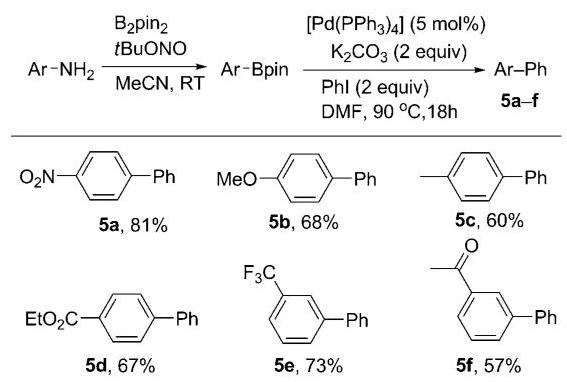
Scheme 1. Sequential borylation and Pd-catalyzed reactions.
方案1. 顺序硼化和钯催化反应。
The mechanism of this novel metal-free borylation process is not yet clear, but some preliminary observations are included here. ${}^{\left\lbrack {19}\right\rbrack }$ When the borylation was carried out in the presence of 1.5 equivalents of the radical scavenger 2,2,6,6-tetramethyl-1-piperidin-1-oxyl (TEMPO), the reaction became sluggish and phenylboronate was formed in only 8% yield after 4h, thus indicating a possible radical process, as a control experiment demonstrated that TEMPO does not react directly with ${\mathrm{B}}_{2}{\mathrm{{pin}}}_{2}$ under these conditions. To further substantiate the possible radical process, a 1:1 mixture of BPO and ${\mathrm{B}}_{2}{\mathrm{{pin}}}_{2}$ was heated in MeCN at ${100}^{ \circ }\mathrm{C}$ for 1 hour. The phenylboronate was isolated in 37% yield [Eq. (1)]. Since BPO decomposes to give the phenyl radical at temperatures higher than ${100}^{ \circ }\mathrm{C}$ , this experiment provides supportive evidence for radical mechanism.
这种新型无金属硼化反应过程的机理尚不清楚,但这里包括一些初步观察结果。${}^{\left\lbrack {19}\right\rbrack }$ 当硼化反应在1.5当量的自由基清除剂2,2,6,6-四甲基-1-哌啶-1-氧基(TEMPO)存在下进行时,反应变得缓慢,4小时后苯基硼酸酯的产率仅为8%,因此表明可能是自由基过程,因为对照实验表明TEMPO在这些条件下不会直接与${\mathrm{B}}_{2}{\mathrm{{pin}}}_{2}$反应。为了进一步证实可能的自由基过程,将BPO和${\mathrm{B}}_{2}{\mathrm{{pin}}}_{2}$的1:1混合物在MeCN中于${100}^{ \circ }\mathrm{C}$加热1小时。分离得到的苯基硼酸酯产率为37% [式(1)]。由于BPO在高于${100}^{ \circ }\mathrm{C}$的温度下分解产生苯基自由基,该实验为自由基机理提供了支持性证据。
$$ \begin{array}{l} \text{ PhCOO) }2 + {\mathrm{B}}_{2}{\mathrm{{pin}}}_{2}\;\text{ MeCN } \\ 1\text{ equiv }\;1\text{ equiv } \\ \end{array} \tag{1} $$However, when the phenyl radical was generated in an alternative process (PhI, $n{\mathrm{{Bu}}}_{3}\mathrm{{SnH}}$ , and AIBN), ${}^{\left\lbrack {20}\right\rbrack }$ and was allowed to react with ${\mathrm{B}}_{2}{\mathrm{{pin}}}_{2}$ , the PhBpin product was formed only in 7% yield. Moreover, mechanisms involving direct homolytic substitution (an ${\mathrm{S}}_{\mathrm{H}}2$ process) of the boron compounds by aryl radicals do not seem likely. ${}^{\left\lbrack {21} - {23}\right\rbrack }$ Detailed mechanistic investigations are in progress and will be reported in due course.
然而,当通过另一种方法(PhI、$n{\mathrm{{Bu}}}_{3}\mathrm{{SnH}}$和AIBN)产生苯基自由基,使${}^{\left\lbrack {20}\right\rbrack }$与${\mathrm{B}}_{2}{\mathrm{{pin}}}_{2}$反应时,PhBpin产物的产率仅为7%。此外,涉及芳基自由基对硼化合物进行直接均裂取代(${\mathrm{S}}_{\mathrm{H}}2$过程)的机理似乎不太可能。${}^{\left\lbrack {21} - {23}\right\rbrack }$ 详细的机理研究正在进行中,将适时报道。
In conclusion, we have developed an entirely new approach to the synthesis of arylboronates. The advantages of this method can be summarized as follows: 1) the starting arylamines are inexpensive and readily available; 2) the reaction is metal-free reaction, thus avoiding possible metal contamination of the boron product; 3) the conditions are mild and the reaction can be carried out under air at room temperature; 4) the boronate product can be used in subsequent Pd-catalyzed Suzuki-Miyaura couplings without purification. Consequently, this method serves as an important supplement to the existing methods of arylboronate synthesis.
总之,我们开发了一种全新的芳基硼酸酯合成方法。该方法的优点可总结如下:1)起始芳胺价格低廉且易于获得;2)反应是无金属反应,从而避免了硼产物可能的金属污染;3)条件温和,反应可在空气中室温下进行;4)硼酸酯产物无需纯化即可用于后续钯催化的铃木-宫浦偶联反应。因此,该方法是现有芳基硼酸酯合成方法的重要补充。
Experimental Section
实验部分
Typical procedure for the reaction of aryl amines $1\mathrm{a} - \mathrm{w},{\mathrm{B}}_{2}{\text{ pin }}_{2}2$ , and $t$ BuONO 3: ${\mathrm{B}}_{2}{\mathrm{{pin}}}_{2}\left( {1\mathrm{{mmol}},{254}\mathrm{{mg}}}\right)$ and BPO $\left( {{0.02}\mathrm{{mmol}},5\mathrm{{mg}}}\right)$ were weighed in a ${25}\mathrm{\;{mL}}$ round-bottom flask. MeCN ( $3\mathrm{\;{mL}}$ ), arylamines ( $1\mathrm{\;{mmol}}$ ), and $t\mathrm{{BuONO}}\left( {{1.5}\mathrm{\;{mmol}},{154}\mathrm{{mg}}}\right)$ were then added in succession. The resulting reaction mixture was allowed to stir for $1 - 2\mathrm{\;h}$ at room temperature. The solution was then concentrated under reduced pressure and the residue was purified by flash column chromatography.
芳基胺$1\mathrm{a} - \mathrm{w},{\mathrm{B}}_{2}{\text{ pin }}_{2}2$与$t$BuONO 3反应的典型步骤:将${\mathrm{B}}_{2}{\mathrm{{pin}}}_{2}\left( {1\mathrm{{mmol}},{254}\mathrm{{mg}}}\right)$和BPO$\left( {{0.02}\mathrm{{mmol}},5\mathrm{{mg}}}\right)$在一个${25}\mathrm{\;{mL}}$圆底烧瓶中称重。然后依次加入乙腈($3\mathrm{\;{mL}}$)、芳基胺($1\mathrm{\;{mmol}}$)和$t\mathrm{{BuONO}}\left( {{1.5}\mathrm{\;{mmol}},{154}\mathrm{{mg}}}\right)$。所得反应混合物在室温下搅拌$1 - 2\mathrm{\;h}$。然后在减压下浓缩溶液,残余物通过快速柱色谱法纯化。
Received: October 16, 2009
收到日期:2009年10月16日
Revised: January 13, 2010
修订日期:2010年1月13日
Published online: February 1, 2010
在线发表日期:2010年2月1日
Keywords: aryl boronates $\cdot$ borylation $\cdot$ cross-coupling $\cdot$ diazo compounds $\cdot$ Sandmeyer reaction
关键词:芳基硼酸酯$\cdot$硼化反应$\cdot$交叉偶联$\cdot$重氮化合物$\cdot$桑德迈尔反应
[1] For reviews, see: a) A. Suzuki, Acc. Chem. Res. 1982, 15, 178; b) N. Miyaura, A. Suzuki, Chem. Rev. 1995, 95, 2457; c) A. Suzuki in Metal-Catalyzed Cross-Coupling Reactions (Eds.: F. Diederich, P. J. Stang), Wiley-VCH, Weinheim, 1998, pp. 49-97; d) N. Miyaura, Top. Curr. Chem. 2002, 219, 11; e) S. Kotha, K. Lahiri, D. Kashinath, Tetrahedron 2002, 58, 9633; f) N. Miyaura, J. Organomet. Chem. 2002, 653, 54; g) T. Ishiyama, N. Miyaura, Chem. Rec. 2004, 3, 271; h) N. Miyaura, Bull. Chem. Soc. Jpn. 2008, 81, 1535.
[2] D. G. Hall, Boronic Acids, Wiley, New York, 2005.
[3] a) H. C. Brown, M. Srebnik, T. E. Cole, Organometallics 1986, 5, 2300; b) H. C. Brown, T. E. Cole, Organometallics 1983, 2, 1316.
[4] For a seminal publication, see: a) T. Ishiyama, M. Murata, N. Miyaura, J. Org. Chem. 1995, 60, 7508. For reviews, see: b) T. Ishiyama, N. Miyaura, J. Synth. Org. Chem. Jpn. 1999, 57, 503; c) T. Ishiyama, N. Miyaura, J. Organomet. Chem. 2000, 611, 392; d) N. Miyaura in Catalytic Heterofunctionalization (Eds.: A. Togni, H. Grützmacher), Wiley-VCH, Chichester, 2001, Chapter 3.
[5] a) T. Ishiyama, Y. Itoh, T. Kitano, N. Miyaura, Tetrahedron Lett. 1997, 38, 3447; b) A. Giroux, Y. Han, P. Prasit, Tetrahedron Lett. 1997, 38, 3841; c) D. M. Willis, R. M. Strongin, Tetrahedron Lett. 2000, 41, 8683; d) A. C. Carbonnelle, J. Zhu, Org. Lett. 2000, 2, 3477; e) K. Takahashi, J. Takagi, T. Ishiyama, N. Miyaura, Chem. Lett. 2000, 29, 126; f) M. H. Todd, C. Abell, J. Comb. Chem. 2001, 3, 319; g) T. Ishiyama, K. Ishida, N. Miyaura, Tetrahedron 2001, 57, 9813; h) T. Ishiyama, N. Miyaura, J. Organomet. Chem. 2000, 611, 392; i) A. Fürstner, G. Seidel, Org. Lett. 2002, 4, 541; j) L. Zhu, J. Duquette, M. Zhang, J. Org. Chem. 2003, 68, 3729; k) A. Giroux, Tetrahedron Lett. 2003, 44, 233; 1) K. Billingsley, T. E. Barder, S. L. Buchwald, Angew. Chem. 2007, 119, 5455; Angew. Chem. Int. Ed. 2007, 46, 5359.
[6] For Pd-catalyzed borylation reactions that employ pinacolbor-ane, see: a) M. Murata, S. Watanabe, Y. Masuda, J. Org. Chem. 1997, 62, 6458; b) M. Murata, T. Oyama, S. Watanbe, Y. Masuda, J. Org. Chem. 2000, 65, 164; c) O. Baudoin, D. Guénard, F. Guéritte, J. Org. Chem. 2000, 65, 9268; d) P. E. Broutin, I. Cerna, M. Campaniello, F. Leroux, F. Colobert, Org. Lett. 2004, 6, 4419; e) M. Murata, T. Sambommatsu, S. Watanabe, Y. Masuda, Synlett 2006, 1867.
[7] For a theoretical study, see: M. Sumimoto, N. Iwane, T. Takahama, S. Sakaki, J. Am. Chem. Soc. 2004, 126, 10457.
[8] More recently, a Cu-catalyzed borylation process was reported, see: C. Kleeberg, L. Dang, Z. Lin, T. B. Marder, Angew. Chem. 2009, 121, 5454; Angew. Chem. Int. Ed. 2009, 48, 5350.
[9] For reviews, see: a) T. Ishiyama, N. Miyaura, J. Organomet. Chem. 2003, 680, 3; b) I. A. I. Mkhalid, J. H. Barnard, T. B. Marder, J. C. Murphy, J. F. Hartwig, Chem. Rev. 2010, DOI: 10.1021/cr900206p.
[10] For selected examples, see: a) J. Y. Cho, C. N. Iverson, M. R. Smith III, J. Am. Chem. Soc. 2000, 122, 12868; b) S. Shimada, A. S. Batsanov, J. A. K. Howard, T. B. Marder, Angew. Chem. 2001, 113, 2226; Angew. Chem. Int. Ed. 2001, 40, 2168; c) J. Y. Cho, M. K. Tse, M. R. Smith III, Org. Lett. 2001, 3, 2831; d) J. Y. Cho, M. K. Tse, D. Holmes, R. E. Maleczka, M. R. Smith III, Science 2002, 295, 305; e) J. Takagi, K. Sato, J. F. Hartwig, T. Ishiyama, N. Miyaura, Tetrahedron Lett. 2002, 43, 5649; f) T. Ishiyama, J. Takagi, J. F. Hartwig, N. Miyaura, Angew. Chem. 2002, 114, 3182; Angew. Chem. Int. Ed. 2002, 41, 3056; g) T. Ishiyama, J. Takagi, K. Ishida, N. Miyaura, N. R. Anastasi, J. F. Hartwig, J. Am. Chem. Soc. 2002, 124, 390; h) T. Ishiyama, J. Takagi, Y. Yonekawa, J. F. Hartwig, N. Miyaura, Adv. Synth. Catal. 2003, 345, 1103; i) T. Tagata, M. Nishida, Adv. Synth. Catal. 2004, 346, 1655; j) K. Mertins, A. Zapf, M. Beller, J. Mol. Catal. A 2004, 207, 21; k) T. M. Boller, J. M. Murphy, M. Hapke, T. Ishiyama, N. Miyaura, J. F. Hartwig, J. Am. Chem. Soc. 2005, 127, 14263; 1) G. D. Frey, C. F. Rentzsch, D. V. Preysing, T. Scherg, M. Mühlhofer, E. Herdtweck, W. A. Herrmann, J. Organomet. Chem. 2006, 691, 5725; m) I. A. I. Mkhalid, D. N. Coventry, D. Albesa-Jové, A. S. Batsanov, J. A. K. Howard, R. N. Perutz, T. B. Marder, Angew. Chem. 2006, 118, 503; Angew. Chem. Int. Ed. 2006, 45, 489; n) Y. H. Zhu, K. C. Yan, J. H. Luo, C. S. Hwei, Y. C. Hon, A. Emi, Z. S. Su, M. Winata, N. S. Hosmane, J. A. Maguire, J. Organomet. Chem. 2007, 692, 4244; o) A. D. Finke, J. S. Moore, Org. Lett. 2008, 10, 4851; p) T. A. Boebel, J. F. Hartwig, Tetrahedron 2008, 64, 6824; q) T. A. Boebel, J. F. Hartwig, Organometallics 2008, 27, 6013; r) T. Kikuchi, Y. Nobuta, J. Umeda, Y. Yamamoto, T. Ishiyama, N. Miyaura, Tetrahedron 2008, 64, 4967; s) T. A. Boebel, J. F. Hartwig, J. Am. Chem. Soc. 2008, 130, 7534; t) T. Tagata, M. Nishida, A. Nishida, Tetrahedron Lett. 2009, 50, 6176; u) P. Harrison, J. Morris, P. G. Steel, T. B. Marder, Synlett 2009, 147; v) P. Harrison, J. Morris, T. B. Marder, P. G. Steel, Org. Lett. 2009, 11, 3586; w) N. Iwadate, M. Suginome, J. Organomet. Chem. 2009, 694, 1713; x) T. S. Jo, S. H. Kim, J. Shin, C. Bae, J. Am. Chem. Soc. 2009, 131, 1656; y) S. Kawamorita, H. Ohmiya, K. Hara, A. Fukuoka, M. Sawamura, J. Am. Chem. Soc. 2009, 131, 5058.
[11] For reviews on the Sandmeyer reaction, see; a) H. H. Hodgson, Chem. Rev. 1947, 40, 251; b) C. Galli, Chem. Rev. 1988, 88, 765; c) E. B. Merkushev, Synthesis 1988, 923; d) R. Bohlmann in Comp. Org Synth., Vol. 6 (Eds.: B. M. Trost, I. Fleming), Pergamon, Oxford, 1991, p. 203.
[12] For examples, see: a) D. A. Evans, J. L. Katz, G. S. Peterson, T. Hintermann, J. Am. Chem. Soc. 2001, 123, 12411; b) C. Vergne, M. Bois-Choussy, J. Zhu, Synlett 1998, 1159.
[13] For an example, see: C. Dugave, J. Org. Chem. 1995, 60, 601.
[14] For an example, see: T. Cohen, A. G. Dietz, Jr., J. R. Miser, J. Org. Chem. 1977, 42, 2053.
[15] H. T. Clarke, R. R. Read, Org. Synth. 1941, Vol I, 514.
[16] P. A. S. Smith, B. B. Brown, J. Am. Chem. Soc. 1951, 73, 2438.
[17] a) M. P. Doyle, B. Siegfried, J. F. Dellaria, Jr., J. Org. Chem. 1977, 42, 2426; b) M. P. Doyle, J. F. Dellaria, Jr., B. Siegfried, S. W. Bishop, J. Org. Chem. 1977, 42, 3494.
[18] J. K. Kochi, J. Am. Chem. Soc. 1957, 79, 2942.
[19] See the Supporting Information for details.
[20] B. Giese, Radical in Organic Synthesis: Formation of Carbon-Carbon Bonds, Pergamon, New York, 1986.
[21] C. Ollivier, P. Renaud, Chem. Rev. 2001, 101, 3415.
[22] J. K. Kochi, Free Radicals in Reactive Intermediate in Organic Chemistry, Vol. I, Wiley, New York, 1968, pp. 547-589.
[23] For a rare example of intramolecular homolytic substitution at boron by a carbon-centered radical, see: R. A. Batey, D. V. Smil, Angew. Chem. 1999, 111, 1914; Angew. Chem. Int. Ed. 1999, 38, 1798.