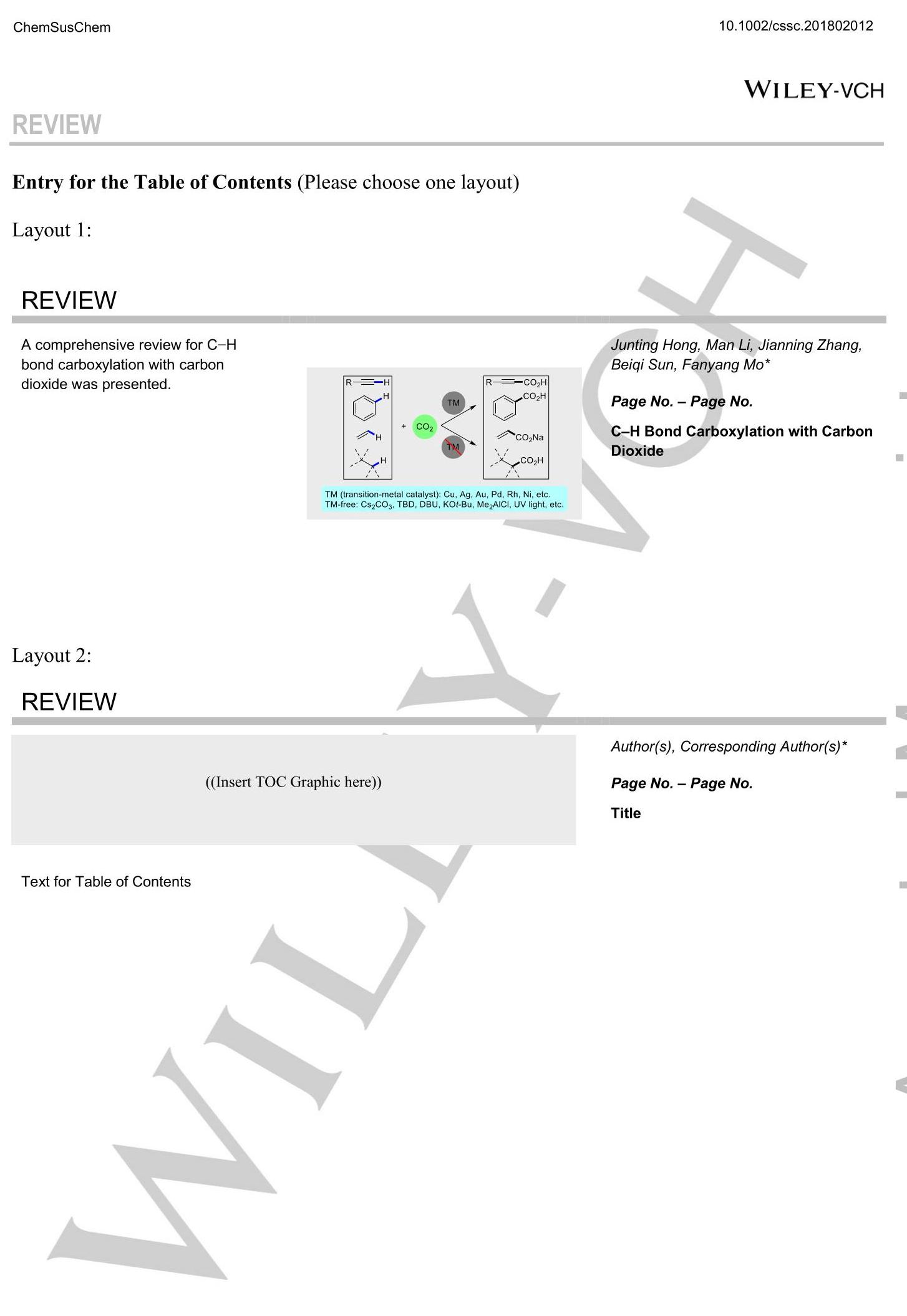
C-H Bond Carboxylation with Carbon Dioxide
英文原文与中文译文逐段对照 · English original with Chinese translation
CHEMISTRY & SUSTAINABILITY
化学与可持续性
CHIEMSUSCHIM
化学与可持续化学
ENERGY & MATERIALS
能源与材料
Accepted Article
录用文章
Title: C-H Bond Carboxylation with Carbon Dioxide
标题:二氧化碳参与的C-H键羧基化反应
Authors: Junting Hong, Man Li, Jianning Zhang, Beiqi Sun, and Fanyang Mo
作者:洪钧婷、李满、张建宁、孙北奇、莫凡洋
This manuscript has been accepted after peer review and appears as an Accepted Article online prior to editing, proofing, and formal publication of the final Version of Record (VoR). This work is currently citable by using the Digital Object Identifier (DOI) given below. The VoR will be published online in Early View as soon as possible and may be different to this Accepted Article as a result of editing. Readers should obtain the VoR from the journal website shown below when it is published to ensure accuracy of information. The authors are responsible for the content of this Accepted Article.
本稿件经同行评审后被录用,在编辑、校对以及最终记录版本(VoR)正式出版之前,以录用文章形式在线发表。目前可通过以下数字对象标识符(DOI)引用此作品。VoR将尽快在Early View在线发表,由于编辑原因,其内容可能与本录用文章有所不同。读者应在VoR发表后从以下期刊网站获取,以确保信息准确。作者对本录用文章的内容负责。
To be cited as: ChemSusChem 10.1002/cssc.201802012
引用格式:ChemSusChem 10.1002/cssc.201802012
Link to VoR: http://dx.doi.org/10.1002/cssc.201802012
VoR链接:http://dx.doi.org/10.1002/cssc.201802012
C-H Bond Carboxylation with Carbon Dioxide
二氧化碳参与的碳氢键羧基化反应
Junting Hong, Man Li, Jianning Zhang, Beiqi Sun, and Fanyang Mo*
洪军亭、李满、张建宁、孙北奇、莫凡洋*(作者姓名可不翻译)
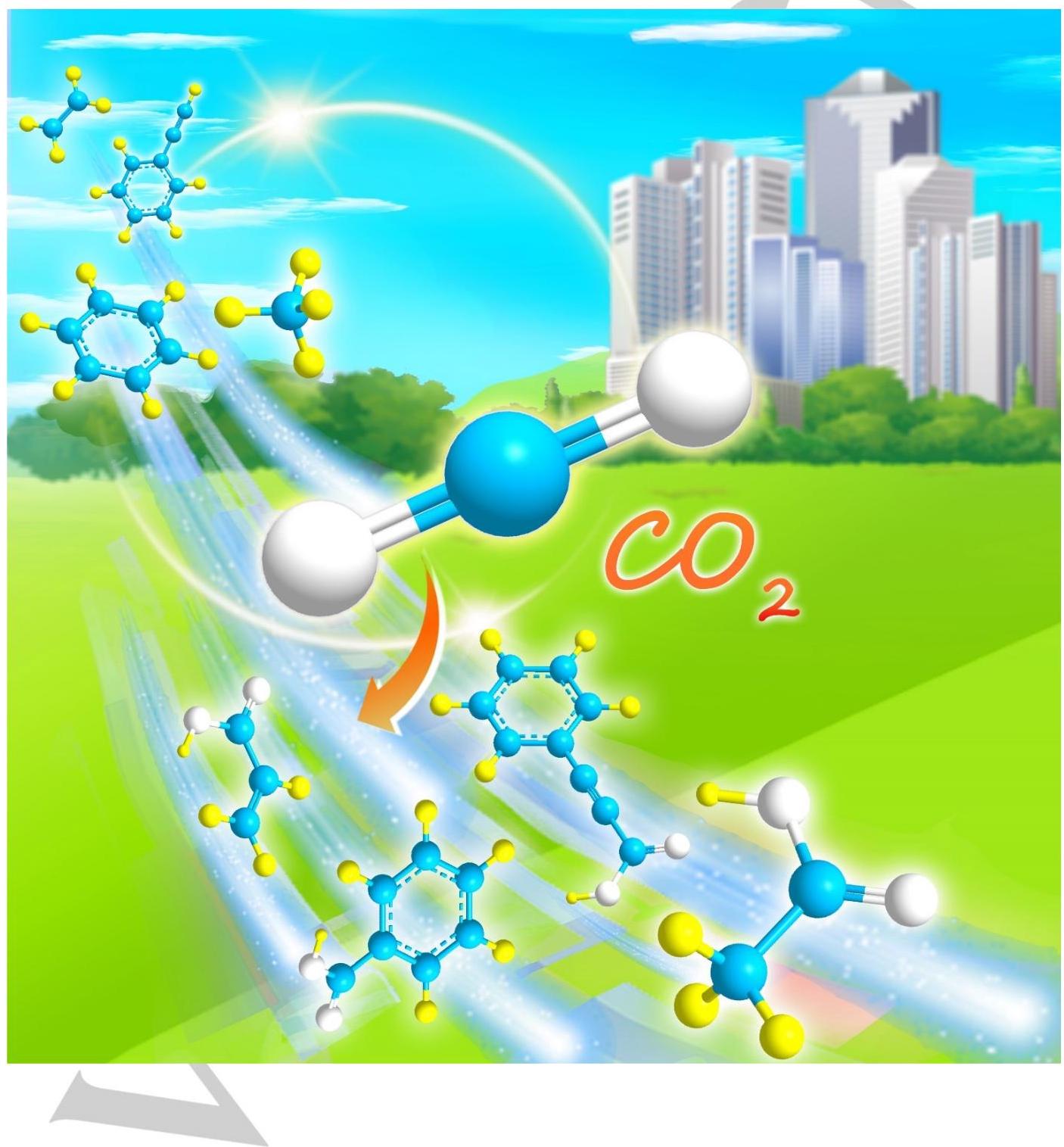
Abstract: Carbon dioxide $\left( {\mathrm{{CO}}}_{2}\right)$ is a nontoxic, renewable and abundant one-carbon (C1) source, while C-H bond functionalization represents one of the most important approaches to the construction of carbon-carbon bonds and carbon-heteroatom bonds in an atom- and step-economical manner. Merging the chemical transformation of ${\mathrm{{CO}}}_{2}$ with $\mathrm{C} - \mathrm{H}$ bond functionalization is of great importance in the synthesis of carboxylic acids and their derivatives. The contents of this review are organized according to the type of $\mathrm{C} - \mathrm{H}$ bond involved in carboxylation. The primary types of $\mathrm{C} - \mathrm{H}$ bonds are as follows: C(sp)-H bonds of terminal alkynes, C(sp2)-H bonds of (hetero)arenes, vinylic C(sp2)-H bonds, the diazo group ipso- $\mathrm{C}\left( {\mathrm{{sp}}}^{2}\right) - \mathrm{H}$ bonds, aldehyde $\mathrm{C}\left( {\mathrm{{sp}}}^{2}\right) - \mathrm{H}$ bonds, $\alpha - \mathrm{C}\left( {\mathrm{{sp}}}^{3}\right) - \mathrm{H}$ bonds of carbonyl group, $\gamma - \mathrm{C}\left( {\mathrm{{sp}}}^{3}\right) - \mathrm{H}$ bonds of carbonyl group, $\mathrm{C}\left( {\mathrm{{sp}}}^{3}\right) -$ H bonds adjacent to nitrogen or oxygen atoms, $\mathrm{C}\left( {\mathrm{{sp}}}^{3}\right) - \mathrm{H}$ bonds of $o$ -alkylphenyl ketones, allylic $\mathrm{C}\left( {\mathrm{{sp}}}^{3}\right) - \mathrm{H}$ bonds, $\mathrm{C}\left( {\mathrm{{sp}}}^{3}\right) - \mathrm{H}$ bonds of methane, and $\mathrm{C}\left( {\mathrm{{sp}}}^{3}\right) - \mathrm{H}$ bonds of halogenated aliphatic hydrocarbons. In addition, multicomponent reactions, tandem reactions and key theoretical studies related to the carboxylation of C-H bonds are briefly summarized. Transition-metal-free, organocatalytic, electrochemical and light-driven methods are highlighted.
摘要:二氧化碳$\left( {\mathrm{{CO}}}_{2}\right)$是一种无毒、可再生且储量丰富的一碳(C1)源,而碳氢键官能团化是一种以原子经济性和步骤经济性方式构建碳 - 碳键和碳 - 杂原子键的重要方法。将${\mathrm{{CO}}}_{2}$的化学转化与$\mathrm{C} - \mathrm{H}$键官能团化相结合在羧酸及其衍生物的合成中具有重要意义。本综述的内容根据羧基化反应中涉及的$\mathrm{C} - \mathrm{H}$键类型进行组织。$\mathrm{C} - \mathrm{H}$键的主要类型如下:末端炔烃的C(sp)-H键、(杂)芳烃的C(sp2)-H键、乙烯基C(sp2)-H键、重氮基本位$\mathrm{C}\left( {\mathrm{{sp}}}^{2}\right) - \mathrm{H}$键、醛基$\mathrm{C}\left( {\mathrm{{sp}}}^{2}\right) - \mathrm{H}$键、羰基的$\alpha - \mathrm{C}\left( {\mathrm{{sp}}}^{3}\right) - \mathrm{H}$键、羰基的$\gamma - \mathrm{C}\left( {\mathrm{{sp}}}^{3}\right) - \mathrm{H}$键、与氮或氧原子相邻的$\mathrm{C}\left( {\mathrm{{sp}}}^{3}\right) -$H键、$o$ - 烷基苯基酮的$\mathrm{C}\left( {\mathrm{{sp}}}^{3}\right) - \mathrm{H}$键、烯丙基$\mathrm{C}\left( {\mathrm{{sp}}}^{3}\right) - \mathrm{H}$键、甲烷的$\mathrm{C}\left( {\mathrm{{sp}}}^{3}\right) - \mathrm{H}$键以及卤代脂肪烃的$\mathrm{C}\left( {\mathrm{{sp}}}^{3}\right) - \mathrm{H}$键。此外,还简要总结了与碳氢键羧基化反应相关的多组分反应、串联反应和关键理论研究。重点介绍了无过渡金属、有机催化、电化学和光驱动方法。
1. Introduction
1. 引言
With increasing attention to climate change, fixation and transformation of carbon dioxide $\left( {\mathrm{{CO}}}_{2}\right)$ , a greenhouse gas, has become a hot topic for chemical researchers. ${}^{\left\lbrack 1 - 6\right\rbrack }{\mathrm{{CO}}}_{2}$ is a one-carbon (C1) source that is non-toxic, nonflammable, renewable, abundant, and inexpensive. The use of ${\mathrm{{CO}}}_{2}$ instead of toxic phosgene or carbon monoxide in organic synthesis has high value in research and development. ${}^{\left\lbrack 7 - {13}\right\rbrack }$ Unfortunately, the high thermodynamic stability and kinetic inertness of ${\mathrm{{CO}}}_{2}$ make its chemical transformation very difficult. To solve this problem, the most classical method is to trap it with highly reactive compounds, such as Grignard or organolithium reagents. However, this method has poor functional group compatibility and requires strict anhydrous and anaerobic conditions. To address these problems, ${\mathrm{{CO}}}_{2}$ fixation processes with less reactive organometallic reagents (such as boron or zinc reagents) or halogenated hydrocarbons have been developed in recent years. ${}^{\left\lbrack {14}\right\rbrack }$ However, these methods require prefunctionalization of the substrate, and also produce needless waste, which fail to meet the requirements of green and sustainable chemistry. Although transition metal-catalyzed reductive carboxylation of unsaturated hydrocarbons partially solves the problem of the substrate prefunctionalization, these reactions still generally require stoichiometric or even excessive amounts of reductants, such as organozinc reagents, aluminum reagents, or hydrosilanes, etc. ${}^{\left\lbrack {15} - {16}\right\rbrack }$ On the other hand, the functionalization of carbon-hydrogen (C-H) bonds is an important method for constructing carbon-carbon bonds and carbon-heteroatom bonds in organic chemistry. ${}^{\left\lbrack {17} - {21}\right\rbrack }$ In light of its high atom economy and step economy, C-H bond functionalization demonstrates a wide range of application in the syntheses of pharmaceuticals, natural products, and organic materials.[22-24] Using ubiquitous $\mathrm{C} - \mathrm{H}$ bond to react with ${\mathrm{{CO}}}_{2}$ is an ideal way to produce high value-added chemicals. Key to achieving this goal is to combine the selective activation and functionalization of inert $\mathrm{C} - \mathrm{H}$ bonds with the activation of ${\mathrm{{CO}}}_{2}$ . Organized according to the types of $\mathrm{C} - \mathrm{H}$ bond involved in the reaction, this review summarizes recent progress in the functionalization of $\mathrm{C} - \mathrm{H}$ bond using ${\mathrm{{CO}}}_{2}$ as a carboxylative reagent. We noted that some published reviews cover part of contents in this paper. For example, $\mathrm{C} - \mathrm{H}$ carboxylation of aromatic compounds through ${\mathrm{{CO}}}_{2}$ fixation has been reviewed recently. ${}^{\left\lbrack 3\right\rbrack }$ The direct carboxylation of $\mathrm{C}\left( {\mathrm{{sp}}}^{3}\right) - \mathrm{H}$ and $\mathrm{C}\left( {\mathrm{{sp}}}^{2}\right) - \mathrm{H}$ bonds with ${\mathrm{{CO}}}_{2}$ by transition-metal-catalyzed and base-mediated reactions has also been surveyed. ${}^{\left\lbrack {25}\right\rbrack }$ However, some important aspects including several specific types of C-H carboxylation reactions, transition-metal-free reactions (including Lewis acid-mediated reactions), multicomponent reactions, tandem reactions and key theoretical studies related to the carboxylation of C-H bonds are overlooked. To this end, it’s highly desirable to thoroughly summarize the field of C-H carboxylation with ${\mathrm{{CO}}}_{2}$ . By doing so, we can find many interesting points which will enhance our understanding of this exciting field. For example, many transition-metal-catalyzed C-H carboxylation reactions with ${\mathrm{{CO}}}_{2}$ (including C(sp)-H bonds and $\mathrm{C}\left( {\mathrm{{sp}}}^{2}\right) - \mathrm{H}$ bonds) can develop their transition-metal-free version (see section 2.2.4., 3.1.1.2., and Scheme 56); copper can catalyze all types of $\mathrm{C} - \mathrm{H}$ carboxylation reactions with ${\mathrm{{CO}}}_{2}$ (see section 2.1.1, 2.2.1, 2.3, 3.1.1.1, Scheme 71, Scheme 78, etc.); base can mediate all types of $\mathrm{C} - \mathrm{H}$ carboxylation reactions for substrates with relatively acidic C-H bonds (see section 2.2.4, 3.1.1.2, 3.3, Scheme 68, Scheme 73, etc.); all types of C-H carboxylation reactions can be incorporated into tandem or sequential reactions (see section 2.3, Scheme 45, 55 and 70, etc.).
随着对气候变化的关注度不断提高,作为一种温室气体的二氧化碳$\left( {\mathrm{{CO}}}_{2}\right)$的固定和转化已成为化学研究人员的热门话题。${}^{\left\lbrack 1 - 6\right\rbrack }{\mathrm{{CO}}}_{2}$是一种无毒、不可燃、可再生、丰富且廉价的一碳(C1)源。在有机合成中使用${\mathrm{{CO}}}_{2}$代替有毒的光气或一氧化碳具有很高的研发价值。${}^{\left\lbrack 7 - {13}\right\rbrack }$不幸的是,${\mathrm{{CO}}}_{2}$的高热力学稳定性和动力学惰性使其化学转化非常困难。为了解决这个问题,最经典的方法是用高活性化合物捕获它,如格氏试剂或有机锂试剂。然而,这种方法的官能团兼容性较差,并且需要严格的无水和无氧条件。为了解决这些问题,近年来已经开发了使用反应活性较低的有机金属试剂(如硼或锌试剂)或卤代烃的${\mathrm{{CO}}}_{2}$固定方法。${}^{\left\lbrack {14}\right\rbrack }$然而,这些方法需要对底物进行预官能化,并且还会产生不必要的废物,不符合绿色和可持续化学的要求。尽管过渡金属催化的不饱和烃的还原羧化部分解决了底物预官能化的问题,但这些反应通常仍然需要化学计量甚至过量的还原剂,如有机锌试剂、铝试剂或硅烷等。${}^{\left\lbrack {15} - {16}\right\rbrack }$另一方面,碳-氢键(C-H)的官能化是有机化学中构建碳-碳键和碳-杂原子键的重要方法。${}^{\left\lbrack {17} - {21}\right\rbrack }$鉴于其高原子经济性和步骤经济性,C-H键官能化在药物、天然产物和有机材料的合成中具有广泛的应用。[22-24] 使用普遍存在的$\mathrm{C} - \mathrm{H}$键与${\mathrm{{CO}}}_{2}$反应是生产高附加值化学品的理想方法。实现这一目标的关键是将惰性$\mathrm{C} - \mathrm{H}$键的选择性活化和官能化与${\mathrm{{CO}}}_{2}$的活化相结合。根据反应中涉及的$\mathrm{C} - \mathrm{H}$键的类型进行组织,本综述总结了使用${\mathrm{{CO}}}_{2}$作为羧化试剂对$\mathrm{C} - \mathrm{H}$键进行官能化的最新进展。我们注意到一些已发表的综述涵盖了本文的部分内容。例如,最近对通过${\mathrm{{CO}}}_{2}$固定对芳香化合物进行$\mathrm{C} - \mathrm{H}$羧化进行了综述。${}^{\left\lbrack 3\right\rbrack }$ 也对过渡金属催化和碱介导的反应中$\mathrm{C}\left( {\mathrm{{sp}}}^{3}\right) - \mathrm{H}$和$\mathrm{C}\left( {\mathrm{{sp}}}^{2}\right) - \mathrm{H}$键与${\mathrm{{CO}}}_{2}$的直接羧化进行了综述。${}^{\left\lbrack {25}\right\rbrack }$然而,一些重要方面,包括几种特定类型的C-H羧化反应、无过渡金属反应(包括路易斯酸介导的反应)、多组分反应、串联反应以及与C-H键羧化相关键羧化相关的关键理论研究被忽视了。为此,非常有必要全面总结用${\mathrm{{CO}}}_{2}$进行C-H羧化的领域。通过这样做,我们可以找到许多有趣的点,这将增强我们对这个令人兴奋的领域的理解。例如,许多过渡金属催化的用${\mathrm{{CO}}}_{2}$进行的C-H羧化反应(包括C(sp)-H键和$\mathrm{C}\left( {\mathrm{{sp}}}^{2}\right) - \mathrm{H}$键)可以开发出它们的无过渡金属版本(见第2.2.4节、3.1.1.2节和方案56);铜可以催化所有类型的用${\mathrm{{CO}}}_{2}$进行的$\mathrm{C} - \mathrm{H}$羧化反应(见第2.1.1节、2.2.1节、2.3节、3.1.1.1节、方案71、方案78等);碱可以介导具有相对酸性C-H键的底物的所有类型的$\mathrm{C} - \mathrm{H}$羧化反应(见第2.2.4节、3.1.1.2节、3.3节、方案68、方案73等);所有类型的C-H羧化反应都可以纳入串联或顺序反应(见第2.3节、方案45、55和70等)。

Junting Hong received her B.S. degrees from Beijing Institute of Technology in 2017. She is currently a Ph.D. candidate in Professor Fanyang Mo’s group in Peking University. Her research interest is radical borylation of aryl and alkyl halides.
洪钧婷于2017年在北京理工大学获得学士学位。她目前是北京大学莫凡洋教授课题组的博士研究生。她的研究兴趣是芳基和烷基卤化物的自由基硼化反应。
Junting Hong, Man Li, Jianning Zhang, Beigi Sun, Prof. Dr. Fanyang Mo
洪钧婷,李满,张建宁,孙北奇,莫凡洋教授
Department of Energy and Resources Engineering, College of Engineering, Peking University
北京大学工学院能源与资源工程系
No. 5 Yiheyuan Road, Haidian Distric, Beijing 100871, China
中国北京市海淀区颐和园路5号,邮编100871
REVIEW
综述
Man Li received his B.S. degree from Henan Normal University in 2010, and obtained his M.Sc. degree from Lanzhou Institute of Chemical Physics (LICP), Chinese Academy of Sciences (CAS) in 2014. He has been a Research Assistant at LICP, CAS, Shanghai Institute of Organic Chemistry, CAS and Peking University (with Assistant Professor Fanyang Mo). His research interests include chemical transformations of carbon dioxide and acid catalysis.
李满于2010年在河南师范大学获得学士学位,并于2014年在中国科学院兰州化学物理研究所获得硕士学位。他曾在中国科学院兰州化学物理研究所、中国科学院上海有机化学研究所和北京大学(与莫凡洋助理教授合作)担任研究助理。他的研究兴趣包括二氧化碳的化学转化和酸催化。
Jianning Zhang is a fourth year undergraduate student of Peking University. He is now studying in Professor Mo’s group.
张建宁是北京大学的一名大四本科生。他目前在莫教授的课题组学习。


Beiqi Sun obtained his B.E degree from
孙北奇于2018年在
Peking University in 2018. He is
北京大学获得工学学士学位。他
currently a Ph.D student in Dr. Fanyang
目前是莫凡洋博士课题组的博士研究生。
Mo’s group. His research interests are organic electrochemistry and ${\mathrm{{CO}}}_{2}$ utilization in organic synthesis.
他的研究兴趣是有机电化学以及有机合成中${\mathrm{{CO}}}_{2}$的利用。
Fanyang Mo obtained his undergraduate
莫凡洋于2004年和2006年在北京
degree and master degree in applied
理工大学分别获得应用
chemistry in 2004 and 2006 at Beijing
化学专业的学士学位和硕士学位。
Institute of Technology under the
导师为
supervision of Professor Zhiming Zhou. He then moved to Peking University and pursued his Ph. D study under the supervision of Professor Jianbo Wang. After receiving his PhD in 2010, he went to the US and worked with Professor Qinghai Zhang at The Scripps Research Institute and Professor Guangbin Dong at The University of Texas at Austin from 2010 to 2015. He joined Peking University as an Assistant Professor in April 2015. Current research interests of the group include ${\mathrm{{CO}}}_{2}$ utilization in organic synthesis, organic electrochemistry, and modification of semiconductor oxides.
在周志敏教授的指导下。随后他前往北京大学,并在王剑波教授的指导下攻读博士学位。2010年获得博士学位后,他前往美国,2010年至2015年期间在斯克里普斯研究所与张青海教授以及德克萨斯大学奥斯汀分校的董广彬教授合作。他于2015年4月作为助理教授加入北京大学。该团队目前的研究兴趣包括有机合成中的${\mathrm{{CO}}}_{2}$利用、有机电化学以及半导体氧化物的改性。
2. Carboxylation of C(sp)-H bonds with ${\mathrm{{CO}}}_{2}$
2. 用${\mathrm{{CO}}}_{2}$对C(sp) - H键进行羧基化
2.1. Carboxylative coupling reaction of terminal alkynes, alkyl halides, and CO2
2.1. 端炔、卤代烃与CO₂的羧基化偶联反应
2.1.1. Cu(I)-catalyzed carboxylative coupling reaction of terminal alkynes, alkyl halides, and CO2
2.1.1. 铜(I)催化的末端炔烃、卤代烃与二氧化碳的羧基化偶联反应
In 1994, Inoue and coworkers[26] found that Cu(I) salts (CuI/CuBr) or Ag(I) salts (AgI/AgNO ${}_{3}$ ) can catalyze the carboxylative coupling of terminal alkynes, alkyl bromides, and ${\mathrm{{CO}}}_{2}$ (Scheme 1). The choice of solvent and base has a significant effect on the reaction. Polar aprotic solvents such as DMF, DMAc and N-methylpyrrolidone are suitable for this reaction. Employment of organic bases such as triethylamine or DBU suffers from alkylation of the base with alkyl halide. Thus, an inorganic salt like ${\mathrm{K}}_{2}{\mathrm{{CO}}}_{3}$ is used as the base. A three-step reaction mechanism is proposed: (i) copper acetylide formation,(ii) ${\mathrm{{CO}}}_{2}$ insertion into the carbon-copper bond, and (iii) esterification with bromoalkane with regeneration of the copper salt catalyst (Scheme 1). Based on the above work, Oi and Inoue and coworkers reported the Cul-catalyzed polymerization of diyne, ${\mathrm{{CO}}}_{2}$ and dihaloalkane in 1996.[27] The use of 1,10-phenanthroline as a ligand accelerates the polymerization.
1994年,井上及其同事[26]发现,铜(I)盐(碘化亚铜/溴化亚铜)或银(I)盐(碘化银/硝酸银${}_{3}$)可催化末端炔烃、溴代烷烃和${\mathrm{{CO}}}_{2}$的羧基化偶联反应(方案1)。溶剂和碱的选择对反应有显著影响。极性非质子溶剂如N, N-二甲基甲酰胺、N, N-二甲基乙酰胺和N-甲基吡咯烷酮适用于该反应。使用有机碱如三乙胺或1,8-二氮杂双环[5.4.0]十一碳-7-烯会导致碱被卤代烷烃烷基化。因此,使用像${\mathrm{K}}_{2}{\mathrm{{CO}}}_{3}$这样的无机盐作为碱。提出了一种三步反应机理:(i)形成乙炔铜,(ii)${\mathrm{{CO}}}_{2}$插入碳-铜键,以及(iii)与溴代烷烃进行酯化反应并使铜盐催化剂再生(方案1)。基于上述工作,大井、井上及其同事在1996年报道了碘化亚铜催化的二炔、${\mathrm{{CO}}}_{2}$和二卤代烷烃的聚合反应[27]。使用1,10-菲咯啉作为配体可加速聚合反应。
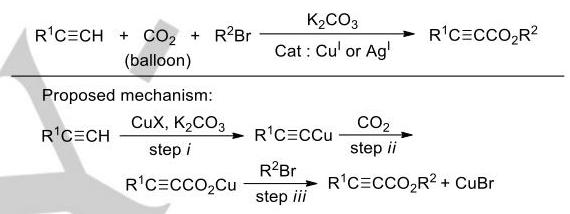
Scheme 1. Carboxylative coupling reaction of terminal alkynes catalyzed by copper(I) or silver(I) salt ${}^{\left\lbrack {26}\right\rbrack }$ In 2010, Lu and coworkers ${}^{\left\lbrack {28}\right\rbrack }$ reported the carboxylative coupling of terminal alkynes, allylic chlorides, and ${\mathrm{{CO}}}_{2}$ catalyzed by $\mathrm{N}$ - heterocyclic carbene (NHC) copper(I) complex (IPr)CuCl (Scheme 2). They found that the use of NHC ligands significantly increases catalytic activity and selectivity. Besides allylic chlorides, propargylic chlorides, benzyl chlorides, and a-chloro carbonyl compounds can all participate in the reaction. Catalyst recovery can be achieved by column chromatography. In 2014, Yuan and Lin[29] conducted a density functional theory (DFT) study on (IPr)CuCl-catalyzed carboxylative coupling reaction of terminal alkynes, allyl chloride and ${\mathrm{{CO}}}_{2}$ reported by Lu. ${}^{\left\lbrack {28}\right\rbrack }$ It was found that both the reactions of (IPr)Cu-C≡CPh and (IPr)CuOCOC≡CPh with an allylic chloride occur through an ${\mathrm{S}}_{\mathrm{N}}2$ substitution pathway. They also revealed how the reaction conditions affect the preference of one pathway over the other (carboxylative coupling versus cross coupling). In 2012, Inamoto, Kondo and coworkers ${}^{\left\lbrack {30}\right\rbrack }$ found that the Cul/PEt ${}_{3}$ system can catalyze carboxylative coupling reactions of terminal alkynes, haloalkane, and ${\mathrm{{CO}}}_{2}$ under mild conditions (Scheme 3). For some relatively inert terminal alkynes such as 4- cyanophenylacetylene, higher yields can be obtained by using the Cul/2,2’-bipyridine catalyst system while heating up to ${50}{}^{ \circ }\mathrm{C}$ . For substrates such as 4-nitrophenylacetylene, the reaction results are unsatisfactory. In 2015, He and coworkers[31] reported a Cu(I)-based ionic liquid-catalyzed carboxylation of terminal alkynes with ${\mathrm{{CO}}}_{2}$ (Scheme 4). For terminal alkynes with electron-withdrawing groups, raising the reaction temperature to ${40}^{ \circ }\mathrm{C}$ can significantly improve the yield.
方案1. 由铜(I)盐或银(I)盐催化的末端炔烃的羧基化偶联反应${}^{\left\lbrack {26}\right\rbrack }$ 2010年,Lu及其同事${}^{\left\lbrack {28}\right\rbrack }$报道了由$\mathrm{N}$-杂环卡宾(NHC)铜(I)配合物(IPr)CuCl催化的末端炔烃、烯丙基氯和${\mathrm{{CO}}}_{2}$的羧基化偶联反应(方案2)。他们发现使用NHC配体可显著提高催化活性和选择性。除烯丙基氯外,炔丙基氯、苄基氯和α-氯代羰基化合物都能参与该反应。通过柱色谱法可实现催化剂回收。2014年,Yuan和Lin[29]对Lu报道的(IPr)CuCl催化的末端炔烃、烯丙基氯和${\mathrm{{CO}}}_{2}$的羧基化偶联反应进行了密度泛函理论(DFT)研究。${}^{\left\lbrack {28}\right\rbrack }$ 发现(IPr)Cu-C≡CPh和(IPr)CuOCOC≡CPh与烯丙基氯的反应均通过${\mathrm{S}}_{\mathrm{N}}2$取代途径进行。他们还揭示了反应条件如何影响一种途径相对于另一种途径的偏好(羧基化偶联与交叉偶联)。2012年,Inamoto、Kondo及其同事${}^{\left\lbrack {30}\right\rbrack }$发现Cul/PEt${}_{3}$体系可在温和条件下催化末端炔烃、卤代烃和${\mathrm{{CO}}}_{2}$ 的羧基化偶联反应(方案3)。对于一些相对惰性的末端炔烃,如4-氰基苯乙炔,使用Cul/2,2’-联吡啶催化剂体系并加热至${50}{}^{ \circ }\mathrm{C}$可获得更高的产率。对于4-硝基苯乙炔等底物,反应结果并不理想。2015年,He及其同事[31]报道了一种基于铜(I)的离子液体催化的末端炔烃与${\mathrm{{CO}}}_{2}$的羧基化反应(方案4)。对于带有吸电子基团的末端炔烃,将反应温度提高到${40}^{ \circ }\mathrm{C}$可显著提高产率。
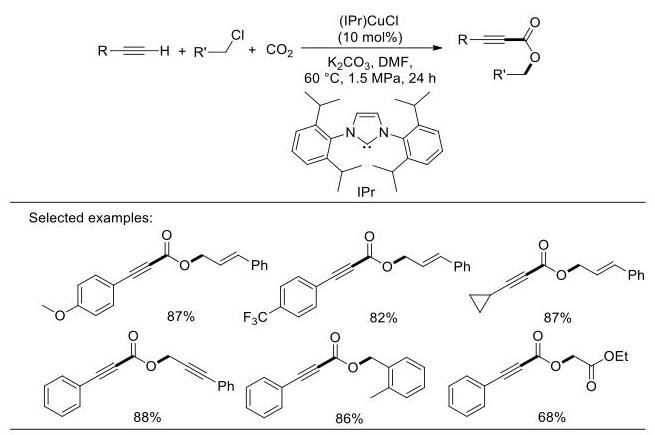
Scheme 2. (IPr)CuCl-catalyzed carboxylative coupling reaction of terminal alkynes[28]
方案2. (IPr)CuCl催化的末端炔烃的羧基化偶联反应[28]
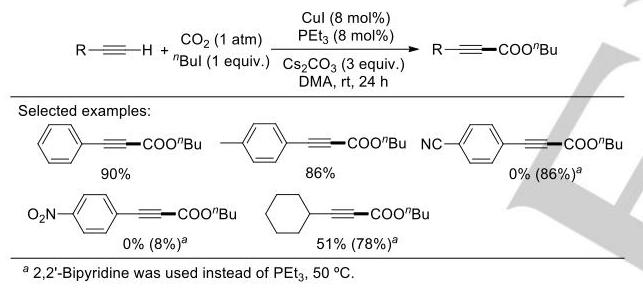
Scheme 3. Cul/PEt3-catalyzed carboxylative coupling reaction of terminal alkynes[30]
方案3. Cul/PEt3催化的末端炔烃的羧基化偶联反应[30]
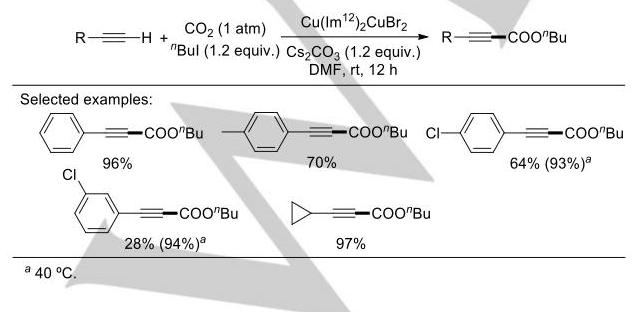
Scheme 4. Copper(I)-based ionic liquid-catalyzed carboxylative coupling reaction of terminal alkynes ${}^{\left\lbrack {31}\right\rbrack }$
方案4. 基于铜(I)的离子液体催化的末端炔烃的羧基化偶联反应${}^{\left\lbrack {31}\right\rbrack }$
The most commonly used solvents in the carboxylative coupling reactions of terminal alkynes, haloalkanes and ${\mathrm{{CO}}}_{2}$ are DMF and DMA. However, these solvents are often environmentally unfriendly. In 2013, He and coworkers[32] found that ethylene carbonate was an ideal solvent for the carboxylative coupling reaction of terminal alkynes (Scheme 5a). Ethylene carbonate has the advantages of strong solubility and low toxicity. DFT calculations show that the use of ethylene carbonate as solvent can greatly reduce the energy barrier for ${\mathrm{{CO}}}_{2}$ insertion into the Cu-C(sp) bond. Ethylene carbonate was thought to act as a potential ligand, as the reaction does not require any external ligands. Based on this work, He and coworkers[33] further developed a carboxylative coupling reaction of terminal alkynes catalyzed by activated carbon-supported CuBr (Scheme 5b). This reaction also used ethylene carbonate as solvent. Hot filtration experiment demonstrates that this reaction most likely occurs on the surface of a heterogeneous catalyst which can be reused at least five times without substantial inactivation. Notably, the catalyst on the second and third reuse performed slightly better than the freshly prepared catalyst. A possible reason was proposed according to X-ray photoelectron spectroscopy (XPS) characterization: Divalent copper species on the surface of the catalyst may be reduced to monovalent copper under the reaction conditions.
在末端炔烃、卤代烃和${\mathrm{{CO}}}_{2}$的羧基化偶联反应中,最常用的溶剂是N, N-二甲基甲酰胺和N, N-二甲基乙酰胺。然而,这些溶剂通常对环境不友好。2013年,何及其同事[32]发现碳酸亚乙酯是末端炔烃羧基化偶联反应的理想溶剂(方案5a)。碳酸亚乙酯具有溶解度强和毒性低的优点。密度泛函理论计算表明,使用碳酸亚乙酯作为溶剂可以大大降低${\mathrm{{CO}}}_{2}$插入Cu-C(sp)键的能垒。碳酸亚乙酯被认为起到了潜在配体的作用,因为该反应不需要任何外部配体。基于这项工作,何及其同事[33]进一步开发了由活性炭负载的CuBr催化的末端炔烃的羧基化偶联反应(方案5b)。该反应也使用碳酸亚乙酯作为溶剂。热过滤实验表明,该反应很可能发生在非均相催化剂的表面,该催化剂可以重复使用至少五次而不会显著失活。值得注意的是,第二次和第三次重复使用的催化剂的性能略优于新制备的催化剂。根据X射线光电子能谱(XPS)表征提出了一个可能的原因:催化剂表面的二价铜物种在反应条件下可能被还原为一价铜。
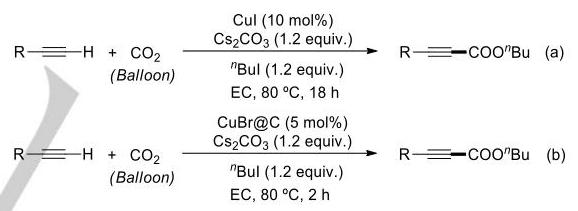
Scheme 5. Cu(I)-catalyzed carboxylative coupling reaction of terminal alkynes in ethylene carbonate[32-33]
方案5. Cu(I)催化的末端炔烃在碳酸亚乙酯中的羧基化偶联反应[32 - 33]
2.1.2. Ag(I)-catalyzed carboxylative coupling reaction of terminal alkynes, alkyl halides, and CO2
2.1.2. 末端炔烃、卤代烃与二氧化碳的银(I)催化羧基化偶联反应
In 2012, based on their previous work[34], Lu and coworkers also reported carboxylative coupling reactions of terminal alkynes, chlorides, and ${\mathrm{{CO}}}_{2}$ catalyzed by Agl (Scheme 6a). ${}^{\left\lbrack {35}\right\rbrack }$ The amount of Agl can be as low as ${0.1}\mathrm{\;{mol}}\%$ . Kinetic studies demonstrated that the activity of the ${0.1}\mathrm{\;{mol}}\% \mathrm{{AgI}}/{\mathrm{{Cs}}}_{2}{\mathrm{{CO}}}_{3}$ catalytic system was significantly better than the previously reported 10 mol% (IPr) ${\mathrm{{CuCl}/K}}_{2}{\mathrm{{CO}}}_{3}$ system. Furthermore, in 2013, Lu and coworkers realized the sequential AgI-catalyzed carboxylative coupling/Ru-catalyzed cross-metathesis reactions for the synthesis of functionalized 2-alkynoates (Scheme 6b). ${}^{\left\lbrack {36}\right\rbrack }$
2012年,基于他们之前的工作[34],陆和同事还报道了由碘化银催化的末端炔烃、氯化物和${\mathrm{{CO}}}_{2}$的羧基化偶联反应(方案6a)。${}^{\left\lbrack {35}\right\rbrack }$ 碘化银的用量可低至${0.1}\mathrm{\;{mol}}\%$ 。动力学研究表明,${0.1}\mathrm{\;{mol}}\% \mathrm{{AgI}}/{\mathrm{{Cs}}}_{2}{\mathrm{{CO}}}_{3}$催化体系的活性明显优于先前报道的10 mol%(IPr)${\mathrm{{CuCl}/K}}_{2}{\mathrm{{CO}}}_{3}$体系。此外,2013年,陆和同事实现了用于合成官能化2-炔酸酯的连续碘化银催化羧基化偶联/钌催化交叉复分解反应(方案6b)。${}^{\left\lbrack {36}\right\rbrack }$
REVIEW
综述
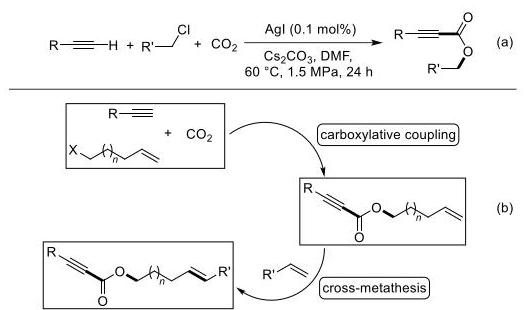
Scheme 6. Agl-catalyzed carboxylative coupling reaction of terminal alkynes ${}^{\left\lbrack {35}\right\rbrack }$ and related sequential reaction ${}^{\left\lbrack {36}\right\rbrack }$
方案6. 碘化银催化的末端炔烃${}^{\left\lbrack {35}\right\rbrack }$羧基化偶联反应及相关连续反应${}^{\left\lbrack {36}\right\rbrack }$
In 2015, He and coworkers[37] reported the carboxylative coupling reaction of terminal alkyne, $n$ -butyl iodide and ${\mathrm{{CO}}}_{2}$ catalyzed by ${\mathrm{{Ag}}}_{2}{\mathrm{{WO}}}_{4}$ (Scheme 7a). The reaction can be carried out under very mild conditions: room temperature,1 atm of ${\mathrm{{CO}}}_{2}$ , without using any external ligands. They believe the catalyst is bifunctional: silver(I) activates C≡C triple bond, while tungstate anion activates ${\mathrm{{CO}}}_{2}$ , as verified by ${}^{13}\mathrm{C}$ NMR. In addition, they also successfully achieved the one-pot sequential phenylacetylene carboxylative coupling and hydroamination reaction (Scheme 7b). There are some other Ag-catalyzed carboxylative coupling reaction of terminal alkynes developed in recent years. ${}^{\left\lbrack {38} - {39}\right\rbrack }$
2015年,何和同事[37]报道了由${\mathrm{{Ag}}}_{2}{\mathrm{{WO}}}_{4}$催化的末端炔烃、$n$-碘丁烷和${\mathrm{{CO}}}_{2}$的羧基化偶联反应(方案7a)。该反应可以在非常温和的条件下进行:室温,1个大气压的${\mathrm{{CO}}}_{2}$,无需使用任何外部配体。他们认为该催化剂具有双功能:银(I)活化碳碳三键,而钨酸根阴离子活化${\mathrm{{CO}}}_{2}$,这已通过${}^{13}\mathrm{C}$核磁共振得到证实。此外,他们还成功实现了一锅法连续苯乙炔羧基化偶联和氢胺化反应(方案7b)。近年来还开发了一些其他的银催化末端炔烃羧基化偶联反应。${}^{\left\lbrack {38} - {39}\right\rbrack }$
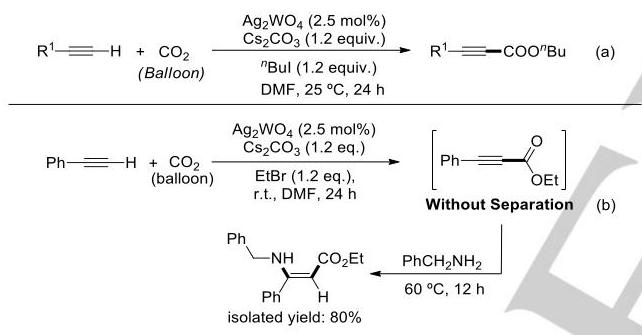
Scheme 7. ${\mathrm{{Ag}}}_{2}{\mathrm{{WO}}}_{4}$ -catalyzed carboxylative coupling reaction of terminal alkynes and related sequential reaction ${}^{\left\lbrack {37}\right\rbrack }$
方案7. ${\mathrm{{Ag}}}_{2}{\mathrm{{WO}}}_{4}$催化的末端炔烃羧基化偶联反应及相关连续反应${}^{\left\lbrack {37}\right\rbrack }$
2.1.3. Au(I)-catalyzed carboxylative coupling reaction of terminal alkynes, alkyl halides, and CO2
2.1.3. 金(I)催化的末端炔烃、卤代烃与二氧化碳的羧基化偶联反应
In 2008, Anastas and coworkers[40] found that Aul can catalyze the carboxylative coupling of phenylacetylene, 1-bromo-2- pentyne and ${\mathrm{{CO}}}_{2}$ to give 1,6-diyne (Scheme 8).
2008年,阿纳斯塔斯及其同事[40]发现,一价金可以催化苯乙炔、1-溴-2-戊炔和${\mathrm{{CO}}}_{2}$的羧基化偶联反应,生成1,6-二炔(方案8)。
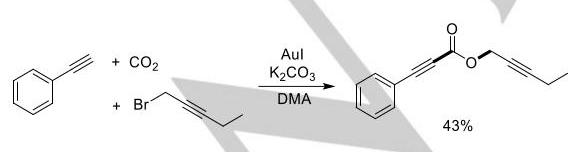
Scheme 8. Aul-catalyzed carboxylative coupling reaction of phenylacetylene ${}^{\left\lbrack {40}\right\rbrack }$
方案8. 一价金催化的苯乙炔${}^{\left\lbrack {40}\right\rbrack }$的羧基化偶联反应
2.2. Carboxylation of terminal alkynes with ${\mathrm{{CO}}}_{2}$
2.2. 末端炔烃与${\mathrm{{CO}}}_{2}$的羧基化反应
2.2.1. Cu(I)-catalyzed carboxylation of terminal alkynes with ${\mathrm{{CO}}}_{2}$
2.2.1. 铜(I)催化的末端炔烃与${\mathrm{{CO}}}_{2}$的羧化反应
In 2010, Gooßen ${}^{\left\lbrack {41}\right\rbrack }$ and Zhang ${}^{\left\lbrack {42}\right\rbrack }$ almost simultaneously reported the catalytic carboxylation of terminal alkynes catalyzed by $\mathrm{{Cu}}\left( \mathrm{I}\right)$ complexes. In Gooßen’s report, it is necessary to use different catalytic systems for aromatic and aliphatic alkynes (Scheme 9). Ethers, halogens, trifluoromethyl group and alkenyl group are all compatible, while unprotected amino group and hydroxyl group are not. In Zhang’s report, the choice of ligand, base and temperature has a large influence on the reaction outcome (Scheme 10). Interestingly, they found that by using the CuCl-TMEDA system, the reaction proceeds in the absence of any basic additives. For most terminal alkynes, good yields can be obtained with the CuCl-TMEDA system. For the very inert 4- nitrophenylacetylene, the use of CuCl-TMEDA system gives lower yields, while using poly-N-heterocyclic carbene (PNHC) as ligands gives good results. The scope of substrates for the reaction is wide and the conditions are mild (room temperature, 1 atm of ${\mathrm{{CO}}}_{2}$ ). It is worth mentioning that when the ratio of $\mathrm{{CuCl}}$ and PNHC ligands is 1:2, the performance of catalyst $\mathrm{P}{\left( \mathrm{{NHC}}\right) }_{0.5}{\left( \mathrm{{NHC}} - \mathrm{{Cu}}\right) }_{0.5}$ is better than that of the catalyst at 3:2 ratio. This result shows that the free carbene species in the catalyst plays an important role in the reaction. It is proposed that the key to extremely high catalytic activity is that organic catalysts (NHC) and organometallic catalysts operate synergistically in one system. In 2014, Wang, Zhang and coworkers[43] calculated the possible mechanism of the carboxylation of terminal alkynes with ${\mathrm{{CO}}}_{2}$ catalyzed by $\mathrm{{Cu}}\left( \mathrm{I}\right) - \mathrm{{NHC}}$ complexes and the role of $\mathrm{{NHC}}$ through DFT calculations. In 2015, Trivedi and coworkers[44] reported the carboxylation of terminal alkynes with ${\mathrm{{CO}}}_{2}$ catalyzed by ferrocene-based bisphosphine ligand and Cul Complex C (Scheme 11). The structure of catalyst C was confirmed by X-ray crystal diffraction. In 2017, Beletskaya and coworkers ${}^{\left\lbrack {45}\right\rbrack }$ first used ${\mathrm{{Al}}}_{2}{\mathrm{O}}_{3}$ -supported copper particles to catalyze the direct carboxylation of various terminal alkynes with ${\mathrm{{CO}}}_{2}$ . The catalyst is heterogeneous, highly active, easily available, and recyclable.
2010年,古森${}^{\left\lbrack {41}\right\rbrack }$和张${}^{\left\lbrack {42}\right\rbrack }$几乎同时报道了由$\mathrm{{Cu}}\left( \mathrm{I}\right)$配合物催化的末端炔烃的催化羧化反应。在古森的报告中,对于芳香族和脂肪族炔烃需要使用不同的催化体系(方案9)。醚、卤素、三氟甲基和烯基都具有兼容性,而未保护的氨基和羟基则不兼容。在张的报告中,配体、碱和温度的选择对反应结果有很大影响(方案10)。有趣的是,他们发现通过使用CuCl-TMEDA体系,反应在没有任何碱性添加剂的情况下进行。对于大多数末端炔烃,使用CuCl-TMEDA体系可以获得良好的产率。对于非常惰性的4-硝基苯乙炔,使用CuCl-TMEDA体系产率较低,而使用聚-N-杂环卡宾(PNHC)作为配体则能得到良好的结果。该反应的底物范围广泛且条件温和(室温,${\mathrm{{CO}}}_{2}$ 1个大气压)。值得一提的是,当$\mathrm{{CuCl}}$与PNHC配体的比例为1:2时,催化剂$\mathrm{P}{\left( \mathrm{{NHC}}\right) }_{0.5}{\left( \mathrm{{NHC}} - \mathrm{{Cu}}\right) }_{0.5}$的性能优于比例为3:2时的催化剂。这一结果表明催化剂中的游离卡宾物种在反应中起着重要作用。有人提出,极高催化活性的关键在于有机催化剂(NHC)和有机金属催化剂在一个体系中协同作用。2014年,王、张及其同事[43]通过密度泛函理论计算了$\mathrm{{Cu}}\left( \mathrm{I}\right) - \mathrm{{NHC}}$配合物催化末端炔烃与${\mathrm{{CO}}}_{2}$羧化反应的可能机理以及$\mathrm{{NHC}}$的作用。2015年,特里维迪及其同事[44]报道了由二茂铁基双膦配体和Cul配合物C催化的末端炔烃与${\mathrm{{CO}}}_{2}$的羧化反应(方案11)。催化剂C的结构通过X射线晶体衍射得到证实。2017年,别列茨卡娅及其同事${}^{\left\lbrack {45}\right\rbrack }$首次使用${\mathrm{{Al}}}_{2}{\mathrm{O}}_{3}$负载的铜颗粒催化各种末端炔烃与${\mathrm{{CO}}}_{2}$的直接羧化反应。该催化剂是多相的,活性高,易于获得且可回收。
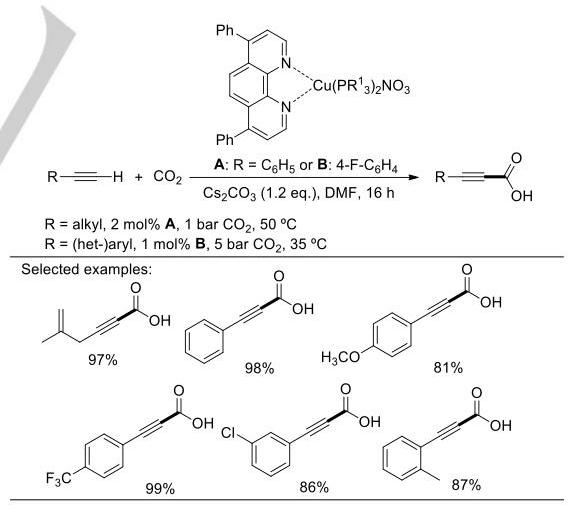
Scheme 9. Copper(I) complexes-catalyzed carboxylation of terminal alkynes reported by Gooßen and co-workers[41]
方案9. 古森及其同事[41]报道的铜(I)配合物催化的末端炔烃羧化反应
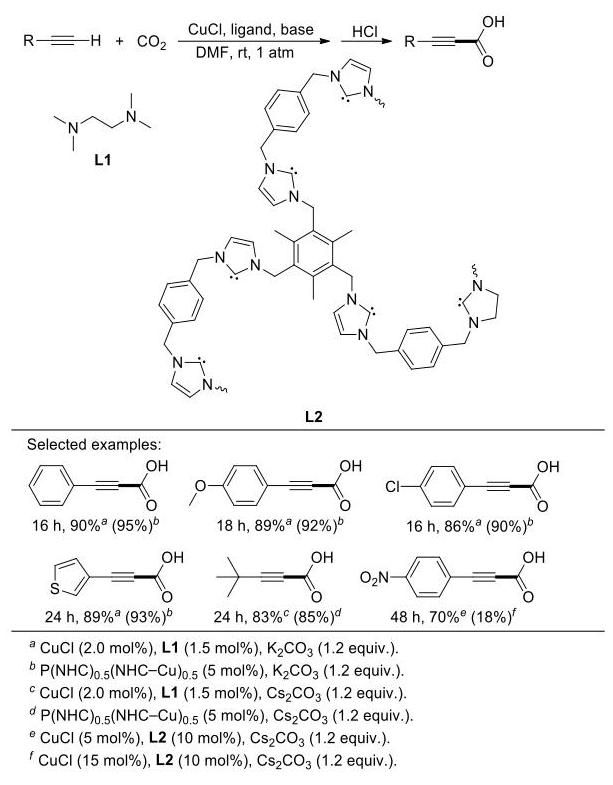
Scheme 10. Copper(I) complexes-catalyzed carboxylation of terminal alkynes reported by Zhang and co-workers[42]
方案10. 张及其同事[42]报道的铜(I)配合物催化的末端炔烃羧化反应
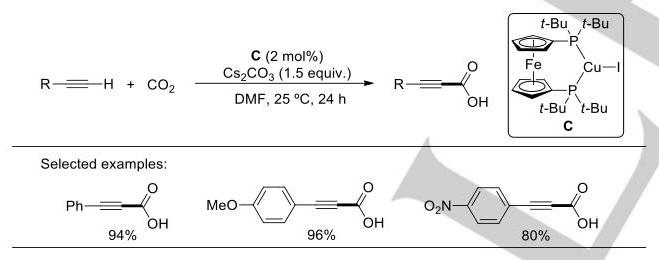
Scheme 11. Complex C-catalyzed carboxylation of terminal alkynes[44]
方案11. 配合物C催化的末端炔烃羧化反应[44]
In 2018, Gooßen and coworkers[46] reported the salt-free copper-catalyzed carboxylation of terminal alkynes with ${\mathrm{{CO}}}_{2}$ (Scheme 12). The reaction utilizes a copper(I) catalyst which enables the insertion of carbon dioxide into alkyne $\mathrm{C} - \mathrm{H}$ bonds by using 2,2,6,6-tetramethylpiperidine (TMP) as the base. The ammonium alkynecarboxylate can be hydrogenated to the primary alcohol and water by a rhodium/molybdenum catalyst, regenerating the amine base.
2018年,古森及其同事[46]报道了无盐铜催化的末端炔烃与${\mathrm{{CO}}}_{2}$的羧化反应(方案12)。该反应使用铜(I)催化剂,通过使用2,2,6,6-四甲基哌啶(TMP)作为碱,使二氧化碳插入炔烃$\mathrm{C} - \mathrm{H}$键中。炔烃羧酸盐铵可以通过铑/钼催化剂氢化为伯醇和水,使胺碱再生。
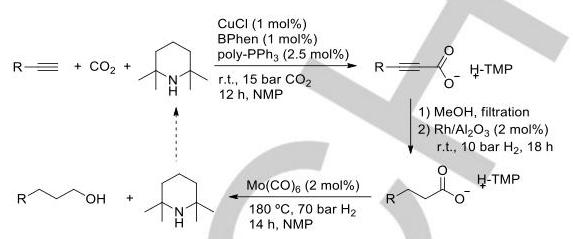
Scheme 12. The salt-free copper-catalysed carboxylation of terminal alkynes with ${\mathrm{{CO}}}_{2}{}^{\left\lbrack {46}\right\rbrack }$
方案12. 无盐铜催化的末端炔烃与${\mathrm{{CO}}}_{2}{}^{\left\lbrack {46}\right\rbrack }$的羧化反应
2.2.2. Ag(I)-catalyzed carboxylation of terminal alkynes with ${\mathrm{{CO}}}_{2}$
2.2.2. 用${\mathrm{{CO}}}_{2}$对末端炔烃进行银(I)催化的羧基化反应
In 2011, Lu and coworkers[34] reported an Agl-catalyzed direct carboxylation of terminal alkynes with ${\mathrm{{CO}}}_{2}$ (Scheme 13a). The optimal amount of Agl is 1 mol%, while increasing the amount of catalyst to 20 mol% decreases the yield. It was reasoned that the catalyst can promote both carboxylation and decarboxylation reactions. This reaction does not require any external ligands which will reduce product yield instead. In 2014, Luo and Zhang and coworkers[47] studied the mechanism of silver-catalyzed carboxylation ${}^{\left\lbrack {34}\right\rbrack }$ of phenylacetylene with ${\mathrm{{CO}}}_{2}$ through DFT calculations. The calculated results show the true catalytically active species is a ${\mathrm{{CsCO}}}_{3}$ -coordinated Ag complex rather than neutral alkynyl silver species. Through theoretical calculations, they also explained the experimentally observed inhibition of the reaction by organic ligands. In 2012, Gooßen and coworkers[48] reported a catalytic system analogous to Lu and coworkers (Scheme 13b). In their report, the amount of Ag(I) catalyst used can be as low as 500 ppm. In 2014, Hong and coworkers[49] found that combusted exhaust gas can be used for organic reactions related to ${\mathrm{{CO}}}_{2}$ after capturing ${\mathrm{{CO}}}_{2}$ in aqueous ethanolamine solution. Successfully combining the capture and utilization of ${\mathrm{{CO}}}_{2}$ , this strategy was applied to the direct carboxylation of terminal alkynes catalyzed by Agl (Scheme 13c). Similar results were obtained using ${\mathrm{{CO}}}_{2}$ in the combusted exhaust gas and directly using hyper-pure ${\mathrm{{CO}}}_{2}$ . Notably, even though the aqueous ethanolamine solution was reused 55 times, the yield of the reaction was still not significantly reduced.
2011年,陆及其同事[34]报道了AgI催化的末端炔烃与${\mathrm{{CO}}}_{2}$的直接羧化反应(方案13a)。AgI的最佳用量为1 mol%,而将催化剂用量增加到20 mol%会降低产率。据推测,该催化剂可以促进羧化反应和脱羧反应。该反应不需要任何会降低产物产率的外部配体。2014年,罗、张及其同事[47]通过DFT计算研究了银催化的苯乙炔与${\mathrm{{CO}}}_{2}$羧化反应${}^{\left\lbrack {34}\right\rbrack }$的机理。计算结果表明,真正的催化活性物种是${\mathrm{{CsCO}}}_{3}$配位的Ag配合物,而不是中性炔基银物种。通过理论计算,他们还解释了实验观察到的有机配体对反应的抑制作用。2012年,古森及其同事[48]报道了一种与陆及其同事类似的催化体系(方案13b)。在他们的报告中,所用Ag(I)催化剂的量可低至500 ppm。2014年,洪及其同事[49]发现,燃烧废气在乙醇胺水溶液中捕获${\mathrm{{CO}}}_{2}$后可用于与${\mathrm{{CO}}}_{2}$相关的有机反应。成功地将${\mathrm{{CO}}}_{2}$的捕获和利用相结合,该策略被应用于AgI催化的末端炔烃的直接羧化反应(方案13c)。使用燃烧废气中的${\mathrm{{CO}}}_{2}$和直接使用超纯${\mathrm{{CO}}}_{2}$得到了相似的结果。值得注意的是,即使乙醇胺水溶液重复使用55次,反应产率仍未显著降低。
In 2014, Jover and Maseras[50] used DFT calculations to study the mechanism of the copper-, silver- and gold-catalyzed carboxylation of terminal alkynes with ${\mathrm{{CO}}}_{2}$ . They found the catalytic systems of these three metals all experienced similar reaction pathways: coordination of alkyne and metal, deprotonation with an external base, and nucleophilic attack on the ${\mathrm{{CO}}}_{2}$ molecule by the metal-acetylide complex.
2014年,Jover和Maseras[50]用DFT计算研究了铜、银和金催化的末端炔烃与${\mathrm{{CO}}}_{2}$的羧基化反应机理。他们发现这三种金属的催化体系都经历了相似的反应途径:炔烃与金属配位、用外部碱去质子化以及金属炔化物络合物对${\mathrm{{CO}}}_{2}$分子的亲核进攻。
In 2016, Fang and Zhou and coworkers ${}^{\left\lbrack {51}\right\rbrack }$ reported the carboxylation of terminal alkynes with ${\mathrm{{CO}}}_{2}$ catalyzed by the $\mathrm{{Ag}}\left( \mathrm{I}\right) -$ NHC complex (Scheme 14). In 2012, Zhang and coworkers developed a PNHC-supported silver nanoparticle catalyst system ${}^{\left\lbrack {52}\right\rbrack }$ based on their previous ${\text{ work }}^{\left\lbrack {42}\right\rbrack }$ . Similar to the Cu(I)-PNHC system, this system can also efficiently catalyze the carboxylation of terminal alkynes at room temperature under 1 atm of ${\mathrm{{CO}}}_{2}$ . A mechanism involving similar synergistic effects of organic catalyst (NHC) and organometallic catalyst was proposed. As a heterogeneous catalytic system, the catalyst can be easily recovered and reused. Later they developed NHC-Ag/Pd-catalyzed reductive carboxylation of terminal alkynes with ${\mathrm{{CO}}}_{2}$ and ${\mathrm{H}}_{2}.{}^{\left\lbrack {53}\right\rbrack }$ In 2014, Finashina and coworkers ${}^{\left\lbrack {54}\right\rbrack }$ reported an Ag/F-Al ${}_{2}{\mathrm{O}}_{3}$ -catalyzed carboxylation of phenylacetylene with ${\mathrm{{CO}}}_{2}$ in 62.1% yield.
2016年,Fang、Zhou及其同事${}^{\left\lbrack {51}\right\rbrack }$报道了用$\mathrm{{Ag}}\left( \mathrm{I}\right) -$ NHC络合物催化末端炔烃与${\mathrm{{CO}}}_{2}$的羧基化反应(方案14)。2012年,Zhang及其同事在他们之前的${\text{ work }}^{\left\lbrack {42}\right\rbrack }$基础上开发了一种PNHC负载的银纳米颗粒催化剂体系${}^{\left\lbrack {52}\right\rbrack }$。与Cu(I)-PNHC体系类似,该体系也能在1 atm的${\mathrm{{CO}}}_{2}$下于室温下高效催化末端炔烃的羧基化反应。提出了一种涉及有机催化剂(NHC)和有机金属催化剂类似协同效应的机理。作为一种多相催化体系,该催化剂易于回收和重复使用。后来他们开发了NHC-Ag/Pd催化的末端炔烃与${\mathrm{{CO}}}_{2}$和${\mathrm{H}}_{2}.{}^{\left\lbrack {53}\right\rbrack }$ 的还原羧基化反应。2014年,Finashina及其同事${}^{\left\lbrack {54}\right\rbrack }$报道了Ag/F-Al ${}_{2}{\mathrm{O}}_{3}$催化苯乙炔与${\mathrm{{CO}}}_{2}$的羧基化反应产率为62.1%。
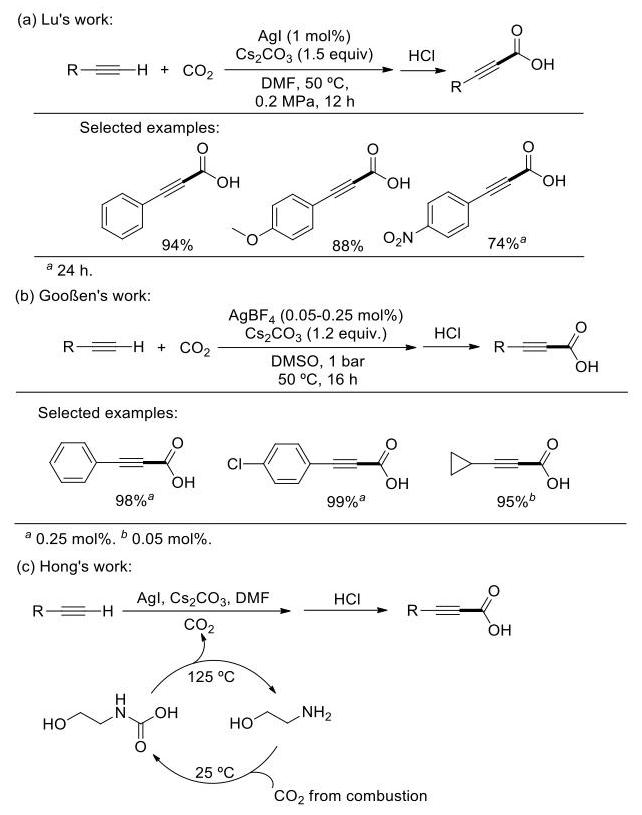
Scheme 13. Ligand-free Ag(I)-catalyzed carboxylation of terminal alkynes[34,48- 49]
方案13. 无配体银(I)催化的末端炔烃羧基化反应[34,48 - 49]
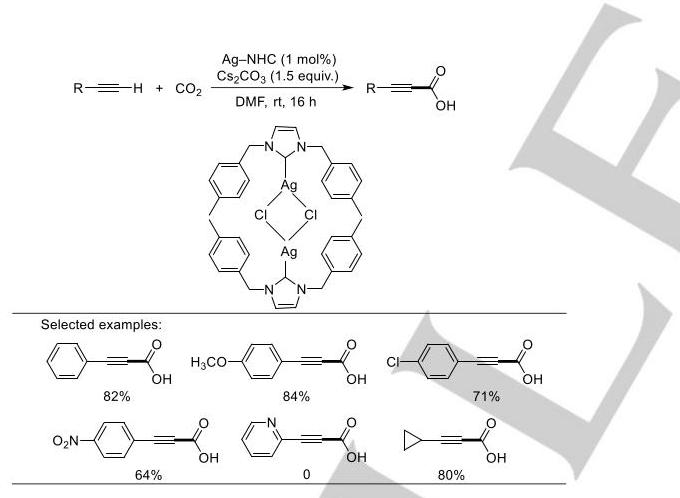
Scheme 14. Ag-NHC complex-catalyzed carboxylation of terminal alkynes[51]
方案14. Ag-NHC配合物催化的末端炔烃羧化反应[51]
In 2015, Ma, Cheng and coworkers[55] reported the carboxylation of terminal alkynes with ${\mathrm{{CO}}}_{2}$ catalyzed by Ag@ MIL-101, silver nanoparticles supported by metal-organic frameworks (MOFs) MIL-101. The dual-functional catalytic material can achieve ${\mathrm{{CO}}}_{2}$ capture and high-efficiency conversion at the same time at ${50}^{ \circ }\mathrm{C}$ under 1 atm of ${\mathrm{{CO}}}_{2}$ . As a heterogeneous catalyst, Ag@MIL-101 can be easily separated from the reaction solution by centrifugation. This catalyst can be reused at least five times without significant reduction in catalytic activity. They believe the larger pore size of the MOF carrier favors the diffusion of metal precursor ${\mathrm{{AgNO}}}_{3}$ and the deposition of $\mathrm{{Ag}}$ nanoparticles. In addition, the MOF carrier also plays an important role in the efficient performance of the catalytic reaction: it is an excellent material for the adsorption of ${\mathrm{{CO}}}_{2}$ and can increase local ${\mathrm{{CO}}}_{2}$ concentration in the catalytic center; the framework and pores can be used as a “microreactor” to provide a favorable reaction environment; MOF structure can stabilize the overall catalytic material. Islam, Bhaumik and coworkers[56] reported the carboxylation of terminal alkynes with ${\mathrm{{CO}}}_{2}$ catalyzed by $\mathrm{{Ag}}$ nanoparticles supported over a bivalent cobalt-based MOF carrier. In 2017, Ma and coworkers[57] utilized Ag@MIL-100(Fe) and Ag@UIO-66(Zr) materials for the capture and transformation of ${\mathrm{{CO}}}_{2}$ into alkynyl carboxylic acids. The influence on the catalytic activity of such Ag@MOF systems were compared and discussed systematically. They supposed that acid-base properties of the MOF influence the catalytic activity of Ag@MOF system significantly. Stronger Lewis acidity favors adsorption of aromatic substrates and activation of the C≡C group, while stronger Lewis basicity is beneficial for the capture of ${\mathrm{{CO}}}_{2}$ and the loading of AgNPs. There are many other Ag-catalyzed carboxylation of terminal alkynes developed in recent years. ${}^{\left\lbrack {58} - {62}\right\rbrack }$
2015年,马、程及其同事[55]报道了由金属有机框架(MOF)MIL-101负载的银纳米颗粒Ag@MIL-101催化的末端炔烃与${\mathrm{{CO}}}_{2}$的羧化反应。这种双功能催化材料能够在1个大气压的${\mathrm{{CO}}}_{2}$下于${50}^{ \circ }\mathrm{C}$同时实现${\mathrm{{CO}}}_{2}$捕获和高效转化。作为一种多相催化剂,Ag@MIL-101可以通过离心轻松地从反应溶液中分离出来。这种催化剂可以重复使用至少五次,而催化活性没有明显降低。他们认为MOF载体较大的孔径有利于金属前驱体${\mathrm{{AgNO}}}_{3}$的扩散以及$\mathrm{{Ag}}$纳米颗粒的沉积。此外,MOF载体在催化反应的高效性能方面也起着重要作用:它是吸附${\mathrm{{CO}}}_{2}$的优良材料,并且可以提高催化中心处的局部${\mathrm{{CO}}}_{2}$浓度;其框架和孔可以用作“微反应器”以提供有利的反应环境;MOF结构可以稳定整个催化材料。伊斯兰、鲍米克及其同事[56]报道了由二价钴基MOF载体负载的$\mathrm{{Ag}}$纳米颗粒催化的末端炔烃与${\mathrm{{CO}}}_{2}$的羧化反应。2017年,马及其同事[57]利用Ag@MIL-100(Fe)和Ag@UIO-66(Zr)材料将${\mathrm{{CO}}}_{2}$捕获并转化为炔基羧酸。系统地比较和讨论了此类Ag@MOF体系对催化活性的影响。他们推测MOF的酸碱性质对Ag@MOF体系的催化活性有显著影响。更强的路易斯酸性有利于芳香族底物的吸附和C≡C基团的活化,而更强的路易斯碱性有利于${\mathrm{{CO}}}_{2}$的捕获和AgNPs的负载。近年来还开发了许多其他Ag催化的末端炔烃羧化反应。${}^{\left\lbrack {58} - {62}\right\rbrack }$
2.2.3. Other metal-catalyzed carboxylation of terminal alkynes with ${\mathrm{{CO}}}_{2}$
2.2.3. 其他金属催化的末端炔烃与${\mathrm{{CO}}}_{2}$的羧基化反应
In 2015, Zhao, Yao and coworkers[63] reported the direct carboxylation of terminal alkynes with ${\mathrm{{CO}}}_{2}$ catalyzed by rare-earth metal complexes (Scheme 15). The structures of the three rare-earth metal complexes were confirmed by X-ray crystal diffraction. Among the three rare-earth metal complexes, Nd-based catalyst D showed the best activity. Phenylacetylene substrates with either an electron-donating group or an electron-withdrawing group afford the product in high yields, while aliphatic alkynes fail to deliver the expected product. The mechanism was proposed as similar to that of monovalent copper or silver salt catalysts.
2015年,赵、姚及其同事[63]报道了稀土金属配合物催化末端炔烃与${\mathrm{{CO}}}_{2}$的直接羧基化反应(方案15)。通过X射线晶体衍射确定了三种稀土金属配合物的结构。在这三种稀土金属配合物中,基于钕的催化剂D表现出最佳活性。带有供电子基团或吸电子基团的苯乙炔底物都能高产率地得到产物,而脂肪族炔烃则未能得到预期产物。其反应机理被认为与一价铜或银盐催化剂的相似。
REVIEW
综述
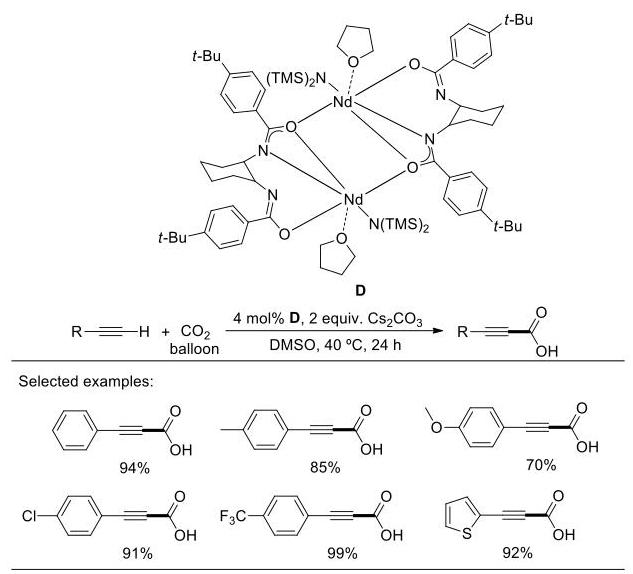
Scheme 15. Complex D-catalyzed carboxylation of terminal alkynes[63]
方案15. 配合物D催化的末端炔烃羧基化反应[63]
In 2016, Trivedi, Rath and coworkers ${}^{\left\lbrack {64}\right\rbrack }$ reported the carboxylation of terminal alkynes with ${\mathrm{{CO}}}_{2}$ catalyzed by MIL-101 supported bimetallic Pd-Cu nanocrystals. In 2018, Ma, Cheng and coworkers[65] investigated the triply bonded dimolybdenum compound ${\mathrm{{Mo}}}_{2}{\left( {\mathrm{O}}^{\prime }\mathrm{{Bu}}\right) }_{6}$ as a homogeneous catalyst for the carboxylation of terminal alkynes with ${\mathrm{{CO}}}_{2}$ (Scheme 16). For the carboxylation of diethynylbenzenes, the asymmetric compounds were selectively obtained. Notably, this is the first report of the application of a metal-metal bond-containing species in the catalytic conversion of ${\mathrm{{CO}}}_{2}$ .
2016年,特里维迪、拉特及其同事${}^{\left\lbrack {64}\right\rbrack }$报道了MIL-101负载的双金属钯-铜纳米晶体催化末端炔烃与${\mathrm{{CO}}}_{2}$的羧基化反应。2018年,马、程及其同事[65]研究了三键双钼化合物${\mathrm{{Mo}}}_{2}{\left( {\mathrm{O}}^{\prime }\mathrm{{Bu}}\right) }_{6}$作为均相催化剂用于末端炔烃与${\mathrm{{CO}}}_{2}$的羧基化反应(方案16)。对于二乙炔基苯的羧基化反应,选择性地得到了不对称化合物。值得注意的是,这是含金属-金属键物种在${\mathrm{{CO}}}_{2}$催化转化中的首次应用报道。
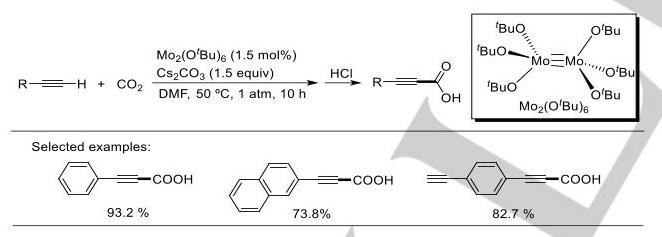
Scheme 16. ${\mathrm{{Mo}}}_{2}{\left( {\mathrm{O}}^{t}\mathrm{{Bu}}\right) }_{6}$ -catalyzed carboxylation of terminal alkynes with ${\mathrm{{CO}}}_{2}{}^{\left\lbrack {65}\right\rbrack }$
方案16. ${\mathrm{{Mo}}}_{2}{\left( {\mathrm{O}}^{t}\mathrm{{Bu}}\right) }_{6}$催化的末端炔烃与${\mathrm{{CO}}}_{2}{}^{\left\lbrack {65}\right\rbrack }$的羧基化反应
2.2.4. Transition-metal-free carboxylation of terminal alkynes with ${\mathrm{{CO}}}_{2}$
2.2.4. 末端炔烃与${\mathrm{{CO}}}_{2}$的无过渡金属羧基化反应
In 2001, Duñach and coworkers ${}^{\left\lbrack {66}\right\rbrack }$ employed electrochemical methods to convert terminal alkynes and ${\mathrm{{CO}}}_{2}$ to alkynyl carboxylic acids. For α,ω-diynes, this method can selectively give monocarboxylated products.
2001年,杜尼亚克及其同事${}^{\left\lbrack {66}\right\rbrack }$采用电化学方法将末端炔烃和${\mathrm{{CO}}}_{2}$转化为炔基羧酸。对于α,ω-二炔,该方法可选择性地得到单羧基化产物。
In 2011, Zhang and coworkers[67] reported the direct carboxylation of terminal alkynes with ${\mathrm{{CO}}}_{2}$ promoted by ${\mathrm{{Cs}}}_{2}{\mathrm{{CO}}}_{3}$ (Scheme 17). They found that the reaction temperature and pressure have significant effect on the reaction outcome: high temperature may cause decarboxylation side reactions; ${\mathrm{{CO}}}_{2}$ pressure is positively correlated with reaction rate. Both aromatic and aliphatic alkynes can undergo the carboxylation reaction smoothly. In 2013, Jang, Lee and coworkers[68] reported the direct carboxylation of terminal alkynes with ${\mathrm{{CO}}}_{2}$ mediated by 1,5,7-Triazabicyclo [4.4.0] dec-5- ene (TBD). When acetylene is used as the substrate, succinic acid salt can be obtained by catalytic hydrogenation with Pd/C after the carboxylation. Succinic acid can be used to produce some biodegradable polymers (such as polybutylene succinate). Similar to ethylene carbonate, supercritical carbon dioxide is also a green reaction medium. In 2014, Suo, Han and coworkers[69] found that 1, 8-diazabicyclo [5.4.0] undec-7-ene (DBU) can promote the reaction in supercritical carbon dioxide medium (Scheme 18). In addition to facilitating deprotonation of the terminal alkyne, DBU may also play a role in capturing ${\mathrm{{CO}}}_{2}$ . They also reported the carboxylation of terminal alkynes catalyzed by ${\mathrm{{Cul}}}^{\left\lbrack {69}\right\rbrack }$ or ${\mathrm{{AgOAc}}}^{\left\lbrack {70}\right\rbrack }$ in supercritical carbon dioxide medium (Scheme 18). The Liu group has also developed a CsF-promoted carboxylation of aryl(hetoaryl) terminal alkynes with ${\mathrm{{CO}}}_{2}$ (1 atm) ${}^{\left\lbrack {58}\right\rbrack }$ and sequential silylation and carboxylation strategy. ${}^{\left\lbrack {71}\right\rbrack }$
2011年,张及其同事[67]报道了在${\mathrm{{Cs}}}_{2}{\mathrm{{CO}}}_{3}$促进下末端炔烃与${\mathrm{{CO}}}_{2}$的直接羧基化反应(方案17)。他们发现反应温度和压力对反应结果有显著影响:高温可能导致脱羧副反应;${\mathrm{{CO}}}_{2}$压力与反应速率呈正相关。芳香族和脂肪族炔烃均可顺利进行羧基化反应。2013年,张、李及其同事[68]报道了1,5,7-三氮杂双环[4.4.0]癸-5-烯(TBD)介导的末端炔烃与${\mathrm{{CO}}}_{2}$的直接羧基化反应。以乙炔为底物时,羧基化反应后用钯/碳催化氢化可得到琥珀酸盐。琥珀酸可用于生产一些可生物降解的聚合物(如聚丁二酸丁二醇酯)。与碳酸亚乙酯类似,超临界二氧化碳也是一种绿色反应介质。2014年,索、韩及其同事[69]发现1,8-二氮杂双环[5.4.0]十一碳-7-烯(DBU)可在超临界二氧化碳介质中促进该反应(方案18)。除了促进末端炔烃的去质子化外,DBU可能还在捕获${\mathrm{{CO}}}_{2}$中发挥作用。他们还报道了在超临界二氧化碳介质中${\mathrm{{Cul}}}^{\left\lbrack {69}\right\rbrack }$或${\mathrm{{AgOAc}}}^{\left\lbrack {70}\right\rbrack }$催化的末端炔烃的羧基化反应(方案18)。刘课题组还开发了一种氟化铯促进的芳基(杂芳基)末端炔烃与${\mathrm{{CO}}}_{2}$(1个大气压)${}^{\left\lbrack {58}\right\rbrack }$的羧基化反应以及连续硅烷化和羧基化策略。${}^{\left\lbrack {71}\right\rbrack }$
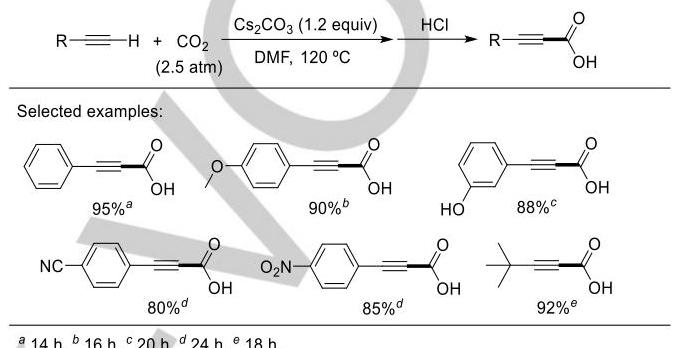
Scheme 17. ${\mathrm{{Cs}}}_{2}{\mathrm{{CO}}}_{3}$ -promoted carboxylation of terminal alkynes ${}^{\left\lbrack {67}\right\rbrack }$
方案17. ${\mathrm{{Cs}}}_{2}{\mathrm{{CO}}}_{3}$促进的末端炔烃的羧化反应${}^{\left\lbrack {67}\right\rbrack }$
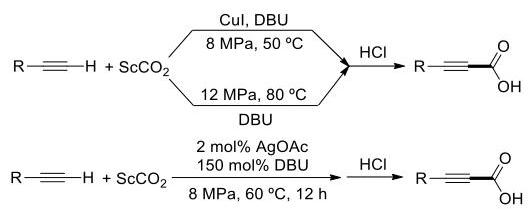
Scheme 18. Carboxylation of terminal alkynes in supercritical ${\mathrm{{CO}}}_{2}{}^{\left\lbrack {69} - {70}\right\rbrack }$
方案18. 超临界${\mathrm{{CO}}}_{2}{}^{\left\lbrack {69} - {70}\right\rbrack }$中末端炔烃的羧基化反应
2.3. Application of carboxylation of terminal alkynes with ${\mathrm{{CO}}}_{2}$ in the multicomponent synthesis of heterocycles
2.3. 末端炔烃与${\mathrm{{CO}}}_{2}$羧基化反应在多组分杂环合成中的应用
Compared with traditional multistep synthesis, multicomponent reactions avoid the separation and purification of intermediates, which has the advantages of significantly shortening reaction time and reducing waste generation. In recent years, considerable efforts have been made toward multicomponent reactions of ${\mathrm{{CO}}}_{2}$ .
与传统多步合成相比,多组分反应避免了中间体的分离和纯化,具有显著缩短反应时间和减少废物产生的优点。近年来,人们在${\mathrm{{CO}}}_{2}$的多组分反应方面付出了巨大努力。
REVIEW
综述
In 2008, Anastas and coworkers[40] reported Agl-catalyzed multicomponent reactions of phenylacetylene, propargylic bromide and ${\mathrm{{CO}}}_{2}$ . The 1,6-diyine produced by the carboxylative coupling reaction can afford an aryl naphthalene lactone via a [2+2+2] cyclization reaction (Scheme 19). In 2010, further improvements have been made to this reaction ${}^{\left\lbrack {72}\right\rbrack }$ and this approach has also been employed in the synthesis of six arylnaphthalene lactone natural products. ${}^{\left\lbrack {73}\right\rbrack }$ In 2014, Müller and coworkers[74] reported the carboxylation-methylation-Michael addition-cyclocondensation of terminal alkynes catalyzed by $\mathrm{{Cu}}{\left( {\mathrm{{PPh}}}_{3}\right) }_{3}{\mathrm{{NO}}}_{3}$ (Scheme 20). The multicomponent reaction can produce pyrimidones or 3- hydroxypyrazoles without isolation and purification of the intermediate propiolate. Recently, Xu, Gong and coworkers reported a similar reaction for 4H-quinolizin-4-one skeleton in the presence of EtBr. ${}^{\left\lbrack {75}\right\rbrack }$ In 2015, He and coworkers ${}^{\left\lbrack {76}\right\rbrack }$ reported CuCl/PPh3-catalyzed carboxylation-cyclization of terminal alkynes (Scheme 21). ${\mathrm{{PPh}}}_{3}$ is not only the ligand for the carboxylation step but also the catalyst for the second cyclization step. In 2016, Müller and coworkers[77] merged the copper-catalyzed carboxylation-propargylation of terminal alkynes with azido-alkyne cycloaddition to obtain a functionalized 1,2,3-triazole. At the same time, they also found that the above four-component reaction can be further integrated with a Michael reaction to develop a five-component reaction (Scheme 22). In 2016, Liang, Pan and coworkers ${}^{\left\lbrack {78}\right\rbrack }$ reported a copper-catalyzed carboxylative coupling/cycloaddition of terminal alkynes, 1,2-dibromoethane, ${\mathrm{{CO}}}_{2}$ and sodium azide similar to Müller’s reaction (Scheme 23).
2008年,阿纳斯塔斯及其同事[40]报道了碘化银催化的苯乙炔、炔丙基溴和${\mathrm{{CO}}}_{2}$的多组分反应。羧基化偶联反应生成的1,6-二炔烃可通过[2+2+2]环化反应得到芳基萘内酯(方案19)。2010年,该反应${}^{\left\lbrack {72}\right\rbrack }$得到了进一步改进,这种方法也被用于六种芳基萘内酯天然产物的合成。${}^{\left\lbrack {73}\right\rbrack }$ 2014年,米勒及其同事[74]报道了$\mathrm{{Cu}}{\left( {\mathrm{{PPh}}}_{3}\right) }_{3}{\mathrm{{NO}}}_{3}$催化的末端炔烃的羧基化-甲基化-迈克尔加成-环缩合反应(方案20)。该多组分反应无需分离和纯化中间体丙炔酸酯即可生成嘧啶酮或3-羟基吡唑。最近,徐、龚及其同事报道了在溴乙烷存在下对4H-喹嗪-4-酮骨架的类似反应。${}^{\left\lbrack {75}\right\rbrack }$ 2015年,何及其同事${}^{\left\lbrack {76}\right\rbrack }$报道了氯化铜/三苯基膦催化的末端炔烃的羧基化-环化反应(方案21)。${\mathrm{{PPh}}}_{3}$不仅是羧基化步骤的配体,也是第二步环化反应的催化剂。2016年,米勒及其同事[77]将铜催化的末端炔烃的羧基化-炔丙基化反应与叠氮基-炔烃环加成反应合并,得到了功能化的1,2,3-三唑。同时,他们还发现上述四组分反应可进一步与迈克尔反应整合,发展出五组分反应(方案22)。2016年,梁、潘及其同事${}^{\left\lbrack {78}\right\rbrack }$报道了与米勒反应类似的铜催化的末端炔烃、1,2-二溴乙烷、${\mathrm{{CO}}}_{2}$和叠氮化钠的羧基化偶联/环加成反应(方案23)。
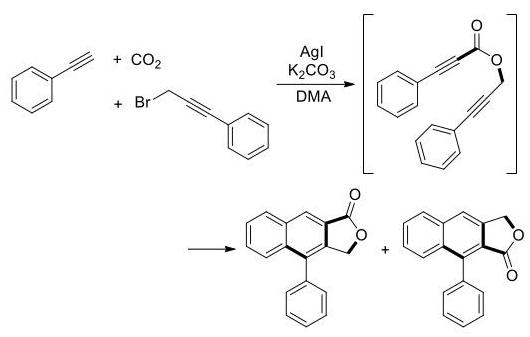
Scheme 19. Synthesis of arylnaphthalene lactones using the Agl-catalyzed muticomponent coupling reaction ${}^{\left\lbrack {40}\right\rbrack }$
方案19. 使用碘化银催化的多组分偶联反应${}^{\left\lbrack {40}\right\rbrack }$合成芳基萘内酯
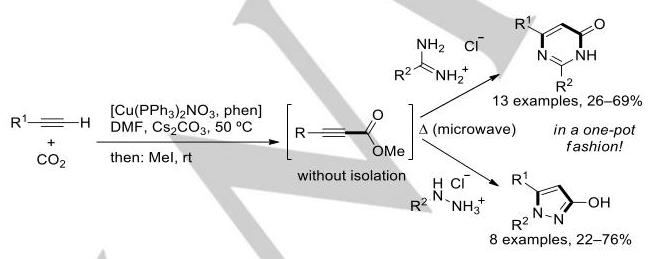
Scheme 20. One-pot synthesis of pyrimidones and 3-hydroxypyrazoles initiated by $\mathrm{{Cu}}\left( \mathrm{I}\right)$ -catalyzed carboxylation of terminal alkynes ${}^{\left\lbrack {74}\right\rbrack }$
方案20. 由$\mathrm{{Cu}}\left( \mathrm{I}\right)$催化的末端炔烃羧基化引发的嘧啶酮和3-羟基吡唑的一锅法合成${}^{\left\lbrack {74}\right\rbrack }$
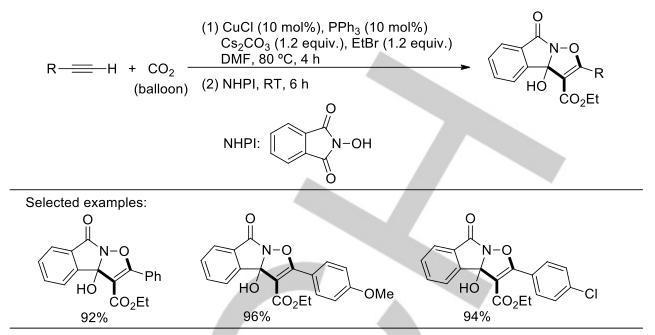
Scheme 21. Copper(I)/PPh3-catalyzed tandem carboxylation/annulation of terminal alkynes ${}^{\left\lbrack {76}\right\rbrack }$
方案21. 铜(I)/三苯基膦催化的末端炔烃串联羧基化/环化反应${}^{\left\lbrack {76}\right\rbrack }$
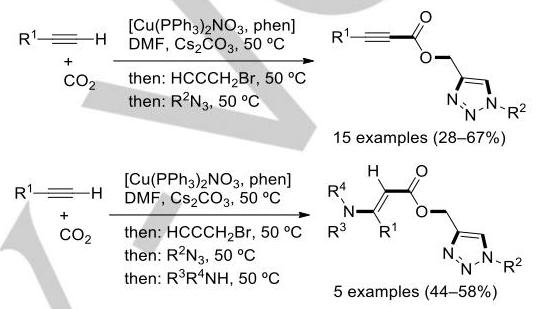
Scheme 22. Copper(I)-catalyzed sequential alkyne carboxylation-propargylation-azide cycloaddition and related five-component reaction[77]
方案22. 铜(I)催化的炔烃羧基化-炔丙基化-叠氮基环加成反应及相关五组分反应[77]
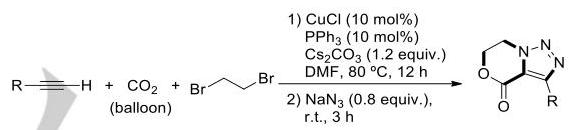
Scheme 23. Copper-catalyzed carboxylative coupling/cycloaddition of terminal alkynes,1,2-dibromoethane, ${\mathrm{{CO}}}_{2}$ and ${\mathrm{{NaN}}}_{3}{}^{\left\lbrack {78}\right\rbrack }$ In 2016, Liang, Pan and coworkers ${}^{\left\lbrack {79}\right\rbrack }$ reported a multicomponent heterocycle synthesis reaction of terminal alkynes, α-haloketones, and ${\mathrm{{CO}}}_{2}$ based on capture and utilization of ${\mathrm{{CO}}}_{2}$ (Scheme 24). Aqueous morpholine solution can be used as an adsorbent to directly capture ${\mathrm{{CO}}}_{2}$ from air. They believe this reaction goes through a copper-catalyzed carboxylative coupling and a base-mediated acyl shift/cyclization/decarbonylation sequence.
方案23. 铜催化的末端炔烃、1,2 - 二溴乙烷、${\mathrm{{CO}}}_{2}$和${\mathrm{{NaN}}}_{3}{}^{\left\lbrack {78}\right\rbrack }$的羧基化偶联/环加成反应。2016年,梁、潘及其同事${}^{\left\lbrack {79}\right\rbrack }$报道了一种基于${\mathrm{{CO}}}_{2}$的捕获和利用的末端炔烃、α - 卤代酮和${\mathrm{{CO}}}_{2}$的多组分杂环合成反应(方案24)。吗啉水溶液可用作吸附剂直接从空气中捕获${\mathrm{{CO}}}_{2}$。他们认为该反应通过铜催化的羧基化偶联以及碱介导的酰基转移/环化/脱羰序列进行。
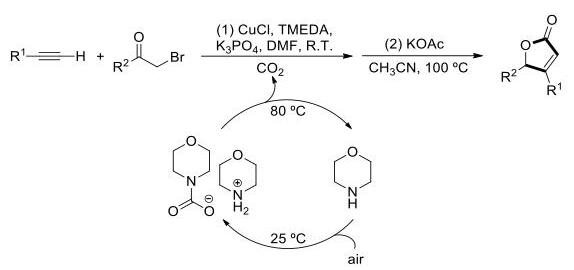
Scheme 24. Muticomponent reaction of terminal alkynes, α-haloketones and ${\mathrm{{CO}}}_{2}{}^{\left\lbrack {79}\right\rbrack }$
方案24. 末端炔烃、α - 卤代酮和${\mathrm{{CO}}}_{2}{}^{\left\lbrack {79}\right\rbrack }$的多组分反应
REVIEW
审核
2.4. Application of carboxylation of terminal alkynes with ${\mathrm{{CO}}}_{2}$ in the hydrothiolation of alkynes
2.4. 末端炔烃与${\mathrm{{CO}}}_{2}$羧基化反应在炔烃氢硫基化反应中的应用
Transition metal-catalyzed hydrothiolation of alkynes is an important method for the synthesis of vinyl sulfides. This reaction faces challenges of regioselectivity and stereoselectivity. In 2012, Ying, Zhang and coworkers ${}^{\left\lbrack {80}\right\rbrack }$ found that the stereoselectivity of the reaction can be modulated by changing the atmosphere under which the reaction proceeds (Scheme 25). Z-vinyl sulfides can be stereoselectively obtained under ${\mathrm{{CO}}}_{2}$ atmosphere, while $E$ -vinyl sulfides are mainly obtained under argon or air. A small amount of water can speed up the reaction. A possible reaction mechanism was proposed: in the ${\mathrm{{CO}}}_{2}$ atmosphere, the terminal alkynes can be converted into propiolate, and then a stereoselective decarboxylative hydrothiolation reaction occurs. Finally, the Z-vinyl sulfide is selectively obtained.
过渡金属催化的炔烃氢硫基化反应是合成乙烯基硫醚的重要方法。该反应面临区域选择性和立体选择性的挑战。2012年,Ying、Zhang及其同事${}^{\left\lbrack {80}\right\rbrack }$发现,通过改变反应进行的气氛可以调节反应的立体选择性(方案25)。在${\mathrm{{CO}}}_{2}$气氛下可以立体选择性地得到Z-乙烯基硫醚,而在氩气或空气气氛下主要得到$E$-乙烯基硫醚。少量水可以加速反应。提出了一种可能的反应机理:在${\mathrm{{CO}}}_{2}$气氛下,末端炔烃可以转化为丙炔酸酯,然后发生立体选择性脱羧氢硫基化反应。最终,选择性地得到Z-乙烯基硫醚。

Scheme 25. Stereoselective hydrothiolation of terminal alkynes[80]
方案25. 末端炔烃的立体选择性氢硫基化反应[80]
3. Carboxylation of $\mathrm{C}\left( {\mathrm{{sp}}}^{2}\right) - \mathrm{H}$ bonds with ${\mathrm{{CO}}}_{2}$
3. 用${\mathrm{{CO}}}_{2}$对$\mathrm{C}\left( {\mathrm{{sp}}}^{2}\right) - \mathrm{H}$键进行羧基化反应
3.1. Carboxylation of $\mathrm{C}\left( {\mathrm{{sp}}}^{2}\right) - \mathrm{H}$ bonds of (hetero)arenes with ${\mathrm{{CO}}}_{2}$
3.1. 用${\mathrm{{CO}}}_{2}$对(杂)芳烃的$\mathrm{C}\left( {\mathrm{{sp}}}^{2}\right) - \mathrm{H}$键进行羧基化反应
3.1.1. Chelation-free carboxylation of $\mathrm{C}\left( {\mathrm{{sp}}}^{2}\right) - \mathrm{H}$ bonds of (hetero)arenes with ${\mathrm{{CO}}}_{2}$
3.1.1. 用${\mathrm{{CO}}}_{2}$对(杂)芳烃的$\mathrm{C}\left( {\mathrm{{sp}}}^{2}\right) - \mathrm{H}$键进行无螯合羧基化反应
3.1.1.1. Transition-metal-catalyzed chelation-free carboxylation of $\mathrm{C}\left( {\mathrm{{sp}}}^{2}\right) - \mathrm{H}$ bonds of (hetero)arenes with ${\mathrm{{CO}}}_{2}$
3.1.1.1. 过渡金属催化的(杂)芳烃的$\mathrm{C}\left( {\mathrm{{sp}}}^{2}\right) - \mathrm{H}$键与${\mathrm{{CO}}}_{2}$的无螯合羧基化反应
In 1984, Fujiwara and coworkers ${}^{\left\lbrack {81}\right\rbrack }$ reported a divalent palladium-catalyzed direct carboxylation of aromatic compounds (benzene, anisole, furan, thiophene) with ${\mathrm{{CO}}}_{2}$ . The pressure of ${\mathrm{{CO}}}_{2}$ can be one atmosphere, but the catalyst has a low turnover number (TON) (for benzene, TON = ca. 1.3). In 2014, based on their previous work ${}^{\left\lbrack {82}\right\rbrack }$ , Iwasawa and coworkers reported the Rh(I)- catalyzed direct carboxylation of $\mathrm{C} - \mathrm{H}$ bonds of simple arenes with ${\mathrm{{CO}}}_{2}{}^{\left\lbrack {83}\right\rbrack }$ (Scheme 26). The use of bulky bidentate phosphine ligands and addition of 1,1,3,3-tetramethylurea (TMU) as a co-solvent may serve to stabilize the coordinatively unsaturated Rh(I) species. Both electron-rich and electron-deficient arenes can participate in this reaction (for benzene, TON = 37). Steric hindrance has a great influence on the regioselectivity of this reaction. For benzofuran and 1-methylindole, the reaction occurs selectively at the C-2 position. The reaction mechanism they proposed is similar to their previous work. ${}^{\left\lbrack {82}\right\rbrack }$ In 2017, Iwasawa and coworkers ${}^{\left\lbrack {84}\right\rbrack }$ studied the mechanism of rhodium-catalyzed carboxylation of simple aromatic compounds with ${\mathrm{{CO}}}_{2}$ . 14- Electron complexes, RhMe(dcype) and RhPh(dcype), participated in the $\mathrm{C} - \mathrm{H}$ bond activation step and the carboxylation step, respectively. Interestingly, the undesired carboxylation of
1984年,藤原及其同事${}^{\left\lbrack {81}\right\rbrack }$报道了二价钯催化的芳香族化合物(苯、苯甲醚、呋喃、噻吩)与${\mathrm{{CO}}}_{2}$的直接羧基化反应。${\mathrm{{CO}}}_{2}$的压力可以是一个大气压,但该催化剂的转换数(TON)较低(对于苯,TON约为1.3)。2014年,岩泽及其同事基于他们之前的工作${}^{\left\lbrack {82}\right\rbrack }$,报道了Rh(I)催化的简单芳烃的$\mathrm{C} - \mathrm{H}$键与${\mathrm{{CO}}}_{2}{}^{\left\lbrack {83}\right\rbrack }$的直接羧基化反应(方案26)。使用大位阻双齿膦配体并添加1,1,3,3-四甲基脲(TMU)作为共溶剂可能有助于稳定配位不饱和的Rh(I)物种。富电子和缺电子芳烃都可以参与该反应(对于苯,TON = 37)。空间位阻对该反应的区域选择性有很大影响。对于苯并呋喃和1-甲基吲哚,反应选择性地发生在C-2位。他们提出的反应机理与他们之前的工作${}^{\left\lbrack {82}\right\rbrack }$相似。2017年,岩泽及其同事${}^{\left\lbrack {84}\right\rbrack }$研究了铑催化的简单芳香族化合物与${\mathrm{{CO}}}_{2}$的羧基化反应机理。14电子配合物RhMe(dcype)和RhPh(dcype)分别参与了$\mathrm{C} - \mathrm{H}$键活化步骤和羧基化步骤。有趣的是,发现RhMe(dcype)不期望的羧基化生成乙酸的速度在化学计量条件下比期望的C-H键活化反应快得多;然而,C-H键活化反应可以在催化条件下发生。2012年Hölscher、Leitner及其同事${}^{\left\lbrack {81}\right\rbrack }$通过DFT计算研究了未活化芳烃(如苯)的${\mathrm{{CO}}}_{2}$键与${}^{\left\lbrack {82}\right\rbrack }$的直接羧基化反应。研究表明,一些钌钳形配合物理论上可以催化该反应,预测的催化剂转换频率(TOF)可达$\mathrm{C} - \mathrm{H}$。2014年,他们${\mathrm{{CO}}}_{2}{}^{\left\lbrack {83}\right\rbrack }$通过DFT计算进一步研究了钌钳形配合物的空间构型对催化作用的影响。
RhMe(dcype) to give acetic acid was found to be much faster than the desired C-H bond activation reaction under stoichiometric conditions; however, the C-H bond activation reaction could occur under catalytic conditions. In 2012, Hölscher, Leitner and coworkers ${}^{\left\lbrack {85}\right\rbrack }$ studied the direct carboxylation of $\mathrm{C} - \mathrm{H}$ bonds of unactivated arenes (such as benzene) with ${\mathrm{{CO}}}_{2}$ by DFT calculations. The study has shown that some ruthenium pincer complexes can catalyze the reaction theoretically, and the predicted catalyst turnover frequency (TOF) can be up to ${10}^{5} - {10}^{7}{\mathrm{\;h}}^{-1}$ . In 2014, they ${}^{\left\lbrack {86}\right\rbrack }$ conducted further research on the effect of spatial configuration of the ruthenium pincer complexes on catalysis by DFT calculations.
发现RhMe(dcype)生成乙酸的速度在化学计量条件下比所需的C-H键活化反应快得多;然而,C-H键活化反应可以在催化条件下发生。2012年,Hölscher、Leitner及其同事${}^{\left\lbrack {85}\right\rbrack }$通过DFT计算研究了未活化芳烃(如苯)的$\mathrm{C} - \mathrm{H}$键与${\mathrm{{CO}}}_{2}$的直接羧化反应。研究表明,一些钌钳形配合物理论上可以催化该反应,预测的催化剂周转频率(TOF)可达${10}^{5} - {10}^{7}{\mathrm{\;h}}^{-1}$。2014年,他们${}^{\left\lbrack {86}\right\rbrack }$通过DFT计算进一步研究了钌钳形配合物的空间构型对催化作用的影响。
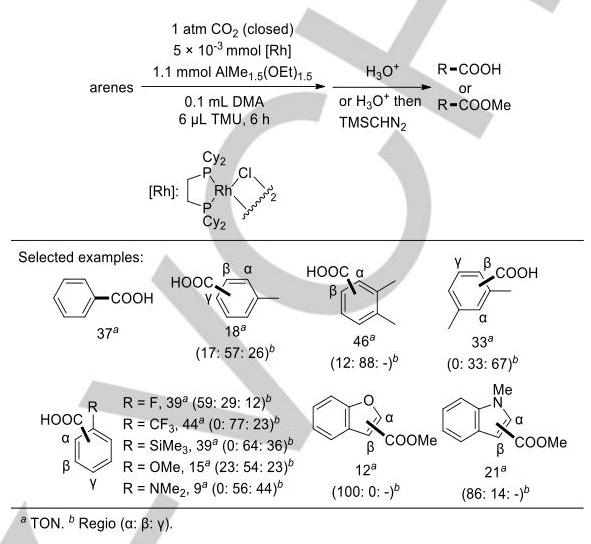
Scheme 26. Rh(I)-catalyzed direct carboxylation of C-H bond of simple arenes ${}^{\left\lbrack {83}\right\rbrack }$
方案26. Rh(I)催化的简单芳烃${}^{\left\lbrack {83}\right\rbrack }$的C-H键直接羧基化反应
In 2010, Nolan and coworkers[87] reported the carboxylation of electron-deficient heterocycles and aromatic rings catalyzed by Au(I)-NHC complex [(IPr)AuOH] (Scheme 27). The reaction occurs at the most acidic C-H bond regioselectively. For the carboxylation of weakly acidic C-H bonds such as N-methylimidazole and $N$ -methylbenzimidazole, it is necessary to use a more basic catalyst [(ItBu)AuOH]. Catalyst recovery can be achieved by simple extraction. The authors isolated and characterized the reaction intermediates (Scheme 28) and applied the intermediates to catalytic carboxylation. Thus, a possible reaction mechanism was proposed. Notably, in 2011, based on their experimental and theoretical calculations, Ahlquist, Wendt and coworkers[88] questioned the mechanism of [(IPr)AuOH]-catalyzed carboxylation of electron-deficient (hetero)aromatics proposed by Nolan and coworkers. In 2012, Geng and coworkers ${}^{\left\lbrack {89}\right\rbrack }$ conducted theoretical studies on the mechanism of oxazole with ${\mathrm{{CO}}}_{2}$ catalyzed by $\mathrm{{Au}}\left( \mathrm{I}\right) - \mathrm{{NHC}}$ complexes. In 2010, Hou ${}^{\left\lbrack {90}\right\rbrack }$ and Nolan ${}^{\left\lbrack {91}\right\rbrack }$ individually reported similar carboxylations of electron-deficient heterocycles or aromatic rings catalyzed by $\mathrm{{Cu}}\left( \mathrm{I}\right) - \mathrm{{NHC}}$ complex. Hou and coworkers[90] used [Cu(IPr)Cl] as catalyst and 1.1 equivalents of potassium $t$ -butoxide as the base (Scheme 29a). The substrate scope covers various substituted benzoxazoles. The yields of less acidic N-methylbenzimidazoles and 1,3,4-oxadiazoles are lower, while benzothiazole, 4-phenyloxazole and benzofuran give only trace amounts of carboxylated products. Similar to Nolan and coworkers’ [(IPr)AuOH] catalytic system[87], Hou and coworkers also isolated and characterized key intermediates for their reactions (including X-ray crystal diffraction) and proved that these key intermediates can catalyze the carboxylation of benzoxazoles. The reaction mechanism they proposed is similar to that of Nolan and coworkers’ [(IPr)AuOH] catalytic system[ ${}^{87}$ ]. Ariafard, Yates and coworkers[ ${}^{92}$ ] studied the mechanism of C-H carboxylation of electron-deficient heteroarenes catalyzed by Cu(I)-NHC complexes by DFT calculations. They proposed a reaction mechanism different from that of Hou and coworkers: it is energetically more favorable for a metal-stabilized carbene intermediate react with ${\mathrm{{CO}}}_{2}$ to give carboxylated products (Scheme 30). The [Cu(IPr)OH]-CsOH system reported by Nolan and coworkers ${}^{\left\lbrack {91}\right\rbrack }$ can be applied to the carboxylation of benzoxazole, benzothiazole, oxazole, 1,2,4-trifluorobenzene and 1,2,4,5-tetrafluorobenzene (Scheme 29b). For 1,2,4,5- tetrafluorobenzene, its monocarboxylation and dicarboxylation can be modulated by controlling the amount of base. In 2010, considering that benzoxazole have similar acidity with terminal alkynes, Gooßen and coworkers [41] applied their copper-complex catalytic system to the carboxylation of benzoxazole. In 2012, Fukuzawa and coworkers ${}^{\left\lbrack {93}\right\rbrack }$ reported the carboxylation of electron-deficient benzoxazoles and benzothiazoles catalyzed by 1,2,3-triazole-derived Cu(I)-NHC complexes [(TPr)CuCl] (Scheme 31). Compared with the [Cu(IPr)Cl] catalyst used by Hou and coworkers, [(TPr)CuCl] has higher catalytic activity. In 2017, Hong and coworkers[94] developed diethylene glycol-functionalized imidazo[1,5-a]pyridin-3-ylidenes (DEG-ImPy) bifunctional NHC ligands. DEG-ImPy Cu(I) complexes can efficiently catalyze the direct $\mathrm{C} - \mathrm{H}$ carboxylation of benzoxazole with ${\mathrm{{CO}}}_{2}$ , giving higher isolated yields than those with the (IPr)CuCl catalyst (Scheme 32).
2010年,诺兰(Nolan)及其同事[87]报道了由Au(I)-NHC络合物[(IPr)AuOH]催化的缺电子杂环和芳环的羧化反应(方案27)。该反应具有区域选择性,发生在酸性最强的C - H键上。对于N - 甲基咪唑和$N$ - 甲基苯并咪唑等酸性较弱的C - H键的羧化反应,需要使用碱性更强的催化剂[(ItBu)AuOH]。通过简单萃取即可实现催化剂的回收。作者分离并表征了反应中间体(方案28),并将这些中间体应用于催化羧化反应。因此,提出了一种可能的反应机理。值得注意的是,2011年,基于实验和理论计算,阿尔奎斯特(Ahlquist)、温特(Wendt)及其同事[88]对诺兰及其同事提出的[(IPr)AuOH]催化缺电子(杂)芳烃羧化反应的机理提出了质疑。2012年,耿(Geng)及其同事${}^{\left\lbrack {89}\right\rbrack }$对$\mathrm{{Au}}\left( \mathrm{I}\right) - \mathrm{{NHC}}$络合物催化恶唑与${\mathrm{{CO}}}_{2}$反应的机理进行了理论研究。2010年,侯${}^{\left\lbrack {90}\right\rbrack }$和诺兰${}^{\left\lbrack {91}\right\rbrack }$分别报道了$\mathrm{{Cu}}\left( \mathrm{I}\right) - \mathrm{{NHC}}$络合物催化缺电子杂环或芳环的类似羧化反应。侯及其同事[90]使用[Cu(IPr)Cl]作为催化剂,1.1当量的$t$ - 丁醇钾作为碱(方案29a)。底物范围涵盖各种取代的苯并恶唑。酸性较弱的N - 甲基苯并咪唑和1,3,4 - 恶二唑的产率较低,而苯并噻唑、4 - 苯基恶唑和苯并呋喃仅得到痕量的羧化产物。与诺兰及其同事的[(IPr)AuOH]催化体系[87]类似,侯及其同事也分离并表征了其反应的关键中间体(包括X射线晶体衍射),并证明这些关键中间体可以催化苯并恶唑的羧化反应。他们提出的反应机理与诺兰及其同事的[(IPr)AuOH]催化体系[${}^{87}$]相似。阿里亚法德(Ariafard)、耶茨(Yates)及其同事[${}^{92}$]通过密度泛函理论(DFT)计算研究了Cu(I)-NHC络合物催化缺电子杂芳烃C - H羧化反应的机理。他们提出了一种与侯及其同事不同的反应机理:金属稳定的卡宾中间体与${\mathrm{{CO}}}_{2}$反应生成羧化产物在能量上更有利(方案30)。诺兰及其同事${}^{\left\lbrack {91}\right\rbrack }$报道的[Cu(IPr)OH] - CsOH体系可用于苯并恶唑、苯并噻唑、恶唑、1,2,4 - 三氟苯和1,2,4,5 - 四氟苯的羧化反应(方案29b)。对于1,2,4,5 - 四氟苯,通过控制碱的用量可以调节其一羧化和二羧化反应。2010年,考虑到苯并恶唑与末端炔烃的酸性相似,古森(Gooßen)及其同事[41]将其铜络合物催化体系应用于苯并恶唑的羧化反应。2012年,福泽(Fukuzawa)及其同事${}^{\left\lbrack {93}\right\rbrack }$报道了由1,2,3 - 三唑衍生的Cu(I)-NHC络合物[(TPr)CuCl]催化的缺电子苯并恶唑和苯并噻唑的羧化反应(方案31)。与侯及其同事使用的[Cu(IPr)Cl]催化剂相比,[(TPr)CuCl]具有更高的催化活性。2017年,洪(Hong)及其同事[94]开发了二甘醇官能化的咪唑并[1,5 - a]吡啶 - 3 - 亚基(DEG - ImPy)双功能NHC配体。DEG - ImPy Cu(I)络合物可以有效地催化苯并恶唑与${\mathrm{{CO}}}_{2}$的直接$\mathrm{C} - \mathrm{H}$羧化反应,与(IPr)CuCl催化剂相比,分离产率更高(方案32)。
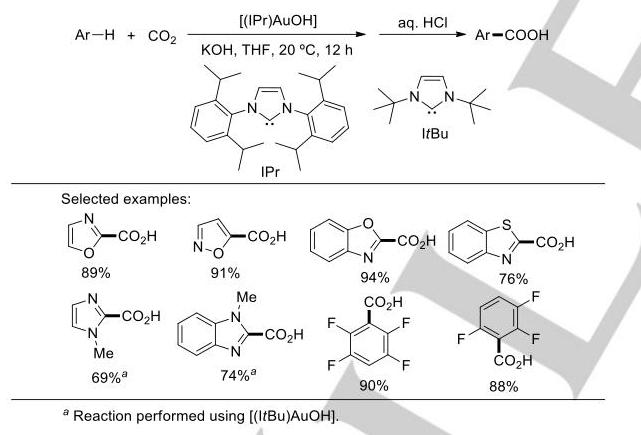
Scheme 27. [(IPr)AuOH]-catalyzed carboxylation of C-H bond of electron-deficient (hetero)arenes ${}^{\left\lbrack {87}\right\rbrack }$
方案27. [(IPr)AuOH]催化的缺电子(杂)芳烃C-H键的羧化反应${}^{\left\lbrack {87}\right\rbrack }$
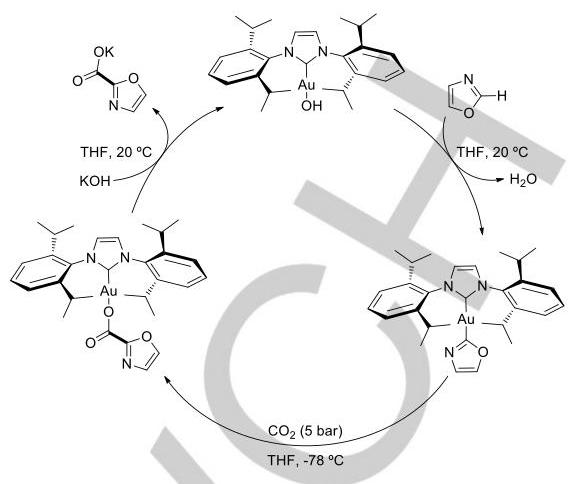
Scheme 28. Possible intermediates involved in the [(IPr)AuOH]-catalyzed carboxylation of $\mathrm{C} - \mathrm{H}$ bond of oxazole ${}^{\left\lbrack {87}\right\rbrack }$
方案28. [(IPr)AuOH]催化恶唑${}^{\left\lbrack {87}\right\rbrack }$的$\mathrm{C} - \mathrm{H}$键羧化反应中可能的中间体
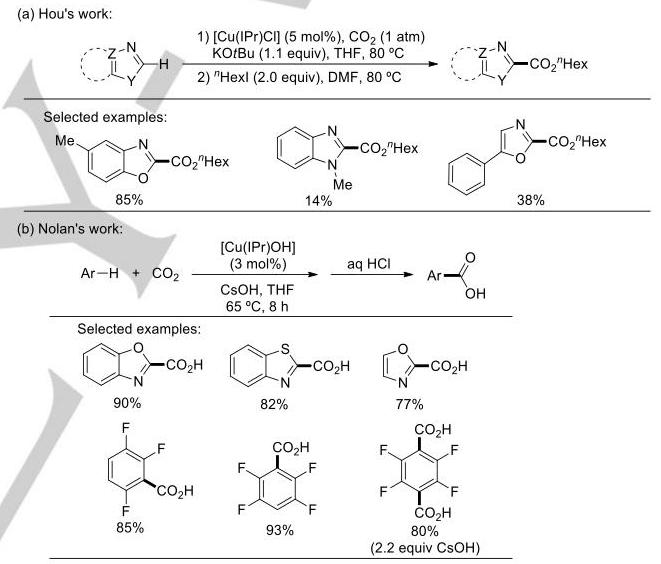
Scheme 29. [Cu(IPr)Cl]- or [Cu(IPr)OH]-catalyzed carboxylation of C-H bond of electron-deficient (hetero)arenes[90-91]
方案29. [Cu(IPr)Cl]或[Cu(IPr)OH]催化的缺电子(杂)芳烃C-H键的羧化反应[90 - 91]
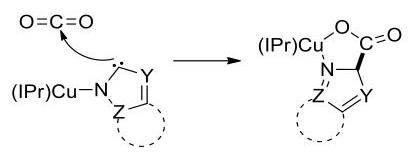
Scheme 30. Reaction of the metal-stabilized carbene intermediate with ${\mathrm{{CO}}}_{2}{}^{\left\lbrack {92}\right\rbrack }$
方案30. 金属稳定的卡宾中间体与${\mathrm{{CO}}}_{2}{}^{\left\lbrack {92}\right\rbrack }$的反应
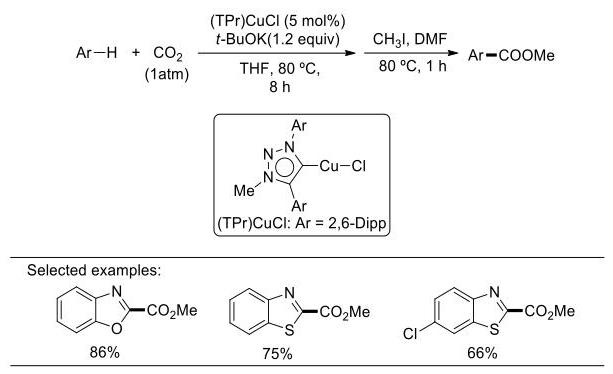
Scheme 31. [(TPr)CuCl]-catalyzed carboxylation of $\mathrm{C} - \mathrm{H}$ bond of benzoxazole and benzothiazole derivatives ${}^{\left\lbrack {93}\right\rbrack }$
方案31. [(TPr)CuCl]催化苯并恶唑和苯并噻唑衍生物${}^{\left\lbrack {93}\right\rbrack }$的$\mathrm{C} - \mathrm{H}$键的羧化反应
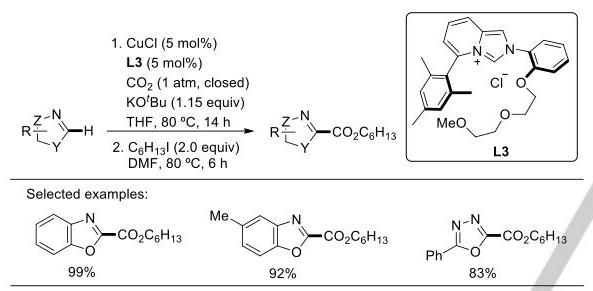
Scheme 32. The direct $\mathrm{C} - \mathrm{H}$ carboxylation of benzoxazole with ${\mathrm{{CO}}}_{2}{}^{\left\lbrack {94}\right\rbrack }$
方案32. 苯并恶唑与${\mathrm{{CO}}}_{2}{}^{\left\lbrack {94}\right\rbrack }$的直接$\mathrm{C} - \mathrm{H}$羧化反应
Catalyst recovery is a problem that limits the wide application of homogeneous catalysis. In 2013, Li and coworkers[95] reported the carboxylation of benzoxazole derivatives catalyzed by a pH-responsive Cu(I)-NHC complex E (Scheme 33). Unlike the [Cu(IPr)Cl] catalyst[90] used by Hou and coworkers, a basic tertiary amine functionality was introduced into Li and coworkers’ catalyst. This type of catalyst is soluble under basic carboxylation conditions. However, when HCI diethyl ether is added after the reaction, the protonated salt of the catalyst will precipitate from the solution. The catalyst can be separated from product by simple centrifugation. And when new substrates and bases are added to the recovered catalyst, the protonated catalyst can be regenerated in the form of a neutral homogeneous catalyst. Moreover, the catalyst can be used for four times without significant drop in catalytic activity. This catalyst can also be used to catalyze the carboxylation of organoboronic esters, while a similar Ag(I)-NHC complex catalyst can catalyze the carboxylation of terminal alkynes.
催化剂回收是限制均相催化广泛应用的一个问题。2013年,Li及其同事[95]报道了由pH响应性Cu(I)-NHC配合物E催化的苯并恶唑衍生物的羧化反应(方案33)。与Hou及其同事使用的[Cu(IPr)Cl]催化剂[90]不同,Li及其同事的催化剂中引入了碱性叔胺官能团。这种类型的催化剂在碱性羧化条件下可溶。然而,反应后加入HCl乙醚时,催化剂的质子化盐会从溶液中沉淀出来。通过简单的离心可以将催化剂与产物分离。当向回收的催化剂中加入新的底物和碱时,质子化的催化剂可以以中性均相催化剂的形式再生。此外,该催化剂可以使用四次而催化活性没有明显下降。该催化剂还可用于催化有机硼酸酯的羧化反应,而类似的Ag(I)-NHC配合物催化剂可催化末端炔烃的羧化反应。
In 2018, Ma, Cheng and coworkers[65] reported the carboxylation of benzothiazoles and benzoxazoles with ${\mathrm{{CO}}}_{2}$ catalyzed by ${\mathrm{{Mo}}}_{2}{\left( {\mathrm{O}}^{t}\mathrm{{Bu}}\right) }_{6}$ (Scheme 34).
2018年,Ma、Cheng及其同事[65]报道了由${\mathrm{{Mo}}}_{2}{\left( {\mathrm{O}}^{t}\mathrm{{Bu}}\right) }_{6}$催化的苯并噻唑和苯并恶唑与${\mathrm{{CO}}}_{2}$的羧化反应(方案34)。
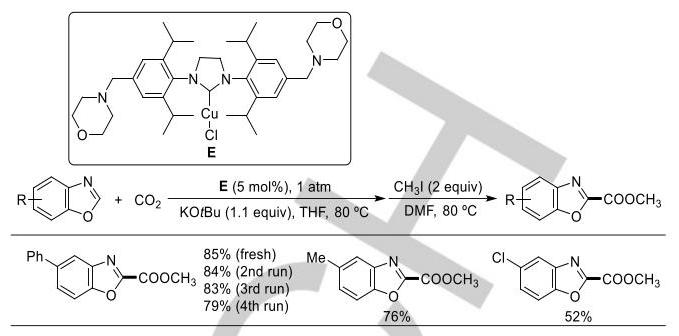
Scheme 33. Complex E-catalyzed carboxylation of benzoxazole derivatives ${}^{\left\lbrack {95}\right\rbrack }$
方案33. 配合物E催化的苯并恶唑衍生物的羧化反应${}^{\left\lbrack {95}\right\rbrack }$
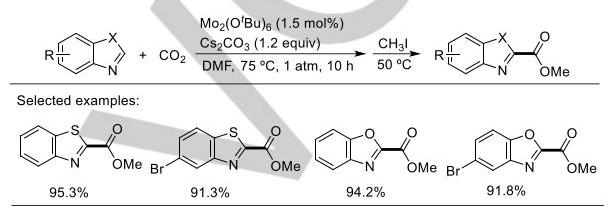
Scheme 34. ${\mathrm{{Mo}}}_{2}{\left( {\mathrm{O}}^{\prime }\mathrm{{Bu}}\right) }_{6}$ -catalyzed carboxylation of benzothiazoles and benzoxazoles with ${\mathrm{{CO}}}_{2}{}^{\left\lbrack {65}\right\rbrack }$
方案34. ${\mathrm{{Mo}}}_{2}{\left( {\mathrm{O}}^{\prime }\mathrm{{Bu}}\right) }_{6}$催化的苯并噻唑和苯并恶唑与${\mathrm{{CO}}}_{2}{}^{\left\lbrack {65}\right\rbrack }$的羧化反应
3.1.1.2. Transition-metal-free and chelation-free carboxylation of $\mathrm{C}\left( {\mathrm{{sp}}}^{2}\right) - \mathrm{H}$ bonds of (hetero)arenes with ${\mathrm{{CO}}}_{2}$
3.1.1.2. (杂)芳烃的$\mathrm{C}\left( {\mathrm{{sp}}}^{2}\right) - \mathrm{H}$键与${\mathrm{{CO}}}_{2}$的无过渡金属和无螯合羧基化反应
The Kolbe-Schmitt reaction ${}^{\left\lbrack {96}\right\rbrack }$ is one of the most important carboxylation reactions, which refers to the direct ortho C-H carboxylation of phenoxide with ${\mathrm{{CO}}}_{2}$ . This reaction is employed for the industrial synthesis of salicylic acid. In 2014, Larrosa and coworkers[97] reported a “one-pot” direct meta-selective arylation reaction of phenol via a traceless directing group relay strategy (Scheme 35). They first exploited the o/p-directing nature of phenol to react with ${\mathrm{{CO}}}_{2}$ to generate ortho- or para-substituted carboxylic acids (Kolbe-Schmitt reaction), followed by ${\mathrm{{CO}}}_{2}\mathrm{H}$ group-directed ortho-C-H arylation reaction and decarboxylation of carboxylic acids, and finally a phenol meta-arylated product was produced. In this process, ${\mathrm{{CO}}}_{2}$ acts as a traceless directing group. Notably, regardless of the regioselectivity of the carboxylation reaction (ortho or para), the meta-aryl phenol products can be finally obtained. The Kolbe-Schmitt reaction generally requires harsh reaction conditions: high ${\mathrm{{CO}}}_{2}$ pressure (20-100 atm) and high temperature (130-280 °C). In 2016, Larrosa and coworkers ${}^{\left\lbrack {98}\right\rbrack }$ first reported a Kolbe-Schmitt reaction that can be performed at atmospheric pressure (Scheme 36). Using 2,4,6-trimethylphenol as a recyclable additive is a key to success of this reaction. This method avoids separation of phenoxides and has a broader range of substrates. They believe that 2,4,6-trimethylphenol in the reaction may facilitate ${\mathrm{{CO}}}_{2}$ capture. In addition, enzymatic Kolbe-Schmitt reactions have also been reported ${}^{\left\lbrack {99} - {104}\right\rbrack }$ . For example, in 2012, Faber and coworkers ${}^{\left\lbrack {100}\right\rbrack }$ found that different types of enzymes can modulate the regioselectivity of $p$ -hydroxystyrene carboxylation (Scheme 37). In 2016, Zhu and coworkers [104] found that addition of quaternary ammonium salt to the reaction system can shift the equilibrium of enzymatic Kolbe-Schmitt reaction towards carboxylation. The precipitation capacity of the quaternary ammonium salt of the carboxylation product is the driving force for reaction equilibrium shift. In 1995, Kudo and coworkers ${}^{\left\lbrack {105}\right\rbrack }$ reported the carboxylation of alkali-metal 2-naphthoate with high-pressure ${\mathrm{{CO}}}_{2}\left( {{400}\mathrm{{atm}}}\right)$ promoted by molten alkali-metal carbonate and formate. In 2010, Hu and coworkers ${}^{\left\lbrack {106}\right\rbrack }$ found that ${\mathrm{{Cs}}}_{2}{\mathrm{{CO}}}_{3}$ can facilitate $\mathrm{C} - \mathrm{H}$ bond carboxylation of some aromatic heterocycles such as benzothiazole, benzoxazole, 5-phenyl oxazole, and 2-aryl-1,3,4- oxadiazole (Scheme 38) without use of any transition metal catalysts. They proposed the following reaction mechanism: first, the most acidic C-H bond in the aromatic heterocycle is cleaved with ${\mathrm{{Cs}}}_{2}{\mathrm{{CO}}}_{3}$ , and the resulting anion reacts with ${\mathrm{{CO}}}_{2}$ to form a new C-C bond (Scheme 38). In 2016, Kanan and coworkers[107] reported the direct carboxylation of the C-H bond of 2-furoic acid promoted by carbonate (Scheme 39). 2-Furoic acid can be easily obtained from lignocellulose. The furan-2,5-dicarboxylic acid produced by carboxylation of 2-furoic acid has wide applications. For example, it can be used to synthesize polyethylene furandicarboxylate (PEF), a substitute for petroleum-derived polyethylene terephthalate (PET). It is believed that ${\mathrm{{CO}}}_{3}{}^{2 - }$ in the molten salt of ${\mathrm{{Cs}}}_{2}{\mathrm{{CO}}}_{3}$ or ${\mathrm{K}}_{2}{\mathrm{{CO}}}_{3}$ can deprotonate furan-2- carboxylate, while the high concentration of alkali metal cations can stabilize the conjugate base by ion pairing. If ${\mathrm{{CO}}}_{3}{}^{2\text{ - }}$ -promoted C-H carboxylation reaction is combined with protonation of the carboxylate salt and regeneration of ${\mathrm{{CO}}}_{3}{}^{2 - }$ , then the net reaction would be the transformation of $\mathrm{C} - \mathrm{H}$ bond and ${\mathrm{{CO}}}_{2}$ into $\mathrm{C} - {\mathrm{{CO}}}_{2}\mathrm{H}$ . In addition, ${\mathrm{{CO}}}_{2}$ -promoted esterification can convert carboxylates into esters and regenerate ${\mathrm{{CO}}}_{3}{}^{2 - }$ (Scheme 40). The authors also examined C-H carboxylation of caesium 2-thiophene carboxylate, caesium benzoate and benzene with ${\mathrm{{CO}}}_{2}$ . Recently, Fenner and Ackermann ${}^{\left\lbrack {108}\right\rbrack }$ reported a heterocyclic C-H bond carboxylation reaction similar to that of Hu and coworkers ${}^{\left\lbrack {106}\right\rbrack }$ (Scheme 41). The main difference is that Fenner and Ackermann ${}^{\left\lbrack {108}\right\rbrack }$ used potassium tert-butoxide as the base to make carboxylation conditions milder (lower reaction temperature, one atmosphere of ${\mathrm{{CO}}}_{2}$ ). In 2002, Hattori, Miyano and coworkers ${}^{\left\lbrack {109}\right\rbrack }$ reported the direct carboxylation of naphthalene, anthracene and phenanthrene with ${\mathrm{{CO}}}_{2}$ promoted by two equivalents of ${\mathrm{{AlBr}}}_{3}$ . In 2002, Olah, Prakash and coworkers ${}^{\left\lbrack {110}\right\rbrack }$ found that the ${\mathrm{{Al}}}_{2}{\mathrm{{Cl}}}_{6}/\mathrm{{Al}}$ system promotes direct carboxylation of benzene or substituted benzene with ${\mathrm{{CO}}}_{2}$ (Scheme 42). For mesitylene, the reaction can be carried out at 20 °C. For some alkylbenzenes (such as ethylbenzene, tert-butylbenzene, and p-xylene), side reaction pathways such as isomerization or disproportionation lead to a decrease in product yield. Addition of metallic aluminum can significantly increase the yield and selectivity of the reaction. They believe the role of aluminum may be to react with HCI generated in the carboxylation reaction to suppress other side reactions, and at the same time to generate part of aluminum chloride in situ. Based on experimental and theoretical calculations, they proposed a reaction mechanism. Aluminum chloride can electrophilically activate ${\mathrm{{CO}}}_{2}$ , and then electrophilic substitution on the aromatic ring occurs. Hattori and coworkers have done a great deal of work on the electrophilic carboxylation of aromatic rings with ${\mathrm{{CO}}}_{2}{}^{\left\lbrack {111} - {113}\right\rbrack }$ . For example, they found that using ${\mathrm{{AlBr}}}_{3}$ and ${\mathrm{R}}_{3}\mathrm{{SiCl}}$ together can significantly promote direct carboxylation of aromatics ${}^{\left\lbrack {112}\right\rbrack }$ . Also, this system solves the disproportionation problem often occuring in the carboxylation of ethylbenzene and $t$ -butylbenzene ${}^{\left\lbrack {110}\right\rbrack }$ . In 2012, Müller [114] and Hattori [113] independently reported the carboxylation of aromatics with ${\mathrm{{CO}}}_{2}$ mediated by silyl cation. In 2009, Munshi and coworkers ${}^{\left\lbrack {115}\right\rbrack }$ found that pre-reacting ${\mathrm{{CO}}}_{2}$ with Lewis acid for a period before adding toluene can promote the carboxylation of toluene. This phenomenon is consistent with the mechanism proposed by Olah, Prakash and coworkers[110] In 2010, Munshi and coworkers[116] achieved a catalytic cycle of ${\mathrm{{Al}}}_{2}{\mathrm{{Cl}}}_{6}$ used in the carboxylation of toluene through rational selection of fluorine-containing solvents and bases. In 2012, Munshi and coworkers ${}^{\left\lbrack {117}\right\rbrack }$ further studied the kinetics of carboxylation of toluene. In 2014, Gu and Cheng ${}^{\left\lbrack {118}\right\rbrack }$ reported the carboxylation of toluene promoted by aluminum-supported aluminum chloride. In 2017, Cheng and coworkers[119] further showed that the addition of silica compounds can promote ${\mathrm{{AlCl}}}_{3}$ catalytic activity in carboxylation of toluene. In 2016, Ma and coworkers[120] made a theoretical investigation of boron-doped lithium clusters, ${\mathrm{{BLi}}}_{\mathrm{n}}\left( {n = 3 - 6}\right)$ , on the carboxylation of simple aromatic compounds with ${\mathrm{{CO}}}_{2}$ . In 2009, Hattori and coworkers ${}^{\left\lbrack {121}\right\rbrack }$ reported the carboxylation of 1-substituted indoles and pyrrole promoted by equimolar amounts of dimethylaluminum chloride. In 2016, they ${}^{\left\lbrack {122}\right\rbrack }$ further extended the substrate scope for this reaction (Scheme 43) and proposed a possible reaction mechanism. For 1-unsubstituted indole, the yield was poor. In 2012, the ${y}^{\left\lbrack {123}\right\rbrack }$ reported similar carboxylation of thiophene and benzothiophene assisted by equimolar amounts of ethylaluminum dichloride. In 2012, Kobayashi and coworkers[124] reported the carboxylation of unprotected indole derivatives with ${\mathrm{{CO}}}_{2}$ mediated by lithium tert-butoxide (Scheme 44). The key of this reaction is the use of a large excess of lithium tert-butoxide as base to inhibit decarboxylative side reaction. Their reaction mechanism is as follows. First, lithium tert-butoxide captures the proton of $\mathrm{N} - \mathrm{H}$ , and the resulting anion reacts with ${\mathrm{{CO}}}_{2}$ to form $\mathrm{N} -$ centered or C-3 carboxylates. Since the carboxylation reaction is reversible, C-3 carboxylates are generated at high temperatures. Notably, the free NH of unprotected indole derivatives plays an important role in the reaction. 1-Methyl indole cannot undergo this carboxylation under the same conditions, which demonstrates that deprotonation by lithium tert-butoxide is a key step in this reaction. In 2015, they ${}^{\left\lbrack {125}\right\rbrack }$ extended the reaction to the carboxylation of pyrrole derivatives with ${\mathrm{{CO}}}_{2}$ . In the same year, Skrydstrup and coworkers[ ${}^{126}$ ] reported the cyclization of 2-alkynyl indole using a catalytic amount of organic base TBD and five equivalents of ${\mathrm{{CO}}}_{2}$ (Scheme 45). Cyclization of aryl-, heteroaryl-, aliphatic-, alkenyl-substituted 2-alkynyl indole, and 2-terminal 2- alkynyl indole are all viable. They believed the reaction went through the following steps. First, TBD reacts with ${\mathrm{{CO}}}_{2}$ to generate an addition product. Then the C-3 position of the indole attacks the addition product or directly attacks ${\mathrm{{CO}}}_{2}$ to generate a new C-C bond. Next, a rearomatized intermediate is obtained after deprotonation. This intermediate undergoes C-O bond formation to give the final product, while regenerating the TBD catalyst (Scheme 46). In 2017, Wong and coworkers[127] performed DFT calculations for this reaction. They proposed a bifunctional activation of indole and ${\mathrm{{CO}}}_{2}$ simultaneously by the bicyclic guanidine catalyst. In 2016, Ma and coworkers[128] conducted a theoretical study of the $\mathrm{C} - \mathrm{H}$ bond insertion reaction of pyrrole or $N$ -methylpyrrole with short-lived ${\mathrm{{CO}}}_{2}$ . In 2016, Xi and coworkers ${}^{\left\lbrack {129}\right\rbrack }$ reported the lactamization reaction of o-arylaniline with ${\mathrm{{CO}}}_{2}$ mediated by MeOTf and TBD (Scheme 47). They propose that isocyanate may be the active intermediate in this metal-free reaction.
科尔贝-施密特反应${}^{\left\lbrack {96}\right\rbrack }$是最重要的羧化反应之一,它指的是酚盐与${\mathrm{{CO}}}_{2}$的直接邻位C-H羧化反应。该反应用于水杨酸的工业合成。2014年,拉罗萨及其同事[97]报道了一种通过无痕导向基团接力策略实现苯酚“一锅法”直接间位选择性芳基化反应(方案35)。他们首先利用苯酚的邻/对导向性质与${\mathrm{{CO}}}_{2}$反应生成邻位或对位取代的羧酸(科尔贝-施密特反应),接着进行${\mathrm{{CO}}}_{2}\mathrm{H}$基团导向的邻位C-H芳基化反应和羧酸脱羧反应,最终得到间位芳基化的苯酚产物。在此过程中,${\mathrm{{CO}}}_{2}$充当无痕导向基团。值得注意的是,无论羧化反应的区域选择性如何(邻位或对位),最终都能得到间位芳基化的苯酚产物。科尔贝-施密特反应通常需要苛刻的反应条件:高${\mathrm{{CO}}}_{2}$压力(20 - 100 atm)和高温(130 - 280 °C)。2016年,拉罗萨及其同事${}^{\left\lbrack {98}\right\rbrack }$首次报道了一种可在常压下进行的科尔贝-施密特反应(方案36)。使用2,4,6-三甲基苯酚作为可循环添加剂是该反应成功的关键。此方法避免了酚盐的分离,且底物范围更广。他们认为反应中的2,4,6-三甲基苯酚可能有助于${\mathrm{{CO}}}_{2}$的捕获。此外,也有关于酶促科尔贝-施密特反应的报道${}^{\left\lbrack {99} - {104}\right\rbrack }$。例如,2012年,法贝尔及其同事${}^{\left\lbrack {100}\right\rbrack }$发现不同类型的酶可调节$p$-羟基苯乙烯羧化反应的区域选择性(方案37)。2016年,朱及其同事[104]发现向反应体系中添加季铵盐可使酶促科尔贝-施密特反应的平衡向羧化方向移动。羧化产物季铵盐的沉淀能力是反应平衡移动的驱动力。1995年,工藤及其同事${}^{\left\lbrack {105}\right\rbrack }$报道了熔融碱金属碳酸盐和甲酸盐促进的碱金属2-萘酚与高压${\mathrm{{CO}}}_{2}\left( {{400}\mathrm{{atm}}}\right)$的羧化反应。2010年,胡及其同事${}^{\left\lbrack {106}\right\rbrack }$发现${\mathrm{{Cs}}}_{2}{\mathrm{{CO}}}_{3}$可促进某些芳香杂环如苯并噻唑、苯并恶唑、5-苯基恶唑和2-芳基-1,3,4-恶二唑的$\mathrm{C} - \mathrm{H}$键羧化反应(方案38),且无需使用任何过渡金属催化剂。他们提出了如下反应机理:首先,芳香杂环中酸性最强的C-H键被${\mathrm{{Cs}}}_{2}{\mathrm{{CO}}}_{3}$裂解,生成的阴离子与${\mathrm{{CO}}}_{2}$反应形成新的C-C键(方案38)。2016年,卡南及其同事[107]报道了碳酸盐促进的2-呋喃甲酸C-H键的直接羧化反应(方案39)。2-呋喃甲酸可从木质纤维素中轻松获得。2-呋喃甲酸羧化生成的呋喃-2,5-二甲酸有广泛应用。例如,它可用于合成聚呋喃二甲酸乙二酯(PEF),一种石油衍生的聚对苯二甲酸乙二酯(PET)的替代品。据信,${\mathrm{{Cs}}}_{2}{\mathrm{{CO}}}_{3}$或${\mathrm{K}}_{2}{\mathrm{{CO}}}_{3}$的熔盐中的${\mathrm{{CO}}}_{3}{}^{2 - }$可使呋喃-2-羧酸盐去质子化,而高浓度的碱金属阳离子可通过离子配对稳定共轭碱。如果${\mathrm{{CO}}}_{3}{}^{2\text{ - }}$促进的C-H羧化反应与羧酸盐的质子化以及${\mathrm{{CO}}}_{3}{}^{2 - }$的再生相结合,那么净反应将是$\mathrm{C} - \mathrm{H}$键和${\mathrm{{CO}}}_{2}$转化为$\mathrm{C} - {\mathrm{{CO}}}_{2}\mathrm{H}$。此外,${\mathrm{{CO}}}_{2}$促进的酯化反应可将羧酸盐转化为酯并再生${\mathrm{{CO}}}_{3}{}^{2 - }$(方案40)。作者还研究了${\mathrm{{CO}}}_{2}$对铯2-噻吩羧酸盐、铯苯甲酸盐和苯的C-H羧化反应。最近,芬纳和阿克曼${}^{\left\lbrack {108}\right\rbrack }$报道了一种与胡及其同事${}^{\left\lbrack {106}\right\rbrack }$类似的杂环C-H键羧化反应(方案41)。主要区别在于芬纳和阿克曼${}^{\left\lbrack {108}\right\rbrack }$使用叔丁醇钾作为碱,使羧化条件更温和(较低反应温度,${\mathrm{{CO}}}_{2}$为一个大气压)。2002年,服部、宫野及其同事${}^{\left\lbrack {109}\right\rbrack }$报道了两当量${\mathrm{{AlBr}}}_{3}$促进的萘、蒽和菲与${\mathrm{{CO}}}_{2}$的直接羧化反应。2002年,奥拉、普拉卡什及其同事${}^{\left\lbrack {110}\right\rbrack }$发现${\mathrm{{Al}}}_{2}{\mathrm{{Cl}}}_{6}/\mathrm{{Al}}$体系促进苯或取代苯与${\mathrm{{CO}}}_{2}$的直接羧化反应(方案42)。对于均三甲苯,反应可在20 °C下进行。对于一些烷基苯(如乙苯叔丁基苯和对二甲苯),异构化或歧化等副反应途径会导致产物产率降低。添加金属铝可显著提高反应产率和选择性。他们认为铝的作用可能是与羧化反应中生成的HCl反应,抑制其他副反应,同时原位生成部分氯化铝。基于实验和理论计算,他们提出了一种反应机理。氯化铝可通过亲电作用活化${\mathrm{{CO}}}_{2}$,然后在芳环上发生亲电取代反应。服部及其同事对芳环与${\mathrm{{CO}}}_{2}{}^{\left\lbrack {111} - {113}\right\rbrack }$的亲电羧化反应做了大量工作。例如,他们发现一起使用${\mathrm{{AlBr}}}_{3}$和${\mathrm{R}}_{3}\mathrm{{SiCl}}$可显著促进芳烃${}^{\left\lbrack {112}\right\rbrack }$的直接羧化反应。此外,该体系还解决了乙苯和$t$-丁基苯羧化反应中经常出现的歧化问题${}^{\left\lbrack {110}\right\rbrack }$。2012年,米勒[114]和服部[113]独立报道了硅阳离子介导的芳烃与${\mathrm{{CO}}}_{2}$的羧化反应。2009年,蒙希及其同事${}^{\left\lbrack {115}\right\rbrack }$发现将${\mathrm{{CO}}}_{2}$与路易斯酸预反应一段时间后再加入甲苯,可促进甲苯的羧化反应。这一现象与奥拉、普拉卡什及其同事[110]提出的机理一致。2010年,蒙希及其同事[116]通过合理选择含氟溶剂和碱,实现了用于甲苯羧化反应的${\mathrm{{Al}}}_{2}{\mathrm{{Cl}}}_{6}$的催化循环。2012年,蒙希及其同事${}^{\left\lbrack {117}\right\rbrack }$进一步研究了甲苯羧化反应的动力学。2014年,顾和程${}^{\left\lbrack {118}\right\rbrack }$报道了铝负载氯化铝促进的甲苯羧化反应。2017年,程及其同事[119]进一步表明,添加硅化合物可促进${\mathrm{{AlCl}}}_{3}$在甲苯羧化反应中的催化活性。2016年,马及其同事[120]对硼掺杂锂簇${\mathrm{{BLi}}}_{\mathrm{n}}\left( {n = 3 - 6}\right)$在简单芳香化合物与${\mathrm{{CO}}}_{2}$的羧化反应中的作用进行了理论研究。2009年,服部及其同事${}^{\left\lbrack {121}\right\rbrack }$报道了等摩尔量的二甲基氯化铝促进的1-取代吲哚和吡咯的羧化反应。2016年,他们${}^{\left\lbrack {122}\right\rbrack }$进一步扩展了该反应的底物范围(方案43),并提出了一种可能的反应机理。对于未取代的吲哚,产率较低。2012年,${y}^{\left\lbrack {123}\right\rbrack }$报道了等摩尔量的二乙基氯化铝辅助的噻吩和苯并噻吩的类似羧化反应。2012年,小林及其同事[124]报道了叔丁醇锂介导的未保护吲哚衍生物与${\mathrm{{CO}}}_{2}$的羧化反应(方案44)。该反应的关键是使用大量过量的叔丁醇锂作为碱,以抑制脱羧副反应。他们的反应机理如下。首先,叔丁醇锂捕获$\mathrm{N} - \mathrm{H}$的质子,生成的阴离子与${\mathrm{{CO}}}_{2}$反应形成以$\mathrm{N} -$为中心的或C-3羧酸盐。由于羧化反应是可逆的,高温下会生成C-3羧酸盐。值得注意的是,未保护吲哚衍生物的游离NH在反应中起重要作用。1-甲基吲哚在相同条件下不能发生此羧化反应,这表明叔丁醇锂的去质子化是该反应的关键步骤。2015年,他们${}^{\left\lbrack {125}\right\rbrack }$将该反应扩展到吡咯衍生物与${\mathrm{{CO}}}_{2}$的羧化反应。同年,斯克里德斯特鲁普及其同事[${}^{126}$]报道了使用催化量的有机碱TBD和五当量的${\mathrm{{CO}}}_{2}$对2-炔基吲哚进行环化反应(方案45)。芳基、杂芳基、脂肪族、烯基取代的2-炔基吲哚以及2-末端2-炔基吲哚的环化反应均可行。他们认为反应经过以下步骤。首先,TBD与${\mathrm{{CO}}}_{2}$反应生成加成产物。然后吲哚的C-3位进攻加成产物或直接进攻${\mathrm{{CO}}}_{2}$以形成新的C-C键。接下来,去质子化后得到一个重新芳构化的中间体。该中间体进行C-O键形成反应得到最终产物,同时再生TBD催化剂(方案46)。2017年,王及其同事[127]对该反应进行了密度泛函理论计算。他们提出双环胍催化剂可同时对吲哚和${\mathrm{{CO}}}_{2}$进行双功能活化。2016年,马及其同事[128]对吡咯或$N$-甲基吡咯与短寿命${\mathrm{{CO}}}_{2}$的$\mathrm{C} - \mathrm{H}$键插入反应进行了理论研究。2016年,习及其同事${}^{\left\lbrack {129}\right\rbrack }$报道了甲磺酸甲酯和TBD介导的邻芳基苯胺与${\mathrm{{CO}}}_{2}$的内酰胺化反应(方案47)。他们提出异氰酸酯可能是该无金属反应中的活性中间体。
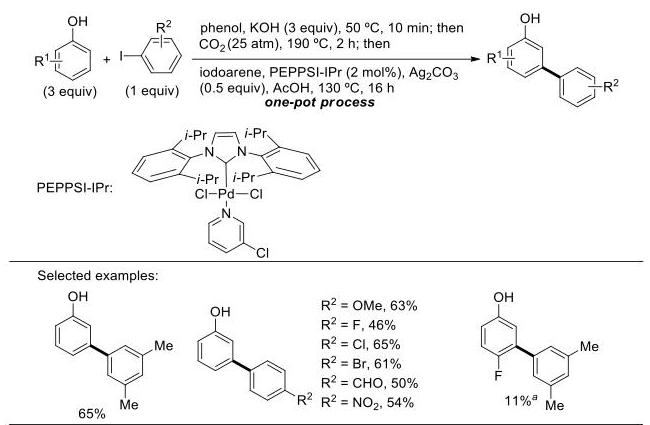
${}^{a}$ Yield determined by ${}^{1}\mathrm{H}$ NMR analysis using an internal standard.
${}^{a}$ 产率通过使用内标物的${}^{1}\mathrm{H}$ NMR分析测定。
Scheme 35. The one-pot direct meta-selective arylation of phenols based on a traceless directing group relay strategy ${}^{\left\lbrack {97}\right\rbrack }$
方案35. 基于无痕导向基团接力策略的酚类的一锅法直接间位选择性芳基化${}^{\left\lbrack {97}\right\rbrack }$
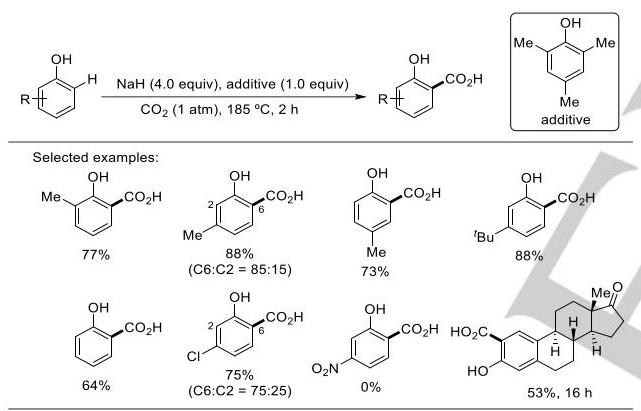
Scheme 36. Kolbe-Schmitt carboxylation at atmospheric pressure ${}^{\left\lbrack {98}\right\rbrack }$
方案36. 常压下的Kolbe-Schmitt羧化反应${}^{\left\lbrack {98}\right\rbrack }$

Scheme 37. Enzymatic regioselective carboxylation of hydroxystyrene derivatives ${}^{\left\lbrack {100}\right\rbrack }$
方案37. 羟基苯乙烯衍生物的酶促区域选择性羧化反应${}^{\left\lbrack {100}\right\rbrack }$
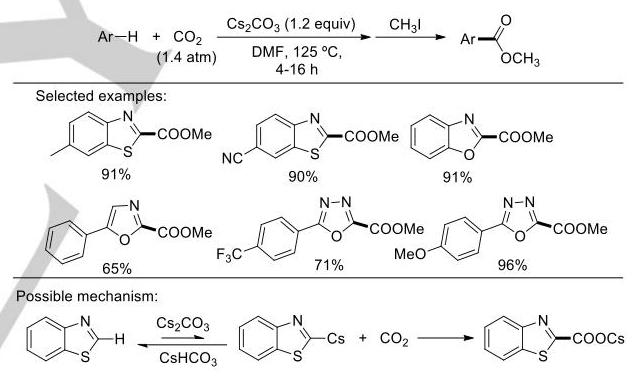
Scheme 38. ${\mathrm{{Cs}}}_{2}{\mathrm{{CO}}}_{3}$ -promoted carboxylation of $\mathrm{C} - \mathrm{H}$ bond of electron-deficient aromatic heterocycles[106]
方案38. ${\mathrm{{Cs}}}_{2}{\mathrm{{CO}}}_{3}$促进的缺电子芳香杂环$\mathrm{C} - \mathrm{H}$键的羧化反应[106]
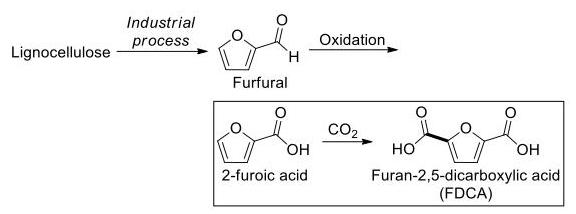
Scheme 39. Synthesis of furan-2,5-dicarboxylic acid from lignocellulose using direct carboxylation of 2-furoic acid[107]
方案39. 利用2-呋喃甲酸的直接羧化反应从木质纤维素合成呋喃-2,5-二甲酸[107]
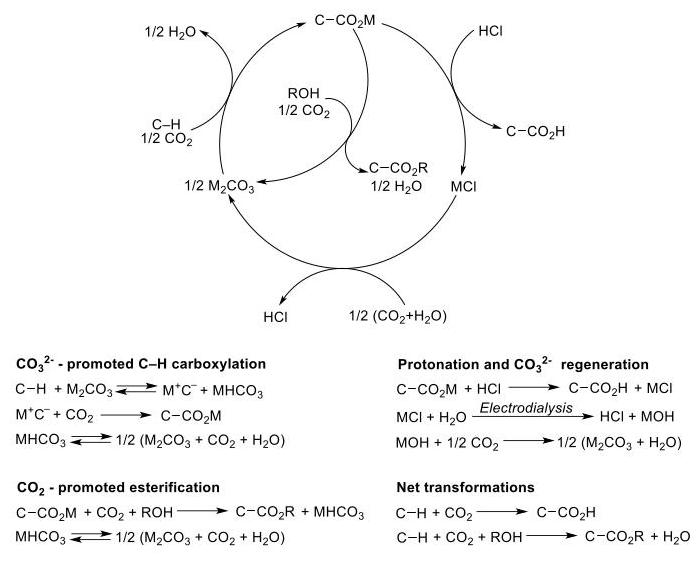
Scheme 40. ${\mathrm{{CO}}}_{2}$ utilization cycle ${}^{\left\lbrack {107}\right\rbrack }$
方案40. ${\mathrm{{CO}}}_{2}$利用循环${}^{\left\lbrack {107}\right\rbrack }$
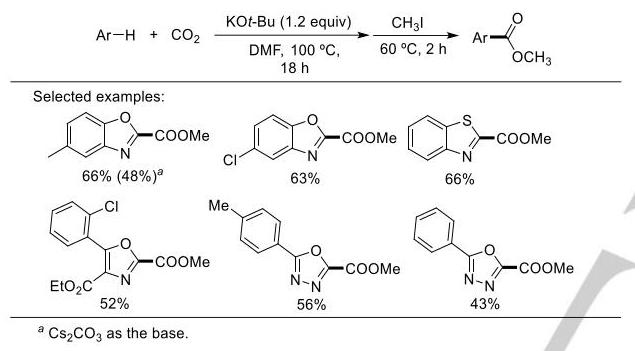
Scheme 41. KOt-Bu-promoted carboxylation of C-H bond of electron-deficient aromatic heterocycles[108]
方案41. KOt-Bu促进的缺电子芳香杂环C-H键的羧化反应[108]
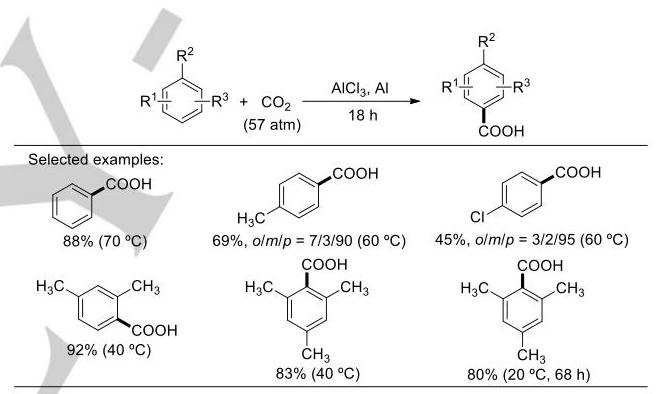
Scheme 42. ${\mathrm{{AICl}}}_{3}/\mathrm{{Al}}$ -promoted carboxylation of benzene and substituted aromatics[110]
方案42. ${\mathrm{{AICl}}}_{3}/\mathrm{{Al}}$促进的苯和取代芳烃的羧化反应[110]
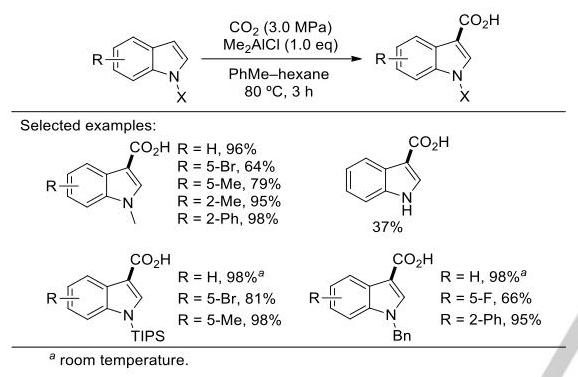
Scheme 43. Me2AICI-mediated carboxylation of indoles ${}^{\left\lbrack {122}\right\rbrack }$
方案43. Me2AICI介导的吲哚的羧化反应${}^{\left\lbrack {122}\right\rbrack }$
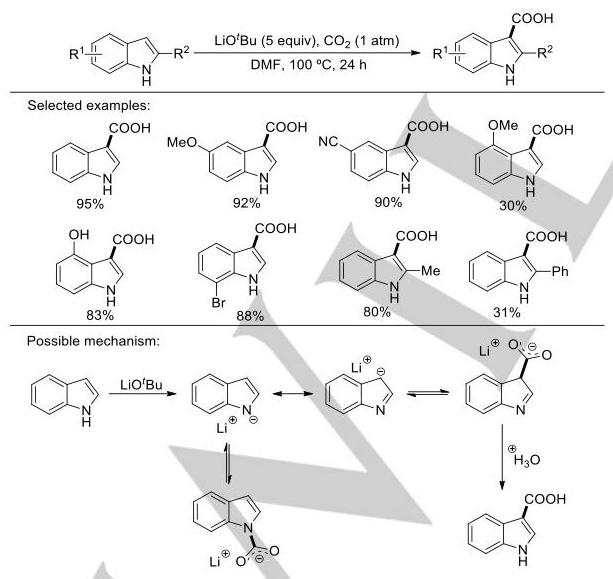
Scheme 44. LiO’Bu-mediated carboxylation of unprotected indole derivatives[124]
方案44. LiO’Bu介导的未保护吲哚衍生物的羧化反应[124]
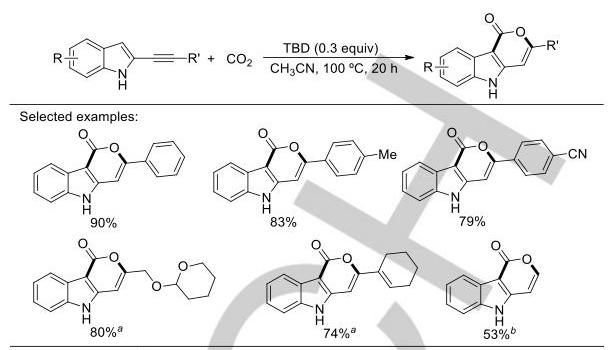
${}^{a}$ TBD: 1.0 equiv. ${}^{b}$ TBD: 3.0 equiv,70 ${}^{ \circ }\mathrm{C}$ .
${}^{a}$ TBD:1.0当量。${}^{b}$ TBD:3.0当量,70${}^{ \circ }\mathrm{C}$。
Scheme 45. TBD-catalyzed/promoted cyclization of 2-alkynyl indoles with ${\mathrm{{CO}}}_{2}{}^{\left\lbrack {126}\right\rbrack }$
方案45. TBD催化/促进的2-炔基吲哚与${\mathrm{{CO}}}_{2}{}^{\left\lbrack {126}\right\rbrack }$的环化反应
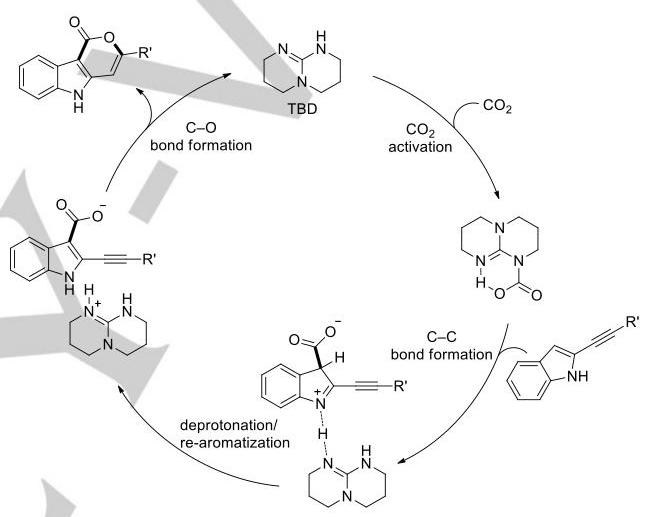
Scheme 46. Possible mechanism for TBD-catalyzed/promoted cyclization of 2- alkynyl indoles with ${\mathrm{{CO}}}_{2}{}^{\left\lbrack {126}\right\rbrack }$
方案46. TBD催化/促进的2-炔基吲哚与${\mathrm{{CO}}}_{2}{}^{\left\lbrack {126}\right\rbrack }$环化反应的可能机理
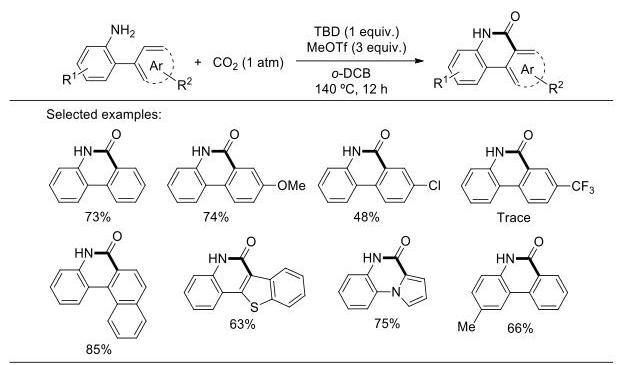
Scheme 47. MeOTf- and TBD-mediated lactamization of ortho-arylanilines with ${\mathrm{{CO}}}_{2}{}^{\left\lbrack {129}\right\rbrack }$
方案47. MeOTf和TBD介导的邻芳基苯胺与${\mathrm{{CO}}}_{2}{}^{\left\lbrack {129}\right\rbrack }$的内酰胺化反应
In 2017, Yu, Zhi and coworkers[130] developed a novel lactonization of heteroaryl and alkenyl $\mathrm{C} - \mathrm{H}$ bonds with ${\mathrm{{CO}}}_{2}$ to synthesize important coumarin derivatives under transition-metal-free conditions (Scheme 48).
2017年,Yu、Zhi及其同事[130]开发了一种新型的杂芳基和烯基$\mathrm{C} - \mathrm{H}$键与${\mathrm{{CO}}}_{2}$ 的内酯化反应,用于在无过渡金属条件下合成重要的香豆素衍生物(方案48)。
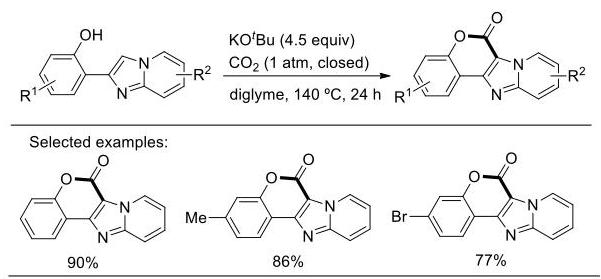
Scheme 48. The lactonization of heteroaryl C-H bonds with ${\mathrm{{CO}}}_{2}{}^{\left\lbrack {130}\right\rbrack }$
方案48. 杂芳基C-H键与${\mathrm{{CO}}}_{2}{}^{\left\lbrack {130}\right\rbrack }$的内酯化反应
3.1.2. Chelation-assisted carboxylation of $\mathrm{C}\left( {\mathrm{{sp}}}^{2}\right) - \mathrm{H}$ bonds of (hetero)arenes with ${\mathrm{{CO}}}_{2}$
3.1.2. (杂)芳烃的$\mathrm{C}\left( {\mathrm{{sp}}}^{2}\right) - \mathrm{H}$键与${\mathrm{{CO}}}_{2}$的螯合辅助羧基化反应
In 2011, Iwasawa and coworkers ${}^{\left\lbrack {82}\right\rbrack }$ reported the Rh(I)-catalyzed chelation-assisted direct carboxylation of aryl $\mathrm{C} - \mathrm{H}$ bonds with ${\mathrm{{CO}}}_{2}$ (Scheme 49). They found that 2-arylpyridines and 1- arylpyrazoles could undergo C-H bond activation to produce the corresponding carboxylated products in the presence of Rh(I) catalyst and two equivalents of ${\mathrm{{AIMe}}}_{2}\left( \mathrm{{OMe}}\right)$ . The choice of phosphine ligand is critical for the reaction: more sterically hindered monodentate phosphine ligands such as $\mathrm{P}{\left( \mathrm{{mes}}\right) }_{3}$ and ${\mathrm{{PCy}}}_{3}$ perform better, and bidentate phosphine ligands are detrimental to the reaction. The reaction mechanism is proposed as follows: first, Rh(I)CI reacts with methylaluminum reagent to generate methyl rhodium (I); then, chelation-assisted aryl C-H bond activation (oxidative addition) generates aryl trivalent rhodium, and reductive elimination of methane produces the key monovalent aryl rhodium species; this species undergoes nucleophilic addition to ${\mathrm{{CO}}}_{2}$ and then transmetalation with the methylaluminum reagent to obtain aluminium carboxylate, while methyl rhodium (I) is regenerated (Scheme 49). In 2017, Lu and coworkers[131] investigated the mechanism and effects of ligands and reagents in Rh-catalyzed C(sp ${}^{2}$ )-H bond carboxylation with ${\mathrm{{CO}}}_{2}$ through DFT calculations. Based on DFT calculations, a similar mechanism was proposed (Scheme 50). In the catalytic cycle, ${\mathrm{{CO}}}_{2}$ insertion is the rate-determining step. In addition to its role as a methylation reagent, ${\mathrm{{AlMe}}}_{2}\left( \mathrm{{OMe}}\right)$ can also serve as a Lewis acid to promote ${\mathrm{{CO}}}_{2}$ insertion. The origin of the promoting effect of $\mathrm{P}{\left( \text{ mes }\right) }_{3}$ on the reactivity is derived from the stabilizing effect due to the favorable agostic interaction of Rh with the ortho-methyl group of P(mes)3. In 2016, Ma and coworkers[132] successfully inserted ${\mathrm{{CO}}}_{2}$ into aryl $\mathrm{C} - \mathrm{H}$ bonds on the backbone of metal-organic framework UiO-67(dcppy) to generate free carboxylate groups (Scheme 51). Their catalytic system and the proposed reaction mechanism are similar to those of Iwasawa and coworkers[82]. UiO-67(dcppy)-COOH obtained by this reaction can be used as a heterogeneous Brønsted acid catalyst to catalyze the methanolysis of epoxides. In 2014, Mita and Sato and coworkers[133] found that 1- arylpyrazole derivatives can sequentially undergo ruthenium-catalyzed $\mathrm{C}\left( {\mathrm{{sp}}}^{2}\right) - \mathrm{H}$ silylation and fluoride-mediated carboxylation (Scheme 52). They believe the pyrazole group can play two roles
2011年,岩泽及其同事${}^{\left\lbrack {82}\right\rbrack }$报道了铑(I)催化的芳基$\mathrm{C} - \mathrm{H}$键与${\mathrm{{CO}}}_{2}$的螯合辅助直接羧基化反应(方案49)。他们发现,在铑(I)催化剂和两当量的${\mathrm{{AIMe}}}_{2}\left( \mathrm{{OMe}}\right)$存在下,2-芳基吡啶和1-芳基吡唑可以发生C-H键活化,生成相应的羧基化产物。膦配体的选择对反应至关重要:空间位阻较大的单齿膦配体,如$\mathrm{P}{\left( \mathrm{{mes}}\right) }_{3}$和${\mathrm{{PCy}}}_{3}$,表现更好,而双齿膦配体对反应不利。反应机理如下:首先,Rh(I)CI与甲基铝试剂反应生成甲基铑(I);然后,螯合辅助的芳基C-H键活化(氧化加成)生成芳基三价铑,甲烷的还原消除产生关键的一价芳基铑物种;该物种与${\mathrm{{CO}}}_{2}$进行亲核加成,然后与甲基铝试剂进行转金属化反应,得到羧酸铝,同时再生甲基铑(I)(方案49)。2017年,卢及其同事[131]通过密度泛函理论计算研究了铑催化的C(sp${}^{2}$)-H键与${\mathrm{{CO}}}_{2}$羧基化反应中配体和试剂的作用机制。基于密度泛函理论计算,提出了类似的反应机理(方案50)。在催化循环中,${\mathrm{{CO}}}_{2}$插入是速率决定步骤。除了作为甲基化试剂的作用外,${\mathrm{{AlMe}}}_{2}\left( \mathrm{{OMe}}\right)$还可以作为路易斯酸促进${\mathrm{{CO}}}_{2}$插入。$\mathrm{P}{\left( \text{ mes }\right) }_{3}$对反应活性促进作用的起源源于铑与P(mes)3邻位甲基的有利agostic相互作用所产生的稳定作用。2016年,马及其同事[132]成功地将${\mathrm{{CO}}}_{2}$插入金属有机框架UiO-67(dcppy)主链上的芳基$\mathrm{C} - \mathrm{H}$键中,生成游离羧基(方案51)。他们的催化体系和提出的反应机理与岩泽及其同事[82]的相似。通过该反应得到的UiO-67(dcppy)-COOH可以用作非均相布朗斯特酸催化剂,催化环氧化物的甲醇解反应。2014年,三田和佐藤及其同事[133]发现,芳基吡唑衍生物可以依次进行钌催化的$\mathrm{C}\left( {\mathrm{{sp}}}^{2}\right) - \mathrm{H}$硅烷化和氟介导的羧基化反应(方案52)。他们认为吡唑基团可以发挥两个作用
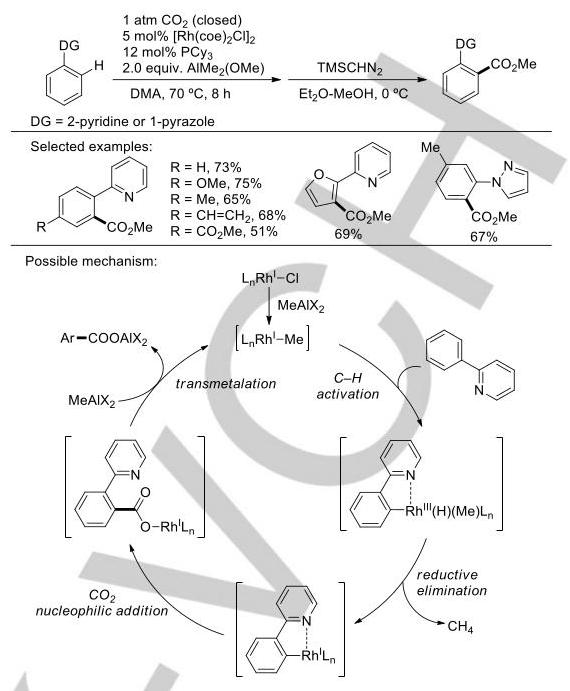
Scheme 49. Rh(I)-catalyzed direct carboxylation of aryl C-H bond via chelation-assisted C-H bond activation[82]
方案49. 通过螯合辅助C-H键活化的铑(I)催化芳基C-H键直接羧基化反应[82]
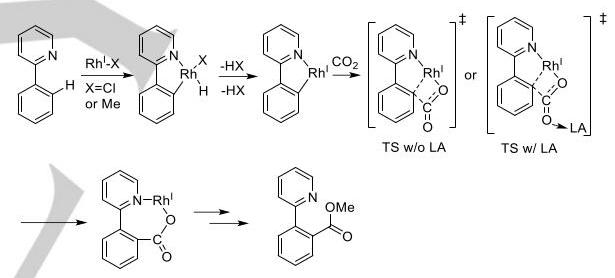
Scheme 50. Proposed mechanism of the Rh-catalysed C-H bond carboxylation based on DFT calculations[131]
方案50. 基于密度泛函理论计算提出的铑催化C-H键羧基化反应机理[131]
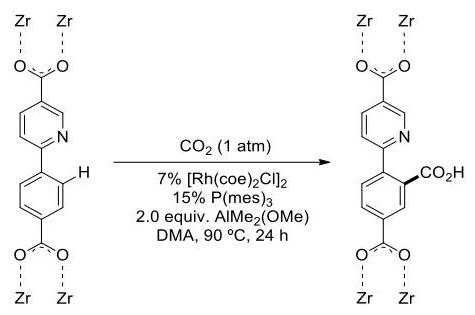
Scheme 51. Insertion of ${\mathrm{{CO}}}_{2}$ into aryl $\mathrm{C} - \mathrm{H}$ bonds of the UiO-67(dcppy) backbone ${}^{\left\lbrack {132}\right\rbrack }$
方案51. ${\mathrm{{CO}}}_{2}$插入UiO-67(dcppy)主链的芳基$\mathrm{C} - \mathrm{H}$键中${}^{\left\lbrack {132}\right\rbrack }$
REVIEW
综述
promoting ortho silylation via formation of a five-membered ruthenacycle intermediate and promoting carboxylation by an electron-withdrawing pyrazole nitrogen atom. In 2015, Hou and coworkers ${}^{\left\lbrack {134}\right\rbrack }$ reported a formal C-H bond carboxylation of aromatic rings containing directing groups or heterocycles catalyzed by a Cu(I)-NHC complex (Scheme 53). The reaction is carried out in two steps: Firstly, the aromatic ring is deprotonated with iBu ${}_{3}$ Al(TMP)Li (TMP=2,2,6,6- tetramethylpiperidide) to form the corresponding arylaluminum intermediate which is then catalyzed by Cu(I)-NHC complex to give the corresponding carboxylated products. This reaction has high regioselectivity, broad substrate scope and good tolerance of functional groups. For heterocycles such as benzofuran, benzothiophene, and N-Boc indole, the reaction occurs selectively at the C-2 position.
通过形成五元钌环中间体促进邻位硅基化,并通过吸电子的吡唑氮原子促进羧化反应。2015年,侯及其同事${}^{\left\lbrack {134}\right\rbrack }$报道了一种由Cu(I)-NHC配合物催化的含导向基团或杂环的芳香环的形式C-H键羧化反应(方案53)。该反应分两步进行:首先,用iBu${}_{3}$Al(TMP)Li(TMP = 2,2,6,6-四甲基哌啶)使芳香环去质子化,形成相应的芳基铝中间体,然后由Cu(I)-NHC配合物催化得到相应的羧化产物。该反应具有高区域选择性、广泛的底物范围和良好的官能团耐受性。对于苯并呋喃、苯并噻吩和N-Boc吲哚等杂环,反应选择性地发生在C-2位。

Scheme 52. Sequential C-H bond silylation and carboxylation of 1-arylpyrazole derivatives[133]
方案52. 1-芳基吡唑衍生物的顺序C-H键硅基化和羧化反应[133]
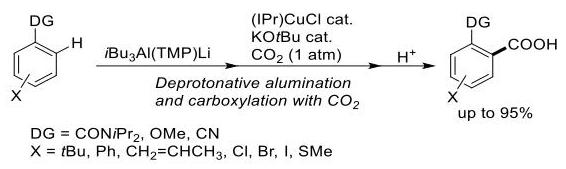
Scheme 53. $\mathrm{C} - \mathrm{H}$ carboxylation of aromatic compounds by deprotonative alumination and carboxylation ${}^{\left\lbrack {134}\right\rbrack }$
方案53. $\mathrm{C} - \mathrm{H}$通过去质子铝化和羧化反应对芳香化合物进行羧化${}^{\left\lbrack {134}\right\rbrack }$
In 2018, Li and coworkers ${}^{\left\lbrack {135}\right\rbrack }$ reported a ligand-enabled site-selective carboxylation of 2-arylphenols under atmospheric pressure of ${\mathrm{{CO}}}_{2}$ through a ${\mathrm{{Rh}}}_{2}{\left( \mathrm{{OAc}}\right) }_{4}$ -catalysed and chelation-assisted C-H bond activation (Scheme 54). Remarkably, the reaction occurs selectively on the less nucleophilic phenyl group via promotion by a phosphine ligand, which overrides the site selectivity dictated by the well-known Kolbe-Schmitt type reaction. Later, they have successfully applied this Rh" catalysis approach to other similar types of substrate. ${}^{\left\lbrack {136} - {137}\right\rbrack }$ In 2018, Yu and coworkers[138] reported the first Pd(TFA)2- catalyzed benzamide-directed carbonylation of unactivated aryl $\mathrm{C - H}$ bonds with atmospheric ${\mathrm{{CO}}}_{2}$ to afford a series of phthalimides (Scheme 55a). The mechanistic investigations suggested that the palladacycle might be an active intermediate, which further reacts with ${\mathrm{{CO}}}_{2}$ to generate the desired product. In another work, ${}^{\left\lbrack {139}\right\rbrack }$ with benzylic alcohol as a directing group, they realized Pd(TFA)2-catalyzed lactonization of unactivated aryl C-H bonds with ${\mathrm{{CO}}}_{2}$ to afford phthalides (Scheme 55b). Remarkably, the DFT calculations indicated that lactonization might involve insertion of two ${\mathrm{{CO}}}_{2}$ into the $\mathrm{O} - \mathrm{{Pd}}$ bond of the palladacycle, which is interesting and novel from previous reports.
2018年,李及其同事${}^{\left\lbrack {135}\right\rbrack }$报道了在${\mathrm{{CO}}}_{2}$大气压下,通过${\mathrm{{Rh}}}_{2}{\left( \mathrm{{OAc}}\right) }_{4}$催化和螯合辅助的C-H键活化实现2-芳基苯酚的配体导向位点选择性羧化反应(方案54)。值得注意的是,该反应通过膦配体的促进作用,选择性地发生在亲核性较弱的苯基上,这超越了著名的Kolbe-Schmitt型反应所决定的位点选择性。后来,他们成功地将这种Rh"催化方法应用于其他类似类型的底物。${}^{\left\lbrack {136} - {137}\right\rbrack }$ 2018年,于及其同事[138]报道了首例Pd(TFA)2催化的苯甲酰胺导向的未活化芳基$\mathrm{C - H}$键与大气中的${\mathrm{{CO}}}_{2}$进行羰基化反应,得到一系列邻苯二甲酰亚胺(方案55a)。机理研究表明,钯环可能是活性中间体,它进一步与${\mathrm{{CO}}}_{2}$反应生成所需产物。在另一项工作中,${}^{\left\lbrack {139}\right\rbrack }$以苄醇为导向基团,他们实现了Pd(TFA)2催化的未活化芳基C-H键与${\mathrm{{CO}}}_{2}$的内酯化反应,得到邻苯二甲酸酯(方案55b)。值得注意的是,DFT计算表明内酯化反应可能涉及两个${\mathrm{{CO}}}_{2}$插入钯环的$\mathrm{O} - \mathrm{{Pd}}$键中,这与以前的报道相比既有趣又新颖。
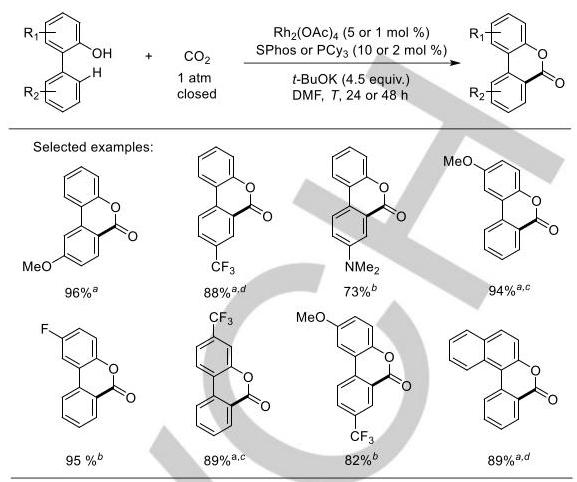
${}^{a}{24}\mathrm{\;h},{90}^{ \circ }\mathrm{C},{\mathrm{{Rh}}}_{2}{\left( \mathrm{{OAc}}\right) }_{4}\left( {5\mathrm{\;{mol}}\% }\right)$ , SPhos $\left( {{10}\mathrm{\;{mol}}\% }\right)$ . ${}^{c}{100}^{ \circ }\mathrm{C}$ . ${}^{d}{120}^{ \circ }\mathrm{C}$ . ${}^{b}{48}\mathrm{\;h},{100}^{ \circ }\mathrm{C},{\mathrm{{Rh}}}_{2}{\left( \mathrm{{OAc}}\right) }_{4}\left( {1\mathrm{\;{mol}}\% }\right) ,{\mathrm{{PCy}}}_{3}\left( {2\mathrm{\;{mol}}\% }\right)$ .
${}^{a}{24}\mathrm{\;h},{90}^{ \circ }\mathrm{C},{\mathrm{{Rh}}}_{2}{\left( \mathrm{{OAc}}\right) }_{4}\left( {5\mathrm{\;{mol}}\% }\right)$,SPhos$\left( {{10}\mathrm{\;{mol}}\% }\right)$。${}^{c}{100}^{ \circ }\mathrm{C}$。${}^{d}{120}^{ \circ }\mathrm{C}$。${}^{b}{48}\mathrm{\;h},{100}^{ \circ }\mathrm{C},{\mathrm{{Rh}}}_{2}{\left( \mathrm{{OAc}}\right) }_{4}\left( {1\mathrm{\;{mol}}\% }\right) ,{\mathrm{{PCy}}}_{3}\left( {2\mathrm{\;{mol}}\% }\right)$。
Scheme 54. Ligand-enabled site-selectivity in a versatile rhodium(II)-catalyzed aryl $\mathrm{C} - \mathrm{H}$ carboxylation of aromatic compounds by deprotonative
方案54. 通过去质子化实现的通用铑(II)催化的芳族化合物芳基$\mathrm{C} - \mathrm{H}$羧化反应中的配体导向位点选择性
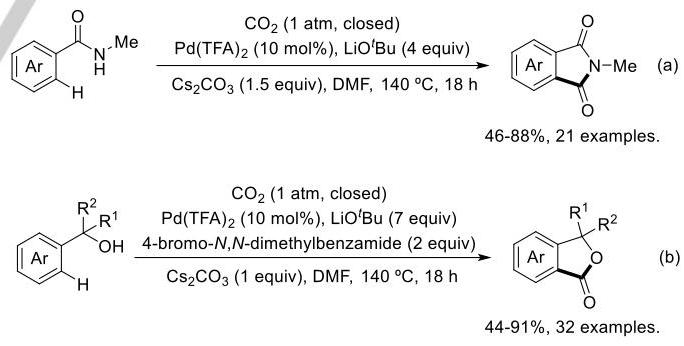
Scheme 55. Pd-catalyzed directed C-H bond carboxylation with ${\mathrm{{CO}}}_{2}{}^{\left\lbrack {138} - {139}\right\rbrack }$
方案55. 钯催化的与${\mathrm{{CO}}}_{2}{}^{\left\lbrack {138} - {139}\right\rbrack }$的定向C-H键羧化反应
3.2. Carboxylation of vinylic $\mathrm{C}\left( {\mathrm{{sp}}}^{2}\right) - \mathrm{H}$ bonds with ${\mathrm{{CO}}}_{2}$
3.2. 乙烯基$\mathrm{C}\left( {\mathrm{{sp}}}^{2}\right) - \mathrm{H}$键与${\mathrm{{CO}}}_{2}$的羧基化反应
In 2013, Iwasawa and coworkers[140] first reported a Pd(II)- catalyzed direct carboxylation (lactonization) reaction of alkenyl C-H bonds with ${\mathrm{{CO}}}_{2}$ (Scheme 56a). Their reaction mechanism is proposed as follows. First, one molecule of 2-hydroxystyrene is chelated with $\mathrm{{Pd}}{\left( \mathrm{{OAc}}\right) }_{2}$ to activate the vinylic $\mathrm{C} - \mathrm{H}$ bond, and then reacts with the cesium salt of a second molecule of 2- hydroxystyrene to produce a hexacyclic alkenyl-palladium intermediate. The next step is a reversible nucleophilic carboxylation of this intermediate with ${\mathrm{{CO}}}_{2}$ to give a palladium carboxylate intermediate. The palladium carboxylate intermediate reacts with another molecule of 2-hydroxystyrene and ${\mathrm{{Cs}}}_{2}{\mathrm{{CO}}}_{3}$ to give the coumarin product, while the cyclometalated intermediate is regenerated (Scheme 57). Through stoichiometric experiments they isolated the cyclometalated intermediates, whose structures were confirmed by X-ray crystal diffraction. Interestingly, a transition-metal-free version of this reaction was reported by Yu, Zhi and coworkers in 2017 (Scheme 56b).[130] The reaction conditions are much harsher for the transition-metal-free version compared with the Pd-catalyzed version.
2013年,岩泽及其同事[140]首次报道了钯(II)催化的烯基C-H键与${\mathrm{{CO}}}_{2}$的直接羧基化(内酯化)反应(方案56a)。他们提出的反应机理如下。首先,一分子2-羟基苯乙烯与$\mathrm{{Pd}}{\left( \mathrm{{OAc}}\right) }_{2}$螯合以活化乙烯基$\mathrm{C} - \mathrm{H}$键,然后与第二分子2-羟基苯乙烯的铯盐反应生成六环烯基钯中间体。下一步是该中间体与${\mathrm{{CO}}}_{2}$进行可逆的亲核羧基化反应,生成羧酸钯中间体。羧酸钯中间体与另一分子2-羟基苯乙烯和${\mathrm{{Cs}}}_{2}{\mathrm{{CO}}}_{3}$反应生成香豆素产物,同时环金属化中间体再生(方案57)。通过化学计量实验,他们分离出了环金属化中间体,其结构通过X射线晶体衍射得到证实。有趣的是,2017年,余志及其同事报道了该反应的无过渡金属版本(方案56b)[130]。与钯催化版本相比,无过渡金属版本的反应条件要苛刻得多。
In 2016, Yu and coworkers ${}^{\left\lbrack {141}\right\rbrack }$ developed a transition-metal-free lactamization of alkenyl and heteroaryl $\mathrm{C} - \mathrm{H}$ bonds with ${\mathrm{{CO}}}_{2}$ (Scheme 58). A series of 2-quinolinone and polyheterocycles were synthesized. Using excessive amounts of sodium tert-butoxide as base and high temperature are key to the efficient transformation. Isocyanate is proposed as the active intermediate in this reaction. In 2016, based on previous work[112-113, 122-123], Tanaka, Hattori and coworkers reported a EtAICl2/2,6-disubstituted pyridine-mediated carboxylation of a-aryl alkenes and trisubstituted alkenes with ${\mathrm{{CO}}}_{2}{}^{\left\lbrack {142}\right\rbrack }$ (Scheme 59). In terms of practical yield, this is the first reaction in which a vinyl hydrogen atom is replaced by a carboxyl group. The choice of a base with suitable steric hindrance and basicity is crucial to this reaction. Notably, the base can be used as a catalyst in this reaction but the amount of ${\mathrm{{EtAICl}}}_{2}$ must be stoichiometric. In 2018, Yu and coworkers ${}^{\left\lbrack {143}\right\rbrack }$ reported a novel synthesis of 1,3- oxazin-6-ones from enamides and ${\mathrm{{CO}}}_{2}$ through C-H carboxylation and one-pot cyclization (Scheme 60). Nucleophilic attack on ${\mathrm{{CO}}}_{2}$ by the electron-rich alkene is demonstrated for this reaction. The direct synthesis of acrylates from ${\mathrm{{CO}}}_{2}$ and ethylene is an ideal and economical way, but this reaction is incredibly challenging. In industry, sodium acrylate is a monomer used for the synthesis of sodium polyacrylate, a versatile polymeric material. In 2012, Limbach and coworkers ${}^{\left\lbrack {144}\right\rbrack }$ first realized a nickel-catalyzed synthesis of sodium acrylate from ${\mathrm{{CO}}}_{2}$ and ethylene (Scheme 61). The turnover number (TON) of the catalyst can exceed 10. Critical to success was the separation and characterization of several key organonickel intermediates of elementary reactions in the catalytic cycle as well as combination of experimental data and theoretical calculations. Since the base sodium tert-butoxide can react with ${\mathrm{{CO}}}_{2}$ to produce relatively stable carbonic acid half esters, the catalytic cycle must be divided into two parts, a ${\mathrm{{CO}}}_{2}$ -rich regime and a ${\mathrm{{CO}}}_{2}$ -poor regime. This shortcoming has greatly limited the practicality of this method. In 2014, Vogt and coworkers[ ${}^{145}$ ] used a nickel catalyst system to further increase catalytic TON to 21 (Scheme 62). Compared with the work of Limbach and coworkers, Vogt and coworkers’ method is easier to operate and avoids repeated replacement of reactant gases. Believed by Vogt and coworkers, the challenge of this reaction is that the nickelalactone intermediate do not readily undergo $\beta$ -hydride elimination due to conformation of the five-membered ring. They found that adding “hard cation soft anion” salt Lil to the reaction system can effectively promote decomposition of the nickelalactone intermediate to produce lithium acrylate (Scheme 62). The role of Lil in the reaction has also been supported by DFT calculations. In 2014, Limbach and coworkers[146] made further improvements to their previously reported system. ${}^{\left\lbrack {144}\right\rbrack }$ Through screen of ligands, solvents, bases, etc., they succeeded in realizing nickel-catalyzed carboxylation of a series of alkenes (including ethylene, styrene and 1,3- butadiene) ${}^{\left\lbrack {146}\right\rbrack }$ (Scheme 63). The choice of base is crucial for the reaction: a suitable base not only has strong basicity so that the nickelalactone intermediate can be deprotonated to release the product, but also has weaker nucleophilicity to avoid reacting directly with ${\mathrm{{CO}}}_{2}$ . Sodium 2-fluorophenoxide is the most suitable base in their selection. For ethylene, the catalyst TON can reach 107. Except for 2-vinylpyridine which gives a branched $\alpha ,\beta$ - unsaturated carboxylic acid salt, other alkenes are capable of selectively producing linear products. In terms of stereoselectivity, this reaction has high (E)-selectivity. Terminal, unactivated alkenes or internal ones cannot participate in this reaction. In 2015, Limbach and coworkers[147] reported the first palladium-catalyzed carboxylation of ethylene and conjugated dienes (Scheme 64a). Their proposed reaction mechanism is similar to the nickel-catalyzed reaction mechanism ${}^{\left\lbrack {146}\right\rbrack }$ . In 2015, Schaub and coworkers ${}^{\left\lbrack {148}\right\rbrack }$ improved the catalyst system of Limbach and coworkers: by using the $\left\lbrack {\mathrm{{Pd}}{\left( {\mathrm{{PPh}}}_{3}\right) }_{4}}\right\rbrack /$ dcpe system, sodium 2,6-di-tert-butyl-4-methylphenolate as base, catalyst TON can reach a level comparable to that of Limbach and coworkers’ nickel catalyst system (TON = 106) while avoiding use of zinc; in addition, the less toxic anisole is used as solvent (Scheme 64b). They also proposed a new concept that combines product separation, catalyst recovery and base regeneration. Schaub and coworkers[149] also studied the elementary reactions involved in nickel-catalyzed carboxylation of some simple alkenes. Recently, Schaub and coworkers[150] found that using [Pd(PPh3)4]/dcpe system and sodium tert-butoxide as base, ethylene, 1,3- butadiene and non-activated terminal alkenes or internal alkenes can undergo carboxylation at ${145}^{ \circ }\mathrm{C}$ (Scheme 64c). Sodium tert-butoxide is more basic than sodium 2-fluorophenoxide and applicable to a broader range of substrates for this system. Notably, the decomposition temperature of carbonate esters given by the reaction of sodium tert-butoxide and ${\mathrm{{CO}}}_{2}$ is ${60}^{ \circ }\mathrm{C}$ . Later, by using amide solvents, they have further improved their Pd catalysis system to achieve turnover numbers greater than 500.[^151] In 2017, Cummins and coworkers developed a series of novel cis-macrocyclic diphosphines ligands, and found these ligands show promising catalytic activity in Ni- ${}^{\left\lbrack {152}\right\rbrack }$ and Co-catalyzed ${}^{\left\lbrack {153}\right\rbrack }{\mathrm{{CO}}}_{2}$ /ethylene coupling reaction.
2016年,Yu及其同事${}^{\left\lbrack {141}\right\rbrack }$开发了一种无过渡金属的方法,用于烯基和杂芳基$\mathrm{C} - \mathrm{H}$键与${\mathrm{{CO}}}_{2}$的环化反应生成内酰胺(方案58)。合成了一系列2-喹啉酮和多杂环化合物。使用过量的叔丁醇钠作为碱并在高温下反应是实现高效转化的关键。异氰酸酯被认为是该反应中的活性中间体。2016年,基于之前的工作[112 - 113, 122 - 123],Tanaka、Hattori及其同事报道了EtAICl2/2,6 - 二取代吡啶介导的α - 芳基烯烃和三取代烯烃与${\mathrm{{CO}}}_{2}{}^{\left\lbrack {142}\right\rbrack }$的羧化反应(方案59)。就实际产率而言,这是第一个将乙烯基氢原子被羧基取代的反应。选择具有合适空间位阻和碱性的碱对该反应至关重要。值得注意的是,该碱在该反应中可作为催化剂,但${\mathrm{{EtAICl}}}_{2}$的用量必须是化学计量的。2018年,Yu及其同事${}^{\left\lbrack {143}\right\rbrack }$报道了一种通过C - H羧化和一锅法环化从烯酰胺和${\mathrm{{CO}}}_{2}$合成1,3 - 恶嗪 - 6 - 酮的新方法(方案60)。该反应证明了富电子烯烃对${\mathrm{{CO}}}_{2}$的亲核进攻。由${\mathrm{{CO}}}_{2}$和乙烯直接合成丙烯酸酯是一种理想且经济的方法,但该反应极具挑战性。在工业上,丙烯酸钠是用于合成聚丙烯酸钠的单体,聚丙烯酸钠是一种用途广泛的高分子材料。2012年,Limbach及其同事${}^{\left\lbrack {144}\right\rbrack }$首次实现了镍催化的由${\mathrm{{CO}}}_{2}$和乙烯合成丙烯酸钠的反应(方案61)。催化剂的周转数(TON)可以超过10。成功的关键在于分离和表征催化循环中几个关键的有机镍中间体以及结合实验数据和理论计算。由于碱叔丁醇钠可与${\mathrm{{CO}}}_{2}$反应生成相对稳定的碳酸半酯,催化循环必须分为两部分,一个${\mathrm{{CO}}}_{2}$富集区和一个${\mathrm{{CO}}}_{2}$贫化区。这个缺点极大地限制了该方法的实用性。2014年,Vogt及其同事[${}^{145}$]使用镍催化剂体系将催化TON进一步提高到21(方案62)。与Limbach及其同事的工作相比,Vogt及其同事的方法更易于操作,并且避免了反应物气体的重复置换。Vogt及其同事认为,该反应的挑战在于由于五元环的构象,镍内酯中间体不容易发生$\beta$ - 氢消除反应。他们发现向反应体系中加入“硬阳离子软阴离子”盐Lil可以有效促进镍内酯中间体的分解,生成丙烯酸锂(方案62)。Lil在反应中的作用也得到了DFT计算的支持。2014年,Limbach及其同事[146]对他们之前报道的体系进行了进一步改进。${}^{\left\lbrack {144}\right\rbrack }$通过筛选配体、溶剂、碱等,他们成功实现了镍催化的一系列烯烃(包括乙烯、苯乙烯和1,3 - 丁二烯)与${}^{\left\lbrack {146}\right\rbrack }$的羧化反应(方案63)。碱的选择对反应至关重要:合适的碱不仅要有强碱性,使镍内酯中间体能够去质子化以释放产物,而且要有较弱的亲核性,以避免直接与${\mathrm{{CO}}}_{2}$反应。2 - 氟苯氧基钠是他们选择中最合适的碱。对于乙烯,催化剂TON可以达到107。除了2 - 乙烯基吡啶生成支链$\alpha ,\beta$ - 不饱和羧酸盐外,其他烯烃能够选择性地生成线性产物。在立体选择性方面,该反应具有高(E) - 选择性。末端未活化的烯烃或内烯烃不能参与该反应。2015年,Limbach及其同事[147]报道了首例钯催化的乙烯和共轭二烯羧化反应(方案64a)。他们提出的反应机理与镍催化的反应机理${}^{\left\lbrack {146}\right\rbrack }$相似。2015年,Schaub及其同事${}^{\left\lbrack {148}\right\rbrack }$改进了Limbach及其同事的催化剂体系:通过使用$\left\lbrack {\mathrm{{Pd}}{\left( {\mathrm{{PPh}}}_{3}\right) }_{4}}\right\rbrack /$ dcpe体系,2,6 - 二叔丁基 - 4 - 甲基苯酚钠作为碱,催化剂TON可以达到与Limbach及其同事的镍催化剂体系相当的水平(TON = 106),同时避免使用锌;此外,使用毒性较小的苯甲醚作为溶剂(方案64b)。他们还提出了一个将产物分离、催化剂回收和碱再生相结合的新概念。Schaub及其同事[149]还研究了镍催化的一些简单烯烃羧化反应中涉及的基元反应。最近,Schaub及其同事[150]发现使用[Pd(PPh3)4]/dcpe体系和叔丁醇钠作为碱,乙烯、1,3 - 丁二烯和未活化的末端烯烃或内烯烃可以在${145}^{ \circ }\mathrm{C}$发生羧化反应(方案64c)。叔丁醇钠比2 - 氟苯氧基钠碱性更强,适用于该体系更广泛的底物。值得注意的是,叔丁醇钠与${\mathrm{{CO}}}_{2}$反应生成的碳酸酯的分解温度为${60}^{ \circ }\mathrm{C}$。后来,通过使用酰胺溶剂,他们进一步改进了钯催化体系以实现周转数大于500。[^151] 2017年,Cummins及其同事开发了一系列新型的顺式大环二膦配体,并发现这些配体在Ni - ${}^{\left\lbrack {152}\right\rbrack }$和Co催化的${}^{\left\lbrack {153}\right\rbrack }{\mathrm{{CO}}}_{2}$/乙烯偶联反应中显示出有前景的催化活性。
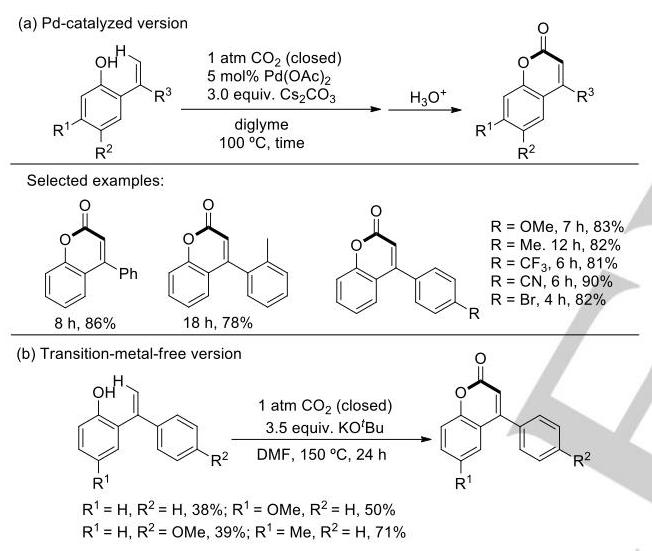
Scheme 56. Pd-catalyzed direct carboxylation of alkenyl C-H bonds of 2- hydroxystyrenes with ${\mathrm{{CO}}}_{2}{}^{\left\lbrack {140}\right\rbrack }$ and its transition-metal-free version ${}^{\left\lbrack {130}\right\rbrack }$
方案56. 钯催化2-羟基苯乙烯的烯基C-H键与${\mathrm{{CO}}}_{2}{}^{\left\lbrack {140}\right\rbrack }$的直接羧基化反应及其无过渡金属版本${}^{\left\lbrack {130}\right\rbrack }$
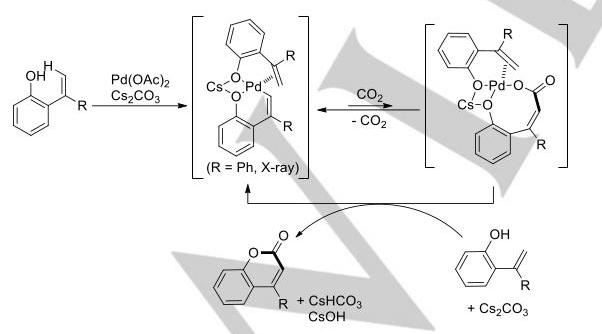
Scheme 57. Possible mechanism for Pd-catalyzed direct carboxylation of alkenyl C-H bonds of 2-hydroxystyrenes with ${\mathrm{{CO}}}_{2}{}^{\left\lbrack {140}\right\rbrack }$
方案57. 钯催化2-羟基苯乙烯的烯基C-H键与${\mathrm{{CO}}}_{2}{}^{\left\lbrack {140}\right\rbrack }$直接羧基化反应的可能机理
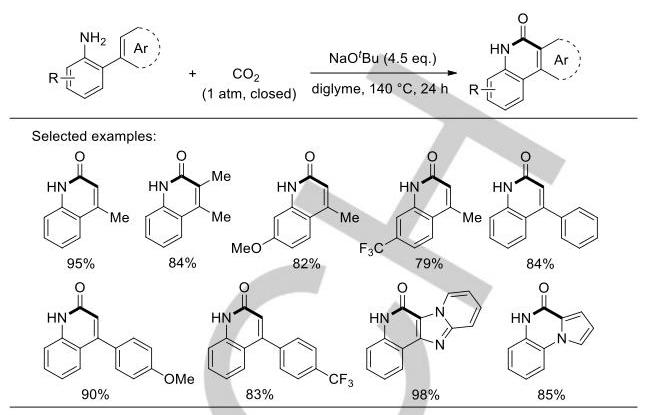
Scheme 58. ${\mathrm{{NaO}}}^{t}\mathrm{{Bu}}$ -promoted lactamization of 2-alkenylanilines or 2- heteroarylanilines with ${\mathrm{{CO}}}_{2}{}^{\left\lbrack {141}\right\rbrack }$
方案58. ${\mathrm{{NaO}}}^{t}\mathrm{{Bu}}$促进2-烯基苯胺或2-杂芳基苯胺与${\mathrm{{CO}}}_{2}{}^{\left\lbrack {141}\right\rbrack }$的内酰胺化反应
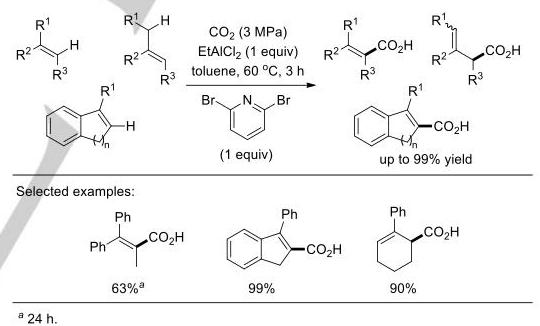
Scheme 59. EtAlCl2/2,6-dibromopyridine-mediated carboxylation of alkenes with ${\mathrm{{CO}}}_{2}{}^{\left\lbrack {142}\right\rbrack }$
方案59. EtAlCl2/2,6-二溴吡啶介导的烯烃与${\mathrm{{CO}}}_{2}{}^{\left\lbrack {142}\right\rbrack }$的羧基化反应
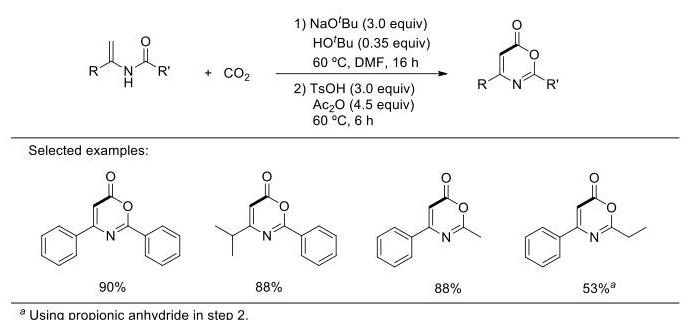
Scheme 60. C-H carboxylation of enamides with ${\mathrm{{CO}}}_{2}{}^{\left\lbrack {143}\right\rbrack }$
方案60. 烯酰胺与${\mathrm{{CO}}}_{2}{}^{\left\lbrack {143}\right\rbrack }$的C-H羧基化反应
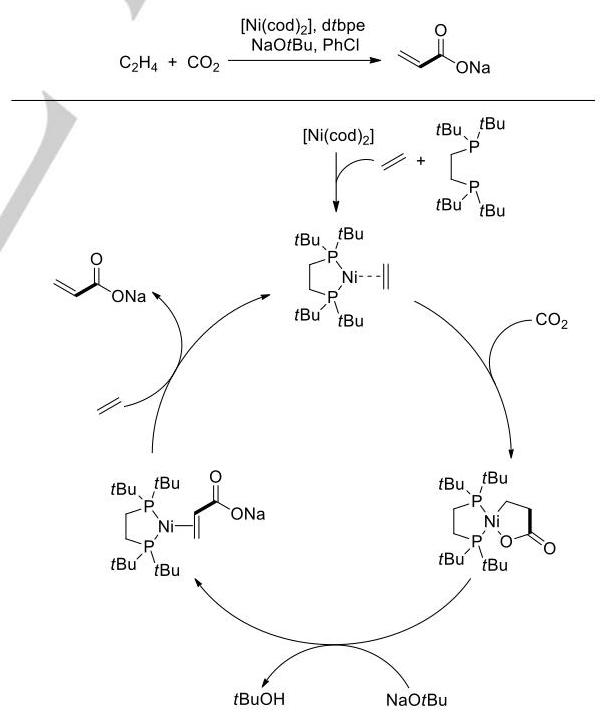
Scheme 61. Possible catalytic cycle for Ni-catalyzed formation of sodium acrylate from ${\mathrm{{CO}}}_{2}$ , ethylene, and base ${}^{\left\lbrack {144}\right\rbrack }$
方案61. 镍催化由${\mathrm{{CO}}}_{2}$、乙烯和碱${}^{\left\lbrack {144}\right\rbrack }$形成丙烯酸钠的可能催化循环
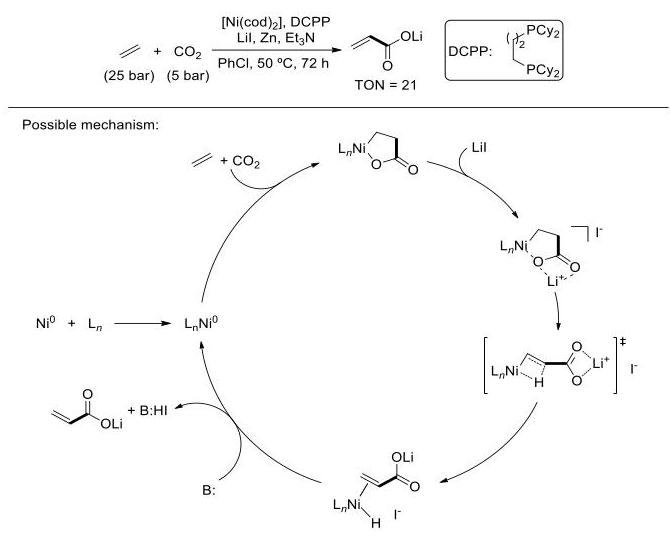
Scheme 62. Ni-catalyzed formation of lithium acrylate ${}^{\left\lbrack {145}\right\rbrack }$
方案62. 镍催化形成丙烯酸锂${}^{\left\lbrack {145}\right\rbrack }$
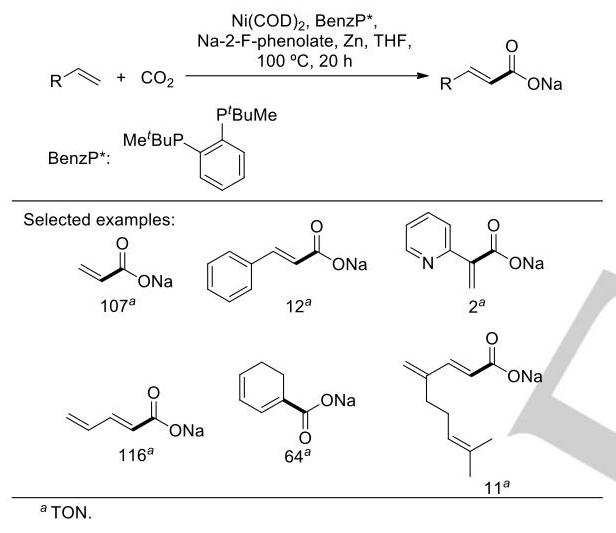
Scheme 63. Ni-catalyzed direct carboxylation of olefins with ${\mathrm{{CO}}}_{2}{}^{\left\lbrack {146}\right\rbrack }$
方案63. 镍催化烯烃与${\mathrm{{CO}}}_{2}{}^{\left\lbrack {146}\right\rbrack }$的直接羧基化反应
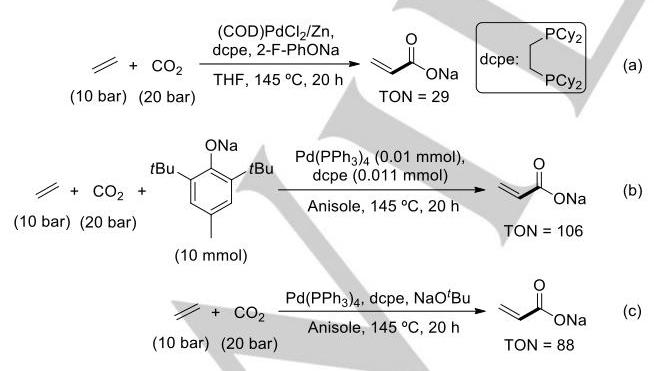
Scheme 64. Pd-catalyzed formation of sodium acrylate ${}^{\left\lbrack {147} - {148},{150}\right\rbrack }$
方案64. 钯催化形成丙烯酸钠${}^{\left\lbrack {147} - {148},{150}\right\rbrack }$
${\mathrm{{CO}}}_{2}$ In 2017, Mo and coworkers ${}^{\left\lbrack {154}\right\rbrack }$ reported ${\mathrm{{Cs}}}_{2}{\mathrm{{CO}}}_{3}$ -promoted carboxylation of the diazo group ipso- $\mathrm{C} - \mathrm{H}$ bond with ${\mathrm{{CO}}}_{2}$ under very mild reaction conditions (Scheme 65). With intrinsic nucleophilicity, diazo group has been found to react with various electrophiles, such as acyl chloride, aldehyde, ketone, imine and boron compounds. This is the first report of utilizing ${\mathrm{{CO}}}_{2}$ in diazo addition reaction. The carboxylation exhibits high reactivity and is amenable to subsequent diversification. The resulting α-diazo carboxylate can be readily converted to esters and amides in a one-pot fashion. In addition to stable $\alpha$ -diazo carbonyl compounds, labile TMSCHN2 is also a competent substrate for the desired transformation. This method provide a modular synthesis of a series of unsymmetrical 1,3-diester/keto/amide diazo compounds in moderate to excellent yields (up to 99%) with good functional group compatibility. In 2018, Lee and coworkers[155] reported an interesting umpolung reactivity of aromatic aldehydes with ${\mathrm{{CO}}}_{2}$ (Scheme 66). By using KCN and Ti(OiPr)4, they achieved direct carboxylation reaction of aromatic aldehydes with ${\mathrm{{CO}}}_{2}$ (1 atm) to afford $\alpha$ -keto acids products under mild reaction conditions. This method has been expanded to the synthesis of α-amino acids derivatives, illustrating the chemical synthesis of essential bioactive molecules from ${\mathrm{{CO}}}_{2}$ .
${\mathrm{{CO}}}_{2}$ 2017年,Mo及其同事 ${}^{\left\lbrack {154}\right\rbrack }$ 报道了 ${\mathrm{{Cs}}}_{2}{\mathrm{{CO}}}_{3}$ 促进的重氮基团原位 $\mathrm{C} - \mathrm{H}$ 键与 ${\mathrm{{CO}}}_{2}$ 在非常温和的反应条件下的羧化反应(方案65)。由于重氮基团具有内在的亲核性,已发现它能与各种亲电试剂反应,如酰氯、醛、酮、亚胺和硼化合物。这是在重氮加成反应中利用 ${\mathrm{{CO}}}_{2}$ 的首次报道。该羧化反应具有高反应活性,并且适合后续的多样化反应。所得的α-重氮羧酸盐可以很容易地一锅法转化为酯和酰胺。除了稳定的 $\alpha$ -重氮羰基化合物外,不稳定的TMSCHN2也是所需转化反应的合适底物。该方法以中等至优异的产率(高达99%)提供了一系列不对称1,3-二酯/酮/酰胺重氮化合物的模块化合成,具有良好的官能团兼容性。2018年,Lee及其同事[155]报道了芳族醛与 ${\mathrm{{CO}}}_{2}$ 的有趣的极性反转反应(方案66)。通过使用KCN和Ti(OiPr)4,他们实现了芳族醛与 ${\mathrm{{CO}}}_{2}$(1 atm)的直接羧化反应,在温和的反应条件下得到 $\alpha$ -酮酸产物。该方法已扩展到α-氨基酸衍生物的合成,说明了从 ${\mathrm{{CO}}}_{2}$ 合成必需的生物活性分子。
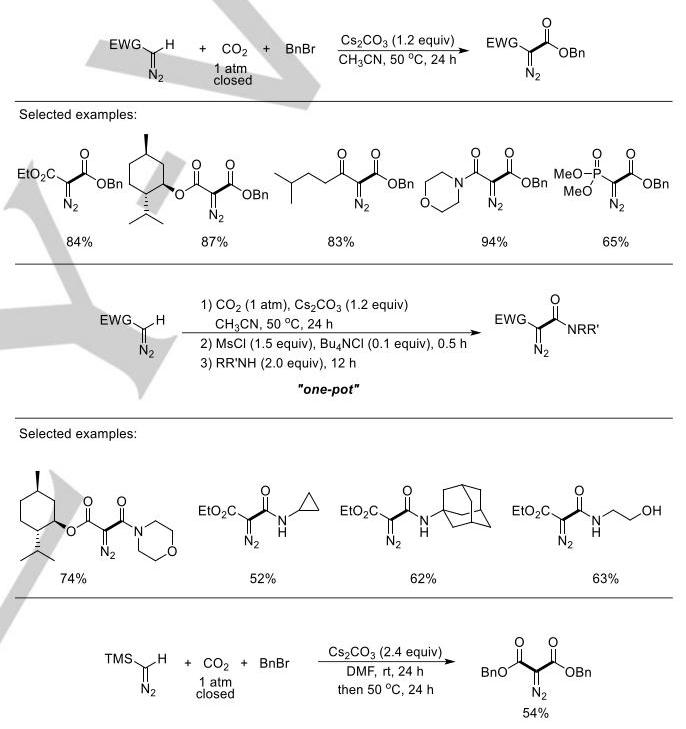
Scheme 65. ${\mathrm{{Cs}}}_{2}{\mathrm{{CO}}}_{3}$ -promoted carboxylation of the diazo group ipso-C-H bond with ${\mathrm{{CO}}}_{2}{}^{\left\lbrack {154}\right\rbrack }$
方案65. ${\mathrm{{Cs}}}_{2}{\mathrm{{CO}}}_{3}$促进重氮基团的ipso-C-H键与${\mathrm{{CO}}}_{2}{}^{\left\lbrack {154}\right\rbrack }$的羧基化反应
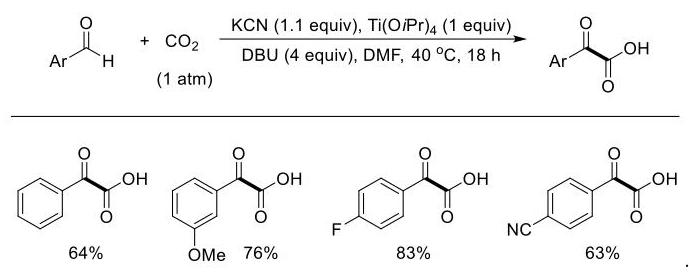
Scheme 66. Carboxylation reaction of aromatic aldehydes with ${\mathrm{{CO}}}_{2}{}^{\left\lbrack {155}\right\rbrack }$
方案66. 芳香醛与${\mathrm{{CO}}}_{2}{}^{\left\lbrack {155}\right\rbrack }$的羧基化反应
4. Carboxylation of $\mathrm{C}\left( {\mathrm{{sp}}}^{3}\right) - \mathrm{H}$ bonds with ${\mathrm{{CO}}}_{2}$
4. 用${\mathrm{{CO}}}_{2}$对$\mathrm{C}\left( {\mathrm{{sp}}}^{3}\right) - \mathrm{H}$键进行羧基化反应
A large body of work ${}^{\left\lbrack {156} - {175}\right\rbrack }$ has been done on the carboxylation of carbonyl $\alpha - \mathrm{C}\left( {\mathrm{{sp}}}^{3}\right) - \mathrm{H}$ bond with ${\mathrm{{CO}}}_{2}$ . For example, in 2006, Shoji Hara and coworkers[174] reported an electrochemical carboxylation of aliphatic ketones with ${\mathrm{{CO}}}_{2}$ to furnish $\beta$ - ketocarboxylic acids in moderate to good yields (Scheme 67). It is believed that ${\mathrm{{CO}}}_{2}$ is reduced to the corresponding radical anion under the reaction conditions; this radical anion species can facilitate enolate formation. In 2014, Macyk and coworkers reported a photocatalytic carboxylation of acetylacetone with CO2 by using ZnS-based photocatalysts. ${}^{\left\lbrack {175}\right\rbrack }$ In 2008, Jessop and coworkers ${}^{\left\lbrack {171}\right\rbrack }$ combined the carboxylation of ketones promoted by DBU with asymmetric hydrogenation of $\beta$ -ketocarboxylic acids catalyzed by ${\mathrm{{RuCl}}}_{2}\left\lbrack {\left( \mathrm{S}\right) - \mathrm{{BINAP}}}\right\rbrack$ for the asymmetric synthesis of $\beta$ - hydroxycarboxylic acids (Scheme 68). In 2011, Beckman and Munshi ${}^{\left\lbrack {172}\right\rbrack }$ reported the carboxylation of ketones catalyzed by a reversible ${\mathrm{{CO}}}_{2}$ carrier (RCC) (Scheme 69). RCC is obtained by reacting ${\mathrm{{CO}}}_{2}$ with DBU which is supported on methylhydrosiloxane dimethyl siloxane copolymer. The extent of carboxylation reaction might be related to the percentage of enol tautomer of the substrate. The catalyst can be conveniently recycled by filtration. This RCC strategy holds potential for low pressure ${\mathrm{{CO}}}_{2}$ utilization in chemical transformations.
关于羰基$\alpha - \mathrm{C}\left( {\mathrm{{sp}}}^{3}\right) - \mathrm{H}$键与${\mathrm{{CO}}}_{2}$的羧基化反应,已经开展了大量工作${}^{\left\lbrack {156} - {175}\right\rbrack }$。例如,2006年,原庄司及其同事[174]报道了脂肪族酮与${\mathrm{{CO}}}_{2}$的电化学羧基化反应,以中等至良好的产率生成$\beta$ - 酮羧酸(方案67)。据信,${\mathrm{{CO}}}_{2}$在反应条件下被还原为相应的自由基阴离子;这种自由基阴离子物种可以促进烯醇盐的形成。2014年,马西克及其同事报道了使用基于ZnS的光催化剂对乙酰丙酮与CO2进行光催化羧基化反应。${}^{\left\lbrack {175}\right\rbrack }$2008年,杰索普及其同事${}^{\left\lbrack {171}\right\rbrack }$将DBU促进的酮的羧基化反应与$\beta$ - 酮羧酸的不对称氢化反应相结合,该反应由${\mathrm{{RuCl}}}_{2}\left\lbrack {\left( \mathrm{S}\right) - \mathrm{{BINAP}}}\right\rbrack$催化,用于不对称合成$\beta$ - 羟基羧酸(方案68)。2011年,贝克曼和蒙希${}^{\left\lbrack {172}\right\rbrack }$报道了由可逆${\mathrm{{CO}}}_{2}$载体(RCC)催化的酮的羧基化反应(方案69)。RCC是通过使${\mathrm{{CO}}}_{2}$与负载在甲基氢硅氧烷二甲基硅氧烷共聚物上的DBU反应获得的。羧基化反应的程度可能与底物的烯醇互变异构体的百分比有关。催化剂可以通过过滤方便地回收。这种RCC策略在化学转化中具有低压${\mathrm{{CO}}}_{2}$利用的潜力。
Normally, β-ketocarboxylic acids are thermodynamic unstable due to high tendency towards decarboxylation. Thus, in situ conversion of β-ketocarboxylic acids into stable compounds by tandem reactions becomes a very viable strategy. ${}^{\left\lbrack {176} - {182}\right\rbrack }$ In 2012, Yamada and coworkers[177] reported a silver-catalyzed carboxylative cyclization of alkynyl-substituted ketones (Scheme 70a). The reaction mechanism is proposed as follows: in the presence of base, the substrate generates an enolate which reacts with ${\mathrm{{CO}}}_{2}$ to form a $\beta$ -ketocarboxylate; and the silver catalyst activates C≡C triple bond to capture the $\beta$ - ketocarboxylate, followed by formation of the lactone product. For ketones having two different protons $\alpha$ and ${\alpha }^{\prime }$ to the carbonyl group, the reaction can selectively generate y-lactones. The geometry of the $C = C$ double bond in the product was confirmed to be of Z-geometry by X-ray crystal diffraction and NOE experiments. Based on the above work, in 2013, Yamada and coworkers[178] reported a silver-catalyzed carboxylative cyclization of o-alkynyl acetophenone (Scheme 70b). In this reaction, the silver catalyst activated C=C triple bond captures the carbonyl group of the $\beta$ -ketocarboxylic acids intermediate to furnish the dihydroisobenzofuran framework. In 2014, Zhang and Lu and coworkers[179] reported a reaction (Scheme 70c) similar to Yamada and coworkers’ work. In 2017, Yamada and coworkers[182] reported the silver-catalyzed carboxylation of conjugated ynones with ${\mathrm{{CO}}}_{2}$ to furnish highly functionalized tetronic acids (Scheme 70d). Notably, in 2016, Zhang and coworkers[181] reported a copper-catalyzed double carboxylation of o-alkynyl acetophenone (Scheme 71). This reaction undergoes carboxylation, intramolecular cyclization and a second carboxylation. Substrates with alkyl-substituted alkynyl group have higher selectivity for double carboxylation than substrates with aryl-substituted alkynyl group. In 2015, Zhang and coworkers ${}^{\left\lbrack {180}\right\rbrack }$ reported the carboxylative cyclization of o-hydroxy-and o-acetamidoacetophenone promoted by DBU (Scheme 72). In the reaction of o-acetamidoacetophenone, the acyl group migrated from the nitrogen atom to the carbon atom.
通常情况下,β-酮羧酸由于具有较高的脱羧倾向,在热力学上是不稳定的。因此,通过串联反应将β-酮羧酸原位转化为稳定化合物成为一种非常可行的策略。${}^{\left\lbrack {176} - {182}\right\rbrack }$ 2012年,Yamada及其同事[177]报道了银催化的炔基取代酮的羧基化环化反应(方案70a)。提出的反应机理如下:在碱的存在下,底物生成烯醇盐,其与${\mathrm{{CO}}}_{2}$反应形成$\beta$-酮羧酸盐;银催化剂活化碳碳三键以捕获$\beta$-酮羧酸盐,随后形成内酯产物。对于羰基两侧具有两个不同质子$\alpha$和${\alpha }^{\prime }$的酮,该反应可以选择性地生成γ-内酯。通过X射线晶体衍射和NOE实验证实产物中$C = C$双键的几何构型为Z-构型。基于上述工作,2013年,Yamada及其同事[178]报道了银催化的邻炔基苯乙酮的羧基化环化反应(方案70b)。在该反应中,银催化剂活化碳碳三键捕获$\beta$-酮羧酸中间体的羰基以提供二氢异苯并呋喃骨架。2014年,Zhang和Lu及其同事[179]报道了一个与Yamada及其同事的工作类似的反应(方案70c)。2017年,Yamada及其同事[182]报道了共轭烯炔酮与${\mathrm{{CO}}}_{2}$的银催化羧基化反应,以提供高度官能化的特窗酸(方案70d)。值得注意的是,2016年,Zhang及其同事[181]报道了铜催化的邻炔基苯乙酮的双羧基化反应(方案71)。该反应经历羧基化、分子内环化和第二次羧基化。具有烷基取代炔基的底物比具有芳基取代炔基的底物对双羧基化具有更高的选择性。2015年,Zhang及其同事${}^{\left\lbrack {180}\right\rbrack }$报道了DBU促进的邻羟基和邻乙酰氨基苯乙酮的羧基化环化反应(方案72)。在邻乙酰氨基苯乙酮的反应中,酰基从氮原子迁移到碳原子。
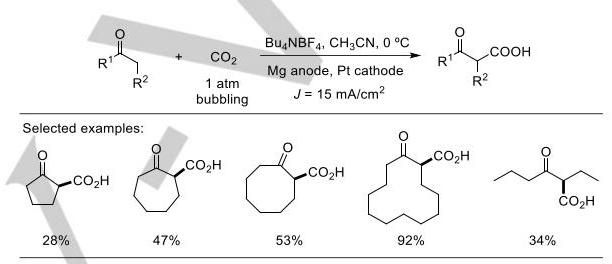
Scheme 67. Electrochemical carboxylation of aliphatic ketones with ${\mathrm{{CO}}}_{2}{}^{\left\lbrack {174}\right\rbrack }$
方案67. 脂肪族酮与${\mathrm{{CO}}}_{2}{}^{\left\lbrack {174}\right\rbrack }$的电化学羧基化反应
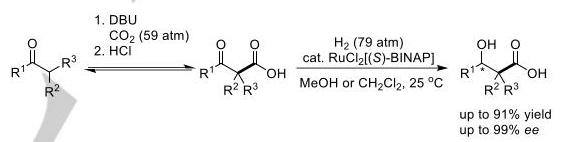
Scheme 68. Carboxylation of ketones followed by asymmetric
方案68. 酮的羧基化反应及随后的不对称
hydrogenation [171]
氢化反应 [171]
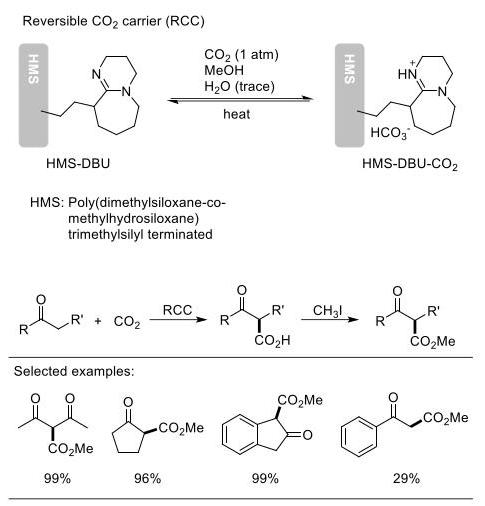
Scheme 69. Reversible ${\mathrm{{CO}}}_{2}$ carrier (RCC)-catalyzed carboxylation of ketones[172]
方案69. 可逆${\mathrm{{CO}}}_{2}$载体(RCC)催化的酮的羧基化反应[172]
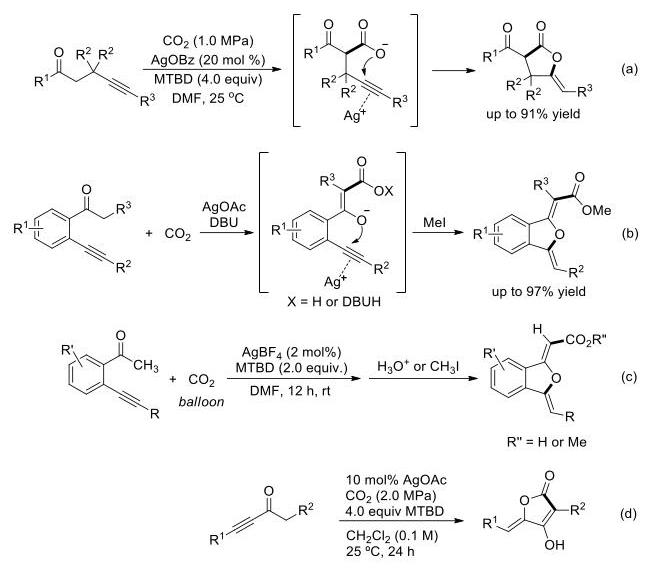
Scheme 70. Silver-catalyzed carboxylative cyclization of ketones containing an alkyne group ${}^{\left\lbrack {177} - {179},{182}\right\rbrack }$
方案70. 银催化的含炔基酮的羧基化环化反应${}^{\left\lbrack {177} - {179},{182}\right\rbrack }$
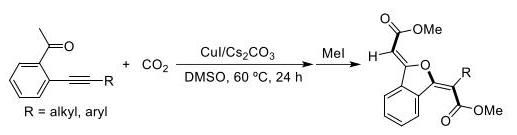
Scheme 71. Copper-catalyzed double carboxylation of o-alkynyl acetophenone ${}^{\left\lbrack {181}\right\rbrack }$
方案71. 铜催化的邻炔基苯乙酮的双羧基化反应${}^{\left\lbrack {181}\right\rbrack }$
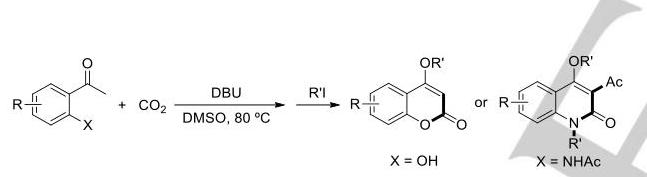
Scheme 72. DBU-promoted carboxylative cyclization of o-hydroxy- and o-acetamidoacetophenone ${}^{\left\lbrack {180}\right\rbrack }$
方案72. DBU促进的邻羟基和邻乙酰氨基苯乙酮的羧基化环化反应${}^{\left\lbrack {180}\right\rbrack }$
Reports on carboxylation of carbonyl $\mathrm{y} - \mathrm{C}\left( {\mathrm{{sp}}}^{3}\right) - \mathrm{H}$ bond with ${\mathrm{{CO}}}_{2}$ are relatively rare. In 1999, Yoshida and coworkers[183] reported the carboxylative cyclization of 4-methyl-3-penten-2-one with ${\mathrm{{CO}}}_{2}$ promoted by ethylzinc carbamate. In 2016, Zhang and coworkers ${}^{\left\lbrack {184}\right\rbrack }$ reported the carboxylative cyclization of various substituted 1-propenone with ${\mathrm{{CO}}}_{2}$ promoted by $\mathrm{{CsF}}$ or ${\mathrm{{Cs}}}_{2}{\mathrm{{CO}}}_{3}$ (Scheme 73). This reaction may have undergone a tandem carbonyl $\gamma - \mathrm{C}\left( {\mathrm{{sp}}}^{3}\right) - \mathrm{H}$ bond carboxylation and base-promoted cyclization. This transition-metal-free reaction was carried out in dilute DMSO to inhibit substrate dimerization. Using ${}^{18}\mathrm{O}$ -labeled carbon dioxide, they found only one oxygen atom in the a-pyrone product came from carbon dioxide (Scheme 74). This proves that the cyclization reaction may have experienced an intramolecular attack of the enolate oxygen on the carbonyl moiety in the resulting carboxylate group. In 2012, Mita and Sato and coworkers[185] reported a formal carboxylation of $\mathrm{C}\left( {\mathrm{{sp}}}^{3}\right) - \mathrm{H}$ bonds with ${\mathrm{{CO}}}_{2}$ . The sequential protocol consists of two reactions: an ${\left\lbrack \mathrm{{Ir}}\left( \mathrm{{cod}}\right) \mathrm{{Cl}}\right\rbrack }_{2}$ - or ${\mathrm{{Ru}}}_{3}{\left( \mathrm{{CO}}\right) }_{12}$ - catalyzed silylation of benzylic $\mathrm{C}\left( {\mathrm{{sp}}}^{3}\right) - \mathrm{H}$ bonds which is directed by a nitrogen atom-containing directing group (quinoline, quinoxaline, pyridine, etc.), and a fluoride-mediated carboxylation (Scheme 75). The $\mathrm{C}\left( {\mathrm{{sp}}}^{3}\right) - \mathrm{{Si}}$ bond can undergo fluoride-promoted carboxylation while the $\mathrm{C}\left( {\mathrm{{sp}}}^{2}\right) - \mathrm{{Si}}$ bond does not. This advantage provides convenience for further manipulation of the carboxylated products. In 2013, Mita and Sato and coworkers[ ${}^{186}$ ] expanded the substrate scope of this reaction. They found that ${\left\lbrack \mathrm{{Ir}}\left( \operatorname{cod}\right) \mathrm{{OMe}}\right\rbrack }_{2}$ or ${\left\lbrack \mathrm{{Rh}}\left( \mathrm{{cod}}\right) \mathrm{{Cl}}\right\rbrack }_{2}$ can catalyze the silylation of $\mathrm{C}\left( {\mathrm{{sp}}}^{3}\right) - \mathrm{H}$ bonds adjacent to nitrogen or oxygen atoms that is directed by a nitrogen-containing directing group (pyridine, isoquinoline, quinoline, etc.). With the participation of fluoride ions, the resulting silylated product can be converted into an α-amino acid derivative. In 2017, Jamison and coworkers[ ${}^{187}$ reported photoredox α- carboxylation of amines with ${\mathrm{{CO}}}_{2}$ for continuous flow synthesis of $\alpha$ -amino acids (Scheme 76). The single-electron reduction of ${\mathrm{{CO}}}_{2}$ is the key in this reaction. In 2015, Murakami and coworkers[188] reported a light-driven carboxylation of $o$ -alkylphenyl ketones with ${\mathrm{{CO}}}_{2}$ (Scheme 77). The reaction mechanism is proposed as follows: the substrate absorbs a photon to produce the excited state; the oxygen atom of the excited carbonyl group abstracts a hydrogen of the ortho-methyl group to form 1,4-biradical species which is then converted into o-quinodimethane. The (E)-isomer can undergo a [4+2] cycloaddition with ${\mathrm{{CO}}}_{2}$ , and finally ring-opening to form a carboxylic acid product while the $\left( Z\right)$ -isomer will undergo 1,5- hydrogen shift to regenerate the starting material. The reaction can be promoted by ultraviolet light or sunlight. Recently, Su and coworkers[189] studied the mechanism of this reaction through theoretical calculations. In 1995, Kudo and coworkers ${}^{\left\lbrack {190}\right\rbrack }$ reported the ${\mathrm{{Cs}}}_{2}{\mathrm{{CO}}}_{3}$ -promoted carboxylation of allylic C-H bonds of caesium 3-crotonate with ${\mathrm{{CO}}}_{2}$ . In 2016, Murakami and coworkers ${}^{\left\lbrack {191}\right\rbrack }$ reported the carboxylation of allylic C-H bonds of simple alkene with ${\mathrm{{CO}}}_{2}$ promoted by light, ketone and copper complex systems (Scheme 78). They proposed a mechanism as follows: the ketone and alkene react under light excitation to form tertiary homoallyl alcohol intermediates; the tertiary homoallyl alcohol reacts with copper tert-butoxide generated in situ by copper complexes and potassium tert-butoxide. The resulting copper alkoxide undergoes C-C bond cleavage via β-carbon elimination to furnish the ketone and allylcopper intermediate; nucleophilic addition of the allylcopper intermediate to ${\mathrm{{CO}}}_{2}$ forms the copper carboxylate, which undergoes ligand exchange with potassium tert-butoxide to produce the carboxylate product and regenerate copper tert-butoxide. The above mechanism was supported by several control experiments. Mita, Sato and coworkers[192] reported a cobalt-catalyzed allylic $\mathrm{C}\left( {\mathrm{{sp}}}^{3}\right) - \mathrm{H}$ carboxylation with ${\mathrm{{CO}}}_{2}$ to regioselectively afford linear 3-butenoic acid motifs with good functional group tolerance (Scheme 79). The formation of a low-valent allyl-Co species is the key in this reaction. Hou and coworkers[193] reported copper-catalysed allylic C-H carboxylation of allyl aryl ethers with ${\mathrm{{CO}}}_{2}$ to afford 2-aryloxy butenoates (Scheme 80). The reaction consists of deprotonative allylic C-H bond alumination of allyl aryl ethers with an aluminum ate base $\left( {i{\mathrm{{Bu}}}_{3}\mathrm{{Al}}\left( \mathrm{{TMP}}\right) \mathrm{{Li}}}\right)$ and subsequent carboxylation of the resulting allylaluminum species with ${\mathrm{{CO}}}_{2}$ catalysed by an NHC-copper complex. Notably, they also found that DBU can catalyze the isomerization of 2-aryloxy-3-butenoate products to (Z)-2- aryloxy-2-butenoate isomers. $\mathrm{C}\left( {\mathrm{{sp}}}^{3}\right) - \mathrm{H}$ bond activation and ${\mathrm{{CO}}}_{2}$ carboxylation promoted by transition metal complexes have received growing attention in recent years[194-203]. In 2008, Langer and Oro and coworkers[199] reported a reaction in which ${\mathrm{{CO}}}_{2}$ was formally inserted into the ligand C-H bond of an iridium complex (Scheme 81). In 2010, they[200] published further research on this reaction. In 2012, Annibale and Song[201] also reported similar reactions (Scheme 82). They proposed the following mechanism: a backbone carbon of diazafluorenide makes nucleophilic attack on ${\mathrm{{CO}}}_{2}$ , and then proton migration occurs. Different from the work of Langer and Oro and coworkers, the reaction of Annibale and Song is reversible. Braunstein and coworkers ${}^{\left\lbrack {195},{198}\right\rbrack }$ have reported similar reversible carboxylation reactions. In 2013, on the basis of the complexes of 4,5-diazafluorenide ligand and divalent ruthenium used in previous work, Song and coworkers[202] investigated the reactivity of the actor ligand toward ${\mathrm{{CO}}}_{2}$ with trivalent rhodium, monovalent rhodium and monovalent copper as spectator metal centers. They proposed the role of the spectator metal center probably was to modulate strength of the resulting C-C bond and adjust acidity of the C-H bond. Interestingly, they also first found that metal-free compounds were also capable of reversible tandem ${\mathrm{{CO}}}_{2}$ and $\mathrm{C} - \mathrm{H}$ activation ${}^{\left\lbrack {202} - {203}\right\rbrack }$ (Scheme 83). Similar to ${\mathrm{{CO}}}_{2}$ , methane is also a cheap, available and quite inert C1 source. $\mathrm{C}\left( {\mathrm{{sp}}}^{3}\right) - \mathrm{H}$ carboxylation of methane can be used to synthesize acetic acid which is widely used in industry. ${}^{\left\lbrack {204} - {229}\right\rbrack }$ In 2013, Wang and coworkers [223] investigated the reaction mechanism of the conversion of methane and ${\mathrm{{CO}}}_{2}$ to acetic acid catalyzed by zinc-modified H-ZSM-5 zeolite (Zn/H-ZSM-5). They first demonstrated through solid-state NMR experiments that $\mathrm{{Zn}}/\mathrm{H} - \mathrm{{ZSM}} - 5$ can catalyze the conversion of methane and ${\mathrm{{CO}}}_{2}$ to acetic acid at a temperature range of 523-773 K. The possible catalytic mechanism of the bifunctional catalyst was revealed by solid-state ${}^{13}\mathrm{C}$ and ${}^{1}\mathrm{H}$ MAS NMR: methane is activated as zinc methyl species and Brønsted protons, while ${\mathrm{{CO}}}_{2}$ is activated as surface carbonate ion species; ${\mathrm{{CO}}}_{2}$ is inserted into the $\mathrm{{Zn}} - \mathrm{C}$ bond of zinc methyl species to generate a key surface zinc acetate species which then abstracts the proton of Brønsted acid sites to release the acetic acid product. In 2014, Basset and coworkers[224] reported low temperature activation of methane over silica supported zinc-exchanged phosphotungstic acid (Zn-HPW/SiO2) (Scheme 84). Zn-HPW/SiO ${}_{2}$ can activate methane to form zinc methyl species at room temperature, while at higher temperature methane reacts with ${\mathrm{O}}_{2}$ to give methanol or reacts with ${\mathrm{{CO}}}_{2}$ to give acetic acid. Recently, Zhu and Ge and coworkers[225] reported a theoretical study of Zn-doped ceria-catalyzed C-C coupling reaction of ${\mathrm{{CO}}}_{2}$ and methane. The results show that the Zn dopant stabilizes the methyl group through formation of a Zn-C bond, thereby inhibiting subsequent dehydrogenation of methane. ${\mathrm{{CO}}}_{2}$ can be inserted into the $\mathrm{{Zn}} - \mathrm{C}$ bond in an activated bent configuration. The transition state of this insertion reaction is in the form of a three-centered Zn-C-C arrangement, with an activation energy barrier of ${0.51}\mathrm{{eV}}$ . The acetate ion generated by C-C coupling can bind to the surface proton generated by dissociation of methane and then desorbs in the form of free acetic acid. They have also examined other possible dopants such as AI, Ga, Cd, In, and Ni, and found a positive correlation between the activation barrier of C-C coupling and the electronegativity of dopant. In addition, carboxylation reactions of other simple alkanes with ${\mathrm{{CO}}}_{2}$ have also been reported. ${}^{\left\lbrack {230} - {231}\right\rbrack }$
关于羰基$\mathrm{y} - \mathrm{C}\left( {\mathrm{{sp}}}^{3}\right) - \mathrm{H}$键与${\mathrm{{CO}}}_{2}$的羧基化反应的报道相对较少。1999年,吉田及其同事[183]报道了氨基甲酸乙酯促进的4-甲基-3-戊烯-2-酮与${\mathrm{{CO}}}_{2}$的羧基化环化反应。2016年,张及其同事${}^{\left\lbrack {184}\right\rbrack }$报道了$\mathrm{{CsF}}$或${\mathrm{{Cs}}}_{2}{\mathrm{{CO}}}_{3}$促进的各种取代的1-丙烯酮与${\mathrm{{CO}}}_{2}$的羧基化环化反应(方案73)。该反应可能经历了串联的羰基$\gamma - \mathrm{C}\left( {\mathrm{{sp}}}^{3}\right) - \mathrm{H}$键羧基化和碱促进的环化反应。该无过渡金属反应在稀二甲基亚砜中进行以抑制底物二聚化。使用${}^{18}\mathrm{O}$标记的二氧化碳,他们发现α-吡喃酮产物中只有一个氧原子来自二氧化碳(方案74)。这证明环化反应可能经历了烯醇盐氧对所得羧酸盐基团中羰基部分的分子内攻击。2012年,三田和佐藤及其同事[185]报道了$\mathrm{C}\left( {\mathrm{{sp}}}^{3}\right) - \mathrm{H}$键与${\mathrm{{CO}}}_{2}$的形式羧基化反应。该顺序协议由两个反应组成:由含氮导向基团(喹啉、喹喔啉、吡啶等)导向的苄基$\mathrm{C}\left( {\mathrm{{sp}}}^{3}\right) - \mathrm{H}$键的${\left\lbrack \mathrm{{Ir}}\left( \mathrm{{cod}}\right) \mathrm{{Cl}}\right\rbrack }_{2}$或${\mathrm{{Ru}}}_{3}{\left( \mathrm{{CO}}\right) }_{12}$催化的硅烷化反应,以及氟化物介导的羧基化反应(方案75)。$\mathrm{C}\left( {\mathrm{{sp}}}^{3}\right) - \mathrm{{Si}}$键可以进行氟化物促进的羧基化反应,而$\mathrm{C}\left( {\mathrm{{sp}}}^{2}\right) - \mathrm{{Si}}$键则不能。这一优点为羧基化产物的进一步操作提供了便利。2013年,三田和佐藤及其同事[${}^{186}$]扩大了该反应的底物范围。他们发现${\left\lbrack \mathrm{{Ir}}\left( \operatorname{cod}\right) \mathrm{{OMe}}\right\rbrack }_{2}$或${\left\lbrack \mathrm{{Rh}}\left( \mathrm{{cod}}\right) \mathrm{{Cl}}\right\rbrack }_{2}$可以催化由含氮导向基团(吡啶、异喹啉、喹啉等)导向的与氮或氧原子相邻的$\mathrm{C}\left( {\mathrm{{sp}}}^{3}\right) - \mathrm{H}$键的硅烷化反应。在氟离子的参与下,所得的硅烷化产物可以转化为α-氨基酸衍生物。2017年,贾米森及其同事[${}^{187}$]报道了胺与${\mathrm{{CO}}}_{2}$的光氧化还原α-羧基化反应,用于连续流动合成$\alpha$-氨基酸(方案76)。${\mathrm{{CO}}}_{2}$ 的单电子还原是该反应的关键。2015年,村上及其同事[188]报道了$o$-烷基苯基酮与${\mathrm{{CO}}}_{2}$的光驱动羧基化反应(方案77)。提出的反应机理如下:底物吸收光子产生激发态;激发态羰基的氧原子夺取邻甲基的氢形成1,4-双自由基物种,然后转化为邻醌二甲烷。(E)-异构体可以与${\mathrm{{CO}}}_{2}$进行[4+2]环加成反应,最后开环形成羧酸产物,而$\left( Z\right)$-异构体将进行1,5-氢转移以再生起始原料。该反应可以由紫外光或太阳光促进。最近,苏及其同事[189]通过理论计算研究了该反应的机理。1995年,工藤及其同事${}^{\left\lbrack {190}\right\rbrack }$报道了碳酸铯3-巴豆酸酯的烯丙基C-H键在${\mathrm{{Cs}}}_{2}{\mathrm{{CO}}}_{3}$促进下与${\mathrm{{CO}}}_{2}$的羧基化反应。2016年,村上及其同事${}^{\left\lbrack {191}\right\rbrack }$报道了简单烯烃的烯丙基C-H键在光、酮和铜配合物体系促进下与${\mathrm{{CO}}}_{2}$的羧基化反应(方案78)。他们提出的机理如下:酮和烯烃在光激发下反应形成叔高烯丙醇中间体;叔高烯丙醇与铜配合物和叔丁醇钾原位生成的叔丁醇铜反应。所得的铜醇盐通过β-碳消除进行C-C键裂解,生成酮和烯丙基铜中间体;烯丙基铜中间体与${\mathrm{{CO}}}_{2}$的亲核加成形成羧酸铜,羧酸铜与叔丁醇钾进行配体交换,生成羧酸盐产物并再生叔丁醇铜。上述机理得到了几个对照实验的支持。三田、佐藤及其同事[192]报道了钴催化的烯丙基$\mathrm{C}\left( {\mathrm{{sp}}}^{3}\right) - \mathrm{H}$与${\mathrm{{CO}}}_{2}$的羧基化反应,以区域选择性地得到具有良好官能团耐受性的线性3-丁烯酸基序(方案79)。低价烯丙基-Co物种的形成是该反应的关键。侯及其同事[193]报道了铜催化的烯丙基芳基醚的烯丙基C-H羧基化反应,以得到2-芳氧基丁酸酯(方案80)。该反应由烯丙基芳基醚与铝酸酯碱$\left( {i{\mathrm{{Bu}}}_{3}\mathrm{{Al}}\left( \mathrm{{TMP}}\right) \mathrm{{Li}}}\right)$进行去质子化烯丙基C-H键铝化反应,以及随后由NHC-铜配合物催化所得烯丙基铝物种与${\mathrm{{CO}}}_{2}$的羧基化反应组成。值得注意的是,他们还发现DBU可以催化2-芳氧基-3-丁烯酸酯产物异构化为(Z)-2-芳氧基-2-丁烯酸酯异构体。近年来,过渡金属配合物促进的$\mathrm{C}\left( {\mathrm{{sp}}}^{3}\right) - \mathrm{H}$键活化和${\mathrm{{CO}}}_{2}$羧基化反应受到了越来越多的关注[194-203]。2008年,兰格和奥罗及其同事[199]报道了一个反应,其中${\mathrm{{CO}}}_{2}$被正式插入铱配合物的配体C-H键中(方案81)。2010年,他们[200]发表了关于该反应的进一步研究。2012年,安尼巴勒和宋[201]也报道了类似的反应(方案82)。他们提出了以下机理:二氮芴的主链碳对${\mathrm{{CO}}}_{2}$进行亲核攻击,然后发生质子迁移。与兰格和奥罗及其同事的工作不同,安尼巴勒和宋的反应是可逆的。布劳恩施泰因及其同事${}^{\left\lbrack {195},{198}\right\rbrack }$报道了类似的可逆羧基化反应。2013年,基于先前工作中使用的4,5-二氮芴配体和二价钌的配合物,宋及其同事[202]研究了以三价铑、一价铑和一价铜作为旁观金属中心时,活性配体对${\mathrm{{CO}}}_{2}$的反应性。他们提出旁观金属中心的作用可能是调节所得C-C键的强度并调节C-H键的酸度。有趣的是,他们还首次发现无金属化合物也能够进行可逆的串联${\mathrm{{CO}}}_{2}$和$\mathrm{C} - \mathrm{H}$活化${}^{\left\lbrack {202} - {203}\right\rbrack }$(方案83)。与${\mathrm{{CO}}}_{2}$类似,甲烷也是一种廉价、易得且相当惰性的C1源。甲烷的$\mathrm{C}\left( {\mathrm{{sp}}}^{3}\right) - \mathrm{H}$羧基化反应可用于合成工业上广泛使用的乙酸。${}^{\left\lbrack {204} - {229}\right\rbrack }$ 2013年,王及其同事[223]研究了锌改性的H-ZSM-5沸石(Zn/H-ZSM-5)催化甲烷和${\mathrm{{CO}}}_{2}$转化为乙酸的反应机理。他们首先通过固态核磁共振实验证明,$\mathrm{{Zn}}/\mathrm{H} - \mathrm{{ZSM}} - 5$可以在523-773K的温度范围内催化甲烷和${\mathrm{{CO}}}_{2}$转化为乙酸。通过固态${}^{13}\mathrm{C}$和${}^{1}\mathrm{H}$ MAS NMR揭示了双功能催化剂可能的催化机理:甲烷被活化成锌甲基物种和布朗斯特质子,而${\mathrm{{CO}}}_{2}$被活化成表面碳酸根离子物种;${\mathrm{{CO}}}_{2}$插入锌甲基物种的$\mathrm{{Zn}} - \mathrm{C}$键中生成关键的表面乙酸锌物种,然后该物种夺取布朗斯特酸位点的质子以释放乙酸产物。2014年,巴塞特及其同事[224]报道了在二氧化硅负载的锌交换磷钨酸(Zn-HPW/SiO2)上甲烷的低温活化(方案84)。Zn-HPW/SiO ${}_{2}$可以在室温下活化甲烷形成锌甲基物种,而在较高温度下甲烷与${\mathrm{O}}_{2}$反应生成甲醇或与${\mathrm{{CO}}}_{2}$反应生成乙酸。最近,朱和葛及其同事[225]报道了锌掺杂氧化铈催化${\mathrm{{CO}}}_{2}$与甲烷的C-C偶联反应的理论研究。结果表明,锌掺杂剂通过形成Zn-C键稳定甲基,从而抑制甲烷随后的脱氢反应。${\mathrm{{CO}}}_{2}$可以以活化的弯曲构型插入$\mathrm{{Zn}} - \mathrm{C}$键中。该插入反应的过渡态呈三中心Zn-C-C排列形式,活化能垒为${0.51}\mathrm{{eV}}$。C-C偶联产生的乙酸根离子可以与甲烷解离产生的表面质子结合,然后以游离乙酸的形式解吸。他们还研究了其他可能的掺杂剂,如Al、Ga、Cd、In和Ni,发现C-C偶联的活化能垒与掺杂剂的电负性之间存在正相关。此外,还报道了其他简单烷烃与${\mathrm{{CO}}}_{2}$的羧基化反应。${}^{\left\lbrack {230} - {231}\right\rbrack }$
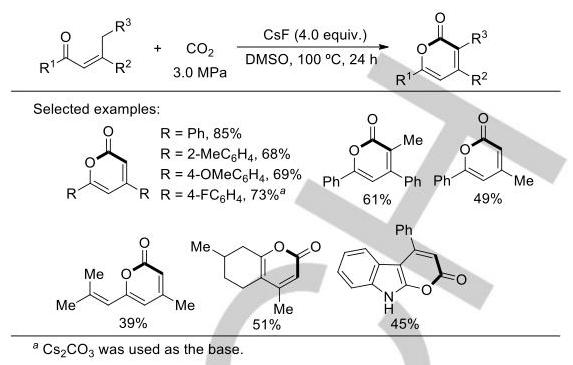
Scheme 73. Carboxylative cyclization of substituted 1-propenyl ketones with ${\mathrm{{CO}}}_{2}{}^{\left\lbrack {184}\right\rbrack }$
方案73. 用${\mathrm{{CO}}}_{2}{}^{\left\lbrack {184}\right\rbrack }$对取代的1-丙烯基酮进行羧基化环化
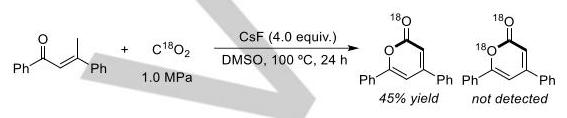
Scheme 74. Carboxylative cyclization of 1-propenyl ketone with ${\mathrm{C}}^{18}{\mathrm{O}}_{2}{}^{\left\lbrack {184}\right\rbrack }$
方案74. 用${\mathrm{C}}^{18}{\mathrm{O}}_{2}{}^{\left\lbrack {184}\right\rbrack }$对1-丙烯基酮进行羧基化环化
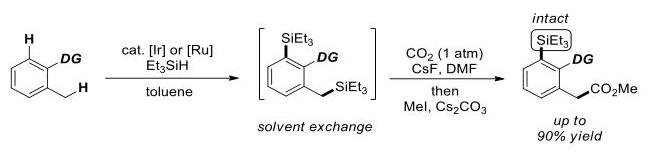
Scheme 75. Ir/Ru-catalyzed C-H silylation and fluoride-mediated carboxylation ${}^{\left\lbrack {185}\right\rbrack }$
方案75. 铱/钌催化的C-H硅烷化和氟化物介导的羧基化${}^{\left\lbrack {185}\right\rbrack }$
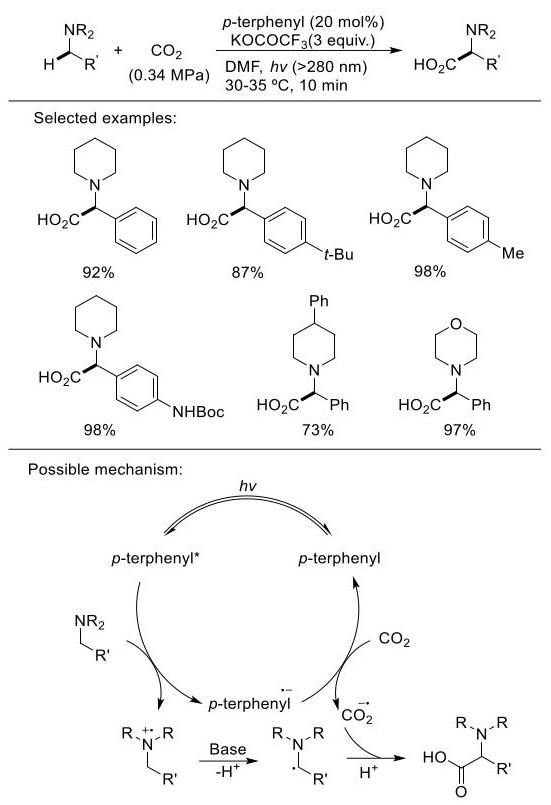
Scheme 76. The photoredox $\alpha$ -carboxylation of amines with ${\mathrm{{CO}}}_{2}{}^{\left\lbrack {187}\right\rbrack }$
方案76. 光催化氧化还原$\alpha$ -胺与${\mathrm{{CO}}}_{2}{}^{\left\lbrack {187}\right\rbrack }$的羧基化反应

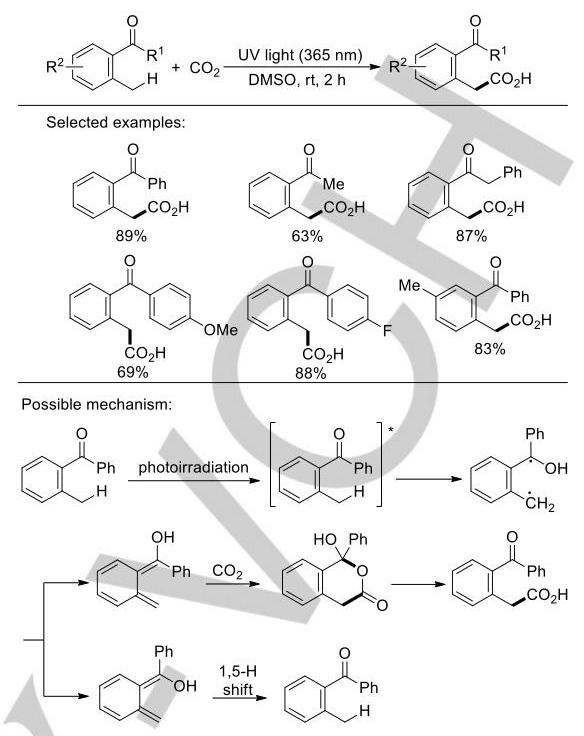
Scheme 77. Light-driven carboxylation of o-alkylphenyl ketones with ${\mathrm{{CO}}}_{2}{}^{\left\lbrack {188}\right\rbrack }$
方案77. 用${\mathrm{{CO}}}_{2}{}^{\left\lbrack {188}\right\rbrack }$对邻烷基苯基酮进行光驱动羧基化反应
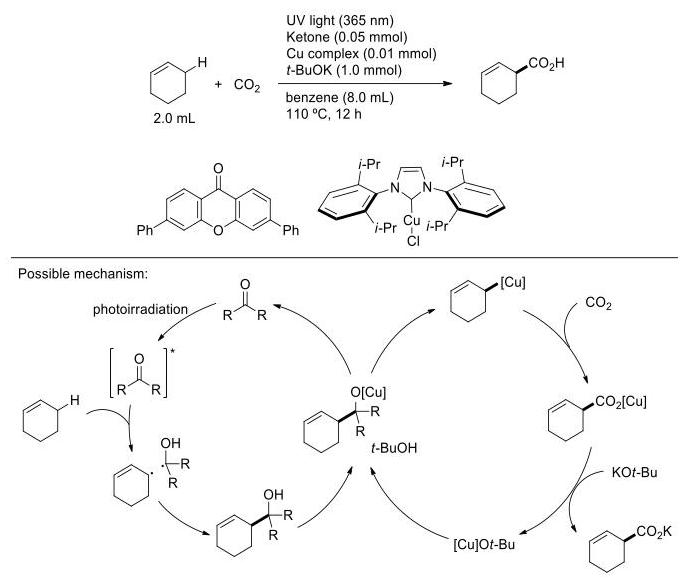
Scheme 78. Carboxylation of cyclohexene with ${\mathrm{{CO}}}_{2}$ in the presence of a ketone and a copper complex under UV irradiation [191]
方案78. 在酮和铜配合物存在下,紫外光照射下用${\mathrm{{CO}}}_{2}$对环己烯进行羧基化反应[191]
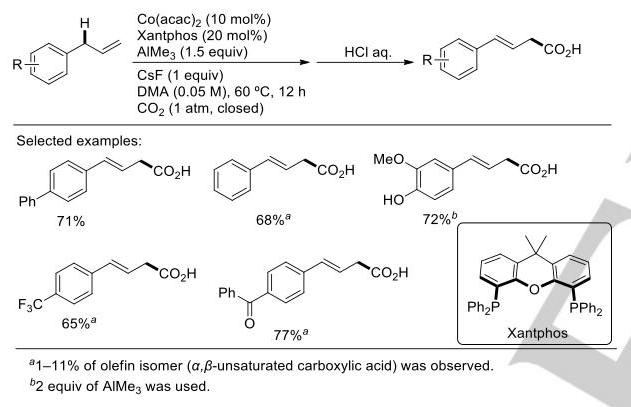
Scheme 79. Cobalt-catalyzed allylic $\mathrm{C}\left( {\mathrm{{sp}}}^{3}\right) - \mathrm{H}$ carboxylation with ${\mathrm{{CO}}}_{2}{}^{\left\lbrack {192}\right\rbrack }$
方案79. 钴催化的烯丙基$\mathrm{C}\left( {\mathrm{{sp}}}^{3}\right) - \mathrm{H}$与${\mathrm{{CO}}}_{2}{}^{\left\lbrack {192}\right\rbrack }$的羧基化反应
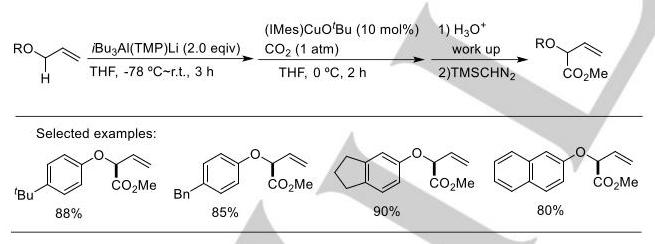
Scheme 80. Copper-catalysed allylic C-H carboxylation of allyl aryl ethers with ${\mathrm{{CO}}}_{2}{}^{\left\lbrack {193}\right\rbrack }$
方案80. 铜催化的烯丙基芳基醚的烯丙基C-H羧基化反应,使用${\mathrm{{CO}}}_{2}{}^{\left\lbrack {193}\right\rbrack }$
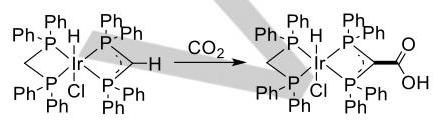
Scheme 81. Formal insertion of ${\mathrm{{CO}}}_{2}$ into a $\mathrm{C} - \mathrm{H}$ bond of ligand in an Ir complex ${}^{\left\lbrack {199}\right\rbrack }$
方案81. 在铱配合物${}^{\left\lbrack {199}\right\rbrack }$中,${\mathrm{{CO}}}_{2}$正式插入配体的$\mathrm{C} - \mathrm{H}$键中
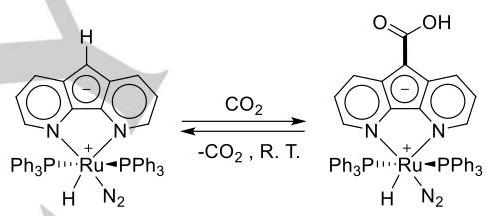
Scheme 82. Reversible carboxylation of a Ru complex ${}^{\left\lbrack {201}\right\rbrack }$
方案82. 钌配合物${}^{\left\lbrack {201}\right\rbrack }$的可逆羧基化反应
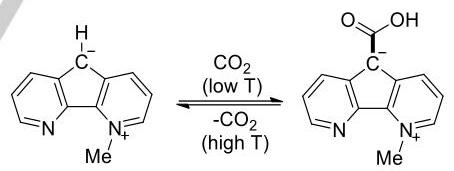
Scheme 83. Reversible metal-free tandem ${\mathrm{{CO}}}_{2}$ and $\mathrm{C} - \mathrm{H}$ activation ${}^{\left\lbrack {202}\right\rbrack }$
方案83. 无金属的可逆串联${\mathrm{{CO}}}_{2}$和$\mathrm{C} - \mathrm{H}$活化反应${}^{\left\lbrack {202}\right\rbrack }$
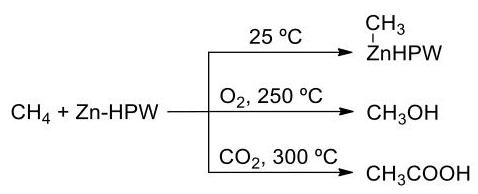
Scheme 84. Activation of methane by Zn-HPW[224]
方案84. 锌-磷钨酸对甲烷的活化反应[224]
In 2017, Martin and coworkers[232] reported a remote carboxylation of halogenated aliphatic hydrocarbons with ${\mathrm{{CO}}}_{2}$ (Scheme 85). Neither purification nor isolation of the intermediate halogenated compounds was necessary for this regioconvergent carboxylation of alkanes with ${\mathrm{{CO}}}_{2}$ to obtain single-regioisomer carboxylic acids. Tunable and controllable displacement of the Ni catalyst through a saturated hydrocarbon side-chain enables the switchable site-selective carboxylation at remote $\mathrm{C}\left( {\mathrm{{sp}}}^{3}\right) - \mathrm{H}$ sites.
2017年,Martin及其同事[232]报道了卤代脂肪烃与${\mathrm{{CO}}}_{2}$的远程羧基化反应(方案85)。对于用${\mathrm{{CO}}}_{2}$对烷烃进行区域收敛羧基化反应以获得单区域异构体羧酸而言,既不需要对中间卤代化合物进行纯化也不需要进行分离。通过饱和烃侧链对镍催化剂进行可调谐和可控的置换,能够在远程$\mathrm{C}\left( {\mathrm{{sp}}}^{3}\right) - \mathrm{H}$位点进行可切换位点选择性羧基化反应。
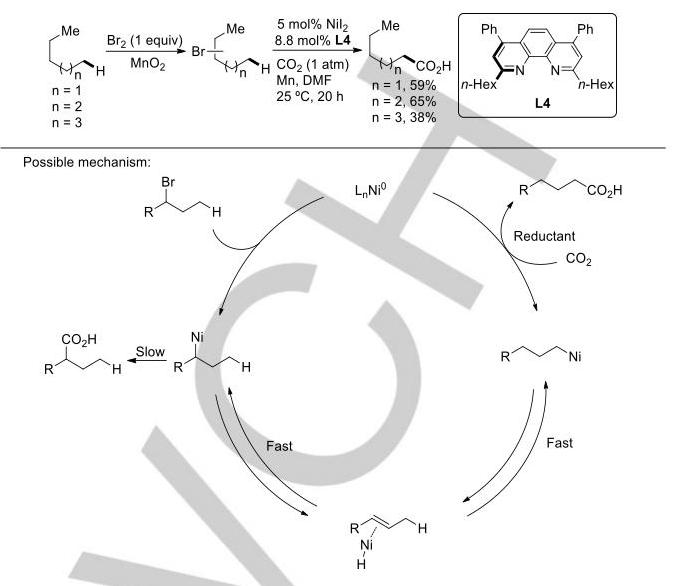
Scheme 85. Remote carboxylation of halogenated aliphatic hydrocarbons with ${\mathrm{{CO}}}_{2}{}^{\left\lbrack {232}\right\rbrack }$
方案85. 卤代脂肪烃与${\mathrm{{CO}}}_{2}{}^{\left\lbrack {232}\right\rbrack }$的远程羧基化反应
5. Conclusions and Outlook
5. 结论与展望
The carboxylation of $\mathrm{C} - \mathrm{H}$ bonds with ${\mathrm{{CO}}}_{2}$ merges activation of chemically inert $\mathrm{C} - \mathrm{H}$ bonds with thermodynamically stable ${\mathrm{{CO}}}_{2}$ and thus has great research value. This type of reaction has developed rapidly in recent years and has made many important advances. Its advantages are as follows: 1) Using ${\mathrm{{CO}}}_{2}$ as $\mathrm{C}1$ source avoids the use of toxic CO or phosgene; 2) C-H bonds are ubiquitous in organic molecules; 3) It conforms with the requirements of green chemistry in terms of atom economy and step economy; 4) It is easy to be incorporated into tandem or multicomponent reactions; 5) Many reactions have good industrial application prospects, such as the syntheses of furan-2,5- dicarboxylic acid and sodium acrylate. In fact, the Kolbe-Schmitt reaction, a classical $\mathrm{C} - \mathrm{H}$ bond carboxylation with ${\mathrm{{CO}}}_{2}$ , has been an industrial method for producing salicylic acid. At present, there are several problems in this field: the reaction conditions are relatively harsh in many cases, for example, requiring high temperature or high-pressure ${\mathrm{{CO}}}_{2}$ ; there is still much room for expansion in the scope of substrates, especially the carboxylation of $\mathrm{C}\left( {\mathrm{{sp}}}^{3}\right) - \mathrm{H}$ bonds; many reactions still require stoichiometric additives or metal exchange reagents; some carboxylation catalysts are not sufficiently efficient; some reactions are unsatisfactory in terms of chemoselectivity, regioselectivity, and stereoselectivity; the mechanism of some reactions is not clear; green reaction media is still rarely used; the cost and recovery of catalysts remains a problem, etc. In terms of reaction mechanism, the dual activation strategy should be more promising than the single activation of $\mathrm{C} - \mathrm{H}$ bonds or ${\mathrm{{CO}}}_{2}$ . Inexpensive metal catalysis, transition-metal-free, electrochemical and light-driven methods deserve more attention. Combining theoretical calculations with experimental research will certainly promote the growth of this field. More effective integration of ${\mathrm{{CO}}}_{2}$ capture and chemical transformation is still a major challenge in this field.
用${\mathrm{{CO}}}_{2}$对$\mathrm{C} - \mathrm{H}$键进行羧基化反应,将化学惰性的$\mathrm{C} - \mathrm{H}$键的活化与热力学稳定的${\mathrm{{CO}}}_{2}$相结合,因此具有很大的研究价值。这类反应近年来发展迅速,并取得了许多重要进展。其优点如下:1)使用${\mathrm{{CO}}}_{2}$作为$\mathrm{C}1$源避免了使用有毒的CO或光气;2)C-H键在有机分子中普遍存在;3)在原子经济性和步骤经济性方面符合绿色化学的要求;4)易于纳入串联或多组分反应;5)许多反应具有良好的工业应用前景,如呋喃-2,5-二甲酸和丙烯酸钠的合成。事实上,Kolbe-Schmitt反应,一种经典的用${\mathrm{{CO}}}_{2}$对$\mathrm{C} - \mathrm{H}$键进行羧基化的反应,一直是生产水杨酸的工业方法。目前,该领域存在几个问题:在许多情况下反应条件相对苛刻,例如需要高温或高压${\mathrm{{CO}}}_{2}$;底物范围的扩展仍有很大空间,特别是$\mathrm{C}\left( {\mathrm{{sp}}}^{3}\right) - \mathrm{H}$键的羧基化;许多反应仍然需要化学计量的添加剂或金属交换试剂;一些羧基化催化剂效率不够高;一些反应在化学选择性、区域选择性和立体选择性方面不尽人意;一些反应的机理尚不清楚;绿色反应介质仍然很少使用;催化剂的成本和回收仍然是一个问题等。在反应机理方面,双活化策略应该比单一活化$\mathrm{C} - \mathrm{H}$键或${\mathrm{{CO}}}_{2}$更有前景。廉价金属催化、无过渡金属、电化学和光驱动方法值得更多关注。将理论计算与实验研究相结合必将推动该领域的发展。更有效地整合${\mathrm{{CO}}}_{2}$捕获和化学转化仍然是该领域的一个重大挑战。
REVIEW
综述
Acknowledgements
致谢
The project is supported by the Natural Science Foundation of China (Grants 21502003 and 21772003). We also thank the “1000-Youth Talents Plan” and Peking University for start-up funds. This work was also partially funded by the Peking University carbon capture, utilization and storage project supported by BHP Billiton.
The project is supported by the Natural Science Foundation of China (Grants 21502003 and 21772003). We also thank the “1000-Youth Talents Plan” and Peking University for start-up funds. This work was also partially funded by the Peking University carbon capture, utilization and storage project supported by BHP Billiton.
Keywords: Carbon dioxide $\cdot \mathrm{C} - \mathrm{H}$ bond activation $\cdot$
关键词:二氧化碳$\cdot \mathrm{C} - \mathrm{H}$键活化$\cdot$
Carboxylation $\cdot$ Carboxylic acid $\cdot$ Catalysis
羧化作用$\cdot$羧酸$\cdot$催化作用
[1] T. Sakakura, J.-C. Choi, H. Yasuda, Chem. Rev. 2007, 107, 2365.
[2] M. Aresta, A. Dibenedetto, A. Angelini, Chem. Rev. 2014, 114, 1709.
[3] J. Luo, I. Larrosa, ChemSusChem 2017, 10, 3317.
[4] W. Zhang, N. Zhang, C. Guo, X. Lü, Chinese. J. Org. Chem. 2017, 37, 1309.
[5] J. Artz, T. E. Müller, K. Thenert, J. Kleinekorte, R. Meys, A. Sternberg, A. Bardow, W. Leitner, Chem. Rev. 2018, 118, 434.
[6] T. Andreu, J.-H. Francisco, B. Marino, M. Toni, M. Ruben, Angew. Chem. Int. Ed. 2018, 0. doi: 10.1002/anie.201803186
[7] W. Zhang, X. LÜ, Chin. J. Catal. 2012, 33, 745.
[8] A. H. Liu, B. Yu, L. N. He, Greenhouse Gas Sci. Technol. 2015, 5, 17.
[9] B. Yu, L. N. He, ChemSusChem 2015, 8, 52.
[10] S. Wang, G. Du, C. Xi, Org. Biomol. Chem. 2016, 14, 3666.
[11] X.-F. Wu, F. Zheng, Top. Curr. Chem. 2016, 375, 4.
[12] G. Yuan, C. Qi, W. Wu, H. Jiang, Current Opinion in Green and Sustainable Chemistry 2017, 3, 22.
[13] Y.-G. Chen, X.-T. Xu, K. Zhang, Y.-Q. Li, L.-P. Zhang, P. Fang, T.-S. Mei, Synthesis 2018, 02, 35.
[14] A. Correa, R. Martín, Angew. Chem. Int. Ed. 2009, 48, 6201.
[15] Y. Zhang, S. N. Riduan, Angew. Chem. Int. Ed. 2011, 50, 6210.
[16] S. Zhang, X.-D. Li, L.-N. He, Acta Chim. Sinica. 2016, 17.
[17] N. Kuhl, M. N. Hopkinson, J. Wencel - Delord, F. Glorius, Angew. Chem. Int. Ed. 2012, 51, 10236.
[18] G. Yan, X. Wu, M. Yang, Org. Biomol. Chem. 2013, 11, 5558.
[19] C. Cheng, J. F. Hartwig, Chem. Rev. 2015, 115, 8946.
[20] Z. Huang, H. N. Lim, F. Mo, M. C. Young, G. Dong, Chem. Soc. Rev. 2015, 44, 7764.
[21] C. Liu, J. Yuan, M. Gao, S. Tang, W. Li, R. Shi, A. Lei, Chem. Rev. 2015, 115, 12138.
[22] W. R. Gutekunst, P. S. Baran, Chem. Soc. Rev. 2011, 40, 1976.
[23] J. Yamaguchi, A. D. Yamaguchi, K. Itami, Angew. Chem. Int. Ed. 2012, 51, 8960.
[24] K. Okamoto, J. Zhang, J. B. Housekeeper, S. R. Marder, C. K. Luscombe, Macromolecules. 2013, 46, 8059.
[25] I. Tommasi, Catalysts 2017, 7, 380.
[26] Y. Fukue, S. Oi, Y. Inoue, J. Chem. Soc. Chem. Commun. 1994, 2091.
[27] S. Oi, Y. Fukue, K. Nemoto, Y. Inoue, Macromolecules. 1996, 29, 2694.
[28] W.-Z. Zhang, W.-J. Li, X. Zhang, H. Zhou, X.-B. Lu, Org. Lett. 2010, 12, 4748.
[29] R. Yuan, Z. Lin, ACS Catal. 2014, 4, 4466.
[30] K. Inamoto, N. Asano, K. Kobayashi, M. Yonemoto, Y. Kondo, Org. Biomol. Chem. 2012, 10, 1514.
[31] J.-N. Xie, B. Yu, Z.-H. Zhou, H.-C. Fu, N. Wang, L.-N. He, Tetrahedron Lett. 2015, 56, 7059.
[32] B. Yu, Z.-F. Diao, C.-X. Guo, C.-L. Zhong, L.-N. He, Y.- N. Zhao, Q.-W. Song, A.-H. Liu, J.-Q. Wang, Green Chem. 2013, 15, 2401.
[33] B. Yu, J.-N. Xie, C.-L. Zhong, W. Li, L.-N. He, ACS Catal. 2015, 5, 3940.
[34] X. Zhang, W.-Z. Zhang, X. Ren, L.-L. Zhang, X.-B. Lu, Org. Lett. 2011, 13, 2402.
[35] X. Zhang, W.-Z. Zhang, L.-L. Shi, C. Zhu, J.-L. Jiang, X.- B. Lu, Tetrahedron 2012, 68, 9085.
36] L. Zhang, W. Zhang, L. Shi, X. Ren, X. Lu, Chin. J. Catal. 2013, 34, 1179.
[37] C.-X. Guo, B. Yu, J.-N. Xie, L.-N. He, Green Chem. 2015, 17, 474.
[38] Z.-Z. Zhang, R.-J. Mi, F.-J. Guo, J. Sun, M.-D. Zhou, X.- C. Fang, Journal of Saudi Chemical Society 2017, 21, 685.
[39] F.-J. Guo, Z.-Z. Zhang, J.-Y. Wang, J. Sun, X.-C. Fang, M.-D. Zhou, Tetrahedron 2017, 73, 900.
[40] N. Eghbali, J. Eddy, P. T. Anastas, J. Org. Chem. 2008, 73, 6932.
L. J. Gooßen, N. Rodríguez, F. Manjolinho, P. P. Lange, Adv. Synth. Catal. 2010, 352, 2913.
[42] D. Yu, Y. Zhang, P. Natl. Acad. Sci. Usa. 2010, 107, 20184.
[43] L. Yang, Y. Yuan, H. Wang, N. Zhang, S. Hong, RSC Adv. 2014, 4, 32457.
[44] M. Trivedi, G. Singh, A. Kumar, N. P. Rath, Dalton Trans. 2015, 44, 20874.
[45] G. N. Bondarenko, E. G. Dvurechenskaya, E. S. Magommedov, I. P. Beletskaya, Catal. Lett. 2017, 147, 2570.
[46] T. Wendling, E. Risto, T. Krause, L. J. Gooßen, Chem. Eur. J. 2018, 24, 6019.
[47] C. Liu, Y. Luo, W. Zhang, J. Qu, X. Lu, Organometallics. 2014, 33, 2984.
[48] M. Arndt, E. Risto, T. Krause, L. J. Gooßen, ChemCatChem 2012, 4, 484.
[49] S. H. Kim, K. H. Kim, S. H. Hong, Angew. Chem. Int. Ed. 2014, 53, 771.
[50] J. Jover, F. Maseras, J. Org. Chem. 2014, 79, 11981.
[51] S. Li, J. Sun, Z. Zhang, R. Xie, X. Fang, M. Zhou, Dalton Trans. 2016, 45, 10577.
[52] D. Yu, M. X. Tan, Y. Zhang, Adv. Synth. Catal. 2012, 354, 969.
[53] D. Yu, F. Zhou, D. S. W. Lim, H. Su, Y. Zhang, ChemSusChem 2017, 10, 836.
[54] E. D. Finashina, L. M. Kustov, O. P. Tkachenko, V. G. Krasovskiy, E. I. Formenova, I. P. Beletskaya, Russ. Chem. B+. 2014, 63, 2652.
[55] X. H. Liu, J. G. Ma, Z. Niu, G. M. Yang, P. Cheng, Angew. Chem. Int. Ed. 2015, 54, 988.
[56] R. A. Molla, K. Ghosh, B. Banerjee, M. A. Iqubal, S. K. Kundu, S. M. Islam, A. Bhaumik, J. Colloid Interf. Sci. 2016, 477, 220.
REVIEW
审核
[57] N.-N. Zhu, X.-H. Liu, T. Li, J.-G. Ma, P. Cheng, G.-M. Yang, Inorg. Chem. 2017, 56, 3414.
[58] B. Yu, P. Yang, X. Gao, Z. Z. Yang, Y. F. Zhao, H. Y. Zhang, Z. M. Liu, New J. Chem. 2017, 41, 9250.
[59] Y. Yuan, C. Chen, C. Zeng, B. Mousavi, S. Chaemchuen, F. Verpoort, ChemCatChem 2017, 9, 882.
[60] Z. Wu, L. Sun, Q. Liu, X. Yang, X. Ye, Y. Hu, Y. Huang, Green Chem. 2017, 19, 2080.
[61] H. Díaz Velázquez, Z.-X. Wu, M. Vandichel, F. Verpoort, Catal. Lett. 2017, 147, 463.
[62] Q.-Q. Dang, C.-Y. Liu, X.-M. Wang, X.-M. Zhang, ACS Appl. Mater. Interfaces 2018, 10, 27972.
[63] H. Cheng, B. Zhao, Y. Yao, C. Lu, Green Chem. 2015, 17, 1675.
[64] M. Trivedi, Bhaskaran, A. Kumar, G. Singh, A. Kumar, N. P. Rath, New J. Chem. 2016, 40, 3109.
[65] J.-H. Chen, C.-H. Deng, S. Fang, J.-G. Ma, P. Cheng, Green Chem. 2018, 20, 989.
[66] F. Köster, E. Dinjus, E. Duñach, Eur. J. Org. Chem. 2001, 2001, 2507.
[67] D. Yu, Y. Zhang, Green Chem. 2011, 13, 1275.
[68] X. Wang, Y. N. Lim, C. Lee, H. Y. Jang, B. Y. Lee, Eur. J. Org. Chem. 2013, 2013, 1867.
[69] F.-W. Li, Q.-L. Suo, H.-L. Hong, N. Zhu, Y.-Q. Wang, L.- M. Han, Tetrahedron Lett. 2014, 55, 3878.
[70] F.-W. Li, Q.-L. Suo, H.-L. Hong, N. Zhu, Y.-Q. Wang, L.- M. Han, Chinese. J. Org. Chem. 2015, 34, 2172.
[71] Y. Bo, Y. Peng, G. Xiang, Y. Zhenzhen, Z. Yanfei, Z. Hongye, L. Zhimin, Sci. China Chem. 2018, 61, 449.
[72] P. Foley, N. Eghbali, P. T. Anastas, Green Chem. 2010, 12, 888.
[73] P. Foley, N. Eghbali, P. T. Anastas, J. Nat. Prod. 2010, 73, 811.
[74] E. Schreiner, S. Braun, C. Kwasnitschka, W. Frank, T. J. J. Müller, Adv. Synth. Catal. 2014, 356, 3135.
[75] C.-C. Dong, J.-F. Xiang, L.-J. Xu, H.-Y. Gong, J. Org. Chem. 2018, 83, 9561.
[76] J.-N. Xie, B. Yu, C.-X. Guo, L.-N. He, Green Chem. 2015, 17, 4061.
[77] E. Schreiner, T. Wilcke, T. J. J. Müller, Synlett 2016, 27, 379.
[78] F.-S. Wu, W. Tong, Y. Liang, H.-S. Wang, Q.-H. Teng, Y.-M. Pan, RSC Adv. 2016, 6, 63855.
[79] F.-H. Cui, S.-X. Su, Y.-l. Xu, Y. Liang, H.-s. Wang, Y.- M. Pan, Org. Chem. Front. 2016, 3, 1304.
[80] S. Nurhanna Riduan, J. Y. Ying, Y. Zhang, Org. Lett. 2012, 14, 1780.
[81] H. Sugimoto, I. Kawata, H. Taniguchi, Y. Fujiwara, J. Organomet. Chem. 1984, 266, c44.
[82] H. Mizuno, J. Takaya, N. Iwasawa, J. Am. Chem. Soc. 2011, 133, 1251.
[83] T. Suga, H. Mizuno, J. Takaya, N. Iwasawa, Chem. Commun. 2014, 50, 14360.
[84] T. Suga, T. Saitou, J. Takaya, N. Iwasawa, Chem. Sci. 2017, 8, 1454.
[85] A. Uhe, M. Hölscher, W. Leitner, Chem. Eur. J. 2012, 18, 170.
[86] S. D. Stoychev, C. M. Conifer, A. Uhe, M. Holscher, W. Leitner, Dalton Trans. 2014, 43, 11180.
87] I. I. F. Boogaerts, S. P. Nolan, J. Am. Chem. Soc. 2010, 132,8858.
8] M. T. Johnson, J. Marthinus Janse van Rensburg, M. Axelsson, M. S. G. Ahlquist, O. F. Wendt, Chem. Sci. 2011, 2, 2373.
[89] X. Zhang, Z. Geng, Y. Wang, X. Hou, D. Wang, J. Mol. Catal. A-Chem. 2012, 363-364, 31.
[90] L. Zhang, J. Cheng, T. Ohishi, Z. Hou, Angew. Chem. Int. Ed. 2010, 49, 8670.
[91] I. I. F. Boogaerts, G. C. Fortman, M. R. L. Furst, C. S. J. Cazin, S. P. Nolan, Angew. Chem. Int. Ed. 2010, 49, 8674.
[92] A. Ariafard, F. Zarkoob, H. Batebi, R. Stranger, B. F. Yates, Organometallics. 2011, 30, 6218.
[93] H. Inomata, K. Ogata, S.-i. Fukuzawa, Z. Hou, Org. Lett. 2012, 14, 3986.
[94] D.-A. Park, J. Y. Ryu, J. Lee, S. Hong, RSC Adv. 2017, 7, 52496.
[95] W. Wang, G. Zhang, R. Lang, C. Xia, F. Li, Green Chem. 2013, 15, 635.
[96] A. S. Lindsey, H. Jeskey, Chem. Rev. 1957, 57, 583.
[97] J. Luo, S. Preciado, I. Larrosa, J. Am. Chem. Soc. 2014, 136, 4109.
[98] J. Luo, S. Preciado, P. Xie, I. Larrosa, Chem. Eur. J. 2016, 22, 6798.
[99] K. Kirimura, H. Gunji, R. Wakayama, T. Hattori, Y. Ishii, Biochem. Bioph. Res. Co 2010, 394, 279.
[100] C. Wuensch, S. M. Glueck, J. Gross, D. Koszelewski, M. Schober, K. Faber, Org. Lett. 2012, 14, 1974.
[101] C. Wuensch, N. Schmidt, J. Gross, B. Grischek, S. M. Glueck, K. Faber, J. Biotechnol. 2013, 168, 264.
[102] C. Wuensch, J. Gross, G. Steinkellner, A. Lyskowski, K. Gruber, S. M. Glueck, K. Faber, RSC Adv. 2014, 4, 9673.
[103] C. Wuensch, T. Pavkov - Keller, G. Steinkellner, J. Gross, M. Fuchs, A. Hromic, A. Lyskowski, K. Fauland, K. Gruber, S. M. Glueck, K. Faber, Adv. Synth. Catal. 2015, 357, 1909.
[104] J. Ren, P. Yao, S. Yu, W. Dong, Q. Chen, J. Feng, Q. Wu, D. Zhu, ACS Catal. 2016, 6, 564.
[105] K. Kudo, M. Shima, Y. Kume, F. Ikoma, S. Mori, N. Sugita, J. Jpn. Petrol. Inst. 1995, 38, 40.
[106] O. Vechorkin, N. Hirt, X. Hu, Org. Lett. 2010, 12, 3567.
[107] A. Banerjee, G. R. Dick, T. Yoshino, M. W. Kanan, Nature 2016, 531, 215.
[108] S. Fenner, L. Ackermann, Green Chem. 2016, 18, 3804.
[109] Y. Suzuki, T. Hattori, T. Okuzawa, S. Miyano, Chem. Lett. 2002, 31, 102.
[110] G. A. Olah, B. Török, J. P. Joschek, I. Bucsi, P. M. Esteves, G. Rasul, G. K. Surya Prakash, J. Am. Chem. Soc. 2002, 124, 11379.
[111] K. Nemoto, H. Yoshida, Y. Suzuki, N. Morohashi, T. Hattori, Chem. Lett. 2006, 35, 820.
[112] K. Nemoto, H. Yoshida, N. Egusa, N. Morohashi, T. Hattori, J. Org. Chem. 2010, 75, 7855.
[113] M. Konno, M. Chiba, K. Nemoto, T. Hattori, Chem. Lett. 2012, 41, 913.
[114] A. Schäfer, W. Saak, D. Haase, T. Müller, Angew. Chem. Int. Ed. 2012, 51, 2981.
[115] P. Munshi, E. J. Beckman, Ind. Eng. Chem. Res. 2009, 48, 1059.
[116] P. Munshi, E. J. Beckman, S. Padmanabhan, Ind. Eng. Chem. Res. 2010, 49, 6678.
[117] A. N. Sarve, P. A. Ganeshpure, P. Munshi, Ind. Eng. Chem. Res. 2012, 51, 5174.
[118] M. Gu, Z. Cheng, Ind. Eng. Chem. Res. 2014, 53, 9992.
REVIEW
审核
[119] X. Zhang, Z. Cheng, Aiche J. 2017, 63, 185.
[120] J.-F. Ma, F. Ma, Z.-J. Zhou, Y.-T. Liu, RSC Adv. 2016, 6, 84042.
[121] K. Nemoto, S. Onozawa, N. Egusa, N. Morohashi, T. Hattori, Tetrahedron Lett. 2009, 50, 4512.
[122] K. Nemoto, S. Tanaka, M. Konno, S. Onozawa, M. Chiba, Y. Tanaka, Y. Sasaki, R. Okubo, T. Hattori, Tetrahedron 2016, 72, 734.
[123] K. Nemoto, S. Onozawa, M. Konno, N. Morohashi, T. Hattori, Bull. Chem. Soc. Jpn. 2012, 85, 369.
[124] W.-J. Yoo, M. G. Capdevila, X. Du, S. Kobayashi, Org. Lett. 2012, 14, 5326.
[125] W. J. Yoo, T. V. Q. Nguyen, M. G. Capdevila, S. Kobayashi, Heterocycles 2015, 90, 1196.
[126] Z. Xin, C. Lescot, S. D. Friis, K. Daasbjerg, T. Skrydstrup, Angew. Chem. Int. Ed. 2015, 54, 6862.
[127] C. W. Kee, K. Q. E. Peh, M. W. Wong, Chem. Asian J. 2017, 12, 1780.
[128] F. Ma, T. Miao, Z.-J. Zhou, H.-L. Xu, Chem. Phys. Lett. 2016, 647, 46.
[129] S. Wang, P. Shao, G. Du, C. Xi, J. Org. Chem. 2016, 81, 6672.
[130] Z. Zhang, T. Ju, M. Miao, J.-L. Han, Y.-H. Zhang, X.-Y. Zhu, J.-H. Ye, D.-G. Yu, Y.-G. Zhi, Org. Lett. 2017, 19, 396.
[131] X. Lv, L. Zhang, B. Sun, Z. Li, Y.-B. Wu, G. Lu, Catal. Sci. Technol. 2017, 7, 3539.
[132] W. Y. Gao, H. Wu, K. Leng, Y. Sun, S. Ma, Angew. Chem. Int. Ed. 2016, 55, 5472.
[133] T. Mita, H. Tanaka, K. Michigami, Y. Sato, Synlett 2014, 25, 1291.
[134] A. Ueno, M. Takimoto, W. N. O Wylie, M. Nishiura, T. Ikariya, Z. Hou, Chem. Asian J. 2015, 10, 1010.
[135] L. Fu, S. Li, Z. Cai, Y. Ding, X.-Q. Guo, L.-P. Zhou, D. Yuan, Q.-F. Sun, G. Li, Nature Catalysis 2018, 1, 469.
[136] Z. Cai, S. Li, Y. Gao, G. Li, Adv. Synth. Catal. 2018, 360, 4005.
[137] R. Huang, S. Li, L. Fu, G. Li, Asian Journal of Organic Chemistry 2018, 7, 1376.
[138] L. Song, G.-M. Cao, W.-J. Zhou, J.-H. Ye, Z. Zhang, X.- Y. Tian, J. Li, D.-G. Yu, Org. Chem. Front. 2018, 5, 2086.
[139] L. Song, L. Zhu, Z. Zhang, J.-H. Ye, S.-S. Yan, J.-L. Han, Z.-B. Yin, Y. Lan, D.-G. Yu, Org. Lett. 2018, 20, 3776.
[140] K. Sasano, J. Takaya, N. Iwasawa, J. Am. Chem. Soc. 2013, 135, 10954.
[141] Z. Zhang, L. L. Liao, S. S. Yan, L. Wang, Y. Q. He, J. H. Ye, J. Li, Y. G. Zhi, D. G. Yu, Angew. Chem. Int. Ed. 2016, 55, 7068.
[142] S. Tanaka, K. Watanabe, Y. Tanaka, T. Hattori, Org. Lett. 2016, 18, 2576.
[143] Z. Zhang, C.-J. Zhu, M. Miao, J.-L. Han, T. Ju, L. Song, J.-H. Ye, J. Li, D.-G. Yu, Chinese. J. Chem. 2018, 36, 430.
[144] M. L. Lejkowski, R. Lindner, T. Kageyama, G. É. Bódizs, P. N. Plessow, I. B. Müller, A. Schäfer, F. Rominger, P. Hofmann, C. Futter, S. A. Schunk, M. Limbach, Chem. Eur. J. 2012, 18, 14017.
[145] C. Hendriksen, E. A. Pidko, G. Yang, B. Schäffner, D. Vogt, Chem. Eur. J. 2014, 20, 12037.
[146] N. Huguet, I. Jevtovikj, A. Gordillo, M. L. Lejkowski, R. Lindner, M. Bru, A. Y. Khalimon, F. Rominger, S. A. Schunk, P. Hofmann, M. Limbach, Chem. Eur. J. 2014, 20, 16858.
[147] S. C. E. Stieber, N. Huguet, T. Kageyama, I. Jevtovikj, P. Ariyananda, A. Gordillo, S. A. Schunk, F. Rominger, P. Hofmann, M. Limbach, Chem. Commun. 2015, 51, 10907.
S. Manzini, N. Huguet, O. Trapp, T. Schaub, Eur. J. Org. Chem. 2015, 2015, 7122.
[149] I. Jevtovikj, S. Manzini, M. Hanauer, F. Rominger, T. Schaub, Dalton Trans. 2015, 44, 11083.
[150] S. Manzini, N. Huguet, O. Trapp, R. A. Paciello, T. Schaub, Catal. Today 2017, 281, 379.
[151] S. Manzini, A. Cadu, A.-C. Schmidt, N. Huguet, O. Trapp, R. Paciello, T. Schaub, ChemCatChem 2017, 9, 2269.
[152] I. Knopf, D. Tofan, D. Beetstra, A. Al-Nezari, K. Al-Bahily, C. C. Cummins, Chem. Sci. 2017, 8, 1463.
[153] I. Knopf, M.-A. Courtemanche, C. C. Cummins, Organometallics. 2017, 36, 4834.
[154] Q. Liu, M. Li, R. Xiong, F. Mo, Org. Lett. 2017, 19, 6756.
[155] M. Juhl, J.-W. Lee, Angew. Chem. Int. Ed. 2018, 57, 12318.
G. Bottaccio, G. P. Chiusoli, Chem. Commun. (London) 1966, 618a.
[157] E. J. Corey, R. H. K. Chen, J. Org. Chem. 1973, 38, 4086.
[158] Y. Otsuji, M. Arakawa, N. Matsumura, E. Haruki, Chem. Lett. 1973, 2, 1193.
[159] T. Ito, Y. Takami, Chem. Lett. 1974, 3, 1035.
[160] K. Chiba, T. Akama, K. Sakakibara, K. Horie, Chem. Lett. 1978, 7, 1387.
[161] H. Sakurai, A. Shirahata, A. Hosomi, Tetrahedron Lett. 1980, 21, 1967.
[162] K. Chiba, K. Sakakibara, A. Ota, Nippon Kagaku Kaishi 1983, 1983, 118.
[163] R. E. Tirpak, R. S. Olsen, M. W. Rathke, J. Org. Chem. 1985, 50, 4877.
[164] H. Hogeveen, W. M. P. B. Menge, Tetrahedron Lett. 1986, 27, 2767.
[165] H. Mori, Bull. Chem. Soc. Jpn. 1988, 61, 435.
[166] K. Tanaka, R. Wakita, T. Tanaka, J. Am. Chem. Soc. 1989, 111, 2428.
[167] Y. Hirai, T. Aida, S. Inoue, J. Am. Chem. Soc. 1989, 111, 3062.
[168] K. Chiba, H. Tagaya, M. Karasu, T. Ono, M. Kugiya, Chem. Lett. 1990, 19, 39.
K. Chiba, H. Tagaya, S. Miura, M. Karasu, Chem. Lett. 1992, 21, 923.
H. Abe, S. Inoue, J. Chem. Soc. Chem. Commun. 1994, 1197.
[171] B. J. Flowers, R. Gautreau - Service, P. G. Jessop, Adv. Synth. Catal. 2008, 350, 2947.
[172] E. J. Beckman, P. Munshi, Green Chem. 2011, 13, 376.
[173] B. R. Van Ausdall, N. F. Poth, V. A. Kincaid, A. M. Arif, J. Louie, J. Org. Chem. 2011, 76, 8413.
[174] H. Senboku, Y. Yamauchi, T. Fukuhara, S. Hara, Electrochemistry. 2006, 74, 612.
[175] T. Baran, A. Dibenedetto, M. Aresta, K. Kruczala, W. Macyk, ChemPlusChem 2014, 79, 708.
[176] P. D. Re, E. Sandri, Chemische Berichte 1960, 93, 1085.
[177] S. Kikuchi, K. Sekine, T. Ishida, T. Yamada, Angew. Chem. Int. Ed. 2012, 51, 6989.
[178] K. Sekine, A. Takayanagi, S. Kikuchi, T. Yamada, Chem. Commun. 2013, 49, 11320.
[179] W.-Z. Zhang, L.-L. Shi, C. Liu, X.-T. Yang, Y.-B. Wang, Y. Luo, X.-B. Lu, Org. Chem. Front. 2014, 1, 275.
REVIEW
审核
[180] W. Z. Zhang, S. Liu, X. B. Lu, Beilstein J. Org. Chem. 2015, 11, 906.
[181] W.-Z. Zhang, M.-W. Yang, X.-T. Yang, L.-L. Shi, H.-B. Wang, X.-B. Lu, Org. Chem. Front. 2016, 3, 217.
[182] Y. Sadamitsu, K. Komatsuki, K. Saito, T. Yamada, Org. Lett. 2017, 19, 3191.
[183] M. Zhou, Y. Yoshida, S. Ishii, H. Noguchi, Synthetic. Commun. 1999, 29, 2241.
[184] W.-Z. Zhang, M.-W. Yang, X.-B. Lu, Green Chem. 2016, 18, 4181.
[185] T. Mita, K. Michigami, Y. Sato, Org. Lett. 2012, 14, 3462.
[186] T. Mita, K. Michigami, Y. Sato, Chem. Asian J. 2013, 8, 2970.
[187] H. Seo, M. H. Katcher, T. F. Jamison, Nat. Chem. 2016, 9, 453.
[188] Y. Masuda, N. Ishida, M. Murakami, J. Am. Chem. Soc. 2015, 137, 14063.
[189] S.-H. Su, M.-D. Su, RSC Adv. 2016, 6, 50825.
[190] K. Kudo, F. Ikoma, S. Mori, N. Sugita, J. Jpn. Petrol. Inst. 1995, 38, 48.
[191] N. Ishida, Y. Masuda, S. Uemoto, M. Murakami, Chem. Eur. J. 2016, 22, 6524.
[192] K. Michigami, T. Mita, Y. Sato, J. Am. Chem. Soc. 2017, 139, 6094.
[193] A. Ueno, M. Takimoto, Z. Hou, Org. Biomol. Chem. 2017, 15, 2370.
[194] A. D. English, T. Herskovitz, J. Am. Chem. Soc. 1977, 99, 1648.
[195] P. Braunstein, D. Matt, Y. Dusausoy, J. Fischer, A. Mitschler, L. Ricard, J. Am. Chem. Soc. 1981, 103, 5115.
[196] A. Behr, E. Herdtweck, W. A. Herrmann, W. Keim, W. Kipshagen, J. Chem. Soc. Chem. Commun. 1986, 1262.
[197] A. Behr, E. Herdtweck, W. A. Herrmann, W. Keim, W. Kipshagen, Organometallics. 1987, 6, 2307.
[198] P. Braunstein, D. Matt, D. Nobel, J. Am. Chem. Soc. 1988, 110, 3207.
[199] J. Langer, M. J. Fabra, P. Garcia-Orduna, F. J. Lahoz, L. A. Oro, Chem. Commun. 2008, 4822.
[200] J. Langer, M. J. Fabra, P. Garcia-Orduna, F. J. Lahoz, H. Gorls, L. A. Oro, M. Westerhausen, Dalton Trans. 2010, 39, 7813.
[201] V. T. Annibale, D. Song, Chem. Commun. 2012, 48, 5416.
[202] V. T. Annibale, D. A. Dalessandro, D. Song, J. Am. Chem. Soc. 2013, 135, 16175.
[203] Y. Yang, M. Xu, D. Song, Chem. Commun. 2015, 51, 11293.
[204] M. Kira, T. Miyazawa, S.-y. Koshihara, Y. Segawa, H. Sakurai, Chem. Lett. 1995, 24, 3.
[205] Y. Fujiwara, Y. Taniguchi, K. Takaki, M. Kurioka, T. Jintoku, T. Kitamura, in Stud. Surf. Sci. Catal., Vol. 107 (Eds.: M. de Pontes, R. L. Espinoza, C. P. Nicolaides, J. H. Scholtz, M. S. Scurrell), Elsevier, 1997, pp. 275.
[206] Y. Taniguchi, T. Hayashida, T. Kitamura, Y. Fujiwara, in Stud. Surf. Sci. Catal., Vol. 114 (Eds.: T. Inui, M. Anpo, K. Izui, S. Yanagida, T. Yamaguchi), Elsevier, 1998, pp. 439.
[2
[2
[2
[2
[2
‘] W. Huang, K. C. Xie, J. P. Wang, Z. H. Gao, L. H. Yin, Q. M. Zhu, J. Catal. 2001, 201, 100.
[208] C.-j. Liu, Y. Li, Y.-p. Zhang, Y. Wang, J. Zou, B. Eliasson, B. Xue, Chem. Lett. 2001, 30, 1304.
[209] E. M. Wilcox, M. R. Gogate, J. J. Spivey, G. W. Roberts, in Stud. Surf. Sci. Catal., Vol. 136 (Eds.: E. Iglesia, J. J. Spivey, T. H. Fleisch), Elsevier, 2001, pp. 259.
[210] E. M. Wilcox, G. W. Roberts, J. J. Spivey, Applied Catalysis A: General 2002, 226, 317.
[211] Y. Li, C.-J. Liu, B. Eliasson, Y. Wang, Energ. Fuel. 2002, 16, 864.
[212] E. M. Wilcox, G. W. Roberts, J. J. Spivey, Catal. Today 2003, 88, 83.
[213] Y.-p. Zhang, Y. Li, Y. Wang, C.-j. Liu, B. Eliasson, Fuel Process. Technol 2003, 83, 101.
[214] M. Zerella, S. Mukhopadhyay, A. T. Bell, Org. Lett. 2003, 5, 3193.
[215] S. Mukhopadhyay, M. Zerella, A. T. Bell, in Stud. Surf. Sci. Catal., Vol. 147 (Eds.: X. Bao, Y. Xu), Elsevier, 2004, pp. 523.
[216] Y.-H. Ding, W. Huang, Y.-G. Wang, Fuel Process. Technol 2007, 88, 319.
[217] J. J. Spivey, E. M. Wilcox, G. W. Roberts, Catal. Commun. 2008, 9, 685.
[218] H. Sellers, R. J. Spiteri, M. Perrone, J. Phys. Chem. C 2009, 113, 2340.
[219] W. Huang, W. Z. Sun, F. Li, Aiche J. 2009, 56, 1279.
[220] V. Havran, M. P. Duduković, C. S. Lo, Ind. Eng. Chem. Res. 2011, 50, 7089.
[221] R. Zhang, L. Song, H. Liu, B. Wang, Appl. Catal. A-Gen. 2012, 443-444, 50.
[222] W. Panjan, J. Sirijaraensre, C. Warakulwit, P. Pantu, J. Limtrakul, Phys. Chem. Chem. Phys. 2012, 14, 16588.
[223] J.-F. Wu, S.-M. Yu, W. D. Wang, Y.-X. Fan, S. Bai, C.- W. Zhang, Q. Gao, J. Huang, W. Wang, J. Am. Chem. Soc. 2013, 135, 13567.
U. Patil, Y. Saih, E. Abou-Hamad, A. Hamieh, J. D. A. Pelletier, J. M. Basset, Chem. Commun. 2014, 50, 12348.
Y. Zhao, C. Cui, J. Han, H. Wang, X. Zhu, Q. Ge, J. Am. Chem. Soc. 2016, 138, 10191.
[226] B. D. Montejo-Valencia, Y. J. Pagán-Torres, M. M. Martínez-Iñesta, M. C. Curet-Arana, ACS Catal. 2017, 7, 6719.
[227] A. M. Rabie, M. A. Betiha, S.-E. Park, Appl. Catal. B-Environ 2017, 215, 50.
[228] R. Shavi, J. Ko, A. Cho, J. W. Han, J. G. Seo, Applied Catalysis B: Environmental 2018, 229, 237.
[229] M. Dutra, M. Schmal, R. Guardani, Catal. Lett. 2018, 148, 3413.
[230] W. Sangthong, M. Probst, J. Limtrakul, Chemphyschem 2014, 15, 514.
[231] C.-C. Chen, C.-H. Yeh, C.-C. Chang, J.-J. Ho, Ind. Eng. Chem. Res. 2015, 54, 1539.
[232] F. Juliá-Hernández, T. Moragas, J. Cornella, R. Martin, Nature 2017, 545, 84.