Diboron-Assisted Interfacial Defect Control Strategy for Highly Efficient Planar Perovskite Solar Cells
英文原文与中文译文逐段对照 · English original with Chinese translation
Yongguang Tu, Xiaoyu Yang, Rui Su, Deying Luo, Yang Cao, Lichen Zhao, Tanghao Liu, Wenqiang Yang, Yifei Zhang, Zhaojian Xu, Quanzhen Liu, Jihuai Wu, Qihuang Gong, Fanyang Mo, and Rui Zhu*
涂永光、杨小玉、苏锐、罗德英、曹洋、赵立臣、刘唐浩、杨文强、张逸飞、徐兆健、刘全振、吴季怀、龚旗煌、莫凡洋、朱锐*
Metal halide perovskite films are endowed with the nature of ions and polycrystallinity. Formamidinium iodide (FAI)-based perovskite films, which include large cations (FA) incorporated into the crystal lattice, are most likely to induce local defects due to the presence of the unreacted FAI species. Here, a diboron-assisted strategy is demonstrated to control the defects induced by the unreacted FAI both inside the grain boundaries and at the surface regions. The diboron compound $\left( {{\mathrm{C}}_{12}{\mathrm{H}}_{10}{\mathrm{\;B}}_{2}{\mathrm{O}}_{4}}\right)$ can selectively react with unreacted FAI, leading to reduced defect densities. Nonradiative recombination between a perovskite film and a hole-extraction layer is mitigated considerably after the introduction of the proposed approach and charge-carrier extraction is improved as well. A champion power conversion efficiency of 21.11% is therefore obtained with a stabilized power output of 20.83% at the maximum power point for planar perovskite solar cells. The optimized device also delivers negligible hysteresis effect under various scanning conditions. This approach paves a new way for mitigating defects and improving device performance.
金属卤化物钙钛矿薄膜具有离子性和多晶性。基于碘化甲脒(FAI)的钙钛矿薄膜,其中包含掺入晶格的大阳离子(FA),由于未反应的FAI物种的存在,最有可能诱导局部缺陷。在此,展示了一种二硼辅助策略,以控制晶界内部和表面区域中由未反应的FAI诱导的缺陷。二硼化合物$\left( {{\mathrm{C}}_{12}{\mathrm{H}}_{10}{\mathrm{\;B}}_{2}{\mathrm{O}}_{4}}\right)$可以与未反应的FAI选择性反应,从而降低缺陷密度。引入所提出的方法后,钙钛矿薄膜与空穴提取层之间的非辐射复合得到显著缓解,电荷载流子提取也得到改善。因此,平面钙钛矿太阳能电池在最大功率点处获得了21.11%的冠军功率转换效率和20.83%的稳定功率输出。优化后的器件在各种扫描条件下还表现出可忽略不计的滞后效应。这种方法为减轻缺陷和提高器件性能开辟了一条新途径。
Perovskite solar cells (PSCs) have inspired burgeoning interests for making skyrocketing revolution in new type photovoltaic field, ${}^{\left\lbrack 1 - 9\right\rbrack }$ because of their excellent photovoltaic and optoelectronic properties. ${}^{\left\lbrack {10}\right\rbrack }$ Most of the reported perovskites are lead (Pb)-based materials in the form of ${\mathrm{{APbX}}}_{3}$ , where $\mathrm{A}$ is organic cation ${\mathrm{{CH}}}_{3}{\mathrm{{NH}}}_{3}{}^{ + }$ (MA) and $\mathrm{X}$ is halide anion iodide (I ${}^{ - }$ ). Both the organic cation and halide anion can be partially substituted. For instance, ${\mathrm{{CH}}}_{3}{\mathrm{{NH}}}_{3}{}^{ + }$ (MA) cation has been replaced with ${\mathrm{{NH}}}_{2}{\mathrm{{CHNH}}}_{2}{}^{ + }{\left( \mathrm{{FA}}\right) }^{\left\lbrack {11},{12}\right\rbrack }$ and/or cesium ion $\left( {\mathrm{{Cs}}}^{ + }\right) ,{}^{\left\lbrack {13}\right\rbrack }$ also iodide $\left( {\mathrm{I}}^{ - }\right)$ can be exchanged by bromide $\left( {\mathrm{{Br}}}^{ - }\right) ,{}^{\left\lbrack {14}\right\rbrack }$ to deliver mixed-cation lead mixed-halide perovskite. The devices with the optimized perovskite have been proven to remarkable stability and impressive power conversion efficiency (PCE). ${}^{\left\lbrack {13},{15},{16}\right\rbrack }$
钙钛矿太阳能电池(PSC)因其优异的光伏和光电特性,在新型光伏领域引发了人们迅速增长的兴趣,${}^{\left\lbrack 1 - 9\right\rbrack }$。${}^{\left\lbrack {10}\right\rbrack }$大多数报道的钙钛矿是以${\mathrm{{APbX}}}_{3}$形式存在的铅(Pb)基材料,其中$\mathrm{A}$是有机阳离子${\mathrm{{CH}}}_{3}{\mathrm{{NH}}}_{3}{}^{ + }$(MA),$\mathrm{X}$是卤化物阴离子碘化物(I${}^{ - }$)。有机阳离子和卤化物阴离子都可以部分被取代。例如,${\mathrm{{CH}}}_{3}{\mathrm{{NH}}}_{3}{}^{ + }$(MA)阳离子已被${\mathrm{{NH}}}_{2}{\mathrm{{CHNH}}}_{2}{}^{ + }{\left( \mathrm{{FA}}\right) }^{\left\lbrack {11},{12}\right\rbrack }$和/或铯离子$\left( {\mathrm{{Cs}}}^{ + }\right) ,{}^{\left\lbrack {13}\right\rbrack }$取代,$\left( {\mathrm{I}}^{ - }\right)$碘化物也可以被溴化物$\left( {\mathrm{{Br}}}^{ - }\right) ,{}^{\left\lbrack {14}\right\rbrack }$交换,以得到混合阳离子铅混合卤化物钙钛矿。具有优化钙钛矿的器件已被证明具有出色的稳定性和令人印象深刻的功率转换效率(PCE)。${}^{\left\lbrack {13},{15},{16}\right\rbrack }$
The precursor solution of mixed-cation lead mixed-halide perovskite is featured with colloidal chemistry, where it has soft coordination complex of ${\left\lbrack {\mathrm{{PbI}}}_{6}\right\rbrack }^{4 - }$ cages with organic cations. ${}^{\left\lbrack {17},{18}\right\rbrack }$ Coupled with complex crystallization process, the resulting perovskite films could induce inhomogeneous composition distribution and local unreacted species in bulk materials and/or at the surface. ${}^{\left\lbrack {19},{20}\right\rbrack }$ Typically, the unreacted ${\mathrm{{PbI}}}_{2}$ has been found to be present within the perovskite film, ${}^{\left\lbrack {21}\right\rbrack }$ which has positive impact on improving device performance through passivation roles. ${}^{\left\lbrack {22} - {26}\right\rbrack }$
混合阳离子铅混合卤化物钙钛矿的前驱体溶液具有胶体化学特性,其中它具有${\left\lbrack {\mathrm{{PbI}}}_{6}\right\rbrack }^{4 - }$笼与有机阳离子的软配位络合物。${}^{\left\lbrack {17},{18}\right\rbrack }$ 再加上复杂的结晶过程,所得的钙钛矿薄膜可能会在块状材料和/或表面诱导不均匀的成分分布和局部未反应的物种。${}^{\left\lbrack {19},{20}\right\rbrack }$ 通常,已发现未反应的${\mathrm{{PbI}}}_{2}$存在于钙钛矿薄膜中,${}^{\left\lbrack {21}\right\rbrack }$ 它通过钝化作用对提高器件性能有积极影响。${}^{\left\lbrack {22} - {26}\right\rbrack }$
For the organic-halide species, evidences suggest that there were some unre-acted formamidinium iodide (FAI) species existing throughout the perovskite film, ${}^{\left\lbrack {19},{21}\right\rbrack }$ exhibiting a FAI-rich region close to the surface of the perovskite film. Such FAI species normally cause the reduction in device performance owing to increase in ionic defects. Moreover, Snaith et al. ${}^{\left\lbrack {27}\right\rbrack }$ proposed unreacted ions (iodide or MA) throughout the film may accelerate the hysteresis effect by ion migrations. Similarly, Jacobsson et al.[21] found that the accumulation of unreacted organic-halide species in the grain boundaries would hinder the charge-carrier transportation and extraction, and even acted as nonradiative recombination centers. ${}^{\left\lbrack {19},{28}\right\rbrack }$ The elimination of undesirable organic-halide species, however, remains open questions in the perovskite solar cells. As a result, it is warranted to develop a facile method to reduce defects and/or nonradiative recombination centers by eliminating the unreacted organic-halide species, aiming to improve charge-carrier extraction and device efficiency.
对于有机卤化物物种,有证据表明在整个钙钛矿薄膜中存在一些未反应的碘化甲脒(FAI)物种,${}^{\left\lbrack {19},{21}\right\rbrack }$ 在钙钛矿薄膜表面附近呈现出富FAI区域。这种FAI物种通常会由于离子缺陷增加而导致器件性能下降。此外,Snaith等人${}^{\left\lbrack {27}\right\rbrack }$ 提出整个薄膜中未反应的离子(碘化物或MA)可能会通过离子迁移加速滞后效应。同样,Jacobsson等人[21]发现未反应的有机卤化物物种在晶界处的积累会阻碍电荷载流子的传输和提取,甚至充当非辐射复合中心。${}^{\left\lbrack {19},{28}\right\rbrack }$ 然而,消除不需要的有机卤化物物种在钙钛矿太阳能电池中仍然是未解决的问题。因此,有必要开发一种简便的方法,通过消除未反应的有机卤化物物种来减少缺陷和/或非辐射复合中心,旨在提高电荷载流子提取和器件效率。
Dr. Y. Tu, X. Yang, R. Su, D. Luo, L. Zhao, Dr. T. Liu, W. Yang, Y. Zhang, Z. Xu, Prof. Q. Gong, Prof. R. Zhu
涂宇博士、杨旭、苏然、罗迪、赵亮、刘婷博士、杨威、张宇、徐泽、龚旗煌教授、朱瑞教授
State Key Laboratory for Artificial Microstructure
人工微结构
and Mesoscopic Physics
与介观物理
Department of Physics
物理系
Peking University
北京大学
Beijing 100871, China
中国北京100871
D. Luo, Prof. Q. Gong, Prof. R. Zhu
罗迪、龚旗煌教授、朱瑞教授
Collaborative Innovation Center of Quantum Matter
量子物质协同创新中心
Beijing 100871, China
中国北京100871
Dr. Y. Cao, Prof. F. Mo
曹洋博士、莫凡教授
Department of Energy and Resources Engineering
能源与资源工程系
College of Engineering
工程学院
Peking University
北京大学
Beijing 100871, China
中国北京 100871
Q. Liu, Prof. J. Wu
刘Q,吴J教授
Engineering Research Center of Environment-Friendly Functional
教育部环境友好功能材料工程研究中心
Materials for Ministry of Education
教育部环境友好功能材料工程研究中心
Institute of Materials Physical Chemistry
材料物理化学研究所
College of Material Science and Engineering
材料科学与工程学院
Huaqiao University
华侨大学
Xiamen, Fujian 361021, China
中国福建厦门 361021
Prof. Q. Gong, Prof. R. Zhu
龚Q教授,朱R教授
Collaborative Innovation Center of Extreme Optics
极端光学协同创新中心
Shanxi University
山西大学
Taiyuan, Shanxi 030006, China
中国山西太原 030006
DOI: 10.1002/adma.201805085
DOI: 10.1002/adma.201805085
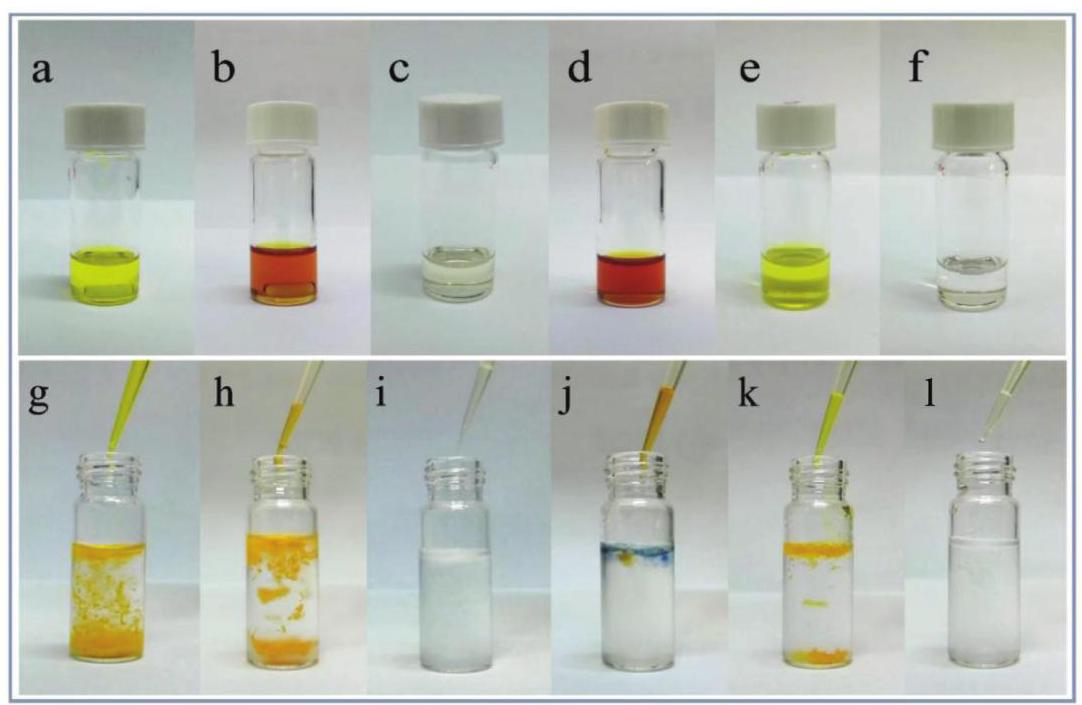
Figure 1. Photographs of different solutions. a) Reference perovskite precursor solution. b) Perovskite precursor solution with addition 3 wt% ${\mathrm{B}}_{2}{\mathrm{{Cat}}}_{2}$ . c) FAI solution. d) FAI solution with ${\mathrm{B}}_{2}{\mathrm{{Cat}}}_{2}$ . e) ${\mathrm{{PbI}}}_{2}$ solution with ${\mathrm{B}}_{2}{\mathrm{{Cat}}}_{2}$ . f) ${\mathrm{B}}_{2}{\mathrm{{Cat}}}_{2}$ solution. Chromogenic reaction with starch aqueous solution. g) Reference perovskite precursor solution. h) Perovskite precursor solution with additional 3 wt% ${\mathrm{B}}_{2}{\mathrm{{Cat}}}_{2}$ . i) FAI solution. j) FAI solution with ${\mathrm{B}}_{2}{\mathrm{{Cat}}}_{2}$ . k) ${\mathrm{{PbI}}}_{2}$ solution with ${\mathrm{B}}_{2}{\mathrm{{Cat}}}_{2}$ . I) ${\mathrm{B}}_{2}{\mathrm{{Cat}}}_{2}$ solution.
图1. 不同溶液的照片。a) 参比钙钛矿前驱体溶液。b) 添加3 wt% ${\mathrm{B}}_{2}{\mathrm{{Cat}}}_{2}$的钙钛矿前驱体溶液。c) FAI溶液。d) 含${\mathrm{B}}_{2}{\mathrm{{Cat}}}_{2}$的FAI溶液。e) 含${\mathrm{B}}_{2}{\mathrm{{Cat}}}_{2}$的${\mathrm{{PbI}}}_{2}$溶液。f) ${\mathrm{B}}_{2}{\mathrm{{Cat}}}_{2}$溶液。与淀粉水溶液的显色反应。g) 参比钙钛矿前驱体溶液。h) 添加3 wt% ${\mathrm{B}}_{2}{\mathrm{{Cat}}}_{2}$的钙钛矿前驱体溶液。i) FAI溶液。j) 含${\mathrm{B}}_{2}{\mathrm{{Cat}}}_{2}$的FAI溶液。k) 含${\mathrm{B}}_{2}{\mathrm{{Cat}}}_{2}$的${\mathrm{{PbI}}}_{2}$溶液。l) ${\mathrm{B}}_{2}{\mathrm{{Cat}}}_{2}$溶液。
Herein, we demonstrate a diboron-assisted strategy to decompose the unreacted organic-halide species at the surface by coating ${\mathrm{B}}_{2}{\mathrm{{Cat}}}_{2}\left( {{\mathrm{C}}_{12}{\mathrm{H}}_{10}{\mathrm{\;B}}_{2}{\mathrm{O}}_{4}}\right)$ on top of the perovskite films. A gaseous medium was produced from chemical reaction between FAI and ${\mathrm{B}}_{2}{\mathrm{{Cat}}}_{2}$ at elevated temperature that led to a “clean” region between the perovskite film and the hole-extraction layer. Meanwhile, the diboron-assisted strategy is expected to suppress the nonradiative recombination losses. Finally, the perovskite solar cells with the regular planar structure exhibited a champion PCE of 21.11% compared to that of the control device (PCE of 19.61%) with a stabilized power output of 20.83%, and negligible hysteresis effect under various scanning condition.
在此,我们展示了一种二硼辅助策略,通过在钙钛矿薄膜顶部涂覆${\mathrm{B}}_{2}{\mathrm{{Cat}}}_{2}\left( {{\mathrm{C}}_{12}{\mathrm{H}}_{10}{\mathrm{\;B}}_{2}{\mathrm{O}}_{4}}\right)$来分解表面未反应的有机卤化物物种。在高温下,FAI与${\mathrm{B}}_{2}{\mathrm{{Cat}}}_{2}$之间的化学反应产生了一种气态介质,在钙钛矿薄膜和空穴提取层之间形成了一个“清洁”区域。同时,二硼辅助策略有望抑制非辐射复合损失。最后,具有常规平面结构的钙钛矿太阳能电池的最佳PCE为21.11%,而对照器件的PCE为19.61%,其稳定功率输出为20.83%,并且在各种扫描条件下滞后效应可忽略不计。
Figure 1 shows the photographs of different solutions, where a series of solutions were prepared to investigate the reaction between ${\mathrm{B}}_{2}{\mathrm{{Cat}}}_{2}$ (the chemical structure was present in Figure S1 in the Supporting Information) and perovskite component materials. To ensure a single variable, the solutions used the same precursors and solvents as reference perovskite precursors. As shown in Figure 1a, the reference perovskite precursor solution in N, N-dimethylformamide (DMF):dimethyl sulfoxide (DMSO) (v/v = 4:1) delivered a yellow color. Specifically, when 3 wt% of ${\mathrm{B}}_{2}{\mathrm{{Cat}}}_{2}$ was added into the perovskite precursor solution, the color turned to slight brown, as shown in Figure 1b. Brown also appeared when same ${\mathrm{B}}_{2}{\mathrm{{Cat}}}_{2}$ was added into the colorless FAI solution, as shown in Figure 1c, d. PbI ${}_{2}$ solution still maintained the initial yellow color after the addition of ${\mathrm{B}}_{2}{\mathrm{{Cat}}}_{2}$ (Figure 1e). In particular, the ${\mathrm{B}}_{2}{\mathrm{{Cat}}}_{2}$ solution was colorless (Figure 1f). Mixed solution of other low content perovskite components (such as ${\mathrm{{PbBr}}}_{2}$ , MABr, and $\mathrm{{CsI}}$ ) with ${\mathrm{B}}_{2}{\mathrm{{Cat}}}_{2}$ was also prepared, as shown in Figure S2 in the Supporting Information. The ${\mathrm{{PbBr}}}_{2}$ solution with ${\mathrm{B}}_{2}{\mathrm{{Cat}}}_{2}$ and the MABr solution with ${\mathrm{B}}_{2}{\mathrm{{Cat}}}_{2}$ both presented the original intrinsic color (Figure S2a-d, Supporting Information). While the CsI solution with ${\mathrm{B}}_{2}{\mathrm{{Cat}}}_{2}$ turned to slight yellow from colorless (Figure S2e, f, Supporting Information). Considering FAI was the main component in perovskite precursor (the molar ratio of FAI: CsI was nearly 20/1), we can speculate that the brown color came mainly from the reaction of FAI and ${\mathrm{B}}_{2}{\mathrm{{Cat}}}_{2}$ .
图1展示了不同溶液的照片,其中制备了一系列溶液以研究${\mathrm{B}}_{2}{\mathrm{{Cat}}}_{2}$(化学结构见补充信息中的图S1)与钙钛矿组成材料之间的反应。为确保单一变量,这些溶液使用了与参考钙钛矿前驱体相同的前驱体和溶剂。如图1a所示,在N, N - 二甲基甲酰胺(DMF):二甲基亚砜(DMSO)(体积比 = 4:1)中的参考钙钛矿前驱体溶液呈现黄色。具体而言,当向钙钛矿前驱体溶液中加入3 wt%的${\mathrm{B}}_{2}{\mathrm{{Cat}}}_{2}$时,颜色变为浅棕色,如图1b所示。当将相同的${\mathrm{B}}_{2}{\mathrm{{Cat}}}_{2}$加入无色的FAI溶液中时,也出现了棕色,如图1c、d所示。加入${\mathrm{B}}_{2}{\mathrm{{Cat}}}_{2}$后,PbI${}_{2}$溶液仍保持初始黄色(图1e)。特别地,${\mathrm{B}}_{2}{\mathrm{{Cat}}}_{2}$溶液是无色的(图1f)。还制备了其他低含量钙钛矿组分(如${\mathrm{{PbBr}}}_{2}$、MABr和$\mathrm{{CsI}}$)与${\mathrm{B}}_{2}{\mathrm{{Cat}}}_{2}$的混合溶液,见补充信息中的图S2。${\mathrm{{PbBr}}}_{2}$与${\mathrm{B}}_{2}{\mathrm{{Cat}}}_{2}$的混合溶液以及MABr与${\mathrm{B}}_{2}{\mathrm{{Cat}}}_{2}$的混合溶液均呈现原始固有颜色(补充信息图S2a - d)。而CsI与${\mathrm{B}}_{2}{\mathrm{{Cat}}}_{2}$的混合溶液从无色变为浅黄色(补充信息图S2e、f)。考虑到FAI是钙钛矿前驱体中的主要成分(FAI与CsI的摩尔比接近20/1),我们可以推测棕色主要来自FAI与${\mathrm{B}}_{2}{\mathrm{{Cat}}}_{2}$的反应。
To further investigate the discoloration feature, chromogenic reaction of the various solutions with starch aqueous solutions was carried out. In Figure 1j, When the FAI-B2 ${\mathrm{{Cat}}}_{2}$ solution was added into starch aqueous solution, blue appeared in colorless solution, which indicated directly the existence of iodine in the brown solution. ${}^{\left\lbrack {29}\right\rbrack }$ In contrast, in Figure 1g, k, for reference perovskite precursor solution and ${\mathrm{{PbI}}}_{2} - {\mathrm{B}}_{2}{\mathrm{{Cat}}}_{2}$ solution, when both solutions added in the starch aqueous solution respectively, it was observed that the precipitation of lead iodide occurred without color change. In Figure 1h, when the slight brown perovskite precursor solution with 3 wt% ${\mathrm{B}}_{2}{\mathrm{{Cat}}}_{2}$ was added, no blue color was observed, which may be attributed to two factors: trace iodine content in the slight brown solution and dominant yellow precipitation of the precursor. In Figure 1i, l, when the colorless FAI and ${\mathrm{B}}_{2}{\mathrm{{Cat}}}_{2}$ solutions dripped separately into the starch aqueous solution, there was still no color change.
为进一步研究变色特征,对各种溶液与淀粉水溶液进行了显色反应。在图1j中,当将FAI - B2${\mathrm{{Cat}}}_{2}$溶液加入淀粉水溶液时,无色溶液中出现蓝色,这直接表明棕色溶液中存在碘。${}^{\left\lbrack {29}\right\rbrack }$ 相比之下,在图1g、k中,对于参考钙钛矿前驱体溶液和${\mathrm{{PbI}}}_{2} - {\mathrm{B}}_{2}{\mathrm{{Cat}}}_{2}$溶液,当分别将这两种溶液加入淀粉水溶液时,观察到碘化铅沉淀且无颜色变化。在图1h中,当加入含3 wt%${\mathrm{B}}_{2}{\mathrm{{Cat}}}_{2}$的浅棕色钙钛矿前驱体溶液时,未观察到蓝色,这可能归因于两个因素:浅棕色溶液中碘含量微量以及前驱体的主要黄色沉淀。在图1i、l中,当无色的FAI和${\mathrm{B}}_{2}{\mathrm{{Cat}}}_{2}$溶液分别滴入淀粉水溶液时,仍然没有颜色变化。
We did extreme experiment to investigate the reaction between FAI and ${\mathrm{B}}_{2}{\mathrm{{Cat}}}_{2}$ in two-phase reaction. As reported, the mass loss of FAI starts from $\approx {247}^{ \circ }\mathrm{C}$ by thermogravimetry differential scanning calorimetry analysis, ${}^{\left\lbrack {30}\right\rbrack }$ so FAI is not easily removed by heating at ${100}{}^{ \circ }\mathrm{C}$ (as shown in Figure S3 in the Supporting Information). Figure S4a in the Supporting Information shows the annealed FAI film on the indium tin oxide (ITO) substrate. When ${\mathrm{B}}_{2}{\mathrm{{Cat}}}_{2}/$ isopropyl alcohol (IPA) solution was dripped onto the FAI film (Figure S4b, Supporting Information), the white FAI disappeared gradually with heating (Figure S4c, Supporting Information). At last, the reactants disappeared almost (Figure S4d, Supporting Information). Based on above observation, we conclude that ${\mathrm{B}}_{2}{\mathrm{{Cat}}}_{2}$ could react with FAI and there is almost no residue eventually. To explore the reaction mechanism, we further carried out the proton nuclear magnetic resonance (1H-NMR) spectra of FAI, ${\mathrm{B}}_{2}{\mathrm{{Cat}}}_{2}$ and ${\mathrm{{FAI} - B}}_{2}{\mathrm{{Cat}}}_{2}$ mixture (DMSO- ${d}_{6},{400}\mathrm{{MHz}}$ ), as shown in Figures S5-S7 in the Supporting Information (specific mechanism analysis could be found in the Supporting Information).
我们进行了极端实验来研究在两相反应中FAI与${\mathrm{B}}_{2}{\mathrm{{Cat}}}_{2}$之间的反应。如报道所述,通过热重差示扫描量热分析,FAI的质量损失从$\approx {247}^{ \circ }\mathrm{C}$开始,${}^{\left\lbrack {30}\right\rbrack }$所以在${100}{}^{ \circ }\mathrm{C}$加热时FAI不容易被去除(如补充信息中的图S3所示)。补充信息中的图S4a显示了在氧化铟锡(ITO)衬底上退火的FAI薄膜。当将${\mathrm{B}}_{2}{\mathrm{{Cat}}}_{2}/$异丙醇(IPA)溶液滴到FAI薄膜上时(补充信息中的图S4b),白色的FAI随着加热逐渐消失(补充信息中的图S4c)。最后,反应物几乎消失(补充信息中的图S4d)。基于上述观察,我们得出结论,${\mathrm{B}}_{2}{\mathrm{{Cat}}}_{2}$可以与FAI反应,最终几乎没有残留物。为了探索反应机理,我们进一步对FAI、${\mathrm{B}}_{2}{\mathrm{{Cat}}}_{2}$和${\mathrm{{FAI} - B}}_{2}{\mathrm{{Cat}}}_{2}$混合物(DMSO - ${d}_{6},{400}\mathrm{{MHz}}$)进行了质子核磁共振(1H - NMR)光谱分析,如补充信息中的图S5 - S7所示(具体机理分析可在补充信息中找到)。
Based on above analysis, a schematic diagram delivering the reduction of the unreacted FAI species with ${\mathrm{B}}_{2}{\mathrm{{Cat}}}_{2}$ - assisted strategy is given in Figure 2a. The control film was composed of cesium-containing triple cation perovskite. $5\mathrm{{mg}}{\mathrm{{mL}}}^{-1}{\mathrm{\;B}}_{2}{\mathrm{{Cat}}}_{2}/$ IPA solution was deposited on top of the perovskite film by spin coating, hereafter termed as B-film (see Experimental Section).
基于上述分析,图2a给出了一个示意图,展示了用${\mathrm{B}}_{2}{\mathrm{{Cat}}}_{2}$辅助策略减少未反应的FAI物种的过程。对照膜由含铯的三阳离子钙钛矿组成。通过旋涂将$5\mathrm{{mg}}{\mathrm{{mL}}}^{-1}{\mathrm{\;B}}_{2}{\mathrm{{Cat}}}_{2}/$ IPA溶液沉积在钙钛矿膜的顶部,此后称为B膜(见实验部分)。
To assess the change in compositions to the films with and without ${\mathrm{B}}_{2}{\mathrm{{Cat}}}_{2}$ treatments, X-ray photoelectron spectroscopy (XPS) that is a surface sensitive technique ${}^{\left\lbrack {31},{32}\right\rbrack }$ was performed. The overview spectrum of the prepared perovskite film is present in Figure S9 in the Supporting Information, and the core level peaks obtained were indexed to the elements forming perovskite materials. ${}^{\left\lbrack {19},{28}\right\rbrack }$ High-resolution spectra of Pb 4f, I 4d, and $\mathrm{N}1\mathrm{\;s}$ regions are shown in Figure $2\mathrm{\;b}$ and Figure S10 in the Supporting Information, respectively. By normalizing the spectra with respect to the Pb $4{\mathrm{f}}_{7/2}$ peak, there is a noticeable decrease in I 4d and $\mathrm{N}1\mathrm{\;s}$ of the B-film related to the decomposition of the FAI close to the surface of the perovskite film. For ${\mathrm{{FA}}}_{0.81}{\mathrm{{MA}}}_{0.10}{\mathrm{{Cs}}}_{0.04}{\mathrm{{PbI}}}_{2.55}{\mathrm{{Br}}}_{0.40}$ in our specific experiment, the theoretical I/Pb ratio value based on the bulk stoichiometry is 2.55. The ions stoichiometry ratio in the material was investigated by comparing the integral area of the characteristic peaks. ${}^{\left\lbrack {19},{21},{28}\right\rbrack }$ The I/Pb ratio with standard error was estimated to be ${2.90} \pm {0.0619}$ and ${2.70} \pm {0.0387}$ for the control and B-film, respectively, as shown in Figure S11 in the Supporting Information. (More information about XPS statistical results were listed in Table S1 in the Supporting Information.) This means that the residual FAI species within the B-film is less than that of the control film. ${}^{\left\lbrack {21}\right\rbrack }$
为了评估经过和未经过${\mathrm{B}}_{2}{\mathrm{{Cat}}}_{2}$处理的薄膜的成分变化,我们进行了作为表面敏感技术的${}^{\left\lbrack {31},{32}\right\rbrack }$X射线光电子能谱(XPS)分析。制备的钙钛矿薄膜的全谱图见补充信息中的图S9,所获得的核心能级峰对应于构成钙钛矿材料的元素。${}^{\left\lbrack {19},{28}\right\rbrack }$Pb 4f、I 4d和$\mathrm{N}1\mathrm{\;s}$区域的高分辨率光谱分别见图$2\mathrm{\;b}$和补充信息中的图S10。通过将光谱相对于Pb$4{\mathrm{f}}_{7/2}$峰进行归一化,与钙钛矿薄膜表面附近FAI的分解相关的B薄膜的I 4d和$\mathrm{N}1\mathrm{\;s}$有明显下降。对于${\mathrm{{FA}}}_{0.81}{\mathrm{{MA}}}_{0.10}{\mathrm{{Cs}}}_{0.04}{\mathrm{{PbI}}}_{2.55}{\mathrm{{Br}}}_{0.40}$在我们的特定实验中,基于体相化学计量的理论I/Pb比值为2.55。通过比较特征峰的积分面积研究了材料中的离子化学计量比。${}^{\left\lbrack {19},{21},{28}\right\rbrack }$如补充信息中的图S11所示,对照薄膜和B薄膜的I/Pb比值及其标准误差分别估计为${2.90} \pm {0.0619}$和${2.70} \pm {0.0387}$。(补充信息中的表S1列出了更多关于XPS统计结果的信息。)这意味着B薄膜中的残余FAI物种比对照薄膜中的少。${}^{\left\lbrack {21}\right\rbrack }$
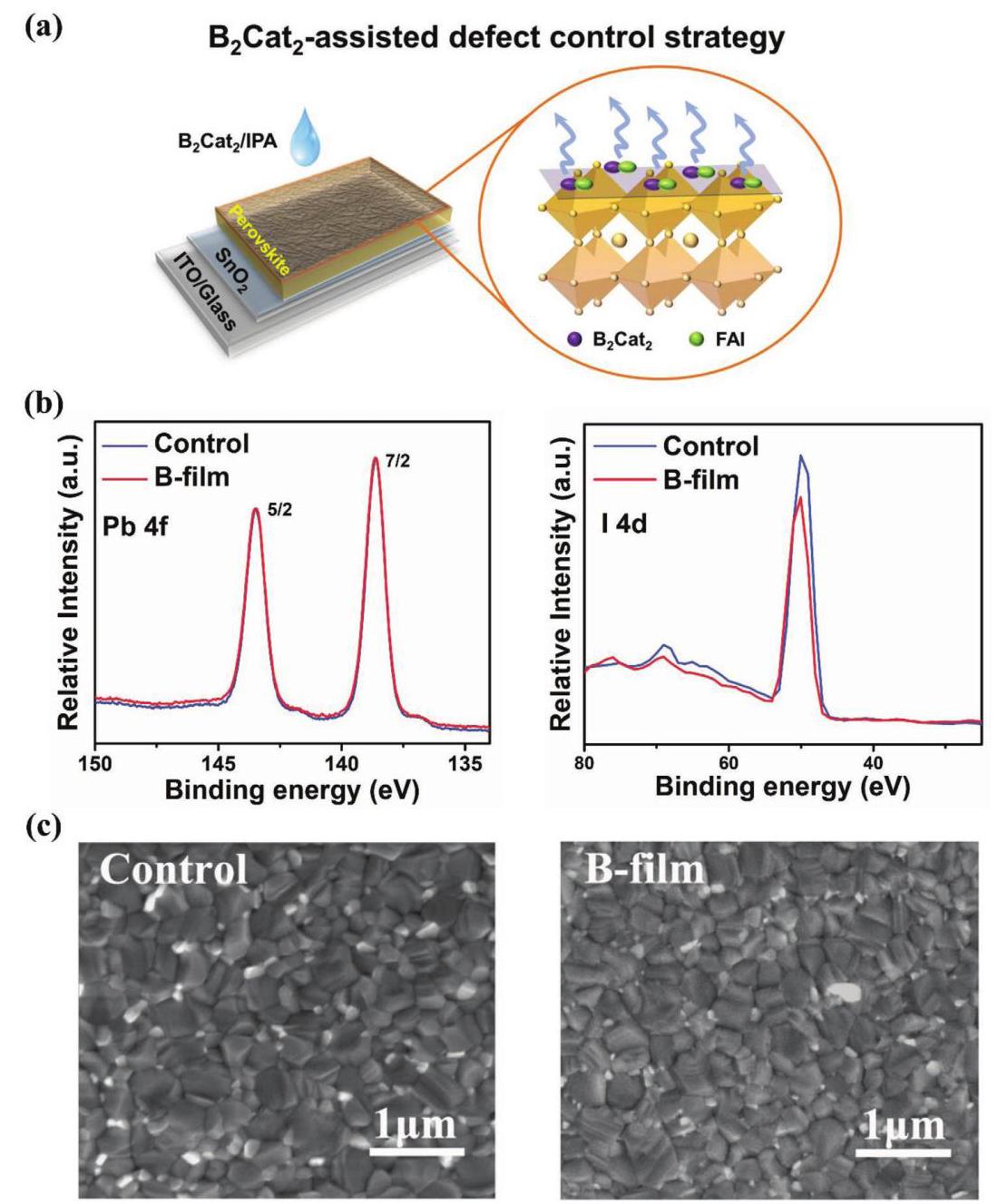
Figure 2. a) Schematic view of the ${\mathrm{B}}_{2}{\mathrm{{Cat}}}_{2}$ -assisted defect control strategy. b) The high-resolution spectra of X-ray photoelectron spectroscopy for Pb 4f and I 4d regions on the surface of the prepared perovskite film. c) SEM images of the control and B-film.
图2. a)${\mathrm{B}}_{2}{\mathrm{{Cat}}}_{2}$辅助缺陷控制策略的示意图。b)制备的钙钛矿薄膜表面的Pb 4f和I 4d区域的X射线光电子能谱高分辨率光谱。c)对照薄膜和B薄膜的SEM图像。
To further demonstrate the influence of the ${\mathrm{B}}_{2}{\mathrm{{Cat}}}_{2}$ treatment on the perovskite film, below we performed a morphological and crystallographic characterization of the prepared films. As shown in Figure 2c, the constitutive grain size of the control and B-film is among ${200} - {300}\mathrm{\;{nm}}$ , indicating that ${\mathrm{B}}_{2}{\mathrm{{Cat}}}_{2}$ did not notably change the morphology and grain size of the perovskite films. The “bright crystals” on the surface was mainly dominated by lead halide complex. ${}^{\left\lbrack {33}\right\rbrack }$ The X-ray diffraction (XRD) results show that there is no notable change in the crystallinity from the XRD patterns after introducing ${\mathrm{B}}_{2}{\mathrm{{Cat}}}_{2}$ treatment (Figure S12, Supporting Information). The peak at ${12.7}^{ \circ }$ could be indexed to the (001) lattice plane of crystallized ${\mathrm{{PbI}}}_{2}{.}^{\left\lbrack {34},{35}\right\rbrack }$ The two main peaks for all perovskite films approximately located at ${14.4}^{ \circ }$ and ${28.8}^{ \circ }$ can be indexed to the (110) and (220) planes.[36]
为了进一步证明${\mathrm{B}}_{2}{\mathrm{{Cat}}}_{2}$处理对钙钛矿薄膜的影响,下面我们对制备的薄膜进行了形貌和晶体学表征。如图2c所示,对照薄膜和B薄膜的组成晶粒尺寸在${200} - {300}\mathrm{\;{nm}}$范围内,这表明${\mathrm{B}}_{2}{\mathrm{{Cat}}}_{2}$没有显著改变钙钛矿薄膜的形貌和晶粒尺寸。表面上的“亮晶体”主要由卤化铅络合物主导。${}^{\left\lbrack {33}\right\rbrack }$X射线衍射(XRD)结果表明,引入${\mathrm{B}}_{2}{\mathrm{{Cat}}}_{2}$处理后,XRD图谱中的结晶度没有显著变化(补充信息中的图S12)。${12.7}^{ \circ }$处的峰可对应于结晶${\mathrm{{PbI}}}_{2}{.}^{\left\lbrack {34},{35}\right\rbrack }$的(001)晶格平面。所有钙钛矿薄膜的两个主要峰大约位于${14.4}^{ \circ }$和${28.8}^{ \circ }$处,可对应于(110)和(220)平面。[36]
Figure 3a compares the variation in work function and valence band for the control and B-film. Work function determined from secondary cutoff spectrum shows a slight decrease relative to control film, and amplitude in fluctuations is approaching 120 meV. In addition to work function, the valence band maximum with respect to Fermi level also exhibits a 180 meV decrease, as shown in Figure S13 in the Supporting Information. This result indicates that the energy level moves toward vacuum after introducing ${\mathrm{B}}_{2}{\mathrm{{Cat}}}_{2}$ treatments, and such changes in electronic states at the surface further confirm that the surface of the perovskite B-film was healed. The band gaps of both films extracted from Tauc plots show an identical value of ${1.61}\mathrm{{eV}}$ (Figure S14, Supporting Information), in agreement with changes to the films solely present at the surface. Combined with ultraviolet photoelectron spectroscopy (UPS) and absorption, we built an energy-band diagram going from control to B-film. The upward shift of the valence band maximum position for the B-film might be favorable for photogerenated hole extraction from perovskite films to hole-extraction layers. ${}^{\left\lbrack {37}\right\rbrack }$
图3a比较了对照样品和硼薄膜的功函数及价带变化。由二次截止光谱确定的功函数相对于对照薄膜略有下降,波动幅度接近120毫电子伏特。除功函数外,相对于费米能级的价带最大值也下降了180毫电子伏特,如补充信息中的图S13所示。该结果表明,引入${\mathrm{B}}_{2}{\mathrm{{Cat}}}_{2}$处理后,能级向真空移动,并且表面电子态的这种变化进一步证实了钙钛矿硼薄膜的表面得到了修复。从Tauc图提取的两种薄膜的带隙显示出相同的${1.61}\mathrm{{eV}}$值(补充信息中的图S14),这与仅在表面存在的薄膜变化一致。结合紫外光电子能谱(UPS)和吸收光谱,我们构建了从对照样品到硼薄膜的能带图。硼薄膜价带最大值位置的上移可能有利于光生空穴从钙钛矿薄膜向空穴提取层的提取。${}^{\left\lbrack {37}\right\rbrack }$
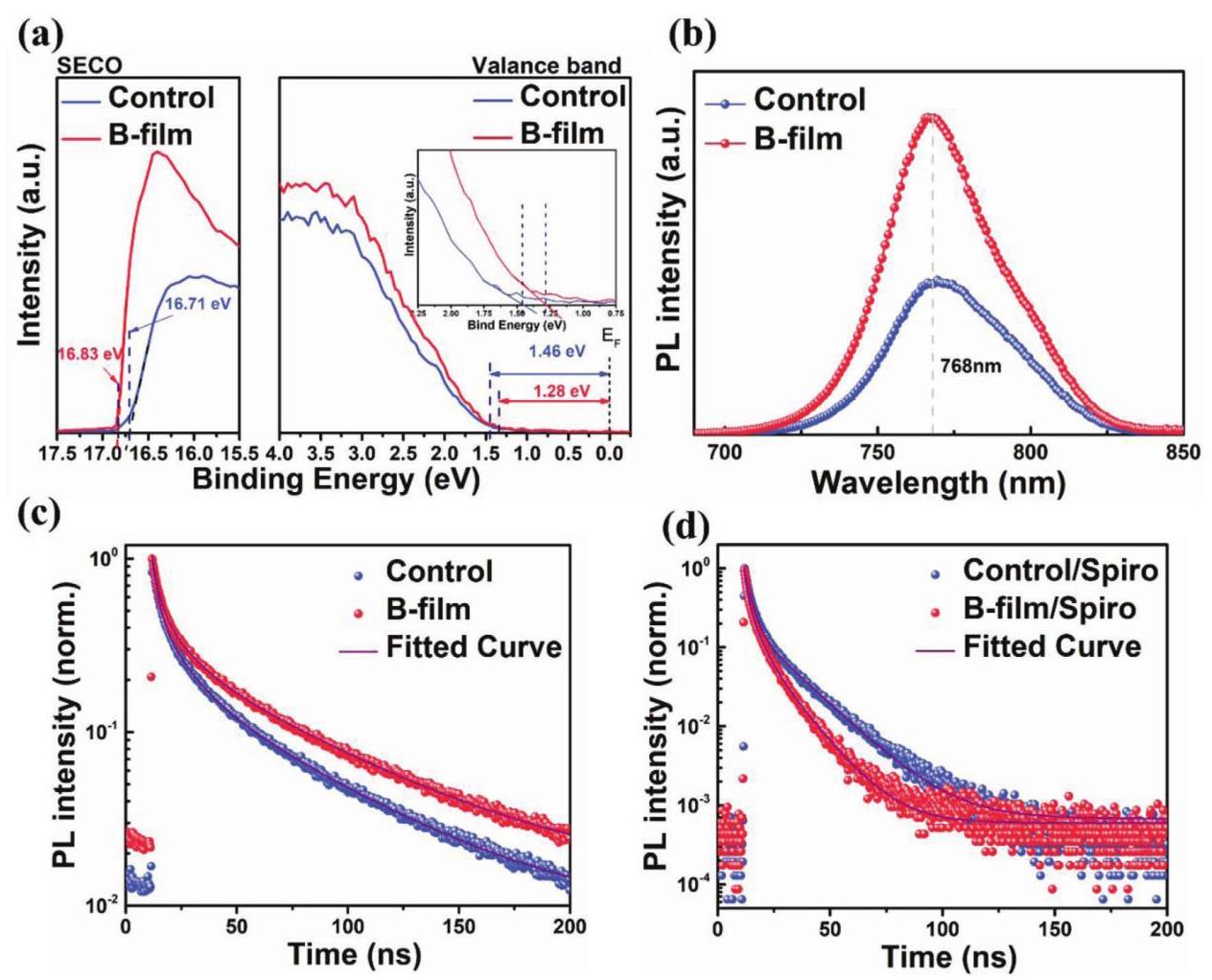
Figure 3. a) UPS spectra of the control and B-film. Left panel: secondary electron cutoff. Right panel: valence band spectrum. b) Steady-state photoluminescence spectra of perovskite films on glass detected at 460 nm excitation wavelength. c) Time-resolved photoluminescence spectra of perovskite films deposited on glass detected at ${768}\mathrm{\;{nm}}$ emission wavelength. d) Time-resolved photoluminescence spectra of the prepared perovskite films detected at 768 nm emission wavelength with the configuration of glass/perovskite/Spiro-OMeTAD.
图3. a)对照样品和硼薄膜的UPS光谱。左图:二次电子截止。右图:价带光谱。b)在460纳米激发波长下检测到的玻璃上钙钛矿薄膜的稳态光致发光光谱。c)在${768}\mathrm{\;{nm}}$发射波长下检测到的沉积在玻璃上的钙钛矿薄膜的时间分辨光致发光光谱。d)采用玻璃/钙钛矿/Spiro-OMeTAD结构,在768纳米发射波长下检测到的制备的钙钛矿薄膜的时间分辨光致发光光谱。
To gain more insight into charge-carrier dynamics with the change of electronic states, we carried out steady-state photoluminescence (PL) spectroscopy and time-resolved PL (TRPL) intensity decay measurements on series of samples: glass/perovskite and glass/perovskite/hole transporting layer. Figure 3b shows that the B-film exhibited a stronger band emission at ${768}\mathrm{\;{nm}}$ relative to the control film at the same excitation. This confirms that radiative recombination rates from photogenerated charge carriers competitive with nonradiative losses play predominant roles in recombination processes. This is in the right direction to enhance device efficiencies by mitigating nonradiative losses. Figure 3c shows the TRPL decays of the films without hole quenchers, where the curves were fitted with a two-component exponential decay function. The fitted results for the TRPL decays of the B-film delivered a much longer PL decay than that of the control film, attributed to reduced trap-assisted recombination at defect sites. ${}^{\left\lbrack 8,{38}\right\rbrack }$ (More information about TRPL results were given in Figure S15 and Table S2 in the Supporting Information.) In addition, to elucidate the charge-carrier dynamics at the perovskite/Spiro-OMeTAD interface, we further carried out TRPL measurement of the control and B-film with the configuration of glass/perovskite/Spiro-OMeTAD, as shown in Figure 3d (for more information about TRPL results were given in Figure S16 and Table S3 in the Supporting Information.) The B-film had a smaller lifetime versus control film, which indicated that charge injection of the B-film to hole transport layer is more efficient than control film, ${}^{\left\lbrack {39},{40}\right\rbrack }$ in line with the more efficient carrier injection of the perovskite film in Figure 3a.
为了更深入地了解随着电子态变化的载流子动力学,我们对一系列样品进行了稳态光致发光(PL)光谱和时间分辨PL(TRPL)强度衰减测量:玻璃/钙钛矿和玻璃/钙钛矿/空穴传输层。图3b表明,在相同激发条件下,硼薄膜相对于对照薄膜在${768}\mathrm{\;{nm}}$处表现出更强的能带发射。这证实了与非辐射损失竞争的光生载流子的辐射复合率在复合过程中起主要作用。这是通过减轻非辐射损失提高器件效率的正确方向。图3c显示了没有空穴猝灭剂的薄膜的TRPL衰减,其中曲线用双组分指数衰减函数拟合。硼薄膜的TRPL衰减的拟合结果显示其PL衰减比对照薄膜长得多,这归因于缺陷位点处陷阱辅助复合的减少。${}^{\left\lbrack 8,{38}\right\rbrack }$ (补充信息中的图S15和表S2给出了更多关于TRPL结果的信息。)此外,为了阐明钙钛矿/Spiro-OMeTAD界面处的载流子动力学,我们进一步对采用玻璃/钙钛矿/Spiro-OMeTAD结构的对照样品和硼薄膜进行了TRPL测量,如图3d所示(补充信息中的图S16和表S3给出了更多关于TRPL结果的信息。)硼薄膜相对于对照薄膜具有更短的寿命,这表明硼薄膜向空穴传输层的电荷注入比对照薄膜更有效,${}^{\left\lbrack {39},{40}\right\rbrack }$ 这与图3a中钙钛矿薄膜更有效的载流子注入一致。
Figure 4 shows the photovoltaic performances of the perovskite solar cells based on control and B-film. Device structure is shown in Figure 4a. As shown in Figure 4b, the cross-section scanning electron microscopy (SEM) image of B-film device shows a dense and uniform perovskite in the device. A complete comparison of the photocurrent-voltage $\left( {J - V}\right)$ curves of the devices by forward and reverse scans measured under AM 1.5 G (100 mW cm ${}^{-2}$ ) is shown in Figure 4c-e, and the corresponding photovoltaic parameters are listed in Table 1. A PCE of 19.61% was achieved for the control device presenting obvious hysteresis effect, with an open circuit voltage $\left( {V}_{\mathrm{{oc}}}\right)$ of 1.143 V, a short-circuit current density $\left( {J}_{\mathrm{{sc}}}\right)$ of ${22.57}\mathrm{\;{mA}}{\mathrm{\;{cm}}}^{-2}$ , and a fill factor (FF) of 0.76 . For the B-film, device performances with different concentrations $(0,1,3,5$ , and $7\mathrm{{mg}}{\mathrm{{mL}}}^{-1}$ ) of ${\mathrm{B}}_{2}{\mathrm{{Cat}}}_{2}$ were checked, variations of which were shown in Table S4 in the Supporting Information. It is notable that the device based on B-film of $5\mathrm{{mg}}{\mathrm{{mL}}}^{-1}{\mathrm{\;B}}_{2}{\mathrm{{Cat}}}_{2}$ achieved the highest PCE value of 21.11% with an ${V}_{\mathrm{{oc}}}$ of ${1.183}\mathrm{\;V}$ and a FF of 0.78, exhibiting negligible $J - V$ hysteresis. The devices processed from pure IPA solvent showed lower FF compared to the devices with the ${\mathrm{B}}_{2}{\mathrm{{Cat}}}_{2}$ treatment, which indicated that the impact of the ${\mathrm{B}}_{2}{\mathrm{{Cat}}}_{2}$ treatment is positive and considerably improves the device performances. To illustrate the reduced hysteresis effect, we further measured the devices at different scan rates. As shown in Figure S17 in the Supporting Information, the control device measured at slow scan $\left( {{10}\mathrm{{mV}}{\mathrm{s}}^{-1}}\right)$ and fast scan $\left( {{400}\mathrm{{mV}}{\mathrm{s}}^{-1}}\right)$ shows obvious hysteresis effect. However, the B-film device presents negligible hysteresis under different scan rates. Photoresponstivity measurement under light/dark cycle was also carried out to demonstrate the less hysteresis effect. ${}^{\left\lbrack {41}\right\rbrack }$ As shown in Figure S19 in the Supporting Information, the B-film device exhibits a much faster response than the control device, which is ascribed to that interfacial defects would be reduced by diboron treatment. ${}^{\left\lbrack {42}\right\rbrack }$ Figure 4f shows the steady-state power output characteristics at the maximum power point of control and B-film devices. Statistical results of the device performance are provided as histogram charts in Figure 4g. It could be found that the devices based on B-film showed better performance and average PCE of 20.66%. Meanwhile, the histogram chart demonstrates a high reproducibility of the devices (each team was calculated from a batch of 50 cells). Long-term stability is a crucial concern for practical application of perovskite solar cells. Figure S20 in the Supporting Information shows the normalized PCE as the function of time for the control and B-film devices, in which the devices were kept under air conditions in the dark. It was found that the devices based on B-film could retain 82% of its initial performance after ${720}\mathrm{\;h}$ aging, which was higher than the control device.
图4展示了基于对照和硼薄膜的钙钛矿太阳能电池的光伏性能。器件结构如图4a所示。如图4b所示,硼薄膜器件的横截面扫描电子显微镜(SEM)图像显示器件中的钙钛矿致密且均匀。图4c - e展示了在AM 1.5 G(100 mW cm${}^{-2}$)下通过正向和反向扫描测量的器件光电流 - 电压$\left( {J - V}\right)$曲线的完整比较,相应的光伏参数列于表1中。对照器件实现了19.61%的光电转换效率(PCE),呈现出明显的滞后效应,开路电压$\left( {V}_{\mathrm{{oc}}}\right)$为1.143 V,短路电流密度$\left( {J}_{\mathrm{{sc}}}\right)$为${22.57}\mathrm{\;{mA}}{\mathrm{\;{cm}}}^{-2}$,填充因子(FF)为0.76。对于硼薄膜,检查了不同浓度$(0,1,3,5$和$7\mathrm{{mg}}{\mathrm{{mL}}}^{-1}$的${\mathrm{B}}_{2}{\mathrm{{Cat}}}_{2}$的器件性能,其变化情况见支持信息中的表S4。值得注意的是,基于$5\mathrm{{mg}}{\mathrm{{mL}}}^{-1}{\mathrm{\;B}}_{2}{\mathrm{{Cat}}}_{2}$硼薄膜的器件实现了最高的PCE值21.11%,${V}_{\mathrm{{oc}}}$为${1.183}\mathrm{\;V}$,FF为0.78,滞后$J - V$可忽略不计。与经过${\mathrm{B}}_{2}{\mathrm{{Cat}}}_{2}$处理的器件相比,由纯异丙醇(IPA)溶剂制备的器件显示出较低的FF,这表明${\mathrm{B}}_{2}{\mathrm{{Cat}}}_{2}$处理的影响是积极的,并且显著提高了器件性能。为了说明滞后效应的降低,我们进一步在不同扫描速率下测量了器件。如支持信息中的图S17所示,在慢扫描$\left( {{10}\mathrm{{mV}}{\mathrm{s}}^{-1}}\right)$和快扫描$\left( {{400}\mathrm{{mV}}{\mathrm{s}}^{-1}}\right)$下测量的对照器件显示出明显的滞后效应。然而,硼薄膜器件在不同扫描速率下呈现出可忽略不计的滞后。还进行了光/暗循环下的光响应度测量以证明较小的滞后效应。${}^{\left\lbrack {41}\right\rbrack }$如支持信息中的图S19所示,硼薄膜器件的响应比对照器件快得多,这归因于硼处理会减少界面缺陷。${}^{\left\lbrack {42}\right\rbrack }$图4f展示了对照和硼薄膜器件在最大功率点的稳态功率输出特性。器件性能的统计结果以直方图形式在图4g中给出。可以发现,基于硼薄膜的器件表现出更好的性能,平均PCE为20.66%。同时,直方图表明器件具有高重现性(每个数据点由一批50个电池计算得出)。长期稳定性是钙钛矿太阳能电池实际应用中的一个关键问题。支持信息中的图S20展示了对照和硼薄膜器件的归一化PCE随时间的变化,其中器件在黑暗中空气条件下保存。发现基于硼薄膜的器件在${720}\mathrm{\;h}$老化后可保留其初始性能 的82%,高于对照器件。
To further demonstrate the origin of the ${V}_{\mathrm{{oc}}}$ and ${J}_{\mathrm{{sc}}}$ rise, the trap density $\left( {n}_{\text{ trap }}\right)$ in the prepared perovskite films needs to be explored. We therefore fabricated electron-only devices with structure of ITO/ ${\mathrm{{SnO}}}_{2}$ /Perovskite/PCBM/Au. Figure 4h illustrates the dark $I - V$ characteristics of the electron-only devices. It is clear that the linear relation indicates an Ohmic contact at the low bias voltage. Then the current increases quickly and nonlinearly when the bias voltage exceeds the kink point, demonstrating that the trap states are completely filled. ${}^{\left\lbrack {43},{44}\right\rbrack }$ The applied voltage at the kink point is known as the trap-filled limit voltage ${V}_{\mathrm{{TFL}}}$ . The ${V}_{\mathrm{{TFL}}}$ values of the control and B-film device were 1.366 and ${0.685}\mathrm{\;V}$ , respectively. The traps state density was determined by the ${V}_{\mathrm{{TFL}}}$ using the following equation
为了进一步证明${V}_{\mathrm{{oc}}}$和${J}_{\mathrm{{sc}}}$上升的原因,需要探究制备的钙钛矿薄膜中的陷阱密度$\left( {n}_{\text{ trap }}\right)$。因此,我们制备了结构为ITO/${\mathrm{{SnO}}}_{2}$/钙钛矿/PCBM/Au的单电子器件。图4h展示了单电子器件的暗$I - V$特性。很明显,线性关系表明在低偏置电压下存在欧姆接触。当偏置电压超过拐点时,电流迅速且非线性地增加,这表明陷阱态被完全填满。${}^{\left\lbrack {43},{44}\right\rbrack }$拐点处的施加电压被称为陷阱填充极限电压${V}_{\mathrm{{TFL}}}$。对照器件和含硼薄膜器件的${V}_{\mathrm{{TFL}}}$值分别为1.366和${0.685}\mathrm{\;V}$。陷阱态密度通过${V}_{\mathrm{{TFL}}}$使用以下公式确定
$$ {n}_{\text{ trap }} = \frac{{2\varepsilon }{\varepsilon }_{0}{V}_{\text{ TFL }}}{e{L}^{2}} \tag{1} $$where $e$ is the elementary charge of the electron, $L$ is the thickness of the perovskite film, $\varepsilon$ is the relative dielectric constant of perovskite, ${}^{\left\lbrack {45},{46}\right\rbrack }$ and ${\varepsilon }_{0}$ is the vacuum permittivity. In contrast to control device with the defect density of ${1.75} \pm {0.13} \times {10}^{16}{\mathrm{\;{cm}}}^{-3}$ , the B-film device delivered lower defect densities of ${8.70} \pm {0.22} \times {10}^{15}{\mathrm{\;{cm}}}^{-3}$ , which is in good agreement with previous reports. ${}^{\left\lbrack {39},{47},{48}\right\rbrack }$ These results provide strong evidences that sunlight converting into electricity becomes more sufficient by the diboron-assisted defect control strategy, owing to reduction of some unwanted nonradiative pathways.
其中$e$是电子的基本电荷,$L$是钙钛矿薄膜的厚度,$\varepsilon$是钙钛矿的相对介电常数,${}^{\left\lbrack {45},{46}\right\rbrack }$和${\varepsilon }_{0}$是真空介电常数。与缺陷密度为${1.75} \pm {0.13} \times {10}^{16}{\mathrm{\;{cm}}}^{-3}$的对照器件相比,含硼薄膜器件的缺陷密度更低,为${8.70} \pm {0.22} \times {10}^{15}{\mathrm{\;{cm}}}^{-3}$,这与之前的报道一致。${}^{\left\lbrack {39},{47},{48}\right\rbrack }$这些结果提供了有力证据,表明由于减少了一些不必要的非辐射途径,通过二硼辅助缺陷控制策略,阳光转化为电能变得更加充分。
In summary, we have demonstrated a diboron assisted interfacial defect control strategy for FAI-based perovskite solar cells, attributed to diboron compound $\left( {{\mathrm{B}}_{2}{\mathrm{{Cat}}}_{2}}\right)$ can selectively react with unreacted FAI. Systematic investigations on electronic states and charge-carrier dynamics have proven to efficient charge-carrier extraction and reduced nonradiative recombination. Notably, ${\mathrm{B}}_{2}{\mathrm{{Cat}}}_{2}$ -assisted control of defect is beneficial for transfer of the photogenerated holes from perovskite film to the HTM layer. As a result, we achieved an improved PCEs of 21.11% comparing to the control device (PCE of 19.61%). This study opens a new avenue to mitigate the interfacial defect aiming to improve device efficiency of the planar perovskite solar cells.
总之,我们展示了一种用于基于FAI的钙钛矿太阳能电池的二硼辅助界面缺陷控制策略,这归因于二硼化合物$\left( {{\mathrm{B}}_{2}{\mathrm{{Cat}}}_{2}}\right)$可以与未反应的FAI选择性反应。对电子态和电荷载流子动力学的系统研究已证明能实现有效的电荷载流子提取并减少非辐射复合。值得注意的是,${\mathrm{B}}_{2}{\mathrm{{Cat}}}_{2}$辅助的缺陷控制有利于光生空穴从钙钛矿薄膜转移到HTM层。结果,与对照器件(PCE为19.61%)相比,我们实现了21.11%的PCE提升。这项研究开辟了一条减轻界面缺陷的新途径,旨在提高平面钙钛矿太阳能电池的器件效率。
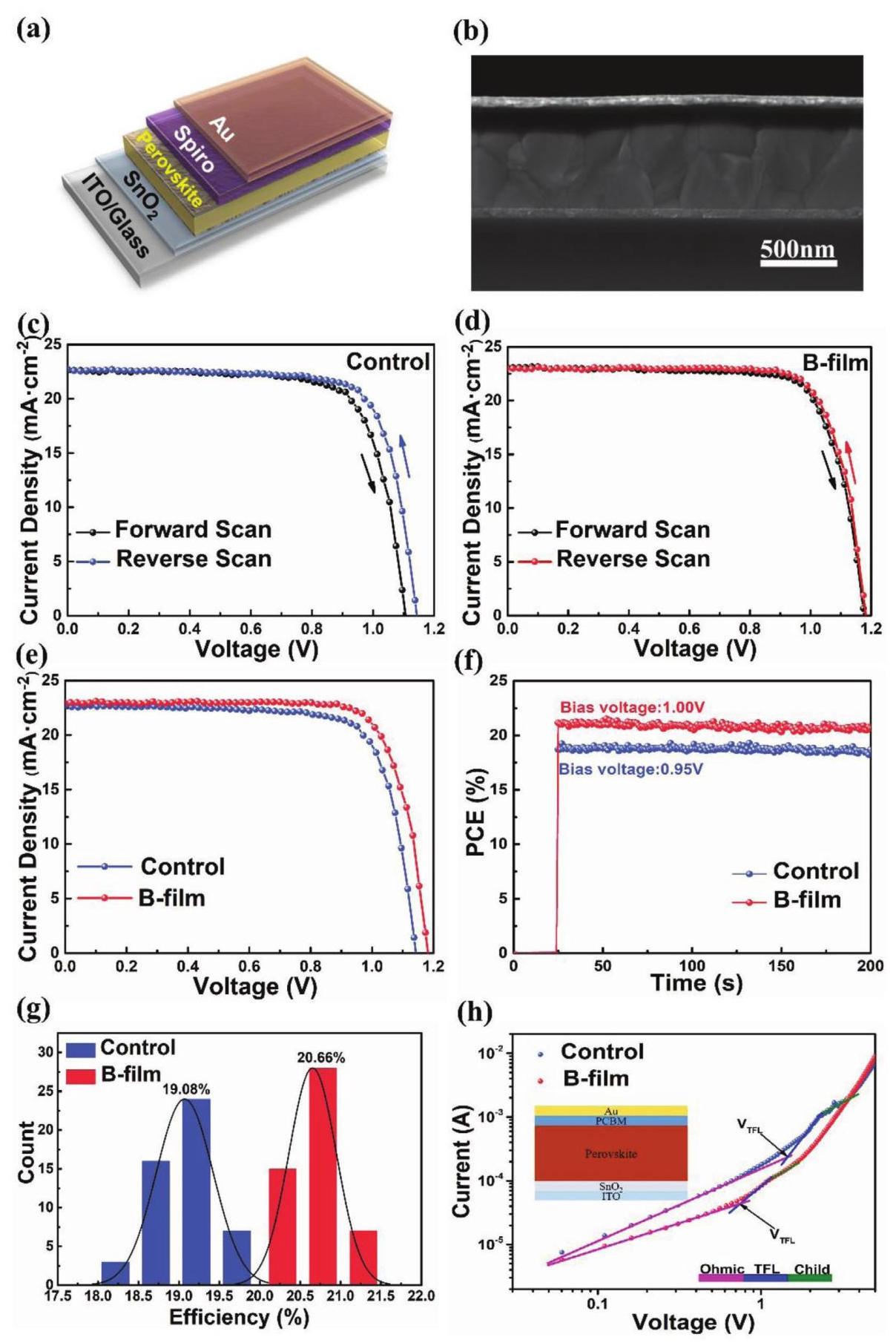
Figure 4. The J-V curves of devices. a) Illustration of the planar perovskite solar cell. b) Cross-sectional SEM image of the B-film device. c) Control device and d) B-film device with different scan directions. e) Control and B-film devices with reverse direction. f) Stabilized power output characteristics at the maximum power point of the control and B-film devices. g) Statistical results of the device performance. h) Dark I-V curves of the electron-only device revealing ${V}_{\text{ TFL }}$ kink point behavior.
图4. 器件的J-V曲线。a) 平面钙钛矿太阳能电池示意图。b) 含硼薄膜器件的横截面SEM图像。c) 对照器件和d) 不同扫描方向的含硼薄膜器件。e) 反向的对照器件和含硼薄膜器件。f) 对照器件和含硼薄膜器件在最大功率点的稳定功率输出特性。g) 器件性能的统计结果。h) 单电子器件的暗I-V曲线揭示了${V}_{\text{ TFL }}$拐点行为。
Table 1. Summary of photovoltaic parameters for perovskite solar cells based control and B-film.
表1. 基于对照和含硼薄膜的钙钛矿太阳能电池光伏参数总结。
| Sample | Scan direction | ${V}_{\mathrm{{oc}}}\left\lbrack \mathrm{V}\right\rbrack$ | ${J}_{\mathrm{{sc}}}\left\lbrack {\mathrm{{mA}}{\mathrm{{cm}}}^{-2}}\right\rbrack$ | FF | PCE [%] | Steady-state output [%] |
| B-film | Reverse | 1.183 | 22.88 | 0.78 | 21.11 | 20.83 |
| Forward | 1.180 | 23.01 | 0.77 | 20.91 | ||
| Control | Reverse | 1.143 | 22.57 | 0.76 | 19.61 | 18.82 |
| Forward | 1.107 | 22.62 | 0.75 | 18.78 |
Supporting Information
支持信息
Supporting Information is available from the Wiley Online Library or from the author.
支持信息可从Wiley在线图书馆或作者处获取。
Acknowledgements
致谢
Y.T. and X.Y. contributed equally to this work. This work was funded by the National Natural Science Foundation of China (Grant Nos. 91733301, 61722501, 91433203, 61377025, and U1705256), the 973 Program of China (Grant No. 2015CB932203), and the General Financial Grant from the China Postdoctoral Science Foundation (Grant No. 2017M620519).
Y.T.和X.Y.对本工作贡献相同。本工作由中国国家自然科学基金(批准号:91733301、61722501、91433203、61377025和U1705256)、中国973计划(批准号:2015CB932203)以及中国博士后科学基金面上资助(批准号:2017M620519)资助。
Conflict of Interest
利益冲突
The authors declare no conflict of interest.
作者声明无利益冲突。
Keywords
关键词
defects, diboron, interface, perovskite solar cells, unreacted FAI
缺陷、二硼、界面、钙钛矿太阳能电池、未反应的FAI
Received: August 5, 2018
收到日期:2018年8月5日
Revised: August 31, 2018
修订日期:2018年8月31日
Published online:
在线发表:
[1] A. Kojima, K. Teshima, Y. Shirai, T. Miyasaka, J. Am. Chem. Soc. 2009, 131, 6050.
[2] J. Burschka, N. Pellet, S. J. Moon, R. Humphry-Baker, P. Gao, M. K. Nazeeruddin, M. Gratzel, Nature 2013, 499, 316.
[3] A. Mei, X. Li, L. Liu, Z. Ku, T. Liu, Y. Rong, M. Xu, M. Hu, J. Chen, Y. Yang, M. Gratzel, H. Han, Science 2014, 345, 295.
[4] N. J. Jeon, J. H. Noh, W. S. Yang, Y. C. Kim, S. Ryu, J. Seo, S. I. Seok, Nature 2015, 517, 476.
[5] Z. Xiao, C. Bi, Y. Shao, Q. Dong, Q. Wang, Y. Yuan, C. Wang, Y. Gao, J. Huang, Energy Environ. Sci. 2014, 7, 2619.
[6] C. Wehrenfennig, G. E. Eperon, M. B. Johnston, H. J. Snaith, L. M. Herz, Adv. Mater. 2014, 26, 1584.
[7] Y. Tu, J. Wu, X. He, P. Guo, T. Wu, H. Luo, Q. Liu, Q. Wu, J. Lin, M. Huang, Z. Lan, S. Li, J. Mater. Chem. A 2017, 5, 21161.
[8] X. Zheng, B. Chen, J. Dai, Y. Fang, Y. Bai, Y. Lin, H. Wei, X. C. Zeng, J. Huang, Nat. Energy 2017, 2, 17102.
[9] Y. Wu, A. Islam, X. Yang, C. Qin, J. Liu, K. Zhang, W. Peng, L. Han, Energy Environ. Sci. 2014, 7, 2934.
[10] W. S. Yang, B. W. Park, E. H. Jung, N. J. Jeon, Y. C. Kim, D. U. Lee, S. S. Shin, J. Seo, E. K. Kim, J. H. Noh, S. I. Seok, Science 2017, 356, 1376.
[11] W. S. Yang, J. H. Noh, N. J. Jeon, Y. C. Kim, S. Ryu, J. Seo, S. I. Seok, Science 2015, 348, 1234.
[12] S. Pang, H. Hu, J. Zhang, S. Lv, Y. Yu, F. Wei, T. Qin, H. Xu, Z. Liu, G. Cui, Chem. Mater. 2014, 26, 1485.
[13] M. Saliba, T. Matsui, J. Y. Seo, K. Domanski, J. P. Correa-Baena, M. K. Nazeeruddin, S. M. Zakeeruddin, W. Tress, A. Abate, A. Hagfeldt, M. Gratzel, Energy Environ. Sci. 2016, 9, 1989.
[14] J. H. Noh, S. H. Im, J. H. Heo, T. N. Mandal, S. I. Seok, Nano Lett. 2013, 13, 1764.
[15] J. P. Correa-Baena, L. Steier, W. Tress, M. Saliba, S. Neutzner, T. Matsui, F. Giordano, T. J. Jacobsson, A. R. Srimath Kandada, S. M. Zakeeruddin, A. Petrozza, A. Abate, M. K. Nazeeruddin, M. Gratzel, A. Hagfeldt, Energy Environ. Sci. 2015, 8, 2928.
[16] E. H. Anaraki, A. Kermanpur, L. Steier, K. Domanski, T. Matsui, W. Tress, M. Saliba, A. Abate, M. Gratzel, A. Hagfeldt, J. P. Correa-Baena, Energy Environ. Sci. 2016, 9, 3128.
[17] K. Yan, M. Long, T. Zhang, Z. Wei, H. Chen, S. Yang, J. Xu, J. Am. Chem. Soc. 2015, 137, 4460.
[18] Q. Hu, L. Zhao, J. Wu, K. Gao, D. Luo, Y. Jiang, Z. Zhang, C. Zhu, E. Schaible, A. Hexemer, C. Wang, Y. Liu, W. Zhang, M. Gratzel, F. Liu, T. P. Russell, R. Zhu, Q. Gong, Nat. Commun. 2017, 8, 15688.
[19] B. Philippe, M. Saliba, J. P. Correa-Baena, U. B. Cappel, S. H. Turren-Cruz, M. Gratzel, A. Hagfeldt, H. Rensmo, Chem. Mater. 2017, 29, 3589.
[20] J. A. Christians, P. Schulz, J. S. Tinkham, T. H. Schloemer, S. P. Harvey, B. J. Tremolet de Villers, A. Sellinger, J. J. Berry, J. M. Luther, Nat. Energy 2018, 3, 68.
[21] T. J. Jacobsson, J. P. Correa-Baena, E. Halvani Anaraki, B. Philippe, S. D. Stranks, M. E. Bouduban, W. Tress, K. Schenk, J. Teuscher, J. E. Moser, H. Rensmo, A. Hagfeldt, J. Am. Chem. Soc. 2016, 138, 10331.
[22] Y. H. Lee, J. Luo, M. K. Son, P. Gao, K. T. Cho, J. Seo, S. M. Zakeeruddin, M. Gratzel, M. K. Nazeeruddin, Adv. Mater. 2016, 28, 3966.
[23] L. Wang, C. McCleese, A. Kovalsky, Y. Zhao, C. Burda, J. Am. Chem. Soc. 2014, 136, 12205.
[24] Q. Chen, H. Zhou, T. B. Song, S. Luo, Z. Hong, H. S. Duan, L. Dou, Y. Liu, Y. Yang, Nano Lett. 2014, 14, 4158.
[25] D. Bi, W. Tress, M. I. Dar, P. Gao, J. Luo, C. Renevier, K. Schenk, A. Abate, F. Giordano, J. P. Corra-Baena, J. D. Decoppet, S. M. Zakeeruddin, M. K. Nazeeruddin, M. Gratzel, A. Hagfeldt, Sci. Adv. 2016, 2, e1501170.
[26] S. Chen, X. Wen, J. S. Yun, S. Huang, M. Green, N. J. Jeon, W. S. Yang, J. H. Noh, J. Seo, S. I. Seok, A. Ho-Baillie, ACS Appl. Mater. Interfaces 2017, 9, 6072.
[27] H. J. Snaith, A. Abate, J. M. Ball, G. E. Eperon, T. Leijtens, N. K. Noel, S. D. Stranks, J. T. W. Wang, K. Wojciechowski, W. Zhang, J. Phys. Chem. Lett. 2014, 5, 1511.
[28] W. Zhang, S. Pathak, N. Sakai, T. Stergiopoulos, P. K. Nayak, N. K. Noel, A. A. Haghighirad, V. M. Burlakov, D. W. deQuilettes, A. Sadhanala, W. Li, L. Wang, D. S. Ginger, R. H. Friend, H. J. Snaith, Nat. Commun. 2015, 6, 10030.
[29] Y. J. Yoo, J. Hong, R. T. Hatch, Biotechnol. Bioeng. 1987, 30, 147.
[30] A. A. Petrov, E. A. Goodilin, A. B. Tarasov, V. A. Lazarenko, P. V. Dorovatovskii, V. N. Khrustalev, Acta Crystallogr. 2017, 73, 569.
[31] H. Li, W. Shi, W. Huang, E. P. Yao, J. Han, Z. Chen, S. Liu, Y. Shen, M. Wang, Y. Yang, Nano Lett. 2017, 17, 2328.
[32] F. Jiang, W. C. Choy, X. Li, D. Zhang, J. Cheng, Adv. Mater. 2015, 27, 2930.
[33] D. Luo, W. Yang, Z. Wang, A. Sadhanala, Q. Hu, R. Su, R. Shivanna, G. F. Trindade, J. F. Watts, Z. Xu, T. Liu, K. Chen, F. Ye, P. Wu, L. Zhao, J. Wu, Y. Tu, Y. Zhang, X. Yang, W. Zhang, R. H. Friend, Q. Gong, H. J. Snaith, R. Zhu, Science 2018, 360, 1442.
[34] D. Bi, A. M. El-Zohry, A. Hagfeldt, G. Boschloo, ACS Photonics 2015, 2, 589.
[35] C. Roldán-Carmona, P. Gratia, I. Zimmermann, G. Grancini, P. Gao, M. Graetzel, M. K. Nazeeruddin, Energy Environ. Sci. 2015, 8, 3550.
[36] N. J. Jeon, J. H. Noh, Y. C. Kim, W. S. Yang, S. Ryu, S. I. Seok, Nat. Mater. 2014, 13, 897.
[37] H. Zai, C. Zhu, H. Xie, Y. Zhao, C. Shi, Z. Chen, X. Ke, M. Sui, C. Chen, J. Hu, Q. Zhang, Y. Gao, H. Zhou, Y. Li, Q. Chen, ACS Energy Lett. 2018, 3, 30.
[38] D. Bi, C. Yi, J. Luo, J. D. Décoppet, F. Zhang, S. M. Zakeeruddin, X. Li, A. Hagfeldt, M. Gratzel, Nat. Energy 2016, 1, 16142.
[39] T. Niu, J. Lu, R. Munir, J. Li, D. Barrit, X. Zhang, H. Hu, Z. Yang, A. Amassian, K. Zhao, S. Liu, Adv. Mater. 2018, 30, 1706576.
[40] M. C. Kim, B. J. Kim, D. Y. Son, N. G. Park, H. S. Jung, M. Choi, Nano Lett. 2016, 16, 5756.
[41] J. Peng, Y. Wu, W. Ye, D. Jacobs, H. Shen, X. Fu, Y. Wan, T. Duong, N. Wu, C. Barugkin, H. Nguyen, D. Zhong, J. Li, T. Lu, Y. Liu, M. N. Lockrey, K. J. Weber, K. R. Catchpole, T. P. White, Energy Environ. Sci. 2017, 10, 1792.
[42] A. Baumann, K. Tvingstedt, M. Heiber, S. Väth, C. Momblona, H. Bolink, V. Dyakonov, APL Mater. 2014, 2, 081501.
[43] Y. Liu, Z. Yang, D. Cui, X. Ren, J. Sun, X. Liu, J. Zhang, Q. Wei, H. Fan, F. Yu, X. Zhang, C. Zhao, S. Liu, Adv. Mater. 2015, 27, 5176.
[44] Y. Zhao, H. Tan, H. Yuan, Z. Yang, J. Z. Fan, J. Kim, O. Voznyy, X. Gong, L. N. Quan, C. S. Tan, J. Hofkens, D. Yu, Q. Zhao, E. H. Sargent, Nat. Commun. 2018, 9, 1607.
[45] F. Cai, L. Yang, Y. Yan, J. Zhang, F. Qin, D. Liu, Y. B. Cheng, Y. Zhou, T. Wang, J. Mater. Chem. A 2017, 5, 9402.
[46] X. Zhang, X. Ren, B. Liu, R. Munir, X. Zhu, D. Yang, J. Li, Y. Liu, D. Smilgies, R. Li, Z. Yang, T. Niu, X. Wang, A. Amassian, K. Zhao, S. Liu, Energy Environ. Sci. 2017, 10, 2095.
[47] D. Yang, R. Yang, X. Ren, X. Zhu, Z. Yang, C. Li, S. Liu, Adv. Mater. 2016, 28, 5206.
[48] D. Luo, L. Zhao, J. Wu, Q. Hu, Y. Zhang, Z. Xu, Y. Liu, T. Liu, K. Chen, W. Yang, W. Zhang, R. Zhu, Q. Gong, Adv. Mater. 2017, 29, 1604758.