Oxidant-free oxidation of C−H bond by cathodic hydrogen evolution: a phosphonic Kolbe oxidation/cyclization process
英文原文与中文译文逐段对照 · English original with Chinese translation
Check for updates
检查更新
Green Chemistry
绿色化学
Accepted Manuscript
录用稿件
This article can be cited before page numbers have been issued, to do this please use: L. Zhang, Z. Zhang, J. Zhang, K. Li and F. Mo, Green Chem., 2018, DOI: 10.1039/C8GC02026D.
在页码发布之前,本文即可被引用,引用时请使用:L. Zhang, Z. Zhang, J. Zhang, K. Li和F. Mo, Green Chem., 2018, DOI: 10.1039/C8GC02026D。
This is an Accepted Manuscript, which has been through the Royal Society of Chemistry peer review process and has been accepted for publication.
这是一篇录用稿件,已经过英国皇家化学学会的同行评审并已被接受发表。
Accepted Manuscripts are published online shortly after acceptance, before technical editing, formatting and proof reading. Using this free service, authors can make their results available to the community, in citable form, before we publish the edited article. We will replace this Accepted Manuscript with the edited and formatted Advance Article as soon as it is available.
录用稿件在接受后不久即在线发表,此时尚未进行技术编辑、排版和校对。通过这项免费服务,作者可以在我们发表编辑后的文章之前,以可引用的形式将研究结果提供给学术界。一旦有编辑和排版后的预印本文章,我们将立即用其替换此录用稿件。
You can find more information about Accepted Manuscripts in the author guidelines.
你可以在作者指南中找到关于录用稿件的更多信息。
Please note that technical editing may introduce minor changes to the text and/or graphics, which may alter content. The journal’s standard Terms & Conditions and the ethical guidelines, outlined in our author and reviewer resource centre, still apply. In no event shall the Royal Society of Chemistry be held responsible for any errors or omissions in this Accepted Manuscript or any consequences arising from the use of any information it contains.
请注意,技术编辑可能会对文本和/或图表进行细微更改,这可能会改变内容。我们作者和审稿人资源中心概述的期刊标准条款和条件以及道德准则仍然适用。在任何情况下,英国皇家化学学会均不对本录用稿件中的任何错误或遗漏或因使用其中包含的任何信息而产生的任何后果承担责任。
Green Chemistry
绿色化学
COMMUNICATION
通讯
Oxidant-free oxidation of C-H bond by cathodic hydrogen evolution: a phosphonic Kolbe oxidation/cyclization process
通过阴极析氢实现的无氧化剂C-H键氧化:膦酸型Kolbe氧化/环化反应
Lei Zhang, ${}^{a}$ Zhenxing Zhang, ${}^{a}$ Jianning Zhang, ${}^{a}$ Kangle Li ${}^{a}$ and Fanyang Mo* ${}^{a}$
张雷,${}^{a}$ 张振兴,${}^{a}$ 张建宁,${}^{a}$ 李康乐 ${}^{a}$ 以及莫凡洋* ${}^{a}$
Received 00th January 20xx, Accepted 00th January 20xx
于20xx年1月00日收到,20xx年1月00日接受
DOI: 10.1039/x0xx00000x
DOI: 10.1039/x0xx00000x
An anodic oxidation/cyclization of 2-(aryl)aryl phosphonic acid monoesters for ethoxy dibenzooxaphosphorin oxides synthesis has been developed. This unprecedented electrochemical oxidation reaction proceeds at room temperature with no oxidant or electrolyte required, and exhibits high atom-economy with ${\mathrm{H}}_{2}$ being the only byproduct. A series of ethoxy dibenzooxaphosphorin oxides were obtained in good yields.
已开发出一种用于合成乙氧基二苯并氧杂磷杂环氧化物的2-(芳基)芳基膦酸单酯的阳极氧化/环化反应。这种前所未有的电化学氧化反应在室温下进行,无需氧化剂或电解质,并且以${\mathrm{H}}_{2}$作为唯一副产物,展现出高原子经济性。一系列乙氧基二苯并氧杂磷杂环氧化物以良好的产率获得。
The development of green and sustainable ways for chemical manufacture represents a vital aspect in modern organic synthesis. ${}^{1,2}$ Oxidation reactions are fundamentally important and frequently applied in both academic and industrial settings every day. ${}^{3}$ However, the use of such highly reactive reagents often causes safety issues and generates much waste, leading to poor atom economy. In addition, chemical oxidants can also bring oxidative side reactions. It is quite reasonable that an oxidation reaction requires a stoichiometric amount of oxidant, but this is not always the case. If the fate of hydrogen atoms can be properly handled, for example, in hydrogen gas formation, the oxidant would not be indispensable. In this context, cathodic hydrogen evolution electrochemical oxidation represents one of such ideal oxidant-free oxidation reactions. In this case, protons can be considered as a sacrificial oxidant, since they are forced by electric potential to combine with electrons to form hydrogen gas (Scheme 1A).
开发绿色可持续的化学制造方法是现代有机合成中的一个重要方面。${}^{1,2}$ 氧化反应至关重要,并且每天都在学术和工业领域频繁应用。${}^{3}$ 然而,使用这类高活性试剂常常会引发安全问题并产生大量废物,导致原子经济性较差。此外,化学氧化剂还会引发氧化副反应。氧化反应需要化学计量的氧化剂是合理的,但情况并非总是如此。例如,如果能够妥善处理氢原子的去向,如形成氢气,那么氧化剂就并非不可或缺。在此背景下,阴极析氢电化学氧化代表了这类理想的无氧化剂氧化反应之一。在这种情况下,质子可被视为一种牺牲性氧化剂,因为它们在电势作用下与电子结合形成氢气(方案1A)。
The past decade has witnessed a resurging interest in organic electrochemistry that dramatically improved organic chemists’ toolbox for green and sustainable synthesis. ${}^{4 - {15}}$ In terms of $\mathrm{C} - \mathrm{H}$ activation/functionalization, the Ackermann’s, ${}^{{16} - } \; {}^{18}$ the Xu’s, ${}^{{19} - {21}}$ the Zeng’s, ${}^{{22} - {24}}$ the Lei’s, ${}^{{25} - {27}}$ the Mei’s, ${}^{{28},{29}}$ the Sanford’s ${}^{30}$ and the Muñiz’s ${}^{31}$ groups have developed ingenious electrochemical methods in C-X construction, C-C cross-coupling and dehydrogenative annulation recently.
在过去十年中,有机电化学重新引起了人们的兴趣,极大地丰富了有机化学家用于绿色可持续合成的工具库。${}^{4 - {15}}$ 在$\mathrm{C} - \mathrm{H}$ 活化/官能团化方面,阿克曼小组、${}^{{16} - } \; {}^{18}$ 徐小组、${}^{{19} - {21}}$ 曾小组、${}^{{22} - {24}}$ 雷小组、${}^{{25} - {27}}$ 梅小组、${}^{{28},{29}}$ 桑福德小组 ${}^{30}$ 和穆尼兹小组 ${}^{31}$ 最近在C-X构建、C-C交叉偶联和脱氢环化反应中开发了巧妙的电化学方法。
A. Compare traditional oxidation reaction and electrochemical
A. 传统氧化反应与电化学氧化反应的比较
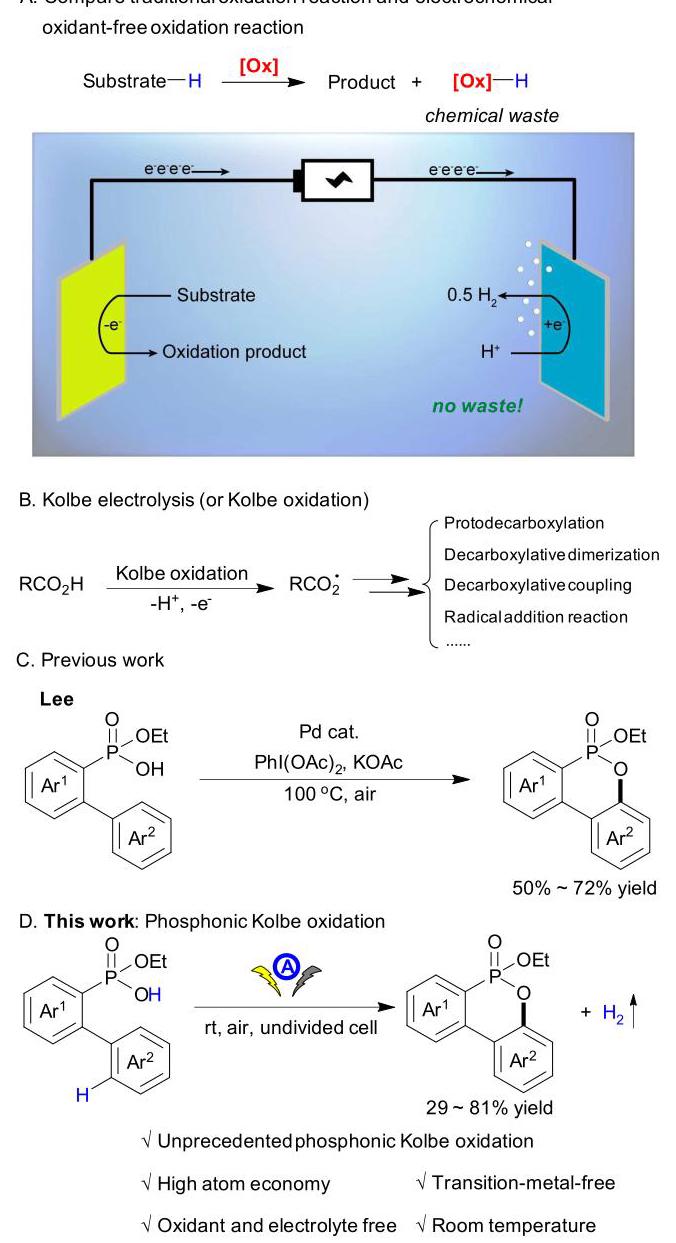
Scheme 1 Kolbe oxidation and phosphonic Kolbe oxidation.
方案1 Kolbe氧化和膦酸型Kolbe氧化
${}^{a}$ Department of Energy and Resources Engineering, College of Engineering, Peking University, Beijing 100871 (China).
${}^{a}$ 北京大学工学院能源与资源工程系,北京100871(中国)。
† Footnotes relating to the title and/or authors should appear here.
† 与标题和/或作者相关的脚注应在此处出现。
Electronic Supplementary Information (ESI) available: [details of any supplementary information available should be included here]. See DOI: 10.1039/x0xx00000x
电子补充信息(ESI)可用:[应在此处包含任何可用补充信息的详细内容]。见DOI: 10.1039/x0xx00000x
We have recently been interested in Kolbe electrolysis. As one of the most well-known organic electrochemical reaction, Kolbe electrolysis can be categorized as such an oxidant-free oxidation reaction. It was first discovered by Faraday in 1834, ${}^{32}$ and then elaborated in detail and utilized in organic synthesis by Kolbe in 1849. ${}^{33}$ Though the Kolbe reaction is a century-old transformation, it is still alive as an important synthetic tool in organic chemistry, and a vast number of studies have been carried out to unveil its synthetic potential (Scheme 1B). ${}^{{34} - {37}}$ In a recent work, we have developed a practical intramolecular Kolbe oxidative cyclization method for the synthesis of dibenzopyranones starting from 2-arylbenzoic acids. ${}^{38}$ In this reaction, the key step is a Kolbe oxidation of aryl benzoic acid affording aroyloxy radicals. Then this radical is trapped intramolecularly by an aromatic ring. Further anodic oxidation of this trapped radical leads to the final cyclized product. In this context, we envision that an analogue of phosphonic Kolbe oxidative cyclization process might be feasible towards the synthesis of ethoxy dibenzooxaphosphorin oxides starting from 2-(aryl)aryl phosphonic acid monoesters.
我们最近对Kolbe电解反应感兴趣。作为最著名的有机电化学反应之一,Kolbe电解可归类为这种无氧化剂氧化反应。它于1834年由法拉第首次发现,${}^{32}$ 并于1849年由科尔贝详细阐述并应用于有机合成。${}^{33}$ 尽管Kolbe反应是一个有百年历史的转化反应,但它在有机化学中作为一种重要的合成工具仍然活跃,并且已经开展了大量研究以揭示其合成潜力(方案1B)。${}^{{34} - {37}}$ 在最近的一项工作中,我们开发了一种从2-芳基苯甲酸出发合成二苯并吡喃酮的实用分子内Kolbe氧化环化方法。${}^{38}$ 在该反应中,关键步骤是芳基苯甲酸的Kolbe氧化生成芳酰氧基自由基。然后该自由基被芳环分子内捕获。对该捕获自由基的进一步阳极氧化导致最终的环化产物。在此背景下,我们设想从2-(芳基)芳基膦酸单酯出发,膦酸型Kolbe氧化环化反应的类似反应可能对于合成乙氧基二苯并氧杂磷杂环氧化物是可行的。
Organophosphorus compounds have been proved to be valuable and effective in pharmaceuticals, ${}^{39}$ pesticides, ${}^{40}$ materials, ${}^{41}$ catalysis, ${}^{42}$ etc. In this context, it’s essential to develop efficient and practical methods to synthesize these crucial compounds. Previously, facilitated by transition metal catalysis, the Lee’s, ${}^{{43} - {46}}$ the Miura’s ${}^{47}$ and the Glorius’s ${}^{48}$ groups have developed robust methods to realize oxidative cyclization of phosphonic acids or their derivatives. In 2014, the Lee group developed a palladium-catalyzed oxidative cyclization starting from 2-(aryl)aryl phosphonic acid monoesters. A series of ethoxy dibenzooxaphosphorin oxides could be obtained effectively in the presence of Pd catalyst, PhI(OAc) ${}_{2}$ and KOAc under heat (Scheme 1C). ${}^{49}$ Herein we developed a simple electrochemical method to realize this cyclization under transition metal catalyst- and oxidant-free conditions (Scheme 1D). To the best of our knowledge, the anodic oxidation of phosphonic acid has not been disclosed yet.
有机磷化合物已被证明在药物、${}^{39}$农药、${}^{40}$材料、${}^{41}$催化、${}^{42}$等领域具有重要价值且效果显著。在此背景下,开发高效实用的方法来合成这些关键化合物至关重要。此前,在过渡金属催化的促进下,Lee课题组、${}^{{43} - {46}}$Miura课题组${}^{47}$以及Glorius课题组${}^{48}$已开发出强大的方法来实现膦酸及其衍生物的氧化环化反应。2014年,Lee课题组开发了一种从2-(芳基)芳基膦酸单酯出发的钯催化氧化环化反应。在钯催化剂、PhI(OAc) ${}_{2}$和KOAc存在下加热,可有效得到一系列乙氧基二苯并氧杂磷杂环庚三烯氧化物(方案1C)。${}^{49}$在此,我们开发了一种简单的电化学方法,可在无过渡金属催化剂和氧化剂的条件下实现这种环化反应(方案1D)。据我们所知,膦酸的阳极氧化反应尚未见报道。
The starting materials were synthesized according to Lee’s report. ${}^{49}$ A range of 2-(aryl)arylphosphonic acid monoethyl esters were efficiently accessed by sequentially conducting a Suzuki coupling of 2-bromoiodoarenes with arylboronic acids, a Pd-catalyzed phosphorylation of 2-bromobiaryls, and hydrolysis of diethyl 2-(aryl)arylphosphonates by using L-selectride or under basic conditions (see supplementary information).
起始原料是根据Lee的报道合成的。${}^{49}$通过依次进行2-溴碘芳烃与芳基硼酸的铃木偶联反应、钯催化的2-溴联芳基的磷酸化反应以及使用L-选择氢化物或在碱性条件下对2-(芳基)芳基膦酸二乙酯进行水解反应,可高效合成一系列2-(芳基)芳基膦酸单乙酯(见补充信息)。
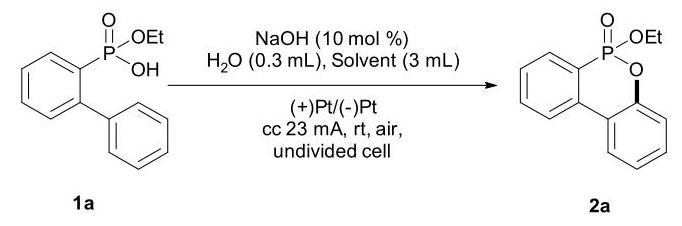
With the starting materials available, we initially studied the anodic oxidation of 2-phenyl phosphonic acid 1a (Table 1). Platinum materials were chosen as the electrodes due to their chemical inertness and low overpotential for hydrogen evolution. Thus, electrolysis of 1a with a constant current of 23 mA for ${2.5}\mathrm{\;h}$ afforded the desired cyclized product $2\mathrm{a}$ in 74% NMR yield and 62% isolated yield in the presence of ${10}\% \mathrm{{NaOH}}$ in a $\mathrm{{MeOH}}/{\mathrm{H}}_{2}\mathrm{O}$ mixed solvent (entry 1). The reaction gave slightly less product when the temperature was kept at $0{}^{ \circ }\mathrm{C}$ (entry 2). We next screened a series of solvents, and found that except DMF, other solvents such as 1,1,1,3,3,3- hexafluoropropanol (HFIP), MeCN, acetone, isopropanol and EtOH proved to be less efficient with longer reaction time required (entry 3-8). Gratifyingly, the use of a mixed solvent MeOH/DMF further increased the yield to 84% (71% isolated yield, entry 9).
在有了可用的起始原料后,我们首先研究了2-苯基膦酸1a的阳极氧化反应(表1)。由于铂材料具有化学惰性且析氢过电位低,因此被选作电极。因此,在${10}\% \mathrm{{NaOH}}$存在的情况下,以23 mA的恒定电流对1a进行${2.5}\mathrm{\;h}$时间的电解,在$\mathrm{{MeOH}}/{\mathrm{H}}_{2}\mathrm{O}$混合溶剂中得到了所需的环化产物$2\mathrm{a}$,NMR产率为74%,分离产率为62%(第1项)。当温度保持在$0{}^{ \circ }\mathrm{C}$时,反应得到的产物略少(第2项)。接下来,我们筛选了一系列溶剂,发现除了DMF外,其他溶剂如1,1,1,3,3,3-六氟异丙醇(HFIP)、MeCN、丙酮、异丙醇和乙醇的效率较低,需要更长的反应时间(第3 - 8项)。令人欣慰的是,使用甲醇/ DMF混合溶剂进一步将产率提高到了84%(分离产率为71%,第9项)。
Table 1 Optimization of Reaction Conditions ${}^{a}$
表1反应条件的优化${}^{a}$
Entry Reaction conditions Yield ${\left( \% \right) }^{b}$
序号 反应条件 产率${\left( \% \right) }^{b}$
1 MeOH, 2.5 h 74 (62) Under air
1 甲醇,2.5小时 74(62) 在空气中
MeOH, 2.5 h, 0 ${}^{ \circ }\mathrm{C}$ 69
甲醇,2.5小时,0${}^{ \circ }\mathrm{C}$ 69
HFIP, 24 h Trace Glass tube
HFIP,24小时 微量 玻璃管
4 DMF, 12 h 76
4 DMF,12小时 76
MeCN 4.6 h 16
乙腈 4.6小时 16
Acetone, 12 h 15
丙酮,12小时 15
0.7 cm
$i$ -PrOH,18 h 23
$i$ -丙醇,18小时 23
Pt meshes
铂网
EtOH, 5 h 36 Stirring bar
乙醇,5小时 36 搅拌棒
9 MeOH/DMF (9:1), 3 h 84 (71)
9 甲醇/ DMF(9:1),3小时 84(71)
${}^{a}$ Reaction conditions: 1a ${0.5}\mathrm{{mmol}}$ , solvent $3\mathrm{\;{mL}},{\mathrm{H}}_{2}\mathrm{O}{0.3}$ mL, Pt mesh electrodes, $1\mathrm{\;{cm}} \times 1\mathrm{\;{cm}},{52}$ mesh. cc constant current. HFIP 1,1,1,3,3,3-hexafluoro-2-propanol. ${}^{b}$ Yield determined by ${}^{1}\mathrm{H}$ NMR using 1,1,2,2-tetrachloroethane as an internal standard. Isolated yield in parentheses.
${}^{a}$反应条件:1a${0.5}\mathrm{{mmol}}$,溶剂$3\mathrm{\;{mL}},{\mathrm{H}}_{2}\mathrm{O}{0.3}$毫升,铂网电极,$1\mathrm{\;{cm}} \times 1\mathrm{\;{cm}},{52}$目。cc恒定电流。HFIP 1,1,1,3,3,3-六氟-2-丙醇。${}^{b}$产率通过以1,1,2,2-四氯乙烷为内标物的${}^{1}\mathrm{H}$核磁共振测定。括号内为分离产率。
With the optimized reaction conditions in hand, the substrate scope was then studied with the results depicted in Table 2. A variety of substitutions on both the ${\mathrm{{Ar}}}^{1}$ and ${\mathrm{{Ar}}}^{2}$ rings were examined, and the desired products were obtained readily in moderate to good yields. This electrochemical approach tolerates diverse functional groups, such as halides, ether, trifluoromethyl, trifluoromethoxyl, ketone etc. When the substitution on ${\mathrm{{Ar}}}^{2}$ ring was at the meta position, a mixture of isomers were obtained (2c). Due to solubility issue of 1e-1g substrates, the yields of products 2e-2g were relatively low. This electrochemical oxidation reaction favoured the substrates bearing electron-donating groups on ${\mathrm{{Ar}}}^{2}$ ring, and the corresponding products were obtained in better yields (2b,2d,2j,2o). In regards of substituents on ${\mathrm{{Ar}}}^{1}$ ring (2o-2s), electronic effect does not operate prominently. The desired cyclized products were obtained in a range of 48- 81% yields. Although the yield of product 2n was not satisfactory, ethoxy dibenzooxaphosphorin oxides containing a heterocycle could be synthesized by this anodic oxidation method conveniently.
在掌握了优化的反应条件后,我们研究了底物范围,结果如表2所示。我们考察了${\mathrm{{Ar}}}^{1}$环和${\mathrm{{Ar}}}^{2}$环上的各种取代基,以中等至良好的产率轻松获得了所需产物。这种电化学方法能够耐受多种官能团,如卤化物、醚、三氟甲基、三氟甲氧基、酮等。当${\mathrm{{Ar}}}^{2}$环上的取代基处于间位时,得到了异构体混合物(2c)。由于1e - 1g底物的溶解性问题,产物2e - 2g的产率相对较低。这种电化学氧化反应有利于${\mathrm{{Ar}}}^{2}$环上带有供电子基团的底物,相应产物的产率更高(2b、2d、2j、2o)。对于${\mathrm{{Ar}}}^{1}$环上的取代基(2o - 2s),电子效应并不显著。所需的环化产物产率在48 - 81%之间。尽管产物2n的产率不尽人意,但通过这种阳极氧化方法可以方便地合成含杂环的乙氧基二苯并氧杂磷杂环氧化物。
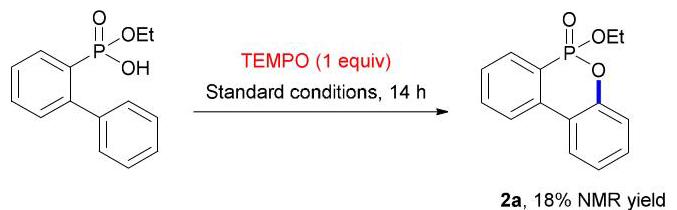
To explore the mechanism of this electrochemical reaction, a free radical scavenger, 2,2,6,6-tetramethyl-1-piperidinyloxy (TEMPO), was introduced as an additive to the standard conditions. The starting material 2-(aryl)aryl phosphonic acid remained largely even after ${14}\mathrm{\;h}$ (Scheme 2), indicating a hindrance of cyclization in the presence of TEMPO and a Table 2 Substrate scope
为了探索这种电化学反应的机理,我们在标准条件下引入了自由基清除剂2,2,6,6 - 四甲基 - 1 - 哌啶氧基(TEMPO)作为添加剂。即使经过${14}\mathrm{\;h}$后,起始原料2 -(芳基)芳基膦酸仍大量存在(方案2),这表明在TEMPO存在下环化受到阻碍,以及表2底物范围
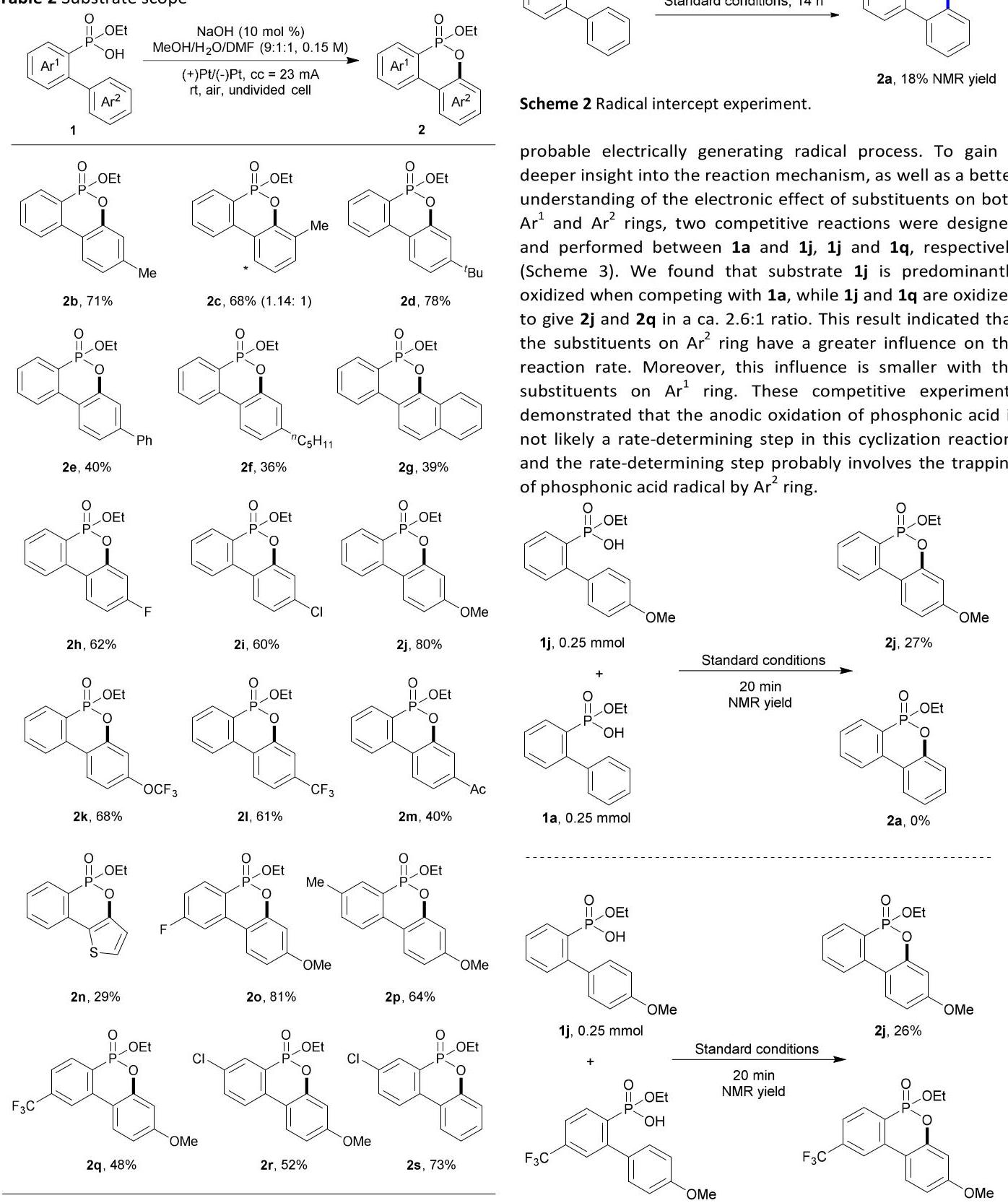
${}^{a}$ Reaction conditions: $1\;{0.5}\mathrm{{mmol}},\mathrm{{NaOH}}2\mathrm{{mg}},\mathrm{{MeOH}}{2.7}\mathrm{{mL}}$ , ${\mathrm{H}}_{2}\mathrm{O}{0.3}\mathrm{\;{mL}}$ , DMF 0.3 mL, Pt net electrodes, $1\mathrm{\;{cm}} \times 1\mathrm{\;{cm}},{52}$ mesh. cc constant current. Isolated yields were reported.
${}^{a}$反应条件:$1\;{0.5}\mathrm{{mmol}},\mathrm{{NaOH}}2\mathrm{{mg}},\mathrm{{MeOH}}{2.7}\mathrm{{mL}}$,${\mathrm{H}}_{2}\mathrm{O}{0.3}\mathrm{\;{mL}}$,DMF 0.3 mL,铂网电极,$1\mathrm{\;{cm}} \times 1\mathrm{\;{cm}},{52}$目。恒流cc。报告的是分离产率。
1q, 0.25 mmol 2q, 10%
1q,0.25 mmol 2q,10%
Scheme 3 Competitive reactions between 1a and 1j, 1j and 1q, respectively.
方案3分别为1a与1j、1j与1q之间的竞争反应。
Based on the information above, a plausible reaction mechanism was proposed in Scheme 4. Phosphonic anion resulting from deprotonation by catalytic amount of NaOH was anodically oxidized to afford the phosphonic acid radical intermediate. Then this radical is trapped by the aryl ring intramolecularly, generating an aryl radical. At last, this aryl radical is oxidized at the anode again to deliver the final cyclized product. The two consecutive electron transfers between the electrode and the substrate taking place on the same electrode (double anodic oxidation) favour implementation of the reaction. Meanwhile, cathodic proton reduction to hydrogen gas accurately balanced the redox of the overall reaction.
基于上述信息,在方案4中提出了一种合理的反应机理。由催化量的NaOH去质子化产生的膦酸根阴离子在阳极被氧化,得到膦酸自由基中间体。然后该自由基被芳环分子内捕获,生成芳基自由基。最后,该芳基自由基在阳极再次被氧化,得到最终的环化产物。在同一电极上发生的电极与底物之间的两次连续电子转移(双阳极氧化)有利于反应的进行。同时,阴极质子还原为氢气准确地平衡了整个反应的氧化还原。
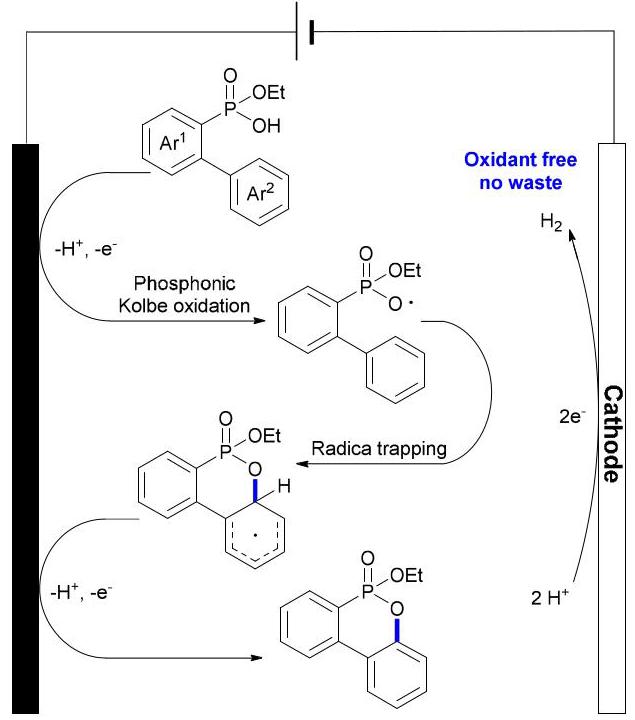
Scheme 4 Proposed mechanism.
方案4提出的机理。
In summary, we have developed a general, practical intramolecular phosphonic Kolbe oxidative cyclization method for the synthesis of ethoxy dibenzooxaphosphorin oxides. This method is transition metal- and oxidant-free, does not involve electrolytes, and proceeds at ambient temperature. We expect this electrochemical reaction to find wide application in the synthesis of phosphorus-containing compounds in future synthetic endeavours.
总之,我们开发了一种通用、实用的分子内膦酸柯尔伯氧化环化方法来合成乙氧基二苯并氧杂磷杂环氧化物。该方法无需过渡金属和氧化剂,不涉及电解质,且在室温下进行。我们期望这种电化学反应在未来合成领域中含磷化合物的合成中得到广泛应用。
Conflicts of interest
利益冲突
In accordance with our policy on Conflicts of interest please ensure that a conflicts of interest statement is included in your manuscript here. Please note that this statement is required for all submitted manuscripts. If no conflicts exist, please state that “There are no conflicts to declare”.
根据我们关于利益冲突的政策,请确保您的稿件中包含利益冲突声明。请注意,所有提交的稿件都需要此声明。如果不存在冲突,请声明 “没有利益冲突需要声明”。
Notes and references
注释与参考文献
‡ Footnotes relating to the main text should appear here. These might include comments relevant to but not central to the matter under discussion, limited experimental and spectral data, and crystallographic data.
‡ 与正文相关的脚注应出现在此处。这些脚注可能包括与正在讨论的事项相关但并非核心的评论、有限的实验和光谱数据以及晶体学数据。
Uncategorized References
未分类参考文献
P. T. Anastas and J. C. Warner, Green chemistry: theory and practice, Oxford university press, 2000.
C.-J. Li and B. M. Trost, P. Natl. Acad. Sci. Usa., 2008, 105, 13197-13202.
J.-E. Bäckvall, Modern oxidation methods, John Wiley & Sons, 2011.
K. D. Moeller, Tetrahedron, 2000, 56, 9527-9554.
J. B. Sperry and D. L. Wright, Chem. Soc. Rev., 2006, 35, 605-621.
A. Jutand, Chem. Rev., 2008, 108, 2300-2347.
J.-i. Yoshida, K. Kataoka, R. Horcajada and A. Nagaki, Chem. Rev., 2008, 108, 2265-2299.
B. A. Frontana-Uribe, R. D. Little, J. G. Ibanez, A. Palma and R. Vasquez-Medrano, Green Chem., 2010, 12, 2099- 2119.
H. J. Schäfer, Comptes Rendus Chimie, 2011, 14, 745-765.
R. Francke and R. D. Little, Chem. Soc. Rev., 2014, 43, 2492-2521.
E. J. Horn, B. R. Rosen and P. S. Baran, ACS Cent. Sci., 2016, 2, 302-308.
M. Yan, Y. Kawamata and P. S. Baran, Chem. Rev., 2017, 117, 13230-13319.
Y. Jiang, K. Xu and C. Zeng, Chem. Rev., 2018, 118, 4485- 4540.
S. Tang, Y. Liu and A. Lei, Chem, 2018, 4, 27-45.
Q.-L. Yang, P. Fang and T.-S. Mei, Chinese. J. Chem., 2018, 36, 338-352.
N. Sauermann, R. Mei and L. Ackermann, Angew. Chem. Int. Ed., 2018, 57, 5090-5094.
C. Tian, L. Massignan, T. H. Meyer and L. Ackermann, Angew. Chem. Int. Ed., 2018, 57, 2383-2387.
N. Sauermann, T. H. Meyer, C. Tian and L. Ackermann, J. Am. Chem. Soc., 2017, 139, 18452-18455.
Z.-J. Wu, S.-R. Li, H. Long and H.-C. Xu, Chem. Commun., 2018, 54, 4601-4604.
H. B. Zhao, Z. J. Liu, J. Song and H. C. Xu, Angew. Chem. Int. Ed., 2017, 56, 12732-12735.
Z.-W. Hou, Z.-Y. Mao and H.-C. Xu, Synlett, 2017, 28, 1867- 1872.
M. Y. Lin, K. Xu, Y. Y. Jiang, Y. G. Liu, B. G. Sun and C. C. Zeng, Adv. Synth. Catal., 2018, 360, 1665-1672.
S. Zhang, L. Li, H. Wang, Q. Li, W. Liu, K. Xu and C. Zeng, Org. Lett., 2018, 20, 252-255.
Q.-Q. Wang, K. Xu, Y.-Y. Jiang, Y.-G. Liu, B.-G. Sun and C.-C. Zeng, Org. Lett., 2017, 19, 5517-5520.
L. Zeng, H. Li, S. Tang, X. Gao, Y. Deng, G. Zhang, C.-W. Pao, J.-L. Chen, J.-F. Lee and A. Lei, ACS Catal., 2018, 8, 5448-5453.
K. Liu, S. Tang, P. Huang and A. Lei, Nat. Commun., 2017, 8, 775.
X. Gao, P. Wang, L. Zeng, S. Tang and A. Lei, J. Am. Chem. Soc., 2018, 140, 4195-4199.
Y.-Q. Li, Q.-L. Yang, P. Fang, T.-S. Mei and D. Zhang, Org. Lett., 2017, 19, 2905-2908.
Q.-L. Yang, Y.-Q. Li, C. Ma, P. Fang, X.-J. Zhang and T.-S. Mei, J. Am. Chem. Soc., 2017, 139, 3293-3298.
A. Shrestha, M. Lee, A. L. Dunn and M. S. Sanford, Org. Lett., 2018, 20, 204-207.
S. Herold, D. Bafaluy and K. Muñiz, Green Chem., 2018, 20, 3191-3196.
M. Faraday, Ann. Phys-berlin., 1834, 108, 401-453.
H. Kolbe, Justus Liebigs Ann. Chem., 1849, 69, 257-294.
A. K. Vijh and B. E. Conway, Chem. Rev., 1967, 67, 623- 664.
H.-J. Schäfer, in Electrochemistry IV, ed. E. Steckhan, Springer Berlin Heidelberg, Berlin, Heidelberg, 1990, DOI: 10.1007/BFb0034365, pp. 91-151.
Z. Wang, in Comprehensive Organic Name Reactions and Reagents, John Wiley & Sons, Inc., 2010, DOI: 10.1002/9780470638859.conrr369.
H. Tanaka, M. Kuroboshi and S. Torii, in Organic Electrochemistry, Fifth Edition Revised and Expanded, eds. O. Hammerich and B. Speiser, CRC Press, Boca Raton, 2015, pp. 1267-1307.
L. Zhang, Z. Zhang, J. Hong, J. Yu, J. Zhang and F. Mo, J. Org. Chem., 2018, 83, 3200-3207.
D. E. Corbridge, Phosphorus: chemistry, biochemistry and technology, CRC press, 2016.
M. A. Sogorb and E. Vilanova, Toxicol. Lett., 2002, 128, 215-228.
T. Baumgartner and R. Réau, Chem. Rev., 2006, 106, 4681- 4727.
J.-H. Xie and Q.-L. Zhou, Accounts. Chem. Res., 2008, 41, 581-593.
Y. Park, J. Seo, S. Park, E. J. Yoo and P. H. Lee, Chem. Eur. J., 2013, 19, 16461-16468.
T. Ryu, J. Kim, Y. Park, S. Kim and P. H. Lee, Org. Lett., 2013, 15, 3986-3989.
J. Seo, Y. Park, I. Jeon, T. Ryu, S. Park and P. H. Lee, Org. Lett., 2013, 15, 3358-3361.
P. Youngchul, S. Jungmin, P. Sangjune, Y. E. Jeong and L. P. Ho, Chem. Eur. J., 2013, 19, 16461-16468.
Y. Unoh, K. Hirano, T. Satoh and M. Miura, Angew. Chem. Int. Ed., 2013, 52, 12975-12979.
D. Zhao, C. Nimphius, M. Lindale and F. Glorius, Org. Lett., 2013, 15, 4504-4507.
S. Shin, D. Kang, W. H. Jeon and P. H. Lee, Beilstein J. Org. Chem., 2014, 10, 1220-1227.
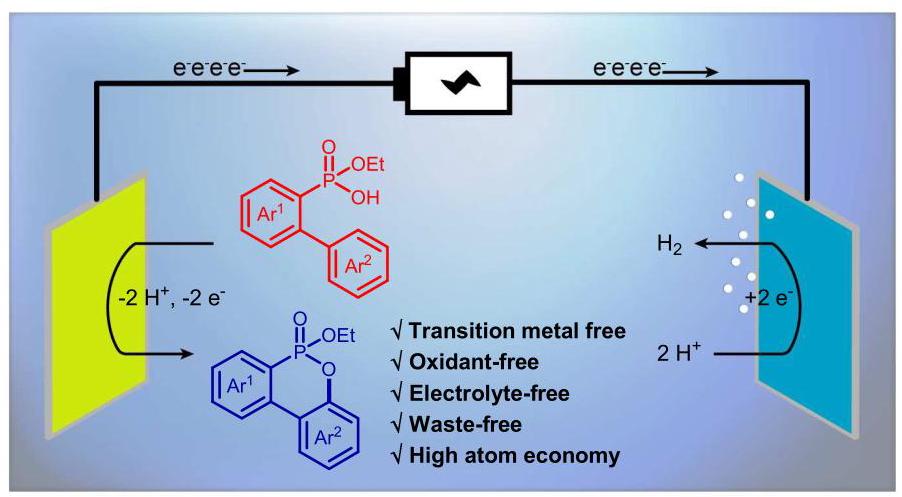
An anodic oxidation/cyclization of 2-(aryl)aryl phosphonic acid monoesters for ethoxy dibenzooxaphosphorin oxides synthesis has been developed.
已开发出一种用于合成乙氧基二苯并氧杂磷杂环氧化物的2-(芳基)芳基膦酸单酯的阳极氧化/环化反应。