Oxidant-Free C(sp2)−H Functionalization/C−O Bond Formation: A Kolbe Oxidative Cyclization Process
英文原文与中文译文逐段对照 · English original with Chinese translation
Lei Zhang, Zhenxing Zhang, Junting Hong, Jian Yu, Jianning Zhang, and Fanyang Mo
张雷,张振兴,洪钧婷,于健,张建宁,莫凡洋
J. Org. Chem., Just Accepted Manuscript • DOI: 10.1021/acs.joc.8b00089 • Publication Date (Web): 23 Feb 2018 Downloaded from http://pubs.acs.org on February 23, 2018
《有机化学杂志》,刚接受的稿件 • DOI: 10.1021/acs.joc.8b00089 • 网络出版日期:2018年2月23日 于2018年2月23日从http://pubs.acs.org下载
Just Accepted
刚接受
“Just Accepted” manuscripts have been peer-reviewed and accepted for publication. They are posted online prior to technical editing, formatting for publication and author proofing. The American Chemical Society provides “Just Accepted” as a service to the research community to expedite the dissemination of scientific material as soon as possible after acceptance. “Just Accepted” manuscripts appear in full in PDF format accompanied by an HTML abstract. “Just Accepted” manuscripts have been fully peer reviewed, but should not be considered the official version of record. They are citable by the Digital Object Identifier (DOI®). “Just Accepted” is an optional service offered to authors. Therefore, the “Just Accepted” Web site may not include all articles that will be published in the journal. After a manuscript is technically edited and formatted, it will be removed from the “Just Accepted” Web site and published as an ASAP article. Note that technical editing may introduce minor changes to the manuscript text and/or graphics which could affect content, and all legal disclaimers and ethical guidelines that apply to the journal pertain. ACS cannot be held responsible for errors or consequences arising from the use of information contained in these “Just Accepted” manuscripts.
“刚接受"的稿件已经经过同行评审并被接受发表。它们在进行技术编辑、排版以供发表和作者校样之前就会在线发布。美国化学学会提供“刚接受”服务,以便在稿件接受后尽快加速科学材料的传播。“刚接受”的稿件以PDF格式全文出现,并附有HTML摘要。“刚接受”的稿件已经经过全面的同行评审,但不应被视为正式的记录版本。它们可以通过数字对象标识符(DOI®)进行引用。“刚接受”是一项提供给作者的可选服务。因此,“刚接受”网站可能不包括该期刊将发表的所有文章。稿件经过技术编辑和排版后,将从“刚接受”网站上删除,并作为一篇“尽快发表”的文章发表。请注意,技术编辑可能会对手稿文本和/或图形进行细微更改,这可能会影响内容,并且适用于该期刊的所有法律免责声明和道德准则均适用。美国化学学会不对因使用这些“刚接受”稿件中包含的信息而产生的错误或后果负责。
ACS Publications
美国化学会出版物
The Journal of Organic Chemistry is published by the American Chemical Society.
《有机化学杂志》由美国化学会出版。
Published by American Chemical Society. Copyright © American Chemical Society. However, no copyright claim is made to original U.S. Government works, or works produced by employees of any Commonwealth realm Crown government in the course
由美国化学会出版。版权所有 © 美国化学会。然而,对于美国政府的原始作品或任何英联邦王国政府的雇员在工作过程中创作的作品,不主张版权。
Oxidant-Free C(sp ${}^{2}$ )-H Functionalization/C-O Bond Formation: A Kolbe Oxidative Cyclization Process
无氧化剂的C(sp ${}^{2}$ )-H官能团化/C-O键形成:科尔贝氧化环化过程
Lei Zhang, ${}^{ \dagger }$ Zhenxing Zhang, ${}^{ \dagger }$ Junting Hong, Jian Yu, Jianning Zhang, Fanyang Mo*
张雷,${}^{ \dagger }$ 张振兴,${}^{ \dagger }$ 洪钧婷,于健,张建宁,莫凡洋*
Department of Energy and Resources Engineering, College of Engineering, Peking University, Beijing 100871, China
中国北京大学工程学院能源与资源工程系,北京100871
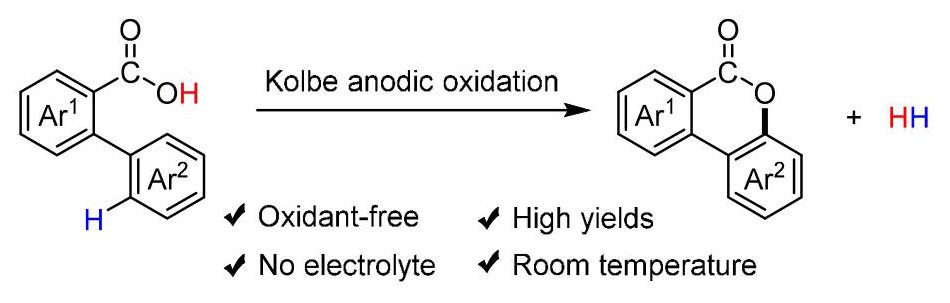
ABSTRACT: An anodic oxidation/cyclization of 2-arylbenzoic acids for dibenzopyranones synthesis has been developed. The reaction proceeds at room temperature with no oxidant or electrolyte required, and exhibits high atom-economy as ${\mathrm{H}}_{2}$ being the only by-product. A series of dibenzopyranones were obtained in good to excellent yields. Urolithin A, B and C are formally synthesized by adopting this method as a key step to demonstrate its synthetic utility.
摘要:已开发出一种用于合成二苯并吡喃酮的2-芳基苯甲酸阳极氧化/环化反应。该反应在室温下进行,无需氧化剂或电解质,并且由于${\mathrm{H}}_{2}$ 是唯一的副产物,因此具有高原子经济性。以良好至优异的产率获得了一系列二苯并吡喃酮。通过采用该方法作为关键步骤正式合成了尿石素A、B和C,以证明其合成效用。
INTRODUCTION
引言
Oxygen-containing heterocycles are privileged motifs found in numerous bioactive natural products, organic materials, agro-chemicals, and pharmaceuticals. ${}^{1}$ The traditional approaches for constructing such heterocyclic scaffolds mainly rely on the addition of a nucleophile to a carbonyl group, to a halide or other leaving groups, electrocyclic reactions, etc. ${}^{2}$ However, most of these approaches involve the use of expensive reagents, harsh conditions, and generate large amounts of waste. Although much progress has been made in recent decades in the transition metal-catalyzed cyclization of acyclic substrates for heterocycles synthesis, ${}^{3}$ the high cost, toxicity, and air/moisture sensitivity of some catalysts are major concerns. Consequently, new compatible and more sustainable synthetic approaches are urgently needed for the synthesis of heterocy-cles.
含氧杂环是众多生物活性天然产物、有机材料、农用化学品和药物中的重要结构单元。${}^{1}$ 构建此类杂环骨架的传统方法主要依赖于亲核试剂与羰基、卤化物或其他离去基团的加成、电环化反应等。${}^{2}$ 然而,这些方法大多需要使用昂贵的试剂、苛刻的条件,并且会产生大量废物。尽管近几十年来在过渡金属催化的无环底物环化以合成杂环方面取得了很大进展,${}^{3}$ 但一些催化剂的高成本、毒性以及对空气/水分的敏感性仍是主要问题。因此,迫切需要新的兼容且更可持续的合成方法来合成杂环。
The prosperous development of organic electrochemistry has dramatically expanded chemists’ toolboxes that provide a variety of opportunities to solve synthetic challenges in unique ways. ${}^{4}$ For example, intramolecular anodic oxidative $\mathrm{C} - \mathrm{O}$ bond formation can serve as a powerful tool for the construction of oxygen-containing heterocycles (Scheme 1A). Moeller and coworkers pioneered a series of intramolecular anodic cyclization of electron-rich olefins with alcohols. ${}^{5}$ Intramolecular electrochemical nucleophilic attack of oxygen nucleo-philes on Schiff bases reported by Zeng and other groups also provide straightforward routes to constructing oxygen-containing heterocycles. ${}^{6}$ The Okimoto and Lee groups described the anodic oxidation of amides or tertiary amines to generate reactive $N$ -acyliminium cations or iminium cations which were trapped by alcohol nucleophiles to afford cyclic $N, O$ -acetals. ${}^{7}$ Very recently, the Waldvogel and Xu groups reported on the intramolecular anodic dehydrogenative coupling of aromatic $\mathrm{C} - \mathrm{H}$ bonds and amide groups for the synthesis of benzoxazoles and benzoxazines, respectively. ${}^{8}$
有机电化学的蓬勃发展极大地扩展了化学家的工具库,为以独特方式解决合成挑战提供了各种机会。${}^{4}$ 例如,分子内阳极氧化$\mathrm{C} - \mathrm{O}$ 键形成可作为构建含氧杂环的有力工具(方案1A)。Moeller及其同事开创了一系列富电子烯烃与醇的分子内阳极环化反应。${}^{5}$ 曾和其他研究小组报道的氧亲核试剂对席夫碱的分子内电化学亲核进攻也为构建含氧杂环提供了直接途径。${}^{6}$ Okimoto和Lee研究小组描述了酰胺或叔胺的阳极氧化,以生成活性$N$ -酰亚胺阳离子或亚胺阳离子,这些阳离子被醇亲核试剂捕获以得到环状$N, O$ -缩醛。${}^{7}$ 最近,Waldvogel和Xu研究小组分别报道了芳族$\mathrm{C} - \mathrm{H}$ 键和酰胺基团的分子内阳极脱氢偶联反应,用于合成苯并恶唑和苯并恶嗪。${}^{8}$
The anodic oxidation of carboxylic acid, also known as Kolbe electrolysis (or Kolbe oxidation, Kolbe dimerization) has a long history of development since its discovery in 1849. ${}^{9}$ The coupling reaction of alkyl radicals generated from elec-trodecarboxylation of alkyl carboxylates $\left( {{\mathrm{{RCO}}}_{2}{}^{ - }}\right)$ gives the dation) favor implementation of the reaction. Finally, the concomitant cathodic proton reduction to hydrogen gas exactly balances the redox of the overall reaction. In this paper, we report a Kolbe electrolysis for the lactonization of 2- arylbenzoic acids at room temperature in an oxidant-free manner (Scheme 1C).
羧酸的阳极氧化,也称为科尔贝电解(或科尔贝氧化、科尔贝二聚化),自1849年被发现以来,已有很长的发展历史。${}^{9}$ 由烷基羧酸盐的电极羧化产生的烷基自由基的偶联反应 $\left( {{\mathrm{{RCO}}}_{2}{}^{ - }}\right)$ 产生了有利于反应实施的产物。最后,伴随的阴极质子还原为氢气正好平衡了整个反应的氧化还原。在本文中,我们报道了一种在室温下以无氧化剂方式进行2-芳基苯甲酸内酯化的科尔贝电解(方案1C)。
Kolbe dimer R-R. However, aryl carboxylates (ArCO2) cannot be applied in Kolbe dimerization due to the challenging
但芳基羧酸盐(ArCO2)由于芳氧基自由基的脱羧困难而不能用于Kolbe二聚化反应。
Scheme 1. Intramolecular Anodic Oxidative C-O Bond Formation and Kolbe Electrolysis
方案1. 分子内阳极氧化C-O键形成和Kolbe电解
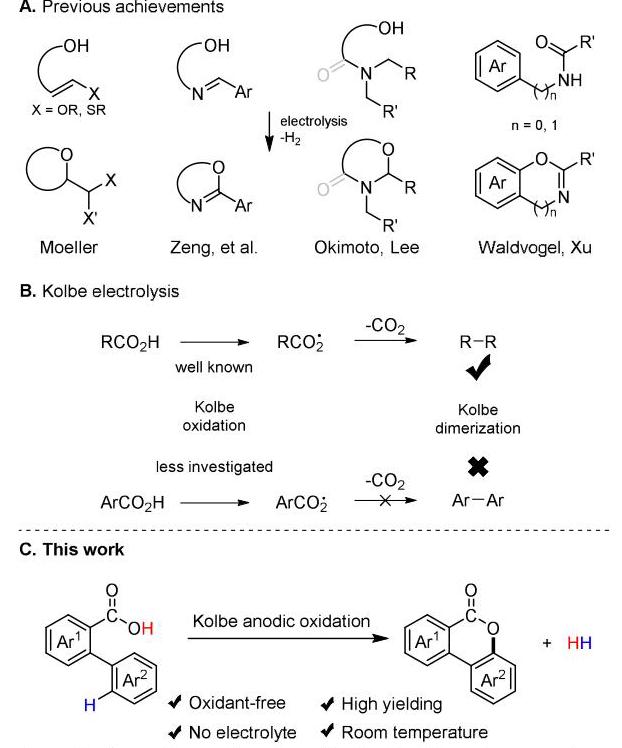
decarboxylation of aroyloxy radicals. In fact, Barton has categorized ${\mathrm{{ArCO}}}_{2}$ - as “nondecarboxylating acyloxy radicals”, noting that it does not decarboxylate at temperatures below ${120} - {130}^{ \circ }\mathrm{C}.{}^{10}$ Thus, compared with alkyl carboxylic acids, there have been far fewer investigations of aryl carboxylic acids for the Kolbe oxidation reaction (Scheme 1B). These previous results give four reasons that the preparation of ben-zolactones is an ideal process for the use of Kolbe electrolysis of 2-arylbenzoic acids. First, although this has been less investigated, anodic oxidation of aromatic carboxylic acid is feasible. ${}^{11}$ Second, the formed aroyloxy radical does not undergo decarboxylation at ambient temperature. Third, the two consecutive electron transfer between the electrode and the substrate taking place on the same electrode (double anodic oxi-
实际上,Barton将${\mathrm{{ArCO}}}_{2}$ -归类为“非脱羧酰氧基自由基”,指出它在低于${120} - {130}^{ \circ }\mathrm{C}.{}^{10}$ 的温度下不会脱羧。因此,与烷基羧酸相比,对芳基羧酸进行Kolbe氧化反应的研究要少得多(方案1B)。这些先前的结果给出了四个理由,说明苯并内酯的制备是使用Kolbe电解2-芳基苯甲酸的理想过程。第一,尽管研究较少,但芳族羧酸的阳极氧化是可行的。${}^{11}$ 第二,形成的芳氧基自由基在室温下不会脱羧。第三,电极与底物之间在同一电极上发生的连续两次电子转移(双阳极氧化)有利于反应的进行。
RESULTS AND DISCUSSION
结果与讨论
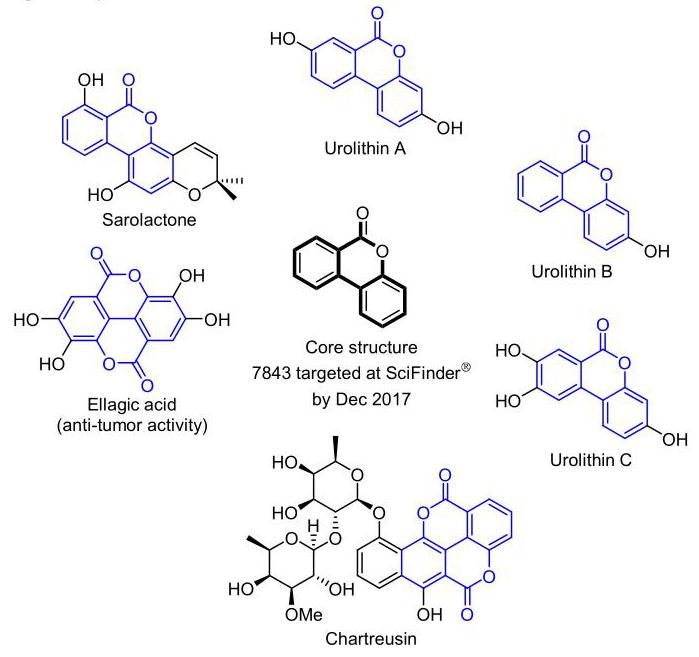
Biaryl lactones and their derivatives are common structure motifs found in a wide variety of bioactive molecules ranging from natural products to drugs (Scheme 2). ${}^{12}$ They also serve as versatile building blocks for the synthesis of various pharmaceuticals, as well as agrochemicals, fragrances, and materials. ${}^{13}$ In light of the importance of these biaryl lactone compounds, a variety of methods have been developed for their synthesis.
联芳基内酯及其衍生物是常见的结构基序,存在于从天然产物到药物等多种生物活性分子中(方案2)。${}^{12}$ 它们还是合成各种药物、农用化学品、香料和材料的通用构建单元。${}^{13}$ 鉴于这些联芳基内酯化合物的重要性,人们已经开发了多种合成方法。
Scheme 2. Natural Products and Pharmaceuticals Containing Biaryl Lactones
方案2. 含有联芳基内酯的天然产物和药物
Among those methods, the oxidative cyclization of 2- arylbenzoic acids via a C-H bond activation/C-O bond formation process is a commonly used cyclization method. ${}^{14}$ For example, Togo and Yokoyama reported on (diacetoxy-iodo)arene and iodine co-mediated cyclization of 2-aryl (or alkyl) benzoic acids under photo irradiation. ${}^{{14b} - d}$ In 2013, Martin and co-workers reported on Cu-catalyzed C-H functionali-zation/C-O bond formation assisted by carboxylic acids with dibenzoyl peroxide as the oxidant. ${}^{{14}\mathrm{e}}$ Later, they also reported on the iodine (III)-catalyzed cyclization of 2-arylbenzoic acid with peroxyacetic acid as the terminal oxidant. ${}^{{14}\mathrm{i}}$ Wang and co-workers developed a Pd-catalysis for the same transformation using $\mathrm{{PhI}}{\left( \mathrm{{OAc}}\right) }_{2}$ as the oxidant. ${}^{{14}\mathrm{f}}$ Gevorgyan reported a Cu(II)-catalyzed title transformation using tert-butyl perox-ybenzoate as the oxidant. ${}^{{14}\mathrm{\;g}}\mathrm{{Xu}}$ also achieved the same goal using a $\mathrm{{Ag}}\left( \mathrm{I}\right)$ catalyst with ${\left( {\mathrm{{NH}}}_{4}\right) }_{2}{\mathrm{\;S}}_{2}{\mathrm{O}}_{8}$ as the oxidant. ${}^{{14}\mathrm{j}}$ In addition, the Wei group demonstrated visible light-induced cyclization of 2-arylbenzoic acids with $N$ -iodosuccinimide as the oxidant, ${}^{{14}\mathrm{\;h}}$ whereas the Gonzalez-Gomez group reported on the metal-free dehydrogenative lactonization of 2- arylbenzoic acids at room temperature under visible light irradiation with $\left\lbrack {{\mathrm{{Acr}}}^{ + }\text{ -Mes] as the photocatalyst and }{\left( {\mathrm{{NH}}}_{4}\right) }_{2}{\mathrm{\;S}}_{2}{\mathrm{O}}_{8}}\right\rbrack$ as the oxidant. ${}^{{14}\mathrm{k}}$ Very recently, the Luo group ${}^{{14}\mathrm{l}}$ and the Zhu group ${}^{{14}\mathrm{\;m}}$ independently reported a photoredox and cobalt co-catalyzed $\mathrm{C}\left( {\mathrm{{sp}}}^{2}\right) - \mathrm{H}$ functionalization $/\mathrm{C} - \mathrm{O}$ bond formation reaction towards biaryl lactone synthesis with no oxidant involved. However, the catalysis system is somewhat complicated. The most known methods use stoichiometric oxidants, since the overall process involves the removal of two hydrogens from the substrate. This will cause excessive waste generation and poor atom economy. We envisage that oxidant-free conditions might be possible if the two hydrogens can be properly handled. In this case, the generation of hydrogen gas $\left( {\mathrm{H}}_{2}\right)$ gives an ideal solution for the two hydrogen atoms (Scheme 3).
在这些方法中,通过C-H键活化/C-O键形成过程对2-芳基苯甲酸进行氧化环化是一种常用的环化方法。${}^{14}$ 例如,Togo和Yokoyama报道了(二乙酰氧基碘)芳烃和碘在光照射下共同介导的2-芳基(或烷基)苯甲酸的环化反应。${}^{{14b} - d}$ 2013年,Martin及其同事报道了以过氧化二苯甲酰为氧化剂,在羧酸辅助下铜催化的C-H官能团化/C-O键形成反应。${}^{{14}\mathrm{e}}$ 后来,他们还报道了以过氧乙酸为终端氧化剂,碘(III)催化的2-芳基苯甲酸的环化反应。${}^{{14}\mathrm{i}}$ 王及其同事开发了一种钯催化体系用于相同的转化反应,使用$\mathrm{{PhI}}{\left( \mathrm{{OAc}}\right) }_{2}$ 作为氧化剂。${}^{{14}\mathrm{f}}$ Gevorgyan报道了以叔丁基过氧苯甲酸酯为氧化剂,铜(II)催化的上述转化反应。${}^{{14}\mathrm{\;g}}\mathrm{{Xu}}$ 也使用$\mathrm{{Ag}}\left( \mathrm{I}\right)$ 催化剂和${\left( {\mathrm{{NH}}}_{4}\right) }_{2}{\mathrm{\;S}}_{2}{\mathrm{O}}_{8}$ 作为氧化剂实现了相同的目标。${}^{{14}\mathrm{j}}$ 此外,魏课题组展示了以$N$ -碘代琥珀酰亚胺为氧化剂,可见光诱导的2-芳基苯甲酸的环化反应,${}^{{14}\mathrm{\;h}}$ 而Gonzalez-Gomez课题组报道了在室温可见光照射下,以$\left\lbrack {{\mathrm{{Acr}}}^{ + }\text{ -Mes] as the photocatalyst and }{\left( {\mathrm{{NH}}}_{4}\right) }_{2}{\mathrm{\;S}}_{2}{\mathrm{O}}_{8}}\right\rbrack$ 为氧化剂,2-芳基苯甲酸的无金属脱氢内酯化反应。${}^{{14}\mathrm{k}}$ 最近,罗课题组${}^{{14}\mathrm{l}}$ 和朱课题组${}^{{14}\mathrm{\;m}}$ 独立报道了一种光氧化还原和钴共催化的$\mathrm{C}\left( {\mathrm{{sp}}}^{2}\right) - \mathrm{H}$ 官能团化$/\mathrm{C} - \mathrm{O}$ 键形成反应,用于合成联芳基内酯,且不涉及氧化剂。然而,催化体系有些复杂。最常见的方法使用化学计量的氧化剂,因为整个过程涉及从底物中去除两个氢原子。这将导致大量废物产生且原子经济性差。我们设想,如果能妥善处理这两个氢原子,无氧化剂条件可能是可行的。在这种情况下,氢气$\left( {\mathrm{H}}_{2}\right)$ 的产生为这两个氢原子提供了一个理想的解决方案(方案3)。
Scheme 3. Rationale of Kolbe Electrolysis for Cyclization of 2-Arylbenzoic Acid
方案3. 用于2-芳基苯甲酸环化的Kolbe电解原理
A. Literature known methods for cyclization of 2-aryl benzoic acid (ref. 14)
A. 文献中已知的2-芳基苯甲酸环化方法(参考文献14)
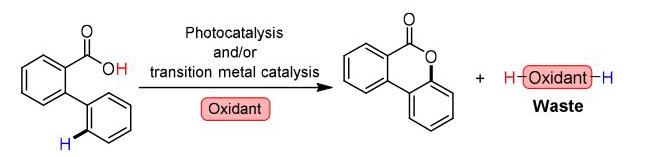
B. Rationale of this work
B. 本工作的原理
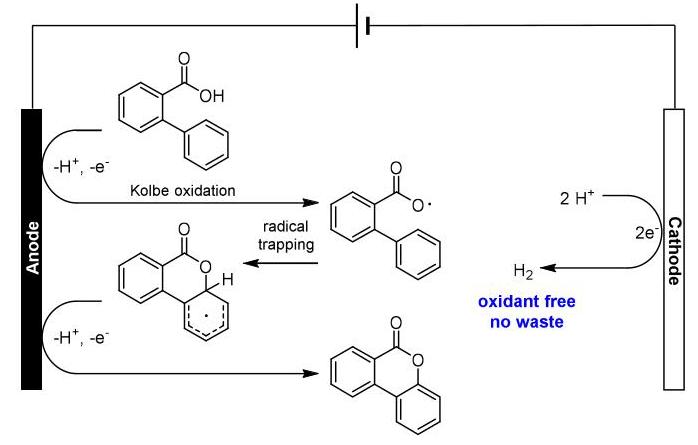
Table 1. Reaction development and optimization
表1. 反应的开发与优化
| entry | deviation from the standard conditions | yield ${}^{b}\left( \% \right)$ |
| 1 | MeCN instead of MeOH, 2.8 h | 69 |
| 2 | Acetone instead of MeOH, 2.8 h | 52 |
| 3 | DMF instead of MeOH, 11 h | 34 |
| 4 | THF instead of MeOH, 7 h | 32 |
| 5 | ${}^{i}\mathrm{{PrOH}}$ instead of $\mathrm{{MeOH}},4\mathrm{\;h}$ | 34 |
| 6 | HFIP instead of $\mathrm{{MeOH}},3\mathrm{\;h}$ | 79 |
| 7 | Under ${\mathrm{N}}_{2},{1.8}\mathrm{\;h}$ | 80 (86) |
| 8 | 1 mmol scale, 0.3 M conc., 3.3 h | 76 |
| 9 | ${50}^{ \circ }\mathrm{C},{16}\mathrm{\;h}$ | 76 |
| 10 | cc 10 mA, 5 h | 76 |
| 11 | w/o NaOH, cv 60V, current ca. $3 \sim 7\mathrm{\;{mA}},2\mathrm{\;d}$ | 76 |
| 12 | No electricity, 2 d | 0 |
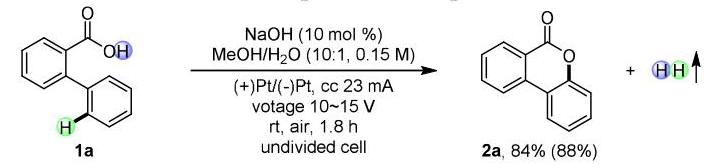
${}^{a}$ Reaction conditions: 1a ${0.5}\mathrm{{mmol}},\mathrm{{MeOH}}3\mathrm{\;{mL}},{\mathrm{H}}_{2}\mathrm{O}{0.3}\mathrm{\;{mL}}$ , Pt net electrode, $1\mathrm{\;{cm}} \times 1\mathrm{\;{cm}}$ , 52 mesh. cc constant current, cv constant voltage. HFIP 1,1,1,3,3,3-hexafluoro-2-propanol. Reaction time varies in each entry. The completion of the reaction is monitored by TLC and voltage. ${}^{b}$ Yield determined by ${}^{1}\mathrm{H}$ NMR using 1,3,5-trimethoxybenzene. Isolated yield in parentheses.
${}^{a}$反应条件:1a ${0.5}\mathrm{{mmol}},\mathrm{{MeOH}}3\mathrm{\;{mL}},{\mathrm{H}}_{2}\mathrm{O}{0.3}\mathrm{\;{mL}}$,铂网电极,$1\mathrm{\;{cm}} \times 1\mathrm{\;{cm}}$,52目。cc为恒流,cv为恒压。HFIP即1,1,1,3,3,3 - 六氟 - 2 - 丙醇。各条目反应时间不同。反应进程通过TLC和电压监测。${}^{b}$产率通过使用1,3,5 - 三甲氧基苯的${}^{1}\mathrm{H}$ NMR测定。括号内为分离产率。
We initially studied the anodic oxidation of 2- phenylbenzoic acid (Table 1). The reaction conditions were optimized to give the desired cyclization product $\mathbf{{2a}}$ with ${84}\%$ NMR yield and 88% isolated yield in the presence of 10% $\mathrm{{NaOH}}$ in a $\mathrm{{MeOH}}/{\mathrm{H}}_{2}\mathrm{O}$ mixed solvent. Platinum was used as the electrode with the reaction using the constant current mode with a current of ${23}\mathrm{\;{mA}}$ . The Kolbe reaction is usually performed with constant current density with the anode potential seldom needing to be controlled by a potentiostat. ${}^{9e}$ The reaction proceeds quite fast as monitored by TLC and the voltage variations with the voltage starting at ${10} \sim {15}\mathrm{\;V}$ and rising to over ${20}\mathrm{\;V}$ on completion of the reaction. Other solvents, such as MeCN, acetone, and DMF, proved to be less efficient (entries 1-5), while HFIP gave a comparable yield (entry 6). The reaction is not sensitive to air or concentration (entries 7 and 8). Normally, the reaction temperature is slightly higher than room temperature, since the reaction is exothermic. Interestingly, the reaction still works well, but slower at ${50}^{ \circ }\mathrm{C}$ (entry 9). An applied current of ${10}\mathrm{\;{mA}}$ required a longer reaction time with a good yield (entry 10). The reaction media became less conductive $\left( {{60}\mathrm{\;V},3 - 7\mathrm{\;{mA}}}\right)$ when no base was added. The yield did not drop much after two days’ electrolysis (entry 11). The results show that the reaction is unambiguously driven by the electrical current (entry 12).
我们最初研究了2 - 苯基苯甲酸的阳极氧化反应(表1)。优化反应条件后,在含有10% $\mathrm{{NaOH}}$的$\mathrm{{MeOH}}/{\mathrm{H}}_{2}\mathrm{O}$混合溶剂中,以${23}\mathrm{\;{mA}}$的电流采用恒流模式进行反应,得到了目标环化产物$\mathbf{{2a}}$,${84}\%$ NMR产率为[X]%,分离产率为88%。以铂作为电极。科尔伯反应通常在恒电流密度下进行,阳极电位很少需要通过恒电位仪控制。${}^{9e}$通过TLC监测反应进行得相当快,反应过程中电压从${10} \sim {15}\mathrm{\;V}$开始变化,反应结束时升至超过${20}\mathrm{\;V}$。其他溶剂,如MeCN、丙酮和DMF,效率较低(条目1 - 5),而HFIP产率相当(条目6)。该反应对空气或浓度不敏感(条目7和8)。通常,反应温度略高于室温,因为反应是放热的。有趣的是,在${50}^{ \circ }\mathrm{C}$时反应仍能顺利进行,但速度较慢(条目9)。施加${10}\mathrm{\;{mA}}$的电流需要更长的反应时间,但产率良好(条目10)。不添加碱时反应介质的导电性$\left( {{60}\mathrm{\;V},3 - 7\mathrm{\;{mA}}}\right)$降低。电解两天后产率下降不多(条目11)。结果表明该反应无疑是由电流驱动的(条目12)。
Table 2. Kolbe Anodic Cyclization via C(sp ${}^{2}$ )-H Functionalization/C-O Formation ${}^{a}$
表2. 通过C(sp ${}^{2}$ ) - H官能团化/C - O形成的科尔伯阳极环化反应${}^{a}$
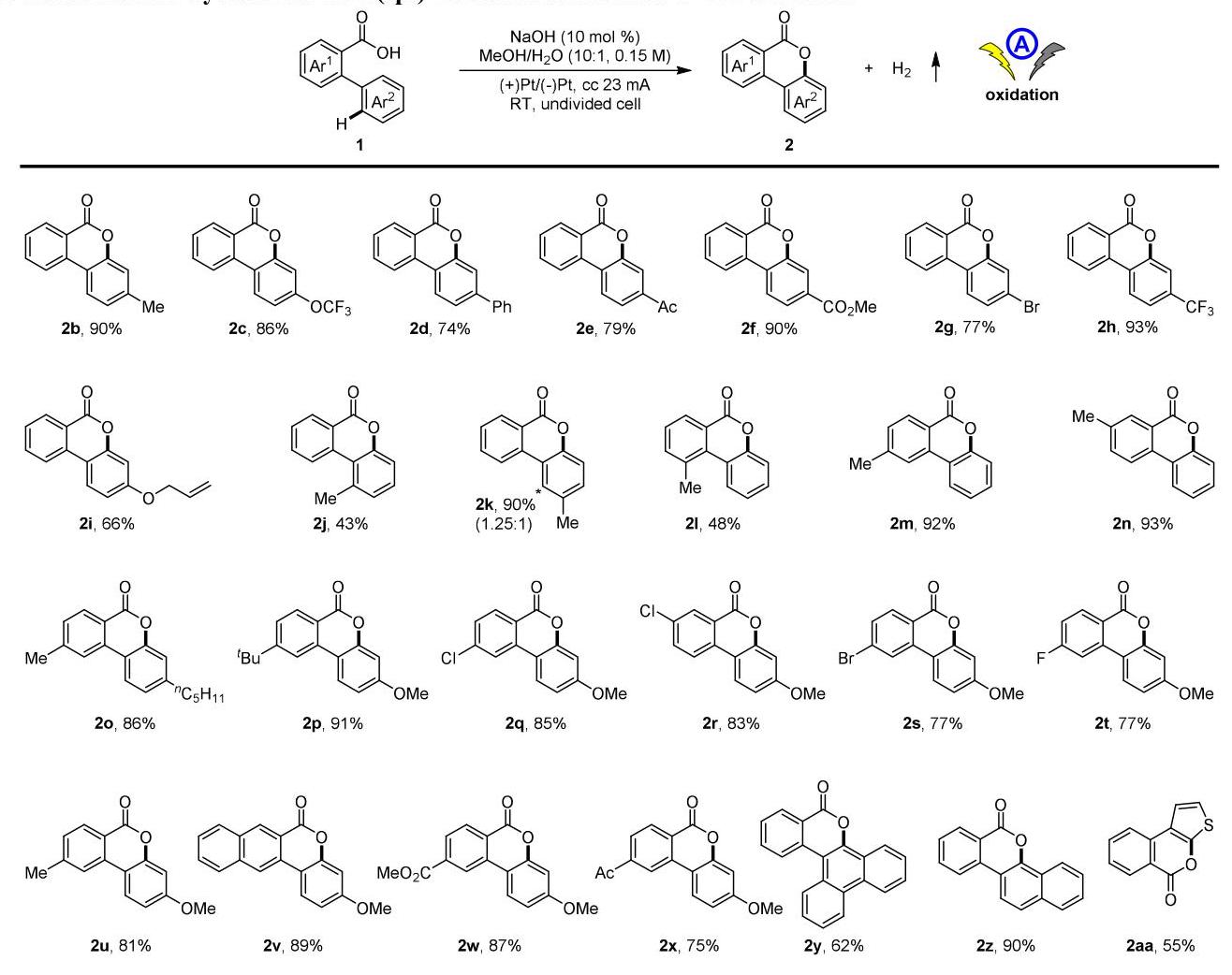
${}^{a}$ Reaction conditions: 1a ${0.5}\mathrm{{mmol}},\mathrm{{MeOH}}3\mathrm{{mL}},{\mathrm{H}}_{2}\mathrm{O}{0.3}\mathrm{{mL}}$ , Pt net electrode, $1\mathrm{\;{cm}} \times 1\mathrm{\;{cm}},{52}\mathrm{{mesh}}$ . cc constant current. Isolated yield are reported.
${}^{a}$反应条件:1a ${0.5}\mathrm{{mmol}},\mathrm{{MeOH}}3\mathrm{{mL}},{\mathrm{H}}_{2}\mathrm{O}{0.3}\mathrm{{mL}}$,铂网电极,$1\mathrm{\;{cm}} \times 1\mathrm{\;{cm}},{52}\mathrm{{mesh}}$。cc为恒流。报告的是分离产率。
The optimal reaction conditions were then used for substrate scope studies with the results shown in Table 2. A series of benzoic acid substrates bearing substitutions on both the ${\mathrm{{Ar}}}^{1}$ and ${\mathrm{{Ar}}}^{2}$ rings were examined with the corresponding cyclization products isolated with good to excellent yields. This anodic oxidation reaction tolerates a variety of functional groups, such as ketone, ester, ether, alkene, halides, trifluoromethyl, and trifluoromethoxyl groups. Both electron-donating and - withdrawing substituents worked well on both aromatic rings. Substituents in the ortho position to the targeted $\mathrm{C} - \mathrm{H}$ bond hindered the reaction, providing $2\mathbf{j}$ in relatively low yield. meta-substitution on ${\mathrm{{Ar}}}^{2}$ ring cause site selectivity, as shown in the case of $2\mathbf{k}$ . The reaction gave a roughly 1.25:1 mixure of isomers in 90% total yield. In another example, a single isomer $2\mathbf{z}$ was obtained with the naphthalene backbone. Het-erocycles could also be accommodated under our electrochemical condition as exemplified by 2aa. ning the reaction at a ${60}\mathrm{{mmol}}$ scale with larger electrodes in a higher concentration $\left( {{0.5}\mathrm{M}}\right)$ in constant voltage mode $\left( {{60}\mathrm{\;V}}\right)$ gave 2a with 75% isolated yield (Scheme 4).
随后,将最优反应条件用于底物范围研究,结果见表 2。研究考察了一系列在 ${\mathrm{{Ar}}}^{1}$ 和 ${\mathrm{{Ar}}}^{2}$ 环上带有取代基的苯甲酸底物,相应的环化产物分离产率良好至优异。该阳极氧化反应可兼容多种官能团,如酮基、酯基、醚基、烯基、卤原子、三氟甲基和三氟甲氧基。给电子和吸电子取代基在两个芳环上均能良好反应。目标 $\mathrm{C} - \mathrm{H}$ 键邻位的取代基会阻碍反应,使 $2\mathbf{j}$ 的产率相对较低。如 $2\mathbf{k}$ 的例子所示,${\mathrm{{Ar}}}^{2}$ 环上的间位取代会导致位点选择性。反应得到了比例约为 1.25:1 的异构体混合物,总产率为 90%。另一个例子中,以萘环为骨架得到了单一异构体 $2\mathbf{z}$。在我们的电化学条件下,杂环化合物也能参与反应,如 2aa 所示。在恒压模式 $\left( {{60}\mathrm{\;V}}\right)$ 下,使用更大的电极,在更高浓度 $\left( {{0.5}\mathrm{M}}\right)$ 中进行 ${60}\mathrm{{mmol}}$ 规模的反应,可分离得到产率为 75% 的 2a(方案 4)。
Scheme 4. Comparison of 10 Gram Scale with 0.1 Gram Scale Reactions
方案4. 10克规模与0.1克规模反应的比较
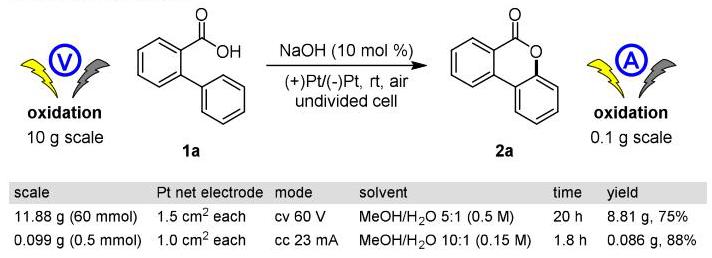
Furthermore, a 10 gram-scale experiment was conducted to examine the scalability of this electrochemical protocol. Run-
此外,进行了10克规模的实验以考察该电化学方法的可扩展性。进行了-
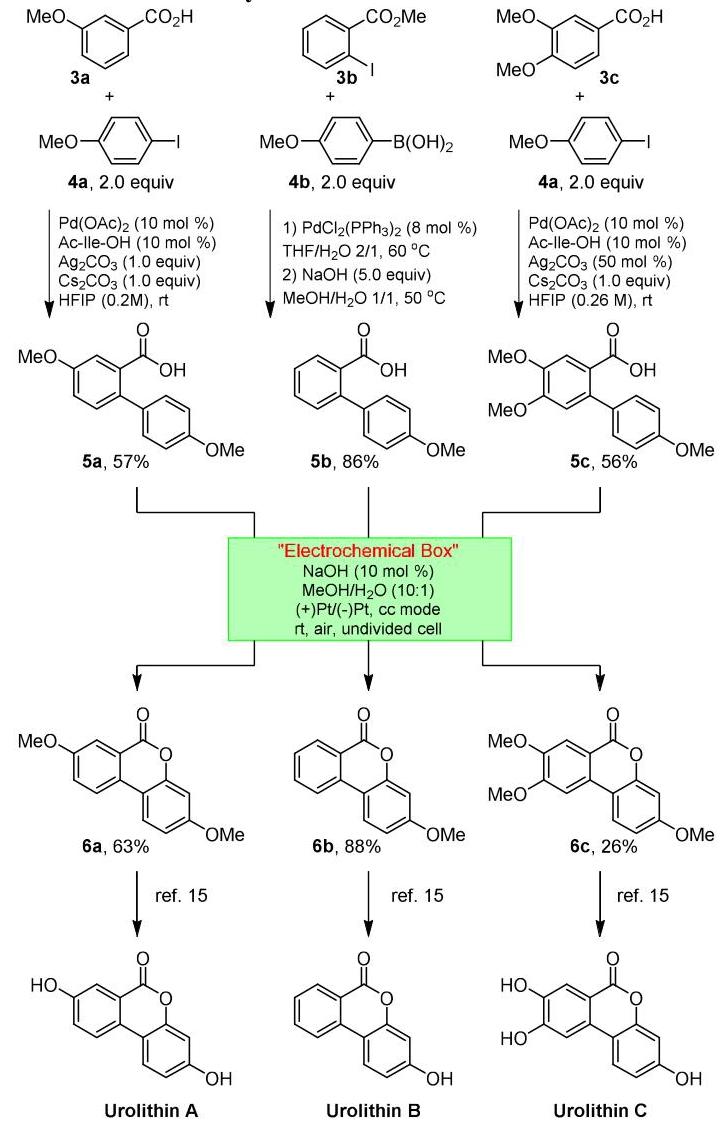
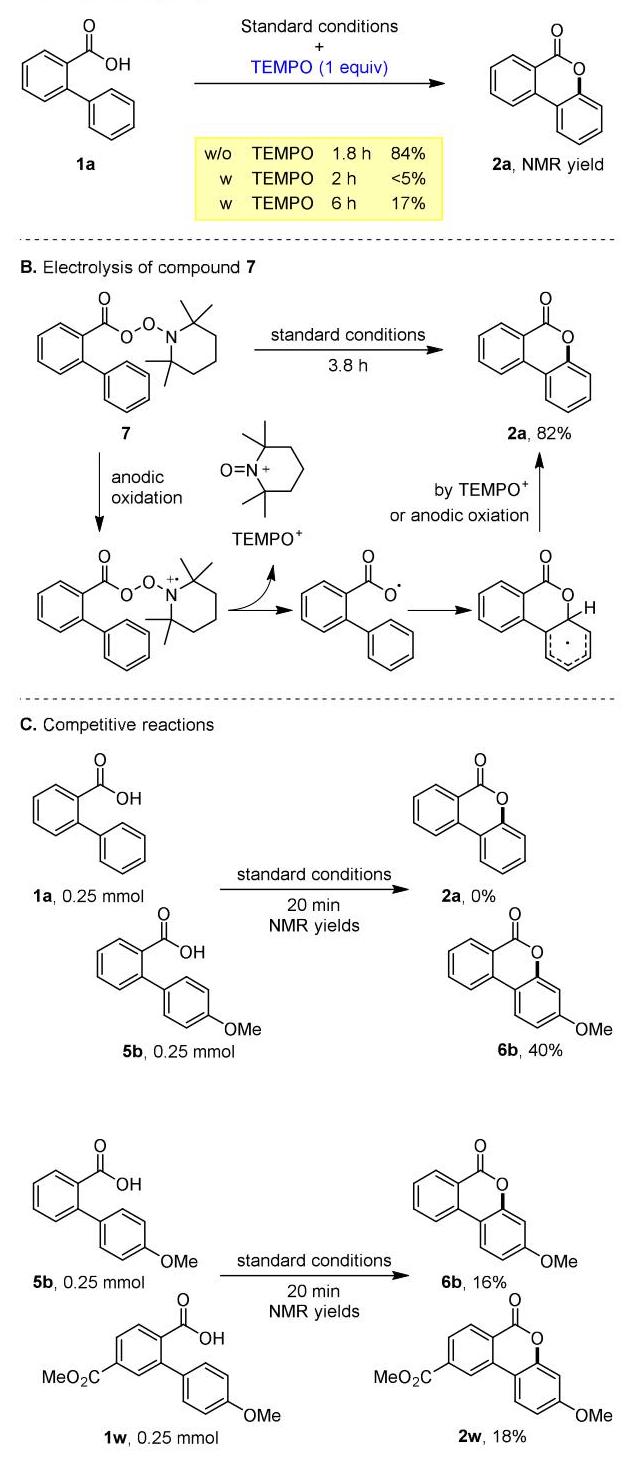
Three compounds in the Urolithin family are suitable targets for demonstrating the synthetic utility of this Kolbe oxidative cyclization reaction. Starting from the easily available substituted benzoic acid or ester, the electrochemical precursors are obtained by means of a Pd-catalyzed cross coupling reaction or the $\mathrm{C} - \mathrm{H}$ arylation reaction. An electrochemical technique was then applied to convert compounds 5 to cyclized products 6. Finally, compounds 6a, 6b and 6c can be easily transformed to Urolithin A, B and C following a reported procedure (Scheme 5). ${}^{15}$ a radical cation. Homolytic cleavage of this radical cation affords 2-phenylbenzoic acid radical and TEMPO cation. The compound $\mathbf{{2a}}$ can be formed by subsequent radical trapping and re-oxidation either by TEMPO ${}^{ + }$ or the anode. At the cathode, reduction of TEMPO ${}^{ + }$ back to TEMPO and hydrogen evolution are two possible reactions to balance the overall transformation. To get more insight into this reaction, we have also performed two competitive reactions between 1a and 5b, 5b and 1w, respectively (Scheme 6C). It was shown that 5b is predominantly oxidized when competing with $1\mathbf{a}$ , while 5b and $1\mathbf{w}$ are equally oxidized to give $\mathbf{{6b}}$ and $2\mathbf{w}$ in a ca. 1:1 ratio. These competitive experiments demonstrated that the Kolbe oxidation of benzoic acid is not likely a rate-determining step.
尿石素家族中的三种化合物是证明这种科尔贝氧化环化反应合成效用的合适目标。从容易获得的取代苯甲酸或酯开始,通过钯催化的交叉偶联反应或$\mathrm{C} - \mathrm{H}$芳基化反应获得电化学前体。然后应用电化学技术将化合物5转化为环化产物6。最后,按照报道的程序,化合物6a、6b和6c可以很容易地转化为尿石素A、B和C(方案5)。${}^{15}$一个自由基阳离子。这个自由基阳离子的均裂产生2-苯基苯甲酸自由基和TEMPO阳离子。化合物$\mathbf{{2a}}$可以通过随后的自由基捕获以及由TEMPO${}^{ + }$或阳极进行的再氧化形成。在阴极,TEMPO${}^{ + }$还原回TEMPO和析氢是平衡整体转化的两个可能反应。为了更深入了解该反应,我们还分别在1a和5b、5b和1w之间进行了两个竞争反应(方案6C)。结果表明,当与$1\mathbf{a}$竞争时,5b主要被氧化,而5b和$1\mathbf{w}$被同等氧化,以约1:1的比例得到$\mathbf{{6b}}$和$2\mathbf{w}$。这些竞争实验表明苯甲酸的科尔贝氧化不太可能是速率决定步骤。
Scheme 5. Kolbe Oxidative Cyclization for the Synthesis of the Urolithin Family of Natural Products
方案5. 用于合成尿石素家族天然产物的科尔贝氧化环化反应
To probe the mechanism of this reaction, 2,2,6,6- tetramethyl-1-piperidinyloxy (TEMPO), a free radical scavenger, was introduced as an additive to the standard reaction. We found that the reaction was suppressed to a great extent. As shown in Scheme 6A, product 2a was formed with less than 5% yield in $2\mathrm{\;h}$ and ${17}\%$ yield in $6\mathrm{\;h}$ . These results support the Kolbe oxidation mechanism. Interestingly, the compound 7, which was synthesized by adopting a procedure reported by Zeng, ${}^{16}$ can be converted to the cyclized product $\mathbf{{2a}}$ in a decent yield under the standard conditions (Scheme 6B). We proposed that compound 7 be oxidized at the anode first to deliver
为探究该反应的机理,将自由基清除剂2,2,6,6-四甲基-1-哌啶氧基(TEMPO)作为添加剂引入标准反应中。我们发现该反应受到了很大程度的抑制。如图6A所示,在$2\mathrm{\;h}$中产物2a的产率低于5%,在$6\mathrm{\;h}$中的产率为${17}\%$。这些结果支持了Kolbe氧化机理。有趣的是,采用曾报道的方法合成的化合物7,${}^{16}$在标准条件下(图6B)可以以相当高的产率转化为环化产物$\mathbf{{2a}}$。我们提出化合物7首先在阳极被氧化以产生
Scheme 6. Control Experiments
图6. 对照实验
A. Radical intercept experiment
A. 自由基捕获实验
CONCLUSION
结论
In summary, we have developed a general, practical intramolecular Kolbe oxidative cyclization method for the synthesis of dibenzopyranones. ${}^{25}$ This method is oxidant-free, does not involve electrolytes, has high yields, works at ambient temperature and is scalable. Urolithins are formally synthesized by adopting this method as a key step to demonstrate its synthetic utility.
总之,我们开发了一种通用、实用的分子内Kolbe氧化环化方法来合成二苯并吡喃酮。${}^{25}$ 该方法无需氧化剂,不涉及电解质,产率高,在室温下即可进行,且具有可扩展性。通过采用该方法作为关键步骤正式合成了尿石素,以证明其合成效用。
EXPERIMENTAL SECTION
实验部分
General Information. Unless otherwise noted, chemicals and solvents were purchased with the highest purity grade available and were used without further purification. Purification of products was conducted by column chromatography on silica gel (200-300 mesh, from Qingdao, China). NMR spectra were measured on a Bruker ARX400 ( ${}^{1}\mathrm{H}$ at ${400}\mathrm{{MHz}},{}^{13}\mathrm{C}$ at 101 MHz) magnetic resonance spectrometer. Chemical shifts (δ) are reported in ppm using tetramethylsilane as internal standard $(s =$ singlet, $d =$ doublet, $t =$ triplet, $q =$ quartet, ${dd} =$ doublet of doublets, $t\mathrm{\;d} =$ triplet of doublets, $d\mathrm{t} =$ doublet of triplets, ddd $=$ doublet of doublet of doublets, $\mathrm{m} =$ multiplet), and coupling constants $\left( J\right)$ were reported in Hertz (Hz). Infrared spectra were recorded on a Thermal Fisher Nicolet iS50 Fourier transform spectrometer (FT-IR) and were reported in wave numbers $\left( {\mathrm{{cm}}}^{-1}\right)$ . HRMS data were obtained on a VG ZAB-HS mass spectrometer, Brucker Apex IV FTMS spectrometer.
一般信息。除非另有说明,化学品和溶剂均购买最高纯度等级的产品,无需进一步纯化即可使用。产品纯化通过硅胶柱色谱法(200 - 300目,来自中国青岛)进行。核磁共振谱在布鲁克ARX400(${}^{1}\mathrm{H}$在${400}\mathrm{{MHz}},{}^{13}\mathrm{C}$,101 MHz)磁共振光谱仪上测量。化学位移(δ)以ppm为单位报告,以四甲基硅烷为内标$(s =$单峰,$d =$双峰,$t =$三重峰,$q =$四重峰,${dd} =$双二重峰,$t\mathrm{\;d} =$双三重峰,$d\mathrm{t} =$三二重峰,ddd$=$双二重二重峰,$\mathrm{m} =$多重峰),耦合常数$\left( J\right)$以赫兹(Hz)为单位报告。红外光谱在赛默飞世尔尼高力iS50傅里叶变换光谱仪(FT - IR)上记录,并以波数$\left( {\mathrm{{cm}}}^{-1}\right)$报告。高分辨质谱数据在VG ZAB - HS质谱仪、布鲁克Apex IV傅里叶变换质谱仪上获得。
Characterization Data. General Procedure for the electrochemical experiments: To a ${15}\mathrm{\;{mL}}$ test tube with a stir bar was charged with ${0.5}\mathrm{{mmol}}2$ -arylbenzoic acid 1, followed by $3\mathrm{\;{mL}} \; \mathrm{{MeOH}}$ and ${0.3}\mathrm{\;{mL}}$ aqueous $\mathrm{{NaOH}}$ solution $\left( {{0.167}\mathrm{M}\text{ , }}\right)$ 0.05mmol). Two platinum net electrodes $\left( {{1.0}\mathrm{\;{cm}} \times {1.0}\mathrm{\;{cm}}}\right)$ were set up in the tube. Make sure that the electrodes be totally immersed. The resulting mixture was electrolyzed at constant current mode with a current of ${23}\mathrm{{mA}}$ under ambient temperature. The reaction was monitored by TLC or GC. Upon completion, the reaction mixture was concentrated under reduced pressure. The residue was chromatographed through silica gel eluting with PE/EA to give the desired product 2.
表征数据。电化学实验的一般步骤:向装有搅拌棒的${15}\mathrm{\;{mL}}$试管中加入${0.5}\mathrm{{mmol}}2$ -芳基苯甲酸1,然后加入$3\mathrm{\;{mL}} \; \mathrm{{MeOH}}$和${0.3}\mathrm{\;{mL}}$的$\mathrm{{NaOH}}$水溶液$\left( {{0.167}\mathrm{M}\text{ , }}\right)$(0.05 mmol)。在试管中设置两个铂网电极$\left( {{1.0}\mathrm{\;{cm}} \times {1.0}\mathrm{\;{cm}}}\right)$。确保电极完全浸没。所得混合物在室温下以${23}\mathrm{{mA}}$的恒定电流模式进行电解。反应通过薄层色谱法(TLC)或气相色谱法(GC)监测。反应完成后,反应混合物在减压下浓缩。残余物通过硅胶柱色谱法,用石油醚/乙酸乙酯洗脱,得到所需产物2。
General Procedure for the 10 gram scale electrochemical experiment: To a 150 mL conical flask with a stir bar was charged with ${60}\mathrm{{mmol}}2$ -arylbenzoic acid $1\mathrm{a}$ , followed by 100 mL MeOH and ${20}\mathrm{\;{mL}}$ aqueous NaOH solution $({0.3}\mathrm{M},6$ mmol). Two platinum net electrodes $\left( {{1.5}\mathrm{\;{cm}} \times {1.0}\mathrm{\;{cm}}}\right)$ were set up in the conical flask. Make sure that the electrodes be totally immersed. The resulting mixture was electrolyzed at constant potential mode with a potential of ${60}\mathrm{\;V}$ under ambient temperature. Note, the reaction is exothermic. Ice water bath was used to maintain reaction temperature between ${15} \sim {30}^{ \circ }\mathrm{C}$ . The reaction was monitored by TLC. Upon completion, the reaction mixture was poured into saturated ${\mathrm{{Na}}}_{2}{\mathrm{{CO}}}_{3}$ aqueous solution. Large amount of solid product precipitated out. The solid product was filtered and washed by water. The residue was dried under heating and vacuum to give analytical pure product 2a, 8.81 g, 75% yield.
10克规模电化学实验的一般步骤:向装有搅拌棒的150 mL锥形瓶中加入${60}\mathrm{{mmol}}2$ -芳基苯甲酸$1\mathrm{a}$,然后加入100 mL甲醇和${20}\mathrm{\;{mL}}$的氢氧化钠水溶液$({0.3}\mathrm{M},6$(mmol)。在锥形瓶中设置两个铂网电极$\left( {{1.5}\mathrm{\;{cm}} \times {1.0}\mathrm{\;{cm}}}\right)$。确保电极完全浸没。所得混合物在室温下以${60}\mathrm{\;V}$的恒定电位模式进行电解。注意,反应是放热的。使用冰水浴将反应温度保持在${15} \sim {30}^{ \circ }\mathrm{C}$之间。反应通过薄层色谱法(TLC)监测。反应完成后,将反应混合物倒入饱和${\mathrm{{Na}}}_{2}{\mathrm{{CO}}}_{3}$水溶液中。大量固体产物沉淀出来。固体产物过滤并用清水洗涤。残余物在加热和真空下干燥,得到分析纯产物2a,8.81 g,产率75%。
Electrolysis of compound 7: The compound 7 was synthesized by adopting a procedure reported by Zeng. ${}^{16}$ To a ${15}\mathrm{\;{mL}}$ test tube with a stir bar was charged with 0.66 mmol 2,2,6,6- tetramethylpiperidin-1-yl [1,1’-biphenyl]-2-carboperoxoate 7, followed by $3\mathrm{\;{mL}}\mathrm{{MeOH}}$ and ${0.3}\mathrm{\;{mL}}$ aqueous $\mathrm{{NaOH}}$ solution
化合物7的电解:化合物7采用曾报道的方法合成。${}^{16}$ 向装有搅拌棒的 ${15}\mathrm{\;{mL}}$ 试管中加入0.66 mmol 2,2,6,6-四甲基哌啶-1-基 [1,1’-联苯]-2-过氧化羧酸酯7,接着加入 $3\mathrm{\;{mL}}\mathrm{{MeOH}}$ 和 ${0.3}\mathrm{\;{mL}}$ 水性 $\mathrm{{NaOH}}$ 溶液(0.167 M, 0.05mmol). Two platinum net electrodes (1.0 cm × ${1.0}\mathrm{\;{cm}}$ ) were set up in the tube. Make sure that the electrodes be totally immersed. The resulting mixture was electrolyzed at constant current mode with a current of ${23}\mathrm{\;{mA}}$ under ambient temperature. The reaction was monitored by TLC. After 3 h 50 min, the reaction mixture was concentrated under reduced pressure. The residue was chromatographed through silica gel eluting with PE/EA to give the desired product $2\mathbf{a},{106}\mathrm{{mg}}$ , 82% yield.
6H-benzo[c]chromen-6-one (2a). ${}^{{14}\mathrm{f}}$ White solid, using PE/EA $\left( {{10} : 1\mathrm{v}/\mathrm{v}}\right)$ as eluent. Isolated yield: ${88}\% \left( {{86}\mathrm{{mg}}}\right)$ ; mp 90-91 °C $\left( {{\text{ lit }}^{{14}\mathrm{e}}{88} - {89}^{ \circ }\mathrm{C}}\right) .{}^{1}\mathrm{H}$ NMR (400 MHz, ${\mathrm{{CDCl}}}_{3}$ ): δ 8.39 (d, $1\mathrm{H}, J \; = {7.9}\mathrm{\;{Hz}}),{8.10}\left( {\mathrm{\;d},1\mathrm{H}, J = {8.1}\mathrm{\;{Hz}}}\right) ,{8.04}\left( {\mathrm{\;d},1\mathrm{H}, J = {7.9}\mathrm{\;{Hz}}}\right)$ , ${7.81}\left( {\mathrm{t},1\mathrm{H}, J = {7.7}\mathrm{\;{Hz}}}\right) ,{7.57}\left( {\mathrm{t},1\mathrm{H}, J = {7.6}\mathrm{\;{Hz}}}\right) ,{7.47}(\mathrm{t},1\mathrm{H}, J \; = {7.7}\mathrm{\;{Hz}}),{7.35}\left( {\mathrm{\;d},1\mathrm{H}, J = {6.5}\mathrm{\;{Hz}}}\right) ,{7.33}(\mathrm{t},1\mathrm{H}, J = {8.1}$ Hz). ${}^{13}\mathrm{C}\;\mathrm{{NMR}}\left( {{101}\mathrm{{MHz}},{\mathrm{{CDCl}}}_{3}}\right) : {161.1},{151.2},{134.8},{134.6}$ , 130.4, 130.4, 128.8, 124.5, 122.7, 121.6, 121.1, 117.9, 117.6.
3-Methyl-6H-benzo[c]chromen-6-one (2b). ${}^{{14}\mathrm{f}}$ White solid, using PE/EA (10:1 v/v) as eluent. Isolated yield: 90% (95 mg); mp 129-130 °C (lit ${}^{16}$ 125-126 °C). ${}^{1}\mathrm{H}$ NMR (400 MHz, ${\mathrm{{CDCl}}}_{3}) : \delta$ 8.38 (d, $1\mathrm{H}, J = {7.9}\mathrm{\;{Hz}}$ ),8.07 (d, $1\mathrm{H}, J = {8.1}\mathrm{\;{Hz}}$ ), ${7.93}\left( {\mathrm{\;d},1\mathrm{H}, J = {8.0}\mathrm{\;{Hz}}}\right) ,{7.79}\left( {\mathrm{\;{dd}},1\mathrm{H}, J = {3.9}\mathrm{\;{Hz}}, J = {11.4}}\right. \; \mathrm{{Hz}}),{7.54}\left( {\mathrm{t},1\mathrm{H}, J = {7.6}\mathrm{\;{Hz}}}\right) ,{7.17}\left( {\mathrm{\;s},1\mathrm{H}}\right) ,{7.15}(\mathrm{\;d},1\mathrm{H}, J = {8.2}$ Hz), 2.45 (s, 3H). ${}^{13}\mathrm{C}$ NMR (101 MHz, CDCl ${}_{3}$ ): δ 161.4, 151.3, 141.3, 135.0, 134.7, 130.6, 128.4, 125.6, 122.5, 121.4, 121.0, 117.9, 115.5, 21.4.
3-(Trifluoromethoxy)-6H-benzo[c]chromen-6-one (2c). ${}^{{14}\mathrm{\;g}}$ White solid, using PE/EA (10:1 v/v) as eluent. Isolated yield: 86% (120 mg); mp 77-78°C (lit ${}^{17}$ 86-87°C). ${}^{1}$ H NMR (400 MHz, CDCl ${}_{3}$ ): δ 8.41 (dd, 1H, J = 7.9, 1.4 Hz), 8.09 (dd, 2H, J $= {8.5},{2.3}\mathrm{\;{Hz}}),{7.86}$ (ddd, $1\mathrm{H}, J = {8.2},{7.3},{1.4}\mathrm{\;{Hz}}),{7.62}$ (ddd, $1\mathrm{H}, J = {8.2},{7.4},{1.1}\mathrm{\;{Hz}}),{7.26} - {7.17}\left( {\mathrm{\;m},2\mathrm{H}}\right) \cdot {}^{13}\mathrm{C}$ NMR (101 MHz, CDCl3): δ 160.5, 151.8, 150.2, 135.2, 133.8, 130.8, 129.4,124.2,121.8,120.9,120.4 (q, $J = {259}\mathrm{\;{Hz}}$ ), 117.0, 116.8, 110.2.
3-Phenyl-6H-benzo[c]chromen-6-one (2d). ${}^{{14}\mathrm{j}}$ White solid, using PE/EA (10:1 v/v) as eluent. Isolated yield: 74% (100 mg); mp 84-86 ${}^{ \circ }\mathrm{C}$ . ${}^{1}\mathrm{H}$ NMR (400 MHz, ${\mathrm{{CDCl}}}_{3}$ ): δ 8.42 (dd, $J \; = {7.9},{1.4}\mathrm{\;{Hz}},1\mathrm{H}),{8.13}\left( {\mathrm{{dd}}, J = {10.7},{8.5}\mathrm{\;{Hz}},2\mathrm{H}}\right) ,{7.84}(\mathrm{{td}}, J \; = {7.7},{1.4}\mathrm{\;{Hz}},1\mathrm{H}),{7.66}\left( {\mathrm{\;d}, J = {7.1}\mathrm{\;{Hz}},2\mathrm{H}}\right) ,{7.63} - {7.56}(\mathrm{\;m}$ , $3\mathrm{H}),{7.49}\left( {\mathrm{t}, J = {7.5}\mathrm{\;{Hz}},2\mathrm{H}}\right) ,{7.42}\left( {\mathrm{t}, J = {7.3}\mathrm{\;{Hz}},1\mathrm{H}}\right) .{}^{13}\mathrm{C}$ NMR (101 MHz, CDCl ${}_{3}$ ): δ 161.2, 151.6, 143.4, 139.2, 134.8, 134.6, 130.6, 129.1, 128.8, 128.3, 127.0, 123.3, 123.2, 121.7, 121.1, 116.9, 115.7.
3-Acetyl-6H-benzo[c]chromen-6-one (2e). ${}^{{14}\mathrm{f}}$ White solid, using PE/EA (10:1 v/v) as eluent. Isolated yield: ${79}\% \left( {{94}\mathrm{{mg}}}\right)$ ; mp 189-191 °C. ${}^{1}$ H NMR (400 MHz, CDCl ${}_{3}$ ): δ 8.46 (dd, $J = \; {7.9},{1.4}\mathrm{\;{Hz}},1\mathrm{H}),{8.18}\left( {\mathrm{t}, J = {8.4}\mathrm{\;{Hz}},2\mathrm{H}}\right) ,{7.97} - {7.92}\left( {\mathrm{\;m},2\mathrm{H}}\right)$ , 7.90 (ddd, $J = {8.2},{7.4},{1.4}\mathrm{\;{Hz}},1\mathrm{H}),{7.72} - {7.65}\left( {\mathrm{\;m},1\mathrm{H}}\right) ,{2.68}$ (s, 3H). ${}^{13}\mathrm{C}$ NMR (101 MHz, CDCl3): δ 196.5, 160.6, 151.2, 138.4, 135.1, 133.7, 130.9, 130.1, 123.9, 123.2, 122.4, 122.0, 121.8, 118.0, 26.8.
Methyl 6-oxo-6H-benzo[c]chromene-3-carboxylate (2f). White solid, using PE/EA (10:1 v/v) as eluent. Isolated yield: 90% (114 mg); mp 160-162 °C. ${}^{1}$ H NMR (400 MHz, CDCl ${}_{3}$ ): $\delta$ 8.43 (dd, $1\mathrm{H}, J = {7.9},{1.3}\mathrm{\;{Hz}}$ ),8.17 (d, $1\mathrm{H}, J = {8.1}\mathrm{\;{Hz}}$ ),8.13 $\left( {\mathrm{d},1\mathrm{H}, J = {8.3}\mathrm{\;{Hz}}}\right) ,{7.99}\left( {\mathrm{\;d},2\mathrm{H}, J = {7.6}\mathrm{\;{Hz}}}\right) ,{7.91} - {7.84}(\mathrm{\;m}$ , 1H), ${7.69} - {7.63}\left( {\mathrm{\;m},1\mathrm{H}}\right) ,{3.98}\left( {\mathrm{\;s},3\mathrm{H}}\right) {.}^{13}\mathrm{C}$ NMR (101 MHz, ${\mathrm{{CDCl}}}_{3}) : \delta$ 165.8,160.6,151.0,135.1,133.7,131.9,130.8, 130.0, 125.3, 122.9, 122.4, 121.9, 121.8, 119.1, 52.6. IR: $v =$ 2948,1735,1717,1606,1304,1267,1097,751 ${\mathrm{{cm}}}^{-1}$ . HRMS (ESI): calcd for ${\mathrm{C}}_{15}{\mathrm{H}}_{11}{\mathrm{O}}_{4}^{ + }\;{\left\lbrack \mathrm{M} + \mathrm{H}\right\rbrack }^{ + }$ : 255.0652; found: 255.0646.
3-Bromo-6H-benzo[c]chromen-6-one (2g). ${}^{{14}\mathrm{f}}$ White solid, using PE/EA (10:1 v/v) as eluent. Isolated yield: 77% (105 mg); mp 134-136 °C (lit ${}^{16}$ 136-138 °C). ${}^{1}\mathrm{H}$ NMR (400 MHz, ${\mathrm{{CDCl}}}_{3}) : \delta$ 8.39 (dd, $1\mathrm{H}, J = {8.0},{1.4}\mathrm{\;{Hz}}$ ),8.11 - 8.04 (m,1H), 7.91 (d, 1H, J = 8.5 Hz), 7.84 (ddd, 1H, J = 8.2, 7.4, 1.5 Hz), ${7.61}\left( {\mathrm{{ddd}},1\mathrm{H}, J = {8.2},{7.3},{1.1}\mathrm{\;{Hz}}}\right) ,{7.53}\left( {\mathrm{\;d},1\mathrm{H}, J = {2.0}\mathrm{\;{Hz}}}\right)$ , 7.46 (dd, $1\mathrm{H}, J = {8.5},{2.0}\mathrm{\;{Hz}}$ ). ${}^{13}\mathrm{C}$ NMR (101 MHz, ${\mathrm{{CDCl}}}_{3}$ ): $\delta$ 160.5, 151.5, 135.1, 134.0, 130.8, 129.3, 127.9, 124.0, 123.7, 121.7, 121.0, 120.9, 117.1.
3-(Trifluoromethyl)-6H-benzo[c]chromen-6-one (2h). ${}^{{14}\mathrm{f}}$ White solid, using PE/EA (10:1 v/v) as eluent. Isolated yield: 93% $\left( {{123}\mathrm{{mg}}}\right)$ ; mp 127-129 ${}^{ \circ }\mathrm{C}\left( {{\text{ lit }}^{{14}\mathrm{e}}{123.1} - {124.1}{}^{ \circ }\mathrm{C}}\right) {}^{1}\mathrm{H}$ NMR $\left( {{400}\mathrm{{MHz}},{\mathrm{{CDCl}}}_{3}}\right) : \delta$ 8.45 $\left( {\mathrm{d},1\mathrm{H}, J = {7.9}\mathrm{\;{Hz}}}\right)$ ,8.18 $(\mathrm{t},2\mathrm{H}, J = \; {8.1}\mathrm{\;{Hz}}),{7.89}\left( {\mathrm{t},1\mathrm{H}, J = {7.7}\mathrm{\;{Hz}}}\right) ,{7.68}\left( {\mathrm{t},1\mathrm{H}, J = {7.6}\mathrm{\;{Hz}}}\right) ,{7.63} \; \left( {\mathrm{s},1\mathrm{H}}\right) ,{7.59}\left( {\mathrm{\;d},1\mathrm{H}, J = {8.4}\mathrm{\;{Hz}}}\right) .{}^{13}\mathrm{C}$ NMR $({101}\mathrm{{MHz}}$ , ${\mathrm{{CDCl}}}_{3}) : \delta$ 160.2,151.0,135.2,133.4,132.4,132.1,130.9, 130.1, 124.6, 123.6, 122.2, 122.0, 121.7, 121.2, 121.11, 121.08, 121.0, 115.3, 115.3, 115.24, 115.20.
3-(Allyloxy)-6H-benzo[c]chromen-6-one (2i). ${}^{{14}\mathrm{j}}$ White solid, using PE/EA (10:1v/v) as eluent. Isolated yield: ${66}\% \left( {{83}\mathrm{{mg}}}\right)$ ; mp 93-94 °C. ${}^{1}\mathrm{H}$ NMR (400 MHz, CDCl ${}_{3}$ ): δ 8.31 (dd,1H, $J = \; {7.9},{1.3}\mathrm{\;{Hz}}),{7.98} - {7.92}\left( {\mathrm{\;m},1\mathrm{H}}\right) ,{7.88}\left( {\mathrm{\;d},1\mathrm{H}, J = {8.8}\mathrm{\;{Hz}},1\mathrm{H}}\right)$ , ${7.75}\left( {\mathrm{{ddd}},1\mathrm{H}, J = {8.4},{7.3},{1.5}\mathrm{\;{Hz}}}\right) ,{7.47}(\mathrm{{ddd}},1\mathrm{H}, J = {8.2},{7.3}$ , ${1.1}\mathrm{\;{Hz}}),{6.90}\left( {\mathrm{{dd}},1\mathrm{H}, J = {8.8},{2.6}\mathrm{\;{Hz}}}\right) ,{6.82}(\mathrm{\;d},1\mathrm{H}, J = {2.6} \; \mathrm{{Hz}}),{6.06}\left( {\mathrm{{ddt}},1\mathrm{H}, J = {17.3},{10.5},{5.3}\mathrm{\;{Hz}}}\right) ,{5.45}(\mathrm{{dq}},1\mathrm{H}, J = \; {17.2},{1.6}\mathrm{\;{Hz}}),{5.34}\left( {\mathrm{{dq}},1\mathrm{H}, J = {10.5},{1.4}\mathrm{\;{Hz}}}\right) ,{4.58}(\mathrm{{dt}},2\mathrm{H}J =$ 5.3, 1.6 Hz). ${}^{13}\mathrm{C}$ NMR (101 MHz, CDC1, 3): δ 161.4, 160.4, 152.5, 135.1, 134.8, 132.4, 130.5, 127.7, 123.7, 121.0, 119.9, 118.4, 112.9, 111.2, 102.5, 69.2.
1-Methyl-6H-benzo[c]chromen-6-one (2j). ${}^{{14}\mathrm{f}}$ White solid, using PE/EA (10:1v/v) as eluent. Isolated yield: ${43}\% \left( {{45}\mathrm{{mg}}}\right)$ ; mp 159-161 °C (lit ${}^{18}$ 161 °C). ${}^{1}$ H NMR (400 MHz, ${\mathrm{{CDCl}}}_{3}$ ): δ ${8.50}\left( {\mathrm{\;d},1\mathrm{H}, J = {7.9}\mathrm{\;{Hz}}}\right) ,{8.39}\left( {\mathrm{\;d},1\mathrm{H}, J = {8.4}\mathrm{\;{Hz}}}\right) ,{7.83}(\mathrm{t},1\mathrm{H}$ , $J = {7.8}\mathrm{\;{Hz}}),{7.60}\left( {\mathrm{t},1\mathrm{H}, J = {7.6}\mathrm{\;{Hz}}}\right) ,{7.36}\left( {\mathrm{t},1\mathrm{H}, J = {7.8}\mathrm{\;{Hz}}}\right)$ , ${7.28}\left( {\mathrm{\;d},1\mathrm{H}, J = {8.5}\mathrm{\;{Hz}}}\right) ,{7.17}\left( {\mathrm{\;d},1\mathrm{H}, J = {7.4}\mathrm{\;{Hz}}}\right) ,{2.90}\left( {\mathrm{\;s},3\mathrm{H}}\right)$ . ${}^{13}\mathrm{C}$ NMR (101 MHz, ${\mathrm{{CDCl}}}_{3}$ ): $\delta$ 161.3,152.2,136.2,136.1, 134.2, 130.8, 129.3, 128.8, 128.1, 126.2, 122.2, 117.5, 116.2, 25.5.
2-Methyl-6H-benzo[c]chromen-6-one (2k). ${}^{{14}\mathrm{\;g}}$ White solid, using PE/EA (10:1 v/v) as eluent. Isolated ${53}\mathrm{{mg}}$ ; mp 124-125 ${}^{ \circ }\mathrm{C}\left( {{\text{ lit }}^{19}{126}^{ - }{128}{}^{ \circ }\mathrm{C}}\right) .{}^{1}\mathrm{H}$ NMR $\left( {{400}\mathrm{{MHz}},{\mathrm{{CDCl}}}_{3}}\right) : {\delta 8.36}(\mathrm{\;d}$ , $1\mathrm{H}, J = {7.9}\mathrm{\;{Hz}}),{8.05}\left( {\mathrm{\;d},1\mathrm{H}, J = {8.1}\mathrm{\;{Hz}}}\right) ,{7.78}\left( {\mathrm{\;m},2\mathrm{H}}\right) ,{7.54} \; \left( {\mathrm{t},1\mathrm{H}, J = {7.6}\mathrm{\;{Hz}}}\right) ,{7.23}\left( {\mathrm{\;m},2\mathrm{H}}\right) ,{2.44}\left( {\mathrm{\;s},3\mathrm{H}}\right) .{}^{13}\mathrm{C}\mathrm{{NMR}}({101}$ MHz, CDCl3): δ 161.3, 149.3, 134.8, 134.7, 134.1, 131.3, 130.5, 128.7, 122.7, 121.6, 121.2, 117.6, 117.4, 77.4, 77.1, 76.8, 21.1.
4-Methyl-6H-benzo[c]chromen-6-one (2k’). ${}^{14}\mathrm{g}$ Isolated ${42}\mathrm{{mg}}$ , white solid; mp 120-122 °C (lit ${}^{19}$ 132-134 °C). ${}^{1}$ H NMR (400 MHz, CDCl ${}_{3}$ ): δ 8.37 (d, 1H, J = 7.9 Hz), 8.07 (d, 1H, J = 8.1 $\mathrm{{Hz}}),{7.85}\left( {\mathrm{\;d},1\mathrm{H}, J = {7.9}\mathrm{\;{Hz}}}\right) ,{7.78}(\mathrm{{dt}},1\mathrm{H}, J = {1.2}\mathrm{\;{Hz}}, J = {7.8} \; \mathrm{{Hz}}),{7.54}\left( {\mathrm{t},1\mathrm{H}, J = {7.6}\mathrm{\;{Hz}}}\right) ,{7.30}\left( {\mathrm{\;d},1\mathrm{H}, J = {7.3}\mathrm{\;{Hz}}}\right) ,{7.19}(\mathrm{t}$ , 1H, $\left. {J = {7.7}\mathrm{\;{Hz}}}\right) ,{2.47}\left( {\mathrm{\;s},3\mathrm{H}}\right) .{}^{13}\mathrm{C}$ NMR $\left( {{101}\mathrm{{MHz}},{\mathrm{{CDCl}}}_{3}}\right) \delta$ 161.2, 149.6, 135.1, 134.7, 131.8, 130.4, 128.6, 127.0, 124.0, 121.8, 121.1, 120.4, 117.6, 77.4, 77.1, 76.8, 16.0.
10-Methyl-6H-benzo[c]chromen-6-one (21). ${}^{{14}\mathrm{f}}$ White solid, using PE/EA (10:1 v/v) as eluent. Isolated yield: ${46}\% \left( {{48}\mathrm{{mg}}}\right)$ ; mp 119-120 °C (lit ${}^{{14}\mathrm{h}}$ 122-124 °C). ${}^{1}\mathrm{H}$ NMR (400 MHz, ${\mathrm{{CDCl}}}_{3}) : \delta$ 8.38 (d, $J = {7.8}\mathrm{\;{Hz}},1\mathrm{H}),{8.32}$ (d, $J = {8.3}\mathrm{\;{Hz}},1\mathrm{H}$ ), ${7.65}\left( {\mathrm{\;d}, J = {7.5}\mathrm{\;{Hz}},1\mathrm{H}}\right) ,{7.48}\left( {\mathrm{t}, J = {7.6}\mathrm{\;{Hz}},2\mathrm{H}}\right) ,{7.41}(\mathrm{\;d}, J =$
${8.0}\mathrm{\;{Hz}},1\mathrm{H}),{7.34}\left( {\mathrm{t}, J = {7.6}\mathrm{\;{Hz}},1\mathrm{H}}\right) ,{2.91}\left( {\mathrm{\;s},3\mathrm{H}}\right) .{}^{13}\mathrm{C}\mathrm{{NMR}}$ (101 MHz, CDCl ${}_{3}$ ): δ 151.2, 139.1, 135.0, 133.6, 129.6, 129.2, 128.3, 127.2, 124.0, 122.8, 119.7, 118.0, 25.4.
9-Methyl-6H-benzo[c]chromen-6-one (2m). ${}^{{14}\mathrm{f}}$ White solid, using PE/EA (10:1 v/v) as eluent. Isolated yield: 92% (97 mg); mp 84-86 ${}^{ \circ }\mathrm{C}\left( {{\text{ lit }}^{16}\text{ 86-88 }{}^{ \circ }\mathrm{C}}\right)$ . ${}^{1}\mathrm{H}$ NMR (400 MHz, ${\mathrm{{CDCl}}}_{3}$ ): δ ${8.26}\left( {\mathrm{\;d},1\mathrm{H}, J = {8.1}\mathrm{\;{Hz}}}\right) ,{8.02}\left( {\mathrm{{dd}},1\mathrm{H}, J = {7.9},{1.5}\mathrm{\;{Hz}}}\right) ,{7.91} - \; {7.85}\left( {\mathrm{\;m},1\mathrm{H}}\right) ,{7.46}\left( {\mathrm{{ddd}},1\mathrm{H}, J = {8.5},{7.2},{1.6}\mathrm{\;{Hz}}}\right) ,{7.37}(\mathrm{{ddd}}$ , 1H, $J = {8.2},{1.6},{0.7}\mathrm{\;{Hz}}),{7.35} - {7.33}\left( {\mathrm{\;m},1\mathrm{H}}\right) ,{7.33} - {7.29}(\mathrm{\;m}$ , 1H), 2.55 (s, 3H). ${}^{13}\mathrm{C}$ NMR (101 MHz, CDCl ${}_{3}$ ): δ161.2, 151.4, 145.9, 134.6, 130.4, 130.2, 130.1, 124.4, 122.7, 121.8, 118.7, 118.0, 117.6, 22.2.
8-Methyl-6H-benzo[c]chromen-6-one (2n). ${}^{{14}\mathrm{f}}$ White solid, using PE/EA (10:1 v/v) as eluent. Isolated yield: 90% (95 mg); mp 128-129 °C (lit ${}^{16}$ 114-115 °C). ${}^{1}\mathrm{H}$ NMR (400 MHz, ${\mathrm{{CDCl}}}_{3}$ ): ${8.11}\left( {\mathrm{\;s},1\mathrm{H}}\right) ,{7.99} - {7.87}\left( {\mathrm{\;m},2\mathrm{H}}\right) ,{7.56}(\mathrm{{dd}}, J = {8.2}$ , ${2.1}\mathrm{\;{Hz}},1\mathrm{H}),{7.46} - {7.36}\left( {\mathrm{\;m},1\mathrm{H}}\right) ,{7.28}\left( {\mathrm{t}, J = {8.1}\mathrm{\;{Hz}},2\mathrm{H}}\right) ,{2.44}$ (s, 3H). ${}^{13}\mathrm{C}$ NMR (101 MHz, CDCl ${}_{3}$ ): δ 150.9, 139.2, 136.0, 132.1, 130.2, 129.8, 124.4, 122.5, 121.6, 121.0, 118.1, 117.6, 21.3.
9-Methyl-3-pentyl-6H-benzo[c]chromen-6-one (2o). ${}^{{14}\mathrm{f}}$ White solid, using PE/EA (10:1 v/v) as eluent. Isolated yield: ${86}\%$ (120mg); mp 60-61 ${}^{ \circ }\mathrm{C}$ (lit ${}^{16}$ 61-63 ${}^{ \circ }\mathrm{C}$ ). ${}^{1}\mathrm{H}$ NMR (400 MHz, ${\mathrm{{CDCl}}}_{3}) : \delta$ 8.24 (dd,1H, $J = {8.1},{2.1}\mathrm{\;{Hz}}$ ),7.91 (dd,1H, $J = {8.0}$ , ${2.3}\mathrm{\;{Hz}}),{7.83}\left( {\mathrm{\;s},1\mathrm{H}}\right) ,{7.33}\left( {\mathrm{{dt}},1\mathrm{H}, J = {8.0},{1.5}\mathrm{\;{Hz}}}\right) ,{7.13}(\mathrm{{dd}}$ , $2\mathrm{H}, J = {9.6},{1.6}\mathrm{\;{Hz}}),{2.68}\left( {\mathrm{t},2\mathrm{H}, J = {7.7}\mathrm{\;{Hz}}}\right) ,{2.53}\left( {\mathrm{\;s},3\mathrm{H}}\right)$ , ${1.66}\left( {\mathrm{\;m},2\mathrm{H}}\right) ,{1.40} - {1.30}\left( {\mathrm{\;m},4\mathrm{H}}\right) ,{0.94} - {0.86}\left( {\mathrm{\;m},3\mathrm{H}}\right) .{}^{13}\mathrm{C}$ NMR (101 MHz, CDCl ${}_{3}$ ): δ 161.5, 151.5, 146.1, 145.8, 130.5, 129.6, 124.8, 122.4, 121.6, 118.4, 117.2, 115.6, 35.7, 31.4, 30.7, 22.5, 22.3, 14.0.
9-tert-Butyl-3-methoxy-6H-benzo[c]chromen-6-one (2p). White solid, using PE/EA (10:1 v/v) as eluent. Isolated yield: 91% (128 mg); mp 150-151 °C. ${}^{1}$ H NMR (400 MHz, CDCl ${}_{3}$ ): $\delta = {8.28}\left( {\mathrm{\;d},1\mathrm{H}, J = {8.4}\mathrm{\;{Hz}}}\right) ,{7.99}\left( {\mathrm{{dd}},2\mathrm{H}, J = {5.3},{3.5}\mathrm{\;{Hz}}}\right) ,{7.56} \; \left( {\mathrm{{dd}},1\mathrm{H}, J = {8.4},{1.8}\mathrm{\;{Hz}}}\right) ,{6.92}\left( {\mathrm{{dd}},1\mathrm{H}, J = {8.8},{2.6}\mathrm{\;{Hz}}}\right) ,{6.86} \; \left( {\mathrm{d},1\mathrm{H}, J = {2.5}\mathrm{\;{Hz}}}\right) ,{3.88}\left( {\mathrm{\;s},3\mathrm{H}}\right) ,{1.43}\left( {\mathrm{\;s},9\mathrm{H}}\right) .{}^{13}\mathrm{C}$ NMR (101 MHz, CDCl3): δ 161.6, 161.3, 158.8, 152.8, 134.9, 130.4, 125.7, 123.6, 117.5, 117.3, 112.4, 111.6, 101.6, 55.7, 35.6, 31.1. IR: $v = {2961},{2908},{1727},{1612},{1409},{1277},{1106},{1040}$ , 776,692 ${\mathrm{{cm}}}^{-1}$ . HRMS (ESI): calcd for ${\mathrm{C}}_{18}{\mathrm{H}}_{19}{\mathrm{O}}_{3}{}^{ + }{\left\lbrack \mathrm{M} + \mathrm{H}\right\rbrack }^{ + }$ : 283.1329; found: 283.1329.
9-Chloro-3-methoxy-6H-benzo[c]chromen-6-one (2q). ${}^{20}$ White solid, using PE/EA (10:1v/v) as eluent. Isolated yield: 85% (110 mg); mp 190-192 °C. ${}^{1}$ H NMR (400 MHz, CDCl ${}_{3}$ ): $\delta$ 8.28 $\left( {\mathrm{d}, J = {8.5}\mathrm{\;{Hz}},1\mathrm{H}}\right) ,{7.96}\left( {\mathrm{\;d}, J = {2.1}\mathrm{\;{Hz}},1\mathrm{H}}\right) ,{7.87}(\mathrm{\;d}, J \; = {8.9}\mathrm{\;{Hz}},1\mathrm{H}),{7.45}\left( {\mathrm{\;{dd}}, J = {8.5},{2.0}\mathrm{\;{Hz}},1\mathrm{H}}\right) ,{6.93}(\mathrm{{dd}}, J = {8.9}$ , ${2.6}\mathrm{\;{Hz}},1\mathrm{H}),{6.86}\left( {\mathrm{\;d}, J = {2.6}\mathrm{\;{Hz}},1\mathrm{H}}\right) ,{3.89}\left( {\mathrm{\;s},3\mathrm{H}}\right) .{}^{13}\mathrm{C}$ NMR (101 MHz, CDCl ${}_{3}$ ): δ 162.1, 160.7, 153.0, 141.8, 136.7, 132.2, 128.1, 123.9, 121.1, 118.2, 112.7, 110.0, 101.7, 55.8.
8-Chloro-3-methoxy-6H-benzo[c]chromen-6-one (2r). White solid, using PE/EA (10:1 v/v) as eluent. Isolated yield: ${83}\%$ (108 mg); mp 160-161 °C. ${}^{1}\mathrm{H}$ NMR (400 MHz, ${\mathrm{{CDCl}}}_{3}$ ): δ ${8.31}\left( {\mathrm{\;d}, J = {2.3}\mathrm{\;{Hz}},1\mathrm{H}}\right) ,{7.94}\left( {\mathrm{\;d},1\mathrm{H}, J = {8.6}\mathrm{\;{Hz}}}\right) ,{7.89}(\mathrm{\;d},1\mathrm{H}$ , $J = {8.9}\mathrm{\;{Hz}}),{7.72}\left( {\mathrm{\;{dd}},1\mathrm{H}, J = {8.6},{2.3}\mathrm{\;{Hz}}}\right) ,{6.92}(\mathrm{\;{dd}},1\mathrm{H}, J = \; {8.8},{2.6}\mathrm{\;{Hz}}),{6.86}\left( {\mathrm{\;d},1\mathrm{H}, J = {2.6}\mathrm{\;{Hz}}}\right) ,{3.89}\left( {\mathrm{\;s},3\mathrm{H}}\right) .{}^{13}\mathrm{C}$ NMR (101 MHz, CDCl ${}_{3}$ ): δ 161.8, 160.4, 152.5, 135.2, 133.6, 130.0, 123.8,122.8,121.2,112.8,110.4,101.7,55.8.IR: $v = {2939}$ , 2839,1728,1623,1604,1474,1263,1168,775 ${\mathrm{{cm}}}^{-1}$ . HRMS (ESI): calcd for ${\mathrm{C}}_{14}{\mathrm{H}}_{10}{\mathrm{{ClO}}}_{3}^{ + }{\left\lbrack \mathrm{M} + \mathrm{H}\right\rbrack }^{ + }$ :261.0313; found: 261.0312.
9-Bromo-3-methoxy-6H-benzo[c]chromen-6-one (2s). White solid, using PE/EA (10:1 v/v) as eluent. Isolated yield: 77% (117 mg); mp 188-190 °C. ${}^{1}\mathrm{H}$ NMR (400 MHz, ${\mathrm{{CDCl}}}_{3}$ ): δ ${8.18}\left( {\mathrm{\;d},1\mathrm{H}, J = {8.5}\mathrm{\;{Hz}}}\right) ,{8.10}\left( {\mathrm{\;d},1\mathrm{H}, J = {1.8}\mathrm{\;{Hz}}}\right) ,{7.84}(\mathrm{\;d},1\mathrm{H}$ , $J = {8.9}\mathrm{\;{Hz}}),{7.59}\left( {\mathrm{{dd}},1\mathrm{H}, J = {8.5},{1.8}\mathrm{\;{Hz}}}\right) ,{6.90}(\mathrm{{dd}},1\mathrm{H}, J = \; {8.8},{2.6}\mathrm{\;{Hz}}),{6.83}\left( {\mathrm{\;d},1\mathrm{H}, J = {2.6}\mathrm{\;{Hz}}}\right) ,{3.89}\left( {\mathrm{\;s},3\mathrm{H}}\right) .{}^{13}\mathrm{C}$ NMR (101 MHz, CDCl ${}_{3}$ ): δ 162.1, 160.8, 153.0, 136.7, 132.2, 131.0, 130.6, 124.2, 123.9, 118.6, 112.7, 109.9, 101.7, 55.8. IR: $v =$ 2918,1731,1625, ${1600},{1590},{1277},{1169},{1034},{768}{\mathrm{\;{cm}}}^{-1}$ . HRMS (ESI): calcd for ${\mathrm{C}}_{14}{\mathrm{H}}_{10}{\mathrm{{BrO}}}_{3}{}^{ + }{\left\lbrack \mathrm{M} + \mathrm{H}\right\rbrack }^{ + }{304.9808}$ ; found: 304.9809.
9-Fluoro-3-methoxy-6H-benzo[c]chromen-6-one (2t). White solid, using PE/EA (10:1 v/v) as eluent. Isolated yield: 77% (94mg); mp 188-189 ${}^{ \circ }\mathrm{C}$ . ${}^{1}\mathrm{H}$ NMR (400 MHz, ${\mathrm{{CDCl}}}_{3}$ ): δ 8.38 (dd, $1\mathrm{H}, J = {8.8},{5.8}\mathrm{\;{Hz}}$ ), ${7.84}\left( {\mathrm{\;d},1\mathrm{H}, J = {8.9}\mathrm{\;{Hz}}}\right) ,{7.61}(\mathrm{{dd}}$ , $1\mathrm{H}, J = {9.9},{2.4}\mathrm{\;{Hz}}),{7.19}\left( {\mathrm{{td}},1\mathrm{H}, J = {8.5},{2.4}\mathrm{\;{Hz}}}\right) ,{6.92}(\mathrm{{dd}}$ , $1\mathrm{H}, J = {8.9},{2.6}\mathrm{\;{Hz}}),{6.86}\left( {\mathrm{\;d},1\mathrm{H}, J = {2.5}\mathrm{\;{Hz}}}\right) ,{3.89}\left( {\mathrm{\;s},3\mathrm{H}}\right) .{}^{13}\mathrm{C}$ NMR (101 MHz, CDCl3): δ 167.1 (d, J = 256.1 Hz), 162.1, 160.6, 153.1, 138.2 (d, $J = {10.7}\mathrm{\;{Hz}}$ ), 133.9 (d, $J = {10.3}\mathrm{\;{Hz}}$ ), 124.0,116.4 $\left( {\mathrm{d}, J = {2.5}\mathrm{\;{Hz}}}\right) ,{115.9}\left( {\mathrm{\;d}, J = {23.4}\mathrm{\;{Hz}}}\right) ,{112.7}$ , 110.5 (d, $J = {2.9}\mathrm{\;{Hz}}$ ),107.4 (d, $J = {23.5}\mathrm{\;{Hz}}$ ),101.7,55.8. IR: $v \; = {2957},{2849},{1746},{1614},{1600},{1278},{1267},{1193},{1099},{832}, \; {619}{\mathrm{\;{cm}}}^{-1}$ . HRMS (ESI): calcd for ${\mathrm{C}}_{14}{\mathrm{H}}_{10}{\mathrm{{FO}}}_{3}^{ + }{\left\lbrack \mathrm{M} + \mathrm{H}\right\rbrack }^{ + }$ : 245.0608; found: 245.0607.
3-Methoxy-9-methyl-6H-benzo[c]chromen-6-one (2u). White solid, using PE/EA (10:1 v/v) as eluent. Isolated yield: 81% (97 mg); mp 155-157 °C. ${}^{1}$ H NMR (400 MHz, CDCl ${}_{3}$ ): δ 8.24 $\left( {\mathrm{d},1\mathrm{H}, J = {8.1}\mathrm{\;{Hz}}}\right) ,{7.94}\left( {\mathrm{\;{dd}},1\mathrm{H}, J = {8.9},{1.0}\mathrm{\;{Hz}}}\right) ,{7.79}\left( {\mathrm{\;s},1\mathrm{H}}\right)$ , ${7.36} - {7.29}\left( {\mathrm{\;m},1\mathrm{H}}\right) ,{6.91}\left( {\mathrm{{ddd}},1\mathrm{H}, J = {8.8},{2.6},{0.7}\mathrm{\;{Hz}}}\right) ,{6.86}$ (dd, 1H, J = 2.6, 0.9Hz), 3.88 (s, 3H), 2.54 (s, 3H). ${}^{13}\mathrm{C}$ NMR (101 MHz, CDCl3): δ 161.6, 161.4, 152.8, 145.9, 135.2, 130.6, 129.1, 123.7, 121.2, 117.6, 112.3, 111.2, 101.6, 55.7, 22.3. IR: $v = {3007},{2943},{1736},{1616},{1279},{1265},{1198},{1038},{831},{771} \; {\mathrm{{cm}}}^{-1}$ . HRMS (ESI): calcd for ${\mathrm{C}}_{15}{\mathrm{H}}_{13}{\mathrm{O}}_{3}{}^{ + }{\left\lbrack \mathrm{M} + \mathrm{H}\right\rbrack }^{ + } : {241.0859}$ ; found: 241.0858.
3-Methoxy-6H-naphtho[2,3-c]chromen-6-one (2v). White solid, using PE/EA (10:1 v/v) as eluent. Isolated yield: 89% (123 mg); mp 181-183 °C. ${}^{1}\mathrm{H}$ NMR (400 MHz, CDCl ${}_{3}$ ): δ ${8.90}\left( {\mathrm{\;s},1\mathrm{H}}\right) ,{8.32}\left( {\mathrm{\;s},1\mathrm{H}}\right) ,{8.03}\left( {\mathrm{\;d},1\mathrm{H}, J = {8.8}\mathrm{\;{Hz}}}\right) ,{7.94}(\mathrm{{dd}}$ , 2H, $J = {12.7},{8.3}\mathrm{\;{Hz}}),{7.63}\left( {\mathrm{{ddd}},1\mathrm{H}, J = {8.3},{6.8},{1.3}\mathrm{\;{Hz}}}\right)$ , ${7.52}\left( {\mathrm{{ddd}},1\mathrm{H}, J = {8.1},{6.8},{1.1}\mathrm{\;{Hz}}}\right) ,{6.91}(\mathrm{{dd}},1\mathrm{H}, J = {8.8},{2.6} \; \mathrm{{Hz}}),{6.81}\left( {\mathrm{\;d},1\mathrm{H}, J = {2.5}\mathrm{\;{Hz}}}\right) ,{3.87}\left( {\mathrm{\;s},3\mathrm{H}}\right) .{}^{13}\mathrm{C}$ NMR (101 MHz, CDCl ${}_{3}$ ): δ 161.7, 161.2, 152.0, 136.4, 132.8, 131.8, 130.0, 129.5, 129.5, 127.8, 126.6, 123.9, 119.5, 118.5, 112.4, 111.3,101.8,55.6. IR: $v = {2841},{1728},{1628},{1301},{1288}$ , 1273,1165,771,470 ${\mathrm{{cm}}}^{-1}$ . HRMS (ESI): calcd for ${\mathrm{C}}_{18}{\mathrm{H}}_{13}{\mathrm{O}}_{3}{}^{ + } \; {\left\lbrack \mathrm{M} + \mathrm{H}\right\rbrack }^{ + }$ : 277.0859; found: 277.0859.
Methyl 3-methoxy-6-oxo-6H-benzo[c]chromene-9- carboxylate (2w). White solid, using PE/EA (10:1 v/v) as eluent. Isolated yield: ${87}\% \left( {{123}\mathrm{{mg}}}\right)$ ; mp 128-130 ${}^{ \circ }\mathrm{C}$ . ${}^{1}\mathrm{H}$ NMR $\left( {{400}\mathrm{{MHz}},{\mathrm{{CDCl}}}_{3}}\right) : \delta$ 8.68 $\left( {\mathrm{d},1\mathrm{H}, J = {1.5}\mathrm{\;{Hz}}}\right) ,{8.42}(\mathrm{\;d},1\mathrm{H}, J \; = {8.2}\mathrm{\;{Hz}}),{8.10}\left( {\mathrm{{dd}},1\mathrm{H}, J = {8.2},{1.5}\mathrm{\;{Hz}}}\right) ,{8.05}\left( {\mathrm{\;d},1\mathrm{H}, J = {8.9}}\right) \; \mathrm{{Hz}}),{6.96}\left( {\mathrm{{dd}},1\mathrm{H}, J = {8.8},{2.6}\mathrm{\;{Hz}}}\right) ,{6.89}\left( {\mathrm{\;d},1\mathrm{H}, J = {2.5}\mathrm{\;{Hz}}}\right)$ , 4.02 (s, 3H), 3.90 (s, 3H). ${}^{13}\mathrm{C}$ NMR (101 MHz, ${\mathrm{{CDCl}}}_{3}$ ): δ 166.0, 162.0, 160.8, 152.8, 135.7, 135.4, 130.9, 127.8, 124.2, 122.9,122.8,112.8,110.7,101.7,55.8,52.8 IR: $v = {2959}$ , 1732,1629,1422,1302,1281,1253,1107,1040,751 ${\mathrm{\;{cm}}}^{-1}$ . HRMS (ESI): calcd for ${\mathrm{C}}_{16}{\mathrm{H}}_{13}{\mathrm{O}}_{5}{}^{ + }{\left\lbrack {\mathrm{M}}^{ + }\mathrm{H}\right\rbrack }^{ + }$ : 285.0758; found: 285.0756.
9-Acetyl-3-methoxy-6H-benzo[c]chromen-6-one (2x). White solid, using PE/EA (10:1 v/v) as eluent. Isolated yield: 75%
$\left( {{100}\mathrm{{mg}}}\right)$ ; mp 220-222 ${}^{ \circ }\mathrm{C}$ . ${}^{1}\mathrm{H}$ NMR $\left( {{400}\mathrm{{MHz}},{\mathrm{{CDCl}}}_{3}}\right) : \delta \; {8.56}\left( {\mathrm{\;d},1\mathrm{H}, J = {1.5}\mathrm{\;{Hz}}}\right) ,{8.45}\left( {\mathrm{\;d},1\mathrm{H}, J = {8.2}\mathrm{\;{Hz}}}\right) ,{8.05}(\mathrm{\;d},1\mathrm{H}$ , $J = {8.9}\mathrm{\;{Hz}}),{8.00}\left( {\mathrm{{dd}},1\mathrm{H}, J = {8.2},{1.6}\mathrm{\;{Hz}}}\right) ,{6.96}(\mathrm{{dd}},1\mathrm{H}, J = \; {8.9},{2.6}\mathrm{\;{Hz}}),{6.88}\left( {\mathrm{\;d},1\mathrm{H}, J = {2.5}\mathrm{\;{Hz}}}\right) ,{3.90}(\mathrm{\;s},3\mathrm{H}),{2.74}(\mathrm{\;s}$ , 3H). ${}^{13}\mathrm{C}$ NMR (101 MHz, ${\mathrm{{CDCl}}}_{3}$ ): $\delta$ 197.4,162.0,160.7, 152.8, 141.6, 135.6, 131.2, 126.7, 124.1, 122.9, 121.0, 112.8, 110.7,101.8,55.8,27.1. IR: $v = {3075},{2841},{1734},{1684},{1611}$ , ${1420},{1282},{1270},{1235},{1038}{\mathrm{\;{cm}}}^{-1}$ . HRMS (ESI): calcd for ${\mathrm{C}}_{16}{\mathrm{H}}_{13}{\mathrm{O}}_{4}^{ + }{\left\lbrack {\mathrm{M}}^{ + }\mathrm{H}\right\rbrack }^{ + } : {269.0808}$ ; found: 269.0808.
10H-tribenzo[c, f, h]chromen-10-one(2y). White solid, using PE/EA (10:1 v/v) as eluent. Isolated yield: 62% (92 mg); mp 154-156 ${}^{ \circ }\mathrm{C}$ . ${}^{1}\mathrm{H}$ NMR (400 MHz, CDCl ${}_{3}$ ): δ 8.70 (dd, $1\mathrm{H}, J = \; {3.4},{6.2}\mathrm{\;{Hz}}),{8.67}\left( {\mathrm{{dd}},1\mathrm{H}, J = {3.4},{6.2}\mathrm{\;{Hz}}}\right) ,{8.63}(\mathrm{\;d},2\mathrm{H}, J = \; {8.2}\mathrm{\;{Hz}}),{8.55}\left( {\mathrm{\;d},1\mathrm{H}, J = {8.3}\mathrm{\;{Hz}}}\right) ,{8.51}\left( {\mathrm{\;d},1\mathrm{H}, J = {7.9}\mathrm{\;{Hz}}}\right)$ , ${7.86}\left( {\mathrm{{dt}},1\mathrm{H}, J = {1.1},{7.7}\mathrm{\;{Hz}}}\right) ,{7.75}\left( {\mathrm{\;m},1\mathrm{H}}\right) ,{7.72}(\mathrm{{dd}},1\mathrm{H}, J =$ 5.7,6.5 Hz), 7.66 (m, 2H), 7.62 (m, 1H). 13C NMR (101 MHz, ${\mathrm{{CDCl}}}_{3}) : \delta$ 161.2,146.7,135.5,134.2,131.3,130.6,128.9, 128.92, 128.89, 127.7, 127.6, 127.1, 126.5, 126.1, 126.0, 123.7,123.1,122.51,122.49,110.1. IR: $v = {3066},{1735},{1496}$ , 1479,1312,1200,1113,1084,763,699 ${\mathrm{{cm}}}^{-1}$ . HRMS (ESI): calcd for ${\mathrm{C}}_{21}{\mathrm{H}}_{13}{\mathrm{O}}_{2}{}^{ + }{\left\lbrack \mathrm{M} + \mathrm{H}\right\rbrack }^{ + }$ : 297.0910; found: 297.0909.
6H-dibenzo[c, h]chromen-6-one (2z). ${}^{{14}\mathrm{\;g}}$ White solid, using PE/EA (10:1 v/v) as eluent. Isolated yield: ${90}\% \left( {{111}\mathrm{{mg}}}\right)$ ; mp ${182} - {184}{}^{ \circ }\mathrm{C}\left( {{\text{ lit }}^{{14}\mathrm{e}}{181} - {182}{}^{ \circ }\mathrm{C}}\right) \cdot {}^{1}\mathrm{H}$ NMR (400 MHz, ${\mathrm{{CDCl}}}_{3}$ ): $\delta \; {8.61}\left( {\mathrm{{dd}},1\mathrm{H}, J = {8.1},{1.7}\mathrm{\;{Hz}}}\right) ,{8.48}\left( {\mathrm{{dd}},1\mathrm{H}, J = {7.9},{1.3}\mathrm{\;{Hz}}}\right)$ , ${8.21}\left( {\mathrm{\;d},1\mathrm{H}, J = {8.1}\mathrm{\;{Hz}}}\right) ,{8.08}\left( {\mathrm{\;d},1\mathrm{H}, J = {8.8}\mathrm{\;{Hz}}}\right) ,{7.88}(\mathrm{{td}},2\mathrm{H}$ , $J = {7.6},{1.4}\mathrm{\;{Hz}}),{7.78}\left( {\mathrm{\;d},1\mathrm{H}, J = {8.7}\mathrm{\;{Hz}}}\right) ,{7.67} - {7.58}\left( {\mathrm{\;m},3\mathrm{H}}\right)$ . ${}^{13}\mathrm{C}$ NMR (101 MHz, ${\mathrm{{CDCl}}}_{3}$ ): $\delta$ 161.2,147.2,135.3,134.9, 134.2, 130.6, 128.6, 127.8, 127.6, 127.1, 124.5, 123.8, 122.3, 122.0,121.1,119.1,113.0.
5H-thieno[2,3-c]isochromen-5-one (2aa). White solid, using PE/EA (10:1 v/v) as eluent. Isolated yield: 55% (56 mg); mp 116-117 °C. ${}^{1}\mathrm{H}$ NMR (400 MHz, CDCl ${}_{3}$ ): δ 8.35 (dd,1H, J= ${0.6},{8.0}\mathrm{\;{Hz}}),{7.80}$ (ddd, $1\mathrm{H}, J = {1.3},{7.0},{8.3}\mathrm{\;{Hz}}),{7.75}\left( {\mathrm{\;m},1\mathrm{H}}\right)$ , ${7.51}\left( {\mathrm{{ddd}},1\mathrm{H}, J = {1.4},{7.1},{8.4}\mathrm{\;{Hz}}}\right) ,{7.31}\left( {\mathrm{\;d},1\mathrm{H}, J = {5.9}\mathrm{\;{Hz}}}\right)$ , 6.99 (d, $1\mathrm{H}, J = {5.9}\mathrm{\;{Hz}}$ ). ${}^{13}\mathrm{C}$ NMR (101 MHz, ${\mathrm{{CDCl}}}_{3}$ ): $\delta$ 161.7, 156.1, 135.3, 134.4, 131.1, 127.6, 122.2, 119.2, 118.3, 117.0,116.0. IR: $v = {2921},{2850},{1736},{1610},{1305},{1200}$ , 1014,710 ${\mathrm{{cm}}}^{-1}$ . HRMS (ESI): calcd for ${\mathrm{C}}_{11}{\mathrm{H}}_{7}{\mathrm{O}}_{2}{\mathrm{\;S}}^{ + }{\left\lbrack \mathrm{M} + \mathrm{H}\right\rbrack }^{ + }$ : 203.0161; found: 203.0161.
4,4’-Dimethoxybiphenyl-2-carboxylic acid (5a). This compound was synthesized following the procedure as reported by Su. ${}^{21}$ Isolated yield: ${57}\%$ ; mp 155-156 ${}^{ \circ }\mathrm{C}\left( {{\text{ lit }}^{22}{156}{}^{ \circ }\mathrm{C}}\right)$ . ${}^{1}\mathrm{H}$ NMR (400 MHz, CDCl ${}_{3}$ ): δ 7.44 (d, J = 2.8 Hz, 1H), 7.29 - ${7.19}\left( {\mathrm{\;m},3\mathrm{H}}\right) ,{7.08}\left( {\mathrm{{dd}}, J = {8.5},{2.8}\mathrm{\;{Hz}},1\mathrm{H}}\right) ,{6.90}(\mathrm{\;d}, J = {8.6} \; \mathrm{{Hz}},2\mathrm{H}),{3.86}\left( {\mathrm{\;s},3\mathrm{H}}\right) ,{3.83}\left( {\mathrm{\;s},3\mathrm{H}}\right) .{}^{13}\mathrm{C}$ NMR (101 MHz, ${\mathrm{{CDCl}}}_{3}$ ): $\delta$ 173.5,158.8,158.3,135.6,133.1,132.5,130.0, 129.7, 118.6, 115.1, 113.6, 55.6, 55.3.
4’-methoxybiphenyl-2-carboxylic acid (5b). This compound was synthesized following the procedure as reported by Wang. ${}^{{14}\mathrm{f}}$ Isolated yield: ${86}\%$ ; mp 146-147 ${}^{ \circ }\mathrm{C}$ (lit ${}^{23}$ 146- ${148}^{ \circ }\mathrm{C}).{}^{1}\mathrm{H}$ NMR (400 MHz, ${\mathrm{{CDCl}}}_{3}$ ): $\delta$ 7.92 (dd, $J = {7.8},{1.4} \; \mathrm{{Hz}},1\mathrm{H}),{7.54}\left( {\mathrm{{td}}, J = {7.5},{1.5}\mathrm{\;{Hz}},1\mathrm{H}}\right) ,{7.43} - {7.37}\left( {\mathrm{\;m},1\mathrm{H}}\right)$ , ${7.37} - {7.33}\left( {\mathrm{\;m},1\mathrm{H}}\right) ,{7.30} - {7.26}\left( {\mathrm{\;m},2\mathrm{H}}\right) ,{6.97} - {6.89}\left( {\mathrm{\;m},2\mathrm{H}}\right)$ , 3.84 (s, 3H). ${}^{13}\mathrm{C}$ NMR (101 MHz, CDCl ${}_{3}$ ): δ 173.4, 159.1, 142.9, 133.4, 132.0, 131.2, 130.7, 129.7, 129.4, 126.9, 113.6, 55.3.
4,4’,5-trimethoxybiphenyl-2-carboxylic acid (5c). This compound was synthesized following the procedure as reported by Su. ${}^{21}$ Isolated yield: ${56}\%$ ; mp 198-199 ${}^{ \circ }\mathrm{C}$ . ${}^{1}\mathrm{H}$ NMR (400 MHz, ${\mathrm{{CDCl}}}_{3}) : \delta = {7.52}\left( {\mathrm{\;s},1\mathrm{H}}\right) ,{7.24}\left( {\mathrm{\;d}, J = {8.6}\mathrm{\;{Hz}},2\mathrm{H}}\right) ,{6.92}(\mathrm{\;d}, J = \; {8.7}\mathrm{\;{Hz}},2\mathrm{H}),{6.76}\left( {\mathrm{\;s},1\mathrm{H}}\right) ,{3.95}\left( {\mathrm{\;s},3\mathrm{H}}\right) ,{3.92}\left( {\mathrm{\;s},3\mathrm{H}}\right) ,{3.85}(\mathrm{\;s}$ , 3H). ${}^{13}\mathrm{C}$ NMR (101 MHz, ${\mathrm{{CDCl}}}_{3}$ ): $\delta$ 172.4,158.9,151.9, 147.5, 138.3, 133.7, 129.8, 120.3, 114.0, 113.6, 113.4, 56.2, 56.1, 55.3.
3,8-Dimethoxy-6H-benzo[c]chromen-6-one (6a). ${}^{15}$ White solid, using PE/EA (10:1 v/v) as eluent. Isolated yield: 63% (81mg); mp 147-148 ${}^{ \circ }\mathrm{C}\left( {{\text{ lit }}^{15}{156}^{ \circ }\mathrm{C}}\right)$ . ${}^{1}\mathrm{H}$ NMR (400 MHz, ${\mathrm{{CDCl}}}_{3}) : \delta = {7.93}\left( {\mathrm{\;d}, J = {8.9}\mathrm{\;{Hz}},1\mathrm{H}}\right) ,{7.87}\left( {\mathrm{\;d}, J = {8.8}\mathrm{\;{Hz}},1\mathrm{H}}\right)$ , ${7.77}\left( {\mathrm{\;d}, J = {2.8}\mathrm{\;{Hz}},1\mathrm{H}}\right) ,{7.37}\left( {\mathrm{\;{dd}}, J = {8.8},{2.8}\mathrm{\;{Hz}},1\mathrm{H}}\right) ,{6.91} \; \left( {\mathrm{{dd}}, J = {8.7},{2.6}\mathrm{\;{Hz}},1\mathrm{H}}\right) ,{6.87}\left( {\mathrm{\;d}, J = {2.5}\mathrm{\;{Hz}},1\mathrm{H}}\right) ,{3.93}\left( {\mathrm{\;s},3\mathrm{H}}\right)$ , 3.88 (s, 3H). ${}^{13}\mathrm{C}$ NMR (101 MHz, CDCl3): $\delta$ 161.6, 160.7, 159.2, 151.7, 128.7, 124.5, 123.2, 122.8, 121.0, 112.4, 111.3, 111.0, 101.6, 55.8, 55.7.
3-Methoxy-6H-benzo[c]chromen-6-one (6b). ${}^{15}$ White solid, using PE/EA (10:1 v/v) as eluent. Isolated yield: ${88}\% \left( {{99}\mathrm{{mg}}}\right)$ ; mp 128-130 °C (lit ${}^{16}$ 133-135 °C). ${}^{1}\mathrm{H}$ NMR (400 MHz, ${\mathrm{{CDCl}}}_{3}) : \delta$ 8.34 $\left( {\mathrm{d}, J = {8.0}\mathrm{\;{Hz}},1\mathrm{H}}\right) ,{7.98}\left( {\mathrm{\;d}, J = {8.1}\mathrm{\;{Hz}},1\mathrm{H}}\right)$ , ${7.92}\left( {\mathrm{\;d}, J = {8.8}\mathrm{\;{Hz}},1\mathrm{H}}\right) ,{7.77}\left( {\mathrm{t}, J = {7.6}\mathrm{\;{Hz}},1\mathrm{H}}\right) ,{7.49}(\mathrm{t}, J = \; {7.6}\mathrm{\;{Hz}},1\mathrm{H}),{6.90}\left( {\mathrm{\;{dd}}, J = {8.5},{2.0}\mathrm{\;{Hz}},1\mathrm{H}}\right) ,{6.84}\left( {\mathrm{\;s},1\mathrm{H}}\right) ,{3.88}$ (s, 3H). ${}^{13}\mathrm{C}$ NMR (101 MHz, CDCl3): δ 161.5, 161.4, 152.7, 135.2, 134.8, 130.6, 127.7, 123.8, 121.0, 120.0, 112.4, 111.2, 101.7, 55.7.
3,8,9-trimethoxy-6H-benzo[c]chromen-6-one (6c). ${}^{15}$ White solid, using PE/EA (10:1 v/v) as eluent. Isolated yield: 26% (37mg); mp 176-177 ${}^{ \circ }\mathrm{C}$ (lit ${}^{24}$ 178 ${}^{ \circ }\mathrm{C}$ ). ${}^{1}\mathrm{H}$ NMR (400 MHz, ${\mathrm{{CDCl}}}_{3}) : \delta \cdot {7.82}\left( {\mathrm{\;d}, J = {8.8}\mathrm{\;{Hz}},1\mathrm{H}}\right) ,{7.68}\left( {\mathrm{\;s},1\mathrm{H}}\right) ,{7.31}\left( {\mathrm{\;s},1\mathrm{H}}\right)$ , ${6.89}\left( {\mathrm{{dd}}, J = {8.8},{2.6}\mathrm{\;{Hz}},1\mathrm{H}}\right) ,{6.84}\left( {\mathrm{\;d}, J = {2.6}\mathrm{\;{Hz}},1\mathrm{H}}\right) ,{4.08}\left( {\mathrm{\;s}\text{ , }}\right)$ 3H),3.99 $\left( {\mathrm{s},3\mathrm{H}}\right) ,{3.88}\left( {\mathrm{\;s},3\mathrm{H}}\right) \cdot {}^{13}\mathrm{C}$ NMR $\left( {{101}\mathrm{{MHz}},{\mathrm{{CDCl}}}_{3}}\right) : \delta$ 161.4, 160.9, 155.2, 152.3, 149.3, 130.5, 123.1, 113.0, 112.3, 111.2, 110.4, 102.1, 101.5, 56.3, 56.2, 55.7.
ASSOCIATED CONTENT
相关内容
Supporting Information
补充信息
Copies of ${}^{1}\mathrm{H}$ and ${}^{13}\mathrm{C}$ NMR spectra
${}^{1}\mathrm{H}$ 和 ${}^{13}\mathrm{C}$ 核磁共振谱图副本
AUTHOR INFORMATION
作者信息
Corresponding Author
通讯作者
Author Contributions
作者贡献
${}^{ \dagger }$ These authors contributed equally.
${}^{ \dagger }$ 这些作者贡献相同。
Notes
注释
The authors declare no competing financial interest.
作者声明不存在利益冲突。
ACKNOWLEDGMENT
致谢
The project was supported by the Natural Science Foundation of China (Grant Nos. 21502003 and 21772003). We also thank the “1000-Youth Talents Plan” and Peking University for startup funds.
The project was supported by the Natural Science Foundation of China (Grant Nos. 21502003 and 21772003). We also thank the “1000-Youth Talents Plan” and Peking University for startup funds.
REFERENCES
参考文献
(1) (a) Bioactive Heterocyclic Compound Classes: Agrochemicals. Wiley-VCH Verlag GmbH & Co. KGaA: 2012; (b) Bioactive Heterocyclic Compound Classes: Pharmaceuticals. Wiley-VCH Verlag GmbH & Co. KGaA: 2013.
(2) Heterocyclic Chemistry. Wiley-Blackwell: Hoboken: 2010.
(3) Transition Metal-Catalyzed Heterocycle Synthesis via C-H Activation. Wiley-VCH Verlag GmbH & Co. KGaA: 2016.
(4) (a) Moeller, K. D. Tetrahedron 2000, 56, 9527; (b) Jutand, A. Chem. Rev. 2008, 108, 2300; (c) Yoshida, J.-i.; Kataoka, K.; Horcajada, R.; Nagaki, A. Chem. Rev. 2008, 108, 2265; (d) Francke, R.; Little, R. D. Chem. Soc. Rev. 2014, 43, 2492; (e) Horn, E. J.; Rosen, B. R.; Baran, P. S. ACS Cent. Sci. 2016, 2, 302; (f) Jiang, Y.; Xu, K.; Zeng, C. Chem. Rev. 10.1021/acs.chemrev.7b00271; (g) Yan, M.; Kawamata, Y.; Baran, P. S. Angew. Chem. Int. Ed., 10.1002/anie.201707584; (h) Yan, M.; Kawamata, Y.; Baran, P. S. Chem. Rev. 2017, 117, 13230.
(5) For seminal, see: (a) Sutterer, A.; Moeller, K. D. J. Am. Chem. Soc. 2000, 122, 5636; For recent, see: (b) Redden, A.; Perkins, R. J.; Moeller, K. D. Angew. Chem. Int. Ed. 2013, 52, 12865; (c) Smith, J. A.; Moeller, K. D. Org. Lett. 2013, 15, 5818; (d) Campbell, J. M.; Smith, J. A.; Gonzalez, L.; Moeller, K. D. Tetrahedron Lett. 2015, 56, 3595.
(6) (a) Li, W.-C.; Zeng, C.-C.; Hu, L.-M.; Tian, H.-Y.; Little, R. D. Adv. Synth. Catal. 2013, 355, 2884; (b) Shih, Y.; Ke, C.; Pan, C.; Huang, Y. RSC Advances 2013, 3, 7330; (c) Gao, W.-J.; Li, W.-C.; Zeng, C.-C.; Tian, H.-Y.; Hu, L.-M.; Little, R. D. J. Org. Chem. 2014, 79, 9613; (d) Singh, S.; Sharma, L. K.; Saraswat, A.; Srivastava, M. K.; Siddiqui, I. R.; Singh, R. K. P. Chemistry of Heterocyclic Compounds 2014, 49, 1508; (e) Xiao, H.-L.; Zeng, C.-C.; Tian, H.-Y.; Hu, L.-M.; Little, R. D. J. Electroanal. Chem. 2014, 727, 120; (f) Röse, P.; Emge, S.; Yoshida, J.-i.; Hilt, G. Beilstein J. Org. Chem. 2015, 11, 174; (g) Kang, L.-S.; Xiao, H.- 1.; Zeng, C.-C.; Hu, L.-M.; Little, R. D. J. Electroanal. Chem. 2016, 767, 13.
(7) (a) Okimoto, M.; Yoshida, T.; Hoshi, M.; Hattori, K.; Komata, M.; Numata, K.; Tomozawa, K. Heterocycles 2006, 68, 2563; (b) Lee, D.-S. Tetrahedron: Asymmetry 2009, 20, 2014; (c) Okimoto, M.; Ohashi, K.; Yamamori, H.; Nishikawa, S.; Hoshi, M.; Yoshida, T. Synthesis 2012, 44, 1315.
(8) (a) Gieshoff, T.; Kehl, A.; Schollmeyer, D.; Moeller, K. D.; Waldvogel, S. R. Chem. Commun. 2017, 53, 2974; (b) Gieshoff, T.; Kehl, A.; Schollmeyer, D.; Moeller, K. D.; Waldvogel, S. R. J. Am. Chem. Soc. 2017, 139, 12317; (c) Xu, F.; Qian, X.-Y.; Li, Y.- J.; Xu, H.-C. Org. Lett. 2017, 19, 6332.
(9) (a) Kolbe, H. Justus Liebigs Ann. Chem. 1849, 69, 257; (b) Vijh, A. K.; Conway, B. E. Chem. Rev. 1967, 67, 623; (c) Schäfer, H.-J., Recent contributions of kolbe electrolysis to organic synthesis. In Electrochemistry IV, Steckhan, E., Ed. Springer Berlin Heidelberg: Berlin, Heidelberg, 1990; pp 91; (d) Wang, Z., Kolbe Electrolysis. In Comprehensive Organic Name Reactions and Reagents, John Wiley & Sons, Inc.: 2010; (e) Tanaka, H.; Kuroboshi, M.; Torii, S., Oxidation of Carboxylic Acids and Derivatives. In Organic Electrochemistry, Fifth Edition Revised and Expanded, Hammerich, O.; Speiser, B., Eds. CRC Press: Boca Raton, 2015; pp 1267.
(10) (a) H.R. Barton, D.; Lacher, B.; Zard, S. Z. Tetrahedron 1987, 43, 4321; (b) Barton, D. H. R.; Ramesh, M. Tetrahedron Lett. 1990, 31, 949.
(11) (a) Bunyan, P. J.; Hey, D. H. J. Chem. Soc. (Resumed) 1960, 3787; (b) Wilshire, J. Aust. J. Chem. 1963, 16, 432; (c) Kikuhiko, K.; Kunihisa, Y.; Shigeru, T. Bull. Chem. Soc. Jpn. 1966, 39, 516.
(12) (a) Ishiguro, K.; Yamaki, M.; Kashihara, M.; Takagi, S.; Isoi, K. Phytochemistry. 1990, 29, 1010; (b) Koch, K.; Podlech, J.; Pfeiffer, E.; Metzler, M. J. Org. Chem. 2005, 70, 3275; (c) Weissman, K. Chem. Biol. 2005, 12, 512; (d) Tibrewal, N.; Pahari, P.; Wang, G.; Kharel, M. K.; Morris, C.; Downey, T.; Hou, Y.; Bugni, T. S.; Rohr, J. J. Am. Chem. Soc. 2012, 134, 18181; (e) Lazo, J. S.; Sharlow, E. R.; Epperly, M. W.; Lira, A.; Leimgruber, S.; Skoda, E. M.; Wipf, P.; Greenberger, J. S. J. Pharmacol. Exp. Ther 2013, 347, 669.
(13) (a) Edwards, J. P.; West, S. J.; Marschke, K. B.; Mais, D. E.; Gottardis, M. M.; Jones, T. K. J. Med. Chem. 1998, 41, 303; (b) Ku, Y.-Y.; Grieme, T.; Raje, P.; Sharma, P.; King, S. A.; Morton, H. E. J. Am. Chem. Soc. 2002, 124, 4282; (c) Schmidt, J. M.; Tremblay, G. B.; Pagé, M.; Mercure, J.; Feher, M.; Dunn-Dufault, R.; Peter, M. G.; Redden, P. R. J. Med. Chem. 2003, 46, 1289; (d) Abe, H.; Nishioka, K.; Takeda, S.; Arai, M.; Takeuchi, Y.; Harayama, T. Tetrahedron Lett. 2005, 46, 3197; (e) Fletcher, S. P.; Dumur, F.; Pollard, M. M.; Feringa, B. L. Science 2005, 310, 80; (f) Sun, W.; Cama, L. D.; Birzin, E. T.; Warrier, S.; Locco, L.; Mosley, R.; Hammond, M. L.; Rohrer, S. P. Bioorg. Med. Chem. Lett 2006, 16, 1468.
(14) (a) Glover, S. A.; Golding, S. L.; Goosen, A.; McCleland, C. W. J. Chem. Soc., Perkin Trans. 1 1981, 842; (b) Togo, H.; Muraki, T.; Yokoyama, M. Tetrahedron Lett. 1995, 36, 7089; (c) Togo, H.; Muraki, T.; Hoshina, Y.; Yamaguchi, K.; Yokoyama, M. J. Chem. Soc., Perkin Trans. 1 1997, 787; (d) Muraki, T.; Togo, H.; Yokoyama, M. J. Chem. Soc., Perkin Trans. 1 1999, 1713; (e) Gallardo-Donaire, J.; Martin, R. J. Am. Chem. Soc. 2013, 135, 9350; (f) Li, Y.; Ding, Y.-J.; Wang, J.-Y.; Su, Y.-M.; Wang, X.-S. Org. Lett. 2013, 15, 2574; (g) Wang, Y.; Gulevich, A. V.; Gevorgyan, V. Chem. Eur. J. 2013, 19, 15836; (h) Gao, P.; Wei, Y. Synthesis 2014, 46, 343; (i) Wang, X.; Gallardo-Donaire, J.; Martin, R. Angew. Chem. Int. Ed. 2014, 53, 11084; (j) Dai, J.- J.; Xu, W.-T.; Wu, Y.-D.; Zhang, W.-M.; Gong, Y.; He, X.-P.; Zhang, X.-Q.; Xu, H.-J. J. Org. Chem. 2015, 80, 911; (k) Ramirez, N. P.; Bosque, I.; Gonzalez-Gomez, J. C. Org. Lett. 2015, 17, 4550; (l) Yang, Q.; Jia, Z.; Li, L.; Zhang, L.; Luo, S. Org. Chem. Front. 2018, 5, 237; (m) Zhang, M.; Ruzi, R.; Li, N.; Xie, J.; Zhu, C. Org. Chem. Front. 2018, 10.1039/C7Q000795G.
(15) Nealmongkol, P.; Tangdepnaisal, K.; Sitthimonchai, S.; Ruchirawat, S.; Thasana, N. Tetrahedron 2013, 69, 9277.
(16) Zhang, S.; Li, L.; Wang, H.; Li, Q.; Liu, W.; Xu, K.; Zeng, C. Org. Lett. 2018, 20, 252.
(17) Zhang, J.; Shi, D.; Zhang, H.; Xu, Z.; Bao, H.; Jin, H.; Liu, Y. Tetrahedron 2017, 73, 154.
(18) Grundmann, C.; Litten, E. Chemische Berichte 1952, 85, 261.
(19) Suarez-Meneses, J. V.; Oukhrib, A.; Gouygou, M.; Urrutigoity, M.; Daran, J. C.; Cordero-Vargas, A.; Ortega-Alfaro, M. C.; Lopez-Cortes, J. G. Dalton Trans. 2016, 45, 9621.
(20) Hart, D. J.; Kim, A.; Krishnamurthy, R.; Merriman, G. H.; Waltos, A.-M. Tetrahedron 1992, 48, 8179.
(21) Zhu, C. L.; Zhang, Y. F.; Kan, J.; Zhao, H. Q.; Su, W. P. Org. Lett. 2015, 17, 3418.
(22) Horner, L.; Baston, D. W. Justus Liebigs Ann. Chem. 1973, 1973, 910.
(23) Brown, P. M.; Russell, J.; Thomson, R. H.; Wylie, A. G. Journal of the Chemical Society C: Organic 1968, 842.
(24) Young, D. A.; Ferreira, D.; Roux, D. G. J. Chem. Soc., Perkin Trans. 1 1983, 2031.
(25) While the manuscript was under preparation, a similar work was reported, see ref 16.
Insert Table of Contents artwork here
在此插入目录图