Renaissance of Sandmeyer-Type Reactions: Conversion of Aromatic C-N Bonds into C-X Bonds (X = B, Sn, P, CF3)
英文原文与中文译文逐段对照 · English original with Chinese translation
Fanyang Mo, ${}^{*,\dagger , \ddagger \odot }$ Di Qiu, ${}^{\ddagger ,\text{ § }}$ Yan Zhang, ${}^{ \ddagger }$ and Jianbo Wang ${}^{*, \ddagger }$ ®
莫凡洋,${}^{*,\dagger , \ddagger \odot }$ 邱迪,${}^{\ddagger ,\text{ § }}$ 张燕,${}^{ \ddagger }$ 及王建波 ${}^{*, \ddagger }$ ®
${}^{ \dagger }$ Department of Energy and Resources Engineering, College of Engineering, Peking University, Beijing 100871, China
${}^{ \dagger }$ 能源与资源工程系,工程学院,北京大学,北京100871,中国
${}^{ \ddagger }$ Beijing National Laboratory of Molecular Sciences (BNLMS) and Key Laboratory of Bioorganic Chemistry and Molecular Engineering of Ministry of Education, College of Chemistry, Peking University, Beijing 100871, China
${}^{ \ddagger }$ 北京分子科学国家实验室(BNLMS)及教育部生物有机化学与分子工程重点实验室,化学学院,北京大学,北京100871,中国
${}^{\text{ § }}$ Department of Chemistry, Tianjin Normal University, Tianjin 300387, China
${}^{\text{ § }}$ 化学系,天津师范大学,天津300387,中国
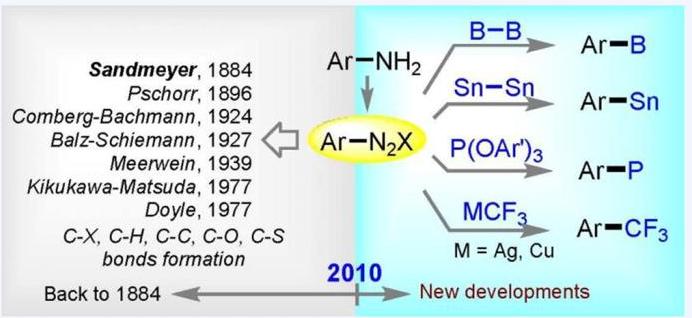
CONSPECTUS: The Sandmeyer reaction represents an important organic transformation that converts an arylamine to an aryl halide using $\mathrm{{Cu}}\left( \mathrm{I}\right)$ halide via a diazonium salt intermediate. The reaction was first reported by Sandmeyer in 1884, and a number of named reactions closely related to it have been developed and widely applied in organic synthesis throughout the 20th century. These include the Pschorr reaction for the synthesis of biaryl tricycles, the Gomberg-Bachmann reaction for biaryl formations, the Balz-Schiemann reaction for C-F bond formations, and the Meerwein reaction for arylation of $\alpha ,\beta$ -unsaturated carbonyl compounds. However, all these reactions were discovered before 1940. In 1977, Doyle and co-workers reported an organic phase diazotization process, and Kikukawa and Matsuda used aryldiazonium salts in transition metal-catalyzed cross-coupling reactions. However, completely new processes involving diazonium salts have been seldom reported since then, although aryldiazonium salts are widely utilized in modern organic synthesis.
综述:桑德迈尔反应是一种重要的有机转化反应,它通过重氮盐中间体,利用$\mathrm{{Cu}}\left( \mathrm{I}\right)$ 卤化物将芳胺转化为芳基卤化物。该反应于1884年由桑德迈尔首次报道,在整个20世纪,许多与之密切相关的命名反应得到了发展,并广泛应用于有机合成中。这些反应包括用于合成联芳基三环的普朔尔反应、用于形成联芳基的贡伯格-巴赫曼反应、用于形成C-F键的巴尔兹-施iemann反应以及用于$\alpha ,\beta$ -不饱和羰基化合物芳基化的米尔温反应。然而,所有这些反应都是在1940年之前发现的。1977年,多伊尔及其同事报道了一种有机相重氮化过程,菊川和松田在过渡金属催化的交叉偶联反应中使用了芳基重氮盐。然而,自那时以来,很少有涉及重氮盐的全新过程被报道,尽管芳基重氮盐在现代有机合成中被广泛使用。
In the past few years, diazonium salt chemistry has been revisited and become a fast-growing research topic. Several novel transformations based on diazonium salts have been developed and have been practiced in organic synthesis. In 2010, we reported a direct conversion of arylamines to pinacol boronates through the reaction of in situ generated aryl diazonium salts with ${\mathrm{B}}_{2}{\mathrm{{pin}}}_{2}$ . This new strategy is under metal-free conditions and thus completely avoids contamination by transition metals in the boron products. From readily available arylamines various functionalized arylboronates, some of which are difficult to access by other methods, can be easily obtained with this reaction. Mechanistic investigations indicate the reaction likely follows a radical mechanism, which is similar to traditional Sandmeyer-type reactions. Subsequently, modified reaction conditions for this transformation appeared in the literature, which include light-induced reactions, aqueous-phase diazotization methods, and reactions with aryltriazenes as the arene diazonium salt surrogates. In addition to the borylation, we have also demonstrated the corresponding stannylation and phosphorylation of arylamines with similar Sandmeyer-type approaches. The stannylation of arylamines was achieved by the reaction of in situ generated diazonium salts with a distannane reagent, while phosphorylation is the reaction of arylamines with trimethyl phosphite in the presence of tert-butyl nitrite ( $t$ -BuONO). With the sequential borylation and stan-nylation approaches, the aromatic compounds bearing two amino groups are easily converted into trimethylstannyl arylboronates, which can be further used in consecutive Stille and Suzuki-Miyaura cross-couplings. Finally, direct conversion of the amino group of arylamines to the trifluoromethyl group has been developed through aryl diazonium salts almost simultaneously by several groups. These reactions represent a novel strategy to achieve trifluoromethylation of aromatic compounds. These developments show the revivification of this age-old chemistry, and this Account will summarize the Sandmeyer reaction-related transformations that have been developed since 2010.
在过去几年中,重氮盐化学被重新审视,并成为一个快速发展的研究课题。基于重氮盐的几种新型转化反应已被开发出来,并在有机合成中得到应用。2010年,我们报道了通过原位生成的芳基重氮盐与${\mathrm{B}}_{2}{\mathrm{{pin}}}_{2}$ 的反应,将芳胺直接转化为频哪醇硼酸酯。这种新策略是在无金属条件下进行的,因此完全避免了硼产物中过渡金属的污染。通过该反应,可以从易得的芳胺中轻松获得各种功能化的芳基硼酸酯,其中一些是通过其他方法难以获得的。机理研究表明,该反应可能遵循自由基机理,这与传统的桑德迈尔型反应类似。随后,文献中出现了该转化反应的改进反应条件,包括光诱导反应、水相重氮化方法以及与芳基三氮烯作为芳烃重氮盐替代物的反应。除了硼化反应,我们还展示了用类似桑德迈尔型方法对芳胺进行相应的锡化和磷酸化反应。芳胺的锡化反应是通过原位生成的重氮盐与二锡试剂反应实现的,而磷酸化反应是芳胺在亚硝酸叔丁酯($t$ -BuONO)存在下与亚磷酸三甲酯的反应。通过连续的硼化和锡化方法,带有两个氨基的芳香化合物很容易转化为三甲基锡芳基硼酸酯,可进一步用于连续的施蒂勒和铃木-宫浦交叉偶联反应。最后,几个研究小组几乎同时通过芳基重氮盐开发了将芳胺的氨基直接转化为三氟甲基的方法。这些反应代表了一种实现芳香化合物三氟甲基化的新策略。这些进展表明了这种古老化学的复兴,本综述将总结自2010年以来开发的与桑德迈尔反应相关的转化反应。
1. INTRODUCTION
1. 引言
Arylamines are ubiquitous in research laboratories and staple chemicals in industry. Due to their low cost, ready availability and diverse reactivity, arylamines have broad applications in the preparation of value-added chemicals, ranging from colorants and agrochemicals to polyurethanes. ${}^{1}$ In addition, the amino groups in aromatic compounds can serve as a scaffold for the introduction of various functional groups to aromatic rings, in particular through Sandmeyer-type reactions. ${}^{2}$ In a Sandmeyer-type reaction, the primary aromatic amino group is replaced by halo, cyano, azido, or hydroxyl groups and so on, through a diazotization-substitution sequence. Diazonium salts, which play the key role in these transformations, were first discovered by Griefs in ${1858.}^{3}$ They had been developed into versatile intermediates in a series of named reactions, among which Sandmeyer reaction was the first to demonstrate the usefulness of diazonium salt in organic synthesis. In 1884, Sandmeyer disclosed that by treatment with CuCl, CuBr, or CuCN, benzenediazonium salt could be converted into chlorobenzene, bromobenzene, and benzonitrile, respectively. ${}^{4}$ Since then various useful transformations based on diazonium salts had been invented in the following decades, including Pschorr biaryltri-cycle synthesis (1896), Gomberg-Bachmann biaryl synthesis (1924), ${}^{6}$ Balz-Schiemann C-F bond formation (1927) ${}^{7}$ and Meerwein arylation reaction (1939). ${}^{8}$ The reactions, which involve diazonium salt as the key intermediate, can be generally categorized as Sandmeyer-type transformations.
芳基胺在研究实验室中普遍存在,也是工业中的主要化学品。由于其成本低、易于获得且反应活性多样,芳基胺在制备增值化学品方面具有广泛应用,从着色剂、农用化学品到聚氨酯。${}^{1}$此外,芳香族化合物中的氨基可作为在芳香环上引入各种官能团的骨架,特别是通过桑德迈尔型反应。${}^{2}$在桑德迈尔型反应中,通过重氮化 - 取代序列,伯芳香氨基被卤素、氰基、叠氮基或羟基等取代。重氮盐在这些转化中起关键作用,最早由格里夫斯于${1858.}^{3}$发现。它们已发展成为一系列命名反应中的通用中间体,其中桑德迈尔反应是第一个证明重氮盐在有机合成中有用性的反应。1884年,桑德迈尔披露,通过用CuCl、CuBr或CuCN处理,苯重氮盐可分别转化为氯苯、溴苯和苯甲腈。${}^{4}$从那时起,在接下来的几十年中发明了各种基于重氮盐的有用转化,包括普朔尔联芳三环合成(1896年)、贡伯格 - 巴赫曼联芳合成(1924年)、${}^{6}$巴尔兹 - 施iemann C - F键形成(1927年)${}^{7}$和迈尔温芳基化反应(1939年)。${}^{8}$这些涉及重氮盐作为关键中间体的反应通常可归类为桑德迈尔型转化。
Received: November 12, 2017
收到日期:2017年11月12日
In 1977, Doyle and co-workers developed an organic phase diazotization process that could allow the formation of diazonium salts in organic solution. ${}^{9}$ This method significantly expanded the synthetic utility of diazonium salts in organic synthesis. On the other hand, pioneered by Kikukawa and Matsuda in 1977, aryldiazonium salts have been utilized in transition metal-catalyzed cross-coupling reactions. ${}^{10}$ This opens up the possibility of using aryldiazonium salts as pseudo-halides in cross-coupling reactions.
1977年,多伊尔及其同事开发了一种有机相重氮化方法,该方法可使重氮盐在有机溶液中形成。${}^{9}$此方法显著扩展了重氮盐在有机合成中的合成效用。另一方面,1977年由菊川和松田开创,芳基重氮盐已用于过渡金属催化的交叉偶联反应。${}^{10}$这开辟了在交叉偶联反应中使用芳基重氮盐作为拟卤化物的可能性。
However, by scrutinizing this history, one can conclude that the research on Sandmeyer-type reactions has remained dormant for decades, and mechanistically new processes involving diazonium salts have seldom been reported since the 1980s, although these well-established transformations are widely practiced on a daily basis in both large scale industrial production and research laboratories. Around 2010, we became involved in the Sandmeyer-type transformations accidentally. In a project, we needed to convert an aromatic amino group into a pinacol boronate. The standard procedure for converting arylamines into arylboronic acids or boronates requires two steps, namely, a Sandmeyer reaction to convert the amine into halide, followed by the Grignard approach or a palladium-catalyzed borylation process. Although the two-step procedure for the conversion of arylamines into arylboronates is reliable, it is usually not very efficient because of the generally low-yielding and tedious separation procedures required. We envisaged that it might be possible to bypass the halogenation step and directly convert the amino group into the boronate group in a single step. Gratifyingly, this preliminary vision eventually led to our development of a series of new transformations, which are all based on aryldiazonium salts, namely, Sandmeyer-type reactions. Herein we summarize our findings, along with the related reactions developed in other laboratories.
然而,通过审视这段历史可以得出结论,对桑德迈尔型反应的研究几十年来一直处于停滞状态,自20世纪80年代以来,很少有涉及重氮盐的新机理过程被报道,尽管这些成熟的转化在大规模工业生产和研究实验室中每天都广泛应用。大约在2010年,我们意外地参与了桑德迈尔型转化。在一个项目中,我们需要将一个芳香氨基转化为频哪醇硼酸酯。将芳基胺转化为芳基硼酸或硼酸酯的标准程序需要两步,即通过桑德迈尔反应将胺转化为卤化物,然后是格氏方法或钯催化的硼化过程。尽管将芳基胺转化为芳基硼酸酯的两步程序是可靠的,但由于通常需要低产率且繁琐的分离程序,它通常不是非常有效。我们设想有可能绕过卤化步骤,直接一步将氨基转化为硼酸酯基团。令人欣慰的是,这一初步设想最终导致我们开发了一系列基于芳基重氮盐的新转化,即桑德迈尔型反应。在此,我们总结我们的发现,以及其他实验室开发的相关反应。
2. DIRECT CONVERSION OF AN AROMATIC AMINO GROUP INTO A BORON GROUP
2. 芳香氨基直接转化为硼基团
Due to the wide application of Suzuki-Miyaura cross-coupling, there has been an increasing demand for various organo boron compounds from both research laboratories and industry. Traditionally, the synthesis of boronic acids relied on the trapping of organolithium or Grignard reagents with a trialkyl borate, followed by acidic hydrolysis. ${}^{11}$ The method is powerful, but it suffers from drawbacks such as rigorously anhydrous conditions normally required for organometallic reagents and narrow functional group compatibility. Transition-metal-catalyzed cross coupling of aryl bromides or iodides with bis(pinacolato)diboron $\left( {{\mathrm{B}}_{2}{\mathrm{{pin}}}_{2}}\right)$ was disclosed by Miyaura and co-workers in 1995, which has become another important approach toward aryl boron compounds. ${}^{12}$ Notably, diazonium salts have also been utilized in this transition-metal-catalyzed borylation process to furnish the corresponding arylboronates. ${}^{13}$ Moreover, efforts have been devoted to the transition-metal-catalyzed direct borylation of aromatic $\mathrm{C} - \mathrm{H}$ bonds for arylboronates synthesis. ${}^{14}$ Notably, all of these borylation methods require metals, either as catalysts or as stoichiometric reagents.
由于铃木-宫浦交叉偶联反应的广泛应用,研究实验室和工业界对各种有机硼化合物的需求日益增加。传统上,硼酸的合成依赖于用硼酸三烷基酯捕获有机锂试剂或格氏试剂,然后进行酸性水解。${}^{11}$ 该方法很有效,但存在一些缺点,例如有机金属试剂通常需要严格的无水条件以及官能团兼容性窄。1995年,宫浦及其同事公开了芳基溴化物或碘化物与双(频哪醇)二硼的过渡金属催化交叉偶联反应 $\left( {{\mathrm{B}}_{2}{\mathrm{{pin}}}_{2}}\right)$,这已成为合成芳基硼化合物的另一种重要方法。${}^{12}$ 值得注意的是,重氮盐也已用于这种过渡金属催化的硼化过程中以提供相应的芳基硼酸酯。${}^{13}$ 此外,人们致力于芳基硼酸酯合成中芳香 $\mathrm{C} - \mathrm{H}$ 键的过渡金属催化直接硼化反应。${}^{14}$ 值得注意的是,所有这些硼化方法都需要金属,要么作为催化剂,要么作为化学计量试剂。
With the prediction that direct conversion of an aromatic amino group into a boron group might be possible, we started the exploration by using Doyle’s in situ diazotization approach with $t$ -BuONO. Through extensive screening of the reaction conditions, we could indeed achieve the goal of the proposed borylation through the reaction of aromatic amine, $t$ -BuONO, and ${\mathrm{B}}_{2}{\left( \mathrm{{pin}}\right) }_{2}$ (Scheme 1). ${}^{15}$ This metal-free transformation
鉴于预测芳香氨基可能直接转化为硼基团,我们开始使用多伊尔的原位重氮化方法与 $t$ -丁基亚硝酸酯进行探索。通过广泛筛选反应条件,我们确实可以通过芳香胺、$t$ -丁基亚硝酸酯和 ${\mathrm{B}}_{2}{\left( \mathrm{{pin}}\right) }_{2}$ 的反应实现所提出的硼化目标(方案1)。${}^{15}$ 这种无金属转化
Scheme 1. Preliminary Results of Metal-Free Borylation of Arylamines
方案1. 芳胺的无金属硼化初步结果
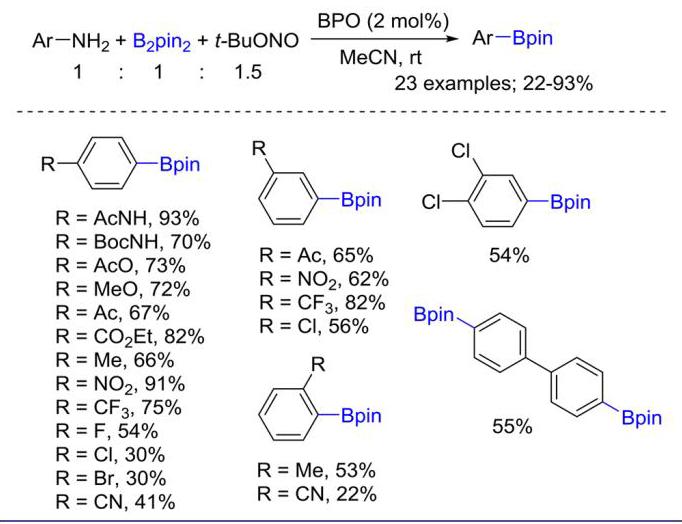
follows a Sandmeyer-type reaction sequence: the arylamine is first converted into the corresponding diazonium ion by the reaction with $t$ -BuONO, followed by the reaction of diazonium ion with ${\mathrm{B}}_{2}{\mathrm{{pin}}}_{2}$ to deliver the final product. The reaction is promoted by the radical initiator dibenzoyl peroxide (BPO), and it is complete at room temperature within $1 - 2\mathrm{\;h}$ . Arylamines bearing various functionalities can be engaged in this transformation, and the corresponding borylation products are obtained in moderate to good yields; however, for heteroaromatic amines and some ortho-substituted arylamines, the reaction only gives trace amount of the products.
遵循桑德迈尔型反应序列:芳胺首先通过与 $t$ -丁基亚硝酸酯反应转化为相应的重氮离子,然后重氮离子与 ${\mathrm{B}}_{2}{\mathrm{{pin}}}_{2}$ 反应生成最终产物。该反应由自由基引发剂二苯甲酰过氧化物(BPO)促进,在室温下 $1 - 2\mathrm{\;h}$ 内完成。带有各种官能团的芳胺可以参与这种转化,并以中等至良好的产率获得相应的硼化产物;然而,对于杂环胺和一些邻位取代的芳胺,反应仅产生痕量产物。
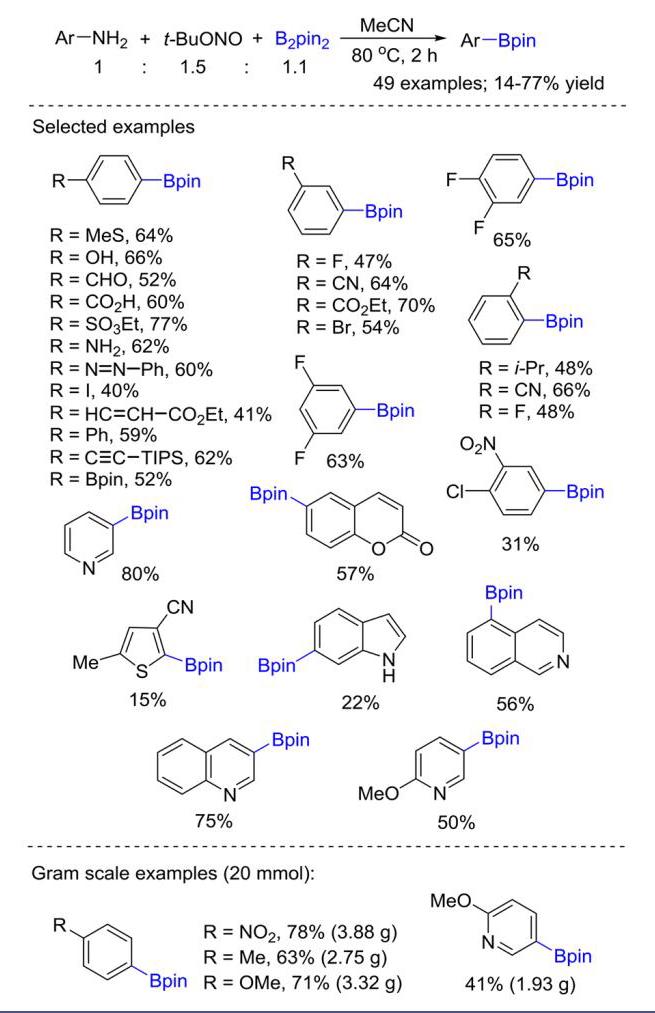
Subsequently, we modified this metal-free borylation by simply carrying out the reaction at an elevated temperature in the absence of BPO. The modified conditions turn out to be compatible with a broader substrate scope, including ortho-substituted arylamines, amines with unprotected hydroxyl and amino groups, aldehydes, and more importantly, heterocyclic amines (Scheme 2). ${}^{16}$ It has been observed that electron-deficient heterocyclic amines exhibit high reactivity to afford the borylation products, while electron-rich heterocyclic amines are prone to oxidation in the presence of $t$ -BuONO, thus resulting in diminished yields. The reaction can be carried out in gram scale for selected substrates. ${}^{17}$
随后,我们通过在无BPO的情况下在升高温度下简单地进行反应来改进这种无金属硼化。改进后的条件与更广泛的底物范围兼容,包括邻位取代的芳胺、具有未保护羟基和氨基的胺、醛,更重要的是杂环胺(方案2)。${}^{16}$ 据观察,缺电子杂环胺表现出高反应活性以提供硼化产物,而富电子杂环胺在 $t$ -丁基亚硝酸酯存在下容易氧化,从而导致产率降低。该反应可以对选定的底物进行克级规模的操作。${}^{17}$
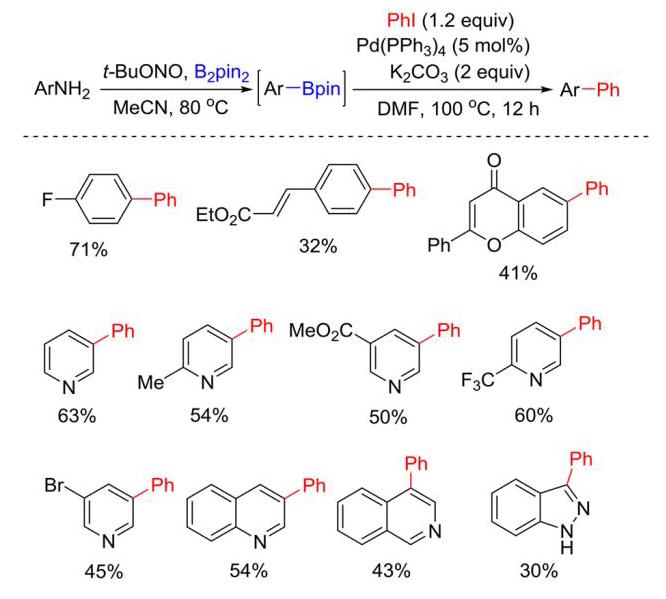
Arylboronates, in particular heterocyclic boronates, are in some cases not stable under silica gel column chromatographic conditions. To avoid the possible borylation product decomposition in purification, a sequential Sandmeyer-type borylation and Pd-catalyzed cross-coupling reaction was performed. Thus, upon completion of the borylation, the solvent MeCN was removed under reduced pressure to leave the crude borylation product, which was then subjected to Pd-catalyzed Suzuki-Miyaura cross-coupling reaction without further purification. The sequential process afforded the coupling products in moderate yields (Scheme 3).
芳基硼酸酯,特别是杂环硼酸酯,在某些情况下在硅胶柱色谱条件下不稳定。为避免纯化过程中可能的硼化产物分解,进行了连续的桑德迈尔型硼化和钯催化的交叉偶联反应。因此,硼化反应完成后,在减压下除去溶剂乙腈以留下粗硼化产物,然后将其直接进行钯催化的铃木-宫浦交叉偶联反应而无需进一步纯化。该连续过程以中等产率提供偶联产物(方案3)。
Scheme 2. Metal-Free Borylation of Arylamines under Modified Conditions
方案2. 改进条件下芳胺的无金属硼化
Scheme 3. Sequential Borylation and Pd-Catalyzed Cross-Coupling Reaction
方案3. 连续硼化和钯催化的交叉偶联反应
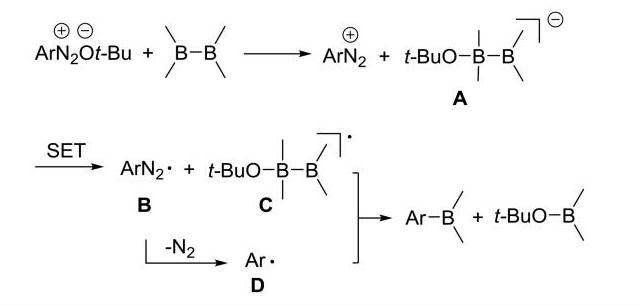
The metal-free borylation raises intriguing questions concerning its reaction mechanism. Since it has been generally recognized that Sandmeyer-type reactions proceed through a radical mechanism, it is likely that the borylation reaction may follow a similar radical pathway. To substantiate such an assumption, a series of radical trapping experiments were carried out. First, in the presence of 1.5 equiv of radical scavenger (TEMPO), the reaction became sluggish and produced only 8% yield of the borylation product (eq 1). A control experiment demonstrated that TEMPO did not react directly with ${\mathrm{B}}_{2}{\mathrm{{pin}}}_{2}$ under identical conditions. Next, heating a 1:1 mixture of dibenzoyl peroxide (BPO) and ${\mathrm{B}}_{2}{\mathrm{{pin}}}_{2}$ in MeCN at ${100}{}^{ \circ }\mathrm{C}$ for $4\mathrm{\;h}$ afforded phenyl pinacoboronate in 37% yield (eq 2). It is known that BPO undergoes homolytic cleavage under thermal conditions to the benzoyloxy radical, followed by subsequent extrusion of ${\mathrm{{CO}}}_{2}$ to form the phenyl radical. Thus, the borylation product is likely formed by the reaction of phenyl radical with ${\mathrm{B}}_{2}{\mathrm{{pin}}}_{2}$ . We also confirmed that the reaction between the relatively stable $\left\lbrack {\mathrm{{PhN}}}_{2}\right\rbrack \left\lbrack {\mathrm{{BF}}}_{4}\right\rbrack$ and ${\mathrm{B}}_{2}{\mathrm{{pin}}}_{2}$ gave the expected borylation product, but base additives played an important role in the reaction (eq 3). salt from the arylamine and $t - \mathrm{{BuONO}}$ , the $t - {\mathrm{{BuO}}}^{ - }$ interacts with ${\mathrm{B}}_{2}{\mathrm{{pin}}}_{2}$ to form a tetra-coordinated boron complex $\mathbf{A}$ . This adduct has been recently confirmed and fully characterized by Marder and co-workers. ${}^{18}$ Then single electron transfer (SET) between complex $\mathbf{A}$ and aryldiazonium ion occurs to generate radical $\mathbf{B}$ , from which aryl radical $\mathbf{D}$ is generated through ${\mathrm{N}}_{2}$ extrusion. Finally, reaction of aryl radical D with intermediate C gives the borylation product. However, alternative mechanisms involving an ionic process, such as nucleophilic aromatic substitution of the aryldiazonium salt by the boronate complex, cannot be strictly ruled out.
无金属硼化反应引发了关于其反应机理的有趣问题。由于人们普遍认为桑德迈尔型反应是通过自由基机理进行的,硼化反应很可能遵循类似的自由基途径。为了证实这一假设,进行了一系列自由基捕获实验。首先,在存在1.5当量自由基清除剂(TEMPO)的情况下,反应变得迟缓,硼化产物的产率仅为8%(式1)。对照实验表明,在相同条件下,TEMPO不会与${\mathrm{B}}_{2}{\mathrm{{pin}}}_{2}$直接反应。接下来,在MeCN中于${100}{}^{ \circ }\mathrm{C}$将过氧化二苯甲酰(BPO)和${\mathrm{B}}_{2}{\mathrm{{pin}}}_{2}$的1:1混合物加热$4\mathrm{\;h}$,得到产率为37%的苯基频哪醇硼酸酯(式2)。已知BPO在热条件下发生均裂生成苯甲酰氧基自由基,随后挤出${\mathrm{{CO}}}_{2}$形成苯基自由基。因此,硼化产物可能是由苯基自由基与${\mathrm{B}}_{2}{\mathrm{{pin}}}_{2}$反应形成的。我们还证实,相对稳定的$\left\lbrack {\mathrm{{PhN}}}_{2}\right\rbrack \left\lbrack {\mathrm{{BF}}}_{4}\right\rbrack$与${\mathrm{B}}_{2}{\mathrm{{pin}}}_{2}$之间的反应得到了预期的硼化产物,但碱添加剂在反应中起重要作用(式3)。芳胺与$t - \mathrm{{BuONO}}$形成的盐,$t - {\mathrm{{BuO}}}^{ - }$与${\mathrm{B}}_{2}{\mathrm{{pin}}}_{2}$相互作用形成四配位硼配合物$\mathbf{A}$。该加合物最近已得到Marder及其同事的证实和充分表征。${}^{18}$然后,配合物$\mathbf{A}$与芳基重氮离子之间发生单电子转移(SET)生成自由基$\mathbf{B}$,通过${\mathrm{N}}_{2}$挤出从中生成芳基自由基$\mathbf{D}$。最后,芳基自由基D与中间体C反应得到硼化产物。然而,涉及离子过程的替代机理,如硼酸酯配合物对芳基重氮盐的亲核芳香取代,不能被严格排除。
$$ \begin{array}{l} {\mathrm{{PhNH}}}_{2} + {\mathrm{B}}_{2}{\mathrm{{pin}}}_{2} + t - \mathrm{{BuONO}} + \text{ TEMPO }\xrightarrow[{\text{ rt, }4\mathrm{\;h}}]{\mathrm{{MeCN}}}\mathrm{{Ph}} - \mathrm{{Bpin}} \\ {1.1}\text{ equiv }{1.5}\text{ equiv }{1.5}\text{ equiv } \\ \end{array} \tag{1} $$(2)
MeCN
乙腈
(PhCOO)2 ${\mathrm{B}}_{2}{\mathrm{{pin}}}_{2}$ Ph-Bpin
(苯甲酰氧基)₂ ${\mathrm{B}}_{2}{\mathrm{{pin}}}_{2}$ 苯基硼酸频哪醇酯
1 equiv
1当量
100 °C, 4 h
100摄氏度,4小时
37%
$$ {}_{\left\lbrack {\mathrm{{Ph}}{\mathrm{N}}_{2}}\right\rbrack \left\lbrack {\mathrm{{BF}}}_{4}\right\rbrack + {\mathrm{B}}_{2}{\mathrm{{pin}}}_{2}}^{ \oplus }\xrightarrow[\text{ additive, rt,10 min }]{\mathrm{{MeCN}}}\mathrm{{Ph}} - \mathrm{{Bpin}} $$(3)
additive (mol%) yield
添加剂(摩尔%) 产率
none 0%
无 0%
KOt-Bu (100) 40%
叔丁醇钾(100)40%
NaOt-Bu (100) 7%
叔丁醇钠(100)7%
A possible reaction mechanism is proposed based on these observations (Scheme 4). First, upon the formation of diazonium
基于这些观察结果提出了一种可能的反应机理(方案4)。首先,在重氮盐形成时
Scheme 4. Possible Reaction Mechanism
方案4. 可能的反应机理
Following our report in 2010, a series of similar Sandmeyer-type borylations under modified conditions appeared in the literature. Zhu and Yamane used aryltriazenes as the precursors of diazonium salts and developed a borylation reaction (Scheme 5a). ${}^{19}$ Yan and co-workers reported an organic dye (eosin Y)-catalyzed photopromoted reduction of stable aryldiazonium tetrafluorobo-rate salts to generate free aryl radicals that are borylated with ${\mathrm{B}}_{2}{\mathrm{{pin}}}_{2}$ (Scheme 5b). ${}^{20}$ This photoredox protocol could also be extended to in situ generated diazonium salts from arylamines
继我们在2010年发表的报告之后,一系列在改良条件下的类似桑德迈尔型硼化反应出现在文献中。朱和山根使用芳基三氮烯作为重氮盐的前体,并开发了一种硼化反应(方案5a)。${}^{19}$ 严及其同事报道了一种有机染料(曙红Y)催化的光促进稳定芳基重氮四氟硼酸盐的还原反应,以生成可与${\mathrm{B}}_{2}{\mathrm{{pin}}}_{2}$进行硼化反应的游离芳基自由基(方案5b)。${}^{20}$ 这种光氧化还原方案也可以扩展到由芳胺原位生成的重氮盐
				Scheme 5. Various Sandmeyer-type Borylations of

				Arylamines or Aryldiazonium Salts
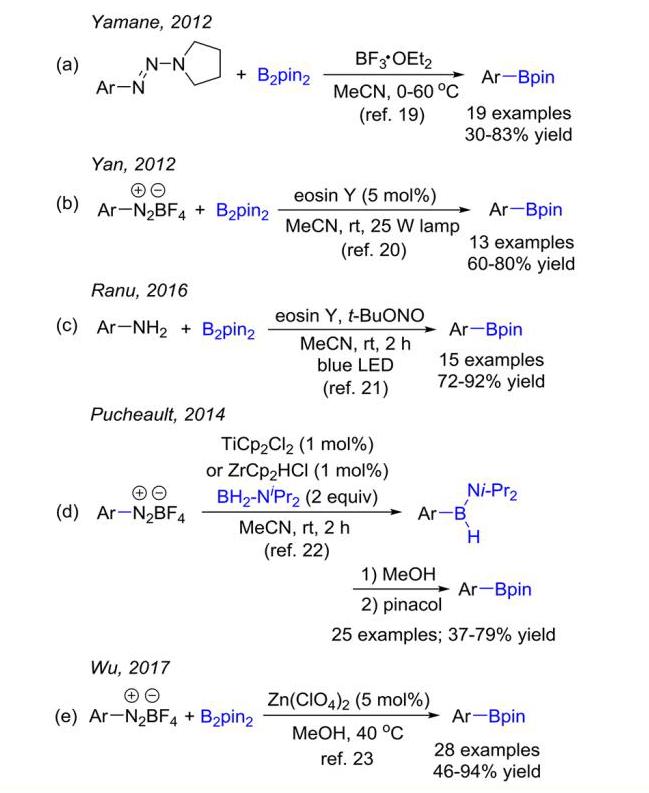
and $t$ -BuONO. Ranu reported that using the same photocatalyst, eosin Y, a variety of anilines were borylated to give the corresponding arylboronates in the presence of $t$ -BuONO and ${\mathrm{B}}_{2}{\mathrm{{pin}}}_{2}$ at room temperature with visible light irradiation (Scheme 5c). ${}^{21}$
和$t$-叔丁基亚硝酸酯。拉努报道,使用相同的光催化剂曙红Y,在室温下,在$t$-叔丁基亚硝酸酯和${\mathrm{B}}_{2}{\mathrm{{pin}}}_{2}$存在下,通过可见光照射,多种苯胺被硼化得到相应的芳基硼酸酯(方案5c)。${}^{21}$
Pucheault and co-workers disclosed that a series of titanocene and zirconocene reagents were capable of promoting borylation of anilines to form boronates (Scheme 5d). ${}^{22}$ Interestingly, this protocol uses diisopropylaminoborane $\left( {{\mathrm{H}}_{2}\mathrm{{BNi}} - {\mathrm{{Pr}}}_{2}}\right)$ as the borylating agent, and the reaction was proposed to proceed through a radical chain mechanism. Very recently, Wu and co-workers demonstrated a zinc-catalyzed borylation of aryldia-zonium salts and aryltriazenes toward arylboronate synthesis. ${}^{23}$ The reaction was carried out in methanol with $5\% \mathrm{{Zn}}{\left( {\mathrm{{ClO}}}_{4}\right) }_{2}$ catalyst at ${40}^{ \circ }\mathrm{C}$ , providing various arylboronates (Scheme 5e).
普肖和他的同事们披露,一系列二茂钛和二茂锆试剂能够促进苯胺的硼化反应,生成硼酸酯(方案5d)。${}^{22}$有趣的是,该方案使用二异丙基氨基硼烷$\left( {{\mathrm{H}}_{2}\mathrm{{BNi}} - {\mathrm{{Pr}}}_{2}}\right)$作为硼化剂,并且该反应被认为是通过自由基链式机理进行的。最近,吴和他的同事们展示了一种锌催化的芳基重氮盐和芳基三氮烯向芳基硼酸酯合成的硼化反应。${}^{23}$该反应在甲醇中与$5\% \mathrm{{Zn}}{\left( {\mathrm{{ClO}}}_{4}\right) }_{2}$催化剂在${40}^{ \circ }\mathrm{C}$条件下进行,得到了各种芳基硼酸酯(方案5e)。
Diazotizations were typically conducted in aqueous solution in the early days. Although aqueous conditions have sometimes restricted the substrate scope due to functional group compatibility or solubility issues, there are also potential advantages of using water as solvent, such as low cost, safety, and environmental benefits. Thus, to develop Sandmeyer-type borylation under aqueous conditions is desirable. In 2014, the groups of ${\mathrm{{Xue}}}^{24}$ and Blanchet ${}^{25}$ independently reported aqueous phase diazotization conditions for the conversion of arylamines to arylboronates. In Xue’s work, the first diazotization step was conducted at $0 - 5{}^{ \circ }\mathrm{C}$ in mixed solvent of $\mathrm{{MeOH}}/\mathrm{{aq}}$ . HCl. Upon the formation of the diazonium salt, a solution of ${\mathrm{B}}_{2}{\mathrm{{pin}}}_{2}$ was added. They found that for the second step protic solvents such as alcohols and organic acids are superior to aprotic solvents like DMF, THF, MeCN, etc. In addition, they expanded the borylation with ${\mathrm{B}}_{2}{\left( \mathrm{{OH}}\right) }_{4}$ as the boron source, affording arylboronic acids as the products (Scheme 6a). In Blanchet’s method, ${}^{{25}\mathrm{a}}$ the most attractive advantage is that the reaction proceeded very fast, as the reactions went to completion in around 0.5 h. In their protocol starting from anilines, the reaction
早期重氮化反应通常在水溶液中进行。尽管由于官能团兼容性或溶解性问题,水相条件有时会限制底物范围,但使用水作为溶剂也有潜在的优点,比如成本低、安全和环境效益好。因此,开发水相条件下的桑德迈尔型硼化反应是很有必要的。2014年,${\mathrm{{Xue}}}^{24}$和布兰切特${}^{25}$的团队分别独立报道了将芳胺转化为芳基硼酸酯的水相重氮化条件。在薛的工作中,第一步重氮化反应在$0 - 5{}^{ \circ }\mathrm{C}$于$\mathrm{{MeOH}}/\mathrm{{aq}}$.HCl的混合溶剂中进行。在重氮盐形成后,加入${\mathrm{B}}_{2}{\mathrm{{pin}}}_{2}$的溶液。他们发现对于第二步反应,质子性溶剂如醇类和有机酸优于非质子性溶剂如DMF、THF、MeCN等。此外,他们扩展了以${\mathrm{B}}_{2}{\left( \mathrm{{OH}}\right) }_{4}$作为硼源的硼化反应,得到芳基硼酸作为产物(方案6a)。在布兰切特的方法中,${}^{{25}\mathrm{a}}$最吸引人的优点是反应进行得非常快,因为反应在大约0.5小时内就完成了。在他们从苯胺开始的方案中,反应
															Scheme 6. Aqueous Phase Diazotization for Conversion of

															Arylamines to Arylboronates or Arylboronic Acids
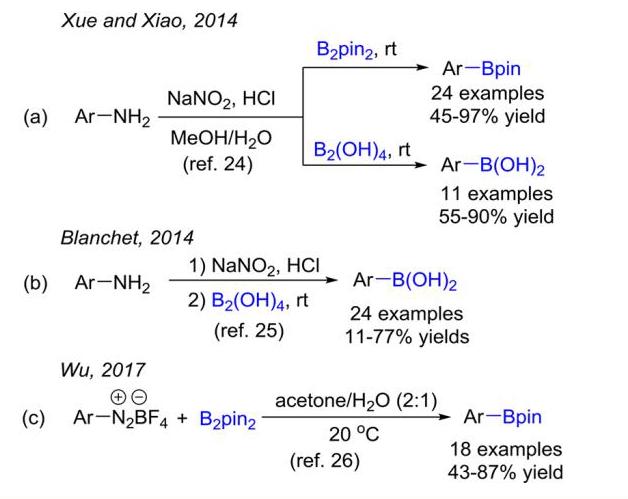
solvent was water, and ${\mathrm{B}}_{2}{\left( \mathrm{{OH}}\right) }_{4}$ was used as the boron source (Scheme 6b). Furthermore, they combined this one-pot fast borylation method with other reactions such as esterification, Suzuki-Miyaura coupling, hydrogenolysis, and Petasis borono-Mannich for rapidly achieving molecular diversity. ${}^{{25}\mathrm{\;b}}$
溶剂是水,并且${\mathrm{B}}_{2}{\left( \mathrm{{OH}}\right) }_{4}$被用作硼源(方案6b)。此外,他们将这种一锅法快速硼化方法与其他反应如酯化、铃木 - 宫浦偶联、氢解和佩塔西斯硼基 - 曼尼希反应相结合,以快速实现分子多样性。${}^{{25}\mathrm{\;b}}$
More recently, Wu further demonstrated that the borylation of stable diazonium tetrafluoroborates could proceed under catalyst-free conditions in acetone-water solution (Scheme 6c). ${}^{26}$ Control experiments indicate that water plays a crucial role in promoting the borylation of diazonium tetrafluoroborates. Mechanistically, the reaction proceeds through a radical pathway, as TEMPO or BHP completely inhibited the desired transformation.
最近,吴进一步证明了稳定的四氟硼酸重氮盐的硼化反应可以在无催化剂条件下在丙酮 - 水溶液中进行(方案6c)。${}^{26}$对照实验表明水在促进四氟硼酸重氮盐的硼化反应中起着关键作用。从机理上讲,该反应通过自由基途径进行,因为TEMPO或BHP完全抑制了所需的转化。
3. STANNYLATION OF DIAZONIUM SALT FOR C-Sn BOND FORMATION
3. 用于形成C-Sn键的重氮盐的锡基化反应
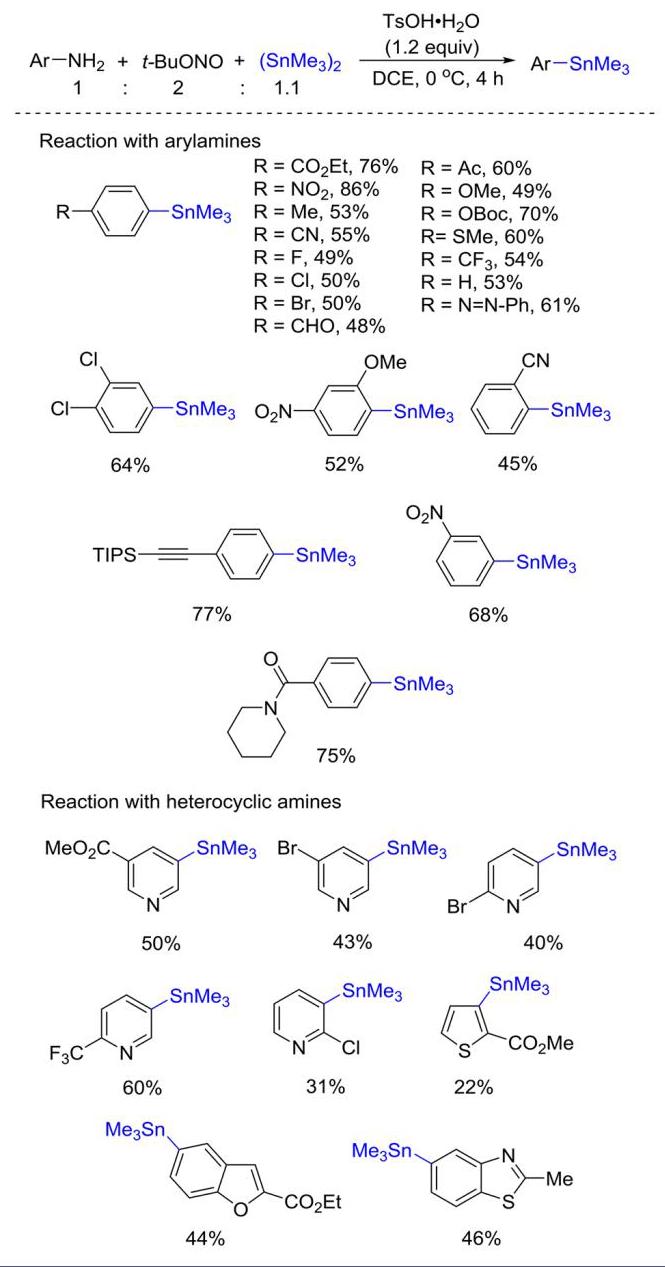
Encouraged by the success in Sandmeyer-type borylation, we further set out to explore other transformations involving diazonium salts as reactive intermediates. Similar to organoboron compounds, organotin compounds are also important and widely used in transition-metal-catalyzed cross-coupling reactions, namely Stille coupling. After extensive exploration, we realized the first stannylation of diazonium salts (Scheme 7). ${}^{27}$ In contrast to borylation, stannylation requires one equivalent of acid to promote the diazotization process. The choice of stannylating reagent is another crucial parameter, as all optimization efforts with hexabutyldistannane as stannylating reagent turned out to be futile. In contrast, with hexamethyldistannane, the reaction gives a decent yield of the desired product. The optimized condition is simple: 1.5 equiv of $t$ -BuONO,1.1 equiv of ${\mathrm{{Me}}}_{3}{\mathrm{{SnSnMe}}}_{3}$ , and 1.2 equiv of $p$ -toluenesulfonic acid at $0{}^{ \circ }\mathrm{C}$ in DCE for $4\mathrm{\;h}$ . The scope of substrates is wide, including a series of functionalized aniline derivatives. The reaction has shown excellent tolerance to both electron-withdrawing and -donating groups on the aromatic ring. The reaction is also scalable. In a representative example,15 mmol of $p$ -toluidine was subjected to the standard conditions, affording ${1.95}\mathrm{\;g}$ of the corresponding product (51% yield). Heterocyclic amines were also engaged in this stannylation; however, the yields were only low to moderate. The substrates bearing electron-deficient rings afforded relatively higher yields than electron-rich ones under the standard conditions. This is partially because the electron-rich heterocyclic stannanes are sensitive to moisture and silica gel column chromatography. Since purification of aryl stannane compounds is tedious and some aryl stannanes are not stable, the Pd-catalyzed Stille coupling was performed with the crude stannylation products. Moderate to good yields of the biaryl coupling products could be obtained.
在桑德迈尔型硼化反应取得成功的鼓舞下,我们进一步着手探索其他涉及重氮盐作为反应中间体的转化反应。与有机硼化合物类似,有机锡化合物也很重要,并且广泛应用于过渡金属催化的交叉偶联反应,即施蒂勒偶联反应。经过广泛探索,我们实现了重氮盐的首次锡基化反应(方案7)。${}^{27}$与硼化反应不同,锡基化反应需要一当量的酸来促进重氮化过程。锡基化试剂的选择是另一个关键参数,因为所有以六丁基二锡烷作为锡基化试剂的优化尝试都徒劳无功。相比之下,使用六甲基二锡烷时,反应能得到产率不错的所需产物。优化后的条件很简单:在二氯乙烷中,1.5当量的$t$ -丁基亚硝酸酯、1.1当量的${\mathrm{{Me}}}_{3}{\mathrm{{SnSnMe}}}_{3}$和1.2当量的$p$ -甲苯磺酸,于$0{}^{ \circ }\mathrm{C}$反应$4\mathrm{\;h}$ 。底物范围广泛,包括一系列官能化的苯胺衍生物。该反应对芳环上的吸电子基团和供电子基团均表现出优异的耐受性。该反应也具有可扩展性。在一个代表性实例中,15 mmol的$p$ -甲苯胺在标准条件下反应,得到${1.95}\mathrm{\;g}$相应产物(产率51%)。杂环胺也能参与此锡基化反应;然而,产率仅为低到中等。在标准条件下,带有缺电子环的底物比富电子底物的产率相对更高。部分原因是富电子的杂环锡烷对水分和硅胶柱色谱敏感。由于芳基锡化合物的纯化繁琐且一些芳基锡不稳定,因此对粗锡基化产物进行了钯催化的施蒂勒偶联反应。可以得到中等至良好产率的联芳基偶联产物。
Scheme 7. Sandmeyer-Type Stannylation
方案7. 桑德迈尔型锡基化反应
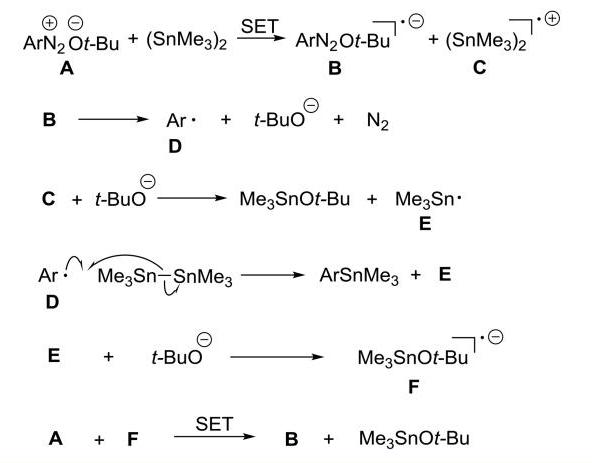
Based on the fact that the reaction was completely inhibited by a stoichiometric amount of TEMPO, we proposed a similar radical pathway to account for the reaction mechanism (Scheme 8). Single electron transfer between the diazonium salt and ${\left( {\mathrm{{Me}}}_{3}\mathrm{{Sn}}\right) }_{2}$ gives a radical anion species $\mathbf{B}$ and a radical cation species C. Radical B decomposes to aryl radical D, while radical $\mathbf{C}$ undergoes cleavage of the $\mathrm{{Sn}} - \mathrm{{Sn}}$ bond with the assistance of the $t$ -butoxide anion to release the trimethylstannyl radical E. The product could be formed from the reaction of aryl radical $\mathbf{D}$ with ${\left( {\mathrm{{Me}}}_{3}\mathrm{{Sn}}\right) }_{2}$ . Radical $\mathbf{E}$ may react with the $t$ -butoxide anion to give radical anion $\mathbf{F}$ , which reduces the diazonium salt to intermediate $\mathbf{B}$ .
基于该反应被化学计量的 TEMPO 完全抑制这一事实,我们提出了类似的自由基途径来解释反应机理(方案 8)。重氮盐与${\left( {\mathrm{{Me}}}_{3}\mathrm{{Sn}}\right) }_{2}$之间的单电子转移产生一个自由基阴离子物种$\mathbf{B}$和一个自由基阳离子物种 C。自由基 B 分解为芳基自由基 D,而自由基$\mathbf{C}$在$t$-丁氧基阴离子的协助下发生$\mathrm{{Sn}} - \mathrm{{Sn}}$键的裂解,释放出三甲基锡自由基 E。产物可由芳基自由基$\mathbf{D}$与${\left( {\mathrm{{Me}}}_{3}\mathrm{{Sn}}\right) }_{2}$反应形成。自由基$\mathbf{E}$可能与$t$-丁氧基阴离子反应生成自由基阴离子$\mathbf{F}$,后者将重氮盐还原为中间体$\mathbf{B}$。
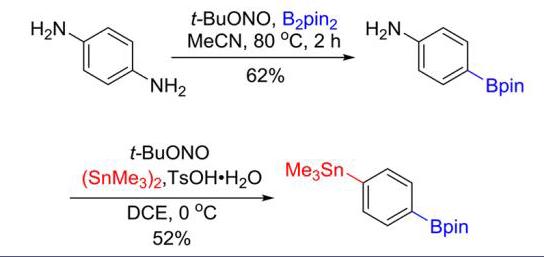
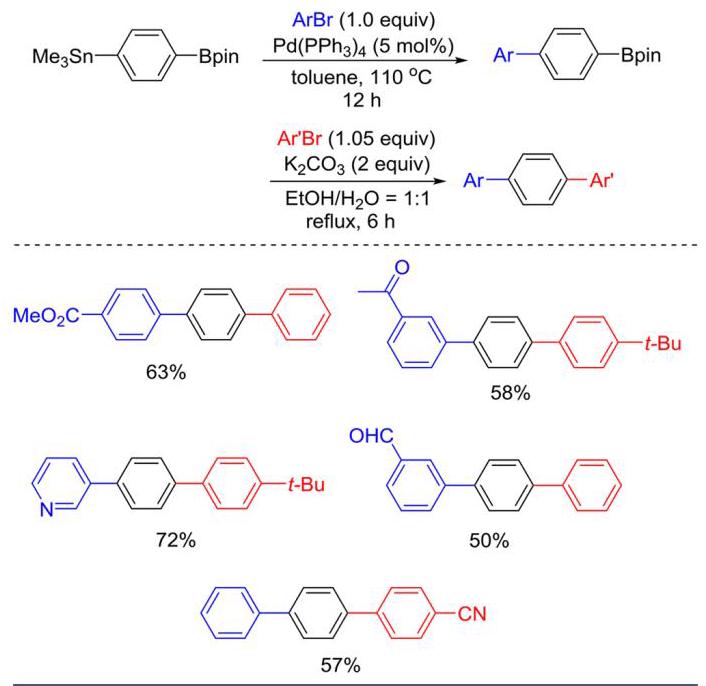
Furthermore, a consecutive Sandmeyer-type borylation and stannylation could be performed on an aromatic ring bearing two amino groups, leading to a borylated arylstannane product (Scheme 9). By taking advantage of the difference in the reactivity of these two groups in Pd-catalyzed cross-coupling reactions, a series of terphenyl derivatives could be synthesized
此外,可以在带有两个氨基的芳环上进行连续的桑德迈尔型硼化和锡化反应,得到硼化芳基锡烷产物(方案9)。利用这两个基团在钯催化的交叉偶联反应中的反应活性差异,可以合成一系列三联苯衍生物
Scheme 8. Proposed Mechanism of the Stannylation
方案8. 锡基化反应的推测机理
Scheme 9. Consecutive Sandmeyer-type Borylation and Stannylation
方案9. 连续的桑德迈尔型硼化和锡化反应
in moderate yields through consecutive Stille coupling and Suzuki-Miyaura coupling (Scheme 10).
通过连续的Stille偶联和Suzuki-Miyaura偶联以中等产率得到(方案10)。
Scheme 10. Consecutive Stille Coupling and Suzuki-Miyaura Coupling
方案10. 连续的Stille偶联和Suzuki-Miyaura偶联
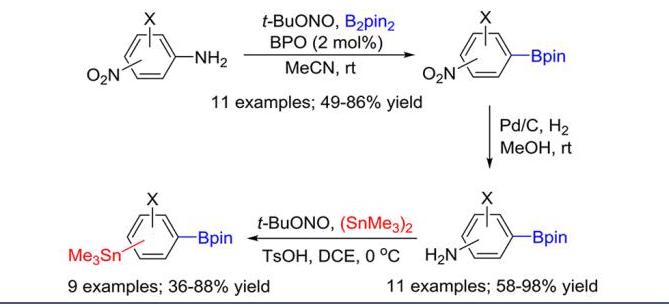
Since nitro-substituted anilines are easily available, a three-step reaction sequence was further devised with nitro-substituted anilines (Scheme 11). ${}^{28}$ First, arylborates bearing nitro substi-tuents were prepared with the Sandmeyer-type borylation on a gram scale starting from nitro-substituted anilines. Subsequently, these nitro groups were reduced to amino-substituted arylborates by Pd-catalyzed hydrogenation at room temperature. Finally, typical Sandmeyer-type stannylation converted the boron-substituted aniline derivatives to the corresponding stannylation products. By adopting this reaction sequence, we could synthesize various stannyl arylboronates compounds in three steps.
由于硝基取代的苯胺很容易获得,因此进一步设计了一个三步反应序列,用于硝基取代的苯胺(方案11)。${}^{28}$ 首先,从硝基取代的苯胺开始,通过克级规模的桑德迈尔型硼化反应制备带有硝基取代基的芳基硼酸酯。随后,通过钯催化的室温氢化反应将这些硝基还原为氨基取代的芳基硼酸酯。最后,典型的桑德迈尔型锡化反应将硼取代的苯胺衍生物转化为相应的锡化产物。通过采用这个反应序列,我们可以分三步合成各种锡基芳基硼酸酯化合物。
Scheme 11. Synthesis of Stannyl Arylboronates from Nitro-Substituted Anilines
方案11. 由硝基取代的苯胺合成锡基芳基硼酸酯
4. PHOSPHORYLATION OF DIAZONIUM SALT FOR C-P BOND FORMATION
4. 用于形成C-P键的重氮盐的磷酸化反应
Organophosphonates have attracted considerable attention as they have broad applications in agrochemicals, medicinal chemistry, material sciences, etc. ${}^{29}$ The synthesis of organophosphonates mostly relies on several classic approaches: nucleophilic substitution reaction of organometallic reagent with electrophilic phosphine reagent, the Michaelis-Arbuzov reaction, the Friedel-Crafts reaction, and transition-metal-catalyzed cross-coupling reaction of aryl (pseudo)halides or boronic acids with phosphorus compounds. ${}^{30}$ In light of the importance of aryl phosphonates and our success in the development of transformations with aryldiazonium salts, we further explored the application of the Sandmeyer-type transformation in aromatic C-P bond formations (Scheme 12). ${}^{31}$
有机膦酸酯因其在农用化学品、药物化学、材料科学等领域的广泛应用而备受关注。${}^{29}$ 有机膦酸酯的合成主要依赖于几种经典方法:有机金属试剂与亲电膦试剂的亲核取代反应、米氏-阿尔布佐夫反应、傅克反应以及芳基(伪)卤化物或硼酸与磷化合物的过渡金属催化交叉偶联反应。${}^{30}$ 鉴于芳基膦酸酯的重要性以及我们在芳基重氮盐转化反应开发方面的成功,我们进一步探索了桑德迈尔型转化反应在芳香族C-P键形成中的应用(方案12)。${}^{31}$
We began our study with phosphorylation of 4-aminobenzoate as the model reaction. Under similar Sandmeyer-type conditions [t-BuONO, P(OMe) ${}_{3}$ , MeCN], the first attempt gave 44% yield of the desired phosphorylation product. The reaction was significantly affected by the choice of phosphite reagent. While triethyl phosphite gave only a trace amount of the corresponding product, triphenyl phosphite exhibited the best reactivity. Eventually, the yield could be improved to 94% by using three equivalents of triphenyl phosphite.
我们以4-氨基苯甲酸酯的磷酸化反应作为模型反应开始研究。在类似的桑德迈尔型条件下[t-BuONO,P(OMe) ${}_{3}$ ,MeCN],首次尝试得到了所需磷酸化产物,产率为44%。该反应受亚磷酸酯试剂的选择影响显著较大。虽然亚磷酸三乙酯仅产生痕量的相应产物,但亚磷酸三苯酯表现出最佳的反应活性。最终,通过使用三当量的亚磷酸三苯酯,产率可提高到94%。
Scheme 12. Sandmeyer-type Phosphorylation: Scope of the Aniline Derivatives and the Proposed Mechanism
方案12. 桑德迈尔型磷酸化反应:苯胺衍生物的范围及提出的机理
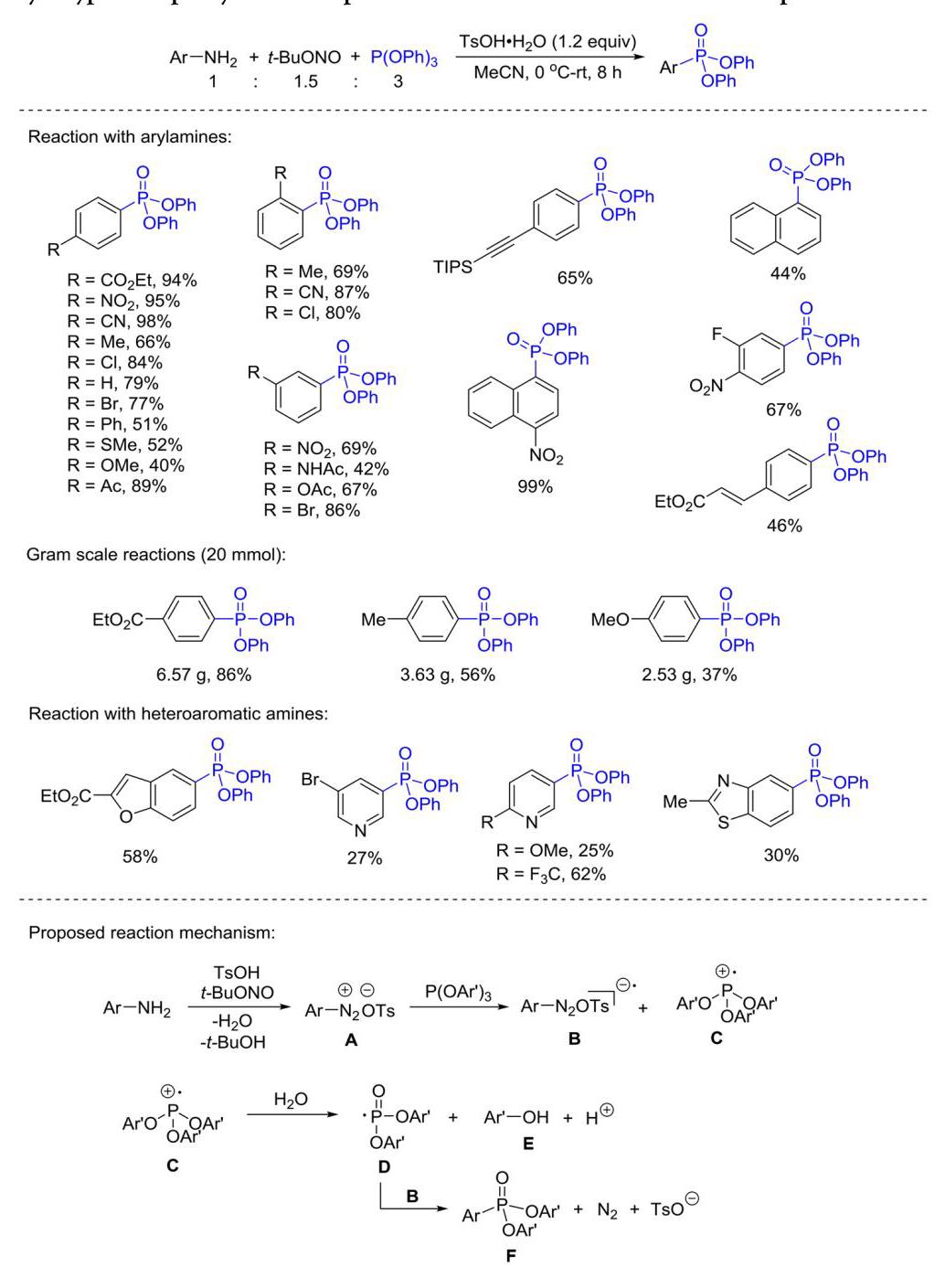
The phosphorylation shows good functional group tolerance to both electron-withdrawing and -donating groups on the aromatic ring (Scheme 12). It is noteworthy that the tolerance of bromo and chloro groups, which are normally not compatible in transition-metal-catalyzed C-P bond construction approaches, makes possible further transformation of the products via cross-coupling reactions. para-Substituted arylamines with electron-withdrawing groups give relatively higher yields. Similar yields could be achieved with ortho- and meta-substituted anilines, indicating that the phosphorylation is not sensitive to steric effects. For a further demonstration of the practical utility of this method, phosphorylation reactions of three substrates were carried out in ${20}\mathrm{{mmol}}$ scale. The reactions furnished the corresponding products with comparable yields. Phosphorylation of aromatic heterocyclic amines was also explored, but the substrate scope was limited. As shown in Scheme 12, the phosphorylation of heteroaromatic amines gives diminished yields in general.
该磷酸化反应对芳环上的吸电子基团和供电子基团均表现出良好的官能团耐受性(方案12)。值得注意的是,在过渡金属催化的C-P键构建方法中通常不相容的溴和氯基团的耐受性,使得产物能够通过交叉偶联反应进行进一步转化。带有吸电子基团的对取代芳胺给出相对较高的产率。邻位和间位取代的苯胺也能获得类似的产率,这表明该磷酸化反应对空间效应不敏感。为了进一步证明该方法的实际实用性,在${20}\mathrm{{mmol}}$规模下进行了三种底物的磷酸化反应。这些反应以相当的产率提供了相应的产物。还探索了芳香族杂环胺的磷酸化反应,但底物范围有限。如方案12所示,杂芳胺的磷酸化反应总体产率较低。
Regarding to the mechanism of this Sandmeyer-type phosphorylation reaction, we proposed that the diazonium salt is first reduced by triaryl phosphite to give a diazonium radical anion B and a phosphite radical cation C. Then, the intermediate $\mathbf{C}$ reacts with water to generate a phosphono radical $\mathbf{D}$ and a phenol product E. Finally, the reaction between B and D gives the desired phosphorylation product F. Observation of a phenol product by means of TLC and GC-MS supports this mechanistic proposal.
关于这种桑德迈尔型磷酸化反应的机理,我们提出重氮盐首先被亚磷酸三苯酯还原,生成重氮自由基阴离子B和亚磷酸酯自由基阳离子C。然后,中间体$\mathbf{C}$ 与水反应生成膦酰基自由基$\mathbf{D}$ 和苯酚产物E。最后,B与D之间的反应得到所需的磷酸化产物F。通过TLC和GC-MS观察到苯酚产物支持了这一机理推测。
5. TRIFLUOROMETHYLATION OF DIAZONIUM SALT FOR C-CF, BOND FORMATION
5. 用于形成C-CF₃键的重氮盐三氟甲基化反应
Trifluoromethylated arenes and heteroarenes are privileged structural motifs in pharmaceuticals, agrochemicals, liquid crystals, dyes, and polymers. ${}^{32}$ However, ${\mathrm{{CF}}}_{3}$ -containing compounds are absent in nature, which accounts for the vital importance of developing synthetic methods to introduce the ${\mathrm{{CF}}}_{3}$ group onto aromatic rings. In addition to the traditional methods, the introduction of the ${\mathrm{{CF}}}_{3}$ group through transition-metal-catalyzed cross-coupling has attracted considerable attention in recent years. Regardless of the remarkable progress, further developments are still needed to enable the use of cheap and abundantly available starting materials under mild trifluoromethylation conditions. To this end, we directed our study on Sandmeyer-type transformations toward trifluoromethylation of diazonium salts, employing readily available and inexpensive anilines as the starting materials. ${}^{33}$
三氟甲基化的芳烃和杂芳烃是药物、农用化学品、液晶、染料和聚合物中具有特殊优势的结构单元。${}^{32}$ 然而,自然界中不存在含 ${\mathrm{{CF}}}_{3}$ 的化合物,这说明了开发将 ${\mathrm{{CF}}}_{3}$ 基团引入芳环的合成方法的至关重要性。除了传统方法外,近年来通过过渡金属催化的交叉偶联引入 ${\mathrm{{CF}}}_{3}$ 基团也引起了相当大的关注。尽管取得了显著进展,但仍需要进一步发展,以便能够在温和的三氟甲基化条件下使用廉价且大量可得的起始原料。为此,我们将对桑德迈尔型转化的研究导向重氮盐的三氟甲基化反应,使用容易获得且廉价的苯胺作为起始原料。${}^{33}$
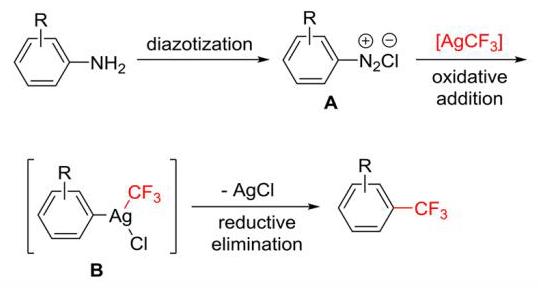
Based on the oxidizing properties of aryl diazonium salts and the strong $\sigma$ -donor nature of the trifluoromethyl group in the $\left\lbrack {\mathrm{{AgCF}}}_{3}\right\rbrack$ complex ${}^{34}$ and also inspired by the previous observation of reductive elimination from bimetallic high-valent silver complexes to form $\mathrm{C}\left( {\mathrm{{sp}}}^{2}\right) - \mathrm{F}$ bonds, ${}^{35}$ we proposed that oxidative addition of diazonium salt A would be favored at an electron-rich silver center to afford intermediate $\mathbf{B}$ (Scheme 13). Subsequently, intermediate B undergoes reductive elimination to form a $\mathrm{C}\left( {\mathrm{{sp}}}^{2}\right) - {\mathrm{{CF}}}_{3}$ bond and the $\mathrm{{AgCl}}$ precipitate. This hypothesis was proven successful when first attempted. Simply adding preformed ${\mathrm{{AgCF}}}_{3}$ into a solution of diazonium chloride in $\mathrm{{MeCN}}$ at $0{}^{ \circ }\mathrm{C}$ delivered the desired trifluoromethylated product in 41% yield. The reaction could be improved at low temperature, presumably attributed to the relative stability of diazonium chloride salts at low temperature. By switching the solvent from MeCN to EtCN, the addition of ${\mathrm{{AgCF}}}_{3}$ could be carried out at $- {78}^{ \circ }\mathrm{C}$ , which turns out to be the optimal condition, providing a 95% yield of the trifluoromethylated product.
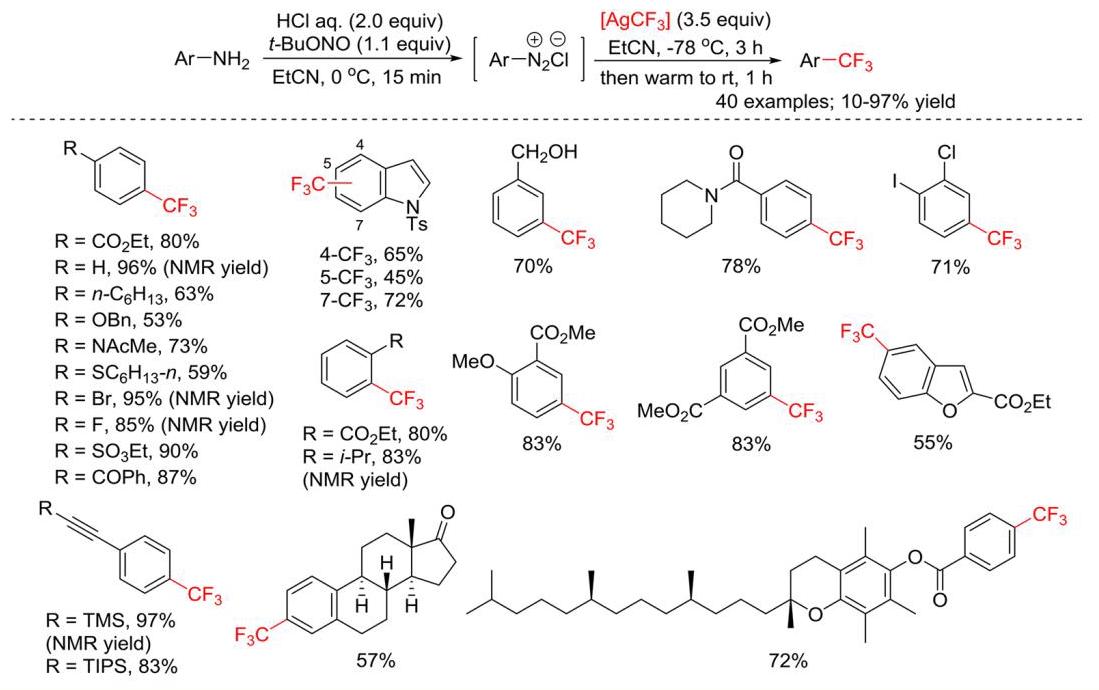
基于芳基重氮盐的氧化性质以及 $\left\lbrack {\mathrm{{AgCF}}}_{3}\right\rbrack$ 配合物中三氟甲基基团的强 $\sigma$ 供体性质 ${}^{34}$ ,并且也受到先前关于从双金属高价银配合物中进行还原消除以形成 $\mathrm{C}\left( {\mathrm{{sp}}}^{2}\right) - \mathrm{F}$ 键的观察结果的启发 ${}^{35}$ ,我们提出重氮盐A在富电子的银中心进行氧化加成将有利于生成中间体 $\mathbf{B}$ (方案13)。随后,中间体B进行还原消除以形成 $\mathrm{C}\left( {\mathrm{{sp}}}^{2}\right) - {\mathrm{{CF}}}_{3}$ 键和 $\mathrm{{AgCl}}$ 沉淀。当首次尝试时,这个假设被证明是成功的。简单地将预先形成的 ${\mathrm{{AgCF}}}_{3}$ 添加到重氮氯化物在 $\mathrm{{MeCN}}$ 中的溶液中,在 $0{}^{ \circ }\mathrm{C}$ 下得到所需的三氟甲基化产物,产率为41%。该反应在低温下可以得到改善,大概是由于重氮氯化物盐在低温下的相对稳定性。通过将溶剂从MeCN切换到EtCN,${\mathrm{{AgCF}}}_{3}$ 的添加可以在 $- {78}^{ \circ }\mathrm{C}$ 下进行,这被证明是最佳条件,提供了95%产率的三氟甲基化产物。
Scheme 13. Proposed Strategy for Trifluoromethylation of Aromatic Amines
方案13. 芳胺三氟甲基化的 proposed Strategy
The substrate scope was next explored (Scheme 14). In general, both electron-rich and -deficient anilines react smoothly to afford the corresponding trifluoromethylation products in moderate to excellent yields. It is noteworthy that this trifluo-romethylation reaction tolerates unprotected alcohols and benzoic acids, as well as oxidation sensitive groups, such as vinyl, alkynyl, Bpin, and TMS groups. Anilines bearing ortho-substituents, including ester and bulky isopropyl groups, also worked well with high yields. In the case of heteroaromatic amines, such as indoles and benzofurans, the desired products could be formed in moderate yields.
接下来研究了底物范围(方案14)。一般来说,富电子和缺电子的苯胺都能顺利反应,以中等至优异的产率得到相应的三氟甲基化产物。值得注意的是,这种三氟甲基化反应耐受未保护的醇和苯甲酸,以及对氧化敏感的基团,如乙烯基、炔基、Bpin和TMS基团。带有邻位取代基(包括酯和大体积异丙基)的苯胺也能以高产率顺利反应。对于杂芳胺,如吲哚和苯并呋喃,可以以中等产率形成所需产物。
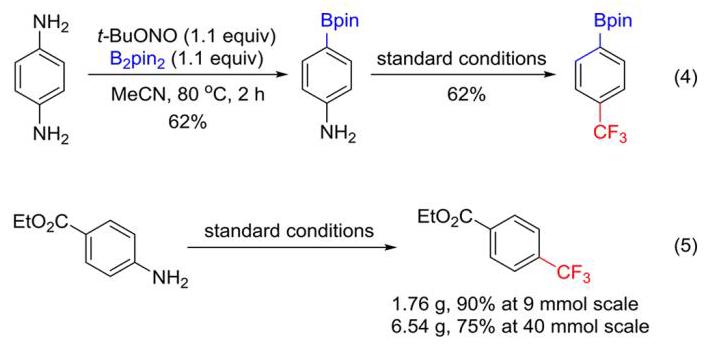
Moreover, by employing the previously established metal-free borylation method, we could convert the two amino groups of benzene-1,4-diamine into Bpin and ${\mathrm{{CF}}}_{3}$ groups successively (eq 4). Gram scale experiments demonstrate the potential usefulness of this method (eq 5).
此外,通过采用先前建立的无金属硼化方法,我们可以将苯-1,4-二胺的两个氨基依次转化为Bpin和 ${\mathrm{{CF}}}_{3}$ 基团(式4)。克级实验证明了该方法的潜在实用性(式5)。
For mechanistic studies, a radical clock and TEMPO trapping experiments were performed. Both suggest that the reaction does not likely operate by a radical mechanism. Instead, an oxidative addition-reductive elimination mechanism involving high-valent silver species as shown in Scheme 13 is likely the case.
为了进行机理研究,进行了自由基时钟和TEMPO捕获实验。两者都表明该反应不太可能通过自由基机理进行。相反,如方案13所示,涉及高价银物种的氧化加成-还原消除机理可能是实际情况。
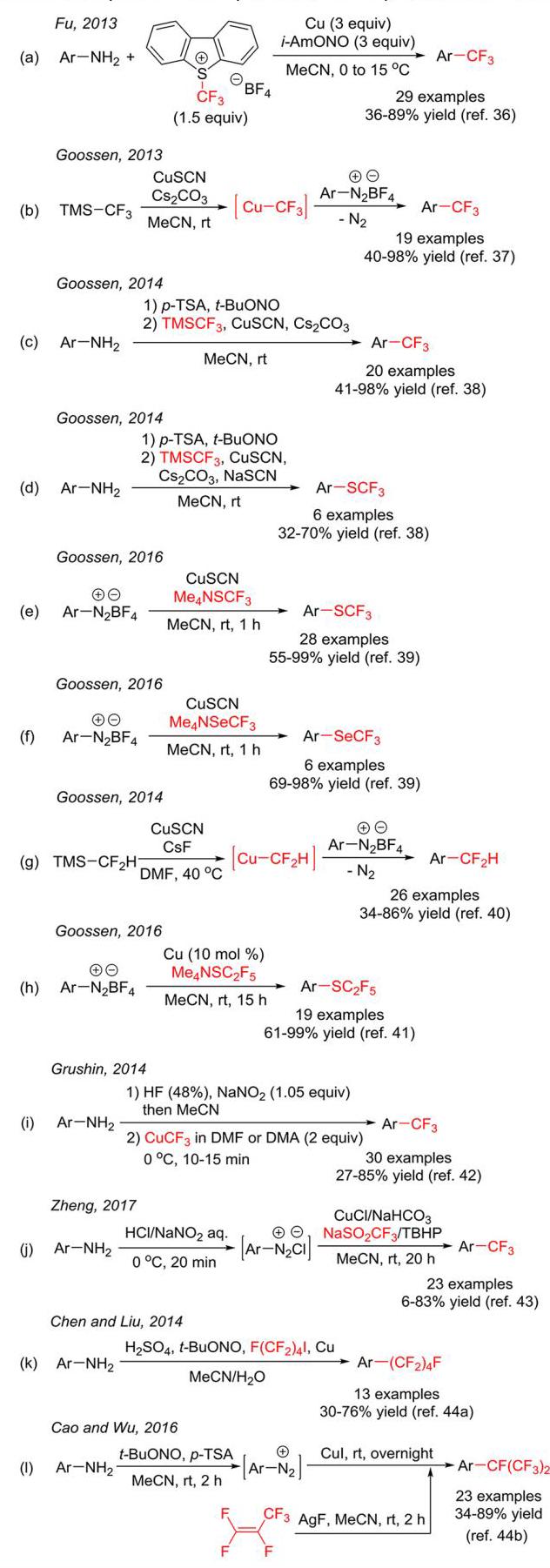
In the same year, Fu and co-workers reported a copper-mediated Sandmeyer-type trifluoromethylation of aromatic amines (Scheme 15a). ${}^{36}$ In their method, Umemoto’s reagent was employed as the ${\mathrm{{CF}}}_{3}$ source, and isoamyl nitrite (i-AmONO) was used to effect the in situ diazotization reaction. The reaction tolerates a variety of functional groups, including ether, thioether, amido, nitro, ester, ketone, and azo. Several typical heterocyclic amines were also successfully covered in the substrates. A radical pathway is supported by a series of mechanistic experiments, including clock trapping reaction, ESR test, and a ${\mathrm{{CuCF}}}_{3}$ species suggested by ${}^{19}\mathrm{\;F}$ NMR data.
同年,傅和他的同事报道了一种铜介导的芳香胺的桑德迈尔型三氟甲基化反应(方案15a)。${}^{36}$ 在他们的方法中,使用了Umemoto试剂作为${\mathrm{{CF}}}_{3}$ 来源,并使用亚硝酸异戊酯(i-AmONO)进行原位重氮化反应。该反应能耐受多种官能团,包括醚、硫醚、酰胺、硝基、酯、酮和偶氮。几种典型的杂环胺也成功地包含在底物中。一系列机理实验支持了自由基途径,包括时钟捕获反应、电子自旋共振测试以及${}^{19}\mathrm{\;F}$ NMR数据表明的${\mathrm{{CuCF}}}_{3}$ 物种。
Scheme 14. Silver-Mediated Trifluoromethylation of Aryldiazonium Salts
方案14. 银介导的芳基重氮盐的三氟甲基化反应
Simultaneously, Goossen and co-workers reported a copper-mediated Sandmeyer-type trifluoromethylation reaction (Scheme 15b). ${}^{37}$ The stable diazonium tetrafluoroborate salts are preformed and used as starting material instead of arylamines in this case. In their reaction, an in situ generated ${\mathrm{{CuCF}}}_{3}$ species is contrived to react with the diazonium salt to deliver the tri-fluoromethylated product. Thus, the Ruppert-Prakash reagent (TMSCF ${}_{3}$ ) is used as the ${\mathrm{{CF}}}_{3}$ source and is premixed with Cu(I) thiocyanate and cesium carbonate before the addition of the diazonium salt. The reaction proceeded smoothly with good functional group tolerance, affording moderate to high yields of the trifluoromethylated products. The reaction has been proposed to proceed via a radical process, which is in line with other Sandmeyer-type halogenation reactions. In an update of this work, they demonstrated that their method could utilize in situ generated diazonium salts (Scheme 15c). ${}^{38}$ They also expanded their method to Sandmeyer-type trifluoro-methylthiolation reaction (Scheme 15d). Alternatively, the Sandmeyer-type trifluoromethylthiolation and trifluoromethyl-selenolation could be achieved by using ${\mathrm{{Me}}}_{4}{\mathrm{{NSCF}}}_{3}$ and ${\mathrm{{Me}}}_{4}{\mathrm{{NSeCF}}}_{3}$ , respectively (Scheme 15e, f). ${}^{39}$ By using an in situ formed ${\mathrm{{CuCF}}}_{2}\mathrm{H}$ reagent, difluoromethylation has also been accomplished (Scheme 15g). ${}^{40}$ In another paper, they achieved a copper-catalyzed Sandmeyer-type pentafluoroethylthiolation (Scheme 15h). ${}^{41}$
同时,古森和他的同事报道了一种铜介导的桑德迈尔型三氟甲基化反应(方案15b)。${}^{37}$ 在这种情况下,预先制备稳定的重氮四氟硼酸盐并用作起始原料,而不是芳胺。在他们的反应中,设计原位生成的${\mathrm{{CuCF}}}_{3}$ 物种与重氮盐反应以得到三氟甲基化产物。因此,鲁珀特 - 普拉卡什试剂(TMSCF${}_{3}$ )用作${\mathrm{{CF}}}_{3}$ 来源,并在加入重氮盐之前与硫氰酸亚铜和碳酸铯预混合。该反应顺利进行,对官能团具有良好的耐受性,提供中等至高收率的三氟甲基化产物。该反应被认为是通过自由基过程进行的,这与其他桑德迈尔型卤化反应一致。在这项工作的更新中,他们证明了他们的方法可以利用原位生成的重氮盐(方案15c)。${}^{38}$ 他们还将他们的方法扩展到桑德迈尔型三氟甲硫基化反应(方案15d)。或者,桑德迈尔型三氟甲硫基化和三氟甲基硒化反应可以分别通过使用${\mathrm{{Me}}}_{4}{\mathrm{{NSCF}}}_{3}$ 和${\mathrm{{Me}}}_{4}{\mathrm{{NSeCF}}}_{3}$ 来实现(方案15e,f)。${}^{39}$ 通过使用原位形成的${\mathrm{{CuCF}}}_{2}\mathrm{H}$ 试剂,也实现了二氟甲基化(方案15g)。${}^{40}$ 在另一篇论文中,他们实现了铜催化的桑德迈尔型五氟乙硫基化反应(方案15h)。${}^{41}$
Grushin and co-workers disclosed a Sandmeyer-type trifluoromethylation of arenediazonium salts with fluoroform-derived ${\mathrm{{CuCF}}}_{3}$ in aqueous media (Scheme 15i). ${}^{42}$ Different from the other reactions mentioned above, in Grushin’s protocol the ${\mathrm{{CF}}}_{3}$ moiety originates from fluoroform $\left( {\mathrm{{CHF}}}_{3}\right)$ , an inexpensive, nonflammable gas. By their method, ${\mathrm{{CuCF}}}_{3}$ could be easily generated as a solution by treatment of $\mathrm{{CuCl}}$ with $\mathrm{{KO}}t$ -Bu and ${\mathrm{{CHF}}}_{3}$ successively. The substrate scope is broad, including a couple of heterocyclic examples as well as some complex molecules. Mechanistically, it has been suggested that the reaction follows a radical pathway based on a radical clock experiment.
格鲁申和他的同事公开了一种在水性介质中用源自氟仿的${\mathrm{{CuCF}}}_{3}$ 对芳基重氮盐进行桑德迈尔型三氟甲基化反应(方案15i)。${}^{42}$ 与上述其他反应不同,在格鲁申的方案中,${\mathrm{{CF}}}_{3}$ 部分源自氟仿$\left( {\mathrm{{CHF}}}_{3}\right)$ ,一种廉价、不可燃的气体。通过他们的方法,通过依次用$\mathrm{{KO}}t$ -Bu和${\mathrm{{CHF}}}_{3}$ 处理$\mathrm{{CuCl}}$ ,可以很容易地将${\mathrm{{CuCF}}}_{3}$ 生成溶液。底物范围广泛,包括几个杂环实例以及一些复杂分子。从机理上讲,基于自由基时钟实验表明该反应遵循自由基途径。
Very recently, Zheng and co-workers disclosed a copper-promoted Sandmeyer-type trifluoromethylation of arylamines by using Langlois reagent $\left( {{\mathrm{{CF}}}_{3}{\mathrm{{SO}}}_{2}\mathrm{{Na}}}\right)$ as the ${\mathrm{{CF}}}_{3}$ source (Scheme 15j). ${}^{43}$ tert-Butyl hydroperoxide (TBHP) was found to be a suitable oxidant for this transformation. A number of arylamines were trifluoromethylated with moderate to good yields. A radical mechanism is also proposed based on TEMPO trapping experiment.
最近,郑及其同事报道了一种铜促进的芳胺的桑德迈尔型三氟甲基化反应,该反应使用朗格卢瓦试剂$\left( {{\mathrm{{CF}}}_{3}{\mathrm{{SO}}}_{2}\mathrm{{Na}}}\right)$作为${\mathrm{{CF}}}_{3}$源(方案15j)。${}^{43}$发现叔丁基过氧化氢(TBHP)是该转化反应的合适氧化剂。许多芳胺都能以中等至良好的产率进行三氟甲基化反应。基于TEMPO捕获实验还提出了一种自由基机理。
In addition to trifluoromethylation, the Sandmeyer-type transformation has also been used in other perfluoroalkylation reactions. ${}^{44}$ Chen and Liu reported a copper-mediated perfluor-oalkylation of diazonium salts by using perfluoroalkyl iodide (Scheme 15k), ${}^{{44}\mathrm{a}}$ whereas Cao and Wu disclosed a silver and copper comediated perfluoroisopropylation of diazonium salts by using hexafluoropropylene (HFP) as the perfluoroalkyl source (Scheme 151). ${}^{{44}\mathrm{\;b}}$ In both cases, radical mechanisms have been proposed for their reactions.
除了三氟甲基化反应外,桑德迈尔型转化反应还被用于其他全氟烷基化反应中。${}^{44}$陈和刘报道了一种铜介导的重氮盐与全氟烷基碘的全氟烷基化反应(方案15k),${}^{{44}\mathrm{a}}$而曹和吴报道了一种银和铜共介导的重氮盐与六氟丙烯(HFP)的全氟异丙基化反应,该反应使用六氟丙烯作为全氟烷基源(方案15l)。${}^{{44}\mathrm{\;b}}$在这两种情况下,都有人为它们的反应提出了自由基机理。
6. CONCLUSIONS
6. 结论
As shown in this Account, recent years have witnessed remarkable development of Sandmeyer-type transformations that enable several novel functional group conversions from aromatic amino group to boryl, stannyl, phosphoryl, and trifluoromethyl/perfluoroalkyl groups. ${}^{45}$ This age-old chemistry has been reenergized and experienced a resurgence. Although we have to concede that aryl halides (or pseudo-halides) and arylboronic acids (boronates) are more “popular” choices when one considers a functional group conversion or a coupling reaction, arylamines have obvious complementary merits: (1) as for their availability and accessibility, the aromatic nitration-reduction procedure for arylamine synthesis normally has higher site-selectivity than halogenation of aromatics and has no over substitution problem; (2) the price for arylamines is in general cheaper than that for the corresponding arylhalides, which could be a great advantage of the Sandmeyer-type boryla-tion reaction; (3) because the conditions for diazotization are orthogonal to many other reactions, the Sandmeyer-type reactions exhibit excellent compatibility; (4) amino groups can be easily protected and deprotected; thus combined with merit 3, Sandmeyer-type transformation may be better suited for a late stage transformation in a given synthesis.
如本综述所示,近年来桑德迈尔型转化取得了显著进展,实现了从芳香氨基到硼基、锡基、磷酰基和三氟甲基/全氟烷基的多种新型官能团转化。${}^{45}$ 这种古老的化学方法已重新焕发生机并再度兴起。尽管我们不得不承认,在考虑官能团转化或偶联反应时,芳基卤化物(或拟卤化物)和芳基硼酸(硼酸盐)是更“受欢迎”的选择,但芳胺具有明显的互补优点:(1) 就其可得性和可及性而言,用于合成芳胺的芳香硝化 - 还原过程通常比芳烃卤化具有更高的位点选择性,且不存在过度取代问题;(2) 芳胺的价格通常比相应的芳基卤化物便宜,这可能是桑德迈尔型硼化反应的一大优势;(3) 由于重氮化条件与许多其他反应正交,桑德迈尔型反应表现出优异的兼容性;(4) 氨基可以很容易地进行保护和脱保护;因此结合优点3,桑德迈尔型转化可能更适合给定合成中的后期转化。
Scheme 15. Various Sandmeyer-type Trifluoromethylation/ perfluoroalkylation of Arylamines or Aryldiazonium Salts
方案15. 芳胺或芳基重氮盐的各种桑德迈尔型三氟甲基化/全氟烷基化反应
							However, there are still limitations and imperfections that

						need to be addressed in the future. For example, some of the

						Sandmeyer-type reactions have to use a large excess of metal
reagents, which may hinder the implementation of these reactions in large scale preparation. Additionally, the choice of reagents in the diazotization step has been restricted to nitrites. In this regard, more environmentally benign agents or the implementation of electrochemical techniques would be a leap forward in both conception and practicality. With the further development of Sandmeyer-type transformations, this age-old chemistry is expected to find new and innovative contributions to the synthetic community in the future.
试剂,这可能会阻碍这些反应在大规模制备中的实施。此外,重氮化步骤中试剂的选择仅限于亚硝酸盐。在这方面,更环保的试剂或电化学技术的应用在概念和实用性上都将是一个飞跃。随着桑德迈尔型转化的进一步发展,这种古老的化学方法有望在未来为合成领域做出新的创新性贡献。
AUTHOR INFORMATION
作者信息
Corresponding Author
通讯作者
ORCID
ORCID
Fanyang Mo: 0000-0002-4140-3020
莫凡洋:0000-0002-4140-3020
Jianbo Wang: 0000-0002-0092-0937
王建波:0000-0002-0092-0937
Notes
注释
The authors declare no competing financial interest.
作者声明不存在利益冲突。
Biographies
人物传记
Fanyang Mo received his B.S. and M.S. degrees in applied chemistry from Beijing Institute of Technology in 2004 and 2006 under the supervision of Prof. Zhiming Zhou and his Ph.D. in 2010 under the supervision of Prof. Jianbo Wang at Peking University. After postdoctoral training at The Scripps Research Institute with Prof. Qinghai Zhang and The University of Texas at Austin with Prof. Guangbin Dong, he started his independent career at Peking University in 2015. His research is focused on sustainable green chemical transformations.
莫凡洋于2004年和2006年在北京理工大学分别获得应用化学学士和硕士学位,导师为周志敏教授;2010年于北京大学获得博士学位,导师为王剑波教授。在与张青海教授于斯克里普斯研究所及与董广彬教授于德克萨斯大学奥斯汀分校进行博士后训练后,他于2015年在北京大学开始独立职业生涯。他的研究集中于可持续绿色化学转化。
Di Qiu was born in Tianjin, China, in 1987. He received his B.S. degree from Peking University in 2010. He continued his graduate study in Prof. Jianbo Wang’s laboratory and obtained his Ph.D. in 2015. In the same year, he joined in Tianjin Normal University as an assistant professor. His research interests lie in aromatic C-P bond formation and functional group transformations in aromatic compounds.
邱迪1987年出生于中国天津。2010年于北京大学获得学士学位。他在王剑波教授的实验室继续研究生学习,并于2015年获得博士学位。同年,他作为助理教授加入天津师范大学。他的研究兴趣在于芳香族C-P键的形成及芳香族化合物中的官能团转化。
Yan Zhang was born in Shandong, China, in 1975. She obtained her B.S. degree in 1997 and Ph.D. in 2002 from Lanzhou University. She continued her research as postdoctoral associate in Hong Kong, Germany, and the United States. She began her academic career at Peking University in 2008 in Prof. Jianbo Wang’s group.
张燕1975年出生于中国山东。1997年获得学士学位,2002年于兰州大学获得博士学位。她在香港、德国和美国继续博士后研究工作。2008年,她在王剑波教授的团队于北京大学开始学术生涯。
Jianbo Wang was born in Zhejiang, China, in 1962. He received his B.S. degree from Nanjing University of Science and Technology in 1983 and his Ph.D. from Hokkaido University in 1990. He continued his research as postdoctoral associate in Switzerland and the United States. He began his independent academic career at Peking University in late 1995. His group’s research interests are focused on catalytic metal carbene transformations.
王剑波1962年出生于中国浙江。1983年于南京理工大学获得学士学位,1990年于北海道大学获得博士学位。他在瑞士和美国继续博士后研究工作。1995年末,他在北京大学开始独立学术生涯。他的团队的研究兴趣集中于催化金属卡宾转化。
ACKNOWLEDGMENTS
致谢
We thank all the co-workers who have contributed to the Sandmeyer-type transformations in our laboratory. We thank Prof. Michael P. Doyle (University of Texas at San Antonio) and Dr. Yiyang Liu (Pfizer Inc.) for proofreading the manuscript. Support of this work by NSFC (Nos. 21502003 and 21332002) and 973 program (2015CB856600) is gratefully acknowledged.
我们感谢所有为我们实验室的桑德迈尔型转化做出贡献的同事。我们感谢德克萨斯大学圣安东尼奥分校的迈克尔·P·多伊尔教授和辉瑞公司的刘益阳博士对手稿进行校对。衷心感谢国家自然科学基金(项目编号:21502003和21332002)以及973计划(2015CB856600)对本工作的支持。
REFERENCES
参考文献
(1) Travis, A. S.: Manufacture and uses of the Anilines: A Vast Array of Processes and Products. The Chemistry of Anilines; John Wiley & Sons, Ltd, 2007; pp 715-782.
(2) (a) Hodgson, H. H. The Sandmeyer Reaction. Chem. Rev. 1947, 40, 251-277. (b) Galli, C. Radical reactions of arenediazonium ions: An easy entry into the chemistry of the aryl radical. Chem. Rev. 1988, 88, 765-792. (c) Mo, F.; Dong, G.; Zhang, Y.; Wang, J. Recent applications of arene diazonium salts in organic synthesis. Org. Biomol. Chem. 2013, 11, 1582-1593.
(3) Griefs, P. Vorläufige Notiz über die Einwirkung von salpetriger Säure auf Amidinitro- und Aminitrophenylsäure. Justus Liebigs Ann. Chem. 1858, 106, 123-125.
(4) (a) Sandmeyer, T. Ueber die Ersetzung der Amidgruppe durch Chlor in den aromatischen Substanzen. Ber. Dtsch. Chem. Ges. 1884, 17, 1633-1635. (b) Sandmeyer, T. Ueber die Ersetzung der Amid-gruppe durch Chlor, Brom und Cyan in den aromatischen Substanzen. Ber. Dtsch. Chem. Ges. 1884, 17, 2650-2653.
(5) Pschorr, R. Neue Synthese des Phenanthrens und seiner Derivate. Ber. Dtsch. Chem. Ges. 1896, 29, 496-501.
(6) Gomberg, M.; Bachmann, W. E. The Synthesis of Biaryl Compounds by Means of the Diazo Reaction. J. Am. Chem. Soc. 1924, 46, 2339-2343.
(7) Balz, G.; Schiemann, G. Über aromatische Fluorverbindungen, I.: Ein neues Verfahren zu ihrer Darstellung. Ber. Dtsch. Chem. Ges. B 1927, 60, 1186-1190.
(8) Meerwein, H.; Büchner, E.; van Emster, K. Über die Einwirkung aromatischer Diazoverbindungen auf $\alpha ,\beta$ -ungesättigte Carbonylverbin-dungen. J. Prakt. Chem. 1939, 152, 237-266.
(9) (a) Doyle, M. P.; Siegfried, B.; Dellaria, J. F. Alkyl nitrite-metal halide deamination reactions. 2. Substitutive deamination of aryl-amines by alkyl nitrites and copper(II) halides. A direct and remarkably efficient conversion of arylamines to aryl halides. J. Org. Chem. 1977, 42, 2426-2431. (b) Doyle, M. P.; Dellaria, J. F.; Siegfried, B.; Bishop, S. W. Reductive deamination of arylamines by alkyl nitrites in N, N-dimethylformamide. A direct conversion of arylamines to aromatic hydrocarbons. J. Org. Chem. 1977, 42, 3494- 3498.
(10) (a) Kikukawa, K.; Matsuda, T. Reaction of Diazonium Salts with Transition Metals. I. Arylation of Olefins with Arenediazonium Salts Catalyzed by Zero Valent Palladium. Chem. Lett. 1977, 6, 159-162. (b) Kikukawa, K.; Nagira, K.; Terao, N.; Wada, F.; Matsuda, T. Reaction of Diazonium Salts with Transition Metals. II. Palladiumca-talyzed Arylation of Ethylene with Arenediazonium Salts. Bull. Chem. Soc. Jpn. 1979, 52, 2609-2610.
(11) Brown, H. C.; Cole, T. E. Organoboranes. 31. A simple preparation of boronic esters from organolithium reagents and selected trialkoxyboranes. Organometallics 1983, 2, 1316-1319.
(12) Ishiyama, T.; Murata, M.; Miyaura, N. Palladium(0)-Catalyzed Cross-Coupling Reaction of Alkoxydiboron with Haloarenes: A Direct Procedure for Arylboronic Esters. J. Org. Chem. 1995, 60, 7508-7510.
(13) (a) Willis, D. M.; Strongin, R. M. Palladium-catalyzed borylation of aryldiazonium tetrafluoroborate salts. A new synthesis of arylboronic esters. Tetrahedron Lett. 2000, 41, 8683-8686. (b) Ma, Y.; Song, C.; Jiang, W.; Xue, G.; Cannon, J. F.; Wang, X.; Andrus, M. B. Borylation of Aryldiazonium Ions with N-Heterocyclic Carbene-Palladium Catalysts Formed without Added Base. Org. Lett. 2003, 5, 4635-4638.
(14) Mkhalid, I. A. I.; Barnard, J. H.; Marder, T. B.; Murphy, J. M.; Hartwig, J. F. C-H Activation for the Construction of C-B Bonds. Chem. Rev. 2010, 110, 890-931.
(15) Mo, F.; Jiang, Y.; Qiu, D.; Zhang, Y.; Wang, J. Direct Conversion of Arylamines to Pinacol Boronates: A Metal-Free Borylation Process. Angew. Chem., Int. Ed. 2010, 49, 1846-1849.
(16) (a) Qiu, D.; Jin, L.; Zheng, Z.; Meng, H.; Mo, F.; Wang, X.; Zhang, Y.; Wang, J. Synthesis of Pinacol Arylboronates from Aromatic Amines: A Metal-Free Transformation. J. Org. Chem. 2013, 78, 1923- 1933. (b) Qiu, D.; Zhang, Y.; Wang, J. Direct synthesis of arylboronic pinacol esters from arylamines. Org. Chem. Front. 2014, 1, 422-425.
(17) Qiu, D.; Meng, H.; Jin, L.; Tang, S.; Wang, S.; Mo, F.; Zhang, Y.; Wang, J. Synthesis of Arylboronic Pinacol Esters from Corresponding Arylamines. Org. Synth. 2014, 91, 106-115.
(18) Pietsch, S.; Neeve, E. C.; Apperley, D. C.; Bertermann, R.; Mo, F.; Qiu, D.; Cheung, M. S.; Dang, L.; Wang, J.; Radius, U.; Lin, Z.; Kleeberg, C.; Marder, T. B. Synthesis, Structure, and Reactivity of Anionic ${\mathrm{{sp}}}^{2} - {\mathrm{{sp}}}^{3}$ Diboron Compounds: Readily Accessible Boryl Nucleophiles. Chem. - Eur. J. 2015, 21, 7082-7098.
(19) Zhu, C.; Yamane, M. Transition-Metal-Free Borylation of Aryltriazene Mediated by ${\mathrm{{BF}}}_{3} \cdot {\mathrm{{OEt}}}_{2}$ . Org. Lett. 2012,14,4560-4563.
(20) Yu, J.; Zhang, L.; Yan, G. Metal-Free, Visible Light-Induced Borylation of Aryldiazonium Salts: A Simple and Green Synthetic Route to Arylboronates. Adv. Synth. Catal. 2012, 354, 2625-2628.
(21) Ahammed, S.; Nandi, S.; Kundu, D.; Ranu, B. C. One-pot Suzuki coupling of aromatic amines via visible light photocatalyzed metal free borylation using t-BuONO at room temperature. Tetrahedron Lett. 2016, 57, 1551-1554.
(22) Marciasini, L. D.; Vaultier, M.; Pucheault, M. Borylation using group IV metallocene under mild conditions. Tetrahedron Lett. 2014, 55, 1702-1705.
(23) Qi, X.; Jiang, L.-B.; Zhou, C.; Peng, J.-B.; Wu, X.-F. Convenient and General Zinc-Catalyzed Borylation of Aryl Diazonium Salts and Aryltriazenes under Mild Conditions. ChemistryOpen 2017, 6, 345- 349.
(24) Zhao, C.-J.; Xue, D.; Jia, Z.-H.; Wang, C.; Xiao, J. Methanol-Promoted Borylation of Arylamines: A Simple and Green Synthetic Method to Arylboronic Acids and Arylboronates. Synlett 2014, 25, 1577-1584.
(25) (a) Erb, W.; Hellal, A.; Albini, M.; Rouden, J.; Blanchet, J. An Easy Route to (Hetero)arylboronic Acids. Chem. - Eur. J. 2014, 20, 6608-6612. (b) Erb, W.; Albini, M.; Rouden, J.; Blanchet, J. Sequential One-Pot Access to Molecular Diversity through Aniline Aqueous Borylation. J. Org. Chem. 2014, 79, 10568-10580.
(26) Qi, X.; Li, H.-P.; Peng, J.-B.; Wu, X.-F. Borylation of aryldiazonium salts at room temperature in an aqueous solution under catalyst-free conditions. Tetrahedron Lett. 2017, 58, 3851-3853.
(27) Qiu, D.; Meng, H.; Jin, L.; Wang, S.; Tang, S.; Wang, X.; Mo, F.; Zhang, Y.; Wang, J. Synthesis of Aryl Trimethylstannanes from Aryl Amines: A Sandmeyer-Type Stannylation Reaction. Angew. Chem., Int. Ed. 2013, 52, 11581-11584.
(28) Qiu, D.; Wang, S.; Tang, S.; Meng, H.; Jin, L.; Mo, F.; Zhang, Y.; Wang, J. Synthesis of Trimethylstannyl Arylboronate Compounds by Sandmeyer-Type Transformations and Their Applications in Chemoselective Cross-Coupling Reactions. J. Org. Chem. 2014, 79, 1979-1988.
(29) Corbridge, D. E. C. Carbophosphorus Compounds. Phosphorus: Chemistry, Biochemistry and Technology; CRC Press, 2013; pp 327- 496.
(30) (a) Bhattacharya, A. K.; Thyagarajan, G. Michaelis-Arbuzov rearrangement. Chem. Rev. 1981, 81, 415-430. (b) Schwan, A. L. Palladium catalyzed cross-coupling reactions for phosphorus-carbon bond formation. Chem. Soc. Rev. 2004, 33, 218-224.
(31) Wang, S.; Qiu, D.; Mo, F.; Zhang, Y.; Wang, J. Metal-Free Aromatic Carbon-Phosphorus Bond Formation via a Sandmeyer-Type Reaction. J. Org. Chem. 2016, 81, 11603-11611.
(32) (a) Müller, K.; Faeh, C.; Diederich, F. Fluorine in Pharmaceuticals: Looking Beyond Intuition. Science 2007, 317, 1881-1886. (b) Furuya, T.; Kamlet, A. S.; Ritter, T. Catalysis for fluorination and trifluoromethylation. Nature 2011, 473, 470-477.
(33) (a) Wang, X.; Xu, Y.; Mo, F.; Ji, G.; Qiu, D.; Feng, J.; Ye, Y.; Zhang, S.; Zhang, Y.; Wang, J. Silver-Mediated Trifluoromethylation of Aryldiazonium Salts: Conversion of Amino Group into Trifluor-omethyl Group. J. Am. Chem. Soc. 2013, 135, 10330-10333. (b) Wang, X.; Xu, Y.; Zhou, Y.; Zhang, Y.; Wang, J. Conversion of Aromatic Amino into Trifluoromethyl Groups through a Sandmeyer-Type Transformation. Synthesis 2014, 46, 2143-2148.
(34) Tomashenko, O. A.; Grushin, V. V. Aromatic Trifluoromethy-lation with Metal Complexes. Chem. Rev. 2011, 111, 4475-4521.
(35) (a) Furuya, T.; Strom, A. E.; Ritter, T. Silver-Mediated Fluorination of Functionalized Aryl Stannanes. J. Am. Chem. Soc. 2009, 131, 1662-1663. (b) Tang, P.; Furuya, T.; Ritter, T. Silver-Catalyzed Late-Stage Fluorination. J. Am. Chem. Soc. 2010, 132, 12150-12154.
(36) Dai, J.-J.; Fang, C.; Xiao, B.; Yi, J.; Xu, J.; Liu, Z.-J.; Lu, X.; Liu, L.; Fu, Y. Copper-Promoted Sandmeyer Trifluoromethylation Reaction. J. Am. Chem. Soc. 2013, 135, 8436-8439.
(37) Danoun, G.; Bayarmagnai, B.; Grünberg, M. F.; Goossen, L. J. Sandmeyer Trifluoromethylation of Arenediazonium Tetrafluorobo-rates. Angew. Chem., Int. Ed. 2013, 52, 7972-7975.
(38) Bayarmagnai, B.; Matheis, C.; Risto, E.; Goossen, L. J. One-Pot Sandmeyer Trifluoromethylation and Trifluoromethylthiolation. Adv. Synth. Catal. 2014, 356, 2343-2348.
(39) Matheis, C.; Wagner, V.; Goossen, L. J. Sandmeyer-Type Trifluoromethylthiolation and Trifluoromethylselenolation of (Hetero)Aromatic Amines Catalyzed by Copper. Chem. - Eur. J. 2016, 22, 79-82.
(40) Matheis, C.; Jouvin, K.; Goossen, L. J. Sandmeyer Difluoromethylation of (Hetero-) Arenediazonium Salts. Org. Lett. 2014, 16, 5984-5987.
(41) Matheis, C.; Bayarmagnai, B.; Jouvin, K.; Goossen, L. J. Convenient synthesis of pentafluoroethyl thioethers via catalytic Sandmeyer reaction with a stable fluoroalkylthiolation reagent. Org. Chem. Front. 2016, 3, 949-952.
(42) Lishchynskyi, A.; Berthon, G.; Grushin, V. V. Trifluoromethy-lation of arenediazonium salts with fluoroform-derived ${\mathrm{{CuCF}}}_{3}$ in aqueous media. Chem. Commun. 2014, 50, 10237-10240.
(43) Hong, J.; Wang, G.; Huo, L.; Zheng, C. Copper-Promoted Conversion of Aromatic Amines into Trifluoromethylated Arenes: One-Pot Sandmeyer Trifluoromethylation. Chin. J. Chem. 2017, 35, 1761-1767.
(44) (a) Jiang, D.-F.; Liu, C.; Guo, Y.; Xiao, J.-C.; Chen, Q.-Y. A General, Regiospecific Synthetic Route to Perfluoroalkylated Arenes via Arenediazonium Salts with $\mathrm{{RFCu}}\left( {{\mathrm{{CH}}}_{3}\mathrm{{CN}}}\right)$ Complexes. Eur. J. Org. Chem. 2014, 2014, 6303-6309. (b) Wang, X.; Li, Y.; Guo, Y.; Zhu, Z.; Wu, Y.; Cao, W. Direct isoperfluoropropylation of arenediazonium salts with hexafluoropropylene. Org. Chem. Front. 2016, 3, 304-308.
(45) Sandmeyer-type transformation has also been explored in novel radical-based C-C bond forming reactions. For an example, see: Hartmann, M.; Studer, A. Cyclizing Radical Carboiodination, Carbotelluration, and Carboaminoxylation of Aryl Amines. Angew. Chem., Int. Ed. 2014, 53, 8180-8183.