Direct Carboxylation of the Diazo Group ipso-C(sp2)–H bond with Carbon Dioxide: Access to Unsymmetrical Diazomalonates and Derivatives
英文原文与中文译文逐段对照 · English original with Chinese translation
Qianyi Liu, Man Li, Rui Xiong, and Fanyang Mo*®
刘谦益,李满,熊睿,莫凡洋*
Department of Energy and Resources Engineering, College of Engineering, Peking University, Beijing 100871, China
北京大学工学院能源与资源工程系,北京 100871,中国
3 Supporting Information
3 支持信息
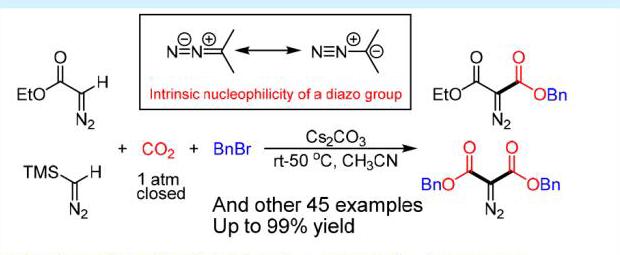
ABSTRACT: The direct carboxylation of the ipso- $\mathrm{C}\left( {\mathrm{{sp}}}^{2}\right) - \mathrm{H}$ bond of a diazo compound with carbon dioxide under mild reaction conditions is described. This method is transition-metal-free, uses a weak base, and proceeds at ambient temperature under atmospheric pressure in carbon dioxide. The carboxylation exhibits high reactivity and is amenable to subsequent diversification. A series of unsymmetrical 1,3-diester/keto/amide diazo compounds are obtained with moderate to excellent yields (up to 99%) with good functional group compatibility.
摘要:本文报道了在温和反应条件下,重氮化合物的偕碳($\mathrm{C}\left( {\mathrm{{sp}}}^{2}\right) - \mathrm{H}$)键与二氧化碳的直接羧基化反应。该方法无需过渡金属,使用弱碱,在常压二氧化碳氛围及室温下即可进行。该羧基化反应具有高反应活性,且易于进行后续衍生化。一系列不对称的 1,3-二酯/酮/酰胺重氮化合物以中等到优异的产率(高达 99%)得到,官能团兼容性良好。
Non-transitional metal catalysis - Atmospheric pressure
无过渡金属催化 - 常压
Normal temperature
常温
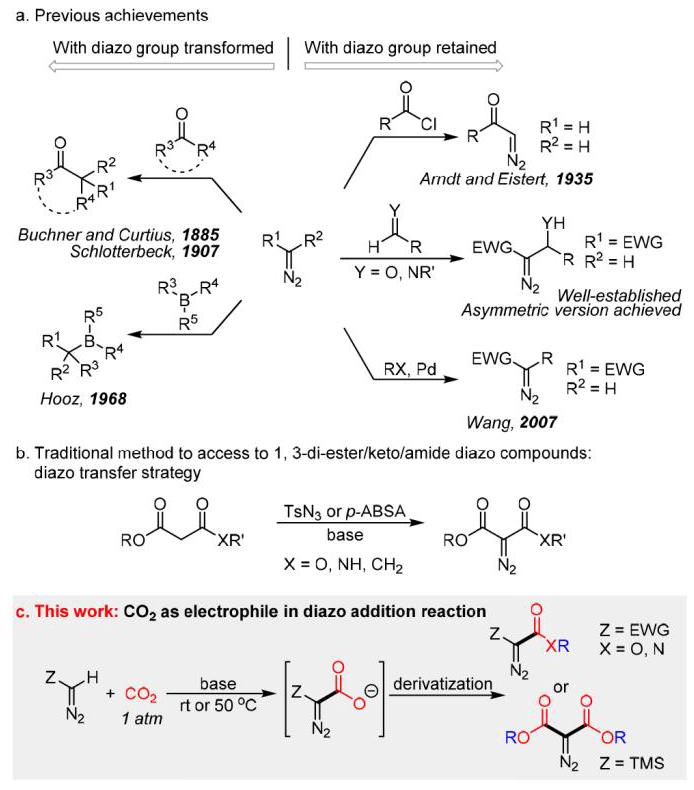
Nucleophilic addition reactions of diazo compounds with various electrophiles have been known for more than a century. ${}^{1}$ Many of these reactions have been developed into useful methods for organic synthesis. For example, the Buchner-Curtius-Schlotterbeck reaction combines aldehydes or ketones with aliphatic diazoalkanes to form homologated ketones. ${}^{2}$ In 1935, Arndt and Eistert reported the nucleophilic addition of diazomethane to acyl chlorides to afford $\alpha$ -diazo ketones. ${}^{3}$ Diazo compounds are generally sensitive to acids but are relatively stable under basic conditions. Base-promoted 1,2- or 1,4-additions to carbonyl compounds with the diazo group retained, as well as their asymmetric version, have been well documented in past decades. ${}^{1,4}$ Besides carbonyl compounds, organoboron reagents have been found to react with diazo compounds under mild conditions. ${}^{5}$ This type of reaction was pioneered by Hooz in ${1968}^{6}$ and further developed by Wang ${}^{7}$ and Barluenga. ${}^{8}$ A palladium-catalyzed cross-coupling reaction using diazo compounds as the nucleophilic partner was developed by Wang in 2007. ${}^{9}$
重氮化合物与各种亲电试剂的亲核加成反应已为人所知超过一个世纪。${}^{1}$ 其中许多反应已发展成为有机合成的有用方法。例如,布赫纳 - 库尔提斯 - 施洛特贝克反应将醛或酮与脂肪族重氮烷烃结合形成同系化酮。${}^{2}$ 1935 年,阿恩特和艾斯特尔特报道了重氮甲烷与酰氯的亲核加成反应,得到 $\alpha$ - 重氮酮。${}^{3}$ 重氮化合物通常对酸敏感,但在碱性条件下相对稳定。过去几十年中,碱促进的羰基化合物的 1,2 - 或 1,4 - 加成反应,同时保留重氮基团,以及它们的不对称版本,都有详细记录。${}^{1,4}$ 除了羰基化合物,人们发现有机硼试剂在温和条件下能与重氮化合物反应。${}^{5}$ 这种类型的反应由胡兹在 ${1968}^{6}$ 开创,并由王 ${}^{7}$ 和巴伦加进一步发展。${}^{8}$ 2007 年,王开发了一种以重氮化合物作为亲核试剂的钯催化交叉偶联反应。${}^{9}$
Looking through this history (Scheme 1a), the most common and available electrophile, carbon dioxide $\left( {\mathrm{{CO}}}_{2}\right)$ , surprisingly has not been used in this addition reaction. ${\mathrm{{CO}}}_{2}$ , a greenhouse gas, has attracted much attention as an inexpensive, nontoxic, nonflammable, renewable, and abundant C1 building block for organic synthesis. ${}^{10}$ The carboxylation of $\mathrm{C} - \mathrm{H}$ bonds using ${\mathrm{{CO}}}_{2}$ is emerging as a straightforward and atom-economic way to synthesize carboxylic acids and their derivatives. ${}^{11}$
纵观这段历史(方案 图 1a),最常见且可得的亲电试剂,二氧化碳 $\left( {\mathrm{{CO}}}_{2}\right)$,令人惊讶地尚未用于此加成反应。${\mathrm{{CO}}}_{2}$,一种温室气体,作为一种廉价、无毒、不可燃、可再生且丰富的有机合成 C1 构建单元,已引起广泛关注。${}^{10}$ 使用 ${\mathrm{{CO}}}_{2}$ 对 $\mathrm{C} - \mathrm{H}$ 键进行羧基化反应正成为一种直接且原子经济的合成羧酸及其衍生物的方法。${}^{11}$
We present here an addition reaction of the diazo compound ipso-C-H bond to ${\mathrm{{CO}}}_{2}$ under very mild reaction conditions with the diazo group retained. The resulting $\alpha$ -diazo carboxylate intermediates can be readily converted to esters and amides in a one-pot method (Scheme 1c). From a synthetic perspective, this method is particularly suitable for accessing unsymmetrical diazomalonates and their derivatives (vide infra). While these products can also be prepared via direct diazo transfer onto activated methylenes (Scheme 1b), the unsymmetrical malonate diester starting materials are not readily available and often require special techniques to prepare. ${}^{12}$ In contrast, our method provides modular synthesis of unsymmetrical diazomalonates.
我们在此展示了在非常温和的反应条件下,重氮化合物偕碳 - 氢键与 ${\mathrm{{CO}}}_{2}$ 的加成反应,同时保留重氮基团。所得的 $\alpha$ - 重氮羧酸酯中间体可以通过一锅法轻松转化为酯和酰胺(方案 图 1c)。从合成角度来看,该方法特别适合用于合成不对称重氮丙二酸酯及其衍生物(见下文)。虽然这些产物也可以通过将重氮直接转移到活性亚甲基上制备(方案 图 1b),但不对称丙二酸二酯起始原料不易获得,且通常需要特殊技术来制备。${}^{12}$ 相比之下,我们的方法提供了不对称重氮丙二酸酯的模块化合成。
Scheme 1. Diazo Group as Nucleophile
方案 图 1. 重氮基团作为亲核试剂
Received: November 17, 2017
收到日期:2017 年 11 月 17 日
Published: December 6, 2017
发表日期:2017 年 12 月 6 日
An electron-withdrawing group at the $\alpha$ position stabilizes the diazo group, which makes the diazo compounds easy to handle but also makes the ipso-C-H bond more acidic. The literature contains many reports of transition-metal-free, base-promoted additions of acidic $\mathrm{C} - \mathrm{H}$ bonds to ${\mathrm{{CO}}}_{2} \cdot {}^{13}$ The carboxylation of several representative types of acidic $\mathrm{C} - \mathrm{H}$ bonds, such as at the $\alpha$ position of a carbonyl compound ${}^{{13a} - 1}$ and at certain sites on an aromatic heterocycle, ${}^{{13j}, m, n}$ has been achieved using various bases such as DBU and alkali carbonates. Thus, we envisioned that a judicious choice of base would be critical to promoting the desired reactivity of diazo compounds with carbon dioxide.
在$\alpha$位置的吸电子基团使重氮基团稳定,这使得重氮化合物易于处理,但也使ipso-C-H键更具酸性。文献中有许多关于无过渡金属、碱促进的酸性$\mathrm{C} - \mathrm{H}$键加成到${\mathrm{{CO}}}_{2} \cdot {}^{13}$的报道。使用各种碱(如DBU和碱金属碳酸盐)已实现了几种代表性类型的酸性$\mathrm{C} - \mathrm{H}$键的羧化反应,例如羰基化合物${}^{{13a} - 1}$的$\alpha$位置以及芳族杂环上的某些位点${}^{{13j}, m, n}$。因此,我们设想明智地选择碱对于促进重氮化合物与二氧化碳的所需反应性至关重要。
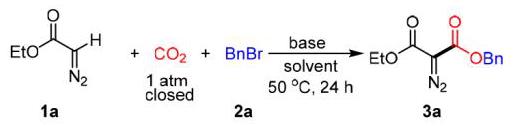
We initiated our studies by investigating the carboxylation of ethyl diazoacetate (EDA) 1a with 1 atm of ${\mathrm{{CO}}}_{2}$ in the presence of a base and an additional electrophile (benzyl bromide 2a in this case) to trap the newly formed carboxylate anion. A variety of bases were examined with 3a obtained with 84% isolated yield using ${\mathrm{{Cs}}}_{2}{\mathrm{{CO}}}_{3}$ as the base (Table 1, entry 5). The use of an organic base, DBU, was unsuccessful (entry 6). Other solvents, such as dichloromethane, 1,4-dioxane, THF, or DMSO, proved to be less efficient (entries 7-10), while DMF exhibited a positive solvent effect that afforded a 79% yield of 3a (entry 11). Since a stoichiometric amount of carbonate salt is used as the base, the source of the carboxyl group must be accurately identified. To this end, a control experiment was conducted in a ${\mathrm{N}}_{2}$ atmosphere (i.e., in the absence of ${\mathrm{{CO}}}_{2}$ , entry 12). Not surprisingly, this reaction gave only trace amounts of product, indicating that ${\mathrm{{CO}}}_{2}$ is the main source of the carboxyl group for this carboxylation reaction.
我们通过研究重氮乙酸乙酯(EDA)1a在碱和额外亲电试剂(在这种情况下为苄基溴2a)存在下与1 atm的${\mathrm{{CO}}}_{2}$进行羧化反应来捕获新形成的羧酸根阴离子,从而开始我们的研究。使用${\mathrm{{Cs}}}_{2}{\mathrm{{CO}}}_{3}$作为碱,以84%的分离产率得到3a,对多种碱进行了研究(表1,条目5)。使用有机碱DBU未成功(条目6)。事实证明,其他溶剂,如二氯甲烷、1,4-二氧六环、四氢呋喃或二甲基亚砜效率较低(条目7-10),而N, N-二甲基甲酰胺表现出积极的溶剂效应,得到了79%产率的3a(条目11)。由于使用化学计量的碳酸盐作为碱,必须准确确定羧基的来源。为此,在${\mathrm{N}}_{2}$气氛中进行了对照实验(即在没有${\mathrm{{CO}}}_{2}$的情况下,条目12)。不出所料,该反应仅产生痕量产物,表明${\mathrm{{CO}}}_{2}$为此羧化反应中羧基的主要来源。
Table 1. Optimization of the Reaction Conditions ${}^{a}$
表1. ${}^{a}$反应条件的优化
| entry | base | solvent | yield ${}^{b}\left( \% \right)$ |
| 1 | ${\mathrm{K}}_{2}{\mathrm{{CO}}}_{3}$ | ${\mathrm{{CH}}}_{3}\mathrm{{CN}}$ | 9 |
| 2 | ${\mathrm{{Li}}}_{2}{\mathrm{{CO}}}_{3}$ | ${\mathrm{{CH}}}_{3}\mathrm{{CN}}$ | nd |
| 3 | ${\mathrm{{KO}}}^{t}\mathrm{{Bu}}$ | ${\mathrm{{CH}}}_{3}\mathrm{{CN}}$ | trace |
| 4 | CsF | ${\mathrm{{CH}}}_{3}\mathrm{{CN}}$ | 17 |
| 5 | ${\mathrm{{Cs}}}_{2}{\mathrm{{CO}}}_{3}$ | ${\mathrm{{CH}}}_{3}\mathrm{{CN}}$ | 84 |
| 6 | DBU | ${\mathrm{{CH}}}_{3}\mathrm{{CN}}$ | trace |
| 7 | ${\mathrm{{Cs}}}_{2}{\mathrm{{CO}}}_{3}$ | DCM | trace |
| 8 | ${\mathrm{{Cs}}}_{2}{\mathrm{{CO}}}_{3}$ | 1,4-dioxane | trace |
| 9 | ${\mathrm{{Cs}}}_{2}{\mathrm{{CO}}}_{3}$ | THF | trace |
| 10 | ${\mathrm{{Cs}}}_{2}{\mathrm{{CO}}}_{3}$ | DMSO | 30 |
| 11 | ${\mathrm{{Cs}}}_{2}{\mathrm{{CO}}}_{3}$ | DMF | 79 |
| ${12}^{c}$ | ${\mathrm{{Cs}}}_{2}{\mathrm{{CO}}}_{3}$ | ${\mathrm{{CH}}}_{3}\mathrm{{CN}}$ | trace |
${}^{a}$ Reaction conditions: 1a ( ${0.5}\mathrm{{mmol}}$ ), ${\mathrm{{CO}}}_{2}$ (1 atm, closed, ${50}\mathrm{\;{mL}}$ Schlenk flask, about 2 mmol, 4 equiv based on the ideal gas law at 20 ${}^{ \circ }\mathrm{C}$ ), 2a (0.75 mmol, 1.5 equiv), base (0.6 mmol, 1.2 equiv), solvent (2 $\mathrm{{mL}}),{24}\mathrm{\;h}$ , nd, not detected. ${}^{b}$ Isolated yields were reported. ${}^{c}{\mathrm{\;N}}_{2}$ atmosphere.
${}^{a}$反应条件:1a(${0.5}\mathrm{{mmol}}$),${\mathrm{{CO}}}_{2}$(1 atm,封闭,${50}\mathrm{\;{mL}}$Schlenk烧瓶,约2 mmol,基于20${}^{ \circ }\mathrm{C}$时的理想气体定律为4当量),2a(0.75 mmol,1.5当量),碱(0.6 mmol,1.2当量),溶剂(2$\mathrm{{mL}}),{24}\mathrm{\;h}$,nd,未检测到。${}^{b}$报道的是分离产率。${}^{c}{\mathrm{\;N}}_{2}$气氛。
These optimal reaction conditions were then used for substrate scope studies with the results shown in Table 2. Substituted benzyl bromides, allyl bromide, and $\alpha$ -bromo carbonyl compounds were all good electrophiles for esterification of the carboxylate, which was formed in situ by the addition of the diazo group to ${\mathrm{{CO}}}_{2}$ , furnishing high yields of the products (>80% in most cases). Other common alkyl bromides were less reactive. Thus, alkyl iodides were employed and/or the solvent was switched to DMF (3l, 3n, and 3q) to enhance the reactivity of the esterification step. The chemo-selectivity of this transformation was further demonstrated by the compatibility of ketone and aldehyde functional groups in cases $3\mathbf{g}$ and $3\mathbf{h}$ . $\alpha$ -Diazo alkyl ketones also worked well and produced diazo $\beta$ -keto esters with $> {80}\%$ yields (3r and 3s), while an $\alpha$ -diazo aryl ketone gave a relatively low yield (3t, 45%). This carboxylation-esterification strategy was also applied to the synthesis of $\alpha$ -diazo amides (3u-x) and $\alpha$ - diazo phosphonate (3y) with 65-94% yields.
然后将这些最佳反应条件用于底物范围研究,结果见表2。取代苄基溴、烯丙基溴和$\alpha$-溴代羰基化合物都是用于羧酸盐酯化的良好亲电试剂,羧酸盐是通过将重氮基加到${\mathrm{{CO}}}_{2}$原位形成的,大多数情况下产物收率很高(>80%)。其他常见的烷基溴反应活性较低。因此,使用烷基碘和/或将溶剂换为DMF(3l、3n和3q)以提高酯化步骤的反应活性。在$3\mathbf{g}$和$3\mathbf{h}$的情况下,酮和醛官能团的兼容性进一步证明了这种转化的化学选择性。$\alpha$-重氮烷基酮也表现良好,以$> {80}\%$的收率生成重氮$\beta$-酮酯(3r和3s),而$\alpha$-重氮芳基酮的收率相对较低(3t,45%)。这种羧化-酯化策略也应用于合成收率为65-94%的$\alpha$-重氮酰胺(3u-x)和$\alpha$-重氮膦酸酯(3y)。
Table 2. Carboxylation-Esterification of Diazo Compounds ${}^{a}$
表2. 重氮化合物${}^{a}$的羧化-酯化反应
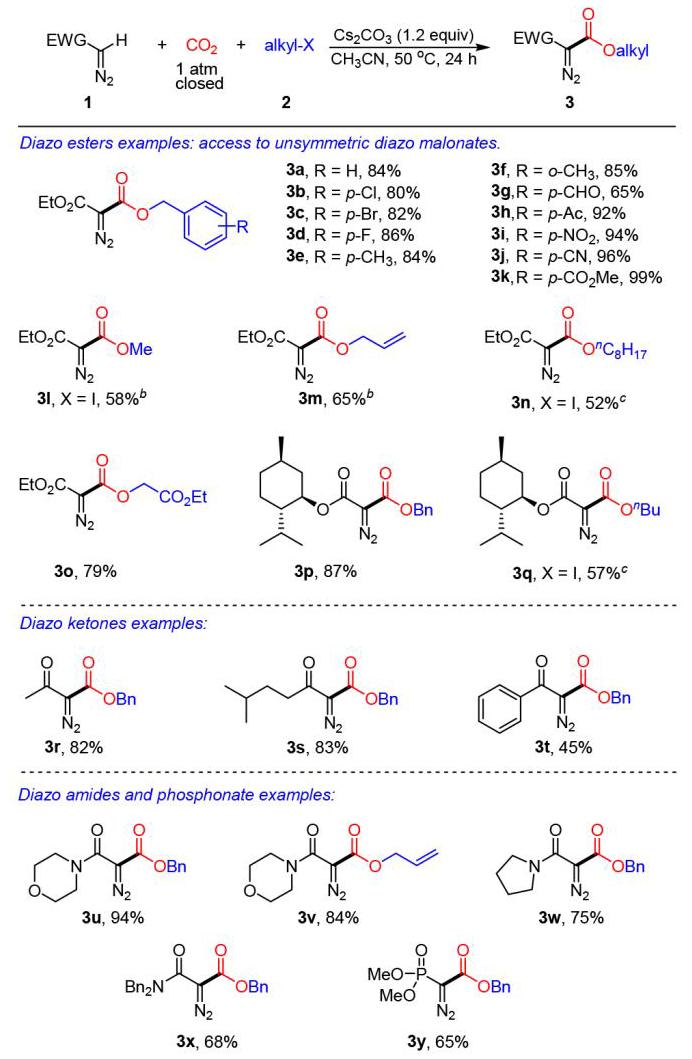
${}^{a}$ Reaction conditions: $1\left( {{0.5}\mathrm{{mmol}}}\right) ,{\mathrm{{CO}}}_{2}$ (1 atm, closed, ${50}\mathrm{\;{mL}}$ Schlenk flask, about 2 mmol, 4 equiv based on the ideal gas law at 20 ${}^{ \circ }\mathrm{C}),2\left( {{0.75}\mathrm{{mmol}},{1.5}\mathrm{{equiv}}}\right) ,{\mathrm{{Cs}}}_{2}{\mathrm{{CO}}}_{3}\left( {{0.6}\mathrm{{mmol}},{1.2}\mathrm{{equiv}}}\right)$ , acetonitrile $\left( {2\mathrm{\;{mL}}}\right) ,{50}^{ \circ }\mathrm{C},{24}\mathrm{\;h}$ . Bromides were used unless specified otherwise. Isolated yields were given. ${}^{b}{80}{}^{ \circ }\mathrm{C}$ . ${}^{c}\mathrm{{DMF}}$ is used as solvent. For more details, see the Supporting Information.
${}^{a}$反应条件:$1\left( {{0.5}\mathrm{{mmol}}}\right) ,{\mathrm{{CO}}}_{2}$(1个大气压,封闭,${50}\mathrm{\;{mL}}$Schlenk烧瓶,约2 mmol,根据理想气体定律在20${}^{ \circ }\mathrm{C}),2\left( {{0.75}\mathrm{{mmol}},{1.5}\mathrm{{equiv}}}\right) ,{\mathrm{{Cs}}}_{2}{\mathrm{{CO}}}_{3}\left( {{0.6}\mathrm{{mmol}},{1.2}\mathrm{{equiv}}}\right)$时为4当量,乙腈$\left( {2\mathrm{\;{mL}}}\right) ,{50}^{ \circ }\mathrm{C},{24}\mathrm{\;h}$。除非另有说明,使用溴化物。给出分离收率。${}^{b}{80}{}^{ \circ }\mathrm{C}$。${}^{c}\mathrm{{DMF}}$用作溶剂。更多细节见补充信息。
The utility of this methodology was further investigated by studying the carboxylation-amidation of $\alpha$ -diazo compounds. The scope is summarized in Table 3. Carboxylation of the diazo ipso- $\mathrm{C} - \mathrm{H}$ bond with ${\mathrm{{CO}}}_{2}$ generated the $\alpha$ -diazo carboxylate intermediate, which reacted with methylsulfonyl chloride to form a mixed anhydride. Finally, an amine was introduced to deliver the final amide products. This protocol gave a range of primary and secondary amines with the amide products obtained with moderate to good yields (50-74%).
通过研究$\alpha$-重氮化合物的羧化-酰胺化反应进一步考察了该方法的实用性。范围总结见表3。重氮基的ipso-$\mathrm{C} - \mathrm{H}$键与${\mathrm{{CO}}}_{2}$发生羧化反应生成$\alpha$-重氮羧酸酯中间体,该中间体与甲磺酰氯反应形成混合酸酐。最后,引入胺得到最终的酰胺产物。该方案得到了一系列伯胺和仲胺,酰胺产物的收率为中等至良好(50-74%)。
Table 3. Carboxylation-Amidation of Diazo Compounds ${}^{a}$
表3. 重氮化合物${}^{a}$的羧化-酰胺化反应
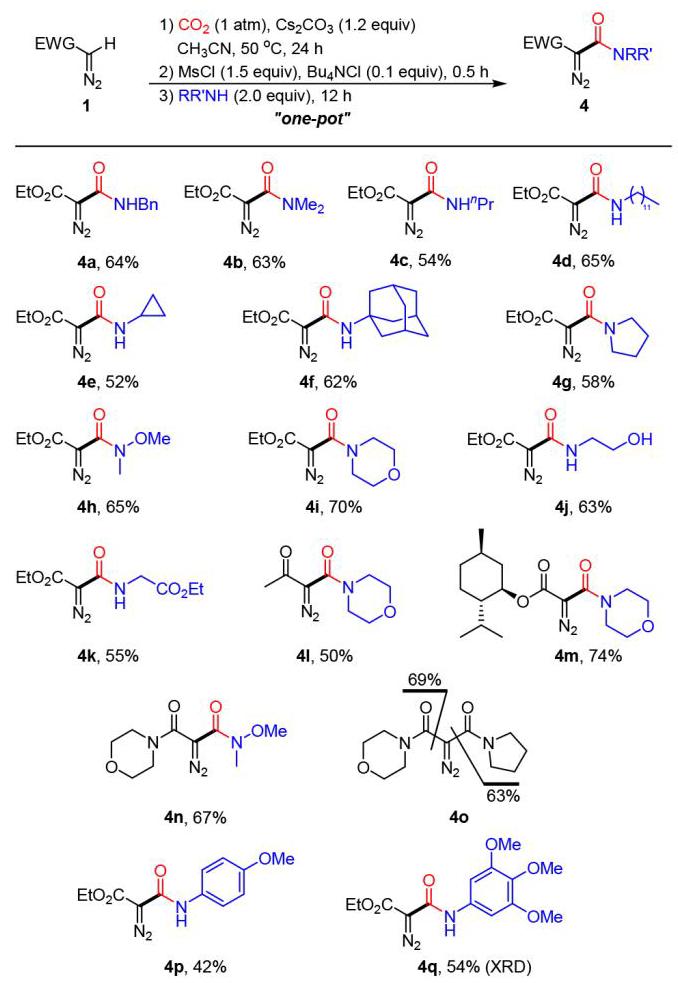
${}^{a}$ Reaction conditions: $1\left( {{0.5}\mathrm{{mmol}}}\right) ,{\mathrm{{CO}}}_{2}(1\mathrm{\;{atm}}$ , closed, ${50}\mathrm{\;{mL}}$ Schlenk flask, about 2 mmol, 4 equiv based on the ideal gas law at 20 ${}^{ \circ }\mathrm{C}),{\mathrm{{Cs}}}_{2}{\mathrm{{CO}}}_{3}$ (0.6 mmol,1.2 equiv), acetonitrile (2 mL), ${50}^{ \circ }\mathrm{C},{24}\mathrm{\;h}$ . Then MsCl (0.75 mmol,1.5 equiv), ${\mathrm{{Bu}}}_{4}\mathrm{{NCl}}$ (0.05 mmol,0.1 equiv), ${50}{}^{ \circ }\mathrm{C},{0.5}\mathrm{\;h}$ . Amine (1 mmol,2 equiv), ${50}{}^{ \circ }\mathrm{C},{12}\mathrm{\;h}$ . Isolated yields were reported.
${}^{a}$反应条件:$1\left( {{0.5}\mathrm{{mmol}}}\right) ,{\mathrm{{CO}}}_{2}(1\mathrm{\;{atm}}$,封闭,${50}\mathrm{\;{mL}}$Schlenk烧瓶,约2 mmol,基于20${}^{ \circ }\mathrm{C}),{\mathrm{{Cs}}}_{2}{\mathrm{{CO}}}_{3}$(0.6 mmol,1.2当量)时的理想气体定律为4当量,乙腈(2 mL),${50}^{ \circ }\mathrm{C},{24}\mathrm{\;h}$。然后加入MsCl(0.75 mmol,1.5当量),${\mathrm{{Bu}}}_{4}\mathrm{{NCl}}$(0.05 mmol,0.1当量),${50}{}^{ \circ }\mathrm{C},{0.5}\mathrm{\;h}$。胺(1 mmol,2当量),${50}{}^{ \circ }\mathrm{C},{12}\mathrm{\;h}$。报告了分离产率。
In addition to stable diazo compounds with an electron-withdrawing group at the $\alpha$ position of the diazo group, labile ${\mathrm{{TMSCHN}}}_{2}$ is also a competent substrate for the desired transformation. This can be attributed to the mild reaction conditions and the high intrinsic reactivity of the diazo $\mathrm{C} - \mathrm{H}$ addition to ${\mathrm{{CO}}}_{2}$ . Thus, increasing the stoichiometry of the base and the halide results in the carboxylation-esterification of ${\mathrm{{TMSCHN}}}_{2}$ proceeding on both sides of the diazo group to furnish symmetrical diazomalonates 5 with moderate to good yields (Table 4, 5a-e, 38-68%).
除了在重氮基团的$\alpha$位置带有吸电子基团的稳定重氮化合物外,不稳定的${\mathrm{{TMSCHN}}}_{2}$也是所需转化反应的合适底物。这可归因于温和的反应条件以及重氮$\mathrm{C} - \mathrm{H}$加成到${\mathrm{{CO}}}_{2}$的高固有反应活性。因此,增加碱和卤化物的化学计量比会导致${\mathrm{{TMSCHN}}}_{2}$在重氮基团两侧发生羧基酯化反应,以中等至良好的产率(表4,5a - e,38 - 68%)提供对称的重氮丙二酸酯5。
The deprotonation of monosubstituted diazocarbonyls and subsequent $\mathrm{C} - \mathrm{C}$ bond formation by nucleophilic addition to the electrophiles is well documented. ${}^{1,{14}}$ Accordingly, we propose that our reaction is also an example of deprotona-tion-nucleophilic addition. We also performed a number of mechanistic experiments to support the deprotonation-addition process with the details shown in the Supporting Information.
单取代重氮羰基化合物的去质子化以及随后通过亲核加成到亲电试剂上形成$\mathrm{C} - \mathrm{C}$键的过程已有充分记载。${}^{1,{14}}$因此,我们认为我们的反应也是去质子化-亲核加成的一个例子。我们还进行了一些机理实验来支持去质子化-加成过程,具体细节见补充信息。
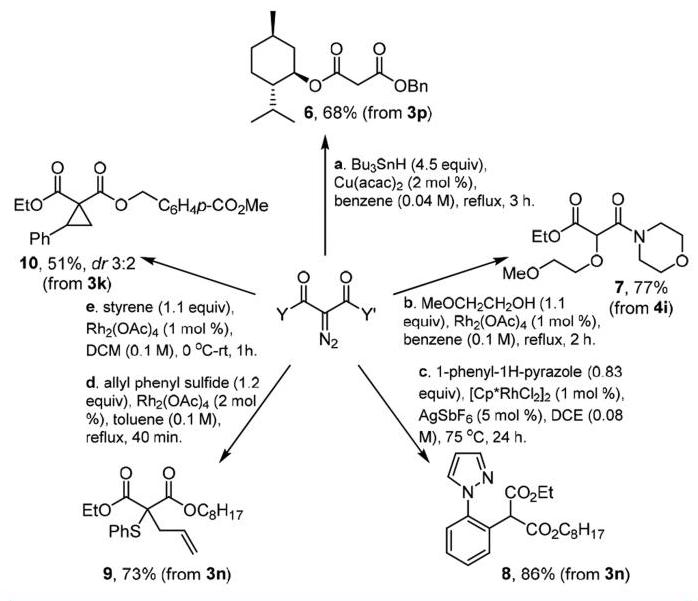
To demonstrate the utility of these unsymmetrical diazo malonates/ketones/amides, several 3 and 4 products were subjected to typical transformations via metal-carbene chemistry. For example, reduction to the methylene group (6), ${}^{15}\mathrm{O} - \mathrm{H}$ insertion (7), ${}^{16}$ formal C-H insertion (8), ${}^{17}$ the sulfonium ylide $\left\lbrack {2,3}\right\rbrack$ -sigmatropic rearrangement (9), ${}^{18}$ and cyclopropanation ${\left( {10}\right) }^{19}$ can be efficiently performed in a single step from the corresponding diazo starting materials (Scheme 2).
为了证明这些不对称重氮丙二酸酯/酮/酰胺的实用性,通过金属卡宾化学对几种3和4产物进行了典型的转化。例如,还原为亚甲基(6),${}^{15}\mathrm{O} - \mathrm{H}$插入(7),${}^{16}$形式的C-H插入(8),${}^{17}$锍叶立德$\left\lbrack {2,3}\right\rbrack$ - 西格玛重排(9),${}^{18}$和环丙烷化${\left( {10}\right) }^{19}$可以从相应的重氮起始原料在一步中高效地进行(方案2)。
Table 4. Carboxylation-Esterification of TMSCHN ${}_{2}{}^{a}$
表4. TMSCHN ${}_{2}{}^{a}$的羧化-酯化反应
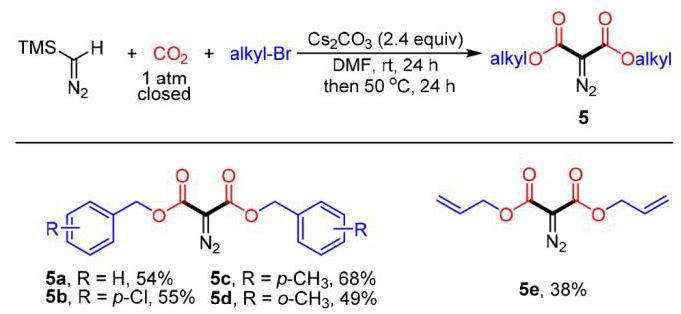
${}^{a}$ Reaction conditions: TMSCHN ${}_{2}$ (0.5 mmol,0.25 mL of $2\mathrm{M}$ in hexane), ${\mathrm{{CO}}}_{2}$ (1 atm, closed, ${100}\mathrm{\;{mL}}$ Schlenk tube, about $4\mathrm{{mmol}},8$ equiv based on the ideal gas law at ${20}^{ \circ }\mathrm{C}),{\mathrm{{Cs}}}_{2}{\mathrm{{CO}}}_{3}$ (1.2 mmol,2.4 equiv), alkyl bromide (3.0 mmol,6 equiv), DMF (2 mL), rt, ${24}\mathrm{\;h}$ , then ${50}^{ \circ }\mathrm{C},{24}\mathrm{\;h}$ . Isolated yields were reported.
${}^{a}$反应条件:TMSCHN ${}_{2}$(0.5 mmol,0.25 mL溶于己烷的$2\mathrm{M}$),${\mathrm{{CO}}}_{2}$(1 atm,封闭,${100}\mathrm{\;{mL}}$Schlenk管,基于${20}^{ \circ }\mathrm{C}),{\mathrm{{Cs}}}_{2}{\mathrm{{CO}}}_{3}$时理想气体定律约$4\mathrm{{mmol}},8$当量),${24}\mathrm{\;h}$(1.2 mmol,2.4当量),烷基溴(3.0 mmol,6当量),DMF(2 mL),室温,${50}^{ \circ }\mathrm{C},{24}\mathrm{\;h}$,然后${50}^{ \circ }\mathrm{C},{24}\mathrm{\;h}$。报告了分离产率。
Scheme 2. Derivative Reactions of Unsymmetrical 1,3- Dicarbonyl Diazo Compounds
方案2. 不对称1,3 - 二羰基重氮化合物的衍生反应
In summary, we have demonstrated the first use of ${\mathrm{{CO}}}_{2}$ as an electrophile for the diazo addition reaction. The reaction harnesses the intrinsic nucleophilicity of the diazo group, so no strong base, no transition metal, and no harsh conditions are needed. The resulting $\alpha$ -diazo carboxylate can be readily converted to esters and amides in a one-pot method. This method provides a new retrosynthetic disconnection for chemists in the preparation of unsymmetrical 1,3-dicarbonyl 2-diazo compounds and their derivatives.
总之,我们首次证明了使用${\mathrm{{CO}}}_{2}$作为重氮加成反应的亲电试剂。该反应利用了重氮基团固有的亲核性,因此无需强碱、过渡金属和苛刻条件。所得的$\alpha$-重氮羧酸盐可以通过一锅法轻松转化为酯和酰胺。该方法为化学家在制备不对称1,3-二羰基2-重氮化合物及其衍生物时提供了一种新的逆合成切断方法。
ASSOCIATED CONTENT
相关内容
G Supporting Information
G 支持信息
The Supporting Information is available free of charge on the ACS Publications website at DOI: 10.1021/acs.or-glett.7b03573.
支持信息可在 ACS 出版物网站上免费获取,DOI:10.1021/acs.or-glett.7b03573。
Experiemental procedures, X-ray data for 4q, and NMR spectra (PDF)
实验步骤、化合物 4q 的 X 射线数据和 NMR 光谱(PDF)
Organic Letters
《有机快报》
Accession Codes
存取号
CCDC 1558263 contains the supplementary crystallographic data for this paper. These data can be obtained free of charge via www.ccdc.cam.ac.uk/data_request/cif, or by contacting The Cambridge Crystallographic Data Centre, 12 Union Road, Cambridge CB2 1EZ, UK; fax: +44 1223 336033.
CCDC 1558263包含了本文的补充晶体学数据。这些数据可以通过www.ccdc.cam.ac.uk/data_request/cif免费获取,或联系英国剑桥联合路12号剑桥晶体学数据中心,邮编CB2 1EZ;传真:+44 1223 336033获取。
AUTHOR INFORMATION
作者信息
Corresponding Author
通讯作者
ORCID ®
开放研究者与贡献者身份识别码(ORCID)
Fanyang Mo: 0000-0002-4140-3020
范洋·莫:0000-0002-4140-3020
Notes
注释
The authors declare no competing financial interest.
作者声明不存在利益冲突。
ACKNOWLEDGMENTS
致谢
The project was supported by the Natural Science Foundation of China (Grant Nos. 21502003 and 21772003). We also thank the “1000-Youth Talents Plan” and Peking University for startup funds.
The project was supported by the Natural Science Foundation of China (Grant Nos. 21502003 and 21772003). We also thank the “1000-Youth Talents Plan” and Peking University for startup funds.
REFERENCES
参考文献
(1) Zhang, Y.; Wang, J. Chem. Commun. 2009, 5350.
(2) (a) Buchner, E.; Curtius, T. Ber. Dtsch. Chem. Ges. 1885, 18, 2371. (b) Schlotterbeck, F. Ber. Dtsch. Chem. Ges. 1907, 40, 1826. (c) Gutsche, C. D. Org. React. 1954, 8, 364. (d) Candeias, N. R.; Paterna, R.; Gois, P. M. P. Chem. Rev. 2016, 116, 2937.
(3) Arndt, F.; Eistert, B. Ber. Dtsch. Chem. Ges. B 1935, 68, 200.
(4) (a) Ye, T.; McKervey, M. A. Chem. Rev. 1994, 94, 1091. (b) Doyle, M. P.; McKervey, M. A.; Ye, T. Modern Catalytic Methods for Organic Synthesis with Diazo Compounds: From Cyclopropanes to Ylides; John Wiley & Sons: New York, 1998. (c) Zhang, Z.; Wang, J. Tetrahedron 2008, 64, 6577. (d) Ford, A.; Miel, H.; Ring, A.; Slattery, C. N.; Maguire, A. R.; McKervey, M. A. Chem. Rev. 2015, 115, 9981. (e) Qiu, D.; Qiu, M.; Ma, R.; Zhang, Y.; Wang, J. Huaxue Xuebao 2016, 74, 472.
(5) Li, H.; Zhang, Y.; Wang, J. Synthesis 2013, 45, 3090.
(6) (a) Hooz, J.; Linke, S. J. Am. Chem. Soc. 1968, 90, 5936. (b) Hooz, J.; Linke, S. J. Am. Chem. Soc. 1968, 90, 6891.
(7) (a) Peng, C.; Zhang, W.; Yan, G.; Wang, J. Org. Lett. 2009, 11, 1667. (b) Li, H.; Wang, L.; Zhang, Y.; Wang, J. Angew. Chem., Int. Ed. 2012, 51, 2943. (c) Li, H.; Shangguan, X.; Zhang, Z.; Huang, S.; Zhang, Y.; Wang, J. Org. Lett. 2014, 16, 448.
(8) Barluenga, J.; Tomás-Gamasa, M.; Aznar, F.; Valdés, C. Nat. Chem. 2009, 1, 494.
(9) Peng, C.; Cheng, J.; Wang, J. J. Am. Chem. Soc. 2007, 129, 8708. (10) (a) Aresta, M.; Dibenedetto, A. Dalton Trans. 2007, 2975. (b) Sakakura, T.; Choi, J.-C.; Yasuda, H. Chem. Rev. 2007, 107, 2365. (c) Mikkelsen, M.; Jorgensen, M.; Krebs, F. C. Energy Environ. Sci. 2010, 3, 43. (d) Cokoja, M.; Bruckmeier, C.; Rieger, B.; Herrmann, W. A.; Kühn, F. E. Angew. Chem., Int. Ed. 2011, 50, 8510. (e) Huang, K.; Sun, C.-L.; Shi, Z.-J. Chem. Soc. Rev. 2011, 40, 2435. (f) Omae, I. Coord. Chem. Rev. 2012, 256, 1384. (g) Tsuji, Y.; Fujihara, T. Chem. Commun. 2012, 48, 9956. (h) Yang, Z.-Z.; He, L.-N.; Gao, J.; Liu, A.- H.; Yu, B. Energy Environ. Sci. 2012, 5, 6602. (i) Yu, B.; Diao, Z.-F.; Guo, C.-X.; He, L.-N. J. CO2 Util. 2013, 1, 60. (j) Aresta, M.; Dibenedetto, A.; Angelini, A. Chem. Rev. 2014, 114, 1709. (k) Maeda, C.; Miyazaki, Y.; Ema, T. Catal. Sci. Technol. 2014, 4, 1482. (l) Yeung, C. S.; Dong, V. M. Top. Catal. 2014, 57, 1342. (m) Fiorani, G.; Guo, W.; Kleij, A. W. Green Chem. 2015, 17, 1375. (n) Liu, Q.; Wu, L.; Jackstell, R.; Beller, M. Nat. Commun. 2015, 6, 5933. (o) Yu, B.; He, L.-N. ChemSusChem 2015, 8, 52. (p) Börjesson, M.; Moragas, T.; Gallego, D.; Martin, R. ACS Catal. 2016, 6, 6739.
(11) (a) Zhang, W.; Lu, X. Chin. J. Catal. 2012, 33, 745. (b) Cai, X.; Xie, B. Synthesis 2013, 45, 3305. (c) Liu, A.-H.; Yu, B.; He, L.-N. Greenhouse Gases: Sci. Technol. 2015, 5, 17. (d) Yu, D.; Teong, S. P.; Zhang, Y. Coord. Chem. Rev. 2015, 293-294, 279. (e) Sekine, K.; Yamada, T. Chem. Soc. Rev. 2016, 45, 4524. (f) Wang, S.; Du, G.; Xi, C. Org. Biomol. Chem. 2016, 14, 3666. (g) Wu, X.-F.; Zheng, F. Top. Curr. Chem. 2017, 375, 4.
(12) Niwayama, S.; Cho, H. Chem. Pharm. Bull. 2009, 57, 508.
(13) (a) Bottaccio, G.; Chiusoli, G. P. Chem. Commun. (London) 1966, 618a. (b) Haruki, E.; Arakawa, M.; Matsumura, N.; Otsuji, Y.; Imoto, E. Chem. Lett. 1974, 3, 427. (c) Sakurai, H.; Shirahata, A.; Hosomi, A. Tetrahedron Lett. 1980, 21, 1967. (d) Mori, H.; Satake, Y. Chem. Pharm. Bull. 1985, 33, 3469. (e) Tirpak, R. E.; Olsen, R. S.; Rathke, M. W. J. Org. Chem. 1985, 50, 4877. (f) Hisakazu, M. Bull. Chem. Soc. Jpn. 1988, 61, 435. (g) Chiba, K.; Tagaya, H.; Miura, S.; Karasu, M. Chem. Lett. 1992, 21, 923. (h) Abe, H.; Inoue, S. J. Chem. Soc., Chem. Commun. 1994, 1197. (i) Flowers, B. J.; Gautreau-Service, R.; Jessop, P. G. Adv. Synth. Catal. 2008, 350, 2947. (j) Vechorkin, O.; Hirt, N.; Hu, X. Org. Lett. 2010, 12, 3567. (k) Dingyi, Y.; Yugen, Z. Green Chem. 2011, 13, 1275. (1) Wang, X.; Lim, Y. N.; Lee, C.; Jang, H.-Y.; Lee, B. Y. Eur. J. Org. Chem. 2013, 2013, 1867. (m) Banerjee, A.; Dick, G. R.; Yoshino, T.; Kanan, M. W. Nature 2016, 531, 215. (n) Fenner, S.; Ackermann, L. Green Chem. 2016, 18, 3804. (o) Zhang, W.-Z.; Yang, M.-W.; Lu, X.-B. Green Chem. 2016, 18, 4181.
(14) (a) Aggarwal, V. K.; Sheldon, C. G.; Macdonald, G. J.; Martin, W. P. J. Am. Chem. Soc. 2002, 124, 10300. (b) Jiang, N.; Wang, J. Tetrahedron Lett. 2002, 43, 1285. (c) Matsuya, Y.; Ohsawa, N.; Nemoto, H. J. Am. Chem. Soc. 2006, 128, 13072. (d) Xiao, F.; Liu, Y.; Wang, J. Tetrahedron Lett. 2007, 48, 1147. (e) Draghici, C.; Brewer, M. J. Am. Chem. Soc. 2008, 130, 3766.
(15) Tan, Z.; Qu, Z.; Chen, B.; Wang, J. Tetrahedron 2000, 56, 7457. (16) Davis, O. A.; Bull, J. A. Angew. Chem., Int. Ed. 2014, 53, 14230.
(17) Yu, X.; Yu, S.; Xiao, J.; Wan, B.; Li, X. J. Org. Chem. 2013, 78, 5444.
(18) Takano, S.; Tomita, S.; Takahashi, M.; Ogasawara, K. Chem. Lett. 1987, 16, 1569.
(19) De Simone, F.; Saget, T.; Benfatti, F.; Almeida, S.; Waser, J. Chem. - Eur. J. 2011, 17, 14527.