Chapter Two - Recent Advances in Transition-Metal-Catalyzed Cross-Coupling Reactions With N-Tosylhydrazones
英文原文与中文译文逐段对照 · English original with Chinese translation
Di Qiu**, Fanyang Mo**, Yan Zhang*, Jianbo Wang**,
邱迪**,莫凡洋**,张燕*,王建波**
*Beijing National Laboratory of Molecular Sciences (BNLMS) and Key Laboratory of Bioorganic Chemistry and Molecular Engineering of Ministry of Education, College of Chemistry, Peking University, Beijing, China ${}^{ \dagger }$ College of Chemistry, Tianjin Key Laboratory of Structure and Performance for Functional Molecules, Tianjin Normal University, Tianjin, China
*北京分子科学国家实验室(BNLMS)和教育部生物有机化学与分子工程重点实验室,北京大学化学与分子工程学院,北京,中国 ${}^{ \dagger }$ 天津师范大学化学学院,天津市功能分子结构与性能重点实验室,天津,中国
*College of Engineering, Peking University, Beijing, China
*北京大学工学院,北京,中国
${}^{1}$ Corresponding author:
${}^{1}$ 通讯作者:
Contents
目录
Introduction 1
引言1
Palladium-Catalyzed Coupling Reaction of N-Tosylhydrazones 2
N-对甲苯磺酰腙的钯催化偶联反应2
2.1 Pd-Catalyzed Coupling of N-Tosylhydrazones With Aryl and Alkenyl Halides 4
2.1 N-对甲苯磺酰腙与芳基和烯基卤化物的钯催化偶联4
2.2 Pd-Catalyzed Coupling of N-Tosylhydrazones With Benzyl Halides 19
2.2 N-对甲苯磺酰腙与苄基卤化物的钯催化偶联19
2.3 Pd-Catalyzed Oxidative Coupling of N-Tosylhydrazones 20
2.3 N-对甲苯磺酰腙的钯催化氧化偶联20
2.4 Pd-Catalyzed Two-Component Cascade Coupling of N-Tosylhydrazones 26
2.4 N-对甲苯磺酰腙的钯催化双组分串联偶联26
2.5 Pd-Catalyzed Multicomponent Coupling of N-Tosylhydrazones 35
2.5 N-对甲苯磺酰腙的钯催化多组分偶联35
Copper-Catalyzed Coupling Reaction of N-Tosylhydrazones
N-对甲苯磺酰腙的铜催化偶联反应
3.1 Cu-Catalyzed Coupling of N-Tosylhydrazones With Alkynes
3.1 N-对甲苯磺酰腙与炔烃的铜催化偶联
3.2 Cu-Catalyzed Coupling of N-Tosylhydrazones Involving C-H Activation
3.2 涉及C-H活化的N-对甲苯磺酰腙的铜催化偶联
3.3 Cu-Catalyzed Oxidative Coupling Reaction of N-Tosylhydrazones
3.3 N-对甲苯磺酰腙的铜催化氧化偶联反应
Rhodium-Catalyzed Coupling Reaction of N-Tosylhydrazones
N-对甲苯磺酰腙的铑催化偶联反应
Nickel- and Cobalt-Catalyzed Coupling Reactions of N-Tosylhydrazones
N-对甲苯磺酰腙的镍和钴催化偶联反应
Catalytic Intramolecular Cyclization of N-Tosylhydrazones
N-对甲苯磺酰腙的催化分子内环化
Summary
总结
Acknowledgments
致谢
References
参考文献
1. INTRODUCTION
1. 引言
The area of transition-metal-catalyzed cross-coupling reactions has experienced considerable growth in the past decades. This strategy has created powerful and indispensable methods for selective constructing carbon-carbon/carbon-heteroatom bond, as well as in synthesizing functional molecules and natural products. ${}^{1}$ To expedite synthetic endeavors, chemists have mainly focused on the development of new catalysts for various coupling reactions. On the other hand, the developments toward novel coupling partners also represent the major challenges in organometallic research area.
在过去几十年中,过渡金属催化的交叉偶联反应领域取得了显著的发展。这种策略为选择性构建碳-碳/碳-杂原子键以及合成功能分子和天然产物创造了强大且不可或缺的方法。${}^{1}$ 为了加快合成研究,化学家们主要致力于开发用于各种偶联反应的新型催化剂。另一方面,开发新型偶联伙伴也是有机金属研究领域的主要挑战。
$N$ -Tosylhydrazones, easily synthesized through the condensation of carbonyl compounds with $N$ -tosylhydrazine, are useful and common substrates in organic synthesis. Thus, transition-metal-catalyzed cross-coupling reaction of $N$ -tosylhydrazones not only expands the substrate scope of coupling partners but also furnishes novel and practical methodology for the unconventional modification of carbonyl compounds.
$N$-甲苯磺酰腙可通过羰基化合物与$N$-甲苯磺酰肼缩合轻松合成,是有机合成中有用且常见的底物。因此,过渡金属催化的$N$-甲苯磺酰腙交叉偶联反应不仅扩大了偶联伙伴的底物范围,还为羰基化合物的非常规修饰提供了新颖实用的方法。
Particularly, owing to the reason that the diazo species can be generated in situ via detosylation of $N$ -tosylhydrazones, $N$ -tosylhydrazones have been utilized as the surrogates for unstable diazo compounds or carbene precursors. ${}^{2}$ Conceptually, transition-metal-catalyzed cross-coupling reactions of $N$ -tosylhydrazones introduce diazo component or carbene species into cross-coupling systems, providing novel types of C-C, C=C, and carbon-heteroatom bond formation strategies. Mechanistically, the key feature of these coupling processes involves a migratory insertion of the metal-carbene intermediates, which not only constitutes a fresh and novel reaction type of $N$ -tosylhydrazones but also represents a paradigm shift in understanding metal-carbene chemistry.
特别地,由于重氮物种可通过$N$-甲苯磺酰腙的脱甲苯磺酰化原位生成,$N$-甲苯磺酰腙已被用作不稳定重氮化合物或卡宾前体的替代物。${}^{2}$从概念上讲,$N$-甲苯磺酰腙的过渡金属催化交叉偶联反应将重氮组分或卡宾物种引入交叉偶联体系,提供了新型的C-C、C=C和碳-杂原子键形成策略。从机理上讲,这些偶联过程的关键特征涉及金属-卡宾中间体的迁移插入,这不仅构成了$N$-甲苯磺酰腙的一种全新反应类型,也代表了理解金属-卡宾化学的范式转变。
Although several reviews related to transition-metal-catalyzed coupling reactions of $N$ -tosylhydrazones have appeared in the literatures in the past years, ${}^{3 - 7}$ in view of the rapid growth of the field a timely and comprehensive summary of this area is still necessary. This chapter will focus on the recent advances in the area, in particular the cascade transformations involving carbene-coupling process. The reactions are classified according to different transition-metal catalysts (Scheme 1). Due to the space limitation, catalytic $\mathrm{C} - \mathrm{H},\mathrm{N} - \mathrm{H}$ , and $\mathrm{O} - \mathrm{H}$ insertion processes of $N$ -tosylhydrazones are not included in this contribution.
尽管过去几年文献中已经出现了几篇关于过渡金属催化的$N$-甲苯磺酰腙偶联反应的综述,但${}^{3 - 7}$鉴于该领域的快速发展,及时对该领域进行全面总结仍然是必要的。本章将重点介绍该领域的最新进展,特别是涉及卡宾偶联过程的级联转化。这些反应根据不同的过渡金属催化剂进行分类(方案1)。由于篇幅限制,本论文不包括$N$-甲苯磺酰腙的催化$\mathrm{C} - \mathrm{H},\mathrm{N} - \mathrm{H}$和$\mathrm{O} - \mathrm{H}$插入过程。
2. PALLADIUM-CATALYZED COUPLING REACTION OF N-TOSYLHYDRAZONES
2. N-对甲苯磺酰腙的钯催化偶联反应
Palladium-catalyzed coupling reaction of $N$ -tosylhydrazones has been extensively developed and demonstrates many applications in organic synthesis. ${}^{{4a} - c}$ The general mechanism is shown in Scheme 2. Initially, the carbon-Pd(II) intermediate1generates either through transmetalation with other metal species or by oxidative addition from organohalide analogues. Subsequently, decomposition of the in situ-generated diazo species from stable $N$ -tosylhydrazone substrates gives rise to the formation of Pd(II)- carbene 2 as the key intermediate. Then, a migratory insertion process, in which an “X” ligand of Pd(II) migrates to carbene center, takes place to generate a new carbon-Pd(II) species 3, followed by sequential $\beta - \mathrm{H},\beta - \mathrm{C}$ elimination or other cascade transformations to afford a variety of functionalized molecules. The Pd-catalyzed cross-coupling reactions of $N$ -tosylhydrazones have established a novel and superior approach toward the selective C-C bond formation, particularly for highly efficient synthesis of polysubstituted alkenes. This content will classify the recent advances according to the various types of the coupling partners.
钯催化的$N$-对甲苯磺酰腙的偶联反应已得到广泛发展,并在有机合成中显示出许多应用。${}^{{4a} - c}$ 一般机理如图2所示。最初,碳-Pd(II)中间体1通过与其他金属物种的转金属化或通过有机卤化物类似物的氧化加成产生。随后,由稳定的$N$-对甲苯磺酰腙底物原位生成的重氮物种分解,形成关键中间体Pd(II)-卡宾2。然后,发生迁移插入过程,其中Pd(II)的“X”配体迁移到卡宾中心,生成新的碳-Pd(II)物种3,随后依次进行$\beta - \mathrm{H},\beta - \mathrm{C}$消除或其他级联转化,得到各种功能化分子。钯催化的$N$-对甲苯磺酰腙的交叉偶联反应为选择性C-C键形成建立了一种新颖且优越的方法,特别是对于多取代烯烃的高效合成。本内容将根据偶联伙伴的不同类型对近期进展进行分类。
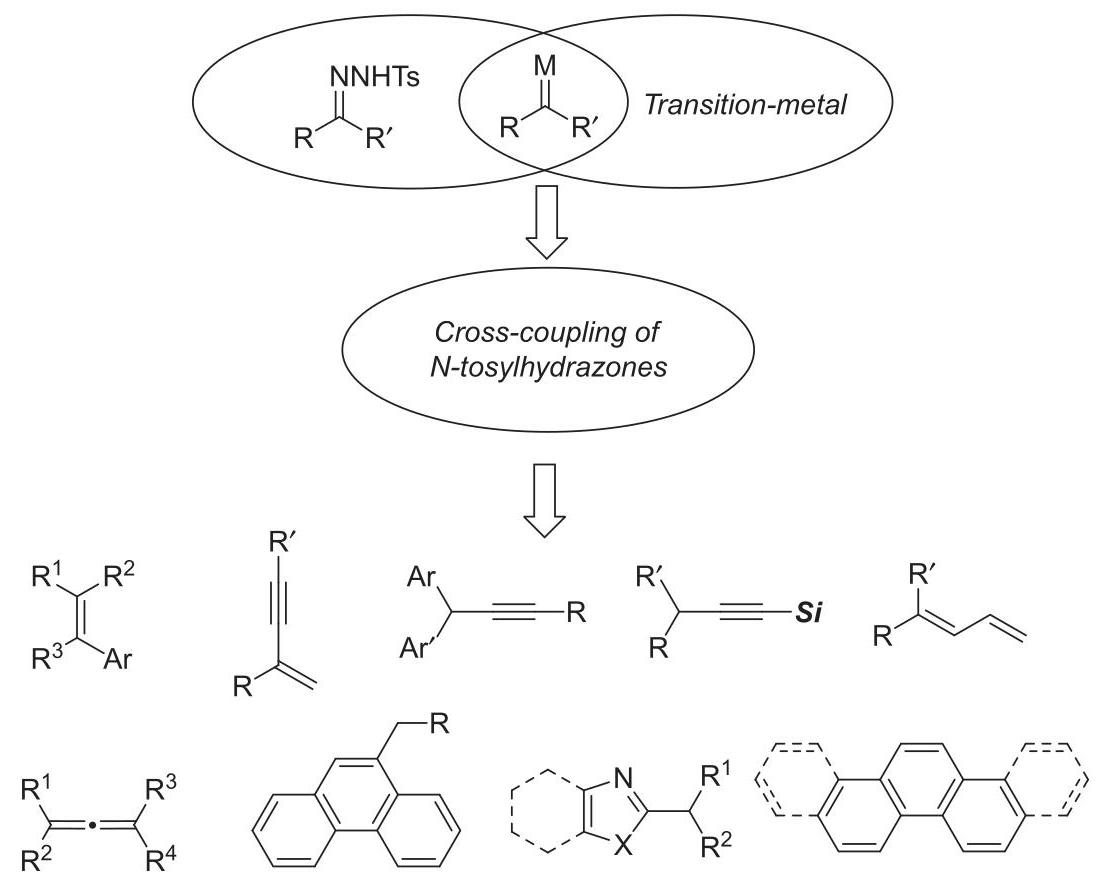
Scheme 1 Transition-metal-catalyzed cross-coupling reactions of $N$ -tosylhydrazones and typical applications in organic synthesis.
图1 $N$-对甲苯磺酰腙的过渡金属催化交叉偶联反应及其在有机合成中的典型应用。
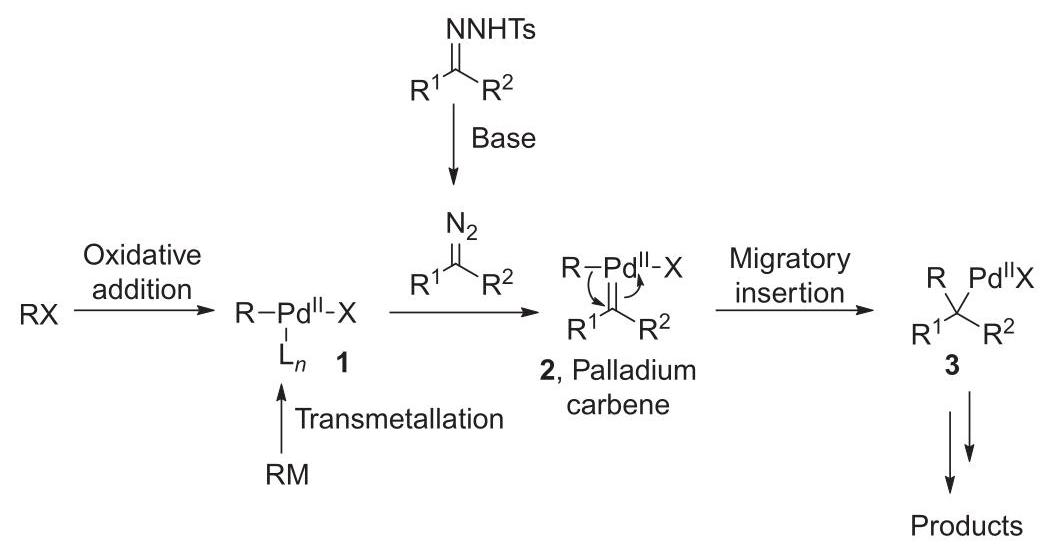
Scheme 2 General reaction pathway of the Pd-catalyzed cross-coupling reaction of $N$ -tosylhydrazones involving migratory insertion.
图2 涉及迁移插入的钯催化$N$-对甲苯磺酰腙交叉偶联反应的一般反应途径。
2.1 Pd-Catalyzed Coupling of N-Tosylhydrazones With Aryl and Alkenyl Halides
2.1 钯催化的N-对甲苯磺酰腙与芳基卤化物和烯基卤化物的偶联反应
In 2007, Barluenga group reported the first example of Pd-catalyzed cross-coupling reactions of $N$ -tosylhydrazones (Scheme 3). ${}^{8}$ They achieved the catalytic coupling of aryl halides with bench-stable $N$ -tosylhydrazones, which provided a novel route for synthesizing polysubstituted olefins with high efficiency. They proposed that the catalytic cycle of this coupling transformation is initiated by the oxidative addition of aryl halide to Pd(0) species 4, giving rise to aryl palladium(II) complex 5. Then, the reaction of 5 with diazo intermediates, which are generated in situ from $N$ -tosylhydrazones in the presence of a base, occurs affording Pd(II)-carbene species 6 . The key feature of this catalytic cycle is the migratory insertion of the aryl group to Pd-carbene center, subsequently delivering the alkyl palladium complex 7. Finally, β-hydrogen elimination of 7 provides the desired arylated olefin along with regeneration of $\mathrm{{Pd}}\left( 0\right)$ species.
2007年,巴伦加研究小组报道了首例钯催化的$N$-对甲苯磺酰腙的交叉偶联反应(方案3)。${}^{8}$ 他们实现了芳基卤化物与稳定的$N$-对甲苯磺酰腙的催化偶联,为高效合成多取代烯烃提供了一条新途径。他们提出,这种偶联转化的催化循环是由芳基卤化物对Pd(0)物种4进行氧化加成引发的,生成芳基钯(II)配合物5。然后,5与重氮中间体反应,重氮中间体是在碱存在下由$N$-对甲苯磺酰腙原位生成的,反应生成Pd(II)-卡宾物种6。这个催化循环的关键特征是芳基向Pd-卡宾中心的迁移插入,随后生成烷基钯配合物7。最后,7的β-氢消除提供了所需的芳基化烯烃,并使$\mathrm{{Pd}}\left( 0\right)$物种再生。
In view of the facile condensation of carbonyl compounds with tosylhydrazide into $N$ -tosylhydrazones, this strategy represents a convenient procedure to convert carbonyl compounds into nucleophilic coupling reagents for Pd-catalyzed cross-coupling reactions. This methodology affords a highly efficient way to prepare densely functionalized alkenes with high stereoselectivity and excellent functional group tolerance.
鉴于羰基化合物与对甲苯磺酰肼容易缩合形成$N$-对甲苯磺酰腙,该策略是将羰基化合物转化为用于钯催化交叉偶联反应的亲核偶联试剂的便捷方法。这种方法提供了一种高效的方式来制备具有高立体选择性和优异官能团耐受性的高度官能化烯烃。
Later, Barluenga and Valdés launched systematic research toward Pd-catalyzed cross-coupling reactions of aryl halides with N-tosylhydrazones derived from divergent carbonyl compounds, proceeding through migratory insertion and $\beta - \mathrm{H}$ elimination to furnish the desired arylated alkenes. ${}^{9 - {18}}$ At the first attempt they have carried out Pd-catalyzed coupling reaction of aryl halides with $N$ -tosylhydrazones derived from 4-piperidones (Scheme 4). ${}^{9}$ The reaction affords 4-aryltetrahydropyridines in good to excellent yields with good functional group tolerance. Furthermore, the catalytic one-pot procedure was also implemented by using 4-piperidone, tosylhydrazide, and aryl halides as the substrates, leading to the formation of functionalized 4-aryltetrahydropyridines in similarly high yields.
后来,巴伦加和巴尔德斯对钯催化的芳基卤化物与源自不同羰基化合物的N-对甲苯磺酰腙的交叉偶联反应展开了系统研究,通过迁移插入和$\beta - \mathrm{H}$消除反应来提供所需的芳基化烯烃。${}^{9 - {18}}$ 他们首次尝试进行了钯催化的芳基卤化物与源自4-哌啶酮的$N$-对甲苯磺酰腙的偶联反应(方案4)。${}^{9}$ 该反应以良好至优异的产率得到4-芳基四氢吡啶,且官能团耐受性良好。此外,还采用4-哌啶酮、对甲苯磺酰肼和芳基卤化物作为底物实施了催化一锅法,以同样高的产率生成了官能化的4-芳基四氢吡啶。
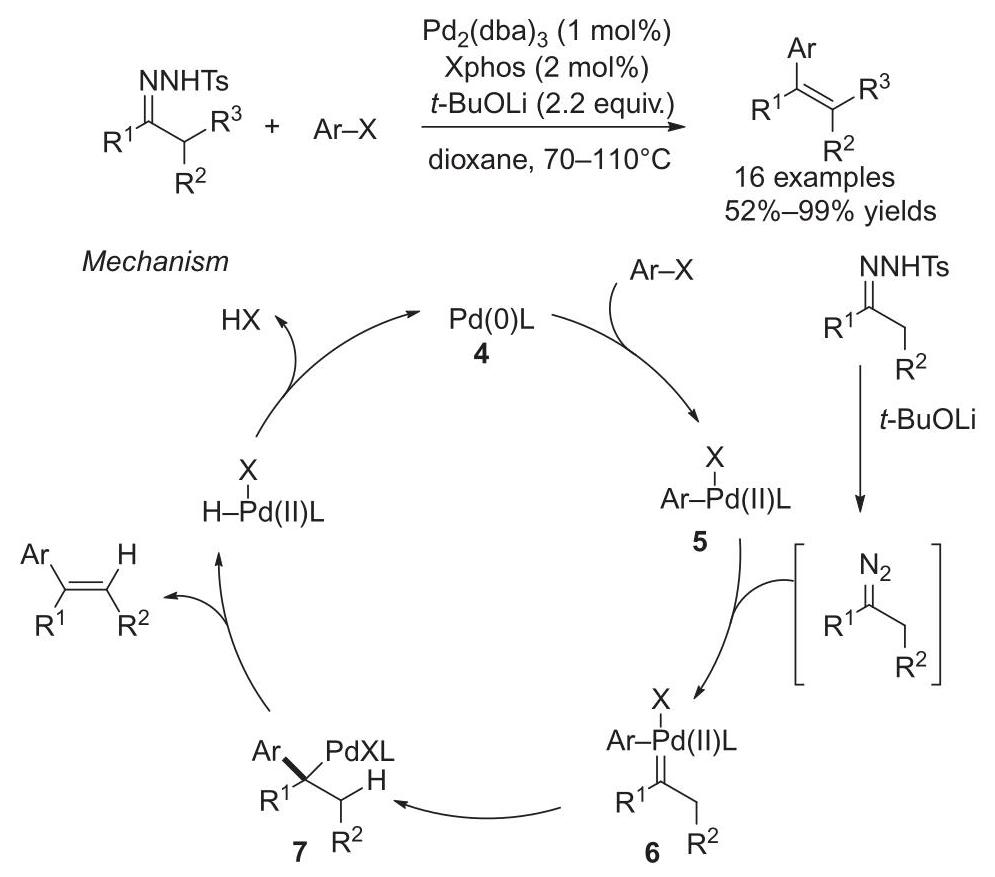
Xphos = 2-dicyclohexylphosphino-2’,4’,6’-triisopropylbiphenyl
Xphos = 2-二环己基膦基-2’,4’,6’-三异丙基联苯
Scheme 3 Pd-catalyzed cross-coupling reactions to synthesize substituted alkenes.
方案3 钯催化合成取代烯烃的交叉偶联反应。
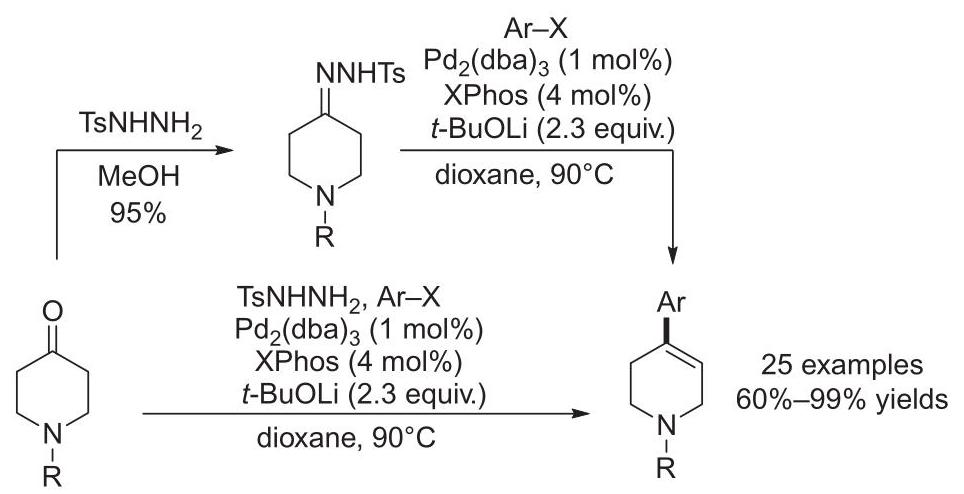
Scheme 4 Pd-catalyzed one-pot coupling of 4-piperidone, tosylhydrazide, and aryl halides.
方案4 钯催化的4-哌啶酮、对甲苯磺酰肼和芳基卤化物的一锅法偶联反应。
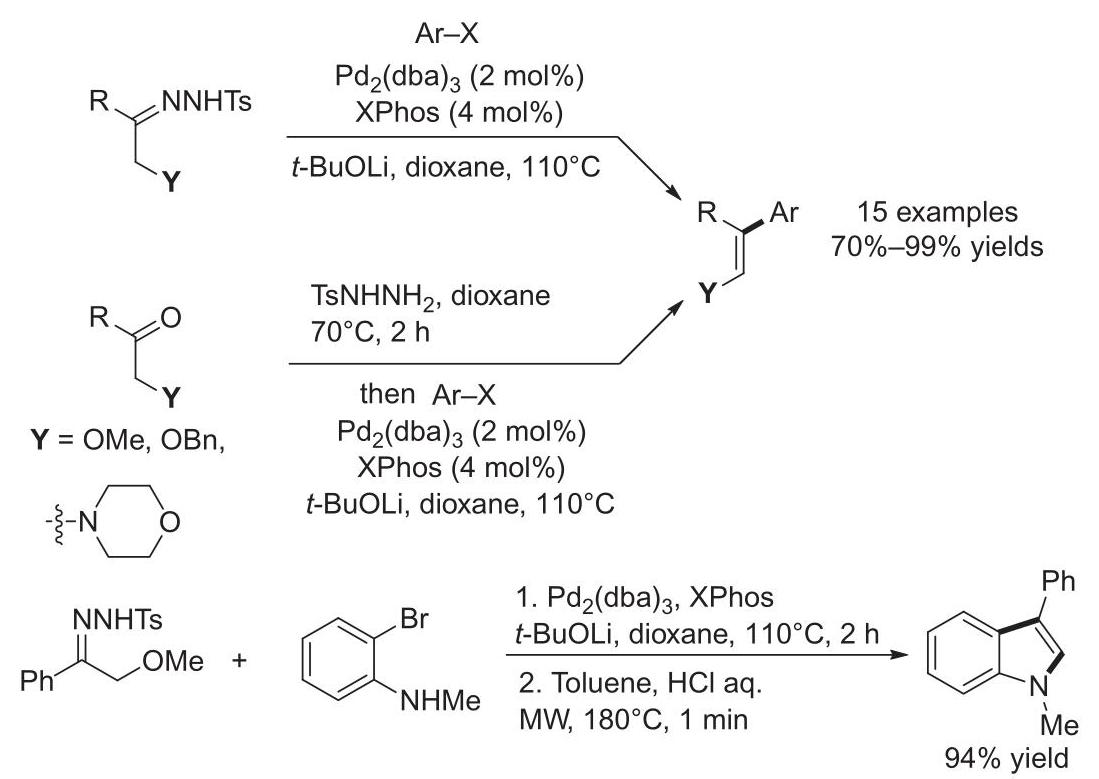
Scheme 5 Pd-catalyzed one-pot synthesis of enol ethers and enamines.
方案5 钯催化的烯醇醚和烯胺的一锅法合成。
In 2009, the same group carried out the Pd-catalyzed cross-coupling reaction of aryl halides with $\alpha$ -alkoxy- or $\alpha$ -amino-derived $N$ -tosylhydrazones, achieving the facile and efficient synthesis of enol ethers or enamines (Scheme 5). ${}^{10}$ This transformation can be either conducted with the preformed tosylhydrazone substrates or in a one-pot process by using $\alpha$ -functionalized carbonyl compounds and tosylhydrazide. The resulting product of this methodology also demonstrated a potential application in constructing heterocyclic scaffolds.
2009年,同一研究小组进行了钯催化的芳基卤化物与$\alpha$-烷氧基或$\alpha$-氨基衍生的$N$-对甲苯磺酰腙的交叉偶联反应,实现了烯醇醚或烯胺的简便高效合成(方案5)。${}^{10}$ 这种转化既可以使用预先形成的对甲苯磺酰腙底物进行,也可以通过使用$\alpha$-官能化的羰基化合物和对甲苯磺酰肼以一锅法进行。该方法得到的产物在构建杂环骨架方面也显示出潜在的应用价值。
In 2010, the same group also accomplished a simple and straightforward synthesis of 2-arylacrylates compounds by employing the Pd-catalyzed tosylhydrazide-promoted coupling reaction of aryl halides with pyruvate derivatives 8 (Scheme 6). ${}^{11}$ Taking into account the great importance of 2-arylacrylates as valuable intermediates and direct precursors for the pro-phen family of antiinflammatory drugs, this method demonstrates potential usefulness in organic synthesis and medicinal chemistry. In addition, this coupling reaction from $N$ -tosylhydrazones derived from substituted 2-oxoesters can also afford tri- and tetra-substituted functionalized alkenes in a facile manner.
2010年,同一研究团队还通过钯催化的芳基卤化物与丙酮酸衍生物8的甲苯磺酰肼促进偶联反应,实现了2-芳基丙烯酸酯类化合物的简单直接合成(方案6)。${}^{11}$ 鉴于2-芳基丙烯酸酯作为抗炎药物前体家族的重要中间体和直接前体的重要性,该方法在有机合成和药物化学中显示出潜在的实用性。此外,这种由取代的2-氧代酯衍生的$N$ -甲苯磺酰腙进行的偶联反应,也能够以简便的方式得到三取代和四取代的官能化烯烃。
The transition-metal-catalyzed coupling reaction has provided a novel approach toward the synthesis of conjugated dienes, which demonstrate great importance in organic synthesis, biochemistry, and materials sciences. ${}^{{12}\mathrm{a}}$ In 2010, Barluenga and coworkers reported the synthesis of conjugated dienes through two different pathways: the Pd-catalyzed cross-coupling reaction of $N$ -tosylhydrazones derived from $\alpha ,\beta$ -unsaturated ketone with aryl halides, or using alkenyl halide with nonconjugated $N$ -tosylhydrazones (Scheme 7). ${}^{{12}\mathrm{\;b}}$ In the latter case, the probable pathway rationalizing the formation of product may involve a hydride elimination of $\pi$ -allylpalladium intermediate9. This method provides a novel approach for the synthesis of aryl-substituted conjugated dienes.
过渡金属催化的偶联反应为共轭二烯的合成提供了一种新方法,共轭二烯在有机合成、生物化学和材料科学中具有重要意义。${}^{{12}\mathrm{a}}$ 2010年,巴伦加及其同事报道了通过两种不同途径合成共轭二烯:钯催化源自$\alpha ,\beta$-不饱和酮的$N$-甲苯磺酰腙与芳基卤化物的交叉偶联反应,或使用烯基卤化物与非共轭$N$-甲苯磺酰腙反应(方案7)。${}^{{12}\mathrm{\;b}}$ 在后一种情况下,合理化产物形成的可能途径可能涉及$\pi$-烯丙基钯中间体9的氢消除反应。该方法为芳基取代共轭二烯的合成提供了一种新方法。
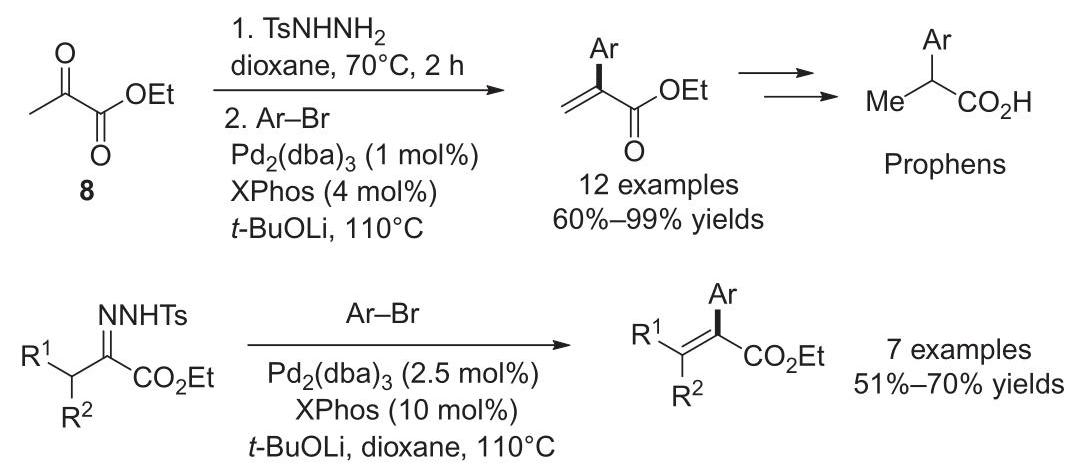
Scheme 6 Synthesis of 2-arylacrylates by Pd-catalyzed coupling reaction from pyruvate with aryl halides.
方案6 钯催化丙酮酸与芳基卤化物的偶联反应合成2-芳基丙烯酸酯。
In 2014, Valdés successfully expanded the substrate scope of Pd-catalyzed coupling reaction of aryl halides to 1,1,1-trifluoroacetone tosylhydrazones. ${}^{13}$ Under the optimized conditions, this transformation affords functionalized $\alpha$ -trifluoromethylstyrenes, which serve as valuable trifluoromethylated synthetic intermediates, in high yields and good functional group tolerance (Scheme 8). This contribution not only represents a novel combination of coupling reaction with fluorine chemistry but also demonstrates potential applications in medicinal chemistry and material sciences.
2014年,巴尔德斯成功地将钯催化的芳基卤化物偶联反应的底物范围扩展到1,1,1-三氟丙酮甲苯磺酰腙。${}^{13}$ 在优化条件下,这种转化以高产率和良好的官能团耐受性提供了官能化的$\alpha$ -三氟甲基苯乙烯,它们是有价值的三氟甲基化合成中间体(方案8)。这一贡献不仅代表了偶联反应与氟化学的新结合,也展示了其在药物化学和材料科学中的潜在应用。
In addition to aryl halides, aryl nonaflates as their analogues have been explored as effective electrophilic reaction partners in Pd-catalyzed cross-coupling of $N$ -tosylhydrazones. ${}^{{14} - {17}}$ In 2011, Pd-catalyzed coupling reaction of $N$ -tosylhydrazones with aryl nonaflates was described, affording di-, tri-, and tetra-substituted alkenes with good functional group tolerance (Scheme 9). ${}^{15}$ Notably, the addition of LiCl in the presence of small amounts of water apparently accelerates this transformation. Under optimized reaction conditions, various olefins are obtained with excellent yields and high stereo-selectivity depending on the nature of the coupling partners. Moreover, the success of a single-step synthesis of dihydronaphthalene derivative10, which is the direct precursor of the antidepressant sertraline, demonstrates the practical application of this methodology in organic synthesis.
除了芳基卤化物外,芳基九氟甲磺酸盐作为其类似物,已被探索作为钯催化的$N$ -甲苯磺酰腙交叉偶联反应中有效的亲电反应伙伴。${}^{{14} - {17}}$ 2011年,有人描述了钯催化的$N$ -甲苯磺酰腙与芳基九氟甲磺酸盐的偶联反应,得到了具有良好官能团耐受性的二取代、三取代和四取代烯烃(方案9)。${}^{15}$ 值得注意的是,在少量水存在下加入LiCl明显加速了这种转化。在优化的反应条件下,根据偶联伙伴的性质,可以以优异的产率和高立体选择性获得各种烯烃。此外,作为抗抑郁药舍曲林直接前体的二氢萘衍生物10的一步合成成功,证明了该方法在有机合成中的实际应用。
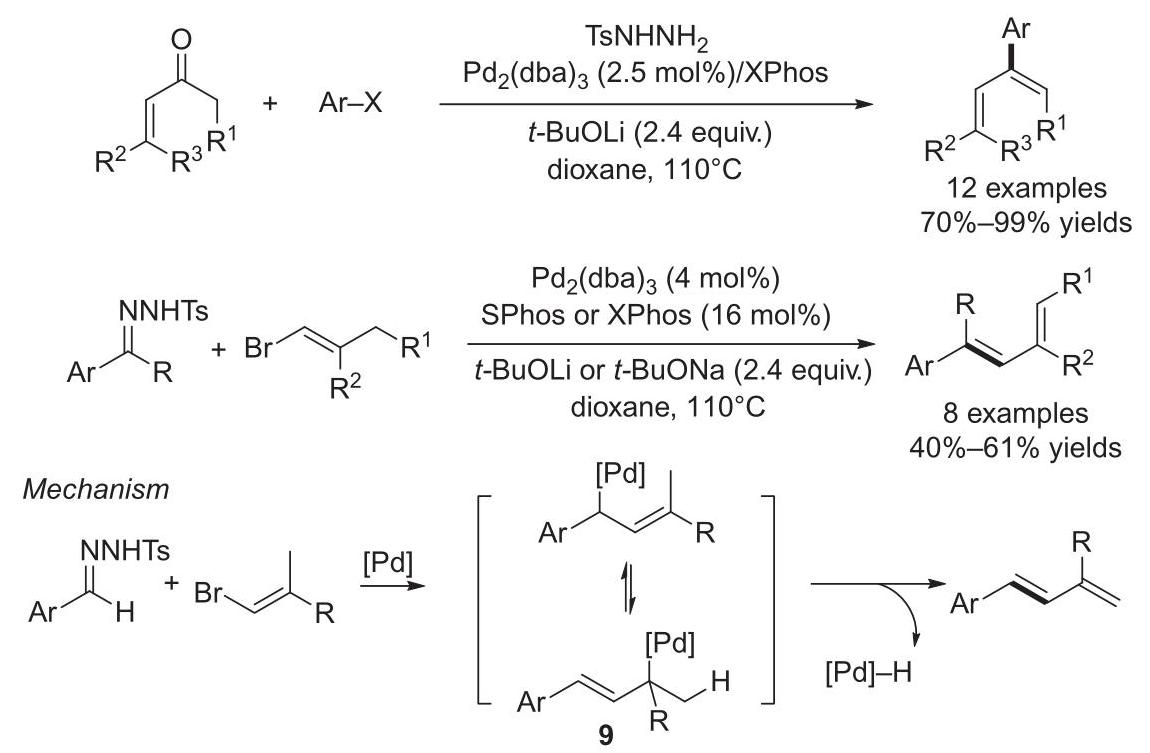
Scheme 7 Pd-catalyzed coupling reaction for the synthesis of conjugated dienes.
方案7 钯催化合成共轭二烯的偶联反应。
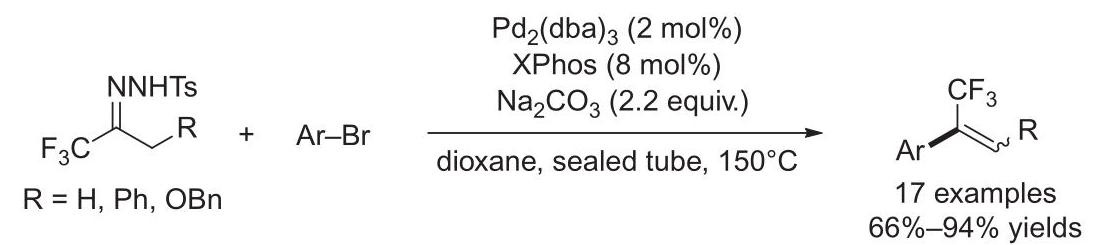
Scheme 8 Pd-catalyzed coupling reaction for the synthesis of $\alpha$ -trifluoromethylstyrenes.
方案8 钯催化合成$\alpha$ -三氟甲基苯乙烯的偶联反应。
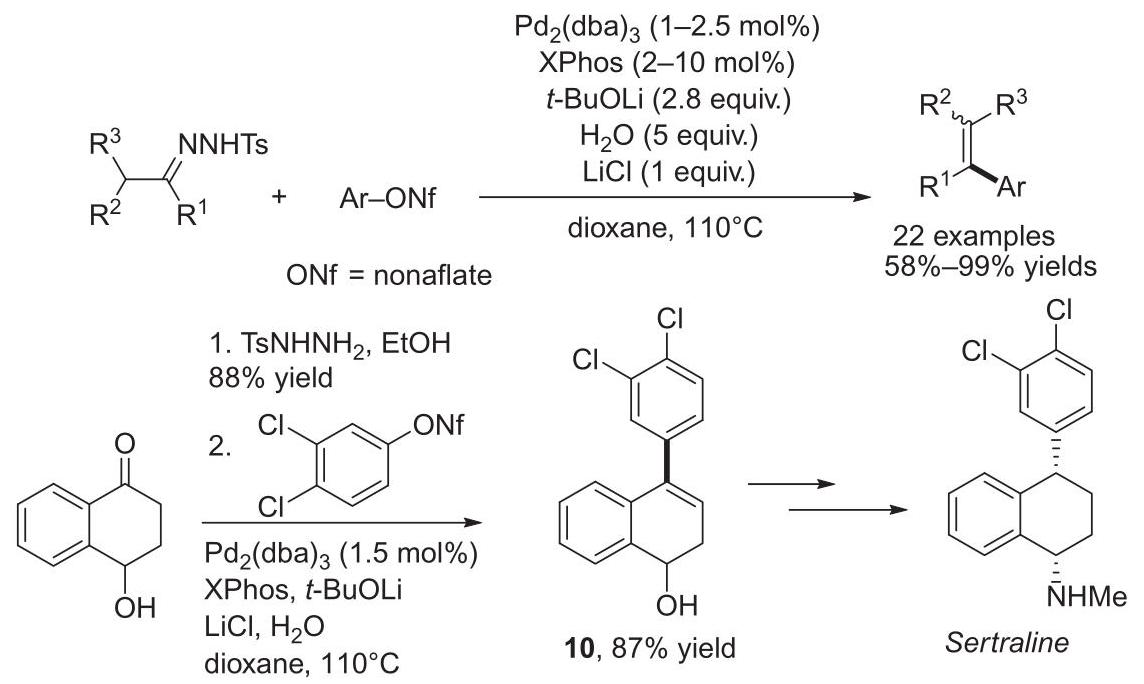
Scheme 9 Pd-catalyzed coupling of $N$ -tosylhydrazones with aryl nonaflates.
方案9 钯催化的$N$ -甲苯磺酰腙与芳基九氟甲磺酸盐的偶联反应。
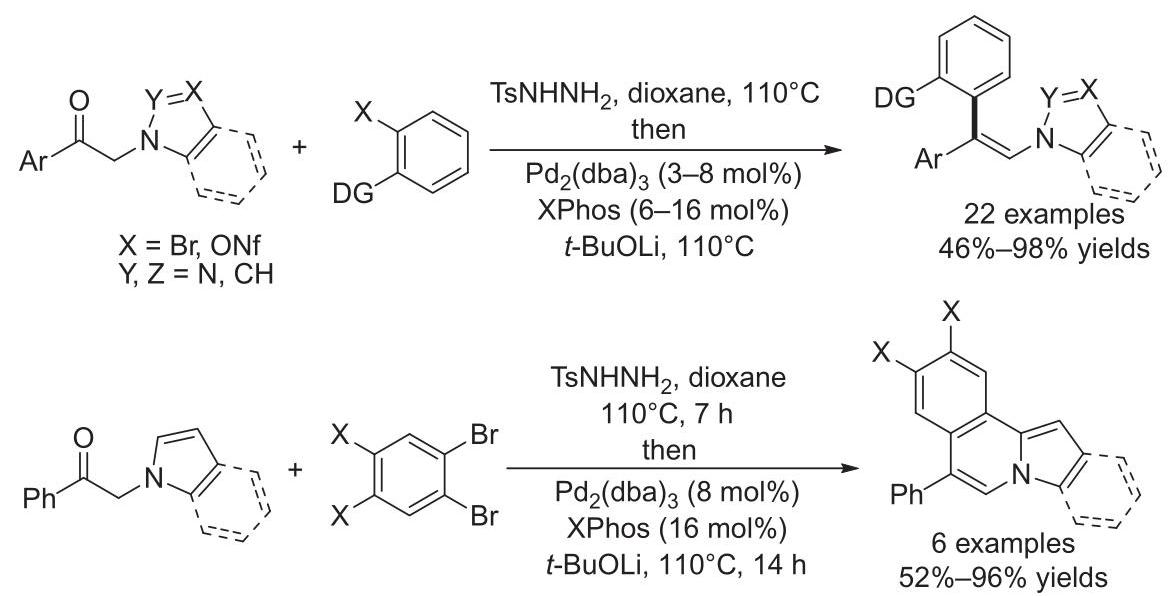
Scheme 10 Synthesis of (Z)-N-alkenylazoles and pyrroloisoquinolines.
方案10 (Z)-N-烯基唑和吡咯并异喹啉的合成。
In 2013, Valdés group reported a one-pot Pd-catalyzed coupling reaction of carbonyl compounds, tosylhydrazine with ortho-substituted aromatic halides or sulfonates (Scheme 10). ${}^{16}$ Taking advantage of ortho-stereo-directing effect in the cross-coupling strategy, this method led to the stereoselective synthesis of $\left( Z\right) - N$ -alkenylazoles with high yields and selectivity. In addition, they also developed a novel and efficient Pd-catalyzed autotandem catalytic system for C-C/C-C bond formation, affording the biologically relevant pyrroloisoquinolines in an efficient manner.
2013年,巴尔德斯团队报道了一种钯催化的羰基化合物、对甲苯磺酰肼与邻位取代的芳基卤化物或磺酸盐的一锅法偶联反应(方案10)。${}^{16}$ 利用交叉偶联策略中的邻位立体导向效应,该方法能以高产率和高选择性立体选择性地合成 $\left( Z\right) - N$ -烯基唑。此外,他们还开发了一种新颖高效的钯催化自串联催化体系用于碳 - 碳/碳 - 碳键的形成,能高效地得到具有生物学意义的吡咯并异喹啉。
Moreover, Valdés group described the Pd-catalyzed cross-coupling cascade reaction of $\alpha$ -alkoxy $N$ -tosylhydrazones with ortho-substituted aryl non-aflates to give various heterocyclic compounds (Scheme 11). ${}^{17}$ By using sulfonates derived from salicyl aldehydes, the first coupling step leads to protected 1,5-dicarbonyls as the intermediates, followed by the treatment with ammonium hydroxide to generate functionalized isoquinolines in moderate to good yields. Similarly, the employment of ortho-cyanononaflates in the coupling step, followed by subsequent reaction with organolithium reagents, gives rise to 1,2,4-trisubstituted isoquinolines in excellent yields. These two divergent approaches enable a versatile and novel method for the preparation of polysubstituted isoquinolines.
此外,巴尔德斯团队还描述了钯催化的 $\alpha$ -烷氧基 $N$ -对甲苯磺酰腙与邻位取代的芳基非氟磺酸盐的交叉偶联级联反应,以得到各种杂环化合物(方案11)。${}^{17}$ 通过使用水杨醛衍生的磺酸盐,第一步偶联反应生成受保护的1,5 - 二羰基化合物作为中间体,随后用氢氧化铵处理,以中等至良好的产率生成官能化的异喹啉。同样,在偶联步骤中使用邻位氰基非氟磺酸盐,随后与有机锂试剂反应,能以优异的产率得到1,2,4 - 三取代异喹啉。这两种不同的方法为多取代异喹啉的制备提供了一种通用且新颖的方法。
In 2015, a facile and effective synthetic method for various 1,1- heterodiaryl alkenes was reported by Pd-catalyzed cross-coupling reaction of heteroarenols with $N$ -tosylhydrazones (Scheme 12). ${}^{18}$ With the employment of various heteroarenols as the coupling partners, the notable feature of this protocol stands on the mild and viable, economical benign reaction conditions, and the absence of halides or pseudohalides. Proposed mechanism involves in situ C-OH bond activation by using the appropriate phosphonium coupling reagent at first, followed by migratory insertion of the heteroaryl group to Pd(II)-phosphonium-carbene complex 11. Finally, $\beta$ -hydrogen elimination affords the desired 1,1-heterodiaryl alkenes along with the regeneration of $\mathrm{{Pd}}\left( 0\right)$ species.
2015年,有人报道了一种通过钯催化杂芳醇与 $N$ -对甲苯磺酰腙的交叉偶联反应制备各种1,1 - 杂二芳基烯烃的简便有效合成方法(方案12)。${}^{18}$ 使用各种杂芳醇作为偶联伙伴,该方法的显著特点是反应条件温和可行、经济环保,且无需卤化物或拟卤化物。推测的机理是首先使用合适的鏻偶联试剂原位活化碳 - 氧键,然后杂芳基迁移插入钯(II) - 鏻 - 卡宾配合物11。最后,$\beta$ -氢消除得到所需的1,1 - 杂二芳基烯烃,并使 $\mathrm{{Pd}}\left( 0\right)$ 物种再生。
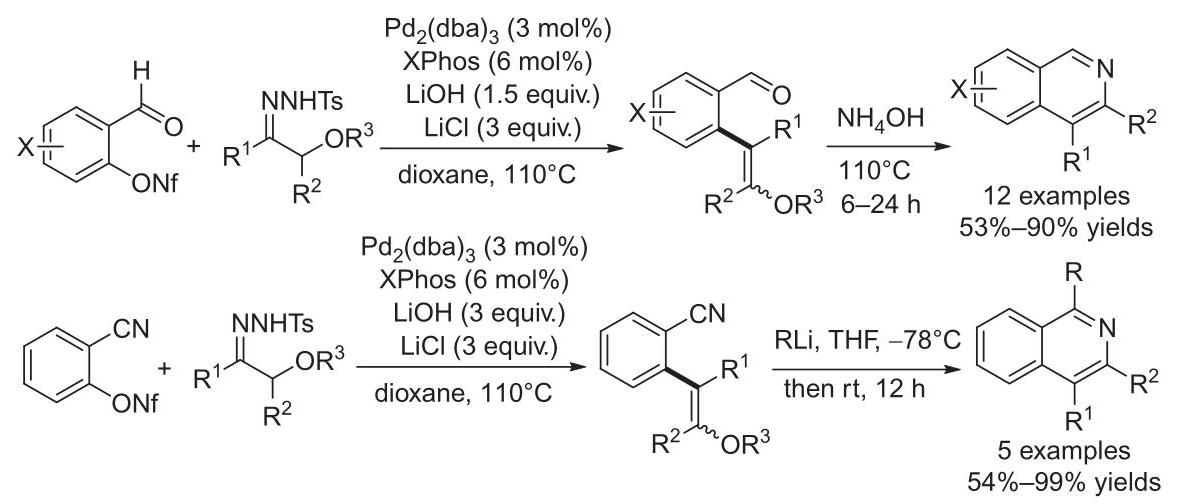
Scheme 11 Synthesis of polysubstituted isoquinolines through Pd-catalyzed coupling reaction of $\alpha$ -alkoxy $N$ -tosylhydrazones.
方案11 通过钯催化的 $\alpha$ -烷氧基 $N$ -对甲苯磺酰腙的偶联反应合成多取代异喹啉。
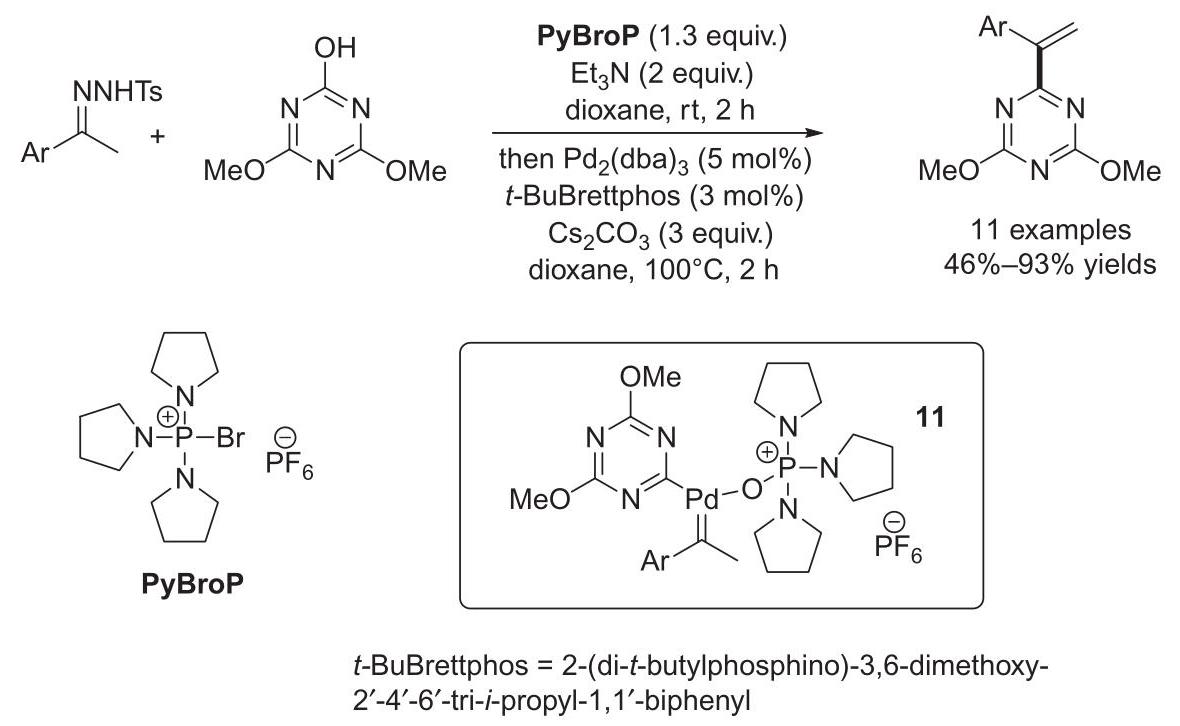
Scheme 12 Pd-catalyzed coupling of heteroarenols with $N$ -tosylhydrazones.
方案12 钯催化杂芳醇与 $N$ -对甲苯磺酰腙的偶联反应。
In 2015, Pd-catalyzed cross-coupling reaction of α-keto-alkylphosphonate-derived $N$ -tosylhydrazones with aryl bromides was demonstrated by Wang group (Scheme 13). ${}^{19}$ From easily accessible reagents as the substrates, this catalytic route constitutes a novel strategy to synthesize $E$ -trisubstituted alkenylphosphonates bearing versatile functional groups as well as $\alpha$ -substituted vinylphosphonates. Mechanistically, migratory insertion of palladium carbene is proposed as the key step in this coupling reaction. This methodology utilizes $\alpha$ -keto-alkylphosphonate $N$ -tosylhydrazones as the nucleophilic coupling partner.
2015年,王团队证明了钯催化的源自α - 酮基烷基膦酸酯的 $N$ -对甲苯磺酰腙与芳基溴的交叉偶联反应(方案13)。${}^{19}$ 以易于获得的试剂为底物,该催化路线构成了一种合成带有多种官能团的 $E$ -三取代烯基膦酸酯以及 $\alpha$ -取代乙烯基膦酸酯的新策略。从机理上讲,钯卡宾的迁移插入被认为是该偶联反应的关键步骤。该方法利用 $\alpha$ -酮基烷基膦酸酯 $N$ -对甲苯磺酰腙作为亲核偶联伙伴。
Furthermore, coupling reaction toward the asymmetric synthesis of chiral functional molecules attracts great attention. In 2010, Barluenga and Valdés attempted Pd-catalyzed cross-coupling reaction of aryl halides with $N$ -tosylhydrazones derived from $\alpha$ -chiral ketones (Scheme 14). ${}^{20}$ As a result, with complete conservation of the stereochemistry at the $\alpha$ -carbon of carbonyl group, a series of aryl-substituted cyclic allylic ethers and allylamines are obtained in high yields. This method not only verifies the cross-coupling reaction of chiral $N$ -tosylhydrazones but also keeps the stability of the $\alpha$ -chiral center of carbonyl compounds.
此外,用于手性功能分子不对称合成的偶联反应备受关注。2010年,巴鲁恩加和巴尔德斯尝试了钯催化的芳基卤化物与源自 $\alpha$ -手性酮的 $N$ -对甲苯磺酰腙的交叉偶联反应(方案14)。${}^{20}$ 结果,在羰基 $\alpha$ -碳上的立体化学完全保持的情况下,高产率地得到了一系列芳基取代的环状烯丙基醚和烯丙基胺。该方法不仅验证了手性 $N$ -对甲苯磺酰腙的交叉偶联反应,还保持了羰基化合物 $\alpha$ -手性中心的稳定性。
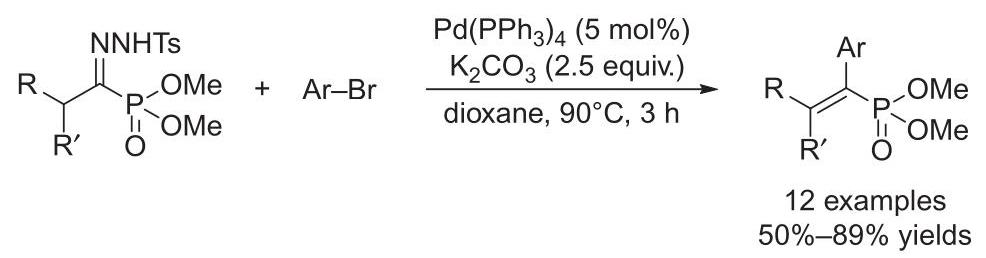
Scheme 13 Synthesis of alkenylphosphonates via Pd-catalyzed coupling of $\alpha$ -keto-alkylphosphonate-derived N-tosylhydrazones with aryl halides.
方案13:通过钯催化的源自$\alpha$-酮基烷基膦酸酯的N-甲苯磺酰腙与芳基卤化物的偶联反应合成烯基膦酸酯。
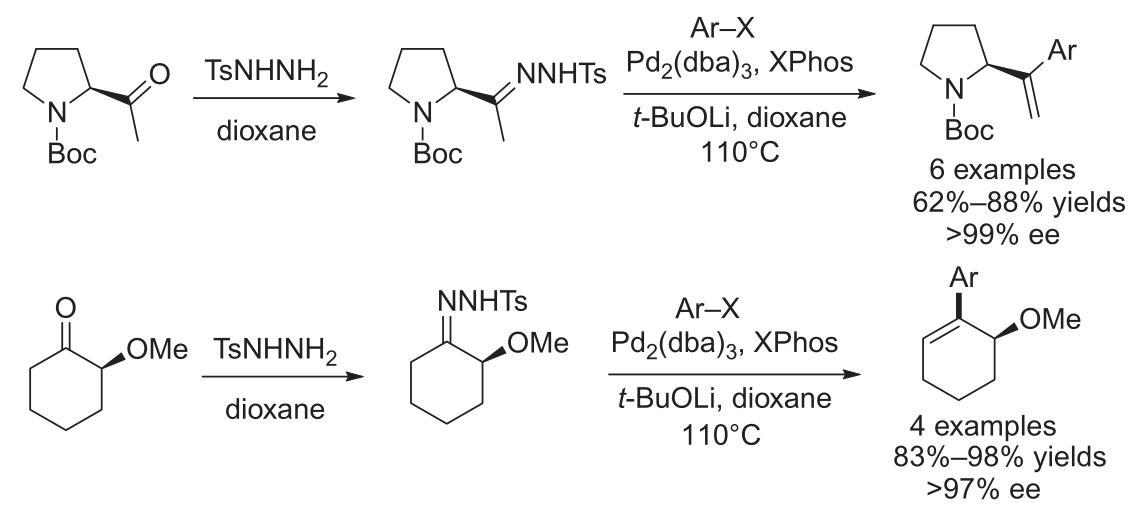
Scheme 14 Pd-catalyzed coupling reaction of aryl halides with $N$ -tosylhydrazones derived from $\alpha$ -chiral ketones.
方案14:钯催化的芳基卤化物与源自$\alpha$-手性酮的$N$-甲苯磺酰腙的偶联反应。
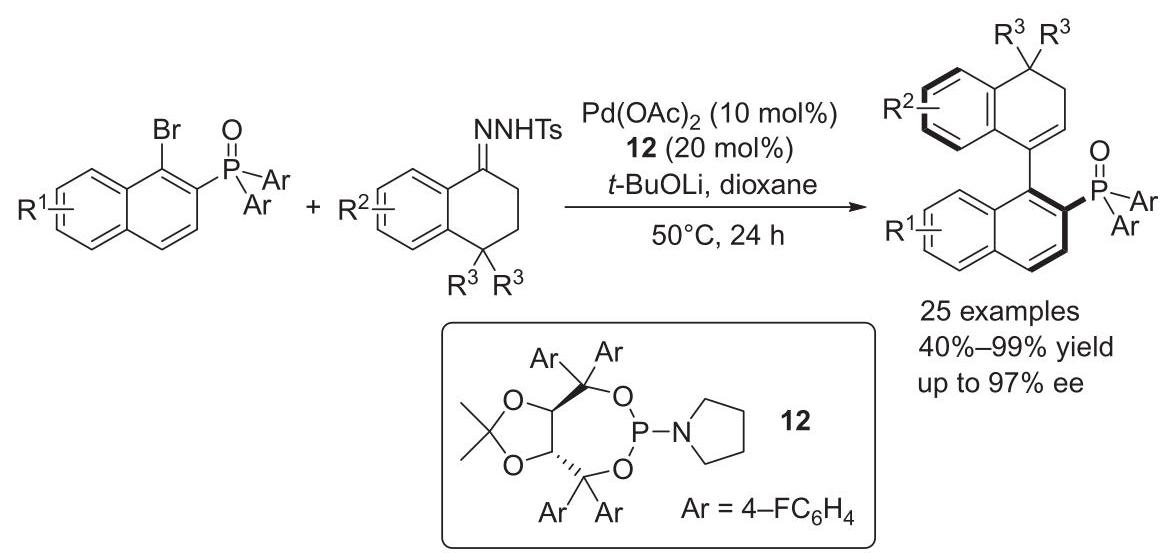
Scheme 15 Pd-catalyzed enantioselective synthesis of axially chiral vinyl arenes.
方案15:钯催化的轴向手性乙烯基芳烃的对映选择性合成。
In 2016, by using chiral pyrrolidine-based phosphoramidite ligand 12, Gu group reported the first asymmetric catalysis in this field, namely, Pd-catalyzed enantioselective synthesis of axially chiral 1-vinylnaphthalen- 2-ylphosphine oxides from achiral substrates of aryl bromides with $N$ -tosylhydrazones derived from cyclic ketones (Scheme 15). ${}^{21}$ This method combines the asymmetric synthesis with Pd-carbene migratory insertion strategy, opening a superior avenue for the construction of axially chiral biaryl compounds with high yields and excellent enantioselectivity. The advantages of this asymmetric coupling approach include good functional group tolerance and mild reaction conditions. Taking into account that desired products are readily reduced to phosphine derivatives, this methodology provides a novel and alternative way to design and synthesize chiral phosphine ligands.
2016年,顾课题组使用基于手性吡咯烷的亚磷酰胺配体12,报道了该领域的首例不对称催化反应,即从芳基溴的非手性底物与源自环酮的$N$-甲苯磺酰腙出发,钯催化对映选择性合成轴向手性1-乙烯基萘-2-基氧化膦(方案15)。${}^{21}$该方法将不对称合成与钯-卡宾迁移插入策略相结合,为高产率和优异对映选择性地构建轴向手性联芳基化合物开辟了一条优越的途径。这种不对称偶联方法的优点包括良好的官能团耐受性和温和的反应条件。考虑到所需产物很容易还原为膦衍生物,该方法为设计和合成手性膦配体提供了一种新颖的替代方法。
Additionally, Alami and Hamze group have made significant progresses in synthesizing functionalized 1,1-diaryl alkenes by employing the Pd-catalyzed cross-coupling strategy of $N$ -tosylhydrazones with aryl halides or triflates. In particular, they utilized this methodology in the target-oriented synthesis of biochemical active functional molecules. At first, they focused the research topic on the expeditious preparation of 1,1- diarylethylenes derivatives through Pd-catalyzed coupling reaction of poly-oxygenated N-tosylhydrazones with aryl triflates (Scheme 16). ${}^{{22}\mathrm{a}}$ They explored this 1,1-diarylethylene scaffold-constructing strategy in the convergent synthesis of iso-combretastatins A (isoCA-4) analogues, which demonstrate cytotoxic and antimicotic bioactivity. ${}^{{22}\mathrm{\;b},\mathrm{c}}$ This protocol represents a practical application of Pd-catalyzed coupling strategy in biochemistry and medical research. Moreover, by employing this convergent strategy with the coupling of $N$ -tosylhydrazones and aryl iodides under palladium catalysis, they carried out the design and synthesis of an array of benzoxepines derivatives, which served as conformationally restricted iso-combretastatin A-4 analogues. ${}^{22d}$
此外,阿拉米和哈姆泽课题组在通过钯催化的$N$-甲苯磺酰腙与芳基卤化物或三氟甲磺酸酯的交叉偶联策略合成官能化的1,1-二芳基烯烃方面取得了重大进展。特别是,他们将该方法用于生化活性功能分子的目标导向合成。起初,他们将研究重点放在通过钯催化的多氧化N-甲苯磺酰腙与芳基三氟甲磺酸酯的偶联反应快速制备1,1-二芳基乙烯衍生物上(方案16)。${}^{{22}\mathrm{a}}$他们在异康普他汀A(isoCA-4)类似物的汇聚合成中探索了这种构建1,1-二芳基乙烯骨架的策略,这些类似物具有细胞毒性和抗真菌生物活性。${}^{{22}\mathrm{\;b},\mathrm{c}}$该方案代表了钯催化偶联策略在生物化学和医学研究中的实际应用。此外,通过在钯催化下将$N$-甲苯磺酰腙与芳基碘化物偶联的这种汇聚策略,他们进行了一系列苯并氧杂卓衍生物的设计和合成,这些衍生物用作构象受限的异康普他汀A-4类似物。${}^{22d}$
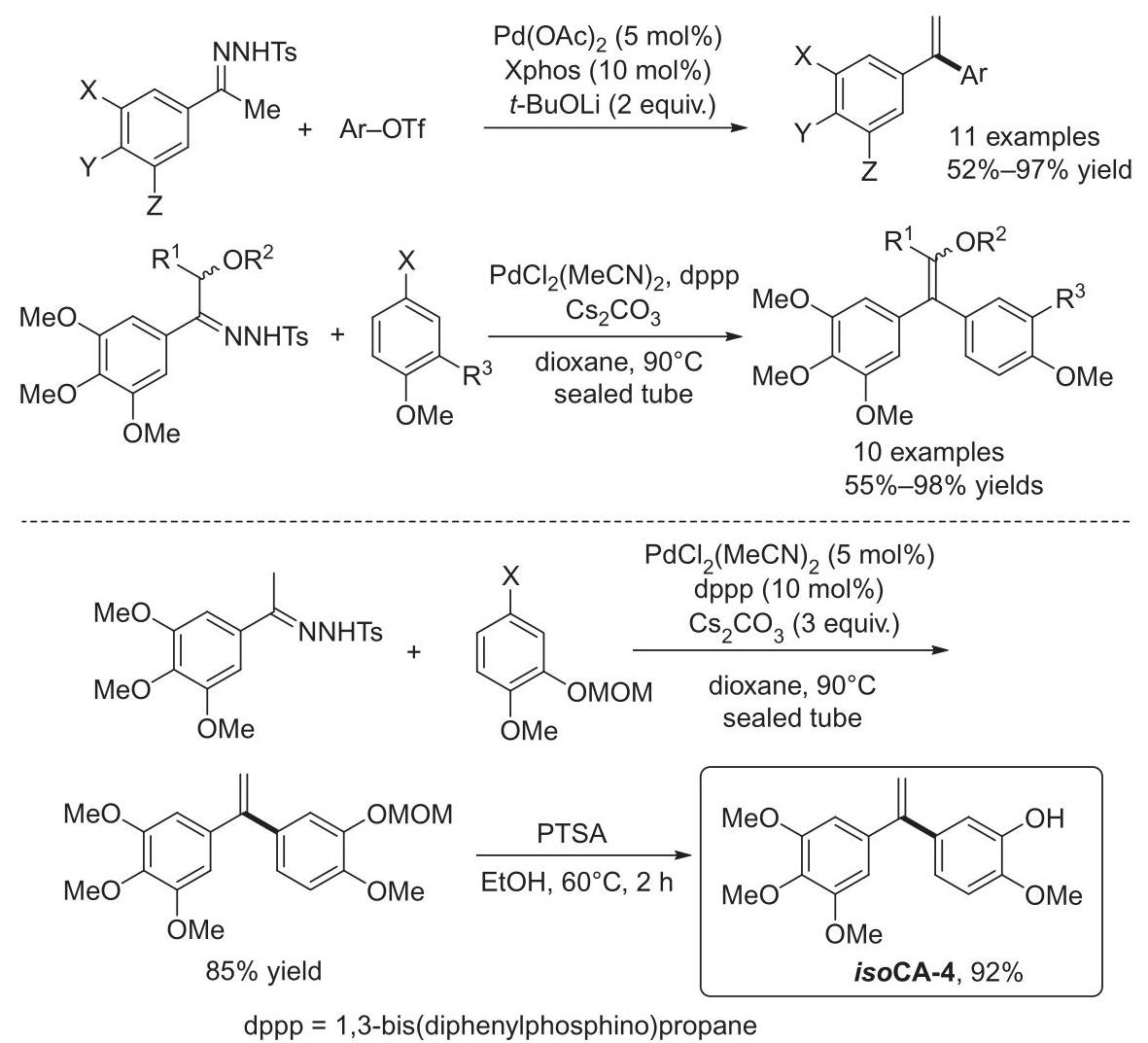
Scheme 16 Synthesis of polyoxygenated diarylethylenes via Pd-catalyzed coupling reaction with aryl triflates.
方案16:通过钯催化的与芳基三氟甲磺酸酯的偶联反应合成多氧化二芳基乙烯。
In addition, 2- $\alpha$ -styrylpyridines derivatives, exhibiting excellent antip-roliferative and antimitotic activity, were directly obtained in satisfactory to good yields by Pd-catalyzed coupling with 2-halopyridines (Scheme 17). ${}^{23}$ After coupling and subsequent reduction, the desired compound 13, which is found to exhibit excellent antiproliferative and antimitotic activities comparable to isoCA-4, was obtained in simple transformations with good yield.
此外,通过钯催化与2-卤吡啶偶联,以令人满意的良好产率直接得到了具有优异抗增殖和抗有丝分裂活性的2-$\alpha$-苯乙烯基吡啶衍生物(方案17)。${}^{23}$经过偶联和随后的还原,通过简单转化以良好产率得到了所需化合物13,发现其具有与isoCA-4相当的优异抗增殖和抗有丝分裂活性。
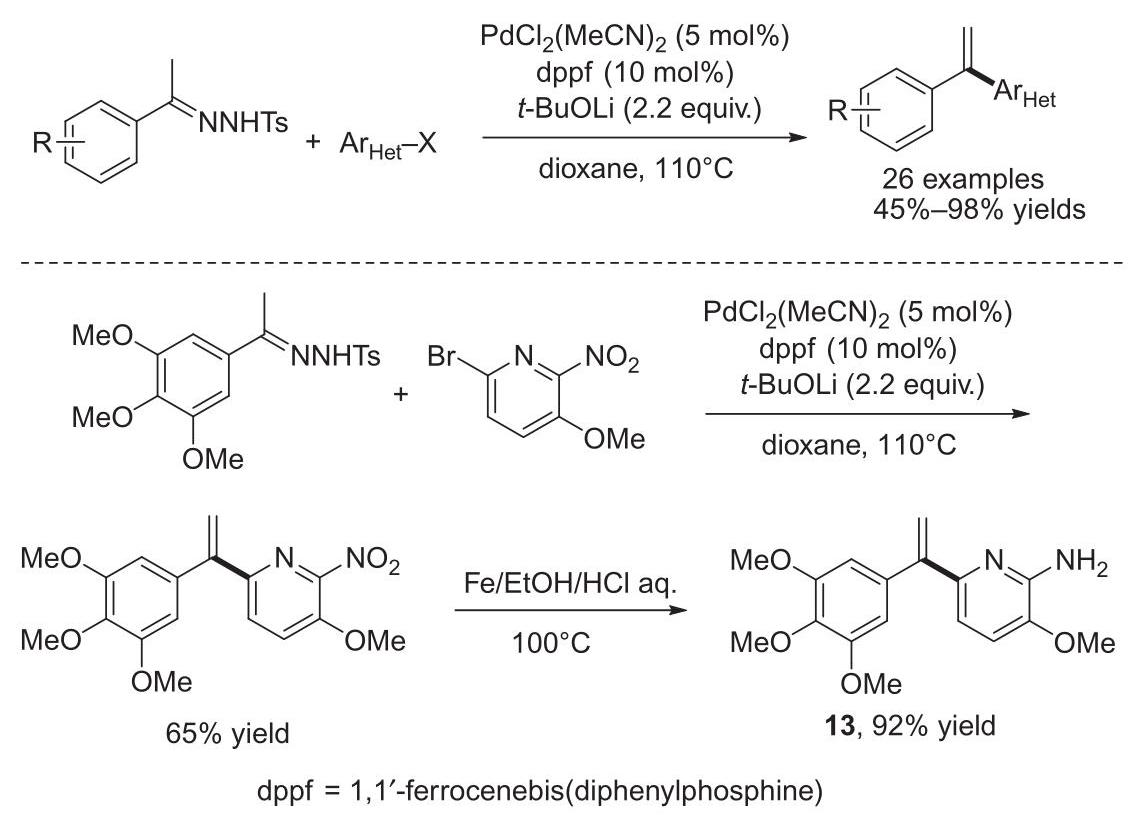
Scheme 17 Pd(II)-catalyzed coupling of $N$ -tosylhydrazone with heteroaryl halides.
方案17:钯(II)催化的$N$-甲苯磺酰腙与杂芳基卤化物的偶联反应。
Upon employing the ${\mathrm{{PdCl}}}_{2}{\left( \mathrm{{MeCN}}\right) }_{2}/\mathrm{{dppp}}$ catalytic system, Alami group also reported the synthesis of tetra-substituted 1,1-diarylethylenes from sterically hindered as well as unhindered $N$ -tosylhydrazones with aryl halides under optimized condition. ${}^{{24}\mathrm{a}}$ This procedure provides a chemoselective and general synthetic route to a wide range of tetra-substituted olefins, especially for those having a cycloalkylidene unit. Moreover, the challenge of coupling reactions from sterically hindered $N$ -tosylhydrazones could also be solved by using a newly established ${\mathrm{{PdCl}}}_{2}{\left( \mathrm{{MeCN}}\right) }_{2}/\mathrm{{Xphos}}/t$ -BuONa/fluorobenzene system (Scheme 18). ${}^{{24}\mathrm{\;b}}$ This protocol has been applied successfully to the synthesis of a xanthene scaffold.
在采用${\mathrm{{PdCl}}}_{2}{\left( \mathrm{{MeCN}}\right) }_{2}/\mathrm{{dppp}}$催化体系时,阿拉米团队还报道了在优化条件下,由空间位阻和非空间位阻的$N$-甲苯磺酰腙与芳基卤化物合成四取代的1,1-二芳基乙烯。${}^{{24}\mathrm{a}}$该方法为多种四取代烯烃提供了一种化学选择性且通用的合成路线,特别是对于那些具有亚环烷基单元的烯烃。此外,通过使用新建立的${\mathrm{{PdCl}}}_{2}{\left( \mathrm{{MeCN}}\right) }_{2}/\mathrm{{Xphos}}/t$-丁醇钠/氟苯体系(方案18),也可以解决空间位阻$N$-甲苯磺酰腙的偶联反应难题。${}^{{24}\mathrm{\;b}}$该方案已成功应用于呫吨支架的合成。
Moreover, they developed the one-pot procedure for the $Z$ -selective synthesis of trisubstituted olefins from arylalkynes with ortho-substituted aryl halides. ${}^{{25}\mathrm{a},\mathrm{b}}$ This multistep sequence provided a rapid and versatile protocol for the synthesis of 4-arylchromenes 14, thiochromenes, and related hetero-cycles via a four-step sequence (Scheme 19). In particular, the first three steps involving hydration of alkynes, hydrazone formation, and Pd-catalyzed coupling with ortho-substituted aryl halides furnished $Z$ -trisubstituted olefins stereoselectively without any purification of the intermediates generated in each stage. ${}^{{25}\mathrm{a}}$ In 2012, the same group also described the one-pot three-step synthetic protocol toward $\left( Z\right)$ -trisubstituted olefins from arylalkynes, as well as the sequential cyclization process to access 4-aryl-2H-chromenes and 5-aryl-2,3-dihydrobenzo- $\left\lbrack b\right\rbrack$ oxepine. ${}^{{25}\mathrm{\;b}}$
此外,他们开发了一种一锅法,用于从芳基炔烃与邻位取代的芳基卤化物中$Z$选择性地合成三取代烯烃。${}^{{25}\mathrm{a},\mathrm{b}}$这个多步序列通过一个四步序列(方案19)为合成4-芳基色烯14、硫代色烯及相关杂环提供了一种快速且通用的方法。特别是,前三步涉及炔烃的水合、腙的形成以及钯催化的与邻位取代芳基卤化物的偶联,立体选择性地提供了$Z$-三取代烯烃,而无需对每个阶段生成的中间体进行任何纯化。${}^{{25}\mathrm{a}}$2012年,同一团队还描述了一种从芳基炔烃合成$\left( Z\right)$-三取代烯烃的一锅三步合成方案,以及用于获得4-芳基-2H-色烯和5-芳基-2,3-二氢苯并$\left\lbrack b\right\rbrack$氧杂卓的连续环化过程。${}^{{25}\mathrm{\;b}}$
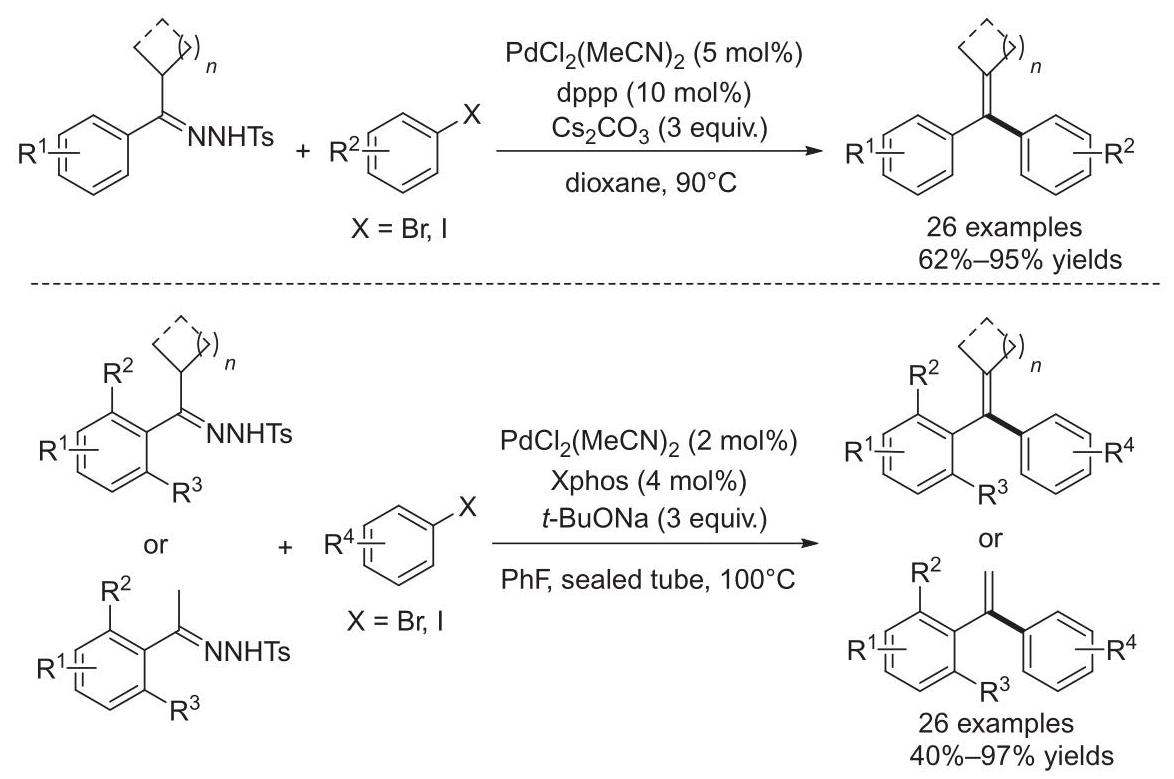
Scheme ${18}{\mathrm{{PdCl}}}_{2}{\left( \mathrm{{MeCN}}\right) }_{2}$ -catalyzed coupling reaction of sterically hindered and unhindered N-tosylhydrazones.
方案${18}{\mathrm{{PdCl}}}_{2}{\left( \mathrm{{MeCN}}\right) }_{2}$催化空间位阻和非空间位阻的N-甲苯磺酰腙的偶联反应。
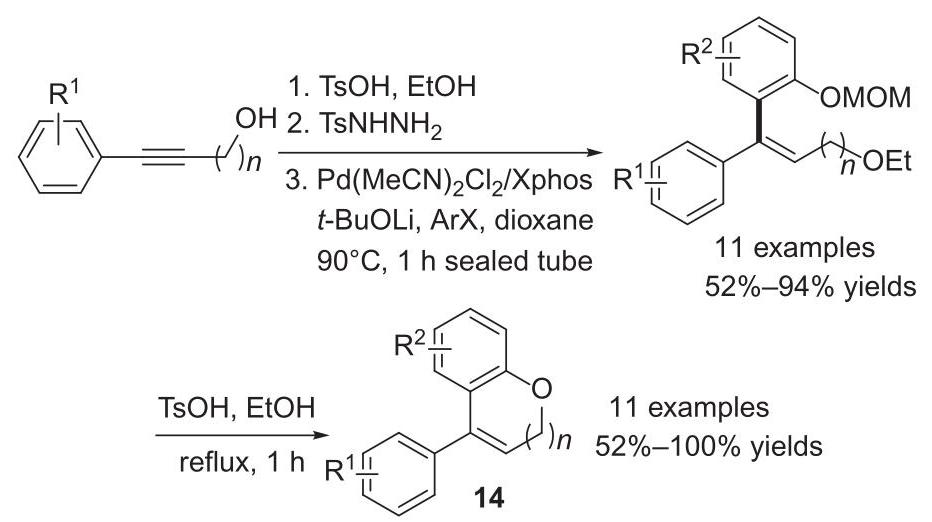
Scheme 19 One-pot multistep synthesis of 4-arylchromenes through Pd-catalyzed coupling of ortho-substituted aryl halides.
方案19通过钯催化邻位取代芳基卤化物的偶联反应一锅多步合成4-芳基色烯。
In 2015, Alami and Hamze demonstrated the synthetic approach toward benzofulvenes through transition-metal-catalyzed cascade coupling reactions. ${}^{26}$ This sequential transformation involves a site-selective Sonogashira coupling reaction of ${2}^{\prime }$ -iodoacetophenone-derived $N$ -tosylhydrazones, Pd-catalyzed cross-coupling of ortho-ethynyl $N$ -tosylhydrazones, and Pd-catalyzed selective 5-exo-digcycloisomerization (Scheme 20).
2015年,阿拉米和哈姆泽展示了通过过渡金属催化的级联偶联反应合成苯并富烯的方法。${}^{26}$这个连续转化过程涉及${2}^{\prime }$-碘代苯乙酮衍生的$N$-甲苯磺酰腙的位点选择性Sonogashira偶联反应、钯催化的邻乙炔基$N$-甲苯磺酰腙的交叉偶联反应以及钯催化的选择性5-外环化异构化反应(方案20)。
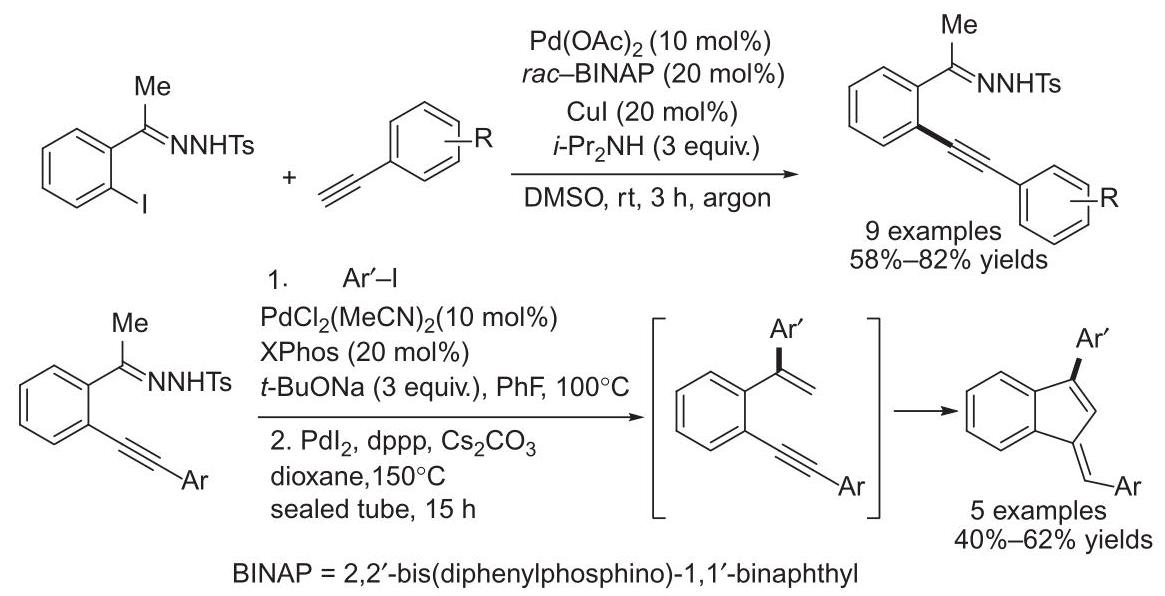
Scheme 20 Synthesis of benzofulvenes through Sonogashira and Pd-catalyzed coupling of ortho-ethynyl- $N$ -tosylhydrazones and catalytic cycloisomerization.
方案20通过Sonogashira反应以及钯催化邻乙炔基-$N$-甲苯磺酰腙的偶联反应和催化环异构化反应合成苯并富烯。
In 2014, the same group established a method to access 3-( $\alpha$ -styryl) benzo[b]thiophene library with a high level of molecular diversity. ${}^{27}$ This synthetic sequence is initiated by bromocyclization of methylthio-containing alkynes using $N$ -methylpyrrolidin-2-one hydrotribromide to obtain 3-bromobenzothiophenes intermediates, followed by a Pd-catalyzed coupling reaction with $N$ -tosylhydrazones, furnishing 2-aryl-3-(α-styryl)benzo[ $b$ ]thiophene derivatives (Scheme 21). Among them, the coupling product 15 has demonstrated submicromolar cytotoxic activity against the HCT-116 cell line, inhibiting the polymerization of tubulin at micromolar level comparable to that of CA-4. Additionally, the success in the synthesis of 6-methyl-6-phenyl-6H-benzo[4,5]thieno $\left\lbrack {3,2 - c}\right\rbrack$ chromenes with good yields expand the scope of this synthetic method.
2014年,同一研究团队开发了一种方法,用于构建具有高度分子多样性的3 - ($\alpha$-苯乙烯基)苯并[b]噻吩库。${}^{27}$该合成路线始于含甲硫基炔烃的溴环化反应,使用$N$-甲基吡咯烷-2-酮三溴化氢得到3-溴苯并噻吩中间体,随后与$N$-甲苯磺酰腙进行钯催化的偶联反应,得到2-芳基-3-(α-苯乙烯基)苯并[$b$]噻吩衍生物(方案21)。其中,偶联产物15对HCT-116细胞系显示出亚微摩尔级的细胞毒性活性,在微摩尔水平上抑制微管蛋白的聚合,与CA-4相当。此外,以良好产率成功合成6-甲基-6-苯基-6H-苯并[4,5]噻吩并$\left\lbrack {3,2 - c}\right\rbrack$色烯扩展了该合成方法的适用范围。
Furthermore, a concise Pd-catalyzed external ligand-free protocol for the synthesis of 1,1-disubstituted alkenes was reported, allowing for the preparation of heterocyclic arylated alkenes under mild conditions (Scheme 22). ${}^{28}$ By using aryl or heteroaryl halides as the substrates, this transformation provides a facile approach to access a variety of heterocyclic compounds, which are difficult to prepare via traditional coupling procedures.
此外,还报道了一种简洁的无外部配体的钯催化合成1,1-二取代烯烃的方法,该方法能够在温和条件下制备杂环芳基化烯烃(方案22)。${}^{28}$ 通过使用芳基或杂芳基卤化物作为底物,这种转化提供了一种简便的方法来获得各种杂环化合物,而这些化合物通过传统偶联方法很难制备。
In 2015, the Pd-catalyzed cross-coupling reaction of aryl fluorides with $N$ -tosylhydrazones was described by Wang group, which constituted a straightforward method for synthesizing di- and trisubstituted arylated olefins (Scheme 23). ${}^{29}$ Mechanistically, the reaction is proposed to be initiated by an electron-deficient group-directed ${\mathrm{S}}_{\mathrm{N}}\mathrm{{Ar}}$ -type process to afford aryl-palladium(II) intermediate 16. Notably, this catalytic protocol represents the combination of C-F bond activation and Pd-carbene migratory insertion strategy.
2015年,王课题组报道了钯催化的芳基氟化物与$N$-甲苯磺酰腙的交叉偶联反应,这是一种合成二取代和三取代芳基化烯烃的直接方法(方案23)。${}^{29}$从机理上讲,该反应被认为是由缺电子基团导向的${\mathrm{S}}_{\mathrm{N}}\mathrm{{Ar}}$型过程引发,生成芳基钯(II)中间体16。值得注意的是,这种催化方案代表了C-F键活化和钯-卡宾迁移插入策略的结合。
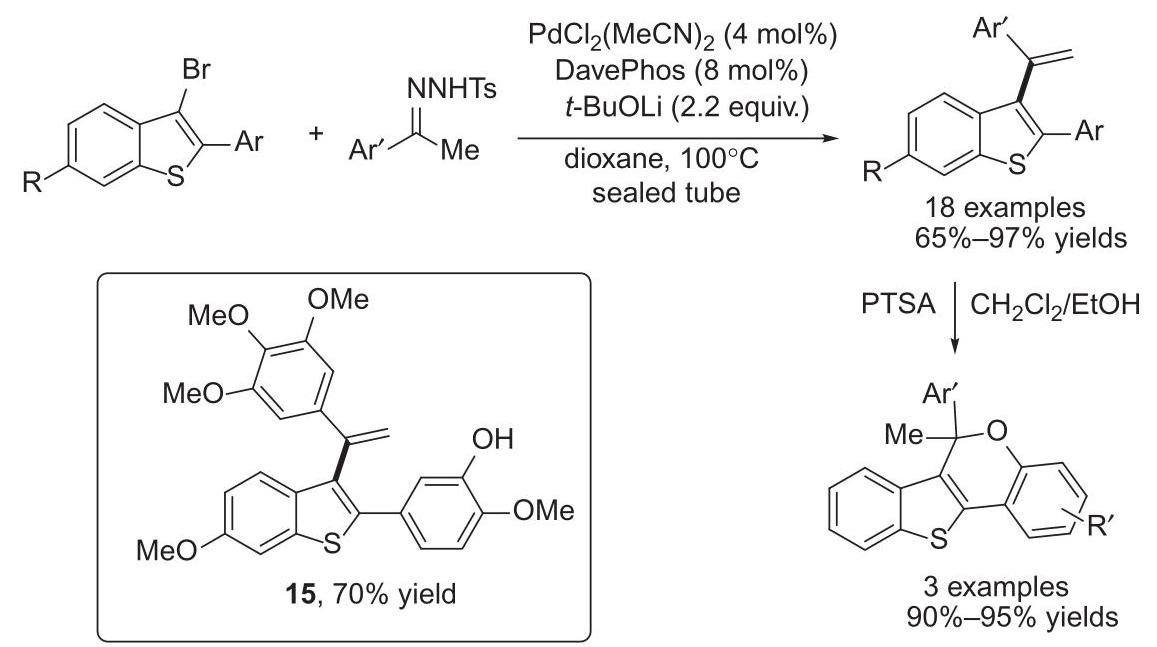
DavePhos = 2-dicyclohexylphosphino-2’-(N, N-dimethylamino)biphenyl
戴夫膦 = 2 - 二环己基膦基 - 2’ -(N,N - 二甲基氨基)联苯
Scheme 21 Synthesis of 3-(α-styryl)benzo[ $b$ ]-thiophene derivatives through Pd-catalyzed coupling of 3-bromobenzothiophenes with $N$ -tosylhydrazones.
方案21:通过钯催化3-溴苯并噻吩与$N$-甲苯磺酰腙的偶联反应合成3-(α-苯乙烯基)苯并[$b$]噻吩衍生物。
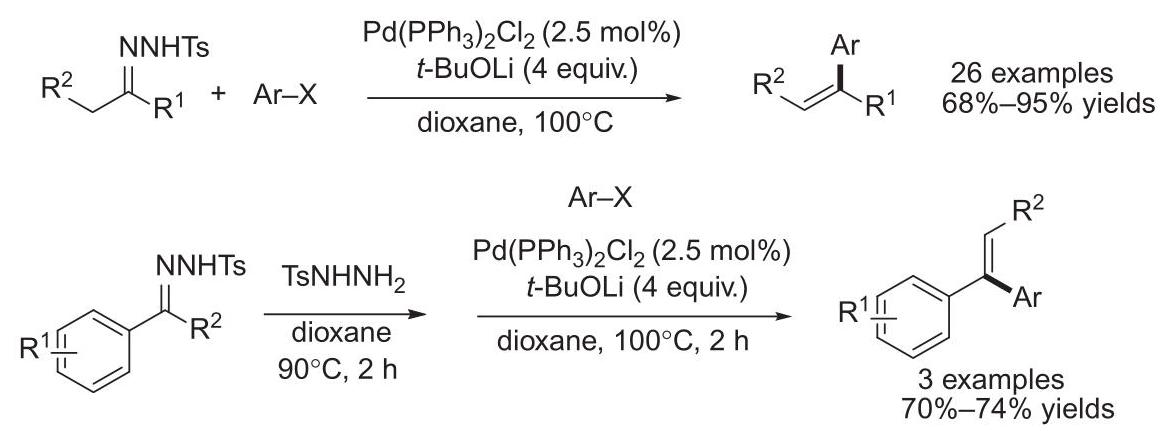
Scheme 22 External ligand-free Pd-catalyzed coupling of $N$ -tosylhydrazones with aryl or heteroaryl halides.
方案22 无外部配体的钯催化的$N$-甲苯磺酰腙与芳基或杂芳基卤化物的偶联反应。
Additionally, the Wang group developed a route to 1,3-butadienes through Pd-catalyzed cross-coupling either from cyclopropylmethyl $N$ -tosylhydrazone with aryl halides, or diaryl $N$ -tosylhydrazone with cyclopropyl halides. ${}^{30}$ The key process in this transformation is the migratory insertion of cyclopropylmethyl Pd-carbene species. Subsequent cyclopropyl ring opening through $\beta$ -carbon elimination of 17, which results in the generation of homoallylic species 18, is followed by base-mediated $\beta$ -H elimination of 18 to give rise to the formation of substituted 1,3- butadienes (Scheme 24). These two transformations constitute a novel approach toward the synthesis of arylated 1,3-butadiene derivatives.
此外,王课题组通过钯催化的交叉偶联反应开发了一条合成1,3 - 丁二烯的路线,该反应要么是环丙基甲基$N$-甲苯磺酰腙与芳基卤化物反应,要么是二芳基$N$-甲苯磺酰腙与环丙基卤化物反应。${}^{30}$此转化过程的关键步骤是环丙基甲基钯卡宾物种的迁移插入。随后通过17的$\beta$-碳消除进行环丙基开环,生成高烯丙基物种18,接着通过碱介导的18的$\beta$-氢消除,形成取代的1,3 - 丁二烯(方案24)。这两个转化过程构成了一种合成芳基化1,3 - 丁二烯衍生物的新方法。
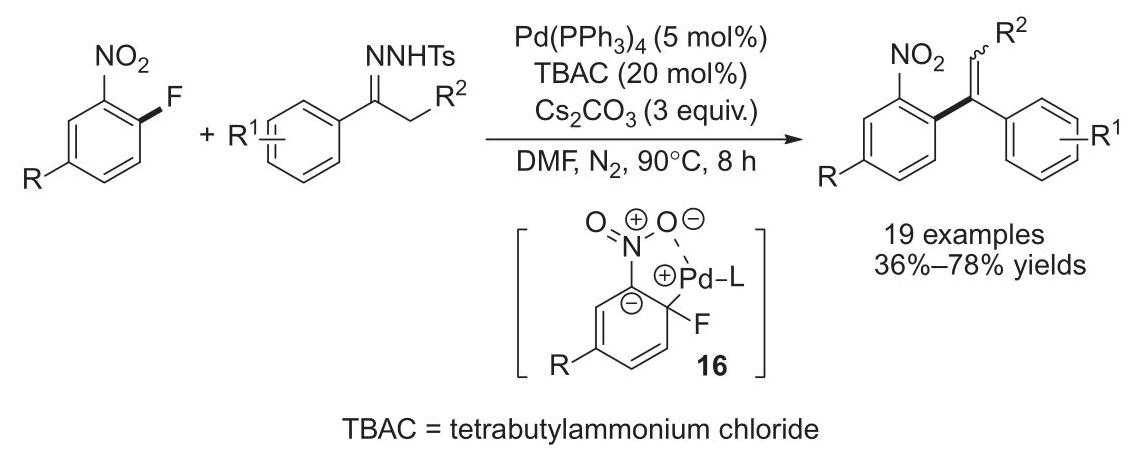
Scheme 23 Pd-catalyzed cross-coupling reaction of aryl fluorides with $N$ -tosylhydrazones.
方案23 钯催化的芳基氟化物与$N$-甲苯磺酰腙的交叉偶联反应。
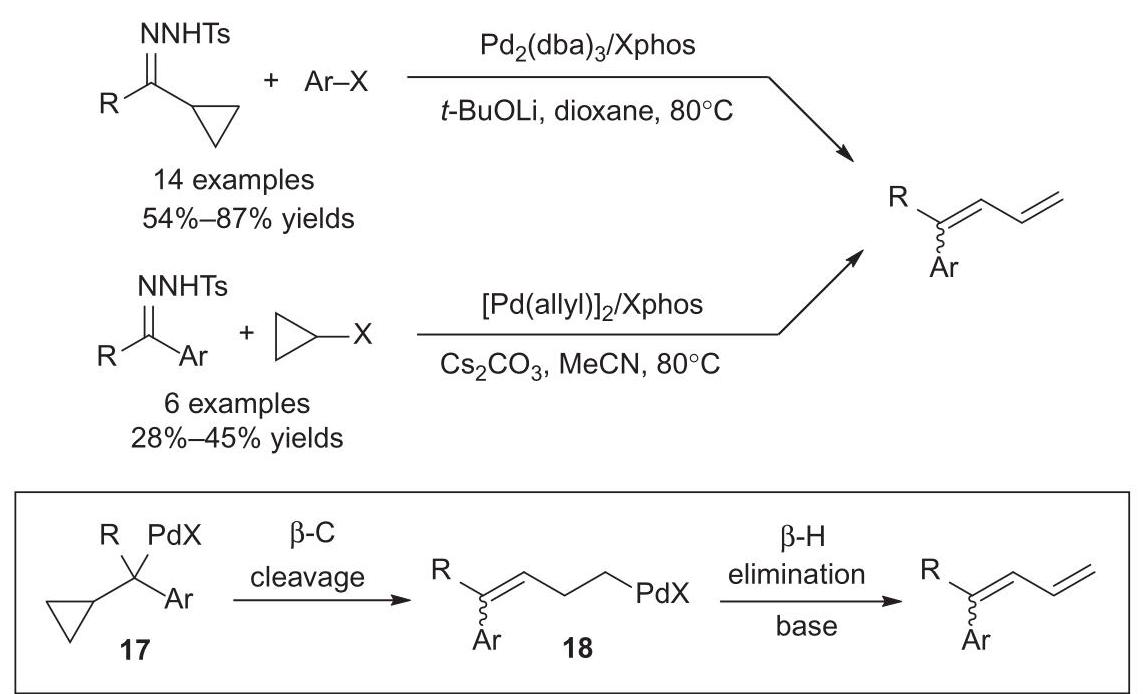
Scheme 24 Synthesis of 1,3-butadienes through Pd-carbene migratory insertion/β-C/ $\beta$ -H elimination.
方案24 通过钯卡宾迁移插入/β-C/$\beta$-H消除反应合成1,3-丁二烯。
Subsequently, Yu group reported the synthesis of 1,1-disubstituted 1,3- butadienes through ${\mathrm{{PdCl}}}_{2}{\left( \mathrm{{MeCN}}\right) }_{2}$ -catalyzed cross-coupling reaction by using cyclopropylmethyl $N$ -tosylhydrazones and aryl halides as the substrates. ${}^{31}$ Besides,1,1,4-trisubstituted 1,3-butadienes can also be accessed with moderate to good yields in the presence of an excess of aromatic bromides catalyzed by $\mathrm{{Pd}}{\left( \mathrm{{OAc}}\right) }_{2}$ .
随后,余课题组报道了通过使用环丙基甲基$N$-甲苯磺酰腙和芳基卤化物作为底物,在${\mathrm{{PdCl}}}_{2}{\left( \mathrm{{MeCN}}\right) }_{2}$催化下进行交叉偶联反应来合成1,1-二取代的1,3-丁二烯。${}^{31}$此外,在$\mathrm{{Pd}}{\left( \mathrm{{OAc}}\right) }_{2}$催化下,在过量的芳族溴化物存在下,也可以以中等至良好的产率得到1,1,4-三取代的1,3-丁二烯。
In 2015, the Pd-catalyzed cross-coupling of 2-amino-3-bromo-aromatic and heteroaromatic components with various sulfonylhydrazones was reported. ${}^{32}$ This work has reported on the catalytic system as well as on the electronic nature of hydrazones which are necessary for the success of this series of Pd-catalyzed coupling reaction.
2015年,报道了钯催化的2-氨基-3-溴芳族和杂芳族组分与各种磺酰腙的交叉偶联反应。${}^{32}$这项工作报道了催化体系以及腙的电子性质,这对于这一系列钯催化的偶联反应的成功是必要的。
Pd-catalyzed reductive cross-coupling of aryl halides with diazo species has been performed to construct ${\mathrm{{Csp}}}^{3} - {\mathrm{{Csp}}}^{2}$ single bonds. The Wang group utilized diaryl $N$ -tosylhydrazones as coupling partners in the presence of ammonium formate as the reducing agent, accessing the synthesis of functionalized triarylmethanes as well as heterocyclic analogues. ${}^{{33}\mathrm{a}}$ Plausible mechanism involves anion exchange of migrated palladium species 19 and sequential decarboxylation to generate Pd-H intermediate 20, followed by reductive elimination to furnish the desired product along with regeneration of Pd(0) species (Scheme 25). Notably, the addition of ammonium acetate significantly suppresses direct reduction of Ar-Pd-X species before diazo decomposition. This coupling strategy constitutes a novel approach toward the efficient synthesis of various triarylmethanes and the corresponding heteroatom-containing analogues from easily available substrates.
钯催化的芳基卤化物与重氮物种的还原交叉偶联反应已用于构建${\mathrm{{Csp}}}^{3} - {\mathrm{{Csp}}}^{2}$单键。王课题组在甲酸铵作为还原剂的存在下,使用二芳基$N$-甲苯磺酰腙作为偶联伙伴,实现了功能化三芳基甲烷以及杂环类似物的合成。${}^{{33}\mathrm{a}}$合理的机理涉及迁移的钯物种进行阴离子交换生成19,然后依次脱羧生成Pd-H中间体20,随后进行还原消除以提供所需产物并再生Pd(0)物种(方案25)。值得注意的是,加入乙酸铵可显著抑制重氮分解前Ar-Pd-X物种的直接还原。这种偶联策略构成了一种从容易获得的底物高效合成各种三芳基甲烷和相应的含杂原子类似物方法。
Recently, Wang and coworkers explored this Pd-catalyzed reductive coupling strategy for the synthesis of di- and triarylmethanes. ${}^{{33}\mathrm{\;b}}$ This reaction includes a wide scope of substrates, among which those containing heterocyclic moiety also proceeded well (Scheme 26).
最近,王及其同事探索了这种钯催化的还原偶联策略用于合成二芳基甲烷和三芳基甲烷。${}^{{33}\mathrm{\;b}}$该反应包括广泛的底物范围,其中含有杂环部分的底物也能顺利进行反应(方案26)。
2.2 Pd-Catalyzed Coupling of N-Tosylhydrazones With Benzyl Halides
2.2 钯催化的N-对甲苯磺酰腙与苄基卤的偶联反应
In 2009, the Wang group demonstrated the first example of Pd-catalyzed cross-coupling reaction of benzyl halides with N-tosylhydrazones (Scheme 27). ${}^{34}$ This catalytic coupling protocol represents an efficient route to di- and trisubstituted olefins in high yields with excellent stereoselectivity. Mechanistically, the key feature of this transformation is the migratory insertion of benzyl group to the carbenic center of21to form intermediate22, from which $\beta - \mathrm{H}$ elimination affords the desired olefins and regenerates the catalyst with the aid of a base.
2009年,王课题组展示了钯催化苄基卤与N-对甲苯磺酰腙交叉偶联反应的首个实例(方案27)。${}^{34}$ 这种催化偶联方案是一种高效合成二取代和三取代烯烃的方法,产率高且立体选择性优异。从机理上讲,该转化的关键特征是苄基迁移插入到21的碳烯中心形成中间体22,从中 $\beta - \mathrm{H}$ 消除得到所需的烯烃,并在碱的帮助下使催化剂再生。
In 2014, the same group reported the synthesis of a wide range of ${\mathrm{{CF}}}_{3} -$ substituted alkenes and conjugated dienes from Pd-catalyzed coupling reaction of ${\mathrm{{CF}}}_{3}$ -bearing $N$ -tosylhydrazones or diazo compounds with benzyl or aryl halides (Scheme 28). ${}^{35}$ Similarly, Pd-carbene migratory insertion is assumed to play a crucial role in these transformations. With the advantages of mild conditions and good functional group tolerance, this methodology displays the potential to find applications in the synthesis of trifluoromethyl-containing complex molecules.
2014年,同一课题组报道了通过钯催化含 ${\mathrm{{CF}}}_{3}$ 的 $N$ -对甲苯磺酰腙或重氮化合物与苄基或芳基卤的偶联反应合成多种 ${\mathrm{{CF}}}_{3} -$ 取代的烯烃和共轭二烯(方案28)。${}^{35}$ 同样,钯-卡宾迁移插入被认为在这些转化中起关键作用。由于条件温和且官能团耐受性好,该方法在含三氟甲基的复杂分子合成中显示出应用潜力。
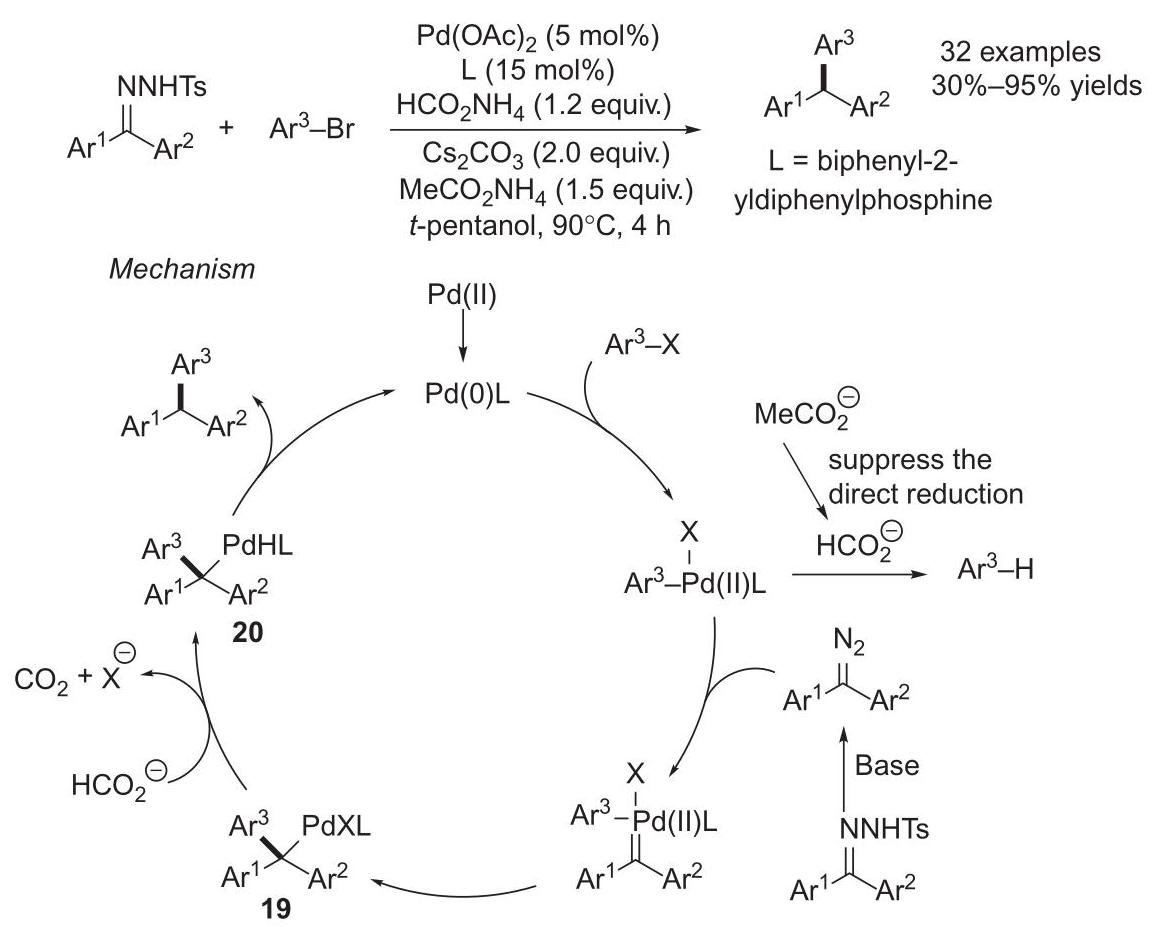
Scheme 25 Pd-catalyzed reductive coupling for synthesizing triarylmethanes.
方案25 钯催化合成三芳基甲烷的还原偶联反应。
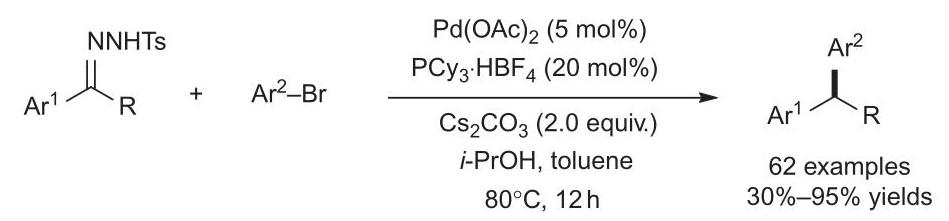
Scheme 26 Pd-catalyzed reductive coupling to form di- and triarylmethanes.
方案26 钯催化形成二芳基甲烷和三芳基甲烷的还原偶联反应。
2.3 Pd-Catalyzed Oxidative Coupling of N-Tosylhydrazones
2.3 钯催化的N-对甲苯磺酰腙的氧化偶联反应
In addition to Pd-catalyzed coupling reaction of aryl halides, catalytic oxidative cross-coupling of arylboronic acids with in situ-generated diazo species from $N$ -tosylhydrazones was also developed, involving transmetalation between the Pd(II) intermediate with boronic acid to generate aryl-Pd(II) species. In 2010, the Wang group disclosed an example of Pd-catalyzed oxidative cross-coupling of $N$ -tosylhydrazones with arylboronic acids in the presence of a Cu(I) salt, affording arylated functionalized olefins with high yields (Scheme 29). ${}^{36}$ The success of the selective generation of cross-coupling products indicates that the oxidative homo-coupling of arylboronic acids has been largely suppressed under aerobic conditions. The proposed mechanism involves transmetalation of Pd(II) species 23 with arylboronic acid initially to afford aryl-palladium species 24, which decomposes the in situ-generated diazo substrate to give the Pd-carbene complex 25. Subsequently, migratory insertion of aryl group to the carbenic carbon of 25 results in the generation of intermediates 26. Finally, $\beta$ -H elimination of 26 affords the olefin product with the regeneration of $\mathrm{{Pd}}\left( 0\right)$ species, which is oxidized by $\mathrm{{Cu}}\left( \mathrm{{II}}\right)$ to form $\mathrm{{Pd}}\left( \mathrm{{II}}\right)$ species.
除了钯催化的芳基卤化物的偶联反应外,还开发了芳基硼酸与由$N$-对甲苯磺酰腙原位生成的重氮物种的催化氧化交叉偶联反应,该反应涉及钯(II)中间体与硼酸之间的转金属化反应以生成芳基-钯(II)物种。2010年,王课题组公开了一个在铜(I)盐存在下钯催化$N$-对甲苯磺酰腙与芳基硼酸氧化交叉偶联反应的例子,以高产率得到芳基官能化烯烃(方案29)。${}^{36}$选择性生成交叉偶联产物的成功表明,在有氧条件下芳基硼酸的氧化均偶联反应已得到很大程度的抑制。提出的机理最初涉及钯(II)物种23与芳基硼酸的转金属化反应,得到芳基钯物种24,其分解原位生成的重氮底物得到钯-卡宾配合物25。随后,芳基迁移插入到25的卡宾碳上,生成中间体26。最后,26的$\beta$-氢消除得到烯烃产物并再生$\mathrm{{Pd}}\left( 0\right)$物种,其被$\mathrm{{Cu}}\left( \mathrm{{II}}\right)$氧化形成$\mathrm{{Pd}}\left( \mathrm{{II}}\right)$物种。
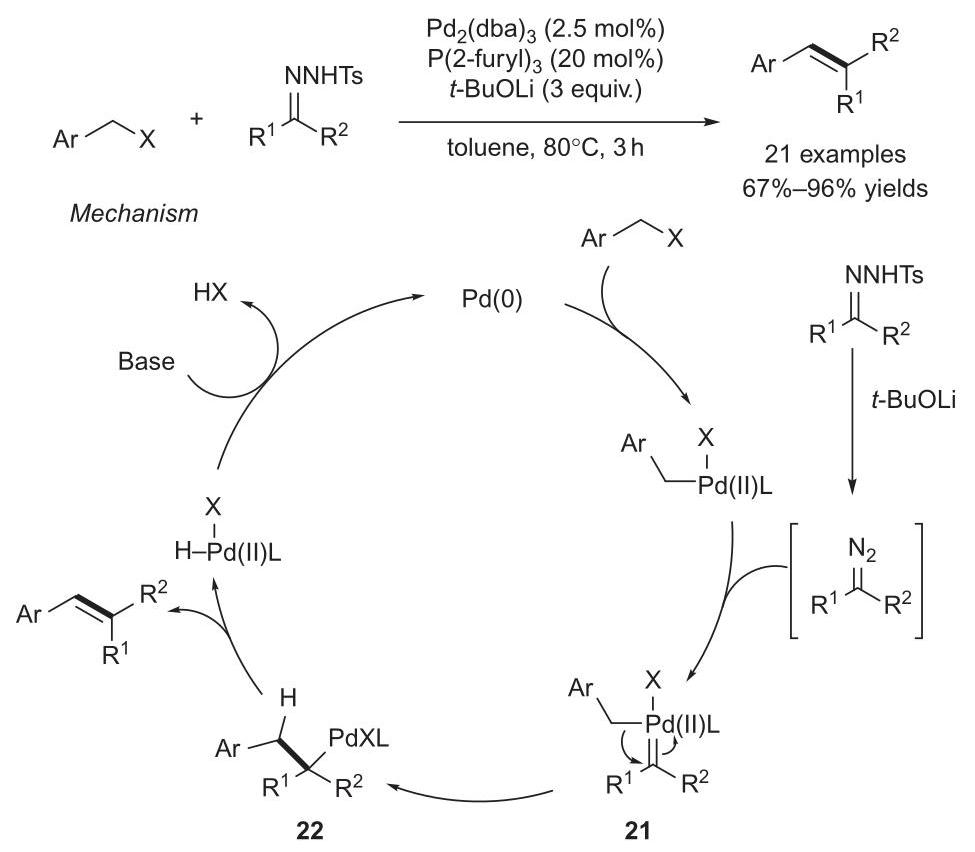
Scheme 27 Pd-catalyzed coupling of benzyl halides with $N$ -tosylhydrazones.
方案27 钯催化苄基卤化物与$N$-对甲苯磺酰腙的偶联反应。
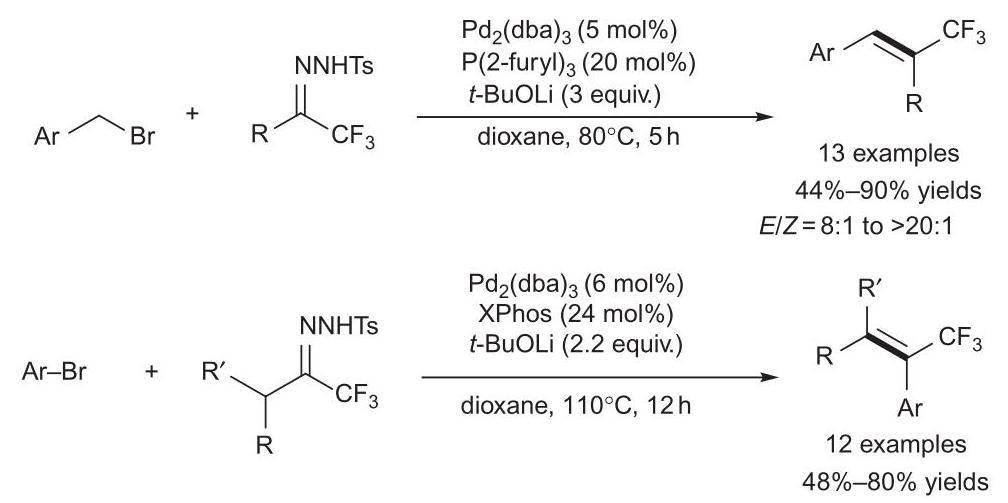
Scheme 28 Pd-catalyzed coupling to access the synthesis of ${\mathrm{{CF}}}_{3}$ -substituted alkenes.
方案28 钯催化用于合成${\mathrm{{CF}}}_{3}$-取代烯烃的偶联反应。
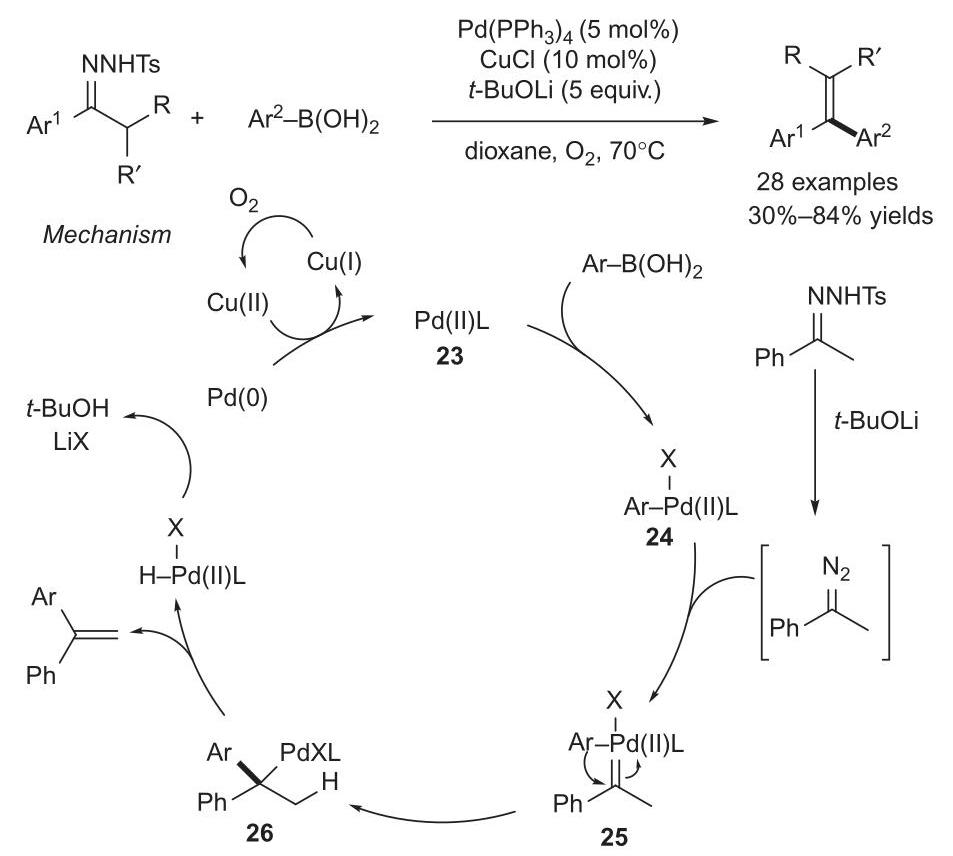
Scheme 29 Pd-catalyzed oxidative cross-coupling of arylboronic acids with N-tosylhydrazones.
方案29 钯催化芳基硼酸与N-对甲苯磺酰腙的氧化交叉偶联反应。
Furthermore, Wang group described the alkynyl migratory insertion process of Pd-carbene, providing a new synthetic method for stereo-selective conjugated enynes through Pd-catalyzed oxidative coupling between $N$ -tosylhydrazones or diazo compounds with terminal alkynes (Scheme 30). ${}^{37}$ The key step in this transformation is migratory insertion of the alkynyl group to the metal-carbene center of27, followed by $\beta - \mathrm{H}$ elimination from 28 to afford enynes. Finally, $\mathrm{{Pd}}\left( 0\right)$ is oxidized by BQ (benzoquinone) to regenerate Pd(II) species.
此外,王课题组描述了钯-卡宾的炔基迁移插入过程,通过钯催化$N$-对甲苯磺酰腙或重氮化合物与端炔的氧化偶联反应,为立体选择性共轭烯炔提供了一种新的合成方法(方案30)。${}^{37}$该转化的关键步骤是炔基迁移插入到27的金属-卡宾中心,随后28发生$\beta - \mathrm{H}$消除得到烯炔。最后,$\mathrm{{Pd}}\left( 0\right)$被苯醌(BQ)氧化以再生钯(II)物种。
In 2012, Jiang group demonstrated the $\mathrm{C}\left( {\mathrm{{sp}}}^{2}\right) - \mathrm{C}\left( {\mathrm{{sp}}}^{3}\right)$ bond formation via Pd-catalyzed oxidative coupling of allylic alcohols with $N$ -tosylhydrazones derived from ketones. ${}^{{38}\mathrm{a}}$ This reaction is proposed to be initiated by $\beta - \mathrm{H}$ elimination of palladium alkoxide species 29 to generate $\alpha ,\beta$ -unsaturated ketones 30, in which the double bond moiety coordinates to a Pd-H species. Next, olefin insertion into Pd-H bond with sequential diazo decomposition affords alkyl-Pd-carbene intermediate 31. Subsequent migratory insertion of the alkyl group to the Pd-carbene center occurs, facilitated by the coordination of the carbonyl group to Pd species. Finally, $\beta - \mathrm{H}$ elimination of 32 affords the coupling product along with extrusion of $\mathrm{{Pd}}\left( 0\right)$ , which is reoxidized by BQ to regenerate Pd(II) species (Scheme 31).
2012年,蒋课题组证明了通过钯催化烯丙醇与由酮衍生的$N$-对甲苯磺酰腙氧化偶联形成$\mathrm{C}\left( {\mathrm{{sp}}}^{2}\right) - \mathrm{C}\left( {\mathrm{{sp}}}^{3}\right)$键。${}^{{38}\mathrm{a}}$该反应被认为是由钯醇盐物种29的$\beta - \mathrm{H}$消除引发,生成$\alpha ,\beta$-不饱和酮30,其中双键部分与钯-氢物种配位。接下来,烯烃插入钯-氢键并伴随重氮分解得到烷基-钯-卡宾中间体31。随后,在羰基与钯物种配位的促进下,烷基迁移插入到钯-卡宾中心。最后,32的$\beta - \mathrm{H}$消除得到偶联产物并挤出$\mathrm{{Pd}}\left( 0\right)$,其被BQ再氧化以再生钯(II)物种(方案31)。
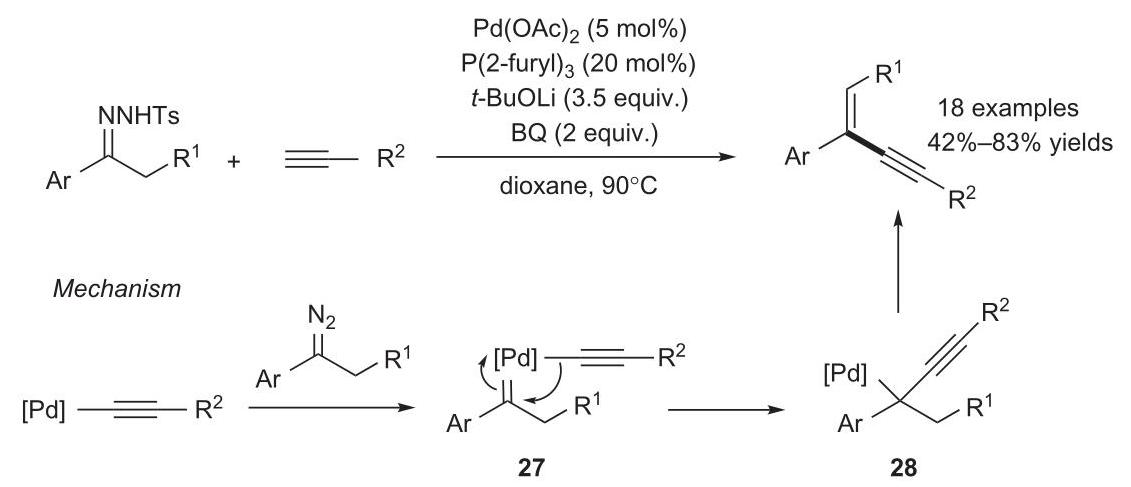
Scheme 30 Pd-catalyzed oxidative coupling of $N$ -tosylhydrazones with terminal alkynes.
方案30 钯催化$N$-对甲苯磺酰腙与端炔的氧化偶联反应。
Moreover, in the same year, the Jiang group established a Pd(II)- catalyzed alternative coupling reactions of electron-deficient terminal alkenes with $N$ -tosylhydrazones. ${}^{{38}\mathrm{\;b}}$ This divergent protocol enables the synthesis of functionalized cyclopropanes from acrylamides, or the chain ketone derivatives from $\alpha ,\beta$ -unsaturated ketones (Scheme 32). The mechanism involves the oxidative cyclometalation of Pd-carbene species 33 with electron-deficient alkene initially to obtain the metallacyclobutane intermediate 34. Sequential $\beta$ -H elimination occurs to produce linear alkyl-Pd species 35, and second $\beta$ -H elimination is suppressed by the strong coordination effect. Amide intermediates undergo an alkene insertion to afford cyclopropane structure 36, followed by reduction elimination or protonolysis to furnish cyclopropanes. On the other hand, weaker coordination effect of the ketone results in the unachievable alkene insertion, instead of the formation of chain products via protonolysis in the presence of water.
此外,同年,姜课题组建立了一种钯(II)催化的缺电子末端烯烃与$N$-甲苯磺酰腙的选择性偶联反应。${}^{{38}\mathrm{\;b}}$ 这种多样化的反应方案能够从丙烯酰胺合成功能化环丙烷,或从$\alpha ,\beta$-不饱和酮合成链状酮衍生物(方案32)。该反应机理首先涉及钯-卡宾物种33与缺电子烯烃的氧化环金属化反应,生成金属环丁烷中间体34。随后发生连续的$\beta$-H消除反应,生成线性烷基钯物种35,由于强配位效应,第二次$\beta$-H消除反应受到抑制。酰胺中间体发生烯烃插入反应,生成环丙烷结构36,随后通过还原消除或质子解反应得到环丙烷。另一方面,酮的配位效应较弱,导致烯烃插入反应无法发生,而是在水存在下通过质子解反应形成链状产物。
To gain insights into the mechanism, the Bi group carried out a theoretical study toward the mechanism of this water-assisted Pd(II)-catalyzed intriguing cross-coupling of alkenes with $N$ -tosylhydrazones. ${}^{{38}\mathrm{c}}$ They have clarified the important roles of water, acetate, and $t - {\mathrm{{BuO}}}^{ - }$ group in the catalytic cycle. The proposed mechanism is as following: (1) migratory insertion to generate stable five-membered metallacyclic intermediate 37; (2) $\beta - \mathrm{H}$ abstraction by $t - {\mathrm{{BuO}}}^{ - }$ , resulting in $\mathrm{C} = \mathrm{C}$ bond formation; (3) oxidative addition; (4) alkene insertion into $\mathrm{{Pd}} - \mathrm{C}\left( {\mathrm{{sp}}}^{2}\right)$ bond; (5) enolization to form Pd-O bond; and (6) hydroxyl hydrogen addition from water to afford final product, along with the generation of Pd-OH species (Scheme 33).
为了深入了解该反应机理,毕课题组对水辅助钯(II)催化的烯烃与$N$-甲苯磺酰腙的有趣交叉偶联反应机理进行了理论研究。${}^{{38}\mathrm{c}}$ 他们阐明了水、乙酸根和$t - {\mathrm{{BuO}}}^{ - }$基团在催化循环中的重要作用。提出的反应机理如下:(1)迁移插入生成稳定的五元金属环中间体37;(2)$t - {\mathrm{{BuO}}}^{ - }$进行$\beta - \mathrm{H}$提取,导致$\mathrm{C} = \mathrm{C}$键形成;(3)氧化加成;(4)烯烃插入$\mathrm{{Pd}} - \mathrm{C}\left( {\mathrm{{sp}}}^{2}\right)$键;(5)烯醇化形成钯-氧键;(6)水的羟基氢加成得到最终产物,同时生成钯-氢氧物种(方案33)。
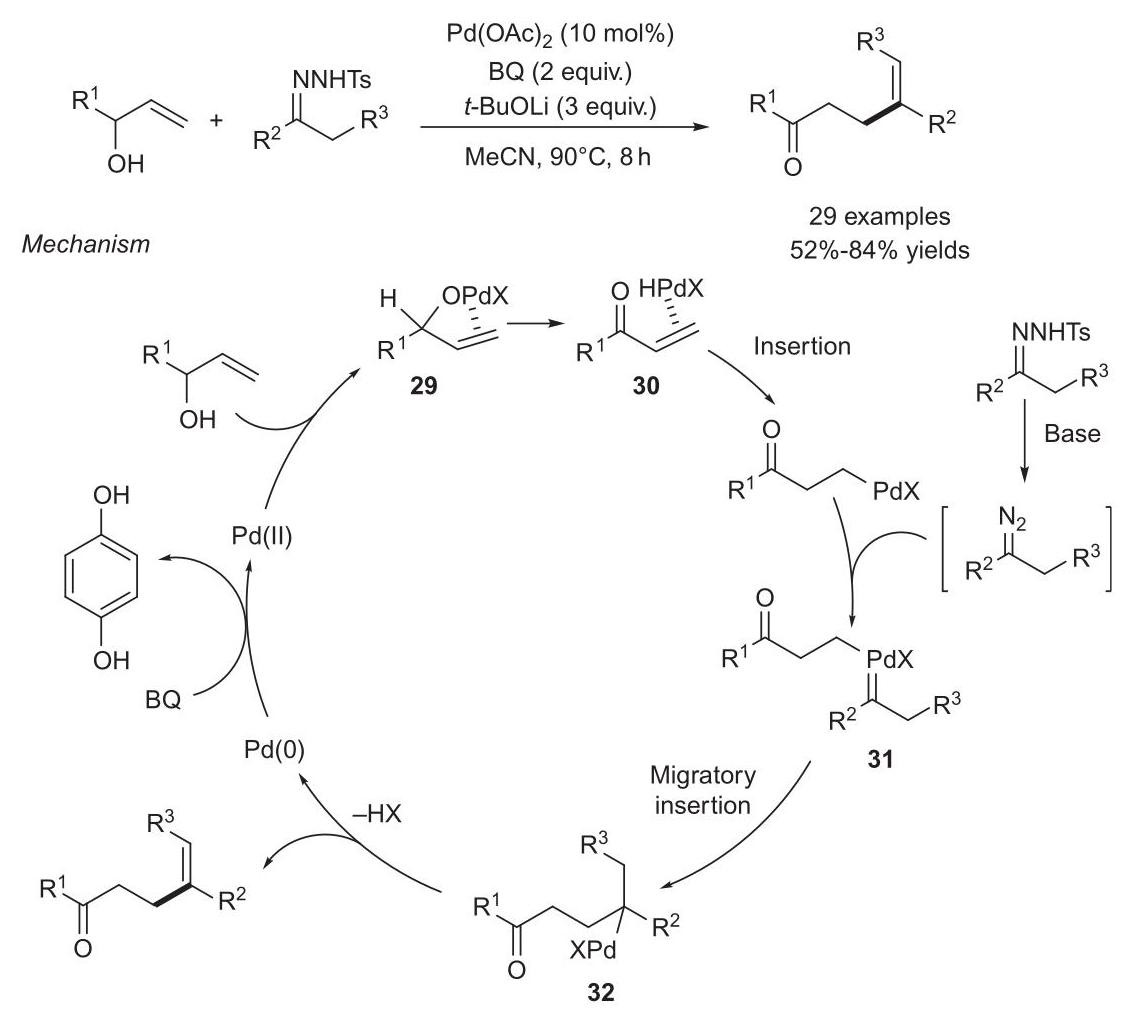
Scheme 31 Pd-catalyzed oxidative coupling of $N$ -tosylhydrazones with allylic alcohols involving alkyl group migratory insertion.
方案31:钯催化的$N$-甲苯磺酰腙与烯丙醇的氧化偶联反应,涉及烷基迁移插入。
Pd-catalyzed oxidative coupling of two molecules of $N$ -tosylhydrazones provided a new route to branched conjugated dienes. ${}^{39}$ In 2013, Jiang ${}^{{39}\mathrm{a}}$ and Prabhu ${}^{{39}\mathrm{b}}$ reported the Pd-catalyzed oxidative coupling reactions of $N$ -tosylhydrazones under the aerobic condition or using BQ as the oxidant, respectively. These transformations enable the facile, efficient regioselective synthesis of 2,3-substituted-1,3-butadienes from readily available substrates, as well as the preparation of heterocyclic rings. The proposed mechanism involves diazo decomposition by alkenyl-Pd species 38 to generate alkenyl-Pd-carbene intermediate 39. Migratory insertion of alkenyl group with sequential $\beta - \mathrm{H}$ elimination gives rise to the formation of the final product, and Pd(0) is oxidized to regenerate Pd(II) (Scheme 34).
钯催化的两分子$N$-甲苯磺酰腙的氧化偶联反应为支链共轭二烯提供了一条新的合成路线。${}^{39}$ 2013年,姜${}^{{39}\mathrm{a}}$和普拉布${}^{{39}\mathrm{b}}$分别报道了在有氧条件下或使用BQ作为氧化剂时钯催化的$N$-甲苯磺酰腙的氧化偶联反应。这些转化反应能够从易得的底物简便、高效、区域选择性地合成2,3-二取代-1,3-丁二烯,以及制备杂环。提出的反应机理涉及烯基钯物种38的重氮分解,生成烯基钯-卡宾中间体39。烯基的迁移插入反应伴随着连续的$\beta - \mathrm{H}$消除反应,生成最终产物,钯(0)被氧化再生为钯(II)(方案34)。
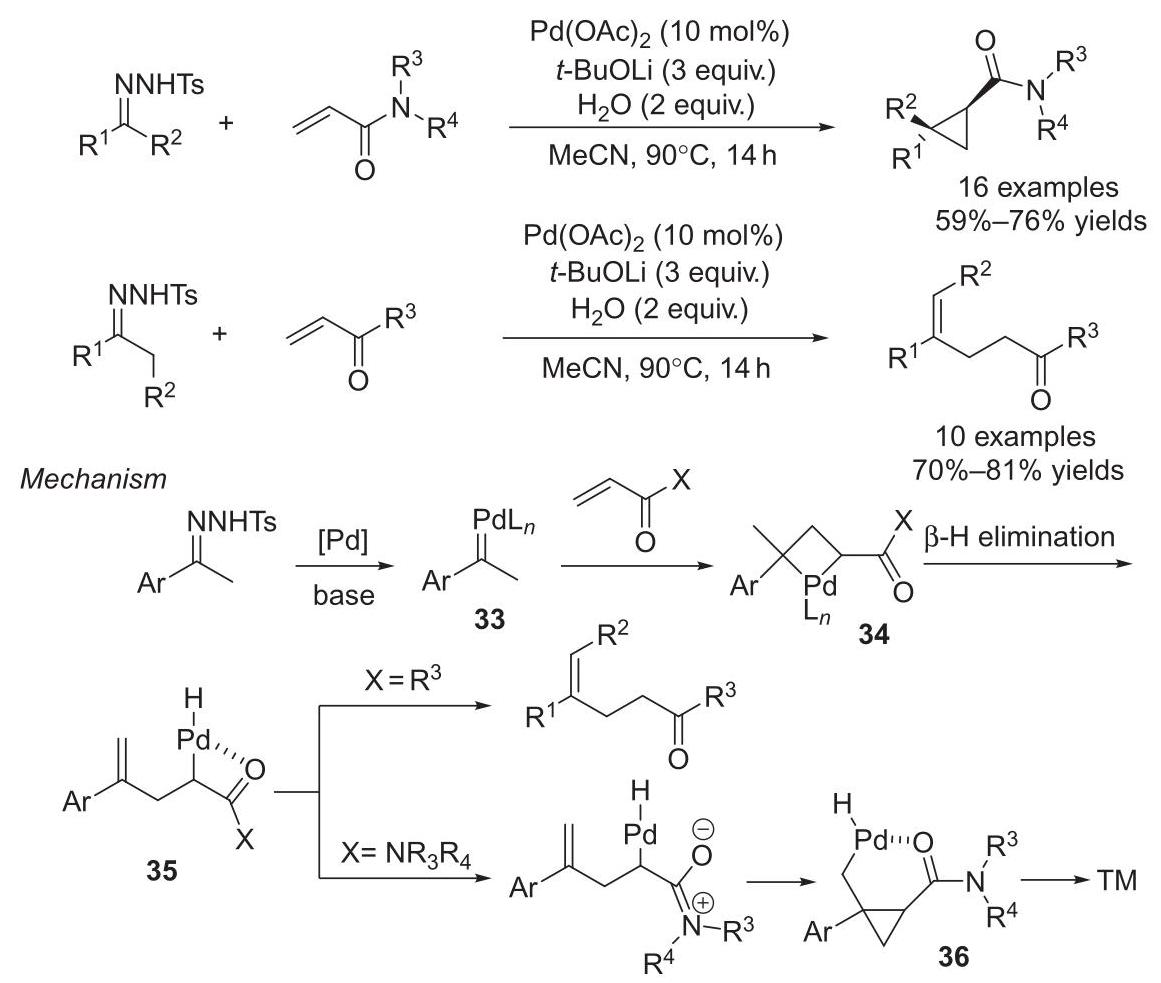
Scheme 32 Pd-catalyzed diverse coupling reaction of N-tosylhydrazones with electron-deficient alkenes.
方案32:钯催化的N-甲苯磺酰腙与缺电子烯烃的多样化偶联反应。
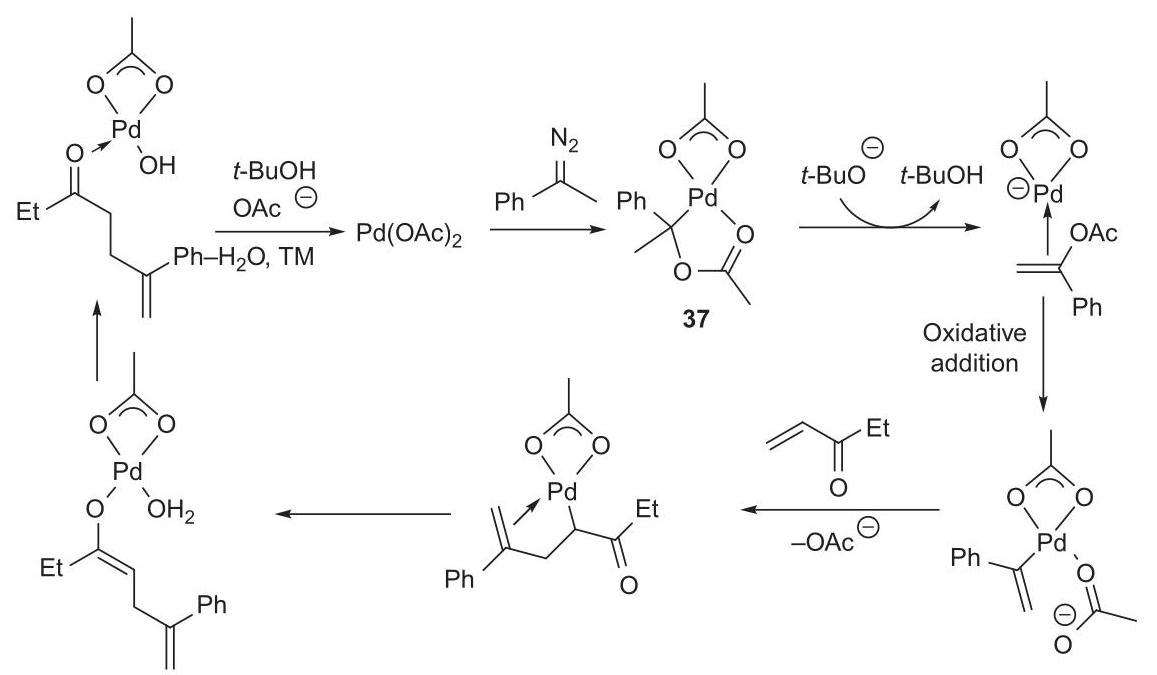
Scheme 33 Proposed mechanism of water-assisted Pd(II)-catalyzed cross-coupling of alkenes with N-tosylhydrazones.
方案33:水辅助钯(II)催化的烯烃与N-甲苯磺酰腙交叉偶联反应的 proposed 机理。
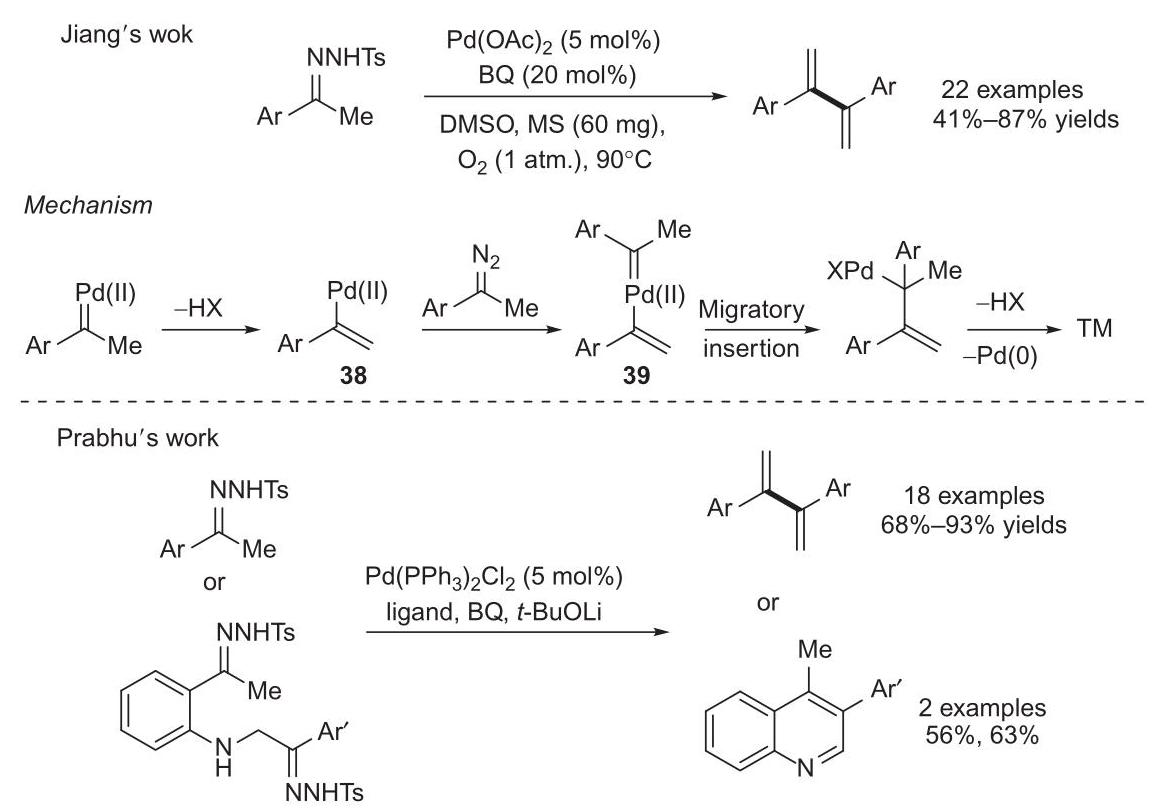
Scheme 34 Pd-catalyzed oxidative coupling of $N$ -tosylhydrazones to provide branched conjugated dienes.
方案34:钯催化的$N$-甲苯磺酰腙氧化偶联反应,生成支链共轭二烯。
Moreover, Pd-catalyzed oxidative cross-coupling of N-tosylhydrazones with indoles was carried out, providing an efficient synthetic method for $N$ -vinylindoles ${}^{{40}\mathrm{a}}$ as well as $N$ -vinylazoles ${}^{{40}\mathrm{\;b}}$ with good functional group tolerance (Scheme 35). These transformations are implemented under aerobic conditions or utilized aryl iodide as the oxidant, respectively. Especially, migratory insertion of the indole unit is hypothesized as the key step, followed by $\beta - \mathrm{H}$ elimination to afford $N$ -vinyl-functionalized $N$ -heterocycles.
此外,还进行了钯催化的N-对甲苯磺酰腙与吲哚的氧化交叉偶联反应,为具有良好官能团耐受性的$N$-乙烯基吲哚${}^{{40}\mathrm{a}}$以及$N$-乙烯基唑${}^{{40}\mathrm{\;b}}$提供了一种有效的合成方法(方案35)。这些转化分别在有氧条件下进行或使用芳基碘作为氧化剂。特别地,吲哚单元的迁移插入被认为是关键步骤,随后进行$\beta - \mathrm{H}$消除以得到$N$-乙烯基官能化的$N$-杂环。
2.4 Pd-Catalyzed Two-Component Cascade Coupling of N-Tosylhydrazones
2.4 钯催化的N-对甲苯磺酰腙的双组分串联偶联反应
Furthermore, Pd-catalyzed two-component cascade reaction involving migratory insertion has also experienced considerable growth. This autotandem catalytic strategy by using diazo compounds establishes a novel and facile approach for synthesizing divergent functional molecules. In 2011, Barluenga and Valdés demonstrated the Pd-catalyzed tandem coupling of $N$ -tosylhydrazones derived from Mannich adducts with 1,2-dihalogenated arenes, proceeding through aryl group migratory insertion with catalytic amination (Scheme 36). ${}^{41}$ This sequential C-C/ intramolecular C-N bond formation protocol provides quinoline derivatives, as well as enantiomerically enriched quinoline scaffold through the combination of organocatalytic Mannich reaction with the Pd-catalyzed coupling reaction. This unprecedented autotandem catalytic transformation opens a new avenue to the development of other appealing coupling cascade transformations.
此外,涉及迁移插入的钯催化双组分串联反应也有了显著发展。这种使用重氮化合物的自动串联催化策略为合成多种功能分子建立了一种新颖且简便的方法。2011年,Barluenga和Valdés展示了钯催化的由曼尼希加合物衍生的$N$-对甲苯磺酰腙与1,2-二卤代芳烃的串联偶联反应,该反应通过芳基迁移插入和催化胺化进行(方案36)。${}^{41}$ 这种顺序的C-C/分子内C-N键形成方法提供了喹啉衍生物,以及通过有机催化的曼尼希反应与钯催化的偶联反应相结合得到的对映体富集的喹啉骨架。这种前所未有的自动串联催化转化为其他有吸引力的偶联级联转化的发展开辟了一条新途径。
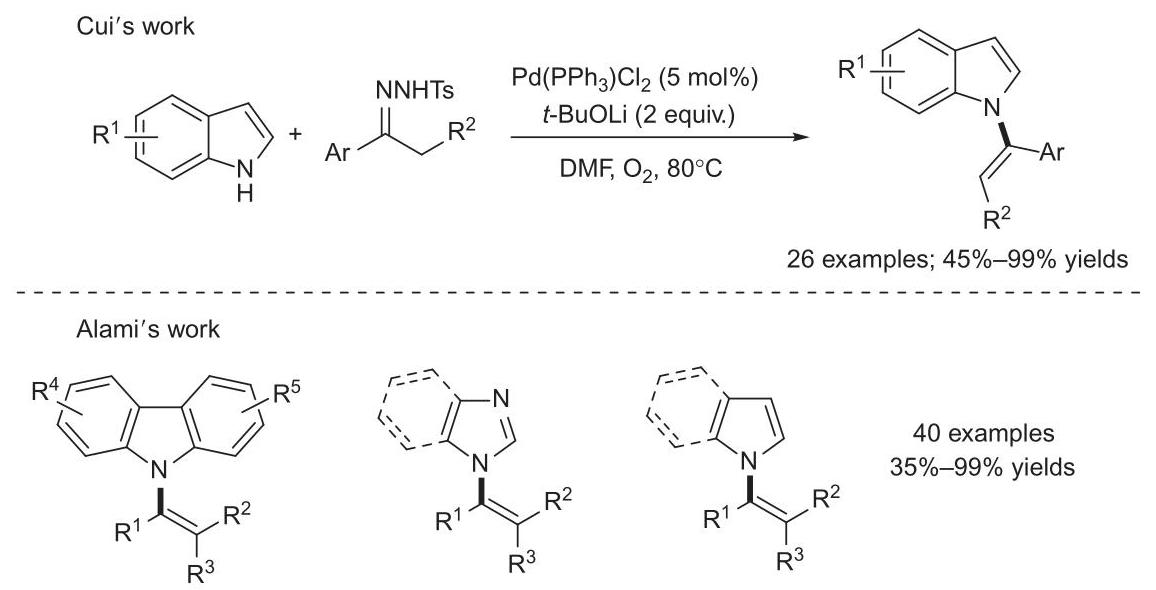
Scheme 35 Pd-catalyzed oxidative cross-coupling of $N$ -tosylhydrazones with indoles.
方案35 钯催化的$N$-对甲苯磺酰腙与吲哚的氧化交叉偶联反应。
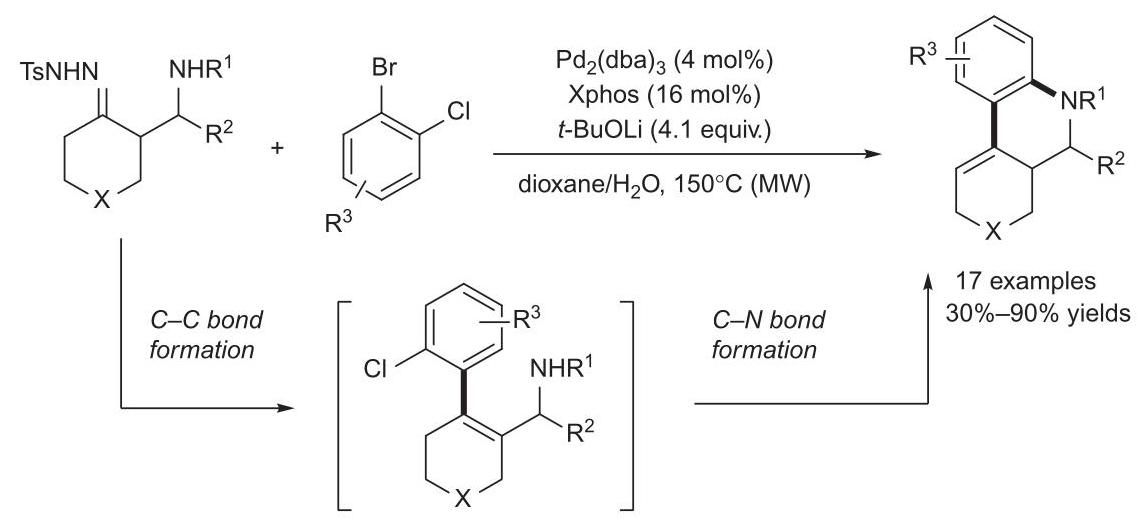
Scheme 36 Autotandem Pd-catalyzed C-C/C-N bond formation to obtain quinolines.
方案36 钯催化的自动串联C-C/C-N键形成反应以获得喹啉。
Besides, Wang group utilized the autotandem strategy to access the functionalized acridines from coupling reaction of o-dihalobenzenes with $N$ -tosylhydrazones containing amino group. ${}^{42}$ Reaction pathway consists of the aryl group migratory insertion/ $\beta - \mathrm{H}$ elimination sequence followed by catalytic intramolecular amination. In addition, Pd-catalyzed coupling reaction between vinyl iodides and $N$ -tosylhydrazones with intramolecular nucleophilic trapping sequence was performed to afford pyrrolidine and piperidine scaffold (Scheme 37). ${}^{43}$
此外,王课题组利用自动串联策略,通过邻二卤代苯与含氨基的$N$-对甲苯磺酰腙的偶联反应来合成功能化吖啶。${}^{42}$ 反应途径包括芳基迁移插入/$\beta - \mathrm{H}$消除序列,随后是催化分子内胺化。此外,进行了钯催化的乙烯基碘与$N$-对甲苯磺酰腙之间的具有分子内亲核捕获序列的偶联反应,以得到吡咯烷和哌啶骨架(方案37)。${}^{43}$
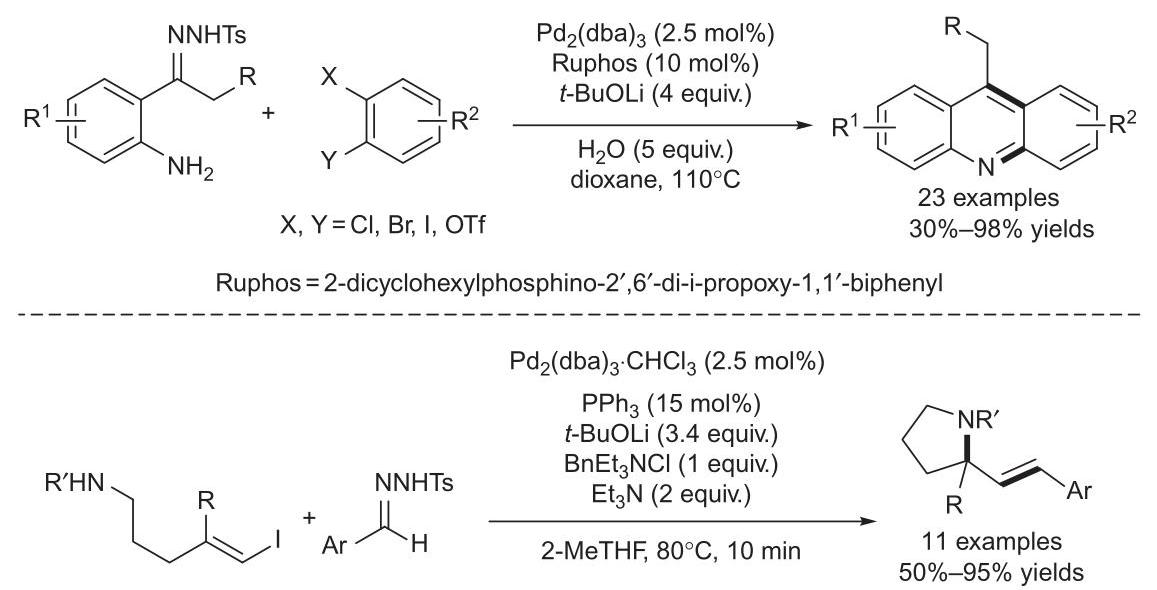
Scheme 37 Autotandem Pd-catalyzed C-C/C-N bond formation to afford acridines, pyrrolidine, and piperidine scaffold.
方案37 钯催化的自动串联C-C/C-N键形成反应以得到吖啶、吡咯烷和哌啶骨架。
Moreover, Pd-catalyzed cross-coupling reaction involving migratory insertion with nucleophilic trapping cascade provided novel and efficient approaches for a wide range of cyclic molecules, including isoindolones 40 (with nitrogen nucleophile), ${}^{44}$ dihydronaphthalene 41 and indene 42 (with carbon nucleophile), ${}^{45}$ 2H-chromenes 43 (with oxygen nucleophile), ${}^{46}$ spiroacetal enol ethers 44 (through intramolecular nucleophilic dearomatization), ${}^{47}$ 1-arylindanes 45 and 1-aryltetralins 46 (with carbon nucleophile), ${}^{48}$ allylic sulfones 47 (using $N$ -tosylhydrazone as a double nucleophile), ${}^{49}$ and chromeno[4,3-b]chromene 48 (with oxygen nucleophile) ${}^{50}$ (Scheme 38). From commercially available aldehydes or ketones and organic halides, these Pd-catalyzed cascade reactions provide facile and straightforward synthesis of divergent building blocks, especially for heterocyclic compounds.
此外,涉及迁移插入与亲核捕获级联的钯催化交叉偶联反应为多种环状分子提供了新颖且有效的方法,包括异吲哚酮40(与氮亲核试剂)、${}^{44}$二氢萘41和茚42(与碳亲核试剂)、${}^{45}$ 2H-色烯43(与氧亲核试剂)、${}^{46}$ 螺缩醛烯醇醚44(通过分子内亲核脱芳构化)、${}^{47}$ 1-芳基茚满45和1-芳基四氢萘46(与碳亲核试剂)、${}^{48}$ 烯丙基砜47(使用$N$-对甲苯磺酰腙作为双亲核试剂)、${}^{49}$ 以及色烯并[4,3-b]色烯48(与氧亲核试剂)${}^{50}$ (方案38)。从市售醛或酮以及有机卤化物出发,这些钯催化的级联反应为多种结构单元,特别是杂环化合物,提供了简便直接的合成方法。
In 2016, Huang group reported the Pd-catalyzed cross-coupling reaction of aminals with vinyl $N$ -sulfonyl hydrazones, in which the C-C and C-S bond was simultaneously constructed in a straightforward manner (Scheme 39). ${}^{51}$ This process affords aminomethyl-substituted allylic sulfones in moderate to good yields. The key step in this reaction is the migratory insertion of aminomethyl group to form the $\pi$ -allylpalladium intermediate 50 generated from electrophilic cyclopalladated complex 49, followed by sequential nucleophilic attack to deliver the final product along with the regeneration of active $\mathrm{{Pd}}\left( 0\right)$ species.
2016年,黄课题组报道了钯催化的胺与乙烯基$N$-磺酰腙的交叉偶联反应,其中以直接的方式同时构建了C-C键和C-S键(方案39)。${}^{51}$ 该过程以中等至良好的产率得到氨基甲基取代的烯丙基砜。该反应的关键步骤是氨基甲基的迁移插入,以形成由亲电环钯化络合物49生成的$\pi$-烯丙基钯中间体50,随后进行顺序亲核进攻以得到最终产物并再生活性$\mathrm{{Pd}}\left( 0\right)$物种。
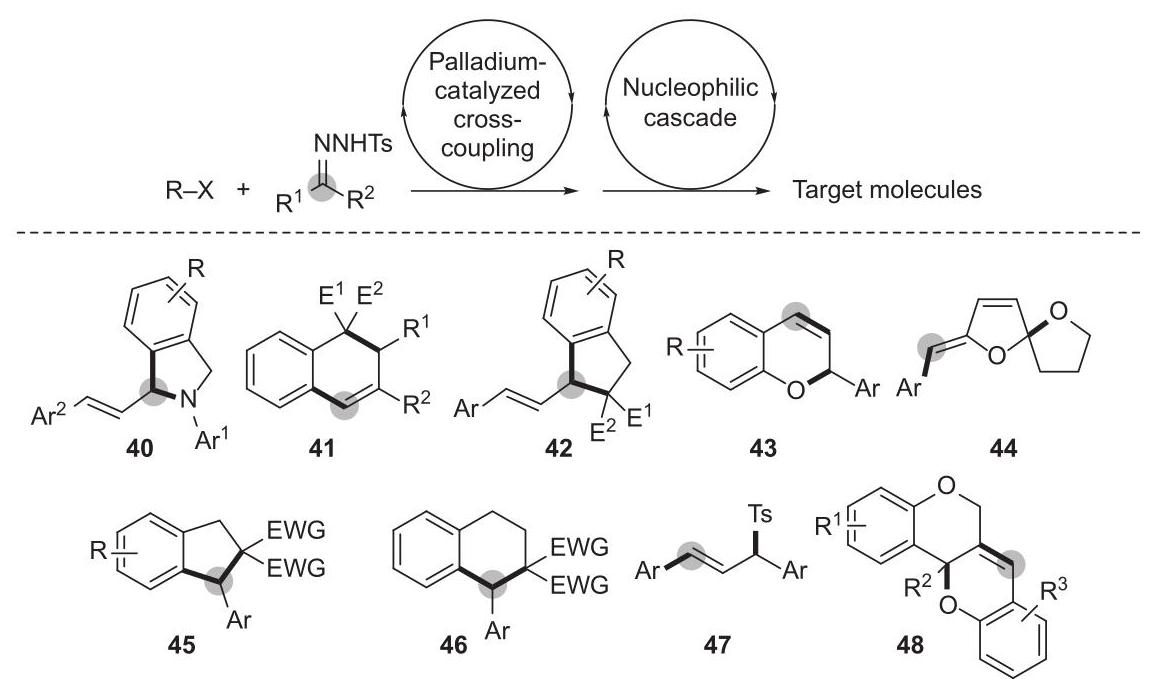
Scheme 38 Synthesis of functional molecules through Pd-catalyzed coupling/nucleophilic trapping cascade synthetic strategy.
方案38 通过钯催化的偶联/亲核捕获级联合成策略合成功能分子。
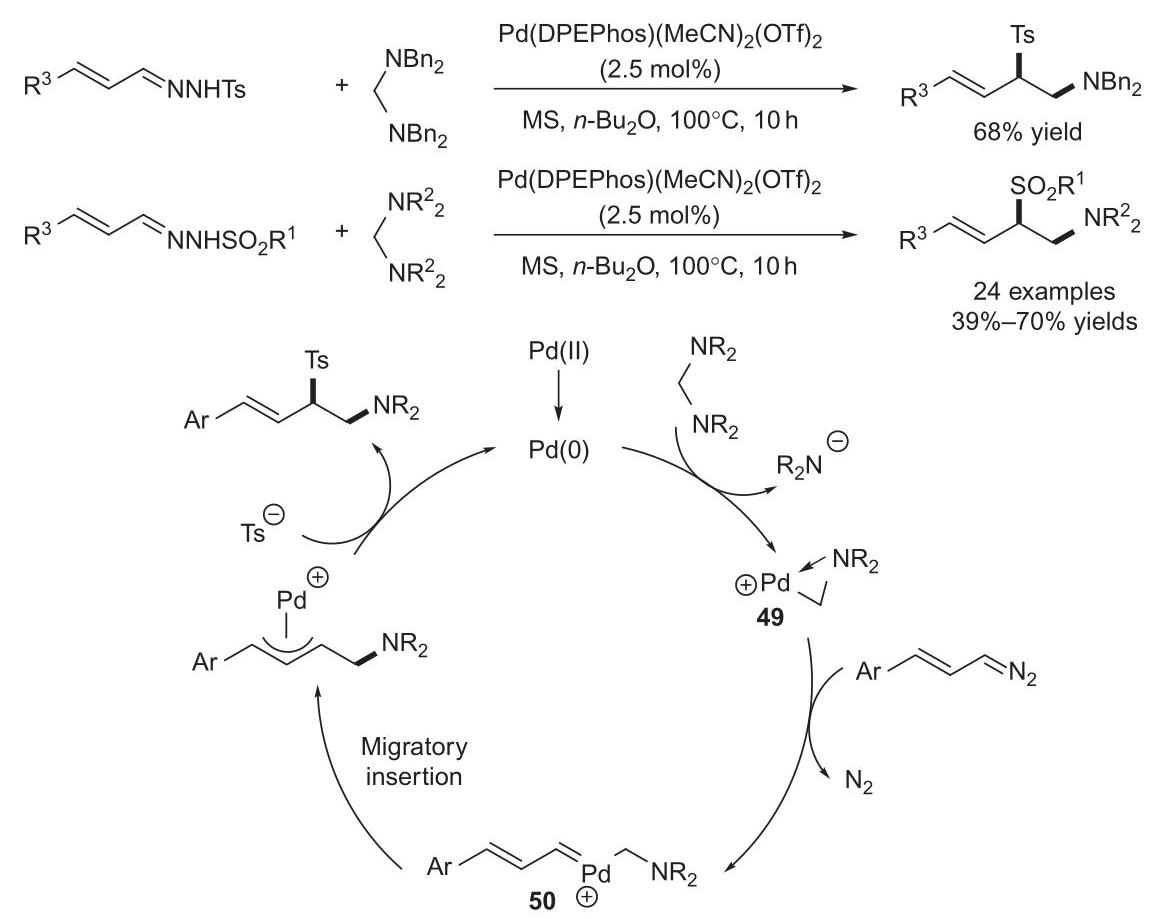
Scheme 39 Pd-catalyzed carbene-coupling reaction of aminals to afford allylic sulfones.
方案39 钯催化的胺的卡宾偶联反应以得到烯丙基砜。
In addition, the combination of Pd-catalyzed cross-coupling involving migratory insertion with intramolecular Heck-type reaction has been developed and applied for preparing functional molecules containing C-C double bonds, including spiroamide derivatives 51, ${}^{52}$ 3-vinylindoles and 3-vinylbenzofurans 52, ${}^{53}$ spirocyclic systems 53 (spiro-fluorenes, -dibenzofluorenes, -acridines, and -anthracenes), ${}^{54}$ benzofuran-, dihydrobenzofuran-, and indoline-containing alkenes 54, ${}^{55}$ indanes and 2,3-disubstituted benzofurans 55, ${}^{56}$ polysubstituted indoles 56 and 1,4-dihydroquinolines ${\mathbf{{56}}}^{\prime },{}^{57}$ as well as various naphtho-fused heterocycles ${\mathbf{{57}}}^{58}$ (Scheme 40). Finally, alkenes are obtained through alkyl group migratory insertion followed by $\beta - \mathrm{H}$ elimination. This reaction represents the first example of the reaction involving neopentyl palladium intermediates with carbenes to form alkenes. ${}^{52}$
此外,钯催化的涉及迁移插入的交叉偶联与分子内Heck型反应的组合已被开发并应用于制备含有碳 - 碳双键的功能分子,包括螺酰胺衍生物51,${}^{52}$ 3 - 乙烯基吲哚和3 - 乙烯基苯并呋喃52,${}^{53}$ 螺环体系53(螺芴、 - 二苯并芴、 - 吖啶和 - 蒽),${}^{54}$ 含苯并呋喃、二氢苯并呋喃和吲哚啉的烯烃54,${}^{55}$ 茚满和2,3 - 二取代苯并呋喃55,${}^{56}$ 多取代吲哚56和1,4 - 二氢喹啉${\mathbf{{56}}}^{\prime },{}^{57}$ 以及各种萘并稠合杂环${\mathbf{{57}}}^{58}$ (方案40)。最后,通过烷基迁移插入然后$\beta - \mathrm{H}$ 消除得到烯烃。该反应代表了涉及新戊基钯中间体与卡宾形成烯烃的反应的第一个例子。${}^{52}$
In 2015, the domino process which converged Pd-carbene migratory insertion with intramolecular Heck reaction was reported, allowing the stereo- and regioselective synthesis of 2-arylidene-3-aryl-1-indanones from readily available $N$ -tosylhydrazones and ${2}^{\prime }$ -iodochalcones (Scheme 41). ${}^{59}$ Moreover, the success of one-pot synthesis as well as gram-scale preparation also demonstrates its practical utility in organic synthesis. Mechanistically, this reaction is assumed to proceed via migratory insertion of aryl group, followed by regioselective 5-exo-trig cyclization and $\beta$ -hydride elimination process.
2015年,有报道称一种多米诺反应过程,该过程将钯卡宾迁移插入与分子内Heck反应相结合,从而能够从易得的$N$-甲苯磺酰腙和${2}^{\prime }$-碘代查尔酮立体选择性和区域选择性地合成2-亚芳基-3-芳基-1-茚酮(方案41)。${}^{59}$此外,一锅法合成以及克级制备的成功也证明了其在有机合成中的实际应用价值。从机理上讲,该反应被认为是通过芳基的迁移插入进行的,随后是区域选择性的5-外向-环化和$\beta$-氢化物消除过程。
Yin and Jiang group developed an intriguing Pd-catalyzed cross-coupling reaction of furfural tosylhydrazones with 2-iodo-anilines or -thiophenols, respectively, affording polysubstituted indoles or benzothiophenes. ${}^{60}$ This transformation is proposed to proceed via aryl migratory insertion to generate 2-furylmethylene palladium species 58. Sequential $\beta$ -oxygen elimination with concomitant furan ring-opening procedure affords the allene intermediate 59. Subsequently, intramolecular nucleophilic addition, palladium transfer, and $\beta - \mathrm{H}$ elimination occur, leading to the synthesis of indoles or benzothiophenes as ring closure products (Scheme 42).
尹和江课题组分别开发了一种有趣的钯催化糠醛对甲苯磺酰腙与2-碘苯胺或2-碘苯硫酚的交叉偶联反应,得到多取代吲哚或苯并噻吩。${}^{60}$ 该转化过程被认为是通过芳基迁移插入生成2-呋喃基亚甲基钯物种58。随后进行连续的$\beta$ -氧消除并伴随呋喃环开环过程,得到丙二烯中间体59。随后发生分子内亲核加成、钯转移和$\beta - \mathrm{H}$消除,导致合成吲哚或苯并噻吩作为环化产物(方案42)。
In 2016, an autotandem Pd-catalyzed coupling reaction of alkyne-based aryl iodides with salicyl $N$ -tosylhydrazones was reported (Scheme 43). This convenient method allows the construction of spiro[benzofuran-3,2’- chromene] scaffold with good yields and excellent selectivity. ${}^{61}$ Mechanistically, this reaction proceeds via initial 5-exo-dig cyclization of 60 to form the vinyl Pd(II) intermediate 61. Then, in situ-generated diazo species reacts with 61 to form Pd-carbene species 62, which undergoes sequential migratory insertion of vinyl group to give benzyl palladium intermediate 63. Finally, intramolecular cyclization of 63 promoted by oxygen as nucleophiles affords the spirocyclic skeleton and regenerate Pd species simultaneously.
2016年,有报道称基于炔烃的芳基碘化物与水杨基$N$-对甲苯磺酰腙发生了自动串联钯催化偶联反应(方案43)。这种简便的方法能够以良好的产率和出色的选择性构建螺[苯并呋喃-3,2’-色烯]骨架。${}^{61}$从机理上讲,该反应首先通过60的5-外向-环化反应形成乙烯基钯(II)中间体61。然后,原位生成的重氮物种与61反应形成钯-卡宾物种62,后者经历乙烯基的连续迁移插入反应,生成苄基钯中间体63。最后,以氧作为亲核试剂促进63的分子内环化反应,得到螺环骨架并同时再生钯物种。
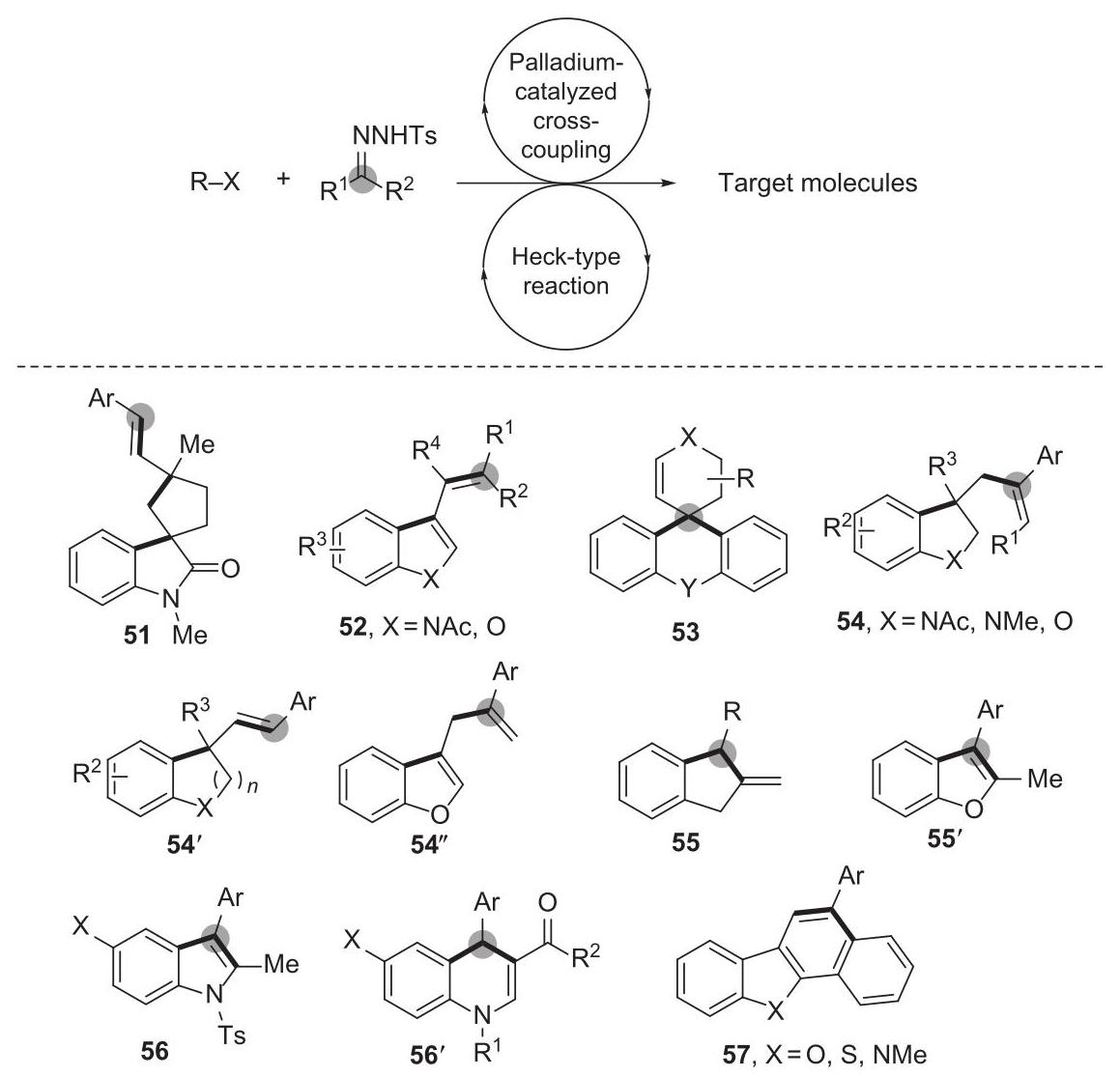
Scheme 40 Synthesis of functional molecules through Pd-catalyzed cross-coupling of N-tosylhydrazones via intramolecular Heck-type cascade transformations.
方案40 通过钯催化的N-对甲苯磺酰腙的分子内Heck型级联转化交叉偶联反应合成功能分子。
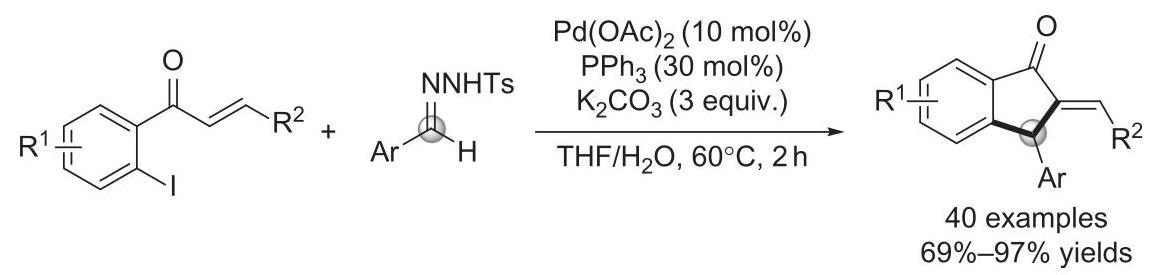
Scheme 41 Synthesis of 2-arylidene-3-aryl-1-indanones through Pd-catalyzed coupling of N-tosylhydrazones with Heck-type cascade reaction.
方案41:通过钯催化的N-对甲苯磺酰腙与Heck型级联反应的偶联反应合成2-亚芳基-3-芳基-1-茚酮。
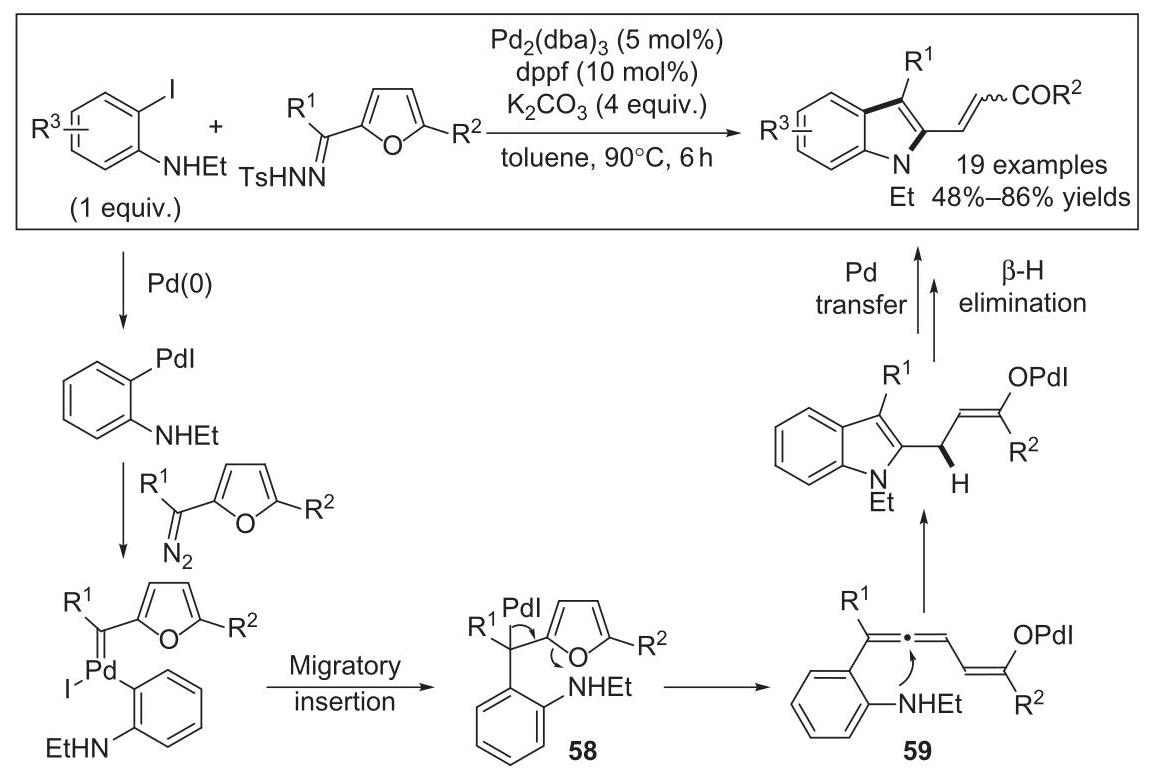
Scheme 42 Pd-catalyzed coupling of furfural tosylhydrazones with 2-iodoanilines.
方案42 钯催化糠醛对甲苯磺酰腙与2-碘苯胺的偶联反应。
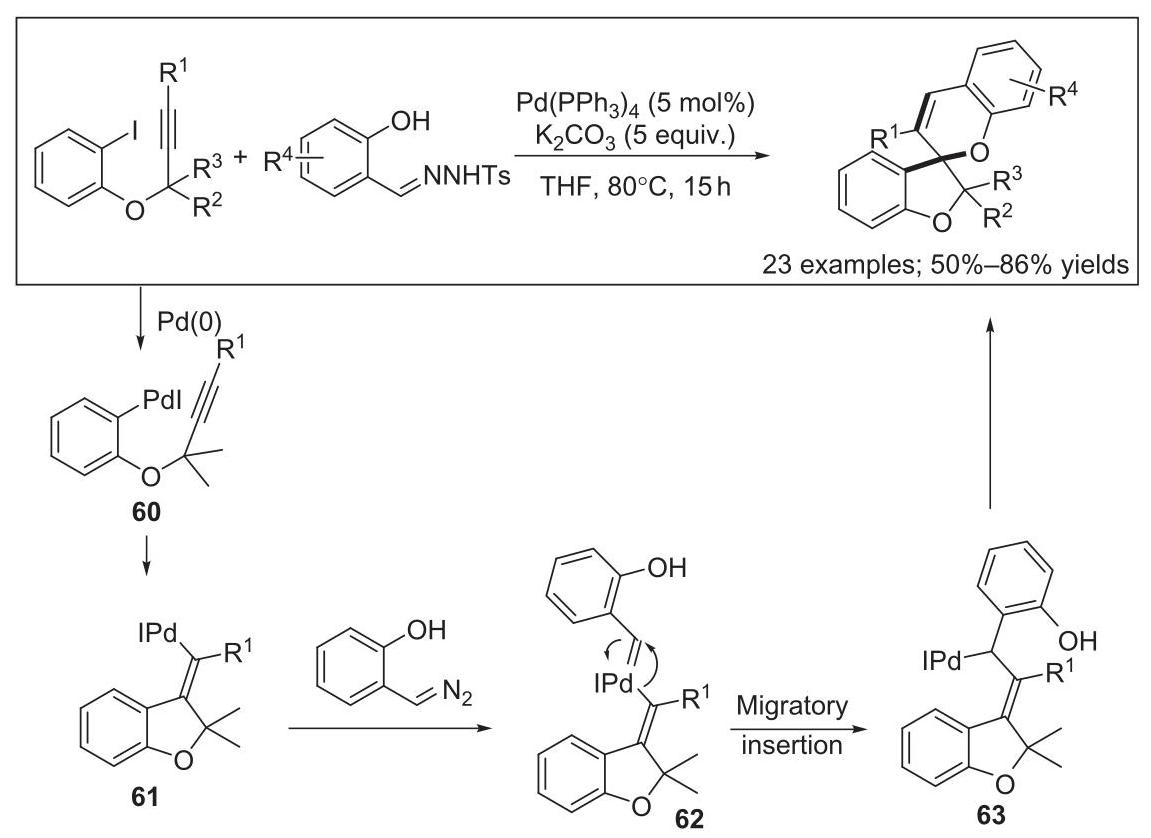
Scheme 43 Formation of spiro[benzofuran-3,2’-chromene] derivatives through Pd-catalyzed tandem coupling reaction.
方案43 通过钯催化的串联偶联反应形成螺[苯并呋喃-3,2’-色烯]衍生物。
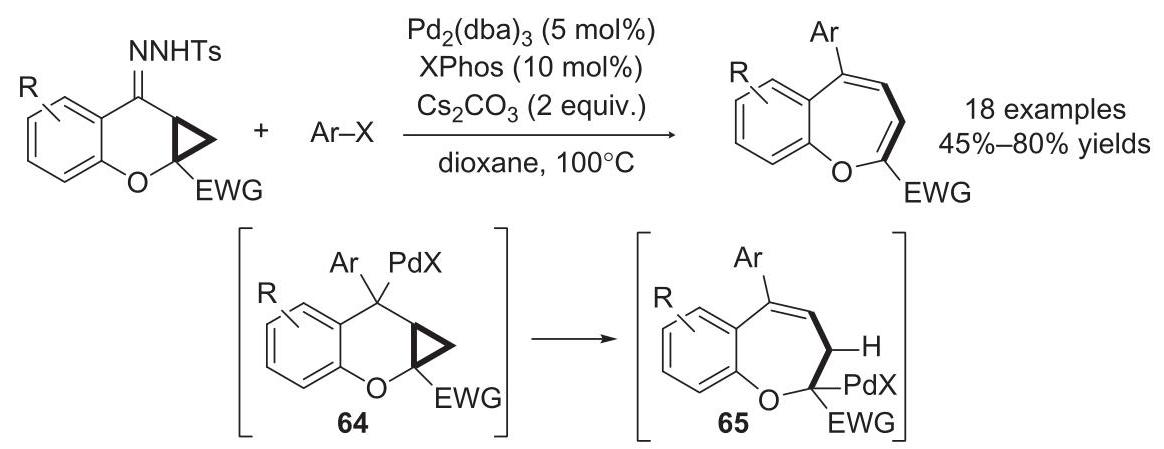
Scheme 44 Synthesis of benzoxepines through Pd-catalyzed coupling reaction involving carbene insertion and C-C bond cleavage.
方案44:通过钯催化的涉及卡宾插入和C-C键断裂的偶联反应合成苯并氧杂环庚三烯。
In 2016, Zhou group achieved the regiospecific synthesis of benzo-xepines derivatives through Pd-catalyzed coupling reaction of aryl halides with oxabicyclo[4.1.0]heptyl $N$ -tosylhydrazones (Scheme 44). ${}^{62}$ Key features of this ring expansion include migratory insertion of the Pd-carbene intermediate to form 64, which undergoes sequential selective C-C bond cleavage to obtain the ring-expanded intermediate 65. Finally, $\beta - \mathrm{H}$ elimination from 65 occurs to deliver benzoxepines containing an aryl group at the 5-position.
2016年,周课题组通过钯催化芳基卤化物与氧杂双环[4.1.0]庚基$N$-甲苯磺酰腙的偶联反应,实现了苯并氧杂卓衍生物的区域特异性合成(方案44)。${}^{62}$这种扩环反应的关键特征包括钯卡宾中间体的迁移插入以形成64,64经过连续的选择性碳-碳键断裂以获得扩环中间体65。最后,$\beta - \mathrm{H}$65发生消除反应,生成在5位含有芳基的苯并氧杂卓。
Moreover, Liang group established divergent Pd-catalyzed decarboxy-lative coupling of propargylic carbonates with acetophenone-derived $N$ -tosylhydrazones (Scheme 45). ${}^{63}$ Migratory insertion from the allenyl-palladium carbene 66 with subsequently $\beta - \mathrm{H}$ elimination results in the synthesis of multisubstituted conjugated vinylallenes. Alternatively, formation of propargylic $N$ -sulfonylhydrazones comes from direct nucleophilic attack of the propargyl palladium intermediate 67 with hydrazone salt anion, followed by reductive elimination to furnish propargylic substitution product, accompanying with the regeneration of $\operatorname{Pd}\left( 0\right)$ .
此外,梁课题组建立了钯催化的炔丙基碳酸酯与苯乙酮衍生的$N$-甲苯磺酰腙的发散性脱羧偶联反应(方案45)。${}^{63}$烯丙基钯卡宾66的迁移插入以及随后的$\beta - \mathrm{H}$消除反应导致多取代共轭乙烯基丙二烯的合成。另外,炔丙基$N$-磺酰腙的形成来自炔丙基钯中间体67与腙盐阴离子的直接亲核进攻,随后进行还原消除以提供炔丙基取代产物,并伴随着$\operatorname{Pd}\left( 0\right)$的再生。
Furthermore, except for hydrocarbon groups, migratory insertion processes of other heteroatom groups have also been explored. In 2015, Wang group reported the Pd-catalyzed carbene insertion into Si-Si and Sn-Sn bonds, using $N$ -tosylhydrazones as the carbene precursors (Scheme 46). ${}^{64}$ This protocol affords geminal bis(silane) and geminal bis(stannane) derivatives with high efficiency under mild conditions. Compared with the traditional insertion process, this reaction is proposed to proceed via oxidative addition and migratory insertion of Pd-carbene species as the key steps. This unprecedented reaction shows the generality of metal-carbene migratory insertion process as a new strategy for the construction of carbon-heteroatom bond with high efficiency and good selectivity.
此外,除了烃基外,其他杂原子基团的迁移插入过程也已被探索。2015年,王课题组报道了钯催化的卡宾插入硅-硅键和锡-锡键反应,使用$N$-甲苯磺酰腙作为卡宾前体(方案46)。${}^{64}$该方法在温和条件下高效地提供偕二(硅烷)和偕二(锡烷)衍生物。与传统的插入过程相比,该反应被认为是通过钯卡宾物种的氧化加成和迁移插入作为关键步骤进行的。这种前所未有的反应表明金属卡宾迁移插入过程作为一种高效且选择性良好地构建碳-杂原子键的新策略具有通用性。
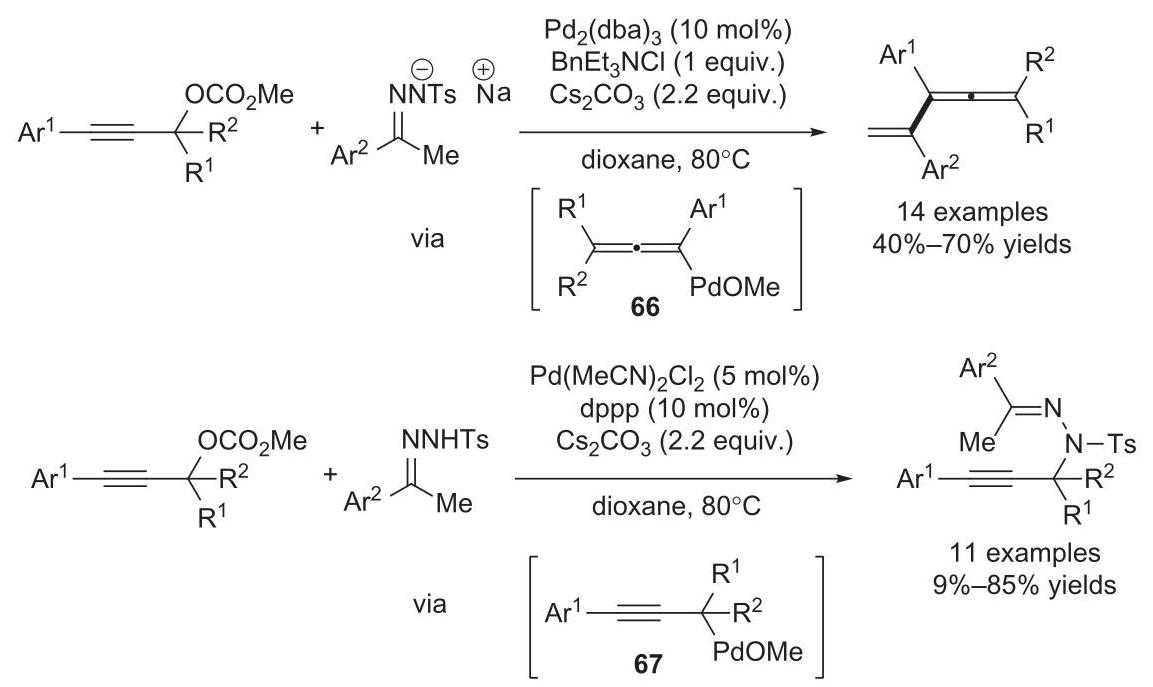
Scheme 45 Pd-catalyzed decarboxylative synthesis of vinylallenes and propargyl N-sulfonylhydrazones.
方案45钯催化乙烯基丙二烯和炔丙基N-磺酰腙的脱羧合成。
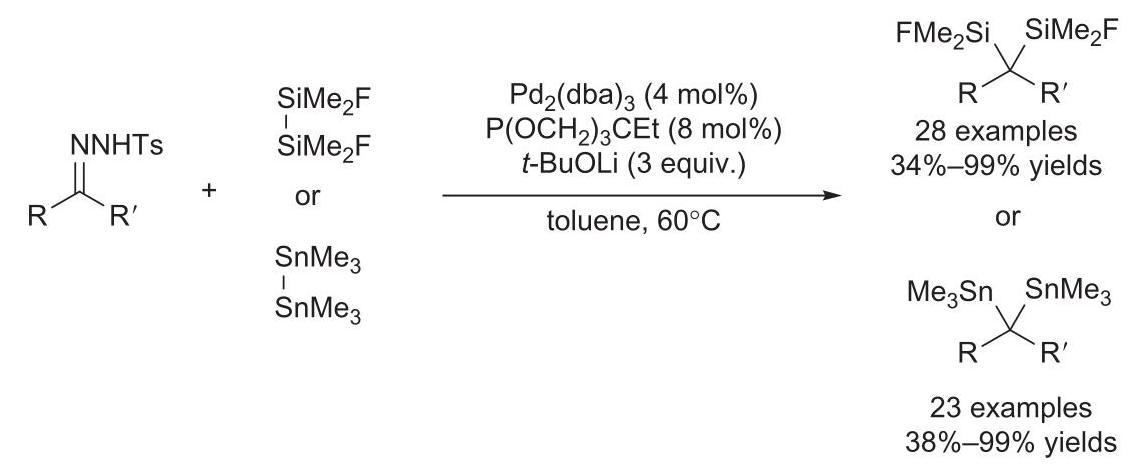
Scheme 46 Pd-catalyzed carbene insertion into Si-Si and Sn-Sn bonds.
方案46钯催化卡宾插入硅-硅键和锡-锡键。
In addition, Huang recently reported the first Pd-catalyzed noncarbene cross-coupling reaction of $\beta ,\gamma$ -unsaturated $N$ -tosylhydrazones with aminals through a catalytic tandem aminomethyl amination/aromatization process (Scheme 47). ${}^{65}$ This Pd-catalyzed coupling strategy constitutes a new approach toward the synthesis of $\beta$ -aminoethylpyrazoles without the need of external oxidant and base. The proposed mechanism is assumed to proceed by C-N bond activation initially to afford electrophilic cyclopalladated complex 68. Then, diene 69 which is in situ generated from tosylhydrazones via imine-enamine tautomerization reacts with 68 to give rise to $\pi$ -allylic palladium complex 70 as the key intermediate. This intermediate then undergoes sequential intramolecular nucleophilic addition to afford 2,3- dihydropyrazole intermediate 71. Subsequently, deprotonation of 71 assisted by aminal results in the formation of the azaallylic anion 72, followed by the capture of 68 and final $\beta - \mathrm{H}$ elimination to afford the desired heterocycle derivatives.
此外,黄最近报道了首例钯催化的$\beta ,\gamma$-不饱和$N$-甲苯磺酰腙与胺缩醛通过催化串联氨甲基胺化/芳构化过程的非卡宾交叉偶联反应(方案47)。${}^{65}$这种钯催化的偶联策略构成了一种无需外部氧化剂和碱即可合成$\beta$-氨基乙基吡唑的新方法。推测的机理是首先通过碳-氮键活化生成亲电环钯化络合物68。然后,通过腙的亚胺-烯胺互变异构原位生成的二烯69与6,8反应,生成$\pi$-烯丙基钯络合物70作为关键中间体。该中间体随后进行连续的分子内亲核加成,得到2,3-二氢吡唑中间体71。随后,在胺缩醛的辅助下71发生去质子化,形成氮杂烯丙基阴离子72,接着捕获68并最终进行$\beta - \mathrm{H}$消除反应,得到所需的杂环衍生物。
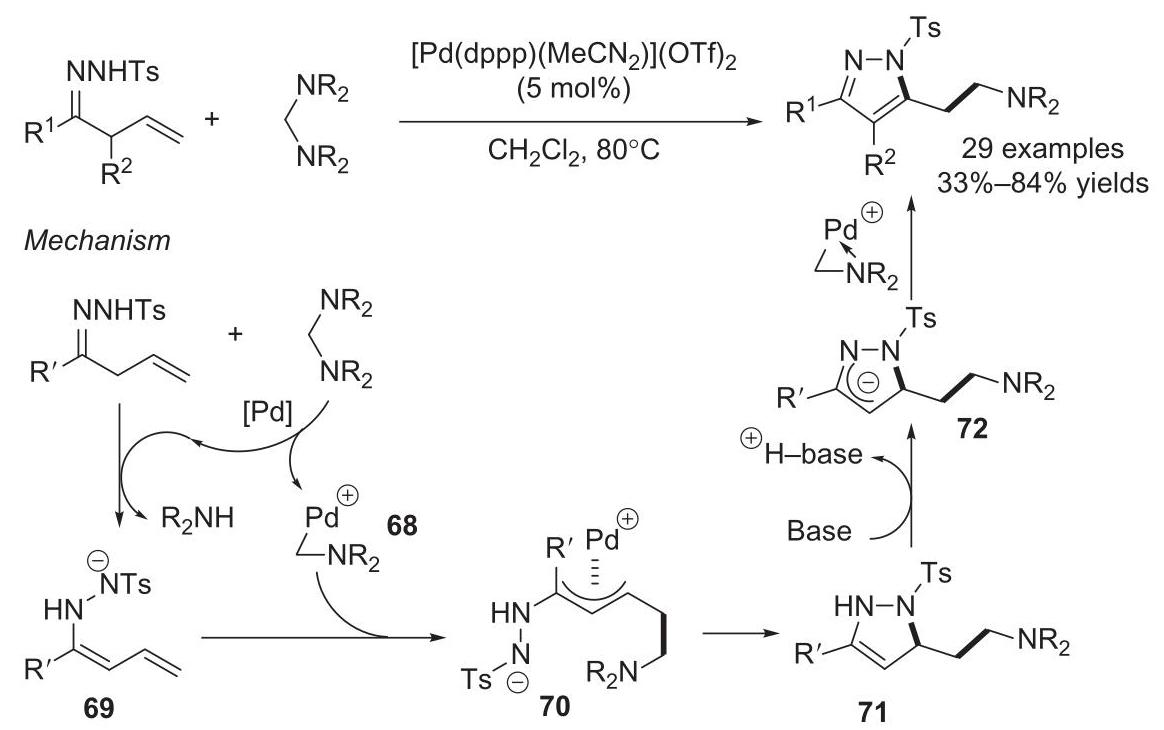
Scheme 47 Pd-catalyzed coupling of $\beta ,\gamma$ -unsaturated $N$ -tosylhydrazones with aminals to synthesize $\beta$ -aminoethylpyrazoles.
方案47钯催化$\beta ,\gamma$-不饱和$N$-甲苯磺酰腙与胺缩醛偶联以合成$\beta$-氨基乙基吡唑。
2.5 Pd-Catalyzed Multicomponent Coupling of N-Tosylhydrazones
2.5 钯催化的N-对甲苯磺酰腙的多组分偶联反应
Furthermore, Pd-catalyzed multicomponent cascade transformation involving migratory insertion also attracts great attentions. One typical type of this cascade process is Pd-catalyzed autotandem strategy. Recently, Alami and Hamze have disclosed a series of Pd-catalyzed three-component coupling reactions of $N$ -tosylhydrazones with aryl halides with sequential C-C/C-N bond formation, affording various functionalized aromatic compounds with high efficiency. ${}^{66}$ In 2013 and 2014, Alami and coworkers reported the one-pot autotandem Pd-catalyzed iterative coupling reactions with sequential $\mathrm{C} - \mathrm{X}$ bond amination, producing nitrogen-containing diarylethylenes ${}^{{66}\mathrm{a}}$ and $N$ -vinylindoles ${}^{{66}\mathrm{\;b}}$ (Scheme 48). These three-component reactions of $N$ -tosylhydrazones, amines, and halogen-substituted aromatic compounds provide facile routes to construct C-C double bond and $\mathrm{C} - \mathrm{N}$ bond in one-pot fashion.
此外,涉及迁移插入的钯催化多组分串联转化也引起了极大关注。这种串联过程的一种典型类型是钯催化的自串联策略。最近,阿拉米(Alami)和哈姆泽(Hamze)报道了一系列钯催化的$N$-对甲苯磺酰腙与芳基卤化物的三组分偶联反应,依次形成C-C/C-N键,高效地得到了各种功能化芳香化合物。${}^{66}$ 2013年和2014年,阿拉米及其同事报道了一锅法自串联钯催化的迭代偶联反应,依次进行$\mathrm{C} - \mathrm{X}$键胺化,生成含氮二芳基乙烯${}^{{66}\mathrm{a}}$和$N$-乙烯基吲哚${}^{{66}\mathrm{\;b}}$(方案48)。$N$-对甲苯磺酰腙、胺和卤代芳香化合物的这些三组分反应提供了一种简便的方法,以一锅法构建C-C双键和$\mathrm{C} - \mathrm{N}$键。
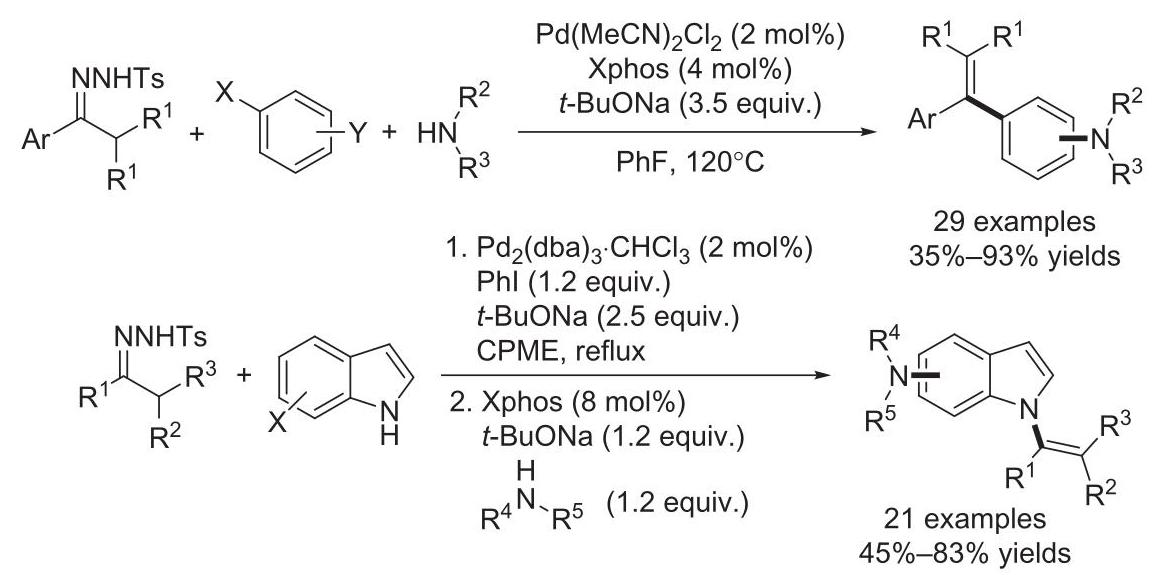
Scheme 48 Autotandem Pd-catalyzed C-C/C-N bond formation reactions to access nitrogen-containing diarylethylenes and $N$ -vinylindoles.
方案48 钯催化的自串联C-C/C-N键形成反应,用于合成含氮二芳基乙烯和$N$-乙烯基吲哚。
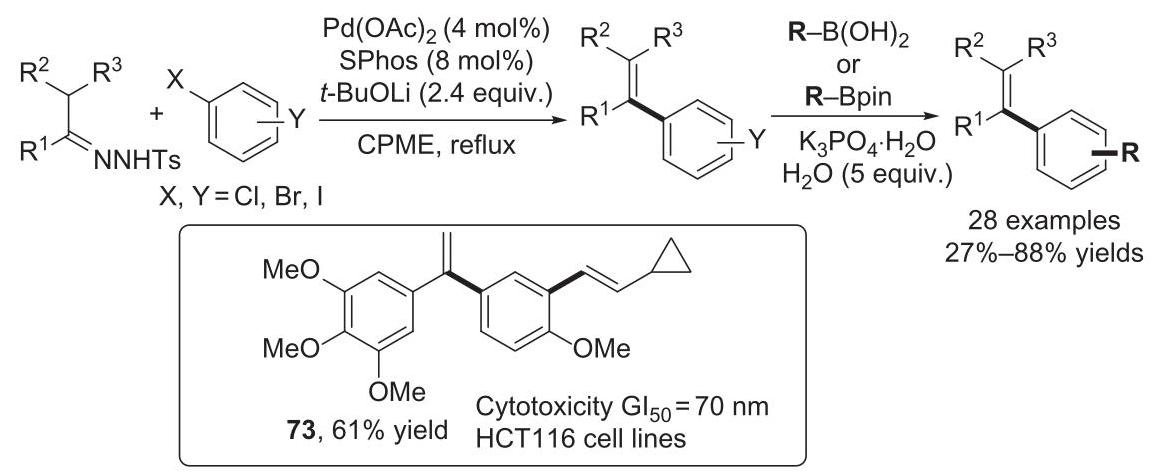
In 2015, the same group developed a Pd-catalyzed one-pot coupling reaction of dihalogenated arenes, $N$ -tosylhydrazones with boronic acids or esters, affording a highly functionalized 1,1-diarylethylene skeleton of the natural product ratanhine with good yields and wide substrate scope (Scheme 49). ${}^{{66}\mathrm{c}}$ Notably, this iterative cross-coupling strategy, which constructs two distinct C-C bonds in one-pot fashion, allows the facile synthesis of 73 that exhibits antiproliferative activity in the nanomolar concentration range against HCT116 cancer cell lines.
2015年,同一研究小组开发了一种钯催化的二卤代芳烃、$N$-对甲苯磺酰腙与硼酸或硼酸酯的一锅法偶联反应,以良好的产率和广泛的底物范围得到了天然产物拉坦辛(ratanhine)的高度官能化的1,1-二芳基乙烯骨架(方案49)。${}^{{66}\mathrm{c}}$ 值得注意的是,这种迭代交叉偶联策略以一锅法构建了两个不同的C-C键,能够简便地合成在纳摩尔浓度范围内对HCT116癌细胞系具有抗增殖活性的73。
In 2016, the same group disclosed a convergent synthesis of arylindole derivatives and (1-arylvinyl)carbazoles through one-pot Pd-catalyzed coupling reaction of 2-nitro-haloarenes with $N$ -tosylhydrazones, followed by a Cadogan-Sundberg reductive cyclization to afford indole scaffold. ${}^{66d}$ This methodology not only enables facile construction of C-C/C-N bond formation in a single step but also allows efficient synthesis of functional molecules which exhibits antiproliferative activity in low nM range against colon cancer cell lines. Moreover, they developed a new Pd-catalyzed one-pot coupling process of $N$ -tosylhydrazones, $N$ -(dihalophenyl)-imidates with amines, affording a library of 5-(1-arylvinyl)-1H-benzimidazoles. 66e
2016年,同一研究小组通过2-硝基卤代芳烃与$N$-对甲苯磺酰腙的一锅法钯催化偶联反应,接着进行卡多根-桑德伯格(Cadogan-Sundberg)还原环化反应,公开了一种合成芳基吲哚衍生物和(1-芳基乙烯基)咔唑的汇聚合成方法,以得到吲哚骨架。${}^{66d}$ 这种方法不仅能够在一步中简便地构建C-C/C-N键,还能高效合成在低纳摩尔范围内对结肠癌细胞系具有抗增殖活性的功能分子。此外,他们还开发了一种新的钯催化的$N$-对甲苯磺酰腙、$N$-(二卤代苯基)-亚氨酸酯与胺的一锅法偶联过程,得到了一系列5-(1-芳基乙烯基)-1H-苯并咪唑。66e
SPhos = 2-dicyclohexylphosphino-2’, 6’-dimethoxybiphenyl
SPhos = 2-二环己基膦基-2’,6’-二甲氧基联苯
Scheme 49 Palladium-catalyzed one-pot coupling reaction of dihalogenated arenes, N-tosylhydrazones with organoborons to form 1,1-diarylethylene derivatives.
方案49 钯催化的二卤代芳烃、N-对甲苯磺酰腙与有机硼形成1,1-二芳基乙烯衍生物的一锅法偶联反应。
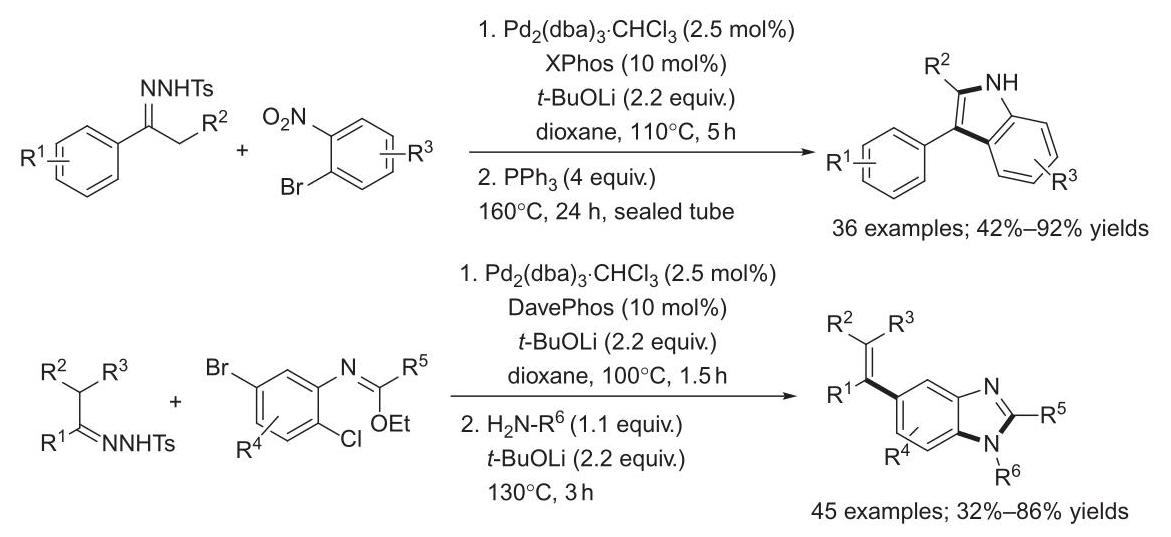
N-tosylhydrazones to construct C-C and C-N bonds.
N-对甲苯磺酰腙用于构建C-C和C-N键。
A plausible mechanism involves a Pd-carbene migratory insertion process to give substituted alkenes, followed by Pd-catalyzed N-arylation and sequential intramolecular cyclization to verify the construction of one C-C bond and two C-N bonds in the same catalytic cycle (Scheme 50).
一种合理的机理涉及钯-卡宾迁移插入过程以生成取代烯烃,接着是钯催化的N-芳基化和顺序的分子内环化,以在同一催化循环中验证一个C-C键和两个C-N键的构建(方案50)。
In 2013, Liang group reported a Pd-catalyzed three-component cross-coupling reaction of vinyl iodide, N-tosylhydrazone (derived from benzalde-hydes), and carbon nucleophiles, as well as the one-pot procedure by using the aldehyde compound as the substrate (Scheme 51). ${}^{{67}\mathrm{a}}$ The proposed mechanism involves migratory insertion of vinyl group to Pd-carbene center, followed by the nucleophilic attack of sodium malonate to the ${\eta }^{3}$ -allylpalladium intermediate, resulting in the formation of two distinct C-C bonds.
2013年,梁课题组报道了乙烯基碘、N-对甲苯磺酰腙(由苯甲醛衍生)和碳亲核试剂的钯催化三组分交叉偶联反应,以及以醛化合物为底物的一锅法(方案51)。${}^{{67}\mathrm{a}}$ 提出的机理涉及乙烯基迁移插入到钯-卡宾中心,接着丙二酸酯钠对${\eta }^{3}$-烯丙基钯中间体的亲核进攻,导致形成两个不同的C-C键。
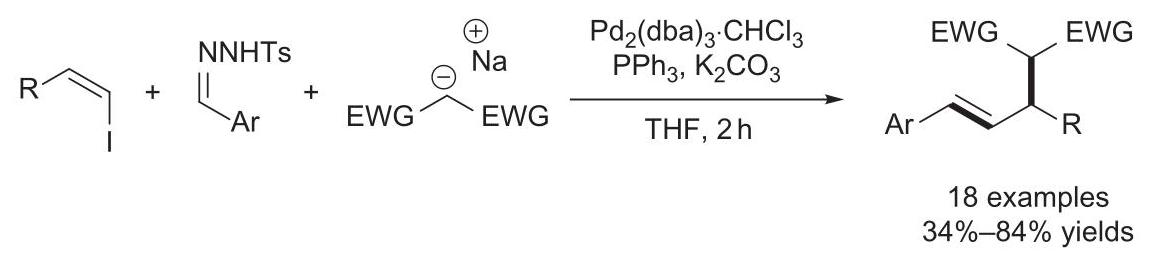
Scheme 51 Pd-catalyzed carbene insertion of vinyl halides, N-tosylhydrazones with carbon nucleophiles.
方案51 钯催化的卤代乙烯、N-对甲苯磺酰腙与碳亲核试剂的卡宾插入反应。
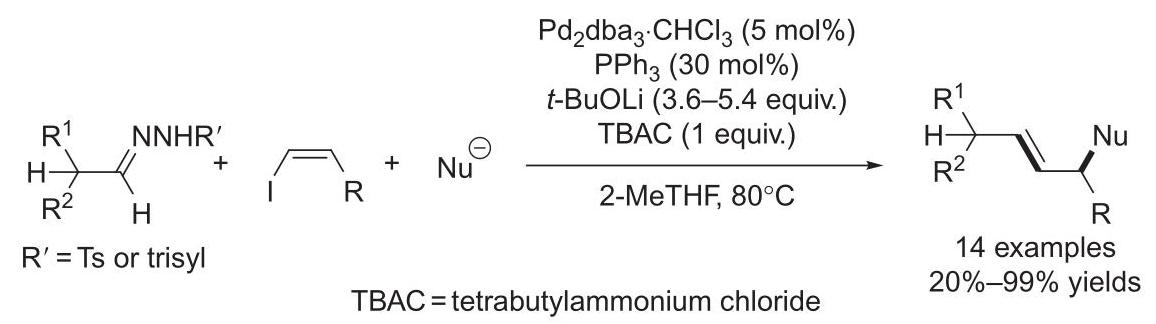
Scheme 52 Pd-catalyzed coupling reaction of vinyl iodides, alkyl aldehyde-derived N-tosylhydrazones, with carbon or nitrogen nucleophile.
方案52:钯催化的碘代乙烯、烷基醛衍生的N-对甲苯磺酰腙与碳或氮亲核试剂的偶联反应。
In 2015, Van Vranken group described the Pd-catalyzed both intra-and intermolecular carbenylative amination and alkylation with vinyl iodides through palladium alkylidene species as the key intermediate (Scheme 52). ${}^{{67}\mathrm{\;b}}$ As a result, vinyl iodides are shown to generate ${\eta }^{3}$ - allylpalladium species, which resists competitive $\beta$ -H elimination process, preserving the $\mathrm{C}\left( {\mathrm{{sp}}}^{3}\right)$ center adjacent to the carbene moiety. This selective multicomponent coupling reaction enables the construction of functionalized alkenes.
2015年,范·弗兰肯小组描述了钯催化的分子内和分子间碳烯基胺化反应以及与碘代乙烯的烷基化反应,该反应通过钯亚烷基物种作为关键中间体(方案52)。${}^{{67}\mathrm{\;b}}$ 结果表明,碘代乙烯可生成 ${\eta }^{3}$ -烯丙基钯物种,该物种可抵抗竞争性的 $\beta$ -H消除过程,从而保留与卡宾部分相邻的 $\mathrm{C}\left( {\mathrm{{sp}}}^{3}\right)$ 中心。这种选择性多组分偶联反应能够构建功能化烯烃。
Wang group have also focused on the Pd-catalyzed multicomponent coupling reaction of $N$ -tosylhydrazones to access the synthesis of functional molecules. In 2010, they carried out the Pd-catalyzed three-component cross-coupling reaction of aryl halides, N-tosylhydrazones, and terminal alkynes as nucleophiles, constructing two separate C-C bonds on a carbenic carbon atom. ${}^{68}$ Rather than competitive undesirable Sonogashira products, this C(sp)-C(sp ${}^{3}$ ) coupling reaction provides an efficient method for synthesizing benzhydryl acetylene derivatives (Scheme 53). Especially, tran-smetalation between the migrated alkylpalladium key intermediate with various transition-metal species opens a new avenue both for carbene chemistry and for cross-coupling reactions.
王小组也专注于钯催化的 $N$ -对甲苯磺酰腙的多组分偶联反应,以实现功能分子的合成。2010年,他们进行了钯催化的芳基卤化物、N-对甲苯磺酰腙和末端炔烃作为亲核试剂的三组分交叉偶联反应,在一个卡宾碳原子上构建了两个独立的C-C键。${}^{68}$ 与竞争性的不良Sonogashira产物不同,这种C(sp)-C(sp ${}^{3}$ )偶联反应为合成二苯甲基乙炔衍生物提供了一种有效方法(方案53)。特别是,迁移的烷基钯关键中间体与各种过渡金属物种之间的转金属化反应为卡宾化学和交叉偶联反应开辟了一条新途径。
Furthermore, Wang group developed the Pd-catalyzed multicomponent reactions of aryl iodides, allenes with $N$ -tosylhydrazones, or diazo species, which is a concise method for synthesizing highly functionalized 1,3- dienes. ${}^{69}$ Mechanistically, the reaction pathway is assumed to proceed via allene carbopalladation to form 74, with sequential allyl group migratory insertion of Pd-carbene 75 as the key step, resulting in the formation of 76 with an $E$ configuration in the formed double bond (Scheme 54).
此外,王小组还开发了钯催化的芳基碘化物、丙二烯与 $N$ -对甲苯磺酰腙或重氮物种的多组分反应,这是一种简洁的方法来合成高度功能化的1,3-二烯。${}^{69}$ 从机理上讲,反应途径假定通过丙二烯碳钯化形成中间体74,随后钯-卡宾75的烯丙基迁移插入作为关键步骤,导致在形成的双键中形成具有 $E$ 构型的中间体76(方案54)。
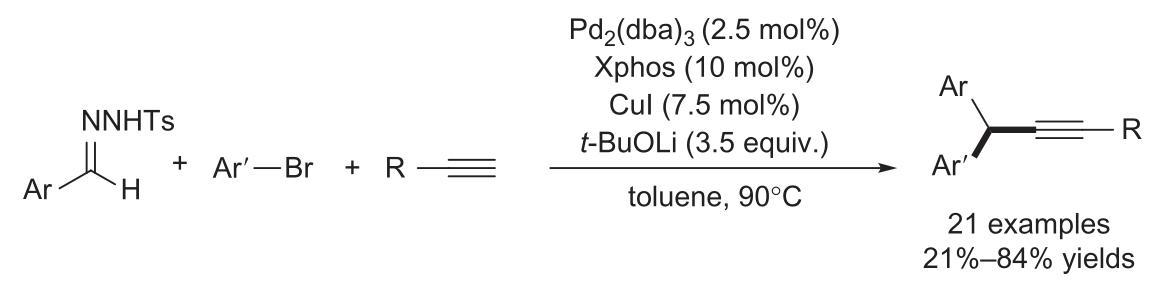
Scheme 53 Pd-catalyzed three-component coupling of $N$ -tosylhydrazone, terminal alkyne with aryl halide.
方案53:钯催化的 $N$ -对甲苯磺酰腙、末端炔烃与芳基卤化物的三组分偶联反应。
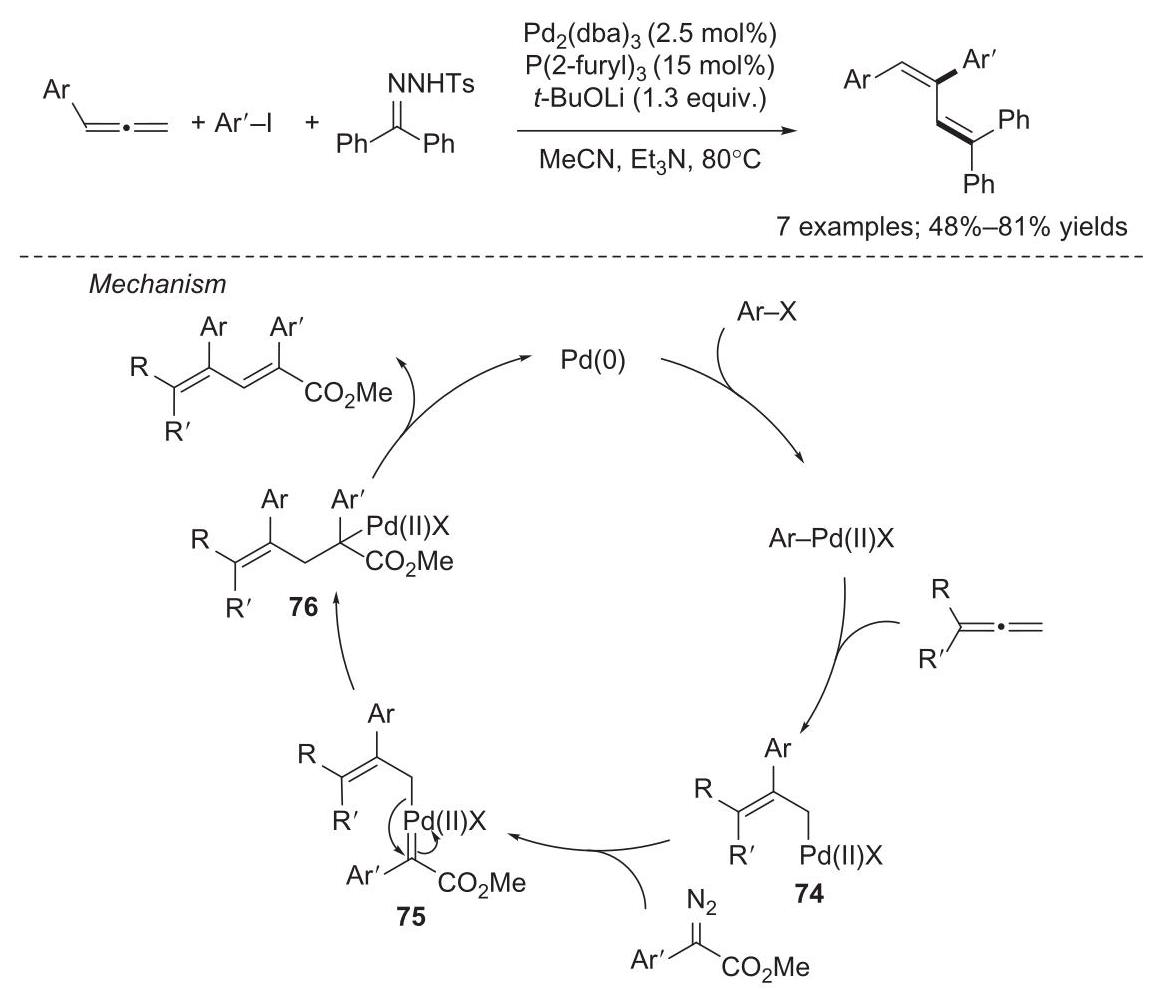
Scheme 54 Pd-catalyzed multicomponent synthesis of 1,3-dienes from aryl iodides, allenes with diazo species.
方案54:钯催化的由芳基碘化物、丙二烯与重氮物种合成1,3-二烯的多组分反应。
Moreover, the Pd-catalyzed carbonylation coupling sequence of aryl iodides with diazo compounds was also developed by Wang group.
此外,王小组还开发了钯催化的芳基碘化物与重氮化合物的羰基化偶联反应序列。
The reaction involves acyl group migratory insertion to the carbenic carbon atom (Scheme 55). ${}^{{70}\mathrm{a}}$ This multicomponent strategy provides a novel route to access $\alpha$ -aryl carbonyl compounds. More importantly, it demonstrates the possibility of the combination of Pd-carbene transformation and catalytic carbonylation. Such transformation involves migratory insertion of an acyl group to Pd-carbene center.
该反应涉及酰基迁移插入到卡宾碳原子上(方案55)。${}^{{70}\mathrm{a}}$ 这种多组分策略为获得 $\alpha$ -芳基羰基化合物提供了一条新途径。更重要的是,它展示了钯-卡宾转化与催化羰基化相结合的可能性。这种转化涉及酰基迁移插入到钯-卡宾中心。
In 2011, Wang group reported a Pd(0)-catalyzed carbonylation of $N$ -tosylhydrazone salts or $\alpha$ -diazocarbonyl compounds under atmospheric pressure of CO (Scheme 56). ${}^{{70}\mathrm{\;b}}$ Pd-catalyzed carbonylative coupling of in situ-generated diazo species from $N$ -tosylhydrazone salts with various nucleophiles allows the efficient synthesis of esters and amides with high yields. Moreover, Staudinger [2+2] reactions are also successfully implemented through the trapping of ketene intermediate with imines, providing aryl or alkenyl substituted β-lactams with high yields and good diastereo-selectivity. In this case, ketene-mediated transformation demonstrates great importance in synthesizing functional molecules under mild conditions.
2011年,王小组报道了在CO常压下钯(0)催化的 $N$ -对甲苯磺酰腙盐或 $\alpha$ -重氮羰基化合物的羰基化反应(方案56)。${}^{{70}\mathrm{\;b}}$ 钯催化原位生成的重氮物种与各种亲核试剂的羰基化偶联反应能够高效合成高产率的酯和酰胺。此外,通过用亚胺捕获烯酮中间体,还成功实现了施陶丁格[2+2]反应,以高产率和良好的非对映选择性提供芳基或烯基取代的β-内酰胺。在这种情况下,烯酮介导的转化在温和条件下合成功能分子方面显示出重要意义。
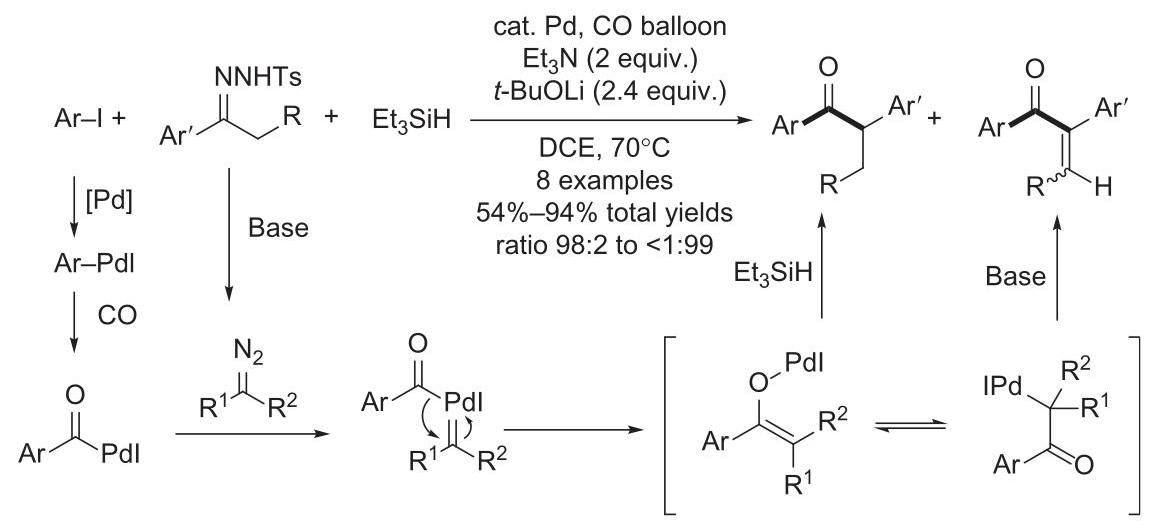
Scheme 55 Pd-catalyzed carbonylation sequence of aryl iodides with in situ-generated diazo compounds.
方案55:钯催化的芳基碘化物与原位生成的重氮化合物的羰基化反应序列。
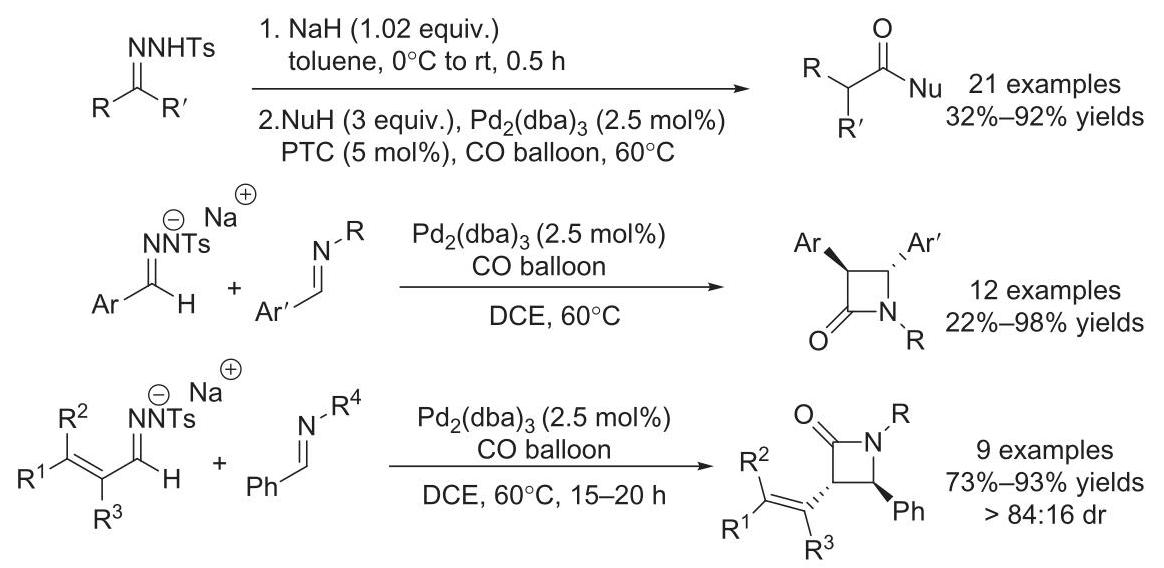
Scheme 56 Pd-catalyzed carbonylation of $N$ -tosylhydrazones under atmospheric pressure.
方案56:常压下钯催化的 $N$ -对甲苯磺酰腙的羰基化反应。
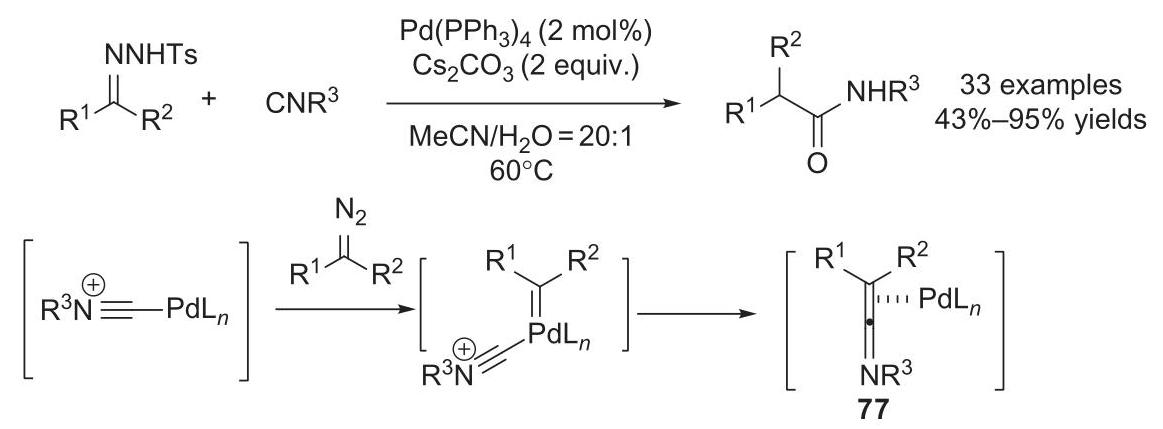
Scheme 57 Pd-catalyzed coupling of $N$ -tosylhydrazones with isocyanides.
方案57:钯催化的 $N$ -对甲苯磺酰腙与异腈的偶联反应。
In addition to the catalytic carbonylation of $N$ -tosylhydrazones, Pd-catalyzed homologation of in situ-generated diazo species with iso-cyanides, involving the generation of ketenimine as the key intermediate, has been explored by Cai and coworkers (Scheme 57). ${}^{71}$ In 2011, they performed the Pd(0)-catalyzed coupling reaction of $N$ -tosylhydrazones with isocyanides in the presence of a base. The mechanistic hypothesis involves the generation of Pd-carbene species, followed by migratory insertion to form ketenimine intermediate 77, which undergoes sequential nucleophilic addition of water to afford the desired amides.
除了$N$-甲苯磺酰腙的催化羰基化反应外,蔡及其同事还探索了钯催化原位生成的重氮物种与异氰化物的同系化反应,该反应涉及生成烯酮亚胺作为关键中间体(方案57)。${}^{71}$2011年,他们在碱存在下进行了钯(0)催化的$N$-甲苯磺酰腙与异氰化物的偶联反应。机理假设涉及生成钯卡宾物种,随后进行迁移插入以形成烯酮亚胺中间体77,该中间体依次进行水的亲核加成以得到所需的酰胺。
Pd-catalyzed norbornene-mediated coupling reaction (Catellani reaction) of $N$ -tosylhydrazones has also been studied within this field. ${}^{72}$ Liang and coworker successfully developed a series of Pd-catalyzed multicomponent norbornene-mediated cascade reactions involving ortho-C-H activation/migratory insertion of aryl group to Pd-carbene center. ${}^{{72a} - c}$ Under similar reaction condition, this strategy is applied for the synthesis of polycyclic vinylarenes as well as ortho-aminated analogues (Scheme 58). In addition, these cascade transformations have, respectively, combined intra- or intermolecular alkylation/amination with Pd-carbene migratory insertion strategy. Alternatively, Wang group carried out the Pd-catalyzed three-component reaction of $N$ -tosylhydrazones, norbornene, and aryl halides to obtain arylated double-functionalized norbornenes, proceeding through intermolecular Heck reaction/alkyl group migratory insertion sequence. ${}^{72d}$
钯催化的$N$-甲苯磺酰腙的降冰片烯介导的偶联反应(卡泰拉尼反应)也在该领域得到了研究。${}^{72}$梁及其同事成功开发了一系列钯催化的多组分降冰片烯介导的级联反应,涉及邻位C-H活化/芳基向钯卡宾中心的迁移插入。${}^{{72a} - c}$在类似的反应条件下,该策略被应用于多环乙烯基芳烃以及邻位胺化类似物的合成(方案58)。此外,这些级联转化分别将分子内或分子间的烷基化/胺化与钯卡宾迁移插入策略相结合。或者,王课题组进行了钯催化的$N$-甲苯磺酰腙、降冰片烯和芳基卤化物的三组分反应,以通过分子间Heck反应/烷基迁移插入序列获得芳基化的双官能化降冰片烯。${}^{72d}$
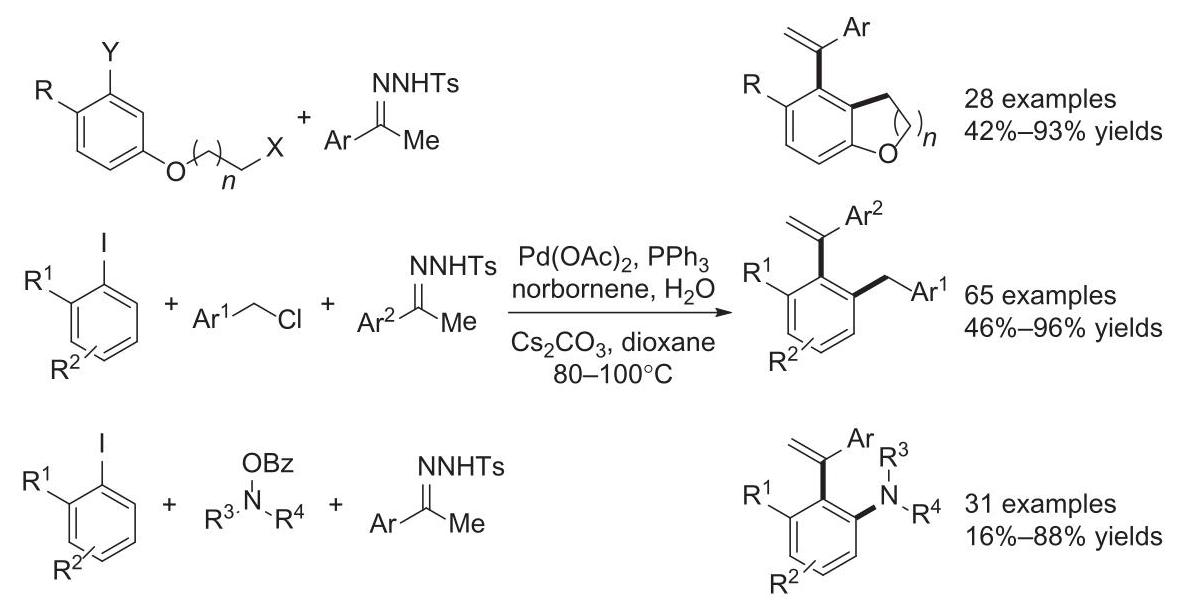
Scheme 58 Pd-catalyzed norbornene-mediated cascade reactions involving C-H bond activation.
方案58 钯催化的涉及C-H键活化的降冰片烯介导的级联反应。
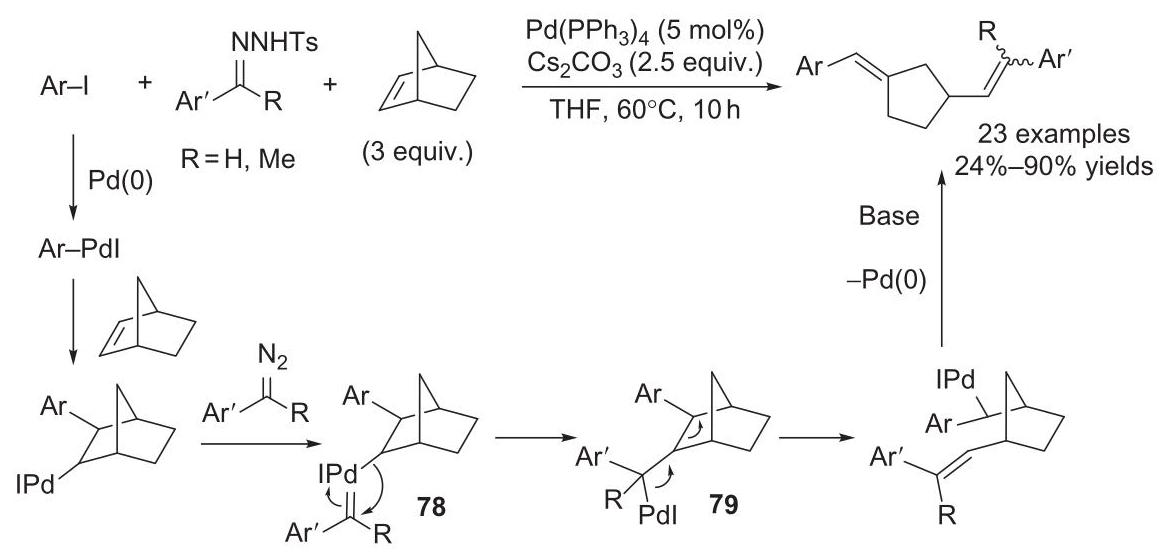
Scheme 59 Pd-catalyzed ring opening of norbornene to access methylenecyclopentanes.
方案59 钯催化的降冰片烯开环以得到亚甲基环戊烷。
In 2015, Liang group developed the Pd-catalyzed three-component domino cascade of aryl iodides, N-tosylhydrazones, and norbornenes (Scheme 59). ${}^{72e}$ Proceeding through the ring-opening sequence of norbornene, methylenecyclopentane derivatives are obtained with high yields and excellent functional group tolerance under mild reaction conditions. Mechanistically, the reaction pathway is assumed to involve oxidative addition/Heck-type carbopalladium/Pd-carbene 78 migratory insertion to form ${79}/\beta - \mathrm{C}$ elimination $/\beta - \mathrm{H}$ elimination sequence to give the desired cyclopentane derivatives.
2015年,梁课题组开发了钯催化的芳基碘化物、N-甲苯磺酰腙和降冰片烯的三组分多米诺级联反应(方案59)。${}^{72e}$通过降冰片烯的开环序列,在温和的反应条件下以高收率和优异的官能团耐受性获得了亚甲基环戊烷衍生物。从机理上讲,反应途径假定涉及氧化加成/Heck型碳钯/Pd-卡宾78迁移插入以形成${79}/\beta - \mathrm{C}$消除$/\beta - \mathrm{H}$消除序列以得到所需的环戊烷衍生物。
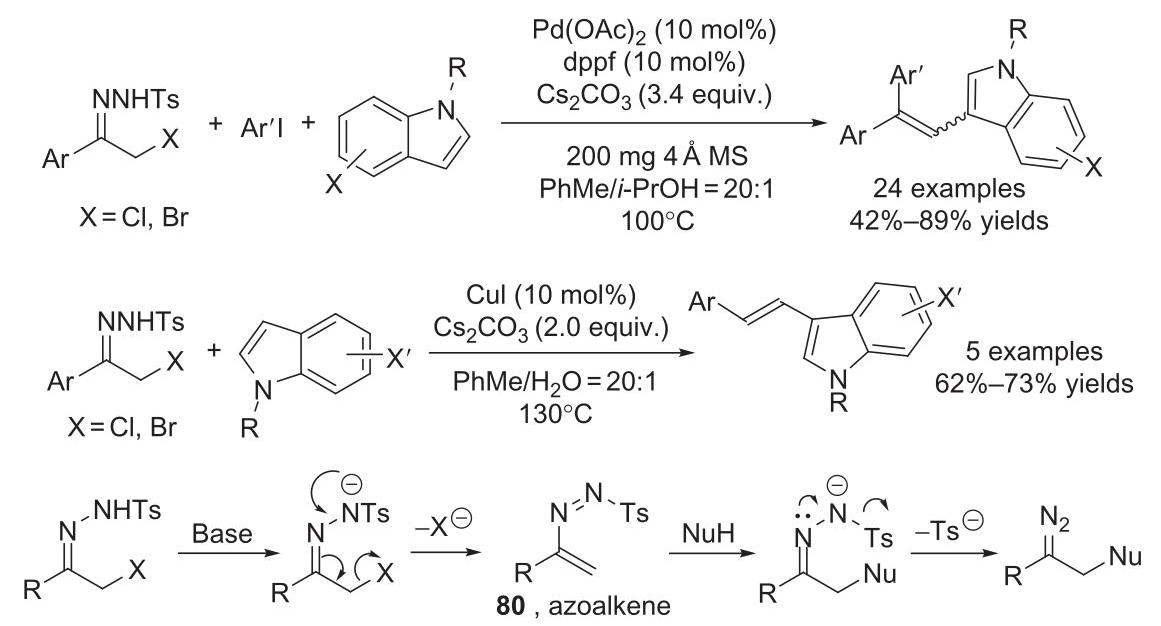
Scheme 60 Pd-catalyzed three-component cascade reaction of α-halo-N-tosylhydrazones, indoles with aryl iodides.
方案60 钯催化的α-卤代-N-甲苯磺酰腙、吲哚与芳基碘化物的三组分级联反应。
Furthermore, in 2016 Wang group disclosed a Pd-catalyzed three-component cascade reaction of $\alpha$ -halo- $N$ -tosylhydrazones, indoles, with aryl iodides, affording 3-indolyl di- or trisubstituted alkenes with moderate to high yields and good functional group tolerance (Scheme 60). ${}^{73}$ This intriguing strategy has been designed by employing indoles as the nucleo-philes to react with the azoalkene intermediate80generated in situ from the corresponding $\alpha$ -halo- $N$ -tosylhydrazone in the presence of base, which is further subjected to Pd-catalyzed carbene-mediated C-C bond forming reactions with aryl iodides. Furthermore, they also reported the 1,2-H shift procedure of the diazo intermediate by using copper(I) iodide as the catalyst.
此外,2016年王课题组公开了钯催化的$\alpha$-卤代-$N$-甲苯磺酰腙、吲哚与芳基碘化物的三组分级联反应,以中等到高的收率和良好的官能团耐受性得到3-吲哚基二取代或三取代烯烃(方案60)。${}^{73}$该有趣策略的设计是通过使用吲哚作为亲核试剂,使其与在碱存在下由相应的$\alpha$-卤代-$N$-甲苯磺酰腙原位生成的偶氮烯烃中间体80反应,该中间体进一步与芳基碘化物进行钯催化的卡宾介导的C-C键形成反应。此外,他们还报道了使用碘化亚铜作为催化剂的重氮中间体的1,2-H迁移过程。
3. COPPER-CATALYZED COUPLING REACTION OF N-TOSYLHYDRAZONES
3. N-对甲苯磺酰腙的铜催化偶联反应
3.1 Cu-Catalyzed Coupling of N-Tosylhydrazones With Alkynes
3.1 铜催化的N-对甲苯磺酰腙与炔烃的偶联反应
In addition to palladium catalysts, copper complexes have also demonstrated high activity in catalyzing cross-coupling reactions involving migratory insertion. However, the coupling partners as well as the type of transformations are different. In 2011, Wang group developed a novel Cu(I)-catalyzed cross-coupling reaction of terminal alkynes with $N$ -tosylhydrazones as diazo analogues by using rac-bis(oxazoline) 81 as the ligand. ${}^{74}$ Highly functionalized trisubstituted allenes were obtained in high yields with good functional group tolerance (Scheme 61). Mechanistic rationale involves the alkynyl migratory insertion to carbenic center of Cu-carbene intermediate 82 to generate alkyl copper complex 83, followed by the regioselective protonation on the triple bond carbon atom of 83.
除钯催化剂外,铜配合物在催化涉及迁移插入的交叉偶联反应中也表现出高活性。然而,偶联伙伴以及转化类型有所不同。2011年,王课题组以rac-双(恶唑啉)81作为配体,开发了一种新型的铜(I)催化的末端炔烃与作为重氮类似物的$N$-对甲苯磺酰腙的交叉偶联反应。${}^{74}$ 以高收率得到了官能团耐受性良好的高度官能化的三取代丙二烯(方案61)。反应机理涉及炔基迁移插入到铜卡宾中间体82的卡宾中心以生成烷基铜配合物83,随后在83的三键碳原子上进行区域选择性质子化。
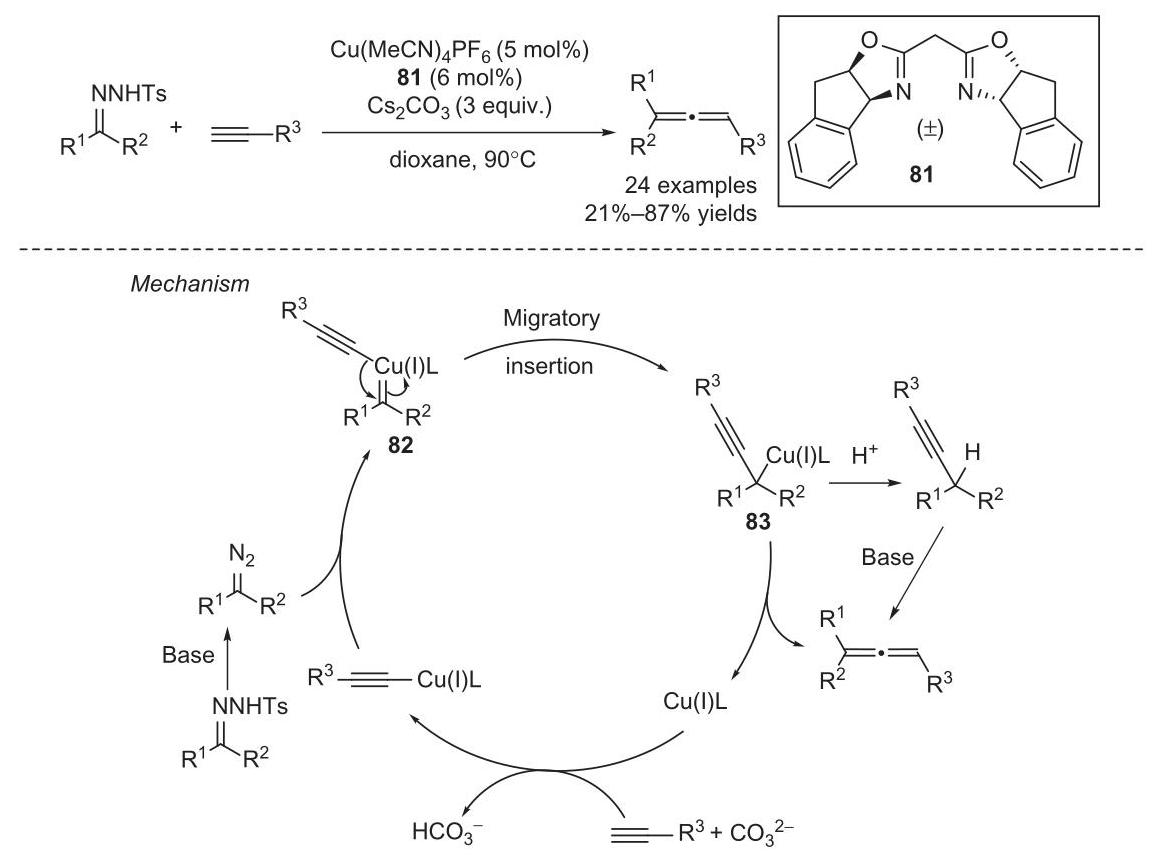
Scheme 61 Cu(I)-catalyzed coupling reaction of terminal alkynes with N-tosylhydrazones.
方案61 铜(I)催化的末端炔烃与N-对甲苯磺酰腙的偶联反应。
Since then, this catalytic system for the synthesis of a variety of allenes has been improved and simplified, which employed inexpensive copper(I) iodide and ligands. Functionalized substituted allenes (including 1,3-disubstituted), ${}^{{75}\mathrm{a}}$ and terminal allenes, ${}^{{75}\mathrm{\;b}}$ can be efficiently accessed by Cu-catalyzed cross-coupling reaction of terminal alkynes with divergent $N$ -tosylhydrazones (Scheme 62). Particularly, ethyne has been explored as a coupling partner in Cu-mediated carbene transformations with $N$ -tosylhydrazones or $\alpha$ -diazoacetates. ${}^{{75}\mathrm{\;b}}$ These reactions represent a set of concise methods for preparing substituted allenes, which are important structure units that find applications in various areas.
从那时起,用于合成各种丙二烯的该催化体系得到了改进和简化,采用了廉价的碘化亚铜和配体。通过末端炔烃与不同的$N$-对甲苯磺酰腙的铜催化交叉偶联反应,可以高效地得到官能化的取代丙二烯(包括1,3-二取代的)、${}^{{75}\mathrm{a}}$和末端丙二烯、${}^{{75}\mathrm{\;b}}$(方案62)。特别地,乙炔已被探索作为与$N$-对甲苯磺酰腙或$\alpha$-重氮乙酸酯进行铜介导的卡宾转化反应中的偶联伙伴。${}^{{75}\mathrm{\;b}}$ 这些反应代表了一组制备取代丙二烯的简洁方法,取代丙二烯是在各个领域有应用的重要结构单元。
On the other hand, Wang group developed a novel and ligand-free $\mathrm{C}\left( \mathrm{{sp}}\right) - \mathrm{C}\left( {\mathrm{{sp}}}^{3}\right)$ bond formation strategy via $\mathrm{{Cu}}\left( \mathrm{I}\right)$ -catalyzed cross-coupling reaction of $N$ -tosylhydrazones with trialkylsilylethynes. ${}^{76}{}^{a}$ Owing to the presence of trialkylsilyl substituents, functionalized alkynes were obtained in high yields under mild reaction conditions. Mechanistically, the protonation step of alkynyl migrated copper(I) species 84 is crucial for the selectivity of the products (Scheme 63). When changing tert-butyl-substituted alkyne as the coupling partner, this transformation affords allene as the product. Theoretical study indicates that the $\mathrm{{Cu}} - \mathrm{C}$ interaction between the tert-butyl-substituted $\mathrm{C}$ atom with the copper center, as well as the back-donation from $\pi$ orbital of the triple bond to ${\sigma }^{ * }$ antibonding orbital of Si-C, determines the chemoselectivity observed in these studies. ${}^{{76}\mathrm{\;b}}$
另一方面,王课题组通过$\mathrm{{Cu}}\left( \mathrm{I}\right)$-催化的$N$-对甲苯磺酰腙与三烷基硅乙炔的交叉偶联反应,开发了一种新型的无配体$\mathrm{C}\left( \mathrm{{sp}}\right) - \mathrm{C}\left( {\mathrm{{sp}}}^{3}\right)$键形成策略。${}^{76}{}^{a}$ 由于三烷基硅取代基的存在,在温和的反应条件下以高收率得到了官能化的炔烃。从机理上讲,炔基迁移的铜(I)物种84的质子化步骤对产物的选择性至关重要(方案63)。当将叔丁基取代的炔烃作为偶联伙伴时,该转化反应得到丙二烯作为产物。理论研究表明,叔丁基取代的$\mathrm{C}$原子与铜中心之间的$\mathrm{{Cu}} - \mathrm{C}$相互作用,以及三键的$\pi$轨道向Si-C的${\sigma }^{ * }$反键轨道的反馈π键作用,决定了在这些研究中观察到的化学选择性。${}^{{76}\mathrm{\;b}}$
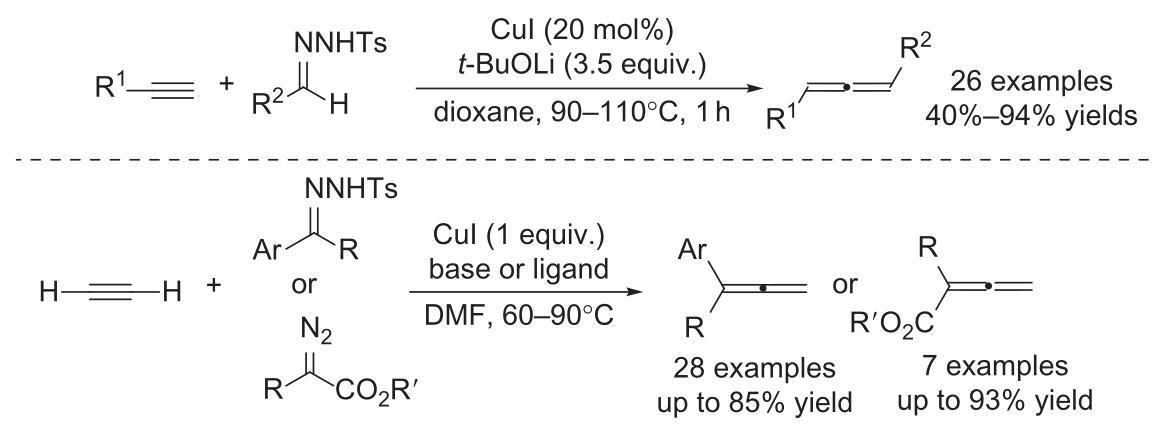
Scheme 62 Cu-mediated synthesis of substituted allenes from diazo compounds with terminal alkynes.
方案62 铜介导的由重氮化合物与末端炔烃合成取代丙二烯。
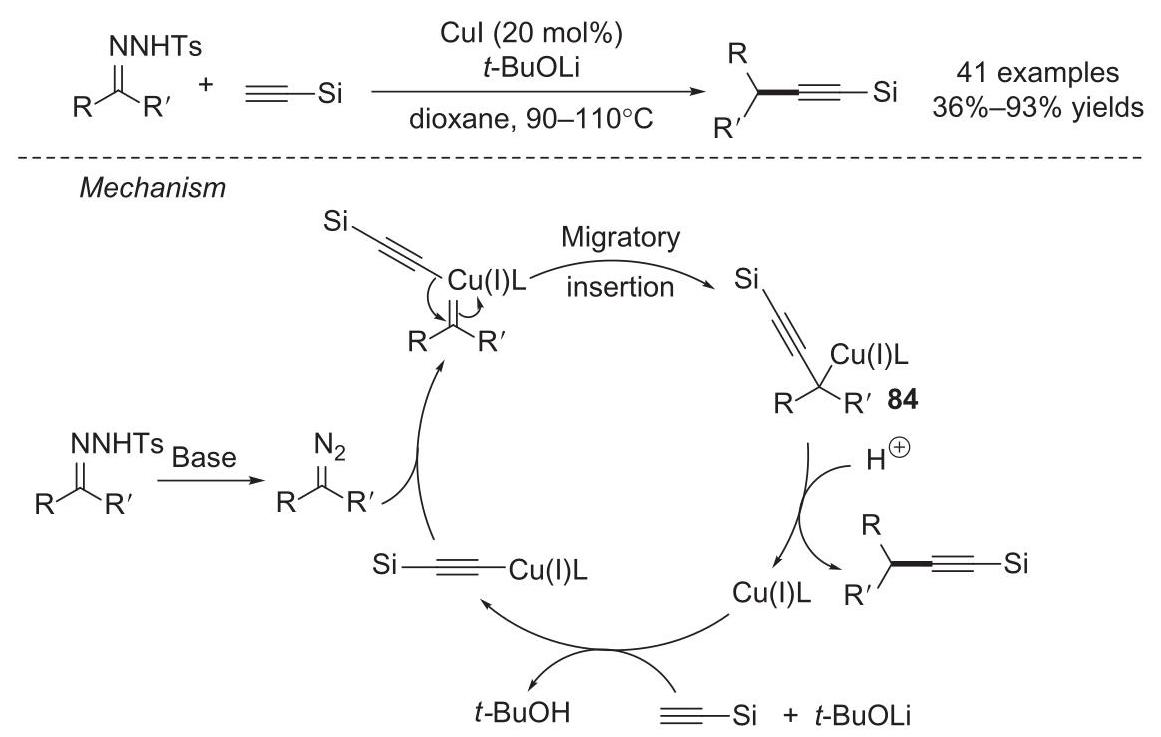
Scheme 63 Cu(I)-catalyzed cross-coupling reaction of N-tosylhydrazones with trialkylsilylethynes.
方案63 铜(I)催化的N-对甲苯磺酰腙与三烷基硅乙炔的交叉偶联反应。
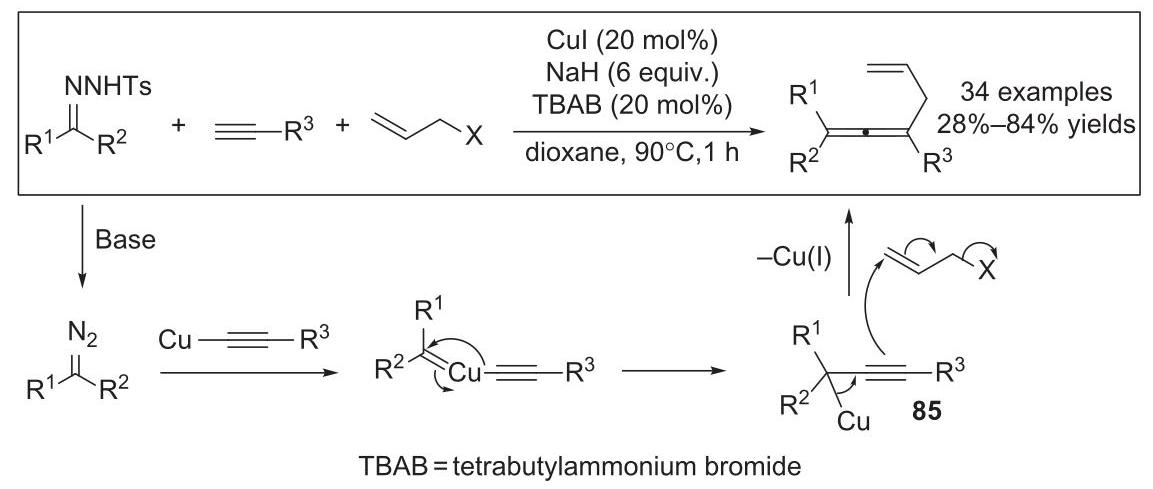
Scheme 64 Cu-catalyzed three-component coupling reaction of $N$ -tosylhydrazones, terminal alkynes with allyl halides.
方案64 铜催化的$N$-对甲苯磺酰腙与末端炔烃及烯丙基卤的三组分偶联反应。
Furthermore, by utilizing the high reactivity of allene moiety, Cu-catalyzed cascade transformations of $N$ -tosylhydrazones with terminal alkynes have been explored for synthesizing a variety of functional molecules. Wang group reported the efficient synthesis of tri- and tetrasubstituted allyl allenes through Cu(I)-catalyzed three-component coupling of $N$ -tosylhydrazones, terminal alkynes with allyl halides (Scheme 64). ${}^{77}$ Beyond protonation process, the propargylic Cu(I) species 85, which is generated from Cu(I) carbene migratory insertion, undergoes nucleophilic substitution with allylic iodides. This strategy demonstrates the possibility of incorporating other electrophiles into Cu-catalyzed coupling partners.
此外,通过利用丙二烯部分的高反应活性,已探索了铜催化的$N$-对甲苯磺酰腙与末端炔烃的串联转化反应来合成各种功能分子。王课题组报道了通过铜(I)催化的$N$-对甲苯磺酰腙、末端炔烃与烯丙基卤的三组分偶联反应高效合成三取代和四取代的烯丙基丙二烯(方案64)。${}^{77}$ 除了质子化过程外,由铜(I)卡宾迁移插入生成的炔丙基铜(I)物种85与烯丙基碘发生亲核取代反应。该策略证明了将其他亲电试剂引入铜催化的偶联伙伴中的可能性。
Phenanthrenes derivatives demonstrate great applications in medicinal chemistry and material research. Wang group has explored the Cu-catalyzed cross-coupling of terminal alkynes with $N$ -tosylhydrazones derived from $o$ -formyl biphenyls for the construction of phenanthrene framework, ${}^{{78}\mathrm{a}}$ as well as the coupling reaction of 2-alkynyl biphenyls with tosylhydrazones derived from aromatic aldehydes. ${}^{{78}\mathrm{\;b}}$ Mechanistically, the reaction is proposed to proceed through Cu-catalyzed coupling/allenylation/6π-electron cyclization of 86/aromatization sequence (Scheme 65). These catalytic transformations provide expeditious synthetic methods for phenanthrenes from readily available starting materials.
菲衍生物在药物化学和材料研究中显示出巨大的应用价值。王课题组探索了铜催化末端炔烃与源自$o$ -甲酰基联苯的$N$ -甲苯磺酰腙的交叉偶联反应,用于构建菲骨架,${}^{{78}\mathrm{a}}$ 以及2-炔基联苯与源自芳香醛的甲苯磺酰腙的偶联反应。${}^{{78}\mathrm{\;b}}$ 从机理上讲,该反应被认为是通过铜催化的86/芳构化序列的偶联/烯丙基化/6π电子环化进行的(方案65)。这些催化转化为从容易获得的起始原料合成菲提供了快速的合成方法。
Moreover, Cu-catalyzed cascade reaction of terminal alkynes with diazo component has been utilized for the construction of a series of heterocyclic scaffolds (Scheme 66). Wang and Zhou reported the efficient synthesis of benzofurans and indoles through Cu(I)-catalyzed ligand-free cross-coupling reaction of terminal alkynes with salicyl $N$ -tosylhydrazones, ${}^{{79}\mathrm{a}}$ or coupling of $N$ -tosylhydrazones with $o$ -hydroxy or $o$ -amino phenylacetylenes. ${}^{{79}\mathrm{\;b}}$ These two catalytic coupling/allenylation/cyclization strategies lead to the facile and economical preparation of heterocycles by employing easily accessible substrates.
此外,铜催化末端炔烃与重氮组分的串联反应已被用于构建一系列杂环骨架(方案66)。王和周报道了通过铜(I)催化的末端炔烃与水杨基$N$ -甲苯磺酰腙的无配体交叉偶联反应,${}^{{79}\mathrm{a}}$ 或$N$ -甲苯磺酰腙与$o$ -羟基或$o$ -氨基苯乙炔的偶联反应,高效合成苯并呋喃和吲哚。${}^{{79}\mathrm{\;b}}$ 这两种催化偶联/烯丙基化/环化策略通过使用易于获得的底物,实现了杂环的简便经济制备。
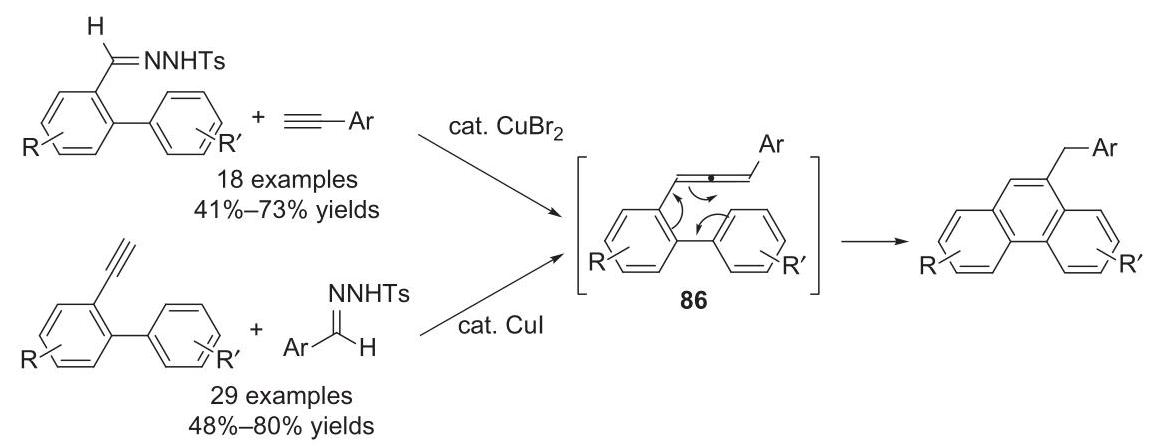
Scheme 65 Cu-catalyzed cross-coupling of alkynes with $N$ -tosylhydrazones for synthesizing phenanthrenes.
方案65 铜催化炔烃与$N$ -甲苯磺酰腙交叉偶联合成菲。
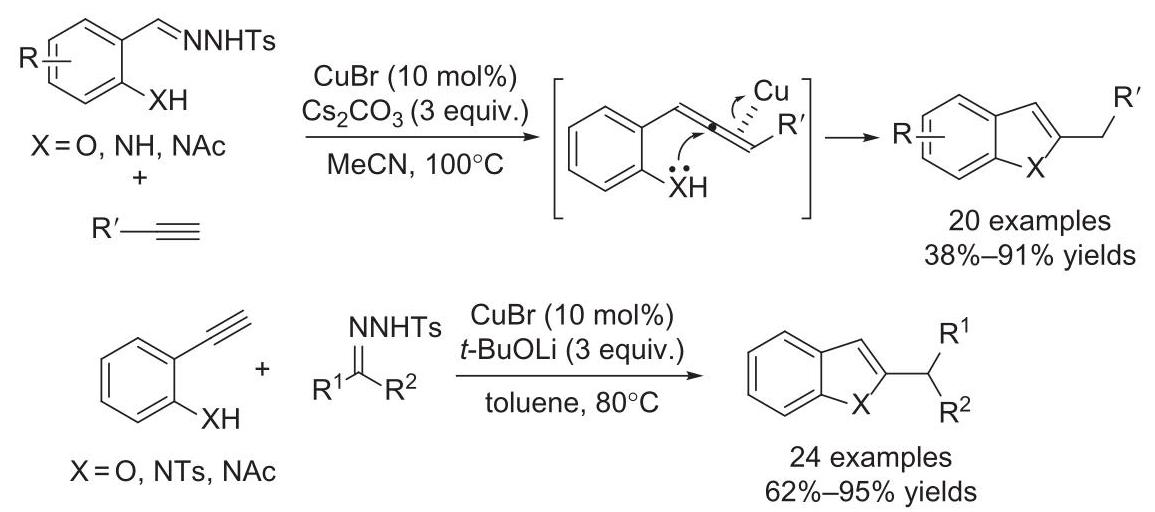
Scheme 66 Synthesis of benzofurans and indoles from alkynes with $N$ -tosylhydrazones.
方案66 由炔烃与$N$ -甲苯磺酰腙合成苯并呋喃和吲哚。
Recently, Cu(I)-catalyzed cross-coupling cascade of $N$ -tosylhydrazones with 3-butyn-1-ol has been reported by Wang group. ${}^{80}$ This methodology constitutes a new approach toward the synthesis of 2-(diarylmethylene) tetrahydrofurans with moderate to good yields. The proposed mechanism involves the intramolecular cyclization of hydroxy-tethered allenes, which are generated via migratory insertion of alkynyl Cu-carbene species.
最近,王课题组报道了铜(I)催化的$N$ -甲苯磺酰腙与3-丁炔-1-醇的交叉偶联串联反应。${}^{80}$ 该方法构成了一种以中等至良好产率合成2-(二芳基亚甲基)四氢呋喃的新方法。提出的机理涉及通过炔基铜卡宾物种的迁移插入生成的羟基连接的丙二烯的分子内环化。
In 2015, Wang group reported a Cu-catalyzed three-component coupling reaction of $N$ -tosylhydrazones, alkynes, and azides, which constitutes a convenient synthetic route to 1,4,5-trisubstituted 1,2,3-triazoles in an efficient and regioselective manner (Scheme 67). ${}^{81}$ Mechanistically, this reaction proceeds through the generation of copper(I) triazolide intermediate 87 initially via Cu(I)-catalyzed azide-alkyne cycloaddition (CuAAC). Subsequently, migratory insertion of the triazole group from Cu(I)-carbene 88 occurs to afford alkyl copper complex 89. Finally, sequential protonation of 89 by HO- $t$ -Bu results in the formation of the product along with regeneration of $\mathrm{{Cu}}\left( \mathrm{I}\right)$ catalyst. This efficient catalytic strategy shows the combination of click chemistry with a metal-carbene migratory insertion process.
2015年,王课题组报道了铜催化的$N$ -甲苯磺酰腙、炔烃和叠氮化物的三组分偶联反应,该反应以高效和区域选择性的方式构成了一条方便的合成1,4,5-三取代1,2,3-三唑的路线(方案67)。${}^{81}$ 从机理上讲,该反应首先通过铜(I)催化的叠氮化物-炔烃环加成(CuAAC)生成铜(I)三唑中间体87。随后,三唑基团从铜(I)-卡宾88发生迁移插入,得到烷基铜配合物89。最后,89被HO-$t$ -Bu依次质子化,导致产物形成并使$\mathrm{{Cu}}\left( \mathrm{I}\right)$ 催化剂再生。这种高效的催化策略展示了点击化学与金属卡宾迁移插入过程的结合。
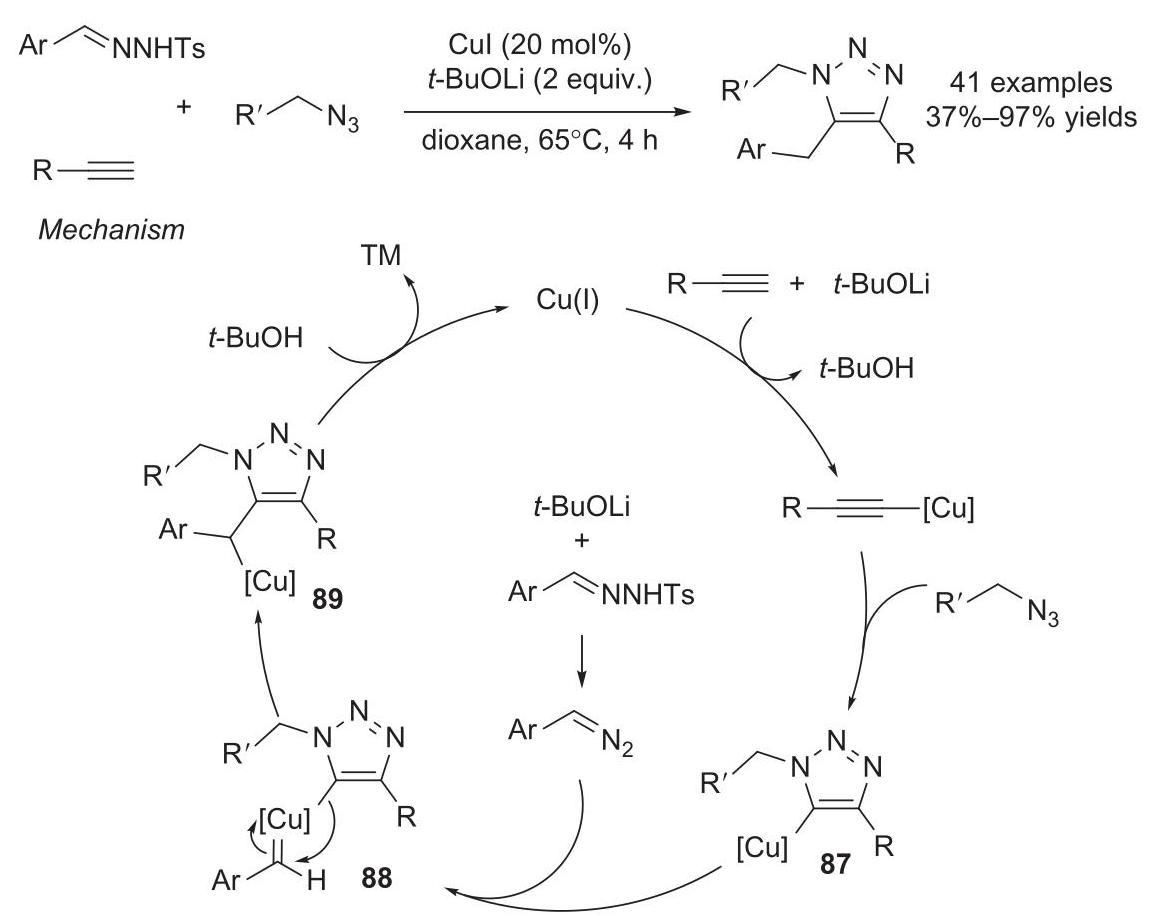
Scheme 67 Cu-catalyzed three-component reaction of $N$ -tosylhydrazones, alkynes, and azides.
方案67 铜催化的$N$ -甲苯磺酰腙、炔烃和叠氮化物的三组分反应。
Moreover, the synthesis of fluorinated 1,3-enynes, which serve as important building blocks in organic synthesis and medicinal research, attracts great attention. Wang group demonstrated the feasibility of the Cu(I)-catalyzed cross-coupling reaction of terminal alkynes with $N$ -tosylhydrazones derived from trifluoromethyl ketones, furnishing functionalized 1,1-dif-luoro-1,3-enyne derivatives with high efficiency. ${}^{82}$ This convenient and facile protocol has combined the Cu-carbene 90 migratory insertion with $\beta$ -fluoride elimination through a cascade Cu-catalytic cycle (Scheme 68).
此外,氟化1,3-烯炔的合成作为有机合成和药物研究中的重要结构单元,引起了广泛关注。王课题组证明了铜(I)催化末端炔烃与源自三氟甲基酮的$N$ -甲苯磺酰腙的交叉偶联反应的可行性,高效地提供了功能化的1,1-二氟-1,3-烯炔衍生物。${}^{82}$ 这种方便简便的方法通过级联铜催化循环将铜卡宾90迁移插入与$\beta$ -氟化物消除相结合(方案68)。
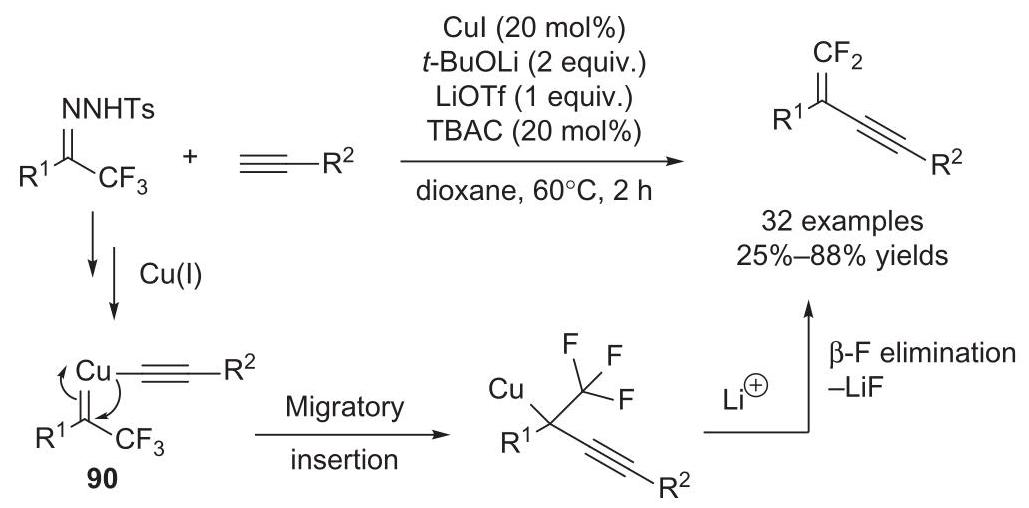
Scheme 68 Cu-catalyzed synthesis of 1,1-difluoro-1,3-enynes from terminal alkynes with trifluoromethyl ketone N-tosylhydrazones.
方案68 铜催化由末端炔烃与三氟甲基酮N-甲苯磺酰腙合成1,1-二氟-1,3-烯炔。
3.2 Cu-Catalyzed Coupling of N-Tosylhydrazones Involving C-H Activation
3.2 铜催化的涉及C-H活化的N-对甲苯磺酰腙的偶联反应
Except for terminal alkynes, heterocycles as well as substituted aromatics have also been employed as the nucleophilic coupling partners, proceeding through a C-H bond activation process. In 2011, Wang group reported Cu-catalyzed cross-coupling of N-tosylhydrazones with 1,3-azoles, directly affording 2-benzylated or 2-allylation products. ${}^{83}$ Compared with other methods, this strategy provides an efficient avenue for the synthesis of 2-alkylated heterocycles through C-H bond functionalization. For the reaction mechanism, Cu-carbene 91 migratory insertion seems more reasonable rather than the direct carbene C-H insertion (Scheme 69).
除了末端炔烃外,杂环以及取代芳烃也被用作亲核偶联伙伴,通过C-H键活化过程进行反应。2011年,王课题组报道了铜催化的N-对甲苯磺酰腙与1,3-唑的交叉偶联反应,直接得到2-苄基化或2-烯丙基化产物。${}^{83}$与其他方法相比,该策略为通过C-H键官能化合成2-烷基化杂环提供了一条有效途径。对于反应机理,铜卡宾91迁移插入似乎比直接卡宾C-H插入更合理(方案69)。
In 2013, this Cu-catalyzed reaction strategy was expanded to 1,3,4- oxadiazoles as the nucleophilic coupling partners, providing an efficient and concise benzylation through direct $\mathrm{C} - \mathrm{H}$ bond functionalization. ${}^{84}$ A series of 2-substituted oxadiazoles could be obtained in high yields (17 examples, 80%-89% yields). Migration of the heteroaryl group to the Cu-carbene center is proposed as the key step.
2013年,这种铜催化的反应策略扩展到以1,3,4-恶二唑作为亲核偶联伙伴,通过直接$\mathrm{C} - \mathrm{H}$键官能化提供了一种高效简洁的苄基化反应。${}^{84}$一系列2-取代恶二唑可以高收率得到(17个例子,收率80%-89%)。提出杂芳基迁移到铜卡宾中心是关键步骤。
In 2013, Wang group further demonstrated the $\mathrm{C} - \mathrm{H}$ alkylation of pyridine derivatives through Cu-catalyzed cross-coupling of $N$ -tosylhydrazones with N-iminopyridinium ylides (Scheme 70). ${}^{85}$ Using inexpensive CuI catalyst under ligand-free conditions, various ortho-alkylated pyridines were obtained in good yields. The reaction is assumed to proceed via a copper carbene 92 migratory insertion of the pyridyl group, a proposal supported by DFT calculations.
2013年,王课题组通过铜催化的$N$-甲苯磺酰腙与N-亚氨基吡啶叶立德的交叉偶联反应,进一步证明了吡啶衍生物的$\mathrm{C} - \mathrm{H}$烷基化反应(方案70)。${}^{85}$在无配体条件下使用廉价的碘化亚铜催化剂,可以高产率得到各种邻位烷基化吡啶。该反应被认为是通过铜卡宾对吡啶基的92迁移插入进行的,这一推测得到了密度泛函理论计算的支持。
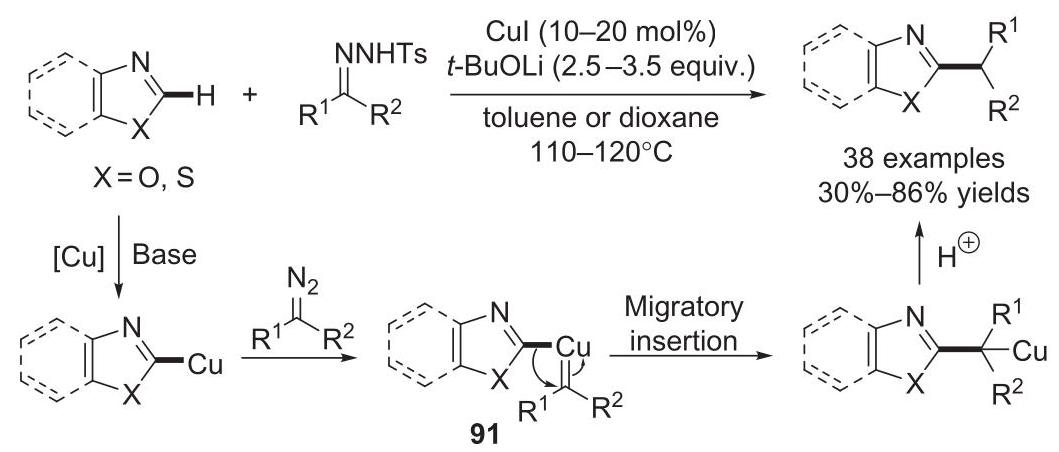
Scheme 69 Cu-catalyzed cross-coupling of $N$ -tosylhydrazones with 1,3-azoles.
方案69 铜催化的$N$-对甲苯磺酰腙与1,3-唑的交叉偶联反应。
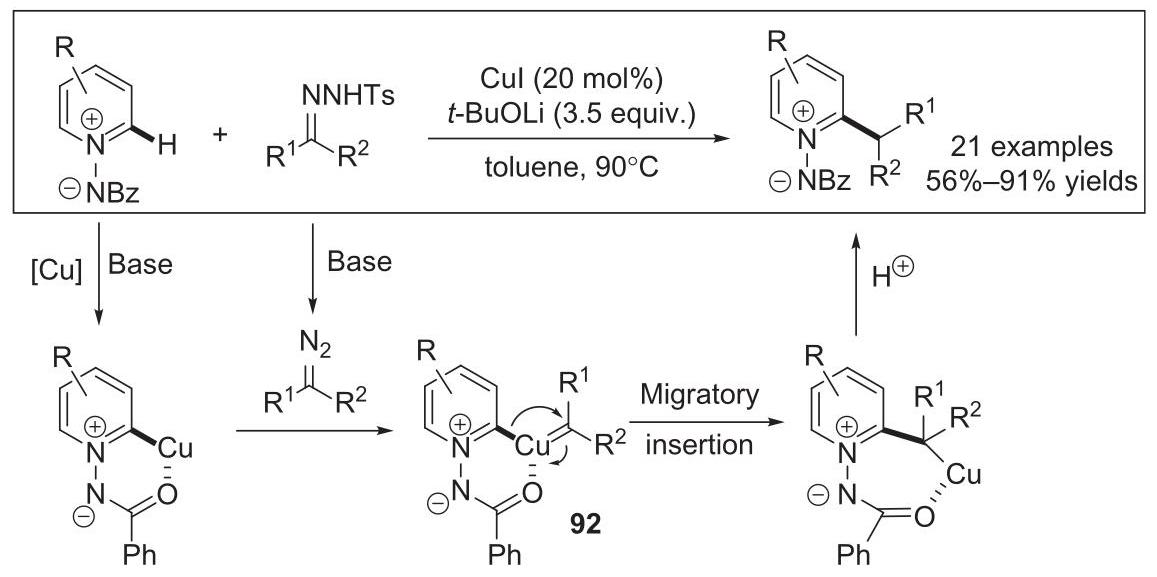
Scheme 70 Cu-catalyzed coupling of $N$ -iminopyridnium ylides with $N$ -tosylhydrazones.
方案70 铜催化的$N$-亚氨基吡啶叶立德与$N$-对甲苯磺酰腙的偶联反应。
Transition-metal-catalyzed C-H alkylation of polyfluoroarenes still remains a challenging problem. Toward this end, Wang group carried out the Cu-catalyzed alkylation of electron-deficient polyfluoroarenes through cross-coupling with $N$ -tosylhydrazones or diazo compounds (Scheme 71). ${}^{86}$ This process represents an efficient construction of a $\mathrm{C}\left( {\mathrm{{sp}}}^{2}\right) - \mathrm{C}\left( {\mathrm{{sp}}}^{3}\right)$ bond of polyfluoroarenes via direct $\mathrm{C} - \mathrm{H}$ bond alkylation. Mechanistically, migratory insertion of polyfluoroaryl copper carbene species is the key step in the catalytic cycle.
过渡金属催化的多氟芳烃的C-H烷基化仍然是一个具有挑战性的问题。为此,王课题组通过与$N$-对甲苯磺酰腙或重氮化合物的交叉偶联进行了铜催化的缺电子多氟芳烃的烷基化反应(方案71)。${}^{86}$该过程代表了通过直接$\mathrm{C} - \mathrm{H}$键烷基化高效构建多氟芳烃的$\mathrm{C}\left( {\mathrm{{sp}}}^{2}\right) - \mathrm{C}\left( {\mathrm{{sp}}}^{3}\right)$键。从机理上讲,多氟芳基铜卡宾物种的迁移插入是催化循环中的关键步骤。
In 2014, the Cu(I)-catalyzed cross-coupling of 1,3-azoles with $N$ -tosylhydrazones derived from ferrocenyl ketones was reported, affording secondary alkylated products. ${}^{87}$ This method may be used for the synthesis of substituted ferrocenyl-based ligands, as well as $1,{1}^{\prime }$ -disubstituted ferro-cenyl bidentate derivatives (Scheme 72).
2014年,报道了铜(I)催化的1,3-唑与源自二茂铁基酮的$N$-对甲苯磺酰腙的交叉偶联反应,得到仲烷基化产物。${}^{87}$该方法可用于合成取代的二茂铁基配体,以及$1,{1}^{\prime }$-二取代的二茂铁基双齿衍生物(方案72)。
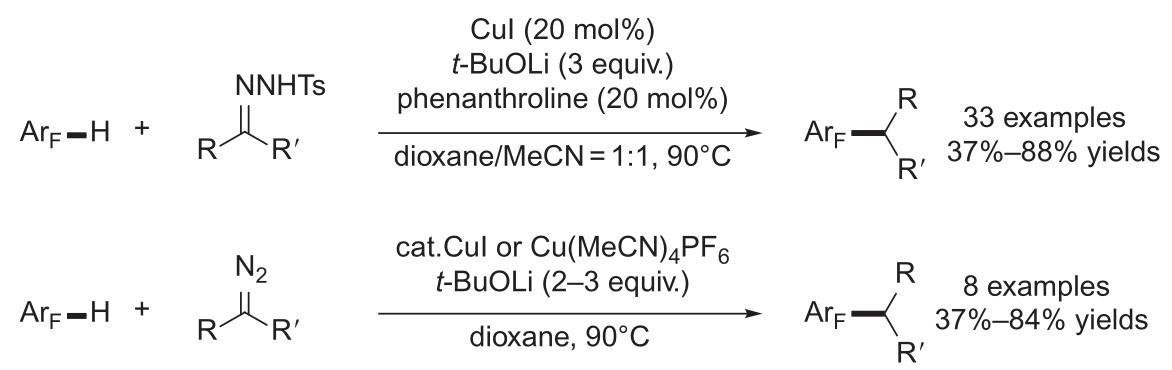
Scheme 71 Cu(I)-catalyzed alkylation of polyfluoroarenes via C-H functionalization.
方案71 铜(I)催化的通过C-H官能化的多氟芳烃烷基化反应。
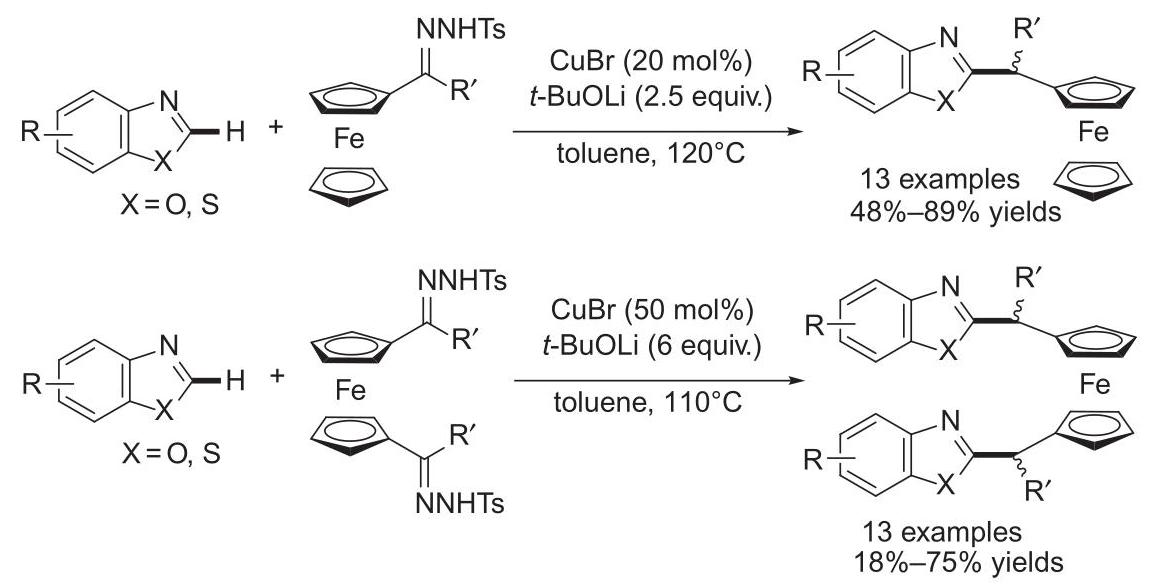
Scheme 72 Cu-catalyzed direct alkylation of 1,3-azoles with N-tosylhydrazones bearing ferrocenyl group.
方案72 铜催化的1,3-唑与带有二茂铁基的N-对甲苯磺酰腙的直接烷基化反应。
Recently, the Cu(I)-catalyzed regioselective C-H functionalization of azine $N$ -oxides with $N$ -tosylhydrazones was achieved under microwave conditions, giving rise to ortho-alkylated heterocyclic compounds (Scheme 73). ${}^{88}$ With readily available substrates and inexpensive copper(I) iodide, a series of 2-alkyl-substituted pyridine, quinoline, and isoquinoline derivatives are easily obtained.
最近,在微波条件下实现了铜(I)催化的嗪$N$-氧化物与$N$-对甲苯磺酰腙的区域选择性C-H官能化反应,得到邻位烷基化杂环化合物(方案73)。${}^{88}$使用容易获得的底物和廉价的碘化亚铜,一系列2-烷基取代的吡啶、喹啉和异喹啉衍生物很容易得到。
3.3 Cu-Catalyzed Oxidative Coupling Reaction of N-Tosylhydrazones
3.3 铜催化的N-对甲苯磺酰腙的氧化偶联反应
In 2016, Jiang and Wu reported a copper-mediated oxidative coupling reaction of $\beta$ -ketoesters by using $N$ -tosylhydrazones as two-carbon synthons, affording 2,3,5-trisubstituted furans in moderate to good yields and excellent regioselectivity. ${}^{89}$ The proposed mechanism is illustrated in Scheme 74, which involves the oxidation of Cu-carbene 93 under aerobic conditions to give the vinyl copper(II) complex 94. Then, accelerated by the Lewis acidic nature of the Zn(II) complex, the regioselective radical addition of the dicarbonyl free radical 95 with 94 occurs to generate the radical intermediate 96. Finally, the products are formed through divergent oxidative sequence. This oxidative cyclization strategy represents a unique type of $N$ -tosylhydrazone transformations.
2016年,Jiang和Wu报道了一种铜介导的氧化偶联反应,该反应使用$\beta$-酮酯与$N$-对甲苯磺酰腙作为双碳合成子,以中等至良好的产率和优异的区域选择性得到2,3,5-三取代呋喃。${}^{89}$ 提出的机理如图74所示,其中包括在有氧条件下将卡宾铜93氧化生成乙烯基铜(II)配合物94。然后,在锌(II)配合物的路易斯酸性作用下加速,二羰基自由基95与94发生区域选择性自由基加成,生成自由基中间体96。最后,通过不同的氧化序列形成产物。这种氧化环化策略代表了一种独特类型的$N$-对甲苯磺酰腙转化。
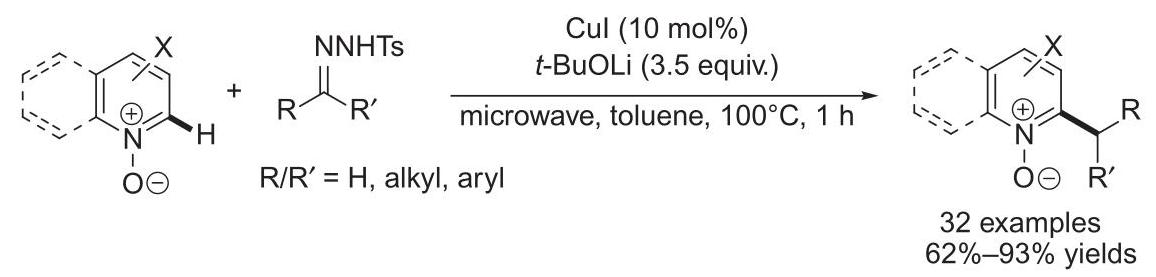
Scheme 73 Cu(I)-catalyzed coupling of azine $N$ -oxides with $N$ -tosylhydrazones.
图73 铜(I)催化的嗪$N$-氧化物与$N$-对甲苯磺酰腙的偶联反应。
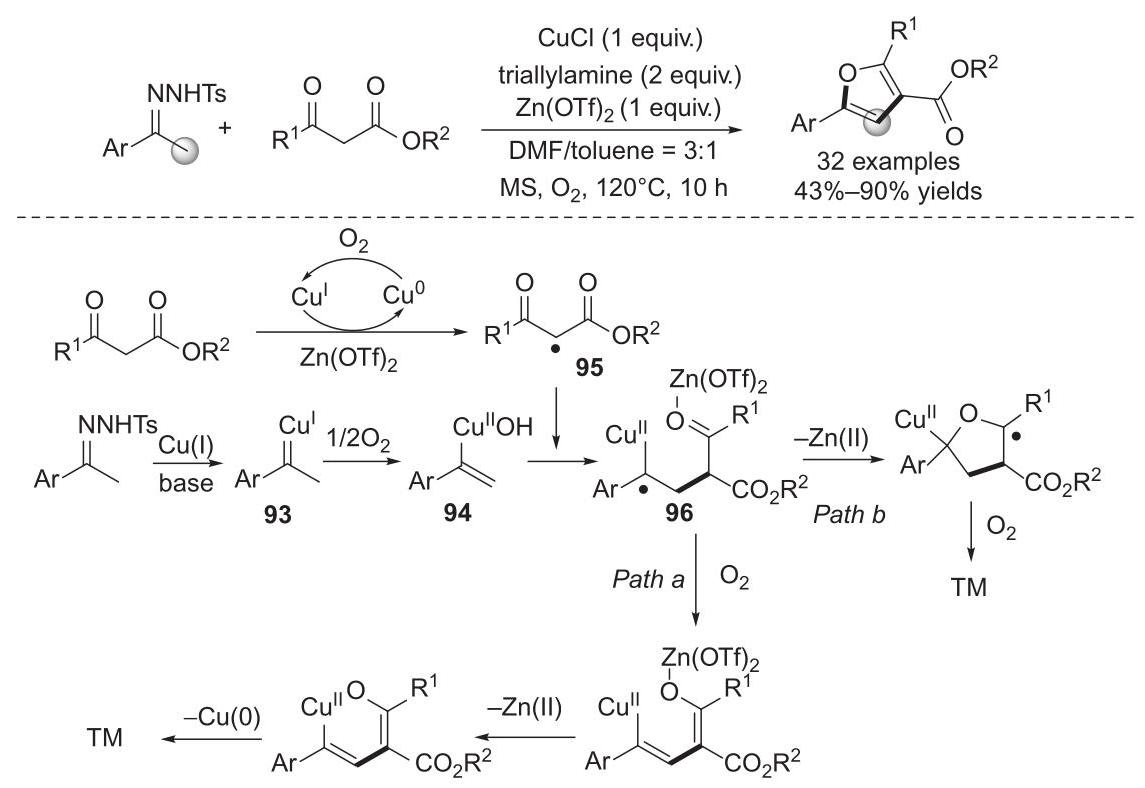
Scheme 74 Cu/Zn-mediated oxidative coupling of $N$ -tosylhydrazones and $\beta$ -ketoesters.
图74 铜/锌介导的$N$-对甲苯磺酰腙与$\beta$-酮酯的氧化偶联反应。
Moreover, Jiang group reported the Cu-catalyzed oxidative transformations of ketone-derived $N$ -tosylhydrazones under aerobic conditions, including Glaser homo-coupling, the cross-coupling reaction with an array of halides and terminal alkynes (Scheme 75). ${}^{90}$ This protocol affords functionalized internal alkynes and diynes, featured by the use of inexpensive catalytic system, wide substrate scope, and high regioselectivity. Reaction mechanism involves the oxidation and dehydrogenation of in situ-generated Cu-carbene species 97 as the key step, affording the internal (99) or terminal alkyne 98 intermediates. Subsequently, deprotonation of the terminal alkyne 98 assisted by copper coordination gives rise to an alkyne-coordinated copper species 100, which allows the sequential Glaser reaction as well as cross-coupling processes. This method enables the utilization of ketone-derived hydrazones as effective terminal alkyne synthons, providing a new type of alkyne synthetic strategies.
此外,Jiang课题组报道了在有氧条件下铜催化的酮衍生的$N$-对甲苯磺酰腙的氧化转化反应,包括格拉泽均偶联反应、与一系列卤化物和末端炔烃的交叉偶联反应(图75)。${}^{90}$ 该方法提供了功能化的内炔和二炔,其特点是使用廉价的催化体系、广泛的底物范围和高区域选择性。反应机理涉及原位生成的卡宾铜物种97的氧化和脱氢作为关键步骤,得到内炔(99)或末端炔烃98中间体。随后,在铜配位的辅助下,末端炔烃98的去质子化产生炔烃配位的铜物种100,这允许进行连续的格拉泽反应以及交叉偶联过程。该方法能够将酮衍生的腙用作有效的末端炔烃合成子,提供了一种新型的炔烃合成策略。
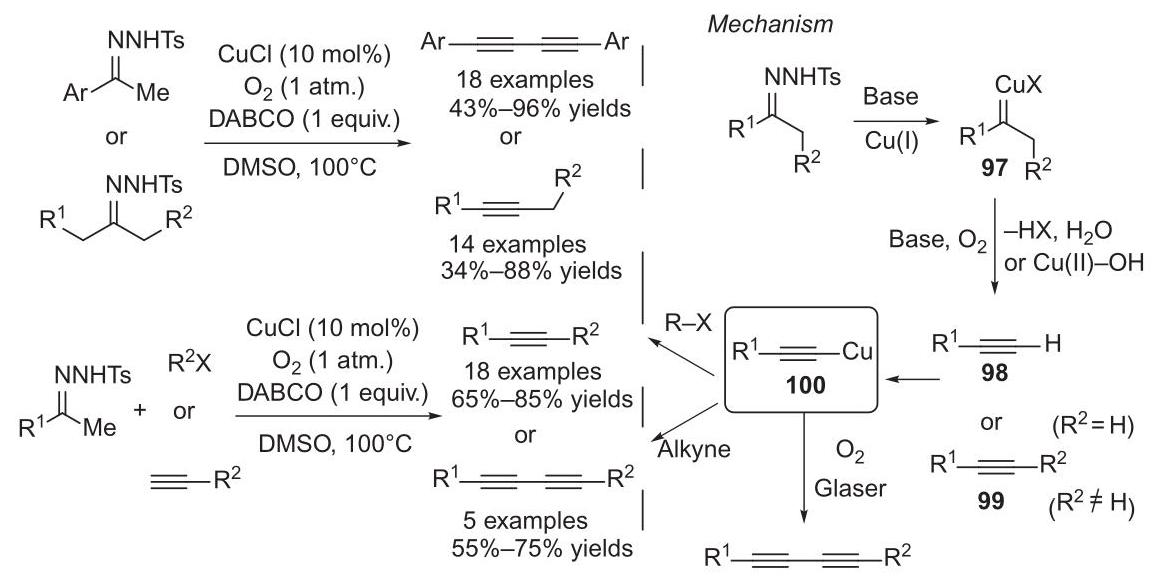
Scheme 75 Cu-catalyzed aerobic oxidative reactions of $N$ -tosylhydrazones to afford various alkynes.
图75 铜催化的$N$-对甲苯磺酰腙的有氧氧化反应以得到各种炔烃。
In 2016, a Cu-catalyzed oxidative cross-coupling reaction of two different $N$ -tosylhydrazones with elemental sulfur was reported. ${}^{91}$ Under aerobic conditions, a series of unsymmetric 2,5-disubstituted 1,3,4-thiadiazoles are obtained in moderate to good yields (Scheme 76). A tentative mechanism proposed the involvement of carbene species and elemental sulfur to afford benzothialdehyde intermediate 101. Thus, nucleophilic attack of $N$ -tosylhydrazone anion with 101 provides the intermediate 102, followed by sequential intramolecular nucleophilic attack to give 103. Final oxidative aromatization by air results in the generation of the desired heterocyclic scaffold.
2016年,报道了一种铜催化两种不同的$N$-对甲苯磺酰腙与元素硫的氧化交叉偶联反应。${}^{91}$ 在有氧条件下,以中等至良好的产率得到一系列不对称的2,5-二取代1,3,4-噻二唑(图76)。初步机理提出涉及卡宾物种和元素硫以得到苯并噻醛中间体101。因此,$N$-对甲苯磺酰腙阴离子对101的亲核进攻提供中间体102,随后进行连续的分子内亲核进攻得到103。最后,通过空气进行氧化芳构化生成所需的杂环骨架。
M
4. RHODIUM-CATALYZED COUPLING REACTION OF N-TOSYLHYDRAZONES
4. 铑催化的N-对甲苯磺酰腙的偶联反应
In 2016, Wang group reported a Rh(I)-catalyzed chemoslective cross-coupling reaction of trifluoromethylketone-derived $N$ -tosylhydrazones with arylboronates, affording 1,1-difluoro-2,2-diarylalkenes with moderate to good yields or 2,2-diaryltrifluoroethanes (Scheme 77). ${}^{92}$ Proposed mechanism involves the generation of aryl rhodium species at first through transmetala-tion with arylboronic acid esters in the presence of a base. This aryl rhodium species then reacts with the in situ-generated diazo compounds to afford the Rh(I)-carbene intermediate, followed by migratory insertion to generate a ${\mathrm{{CF}}}_{3}$ -substituted alkyl rhodium(I) intermediate. This intermediate can either experience $\beta$ -fluoride elimination to obtain desired 1,1-difluoroolefin product, or experience protonation of carbon-rhodium bond to afford ${\mathrm{{CF}}}_{3} -$ substituted alkane as a by-product. This transformation illustrates the practical application of trifluoromethylketone-derived $N$ -tosylhydrazones in the concise synthesis of fluorine-containing functional molecules.
2016年,王课题组报道了一种铑(I)催化的源自三氟甲基酮的$N$-对甲苯磺酰腙与芳基硼酸酯的化学选择性交叉偶联反应,以中等至良好的产率得到1,1-二氟-2,2-二芳基烯烃或2,2-二芳基三氟乙烷(方案77)。${}^{92}$提出的机理首先涉及在碱存在下通过与芳基硼酸酯的转金属化生成芳基铑物种。然后该芳基铑物种与原位生成的重氮化合物反应生成铑(I)-卡宾中间体,随后进行迁移插入以生成${\mathrm{{CF}}}_{3}$-取代的烷基铑(I)中间体。该中间体既可以经历$\beta$-氟消除以获得所需的1,1-二氟烯烃产物,也可以经历碳-铑键的质子化以得到${\mathrm{{CF}}}_{3} -$取代的烷烃作为副产物。这种转化说明了源自三氟甲基酮的$N$-对甲苯磺酰腙在含氟功能分子的简洁合成中的实际应用。
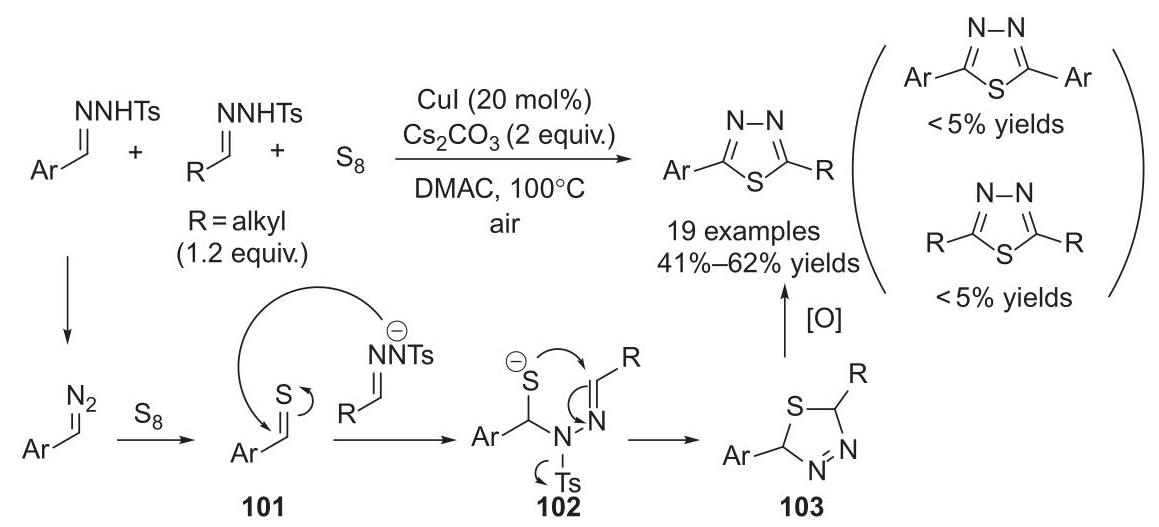
Scheme 76 Cu-catalyzed multicomponent coupling reaction of two different N-tosylhydrazones with elemental sulfur.
方案76 铜催化的两种不同的N-对甲苯磺酰腙与元素硫的多组分偶联反应。
Apart from the transmetalation process, selective C-C bond cleavage was implemented to efficiently generate carbon-rhodium species, which experienced sequential migratory insertion to perform carbene species func-tionalization. In 2014, Murakami group reported the Rh-catalyzed asymmetric carbene insertion to $\mathrm{C}\left( {\mathrm{{sp}}}^{3}\right) - \mathrm{C}\left( {\mathrm{{sp}}}^{3}\right)$ bond of cyclobutanols with $N$ -tosylhydrazones as diazo analogues (Scheme 78). ${}^{93}$ With the employment of chiral phosphine ligands, cyclopentanol derivatives are furnished by ring expansion of cyclobutanols with moderate to good yields (up to 77% yield) and excellent enantioselectivities (up to 99% ee). In the reaction mechanism, initially the rhodium alkoxide is formed through the ligand exchange with the substrate. Through $\beta$ -carbon elimination the four-membered ring rhodium alkoxide is cleaved, affording a $\gamma$ -keto alkylrhodium intermediate. Then, the reaction of in situ-generated diazo species with alkylrhodium species occurs, giving rise to (alkyl)(carbene)rhodium complex. Migratory insertion of ring-opened alkyl group onto prochiral carbene carbon is proposed as the key step. This Rh-catalyzed enantioselective carbene ring-expansion reaction has created two new chiral centers through the facile selective C-C bond cleavage.
除了转金属化过程外,还实施了选择性C-C键裂解以有效生成碳-铑物种,该物种经历顺序迁移插入以进行卡宾物种功能化。2014年,村上课题组报道了铑催化的以$N$-对甲苯磺酰腙作为重氮类似物对环丁醇的$\mathrm{C}\left( {\mathrm{{sp}}}^{3}\right) - \mathrm{C}\left( {\mathrm{{sp}}}^{3}\right)$键进行不对称卡宾插入反应(方案78)。${}^{93}$通过使用手性膦配体,环丁醇通过扩环反应以中等至良好的产率(高达77%产率)和优异的对映选择性(高达99% ee)得到环戊醇衍生物。在反应机理中,最初通过与底物的配体交换形成铑醇盐。通过$\beta$-碳消除,四元环铑醇盐被裂解,得到$\gamma$-酮基烷基铑中间体。然后,原位生成的重氮物种与烷基铑物种发生反应,生成(烷基)(卡宾)铑配合物。开环烷基迁移插入到手性卡宾碳上被认为是关键步骤。这种铑催化的对映选择性卡宾扩环反应通过简便的选择性C-C键裂解产生了两个新的手性中心。
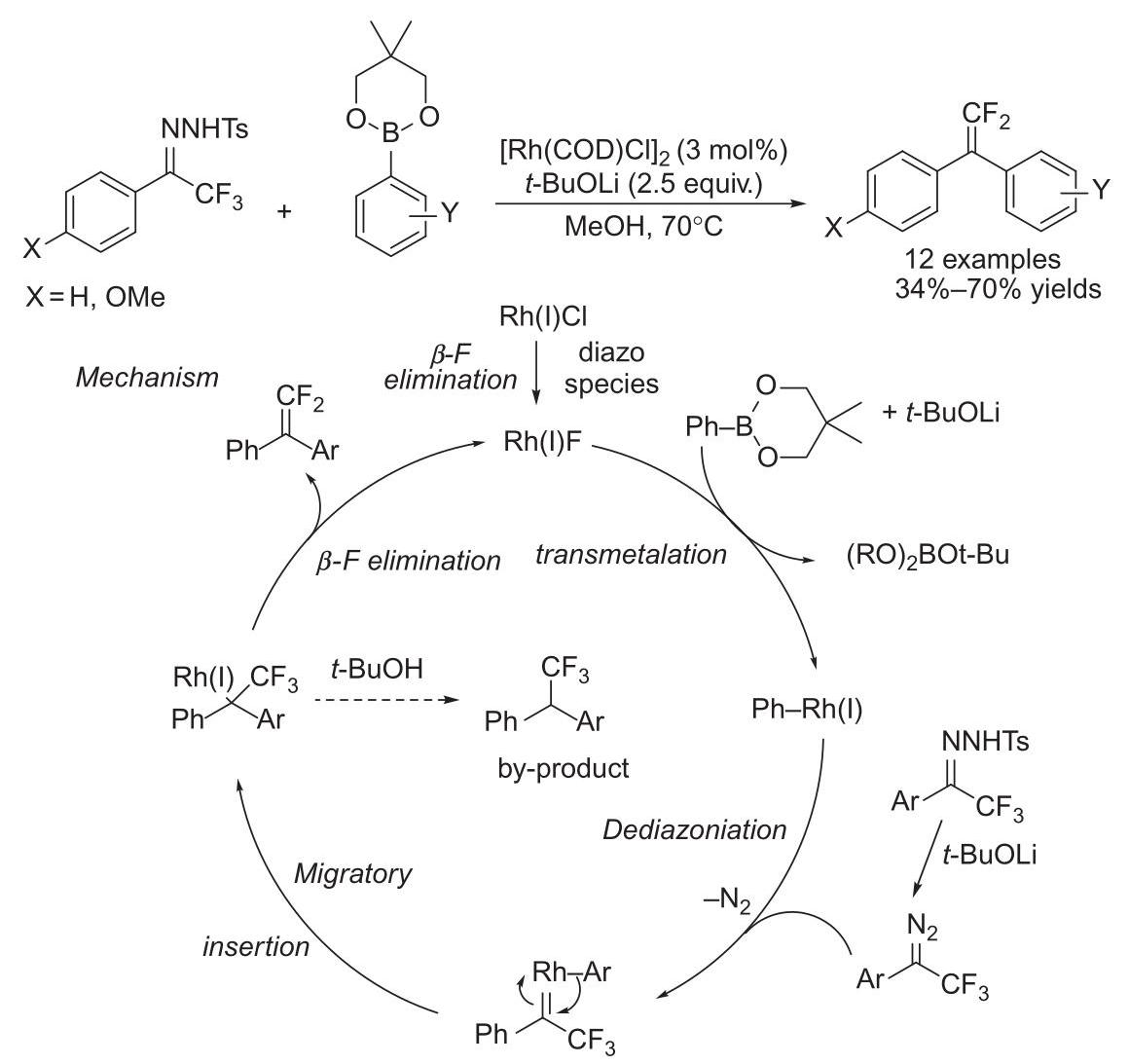
Scheme 77 Rh(I)-catalyzed cross-coupling of trifluoromethylketone-derived N-tosylhydrazones with arylboronates.
方案77 铑(I)催化的源自三氟甲基酮的N-对甲苯磺酰腙与芳基硼酸酯的交叉偶联反应。
Differing from the previous Pd- and Cu-catalyzed N-tosylhydrazones transformations, a typical feature of Rh-catalyzed cross-coupling reaction involving migratory insertion is the combination with the directing-group-assisted C-H activation strategy. Thus, these transformations demonstrate complementary strategy for classic ${\mathrm{{sp}}}^{2}\mathrm{C} - \mathrm{H}$ bond insertion pathway. In contrast to the Rh-catalytic transformations, which are also typically terminated by protonation in the cyclic cycle, the copper-catalyzed reactions also show diverse reaction type. In 2014, Wang group disclosed an efficient synthetic method for ortho-alkenyl phenols through $\mathrm{{Rh}}\left( \mathrm{{III}}\right)$ -catalyzed $\mathrm{C} - \mathrm{H}$ activation of $N$ -phenoxyacetamides with $N$ -tosylhydrazones or $\alpha$ -dia-zoesters. ${}^{{94}\mathrm{a}}$ By employing oxidizing $N$ -oxyacetamide as the directing group, this transformation allows the direct preparation of ortho-alkenyl phenols with high yields and excellent regio- and stereoselectivity. Besides, these reactions proceed under mild conditions and do not need any external oxidants. Mechanistic hypothesis involves the sequence of Rh-carbene 104 migratory insertion to form $\mathbf{{105}},\beta - \mathrm{H}$ elimination, reductive elimination, oxidative addition to regenerate active Rh(III) species, instead of direct protonation process (Scheme 79). This methodology has integrated with the $\mathrm{C} - \mathrm{H}$ bond activation with transition-metal-catalyzed coupling reaction of $N$ -tosylhydrazones.
与之前钯和铜催化的N-对甲苯磺酰腙转化不同,铑催化的涉及迁移插入的交叉偶联反应的一个典型特征是与导向基团辅助的C-H活化策略相结合。因此,这些转化展示了与经典${\mathrm{{sp}}}^{2}\mathrm{C} - \mathrm{H}$键插入途径互补的策略。与铑催化的转化(其在循环中通常也通过质子化终止)相反,铜催化的反应也显示出多样的反应类型。2014年,王课题组报道了一种通过$\mathrm{{Rh}}\left( \mathrm{{III}}\right)$催化$\mathrm{C} - \mathrm{H}$活化$N$-苯氧基乙酰胺与$N$-对甲苯磺酰腙或$\alpha$-重氮酯来高效合成邻烯基苯酚的方法。${}^{{94}\mathrm{a}}$通过使用氧化$N$-氧代乙酰胺作为导向基团,该转化能够以高收率、优异的区域和立体选择性直接制备邻烯基苯酚。此外,这些反应在温和条件下进行,不需要任何外部氧化剂。机理假设涉及铑卡宾104迁移插入形成$\mathbf{{105}},\beta - \mathrm{H}$消除、还原消除、氧化加成以再生活性铑(III)物种,而不是直接质子化过程(方案79)。该方法将$\mathrm{C} - \mathrm{H}$键活化与过渡金属催化的$N$-对甲苯磺酰腙偶联反应相结合。
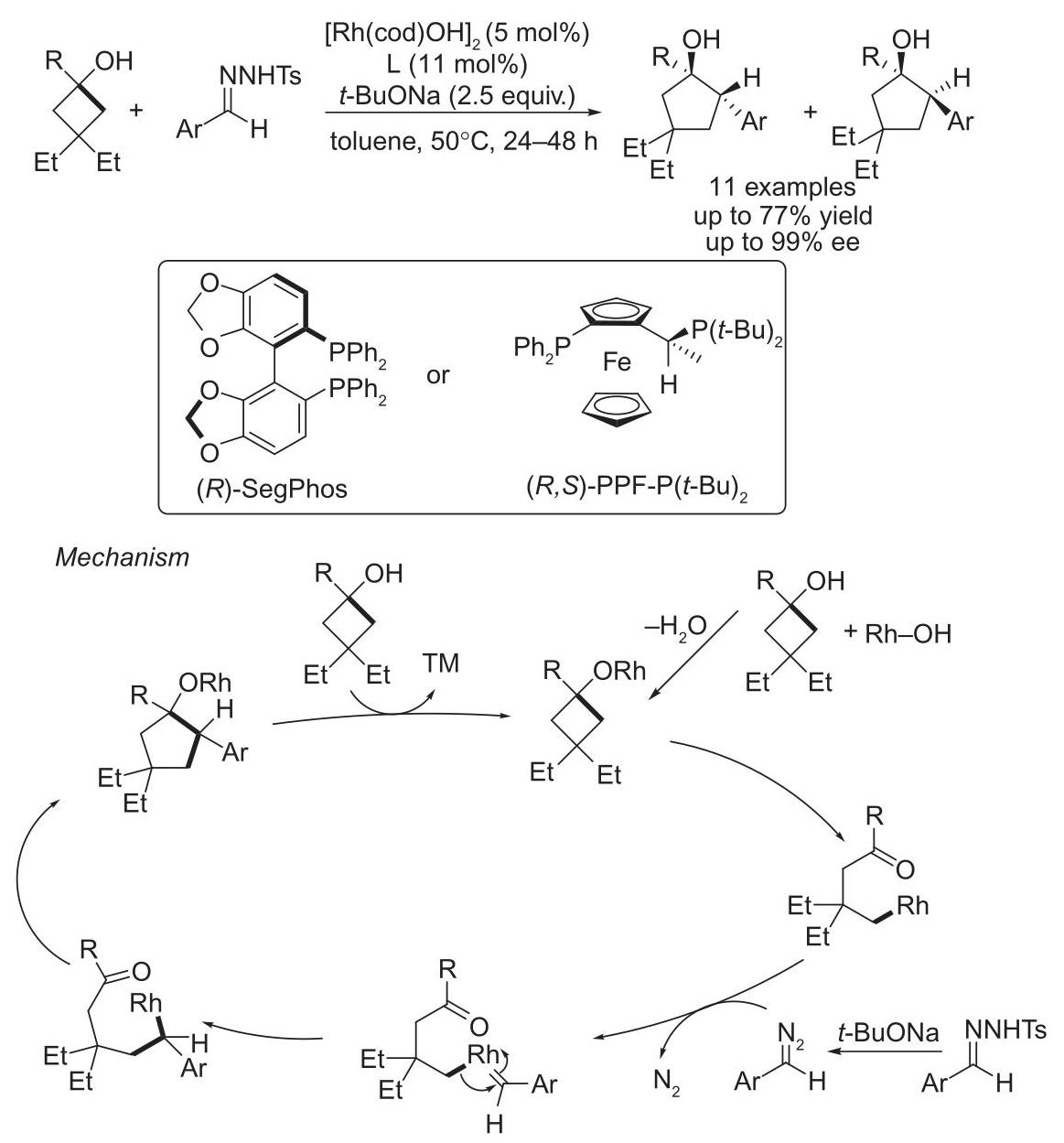
Scheme 78 Rh-catalyzed enantioselective carbenoid insertion of cyclobutanols with N-tosylhydrazones.
方案78 铑催化环丁醇与N-对甲苯磺酰腙的对映选择性卡宾插入反应。
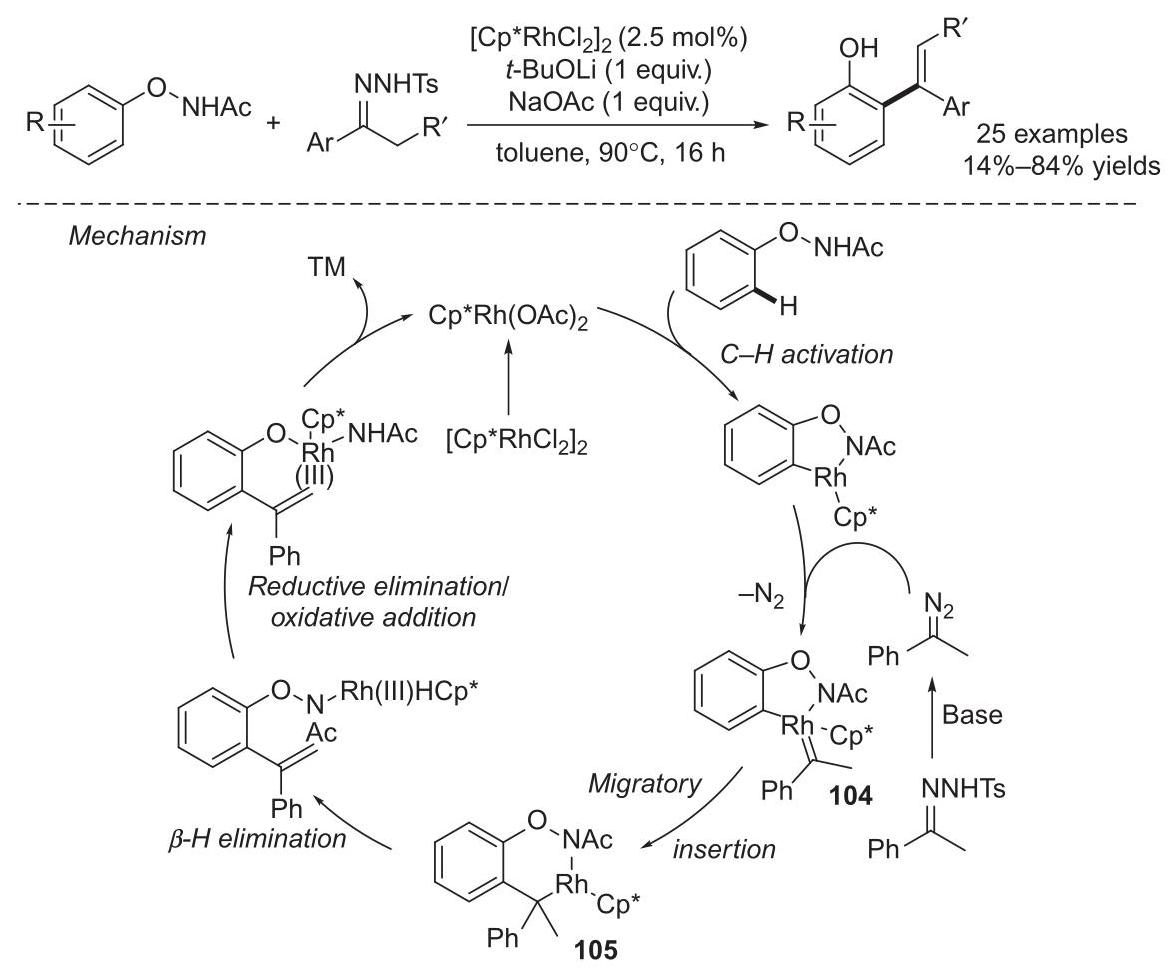
Scheme 79 Rh-catalyzed C-H bond activation of N-phenoxyacetamides with $N$ -tosylhydrazones or $\alpha$ -diazoesters.
方案79 铑催化N-苯氧基乙酰胺与$N$-对甲苯磺酰腙或$\alpha$-重氮酯的C-H键活化反应。
In 2016, Liao and Li implemented a DFT study to examine the mechanism of the above rhodium(III)-catalyzed alkenylation of $N$ -phenoxyacetamide with $N$ -tosylhydrazones. ${}^{{94}\mathrm{\;b}}$ The results indicate that the most favorable pathway for the Rh-catalyzed coupling of $N$ -tosylhydrazones involves sequential $\mathrm{N} - \mathrm{H}$ deprotonation, $\mathrm{C} - \mathrm{H}$ activation through concerted-metalation-deprotonation process, nitrogen extrusion, Rh(III)-carbene migratory insertion of aryl group, O-N bond cleavage to give a Rh(V) nitrene species, tautomerization, hydrogen migration from the $\beta - \mathrm{C}$ atom to the $\mathrm{N}$ atom of the internal oxidant, and acetic-acid-assisted protonation steps (Scheme 80).
2016年,廖和李进行了一项DFT研究,以考察上述铑(III)催化的$N$-苯氧基乙酰胺与$N$-对甲苯磺酰腙烯基化反应的机理。${}^{{94}\mathrm{\;b}}$结果表明,铑催化的$N$-对甲苯磺酰腙偶联反应最有利的途径包括依次进行$\mathrm{N} - \mathrm{H}$去质子化、通过协同金属化-去质子化过程进行$\mathrm{C} - \mathrm{H}$活化、氮消除、芳基的铑(III)-卡宾迁移插入、O-N键断裂生成铑(V)氮烯物种、互变异构、氢从$\beta - \mathrm{C}$原子迁移到内氧化剂的$\mathrm{N}$原子以及乙酸辅助的质子化步骤(方案80)。
Alternatively, Rh(I) complexes also emerged as efficient catalysis for C-C double bond formation through coupling reaction of (quinolin- 8-yl)methanone with $N$ -tosylhydrazones, representing a rare case of $\mathrm{C}\left( {\mathrm{{sp}}}^{3}\right) - \mathrm{H}$ activation case in this research area. ${}^{95}$ In the presence of a base and ${\mathrm{{Ag}}}_{2}\mathrm{O}$ ,3-aryl-1-(quinolin-8-yl)prop-2-en-1-one derivatives are obtained in good yields (Scheme 81). A plausible mechanism involves directing-group-assisted $\mathrm{C} - \mathrm{H}$ metalation at first, followed by migratory insertion as the key step to generate seven-membered rhodacycle 106. This key intermediate experiences sequential $\beta$ -H elimination to release desired alkenes, accompanying with the regeneration of Rh species. This methodology provides an alternative route for the direct arylvinylation of (quinolin- 8-yl)methanone by using $N$ -tosylhydrazones.
另外,铑(I)配合物也作为通过(喹啉-8-基)甲酮与$N$-对甲苯磺酰腙的偶联反应形成C-C双键的有效催化剂出现,这是该研究领域中罕见的$\mathrm{C}\left( {\mathrm{{sp}}}^{3}\right) - \mathrm{H}$活化实例。${}^{95}$在碱和${\mathrm{{Ag}}}_{2}\mathrm{O}$存在下,可良好收率得到3-芳基-1-(喹啉-8-基)丙-2-烯-1-酮衍生物(方案81)。一个合理的机理首先涉及导向基团辅助的$\mathrm{C} - \mathrm{H}$金属化,随后迁移插入作为生成七元铑环106的关键步骤。这个关键中间体依次经历$\beta$-H消除以释放所需的烯烃,同时伴随铑物种的再生。该方法为使用$N$-对甲苯磺酰腙直接对(喹啉-8-基)甲酮进行芳基乙烯基化提供了一条替代路线。
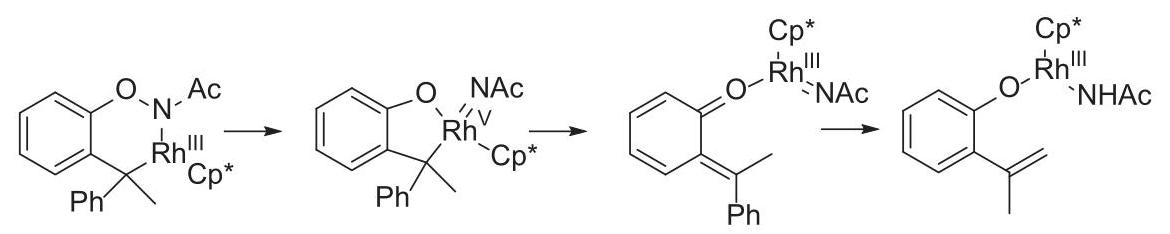
Scheme 80 Probable intermediates for rhodium(III)-catalyzed alkenylation of N-phenoxyacetamide with N-tosylhydrazones.
方案80 铑(III)催化N-苯氧基乙酰胺与N-对甲苯磺酰腙烯基化反应的可能中间体。
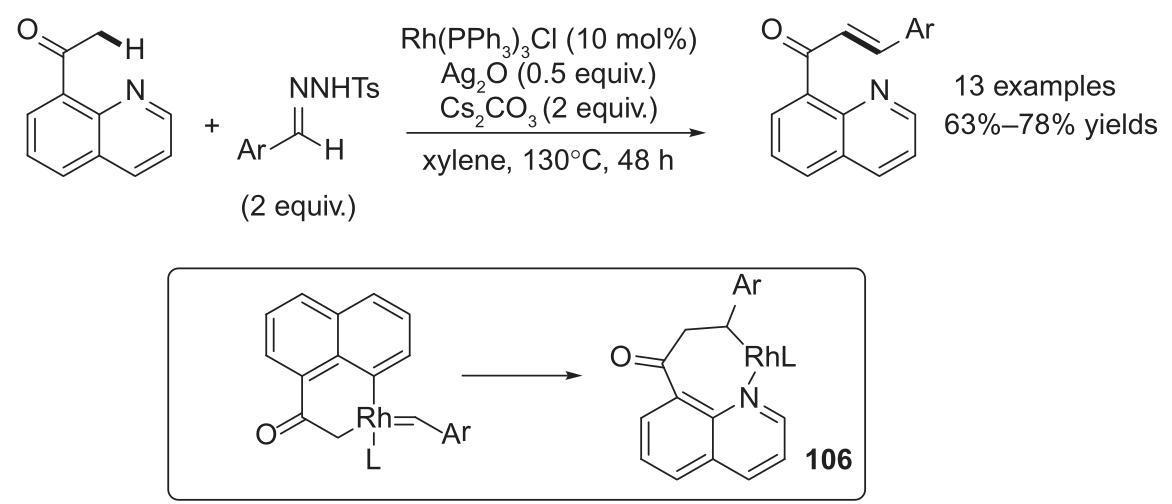
Scheme 81 Rh(I)-catalyzed C-H bond activation of (quinolin-8-yl)methanone with N-tosylhydrazones.
方案81:铑(I)催化的(喹啉-8-基)甲酮与N-甲苯磺酰腙的C-H键活化反应。
5. NICKEL- AND COBALT-CATALYZED COUPLING REACTIONS OF N-TOSYLHYDRAZONES
5. 镍和钴催化的N-对甲苯磺酰腙的偶联反应
In 2012, Miura and coworkers disclosed the direct 2-alkylation process of azoles with $N$ -tosylhydrazones containing unactivated alkyl sub-stituents by employing nickel(II) and cobalt(II) catalysts (Scheme 82). In the presence of a base, nickel complexes have emerged as efficient catalysts for the introduction of secondary alkyl groups into benzoxazole scaffolds. Moreover, straightforward alkylation of 5-aryloxazoles and benzothiazole can be achieved catalyzed by cobalt(II) bromide. The plausible mechanism involves the base-mediated $\mathrm{C} - \mathrm{H}$ bond metalation process initially, followed by metal-carbene migratory insertion as the key steps. Finally, protonation or ligand exchange with the C-H bond of the starting heteroarene gives rise to the desired heterocycles bearing secondary alkyl side chain. This methodology enables a concise access to azole cores containing unactivated secondary alkyl side chains, which are generally difficult to achieve by using the precedent C-H alkylation strategy.
2012年,三浦及其同事通过使用镍(II)和钴(II)催化剂,公开了用含有未活化烷基取代基的$N$-对甲苯磺酰腙对唑类进行直接2-烷基化的方法(方案82)。在碱的存在下,镍配合物已成为将仲烷基引入苯并恶唑骨架的有效催化剂。此外,溴化钴可以催化实现5-芳基恶唑和苯并噻唑的直接烷基化。合理的机理最初涉及碱介导的$\mathrm{C} - \mathrm{H}$键金属化过程,随后是金属卡宾迁移插入作为关键步骤。最后,质子化或与起始杂芳烃的C-H键进行配体交换,得到带有仲烷基侧链的所需杂环。这种方法能够简洁地获得含有未活化仲烷基侧链的唑类核心,而这通常很难通过使用先前的C-H烷基化策略来实现。
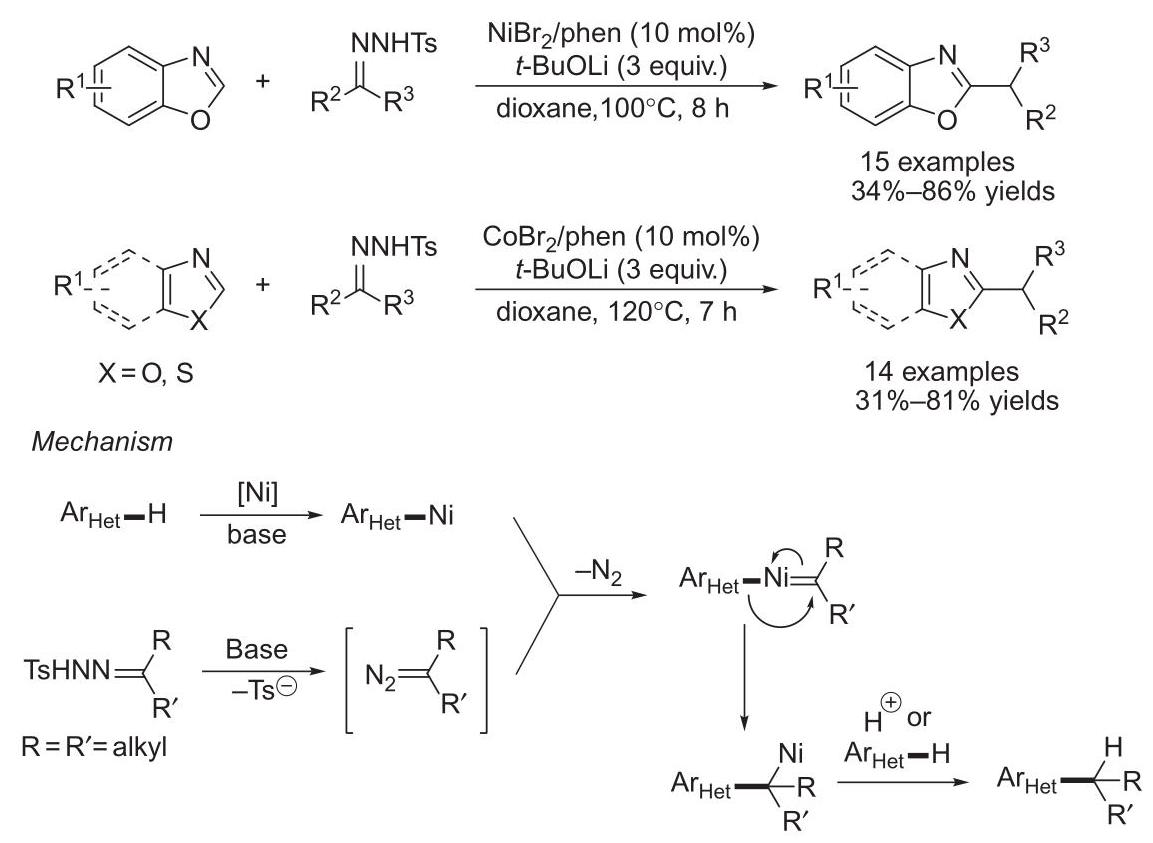
Scheme 82 Ni- and Co-catalyzed alkylation of azoles with N-tosylhydrazones.
方案82 镍和钴催化的用N-对甲苯磺酰腙对唑类进行烷基化反应。
In 2013, Zhang and de Bruin reported a radical-type Co(II)Por (Por=porphyrin)-catalyzed carbene carbonylation with sequential ketene-trapping process by diverse nucleophiles and imines, affording esters, amides, or good diastereoselective trans-β-lactams with high yields in one-pot cascade procedure. ${}^{97}$ Consequently, the metalloradical [Co(II) TPP] complex has emerged as an efficient catalyst for the homologation of both $N$ -tosylhydrazone sodium salts and $\alpha$ -diazocarbonyl compounds (Scheme 83).
2013年,张和德布鲁因报道了一种自由基型Co(II)Por(Por = 卟啉)催化的卡宾羰基化反应,该反应通过不同的亲核试剂和亚胺进行连续的乙烯酮捕获过程,在一锅串联反应中以高产率得到酯、酰胺或具有良好非对映选择性的反式β-内酰胺。${}^{97}$因此,金属自由基[Co(II) TPP]配合物已成为一种有效的催化剂,可用于$N$-对甲苯磺酰腙钠盐和$\alpha$-重氮羰基化合物的同系化反应(方案83)。
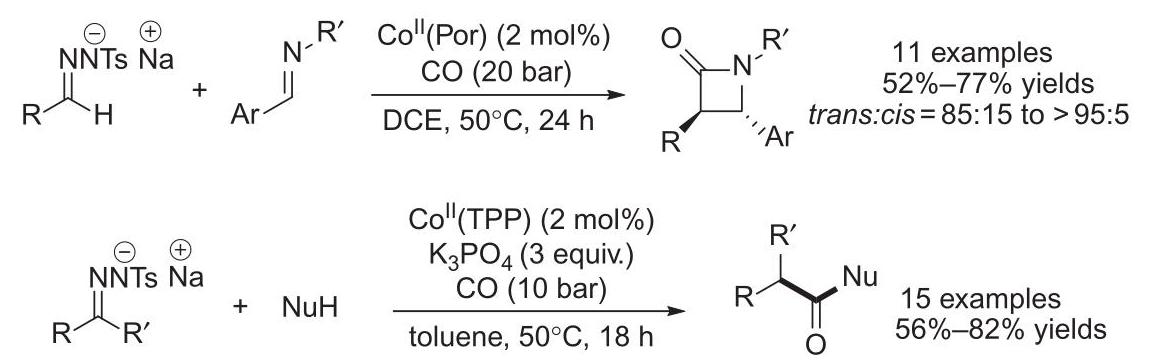
Scheme 83 Co(II)Por-catalyzed carbene carbonylation of N-tosylhydrazone sodium salt with nucleophiles for the synthesis of esters, amides, and β-lactams.
方案83 Co(II)Por催化的亲核试剂与N-对甲苯磺酰腙钠盐的卡宾羰基化反应,用于合成酯、酰胺和β-内酰胺。
6. CATALYTIC INTRAMOLECULAR CYCLIZATION OF N-TOSYLHYDRAZONES
6. N-对甲苯磺酰腙的催化分子内环化反应
In the past few decades, transition-metal-catalyzed ring-closing metathesis has evolved into a highly efficient and versatile strategy for the intramolecular $\mathrm{C} = \mathrm{C}$ bond formation. In particular, by employing $N$ -tosylhydrazones or diazo compounds as the carbene precursors, the catalytic carbene dimerization process provides an alternative way to form $\mathrm{C} = \mathrm{C}$ bonds. However, owing to the instability of diazo species and poor selectivity, this method suffers significant limitation for its use in organic synthesis. In 2012, Wang group successfully disclosed a novel Rh(II)-catalyzed intramolecular carbene dimerization of bis(N-tosylhydrazone)s. ${}^{98}$ This catalytic cyclization process, as well as the one-pot procedure from corresponding readily available dicarbonyl substrates, provides a general and highly efficient synthetic method for polycyclic aromatic compounds, including chrysene, helicene, picene, and pent-aphenes (Scheme 84). This method is operationally simple and can be served as a general and practical approach to polycyclic aromatic compounds.
在过去几十年中,过渡金属催化的闭环复分解反应已发展成为一种用于分子内$\mathrm{C} = \mathrm{C}$键形成的高效且通用的策略。特别是,通过使用$N$-对甲苯磺酰腙或重氮化合物作为卡宾前体,催化卡宾二聚化过程提供了一种形成$\mathrm{C} = \mathrm{C}$键的替代方法。然而,由于重氮物种的不稳定性和选择性差,该方法在有机合成中的应用受到很大限制。2012年,王课题组成功披露了一种新型的铑(II)催化的双(N-对甲苯磺酰腙)分子内卡宾二聚化反应。${}^{98}$ 这种催化环化过程以及从相应易得的二羰基底物出发的一锅法,为包括苊、螺旋烯、苝和五环苯在内的多环芳烃提供了一种通用且高效的合成方法(方案84)。该方法操作简单,可作为一种通用且实用的多环芳烃合成方法。
In addition to the rhodium catalysts, gold complexes have been explored in intramolecular coupling reaction of bis- $N$ -tosylhydrazones. In 2015, Sun group developed a selective and controllable divergent synthetic approach of decomposition of bis- $N$ -tosylhydrazones (Scheme 85). ${}^{99}$ Thus, in the presence of gold(I) catalyst and strong base, polysubstituted cyclic olefins are effectively accessed through this Au-catalyzed intramolecular coupling reaction of bis- $N$ -tosylhydrazones. Moreover, the one-pot procedure by using bis-carbonyl compounds as substrates is also employed to access poly-aromatic scaffold in a facile and efficient manner. This gold-catalyzed effective approach demonstrates practical applications in synthesizing polycyclic aromatic compounds with good yields.
除了铑催化剂外,金配合物也已用于双$N$-对甲苯磺酰腙的分子内偶联反应。2015年,孙课题组开发了一种选择性和可控的双$N$-对甲苯磺酰腙分解的发散合成方法(方案85)。${}^{99}$ 因此,在金(I)催化剂和强碱存在下,通过这种金催化的双$N$-对甲苯磺酰腙分子内偶联反应可有效得到多取代的环烯烃。此外,以双羰基化合物为底物的一锅法也被用于以简便有效的方式获得多芳基骨架。这种金催化的有效方法在高产率合成多环芳烃中显示出实际应用价值。
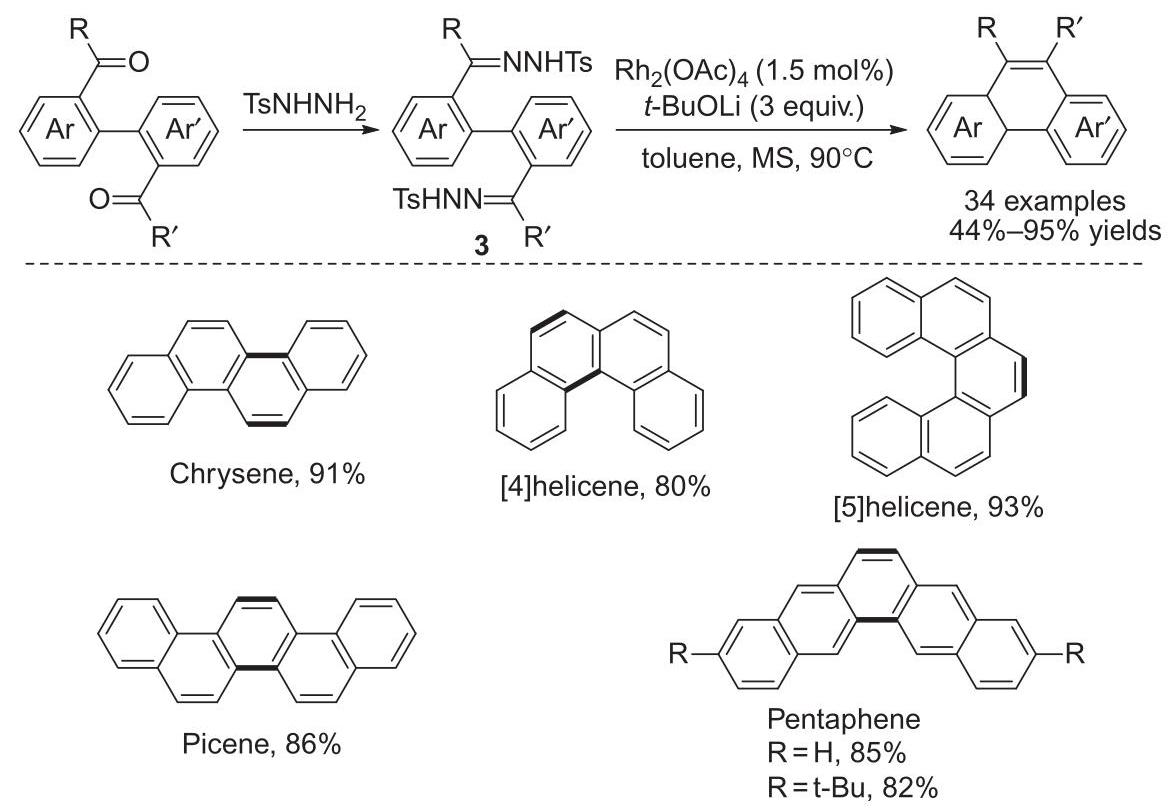
Scheme 84 Rh(II)-catalyzed intramolecular carbene cyclization of bis(N-tosylhydrazone)s.
方案84 铑(II)催化的双(N-对甲苯磺酰腙)分子内卡宾环化反应。
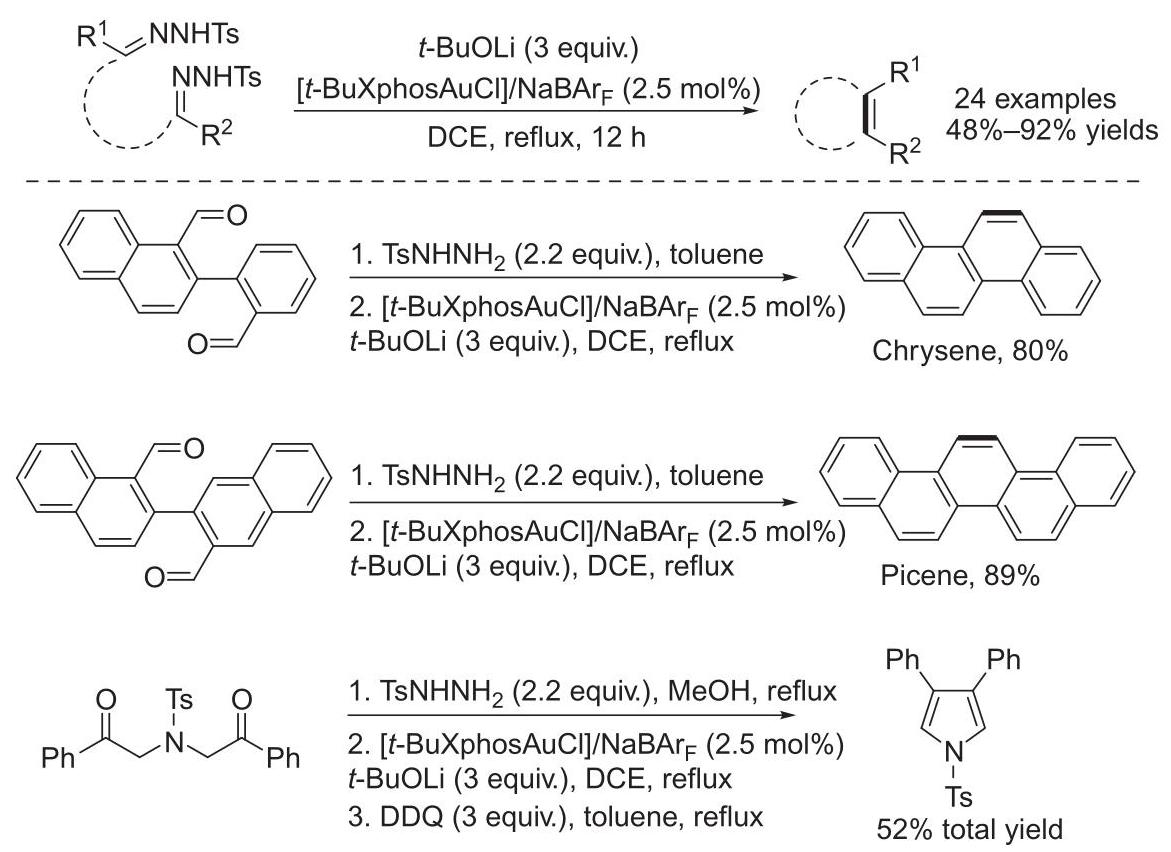
Scheme 85 Au-catalyzed intramolecular coupling of bis- $N$ -tosylhydrazones.
方案85 金催化的双$N$-对甲苯磺酰腙分子内偶联反应。
OF
7. SUMMARY
7. 总结
As described in this chapter, the incorporation of transition-metal-catalyzed coupling strategy with $N$ -tosylhydrazones allows toward various novel transformations for C-C bond construction. Serving as readily available substrates, $N$ -tosylhydrazones are widely used in traditional organic transformations, including Bamford-Stevens-Shapiro reaction, Barton-Kellogg reaction, or Julia-type olefination, which have already demonstrated great applications in organic synthesis. Furthermore, the introduction of $N$ -tosylhydrazones in transition-metal-catalyzed cross-coupling reactions not only expands the substrate scope of coupling partners but also makes this coupling strategy practically useful in organic synthesis and other fields. This type of transformation constitutes an unprecedented avenue to construct C-C, C=C, C-X bonds in a selective and efficient manner. Otherwise, various functionalized molecules such as polysubstituted alkenes, allenes, alkynes, aromatic and heterocyclic compounds, can be expeditiously and facilely accessed from N-tosylhydrazones or corresponding carbonyl substrates.
如本章所述,将过渡金属催化的偶联策略与$N$-甲苯磺酰腙相结合,能够实现各种用于构建碳-碳键的新型转化。作为易于获得的底物,$N$-甲苯磺酰腙广泛应用于传统有机转化反应,包括Bamford-Stevens-Shapiro反应、Barton-Kellogg反应或Julia型烯烃化反应,这些反应在有机合成中已展现出巨大的应用价值。此外,在过渡金属催化的交叉偶联反应中引入$N$-甲苯磺酰腙,不仅拓宽了偶联伙伴的底物范围,还使这种偶联策略在有机合成及其他领域具有实际应用价值。这种类型的转化为以选择性和高效的方式构建碳-碳、碳-碳双键、碳-杂原子键提供了一条前所未有的途径。否则,各种功能化分子,如多取代烯烃、丙二烯、炔烃、芳香族和杂环化合物,都可以从甲苯磺酰腙或相应的羰基底物快速且容易地获得。
Mechanistically, most of these catalytic transformations involve the formation of metal-carbene and subsequent migratory insertion as the key steps. The migratory insertion of metal-carbene has been proved to be general in terms of migrating groups, which include aryl, vinyl, benzyl, acyl, allyl, allenyl, alkynyl, propargyl, and cyclopropyl groups.
从机理上讲,这些催化转化反应大多涉及金属卡宾的形成以及随后的迁移插入作为关键步骤。金属卡宾的迁移插入在迁移基团方面已被证明具有普遍性,这些迁移基团包括芳基、乙烯基、苄基、酰基、烯丙基、联烯基、炔基、炔丙基和环丙基。
Although significant achievements have been made in this field, some difficult problems still remain. For example, $\mathrm{C}\left( {\mathrm{{sp}}}^{3}\right) - \mathrm{H}$ activation combined with migratory insertion, decarboxylative coupling with N-tosylhydrazones, asymmetric carbene transformation, and the coupling catalyzed by early transition-metal are yet challenging goals. With the significant achievements mostly made only in the last 10 years, it would be confident to say that this area is still far from mature and further developments can be expected.
尽管该领域已取得显著成就,但仍存在一些难题。例如,$\mathrm{C}\left( {\mathrm{{sp}}}^{3}\right) - \mathrm{H}$活化与迁移插入、与甲苯磺酰腙的脱羧偶联、不对称卡宾转化以及早期过渡金属催化的偶联仍是具有挑战性的目标。由于大部分显著成就仅在过去10年取得,可以有信心地说,这个领域仍远未成熟,有望进一步发展。
ACKNOWLEDGMENTS
致谢
The project is supported by the National Basic Research Program of China (973 Program, No. 2015CB856600) and the Natural Science Foundation of China (Grant 21332002, 21472004).
本项目得到了中国国家重点基础研究发展计划(973计划,项目编号:2015CB856600)和国家自然科学基金(项目批准号:21332002, 21472004)的资助。
REFERENCES
参考文献
(a) Suzuki A. Cross-coupling reactions of organoboranes: an easy way to construct C-C bonds (Nobel Lecture). Angew Chem Int Ed. 2011;50:6723-6737. (b) Johansson Secchurn CCC, Kitching MO, Colacot TJ, Snieckus V. Palladium-catalyzed cross-coupling: a historical contextual perspective to the 2010 Nobel Prize. Angew Chem Int Ed. 2012;51:5062-5085. (c) Magano J, Dunetz JR. Large-scale applications of transition metal-catalyzed couplings for the synthesis of pharmaceuticals. Chem Rev. 2011;111:2177-2250. (d) Diederich F, de Meijere A. Metal-Catalyzed Cross-Coupling Reactions. 2nd ed. Weinheim: Wiley-VCH; 2004. (e) Tobisu M, Chatani N. Devising boron reagents for orthogonal functionalization through Suzuki-Miyaura cross-coupling. Angew Chem Int Ed. 2009;48:3565-3568. (f) Wang C, Glorius F. Controlled iterative cross-coupling: on the way to the automation of organic synthesis. Angew Chem Int Ed. 2009;48:5240-5244.
Bamford WR, Stevens TS. The decomposition of toluene-p-sulphonylhydrazones by alkali. J Chem Soc. 1952;4735-4740.
For comprehensive review of $N$ -tosylhydrazones and tosylhydrazone salts, see: Fulton JR, Aggarwal VK, de Vicente J. The use of tosylhydrazone salts as a safe alternative for handling diazo compounds and their applications in organic synthesis. Eur J Org Chem. 2005;1479-1492.
For reviews of transition-metal-catalyzed coupling reactions of $N$ -tosylhydrazones, see: (a) Barluenga J, Valdés C. Tosylhydrazones: new uses for classic reagents in palladium-catalyzed cross-coupling and metal-free reactions. Angew Chem Int Ed. 2011;50:7486-7500. (b) Shao Z, Zhang H. N-Tosylhydrazones: versatile reagents for metal-catalyzed and metal-free cross-coupling reactions. Chem Soc Rev. 2012;41:560-572. (c) Xiao Q, Zhang Y, Wang J. Diazo compounds and N-tosylhydrazones: novel cross-coupling partners in transition-metal-catalyzed reactions. Acc Chem Res. 2013;46:236-247. (d) Jadhav AP, Ray D, Bhaskara Rao VU, Singh RP. Copper-catalyzed direct cross-coupling of compounds containing activated C-H/heteroatom-H bonds with N-tosylhydrazones. Eur J Org Chem. 2016;2369-2382. (e) Zhang Y, Wang J. Alkene synthesis through transition metal-catalyzed cross-coupling of N-tosylhydrazones. Top Curr Chem. 2012;327:239-270.
For recent reviews of transition-metal-catalyzed coupling reactions of diazo compounds, see: (a) Zhang Y, Wang J. Recent developments in Pd-catalyzed reactions of diazo compounds. Eur J Org Chem. 2011;1015-1026. (b) Zhao X, Zhang Y, Wang J. Recent developments in copper-catalyzed reactions of diazo compounds. Chem Commun. 2012;48:10162-10173.
For review of novel synthesis of metal carbene, see: Jia M, Ma S. New approaches to the synthesis of metal carbenes. Angew Chem Int Ed. 2016;55:9134-9166.
For reviews of catalytic cross-coupling reactions involving metal carbene, see: (a) Liu Z, Wang J. Cross-coupling reactions involving metal carbene: from C=C/C-C bond formation to C-H bond functionalization. J Org Chem. 2013;78:10024-10030. (b) Xia Y, Zhang Y, Wang J. Catalytic cascade reactions involving metal carbene migratory insertion. ACS Catal. 2013;3:2586-2598. (c) Hu F, Xia Y, Ma C, Zhang Y, Wang J. C-H bond functionalization based on metal carbene migratory insertion. Chem Commun. 2015;51:7986-7995.
Barluenga J, Moriel P, Valdés C, Aznar F. N-Tosylhydrazones as reagents for cross-coupling reactions: a route to polysubstituted olefins. Angew Chem Int Ed. 2007;46:5587-5590.
Barluenga J, Tomás-Gamasa M, Moriel P, Aznar F, Valdés C. Pd-catalyzed cross-coupling reactions with carbonyls: application in a very efficient synthesis of 4-aryltetrahydropyridines. Chem Eur J. 2008;14:4792-4795.
Barluenga J, Escribano M, Moriel P, Aznar F, Valdés C. Synthesis of enol ethers and enamines by Pd-catalyzed tosylhydrazide-promoted cross-coupling reactions. Chem Eur J. 2009;15:13291-13294.
Barluenga J, Tomás-Gamasa M, Aznar F, Valdés C. Synthesis of 2-arylacrylates from pyruvate by tosylhydrazide-promoted Pd-catalyzed coupling with aryl halides. Chem Eur J. 2010;16:12801-12803.
(a) Zhou Y, Zhang Y, Wang J. Recent advances in transition-metal-catalyzed synthesis of conjugated enynes. Org Biomol Chem. 2016;14:6638-6650. (b) Barluenga J, Tomás-Gamasa M, Aznar F, Valdés C. Synthesis of dienes by palladium-catalyzed couplings of tosylhydrazones with aryl and alkenyl halides. Adv Synth Catal. 2010;352:3235-3240.
Jiménez-Aquino A, Vega JA, Trabanco AA, Valdés CA. General synthesis of α-trifluoromethylstyrenes through palladium-catalyzed cross-couplings with 1,1,1- trifluoroacetone tosylhydrazone. Adv Synth Catal. 2014;356:1079-1084.
Högermeier J, Reissig H-U. Nine times fluoride can be good for your syntheses. not just cheaper: nonafluorobutanesulfonates as intermediates for transition metal-catalyzed reactions. Adv Synth Catal. 2009;351:2747-2763.
Barluenga J, Florentino L, Aznar F, Valdés C. Synthesis of polysubstituted olefins by Pd-catalyzed cross-coupling reaction of tosylhydrazones and aryl nonaflates. Org Lett. 2011;13:510-513.
Florentino L, Aznar F, Valdés C. Synthesis of (Z)-N-alkenylazoles and pyrroloisoquinolines from $\alpha - N$ -azoleketones through Pd-catalyzed tosylhydrazone cross-couplings. Chem Eur J. 2013;19:10506-10510.
Florentino L, Aznar F, Valdés C. Synthesis of polysubstituted isoquinolines through cross-coupling reactions with $\alpha$ -alkoxytosylhydrazones. Org Lett. 2012;14:2323-2325.
Patel PK, Dalvadi JP, Chikhalia KH. A direct facile and effective synthesis of various 1,1-heterodiarylalkenes through Pd catalyzed cross coupling reaction using N-tosylhydrazones via C-OH bond activation. Tetrahedron Lett. 2015;56:6585-6589.
Zhou Y, Ye F, Wang X, Xu S, Zhang Y, Wang J. Synthesis of alkenylphosphonates through palladium-catalyzed coupling of $\alpha$ -diazo phosphonates with benzyl or allyl halides. J Org Chem. 2015;80:6109-6118.
Barluenga J, Escribano M, Aznar F, Valdés C. Arylation of a-chiral ketones by palladium-catalyzed cross-coupling reactions of tosylhydrazones with aryl halides. Angew Chem Int Ed. 2010;49:6856-6859.
Feng J, Li B, He Y, Gu Z. Enantioselective synthesis of atropisomeric vinyl arene compounds by palladium catalysis: a carbene strategy. Angew Chem Int Ed. 2016;55:2186-2190.
(a) Tréguier B, Hamze A, Provot O, Brion J-D, Alami M. Expeditious synthesis of 1,1- diarylethylenes related to isocombretastatin A-4 (isoCA-4) via palladium-catalyzed arylation of N-tosylhydrazones with aryl triflates. Tetrahedron Lett. 2009;50:6549-6552. (b) Messaoudi S, Tréguier B, Hamze A, et al. Isocombretastatins A versus combretastatins A: the forgotten isoCA-4 isomer as a highly promising cytotoxic and antitubulin agent. J Med Chem. 2009;52:4538-4542. (c) Aziz J, Brachet E, Hamze A, et al. Synthesis, biological evaluation, and structure-activity relationships of tri- and tetrasubstituted olefins related to isocombretastatin A-4 as new tubulin inhibitors. Org Biomol Chem. 2013;11:430-442. (d) Rasolofonjatovo E, Provot O, Hamze A, et al. Design, synthesis and anticancer properties of 5-arylbenzoxepins as conformationally restricted isocombretastatin A-4 analogs. Eur J Med Chem. 2013;62:28-39.
Lawson M, Hamze A, Peyrat J-F, et al. An efficient coupling of $N$ -tosylhydrazones with 2-halopyridines: synthesis of 2-α-styrylpyridines endowed with antitumor activity. Org Biomol Chem. 2013;11:3664-3673.
(a) Brachet E, Hamze A, Peyrat J-F, Brion J-D, Alami M. Pd-catalyzed reaction of sterically hindered hydrazones with aryl halides: synthesis of tetra-substituted olefins related to iso-combretastatin A4. Org Lett. 2010;12:4042-4045. (b) Roche M, Hamze A, Provot O, Brion J-D, Alami M. Synthesis of ortho/ortho’-substituted 1,1-diarylethylenes through cross-coupling reactions of sterically encumbered hydrazones and aryl halides. J Org Chem. 2013;78:445-454.
(a) Rasolofonjatovo E, Tréguier B, Provot O, et al. Palladium-catalyzed coupling of $N$ -tosylhydrazones with ortho substituted aryl halides: synthesis of 4-arylchromenes and related heterocycles. Tetrahedron Lett. 2011;52:1036-1040. (b) Rasolofonjatovo E, Tréguier B, Provot O, Hamze A, Brion J-D, Alami M. A one-pot three-step synthesis of $Z$ -trisubstituted olefins from arylalkynes and their cyclization into 4-aryl-2H-chro-menes. Eur J Org Chem. 2012;1603-1615.
Aziz J, Brion J-D, Alami M, Hamze A. Synthesis of benzofulvenes through chemoselective Sonogashira and Barluenga couplings of ortho ethynyl-N-tosylhydrazones and cycloisomerization. RSC Adv. 2015;5:74391-74398.
Tréguier B, Lawson M, Bernadat G, et al. Synthesis of a 3-(α-styryl)benzo[b]-thiophene library via bromocyclization of alkynes and palladium-catalyzed tosylhydrazones cross-couplings: evaluation as antitubulin agents. ACS Comb Sci. 2014;16:702-710.
Ojha DP, Prabhu KR. Palladium catalyzed coupling of tosylhydrazones with aryl and heteroaryl halides in the absence of external ligands: synthesis of substituted olefins. J Org Chem. 2012;77:11027-11033.
Luo H, Wu G, Xu S, et al. Palladium-catalyzed cross-coupling of arylfluorides with N-tosylhydrazones via C-F bond activation. Chem Commun. 2015;51:13321-13323.
Zhou L, Ye F, Zhang Y, Wang J. Cyclopropylmethyl palladium species from carbene migratory insertion: new routes to 1,3-butadienes. Org Lett. 2012;14:922-925.
Yang Q, Chai H, Liu T, Yu Z. Palladium-catalyzed cross-coupling of cyclo-propylmethyl N-tosylhydrazones with aromatic bromides: an easy access to multi-substituted 1,3-butadienes. Tetrahedron Lett. 2013;54:6485-6489.
Tan H, Houpis I, Liu R, Wang Y, Chen Z, Fleming MJ. Palladium-catalyzed coupling of sulfonylhydrazones with heteroaromatic 2-amino-halides (Barluenga reaction): exploring the electronics of the sulfonylhydrazone. Org Process Res Dev. 2015;19:1044-1048.
(a) Xia Y, Hu F, Liu Z, et al. Palladium-catalyzed diarylmethyl C(sp ${}^{3}$ )-C(sp ${}^{2}$ ) bond formation: a new coupling approach toward triarylmethanes. Org Lett. 2013;15:1784-1787. (b) Xia Y, Hu F, Xia Y, et al. Synthesis of di- and triarylmethanes through palladium-catalyzed reductive coupling of N-tosylhydrazones and aryl bromides. Synthesis. 2016;48. http://dx.doi.org/10.1055/s-0036-1588893.
Xiao Q, Ma J, Yang Y, Zhang Y, Wang J. Pd-catalyzed C=C double-bond formation by coupling of $N$ -tosylhydrazones with benzyl halides. Org Lett. 2009;11: 4732-4735.
Wang X, Xu Y, Deng Y, et al. Pd-carbene migratory insertion: application to the synthesis of trifluoromethylated alkenes and dienes. Chem Eur J. 2014;20:961-965.
Zhao X, Jing J, Lu K, Zhang Y, Wang J. Pd-catalyzed oxidative cross-coupling of N-tosylhydrazones with arylboronic acids. Chem Commun. 2010;46:1724-1726.
Zhou L, Ye F, Ma J, Zhang Y, Wang J. Palladium-catalyzed oxidative cross-coupling of $N$ -tosylhydrazones or diazoesters with terminal alkynes: a route to conjugated enynes. Angew Chem Int Ed. 2011;50:3510-3514.
(a) Chen H, Huang L, Fu W, Liu X, Jiang H. Carbon-carbon bond formation: palladium-catalyzed oxidative cross-coupling of N-tosylhydrazones with allylic alcohols. Chem Eur J. 2012;18:10497-10500. (b) Jiang H, Fu W, Chen H. Palladium-catalyzed cross-coupling reactions of electron-deficient alkenes with $N$ -tosylhydrazones: functional-group-controlled C-C bond construction. Chem Eur J. 2012;18:11884-11888. (c) Li B, Bi S, Liu Y, Ling B, Li P. Role of acetate and water in the water-assisted Pd(OAc)2-catalyzed cross-coupling of alkenes with N-tosylhydrazones: a DFT study. Organometallics. 2014;33:3453-3463.
(a) Jiang H, He L, Li X, Chen H, Wu W, Fu W. Facile synthesis of dibranched conjugated dienes via palladium-catalyzed oxidative coupling of $N$ -tosylhydrazones. Chem Commun. 2013;49:9218-9220. (b) Ojha DP, Prabhu KR. Pd-catalyzed cross-coupling reactions of hydrazones: regioselective synthesis of highly branched dienes. J Org Chem. 2013;78:12136-12143.
(a) Zeng X, Cheng G, Shen J, Cui X. Palladium-catalyzed oxidative cross-coupling of $N$ -tosylhydrazones with indoles: synthesis of $N$ -vinylindoles. Org Lett. 2013; 15:3022-3025. (b) Roche M, Frison G, Brion J-D, Provot O, Hamze A, Alami M. Csp2-N bond formation via ligand-free Pd-catalyzed oxidative coupling reaction of N-tosylhydrazones and indole derivatives. J Org Chem. 2013;78:8485-8495.
Barluenga J, Quiñones N, Cabal M-P, Aznar F, Valdés C. Tosylhydrazide-promoted palladium-catalyzed reaction of $\beta$ -aminoketones with $o$ -dihaloarenes: combining organ-ocatalysis and transition-metal catalysis. Angew Chem Int Ed. 2011;50:2350-2353.
Huang Z, Yang Y, Xiao Q, Zhang Y, Wang J. Auto-tandem catalysis: synthesis of acridines by Pd-catalyzed C=C bond formation and C(sp2)-N cross-coupling. Eur J Org Chem. 2012;6586-6593.
Khanna A, Maung C, Johnson KR, Luong TT, Van Vranken DL. Carbenylative amination with N-tosylhydrazones. Org Lett. 2012;14:3233-3235.
Zhou P-X, Luo J-Y, Zhao L-B, Ye Y-Y, Liang Y-M. Palladium-catalyzed insertion of N-tosylhydrazones for the synthesis of isoindolones. Chem Commun. 2013;49:3254-3256.
Ye Y-Y, Zhou P-X, Luo J-Y, Zhong M-J, Liang Y-M. Palladium-catalyzed insertion of $\alpha ,\beta$ -unsaturated N-tosylhydrazones and trapping with carbon nucleophiles. Chem Commun. 2013;49:10190-10192.
Xia Y, Xia Y, Zhang Y, Wang J. Palladium-catalyzed coupling of N-tosylhydrazones and $\beta$ -bromostyrene derivatives: new approach to ${2H}$ -chromenes. Org Biomol Chem. 2014;12:9333-9336.
Yin B, Zhang X, Liu J, Li X, Jiang H. Practical access to spiroacetal enol ethers via nucleophilic dearomatization of 2-furylmethylenepalladium halides generated by Pd-catalyzed coupling of furfural tosylhydrazones with aryl halides. Chem Commun. 2014;50:8113-8116.
Gutman ES, Arredondo V, Van Vranken DL. Cyclization of ${\eta }^{3}$ -benzylpalladium intermediates derived from carbene insertion. Org Lett. 2014;16:5498-5501.
Zhou P-X, Ye Y-Y, Zhao L-B, et al. Using N-tosylhydrazone as a double nucleophile in the palladium-catalyzed cross-coupling reaction to synthesize allylic sulfones. Chem Eur J. 2014;20:16093-16096.
Shang XS, Li NT, Siyang HX, Liu PN. Palladium-catalyzed tandem carbene migratory insertion and intramolecular cyclization: synthesis of chromeno[4,3-b]chromene compounds. J Org Chem. 2015;80:4808-4815.
Li J, Qin G, Liu Y, Huang H. Palladium-catalysed coupling reaction of aminals with N-sulfonyl hydrazones to give allylic sulfones. Org Chem Front. 2016;3:259-267.
Liu X, Ma X, Huang Y, Gu Z. Pd-catalyzed Heck-type cascade reactions with $N$ -tosylhydrazones: an efficient way to alkenes via in situ generated alkylpalladium. Org Lett. 2013;15:4814-4817.
Liu Z, Xia Y, Zhou S, Wang L, Zhang Y, Wang J. Pd-catalyzed cyclization and carbene migratory insertion: new approach to 3-vinylindoles and 3-vinylbenzofurans. Org Lett. 2013;15:5032-5035.
Barroso R, Valencia RA, Cabal M-P, Valdés C. Pd-catalyzed auto-tandem C-C/C-C bond-forming reactions with tosylhydrazones: synthesis of spirocycles with extended π-conjugation. Org Lett. 2014;16:2264-2267.
Gao Y, Xiong W, Chen H, et al. Pd-catalyzed highly regio- and stereoselective formation of $\mathrm{C} - \mathrm{C}$ double bonds: an efficient method for the synthesis of benzofuran-, dihydrobenzofuran-, and indoline-containing alkenes. J Org Chem. 2015;80: 7456-7467.
Paraja M, Pérez-Aguilar MC, Valdés C. The Pd-catalyzed synthesis of benzoffused carbo-and heterocycles through carbene migratory insertion/carbopalladation cascades with tosylhydrazones. Chem Commun. 2015;51:16241-16243.
Paraja M, Valdés C. Pd-catalyzed cascade reactions between o-iodo- $N$ -alkenylanilines and tosylhydrazones: novel approaches to the synthesis of polysubstituted indoles and 1,4-dihydroquinolines. Chem Commun. 2016;52:6312-6315.
Ngo TN, Dang TT, Villinger A, Langer P. Regioselective synthesis of naphtho-fused heterocycles via palladium(0)-catalyzed tandem reaction of $N$ -tosylhydrazones. Adv Synth Catal. 2016;358:1328-1336.
Arunprasath D, Muthupandi P, Sekar G. Palladium-catalyzed intermolecular carbene insertion prior to intramolecular Heck cyclization: synthesis of 2-arylidene-3- aryl-1-indanones. Org Lett. 2015;17:5448-5451.
Yin B, Zhang X, Zhang X, et al. Access to polysubstituted indoles or benzothiophenes via palladium-catalyzed cross-coupling of furfural tosylhydrazones with 2-iodoanilines or 2-iodothiophenols. Chem Commun. 2015;51:6126-6129.
Shang XS, Li NT, Li DY, Liu PN. Palladium-catalyzed tandem reaction of alkyne-based aryl iodides and salicyl N-tosylhydrazones to construct the spiro[benzofuran-3,2’- chromene] skeleton. Adv Synth Catal. 2016;358:1577-1582.
Xie Y, Zhang P, Zhou L. Regiospecific synthesis of benzoxepines through Pd-catalyzed carbene migratory insertion and C-C bond cleavage. J Org Chem. 2016;81:2128-2134.
Chen Z-S, Duan X-H, Wu L-Y, et al. Palladium-catalyzed coupling of propargylic carbonates with $N$ -tosylhydrazones: highly selective synthesis of substituted propargylic N-sulfonylhydrazones and vinylallenes. Chem Eur J. 2011;17:6918-6921.
Liu Z, Tan H, Fu T, et al. Pd(0)-catalyzed carbene insertion into Si-Si and Sn-Sn bonds. J Am Chem Soc. 2015;137:12800-12803.
Li L, Liu P, Su Y, Huang H. Palladium-catalyzed aminomethyl amination and aromatization of aminoalkenes with aminals via C-N bond activation. Org Lett. 2016;18:5736-5739.
(a) Roche M, Hamze A, Brion J-D, Alami M. Catalytic three-component one-pot reaction of hydrazones, dihaloarenes, and amines. Org Lett. 2013;15:148-151. (b) Roche M, Bignon J, Brion J-D, Hamze A, Alami M. Tandem one-pot palladium-catalyzed coupling of hydrazones, haloindoles, and amines: synthesis of amino-N-vinylindoles and their effect on human colon carcinoma cells. J Org Chem. 2014;79:7583-7592. (c) Roche M, Salim SM, Bignon J, et al. Palladium-catalyzed one-pot reaction of hydrazones, dihaloarenes, and organoboron reagents: synthesis and cytotoxic activity of 1,1-diarylethylene derivatives. J Org Chem. 2015;80:6715-6727. (d) Bzeih T, Naret T, Hachem A, et al. A general synthesis of arylindoles and (1-arylvinyl)carbazoles via a one-pot reaction from $N$ -tosylhydrazones and 2-nitro-haloarenes and their potential application to colon cancer. Chem Commun. 2016;52:13027-13030. (e) Naret T, Retailleau P, Bignon J, Brion J-D, Alami M, Hamze A. Palladium-catalyzed one-pot synthesis of 5-(1-arylvinyl)-1H-benzimidazoles: overcoming the limitation of acetamide partners. Adv Synth Catal. 2016;358:1833-1847.
(a) Zhou P-X, Ye Y-Y, Liang Y-M. Palladium-catalyzed insertion of N-tosylhydrazones and trapping with carbon nucleophiles. Org Lett. 2013;15: 5080-5083. (b) Premachandra IDUA, Nguyen TA, Shen C, Gutman ES, Van Vranken DL. Carbenylative amination and alkylation of vinyl iodides via palladium alkylidene intermediates. Org Lett. 2015;17:5464-5467.
Zhou L, Ye F, Zhang Y, Wang J. Pd-catalyzed three-component coupling of $N$ -tosylhydrazone, terminal alkyne, and aryl halide. $J$ Am Chem Soc. 2010;132: 13590-13591.
Xiao Q, Wang B, Tian L, et al. Palladium-catalyzed three-component reaction of allenes, aryliodides, and diazo compounds: approach to 1,3-dienes. Angew Chem Int Ed. 2013;52:9305-9308.
(a) Zhang Z, Liu Y, Gong M, Zhao X, Zhang Y, Wang J. Palladium-catalyzed carbonylation/acyl migratory insertion sequence. Angew Chem Int Ed. 2010;49:1139-1142. (b) Zhang Z, Liu Y, Ling L, et al. Pd-catalyzed carbonylation of diazo compounds at atmospheric pressure: a catalytic approach to ketenes. J Am Chem Soc. 2011;133:4330-4341.
Zhou F, Ding K, Cai Q. Palladium-catalyzed amidation of N-tosylhydrazones with iso-cyanides. Chem Eur J. 2011;17:12268-12271.
(a) Wu X-X, Zhou P-X, Wang L-J, Xu P-F, Liang Y-M. Synthesis of polycyclic substituted vinylarenes via a one-pot intramolecular aryl alkylation-N-tosylhydrazone insertion reaction. Chem Commun. 2014;50:3882-3884. (b) Zhou P-X, Zheng L, Ma J-W, et al. Palladium-catalyzed/norbornene-mediated C-H activation/N-tosylhydrazone insertion reaction: a route to highly functionalized vinylarenes. Chem Eur J. 2014;20:6745-6751. (c) Zhou P-X, Ye Y-Y, Ma J-W, et al. Palladium-catalyzed/ norbornene-mediated ortho-amination/N-tosylhydrazone insertion reaction: an approach to the synthesis of ortho-aminated vinylarenes. J Org Chem. 2014;79: 6627-6633. (d) Hu F, Xia Y, Liu Z, Ma C, Zhang Y, Wang J. Palladium-catalyzed three-component reaction of N-tosyhydrazone, norbornene and aryl halide. Org Bio-mol Chem. 2014;12:3590-3593. (e) Wu X-X, Shen Y, Chen W-L, et al. Palladium-catalyzed ring opening of norbornene: efficient synthesis of methylenecyclopentane derivatives. Chem Commun. 2015;51:8031-8033.
Wu G, Deng Y, Luo H, Li T, Zhang Y, Wang J. Palladium-catalyzed cascade reaction of $\alpha$ -halo- $N$ -tosylhydrazones, indoles and aryl iodides. Asian J Org Chem. 2016;5:874-877.
Xiao Q, Xia Y, Li H, Zhang Y, Wang J. Coupling of N-tosylhydrazones with terminal alkynes catalyzed by copper(I): synthesis of trisubstituted allenes. Angew Chem Int Ed. 2011;50:1114-1117.
(a) Hossain ML, Ye F, Zhang Y, Wang J. CuI-catalyzed cross-coupling of $N$ -tosylhydrazones with terminal alkynes: synthesis of 1,3-disubstituted allenes. J Org Chem. 2013;78:1236-1241. (b) Ye F, Wang C, Ma X, et al. Synthesis of terminal allenes through copper-mediated cross-coupling of ethyne with $N$ -tosylhydrazones or $\alpha$ -diazoesters. J Org Chem. 2015;80:647-652.
(a) Ye F, Ma X, Xiao Q, Li H, Zhang Y, Wang J. C(sp)-C(sp ${}^{3}$ ) bond formation through cu-catalyzed cross-coupling of $N$ -tosylhydrazones and trialkylsilylethynes. J Am Chem Soc. 2012;134:5742-5745. (b) Wang T, Wang M, Fang S, Liu J-y. DFT studies on Cu-catalyzed cross-coupling of diazo compounds with trimethylsilylethyne and tert-butylethyne: formation of alkynes for trimethylsilylethyne while allenes for tert-butylethyne. Organometallics. 2014;33:3941-3949.
Ye F, Hossain ML, Xu Y, et al. Synthesis of allyl allenes through three-component cross-coupling reaction of N-tosylhydrazones, terminal alkynes, and allyl halides. Chem Asian J. 2013;8:1404-1407.
(a) Ye F, Shi Y, Zhou L, Xiao Q, Zhang Y, Wang J. Expeditious synthesis of phenan-threnes via CuBr ${}_{2}$ -catalyzed coupling of terminal alkynes and $N$ -tosylhydrazones derived from o-formyl biphenyls. Org Lett. 2011;13:5020-5023. (b) Hossain ML, Ye F, Liu Z, et al. Synthesis of phenanthrenes through copper-catalyzed cross-coupling of N-tosylhydrazones with terminal alkynes. J Org Chem. 2014;79:8689-8699.
(a) Zhou L, Shi Y, Xiao Q, et al. CuBr-catalyzed coupling of N-tosylhydrazones and terminal alkynes: synthesis of benzofurans and indoles. Org Lett. 2011;13: 968-971. (b) Xiao T, Dong X, Zhou L. Benzofuran and indole synthesis via Cu(I)- catalyzed coupling of $N$ -tosylhydrazone and $o$ -hydroxy or $o$ -amino phenylacetylene. Org Biomol Chem. 2013;11:1490-1497.
Hossain ML, Wang K, Ye F, Zhang Y, Wang J. Cu(I)-catalyzed cascade reaction of $N$ -tosylhydrazones with 3-butyn-1-ol: a new synthesis of tetrahydrofurans. Chin J Catal. 2017;38:115-122. http://dx.doi.org/10.1016/S1872-2067(16)62565-2.
Zhang Z, Zhou Q, Ye F, et al. Copper(I)-catalyzed three-component coupling of $N$ -tosylhydrazones, alkynes and azides: synthesis of trisubstituted 1,2,3-triazoles. Adv Synth Catal. 2015;357:2277-2286.
Zhang Z, Zhou Q, Yu W, et al. Cu(I)-catalyzed cross-coupling of terminal alkynes with trifluoromethyl ketone $N$ -tosylhydrazones: access to 1,1-difluoro-1,3-enynes. Org Lett. 2015;17:2474-2477.
Zhao X, Wu G, Zhang Y, Wang J. Copper-catalyzed direct benzylation or allylation of 1,3-azoles with N-tosylhydrazones. J Am Chem Soc. 2011;133:3296-3299.
Salvanna N, Reddy GC, Rao BR, Das B. Copper-catalyzed direct cross-coupling of 1,3,4-oxadiazoles with $N$ -tosylhydrazones: efficient synthesis of benzylated 1,3,4- oxadiazoles. RSC Adv. 2013;3:20538-20544.
Xiao Q, Ling L, Ye F, et al. Copper-catalyzed direct ortho-alkylation of $N$ -iminopyridinium ylides with $N$ -tosylhydrazones. J Org Chem. 2013;78:3879-3885.
Xu S, Wu G, Ye F, et al. Copper(I)-catalyzed alkylation of polyfluoroarenes through direct C-H bond functionalization. Angew Chem Int Ed. 2015;54:4669-4672.
Teng Q, Hu J, Ling L, et al. Copper-catalyzed direct alkylation of 1,3-azoles with $N$ -tosylhydrazones bearing a ferrocenyl group: a novel method for the synthesis of ferrocenyl-based ligands. Org Biomol Chem. 2014;12:7721-7727.
Jha AK, Jain N. The microwave-assisted ortho-alkylation of azine N-oxides with N-tosylhydrazones catalyzed by copper(I) iodide. Chem Commun. 2016;52:1831-1834.
Huang Y, Li X, Yu Y, Zhu C, Wu W, Jiang H. Copper-mediated [3 + 2] oxidative cyclization reaction of $N$ -tosylhydrazones and $\beta$ -ketoesters: synthesis of 2,3,5- trisubstituted furans. J Org Chem. 2016;81:5014-5020.
Li X, Liu X, Chen H, Wu W, Qi C, Jiang H. Copper-catalyzed aerobic oxidative transformation of ketone-derived N-tosylhydrazones: an entry to alkyne. Angew Chem Int Ed. 2014;53:14485-14489.
Zhou Z, Liu Y, Chen J, Yao E, Cheng J. Multicomponent coupling reactions of two $N$ -tosylhydrazones and elemental sulfur: selective denitrogenation pathway toward unsymmetric 2,5-disubstituted 1,3,4-thiadiazoles. Org Lett. 2016;18:5268-5271.
Zhang Z, Yu W, Zhou Q, Li T, Zhang Y, Wang J. Rh(I)-catalyzed reaction of trifluoromethylketone N-tosylhydrazones and arylboronates. Chin J Chem. 2016;34:473-476.
Yada A, Fujita S, Murakami M. Enantioselective insertion of a carbenoid carbon into a C-C bond to expand cyclobutanols to cyclopentanols. J Am Chem Soc. 2014;136:7217-7220.
(a) Hu F, Xia Y, Ye F, et al. Rhodium(III)-catalyzed ortho alkenylation of $N$ -phenoxyacetamides with $N$ -tosylhydrazones or diazoesters through C-H activation. Angew Chem Int Ed. 2014;53:1364-1367. (b) Qiu Z, Deng J, Zhang Z, Wu C, Li J, Liao X. Mechanism of the rhodium(III)-catalyzed alkenylation reaction of $N$ -phenoxyacetamide with styrene or $N$ -tosylhydrazone: a computational study. Dalton Trans. 2016;45:8118-8126.
Zhang Y, Wang J, Wang J. Rh(I)-catalyzed carbon-carbon double-bond formation by coupling of(quinolin-8-yl)methanone with arylaldehyde tosylhydrazone. Synlett. 2013;24:1643-1648.
Yao T, Hirano K, Satoh T, Miura M. Nickel- and cobalt-catalyzed direct alkylation of azoles with N-tosylhydrazones bearing unactivated alkyl groups. Angew Chem Int Ed. 2012;51:775-779.
Paul ND, Chirila A, Lu H, Zhang XP, de Bruin B. Carbene radicals in cobalt(II)- porphyrin-catalysed carbene carbonylation reactions; a catalytic approach to ketenes. Chem Eur J. 2013;19:12953-12958.
Xia Y, Liu Z, Xiao Q, et al. Rhodium(II)-catalyzed cyclization of bis(N-tosylhydrazone) s: an efficient approach towards polycyclic aromatic compounds. Angew Chem Int Ed. 2012;51:5714-5717.
Zhu C, Qiu L, Xu G, Li J, Sun J. Base-promoted/gold-catalyzed intramolecular highly selective and controllable detosylative cyclization. Chem Eur J. 2015;21:12871-12875.