Rhodium(I)-Catalyzed C−C Bond Activation of Siloxyvinylcyclopropanes with Diazoesters
英文原文与中文译文逐段对照 · English original with Chinese translation
German Edition:
德语版:
Rhodium(I)-Catalyzed C-C Bond Activation of Siloxyvinylcyclopropanes with Diazoesters
铑(I)催化的硅氧基乙烯基环丙烷与重氮酯的碳 - 碳键活化
Sheng Feng, Fanyang Mo, Ying Xia, Zhenxing Liu, Zhen Liu, Yan Zhang, and Jianbo Wang*
冯盛,莫凡洋,夏莹,刘振兴,刘震,张燕,王剑波*
Abstract: The rhodium(I)-catalyzed $C - C$ bond activation reaction of siloxyvinylcyclopropanes with diazoesters demonstrates a novel mode of $C - C$ bond cleavage of siloxyivnivyl-cyclopanes. The alkene products were obtained as single E-configured isomers in good yields. A $\sigma ,{\eta }^{3}$ -allyl rhodium complex, which has been previously proposed as the key intermediate in rhodium(I)-catalyzed cycloaddition of vinyl-cyclopropanes, has been isolated and characterized by X-ray crystallography.
摘要:铑(I)催化的硅氧基乙烯基环丙烷与重氮酯的$C - C$键活化反应展示了硅氧基乙烯基环丙烷$C - C$键裂解的一种新模式。烯烃产物以单一E构型异构体的形式高产率获得。一种$\sigma ,{\eta }^{3}$ -烯丙基铑配合物,此前被认为是铑(I)催化的乙烯基环丙烷环加成反应中的关键中间体,已通过X射线晶体学进行了分离和表征。
Transition metal catalyzed cycloaddition reactions of vinyl-cyclopropanes (VCPs) and $\pi$ -systems have been established as powerful tools for the construction of all-carbon rings. ${}^{\left\lbrack 1\right\rbrack }$ First reported by Wender et al. in 1995, ${}^{\left\lbrack 2\right\rbrack }$ the rhodium-catalyzed [5+2] cycloadditions of VCPs with alkynes, alkenes, and allenes work both intra- and intermolecularly to form seven-membered rings. ${}^{\left\lbrack 3\right\rbrack }$ By alternating the structure of the VCP-ene typically employed in [5+2] intramolecular cyclo-additions, Yu and co-workers developed various rhodium(I)- catalyzed [3+2] cycloaddition reactions of unactivated VCP-enes. ${}^{\left\lbrack 4\right\rbrack }$ In addition to two-carbon $\pi$ -systems, CO was found to be a versatile coupling partner in both $\left\lbrack {5 + 2}\right\rbrack$ and $\left\lbrack {3 + 2}\right\rbrack$ cycloaddition systems, thus facilitating the reductive elimination step and meanwhile introducing a ketone moiety to the cycloadduct. ${}^{\left\lbrack 5\right\rbrack }$ DFT calculations suggest that rhodium(I)- catalyzed cycloaddition of VCPs with $\pi$ -systems uniformly proceeds through the formation of the $\sigma ,{\eta }^{3}$ -allyl rhodium species $\mathbf{A}$ , which is followed by alkyne and/or CO insertion and subsequent reductive elimination (Scheme 1a, b). ${}^{\left\lbrack 6\right\rbrack }$
过渡金属催化的乙烯基环丙烷(VCPs)与$\pi$体系的环加成反应已成为构建全碳环的有力工具。${}^{\left\lbrack 1\right\rbrack }$ 1995年由温德等人首次报道,${}^{\left\lbrack 2\right\rbrack }$ 铑催化的VCPs与炔烃、烯烃和丙二烯的[5 + 2]环加成反应在分子内和分子间均能进行,以形成七元环。${}^{\left\lbrack 3\right\rbrack }$ 通过改变[5 + 2]分子内环加成反应中通常使用的VCP -烯的结构,余及其同事开发了各种铑(I)催化的未活化VCP -烯的[3 + 2]环加成反应。${}^{\left\lbrack 4\right\rbrack }$ 除了双碳$\pi$体系外,发现CO在$\left\lbrack {5 + 2}\right\rbrack$和$\left\lbrack {3 + 2}\right\rbrack$环加成体系中都是一种通用的偶联伙伴,从而促进了还原消除步骤,同时在环加成产物中引入了酮基部分。${}^{\left\lbrack 5\right\rbrack }$ DFT计算表明,铑(I)催化的VCPs与$\pi$体系的环加成反应通常通过形成$\sigma ,{\eta }^{3}$ -烯丙基铑物种$\mathbf{A}$进行,随后是炔烃和/或CO插入以及随后的还原消除(方案1a,b)。${}^{\left\lbrack 6\right\rbrack }$
In contrast, diazo compounds have recently emerged as a new type of cross-coupling partner in transition metal catalyzed reactions. ${}^{\left\lbrack 7\right\rbrack }$ In particular, the integration of transition metal induced C-C bond cleavage with a carbene migratory insertion process has captured our attention. We have previously demonstrated a rhodium(I)-catalyzed formal carbene insertion into the $\mathrm{C}\left( {\mathrm{{sp}}}^{2}\right) - \mathrm{C}\left( {\mathrm{{sp}}}^{3}\right)$ bond of benzo-cyclobutenol. ${}^{\left\lbrack 8\right\rbrack }$ The reaction involves a sequence of $\mathrm{C} - \mathrm{C}$ bond cleavage to form ${\mathrm{{Rh}}}^{\mathrm{I}}$ intermediate/ ${\mathrm{{Rh}}}^{\mathrm{I}}$ carbene formation/carbene migratory insertion/intramolecular aldol reaction. As a continuation of our interest in transition metal catalyzed transformations involving metal carbenes, we envisioned a reaction of siloxyvinycyclopropanes with diazo-esters under rhodium(I) catalysis, with the expectation of the formation of a [5+1] cycloadduct (Scheme 1c). However, contrary to our expectations, the expected cycloadducts were not observed. Instead, the C-C bond cleavage occurred between C2 and C3 to afford methyl-branched acyclic products (Scheme 1d). To the best of our knowledge, the cleavage of the C2-C3 bond of VCPs in transition metal catalyzed reactions has not been documented previously. Herein we describe the details of the investigation.
相比之下,重氮化合物最近在过渡金属催化反应中作为一种新型的交叉偶联伙伴出现。${}^{\left\lbrack 7\right\rbrack }$ 特别是,过渡金属诱导的C-C键裂解与卡宾迁移插入过程的结合引起了我们的关注。我们之前已经证明了铑(I)催化的形式卡宾插入到苯并环丁烯醇的$\mathrm{C}\left( {\mathrm{{sp}}}^{2}\right) - \mathrm{C}\left( {\mathrm{{sp}}}^{3}\right)$键中。${}^{\left\lbrack 8\right\rbrack }$ 该反应涉及一系列$\mathrm{C} - \mathrm{C}$键裂解以形成${\mathrm{{Rh}}}^{\mathrm{I}}$中间体/${\mathrm{{Rh}}}^{\mathrm{I}}$卡宾形成/卡宾迁移插入/分子内羟醛反应。作为我们对涉及金属卡宾的过渡金属催化转化感兴趣的延续,我们设想了在铑(I)催化下硅氧基乙烯基环丙烷与重氮酯的反应,期望形成[5+1]环加成物(方案1c)。然而,与我们的预期相反,未观察到预期的环加成物。相反,C-C键在C2和C3之间裂解,得到甲基支化的无环产物(方案1d)。据我们所知,在过渡金属催化反应中VCPs的C2-C3键裂解以前尚未见报道。在此我们描述研究的细节。
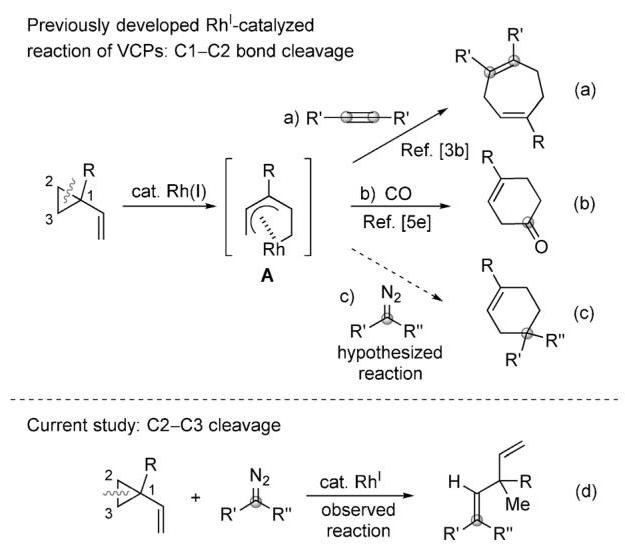
Scheme 1. Rhodium (I)-catalyzed reaction of VCPs through C-C bond cleavage.
方案1. 铑(I)催化的VCPs通过C-C键裂解的反应。
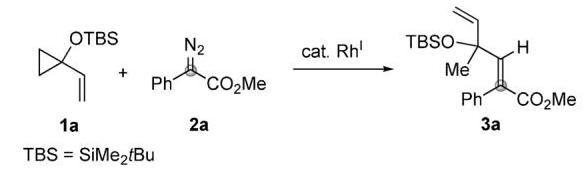
At the outset of the study, the siloxyvinycyclopropane 1a and $\alpha$ -diazoester $2\mathbf{a}$ were chosen as the substrates. With $\left\lbrack {\left\{ \mathrm{{Rh}}{\left( \mathrm{{CO}}\right) }_{2}\mathrm{{Cl}}\right\} }_{2}\right\rbrack$ as the catalyst and DCE as the solvent, the reaction was carried out at ${80}^{ \circ }\mathrm{C}$ for 4 hours, thus affording $3\mathbf{a}$ in 21% yield (Table 1, entry 1). With the initial result in hand, we proceeded to optimize the reaction conditions. In our first attempt (entry 1), we found that the low yield was due to the dimerization of $\mathbf{{2a}}$ , and $\mathbf{{1a}}$ largely remained unchanged. With slow addition of the diazoester, the yield was increased to 59% (entry 2). Switching to other solvents failed to significantly promote the reaction, and only 1,4-dioxane could give a slightly higher yield (entries 3-5). We then explored the effectiveness of other rhodium(I) catalysts. With Wilkinson’s catalyst, which has been typically employed in intramolecular [5+2] cycloaddition, ${}^{\left\lbrack 2\right\rbrack }$ 3a could also be obtained in comparable yields (entries 6 and 7). Gratifyingly, when [{Rh- (cod)Cl}2] was employed, 3a was isolated in 88% yield (entry 8). Lowering or elevating the reaction temperature did not show significant effect on the reaction (entries 9 and 10). Finally, under the optimized reaction conditions, if all the diazoester is added at once the yield fell to 11% (entry 11).
在研究开始时,选择硅氧基乙烯基环丙烷1a和$\alpha$-重氮酯$2\mathbf{a}$作为底物。以$\left\lbrack {\left\{ \mathrm{{Rh}}{\left( \mathrm{{CO}}\right) }_{2}\mathrm{{Cl}}\right\} }_{2}\right\rbrack$作为催化剂,DCE作为溶剂,反应在${80}^{ \circ }\mathrm{C}$下进行4小时,从而以21%的产率得到$3\mathbf{a}$(表1,条目1)。有了初步结果后,我们着手优化反应条件。在我们的第一次尝试(条目1)中,我们发现低产率是由于$\mathbf{{2a}}$的二聚化,并且$\mathbf{{1a}}$基本保持不变。缓慢加入重氮酯后,产率提高到59%(条目2)。切换到其他溶剂未能显著促进反应,只有1,4-二氧六环能给出略高的产率(条目3-5)。然后我们探索了其他铑(I)催化剂的效果。使用通常用于分子内[5+2]环加成的威尔金森催化剂,${}^{\left\lbrack 2\right\rbrack }$ 3a也能以相当的产率得到(条目6和7)。令人满意的是,当使用[{Rh-(cod)Cl}2]时,3a以88%的产率分离得到(条目8)。降低或升高反应温度对反应没有显著影响(条目9和10)。最后,在优化的反应条件下,如果一次性加入所有重氮酯,产率降至11%(条目11)。
[*] S. Feng, Prof. F. Mo, Dr. Y. Xia, Z. Liu, Z. Liu, Prof. Y. Zhang, Prof. J. Wang
[*] 冯S,莫F教授,夏Y博士,刘Z,刘Z,张Y教授,王J教授
Beijing National Laboratory of Molecular Sciences (BNLMS) and
北京分子科学国家实验室(BNLMS)和
Key Laboratory of Bioorganic Chemistry and Molecular
生物有机化学与分子
Engineering of Ministry of Education
教育部重点实验室
College of Chemistry, Peking University
北京大学化学与分子工程学院
Beijing 100871 (China)
北京100871(中国)
Prof. F. Mo
莫F教授
Department of Energy and Resources Engineering
能源与资源工程系
College of Engineering, Peking University
北京大学工学院
Beijing 100871 (China)
北京100871(中国)
Supporting information for this article can be found under: http://dx.doi.org/10.1002/anie.201609642.
本文的支持信息可在以下网址找到:http://dx.doi.org/10.1002/anie.201609642。
Table 1: Optimization experiments for the rhodium(I)-catalyzed reaction of $1\mathrm{a}$ and $2\mathrm{a}{.}^{\left\lbrack \mathrm{a}\right\rbrack }$
表1:铑(I)催化的$1\mathrm{a}$与$2\mathrm{a}{.}^{\left\lbrack \mathrm{a}\right\rbrack }$反应的优化实验
| Entry | Cat. ${\mathrm{{Rh}}}^{1}$ | Solvent (mL) | $T\left\lbrack {{}^{ \circ }\mathrm{C}}\right\rbrack$ | Yield ${\left\lbrack \% \right\rbrack }^{\left\lbrack b\right\rbrack }$ |
| ${1}^{\left\lbrack c\right\rbrack }$ | $\left\lbrack {\left\{ \mathrm{{Rh}}{\left( \mathrm{{CO}}\right) }_{2}\mathrm{{Cl}}\right\} }_{2}\right\rbrack$ | DCE (0.5) | 80 | 21[d] |
| 2 | $\left\lbrack {\left\{ \mathrm{{Rh}}{\left( \mathrm{{CO}}\right) }_{2}\mathrm{{Cl}}\right\} }_{2}\right\rbrack$ | DCE (0.1) | 80 | 59 |
| 3 | $\left\lbrack {\left\{ \mathrm{{Rh}}{\left( \mathrm{{CO}}\right) }_{2}\mathrm{{Cl}}\right\} }_{2}\right\rbrack$ | toluene (0.1) | 80 | 37 |
| 4 | $\left\lbrack {\left\{ \mathrm{{Rh}}{\left( \mathrm{{CO}}\right) }_{2}\mathrm{{Cl}}\right\} }_{2}\right\rbrack$ | 1,4-dioxane (0.1) | 80 | 61 |
| 5 | $\left\lbrack {\left\{ \mathrm{{Rh}}{\left( \mathrm{{CO}}\right) }_{2}\mathrm{{Cl}}\right\} }_{2}\right\rbrack$ | THF (0.1) | 80 | 50 |
| 6 | [Rh ${\left( {\mathrm{{PPh}}}_{3}\right) }_{3}\mathrm{{Cl}}$ ] | 1,4-dioxane (0.1) | 80 | 39 |
| 7 | [Rh ${\left( {\mathrm{{PPh}}}_{3}\right) }_{3}\mathrm{{Cl}}$ ] | ${\mathrm{{CDCl}}}_{3}$ (0.1) | 80 | 50 |
| 8 | [\{Rh(cod)Cl\}2] | 1,4-dioxane (0.1) | 80 | 89 (88) |
| 9 | [\{Rh(cod)Cl\}2] | 1,4-dioxane (0.1) | 70 | 80[d] |
| 10 | $\left\lbrack {\{ \mathrm{{Rh}}\left( \mathrm{{cod}}\right) \mathrm{{Cl}}{\} }_{2}}\right\rbrack$ | 1,4-dioxane (0.1) | 90 | 85[d] |
| 11 [C] | $\left\lbrack {\{ \mathrm{{Rh}}\left( \mathrm{{cod}}\right) \mathrm{{Cl}}{\} }_{2}}\right\rbrack$ | 1,4-dioxane (0.45) | 80 | 11 |
[a] If not otherwise noted, the reaction was carried out under the following reaction conditions: 1a (0.10 mmol) and cat. rhodium(I) (5 mol%) were dissolved in the solvent and the solution was stirred at the indicated temperature. To the solution was added dropwise over ${1.5}\mathrm{\;h}$ the solution of $2\mathrm{a}\left( {{0.15}\mathrm{{mmol}}}\right)$ dissolved in the same solvent $\left( {{0.35}\mathrm{\;{mL}}}\right)$ . The solution was stirred for another ${2.5}\mathrm{\;h}$ . [b] The yield was determined by ${}^{1}\mathrm{H}$ NMR spectroscopy if not otherwise noted. [c] 2 a was directly mixed with $1\mathrm{a}$ in solution. [d] Yield of isolated product.
[a] 除非另有说明,反应在以下反应条件下进行:1a(0.10 mmol)和铑(I)催化剂(5 mol%)溶解于溶剂中,溶液在指定温度下搅拌。在${1.5}\mathrm{\;h}$时间内,将溶解于相同溶剂$\left( {{0.35}\mathrm{\;{mL}}}\right)$中的$2\mathrm{a}\left( {{0.15}\mathrm{{mmol}}}\right)$溶液逐滴加入到该溶液中。溶液再搅拌${2.5}\mathrm{\;h}$时间。[b] 除非另有说明,产率通过${}^{1}\mathrm{H}$核磁共振光谱法测定。[c] 2a在溶液中直接与$1\mathrm{a}$混合。[d] 分离产物的产率。
With the optimized reaction conditions established, we then examined the substrate scope of this reaction (Scheme 2). A series of diazoesters (2a-t) were tested with 1a under the standard reaction conditions. To our delight, para- (2b-i), meta- (2j-m), ortho- (2n), and multisubstituted aryl diazoesters (2o) could all smoothly participate in this ring-opening reaction, thus affording the corresponding products 3b-o in good to excellent yields. Moreover, a naphthyl diazoester (2p) was also an efficient coupling partner. Replacing the carbomethoxy group in $\mathbf{{2a}}$ with more bulky ester groups (2q-s) had little effect on the efficiency of this reaction. When an optically pure diazoester (2t) was subjected to the reaction, equal amounts of the diastereoisomers were obtained. If the vinyl group is substituted by a butyl group, the butyl substituent remains on the vinyl group in the product (3u), thus indicating that the vinyl moiety in the product comes from the vinyl substituent instead of from the ethidene group in the VCP.
在确定了优化的反应条件后,我们接着研究了该反应的底物范围(方案2)。在标准反应条件下,用1a对一系列重氮酯(2a - t)进行了测试。令我们高兴的是,对 - (2b - i)、间 - (2j - m)、邻 - (2n)和多取代芳基重氮酯(2o)都能顺利参与该开环反应,从而以良好至优异的产率得到相应产物3b - o。此外,萘基重氮酯(2p)也是一种有效的偶联伙伴。用体积更大的酯基(2q - s)取代$\mathbf{{2a}}$中的甲氧基羰基对该反应的效率影响不大。当使用光学纯的重氮酯(2t)进行反应时,得到了等量的非对映异构体。如果乙烯基被丁基取代,丁基取代基在产物(3u)的乙烯基上保留,这表明产物中的乙烯基部分来自乙烯基取代基而非VCP中的亚乙基。
When a triisopropylsilyl substituted VCP (2v) was employed, the corresponding product was also formed, despite the lower yield. Next, the reaction of alkyl diazoesters $\left( {2\mathbf{w} - \mathbf{x}}\right)$ with $1\mathbf{a}$ was examined, and these diazoesters also proved to be good reaction partners. Notably, for all the reactions the stereoselectivity for the double bond in the products is excellent but in most cases the isolated products contain a trivial amount of isomers as judged by GC-MS and NMR analysis. The structure of two of the products $3\mathbf{h}$ and $3\mathbf{i}$ were unambiguously determined, by X-ray crystallography, as having an $E$ configuration. ${}^{\left\lbrack 9\right\rbrack }$ The configurations of all the other products are assigned as $E$ based on their ${}^{1}\mathrm{H}$ NMR spectra.
当使用三异丙基硅基取代的VCP(2v)时,尽管产率较低,但也形成了相应的产物。接下来,研究了烷基重氮酯$\left( {2\mathbf{w} - \mathbf{x}}\right)$与$1\mathbf{a}$的反应,这些重氮酯也被证明是良好的反应伙伴。值得注意的是,对于所有反应,产物中双键的立体选择性都非常好,但在大多数情况下,通过气相色谱 - 质谱联用和核磁共振分析判断,分离得到的产物含有少量异构体。通过X射线晶体学明确确定了两种产物$3\mathbf{h}$和$3\mathbf{i}$的结构为具有$E$构型。${}^{\left\lbrack 9\right\rbrack }$基于它们的${}^{1}\mathrm{H}$核磁共振光谱,将所有其他产物的构型指定为$E$。
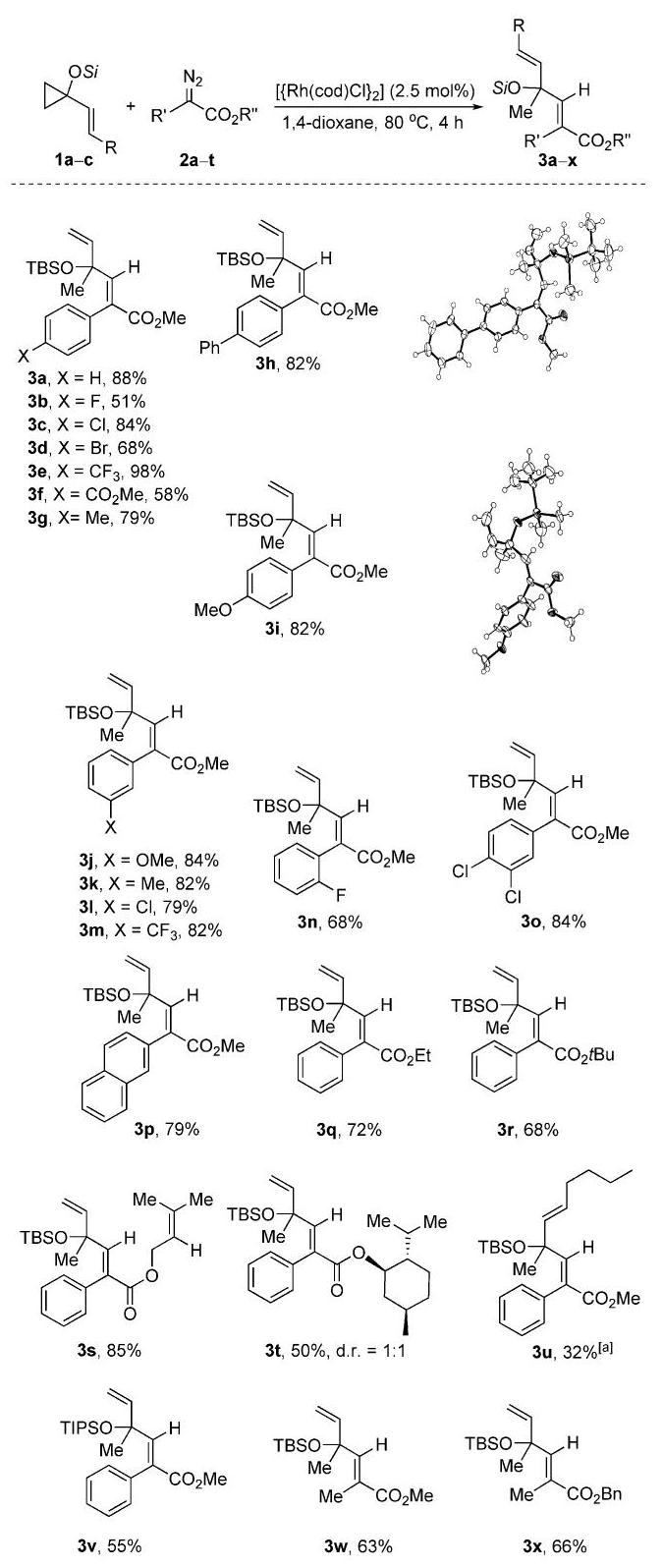
Scheme 2. Reaction scope. Unless otherwise noted, the reaction conditions are those described in entry 8 of Table 1. [a] The reaction was carried out at ${100}^{ \circ }\mathrm{C}$ . Thermal ellipsoids shown at ${30}\%$ probability for the X-ray structures of $3\mathrm{\;h}$ and $3\mathrm{i}$ . TBS $= {\mathrm{{SiMe}}}_{2}t\mathrm{{Bu}}$ , TIPS $= {\mathrm{{SiPr}}}_{3}$ .
方案2. 反应范围。除非另有说明,反应条件为表1第8项所述。[a] 反应在${100}^{ \circ }\mathrm{C}$进行。热椭球体以${30}\%$概率显示$3\mathrm{\;h}$和$3\mathrm{i}$的X射线结构。TBS $= {\mathrm{{SiMe}}}_{2}t\mathrm{{Bu}}$,TIPS $= {\mathrm{{SiPr}}}_{3}$。
To gain insight into the reaction mechanism, a stoichiometric reaction between $\left\lbrack {\mathrm{{Rh}}{\left( {\mathrm{{PPh}}}_{3}\right) }_{3}\mathrm{{Cl}}}\right\rbrack$ and $\mathbf{{1a}}$ was carried out at ${80}^{ \circ }\mathrm{C}$ for 30 minutes, and the $\sigma ,{\eta }^{3}$ -allyl rhodium species 4 was isolated in 44% yield (Scheme 3a). Its structure was determined by single-crystal X-ray analysis (Figure 1). ${}^{\left\lbrack 9\right\rbrack }$ Such a $\sigma ,{\eta }^{3}$ -allyl rhodium complex has been proposed as the key intermediate in rhodium(I)-catalyzed cycloaddition reactions of VCPs and $\pi$ -systems, however, isolation and characterization of such a complex is scarce. Bleeke and co-workers reported the single-crystal X-ray structure of [(2-tert-butyl- 1,3,4,5-η-pentenediyl) $\mathrm{{Fe}}{\left( {\mathrm{{PEt}}}_{3}\right) }_{2}{\left( \mathrm{{CNCMe}}\right) }_{3}$ ], but this complex was generated from deprotonation of $\left\lbrack \left( {\eta }^{5}\right. \right.$ -pentadienyl $)$ Fe- $\left. {\left( {\mathrm{{PMe}}}_{3}\right) }^{ + }\right\rbrack$ instead of from the reaction of iron catalyst with VCP. ${}^{\left\lbrack {10}\mathrm{a}\right\rbrack }$ Brown and co-workers synthesized the tetramer of a $\sigma ,{\eta }^{3}$ -allyl rhodium complex by reacting exo-6-vinylbicyclo- [3.1.0]hex-2-ene with $\left\lbrack {\left\{ \mathrm{{Rh}}{\left( {\mathrm{C}}_{2}{\mathrm{H}}_{4}\right) }_{2}\left( \text{ hfacac }\right) \right\} }_{2}\right\rbrack$ and confirmed its structure through X-ray diffraction. ${}^{\left\lbrack {10}\mathrm{\;b}\right\rbrack }$ A bipyridine ligated $\sigma ,{\eta }^{3}$ -allyl rhodium complex was reported by Jun and co-workers, ${}^{\left\lbrack {10}\mathrm{c}\right\rbrack }$ however, bipyridine has never been demonstrated to be an effective ligand in rhodium(I)-catalyzed cycloaddition reactions involving VCPs. Furthermore, they did not provide evidence on the structure of such a complex. To date, structural information for a monomer of $\sigma ,{\eta }^{3}$ -allyl rhodium complex obtained from the reaction of VCP derivatives with rhodium(I) catalysts is still lacking. Therefore, our finding provides valuable structural information for the investigation on the mechanism of rhodium(I)-catalyzed cycloaddition reactions involving VCPs.
为深入了解反应机理,在${80}^{ \circ }\mathrm{C}$下将$\left\lbrack {\mathrm{{Rh}}{\left( {\mathrm{{PPh}}}_{3}\right) }_{3}\mathrm{{Cl}}}\right\rbrack$与$\mathbf{{1a}}$进行化学计量反应30分钟,以44%的产率分离得到了$\sigma ,{\eta }^{3}$-烯丙基铑物种4(方案3a)。其结构通过单晶X射线分析确定(图1)。${}^{\left\lbrack 9\right\rbrack }$这样的$\sigma ,{\eta }^{3}$-烯丙基铑配合物被认为是铑(I)催化的VCPs与$\pi$-体系环加成反应的关键中间体,然而,分离和表征这样的配合物却很少见。Bleeke及其同事报道了[(2-叔丁基-1,3,4,5-η-戊二烯基)$\mathrm{{Fe}}{\left( {\mathrm{{PEt}}}_{3}\right) }_{2}{\left( \mathrm{{CNCMe}}\right) }_{3}$]的单晶X射线结构,但该配合物是由$\left\lbrack \left( {\eta }^{5}\right. \right.$-戊二烯基$)$Fe-$\left. {\left( {\mathrm{{PMe}}}_{3}\right) }^{ + }\right\rbrack$去质子化生成的,而不是由铁催化剂与VCP反应生成的。${}^{\left\lbrack {10}\mathrm{a}\right\rbrack }$Brown及其同事通过使外型-6-乙烯基双环[3.1.0]己-2-烯与$\left\lbrack {\left\{ \mathrm{{Rh}}{\left( {\mathrm{C}}_{2}{\mathrm{H}}_{4}\right) }_{2}\left( \text{ hfacac }\right) \right\} }_{2}\right\rbrack$反应合成了$\sigma ,{\eta }^{3}$-烯丙基铑配合物的四聚体,并通过X射线衍射确定了其结构。${}^{\left\lbrack {10}\mathrm{\;b}\right\rbrack }$Jun及其同事报道了一种联吡啶配位的$\sigma ,{\eta }^{3}$-烯丙基铑配合物,${}^{\left\lbrack {10}\mathrm{c}\right\rbrack }$然而,在铑(I)催化的涉及VCPs的环加成反应中,联吡啶从未被证明是一种有效的配体。此外,他们没有提供该配合物结构的证据。迄今为止,仍缺乏从VCP衍生物与铑(I)催化剂反应得到的$\sigma ,{\eta }^{3}$-烯丙基铑配合物单体的结构信息。因此,我们的发现为研究铑(I)催化的涉及VCPs的环加成反应机理提供了有价值的结构信息。
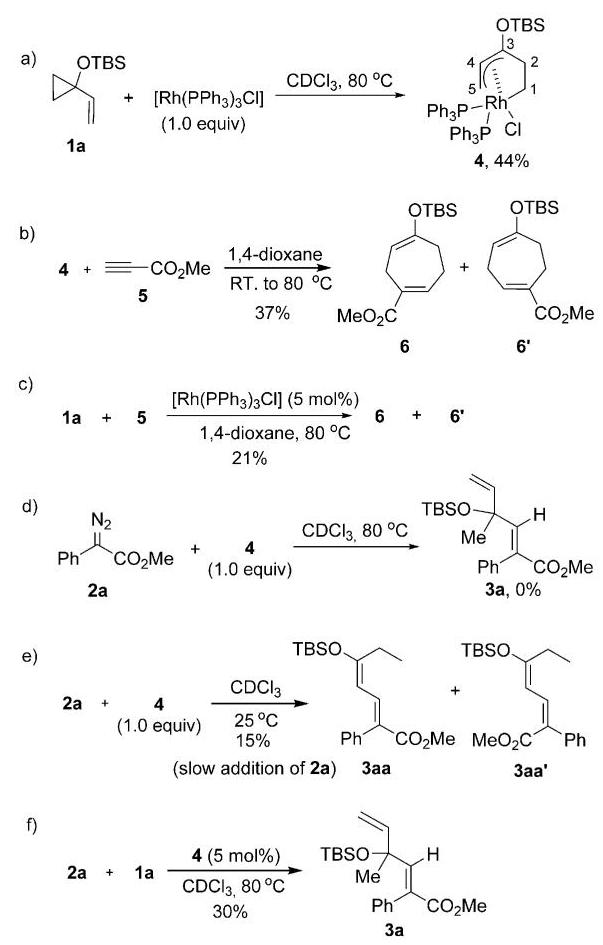
Scheme 3. Experiments for mechanistic understanding.
方案3. 用于机理理解的实验。
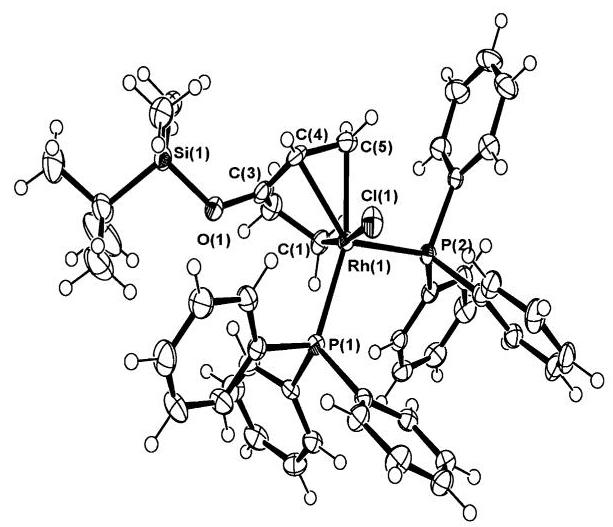
Figure 1. X-ray structure of the σ, ${\eta }^{3}$ -allyl rhodium complex 4. Thermal ellipsoids shown at 30% probability. Selected bond lengths [Å]: Rh-C(1) 2.079, Rh-C(3) 2.436, Rh-C(4) 2.215, Rh-C(5) 2.105, C(1)-C(2) 1.521, C(2)-C(3) 1.501, C(3)-C(4) 1.374, C(4)-C(5) 1.430.
图1. σ,${\eta }^{3}$-烯丙基铑配合物4的X射线结构。热椭球以30%概率显示。选定键长[Å]:Rh-C(1) 2.079,Rh-C(3) 2.436,Rh-C(4) 2.215,Rh-C(5) 2.105,C(1)-C(2) 1.521,C(2)-C(3) 1.501,C(3)-C(4) 1.374,C(4)-C(5) 1.430。
With the rhodium complex 4 in hand, we proceeded to investigate its properties. Interestingly, we found that 4 in solution decomposes at elevated temperature to form [{Rh- $\left. {{\left( {\mathrm{{PPh}}}_{3}\right) }_{2}\mathrm{{Cl}}{\} }_{2}}\right\rbrack$ and other unidentified compounds, but4was regenerated with the treatment of silica gel. ${}^{\left\lbrack {11}\right\rbrack }$ Moreover,4 was found to react with the alkyne 5 to give the [5+2] cycloadducts 6 and ${6}^{\prime }$ in 37% yield (Scheme 3b), while the corresponding catalytic reaction between $1\mathrm{a}$ and5afforded 6 and ${6}^{\prime }$ in 21% yield (Scheme 3c). These results provide direct experimental support for the previously proposed mechanism of rhodium(I)-catalyzed reaction between VCPs and alkynes.
得到铑配合物4后,我们着手研究其性质。有趣的是,我们发现4在溶液中于高温下分解,形成[{Rh - $\left. {{\left( {\mathrm{{PPh}}}_{3}\right) }_{2}\mathrm{{Cl}}{\} }_{2}}\right\rbrack$和其他未鉴定的化合物,但用硅胶处理后4又会再生。${}^{\left\lbrack {11}\right\rbrack }$ 此外,发现4与炔烃5反应生成[5 + 2]环加成产物6和${6}^{\prime }$,产率为37%(方案3b),而$1\mathrm{a}$与5之间的相应催化反应得到6和${6}^{\prime }$的产率为21%(方案3c)。这些结果为先前提出的铑(I)催化的VCPs与炔烃反应的机理提供了直接的实验支持。
To find out whether4is also the key intermediate in reactions between VCPs and diazoesters,4was subjected to the reaction with $2\mathbf{a}$ at ${80}^{ \circ }\mathrm{C}$ . However, the formation of $3\mathbf{a}$ was not observed as judged by GC-MS and ${}^{1}\mathrm{H}$ NMR spectra, and 4 decomposed completely (Scheme 3d). Furthermore, with slow addition of $\mathbf{{2a}}$ into the solution of4at ${25}^{ \circ }\mathrm{C}$ , two isomers (3aa and 3aa’) of 3a were obtained in low yields, but 3a was not formed under such reaction conditions (Scheme 3e). The formation of $\mathbf{{3aa}}$ and ${\mathbf{{3aa}}}^{\prime }$ can be rationalized by the rhodium carbene formation from the reaction of $\mathbf{{2a}}$ with 4, followed by migratory insertion, $\beta$ -H elimination, and reductive elimination. Interestingly, 3a could be obtained in 30% yield when $\mathbf{{1a}}$ was reacted with $\mathbf{{2a}}$ at ${80}^{ \circ }\mathrm{C}$ with4as the catalyst (Scheme 3 f).
为了弄清楚4是否也是VCPs与重氮酯反应的关键中间体,使4在${80}^{ \circ }\mathrm{C}$ 下与$2\mathbf{a}$反应。然而,通过GC - MS和${}^{1}\mathrm{H}$ NMR光谱判断,未观察到$3\mathbf{a}$的形成,并且4完全分解(方案3d)。此外,在${25}^{ \circ }\mathrm{C}$ 下将$\mathbf{{2a}}$缓慢加入到4的溶液中,以低产率得到了3a的两种异构体(3aa和3aa’),但在这种反应条件下未形成3a(方案3e)。$\mathbf{{3aa}}$和${\mathbf{{3aa}}}^{\prime }$的形成可以通过$\mathbf{{2a}}$与4反应生成铑卡宾,随后进行迁移插入、$\beta$ - H消除和还原消除来解释。有趣的是,当$\mathbf{{1a}}$在${80}^{ \circ }\mathrm{C}$ 下以4为催化剂与$\mathbf{{2a}}$反应时,可以得到产率为30%的3a(方案3f)。
We also investigated the reactivity of VCP with other rhodium(I) catalysts which were found to be capable of catalyzing this reaction. In stoichiometric reactions between 1a and $\left\lbrack {\left\{ \mathrm{{Rh}}\left( \mathrm{{cod}}\right) \mathrm{{Cl}}\right\} }_{2}\right\rbrack$ at both room temperature as well as ${80}^{ \circ }\mathrm{C}$ , we found that $\mathbf{{1a}}$ completely remained unchanged and no sign of the $\sigma ,{\eta }^{3}$ -allyl rhodium complex was observed in the ${}^{1}$ H NMR spectra. ${}^{\left\lbrack {11}\right\rbrack }$ In contrast to this, the stoichiometric reaction between $1\mathrm{a}$ and $\left\lbrack {\left\{ \mathrm{{Rh}}{\left( \mathrm{{CO}}\right) }_{2}\mathrm{{Cl}}\right\} }_{2}\right\rbrack$ proceeded very quickly at room temperature to afford a mixture which supposedly consisted of $\sigma ,{\eta }^{3}$ -allyl and $\sigma ,{\eta }^{1}$ -allyl rhodium species. ${}^{\left\lbrack 3b\right\rbrack }$ After the mixture was heated at ${80}^{ \circ }\mathrm{C}$ for 30 minutes, these two complexes did not decompose though their ratio changed, and about 5% of VCP still remained. Therefore we can conclude that the reaction between VCP and $\left\lbrack {\left\{ \mathrm{{Rh}}{\left( \mathrm{{CO}}\right) }_{2}\mathrm{{Cl}}\right\} }_{2}\right\rbrack$ is fast and reversible. The solid extracted from this solution was also used to catalyze the standard reaction, and the product was obtained in 35% yield. ${}^{\left\lbrack {11}\right\rbrack }$
我们还研究了VCP与其他铑(I)催化剂的反应活性,发现这些催化剂能够催化该反应。在1a与$\left\lbrack {\left\{ \mathrm{{Rh}}\left( \mathrm{{cod}}\right) \mathrm{{Cl}}\right\} }_{2}\right\rbrack$在室温以及${80}^{ \circ }\mathrm{C}$下的化学计量反应中,我们发现$\mathbf{{1a}}$完全保持不变,并且在${}^{1}$ H NMR光谱中未观察到$\sigma ,{\eta }^{3}$ -烯丙基铑配合物的迹象。${}^{\left\lbrack {11}\right\rbrack }$与此相反,$1\mathrm{a}$与$\left\lbrack {\left\{ \mathrm{{Rh}}{\left( \mathrm{{CO}}\right) }_{2}\mathrm{{Cl}}\right\} }_{2}\right\rbrack$之间的化学计量反应在室温下进行得非常快,得到了一种混合物,据推测该混合物由$\sigma ,{\eta }^{3}$ -烯丙基和$\sigma ,{\eta }^{1}$ -烯丙基铑物种组成。${}^{\left\lbrack 3b\right\rbrack }$将混合物在${80}^{ \circ }\mathrm{C}$下加热30分钟后,这两种配合物虽然比例发生了变化,但并未分解,仍有约5%的VCP残留。因此我们可以得出结论,VCP与$\left\lbrack {\left\{ \mathrm{{Rh}}{\left( \mathrm{{CO}}\right) }_{2}\mathrm{{Cl}}\right\} }_{2}\right\rbrack$之间的反应是快速且可逆的。从该溶液中提取的固体也用于催化标准反应,产物收率为35%。${}^{\left\lbrack {11}\right\rbrack }$
These results lead us to conclude that the widely accepted $\sigma ,{\eta }^{3}$ -allyl rhodium intermediate in VCP-involved rhodium-catalyzed reactions may not be a key intermediate in the catalytic cycle of this reaction. Instead, it more likely serves as a resting state for the catalyst in the cases of $\left\lbrack {\mathrm{{Rh}}{\left( {\mathrm{{PPh}}}_{3}\right) }_{3}\mathrm{{Cl}}}\right\rbrack$ and $\left\lbrack {\left\{ \mathrm{{Rh}}{\left( \mathrm{{CO}}\right) }_{2}\mathrm{{Cl}}\right\} }_{2}\right\rbrack$ catalysis. Since the diazo substrate is slowly added by peristaltic pump to the reaction solution, the fast reaction between VCP and $\left\lbrack {\mathrm{{Rh}}{\left( {\mathrm{{PPh}}}_{3}\right) }_{3}\mathrm{{Cl}}}\right\rbrack$ or $\lbrack \{ \mathrm{{Rh}} - \; \left. {{\left( \mathrm{{CO}}\right) }_{2}\mathrm{{Cl}}{\} }_{2}}\right\rbrack$ may reach an equilibrium at ${80}^{ \circ }\mathrm{C}$ . As the diazoester enters the solution, in comparison with 4 , the sterically less hindered rhodium(I) species, which is in equilibrium with the former, readily reacts with the diazo substrate to generate rhodium carbene intermediate. Since the formation of rhodium carbene is irreversible, the consumption of the rhodium(I) species will cause the equilibrium between ${\mathrm{{Rh}}}^{\mathrm{I}}$ and $\sigma ,{\eta }^{3}$ -allyl ${\mathrm{{Rh}}}^{\mathrm{{III}}}$ to shift. Thus,4 only serves as a resting state for the active catalyst.
这些结果使我们得出结论,在涉及VCP的铑催化反应中被广泛接受的$\sigma ,{\eta }^{3}$ -烯丙基铑中间体可能不是该反应催化循环中的关键中间体。相反,在$\left\lbrack {\mathrm{{Rh}}{\left( {\mathrm{{PPh}}}_{3}\right) }_{3}\mathrm{{Cl}}}\right\rbrack$和$\left\lbrack {\left\{ \mathrm{{Rh}}{\left( \mathrm{{CO}}\right) }_{2}\mathrm{{Cl}}\right\} }_{2}\right\rbrack$催化的情况下,它更可能作为催化剂的静止状态。由于重氮底物通过蠕动泵缓慢添加到反应溶液中,VCP与$\left\lbrack {\mathrm{{Rh}}{\left( {\mathrm{{PPh}}}_{3}\right) }_{3}\mathrm{{Cl}}}\right\rbrack$或$\lbrack \{ \mathrm{{Rh}} - \; \left. {{\left( \mathrm{{CO}}\right) }_{2}\mathrm{{Cl}}{\} }_{2}}\right\rbrack$之间的快速反应可能在${80}^{ \circ }\mathrm{C}$达到平衡。随着重氮酯进入溶液,与4相比,空间位阻较小的铑(I)物种与前者处于平衡状态,它很容易与重氮底物反应生成铑卡宾中间体。由于铑卡宾的形成是不可逆的,铑(I)物种的消耗将导致${\mathrm{{Rh}}}^{\mathrm{I}}$与$\sigma ,{\eta }^{3}$ -烯丙基${\mathrm{{Rh}}}^{\mathrm{{III}}}$之间的平衡发生移动。因此,4仅作为活性催化剂的静止状态。
Based on the above rationalization, a plausible mechanism is proposed (Scheme 4). First, the rhodium(I) carbene $\mathbf{A}$ is formed from the reaction of $\mathbf{{2a}}$ with a rhodium(I) species. The formation of the rhodium(I) carbene dramatically increases the steric hindrance around the rhodium center. Because of the bulky siloxy group on C1 of $\mathbf{{1a}}$ , it is difficult for the rhodium carbene to approach the C1-C2 bond of the VCP and thus the cleavage of this bond is hampered. Instead, the rhodium carbene inserts into the less crowded C2-C3 bond of VCP to generate the cyclic rhodium(III) complex B. Subsequently, $\mathbf{B}$ undergoes migratory insertion, $\beta$ -H elimination, and reductive elimination to afford the product and regenerate the catalyst. ${}^{\left\lbrack {12}\right\rbrack }$ To probe the role of vinyl and siloxy groups of VCPs in this reaction, other cyclopropane derivatives were synthesized and subjected to the standard reaction conditions. ${}^{\left\lbrack {11}\right\rbrack }$
基于上述推理,提出了一种合理的机理(方案4)。首先,铑(I)卡宾$\mathbf{A}$由$\mathbf{{2a}}$与铑(I)物种反应形成。铑(I)卡宾的形成极大地增加了铑中心周围的空间位阻。由于$\mathbf{{1a}}$的C1上存在庞大的硅氧基,铑卡宾难以接近VCP的C1-C2键,因此该键的裂解受到阻碍。相反,铑卡宾插入到VCP中拥挤程度较低的C2-C3键中,生成环状铑(III)配合物B。随后,$\mathbf{B}$经历迁移插入、$\beta$-H消除和还原消除,得到产物并使催化剂再生。${}^{\left\lbrack {12}\right\rbrack }$为了探究VCPs的乙烯基和硅氧基在该反应中的作用,合成了其他环丙烷衍生物并使其在标准反应条件下反应。${}^{\left\lbrack {11}\right\rbrack }$
In conclusion, we have demonstrated the first example of transition metal induced, selective cleavage of the C2-C3 bond of VCPs. Increasing the steric hindrance around the rhodium center, by forming rhodium carbene, is proposed to be the rationale for this process. This finding highlights the possibility that by ligating the transition-metal center with bulky ligands, regioselective cleavage of C2-C3 bond in VCPs might occur to afford a four-membered metallocyclic species. If such a process is achieved, its combination with a $\pi$ -system insertion process can open up new chemistry in the field of developing VCPs-involved cycloaddition reactions. Furthermore, we have isolated and characterized a $\sigma ,{\eta }^{3}$ -allyl rhodium complex and it proved to be the key intermediate in the rhodium(I)-catalyzed reactions of VCPs and alkynes.
总之,我们展示了过渡金属诱导的VCPs的C2-C3键选择性裂解的首个例子。通过形成铑卡宾来增加铑中心周围的空间位阻,被认为是这一过程的基本原理。这一发现突出了通过用庞大的配体连接过渡金属中心,VCPs中C2-C3键可能发生区域选择性裂解以得到四元金属环物种的可能性。如果实现了这样一个过程,则其与$\pi$-体系插入过程的结合可以在开发涉及VCPs的环加成反应领域开辟新的化学领域。此外,我们分离并表征了结$\sigma ,{\eta }^{3}$-烯丙基铑配合物,并且证明它是铑(I)催化的VCPs与炔烃反应中的关键中间体。
Acknowledgments
致谢
The project is supported by the National Basic Research Program of China (973 Program, No. 2015CB856600) and NSFC (Grant 21472004 and 21332002). F.M. and Y.X. contributed equally to this work. We greatly appreciate Prof. Wenxiong Zhang and Dr. Nengdong Wang (Peking University) for the assistance in obtaining X-ray crystallographic structures. We also thank Prof. Zhixiang Yu and Mr. Yi Wang (Peking University) for mechanistic discussions.
本项目得到了中国国家基础研究计划(973计划,编号2015CB856600)和国家自然科学基金(项目批准号21472004和21332002)的资助。F.M.和Y.X.对本工作贡献相同。我们非常感谢张文雄教授和王能东博士(北京大学)在获取X射线晶体结构方面提供的帮助。我们也感谢余志祥教授和王毅先生(北京大学)进行的机理讨论。
Keywords: C-C activation $\cdot$ carbenes $\cdot$ diazo compounds $\cdot$ rhodium $\cdot$ small ring systems
关键词:碳 - 碳活化 $\cdot$ 卡宾 $\cdot$ 重氮化合物 $\cdot$ 铑 $\cdot$ 小环体系
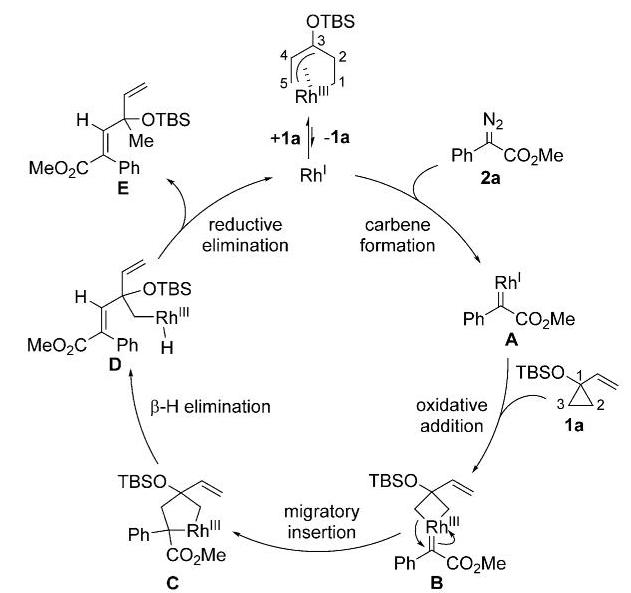
Scheme 4. Proposed mechanism.
方案4. 提出的机理。
4
[1] For reviews, see: a) M. Rubin, M. Rubina, V. Gevorgyan, Chem. Rev. 2007, 107, 3117-3179; b) K. E. O. Ylijoki, J. M. Stryker, Chem. Rev. 2013, 113, 2244-2266; c) L. Jiao, Z. Yu, J. Org. Chem. 2013, 78, 6842-6848; d) Y. Wang, Z. Yu, Acc. Chem. Res. 2015, 48, 2288-2296.
[2] P. A. Wender, H. Takahashi, B. Witulski, J. Am. Chem. Soc. 1995, 117, 4720-4721.
[3] For selected examples of [5+2] cycloadditions, see: a) P. A. Wender, C. O. Husfeld, E. Langkopf, J. A. Love, J. Am. Chem. Soc. 1998, 120, 1940-1941; b) P. A. Wender, H. Rieck, M. Fuji, J. Am. Chem. Soc. 1998, 120, 10976-10977; c) P. A. Wender, T. M. Pedersen, M. J. C. Scanio, J. Am. Chem. Soc. 2002, 124, 15154- 15155; d) H. A. Wegner, A. Meijere, P. A. Wender, J. Am. Chem. Soc. 2005, 127, 6530-6531.
[4] For [3+2] cycloadditions, see: a) L. Jiao, S. Ye, Z. Yu, J. Am. Chem. Soc. 2008, 130, 7178-7179; b) L. Jiao, M. Lin, Z. Yu, Chem. Commun. 2010, 46, 1059-1061; c) Q. Li, G. Jiang, L. Jiao, Z. Yu, Org. Lett. 2010, 12, 1332-1335; d) M. Lin, G. Y. Kang, Y. A. Guo, Z. Yu, J. Am. Chem. Soc. 2012, 134, 398-405.
[5] For [5+2+1]/[3+2+1]/[5+1] cycloadditions, see: a) P. A. Wender, G. G. Gamber, R. D. Hubbard, L. Zhang, J. Am. Chem. Soc. 2002, 124, 2876-2877; b) Y. Wang, J. Wang, J. Su, F. Huang, L. Jiao, Y. Liang, D. Yang, S. Zhang, P. A. Wender, Z. Yu, J. Am. Chem. Soc. 2007, 129, 10060-10061; c) L. Jiao, M. Lin, L. Zhuo, Z. Yu, Org. Lett. 2010, 12, 2528-2531; d) M. Lin, F. Li, L. Jiao, Z. Yu, J. Am. Chem. Soc. 2011, 133, 1690-1693; e) G. Jiang, X. Fu, Q. Li, Z. Yu, Org. Lett. 2012, 14, 692-695.
[6] For mechanistic studies, see: a) Z. Yu, P. A. Wender, K. N. Houk, J. Am. Chem. Soc. 2004, 126, 9154-9155; b) P. Liu, L. E. Sirois, P. H. Cheong, Z. Yu, I. V. Hartung, H. Rieck, P. A. Wender, K. N. Houk, J. Am. Chem. Soc. 2010, 132, 10127-10135; c) L. Jiao, M. Lin, Z. Yu, J. Am. Chem. Soc. 2011, 133, 447-461; d) M. C. Melcher, H. Wachenfeldt, A. Sundin, D. Strand, Chem. Eur. J. 2015, 21, 531-535.
[7] For reviews, see: a) J. Barluenga, C. Valdés, Angew. Chem. Int. Ed. 2011, 50, 7486-7500; Angew. Chem. 2011, 123, 7626-7640; b) Z. Shao, H. Zhang, Chem. Soc. Rev. 2012, 41, 560-572; c) Q. Xiao, Y. Zhang, J. Wang, Acc. Chem. Res. 2013, 46, 236-247; d) Z. Liu, J. Wang, J. Org. Chem. 2013, 78, 10024-10030; e) Y. Xia, Y. Zhang, J. Wang, ACS Catal. 2013, 3, 2586-2598.
[8] Y. Xia, Z. Liu, Z. Liu, R. Ge, F. Ye, M. Hossain, Y. Zhang, J. Wang, J. Am. Chem. Soc. 2014, 136, 3013-3015.
[9] CCDC 1494934, 1494935 and 1494936 contain the supplementary crystallographic data for $3\mathbf{h},3\mathbf{i}$ , and4, respectively. These data can be obtained free of charge from The Cambridge Crystallographic Data Centre via www.ccdc.cam.ac.uk/data_request/cif.
[10] a) R. J. Bleeke, R. J. Wittenbrink, T. W. Clayton, M. Y. Chiang, J. Am. Chem. Soc. 1990, 112, 6539-6545; b) N. W. Alcock, J. M. Brown, J. A. Conneely, D. H. Williamson, J. Chem. Soc. Perkin Trans. 2 1979, 962-971; c) C. Jun, J. Kang, Y. Lim, Tetrahedron Lett. 1995, 36, 277-280.
[11] For details, see the Supporting Information.
[12] As suggested by one of the referees, an alternative mechanism which involves an $\alpha$ -hydride elimination from the intermediate B to generate a metallocyclobutene intermediate with two carbene ligands on the rhodium center, followed by carbene dimerization and reductive elimination to form the $\mathrm{C} - \mathrm{H}$ bond, is also possible. Further computational and experimental studies to unambiguously elucidate the mechanism are currently under way and the results will be reported in due course.
Received: October 2, 2016
收到日期:2016年10月2日
Published online:
在线发表日期:
Communications
通讯
Communications
通讯
plex, which has been previously proposed
先前已提出的配合物
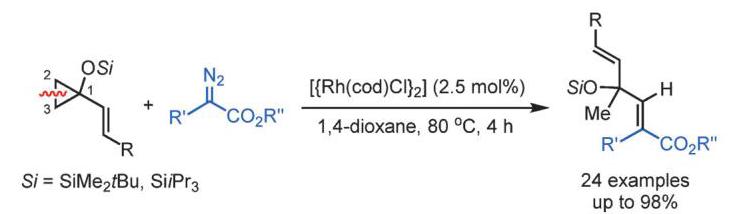
Break of a different kind: The title reaction demonstrates a novel mode of $\mathrm{C} - \mathrm{C}$ bond cleavage of siloxyvinylcyclopro-as the key intermediate in rhodium(I)-
另一种类型的断裂:标题反应展示了硅氧基乙烯基环丙烷$\mathrm{C} - \mathrm{C}$键断裂的新方式,作为铑(I)催化的乙烯基环丙烷环加成反应中的关键中间体。
catalyzed cycloaddition of vinylcyclopro-
催化的乙烯基环丙烷环加成反应
panes. In the study of the reaction panes, has been isolated and character-
在反应机理的研究中,乙烯基环丙烷已被分离出来,并通过X射线晶体学进行了表征。
mechanism, a $\sigma ,{\eta }^{3}$ -allyl rhodium com-ized by X-ray crystallography.
在反应机理的研究中,一种$\sigma ,{\eta }^{3}$ -烯丙基铑配合物已被分离出来,并通过X射线晶体学进行了表征。
Diazo Compounds
重氮化合物
S. Feng, F. Mo, Y. Xia, Z. Liu, Z. Liu,
S. 冯, F. 莫, Y. 夏, Z. 刘, Z. 刘
Y. Zhang, J. Wang* ___ IIII-III
Y. 张, J. 王* ___ IIII-III
Rhodium (I)-Catalyzed C-C Bond Activation of Siloxyvinylcyclopropanes with Diazoesters
铑(I)催化的硅氧基乙烯基环丙烷与重氮酯的C-C键活化反应