Enantioselective Synthesis of Trisubstituted Allenes via Cu(I)-Catalyzed Coupling of Diazoalkanes with Terminal Alkynes
英文原文与中文译文逐段对照 · English original with Chinese translation
Wen-Dao Chu, Lei Zhang, Zhikun Zhang, Qi Zhou, Fanyang Mo, Yan Zhang, and Jianbo Wang
朱文道,张雷,张志坤,周琦,莫凡洋,张燕,王剑波
J. Am. Chem. Soc., Just Accepted Manuscript - Publication Date (Web): 27 Oct 2016 Downloaded from http://pubs.acs.org on October 27, 2016
《美国化学会志》,刚接收的稿件 - 网络出版日期:2016年10月27日 于2016年10月27日从http://pubs.acs.org下载
Just Accepted
刚被接受
“Just Accepted” manuscripts have been peer-reviewed and accepted for publication. They are posted online prior to technical editing, formatting for publication and author proofing. The American Chemical Society provides “Just Accepted” as a free service to the research community to expedite the dissemination of scientific material as soon as possible after acceptance. “Just Accepted” manuscripts appear in full in PDF format accompanied by an HTML abstract. “Just Accepted” manuscripts have been fully peer reviewed, but should not be considered the official version of record. They are accessible to all readers and citable by the Digital Object Identifier (DOI(R)). “Just Accepted” is an optional service offered to authors. Therefore, the “Just Accepted” Web site may not include all articles that will be published in the journal. After a manuscript is technically edited and formatted, it will be removed from the “Just Accepted” Web site and published as an ASAP article. Note that technical editing may introduce minor changes to the manuscript text and/or graphics which could affect content, and all legal disclaimers and ethical guidelines that apply to the journal pertain. ACS cannot be held responsible for errors or consequences arising from the use of information contained in these “Just Accepted” manuscripts.
“刚被接受"的稿件已经经过同行评审并被接受发表。它们在进行技术编辑、排版以供发表和作者校对之前就会在线发布。美国化学学会提供“刚被接受”这项免费服务给研究界,以便在稿件被接受后尽快加速科学材料的传播。“刚被接受”的稿件以PDF格式全文呈现,并附有HTML摘要。“刚被接受”的稿件已经经过全面的同行评审,但不应被视为正式的记录版本。所有读者都可以访问这些稿件,并且可以通过数字对象标识符(DOI(R))进行引用。“刚被接受”是一项提供给作者的可选服务。因此,“刚被接受”网站可能不包括该期刊将要发表的所有文章。稿件经过技术编辑和排版后,将从“刚被接受”网站上移除,并作为一篇尽快发表的文章发表。请注意,技术编辑可能会对手稿文本和/或图表进行一些细微的更改,这可能会影响内容,并且适用于该期刊的所有法律免责声明和道德准则仍然适用。美国化学学会不对因使用这些“刚被接受”稿件中包含的信息而产生的错误或后果负责。
ACS Publications
美国化学会出版物
Journal of the American Chemical Society is published by the American Chemical Society. 1155 Sixteenth Street N.W., Washington, DC 20036
《美国化学会志》由美国化学会出版。华盛顿特区西北第十六街1155号,邮编20036
Published by American Chemical Society. Copyright © American Chemical Society. However, no copyright claim is made to original U.S. Government works, or works produced by employees of any Commonwealth realm Crown government in the course
由美国化学会出版。版权所有©美国化学会。然而,对于美国政府的原始作品或任何英联邦王国政府的雇员在工作过程中创作的作品,不主张版权
Enantioselective Synthesis of Trisubstituted Allenes via Cu(I)- Catalyzed Coupling of Diazoalkanes with Terminal Alkynes
通过铜(I)催化重氮烷与末端炔烃的偶联实现三取代丙二烯的对映选择性合成
Wen-Dao Chu, ${}^{ \dagger }$ Lei Zhang, ${}^{ \dagger }$ Zhikun Zhang, ${}^{ \dagger }$ Qi Zhou, ${}^{ \dagger }$ Fanyang Mo, ${}^{ \dagger }$ Yan Zhang ${}^{ \dagger }$ and Jianbo Wang ${}^{*,\dagger , \ddagger }$
朱文道,${}^{ \dagger }$ 张雷,${}^{ \dagger }$ 张志坤,${}^{ \dagger }$ 周琦,${}^{ \dagger }$ 莫凡洋,${}^{ \dagger }$ 张岩 ${}^{ \dagger }$ 和王剑波 ${}^{*,\dagger , \ddagger }$
Beijing National Laboratory of Molecular Sciences (BNLMS), Key Laboratory of Bioorganic Chemistry and Molecular Engineering of Ministry of Education, College of Chemistry, Peking University, Beijing 100871, China, and State Key Laboratory of Organometallic Chemistry, Chinese Academy of Sciences, Shanghai 200032, China
北京分子科学国家实验室(BNLMS),教育部生物有机化学与分子工程重点实验室,北京大学化学与分子工程学院,北京 100871,中国,以及中国科学院有机金属化学国家重点实验室,上海 200032,中国
Supporting Information Placeholder
支持信息占位符
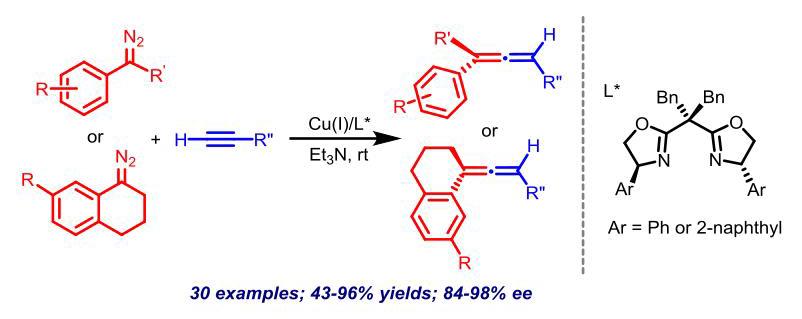
ABSTRACT: A highly enantioselective synthesis of trisubstituted allenes has been achieved through Cu(I)-catalyzed cross-coupling of aryldiazoalkanes and terminal aklynes with chiral bisoxazoline ligands. Alkynyl migratory insertion of Cu(I) carbene is proposed as the key step for the construction of axial chirality.
摘要:通过铜(I)催化芳基重氮烷与末端炔烃在手性双恶唑啉配体存在下的交叉偶联反应,实现了三取代丙二烯的高对映选择性合成。提出了铜(I)卡宾的炔基迁移插入反应是构建轴手性的关键步骤。
Due to their unique structure feature and reactivities, allenes have attracted significant attentions in the fields of organic synthesis, natural product chemistry and material sciences. ${}^{1,2}$ In particular, chiral allenes are a type of fascinating molecules possessing axial chirality and have found many applications as useful building blocks in organic synthesis. ${}^{2}$ Accordingly, substantial efforts have been made toward the stereoselective synthesis of axially chiral allenes. ${}^{3}$ Early successful examples relied on the resolution of racemic allenes, ${}^{4}$ and the reactions involving chirality transfer from enantiomerically enriched propargylic derivatives. ${}^{5}$ The construction of axial chirality of allenes through asymmetric catalysis remains a substantially challenging problem. Recently, some progresses have been made in catalytic asymmetric synthesis of chiral allenes, which include nucleophilic addition to enynes, ${}^{6}\beta$ -hydride elimination of enol triflates, ${}^{7}$ enantioselective functionalization of racemic allenes, ${}^{8}$ sigmatropic rearrangements of alkynes, ${}^{9}$ isomerization of 3-alkynes, ${}^{10}$ and Mukaiyama aldol reactions. ${}^{11}$ Despite all these successful catalytic systems, there are still limitations with the existing methods such as the need to use expensive metals, complex substrates, limited scopes, and the possible formation of homo-propargylic alcohols as the byproducts in some cases.
由于丙二烯独特的结构特征和反应活性,它们在有机合成、天然产物化学和材料科学领域引起了广泛关注。${}^{1,2}$ 特别是,手性丙二烯是一类具有轴手性的迷人分子,并已作为有机合成中的有用结构单元得到了许多应用。${}^{2}$ 因此,人们为轴手性丙二烯的立体选择性合成付出了巨大努力。${}^{3}$ 早期的成功例子依赖于外消旋丙二烯的拆分,${}^{4}$ 以及涉及从对映体富集的炔丙基衍生物进行手性转移的反应。${}^{5}$ 通过不对称催化构建丙二烯的轴手性仍然是一个极具挑战性的问题。最近,在手性丙二烯的催化不对称合成方面取得了一些进展,包括对烯炔的亲核加成,${}^{6}\beta$ 烯醇三氟甲磺酸酯的 - 氢消除,${}^{7}$ 外消旋丙二烯的对映选择性官能团化,${}^{8}$ 炔烃的 [3,3] - 迁移重排,${}^{9}$ 3 - 炔烃的异构化,${}^{10}$ 以及木下醇醛反应。${}^{11}$ 尽管有所有这些成功的催化体系,但现有方法仍然存在局限性,例如需要使用昂贵的金属、复杂的底物、有限的适用范围,以及在某些情况下可能形成同型炔丙醇作为副产物。
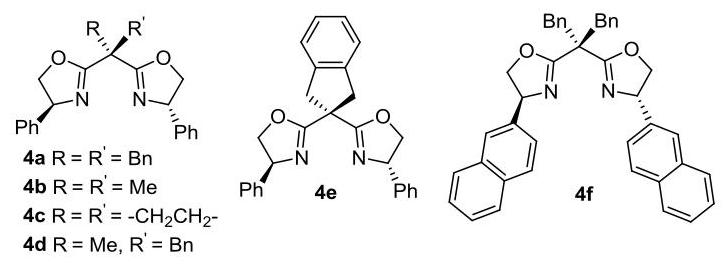
As a part of our research program on carbene-based coupling reaction, ${}^{12}$ we have previously developed a straightforward method for the synthesis of substituted allenes through Cu(I)-catalyzed cross-coupling of terminal alkynes and N-tosylhydrazones (Scheme 1a). ${}^{13}$ The related Cu(I)-catalyzed cross-coupling of terminal alkynes and diazo compounds has also been documented. ${}^{14}$ These coupling reactions may follow common reaction pathway involving alkynyl migratory insertion of $\mathrm{{Cu}}\left( \mathrm{I}\right)$ carbene species. In terms of efficiency and versatility, these direct coupling methods are attractive because they can construct the core structure of allenes from two readily available fragments. Thus, desired allene product 3aa in 69% yield and 71% ee (entry 1). Encouraged by this result, we then proceeded to optimize the reaction by firstly evaluating the effect of solvents (entries 2-7). It was found that the reaction in ${\mathrm{{CHCl}}}_{3},{\mathrm{{CH}}}_{2}{\mathrm{{Cl}}}_{2},{\mathrm{{ClCH}}}_{2}{\mathrm{{CH}}}_{2}\mathrm{{Cl}}$ , THF and dioxane all afforded the product 3aa in comparatively high ee (entries 2-7), but the yields varied significantly and the reaction in ${\mathrm{{CHCl}}}_{3}$ afforded the highest yield. A subsequent investigation of ligands confirmed that 4a provided higher ee than other bisoxazo-line ligands 4b-e (entries 8-11). Subsequently, a substantial increase in both yield and enantioselectivity was observed by replacing bisoxazoline ligand 4a with 4f, in which the phenyl sub-stituents are replaced by 2-naphthyl groups (entry 12). To further improve the enantioselectivity, a mixed solvent of ${\mathrm{{CH}}}_{2}{\mathrm{{Cl}}}_{2}$ and ${\mathrm{{CHCl}}}_{3}$ (1:1) was employed. Under the optimized conditions, the reaction could afford the allene product with ${90}\%$ ee and ${93}\%$ yield (entry 13).
作为我们基于卡宾的偶联反应研究项目的一部分,${}^{12}$ 我们之前开发了一种通过铜(I)催化末端炔烃与N - 甲苯磺酰腙的交叉偶联反应来合成取代丙二烯的直接方法(方案1a)。${}^{13}$ 末端炔烃与重氮化合物相关的铜(I)催化交叉偶联反应也有文献报道。${}^{14}$ 这些偶联反应可能遵循涉及卡宾物种的炔基迁移插入的常见反应途径。$\mathrm{{Cu}}\left( \mathrm{I}\right)$ 就效率和通用性而言,这些直接偶联方法很有吸引力,因为它们可以从两个容易获得的片段构建丙二烯的核心结构。因此,得到了所需的丙二烯产物3aa,产率为69%,对映体过量值为71%(条目1)。受此结果鼓舞,我们接着通过首先评估溶剂的影响来优化反应(条目2 - 7)。发现反应在${\mathrm{{CHCl}}}_{3},{\mathrm{{CH}}}_{2}{\mathrm{{Cl}}}_{2},{\mathrm{{ClCH}}}_{2}{\mathrm{{CH}}}_{2}\mathrm{{Cl}}$、四氢呋喃和二氧六环中都能以相对较高的对映体过量值得到产物3aa(条目2 - 7),但产率差异很大,并且在${\mathrm{{CHCl}}}_{3}$中反应产率最高。随后对配体的研究证实,4a提供的对映体过量值高于其他双恶唑啉配体4b - e(条目8 - 11)。随后,通过用4f取代双恶唑啉配体4a,观察到产率和对映选择性都有显著提高,其中4f的苯基取代基被2 - 萘基取代(条目12)。为了进一步提高对映选择性,采用了${\mathrm{{CH}}}_{2}{\mathrm{{Cl}}}_{2}$和${\mathrm{{CHCl}}}_{3}$(体积比1:1)的混合溶剂。在优化条件下,反应可以得到具有${90}\%$对映体过量值和${93}\%$产率的丙二烯产物(条目13)。
Scheme 1. Allene Synthesis through Cu(I)-Catalyzed Carbene Coupling with Terminal Alkynes
方案1. 通过铜(I)催化卡宾与末端炔烃偶联合成丙二烯
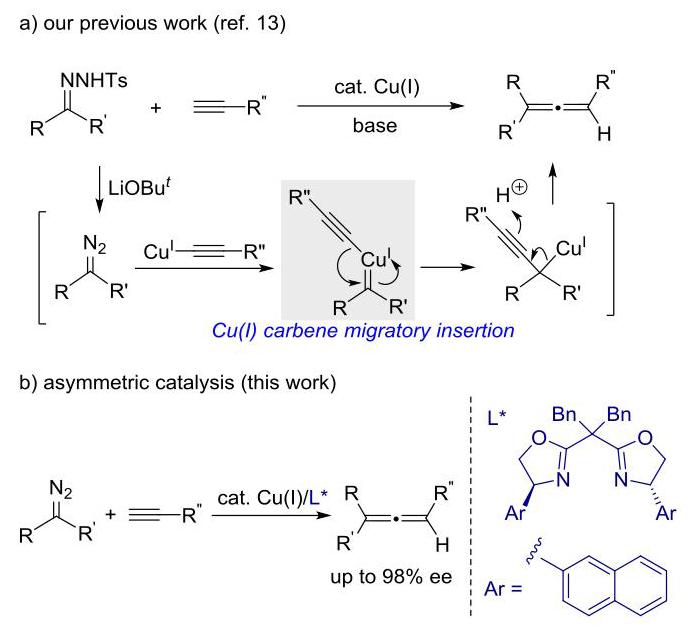
the development of catalytic asymmetric version of these reactions is highly desirable. However, such direct build-up of axial chirality under catalytic asymmetric conditions is not known until very recently. In 2015, the group of Liu and Feng reported the first catalytic asymmetric coupling for the highly enantioselective synthesis of allenoates with chiral cationic guanidinium salts/Cu(I) as the catalyst. ${}^{15}$ While the work represents a significant breakthrough, the reaction is limited to $\alpha$ -diazoesters, which leads to the formation of 2,4-disubstituted allenoates. Thus, further development of catalytic asymmetric coupling for allene synthesis with non-stabilized diazo alkanes is highly demanded. Herein, we report a Cu(I)-catalyzed coupling of non-stabilized diazo compounds for the highly enantioselective synthesis of trisubstituted allenes with a newly designed chiral bisoxazoline ligand (Scheme 1b).
非常需要开发这些反应的催化不对称版本。然而,直到最近才知道在催化不对称条件下如此直接地构建轴手性。2015年,刘和冯的团队报道了首例以手性阳离子胍盐/Cu(I)为催化剂,高对映选择性合成联烯酸酯的催化不对称偶联反应。${}^{15}$ 虽然这项工作代表了一个重大突破,但该反应仅限于 $\alpha$ -重氮酯,这导致了2,4-二取代联烯酸酯的形成。因此,迫切需要进一步开发用于用非稳定重氮烷烃合成联烯的催化不对称偶联反应。在此,我们报道了一种Cu(I)催化的非稳定重氮化合物的偶联反应,用于用新设计的手性双恶唑啉配体高对映选择性地合成三取代联烯(方案1b)。
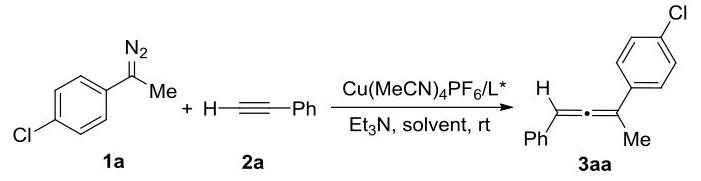
We began our investigation by examining the $\mathrm{{Cu}}\left( \mathrm{I}\right)$ -catalyzed cross coupling reaction between 1-(p-chlorophenyl)-1- diazoethane 1a and phenylacetylene 2a (Table 1). Gratifyingly, the initial experiment with $\mathrm{{Cu}}{\left( \mathrm{{MeCN}}\right) }_{4}{\mathrm{{PF}}}_{6}$ and commercially available chiral bisoxazoline ligand 4a in toluene afforded the
我们通过研究1-(对氯苯基)-1-重氮乙烷1a与苯乙炔2a之间的$\mathrm{{Cu}}\left( \mathrm{I}\right)$催化交叉偶联反应开始了我们的研究(表1)。令人欣慰的是,在甲苯中用$\mathrm{{Cu}}{\left( \mathrm{{MeCN}}\right) }_{4}{\mathrm{{PF}}}_{6}$和市售手性双恶唑啉配体4a进行的初步实验得到了
Table 1. Optimization of the Reaction Conditions ${}^{a}$
表1. 反应条件的优化 ${}^{a}$
| entry | L* | solvent | yield, ${\% }^{\mathrm{b}}$ | ee, %c |
| 1 | 4a | toluene | 69 | 71 |
| 2 | 4a | CHCl3 | 90 | 75 |
| 3 | 4a | ${\mathrm{{CH}}}_{2}{\mathrm{{Cl}}}_{2}$ | 30 | 83 |
| 4 | 4a | ${\mathrm{{ClCH}}}_{2}{\mathrm{{CH}}}_{2}\mathrm{{Cl}}$ | 18 | 81 |
| 5 | 4a | THF | 40 | 80 |
| 6 | 4a | MeCN | trace | - |
| 7 | 4a | 1,4-dioxane | 20 | 73 |
| 8 | 4b | ${\mathrm{{CHCl}}}_{3}$ | 85 | 34 |
| 9 | 4c | ${\mathrm{{CHCl}}}_{3}$ | 60 | 61 |
| 10 | 4d | ${\mathrm{{CHCl}}}_{3}$ | 90 | 39 |
| 11 | 4e | ${\mathrm{{CHCl}}}_{3}$ | 50 | 18 |
| 12 | 4f | ${\mathrm{{CHCl}}}_{3}$ | 98 | 88 |
| 13 | 4f | ${\mathrm{{CH}}}_{2}{\mathrm{{Cl}}}_{2} : {\mathrm{{CHCl}}}_{3}$ (1:1) | 93 | 90 |
${}^{a}$ Reaction was run under the following conditions: a solution of 1a (0.2 mmol), 2a (0.1 mmol), Et ${}_{3}\mathrm{\;N}$ (0.1 mmol), Cu(MeCN) ${}_{4}{\mathrm{{PF}}}_{6}$ (10 mol%), and chiral ligand (11 mol%) in anhydrous solvent (1 mL) was stirred at ${25}^{ \circ }\mathrm{C}$ under nitrogen atmosphere for ${60}\mathrm{\;{min}}$ . ${}^{\mathrm{b}}\mathrm{Y}$ - ields refer to isolated products. CDetermined by HPLC analysis using a chiral stationary phase.
${}^{a}$ 反应在以下条件下进行:将1a(0.2 mmol)、2a(0.1 mmol)、Et ${}_{3}\mathrm{\;N}$(0.1 mmol)、Cu(MeCN) ${}_{4}{\mathrm{{PF}}}_{6}$(10 mol%)和手性配体(11 mol%)在无水溶剂(1 mL)中的溶液在氮气气氛下于${25}^{ \circ }\mathrm{C}$搅拌${60}\mathrm{\;{min}}$。${}^{\mathrm{b}}\mathrm{Y}$ -产率指分离得到的产物。通过使用手性固定相的HPLC分析测定。
With the optimized reaction conditions, the reaction scope was then evaluated. A series of aryldiazoalkanes 1a-j $\left( {{\mathrm{R}}^{\prime } = \mathrm{{Me}}}\right)$ bearing electron-neutral, -deficient or -rich aromatic substituents were smoothly reacted with phenylacetylene 2a to give the corresponding trisubstituted allenes Заа-ja in 84-95% ee and 75-96% yield. The absolute configuration (R) of 3ia was established by the comparison of its optical rotation with the same compound of known configuration reported in the literature. ${}^{16}$ The absolute configuration (R) was further confirmed by X-ray crystallographic analysis of a single crystal of 3ja. The assignment was extended to other allene products based on the assumption that all the reactions followed the same reaction pathway. It is worth mentioning that when the ${\mathrm{R}}^{\prime }$ group was changed to ${\mathrm{{CF}}}_{3}$ , ligand $4\mathrm{a}$ was proved to be the most efficient one, albeit affording the desired product 3ka in only ${50}\%$ yield and ${72}\%$ ee. To further expand the scope of the reaction, tetralone-derived diazo compounds 11-n were then examined. For these diazo substrates, the best results were obtained with 20 mol% of 4a as the ligand, affording the corresponding allene products 3la-na in 92-96% ee and 85-95% yield.
在优化的反应条件下,然后评估了反应范围。一系列带有电子中性、缺电子或富电子芳基取代基的芳基重氮烷烃1a-j $\left( {{\mathrm{R}}^{\prime } = \mathrm{{Me}}}\right)$ 与苯乙炔2a顺利反应,得到相应的三取代联烯3aa-ja,对映体过量率为84-95%,产率为75-96%。通过将3ia的旋光性与文献中报道的相同构型的化合物进行比较,确定了其绝对构型(R)。${}^{16}$ 通过对3ja单晶的X射线晶体学分析进一步证实了绝对构型(R)。基于所有反应遵循相同反应途径的假设,该构型归属扩展到了其他联烯产物。值得一提的是,当${\mathrm{R}}^{\prime }$基团变为${\mathrm{{CF}}}_{3}$时,配体$4\mathrm{a}$被证明是最有效的,尽管仅以${50}\%$的产率和${72}\%$的对映体过量率得到所需产物3ka。为了进一步扩大反应范围,然后研究了四氢萘酮衍生的重氮化合物11-n。对于这些重氮底物,以20 mol%的4a作为配体得到了最佳结果,得到相应的联烯产物3la-na,对映体过量率为92-96%,产率为85-95%。
Table 2. The Substrate Scope for Aryldiazoalkanes
表2. 芳基重氮烷烃的底物范围
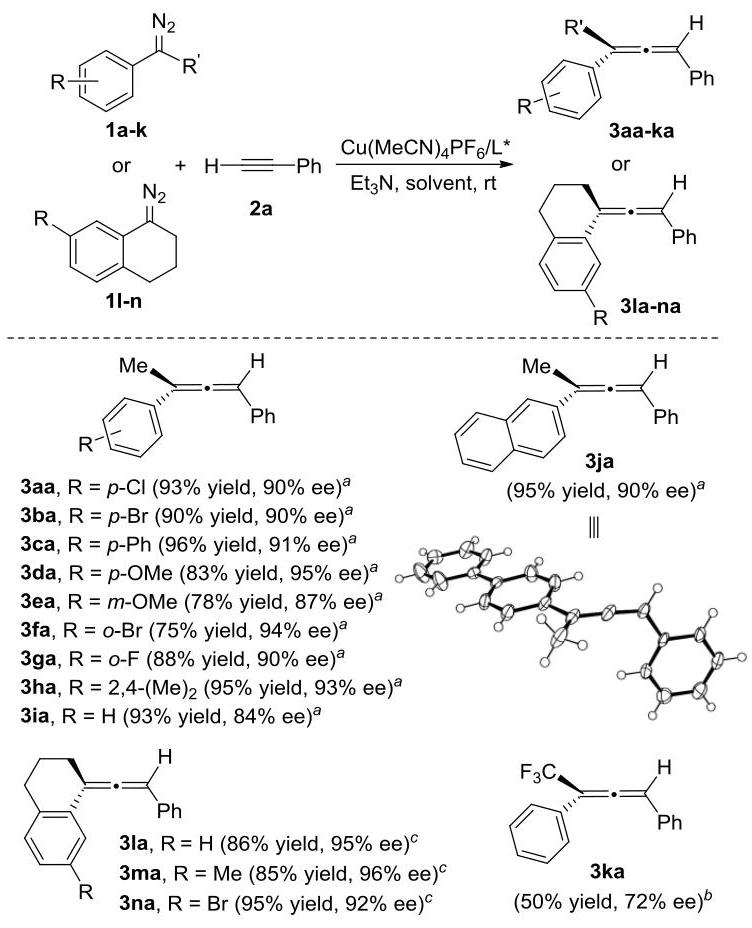
${}^{a}$ Reaction conditions: a solution of 1a-j (0.2 mmol),2a (0.1 $\mathrm{{mmol}}),{\mathrm{{Et}}}_{3}\mathrm{\;N}\left( {{0.1}\mathrm{{mmol}}}\right) ,\mathrm{{Cu}}{\left( \mathrm{{MeCN}}\right) }_{4}{\mathrm{{PF}}}_{6}\left( {{10}\mathrm{\;{mol}}\% }\right)$ , and $4\mathrm{f}({11} \; \mathrm{{mol}}\% )$ in ${\mathrm{{CH}}}_{2}{\mathrm{{Cl}}}_{2}\left( {{0.5}\mathrm{\;{mL}}}\right)$ and ${\mathrm{{CHCl}}}_{3}\left( {{0.5}\mathrm{\;{mL}}}\right)$ was stirred at 25 ${}^{ \circ }\mathrm{C}$ under ${\mathrm{N}}_{2}$ atmosphere for ${70}\mathrm{\;{min}}$ . ${}^{\mathrm{b}}{20}\mathrm{\;{mol}}\% \mathrm{{Cu}}{\left( \mathrm{{MeCN}}\right) }_{4}{\mathrm{{PF}}}_{6}$ , and ${22}\mathrm{\;{mol}}\%$ of $4\mathrm{a}$ were used. ${}^{ \circ }\mathrm{R}$ eaction conditions: a solution of 11-n (0.2 mmol), 2a (0.1 mmol), Et ${}_{3}\mathrm{\;N}$ (0.1 mmol), $\mathrm{{Cu}}{\left( \mathrm{{MeCN}}\right) }_{4}{\mathrm{{PF}}}_{6}\left( {{20}\mathrm{\;{mol}}\% }\right)$ , and $4\mathrm{a}\left( {{22}\mathrm{\;{mol}}\% }\right)$ in ${\mathrm{{CHCl}}}_{3}\left( {{1.0}\mathrm{\;{mL}}}\right)$ was stirred at ${25}^{ \circ }\mathrm{C}$ under ${\mathrm{N}}_{2}$ atmosphere for ${70}\mathrm{\;{min}}$ . The yields refer to isolated products, and the ee values were determined by chiral HPLC analysis.
${}^{a}$反应条件:将1a - j(0.2 mmol)、2a(0.1 $\mathrm{{mmol}}),{\mathrm{{Et}}}_{3}\mathrm{\;N}\left( {{0.1}\mathrm{{mmol}}}\right) ,\mathrm{{Cu}}{\left( \mathrm{{MeCN}}\right) }_{4}{\mathrm{{PF}}}_{6}\left( {{10}\mathrm{\;{mol}}\% }\right)$)以及$4\mathrm{f}({11} \; \mathrm{{mol}}\% )$置于${\mathrm{{CH}}}_{2}{\mathrm{{Cl}}}_{2}\left( {{0.5}\mathrm{\;{mL}}}\right)$和${\mathrm{{CHCl}}}_{3}\left( {{0.5}\mathrm{\;{mL}}}\right)$中,在25 ${}^{ \circ }\mathrm{C}$下于${\mathrm{N}}_{2}$气氛中搅拌${70}\mathrm{\;{min}}$。使用了${}^{\mathrm{b}}{20}\mathrm{\;{mol}}\% \mathrm{{Cu}}{\left( \mathrm{{MeCN}}\right) }_{4}{\mathrm{{PF}}}_{6}$以及${22}\mathrm{\;{mol}}\%$的$4\mathrm{a}$。${}^{ \circ }\mathrm{R}$反应条件:将11 - n(0.2 mmol)、2a(0.1 mmol)、Et ${}_{3}\mathrm{\;N}$(0.1 mmol)、$\mathrm{{Cu}}{\left( \mathrm{{MeCN}}\right) }_{4}{\mathrm{{PF}}}_{6}\left( {{20}\mathrm{\;{mol}}\% }\right)$以及$4\mathrm{a}\left( {{22}\mathrm{\;{mol}}\% }\right)$置于${\mathrm{{CHCl}}}_{3}\left( {{1.0}\mathrm{\;{mL}}}\right)$中,在${25}^{ \circ }\mathrm{C}$下于${\mathrm{N}}_{2}$气氛中搅拌${70}\mathrm{\;{min}}$。产率指的是分离得到的产物,对映体过量值(ee值)通过手性高效液相色谱分析测定。
Next, the scope of the reaction was extended by conducting the reaction with various terminal alkynes. To facilitate the determination of ee values by HPLC, 1h was selected as the representative aryldiazoalkanes (Table 3). When the standard condition was employed for the reactions between $1\mathrm{\;h}$ and $2\mathrm{\;b} - \mathrm{j}$ , moderate ee values were observed. We speculated that the background reactions were more severe when these alkynes were used. Further optimization of the reaction parameters showed that by changing the ratio of $1\mathrm{\;h}$ and alkynes from 2 to 0.5, the reactions provided excellent ee values, albeit with lower yields. A series of terminal alkynes could react smoothly with $1\mathrm{\;h}$ , affording the corresponding trisubstituted allenes 3hb-hi in moderate yields and excellent enantioselectivities, regardless of the electronic nature of the sub-stituents on the aromatic ring of the alkyne substrates 2b-i.
接下来,通过使用各种末端炔烃进行反应来扩展反应范围。为便于通过高效液相色谱法测定ee值,选择1h作为代表性芳基重氮烷烃(表3)。当在$1\mathrm{\;h}$和$2\mathrm{\;b} - \mathrm{j}$之间的反应采用标准条件时,观察到中等的ee值。我们推测当使用这些炔烃时背景反应更严重。反应参数的进一步优化表明,通过将$1\mathrm{\;h}$与炔烃的比例从2变为0.5,反应提供了优异的ee值,尽管产率较低。一系列末端炔烃能与$1\mathrm{\;h}$顺利反应,以中等产率和优异的对映选择性得到相应的三取代丙二烯3hb - hi,无论炔烃底物2b - i的芳环上取代基的电子性质如何。
It is also noteworthy that the reaction with benzyl-substituted alkyne 2j also gave the coupling product $3\mathrm{\;h}$ jin ${46}\%$ yield and 92% ee. Furthermore, tetralone-derived diazoalkane 11 was also chosen as the model diazo substrate to study the scope of terminal alkynes. The reaction with alkyne substrates bearing various sub-stituents on the aromatic ring all proceeded smoothly to afford the corresponding allene products 3lb-li in excellent yields and enan-tioselectivities. Finally, the reaction could also be extended to benzyl substituent, the corresponding trisubstituted allenes 31j could be obtained in 96% ee and 93% yield.
同样值得注意的是,与苄基取代的炔烃2j的反应也以${46}\%$产率和92% ee得到偶联产物$3\mathrm{\;h}$j。此外,还选择了四氢萘衍生的重氮烷烃11作为模型重氮底物来研究末端炔烃的范围。与芳环上带有各种取代基的炔烃底物的反应均顺利进行,以优异的产率和对映选择性得到相应的丙二烯产物3lb - li。最后,该反应还可扩展到苄基取代基,能以96% ee和93%产率得到相应的三取代丙二烯31j。
Table 3. The Substrate Scope for Terminal Alkynes
表3. 末端炔烃的底物范围
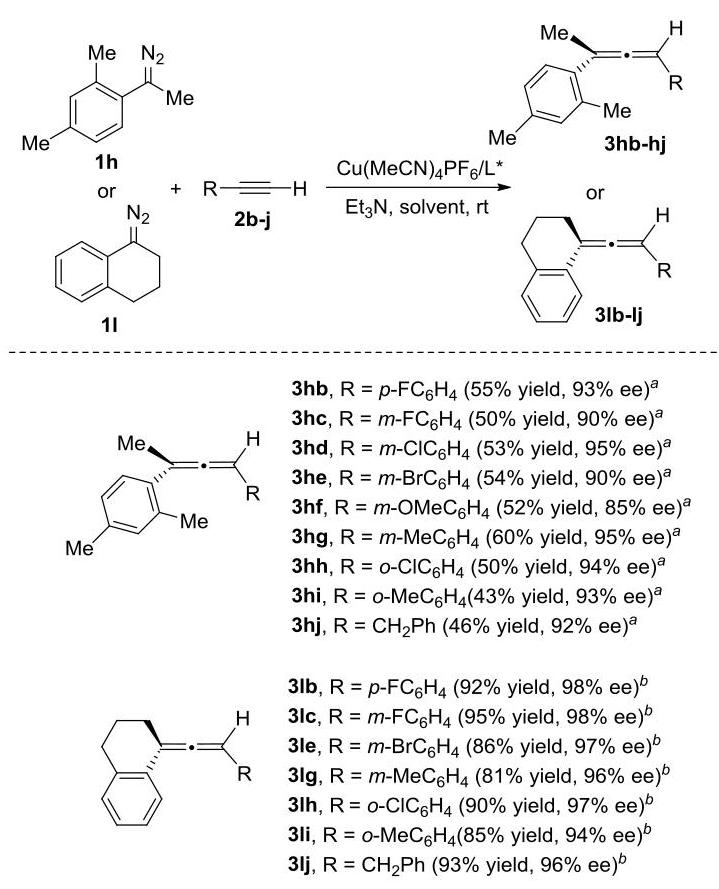
${}^{a}$ Reaction conditions: a solution of $1\mathrm{\;h}\left( {{0.1}\mathrm{{mmol}}}\right) ,2\mathrm{\;b} - \mathrm{j}({0.2} \; \mathrm{{mmol}}),{\mathrm{{Et}}}_{3}\mathrm{\;N}\left( {{0.2}\mathrm{{mmol}}}\right) ,\mathrm{{Cu}}{\left( \mathrm{{MeCN}}\right) }_{4}{\mathrm{{PF}}}_{6}\left( {{10}\mathrm{\;{mol}}\% }\right)$ , and $4\mathrm{f}({11} \; \mathrm{{mol}}\% )$ in ${\mathrm{{CH}}}_{2}{\mathrm{{Cl}}}_{2}\left( {{0.5}\mathrm{\;{mL}}}\right)$ and ${\mathrm{{CHCl}}}_{3}\left( {{0.5}\mathrm{\;{mL}}}\right)$ was stirred at 25 ${}^{ \circ }\mathrm{C}$ under ${\mathrm{N}}_{2}$ atmosphere for ${70}\mathrm{\;{min}}$ . ${}^{\mathrm{b}}$ Reaction conditions: a solution of ${11}\left( {{0.2}\mathrm{{mmol}}}\right) ,2\mathrm{\;b} - \mathrm{j}\left( {{0.1}\mathrm{{mmol}}}\right) ,{\mathrm{{Et}}}_{3}\mathrm{\;N}\left( {{0.1}\mathrm{{mmol}}}\right)$ , $\mathrm{{Cu}}{\left( \mathrm{{MeCN}}\right) }_{4}{\mathrm{{PF}}}_{6}\left( {{20}\mathrm{\;{mol}}\% }\right)$ , and $4\mathrm{a}\left( {{22}\mathrm{\;{mol}}\% }\right)$ in ${\mathrm{{CHCl}}}_{3}\left( {{1.0}\mathrm{\;{mL}}}\right)$ was stirred at ${25}^{ \circ }\mathrm{C}$ under ${\mathrm{N}}_{2}$ atmosphere for ${70}\mathrm{\;{min}}$ . All the yields refer to isolated products. The ee values were determined by chiral HPLC analysis.
${}^{a}$反应条件:将$1\mathrm{\;h}\left( {{0.1}\mathrm{{mmol}}}\right) ,2\mathrm{\;b} - \mathrm{j}({0.2} \; \mathrm{{mmol}}),{\mathrm{{Et}}}_{3}\mathrm{\;N}\left( {{0.2}\mathrm{{mmol}}}\right) ,\mathrm{{Cu}}{\left( \mathrm{{MeCN}}\right) }_{4}{\mathrm{{PF}}}_{6}\left( {{10}\mathrm{\;{mol}}\% }\right)$、$4\mathrm{f}({11} \; \mathrm{{mol}}\% )$溶解于${\mathrm{{CH}}}_{2}{\mathrm{{Cl}}}_{2}\left( {{0.5}\mathrm{\;{mL}}}\right)$和${\mathrm{{CHCl}}}_{3}\left( {{0.5}\mathrm{\;{mL}}}\right)$中,在25${}^{ \circ }\mathrm{C}$下于${\mathrm{N}}_{2}$气氛中搅拌${70}\mathrm{\;{min}}$。${}^{\mathrm{b}}$反应条件:将${11}\left( {{0.2}\mathrm{{mmol}}}\right) ,2\mathrm{\;b} - \mathrm{j}\left( {{0.1}\mathrm{{mmol}}}\right) ,{\mathrm{{Et}}}_{3}\mathrm{\;N}\left( {{0.1}\mathrm{{mmol}}}\right)$、$\mathrm{{Cu}}{\left( \mathrm{{MeCN}}\right) }_{4}{\mathrm{{PF}}}_{6}\left( {{20}\mathrm{\;{mol}}\% }\right)$和$4\mathrm{a}\left( {{22}\mathrm{\;{mol}}\% }\right)$溶解于${\mathrm{{CHCl}}}_{3}\left( {{1.0}\mathrm{\;{mL}}}\right)$中,在${25}^{ \circ }\mathrm{C}$下于${\mathrm{N}}_{2}$气氛中搅拌${70}\mathrm{\;{min}}$。所有产率均指分离得到的产物。对映体过量值通过手性高效液相色谱分析测定。
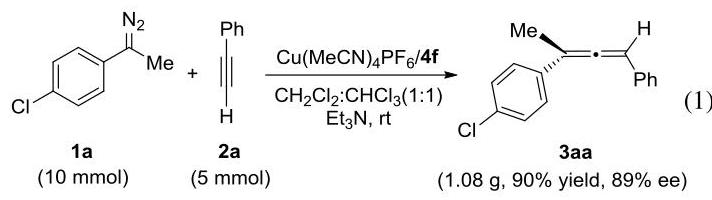
To show the synthetic potential of this strategy, we have carried out a gram scale synthesis of 3aa (eq 1). Under the optimized reaction conditions, the reaction with 5 mmol of 2a proceeded smoothly with 2 equivalents of 1a, affording 1.08 g of 3aa (90% yield) with 89% ee.
为了展示该策略的合成潜力,我们进行了3aa的克级规模合成(方程式1)。在优化的反应条件下,5 mmol的2a与2当量的1a顺利反应,得到1.08 g的3aa(产率90%),对映体过量为89%。
A stereocontrol model was tentatively proposed to explain the enantioselection in the present reaction (Figure 1). Based on previous studies, ${}^{{13},{14}}$ the $\mathrm{{Cu}}\left( \mathrm{I}\right)$ -catalyzed coupling reaction follows a pathway involving $\mathrm{{Cu}}\left( \mathrm{I}\right)$ carbene formation, alkynyl migratory insertion and protonation (Scheme 1a). In this mechanism, the alkynyl migratory insertion generates the C(sp)-C(sp ${}^{3}$ ) bond and this step is enantio-determining. Therefore, for this step two competing structures A and B are proposed to lead to the allene products with (R) and (S) configurations, respectively. Because of the steric repulsion existed in B between the phenyl group of the carbene and the naphthyl group of the chiral skeleton of the bisoxa-zoline, A is energetically more favored than B, leading to the formation of (R)-configured allene as the major product.
初步提出了一个立体控制模型来解释本反应中的对映选择性(图1)。基于先前的研究,${}^{{13},{14}}$ $\mathrm{{Cu}}\left( \mathrm{I}\right)$催化的偶联反应遵循一条涉及$\mathrm{{Cu}}\left( \mathrm{I}\right)$卡宾形成、炔基迁移插入和质子化的途径(方案1a)。在该机理中,炔基迁移插入生成C(sp)-C(sp${}^{3}$)键,这一步是对映体决定步骤。因此,对于这一步,提出了两个相互竞争的结构A和B,分别导致具有(R)和(S)构型的丙二烯产物。由于卡宾的苯基与双恶唑啉手性骨架的萘基之间在B中存在空间排斥,A在能量上比B更有利,导致形成(R)构型的丙二烯作为主要产物。
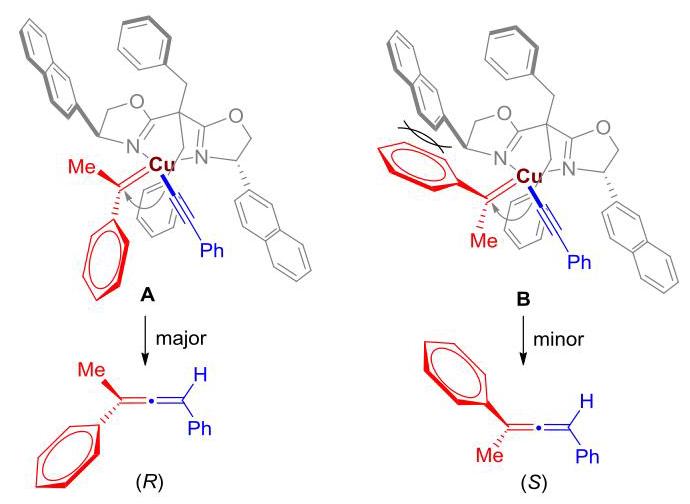
Figure 1. Rationale for Enantioselection.
图1. 对映选择性的原理。
In summary, we have developed a highly enantioselective Cu(I)-catalyzed coupling reaction between aryldiazoalkanes and terminal alkynes with chiral bisoxazoline as the ligand. A series of trisubstituted allenes were obtained with moderate to high yields (up to 96%) and excellent enantioselectivities (up to 98% ee). Further investigations on the related Cu(I)-catalyzed enantioselec-tive carbene coupling reaction is current under way in our laboratory.
总之,我们开发了一种以手性双恶唑啉为配体的、高度对映选择性的铜(I)催化的芳基重氮烷与末端炔烃之间的偶联反应。得到了一系列三取代丙二烯,产率中等至较高(高达96%),对映选择性优异(高达98% ee)。我们实验室目前正在对相关的铜(I)催化的对映选择性卡宾偶联反应进行进一步研究。
ASSOCIATED CONTENT
相关内容
Supporting Information. Experimental procedure, characterization data, copies of ${}^{1}\mathrm{H}$ and ${}^{13}\mathrm{C}$ NMR spectra. This material is available free of charge via the Internet at http://pubs.acs.org.
支持信息。实验步骤、表征数据、${}^{1}\mathrm{H}$ 和 ${}^{13}\mathrm{C}$ NMR 光谱的副本。此材料可通过互联网免费获取,网址为 http://pubs.acs.org。
AUTHOR INFORMATION
作者信息
${}^{ \dagger }$ Peking University
${}^{ \dagger }$ 北京大学
${}^{ \ddagger }$ Chinese Academy of Sciences
${}^{ \ddagger }$ 中国科学院
Corresponding Author
通讯作者
ACKNOWLEDGMENT
致谢
The project is supported by the National Basic Research Program of China (973 Program, No. 2015CB856600) and the Natural Science Foundation of China (Grant 21472004, 21332002).
本项目受中国国家基础研究计划(973计划,编号2015CB856600)和中国国家自然科学基金(项目批准号21472004、21332002)资助。
REFERENCES
参考文献
(1) Reviews on allenes in natural products: (a) Hoffmann-Röder, A.; Krause, N. Angew. Chem. Int. Ed. 2004, 43, 1196. Allenes in organic materials: (b) Rivera-Fuentes, P.; Diederich, F. Angew. Chem. Int. Ed. 2012, 51, 2818-2828.
(2) For selected recent reviews, see: (a) Modern Allene Chemistry; Krause, N., Hashmi, A. S. K., Eds.; Wiley-VCH: Weinheim, Germany, 2004; Vols. 1 and 2. (b) Hoffmann-Röder, A.; Krause, N. Angew. Chem. Int. Ed. 2004, 43, 1196-1216. (c) Ma, S. Palladium-Catalyzed Two- or Three-Component Cyclization of Functionalized Allenes in Palladium in Organic Synthesis; Tsuji, J., Ed.; Springer: Berlin, 2005; pp 183-210. (d) Brandsma, L.; Ne-dolya, N. A. Synthesis 2004, 735-745. (e) Ma, S. Chem. Rev. 2005, 105, 2829-2871. (f) Ma, S. Aldrichimica Acta 2007, 40, 91-102. (g) Kim, H.; Williams, L. J. J. Curr. Opin. Drug Discovery Dev. 2008, 11, 870-894. (h) Brasholz, M.; Reissig, H. U.; Zimmer, R. Acc. Chem. Res. 2009, 42, 45-56. (i) Ma, S. Acc. Chem. Res. 2009, 42, 1679-1688. (j) Aubert, C.; Fensterbank, L.; Garcia, P.; Malacria, M.; Simonneau, A. Chem. Rev. 2011, 111, 1954-1993. (k) Yu, S.; Ma, S. Angew. Chem. Int. Ed. 2012, 51, 3074-3112. (1) Ye, J.; Ma, S. Acc. Chem. Res. 2014, 47, 989- 1000.
(3) For recent reviews on asymmetric synthesis of allenes, see: (a) Ogasawara, M. Tetrahedron: Asymm. 2009, 20, 259-271. (b) Neff, R. K.; Frantz, D. E. ACS Catal. 2014, 4, 519-528. (c) Ye, J.; Ma. S. Org. Chem. Front. 2014, 1, 1210-1224.
(4) For selected examples, see: (a) Yu, J.; Chen, W.-J.; Gong, L.-Z. Org. Lett. 2010, 12, 4050-4053. (b) Sapu, C. M.; Bäckvall, J.-E.; Deska, J. Angew. Chem. Int. Ed. 2011, 50, 9731-9734. (c) In-okuma, T.; Furukawa, M.; Suzuki, Y.; Kimachi, T.; Kobayashi, Y.; Takemoto, Y. ChemCatChem 2012, 4, 983-985.
(5) For selected recent examples, see: (a) Zelder, C.; Krause, N. Eur. J. Org. Chem. 2004, 3968-3971. (b) Sherry, B. D.; Toste, F. D. J. Am. Chem. Soc. 2004, 126, 15978-15979. (c) Pu, X.; Ready, J. M. J. Am. Chem. Soc. 2008, 130, 10874-10875. (d) Lo, V. K. Y.; Wong, M. K.; Che, C. M. Org. Lett. 2008, 10, 517-519. (e) Lo, V. K.-Y.; Zhou, C.-Y.; Wong, M.-K.; Che, C.-M. Chem. Com-mun. 2010, 46, 213-215. (f) Ohmiya, H.; Yokobori, U.; Makida, Y.; Sawamura, M. Org. Lett. 2011, 13, 6312-6315. (g) Uehling, M. R.; Marionni, S. T.; Lalic, G. Org. Lett. 2012, 14, 362-365. (h) Yang, M.; Yokokawa, N.; Ohmiya, H.; Sawamura, M. Org. Lett. 2012, 14, 816-819. (i) Tang, X.; Huang, X.; Cao, T.; Han, Y.; Jiang, X.; Lin, W.; Tang, Y.; Zhang, J.; Yu, Q.; Fu, C.; Ma, S. Org. Chem. Front. 2015, 2, 688-691. (j) Huang, X.; Xue, C.; Fu, C.; Ma, S. Org. Chem. Front. 2015, 2, 1040-1044. (k) Huang, X.; Cao, T.; Han, Y.; Jiang, X.; Lin, W.; Zhang, J.; Ma, S. Chem. Commun. 2015, 51, 6956-6959. (l) S. Wu, X. Huang, W. Wu, P. Li, C. Fu, S. Ma, Nat. Comm. 2015, 6, 7946.
(6) (a) Matsumoto, Y.; Naito, M.; Uozumi, Y.; Hayashi, T. J. Chem. Soc. Chem. Commun. 1993, 1468-1469. (b) Han, J. W.; Tokuna-ga, N.; Hayashi, T. J. Am. Chem. Soc. 2001, 123, 12915-12916. (c) Hayashi, T.; Tokunaga, N.; Inoue, K. Org. Lett. 2004, 6, 305-307. (d) Nishimura, T.; Makino, H.; Nagaosa, M.; Hayashi, T. J. Am. Chem. Soc. 2010, 132, 12865-12867. (e) Zhang, W.; Zheng, S. Q.; Liu, N.; Werness, J. B.; Guzei, I. A.; Tang, W. P. J. Am. Chem. Soc. 2010, 132, 3664-3665. (f) Qian, H.; Yu, X.; Zhang, J.; Sun, J. J. Am. Chem. Soc. 2013, 135, 18020-18023. (g) Wang, M.; Liu, Z.-L.; Zhang, X.; Tian, P.-P.; Xu, Y.-H.; Loh, T.-P. J. Am. Chem. Soc. 2015, 137, 14830-14833. (h) Yao, Q.; Liao, Y.; Lin, L.; Lin, X.; Ji, J.; Liu, X.; Feng, X. Angew. Chem., Int. Ed. 2016, 55, 1859-1863.
(7) Crouch, I. T.; Neff, R. K.; Frantz, D. E. J. Am. Chem. Soc. 2013, 135, 4970-4973.
(8) (a) Imada, Y.; Nishida, M.; Kutsuwa, K.; Murahashi, S.-I.; Nao-ta, T. Org. Lett. 2005, 7, 5837-5839. (b) Boutier, A.; Kammerer-Pentier, C.; Krause, N.; Prestat, G.; Poli, G. Chem. Eur. J. 2012, 18, 3840-3844. (c) Hashimoto, T.; Sakata, K.; Tamakuni, F.; Dutton, M. J.; Maruoka, K. Nat. Chem. 2013, 5, 240-244. (d) Wan, B.; Ma, S. Angew. Chem. Int. Ed. 2013, 52, 441-445. (e) Mbofana, C. T.; Miller, S. J. J. Am. Chem. Soc. 2014, 136, 3285- 3292. (f) Wang, G.; Liu, X.; Chen, Y.; Yang, J.; Li, J.; Lin, L.; Feng, X. ACS Catal. 2016, 6, 2482-2486.
(9) (a) Li, Z.; Boyarskikh, V.; Hansen, J. H.; Autschbach, J.; Mu-saev, D.; Davies, H. M. L. J. Am. Chem. Soc. 2012, 134, 15497- 15504. (b) Wang, Y.; Zhang, W.; Ma, S. J. Am. Chem. Soc. 2013, 135, 11517-11520. (c) Liu, Y.; Hu, H.; Zheng, H.; Xia, Y.; Liu, X.; Lin, L.; Feng, X. Angew. Chem. Int. Ed. 2014, 53, 11579- 11582. (d) Liu, Y.; Liu, X.; Hu, H.; Guo, J.; Xia, Y.; Lin, L.; Feng, X. Angew. Chem. Int. Ed. 2016, 55, 4054-4058.
(10) (a) Liu, H.; Leow, D.; Huang, K.-W.; Tan, C.-H. J. Am. Chem. Soc. 2009, 131, 7212-7213. (b) Huang, D.; Qin, S.; Hu, C. Org. Biomol. Chem. 2011, 9, 6034-6039. (c) Inokuma, T.; Furukawa, M.; Uno, T.; Suzuki, Y.; Yoshida, K.; Yano, Y.; Matsuzaki, K.; Takemoto, Y. Chem. -Eur. J. 2011, 17, 10470-10477. (d) Xiao, H.; Kobayashi, Y.; Takemoto, Y.; Morokuma, K. ACS Catal. 2016, 6, 2988-2996.
(11) Tap, A.; Blond, A.; Wakchaure, V. N.; List, B. Angew. Chem. Int. Ed. 2016, 55, 8962-8965.
(12) Xiao, Q.; Zhang, Y.; Wang, J. Acc. Chem. Res. 2013, 46, 236- 247.
(13) (a) Xiao, Q.; Xia, Y.; Li, H.; Zhang, Y.; Wang, J. Angew. Chem. Int. Ed. 2011, 50, 1114-1117. (b) Ye, F.; Hossain, M. L.; Xu, Y.; Ma, X.; Xiao, Q.; Zhang, Y.; Wang, J. Chem. Asian J. 2013, 8, 1404-1407. (c) Hossain, M. L.; Ye, F.; Zhang, Y.; Wang, J. J. Org. Chem. 2013, 78, 1236-1241. (d) Ye, F.; Wang, C.; Ma, X; Hossain, M. L.; Xia, Y.; Zhang, Y.; Wang, J. J. Org. Chem. 2015, 80, 647-652.
(14) For related coupling with diazo compounds, see: (a) Hassink, M.; Liu, X.; Fox, J. M. Org. Lett. 2011, 13, 2388-2391. (b) Mondal, S.; Nechab, M.; Campolo, D.; Vanthuyne, N.; Bertrand, M. P. Adv. Synth. Catal. 2012, 354, 1987-2000. (c) Poh, J.-S.; Tran, D. N.; Battilocchio, C.; Hawkins, J. M.; Ley, S. V. Angew. Chem. Int. Ed. 2015, 54, 7920-7923. (d) Wu, C.; Hu, F.; Liu, Z.; Deng, G.; Ye, F.; Zhang, Y.; Wang, J. Tetrahedron 2015, 71, 9196- 9201.
(15) Tang, Y.; Chen, Q.; Liu, X.; Wang, G.; Lin, L.; Feng, X. Angew. Chem. Int. Ed. 2015, 54, 9512-9516.
(16) Periasamy, M.; Reddy, P. O.; Satyanarayana, I.; Mohan, L.; Edu-kondalu, A. J. Org. Chem. 2016, 81, 987-999.