Bi-functional Ligand-assisted Catalytic Ketone α-Alkenylation with Internal Alkynes: Controlled Synthesis of Enones and Mechanistic Studies
英文原文与中文译文逐段对照 · English original with Chinese translation
Fanyang Mo, Hee Nam Lim, and Guangbin Dong
莫凡洋、林熙南、董广彬
J. Am. Chem. Soc., Just Accepted Manuscript • DOI: 10.1021/jacs.5b10466 • Publication Date (Web): 13 Nov 2015 Downloaded from http://pubs.acs.org on November 13, 2015
《美国化学会志》,刚接受的稿件 • DOI: 10.1021/jacs.5b10466 • 网络出版日期:2015年11月13日 于2015年11月13日从http://pubs.acs.org下载
Just Accepted
刚被接受
“Just Accepted” manuscripts have been peer-reviewed and accepted for publication. They are posted online prior to technical editing, formatting for publication and author proofing. The American Chemical Society provides “Just Accepted” as a free service to the research community to expedite the dissemination of scientific material as soon as possible after acceptance. “Just Accepted” manuscripts appear in full in PDF format accompanied by an HTML abstract. “Just Accepted” manuscripts have been fully peer reviewed, but should not be considered the official version of record. They are accessible to all readers and citable by the Digital Object Identifier (DOI(R)). “Just Accepted” is an optional service offered to authors. Therefore, the “Just Accepted” Web site may not include all articles that will be published in the journal. After a manuscript is technically edited and formatted, it will be removed from the “Just Accepted” Web site and published as an ASAP article. Note that technical editing may introduce minor changes to the manuscript text and/or graphics which could affect content, and all legal disclaimers and ethical guidelines that apply to the journal pertain. ACS cannot be held responsible for errors or consequences arising from the use of information contained in these “Just Accepted” manuscripts.
“刚被接受"的稿件已经经过同行评审并被接受发表。它们在进行技术编辑、排版以供发表和作者校对之前就会在线发布。美国化学学会提供“刚被接受”这一免费服务给研究界,以便在稿件被接受后尽快加速科学材料的传播。“刚被接受”的稿件以PDF格式全文呈现,并附有HTML摘要。“刚被接受”的稿件已经经过全面的同行评审,但不应被视为正式的记录版本。所有读者都可以访问这些稿件,并且可以通过数字对象标识符(DOI(R))进行引用。“刚被接受”是一项提供给作者的可选服务。因此,“刚被接受”网站可能不包括该期刊将要发表的所有文章。稿件经过技术编辑和排版后,将从“刚被接受”网站上移除,并作为一篇尽快发表的文章发表。请注意,技术编辑可能会对手稿文本和/或图表进行一些细微的更改,这可能会影响内容,并且适用于该期刊的所有法律免责声明和道德准则都适用。美国化学学会不对因使用这些“刚被接受”稿件中包含的信息而产生的错误或后果负责。
ACS Publications
美国化学会出版物
Journal of the American Chemical Society is published by the American Chemical Society. 1155 Sixteenth Street N.W., Washington, DC 20036
《美国化学会志》由美国化学会出版。华盛顿特区西北第十六街1155号,邮编20036
Published by American Chemical Society. Copyright © American Chemical Society. However, no copyright claim is made to original U.S. Government works, or works produced by employees of any Commonwealth realm Crown government in the course
由美国化学会出版。版权所有©美国化学会。然而,对于美国政府的原始作品或任何英联邦王国政府雇员在工作过程中创作的作品,不主张版权
Bi-functional Ligand-assisted Catalytic Ketone α-Alkenylation with Internal Alkynes: Controlled Synthesis of Enones and Mechanistic Studies
双功能配体辅助的酮与内炔的α-烯基化反应:烯酮的可控合成及机理研究
Fanyang Mo, ${}^{1,2}$ Hee Nam Lim ${}^{1}$ and Guangbin Dong ${}^{1 * }$
莫凡洋,${}^{1,2}$ 林熙南 ${}^{1}$ 及董广彬 ${}^{1 * }$
${}^{1}$ Department of Chemistry, University of Texas at Austin, Austin, TX 78712, United States
${}^{1}$ 美国得克萨斯大学奥斯汀分校化学系,奥斯汀,德克萨斯州78712
${}^{2}$ Department of Energy and Resources Engineering, College of Engineering, Peking University, Beijing 100871, China
${}^{2}$ 中国北京大学工学院能源与资源工程系,北京100871
Supporting Information
支持信息
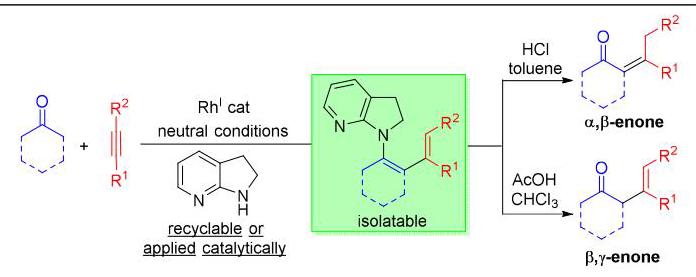
ABSTRACT: Here we describe a detailed study of the rhodium(I)-catalyzed, bi-functional ligand-assisted ketone α-C-H alkenyla-tion using internal alkynes. Through controlling the reaction conditions, conjugated enamines, $\alpha ,\beta$ - or $\beta ,\gamma$ -unsaturated ketones can be selectively accessed. Both aromatic and aliphatic alkynes can be employed as coupling partners. The reaction conditions also tolerate a broad range of functional groups, including carboxylic esters, malonates, secondary amides, thioethers and free alcohols. In addition, excellent $E$ -selectivity was observed for the tetra-substituted alkene when forming the $\alpha ,\beta$ -unsaturated ketone products. The mechanism of this transformation was explored through control experiments, kinetic monitoring, synthesizing the rhodium-hydride intermediates and their reactions with alkynes, deuterium-labeling experiments and identification of the resting states of the catalyst.
摘要:本文详细研究了铑(I)催化、双功能配体辅助的酮与内炔的α-C-H烯基化反应。通过控制反应条件,可以选择性地得到共轭烯胺、$\alpha ,\beta$ -或$\beta ,\gamma$ -不饱和酮。芳香族和脂肪族内炔均可作为偶联伙伴。该反应条件还能耐受多种官能团,包括羧酸酯、丙二酸酯、仲酰胺、硫醚和游离醇。此外,在形成$\alpha ,\beta$ -不饱和酮产物时,对于四取代烯烃观察到了优异的$E$ -选择性。通过对照实验、动力学监测、合成氢化铑中间体及其与炔烃的反应、氘标记实验以及确定催化剂的静止状态,探索了该转化反应的机理。
INTRODUCTION
引言
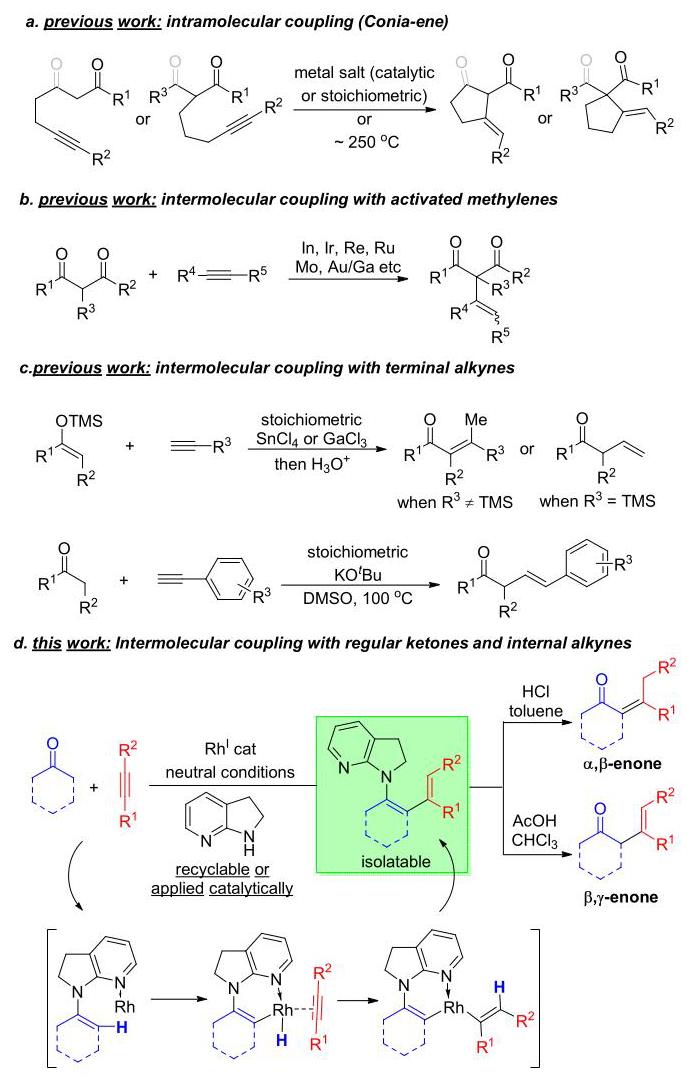
Unsaturated ketones (also known as enones), typically those bearing $\alpha ,\beta$ - or $\beta ,\gamma$ -C-C double bonds, have rich biological and chemical properties. They are often observed in bioactive compounds and frequently employed as synthetic intermediates. ${}^{1,2}$ Undoubtedly, numerous methods have been developed to date for enone synthesis. ${}^{3 - 5}$ However, direct $\mathrm{C} - \mathrm{C}$ coupling between a ketone and an alkyne represents one of the most attractive approaches due to the atom/redox-efficiency of the reaction and the wide availability of both starting materials. ${}^{6,7}$ For example, the intramolecular ketone-alkyne cyclization, also known as “Conia-ene” reaction, represents a distinct way to synthesize cyclic enones, which can be catalyzed/mediated by a range of metals or enabled by thermal conditions (Scheme 1a). ${}^{8 - {38}}$ In contrast, the intermolecular ketone-alkyne coupling is primarily known with activated methylene compounds as the substrates (Scheme 1b). ${}^{{39} - {53}}$ To date, only two approaches are available for intermolecular coupling of a regular ketones and an alkyne. One seminal work by Yamaguchi involves addition of silyl enol ethers into mono-substituted alkynes mediated by stoichiometric Lewis acids, such as Ga(III) and Sn(IV) salts. ${}^{{54} - {57}}$ Recently, Trofimov and coworkers developed a strong base-promoted addition of potassium enolates into aryl terminal acetylenes (Scheme 1c). ${}^{{58},{59}}$
不饱和酮(也称为烯酮),通常是那些含有$\alpha ,\beta$-或$\beta ,\gamma$-碳-碳双键的不饱和酮,具有丰富的生物学和化学性质。它们经常出现在生物活性化合物中,并经常用作合成中间体。${}^{1,2}$ 毫无疑问,迄今为止已经开发出许多用于烯酮合成的方法。${}^{3 - 5}$ 然而,由于反应的原子/氧化还原效率以及两种起始原料的广泛可得性,酮与炔烃之间的直接$\mathrm{C} - \mathrm{C}$ 偶联是最具吸引力的方法之一。${}^{6,7}$ 例如,分子内酮-炔烃环化反应,也称为“Conia-烯”反应,是合成环状烯酮的一种独特方法,该反应可以由多种金属催化/介导或在热条件下进行(方案1a)。${}^{8 - {38}}$ 相比之下,分子间酮-炔烃偶联主要是以活性亚甲基化合物作为底物(方案1b)。${}^{{39} - {53}}$ 迄今为止,对于普通酮与炔烃的分子间偶联,只有两种方法。Yamaguchi的一项开创性工作涉及将硅基烯醇醚加成到由化学计量的路易斯酸(如Ga(III)和Sn(IV)盐)介导的单取代炔烃中。${}^{{54} - {57}}$ 最近,Trofimov及其同事开发了一种强碱促进的烯醇钾盐加成到芳基末端乙炔中的方法(方案1c)。${}^{{58},{59}}$
To the best of our knowledge, the intermolecular coupling between a regular ketone and an internal alkyne remained an unknown transformation. Towards our long-term goal of developing byproduct-free ketone/unsaturate couplings under $\mathrm{{pH}}$ and redox-neutral conditions, ${}^{60}$ here we describe our detailed development of a catalytic ketone $\alpha$ -alkenylation reaction with unactivated disubstituted alkynes, which is enabled by a bi-functional ligand and a low-valent transition-metal catalyst (Scheme 1d).
据我们所知,普通酮与内炔之间的分子间偶联仍然是一种未知的转化反应。为了实现我们在$\mathrm{{pH}}$和氧化还原中性条件下开发无副产物的酮/不饱和物偶联的长期目标,${}^{60}$ 在此我们描述了我们对一种由双功能配体和低价过渡金属催化剂实现的、用于未活化二取代炔烃的催化酮$\alpha$-烯基化反应的详细研究(方案1d)。
The transition-metal-catalyzed addition of $s{p}^{2}\mathrm{C} - \mathrm{H}$ bonds across unactivated alkynes has recently emerged a powerful strategy to synthesize substituted alkenes in a byproduct-free fashion. ${}^{{61},{62}}$ For example, Murai and co-workers reported the first directed hydroarylation of alkynes using a ruthenium catalyst. ${}^{{62}\mathrm{c}}$ The related alkyne hydrovinylation was first established by Trost and co-workers. ${}^{{62}\mathrm{\;d}}$ Later, Lim and Kang developed an rhodium-catalyzed ortho-alkenylation of 2-phenylpyridines with internal alkynes. ${}^{{62}\mathrm{\;h}}$ Besides through a metal-hydride reaction pathway, more recently Schipper and Fagnou demonstrated a Rh(III)- catalyzed intermolecular hydroarylation of alkynes via aryl-metalation followed by protonation. ${}^{62o}$ In addition, Jun and coworkers have achieved a novel metal-organic cooperative approach in the rhodium-catalyzed hydroacylation of alkynes, in which an aldehyde was masked as an imine that can undergo directed $\mathrm{C} - \mathrm{H}$ activation. ${}^{{61}\mathrm{a},{62}\mathrm{k}}$ These seminal works offer a solid foundation and important inspiration for our targeted catalytic ketone $\alpha$ -alkenylation with unactivated alkynes.
过渡金属催化的$s{p}^{2}\mathrm{C} - \mathrm{H}$键加成到未活化炔烃上最近已成为一种以无副产物方式合成取代烯烃的强大策略。${}^{{61},{62}}$ 例如,Murai及其同事报道了使用钌催化剂首次实现的炔烃定向氢芳基化反应。${}^{{62}\mathrm{c}}$ 相关的炔烃氢乙烯基化反应最早由Trost及其同事建立。${}^{{62}\mathrm{\;d}}$ 后来,Lim和Kang开发了一种铑催化的2-苯基吡啶与内炔的邻烯基化反应。${}^{{62}\mathrm{\;h}}$ 除了通过金属氢化物反应途径外,最近Schipper和Fagnou证明了Rh(III)催化的炔烃分子间氢芳基化反应是通过芳基金属化然后质子化进行的。${}^{62o}$ 此外,Jun及其同事在铑催化的炔烃氢酰化反应中实现了一种新型的金属-有机协同方法,其中醛被掩蔽为可以进行定向$\mathrm{C} - \mathrm{H}$ 活化的亚胺。${}^{{61}\mathrm{a},{62}\mathrm{k}}$ 这些开创性的工作为我们针对未活化炔烃的目标催化酮$\alpha$-烯基化反应提供了坚实的基础和重要的灵感。
Our laboratory recently developed a regioselective ketone $\alpha$ - alkylation reaction with unactivated $\alpha$ -olefins, wherein the vinyl $\mathrm{C} - \mathrm{H}$ bond of the enamine generated from the ketone and an amine bi-functional catalyst can be activated by $\mathrm{{Rh}}$ metal and added across olefins to deliver an alkylated enamine, which upon hydrolysis furnished the alkylation product and regenerate the bifunctional catalyst. ${}^{60}$ Accordingly, we envisioned a protocol for formal ketone $\alpha$ -alkenylation with internal alkynes wherein a conjugated enamine is formed as the key intermediate that can undergo hydrolysis to give either $\alpha ,\beta$ - or $\beta ,\gamma$ -enones (Scheme 1d). Compared to the $\alpha$ -alkylation reaction, the challenges of the $\alpha$ - alkenylation reactions with internal alkynes are three-fold. First, assisted by low valent metals, alkynes can undergo facile homo-couplings to give dimer or trimer products. ${}^{{63},{64}}$ Second, due to their low steric hindrance, more than one alkyne can coordinate to a single metal center, which often generates multiple-insertion products. ${}^{65}$ Third, chemo- and stereo-selective hydrolysis of the proposed conjugated enamine intermediate is expected to be nontrivial (Scheme 1d). ${}^{66}$ Particularly, control of the geometry for the newly formed tetra-substituted-alkene in the $\alpha ,\beta$ -enone products can be a significant concern.
我们实验室最近开发了一种区域选择性酮$\alpha$-与未活化的$\alpha$-烯烃的烷基化反应,其中由酮和胺双功能催化剂生成的烯胺的乙烯基$\mathrm{C} - \mathrm{H}$键可以被$\mathrm{{Rh}}$金属活化,并加成到烯烃上以提供烷基化烯胺,该烯胺水解后得到烷基化产物并再生双功能催化剂。${}^{60}$因此,我们设想了一种用内炔进行正式酮$\alpha$-烯基化的方案,其中形成共轭烯胺作为关键中间体,该中间体可以水解得到$\alpha ,\beta$-或$\beta ,\gamma$-烯酮(方案1d)。与$\alpha$-烷基化反应相比,用内炔进行$\alpha$-烯基化反应面临三个挑战。首先,在低价金属的辅助下,炔烃可以容易地进行均偶联反应,生成二聚体或三聚体产物。${}^{{63},{64}}$其次,由于它们的空间位阻低,不止一个炔烃可以与单个金属中心配位,这通常会产生多插入产物。${}^{65}$第三,预计所提出的共轭烯胺中间体的化学和立体选择性水解将是不平凡的(方案1d)。${}^{66}$特别地,控制$\alpha ,\beta$-烯酮产物中新形成的四取代烯烃的几何形状可能是一个重大问题。
Scheme 1. C-C Couplings between Ketones and Alkynes.
方案1. 酮与炔烃之间的C-C偶联。
RESULTS AND DISCUSSION
结果与讨论
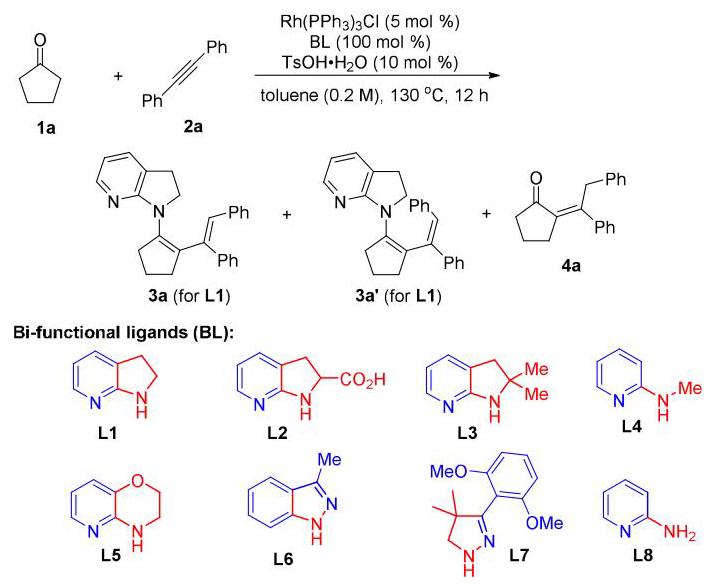
Reaction Condition Optimization. To probe the feasibility of the ketone-alkyne coupling, we initiated our studies with cyclopentanone 1a and diphenylacetylene 2a as the standard substrates. First, the effect of the bi-functional ligands was examined. Eight secondary and primary amine compounds (L1 to L8 in Table 1) containing an adjacent directing group were subjected to the reaction conditions (5 mol % of Wilkinson’s catalyst and 10 mol % of ${\mathrm{{TsOH}}}_{4}{\mathrm{H}}_{2}\mathrm{O}$ in toluene at ${130}{}^{ \circ }\mathrm{C}$ for ${12}\mathrm{\;h}$ ). In accord with our previous study, ${}^{60}$ 7-azaindoline (L1) exhibited unique and high catalytic activity, whereas other directing ligands were inactive. As a preliminary result, with 100 mol % loading of L1, the reaction gave 46% of conjugated enamine product 3a, 26% of its isomer (3a’) and 17% of the conjugated enone 4a (Table 1, entry 1). All these products were isolated and fully characterized by ${}^{1}\mathrm{H}/{}^{13}\mathrm{C}$ NMR, infrared (IR), and high-resolution mass spectrometry (HRMS). The structures of 3a and 4a’s hydrazone derivatives were further unambiguously confirmed by X-ray crystallography (vide infra).
反应条件优化。为探究酮-炔烃偶联反应的可行性,我们以环戊酮1a和二苯乙炔2a作为标准底物开展研究。首先,考察了双功能配体的影响。将8种含有相邻导向基团的仲胺和伯胺化合物(表1中的L1至L8)置于反应条件下(在甲苯中,5 mol%的威尔金森催化剂和10 mol%的${\mathrm{{TsOH}}}_{4}{\mathrm{H}}_{2}\mathrm{O}$,于${130}{}^{ \circ }\mathrm{C}$下反应${12}\mathrm{\;h}$)。与我们之前的研究一致,${}^{60}$ 7-氮杂吲哚(L1)表现出独特且高的催化活性,而其他导向配体则无活性。作为初步结果,当L1的负载量为100 mol%时,反应得到46%的共轭烯胺产物3a、26%的异构体(3a’)和17%的共轭烯酮4a(表1,条目1)。所有这些产物均经分离,并通过${}^{1}\mathrm{H}/{}^{13}\mathrm{C}$核磁共振、红外光谱(IR)和高分辨质谱(HRMS)进行了全面表征。3a和4a的腙衍生物的结构通过X射线晶体学进一步明确确认(见下文)。
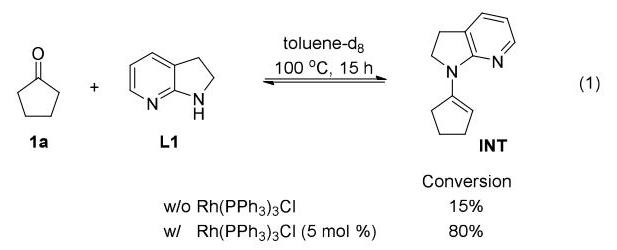
With an active bi-functional ligand L1 in hand, we continued our studies by investigating other reaction parameters shown in Table 2. First, we found that the absence of $\mathrm{{TsOH}} \cdot {\mathrm{H}}_{2}\mathrm{O}$ led to an increased yield of $3\mathrm{a}$ with no 4a formed (Table 2, entry 1). In contrast to our study with alkene couplings, ${}^{60}\mathrm{{TsOH}} \cdot {\mathrm{H}}_{2}\mathrm{O}$ , previously proposed to promote enamine formation, is not necessary in this ketone/alkyne coupling reaction. Two control experiments (without the alkyne) revealed that Wilkinson’s catalyst can significantly accelerate the condensation between ketone 1a and L1 to form the enamine intermediate (eq 1). Consequently, in the absence of this protic acid, the conjugated enmaine products (3a/3a’) are stable under the reaction conditions.
有了活性双功能配体L1后,我们通过研究表2中所示的其他反应参数继续我们的研究。首先,我们发现没有$\mathrm{{TsOH}} \cdot {\mathrm{H}}_{2}\mathrm{O}$会导致$3\mathrm{a}$的产率增加,且不会生成4a(表2,条目1)。与我们对烯烃偶联的研究不同,${}^{60}\mathrm{{TsOH}} \cdot {\mathrm{H}}_{2}\mathrm{O}$ ,之前认为它能促进烯胺的形成,但在这种酮/炔烃偶联反应中并非必需。两个对照实验(无炔烃)表明,威尔金森催化剂能显著加速酮1a与L1之间的缩合反应,形成烯胺中间体(式1)。因此,在没有这种质子酸的情况下,共轭烯胺产物(3a/3a’)在反应条件下是稳定的。
Table 1. Evaluation of Bi-functional Ligands for Rh(I)-catalyzed Coupling of Cyclopentanone and Diphenylacetylene ${}^{a}$
表1. 用于铑(I)催化环戊酮与二苯乙炔${}^{a}$偶联反应的双功能配体评估
| Entry | Bi-functional ligand | Yields of Products ${}^{1}$ |
| 1 | L1 | 3a 46%, 3a' 26%, 4a 17% |
| 2 | L2 | all together < 5% |
| 3 | L3 | all together < 5% |
| 4 | L4 | all together < 5% |
| 5 | L5 | all together < 5% |
| 6 | L6 | all together < 5% |
| 7 | L7 | all together < 5% |
| 8 | L8 | all together < 5% |
${}^{a}$ Conditions: cyclopentanone 1a (0.2 mmol), diphenylacetylene 2a (0.2 mmol). ${}^{b}$ Yields were determined by ${}^{1}\mathrm{H}$ NMR using 1,1,2,2- tetrachloroethane as the internal standard.
${}^{a}$ 条件:环戊酮1a(0.2 mmol),二苯乙炔2a(0.2 mmol)。 ${}^{b}$ 产率通过以1,1,2,2-四氯乙烷为内标的${}^{1}\mathrm{H}$ NMR测定。
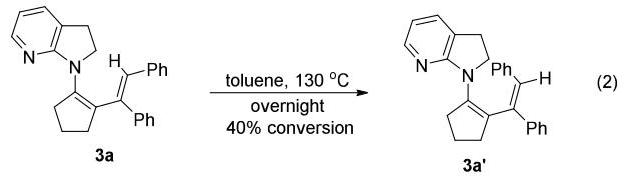
${\left\lbrack \mathrm{{Rh}}{\left( \mathrm{{CO}}\right) }_{2}\mathrm{{Cl}}\right\rbrack }_{2}$ and ${\left\lbrack \mathrm{{Rh}}{\left( \mathrm{{coe}}\right) }_{2}\mathrm{{Cl}}\right\rbrack }_{2}$ also delivered the desired products albeit giving lower yields than Wilkinson’s catalyst (entries 2 and 3). Different phosphine ligands other than ${\mathrm{{PPh}}}_{3}$ were also evaluated, whereas both electron-rich and deficient ones gave much lower yields (entries 4 and 5). ${}^{67}$ Use of 2 equivalents of cyclopentanone led to a full conversion of L1 with 64% yield of 3a and 31% yield of 3a’ (entry 6). It is noteworthy that under the conditions giving low yields (e.g. entries 4 and 5), 3a’ was not detected in the reaction mixture. We rationalized that 3a was likely the initial product formed, and 3a’ is the isomerized product of 3a. Indeed, when pure $3\mathrm{a}$ was heated at ${130}{}^{ \circ }\mathrm{C}$ overnight,40% conversion to 3a’ was observed (eq 2). The 3a/3a’ ratio was higher when the reaction was conducted at ${100}{}^{ \circ }\mathrm{C}$ instead of ${130}{}^{ \circ }\mathrm{C}$ (entry 7), without losing reactivity. We further discovered that
${\left\lbrack \mathrm{{Rh}}{\left( \mathrm{{CO}}\right) }_{2}\mathrm{{Cl}}\right\rbrack }_{2}$ 和${\left\lbrack \mathrm{{Rh}}{\left( \mathrm{{coe}}\right) }_{2}\mathrm{{Cl}}\right\rbrack }_{2}$ 也得到了所需产物,尽管产率低于威尔金森催化剂(条目2和3)。还评估了除${\mathrm{{PPh}}}_{3}$ 之外的不同膦配体,而富电子和缺电子的配体产率都低得多(条目4和5)。 ${}^{67}$ 使用2当量的环戊酮导致L1完全转化,3a的产率为64%,3a’的产率为31%(条目6)。值得注意的是,在产率较低的条件下(例如条目4和5),反应混合物中未检测到3a’。我们推测3a可能是最初形成的产物,3a’是3a的异构化产物。事实上,当纯的$3\mathrm{a}$ 在${130}{}^{ \circ }\mathrm{C}$ 加热过夜时,观察到40%转化为3a’(式2)。当反应在${100}{}^{ \circ }\mathrm{C}$ 而不是${130}{}^{ \circ }\mathrm{C}$ 进行时,3a/3a’的比例更高(条目7),且不失活性。我们进一步发现
Table 2. Reaction Condition Screening ${}^{a}$
表2. 反应条件筛选 ${}^{a}$

| Entry | Rh(I) (mmol %) | Ratio (1a : 2a : L1) | Temperature $\left( {{}^{ \circ }\mathrm{C}}\right)$ | Additives (mol %) | Yields of Products (%) ${}^{b}$ | |||
| 3a | 3a' | 4a | 5a | |||||
| Optimization for conjugated enamine product 3a | ||||||||
| 1 | $\mathrm{{Rh}}{\left( {\mathrm{{PPh}}}_{3}\right) }_{3}\mathrm{{Cl}}\left( 5\right)$ | $1 : 1 : 1$ | 130 | - | 59 | 22 | 0 | 0 |
| 2 | ${\left\lbrack \mathrm{{Rh}}{\left( \mathrm{{CO}}\right) }_{2}\mathrm{{Cl}}\right\rbrack }_{2}\left( {2.5}\right)$ | $1 : 1 : 1$ | 130 | - | 17 | 12 | 0 | 0 |
| 3 | ${\left\lbrack \mathrm{{Rh}}{\left( \mathrm{{coe}}\right) }_{2}\mathrm{{Cl}}\right\rbrack }_{2}\left( {2.5}\right)$ | $1 : 1 : 1$ | 130 | - | 22 | 12 | 0 | 0 |
| 4 | ${\left\lbrack \mathrm{{Rh}}\left( \mathrm{{coe}}\right) 2\mathrm{{Cl}}\right\rbrack }_{2}\left( 5\right) + {\mathrm{{PCy}}}_{3}$ (20) | $1 : 1 : 1$ | 130 | - | 13 | 0 | 0 | 0 |
| 5 | ${\left\lbrack \mathrm{{Rh}}\left( \mathrm{{Coe}}\right) 2\mathrm{{Cl}}\right\rbrack }_{2}\left( 5\right) + \mathrm{P}{\left( {\mathrm{C}}_{6}{\mathrm{\;F}}_{5}\right) }_{3}\left( {20}\right)$ | $1 : 1 : 1$ | 130 | - | 15 | 0 | 0 | 0 |
| 6 | $\mathrm{{Rh}}{\left( {\mathrm{{PPh}}}_{3}\right) }_{3}\mathrm{{Cl}}\left( 5\right)$ | $2 : 1 : 1$ | 130 | - | 64 | 31 | 0 | 0 |
| 7 | $\mathrm{{Rh}}{\left( {\mathrm{{PPh}}}_{3}\right) }_{3}\mathrm{{Cl}}\left( 5\right)$ | $2 : 1 : 1$ | 100 | - | 73 | 26 | 0 | 0 |
| 8 | $\mathrm{{Rh}}{\left( {\mathrm{{PPh}}}_{3}\right) }_{3}\mathrm{{Cl}}\left( 1\right)$ | $2 : 1 : 1$ | 100 | - | 31 | 0 | 0 | 0 |
| 9° | Rh(PPh3) ${}_{3}\mathrm{{Cl}}\left( 2\right)$ | $2 : 1 : 1$ | 100 | - | 84 | 11 | 4 | 0 |
| Optimization for conjugated ketone product 4a | ||||||||
| 10 | $\mathrm{{Rh}}{\left( {\mathrm{{PPh}}}_{3}\right) }_{3}\mathrm{{Cl}}\left( 5\right)$ | 2 : 1 : 1 | 130 | $\mathrm{{TsOH}} \cdot {\mathrm{H}}_{2}\mathrm{O}\left( {10}\right)$ | 30 | 51 | 18 | 0 |
| 11 | $\mathrm{{Rh}}{\left( {\mathrm{{PPh}}}_{3}\right) }_{3}\mathrm{{Cl}}\left( 5\right)$ | 2 : 1 : 1 | 130 | ${\mathrm{{PhCO}}}_{2}\mathrm{H}\left( {10}\right)$ | 55 | 40 | 4 | 0 |
| ${12}^{\mathrm{d}}$ | Rh(PPh ${}_{3}$ ) ${}_{3}$ Cl (5) | 2 : 1 : 0.5 | 130 | TsOH·H ${}_{2}$ O (10) | 7 | 0 | 64 | 9 |
| 13 | - | 2 : 1 : 1 | 130 | $\mathrm{{TsOH}} \cdot {\mathrm{H}}_{2}\mathrm{O}$ (10) | 0 | 0 | 0 | 0 |
| 14 | $\mathrm{{Rh}}{\left( {\mathrm{{PPh}}}_{3}\right) }_{3}\mathrm{{Cl}}$ (5) | 2:1:0 | 130 | ${\mathrm{{TsOH}}}^{ \bullet }{\mathrm{H}}_{2}\mathrm{O}$ (10) | - | - | 0 | 0 |
${}^{a}$ General conditions: 0.5 mmol scale, toluene 2.5 mL. ${}^{b}$ Yields were determined by ${}^{1}$ H NMR using 1,1,2,2-tetrachloroethane as the internal standard. ${}^{c}{48}\mathrm{\;h}.{}^{d} \; {24}\mathrm{\;h}$ . After the reaction, $\mathrm{{HCl}}$ (conc. ${40}\mathrm{{OL}}$ ) was added; the reaction was further heated at ${130}^{ \circ }\mathrm{C}$ for ${0.5}\mathrm{\;h}$ .
${}^{a}$ 一般条件:0.5 mmol规模,甲苯2.5 mL。 ${}^{b}$ 产率通过以1,1,2,2-四氯乙烷为内标的${}^{1}$ H NMR测定。 ${}^{c}{48}\mathrm{\;h}.{}^{d} \; {24}\mathrm{\;h}$ 。反应后,加入$\mathrm{{HCl}}$(浓${40}\mathrm{{OL}}$);反应在${130}^{ \circ }\mathrm{C}$ 进一步加热${0.5}\mathrm{\;h}$ 。
lowering the catalyst loading to 1 mol % resulted in almost no isomerization, but 3a was formed in only 31% yield, due to the relatively low reaction rate (entry 8). However, by using 2 mol % of Wilkinson’s catalyst at ${100}{}^{ \circ }\mathrm{C}$ for 48 hours, a full conversion with 84% yield of product 3a was obtained (entry 9).
将催化剂负载量降至1 mol%几乎没有异构化,但由于反应速率相对较低,3a的产率仅为31%(条目8)。然而,通过在${100}{}^{ \circ }\mathrm{C}$ 使用2 mol%的威尔金森催化剂48小时,得到了产物3a的完全转化,产率为84%(条目9)。
With an optimal yield for conjugate enamine 3a in hand, we next optimized the yield for enone 4a through adding an acid as a co-catalyst. Tosylic acid monohydrate and benzoic acid both showed comparable conversions. However, formation of 4a was more favorable when tosylic acid monohydrate was used (entries 10 and 11). In principle, L1 can be employed in a catalytic amount for in situ hydrolysis of 3a would liberate L1. However, due to the high stability of the conjugated enamine product 3a (3a’), 50 mol % of L1 was used to ensure the reaction rate. At the end of the reaction, simple workup with a small amount of HCl aqueous solution for half an hour (to hydrolyze any remaining conjugated enamines) afforded an acceptable yield of 4a along with a small amount of vinyl ketone 5a (entry 12). Finally, control experiments showed that the rhodium catalyst and bifunctional ligand L1 are both pivotal to this transformation (entries 13 and 14). Another potential pathway to form 4a is aldol reaction between ketone 1a and 2-phenylacetophenone, which can possibly come from the hydration of alkyne 2a. However, as indicated in a control experiment, replacing alkyne 2a with 2- phenylacetophenone led to no desired coupling products, which excluded the hydration passway. ${}^{68}$
在获得共轭烯胺3a的最佳产率后,我们接下来通过添加酸作为共催化剂来优化烯酮4a的产率。一水合对甲苯磺酸和苯甲酸都显示出相当的转化率。然而,使用一水合对甲苯磺酸时,4a的形成更有利(条目10和11)。原则上,L1可以以催化量使用,因为3a的原位水解会释放L1。然而,由于共轭烯胺产物3a(3a’)的高稳定性,使用50 mol%的L1以确保反应速率。在反应结束时,用少量盐酸水溶液简单后处理半小时(以水解任何剩余的共轭烯胺),得到了可接受产率的4a以及少量乙烯基酮5a(条目12)。最后,对照实验表明铑催化剂和双功能配体L1对这种转化都至关重要(条目13和14)。形成4a的另一个潜在途径是酮1a和2-苯基苯乙酮之间的羟醛反应,这可能来自炔烃2a的水合。然而,如对照实验所示,用2-苯基苯乙酮代替炔烃2a没有得到所需的偶联产物,这排除了水合途径。${}^{68}$
The Scope of Conjugated Enamine Products. The scope of forming conjugated enamines (from ketones, alkynes and L1) is illustrated in Chart 1. As expected, the nature of the ketones and alkynes influenced the yields of these reactions, thus the reaction conditions, such as catalyst loading, temperature and concentration, were slightly varied in each cases (see supporting information for details). In general, the five membered-ring ketones were normally run at 100 to ${120}^{ \circ }\mathrm{C}$ with 2 mol %Rh-catalyst loading, whereas the six membered-ring ketones need a relatively higher temperature $\left( {{150}^{ \circ }\mathrm{C}}\right)$ and $5\mathrm{\;{mol}}\%$ of catalyst to enhance the enamine condensation and further coupling with alkynes. In this study, one equivalent of the ketone substrate was used except simple cyclopentanone and cyclohexanone. Regarding the alkyne partners, aliphatic alkynes normally exhibit higher reactivity than aromatic ones, thus requiring relatively lower temperatures and dilute concentration. In addition, we found when the aliphatic alkynes were run at the standard concentration (0.2 M), multiple alkyne insertions took place, giving a complex mixture which was not observed when the reaction was conducted at ${0.1}\mathrm{M}$ concentration.
共轭烯胺产物的范围。形成共轭烯胺(由酮、炔烃和L1)的范围如图1所示。正如预期的那样,酮和炔烃的性质影响了这些反应的产率,因此在每种情况下反应条件,如催化剂负载量、温度和浓度,都略有变化(详细信息见支持信息)。一般来说,五元环酮通常在100至${120}^{ \circ }\mathrm{C}$下以2 mol%的铑催化剂负载量进行反应,而六元环酮需要相对较高的温度$\left( {{150}^{ \circ }\mathrm{C}}\right)$和$5\mathrm{\;{mol}}\%$的催化剂来增强烯胺缩合并进一步与炔烃偶联。在本研究中,除了简单的环戊酮和环己酮外,使用了一当量的酮底物。关于炔烃底物,脂肪族炔烃通常比芳香族炔烃表现出更高的反应性,因此需要相对较低的温度和稀浓度。此外,我们发现当脂肪族炔烃在标准浓度(0.2 M)下反应时,会发生多次炔烃插入,得到复杂的混合物,而在${0.1}\mathrm{M}$浓度下进行反应时未观察到这种情况。
A series of symmetrical diarylacetylenes were examined first, and the corresponding conjugated enamine products were isolated in good to excellent yields (3a-3f). Thiophene and naphthalene were tolerated under the reaction conditions (3e and 3f). Next, we tested unsymmetrical alkynes containing one alkyl and one aryl substituents, namely 1-phenyl-propyne and 1-phenyl-1-hexyne (3g and 3h). It is interesting to observe that both substrates prefer to form C-C bond at the aryl site. While the selectivity is moderate, ${}^{69}$ the major isomers can be cleanly isolated in synthetically useful yields. Symmetrical aliphatic alkynes (3i and 3j) also worked well when running at ${0.1}\mathrm{M}$ concentration. It was exciting to find that electron-deficient phenylpropiolic dimethyl amide was also a suitable substrate giving a high selectivity for the “reverse conjugate addition” product (3k) confirmed by the X-ray crystallography. Since propiolic acid derivatives are known as good Michael acceptors, the lack of normal conjugate addition supports a metal hydride-involved mechanism (vide infra). ${}^{70}$ Chemoselec-tivity of this transformation was further demonstrated by the compatibility of unprotected alcohols. Phenylproparyl alcohol can be directly coupled to give the enamine-allyl-alcohol product (31) with good regioselectivity. Mono-substituted alkynes were found not suitable under the current reaction conditions, as the hydroam-ination with $\mathbf{L}\mathbf{1}$ was the major side reaction.
首先研究了一系列对称的二芳基乙炔,并以良好至优异的产率分离出相应的共轭烯胺产物(3a - 3f)。噻吩和萘在反应条件下是耐受的(3e和3f)。接下来,我们测试了含有一个烷基和一个芳基取代基的不对称炔烃,即1-苯基-丙炔和1-苯基-1-己炔(3g和3h)。有趣的是,观察到两种底物都倾向于在芳基位点形成C-C键。虽然选择性适中,但${}^{69}$主要异构体可以以合成有用的产率干净地分离出来。对称脂肪族炔烃(3i和3j)在${0.1}\mathrm{M}$浓度下反应时也表现良好。令人兴奋的是,发现缺电子的苯基丙炔二甲基酰胺也是一种合适的底物,通过X射线晶体学证实其对“反向共轭加成 ”产物具有高选择性(3k)。由于丙炔酸衍生物是已知的良好迈克尔受体,缺乏正常的共轭加成支持了涉及金属氢化物的机理(见下文)。${}^{70}$未保护的醇的相容性进一步证明了这种转化的化学选择性。苯基丙炔醇可以直接偶联,以良好的区域选择性得到烯胺-烯丙基-醇产物(31)。发现单取代炔烃在当前反应条件下不合适,因为与$\mathbf{L}\mathbf{1}$的加氢胺化是主要的副反应。
Chart 1. Synthesis of Conjugated Enamine Products ${}^{a}$
图1. 共轭烯胺产物的合成${}^{a}$
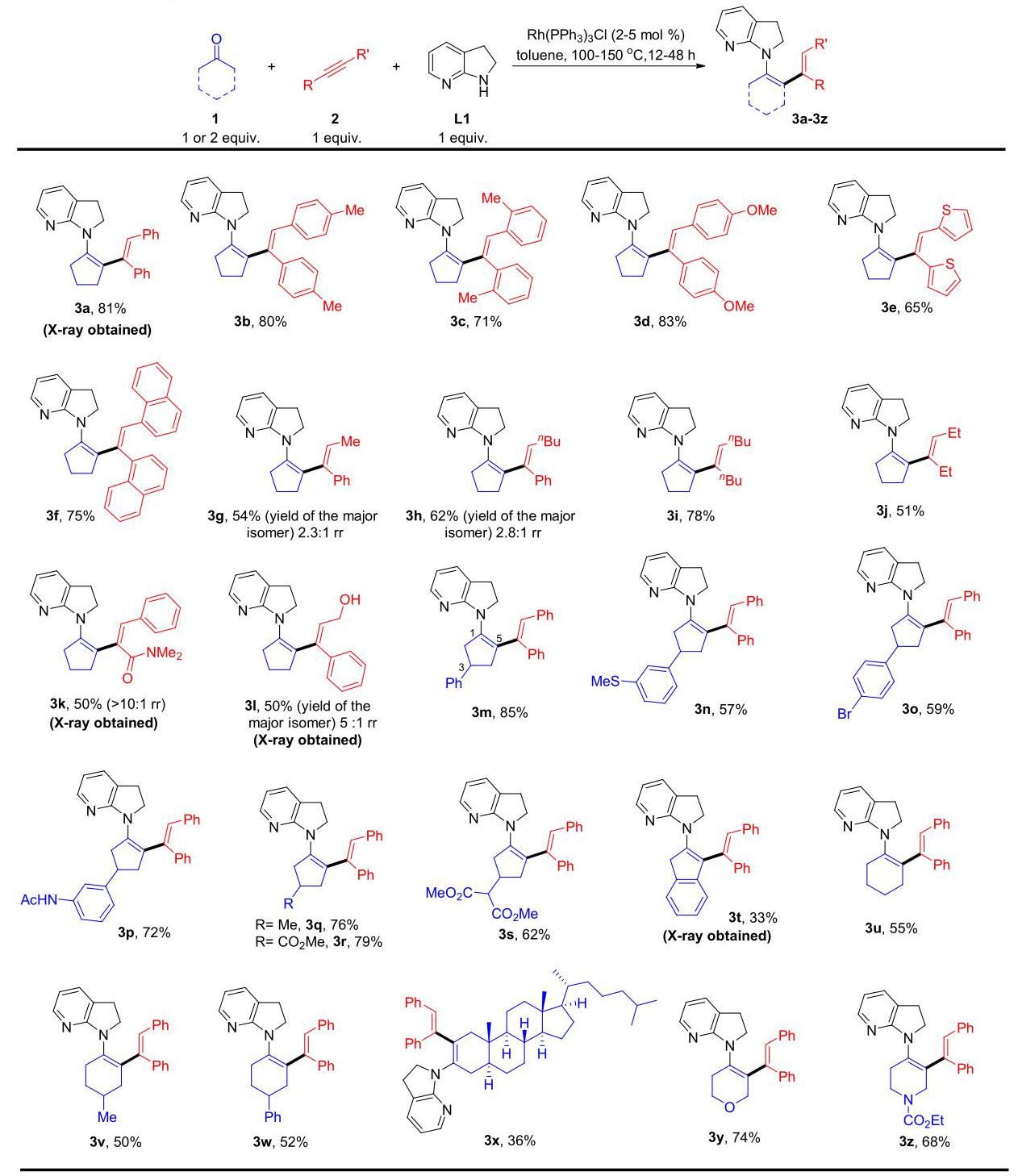
${}^{a}$ For unsubstituted cyclopentanones and cyclohexanones,2 equivalents of the ketone were employed; for other ketones,1 equivalent of the ketone was employed. For detailed conditions, see supporting information. All the yields are isolated yields. rr: regioisomer ratio.
${}^{a}$ 对于未取代的环戊酮和环己酮,使用2当量的酮;对于其他酮,使用1当量的酮。详细条件见补充信息。所有产率均为分离产率。rr:区域异构体比例。
Subsequently, the scope of the ketones was investigated (also see Charts 2 and 3). A range of 3-substituted cyclopentanones were first utilized to examine the site-selectivity (for the ketone) and functional group tolerance. To our delight, the alkenylation occurred exclusively at the less hindered C5 position of the ketones (3m-s). Substrates containing acidic C-H bonds, such as those $\alpha$ to a carboxylic ester (3r) and a malonate group (3s), were well tolerated. Thioethers (3n), aryl bromides (3o) and amides (3p) were compatible as well. The high chemoselectivity can be attributed to the ${pH}$ and redox-neutral conditions. 2-Indanone can also couple to give the desired product $3\mathbf{t}$ in a moderate yield. Although of lower reactivity, six-membered cyclic ketones (3u-z) were suitable substrates at an elevated temperature. Cholesterol-derived substrates gave the desired vinylation product (3x) selectively at the less hindered site of the ketone albeit in a lower yield. Heterocyclic ketones also underwent efficient couplings to give the corresponding enamines (3y and 3z). Acyclic ketones, e.g. acetophenone, also reacted; however, the pure form of the conjugated enamine product (observed from the crude NMR and Mass Spec) proved to be difficult to isolate due to its lability (for a one-pot alkenylation with acetophenone, see Chart 3). It is not surprising that, compared to cyclic ketones, acyclic ketones showed significantly diminished reactivity due to their increased difficulty to form enamines. ${}^{71}$ Thus, the general trend of reactivity is in an order of 5-membered cyclic ketones>6-membered cyclic ketones>linear ketones.
随后,我们对酮的适用范围进行了考察(另见图 2 和图 3)。首先,我们使用一系列 3-取代环戊酮来研究(酮的)位点选择性和官能团耐受性。令我们高兴的是,烯基化反应仅发生在酮位阻较小的 C5 位(3m-s)。含有酸性 C-H 键的底物,如那些与羧酸酯(3r)和丙二酸酯基团(3s)相邻的 $\alpha$,都能很好地兼容。硫醚(3n)、芳基溴化物(3o)和酰胺(3p)也具有兼容性。这种高化学选择性可归因于 ${pH}$ 和氧化还原中性条件。2-茚满酮也能发生偶联反应,以中等收率得到所需产物 $3\mathbf{t}$。虽然反应活性较低,但六元环酮(3u-z)在升高温度时也是合适的底物。胆固醇衍生的底物能选择性地在酮位阻较小的位点发生乙烯基化反应,得到所需产物(3x),尽管收率较低。杂环酮也能有效发生偶联反应,生成相应的烯胺(3y 和 3z)。无环酮,如苯乙酮,也能发生反应;然而,由于共轭烯胺产物(从粗品核磁共振和质谱中观察到)的不稳定性,很难分离得到其纯品(关于苯乙酮的一锅法烯基化反应,见图 3)。与环酮相比,无环酮由于形成烯胺的难度增加,反应活性显著降低,这并不奇怪。${}^{71}$ 因此,反应活性的一般趋势为五元环酮>六元环酮>直链酮。
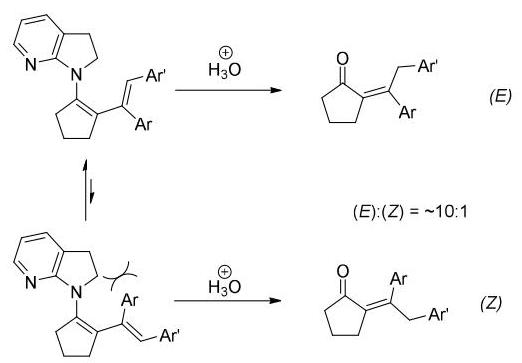
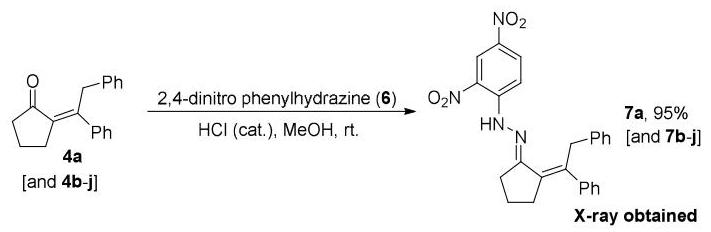
Scope of Conjugated Enone Products. The scope of directly forming conjugated enones was next investigated (Chart 2). Under the previously optimized conditions (vide supra, Table 1, entry 12), a variety of $\alpha ,\beta$ -unsaturated ketones were synthesized in 50- 70% yields. This coupling also tolerated a number of functional groups. Given the challenge of forming geometrically defined tetra-substituted alkenes, it is particularly interesting to note that all reactions with cyclic ketones gave $E$ enone as the predominate products $\left( {E : Z \sim {10} : 1}\right)$ . The high selectivity is likely controlled by the preferred conformation of the conjugated-enamine intermediate during the hydrolysis step, in which the 1,3-diene would adopt an $s$ -cis conformation to avoid the steric repulsion between the 7- azaindoline and the aryl group (Scheme 2). Most of the enone products were derivatized to the corresponding 2,4-dinitrophenyl hydrozones, and their structures were confirmed through X-ray crystallography.
共轭烯酮产物的范围。接下来研究了直接形成共轭烯酮的范围(图2)。在先前优化的条件下(见上文,表1,条目12),以50 - 70%的产率合成了多种$\alpha ,\beta$ -不饱和酮。这种偶联也能耐受许多官能团。鉴于形成几何构型明确的四取代烯烃的挑战,特别有趣的是,所有与环酮的反应都以$E$烯酮作为主要产物$\left( {E : Z \sim {10} : 1}\right)$。高选择性可能是由水解步骤中共轭烯胺中间体的优选构象控制的,其中1,3 -二烯将采取$s$ -顺式构象以避免7 -氮杂吲哚和芳基之间的空间排斥(方案2)。大多数烯酮产物被衍生化为相应的2,4 -二硝基苯腙,并通过X射线晶体学确认了它们的结构。
Chart 2. Synthesis of Conjugated Enones ${}^{\mathrm{a}}$
图2. 共轭烯酮的合成${}^{\mathrm{a}}$
Rh(PPh)3Cl (5 mol %)
三(三苯基膦)氯化铑(5 mol%)
TsOH•H ${}_{2}$ O (10 mol %)
对甲苯磺酸一水合物(10 mol%)${}_{2}$
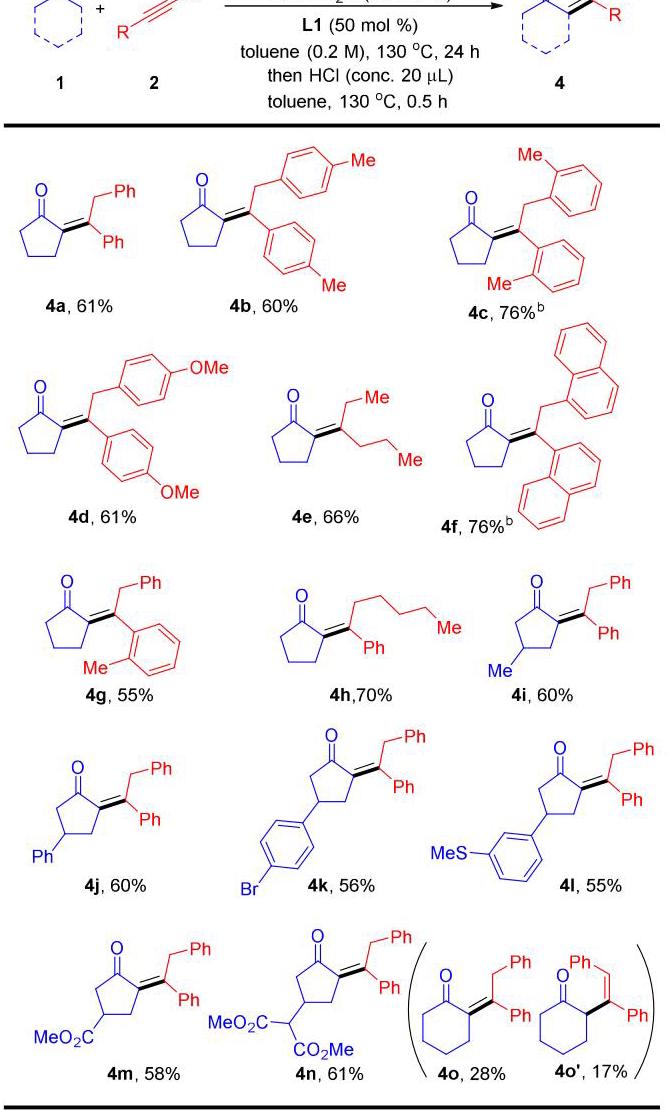
${}^{a}$ Reaction conditions: ${0.2}\mathrm{{mmol}}$ scale, toluene $1\mathrm{\;{mL}}$ . All the yields are isolated yields of the major $E$ isomer. $E/Z$ ratio is around 10:1. ${}^{b}$ With 100 mol $\%$ L1.
${}^{a}$ 反应条件:${0.2}\mathrm{{mmol}}$规模,甲苯$1\mathrm{\;{mL}}$。所有产率均为主要$E$异构体的分离产率。$E/Z$比例约为10:1。${}^{b}$ 含100 mol $\%$ L1。
Scheme 2. Rationalization of the alkene geometry
方案2. 烯烃几何构型的合理化
Scheme 3. Derivatization of Enone Products
方案3. 烯酮产物的衍生化
Scope of Vinyl Ketone Products. Undoubtedly, the $\alpha ,\beta$ - unsaturated enones are the thermodynamically more favorable products during the enamine hydrolysis, thus it would be difficult to obtain the less stable vinyl ketones ( $\beta ,\gamma$ -unsaturated enones) selectively using the in situ hydrolysis protocol. ${}^{66}$ However, the problem can be solved via a mild hydrolysis protocol (e.g. relatively low temperature) of the conjugate enamine intermediates (3) to acquire the kinetic products. By carefully tuning the hydrolysis conditions, the vinyl ketone products $\left( {\beta ,\gamma }\right.$ -unsaturated enones $)$ can be accessed selectively with retention of the geometry of the vinyl group (Chart 3). We found that a weak acid, such as acetic acid, in chloroform at room temperature gave the highest selectivity for the vinyl ketone. A number of conjugated enamines obtained from the ketone/alkyne/L1 coupling were subjected to these conditions. In general, the $\beta ,\gamma$ -enones products were formed predominantly, and the geometry of the vinyl group was conserved during the hydrolysis. In the case of 3-phenylcyclopentanone (5g), only one diastereoisomer was observed and the stereochemistry was revealed by 2D NMR analysis showing that the phenyl and vinyl substituents are in a cis relationship. In contrast, a pair of diaster-eoisomers was isolated for the six-membered ring substrates (5i and 5j). Linear ketones such as acetophenone, also participated in this transformation. Interestingly, using a one-pot procedure, the vinyl ketone products (5k and 5k’) were isolated as the major products instead of the conjugated enones.
乙烯基酮产物的范围。毫无疑问,在烯胺水解过程中,$\alpha ,\beta$ - 不饱和烯酮是热力学上更有利的产物,因此使用原位水解方案很难选择性地获得较不稳定的乙烯基酮($\beta ,\gamma$ - 不饱和烯酮)。${}^{66}$ 然而,通过对共轭烯胺中间体(3)进行温和的水解方案(例如相对较低的温度)可以解决这个问题,以获得动力学产物。通过仔细调整水解条件,可以选择性地获得乙烯基酮产物$\left( {\beta ,\gamma }\right.$ - 不饱和烯酮$)$,同时保留乙烯基的几何构型(图3)。我们发现,在室温下,在氯仿中使用弱酸(如乙酸)对乙烯基酮具有最高的选择性。许多由酮/炔烃/L1偶联得到的共轭烯胺都经过了这些条件的处理。一般来说,主要形成$\beta ,\gamma$ - 烯酮产物,并且在水解过程中乙烯基的几何构型得以保留。对于3 - 苯基环戊酮(5g),只观察到一种非对映异构体,并且通过二维核磁共振分析揭示了其立体化学,表明苯基和乙烯基取代基处于顺式关系。相比之下,对于六元环底物(5i和5j),分离出了一对非对映异构体。线性酮如苯乙酮也参与了这种转化。有趣的是,使用一锅法,乙烯基酮产物(5k和5k’)被分离为主要产物,而不是共轭烯酮。
Furthermore, a larger scale experiment was conducted to examine the scalability of the reaction. Running the reaction at a 5 mmol scale with $2\mathrm{\;{mol}}\% \mathrm{{Rh}}$ catalyst at ${100}{}^{ \circ }\mathrm{C}$ for ${40}\mathrm{\;h}$ gave $\mathbf{{5a}}$ in 65% yield after mild hydrolysis. The directing ligand L1 was recovered in 76% yield, showing that it can be recycled (eq 3).
此外,进行了更大规模的实验以检验反应的可扩展性。在5 mmol规模下,使用$2\mathrm{\;{mol}}\% \mathrm{{Rh}}$催化剂,在${100}{}^{ \circ }\mathrm{C}$条件下反应${40}\mathrm{\;h}$,经过温和水解后,以65%的产率得到$\mathbf{{5a}}$。导向配体L1的回收率为76%,表明它可以循环使用(式3)。
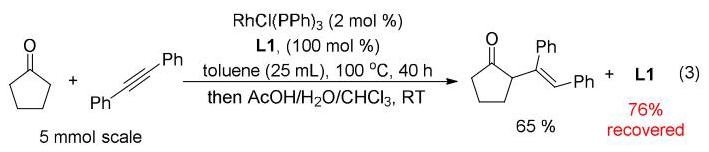
Chart 3. Synthesis of Vinyl Ketone Products ${}^{a}$
图3. 乙烯基酮产物${}^{a}$的合成
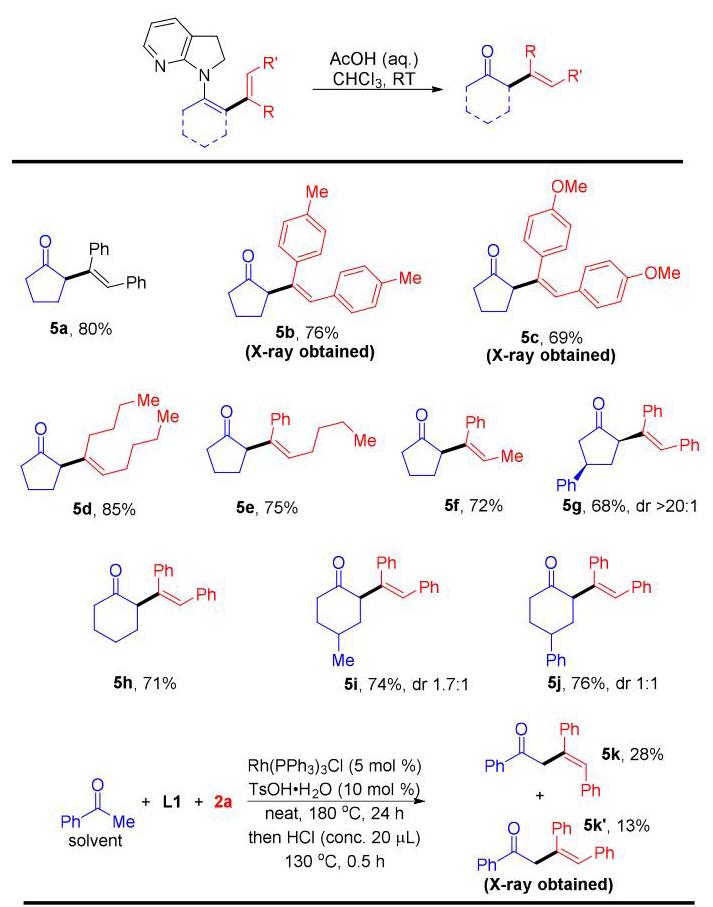
${}^{a}$ Reaction conditions: 0.2 mmol scale. $1\mathrm{\;{mL}}{\mathrm{{CHCl}}}_{3}$ and $1\mathrm{\;{mL}}{10}\% \; \left( {\mathrm{v}/\mathrm{v}}\right)$ aqueous acetic acid. All the yields are isolated yields.
${}^{a}$反应条件:0.2 mmol规模。$1\mathrm{\;{mL}}{\mathrm{{CHCl}}}_{3}$和$1\mathrm{\;{mL}}{10}\% \; \left( {\mathrm{v}/\mathrm{v}}\right)$为乙酸水溶液。所有产率均为分离产率。
Proposed Mechanism. While other possible mechanisms cannot be excluded at this stage, ${}^{72}$ based on our previous work with alkene insertion ${}^{60}$ and the aforementioned control experiments, a plausible catalytic cycle of the ketone $\alpha - \mathrm{C} - \mathrm{H}$ alkenylation is illustrated in Scheme 4. The reaction begins with the condensation of the secondary amine L1 with the ketone to form an enamine intermediate $\mathbf{I}$ (step A). During this step, the ketone $\alpha {\mathrm{{sp}}}^{3}\mathrm{C} - \mathrm{H}$ bond is converted into a ${\mathrm{{sp}}}^{2}\mathrm{C} - \mathrm{H}$ bond, thus enhancing the reactivity towards oxidative addition by a low-valent transition metal. ${}^{{73},{74}}$ Meanwhile, the adjacent pyridine group to the amine domain facilitates insertion of the rhodium(I) species into the resulting enamine vinyl C-H bond giving a rhodium-hydride species II (Rh-H, step B). Upon alkyne coordination with the metal, subsequent Rh-H migratory insertion (step D) or Rh-vinyl migratory insertion (not drawn) and reductive elimination (step E) would provide the final alkenylated conjugated enamine product. The following efforts have been conducted to explore the feasibility of the proposed mechanism.
提出的机理。虽然现阶段不能排除其他可能的机理,${}^{72}$ 基于我们之前关于烯烃插入的工作${}^{60}$以及上述对照实验,酮$\alpha - \mathrm{C} - \mathrm{H}$烯基化的一个合理催化循环如图4所示。反应始于仲胺L1与酮的缩合,形成烯胺中间体$\mathbf{I}$(步骤A)。在这个步骤中,酮$\alpha {\mathrm{{sp}}}^{3}\mathrm{C} - \mathrm{H}$键转化为${\mathrm{{sp}}}^{2}\mathrm{C} - \mathrm{H}$键,从而增强了对低价过渡金属氧化加成的反应性。${}^{{73},{74}}$ 同时,胺域相邻的吡啶基团促进铑(I)物种插入所得烯胺的乙烯基C - H键,生成铑氢物种II(Rh - H,步骤B)。炔烃与金属配位后,随后的Rh - H迁移插入(步骤D)或Rh - 乙烯基迁移插入(未画出)以及还原消除(步骤E)将提供最终的烯基化共轭烯胺产物。已经进行了以下努力来探索所提出机理的可行性。
Kinetic Monitoring. The reaction progress for forming the conjugate enamines (3a and 3a’) was monitored by ${}^{1}\mathrm{H}$ NMR (Figure 1). The enamine adduct between the ketone and L1 (INT, vide supra, eq 1) was observed at $1\mathrm{\;h}$ and disappeared at $3\mathrm{\;h}$ , suggesting that it was a reactive intermediate during the reaction. The reaction was completed at $5\mathrm{\;h}$ with full consumption of the bifunctional ligand L1. The profile after $3\mathrm{\;h}$ clearly showed that the conjugated enamine product 3a started to isomerize to 3a’, which ultimately reached an equilibrium with a ratio of 3a/3a’ about 2:1.
动力学监测。通过${}^{1}\mathrm{H}$核磁共振(图1)监测形成共轭烯胺(3a和3a’)的反应进程。在$1\mathrm{\;h}$处观察到酮与L1之间的烯胺加合物(INT,见上文,式1),并在$3\mathrm{\;h}$处消失,这表明它是反应过程中的活性中间体。在$5\mathrm{\;h}$时,随着双功能配体L1的完全消耗,反应完成。$3\mathrm{\;h}$之后的曲线清楚地表明,共轭烯胺产物3a开始异构化为3a’,最终达到平衡,3a/3a’的比例约为2:1。
Scheme 4. Proposed Catalytic Cycle.
方案4. 提出的催化循环。
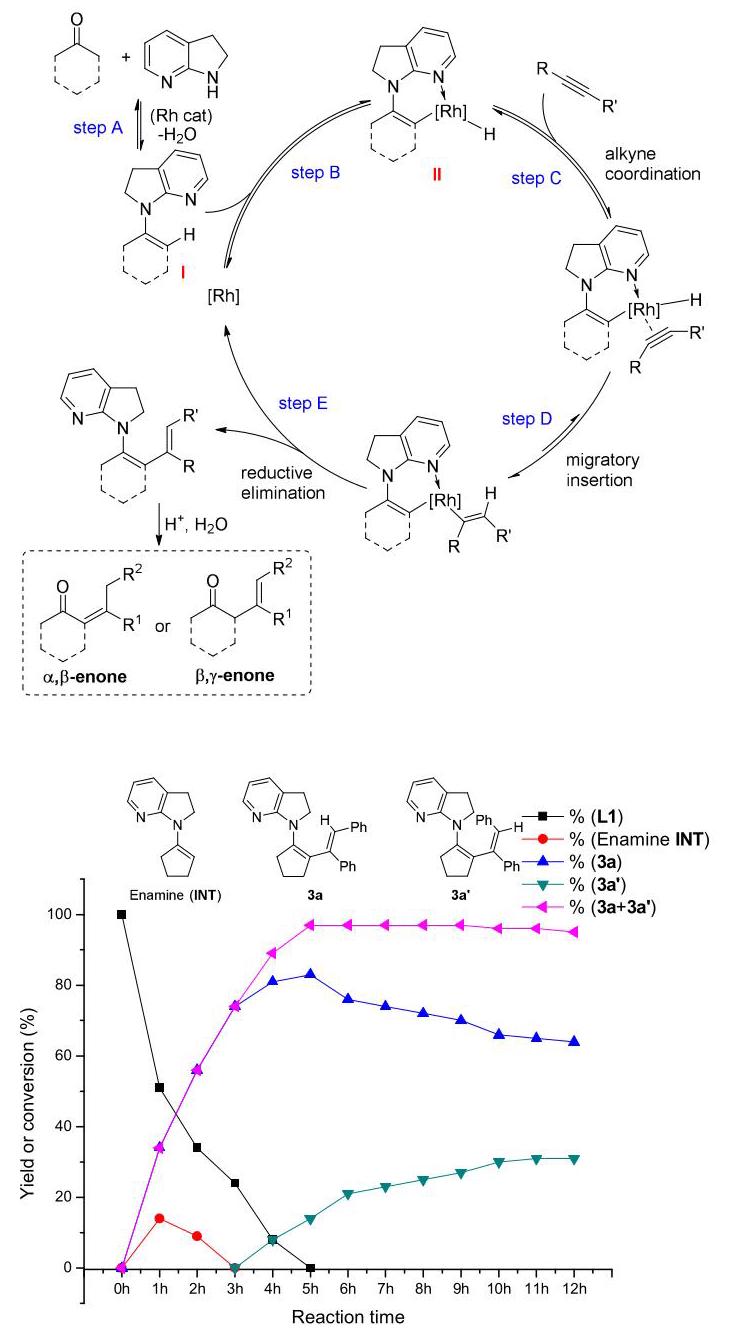
Figure 1. The reaction progress profile for conjugated enamine formation monitored by ${}^{1}\mathrm{H}$ NMR. The reaction was conducted with 5 mol % Wilkinson’s catalyst at ${130}^{ \circ }\mathrm{C}$ .
图1. 通过${}^{1}\mathrm{H}$核磁共振监测共轭烯胺形成的反应进程曲线。反应在${130}^{ \circ }\mathrm{C}$下用5 mol%的威尔金森催化剂进行。
Identification, Synthesis and Characterization of Rhodium-Hydride Complexes. Low valent transition metals, such as $\mathrm{{Ru}}\left( 0\right) ,\mathrm{{Rh}}\left( \mathrm{I}\right)$ and $\mathrm{{Ir}}\left( \mathrm{I}\right)$ , are known to undergo oxidative addition into C-H bonds to give metal-hydride species. ${}^{75}$ However, metal-hydride complexes are challenging to be captured and isolated particularly during a $\mathrm{C} - \mathrm{H}$ activation reaction, due to their high reactivity and lability. ${}^{69}$ Thus, we first explore the feasibility to synthesize Rh-H species with more stable enamine substrates. Previously, we have demonstrated the 1,2-diketone-derived enamines can undergo C-H coupling with alkenes and alkynes. ${}^{{76},{77}}$ To our delight, treatment of enamines $\mathbf{{8a}}$ and $\mathbf{{8b}}$ with $\mathrm{{Rh}}{\left( {\mathrm{{PPh}}}_{3}\right) }_{3}\mathrm{{Cl}}$ in ${\mathrm{C}}_{6}{\mathrm{D}}_{6}$ for 1 hour afforded the desired $\mathrm{{Rh}} - \mathrm{H}$ species $\mathbf{{9a}}$ and $\mathbf{{9b}}$ respectively (eqs 4 and 5), which were unambiguously characterized by NMR, IR, HRMS and X-ray crystallography. From the X-ray structures, the two PPh ${}_{3}$ ligands adopt a trans geometry. Surprisingly, these rhodium(III) hydride species can be isolated in high yields via bench-top flash chromatography, and they were stable in the air for several hours. The high efficiency of these C-H oxidative addition reactions is likely due to
氢化铑配合物的鉴定、合成与表征。已知低价过渡金属,如$\mathrm{{Ru}}\left( 0\right) ,\mathrm{{Rh}}\left( \mathrm{I}\right)$和$\mathrm{{Ir}}\left( \mathrm{I}\right)$,会发生氧化加成到C-H键中生成金属氢化物物种。${}^{75}$然而,金属氢化物配合物很难被捕获和分离,特别是在$\mathrm{C} - \mathrm{H}$活化反应过程中,因为它们具有高反应活性和不稳定性。${}^{69}$因此,我们首先探索用更稳定的烯胺底物合成Rh-H物种的可行性。此前,我们已经证明1,2-二酮衍生的烯胺可以与烯烃和炔烃发生C-H偶联。${}^{{76},{77}}$令我们高兴的是,在${\mathrm{C}}_{6}{\mathrm{D}}_{6}$中用$\mathrm{{Rh}}{\left( {\mathrm{{PPh}}}_{3}\right) }_{3}\mathrm{{Cl}}$处理烯胺$\mathbf{{8a}}$和$\mathbf{{8b}}$ 1小时,分别得到了所需的$\mathrm{{Rh}} - \mathrm{H}$物种$\mathbf{{9a}}$和$\mathbf{{9b}}$(式4和式5),通过核磁共振、红外光谱、高分辨质谱和X射线晶体学对其进行了明确表征。从X射线结构来看,两个PPh${}_{3}$配体呈反式构型。令人惊讶的是,这些氢化铑(III)物种可以通过台式快速柱色谱法高产率地分离出来,并在空气中稳定存在数小时。这些C-H氧化加成反应的高效率可能是由于
the strong electron-withdrawing nature of the conjugated carbonyl group, which may stabilize the Rh-H intermediates.
共轭羰基的强吸电子性质,这可能使Rh-H中间体稳定。
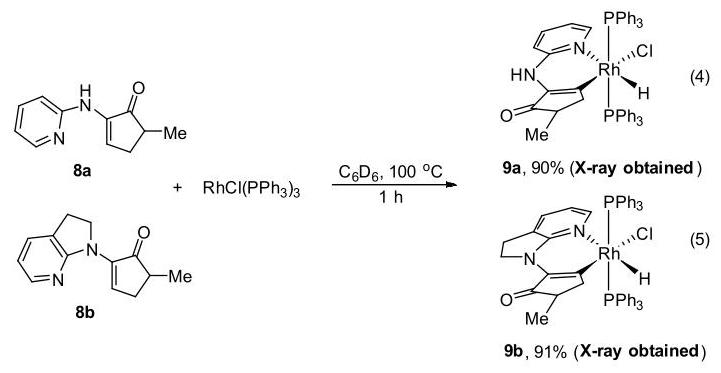
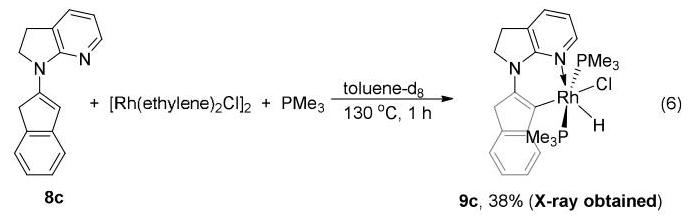
Encouraged by these results, we continued our study with the mono-ketone derived enamine (8c). In this case, Wilkinson’s catalyst did not yield any detectable metal-hydride species monitored by in situ ${}^{1}\mathrm{H}$ NMR analysis. Failure to capture a stable metal-hydride species does not necessarily mean that Wilkinson’s catalyst lacks the reactivity to insert into the $\mathrm{C} - \mathrm{H}$ bond. We hypothesized that due to the bulkiness and $\pi$ -accepting nature of the triphenylphosphine ligand, the reverse reaction (C-H reductive elimination) would be more favorable during the activation of enamine 8c. Consequently, the Rh-H species derived from the normal ketone enamine 8c could possibly be a high energy transient intermediate. To test this hypothesis, a less bulky but more electron-rich ligand, i.e. trimethylphosphine, was employed (eq 6), which should help to facilitate the $\mathrm{C} - \mathrm{H}$ oxidative addition and stabilize the Rh(III) intermediate by disfavoring the reductive elimination. Indeed, after heating ${\left\lbrack \mathrm{{Rh}}{\left( \text{ ethylene }\right) }_{2}\mathrm{{Cl}}\right\rbrack }_{2},\mathbf{{8c}}$ and ${\mathrm{{PMe}}}_{3}$ at ${130}^{ \circ }\mathrm{C}$ for $1\mathrm{\;h}$ , a rhodium-hydride complex $\left( {9\mathrm{c}}\right)$ is formed, which was found more sensitive to air than complexes 9a and $\mathbf{{9b}}{.}^{78}$ Nevertheless, we were able to isolate complex $\mathbf{{9c}}$ and characterize the structure via the X-ray crystallography. This Rh-H complex holds a distorted octahedral geometry with two phosphorus groups at the axial positions, and the Rh-H bond length is ${1.505\text{ Å }}$ . To the best of our knowledge, this represents the first example of insertion of a low-valent transition metal into a regular enamine vinyl $\mathrm{C} - \mathrm{H}$ bonds via oxidative addition.
受这些结果的鼓舞,我们继续使用单酮衍生的烯胺(8c)进行研究。在这种情况下,通过原位${}^{1}\mathrm{H}$ NMR分析监测发现,威尔金森催化剂未产生任何可检测到的金属氢化物物种。未能捕获稳定的金属氢化物物种并不一定意味着威尔金森催化剂缺乏插入$\mathrm{C} - \mathrm{H}$键的反应活性。我们推测,由于三苯基膦配体的体积较大且具有$\pi$接受性质,在烯胺8c的活化过程中,逆反应(C-H还原消除)会更有利。因此,由普通酮烯胺8c衍生的Rh-H物种可能是一种高能瞬态中间体。为了验证这一假设,我们使用了一种体积较小但电子密度更高的配体,即三甲基膦(式6),它应该有助于促进$\mathrm{C} - \mathrm{H}$氧化加成,并通过不利于还原消除来稳定Rh(III)中间体。事实上,将${\left\lbrack \mathrm{{Rh}}{\left( \text{ ethylene }\right) }_{2}\mathrm{{Cl}}\right\rbrack }_{2},\mathbf{{8c}}$和${\mathrm{{PMe}}}_{3}$在${130}^{ \circ }\mathrm{C}$加热$1\mathrm{\;h}$后,形成了一种铑氢化物配合物$\left( {9\mathrm{c}}\right)$,发现它比配合物9a和$\mathbf{{9b}}{.}^{78}$对空气更敏感。尽管如此,我们还是能够分离出配合物$\mathbf{{9c}}$并通过X射线晶体学对其结构进行表征。这种Rh-H配合物具有扭曲的八面体几何结构,轴向位置有两个磷基团,Rh-H键长为${1.505\text{ Å }}$。据我们所知,这代表了低价过渡金属通过氧化加成插入普通烯胺乙烯基$\mathrm{C} - \mathrm{H}$键的首个实例。
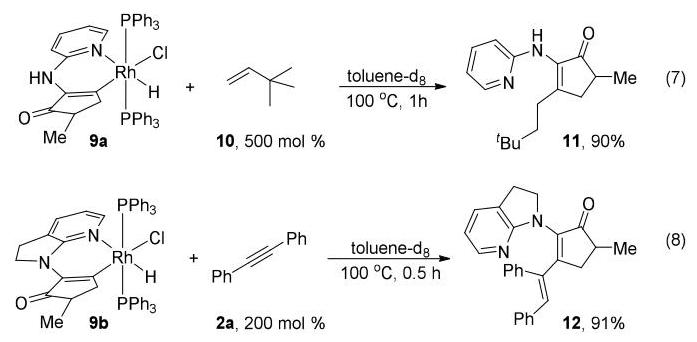
Reactivity of Rhodium-Hydride Complexes with Alkenes and Alkynes. Having examined the feasibility of the oxidative addition into the vinyl C-H bond (step B, Scheme 4), we next investigated the C-C bond forming step through ${2\pi }$ -insertion with the rhodium-hydride intermediate (migratory insertion and reductive elimination, steps D and E). Rhodium-hydride complexes 9a and $\mathbf{{9b}}$ were employed initially (eqs 7 and 8). Treatment of $\mathbf{{9a}}$ with 5 equivalents of 3,3-dimethylbutene (10) provided the desired alkylation product 11 in 90% yield. Through monitoring the reaction at different temperatures, no significant conversion was observed below ${100}{}^{ \circ }\mathrm{C}$ . However, when $\mathbf{{9b}}$ reacted with 2 equivalents of diphenylacetylene 2a, the metal-hydride peak disappeared in less than ${10}\mathrm{\;{min}}$ at ${50}^{ \circ }\mathrm{C}$ , suggesting a much higher reactivity with alkynes. The alkenylation product (12) was obtained in 91% yield at ${100}{}^{ \circ }\mathrm{C}$ within 0.5h. These observations are consistent with our previously proposed rhodium-hydride-involved mechanism for alkylation and alkenylation of 1,2- diketone-derived enamines. ${}^{{76},{77}}$
铑氢化物配合物与烯烃和炔烃的反应活性。在研究了氧化加成到乙烯基C-H键(方案4中的步骤B)的可行性之后,我们接下来通过铑氢化物中间体的${2\pi }$插入(迁移插入和还原消除,步骤D和E)研究了C-C键形成步骤。最初使用了铑氢化物配合物9a和$\mathbf{{9b}}$(式7和8)。用5当量的3,3-二甲基丁烯(10)处理$\mathbf{{9a}}$,以90%的产率得到了所需的烷基化产物11。通过在不同温度下监测反应,在${100}{}^{ \circ }\mathrm{C}$以下未观察到明显的转化。然而,当$\mathbf{{9b}}$与2当量的二苯乙炔2a反应时,金属氢化物峰在${50}^{ \circ }\mathrm{C}$下不到${10}\mathrm{\;{min}}$的时间内消失,这表明与炔烃的反应活性要高得多。在${100}{}^{ \circ }\mathrm{C}$下0.5小时内以91%的产率得到了烯基化产物(12)。这些观察结果与我们之前提出的涉及铑氢化物的1,2-二酮衍生烯胺烷基化和烯基化机理一致。${}^{{76},{77}}$
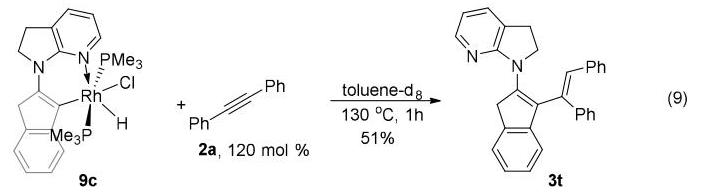
The reaction between the mono-ketone-derived rhodium-hydride complex (9c) and diphenylacetylene was tested subsequently (eq 9). While showing almost no reactivity with alkenes, 9c reacted with the alkyne to give the corresponding conjugated enamine (3t) in 51% yield at ${130}^{ \circ }\mathrm{C}$ .
随后测试了单酮衍生的铑氢化物配合物(9c)与二苯乙炔之间的反应(式9)。虽然9c与烯烃几乎没有反应活性,但它与炔烃反应,在${130}^{ \circ }\mathrm{C}$下以51%的产率得到了相应的共轭烯胺(3t)。
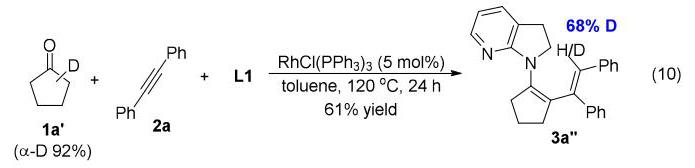
Deuterium-Labeling Experiments. In the proposed cycle (Scheme 4), metal-hydride migratory insertion and reductive elimination will transfer a ketone $\alpha$ -proton to the terminal vinyl position of the conjugated enamine product. Indeed, when deuter-ated cyclopentanone 1a’ ( $\alpha$ and $\alpha$ ‘-deuterated 92%) was allowed to react under the standard conditions, the NMR analysis of the product 3a” revealed 68% incorporation of deuterium at the terminal vinyl position (eq 10). ${}^{78}$ The erosion in deuterium incorporation for enone 3a" is likely caused by an proton exchange between the $\alpha$ -hydrogens of $1{a}^{\prime }$ and the NH hydrogen of L1. In addition, the resulting $E$ olefin geometry in the product supports a syn-migratory insertion pathway.
氘标记实验。在所提出的反应循环(方案4)中,金属氢迁移插入和还原消除将把酮的$\alpha$-质子转移到共轭烯胺产物的末端乙烯基位置。实际上,当氘代环戊酮1a’($\alpha$和$\alpha$’-氘代率为92%)在标准条件下反应时,产物3a"的核磁共振分析显示末端乙烯基位置有68%的氘掺入(方程式10)。${}^{78}$烯酮3a"中氘掺入率的降低可能是由于$1{a}^{\prime }$的$\alpha$-氢与L1的NH氢之间的质子交换。此外,产物中生成的$E$烯烃几何结构支持顺式迁移插入途径。
Identification of the Resting States of the Catalyst. To gain a better understanding of the catalytic cycle, we continued to identify the resting states of the catalyst. When monitoring the standard reaction of forming conjugated enamine 3a in toluene- ${\mathrm{d}}_{8}$ at 130 ${}^{ \circ }\mathrm{C}$ , we observed two sets of discrete phosphine-ligated rhodium species, which should correlate to the resting states of the catalyst (Figure 2A). ${}^{79}$ A doublet at ${36.8}\mathrm{{ppm}}$ with a ${J}_{\mathrm{{Rh}} - \mathrm{P}}$ value of ${126}\mathrm{\;{Hz}}$ and two doublets of doublets at ${59.3}\mathrm{{ppm}}$ and ${52.4}\mathrm{{ppm}}$ with ${J}_{\mathrm{{Rh}} - \mathrm{P}}$ values of ${200}\mathrm{\;{Hz}}$ and ${166}\mathrm{\;{Hz}}$ respectively were found in the ${}^{31}\mathrm{P}$ NMR spectrum.
催化剂静止态的鉴定。为了更好地理解催化循环,我们继续鉴定催化剂的静止态。当在130${}^{ \circ }\mathrm{C}$下监测在甲苯-${\mathrm{d}}_{8}$中形成共轭烯胺3a的标准反应时,我们观察到两组离散的膦配位铑物种,它们应该与催化剂的静止态相关(图2A)。${}^{79}$在${}^{31}\mathrm{P}$核磁共振谱中发现了一个位于${36.8}\mathrm{{ppm}}$处的双峰,其${J}_{\mathrm{{Rh}} - \mathrm{P}}$值为${126}\mathrm{\;{Hz}}$,以及两个位于${59.3}\mathrm{{ppm}}$和${52.4}\mathrm{{ppm}}$处的双二重峰,其${J}_{\mathrm{{Rh}} - \mathrm{P}}$值分别为${200}\mathrm{\;{Hz}}$和${166}\mathrm{\;{Hz}}$。
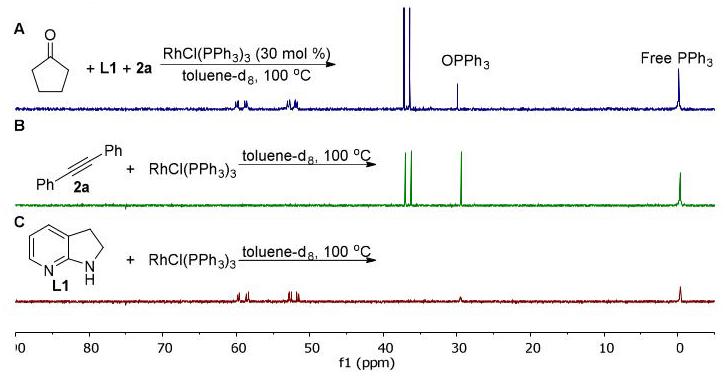
Figure 2. ${}^{31}\mathrm{P}$ NMR of mechanistic studies.
图2. 机理研究的${}^{31}\mathrm{P}$核磁共振谱。
(11)
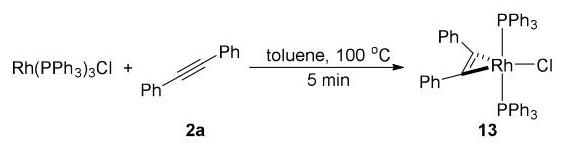
To identify these rhodium species, we carried out control experiments by mixing $\mathrm{{Rh}}{\left( {\mathrm{{PPh}}}_{3}\right) }_{3}\mathrm{{Cl}}$ with each reagent one at a time. We discovered that the doublet at ${36.8}\mathrm{{ppm}}$ in ${}^{31}\mathrm{P}$ NMR spectrum appeared when Wilkinson’s catalyst and diphenylacetylene were mixed and heated together (Figure 2B and eq 11). Fortunately, a crystal was obtained from this reaction and the X-ray structure was shown below as an alkyne-coordinated complex (13). This complex exhibits a pseudo-trigonal bipyramidal geometry in which the distorted diphenylacetylene and chloride form the triangle base and the two phosphorus groups occupy the axial positions. The bond distance between the rhodium and one of the alkynyl carbon is ${2.075\text{ Å }}$ and the C-Rh-C angle is ${35.6}^{ \circ }$ .
为了鉴定这些铑物种,我们通过将$\mathrm{{Rh}}{\left( {\mathrm{{PPh}}}_{3}\right) }_{3}\mathrm{{Cl}}$一次与一种试剂混合进行对照实验。我们发现,当威尔金森催化剂和二苯乙炔混合并一起加热时,${}^{31}\mathrm{P}$核磁共振谱中位于${36.8}\mathrm{{ppm}}$处的双峰出现了(图2B和方程式11)。幸运的是,从该反应中获得了一个晶体,其X射线结构如下所示为炔烃配位络合物(13)。该络合物呈现出伪三角双锥几何结构,其中扭曲的二苯乙炔和氯形成三角底面,两个磷基团占据轴向位置。铑与其中一个炔基碳之间的键长为${2.075\text{ Å }}$,C-Rh-C角为${35.6}^{ \circ }$。
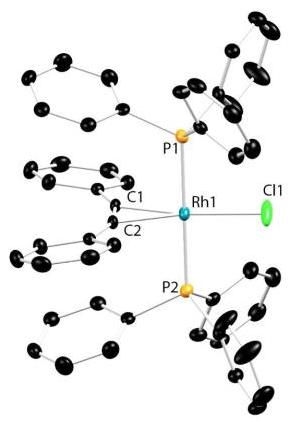
Figure 3. Crystal structure of complex 13 at 50% probability level. Hydrogen atoms are omitted for clarity. Selected bond lengths (Å): $\mathrm{{Rh}}1 - \mathrm{P}1 = {2.342},\mathrm{{Rh}}1 - \mathrm{P}2 = {2.342},\mathrm{{Rh}}1 - \mathrm{C}1 = {2.072},\mathrm{{Rh}}1 - \mathrm{C}2 =$ 2.072, Rh1-Cl1 = 2.341. Selected bond angle (deg): C2-Rh1-C1 $= {35.6}$ .
图3. 络合物13在50%概率水平下的晶体结构。为清晰起见,省略了氢原子。选定键长(Å):$\mathrm{{Rh}}1 - \mathrm{P}1 = {2.342},\mathrm{{Rh}}1 - \mathrm{P}2 = {2.342},\mathrm{{Rh}}1 - \mathrm{C}1 = {2.072},\mathrm{{Rh}}1 - \mathrm{C}2 =$2.072,Rh1-Cl1 = 2.341。选定键角(度):C2-Rh1-C1$= {35.6}$。
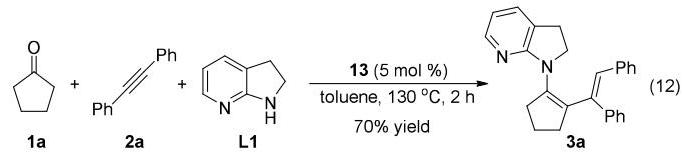
Later, we found that the synthesis of complex 13 was first reported by Wilkinson in 1966, ${}^{80}$ albeit that no structure was defined at that time. In accord with Wilkinson’s discovery, we also observed that complex 13 dissociates when dissolved in solution and cannot be recrystallized. This phenomenon implies that complex 13 is not stable without excess alkynes and phosphine ligands in solution, and thus may hold high catalytic activity. Indeed, when complex 13 (5 mol%) was used as the catalyst instead of $\mathrm{{Rh}}{\left( {\mathrm{{PPh}}}_{3}\right) }_{3}\mathrm{{Cl}}$ , the reaction gave 70% yield of $\mathbf{{3a}}$ within 2 hours (eq 12). All together, we anticipate that complex 13 is one of the resting states of the catalyst.
后来,我们发现配合物13的合成最早是由威尔金森在1966年报道的,${}^{80}$ 尽管当时没有确定其结构。与威尔金森的发现一致,我们还观察到配合物13在溶解于溶液时会解离,并且无法重结晶。这种现象表明,在溶液中没有过量的炔烃和膦配体时,配合物13是不稳定的,因此可能具有高催化活性。事实上,当使用配合物13(5 mol%)代替 $\mathrm{{Rh}}{\left( {\mathrm{{PPh}}}_{3}\right) }_{3}\mathrm{{Cl}}$ 作为催化剂时,反应在2小时内得到了70%产率的 $\mathbf{{3a}}$(方程式12)。总之,我们预计配合物13是催化剂的静止状态之一。
Regarding the other Rh complex observed during the catalytic reaction, the identical doublets of doublets at 59.3 ppm and 52.4 ppm in ${}^{31}\mathrm{P}$ NMR were observed when just heating Wilkinson’s catalyst and L1 together (Figure 2C). While attempts to isolate a pure complex for further characterization remained unfruitful, we are confident that the other resting state of the catalyst should contain rhodium, triphenylphosphine and the bi-functional ligand (L1).
关于在催化反应过程中观察到的另一种铑配合物,当仅将威尔金森催化剂和L1一起加热时(图2C),在 ${}^{31}\mathrm{P}$ NMR中59.3 ppm和52.4 ppm处观察到了相同的双重双峰。虽然分离出纯配合物以进行进一步表征的尝试没有成功,但我们相信催化剂的另一种静止状态应该包含铑、三苯基膦和双功能配体(L1)。
CONCLUSIONS
结论
In summary, we have developed a rhodium(I)-catalyzed bifunctional ligand-assisted ketone alkenylation using unactivated di-substituted alkynes as the coupling partner. Through controlling the reaction conditions, selective synthesis of conjugated enamines, $\alpha ,\beta$ -and $\beta ,\gamma$ -unsaturated ketones can be achieved. While both cyclic and acyclic ketones can be used as the substrates, cyclic ketones are more reactive. The intermolecular coupling of ketones with internal alkynes shows high site-, chemo- and stere-oselectivity. This transformation can also tolerate a range of functional groups due to its near $\mathrm{{pH}}$ and redox-neutral conditions. Finally, the proposed reaction mechanism was carefully explored through control experiments, kinetic monitoring, preparation of the rhodium-hydride intermediates and their reactions with alkynes, deuterium-labeling experiments and identification of the resting states of the catalyst. We expect this detailed study would shed light on the scope and potential of the dual activation strategy for catalytic ketone-unsaturate couplings. Expansion to the coupling of other types of unsaturated hydrocarbons, e.g. allenes and 1,3-dienes, is ongoing in our laboratory.
总之,我们开发了一种铑(I)催化的双功能配体辅助的酮烯基化反应,使用未活化的二取代炔烃作为偶联伙伴。通过控制反应条件,可以实现共轭烯胺、$\alpha ,\beta$ -和$\beta ,\gamma$ -不饱和酮的选择性合成。虽然环状和非环状酮都可以用作底物,但环状酮的反应性更高。酮与内炔的分子间偶联表现出高的位点、化学和立体选择性。由于其接近$\mathrm{{pH}}$且氧化还原中性的条件,这种转化也能耐受一系列官能团。最后,通过对照实验、动力学监测、铑氢中间体的制备及其与炔烃的反应、氘标记实验以及催化剂静止态的鉴定,对提出的反应机理进行了仔细探索。我们期望这项详细研究能够阐明催化酮 - 不饱和物偶联的双活化策略的范围和潜力。我们实验室正在进行将其扩展到其他类型不饱和烃(如丙二烯和1,3 - 二烯)的偶联反应。
ASSOCIATED CONTENT
相关内容
Text, figures, tables, and CIF files giving experimental procedures, kinetics data, and crystallographic information. This material is available free of charge via the Internet at http://pubs.acs.org.
提供实验步骤、动力学数据和晶体学信息的文本、图表和CIF文件。这些材料可通过互联网免费获取,网址为http://pubs.acs.org。
AUTHOR INFORMATION
作者信息
Corresponding Author
通讯作者
Author Contributions
作者贡献
The manuscript was written through contributions of all authors. All authors have given approval to the final version of the manuscript.
该稿件由所有作者共同撰写。所有作者均已批准稿件的最终版本。
Notes
注释
The authors declare no competing financial interest.
作者声明不存在相互竞争的财务利益。
ACKNOWLEDGMENT
致谢
We thank Cancer Prevention and Research Institute of Texas (R1118) for a start-up fund and the Welch Foundation (F-1781) and NSF (CAREER: CHE-1254935) for research grants. Dr. Lynch is acknowledged for X-ray crystallography. We thank B. A. Shoulders, S. Sorey, and A. Spangenberg for NMR advice; Johnson Matthey for a donation of Rh salts. We also thank Dr. M.C. Young for proofreading the manuscript.
我们感谢德克萨斯州癌症预防与研究所(R1118)提供的启动资金,以及韦尔奇基金会(F - 1781)和美国国家科学基金会(职业发展奖:CHE - 1254935)提供的研究资助。感谢林奇博士进行X射线晶体学研究。感谢B. A. 肖尔兹、S. 索里和A. 斯潘根贝格提供核磁共振方面的建议;感谢庄信万丰公司捐赠铑盐。我们还感谢M.C. 杨博士对手稿进行校对。
REFERENCES
参考文献
(1) Escher, I.; Glorious, F. Sci. Synth. 2007, 25, 733.
(2) Radin, N. S. Drug Dev. Res. 2008, 69, 15.
(3) Patai, S.; Rappoport, Z. Eds.; The Chemistry of Enones: Volume 1 and 2, John Wiley & Sons, 1989.
(4) Buckle, D. R.; Pinto, I. L. In Comprehensive Organic Synthesis; Trost, B. M., Fleming, I., Eds.; Pergamon Press: Oxford, U.K., 1991; Vol. 7, pp 119-149.
(5) Larock, R. C. In Comprehensive Organic Transformations; John Wiley & Sons: New York, 1999; pp 251-256.
(6) Dénès, F.; Pérez-Luna, A.; Chemla, F. Chem. Rev. 2010, 110, 2366.
(7) Patil, N. T.; Kavthe, R. D.; Shinde, V. S. Tetrahedron 2012, 68, 8079.
(8) For stoichiometric metal salts promoted “Conia-ene” reactios, see ref 6, section 4.1.
(9) Bloch, R.; Le Perchec, P.; Conia, J. M. Tetrahedron 1968, 24, 5971.
(10) Conia, J. M.; Le Perchec, P. Synthesis 1975, 1.
(11) Drouin, J.; Leyendecker, F.; Conia, J. M. Tetrahedron 1980, 36, 1203.
(12) Mandville, G.; Conia, J. M. Nouv. J. Chim. 1981, 5, 137.
(13) Boaventura, M. A.; Drouin, J.; Conia, J. M. Synthesis 1983, 801.
(14) Kennedy-Smith, J. J.; Staben, S. T.; Toste, F. D. J. Am. Chem. Soc. 2004, 126, 4526.
(15) Staben, S. T.; Kennedy-Smith, J. J.; Toste, F. D. Angew. Chem. Int. Ed. 2004, 43, 5350.
(16) Ochida, A.; Ito, H.; Sawamura, M. J. Am. Chem. Soc. 2006, 128, 16486.
(17) Ito, H.; Makida, Y.; Ochida, A.; Ohmiya, H.; Sawamura, M. Org. Lett. 2008, 10, 5051.
(18) Pan, J.-H.; Yang, M.; Gao, Q.; Zhu, N.-Y.; Yang, D. Synthesis 2007, 2539.
(19) Gao, Q.; Zheng, B.-F.; Li, J.-H.; Yang, D. Org. Lett. 2005, 7, 2185.
(20) Deng, C.-L.; Song, R.-J.; Liu, Y.-L.; Li, J.-H. Adv. Synth. Catal. 2009, 351, 3096.
(21) Deng, C.-L.; Zou, T.; Wang, Z.-Q.; Song, R.-J.; Li, J.-H. J. Org. Chem. 2009, 74, 412.
(22) Montel, S.; Bouyssi, D.; Balme, G. Adv. Synth. Catal. 2010, 352, 2315.
(23) Deng, C.-L.; Song, R.-J.; Guo, S.-M.; Wang, Z.-Q.; Li, J.-H. Org. Lett. 2007, 9, 5111.
(24) Liu, Y.; Song, R.-J.; Li, J.-H. Synthesis 2010, 3663.
(25) Davies, P. W.; Detty-Mambo, C. Org. Bimol. Chem. 2010, 8, 2918.
(26) Chernyak, N.; Gorelsky, S. I.; Gevorgyan, V. Angew. Chem. Int. Ed. 2011, 50, 2342.
(27) Corkey, B. K.; Toste, F. D. J. Am. Chem. Soc. 2005, 127, 17168.
(28) Yang, T.; Ferrali, A.; Sladojevich, F.; Campbell, L.; Dixon, D. J. J. Am. Chem. Soc. 2009, 131, 9140.
(29) Matsuzawa, A.; Mashiko, T.; Kumagai, N.; Shibasaki, M. An-gew. Chem. Int. Ed. 2011, 50, 7616.
(30) Phillips, E. M.; Roberts, J. M.; Scheidt, K. A. Org. Lett. 2010, 12, 2830.
(31) Tsuji, H.; Yamagata, K.-i.; Itoh, Y.; Endo, K.; Nakamura, M.; Nakamura, E. Angew. Chem. Int. Ed. 2007, 46, 8060.
(32) Itoh, H.; Tsuji, H.; Yamagata, K.-i.; Endo, K.; Tanaka, I.; (32) Nakamura, M.; Nakamura, E. J. Am. Chem. Soc. 2008, 130, 17161.
(33) Tsuji, H.; Yamagata, K.-i.; Fujimoto, T.; Nakamura, E. J. Am. Chem. Soc. 2008, 130, 7792.
(34) Peng, W.; Lee, C.-S. Synlett 2008, 142.
(35) Jackson, W. P.; Ley, S. V. J. Chem. Soc., Perkin Trans. 1 1981, 1516.
(36) McDonald, F. E.; Olson, T. C. Tetrahedron Lett. 1997, 38, 7691.
(37) Chan, L. Y.; Kim, S.; Park, Y.; Lee, P. H. J. Org. Chem. 2012, 77, 5239.
(38) Shaw, S.; White, J. D. J. Am. Chem. Soc. 2014, 136, 13578.
(39) Nakamura, M.; Endo, K.; Nakamura, E. J. Am. Chem. Soc. 2003, 125, 13002.
(40) Nakamura, M.; Endo, K.; Nakamura, E. Org. Lett. 2005, 7, 3279.
(41) Nakamura, M.; Endo, K.; Nakamura, E. Adv. Synth. Catal. 2005, 347, 1681.
(42) Kuninobu, Y.; Kawata, A.; Takai, K. Org. Lett. 2005, 7, 4823.
(43) Nakamura, M. Pure Appl. Chem. 2006, 78, 425.
(44) Endo, K.; Hatakeyama, T.; Nakamura, M.; Nakamura, E. J. Am. Chem. Soc. 2007, 129, 5264.
(45) Tsuji, H.; Fujimoto, T.; Endo, K.; Nakamura, N.; Nakamura, E. Org. Lett. 2008, 10, 1219.
(46) Fujimoto, T.; Endo, K.; Tsuji, H.; Nakamura, M.; Nakamura, E. J. Am. Chem. Soc. 2008, 130, 4492.
(47) Kuninobu, Y.; Nishi, M.; Yudha, S.; Takai, K. Org. Lett. 2008, 10, 3009.
(48) Tsuji, H.; Tanaka, I.; Endo, K.; Yamagata, K.-i.; Nakamura, M.; Nakamura, E. Org. Lett. 2009, 11, 1845.
(49) Onodera, G.; Kato, M.; Kawano, R.; Kometani, Y.; Takeuchi, R. Org. Lett. 2009, 11, 5038.
(50) Murahashi, S.; Naota, T.; Nakano, Y. Synlett 2009, 20, 3355.
(51) Cheung, H. W.; So, C. M.; Pun, K. H.; Zhou, Z.; Lau, C. P. Adv. Synth. Catal. 2011, 353, 411.
(52) Pennington-Boggio, M. K.; Conley, B. L.; Williams, T. J. J. Organomet. Chem. 2012, 716, 6.
(53) Xi, Y.; Wang, D.; Ye, X.; Akhmedov, N. G.; Petersen, J. L.; Shi, X. Org. Lett. 2013, 16, 306.
(54) Yamaguchi, M.; Hayashi, A.; Hirama, M. J. Am. Chem. Soc. 1993, 115, 3362.
(55) Yamaguchi, M.; Sehata, M.; Hayashi, A.; Hirama, M. J. Chem. Soc., Chem. Commun. 1993, 1708.
(56) Hayashi, Y.; Yamaguchi, M.; Hirama, M. Synlett 1995, 51.
(57) Yamaguchi, M.; Tsukagoshi, T.; Arisawa, M. J. Am. Chem. Soc. 1999, 121, 4074.
(58) Trofimov, B. A.; Schmidt, E. Y.; Ushakov, I. A.; Zorina, N. V.; Skital’tseva, E. V.; Protsuk, N. I.; Mikhaleva, A. b. I. Chem. -Eur. J. 2010, 16, 8516.
(59) Trofimov, B. A.; Schmidt, E. Y.; Zorina, N. V.; Ivanova, E. V.; Ushakov, I. A. J. Org. Chem. 2012, 77, 6880.
(60) For a preliminary report of our ketone-olefin couplings, see: Mo, F.; Dong, G. Science 2014, 345, 68.
(61) For reviews of ${\mathrm{{sp}}}^{2}\mathrm{C} - \mathrm{H}/$ alkyne couplings, see: (a) Park, Y.; Park, J.-W.; Jun, C.-H. Acc. Chem. Res. 2008, 41, 222. (b) Kitamura, T.
Eur. J. Org. Chem. 2009, 1111. (c) Wang, X.; Zhou, L.; Lu, W. Cur.
Org. Chem. 2010, 14, 289. (d) Colby, D. A.; Tsai, A. S.; Bergman, R. G.; Ellman, J. A. Acc. Chem. Res. 2012, 45, 814. (e) Yang, L.; Huang, H. Chem. Rev. 2015, 9, 3468.
(62) For representative examples, see: (a) Hong, P.; Cho, B.-R.; Yamazaki, H. Chem. Lett. 1980, 507. (b) Yamazaki, H.; Hong, P. J. Mol. Catal. A 1983, 21, 133. (c) Kakiuchi, F.; Yamamoto, Y.; Chatani, N.; Murai, S. Chem. Lett. 1995, 681. (d) Trost, B. M.; Imi, K.; Davies, I. W. J. Am. Chem. Soc. 1995, 117, 5371. (e) Auluwurm, U. R.; Melchinger, J. U.; Kisch, H. Organometallics 1995, 14, 3385. (f) Kakiuchi, F.; Yamamoto, Y.; Chatani, N.; Murai, S. Chem. Lett. 1995, 24, 681. (g) Dürr, U.; Kisch, H. Synlett 1997, 12, 1335. (h) Lim, Y.-G.; Lee, K.-H.; Koo, B. T.; Kang, J.-B. Tetrahedron Lett. 2001, 42, 7609.
(i) Jun, C.-H.; Lee, H.; Hong, J.-B.; Kwon, B.-I. Angew. Chem. Int. Ed. 2002, 41, 2146. (j) Kakiuchi, F.; Uetsuhara, T.; Tanaka, Y.; Chatani, N.; Murai, S. J. Mol. Catal. A: Chem. 2002, 182, 511. (k) Jun, C.-H.; Lee, H.; Hong, J.-B.; Kwon, B.-I. Angew. Chem., Int. Ed.
2002, 41, 2146. (1) Colby, D. A.; Bergman, R. G.; Ellman, J. A. J. Am.
Chem. Soc. 2006, 128, 5604. (m) Tsuchikama, K.; Kasagawa, M.;
Hashimoto, Y.-K.; Endo, K.; Shibata, T. J. Organomet. Chem. 2008,
693, 3939. (n) Katagiri, T.; Mukai, T.; Satoh, T.; Hirano, K.; Miura,
M. Chem. Lett. 2009, 38, 118. (o) Schipper, D. J.; Hutchinson, M.;
Fagnou, K. J. Am. Chem. Soc. 2010, 132, 6910. (p) Gao, K.; Lee, P.-
S.; Fujita, T.; Yoshikai, N. J. Am. Chem. Soc. 2010, 132, 12249. (q)
Kanyiva, K. S.; Kashihara, N.; Nakao, Y.; Hiyama T.; Ohashi M.;
Ogoshi S. Dalton Trans. 2010, 39, 10483. (r) Lee, P.-S.; Fujita, T.;
Yoshikai, N. J. Am. Chem. Soc. 2011, 133, 17283. (s) Nakao, Y.;
Morita E.; Idei H.; Hiyama T. J. Am. Chem. Soc. 2011, 133, 3264.
(63) Ito, J.-i.; Kitase, M.; Nishiyama, H. Organometallics 2007, 26, 6412.
(64) Katagiri, T.; Tsurugi, H.; Satoh, T.; Miura, M. Chem. Commun. 2008, 3405.
(65) Umeda, N.; Hirano, K.; Satoh, T.; Shibata, N.; Sato, H.; Miura, M. J. Org. Chem. 2011, 76, 13.
(66) For a recent seminal work on selective hydrolysis of conjugated enamines, see: Duttwyler, S.; Chen, S.; Takase, M. K.; Wiberg, K. B.; Bergman, R. G.; Ellman, J. A. Science 2013, 339, 678.
(67) Use of the IMes NHC ligand, which gave the optimal yield for the alkene insertion, gave no desired coupling product with alkyne 2a.
(68) A control reaction showed that no 4a formed when heating 1a with 2-phenylacetophenone under the standard conditions:

(69) For a similar regioselectivity observed on C-H/alkyne couplings, see: Colby, D. A.; Bergman, R. G.; Ellman, J. A. J. Am. Chem. Soc. 2008, 130, 3645.
(70) A control experiment showed that in the absence of the rhodium catalyst no reaction with $3\mathbf{k}$ was observed.
(71) Sánchez, D.; Bastida, D.; Burés, J.; Isart, C.; Pineda, O.; Vilarra-sa, J. Org. Lett. 2012, 14, 536.
(72) For an alternative mechanism that cannot be excluded at this stage, see SI page S22.
(73) Lewis, L. N.; Smith, J. F. J. Am. Chem. Soc. 1986, 108, 2728.
(74) Colby, D. A.; Bergman, R. G.; Ellman, J. A. Chem. Rev. 2010, 110, 624.
(75) Labinger, J. A.; Bercaw, J. E. Nature 2002, 417, 507.
(76) Wang, Z.; Reinus, B. J.; Dong, G. J. Am. Chem. Soc. 2012, 134, 13954.
(77) Wang, Z.; Reinus, B. J.; Dong, G. Chem. Commun. 2014, 50, 5230.
(78) A portion of these results have been described in our previous communication, see ref 60.
(79) For recent examples of identifying catalyst resting states, see: (a) Cheng, C.; Hartwig, J. F. J. Am. Chem. Soc. 2014, 136, 12064. (b)
Sevov, C. S.; Zhou, J.; Hartwig, J. F. J. Am. Chem. Soc. 2014, 136, 3200. (c) Feller, M.; Diskin-Posner, Y.; Leitus, G.; Shimon, L. J. W.; Milstein, D. J. Am. Chem. Soc. 2013, 135, 11040.
(80) Mague, J. T.; Wilkinson, G. Journal of the Chemical Society A: Inorganic, Physical, Theoretical 1966, 1736.