Transition metal-catalyzed ketone-directed or mediated C–H functionalization
英文原文与中文译文逐段对照 · English original with Chinese translation
Zhongxing Huang, Hee Nam Lim, Fanyang Mo, Michael C. Young and Guangbin Dong*
黄中兴,林熙南,莫凡洋,迈克尔·C·杨和董广彬*
Transition metal-catalyzed C-H functionalization has evolved into a prominent and indispensable tool in organic synthesis. While nitrogen, phosphorus and sulfur-based functional groups (FGs) are widely employed as effective directing groups (DGs) to control the site-selectivity of C-H activation, the use of common FGs (e.g. ketone, alcohol and amine) as DGs has been continuously pursued. Ketones are an especially attractive choice of DGs and substrates due to their prevalence in various molecules and versatile reactivity as synthetic intermediates. Over the last two decades, transition metal-catalyzed C-H functionalization that is directed or mediated by ketones has experienced vigorous growth. This review summarizes these advancements into three major categories: use of ketone carbonyls as DGs, direct $\beta$ -functionalization, and $\alpha$ -alkylation/alkenylation with unactivated olefins and alkynes. Each of these subsections is discussed from the perspective of strategic design and reaction discovery.
过渡金属催化的C-H官能化已发展成为有机合成中一种重要且不可或缺的工具。虽然基于氮、磷和硫的官能团(FGs)被广泛用作有效的导向基团(DGs)来控制C-H活化的位点选择性,但人们一直在不断探索使用常见的FGs(如酮、醇和胺)作为DGs。酮作为DGs和底物是一个特别有吸引力的选择,因为它们在各种分子中普遍存在,并且作为合成中间体具有多种反应性。在过去的二十年中,由酮导向或介导的过渡金属催化的C-H官能化经历了蓬勃发展。本综述将这些进展总结为三大类:使用酮羰基作为DGs、直接$\beta$-官能化以及与未活化的烯烃和炔烃进行$\alpha$-烷基化/烯基化。这些小节中的每一个都从战略设计和反应发现的角度进行了讨论。
CrossMark
CrossMark
Eclick for updates
点击获取更新
Cite this: DOI: 10.1039/c5cs00272a
引用本文:DOI: 10.1039/c5cs00272a
Received 31st March 2015
2015年3月31日收到
DOI: 10.1039/c5cs00272a
DOI: 10.1039/c5cs00272a
1. Introduction
1. 引言
Transition metal-catalyzed C-H functionalization has emerged as an increasingly important tool for organic synthesis; however, control of site-selectivity remains a challenging and ongoing task. ${}^{1}$ Among all of the approaches developed hitherto, the use of a directing group (DG) represents a versatile and reliable strategy to govern which C-H bond will be functionalized. ${}^{2}$ Through coordination of a DG to a transition metal, the proximity effect can often override the inherent steric/electronic preferences and ultimately dictate the site-selectivity of $\mathrm{C} - \mathrm{H}$ bond activation. Consequently, nitrogen-based functional groups (FGs) and hetero-cycles, as well as soft elements (e.g. sulfur and phosphorus), are widely employed as DGs due to their excellent coordination ability with transition metals. In contrast, the use of a more common FG as DG, such as regular ketones is much rarer due to their relatively low coordinating ability. Undoubtedly the C-H functionalization reactions involving these common FGs as DGs or substrates are highly attractive. For example, ketone moieties are widely found in various bioactive molecules and functional materials; ${}^{3}$ they can also be readily transformed into a diverse range of other FGs, and are thus often employed as versatile synthetic intermediates. For this reason simple ketone-directed or mediated C-H functionali-zation is of high synthetic value.
过渡金属催化的C-H官能团化已成为有机合成中越来越重要的工具;然而,位点选择性的控制仍然是一项具有挑战性且仍在进行的任务。${}^{1}$ 在迄今为止开发的所有方法中,使用导向基团(DG)是一种通用且可靠的策略,用于确定哪个C-H键将被官能团化。${}^{2}$ 通过DG与过渡金属的配位,邻近效应通常可以超越固有的空间/电子偏好,并最终决定$\mathrm{C} - \mathrm{H}$ 键活化的位点选择性。因此,基于氮的官能团(FGs)和杂环,以及软元素(如硫和磷),由于它们与过渡金属具有出色的配位能力,被广泛用作导向基团。相比之下,使用更常见的FG作为导向基团,如普通酮,由于其相对较低的配位能力,要少见得多。毫无疑问,涉及这些常见FG作为导向基团或底物的C-H官能团化反应非常有吸引力。例如,酮基广泛存在于各种生物活性分子和功能材料中;${}^{3}$ 它们还可以很容易地转化为各种其他FG,因此经常被用作通用的合成中间体。因此,简单酮导向或介导的C-H官能团化具有很高的合成价值。
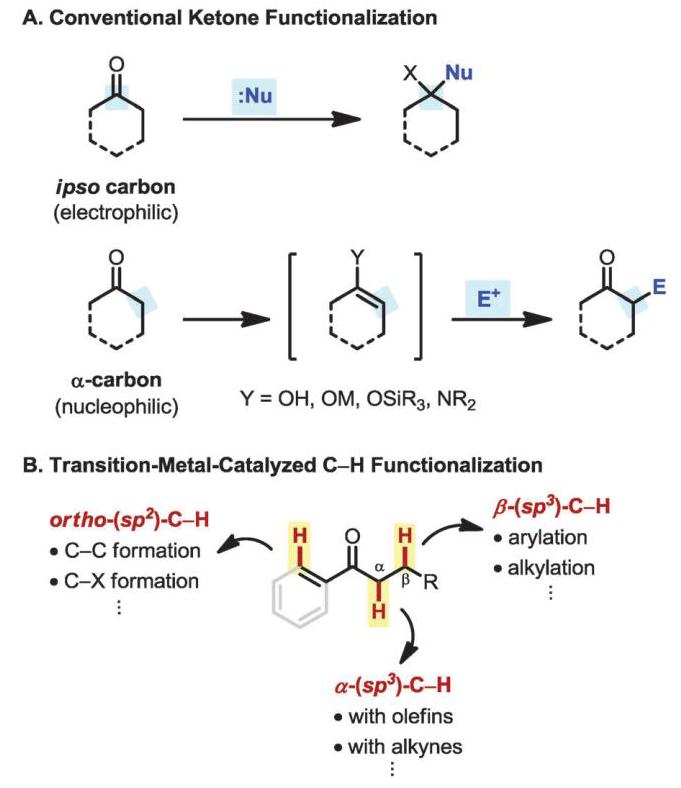
Conventional ketone-functionalization methods take advantage of the intrinsic electrophilicity of the carbonyl and acidity of the $\alpha - \mathrm{C} - \mathrm{H}$ bonds (Scheme 1A). Carbonyl attack by various nucleophiles allows functionalization at the ipso carbon, whereas deprotonation of the $\alpha$ -hydrogen or enolization with a strong (Lewis) acid permits substitution at the $\alpha$ -positions by reaction with various electrophiles. Alternatively, recent advancements in transition-metal chemistry enable novel ketone-based $\mathrm{C} - \mathrm{H}$ bond transformations that do not occur under traditional conditions. This field has taken off since Murai’s pioneering work on ketone-directed Ru-catalyzed C-H/ olefin coupling reactions in 1993 (vide infra). ${}^{4}$ To date, a number of innovative approaches and methods have been developed.
传统的酮官能团化方法利用了羰基的固有亲电性和$\alpha - \mathrm{C} - \mathrm{H}$ 键的酸性(方案1A)。各种亲核试剂对羰基的进攻允许在本位碳上进行官能团化,而$\alpha$ -氢的去质子化或用强(路易斯)酸进行烯醇化允许通过与各种亲电试剂反应在$\alpha$ -位进行取代。或者,过渡金属化学的最新进展使得基于酮的$\mathrm{C} - \mathrm{H}$ 键转化成为可能,而这些转化在传统条件下不会发生。自1993年村井关于酮导向的钌催化C-H/烯烃偶联反应的开创性工作以来(见下文),这个领域迅速发展。${}^{4}$ 迄今为止,已经开发了许多创新方法。
This review focuses on the simple-ketone-directed or mediated C-H functionalization reactions that are catalyzed by transition metals, covered through January of 2015 (Scheme 1B). The content is organized into three parts: use of ketone carbonyl as the DG, direct $\beta$ -functionalization, and $\alpha$ -alkylation/alkenylation with unactivated olefins and alkynes. It is noteworthy that transition-metal enolate-mediated cross coupling reactions, e.g. Buchwald-Hartwig-Miura $\alpha$ -arylation, ${}^{5}$ and Lewis acid-mediated enolate chemistry with regular electrophiles ${}^{6}$ will not be included. Reactions with related ketone derivatives, such as silyl enol ethers, oximes, $\beta$ -keto esters and $\alpha ,\beta$ -unsaturated ketones, will also not be discussed. While not intended to be comprehensive, this review summarizes major developments from the perspective of strategic design and reaction discovery.
本综述重点关注2015年1月之前报道的由过渡金属催化的简单酮导向或介导的C-H官能团化反应(方案1B)。内容分为三个部分:使用酮羰基作为导向基团、直接$\beta$ -官能团化以及与未活化烯烃和炔烃的$\alpha$ -烷基化/烯基化。值得注意的是,过渡金属烯醇盐介导的交叉偶联反应,如布赫瓦尔德-哈特维希-村井$\alpha$ -芳基化、${}^{5}$ 以及路易斯酸介导的烯醇盐与普通亲电试剂的化学${}^{6}$ 将不包括在内。与相关酮衍生物的反应,如硅烯醇醚、肟、$\beta$ -酮酯和$\alpha ,\beta$ -不饱和酮,也将不进行讨论。虽然本综述并非旨在全面涵盖,但它从战略设计和反应发现的角度总结了主要进展。
2. Ketone as the directing group
2. 酮作为导向基团
Based on the reaction type, this section is divided into three subsections: carbon-carbon (C-C) bond formation via addition to alkenes and alkynes, C-H arylation, and carbon-heteroatom (C-X) bond formation. While a large number of transformations have been reported using ketone as the directing group, it should be noted that the substrate scopes of these reactions are limited to ${\mathrm{{sp}}}^{2}$ C-H bonds in aromatic, and in some cases, vinyl ketones. Applications of the DG-based strategy to other types of ketones, such as alkyl ketones ( $\beta - {\mathrm{{sp}}}^{3}\mathrm{C} - \mathrm{H}$ bonds, vide infra), are largely underdeveloped, likely due to the weak coordinating ability of ketones.
基于反应类型,本节分为三个子部分:通过加成到烯烃和炔烃形成碳 - 碳(C - C)键、C - H芳基化以及碳 - 杂原子(C - X)键形成。虽然已经报道了大量使用酮作为导向基团的转化反应,但应该注意的是,这些反应的底物范围仅限于芳香族以及某些情况下乙烯基酮中的${\mathrm{{sp}}}^{2}$C - H键。基于导向基团的策略在其他类型酮(如烷基酮($\beta - {\mathrm{{sp}}}^{3}\mathrm{C} - \mathrm{H}$键,见下文))中的应用在很大程度上尚未得到充分发展,这可能是由于酮的配位能力较弱。
Department of Chemistry, University of Texas at Austin, Austin, Texas 78712, USA.
美国得克萨斯大学奥斯汀分校化学系,得克萨斯州奥斯汀78712。
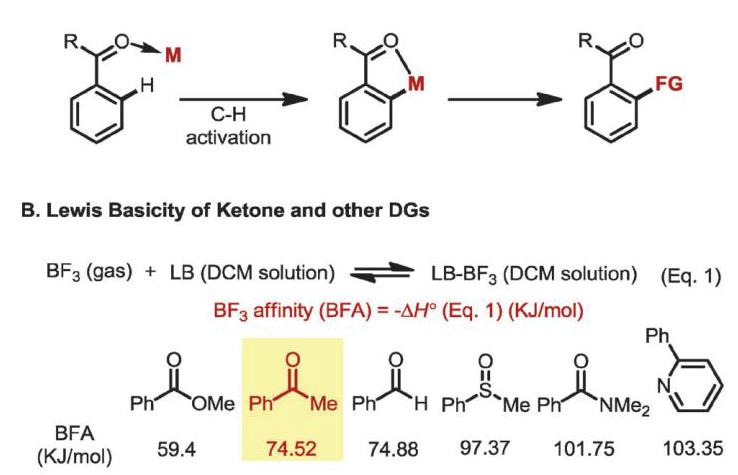
Over the past two decades, the DG-based strategy has been established as one prominent approach for C-H functionaliza-tion. ${}^{2}$ One common mode of reactivity consists of coordination of the DG to a transition metal before C-H cleavage and subsequent formation of stable metallacycles (Scheme 2A). To date, a diverse range of DGs are available, among which ketones are often considered weakly coordinating due to their relatively low Lewis basicity. As demonstrated by the ${\mathrm{{BF}}}_{3}$ affinity scale, ketones’ coordinating capability is considerably lower than other directing groups, including pyridines, sulfoxides and amides (Scheme 2B). ${}^{7}$ However, from a chronological viewpoint, ketones are actually one of the earliest DGs employed in transition metal-catalyzed C-H functionalization.
在过去的二十年中,基于导向基团的策略已成为C - H官能化的一种重要方法。${}^{2}$一种常见的反应模式包括在C - H裂解之前导向基团与过渡金属配位,随后形成稳定的金属环(方案2A)。迄今为止,有各种各样的导向基团可供使用,其中酮由于其相对较低的路易斯碱性,通常被认为是弱配位的。如${\mathrm{{BF}}}_{3}$亲和力标度所示,酮的配位能力明显低于其他导向基团,包括吡啶、亚砜和酰胺(方案2B)。${}^{7}$然而,从时间顺序来看,酮实际上是最早用于过渡金属催化C - H官能化的导向基团之一。
2.1 Coupling with alkenes and alkynes
2.1 与烯烃和炔烃的偶联
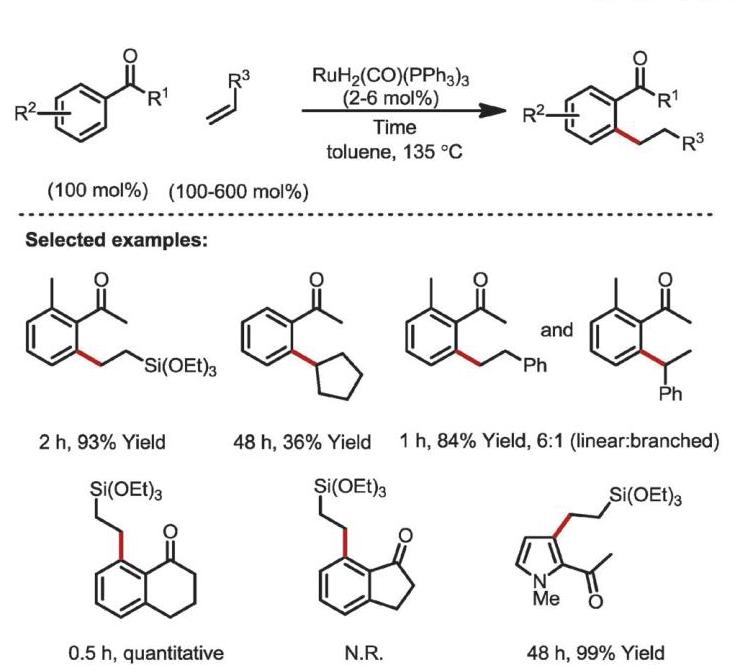
In 1993, Murai and coworkers reported the first Ru-catalyzed ortho-alkylation reaction of aromatic ketones with olefins, also known as the hydroarylation of olefins (Scheme 3). ${}^{4}$ The ortho-C-H bond of the ketone was selectively coupled with the olefin to afford the alkylation product in up to quantitative yield with ${\mathrm{{RuH}}}_{2}\left( \mathrm{{CO}}\right) {\left( {\mathrm{{PPh}}}_{3}\right) }_{3}$ as the catalyst in toluene at ${135}{}^{ \circ }\mathrm{C}$ . Detailed studies of the substrate scope revealed that a large collection of olefins can participate in this reaction. ${}^{8}$ Vinylsilanes proved to be superior substrates that gave complete linear selectivity. In the case of styrene, a 6 : 1 ratio between linear and branched products was obtained. Despite the good reactivity with terminal olefins, internal, isomerizable terminal, and acrylate-type olefins gave poor yields or no reaction. Regarding the scope of ketones, aromatic ketones bearing various alkyl, aryl, or hetero-aryl substituents were all alkylated smoothly under the reaction conditions. It is interesting to note that while $\alpha$ -tetralone afforded the product in quantitative yield, 1-indanone showed no reactivity. As explained by the authors, the loss of reactivity with 1-indanone was attributed to the difficulty of forming the five-membered ring metallacycle due to the strained benzo-fused structure.
1993年,村井及其同事报道了首例钌催化的芳香酮与烯烃的邻位烷基化反应,该反应也被称为烯烃的氢芳基化反应(方案3)。${}^{4}$ 酮的邻位碳氢键与烯烃选择性偶联,以${\mathrm{{RuH}}}_{2}\left( \mathrm{{CO}}\right) {\left( {\mathrm{{PPh}}}_{3}\right) }_{3}$为催化剂,在甲苯中于${135}{}^{ \circ }\mathrm{C}$下反应,可定量得到烷基化产物。对底物范围的详细研究表明,大量烯烃可参与此反应。${}^{8}$ 乙烯基硅烷被证明是优良的底物,具有完全的线性选择性。对于苯乙烯,得到的线性产物与支链产物的比例为6:1。尽管与末端烯烃反应活性良好,但内烯烃、可异构化的末端烯烃和丙烯酸酯类烯烃的产率较低或不发生反应。关于酮的范围,带有各种烷基、芳基或杂芳基取代基的芳香酮在反应条件下均能顺利进行烷基化反应。有趣的是,虽然$\alpha$-四氢萘酮能定量得到产物,但1-茚酮没有反应活性。正如作者所解释的,1-茚酮反应活性的丧失归因于由于苯并稠合结构的张力而难以形成五元环金属环化物。
The proposed catalytic cycle, supported by both mechanistic studies ${}^{9 - {12}}$ and DFT calculations, ${}^{13}$ is initiated by the generation of a $\mathrm{{Ru}}\left( 0\right)$ species through the reduction of ${\mathrm{{RuH}}}_{2}\left( \mathrm{{CO}}\right) {\left( {\mathrm{{PPh}}}_{3}\right) }_{3}$ with olefin substrates (Scheme 4). The ketone moiety coordinates to
机理研究${}^{9 - {12}}$和密度泛函理论计算${}^{13}$均支持的拟催化循环,是通过用烯烃底物还原${\mathrm{{RuH}}}_{2}\left( \mathrm{{CO}}\right) {\left( {\mathrm{{PPh}}}_{3}\right) }_{3}$生成$\mathrm{{Ru}}\left( 0\right)$物种而引发的(方案4)。酮部分配位到
Hee Nam Lim (Far right): Dr Hee Nam Lim received his BSc degree in 2006 and MSc in 2008 from the Department of Chemical Engineering at Hanyang University, Seoul, Korea, under the supervision of Professor Kee-Jung Lee. In 2013, He obtained his PhD degree in Organic Chemistry from SUNY Stony Brook, under the supervision of Professor Kathlyn A. Parker. He is currently a postdoc fellow in Professor Guangbin Dong’s group at the University of Texas at Austin. His research is focused on the $\alpha - C - H$ functionaliza-tion of ketones.
Hee Nam Lim(最右边):Hee Nam Lim于2006年获得理学学士学位,并于2008年在韩国首尔汉阳大学化学工程系在Kee-Jung Lee教授的指导下获得理学硕士学位。2013年,他在纽约州立大学石溪分校在Kathlyn A. Parker教授的指导下获得有机化学博士学位。他目前是德克萨斯大学奥斯汀分校Guangbin Dong教授课题组的博士后研究员。他的研究重点是酮的$\alpha - C - H$官能化。
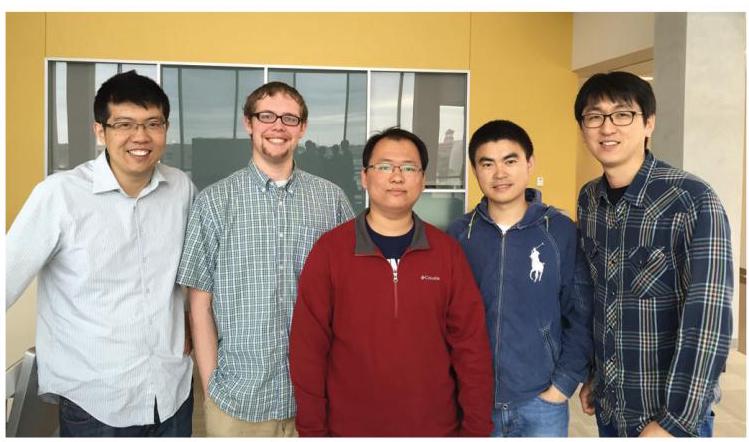
Zhongxing Huang (Center), Hee Nam Lim (Far right), Fanyang Mo (2nd from right), Michael C. Young (2nd from left) and Guangbin Dong (Far left)
黄中兴(中间)、Hee Nam Lim(最右边)、莫凡洋(右二)、Michael C. Young(左二)和董广彬(最左边)
Zhongxing Huang (Center): Zhongxing Huang received his BSc degree in Chemistry from Peking University in 2012 under the supervision of Professor Jianbo Wang and Yan Zhang. He is currently a PhD student in Professor Guangbin Dong’s group at the University of Texas at Austin. His research is focused on transition-metal-catalyzed C-H functionalization.
黄中兴(中间):黄中兴于2012年在北京大学在王剑波教授和张艳教授的指导下获得化学理学学士学位。他目前是德克萨斯大学奥斯汀分校Guangbin Dong教授课题组的博士生。他的研究重点是过渡金属催化的碳氢键官能化。
Fanyang Mo (2nd from right): Dr Fanyang Mo obtained his MSc degree in Applied Chemistry in 2006 from Beijing Institute of Technology under the supervision of Professor Zhiming Zhou, and then obtained his PhD degree in Organic Chemistry in 2010 from Peking University under the supervision of Professor Jianbo Wang. After spending 10 months at the Scripps Research Institute under the supervision of Professor Qinghai Zhang, he joined Professor Guangbin Dong’s group at the University of Texas at Austin in 2011. In 2015, he joined the department of engineering at Peking University as an assistant professor.
莫凡洋(右二):莫凡洋博士于2006年在北京理工大学在周志敏教授的指导下获得应用化学理学硕士学位,随后于2010年在北京大学在王剑波教授的指导下获得有机化学博士学位。在斯克里普斯研究所跟随张青海教授工作10个月后,他于2011年加入德克萨斯大学奥斯汀分校Guangbin Dong教授课题组。2015年,他加入北京大学工程系担任助理教授。
Michael C. Young (2nd from left): Michael Young received his BSc and MSc degrees in Chemistry under the tutelage of Prof. Brian D. Dinkelmeyer studying hydrogen-bonding self-assembly at Western Carolina University. He went on to pursue PhD work at the University of California - Riverside under Prof. Richard J. Hooley studying the self-assembly of metal-organic polyhedra and their applications towards organocatalysis. He is currently engaged in postdoctoral work in Prof. Guangbin Dong’s group, investigating supramolecular strategies for directed $\mathrm{C} - \mathrm{H}$ functionalization based on aldehyde and ketone functional groups.
Michael C. Young(左二):Michael Young在西卡罗莱纳大学在Brian D. Dinkelmeyer教授的指导下获得化学理学学士和理学硕士学位,研究氢键自组装。他接着在加利福尼亚大学河滨分校在Richard J. Hooley教授的指导下攻读博士学位,研究金属有机多面体的自组装及其在有机催化中的应用。他目前在Guangbin Dong教授课题组从事博士后工作,研究基于醛和酮官能团的定向$\mathrm{C} - \mathrm{H}$官能化的超分子策略。
Guangbin Dong (Far left): Guangbin Dong received his BSc degree from Peking University and completed his PhD degree in Chemistry from Stanford University with Professor Barry M. Trost where he was a Larry Yung Stanford Graduate Fellow. In 2009, he began research with Prof. Robert H. Grubbs at California Institute of Technology as a Camille and Henry Dreyfus Environmental Chemistry Fellow. In 2011, he joined the Department of Chemistry and Biochemistry at the University of Texas at Austin as an assistant professor and a CPRIT Scholar. His research interests lie at the development of powerful chemical tools for addressing questions of biological importance. and delivers the $\mathrm{{Ru}}\left( 0\right)$ within proximity of the ortho-C-H bond, followed by oxidative addition to generate ruthenium hydride 3. Subsequent migratory insertion of olefin into the Ru-H bond proceeds in a highly regio- and chemoselective manner to give intermediate 5, which after reductive elimination gives the alkylation product and restores the active $\mathrm{{Ru}}\left( 0\right)$ catalyst. The reductive elimination of complex 5 proved to be the rate determining step of the catalytic cycle. While the reaction was run at ${135}^{ \circ }\mathrm{C}$ , the oxidative addition of $\mathrm{{Ru}}\left( 0\right)$ to the aryl $\mathrm{C} - \mathrm{H}$ bond was found to proceed even at ${50}^{ \circ }\mathrm{C}$ .
董广彬(最左边):董广彬毕业于北京大学,在斯坦福大学师从巴里·M·特罗斯特教授获得化学博士学位,期间他是拉里·容·斯坦福研究生奖学金获得者。2009年,他作为卡米尔和亨利·德雷福斯环境化学研究员,开始在加州理工学院与罗伯特·H·格鲁布斯教授开展研究。2011年,他加入德克萨斯大学奥斯汀分校化学与生物化学系,担任助理教授和CPRIT学者。他的研究兴趣在于开发强大的化学工具,以解决具有生物学重要性的问题。并将$\mathrm{{Ru}}\left( 0\right)$置于邻位C-H键附近,随后进行氧化加成生成氢化钌3。烯烃随后以高度区域和化学选择性的方式迁移插入Ru-H键,生成中间体5,中间体5经还原消除得到烷基化产物并恢复活性$\mathrm{{Ru}}\left( 0\right)$催化剂。配合物5的还原消除被证明是催化循环的速率决定步骤。虽然反应在${135}^{ \circ }\mathrm{C}$下进行,但发现$\mathrm{{Ru}}\left( 0\right)$对芳基$\mathrm{C} - \mathrm{H}$键的氧化加成即使在${50}^{ \circ }\mathrm{C}$下也能进行。
Scheme 1 Functionalization of ketones.
方案1酮的官能化。
A. Ketone-Directed C-H Functionalization
A. 酮导向的C-H官能化
Scheme $2\mathrm{C} - \mathrm{H}$ functionalization directed by ketones.
方案$2\mathrm{C} - \mathrm{H}$酮导向的官能化。
A more reactive precatalyst was discovered during the mechanistic studies by Kakiuchi, Murai, and coworkers. ${}^{14}$ The spectroscopic evidence supported the generation of a Rh-hydride complex (6) from the reaction of ${\mathrm{{RuH}}}_{2}\left( \mathrm{{CO}}\right) {\left( {\mathrm{{PPh}}}_{3}\right) }_{3}$ and trimethylvinylsilane (Scheme 5, eqn (1)). This species, once used as the catalyst, could enable the ortho-alkylation to proceed even at room temperature (eqn (2)). When the alkylation was run at ${120}{}^{ \circ }\mathrm{C}$ , complex 6 achieved a turnover number (TON) close to 1000 (eqn (3)).
在柿内、村井及其同事的机理研究过程中发现了一种活性更高的前催化剂。${}^{14}$光谱证据支持由${\mathrm{{RuH}}}_{2}\left( \mathrm{{CO}}\right) {\left( {\mathrm{{PPh}}}_{3}\right) }_{3}$和三甲基乙烯基硅烷反应生成铑氢配合物(6)(方案5,方程式(1))。该物种一旦用作催化剂,即使在室温下也能使邻位烷基化反应进行(方程式(2))。当烷基化反应在${120}{}^{ \circ }\mathrm{C}$下进行时,配合物6的周转数(TON)接近1000(方程式(3))。
Scheme 3 Ruthenium-catalyzed ortho-alkylation of aromatic ketones.
方案3钌催化的芳香酮邻位烷基化。
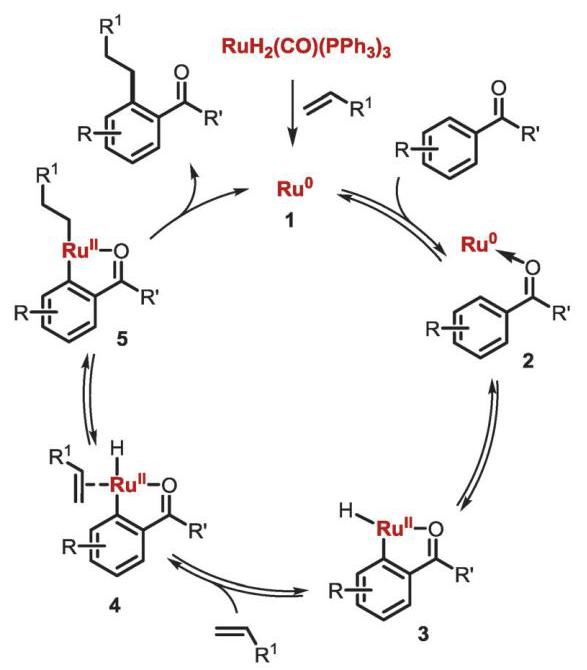
Scheme 4 Proposed catalytic cycle for the ruthenium-catalyzed ortho-alkylation of aromatic ketones.
方案4钌催化的芳香酮邻位烷基化的拟议催化循环。
Other groups have also developed improved catalysts for this transformation. Using ${\mathrm{{RuH}}}_{2}{\left( {\mathrm{H}}_{2}\right) }_{2}{\left( {\mathrm{{PCy}}}_{3}\right) }_{2}$ (7) as the catalyst, the Chaudret ${}^{{15},{16}}$ and Leitner ${}^{{17},{18}}$ groups reported ortho-alkylation with ethylene that proceeded at room temperature (Scheme 6). A variant ruthenium complex with two tricyclopentylphosphine (PCyp3) ligands was also synthesized, characterized, and demonstrated to possess outstanding catalytic activity towards the same ethylation reaction. ${}^{19}$ Compared to Murai’s original precatalyst ${\mathrm{{RuH}}}_{2}\left( \mathrm{{CO}}\right) {\left( {\mathrm{{PPh}}}_{3}\right) }_{3}$ , these modified ruthenium species have two dihydrogen and two tricycloalkylphosphine ligands. The lability of dihydrogen and strongly electron-donating tricyclohexylphosphine ligand were proposed to generate an active and electron-rich $\mathrm{{Ru}}\left( 0\right)$ catalyst promptly. However, coupling with olefins other than ethylene was not demonstrated using these modified catalysts.
其他研究小组也开发了用于这种转化的改进催化剂。使用${\mathrm{{RuH}}}_{2}{\left( {\mathrm{H}}_{2}\right) }_{2}{\left( {\mathrm{{PCy}}}_{3}\right) }_{2}$(7)作为催化剂,肖德雷${}^{{15},{16}}$和莱特纳${}^{{17},{18}}$小组报道了与乙烯的邻位烷基化反应在室温下进行(方案6)。还合成、表征了一种带有两个三环戊基膦(PCyp3)配体的变体钌配合物,并证明其对相同的乙基化反应具有出色的催化活性。${}^{19}$与村井最初的前催化剂${\mathrm{{RuH}}}_{2}\left( \mathrm{{CO}}\right) {\left( {\mathrm{{PPh}}}_{3}\right) }_{3}$相比,这些改性钌物种具有两个二氢和两个三环烷基膦配体。有人提出二氢的不稳定性和强给电子的三环己基膦配体能够迅速生成活性且富电子的$\mathrm{{Ru}}\left( 0\right)$催化剂。然而,使用这些改性催化剂未证明与乙烯以外的烯烃发生偶联反应。
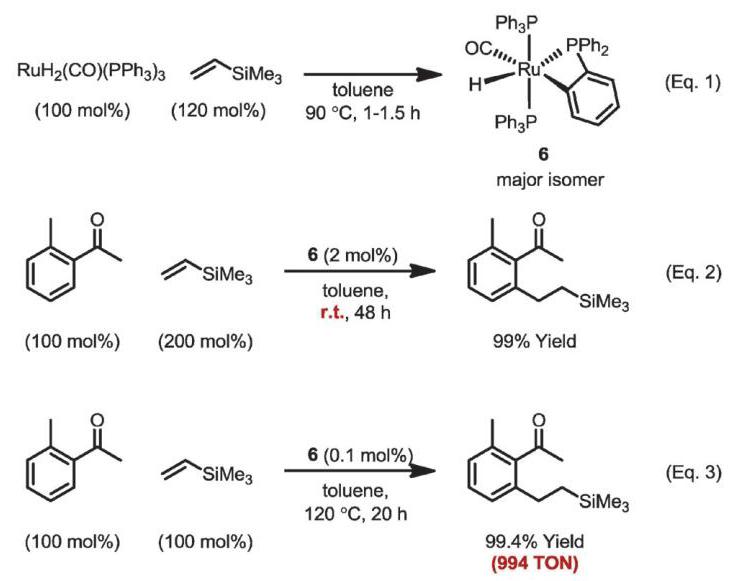
Scheme 5 Formation of active catalyst of ruthemium-catalyzed ortho-alkylation.
方案5钌催化的邻位烷基化活性催化剂的形成。
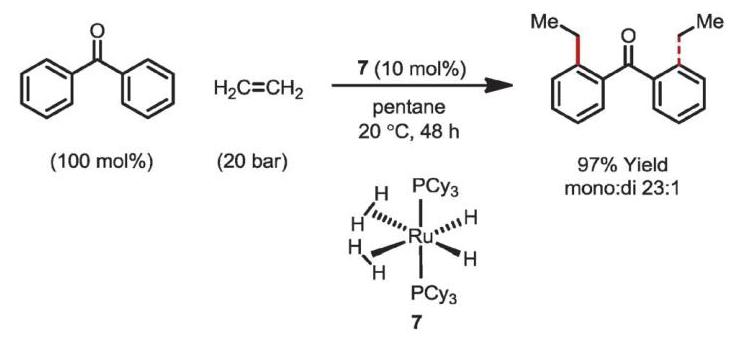
Scheme 6 RuH ${}_{2}{\left( {\mathrm{H}}_{2}\right) }_{2}{\left( {\mathrm{{PCy}}}_{3}\right) }_{2}$ -catalyzed ortho-ethylation with ethylene.
方案6 RuH${}_{2}{\left( {\mathrm{H}}_{2}\right) }_{2}{\left( {\mathrm{{PCy}}}_{3}\right) }_{2}$催化的与乙烯的邻位乙基化反应。
Another important contribution for the catalyst modification came from the Darses group. ${}^{{20} - {23}}$ They developed several protocols for the ortho-alkylation of aromatic ketones using a combination of less expensive Ru salts, such as ${\left\lbrack {\mathrm{{RuCl}}}_{2}\left( p\text{ -cymene }\right) \right\rbrack }_{2}$ and ${\mathrm{{RuCl}}}_{3}$ , along with triarylphosphine ligands and formate salts (Scheme 7). The formate salts were proposed to reduce the Ru(II) or $\mathrm{{Ru}}\left( \mathrm{{III}}\right)$ catalyst in situ to generate the active $\mathrm{{Ru}}\left( 0\right)$ catalyst. This strategy turned out to be highly efficient and the TON could reach more than 1000 (eqn (4)). Besides the lower cost of the precatalysts, the addition of phosphine ligands as a separate reagent presents another advantage over the original catalytic system using ${\mathrm{{RuH}}}_{2}\left( \mathrm{{CO}}\right) {\left( {\mathrm{{PPh}}}_{3}\right) }_{3}$ . This is because the ruthenium dihydride complexes are often nontrivial to synthesize and sensitive to air and moisture, thus the addition of ligand as a separate reagent makes it easier to evaluate the ligand effect. The authors discovered that the ligand played a vital role in controlling the regioselectivity. For example, the coupling between 1-acetonaphthone and styrene with dicyclohexyl(phenyl)- phosphine significantly enhanced linear selectivity compared to triphenylphosphine (eqn (5)). ${}^{20}$
催化剂改性的另一项重要贡献来自达尔塞斯团队。${}^{{20} - {23}}$ 他们开发了几种方案,使用较便宜的钌盐(如 ${\left\lbrack {\mathrm{{RuCl}}}_{2}\left( p\text{ -cymene }\right) \right\rbrack }_{2}$ 和 ${\mathrm{{RuCl}}}_{3}$ )与三芳基膦配体和甲酸盐的组合,对芳香酮进行邻位烷基化反应(方案7)。甲酸盐被认为可以原位还原Ru(II)或 $\mathrm{{Ru}}\left( \mathrm{{III}}\right)$ 催化剂,以生成活性 $\mathrm{{Ru}}\left( 0\right)$ 催化剂。事实证明,这种策略非常有效,TON可以达到1000以上(式(4))。除了预催化剂成本较低外,作为单独试剂添加膦配体相对于使用 ${\mathrm{{RuH}}}_{2}\left( \mathrm{{CO}}\right) {\left( {\mathrm{{PPh}}}_{3}\right) }_{3}$ 的原始催化体系还有另一个优势。这是因为二氢化钌配合物通常难以合成,并且对空气和水分敏感,因此作为单独试剂添加配体更容易评估配体的效果。作者发现配体在控制区域选择性方面起着至关重要的作用。例如,与三苯基膦相比,1-乙酰萘与苯乙烯在二环己基(苯基)膦存在下的偶联显著提高了线性选择性(式(5))。${}^{20}$
Besides aromatic C-H bonds, the olefinic C-H bond can also participate in the Ru-catalyzed alkylation with alkenes (Scheme 8). Trost ${}^{24}$ and Kakiuchi/Murai ${}^{{25},{26}}$ independently demonstrated that both linear (eqn (6)) and cyclic vinyl ketones (eqn (7)) are suitable substrates for the alkylation reaction, although $E/Z$ isomerisation from linear enone substrates was observed in some cases. ${}^{24}$ With regard to the alkene scope, vinyl silanes and styrene-type olefins proved to be superior substrates for the coupling. Alkyl olefins and acrylate derivatives also participated in the reaction, although a large excess was required to obtain good yields.
除了芳香族C-H键外,烯属C-H键也可以参与钌催化的与烯烃的烷基化反应(方案8)。特罗斯特 ${}^{24}$ 和柿内/村井 ${}^{{25},{26}}$ 分别证明,线性(式(6))和环状乙烯基酮(式(7))都是烷基化反应的合适底物,尽管在某些情况下观察到线性烯酮底物发生了 $E/Z$ 异构化。${}^{24}$ 关于烯烃的范围,乙烯基硅烷和苯乙烯型烯烃被证明是偶联反应的优良底物。烷基烯烃和丙烯酸酯衍生物也参与了反应,尽管需要大量过量才能获得良好的产率。
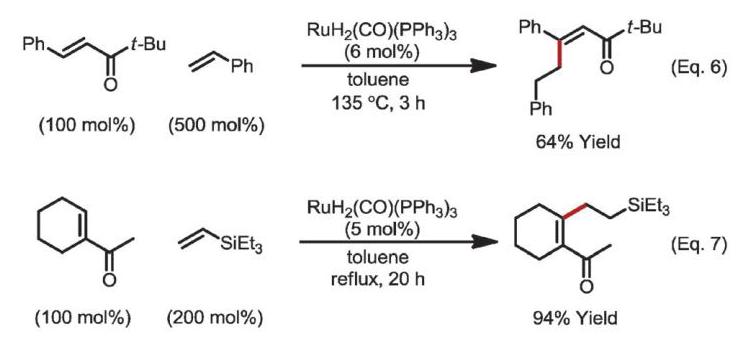
Scheme 8 Ketone-directed ortho-alkylation of olefinic C-H bonds.
方案8 酮导向的烯属C-H键的邻位烷基化反应。
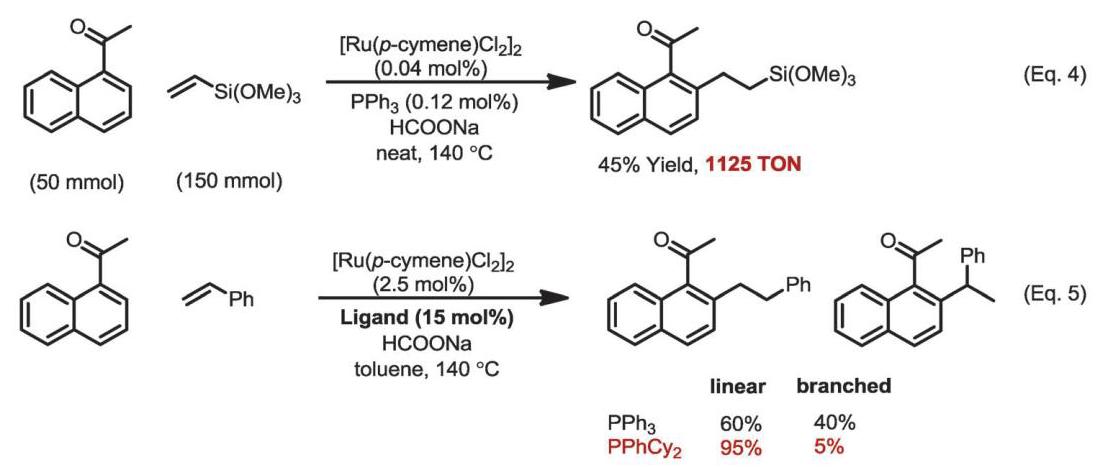
Scheme 7 Ketone-directed ortho-alkylation using Ru(II) precursors.
方案7 使用Ru(II)前体进行酮导向的邻位烷基化反应。
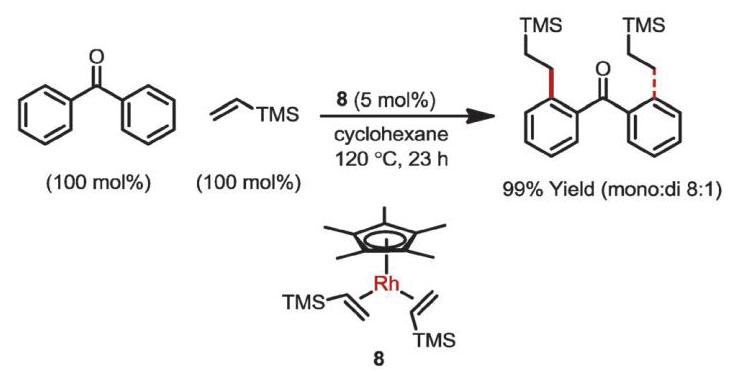
Scheme 9 Rhodium-catalyzed ortho-alkylation of aromatic ketones with olefins.
方案9 铑催化的芳香酮与烯烃的邻位烷基化反应。
In addition to ruthenium catalysts, ortho-alkylation of aromatic ketones with olefins has also been reported using other transition-metal catalysts. The rhodium bis-olefin complex 8 was used by Brookhart and coworkers for the hydroarylation of olefins (Scheme 9). ${}^{27}$ A distinct feature of this rhodium catalysis is the non-site-selective oxidative addition of rhodium into aromatic C-H bonds before the migratory insertion. Chelation of the ketone moiety was proposed to lower the barrier of reductive elimination, which is the rate-determining step, thus affording the ortho-selective alkylation product. Besides the distinct mechanism, this rhodium-catalyzed alkylation can accommodate isomerizable olefins (e.g. 1-pentene) that were hard to react under Murai’s ruthenium catalysis.
除了钌催化剂外,还报道了使用其他过渡金属催化剂对芳香酮与烯烃进行邻位烷基化反应。布鲁克哈特及其同事使用铑双烯烃配合物8进行烯烃的氢芳基化反应(方案9)。${}^{27}$ 这种铑催化的一个显著特点是,在迁移插入之前,铑对芳香族C-H键的氧化加成是非位点选择性的。有人提出,酮部分的螯合作用可以降低还原消除的势垒,而还原消除是速率决定步骤,从而得到邻位选择性的烷基化产物。除了独特的机理外,这种铑催化的烷基化反应可以容纳在村井的钌催化下难以反应的可异构化烯烃(如1-戊烯)。
In 2002, Jun and coworkers reported a benzylamine-assisted ortho-alkylation of aromatic ketones catalyzed by Wilkinson’s catalyst (Scheme 10). ${}^{28}$ A substoichiometric amount (50 mol%) of benzylamine acts as a co-catalyst through transient condensation with the substrate, which converts ketones to stronger coordinating ketimines. After the rhodium-catalyzed ortho-alkylation, the resulting alkylated ketimine would be hydrolyzed to release the product and regenerate the benzylamine (eqn (8)). A similar strategy was later applied to the $\beta$ -alkylation of 4-phenyl-3-buten-2-one (9) (eqn (9)). ${}^{29}$ In this case, a secondary amine was employed to form a transient enamine with 9, followed by directed olefinic C-H activation with a rhodium catalyst. It is interesting to note that after the alkylation reaction, an olefin migration was proposed to take place to give $\beta ,\gamma$ -enone 10 as the major product. Although the substrate scopes of these amine-assisted alkylations were only briefly investigated, the reaction conditions were compatible with a variety of olefins, including vinyl silanes, styrene-type olefins and even isomerizable $\alpha$ -olefins, which represent a key advantage over the Ru-catalyzed ortho-alkylation reactions.
2002年,Jun及其同事报道了Wilkinson催化剂催化的苄胺辅助芳香酮邻位烷基化反应(方案10)。${}^{28}$ 化学计量比(50 mol%)的苄胺通过与底物的瞬时缩合作为共催化剂,将酮转化为更强配位的酮亚胺。在铑催化的邻位烷基化反应后,生成的烷基化酮亚胺将被水解以释放产物并再生苄胺(式(8))。类似的策略后来被应用于4-苯基-3-丁烯-2-酮(9) 的$\beta$ -烷基化反应(式(9))。${}^{29}$ 在这种情况下,使用仲胺与9形成瞬时烯胺,然后用铑催化剂进行定向烯烃C-H活化。有趣的是,在烷基化反应后,有人提出发生烯烃迁移,以$\beta ,\gamma$ -烯酮10作为主要产物。尽管这些胺辅助烷基化反应的底物范围只是简要研究过,但反应条件与多种烯烃兼容,包括乙烯基硅烷、苯乙烯型烯烃,甚至可异构化的$\alpha$ -烯烃,这是相对于钌催化的邻位烷基化反应的一个关键优势。
An iridium-catalyzed hydroarylation of olefins was reported by Shibata and coworkers in 2008 (Scheme 11). ${}^{30}$ In their study, the cationic iridium complex $\left\lbrack {\operatorname{Ir}{\left( \operatorname{cod}\right) }_{2}}\right\rbrack$ BARF was used as the catalyst to promote ortho-alkylation of aromatic ketones with styrene-type olefins, giving the linear products as the major isomers (eqn (10)). It is noteworthy that when the chiral bidentate phosphine ligand (R)-MeO-BIPHEP (12) was used, the coupling between norbornene and 11 afforded the product with moderate enantioselectivity (eqn (11)).
2008年,Shibata及其同事报道了铱催化的烯烃氢芳基化反应(方案11)。${}^{30}$ 在他们的研究中,阳离子铱配合物$\left\lbrack {\operatorname{Ir}{\left( \operatorname{cod}\right) }_{2}}\right\rbrack$ BARF被用作催化剂,以促进芳香酮与苯乙烯型烯烃的邻位烷基化反应,得到线性产物作为主要异构体(式(10))。值得注意的是,当使用手性双齿膦配体(R)-MeO-BIPHEP(12)时,降冰片烯与11的偶联反应以中等对映选择性得到产物(式(11))。
With Murai’s protocols, formation of linear alkylation products is favored over branched ones. In 2014, Bower and coworkers reported an alternative iridium-catalyzed system that is highly selective for branched products (Scheme 12). ${}^{31}$ The key for the inversion of the selectivity is the use of an electron-deficient bis-phosphine ligand (13), which can presumably accelerate the reductive elimination. Under their reaction conditions, various aromatic ketones were coupled with styrenes giving better than 20:1 branched/linear selectivity.
按照Murai的方法,线性烷基化产物的形成比支链产物更有利。2014年,Bower及其同事报道了另一种铱催化体系,该体系对支链产物具有高度选择性(方案12)。${}^{31}$ 选择性反转的关键是使用缺电子双膦配体(13),据推测它可以加速还原消除反应。在他们的反应条件下,各种芳香酮与苯乙烯偶联,得到的支链/线性选择性优于20:1。
An important variation of Murai’s ketone-directed alkylation reaction is the oxidative ortho-olefination of aromatic ketones with alkenes. While Murai’s reaction is viewed as a redox-neutral addition of a $\mathrm{C} - \mathrm{H}$ bond to an olefin, the olefination reaction can be considered as a formal dehydrogenative coupling, also known as the oxidative Heck reaction. ${}^{32}$ It is noteworthy to mention that an olefination product was also observed by Murai and coworkers in the ${\mathrm{{Ru}}}_{3}{\left( \mathrm{{CO}}\right) }_{12}$ -catalyzed addition of $\mathrm{C} - \mathrm{H}$ bonds to olefins, although the dehydrogenative coupling was directed by imidates instead of ketones. ${}^{33}$ In 2011, Glorius and coworkers reported a rhodium-catalyzed C-H olefination reaction directed by ketones (Scheme 13). ${}^{34}$ When styrene-type olefins were coupled with acetophenone derivatives, 1,2-disubstituted trans-alkenes were generated as the sole regioisomer. This selectivity represents a distinct feature from Murai’s ruthenium catalysis, where a mixture of branched and linear alkylation products were produced with styrene-type olefins. In addition, acrylate-type olefins, previously unreactive under Murai’s conditions, afforded the alkenylation products in good yields with this rhodium catalysis.
Murai酮导向烷基化反应的一个重要变体是芳香酮与烯烃的氧化邻位烯基化反应。虽然Murai的反应被视为将$\mathrm{C} - \mathrm{H}$ 键氧化还原中性加成到烯烃上,但烯基化反应可以被认为是一种形式上的脱氢偶联反应,也称为氧化Heck反应。${}^{32}$ 值得一提的是,Murai及其同事在${\mathrm{{Ru}}}_{3}{\left( \mathrm{{CO}}\right) }_{12}$ 催化的将$\mathrm{C} - \mathrm{H}$ 键加成到烯烃的反应中也观察到了烯基化产物,尽管脱氢偶联反应是由亚胺酸酯而不是酮导向的。${}^{33}$ 2011年,Glorius及其同事报道了酮导向的铑催化C-H烯基化反应(方案13)。${}^{34}$ 当苯乙烯型烯烃与苯乙酮衍生物偶联时,生成1,2-二取代反式烯烃作为唯一的区域异构体。这种选择性是Murai钌催化反应的一个显著特征,在Murai钌催化反应中,苯乙烯型烯烃会生成支链和线性烷基化产物的混合物。此外,丙烯酸酯型烯烃在Murai条件下以前是无反应性的,但在这种铑催化反应中能以良好的产率得到烯基化产物。
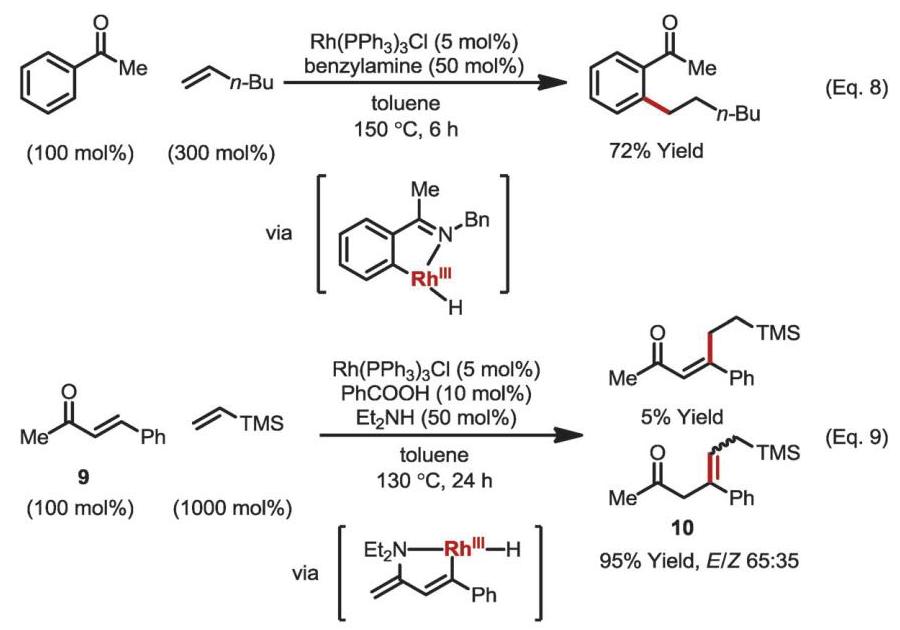
Scheme 10 Amine-assisted ortho-alkylation of aromatic ketones and enones.
方案10 胺辅助的芳香酮和烯酮的邻位烷基化反应。
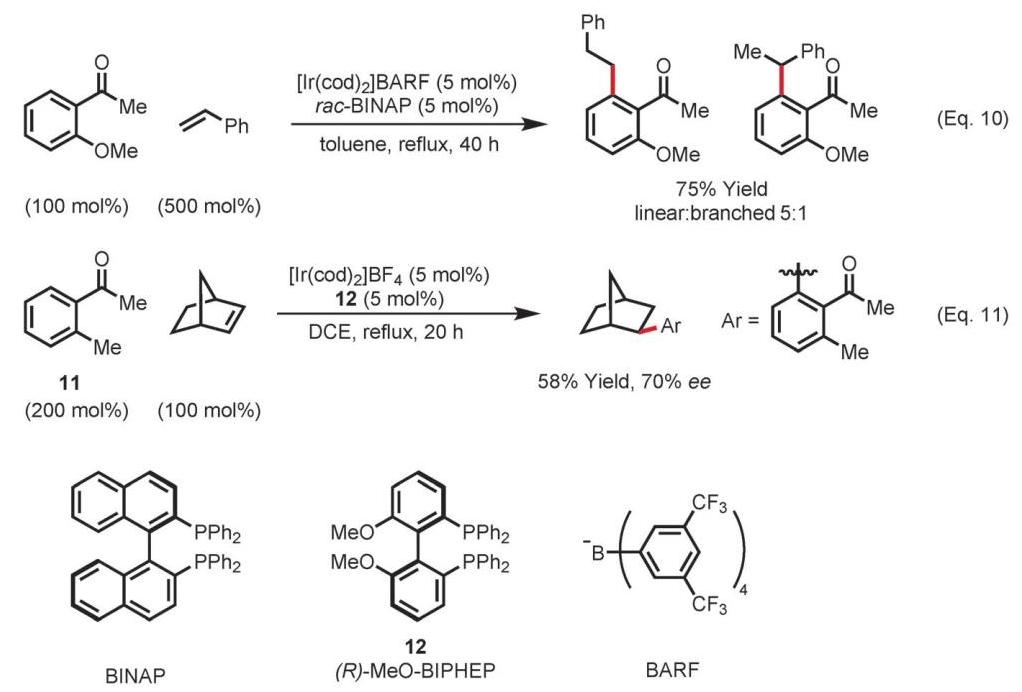
Scheme 11 Iridium-catalyzed ortho-alkylation of aromatic ketones with olefins.
方案11 铱催化的芳香酮与烯烃的邻位烷基化反应。
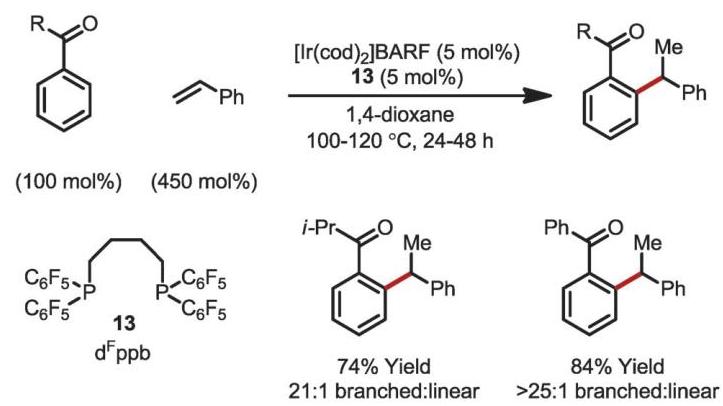
Scheme 12 Branched-selective ortho-alkylation of aromatic ketones with olefins.
方案12 芳族酮与烯烃的支链选择性邻位烷基化反应。
The use of a cationic rhodium catalyst, in conjunction with a stoichiometric $\mathrm{{Cu}}\left( \mathrm{{II}}\right)$ oxidant, triggered a different reaction pathway from Murai’s original alkylation reaction (Scheme 14). The activation of the ortho-C-H bond was proposed to proceed through a concerted metalation-deprotonation (CMD) pathway with the $\mathrm{{Rh}}\left( \mathrm{{III}}\right)$ catalyst. Unlike the oxidative addition pathway observed with $\mathrm{{Ru}}\left( 0\right)$ , the CMD mechanism yielded a $\mathrm{{Rh}}\left( \mathrm{{III}}\right)$ -aryl complex and an acid instead of a metal-hydride species. Subsequent migratory insertion of the olefin into the Rh(III)- aryl bond and $\beta$ -hydride elimination afforded the olefination product. The $\mathrm{{Cu}}\left( \mathrm{{II}}\right)$ oxidant was proposed to be responsible for regenerating the active $\mathrm{{Rh}}\left( \mathrm{{III}}\right)$ catalyst. An analogous Ru(III)-catalyzed ortho-alkenylation with olefins was reported by Jeganmohan and coworkers. ${}^{35}$
使用阳离子铑催化剂与化学计量的$\mathrm{{Cu}}\left( \mathrm{{II}}\right)$氧化剂相结合,引发了与村井最初的烷基化反应不同的反应途径(方案14)。邻位C-H键的活化被认为是通过与$\mathrm{{Rh}}\left( \mathrm{{III}}\right)$催化剂协同的金属化-去质子化(CMD)途径进行的。与用$\mathrm{{Ru}}\left( 0\right)$观察到的氧化加成途径不同,CMD机理产生了一个$\mathrm{{Rh}}\left( \mathrm{{III}}\right)$-芳基络合物和一种酸,而不是金属氢化物物种。随后烯烃向Rh(III)-芳基键的迁移插入和$\beta$-氢化物消除得到了烯化产物。有人提出$\mathrm{{Cu}}\left( \mathrm{{II}}\right)$氧化剂负责再生活性$\mathrm{{Rh}}\left( \mathrm{{III}}\right)$催化剂。Jeganmohan及其同事报道了类似的Ru(III)催化的烯烃与烯烃的邻位烯基化反应。${}^{35}$
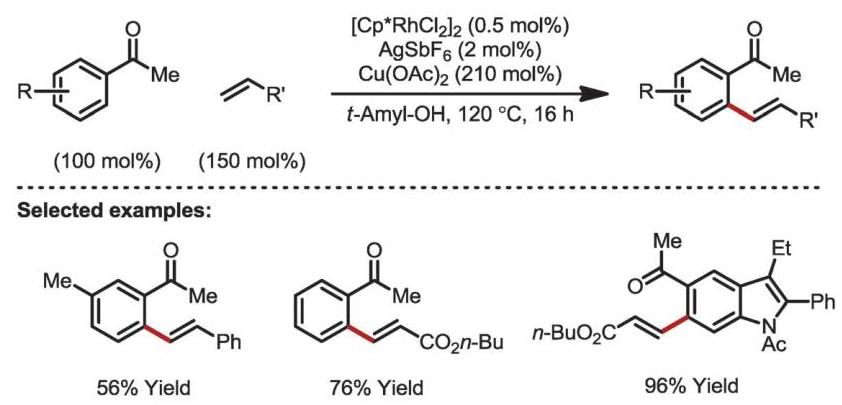
Scheme 13 Rhodium-catalyzed ortho-olefination of aromatic ketones with olefins.
方案13 铑催化的芳族酮与烯烃的邻位烯化反应。
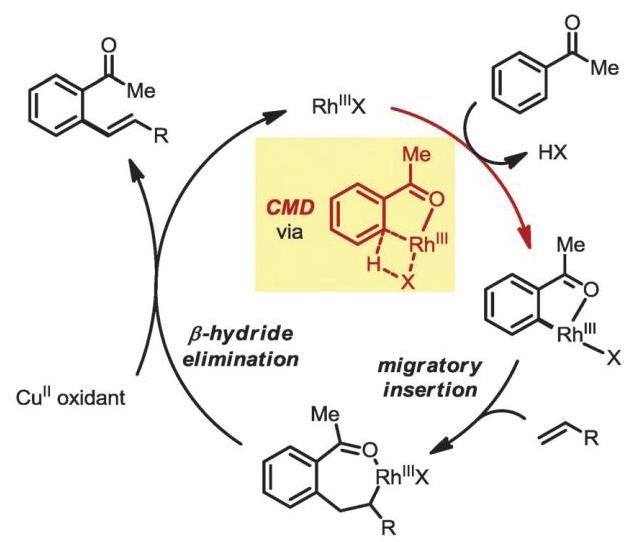
Scheme 14 Catalytic cycle of rhodium-catalyzed ortho-olefination.
方案14 铑催化的邻位烯化反应的催化循环。
When a cationic rhodium catalyst $\left\lbrack {{\mathrm{{Cp}}}^{ * }\mathrm{{Rh}}{\left( {\mathrm{{CH}}}_{3}\mathrm{{CN}}\right) }_{3}}\right\rbrack {\left( {\mathrm{{SbF}}}_{6}\right) }_{2}$ was used with stoichiometric silver acetate, Li and coworkers discovered aromatic ketones and enones underwent a C-H alkylation/aldol condensation sequence instead of an oxidative olefination reaction (Scheme 15). ${}^{36}$ The cascade reaction was proposed to proceed through 14, a similar intermediate as in Glorius’s olefination reaction. However, instead of $\beta$ -hydride elimination, intermediate 14 would be protonated under the reaction conditions to give 15, followed by silver-mediated aldol condensation to give an indene as the product. The possibility of direct aldol condensation with intermediate 14 cannot be excluded. A small amount of water was demonstrated to be beneficial to the cascade reaction, probably by facilitating the protonation step.
当将阳离子铑催化剂$\left\lbrack {{\mathrm{{Cp}}}^{ * }\mathrm{{Rh}}{\left( {\mathrm{{CH}}}_{3}\mathrm{{CN}}\right) }_{3}}\right\rbrack {\left( {\mathrm{{SbF}}}_{6}\right) }_{2}$与化学计量的乙酸银一起使用时,Li及其同事发现芳族酮和烯酮发生了C-H烷基化/羟醛缩合序列,而不是氧化烯化反应(方案15)。${}^{36}$该串联反应被认为是通过14进行的,14是与Glorius烯化反应中类似的中间体。然而,在反应条件下,中间体14不是进行$\beta$-氢化物消除,而是被质子化得到15,随后通过银介导的羟醛缩合得到茚作为产物。不能排除与中间体14直接进行羟醛缩合的可能性。已证明少量水对串联反应有益,可能是通过促进质子化步骤。
Although less studied than coupling with olefins, ketone-directed addition of the ortho-C-H bonds to alkynes also proves to be efficient. Murai and coworkers demonstrated that both aromatic ${}^{37}$ and olefinic ${}^{38}\mathrm{C} - \mathrm{H}$ bonds can react with alkynes to give the alkenylation products using the same ruthenium catalyst (Scheme 16). While internal alkynes gave good yields, terminal alkynes failed to provide access to the desired products, presumably due to competing side reactions, e.g. dimerization. When unsymmetrical ethylphenylacetylene was submitted to the reaction, all four possible stereo- and regioisomers (16) were isolated. However, reactions with trimethylsilyl-substituted acetylenes all gave 1-trimethylsilyl-2-aryl alkenes as the exclusive regioisomers. Besides ruthenium catalysis, Shibata and coworkers also reported the same transformation with a cationic iridium catalyst, although only diphenylacetylene and trimethylsilyl-phenylacetylene were employed. ${}^{30}$
尽管与烯烃的偶联反应研究较少,但酮导向的邻位C-H键与炔烃的加成反应也被证明是有效的。村井及其同事证明,使用相同的钌催化剂,芳族${}^{37}$键和烯烃${}^{38}\mathrm{C} - \mathrm{H}$键都可以与炔烃反应生成烯基化产物(方案16)。虽然内炔烃能得到良好的产率,但末端炔烃无法得到所需产物,可能是由于竞争性副反应,如二聚反应。当不对称的乙基苯基乙炔进行反应时,分离出了所有四种可能的立体和区域异构体(16)。然而,与三甲基硅基取代的乙炔的反应都只得到1-三甲基硅基-2-芳基烯烃作为唯一的区域异构体。除了钌催化外,Shibata及其同事也报道了用阳离子铱催化剂进行的相同转化反应,尽管只使用了二苯乙炔和三甲基硅基苯基乙炔。${}^{30}$
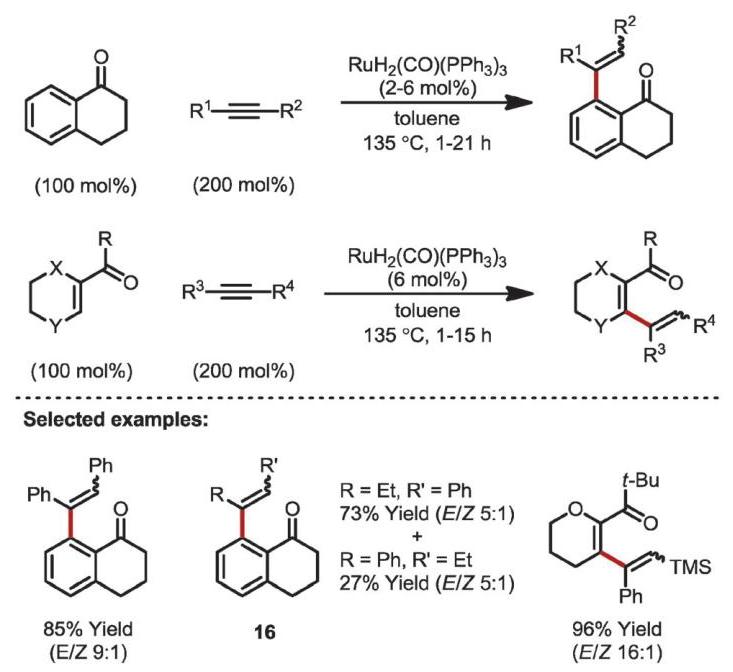
Scheme 16 Ruthenium-catalyzed ortho-alkenylation of aromatic ketones or enones with alkynes.
方案16 钌催化的芳族酮或烯酮与炔烃的邻位烯基化反应。
In 2011, Glorius and coworkers reported that the coupling between aromatic ketones and alkynes can undergo a different pathway, leading to indenol and fulvene derivatives when a cationic Rh(III) catalyst and stoichiometric Cu(II) salt are used (Scheme 17). ${}^{39}$ Similar to the coupling with olefins (vide supra, Scheme 14), ortho-C-H activation with Rh(111) proceeds through a CMD mechanism and the following migratory insertion of alkyne gives vinyl-Rh(III) species 20. Subsequently, an intramolecular addition of vinyl group to the ketone carbonyl yields the intermediate 21, which upon protonation gives the indenol (17) as the final product. However, if a methyl or methylene group is present at the $\alpha$ -position of the ketone $\left( {\mathrm{R}}^{1}\right)$ or the $\gamma$ -position of the alkyne $\left( {\mathrm{R}}^{3}\right)$ , dehydration takes place affording the fulvene derivatives (18 and 19, respectively). Similar transformations have also been reported by Cheng, ${}^{40}$ Jeganmohan, ${}^{41}$ and Shibata ${}^{42}$ using rhodium, ruthenium, and iridium catalysts respectively.
2011年,格洛里厄斯及其同事报告称,当使用阳离子铑(III)催化剂和化学计量的铜(II)盐时,芳香酮与炔烃之间的偶联可以通过不同的途径进行,生成茚醇和富烯衍生物(方案17)。${}^{39}$ 与烯烃的偶联类似(见上文,方案14),铑(III)催化的邻位C-H活化通过CMD机理进行,随后炔烃的迁移插入生成乙烯基铑(III)物种20。随后,乙烯基分子内加成到酮羰基上生成中间体21,质子化后得到茚醇(17)作为最终产物。然而,如果在酮的$\alpha$ -位或炔烃的$\gamma$ -位存在甲基或亚甲基$\left( {\mathrm{R}}^{1}\right)$ $\left( {\mathrm{R}}^{3}\right)$ ,则会发生脱水反应,分别得到富烯衍生物(18和19)。程、${}^{40}$ 杰甘莫汉、${}^{41}$ 和柴田${}^{42}$ 也分别使用铑、钌和铱催化剂报道了类似的转化反应。
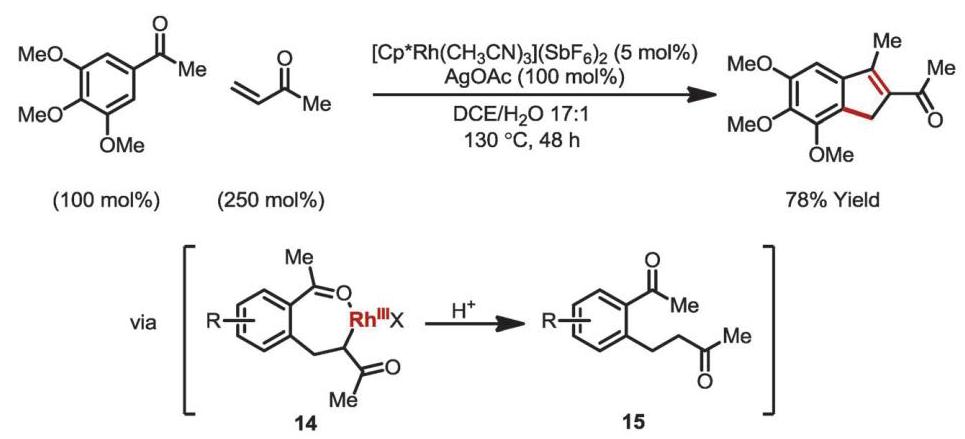
Scheme 15 Rhodium-catalyzed ortho-alkylation/aldol condensation cascade.
方案15 铑催化的邻位烷基化/羟醛缩合级联反应。
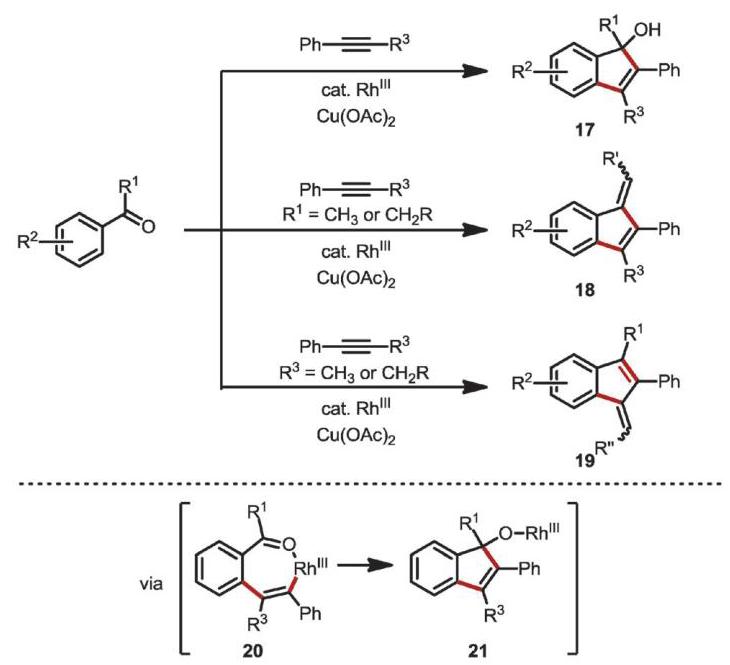
Scheme 17 Rhodium-catalyzed fulvene and indenol synthesis.
方案17 铑催化的富烯和茚醇合成。
Another interesting tandem reaction that involves ketone-directed C-H bond activation is the rhodium-catalyzed cyclization of aromatic ketones and diynes (Scheme 18). In 2007, Shibata and coworkers reported the formation of cyclic 1,3-diene product 23 from the coupling of diynes and aromatic ketones catalyzed by $\left\lbrack {\mathrm{{Rh}}\left( \mathrm{{BIPHEP}}\right) }\right\rbrack {\mathrm{{BF}}}_{4}$ (eqn (12)). ${}^{43}$ When trans-chalcone was used as the substrate, monocyclic trienone 24 was generated (eqn (13)). The tandem process was proposed to initiate via the ketone-directed ortho-C-H activation with the rhodium catalyst. Intermolecular hydro-rhodation of one of the alkyne moieties and subsequent intramolecular carbo-rhodation of the other would give the six-membered rhodacycle 26. The final reductive elimination generates the product and releases the active catalyst.
另一个涉及酮导向的C-H键活化的有趣串联反应是铑催化的芳香酮与二炔的环化反应(方案18)。2007年,柴田及其同事报道了由$\left\lbrack {\mathrm{{Rh}}\left( \mathrm{{BIPHEP}}\right) }\right\rbrack {\mathrm{{BF}}}_{4}$ 催化的二炔与芳香酮偶联生成环状1,3-二烯产物23(式(12))。${}^{43}$ 当使用反式查尔酮作为底物时,生成了单环三烯酮24(式(13))。该串联过程被认为是通过铑催化剂进行酮导向的邻位C-H活化开始的。一个炔基部分的分子间氢铑化以及随后另一个炔基部分的分子内碳铑化将生成六元铑环26。最终的还原消除反应生成产物并释放出活性催化剂。
When an enyne was employed as the substrate, the metal-lated intermediate added to the alkyne first to give the monocyclic product 27 (Scheme 19). The product descended from the initial addition to alkene and subsequent carbo-rhodation of alkyne (28) was not observed. When a chiral rhodium complex was used as the catalyst, good enantioselectivity was obtained. Similar tandem reactions with enynes and diynes as the coupling partners have also been published by Tanaka and coworkers using cationic rhodium catalysts. ${}^{{44},{45}}$
当使用烯炔作为底物时,金属化中间体首先加成到炔烃上,得到单环产物27(方案19)。未观察到最初加成到烯烃上并随后进行炔烃碳铑化(28)得到的产物。当使用手性铑配合物作为催化剂时,获得了良好的对映选择性。田中及其同事也使用阳离子铑催化剂报道了以烯炔和二炔作为偶联伙伴的类似串联反应。${}^{{44},{45}}$
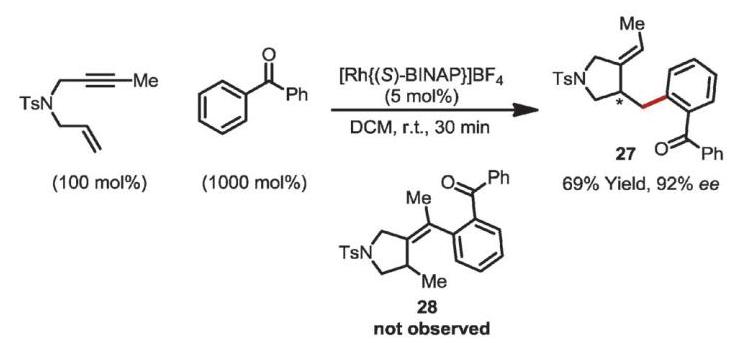
Scheme 19 Rhodium-catalyzed cyclization of enynes and aromatic ketones.
方案19 铑催化的烯炔与芳香酮的环化反应。
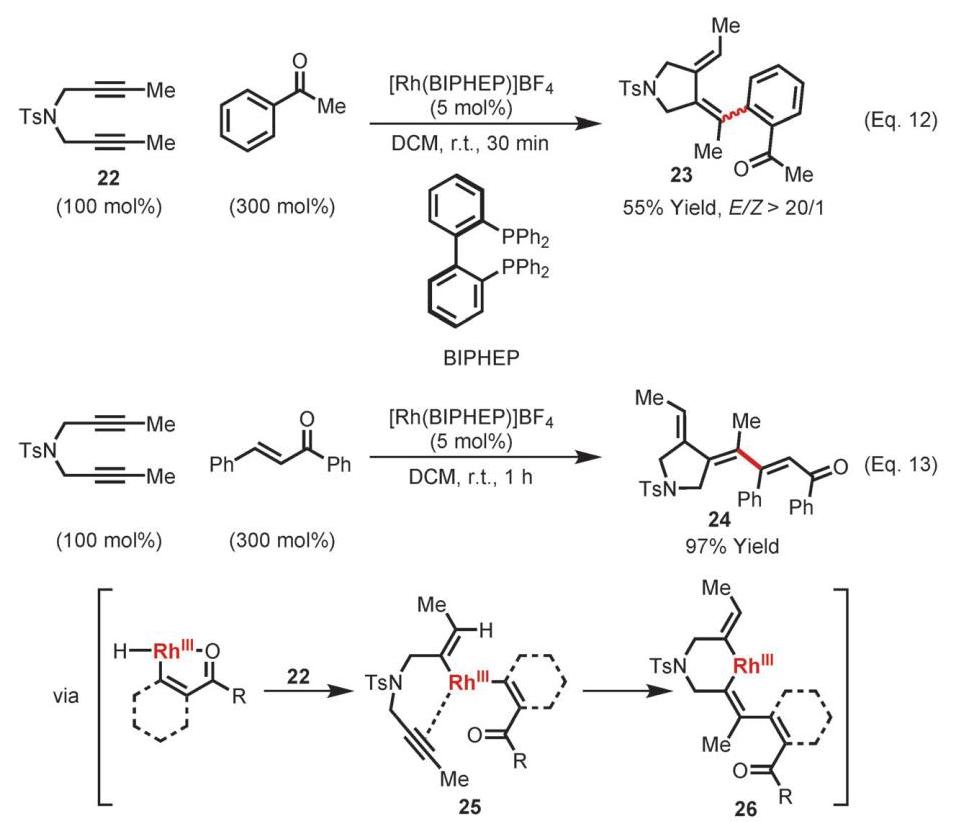
Scheme 18 Rhodium-catalyzed cyclization of diynes and aromatic ketones or chalcones.
方案18 铑催化的二炔与芳香酮或查尔酮的环化反应。
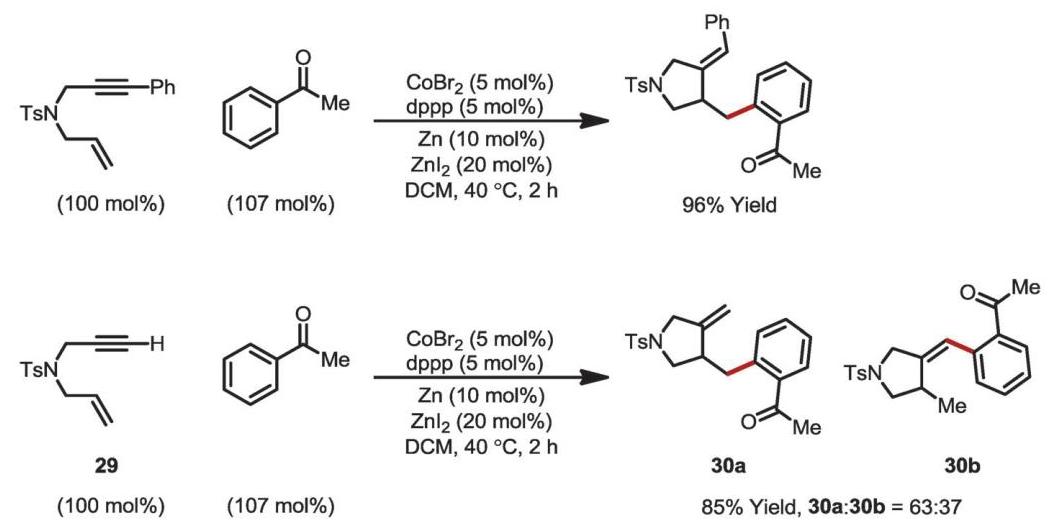
Scheme 20 Cobalt-catalyzed cyclization of enynes and aromatic ketones.
方案20 钴催化的烯炔与芳香酮的环化反应。
Recently, Cheng and coworkers reported a similar hydroar-ylative cyclization of enynes and aromatic ketones with a cobalt catalyst (Scheme 20). ${}^{46}$ In their case, ${\mathrm{{CoBr}}}_{2}/1,3$ -bis(diphenyl-phosphino)propane (dppp) was used as the precatalyst and the combination of zinc and zinc iodide was proposed to reduce the cobalt salt to the active $\mathrm{{Co}}\left( \mathrm{I}\right)$ catalyst. A large collection of functionalized pyrrolidines, dihydrofurans, and cyclopentanes were accessed as single regioisomers in good yields from simple aromatic ketones and enynes. While examples with terminal alkynes were not shown with rhodium catalysts (vide supra, Scheme 19), enyne 29 proceeded to give the cyclization product 30 as a mixture of regioisomers under the cobalt catalysis.
最近,程及其同事报道了使用钴催化剂对烯炔和芳香酮进行类似的氢芳基化环化反应(方案20)。${}^{46}$ 在他们的研究中,${\mathrm{{CoBr}}}_{2}/1,3$ -双(二苯基膦基)丙烷(dppp)用作预催化剂,锌和碘化锌的组合被认为可以将钴盐还原为活性$\mathrm{{Co}}\left( \mathrm{I}\right)$ 催化剂。从简单的芳香酮和烯炔中可以以良好的产率获得大量官能团化的吡咯烷、二氢呋喃和环戊烷,且均为单一区域异构体。虽然在铑催化剂的情况下没有展示端炔的例子(见上文,方案19),但在钴催化下,烯炔29生成了区域异构体混合物的环化产物30。
Although this review focuses on reaction discovery and strategy design, ketone-directed C-H bond addition to alkenes and alkynes has found many synthetic applications. For example, ketone-directed hydroarylation reactions were employed by Woodgate and coworkers in the synthesis of various aromatic diterpenoids (Scheme 21). In their study, the C14 C-H bond of diterpenoid 31 was selectively alkylated in quantitative yield with triethoxyvinylsilane using ${\mathrm{{RuH}}}_{2}\left( \mathrm{{CO}}\right) {\left( {\mathrm{{PPh}}}_{3}\right) }_{3}$ as the catalyst. ${}^{47}$ The authors also demonstrated the resulting alkyl-alkoxysilane moiety could serve as a handle to access a diverse range of analogues. ${}^{48}$
尽管本综述聚焦于反应发现和策略设计,但酮导向的碳氢键加成到烯烃和炔烃上已发现许多合成应用。例如,Woodgate及其同事在各种芳香二萜类化合物的合成中采用了酮导向的氢芳基化反应(方案21)。在他们的研究中,使用${\mathrm{{RuH}}}_{2}\left( \mathrm{{CO}}\right) {\left( {\mathrm{{PPh}}}_{3}\right) }_{3}$作为催化剂,二萜类化合物31的C14碳氢键以定量产率被三乙氧基乙烯基硅烷选择性烷基化。${}^{47}$作者还证明了所得的烷基 - 烷氧基硅烷部分可作为获得各种类似物的手段。${}^{48}$
Due to its high efficiency, the ketone-directed hydroarylation reaction has also found applications in the field of polymer chemistry. Shortly after Murai’s original discovery, Weber and coworkers applied the ruthenium-catalyzed ortho-alkylation of ketones to the copolymerization of aromatic ketones and diene derivatives (Scheme 22A). Copolymers with various backbones and functional groups, such as amines and acetals, were synthesized in high efficiency using ${\mathrm{{RuH}}}_{2}\left( \mathrm{{CO}}\right) {\left( {\mathrm{{PPh}}}_{3}\right) }_{3}$ as the catalyst. ${}^{{49} - {53}}$ The Weber group also reported the modification of poly-(vinyl-methylsiloxane) (PVMS) using the ruthenium-catalyzed hydroaryl-ation reaction (Scheme 22B). The ortho-C-H bond of the ketone in 9-acetylphenanthrene added to the pendant vinyl groups in PVMS with anti-Markovnikov selectivity and afforded the modified polymer in an excellent yield. ${}^{54}$
由于其高效率,酮导向的氢芳基化反应也在聚合物化学领域得到了应用。在Murai最初发现后不久,Weber及其同事将钌催化的酮邻位烷基化反应应用于芳香酮和二烯衍生物的共聚反应(方案22A)。使用${\mathrm{{RuH}}}_{2}\left( \mathrm{{CO}}\right) {\left( {\mathrm{{PPh}}}_{3}\right) }_{3}$作为催化剂,高效合成了具有各种主链和官能团(如胺和缩醛)的共聚物。${}^{{49} - {53}}$Weber团队还报道了使用钌催化的氢芳基化反应对聚(乙烯基 - 甲基硅氧烷)(PVMS)进行改性(方案22B)。9 - 乙酰菲中酮的邻位碳氢键以反马氏选择性加成到PVMS中的侧链乙烯基上,并以优异的产率得到改性聚合物。${}^{54}$
2.2 Arylation
2.2芳基化
In 2003, Kakiuchi and coworkers successfully extended ruthenium-catalyzed ortho-functionalization to the arylation of aromatic ketones (Scheme 23). ${}^{55}$ With ${\mathrm{{RuH}}}_{2}\left( \mathrm{{CO}}\right) {\left( {\mathrm{{PPh}}}_{3}\right) }_{3}$ as the catalyst, a wide panel of aromatic ketones were arylated in good yields with arylboronates as the arene source. To ensure good yields, two equivalents of ketone substrate were required.
2003年,柿内和同事成功地将钌催化的邻位官能化扩展到芳香酮的芳基化反应(方案23)。${}^{55}$ 以${\mathrm{{RuH}}}_{2}\left( \mathrm{{CO}}\right) {\left( {\mathrm{{PPh}}}_{3}\right) }_{3}$为催化剂,使用芳基硼酸酯作为芳烃源,多种芳香酮都能以良好的产率实现芳基化。为确保高产率,需要两当量的酮底物。
Murai’s original ruthenium-catalyzed addition of C-H bonds across olefins is a redox-neutral process requiring no external oxidant or reductant. However, in the case of arylation with aryl-boronates, additional reductants are necessary to trap the hydride generated after the oxidative addition. This is supported by the authors’ observation that an equal amount of benzyl alcohol was isolated as a byproduct after workup (eqn (14)). ${}^{56}$ In the proposed catalytic cycle, addition of Ru(π)-hydride 32 to another ketone substrate generates Ru(π)-alkoxide 33 (Scheme 24). Subsequent transmetalation between 33 and arylboronate transfers the aryl group to the $\mathrm{{Ru}}\left( \mathrm{{II}}\right)$ and meanwhile generates a stoichiometric amount of boronic ester, which is hydrolyzed during the workup to give the benzyl alcohol. Reductive elimination of complex 34 would give the arylation product and restore the active $\mathrm{{Ru}}\left( 0\right)$ catalyst.
村井最初报道的钌催化碳氢键对烯烃的加成反应是一个氧化还原中性过程,不需要外部氧化剂或还原剂。然而,在使用芳基硼酸酯进行芳基化反应时,需要额外的还原剂来捕获氧化加成后生成的氢化物。作者观察到后处理后分离出等量的苄醇作为副产物,这一现象支持了上述观点(方程式(14))。${}^{56}$ 在提出的催化循环中,Ru(π)-氢化物32与另一个酮底物加成生成Ru(π)-醇盐33(方案24)。随后,33与芳基硼酸酯之间的转金属化反应将芳基转移到$\mathrm{{Ru}}\left( \mathrm{{II}}\right)$上,同时生成化学计量的硼酸酯,该硼酸酯在工作后处理过程中水解生成苄醇。配合物34的还原消除将得到芳基化产物,并使活性$\mathrm{{Ru}}\left( 0\right)$催化剂得以恢复。
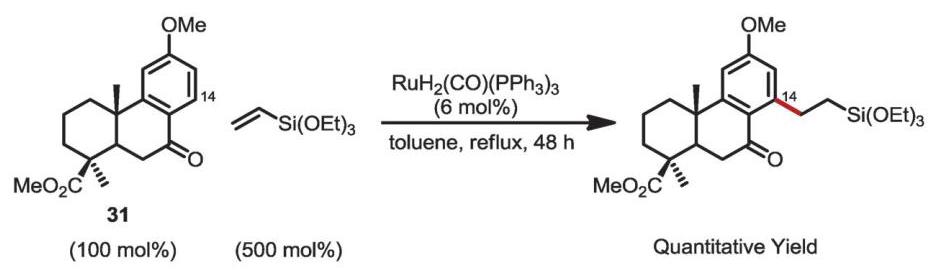
Scheme 21 Ruthenium-catalyzed alkylation of aromatic diterpenoid.
方案21 钌催化的芳香二萜的烷基化反应。
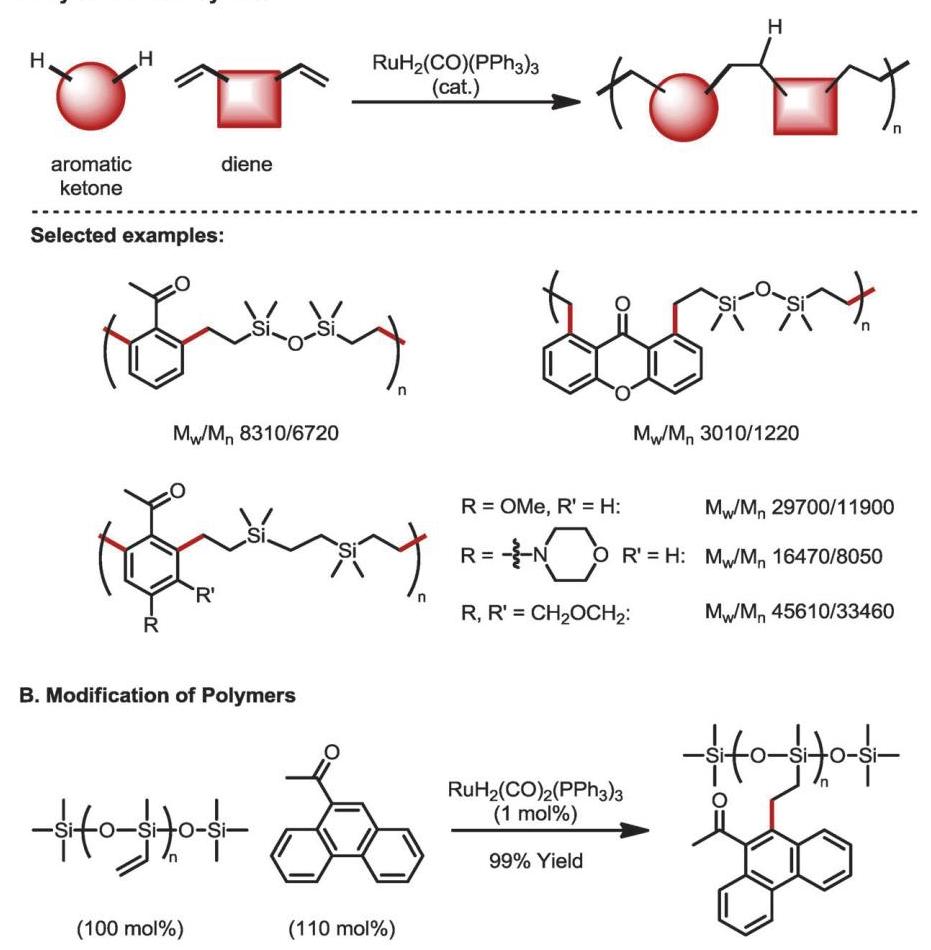
Scheme 22 Ruthenium-catalyzed synthesis and modification of polymers.
方案22 钌催化的聚合物的合成与改性。
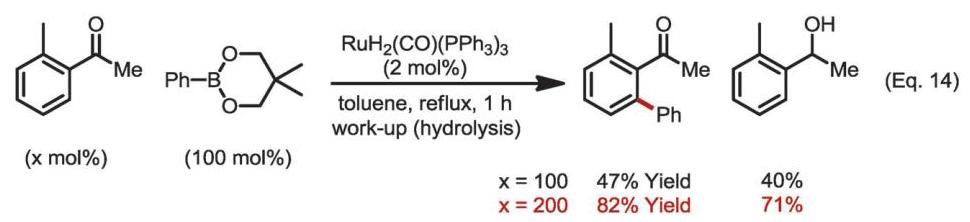
Scheme 23 Ruthenium-catalyzed ortho-arylation of aromatic ketones with arylboronates.
方案23 钌催化的芳香酮与芳基硼酸酯的邻位芳基化反应。
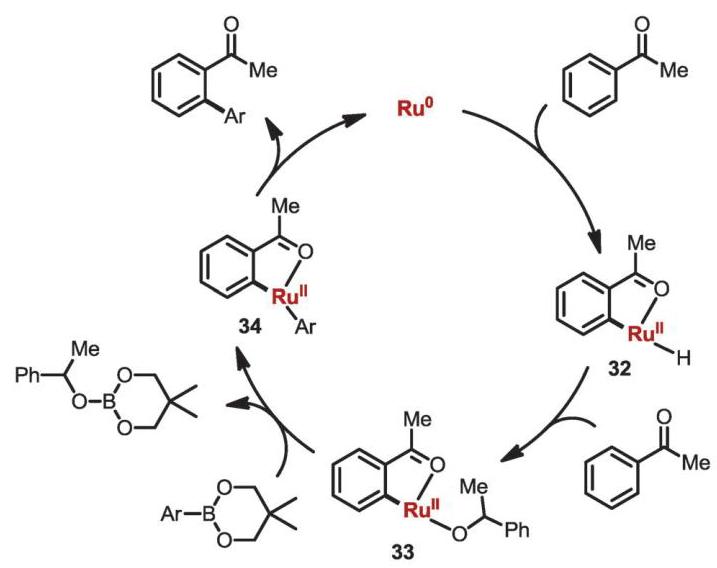
Scheme 24 Proposed catalytic cycle of ruthenium-catalyzed ortho-arylation.
方案24 钌催化邻位芳基化反应的催化循环示意图。
The issue of using excess ketone substrates was later resolved by employing pinacolone as the solvent (Scheme 25, eqn (15)). The efficiency of the arylation reaction can be sustained with aromatic ketones as the limiting reagent, and excess pinacolone serves as the hydride scavenger instead of the aryl ketone substrate. The coupling with alkenylboronates was also reported under similar reaction conditions by the same group (eqn (16)). ${}^{{57},{58}}$ This new olefination reaction can be considered as a complementary approach to the previous C-H addition to alkynes (vide supra, Scheme 16), since products like 35 cannot be accessed directly from coupling with alkynes.
使用过量的酮底物这一问题后来通过使用频哪酮作为溶剂得到了解决(方案25,方程式(15))。以芳香酮作为限量试剂时,芳基化反应的效率可以得到维持,过量的频哪酮作为氢化物清除剂,而不是芳基酮底物。同一研究小组在相似的反应条件下也报道了与烯基硼酸酯的偶联反应(方程式(16))。${}^{{57},{58}}$ 这种新的烯化反应可以看作是之前碳氢键对炔烃加成反应的补充方法(见上文,方案16),因为像35这样的产物不能通过与炔烃的偶联直接得到。
On the other hand, the ortho-arylation of aromatic ketones using aryl halides as the coupling partner was achieved using palladium catalysis. The ortho-arylation of aromatic ketones with aryl bromides was first discovered by Miura and coworkers (Scheme 26). ${}^{59}$ In the presence of a palladium catalyst and a stoichiometric base, benzylphenyl ketone reacted with excess bromobenzene to give poly-arylated ketone 36 as the major product (eqn (17)). Instead of a ketone-directed pathway, the authors proposed an enolate-directed palladation assisted by ${\mathrm{{Cs}}}_{2}{\mathrm{{CO}}}_{3}$ . In a following study by the same group, the ortho- $\mathrm{C} - \mathrm{H}$ bonds of anthrone were also arylated under similar reaction conditions (eqn (18)). ${}^{60}$
另一方面,使用钯催化实现了以芳基卤化物作为偶联伙伴的芳香酮的邻位芳基化反应。芳香酮与芳基溴的邻位芳基化反应最早是由三浦和同事发现的(方案26)。${}^{59}$ 在钯催化剂和化学计量碱的存在下,苄基苯基酮与过量的溴苯反应,以多芳基化酮36作为主要产物(方程式(17))。作者提出了一种由${\mathrm{{Cs}}}_{2}{\mathrm{{CO}}}_{3}$辅助的烯醇盐导向的钯化反应,而不是酮导向的反应途径。在同一研究小组随后的一项研究中,蒽酮的邻位$\mathrm{C} - \mathrm{H}$键在相似的反应条件下也实现了芳基化(方程式(18))。${}^{60}$
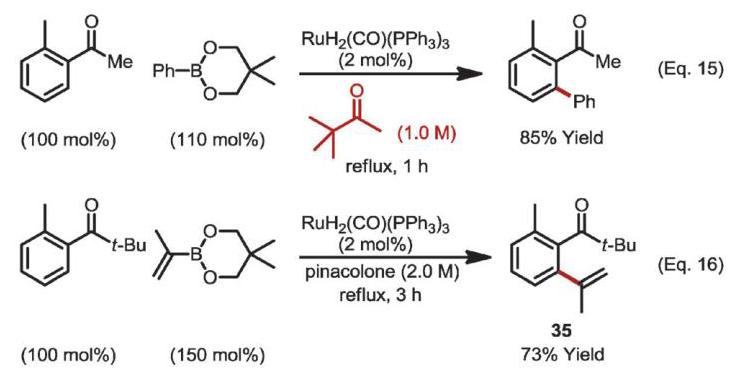
Scheme 25 Ruthenium-catalyzed ortho-arylation using pinacolone as solvent.
方案25 使用频哪酮作为溶剂的钌催化邻位芳基化反应。
In 2010, Cheng and coworkers reported a ketone-directed ortho-arylation with aryl iodides (Scheme 27). ${}^{61}$ Contrary to Miura’s basic conditions, trifluoroacetic acid was used as the solvent for this reaction. In addition, although excess aryl iodides were employed, only mono arylation products were observed for a range of aromatic ketones. However, when electron-neutral or rich aryl iodides were used as the substrates, the yields were largely compromised. It is interesting to note that the use of sec-alkyl aryl ketones triggered a tandem process that gave phenanthrone products (Scheme 28). It was proposed that after the ortho-arylation, a second ketone (or enolate)- directed C-H activation occurs to form a seven-membered palladacycle (41). Subsequent enolate formation, rearrangement, and reductive elimination results in formation of phenan-throne 39.
2010年,程及其同事报道了用芳基碘化物进行的酮导向邻位芳基化反应(方案27)。${}^{61}$ 与三浦的碱性条件相反,该反应使用三氟乙酸作为溶剂。此外,尽管使用了过量的芳基碘化物,但对于一系列芳香酮,仅观察到单芳基化产物。然而,当使用电子中性或富电子的芳基碘化物作为底物时,产率大大降低。有趣的是,使用仲烷基芳基酮引发了一个串联过程,得到菲酮产物(方案28)。有人提出,在邻位芳基化之后,发生第二次酮(或烯醇盐)导向的C-H活化,形成七元钯环(41)。随后的烯醇盐形成、重排和还原消除导致菲酮39的形成。
Besides coupling with pre-functionalized aryl sources (i.e. arylboronates and aryl halides), ketone-directed arylation can also occur through the coupling between two aryl $\mathrm{C} - \mathrm{H}$ bonds. In 2012, the Cheng ${}^{62}$ and Shi ${}^{63}$ groups independently reported the synthesis of fluorenone derivatives from diaryl ketones using palladium acetate as the catalyst and silver oxide as the oxidant (Scheme 29). The proposed pathway begins with ortho-C-H palladation via a CMD mechanism directed by the ketone carbonyl. Due to the weak coordinating ability of the ketone, de-chelation followed by C-C bond rotation can occur, allowing the Pd(II) center to rotate towards the ortho-C-H on the other arene. A second C-H palladation would lead to a six-membered pallacycle (46), which upon reductive elimination would give fluorenone 44 as the product and a $\operatorname{Pd}\left( 0\right)$ species. The silver salt was proposed to oxidize the $\operatorname{Pd}\left( 0\right)$ intermediate and restore the active Pd(π) catalyst.
除了与预官能化的芳基源(即芳基硼酸酯和芳基卤化物)偶联外,酮导向的芳基化也可以通过两个芳基$\mathrm{C} - \mathrm{H}$键之间的偶联发生。2012年,程${}^{62}$和施${}^{63}$小组独立报道了使用醋酸钯作为催化剂和氧化银作为氧化剂,由二芳基酮合成芴酮衍生物(方案29)。提出的途径始于通过酮羰基导向的CMD机制进行的邻位C-H钯化。由于酮的配位能力较弱,去螯合随后的C-C键旋转可能发生,使Pd(II)中心向另一个芳烃上的邻位C-H旋转。第二次C-H钯化将导致形成六元钯环(46),其在还原消除后将得到芴酮44作为产物和一个$\operatorname{Pd}\left( 0\right)$物种。有人提出银盐氧化$\operatorname{Pd}\left( 0\right)$中间体并恢复活性Pd(π)催化剂。
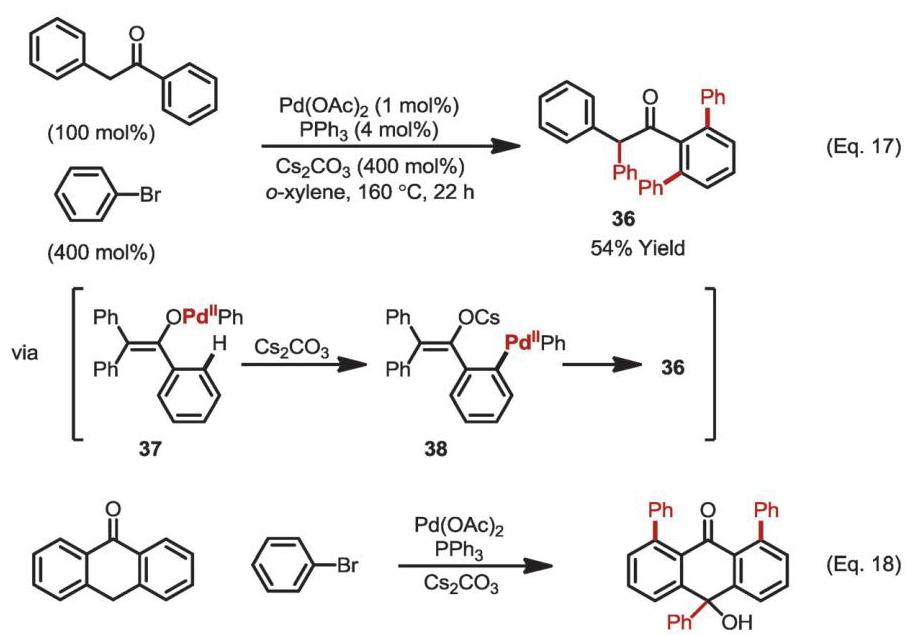
Scheme 26 Palladium-catalyzed multi-arylation of ketones.
方案26 钯催化的酮的多芳基化。
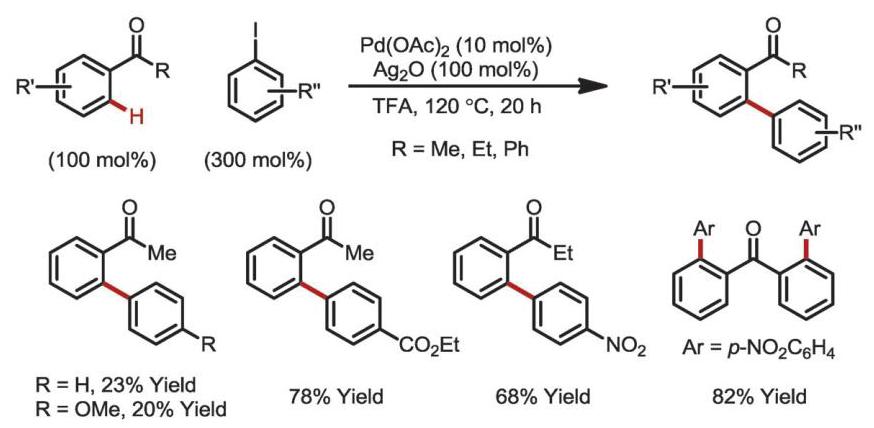
Scheme 27 Palladium-catalyzed ortho-arylation with aryl iodides.
方案27 钯催化的与芳基碘化物的邻位芳基化。
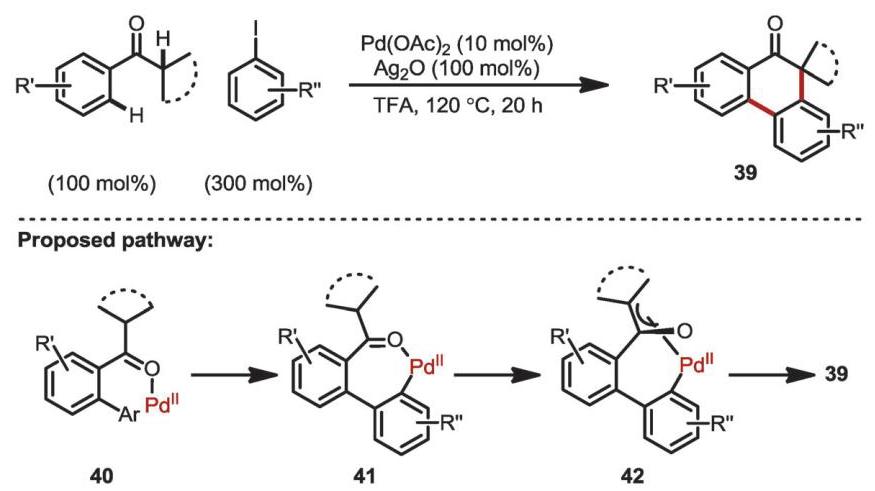
Scheme 28 Palladium-catalyzed ortho-arylation and tandem cyclization.
方案28 钯催化的邻位芳基化和串联环化。
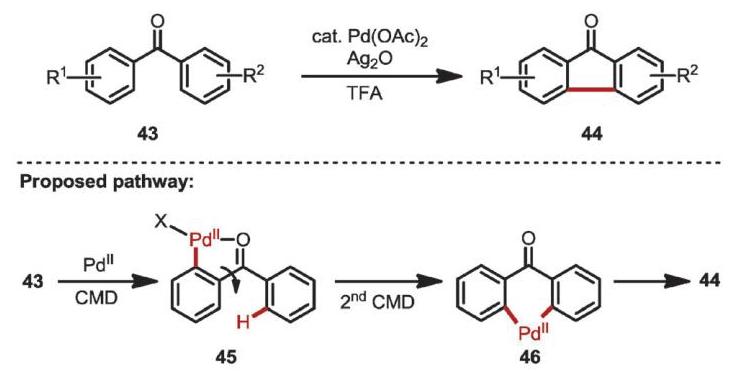
Scheme 29 Palladium-catalyzed fluorenone synthesis via sequential C-H activation.
方案29 通过连续C-H活化钯催化的芴酮合成。
2.3 Carbon-heteroatom (C-X) bond formation
2.3 碳-杂原子(C-X)键的形成
Compared to C-C bond forming reactions, ketone-directed ortho-C-X (X: heteroatom) bond formation is relatively less studied. Nevertheless, direct and efficient assembly of ortho-heteroatom-substituted ketones via C-H functionalization is of great value to the synthetic community as $o$ -acyl phenols, anilines, and haloarenes are prevalent motifs in bioactive compounds.
与形成C-C键的反应相比,酮导向的邻位C-X(X:杂原子)键的形成研究相对较少。然而,通过C-H官能化直接有效地组装邻位杂原子取代的酮对合成领域具有重要价值,因为$o$-酰基苯酚、苯胺和卤代芳烃是生物活性化合物中普遍存在的结构单元。
The general catalytic cycle for ketone-directed C-X bond formation is illustrated in Scheme 30. The reaction starts with a directed ortho-C-H metalation to give a five-membered metalla-cycle (47), where the oxidation state of the metal remains unchanged. The following oxidation with various oxidants first delivers an anionic heteroatom ligand $\left( \mathrm{X}\right)$ to the metal, and second increases the oxidation state of the metal by two. Depending on the oxidant employed, different heteroatom ligands can be introduced to the metal. The final reductive elimination of the higher-oxidation state metal complex (48) affords the product with a newly formed C-X bond and regenerates the active metal catalyst.
酮导向的C-X键形成的一般催化循环如图30所示。反应始于导向的邻位C-H金属化,生成一个五元金属环(47),其中金属的氧化态保持不变。随后用各种氧化剂进行氧化,首先将一个阴离子杂原子配体$\left( \mathrm{X}\right)$传递给金属,其次将金属的氧化态提高两个单位。根据所使用的氧化剂,可以将不同的杂原子配体引入到金属中。最后,高氧化态金属配合物(48)的还原消除得到具有新形成的C-X键的产物,并使活性金属催化剂再生。
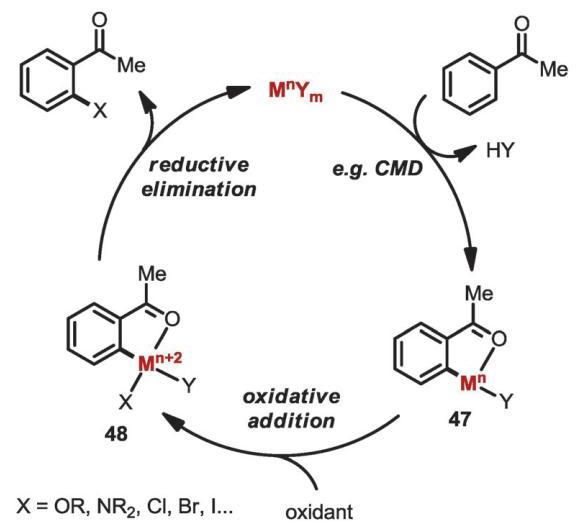
Scheme 30 General mechanism of the ketone-directed ortho-C-X bond formation.
图30酮导向的邻位C-X键形成的一般机理。
In 2012, the Rao ${}^{64}$ and Dong ${}^{65}$ groups independently reported a palladium-catalyzed ortho-hydroxylation reaction directed by ketones (Scheme 31, eqn (19)). A wide range of ortho-acylphenols were synthesized using palladium acetate or trifluoroacetate as the catalyst in good yields. Both organic and inorganic oxidants, e.g. hypervalent iodine compounds and potassium persulfate, can be used to promote the C-O bond formation. Dong and coworkers further discovered an unusual ortho-carbonylation reaction when running the hydroxylation reaction under CO atmosphere (eqn (20)). ${}^{65}$ While the exact pathway remains unclear, the ethyl-ketal lactone was proposed to come from mixed-anhydride intermediate 50. A similar palladium-catalyzed hydroxylation reaction was later reported by Kwong and coworkers. ${}^{66}$ In addition to palladium catalysis, the ketone-directed hydroxylation reaction can also be catalyzed by ruthenium ${}^{{67},{68}}$ and rhodium ${}^{68}$ under similar conditions (Scheme 32). The study of substrate scopes indicated that, while ruthenium- and rhodium-catalyzed hydroxylation reactions shared similar chemoselectivity (electron-rich arenes are favored), the ruthenium catalysts gave better performance in terms of yields.
2012年,Rao ${}^{64}$和Dong ${}^{65}$课题组独立报道了酮导向的钯催化邻位羟基化反应(图31,式(19))。使用醋酸钯或三氟醋酸钯作为催化剂,以良好的产率合成了多种邻位酰基苯酚。有机和无机氧化剂,如高价碘化合物和过硫酸钾,均可用于促进C-O键的形成。Dong及其同事进一步发现,在CO气氛下进行羟基化反应时会发生一种不寻常的邻位羰基化反应(式(20))。${}^{65}$虽然确切的途径仍不清楚,但乙基缩酮内酯被认为来自混合酸酐中间体50。Kwong及其同事后来也报道了类似的钯催化羟基化反应。${}^{66}$除了钯催化外,在类似条件下,酮导向的羟基化反应也可以由钌${}^{{67},{68}}$和铑${}^{68}$催化(图32)。底物范围的研究表明,虽然钌和铑催化的羟基化反应具有相似的化学选择性(富电子芳烃更受青睐),但钌催化剂在产率方面表现更好。
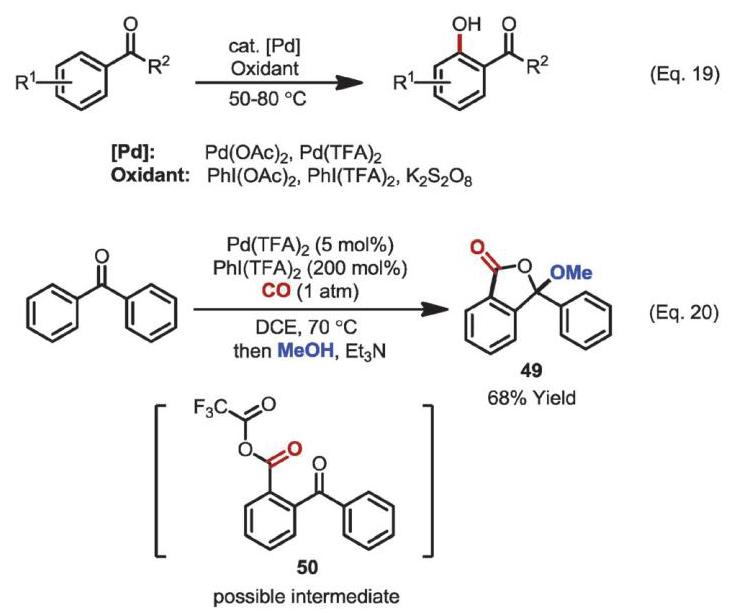
Scheme 31 Palladium-catalyzed ketone-directed ortho-hydroxylation reaction.
图31钯催化的酮导向邻位羟基化反应。
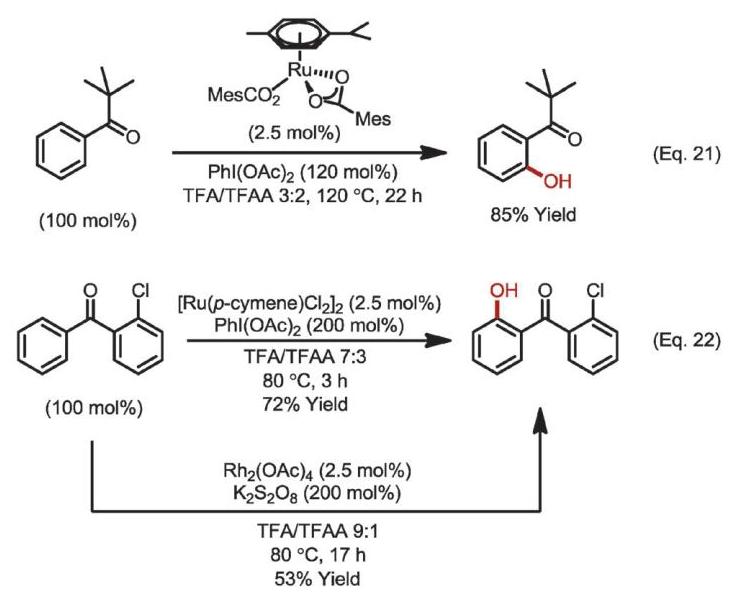
Scheme 32 Ruthenium and rhodium-catalyzed ketone-directed ortho-hydroxylation reaction.
图32钌和铑催化的酮导向邻位羟基化反应。
Halogenation is also possible, and $N$ -halo succinimides proved to be efficient oxidants for carbon-halogen bond formation directed by ketones. In 2012, Glorius and coworkers reported rhodium-catalyzed ortho-bromination and iodination reactions with aromatic ketones, using $N$ -bromo and $N$ -iodo-succinimide as the oxidant respectively (Scheme 33). ${}^{69}$ The reaction conditions utilize a cationic rhodium catalyst and stoichiometric pivalic acid or copper acetate, presumably to facilitate the metalation step. The chlorination with $N$ -chlorosuccinimide was reported later by Rao and coworkers using palladium catalysis (Scheme 34). ${}^{70}$ Both triflic acid and potassium persulfate additives play a vital role in sustaining the reactivity. While triflic acid facilitates coordination of the ketone by in situ generation of a more electrophilic palladium catalyst $\mathrm{{Pd}}{\left( \mathrm{{OTf}}\right) }_{2}$ , potassium persulfate is believed to promote the oxidation of $\mathrm{{Pd}}\left( \mathrm{{II}}\right)$ to $\mathrm{{Pd}}\left( \mathrm{{IV}}\right)$ as a co-oxidant.
卤化也是可行的,并且$N$-卤代琥珀酰亚胺被证明是酮导向形成碳-卤键的有效氧化剂。2012年,Glorius及其同事报道了铑催化的与芳香酮的邻位溴化和碘化反应,分别使用$N$-溴代和{{F}}-碘代琥珀酰亚胺作为氧化剂(图33)。${}^{69}$反应条件使用阳离子铑催化剂和化学计量的新戊酸或醋酸铜,可能是为了促进金属化步骤。Rao及其同事后来报道了使用钯催化的用$N$-氯代琥珀酰亚胺进行的氯化反应(图)。${}^{70}$三氟甲磺酸和过硫酸钾添加剂在维持反应活性方面都起着至关重要的作用。虽然三氟甲磺酸通过原位生成更具亲电性的钯催化剂$\mathrm{{Pd}}{\left( \mathrm{{OTf}}\right) }_{2}$促进酮的配位,但过硫酸钾被认为作为共氧化剂促进$\mathrm{{Pd}}\left( \mathrm{{II}}\right)$氧化为$\mathrm{{Pd}}\left( \mathrm{{IV}}\right)$。
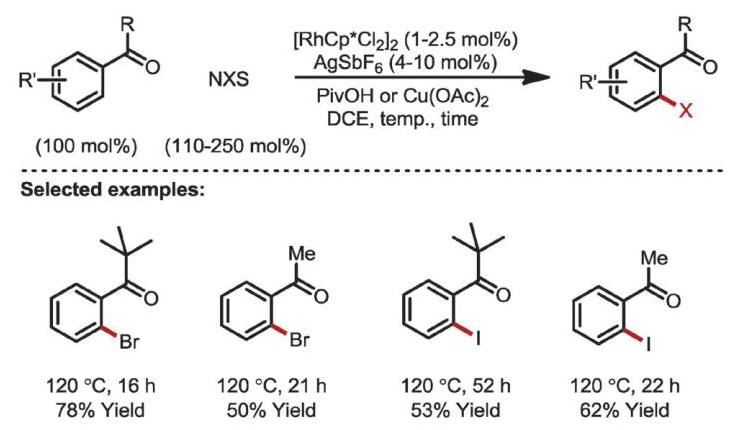
Scheme 33 Palladium-catalyzed ketone-directed ortho-bromination and iodination.
图33钯催化的酮导向邻位溴化和碘化反应。
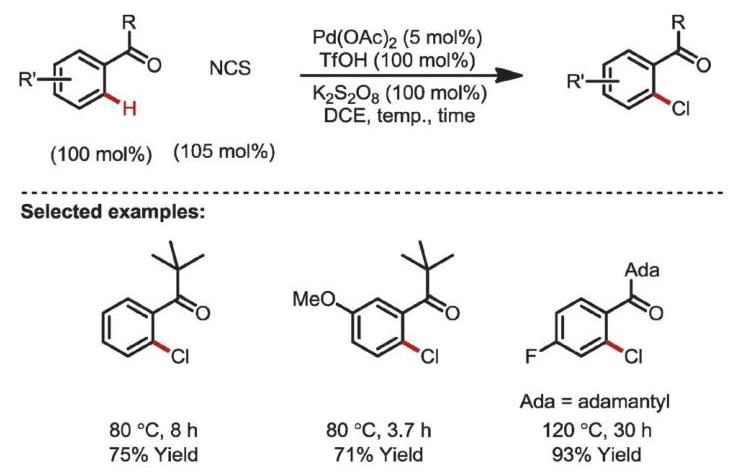
Scheme 34 Palladium-catalyzed ketone-directed ortho-chlorination.
图34钯催化的酮导向邻位氯化反应。
Ketone-directed ortho-amination was first accomplished by Liu and coworkers using sulfonamides or amides as the amine source (Scheme 35). ${}^{71}N$ -Fluoro-2,4,6-trimethylpyridinium triflate 51 or sodium persulfate can be used as the terminal oxidant. Mechanistic studies revealed that during the reaction the sulfonamide competes with the weakly coordinating ketone for complexation with palladium, which results in lower efficiency during the reaction.
酮导向的邻位胺化反应最初是由Liu及其同事使用磺酰胺或酰胺作为胺源完成的(方案35)。${}^{71}N$-三氟甲磺酸-氟-2,4,6-三甲基吡啶鎓51或过硫酸钠可作为终端氧化剂。机理研究表明,在反应过程中,磺酰胺与弱配位酮竞争与钯的络合,这导致反应过程中的效率较低。
The corresponding ortho-amination with sulfonyl azides was independently reported by the Chang, ${}^{72}$ Jiao, ${}^{73}$ and Sahoo ${}^{74}$ groups in 2013 using ${\left\lbrack \mathrm{{Ru}}\left( p\text{ -cymene }\right) {\mathrm{{Cl}}}_{2}\right\rbrack }_{2}$ as the catalyst (Scheme 36). Besides the use of cationic silver salts, additional copper or sodium acetate is indispensable for all three reactions. The silver salt is proposed to generate a more electrophilic ruthenium catalyst allowing better complexation with ketone. The basic acetate ligands are expected to facilitate C-H metalation via a CMD mechanism.
2013年,Chang、${}^{72}$Jiao和${}^{73}$Sahoo${}^{74}$小组分别报道了使用${\left\lbrack \mathrm{{Ru}}\left( p\text{ -cymene }\right) {\mathrm{{Cl}}}_{2}\right\rbrack }_{2}$作为催化剂的相应磺酰叠氮化物邻位胺化反应(方案36)。除了使用阳离子银盐外,额外的铜或乙酸钠对所有三个反应都是必不可少的。有人提出银盐会生成更具亲电性的钌催化剂,从而使其与酮更好地络合。碱性乙酸配体有望通过CMD机理促进C-H金属化。
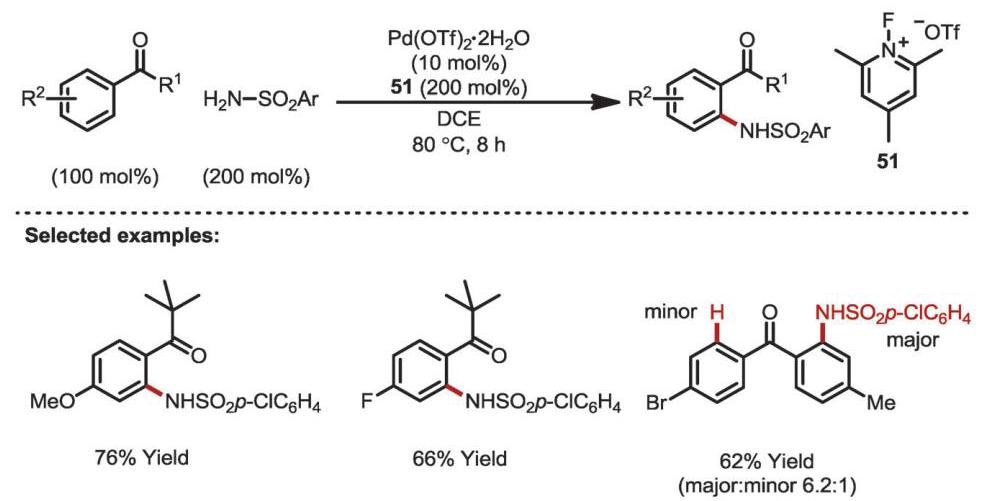
Scheme 35 Palladium-catalyzed ketone-directed ortho-amination using sulfonamides.
方案35 使用磺酰胺的钯催化酮导向邻位胺化反应。
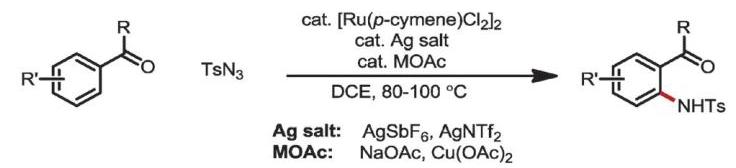
Scheme 36 Palladium-catalyzed ketone-directed ortho-amination using sulfonyl azides.
方案36 使用磺酰叠氮化物的钯催化酮导向邻位胺化反应。
3. β-C-H functionalization of simple ketones
3. 简单酮的β-C-H官能团化
$\beta$ -Substituted ketones represent an important class of prevalent motifs in bioactive compounds, such as drug candidates, antioxidants, and pesticides. Nevertheless, compared to the $\alpha - \mathrm{C} - \mathrm{H}$ bond, the more distal $\beta - \left( {\mathrm{{sp}}}^{3}\right) \mathrm{C} - \mathrm{H}$ bonds of ketones are usually considered intrinsically unreactive. Conventionally, $\beta$ -functionalized ketones are prepared through the conjugate addition of nucleo-philes to $\alpha ,\beta$ -unsaturated ketones (Scheme 37). ${}^{75}$ As efficient as this protocol is, $\alpha ,\beta$ -unsaturated ketones are often synthesized from the corresponding saturated ketones via dehydrogenation, which takes 1-3 steps and requires stoichiometric oxidants. ${}^{76}$ The direct $\beta$ -C-H functionalization of the carboxylic acid derivatives, e.g. amides and esters, using a DG-based strategy have been extensively studied and reviewed: ${}^{77}$ in contrast, $\beta$ -functionalization of simple ketones is nontrivial to develop due to their higher reactivity but lower coordinating ability. In the past two years, several transition-metal-catalyzed approaches have emerged that enable the direct $\beta - \mathrm{C} - \mathrm{H}$ functionalization of simple ketones.
$\beta$-取代的酮是生物活性化合物中一类重要的普遍结构单元,如候选药物、抗氧化剂和杀虫剂。然而,与$\alpha - \mathrm{C} - \mathrm{H}$键相比,酮的更远端$\beta - \left( {\mathrm{{sp}}}^{3}\right) \mathrm{C} - \mathrm{H}$键通常被认为本质上是不活泼的。传统上,$\beta$-官能团化的酮是通过亲核试剂对$\alpha ,\beta$-不饱和酮的共轭加成来制备的(方案37)。${}^{75}$尽管该方法很有效,但$\alpha ,\beta$-不饱和酮通常是通过相应的饱和酮经脱氢反应合成的,这需要1-3步且需要化学计量的氧化剂。${}^{76}$使用基于导向基团的策略对羧酸衍生物(如酰胺和酯)进行直接$\beta$-C-H官能团化已得到广泛研究和综述:${}^{77}$相比之下,由于简单酮的反应活性较高但配位能力较低,对其进行$\beta$-官能团化的开发并不容易。在过去两年中,出现了几种过渡金属催化的方法,能够实现简单酮的直接$\beta - \mathrm{C} - \mathrm{H}$官能团化。
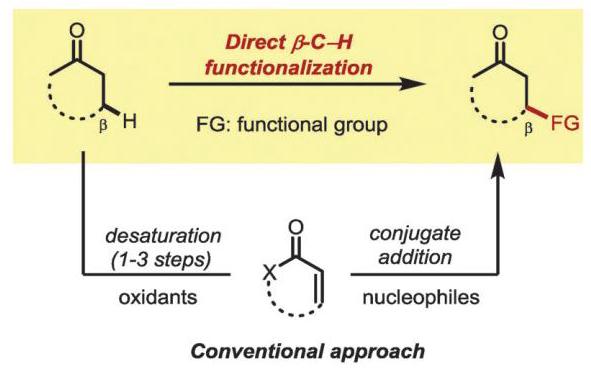
Scheme 37 Direct $\beta$ -C-H functionalization of ketones.
方案37 酮的直接$\beta$-C-H官能团化。
In 2013, MacMillan and coworkers reported a direct $\beta$ -arylation of cyclic ketones with electron-deficient arylnitriles via the combination of photo- and enamine catalysis (Scheme 38). ${}^{78}$ With a photocatalyst, i.e. $\operatorname{Ir}{\left( \mathrm{{ppy}}\right) }_{3}$ , and amine catalyst, i.e. azepane, various cyclic ketones were coupled with 1,4-dicyanobenzene selectively at the $\beta$ -position in the presence of a ${26}\mathrm{\;W}$ light bulb (CFL: compact fluorescent light) (eqn (23)). This transformation is amenable for enantioselective catalysis. When a cinchona-based chiral amine (53) was employed, a moderate ee value was obtained for the $\beta$ -arylation of cyclohexanone (eqn (24))
2013年,MacMillan及其同事报道了通过光催化和烯胺催化相结合,实现环状酮与缺电子芳基腈的直接$\beta$-芳基化反应(方案38)。${}^{78}$使用光催化剂,即$\operatorname{Ir}{\left( \mathrm{{ppy}}\right) }_{3}$,和胺催化剂,即氮杂环庚烷,在${26}\mathrm{\;W}$灯泡(紧凑型荧光灯)存在下,各种环状酮与1,4-二氰基苯在$\beta$-位选择性偶联(方程(23))。这种转化适用于对映选择性催化。当使用基于金鸡纳碱的手性胺(53)时,环己酮的$\beta$-芳基化反应获得了中等的对映体过量值(方程(24))
The proposed mechanism for the $\beta$ -arylation reaction consists of two catalytic cycles mediated by the photo- and amine catalyst, respectively (Scheme 39). In the photocatalytic cycle, the $\operatorname{Ir}{\left( \mathrm{{ppy}}\right) }_{3}$ catalyst is first activated by light to generate an excited *Ir(ppy) ${}_{3}$ . A subsequent single electron transfer (SET) between the electron-deficient 1,4-dicyanobenzene and the activated catalyst reduces the arene to a radical anion (54) and yields an Ir(rv) intermediate 55. In the second cycle, the amine catalyst condenses with the ketone substrate to give an electron-rich enamine intermediate (56). The two catalytic cycles then merge through a single electron transfer process, where the enamine gets oxidized to a nitrogen-centered radical cation (57) and the Ir complex (55) is reduced back to $\operatorname{Ir}{\left( \mathrm{{ppy}}\right) }_{3}$ . The formation of the radical cation increases the acidity of the allylic $\beta$ -C-H bond, which can be deprotonated by a base to give a ${5\pi }$ -electron system that has significant radical character at the $\beta$ -carbon. Coupling between electron-rich $\beta$ -radical 58 and electron-deficient radical anion 54 provides intermediate 59 bearing a new $\beta - \mathrm{C} - \mathrm{C}$ bond. The following re-aromatization and hydrolysis affords the $\beta$ -arylated ketone, releases a cyanide anion, and regenerates the amine catalyst. The use of electron-deficient arylnitriles as the coupling partner is important because the radical anion intermediate 54 generated from the arylnitrile is long living and reluctant to dimerize due to its electron deficiency, which is the key for high chemo and site-selectivity for the $\beta - \mathrm{C} - \mathrm{C}$ bond formation.
所提出的用于$\beta$-芳基化反应的机理由分别由光催化剂和胺催化剂介导的两个催化循环组成(方案39)。在光催化循环中,$\operatorname{Ir}{\left( \mathrm{{ppy}}\right) }_{3}$催化剂首先被光激活生成激发态的*Ir(ppy)${}_{3}$。随后,缺电子的1,4-二氰基苯与活化的催化剂之间发生单电子转移(SET),将芳烃还原为自由基阴离子(54),并生成Ir(III)中间体55。在第二个循环中,胺催化剂与酮底物缩合得到富电子的烯胺中间体(56)。然后,两个催化循环通过单电子转移过程合并,其中烯胺被氧化为以氮为中心的自由基阳离子(57),Ir配合物(55)被还原回$\operatorname{Ir}{\left( \mathrm{{ppy}}\right) }_{3}$。自由基阳离子的形成增加了烯丙基$\beta$-C-H键的酸度,其可以被碱去质子化,得到一个在$\beta$-碳上具有显著自由基特征的${5\pi }$-电子体系。富电子的$\beta$-自由基58与缺电子的自由基阴离子54之间的偶联提供了带有新的$\beta - \mathrm{C} - \mathrm{C}$键的中间体59。随后的再芳构化和水解得到$\beta$-芳基化酮,释放出氰化物阴离子,并使胺催化剂再生。使用缺电子的芳基腈作为偶联伙伴很重要,因为由芳基腈产生的自由基阴离子中间体54寿命长,并且由于其缺电子而不易二聚,这是形成$\beta - \mathrm{C} - \mathrm{C}$键的高化学和位点选择性的关键。
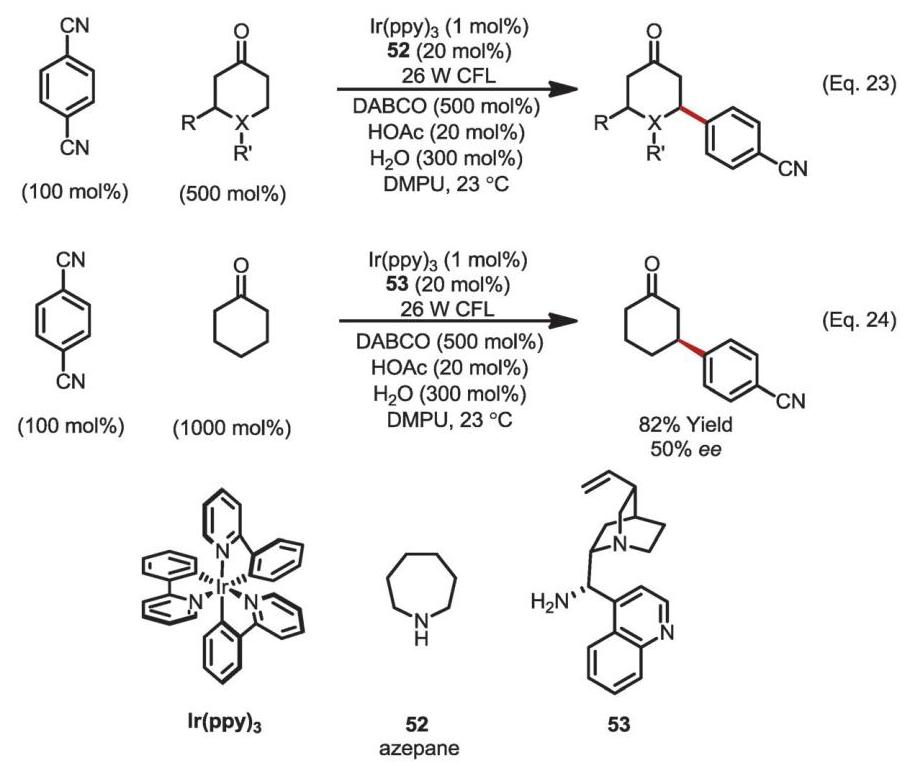
Scheme 38 Direct $\beta$ -arylation of ketones via photoredox organocatalysis.
方案38 通过光氧化还原有机催化实现酮的直接$\beta$-芳基化。
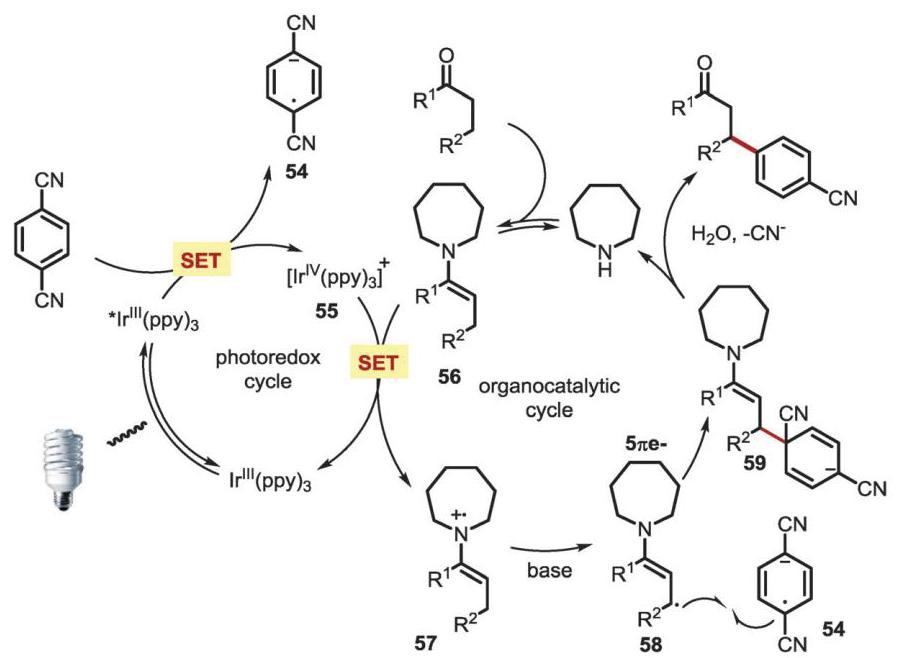
Scheme 39 Proposed catalytic cycle of direct $\beta$ -arylation of ketones.
方案39 酮直接$\beta$-芳基化的拟议催化循环。
Later, the same group extended this activation mode to other ketone $\beta - \mathrm{C} - \mathrm{H}$ functionalization reactions. With the use of the same photocatalyst [Ir(ppy) ${}_{3}$ ] and amine catalyst (azepane), cyclic ketones can be coupled with diarylketones to give $\gamma$ -hydroxyketone adducts (Scheme 40, eqn (25)). ${}^{79}$ This transformation can be considered as a formal $\beta$ -aldol reaction. A similar mechanism as the $\beta$ -arylation reaction was proposed by the authors, where the major difference is that a ketyl radical is used as the coupling partner instead of the aryl radical anion. A stoichiometric amount of ${\mathrm{{LiAsF}}}_{6}$ salt was found important to sustain the efficiency of the coupling, presumably due to its capability of prohibiting the dimerization of ketyl radicals. When an alkyl aryl ketone was employed as the substrate, the more reducing photocatalyst Ir(p-OMe-ppy) ${}_{3}$ , a higher loading of the amine catalyst, and an additional light bulb are necessary to promote the transformation (eqn (26)). This can be attributed to a higher reduction potential for the alkyl aryl ketones compared to the diaryl ketones.
后来,同一研究小组将这种活化模式扩展到其他酮$\beta - \mathrm{C} - \mathrm{H}$官能化反应。使用相同的光催化剂[Ir(ppy)${}_{3}$]和胺催化剂(氮杂环庚烷),环酮可以与二芳基酮偶联得到$\gamma$-羟基酮加合物(方案40,式(25))。${}^{79}$这种转化可以被视为形式上的$\beta$-羟醛反应。作者提出了与$\beta$-芳基化反应类似的机理,主要区别在于使用酮基自由基作为偶联伙伴而不是芳基自由基阴离子。发现化学计量的${\mathrm{{LiAsF}}}_{6}$盐对于维持偶联效率很重要,大概是因为它能够阻止酮基自由基的二聚。当使用烷基芳基酮作为底物时,需要更强还原性的光催化剂Ir(p-OMe-ppy)${}_{3}$、更高负载量的胺催化剂和额外的灯泡来促进转化(式(26))。这可以归因于烷基芳基酮与二芳基酮相比具有更高的还原电位。
Another interesting ketone $\beta$ -functionalization was reported by Fagnoni and coworkers in 2014 using a different transition-metal-catalyzed photoredox approach (Scheme 41). ${}^{80}$ Using tetrabutylammonium decatungstate (TBADT) as the catalyst and a Xe lamp or sunlight as the light source, various cyclo-pentanones can be coupled with electron-deficient alkenes to give $\beta$ -alkylated products (eqn (27)). The light source was proposed to excite the TBADT catalyst to a state containing electronegative oxygen-centered radicals. The activated catalyst can directly abstract a $\beta$ -hydrogen of the cyclopentanone to generate a carbon-centered radical. Subsequent 1,4-addition to a Michael acceptor, followed by hydrogen transfer back from the catalyst, results in the $\beta$ -alkylation product.
2014年,法尼奥尼及其同事报道了另一种有趣的酮$\beta$官能化反应,该反应采用了不同的过渡金属催化光氧化还原方法(方案41)。${}^{80}$ 使用四丁基铵十钨酸盐(TBADT)作为催化剂,氙灯或阳光作为光源,各种环戊酮可以与缺电子烯烃偶联,得到$\beta$烷基化产物(式(27))。有人提出,光源将TBADT催化剂激发到含有以氧为中心的电负性自由基的状态。活化的催化剂可以直接提取环戊酮的$\beta$氢,生成以碳为中心的自由基。随后对迈克尔受体进行1,4-加成,然后从催化剂中进行氢转移,得到$\beta$烷基化产物。
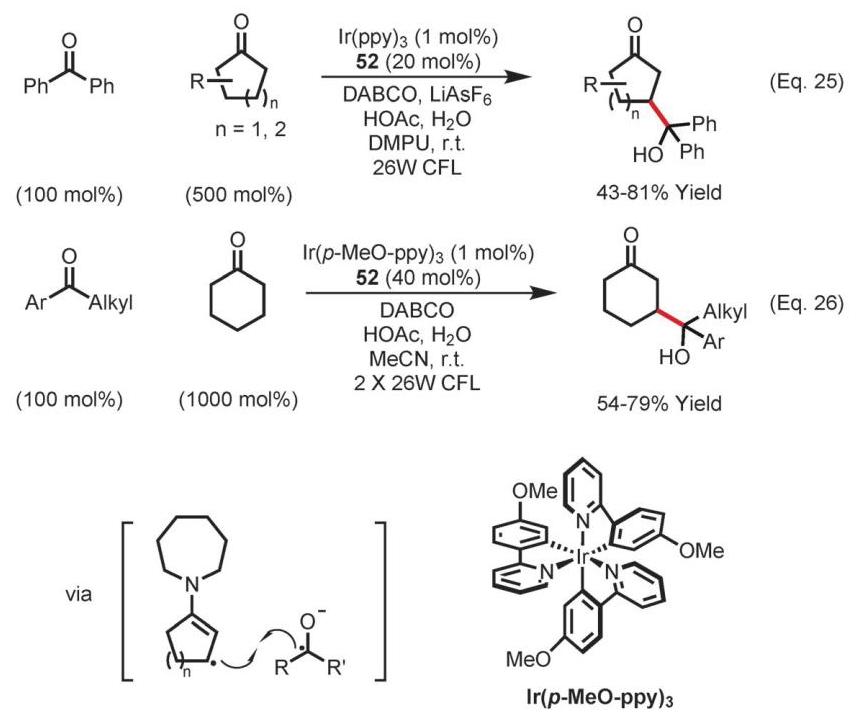
Scheme ${40\beta }$ -Aldol coupling of cyclic ketones with aryl ketones via photoredox catalysis.
方案${40\beta }$ - 环状酮与芳基酮通过光氧化还原催化的羟醛缩合反应。
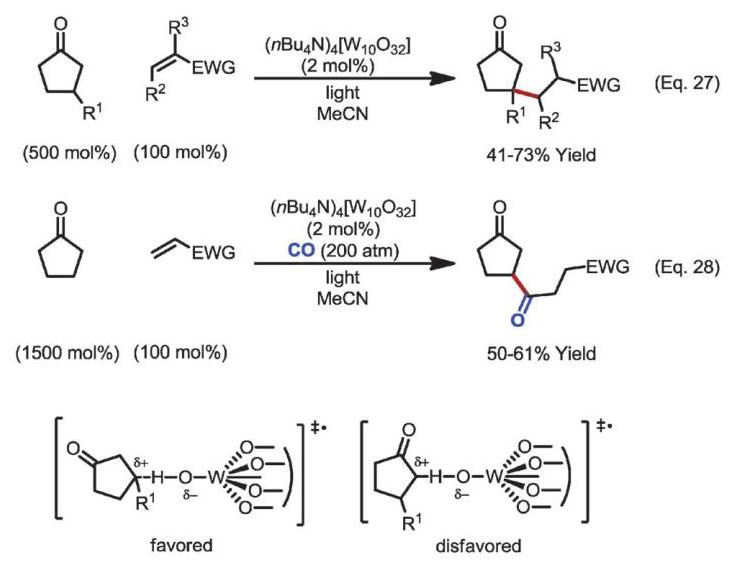
Scheme 41 Photocatalyzed β-alkylation and acylation of cyclopentanones.
方案41 环戊酮的光催化β-烷基化和酰化反应。
The $\beta$ -selectivity of this transformation is determined during the hydrogen abstraction step. When the electronegative oxygen-centered radical approaches a C-H bond, a partial positive charge will build on the carbon atom in the transition state. Because the partial positive charge is destabilized by the neighboring carbonyl group, the abstraction of the $\alpha$ -hydrogen is disfavored, resulting in a high $\beta$ -selectivity. In addition to the alkylation, a $\beta$ -acylation of cyclopentanones was also achieved when the reaction was run under high pressure of carbon monoxide (eqn (28)). Despite the high $\beta$ -selectivity for cyclopentanone, other cyclic ketones, e.g. cyclohexanone, gave a mixture of $\beta$ - and $\gamma$ -C-H functionalization products.
这种转化的$\beta$选择性在氢提取步骤中确定。当以氧为中心的电负性自由基接近C-H键时,过渡态中的碳原子上会形成部分正电荷。由于相邻羰基会使部分正电荷不稳定,因此提取$\alpha$氢是不利的,从而导致高$\beta$选择性。除了烷基化反应外,当反应在一氧化碳高压下进行时,还实现了环戊酮的$\beta$酰化反应(式(28))。尽管对环戊酮具有高$\beta$选择性,但其他环状酮,例如环己酮,会生成$\beta$和$\gamma$ - C-H官能化产物的混合物。
In 2013, the Dong group reported a palladium-catalyzed direct ketone $\beta$ -arylation with aryl halides (Scheme 42). ${}^{81}$ Under the reaction conditions, $\mathrm{{Pd}}{\left( \mathrm{{TFA}}\right) }_{2}/\mathrm{P}{\left( \mathrm{i} - \mathrm{{Pr}}\right) }_{3}$ is used as the pre-catalyst and silver trifluoroacetate is employed as an additive. While the catalytic system is formally similar to those used for $\alpha$ -arylation, the reaction gives complete $\beta$ -position selectivity, which is likely due to the mildly acidic conditions. Aryl iodides with various electronic properties (electron-rich and poor) can participate, and both linear and cyclic ketones with different ring sizes are suitable substrates (eqn (29)). In addition, base- or nucleophile-sensitive functional groups, such as aldehydes, Weinreb amides, and methyl ketones are tolerated. Aryl bromides also react but give a decreased yield (eqn (30)).
2013年,董课题组报道了钯催化的酮与芳基卤化物的直接酮$\beta$芳基化反应(方案42)。${}^{81}$ 在反应条件下,$\mathrm{{Pd}}{\left( \mathrm{{TFA}}\right) }_{2}/\mathrm{P}{\left( \mathrm{i} - \mathrm{{Pr}}\right) }_{3}$用作预催化剂,三氟乙酸银用作添加剂。虽然该催化体系在形式上与用于$\alpha$芳基化的体系相似,但该反应具有完全的$\beta$位选择性,这可能是由于温和的酸性条件。具有各种电子性质(富电子和贫电子)的芳基碘化物都可以参与反应,不同环大小的直链和环状酮都是合适的底物(式(29))。此外,对碱或亲核试剂敏感的官能团,如醛、Weinreb酰胺和甲基酮,都能耐受。芳基溴化物也能反应,但产率会降低(式(30))。
While the mechanism remains unclear, this transformation aims to combine palladium-catalyzed ketone dehydrogenation, ${}^{82}\mathrm{C} - \mathrm{X}$ bond activation, and conjugate addition into one reaction vessel. The proposed catalytic cycle is depicted in Scheme 43. It begins with ketone dehydrogenation by a Pd(π) catalyst (60) to give an $\alpha ,\beta$ -unsaturated ketone $/\mathrm{{Pd}}\left( 0\right)$ intermediate (63). Subsequent oxidative addition with an aryl iodide affords an Pd(π)-aryl species (64), which can undergo migratory insertion and protonation of the resulting Pd(π)-enolate 65 to deliver the $\beta$ -arylation product and restore the active Pd(π) catalyst. Alternatively, a two-catalytic-cycle mechanism, involving ketone dehydrogenation and reductive Heck coupling is also possible.
虽然反应机理尚不清楚,但这种转化旨在将钯催化的酮脱氢反应、${}^{82}\mathrm{C} - \mathrm{X}$键活化和共轭加成反应整合到一个反应容器中。提出的催化循环如图43所示。它始于Pd(π)催化剂(60)对酮的脱氢反应,生成$\alpha ,\beta$不饱和酮$/\mathrm{{Pd}}\left( 0\right)$中间体(63)。随后与芳基碘化物进行氧化加成,得到Pd(π)-芳基物种(64),该物种可以进行迁移插入,并使生成的Pd(π)-烯醇盐65质子化,从而得到$\beta$芳基化产物并恢复活性Pd(π)催化剂。或者,也可能存在涉及酮脱氢和还原Heck偶联的双催化循环机理。
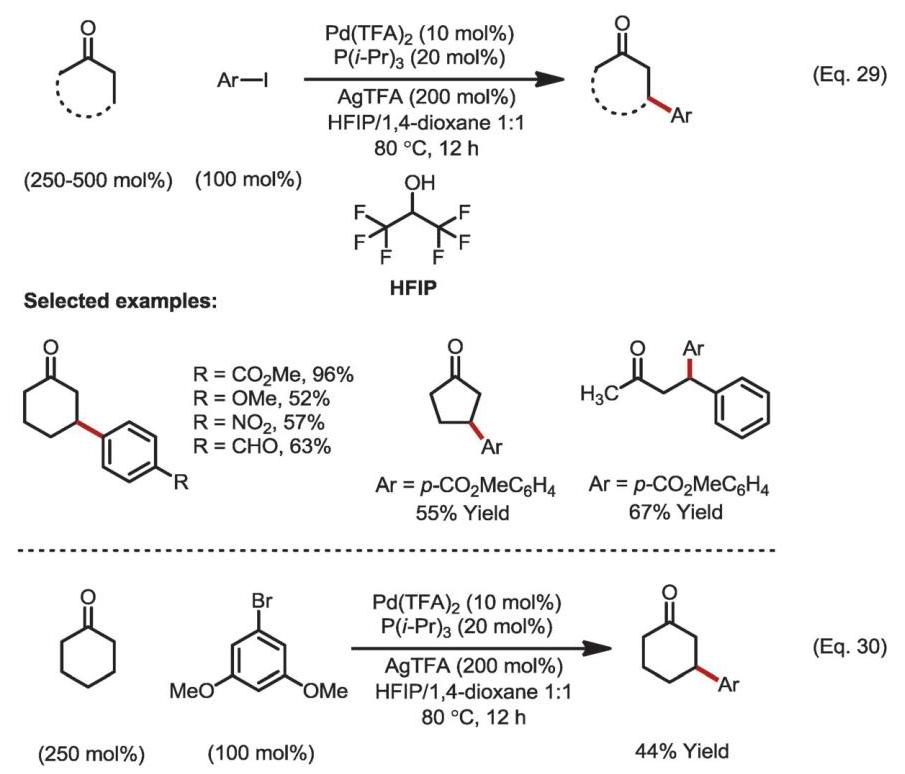
Scheme 42 Palladium-catalyzed direct $\beta$ -arylation of ketones with aryl halides.
方案42 钯催化的酮与芳基卤化物的直接$\beta$芳基化反应。
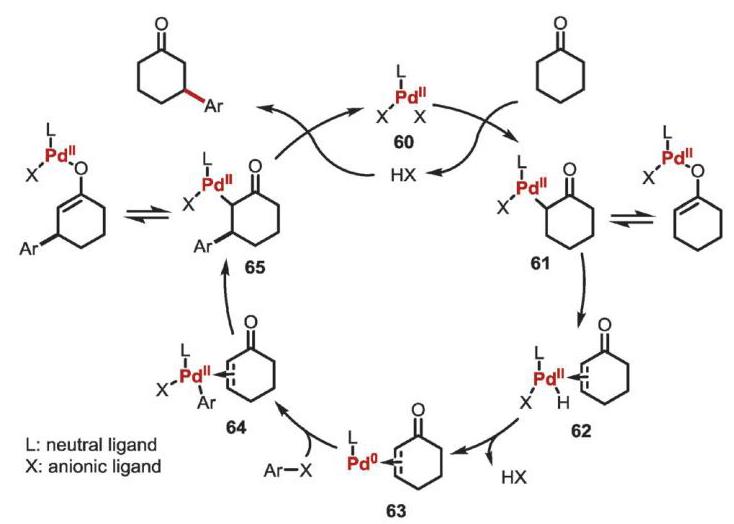
Scheme 43 Proposed strategy of direct $\beta$ -arylation of ketones with aryl halides.
方案43钯催化的酮与芳基卤化物直接$\beta$芳基化反应的拟议策略。
4. Addition of $\alpha - \mathrm{C} - \mathrm{H}$ bonds to unactivated alkenes or alkynes
4. 将$\alpha - \mathrm{C} - \mathrm{H}$键加成到未活化的烯烃或炔烃上
4.1 Addition to alkenes
4.1 与烯烃的加成反应
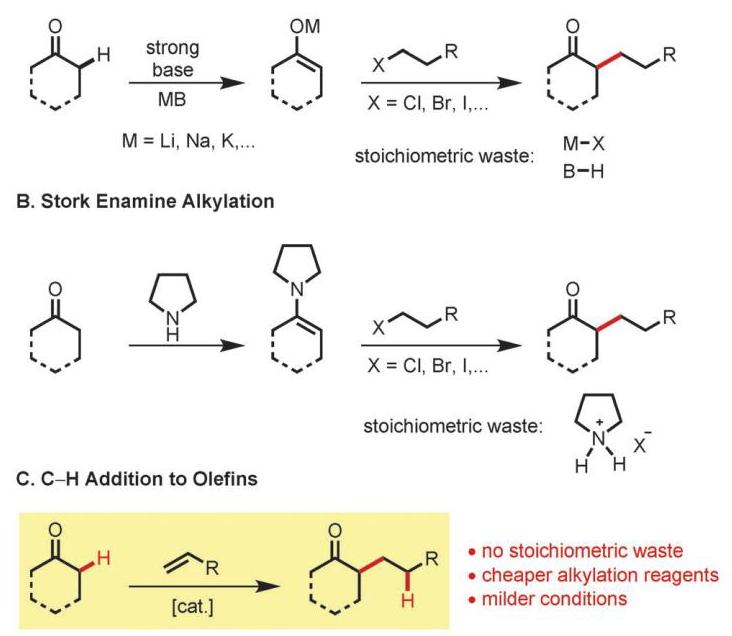
Direct addition of the $\alpha - \mathrm{C} - \mathrm{H}$ bond of ketones across unactivated alkenes represents a transformation of significant synthetic value. Traditionally, α-alkylation of ketones is realized through enolate formation and subsequent substitution with an alkylating reagent, e.g. alkyl halides in most cases (Scheme 44A). Efficient as this reaction is, it suffers from several drawbacks, including highly basic conditions, generation of stoichiometric waste, lack of regioselectivity, high cost of the alkylation reagents and over-alkylation. ${}^{83}$ The Stork enamine reaction can also be used to prepare $\alpha$ -alkylated ketones, ${}^{84}$ although the use of highly reactive alkylating reagents (‘hot electrophiles’), as well as the formation of stoichiometric amine salts are inevitable (Scheme 44B).
酮的$\alpha - \mathrm{C} - \mathrm{H}$键直接加成到未活化烯烃上是一个具有重要合成价值的转化反应。传统上,酮的α-烷基化是通过烯醇盐的形成以及随后与烷基化试剂(例如在大多数情况下为卤代烃)的取代反应来实现的(方案44A)。尽管该反应很有效,但它存在几个缺点,包括高碱性条件、化学计量的废弃物生成、区域选择性的缺乏、烷基化试剂的高成本以及过度烷基化。${}^{83}$ 斯托克烯胺反应也可用于制备$\alpha$-烷基化酮,${}^{84}$ 尽管使用高活性烷基化试剂(“热亲电试剂”)以及化学计量的胺盐的形成是不可避免的(方案44B)。
A. Enolate Alkylation
A. 烯醇盐烷基化
Scheme 44 α-Alkylation of ketones.
方案44 酮的α-烷基化。
Compared to conventional alkylation reagents, such as alkyl halides and Michael acceptors, simple olefins are more accessible and generally less expensive. Moreover, the addition of the $\alpha$ -C-H bond of ketones to olefins ostensibly generates no stoichiometric waste, thus maximizing the atom economy of the alkylation reaction (Scheme 44C). Although the addition of activated methylene compounds (e.g. $\alpha - \mathrm{C} - \mathrm{H}$ bond of 1,3-dicarbonyl compounds) to olefins has been well studied, ${}^{85}$ examples of using less-acidic simple ketones as substrate are limited.
与传统的烷基化试剂(如卤代烃和迈克尔受体)相比,简单烯烃更容易获得且通常成本更低。此外,酮的$\alpha$-C-H键加成到烯烃上表面上不会产生化学计量的废弃物,从而使烷基化反应的原子经济性最大化(方案44C)。尽管活性亚甲基化合物(例如1,3-二羰基化合物的$\alpha - \mathrm{C} - \mathrm{H}$键)加成到烯烃上的反应已得到充分研究,${}^{85}$ 使用酸性较弱的简单酮作为底物的例子却很有限。
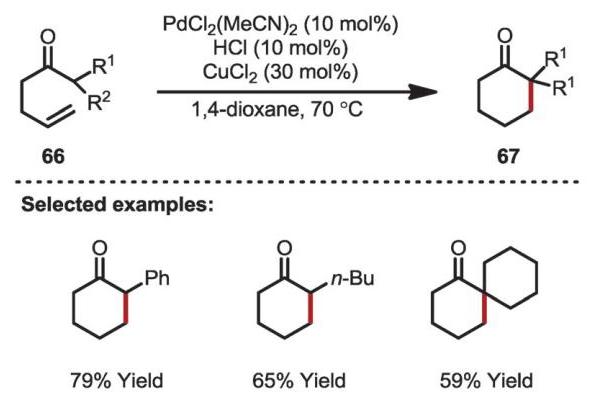
Scheme 45 Palladium-catalyzed intramolecular $\alpha$ -alkylation of ketones with olefins.
方案45 钯催化的酮与烯烃的分子内$\alpha$-烷基化反应。
In 2003, Widenhoefer and coworkers reported an intramolecular cyclization with a $\gamma ,\sigma$ -enone using palladium catalysis (Scheme 45). ${}^{86}$ A catalytic amount of hydrochloric acid was employed to promote enol formation, and ${\mathrm{{CuCl}}}_{2}$ was used to stabilize the $\mathrm{{Pd}}\left( \mathrm{{II}}\right)$ catalyst. A number of $\gamma ,\delta$ -enones (66) cyclized efficiently in a 6-endo-trig fashion to afford 2-substituted cyclo-hexanones (67). When a tertiary substituent is present on the ketone, a spirocyclic structure can be formed in a similar yield. Based on deuterium-labeling studies, the authors proposed that after intramolecular nucleophilic attack of the enol to the olefin, the resulting Pd(π)-alkyl species (69) would undergo a “chain walk” to place palladium on the $\alpha$ -position through a series of $\beta$ -hydride elimination/re-insertion steps (Scheme 46). Protonation of the Pd(π)-enolate (72) would release the product and regenerate the active palladium catalyst. ${}^{87}$
2003年,Widenhoefer及其同事报道了使用钯催化的与$\gamma ,\sigma$-烯酮的分子内环化反应(方案45)。${}^{86}$ 使用催化量的盐酸来促进烯醇的形成,并且${\mathrm{{CuCl}}}_{2}$ 用于稳定$\mathrm{{Pd}}\left( \mathrm{{II}}\right)$催化剂。许多$\gamma ,\delta$-烯酮(66)以6-endo-trig方式有效环化得到2-取代环己酮(67)。当酮上存在叔取代基时,可以以类似的产率形成螺环结构。基于氘标记研究,作者提出烯醇对烯烃进行分子内亲核攻击后,生成的Pd(π)-烷基物种(69)将通过一系列$\beta$-氢化物消除/重新插入步骤经历“链行走”,使钯位于$\alpha$-位置(方案46)。Pd(π)-烯醇盐(72)的质子化将释放产物并再生活性钯催化剂。${}^{87}$
In 2011, an efficient gold-catalyzed intramolecular $\alpha$ -alkylation with aliphatic olefins was developed by Che and coworkers (Scheme 47). ${}^{88}$ Compared to Widenhoefer’s protocol, the gold-catalyzed method has several distinct features. First, no additional protic acids are employed because the cationic gold is Lewis acidic enough to facilitate enol formation. Second, the 5-exo-trig cyclization to give five-membered rings is favored over the 6-endo-trig pathway. Mechanistically, the alkyl-Au(1) species generated from the enol addition step was proposed to undergo direct protonation to give the alkylation product as opposed to the aforementioned “chain walk” process. No coupling with aromatic olefins was reported with either Widenhoefer or Che’s catalytic system, which can likely be attributed to the acid-lability of aryl olefins.
2011年,Che及其同事开发了一种高效的金催化的与脂肪族烯烃的分子内$\alpha$-烷基化反应(方案47)。${}^{88}$ 与Widenhoefer的方法相比,金催化的方法有几个明显的特点。首先,不使用额外的质子酸,因为阳离子金的路易斯酸性足以促进烯醇的形成。其次,与6-endo-trig途径相比,更倾向于通过5-exo-trig环化生成五元环。从机理上讲,烯醇加成步骤生成的烷基-Au(I)物种被认为会直接质子化生成烷基化产物,这与上述“链行走”过程不同。Widenhoefer和Che的催化体系均未报道与芳族烯烃的偶联反应,这可能归因于芳基烯烃对酸的敏感性。
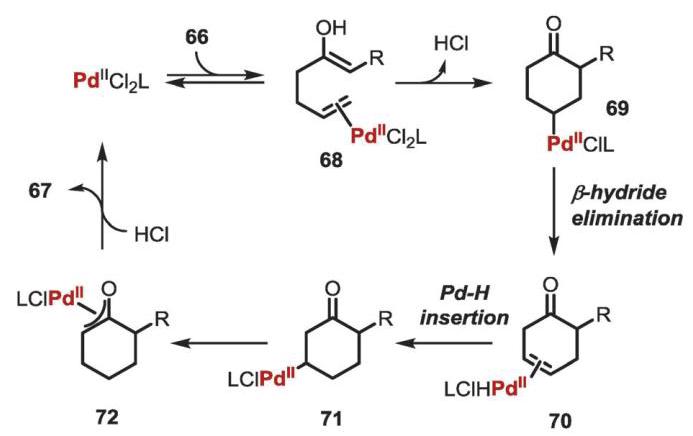
Scheme 46 Proposed pathway of palladium-catalyzed intramolecular $\alpha$ - alkylation.
方案46 钯催化的分子内$\alpha$-烷基化反应的推测途径。
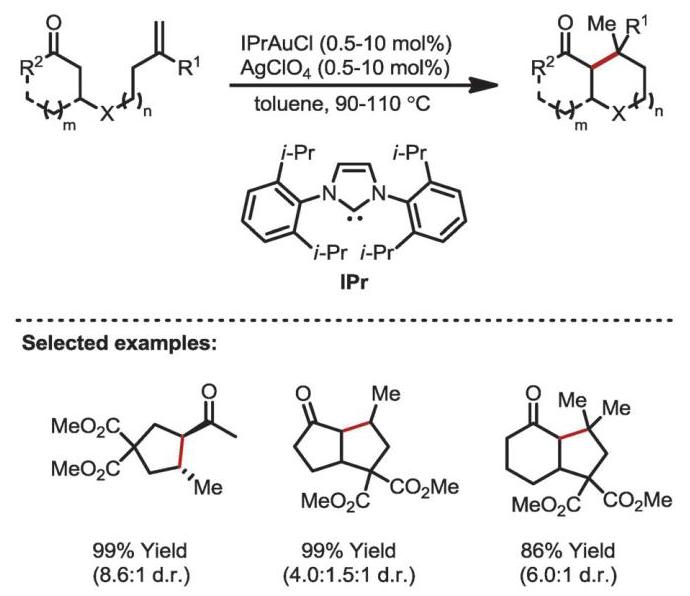
Scheme 47 Gold-catalyzed intramolecular $\alpha$ -alkylation of ketones with olefins.
方案47 金催化的酮与烯烃的分子内$\alpha$-烷基化反应。
Besides intramolecular alkylation reactions, several approaches for the more challenging intermolecular $\alpha$ -alkylation of ketones with simple olefins have also emerged. Intermolecular alkylation with aryl olefins, e.g. styrene, is known to be catalyzed by strong bases such as ${\mathrm{{KO}}}^{t}\mathrm{{Bu}}$ in polar solvents such as DMSO. ${}^{{89} - {91}}$ In 2012, Kanai and coworkers reported a copper-catalyzed addition of ketone $\alpha - \mathrm{C} - \mathrm{H}$ bonds to styrene derivatives (Scheme 48). ${}^{92}$ Mesityl cuprate and ${\mathrm{{CuO}}}^{\mathrm{i}}\mathrm{{Pr}}$ were both found to be efficient precatalysts. Ketones with diverse structures can be coupled with styrene derivatives to afford linear alkylation products. While the exact mechanism remains unclear, a dual role of the copper catalyst was proposed: (1) it acts as a strong base to generate a $\mathrm{{Cu}}\left( \mathrm{I}\right)$ -enolate; (2) it serves as a $\pi$ acid to activate the styrene.
除了分子内烷基化反应外,还出现了几种更具挑战性的用简单烯烃对酮进行分子间$\alpha$-烷基化的方法。已知在极性溶剂如二甲基亚砜中,用强碱如${\mathrm{{KO}}}^{t}\mathrm{{Bu}}$催化酮与芳基烯烃(如苯乙烯)的分子间烷基化反应。${}^{{89} - {91}}$2012年,金井及其同事报道了铜催化的酮$\alpha - \mathrm{C} - \mathrm{H}$键与苯乙烯衍生物的加成反应(方案48)。${}^{92}$均三甲苯基铜酸盐和${\mathrm{{CuO}}}^{\mathrm{i}}\mathrm{{Pr}}$都被发现是有效的预催化剂。结构多样的酮可以与苯乙烯衍生物偶联,得到线性烷基化产物。虽然确切的机理尚不清楚,但有人提出铜催化剂具有双重作用:(1)它作为强碱生成$\mathrm{{Cu}}\left( \mathrm{I}\right)$-烯醇盐;(2)它作为$\pi$酸来活化苯乙烯。
An unusual radical approach also proved to be feasible for the addition of $\alpha - \mathrm{C} - \mathrm{H}$ bonds of ketones to aliphatic olefins. ${}^{93}$ In 2000, Ishii and coworkers reported an $\alpha$ -alkylation reaction of ketones with alkenes using a combination of catalytic $\mathrm{{Mn}}{\left( \mathrm{{OAc}}\right) }_{2}$ and $\mathrm{{Co}}{\left( \mathrm{{OAc}}\right) }_{2}$ (Scheme 49, eqn (31)). Both cyclic and linear ketones can couple with 1-octene or isopropenyl acetate to give the alkylation products. Acetic acid was used as solvent, and the reaction was run under a mixed atmosphere of nitrogen and oxygen. In the proposed mechanism, the ketone substrate was first oxidized by in situ generated $\mathrm{{Mn}}{\left( \mathrm{{OAc}}\right) }_{3}$ to give an $\alpha$ -keto radical species (74). Subsequent radical addition to the alkene, followed by hydrogen abstraction from either the solvent or another ketone, would provide the alkylation product. The presence of oxygen was critical, suggesting an oxidative process. Although the cobalt salt is not necessary for product formation, it is believed to assist the re-oxidation of $\mathrm{{Mn}}{\left( \mathrm{{OAc}}\right) }_{2}$ by oxygen. A major drawback of this approach is the use of excess ketone, presumably to sustain the efficiency of the radical generation. When styrene was used as the substrate, an interesting peroxo bicycle was formed (eqn (32)).
一种不同寻常的自由基方法也被证明可用于酮的$\alpha - \mathrm{C} - \mathrm{H}$键与脂肪族烯烃的加成反应。${}^{93}$2000年,石井及其同事报道了使用催化量的$\mathrm{{Mn}}{\left( \mathrm{{OAc}}\right) }_{2}$和$\mathrm{{Co}}{\left( \mathrm{{OAc}}\right) }_{2}$组合实现酮与烯烃的$\alpha$-烷基化反应(方案49,式(31))。环状和线性酮都可以与1-辛烯或乙酸异丙烯酯偶联,得到烷基化产物。使用乙酸作为溶剂,反应在氮气和氧气的混合气氛下进行。在所提出的机理中,酮底物首先被原位生成的$\mathrm{{Mn}}{\left( \mathrm{{OAc}}\right) }_{3}$氧化,得到$\alpha$-酮基自由基物种(74)。随后自由基加成到烯烃上,接着从溶剂或另一个酮中夺取氢,将得到烷基化产物。氧气的存在至关重要,这表明是一个氧化过程。虽然钴盐对于产物形成不是必需的,但据信它有助于$\mathrm{{Mn}}{\left( \mathrm{{OAc}}\right) }_{2}$被氧气再氧化。这种方法的一个主要缺点是使用过量的酮,大概是为了维持自由基生成的效率。当使用苯乙烯作为底物时,会形成一个有趣的过氧双环化合物(式(32))。
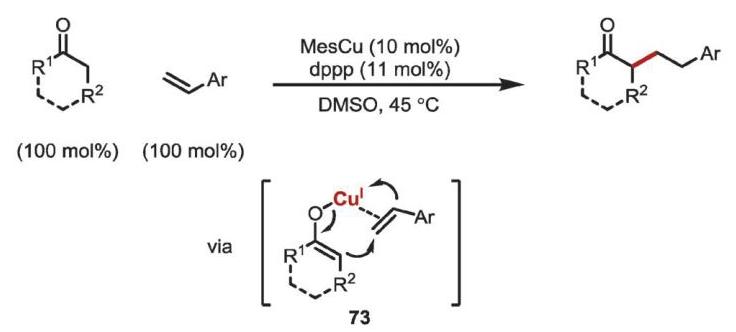
Scheme 48 Copper-catalyzed intermolecular $\alpha$ -alkylation of ketones with olefins.
方案48 铜催化的酮与烯烃的分子间$\alpha$-烷基化反应。
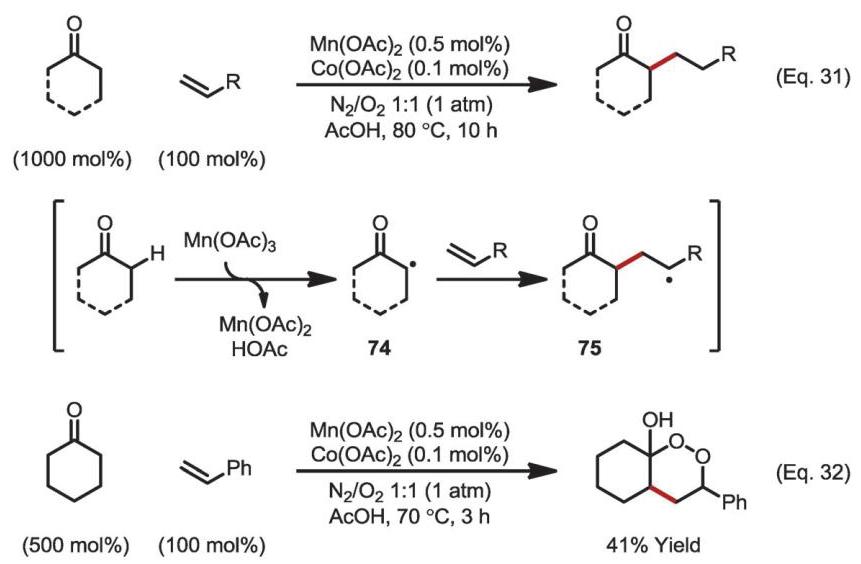
Scheme 49 Manganese-catalyzed intermolecular $\alpha$ -alkylation of ketones with olefins.
方案49 锰催化的酮与烯烃的分子间$\alpha$-烷基化反应。
In 2014, Mo and Dong reported a Rh(1)-catalyzed $\alpha$ -alkylation of ketones with various alkenes $v$ ia bifunctional catalysis (Scheme 50). ${}^{94}$ The dual activation of the ketone and olefin was achieved through the use of $\mathrm{{Rh}}\left( \mathrm{I}\right) /7$ -azaindoline as the bifunctional catalyst. In the proposed catalytic cycle, the secondary amine motif in 7-azaindoline (81) would first condense with ketone to form enamine 77, which converts a ketone ${\mathrm{{sp}}}^{3}\alpha - \mathrm{C} - \mathrm{H}$ bond to an ${\mathrm{{sp}}}^{2} \; \mathrm{C} - \mathrm{H}$ bond. One benefit of the transient enamine formation is that ${\mathrm{{sp}}}^{2}\mathrm{C} - \mathrm{H}$ bonds are generally easier to be activated than ${\mathrm{{sp}}}^{3}$ bonds both thermodynamically and kinetically. ${}^{95}$ Directed by the pyridine moiety, oxidative addition of $\mathrm{{Rh}}\left( \mathrm{I}\right)$ into the $\alpha - \mathrm{C} - \mathrm{H}$ bond would then yield six-membered rhodacycle 78. Subsequent migratory insertion of the olefin into the Rh-hydride bond, followed by reductive elimination to form the C-C bond and hydrolysis of the enamine, furnished the alkylation product and re-generated the bifunctional catalyst.
2014年,Mo和Dong报道了通过双功能催化实现的Rh(1)催化的酮与各种烯烃的$\alpha$ -烷基化反应(方案50)。 ${}^{94}$ 通过使用$\mathrm{{Rh}}\left( \mathrm{I}\right) /7$ -氮杂吲哚啉作为双功能催化剂,实现了酮和烯烃的双重活化。在提出的催化循环中,7-氮杂吲哚啉(81)中的仲胺基序首先会与酮缩合形成烯胺77,这将酮的${\mathrm{{sp}}}^{3}\alpha - \mathrm{C} - \mathrm{H}$键转化为${\mathrm{{sp}}}^{2} \; \mathrm{C} - \mathrm{H}$键。瞬时烯胺形成的一个好处是,无论是从热力学还是动力学角度来看,${\mathrm{{sp}}}^{2}\mathrm{C} - \mathrm{H}$键通常都比${\mathrm{{sp}}}^{3}$键更容易被活化。 ${}^{95}$ 在吡啶部分的导向下,$\mathrm{{Rh}}\left( \mathrm{I}\right)$对$\alpha - \mathrm{C} - \mathrm{H}$键进行氧化加成,随后生成六元铑环78。接着烯烃迁移插入到Rh - 氢化物键中,然后进行还原消除形成C - C键,并使烯胺水解,得到烷基化产物并再生双功能催化剂。
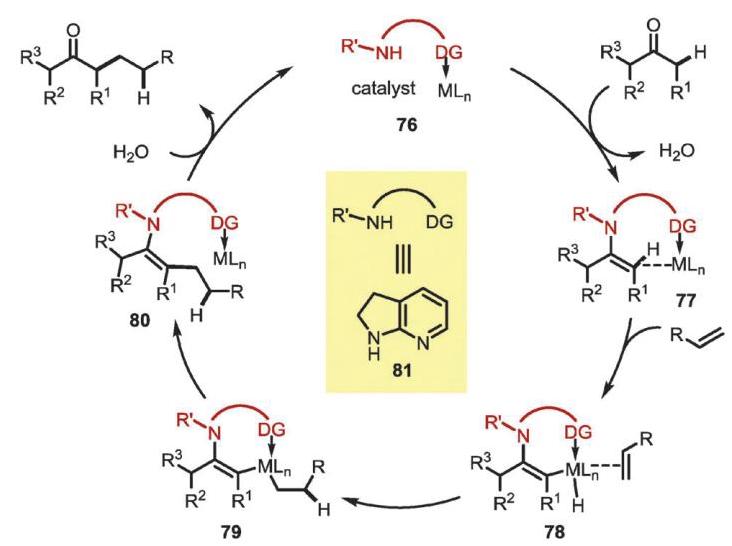
Scheme 50 Proposed strategy of $\alpha$ -alkylation of ketones using bifunctional catalysis.
方案50使用双功能催化进行酮的$\alpha$-烷基化反应的拟议策略。
Based on the proposed strategy, the optimized conditions consist of ${\left\lbrack \mathrm{{Rh}}{\left( \mathrm{{coe}}\right) }_{2}\mathrm{{Cl}}\right\rbrack }_{2}/\mathrm{{bis}}\lbrack 1,3$ -bis(2,4,6-trimethylphenyl)imidazol- 2-ylidene] (IMes) as the precatalyst, and catalytic tosylsulfonic acid to promote enamine formation (Scheme 51). This strategy enabled coupling of both aliphatic and aromatic alkenes giving the alkylation products with linear selectivity. Both cyclic and linear ketones can be coupled with various $\alpha$ -olefins to give the corresponding alkylation products. In addition, due to the pH- and redox-neutral conditions, many sensitive functional groups, such as free alcohols, amines and malonates etc., were found compatible.
基于所提出的策略,优化的条件包括使用${\left\lbrack \mathrm{{Rh}}{\left( \mathrm{{coe}}\right) }_{2}\mathrm{{Cl}}\right\rbrack }_{2}/\mathrm{{bis}}\lbrack 1,3$-双(2,4,6-三甲基苯基)咪唑-2-亚基](IMes)作为预催化剂,并使用催化量的对甲苯磺酸促进烯胺的形成(方案51)。该策略能够实现脂肪族和芳香族烯烃的偶联,得到具有线性选择性的烷基化产物。环状和线性酮均可与各种$\alpha$-烯烃偶联,得到相应的烷基化产物。此外,由于反应在pH和氧化还原中性条件下进行,发现许多敏感官能团,如游离醇、胺和丙二酸酯等,都是兼容的。
4.2 Addition to alkynes
4.2 与炔烃的加成反应
The direct addition of ketone $\alpha - \mathrm{C} - \mathrm{H}$ bonds to alkynes represents a promising approach to access enone derivatives. For example, the intramolecular ketone-alkyne cyclization has been extensively studied and employed to construct cyclic enone structures. ${}^{{96} - {103}}$ Although a large collection of catalysts and reaction conditions have been developed to facilitate this cyclization, the substrate scope is primarily focused on 1,3-dicarbonyl compounds. Nevertheless, $\pi$ -acid-catalyzed ketone-mediated transformations have been recently developed.
将酮的$\alpha - \mathrm{C} - \mathrm{H}$键直接加成到炔烃上是合成烯酮衍生物的一种很有前景的方法。例如,分子内酮 - 炔烃环化反应已得到广泛研究,并用于构建环状烯酮结构。${}^{{96} - {103}}$ 尽管已经开发了大量的催化剂和反应条件来促进这种环化反应,但底物范围主要集中在1,3 - 二羰基化合物上。然而,$\pi$ - 酸催化的酮介导的转化反应最近也得到了发展。
In 2010, Davies and coworkers reported a gold-catalyzed intramolecular cycloisomerisation of alkynes and simple ketones (Scheme 52). ${}^{104}$ A number of tethered keto-alkynes could cyclize in the presence of a cationic gold catalyst to give fused or spiro-enone derivatives. While the direct addition of the $\alpha - \mathrm{C} - \mathrm{H}$ bond to the alkyne represents a possible pathway, mechanistic studies indicate an alkyne hydration/aldol condensation pathway seems to be more reasonable. In the proposed reaction pathway, gold-catalyzed alkyne hydration with adventitious water would first generate diketone 82, which upon intramolecular aldol condensation gives the enone product.
2010年,戴维斯及其同事报道了金催化的炔烃与简单酮的分子内环化异构化反应(方案52)。${}^{104}$ 许多连接的酮 - 炔烃在阳离子金催化剂存在下可以环化,生成稠合或螺环烯酮衍生物。虽然$\alpha - \mathrm{C} - \mathrm{H}$键直接加成到炔烃上是一种可能的途径,但机理研究表明炔烃水合/羟醛缩合途径似乎更合理。在所提出的反应途径中,金催化的炔烃与外界水的水合反应首先生成二酮82,然后通过分子内羟醛缩合得到烯酮产物。
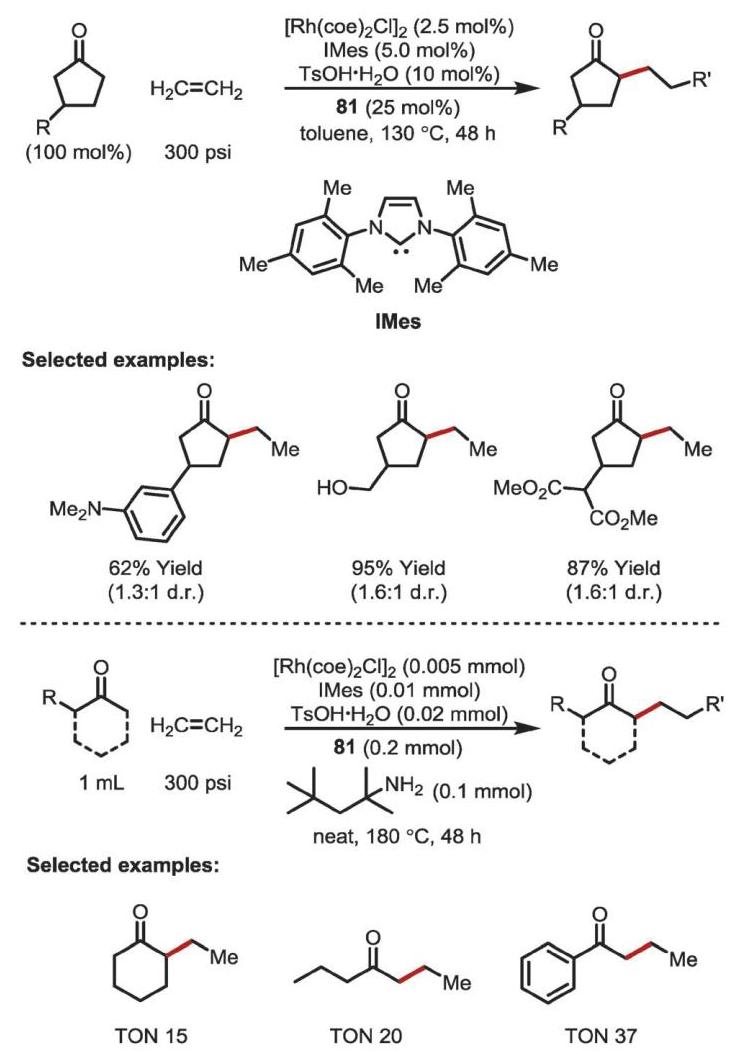
Scheme 51 Rhodium-catalyzed $\alpha$ -alkylation of ketones with bifunctional ligand.
方案51 铑催化的酮与双官能配体的$\alpha$ - 烷基化反应。
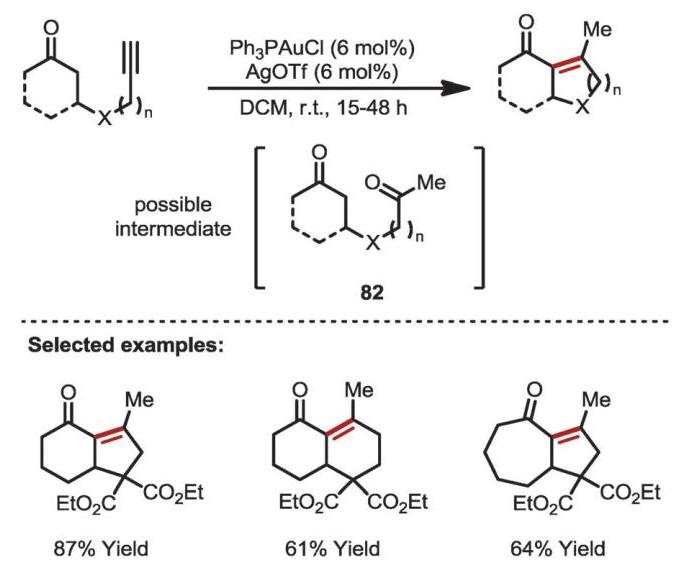
Scheme 52 Gold-catalyzed intramolecular $\alpha$ -alkenylation of ketones with alkynes.
方案52 金催化的酮与炔烃的分子内$\alpha$ - 烯基化反应。
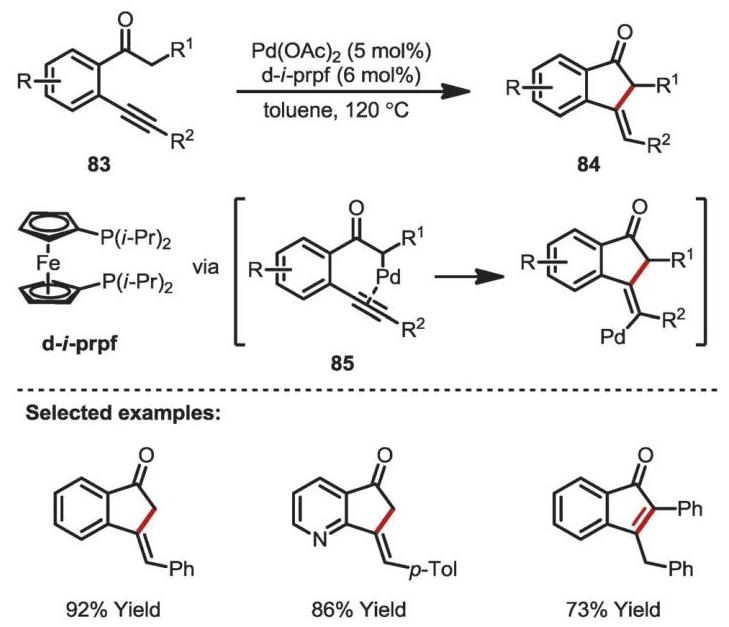
Scheme 53 Palladium-catalyzed intramolecular $\alpha$ -alkenylation of ketones with alkynes.
方案53 钯催化的酮与炔烃的分子内$\alpha$ - 烯基化反应。
A palladium-catalyzed cyclization of keto-alkynes was later reported by Gevorgyan and coworkers. ${}^{105}2$ -Alkynyl acetophenone derivatives can readily cyclize to form $\beta$ -alkylidene indanone structures (Scheme 53). Complete stereoselectivity for the $E$ isomers was observed for the cyclization. Interestingly, when the ketone possesses an $\alpha$ -aryl substituent, a conjugated indenone structure was formed instead of the indanone. DFT calculation implied the reaction proceeded through palladium enolate 85, a similar intermediate to that proposed in Kanai’s alkylation reaction with olefins (vide supra, Scheme 48).
后来,格沃尔gyan及其同事报道了钯催化的酮 - 炔烃环化反应。${}^{105}2$ - 炔基苯乙酮衍生物可以很容易地环化形成$\beta$ - 亚烷基茚满酮结构(方案53)。环化反应对$E$异构体具有完全的立体选择性。有趣的是,当酮具有$\alpha$ - 芳基取代基时,会形成共轭茚酮结构而不是茚满酮。密度泛函理论计算表明该反应通过钯烯醇盐85进行,这是与金井与烯烃的烷基化反应(见上文,方案48)中提出的类似中间体。
The intermolecular addition of ketones to alkynes has limited success using simple ketones as the substrate. No transition metal-catalyzed example has been reported. To date, stoichiometric Lewis acid-mediated addition of silyl enol ethers into terminal alkynes ${}^{{106} - {109}}$ and strong base-promoted addition of potassium enolates into aryl terminal acetylenes ${}^{{110},{111}}$ represent the only known examples.
以简单酮为底物,酮与炔烃的分子间加成反应取得的成功有限。尚未报道过渡金属催化的例子。迄今为止,化学计量的路易斯酸介导的硅烯醇醚加成到末端炔烃${}^{{106} - {109}}$以及强碱促进的烯醇钾加成到芳基末端乙炔${}^{{110},{111}}$是仅有的已知例子。
5. Conclusion
5. 结论
In summary, the transition metal-catalyzed ketone-directed or mediated C-H functionalization has been a rapidly growing field over the past two decades. While the mode of activation varies from case to case, the use of transition metals has driven transformations of ketones beyond the intrinsic reactivity allowing C-H functionalization to occur at the less reactive position or with unactivated coupling partners. Among all the topics covered in this review, the aromatic ortho C-H function-alization using ketone DGs has been most well studied. Future endeavors are expected to demonstrate more applications with these methods and introduce more types of FGs. Although the functionalization of ketone aliphatic C-H bonds using transition-metal catalysis is a relatively new area, an avalanche of novel approaches have sprung up recently. While it is still too early to assess the synthetic potential of these methods, they nonetheless offer new perspectives on how strategy and catalyst design can enable the reactivity and selectivity that are not expected from conventional viewpoints.
总之,在过去二十年中,过渡金属催化的酮导向或介导的C-H官能化一直是一个快速发展的领域。虽然活化模式因情况而异,但过渡金属的使用推动了酮的转化,超越了其固有反应性,使得C-H官能化能够在反应性较低的位置或与未活化的偶联伙伴发生。在本综述涵盖的所有主题中,使用酮导向基团的芳族邻位C-H官能化研究得最为充分。未来的努力有望展示这些方法的更多应用,并引入更多类型的导向基团。尽管使用过渡金属催化实现酮脂肪族C-H键的官能化是一个相对较新的领域,但最近涌现出大量新颖的方法。虽然现在评估这些方法的合成潜力还为时过早,但它们仍然为策略和催化剂设计如何实现传统观点所无法预期的反应性和选择性提供了新的视角。
Acknowledgements
致谢
We thank the University of Texas at Austin and Cancer Prevention and Research Institute of Texas (R1118) for a start-up fund, and thank the Welch Foundation (F-1781) and NSF (CAREER: CHE-1254935) for research grants. G.D. is a Searle Scholar and Sloan fellow.
我们感谢德克萨斯大学奥斯汀分校以及德克萨斯癌症预防与研究所(R1118)提供的启动资金,同时感谢韦尔奇基金会(F - 1781)和美国国家科学基金会(职业发展奖:CHE - 1254935)提供的研究资助。G.D. 是塞尔学者和斯隆研究员。
References
参考文献
1 For recent reviews on transition metal-catalyzed C-H func-tionalization, see: (a) H. M. L. Davies, J. Mol. Catal. A: Chem., 2002, 189, 125-135; (b) F. Kakiuchi and S. Murai, Acc. Chem. Res., 2002, 35, 826-834; (c) X. Chen, K. M. Engle, D.-H. Wang and J.-Q. Yu, Angew. Chem., Int. Ed., 2009, 48, 5094-5115; (d) L. Ackermann, R. Vicente and A. R. Kapdi, Angew. Chem., Int. Ed., 2009, 48, 9792-9826; (e) R. Jazzar, J. Hitce, A. Renaudat, J. Sofack-Kreutzer and O. Baudoin, Chem. - Eur. J., 2010, 16, 2654-2672; (f) O. Daugulis, Top. Curr. Chem., 2010, 292, 57-84; (g) D. A. Colby, R. G. Bergman and J. A. Ellman, Chem. Rev., 2010, 110, 624-655; (h) I. A. I. Mkhalid, J. H. Barnard, T. B. Marder, J. M. Murphy and J. F. Hartwig, Chem. Rev., 2010, 110, 890-931; (i) O. Baudoin, Chem. Soc. Rev., 2011, 40, 4902-4911; (j) H. Li, B.-J. Li and Z.-J. Shi, Catal. Sci. Technol., 2011, 1, 191-206; (k) H. Lu and X. P. Zhang, Chem. Soc. Rev., 2011, 40, 1899-1909; (l) J. Wencel-Delord, T. Dröge, F. Liu and F. Glorius, Chem. Soc. Rev., 2011, 40, 4740-4761; (m) P. B. Arockiam, C. Bruneau and P. H. Dixneuf, Chem. Rev., 2012, 112, 5879-5918; (n) G. Song, F. Wang and X. Li, Chem. Soc. Rev., 2012, 41, 3651-3678.
2 For recent reviews on directing group strategy, see: (a) T. W. Lyons and M. S. Sanford, Chem. Rev., 2010, 110, 1147-1169; (b) G. Rousseau and B. Breit, Angew. Chem., Int. Ed., 2011, 50, 2450-2494; (c) M. Zhang, Y. Zhang, X. Jie, H. Zhao, G. Li and W. Su, Org. Chem. Front., 2014, 1, 843-895.
3 For selected examples, see: (a) S. R. Mancha, C. M. Regnery, J. R. Dahlke, K. A. Miller and D. J. Blake, Bioorg. Med. Chem. Lett., 2013, 23, 562-564; (b) G. N. Roth, A. Chandra and M. G. Nair, J. Nat. Prod., 1998, 61, 542-545; (c) N. Misawa, R. Nakamura, Y. Kagiyama, H. Ikenaga, K. Furukawa and K. Shindo, Tetrahedron, 2005, 61, 195-204; (d) L. S. Melvin, M. R. Johnson, C. A. Harbert, G. M. Milne and A. Weissman, J. Med. Chem., 1984, 27, 67-71; (e) D. P. G. Hamon, P. J. Hayball, R. A. Massy-Westropp, J. L. Newton and J. G. Tamblyn, Tetrahedron: Asymmetry, 1996, 7, 263-272.
4 S. Murai, F. Kakiuchi, S. Sekine, Y. Tanaka, A. Kamatani, M. Sonoda and N. Chatani, Nature, 1993, 366, 529-531.
5 For recent reviews on $\alpha$ -arylation of ketones, see: (a) C. C. C. Johansson and T. J. Colacot, Angew. Chem., Int. Ed., 2010, 49, 676-707; (b) F. Bellina and R. Rossi, Chem. Rev., 2010, 110, 1082-1146; (c) D. A. Culkin and J. F. Hartwig, Acc. Chem. Res., 2003, 36, 234-245.
6 For selected reviews, see: (a) R. C. Larock, Comprehensive Organic Transformation, Wiley-VCH, New York, 2nd edn, 1999, p. 709; (b) R. Mahrwald, Chem. Rev., 1999, 99, 1095-1120; (c) C. Palomo, M. Oiarbide and J. M. Garcia, Chem. Soc. Rev., 2004, 33, 65-75.
7 C. Laurance and J.-F. Gal, Lewis Basicity and Affinity Scales: Data and Measurement, Wiley-VCH, Weinheim, 2010.
8 F. Kakiuchi, S. Sekine, Y. Tanaka, A. Kamatani, N. Chatani and S. Murai, Bull. Chem. Soc. Jpn., 1995, 68, 62-83.
9 S. Murai, F. Kakiuchi, S. Sekine, Y. Tanaka, A. Kamatani and N. Chatani, Pure Appl. Chem., 1994, 66, 1527-1534.
10 M. Sonoda, F. Kakiuchi, N. Chatani and S. Murai, J. Organomet. Chem., 1995, 504, 151-152.
11 M. Sonoda, F. Kakiuchi, N. Chatani and S. Murai, Bull. Chem. Soc. Jpn., 1997, 70, 3117-3128.
12 K. Hiraki, T. Ishimoto and H. Kawano, Bull. Chem. Soc. Jpn., 2000, 73, 2099-2108.
13 T. Matsubara, N. Koga, D. G. Musaev and K. Morokuma, J. Am. Chem. Soc., 1998, 120, 12692-12693.
14 F. Kakiuchi, T. Kochi, E. Mizushima and S. Murai, J. Am. Chem. Soc., 2010, 132, 17741-17750.
15 Y. Guari, S. Sabo-Etienne and B. Chaudret, J. Am. Chem. Soc., 1998, 120, 4228-4229.
16 Y. Guari, A. Castellanos, S. Sabo-Etienne and B. Chaudret, J. Mol. Catal. A: Chem., 2004, 212, 77-82.
17 S. Busch and W. Leitner, Chem. Commun., 1999, 2305-2306.
18 S. Busch and W. Leitner, Adv. Synth. Catal., 2001, 343, 192-195.
19 M. Grellier, L. Vendier, B. Chaudret, A. Albinati, S. Rizzato, S. Mason and S. Sabo-Etienne, J. Am. Chem. Soc., 2005, 127, 17592-17593.
20 R. Martinez, R. Chevalier, S. Darses and J.-P. Genet, Angew. Chem., Int. Ed., 2006, 45, 8232-8235.
21 R. Martinez, M.-O. Simon, R. Chevalier, C. Pautigny, J.-P. Genet and S. Darses, J. Am. Chem. Soc., 2009, 131, 7887-7895.
22 M.-O. Simon, R. Martinez, J.-P. Genet and S. Darses, J. Org. Chem., 2010, 75, 208-210.
23 M.-O. Simon, J.-P. Genet and S. Darses, Org. Lett., 2010, 12, 3038-3041.
24 B. M. Trost, K. Imi and I. W. Davies, J. Am. Chem. Soc., 1995, 117, 5371-5372.
25 F. Kakiuchi, Y. Tanaka, T. Sato, N. Chatani and S. Murai, Chem. Lett., 1995, 679-680.
26 T. Sato, F. Kakiuchi, N. Chatani and S. Murai, Chem. Lett., 1998, 893-894.
27 C. P. Lenges and M. Brookhart, J. Am. Chem. Soc., 1999, 121, 6616-6623.
28 C.-H. Jun, C. W. Moon, J.-B. Hong, S.-G. Lim, K.-Y. Chung and Y.-H. Kim, Chem. - Eur. J., 2002, 8, 485-492.
29 C.-H. Jun, C. W. Moon, Y.-M. Kim, H. Lee and J. H. Lee, Tetrahedron Lett., 2002, 43, 4233-4236.
30 K. Tsuchikama, M. Kasagawa, Y.-K. Hashimoto, K. Endo and T. Shibata, J. Organomet. Chem., 2008, 693, 3939-3942.
31 G. E. M. Crisenze, N. G. McCreanor and J. F. Bower, J. Am. Chem. Soc., 2014, 136, 10258-10261.
32 For a recent review, see: C. S. Yeung and V. M. Dong, Chem. Rev., 2011, 111, 1215.
33 F. Kakiuchi, T. Sato, M. Yamauchi, N. Chatani and S. Murai, Chem. Lett., 1999, 19-20.
34 F. W. Patureau, T. Besset and F. Glorius, Angew. Chem., Int. Ed., 2011, 50, 1064-1067.
35 K. Padala and M. Jeganmohan, Org. Lett., 2011, 13, 6144-6147.
36 X.-Y. Shi and C.-J. Li, Org. Lett., 2013, 15, 1476-1479.
37 F. Kakiuchi, Y. Yamamoto, N. Chatani and S. Murai, Chem. Lett., 1995, 681-682.
38 F. Kakiuchi, T. Uetsuhara, Y. Tanaka, N. Chatani and S. Murai, J. Mol. Catal. A: Chem., 2002, 182, 511-514.
39 F. W. Patureau, T. Besset, N. Kuhl and F. Glorius, J. Am. Chem. Soc., 2011, 133, 2154-2156.
40 K. Muralirajan, K. Parthasarathy and C.-H. Cheng, Angew. Chem., Int. Ed., 2011, 50, 4169-4172.
41 R. K. Chinnagolla and M. Jeganmohan, Eur. J. Org. Chem., 2012, 417-423.
42 K. Tsuchikama, M. Kasagawa, K. Endo and T. Shibata, Synlett, 2010, 97-100.
43 K. Tsuchikama, Y. Kuwata, Y.-K. Tahara, Y. Yoshinami and T. Shibata, Org. Lett., 2007, 9, 3097-3099.
44 K. Tanaka, Y. Otake, A. Wada, K. Noguchi and M. Hirano, Org. Lett., 2007, 9, 2203-2206.
45 K. Tanaka, Y. Otake, H. Sagae, K. Noguchi and M. Hirano, Angew. Chem., Int. Ed., 2008, 47, 1312-1316.
46 R. Santhoshkumar, S. Mannathan and C.-H. Cheng, Org. Lett., 2014, 16, 4208-4211.
47 P. W. R. Harris and P. D. Woodgate, J. Organomet. Chem., 1997, 530, 211-223.
48 P. W. R. Harris and P. D. Woodgate, Tetrahedron, 2000, 56, 4001-4015.
49 H. Guo and W. P. Weber, Polym. Bull., 1994, 32, 525-528.
50 H. Guo, M. A. Tapsak and W. P. Weber, Polym. Bull., 1994, 34, 49-55.
51 T. M. Londergan, Y. You, M. E. Thompson and W. P. Weber, Macromolecules, 1998, 31, 2784-2788.
52 D. Huang, J. Yang and W. P. Weber, Polym. Bull., 2000, 43, 465-470.
53 H. Guo, M. A. Tapsak and W. P. Weber, Polym. Bull., 1994, 33, 417-423.
54 S. K. Gupta and W. P. Weber, Macromolecules, 2002, 35, 3369-3373.
55 F. Kakiuchi, S. Kan, K. Igi, N. Chatani and S. Murai, J. Am. Chem. Soc., 2003, 125, 1698-1699.
56 F. Kakiuchi, Y. Matsuura, S. Kan and N. Chatani, J. Am. Chem. Soc., 2005, 127, 5936-5945.
57 S. Ueno, N. Chatani and F. Kakiuchi, J. Org. Chem., 2007, 72, 3600-3602.
57 S. 上野、N. 茶谷和F. 柿内,《有机化学杂志》,2007年,第72卷,第3600 - 3602页。
58 S. Ueno, T. Kochi, N. Chatani and F. Kakiuchi, Org. Lett., 2009, 11, 855-858.
59 T. Satoh, Y. Kametani, Y. Terao, M. Miura and M. Nomura, Tetrahedron Lett., 1999, 40, 5345-5348.
60 Y. Terao, Y. Kametani, H. Wakui, T. Satoh, M. Miura and M. Nomura, Tetrahedron, 2001, 57, 5967-5974.
61 P. Gandeepan, K. Parthasarathy and C.-H. Cheng, J. Am. Chem. Soc., 2010, 132, 8569-8571.
62 P. Gandeepan, C.-H. Hung and C.-H. Cheng, Chem. Commun., 2012, 48, 9379-9381.
63 H. Li, R.-Y. Zhu, W.-J. Shi, K.-H. He and Z.-J. Shi, Org. Lett., 2012, 14, 4850-4853.
64 G. Shan, X. Yang, L. Ma and Y. Rao, Angew. Chem., Int. Ed., 2012, 51, 13070-13074.
65 F. Mo, L. J. Trzepkowski and G. Dong, Angew. Chem., Int. Ed., 2012, 51, 13075-13079.
66 P. Y. Choy and F. Y. Kwong, Org. Lett., 2013, 15, 270-273.
67 V. S. Thirunavukkarasu and L. Ackermann, Org. Lett., 2012, 14, 6206-6209.
68 G. Shan, X. Han, Y. Lin, S. Yu and Y. Rao, Org. Biomol. Chem., 2013, 11, 2318-2322.
69 N. Schröder, J. Wencel-Delord and F. Glorius, J. Am. Chem. Soc., 2012, 134, 8298-8301.
70 X. Sun, G. Shan, Y. Sun and Y. Rao, Angew. Chem., Int. Ed., 2013, 52, 4440-4444.
71 B. Xiao, T.-J. Gong, J. Xu, Z.-J. Liu and L. Liu, J. Am. Chem. Soc., 2011, 133, 1466-1474.
72 J. Kim, J. Kim and S. Chang, Chem. - Eur. J., 2013, 19, 7328-7333.
73 Q.-Z. Zheng, Y.-F. Liang, C. Qin and N. Jiao, Chem. Commun., 2013, 49, 5654-5656.
74 M. Bhanuchandra, M. R. Yadav, R. K. Rit, M. R. Kuram and A. K. Sahoo, Chem. Commun., 2013, 49, 5225-5227.
75 For selected reviews on transition-metal-catalyzed conjugate addition, see: (a) B. E. Rossiter and N. M. Swingle, Chem. Rev., 1992, 92, 771-806; (b) A. Gutnov, Eur. J. Org. Chem., 2008, 4547-4554; (c) T. Hayashi and K. Yamasaki, Chem. Rev., 2003, 103, 2829-2844.
76 (a) D. R. Buckle and I. L. Pinto, in Comprehensive Organic Synthesis, ed. B. M. Trost and I. Fleming, Pergamon Press, Oxford, U.K., 1991, Vol. 7, pp. 119-149; (b) R. C. Larock, Comprehensive Organic Transformations, John Wiley & Sons, New York, 1999, pp. 251-256; (c) J. Muzart, Eur. J. Org. Chem., 2010, 3779-3790.
77 For recent reviews on β-C-H functionalization, see: (a) G. Rouquet and N. Chatani, Angew. Chem., Int. Ed., 2013, 52, 11726-11743; (b) Z. Huang and G. Dong, Tetrahedron Lett., 2014, 55, 5869-5889; (c) G. Qiu and J. Wu, Org. Chem. Front., 2015, 2, 169-178.
78 M. T. Pirnot, D. A. Rankic, D. B. C. Martin and D. W. C. MacMillan, Science, 2013, 339, 1593-1596.
79 F. R. Petronijević, M. Nappi and D. W. C. MacMillan, J. Am. Chem. Soc., 2013, 135, 18323-18326.
80 M. Okada, T. Fukuyama, K. Yamada, I. Ryu, D. Ravelli and M. Fagnoni, Chem. Sci., 2014, 5, 2893-2898.
81 Z. Huang and G. Dong, J. Am. Chem. Soc., 2013, 135, 17747-17750.
82 For recent examples of Pd-catalyzed dehydrogenation of ketones, see: (a) T. Diao and S. S. Stahl, J. Am. Chem. Soc., 2011, 133, 14566-14569; (b) T. Diao, T. J. Wadzinski and S. S. Stahl, Chem. Sci., 2012, 3, 887-891; (c) W. Gao, Z. He, Y. Qian, J. Zhao and Y. Huang, Chem. Sci., 2012, 3, 883-886; (d) T. Diao, D. Pun and S. S. Stahl, J. Am. Chem. Soc., 2013, 135, 8205-8212; (e) D. Pun, T. Diao and S. S. Stahl, J. Am. Chem. Soc., 2013, 135, 8213-8221.
83 (a) M. B. Smith and J. March, March’s Advanced Organic Chemistry, Wiley, New York, 2001; (b) T. Anastas and J. C. Warner, Green Chemistry: Theory and Practice, Oxford Univ. Press, Oxford, 1998; (c) W. F. von Oettingen, The Halogenated Hydrocarbons of Industrial and Toxicological Importance, Elsevier, Amsterdam, New York, 1964.
84 (a) G. Stork, R. Terrell and J. Szmuszkovicz, J. Am. Chem. Soc., 1954, 76, 2029-2030; (b) G. Stork and H. Landesman, J. Am. Chem. Soc., 1956, 78, 5128-5129.
85 For a recent review, see: F. Dénès, A. Pérez-Luna and F. Chemla, Chem. Rev., 2010, 110, 2366-2447.
86 S. Wang, T. Pei, X. Han and R. A. Widenhoefer, Org. Lett., 2003, 5, 2699-2701.
87 X. Han, X. Wang, T. Pei and R. A. Widenhoefer, Chem. - Eur. J., 2004, 10, 6333-6342.
88 Y.-P. Xiao, X.-Y. Liu and C.-M. Che, Angew. Chem., Int. Ed., 2011, 50, 4937-4941.
89 H. Pines, S. V. Kannan and J. Simonik, J. Org. Chem., 1971, 36, 2311-2315.
90 A. L. Rodriguez, T. Bunlaksananusorn and P. Knochel, Org. Lett., 2000, 2, 3285-3287.
91 J.-M. Gaudin and P. Millet, Chem. Commun., 2008, 588-590.
92 S. Majima, Y. Shimizu and M. Kanai, Tetrahedron Lett., 2012, 53, 4381-4384.
93 T. Iwahama, S. Sakaguchi and Y. Ishii, Chem. Commun., 2000, 2317-2318. 94 F. Mo and G. Dong, Science, 2014, 345, 68-72.
95 J. F. Hartwig, Organotransition Metal Chemistry: From Bonding to Catalysis, University Science Books, Sausalito, 2010.
96 J. M. Conia and P. Le Perchec, Synthesis, 1975, 1-19.
97 B. K. Corkey and F. D. Toste, J. Am. Chem. Soc., 2005, 127, 17168-17169.
98 A. Ochida, H. Ito and M. Sawamura, J. Am. Chem. Soc., 2006, 128, 16486-16487.
99 Y. Itoh, H. Tsuji, K.-I. Yamagata, K. Endo, I. Tanaka, M. Nakamura and E. Nakamura, J. Am. Chem. Soc., 2008, 130, 17161-17167.
100 T. Yang, A. Ferrali, F. Sladojevich, L. Campbell and D. J. Dixon, J. Am. Chem. Soc., 2009, 131, 9140-9141.
101 A. Matsuzawa, T. Mashiko, N. Kumagai and M. Shibasaki, Angew. Chem., Int. Ed., 2011, 50, 7616-7619.
102 S. S. K. Boominathan, W.-P. Hu, G. C. Senadi and J.-J. Wang, Adv. Synth. Catal., 2013, 355, 3570-3574.
103 S. Shaw and J. D. White, J. Am. Chem. Soc., 2014, 136, 13578-13581.
104 P. W. Davies and C. Detty-Mambo, Org. Biomol. Chem., 2010, 8, 2918-2922.
105 N. Chernyak, S. I. Gorelsky and V. Gevorgyan, Angew. Chem., Int. Ed., 2011, 50, 2342-2345.
106 M. Yamaguchi, A. Hayashi and M. Hirama, J. Am. Chem. Soc., 1993, 115, 3362-3363.
107 M. Yamaguchi, M. Sehata, A. Hayashi and M. Hirama, J. Chem. Soc., Chem. Commun., 1993, 1708-1709.
108 Y. Hayashi, M. Yamaguchi and M. Hirama, Synlett, 1995, 51-52.
109 M. Yamaguchi, T. Tsukagoshi and M. Arisawa, J. Am. Chem. Soc., 1999, 121, 4074-4075.
110 B. A. Trofimov, E. Y. Schmidt, I. A. Ushakov, N. V. Zorina, E. V. Skital’tseva, N. I. Protsuk and A. I. Mikhaleva, Chem. - Eur. J., 2010, 16, 8516-8521.
111 B. A. Trofimov, E. Y. Schmidt, N. V. Zorina, E. V. Ivanova and I. A. Ushakov, J. Org. Chem., 2012, 77, 6880-6886.