Regioselective ketone α-alkylation with simple olefins via dual activation
英文原文与中文译文逐段对照 · English original with Chinese translation
Regioselective ketone $\alpha$ -alkylation with simple olefins via dual activation
通过双重活化实现简单烯烃对酮的区域选择性$\alpha$-烷基化反应
Fanyang Mo and Guangbin Dong
莫凡洋和董广彬
Science 345, 68 (2014);
《科学》345卷,68页(2014年);
DOI: 10.1126/science.1254465
DOI: 10.1126/science.1254465
This copy is for your personal, non-commercial use only.
此副本仅供个人非商业使用。
REFERENCES AND NOTES
参考文献和注释
C. S. Reynolds, Mon. Not. R. Acad. Sci. 286, 513-537 (1997).
D. M. Crenshaw et al., Astrophys. J. 516, 750-768 (1999).
J. S. Kaastra et al., Astron. Astrophys. 534, A36 (2011).
J. S. Kaastra et al., Astron. Astrophys. 539, A117 (2012).
See supplementary materials on Science Online.
K. C. Steenbrugge et al., Astron. Astrophys. 434, 569-584 (2005).
K. T. Korista et al., Astrophys. J. 97 (suppl.), 285 (1995).
D. M. Crenshaw et al., Astrophys. J. 698, 281-292 (2009).
A. Pancoast et al. (2013), http://arxiv.org/abs/1311.6475.
G. Risaliti, M. Elvis, F. Nicastro, Astrophys. J. 571, 234-246 (2002).
G. Lamer, P. Uttley, I. M. McHardy, Mon. Not. R. Acad. Sci. 342, L41-L45 (2003).
D. M. Crenshaw, S. B. Kraemer, Astrophys. J. 659, 250-256 (2007).
T. J. Turner, J. N. Reeves, S. B. Kraemer, L. Miller, Astron. Astrophys. 483, 161-169 (2008).
S. Bianchi et al., Astrophys. J. 695, 781-787 (2009).
G. Risaliti et al., Astrophys. J. 696, 160-171 (2009).
A. L. Longinotti et al., Astrophys. J. 766, 104 (2013).
G. Miniutti et al., Mon. Not. R. Acad. Sci. 437, 1776-1790 (2014).
A. G. Markowitz, M. Krumpe, R. Nikutta, Mon. Not. R. Acad. Sci. 439, 1403-1458 (2014).
A. G. 马尔科维茨、M. 克鲁姆佩、R. 尼库塔,《皇家天文学会月刊》439, 1403 - 1458 (2014)。
D. Proga, T. R. Kallman, Astrophys. J. 616, 688-695 (2004).
D. 普罗加、T. R. 卡尔曼,《天体物理学杂志》616, 688 - 695 (2004)。
S. Gallagher et al., Astrophys. J. 644, 709-724 (2006).
S. 加拉格尔等人,《天体物理学杂志》644, 709 - 724 (2006)。
ACKNOWLEDGMENTS
致谢
The data used in this research are stored in the public archives of the international space observatories involved: XMM-Newton, HST, Swift, NuSTAR, INTEGRAL, and Chandra. We acknowledge support by the International Space Science Institute in Bern; the Netherlands Organization for Scientific Research; NASA HST program 13184 from the Space Telescope Science Institute, which is operated by Association of Universities for Research in Astronomy, Incorporated, under NASA contract NAS5-26555; the UK Science and Technology Facilities Council; the French Centre National d’Etudes Spatiales, CNRS/Project International de Coopération Scientific and CNRS/Programme National Hautes Énergies; Vicerrectoría de Investigación y Desarrollo Tecnológico (Chile); Israel’s Ministry of Science, Technology, and Space, Israel Science
本研究中使用的数据存储在相关国际空间天文台的公共档案中:XMM-牛顿卫星、哈勃太空望远镜、雨燕卫星、核分光望远镜阵列、国际伽玛射线天体物理实验室和钱德拉X射线天文台。我们感谢伯尔尼国际空间科学研究所;荷兰科学研究组织;美国国家航空航天局哈勃太空望远镜项目13184(来自太空望远镜科学研究所,该研究所由大学天文研究协会运营,根据美国国家航空航天局合同NAS5-26555);英国科学与技术设施委员会;法国国家空间研究中心、法国国家科学研究中心/国际科学合作项目和法国国家科学研究中心/高能国家项目;智利研究与技术发展副校长办公室;以色列科学、技术和空间部、以色列科学基金会(1163/10)以及以色列卓越研究中心项目(1937/12);瑞士国家科学基金会;意大利航天局授予的INAF I/037/12/0-011/13和INAF/国际科学合作项目;美国国家科学基金会授予的AST-1008882;以及欧盟玛丽·居里合同FP-PEOPLE-2012-IEF-331095。我们感谢S. Paniagua在图4方面提供的帮助。
Foundation (1163/10), and Israeli Centers of Research Excellence program (1937/12); the Swiss National Science Foundation; the Agenzia Spaziale Italiana grant INAF I/037/12/0-011/13 and INAF/Project for International Scientific Cooperation; NSF grant AST-1008882; and European Union Marie Curie contract FP-PEOPLE-2012-IEF-331095. We thank S. Paniagua for help with Fig. 4.
感谢国际空间科学研究所(伯尔尼)、荷兰科学研究组织、美国国家航空航天局哈勃太空望远镜项目13184(来自太空望远镜科学研究所,该研究所由大学天文研究协会运营,根据美国国家航空航天局合同NAS5-26555)、英国科学与技术设施委员会、法国国家空间研究中心、法国国家科学研究中心/国际科学合作项目和法国国家科学研究中心/高能国家项目、智利研究与技术发展副校长办公室、以色列科学、技术和空间部、以色列科学基金会(1163/10)以及以色列卓越研究中心项目(1937/12)、瑞士国家科学基金会、意大利航天局授予的INAF I/037/12/0-011/13和INAF/国际科学合作项目、美国国家科学基金会授予的AST-1008882以及欧盟玛丽·居里合同FP-PEOPLE-2012-IEF-331095。我们感谢S. Paniagua在图4方面提供的帮助。
SUPPLEMENTARY MATERIALS
补充材料
www.sciencemag.org/content/345/6192/64/suppl/DC1
www.sciencemag.org/content/345/6192/64/suppl/DC1
Materials and Methods
材料与方法
Figs. S1 to S4
图S1至S4
Tables S1 to S3
表S1至S3
References (21-38)
参考文献(21 - 38)
Movie S1
影片S1
24 March 2014; accepted 9 June 2014
2014年3月24日;2014年6月9日接受
Published online 19 June 2014;
2014年6月19日在线发表;
10.1126/science.1253787
10.1126/science.1253787
C-H BOND ACTIVATION
C - H键活化
Regioselective ketone $\alpha$ -alkylation with simple olefins via dual activation
通过双重活化实现简单烯烃对酮的区域选择性$\alpha$-烷基化
Fanyang Mo and Guangbin Dong*
莫凡洋 董广彬*
Alkylation of carbonyl compounds is a commonly used carbon-carbon bond-forming reaction. However, the conventional enolate alkylation approach remains problematic due to lack of regioselectivity, risk of overalkylation, and the need for strongly basic conditions and expensive alkyl halide reagents. Here, we describe development of a ketone-alkylation strategy using simple olefins as the alkylating agents. This strategy employs a bifunctional catalyst comprising a secondary amine and a low-valent rhodium complex capable of activating ketones and olefins simultaneously. Both cyclic and acyclic ketones can be mono- $\alpha$ -alkylated with simple terminal olefins, such as ethylene, propylene, 1-hexene, and styrene, selectively at the less hindered site; a large number of functional groups are tolerated. The pH/redox neutral and byproduct-free nature of this dual-activation approach shows promise for large-scale syntheses.
羰基化合物的烷基化是一种常用的碳-碳键形成反应。然而,传统的烯醇盐烷基化方法仍然存在问题,因为缺乏区域选择性、存在过度烷基化的风险,并且需要强碱性条件和昂贵的卤代烷试剂。在这里,我们描述了一种使用简单烯烃作为烷基化剂的酮烷基化策略。该策略采用一种双功能催化剂,其包含仲胺和能够同时活化酮和烯烃的低价铑配合物。环状和非环状酮都可以用简单的末端烯烃(如乙烯、丙烯、1-己烯和苯乙烯)在空间位阻较小的位点选择性地进行单$\alpha$-烷基化;该反应能耐受大量的官能团。这种双重活化方法pH/氧化还原中性且无副产物的特点显示出大规模合成的潜力。
The $\alpha$ -alkylation of carbonyl compounds, an old but fundamental organic transformation, is still widely used in complex molecule syntheses (1). Conventionally, carbonyl alkylation involves generation of metal enolates followed by addition of an alkylating agent, often alkyl halides (Fig. 1A). Although effective, as documented in almost all organic chemistry textbooks, this enolate alkylation approach suffers from many drawbacks (1), including (i) the need for stoichiometric strong metallic bases (e.g., lithium diisopropylamide) and cryogenic conditions (to avoid homolytic couplings); (ii) the challenge in controlling regioselectivity for unsymmetrical ketones and curtailing overalkylation to di- or trisubstituted products ; (iii) the expense of alkyl halide reagents (2-4); and (iv) the formation of stoichiometric metal halides and conjugate acids of the bases as byproducts. On the other hand, the Stork enamine reaction (5, 6) (Fig. 1B) affords monoalkylation with high regioselectivity at the less hindered $\alpha$ carbons under less basic conditions; however, use of reactive alkylating agents (alkyl halides or Michael acceptors) is still required due to the reduced nucleophilicity of enamines versus metal enolates.
羰基化合物的$\alpha$-烷基化是一种古老但基础的有机转化反应,仍然广泛用于复杂分子合成(1)。传统上,羰基烷基化涉及生成金属烯醇盐,然后加入烷基化剂,通常是卤代烷(图1A)。尽管有效,正如几乎所有有机化学教科书中所记载的那样,这种烯醇盐烷基化方法存在许多缺点(1),包括(i)需要化学计量的强金属碱(如二异丙基氨基锂)和低温条件(以避免均裂偶联);(ii)控制不对称酮的区域选择性以及减少过度烷基化生成二取代或三取代产物的挑战;(iii)卤代烷试剂的成本(2-4);以及(iv)作为副产物形成化学计量的金属卤化物和碱的共轭酸。另一方面, 斯托克烯胺反应(5, 6)(图1B)在碱性较弱的条件下,能在空间位阻较小的$\alpha$碳上以高区域选择性实现单烷基化;然而,由于烯胺相对于金属烯醇盐的亲核性降低,仍然需要使用活性烷基化剂(卤代烷或迈克尔受体)。
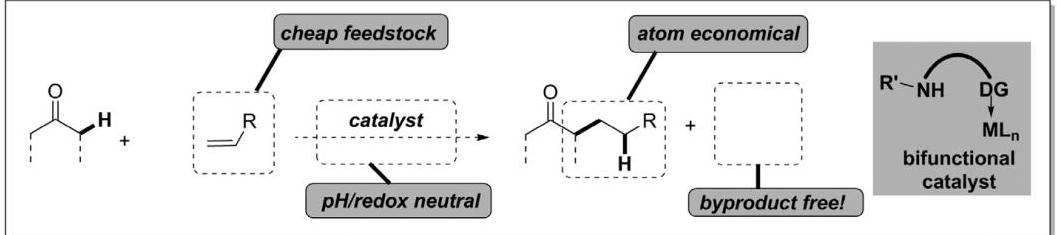
We foresaw substantial advantages in the prospective use of simple unactivated olefins as alkylating agents (Fig. 1C). Adding the ketone $\alpha - \mathrm{C} - \mathrm{H}$ bond across a $\mathrm{C} - \mathrm{C}$ double bond under neutral conditions would furnish no byproducts and tolerate a broad range of functionality. This approach would also have economic advantages because olefins are much cheaper and more readily available feedstock than the corresponding alkyl halides (Fig. 1D); in fact, most terminal alkyl halides are ultimately prepared from olefins (4, 7).
我们预见到使用简单的未活化烯烃作为烷基化剂(图)具有显著优势。在中性条件下,将酮的$\alpha - \mathrm{C} - \mathrm{H}$键加成到$\mathrm{C} - \mathrm{C}$双键上不会产生副产物,并且能耐受广泛的官能团。这种方法还具有经济优势,因为烯烃比相应的卤代烷便宜得多且更容易获得(图1D);事实上,大多数末端卤代烷最终都是由烯烃制备的(4, 7)。
Although adding $\alpha - \mathrm{C} - \mathrm{H}$ bonds of activated methylene compounds across olefins and alkynes has been established (8-11), there are fewer examples of direct coupling of simple ketones and unactivated olefins. The intramolecular ketone-olefin coupling, known as the Conia-ene reaction (12), requires high temperature $\left( { > {250}^{ \circ }\mathrm{C}}\right)$ , giving moderate yields with limited functional-group tolerance; the catalytic version was first reported by Widenhoefer (13) using palladium and recently by Che (14) using gold. In contrast, intermolecular ketone-olefin couplings are rare and mainly involve addition of stoichiometric metal enolates or enamides across olefins (8, 15, 16). To our knowledge, base-catalyzed additions of metal enolates to styrene derivatives (likely facilitated by formation of delocalized charges) (17, 18) and a Mn/Co-initiated oxidative radical process for nonaromatic olefins (19) are the only approaches reported to date. Recently, enamine radical cation-mediated couplings with olefins emerged as an attractive catalytic strategy for $\alpha$ -functionalization of carbonyl compounds, albeit requiring oxidative conditions (20, 21). Therefore, a general activation mode for coupling of simple ketones and unactivated olefins remains to be developed. Here, we describe our development of a catalytic dual-activation strategy for addition of normal ketone $\alpha - \mathrm{C} - \mathrm{H}$ bonds across unactivated olefins, which allows for direct ketone alkylation by simple olefins under both $\mathrm{{pH}}$ - and redox-neutral conditions.
尽管通过活化亚甲基化合物的$\alpha - \mathrm{C} - \mathrm{H}$键与烯烃和炔烃加成反应已得到广泛应用(8-11),但简单酮与未活化烯烃直接偶联的例子较少。分子内酮-烯烃偶联反应,即柯尼雅-烯反应(12),需要高温$\left( { > {250}^{ \circ }\mathrm{C}}\right)$,产率适中且官能团耐受性有限;催化版本最早由Widenhoefer(13)使用钯报道,最近Che(14)使用金报道。相比之下,分子间酮-烯烃偶联反应很少见,主要涉及化学计量的金属烯醇盐或烯酰胺与烯烃的加成反应(8, 15, 16)。据我们所知,碱催化的金属烯醇盐与苯乙烯衍生物的加成反应(可能通过形成离域电荷促进)(17, 18)以及用于非芳香烯烃的Mn/Co引发的氧化自由基过程(19)是迄今为止报道的唯一方法。最近,烯胺自由基阳离子介导的与烯烃的偶联反应成为羰基化合物$\alpha$ -官能化的一种有吸引力的催化策略,尽管需要氧化条件(20, 21)。因此,简单酮与未活化烯烃偶联的通用活化模式仍有待开发。在此,我们描述了一种催化双活化策略,用于通过未活化烯烃加成普通酮的$\alpha - \mathrm{C} - \mathrm{H}$键,该策略允许在$\mathrm{{pH}}$ -和氧化还原中性条件下通过简单烯烃直接进行酮烷基化反应。
We targeted a bifunctional catalyst capable of activating the ketone $\alpha - \mathrm{C} - \mathrm{H}$ bonds and the olefin simultaneously, which would incorporate a secondary amine and a low-valent transition metal complex. Seminal work by Jun and coworkers showed that metal-organic cooperative catalysis enables activation of aldehyde ipso-C-H bonds through imine formation with a bifunctional primary amine, i.e., 2-amino-3- picoline (22). We hypothesized that, by using a secondary amine, the ketone $\alpha$ -C-H bonds would instead be activated by enamine formation. As depicted in Fig. 2, first, the catalyst would bind the ketone substrate to form an enamine (step a), which would consequently convert the ketone $\alpha \; s{p}^{3}\mathrm{C} - \mathrm{H}$ bond into a $s{p}^{2}\mathrm{C} - \mathrm{H}$ bond, thus enhancing the reactivity toward oxidative addition by a low-valent transition metal (23, 24). Meanwhile, if a proper directing group (DG) were linked to the amine domain, the DG could facilitate insertion of a low-valent transition metal (e.g., ${\mathrm{{Rh}}}^{\mathrm{I}}$ ) into the resulting enamine $\mathrm{C} - \mathrm{H}$ bonds, giving metal hydride species (M-H, step b). Upon olefin coordination to the metal, subsequent M-H migratory insertion (step c) and reductive elimination (step d) would provide an alkylated enamine, which upon hydrolysis would lead to $\alpha$ -alkylation and catalyst regeneration (step e).
我们的目标是开发一种双功能催化剂,能够同时活化酮的$\alpha - \mathrm{C} - \mathrm{H}$键和烯烃,该催化剂将包含仲胺和低价过渡金属配合物。Jun及其同事的开创性工作表明,金属-有机协同催化能够通过与双功能伯胺(即2-氨基-3-甲基吡啶)形成亚胺来活化醛的ipso-C-H键(22)。我们推测,通过使用仲胺,酮的$\alpha$ -C-H键将通过形成烯胺而被活化。如图2所示,首先,催化剂将与酮底物结合形成烯胺(步骤a),这将使酮的$\alpha \; s{p}^{3}\mathrm{C} - \mathrm{H}$键转化为$s{p}^{2}\mathrm{C} - \mathrm{H}$键,从而增强其对低价过渡金属氧化加成的反应性(23, 24)。同时,如果一个合适的导向基团(DG)连接到胺域,DG可以促进低价过渡金属(例如${\mathrm{{Rh}}}^{\mathrm{I}}$)插入所得烯胺的$\mathrm{C} - \mathrm{H}$键中,生成金属氢化物物种(M-H,步骤b)。烯烃与金属配位后,随后的M-H迁移插入(步骤c)和还原消除(步骤d)将提供烷基化烯胺,水解后将导致$\alpha$ -烷基化和催化剂再生(步骤e)。
Department of Chemistry, University of Texas at Austin, Austin, TX 78712, USA.
美国得克萨斯大学奥斯汀分校化学系,奥斯汀,TX 78712
*Corresponding author.
*通讯作者。
In the Stork enamine reaction (5, 6), enamine formation is regioselective for the less-hindered site of ketones; thus, this bifunctional catalyst would be expected to provide high regiocontrol for monoalkylation of unsymmetrical ketones. Moreover, as documented in enamine catalysis (25), enamine formation and hydrolysis can exist in equilibrium, but the less-hindered ketone (starting material) preferentially forms enamine over the more-hindered ketone (product), and thus product inhibition can be avoided. In addition, enamine formation/hydrolysis is known to be compatible with the ${\mathrm{{Rh}}}^{\mathrm{I}}$ to ${\mathrm{{Rh}}}^{\mathrm{{III}}}$ catalytic cycle (26). Therefore, both the amine and the metal components can be employed catalytically. [For our preliminary study of alkylation with 1,2-cyclic diketones using stoichiometric aminopyridine as the cofactor, see (27).]
在斯托克烯胺反应(5, 6)中,烯胺的形成对酮的位阻较小的位点具有区域选择性;因此,预计这种双功能催化剂将为不对称酮的单烷基化提供高区域控制。此外,如烯胺催化(25)中所述,烯胺的形成和水解可以处于平衡状态,但位阻较小的酮(原料)比位阻较大的酮(产物)优先形成烯胺,因此可以避免产物抑制。此外,已知烯胺的形成/水解与${\mathrm{{Rh}}}^{\mathrm{I}}$至${\mathrm{{Rh}}}^{\mathrm{{III}}}$催化循环(26)兼容。因此,胺和金属组分都可以催化使用。[关于我们使用化学计量的氨基吡啶作为辅因子对1,2 - 环二酮进行烷基化的初步研究,见(27)。]
To examine the feasibility of the proposed strategy, we tested 3-phenylcyclopentanone (1a) and ethylene (2a) as model substrates. A variety of rhodium precatalysts/dative ligands, bifunctional ligands, solvents, additives, and pressure of ethylene were examined (see table S1). Given the crucial role of the bifunctional ligands in the proposed catalytic cycle, seven secondary amine compounds (L1 to L7 in table S1) containing an adjacent DG were designed and explored under the ethylation conditions. To our delight, 7-azaindoline (L1) exhibited unique and high catalytic activities, whereas others were inactive. In the presence of 2.5 mole percent (mol %) chlorobis(cyclooctene) rhodium(I) dimer {[Rh(coe) ${}_{2}{\mathrm{{Cl}}}_{2}$ }, 5 mol % 1,3- bis(2,4,6-trimethylphenyl)imidazol-2-ylidene (IMes) ligand,10 mol $\% p$ -toluenesulfonic acid monohydrate $\left( {\mathrm{{TsOH}} \cdot {\mathrm{H}}_{2}\mathrm{O}}\right)$ , and ${25}\mathrm{\;{mol}}\% \mathrm{{Ll}}$ in toluene, the desired ethyl-substituted product $\mathbf{{3a}}$ was isolated in 82% yield using ethylene gas as the alkylating agent (table S1, entry 4). Subsequently, the role of each reactant was investigated through a series of control experiments. The absence of the ${\mathrm{{Rh}}}^{\mathrm{I}}$ complex or bifunctional ligand $\mathrm{L}1$ completely eliminates the reactivity (table S1, entries 5 and 6), supporting our hypothesis that enamine formation and low-valent metal are key for the C-H/olefin coupling reaction. To promote enamine formation,10 mol $\% \mathrm{{TsOH}} \cdot {\mathrm{H}}_{2}\mathrm{O}$ was purposely employed as an acid catalyst; indeed, without this additive, no desired alkylation product was observed (table S1, entry 7). The bulky electron-rich N-heterocyclic carbene (NHC) ligand (IMes) was used to promote oxidative addition of enamine C-H bonds to Rh and subsequent olefin insertion (28). Considerably diminished yields were found in the absence of this ligand or using Wilkinson’s catalyst instead (table S1, entries 8 and 20). The reaction exhibited complete regioselectivity for the less-hindered 5 position of cyclopentanone; neither alkylation at the 2 position nor multiple alkylations was observed for ketone 1a. Moreover, while the reaction requires 2 days at toluene reflux temperature when 2.5 mol % [Rh(coe) ${}_{2}\mathrm{{Cl}}{\rbrack }_{2},5\mathrm{\;{mol}}\%$ IMes, and ${25}\mathrm{\;{mol}}\% \mathrm{L}1$ were employed, increasing the catalyst loading can result in a full conversion within 12 to 24 hours (table S1, entries 1 and 2).
为了检验所提出策略的可行性,我们测试了3 - 苯基环戊酮(1a)和乙烯(2a)作为模型底物。研究了各种铑预催化剂/给体配体、双功能配体、溶剂、添加剂以及乙烯压力(见表S1)。鉴于双功能配体在所提出的催化循环中的关键作用,设计并研究了七种含有相邻DG的仲胺化合物(表S1中的L1至L7)在乙基化条件下的情况。令我们高兴的是,7 - 氮杂吲哚(L1)表现出独特且高的催化活性,而其他的则无活性。在2.5摩尔百分比(mol%)的二氯双(环辛烯)铑(I)二聚体{[Rh(coe)${}_{2}{\mathrm{{Cl}}}_{2}$]、5 mol%的1,3 - 双(2,4,6 - 三甲基苯基)咪唑 - 2 - 亚基(IMes)配体、10 mol$\% p$对甲苯磺酸一水合物$\left( {\mathrm{{TsOH}} \cdot {\mathrm{H}}_{2}\mathrm{O}}\right)$以及${25}\mathrm{\;{mol}}\% \mathrm{{Ll}}$存在于甲苯中的情况下,使用乙烯气体作为烷基化剂,以82%的产率分离出所需的乙基取代产物$\mathbf{{3a}}$(表S1,条目4)。随后,通过一系列对照实验研究了每种反应物的作用。${\mathrm{{Rh}}}^{\mathrm{I}}$配合物或双功能配体$\mathrm{L}1$的不存在完全消除了反应活性(表S1,条目5和6),支持了我们的假设,即烯胺的形成和低价金属是C - H/烯烃偶联反应的关键。为了促进烯胺的形成,特意使用10 mol$\% \mathrm{{TsOH}} \cdot {\mathrm{H}}_{2}\mathrm{O}$作为酸催化剂;实际上,没有这种添加剂时,未观察到所需的烷基化产物(表S1,条目7)。体积较大的富电子N - 杂环卡宾(NHC)配体(IMes)用于促进烯胺C - H键向Rh的氧化加成以及随后的烯烃插入(28)。在没有这种配体或使用威尔金森催化剂代替的情况下,产率显著降低(表S1中的条目8和20)。该反应对环戊酮位阻较小的5位表现出完全的区域选择性;对于酮1a,未观察到2位的烷基化或多次烷基化。此外,当使用2.5 mol%的[Rh(coe)${}_{2}\mathrm{{Cl}}{\rbrack }_{2},5\mathrm{\;{mol}}\%$]、IMes和${25}\mathrm{\;{mol}}\% \mathrm{L}1$时,反应在甲苯回流温度下需要2天,但增加催化剂负载量可在12至24小时内实现完全转化(表S1,条目1和2)。
With the optimized conditions in hand, we examined the substrate scope. A wide range of different functional groups were tolerated under the alkylation conditions (Fig. 3A). Ethers, aryl bromides, carboxylic esters, methylenedioxys, nitriles, and thioethers proved compatible (3b to 3h). Substrates containing competitive alkylation sites, such as secondary amides (3i), malonates (3j) and aliphatic esters (3k and 3t), gave chemo-and regioselective ethylation exclusively at the ketone C5 position. Furthermore, reactive functional
有了优化的条件后,我们研究了底物范围。在烷基化条件下,多种不同的官能团都能兼容(图3A)。醚、芳基溴、羧酸酯、亚甲二氧基、腈和硫醚都证明是兼容的(3b至3h)。含有竞争性烷基化位点的底物,如仲酰胺(3i)、丙二酸酯(3j)和脂肪族酯(3k和3t),仅在酮的C5位置发生化学和区域选择性乙基化。此外,活性官能团,包括游离的叔醇和伯醇(3l和3m)、游离酚(3n)、未保护的吲哚(3o)和胺(3p),都能保留下来,得到中等到高产率的酮烷基化产物。对酸敏感的底物,如那些含有叔丁基二甲基硅基(TBS)醚(- 3q)、叔醇(3l)和三甲基硅基(TMS)基团(图3C中的3ad)的底物,也适用于这种转化。此外,由于反应中不涉及强碱,可烯醇化的预先存在的立体中心在反应过程中得以保留(3t)。因此,该方法为传统的烯醇盐烷基化化学提供了互补的兼容性。
A Enolate Alkylation
A烯醇盐烷基化

B Stork Enamine Reaction
B斯托克烯胺反应

C Simple Olefins as Alkylating Agents groups, including free tertiary and primary alcohols (31 and 3m), free phenols (3n), unprotected indoles (3o), and amines (3p), survived, giving moderate to high yields of ketone-alkylation products. Acid-sensitive substrates, such as those containing a tert-butyldimethyl silyl (TBS) ether (3q), a tertiary alcohol (3l), and a trimethylsilyl (TMS) group (3ad in Fig. 3C), were also suitable for this transformation. Furthermore, enolizable preexisting stereocenters were preserved during the reaction (3t) because no strong base was involved. Thus, this method provides complementary compatibility to the conventional enolate alkylation chemistry.
C作为烷基化剂的简单烯烃 包括游离的叔醇和伯醇(3l和3m)、游离酚(3n)、未保护的吲哚(3o)和胺(3p)在内的官能团都能保留下来,得到中等到高产率的酮烷基化产物。对酸敏感的底物,如那些含有叔丁基二甲基硅基(TBS)醚(3q)、叔醇(3l)和三甲基硅基(TMS)基团(图3C中的3ad)的底物,也适用于这种转化。此外,由于反应中不涉及强碱,可烯醇化的预先存在的立体中心在反应过程中得以保留(3t)。因此,该方法为传统的烯醇盐烷基化化学提供了互补的兼容性。
| ${\mathrm{H}}_{2}\mathrm{C} = {\mathrm{{CH}}}_{2}$ | ${\mathrm{{ICH}}}_{2}{\mathrm{{CH}}}_{3}$ | ${\mathrm{{BrCH}}}_{2}{\mathrm{{CH}}}_{3}$ | |
| estimated cost: | \$1/kg (ICIS market price)  | \$280/kg (Aldrich) | \$55/kg (Aldrich) |
| \$0.028/mol | \$43.7/mol | \$6.0/mol | |
| molecular weight: | 28 | 156 | 109 |
Fig. 1. Different approaches to ketone alkylation. (A) Enolate alkylation. (B) Stock enamine reaction. (C) Simple olefins as alkylating agents. (D) Cost of alkylating agents.
图1. 酮烷基化的不同方法。(A)烯醇盐烷基化。(B)斯托克烯胺反应。(C)作为烷基化剂的简单烯烃。(D)烷基化剂的成本。
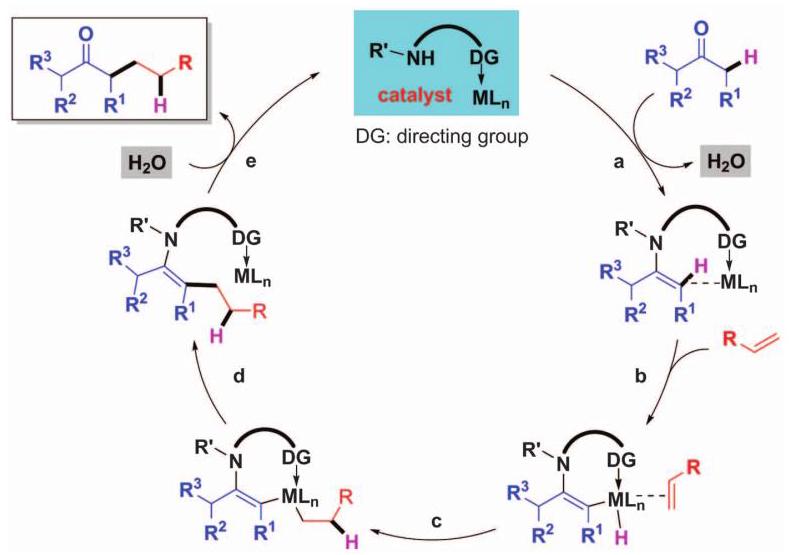
Fig. 2. Design of a bifunctional catalyst and proposed catalytic cycle. (a) Enamine formation; (b) Oxidative addition of enamine C-H bond; (c) Migratory insertion into olefins; (d) Reductive elimination to form C-C bond; (e) Enamine hydrolysis.
图2. 双功能催化剂的设计及提出的催化循环。(a)烯胺形成;(b)烯胺C-H键的氧化加成;(c)迁移插入烯烃;(d)还原消除形成C-C键;(e)烯胺水解。
On a 2-mmol scale $\left( {{2.0}\mathrm{M}}\right)$ , the reaction of ketone 1a provided full conversion and 96% isolated yield with a lower catalyst loading (versus the 0.2-mmol scale). In addition, using 10 mmol (0.98 g) 3-methyl-cyclopentanone as the starting material, we obtained the desired ethylation product (3s) in nearly quantitative yield [determined by ${}^{1}\mathrm{H}$ nuclear magnetic resonance (NMR)] with only ${0.5}\mathrm{\;{mol}}\%$ of the Rh-dimer catalyst and 15 mol % of L1 (75% isolated yield due to the volatility of 3s). This reaction can tolerate a range of concentrations (from ${0.2}\mathrm{M}$ to ${3.3}\mathrm{M}$ ), which can be critical for large-scale applications. Structures of the products were unambiguously characterized by ${}^{1}\mathrm{H}/{}^{13}\mathrm{C}$ NMR, infrared (IR), and high-resolution mass spectrometry (HRMS); x-ray structures of several hydrazone derivatives were also obtained. For all substrates, the products were obtained as a pair of diastereoisomers with the cis-isomer predominating. It is likely that in the last step (enamine hydrolysis), the proton preferentially attacks the less-hindered face of the enamine, resulting in cis disposition of the two substituents. The di-astereomeric ratio (dr) of the alkylation product can be enhanced by conversion to the corresponding silyl enol ether followed by treatment with a chiral Lewis acid (supplementary materials).
在2 mmol规模$\left( {{2.0}\mathrm{M}}\right)$下,酮1a的反应在较低的催化剂负载量下(与0.2 mmol规模相比)实现了完全转化和96%的分离产率。此外,以10 mmol(0.98 g)3-甲基环戊酮为起始原料,我们仅使用${0.5}\mathrm{\;{mol}}\%$的Rh二聚体催化剂和15 mol%的L1,就以近乎定量的产率[通过${}^{1}\mathrm{H}$核磁共振(NMR)测定]得到了所需的乙基化产物(3s)(由于3s的挥发性,分离产率为75%)。该反应可以耐受一定范围的浓度(从${0.2}\mathrm{M}$到${3.3}\mathrm{M}$),这对于大规模应用可能至关重要。产物的结构通过${}^{1}\mathrm{H}/{}^{13}\mathrm{C}$NMR、红外(IR)和高分辨率质谱(HRMS)进行了明确表征;还获得了几种腙衍生物的x射线结构。对于所有底物,产物都是以一对非对映异构体的形式得到,其中顺式异构体占主导。在最后一步(烯胺水解)中,质子可能优先攻击烯胺位阻较小的面,导致两个取代基呈顺式排列。通过转化为相应的硅基烯醇醚,然后用手性路易斯酸处理,可以提高烷基化产物的非对映体比例(dr)(补充材料)。
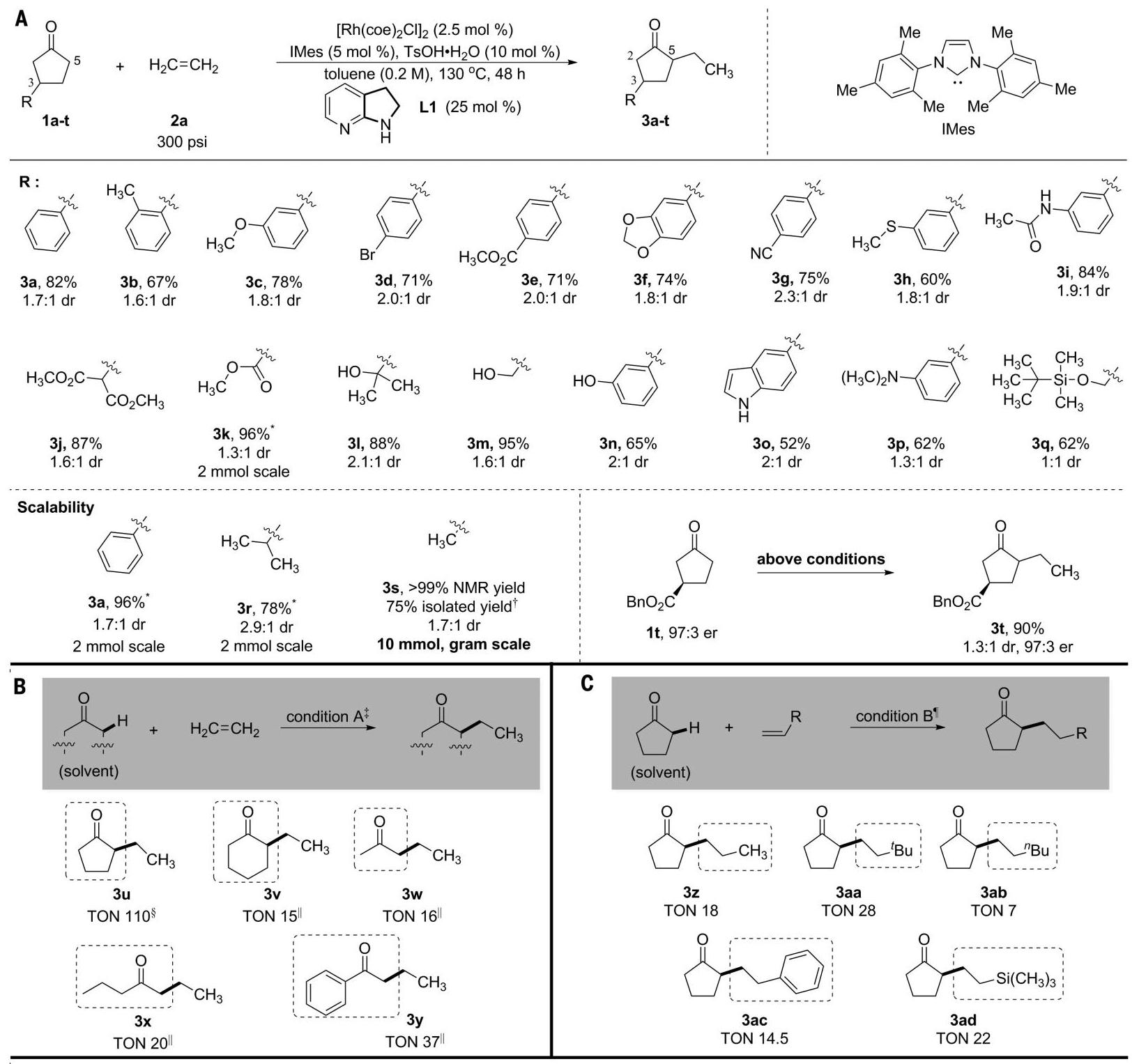
Fig. 3. Regioselective ketone $\alpha$ -alkylation with simple olefins. (A) Ethylation of various cyclopentanones. Unless otherwise mentioned, the reactions were run on a 0.2-mmol scale; the data are reported as percent isolated yield. Diastereomeric ratio (dr) was determined by ${}^{1}\mathrm{H}$ NMR. *[Rh(coe) ${}_{2}\mathrm{{Cl}}{\rbrack }_{2}$ (1 mol %), IMes (2 mol %), TsOH-H2O (5 mol %), toluene 1 mL (2.0 M). †[Rh(coe) ${\left. {}_{2}\mathrm{{Cl}}\right\rbrack }_{2}$ (0.5 mol %), IMes (1 mol %), TsOH $\cdot {\mathrm{H}}_{2}\mathrm{O}$ (2 mol %), L1 (15 mol %), toluene 3.0 mL (3.3 M). (B) Ethylation of various ketones. ‡Condition A: ketone 1 mL, ethylene 300 pounds per square inch, L1 (0.2 mmol), [Rh(coe) ${}_{2}\mathrm{{Cl}}{\rbrack }_{2}$ (0.005 mmol), IMes (0.01 mmol), TsOH-H ${}_{2}\mathrm{O}$ (0.02 mmol), 2,4,4-trimethylpentan-2-amine (0.1 mmol), neat, 130°C, 48 hours. The TON are based on [Rh] monomer, which are determined by GC with dodecane as an internal standard. §No 2,4,4- trimethylpentan-2-amine, but with ${\mathrm{H}}_{2}\mathrm{O}\left( {{10\mu }\mathrm{L}}\right)$ ; 2,5-diethyl-cyclopentanones were also obtained (TON 29). ||180°C. (C) Alkylation of cyclopentanone with various olefins. ¶Condition B: cyclopentanone (0.5 mL), olefin (0.5 mL, propene $\sim 1\mathrm{\;{mL}}$ ), L1 (0.2 mmol), ${\left\lbrack \mathrm{{Rh}}{\left( \mathrm{{coe}}\right) }_{2}\mathrm{{Cl}}\right\rbrack }_{2}$ (0.005 mmol), IMes (0.01 mmol), TsOH $\cdot {\mathrm{H}}_{2}\mathrm{O}\left( {{0.02}\mathrm{{mmol}}}\right) ,2,4,4$ -trimethylpentan-2-amine (0.1 mmol), ${\mathrm{H}}_{2}\mathrm{O}\left( {{10\mu }\mathrm{L}}\right)$ , neat, ${130}^{ \circ }\mathrm{C},{48}$ hours. The TON are based on [Rh] monomer, which are determined by GC with dodecane as an internal standard.
图3. 简单烯烃对酮的区域选择性$\alpha$-烷基化反应。(A) 各种环戊酮的乙基化反应。除非另有说明,反应以0.2 mmol规模进行;数据以分离产率百分比表示。非对映体比例(dr)通过${}^{1}\mathrm{H}$ NMR测定。*[Rh(coe)${}_{2}\mathrm{{Cl}}{\rbrack }_{2}$(1 mol %), IMes (2 mol %), TsOH-H2O (5 mol %), 甲苯1 mL (2.0 M)。†[Rh(coe)${\left. {}_{2}\mathrm{{Cl}}\right\rbrack }_{2}$(0.5 mol %), IMes (1 mol %), TsOH$\cdot {\mathrm{H}}_{2}\mathrm{O}$(2 mol %), L1 (15 mol %), 甲苯3.0 mL (3.3 M)。(B) 各种酮的乙基化反应。‡条件A:酮1 mL,乙烯300磅力每平方英寸,L1 (0.2 mmol),[Rh(coe)${}_{2}\mathrm{{Cl}}{\rbrack }_{2}$(0.005 mmol),IMes (0.01 mmol),TsOH-H${}_{2}\mathrm{O}$(0.02 mmol),2,4,4-三甲基戊-2-胺(0.1 mmol),纯物质,130°C,48小时。TON基于[Rh]单体,通过以十二烷作为内标物的GC测定。§无2,4,4-三甲基戊-2-胺,但使用${\mathrm{H}}_{2}\mathrm{O}\left( {{10\mu }\mathrm{L}}\right)$;也得到了2,5-二乙基环戊酮(TON 29)。||180°C。(C) 环戊酮与各种烯烃的烷基化反应。¶条件B:环戊酮(0.5 mL),烯烃(0.5 mL,丙烯$\sim 1\mathrm{\;{mL}}$),L1 (0.2 mmol),${\left\lbrack \mathrm{{Rh}}{\left( \mathrm{{coe}}\right) }_{2}\mathrm{{Cl}}\right\rbrack }_{2}$(0.005 mmol),IMes (0.01 mmol),TsOH$\cdot {\mathrm{H}}_{2}\mathrm{O}\left( {{0.02}\mathrm{{mmol}}}\right) ,2,4,4$-三甲基戊-2-胺(0.1 mmol),${\mathrm{H}}_{2}\mathrm{O}\left( {{10\mu }\mathrm{L}}\right)$,纯物质,${130}^{ \circ }\mathrm{C},{48}$小时。TON基于[Rh]单体,通过以十二烷作为内标物的GC测定。
We next explored the scope of ketones and olefins for this transformation. Both cyclic and acyclic ketones could be directly coupled with ethylene gas to afford the ethyl-substituted ketones (Fig. 3B). In general, cyclopentanones were more reactive than cyclohexanones and acyclic ketones, consistent with the established tendencies toward enamine formation (29). By further investigating the reaction conditions, we discovered that a catalytic amount of an additional amine, such as triethylamine, 1,4-diazabicyclo[2.2.2]octane (DABCO), or 2,4,4-trimethylpentan-2-amine, could increase the efficiency of the ketone α-alkylation. Although the exact reason remains unclear, with the help of the amine additive, simple aliphatic ketones, such as acetone and 2-pentanone, coupled with ethylene to afford the desired monoalkylation products. It is well established that aromatic ketones, such as acetophenone, can undergo metal-catalyzed C-H/olefin couplings through activation of the ortho aromatic C-H bond, initially reported by Murai and co-workers (30). In contrast, our strategy completely switched the chemoselectivity from the normal aromatic C-H bond to the ketone $\alpha$ -C-H bond, providing homologated ketone 3y.
接下来,我们探索了用于此转化的酮和烯烃的范围。环状和非环状酮均可与乙烯气体直接偶联,得到乙基取代的酮(图3B)。一般来说,环戊酮比环己酮和非环状酮更具反应性,这与已确定的烯胺形成趋势一致(29)。通过进一步研究反应条件,我们发现催化量的额外胺,如三乙胺、1,4-二氮杂双环[2.2.2]辛烷(DABCO)或2,4,4-三甲基戊-2-胺,可以提高酮α-烷基化的效率。尽管确切原因尚不清楚,但在胺添加剂的帮助下,简单的脂肪族酮,如丙酮和2-戊酮,与乙烯偶联得到了所需的单烷基化产物。众所周知,芳香族酮,如苯乙酮,可以通过邻位芳香族C-H键的活化进行金属催化的C-H/烯烃偶联,最初由村井及其同事报道(30)。相比之下,我们的策略完全将化学选择性从正常的芳香族C-H键切换到酮$\alpha$-C-H键,得到了同系化酮3y。
Using cyclopentanone as the ketone substrate, different classes of terminal olefins were also explored. All these $\alpha$ -olefins provided the desired mono-alkylation products with complete regioselectivity for the anti-Markovnikov addition products. Sterically hindered and less-hindered, isomerizable and non-isomerizable, aliphatic and aromatic olefins all reacted, suggesting a broad scope of this methodology. Through this investigation, dialkylation was only observed when coupling the unsubstituted cyclopentanone (1u) with ethylene (Fig. 3B); however, we discovered that simply adding water to the reaction enhanced the selectivity for monoalkylation (supplementary materials). For examples exhibited in Fig. 3, B and C, the ketones were employed as the solvents for optimal performance, and the turnover numbers (TON) based on the Rh monomer were used to measure the efficiency of these reactions. Given the volatility of these alkylation products, their accurate yields were determined by gas chromatography (GC) or ${}^{1}\mathrm{H}$ NMR analysis; a portion of the pure products could be isolated via silica gel chromatography and fully characterized (supplementary materials), although compounds 3w and $3\mathbf{x}$ were identified by comparison of their crude ${}^{1}\mathrm{H}$ NMR, GC, and GC-mass spectrometry data with authentic samples.
以环戊酮为酮底物,还探索了不同类别的末端烯烃。所有这些$\alpha$-烯烃都提供了所需 的单烷基化产物,对反马氏加成产物具有完全的区域选择性。空间位阻大的和位阻小的、可异构化的和不可异构化的、脂肪族和芳香族烯烃都发生了反应,这表明该方法的适用范围很广。通过这项研究,仅在将未取代的环戊酮(1u)与乙烯偶联时观察到了二烷基化(图3B);然而,我们发现简单地向反应中加水可以提高单烷基化的选择性(补充材料)。对于图3B和C中所示的示例,酮用作溶剂以实现最佳性能,并使用基于Rh单体的周转数(TON)来衡量这些反应的效率。鉴于这些烷基化产物的挥发性,它们的准确产率通过气相色谱(GC)或${}^{1}\mathrm{H}$ NMR分析确定;一部分纯产物可以通过硅胶柱色谱分离并进行全面表征(补充材料),尽管化合物3w和$3\mathbf{x}$是通过将其粗${}^{1}\mathrm{H}$ NMR、GC和GC-质谱数据与真实样品进行比较来鉴定的。
To gain more mechanistic insight into this bifunctional catalyst-mediated ketone/olefin coupling, we conducted several additional experiments (Fig. 4). First, we isolated a key Rh-enamine complex (4) from enamine 5 and ${\left\lbrack \mathrm{{Rh}}{\left( \mathrm{{coe}}\right) }_{2}\mathrm{{Cl}}\right\rbrack }_{2}$ (Fig. 4A). The x-ray structure of 4 shows that the azaindoline plane is twisted ${62.5}^{ \circ }$ (compared with the x-ray structure of free enamine 5) to allow chelation of the metal with the pyridine and the olefin, suggesting a preactivated conformation for the subsequent $\mathrm{C} - \mathrm{H}$ insertion (see step a in Fig. 2). Second, attempts to capture the metal-hydride intermediate incorporating an IMes ligand were unfruitful; however, we successfully isolated and obtained the x-ray structure of $\mathrm{{Rh}} - \mathrm{H}$ complex 6 with ${\mathrm{{PMe}}}_{3}$ as the dative ligand (Fig. 4B). Although complex6did not react with ethylene, it demonstrated the feasibility of insertion of a low-valent transition metal into enamine vinyl C-H bonds by oxidative addition (see step b in Fig. 2). Third, two deuterium-labeling experiments (Fig. 4C) were carried out to examine the proposed metal-hydride migratory insertion and reductive elimination steps (see steps c and d in Fig. 2). Following the proposed sequence, an $\alpha$ hydrogen of the ketone substrate should be transferred to the terminal position of the ethyl substituent of the alkylation product. Indeed, when the $\alpha$ and ${\alpha }^{\prime }$ -deuterated (at the ${93}\%$ D level) 3-methylcyclopentanone (1s’) was subjected to the standard reaction conditions, more than 82% deuterium incorporation was observed at the C2 position of the ethyl group. In addition, a stable conjugated enamine (8) could be isolated in good yield through coupling cyclopentanone ( ${\mathbf{{1u}}}^{\prime }\alpha$ and ${\alpha }^{\prime } - {92}\%$ deuterated), amine L1, and diphenylacetylene. Similarly, significant deuterium incorporation (68%) was observed at the vinyl hydrogen of compound 8. X-ray diffraction analysis confirmed the E olefin geometry, further supporting a syn-migratory insertion pathway (see step c in Fig. 2). The erosion in deuterium incorporation for both labeling experiments is likely caused by proton exchange with the NH hydrogen of L1 and/or the protons of $\mathrm{{TsOH}} \cdot {\mathrm{H}}_{2}\mathrm{O}$ (for more details, see the supplementary materials, section 3.6). Altogether, these results are consistent with our proposed mechanism in Fig. 2.
为了更深入地了解这种双功能催化剂介导的酮/烯烃偶联反应,我们进行了一些额外的实验(图4)。首先,我们从烯胺5和${\left\lbrack \mathrm{{Rh}}{\left( \mathrm{{coe}}\right) }_{2}\mathrm{{Cl}}\right\rbrack }_{2}$中分离出了关键的铑 - 烯胺配合物(4)(图4A)。4的X射线结构表明,氮杂吲哚平面发生了扭曲${62.5}^{ \circ }$(与游离烯胺5的X射线结构相比),以使金属与吡啶和烯烃形成螯合,这表明了后续$\mathrm{C} - \mathrm{H}$插入的预活化构象(见图2中的步骤a)。其次,尝试捕获包含IMes配体的金属氢化物中间体未成功;然而,我们成功分离并获得了以${\mathrm{{PMe}}}_{3}$作为给体配体的$\mathrm{{Rh}} - \mathrm{H}$配合物6的X射线结构(图4B)。尽管配合物6不与乙烯反应,但它证明了通过氧化加成将低价过渡金属插入烯胺乙烯基C - H键的可行性(见图2中的步骤b)。第三,进行了两个氘标记实验(图4C),以检验所提出的金属氢化物迁移插入和还原消除步骤(见图2中的步骤c和d)。按照所提出的顺序,酮底物的$\alpha$氢应该转移到烷基化产物乙基取代基的末端位置。实际上,当$\alpha$和${\alpha }^{\prime }$ - 氘代(在${93}\%$ D水平)的3 - 甲基环戊酮(1s’)在标准反应条件下反应时,在乙基的C2位置观察到超过82%的氘掺入。此外,通过环戊酮(${\mathbf{{1u}}}^{\prime }\alpha$和${\alpha }^{\prime } - {92}\%$氘代)、胺L1和二苯乙炔的偶联,可以以良好的产率分离出稳定的共轭烯胺(8)。同样,在化合物8的乙烯基氢处观察到显著的氘掺入(68%)。X射线衍射分析证实了E型烯烃几何结构,进一步支持了顺式迁移插入途径(见图2中的步骤c)。两个标记实验中氘掺入的减少可能是由于与L1的NH氢和/或$\mathrm{{TsOH}} \cdot {\mathrm{H}}_{2}\mathrm{O}$的质子进行了质子交换(更多细节见补充材料,第3.6节)。总之,这些结果与我们在图2中提出的机理一致。
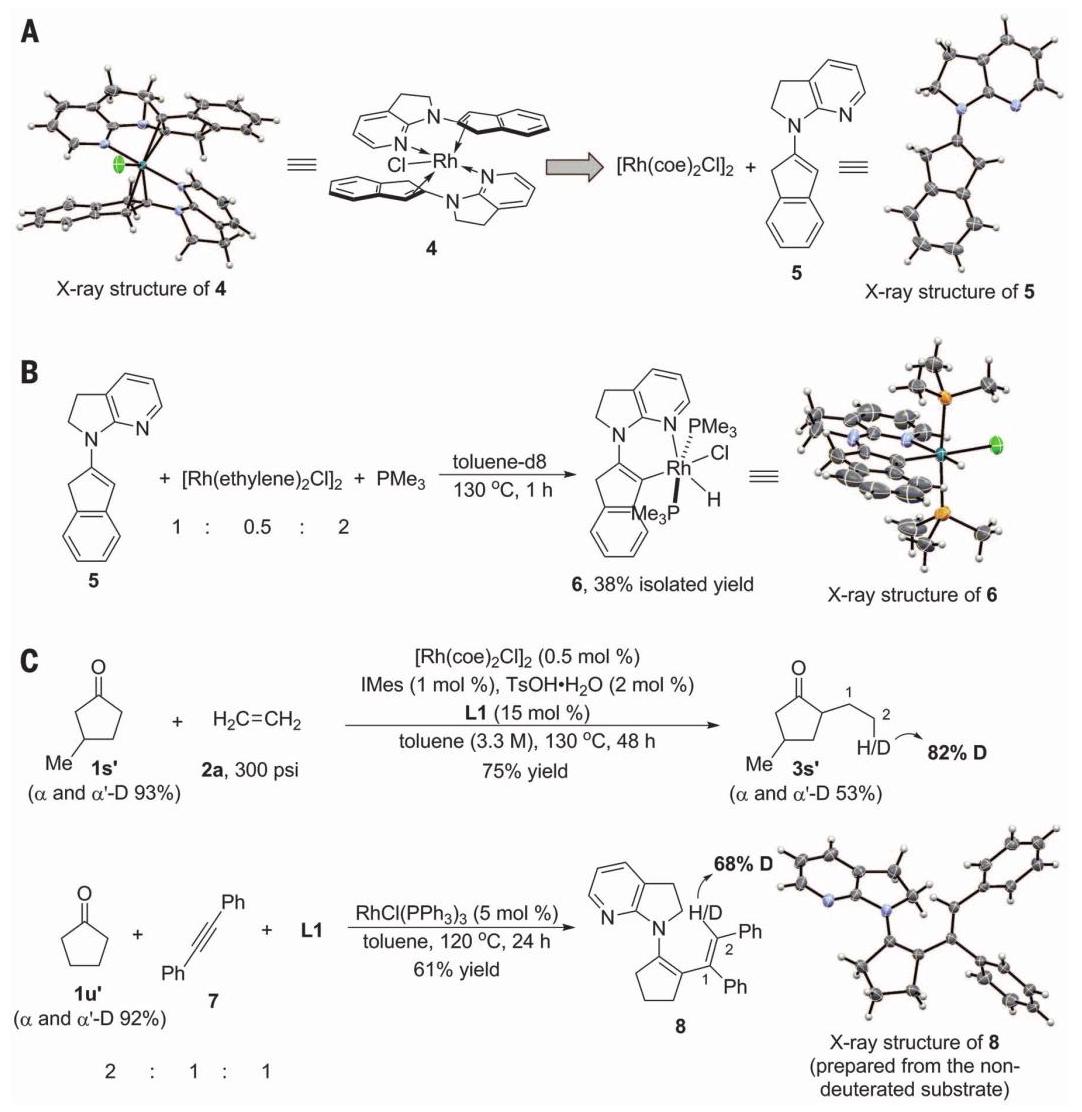
Fig. 4. Preliminary mechanistic studies. (A) Structure of the enamine-Rh complex. (B) Synthesis of a Rh-H complex. (C) Deuterium-labeling experiments.
图4. 初步机理研究。(A)烯胺 - 铑配合物的结构。(B)铑 - 氢配合物的合成。(C)氘标记实验。
REFERENCES AND NOTES
参考文献与注释
M. B. Smith, J. March, March’s Advanced Organic Chemistry (Wiley, New York, 2001).
Y. Ono, Pure Appl. Chem. 68, 367 (1996).
T. Anastas, J. C. Warner, Green Chemistry: Theory and Practice (Oxford Univ. Press, Oxford, 1998).
W. F. von Oettingen, The Halogenated Hydrocarbons of Industrial and Toxicological Importance (Elsevier, Amsterdam, New York, 1964).
G. Stork, R. Terrell, J. Szmuszkovicz, J. Am. Chem. Soc. 76, 2029-2030 (1954).
G. Stork, H. Landesman, J. Am. Chem. Soc. 78, 5128-5129 (1956).
R. C. Larock, Comprehensive Organic Transformations (Wiley, New York, 1999).
F. Dénès, A. Pérez-Luna, F. Chemla, Chem. Rev. 110, 2366-2447 (2010).
T. Pei, R. A. Widenhoefer, J. Am. Chem. Soc. 123, 11290-11291 (2001).
X. Yao, C.-J. Li, J. Am. Chem. Soc. 126, 6884-6885 (2004).
J. J. Kennedy-Smith, S. T. Staben, F. D. Toste, J. Am. Chem. Soc. 126, 4526-4527 (2004).
J. M. Conia, P. Le Perchec, Synthesis 1975, 1-19 (1975).
X. Wang, T. Pei, X. Han, R. A. Widenhoefer, Org. Lett. 5, 2699-2701 (2003).
Y.-P. Xiao, X.-Y. Liu, C.-M. Che, Angew. Chem. Int. Ed. 50, 4937-4941 (2011).
M. Nakamura, T. Hatakeyama, E. Nakamura, J. Am. Chem. Soc. 126, 11820-11825 (2004).
L. S. Hegedus, R. E. Williams, M. A. McGuire, T. Hayashi, J. Am. Chem. Soc. 102, 4973-4979 (1980).
A. L. Rodriguez, T. Bunlaksananusorn, P. Knochel, Org. Lett. 2, 3285-3287 (2000).
S. Majima, Y. Shimizu, M. Kanai, Tetrahedron Lett. 53, 4381-4384 (2012).
T. Iwahama, S. Sakaguchi, Y. Ishii, Chem. Commun. (23): 2317-2318 (2000).
R. J. Comito, F. G. Finelli, D. W. C. MacMillan, J. Am. Chem. Soc. 135, 9358-9361 (2013).
T. D. Beeson, A. Mastracchio, J. B. Hong, K. Ashton, D. W. C. Macmillan, Science 316, 582-585 (2007).
Y. J. Park, J.-W. Park, C.-H. Jun, Acc. Chem. Res. 41, 222-234 (2008).
L. N. Lewis, J. F. Smith, J. Am. Chem. Soc. 108, 2728-2735 (1986).
D. A. Colby, R. G. Bergman, J. A. Ellman, Chem. Rev. 110, 624-655 (2010).
B. List, Chem. Rev. 107, 5413-5415 (2007).
C.-H. Jun, C. W. Moon, Y.-M. Kim, H. Lee, J. H. Lee, Tetrahedron Lett. 43, 4233-4236 (2002).
Z. Wang, B. J. Reinus, G. Dong, J. Am. Chem. Soc. 134, 13954-13957 (2012).
J. Kwak, Y. Ohk, Y. Jung, S. Chang, J. Am. Chem. Soc. 134, 17778-17788 (2012).
D. Sánchez et al., Org. Lett. 14, 536-539 (2012).
S. Murai et al., Nature 366, 529-531 (1993).
ACKNOWLEDGMENTS
致谢
We thank the University of Texas at Austin and Cancer Prevention and Research Institute of Texas (R1118) for a start-up fund and the Welch Foundation (F-1781) and NSF (CAREER: CHE-1254935) for research grants. A provisional patent based on this work has been filed by the University of Texas at Austin. G.D. is a Searle Scholar. We thank V. Lynch for x-ray crystallography. Metrical parameters for the crystal structures of compounds S3a to S3g, S3j, S3r, S3s, 4 to 6, and 8 are available free from the Cambridge Crystallographic Data Centre under reference numbers CCDC-1003268 to -1003281. respectively. We thank J. L. Sessler, M. J. Krische, and
我们感谢得克萨斯大学奥斯汀分校以及得克萨斯州癌症预防与研究所(R1118)提供的启动资金,感谢韦尔奇基金会(F - 1781)和美国国家科学基金会(职业发展奖:CHE - 1254935)提供的研究资助。得克萨斯大学奥斯汀分校已基于此项工作提交了一项临时专利。G.D. 是塞尔学者。我们感谢V. 林奇进行X射线晶体学研究。化合物S3a至S3g、S3j、S3r、S3s、4至6以及8的晶体结构的测量参数可从剑桥晶体学数据中心免费获取,参考文献编号分别为CCDC - 1003268至 - 1003281。我们感谢J. L. 塞斯勒、M. J. 克里斯切以及
D. R. Siegel for loaning chemicals; B. A. Shoulders, S. Sorey, and
D. R. 西格尔出借化学试剂;感谢B. A. 肖尔兹、S. 索里以及
A. Spangenberg for NMR advice; Y. Xu for thoughtful suggestions;
A. 斯潘根贝格提供核磁共振方面的建议;感谢Y. 徐提出的宝贵建议;
A. Dermenci and H. Lim for proofreading the manuscript; and
感谢A. 德门西和H. 林校对稿件;以及
Z. Dong for checking and repeating the experimental procedure.
感谢Z. 董检查并重复实验步骤。
SUPPLEMENTARY MATERIALS
补充材料
www.sciencemag.org/content/345/6192/68/suppl/DC1
www.sciencemag.org/content/345/6192/68/suppl/DC1
Materials and Methods
材料与方法
Supplementary Text
补充文本
Table S1
表S1
References (31-58)
参考文献(31 - 58)
7 April 2014; accepted 27 May 2014
2014年4月7日;2014年5月27日接受
10.1126/science.1254465
10.1126/science.1254465
Molecular sieving membranes have created interest as high-performance separation systems for production of petro-based and renewable fuels and chemicals. Compared to thermodynamically driven separation methods such as distillation, membrane-based processes can substantially reduce the energy and capital costs of separating molecules on a large scale. Membranes composed of molecular sieving materials such as zeolites (1), layered zeolites (2), or metal-organic frameworks (MOFs) (3) have intrinsic advantages over polymeric membranes, such as a simultaneously high permeability and selectivity. Despite their performance limitations, polymeric membranes have continued to dominate industrial membrane separations owing to their relative ease of processing into morphologies such as hollow fibers (4). One challenge facing molecular sieving membranes is the lack of an easily scalable, reliable, and benign fabrication process (5-7). Zeolite membranes are further hampered by the need for hydrothermal synthesis on high-cost support materials. MOFs consist of metal centers connected by coordination bonds to organic linker molecules. They have been used to grow crystalline membranes on disk and tubular substrates through techniques similar to those developed for zeolitic membranes (8). The zeolitic imidazolite framework (ZIF) subclass of MOFs is of particular interest for membrane fabrication because of its tunable pore size and chemistry (9) and relatively good thermal and chemical stability (10, 11). In an early demonstration of scalable ZIF membrane processing (12), we synthesized ZIF-90 membranes by seeded growth on the outer surfaces of porous polymeric poly(amide-imide) (Torlon) hollow fibers of $\sim {250} - \mu \mathrm{m}$ outer diameter by immersion in a methanolic precursor solution at mild conditions $\left( {{65}^{ \circ }\mathrm{C}}\right)$ . Free-standing MOF films can also be synthesized at the interfaces between two immiscible solvents (13). However, molecular sieving membranes on the inner surfaces of hollow fibers also have advantages for rapid, scalable fabrication due to the ability to be bundled in close proximity while avoiding membrane-membrane contact points and interfaces that lead to defects during synthesis. Synthesis of selective membranes in microscopic confined spaces faces a number of challenges: reactant availability and transport, positional control of the membrane, and scal-ability. As the bore size (and hence volume) is decreased to microscopic dimensions, film formation becomes limited by reactant availability and local inhomogeneities (14).
分子筛膜作为用于生产石油基和可再生燃料及化学品的高性能分离系统引起了人们的关注。与蒸馏等热力学驱动的分离方法相比,基于膜的工艺可以大幅降低大规模分离分子的能源和资本成本。由分子筛材料如沸石(1)、层状沸石(2)或金属有机框架(MOF)(3)组成的膜相对于聚合物膜具有内在优势,如同时具有高渗透性和选择性。尽管存在性能限制,但聚合物膜由于相对易于加工成中空纤维等形态(4),在工业膜分离中仍占据主导地位。分子筛膜面临的一个挑战是缺乏一种易于扩展、可靠且温和的制造工艺(5 - 7)。沸石膜还因需要在高成本支撑材料上进行水热合成而受到进一步阻碍。MOF由通过配位键连接到有机连接分子的金属中心组成。它们已被用于通过与沸石膜类似的技术在圆盘和管状基材上生长结晶膜(8)。MOF的沸石咪唑框架(ZIF)子类因其可调孔径和化学性质(9)以及相对良好的热稳定性和化学稳定性(10, 11),在膜制造方面特别受关注。在早期可扩展的ZIF膜加工演示(12)中,我们通过在外径为$\sim {250} - \mu \mathrm{m}$的多孔聚合物聚(酰胺 - 酰亚胺)(Torlon)中空纤维外表面进行晶种生长,在温和条件$\left( {{65}^{ \circ }\mathrm{C}}\right)$下浸入甲醇前驱体溶液中合成了ZIF - 90膜。独立的MOF膜也可以在两种不混溶溶剂的界面处合成(13)。然而,中空纤维内表面的分子筛膜由于能够紧密捆扎同时避免导致合成过程中出现缺陷的膜 - 膜接触点和界面,在快速、可扩展制造方面也具有优势。在微观受限空间中合成选择性膜面临许多挑战:反应物的可用性和传输、膜的位置控制以及可扩展性。随着孔径(进而体积)减小到微观尺寸,成膜受到反应物可用性和局部不均匀性的限制(14)。
We report a methodology for fabricating molecular sieving MOF membranes (specifically, ZIF-8), which we refer to as interfacial micro-fluidic membrane processing (IMMP) (Fig. 1). IMMP thus combines three key concepts: (i) in situ ZIF-8 film synthesis in the membrane module (Fig. 1A); (ii) a two-solvent interfacial approach (Fig. 1, B and C) that can be tuned to achieve positional control over membrane formation (at inner and outer surfaces, as well as inside the bulk, of the porous fiber); and (iii) the controlled supply, replenishment, and recycling of reactants at microfluidic conditions in the hollow fiber bore. Our approach can be applied more generally to other MOF materials, but we demonstrate our key findings here with the example of ZIF-8, which has been identified as a promising candidate for important separations such as ${\mathrm{H}}_{2}$ from hydrocarbons and propylene from propane (3, 15). To study the IMMP concept, we designed and fabricated a reusable flow module that serves as
我们报告了一种制造分子筛MOF膜(具体为ZIF - 8)的方法,我们将其称为界面微流控膜加工(IMMP)(图1)。IMMP因此结合了三个关键概念:(i)在膜组件中原位合成ZIF - 8膜(图1A);(ii)一种双溶剂界面方法(图1,B和C),可进行调整以实现对膜形成的位置控制(在多孔纤维的内表面和外表面以及内部);(iii)在中空纤维孔内的微流控条件下对反应物进行受控供应、补充和循环利用。我们的方法可以更广泛地应用于其他MOF材料,但我们在此以ZIF - 8为例展示我们的关键发现,ZIF - 8已被确定为从烃类中分离${\mathrm{H}}_{2}$以及从丙烷中分离丙烯等重要分离的有前途的候选材料(3, 15)。为了研究IMMP概念,我们设计并制造了一个可重复使用的流动模块,其作用是
SEPARATION MEMBRANES
分离膜
Interfacial microfluidic processing of metal-organic framework hollow fiber membranes
金属有机框架中空纤维膜的界面微流控处理
Andrew J. Brown, ${}^{1}$ Nicholas A. Brunelli, ${}^{2,3}$ Kiwon Eum, ${}^{2}$ Fereshteh Rashidi, ${}^{2}$ J. R. Johnson, ${}^{2}$ William J. Koros, ${}^{2}$ Christopher W. Jones, ${}^{1,2 * }$ Sankar Nair ${}^{2 * }$
安德鲁·J·布朗,${}^{1}$ 尼古拉斯·A·布鲁内利,${}^{2,3}$ 金恩,${}^{2}$ 费雷什特·拉希迪,${}^{2}$ J·R·约翰逊,${}^{2}$ 威廉·J·科罗斯,${}^{2}$ 克里斯托弗·W·琼斯,${}^{1,2 * }$ 桑卡尔·奈尔 ${}^{2 * }$
Molecular sieving metal-organic framework (MOF) membranes have great potential for energy-efficient chemical separations, but a major hurdle is the lack of a scalable and inexpensive membrane fabrication mechanism. We describe a route for processing MOF membranes in polymeric hollow fibers, combining a two-solvent interfacial approach for positional control over membrane formation (at inner and outer surfaces, or in the bulk, of the fibers), a microfluidic approach to replenishment or recycling of reactants, and an in situ module for membrane fabrication and permeation. We fabricated continuous molecular sieving ZIF-8 membranes in single and multiple poly(amide-imide) hollow fibers, with ${\mathrm{H}}_{2}/{\mathrm{C}}_{3}{\mathrm{H}}_{8}$ and ${\mathrm{C}}_{3}{\mathrm{H}}_{6}/{\mathrm{C}}_{3}{\mathrm{H}}_{8}$ separation factors as high as 370 and 12, respectively. We also demonstrate positional control of the ZIF-8 films and characterize the contributions of membrane defects and lumen bypass.
用于分子筛分和节能分离的金属有机框架(MOF)膜在节能化学分离方面具有巨大潜力,但一个主要障碍是缺乏可扩展且廉价的膜制造机制。我们描述了一种在聚合物中空纤维中加工MOF膜的方法,该方法结合了用于控制膜形成位置(在纤维的内表面、外表面或本体中)的双溶剂界面方法、用于反应物补充或循环的微流控方法以及用于膜制造和渗透的原位模块。我们在单根和多根聚(酰胺 - 酰亚胺)中空纤维中制备了连续的用于分子筛分的ZIF - 8膜,${\mathrm{H}}_{2}/{\mathrm{C}}_{3}{\mathrm{H}}_{8}$ 和 ${\mathrm{C}}_{3}{\mathrm{H}}_{6}/{\mathrm{C}}_{3}{\mathrm{H}}_{8}$ 的分离因子分别高达370和12。我们还展示了ZIF - 8膜的位置控制,并表征了膜缺陷和内腔旁路的影响。
${}^{1}$ School of Chemistry and Biochemistry, Georgia Institute of Technology, Atlanta, GA 30332, USA. ${}^{2}$ School of Chemical & Biomolecular Engineering, Georgia Institute of Technology, Atlanta, GA 30332, USA. ${}^{3}$ Department of Chemical and Biomolecular Engineering, The Ohio State University, Columbus, OH 43210, USA.
${}^{1}$ 美国佐治亚理工学院化学与生物化学学院,亚特兰大,GA 30332。${}^{2}$ 美国佐治亚理工学院化学与生物分子工程学院,亚特兰大,GA 30332。${}^{3}$ 美国俄亥俄州立大学化学与生物分子工程系,哥伦布,OH 43210。
*Corresponding author. (S.N.); (C.W.J.)
*通讯作者。(S.N.);(C.W.J.)