Alcohols or Masked Alcohols as Directing Groups for C–H Bond Functionalization
英文原文与中文译文逐段对照 · English original with Chinese translation
Highlight Review
重点回顾
Alcohols or Masked Alcohols as Directing Groups for C-H Bond Functionalization
醇类或掩蔽醇类作为C-H键官能团化的导向基团
Fanyang Mo, John R. Tabor, and Guangbin Dong* Department of Chemistry, University of Texas at Austin, Austin, TX 78712, USA
莫凡洋、约翰·R·泰伯、董广彬* 美国德克萨斯大学奥斯汀分校化学系,奥斯汀,德克萨斯州78712
()
()
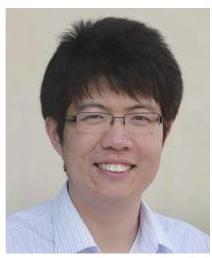
Prof. Guangbin Dong received his B.S. degree from Peking University and completed his Ph.D. degree in chemistry from Stanford University with Professor Barry M. Trost, where he was a Larry Yung Stanford Graduate fellow. In 2009, He began to research with Prof. Robert H. Grubbs at California Institute of Technology, as a Camille and Henry Dreyfus Environmental Chemistry Fellow. In 2011, he joined the department of chemistry and biochemistry at the University of Texas at Austin as an assistant professor and a CPRIT Scholar. His research interests lie at the development of powerful chemical tools for addressing questions of biological importance.
董广彬教授毕业于北京大学并获得学士学位,后在斯坦福大学师从巴里·M·特罗斯特教授完成化学博士学位,期间他是拉里·容·斯坦福研究生奖学金获得者。2009年,他作为卡米尔和亨利·德雷福斯环境化学研究员开始在加州理工学院与罗伯特·H·格鲁布斯教授开展研究。2011年,他加入德克萨斯大学奥斯汀分校化学与生物化学系担任助理教授及CPRIT学者。他的研究兴趣在于开发用于解决具有生物学重要性问题的强大化学工具。
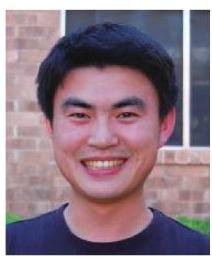
Dr. Fanyang Mo obtained his master degree in applied chemistry in 2006 at Beijing Institute of Technology under the supervision of Professor Zhiming Zhou, and then obtained his doctoral degree in organic chemistry in 2010 at Peking University under the supervision of Professor Jianbo Wang. After spending 10 months at The Scripps Research Institute under the supervision of Professor Qinghai Zhang, he joined Professor Guangbin Dong’s group at The University of Texas at Austin in 2011. Now his research interest is catalytic ketone C-H bond functionalization.
莫凡洋博士于2006年在北京理工大学在周志敏教授指导下获得应用化学硕士学位,随后于2010年在北京大学在王剑波教授指导下获得有机化学博士学位。在斯克里普斯研究所师从张清海教授工作10个月后,他于2011年加入德克萨斯大学奥斯汀分校董广彬教授课题组。他目前的研究兴趣是催化酮C-H键官能团化。
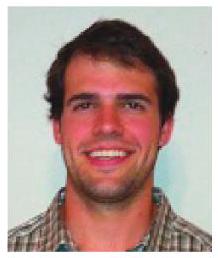
John Tabor is currently a senior in the undergraduate chemistry department at The University of Texas. He has been working in the Dong Lab since summer of 2013 and will receive his bachelors degree in the spring of 2014. He expects to enter graduate school for organic chemistry in the fall of 2014.
约翰·泰伯目前是德克萨斯大学本科化学系的一名大四学生。他自2013年夏天起一直在董实验室工作,并将于2014年春季获得学士学位。他预计2014年秋季进入研究生院攻读有机化学专业。
Abstract
摘要
This highlight review describes the recent progress in alcohol or masked alcohol-directed C-H functionalization, which enables rapid access to a large array of complex structures. Given the ubiquity of the hydroxy group in organic chemistry, these types of transformations may have significant impacts on synthetic strategy design.
本重点综述描述了醇或掩蔽醇导向的C-H官能团化的最新进展,这使得能够快速获得大量复杂结构。鉴于羟基在有机化学中的普遍性,这些类型的转化可能对合成策略设计产生重大影响。
Introduction
引言
The strategy of using coordinating and tethering moieties as directing groups (DGs) has been instrumental in enabling various $\mathrm{C} - \mathrm{H}$ activation-functionalization over the past several decades. ${}^{1}$ While the DGs are largely dominated by the nitrogen-based functional groups, ${}^{{1a},{1e},{1g}}$ including pyridines, oxazolines, amides, acetanilides, nitriles, etc., the oxygen-based DGs, however, are much less common. This is likely due to the “hard” nature of oxygen and weak coordination ability toward transition metals. ${}^{2}$ In this mini-review, we aim to highlight the recent progress in the field of $\mathrm{C} - \mathrm{H}$ functionalization that is directed by alcohols or masked alcohols.
在过去几十年中,使用配位和连接基团作为导向基团(DGs)的策略对于实现各种$\mathrm{C} - \mathrm{H}$活化官能团化起到了重要作用。${}^{1}$虽然导向基团在很大程度上由含氮官能团主导,${}^{{1a},{1e},{1g}}$包括吡啶、恶唑啉、酰胺、乙酰苯胺、腈等,但基于氧的导向基团却要少见得多。这可能是由于氧的“硬”性质以及对过渡金属的弱配位能力。${}^{2}$在本综述中,我们旨在突出由醇或掩蔽醇导向的$\mathrm{C} - \mathrm{H}$官能团化领域的最新进展。
Alcohols ${}^{3}$ are one of the most important and ubiquitous functional groups found in a diverse array of molecules ranging from small organic feedstocks to natural products and materials. ${}^{4}$ In addition, it is well established that alcohols can be reversibly transformed into many other functional groups, including alkenes, haloalkanes, aldehydes, ketones, carboxylic acids, and esters. ${}^{5}$ Often, hydroxy groups play a central role in intercon-verting organic compounds and synthetic strategy design. Thus, the development of alcohol- or masked alcohol-directed chemo and stereoselective C-H functionalization is of significant interest because it holds great potential to streamline complex molecule synthesis.
醇${}^{3}$是在从小有机原料到天然产物和材料等各种分子中发现的最重要且最普遍存在的官能团之一。${}^{4}$此外,醇可以可逆地转化为许多其他官能团,包括烯烃、卤代烷、醛、酮、羧酸和酯,这一点已得到充分证实。${}^{5}$通常,羟基在有机化合物的相互转化和合成策略设计中起着核心作用。因此,开发醇或掩蔽醇导向的化学和立体选择性C-H官能团化具有重大意义,因为它在简化复杂分子合成方面具有巨大潜力。
Based on different modes of reactivity, this review is divided into four sections: electrophilic metalation, oxidative addition, metal-carbene and -nitrene insertion, and radical processes.
基于不同的反应模式,本综述分为四个部分:亲电金属化、氧化加成、金属卡宾和氮宾插入以及自由基过程。
Electrophilic Metalation
亲电金属化
It is well known that some transition metals with higher oxidation states, such as Pd, Ru, and Rh, are capable of triggering electrophilic C-H metalation to form metal-carbon bonds, through which a variety of transformations have been achieved. ${}^{6}$ The site-selectivity of these $\mathrm{C} - \mathrm{H}$ functionalization methods can be controlled by employing alcohols and masked alcohols as DGs.
众所周知,一些具有较高氧化态的过渡金属,如钯(Pd)、钌(Ru)和铑(Rh),能够引发亲电C-H金属化反应以形成金属-碳键,通过这种方式已经实现了多种转化。${}^{6}$ 这些 $\mathrm{C} - \mathrm{H}$ 官能团化方法的位点选择性可以通过使用醇类和掩蔽醇类作为导向基团来控制。
(i) Activation of Aryl C-H Bonds. In 2010, Yu and co-workers disclosed a Pd(II)-catalyzed aromatic ortho-C-H olefination using spatially remote unprotected alcohols as the directing groups. ${}^{7}$ Their initial attempts to perform C-H palladation with a fully depronated alcohol (via a [Pd ${}^{\mathrm{{II}}}$ -OR] species) turned out to be unfruitful. However, they then envisioned that a different coordination mode with a neutral alcohol could be more effective (Scheme 1). ${}^{8}$ Indeed, they found the combination of ${\mathrm{C}}_{6}{\mathrm{\;F}}_{6}$ as solvent, ${\mathrm{{Li}}}_{2}{\mathrm{{CO}}}_{3}$ as a base, and AgOAc as an oxidant was promising, but the yield of olefinated product 3 was low (22%). Later, they discovered mono-N-protected amino acid ligands substantially influenced the reaction and $\left( +\right)$ -menthyl $\left( {{\mathrm{O}}_{2}\mathrm{C}}\right)$ -Leu-OH was most effective, providing benzopyran 4 in ${88}\%$ yield with an increased amount of AgOAc. The benzopyran product comes from the initial C-H olefination product 3 that undergoes an intramolecular Pd(II)- catalyzed oxidative cyclization. The substrate scope was expanded to arenes bearing various functional groups, such as methyl, methoxy groups, and halogens (Scheme 2). A number of other electron-deficient olefins were also compatible. Mechanistically, an anti-addition mode was concluded for the oxidative cyclization step after C-H olefination.
(i) 芳基C-H键的活化。2010年,余课题组报道了一种钯(II)催化的芳环邻位C-H烯基化反应,该反应使用空间上远程的未保护醇类作为导向基团。${}^{7}$ 他们最初尝试用完全去质子化的醇(通过 [Pd ${}^{\mathrm{{II}}}$ -OR] 物种)进行C-H钯化反应,但未成功。然而,他们随后设想与中性醇的不同配位模式可能更有效(方案1)。${}^{8}$ 事实上,他们发现 ${\mathrm{C}}_{6}{\mathrm{\;F}}_{6}$ 作为溶剂、${\mathrm{{Li}}}_{2}{\mathrm{{CO}}}_{3}$ 作为碱以及醋酸银(AgOAc)作为氧化剂的组合很有前景,但烯基化产物3的产率较低(22%)。后来,他们发现单-N-保护氨基酸配体对反应有很大影响,$\left( +\right)$ -薄荷基 $\left( {{\mathrm{O}}_{2}\mathrm{C}}\right)$ -亮氨酸($\left( +\right)$ -menthyl $\left( {{\mathrm{O}}_{2}\mathrm{C}}\right)$ -Leu-OH)最有效,在增加醋酸银用量的情况下,以 ${88}\%$ 的产率得到苯并吡喃4。苯并吡喃产物来自最初的C-H烯基化产物3,它经历了分子内钯(II)催化的氧化环化反应。底物范围扩展到带有各种官能团的芳烃,如甲基、甲氧基和卤素(方案2)。许多其他缺电子烯烃也与之兼容。从机理上讲,C-H烯基化反应后的氧化环化步骤得出的是反式加成模式。
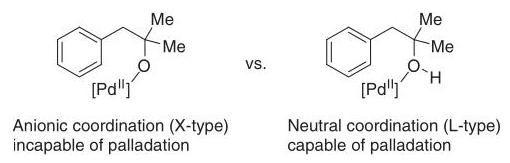
Scheme 1. Two coordination modes.
方案1. 两种配位模式。
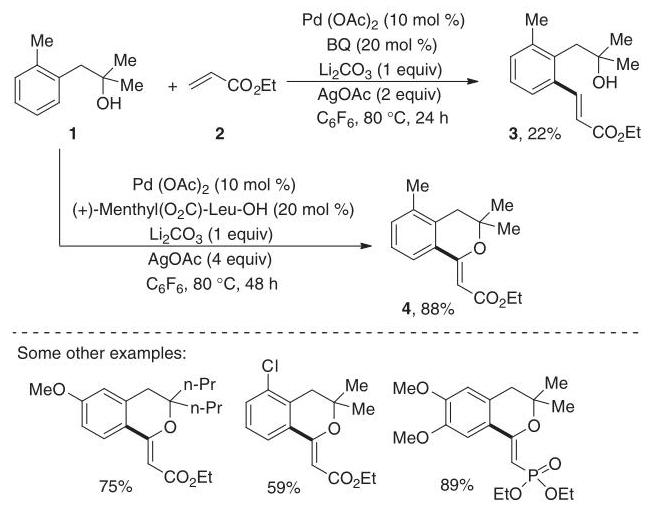
Scheme 2. Pd-Catalyzed hydroxy-directed olefination.
方案2. 钯催化的羟基导向的烯基化反应。
When using simple olefins, such as styrenes and aliphatic alkenes, the reaction only gave the olefinated products without further cyclization, presumably because the oxidative 1,4- addition is less facile when the olefin is less electrophilic. Thus, only 2 equiv of AgOAc was needed in these cases. Primary and secondary alcohol substrates were also effective, albeit giving lower yields due to their lability under the reaction conditions (Scheme 3).
当使用简单烯烃,如苯乙烯和脂肪族烯烃时,反应只得到烯基化产物,没有进一步环化,可能是因为当烯烃的亲电性较低时,氧化1,4-加成不太容易发生。因此,在这些情况下只需要2当量的醋酸银。伯醇和仲醇底物也有效,尽管由于它们在反应条件下不稳定,产率较低(方案3)。
In subsequent work, Yu and co-workers reported a dihy-drobenzofuran synthesis through a Pd(II)-catalyzed intramolecular oxidative C-O bond formation reaction, which was directed by a proximate hydroxy group. ${}^{9}$ A number of oxidants were examined, and $\mathrm{{PhI}}{\left( \mathrm{{OAc}}\right) }_{2}$ gave the best result. A variety of tertiary alcohols were cyclized to give the corresponding dihydrobenzofurans in good to excellent yields. The reaction tolerated both electron-donating and -withdrawing groups on the aryl rings. Secondary alcohols were also tested but gave lower yields because of the competitive substrate decomposition under the reaction conditions. This methodology can also be applied in spirocyclic dihydrobenzofuran syntheses (Scheme 4).
在后续工作中,余课题组报道了通过钯(II)催化的分子内氧化C-O键形成反应合成二氢苯并呋喃,该反应由邻近的羟基导向。${}^{9}$ 研究了多种氧化剂,$\mathrm{{PhI}}{\left( \mathrm{{OAc}}\right) }_{2}$ 给出了最佳结果。多种叔醇被环化,以良好到优异的产率得到相应的二氢苯并呋喃。该反应容忍芳环上的供电子和吸电子基团。仲醇也进行了测试,但由于在反应条件下底物发生竞争性分解,产率较低。这种方法也可应用于螺环二氢苯并呋喃的合成(方案4)。
A plausible catalytic cycle appears to involve electrophilic $\mathrm{C} - \mathrm{H}$ palladation followed by oxidation of the $\mathrm{{Pd}}\left( \mathrm{{II}}\right)$ species to a
一个合理的催化循环似乎涉及亲电$\mathrm{C} - \mathrm{H}$钯化,随后将$\mathrm{{Pd}}\left( \mathrm{{II}}\right)$物种氧化为a
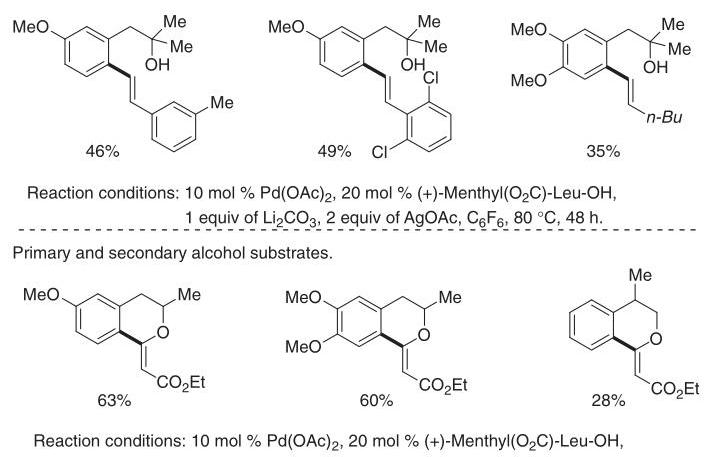
Scheme 3. Reactions with regular olefins, and primary and secondary alcohol-directed reactions. higher oxidation state, from which reductive elimination takes place to form the C-O bond (Scheme 5).
方案3. 与普通烯烃的反应以及伯醇和仲醇导向的反应。
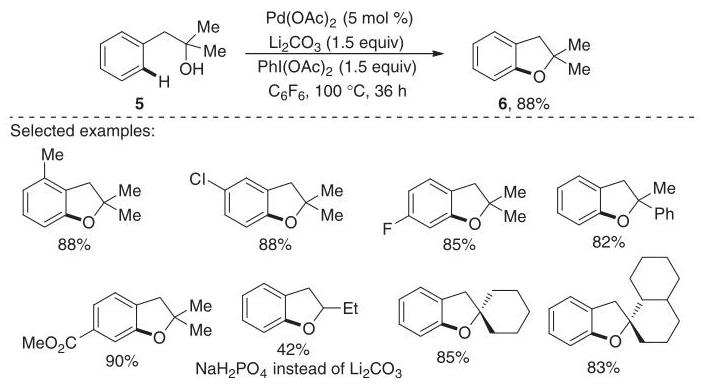
Scheme 4. Pd-Catalyzed hydroxy-directed C-O cyclization.
方案4. 钯催化的羟基导向的C-O环化反应。
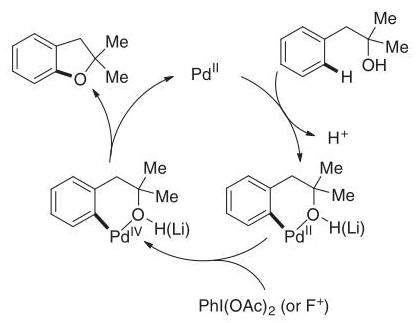
Scheme 5. Proposed catalytic cycle for the Pd-catalyzed hydroxy-directed C-O cyclization.
方案5. 钯催化的羟基导向的C-O环化反应的拟议催化循环。
(ii) Activation of Allylic C-H Bonds. In 2007 and 2009, the White group reported palladium(II)-sulfoxide-catalyzed intramolecular allylic C-H aminations for the preparation of syn-1,2- and -1,3-amino alcohol motifs, respectively. ${}^{10}$ The homoallylic and bishomoallylic oxygen substituents were masked as carbamates, which also serve as nitrogen nucleophiles to facilitate 1,2 or 1,3 C-H amination (Scheme 6). In these reactions, phenylbenzoquinone (PhBQ) performed better than benzoquinone (BQ) as an oxidant, and bissulfoxide (BisSO) was the optimal ligand. White and co-workers further utilized this methodology on β-lactam-containing substrates to generate pharmacologically interesting oxazolidinones and oxazina-nones. ${}^{11}$
(ii) 烯丙基碳氢键的活化。2007年和2009年,怀特团队分别报道了钯(II)-亚砜催化的分子内烯丙基碳氢键胺化反应,用于制备顺式1,2-和-1,3-氨基醇结构单元。${}^{10}$ 高烯丙基和双高烯丙基氧取代基被掩蔽为氨基甲酸酯,其也作为亲核氮试剂促进1,2或1,3碳氢键胺化反应(方案6)。在这些反应中,苯基苯醌(PhBQ)作为氧化剂比苯醌(BQ)表现更好,双亚砜(BisSO)是最佳配体。怀特及其同事进一步将该方法应用于含β-内酰胺的底物,以生成具有药理活性的恶唑烷酮和恶嗪酮。${}^{11}$
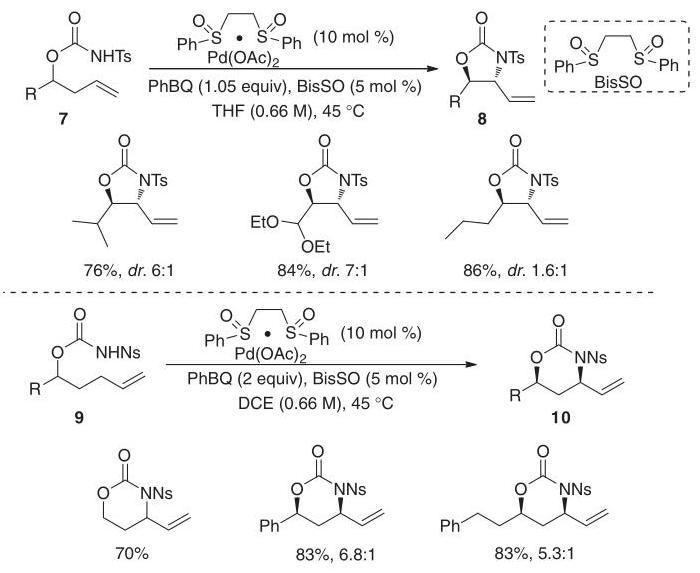
Scheme 6. Pd-Catalyzed intramolecular C-H allylic amination.
方案6. 钯催化的分子内C-H烯丙基胺化反应。
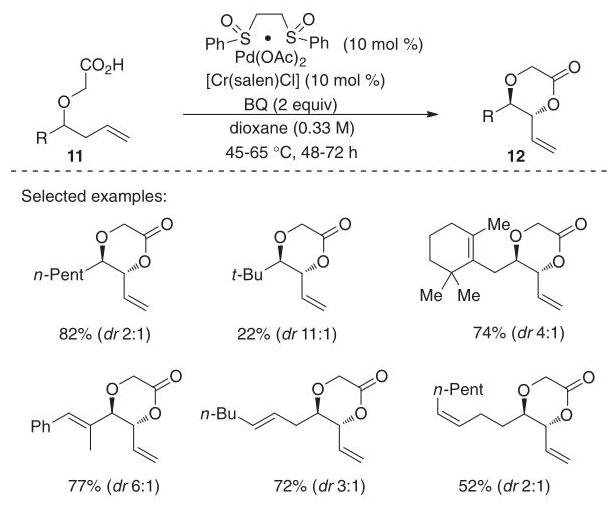
Scheme 7. Pd-Catalyzed intramolecular C-H oxidation.
方案7. 钯催化的分子内C-H氧化反应。
The same group also disclosed a palladium(II)-sulfoxide-catalyzed intramolecular allylic C-H oxidation to form anti-1,4- dioxan-2-ones from homoallylic oxygenates. ${}^{12}$ While homoal-lylic alcohol derivatives were not suitable for the intermolecular allylic $\mathrm{C} - \mathrm{H}$ oxidation, ${}^{13}$ by being tethered with a carboxylic acid substrates 11 can undergo the desired allylic $\mathrm{C} - \mathrm{O}$ bond formation (Scheme 7). It was found that the steric factor of the substrates affected the reactivity and selectivity of the reaction, as the substrates bearing a bulky substituent gave poorer yields but excellent diastereoselectivity (trans products). This intramolecular allylic C-H oxidation reaction gave complete chemo-selectivity for the terminal olefin over tetra-, tri-, and disubstituted olefins. A few synthetic applications were also achieved, including polyhydroxy motifs and densely functionalized pyrans.
同一研究小组还报道了一种由钯(II)-亚砜催化的分子内烯丙基C-H氧化反应,该反应能从高烯丙基含氧化合物中生成反式-1,4-二氧六环-2-酮。${}^{12}$ 虽然高烯丙基醇衍生物不适合分子间烯丙基 $\mathrm{C} - \mathrm{H}$ 氧化反应,${}^{13}$ 但通过与羧酸底物相连,化合物11能够发生所需的烯丙基 $\mathrm{C} - \mathrm{O}$ 键形成反应(方案7)。研究发现,底物的空间因素会影响反应的活性和选择性,因为带有庞大取代基的底物产率较低,但非对映选择性优异(反式产物)。这种分子内烯丙基C-H氧化反应对末端烯烃相对于四取代、三取代和二取代烯烃具有完全的化学选择性。该反应还实现了一些合成应用,包括多羟基结构和高度官能团化的吡喃。
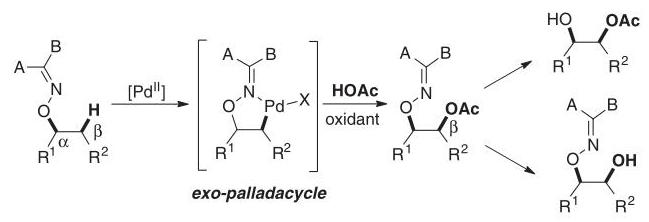
Scheme 8. The exo-palladation strategy for 1,2-diols.
方案8. 1,2 - 二醇的外钯化策略。
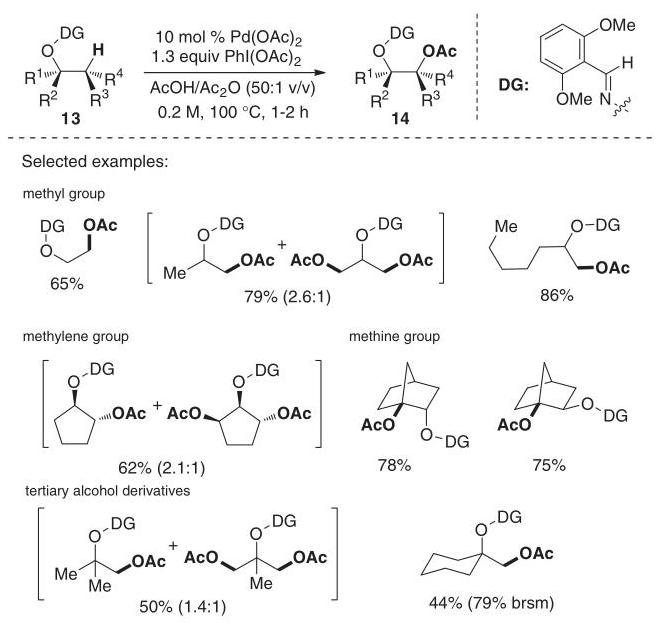
Scheme 9. Pd-Catalyzed oxime-directed C-H oxidation.
方案9. 钯催化肟导向的C-H氧化反应。
(iii) Activation of Aliphatic C-H Bonds. Compared with aromatic and allylic C-H bonds, aliphatic C-H bonds are known to be more challenging to activate. ${}^{{1c},{14}}$ Our group has been interested in synthesizing 1,2-diols from monoalcohols or masked alcohols via a catalytic activation of unactivated ${\mathrm{{sp}}}^{3}\mathrm{C} - \mathrm{H}$ bonds. ${}^{15}$ We envisioned that a five-membered exo-palladacycle would be generated via metalation of the $\beta - \mathrm{C} - \mathrm{H}$ bond, and subsequent oxidation should lead to the desired 1,2-diol motif (Scheme 8). A well-designed oxime was utilized as both an alcohol surrogate and a DG for this transformation.
(iii) 脂肪族碳氢键的活化。与芳香族和烯丙基碳氢键相比,脂肪族碳氢键的活化更具挑战性。${}^{{1c},{14}}$ 我们团队一直致力于通过催化活化未活化的${\mathrm{{sp}}}^{3}\mathrm{C} - \mathrm{H}$键,从一元醇或掩蔽醇合成1,2 - 二醇。${}^{15}$ 我们设想通过$\beta - \mathrm{C} - \mathrm{H}$键的金属化生成一个五元外环钯环,随后的氧化反应应能得到所需的1,2 - 二醇结构单元(方案8)。在该转化过程中,精心设计的肟既用作醇替代物,又用作导向基团。
This reaction worked smoothly with the substrates derived from primary, secondary, and tertiary alcohols affording the corresponding vicinal diols in good yields (Scheme 9). In general, the secondary alcohol-derived substrates have higher reactivity than the tertiary ones. Selective oxidation of the methyl vs. methylene $\mathrm{C} - \mathrm{H}$ bonds is observed; nevertheless, in the absence of methyl groups at the $\beta$ -positions, the $\mathrm{C} - \mathrm{H}$ activation can also happen with methylene groups. It was unexpected to observe that for both the endo- and exo-norborneol-derived substrates the $\mathrm{C} - \mathrm{H}$ functionalization occurred exclusively at the methine tertiary $\mathrm{C} - \mathrm{H}$ bonds, which is likely due to the fact that the bridgehead position is less hindered but more electron-rich thus favoring electrophilic metalation.
该反应与由伯醇、仲醇和叔醇衍生的底物顺利进行,以良好的产率得到相应的邻二醇(方案9)。一般来说,由仲醇衍生的底物比叔醇衍生的底物具有更高的反应活性。观察到甲基与亚甲基$\mathrm{C} - \mathrm{H}$键的选择性氧化;然而,在$\beta$位没有甲基的情况下,亚甲基也会发生$\mathrm{C} - \mathrm{H}$活化。令人意外的是,对于内型和外型降冰片醇衍生的底物,$\mathrm{C} - \mathrm{H}$官能化仅发生在次甲基叔$\mathrm{C} - \mathrm{H}$键上,这可能是由于桥头位置位阻较小但电子云密度较高,因此有利于亲电金属化。
Interestingly, when menthol-derived oxime 15 was used as the substrate, an unusual C-H activation-triggered skeleton rearrangement was discovered leading to a five-membered ring product with 1,3-diol moieties though the exact mechanism is unclear (Scheme 10).
有趣的是,当使用薄荷醇衍生的肟15作为底物时,发现了一种不寻常的由C-H活化引发的骨架重排,生成了一种带有1,3 - 二醇部分的五元环产物,尽管确切机制尚不清楚(方案10)。
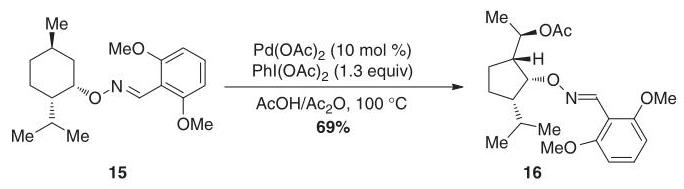
Scheme 10. An unusual oxidative rearrangement.
方案10. 一种不寻常的氧化重排反应。

Scheme 11. Orthogonal protecting groups.
方案11. 正交保护基。

Scheme 12. Ir-Catalyzed formal hydroxy-directed C-H func-tionalization.
方案12. 铱催化的形式上羟基导向的C-H官能化反应。
The diol moieties in these products are chemically differentiated. By using orthogonal reaction conditions, the DG (oxime) and the acetate can be selectively converted to the corresponding alcohols in excellent yields (Scheme 11).
这些产物中的二醇部分在化学性质上有所不同。通过使用正交反应条件,导向基团(肟)和乙酸酯可以以优异的产率选择性地转化为相应的醇(方案11)。
Oxidative Addition
氧化加成
Oxidative addition of transition metals into $\mathrm{C} - \mathrm{H}$ bonds is another common mode of activation for $\mathrm{C} - \mathrm{H}$ functionalization; $\mathrm{{Rh}}\left( \mathrm{I}\right) ,\mathrm{{Ru}}\left( 0\right)$ , and $\mathrm{{Ir}}\left( \mathrm{I}\right)$ are often employed as catalysts for these transformations. ${}^{6}$ Hartwig and co-workers have made significant contributions to this field. They took advantage of two Ir-catalyzed tandem processes, namely O-H silylation (from alcohols) or hydrosilylation (from ketones and aldehydes) and proximate C-H silylation enabling the formal hydroxy-directed C-H functionalization (Scheme 12).
过渡金属对$\mathrm{C} - \mathrm{H}$键的氧化加成是$\mathrm{C} - \mathrm{H}$官能化的另一种常见活化模式;$\mathrm{{Rh}}\left( \mathrm{I}\right) ,\mathrm{{Ru}}\left( 0\right)$和$\mathrm{{Ir}}\left( \mathrm{I}\right)$常被用作这些转化的催化剂。${}^{6}$哈特维希及其同事在该领域做出了重大贡献。他们利用了两种铱催化的串联过程,即O-H硅烷化(来自醇)或硅氢化(来自酮和醛)以及邻近的C-H硅烷化,实现了形式上羟基导向的C-H官能化(方案12)。
This strategy was first demonstrated in the aromatic ortho-C-H functionalization (Scheme 13). ${}^{16}$ Both benzyl alcohols and aromatic ketones and aldehydes are suitable substrates for this transformation. A (hydrido)silyl ether was generated as an intermediate through the Ir-catalyzed O-H silylation of the alcohols or hydrosilylation of the carbonyl compounds. Switching to a slightly different Ir catalyst, the silyl ether intermediate then underwent a dehydrogenative cyclization at ${80} - {100}{}^{ \circ }\mathrm{C}$ with norbornene (nbe) as a hydrogen acceptor providing benzoxa-siloles in good yields.
该策略首先在芳环邻位C-H官能化中得到证明(方案13)。${}^{16}$苄醇以及芳族酮和醛都是这种转化的合适底物。通过醇的铱催化O-H硅烷化或羰基化合物的硅氢化生成(氢硅基)醚中间体。切换到略有不同的铱催化剂后,硅醚中间体然后在${80} - {100}{}^{ \circ }\mathrm{C}$处与降冰片烯(nbe)作为氢受体进行脱氢环化反应,以良好的产率提供苯并氧杂硅杂环戊二烯。
The reaction tolerated a broad scope of functional groups, including alkyl, halogen, boronate, silyl ether, and amine, except those sensitive to silane-mediated reductions, such as the nitro group. Notably, this ortho-silylation exhibited high regioselec-tivity for unsymmetrical substrates bearing a meta-substituent. Further functionalization-derivatization of the benzoxasilole products was demonstrated through a Tamao-Fleming oxidation ${}^{17}$ and a Hiyama cross-coupling reaction, ${}^{18}$ in which the C-Si bond can be transformed into new C-O and C-C bonds respectively (Scheme 14).
该反应耐受广泛的官能团,包括烷基、卤素、硼酸酯、硅醚和胺,但对硅烷介导的还原敏感的官能团除外,如硝基。值得注意的是,这种邻位硅烷化对带有间位取代基的不对称底物表现出高区域选择性。通过玉尾-弗莱明氧化反应${}^{17}$和日山交叉偶联反应${}^{18}$证明了苯并氧杂硅杂环戊二烯产物的进一步官能化衍生化,其中C-Si键可分别转化为新的C-O键和C-C键(方案14)。
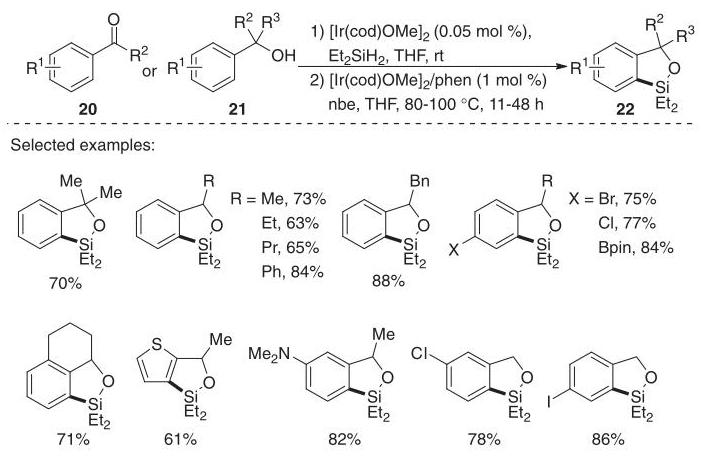
Scheme 13. Ir-Catalyzed intramolecular C-H silylation.
方案13. 铱催化的分子内C-H硅烷化。
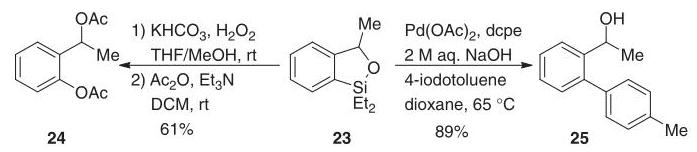
Scheme 14. Functionalization-derivatization of benzoxasi-loles.
方案14. 苯并氧杂硅杂环戊二烯的官能化衍生化。
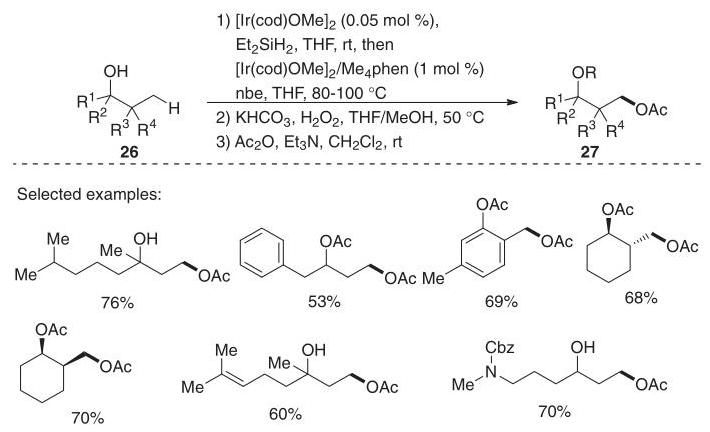
Scheme 15. Ir-Catalyzed formal hydroxy-direct ${\mathrm{{sp}}}^{3}\mathrm{C} - \mathrm{H}$ activation.
方案15. 铱催化的形式上羟基导向的${\mathrm{{sp}}}^{3}\mathrm{C} - \mathrm{H}$活化。
In 2012, Hartwig and co-workers further expanded the reaction scope to aliphatic primary C-H bonds. ${}^{19}$ They found the ligands play a critical role in the catalyst reactivity. While 1,10- phenanthroline, an efficient ligand for the aromatic substrates, ${}^{16}$ only gave moderate reactivity for aliphatic cases, the more electron-rich 3,4,7,8-tetramethyl-1,10-phenanthroline $\left( {{\mathrm{{Me}}}_{4}\text{ phen }}\right)$ was found superior (Scheme 15). The reaction exhibited a broad substrate scope and many functional groups were tolerated under the standard reaction conditions, including halogens, silyl ethers, benzyl groups, acetals, and carboxylic esters. While some carbonyl moieties, such as methyl esters, ketones, and carba-mates were not compatible with the Ir-catalyzed hydrosilylation reaction, the use of a ruthenium catalyst $\left\lbrack {\mathrm{{Ru}}{\left( {\mathrm{{PPh}}}_{3}\right) }_{2}{\mathrm{{Cl}}}_{2}}\right\rbrack$ instead for the hydrosilylation circumvented this problem. ${}^{20}$ Moreover, these carbonyl functional groups were compatible with the C-H silylation and subsequent Tamao-Fleming oxidation. The complete site-selectivity can be attributed to the powerful directing ability of the (hydrido)silyl group.
2012年,哈特维希及其同事进一步将反应范围扩展到脂肪族伯C-H键。${}^{19}$他们发现配体在催化剂反应性中起关键作用。虽然1,10-菲咯啉是芳族底物的有效配体,${}^{16}$但对于脂肪族情况仅具有中等反应性,发现电子更丰富的3,4,7,8-四甲基-1,10-菲咯啉$\left( {{\mathrm{{Me}}}_{4}\text{ phen }}\right)$更具优势(方案15)该反应表现出广泛的底物范围,在标准反应条件下耐受许多官能团,包括卤素、硅醚、苄基、缩醛和羧酸酯。虽然一些羰基部分,如甲酯、酮和氨基甲酸酯与铱催化的硅氢化反应不兼容,但使用钌催化剂$\left\lbrack {\mathrm{{Ru}}{\left( {\mathrm{{PPh}}}_{3}\right) }_{2}{\mathrm{{Cl}}}_{2}}\right\rbrack$进行硅氢化反应避免了这个问题。${}^{20}$此外,这些羰基官能团与C-H硅烷化及随后的玉尾-弗莱明氧化反应兼容。完全的位点选择性可归因于(氢硅基)基团的强大导向能力。
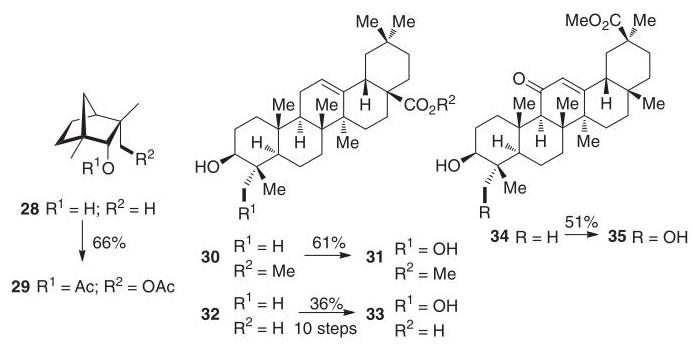
Scheme 16. Directed aliphatic C-H functionalization of natural products.
方案16. 天然产物的导向脂肪族C-H官能化。
In addition, this methodology has also been demonstrated in functionalization of complex natural products. For example, 1,3- diol moiety can be efficiently installed from monoalcohols in three steps without the need to purify any intermediates in spite of the complexity of these substrates (Scheme 16). ${}^{21}$
此外,该方法也已在复杂天然产物的官能化中得到证明。例如,尽管这些底物很复杂,但可以从一元醇分三步有效地安装1,3-二醇部分,而无需纯化任何中间体(方案16)。${}^{21}$
Metal-Carbene and -Nitrene Insertion
金属卡宾和氮宾插入反应
Metal-mediated carbene or -nitrene insertions into saturated $\mathrm{C} - \mathrm{H}$ bonds are another powerful approach for $\mathrm{C} - \mathrm{H}$ function-alization. ${}^{22}$ Intramolecular metal-carbenoid insertion into $\mathrm{C} - \mathrm{H}$ bonds generally gives five- or six-membered ring products. ${}^{23}$ When the carbene or nitrene precursors are tethered with alcohols, useful synthetic building blocks can be efficiently constructed. For example, Doyle and co-workers reported chiral rhodium(II) carboxamidate-catalyzed intramolecular C-H insertion reactions with enantiomerically pure 2-substituted cyclohexyl diazoacetate 36, which were derivatized from an alcohol (Scheme 17). ${}^{24}$ By using different chiral catalysts (a matched vs. mismatched situation), excellent site-selectivity was achieved with complete diastereocontrol. They further expanded the substrate scope to steroidal diazoacetates 39, in which the five-membered ring product 40 is predominantly formed over the four-membered ring $\beta$ -lactone product by using the chiral $\left\lbrack {{\mathrm{{Rh}}}_{2}{\left( 5R\text{ -MEPY }\right) }_{4}}\right\rbrack$ catalyst. ${}^{25}$
金属介导的卡宾或氮宾插入饱和的$\mathrm{C} - \mathrm{H}$键是实现$\mathrm{C} - \mathrm{H}$官能团化的另一种有效方法。${}^{22}$分子内金属卡宾插入$\mathrm{C} - \mathrm{H}$键通常生成五元或六元环产物。${}^{23}$当卡宾或氮宾前体与醇相连时,可以高效构建有用的合成砌块。例如,Doyle及其同事报道了手性铑(II)羧酰胺催化的分子内C-H插入反应,该反应使用对映体纯的2-取代环己基重氮乙酸酯36,其由醇衍生而来(方案17)。${}^{24}$通过使用不同的手性催化剂(匹配与不匹配的情况),实现了优异的位点选择性和完全的非对映体控制。他们进一步将底物范围扩展到甾体重氮乙酸酯39,通过使用手性$\left\lbrack {{\mathrm{{Rh}}}_{2}{\left( 5R\text{ -MEPY }\right) }_{4}}\right\rbrack$催化剂,五元环产物40比四元环$\beta$ -内酯产物更易形成。${}^{25}$
An efficient method of directed metal-nitrenoid insertion into aliphatic C-H bonds was reported by Du Bois and coworkers. ${}^{26}$ They first demonstrated that sulfamates can undergo a Rh-catalyzed nitrenoid insertion to give six-membered ring products, which can be viewed as a 1,3-amino alcohol equivalent (Scheme 18). ${}^{27}$ The site-selectivity for the $\gamma - \mathrm{C} - \mathrm{H}$ bond was excellent, and the authors rationalized that the strong bias for the six-membered ring formation vs. five-membered formation was due to the elongated S-O and S-N bonds and the obtuse N-S-O angle, which are quite similar with the metrical parameters of the heterocycle. Nevertheless, it is also possible to afford the five-membered ring products when obviating the six-membered ring formation pathway.
Du Bois及其同事报道了一种将金属氮宾定向插入脂肪族C-H键的有效方法。${}^{26}$他们首先证明了氨基磺酸酯可以发生铑催化的氮宾插入反应,生成六元环产物,该产物可被视为1,3-氨基醇等价物(方案18)。${}^{27}$对$\gamma - \mathrm{C} - \mathrm{H}$键的位点选择性非常好,作者认为六元环比五元环更易形成的强烈倾向是由于S-O和S-N键的伸长以及钝角的N-S-O角,这与杂环的结构参数非常相似。然而,当避免六元环形成途径时,也有可能得到五元环产物。
In addition, the Rh(II)-catalyzed oxidative cyclization of carbamates was successfully achieved to afford the corresponding oxazolidinones in good to excellent yields (Scheme 18). The substrates with more conformational constraint generally afforded better yields. Compared with $\left\lceil {{\mathrm{{Rh}}}_{2}{\left( \mathrm{{OAc}}\right) }_{4}}\right\rceil$ , the readily prepared triphenylacetate (tpa) complex, ${\left\lbrack {\mathrm{{Rh}}}_{2}{\left( \mathrm{{tpa}}\right) }_{4}\right\rbrack }^{28}$ was more effective due to its greater resistance under oxidative conditions.
此外,成功实现了铑(II)催化的氨基甲酸酯氧化环化反应,以良好至优异的产率得到相应的恶唑烷酮(方案18)。具有更多构象限制的底物通常产率更高。与$\left\lceil {{\mathrm{{Rh}}}_{2}{\left( \mathrm{{OAc}}\right) }_{4}}\right\rceil$相比,易于制备的三苯基乙酸酯(tpa)配合物${\left\lbrack {\mathrm{{Rh}}}_{2}{\left( \mathrm{{tpa}}\right) }_{4}\right\rbrack }^{28}$由于在氧化条件下具有更高的稳定性而更有效。
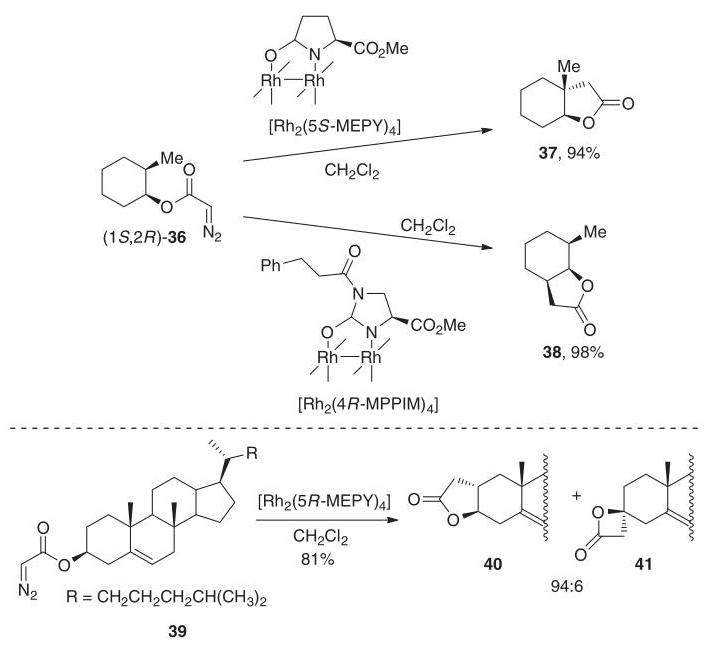
Scheme 17. Rh(II)-Catalyzed intramolecular C-H carbenoid insertion reactions.
方案17. 铑(II)催化的分子内C-H卡宾插入反应。
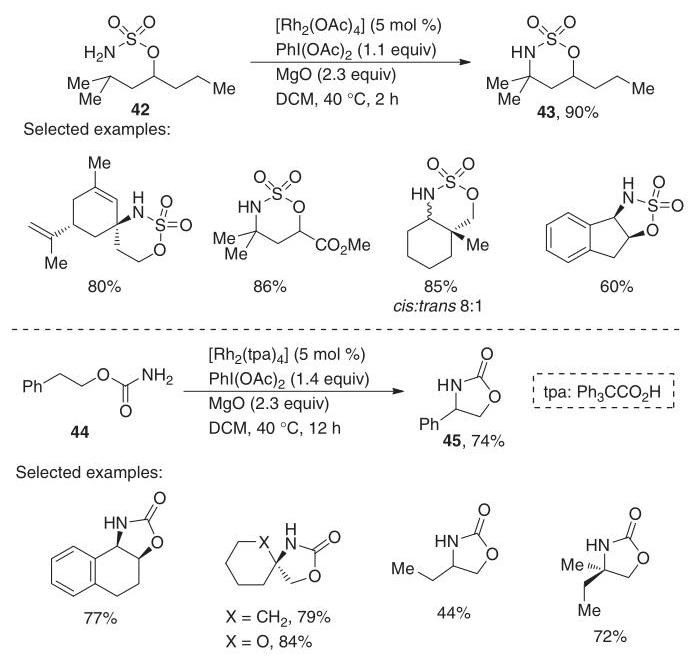
Scheme 18. Rh-Catalyzed intramolecular nitrenoid-mediated C-H aminations.
方案18. 铑催化的分子内氮宾介导的C-H胺化反应。
The synthetic utilities of oxathiazinanes was further explored (Scheme 19). The six-membered sulfamates can be hydrolytically opened by various nucleophiles under mild conditions (as exemplified by morpholine and acetate). They can also be converted to $\beta$ -amino acids in a stereospecific manner. Furthermore, these methodologies also found broad applications in total synthesis of complex natural products. ${}^{{22e},{29}}$
进一步探索了氧杂噻嗪烷的合成应用(方案19)。六元氨基磺酸酯可以在温和条件下被各种亲核试剂水解开环(以吗啉和乙酸盐为例)。它们还可以以立体特异性方式转化为$\beta$ -氨基酸。此外,这些方法在复杂天然产物的全合成中也有广泛应用。${}^{{22e},{29}}$
Radical Processes
自由基反应历程
As early as in 1971, Breslow and Scholl reported a selective oxidation of unactivated methylene groups by controlling the substrate-reagent orientation (Scheme 20). ${}^{30}$ An alcohol substrate was tethered with a carbon chain containing a carboxylic acid moiety, which can recognize and “grasp” the reagent via hydrogen bonding. Using this approach, selective remote dehydrogenation through radical abstractions at specific positions of the substrate was achieved.
早在1971年,Breslow和Scholl就报道了通过控制底物 - 试剂的取向对未活化亚甲基进行选择性氧化(方案20)。${}^{30}$ 醇底物通过含羧酸部分的碳链连接,该羧酸部分可通过氢键识别并“抓住”试剂。使用这种方法,实现了通过在底物特定位置的自由基提取进行选择性远程脱氢。
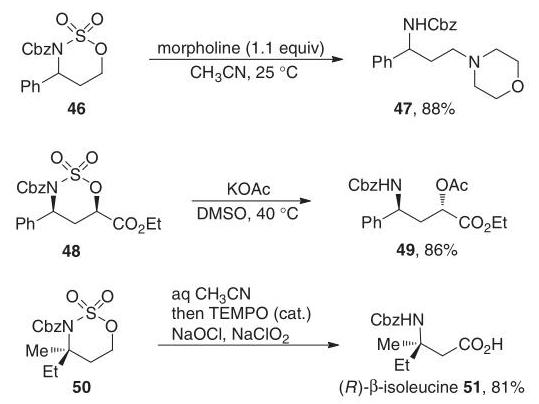
Scheme 19. Synthetic applications of oxathiazinanes.
方案19. 恶唑烷的合成应用。
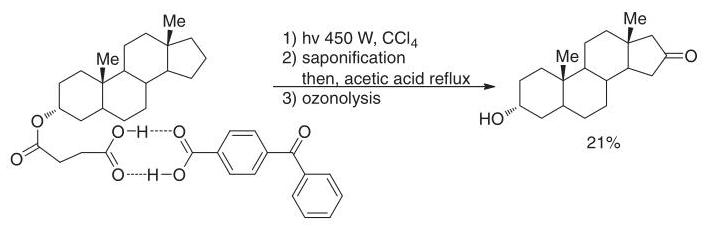
Scheme 20. Selective oxidation through substrate-reagent orientation.
方案20. 通过底物 - 试剂取向进行的选择性氧化。
In 2008, inspired by the Hofmann-Löffler-Freytag (HLF) reaction, ${}^{31}$ the Baran group disclosed an efficient five-step two-pot sequence for converting monoalcohols to 1,3-diols via radical-abstraction. ${}^{32}$ The alcohol was first transformed to a trifluoromethyl carbamate serving as both a directing group and radical precursor. After the initial C-H abstraction and atom transfer, a cyclic carbonate was produced, which can undergo further hydrolysis to give the 1,3-diol product (Scheme 21). This reaction works efficiently for benzylic and tertiary $\mathrm{C} - \mathrm{H}$ bonds. Further utilization of this method was elegantly demonstrated in a number of natural product syntheses. ${}^{33}$
2008年,受霍夫曼 - 勒夫勒 - 弗赖塔格(HLF)反应的启发,${}^{31}$ Baran课题组公开了一种高效的五步两锅法序列,通过自由基提取将一元醇转化为1,3 - 二醇。${}^{32}$ 醇首先转化为三氟甲基氨基甲酸酯,其作为导向基团和自由基前体。在初始的C - H提取和原子转移后,生成环状碳酸酯,其可进一步水解得到1,3 - 二醇产物(方案21)。该反应对苄基和叔 $\mathrm{C} - \mathrm{H}$ 键有效。该方法在许多天然产物合成中得到了巧妙的应用。${}^{33}$
In 2012, Baran and co-workers developed another guided radical protocol for alkane dehydrogenation using an $o$ -tosyl triazene $\left( {\mathrm{{Tz}}}^{0}\right)$ moiety. ${}^{34}$ This well-designed,“portable desatur-ase”-like group $\left( {\mathrm{{Tz}}}^{0}\right)$ is easy to install on alcohols and amines, and can serve as a masked aryl radical to enable remote desaturation leaving behind a synthetically useful tosyl group (Scheme 22). In general, the desaturation reaction takes place via 1,7-H-abstraction when a tertiary carbon center is at the $\gamma$ - position to the alcohol or amine. Further experimental results indicate that TEMPO plays a critical role in radical generation and carbocation intermediate formation. A plausible reaction mechanism was proposed (Scheme 23).
2012年,Baran及其同事开发了另一种使用 $o$ - 甲苯磺酰基三氮烯 $\left( {\mathrm{{Tz}}}^{0}\right)$ 部分进行烷烃脱氢的导向自由基协议。${}^{34}$ 这个精心设计的、类似“便携式去饱和酶”的基团 $\left( {\mathrm{{Tz}}}^{0}\right)$ 易于安装在醇和胺上,并且可以作为掩蔽的芳基自由基实现远程去饱和,同时留下一个具有合成用途的甲苯磺酰基(方案22)。一般来说,当叔碳中心位于醇或胺的 $\gamma$ 位时,去饱和反应通过1,7 - H提取发生。进一步的实验结果表明TEMPO在自由基生成和碳正离子中间体形成中起关键作用。提出了一个合理的反应机理(方案23)。
This methodology was successfully applied to modify a number of natural products. For example, desaturation of an eudesmane derivative 61 afforded alkene products 62 and 63 with a ratio of 2:1. When triterpene derivative 64 was subjected to these reaction conditions, diene 65 was obtained in 47% yield as the major product (Scheme 24).
该方法已成功应用于修饰多种天然产物。例如,桉烷衍生物61的去饱和反应得到烯烃产物62和63,比例为2:1。当三萜衍生物64在这些反应条件下进行反应时,以47%的产率得到二烯65作为主要产物(方案24)。
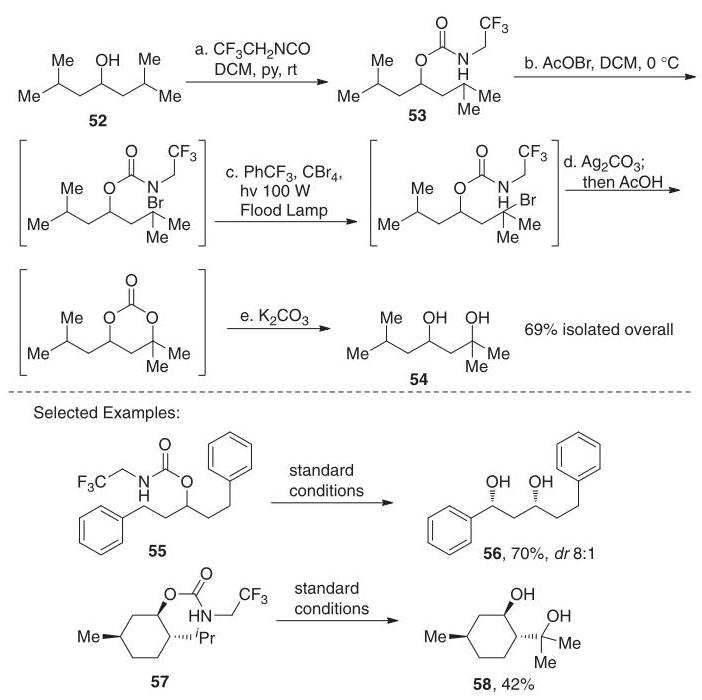
Scheme 21. Synthesis of 1,3-diols from monoalcohols.
方案21. 由一元醇合成1,3 - 二醇。
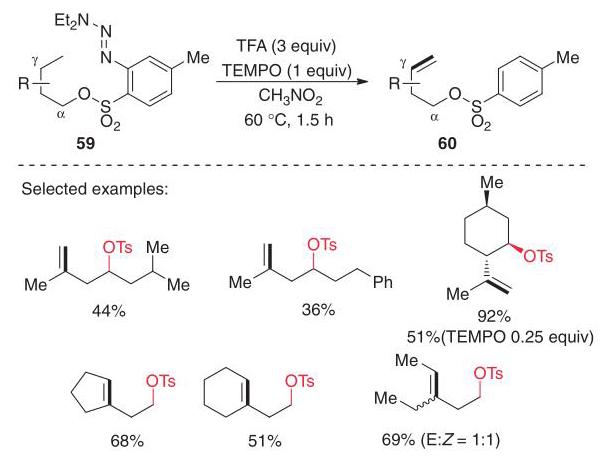
Scheme 22. Guided desaturation of unactivated aliphatic compounds.
方案22. 未活化脂肪族化合物的导向去饱和。
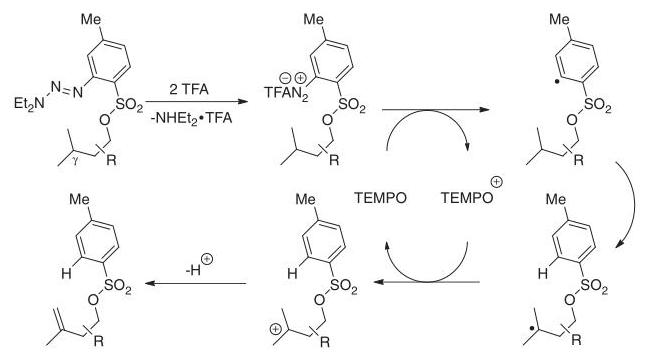
Scheme 23. Proposed mechanism.
方案23. 提出的机理。
Dioxirane-mediated C-H oxidation has found important applications in organic synthesis. ${}^{35}$ In 2009, the Inoue group reported a hydroxylation of tertiary $\mathrm{C} - \mathrm{H}$ bonds directed by a removable trifluoromethyl dioxirane moiety that was derived from a free alcohol. This method allows construction of 1,3- diaxial diols in carbocyclic matrices. ${}^{36}$ The introduction of the trifluoroketone moiety from an alcohol required three steps (Scheme 25).
二氧杂环丙烷介导的C - H氧化在有机合成中已发现重要应用。${}^{35}$ 2009年,Inoue课题组报道了由可除去的三氟甲基二氧杂环丙烷部分导向的叔 $\mathrm{C} - \mathrm{H}$ 键的羟基化反应,该部分衍生自游离醇。该方法允许在碳环基质中构建1,3 - 二轴向二醇。${}^{36}$ 从醇引入三氟酮部分需要三个步骤(方案25)。
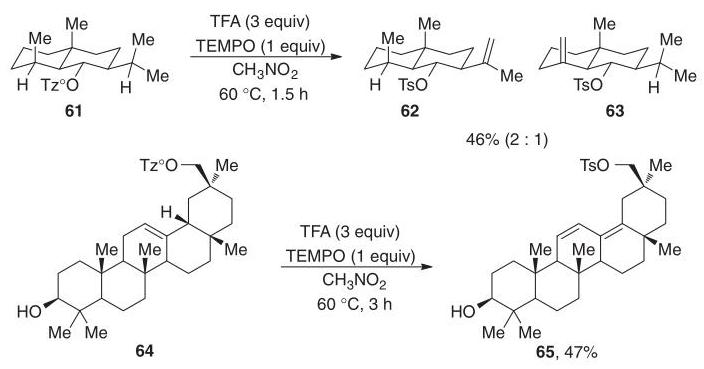
Scheme 24. Synthetic applications on complicated substrates.
方案24. 在复杂底物上的合成应用。
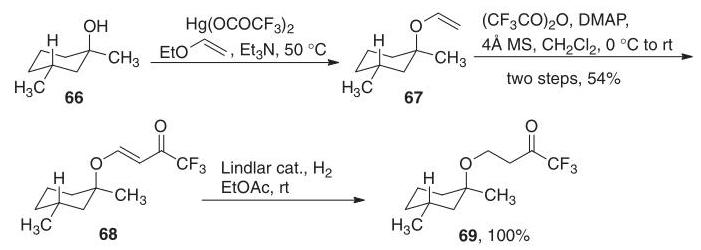
Scheme 25. Introduction of trifluoroketone moiety.
方案25. 三氟酮部分的引入。
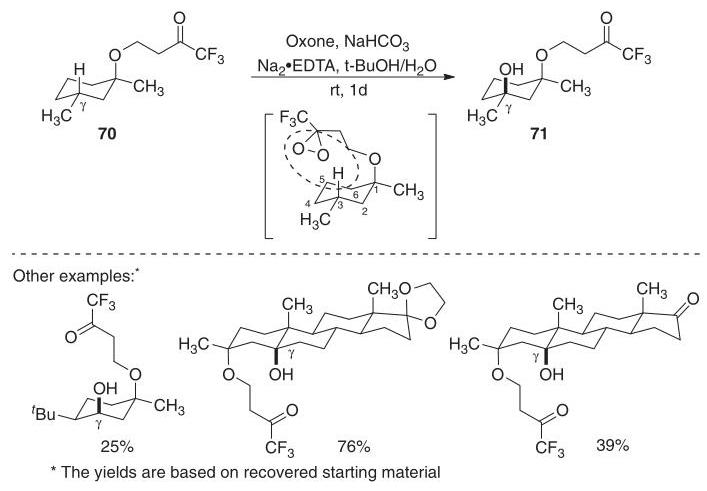
Scheme 26. Construction of 1,3-diaxial diols.
方案26. 1,3 - 二轴向二醇的构建。
Upon exposure to oxone, the trifluoroketone moiety was transformed to a dioxirane, which is capable of oxidizing the proximate $\mathrm{C} - \mathrm{H}$ bond through an intramolecular oxygen insertion (via either a radical or converted pathway). ${}^{35}$ The tertiary $\mathrm{C} - \mathrm{H}$ bond at the $\gamma$ -position can be selectively oxidized with retention of stereochemistry (Scheme 26). The reactivity is affected by the three-dimensional orientation between the dioxirane and the $\gamma$ - C-H bond. This strategy provides another useful approach to access a 1,3-diol moiety from a monoalcohol.
暴露于过氧单磺酸钾后,三氟酮部分转化为二氧杂环丙烷,其能够通过分子内氧插入(通过自由基或转化途径)氧化邻近的 $\mathrm{C} - \mathrm{H}$ 键。${}^{35}$ 在 $\gamma$ 位的叔 $\mathrm{C} - \mathrm{H}$ 键可以立体化学保留的方式被选择性氧化(方案26)。反应活性受二氧杂环丙烷与 $\gamma$ - C - H键之间的三维取向影响。该策略提供了另一种从一元醇获得1,3 - 二醇部分的有用方法。
Conclusion
结论
In this mini-review we have highlighted the recent progress in the field of alcohol or masked alcohol-directed C-H functionalization. Given the ubiquity of alcohols and their central role in organic chemistry, the methods summarized here should have a significant impact on novel and efficient strategy design for complex molecule synthesis. Clearly, at this stage this field is far from being mature; additional innovative and efficient approaches are expected to be developed by more researchers in the future.
在本综述中,我们重点介绍了醇或掩蔽醇导向的C-H官能化领域的最新进展。鉴于醇类物质的普遍性及其在有机化学中的核心作用,本文总结的方法应该会对复杂分子合成的新型高效策略设计产生重大影响。显然,在现阶段,该领域远未成熟;预计未来会有更多研究人员开发出更多创新高效的方法。
The authors would like to thank UT Austin and CPRIT for a start-up fund, and thank the Welch Foundation (F 1781) and Frasch Foundation for research grants. We also thank the ACS Petroleum Research Fund Doctoral New Investigator Grant. Mr. Thompson and Ms. Whittaker are thanked for their proofreading of this manuscript.
作者感谢德克萨斯大学奥斯汀分校和癌症预防与研究机构(CPRIT)提供启动资金,并感谢韦尔奇基金会(F 1781)和弗拉施基金会提供研究资助。我们还感谢美国化学学会石油研究基金博士新研究员奖。感谢汤普森先生和惠特克女士对本稿件的校对。
References and Notes
参考文献和注释
1 a) D.-G. Yu, B.-J. Li, Z.-J. Shi, Tetrahedron 2012, 68, 5130. b) P. B. Arockiam, C. Bruneau, P. H. Dixneuf, Chem. Rev. 2012, 112, 5879. c) H. Li, B.-J. Li, Z.-J. Shi, Catal. Sci. Technol. 2011, 1, 191. d) D. A. Colby, A. S. Tsai, R. G. Bergman, J. A. Ellman, Acc. Chem. Res. 2012, 45, 814. e) T. W. Lyons, M. S. Sanford, Chem. Rev. 2010, 110, 1147. f) R. Jazzar, J. Hitce, A. Renaudat, J. Sofack-Kreutzer, O. Baudoin, Chem.-Eur. J. 2010, 16, 2654. g) D. A. Colby, R. G. Bergman, J. A. Ellman, Chem. Rev. 2010, 110, 624. h) X. Chen, K. M. Engle, D.-H. Wang, J.-Q. Yu, Angew. Chem., Int. Ed. 2009, 48, 5094. i) L.-C. Campeau, D. R. Stuart, K. Fagnou, Aldrichimica Acta 2007, 40, 35. j) O. Daugulis, V. G. Zaitsev, D. Shabashov, Q.-N. Pham, A. Lazareva, Synlett 2006, 3382.
2 J. Hartwig, Organotransition Metal Chemistry: From Bonding to Catalysis, University Science Books, Mill Valley, 2009.
3 Phenol-directed C-H functionalization methodologies are not included in this mini-review.
4 J. Falbe, H. Bahrmann, W. Lipps, D. Mayer, G. D. Frey, Ullmann’s Encyclopedia of Industrial Chemistry, Wiley-VCH Verlag GmbH & Co. KGaA, 2000. doi:10.1002/ 14356007.801_279.pub2.
5 R. C. Larock, Comprehensive Organic Transformations: A Guide to Functional Group Preparation, VCH, New York, 1989.
6 Handbook of C-H Transformations: Applications in Organic Synthesis, ed. by G. Dyker, Wiley-VCH, Weinheim, 2005. doi:10.1002/9783527619450.
7 Y. Lu, D.-H. Wang, K. M. Engle, J.-Q. Yu, J. Am. Chem. Soc. 2010, 132, 5916.
8 P. L. Alsters, J. Boersma, W. J. J. Smeets, A. L. Spek, G. van Koten, Organometallics 1993, 12, 1639.
9 X. Wang, Y. Lu, H.-X. Dai, J.-Q. Yu, J. Am. Chem. Soc. 2010, 132, 12203.
10 a) K. J. Fraunhoffer, M. C. White, J. Am. Chem. Soc. 2007, 129, 7274. b) G. T. Rice, M. C. White, J. Am. Chem. Soc. 2009, 131, 11707.
11 X. Qi, G. T. Rice, M. S. Lall, M. S. Plummer, M. C. White, Tetrahedron 2010, 66, 4816.
12 P. E. Gormisky, M. C. White, J. Am. Chem. Soc. 2011, 133, 12584.
13 a) M. S. Chen, M. C. White, J. Am. Chem. Soc. 2004, 126, 1346. b) M. S. Chen, N. Prabagaran, N. A. Labenz, M. C. White, J. Am. Chem. Soc. 2005, 127, 6970. c) K. J. Fraunhoffer, N. Prabagaran, L. E. Sirois, M. C. White, J. Am. Chem. Soc. 2006, 128, 9032.
14 B.-J. Li, Z.-J. Shi, Chem. Soc. Rev. 2012, 41, 5588.
15 Z. Ren, F. Mo, G. Dong, J. Am. Chem. Soc. 2012, 134, 16991.
16 E. M. Simmons, J. F. Hartwig, J. Am. Chem. Soc. 2010, 132, 17092.
17 a) G. Bashiardes, V. Chaussebourg, G. Laverdan, J. Pornet, Chem. Commun. 2004, 122. b) G. R. Jones, Y. Landais, Tetrahedron 1996, 52, 7599. c) S. Bracegirdle, E. A. Anderson, Chem. Commun. 2010, 46, 3454. d) K. Tamao, N. Ishida, J. Organomet. Chem. 1984, 269, c37.
18 a) S. E. Denmark, C. S. Regens, Acc. Chem. Res. 2008, 41, 1486. b) E. Hagiwara, K.-i. Gouda, Y. Hatanaka, T. Hiyama, Tetrahedron Lett. 1997, 38, 439.
19 E. M. Simmons, J. F. Hartwig, Nature 2012, 483, 70.
20 R. J. P. Corriu, J. J. E. Moreau, J. Chem. Soc., Chem. Commun. 1973, 38.
21 A. García-Granados, P. E. López, E. Melguizo, A. Parra, Y. Simeó, J. Org. Chem. 2007, 72, 3500.
22 a) H. M. L. Davies, D. Morton, Chem. Soc. Rev. 2011, 40, 1857. b) F. Collet, C. Lescot, P. Dauban, Chem. Soc. Rev. 2011, 40, 1926. c) M. P. Doyle, R. Duffy, M. Ratnikov, L. Zhou, Chem. Rev. 2010, 110, 704. d) P. Müller, C. Fruit, Chem. Rev. 2003, 103, 2905. e) J. L. Roizen, M. E. Harvey, J. Du Bois, Acc. Chem. Res. 2012, 45, 911.
23 a) A. Padwa, K. E. Krumpe, Tetrahedron 1992, 48, 5385. b) A. Padwa, D. J. Austin, Angew. Chem., Int. Ed. Engl. 1994, 33, 1797. c) J. Adams, D. M. Spero, Tetrahedron 1991, 47, 1765.
24 M. P. Doyle, A. V. Kalinin, D. G. Ene, J. Am. Chem. Soc. 1996, 118, 8837.
25 M. P. Doyle, S. B. Davies, E. J. May, J. Org. Chem. 2001, 66, 8112.
26 C. G. Espino, J. Du Bois, Angew. Chem., Int. Ed. 2001, 40, 598.
27 C. G. Espino, P. M. Wehn, J. Chow, J. Du Bois, J. Am. Chem. Soc. 2001, 123, 6935.
28 S.-i. Hashimoto, N. Watanabe, S. Ikegami, Tetrahedron Lett. 1992, 33, 2709.
29 L. McMurray, F. O’Hara, M. J. Gaunt, Chem. Soc. Rev. 2011, 40, 1885.
30 R. Breslow, P. C. Scholl, J. Am. Chem. Soc. 1971, 93, 2331.
31 a) A. W. Hofmann, Ber. Dtsch. Chem. Ges. 1883, 16, 558. b) A. W. Hofmann, Ber. Dtsch. Chem. Ges. 1885, 18, 5. c) M. E. Wolff, Chem. Rev. 1963, 63, 55. d) P. Mackiewicz, R. Furstoss, Tetrahedron 1978, 34, 3241. e) E. J. Corey, W. R. Hertler, J. Am. Chem. Soc. 1960, 82, 1657.
32 K. Chen, J. M. Richter, P. S. Baran, J. Am. Chem. Soc. 2008, 130, 7247.
33 K. Chen, P. S. Baran, Nature 2009, 459, 824.
34 A.-F. Voica, A. Mendoza, W. R. Gutekunst, J. O. Fraga, P. S. Baran, Nat. Chem. 2012, 4, 629.
35 R. Curci, L. D’Accolti, C. Fusco, Acc. Chem. Res. 2006, 39, 1.
36 S. Kasuya, S. Kamijo, M. Inoue, Org. Lett. 2009, 11, 3630.