AuPPh3Cl/AgOTf-catalyzed reaction of terminal alkynes: nucleophilic addition to activated CO bond
英文原文与中文译文逐段对照 · English original with Chinese translation
Changkun Li, Fanyang Mo, Weibin Li, Jianbo Wang*
李长坤,莫凡洋,李伟斌,王建波*
Beijing National Laboratory of Molecular Sciences (BNLMS), and Key Laboratory of Bioorganic Chemistry and Molecular Engineering of Ministry of Education, College of Chemistry, Peking University, Beijing 100871, China
北京分子科学国家实验室(BNLMS),教育部生物有机化学与分子工程重点实验室,北京大学化学与分子工程学院,北京 100871,中国
The State Key Laboratory of Organometallic Chemistry, Shanghai Institute of Organic Chemistry, Chinese Academy of Sciences, 354 Fenglin Lu, Shanghai 200032, China
中国科学院上海有机化学研究所金属有机化学国家重点实验室,枫林路354号,上海200032,中国
A R T I C L E I N F O
文章信息
Article history:
文章历史:
Received 28 July 2009
于2009年7月28日收到
Revised 14 August 2009
于2009年8月14日修订
Accepted 18 August 2009
于2009年8月18日接受
Available online 20 August 2009
于2009年8月20日在线发布
Keywords:
关键词:
Au-catalyzed reaction
金催化反应
Three-component reaction
三组分反应
Terminal alkyne
末端炔烃
Propargyl ether
炔丙基醚
A B S T R A C T
摘 要
Terminal alkynes, under Au-catalyzed conditions, react with aromatic aldehyde diethyl acetals, affording propargylation products through C=O bond addition. Furthermore, AuPPh ${}_{3}\mathrm{{Cl}}/\mathrm{{AgO}}\mathrm{{Tf}}$ -catalyzed three-component reaction of aldehydes, alkynes, and triethyl orthoformate is developed. Gold alkynilides are supposed to be reactive intermediates in these reactions.
在金催化条件下,末端炔烃与芳香醛二乙缩醛反应,通过碳氧双键加成生成炔丙基化产物。此外,还开发了金(三苯基膦)_${}_{3}\mathrm{{Cl}}/\mathrm{{AgO}}\mathrm{{Tf}}$催化的醛、炔烃和原甲酸三乙酯的三组分反应。金炔化物被认为是这些反应中的活性中间体。
© 2009 Elsevier Ltd. All rights reserved.
© 2009爱思唯尔有限公司。保留所有权利。
Development of catalytic reactions that lead to $\mathrm{C} - \mathrm{C}$ bond formation is of fundamental importance in modern synthetic organic chemistry. In this regard, metalated terminal alkynes are versatile nucleophiles that can react with a wide variety of electrophiles. ${}^{1}$ Traditionally, metalated terminal alkynes are generated by the reaction with organolithium or organomagnesium reagents through deprotonation. In these cases, the metalated terminal alkynes must be generated in a separate step due to the strong nucleophilicity of organolithium or organomagnesium reagents. Obviously, catalytic processes that can lead to the generation of metal alkynilides under mild conditions are highly desirable. Car-reira and co-workers have reported an efficient catalytic in situ generation of $\mathrm{{Zn}}$ (II)-alkynilides that add to $\mathrm{C} = \mathrm{N}$ bond efficiently. The catalytic asymmetric version has also been subsequently developed by the same group. ${}^{{1c},2}$ Terminal alkyne additions that are catalyzed by $\ln {,}^{3}\mathrm{{Ru}}{,}^{4}\mathrm{{Rh}}{,}^{5}\mathrm{{Ir}}{,}^{6}\mathrm{{Cu}}{,}^{7}\mathrm{{Fe}}{,}^{8}\mathrm{{Ag}}{,}^{9}\mathrm{{Hg}}{,}^{10}$ and ${\mathrm{{Au}}}^{11}$ complexes have appeared subsequently. In most of these reactions, metal alkynilides are suggested as reactive intermediates (Scheme 1).
开发导致形成_$\mathrm{C} - \mathrm{C}$键的催化反应在现代有机合成化学中具有至关重要的意义。在这方面,金属化的末端炔烃是通用的亲核试剂,可与多种亲电试剂反应。${}^{1}$传统上,金属化的末端炔烃是通过与有机锂或有机镁试剂反应去质子化生成的。在这些情况下,由于有机锂或有机镁试剂的强亲核性,金属化的末端炔烃必须在单独的步骤中生成。显然,非常需要能够在温和条件下生成金炔化物的催化过程。卡雷拉及其同事报道了一种高效的原位催化生成$\mathrm{{Zn}}$(II)-炔化物的方法,该炔化物能有效地加成到_$\mathrm{C} = \mathrm{N}$键上。同一研究小组随后也开发了催化不对称版本。${}^{{1c},2}$随后出现了由$\ln {,}^{3}\mathrm{{Ru}}{,}^{4}\mathrm{{Rh}}{,}^{5}\mathrm{{Ir}}{,}^{6}\mathrm{{Cu}}{,}^{7}\mathrm{{Fe}}{,}^{8}\mathrm{{Ag}}{,}^{9}\mathrm{{Hg}}{,}^{10}$和_${\mathrm{{Au}}}^{11}$配合物催化的末端炔烃加成反应。在大多数这些反应中,金炔化物被认为是活性中间体(方案1)。
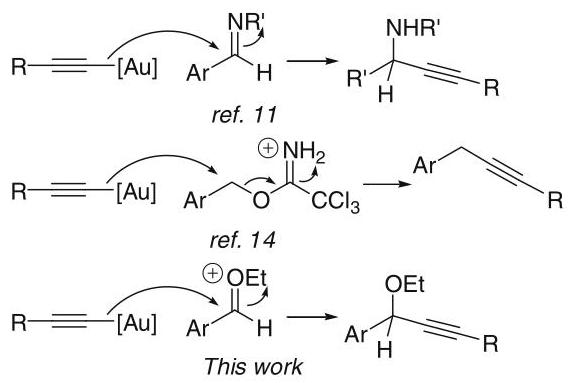
Among these reactions, Au-catalyzed nucleophilic additions have attracted attentions. Recently, Au complexes have emerged as efficient catalysts for a wide variety of transformations involving alkynes, allenes, and alkenes. ${}^{12}$ The research activities in this field so far have been mostly concentrated on the reaction of gold-activated alkynes functioning as electron-deficient species to accept nucleophilic attack. The process that gold-alkyne species function as nucleophile has been much less developed except simple protonation or elimination. Wei and Li have reported a gold-catalyzed three-component coupling reaction of aldehydes, alkynes, and amines. A gold acetylide species, which adds to $\mathrm{C} = \mathrm{N}$ bond of imin-ium ion, is proposed as the reactive intermediate. ${}^{11}$ a Wang and Zhang have reported a Au(III)-catalyzed acyl migration of propargylic esters in which the intramolecular attack of nucleophilic Au(III)-C( ${\mathrm{{sp}}}^{2}$ ) to C=O bond is supposed as the key step in the reaction mechanism. ${}^{{11}\mathrm{\;d},{13}}$ These results indicate that the nucleophilicity of Au-C bond can be exploited in the formation of C-C bond.
在这些反应中,金催化的亲核加成反应受到了关注。最近,金配合物已成为涉及炔烃、丙二烯和烯烃的各种转化的有效催化剂。${}^{12}$到目前为止,该领域的研究活动主要集中在金活化的炔烃作为缺电子物种接受亲核攻击的反应上。除了简单的质子化或消除反应外,金炔物种作为亲核试剂的过程研究得很少。魏和李报道了金催化的醛、炔烃和胺的三组分偶联反应。一种加成到亚胺离子$\mathrm{C} = \mathrm{N}$键上的金炔化物物种被认为是活性中间体。${}^{11}$王和张报道了金(III)催化的炔丙基酯的酰基迁移反应,其中亲核的金(III)-碳${\mathrm{{sp}}}^{2}$对碳氧双键的分子内攻击被认为是反应机理中的关键步骤。_${}^{{11}\mathrm{\;d},{13}}$这些结果表明,金-碳键的亲核性可用于碳-碳键的形成。
In this context, we have reported a ${\mathrm{{AuCl}}}_{3}/\mathrm{{CuBr}}$ -catalyzed three-component reaction of aldehydes, amines, and alkynes. The reaction gives quinoline derivatives through a sequential catalytic process, involving initial formation of propargyl amine via nucleophilic addition of gold alkynilide intermediate to $\mathrm{C} = \mathrm{N}$ bond (Eq. 1). ${}^{{11}\mathrm{f}}$ Furthermore, we have recently reported Au-catalyzed reaction of terminal alkynes and benzyl trichloroacetimidates, which leads to benzylacetylene products through nucleophilic substitution by gold acetylide (Eq. 2). ${}^{14}$ As a continuation of our research program aiming at $\mathrm{C} - \mathrm{H}$ activation of terminal alkynes with transition metal catalysis, we proceeded to study the nucleophilic addition of gold acetylide to $\mathrm{C} = \mathrm{O}$ bond in similar catalytic system (Eq. 3). Herein we report a Au-catalyzed three-component reaction of aldehyde, alkyne, and triethyl orthoformate, which affords prop-argylation products in good yields.
在这种情况下,我们报道了一种${\mathrm{{AuCl}}}_{3}/\mathrm{{CuBr}}$催化的醛、胺和炔烃的三组分反应。该反应通过一个连续的催化过程生成喹啉衍生物,包括通过金炔化物中间体对$\mathrm{C} = \mathrm{N}$键的亲核加成首先形成炔丙基胺(式1)。${}^{{11}\mathrm{f}}$此外,我们最近报道了末端炔烃与苄基三氯乙酰亚胺的金催化反应,该反应通过金炔化物的亲核取代生成苄基乙炔产物(式2)。${}^{14}$作为我们旨在通过过渡金属催化实现$\mathrm{C} - \mathrm{H}$活化末端炔烃的研究计划的延续,我们继续研究在类似催化体系中,金炔化物对$\mathrm{C} = \mathrm{O}$键的亲核加成(式3)。在此,我们报道了一种金催化的醛、炔烃和原甲酸三乙酯的三组分反应,该反应能以良好的产率得到炔丙基化产物。
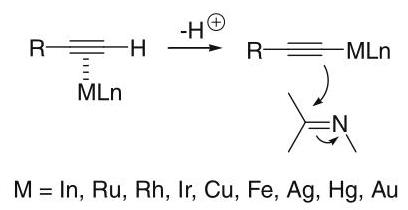
Scheme 1. Metal-catalyzed reaction of terminal alkyne.
方案1. 末端炔烃的金属催化反应。
Corresponding author.
通讯作者。
(J. Wang).
(J. 王)。
(1) (2) (3)
On the outset of this investigation, we have attempted the nucleophilic addition of terminal alkyne to aldehyde by gold catalyst. The reaction failed to give any $\mathrm{C} = \mathrm{O}$ bond addition products. The failure might be attributed to the low reactivity of aldehyde carbonyl group toward nucleophiles. We then examined the oxocarbenium ion, which can be generated from benzaldehyde diethyl acetal. ${}^{15}$ We were delighted to find that addition of terminal alkyne occurs with ${\mathrm{{AuPPh}}}_{3}\mathrm{{Cl}}/\mathrm{{AgOTf}}$ catalyst (Scheme 2).
在本研究开始时,我们尝试了用金催化剂使末端炔烃对醛进行亲核加成。该反应未能得到任何$\mathrm{C} = \mathrm{O}$键加成产物。失败的原因可能是醛羰基对亲核试剂的反应活性较低。然后我们研究了可以由苯甲醛二乙缩醛生成的氧鎓离子。${}^{15}$我们很高兴地发现,在${\mathrm{{AuPPh}}}_{3}\mathrm{{Cl}}/\mathrm{{AgOTf}}$催化剂存在下,末端炔烃会发生加成反应(方案2)。
Several other metal complexes have also been examined and the results are summarized in Table 1. ${\mathrm{{AuCl}}}_{3}/\mathrm{{AgOTf}}$ was less effective to afford 3a in 66% yield (entry 1). Without AgOTf as co-catalyst, ${\mathrm{{AuPPh}}}_{3}\mathrm{{Cl}}$ or ${\mathrm{{AuCl}}}_{3}$ gave very low yields of $3\mathrm{a}$ (entries 2 and 3). However, AgOTf alone afforded the product in the yield similar to the reaction with ${\mathrm{{AuCl}}}_{3}/\mathrm{{AgOTf}}$ (entry 4). It was also noted that base additive completely shut down the reaction (entry 5). Other metal catalysts, such as ${\mathrm{{PtCl}}}_{2}$ , CuI, $\mathrm{{Cu}}{\left( {\mathrm{{CH}}}_{3}\mathrm{{CN}}\right) }_{4}{\mathrm{{PF}}}_{6}$ , and $\mathrm{{Zn}}{\left( \mathrm{{OTf}}\right) }_{2}$ , all failed to catalyze this reaction.
还研究了其他几种金属配合物,结果总结在表1中。${\mathrm{{AuCl}}}_{3}/\mathrm{{AgOTf}}$生成3a的产率较低,为66%(条目1)。没有AgOTf作为共催化剂时,${\mathrm{{AuPPh}}}_{3}\mathrm{{Cl}}$或${\mathrm{{AuCl}}}_{3}$生成$3\mathrm{a}$的产率非常低(条目2和3)。然而,单独使用AgOTf得到的产物产率与使用${\mathrm{{AuCl}}}_{3}/\mathrm{{AgOTf}}$的反应相似(条目4)。还注意到碱添加剂会使反应完全停止(条目5)。其他金属催化剂,如${\mathrm{{PtCl}}}_{2}$、CuI、$\mathrm{{Cu}}{\left( {\mathrm{{CH}}}_{3}\mathrm{{CN}}\right) }_{4}{\mathrm{{PF}}}_{6}$和$\mathrm{{Zn}}{\left( \mathrm{{OTf}}\right) }_{2}$,都未能催化该反应。
During the course of this investigation, we observed that ${\mathrm{{AuPPh}}}_{3}\mathrm{{Cl}}/\mathrm{{AgOTf}}$ could efficiently catalyze the formation of benzaldehyde diethyl acetal from benzaldehyde and triethyl orthofor-mate. This observation led us to conceive that a three-component reaction of aldehydes, alkynes, and triethyl orthoformate might be catalyzed by the same catalytic system. To test this hypothesis, benzaldehyde, phenylacetylene, and triethyl orthoformate were subjected to the reaction with catalytic ${\mathrm{{AuPPh}}}_{3}\mathrm{{Cl}}/\mathrm{{AgOTf}}$ . Upon refluxing in 1,2-dichloroethane (DCE) for $1\mathrm{\;h}$ , product $3\mathrm{a}$ could be isolated in 87% yield (Table 2, entry 1). Other catalytic systems were also examined. For the gold catalyst, co-catalyst AgOTf was found necessary (entries 2 and 5). ${\mathrm{{AuCl}}}_{3}$ and $\mathrm{{AuCl}}$ were also found to catalyze the formation of 3a when AgOTf was used as co-catalyst, albeit in much lower yields (entries 3 and 4). Control experiment showed that AgOTf alone failed to catalyze the reaction (entry 6). Solvent has marginal effect, as seen by the similar result obtained with benzene (entry 7). However, water can completely shut down the reaction (entry 8).
在本研究过程中,我们观察到${\mathrm{{AuPPh}}}_{3}\mathrm{{Cl}}/\mathrm{{AgOTf}}$能够有效地催化由苯甲醛和原甲酸三乙酯生成苯甲醛二乙缩醛的反应。这一观察结果使我们设想,醛、炔烃和原甲酸三乙酯的三组分反应可能由相同的催化体系催化。为了验证这一假设,将苯甲醛、苯乙炔和原甲酸三乙酯与催化量的${\mathrm{{AuPPh}}}_{3}\mathrm{{Cl}}/\mathrm{{AgOTf}}$进行反应。在1,2 - 二氯乙烷(DCE)中回流$1\mathrm{\;h}$后,产物$3\mathrm{a}$能够以87%的产率分离得到(表2,条目1)。我们还研究了其他催化体系。对于金催化剂,发现共催化剂AgOTf是必需的(条目2和5)。当使用AgOTf作为共催化剂时,${\mathrm{{AuCl}}}_{3}$和$\mathrm{{AuCl}}$也能催化3a的生成,尽管产率要低得多(条目3和4)。对照实验表明,单独的AgOTf不能催化该反应(条目6)。溶剂的影响不大,以苯作为溶剂时得到了相似的结果(条目7)。然而,水会完全抑制该反应(条目8)。
Other metal complexes, such as ${\mathrm{{PtCl}}}_{2}$ , Cul, $\mathrm{{Cu}}{\left( {\mathrm{{CH}}}_{3}\mathrm{{CN}}\right) }_{4}{\mathrm{{PF}}}_{6},{\mathrm{{ZnI}}}_{2}$ , and $\mathrm{{Zn}}{\left( \mathrm{{OTf}}\right) }_{2}$ , all failed to catalyze the reaction (entries 9-13). Interestingly, strong protic acid TfOH could catalyze the reaction, albeit in low yield (entry 14). Very recently, highly efficient TfOH-catalyzed reaction of alkenes and alkynes has been documented. ${}^{16}$ Thus, for the current Au-catalyzed reaction the possibility existed that small amount of TfOH could be generated in situ, which catalyzed the three-component reaction. However, this should not be the major reaction pathway in view of the fact that TfOH-catalyzed reaction gave much lower yield of the product as compared with ${\mathrm{{AuPPh}}}_{3}\mathrm{{Cl}}/\mathrm{{AgOTf}}$ -catalyzed reaction.
其他金属配合物,如${\mathrm{{PtCl}}}_{2}$、CuI、$\mathrm{{Cu}}{\left( {\mathrm{{CH}}}_{3}\mathrm{{CN}}\right) }_{4}{\mathrm{{PF}}}_{6},{\mathrm{{ZnI}}}_{2}$和$\mathrm{{Zn}}{\left( \mathrm{{OTf}}\right) }_{2}$,都不能催化该反应(条目9 - 13)。有趣的是,强质子酸TfOH能够催化该反应,尽管产率较低(条目14)。最近,已经报道了TfOH高效催化烯烃和炔烃的反应。${}^{16}$因此,对于当前的金催化反应,存在原位生成少量TfOH催化三组分反应的可能性。然而,鉴于与${\mathrm{{AuPPh}}}_{3}\mathrm{{Cl}}/\mathrm{{AgOTf}}$催化反应相比,TfOH催化反应的产物产率要低得多,这不应是主要的反应途径。
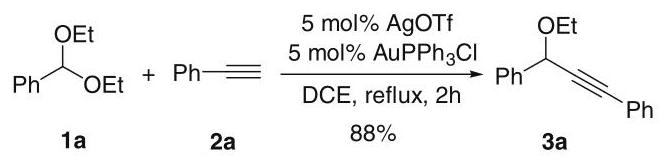
Scheme 2. Au-catalyzed reaction of 1a and 2a.
方案2. 1a和2a的金催化反应。
Table 1
表1
Reactions of 1a and 2a under various catalytic conditions ${}^{a}$
1a和2a在各种催化条件下的反应${}^{a}$
| Entry | Cat. (5 mol %) | $t\left( \mathrm{\;h}\right)$ | Yieldb (%) |
| 1 | ${\mathrm{{AuCl}}}_{3}/\mathrm{{AgOTf}}$ | 6 | 66 |
| 2 | ${\mathrm{{AuPPh}}}_{3}\mathrm{{Cl}}$ | 12 | Trace |
| 3 | ${\mathrm{{AuCl}}}_{3}$ | 48 | 9 |
| 4 | AgOTf | 24 | 59 |
| 5 | ${\mathrm{{AuCl}}}_{3}/\mathrm{{AgOTf}}/{\mathrm{{DIPEA}}}^{\mathrm{c}}$ | 24 | 0 |
| 6 | ${\mathrm{{PtCl}}}_{2}$ | 24 | Trace |
| 7 | Cul | 18 | Trace |
| 8 | $\mathrm{{Cu}}{\left( {\mathrm{{CH}}}_{3}\mathrm{{CN}}\right) }_{4}{\mathrm{{PF}}}_{6}$ | 24 | Trace |
| 9 | $\mathrm{{Zn}}{\left( \mathrm{{OTf}}\right) }_{2}$ | 24 | Trace |
a Reaction was carried out in refluxing DCE.
a反应在回流的DCE中进行。
b Isolated yield.
b分离产率。
C DIPEA: Diisopropylethylamine.
C DIPEA:二异丙基乙胺。
Table 2
表2
Three-component reactions under various catalytic conditions
各种催化条件下的三组分反应
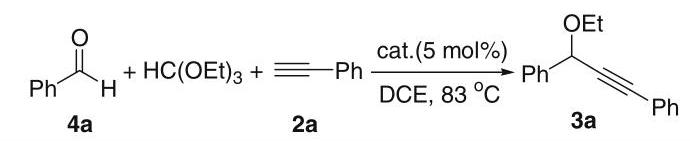
| Entry | Cat. (5 mol %) | t (h) | Yield ${}^{a}$ (%) |
| 1 | ${\mathrm{{AuPPh}}}_{3}\mathrm{{Cl}}/\mathrm{{AgOTf}}$ | 1 | 87 |
| 2 | ${\mathrm{{AuPPh}}}_{3}\mathrm{{Cl}}$ | 24 | 0 |
| 3 | AuCl/AgOTf | 24 | 31 |
| 4 | ${\mathrm{{AuCl}}}_{3}/\mathrm{{AgOT}{f}^{b}}$ | 1 | 32 |
| 5 | ${\mathrm{{AuCl}}}_{3}$ | 24 | 0 |
| 6 | AgOTf | 24 | Trace |
| 7° | ${\mathrm{{AuPPh}}}_{3}\mathrm{{Cl}}/\mathrm{{AgOTf}}$ | 2 | 84 |
| ${8}^{\mathrm{d}}$ | ${\mathrm{{AuPPh}}}_{3}\mathrm{{Cl}}/\mathrm{{AgOTf}}$ | 2 | 0 |
| 9 | ${\mathrm{{PtCl}}}_{2}$ | 12 | 0 |
| 10 | CuI | 12 | 0 |
| 11 | $\mathrm{{Cu}}{\left( {\mathrm{{CH}}}_{3}\mathrm{{CN}}\right) }_{4}{\mathrm{{PF}}}_{6}$ | 12 | Trace |
| 12 | ${\mathrm{{Znl}}}_{2}$ | 12 | Trace |
| 13 | Zn(OTf) ${}_{2}$ | 12 | 0 |
| 14 | TfOH | 3 | 24 |
a Isolated yield.
a分离产率。
b 15 mol % AgOTf.
b 15 mol% AgOTf。
c Benzene as solvent.
c以苯为溶剂。
d Water as solvent.
d以水为溶剂。
With ${\mathrm{{AuPPh}}}_{3}\mathrm{{Cl}}/\mathrm{{AgOTf}}$ catalytic system, the scope of the three-component reaction was examined by a series of aldehydes and alkynes, and triethyl orthoformate. The results are summarized in Table 3. For a wide range of aromatic aldehydes and alkynes, the reaction afforded the addition products in moderate to good yields. 1-Naphthaldehyde and 2-naphthaldehyde gave similar results (entries 10 and 11). Secondary cyclohexanecarbaldehyde could react with aromatic alkyne smoothly and give moderate yield (entry 16). The electron-donating group makes the reaction faster than the electron-withdrawing groups. $p$ -Nitrobenzaldehyde and basic pyridinecarbaldehyde failed to react.
使用${\mathrm{{AuPPh}}}_{3}\mathrm{{Cl}}/\mathrm{{AgOTf}}$催化体系,通过一系列醛、炔烃和原甲酸三乙酯研究了三组分反应的范围。结果总结在表3中。对于多种芳香醛和炔烃,反应以中等至良好的产率得到加成产物。1 - 萘甲醛和2 - 萘甲醛得到了相似的结果(条目10和1)。仲环己烷甲醛能与芳香炔烃顺利反应并给出中等产率(条目16)。供电子基团使反应比吸电子基团更快。$p$ - 硝基苯甲醛和碱性吡啶甲醛不发生反应。
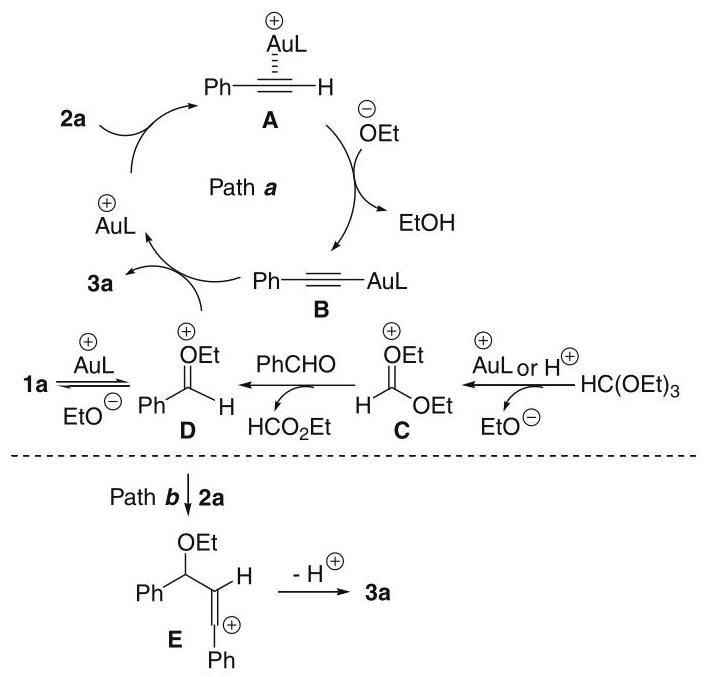
To account for the three-component reaction, two possible reaction mechanisms are considered (Scheme 3). The first mechanism (path a) involves the generation of gold alkynilide $\mathbf{B}$ , which adds to the $\mathrm{C} = \mathrm{O}$ bond of oxocarbenium ion $\mathbf{D}$ , as proposed previously. In view of the fact that TfOH could also catalyze the reaction, the second possible mechanism (path b), which involves a Prins-type reaction, ${}^{18}$ is suggested. In this case, the oxocarbenium ion D is added to the alkyne directly to give vinyl cation E. The Au catalyst may function as Lewis acid to promote the generation of D.
为了解释该三组分反应,我们考虑了两种可能的反应机理(方案3)。第一种机理(路径a)涉及生成金炔化物$\mathbf{B}$,如前所述,它会加成到氧鎓离子$\mathbf{D}$的$\mathrm{C} = \mathrm{O}$键上。鉴于三氟甲磺酸(TfOH)也能催化该反应,因此提出了第二种可能的机理(路径b),该机理涉及普林斯型反应${}^{18}$。在这种情况下,氧鎓离子D直接加成到炔烃上生成乙烯基阳离子E。金催化剂可能作为路易斯酸促进D的生成。
Table 3
表3
The scope of the three-component reaction ${}^{17}$
三组分反应的范围${}^{17}$
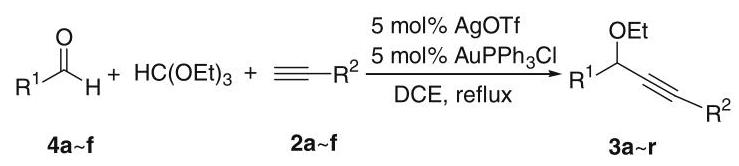
| Entry | 4, ${\mathrm{R}}^{1}$ | 2, ${\mathrm{R}}^{2}$ | $t\left( \mathrm{\;h}\right)$ | Yielda |
| 1 | a, ${\mathrm{C}}_{6}{\mathrm{H}}_{5}$ | a, ${\mathrm{C}}_{6}{\mathrm{H}}_{5}$ | 1 | 3a, 87 |
| 2 | b, o-CH ${}_{3}{\mathrm{C}}_{6}{\mathrm{H}}_{4}$ | a, ${\mathrm{C}}_{6}{\mathrm{H}}_{5}$ | 2 | 3b, 82 |
| 3 | c, o-AllylOC ${}_{6}{\mathrm{H}}_{4}$ | a, ${\mathrm{C}}_{6}{\mathrm{H}}_{5}$ | 2 | 3c, 55 |
| 4 | d, $m - {\mathrm{{BrC}}}_{6}{\mathrm{H}}_{4}$ | a, ${\mathrm{C}}_{6}{\mathrm{H}}_{5}$ | 4 | 3d, 80 |
| 5 | e, $m - {\mathrm{{CH}}}_{3}{\mathrm{{OC}}}_{6}{\mathrm{H}}_{4}$ | a, ${\mathrm{C}}_{6}{\mathrm{H}}_{5}$ | 3 | 3e, 81 |
| 6 | $\mathbf{f}, m - {\mathrm{{CF}}}_{3}{\mathrm{C}}_{6}{\mathrm{H}}_{4}$ | a, ${\mathrm{C}}_{6}{\mathrm{H}}_{5}$ | 6 | 3f, 76 |
| 7 | g, $p - {\mathrm{{BrC}}}_{6}{\mathrm{H}}_{4}$ | a, ${\mathrm{C}}_{6}{\mathrm{H}}_{5}$ | 2 | 3g, 87 |
| 8 | h, $p - {\mathrm{{ClC}}}_{6}{\mathrm{H}}_{4}$ | a, ${\mathrm{C}}_{6}{\mathrm{H}}_{5}$ | 2 | 3h, 82 |
| 9 | i, $p - {\mathrm{C}}_{6}{\mathrm{H}}_{5}{\mathrm{C}}_{6}{\mathrm{H}}_{4}$ | a, ${\mathrm{C}}_{6}{\mathrm{H}}_{5}$ | 15 | 3i, 87 |
| 10 | j, 1-Naphthyl | a, ${\mathrm{C}}_{6}{\mathrm{H}}_{5}$ | 3 | 3j, 88 |
| 11 | k, 2-Naphthyl | a, ${\mathrm{C}}_{6}{\mathrm{H}}_{5}$ | 15 | 3k, 80 |
| 12 | a, ${\mathrm{C}}_{6}{\mathrm{H}}_{5}$ | b, $p - {\mathrm{{BrC}}}_{6}{\mathrm{H}}_{4}$ | 2 | 31, 66 |
| 13 | a, ${\mathrm{C}}_{6}{\mathrm{H}}_{5}$ | c, $p - {\mathrm{{PhC}}}_{6}{\mathrm{H}}_{4}$ | 2 | 3m, 71 |
| 14 | a, ${\mathrm{C}}_{6}{\mathrm{H}}_{5}$ | e, $p - {\mathrm{{NO}}}_{2}{\mathrm{C}}_{6}{\mathrm{H}}_{4}$ | 4 | 3n, 38 |
| 15 | a, ${\mathrm{C}}_{6}{\mathrm{H}}_{5}$ | f, 2-Naphthyl | 1 | 30, 76 |
| 16 | 1, ${\mathrm{C}}_{6}{\mathrm{H}}_{11}$ | b, $p - {\mathrm{{BrC}}}_{6}{\mathrm{H}}_{4}$ | 12 | 3p, 51 |
| 17 | $\mathbf{m}, p - {\mathrm{{CH}}}_{3}{\mathrm{{OC}}}_{6}{\mathrm{H}}_{4}$ | a, ${\mathrm{C}}_{6}{\mathrm{H}}_{5}$ | 4 | 3q, 30b |
| 18 | n, trans- ${\mathrm{C}}_{6}{\mathrm{H}}_{5}\mathrm{{CH}} = {\mathrm{{CHC}}}_{6}{\mathrm{H}}_{4}$ | a, ${\mathrm{C}}_{6}{\mathrm{H}}_{5}$ | 2 | 3r, 32° |
a Isolated yield.
a 分离产率。
b 1,5-Diphenyl-3-(p-methoxyphenyl) pent-1,4-diyne was isolated in 52%.
b 1,5-二苯基-3-(对甲氧基苯基)戊-1,4-二炔的分离产率为52%。
c The product was 1:1 mixture of $\mathbf{{3r}}$ and trans-1-Methoxy-3,5-diphenyl-1- pen-ten-4-yne.
c 产物是$\mathbf{{3r}}$和反式-1-甲氧基-3,5-二苯基-1-戊烯-4-炔的1:1混合物。
Scheme 3. Mechanistic rationale.
方案3. 机理原理。
Several experiments were carried out in order to differentiate the two reaction pathways. First, Prins-type reaction might occur when phenyl acetylene is replaced by styrene. However, no reaction occurred under the same conditions with styrene. Second, it was observed that when the reaction was carried out in benzene, possible Friedel-Crafts reaction with benzene was not detected, and the reaction gave three-component reaction product in similar yield. All these observations were not in favor of the Prins-type reaction mechanism (path b).
为了区分这两种反应途径,我们进行了几项实验。首先,当苯乙炔被苯乙烯取代时,可能会发生普林斯型反应。然而,在相同条件下苯乙烯未发生反应。其次,我们观察到当反应在苯中进行时,未检测到与苯可能发生的傅克反应,并且反应以相似的产率得到了三组分反应产物。所有这些观察结果都不支持普林斯型反应机理(路径b)。
Gold alkynilide species has been previously synthesized and characterized in stoichiometric reaction. ${}^{17}$ These species have also been suggested in the reaction mechanism of Au-catalyzed reactions of terminal alkynes. ${}^{{11},{14}}$ Based on these reports and our own observation in this study, we consider that the mechanism path a, which involves nucleophilic addition of gold alkynilide B, is most plausible.
金炔化物物种先前已在化学计量反应中合成并表征${}^{17}$。这些物种也在金催化的末端炔烃反应机理中被提及${}^{{11},{14}}$。基于这些报道以及我们在本研究中的观察,我们认为涉及金炔化物B亲核加成的机理路径a是最合理的。
In summary, we have developed an AuPPh ${}_{3}\mathrm{{Cl}}/\mathrm{{AgOTf}}$ -catalyzed three-component reaction of terminal alkyne, aldehyde, and amine. The three-component reaction is highly efficient, providing propargyl ether in good yields. ${}^{19}$ The reaction may involve gold alkynilide intermediates, which add to the activated $\mathrm{C} = \mathrm{O}$ bond. The catalytic processes are carried out under mild conditions to provide propargyl ethers in good yields.
总之,我们开发了一种由AuPPh${}_{3}\mathrm{{Cl}}/\mathrm{{AgOTf}}$催化的末端炔烃、醛和胺的三组分反应。该三组分反应高效,能以良好的产率提供炔丙基醚${}^{19}$。该反应可能涉及金炔化物中间体,它们加成到活化的$\mathrm{C} = \mathrm{O}$键上。催化过程在温和条件下进行,以良好的产率提供炔丙基醚。
Acknowledgments
致谢
The project is generously supported by Natural Science Foundation of China (Grant No. 20832002, 20772003, 20821062), the Ministry of Education of China, and National Basic Research Program of China (973 Program, No. 2009CB825300).
本项目得到了中国国家自然科学基金(批准号:20832002、20772003、20821062)、中国教育部以及中国国家基础研究计划(973计划,编号:2009CB825300)的慷慨资助。
Supplementary data
补充数据
Supplementary data (characterization data, ${}^{1}\mathrm{H}$ and ${}^{13}\mathrm{C}$ NMR spectra for all new compounds, these materials are available free of charge via the Internet) associated with this article can be found, in the online version, at doi:10.1016/j.tetlet.2009.08.049.
与本文相关的补充数据(所有新化合物的表征数据、${}^{1}\mathrm{H}$ 和 ${}^{13}\mathrm{C}$ NMR 光谱,这些材料可通过互联网免费获取)可在在线版本中查看,链接为:doi:10.1016/j.tetlet.2009.08.049。
References and notes
参考文献和注释
For selected reviews, see: (a) Brandsma, L. Preparative Acetylene Chemistry, 2nd ed.; Elsevier: Amsterdam, 1988; (b)Modern Acetylene Chemistry; Stang, P. J., Diederich, F., Eds.; VCH: Weinheim, 1995; (c) Frantz, D. E.; Fässler, R.; Tomooka, C. S.; Carreira, E. M. Acc. Chem. Res. 2000, 33, 373-381; (d) Negishi, E.-i.; Anastasia, L. Chem. Rev. 2003, 103, 1979-2017; (e)Handbook of C-H Transformations; Dyker, G., Ed.; Wiley-VCH: Weinheim, 2005; Vol. 1, pp 31-78.
(a) Frantz, D. E.; Fässler, R.; Carreira, E. M. J. Am. Chem. Soc. 1999, 121, 11245- 11246; (b) Anand, N. K.; Carreira, E. M. J. Am. Chem. Soc. 2001, 123, 9687-9688.
(a) Takita, R.; Fukuta, Y.; Tsuji, R.; Ohshima, T.; Shibasaki, M. Org. Lett. 2005, 7, 1363-1366; (b) Takita, R.; Yakura, K.; Ohshima, T.; Shibasaki, M. J. Am. Chem. Soc. 2005, 127, 13760-13761; (c) Zhang, Y.; Li, P.; Wang, M.; Wang, L. J. Org.
(a) Wei, C.; Li, C.-]. Green Chem. 2002, 4, 39-41; (b) Li, C.-].; Wei, C. Chem. Commun. 2002, 268-269.
Dhondi, P. K.; Chisholm, J. D. Org. Lett. 2006, 8, 67-69.
Fischer, C.; Carreira, E. M. Org. Lett. 2001, 3, 4319-4321.
(a) Koradin, C.; Polborn, K.; Knochel, P. Angew. Chem., Int. Ed. 2002, 41, 2535- 2538; (b) Gommermann, N.; Koradin, C.; Polborn, K.; Knochel, P. Angew. Chem., Int. Ed. 2003, 42, 5763-5766; (c) Wei, C.; Li, C.-]. J. Am. Chem. Soc. 2002, 124, 5638-5639; (d) Asano, Y.; Hara, K.; Ito, H.; Sawamura, M. Org. Lett. 2007, 9, 3901-3904; (e) Motoki, R.; Kanai, M.; Shibasaki, M. Org. Lett. 2007, 9, 2997- 3000; (f) Shi, L.; Tu, Y.-Q.; Wang, M.; Zhang, F.-M.; Fan, C.-A. Org. Lett. 2004, 6, 1001-1003; (g) Choudary, B. M.; Sridhar, C.; Kantam, M. L.; Sreedhar, B. Tetrahedron Lett. 2004, 45, 7319-7321; (h) Wang, M.; Li, P.; Wang, L. Eur. J. Org. Chem. 2008, 2255-2261; (i) Kantam, M. L.; Yadav, J.; Laha, S.; Jha, S. Synlett 2009, 1791-1794.
Li, P.; Zhang, Y.; Wang, L. Chem. Eur. J. 2009, 15, 2045-2049.
(a) Yao, X.; Li, C.-J. Org. Lett. 2005, 7, 4395-4398; (b) Dodda, R.; Zhao, C.-G. Org. Lett. 2007, 9, 165-167; (c) Wei, C.; Li, Z.; Li, C.-J. Org. Lett. 2003, 5, 4473-4475; (d) Li, P.; Wang, L.; Zhang, Y.; Wang, M. Tetrahedron Lett. 2008, 49, 6650-6654. 10. Li, P.; Wang, L. Chin. J. Chem. 2005, 23, 1076-1080.
(a) Wei, C.; Li, C.-J. J. Am. Chem. Soc. 2003, 125, 9584-9585; (b) Lo, V. K.-Y.; Liu, Y.; Wong, M.-K.; Che, C.-M. Org. Lett. 2006, 8, 1529-1532; (c) Huang, B.; Yao, X.; Li, C.-J. Adv. Synth. Catal. 2006, 348, 1528-1532; (d) Yao, X.; Li, C.-J. Org. Lett. 2006, 8, 1953-1955; (e) Skouta, R.; Li, C.-J. Angew. Chem., Int. Ed. 2007, 46, 1117-1119; (f) Xiao, F.; Chen, Y.; Liu, Y.; Wang, J. Tetrahedron 2008, 64, 2755- 2761; (g) Zhang, X.; Corma, A. Angew. Chem., Int. Ed. 2008, 47, 4358-4361.
For selected recent reviews on Au-catalyzed reactions, see: (a) Dyker, G. Angew. Chem., Int. Ed. 2000, 39, 4237-4239; (b) Hashmi, A. S. K. Gold Bull. 2004, 37, 51-65; (c) Hashmi, A. S. K. Angew. Chem., Int. Ed. 2005, 44, 6990-6993; (d) Hoffmann-Röder, A.; Krause, N. Org. Biomol. Chem. 2005, 3, 387-391; (e) Bruneau, C. Angew. Chem., Int. Ed. 2005, 44, 2328-2334; (f) Fürstner, A.; Davies, P. W. Angew. Chem., Int. Ed. 2007, 46, 3410-3449; (g) Hashmi, A. S. K. Chem. Rev. 2007, 107, 3180-3211; (h) Li, Z.; Brouwer, C.; He, C. Chem. Rev. 2008, 108, 3239-3265; (i) Arcadi, A. Chem. Rev. 2008, 108, 3266-3325; (j) Jiménez-Núñnez, E.; Echavarren, A. M. Chem. Rev. 2008, 108, 3326-3350; (k) Gorin, D. J.; Sherry, B. B. D.; Toste, F. D. Chem. Rev. 2008, 108, 3351-3378.
(a) Wang, S.; Zhang, L. J. Am. Chem. Soc. 2006, 128, 8414-8415; (b) Dubé, P.; Toste, F. D. J. Am. Chem. Soc. 2006, 128, 12062-12063; (c) Wang, S.; Zhang, L. J. Am. Chem. Soc. 2006, 128, 14274-14275.
Li, C.; Li, W.; Wang, J. Tetrahedron Lett. 2009, 50, 2536-2539.
(a) Howk, B. W.; Sauer, J. C. J. Am. Chem. Soc. 1958, 80, 4607-4609; (b) Sakurai, H.; Sasaki, K.; Hosomi, A. Tetrahedron Lett. 1981, 22, 745-748.
(a) Anderson, L. L.; Arnold, J.; Bergman, R. G. J. Am. Chem. Soc. 2005, 127, 14542-14543; (b) Sun, J.; Kozmin, S. A. J. Am. Chem. Soc. 2005, 127, 13512-13513; (c) Li, Z.; Zhang, J.; Brouwer, C.; Yang, C.-G.; Reich, N. W.; He, C. Org. Lett. 2006, 19, 4175-4178; (d) Rosenfeld, D. C.; Shekhar, S.; Takemiya, A.; Utsunomiya, M.; Hartwig, J. F. Org. Lett. 2006, 19, 4179- 4182; (e) Rozenman, M. M.; Kanan, M. W.; Liu, D. R. J. Am. Chem. Soc. 2007, 129, 14933-14938.
General procedure for the gold-catalyzed three-component reaction of aldehydes, alkynes, and triethyl orthoformate: To a ${25}\mathrm{\;{mL}}$ round-bottomed flask was added ${\mathrm{{AuClPPh}}}_{3}$ (12.4mg,0.05 equiv), $\mathrm{{AgOTf}}$ (6.4mg,0.05 equiv), and $3\mathrm{\;{mL}}$ 1,2- dichloroethane. The solution was stirred at room temperature for $5\mathrm{\;{min}}$ . Phenylacetylene 2a (61 mg, 1.2 equiv), benzaldehyde 4a (53 mg, 1.0 equiv), and $\mathrm{{HC}}{\left( \mathrm{{OEt}}\right) }_{3}$ ( ${88}\mathrm{{mg}},{1.2}$ equiv) were added to the solution. The resulting mixture was heated to reflux and monitored by TLC and GC-MS. When the reaction was complete, the solvent was removed in vacuo and the crude product was purified by column chromatography on silica gel with petroleum and ethyl acetate (100:1) to give 3-ethoxy-1,3-diphenylprop-1-yne (103 mg, 87% yield) as a yellow oil.
Vicente, J.; Chicote, M.-T.; Abrisqueta, M.-D. J. Chem. Soc., Dalton Trans. 1995, 497-498.
Selected reviews on multicomponent reactions, see: (a) For multicomponent reactions, see: Multicomponent Reactions; Zhu, J., Bienayme, H., Eds.; Wiley: Weinheim, 2005. (b) Armstrong, R. W.; Combs, A. P.; Tempest, P. A.; Brown, S. D.; Keating, T. A. Acc. Chem. Res. 1996, 29, 123-131.