Synthesis of Aryl Trimethylstannanes from Aryl Amines: A Sandmeyer-Type Stannylation Reaction
英文原文与中文译文逐段对照 · English original with Chinese translation
Di Qiu, He Meng, Liang Jin, Shuai Wang, Shengbo Tang, Xi Wang, Fanyang Mo, Yan Zhang,* and Jianbo Wang*
邱迪,何萌,金亮,王帅,唐胜波,王曦,莫帆扬,张燕*,王剑波*
The cross-coupling reaction with organotin reagents, namely the Stille coupling reaction, has been well-established as a powerful C-C bond forming method in organic synthesis. ${}^{\left\lbrack 1,2\right\rbrack }$ Moreover, the Ar-Sn bond can also be employed in various functional-group transformations, such as $\mathrm{C} - \mathrm{N},\mathrm{C} - \mathrm{F}$ , and $\mathrm{C} - {\mathrm{{OCF}}}_{3}$ bond formation. ${}^{\left\lbrack 3\right\rbrack }$ The wide application of Stille coupling has created considerable need for the easy access to aryl stannane compounds. However, the methods for the synthesis of functionalized aryl stannane compounds are still very limited. The traditional method for preparing aryl stannane compounds is by the reaction of aryl magnesium, -lithium, or -zinc reagents with trialkyl tin chloride (Scheme 1a). ${}^{\left\lbrack 4\right\rbrack }$ A different strategy is the nucleophilic substitution between aryl halides or aryl ammonium salts and trialkyl stannyl anion (Scheme 1b). ${}^{\left\lbrack 5\right\rbrack }$ Moreover, palladium-catalyzed direct stannylation from aryl halides/ArOTf has also been reported, which uses hexaalkyl distannane as the tin source (Scheme 1c). ${}^{\left\lbrack 6\right\rbrack }$
与有机锡试剂的交叉偶联反应,即施蒂勒偶联反应,已被公认为有机合成中一种强大的碳 - 碳键形成方法。${}^{\left\lbrack 1,2\right\rbrack }$ 此外,Ar - Sn键也可用于各种官能团转化,例如$\mathrm{C} - \mathrm{N},\mathrm{C} - \mathrm{F}$ ,以及$\mathrm{C} - {\mathrm{{OCF}}}_{3}$ 键的形成。${}^{\left\lbrack 3\right\rbrack }$ 施蒂勒偶联的广泛应用使得对芳基锡烷化合物的简便获取产生了相当大的需求。然而,合成官能化芳基锡烷化合物的方法仍然非常有限。制备芳基锡烷化合物的传统方法是通过芳基镁、锂或锌试剂与三烷基氯化锡反应(方案1a)。${}^{\left\lbrack 4\right\rbrack }$ 一种不同的策略是芳基卤化物或芳基铵盐与三烷基锡阴离子之间的亲核取代反应(方案1b)。${}^{\left\lbrack 5\right\rbrack }$ 此外,也有报道钯催化由芳基卤化物/ArOTf直接进行锡基化反应,该反应使用六烷基二锡烷作为锡源(方案1c)。${}^{\left\lbrack 6\right\rbrack }$
The Sandmeyer-type transformation is a classical and valuable approach in which the amino group can be converted into various functional groups, such as halogen, cyano, hydroxy, and sulfonate groups. ${}^{\left\lbrack 7\right\rbrack }$ These transformations have been routinely applied both in the research laboratory and in industrial production. The common reaction intermediates in these transformations are aryl diazonium salts, which have been recently explored in various new transformations. ${}^{\left\lbrack 8 - {10}\right\rbrack }$ We have recently reported a new approach towards aryl boronic pinacol esters with aromatic amines as starting materials. ${}^{\left\lbrack 9\right\rbrack }$ This transformation, which is a novel metal-free borylation, is under the Sandmeyer-type reaction conditions by using alkyl nitrite as diazotizing reagent. ${}^{\left\lbrack {11}\right\rbrack }$ In view of the importance of aryl stannane compounds and also as a continuation of our interest in this type of diazonium salt-based transformation, we have proceeded to develop a new route to aryl stannane compounds through similar Sandmeyer-type transformation (Scheme 1d).
桑德迈尔型转化是一种经典且有价值的方法,其中氨基可转化为各种官能团,如卤素、氰基、羟基和磺酸酯基。${}^{\left\lbrack 7\right\rbrack }$ 这些转化在研究实验室和工业生产中都有常规应用。这些转化中常见的反应中间体是芳基重氮盐,最近它们已在各种新的转化中得到探索。${}^{\left\lbrack 8 - {10}\right\rbrack }$ 我们最近报道了一种以芳香胺为起始原料合成芳基硼酸频哪醇酯的新方法。${}^{\left\lbrack 9\right\rbrack }$ 这种转化是一种新型的无金属硼基化反应,是在桑德迈尔型反应条件下,使用亚硝酸烷基酯作为重氮化试剂进行的。${}^{\left\lbrack {11}\right\rbrack }$ 鉴于芳基锡烷化合物的重要性,并且作为我们对这种基于重氮盐的转化兴趣的延续,我们着手通过类似的桑德迈尔型转化开发一种合成芳基锡烷化合物的新路线(方案1d)。
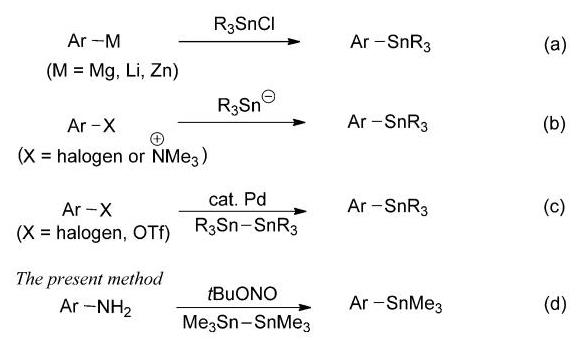
Scheme 1. Synthetic methods for aryl triaryl stannanes.
方案1. 芳基三芳基锡烷的合成方法。
At the outset, we carried out the stannylation under the reaction conditions similar to our previously reported Sand-meyer-type borylation with MeCN as solvent. ${}^{\left\lbrack 9\right\rbrack }$ To our disappointment, we could only observe trace expected stannylation product 2a (Table 1, entry 1). Most starting material (1a) remained unchanged under these conditions. The yield of $\mathbf{{2a}}$ could be significantly improved when excess tert-butyl nitrite was employed and the solvent was switched to DCE (Table 1, entry 2). Notably, the yield of 2a was diminished when extending the reaction time or raising the reaction temperature. It was then confirmed that the product
首先,我们在与之前报道的以乙腈为溶剂的桑德迈尔型硼基化反应相似的条件下进行锡基化反应。${}^{\left\lbrack 9\right\rbrack }$ 令我们失望的是,我们只能观察到痕量的预期锡基化产物2a(表1,条目1)。在这些条件下,大多数起始原料(1a)保持不变。当使用过量的亚硝酸叔丁酯并将溶剂切换为二氯乙烷时,$\mathbf{{2a}}$ 的产率可以显著提高(表1,条目2)。值得注意的是,延长反应时间或提高反应温度时,2a的产率会降低。然后证实了产物
Table 1: Optimization of reaction conditions. ${}^{\left\lbrack a\right\rbrack }$
表1:反应条件的优化。${}^{\left\lbrack a\right\rbrack }$

| Entry | Additive (equiv) | Yield ${\left\lbrack \% \right\rbrack }^{\left\lbrack b\right\rbrack }$ |
| 1 | none | trace ${}^{\left\lbrack c\right\rbrack }$ |
| 2 | none | ${38}^{\left\lbrack d\right\rbrack }$ |
| 3 | ${\mathrm{{BF}}}_{3} \cdot {\mathrm{{OEt}}}_{2}$ (1) | 62 |
| 4 | TsOH (1) | 72 |
| 5 | ${\mathrm{{AlCl}}}_{3}$ (1) | 66 |
| 6 | AcOH (1) | 40 |
| 7 | TsOH (1.2) | 76 |
[a] Unless otherwise noted, the reaction conditions are as follows: aryl amine (0.3 mmol), tBuONO (1.5 equiv), (SnM ${\mathrm{e}}_{3}{)}_{3}$ (1.1 equiv),
[a] 除非另有说明,反应条件如下:芳基胺(0.3 mmol),亚硝酸叔丁酯(1.5当量),(SnM ${\mathrm{e}}_{3}{)}_{3}$(1.1当量),
1,2-dichloroethane (DCE; 1.5 mL), 4 h. [b] Yield of isolated product.
1,2 - 二氯乙烷(DCE;1.5 mL),反应4小时。[b] 分离得到产物的产率。
[c] The reaction was carried out in MeCN; 1 a was recovered unchanged. [d] The reaction was carried out in DCE with 10 equivalents of tBuONO.
[c] 反应在乙腈中进行;1a未发生变化地回收。[d] 反应在DCE中与10当量的叔丁基亚硝酸酯进行。
[*] D. Qiu, H. Meng, L. Jin, S. Wang, S. Tang, X. Wang, F. Mo, Dr. Y. Zhang, Prof. Dr. J. Wang
[*] D. 邱,H. 孟,L. 金,S. 王,S. 唐,X. 王,F. 莫,Y. 张博士,J. 王教授博士
Beijing National Laboratory of Molecular Sciences (BNLMS) and Key Laboratory of Bioorganic Chemistry and Molecular Engineering of Ministry of Education, College of Chemistry, Peking University Beijing 100871 (China)
北京分子科学国家实验室(BNLMS)以及教育部生物有机化学与分子工程重点实验室,北京大学化学与分子工程学院,北京100871(中国)
Prof. Dr. J. Wang
J. 王教授博士
The State Key Laboratory of Organometallic Chemistry
有机金属化学国家重点实验室
Shanghai Institute of Organic Chemistry
上海有机化学研究所
Chinese Academy of Sciences
中国科学院
354 Fenglin Lu, Shanghai 200032 (China)
枫林路354号,上海200032(中国)
[**] The project is supported by the 973 Program (No. 2012CB821600) and NSFC (Grant No. 21272010).
[**] 本项目得到973计划(编号2012CB821600)和国家自然科学基金(批准号21272010)的支持。
Supporting information for this article is available on the WWW under http://dx.doi.org/10.1002/anie.201304579.
本文的支持信息可在网页http://dx.doi.org/10.1002/anie.201304579获取。
2a was not stable at high temperature and the aryl stannane product could react with alkyl nitrite under these conditions. We then decided to carry out the reaction at ${0}^{ \circ }\mathrm{C}$ , and we also reasoned that adding an acidic additive should facilitate the diazotization process. To our delight, the reaction was significantly improved by adding 1 equivalent of ${\mathrm{{BF}}}_{3} \cdot {\mathrm{{OEt}}}_{2}$ (Table 1, entry 3). Other acids were then subsequently examined, and $p$ -toluenesulfonic acid (TsOH) was shown to provide optimal results (Table 1, entries 4,7).
2a在高温下不稳定,芳基锡烷产物在这些条件下会与亚硝酸烷基酯反应。然后我们决定在${0}^{ \circ }\mathrm{C}$下进行反应,并且我们还推断加入酸性添加剂应该有助于重氮化过程。令我们高兴的是,加入1当量的${\mathrm{{BF}}}_{3} \cdot {\mathrm{{OEt}}}_{2}$后反应有显著改善(表1,第3项)。随后研究了其他酸,结果表明$p$ - 对甲苯磺酸(TsOH)能提供最佳结果(表1,第4、7项)。
With the optimized reaction conditions in hand, we then proceeded to expand the scope of substrates to a series of functionalized aniline derivatives (Scheme 2). Moderate to good yields were obtained under the reaction conditions. The stannylation has shown excellent tolerance to both electron-withdrawing and electron-donating groups on the aromatic ring, including nitro (2b), methyl (2c), cyano (2d), halogen (2e, 2f, 2g), formyl (2h), acetyl (2i), methoxy/BocO- (2j, 2k), methylthio (2l), trifluoromethyl (2m), and azo groups (2o). Along with the para-substituted anilines, more complicated substrates, such as those substituted by alkenyl (2t), alkynyl (2u), and amido (2z) groups, were subjected to this reaction, and moderate yields were obtained. In the case of 2s and $2\mathbf{v}$ , the diminished yields were presumably due to steric effects. For the fluoro- and trifluoromethyl-substituted anilines, the diminished yields were attributed to the low boiling points of the products (2v, 2w and 2y), which resulted in the loss of products in the purification. Notably, the side-products of the reaction, which are mostly hydrodeamination products and $t{\mathrm{{BuOSnMe}}}_{3}$ , can be easily removed from the desired stannylation products.
有了优化的反应条件后,我们接着将底物范围扩展到一系列官能化苯胺衍生物(方案2)。在反应条件下获得了中等至良好的产率。该锡基化反应对芳环上吸电子和供电子基团均表现出优异的耐受性,包括硝基(2b)、甲基(2c)、氰基(2d)、卤素(2e、2f、2g)、甲酰基(2h)、乙酰基(2i)、甲氧基/叔丁氧羰基氧基 - (2j、2k)、甲硫基(2l)、三氟甲基(2m)和偶氮基团(2o)。除了对取代苯胺外,更复杂的底物,如被烯基(2t)、炔基(2u)和酰胺基(2z)取代的底物,也进行了此反应,并获得了中等产率。对于2s和$2\mathbf{v}$,产率降低可能是由于空间位阻效应。对于氟代和三氟甲基取代的苯胺,产率降低归因于产物的低沸点(2v、2w和2y),这导致产物在纯化过程中损失。值得注意的是,反应的副产物,主要是加氢脱氨基产物和$t{\mathrm{{BuOSnMe}}}_{3}$,可以很容易地从所需的锡基化产物中除去。
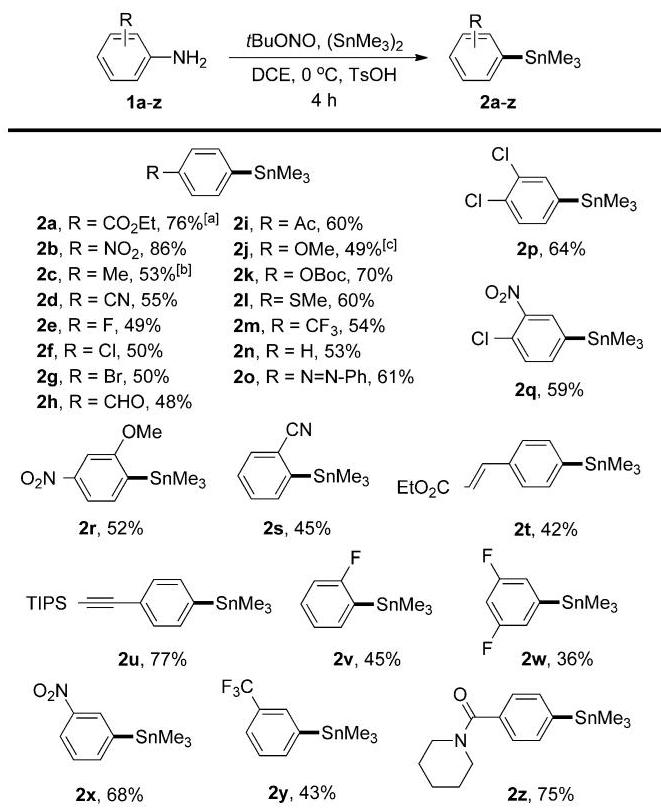
Scheme 2. Scope of aniline derivatives. Reaction conditions: aryl amine (0.3 mmol), tBuONO (0.6 mmol), (SnMe ${}_{3}$ ) (0.33 mmol), TsOH (0.36 mmol), DCE (1.5 mL), 4 h. [a] Yield of isolated product after column chromatography. [b] Room temperature. [c] The reaction was carried out for ${12}\mathrm{\;h}$ at room temperature.
方案2. 苯胺衍生物的范围。反应条件:芳基胺(0.3 mmol),叔丁基亚硝酸酯(0.6 mmol),(三甲基锡${}_{3}$)(0.33 mmol),TsOH(0.36 mmol),DCE(1.5 mL),4小时。[a] 柱色谱后分离得到产物的产率。[b] 室温。[c] 反应在室温下进行${12}\mathrm{\;h}$。
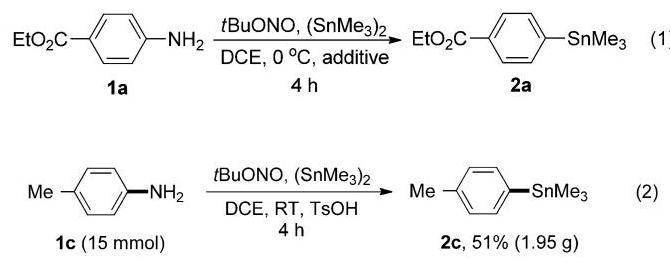
To demonstrate the practical usefulness of this method, the stannylation reaction has been carried out on a gram scale for two substrates $\mathbf{{1b}}$ and $\mathbf{{1c}}$ , as shown in Equation (1) and Equation (2). The corresponding stannylation products 2b and $2\mathbf{c}$ were obtained in acceptable yields on about a 2 gram scale.
为了证明该方法的实际实用性,对两种底物$\mathbf{{1b}}$和$\mathbf{{1c}}$进行了克级规模的锡基化反应,如式(1)和式(2)所示。以约2克规模获得了产率可接受的相应锡基化产物2b和$2\mathbf{c}$。
Heterocyclic aryl stannane compounds have also been found great importance in organic synthesis, especially for pharmaceuticals. Thus, we expanded the scope of this stannylation to the synthesis of aromatic heterocyclic amine derivatives. The results shown in Scheme 3 indicate that stannylation of electron-deficient rings affords relatively high yields under the standard conditions (4a-e). However, longer time is required for the diazotization process of these substrates. In the case of $4\mathbf{e}$ , the diminished yield may be attributed to the steric effects of the chloride substituent. As for the amine substrates bearing electron-rich substituents, the corresponding stannylation products could only be isolated in low yield owing to the easy oxidation of the substrates (4h).
杂环芳基锡化合物在有机合成中也具有重要意义,特别是在药物领域。因此,我们将这种锡化反应的范围扩展到了芳香杂环胺衍生物的合成。方案3所示结果表明,在标准条件下(4a - e),缺电子环的锡化反应能获得较高产率。然而,这些底物的重氮化过程需要更长时间。对于$4\mathbf{e}$,产率降低可能归因于氯取代基的空间效应。至于带有富电子取代基的胺底物,由于底物易于氧化,相应的锡化产物只能以低产率分离得到(4h)。
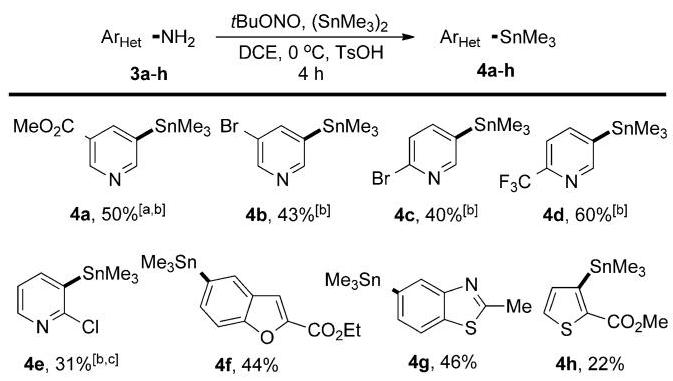
Scheme 3. Scope of heterocyclic amine derivatives. If not otherwise noted, the reaction conditions are as follows: aryl amine (0.3 mmol), tBuONO (0.6 mmol), (SnMe ${}_{3}$ ), (0.33 mmol), TsOH (0.36 mmol), DCE (1.5 mL), 4 h. [a] Yield of isolated product after column chromatography. [b] The reaction was carried out for ${24}\mathrm{\;h}$ . [c] TsOH (0.45 mmol) was used.
方案3. 杂环胺衍生物的范围。除非另有说明,反应条件如下:芳基胺(0.3 mmol),叔丁基亚硝酸酯(0.6 mmol),(SnMe ${}_{3}$ )(0.33 mmol),对甲苯磺酸(0.36 mmol),1,2-二氯乙烷(1.5 mL),4小时。[a] 柱色谱分离后分离产物的产率。[b] 反应进行了${24}\mathrm{\;h}$ 。[c] 使用了对甲苯磺酸(0.45 mmol)。
Since purification of aryl stannane compounds is tedious and some aryl stannanes are not stable on a silica gel column, it is thus desirable to perform the cross-coupling reaction without purification of the crude aryl stannane products. The sequential Sandmeyer-type stannylation and Pd-catalyzed Stille coupling reaction was then explored. Upon completion of the stannylation, the reaction system was filtered to remove the insoluble precipitates, followed by removing the DCE solvent in vacuum. The crude product was then subjected to the Stille reaction to afford the coupling products in moderate to high yields (Scheme 4).
由于芳基锡烷化合物的纯化过程繁琐,且一些芳基锡烷在硅胶柱上不稳定,因此希望在不纯化粗制芳基锡烷产物的情况下进行交叉偶联反应。随后探索了连续的桑德迈尔型锡化反应和钯催化的施蒂勒偶联反应。锡化反应完成后,将反应体系过滤以除去不溶性沉淀,然后在真空中除去1,2-二氯乙烷(DCE)溶剂。然后将粗产物进行施蒂勒反应,以中等至高产率得到偶联产物(方案4)。
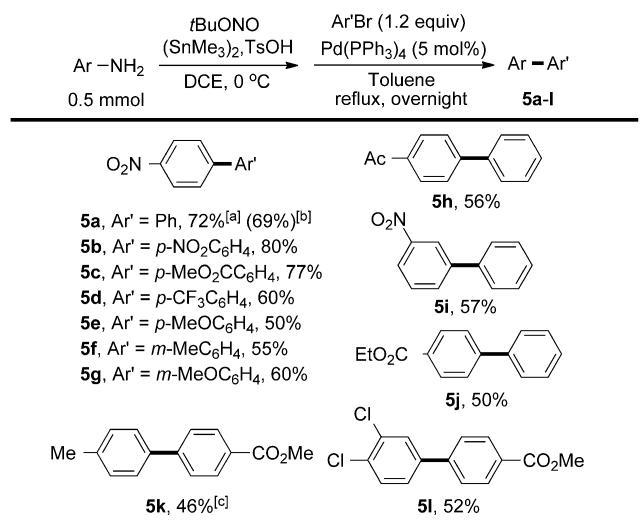
Scheme 4. Sequential stannylation and Pd-catalyzed Stille cross-coupling reactions. Reaction conditions for the first step: aryl amine (0.5 mmol), tBuONO (1.0 mmol), (SnMe ${}_{3}$ ), (0.55 mmol), TsOH (0.60 mmol), DCE (2 mL), 4 h; second step: Ar’Br (1.2 equiv), [Pd ${\left( {\mathrm{{PPh}}}_{3}\right) }_{4}$ ] (5 mol %), toluene (3 mL). [a] Yield of isolated final product after column chromatography. [b] The yield in bracket refers to the reaction using PhI for the second step. [c] Reaction for the first step was carried out at room temperature.
方案4. 连续锡基化反应和钯催化的Stille交叉偶联反应。第一步反应条件:芳基胺(0.5 mmol),叔丁基亚硝酸酯(1.0 mmol),(SnMe ${}_{3}$ )(0.55 mmol),对甲苯磺酸(0.60 mmol),二氯乙烷(2 mL),4小时;第二步:Ar’Br(1.2当量),Pd ${\left( {\mathrm{{PPh}}}_{3}\right) }_{4}$ ,甲苯(3 mL)。[a] 柱色谱后分离得到的最终产物的产率。[b] 括号内的产率是指第二步使用PhI的反应。[c] 第一步反应在室温下进行。
Further demonstration of the usefulness of this Sand-meyer-type stannylation is the concise synthesis of $p$ -terphenyl derivatives $\mathbf{{9a} - e}$ from $p$ -aminoaniline6(Scheme 5). One of the two amino groups of $p$ -aminoaniline6was first converted into a boron group with our previously established metal-free borylation method. ${}^{\left\lbrack 9b\right\rbrack }$ Subsequently, the stannyla-tion converted the remaining amino group into a trimethyl-stannyl group. With the aromatic substrate 8 bearing both boron and tin groups, consecutive cross-couplings were carried out by first performing a Stille cross-coupling with $\left\lbrack {\mathrm{{Pd}}{\left( {\mathrm{{PPh}}}_{3}\right) }_{4}}\right\rbrack$ catalyst and ArBr. Upon completion of the Stille coupling, ${\mathrm{{Ar}}}^{\prime }\mathrm{{Br}},{\mathrm{K}}_{2}{\mathrm{{CO}}}_{3}$ , and $\mathrm{{EtOH}} - {\mathrm{H}}_{2}\mathrm{O}$ were added and reflux was continued for $6\mathrm{\;h}$ . The consecutive cross-coupling afforded $p$ -terphenyl derivatives $\mathbf{{9a} - e}$ in moderately good yields.
这种桑德迈尔型锡基化反应实用性的进一步证明是通过从$p$-氨基苯胺6简洁地合成$p$-三联苯衍生物$\mathbf{{9a} - e}$(方案5)。$p$-氨基苯胺6的两个氨基中的一个首先通过我们之前建立的无金属硼化方法转化为硼基团。${}^{\left\lbrack 9b\right\rbrack }$随后,锡基化反应将剩余的氨基转化为三甲基锡基。对于同时带有硼和锡基团的芳族底物8,首先用$\left\lbrack {\mathrm{{Pd}}{\left( {\mathrm{{PPh}}}_{3}\right) }_{4}}\right\rbrack$催化剂和ArBr进行施蒂勒交叉偶联,然后进行连续的交叉偶联。施蒂勒偶联完成后,加入${\mathrm{{Ar}}}^{\prime }\mathrm{{Br}},{\mathrm{K}}_{2}{\mathrm{{CO}}}_{3}$和$\mathrm{{EtOH}} - {\mathrm{H}}_{2}\mathrm{O}$,并继续回流$6\mathrm{\;h}$。连续交叉偶联以中等良好的产率得到$p$-三联苯衍生物$\mathbf{{9a} - e}$。
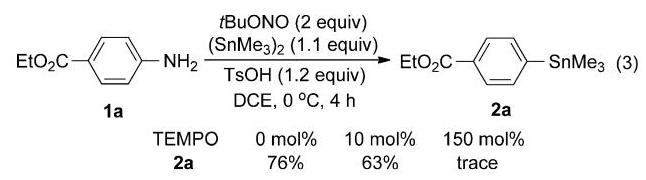
To gain insights into the reaction mechanism, we have carried out the reaction in the presence of radical scavenger TEMPO (2,2,6,6-tetramethylpiperidine-1-oxyl) [Eq. (3)]. When 10 mol% TEMPO was used, the yield of 2a dropped from 76% to 63%. The reaction was completely blocked if excess TEMPO (150 mol%) was added. This experiment indicates the involvement of radical intermediates in the reaction mechanism.
为深入了解反应机理,我们在自由基清除剂TEMPO(2,2,6,6 - 四甲基哌啶 - 1 - 氧基)存在下进行了反应[式(3)]。当使用10 mol%的TEMPO时,2a的产率从76%降至63%。如果加入过量的TEMPO(150 mol%),反应则完全被阻断。该实验表明反应机理中涉及自由基中间体。
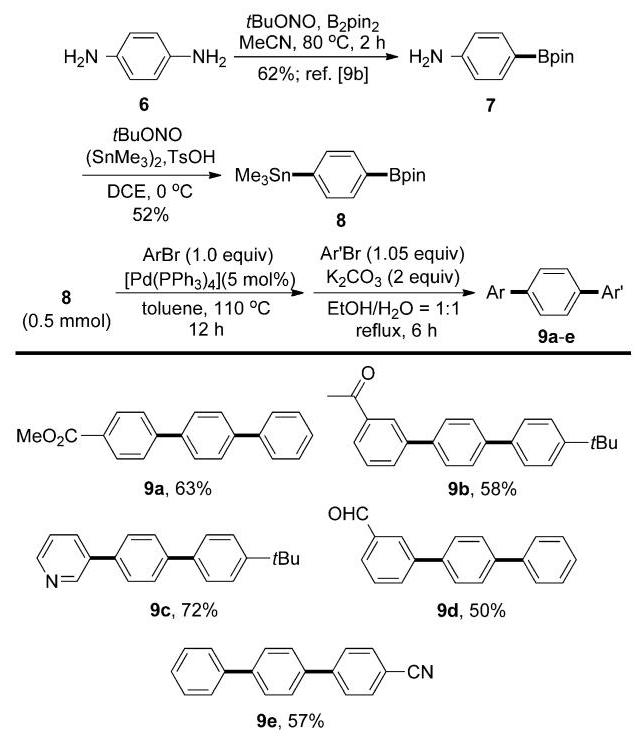
Scheme 5. Synthesis of $p$ -terphenyl derivatives from $p$ -aminoaniline.
方案5. 由$p$ - 氨基苯胺合成$p$ - 三联苯衍生物。
A radical mechanism has been proposed to account for this stannylation reaction (Scheme 6). ${}^{\left\lbrack {12},{13}\right\rbrack }$ First, diazotization of the amino group with $t$ BuONO generates diazonium salt $\mathbf{A}$ (Scheme 6a). This is followed by single electron transfer (SET) from ${\left( {\mathrm{{Me}}}_{3}\mathrm{{Sn}}\right) }_{2}$ to $\mathbf{A}$ , generating radical anion species $\mathbf{B}$ and radical anion species $\mathbf{C}$ (Scheme 6b). ${}^{\left\lbrack {14}\right\rbrack }$ From $\mathbf{B}$ , aryl radical $\mathbf{D}$ is formed, while $\mathbf{C}$ reacts with tert-butoxide anion to generate trimethylstannyl radical $\mathbf{E}$ (Scheme 6c and d). Reaction of the aryl radical $\mathbf{D}$ with ${\left( {\mathrm{{Me}}}_{3}\mathrm{{Sn}}\right) }_{2}$ affords the stannylation product and trimethylstannyl radical E
已提出一种自由基机理来解释这种锡基化反应(方案6)。${}^{\left\lbrack {12},{13}\right\rbrack }$首先,氨基与$t$ BuONO进行重氮化反应生成重氮盐$\mathbf{A}$(方案6a)。随后,从${\left( {\mathrm{{Me}}}_{3}\mathrm{{Sn}}\right) }_{2}$到$\mathbf{A}$发生单电子转移(SET),生成自由基阴离子物种$\mathbf{B}$和自由基阴离子物种$\mathbf{C}$(方案6b)。${}^{\left\lbrack {14}\right\rbrack }$从$\mathbf{B}$形成芳基自由基$\mathbf{D}$,而$\mathbf{C}$与叔丁醇阴离子反应生成三甲基锡自由基$\mathbf{E}$(方案6c和d)。芳基自由基$\mathbf{D}$与${\left( {\mathrm{{Me}}}_{3}\mathrm{{Sn}}\right) }_{2}$反应得到锡基化产物和三甲基锡自由基E
$$ {\mathrm{{Ar} - {NH}}}_{2}\xrightarrow[{-{\mathrm{H}}_{2}\mathrm{O}}]{t\mathrm{{BuONO}}}\overset{ \oplus }{\mathrm{{Ar}} - {\mathrm{N}}_{2} \cdot \mathrm{O}t\mathrm{{Bu}}} $$(a)
$$ \mathrm{A} + {\mathrm{{Me}}}_{3}{\mathrm{{SnSnMe}}}_{3}\xrightarrow[]{{\mathrm{{SET}}}^{ - }}{\mathrm{{Ar} - N}}_{2} \cdot \mathrm{O}\xrightarrow[]{{\mathrm{{He}}}_{3}}{\mathrm{{SnSnMe}}}_{3}\xrightarrow[]{{\mathrm{O}}_{2}}\mathrm{C} $$(b)
$$ \mathrm{B} \rightarrow \mathrm{{Ar}} \cdot + t{\mathrm{{BuO}}}^{ \ominus } + {\mathrm{N}}_{2} \tag{c} $$$$ \mathrm{C} + t{\mathrm{{BuO}}}^{ \ominus } \rightarrow {\mathrm{{Me}}}_{3}\mathrm{{SnO}}t\mathrm{{Bu}} + {\mathrm{{Me}}}_{3}\mathrm{{Sn}} \cdot \tag{d} $$$$ \mathrm{{Ar}}\xrightarrow[]{\mathrm{{Ar}} \uparrow }{\mathrm{{Me}}}_{3}\mathrm{{Sn}} - {\mathrm{{SnMe}}}_{3} \rightarrow \mathrm{{Ar}} - {\mathrm{{SnMe}}}_{3} + {\mathrm{{Me}}}_{3}\mathrm{{Sn}} \cdot \tag{e} $$Ar SnMe ${}_{3}$ Ar-SnMe ${}_{3}$
Ar SnMe ${}_{3}$ Ar - SnMe ${}_{3}$(f)
D E
Scheme 6. Proposed reaction mechanism.
方案6. 提出的反应机理。
(Scheme 6e). ${}^{\left\lbrack {15}\right\rbrack }$ An alternative pathway to stannylation product is direct combination of radical $\mathbf{D}$ and $\mathbf{E}$ (Scheme 6f).
(方案6e)。${}^{\left\lbrack {15}\right\rbrack }$生成锡基化产物的另一条途径是自由基$\mathbf{D}$和$\mathbf{E}$的直接结合(方案6f)。
In conclusion, we have developed a Sandmeyer-type stannylation reaction to synthesize aryl trimethylstannane derivatives. The reaction is under mild conditions and affords the stannylation products in moderate to good yields in most cases. The reaction tolerates a wide range of functional groups. In view of the importance of arylstannane compounds in cross-coupling reactions, we expect that this novel stannyl-ation method will find applications in organic synthesis. Further expansion of the substrate scope as well as the detailed mechanistic study is currently underway in our laboratory, and the results will be reported in due course.
总之,我们开发了一种桑德迈尔型锡基化反应来合成芳基三甲基锡衍生物。该反应条件温和,在大多数情况下能以中等至良好的产率得到锡基化产物。该反应能耐受多种官能团。鉴于芳基锡化合物在交叉偶联反应中的重要性,我们预计这种新型锡基化方法将在有机合成中得到应用。目前我们实验室正在进一步扩大底物范围并进行详细的机理研究,结果将适时报道。
Received: May 28, 2013
收到:2013年5月28日
Revised: July 13, 2013
修订:2013年7月13日
Published online: September 6, 2013
在线发表:2013年9月6日
Keywords: aryl stannanes $\cdot$ cross-coupling $\cdot$ diazonium salts Sandmeyer reaction $\cdot$ Stille coupling reaction
关键词:芳基锡$\cdot$交叉偶联$\cdot$重氮盐 桑德迈尔反应$\cdot$ 施蒂勒偶联反应
[4] a) S. M. Moerlein, J. Organomet. Chem. 1989, 319, 29; b) J. A. Soderquist, A. Hassner, J. Am. Chem. Soc. 1980, 102, 1577; c) T. Hayashi, M. Ishigedani, Tetrahedron 2001, 57, 2589; d) P. Knochel, R. D. Singer, Chem. Rev. 1993, 93, 2117.
[5] a) M. Gielen, B. de Poorter, Rev. Silicon Germanium Tin Lead Compd. 1977, 3, 9; b) M. Gielen, Rev. Silicon Germanium Tin Lead Compd. 1981, 5, 6; c) A. B. Chopa, M. T. Lockhart, G. Silbestri, Organometallics 2001, 20, 3358; d) G. F. Silbestri, M. T. Lockhart, A. B. Chopa, Arkivoc 2011, 210.
[6] a) D. Azarian, S. S. Dua, C. Eaborn, D. R. M. Walton, J. Organomet. Chem. 1976, 117, C55; b) H. Azizian, C. E. Eaborn, A. Pidcock, J. Organomet. Chem. 1981, 215, 49; c) A. N. Kashin, I. G. Bumagina, N. A. Bumagin, V. N. Bakunin, I. P. Beletskaya, J. Org. Chem. USSR 1981, 17, 789; d) N. A. Bumagin, I. G. Bumagina, I. P. Beletskaya, Dokl. Akad. Nauk SSSR 1984, 274, 1103; e) W. D. Wulff, G. A. Peterson, W. E. Bauta, K. Chan, K. L. Faron, S. R. Gilbertson, R. W. Kaesler, D. C. Yang, C. K. Murray, J. Org. Chem. 1986, 51, 277; f) M. Lautens, T. Rovis, Tetrahedron 1999, 55, 8967; g) E. B. Corcoran, A. B. Williams, R. N. Hanson, Org. Lett. 2012, 14, 4630; h) C. Gosmini, J. Périchon, Org. Biomol. Chem. 2005, 3, 216. For a report on catalytic aromatic C-H bond stannylation, see: i) M. E. Doster, J. A. Hatnean, T. Jeftic, S. Modi, S. A. Johnson, J. Am. Chem. Soc. 2010, 132, 11923.
[7] For reviews on the Sandmeyer reaction, see: a) H. H. Hodgson, Chem. Rev. 1947, 40, 251; b) C. Galli, Chem. Rev. 1988, 88, 765; c) E. B. Merkushev, Synthesis 1988, 923; d) R. Bohlmann in Comp. Org. Synth., Vol. 6 (Eds.: B. M. Trost, I. Fleming), Pergamon, Oxford, 1991, p. 203; e) G. Balz, G. Schiemann, Ber. Dtsch. Chem. Ges. B 1927, 60, 1186.
[8] For recent reviews on the application of aryldiazonium salts in organic synthesis, see: a) F. X. Felpin, L. Nassar-Hardy, F. Le Callonnec, E. Fouquet, Tetrahedron 2011, 67, 2815; b) J. G. Taylor, A. V. Moro, C. R. D. Correia, Eur. J. Org. Chem. 2011, 1403; c) F. Mo, G. Dong, Y. Zhang, J. Wang, Org. Biomol. Chem. 2013, 11, 1582; d) D. P. Hari, B. König, Angew. Chem. 2013, 125, 4832; Angew. Chem. Int. Ed. 2013, 52, 4734.
[9] a) F. Mo, Y. Jiang, D. Qiu, Y. Zhang, J. Wang, Angew. Chem. 2010, 122, 1890; Angew. Chem. Int. Ed. 2010, 49, 1846; b) D. Qiu, L. Jin, Z. Zheng, H. Meng, F. Mo, X. Wang, Y. Zhang, J. Wang, J. Org. Chem. 2013, 78, 1923.
[10] For a related reaction, see: C. Zhu, M. Yamane, Org. Lett. 2012, 14, 4560.
[11] a) M. P. Doyle, B. Siegfried, J. F. Dellaria, Jr., J. Org. Chem. 1977, 42, 2426; b) M. P. Doyle, Jr., J. F. Dellaria, B. Siegfried, S. W. Bishop, J. Org. Chem. 1977, 42, 3494.
[12] For a mechanistic study on Sandmeyer reaction, see: J. K. Kochi, J. Am. Chem. Soc. 1957, 79, 2942.
[13] A. G. Davies, Radical Chemistry of Tin in Chemistry of Tin (Ed.: P. G. Harrison), Blackie & Son, Glasgow, 1989, p. 294.
[14] For reports of single electron transfer from ${\mathrm{R}}_{3}{\mathrm{{SnSnR}}}_{3}$ , see: a) S. Fukuzumi, T. Kitano, K. Mochida, J. Am. Chem. Soc. 1990, 112, 3246; b) T. Maruyama, S. Suga, J.-i. Yoshida, J. Am. Chem. Soc. 2005, 127, 7324; c) T. Maruyama, S. Suga, J.-i. Yoshida, Tetrahedron 2006, 62, 6519.
[15] D. Seyferth, K. V. Darragh, J. Organomet. Chem. 1968, 11, P9.
[1] For reviews, see: a) J. K. Stille, Angew. Chem. 1986, 98, 504; Angew. Chem. Int. Ed. Engl. 1986, 25, 508; b) V. Farina, Pure Appl. Chem. 1996, 68, 73; c) M. Kosugi, K. Fugami, Handbook of Organopalladium Chemistry for Organic Synthesis (Ed.: E. Negishi), Wiley, New York, 2002, p. 263; d) J. Hassan, M. Sevignon, C. Gozzi, E. Schulz, M. Lemaire, Chem. Rev. 2002, 102, 1359; e) P. Espinet, A. M. Echavarren, Angew. Chem. 2004, 116, 4808; Angew. Chem. Int. Ed. 2004, 43, 4704; f) C. C. C. Johansson Seechurn, M. O. Kitching, T. J. Colacot, V. Snieckus, Angew. Chem. 2012, 124, 5150; Angew. Chem. Int. Ed. 2012, 51, 5062.
[1] 有关综述,请参阅:a) J. K. Stille, Angew. Chem. 1986, 98, 504; Angew. Chem. Int. Ed. Engl. 1986, 25, 508; b) V. Farina, Pure Appl. Chem. 1996, 68, 73; c) M. Kosugi, K. Fugami, Handbook of Organopalladium Chemistry for Organic Synthesis (Ed.: E. Negishi), Wiley, New York, 2002, p. 263; d) J. Hassan, M. Sevignon, C. Gozzi, E. Schulz, M. Lemaire, Chem. Rev. 2002, 102, 1359; e) P. Espinet, A. M. Echavarren, Angew. Chem. 2004, 116, 4808; Angew. Chem. Int. Ed. 2004, 43, 4704; f) C. C. C. Johansson Seechurn, M. O. Kitching, T. J. Colacot, V. Snieckus, Angew. Chem. 2012, 124, 5150; Angew. Chem. Int. Ed. 2012, 51, 5062.
[2] a) M. Kosugi, K. Sasazawa, Y. Shimizu, T. Migita, Chem. Lett. 1977, 301; b) M. Kosugi, Y. Shimizu, T. Migita, J. Organomet. Chem. 1977, 129, C36; c) M. Kosugi, Y. Shimizu, T. Migita, Chem. Lett. 1977, 1423; d) D. Milstein, J. K. Stille, J. Am. Chem. Soc. 1978, 100, 3636; e) I. P. Beletskaya, J. Organomet. Chem. 1983, 250, 551. For an example of a large-scale application of Stille coupling, see: f) J. A. Ragan, J. W. Raggon, P. D. Hill, B. P. Jones, R. E. McDermott, M. J. Munchhof, M. A. Marx, J. M. Casavant, B. A. Cooper, J. L. Doty, Y. Lu, Org. Process Res. Dev. 2003, 7, 676. For a selected recent example of Stille coupling reaction in total synthesis, see: g) E. Alonso, H. Fuwa, C. Vale, Y. Suga, T. Goto, Y. Konno, M. Sasaki, F. M. LaFerla, M. R. Vieytes, L. Giménez-Llort, L. M. Botana, J. Am. Chem. Soc. 2012, 134, 7467.
[2] a) M. 小杉、K. 笹泽、Y. 清水、T. 三木田,《化学通讯》,1977年,301页;b) M. 小杉、Y. 清水、T. 三木田,《有机金属化学杂志》,1977年,129卷,C36页;c) M. 小杉、Y. 清水、T. 三木田,《化学通讯》,1977年,1423页;d) D. 米尔斯坦、J. K. 斯蒂尔,《美国化学会志》,1978年,100卷,3636页;e) I. P. 别列茨卡娅,《有机金属化学杂志》,1983年,250卷,551页。关于施蒂勒偶联大规模应用的一个例子,见:f) J. A. 拉根、J. W. 拉贡恩、P. D. 希尔、B. P. 琼斯、R. E. 麦克德莫特、M. J. 芒奇霍夫、M. A. 马克思、J. M. 卡萨万特、B. A. 库珀、J. L. 多蒂、Y. 卢,《有机过程研究与开发》,2003年,7卷,676页。关于全合成中施蒂勒偶联反应的一个近期精选例子,见:g) E. 阿隆索、H. 富和、C. 瓦尔、Y. 菅、T. 后藤、Y. にこ、M. 佐々木、F. M. 拉费拉、M. R. 维耶特斯、L. 希门尼斯 - 略特、L. M. 博塔纳,《美国化学会志》,2012年,134卷,7467页。
[3] For selected examples, see: a) P. Y. S. Lam, G. Vincent, D. Bonne, C. G. Clark, Tetrahedron Lett. 2002, 43, 3091; b) T. Furuya, A. E. Strom, T. Ritter, J. Am. Chem. Soc. 2009, 131, 1662; c) P. Tang, T. Furuya, T. Ritter, J. Am. Chem. Soc. 2010, 132, 12150; d) C. Huang, T. Liang, S. Harada, E. Lee, T. Ritter, J. Am. Chem. Soc. 2011, 133, 13308.
[3] 关于精选例子,见:a) P. Y. S. 林、G. 文森特、D. 博内、C. G. 克拉克,《四面体通讯》,2002年,43卷,3091页;b) T. 古谷、A. E. 斯特罗姆、T. 里特,《美国化学会志》,2009年,131卷,1662页;c) P. 唐、T. 古谷、T. 里特,《美国化学会志》,2010年,132卷,12150页;d) C. 黄、T. 梁、S. 原田、E. 李、T. 里特,《美国化学会志》,2011年,133卷,13308页。