Silver-Mediated Trifluoromethylation of Aryldiazonium Salts: Conversion of Amino Group into Trifluoromethyl Group
英文原文与中文译文逐段对照 · English original with Chinese translation
Xi Wang, Yan Xu, Fanyang Mo, Guojing Ji, Di Qiu, Jiajie Feng, Yuxuan Ye, Songnan Zhang, Yan Zhang, and Jianbo Wang*
王曦,许言,莫凡洋,季国静,邱迪,冯佳杰,叶雨萱,张松楠,张燕,王建波*
Beijing National Laboratory of Molecular Sciences (BNLMS), Key Laboratory of Bioorganic Chemistry and Molecular Engineering of Ministry of Education, College of Chemistry, Peking University, Beijing 100871, China
中国北京 100871,北京大学化学与分子工程学院,生物有机与分子工程教育部重点实验室,北京分子科学国家实验室(BNLMS)
(c) Supporting Information
(c) 支持信息
ABSTRACT: A novel strategy for aromatic trifluorome-thylation by converting aromatic amino group into ${\mathrm{{CF}}}_{3}$ group is reported herein. This method, which can be considered as trifluoromethylation variation of the classic Sandmeyer reaction, uses readily available aromatic amines as starting materials and is performed under mild conditions.
摘要:本文报道了一种通过将芳香族氨基转化为${\mathrm{{CF}}}_{3}$基团来实现芳香族三氟甲基化的新策略。该方法可视为经典桑德迈尔反应的三氟甲基化变体,以易于获得的芳香胺为起始原料,在温和条件下进行。
Trifluoromethylated arenes have become increasingly prevalent in numerous fields, ranging from pharmaceuticals, agrochemicals, to functional materials. ${}^{1}$ However, ${\mathrm{{CF}}}_{3}$ - containing compounds are absent in nature, which accounts for the vital importance of developing general and practical methods to introduce a ${\mathrm{{CF}}}_{3}$ group onto aromatic structures. In recent years, the scientific community has witnessed a rapid development of methods for trifluoromethylation of arenes. ${}^{2}$
三氟甲基化芳烃在众多领域中变得越来越普遍,从药物、农用化学品到功能材料。${}^{1}$ 然而,自然界中不存在含 ${\mathrm{{CF}}}_{3}$ 的化合物,这说明了开发通用且实用的方法将 ${\mathrm{{CF}}}_{3}$ 基团引入芳香结构的至关重要性。近年来,科学界见证了芳烃三氟甲基化方法的快速发展。${}^{2}$
The traditional means for introducing a ${\mathrm{{CF}}}_{3}$ group onto an aromatic ring relies on a Swarts-type reaction, pioneered by Swarts in 1892. ${}^{3}$ The Swarts-type reaction involves exhaustive chlorination at the benzylic position, followed by chlorine/ fluorine exchange with HF under harsh conditions (Scheme 1a). Although relatively practical for large-scale industrial production of ${\mathrm{{CF}}}_{3}$ -containing aromatic building blocks and intermediates, this process is not appropriate for late-stage introduction of a ${\mathrm{{CF}}}_{3}$ group onto an aromatic structure, which is becoming increasingly important in drug development. To tackle such a problem, methodologies for the direct trifluoromethylation of arenes have been developed. A commonly applied approach is the conversion of halogen substituents into ${\mathrm{{CF}}}_{3}$ groups through transition-metal-mediated or -catalyzed reactions (Scheme 1b). Since the first discovery by McLoughlin and Thrower in ${1969},{}^{4}{\mathrm{{CuCF}}}_{3}$ reagents have been extensively studied and widely used in the stoichiometric trifluoromethylation of aryl halides. ${}^{2\mathrm{e}}$ More recently, Cu- or Pd-catalyzed trifluoromethylation has attracted great attention from the synthetic community. Accordingly, significant progress in this field has been achieved. ${}^{5 - 7}$ Closely related methods, the Cu-catalyzed or -mediated conversion of a boron group into a ${\mathrm{{CF}}}_{3}$ group, have also been developed (Scheme 1c). ${}^{8}$ In addition to the transition-metal-catalyzed or -promoted methods, a distinct approach to introducing a ${\mathrm{{CF}}}_{3}$ group is the facile trifluoromethylation of an aromatic $\mathrm{C} - \mathrm{H}$ bond through a radical process (Scheme 1, d). ${}^{9,{10}}$
在芳环上引入${\mathrm{{CF}}}_{3}$基团的传统方法依赖于1892年由斯瓦茨开创的斯瓦茨型反应。${}^{3}$斯瓦茨型反应包括在苄基位置进行彻底的氯化,然后在苛刻条件下与HF进行氯/氟交换(方案1a)。尽管该方法对于大规模工业生产含${\mathrm{{CF}}}_{3}$的芳族结构单元和中间体相对实用,但该过程不适用于在芳族结构上后期引入${\mathrm{{CF}}}_{3}$基团,而这在药物开发中变得越来越重要。为了解决这个问题,已经开发了芳烃直接三氟甲基化的方法。一种常用的方法是通过过渡金属介导或催化的反应将卤素取代基转化为${\mathrm{{CF}}}_{3}$基团(方案1b)。自从麦克劳克林和思罗尔在${1969},{}^{4}{\mathrm{{CuCF}}}_{3}$首次发现以来,试剂已经得到了广泛的研究,并广泛用于芳基卤化物的化学计量三氟甲基化。${}^{2\mathrm{e}}$最近,铜或钯催化的三氟甲基化引起了合成界的极大关注。因此,该领域已经取得了重大进展。${}^{5 - 7}$密切相关的方法,即铜催化或介导的硼基团转化为${\mathrm{{CF}}}_{3}$基团的方法,也已被开发出来(方案1c)。${}^{8}$除了过渡金属催化或促进的方法外,引入${\mathrm{{CF}}}_{3}$基团的另一种独特方法是通过自由基过程对芳族$\mathrm{C} - \mathrm{H}$键进行简便的三氟甲基化(方案1d)。${}^{9,{10}}$
Scheme 1. Methods for Aryl Trifluoromethylation Categorized by the Groups Being Converted
方案1. 按被转化基团分类的芳基三氟甲基化方法
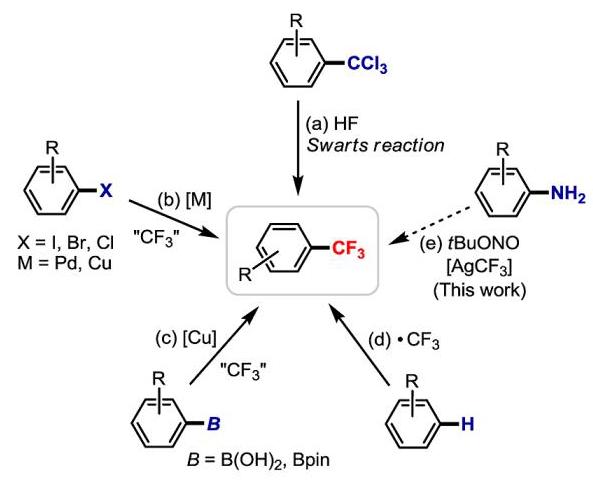
Although numerous efforts have been devoted to aromatic trifluoromethylation and remarkable progress has been made, the problem is far from being solved. Most current methods suffer from at least one of the following drawbacks: harsh reaction conditions, limited substrate scope, low regioselectiv-ity, and expensive reagents or catalysts/ligands. Therefore, further developments are needed to enable the use of cheap and abundantly available starting materials as well as mild trifluoromethylation conditions. To this end, we report herein a novel approach to aromatic trifluoromethylation through direct conversion of an aromatic amino group into ${\mathrm{{CF}}}_{3}$ group (Scheme 1e).
尽管人们已经为芳香族三氟甲基化付出了诸多努力并取得了显著进展,但问题远未得到解决。目前大多数方法至少存在以下缺点之一:反应条件苛刻、底物范围有限、区域选择性低以及试剂或催化剂/配体昂贵。因此,需要进一步发展,以能够使用廉价且大量可得的起始原料以及温和的三氟甲基化条件。为此,我们在此报告一种通过将芳香族氨基直接转化为${\mathrm{{CF}}}_{3}$基团来进行芳香族三氟甲基化的新方法(方案1e)。
Aromatic amines are commonly used chemicals and easily available. The aromatic amino group serves as a versatile motif, which can be converted into various functional groups. These transformations mostly proceed through arene diazonium salts, which are important intermediates in organic chemistry. Since their first discovery in ${1858},{}^{{11},{12}}$ several named reactions related to arene diazonium salts have been established as classic methods for functional group transformations. Undoubtedly, the most prominent one is the Sandmeyer reaction, which can replace aromatic amino groups with halides or pseudohalides. ${}^{13}$ Another important reaction is Balz-Schiemann reaction, which can convert an amino group into a fluoro group. ${}^{14}$ These classic transformations are not only routinely practised in research laboratories but also widely applied in industry.
芳香胺是常用化学品且易于获得。芳香氨基是一种通用结构单元,可转化为各种官能团。这些转化大多通过芳基重氮盐进行,芳基重氮盐是有机化学中的重要中间体。自它们在${1858},{}^{{11},{12}}$首次被发现以来,几种与芳基重氮盐相关的命名反应已成为官能团转化的经典方法。毫无疑问,最著名的是桑德迈尔反应,它可以用卤化物或拟卤化物取代芳香氨基。${}^{13}$另一个重要反应是巴尔扎 - 席曼反应,它可以将氨基转化为氟基。${}^{14}$这些经典转化不仅在研究实验室中经常进行,而且在工业上也有广泛应用。
Received: June 5, 2013
收到日期:2013年6月5日
Based on the oxidizing properties of aryl diazonium salts and the strong $\sigma$ -donor nature of the trifluoromethyl group in the $\left\lbrack {\mathrm{{AgCF}}}_{3}\right\rbrack {\text{ complex }}^{2\mathrm{e}}$ and also inspired by Ritter’s recent reports on reductive elimination from bimetallic high-valent silver complex to form ${\mathrm{C}}_{\text{ avyl }} - \mathrm{F}$ bonds, ${}^{15}$ we proposed that oxidative addition of diazonium salt A would be favored at an electron-rich silver center to afford intermediate $\mathbf{B}$ (Scheme 2).
基于芳基重氮盐的氧化性质以及$\left\lbrack {\mathrm{{AgCF}}}_{3}\right\rbrack {\text{ complex }}^{2\mathrm{e}}$中三氟甲基的强$\sigma$供体性质,并且也受到里特最近关于从双金属高价银配合物进行还原消除以形成${\mathrm{C}}_{\text{ avyl }} - \mathrm{F}$键的报道的启发,${}^{15}$我们提出重氮盐A在富电子银中心的氧化加成将有利于生成中间体$\mathbf{B}$(方案2)。
Scheme 2. Proposed Strategy for Trifluoromethylation of Aromatic Amines
方案2. 芳香胺三氟甲基化的 proposed Strategy
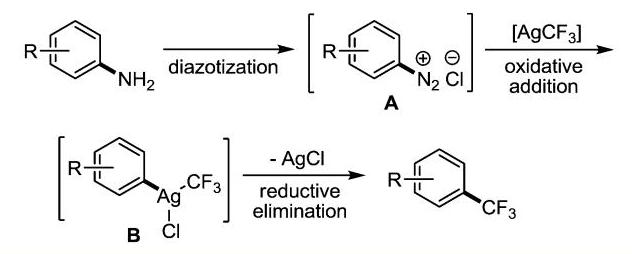
Subsequently, intermediate B undergoes reductive elimination to form a ${\mathrm{C}}_{\text{ aryl }} - {\mathrm{{CF}}}_{3}$ bond and a $\mathrm{{AgCl}}$ precipitate. According to this hypothesis, we envisioned that conversion of aromatic amines into the corresponding trifluoromethyl arenes (trifluor-omethylation variation of the classic Sandmeyer reaction) would be feasible.
随后,中间体B进行还原消除以形成${\mathrm{C}}_{\text{ aryl }} - {\mathrm{{CF}}}_{3}$键和$\mathrm{{AgCl}}$沉淀。根据这一假设,我们设想将芳香胺转化为相应的三氟甲基芳烃(经典桑德迈尔反应的三氟甲基化变体)是可行的。
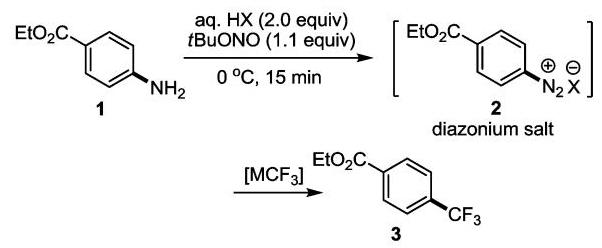
Initially, we imitated the classic Sandmeyer reaction conditions by slowly adding a solution of $\left\lbrack {\mathrm{{AgCF}}}_{3}\right\rbrack$ in MeCN, freshly prepared from AgF and ${\mathrm{{Me}}}_{3}{\mathrm{{SiCF}}}_{3}$ (Ruppert-Prakash reagent), ${}^{{16},{17}}$ into the diazonium chloride $2\left( {\mathrm{X} = \mathrm{{Cl}}}\right)$ at $0{}^{ \circ }\mathrm{C}$ , prepared in MeCN from ethyl 4-aminobenzoate 1 through diazotization with $t$ -BuONO/aq HCl (Table 1). ${}^{18}$ To our delight, the expected trifluoromethylated product 3 was formed in 41% yield based on ${}^{19}\mathrm{\;F}$ NMR analysis (entry 1). It was found that the reaction was favored at low temperature. When the solvent was switched to EtCN (mp $- {93}^{ \circ }\mathrm{C}$ ) and the addition of $\left\lbrack {\mathrm{{AgCF}}}_{3}\right\rbrack$ was carried out at $- {78}^{ \circ }\mathrm{C}$ , we observed a dramatic increase in the yield (entry 2). It was noted that 3.5 equiv of $\left\lbrack {\mathrm{{AgCF}}}_{3}\right\rbrack$ was necessary to maintain the high yield. Further study indicates that the counterions of diazonium salt impose significant affect on the reaction. ${\mathrm{{Br}}}^{ - }$ and ${\mathrm{{CF}}}_{3}{\mathrm{{CO}}}_{2}{}^{ - }$ afforded similar results as ${\mathrm{{Cl}}}^{ - }$ , whereas ${\mathrm{{BF}}}_{4}^{ - }$ gave diminished yield and $t - {\mathrm{{BuO}}}^{ - }$ gave only a trace amount of the product (entries 3-6). It is noteworthy that using $\left\lbrack {\mathrm{{CuCF}}}_{3}\right\rbrack$ as the ${\mathrm{{CF}}}_{3}$ source, freshly prepared from CuCl, CsF, and ${\mathrm{{Me}}}_{3}{\mathrm{{SiCF}}}_{3}$ in DMF, the trifluoromethylation also proceeded, albeit with lower yield (entry 7). ${}^{19}$ Finally, other solvents, such as DMF, DCE, MeOH, and EtOH, were all found to give poor results.
最初,我们模仿经典的桑德迈尔反应条件,将由AgF和${\mathrm{{Me}}}_{3}{\mathrm{{SiCF}}}_{3}$(鲁佩特 - 普拉卡什试剂)${}^{{16},{17}}$在MeCN中新鲜制备的$\left\lbrack {\mathrm{{AgCF}}}_{3}\right\rbrack$溶液,在由4 - 氨基苯甲酸乙酯1在MeCN中通过用$t$ - BuONO/盐酸水溶液重氮化制备的重氮氯化物$2\left( {\mathrm{X} = \mathrm{{Cl}}}\right)$于$0{}^{ \circ }\mathrm{C}$下缓慢加入。${}^{18}$令我们高兴的是,基于${}^{19}\mathrm{\;F}$ NMR分析,预期的三氟甲基化产物3以41%的产率形成(条目1)。发现该反应在低温下更有利。当溶剂切换到EtCN(熔点$- {93}^{ \circ }\mathrm{C}$)且在$- {78}^{ \circ }\mathrm{C}$下加入$\left\lbrack {\mathrm{{AgCF}}}_{3}\right\rbrack$时,我们观察到产率显著提高(条目2)。注意到需要3.5当量的$\left\lbrack {\mathrm{{AgCF}}}_{3}\right\rbrack$以维持高产率。进一步研究表明重氮盐的抗衡离子对反应有显著影响。${\mathrm{{Br}}}^{ - }$和${\mathrm{{CF}}}_{3}{\mathrm{{CO}}}_{2}{}^{ - }$得到与${\mathrm{{Cl}}}^{ - }$相似的结果,而${\mathrm{{BF}}}_{4}^{ - }$产率降低且$t - {\mathrm{{BuO}}}^{ - }$仅得到痕量产物(条目3 - 6)。值得注意的是,使用由CuCl、CsF和${\mathrm{{Me}}}_{3}{\mathrm{{SiCF}}}_{3}$在DMF中新鲜制备的$\left\lbrack {\mathrm{{CuCF}}}_{3}\right\rbrack$作为${\mathrm{{CF}}}_{3}$源时,三氟甲基化也能进行,尽管产率较低(条目7)。${}^{19}$最后,发现其他溶剂,如DMF、DCE、MeOH和EtOH,都得到较差的结果。
With the optimal reaction conditions (Table 1, entry 2), the substrate scope was then surveyed with a series of aromatic amine derivatives (Scheme 3). In general, the aniline derivatives bearing either electron-withdrawing or -donating groups react smoothly to afford the corresponding trifluoromethylation products in moderate to excellent yields. 4-Aminoazobenzene is also a suitable substrate for the reaction, affording product 14. Trifluoromethylation of unprotected alcohol and benzoic acid affords the desired products 15 and 16 in good yields, respectively. Remarkably, oxidation sensitive groups, such as vinyl, alkynyl, Bpin, and TMS groups, also tolerate the reaction conditions (17-22). The anilines bearing ortho-substitutents, including ester and bulky isopropyl groups, also worked well to give 23 and 24, respectively. The diminished yields of 28 and 29 are due to the sublimation of the trifluoromethylated naphthalene products under reduced pressure during purification.
在优化的反应条件下(表1,条目2),然后用一系列芳胺衍生物研究了底物范围(方案3)。一般来说,带有吸电子或供电子基团的苯胺衍生物反应顺利,以中等至优异的产率得到相应的三氟甲基化产物。4 - 氨基偶氮苯也是该反应的合适底物,得到产物14。未保护的醇和苯甲酸的三氟甲基化分别以良好的产率得到所需产物15和16。值得注意的是,对氧化敏感的基团,如乙烯基、炔基、硼酸频哪醇酯和三甲基硅基,也能耐受反应条件(17 - 22)。带有邻位取代基(包括酯和大体积异丙基)的苯胺也能很好地反应,分别得到23和24。28和29产率降低是由于在减压纯化过程中三氟甲基化萘产物升华。
Table 1. Optimization of Trifluoromethylation Conditions ${}^{a}$
表1. 三氟甲基化条件的优化${}^{a}$
| entry | X | $\left\lbrack {\mathrm{{MCF}}}_{3}\right\rbrack$ | temp | solvent | 3, yield ${}^{b}$ |
| 1 | Cl | ${\mathrm{{AgCF}}}_{3}{}^{c}$ | 0°C-rt | MeCN | 41% |
| 2 | Cl | $\mathrm{{AgC}{F}_{3}}$ | $- {78}^{ \circ }\mathrm{C}$ -rt | EtCN | 95% (80%) |
| 3 | OtBu | $\mathrm{{AgC}{F}_{3}}$ | $- {78}^{ \circ }\mathrm{C}$ -rt | EtCN | trace |
| 4 | BF4 | $\mathrm{{AgC}{F}_{3}}$ | $- {78}^{ \circ }\mathrm{C}$ -rt | EtCN | 46% |
| 5 | Br | $\mathrm{{AgC}{F}_{3}}$ | $- {78}^{ \circ }\mathrm{C}$ -rt | EtCN | 93% |
| 6 | ${\mathrm{{CF}}}_{3}{\mathrm{{CO}}}_{2}$ | $\mathrm{{AgC}{F}_{3}}$ | $- {78}^{ \circ }\mathrm{C}$ -rt | EtCN | 93% |
| 7 | Cl | ${\mathrm{{CuCF}}}_{3}$ | $- {60}^{ \circ }\mathrm{C}$ -rt | EtCN | 37% |
${}^{a}$ Reaction conditions: preparation of the diazonium salt:1(0.3 mmol), aq HX (0.6 mmol), t-BuONO (0.33 mmol), solvent, 0°C, 15 min; preparation of $\left\lbrack {\mathrm{{AgCF}}}_{3}\right\rbrack$ : AgF (1.05 mmol), ${\mathrm{{TMSCF}}}_{3}$ (1.05 mmol), EtCN (3 mL), room temperature, 15 min; preparation of $\left\lbrack {\mathrm{{CuCF}}}_{3}\right\rbrack : \mathrm{{CuCl}}$ (1.05 mmol), $\mathrm{{CsF}}$ (1.05 mmol), ${\mathrm{{TMSCF}}}_{3}$ (1.05 mmol), DMF (3 mL), room temperature, 30 min. The [MCF3] solution was added dropwise to the solution of 2 (0.30 mmol) over a period of $1\mathrm{\;h}$ . The solution was stirred for another $3\mathrm{\;h}$ and then warmed to room temperature. ${}^{b}$ Unless otherwise noted, the yields are based on ${}^{19}\mathrm{\;F}$ NMR with $4 - {\mathrm{{CF}}}_{3}{\mathrm{{OC}}}_{6}{\mathrm{H}}_{4}\mathrm{{OMe}}$ as internal standard. ${}^{c}\left\lbrack {\mathrm{{AgCF}}}_{3}\right\rbrack$ was prepared in MeCN (3 mL). ${}^{d}$ Value in parentheses refers to isolated yield.
${}^{a}$ 反应条件:重氮盐的制备:1(0.3 mmol),HX水溶液(0.6 mmol),叔丁基亚硝酸酯(0.33 mmol),溶剂,0°C,15分钟;$\left\lbrack {\mathrm{{AgCF}}}_{3}\right\rbrack$ 的制备:AgF(1.05 mmol),${\mathrm{{TMSCF}}}_{3}$(1.05 mmol),乙腈(3 mL),室温,15分钟;$\left\lbrack {\mathrm{{CuCF}}}_{3}\right\rbrack : \mathrm{{CuCl}}$(1.05 mmol),$\mathrm{{CsF}}$(1.05 mmol),${\mathrm{{TMSCF}}}_{3}$(1.05 mmol),N, N-二甲基甲酰胺(3 mL),室温,30分钟。[MCF3]溶液在$1\mathrm{\;h}$ 的时间内滴加到2(0.30 mmol)的溶液中。溶液再搅拌$3\mathrm{\;h}$ ,然后升温至室温。${}^{b}$ 除非另有说明,产率基于以$4 - {\mathrm{{CF}}}_{3}{\mathrm{{OC}}}_{6}{\mathrm{H}}_{4}\mathrm{{OMe}}$ 为内标物的${}^{19}\mathrm{\;F}$ 核磁共振。${}^{c}\left\lbrack {\mathrm{{AgCF}}}_{3}\right\rbrack$ 在乙腈(3 mL)中制备。${}^{d}$ 括号内的值为分离产率。
For the substrate bearing pyridine moiety, the reaction gave only a low yield of the product 30 , presumably due to the protonation of the pyridine nitrogen. In the case of heteroaromatic amines, such as indoles and benzofurans, the desired products 31-34 could be formed in moderate yields. Besides, various di- and multi-substituted ${\mathrm{{CF}}}_{3}$ -bearing arenes could be accessed through this transformation in generally good yields (35-46). Finally, to demonstrate the applicability of this method in more complex molecules, we smoothly converted the amino groups embedded in the estrone and tocopherol framework into the trifluoromethyl groups (47 and 48).
对于带有吡啶部分的底物,反应仅得到低产率的产物30,可能是由于吡啶氮的质子化。对于杂环芳胺,如吲哚和苯并呋喃,可以以中等产率形成所需产物31 - 34。此外,通过这种转化可以以总体良好的产率(35 - 46)获得各种二取代和多取代的${\mathrm{{CF}}}_{3}$ 芳烃。最后,为了证明该方法在更复杂分子中的适用性,我们顺利地将嵌入雌酮和生育酚骨架中的氨基转化为三氟甲基(47和48)。
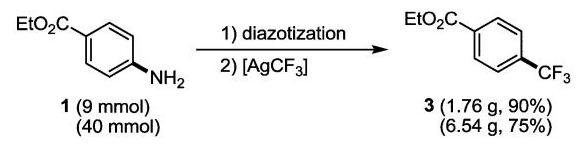
The reaction with ethyl 4-aminobenzoate 1 was also conducted on a gram scale to generate the desired product 3 in comparable yields as the small-scale experiment (eq 1).
还对4 - 氨基苯甲酸乙酯1进行了克级规模的反应,以与小规模实验相当的产率生成所需产物3(方程式1)。
(1)
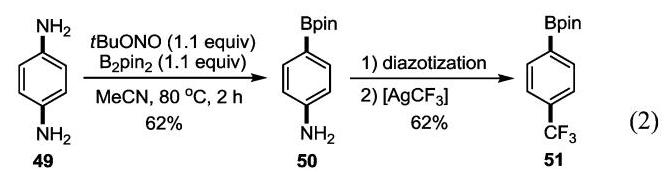
Moreover, by employing our previously established metal-free borylation method, ${}^{20}$ we could smoothly convert the two amino groups of benzene-1,4-diamine 49 into Bpin and ${\mathrm{{CF}}}_{3}$ groups successively, with similar Sandmeyer-type reaction for both steps (eq 2). This transformation shows the oxidation sensitive Bpin group tolerates the Sandmeyer-type trifluor-omethylation (also see 20 in Scheme 3).
此外,通过采用我们先前建立的无金属硼化方法,${}^{20}$ 我们可以将对苯二胺49的两个氨基依次顺利地转化为硼酸频哪醇酯和${\mathrm{{CF}}}_{3}$ 基团,两个步骤都有类似桑德迈尔型反应(方程式2)。这种转化表明对氧化敏感的硼酸频哪醇酯基团耐受桑德迈尔型三氟甲基化反应(另见方案3中的20)。
Preliminary mechanistic investigations have been carried out on this reaction. For the Sandmeyer-type transformations, it was proposed that the reaction may involve aryl radical probe was introduced by using 2-(but-3-en-1-yl)aniline 52 as the substrate in the reaction (Scheme 4a). The normal trifluoromethylation product 54 was formed in 41% yield ( ${}^{19}\mathrm{\;F}$ NMR), whereas cyclization product 55 could not be detected. ${}^{22}$ The diminished yield of the trifluoromethylation product 54 was due to the decomposition of the substrate and the product under the reaction conditions. These results are not in favor of the possible involvement of aryl radical species.
已经对该反应进行了初步的机理研究。对于桑德迈尔型转化,有人提出反应可能涉及芳基自由基物种。${}^{19}\mathrm{\;F}$ 为了验证在当前三氟甲基化过程中是否生成芳基自由基物种,使用2 - (3 - 丁烯 - 1 - 基)苯胺52作为底物在反应中引入了自由基时钟(方案4a)。正常的三氟甲基化产物54以41%的产率形成(${}^{19}\mathrm{\;F}$ 核磁共振谱),而环化产物55未检测到。${}^{22}$ 三氟甲基化产物54产率降低是由于底物和产物在反应条件下分解。这些结果不支持可能涉及芳基自由基物种。
Scheme 3. Trifluoromethylation of Various Aromatic Amine Substrates ${}^{a}$
方案3. 各种芳香胺底物的三氟甲基化反应 ${}^{a}$
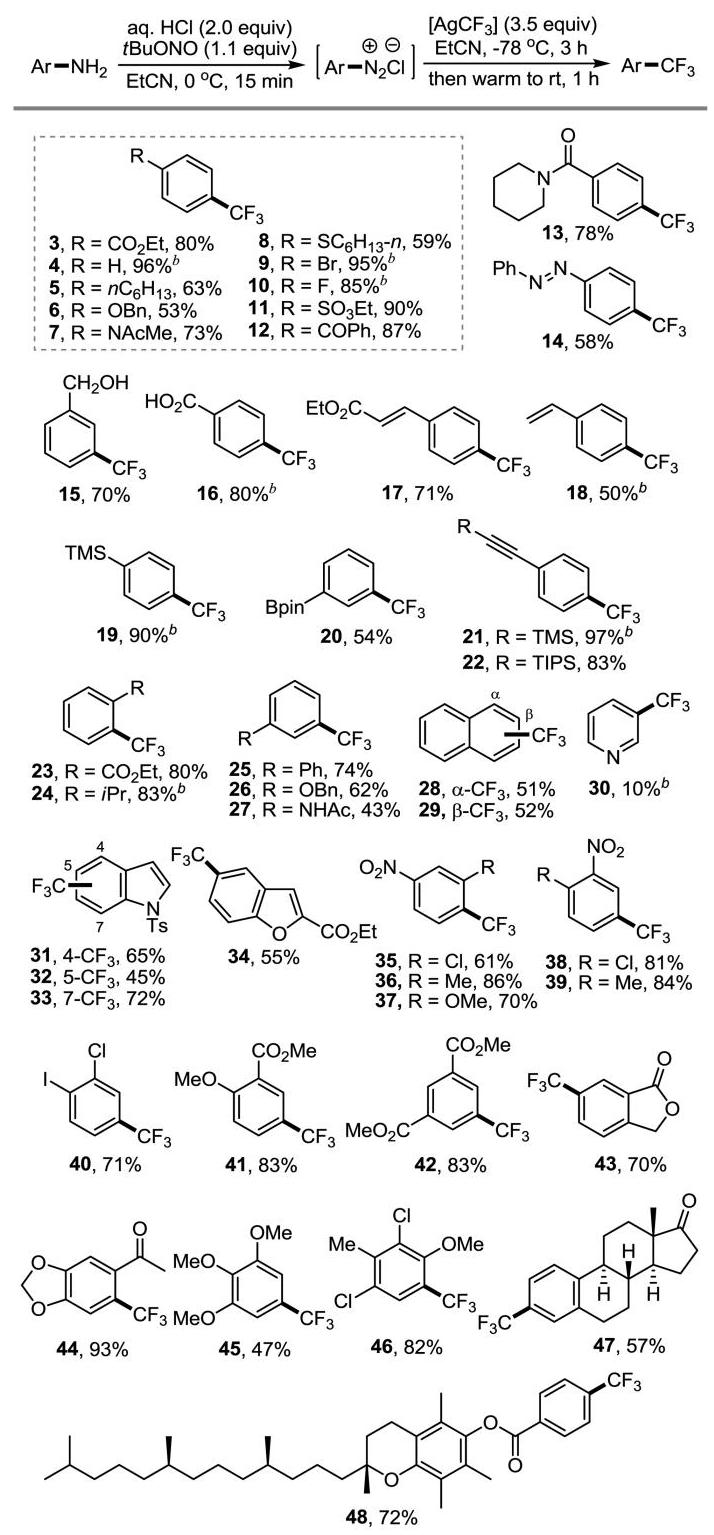
${}^{a}$ Yields refer to the isolated products if not otherwise noted. ${}^{b}$ These yields are based on ${}^{19}\mathrm{\;F}$ NMR with $4 - {\mathrm{{CF}}}_{3}\mathrm{O} - {\mathrm{C}}_{6}{\mathrm{H}}_{4}\mathrm{{OMe}}$ as internal standard.
${}^{a}$ 除非另有说明,产率指分离得到的产物。${}^{b}$ 这些产率基于以$4 - {\mathrm{{CF}}}_{3}\mathrm{O} - {\mathrm{C}}_{6}{\mathrm{H}}_{4}\mathrm{{OMe}}$ 为内标物的${}^{19}\mathrm{\;F}$ 核磁共振谱。
species. ${}^{21}$ To validate whether aryl radical species are generated in the current trifluoromethylation process, a radical clock
物种。${}^{21}$ 为了验证在当前三氟甲基化过程中是否生成芳基自由基物种,一个自由基时钟
Scheme 4. (a) Radical Clock Probe Experiment. (b) Trapping Experiment for Possible Radical Intermediates. (c) Background Reaction of $\left\lbrack {\mathrm{{AgCF}}}_{3}\right\rbrack$
方案4. (a) 自由基钟探针实验。(b) 对可能的自由基中间体的捕获实验。(c) $\left\lbrack {\mathrm{{AgCF}}}_{3}\right\rbrack$的背景反应
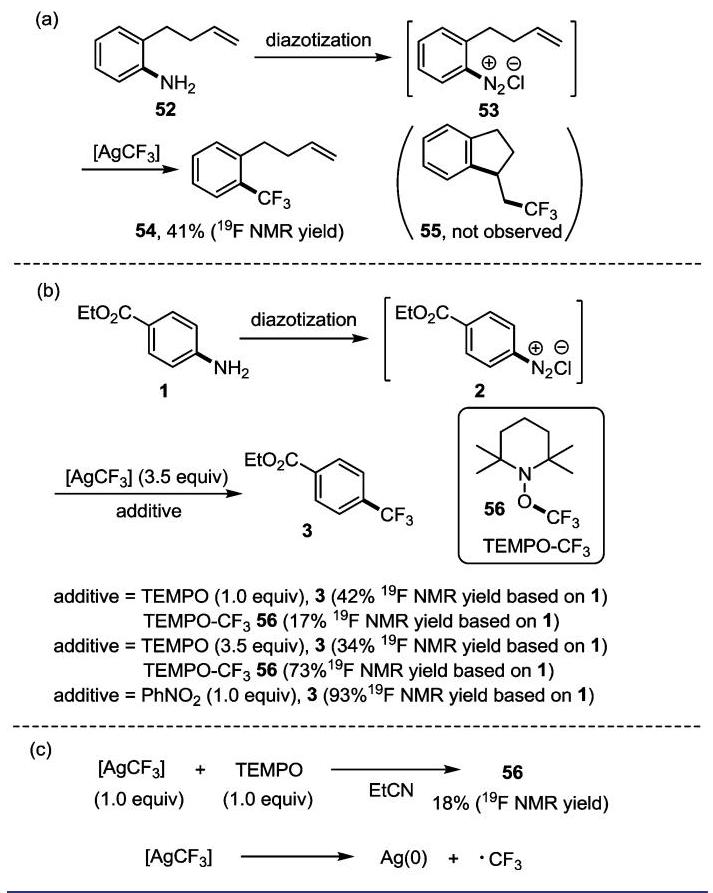
Next, 2,2,6,6-tetramethyl-1-piperidinyloxy (TEMPO), a wellknown free radical scavenger, was introduced as the additive in the standard reaction (Scheme 4b). The yield of 3 was diminished to 42% and TEMPO-CF ${}_{3}$ 56 was formed in 17% yield when 1.0 equiv of TEMPO was added under standard condition. The yield of 3 was further dropped to 34%, and 73% of TEMPO-CF ${}_{3}$ 56 was observed when 3.5 equiv of TEMPO was added. However, TEMPO-Ar adducts were not observed, as judged by both NMR and GC-MS analysis of the crude product. Nitrobenzene, which has been shown to be the inhibitor of SET steps in free radical aryl $\mathrm{C} - \mathrm{H}$ trifluorome-thylation, ${}^{{24},{9c}}$ has essentially no effect on the reaction.
接下来,将2,2,6,6-四甲基-1-哌啶氧基(TEMPO),一种著名的自由基清除剂,作为添加剂引入标准反应中(方案4b)。在标准条件下加入1.0当量的TEMPO时,3的产率降至42%,并以17%的产率形成了TEMPO-CF ${}_{3}$ 56。当加入3.5当量的TEMPO时,3的产率进一步降至34%,并观察到73%的TEMPO-CF ${}_{3}$ 56。然而,通过对粗产物的NMR和GC-MS分析判断,未观察到TEMPO-Ar加合物。已证明是自由基芳基$\mathrm{C} - \mathrm{H}$三氟甲基化中SET步骤抑制剂的硝基苯,${}^{{24},{9c}}$对该反应基本没有影响。
We speculate that the formation of ${\mathrm{{CF}}}_{3}$ radical is due to the background reaction of $\left\lbrack {\mathrm{{AgCF}}}_{3}\right\rbrack$ (Scheme 4c). ${}^{{9c},{10c}}$ Thus, in the absence of aryl diazonium salt, $\left\lbrack {\mathrm{{AgCF}}}_{3}\right\rbrack$ was added to the TEMPO in EtCN. We observed the formation of TEMPO-CF ${}_{3}$ 56 in 18% yield. Moreover, in the trifluoromethylation reaction, we found that most silver remains as $\mathrm{{Ag}}\left( \mathrm{I}\right)$ salt, rather than $\mathrm{{Ag}}\left( 0\right)$ . Collectively, these results indicate that ${\mathrm{{CF}}}_{3}$ radical is unlikely involved in the trifluoromethylation pathway. An oxidative addition-reductive elimination mechanism involving high-valent silver species, as shown in Scheme 2, may be involved. However, rigorous investigations are necessary to unambiguously elucidate the detailed mechanism.
我们推测${\mathrm{{CF}}}_{3}$自由基的形成是由于$\left\lbrack {\mathrm{{AgCF}}}_{3}\right\rbrack$的背景反应(方案4c)。${}^{{9c},{10c}}$因此,在没有芳基重氮盐的情况下,将$\left\lbrack {\mathrm{{AgCF}}}_{3}\right\rbrack$加入到乙腈中的TEMPO中。我们观察到以18%的产率形成了TEMPO-CF ${}_{3}$ 56。此外,在三氟甲基化反应中,我们发现大多数银以$\mathrm{{Ag}}\left( \mathrm{I}\right)$盐的形式存在,而不是$\mathrm{{Ag}}\left( 0\right)$。总的来说,这些结果表明${\mathrm{{CF}}}_{3}$自由基不太可能参与三氟甲基化途径。可能涉及如图2所示的涉及高价银物种的氧化加成-还原消除机制。然而,需要进行严格的研究来明确阐明详细的机制。
In summary, the conversion of an amino group into a ${\mathrm{{CF}}}_{3}$ group is a valuable complement to the previously established trifluoromethylation methods. ${}^{25}$ The reaction proceeds at low temperature and tolerates various functional groups. Moreover, the amino group can be readily protected and deprotected, rendering this method suitable for late-stage introduction of a ${\mathrm{{CF}}}_{3}$ group onto an aromatic structure.
总之,将氨基转化为${\mathrm{{CF}}}_{3}$基团是对先前建立的三氟甲基化方法的有价值补充。${}^{25}$该反应在低温下进行,并且耐受各种官能团。此外,氨基可以很容易地进行保护和脱保护,使得该方法适用于在芳香结构上后期引入${\mathrm{{CF}}}_{3}$基团。
A ASSOCIATED CONTENT
A 相关内容
(c) Supporting Information
(c) 支持信息
Experimental procedure, characterization data, and copies of ${}^{1}\mathrm{H}$ and ${}^{13}\mathrm{C}$ NMR spectra. This material is available free of charge via the Internet at http://pubs.acs.org.
实验步骤、表征数据以及${}^{1}\mathrm{H}$和${}^{13}\mathrm{C}$核磁共振谱图的副本。该材料可通过互联网免费获取,网址为http://pubs.acs.org。
A AUTHOR INFORMATION
A作者信息
Corresponding Author
通讯作者
Notes
注释
The authors declare no competing financial interest.
作者声明不存在相互竞争的财务利益。
ACKNOWLEDGMENTS
致谢
We thank Ms. Xiu Zhang and Ms. Hui Fu for NMR analysis, Mr. Guojiao Wu (Peking University) for helpful discussions, and Mr. John Thompson (University of Texas at Austin) for correcting the manuscript. Support of this work by 973 Program (no. 2012CB821600) and NSFC (no. 21272010) is gratefully acknowledged.
我们感谢张秀女士和傅慧女士进行核磁共振分析,感谢北京大学的吴国娇先生给予的有益讨论,以及得克萨斯大学奥斯汀分校的约翰·汤普森先生对手稿的校正。衷心感谢973计划(编号:2012CB821600)和国家自然科学基金(编号:21272010)对本研究的支持。
REFERENCES
参考文献
(1) Müller, K.; Faeh, C.; Diederich, F. Science 2007, 317, 1881.
(2) Reviews: (a) Shimizu, M.; Hiyama, T. Angew. Chem., Int. Ed. 2005, 44, 214. (b) Schlosser, M. Angew. Chem., Int. Ed. 2006, 45, 5432. (c) Ma, J. -A.; Cahard, D. J. Fluorine Chem. 2007, 128, 975. (d) Ma, J. -A.; Cahard, D. Chem. Rev. 2008, 108, PR1. (e) Tomashenko, O. A.; Grushin, V. V. Chem. Rev. 2011, 111, 4475. (f) Furuya, T.; Kamlet, A. S.; Ritter, T. Nature 2011, 473, 470. (g) Besset, T.; Schneider, C.; Cahard, D. Angew. Chem., Int. Ed. 2012, 51, 5048.
(3) Swarts, F. Bull. Soc. Chim. Belg. 1892, 24, 309.
(4) McLoughlin, V. C. R.; Thrower, J. Tetrahedron 1969, 25, 5921. (5) (a) Chen, Q.-Y.; Wu, S.-W. J. Chem. Soc. Chem. Commun. 1989, 705. (b) Chen, Q.-Y.; Duan, J.-X. J. Chem. Soc. Chem. Commun. 1993, 1389.
(6) Oishi, M.; Kondo, H.; Amii, H. Chem. Commun. 2009, 1909.
(7) Cho, E. J.; Senecal, T. D.; Kinzel, T.; Zhang, Y.; Watson, D. A.; Buchwald, S. L. Science 2010, 328, 1679.
(8) (a) Chu, L.; Qing, F.-L. Org. Lett. 2010, 12, 5060. (b) Senecal, T. D.; Parsons, A. T.; Buchwald, S. L. J. Org. Chem. 2011, 76, 1174. (c) Liu, T.; Shen, Q. Org. Lett. 2011, 13, 2342. (d) Xu, J.; Luo, D.-F.; Xiao, B.; Liu, Z.-J.; Gong, T.-J.; Fu, Y.; Liu, L. Chem. Commun. 2011, 47, 4300. (e) Zhang, C.-P.; Cai, J.; Zhou, C.-B.; Wang, X.-P.; Zheng, X.; Gu, Y.-C.; Xiao, J.-C. Chem. Commun. 2011, 47, 9516. (f) Litvinas, N. D.; Fier, P. S.; Hartwig, J. F. Angew. Chem., Int. Ed. 2012, 51, 536. (g) Novák, P.; Lishchynskyi, A.; Grushin, V. V. Angew. Chem., Int. Ed. 2012, 51, 7767. (h) Ye, Y.; Sanford, M. S. J. Am. Chem. Soc. 2012, 134, 9034.
(9) Recent reports: (a) Nagib, D. A.; MacMillan, D. W. C. Nature 2011, 480, 224. (b) Ji, Y.; Brueckl, T.; Baxter, R. D.; Fujiwara, Y.; Seiple, I. B.; Su, S.; Blackmond, D. G.; Baran, P. S. Proc. Natl. Acad. Sci. U.S.A. 2011, 108, 14411. (c) Ye, Y.; Lee, S. H.; Sanford, M. S. Org. Lett. 2011, 13, 5464. (d) Fujiwara, Y.; Dixon, J. A.; O’Hara, F.; Funder, E. D.; Dixon, D. D.; Rodriguez, R. A.; Baxter, R. D.; Herlé, B.; Sach, N.; Collins, M. R.; Ishihara, Y.; Baran, P. S. Nature 2012, 492, 95. (e) Studer, A. Angew. Chem., Int. Ed. 2012, 51, 8950.
(10) Trifluoromethylation through transition-metal-catalyzed C-H bond activation: (a) Wang, X.; Truesdale, L.; Yu, J.-Q. J. Am. Chem. Soc. 2010, 132, 3648. (b) Zhang, X.-G.; Dai, H.-X.; Wasa, M.; Yu, J.-Q. J. Am. Chem. Soc. 2012, 134, 11948. (c) Hafner, A.; Bräse, S. Angew. Chem., Int. Ed. 2012, 51, 3713.
(11) Griess, J. P. Ann. Chem., Justus Liebigs 1858, 106, 123.
(12) Reviews on arene diazonium salts: (a) Mo, F.; Dong, G.; Zhang, Y.; Wang, J. Org. Biomol. Chem. 2013, 11, 1582. (b) Hari, D. P.; König, B. Angew. Chem., Int. Ed. 2013, 52, 4734.
(13) (a) Sandmeyer, T. Ber. Dtsch. Chem. Ges. 1884, 17, 1633. (b) Sandmeyer, T. Ber. Dtsch. Chem. Ges. 1884, 17, 2650.
(14) Balz, G.; Schiemann, G. Ber. - Umweltbundesamt (Ger.) 1927, 60B, 1186.
(15) (a) Furuya, T.; Strom, A. E.; Ritter, T. J. Am. Chem. Soc. 2009, 131, 1662. (b) Tang, P.; Furuya, T.; Ritter, T. J. Am. Chem. Soc. 2010, 132, 12150. (c) Huang, C.; Liang, T.; Harada, S.; Lee, E.; Ritter, T. J. Am. Chem. Soc. 2011, 133, 13308.
(16) Kremlev, M. M.; Mushta, A. I.; Tyrra, W.; Naumann, D.; Fischer, H. T. M.; Yagupolskii, Y. L. J. Fluorine Chem. 2007, 128, 1385.
(17) (a) Ruppert, I.; Schlich, K.; Volbach, W. Tetrahedron Lett. 1984, 25, 2195. (b) Prakash, G. K. S.; Krishnamurti, R.; Olah, G. A. J. Am. Chem. Soc. 1989, 111, 393. (c) Prakash, G. K. S.; Jog, P. V.; Batamack, P. T. D.; Olah, G. A. Science 2012, 338, 1324.
(18) (a) Doyle, M. P.; Siegfried, B.; Dellaria, J. F., Jr. J. Org. Chem. 1977, 42, 2426. (b) Doyle, M. P.; Dellaria, J. F.; Dellaria, J. F., Jr.; Bishop, S. W. J. Org. Chem. 1977, 42, 3494.
(19) For detailed screening of reaction conditions, see Supporting Information.
(20) (a) Mo, F.; Jiang, Y.; Qiu, D.; Zhang, Y.; Wang, J. Angew. Chem., Int. Ed. 2010, 49, 1846. (b) Qiu, D.; Jin, L.; Zheng, Z.; Meng, H.; Mo, F.; Wang, X.; Zhang, Y.; Wang, J. J. Org. Chem. 2013, 78, 1923.
(21) (a) Kochi, J. K. J. Am. Chem. Soc. 1957, 79, 2942. (b) Galli, C. Chem. Rev. 1988, 88, 765.
(22) Fier, P. S.; Hartwig, J. F. J. Am. Chem. Soc. 2012, 134, 10795.
(23) Wang, X.; Ye, Y.; Zhang, S.; Feng, J.; Xu, Y.; Zhang, Y.; Wang, J. J. Am. Chem. Soc. 2011, 133, 16410.
(24) Wakselman, C.; Tordeux, M. J. Chem. Soc., Chem. Commun. 1987, 1701.
(25) While the manuscript was under revision, a Cu-promoted Sandmeyer trifluoromethylation reaction was reported: Dai, J.-J.; Fang, C.; Xiao, B.; Yi, J.; Xu, J.; Liu, Z.-J.; Lu, X.; Liu, L.; Fu, Y. J. Am. Chem. Soc. 2013, 135, 8436.