Recent applications of arene diazonium salts in organic synthesis
英文原文与中文译文逐段对照 · English original with Chinese translation
PERSPECTIVE
观点
Recent applications of arene diazonium salts in organic synthesis
芳烃重氮盐在有机合成中的最新应用
Fanyang Mo, ${}^{a, b}$ Guangbin Dong, ${}^{*b}$ Yan Zhang ${}^{a}$ and Jianbo Wang*a
莫凡洋,${}^{a, b}$ 董广彬,${}^{*b}$ 张燕 ${}^{a}$ 和王建波*a
Arene diazonium salts are common, easily prepared and highly useful intermediates in organic synthesis due to their rich reactivity and diverse transformations. In this review, recent advances involving arene diazonium salts as starting materials or active intermediates for various synthetically useful applications are summarized.
芳烃重氮盐是有机合成中常见、易于制备且非常有用的中间体,因其具有丰富的反应活性和多样的转化方式。在本综述中,总结了以芳烃重氮盐为起始原料或活性中间体用于各种合成应用的最新进展。
1 Introduction
1 引言
Diazonium compounds, taught in almost every sophomore organic chemistry course, represent a large group of organic compounds with the general formula $\mathrm{R} - \mathrm{N} \equiv {\mathrm{N}}^{ + }{\mathrm{X}}^{ - }$ , in which $\mathrm{R}$ can be alkyl or aryl and $\mathrm{X}$ is an organic or inorganic anion such as a halogen. Diazonium salts, especially those where R is an aryl group, are important intermediates and have found wide applications in organic synthesis. Since their first discovery in ${1858}^{1}$ several prominent named reactions associated with arene diazonium salts have evolved throughout the development of more than one century (Scheme 1).
重氮化合物几乎在每一门大二有机化学课程中都会讲到,它是一大类通式为$\mathrm{R} - \mathrm{N} \equiv {\mathrm{N}}^{ + }{\mathrm{X}}^{ - }$的有机化合物,其中$\mathrm{R}$可以是烷基或芳基,$\mathrm{X}$是有机或无机阴离子,如卤素。重氮盐,尤其是那些R为芳基的重氮盐,是重要的中间体,在有机合成中有着广泛的应用。自从它们在${1858}^{1}$首次被发现以来,在一个多世纪的发展过程中,出现了几个与芳基重氮盐相关的著名反应(方案1)。
In 1884, Sandmeyer disclosed that by treatment with copper(1) chloride, benzenediazonium salt was converted into chlorobenzene. ${}^{2}$ He also showed that bromobenzene could be formed when using copper(1) bromide, and benzonitrile was obtained when copper(1) cyanide was used. 12 years later, Pschorr reported a method for the preparation of biaryltri-cyclics by intramolecular substitution of one arene with an aryl radical, which is generated in situ from an aryl diazonium salt by copper catalysis. ${}^{3}$ In 1924, Gomberg and Bachmann developed an intermolecular version of Pschorr’s radical biaryl synthesis, which is now known as the Gomberg-Bachmann reaction. ${}^{4}$ Only three years later, an important breakthrough was achieved by Balz and Schiemann, who reported thermal decomposition of aromatic diazonium tetrafluoroborates.
1884年,桑德迈尔发现,用氯化亚铜处理时,苯重氮盐会转化为氯苯。${}^{2}$ 他还表明,使用溴化亚铜时可以形成溴苯,使用氰化亚铜时可以得到苯甲腈。12年后,普朔尔报道了一种通过分子内用芳基自由基取代一个芳烃来制备联芳基三环化合物的方法,该芳基自由基是由芳基重氮盐通过铜催化原位生成的。${}^{3}$ 1924年,贡伯格和巴赫曼开发了普朔尔自由基联芳基合成的分子间版本,即现在所知的贡伯格-巴赫曼反应。${}^{4}$ 仅仅三年后,巴尔兹和席曼取得了一项重要突破,他们报道了芳基四氟硼酸重氮盐的热分解。
Cite this: Org. Biomol. Chem., 2013, 11, 1582
引用本文:Org. Biomol. Chem., 2013, 11, 1582
Received 6th December 2012, Accepted 9th January 2013
2012年12月6日收到,2013年1月9日接受
DOI: 10.1039/c3ob27366k
DOI: 10.1039/c3ob27366k
a College of Chemistry and Molecular Engineering, Peking University, Beijing, P. R. China.
a中国北京大学化学与分子工程学院。
${}^{b}$ Department of Chemistry and Biochemistry, University of Texas at Austin, Austin, Texas 78712, USA.
${}^{b}$美国得克萨斯大学奥斯汀分校化学与生物化学系,得克萨斯州奥斯汀78712。
Fanyang Mo was born in Liaoning Province of China in 1982. He received his B.Sc. and M.Sc. degrees from Beijing Institute of Technology (P. R. of China) in 2004 and 2006 under the supervision of Professor Zhiming Zhou. He then obtained his Ph.D. from Peking University under the supervision of Prof. Jianbo Wang in 2010. He is currently a postdoctoral fellow in Prof. Guang-bin Dong’s group at the University of Texas at Austin.
莫凡洋1982年出生于中国辽宁省。2004年和2006年,他在中国北京理工大学在周志敏教授的指导下获得理学学士和硕士学位。2010年,他在北京大学在王剑波教授的指导下获得博士学位。他目前是美国得克萨斯大学奥斯汀分校董广斌教授课题组的博士后。
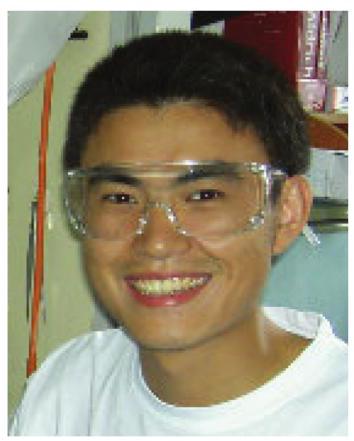
Fanyang Mo
莫凡洋
Guangbin Dong received his B.S. degree from Peking University and completed his Ph.D. degree in chemistry from Stanford University with Professor Barry M. Trost, where he was a Larry Yung Stanford Graduate fellow. In 2009, he began to research with Prof. Robert H. Grubbs at the California Institute of Technology, as a Camille and Henry Dreyfus Environmental Chemistry Fellow. In 2011, he joined the department of chemistry and
董广斌毕业于北京大学,在斯坦福大学在巴里·M·特罗斯特教授的指导下完成化学博士学位,他在那里是拉里·容·斯坦福研究生奖学金获得者。2009年,他开始在加利福尼亚理工学院与罗伯特·H·格鲁布斯教授一起做研究,作为卡米尔和亨利·德雷福斯环境化学奖学金获得者。2011年,他加入了得克萨斯大学奥斯汀分校的化学与
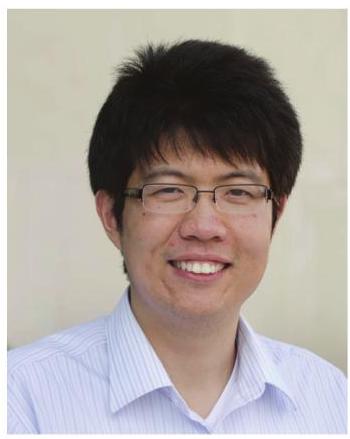
Guangbin Dong
董广斌
biochemistry at the University of Texas at Austin as an assistant professor and a CPRIT Scholar. His research interests include the development of powerful chemical tools for addressing questions of biological importance.
生物化学系担任助理教授和CPRIT学者。他的研究兴趣包括开发强大的化学工具来解决具有生物学重要性问题。
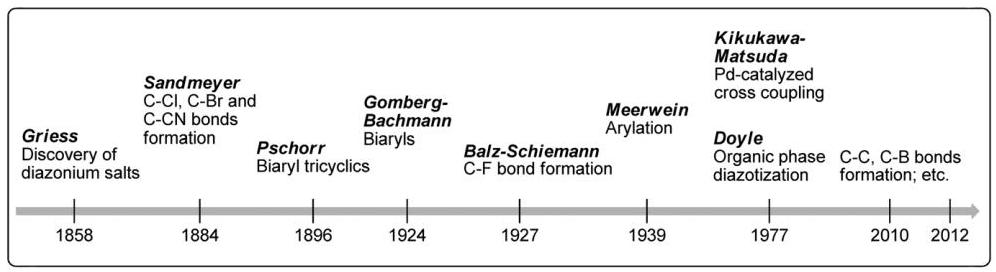
Scheme 1 Brief history of diazonium salts.
方案1重氮盐简史。
The reaction leads to the formation of aromatic fluorides, which cannot be accessed by the Sandmeyer reaction. ${}^{5}$ In 1939, Meerwein and co-workers reported an extensive study on the reaction of aromatic diazonium salts with $\alpha ,\beta$ -unsaturated carbonyl compounds. The reaction was later known as Meer-wein arylation, in which the aryl group adds across the double bond. ${}^{6}$
该反应导致形成芳香氟化物,这是桑德迈尔反应无法得到的。${}^{5}$ 1939年,梅耶尔温及其同事报道了关于芳基重氮盐与$\alpha ,\beta$-不饱和羰基化合物反应的广泛研究。该反应后来被称为梅耶尔温芳基化反应,其中芳基加成到双键上。${}^{6}$
In 1977, Doyle and co-workers reported a different method for the generation of diazonium salts in which an aqueous acidic solution was no longer necessary. ${}^{7}$ This development expands the synthetic scope of diazonium salts in organic synthesis. Besides the above-mentioned classical reactions, diazonium salts also served as arylhalide surrogates, which have been utilized in Pd-catalyzed cross-coupling reactions for carbon-carbon bond and carbon-heteroatom bond formation. These coupling reactions have been well established over the past 40 years since the pioneering work of Kikukawa and Matsuda in 1977, ${}^{8}$ and are comprehensively documented in a series of excellent reviews. ${}^{9}$ In addition, diazonium salts are also highly useful in the dye and pigment industry for the preparation of azo-compounds. ${}^{10}$ Regardless of the long history, the arene diazonium compounds still attract attention and new developments have been emerging constantly. In this short review article, we will focus on the most recent developments.
1977年,多伊尔及其同事报道了一种生成重氮盐的不同方法,该方法不再需要酸性水溶液。${}^{7}$ 这一进展扩大了重氮盐在有机合成中的应用范围。除了上述经典反应外,重氮盐还可作为芳基卤化物的替代物,用于钯催化的碳 - 碳键和碳 - 杂原子键形成的交叉偶联反应。自1977年菊川和松田的开创性工作以来,在过去40年中,这些偶联反应已得到充分确立,${}^{8}$ 并在一系列优秀综述中有全面记载。${}^{9}$ 此外,重氮盐在染料和颜料工业中对于制备偶氮化合物也非常有用。${}^{10}$ 尽管历史悠久,芳基重氮化合物仍然备受关注,新的发展不断涌现。在这篇简短的综述文章中,我们将重点关注最新进展。
2 Carbon-carbon bond formation
2 碳-碳键的形成
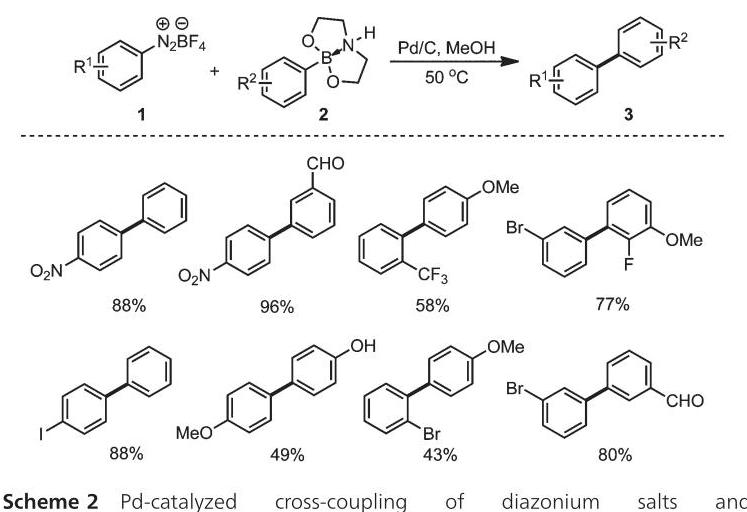
Arene diazonium salts have been utilized as reactive arylhalide surrogates in Pd-catalyzed cross-coupling reactions for C-C bond formation. ${}^{9}$ The intrinsic electrophilicity of diazonium salts comes from ${\mathrm{N}}_{2}$ being a superb leaving group, which allows the use of mild reaction conditions, and sometimes without an additional ligand and/or base. The first utilization of the aryldiazonium salts as electrophiles in Pd-catalyzed Suzuki-Miyaura cross-couplings was achieved independently by Genêt ${}^{11}$ and Sengupta. ${}^{12}$ A recent example was shown by Gras and co-workers who reported an application of diazonium salts 1 in a base-free cross-coupling reaction with self-activated dioxazaborocanes 2 under mild and user-friendly conditions (Scheme 2). ${}^{13}$
芳基重氮盐已被用作活性芳基卤化物替代物,用于钯催化的交叉偶联反应以形成碳-碳键。${}^{9}$ 重氮盐的固有亲电性源于 ${\mathrm{N}}_{2}$ 其作为极好的离去基团,这使得反应可以在温和的条件下进行,有时无需额外的配体和/或碱。芳基重氮盐首次作为亲电试剂用于钯催化的铃木-宫浦交叉偶联反应是由热内 ${}^{11}$ 和森古普塔分别独立完成的。${}^{12}$ 格拉斯及其同事最近展示了一个例子,他们报道了重氮盐1在温和且用户友好的条件下与自活化二氧杂硼烷2进行无碱交叉偶联反应的应用(方案2)。${}^{13}$
In their study, $\mathrm{{Pd}}{\left( \mathrm{{OAc}}\right) }_{2}$ only showed moderate efficiency and gave homo-coupling of dioxazaborocanes 2 as the major product, whereas Pd/C was proved to be a highly selective catalyst towards cross-coupling products.
在他们的研究中,$\mathrm{{Pd}}{\left( \mathrm{{OAc}}\right) }_{2}$ 仅显示出中等效率,并且以二氧杂硼烷2的均偶联产物作为主要产物,而钯/碳被证明是对交叉偶联产物具有高选择性的催化剂。
Although arene diazonium tetrafluoroborates have been well established as coupling partners in Pd-catalyzed reactions, the major drawback is that they are usually not commercially available and in many cases have to be newly prepared before use. In this context, one-pot diazotization/cross-coupling is obviously more attractive. Such a one-pot approach has been exploited previously by several groups. ${}^{14}$ A recent example has been shown by Wang and co-workers who have demonstrated a convenient Pd-catalyzed base-free Suzuki-Miyaura cross-coupling for the synthesis of biaryls using arylamines 4 as the starting materials (Scheme 3). ${}^{15}$ The mechanism of this diazotization-coupling is proposed to be the standard oxidative addition-reductive elimination mechanism of Pd-catalyzed cross-coupling. ${}^{16}$
尽管四氟硼酸芳基重氮盐在钯催化反应中作为偶联伙伴已得到充分确立,但主要缺点是它们通常无法从商业途径获得,并且在许多情况下必须在使用前重新制备。在这种情况下,一锅法重氮化/交叉偶联显然更具吸引力。此前已有几个研究小组采用了这种一锅法。${}^{14}$ 王及其同事最近展示了一个例子,他们展示了一种便捷的钯催化无碱铃木-宫浦交叉偶联反应,该反应以芳基胺4为起始原料用于合成联芳基(方案3)。${}^{15}$ 这种重氮化-偶联的机理被认为是钯催化交叉偶联的标准氧化加成-还原消除机理。${}^{16}$
Jianbo Wang received his B.S. degree from Nanjing University of Science and Technology in 1983, and his Ph.D. from Hokkaido University (under the supervision of Prof. H. Suginome) in 1990. He was a postdoctoral associate at the University of Geneva from 1990 to 1993 (with Prof. C. W. Jefford), and at the University of Wisconsin-Madison from 1993 to 1995 (with Prof. H. E. Zimmerman and F. A. Fahien). He began
王建波于1983年从南京理工大学获得学士学位,并于1990年从北海道大学(在杉野博教授的指导下)获得博士学位。他在1990年至1993年期间是日内瓦大学的博士后研究员(与C. W. 杰福德教授合作),并在1993年至1995年期间是威斯康星大学麦迪逊分校的博士后研究员(与H. E. 齐默尔曼教授和F. A. 法希恩教授合作)。他于
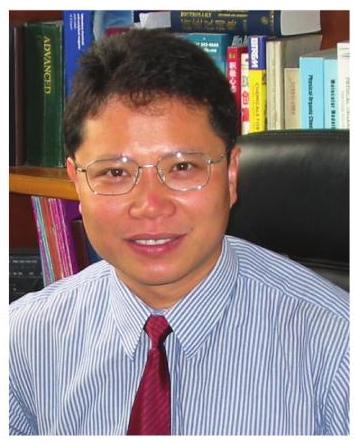
Jianbo Wang his academic career at Peking University in 1995. His research interests include catalytic metal carbene transformations.
王建波于1995年在北京大学开始其学术生涯。他的研究兴趣包括催化金属卡宾转化。
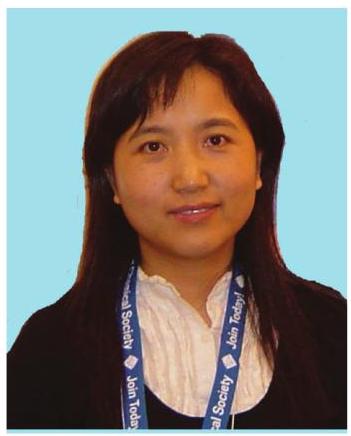
Yan Zhang obtained her B.S. in 1997, and her Ph.D. in 2002 from Lanzhou University (under the supervision of Prof. Ziyi Zhang). She continued her research as a postdoctoral associate in Hong Kong, Germany, and the United States. She began her academic career at Peking University in 2008 in Prof. Jianbo Wang’s group. Her research focuses on the application of transition metal complexes of N-heterocyclic carbenes
张燕于1997年获得学士学位,并于2002年从兰州大学(在张资义教授的指导下)获得博士学位。她作为博士后研究员在香港、德国和美国继续开展研究。她于2008年在北京大学王建波教授的团队开始其学术生涯。她的研究重点是氮杂环卡宾过渡金属配合物的应用
Yan Zhang and the synthesis of small molecules with important biological activities.
张燕以及具有重要生物活性的小分子的合成。
dioxazaborocanes.
二氧杂硼烷。
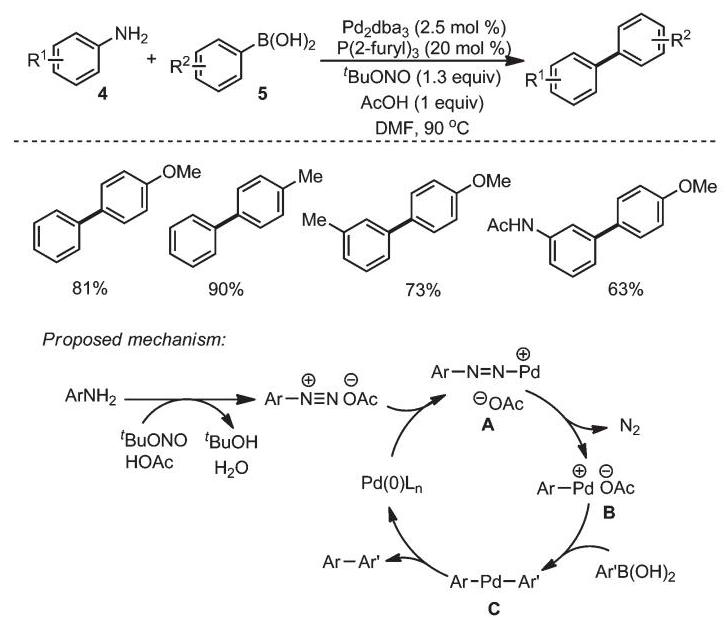
Scheme 3 Pd-catalyzed one-pot diazotization/cross-coupling.
方案3 钯催化的一锅法重氮化/交叉偶联。
The Heck-Matsuda reaction is the diazonium salt version of the Heck-Mizoroki reaction, where aryl-halides or -sulfo-nates serve as electrophiles. Although the seminal work was achieved by Kikukawa and Matsuda in 1977, ${}^{8}$ the Heck-Matsuda reaction had been overlooked until the late nineties. In recent years, the group of Felpin has made significant contributions toward the development of the Heck-Matsuda reaction. ${}^{9,{17}}$ In 2010, they demonstrated a highly efficient Heck-Matsuda coupling of aryldiazonium salts with 2-arylacrylates leading to cis-stilbene with good to excellent $E$ stereoselectivity (Scheme 4). ${}^{17e}$
赫克-松田反应是赫克-水泽反应的重氮盐版本,其中芳基卤化物或芳基磺酸盐用作亲电试剂。尽管开创性工作是由菊川和松田在1977年完成的,${}^{8}$ 但赫克-松田反应直到九十年代后期一直被忽视。近年来,费尔潘团队对赫克-松田反应的发展做出了重大贡献。${}^{9,{17}}$ 在2010年,他们展示了芳基重氮盐与2-芳基丙烯酸酯的高效赫克-松田偶联反应,生成具有良好至优异 $E$ 立体选择性的顺式芪(方案4)。${}^{17e}$
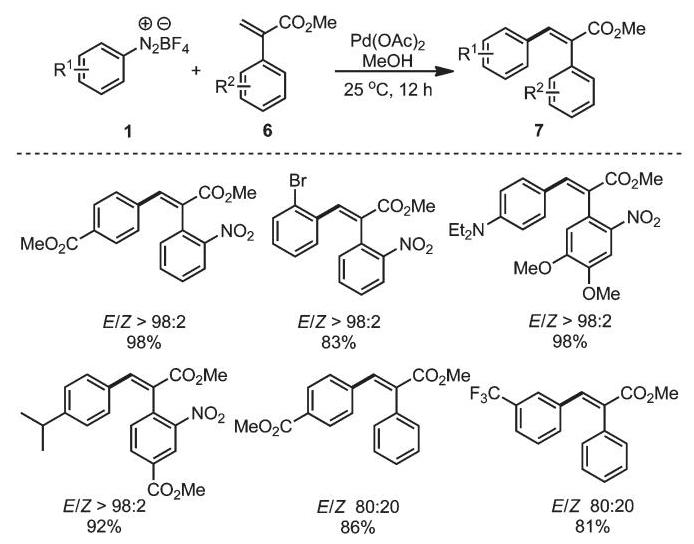
Scheme 4 Synthesis of stilbenes by the Heck-Matsuda reaction.
方案4 通过赫克-松田反应合成芪。
It has been shown that 2-arylacrylates 6 with one substituent on the aromatic ring at C2 coupling with diazonium salts 1 under palladium catalysis gives exclusively cis-stilbenes. Interestingly, the high stereoselectivity observed does not seem to be related to any stereoelectronic effect on either the acrylate or the diazonium salt. They also found that the catalyst loading can be lowered to 0.005% in the coupling reaction of diazonium salts with methyl acrylate.
研究表明,在钯催化下,芳环上C2位带有一个取代基的2-芳基丙烯酸酯6与重氮盐1发生偶联反应,仅生成顺式芪类化合物。有趣的是,观察到的高立体选择性似乎与丙烯酸酯或重氮盐上的任何立体电子效应无关。他们还发现,在重氮盐与丙烯酸甲酯的偶联反应中,催化剂负载量可降至0.005%。
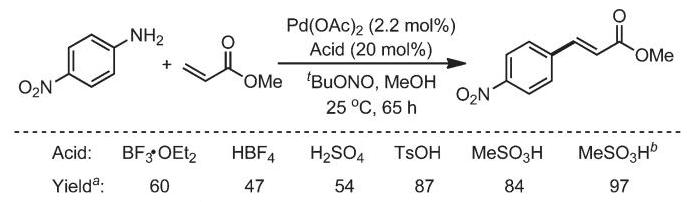
In subsequent work, the same group reported a Heck-Matsuda reaction using a substoichiometric amount of diazonium salt through a double catalytic cycle. ${}^{17g}$ A variety of acids were examined in order to evaluate the influence of the acidity and the nature of the counter-ion (eqn (1)). The results showed that although the tetrafluoroborate anion has been widely used in the literature, it was not the most effective counter-ion regardless of the source of the acid (i.e., ${\mathrm{{HBF}}}_{4}$ and ${\mathrm{{BF}}}_{3} \cdot {\mathrm{{Et}}}_{2}\mathrm{O}$ ). Finally, ${\mathrm{{MeSO}}}_{3}\mathrm{H}$ was selected as the acid of choice based on the cost and recoverability.
在后续工作中,同一研究小组报道了通过双催化循环使用亚化学计量的重氮盐进行的Heck-Matsuda反应。${}^{17g}$ 为了评估酸度和抗衡离子性质的影响,研究了多种酸(方程式(1))。结果表明,尽管四氟硼酸根阴离子在文献中已被广泛使用,但无论酸的来源如何(即 ${\mathrm{{HBF}}}_{4}$ 和 ${\mathrm{{BF}}}_{3} \cdot {\mathrm{{Et}}}_{2}\mathrm{O}$),它都不是最有效的抗衡离子。最后,基于成本和可回收性,${\mathrm{{MeSO}}}_{3}\mathrm{H}$ 被选为首选酸。
(1)
${}^{a}$ Isolated yield; ${}^{b}$ Anisole (0.5 equiv) as additive
${}^{a}$ 分离产率;${}^{b}$ 苯甲醚(0.5当量)作为添加剂
This reaction is not sensitive to steric effects as some orthosubstituted diazonium salts gave even higher yields as compared with their para-substituted counterparts. Moreover, this coupling has been utilized to complete the synthesis of quino-lone 11 by their Heck-reduction-cyclization strategy (Scheme 5).
该反应对空间效应不敏感,因为一些邻位取代的重氮盐与其对位取代的类似物相比,产率甚至更高。此外,这种偶联反应已被用于通过Heck还原环化策略完成喹诺酮11的合成(方案5)。
In 2012, König and co-workers developed an efficient visible-light mediated arylation of alkenes, alkynes and enones with diazonium salts by photoredox catalysis (Scheme 6). ${}^{18}$ The reaction scope comprises a range of different substituted aryl diazonium salts and tolerates a variety of functional groups including aryl halides. Mechanistically, a radical pathway including one-electron oxidation and reduction steps is likely for this photoredox arylation.
2012年,König及其同事通过光氧化还原催化开发了一种利用重氮盐对烯烃、炔烃和烯酮进行高效可见光介导的芳基化反应(方案6)。${}^{18}$ 反应范围包括一系列不同取代的芳基重氮盐,并能耐受包括芳基卤化物在内的多种官能团。从机理上讲,这种光氧化还原芳基化反应可能涉及一个包括单电子氧化和还原步骤的自由基途径。
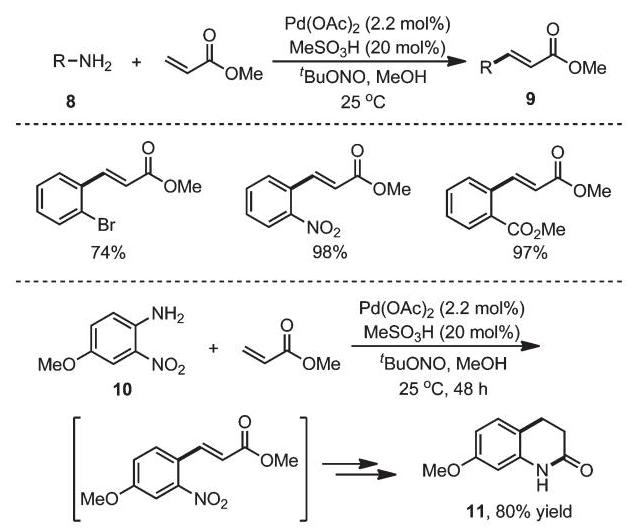
Scheme 5 Heck-Matsuda reaction and synthesis of quinolone 11.
方案5 Heck-Matsuda反应及喹诺酮11的合成。
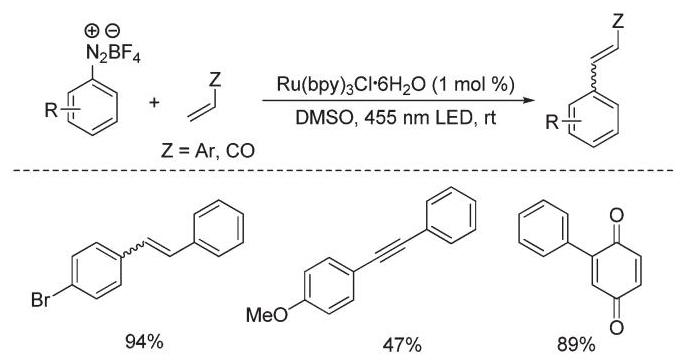
Scheme 6 Photocatalytic arylation of alkenes, alkynes and enones with diazonium salts.
方案6 重氮盐对烯烃、炔烃和烯酮的光催化芳基化反应。
In early 2013, Gholinejad reported Heck-Matsuda and Suzuki-Miyaura coupling reactions of aryl diazonium salts catalyzed by palladium nanoparticles supported on agarose. ${}^{19}$ By using this new catalyst, reactions could be carried out in aqueous solution at lower temperature. Moreover, this immobilized catalyst could be recycled and reused several times.
2013年初,Gholinejad报道了琼脂糖负载的钯纳米颗粒催化芳基重氮盐的Heck-Matsuda和Suzuki-Miyaura偶联反应。${}^{19}$ 使用这种新型催化剂,反应可以在较低温度的水溶液中进行。此外,这种固定化催化剂可以循环使用多次。
Although many Pd-catalyzed cross-coupling reactions, such as the Heck, Suzuki-Miyaura and Stille reactions, have been developed utilizing aryldiazonium salts as aryl halide surrogates, the Sonogashira cross-coupling remained a challenge until the first two successful examples presented by the Sarkar group and the Cacchi group in 2010, respectively (Schemes 7 and 8). ${}^{{20},{21}}$ In Sarkar’s work, $\mathrm{{AuCl}}$ and ${\mathrm{{PdCl}}}_{2}$ were combined as a catalyst and the reaction could even start with aniline derivatives by employing an in situ diazonium formation step. In Cacchi’s work, initial attempts with various Pd catalysts, solvents and bases did not produce the desired product. The problem was circumvented by a sequential iododediazonia-tion/cross-coupling strategy.
尽管已经开发了许多钯催化的交叉偶联反应,如Heck、Suzuki-Miyaura和Stille反应,利用芳基重氮盐作为芳基卤化物的替代物,但直到2010年Sarkar小组和Cacchi小组分别给出了前两个成功的例子,Sonogashira交叉偶联反应仍然是一个挑战(方案7和8)。${}^{{20},{21}}$ 在Sarkar的工作中,$\mathrm{{AuCl}}$ 和 ${\mathrm{{PdCl}}}_{2}$ 组合作为催化剂,并且通过采用原位重氮化步骤,反应甚至可以从苯胺衍生物开始。在Cacchi的工作中,最初使用各种钯催化剂、溶剂和碱的尝试均未得到所需产物。通过顺序碘代脱重氮/交叉偶联策略解决了该问题。
Carbopalladation of alkynes results in the formation of alkenyl palladium species. Phenol diazonium salts 12 have been recently explored by Schmidt and co-workers in Pd-catalyzed $\left\lbrack {2 + 2 + 1}\right\rbrack$ cyclization, leading to the formation of spirocyclic ketones 14 (Scheme 9). ${}^{22}$
炔烃的碳钯化反应会生成烯基钯物种。最近,Schmidt及其同事在钯催化的$\left\lbrack {2 + 2 + 1}\right\rbrack$ 环化反应中研究了苯酚重氮盐12,生成了螺环酮14(方案9)。${}^{22}$
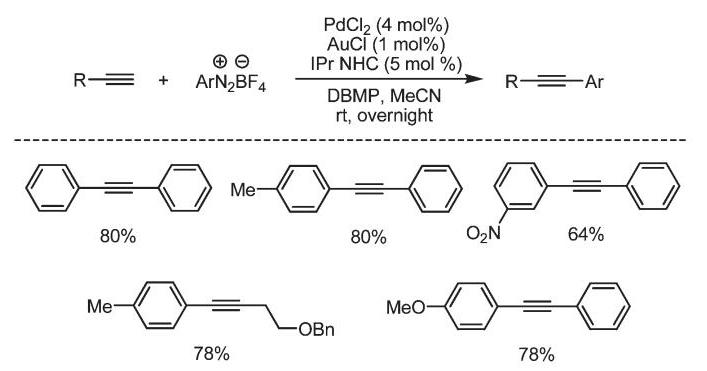
Scheme 7 Pd-Au-catalyzed Sonogashira cross-coupling of arenediazonium salts.
方案7 钯-金催化的芳基重氮盐的Sonogashira交叉偶联反应。
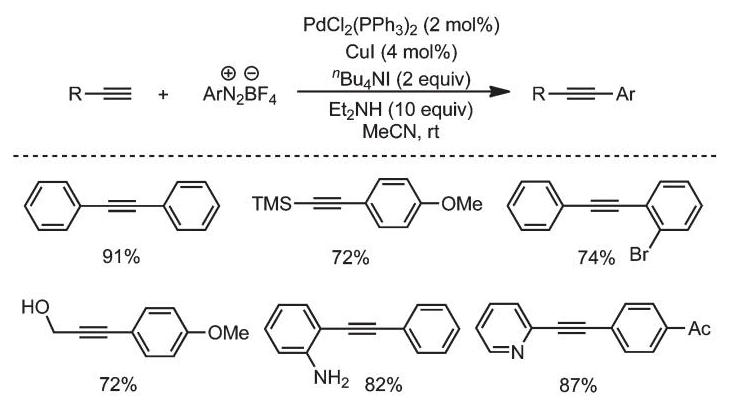
Scheme 8 Sonogashira cross-coupling of aryldiazonium salts.
方案8 芳基重氮盐的Sonogashira交叉偶联反应。
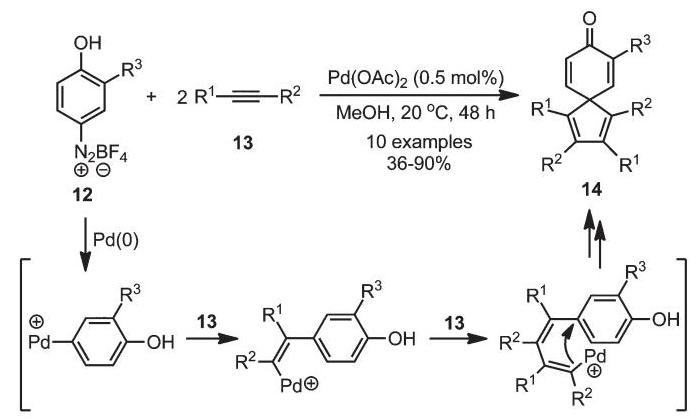
Scheme 9 Pd-catalyzed reaction of phenol diazonium salts with alkynes 13.
方案9 钯催化苯酚重氮盐与炔烃13的反应。
Besides traditional cross-coupling reactions, arene diazonium salts can also serve as an aryl radical source in transition-metal-catalyzed C-H functionalization and metal-free C-C bond forming reactions. For a recent example, the Sanford group described a room-temperature ligand-directed C-H arylation reaction using aryldiazonium salts (Scheme 10). ${}^{23}$ The linchpin for the success of this methodology is the combination of visible-light photoredox catalysis and Pd-catalyzed $\mathrm{C} - \mathrm{H}$ functionalization. This room-temperature $\mathrm{C} - \mathrm{H}$ arylation reaction is effective for the substrates containing a wide range of directing groups, including 2-arylpyridines, amides, pyrazoles, pyrimidines, oxime ethers, and free oximes. The authors have proposed a mechanism which involves a ruthenium catalyst cycle. The diazonium salt is decomposed to an aryl radical by $\mathrm{{Ru}}{\left( \mathrm{{bpy}}\right) }_{3}{}^{2 + * },{}^{24}$ which is formed by photoexcita-tion of $\mathrm{{Ru}}{\left( \mathrm{{bpy}}\right) }_{3}{}^{2 + }$ . This aryl radical then participates in the Pd-catalyzed C-H functionalization cycle to oxidize Pd(II) to Pd(III), which is further oxidized by $\mathrm{{Ru}}\left( \mathrm{{III}}\right)$ to form a $\mathrm{{Pd}}\left( \mathrm{{IV}}\right)$ species and regenerate the photocatalyst. Finally, C-C bond-forming reductive elimination releases the arylated product and regenerates the Pd(π) catalyst.
除了传统的交叉偶联反应外,芳基重氮盐还可作为芳基自由基源,用于过渡金属催化的C-H官能团化反应和无金属的C-C键形成反应。最近的一个例子是,桑福德团队报道了一种使用芳基重氮盐的室温配体导向C-H芳基化反应(方案10)。${}^{23}$ 该方法成功的关键是可见光光氧化还原催化和钯催化的$\mathrm{C} - \mathrm{H}$ 官能团化反应的结合。这种室温$\mathrm{C} - \mathrm{H}$ 芳基化反应对于含有多种导向基团的底物有效,包括2-芳基吡啶、酰胺、吡唑、嘧啶、肟醚和游离肟。作者提出了一种涉及钌催化剂循环的机理。重氮盐通过$\mathrm{{Ru}}{\left( \mathrm{{bpy}}\right) }_{3}{}^{2 + * },{}^{24}$ 分解为芳基自由基,$\mathrm{{Ru}}{\left( \mathrm{{bpy}}\right) }_{3}{}^{2 + * },{}^{24}$ 是由$\mathrm{{Ru}}{\left( \mathrm{{bpy}}\right) }_{3}{}^{2 + }$ 的光激发形成的。然后该芳基自由基参与钯催化的C-H官能团化循环,将Pd(II)氧化为Pd(III),Pd(III)再被$\mathrm{{Ru}}\left( \mathrm{{III}}\right)$ 进一步氧化形成$\mathrm{{Pd}}\left( \mathrm{{IV}}\right)$ 物种并再生光催化剂。最后,形成C-C键的还原消除反应释放出芳基化产物并再生Pd(0)催化剂。
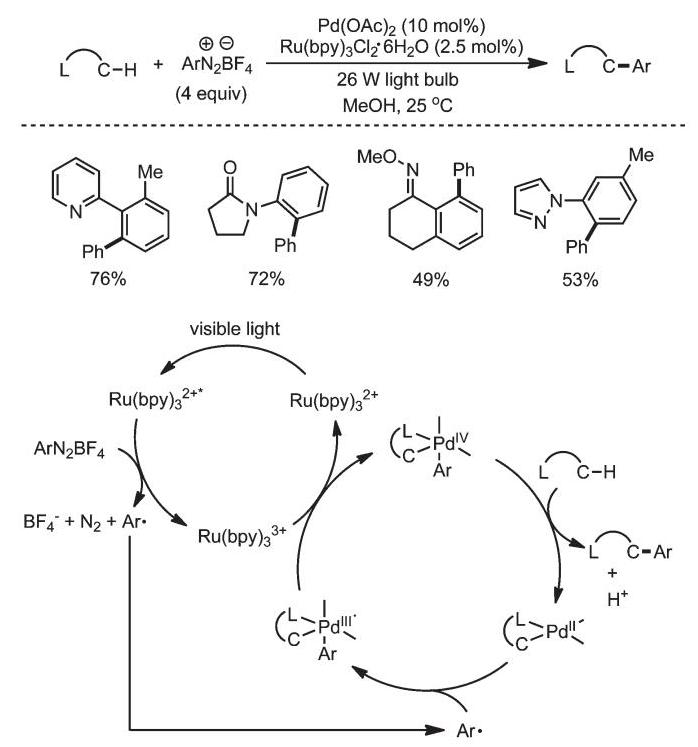
Scheme 10 Pd/Ru-catalyzed C-H arylation with diazonium salts.
方案10 钯/钌催化的重氮盐参与的C-H芳基化反应。
In 2012, König and co-workers reported a metal-free, visible-light-mediated direct $\mathrm{C} - \mathrm{H}$ arylation of heteroarenes with aryldiazonium salts (Scheme 11). ${}^{25}$
2012年,柯尼希及其同事报道了一种无金属、可见光介导的杂芳烃与芳基重氮盐的直接$\mathrm{C} - \mathrm{H}$ 芳基化反应(方案11)。${}^{25}$
The reaction does not require transition-metal catalysts or bases and proceeds smoothly at room temperature. In contrast to Sanford’s ruthenium catalyst, this protocol uses eosin Y 17 as the photoredox catalyst, and is presumed to proceed through a radical mechanism. ${}^{26}$ The radical mechanism is supported by the fact that 2,2,6,6-tetramethylpiperidinoxyl (TEMPO) effectively inhibits the reaction, and trapped intermediates can be detected.
该反应不需要过渡金属催化剂或碱,在室温下顺利进行。与桑福德的钌催化剂不同,该方案使用曙红Y 17作为光氧化还原催化剂,推测其通过自由基机理进行。${}^{26}$ 2,2,6,6-四甲基哌啶氮氧化物(TEMPO)能有效抑制该反应,并且可以检测到捕获的中间体,这一事实支持了自由基机理。
As shown in Scheme 11, the proposed mechanism starts with the formation of an aryl radical $\mathbf{A}$ by single-electron transfer (SET) from the excited state of eosin Y to the aryldiazonium salt. Addition of the aryl radical to heteroarene gives radical intermediate $\mathbf{B}$ , which is further transformed to the carbo-cation intermediate $\mathbf{C}$ by two possible pathways: (a) oxidation of the radical intermediate $\mathbf{B}$ by the eosin $\mathrm{Y}$ radical cation to give $\mathbf{C}$ or (b) oxidation of $\mathbf{B}$ by aryldiazonium salt in a radical chain transfer mechanism. Finally, deprotonation of intermediate $\mathbf{C}$ regenerates the aromatic ring and gives the final coupling product.
如方案11所示,提出的机理始于通过从曙红Y的激发态到芳基重氮盐的单电子转移(SET)形成芳基自由基$\mathbf{A}$。芳基自由基加成到杂芳烃上得到自由基中间体$\mathbf{B}$,它可以通过两种可能的途径进一步转化为碳正离子中间体$\mathbf{C}$:(a)自由基中间体$\mathbf{B}$ 被曙红$\mathrm{Y}$ 自由基阳离子氧化得到$\mathbf{C}$,或者(b)在自由基链转移机理中,$\mathbf{B}$ 被芳基重氮盐氧化。最后,中间体$\mathbf{C}$ 的去质子化再生芳环并得到最终的偶联产物。
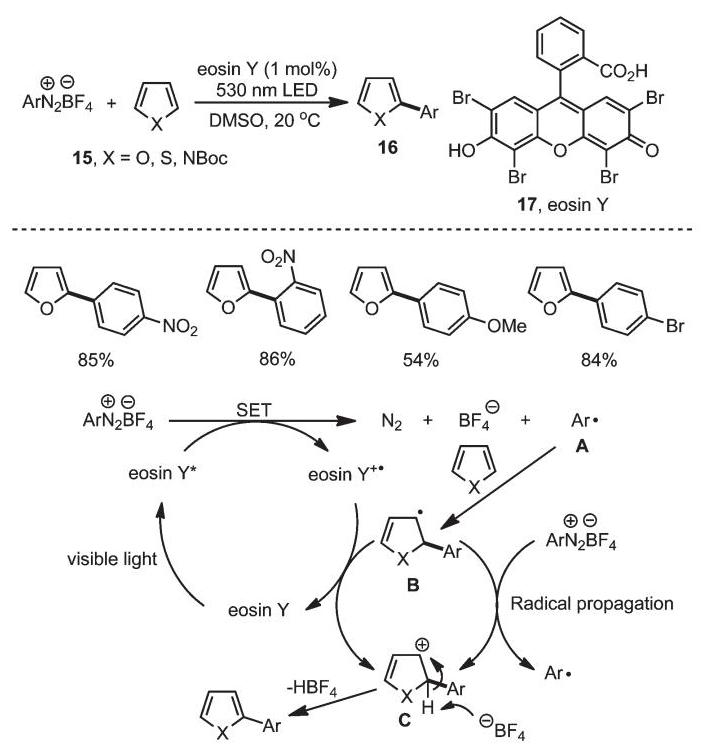
Scheme 11 Eosin Y-catalyzed visible-light-mediated direct $\mathrm{C} - \mathrm{H}$ arylation of heteroarenes with aryldiazonium salts.
方案11 曙红Y催化的可见光介导的杂芳烃与芳基重氮盐的直接$\mathrm{C} - \mathrm{H}$ 芳基化反应。
In the same year, the König group developed an eosin Y catalyzed visible light photocatalytic reaction of o-methylthio-arenediazonium salts with alkynes. The reaction affords substituted benzothiophenes through a similar radical annulation process. ${}^{27}$ This method provides mild and efficient access to benzothiophenes. This method was employed to prepare the key intermediate 21 for the synthesis of raloxifene ${}^{28}$ (Scheme 12).
同年,柯尼希团队开发了一种曙红Y催化的邻甲硫基芳基重氮盐与炔烃的可见光光催化反应。该反应通过类似的自由基环化过程得到取代苯并噻吩。${}^{27}$ 该方法为合成苯并噻吩提供了温和有效的途径。该方法被用于制备雷洛昔芬${}^{28}$ 合成的关键中间体21(方案12)。
In 2012, Studer and co-workers reported a transition-metal-free oxyarylation of alkenes 23 with aryldiazonium salts and TEMPONa (Scheme 13). ${}^{29}$ The mechanism involves aryl radical addition to alkenes with subsequent TEMPO trapping to afford the corresponding oxyarylation products 24. TEMPONa is used as a reducing reagent to convert an aryldiazonium salt to the corresponding aryl radical through single-electron transfer. The product TEMPO-based alkoxyamines can be easily converted to more common and useful compounds by further chemical manipulation.
2012年,施图德及其同事报道了芳基重氮盐与TEMPONa对烯烃23进行的无过渡金属氧芳基化反应(方案13)。${}^{29}$ 其反应机理包括芳基自由基加成到烯烃上,随后被TEMPO捕获,得到相应的氧芳基化产物24。TEMPONa用作还原试剂,通过单电子转移将芳基重氮盐转化为相应的芳基自由基。基于产物TEMPON的烷氧基胺可通过进一步的化学操作轻松转化为更常见和有用的化合物。
Aryldiazonium salts are typically considered as electrophiles to participate in various Pd-catalyzed cross-coupling reactions. However, much less attention has been paid to the synthetic utility of the homocoupling of aryldiazonium salts for synthesizing symmetrical biaryls. ${}^{30}$ In 2012, Song and co-workers reported a simple and efficient ${\mathrm{{FeCl}}}_{2}$ -promoted homocoupling of aryldiazonium tetrafluoroborates to afford symmetrical biaryls 25 with broad substrate scope and high yields (Scheme 14). ${}^{31}$ The authors suggest that the mechanism involves reductive homocoupling of the aryldiazonium salt with the oxidation of the ${\mathrm{{Fe}}}^{2 + }$ ion.
芳基重氮盐通常被视为亲电试剂,参与各种钯催化的交叉偶联反应。然而,芳基重氮盐用于合成对称联芳基的自偶联反应的合成效用却很少受到关注。${}^{30}$ 2012年,宋及其同事报道了一种简单有效的${\mathrm{{FeCl}}}_{2}$促进的四氟硼酸芳基重氮盐自偶联反应,可得到底物范围广、产率高的对称联芳基25(方案14)。${}^{31}$ 作者认为其反应机理涉及芳基重氮盐的还原自偶联以及${\mathrm{{Fe}}}^{2 + }$离子的氧化。
Aryldiazonium salts are not only excellent precursors for the generation of radical intermediates, but also aryl cations. ${}^{32}$ One of the latest examples is shown in Scheme 15, which was reported by Ren and co-workers in ${2012.}^{33}$ It has been shown that the reaction of aryltriazenes26with ${\mathrm{{BF}}}_{3} \cdot {\mathrm{{OEt}}}_{2}$ leads to the formation of polycyclic aromatic hydrocarbons 27 through a Friedel-Crafts intramolecular arylation. Aryltria-zenes, which can be readily prepared from the corresponding arylamine in high yields and are easy to handle, are widely used as equivalents of aryldiazonium salts. In the presence of Lewis or Brønsted acid, aryltriazenes are activated and the corresponding aryldiazonium salt is generated.
芳基重氮盐不仅是生成自由基中间体的优良前体,也是芳基阳离子。${}^{32}$ 最新的一个例子如图15所示,是任及其同事在${2012.}^{33}$报道的。结果表明,芳基三氮烯26与${\mathrm{{BF}}}_{3} \cdot {\mathrm{{OEt}}}_{2}$的反应通过傅克分子内芳基化反应生成多环芳烃27。芳基三氮烯可以很容易地由相应的芳胺高产率制备且易于处理,被广泛用作芳基重氮盐的等效物。在路易斯酸或布朗斯特酸存在下,芳基三氮烯被活化并生成相应的芳基重氮盐。
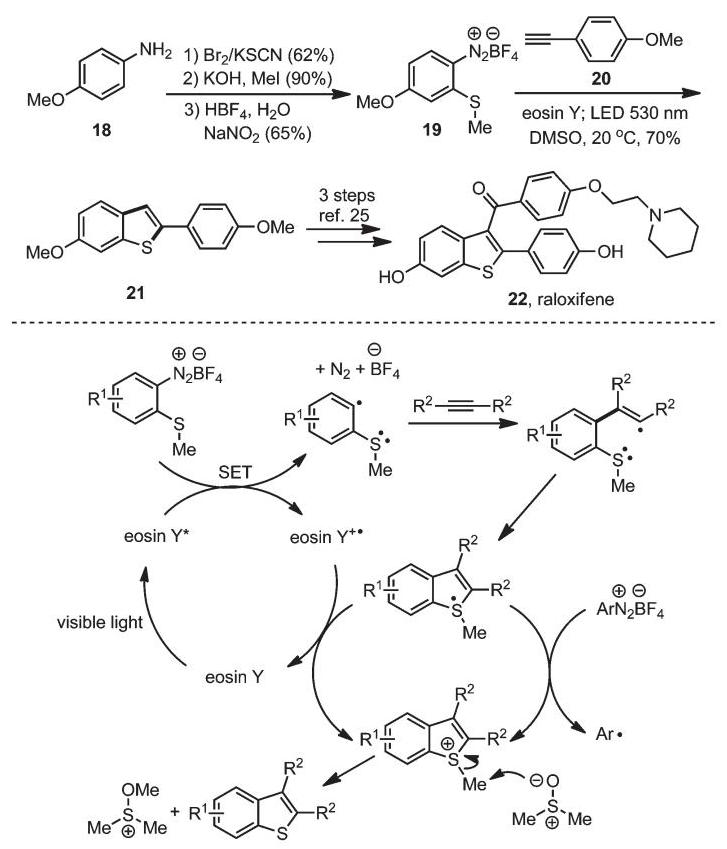
Scheme 12 Benzothiophene synthesis from arene diazonium salts.
方案12 由芳基重氮盐合成苯并噻吩。
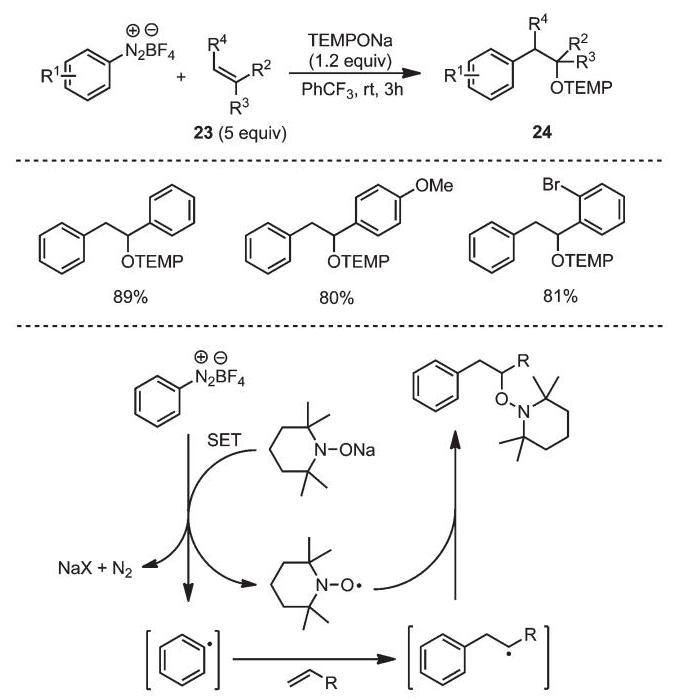
Scheme 13 Transition-metal-free oxyarylation of alkenes with aryldiazonium salts and TEMPONa.
方案13芳基重氮盐与TEMPONa对烯烃进行的无过渡金属氧芳基化反应。
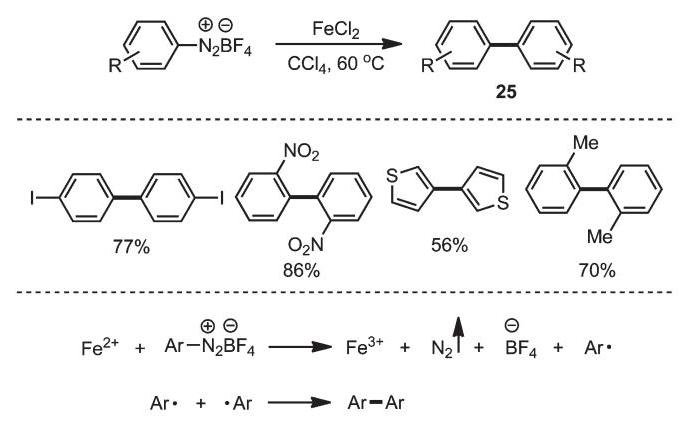
Scheme 14 Homocoupling of aryldiazonium tetrafluoroborates.
方案14四氟硼酸芳基重氮盐的自偶联反应。
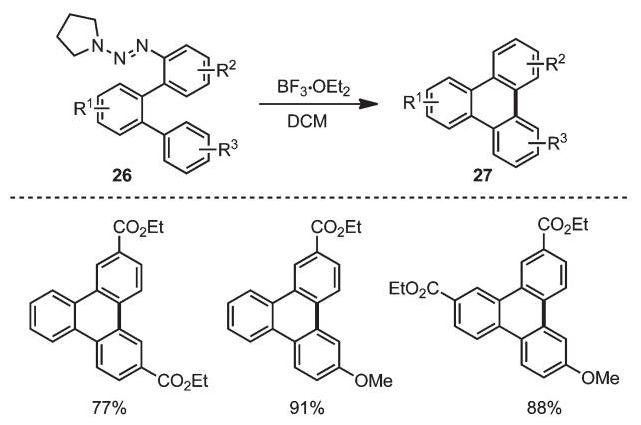
Scheme 15 Synthesis of polycyclic aromatic hydrocarbons through Friedel-Crafts intramolecular arylation.
方案15通过傅克分子内芳基化反应合成多环芳烃。
Zhou and co-workers reported a metal-free, visible light-induced $\left\lbrack {4 + 2}\right\rbrack$ benzannulation of biaryldiazonium salts 28 and alkynes with eosin Y as the photoredox catalyst. ${}^{34}$ A variety of 9-substituted or 9,10-disubstituted phenanthrenes 29 were obtained via a cascade radical addition and cyclization sequence. In general, electron deficient alkynes give higher yields as compared with electron rich ones (Scheme 16).
周及其同事报道了以曙红Y作为光氧化还原催化剂,对联芳基重氮盐28和炔烃进行的无金属可见光诱导的$\left\lbrack {4 + 2}\right\rbrack$苯并环化反应。${}^{34}$ 通过串联自由基加成和环化序列得到了多种9-取代或9,10-二取代菲29。一般来说,与富电子炔烃相比,缺电子炔烃的产率更高(方案16)。
3 Carbon-boron bond formation
3 碳-硼键的形成
Since the discovery of diazonium salts by Griess in 1858, carbon-halogen, carbon-carbon, carbon-nitrogen, carbon-oxygen, carbon-sulfur bond formation have been achieved by utilizing intrinsic reactivity of diazonium salts. Although numerous efforts have been made in Pd-catalyzed cross-coupling reactions using aryldiazonium salts since the pioneering work of Kikukawa and Matsuda reported in 1977, in terms of mechanism, diazonium salts in these reactions only serve as “super” electrophiles and surrogates of aryl halides. Thus, it is not unexpected that aryldiazonium salts can also be used in the Pd-catalyzed Miyaura borylation reaction, which is an important approach towards aromatic boronates. ${}^{35}$
自1858年格里斯发现重氮盐以来,利用重氮盐的固有反应性实现了碳-卤键、碳-碳键、碳-氮键、碳-氧键、碳-硫键的形成。尽管自1977年菊川和松田的开创性工作以来,人们在使用芳基重氮盐的钯催化交叉偶联反应方面付出了诸多努力,但从机理上讲,这些反应中的重氮盐仅作为“超级”亲电试剂和芳基卤化物的替代物。因此,芳基重氮盐也可用于钯催化的宫浦硼化反应并不意外,这是合成芳基硼酸酯的一种重要方法。${}^{35}$
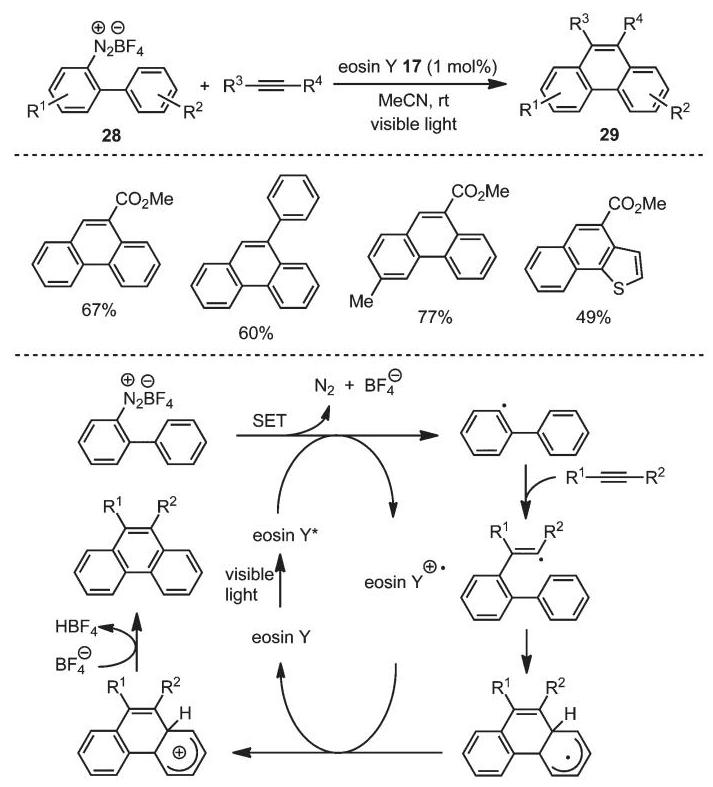
Scheme 16 Eosin Y-catalyzed visible light-induced [4 + 2] benzannulation of biaryldiazonium salts and alkynes.
方案16 曙红Y催化的联芳基重氮盐与炔烃的可见光诱导[4 + 2]苯并环化反应。
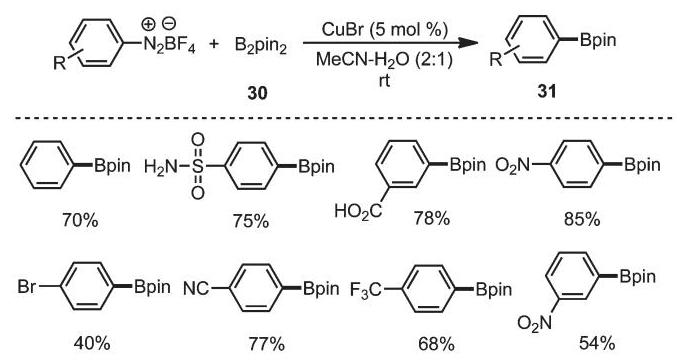
Scheme 17 Cu(i)-catalyzed borylation of aryldiazonium salts.
方案17 铜(I)催化的芳基重氮盐的硼化反应。
A recent example of transition-metal-catalyzed borylation of diazonium salts was shown by $\mathrm{{Yu}}$ and co-workers. They reported $\mathrm{{Cu}}\left( \mathrm{I}\right)$ -catalyzed cross-coupling reactions of aryl diazonium salts with ${\mathrm{B}}_{2}{\text{ pin }}_{2}$ [bis(pinacolato)diboron] 30 in MeCN- ${\mathrm{H}}_{2}\mathrm{O}$ at room temperature, providing the corresponding aryl-boronates 31 in good to high yields (Scheme 17). ${}^{36}$ They found that CuBr is superior to other inorganic salts and water in an organic solvent is helpful to the reaction. Most of the substrates presented are those with electron withdrawing groups on the aromatic ring. However, the reaction tolerates halo and acidic substituents.
最近,$\mathrm{{Yu}}$及其同事展示了一个过渡金属催化的重氮盐硼化反应的例子。他们报道了在室温下,在乙腈-${\mathrm{H}}_{2}\mathrm{O}$中,$\mathrm{{Cu}}\left( \mathrm{I}\right)$催化芳基重氮盐与${\mathrm{B}}_{2}{\text{ pin }}_{2}$ [双(频哪醇)二硼] 30的交叉偶联反应,以良好至高收率得到相应的芳基硼酸酯31(方案17)。${}^{36}$他们发现溴化铜优于其他无机盐,并且有机溶剂中的水有助于反应。所呈现的大多数底物是芳环上带有吸电子基团的底物。然而,该反应能耐受卤素和酸性取代基。
Recently, transition-metal-free methods for C-B bond formation reactions involving aryldiazonium salts as key intermediates have been reported. ${}^{{37} - {40}}$ In 2010, Mo and Wang reported novel metal-free C-B bond formation by directly converting arylamines into pinacolboronates 31 at room temperature. The starting material arylamine is first converted into the corresponding diazonium ion by reaction with tert-butylni-trite 32, and then the diazonium ion reacts with the diboron reagent ${\mathrm{B}}_{2}{\text{ pin }}_{2}{30}$ to deliver the final product (Scheme 18). ${}^{37}$
最近,已经报道了以芳基重氮盐为关键中间体的无过渡金属的碳-硼键形成反应方法。${}^{{37} - {40}}$ 2010年,Mo和Wang报道了一种新型的无金属碳-硼键形成反应,即在室温下将芳胺直接转化为频哪醇硼酸酯31。起始原料芳胺首先通过与叔丁基亚硝酸酯32反应转化为相应的重氮离子,然后重氮离子与二硼试剂${\mathrm{B}}_{2}{\text{ pin }}_{2}{30}$反应得到最终产物(方案18)。${}^{37}$
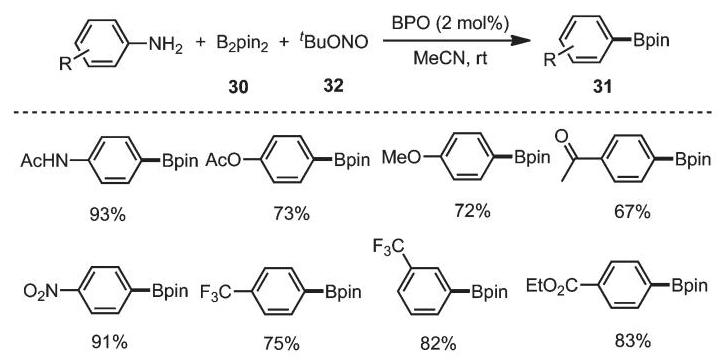
Scheme 18 Direct conversion of arylamines to pinacol boronates.
方案18 芳胺直接转化为频哪醇硼酸酯。
The reaction occurs smoothly with meta- and para-substituted arylamines, while the reactions with ortho-substituted arylamines give diminished yields. In general, substrates with electron-withdrawing groups at the para- and meta-positions exhibit good reactivity. It is noteworthy that substrates bearing halo substituents can also be employed in this reaction, providing the possibility of multiple transition-metal-catalyzed cross-coupling. Since arylamines are inexpensive and ubiquitous starting materials, this borylation method is expected to find wide applications in organic synthesis.
间位和对位取代的芳胺反应顺利,而邻位取代的芳胺反应产率降低。一般来说,对位和间位带有吸电子基团的底物表现出良好的反应性。值得注意的是,带有卤素取代基的底物也可用于该反应,这为多种过渡金属催化的交叉偶联提供了可能性。由于芳胺是廉价且普遍存在的起始原料,这种硼化方法有望在有机合成中得到广泛应用。
More recently, the substrate scope of the reaction was further expanded, especially to heterocyclic amine derivatives, for which the corresponding boronate products are highly important in both academic research and the pharmaceutical industry (Scheme 19). ${}^{38}$ It was found that electron-deficient heterocyclic amines exhibit high reactivity with nearly complete conversion of ${\mathrm{B}}_{2}{\mathrm{{pin}}}_{2}$ . However, electron-rich heterocyclic amines are prone to be oxidized in the presence of $t$ -BuONO, resulting in diminished yields of the borylation products.
最近,该反应的底物范围进一步扩大,特别是扩展到杂环胺衍生物,其相应的硼酸酯产物在学术研究和制药工业中都非常重要(方案19)。${}^{38}$发现缺电子的杂环胺表现出高反应性,${\mathrm{B}}_{2}{\mathrm{{pin}}}_{2}$几乎完全转化。然而,富电子的杂环胺在$t$-丁基亚硝酸酯存在下容易被氧化,导致硼化产物的产率降低。
Based on the experimental observations, a possible reaction pathway involving radical species is proposed for this boryla-tion reaction as shown in Scheme 20. First, the tert-butoxide anion interacts with ${\mathrm{B}}_{2}{\mathrm{{pin}}}_{2}$ to form a tetra-coordinated boron complex A. Single electron transfer (SET) between the ate complex $\mathbf{A}$ and the aryldiazonium ion then affords an aryl radical $\mathbf{D}$ through ${\mathrm{N}}_{2}$ extrusion from radical $\mathbf{B}$ . Finally, reaction of aryl radical $\mathbf{D}$ with intermediate $\mathbf{C}$ gives the borylation product.
基于实验观察结果,针对该硼化反应提出了一种可能涉及自由基物种的反应途径,如图20所示。首先,叔丁醇根阴离子与${\mathrm{B}}_{2}{\mathrm{{pin}}}_{2}$相互作用形成四配位硼络合物A。然后,在酸根络合物$\mathbf{A}$和芳基重氮离子之间发生单电子转移(SET),通过从自由基$\mathbf{B}$中挤出${\mathrm{N}}_{2}$,得到芳基自由基$\mathbf{D}$。最后,芳基自由基$\mathbf{D}$与中间体$\mathbf{C}$反应生成硼化产物。
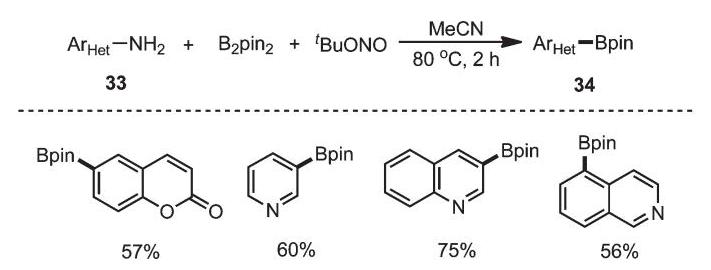
Scheme 19 Heterocyclic boronates from heterocyclic amines.
图19 由杂环胺制备的杂环硼酸酯。
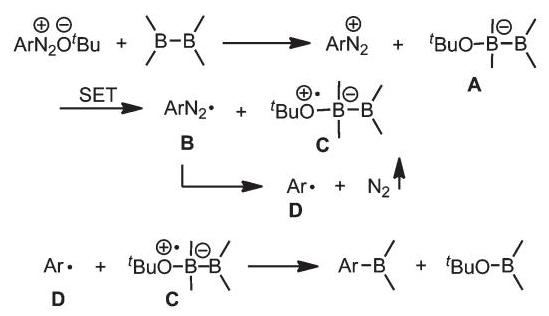
Scheme 20 Proposed mechanism for borylation of arylamine.
图20 芳胺硼化反应的 proposed mechanism。
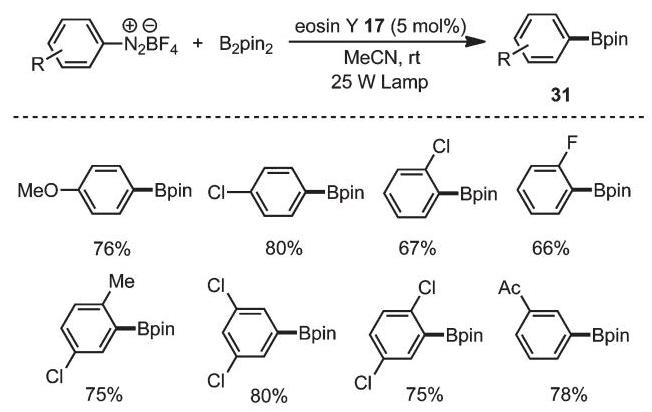
Scheme 21 Metal-free, visible-light-induced borylation of aryldiazonium salts.
图21 无金属可见光诱导的芳基重氮盐硼化反应。
Subsequently, Yan and co-workers reported photoredox-mediated reduction of aryldiazonium salts, providing free aryl radicals that are borylated in the presence of ${\mathrm{B}}_{2}{\mathrm{{pin}}}_{2}$ (Scheme 21). ${}^{39}$ Both electron poor and electron rich aromatics are tolerated and provided the corresponding borylated compounds in moderate to good yields.
随后,Yan及其同事报道了光氧化还原介导的芳基重氮盐还原反应,提供了在${\mathrm{B}}_{2}{\mathrm{{pin}}}_{2}$存在下被硼化的游离芳基自由基(图21)。${}^{39}$ 贫电子和富电子芳烃都能耐受,并以中等至良好的产率提供相应的硼化化合物。
In the proposed mechanism, an aryl radical is formed by single electron transfer (SET) from the excited state of eosin Y to aryldiazonium salt (Scheme 22). The aryl radical then reacts with complex $\mathbf{A}$ , which is generated in situ from the ${\mathrm{B}}_{2}{\mathrm{{pin}}}_{2}$ coordination tetrafluoroborate anion, affording borylation product 31 and the radical anion intermediate B. Oxidation of B to $\mathbf{C}$ by the eosin $\mathrm{Y}$ radical cation completes the catalytic cycle. This transformation provides supportive evidence for the involvement of aryl radical species in the borylation with ${\mathrm{B}}_{2}{\mathrm{{pin}}}_{2}$ as shown in Scheme 20.
在所提出的机理中,芳基自由基是通过从曙红Y的激发态向芳基重氮盐进行单电子转移(SET)而形成的(图22)。然后,芳基自由基与络合物$\mathbf{A}$反应,$\mathbf{A}$是由${\mathrm{B}}_{2}{\mathrm{{pin}}}_{2}$配位四氟硼酸根阴离子原位生成的,得到硼化产物31和自由基阴离子中间体B。曙红$\mathrm{Y}$自由基阳离子将B氧化为$\mathbf{C}$,完成催化循环。这种转化为图20所示的芳基自由基物种参与与${\mathrm{B}}_{2}{\mathrm{{pin}}}_{2}$的硼化反应提供了支持性证据。
More recently, Yamane and Zhu described a related arylboro-nate synthesis via direct borylation of aryltriazene mediated by ${\mathrm{{BF}}}_{3} \cdot {\mathrm{{OEt}}}_{2}$ (Scheme 23). ${}^{40}$ The aryltriazenes, which are considered as protected diazonium salts, can be easily prepared from the corresponding arylamines in high yields. ${}^{41}$ The reaction proceeds smoothly for a variety of aryltriazenes 35 and provides moderate to high yields of arylboronates.
最近,Yamane和Zhu描述了一种通过${\mathrm{{BF}}}_{3} \cdot {\mathrm{{OEt}}}_{2}$介导的芳基三氮烯直接硼化反应合成相关芳基硼酸酯的方法(图23)。${}^{40}$ 芳基三氮烯被认为是受保护的重氮盐,可以很容易地从相应的芳胺中高产率制备。${}^{41}$ 该反应对多种芳基三氮烯35都能顺利进行,并提供中等至高产率的芳基硼酸酯。
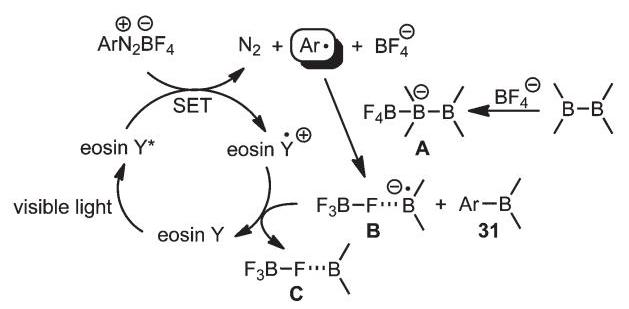
Scheme 22 Proposed reaction mechanism.
图22 提出的反应机理。
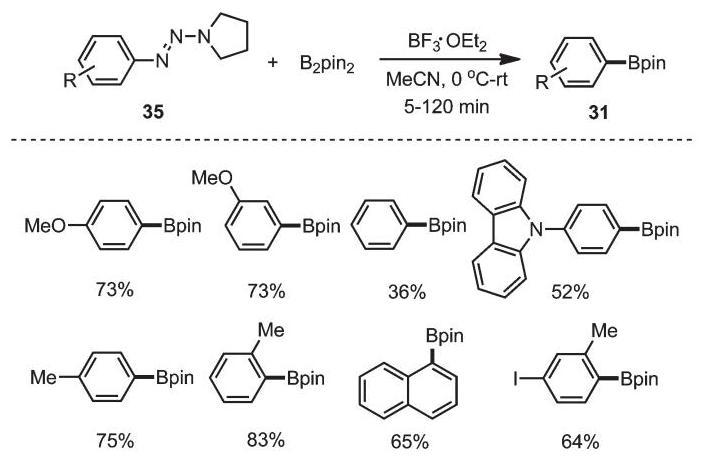
Scheme 23 Borylation of aryltriazene mediated by ${\mathrm{{BF}}}_{3} \cdot {\mathrm{{OEt}}}_{2}$ .
图23 ${\mathrm{{BF}}}_{3} \cdot {\mathrm{{OEt}}}_{2}$介导的芳基三氮烯硼化反应。
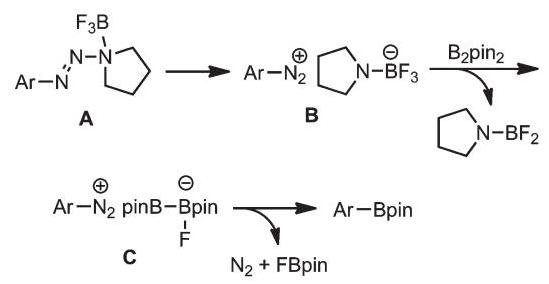
Scheme 24 Proposed mechanistic for borylation of aryltriazene.
图24 芳基三氮烯硼化反应的proposed mechanistic。
For the reaction mechanism, it is proposed that the formation of triazene- ${\mathrm{{BF}}}_{3}$ complex $\mathbf{A}$ is followed by the generation of aryldiazonium salt $\mathbf{B}$ (Scheme 24). Then the fluoride anion transfers from the trifluoroborate anion onto ${\mathrm{B}}_{2}{\text{ pin }}_{2}$ to generate C. Finally, nucleophilic substitution affords the bory-lation product and releases ${\mathrm{N}}_{2}$ and F-Bpin. Although this bory-lation is closely related to those shown in Scheme 18, a mechanism involving radical species has been ruled out based on the trapping experiment.
对于反应机理,有人提出先形成三氮烯 - ${\mathrm{{BF}}}_{3}$络合物$\mathbf{A}$,然后生成芳基重氮盐$\mathbf{B}$(图24)。然后氟阴离子从三氟硼酸根阴离子转移到${\mathrm{B}}_{2}{\text{ pin }}_{2}$上生成C。最后,亲核取代反应得到硼化产物并释放出${\mathrm{N}}_{2}$和F - Bpin。尽管这种硼化反应与图18所示的反应密切相关,但基于捕获实验排除了涉及自由基物种的机理。
4 Carbon-sulfur bond formation
4 碳 - 硫键的形成
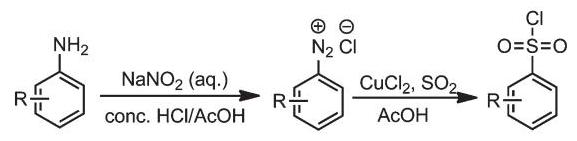
Direct chlorosulfonylation of diazonium salts to build carbon-sulfur bonds was first reported by Meerwein and co-workers in 1957. ${}^{42}$ In their original paper, the diazonium salt, formed from aniline using aqueous ${\mathrm{{NaNO}}}_{2}$ in a mixture of concentrated aqueous HCl and acetic acid, is added to a saturated solution of ${\mathrm{{SO}}}_{2}$ in acetic acid in the presence of a catalytic amount of ${\mathrm{{CuCl}}}_{2}$ . The reaction affords the corresponding aryl sulfonyl chloride (eqn (2)).
重氮盐的直接氯磺酰化反应以构建碳 - 硫键最早由梅耶尔温及其同事于1957年报道。${}^{42}$ 在他们的原始论文中,由苯胺在浓盐酸水溶液和乙酸的混合物中使用含水的${\mathrm{{NaNO}}}_{2}$形成的重氮盐,在催化量的${\mathrm{{CuCl}}}_{2}$存在下加入到乙酸中的${\mathrm{{SO}}}_{2}$饱和溶液中。该反应得到相应的芳基磺酰氯(式(2))。
(2)
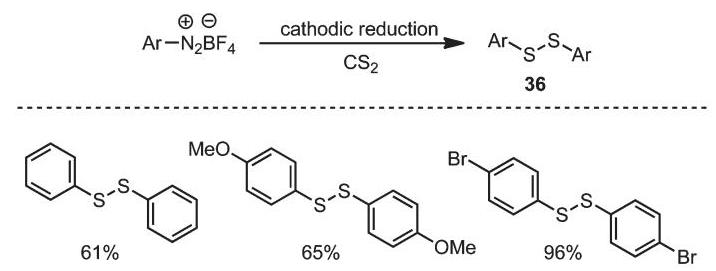
Scheme 25 Formation of diaryldisulfides by electrolyses of aryldiazonium salts in ${\mathrm{{CS}}}_{2}$ .
方案25 通过在${\mathrm{{CS}}}_{2}$中电解芳基重氮盐形成二芳基二硫化物。
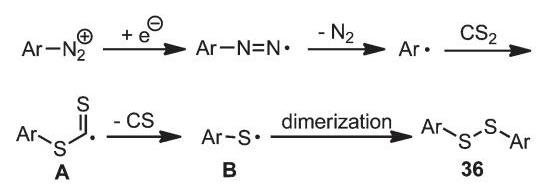
Scheme 26 Proposed reaction mechanism for 36.
方案26 36的反应机理推测。
Recently, Batanero and co-workers developed an electrolytic method towards diaryldisulfides synthesis by cathodic reduction of aryldiazonium tetrafluoroborates in ${\mathrm{{CS}}}_{2} - \mathrm{{EtOH}}$ and ${\mathrm{{Bu}}}_{4}{\mathrm{{NClO}}}_{4}$ (Scheme 25). ${}^{43}$ In their previous paper, ${}^{44}$ they had already demonstrated that the aryldiazonium salts are easily reduced to the corresponding aryl radicals under electrolysis, which can further react with solvents such as acetonitrile, DMF, or 1,2-dichloroethane to produce the dimethylaminocar-bonyl, cyanomethyl, or 1,2-dichloroethyl radicals, respectively. As shown in Scheme 26, the aryl radical, once generated in a low concentration, can react with ${\mathrm{{CS}}}_{2}$ forming intermediate $\mathbf{A}$ , which further decomposes to give carbon monosulfide and aryl sulfur radical $\mathbf{B}$ . Dimerization of intermediate $\mathbf{B}$ releases the final diaryldisulfide product.
最近,巴塔内罗及其同事开发了一种电解方法,通过在${\mathrm{{CS}}}_{2} - \mathrm{{EtOH}}$和${\mathrm{{Bu}}}_{4}{\mathrm{{NClO}}}_{4}$中阴极还原四氟硼酸芳基重氮盐来合成二芳基二硫化物(方案25)。${}^{43}$ 在他们之前的论文中,${}^{44}$ 他们已经证明芳基重氮盐在电解下很容易还原为相应的芳基自由基,这些自由基可以进一步与乙腈、DMF或1,2 - 二氯乙烷等溶剂反应,分别生成二甲基氨基羰基、氰甲基或1,2 - 二氯乙基自由基。如图方案26所示,一旦低浓度生成芳基自由基,它可以与${\mathrm{{CS}}}_{2}$反应形成中间体$\mathbf{A}$,中间体$\mathbf{A}$进一步分解生成碳一硫化物和芳基硫自由基$\mathbf{B}$。中间体$\mathbf{B}$的二聚反应释放出最终的二芳基二硫化物产物。
In 2011, Ranu and co-workers reported a transition-metal-free procedure for the synthesis of $S$ -aryl dithiocarbamates 37 using water as a solvent at room temperature. ${}^{45}$ The reaction is a one-pot multi-component condensation of aryldiazonium-tetrafluoroborate, carbon disulfide and an amine without metal catalysts (Scheme 27).
2011年,拉努及其同事报道了一种在室温下以水为溶剂合成$S$ - 芳基二硫代氨基甲酸盐37的无过渡金属方法。${}^{45}$ 该反应是芳基重氮四氟硼酸盐、二硫化碳和胺在无金属催化剂条件下的一锅多组分缩合反应(方案27)。
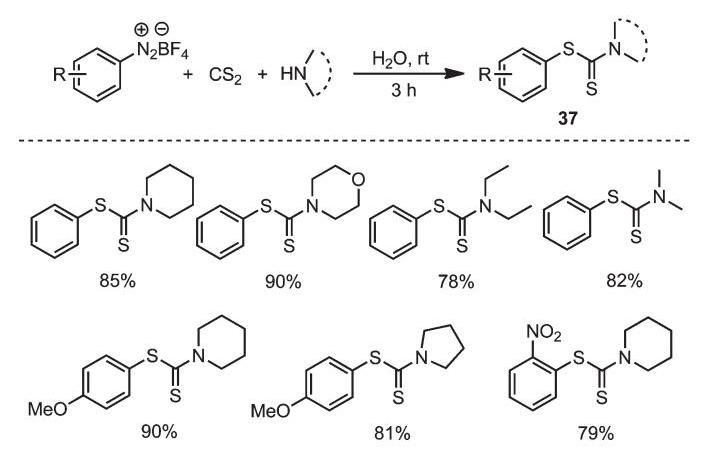
Scheme 27 Transition-metal-free reaction of aryldiazonium salts with dithio-carbamate anions.
方案27 芳基重氮盐与二硫代氨基甲酸盐阴离子的无过渡金属反应。
S
$\oplus$
NR'2 ${\mathrm{{CS}}}_{2}$
NR'2 ${\mathrm{{CS}}}_{2}$
${\mathrm{N}}_{2}$
R'2NH
R’₂NH
R'2N SH
R’₂N SH
38
Scheme 28 Proposed reaction mechanism for the formation of dithiocarbamates.
方案28 二硫代氨基甲酸盐形成的反应机理推测。
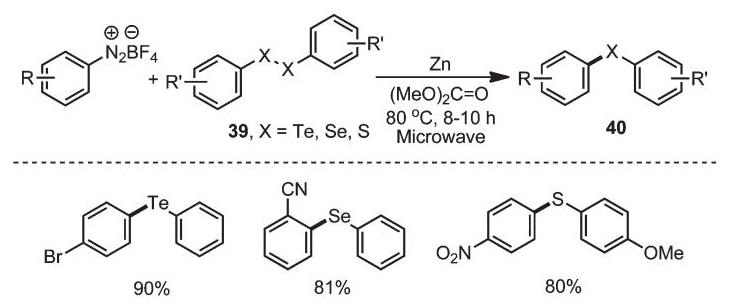
Scheme 29 Zn-mediated synthesis of diarylchalcogenides 40.
方案29 锌介导的二芳基硫属化合物40的合成。
Mechanistically, it was found that ${\mathrm{{CS}}}_{2}$ underwent a very fast reaction with piperidine in water at $0 - 5{}^{ \circ }\mathrm{C}$ to form piperidine- 1-dithiocarbamic acid 38, which could be isolated and fully characterized. Compound 38 could react with aryldiazonium tetrafluoroborate to give the corresponding dithiocarbamate product (Scheme 28).
从机理上看,发现${\mathrm{{CS}}}_{2}$在$0 - 5{}^{ \circ }\mathrm{C}$下于水中与哌啶发生非常快速的反应,形成哌啶 - 1 - 二硫代氨基甲酸38,它可以被分离并完全表征。化合物38可以与芳基重氮四氟硼酸盐反应得到相应的二硫代氨基甲酸盐产物(方案28)。
Moreover, the same group has succeeded in using aryldia-zonium fluoroborates and diaryldichalcogenides 39 to access unsymmetrical diarylchalcogenides 40 under microwave conditions (Scheme 29). ${}^{46}$
此外,同一研究小组成功地在微波条件下使用氟硼酸芳基重氮盐和二芳基二硫属化合物39得到不对称二芳基硫属化合物40(方案29)。${}^{46}$
It is known that diaryldichalcogenide could be reduced by Zn dust via homo-cleavage to form $\mathrm{{Zn}}{\left( \mathrm{{Xaryl}}\right) }_{2}$ species. ${}^{47}$ This $\mathrm{{Zn}}{\left( \mathrm{{Xaryl}}\right) }_{2}$ species then reacts with aryldiazonium tetrafluoro-borate to provide the final product with extrusion of ${\mathrm{N}}_{2}$ .
已知二芳基二硫属化合物可以通过锌粉的均裂还原形成$\mathrm{{Zn}}{\left( \mathrm{{Xaryl}}\right) }_{2}$物种。${}^{47}$ 这种$\mathrm{{Zn}}{\left( \mathrm{{Xaryl}}\right) }_{2}$物种然后与芳基重氮四氟硼酸盐反应,挤出${\mathrm{N}}_{2}$得到最终产物。
5 Miscellaneous reactions
5 杂项反应
The stability of aryldiazonium salts depends on the aromatic substituents and the nature of their counter-anion. The diazonium salts of tetrafluoroborates, tosylates and disulfonimides represent the most stable ones. Recently Kachanov and coworkers have reported a modified method that introduces 1,1,2,3,3-pentacyanopropenide as the anion of aryldiazonium salts. ${}^{48}$ A number of aryldiazonium salts possessing the 1,1,2,3,3-pentacyanopropenide anion have been prepared by means of the exchange reaction between aryldiazonium chlorides and pyridinium 1,1,2,3,3-pentacyanopropenide ${}^{49}$ in water (Scheme 30).
芳基重氮盐的稳定性取决于芳环上的取代基及其抗衡阴离子的性质。四氟硼酸盐、甲苯磺酸盐和二磺酰亚胺的重氮盐是最稳定的。最近,卡恰诺夫及其同事报道了一种改进方法,该方法引入1,1,2,3,3 - 五氰基丙烯化物作为芳基重氮盐的阴离子。${}^{48}$ 通过芳基重氮氯化物与吡啶鎓1,1,2,3,3 - 五氰基丙烯化物${}^{49}$ 在水中的交换反应,制备了多种具有1,1,2,3,3 - 五氰基丙烯化物阴离子的芳基重氮盐(方案30)。
Although aryldiazonium salts have been widely investigated as sources of aryl radicals in the Sandmeyer, Meerwein, Gomberg-Bachmann, and Pschorr reactions, their use and application as nitrogen-centered radical surrogates has only been marginally explored so far. ${}^{50}$ In 2010, Heinrich and coworkers reported an iron(π)-mediated three-component reaction of hydroperoxides, olefins and aryldiazonium salts to give azo compounds as products. ${}^{51}$ The reaction starts with a fragmentation liberating acetic acid from hydroperoxide compound 41 to give radical $\mathbf{A}$ , which is trapped by olefin to give another radical B. The last step involves nucleophilic attack of B by a diazonium ion via a reductive process to furnish the final product (Scheme 31).
尽管芳基重氮盐作为芳基自由基源在桑德迈尔反应、迈尔温反应、贡伯格 - 巴赫曼反应和普肖尔反应中已得到广泛研究,但迄今为止,它们作为氮中心自由基替代物的用途和应用仅得到了有限的探索。${}^{50}$ 2010年,海因里希及其同事报道了一种铁(Ⅱ)介导的氢过氧化物、烯烃和芳基重氮盐的三组分反应,生成偶氮化合物作为产物。${}^{51}$ 反应始于从氢过氧化物化合物41中裂解出乙酸生成自由基$\mathbf{A}$ ,该自由基被烯烃捕获生成另一个自由基B。最后一步涉及自由基B通过还原过程被重氮离子亲核进攻以提供最终产物(方案31)。
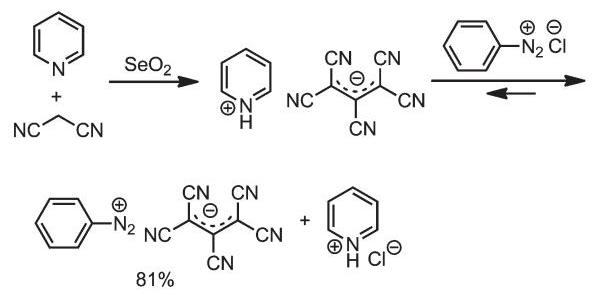
Scheme 30 Preparation of aryldiazonium 1,1,2,3,3-pentacyanopropenide.
方案30 芳基重氮1,1,2,3,3 - 五氰基丙烯化物的制备。
Cyclization of the diazonium ion to form a heterocycle is another common application of diazonium salts chemistry. In 2010, Flynn and co-workers reported a modified Richter cyclization ${}^{52}$ by using 2-alkynylaryltriazene 43 as masked diazonium salts, affording chemoselective access to 4-bromocin-noline 44, cinnolinones 45, ring-fused cinnolines 46 and indazoles 47 (Scheme 32). ${}^{53}$
重氮离子环化形成杂环是重氮盐化学的另一个常见应用。2010年,弗林及其同事报道了一种改进的里希特环化反应${}^{52}$ ,使用2 - 炔基芳基三氮烯(即43)作为掩蔽的重氮盐,化学选择性地得到4 - 溴噌啉(即44)、噌啉酮(即45)、稠环噌啉(即46)和吲唑(即47)(方案32)。${}^{53}$
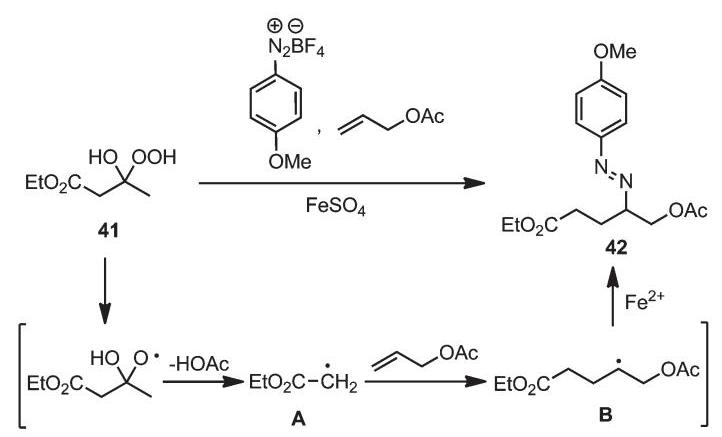
Scheme 31 Synthesis of the azo compound via iron(ii)-mediated olefin func-tionalization with aryldiazonium salts.
方案31 通过铁(Ⅱ)介导的芳基重氮盐与烯烃官能化反应合成偶氮化合物。
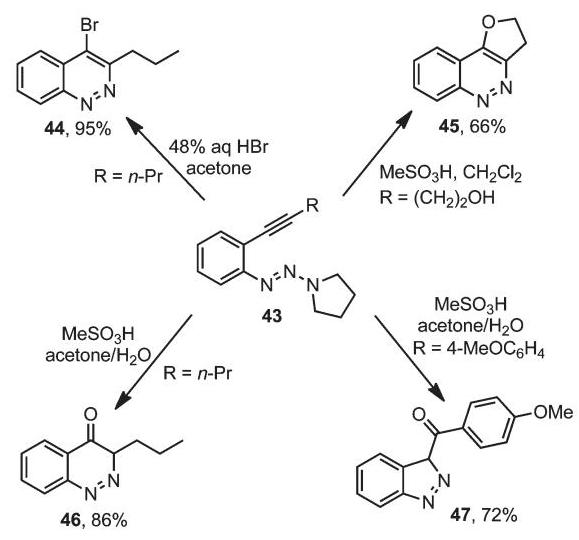
Scheme 32 Cyclization of 2-alkynylaryl triazenes 43.
方案32 2 - 炔基芳基三氮烯(即43)的环化反应。
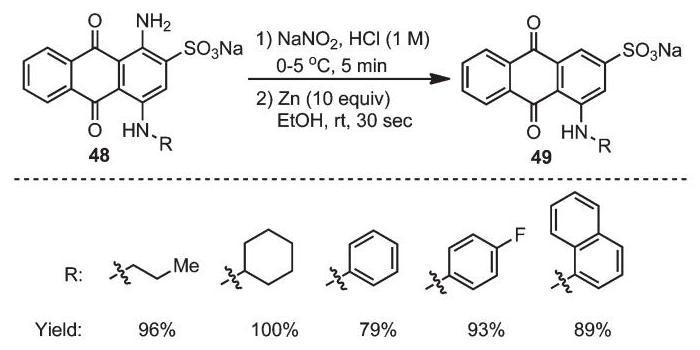
Scheme 33 Reductive deamination protocol using a Zn-EtOH system.
方案33 使用锌 - 乙醇体系的还原脱氨基方法。
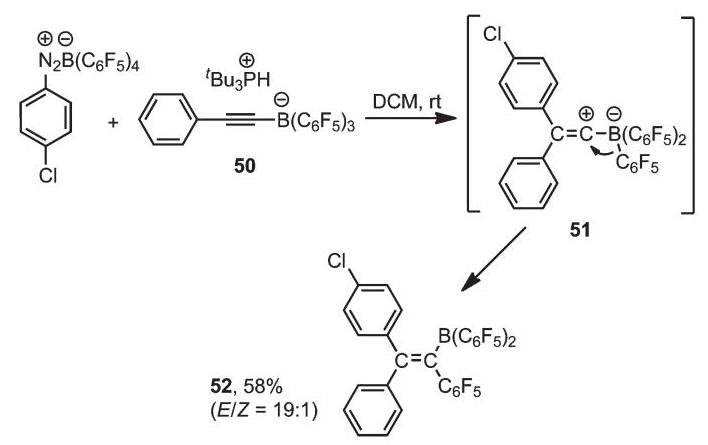
Scheme 34 Formation of electrophilic vinyl boranes.
方案34 亲电乙烯基硼烷的形成。
Deamination of aromatic amines is one of the important transformations in organic chemistry. Very recently, Müller and co-workers reported an efficient and mild deamination procedure for 1-aminoanthraquinones 48 by using a zinc-ethanol system (Scheme 33). ${}^{54}$
芳香胺的脱氨基反应是有机化学中的重要转化反应之一。最近,米勒及其同事报道了一种使用锌 - 乙醇体系对1 - 氨基蒽醌(即48)进行高效温和脱氨基的方法(方案33)。${}^{54}$
Recently, FLP (frustrated Lewis pair) has attracted attention. ${}^{55}$ The chemistry of diazonium salts has also been combined with the reaction of FLP. In 2012, Stephan and coworkers described a new and facile approach for the preparation of electrophilic vinyl boranes 52 starting from diazonium salts and alkynylborate salts 50 (Scheme 34). ${}^{56a}$ Alkynylborate salts 50 are easily prepared from the reaction of FLP ${}^{t}{\mathrm{{Bu}}}_{3}\mathrm{P} - \mathrm{B}{\left( {\mathrm{C}}_{6}{\mathrm{\;F}}_{5}\right) }_{3}$ with a terminal alkyne by the same group. ${}^{{56b}, c}$ This methodology to electrophilic vinyl boranes can be conveniently expanded to various alkynylborates and diazonium salts. The authors proposed a mechanism in which the interaction of the electron-deficient cation derived from the diazonium salt and the alkyne fragment of the alkynylborate generates a transient carbocation adjacent to the borate centre. This promotes the migration of the $- {\mathrm{C}}_{6}{\mathrm{\;F}}_{5}$ group from $- \mathrm{B}{\left( {\mathrm{C}}_{6}{\mathrm{\;F}}_{5}\right) }_{3}$ to the carbon cation to afford the vinyl borane.
最近,受阻路易斯对(FLP)引起了关注。${}^{55}$ 重氮盐的化学也与FLP反应相结合。2012年,斯特凡及其同事描述了一种从重氮盐和炔基硼酸盐(即50)开始制备亲电乙烯基硼烷(即52)的新的简便方法(方案34)。${}^{56a}$ 炔基硼酸盐(即50)很容易由同一研究小组通过FLP${}^{t}{\mathrm{{Bu}}}_{3}\mathrm{P} - \mathrm{B}{\left( {\mathrm{C}}_{6}{\mathrm{\;F}}_{5}\right) }_{3}$ 与端炔反应制备得到。${}^{{56b}, c}$ 这种制备亲电乙烯基硼烷的方法可以方便地扩展到各种炔基硼酸盐和重氮盐。作者提出了一种机理,即重氮盐衍生的缺电子阳离子与炔基硼酸盐的炔烃片段相互作用,在硼酸盐中心附近产生一个瞬态碳正离子。这促进了$- {\mathrm{C}}_{6}{\mathrm{\;F}}_{5}$ 基团从$- \mathrm{B}{\left( {\mathrm{C}}_{6}{\mathrm{\;F}}_{5}\right) }_{3}$ 迁移到碳正离子上,从而得到乙烯基硼烷。
6 Conclusions
6 结论
In this review we have shown a number of synthetic applications of aryldiazonium salts developed in recent years. The reactive manner of the aryldiazonium salts in all these reactions can be summarized in three categories, namely aryl radical precursors, aryl cation precursors, and “super” electro-philes in transition-metal-catalyzed cross-coupling reactions. Although the history of aryldiazonium salts can be dated back to the nonage of organic chemistry, from the selected examples shown in this review, it can be expected that aryldia-zonium salts, which are readily derived from inexpensive and ubiquitous aromatic anilines, will continue to attract the attention of synthetic chemists as valuable reactants in the coming years.
在本综述中,我们展示了近年来芳基重氮盐的一些合成应用。芳基重氮盐在所有这些反应中的反应方式可归纳为三类,即芳基自由基前体、芳基阳离子前体以及过渡金属催化交叉偶联反应中的“超级”亲电试剂。尽管芳基重氮盐的历史可以追溯到有机化学的早期,但从本综述中展示的选定示例可以预期,易于从廉价且普遍存在的芳香胺衍生而来的芳基重氮盐,在未来几年将继续作为有价值的反应物吸引合成化学家的关注。
Acknowledgements
致谢
Financial support from the 973 Program (No. 2012CB821600) and the National Natural Science Foundation of China is gratefully acknowledged.
衷心感谢国家重点基础研究发展计划(973计划,项目编号:2012CB821600)以及国家自然科学基金的资助。
Notes and references
注释与参考文献
1 (a) J. P. Griess, Ann. Chem. Justus Liebigs, 1858, 106, 123; (b) J. P. Griess, Philos. Trans. R. Soc. London, 1864, 164, 693; (c) J. P. Griess, Ann. Chem. Justus Liebigs, 1866, 137, 3991.
2 (a) T. Sandmeyer, Ber. Dtsch. Chem. Ges., 1884, 17, 1633; (b) T. Sandmeyer, Ber. Dtsch. Chem. Ges., 1884, 17, 2650.
3 R. Pschorr, Ber. Dtsch. Chem. Ges., 1896, 29, 496.
4 (a) M. Gomberg and W. E. Bachmann, J. Am. Chem. Soc., 1924, 46, 2339; (b) O. C. Dermer and M. T. Edmison, Chem. Rev., 1957, 57, 77; (c) A. Wetzel, G. Pratsch, R. Kolb and M. R. Heinrich, Chem.-Eur. J., 2010, 16, 2547.
5 G. Balz and G. Schiemann, Ber. Dtsch. Chem. Ges. B, 1927, 60, 1186.
6 H. Meerwein, E. Buchner and K. van Emsterk, J. Prakt. Chem., 1939, 152, 237.
7 (a) M. P. Doyle, B. Siegfried and J. F. Dellaria Jr., J. Org. Chem., 1977, 42, 2426; (b) M. P. Doyle, J. F. Dellaria Jr., B. Siegfried and S. W. Bishop, J. Org. Chem., 1977, 42, 3494.
8 (a) K. Kikukawa and T. Matsuda, Chem. Lett., 1977, 159; (b) K. Kikukawa, K. Nagira and T. Matsuda, Bull. Chem. Soc. Jpn., 1977, 50, 2207; (c) K. Kikukawa, K. Nagira, N. Terao, F. Wada and T. Matsuda, Bull. Chem. Soc. Jpn., 1979, 52, 2609.
9 (a) A. Roglans, A. Pla-Quintanaand and M. Moreno-Mañas, Chem. Rev., 2006, 106, 4622; (b) F.-X. Felpin, L. Nassar-Hardy, F. Le Callonnec and E. Fouquet, Tetrahedron, 2011, 67, 2815; (c) J. G. Taylor, A. V. Moro and C. R. D. Correia, Eur. J. Org. Chem., 2011, 1403.
10 H. Zollinger, Color Chemistry. Syntheses, Properties, and Applications of Organic Dyes and Pigments, Wiley-VCH Verlag, Zürich, 3rd revised edn, 2003.
11 (a) S. Darses, T. Jeffery, J. P. Genêt, J. L. Brayer and J. P. Demoute, Tetrahedron Lett., 1996, 37, 3857; (b) S. Darses, T. Jeffery, J. L. Brayer, J. P. Demoute and J. P. Genêt, Bull. Soc. Chim. Fr., 1996, 133, 1095.
12 (a) S. Sengupta and S. Bhattacharyya, J. Org. Chem., 1997, 62, 3405; (b) S. Sengupta and S. K. Sadhukhan, Tetrahedron Lett., 1998, 39, 715.
13 H. Bonin, D. Delbrayelle, P. Demonchaux and E. Gras, Chem. Commun., 2010, 46, 2677.
14 (a) F. Akiyama, H. Miyazaki, K. Kaneda, S. Teranishi, Y. Fujiwara, M. Abe and H. Taniguchi, J. Org. Chem., 1980, 45, 2359; (b) K. Kikukawa, K. Maemura, K. Nagira, F. Wada and T. Matsuda, Chem. Lett., 1980, 551; (c) K. Kikukawa, K. Maemura, Y. Kiseki, F. Wada, T. Matsuda and C.S. Giam, J. Org. Chem., 1981, 46, 4885; (d) M. B. Andrus and C. Song, Org. Lett., 2001, 3, 3761.
15 F. Mo, D. Qiu, Y. Jiang, Y. Zhang and J. Wang, Tetrahedron Lett., 2010, 52, 518.
16 (a) D. Sutton, Chem. Rev., 1993, 93, 995; (b) R. B. King, J. Organomet. Chem., 1995, 500, 187; (c) H. Bonin, E. Fouquet and F.-X. Felpin, Adv. Synth. Catal., 2011, 353, 3063.
17 (a) F.-X. Felpin, E. Fouquet and C. Zakri, Adv. Synth. Catal., 2008, 350, 2559; (b) F.-X. Felpin, O. Ibarguren, L. Nassar-Hardy and E. Fouquet, J. Org. Chem., 2009, 74, 1349; (c) F.-X. Felpin, J. Coste, C. Zakri and E. Fouquet, Chem.-Eur. J., 2009, 15, 7238; (d) O. Ibarguren, C. Zakri, E. Fouquet and F.-X. Felpin, Tetrahedron Lett., 2009, 50, 5071; (e) F.-X. Felpin, K. Miqueu, J.-M. Sotiropoulos, E. Fouquet, O. Ibarguren and J. Laudien, Chem.-Eur. J., 2010, 16, 5191; (f) J. Laudien, E. Fouquet, C. Zakri and F.- X. Felpin, Synlett, 2010, 1539; (g) F. Le Callonnec, E. Fouquet and F.-X. Felpin, Org. Lett., 2011, 13, 2646; (h) L. Nassar-Hardy, C. Deraedt, E. Fouquet and T.-X. Felpin, Eur. J. Org. Chem., 2011, 4616; (i) C. Rossy, E. Fouquetand and F.-X. Felpin, Synthesis, 2012, 37; (j) L. Nassar-Hardy, S. Fabre, A. M. Amer, E. Fouquet and F.-X. Felpin, Tetrahedron Lett., 2012, 53, 338; (k) N. Susperregui, K. Miqueu, J.-M. Sotiropoulos, F. Le Callonnec, E. Fouquet and F.-X. Felpin, Chem.-Eur. J., 2012, 18, 7210.
18 P. Schroll, D. P. Hari and B. König, ChemistryOpen, 2012, 1, 130.
19 M. Gholinejad, Appl. Organomet. Chem., 2013, 27, 19.
20 B. Panda and T. K. Sarkar, Chem. Commun., 2010, 46, 3131.
21 G. Fabrizi, A. Goggiamani, A. Sferrazza and S. Cacchi, Angew. Chem., Int. Ed., 2010, 49, 4067.
22 B. Schmidt, R. Berger, A. Kelling and U. Schilde, Chem.-Eur. J., 2010, 17, 7032.
23 D. Kalyani, K. B. McMurtrey, S. R. Neufeldt and M. S. Sanford, J. Am. Chem. Soc., 2011, 133, 18566.
24 (a) H. Cano-Yelo and A. Deronzier, J. Chem. Soc., Perkin Trans. 2, 1984, 1093; (b) H. Cano-Yelo and A. Deronzier, J. Chem. Soc., Faraday Trans. 1, 1984, 3011; (c) H. Cano-Yelo and A. Deronzier, Tetrahedron Lett., 1984, 25, 5517; (d) H. Cano-Yelo and A. Deronzier, J. Photochem., 1987, 37, 315; (e) H. Cano-Yelo and A. Deronzier, New J. Chem., 1987, 11, 479; (f) J. Lalevee, N. Blanchard, M.-A. Tehfe, M. Peter, F. Morlet-Savary and J. P. Fouassier, Macromol. Rapid Commun., 2011, 32, 917.
25 D. P. Hari, P. Schroll and B. König, J. Am. Chem. Soc., 2012, 134, 2958.
26 Related and supporting literatures, see: (a) M. R. Heinrich, A. Wetzel and M. Kirschstein, Org. Lett., 2007, 9, 3833; (b) G. Pratsch, C. A. Anger, K. Ritter and M. R. Heinrich, Chem.-Eur. J., 2011, 17, 4104; (c) A. Wetzel, V. Ehrhardt and M. R. Heinrich, Angew. Chem., Int. Ed., 2008, 47, 9130; (d) A. Wetzel, G. Pratsch, R. Kolb and M. R. Heinrich, Chem.-Eur. J., 2010, 16, 2547; (e) T. Lazarides, T. McCormick, P. Du, G. Luo, B. Lindley and R. Eisenberg, J. Am. Chem. Soc., 2009, 131, 9192; (f) H. Liu, W. Feng, C. W. Kee, Y. Zhao, D. Leow, Y. Pan and C.-H. Tan, Green Chem., 2010, 12, 953.
27 D. P. Hari, T. Hering and B. König, Org. Lett., 2012, 14, 5334.
28 P. S. Shinde, S. S. Shinde, A. S. Renge, G. H. Patil, A. B. Rode and R. R. Pawar, Lett. Org. Chem., 2009, 6, 8.
29 M. Hartmann, Y. Li and A. Studer, J. Am. Chem. Soc., 2012, 134, 16516.
30 (a) M. K. Robinson, V. S. Kochurina and J. M. Hanna Jr., Tetrahedron Lett., 2007, 48, 7687; (b) I. Cepanec, M. Litvić, J. Udiković, I. Pogorelić and M. Lovric, Tetrahedron, 2007, 63, 5614.
31 Y. Ding, K. Cheng, C. Qi and Q. Song, Tetrahedron Lett., 2012, 53, 6269.
32 (a) H. Zollinger, Acc. Chem. Res., 1973, 6, 335; (b) R. G. Bergstrom, R. G. M. Landells, G. H. Wahl Jr. and H. Zollinger, J. Am. Chem. Soc., 1976, 98, 3301; (c) I. Szele and H. Zollinger, J. Am. Chem. Soc., 1978, 100, 2811; (d) Y. Hashida, R. G. M. Landells, G. E. Lewis, I. Szele and H. Zollinger, J. Am. Chem. Soc., 1978, 100, 2816; (e) R. Glaser, C. J. Horan, M. Lewis and H. Zollinger, J. Org. Chem., 1999, 64, 902.
33 J. Zhou, W. Yang, B. Wang and H. Ren, Angew. Chem., Int. Ed., 2012, 51, 12293.
34 T. Xiao, X. Dong, Y. Tang and L. Zhou, Adv. Synth. Catal., 2012, 354, 3195.
35 (a) D. M. Willis and R. M. Strongin, Tetrahedron Lett., 2000, 41, 8683; (b) Y. Ma, C. Song, W. Jiang, G. Xue, J. F. Cannon, X. Wang and M. B. Andrus, Org. Lett., 2003, 5, 4635.
36 J. Zhang, X. Wang, H. Yu and J. Ye, Synlett, 2012, 1394.
37 F. Mo, Y. Jiang, D. Qiu, Y. Zhang and J. Wang, Angew. Chem., Int. Ed., 2010, 49, 1846.
38 D. Qiu, L. Jin, Z. Zheng, H. Meng, F. Mo, X. Wang, Y. Zhang and J. Wang, J. Org. Chem., 2013, DOI: 10.1021/jo3018878.
39 J. Yu, L. Zhang and G. Yan, Adv. Synth. Catal., 2012, 354, 2625.
40 C. Zhu and M. Yamane, Org. Lett., 2012, 14, 4560.
41 D. B. Kimball and M. M. Haley, Angew. Chem., Int. Ed., 2002, 41, 3338.
42 H. Meerwein, G. Dittmar, R. Gollner, K. Hafner, F. Mensch and O. Steinfort, Chem. Ber., 1957, 90, 841.
43 F. Barba, F. Ranz and B. Batanero, Tetrahedron Lett., 2009, 50, 6798.
44 B. Batanero, R. Saez and F. Barba, Electrochim. Acta, 2009, 54, 4872.
45 T. Chatterjee, S. Bhadra and B. C. Ranu, Green Chem., 2011, 13, 1837.
46 D. Kundu, S. Ahammed and B. C. Ranu, Green Chem., 2012, 14, 2024.
47 J. G. Melnick, K. Yurkerwich and G. Parkin, J. Am. Chem. Soc., 2010, 132, 647.
48 A. V. Kachanov, O. Y. Slabko and V. A. Kaminskii, Tetrahedron Lett., 2012, 53, 5807.
49 V. A. Kaminskii, O. Y. Slabko, A. V. Kachanov and B. V. Buhvetskii, Tetrahedron Lett., 2003, 44, 139.
50 (a) I. Al Adel, B. A. Salami, J. Levisalles and H. Rudler, Bull. Soc. Chim. Fr., 1976, 934; (b) A. Citterio, F. Minisci, A. Albinati and S. Bruckner, Tetrahedron Lett., 1980, 21, 2909; (c) J. E. Packer, C. J. Heighway, H. M. Muller and B. C. Dobson, Aust. J. Chem., 1980, 13, 965; (d) A. Citterio and F. Minisci, J. Org. Chem., 1982, 47, 1759.
51 O. Blank, N. Raschke and M. R. Heinrich, Tetrahedron Lett., 2010, 51, 1758.
52 Richter cyclization was first reported by Richter in 1883, see: V. Richter, Ber., 1883, 16, 677.
53 A. Goeminne, P. J. Scammells, S. M. Devine and B. L. Flynn, Tetrahedron Lett., 2010, 51, 6882.
54 Y. Baqi and C. E. Müller, Tetrahedron Lett., 2012, 53, 6739.
55 G. C. Welch, R. San Juan, J. D. Masuda and D. W. Stephan, Science, 2006, 314, 1124.
56 (a) X. Zhao, L. Liang and D. W. Stephan, Chem. Commun., 2012, 48, 10189; (b) M. A. Dureen, C. C. Brown and D. W. Stephan, Organometallics, 2010, 29, 6594; (c) M. A. Dureen and D. W. Stephan, J. Am. Chem. Soc., 2009, 131, 8396.