Synthesis of ortho-Acylphenols through the Palladium-Catalyzed Ketone-Directed Hydroxylation of Arenes
英文原文与中文译文逐段对照 · English original with Chinese translation
Fanyang Mo, Louis J. Trzepkowski, and Guangbin Dong*
莫凡洋、路易斯·J·特雷普科夫斯基、董广彬*
In memory of Michael W. Day
纪念迈克尔·W·戴
ortho-Acylphenols are an important structural motif found in a diversity of bioactive molecules ranging from natural products to drugs (Figure 1). ${}^{\left\lbrack 1\right\rbrack }$ Moreover, they also serve as versatile building blocks for the synthesis of various pharmaceuticals, such as warfarin, ${}^{\left\lbrack 2\right\rbrack }$ as well as agrichemicals, flavors, and fragrances. ${}^{\left\lbrack 3\right\rbrack }$ Classic approaches to the synthesis of $o$ -acylphenols generally involve a two-step process: acylation of phenols followed by Fries rearrangement of the resulting phenyl esters (Scheme 1a). ${}^{\left\lbrack 4\right\rbrack }$ On the other hand, direct C-acylation of phenols has also been known under more forcing conditions. ${}^{\left\lbrack 5\right\rbrack }$ Although effective, these approaches are often complicated by the formation of undesired $p$ -substituted products when bulky acyl groups need to be introduced, as well as the limited variety of ketones that can be generated. ${}^{\left\lbrack 6,7\right\rbrack }$
邻酰基苯酚是一种重要的结构基序,存在于从天然产物到药物等多种生物活性分子中(图1)。${}^{\left\lbrack 1\right\rbrack }$ 此外,它们还是合成各种药物(如华法林)${}^{\left\lbrack 2\right\rbrack }$ 以及农用化学品、香料和香精的通用构建单元。${}^{\left\lbrack 3\right\rbrack }$ 合成$o$ -酰基苯酚的经典方法通常涉及两步过程:苯酚的酰化,然后是所得苯基酯的弗里斯重排(方案1a)。${}^{\left\lbrack 4\right\rbrack }$ 另一方面,在更苛刻的条件下,苯酚的直接C-酰化也已为人所知。${}^{\left\lbrack 5\right\rbrack }$ 尽管有效,但当需要引入庞大的酰基时,这些方法往往会因形成不需要的$p$ -取代产物而变得复杂,并且可生成的酮的种类有限。${}^{\left\lbrack 6,7\right\rbrack }$
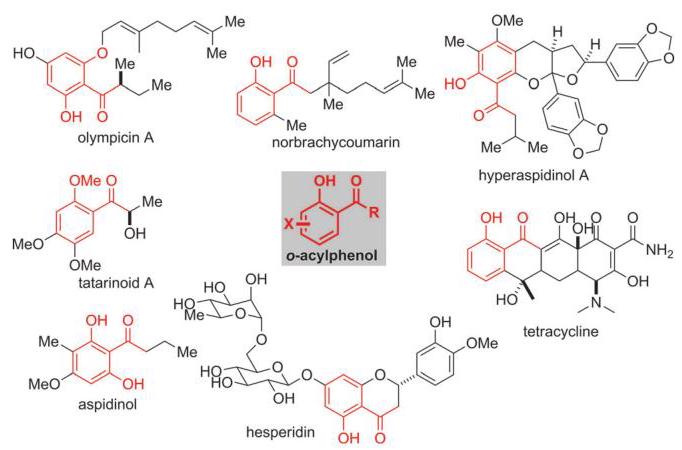
Figure 1. Natural products and drugs containing o-acylphenols.
图1. 含有邻酰基苯酚的天然产物和药物。
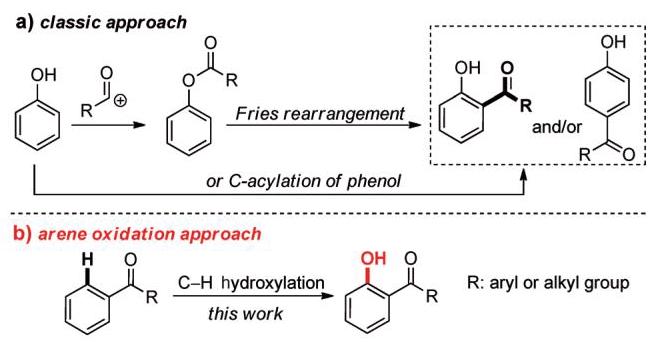
Scheme 1. Synthesis of o-acylphenols.
方案1. 邻酰基苯酚的合成。
An alternative approach would be to use ketones as the starting material and introduce the hydroxy group (phenol) by direct arene oxidation (Scheme 1b). This is attractive because aryl ketones are a readily available feedstock and can be prepared in one step through electrophilic aromatic acylation, ${}^{\left\lbrack 8\right\rbrack }$ benzylic oxidation, ${}^{\left\lbrack 9\right\rbrack }$ Wacker oxidation of the corresponding styrenes, ${}^{\left\lbrack {10}\right\rbrack }$ or other means. ${}^{\left\lbrack {11}\right\rbrack }$ The direct hydroxylation of arylketones either through a radical approach ${}^{\left\lbrack {12}\right\rbrack }$ or through heterogeneous catalysts ${}^{\left\lbrack {13}\right\rbrack }$ is known; however, these reactions lack site-selectivity and provide a mixture of all $o - , m - , p$ -isomers. A highly ortho-selective hydroxylation of arylketones remains to be developed.
另一种方法是以酮为起始原料,通过直接芳烃氧化引入羟基(苯酚)(方案1b)。这很有吸引力,因为芳基酮是一种容易获得的原料,可以通过亲电芳香酰化${}^{\left\lbrack 8\right\rbrack }$、苄基氧化${}^{\left\lbrack 9\right\rbrack }$、相应苯乙烯的瓦克氧化${}^{\left\lbrack {10}\right\rbrack }$ 或其他方法一步制备。${}^{\left\lbrack {11}\right\rbrack }$ 通过自由基方法${}^{\left\lbrack {12}\right\rbrack }$ 或非均相催化剂${}^{\left\lbrack {13}\right\rbrack }$ 对芳基酮进行直接羟基化是已知的;然而,这些反应缺乏位点选择性,会提供所有$o - , m - , p$ -异构体的混合物。芳基酮的高度邻位选择性羟基化仍有待开发。
Transition metal (TM)-catalyzed C-H oxidation presents an increasingly important approach for preparing heteroatom-substituted aromatic compounds. ${}^{\left\lbrack {14}\right\rbrack }$ Recently, such transformations driven by weak coordination have become a powerful means for further functionalization of simple organic feedstocks. ${}^{\left\lbrack {15}\right\rbrack }$ The first carbonyl-directed (carbamate) ${\mathrm{{Pd}}}^{\mathrm{{II}}}$ -catalyzed ${\mathrm{{sp}}}^{3}\mathrm{C} - \mathrm{H}$ oxidation was developed by $\mathrm{{Yu}}$ et al.; ${}^{\left\lbrack {16}\right\rbrack }$ subsequently, a remarkable achievement using carboxylate-directed $\left( {-{\mathrm{{CO}}}_{2}\mathrm{{Na}}}\right) \mathrm{C} - \mathrm{H}$ carboxylation was reported by the same group, which significantly expanded the scope of using weakly coordinating $\sigma$ donors as directing groups (DGs) in $\mathrm{C} - \mathrm{H}$ oxidations. ${}^{\left\lbrack {17}\right\rbrack }$ In terms of ortho-oxidation of arenes, Yu and co-workers further demonstrated an ortho-hydroxylation with carboxylic acids as DGs using air or ${\mathrm{O}}_{2}$ as the source for the hydroxy group. ${}^{\left\lbrack {18}\right\rbrack }$ On the other hand, an ortho-acetoxylation using oximes as DGs was first reported by Sanford et al., wherein oximes can be considered as a ketone surrogate. ${}^{\left\lbrack {19}\right\rbrack }$ Very recently, Ru-catalyzed ortho-hydroxylations using esters and amides as DGs were reported by the groups of ${\text{ Rao }}^{\left\lbrack {20}\right\rbrack }$ and Ackermann, ${}^{\left\lbrack {21}\right\rbrack }$ respectively. These seminal works could potentially serve as effective ways to access o-acylphenols, although additional steps are needed to reveal the phenol or to obtain the ketone moiety. Thus, it would be a more step-economical approach to synthesize o-acylphenols if ketones could be directly employed as the DG for the catalytic arene hydroxylation reaction. ${}^{\left\lbrack {22}\right\rbrack }$
过渡金属(TM)催化的C-H氧化是制备杂原子取代的芳香族化合物的一种越来越重要的方法。${}^{\left\lbrack {14}\right\rbrack }$ 最近,这种由弱配位驱动的转化已成为进一步官能化简单有机原料的有力手段。${}^{\left\lbrack {15}\right\rbrack }$ 第一种羰基导向(氨基甲酸酯)${\mathrm{{Pd}}}^{\mathrm{{II}}}$ -催化的${\mathrm{{sp}}}^{3}\mathrm{C} - \mathrm{H}$ 氧化是由$\mathrm{{Yu}}$ 等人开发的;${}^{\left\lbrack {16}\right\rbrack }$ 随后,同一研究小组报道了使用羧酸盐导向的$\left( {-{\mathrm{{CO}}}_{2}\mathrm{{Na}}}\right) \mathrm{C} - \mathrm{H}$ 羧化反应的一项显著成果,这显著扩大了在$\mathrm{C} - \mathrm{H}$ 氧化反应中使用弱配位$\sigma$ 供体作为导向基团(DG)的范围。${}^{\left\lbrack {17}\right\rbrack }$ 在芳烃的邻位氧化方面,Yu及其同事进一步证明了以羧酸为导向基团,使用空气或${\mathrm{O}}_{2}$ 作为羟基源进行邻位羟基化反应。${}^{\left\lbrack {18}\right\rbrack }$ 另一方面,Sanford等人首次报道了以肟为导向基团的邻位乙酰氧基化反应,其中肟可被视为酮的替代物。${}^{\left\lbrack {19}\right\rbrack }$ 就在最近,${\text{ Rao }}^{\left\lbrack {20}\right\rbrack }$ 小组和Ackermann小组分别报道了使用酯和酰胺作为导向基团的钌催化的邻位羟基化反应。${}^{\left\lbrack {21}\right\rbrack }$ 这些开创性的工作可能是获得邻酰基苯酚的有效方法,尽管还需要额外的步骤来揭示苯酚或获得酮部分。因此,如果酮可以直接用作催化芳烃羟基化反应的导向基团,那么合成邻酰基苯酚将是一种更具步骤经济性的方法。${}^{\left\lbrack {22}\right\rbrack }$
[*] Dr. F. Mo, L. J. Trzepkowski, Prof. Dr. G. Dong
[*] F. Mo博士,L. J. Trzepkowski,G. Dong教授
Department of Chemistry and Biochemistry
化学与生物化学系
University of Texas at Austin
德克萨斯大学奥斯汀分校
100 east 24th street, Austin, TX 78712 (USA)
美国德克萨斯州奥斯汀市东24街100号,邮编78712
Homepage: http://gbdong.cm.utexas.edu/
主页:http://gbdong.cm.utexas.edu/
[**] We thank UT Austin and CPRIT for a start-up fund, and thank the Welch Foundation and the Frasch Foundation for research grants. G.D. thanks ORAU for a new faculty enhancement award. We also thank faculty members from the organic division at UT Austin for their generous support. Dr. Lynch is acknowledged for X-ray crystallography. We thank Dr. Shoulders, Mrs. Spangenberg, and Mr. Sorey for their NMR advice.
[**] 我们感谢德克萨斯大学奥斯汀分校和CPRIT提供的启动资金,并感谢韦尔奇基金会和弗拉施基金会提供的研究资助。G.D.感谢ORAU授予的新教师提升奖。我们还感谢德克萨斯大学奥斯汀分校有机化学部门的教职员工的慷慨支持。感谢Lynch博士进行X射线晶体学研究。感谢Shoulders博士、Spangenberg夫人和Sorey先生提供的核磁共振方面的建议。
Supporting information for this article is available on the WWW under http://dx.doi.org/10.1002/anie.201207479.
本文的支持信息可在网站http://dx.doi.org/10.1002/anie.201207479上获取。
Although rare compared to other directed reactions, ketone-directed catalytic $\mathrm{C} - \mathrm{H}$ functionalization has been documented for almost two decades since the pioneering work on Ru-catalyzed C-H/olefin coupling reactions by Murai et al. ${}^{\left\lbrack {23}\right\rbrack }$ However, most of these transformations are restricted to $\mathrm{C} - \mathrm{C}$ bond formations (by the groups of Murai, ${}^{\left\lbrack {24}\right\rbrack }$ Chatani, ${}^{\left\lbrack {25}\right\rbrack }$ Miura, ${}^{\left\lbrack {26}\right\rbrack }$ Brookhart, ${}^{\left\lbrack {27}\right\rbrack }$ Cheng, ${}^{\left\lbrack {28}\right\rbrack }$ Glorius, ${}^{\left\lbrack {29}\right\rbrack }$ Jeganmohan, ${}^{\left\lbrack {30}\right\rbrack }$ Shi, ${}^{\left\lbrack {31}\right\rbrack }$ and others). Only recently, the groups of Liu ${}^{\left\lbrack {32}\right\rbrack }$ and Glorius ${}^{\left\lbrack {33}\right\rbrack }$ reported the first ketone-directed $\mathrm{C} - \mathrm{N}$ and $\mathrm{C} - \mathrm{{Br}}/\mathrm{I}$ bond-forming reactions using $\mathrm{{Pd}}$ and Rh catalysts, respectively. To the best of our knowledge, catalytic ketone-directed arene oxidation to form $\mathrm{C} - \mathrm{O}$ bonds has not been previously described. The likely challenges are: 1) As a hard Lewis base and even weaker $\sigma$ donor (compared to oximes, amides, carboxylic acids, and esters), ketones generally do not coordinate strongly with TMs, ${}^{\left\lbrack {34}\right\rbrack }$ which leads to lower reactivity. 2) Undesired oxidations (particularly with oxygen-based oxidants) can occur either at the enolizable $\alpha \mathrm{C} - \mathrm{H}$ bond or at the $\alpha \mathrm{C} - \mathrm{C}$ bond of the ketone through a Baeyer-Villiger-type oxidation. ${}^{\left\lbrack {35}\right\rbrack }$
尽管与其他导向反应相比较为罕见,但自村井等人在钌催化的 C - H/烯烃偶联反应方面开展开创性工作以来,酮导向的催化 $\mathrm{C} - \mathrm{H}$ 官能团化反应已有近二十年的研究记载 ${}^{\left\lbrack {23}\right\rbrack }$。然而,这些转化大多局限于 $\mathrm{C} - \mathrm{C}$ 键的形成(村井、${}^{\left\lbrack {24}\right\rbrack }$ 茶谷、${}^{\left\lbrack {25}\right\rbrack }$ 三浦、${}^{\left\lbrack {26}\right\rbrack }$ 布鲁克哈特、${}^{\left\lbrack {27}\right\rbrack }$ 郑、${}^{\left\lbrack {28}\right\rbrack }$ 格洛里乌斯、${}^{\left\lbrack {29}\right\rbrack }$ 杰甘莫汉、${}^{\left\lbrack {30}\right\rbrack }$ 史等研究团队的工作)。直到最近,刘 ${}^{\left\lbrack {32}\right\rbrack }$ 和格洛里乌斯 ${}^{\left\lbrack {33}\right\rbrack }$ 的团队分别报道了首例使用 $\mathrm{{Pd}}$ 和铑催化剂的酮导向 $\mathrm{C} - \mathrm{N}$ 和 $\mathrm{C} - \mathrm{{Br}}/\mathrm{I}$ 键形成反应。据我们所知,催化酮导向芳烃氧化形成 $\mathrm{C} - \mathrm{O}$ 键的反应此前未见报道。可能面临的挑战如下:1) 作为硬路易斯碱且是比肟、酰胺、羧酸和酯更弱的 $\sigma$ 供体,酮通常与过渡金属(TMs)的配位能力较弱 ${}^{\left\lbrack {34}\right\rbrack }$,这导致反应活性较低。2) 不期望的氧化反应(尤其是使用基于氧的氧化剂时)可能通过拜耳 - 维利格型氧化在可烯醇化的 $\alpha \mathrm{C} - \mathrm{H}$ 键或酮的 $\alpha \mathrm{C} - \mathrm{C}$ 键处发生 ${}^{\left\lbrack {35}\right\rbrack }$。
Stimulated by the previous success of $\mathrm{C} - \mathrm{H}$ activation driven by weak coordination ${}^{\left\lbrack {15},{17}\right\rbrack }$ and the need for efficient synthesis of $o$ -acylphenols from arylketones, we pursued this challenge using a Pd-catalyzed formal arene hydroxylation reaction. It was envisioned that the above-mentioned challenges could potentially be overcome by: 1) increasing the Lewis acidity of the metal and 2) using milder oxidants and reaction conditions. Herein, we report the use of ketone carbonyls as DGs for a Pd-catalyzed ortho-selective formal hydroxylation of arenes to provide various 2-acylpheonols; preliminary results of the first ketone-directed oxidative carbonylation to give an unusual ketal-lactone are also described.
受先前由弱配位${}^{\left\lbrack {15},{17}\right\rbrack }$驱动的$\mathrm{C} - \mathrm{H}$活化成功的启发,以及从芳基酮高效合成$o$ -酰基苯酚的需求,我们采用钯催化的形式芳烃羟基化反应来应对这一挑战。据设想,上述挑战可能通过以下方式克服:1)提高金属的路易斯酸度,以及2)使用更温和的氧化剂和反应条件。在此,我们报道了使用酮羰基作为导向基团进行钯催化的芳烃邻位选择性形式羟基化反应,以提供各种2-酰基苯酚;还描述了首例酮导向的氧化羰基化反应生成一种不寻常的缩酮内酯的初步结果。
We initiated our studies by examining the ortho-oxidation of 2,2-dimethylpropiophenone, a problematic substrate for the Fries-rearrangement. ${}^{\left\lbrack {36}\right\rbrack }$ Different ${\mathrm{{Pd}}}^{\mathrm{{II}}}$ precatalysts, oxidants, and solvents were tested (Table 1). Not surprisingly, the standard Pd(OAc) ${}_{2}$ and PhI(OAc) ${}_{2}$ (DIB) combination, which is commonly used in nitrogen-based DG-directed $\mathrm{C} - \mathrm{H}$ oxidations, ${}^{\left\lbrack {19},{14}\mathrm{c}\right\rbrack }$ did not give any of the desired product at ${80}^{ \circ }\mathrm{C}$ in 1,2-dichloroethane (DCE) or $\mathrm{{AcOH}}$ (Table 1, entries 1 and 2). A search for more electrophilic catalysts and oxidants was pursued. Eventually, $\mathrm{{Pd}}{\left( \mathrm{{TFA}}\right) }_{2}\left( {5\mathrm{\;{mol}}\% }\right)$ with PhI(TFA) ${}_{2}$ (BTI; 2 equiv) was found to give quantitative conversion with ${83}\%$ yield of the desired ortho-oxidation product (entry 3). Trifluoroacetate $\mathbf{{3a}}$ is the initial product generated, which is confirmed by both GC-MS and NMR analysis. We were delighted to discover that compound $\mathbf{{3a}}$ is labile, and readily converts into the corresponding phenol (2a) upon purification by column chromatography with silica gel. The use of other solvents, such as dioxane, THF, and MeCN, in place of DCE proved much less effective (entries 4- 6). Interestingly, when BTI is used as an oxidant, comparable yields can be obtained when $\mathrm{{Pd}}{\left( \mathrm{{TFA}}\right) }_{2}$ is replaced by either $\mathrm{{Pd}}{\left( \mathrm{{OAc}}\right) }_{2}$ or $\mathrm{{Pd}}{\left( \mathrm{{OPiv}}\right) }_{2}$ , whereas this was not the case for ${\mathrm{{PdCl}}}_{2}{}^{\left\lbrack {37}\right\rbrack }$ (entries 7-9). In contrast, DIB cannot be used in place of BTI, even when using Pd(TFA) ${}_{2}$ as a catalyst (entry 10; see below for a mechanistic discussion). Furthermore, the reaction gives full conversion with ${84}\%$ yield in $9\mathrm{\;h}$ when the catalyst loading is lowered to $2\mathrm{\;{mol}}\%$ (entry 11).
我们的研究始于对 2,2 - 二甲基苯丙酮的邻位氧化反应的考察,该底物在傅瑞斯重排反应中存在问题。${}^{\left\lbrack {36}\right\rbrack }$ 我们测试了不同的 ${\mathrm{{Pd}}}^{\mathrm{{II}}}$ 预催化剂、氧化剂和溶剂(表 1)。不出所料,常用于含氮导向基团(DG)导向的 $\mathrm{C} - \mathrm{H}$ 氧化反应的标准组合 Pd(OAc) ${}_{2}$ 和 PhI(OAc) ${}_{2}$(DIB),${}^{\left\lbrack {19},{14}\mathrm{c}\right\rbrack }$ 在 1,2 - 二氯乙烷(DCE)或 $\mathrm{{AcOH}}$ 中于 ${80}^{ \circ }\mathrm{C}$ 条件下并未得到任何目标产物(表 1,条目 1 和 2)。我们开始寻找更具亲电性的催化剂和氧化剂。最终发现,使用 $\mathrm{{Pd}}{\left( \mathrm{{TFA}}\right) }_{2}\left( {5\mathrm{\;{mol}}\% }\right)$ 与 PhI(TFA) ${}_{2}$(BTI;2 当量)能实现定量转化,得到目标邻位氧化产物的 ${83}\%$ 产率(条目 3)。三氟乙酸酯 $\mathbf{{3a}}$ 是最初生成的产物,这通过气相色谱 - 质谱联用(GC - MS)和核磁共振(NMR)分析得到了证实。我们很高兴地发现化合物 $\mathbf{{3a}}$ 不稳定,在使用硅胶柱色谱纯化时可轻松转化为相应的酚(2a)。事实证明,用二氧六环、四氢呋喃(THF)和乙腈(MeCN)等其他溶剂代替 DCE 效果要差得多(条目 4 - 6)。有趣的是,当使用 BTI 作为氧化剂时,用 $\mathrm{{Pd}}{\left( \mathrm{{OAc}}\right) }_{2}$ 或 $\mathrm{{Pd}}{\left( \mathrm{{OPiv}}\right) }_{2}$ 代替 $\mathrm{{Pd}}{\left( \mathrm{{TFA}}\right) }_{2}$ 可获得相当的产率,而对于 ${\mathrm{{PdCl}}}_{2}{}^{\left\lbrack {37}\right\rbrack }$ 则并非如此(条目 7 - 9)。相反,即使使用 Pd(TFA) ${}_{2}$ 作为催化剂,也不能用 DIB 代替 BTI(条目 10;有关机理讨论见下文)。此外,当催化剂负载量降至 $2\mathrm{\;{mol}}\%$ 时,反应在 $9\mathrm{\;h}$ 中可实现完全转化,得到 ${84}\%$ 产率(条目 11)。
Table 1: Selected optimization of the reaction conditions. ${}^{\left\lbrack a\right\rbrack }$
表1:反应条件的选定优化。${}^{\left\lbrack a\right\rbrack }$
O Pd precatalyst (5 mol%)
钯预催化剂(5摩尔%)
tBu oxidant, solvent tBu and/or
叔丁基氧化剂、溶剂叔丁基和/或
T, 3 h
1a 2a 3a
1a 2a 3a
| Entry | Catalyst | Oxidant ${}^{\left\lbrack b\right\rbrack }$ | Solvent | $T\left\lbrack {{}^{ \circ }\mathrm{C}}\right\rbrack$ | Conv. [%][c] | Yield [%] |
| 1 | Pd ${\left( \mathrm{{OAc}}\right) }_{2}$ | DIB | DCE | 80 | < 5 | 0 |
| 2 | Pd ${\left( \mathrm{{OAc}}\right) }_{2}$ | DIB | AcOH | 80 | 12 | 0 |
| 3 | Pd(TFA) ${}_{2}$ | BTI | DCE | 80 | 100 | 83 |
| 4 | Pd(TFA) ${}_{2}$ | BTI | dioxane | 80 | 30 | 7 |
| 5 | Pd(TFA) ${}_{2}$ | BTI | THF | 80 | 17 | 8 |
| 6 | Pd(TFA) ${}_{2}$ | BTI | MeCN | 80 | 22 | 0 |
| 7 | Pd(OAc) ${}_{2}$ | BTI | DCE | 80 | 100 | 79 |
| 8 | Pd(OPiv) ${}_{2}$ | BTI | DCE | 80 | 100 | 78 |
| 9 | ${\mathrm{{PdCl}}}_{2}$ | BTI | DCE | 80 | 15 | 0 |
| 10 | Pd(TFA) ${}_{2}$ | DIB | DCE | 80 | 8 | 0 |
| 11[d] | Pd(TFA) ${}_{2}$ | BTI | DCE | 80 | 100 | 84 |
| 12 | Pd(TFA) ${}_{2}$ | KPS | DCE | 80 | 12 | 4 |
| ${13}^{\left\lbrack e\right\rbrack }$ | Pd(TFA) ${}_{2}$ | KPS (TFA) | DCE | 80 | 36 | 17 |
| 14 | Pd(OAc) ${}_{2}$ | KPS | TFA | 50 | 100 | 88 |
| 15 | Pd(OAc) ${}_{2}$ | KPS | TFA/DCE (1:1) | 50 | 100 | 77 |
| 16 | - | BTI | DCE | 80 | < 5 | 0 |
| 17 | - | KPS | TFA | 50 | < 5 | 0 |
[a] The reactions were run on a ${0.2}\mathrm{{mmol}}$ scale with $1\mathrm{\;{mL}}$ solvent over 3 h. [b] In all cases, 2 equiv of oxidant was used. [c] Determined by ${}^{1}\mathrm{H}$ NMR spectroscopy using mesitylene as the internal standard. [d] 2 mol % catalyst loading, reaction time 9 h. [e] Reaction time 9 h. BTI = [bis(trifluoroacetoxy)iodo]benzene, DCE = 1,2-dichloroethane, DIB = (diacetoxyiodo)benzene, KPS = K2, S2O, Br iv = pivaloyl, TFA = tri-fluoroacetic acid.
[a] 反应在 ${0.2}\mathrm{{mmol}}$ 规模下,使用 $1\mathrm{\;{mL}}$ 溶剂进行3小时。[b] 在所有情况下,使用2当量的氧化剂。[c] 以均三甲苯为内标,通过 ${}^{1}\mathrm{H}$ NMR光谱测定。[d]催化剂负载量2摩尔%,反应时间9小时。[e] 反应时间9小时。BTI = [双(三氟乙酰氧基)碘]苯,DCE = 1,2 - 二氯乙烷,DIB =(二乙酰氧基碘)苯,KPS = K2,S2O,Br iv = 新戊酰基,TFA = 三氟乙酸。
Less expensive inorganic oxidants, such as ${\mathrm{K}}_{2}{\mathrm{\;S}}_{2}{\mathrm{O}}_{8}$ (KPS), have also been examined. The desired product was obtained in 4% yield by simply replacing BTI with KPS (entry 12). The yield was improved to 17% when 2 equiv of TFA was added (entry 13). Towards the end, complete conversion with 88% yield was obtained when using TFA as the solvent and KPS (2 equiv) as the oxidant (entry 14). Note that the reaction proceeds at a lower temperature $\left( {{50}^{ \circ }\mathrm{C}}\right)$ with the less expensive $\mathrm{{Pd}}{\left( \mathrm{{OAc}}\right) }_{2}$ as a pre-catalyst, thus it is complementary to the conditions described in entry 11. Although it is well recognized that BTI is able to oxidize electron-rich aromatic compounds through a single-electron transfer mechanism, ${}^{\left\lbrack {38}\right\rbrack }$ control experiments indicated that neither of the conditions in entries 16 or 17 showed significant reactivity in the absence of Pd.
还研究了成本较低的无机氧化剂,如${\mathrm{K}}_{2}{\mathrm{\;S}}_{2}{\mathrm{O}}_{8}$(过硫酸钾,KPS)。通过简单地用KPS替代BTI,以4%的产率得到了所需产物(条目12)。当加入2当量的三氟乙酸(TFA)时,产率提高到了17%(条目13)。最后,当使用TFA作为溶剂和KPS(2当量)作为氧化剂时,实现了完全转化,产率为88%(条目14)。注意,使用成本较低的$\mathrm{{Pd}}{\left( \mathrm{{OAc}}\right) }_{2}$作为预催化剂时,反应在较低温度$\left( {{50}^{ \circ }\mathrm{C}}\right)$下进行,因此它与条目11中描述的条件互补。尽管人们普遍认为BTI能够通过单电子转移机制氧化富电子的芳香化合物,但${}^{\left\lbrack {38}\right\rbrack }$对照实验表明,在没有钯的情况下,条目16或17中的任何一个条件都没有显著的反应活性。
With the optimized conditions in hand, we next investigated the substrate scope of this reaction (Scheme 2). A variety of aromatic ketones smoothly underwent the ortho-hydroxylation. Both aryl and alkyl-substituted ketones with different steric properties gave satisfying yields of the correspond $o$ -acylphenols. Note that benzylic and enolizable hydrogens, which can participate in various oxidation reactions, are also tolerated under these conditions (2c-2g, 2k, 2l, 2n, 2p). Moreover, aryl bromides, methyl ethers, xanthones, and nitro groups are also compatible (2b, 2j, 2k, 2m, 2q). Mono-oxidation is selectively achieved on mono-arylketones, most likely because further $\mathrm{C} - \mathrm{H}$ activation/oxidation is inhibited by the strong inductive effect of the introduced trifluoroacetate group (which is cleaved upon workup). Notably, a single regioisomer (2f) was obtained in 82% yield using $m$ -methyl-substituted ketone, which indicates that $\mathrm{C} - \mathrm{H}$ oxidation is preferred at the less hindered site. For diarylketones, hydroxylation occurred on both phenyl rings in the presence of 2 equiv of BTI, but formation of mono-oxidized product $2\mathbf{h}$ (91% yield) can be controlled using 1.3 equiv of the oxidant. With excess oxidants, both electron-neutral and electron-rich aromatic rings could be smoothly oxidized without increasing catalyst loading (2o and 2q). Furthermore, for unsymmetrical benzophenone substrates, the more electron-rich aromatic rings are selectively oxidized over the electron-poor ones, which is consistent with an electrophilic palladation mechanism (2m). ${}^{\left\lbrack {14}\right\rbrack }$ The two conditions $\left( {\mathbf{A}\text{ and }\mathbf{B}}\right)$ employed in this study are complementary: generally, condition $\mathbf{A}$ (using BTI as an oxidant and DCE as a solvent) is milder and more selective, whereas condition $\mathbf{B}$ (using KPS/TFA) is more reactive. For example, condition $\mathbf{A}$ effectively circumvents oxidation on the enolizable protons; on the other hand, sterically hindered or nitro-containing ketones react slowly under condition $\mathbf{A}$ , whereas high conversion was obtained under condition $\mathbf{B}$ (21 and $2\mathbf{m}$ ).
掌握了优化条件后,我们接下来研究了该反应的底物范围(方案2)。多种芳香酮顺利地进行了邻位羟基化反应。具有不同空间性质的芳基和烷基取代的酮都能以令人满意的产率得到相应的$o$ -酰基苯酚。注意,在这些条件下(2c - 2g、2k、2l、2n、2p),能够参与各种氧化反应的苄基氢和烯醇化氢也能耐受。此外,芳基溴、甲基醚、呫吨酮和硝基也具有兼容性(2b、2j、2k、2m、2q)。单芳基酮上选择性地实现了单氧化,这很可能是因为引入的三氟乙酸酯基团的强诱导效应(在后处理时会裂解)抑制了进一步的$\mathrm{C} - \mathrm{H}$活化/氧化。值得注意的是,使用$m$ -甲基取代的酮以82%的产率得到了单一的区域异构体(2f),这表明$\mathrm{C} - \mathrm{H}$氧化在空间位阻较小的位点更受青睐。对于二芳基酮,在存在2当量BTI时两个苯环上都发生了羟基化反应,但使用1.3当量的氧化剂可以控制单氧化产物$2\mathbf{h}$的形成(产率91%)。使用过量的氧化剂时,电子中性和富电子的芳香环都能顺利氧化,而无需增加催化剂负载量(2o和2q)。此外,对于不对称二苯甲酮底物,富电子的芳香环比贫电子的芳香环更易被选择性氧化,这与亲电钯化机理一致(2m)。${}^{\left\lbrack {14}\right\rbrack }$本研究中使用的两种条件$\left( {\mathbf{A}\text{ and }\mathbf{B}}\right)$是互补的:一般来说,条件$\mathbf{A}$(使用BTI作为氧化剂和二氯乙烷(DCE)作为溶剂)更温和、更具选择性,而条件$\mathbf{B}$(使用KPS/TFA)反应活性更高。例如,条件$\mathbf{A}$有效地避免了烯醇化质子上的氧化;另一方面,空间位阻大的或含硝基的酮在条件$\mathbf{A}$下反应缓慢,而在条件$\mathbf{B}$下能获得高转化率(21和$2\mathbf{m}$)。
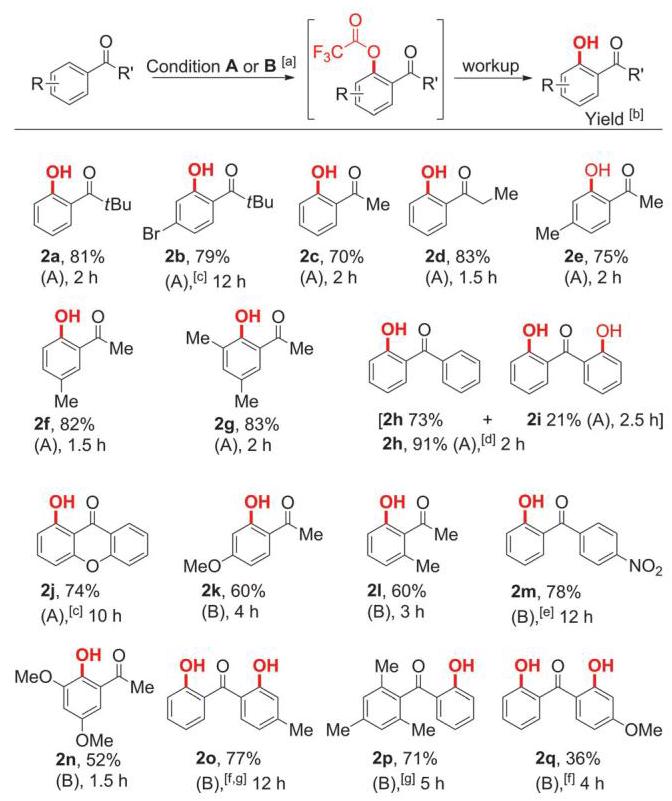
Scheme 2. Substrate scope. [a] 0.4 mmol scale. Condition A: Pd(TFA) ${}_{2}$ (5 mol %), BTI (2.0 equiv), DCE 2 mL, 80°C. Condition B: Pd(OAc) ${}_{2}$ (5 mol %), ${\mathrm{K}}_{2}{\mathrm{\;S}}_{2}{\mathrm{O}}_{8}$ (2 equiv), TFA $2\mathrm{\;{mL}},{50}^{ \circ }\mathrm{C}$ . [b] Yield of isolated product. [c] Pd(TFA) ${}_{2}$ 10 mol %, ${100}^{ \circ }\mathrm{C}$ . [d] with 1.3 equiv of BTI. [e] ${70}^{ \circ }\mathrm{C}$ . [f] ${\mathrm{K}}_{2}{\mathrm{\;S}}_{2}{\mathrm{O}}_{8}$ 3 equiv [g] TFA 1 mL and DCE 1 mL. BTI = [bis(tri-fluoroacetoxy)iodo]benzene, DCE $= 1,2$ -dichloroethane, TFA $=$ trifluoro-acetic acid.
方案2. 底物范围。[a] 0.4 mmol规模。条件A:Pd(TFA)${}_{2}$(5 mol%),BTI(2.0当量),二氯乙烷2 mL,80°C。条件B:Pd(OAc)${}_{2}$(5 mol%),${\mathrm{K}}_{2}{\mathrm{\;S}}_{2}{\mathrm{O}}_{8}$(2当量),三氟乙酸$2\mathrm{\;{mL}},{50}^{ \circ }\mathrm{C}$。[b] 分离产物的产率。[c] Pd(TFA)${}_{2}$ 10 mol%,${100}^{ \circ }\mathrm{C}$。[d] 使用1.3当量的BTI。[e] ${70}^{ \circ }\mathrm{C}$。[f] ${\mathrm{K}}_{2}{\mathrm{\;S}}_{2}{\mathrm{O}}_{8}$ 3当量 [g] 三氟乙酸1 mL和二氯乙烷1 mL。BTI = [双(三氟乙酰氧基)碘]苯,二氯乙烷$= 1,2$ -二氯乙烷,三氟乙酸$=$ 三氟乙酸。
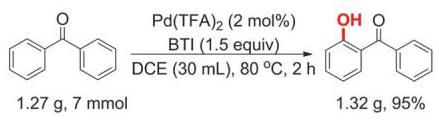
This reaction could also be run on a gram scale with only 2 mol % catalyst loading, affording product $2\mathbf{h}$ in 95% yield within $2\mathrm{\;h}$ [Eq. (1)].
该反应也可以在克级规模上进行,催化剂负载量仅为2 mol%,在$2\mathrm{\;h}$内以95%的产率得到产物$2\mathbf{h}$[式(1)]。
(1)
Next, in order to understand the mechanism of this Pd-catalyzed ketone-directed $\mathrm{C} - \mathrm{H}$ hydroxylation reaction, stepwise stoichiometric reactions were carried out. Compared to previous methods of preparing ketone-chelated palladacycles where additional strong acids (TfOH or TFA) are involved, ${}^{\left\lbrack {28}.,{32}\right\rbrack }$ we found that the ketone is able to react directly with $\mathrm{{Pd}}{\left( \mathrm{{TFA}}\right) }_{2}$ in DCE to give the dimeric $\mathrm{{Pd}}$ complex (3) in good yield [Eq. (2)]. ${}^{\left\lbrack {39}\right\rbrack }$
接下来,为了理解这种钯催化的酮导向$\mathrm{C} - \mathrm{H}$羟基化反应的机理,进行了逐步化学计量反应。与之前制备酮螯合钯环的方法相比,之前的方法涉及额外的强酸(TfOH或TFA),${}^{\left\lbrack {28}.,{32}\right\rbrack }$我们发现酮能够在二氯乙烷中直接与$\mathrm{{Pd}}{\left( \mathrm{{TFA}}\right) }_{2}$反应,以良好的产率得到二聚体$\mathrm{{Pd}}$配合物(3)[式(2)]。${}^{\left\lbrack {39}\right\rbrack }$
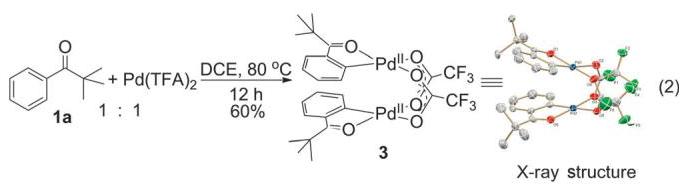
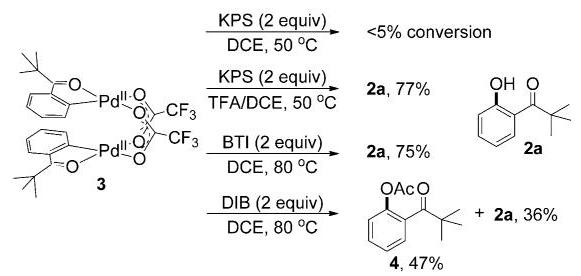
Moreover, although acid is not required for the $\mathrm{C} - \mathrm{H}$ activation step, it was found to be critical in the subsequent KPS-mediated oxidation/C-O bond formation step (Scheme 3). No reaction occurred upon treating palladacycle
此外,虽然在$\mathrm{C} - \mathrm{H}$活化步骤中不需要酸,但发现在随后的KPS介导的氧化/C-O键形成步骤中(方案3)酸至关重要。在二氯乙烷中仅用KPS处理钯环
Scheme 3. Oxidation of Complex 3.
方案3. 配合物3的氧化。
3 with KPS alone in DCE, whereas the addition of TFA promoted the formation of the product in 77% yield. When BTI was used as the oxidant (without adding acids), the corresponding arene oxidation products were also obtained in good yields. Moreover, the use of less reactive DIB as an oxidant led to the formation of $o$ -OAc substituted ketone (4).
3时不发生反应,而加入三氟乙酸促进产物的形成,产率为77%。当使用BTI作为氧化剂(不添加酸)时,也能以良好的产率得到相应的芳烃氧化产物。此外,使用反应活性较低的DIB作为氧化剂导致形成$o$ -OAc取代的酮(4)。
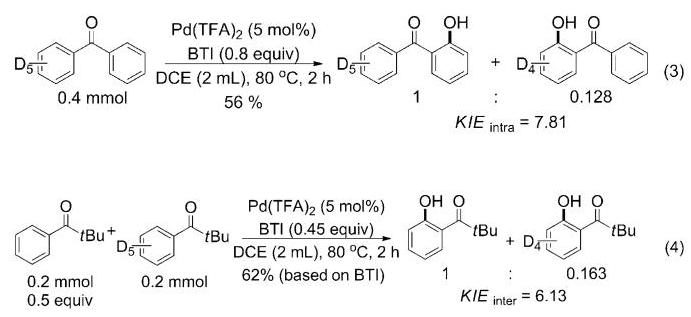
These studies suggest that trifluoroacetate anions play a critical role in maintaining the high electrophilicity of the Pd catalyst for the initial $\mathrm{C} - \mathrm{H}$ bond cleavage, but are not required as a part of the oxidants. Furthermore, high KIE values were observed both in the intramolecular $\left( {{k}_{\mathrm{H}/\mathrm{D}} = {7.81}}\right)$ and intermolecular $\left( {{k}_{\mathrm{H}/\mathrm{D}} = {6.13}}\right)$ competition experiments [Eq. (3) and (4)]. ${}^{\left\lbrack {40}\right\rbrack }$
这些研究表明,三氟乙酸根阴离子在维持钯催化剂对于初始$\mathrm{C} - \mathrm{H}$键断裂的高亲电性方面起着关键作用,但不作为氧化剂的一部分。此外,在分子内$\left( {{k}_{\mathrm{H}/\mathrm{D}} = {7.81}}\right)$和分子间$\left( {{k}_{\mathrm{H}/\mathrm{D}} = {6.13}}\right)$竞争实验中均观察到高KIE值[式(3)和(4)]。${}^{\left\lbrack {40}\right\rbrack }$
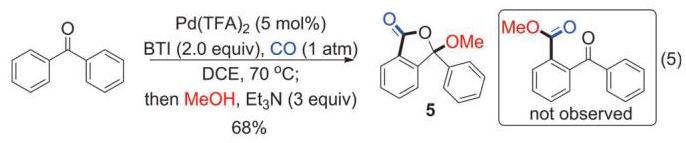
With this mechanistic knowledge in hand, we made further preliminary efforts to explore a ketone-directed Pd-catalyzed oxidative $\mathrm{C} - \mathrm{H}$ carbonylation reaction [Eq. (5)]. ${}^{\left\lbrack {41},{42}\right\rbrack }$ To our delight, under almost identical conditions, except for the use of a CO atmosphere (1 atm), an interesting ortho-carboxylation product (5) was obtained in 68% yield when benzophenone was used as the substrate. ${}^{\left\lbrack {43}\right\rbrack }$ Upon workup with methanol and ${\mathrm{{Et}}}_{3}\mathrm{\;N}$ , the originally anticipated methyl ester was not observed; instead, the methyl ketal-lactone was formed as the major product. ${}^{\left\lbrack {44}\right\rbrack }$ Although the mechanism of this reaction is still unclear, the mixed-anhydride was proposed as the initial product formed. ${}^{\left\lbrack {42}\right\rbrack }$ It is noteworthy that the formation of phenol products were significantly suppressed in the presence of CO.
基于这一机理认识,我们进一步开展了初步研究,以探索酮导向的钯催化氧化$\mathrm{C} - \mathrm{H}$羰基化反应[式(5)]。${}^{\left\lbrack {41},{42}\right\rbrack }$令我们高兴的是,在几乎相同的条件下,除了使用CO气氛(1 atm)外,当以二苯甲酮为底物时,以68%的产率得到了一种有趣的邻位羧化产物(5)。${}^{\left\lbrack {43}\right\rbrack }$在用甲醇和${\mathrm{{Et}}}_{3}\mathrm{\;N}$后处理后,未观察到最初预期的甲酯;相反,甲基缩酮内酯作为主要产物形成。${}^{\left\lbrack {44}\right\rbrack }$尽管该反应的机理仍不清楚,但有人提出混合酸酐是最初形成的产物。${}^{\left\lbrack {42}\right\rbrack }$值得注意的是,在CO存在下,酚类产物的形成受到显著抑制。
In summary, a ketone-directed Pd-catalyzed ortho-hydroxylation of arenes has been developed, which is an effective approach to access various o-acylphenol compounds from arylketones. As an exploratory study, a Pd-catalyzed ortho-carboxylation of simple aryl ketones to access an unusual ketal-lactone motif has also been disclosed. Both are the first examples of simple ketone-directed $\mathrm{C} - \mathrm{O}$ bond formation and carboxylation of arenes by $\mathrm{C} - \mathrm{H}$ bond activation. Because of the versatile nature of ketones, the methods described herein are expected to have significant value for practical applications, and should stimulate further research on simple ketone-directed $\mathrm{C} - \mathrm{H}$ functionalizations. Expansion of the scope of the reaction and substrates, as well as more detailed mechanistic studies are ongoing.
总之,已开发出一种酮导向的钯催化芳烃邻位羟基化反应,这是一种从芳基酮获得各种邻酰基苯酚化合物的有效方法。作为一项探索性研究,还公开了一种钯催化的简单芳基酮邻位羧化反应,以获得一种不寻常的缩酮内酯结构单元。这两者都是简单酮导向的$\mathrm{C} - \mathrm{O}$键形成以及通过$\mathrm{C} - \mathrm{H}$键活化实现芳烃羧化的首例。由于酮的多功能性,本文所述方法预计在实际应用中具有重要价值,并应激发对简单酮导向的$\mathrm{C} - \mathrm{H}$官能化的进一步研究。反应和底物范围的扩展以及更详细的机理研究正在进行中。
Received: September 15, 2012
收到:2012年9月15日
Revised: October 11, 2012
修订:2012年10月11日
Published online: November 19, 2012
在线发表:2012年11月19日
[1] For the examples shown in Figure 1, see: a) M. G. Charest, C. D. Lerner, J. D. Brubaker, D. R. Siegel, A. G. Myers, Science 2005, 308, 395; b) C. Tan, H. Tasaka, K. P. Yu, M. L. Murphy, D. A. Karnofsky, Cancer 1967, 20, 333; c) A. Hirata, Y. Murakami, M. Shoji, Y. Kadoma, S. Fujisawa, Anticancer Res. 2005, 25, 3367; d) X.-G. Tong, G.-S. Wu, Q. Lu, Y.-H. Wang, C.-L. Long, H.-R. Luo, H.-J. Zhu, Y.-X. Cheng, C.-G. Huang, J. Nat. Prod. 2010, 73, 1160; e) C. Zdero, F. Bohlmann, R. M. King, H. Robinson, Phytochemistry 1986, 25, 509; f) W. Wang, Y. H. Zeng, Q. Mu, K. Osman, K. Shinde, M. Rahman, S. Gibbons, J. Nat. Prod. 2010, 73, 1815; g) W. K. P. Shiu, M. M. Rahman, J. Curry, P. Stapleton, M. Zloh, J. P. Malkinson, S. Gibbons, J. Nat. Prod. 2012, 75, 336.
[2] I. Uwaydah, M. Aslam, C. Browm, S. Fitzhenry, J. McDonough, US Patent 5696274, 1997.
[3] For a review, see: C. Gonzalez-Bello, L. Castedo, Sci. Synth. 2007, 31a, 319.
[4] For recent reviews, see: a) V.P. Reddy, G. K. S. Prakash, Chemistry of Phenols, Vol. 1 (Ed.: Z. Rappoport), John Wiley & Sons, Chichester, 2003, p. 605; b) I. V. Kozhevnikov, J. Kaur, E. F. Kozhevnikova, Catalysis in Application (Eds.: S. D. Jackson, J. S. J. Hargreaves, D. Lennon), Royal Society of Chemistry, Cambridge, 2003, p. 136; c) R. Martin, Org. Prep. Proced. Int. 1992, 24, 369.
[5] C. L. Padró, E. A. Rey, L. F. González Peña, C. R. Apesteguía, Microporous Mesoporous Mater. 2011, 143, 236.
[6] J. A. Miller, J. Org. Chem. 1987, 52, 322, and references therein.
[7] Although the anionic Fries rearrangement is ortho-selective, it requires strong bases (such as organolithium), and enolizable ketones are generally not tolerated, see also Ref. [6].
[8] G. A. Olah, Friedel- Crafts Chemistry, Wiley, New York, 1973.
[9] For some recent examples, see: a) M. Zhou, N. D. Schley, R. H. Crabtree, J. Am. Chem. Soc. 2010, 132, 12550; b) M. S. Yusubov, V. N. Nemykin, V. V. Zhadankin, Tetrahedron 2010, 66, 5745; c) M. Moghadam, V. Mirkhani, S. Tangestaninejad, I. M. Bal-tork, H. Kargar, J. Mol. Catal. A 2008, 288, 116; d) Z. Lounis, A. Riahi, F. Djafri, J. Muzart, Appl. Catal. A 2006, 309, 270; e) B. Karami, M. Montazerozohori, Molecules 2006, 11, 720; f) S. J. Singh, R. V. Jayaram, Catal. Commun. 2009, 10, 2004; g) R. Mayilmurugan, H. Stoechli-Evans, E. Suresh, M. Palaniandavar, Dalton Trans. 2009, 5101.
[10] J. Smidt, W. Hafner, R. Jira, J. Sedlmeier, R. Sieber, R. Ruttinger, H. Kojer, Angew. Chem. 1959, 71, 176.
[11] C. Pan, X. Jia, J. Cheng, Synthesis 2012, 677.
[12] a) O. V. Makhlynets, E. V. Rybak-Akimova, Chem. Eur. J. 2010, 16, 13995; b) G. Palmisano, M. Addamo, V. Augugliaro, T. Caronna, E. Garcia-Lopez, V. Loddo, L. Palmisano, Chem. Commun. 2006, 1012; c) M. Makosza, K. Sienkiewicz, J. Org. Chem. 1998, 63, 4199; d) K. Fujimoto, Y. Tokuda, H. Maekawa, Y. Matsubara, T. Mizuno, I. Nishiguchi, Tetrahedron 1996, 52, 3889; e) J. P. Gesson, J. C. Jacquesy, M. P. Jouannetaud, G. Morellet, Tetrahedron Lett. 1983, 24, 3095.
[13] a) D. Y. Ganapati, G. M. Haresh, Adv. Synth. Catal. 2008, 350, 2286; b) S. Mita, T. Sakamoto, S. Yamada, S. Sakaguchi, Y. Ishii, Tetrahedron Lett. 2005, 46, 7729; c) M. Basu, S. Sarkar, S. Pande, S. Jana, A. K. Sinha, S. Sarkar, M. Pradhan, A. Pal, T. Pal, Chem. Commun. 2009, 7191.
[14] For selected recent reviews, see: a) R. Giri, B.-F. Shi, K. M. Engle, N. Maugel, J.-Q. Yu, Chem. Soc. Rev. 2009, 38, 3242; b) J. Wencel-Delord, T. Dröge, F. Liu, F. Glorius, Chem. Soc. Rev. 2011, 40, 4740; c) T. W. Lyons, M. S. Sanford, Chem. Rev. 2010, 110, 1147; d) L.-M. Xu, B.-J. Li, Z. Yang, Z.-J. Shi, Chem. Soc. Rev. 2010, 39, 712; e) S. R. Neufeldt, M. S. Sanford, Acc. Chem. Res. 2012, 45, 936.
[15] K. M. Engle, T.-S. Mei, M. Wasa, J.-Q. Yu, Acc. Chem. Res. 2012, 45, 788.
Keywords: C-H activation - homogeneous catalysis - ketones - oxidation - palladium
关键词:C-H活化;均相催化;酮;氧化;钯
[16] D.-H. Wang, X.-S. Hao, D.-F. Wu, J.-Q. Yu, Org. Lett. 2006, 8, 3387.
[17] a) R. Giri, J. Q. Yu, J. Am. Chem. Soc. 2008, 130, 14082; b) For a seminal report on carboxylate-directed $\mathrm{C} - \mathrm{H}$ activation and $\mathrm{C} -$ C bond formation, see: R. Giri, N. Maugel, J.-J. Li, D.-H. Wang, S. P. Breazzano, L. B. Saunders, J.-Q. Yu, J. Am. Chem. Soc. 2007, 129, 3510.
[18] a) Y. H. Zhang, J.-Q. Yu, J. Am. Chem. Soc. 2009, 131, 14654; b) For a seminal report on Cu-mediated ortho-hydroxylation of 2-arylpyridines, see: X. Chen, X.-S. Hao, C. E. Goodhue, J.-Q. Yu, J. Am. Chem. Soc. 2006, 128, 6790.
[19] a) L. V. Desai, K. L. Hull, M. S. Sanford, J. Am. Chem. Soc. 2004, 126, 9542; b) S. R. Neufeldt, M. S. Sanford, Org. Lett. 2010, 12, 532.
[20] Y. Yang, Y. Lin, Y. Rao, Org. Lett. 2012, 14, 2874.
[21] V. S. Thirunavukkarasu, J. Hubrich, L. Ackermann, Org. Lett. 2012, 14, 4210.
[22] P. A. Wender, V. A. Verma, T. J. Paxton, T. H. Pillow, Acc. Chem. Res. 2008, 41, 40.
[23] S. Murai, F. Kakiuchi, S. Sekine, Y. Tanaka, A. Kamatani, M. Sonoda, N. Chatani, Nature 1993, 366, 529.
[24] F. Kakiuchi, S. Kan, K. Igi, N. Chatani, S. Murai, J. Am. Chem. Soc. 2003, 125, 1698.
[25] F. Kakiuchi, Y. Matsuura, S. Kan, N. Chatani, J. Am. Chem. Soc. 2005, 127, 5936.
[26] a) T. Satoh, Y. Kametani, Y. Terao, M. Miura, M. Namura, Tetrahedron Lett. 1999, 40, 5345; b) Y. Terao, Y. Kametani, H. Wakui, T. Satoh, M. Miura, M. Nomura, Tetrahedron 2001, 57, 5967; c) T. Satoh, M. Miura, M. Nomura, J. Organomet. Chem. 2002, 653, 161.
[27] C. P. Lenges, M. Brookhart, J. Am. Chem. Soc. 1999, 121, 6616.
[28] a) P. Gandeepan, K. Parthasarathy, C.-H. Cheng, J. Am. Chem. Soc. 2010, 132, 8569; b) K. Muralirajan, K. Parthasarathy, C.-H. Cheng, Angew. Chem. 2011, 123, 4255; Angew. Chem. Int. Ed. 2011, 50, 4169; c) P. Gandeepan, C.-H. Hung, C.-H. Cheng, Chem. Commun. 2012, 48, 9379.
[29] a) F. W. Patureau, T. Besset, N. Kuhl, F. Glorius, J. Am. Chem. Soc. 2011, 133, 2154; b) F. W. Patureau, T. Besset, F. Glorius, Angew. Chem. 2011, 123, 1096; Angew. Chem. Int. Ed. 2011, 50, 1064.
[30] K. Padala, M. Jeganmohan, Org. Lett. 2011, 13, 6144.
[31] H. Li, R.-Y. Zhu, W.-J. Shi, K.-H. He, Z.-J. Shi, Org. Lett. 2012, 14, 4850.
[32] B. Xiao, T.-J. Gong, J. Xu, Z.-J. Liu, L. Liu, J. Am. Chem. Soc. 2011, 133, 1466.
[33] N. Schröder, J. Wencel-Delord, F. Glorius, J. Am. Chem. Soc. 2012, 134, 8298.
[34] J. F. Hartwig, Organotransition Metal Chemistry: from Bonding to Catalysis, University Science Books, Mill Valley, 2009.
[35] R. M. Moriarty, K.-C. Hou, I. Prakash, S. K. Arora, Org. Synth. 1986, 64.
[36] R. Martin, Bull. Soc. Chim. Fr. 1979, 373.
[37] This is likely due to stronger Pd-Cl bonds, thus Cl ligands slowly exchange with trifluoroacetate anions.
[38] V. Z. Viktor, Arkivoc 2009, 1.
[39] CCDC 897814 (3) contains the supplementary crystallographic data for this paper. These data can be obtained free of charge from The Cambridge Crystallographic Data Centre via www.ccdc.cam.ac.uk/data_request/cif.
[40] For an example of similar KIEs observed on the activation of aryl $\mathrm{C} - \mathrm{H}$ bonds, see: Ref. [18a].
[41] For early seminal work, see: a) Y. Fujiwara, T. Kawauchi, H. Taniguchi, J. Chem. Soc. Chem. Commun. 1980, 220; b) Y. Taniguchi, Y. Yamaoka, K. Nakata, K. Takaki, Y. Fujiwara, Chem. Lett. 1995, 5.
[42] For some remarkable recent examples of Pd-catalyzed carboxylation of arenes under mild conditions by $\mathrm{C} - \mathrm{H}$ activation, see: R. Giri, J. K. Lam, J.-Q. Yu, J. Am. Chem. Soc. 2010, 132, 686 and Ref. [17].
[43] Alkyl-substituted aryl ketones are much less reactive under these reaction conditions. A full account of our efforts with regards to the reaction mechanism and the substrate scope will be reported later.
[44] M. S. Newman, C. Courduvelis, J. Org. Chem. 1965, 30, 1795.