Catalytic Functionalization of Unactivated sp3 C–H Bonds via exo-Directing Groups: Synthesis of Chemically Differentiated 1,2-Diols
英文原文与中文译文逐段对照 · English original with Chinese translation
Zhi Ren, ${}^{ \dagger }$ Fanyang Mo, ${}^{ \dagger }$ and Guangbin Dong*
任志,${}^{ \dagger }$莫凡洋,${}^{ \dagger }$和董广彬*
Department of Chemistry and Biochemistry, University of Texas at Austin, Austin, Texas 78712, United States
美国德克萨斯大学奥斯汀分校化学与生物化学系,奥斯汀,德克萨斯78712
(c) Supporting Information
(c) 支持信息
ABSTRACT: We describe a Pd-catalyzed site-selective functionalization of unactivated aliphatic C-H bonds, providing chemically differentiated 1,2-diols from mono-alcohol derivatives. The oxime was employed as both a directing group (DG) and an alcohol surrogate for this transformation. As demonstrated in a range of substrates, the $\mathrm{C} - \mathrm{H}$ bonds $\beta$ to the oxime group are selectively oxidized. Besides activation of the methyl groups, methylene groups $\left( {\mathrm{{CH}}}_{2}\right)$ in cyclic substrates and methine groups (CH) at bridge-head positions can also be functionalized. In addition, an intriguing oxidative skeleton rearrangement was observed using the menthol-derived substrate. The use of exo-directing groups in $\mathrm{C} - \mathrm{H}$ activation, as illustrated in this work, would potentially open doors for the discovery of new transformations and new cleavable DGs.
摘要:我们描述了一种钯催化的未活化脂肪族C-H键的位点选择性官能团化反应,该反应可从单醇衍生物制备化学分化的1,2-二醇。肟在此转化反应中既用作导向基团(DG)又用作醇替代物。正如在一系列底物中所证明的,与肟基团$\beta$相连的$\mathrm{C} - \mathrm{H}$键被选择性氧化。除了甲基的活化外,环状底物中的亚甲基$\left( {\mathrm{{CH}}}_{2}\right)$以及桥头位置的次甲基(CH)也可以进行官能团化。此外,使用薄荷醇衍生的底物时观察到了有趣的氧化骨架重排。如本工作所示,在外向导向基团用于$\mathrm{C} - \mathrm{H}$活化中,这可能为发现新的转化反应和新的可裂解DG打开大门。
Site selectivity represents one of the grand challenges for catalytic functionalization of aliphatic $\mathrm{C} - \mathrm{H}$ bonds. ${}^{1}$ Elegant approaches have been developed for selective activation of specific $\mathrm{C} - \mathrm{H}$ bonds based on intrinsic reactivity; ${}^{2}$ to date, directing groups (DGs), broadly defined, still serve as highly effective tools for controlling which ${\mathrm{{sp}}}^{3}\mathrm{C} - \mathrm{H}$ bond to activate. ${}^{3}$ Among various DGs, those derived from alcohols or masked alcohols are particularly attractive due to the ubiquity of hydroxyl groups. Using alcohols or masked alcohols as DGs for activation of more reactive aryl and allylic C-H bonds has been demonstrated by $\mathrm{{Yu}}{,}^{4}$ Hartwig, ${}^{5}$ and White; ${}^{6}$ however, limited success has been made with unactivated ${\mathrm{{sp}}}^{3}\mathrm{C} - \mathrm{H}$ bonds. ${}^{7}$ It is well documented that the $\mathrm{C} - \mathrm{H}$ bonds at the $\delta$ -position of alcohols can be functionalized through a 1,5-H shift using an oxygen-centered radical approach. ${}^{8}$ Du Bois et al. have developed carbamate- and sulfamate-directed nitrene insertions to access 1,2 or 1,3 amino alcohol moieties (Scheme 1A). ${}^{9}$ Recently, Baran disclosed an efficient four-step one-pot sequence to convert a trifluoromethyl carbamate to a 1,3-diol using a Hofmann-Löffler reaction-like approach (Scheme 1B). ${}^{10}$ Most recently, Hartwig reported a powerful approach to convert monoalcohols to 1,3- diols using Ir-catalysts (Scheme 1C). ${}^{1c}$
位点选择性是脂肪族$\mathrm{C} - \mathrm{H}$键催化官能团化的重大挑战之一。${}^{1}$ 基于固有反应性,已经开发出了用于选择性活化特定$\mathrm{C} - \mathrm{H}$键的优雅方法;${}^{2}$ 然而,迄今为止,广义上定义的导向基团(DG)仍然是控制活化哪个${\mathrm{{sp}}}^{3}\mathrm{C} - \mathrm{H}$键的高效工具。${}^{3}$ 在各种DG中,那些源自醇或掩蔽醇的DG由于羟基的普遍性而特别有吸引力。使用醇或掩蔽醇作为DG来活化更具反应性的芳基和烯丙基C-H键已被$\mathrm{{Yu}}{,}^{4}$ 哈特维希、${}^{5}$ 和怀特证明;${}^{6}$ 然而,对于未活化的${\mathrm{{sp}}}^{3}\mathrm{C} - \mathrm{H}$键,成功有限。${}^{7}$ 有充分的文献记载,醇的$\delta$位的$\mathrm{C} - \mathrm{H}$键可以通过以氧为中心的自由基方法通过1,5-H迁移进行官能团化。${}^{8}$ 杜波依斯等人已经开发了氨基甲酸酯和氨基磺酸酯导向的氮烯插入反应,以获得1,2或1,3氨基醇部分(方案1A)。${}^{9}$ 最近,巴兰公开了一种高效的四步一锅法序列,使用类似霍夫曼-勒夫勒反应的方法将三氟甲基氨基甲酸酯转化为1,3-二醇(方案1B)。${}^{10}$ 最近,哈特维希报道了一种使用铱催化剂将单醇转化为1,3-二醇的强大方法(方案1C)。${}^{1c}$
We have been interested in 1,2-diol synthesis directly from monoalcohols or masked alcohols via catalytic activation of unactivated $s{p}^{3}\mathrm{C} - \mathrm{H}$ bonds, which, to our knowledge, has not been realized previously. ${}^{11}$ The challenge is twofold: (1) compared to the $\gamma$ -position that gives 1,3-diols, the $\beta$ -position of an alcohol is relatively electron-deficient due to the inductive effect of the oxygen and is, thus, less reactive toward electrophilic $\mathrm{C} - \mathrm{H}$ activation (such as metal-oxo insertion); ${}^{2}$ (2) designing DGs for such a site-selective reaction is nontrivial because, aside from serving as a good ligand for transition-metal catalysts, the DG should be easily removable to restore the alcohol. To address these challenges, here, we report our development of a Pd-catalyzed functionalization of the unactivated $\beta {\mathrm{{sp}}}^{3}\mathrm{C} - \mathrm{H}$ bonds, where oximes are employed as unusual exo-DGs.
我们一直致力于通过催化活化未活化的$s{p}^{3}\mathrm{C} - \mathrm{H}$键,直接从一元醇或掩蔽醇合成1,2 - 二醇,据我们所知,这在以前尚未实现。${}^{11}$挑战有两个方面:(1)与生成1,3 - 二醇的$\gamma$位相比,由于氧的诱导效应,醇的$\beta$位相对缺电子,因此对亲电$\mathrm{C} - \mathrm{H}$活化(如金属 - 氧插入)的反应性较低;${}^{2}$(2)为这种位点选择性反应设计导向基团并非易事,因为除了作为过渡金属催化剂的良好配体之外,导向基团还应易于去除以恢复醇。为应对这些挑战,在此我们报告我们开发的钯催化未活化$\beta {\mathrm{{sp}}}^{3}\mathrm{C} - \mathrm{H}$键的官能化反应,其中肟被用作不寻常的外向导向基团。
Scheme 1. Alcohol or Masked-Alcohol Directed C-H Bond Functionalization (Ac, Acetate)
方案1. 醇或掩蔽醇导向的C - H键官能化反应(Ac,乙酸酯)
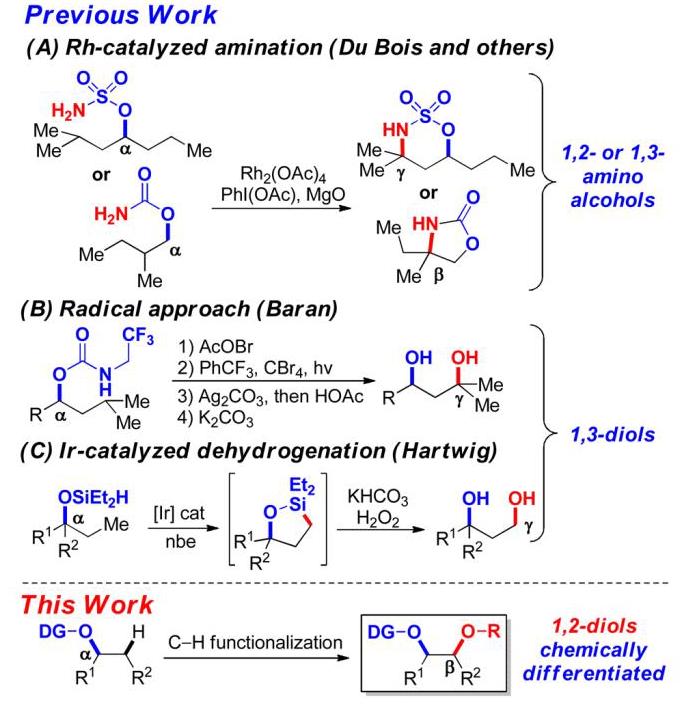
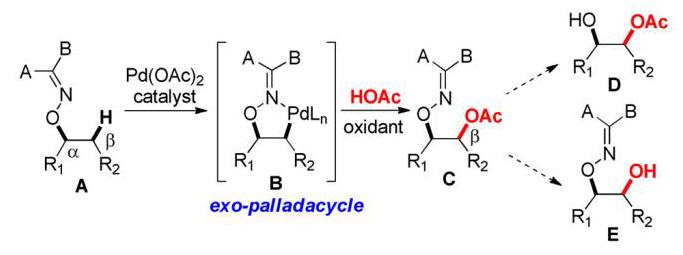
We postulated that properly designed oximes would likely serve as both an alcohol surrogate and a DG for metal-catalyzed site-selective functionalization of $\beta \mathrm{C} - \mathrm{H}$ bonds. Oxime-directed catalytic $\mathrm{C} - \mathrm{H}$ activation was first reported by Sanford, where oximes serve as a carbonyl equivalent directing oxidation of the ${\mathrm{{sp}}}^{3}\mathrm{C} - \mathrm{H}$ bonds on the nitrogen side (eq 1). ${}^{12}$ In this case, an endo-palladacycle is formed through coordination with the oxime nitrogen. In contrast to the endo-metallocycles ( $\pi$ -bond of the DG inside the metallocycle), formation of the exo-metallocycles ( $\pi$ -bond of the DG outside the metallocycle) is rare in catalytic reactions ${}^{13}$ and often less competitive when formation of an endo-cycle is possible (Figure 1). ${}^{14}$ However, we hypothesized that, by blocking or obviating potential reaction sites on the nitrogen site of oximes, selective activation of the $\mathrm{C} - \mathrm{H}$ bonds on the alcohol site should become feasible (Scheme 2). Thus, using such an oxime as a DG, a five-membered exo-palladacycle (intermediate B) is expected to be generated via metalation of the $\beta \mathrm{C} - \mathrm{H}$ bond. Subsequent oxidation of intermediate $\mathbf{B}$ would provide the desired 1,2-diol motif (C). Note that the resulting diols would be chemically differentiated, because removal of the acetate group and cleavage of the oxime N-O bond can be operated under orthogonal reaction conditions (vide infra).
我们推测,经过适当设计的肟可能同时作为醇的替代物和用于金属催化$\beta \mathrm{C} - \mathrm{H}$键位点选择性官能化的导向基团。肟导向的催化$\mathrm{C} - \mathrm{H}$活化首次由桑福德报道,其中肟作为羰基等价物,导向氮侧${\mathrm{{sp}}}^{3}\mathrm{C} - \mathrm{H}$键的氧化反应(方程式1)。${}^{12}$在这种情况下,通过与肟氮配位形成内钯环。与内金属环(金属环内导向基团的$\pi$键)相反,外金属环(金属环外导向基团的$\pi$键)在催化反应中很少形成${}^{13}$,并且当可能形成内环时通常竞争力较小(图1)。${}^{14}$然而,我们假设,通过封闭或消除肟氮位点上的潜在反应位点,醇位点上$\mathrm{C} - \mathrm{H}$键的选择性活化应该变得可行(方案2)。因此,使用这样的肟作为导向基团,预期通过$\beta \mathrm{C} - \mathrm{H}$键的金属化生成五元外钯环(中间体B)。中间体$\mathbf{B}$的后续氧化将提供所需的1,2 - 二醇结构单元(C)。请注意,所得的二醇在化学上是有区别的,因为乙酸酯基团的去除和肟N - O键的裂解可以在正交反应条件下进行(见下文)。
Received: August 18, 2012
收到日期:2012年8月18日
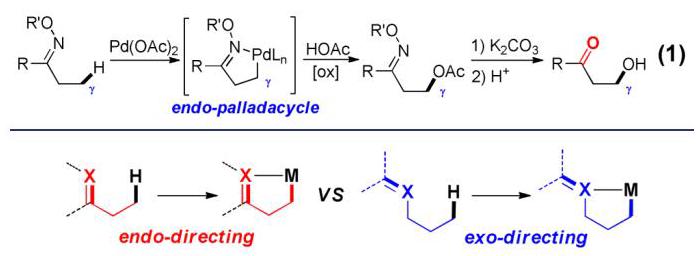
Figure 1. endo-Metalation vs exo-Metalation.
图1. 内金属化与外金属化
Scheme 2. Our Strategy Design
方案2. 我们的策略设计
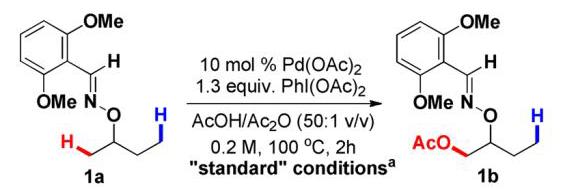
To test our hypothesis, oxime-derived 2-butanol (1a) was employed as the initial substrate. Having optimized the reaction conditions, we were delighted to find that the desired protected 1,2-diol (1b) was obtained in 67% yield with excellent site selectivity; oxidation at the $\gamma$ -position was not observed (entry 1, Table 1). A number of control experiments were conducted to provide further insight of this reaction. Not surprisingly, without the Pd catalyst or the oxidant, no desired product was formed (entries 2 and 4). Use of less catalyst (5 mol %) gave incomplete conversion on a small scale (0.1 mmol, vide infra, eq 2) (entry 3). The yield was slightly diminished in the absence of ${\mathrm{{Ac}}}_{2}\mathrm{O}$ (entry 5), ${}^{15}$ while addition of a small amount of water led to a significant reduction of the yield, suggesting water may hamper the desired reaction pathway (entry 6).
为了验证我们的假设,以肟衍生的2-丁醇(1a)作为起始底物。在优化反应条件后,我们很高兴地发现,所需的受保护的1,2-二醇(1b)以67%的产率和优异的位点选择性得到;未观察到在$\gamma$位的氧化反应(表1,第1项)。进行了一系列对照实验以进一步深入了解该反应。不出所料,没有钯催化剂或氧化剂时,没有形成所需产物(第2项和第4项)。使用较少的催化剂(5 mol%)在小规模(0.1 mmol,见下文,式2)时转化不完全(第3项)。在没有${\mathrm{{Ac}}}_{2}\mathrm{O}$的情况下产率略有降低(第5项),${}^{15}$而加入少量水会导致产率显著降低,这表明水可能会阻碍所需的反应途径(第6项)。
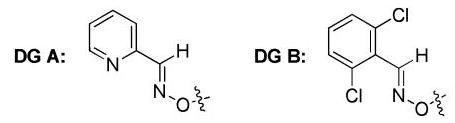
Use of other solvents, such as chlorobenzene, toluene, and 1,2- dichloroethane, proved to be less efficient (entries 7-9). When ${\mathrm{K}}_{2}{\mathrm{\;S}}_{2}{\mathrm{O}}_{8}$ was employed as the oxidant, a significant amount of the elimination product (2,6-dimethoxybenzonitrile) was formed (entry 10). Addition of LiOAc did not affect the reaction yield (entry 11). Control of the reaction concentration seems to be critical: at higher concentration decomposition products were formed, while at lower concentration incomplete conversion was observed (entries 12 and 13). Finally, 2,6-dimethoxybenzyl oxime proved an optimal DG because use of either the 2-pyridyl (DG A) or 2,6-dichlorobenzyl (DG B) analogue is much less efficient (entries 14 and 15). ${}^{16}$ It is likely that the pyridine-derived oxime chelates strongly with the Pd and consequently inhibits catalyst turnover, while the 2,6-dichlorobenzyl oxime has relatively weak coordination ability compared to the 2,6- dimethoxybenzyl oxime.
事实证明,使用其他溶剂,如氯苯、甲苯和1,2 - 二氯乙烷,效率较低(条目7 - 9)。当使用${\mathrm{K}}_{2}{\mathrm{\;S}}_{2}{\mathrm{O}}_{8}$作为氧化剂时,会形成大量的消除产物(2,6 - 二甲氧基苯甲腈)(条目10)。添加醋酸锂对反应产率没有影响(条目11)。控制反应浓度似乎至关重要:在较高浓度下会形成分解产物,而在较低浓度下则观察到不完全转化(条目12和13)。最后,2,6 - 二甲氧基苄基肟被证明是最佳的导向基团,因为使用2 - 吡啶基(导向基团A)或2,6 - 二氯苄基(导向基团B)类似物的效率要低得多(条目14和15)。${}^{16}$ 吡啶衍生的肟可能与钯强烈螯合,从而抑制催化剂的周转,而与2,6 - 二甲氧基苄基肟相比,2,6 - 二氯苄基肟的配位能力相对较弱。
Table 1. Selected Optimization of Reaction Conditions ${}^{a}$
表1. 反应条件的选定优化 ${}^{a}$
| entry | variation from the "standard" conditions | yield ${}^{b, d}$ |
| 1 | none | 67% (61%°) |
| 2 | no Pd(OAc) ${}_{2}$ | 0% |
| 3 | 5 mol % Pd(OAc) ${}_{2}$ | 50% |
| 4 | no PhI(OAc) ${}_{2}$ | 0% |
| 5 | no ${\mathrm{{Ac}}}_{2}\mathrm{O}$ | 61% |
| 6 | ${\mathrm{H}}_{2}\mathrm{O}$ instead of ${\mathrm{{Ac}}}_{2}\mathrm{O}$ | 50% |
| 7 | chlorobenzene instead of $\mathrm{{HOAc}}$ | 7% |
| 8 | toluene instead of HOAc | 7% |
| 9 | 1,2-dichloroethene instead of HOAc | 10% |
| 10 | ${\mathrm{K}}_{2}{\mathrm{\;S}}_{2}{\mathrm{O}}_{8}$ instead of $\mathrm{{PhI}}{\left( \mathrm{{OAc}}\right) }_{2}$ | 24% |
| 11 | add 0.1 equiv of LiOAc | 67% |
| 12 | 0.25 mL of HOAc | 53% |
| 13 | 1 mL of HOAc | 52% |
| 14 | use "DG A" | 0% |
| 15 | use "DG B" | 31% |
${}^{a}$ Reaction conditions: all the reactions were run on a ${0.1}\mathrm{{mmol}}$ scale with ${0.5}\mathrm{\;{mL}}$ of solvents in $2\mathrm{\;h}$ . ${}^{b}$ NMR yield determined using 1,1,2,2- tetrachloroethane as internal standard. ${}^{c}$ Isolated yield. ${}^{d}$ Product 1b consisted of a mixture of oxime $E/Z$ stereoisomers; see SI.
${}^{a}$ 反应条件:所有反应均在${0.1}\mathrm{{mmol}}$规模下进行,使用${0.5}\mathrm{\;{mL}}$的溶剂于$2\mathrm{\;h}$中。${}^{b}$ 使用1,1,2,2 - 四氯乙烷作为内标测定的NMR产率。${}^{c}$ 分离产率。${}^{d}$ 产物1b由肟$E/Z$立体异构体的混合物组成;见补充信息。
The substrate scope is depicted in Table 2. All the substrates were prepared from the corresponding alcohols via first conversion to the corresponding $N$ -alkoxyphthalimides using a Mitsunobu (for ${1}^{ \circ }$ and ${2}^{ \circ }$ alcohols) or ${\mathrm{S}}_{\mathrm{N}}1$ (for ${3}^{ \circ }$ alcohols)-type reaction, followed by a one-pot deprotection/condensation with 2,6-dimethoxybenzaldehyde (for a summary and details, see Supporting Information (SI)). Substrates derived from primary, secondary, and tertiary alcohols all reacted smoothly under the optimized conditions, and the corresponding vicinal diols were afforded in good yields (entries 1-9). Substrates with different steric properties were examined, and it seems that increasing sterics on one side of the alcohol does not have a significant impact on the overall reactivity (entries 5-7); however, it seems clear that the secondary alcohol-derived substrates generally give higher reactivity (conversion) than the tertiary ones (entries 8 and 9). The oxidation occurred site selectively on the $\beta$ -position (X-ray crystal structure of product 9b was obtained, see SI), and in the presence of a methyl and a nonmethyl alkyl group at the $\beta$ - position, reaction with the methyl group is generally preferred (entries 3-7).
底物范围见表2。所有底物均由相应的醇通过使用Mitsunobu反应(用于${1}^{ \circ }$和${2}^{ \circ }$醇)或${\mathrm{S}}_{\mathrm{N}}1$反应(用于${3}^{ \circ }$醇)首先转化为相应的$N$ - 烷氧基邻苯二甲酰亚胺,然后与2,6 - 二甲氧基苯甲醛进行一锅法脱保护/缩合制备而成(总结和详细信息见补充信息(SI))。由伯醇、仲醇和叔醇衍生的底物在优化条件下均能顺利反应,并以良好的产率得到相应的邻位二醇(条目1 - 9)。研究了具有不同空间性质的底物,似乎醇一侧空间位阻的增加对整体反应性没有显著影响(条目5 - 7);然而,很明显仲醇衍生的底物通常比叔醇衍生的底物具有更高的反应性(转化率)(条目8和9)。氧化选择性地发生在$\beta$位(获得了产物9b的X射线晶体结构,见SI),并且在$\beta$位存在甲基和非甲基烷基时,通常优先与甲基反应(条目3 - 7)。
In addition to methyl groups, cyclic methylene groups $\left( {\mathrm{{CH}}}_{2}\right)$ also react. In the case of a cyclopentanol-derived substrate, both the mono- and bis-oxidation products (diol 10b and triol 10c) were obtained (entry 10). ${}^{17}$ It is interesting to note that the reaction gave a trans-isomer for diol 10b but a cis/trans-isomer for triol 10c. This suggests the first metalation occurs selectively on the opposite side of the DG, but the second takes place on the same side. Such selectivity is likely dictated by the inherently preferred conformation of these substrates in the transition states (for details, see SI).
除了甲基外,环状亚甲基$\left( {\mathrm{{CH}}}_{2}\right)$也会发生反应。对于环戊醇衍生的底物,得到了单氧化产物和双氧化产物(二醇10b和三醇10c)(条目10)。${}^{17}$ 有趣的是,该反应得到的二醇10b为反式异构体,而三醇10c为顺式/反式异构体混合物。这表明第一次金属化选择性地发生在导向基团的相反侧,但第二次发生在同一侧。这种选择性可能由这些底物在过渡态中固有的优选构象决定(详细信息见SI)。
Table 2. Summary of the Substrate Scope
表2. 底物范围总结
 |  10 mol % Pd(OAc)2 1.3 equiv. Phl(OAc)2 0.2 M, 100 °C |  | |
| Entry | Substrate | Product | Yield ${}^{a}$ /Reaction Time |
 |  | 65%^j/1.5h | |
| 2 3 |   1a |   | 79%°/1h (3b: 3c= 2.6:1) 61%b/1h |
 |  | 86%°/1h | |
 |  | 72%°/1h | |
 |  | 74%°/1h | |
 |  | 68%'/2h | |
 8a |  | 50%b/2.5h (8b: 8c= 1.4:1) | |
| 9 |  |  | 44%b, c/2h (79% brsm) |
| 10 |  10a |  | 62% (10b:10c= 2.1:1) |
 |  | 78%°/1.5h | |
| 12 |  |  | 75% ${}^{\mathrm{b}}$ /1.5h |
${}^{a}$ Isolated yields. ${}^{b}$ Product consisted of a mixture of oxime $E/Z$ stereoisomers; see SI. ${}^{c}$ Starting material and product consisted of a mixture of oxime $E/Z$ stereoisomers; see SI. ${}^{d}1$ equiv of $\mathrm{{PhI}}{\left( \mathrm{{OAc}}\right) }_{2}$ was used. ${}^{e}3$ equiv of $\mathrm{{PhI}}{\left( \mathrm{{OAc}}\right) }_{2}$ were used.
${}^{a}$ 分离产率。${}^{b}$ 产物由肟 $E/Z$ 立体异构体混合物组成;见补充信息。${}^{c}$ 起始原料和产物由肟 $E/Z$ 立体异构体混合物组成;见补充信息。${}^{d}1$ 使用了 $\mathrm{{PhI}}{\left( \mathrm{{OAc}}\right) }_{2}$ 的当量。${}^{e}3$ 使用了 $\mathrm{{PhI}}{\left( \mathrm{{OAc}}\right) }_{2}$ 的当量。
Furthermore, it is surprising to find that in the cases of norbornyl-derived alcohols, both the endo- and exo-substrates directed the $\mathrm{C} - \mathrm{H}$ functionalization at the $\beta$ -methine (CH) group, instead of the less hindered $\beta$ -methylene group (entries 11 and 12). The structures of the products (11b and 12b) were determined by removal of both the DG and Ac groups to give the known diols (vide infra, Scheme 4). ${}^{18}$ To our knowledge, Pd-catalyzed $\mathrm{C} - \mathrm{H}$ functionalization of tertiary carbon centers is extremely rare; ${}^{19}$ thus this finding might shed light on the unique reactivity of bridge-head $\mathrm{C} - \mathrm{H}$ bonds in these reactions. Although functional group compatibility is not a focus of this communication, we envision this reaction should tolerate a range of functionalities, such as ether, ester, oxime, and aryl groups given that the DG contains aryl methyl ether and oxime groups and that the products contain acetate groups. ${}^{20}$
此外,令人惊讶的是,在降冰片基衍生的醇的情况下,内型和外型底物都引导 $\mathrm{C} - \mathrm{H}$ 在 $\beta$ -次甲基(CH)基团上进行官能化,而不是在空间位阻较小的 $\beta$ -亚甲基上(条目11和12)。产物(11b和12b)的结构通过去除DG和Ac基团得到已知二醇来确定(见下文,方案4)。${}^{18}$ 据我们所知,钯催化的叔碳中心的 $\mathrm{C} - \mathrm{H}$ 官能化极其罕见;${}^{19}$ 因此,这一发现可能有助于揭示这些反应中桥头 $\mathrm{C} - \mathrm{H}$ 键的独特反应性。尽管官能团兼容性不是本通讯的重点,但我们设想该反应应该能够容忍一系列官能团,如醚、酯、肟和芳基,因为DG含有芳基甲醚和肟基团,且产物含有乙酸酯基团。${}^{20}$
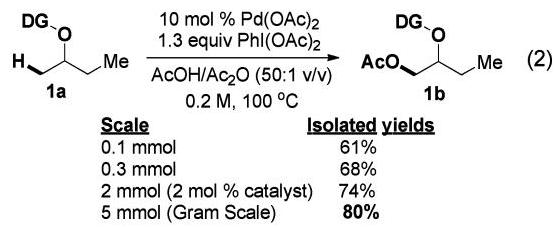
Reactions on different scales have also been examined with substrate 1a (eq 2). On larger scales, the yield was significantly higher and less catalyst was required. For example, the yield increased from 61% on a 0.1 mmol scale to 80% on a 5 mmol (gram) scale. In addition, on a 2 mmol scale, use of 2 mol % Pd(OAc) ${}_{2}$ provided a 74% yield of the product.
也使用底物1a对不同规模的反应进行了研究(方程式2)。在更大规模上,产率显著更高,所需催化剂更少。例如,产率从0.1 mmol规模的61%提高到5 mmol(克)规模的80%。此外,在2 mmol规模下,使用2 mol%的Pd(OAc) ${}_{2}$ 得到产物的产率为74%。
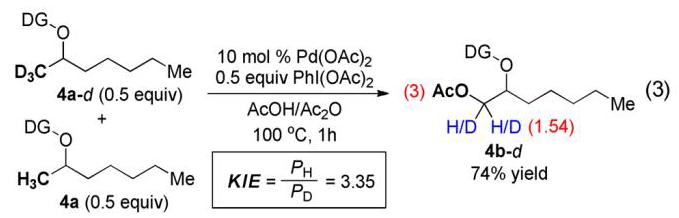
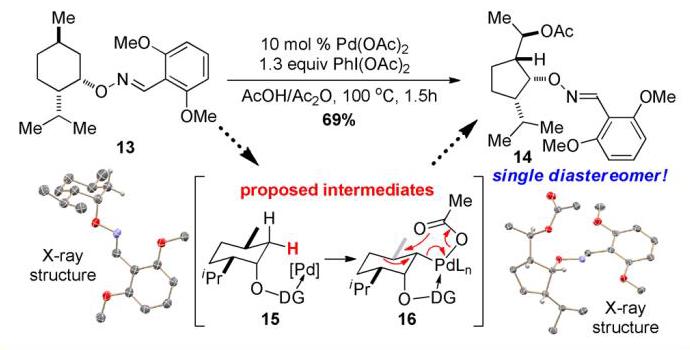
The kinetic isotope effect (KIE) was determined to briefly explore the reaction mechanism. The KIE observed in the intermolecular competition experiments $\left( {{k}_{\mathrm{H}/\mathrm{D}} = {3.35}}\right)$ is consistent with $\mathrm{C} - \mathrm{H}$ cleavage being the rate-determining step (eq 3). ${}^{21}$ was isolated as a single diastereomer in good yield. ${}^{22}$ Both the starting material (13) and product (14) were unambiguously identified by ${}^{1}\mathrm{H}$ and ${}^{13}\mathrm{C}$ NMR, IR, HRMS, and X-ray crystallography. The mechanism for this rearrangement is unclear ${}^{23}$ but likely involves an intermediate such as 16 formed via cis-palladation. Detailed mechanistic studies and extension of this transformation to other substrates will be provided in a later report.
测定了动力学同位素效应(KIE)以简要探索反应机理。在分子间竞争实验中观察到的KIE $\left( {{k}_{\mathrm{H}/\mathrm{D}} = {3.35}}\right)$ 与 $\mathrm{C} - \mathrm{H}$ 裂解是速率决定步骤一致(方程式3)。${}^{21}$ 以良好产率分离得到单一非对映异构体。${}^{22}$ 起始原料(13)和产物(14)均通过 ${}^{1}\mathrm{H}$ 和 ${}^{13}\mathrm{C}$ NMR、IR、HRMS和X射线晶体学明确鉴定。这种重排的机理尚不清楚 ${}^{23}$ 但可能涉及通过顺式钯化形成的中间体如16。后续报告将提供该转化的详细机理研究以及向其他底物的扩展。
An unusual skeleton rearrangement was observed when menthol-derived oxime 13 was used as the substrate (Scheme 3). A five-membered ring product (14) with 1,3-diol moieties
当使用薄荷醇衍生的肟13作为底物时,观察到一种不寻常的骨架重排(方案3)。具有1,3 -二醇部分的五元环产物(14)
Scheme 3. An Unusual Oxidative Rearrangement
方案3. 一种不寻常的氧化重排
Finally, we demonstrated the DG and Ac groups can be removed in excellent yields using orthogonal chemical methods (Scheme 4). Thus, the diols can be easily differentiated, which shows great potential for use in syntheses of complex natural products.
最后,我们证明了使用正交化学方法可以以优异的产率去除DG和Ac基团(方案4)。因此,二醇可以很容易地进行区分,这在复杂天然产物的合成中显示出巨大的应用潜力。
Scheme 4. Orthogonal Protecting Groups
方案4. 正交保护基团
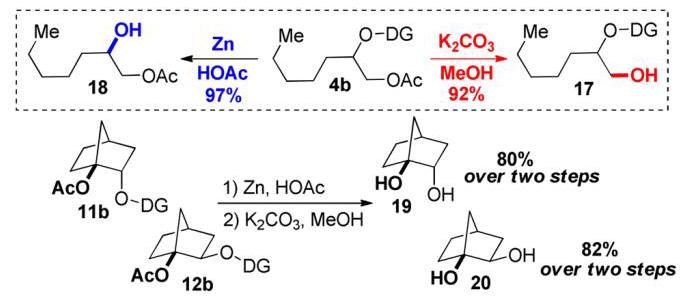
In summary, we have developed a new strategy for the Pd-catalyzed site-selective functionalization of unactivated aliphatic C-H bonds, which allows access to chemically differentiated 1,2- diols from monoalcohol derivatives. The oxime was employed as both a DG and an alcohol surrogate for this transformation. The use of exo-DGs in C-H activation, as illustrated in this work, would potentially open doors for the discovery of new transformations and new cleavable DGs. On the basis of these preliminary results, efforts toward enhancing the efficiency of the DG for higher reactivity and easier installation, expanding the substrate/reaction scope, and a detailed mechanistic study are currently ongoing.
总之,我们开发了一种新的策略用于钯催化的未活化脂肪族C - H键的位点选择性官能化,该策略允许从单醇衍生物获得化学上有差异的1,2 -二醇。肟被用作该转化的DG和醇替代物。如本工作所示,在C - H活化中使用外型DG可能为发现新的转化和新的可裂解DG打开大门。基于这些初步结果,目前正在努力提高DG的效率以实现更高的反应性和更易于安装,扩大底物/反应范围,并进行详细的机理研究。
ASSOCIATED CONTENT
相关内容
⑤ Supporting Information
⑤ 支持信息
Experimental procedures, spectral data, and crystallographic data (CIF). This material is available free of charge via the Internet at http://pubs.acs.org.
实验步骤、光谱数据和晶体学数据(CIF)。此材料可通过互联网在http://pubs.acs.org免费获取。
A AUTHOR INFORMATION
A作者信息
Corresponding Author
通讯作者
Author Contributions
作者贡献
${}^{ \dagger }$ Z.R. and F.M. contributed equally.
${}^{ \dagger }$ Z.R. 和 F.M. 贡献相同。
Notes
注释
The authors declare no competing financial interest.
作者声明不存在利益冲突。
ACKNOWLEDGMENTS
致谢
We thank UT Austin and CPRIT for a start-up fund and thank the Welch Foundation and Frasch Foundation for research grants. G.D. thanks ORAU for a new faculty enhancement award. We also thank faculty members from the organic division at UT Austin for their generous support. Dr. Lynch is acknowledged for X-ray crystallography. We thank Dr. Shoulders, Mrs. Spangen-berg, and Mr. Sorey for their NMR advice.
我们感谢德克萨斯大学奥斯汀分校和癌症预防与研究机构(CPRIT)提供启动资金,感谢韦尔奇基金会和弗拉施基金会提供研究资助。G.D. 感谢橡树岭相关大学协会(ORAU)授予新教师提升奖。我们还感谢德克萨斯大学奥斯汀分校有机化学系的教师们给予的慷慨支持。感谢林奇博士进行X射线晶体学研究。感谢肖尔兹博士、斯潘根贝格夫人和索里先生提供的核磁共振(NMR)相关建议。
REFERENCES
参考文献
(1) (a) Neufeldt, S. R.; Sanford, M. S. Acc. Chem. Res. 2012, 45, 936. (b) Chen, K.; Baran, P. S. Nature 2009, 459, 824. (c) Simmons, E. M.; Hartwig, J. F. Nature 2012, 483, 70.
(2) (a) Davies, H. M. L.; Morton, D. Chem. Soc. Rev. 2011, 40, 1857. (b) Newhouse, T.; Baran, P. S. Angew. Chem., Int. Ed. 2011, 50, 3362. (c) Chen, M. S.; White, M. C. Science 2007, 318, 783.
(3) For a recent review on Pd-catalyzed directed C-H functionaliza-tion, see: (a) Lyons, T. W.; Sanford, M. S. Chem. Rev. 2010, 110, 1147. For recent reviews on ${\mathrm{{sp}}}^{3}\mathrm{C} - \mathrm{H}$ activation, see: (b) Li, H.; Li, B.-J.; Shi, Z.-J. Catal. Sci. Technol. 2011, 1, 191. (c) Jazzar, R.; Hitce, J.; Renaudat, A.; Sofack-Kreutzer, J.; Baudoin, O. Chem.-Eur. J. 2010, 16, 2654. (d) Davies, H. M. L. J. Mol. Catal. A: Chem. 2002, 189, 125.
(4) (a) Wang, X.; Lu, Y.; Dai, H.-D; Yu, J.-Q. J. Am. Chem. Soc. 2010, 132, 12203. (b) Lu, Y.; Wang, D.-H.; Engle, K. M.; Yu, J.-Q. J. Am. Chem. Soc. 2010, 132, 5916.
(5) Simmons, E. M.; Hartwig, J. F. J. Am. Chem. Soc. 2010, 132, 17092. (6) (a) Gormisky, P. E.; White, M. C. J. Am. Chem. Soc. 2011, 133, 12584. (b) Qi, X.; Rice, G. T.; Lall, M. S.; Plummer, M. S.; White, M. C. Tetrahedron 2012, 66, 4816.
(7) Use of amine-derived DGs for selective functionalization of unactivated aliphatic C-H bonds has been recently developed by Daugulis and Chen; for seminal works, see: (a) Zaitsev, V. G.; Daugulis, O. J. Am. Chem. Soc. 2005, 127, 4156. (b) He, G.; Chen, G. Angew. Chem., Int. Ed. 2011, 50, 5192.
(8) For a review, see: Hartung, J.; Gottwald, T.; Spehar, K. Synthesis 2002, 11, 1469.
(9) (a) Espino, C. G.; Du Bois, J. Angew. Chem., Int. Ed. 2001, 40, 598. (b) Espino, C. G.; Wehn, P. M.; Chow, J.; Du Bois, J. J. Am. Chem. Soc. 2001, 123, 6935.
(10) (a) Chen, K.; Richter, J. M.; Baran, P. S. J. Am. Chem. Soc. 2008, 130, 7247. While this manuscript was in preparation, two additional related works from Baran and co-workers were reported: (b) Michaudel, Q.; Thevenet, D.; Baran, P. S. J. Am. Chem. Soc. 2012, 134, 2547. (c) Voica, A. F.; Mendoza, A.; Gutekunst, W. R.; Fraga, J. O.; Baran, P. S. Nat. Chem. 2012, 4, 629.
(11) (a) The directed activation of allylic C-H bonds to form 1,2-diols was first developed by White; see ref 6a. (b) For a synthesis of catechols from phenols via silanol-DGs, see: Huang, C.; Ghavtadze, N.; Chattopadhyay, B.; Gevorgyan, V. J. Am. Chem. Soc. 2011, 133, 17630.
(12) (a) Desai, L. V.; Hull, K. L.; Sanford, M. S. J. Am. Chem. Soc. 2004, 126, 9542. (b) Neufeldt, S. R.; Sanford, M. S. Org. Lett. 2010, 12, 532.
(13) For a single example using an oxime as an exo-DG in functionalization aromatic C-H bonds, see: Desai, L. V.; Stowers, K. J.; Sanford, M. S. J. Am. Chem. Soc. 2008, 130, 13285.
(14) (a) Mawo, R. Y.; Mustakim, S.; Young, V. G., Jr.; Hoffmann, M. R.; Smoliakova, I. P. Organometallics 2007, 26, 1801. (b) Keuseman, K. J.; Smoliakova, I. P.; Dunina, V. V. Organometallics 2005, 24, 4159 and references therein.
(15) For an important discovery of the role of ${\mathrm{{Ac}}}_{2}\mathrm{O}$ in a Pd-catalyzed C-H oxidation reaction, see: Giri, R.; Liang, J.; Lei, J.-G.; Li, J.-J.; Wang, D.-H.; Chen, X.; Naggar, I. C.; Guo, C.; Foxman, B. M.; Yu, J.-Q. Angew. Chem., Int. Ed. 2005, 44, 7420.
(16) For a related imine-DG in a stoichiometric Pd-mediated C-H activation, see: Dangel, B. D.; Godula, K.; Youn, S. W.; Sezen, B.; Sames, D. J. Am. Chem. Soc. 2002, 124, 11856.
(17) The reaction with a cyclohexyl-derived substrate only gave $\sim {20}\%$ conversion. The reaction with a 2-pentanol-derived substrate has also been attempted, and only a trace amount of $\mathrm{C} - \mathrm{H}$ activation product was detected. The difficulties with oxidation of acyclic secondary ${\mathrm{{CH}}}_{2}$ groups suggest the conformation of the substrate greatly affects the reactivity.
(18) García Martínez, A.; Teso Vilar, E.; García Fraile, A.; De La Moya Cerero, S.; Martínez Ruiz, P. Tetrahedron: Asymmetry 1998, 9, 1737.
(19) To the best of our knowledge, no such example has been reported.
(20) Olefins react under the reported conditions; see: Li, Y.; Song, D.; Dong, V. M. J. Am. Chem. Soc. 2008, 130, 2962.
(21) For a similar KIE observation in ${\mathrm{{sp}}}^{3}\mathrm{C} - \mathrm{H}$ functionalization, see: Wang, D.-H.; Wu, D.-F.; Yu, J.-Q. Org. Lett. 2006, 8, 3387.
(22) Compound 14 was isolated as a mixture of oxime $E/Z$ isomers. Cleavage of the DG revealed the corresponding alcohol as a single diastereomer.
(23) For a recent Fe-catalyzed C-H activation-initiated skeleton rearrangement, see: Bigi, M. A.; Reed, S. A.; White, M. C. J. Am. Chem. Soc. 2012, 134, 9721.